FM 3-90-1 Offense and Defense (Volume 1, March 2013) - page 3
Attack
attack criteria are a compilation of the commander’s guidance, desired effects, and high-payoff targets and
attack priorities. The amount of time available to plan the operation constrains the commander’s ability to
synchronize fire-support operations that employ well-matched effects of all available assets against
high-payoff targets.
3-44. The goal of the commander’s attack criteria is to focus fires on seizing the initiative. The
commander emphasizes simple and rapidly integrated fire support plans. This is done using quick-fire
planning techniques and good standard operating procedures (SOPs). The commander integrates fire assets
as far forward as possible in the movement formation to facilitate early emplacement. One example of this
integration would be the use of a UAS forward site team from a combat aviation brigade temporarily
attached to a fires brigade or a BFSB to identify targets for destruction. Fires concentrate (mass) on forward
enemy elements to enable maneuver efforts to close with the enemy positions. Fires can isolate forward
enemy elements by using long-range fires, air support, and electronic warfare.
3-45. Fires facilitate the attacking unit’s maneuver by destroying or neutralizing strong enemy forces and
positions. Fire systems must take full advantage of available preparation time to achieve these demanding
effects criteria. Fire plans feature the following characteristics:
z
Targets that are confirmed or denied by reconnaissance and surveillance efforts.
z
Designation of target sensor-to-shooter communication links.
z
Possible use of preparation and deception fires to shape the enemy’s defense.
z
Air support to destroy high-payoff targets on the objective and then shift to reinforcing enemy
units, artillery assets, and command and control nodes.
z
Proactive suppression of enemy air-defense efforts.
z
Preparation fires that shift just as the maneuver force arrives on the objective.
z
Suppression and obscuration fire plan to support breaching operations.
z
Pre-positioned ammunition backed by prepackaged munitions stocks capable of rapid delivery.
z
Integration of nonlethal effects, such as electronic attack and military information support
operations, into the attack guidance matrix.
z
Integration of primary and backup observers to engage high-priority targets.
z
Fire support coordination measures, accounting for danger close and other technical constraints,
to allow maneuver forces to get as close as possible to the objective before lifting fires.
z
Signals for lifting and shifting fires on the objective, primarily by combat net radio and by visual
signals as a backup means.
These later fire support coordination measures should also facilitate the massing of fires, including close air
support (CAS) and air interdiction using kill box procedures, against high-payoff targets throughout the
AO. (See FM 3-09.34 for more information on the employment of a kill box.)
PREPARING FOR AN ATTACK
3-46. Even in fluid situations, attacks are best organized and coordinated in assembly areas. If the
commander decides that rapid action is essential to retain a tactical advantage, that individual may opt not
to use an assembly area. Detailed advance planning—combined with digital communications, SOPs, and
battle drills—may reduce negative impacts of such a decision.
3-47. Unless already in an assembly area, the attacking unit moves into one during the preparation phase.
The unit moves with as much secrecy as possible, normally at night and along routes that prevent or
degrade the enemy’s capabilities to observe or detect the movement. It avoids congesting its assembly area
and occupies it for the minimum possible time. While in the assembly area, each unit is responsible for its
own protection activities, such as local ground security.
3-48. Units moving to assembly areas send out their quartering parties and link up with their guides at the
designated locations. (FM 3-90-2 discusses these aspects of troop movement.) While subordinate units
move to and occupy assembly areas, the commander completes the process of planning and coordinating
the attack.
22 March 2013
FM 3-90-1
3-9
Chapter 3
3-49. The attacking unit should continue its troop leading procedures and priorities of work to the extent
the situation and mission allow before moving to attack positions. These preparations include but are not
necessarily limited to—
z
Protecting the force.
z
Conducting task organization.
z
Performing reconnaissance.
z
Refining the plan.
z
Briefing the troops.
z
Conducting rehearsals, to include test firing of weapons and breach and gap crossings, if these
operations are envisioned to occur during the attack. (The type of rehearsal and techniques used
will vary based on the mission variables of METT-TC.)
z
Moving logistics and medical support forward.
z
Promoting adequate rest for both leaders and Soldiers.
z
Positioning the force for subsequent action.
As part of troop leading procedures, leaders at all levels should conduct a personal reconnaissance of the
actual terrain when this will not compromise operations security or result in excessive risk to the unit’s
leadership. Modern information systems can enable leaders to conduct a virtual reconnaissance when a
physical reconnaissance is not practical. If a limited-visibility attack is planned, they should also
reconnoiter the terrain at night.
3-50. A thorough reconnaissance of the objective, its foreground, and other enemy positions is a critical
part of attack preparations. The commander exploits all available reconnaissance and surveillance assets to
provide the necessary information. This includes requesting joint surveillance feeds of enemy movements
from higher echelons or imagery of enemy obstacles. Reconnaissance forces infiltrate through the enemy
security area to conduct an area reconnaissance. They can employ precision munitions and conventional
indirect fires to destroy detected enemy outposts while remaining undetected. They locate and attempt to
infiltrate the enemy’s main defensive positions to confirm enemy unit dispositions. When properly
task-organized, forces conducting reconnaissance may also be given a mission to conduct covert breaches
in the enemy’s obstacle complexes to facilitate rapid movement of the decisive or shaping operation.
3-51. During this phase, the commander positions artillery target-acquisition radars to provide support
throughout the AO. BCT and higher headquarters establish quick-fire channels between sensors, such as
counterbattery radars, and firing units assigned a counterfire mission, to rapidly silence enemy indirect fire
systems. These channels do not change command relationships or priority of fires.
3-52. The commander exercises and refines the maneuver and fire plans during rehearsals which are an
important part of ensuring the plan’s coordination and synchronization. As part of the rehearsal process, the
commander reviews the anticipated battle sequence with subordinate leaders to ensure all units understand
the plan, the relationship between fire and movement, and the synchronization of critical events. These
critical events include:
z
Moving from the assembly area to the line of departure.
z
Maneuvering from the line of departure to the probable line of deployment.
z
Occupying support by fire positions.
z
Conducting the breach or gap crossing.
z
Assaulting the objective.
z
Consolidating on the objective.
z
Exploiting success or pursuing a withdrawing enemy.
z
Actions of echelon reserves.
The unit should conduct rehearsals under as many types of adverse conditions as possible (under time and
other constraints) to identify and prepare the unit to cope with problems. At lower tactical echelons, the
rehearsal includes battle drills, such as creating lanes through minefields.
3-10
FM 3-90-1
22 March 2013
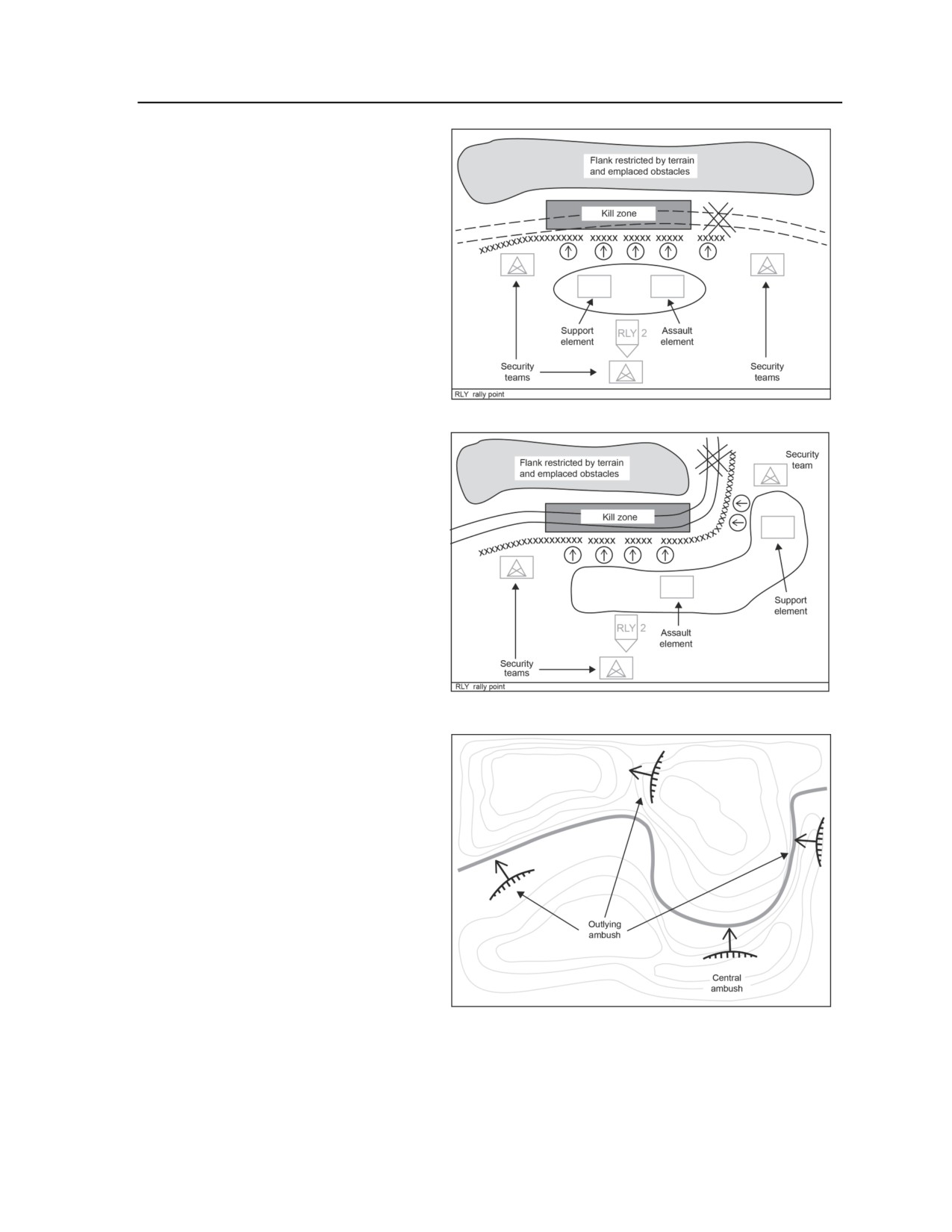
Attack
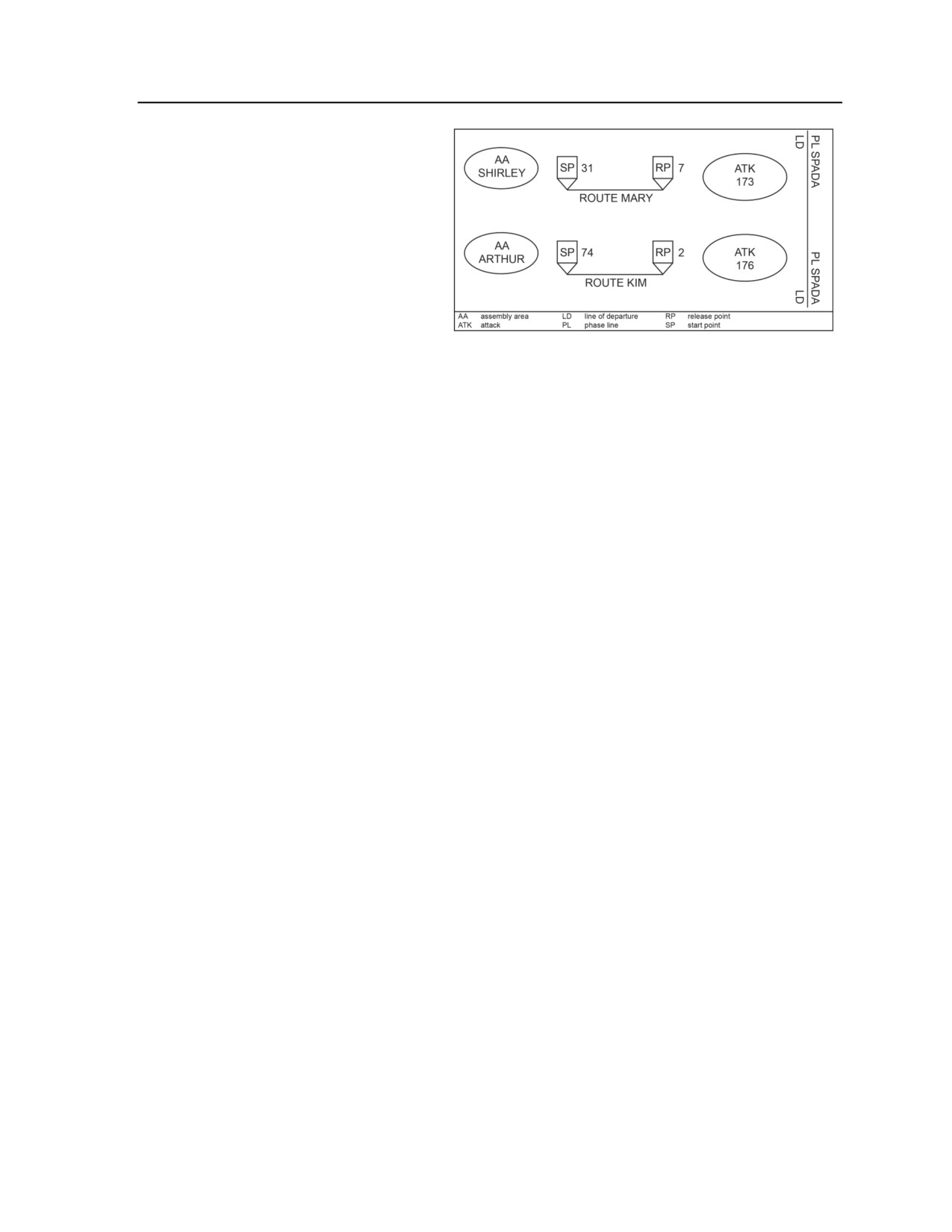
3-53. From their assembly areas,
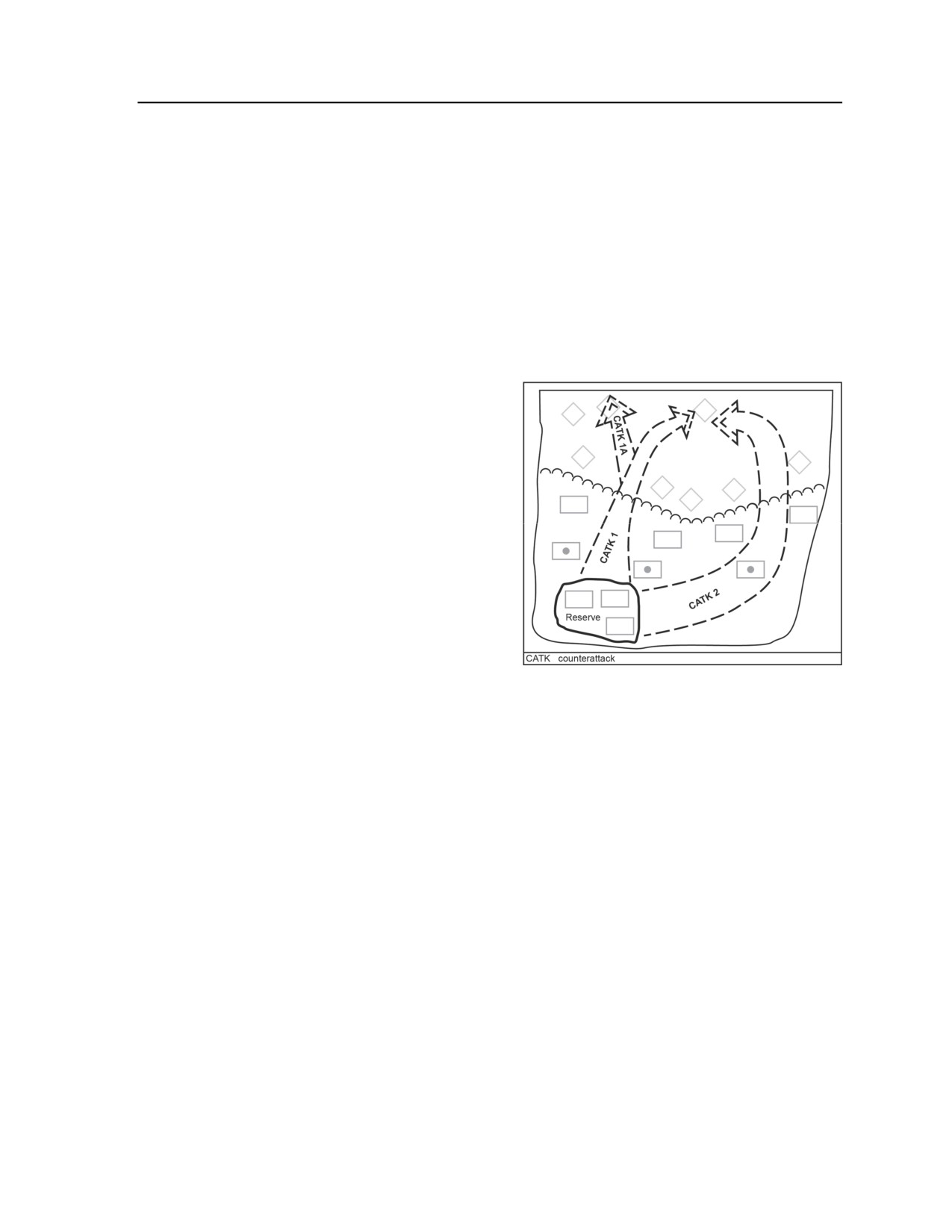
attacking units move to their respective
LDs. (See figure 3-2.) Units move from
assembly areas to the LD in the same way
as for any other tactical movement. (FM
3-90-2 discusses troop movement.) The
number of columns a unit employs in its
movement depends on the availability of
suitable routes and the friendly and enemy
situation. The tactical situation and the
order in which the commander wants
subordinate units to arrive at their attack
positions primarily govern the march
Figure 3-2. Movement from the assembly area to the
formation. Using an LD facilitates the
line of departure
simultaneous initiation of the attack at the
prescribed time by all attacking units.
3-54. Light infantry units should move by tactical vehicles to the maximum extent possible to avoid
prematurely exhausting their Soldiers. However, light infantry forces should not travel too far forward in
tactical vehicles. The enemy can detect the noise and other battlefield signatures associated with using
tactical vehicles at a greater distance than dismounted infantry Soldiers can be detected, and the enemy will
probably respond to the presence of tactical vehicles with direct- and indirect-fire systems. The commander
must weigh the need for security against the time required to conduct a foot march and its resulting effects
on Soldiers.
3-55. Units move rapidly through their attack positions and across the LD, which should be controlled by
friendly forces. A unit uses its designated attack position only by exception, such as when it must refuel
before to crossing the LD to ensure sufficient fuel to reach the objective or the conditions required to
ensure the success of the planned maneuver are not yet established. A unit does not occupy its attack
positions for more than 10 to 15 minutes without initiating actions to protect itself and increase its
survivability, such as deploying local security and camouflage nets and starting the construction of fighting
and survivability positions. If necessary, a unit can use guides to assist in occupying the attack position.
3-56. For units attacking on foot using infiltration and stealth, a commander may designate a point of
departure for the attacking units instead of an LD. Armored and Stryker-equipped units normally use gaps
or lanes through the friendly positions to allow them to deploy into combat formations before they cross the
LD.
3-57. Preliminary operations for an attack may include using preparatory fires and the relief of units in
contact by executing a relief in place (RIP) or a forward passage of lines. The relief of units may be
desirable to continue the momentum of the attack with fresh troops, change the direction of the attack,
exploit a weakness in the enemy position with reserve forces, or initiate an offensive on a stabilized front.
(FM 3-90-2 addresses the basic tactics associated with the conduct of a RIP and a forward passage of lines.)
3-58. The commander uses available artillery, mortar, CAS, air interdiction, electronic warfare, and
military information support operations
(MISO) to conduct preparation fires. Preparation fires are
developed from the top down, with bottom-up refinement. The subordinate commander most affected by
the effects of these preparatory fires must strongly emphasize the bottom-up refinement process.
Preparatory fires can accomplish the following functions:
z
Destroy the enemy.
z
Suppress, neutralize, or disrupt high-value or high-priority targets.
z
Gain fire superiority.
z
Suppress enemy forces in their defensive positions.
22 March 2013
FM 3-90-1
3-11
Chapter 3
z
Facilitate the attacking force’s maneuver.
z
Deceive the enemy.
3-59. If the attacking forces are in contact with the enemy’s security zone, preparatory fires may initially
destroy or disrupt only the enemy’s reconnaissance and security forces and positions. In either case,
counterfires conducted as part of preparatory fires serve to degrade the enemy’s fire-support systems and
assist in achieving fire superiority.
3-60. The commander ensures that attacking maneuver forces have the functional and multifunctional
support and sustainment assets necessary to conduct the operation and maintain the attack’s momentum as
part of the preparation process. That support and sustainment effort must anticipate future maneuvers to
ensure the uninterrupted advance of the maneuver force.
EXECUTING AN ATTACK
3-61. An attack consists of a series of advances and assaults by attacking units until they accomplish their
mission. (This may be the seizure or securing of a final geographic objective, or the destruction, defeat, or
disruption of a designated enemy force in accordance with the higher commander’s intent.) Commanders at
all levels must use their initiative to rapidly shift their decisive operation or main effort between units as
necessary to take advantage of opportunities and momentum to ensure the enemy’s rapid destruction.
Attacking units move as quickly as possible, following reconnaissance elements through gaps in the
enemy’s defenses. They shift their strength to reinforce success and carry the battle deep into the enemy’s
rear. A commander does not delay the attack to preserve the alignment of subordinate units or to adhere
closely to the preconceived plan of attack.
3-62. The commander must avoid becoming so committed to the initial plan that opportunities are
neglected. The commander is mentally prepared to abandon failed attacks and to exploit any unanticipated
successes or enemy errors by designating another unit to conduct the decisive operation in response to the
changing situation.
3-63. When maneuvering the force, the commander strives to retain freedom of action while protecting the
force. Although a detailed plan to defeat the enemy may exist, the commander continually seeks any
opportunity to attack to defeat, destroy, or reduce the enemy’s combat power or shatter the enemy’s
cohesion and will to fight. The commander avoids dogged adherence to a plan no longer appropriate to
current battlefield conditions. The difference between success and failure in combat often depends on the
commander’s ability to make the plan fit existing circumstances rather than trying to make circumstances
fit the plan.
SHAPING OPERATIONS
3-64. The five step discussion of offensive actions introduced in chapter 2 is used in this chapter, although
there are others ways of discussing the execution phase. Just as in chapter 2, the first three steps are usually
shaping operations or supporting efforts. These steps are presented here for discussion purposes only and
often overlap during the actual execution of attacks.
Gain and Maintain Enemy Contact
3-65. Gaining and maintaining contact with an enemy determined to break that contact is vital to the
success of offensive actions. A defending enemy generally establishes a security area around those forces
manning the main line of defense to make early contact with attacking forces to determine their
capabilities, intent, and chosen COA, and to delay their approach. The enemy commander uses that security
area to strip away friendly reconnaissance forces and hide enemy dispositions, capabilities, and intent. The
enemy commander’s goal is to compel the attacking force to conduct a movement to contact against
defending enemy forces that know the exact location of the attacking force.
3-66. A commander employs combat power to overwhelm enemy forces in accordance with the
commander’s situational understanding. However, echelons below division do not normally have the
detection, tracking, and weapon systems necessary to conduct decisive or shaping operations directed
3-12
FM 3-90-1
22 March 2013
Attack
against enemy forces not currently committed to close combat. The way a unit gains and maintains contact
depends on whether the unit is in contact with the enemy’s security area or the enemy’s main line of
resistance and the echelon of the unit in the nested layers of reconnaissance and security. For example, the
intent of a corps’ reconnaissance effort is to determine the dispositions, composition, direction of
movement, and rate of movement of a defending enemy’s significant forces. An ABCT, acting as a
covering force or advance guard, can fight through most security areas, develop the situation, confirm
information provided by technical means, and force the enemy to reveal more information than could be
acquired solely through using intelligence sensors. This additional information includes locating the
enemy’s tactical and possibly operational reserves. At a lower level, a battalion constituting the advance
guard of the main body of a brigade combat team can use its scout platoon to conduct a zone
reconnaissance that focuses on acquiring updates of enemy positions and obstacles.
3-67. The commander’s ability to sense the enemy’s actions by gaining and maintaining contact with all
significant parts of the enemy force, to include tracking enemy reserves, fire support, and follow-on forces,
increases the security of the attacking force. The commander seeks to detect the enemy’s attempts to shift
major elements of defending enemy forces or launch a counterattack. Additionally, by sending out a force
to conduct area reconnaissance with an on-order mission to be prepared to conduct a security mission, the
commander can prevent enemy reconnaissance assets from detecting the friendly force’s major movements
and increase the enemy’s risk. The risks to the enemy force increase when friendly forces impede or deny
enemy reconnaissance and surveillance assets success. Combining these factors results in providing the
attacking commander with additional time to take advantage of the changing situation. Moving within the
enemy’s decision cycle allows the commander to take advantage of successes by transitioning to the
exploitation and pursuit to complete the enemy’s destruction.
3-68. The capabilities of digital information systems offer additional techniques a commander can use to
gain and maintain enemy contact. The improved common operational picture provided by those systems
enhances the commander’s situational understanding and ensures rapid, clear communication of orders and
intent, thereby reducing the confusion and friction of battle. This is especially true when the data on those
information systems providing that common operational picture is rapidly updated from the lowest tactical
echelons. The disposition and activities of friendly and enemy forces and third-party agencies are important
elements of information. Advanced Service and joint intelligence systems feeding those information
systems enable the commander and echelon staff to detect and track enemy forces throughout a given AO
without having subordinate forces make physical contact with the enemy. The commander’s ability to see
and understand the situation before the enemy can allows the friendly force to act first and rapidly
maneuver out of contact with the enemy at a high tempo. This allows the commander to position
subordinate forces where they can overwhelm selected elements of the enemy force to disrupt and destroy
the enemy’s combined arms team. Such attacks—delivered simultaneously with precision by air, ground,
and naval systems throughout the width, height, and depth of the battlefield—stun the enemy forces and
rapidly lead to their defeat.
Disrupt the Enemy
3-69. Disrupting one or more parts of the enemy’s combined arms team weakens the entire enemy force
and allows the friendly commander to attack selected portions of the remaining enemy force in an
asymmetrical manner. The assessment and decisions regarding what to disrupt, when to disrupt, and to
what end are critical. For example, the goal of disrupting the enemy’s fire-support system is to allow
friendly forces to maneuver and mass the effects of their weapon systems against the enemy without being
engaged by the enemy’s indirect-fire weapons. Attacking forces can accomplish this by attacking enemy
forward observers, fire-direction centers, command posts, artillery, rocket systems, or ammunition. Each
set of targets requires a different amount of resources. The probability of success, the effectiveness of the
attack, and the time necessary to achieve the desired target effects varies with each set of targets.
3-70. Once any type of contact—even sensor contact—is made with the enemy, the commander seeks to
use the element of surprise to conduct shaping operations that strike at the enemy and disrupt both the
enemy’s combined arms team and the enemy commander’s ability to plan operations and control enemy
forces. Once the attacking commander begins this disruption process, it continues throughout the attack.
22 March 2013
FM 3-90-1
3-13
Chapter 3
The commander uses any existing technological advantage over the enemy in the following areas to aid the
disruption process:
z
Joint information operations core, supporting, and related capabilities and Army inform and
influence and cyber electromagnetic activities.
z
Lethal firepower effects.
z
Range of direct-fire weapons.
z
Protection.
z
Battlefield mobility and countermobility.
z
Information management.
z
Mission command systems.
3-71. Disrupting the enemy enables the commander to seize, retain, and exploit the initiative, maintain
freedom of action, impose the commander’s will on the enemy, set the terms, and select the place for battle.
That disruption also allows the commander to exploit enemy vulnerabilities and react to changing situations
and unexpected developments more rapidly than the enemy. This disruption effort usually occurs at
divisional echelons and above because lower echelons lack the necessary reconnaissance, target
acquisition, intelligence analysis, and target attack assets to engage enemy forces not committed to close
combat.
3-72. The commander plans the shaping operations to occur at the place and time necessary to establish
the conditions for the decisive operation. Targets of a shaping operation may include enemy command and
control facilities, reconnaissance and surveillance assets, fire-support systems, reserves, and logistics
support nodes. If a commander executes a shaping operation too early, the enemy has time to recover and
respond before friendly forces conducting the decisive operation can complete their maneuver.
3-73. The commander plans to use harassment, suppressive, or interdiction fires against positions likely to
contain high-payoff targets to disrupt enemy reactions to the attacking unit’s advance. These fires deny the
enemy unrestricted use of the terrain and can prevent enemy reserves from entering the fight before the
attacking friendly unit seizes the objective. Additional benefits may result from these fires over time,
including increased psychological pressure on enemy personnel and a reduction in their mental and
physical capabilities by disrupting their sleep and rest patterns.
3-74. Surprise denies the enemy the opportunity to focus and synchronize combat power against the
attacking force. It prevents the enemy from massing defending enemy forces or fires at a critical, possibly
decisive, place and time. In place of cohesive resistance, surprise can produce confusion, fear, and
piecemeal resistance. Factors that contribute to surprise include the tempo and intensity in executing the
attack plan and employing unexpected factors, such as selecting a less than optimal COA, varying
operational tactics and methods, conducting military deception operations, and ensuring OPSEC.
Fix the Enemy
3-75. A primary purpose in fixing the enemy is to isolate the objective of the force conducting the
echelon’s decisive operation to prevent the enemy from maneuvering to reinforce the unit targeted for
destruction. Since war is a contest between thinking opponents, the enemy will oppose the friendly
commander’s attempts to fix the enemy’s forces. Every friendly move causes the enemy to attempt to
counter that move. The commander does everything possible to limit the options available to the opposing
commander. Fixing an enemy into a given position or a COA and controlling the enemy’s movements limit
enemy options and reduce the amount of uncertainty on the battlefield.
3-76. Reducing uncertainty allows the friendly force to use maneuver to mass the effects of overwhelming
combat power against a portion of the enemy. It gives the commander more time to modify the attack plan
as necessary and synchronize the employment of friendly forces. It allows the commander to mass forces in
one place by using economy of force measures in other areas. The commander may also try to fix an enemy
unit, such as the enemy reserve or follow-on force, to prevent it from repositioning or maneuvering against
the force conducting the decisive operation.
3-14
FM 3-90-1
22 March 2013
Attack
3-77. Fixing the enemy must be done with the minimum amount of force. The commander normally
allocates the bulk of friendly combat power to the force conducting the decisive operation, so fixing
operations are, by necessity, shaping operations that illustrate economy of force as a principle of war.
Therefore, the commander must carefully consider which enemy elements to fix and target only those that
can significantly affect the operation’s outcome. The longer the requirement to fix these forces, the more
resources the commander needs to accomplish the mission. Generally, an enemy force only needs to be
fixed until it cannot respond to the actions of the unit conducting the decisive operation in time to affect the
outcome. This may require a commander to slow down the rate of march of an enemy unit to prevent it
from influencing the outcome of the engagement or battle.
3-78. One method of isolating the objective is to conduct a shaping operation using lethal and nonlethal
effects. Lethal effects may range from sniper fire to a joint fire plan designed to totally destroy a selected
portion of the enemy force. Nonlethal effects, such as electronic warfare, can prevent the enemy from
receiving orders or vital intelligence and combat information.
3-79. Severing enemy lines of communication over prolonged periods of time by using interdiction
measures is another way to fix the enemy. These measures can range from air interdiction that destroys
bridges and rail switching yards to ambushes conducted by infiltrating combat patrols.
3-80. Another method of fixing the enemy is to tie obstacles into the existing terrain to canalize and slow
the movement of enemy reserves. At lower tactical echelons, scatterable minefields
(employed in
accordance with the rules of engagement) can seal the objectives from possible enemy reinforcement or
counterattacks and block or disrupt enemy actions to the flanks. Military deception operations and
activities, such as demonstrations and false preparatory fires, can fix the enemy. Using extensive smoke
screens and vehicle mock-ups in a military deception effort can also assist in fixing an enemy force.
DECISIVE OPERATIONS
3-81. The commander maneuvers subordinate forces to gain positional advantage that enables the friendly
force to seize, retain, and exploit the initiative. The attacking force seeks to avoid the enemy’s defensive
strength. The commander employs tactics that defeat the enemy by attacking through a point of relative
weakness, such as a flank or the rear.
3-82. Offensive maneuver seeks to achieve a decisive massing of effects at the decisive point, or at several
decisive points if adequate combat power is available. The commander exploits maneuver by—
z
Taking maximum advantage of dead space and covered and concealed routes to close with the
enemy.
z
Using advantages in the effective ranges of weapon systems.
z
Repositioning friendly forces rapidly.
z
Navigating accurately cross-country.
z
Obtaining situational understanding of friendly and enemy locations.
z
Taking effective security measures.
z
Synchronizing the application of all elements of combat power at a time and place on the
battlefield to maximize their effects.
3-83. The key to success is to strike hard and fast, overwhelm a portion of the enemy force, and then
quickly transition to the next objective or phase, thus maintaining the momentum of the attack without
reducing the pressure on the enemy. The commander must retain freedom of maneuver with multiple COAs
throughout the operation and responsive sustainment. Additionally, the commander must make every effort
to locate and track enemy reserve and follow-on forces, which prevents friendly forces from being attacked
unexpectedly by significant enemy forces. This allows the commander time to delay, disrupt, or destroy
these enemy forces before they can interfere with the attack.
3-84. Depending on the mission variables of METT-TC, artillery and mortars may advance with the
attacking formation or move forward by bounds. The echelon fire support coordinators (FSCOORDs)
position direct support and reinforcing artillery in coordination with their maneuver commanders. The force
field artillery headquarters, normally a fires brigade headquarters, coordinates position areas for general
22 March 2013
FM 3-90-1
3-15
Chapter 3
support and general support-reinforcing artillery units through the fires cells organic to the corps, division,
and brigade headquarters. The commander considers the maneuver of fire support assets along with
maneuver forces to ensure that proper fire support is available at all times.
3-85. The maneuver process normally follows this sequence:
z
Movement from the LD to the PLD.
z
Actions at the PLD, assault position, or FCL.
z
Breaching operations.
z
Actions on the objective.
The movement from the assembly area to the LD that precedes many attacks is troop movement and is
discussed in FM 3-90-2.
MOVEMENT FROM THE LINE OF DEPARTURE TO THE PROBABLE LINE OF DEPLOYMENT
3-86. The unit transitions from troop movement to maneuver once it crosses the LD. It moves aggressively
and as quickly as the terrain and enemy situation allow. It moves forward using appropriate movement
techniques assisted by the fires of supporting units. Fire and movement are closely integrated and
coordinated. Effective suppressive fires facilitate friendly movement, and friendly movement facilitates
more effective fires. Whenever possible, the attacking unit uses avenues of approach that avoid strong
enemy defensive positions, takes advantage of all available cover and concealment, and places the unit on
the flanks and rear of the defending enemy. Where cover and concealment are not available, the unit uses
obscurants to conceal its movement. Any delays in establishing obscuration and suppressive fires before
crossing the PLD may require the attacking unit to occupy its assault positions.
3-87. Artillery and other ground-based fires assets move as necessary to ensure that the attacking unit
remains within supporting range. The commander’s analysis of the time it takes the maneuver unit to move
from the LD to the PLD and the distances involved ensures that artillery systems are prepared to provide
support before maneuver units move inside the effective range of enemy direct-fire weapon systems. The
commander keeps attacking artillery forces out of enemy artillery range as long as possible. The existence
of enemy artillery systems that have a longer range than fielded U.S. artillery systems complicates this
process. The commander uses fires delivered from fixed- and rotary-wing systems and the autonomous
operation capabilities of modernized artillery systems to help counter any enemy range advantage.
3-88. If the commander expects to make enemy contact at or shortly beyond the LD, the unit deploys so as
to maintain maximum firepower against the enemy’s known positions. The commander selects the combat
formation that best balances firepower, tempo, security, and control in the specific situation. The
commander has the option of deploying a security force in front of the attacking unit. The commander may
also employ a flank or rear security force if required by the enemy situation. The commander may not want
to change formations during the attack because of potential loss of momentum resulting from such changes.
If the commander finds it necessary to transition from one combat formation to another, that transition
should be based on thoroughly trained drills. Once enemy contact is expected, the force transitions to the
bounding overwatch technique of movement. (FM 3-90-2 addresses movement techniques.)
3-89. Between the LD and the PLD, the attacker seizes intermediate objectives only to eliminate enemy
positions or bring additional suppressive fires to bear. Artillery, rocket, electronic warfare (EW), and aerial
assets engage targets of opportunity. The commander uses CAS and artillery to destroy enemy security
forces. As the unit approaches suspected enemy positions or danger areas, the commander directs
subordinate forces to occupy pre-designated support by fire positions. Lethal fires, suppression, and
obscuration enable attacking forces to occupy these positions. The commander uses direct-fires from these
positions to suppress enemy forces while other portions of the unit continue their advance toward the
objective.
3-90. The commander engages known enemy forces with the maximum possible combat power to
overwhelm them as quickly as possible. An attacking unit that encounters small enemy units on the way to
the objective either quickly overruns or bypasses them, if they meet the bypass criteria. The attacking unit
then reports the location of bypassed enemy elements to its higher headquarters and maintains contact until
3-16
FM 3-90-1
22 March 2013
Attack
they can be handed off to follow and support forces. The commander uses minimal force to maintain that
contact to avoid significantly weakening the force conducting the unit’s decisive operation.
ACTIONS AT THE PROBABLE LINE OF DEPLOYMENT, ASSAULT POSITION, OR FINAL
COORDINATION LINE
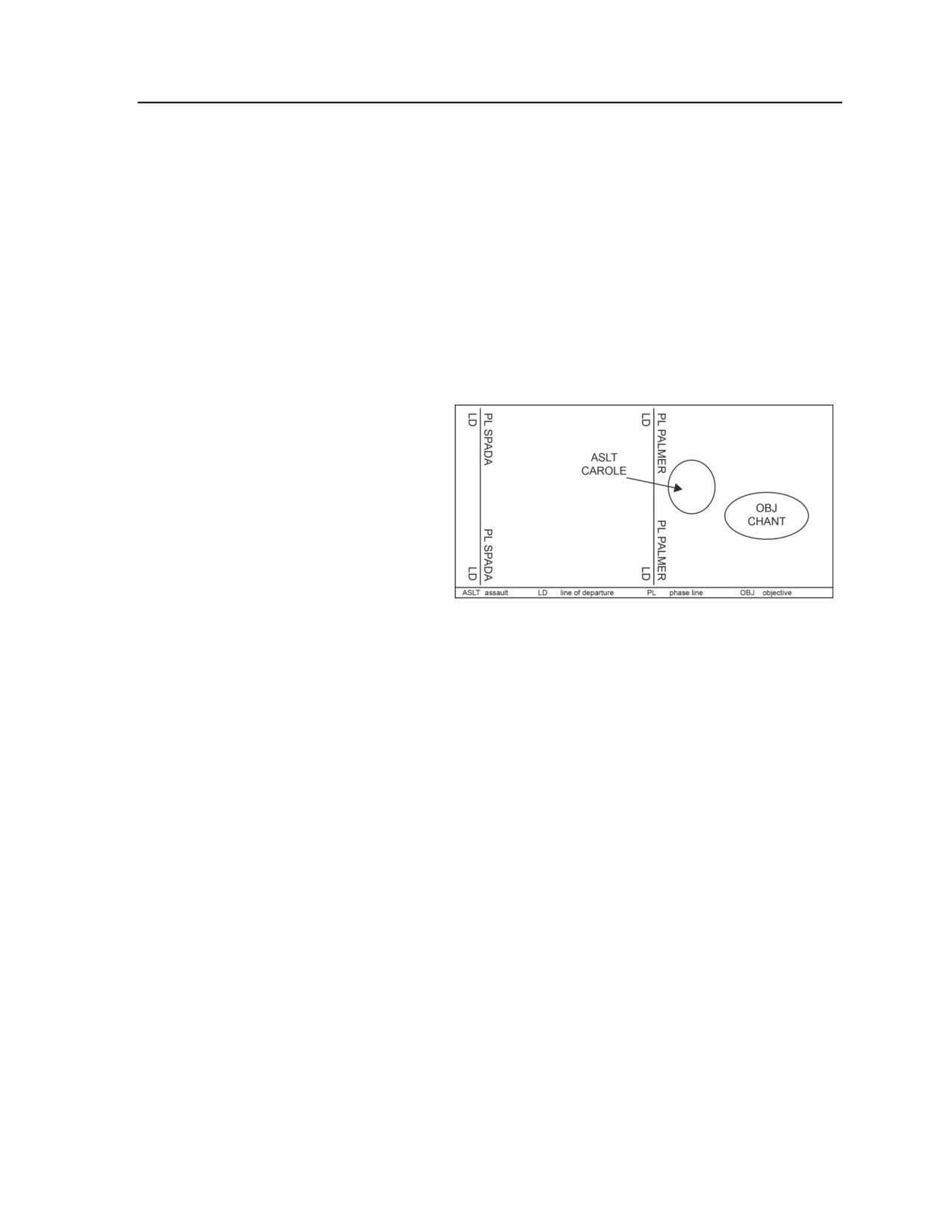
3-91. The attacking unit maintains the pace of its advance as it approaches its PLD. (See figure 3-3.) The
commander divides the attacking unit into one or more assault and support forces either before or upon
reaching the PLD. At the PLD infantry Soldiers dismount from their combat vehicles, if necessary. All
forces supporting the assault force should be set in their support by fire positions before the assault force
crosses the PLD. The commander synchronizes the occupation of these support by fire positions with the
maneuver of the supported attacking unit to limit the vulnerability of the forces occupying these positions.
The commander uses unit tactical SOPs, battle drills, prearranged signals, engagement areas (EAs), and
target reference points (TRPs) to control the direct fires from these supporting positions. A commander
normally employs restrictive fire lines between converging forces.
3-92. The PLD can be co-located with
the assault position. (See figure 3-3.) The
commander ensures that the final
preparations of the breach force in an
assault position do not delay its maneuver
to the breach point as soon as the
conditions are set. Whenever possible, the
assault force rapidly passes through the
assault position. It may have to halt in the
assault position while fires are lifted and
shifted. In this case, if the enemy
anticipates the assault, the assault force
Figure 3-3. Probable line of deployment and assault
deploys into covered positions, screens its
positions
positions with smoke, and waits for the
order to assault. As long as the assault force remains in the assault position, support forces continue their
suppressive fires on the objective.
3-93. Once the support force sets the conditions, the breach force reduces, proofs, and marks the required
number of lanes through the enemy’s tactical obstacles to support the maneuver of the assault force. To
avoid confusion, the commander clearly identifies the conditions that allow the breach force to proceed.
From the PLD, the assault force maneuvers against or around the enemy to take advantage of the support
force’s efforts to suppress the targeted enemy positions. The support force employs direct and indirect fires
against the selected enemy positions to destroy, suppress, obscure, or neutralize enemy weapons and cover
the assault force’s movement. The assault force must closely follow these supporting fires to gain ground
that offers positional advantage. This COA normally results in the fewest casualties.
3-94. The key to forward movement when the assault force is under enemy direct fire is to return effective
fire, which prevents the enemy from firing effectively at the moving assault force. Destructive or
suppressive fires are most effective when fired by the stationary support force. These fires prevent the
enemy from firing effectively at the moving assault force. Once the support force is in position and the
assault force is prepared to move, the support force places a heavy volume of fires on the enemy forces to
destroy, neutralize, or suppress them. The ability of the support force to move to advantageous terrain is
critical to accomplishing its purpose of ensuring the assault force’s success. Once it suppresses the enemy
position, it reduces its rate of fire to sustainable levels to conserve ammunition as the assault force closes
on the objective to ensure that it has enough to support the assault. When the assault force nears its
objective, the support force increases its rate of fire to ensure the continued suppression of the enemy. This
allows the assault force to assault the position before the enemy can react. Either on signal or when the
assault begins, the support force ceases fire, shifts its fire to another target area, or walks its fire across the
objective in front of the assault force.
22 March 2013
FM 3-90-1
3-17
Chapter 3
3-95. The commander uses smoke to help conceal units and individual weapons. It degrades enemy laser
designators, range finders, and directed energy weapons. When planning to employ smoke, the commander
remembers that smoke can have the same effects on friendly and enemy forces. During the assault, the
commander uses obscuration to blind the enemy and screen friendly movement onto the objective if
possible. Obscuration is placed in front of enemy positions, on the far side of obstacles, and in areas that
restrict maneuver. The commander may use a smoke haze over the echelon support area to limit enemy
observation. The neutralization of enemy thermal viewers requires the use of multispectral smoke.
ACTIONS ON THE OBJECTIVE
3-96. The commander employs overwhelming and simultaneous fire, movement, and shock action during
the final assault. This violent assault destroys, defeats, or drives the enemy from the objective area. Small
units conduct the final assault while operating under the control of the appropriate echelon command post.
Armored forces have the option of conducting this final assault in either a mounted or dismounted
configuration.
3-97. The commander employs all fire support means to destroy and suppress the enemy and sustain the
momentum of the attack. By carefully synchronizing the effects of indirect-fire systems and available CAS,
the commander improves the likelihood of success. The commander plans fires in series or groups to
support maneuver against enemy forces on or near the geographical objective. As the commander shifts
artillery fires and obscurants from the objective to other targets, the assault element moves rapidly across
the objective. The support elements must maintain suppressive fires to isolate the objective and prevent the
enemy from reinforcing or counterattacking. They also destroy escaping enemy forces and systems. The
commander employs joint information operations and Army information tasks, such as electronic warfare,
to attack enemy command and control information systems as part of this effort.
3-98. Supporting artillery may need to displace forward during the attack to ensure maximum support is
available for the assault. However, changes in position are limited because they reduce the volume of
available fires. The commander balances the need to maintain that amount of artillery support against the
enemy’s counterfire capabilities with the need to provide continued coverage as the attacking unit
continues to move forward. Supporting artillery, rocket, and mortar assets move into their new positions
one subordinate unit at a time, by echelon, to maintain support throughout the attack. The commander can
use any available CAS to provide supporting fires while artillery batteries displace.
3-99. Small enemy units moving toward the penetrated area can disrupt the synchronization of this final
assault. As small units and weapon systems crews become engaged, they tend to focus on their immediate
opponent rather than the overall situation. Loss of situational understanding, combined with the enemy’s
more detailed knowledge of the terrain, allows small enemy forces to inflict a great deal of damage on the
attacking force. The attacking unit’s leaders must understand the flow of combat and retain the capability to
engage these enemy forces before they can alter the outcome of the assault. The commander can commit
the echelon reserve to maintain the attack momentum and keep relentless pressure on the enemy. This also
hinders enemy attempts to stabilize the situation.
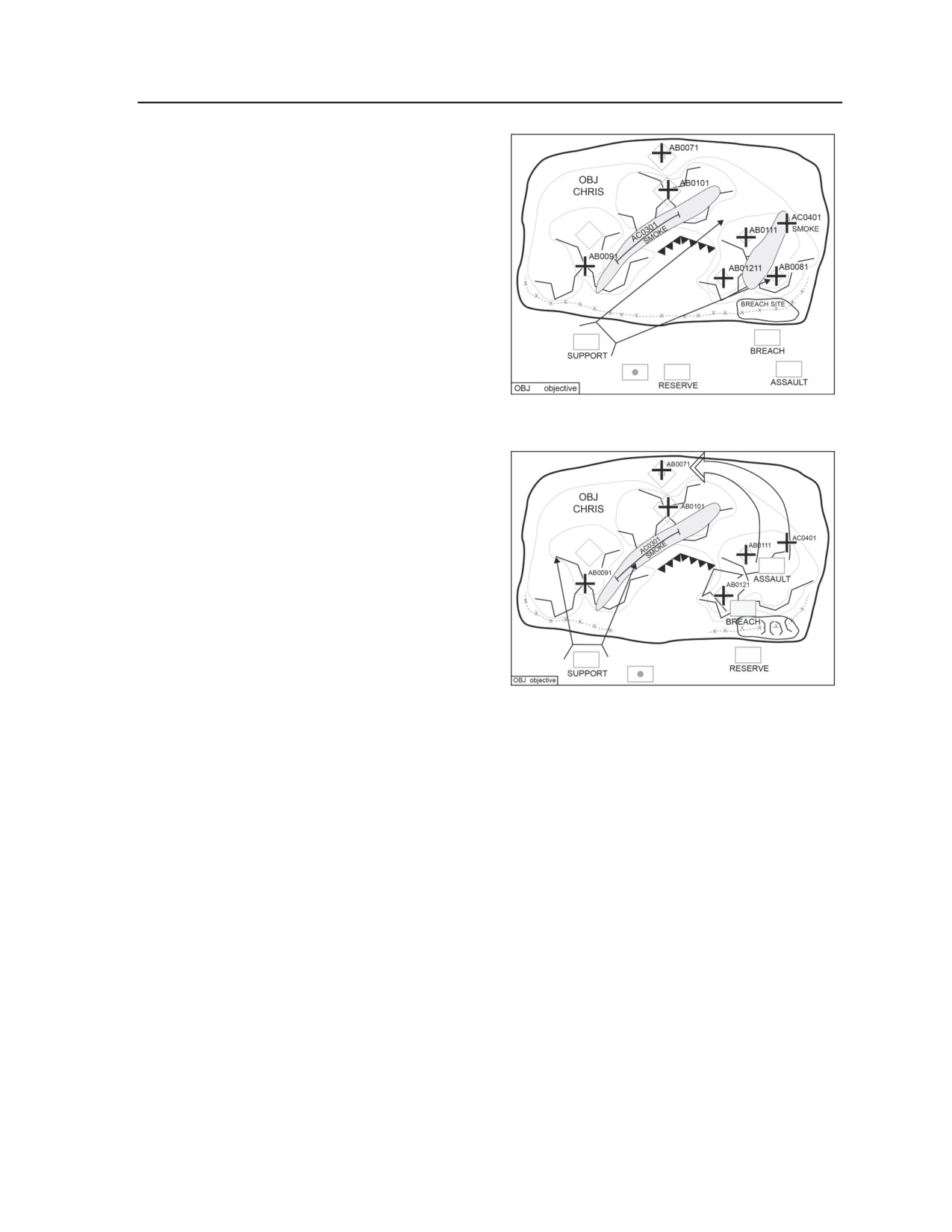
3-100. Against a well-prepared, integrated enemy defense, the commander must isolate and destroy
portions of the enemy defense in sequence. (See figures 3-4 and 3-5.) Friendly forces must isolate,
suppress, obscure, and bypass selected enemy positions. For example, smoke delivered by field artillery
and mortars in front of the objective—between the force and the enemy—screens friendly movement and
obscures the enemy’s weapon systems. Fires placed on and beyond the flanks of the objective isolate the
enemy’s position. These fires include smoke, high explosives, improved conventional munitions, and
precision-guided munitions delivered by a mix of field artillery, fixed-wing aviation assets, and attack
helicopters conducting close combat attack. In addition, the commander may employ short-duration
scatterable mines in conjunction with terminally guided munitions to help isolate and impair the enemy’s
ability to counterattack. (Their use must not impede the commander’s conduct of exploitation and pursuit
operations.) Jamming can be used to cut information system links between the enemy’s maneuver force and
its supporting artillery. The commander can also use available CAS to accomplish these tasks.
3-18
FM 3-90-1
22 March 2013
Attack
3-101. The commander masses overwhelming
combat power in sequence against isolated centers
of resistance. The assault element commander can
task organize the element to assault one portion of
the objective at a time. For example, within the
assault company of a battalion-level attack, two
platoons may suppress while one platoon seizes a
portion of the company objective. This initial
platoon, having seized a foothold, then suppresses
to allow a second platoon to continue the assault.
The third platoon may have a third portion of the
objective assigned to it to seize in turn. The enemy
may attempt to reinforce its defending forces or
counterattack during the friendly force’s attack.
Once the attacking force reaches the far side of the
objective, selected elements clear remaining
Figure 3-4. Attack of an objective: the
pockets of resistance while the bulk of the assault
breach
force prepares for a possible enemy counterattack.
After the assault force reaches the objective, the
support force leaves its support by fire position and
rejoins the assault force or moves to a blocking
position to counter possible enemy counterattacks.
Mounted Assault
3-102. In determining whether to conduct a
mounted or dismounted attack, the commander
considers the primary mission variables of the
terrain, obstacles, and the strength of enemy
anti-armor defenses. Mounted assaults accelerate
the execution of the operation by allowing the
greatest speed and shock action and providing the
best protection against small arms and indirect fires
Figure 3-5. Attack of an objective: the
while conserving the strength of the infantry
assault
Soldiers conducting the assault.
3-103. When facing weak, hastily prepared, disorganized resistance, or when attacking with overwhelming
combat power, an armored or Stryker-equipped force commander can conduct a mounted assault. The
commander conducting a mounted assault concentrates all supporting fires to destroy and neutralize the
enemy and fix local reserves. Tanks, infantry fighting vehicles, and amphibious assault carriers use their
cannons and machineguns to engage targets for as long as possible. As the fires from one type of weapon
are lifted or shifted, other weapons increase their rate of fire. The assault force advances close to its
objective under the cover of these supporting fires.
3-104. The assault force attacks using shock action and firepower to rapidly overrun the enemy position as
soon as the commander shifts supporting fires beyond the objective. Mechanized infantry elements move as
close as possible to the objective while remaining mounted in their combat vehicles. When the danger to
the mounted infantry elements exceeds the protection offered by their combat vehicle, the commander
gives the order for infantry elements to dismount from their carriers.
3-105. The following technique for securing an objective applies to an armored or Stryker equipped force
assigned the mission of rapidly clearing an objective against an enemy that does not have a robust
anti-armor capability. First, the force overruns the objective. Then, the accompanying mechanized infantry
Soldiers dismount from their combat vehicles on the far side of the objective and sweep the objective from
the far side back to the near side to clear any remaining pockets of resistance. The ability of armored and
Stryker forces to closely follow friendly mortar and artillery fires, as they shift across the objective, is a
22 March 2013
FM 3-90-1
3-19
Chapter 3
major advantage. The commander secures the objective immediately after supporting fires are shifted to
deny the enemy time to move from protective to firing positions.
Dismounted Assault
3-106. An armored or Stryker equipped force commander usually conducts a dismounted assault when any
of the following conditions apply:
z
Terrain favors dismounted operations.
z
The enemy is in prepared positions.
z
The enemy has a strong anti-armor capability.
z
Tanks are not available to lead the assault even though the mission variables of METT-TC favor
their employment.
z
Obstacles prevent maneuver across the objective.
z
Stealth is required to close on the objective.
z
A mounted assault stalls on or short of the objective.
The commander determines if, when, and where any mechanized infantry forces will dismount from their
combat vehicles based on analysis of the mission variables of METT-TC and the degree of acceptable risk.
3-107. An attacking force should consider advancing beyond the geographical boundaries of enemy
defensive positions whenever possible before stoping to consolidate and reorganize when attacking
enemies with considerable artillery and mortar capabilities. This is because enemies with these indirect fire
capabilities are likely to have developed preplanned targets on those positions for rapid engagement in case
of their loss and to support enemy counterattacks.
Consolidation
3-108. Once an attacking force takes an enemy position, it consolidates on that position if doing so is
tactically necessary or advantageous. Consolidation is organizing and strengthening a newly captured
position so that it can be used against the enemy. Normally, the attacking unit tries to exploit its success;
however, in some situations the unit may have to pause to consolidate its gains. Consolidation may vary
from a rapid repositioning of forces and security elements on the objective, to a reorganization of the
attacking force, to the organization and detailed improvement of the position for defense. Actions taken to
consolidate gains include—
z
Conducting reconnaissance.
z
Establishing security.
z
Eliminating enemy pockets of resistance.
z
Positioning forces to enable them to conduct a hasty defense by blocking possible enemy
counterattacks.
z
Adjusting the fire planning.
z
Preparing for potential additional missions.
3-109. Immediately after the assault, the commander must maintain contact with those enemy forces that
have abandoned the objective. If the attacking force has destroyed all enemy forces on the objective, the
commander takes those actions necessary to regain contact with the enemy. Patrols are sent in any direction
required to maintain or regain contact with the enemy within the unit’s AO. Higher echelon commanders
reposition their intelligence collection assets and adjust their missions as necessary to maintain that contact.
3-110. The commander also dispatches patrols to ensure contact with any adjacent friendly units. A unit is
normally responsible for establishing contact with the units to its front and right as defined by the direction
to the enemy. The unit commander also establishes contact with friendly units to the left and rear, unless
those units are preparing to establish contact. Otherwise, a dangerous gap could occur, which the enemy
could exploit during a counterattack.
3-111. As soon as the attacking force occupies the objective it establishes security. Each subordinate
element establishes observation posts (OPs) that monitor likely enemy avenues of approach and conduct
3-20
FM 3-90-1
22 March 2013
Attack
other security operations. Units must remain aware that the enemy will have defensive fires planned on
these formerly occupied positions, including headquarters bunkers and supply caches.
3-112. Once subordinate units seize the objective, they clear it of enemy forces. They then occupy firing
positions to prepare for an enemy counterattack. Normally, an attacking unit does not occupy vacated
enemy positions because the enemy is familiar with and normally targets them. Therefore, the attacking
unit should position itself away from established enemy positions, usually on the next defensible piece of
terrain. This positioning is also important because the unit needs to orient on different avenues of approach
and in a different direction. The commander positions armored and antitank systems in overwatch to cover
likely enemy mounted avenues of approach. Mechanized infantry forces normally dismount and orient
along likely dismounted and mounted avenues of approach. Mortars, command posts, and sustainment
assets move forward to assist in the consolidation.
3-113. The commander should preplan the location and future missions of each element. Artillery and
other fire support systems mass fires on enemy assembly areas and troops forming for counterattacks. The
commander may alert the reserve to protect the flanks of the attacking units, hold ground seized by them, or
counter an enemy counterattack. The commander may use antitank minefields or other obstacles to cover
likely enemy avenues of approach. As the unit has time and resources, it improves these obstacles and
defensive positions.
3-114. The commander normally designates TRPs, final protective fires, engagement areas, and other
direct- and indirect-fire control measures as part of the consolidation process. Once in position, subordinate
elements modify preplanned measures and improve defensive capabilities as required. As local security is
being established, the commander directs subordinate elements to conduct mounted or dismounted patrols
along likely enemy avenues of approach. The echelon scout or cavalry unit deploys beyond these local
security patrols to conduct its reconnaissance or security mission.
Reorganization
3-115. Reorganization includes all measures taken by the commander to maintain unit combat
effectiveness or return it to a specified level of combat capability. Commanders of all types of units at
each echelon conduct reorganization. Any reorganization actions not completed when conducting the attack
are accomplished during consolidation. These actions include—
z
Redistributing or cross-leveling supplies, ammunition, and equipment as necessary.
z
Matching operational weapon systems with crews.
z
Forming composite units by joining two or more attrited units to form a single, mission-capable
unit.
z
Replacing key personnel lost before or during the battle.
z
Reporting unit location and status to keep the next higher commander informed; digitized units
can do this automatically.
z
Recovering, treating, and evacuating casualties, prisoners of war, and damaged equipment in
accordance with its SOP.
z
Resupplying basic loads of ammunition, fuel, and repair parts.
z
Integrating replacement Soldiers and systems into the unit.
z
Revising communication plans as required.
z
Placing the unit’s command posts in position to conduct further operations and control the
consolidation.
z
Reestablishing unit cohesion.
z
Conducting essential training, such as training replacements on the unit’s SOP.
FOLLOW THROUGH
3-116. After seizing the objective, the commander has two alternatives: exploit success and continue the
attack or terminate the offense. After seizing an objective, the most likely on-order mission is to continue
the attack. By continuing the attack the commander seeks to achieve a breakthrough that can be turned into
22 March 2013
FM 3-90-1
3-21
Chapter 3
an exploitation or a pursuit. A breakthrough is a rupturing of the enemy's forward defense that occurs
as a result of a penetration. A breakthrough permits the passage of an exploitation force. At BCT
echelon and below, the unit maintains contact and attempts to exploit its success. Normally, an intermediate
tactical commander, such as a division or corps commander, makes the decision regarding whether to
initiate a general—as opposed to local—exploitation or pursuit or terminate offensive actions.
3-117. During consolidation, the unit commander and staff continue troop leading procedures in
preparation for any on-order missions. They use available combat information and intelligence products to
adjust contingency plans. The commander redirects the unit’s intelligence collection effort to support the
next mission.
3-118. Fire support assets move quickly to take advantage of the natural reduction in support requirements
that occurs when a position is taken. Field artillery units reposition to where they can support a renewed
attack when ammunition supply and enemy action permit. Attacks by rotary- and fixed-wing manned and
unmanned aircraft can provide support while artillery systems reposition. Road conditions, such as
destroyed bridges or large numbers of dislocated civilians, and the unit’s cross-country mobility will affect
the exact time of repositioning.
3-119. The commander attempts to exploit the deterioration of the enemy position by administering quick
and powerful blows before the enemy can reconstitute an effective defense. The commander’s employment
of precision-guided munitions, combined with the action of large, armored or Styker formations and air
support, may achieve decisive results.
3-120. Ordinarily, a defending enemy force will attempt to hold a position until nightfall to be able to
complete its withdrawal under the cover of darkness. The attacking unit maintains relentless pressure,
continuing the attack at night. Through these attacks, the unit maintains contact with the enemy, keeps the
enemy off balance, and makes the enemy force’s withdrawal from action extremely difficult. If the enemy
tries to delay, the unit continues its attack, concentrating its efforts on enveloping or encircling the
retrograding enemy force, if the enemy is too strong to overrun. An attack aggressively pushed through the
hostile front may isolate major elements and force the enemy force to evacuate the entire defensive position
before it can construct a viable fall-back position.
3-121. When conducting a successful penetration, attacking units penetrate deeply into the hostile position
to attack enemy reserves, artillery, command and control nodes, and lines of communication. Either the
assault or a support unit attacks the enemy’s newly exposed flanks to widen the gap. The commander sends
forces through the gap that have a high degree of tactical mobility to exploit the penetration, attack the
enemy from the rear, and prevent the enemy’s escape. At this time, the commander’s force multipliers—
such as fixed-wing aviation assets—concentrate on supporting the ground force exploiting the penetration.
3-122. The commander plans logical sequels to the attack as part of the follow through. Attacking forces
plan for exploitation. Exploiting forces plan for the pursuit of a defeated enemy. Furthermore, the
commander must use subordinate forces without overextending their sustainment capabilities. The
commander must plan to have fresh units pass around or through forward units to sustain the momentum of
the attack. These fresh units may be assigned the task of follow and support or follow and assume in an
effort to maintain the attack’s tempo. (Appendix B discusses both tactical mission tasks.) A commander of
any unit conducting any offensive task envisions how, under what conditions, where, and when that unit
will need to transition to the defense, based on possible enemy countermoves and other events.
3-123. If the attacking unit transitions to a pursuit or exploitation, it may have to bypass enemy units to
maintain the tempo. Units bypass enemy forces according to previously established bypass criteria. As a
minimum, the bypassed force remains under observation or fixed in place by other units.
3-124. If the enemy succeeds in withdrawing major forces from action, the commander intensifies
reconnaissance to obtain the information necessary to decide on a COA. Aggressive action may prevent the
enemy from reconstituting an effective defense in a rearward position. The commander may have to delay
the renewal of the attack until completing additional reconnaissance, so a tactically sound plan can be
formulated if the enemy succeeds in occupying new defensive positions.
3-22
FM 3-90-1
22 March 2013
Attack
SPECIAL PURPOSE ATTACKS
3-125. The commander can launch an attack to achieve various results or for special purposes. These
subordinate attack tasks include the—
z
Ambush.
z
Counterattack.
z
Demonstration.
z
Feint.
z
Raid.
z
Spoiling attack.
3-126. The commander’s intent and mission variables of METT-TC determine the specific attack form. As
subordinate attack tasks, they share many of the planning, preparation, and execution considerations of the
attack. This section discusses the unique considerations of each subordinate attack task. Demonstrations
and feints, while forms of attack, are also associated with the conduct of military deception operations. (See
JP 3-13.)
AMBUSH
3-127. An ambush is an attack by fire or other destructive means from concealed positions on a
moving or temporarily halted enemy. An ambush stops, denies, or destroys enemy forces by maximizing
the element of surprise. Ambushes can employ direct fire systems as well as other destructive means, such
as command-detonated mines, indirect fires, and supporting nonlethal effects. They may include an assault
to close with and destroy enemy forces. In an ambush, ground objectives do not have to be seized and held.
3-128. The three forms of an ambush are the point ambush, the area ambush, and the anti-armor ambush.
In a point ambush, a unit deploys to attack a single kill zone. In an area ambush, a unit deploys into two or
more related point ambushes. A unit smaller than a platoon does not normally conduct an area ambush.
Anti-armor ambushes focus on moving or temporarily
halted enemy armored vehicles.
3-129. Ambushes are categorized as hasty or deliberate but
take place along a continuum. A hasty ambush is an
immediate reaction to an unexpected opportunity conducted
using SOPs and battle drill. A deliberate ambush is planned
as a specific action against a specific target. Detailed
information about the target; such as size, organization, and
weapons and equipment carried, route and direction of
movement, and times the target will reach or pass certain
points on its route, may be available. All forces may
conduct an ambush. There are no ambush specific control
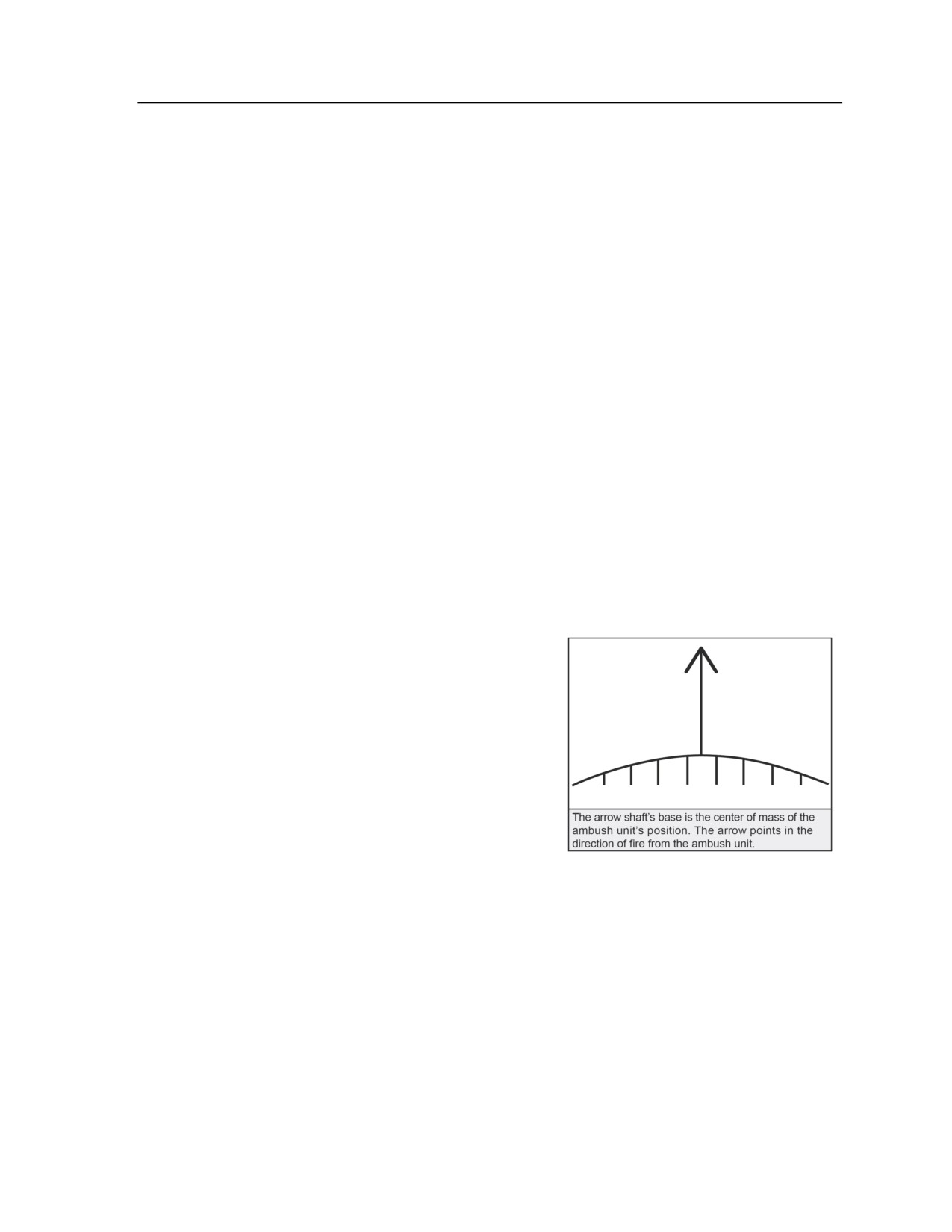
measures. (Figure 3-6 shows the ambush tactical mission
graphic.) Doctrine also categorizes ambushes as near or far
Figure 3-6. Ambush tactical mission
ambushes, based on the proximity of the friendly force to
graphic
the enemy.
3-130. The normal goal of an ambush is the death or capture of all enemy personnel located within the kill
zone. Another goal could be to destroy certain designated vehicles, such as all missile transporter-erector
launchers. Ideally, the ambush force can destroy the ambushed enemy so quickly that enemy personnel
within the kill zone cannot to report the engagement while the ambush force accomplishes its mission.
Organization of Forces
3-131. A typical ambush is organized into three elements: assault, support, and security. The assault
element fires into the kill zone. Its goal is to destroy the enemy force. When used, the assault force attacks
into and clears the kill zone and may be assigned additional tasks, to include searching for items of
intelligence value, capturing prisoners, and completing the destruction of enemy equipment to preclude its
22 March 2013
FM 3-90-1
3-23
Chapter 3
immediate reuse. The support element supports the assault element by firing into and around the kill zone,
and it provides the ambush’s primary killing power. The support element attempts to destroy the majority
of enemy combat power before the assault element moves into the objective or kill zone. The security
element isolates the kill zone, provides early warning of the arrival of any enemy relief force, and provides
security for the assault and support elements. It secures the objective rally point and blocks enemy avenues
of approach into and out of the ambush site, which prevents the enemy from entering or leaving.
Planning an Ambush
3-132. During terrain analysis, leaders identify at least four different locations: the ambush site, the kill
zone, security positions, and rally points. As far as possible, so-called "ideal" ambush sites should be
avoided because alert enemies avoid them if possible and increase their vigilance and security when they
must be entered. Therefore, surprise is difficult to achieve. Instead, unlikely sites should be chosen when
possible. Other planning considerations for an ambush include—
z
A “no-later-than” time to establish the ambush.
z
A tentative ambush formation or, for an area ambush, element locations.
z
Insertion and exit routes.
z
A forward passage of lines and movement to the ambush site in tactical formation.
z
Actions if the ambush is prematurely detected.
z
A scheme of maneuver that maximizes engagement of the enemy’s flank or rear, provides early
warning of target approach, includes assault element actions in the kill zone, and details how the
ambush element displaces from the ambush site.
z
Actions at the objective.
z
Obstacles to augment the effects of the friendly fire.
z
A fire support plan that integrates the direct fire and obstacle plans, which results in the enemy’s
isolation, inflicts maximum damage, and also supports forces in the rally point.
z
The criteria for initiating the ambush; for example, units only engage enemy formations of the
same or smaller size and withhold fire until the target moves into the kill zone.
z
Any required changes to the ambushing unit’s fire distribution SOP.
z
Rear security measures.
3-133. A point ambush usually employs a linear or an L-shaped formation. The names of these formations
describe deployment of the support element around the kill zone. The kill zone is that part of an ambush
site where fires are concentrated to isolate, fix, and destroy the enemy. The ambush formation is
important because it determines whether a point ambush can deliver the heavy volume of fire necessary to
isolate and destroy the target. The commander determines the formation to use based on the advantages and
disadvantages of each formation in relation to the mission variables of METT-TC.
3-134. The assault and support elements generally deploy parallel to the target’s route of movement—the
long axis of the kill zone—which subjects the target to flanking fire in the line formation. (See figure 3-7.)
The security element positions itself where it can best provide security to the assault and support elements.
The size of the target that can be trapped in the kill zone is limited by the size of the area that can be
covered by the support element’s weapons. Natural, man-made, and military obstacles—reinforced with
tactical obstacles integrated with direct and indirect fires—trap the target in the kill zone. A disadvantage of
the line formation is that the target may be so dispersed that it is larger than the kill zone.
3-135. The linear ambush formation is effective in close terrain, which restricts the target’s movement, and
in open terrain where one flank is blocked by existing or reinforcing obstacles. The commander may place
similar obstacles between the assault and support elements and the kill zone to protect the ambush force
from the target’s counter-ambush drills. When the ambush force deploys in a line formation, it leaves
access lanes through these protective obstacles so that it can assault the target. An advantage of the line
formation is that it is relatively easy to control under all conditions of visibility.
3-136. The L-shaped formation is a variation of the line formation. (See figure 3-8.) The long leg of the
“L” (assault element) is parallel to the kill zone and provides flanking fire. An advantage of the “L”
3-24
FM 3-90-1
22 March 2013
Attack
formation is that the short leg (support
element) is at the end of the kill zone and
at a right angle to it and blocks the
enemy’s forward movement. It also
provides enfilading fire that interlocks
with fire from the other leg. The
commander can employ an L-shaped
formation on a straight stretch of trail,
road, stream, or at a sharp bend.
3-137. An area ambush is most effective
when enemy movement is largely re-
stricted to trails or roads. The area should
offer several suitable point ambush sites.
The commander selects a central ambush
site around which the commander can
organize outlying ambushes. Once the
Figure 3-7. Linear ambush
site is selected, the commander must
determine the enemy’s possible avenues
of approach and escape routes. Outlying
point ambush sites are assigned to
subordinates to cover these avenues.
Once they occupy these sites, they report
all enemy traffic going toward or away
from the central ambush site to the
commander. These outlying ambushes
allow the enemy to pass through their kill
zones until the commander initiates the
central ambush. Once the central ambush
begins, the out-lying ambushes prevent
enemy troops from escaping or entering
the area. (See figure 3-9.)
3-138. The ambush unit commander
Figure 3-8. L-shaped ambush
normally specifies the signals required to
control the ambush. Changes to the
meaning of audible and visual signals are
made frequently to avoid setting patterns
that the enemy can recognize. Otherwise,
the enemy might recognize a signal and
react in time to avoid the full effects of
the ambush. For example, if a white star
cluster is always used to signal
withdrawal in a night ambush, an alert
enemy might fire one and cause the
ambush force to withdraw prematurely.
The subordinate elements of the ambush
unit must receive communications—in
the form of signals—that relay the
following information:
z
Target approaching, normally
Figure 3-9. Area ambush
given by a member of the
security team to warn the
ambush commander and the ambush elements of the target’s progress.
z
Initiate the ambush, given by the ambush unit commander. (This signal should be a mass
casualty-producing signal initiated by a reliable weapon system or explosive, such as a main gun
22 March 2013
FM 3-90-1
3-25
Chapter 3
round from a tank or infantry carrier, the detonation of mines or explosives, or other direct fire
crew-served weapons that fire from a closed bolt.)
z
Lift or shift fire, given when the target is to be assaulted; all fires must stop or be shifted at once
so that the assault element can attack before the target can react.
z
Assault, given when the assault force is to move into the kill zone and complete its activities.
z
Cease fire, given to cease all fires.
z
Withdraw from the kill zone or ambush site, given when the ambush is completed or an enemy
relief force is approaching.
3-139. The commander uses a variety of signals to communicate this information, such as radio
transmissions, voice commands, vehicle horns, whistles, or pyrotechnics. All signals must have at least one
backup. For example, if the signal to shift fire fails, the assault element should not attack the target unless it
receives the backup signal. Signals sent out before initiation of the ambush should not expose the ambush
to detection by the enemy. The commander reviews SOP signals to see if they need to be revised or
augmented to meet specific situational requirements.
Preparation for an Ambush
3-140. The keys to a successful ambush are surprise, coordinated fires, and control. Surprise allows the
ambush force to seize control of the situation. If total surprise is not possible, it must be so nearly complete
that the target does not expect the ambush until it is too late to react effectively. Thorough planning,
preparation, and execution help achieve surprise.
3-141. The commander conducts a leader’s reconnaissance with key personnel to confirm or modify the
plan. This reconnaissance should be covert to remain undetected and preclude alerting the enemy. If
necessary, the commander modifies the ambush plan and immediately disseminates those changes to
subordinate leaders and other affected organizations. The commander must maintain close control during
movement to, occupation of, and withdrawal from the ambush site. Control is most critical when the
ambush unit is approaching the target. Leaders enforce camouflage, noise, and light discipline. All
elements of the ambush force reconnoiter their routes of withdrawal to the selected rally point. When
possible, all Soldiers reconnoiter the routes they will use.
3-142. The ambush unit’s security element remains at full alert and uses all available observation devices
to detect the enemy’s approach to the ambush site. Each Soldier’s duties within each element are rotated as
necessary to maintain alertness.
3-143. The commander positions all weapons, including mines and demolitions, to obtain the maximum
effectiveness against the target in the kill zone. All fires, including those of supporting artillery and
mortars, are coordinated. The support element isolates the kill zone, prevents the target’s escape or
reinforcement, and delivers a large volume of highly concentrated surprise fire into the kill zone. This fire
must inflict maximum damage so the assault element can quickly assault and destroy the target.
Execution of an Ambush
3-144. Fire discipline is a key part of any ambush. Soldiers withhold fire until the ambush commander
gives the signal to initiate the ambush. That signal should be fire from the most deadly and reliable weapon
in the ambush. Once initiated, the ambush unit delivers its fires at the maximum rate possible given the
need for accuracy. Otherwise, the assault could be delayed, giving the target time to react and increasing
the possibility of fratricide. Accurate fires help achieve surprise as well as destroy the target. When it is
necessary to assault the target, the lifting or shifting of fires must be precise. The assault element does not
conduct its assault until enemy fires or resistance has been negated or eliminated.
3-145. If the ambush fails and the enemy pursues the ambush force, it may have to withdraw by bounds. It
should use smoke to help conceal its withdrawal. Activating limited-duration minefields along the
withdrawal routes after the passage of the withdrawing ambush force can help stop or delay enemy pursuit.
The commander positions the support element to assist in the withdrawal of the assault element.
3-26
FM 3-90-1
22 March 2013
Attack
3-146. On the commander’s order, the ambush force withdraws to the rally point, reorganizes, and starts its
return march. At a previously established location, it halts and disseminates any combat information
obtained as a result of the ambush to all elements of the ambush force. However, if information systems are
able to disseminate this information, the force does not need to halt.
3-147. Once the ambush force returns from conducting the ambush, the commander or a representative
debriefs the ambush force to help identify enemy patterns of response, activities, and procedures, both
inside and outside the ambush area. Patterns should be analyzed and reported to all appropriate
organizations through intelligence channels. The commander adjusts the tactics, techniques, and procedures
employed by the unit to account for these patterns. (For additional information on the conduct of ambushes
see the Maneuver Center of Excellence Army techniques publication for the infantry rifle platoon and
squad.)
COUNTERATTACK
3-148. A counterattack is an attack by part or all
of a defending force against an enemy attacking
force, for such specific purposes as regaining
ground lost or cutting off or destroying enemy
advance units, and with the general objective of
denying to the enemy the attainment of the
enemy’s purpose in attacking. In sustained
defensive actions, it is undertaken to restore the
battle position and is directed at limited
objectives.
The
commander
directs
a
counterattack—normally conducted from a defensive
posture—to defeat or destroy enemy forces, exploit
an enemy weakness, such as an exposed flank, or to
regain control of terrain and facilities after an enemy
success. A unit conducts a counterattack to seize the
initiative from the enemy through offensive action.
A counterattacking force maneuvers to isolate and
destroy a designated enemy force. It can attack by
Figure 3-10. Projected major counterattacks
fire into an engagement area to defeat or destroy an
enemy force, restore the original position, or block an enemy penetration. Once launched, the counterattack
normally becomes the commander’s decisive operation. (See figure 3-10.)
3-149. The commander plans and conducts a counterattack to attack the enemy when and where the enemy
is most vulnerable, which is when the enemy is attempting to overcome friendly defensive positions.
Normally, the commander attempts to retain a reserve or striking force to conduct a decisive counterattack
once the enemy main force commits to the attack. The commander assigns objectives to counterattacking
forces when they are intended to assault the enemy. The commander normally assigns attack by fire
positions when counterattacking using primarily direct and indirect fires.
3-150. The two levels of counterattacks are major and local counterattacks. In both cases, waiting for the
enemy to act first may reveal the enemy’s main effort and create an assailable flank to exploit. A defending
unit conducts a major counterattack to seize the initiative from the enemy through offensive action after an
enemy launches an attack. A commander also conducts major counterattacks to defeat or block an enemy
penetration that endangers the integrity of the entire defense, or to attrit the enemy by the defeat or
destruction of an isolated portion of the attacking enemy.
Organization of Forces
3-151. The commander of a major counterattack force typically organizes available combined arms assets
into security, reconnaissance, main body, and reserve forces. Those defending forces already in contact
with the enemy are used to fix or contain those same enemy forces. The commander may use a force
committed to the counterattack, such as the striking force in a mobile defense, the reserve, another
22 March 2013
FM 3-90-1
3-27
Chapter 3
echelon’s reserve, or designate any other force deemed appropriate to be the counterattack force. The
commander completes changes in task organization in time to allow units to conduct rehearsals with their
attached or supporting elements.
3-152. A commander conducts a local counterattack with whatever forces are immediately available to
retake positions lost to enemy action or to exploit a target of opportunity. The forces often consist of the
reserves of subordinates and defending forces that survive after completing their withdrawal from lost
positions. While it is unlikely that the commander changes the task organization of the forces conducting a
local counterattack, the commander organizes the force into a security force and a main body. The
commander may be able to designate an element to conduct reconnaissance.
3-153. The counterattack force is a committed force from the beginning of the defense if the commander’s
defensive scheme hinges on a counterattack to destroy, dislocate, disintegrate, or isolate the attacking
enemy force, such as the strike force in a mobile defense. In this case, the commander should designate
another force as the reserve.
Planning a Counterattack
3-154. The commander plans to counterattack the enemy force when it is vulnerable. As the enemy force
advances, the defense may create gaps between enemy units, exposing the flanks and rear of elements of
the attacking force. Immediately after an enemy force occupies a defended position, it is often disorganized
and ill prepared to meet a sudden counterattack. Opportunities for effective counterattacks are usually brief;
the commander must assess the situation rapidly, and the force must execute the counterattack swiftly. The
commander assigns objectives or attack by fire positions to counterattacking forces, depending on whether
the counterattacking force is intended to close with and assault the enemy.
3-155. Major counterattack plans are normally developed as a branch or sequel to the main defensive plan.
A major counterattack may achieve surprise when it strikes the enemy from an unanticipated direction. For
that reason the force directed to conduct a major counterattack, such as the strike force in a mobile defense,
should be involved in developing those plans as well as any plans to exploit potential success. Local
counterattacks may or may not be the result of previous deliberate planning.
Preparing a Counterattack
3-156. The keys to a successful counterattack are surprise, control, and coordinated fires. Surprise allows
the counterattacking force to seize control of the situation. If total surprise is not possible, it must be so
nearly complete that the targeted enemy force does not expect the attack until it is too late to react
effectively. Thorough planning and preparation help achieve surprise. The commander adjusts the
positioning of reconnaissance and surveillance assets and the taskings given those assets so as to determine
the location and targets for the counterattack.
3-157. Control of a counterattack begins with the commander’s plan. The commander conducts a leader’s
reconnaissance with key personnel to confirm or modify the counterattack plan. If necessary, the
commander modifies the plan and disseminates those changes to subordinate leaders and other affected
organizations. Each element of the counterattack force reconnoiters its planned axis of advance and the
routes it will take, if possible. The commander maintains close control during movement to and occupation
of hide positions and this reconnaissance process so the enemy does not detect the counterattack force
before initiating the counterattack. Leaders enforce camouflage, noise, and light discipline.
3-158. The commander coordinates fires by adjusting the planned positions of weapon systems to obtain
maximum effectiveness against targets in the planned engagement area. The commander coordinates all
fires, including those of supporting artillery and mortars. The commander uses these fires to isolate the
targeted enemy force in the planned engagement area while preventing the target’s escape or reinforcement.
These fires must inflict maximum damage quickly before the enemy can respond to the counterattack.
Executing a Counterattack
3-159. A commander should not counterattack unless there is a reasonable chance of success. The
commander attempts to retain a reserve to counterattack the enemy force after it reveals its main effort by
3-28
FM 3-90-1
22 March 2013
Attack
committing the majority of its combat power. If the commander orders the reserve to conduct a planned
counterattack, the reserve becomes a committed force and the commander should take measures to
designate or reconstitute a new reserve.
3-160. The commander conducts the counterattack in the same manner in which any other attack is
conducted. The commander shifts priorities of support and fire and designates targets to be engaged by
electronic warfare systems. The counterattack force also performs those activities discussed in
paragraphs 3-61 to 3-124.
3-161. Subordinate commanders initiate local counterattacks with the forces on hand when it fits within
the higher commander’s intent. The conduct of a local counterattack should be swift and violent.
Commanders exploit enemy disorganization, such as the confusion that temporarily exists in an attacking
force after it seizes a defended position. A rapidly mounted local counterattack may yield better results than
a more deliberate counterattack executed by a higher echelon because of the speed at which it can be
launched.
3-162. In the face of a strong enemy penetration, a commander may conduct local counterattacks to retain
or seize positions on the shoulders of the enemy’s penetration. This prevents the enemy from widening the
penetration while forces from other defending units engage the penetrating enemy forces. Holding the
shoulders can also prevent the sacrifice of positional depth because the limited gap in the defensive position
prevents an attacking enemy force from fully exploiting its success.
DEMONSTRATIONS AND FEINTS
3-163. In military deception, a demonstration is a show of force in an area where a decision is not sought
that is made to deceive an adversary. It is similar to a feint but no actual contact with the adversary is
intended (JP 3-13.4). A feint in military deception is an offensive action involving contact with the
adversary conducted for the purpose of deceiving the adversary as to the location and/or time of the actual
main offensive action (JP 3-13.4). A commander uses demonstrations and feints in conjunction with other
military deception activities. They generally attempt to deceive the enemy and induce the enemy
commander to move reserves and shift fire support assets to locations where they cannot immediately
impact the friendly decisive operation or take other actions not conducive to the enemy’s best interests
during the defense. Both forms are always shaping operations. The commander must synchronize the
conduct of these forms of attack with higher and lower echelon plans and operations to prevent
inadvertently placing another unit at risk.
3-164. The principal difference between these forms of attack is that in a feint the commander assigns the
force an objective limited in size, scope, or some other measure. Forces conducting a feint make direct fire
contact with the enemy but avoid decisive engagement. Forces conducting a demonstration do not seek
contact with the enemy. The planning, preparing, and executing considerations for demonstrations and
feints are the same as for the other forms of attack.
RAID
3-165. A raid is an operation to temporarily seize an area in order to secure information, confuse an
adversary, capture personnel or equipment, or to destroy a capability culminating in a planned withdrawal
(JP 3-0). Raids are usually small, involving battalion-sized or smaller forces. Raids are normally conducted
in five phases, as shown in figure 3-11 on page 3-30. In the first phase the raiding force inserts or infiltrates
into the objective area. In the second phase the objective area is then sealed off from outside support or
reinforcement, to include enemy air assets. In phase three any enemy forces at or near the objective are
overcome in a violently executed surprise attack using all available firepower for shock effect. In phase
four the force seizes the objective and accomplishes its assigned task quickly before any surviving enemy
in the objective area can recover or be reinforced. Lastly in phase five the raiding force withdraws from the
objective area and is extracted usually using a different route than what was used for movement to the
objective. Operations designed to rescue and recover individuals and equipment in danger of capture are
normally conducted as raids.
22 March 2013
FM 3-90-1
3-29
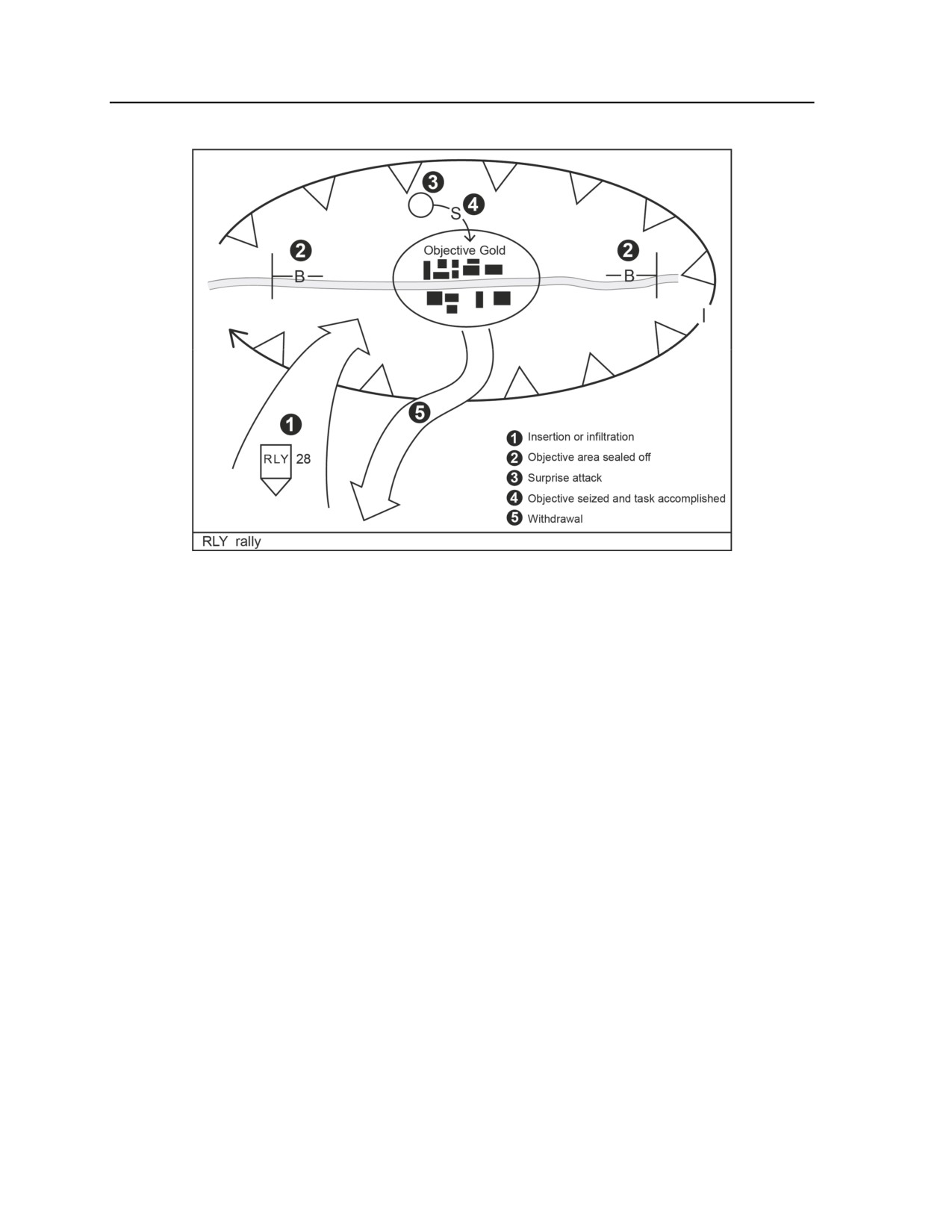
Chapter 3
Figure 3-11. Five phases of a raid
3-166. A simplified raid chain of command is an essential organizational requirement. A raid usually
requires a force carefully tailored to neutralize specific enemy forces operating in the vicinity of the
objective and to perform whatever additional functions are required to accomplish the objective of the raid.
These additional functions can consist of the demolition of bridges over major water obstacles or the
recovery of an attack helicopter pilot shot down forward of the forward line of own troops (FLOT). The
commander incorporates any necessary support specialists during the initial planning stage of the operation.
3-167. When a unit’s commander and staff plan a raid, they develop COAs that meet ethical, legal,
political, and technical feasibility criteria. Planners require precise, time-sensitive, all-source intelligence.
The planning process determines how mission command, sustainment, target acquisition and target
servicing will occur during the raid. Techniques and procedures for conducting operations across the FLOT
are also developed, given the specific mission variables of METT-TC expected to exist during the conduct
of the raid. The commander and staff develop as many alternative COAs as time and the situation permit.
They carefully weigh each alternative. In addition to those planning considerations associated with other
offensive actions, they must determine the risks associated with conducting the mission and possible
repercussions.
3-168. All elements involved in a raid fully rehearse their functions, if time permits. The key elements in
determining the level of detail and the opportunities for rehearsal before mission execution are time,
OPSEC, and military deception requirements. (See Maneuver Center of Excellence Army techniques
publications discussing the infantry rifle company, platoon, and squad for additional information on the
conduct of raids.)
SPOILING ATTACK
3-169. A spoiling attack is a tactical maneuver employed to seriously impair a hostile attack while the
enemy is in the process of forming or assembling for an attack. The objective of a spoiling attack is to
disrupt the enemy’s offensive capabilities and timelines while destroying targeted enemy personnel and
equipment, not to seize terrain and other physical objectives. (See figure 3-12.) A commander conducts a
spoiling attack whenever possible during the conduct of friendly defensive tasks to strike an enemy force
3-30
FM 3-90-1
22 March 2013
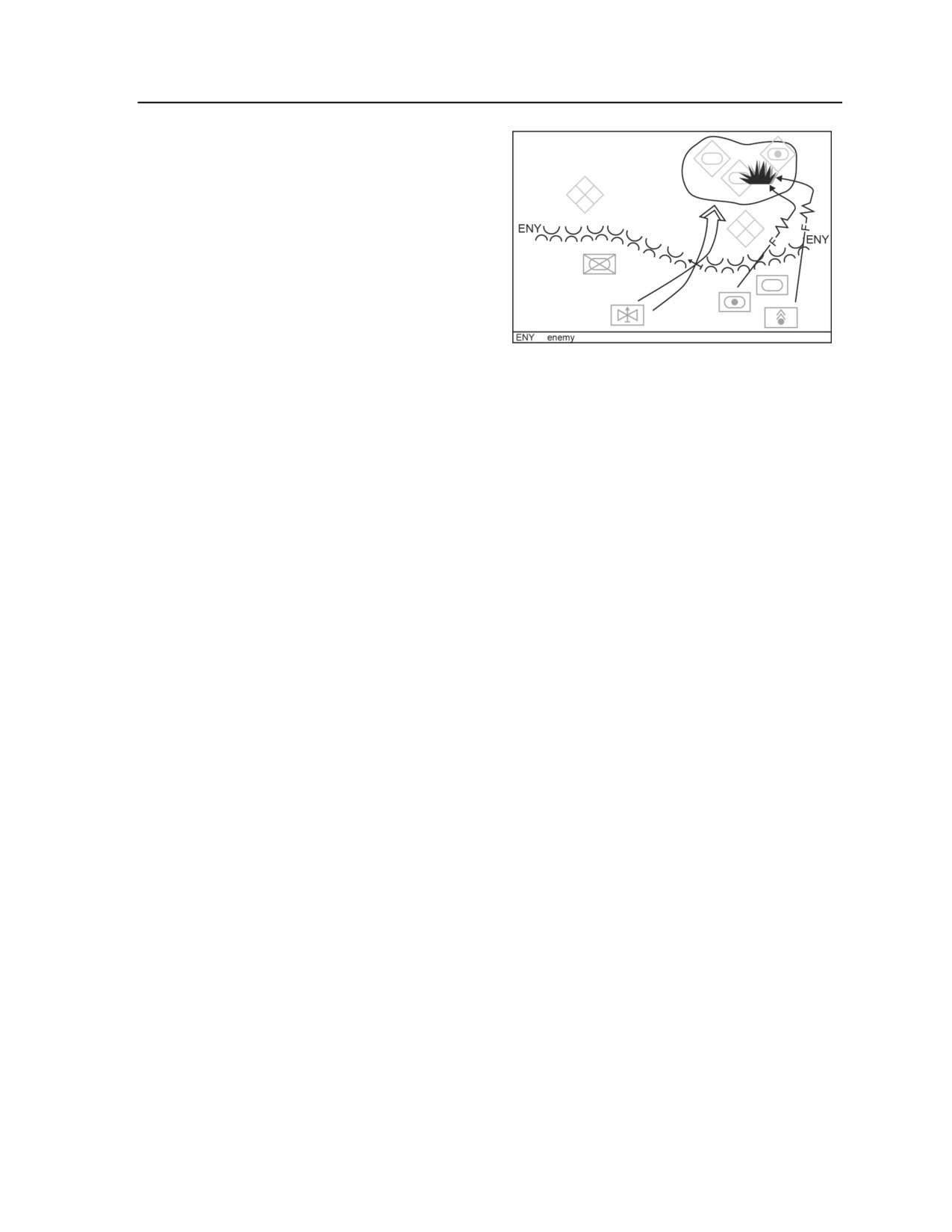
Attack
while it is in assembly areas or attack positions
preparing for its own offensive operation or is
temporarily stopped. A spoiling attack usually
employs armored, attack helicopter, or fire support
elements to attack enemy assembly positions in front
of the friendly commander’s main line of resistance
or battle positions.
3-170. A commander conducts a spoiling attack
to—
z
Disrupt
the
enemy’s offensive
preparations.
z
Destroy key assets that the enemy
requires to attack, such as fire support
Figure 3-12. Spoiling attack
systems, fuel and ammunition stocks,
and bridging equipment.
z
Gain additional time for the defending force to prepare its positions.
z
Reduce the enemy’s current advantage in the correlation of forces.
The commander synchronizes the conduct of the spoiling attack with other defensive actions.
3-171. The commander can employ reserve forces in a spoiling attack to throw the enemy’s offensive
preparations off stride. The commander assumes the risk of not having a reserve or designates another force
as the echelon reserve in this case. The following considerations affect the spoiling attack:
z
The commander may want to limit the size of the force used in executing the spoiling attack.
z
Spoiling attacks are not conducted if the loss or destruction of the friendly attacking force would
jeopardize the commander’s ability to accomplish the defensive mission.
z
The mobility of the force available for the spoiling attack should be equal to or greater than that
of the targeted enemy force.
z
Operations by artillery or aviation systems to prevent enemy elements not in contact from
interfering with the spoiling attack are necessary to ensure the success of the operation.
3-172. There are two conditions that must be met to conduct a successful and survivable spoiling attack:
z
The spoiling attack’s objective must be obtainable before the enemy is able to respond to the
attack in a synchronized and coordinated manner.
z
The commander must prevent the force conducting the spoiling attack from becoming
overextended.
If the spoiling attack fails to meet both conditions, it will likely fail, with grave consequences to the
defense.
22 March 2013
FM 3-90-1
3-31
This page intentionally left blank.
Chapter 4
Exploitation
An exploitation takes full advantage of offensive success, following up initial gains,
and making permanent the temporary effects already achieved. Commanders at all
echelons exploit successful offensive actions. Attacks that succeed in annihilating a
defending enemy are rare. Failure to aggressively exploit success at every turn may
give the enemy time to reconstitute an effective defense by shifting forces or by
regaining the initiative through a counterattack. Therefore, every offensive action not
restricted by higher authority or lack of resources should be followed without delay
by bold exploitation. The commander designs the exploitation to maintain pressure
on the enemy, compound and take advantage of the enemy’s disorganization, shatter
the enemy’s will to resist, and seize decisive or key terrain.
GENERAL CONSIDERATIONS OF AN EXPLOITATION
4-1. Exploitation is the primary means of translating tactical success into operational advantage. It
reinforces enemy force disorganization and confusion in the enemy’s command and control (C2) system
caused by tactical defeat. It is an integral part of the concept of the offense. The psychological effect of
tactical defeat creates confusion and apprehension throughout the enemy C2 structure and reduces the
enemy’s ability to react. Exploitation takes advantage of this reduction in enemy capabilities to make
permanent what would be only a temporary tactical effect if exploitation were not conducted. Exploitation
may be decisive.
4-2. Exploitation can occur regardless of the operational theme or point along the range of operations in
which the exploitation occurs. All units, regardless of their size, conduct exploitation, although the
discussion in this chapter tends to focus on the activities of large units during conduct of major combat
operations. Small tactical units also conduct exploitations. For example, during counterinsurgency
operations, a company could conduct a raid on an particular civilian residence during the night to exploit
the information and intelligence gathered during its conduct of a cordon and search operation that occurred
earlier in the day. In this example, effective search procedures, tactical site exploitation, tactical
questioning, and the use of reconnaissance and surveillance assets are keys to the company being able to
effectively conduct exploitation.
4-3. Those plan, prepare, execute, and assess concepts discussed in ADRP 5-0 apply during an
exploitation. The commander modifies these concepts as necessary to reflect the specific existing mission
variables of mission, enemy, terrain and weather, troops and support available, time available, and civil
considerations
(METT-TC). The five step sequence for executing offensive actions described in the
introduction of this publication is used to discuss the execution of an exploitation. The first three steps are
shaping operations and the last two constitute the decisive operation.
4-4. Local exploitation by the committed force follows a successful attack. A unit conducts a local
exploitation when it capitalizes on whatever tactical opportunities it creates in the course of accomplishing
its offensive mission. Whenever possible, the lead attacking unit transitions directly to the exploitation after
accomplishing its mission in a local exploitation. If this is not feasible, the commander can pass fresh
forces (follow and assume) into the lead. The commander acts quickly to capitalize on local successes.
Although such local exploitations may appear insignificant, their cumulative effects can be decisive.
Subordinate commanders, working within their higher commander’s intent, use their initiative to launch
exploitations. When initiating a local exploitation, the commander informs higher headquarters. This
22 March 2013
FM 3-90-1
4-1
Chapter 4
prevents disruption of the higher echelon’s battle or campaign and allows the higher headquarters to assess
the possibility of general collapse and to initiate pursuit operations.
4-5. Conduct of a major exploitation is a specific contingency mission assigned to a large unit in
anticipation of offensive success by another unit of equivalent size. Divisions and brigade combat teams
(BCTs) are the echelons that typically conduct a major exploitation, although a corps can conduct a major
exploitation as part of a multi-corps operation.
ORGANIZATION OF FORCES FOR AN EXPLOITATION
4-6. The forces conducting an attack are also the forces that initially exploit that attack’s success.
Typically, the commander does not assign a subordinate unit the mission of exploitation before starting a
movement to contact or an attack. The commander reorganizes internally to reflect the existing mission
variables of METT-TC when the opportunity to exploit success occurs. The commander then uses
fragmentary orders (FRAGORDs) to conduct actions on contact. (See chapter 2 for a discussion of actions
on contact.) If a commander needs additional resources to support the exploitation, they are requested from
the appropriate headquarters. The additional resources may include reconnaissance and surveillance assets
to help identify targets for attack, as well as attack helicopters and controlled munitions, such as the Army
tactical missile system rockets, to attack identified targets. Each exploitation force should be large enough
to defend itself from those enemy forces it expects to encounter. It should also be a reasonably
self-sufficient combined arms force capable of operations beyond the supporting range of the main body.
4-7. The units that create an opportunity to exploit should not be expected to continue the exploitation to
an extended depth. If the commander plans to exploit with a specific subordinate unit, the commander
specifies the degree of damage or risk to that force the commander is willing to accept during the operation.
If the initially attacking units incur significant losses of combat power, the commander replaces them as
soon as possible. When the exploiting force’s combat power weakens because of fatigue, disorganization,
or attrition, or when it must hold ground or resupply, the commander should continue the exploitation with
a fresh force. In both cases, the replacement force should have a high degree of tactical mobility, so it can
conduct the exploitation.
4-8. The exploitation may be more effective if the commander can commit additional forces and assign
them the task of either follow and support or follow and assume. The commander assigns follow and
support missions to units designated to assist exploiting forces by relieving them of tasks that would slow
their advances. The lead unit and any follow and assume or follow and support units exchange liaison
teams to facilitate the transfer of responsibilities. Units designated to follow and assume conduct a forward
passage of lines and replace the initial exploiting forces when they approach their culminating point.
Normally, the next higher commander retains control of the forces performing the tasks of follow and
support or follow and assume. (Appendix B expands the discussion of these tasks.) When possible, units
assigned these tasks should possess mobility equal to that of the exploiting unit or receive additional
engineers and transportation assets to provide the necessary mobility. Once organized, they are committed
forces and should receive habitually associated artillery, air defense, engineer, and other functional and
multifunctional support and sustainment forces in accordance with the mission variables of METT-TC. In
an exploitation operation projected to cross significant distances, the commander may attach elements of a
follow and support unit to the exploiting force to ensure unity of command and effort.
4-9. Since the force conducting an exploitation operation typically covers a wider front than an attacking
force, fire support assets may find their supported elements operating outside normal supporting ranges.
They must displace forward to ensure the continued provision of fires on and beyond enemy formations,
which may cause some difficulty in supporting the exploiting force’s flank elements. To provide the
required support, these fire support units, as well as independently operating assets, can be attached to
subordinate elements of the exploiting force. Otherwise, the commander can move additional reinforcing
fire support elements forward to fill the void. The commander can use available air interdiction and close
air support
(CAS) by fixed-wing aircraft to augment or replace Army fire support assets during
exploitation.
4-10. The joint air and missile defense (AMD) coverage for the initial attack is likely to remain effective
throughout the exploitation. However, when a tactical commander accepts the risks involved and extends
4-2
FM 3-90-1
22 March 2013
Exploitation
subordinate formations and assets to cover more area, the AMD coverage probably becomes less effective.
The commander needs to consider the risks associated with moving out from under the AMD umbrella
provided by the Army air and missile defense command (AAMDC) or Army air defense artillery brigade
supporting the joint force commander. The commander can request adjustments in that coverage to
conform to the unit’s tactical maneuvers. Counterair operations conducted by Air Force and Navy assets
and anti-air warfare conducted by Marine Corps assets may provide the desired degree of AMD protection.
4-11. The exploitation mission demands a force with a significant mobility advantage over the enemy.
This mobility advantage may be provided by forces with tracked or wheeled armored combat vehicles.
Attack helicopters and air assault assets may constitute a portion of the exploiting force’s combat power.
They are extremely useful in seizing defiles, crossing obstacles, and otherwise capitalizing on their
mobility to attack and cut off disorganized enemy elements. They can also seize or control key terrain such
as important river-crossing sites or vital enemy transportation nodes along the exploiting force’s route of
advance into and through the enemy’s support areas. The commander integrates combat engineers into the
exploiting force to help breach obstacles, keep ground forces maneuvering, and provide countermobility
protection to the flanks. Typical problems that degrade an exploiting force’s mobility are minefields and
other obstacles. The commander also uses engineers to keep the force’s supply routes open.
4-12. The commander retains only those reserves necessary to ensure flexibility of operation, continued
momentum in the advance, and likely enemy responses to the exploitation.
(Chapter
3 discusses
employment considerations for the reserve.)
RECONNAISSANCE AND SECURITY
4-13. When a commander initiates an exploitation operation, the exact enemy situation may not be clear.
The commander orders one or more subordinates to conduct reconnaissance to gain and maintain enemy
contact. Those forces conducting reconnaissance also provide a degree of security. The reconnaissance
effort is complemented with sensors and surveillance assets and intelligence products produced by
adjacent, higher, and lower echelons to maintain the commander’s situational understanding of the strength,
dispositions, capabilities, and intentions of all significant enemy elements within the area of interest. The
commander normally emphasizes reconnaissance more than security operations when conducting
exploitation. Nevertheless, since forces exploiting success tend to move independently, the overall
commander addresses the total force’s security needs.
4-14. The commander assigns the appropriate security missions to appropriate subordinates in the same
way they are for a movement to contact. (See chapter 2.) An exploiting corps or division commander
typically organizes the forward-most security element into a covering force to protect the main body’s
movement and develop the situation before the commander commits the main body. These security
elements respond directly to the overall commander.
4-15. If an exploiting force is unable to resource a covering force for independent operations, it may use an
advance guard in place of a covering force. This is typical for a BCT conducting exploitation on its own. In
some cases when the higher echelon (corps or division) creates a covering force, a BCT subordinate to that
corps or division may still push out its own advance guard behind the covering force. This normally occurs
when subordinate exploiting units advance in multiple parallel columns.
SUSTAINMENT
4-16. Functional and multifunctional sustainment arrangements must be extremely flexible during
exploitation operations. In the conduct of major exploitation operations directed against uncommitted
enemy forces or in exploitation operations directed along diverging lines of advance, the tactical
commander commonly attaches functional and multifunctional sustainment units to the exploiting
maneuver force. This changes the normal support relationship between the two forces to a command
relationship for the duration of the operation. At a minimum that command relationship should be
operational control (OPCON) for positioning, movement, and defense since the sustainment unit will be a
tenant unit within the tactical commander’s area of operations
(AO). Alternatively, the supporting
sustainment assets can follow the exploiting force in an echeloned manner along main supply routes
(MSRs). Transportation and supplies to sustain the force become increasingly important as the exploitation
22 March 2013
FM 3-90-1
4-3
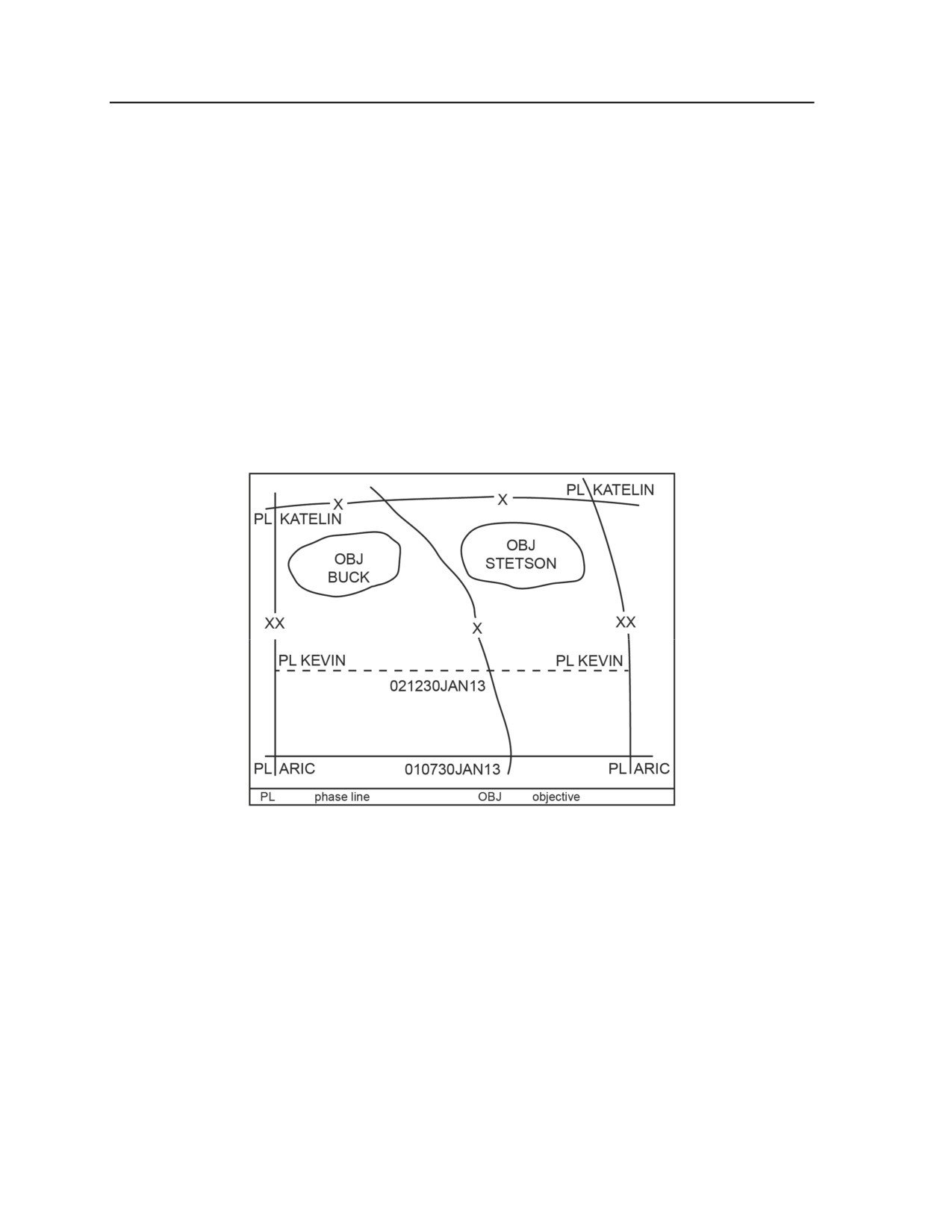
Chapter 4
progresses. As supply lines lengthen, the condition of lines of communications and the conduct of route and
convoy security can become problems. The largest possible stocks of fuel, spare parts, and ammunition
should accompany the force so that it does not lose momentum because of a lack of support.
4-17. The exploitation effort may be limited more by vehicle mechanical failures and the need for fuel
than by combat losses or a lack of ammunition. Therefore, at the low tactical level a field maintenance team
from the brigade support battalion (BSB) should accompany each exploiting company to assess problems
and repair disabled vehicles quickly or evacuate them to maintenance collection points for repair or
evacuation by the BSB’s field maintenance company. The commander may use utility and cargo
helicopters to move critical supplies forward during the exploitation.
CONTROL MEASURES FOR AN EXPLOITATION
4-18. Exploitation uses fewer control measures than many other operations because of the uncertain
enemy situation and the need to provide subordinate commanders with the maximum flexibility to take
advantage of fleeting opportunities. (See figure 4-1 for an example of control measures for a major
exploitation. See figure 4-2 for an example of control measures for a local exploitation.) Planners develop
control measures as part of the planning process. The commander issues these control measures as part of
the attack order to facilitate mission command when the force transitions to exploitation.
Figure 4-1. Control measures for a major exploitation
4-19. A unit conducting exploitation normally operates in the same AO it was assigned for the attack. The
exploiting unit assigns subordinate units their own AOs. Boundaries between subordinate units may change
often to take advantage of opportunities. Since an exploiting unit deploys reconnaissance and security
forces, the commander must rapidly adjust boundaries as the exploiting force advances. The commander
designates obstacle-restricted areas to prevent friendly obstacles from hindering the movement of the
exploiting force. The commander designates obstacle zones on the flanks of the exploiting force’s mobility
corridors to enhance security. The commander uses phase lines and subsequent objectives to control the
conduct of the exploitation. The commander uses objectives to orient the movement of exploiting forces.
Although exploitation may result in taking a terrain objective, the primary focus should be on completing
the destruction of the enemy force. The commander may establish a limit of advance if a culminating point
can be anticipated or some other restriction, such as political considerations regarding an international
border, requires its establishment.
4-4
FM 3-90-1
22 March 2013
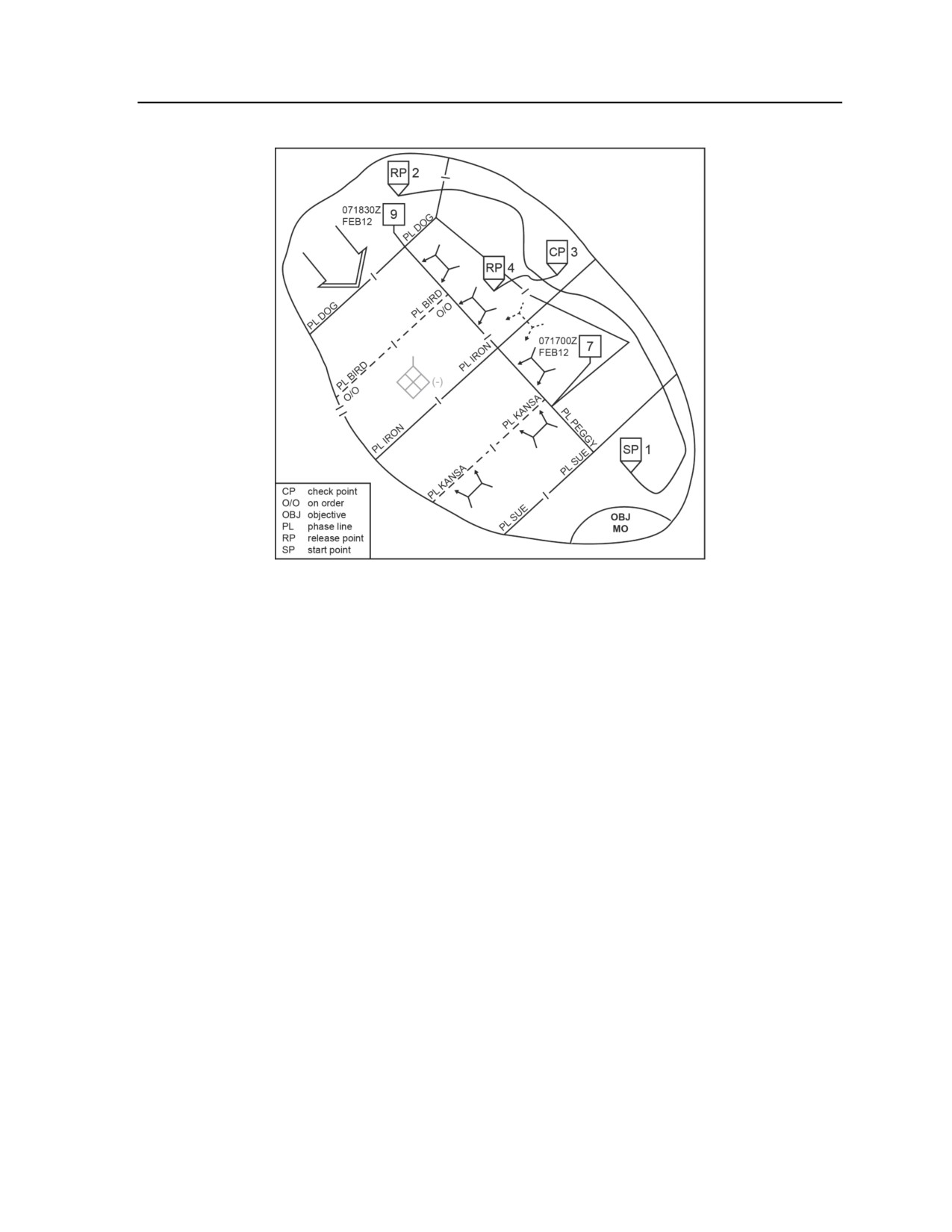
Exploitation
Figure 4-2. Control measures for a local exploitation
4-20. A commander normally employs permissive fire support coordination measures during exploitation.
A coordinated fire line (CFL) ensures rapid response. Movement of the CFL is particularly important to
provide adequate support as the force continues to advance. Even if the culmination of the exploitation is
not anticipated, establishing a forward boundary is important to facilitate operations beyond that boundary
by a higher headquarters. The commander can use additional control measures, such as targets and
checkpoints, as required.
PLANNING AN EXPLOITATION
4-21. The commander’s ability to deny the enemy options by proactive use of the warfighting functions is
critical to a successful exploitation. This is done by arranging the warfighting functions within the
opponent’s time and space relationship in accordance with the mission variables of METT-TC. This applies
whether conducting a local or a major exploitation.
4-22. The commander must plan for decentralized execution during the conduct of an exploitation. The
commander’s intent is especially important because subordinates must be able to exercise initiative in a
rapidly changing situation. The commander must state the purpose of the exploitation, which may be to
force the retrograde of enemy forces from an area, encircle enemy forces so they cannot withdraw, or
destroy enemy artillery and other fire support systems. The intent must describe the desired end state. That
intent will also determine the force’s decisive and shaping operations and guide the designation of the main
effort.
4-23. A clear commander’s intent provides subordinates with guidance on integrating their operations into
the overall operations of the higher headquarters. Subordinates act quickly to seize all opportunities to
damage the enemy or accelerate the tempo of operations. Commanders place minimal restrictions on
subordinates. These may include clear instructions regarding the seizure of key terrain and the size of
enemy forces that may be bypassed. Reliable, secure communications between the exploiting force, the
follow and support force, and the commander facilitate coordination that can maximize the impact of the
22 March 2013
FM 3-90-1
4-5
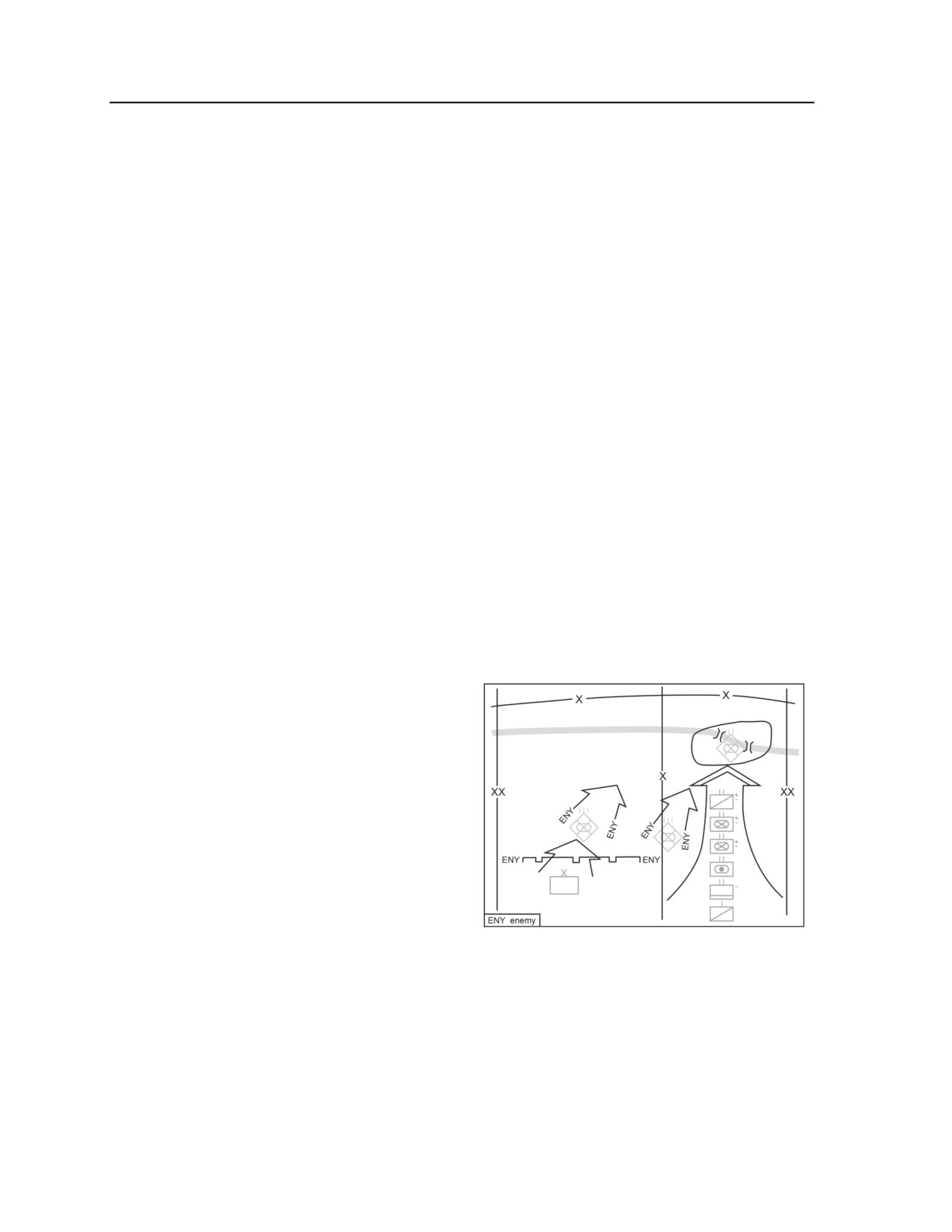
Chapter 4
exploitation. However, all subordinates should have a clear picture of the desired end state to conduct
operations that support it, even if communications are lost.
4-24. Exploitation planning begins during the preparation phase of all offensive actions. To avoid losing
critical time during the transition from a movement to contact or an attack to exploitation, the commander
tentatively identifies forces, objectives, and AOs for subordinate units before the offensive task begins. The
defeat of these enemy forces and the seizure of these objectives deny the enemy routes of escape, result in
the encirclement of selected enemy forces, and destroy enemy command and control nodes and the
enemy’s sustainment facilities. When the opportunity to exploit occurs, BCT and higher-echelon
commanders initiate the exploitation either as a branch of or a sequel to the existing operation.
Commanders may direct that lower tactical commanders immediately exploit the local successes of their
units. However, the commander avoids driving the enemy back towards the enemy’s sustaining base.
4-25. During exploitation planning and execution, the commander balances the force conducting the
exploitation’s need for speed and momentum against its need for security as it begins to move beyond
supporting range of the rest of the force. The commander must be careful not to allow a force conducting
exploitation to move outside of supporting distance of the main body. Determining the supporting distance
requires some knowledge of the enemy’s remaining capabilities. Generally, the commander should
approach exploitation planning with a sense of guarded optimism. It is an excellent opportunity to shatter
enemy cohesion and gain a position of advantage over the enemy. However, the commander cannot allow
the exploiting force to fall into an enemy trap where it could be drawn into a salient and destroyed in detail.
4-26. The exploitation may take the form of a movement to contact with a series of hasty attacks. The
commander usually issues a series of FRAGORDs that designate—
z
Movement formation.
z
The position of each major element within the formation of the force conducting the
exploitation.
z
Any required modifications to task organization.
z
Bypass criteria.
z
Revised or new control measures that assist with the maneuver, such as objectives, boundary
changes, a limit of advance (LOA), and fire support coordination measures (FSCMs).
4-27. Forces conducting exploitation normally
maneuver on a wide front and on at least two axes.
The forces on each axis are capable of independent
action, depending on the mobility of the force, the
road net, and other aspects of the terrain. In some
cases, rather than assigning subordinates their own
AOs, the commander may designate a movement
formation for the entire unit to concentrate all
combat power against a specific enemy element. In
this case, the commander normally adopts a
variation of the column, line, or vee formation.
(Chapter 1 discusses combat formations.) (Figure
4-3 shows an armored brigade combat team
[ABCT] conducting exploitation with its battalions
in column.) Movement on parallel routes is
Figure 4-3. Brigade exploitation: battalions in
preferred; however, the terrain and the enemy
column formation
situation may cause the force to advance in a
column formation. Generally, using a column in the exploitation emphasizes flexibility at the expense of
placing maximum firepower forward.
4-28. In exceptional circumstances, when the enemy is clearly incapable of effectively resisting, the
commander can choose temporarily not to retain a reserve but to commit all forces to the exploitation. The
commander may employ a line formation with two or more elements abreast without a reserve when the
approach to the objective must be made on as wide a front as possible. For example, a commander could
use this formation when attempting to secure crossing sites over a major river. (See figure 4-4 on page 4-7.)
4-6
FM 3-90-1
22 March 2013
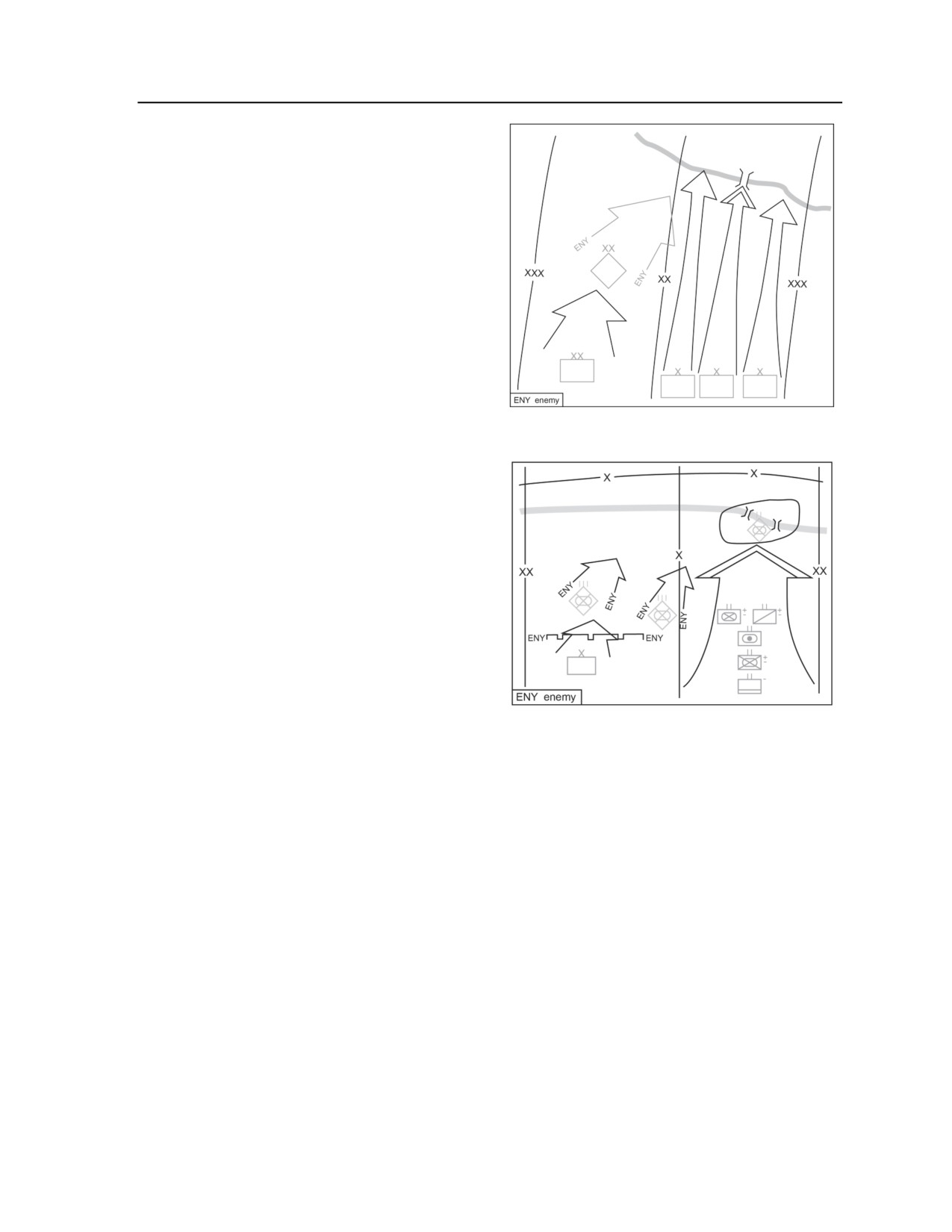
Exploitation
The commander could also employ this formation
against sporadic and weakening resistance when
the enemy lacks a significant counterattack
capability or when the counterattack can be
blocked by means other than employing the
reserve. Despite the lack of a constituted reserve,
other actions, such as the effective employment of
massed indirect fires, can provide the commander
with the flexibility usually provided by the reserve
for influencing actions during exploitation.
4-29. A vee formation with two or more elements
abreast and a reserve allows the unit to advance on
a reasonably wide front with the bulk of the unit’s
direct
firepower oriented
forward.
This
configuration helps when creating gaps in the
enemy’s defenses. While the bulk of the unit is
committed, the reserve is available to exploit the
Figure 4-4. Division exploitation: brigades
success of the attacking elements, assume the
abreast, no reserve
mission of the attacking elements, or counter
enemy threats as they develop. (See figure 4-5 and
figure 4-6 on page 4-8.)
4-30. Because of the need to rapidly transition
from an attack to exploitation, exploitation fire
planning must take place as part of the planning for
the attack. The commander establishes links
between military intelligence, reconnaissance,
attack aviation, field artillery, electronic warfare,
and supporting fixed-wing aviation assets to
expedite the detection and delivery of effects
against situationally dependent high-priority
targets. The commander selects those targets
regardless of their location within the enemy’s
defensive area to support the exploitation. During
Figure 4-5. Brigade exploitation: two
the exploitation, there is little time to revise target
battalions forward, one in reserve
lists. Target considerations are similar to those of a
movement to contact. In addition, the exploitation requires a flexible, responsive, and redundant fire control
net that must be planned in advance. Coordination with the echelon intelligence officer is critical as the
situation develops into exploitation. The exploiting force templates known enemy locations within its AO
as danger areas and targets them.
4-31. The fire support plan includes allocating support for meeting engagements or hasty attacks that occur
during the exploitation. The fire support coordinator (FSCOORD) plans targets beyond the projected
locations of the exploiting maneuver forces to shield them from enemy counterattacks. The FSCOORD
then addresses how to provide fire support to the force in its movement to the LOA and targets locations
beyond the LOA to interdict the enemy’s lines of communication (LOCs).
4-32. The commander plans for artillery and mortar displacement as an integral part of the exploitation.
These indirect fire assets must displace at a faster pace than during normal offensive actions, while
maintaining the capability to provide accurate and lethal fires. The commander can normally plan on
subordinate forces using less ammunition during an exploitation than in an attack because fleeing enemy
forces are normally not in prepared positions, and thus are more vulnerable. The commander should also
consider using close air support in the exploitation, especially to support those units moving beyond
supporting range of the main body. Airborne forward air controllers can help identify and track high-payoff
targets forward of the exploiting force.
22 March 2013
FM 3-90-1
4-7
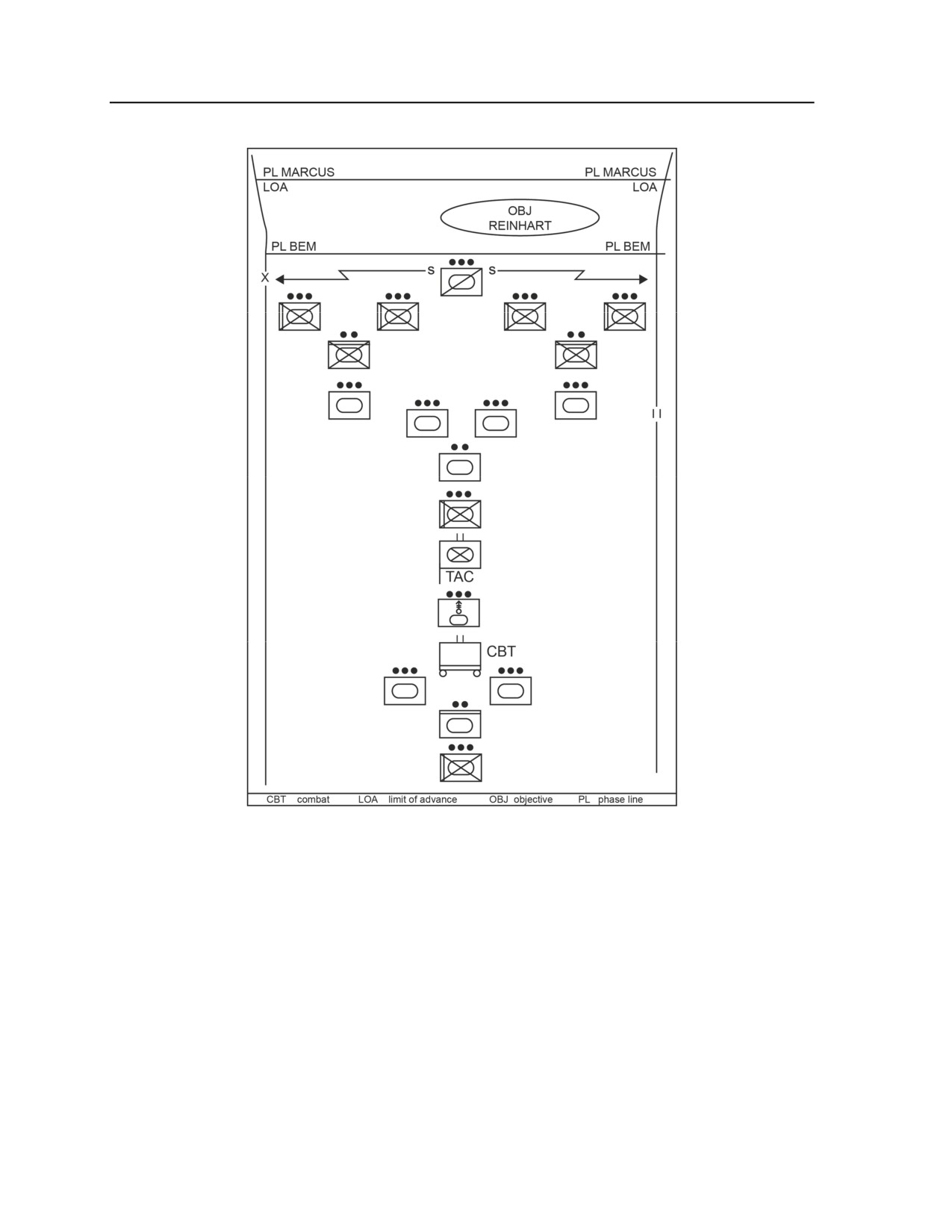
Chapter 4
Figure 4-6. Exploitation control measures for a combined arms battalion in a vee formation
4-33. The commander plans situational obstacles for each phase of the operation. For example, in
accordance with the rules of engagement, the commander places scatterable minefields in those areas that
could be used by an enemy counterattack force as friendly forces move forward.
4-34. The enemy may be willing to commit aircraft against a friendly exploitation that endangers the
viability of the enemy’s defense, buying the enemy time to prepare a defense while weakening the friendly
force. Enemy forces may have the ability to employ unmanned aircraft systems in reconnaissance and
attack roles. The tactical commander plans a decision point to request through command channels that the
joint force commander reposition joint air and missile defense assets to provide priority of protection to that
part of the commander’s decisive operation that moves out from under the existing air and missile defense
umbrella. Ideally, that existing defensive umbrella protects the commander’s tactical lines of
communication from enemy air attack, thereby allowing supporting functional and multifunctional
sustainment elements to keep pace with the operation. The commander must plan how to rapidly resupply
air and missile defense missiles as they are used and protect launch locations from interference from enemy
4-8
FM 3-90-1
22 March 2013
Exploitation
ground attack. The commander must also allow for adjustments in the priority of protection assigned to
different elements during the exploitation.
4-35. The commander must anticipate the exploitation and ensure that the sustainment plan supports the
force all the way to the LOA. Planning for sustainment in the exploitation includes designating future main
supply routes (MSRs), logistics release points, maintenance collection points, casualty collection points,
medical treatment facilities, ambulance exchange points, and prisoner of war collection points. In
sustaining the exploitation, petroleum, oil, and lubricants (POL) consumption and vehicle maintenance are
primary concerns of sustainment planners. A significant factor is that an exploiting force tends to travel on
a broad front, which may necessitate designating one or more lateral MSRs to handle the dispersion.
Sustainment operators must be prepared to bound their sustainment assets farther forward and move them
more often than in an attack. Commanders consider in their planning the amount of military logistics and
health support needed by the civilian population of the AO beyond what the civilian sector can provide for
itself during an exploitation. It is the commander’s decision, after being informed by the staff, as to how
much the provision of such support should be allowed to impact on the conduct of the exploitation.
4-36. Selecting a flexible MSR is critical because it must be able to respond to changes in the direction of
the exploitation. Maintaining the MSR is a responsibility of the force engineers. During planning, the
commander must specifically address the control of sustainment unit positioning and convoys. The tactical
commander calls supporting as well as organic sustainment units forward and redirects them as needed.
Low tactical echelon commanders may have to plan for guides to assist the movement of these sustainment
assets around bypassed enemy positions and obstacles. The commander may assign some maneuver
elements from the reserve an “on-order” mission to conduct echelon support area security to help protect
echelon sustainment and other supporting elements or secure the MSR. The commander must also ensure
adequate plans exist for controlling displaced civilians on the battlefield, so that they do not interfere with
follow-on maneuver and support assets. This is a critical stability task that impacts exploitation operations.
EXECUTING AN EXPLOITATION
4-37. An exploitation may be initiated on order or on reaching prescribed objectives or phase lines. Local
and major exploitations require physical and mental aggressiveness to combat the friction of limited
visibility, fatigue, bad weather, fratricide dangers, and the exhaustion associated with extended operations.
An exploitation requires bold and aggressive reconnaissance, prompt use of firepower, and rapid
employment of previously uncommitted units. Exploiting forces maneuver swiftly toward their objectives,
sever enemy escape routes, and strike at enemy command posts, communications nodes, reserves, artillery,
and functional and multifunctional support units to prevent the enemy from reorganizing an effective
defense. Exploiting forces should be able to change direction on short notice. The commander supports
exploiting forces with tactical air support, attack aviation, artillery fires, and electronic warfare. Units
participating in exploitation apply the doctrine, tactics, techniques, and procedures appropriate for a unit of
their size conducting a movement to contact and an attack.
4-38. To maintain sufficient forces to conduct exploitation, the commander must ensure that subordinates
focus on the commander’s intent. They should not dissipate their combat power by seeking minor tactical
successes or reducing inconsequential enemy forces. The aim is to reach the final objective with the
maximum possible strength as rapidly as possible. The commander must provide exploiting forces with
mobile sustainment, including air resupply, to move emergency lifts of POL and ammunition.
4-39. The transition from attack to exploitation may be so gradual that it is hardly distinguishable; it may
also be abrupt. The abrupt transition may occur when a force uses large numbers of precision munitions,
achieves surprise, or overwhelms a much weaker enemy force. Normally, the commander orders an
exploitation after the force seizes or secures its objective. With adequate support, the commander can
launch the exploitation with the initial assault or at any time after that, depending on the effects of the fires
and the commander’s desires.
4-40. Since the exploitation takes advantage of previous success, forces previously allocated toward
attacking enemy forces normally continue their ongoing activities. These activities include—
22 March 2013
FM 3-90-1
4-9
Chapter 4
z
Attrition or defeat of enemy reserves before their commitment.
z
Destruction of enemy countermobility assets before their employment on a friendly avenue of
advance for the exploiting force.
z
Disruption of enemy units attempting to reestablish a coherent defense.
z
Disruption of enemy sustaining operations.
This assumes the commander has accurate and timely intelligence to target these enemy actions.
4-41. Generally, as one part of the attacking force finishes clearing an objective, the commander orders the
remaining elements to exploit that success. To accomplish this with minimal confusion, the commander
must know where each subordinate and supporting element is and what combat formation each has
adopted. If the commander has previously trained and rehearsed the force to change rapidly from one
combat formation to another, to change missions, and to change the direction of advance, the commander
can time the execution of such changes to maintain the initiative over an enemy.
4-42. The commander can also initiate exploitation upon the realization that the enemy force is having
difficulty maintaining its position or cohesion. Updated intelligence is crucial to the commander, since it is
difficult to accurately predict the exact conditions required to transition from an attack to exploitation.
Therefore, the commander and subordinates watch the enemy’s defenses for indications of disintegration
that may signal the opportunity to transition to exploitation. Such indicators include the following:
z
The threat or use of weapons of mass destruction by enemy forces, despite the probable U.S.
retaliation, may signal impending enemy collapse.
z
Enemy reconnaissance intensifies.
z
Rearward movement increases, especially by fire support and reserves.
z
The enemy prepares to demolish or destroy facilities, installations, equipment, and supply
stockpiles.
z
Various units intermix their vehicles and personnel in combat formations or march columns.
z
The number of prisoners captured increases significantly.
z
Enemy fire decreases in intensity and effectiveness.
z
Fires increase in one or more individual sectors of the front that do not appear to be
synchronized with the developing situation and at a time when the amount of defensive fires
appears to be decreasing.
z
Enemy resistance decreases considerably, or the enemy lacks any type of organized defense.
z
The amount of abandoned enemy war materiel encountered increases significantly.
z
Reports confirm the capture or absence of enemy leaders.
z
Friendly forces overrun enemy artillery, C2 facilities, and supply points.
z
Enemy units disintegrate and friendly companies and battalions can defeat enemy battalion- and
brigade-sized units, respectively.
In any case, the commander ruthlessly exploits vulnerable enemy forces after weighing and
accommodating the risks.
4-43. The commander has two general methods to exploit the unit’s battlefield success. The commander
rapidly implements the method chosen. The first method is to exploit with committed forces. In this
method, forces are committed to exploit their own success. This is extremely common at low tactical
echelons, such as the battalion and below, at all points along the range of operations. This method is
generally indicated when the attacking unit has accomplished its mission with minimum loss and is the
force most readily available to continue the advance. It may become necessary to reorganize and resupply
these forces while they are still moving to maintain the momentum of the exploitation.
4-44. The second method is to exploit with forces other than the unit that achieved the initial battlefield
success. This other force may be the echelon reserve or specifically designated follow-and-support or
follow-and-assume forces. In this method, this other force is committed by passing around, over, or through
the forces that achieved the initial success. This method is generally indicated when the attacking echelon
still has essential tasks to accomplish, is still actively engaged with enemy forces, or will require
4-10
FM 3-90-1
22 March 2013
Exploitation
reorganization before it can continue the advance. This commonly occurs in exploitations by brigades and
larger units.
GAIN AND MAINTAIN ENEMY CONTACT
4-45. The exploiting force must gain and maintain contact with the enemy. This is a critical aspect of local
and major exploitations, since the enemy may be trying to break contact and distance itself from the
friendly force to give enemy units time to recover. After a successful attack, the exploiting force must
perform aggressive reconnaissance to both its front and flanks. The commander’s intent determines how
much contact is required to maintain pressure on the enemy, compound the enemy’s disorganization,
shatter the enemy’s will, and seize key or decisive terrain. As discussed in chapter 3, this reconnaissance
effort must start almost immediately after an attacking unit seizes its objective. If the commander has
dedicated reconnaissance assets, they are used to maintain enemy contact, observe the enemy’s movements,
and search for weakly defended enemy positions. If those assets are not available, other maneuver units
perform those reconnaissance tasks. While maintaining contact with the enemy, the reconnaissance force
tries to locate enemy reserves, uncommitted forces, and blocking positions. This effort helps the exploiting
force avoid being led into ambushes as the enemy seeks to recover the initiative by counterattacking.
4-46. When the previously assigned offensive mission is accomplished, units at all echelons push out their
reconnaissance and security forces to discover whether the opportunity exists to initiate exploitation. At
BCT and battalion echelons, these reconnaissance and security forces must gain and maintain enemy
contact while remaining within the supporting range of their parent brigade or battalion.
4-47. The commander uses air reconnaissance to augment ground reconnaissance. The commander can
employ aerial sensors, such as manned and unmanned aircraft systems, in advance of ground maneuver
reconnaissance. This allows aerial observation of named and targeted areas of interest that facilitate the
unit’s movement and cue the attack of high-payoff targets. Armed manned and unmanned aircraft can
locate enemy positions and engage the enemy to disrupt the enemy’s movement and preparations. Aviation
assets maintain constant contact and pressure on the enemy.
DISRUPT THE ENEMY
4-48. The commander’s decision to exploit presumes that the enemy has already been somewhat disrupted.
The commander exploits to maintain or increase this disruption by preventing the enemy from
reconstituting an effective defense. At the division and corps levels, the commander combines the effects of
operations against enemy reserves and uncommitted forces with the rapid maneuver of ground maneuver
forces to maintain this disruption. Attack helicopters can maneuver in front of exploiting ground maneuver
forces to destroy high-payoff targets. The commander integrates fixed-wing aircraft into the fire plan for
attacking these targets. Rapid advances by the exploiting force keep the enemy force off balance and
degrade enemy intelligence and surveillance capabilities, thus providing some security from attack. The
commander uses all available resources to maintain pressure on the enemy, using both overwhelming
combat power and asymmetric weapon systems. The commander never allows the enemy an opportunity to
recover from the initial blow. The exploiting force’s fire support system must deliver massed fires quickly
to respond to any contingencies that arise during the exploitation.
FIX THE ENEMY
4-49. As part of its shaping operations, an exploiting force has three goals in fixing an enemy force. First,
it tries to break down the enemy’s combined arms organization by fixing enemy units in positions out of
supporting distance of each other. This allows the exploiting force to defeat the enemy in detail. Second,
the commander attacks out-of-contact enemy forces before they can adversely affect the exploitation. By
attacking these enemy forces, the commander seeks to fix them in their current positions or force them to
move to locations where they can be harmlessly contained until the exploiting force or a follow and support
force can engage and defeat them. Third, it achieves a specific targeting effect—such as causing 15-percent
casualties—that disrupts the enemy commander’s plan.
22 March 2013
FM 3-90-1
4-11
Chapter 4
DECISIVE OPERATION
4-50. During an exploitation, the exploiting force maneuvers to maintain pressure on the enemy. Swift
raids, thrusts, and envelopments prevent enemy reorganization. The commander can use any armored,
Stryker, and mobile light infantry forces, such as airborne or air assault elements, to secure terrain
objectives or choke points critical to the advance and to cut enemy lines of escape. The commander takes
advantage of vertical envelopment capabilities to secure objectives critical to the advance and to cut enemy
lines of escape. The exploiting force clears only enough of its AO to permit its advance. It cuts through
enemy logistics units and lines of communications to seize objectives vital to the enemy’s defense. It
attacks from the march to overrun weak enemy formations. In accordance with the bypass criteria, the
exploiting force can contain and bypass those enemy pockets of resistance too small to jeopardize the
mission while its commander reports these enemy forces to adjacent units, following units, and higher
headquarters.
4-51. If an enemy unit is too strong for the leading elements of the exploiting force to overrun and destroy,
succeeding elements of the force conduct a hasty attack based on the combat information provided by its
leading elements. Such enemy forces are rarely attacked frontally. In almost all cases, the commander uses
another form of maneuver to produce faster and better results with fewer casualties. While the exploiting
force is seeking one or more assailable flanks, available fire support systems continue to engage the enemy
to divert attention from the attempted envelopment and destroy as much enemy combat power as possible.
4-52. The exploiting force may face prepared belts of defensive positions in depth when it is exploiting the
initial success of the attack. Therefore, the exploiting force must move rapidly to attack and destroy the
enemy before enemy defending forces can settle into subsequent or supplemental positions. The faster the
exploiting force moves, the less likely it is that succeeding defensive lines will be fully prepared and the
less effort it will take to penetrate each successive defensive position. The exploiting force attacks and
maneuvers as many times as necessary until it breaks completely through the enemy’s defenses.
4-53. The commander’s primary concern when initiating an exploitation resulting from a successful attack
is to shift the force into the appropriate combat formation and task-organize it with additional capabilities
and resources to take advantage of a short window of opportunity. The commander must control the
formation as it moves and prevent its overextension. The commander must anticipate the enemy’s reactions
to friendly actions. The real danger to the exploiting force is not the immediate enemy, but the enemy not
yet engaged. Overextension is a risk inherent in exploitation. While commanders avoid overextension, they
must also guard against being overcautious.
4-54. During an exploitation, the commander often surrounds or bypasses enemy units. Surrender appeals
and ultimatums are particularly effective when directed against enemy units that have been surrounded,
isolated, or bypassed. JP 3-13.2 and FM 3-53 detail ways for communicating with the enemy.
4-55. While the exploiting force is conducting its operations, the follow and support force, if available—
z
Widens or secures the shoulders of a penetration.
z
Destroys bypassed enemy units.
z
Relieves supported units that have halted to contain enemy forces.
z
Blocks the movement of enemy reinforcements.
z
Opens and secures lines of communications.
z
Guards prisoners, key areas, seized enemy bases and installations, and lines of communication.
z
Controls dislocated civilians.
FOLLOW THROUGH
4-56. Once the exploitation begins, friendly forces quickly move to attack enemy forces. The exploitation
continues around the clock, so the enemy cannot escape the relentless offensive pressure. The exploiting
force retains terrain only as necessary to accomplish its mission. The commander must be careful not to
dissipate combat power to achieve minor tactical successes or to reduce small enemy forces. Once the
exploiting force reaches the LOA, the commander quickly shifts attention to reconnaissance and
surveillance, countermobility, and protection because of the possibility of an enemy counterattack.
4-12
FM 3-90-1
22 March 2013
Exploitation
4-57. At some point a unit conducting an exploitation reaches a culminating point or transitions to a
pursuit. Culmination can occur for a variety of reasons, such as friendly losses or the enemy’s commitment
of a reserve. The commander, when making an assessment that the force is approaching culmination,
should transition to another type of operation. For example, a pursuit enables the commander to complete
the enemy’s destruction.
22 March 2013
FM 3-90-1
4-13
Chapter 5
Pursuit
A pursuit differs from the exploitation in that its primary function is to complete the
destruction of the targeted enemy force. Army doctrine regards a pursuit as an
offensive task. Pursuit operations begin when an enemy force attempts to conduct
retrograde operations. At that point, it becomes most vulnerable to the loss of internal
cohesion and complete destruction. An aggressively executed pursuit leaves the
enemy trapped, unprepared, and unable to defend, faced with the options of
surrendering or complete destruction. Pursuits include the rapid shifting of units,
continuous day and night movements, hasty attacks, containment of bypassed enemy
forces, large numbers of prisoners, and a willingness to forego some synchronization
to maintain contact with and pressure on a fleeing enemy. Pursuits require swift
maneuver and attacks by forces to strike the enemy’s most vulnerable areas. A
successful pursuit requires flexible forces, initiative by commanders at all echelons,
and a high tempo during execution.
GENERAL CONSIDERATIONS FOR A PURSUIT
5-1. The enemy may conduct a retrograde when successful friendly offensive actions have shattered the
enemy’s defense. In addition, the enemy may deliberately conduct a retrograde when—
z
Reacting to a threat of envelopment.
z
Adjusting battlefield dispositions to meet changing situations.
z
Attempting to draw the friendly force into fire sacks, kill zones, or engagement areas.
z
Planning to employ weapons of mass destruction.
5-2. Modern military information systems give brigade combat teams (BCTs) the ability to leverage
external Service, joint, and interagency intelligence assets to determine if the enemy is conducting a
retrograde. When faced with enemy attempts to break contact, BCTs and maneuver battalions act to
maintain contact until a division or corps commander directs them to initiate a pursuit operation.
5-3. Unlike an exploitation, which may focus on seizing key or decisive terrain instead of the enemy force,
the pursuit always focuses on completing the destruction of fleeing enemy forces by destroying their ability
and will to resist. This is seldom accomplished by directly pushing back the hostile forces on their lines of
communication (LOCs). The commander in a pursuit tries to combine direct pressure against the retreating
forces with an enveloping or encircling maneuver to place friendly troops across the enemy’s lines of
retreat. This fixes the enemy in positions where the enemy force can be defeated in detail. If it becomes
apparent that enemy resistance has broken down entirely and the enemy is fleeing the battlefield, any other
offensive task can transition to a pursuit.
5-4. Conducting a pursuit is a prudent risk. Once the pursuit begins, the commander maintains contact
with the enemy and pursues retreating enemy forces without further orders. The commander maintains the
pursuit as long as the enemy appears disorganized and friendly forces continue to advance. Like
exploitation, pursuit tests the audacity and endurance of Soldiers and leaders. In both operations, the
attacker risks becoming disorganized. Extraordinary physical and mental effort is necessary to sustain the
pursuit, transition to other operations, and translate tactical success into operational or strategic victory.
5-5. The commander must be aware of any approaching culmination point. Enemy forces are usually
falling back on their supply bases, and potentially on fresh units, while friendly forces become less
effective as they expend resources faster than they can be replaced. Reasons to stop the pursuit include the
22 March 2013
FM 3-90-1
5-1
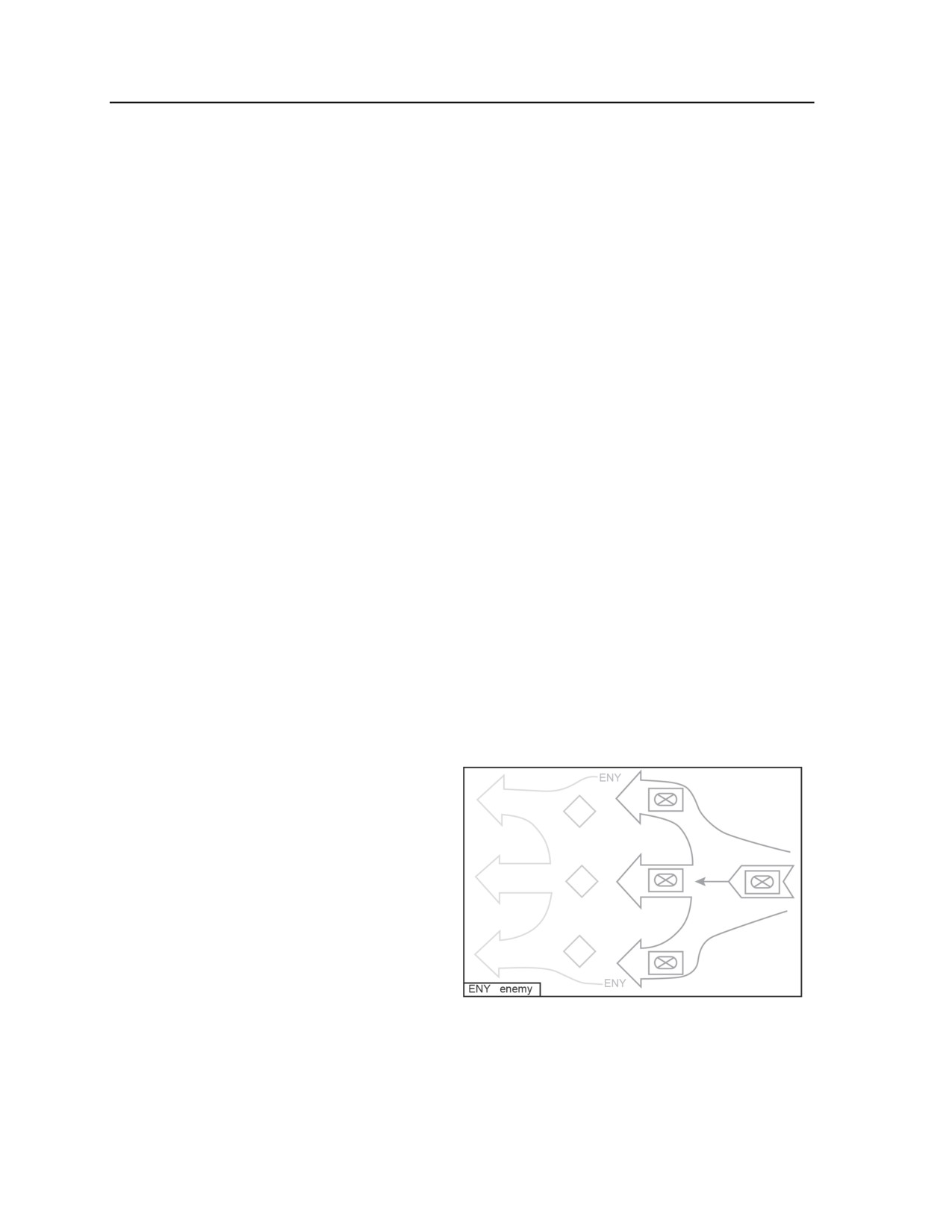
Chapter 5
presence of fresh enemy forces, greatly increased resistance, fatigue, dwindling supplies, diversion of
friendly units to security missions, increased need to conduct immediate civil security and civil control
tasks, and the need to contain bypassed enemy units. The unit staff should have developed a decision
support template that depicts decision points, timelines associated with the movement of forces and the
flow of the operation, and other key items of information required before the unit reaches that culmination
point.
5-6. Those plan, prepare, and execute concepts introduced previously continue to apply during a pursuit.
The assessment concepts described in ADRP 5-0 also apply. The commander modifies them as necessary
to account for the specific existing mission variables of mission, enemy, terrain and weather, troops and
support available, time available, and civil considerations (METT-TC).
ORGANIZATION OF FORCES FOR A PURSUIT
5-7. Normally, the commander does not organize specifically for pursuit operations ahead of time,
although the unit staff may plan for a pursuit mission as a branch or sequel to the current order. Therefore,
the commander must be flexible to react when the situation presents itself. Subordinate elements are made
as self-sufficient as resources will permit. The commander’s maneuver and sustainment forces continue
their ongoing activities, while the commander readjusts priorities to better support the pursuit. The
commander requests and acquires additional support from higher headquarters in accordance with the
mission variables of METT-TC. For most pursuits, the commander assigns subordinate forces security,
direct-pressure, encircling, follow and support, and reserve missions. The commander can assign available
airborne or air assault units the encircling mission because of their ability to conduct vertical envelopments.
Given sufficient resources, there can be more than one force assigned the encirclement mission. The
subordinate unit assigned the follow and support mission polices the battlefield to prevent the dissipation of
the combat power of the unit assigned the direct-pressure mission. Appendix B addresses the duties of a
follow and support force. The reserve allows the commander to take advantage of unforeseen opportunities
or respond to enemy counterattacks.
5-8. There are two options in conducting a pursuit; each involves assigning a subordinate the mission of
maintaining direct-pressure on the rearward moving enemy force. The first is a frontal pursuit that employs
only direct-pressure. The second is a combination that uses one subordinate element to maintain
direct-pressure and one or more other subordinate forces to encircling the retrograding enemy. The
combination pursuit is generally more effective. Either the subordinate applying direct-pressure or the
subordinate conducting the encirclement can be conducting the decisive operation in a combination pursuit.
FRONTAL PURSUIT
5-9. In a frontal pursuit, the commander
employs only a single force to maintain
direct-pressure on the retrograding enemy by
conducting operations along the same
retrograde routes used by that enemy.
(See
figure
5-1.) The commander chooses this
option in two situations. The first is when a
subordinate force with a sufficient mobility
advantage to get behind a retrograding enemy
force cannot be created. The second is when the
commander cannot provide enough resources to
the force conducting the encirclement to allow
that force to survive and sustain itself until
linkup with the direct-pressure force can be
Figure 5-1. Frontal pursuit
achieved. Either situation can occur because of
restrictive terrain or because an enemy withdraws in a disciplined, cohesive formation and still has
significant available combat power.
5-2
FM 3-90-1
22 March 2013
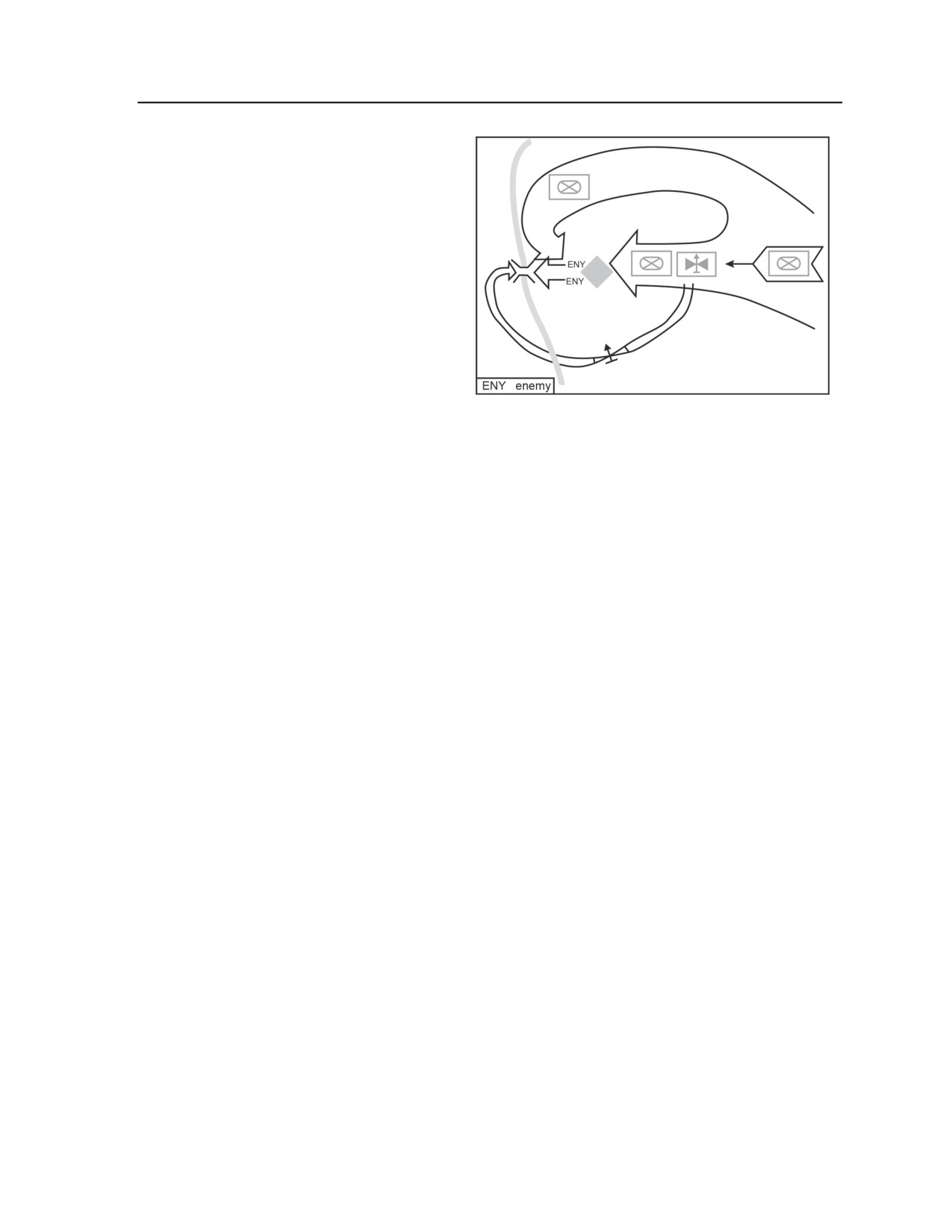
Pursuit
COMBINATION PURSUIT
5-10. In the pursuit, the most decisive
effects result from combining a direct
pressure force and an encircling force. The
direct pressure force is a force employed in
a pursuit operation that orients on the
enemy main body to prevent enemy
disengagement or defensive reconstitution
prior to envelopment by the encircling
force. It normally conducts a series of
attacks to slow the enemy’s retirement by
forcing the enemy to stand and fight. (See
figure 5-2.) In the combination pursuit, the
force providing direct-pressure initiates a
frontal pursuit immediately on discovering
the enemy’s initiation of a retrograde
Figure 5-2. Combination pursuit
operation. This slows the tempo of the
enemy’s withdrawal
(or fixes the enemy
force in its current position if possible), and may destroy the enemy’s rear security force. The
direct-pressure force’s actions help to set the conditions necessary for the success of the force conducting
the encircling operation by maintaining constant pressure. The encircling force is, in pursuit operations,
the force which maneuvers to the rear or flank of the enemy to block the enemy’s escape so that the
enemy can be destroyed between the direct pressure force and encircling force. This force advances
or flies along routes parallel to the enemy’s line of retreat. If the encircling force cannot outdistance
the enemy to cut the enemy off, the encircling force may also attack the flank of a retreating enemy.
The force conducting the encircling operation conducts an envelopment or a turning movement to position
itself where it can block the enemy’s escape and trap the enemy between the two forces, which leads to
complete annihilation of the enemy.
5-11. The force providing direct-pressure conducts hasty attacks to maintain contact and apply unrelenting
pressure until it destroys the enemy force. The force applying direct-pressure prevents enemy
disengagement and subsequent reconstitution of the enemy’s defense and inflicts maximum casualties. It
forces the enemy to deploy frequently in an attempt to delay the advance of the force applying
direct-pressure and restricts the enemy’s ability to disengage and rapidly move away. The force applying
direct-pressure must be at least as mobile as the enemy. Armored and Stryker units are ideally suited to this
role in open terrain, but the commander can employ light infantry forces, if the enemy is also foot-mobile
and the terrain prevents the use of more tactically mobile forces. The force applying direct-pressure
organizes itself to conduct a movement to contact and must be able to conduct a series of hasty attacks. It
must be powerful enough to defeat enemy rear guard actions and maintain pressure on the enemy’s main
body.
5-12. The force conducting the encirclement is the force that maneuvers to the rear or flank of the enemy
to block the enemy’s escape, so that the enemy can be destroyed between the force applying direct pressure
and the force conducting the encirclement. The force conducting the encirclement advances or flies along
routes parallel to the enemy’s line of retreat. If the force conducting the encirclement cannot outdistance the
enemy to cut the retrograding enemy off, that encircling force may also attack the flank of a retreating
enemy. The mobility of the force conducting the encirclement must be equal—preferably superior—to the
withdrawing enemy. If there is no inherent mobility differential, the commander must create one. This
differential can also result from the force applying direct-pressure to force the enemy to deploy. The
commander can also enhance, and sometimes create, this mobility advantage by conducting
countermobility operations against the enemy, specifically targeting locations, such as choke points or
bridges, that will hinder the fleeing enemy’s withdrawal. Armored, air assault, and airborne forces are well
suited for this encircling mission. Attack helicopters are also effective when used as part of this encircling
force. The force conducting the encirclement must be strong enough to defend itself from the enemy’s main
body and slow or fix the enemy until the friendly force applying direct-pressure force can combine with the
encircling force to destroy the enemy. It must be capable of mounting a hasty defense without placing itself
22 March 2013
FM 3-90-1
5-3