FM 3-90-1 Offense and Defense (Volume 1, March 2013) - page 1
*FM 3-90-1
Field Manual
Headquarters
Department of the Army
No. 3-90 Volume 1
Washington, DC, 22 March 2013
Offense and Defense
Volume 1
Contents
Page
PREFACE
viii
INTRODUCTION
ix
PART ONE OFFENSIVE TASKS
Chapter 1
BASICS OF THE OFFENSE
1-1
Characteristics of Offensive Tasks
1-1
Offensive Tasks
1-1
Common Offensive Control Measures
1-2
Forms of Maneuver
1-2
Common Offensive Planning Considerations
1-22
Transition
1-42
Chapter 2
MOVEMENT TO CONTACT
2-1
General Considerations for a Movement to Contact
2-1
Organization of Forces for a Movement to Contact
2-2
Control Measures for a Movement to Contact
2-4
Planning a Movement to Contact
2-5
Preparing for a Movement to Contact
2-7
Executing a Movement to Contact
2-7
Search and Attack
2-12
Cordon and Search
2-15
Chapter 3
ATTACK
3-1
General Considerations for an Attack
3-1
Organization of Forces for an Attack
3-1
Control Measures For an Attack
3-3
Planning an Attack
3-4
Preparing for an Attack
3-9
Distribution Restriction: Approved for public release; distribution is unlimited.
*This publication supersedes FM 3-90, dated 4 July 2001.
i
Contents
Executing an Attack
3-12
Special Purpose Attacks
3-23
Chapter 4
EXPLOITATION
4-1
General Considerations of an Exploitation
4-1
Organization of Forces for an Exploitation
4-2
Control Measures for an Exploitation
4-4
Planning an Exploitation
4-5
Executing an Exploitation
4-9
Chapter 5
PURSUIT
5-1
General Considerations for a Pursuit
5-1
Organization of Forces for a Pursuit
5-2
Control Measures for a Pursuit
5-4
Planning a Pursuit
5-5
Executing a Pursuit
5-6
Pursuit During Other Than Major Combat Operations
5-9
PART TWO DEFENSIVE TASKS
Chapter 6
BASICS OF THE DEFENSE
6-1
General Considerations of the Defense
6-1
Characteristics of the Defense
6-1
Defensive Tasks
6-2
Common Defensive Control Measures
6-3
Common Defensive Planning Considerations
6-3
Forms of the Defense
6-21
Transitions
6-29
Chapter 7
THE AREA DEFENSE
7-1
General Considerations for an Area Defense
7-1
Organization of Forces for an Area Defense
7-1
Control Measures for an Area Defense
7-4
Planning an Area Defense
7-5
Preparing an Area Defense
7-10
Executing an Area Defense
7-12
Chapter 8
MOBILE DEFENSE
8-1
General Considerations for a Mobile Defense
8-1
Organization of Forces for a Mobile Defense
8-2
Control Measures For a Mobile Defense
8-3
Planning a Mobile Defense
8-4
Preparing a Mobile Defense
8-5
Executing a Mobile Defense
8-6
Chapter 9
THE RETROGRADE
9-1
General Considerations for the Retrograde
9-1
Delay
9-1
Withdrawal
9-12
Retirement
9-16
Unique Retrograde Situations
9-19
ii
FM 3-90-1
22 March 2013
Contents
Appendix A BASIC TACTICAL CONTROL MEASURES
A-1
Common Control Measures
A-1
Appendix B TACTICAL MISSION TASKS
B-1
GLOSSARY
Glossary-1
REFERENCES
References-1
INDEX
Index-1
Figures
Figure
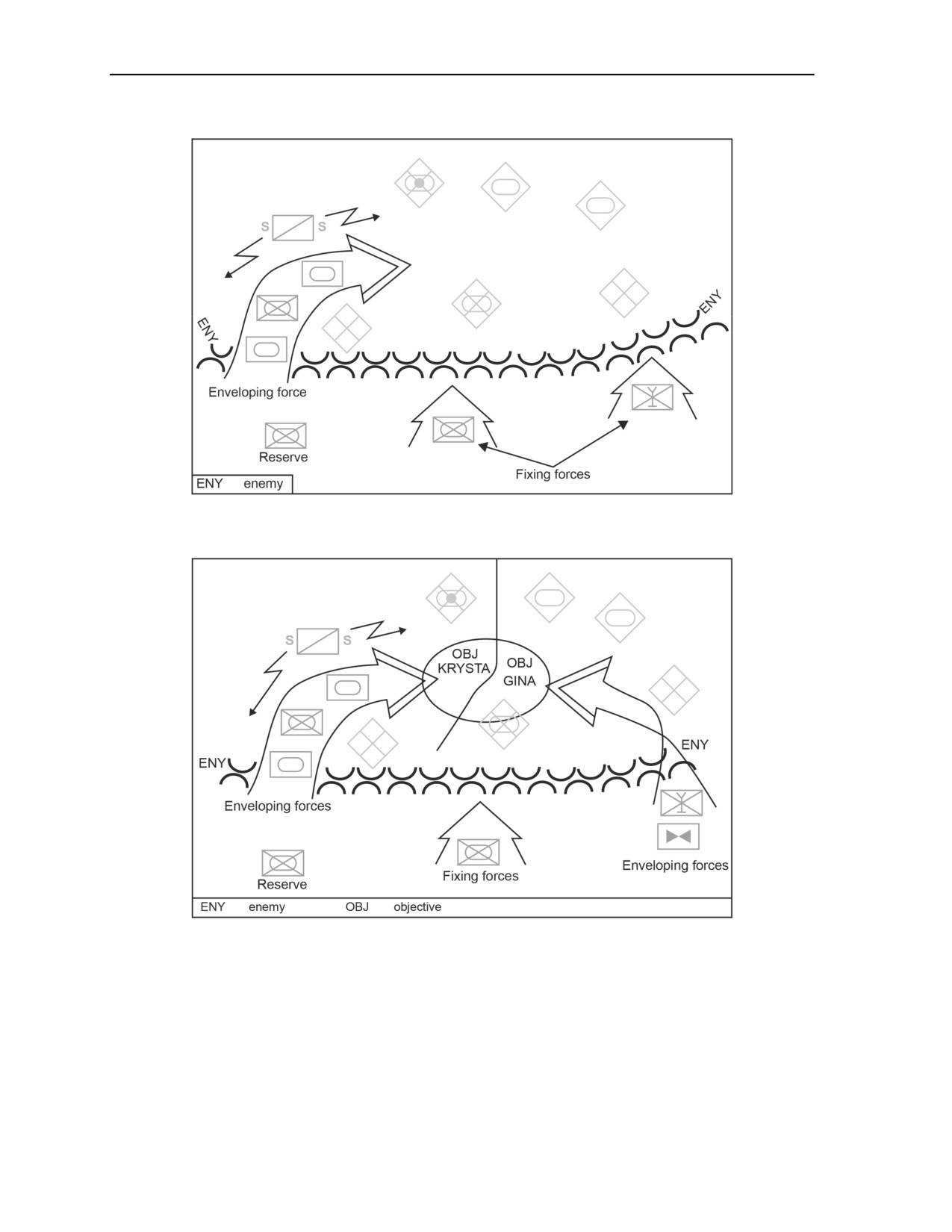
1-1. Single envelopment
1-4
Figure
1-2. Double envelopment
1-4
Figure
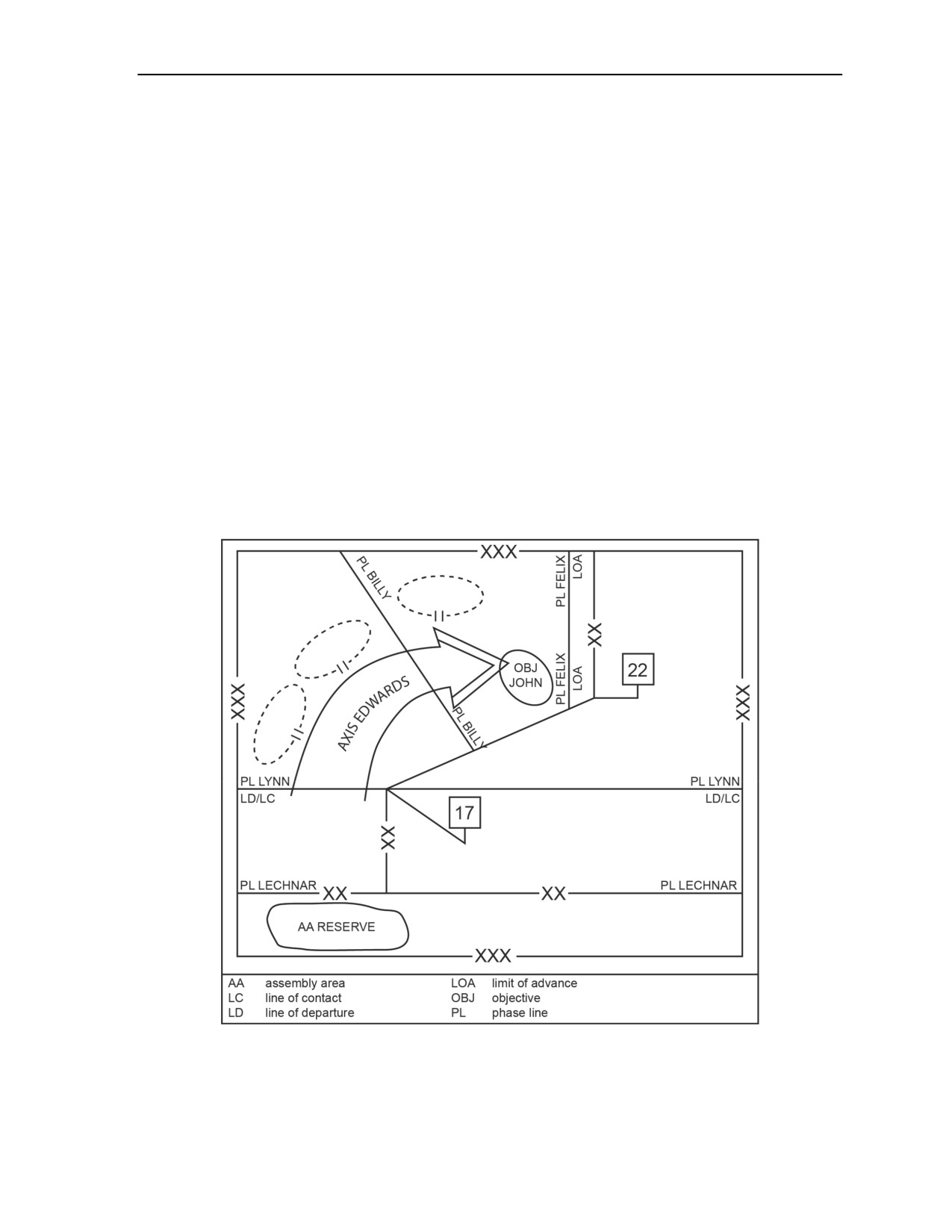
1-3. Example envelopment control measures
1-5
Figure
1-4. Turning movement: turning force conducting the decisive operation
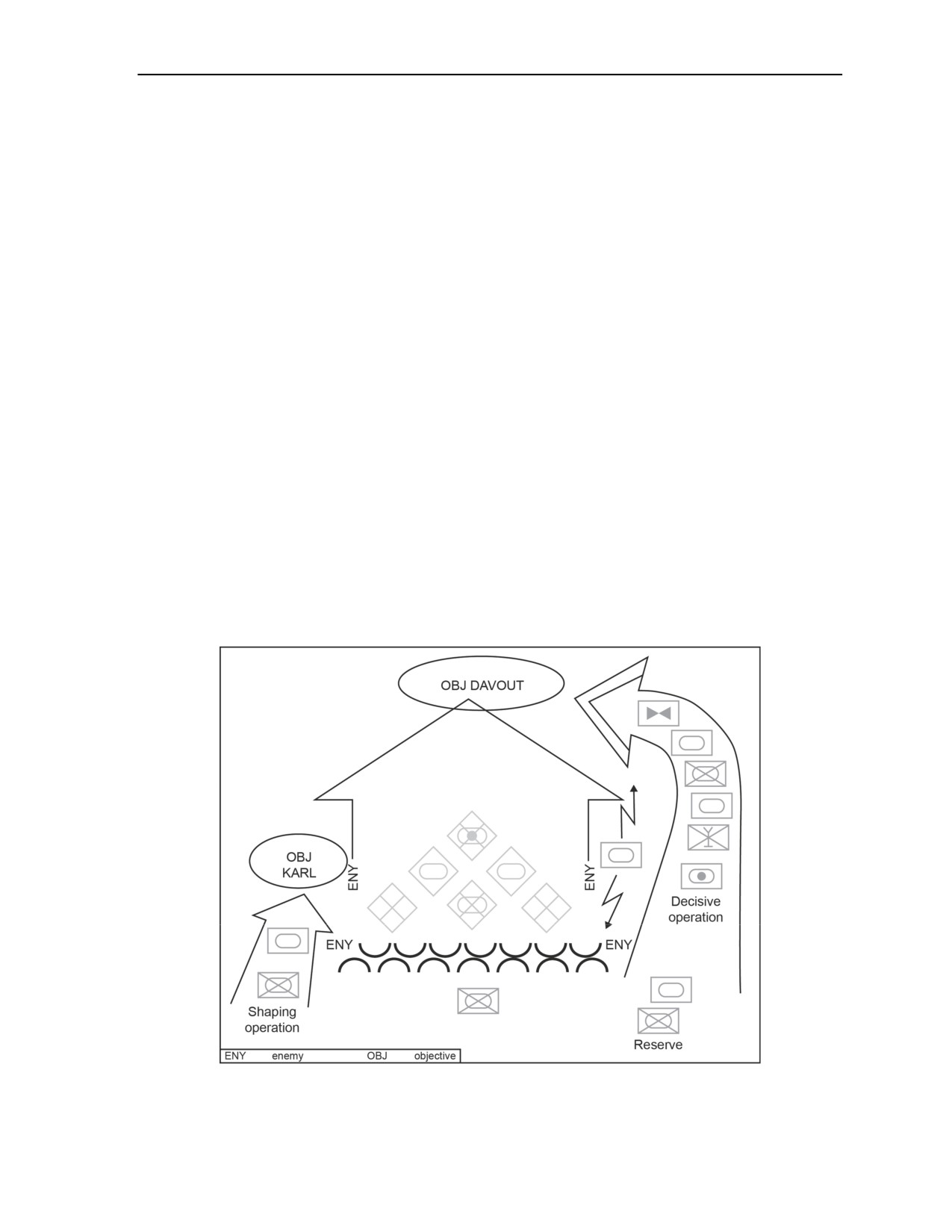
1-7
Figure
1-5. Control measures for a turning movement
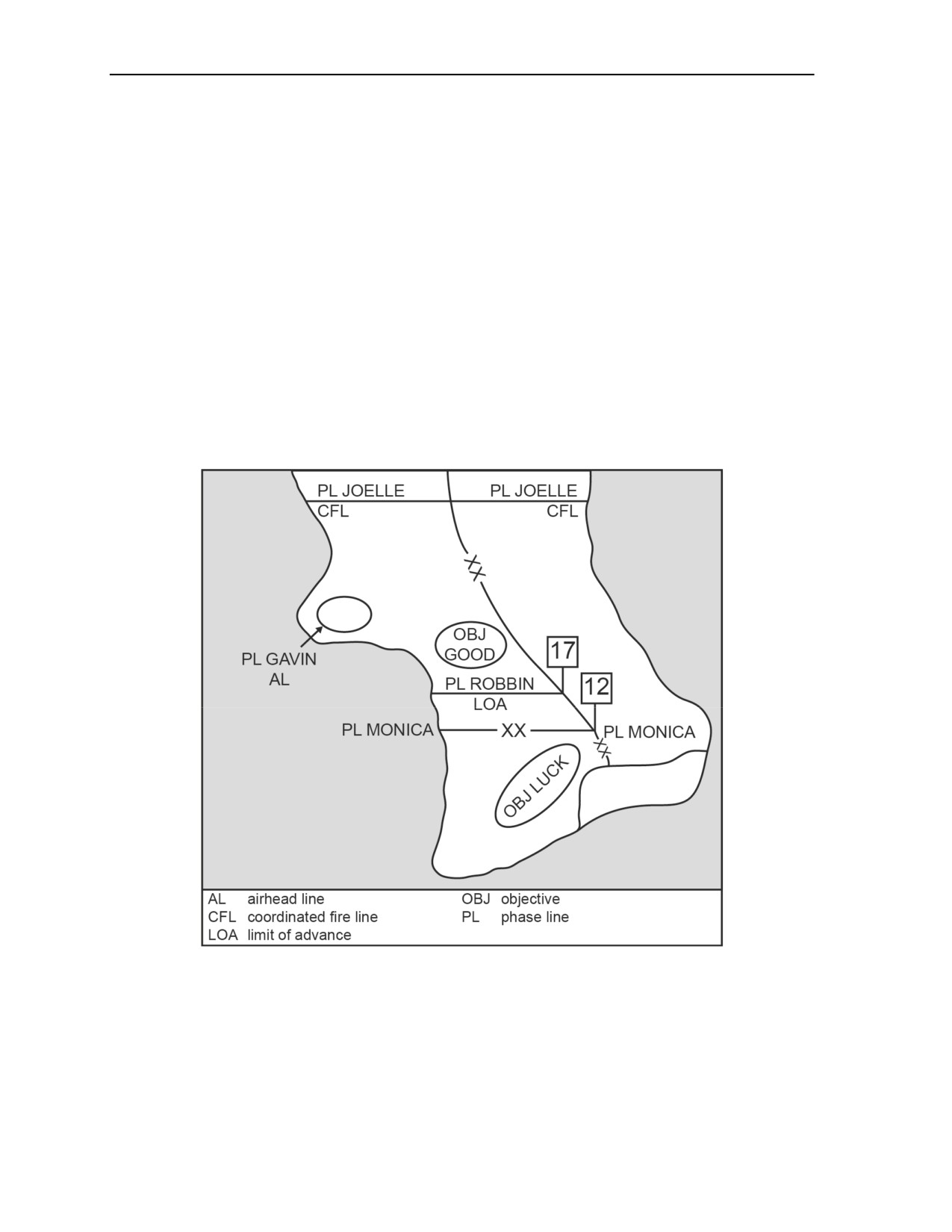
1-8
Figure
1-6. Infiltration lane
1-11
Figure
1-7. Linkup point 8
1-12
Figure
1-8. Penetration: relative combat power
1-15
Figure
1-9. Penetration: minimum graphic control measures
1-16
Figure
1-10. The penetration
1-18
Figure
1-11. Widening the breach to secure the flanks
1-19
Figure
1-12. Seizing the objective
1-20
Figure
1-13. Frontal attack
1-20
Figure
1-14. Flank attack
1-22
Figure
1-15. Armored brigade combat team in battalion column
1-26
Figure
1-16. Line formation
1-27
Figure
1-17. Armored brigade combat team in echelon left formation
1-27
Figure
1-18. Armored brigade combat team in echelon right formation
1-28
Figure
1-19. Box formation
1-28
Figure
1-20. Diamond formation
1-28
Figure
1-21. Wedge formation
1-29
Figure
1-22. Armored brigade combat team in vee formation
1-30
Figure
2-1. Force organized for a movement to contact
2-2
Figure
2-2. Movement to contact control measures
2-5
Figure
2-3. A column advance guard attacking to destroy a contained enemy force
2-7
Figure
2-4. Search and attack control measures
2-13
Figure
2-5. Company search and attack
2-14
Figure
3-1. Minimum attack control measures
3-3
Figure
3-2. Movement from the assembly area to the line of departure
3-11
Figure
3-3. Probable line of deployment and assault positions
3-17
Figure
3-4. Attack of an objective: the breach
3-19
Figure
3-5. Attack of an objective: the assault
3-19
22 March 2013
FM 3-90-1
iii
Contents
Figure 3-6. Ambush tactical mission graphic
3-23
Figure 3-7. Linear ambush
3-25
Figure 3-8. L-shaped ambush
3-25
Figure 3-9. Area ambush
3-25
Figure 3-10. Projected major counterattacks
3-27
Figure 3-11. Five phases of a raid
3-30
Figure 3-12. Spoiling attack
3-31
Figure 4-1. Control measures for a major exploitation
4-4
Figure 4-2. Control measures for a local exploitation
4-5
Figure 4-3. Brigade exploitation: battalions in column formation
4-6
Figure 4-4. Division exploitation: brigades abreast, no reserve
4-7
Figure 4-5. Brigade exploitation: two battalions forward, one in reserve
4-7
Figure 4-6. Exploitation control measures for a combined arms battalion in a vee
formation
4-8
Figure 5-1. Frontal pursuit
5-2
Figure 5-2. Combination pursuit
5-3
Figure 5-3. Pursuit control measures
5-5
Figure 6-1. Perimeter defense
6-22
Figure 6-2. All company teams on the perimeter
6-23
Figure 6-3. Two battalion task forces on the perimeter, company teams positioned in
depth
6-23
Figure 6-4. Two battalion task forces on the perimeter, one in reserve
6-24
Figure 6-5. Engagement area control measures
6-25
Figure 6-6. Slope terminology
6-27
Figure 6-7. Oblique defilade
6-28
Figure 7-1. Typical control measures for an area defense
7-4
Figure 7-2. Organization of forces for an area defense-contiguous area of operations
7-5
Figure 7-3. Organization of forces for an area defense-noncontiguous area of
operations
7-5
Figure 7-4. Division conducting a defense in depth with subordinate brigades
deployed in noncontiguous areas of operations with enemy avenues of
approach depicted
7-7
Figure 7-5. Brigade conducting a forward defense in a contiguous area of operations
7-8
Figure 7-6. Division counterattack
7-9
Figure 7-7. Area defense using static and dynamic elements
7-12
Figure 7-8. Battle handover line
7-14
Figure 8-1. Mobile defense
8-2
Figure 8-2. Army organization of forces for a mobile defense
8-2
Figure 8-3. Mobile defense control measures
8-4
Figure 8-4. Mobile defense before commitment of striking force
8-7
Figure 8-5. Mobile defense after commitment of striking force
8-8
Figure 9-1. Delay tactical mission graphic
9-3
iv
FM 3-90-1
22 March 2013
Contents
Figure 9-2. Control measures for a delay
9-4
Figure 9-3. Delay forward of a specified line for a specified time
9-5
Figure 9-4. Delay from alternate positions
9-7
Figure 9-5. Delay from subsequent positions
9-7
Figure 9-6. Detachment left in contact
9-14
Figure 9-7. Withdrawal control measures
9-14
Figure 9-8. Types of withdrawals
9-15
Figure 9-9. Retirement tactical mission graphic
9-17
Figure 9-10. Organization of forces for a retirement operation
9-17
Figure 9-11. Stay-behind force
9-21
Figure A-1. Example airspace coordination area
A-2
Figure A-2. Example air corridor and air control points
A-3
Figure A-3. Assembly area examples
A-5
Figure A-4. Checkpoint 13
A-5
Figure A-5. Contact point 8
A-5
Figure A-6. Critical friendly zone
A-6
Figure A-7. Example battalion engagement area
A-7
Figure A-8. Example sector of fire
A-8
Figure A-9. Target reference point 032
A-8
Figure A-10. Trigger line examples
A-9
Figure A-11. 1st Brigade combat team coordinated fire line
A-10
Figure A-12. III Corps fire support coordination line
A-10
Figure A-13. 1CD free-fire area
A-11
Figure A-14. Example no fire area
A-11
Figure A-15. Example restrictive fire area
A-11
Figure A-16. Example restrictive fire line
A-12
Figure A-17. Fire support target symbols
A-12
Figure A-18. Example forward line of own troops
A-13
Figure A-19. Line of contact
A-13
Figure A-20. Example movement corridor
A-14
Figure A-21. Named area of interest Augusta
A-14
Figure A-22. Obstacle control measure graphics
A-15
Figure A-23. Phase lines with other control measures
A-18
Figure A-24. Position area for artillery
A-18
Figure A-25. Example routes
A-19
Figure A-26. Example target area of interest
A-19
Figure A-27. Attack by fire position Brandon
A-20
Figure A-28. Attack positions used with other common offensive control measures
A-21
Figure A-29. Battle handover line in a rearward passage of lines
A-22
Figure A-30. Final coordination line, limit of advance, and line of departure used with
other offensive control measures
A-23
22 March 2013
FM 3-90-1
v
Contents
Figure A-31. Point of departure 7
A-24
Figure A-32. Rally point 14
A-24
Figure A-33. Support by fire position
A-24
Figure A-34. Task force battle position
A-25
Figure A-35. Area of operations and battle position control measures used in
combination
A-26
Figure A-36. Five kinds of battle positions
A-26
Figure A-37. Strong point defense
A-27
Figure A-38. Direct fire control measures
A-27
Figure A-39. Final protective fire
A-28
Figure A-40. Forward edge of the battle area
A-28
Figure B-1. Attack by fire tactical mission graphic
B-3
Figure B-2. Breach tactical mission graphic
B-3
Figure B-3. Bypass tactical mission graphic
B-4
Figure B-4. Task force conducting a fix and bypass
B-4
Figure B-5. Clear tactical mission graphic
B-5
Figure B-6. Follow and assume tactical mission graphic
B-7
Figure B-7. Follow and support tactical mission graphic
B-8
Figure B-8. Occupy tactical mission graphic
B-9
Figure B-9. Retain tactical mission graphic
B-9
Figure B-10. Secure tactical mission graphic
B-9
Figure B-11. Seize tactical mission graphic
B-10
Figure B-12. Support by fire tactical mission graphic
B-10
Figure B-13. Block tactical mission graphic
B-10
Figure B-14. Block obstacle effect graphic
B-11
Figure B-15. Canalize tactical mission graphic
B-11
Figure B-16. Canalizing terrain enhanced by obstacles used with an engagement
area
B-11
Figure B-17. Contain tactical mission graphic
B-12
Figure B-18. Destroy tactical mission graphic
B-12
Figure B-19. Disrupt tactical mission graphic
B-12
Figure B-20. Disrupt obstacle intent graphic
B-12
Figure B-21. Fix tactical mission graphic
B-13
Figure B-22. Fix obstacle intent graphic
B-13
Figure B-23. Interdict tactical mission graphic
B-13
Figure B-24. Isolate tactical mission graphic
B-14
Figure B-25. Neutralize tactical mission graphic
B-14
Figure B-26. Suppress tactical mission task graphic
B-14
Figure B-27. Turn tactical mission graphic
B-15
Figure B-28. Turn obstacle effect
B-15
vi
FM 3-90-1
22 March 2013
Contents
Tables
Table 3-1. Advantages and disadvantages of limited-visibility attacks
3-6
Table 9-1. Advantages and disadvantages of delay techniques
9-6
Table B-1. Actions by friendly forces and effects on enemy forces
B-1
Table B-2. Elements of operations and subordinate tasks
B-2
Table B-3. Tactical shaping operations and tasks
B-2
22 March 2013
FM 3-90-1
vii
Preface
Field Manual (FM) 3-90 Volume 1 contributes to the Army and joint community by providing guidance on
the conduct of the offense and defense. It describes both combat-tested tactics and procedures that have
been modified to exploit emerging Army and joint offensive and defensive capabilities. FM 3-90-1
expounds on the doctrinal fundamentals established in Army Doctrine Reference Publication (ADRP) 3-90.
ADRP 3-90 must be read before reading FM 3-90-1, since that is where doctrine for the conduct of
offensive and defensive tasks and the art and science of tactics is found. FM 3-90-1 addresses the basic
tactics associated with the conduct of offensive and defensive tasks.
The principal audience for FM 3-90-1 is all members of the profession of arms. Commanders and staffs of
Army headquarters serving as a joint task force or multinational headquarters should also refer to
applicable joint or multinational doctrine concerning the range of military operations and joint or
multinational forces. Trainers and educators throughout the Army will also use this publication.
FM 3-90-1 focuses on the organization of forces, minimum essential control measures, and general
planning, preparation, and execution considerations for each primary offensive and defensive task. It is the
common reference for all students of the art and science of tactics, both in the field and the Army school
system. The offensive and defensive considerations in this publication apply to small tactical units, such as
companies and battalions, even though most of the figures in this publication use the division and the
brigade combat team (BCT) echelons to illustrate points in the text. Echelon-specific field manuals and
Army techniques publications address the specifics of how each tactical echelon employs these tactical
concepts.
FM 3-90-1 implements standardization agreement (STANAG) Allied Tactical Publication-3.2.1.
Commanders, staffs, and subordinates ensure their decisions and actions comply with applicable U.S.,
international, and, in some cases, host-nation laws and regulations. Commanders at all levels ensure their
Soldiers operate in accordance with the law of war and the rules of engagement. (See FM 27-10.)
FM 3-90-1 uses joint terms where applicable. Most terms with joint or Army definitions are in both the
glossary and the text. Terms for which FM 3-90-1 is the proponent publication (the authority) are marked
with an asterisk (*) in the glossary. Definitions for which FM 3-90-1 is the proponent publication are
boldfaced in the text. For other definitions shown in the text, the term is italicized and the number of the
proponent publication follows the definition.
FM 3-90-1 applies to the Active Army, the Army National Guard (ARNG)/the Army National Guard of the
United States(ARNGUS), and the United States Army Reserve (USAR) unless otherwise stated.
The United States Army Combined Arms Center is the proponent for this publication. The preparing
agency is the Combined Arms Doctrine Directorate, United States Army Combined Arms Center. Send
written comments and recommendations on a DA Form 2028 (Recommended Changes to Publications and
Blank Forms) to Commander, U.S. Army Combined Arms Center and Fort Leavenworth, ATTN: ATZL-
MCK-D (FM 3-90-1), 300 McPherson Avenue, Fort Leavenworth, KS 66027-2337; by e-mail to
usarmy.leavenworth.mccoe.mbx.cadd-org-mailbox@mail.mil; or submit an electronic DA Form 2028.
viii
FM 3-90-1
22 March 2013
Introduction
To understand FM 3-90-1, the reader must understand the doctrinal fundamentals contained in Army
Doctrine Publications (ADP) 3-0 and 3-90 and Army Doctrine Reference Publications (ADRP) 3-0 and 3-
90. The reader should understand how the activities described in ADPs 3-07 and 3-28 and ADRP 3-07
carry over and impact the conduct of offensive and defensive primary tasks and vice versa. The reader
should understand the operations (plan, prepare, execute, and assess) process and how that process relates
to the Army’s military decisionmaking process and troop-leading procedures described in ADP 5-0 and
ADRP 5-0. The reader should also understand the intelligence preparation of the battlefield (IPB) process
found in ADRP 2-0 and the targeting process described in ADRP 3-09.
The combined arms tactics contained in this volume are based on the Army’s historical lessons learned.
However, enemies and adversaries read U.S. doctrine and tactics to learn how to best counter the U.S.
combined arms team. The Army of the future must prove itself as capable of quickly adapting to new and
unexpected situations as it has in the past. Implementing change in the midst of combat is a difficult
process. Commanders must ensure the rapid dissemination of new tactics, techniques, and procedures
developed to counter or take advantage of new circumstances regardless of the source of the solutions, from
junior Soldiers on patrol to staff officers in Army command headquarters.
There have been several changes in the organization and contents of this publication when compared with
its predecessor, the 2001 edition of FM 3-90, Tactics. Chapter 1, The Art of Tactics, and the common
tactical concept half of chapter 2 of the previous edition are now found in ADRP 3-90. The graphic control
measures discussion in the previous version’s chapter 2 is now appendix A of FM 3-90-1. The Army
branch discussion from the previous version’s appendix A has been deleted as redundant with information
contained in Department of the Army 600-series pamphlets. The Army tactical echelon discussion from the
previous version’s appendix A has been moved to chapter 2 of ADRP 3-90 and expanded on down to the
fire team level. Appendix C, Airborne and Air Assault Operations, of the 2001 version of FM 3-90 has
been deleted. The Army contributions to the joint task of forcible entry by vertical envelopment are now
addressed in airborne and air assault doctrine. Appendix D, Encirclement Operations, is now a tactical
enabling task addressed in FM 3-90-2. Appendix E, Rear Area and Base Security, is now addressed in the
protection series of publications (ADP 3-37 and ADRP 3-37).
This volume contains nine chapters divided into two parts and two appendices. The text of FM 3-90-1
focuses on combined arms tactics used to employ available means to win in combat (the conduct of
offensive and defensive tasks) and constitutes the Army’s collective view of how units conduct prompt and
sustained tactical offensive and defensive actions on land. Those tactics require judgment in application.
FM 3-90-1 provides a common discussion of how commanders from the battalion task force level through
the division echelon conduct tactical offensive and defensive tasks and their supporting tactical enabling
tasks. The tactics and considerations discussed in this publication focus on the Army core competencies of
employing combined arms in lethal combat operations. These offensive and defensive combined arms
tactics and considerations apply to the conduct of decisive action across the range of military operations,
but they cannot be used in isolation. Their application must be tempered by the obligation to protect the
civilian population within the area of operations in the conduct of the stability element of decisive action.
This publication is not prescriptive, but it is authoritative.
• Part One contains five chapters and addresses the conduct of offensive tasks.
• Part Two contains four chapters addresses the conduct of defensive tasks.
• The two appendices address in control measures that apply to the conduct of offensive and
defensive tasks and Army tactical mission tasks.
Each chapter is built around organizational considerations, control measures, planning, preparation, and
execution considerations for the tasks to be accomplished. These considerations are largely grouped by
warfighting or joint function. Chapter 1 contains general information on the offense. Chapter 6 contains
22 March 2013
FM 3-90-1
ix
Introduction
general information on the defense. Information contained in these chapters is not repeated in other
chapters to avoid redundancy. For example, chapter 1 addresses the sustainment function in the offense.
That information applies to all four primary offensive tasks, so it is not repeated in chapters 2-5.
This publication discusses the conduct of the primary offensive tasks in chapters 2-5 and the primary
defensive tasks in chapters 7-9 in a five-step sequence:
z Gain and maintain enemy contact.
z Disrupt the enemy.
z Fix the enemy.
z Maneuver.
z Follow through.
This sequence is for discussion purposes only and is not the only way of conducting operations. The reader
should understand that these sequences overlap during the conduct of operations, if they can even be
distinguished from each other. Normally the first three of these steps are shaping operations, while the
maneuver step is the decisive operation. The follow through step is normally a sequel or a branch to the
plan based on the revised situation, but in certain circumstances it can be the decisive operation. The
execution of this follow through determines if the force can exploit success, or if it should transition to
another task to include a change in focus from offensive or defensive tasks to a focus on the conduct of
stability tasks.
The tactics, techniques, and procedures discussed in this publication are only examples of a way to conduct
a specific offensive or defensive task. Collectively they provide a set of tools that commanders employ in
accordance with the exact tactical situation that they face at any one given time. The tactical situation is
defined as the mission variables of mission, enemy, terrain and weather, troops and support available, time
available, and civil considerations (METT-TC).
The existing rules of engagement in a specific situation will control the actual application of the tactics,
techniques, and procedures discussed in this publication. Readers of FM 3-90-1 should be aware that rules
of engagement are constantly evolving. Criteria for allowing weapon systems employment during the
conduct of major operations are significantly different than the criteria used during the conduct of irregular
warfare or peace operations. Commanders must understand where they currently are on the range of
military operations continuum and be able to switch quickly between different places along that continuum
to protect their units and Soldiers while still accomplishing their mission. A commander should seek legal
guidance concerning currently applicable U.S. and multinational rules and policies regarding the
employment of lethal and non-lethal weapons before directing their employment.
This volume contains few historical references. Such references are important in illustrating the impact of
combat on Soldiers and the art of command. Successful commanders, staff officers, and Soldiers of all
ranks study military history. This study should include the experiences of other armies and precedents from
classical, medieval, and recent historical periods, in addition to Army and Marine Corps recent experiences
in Iraq and Afghanistan. Military professionals should also study politics and diplomacy, economics, and
ways of influencing others—the other instruments of national power. While history never exactly repeats
itself, on many occasions it closely parallels previous developments. In addition, war remains a human
endeavor. What motivated or influenced Soldiers in the past will probably motivate or influence today’s
Soldiers to one degree or another, once adjustments are made to account for technological and social
changes.
The introductory table on page xiii outlines different modifications in doctrinal terminology reflected in
Volumes 1 and 2 of FM 3-90.
x
FM 3-90-1
22 March 2013
Introduction
Introductory table. Modified Army terms
Term
Remarks
base defense force
Adopts the joint definition.
combat arms
Doctrinal term no longer used, but term still used
in Army regulations.
combat support
Retained based on common English usage. No
longer formally defined.
consolidation
FM 3-90-1modifies the definition.
contact point
Adopts the joint definition.
destroy
FM 3-90-1modifies the definition.
exfiltrate
FM 3-90-1modifies the definition.
key terrain
Adopts the joint definition.
line formation
FM 3-90-1modifies the definition.
passage of lines
Adopts the joint definition.
procedures
Adopts the DOD definition.
reconnaissance operations
Retained based on common English usage. No
longer formally defined.
relief in place
Adopts the joint definition.
tactician
Retained based on common English usage. No
longer formally defined.
techniques
Adopts the joint definition.
22 March 2013
FM 3-90-1
xi
PART ONE
Offensive Tasks
Chapter 1
Basics of the Offense
Offensive actions are combat operations conducted to defeat and destroy enemy
forces and seize terrain, resources, and population centers. They impose the
commander’s will on the enemy. A commander may also conduct offensive actions to
deprive the enemy of resources, seize decisive terrain, deceive or divert the enemy,
develop intelligence, or hold an enemy in position. This chapter discusses the basics
of the offense. The basics discussed in this chapter apply to the conduct of all
offensive tasks.
1-1. The commander seizes, retains, and exploits the initiative when conducting offensive tasks. Specific
operations may orient on a specific enemy force or terrain feature as a means of affecting the enemy. Even
when conducting primarily defensive tasks, wresting the initiative from the enemy requires the conduct of
offensive actions.
CHARACTERISTICS OF OFFENSIVE TASKS
1-2. Offensive tasks are characterized by surprise, concentration,
Characteristics of
tempo, and audacity. Effective offensive action capitalizes on accurate
offensive tasks
and timely intelligence and other relevant information regarding enemy
forces, weather, and terrain. The commander maneuvers forces to
• Surprise
advantageous positions before contact. Protection tasks, such as
security operations, operations security, and information protection
• Concentration
prevent or inhibit the enemy from acquiring accurate information about
• Tempo
friendly forces. Contact with enemy forces before the decisive
operation is deliberate, designed to shape the optimum situation for the
• Audacity
decisive operation. The decisive operation is the operation that directly
accomplishes the mission (ADRP 3-0). The decisive operation is a sudden, shattering action that capitalizes
on subordinate initiative and a common operational picture (COP) to expand throughout the area of
operations (AO). The commander executes violently without hesitation to break the enemy’s will or destroy
the enemy. (See ADRP 3-90 for a discussion of these characteristics.)
Army offensive tasks
OFFENSIVE TASKS
• Movement to contact
1-3. An offensive task is a task conducted to defeat and destroy
enemy forces and seize terrain, resources, and population centers
• Attack
(ADRP 3-0). The four primary offensive tasks are movement to
• Exploitation
contact, attack, exploitation, and pursuit.
• Pursuit
22 March 2013
FM 3-90-1
1-1
Chapter 1
MOVEMENT TO CONTACT
1-4. Movement to contact is an offensive task designed to develop the situation and establish or regain
contact (ADRP 3-90). It also creates favorable conditions for subsequent tactical actions. The commander
conducts a movement to contact when the enemy situation is vague or not specific enough to conduct an
attack. Forces executing this task seek to make contact with the smallest friendly force feasible. A
movement to contact may result in a meeting engagement. Once contact is made with an enemy force, the
commander has five options: attack, defend, bypass, delay, or withdraw. Search and attack and cordon and
search are subordinate tasks of movement to contact. Chapter 2 discusses movement to contact. FM 3-90-2
discusses the approach march.
ATTACK
1-5. An attack is an offensive task that destroys or defeats enemy forces, seizes and secures terrain, or
both (ADRP 3-90). Attacks incorporate coordinated movement supported by fires. They may be either
decisive or shaping operations. Attacks may be characterized as hasty or deliberate, depending on the time
available for assessing the situation, planning, and preparing. However, based on mission variable analysis,
the commander may decide to conduct an attack using only fires. An attack differs from a movement to
contact because, in an attack, the commander knows part of the enemy’s disposition. This knowledge
enables the commander to better synchronize the attack and employ combat power more effectively in an
attack than in a movement to contact.
Forms of the attack
1-6. Subordinate forms of the attack have special purposes and include
the ambush, counterattack, demonstration, feint, raid, and spoiling
• Ambush
attack. The commander’s intent and the mission variables of mission,
enemy, terrain and weather, troops and support available, time
• Counterattack
available, and civil considerations
(METT-TC) determine which of
• Demonstration
these forms of attack are employed. The commander can conduct each
of these forms of attack, except for a raid, as either a hasty or a
• Feint
deliberate operation. Chapter
3 discusses the attack and these
• Raid
subordinate forms.
• Spoiling attack
EXPLOITATION
1-7. Exploitation is an offensive task that usually follows the conduct of a successful attack and is
designed to disorganize the enemy in depth (ADRP 3-90). Exploitations seek to disintegrate enemy forces
to the point where they have no alternative but surrender or take flight. Exploitations take advantage of
tactical opportunities. Division and higher headquarters normally plan exploitations as branches or sequels
to the current operation. Chapter 4 discusses exploitation.
PURSUIT
1-8. A pursuit is an offensive task designed to catch or cut off a hostile force attempting to escape, with
the aim of destroying it (ADRP 3-90). A pursuit normally follows a successful exploitation. However, any
offensive task can transition into a pursuit, if enemy resistance has broken down and the enemy is fleeing
the battlefield. Pursuits entail rapid movement and decentralized control. Chapter 5 discusses the pursuit.
COMMON OFFENSIVE CONTROL MEASURES
1-9. Appendix A discusses common control measures. Those control measures closely associated with a
subordinate offensive task, form of maneuver, or form of attack are discussed as part of the discussion of
those tasks or forms.
FORMS OF MANEUVER
1-10. Forms of maneuver are distinct tactical combinations of fire and movement with a unique set of
doctrinal characteristics that differ primarily in the relationship between the maneuvering force and the
1-2
FM 3-90-1
22 March 2013
Basics of the Offense
enemy (ADRP 3-90). There are six forms of maneuver: envelopment, turning movement, frontal attack,
penetration, infiltration, and flank attack. Combined arms organizations accomplish their mission by
synchronizing the contributions of all warfighting functions to
Forms of maneuver
execute these forms of maneuver. Combined arms is the synchronized
and simultaneous application of arms to achieve an effect greater than
• Envelopment
if each arm was used separately or sequentially (ADRP 3-0).The
commander generally chooses one form on which to build a course of
• Turning movement
action (COA). The higher commander rarely specifies the specific
• Frontal attack
form of offensive maneuver. However, that higher commander’s
guidance and intent, along with the mission and any implied tasks,
• Penetration
may impose constraints such as time, security, and direction of attack
• Infiltration
that narrow the forms of offensive maneuver to one alternative.
Additionally, the AO’s characteristics and the enemy’s dispositions
• Flank attack
also help the commander determine the form of maneuver. A single
operation may contain several forms of maneuver, such as a frontal attack to clear a security area followed
by a penetration to create a gap in enemy defenses. Then, the commander might use an envelopment to
destroy the enemy’s first line of defense.
ENVELOPMENT
1-11. Envelopment is a form of maneuver in which an attacking force seeks to avoid the principal
enemy defenses by seizing objectives behind those defenses that allow the targeted enemy force to be
destroyed in their current positions. At the tactical level, envelopments focus on seizing terrain,
destroying specific enemy forces, and interdicting enemy withdrawal routes. The commander’s decisive
operation focuses on attacking an assailable flank. It avoids the enemy’s strength—the enemy’s front—
where the effects of enemy fires and obstacles are the greatest. Generally, a commander prefers to conduct
envelopment instead of a penetration or a frontal attack because the attacking force tends to suffer fewer
casualties while having the most opportunities to destroy the enemy. Envelopment also produces great
psychological shock to the enemy. If no assailable flank is available, the attacking force creates one
through the conduct of a penetration. The four varieties of envelopment are the single envelopment, double
envelopment, encirclement, and vertical envelopment. (See figure 1-1 and 1-2 on page 1-4.) A single
envelopment results from maneuvering around one assailable flank of a designated enemy force. A
double envelopment results from simultaneous maneuvering around both flanks of a designated
enemy force. Encirclement operations are operations where one force loses its freedom of maneuver
because an opposing force is able to isolate it by controlling all ground lines of communication and
reinforcement. Vertical envelopments are tactical maneuvers in which troops, either air-dropped or
airlanded, attack the rear and flanks of a force, in effect cutting off or encircling the force. (JP 3-18). (For a
discussion of encirclement operations, see FM 3-90-2.)
22 March 2013
FM 3-90-1
1-3
Chapter 1
Figure 1-1. Single envelopment
Figure 1-2. Double envelopment
1-12. Single and double envelopments force the enemy to fight in two or more directions simultaneously
to meet the converging efforts of the attack. A double envelopment generally requires a preponderance of
force and can be difficult to control. A force seeking to execute a double envelopment must also have a
substantial mobility advantage over the defender. A unit performs a double envelopment by conducting a
frontal attack as a shaping operation in the center to fix the enemy in place while enveloping both hostile
flanks. Because of the forces required, normally only divisions and larger organizations have the resources
to execute a double envelopment.
1-4
FM 3-90-1
22 March 2013
Basics of the Offense
Organization of Forces
1-13. The commander envisioning a single envelopment organizes the friendly force to perform two
primary tasks: fixing the enemy force in its current location and conducting the envelopment. The
commander also allocates forces to conduct necessary shaping operations, such as reconnaissance, security,
reserve, and sustaining tasks. The force conducting the envelopment normally conducts the decisive
operation by attacking an assailable enemy flank and avoiding the enemy’s main strength en route to the
objective. The fixing force conducting the shaping operations normally conducts a frontal attack to fix
enemy forces in their current positions to prevent their escape and reduce their capability to react against
the enveloping force. A commander executing a double envelopment organizes the friendly forces to
conduct two enveloping operations and allocates the minimum combat power to shaping operations
required to conduct the fix tasks in addition to reconnaissance, security, reserve, and sustaining tasks. The
commander typically designates the more important of the two enveloping forces as the main effort for
resources. The main effort is a designated subordinate unit whose mission at a given point in time is most
critical to overall mission success (ADRP 3-0).
Control Measures
1-14. The commander, at a minimum, designates AOs for each unit participating in the envelopment by
using boundaries. The commander also designates phase lines (PLs), support by fire and attack by fire
positions, contact points, and appropriate fire coordination measures, such as a restrictive fire line or
boundary between converging forces, and any other control measures necessary to control the envelopment.
Figure 1-3 is an example of control measures used when conducting a single envelopment.
Figure 1-3. Example envelopment control measures
22 March 2013
FM 3-90-1
1-5
Chapter 1
Planning an Envelopment
1-15. Successful envelopment planning depends on knowing and understanding the enemy and its
capabilities. The commander seeks to maneuver the enveloping force around or over the enemy’s main
defenses to secure objectives on the enemy’s flank or rear. From those objectives the enveloping force can
use its positional advantage to employ superior combat power against a defending enemy oriented in the
wrong direction. The commander uses intelligence assets and personnel to determine the disposition and
capabilities of enemy forces to detect and react to their operations.
1-16. The commander plans for the force conducting the envelopment to remain within supporting
distance of the fixing force. (If the enveloping force is going outside of supporting distance, it is probably
conducting a turning movement, not envelopment.)
1-17. Sustaining the enveloping force requires deliberate planning because only intermittent ground lines
of communication (LOCs) between the echelon support area and the enveloping force may exist. A line of
communications is a route, either land, water, and/or air, that connects an operating military force with a
base of operations and along which supplies and military forces move (JP 2-01.3).
1-18. The commander plans how to exploit the envelopment’s success as the enemy is encircled or how to
transition to a pursuit to complete the destruction of the enemy force. These plans are developed as
branches and sequels to the envelopment operation.
Executing an Envelopment
1-19. A successful envelopment depends largely on the degree of surprise the commander achieves against
the opponent or the presence of overwhelming combat power. The envelopment’s probability of success
also increases when the commander’s forces have superior tactical mobility, possess air and information
superiority, and shaping operations fix the bulk of the enemy’s forces in their current positions. The
commander uses reconnaissance and surveillance assets to provide continuous intelligence and combat
information to identify changes in enemy COAs throughout the execution of the envelopment.
1-20. Normally, a unit orients the majority of its combat power toward where it expects to engage enemy
forces, while placing less combat power on its own flanks. Thus the flanks of most units are more
vulnerable to attack. The attacking commander creates an assailable flank using whatever means necessary.
The enveloping force then moves rapidly to exploit the situation before the enemy strengthens an assailable
flank by preparing positions in depth and by holding mobile forces in reserve. When faced with the threat
of envelopment, the enemy commander might move reserves to meet the enveloping force. Thus, rapid
movement around the enemy’s flank is essential to prevent the enemy from occupying previously prepared
positions. Ground and air assets conducting vigorous shaping operations attempt to prevent the enemy
commander from reconstituting reserves from other portions of the enemy front.
1-21. The enemy may attempt to cut off the enveloping force and extend its flank beyond the area that the
enveloping force is attempting to attack through. If the encircling force attempts to outflank such a hostile
extension, it may become overextended by moving outside of supporting distance from the fixing force.
Therefore, it is usually better for the encircling force to take advantage of the enemy’s extension and
subsequent weakness by penetrating a thinly held area of the enemy’s front rather than overextending itself
in an attempt to completely outflank the enemy’s position.
1-22. The enemy may attempt a frontal counterattack in response to an attempted envelopment. In this
case, the fixing force defends itself or conducts a delay while the enveloping force continues the
envelopment.
1-23. After the initial envelopment of one flank—which places the enemy at a disadvantage—the
commander has many options. The commander may choose to establish favorable conditions for passing to
a double envelopment by using reserves, or the commander may exploit success by generating additional
combat power along the same axis. Alternatively, the commander can destroy or defeat the enveloped
enemy force in place, or transition to another type of operation, such as an exploitation or pursuit.
1-6
FM 3-90-1
22 March 2013
Basics of the Offense
TURNING MOVEMENT
1-24. A turning movement is a form of maneuver in which the attacking force seeks to avoid the
enemy’s principle defensive positions by seizing objectives behind the enemy’s current positions
thereby causing the enemy force to move out of their current positions or divert major forces to meet
the threat. However, a commander can employ a vertical envelopment using airborne or air assault forces
to effect a turning movement. An air assault is the movement of friendly assault forces (combat, combat
support, and combat service support) by rotary wing aircraft to engage and destroy enemy forces or to seize
and hold key terrain (JP 3-18). It can also be conducted using waterborne or amphibious means. (JP 3-02
discusses amphibious operations.) A commander uses this form of offensive maneuver to seize vital areas
in the enemy’s support area before the main enemy force can withdraw or receive support or
reinforcements. (See figure 1-4 for a graphic depiction of a turning movement.) Commanders frequently
transition this form of offensive maneuver from the attack into an exploitation or pursuit. A turning
movement differs from envelopment because the force conducting a turning movement seeks to make the
enemy forces displace from their current locations, whereas an enveloping force seeks to engage the enemy
forces in their current locations from an unexpected direction.
Organization of Forces
1-25. The commander directing a turning movement task organizes available resources to conduct three
main tasks: conduct a turning movement, conduct shaping operations, and conduct reserve operations. Each
of these task-organized forces conducts security and reconnaissance operations as part of its tactical
enabling operations. Normally the force conducting the turning movement conducts the echelon’s decisive
operation given the appropriate mission variables of METT-TC. A turning movement is particularly suited
for division-sized or larger forces possessing a high degree of tactical mobility. It is not until a commander
has access to the resources of these echelons that the commander normally has the combat power to
resource a turning force that can operate outside supporting range of the main body to allow the turning
force to force enemy units out of their current positions. The commander bases the task organization of
these forces on the mission variables of METT-TC and the concept of operations for the turning movement.
Figure 1-4. Turning movement: turning force conducting the decisive operation
22 March 2013
FM 3-90-1
1-7
Chapter 1
1-26. The maneuver of the turning force is what causes enemy forces to leave their positions. A turning
force normally conducts the majority of its operations outside of the supporting range of the main body and
possibly outside its supporting distance. Thus, the turning force must contain sufficient maneuver,
functional, and multifunctional capabilities to operate independently of the main body for a specific period.
1-27. The commander task organizes the main body to ensure the success of the turning force. The main
body conducts operations, such as attacks designed to divert the enemy’s attention away from the area
where the turning force conducts its operations. The operations of the main body can be either the
echelon’s decisive or shaping operations. The commander organizes the reserve to exploit success by either
the turning force or the main body. The reserve also provides the commander insurance against unexpected
enemy actions.
Control Measures
1-28. The commander designates the AOs for each unit participating in the turning movement by
establishing boundaries. The commander also designates additional control measures as necessary to
synchronize the subordinate force operations. These additional control measures include phase lines,
contact points, objectives, limits of advance, and appropriate fire coordination measures. Figure 1-5 depicts
these control measures used to synchronize a turning movement that employs an airborne division as the
turning force.
Figure 1-5. Control measures for a turning movement
Planning a Turning Movement
1-29. Selecting the geographic objective of the turning movement is of major importance to the success of
the operation. The commander’s scheme of maneuver in a turning movement may vary, depending on the
specific situation and the mission variables of METT-TC. In addition to common offensive planning
1-8
FM 3-90-1
22 March 2013
Basics of the Offense
considerations addressed in paragraphs 1-96 to 1-204, the commander conducting a turning movement pays
special attention to planning branches and sequels to the turning movement, including—
z
Defensive actions conducted by the turning force.
z
Link-up operations between the turning force and the main body.
z
Retrograde operations for the turning force.
Essential to the planning of the branches and sequels is the linkage between the branch or sequel and
specific decision points supported by situation development.
1-30. After developing the tactical plan, the commander plans how the turning force maneuvers to its
objective. The commander develops the turning force’s movement, loading, and staging plans if outside
transportation assets are required. The commander can plan to occupy key terrain that will threaten the
enemy’s survival or remain mobile and seek ways to exploit the turning force’s success. Before initiating
the operation, the commander plans how the turning force can exploit success.
1-31. In a turning movement that envisions an early linkup with the main body, the turning force normally
plans to defend only that terrain required to protect itself. Once reinforcement or linkup with the main body
occurs, the commander plans how to use the turning force to continue the attack or relieve it so it can
prepare for subsequent missions.
1-32. The distances between forces and the existence of intermittent LOCs magnify the problems inherent
in providing sustainment to a maneuver force during a turning movement. Therefore, in the planning of a
turning movement, the commander emphasizes resupply, equipment maintenance, casualty evacuation,
graves registration, prisoner of war handling, and dealing with the indigenous civilian population to address
these likely problems. Prepackaging company- and battalion-sized resupply sets can ease the execution of
sustaining operations during periods when sustainment units must push supplies to the combat units. A
sustaining operation is an operation at any echelon that enables the decisive operation or shaping operation
by generating or maintaining combat power (ADRP 3-0).
1-33. Planners must consider the provision of all supplies and equipment required for mission
accomplishment as an integral part of tactical planning. The commander plans and organizes unit
sustainment operations to support a rapid tempo of highly mobile and widely dispersed operations.
Traditional doctrinal supporting distances and responsibilities do not always apply to turning movements.
Sustainment planners recognize this and adjust their plans using available resources. Subordinate units will
carry into the operation only those supplies required to meet their immediate needs. Excess supplies and
equipment can burden the turning force. Staffs establish and maintain required supply levels in the
objective area by phasing supplies into the objective area on an accompanying, follow-up (automatic and
on-call), and routine basis. Medical evacuation, resupply, and reinforcement airlifts may be necessary to
sustain the force’s combat operations. Ammunition and petroleum, oils, and lubricants (POL) normally
constitute the major tonnage items.
Executing a Turning Movement
1-34. The primary prerequisites of a successful turning movement are moving the turning force to the
objective area without incurring unacceptable losses and providing the force with the required combat
power and sustainment. A commander can reduce personnel and equipment losses by operating under
conditions of friendly air and information superiority, suppressing enemy fires, and having a mobility
advantage over the enemy.
1-35. Major sources of firepower to suppress enemy fires are fixed-wing aircraft, attack helicopters,
jammers, and Multiple Launch Rocket Systems (MLRSs) that cover the entire route taken by the turning
force. Other sources of firepower include accompanying artillery units and naval surface fire support.
1-36. When threatened with a turning movement, the enemy commander is in a dilemma. The enemy’s
original defense is misplaced. The enemy commander must move forces from their original position in
meeting the new threat. Often the commander must commit available reserves against the new threat. The
enemy commander exposes those forces to friendly fires as the commander weakens the defense and moves
those forces. The enemy commander must now engage friendly forces on ground that commander has not
chosen or prepared. Whenever possible, the commander conducting a turning movement tries to reach the
22 March 2013
FM 3-90-1
1-9
Chapter 1
decisive location without encountering the enemy. Techniques to accomplish this include outflanking the
enemy or using airborne, air assault, and amphibious means to avoid prepared enemy positions. Once
friendly forces find a way deep into the enemy’s support areas, the turning force moves rapidly to exploit
the situation. It seeks to achieve its mission before the enemy can reposition uncommitted forces to react.
Rapid movement is essential to prevent the enemy from occupying previously prepared positions in the
enemy’s support area. Vigorous shaping operations prevent the enemy from reconstituting reserves from
other portions of the enemy front.
1-37. The enemy may counterattack in an attempt to cut off and destroy or block the turning force and
prevent the successful completion of the turning movement. In this case, the turning force’s security
elements conduct an area defense in depth or engage in delaying actions while the rest of the turning force
continues its mission. Alternatively, the enemy may try to withdraw forces to a position where their LOCs
are not threatened.
INFILTRATION
1-38. An infiltration is a form of maneuver in which an attacking force conducts undetected
movement through or into an area occupied by enemy forces to occupy a position of advantage
behind those enemy positions while exposing only small elements to enemy defensive fires.
Historically, the scope of the mission for the infiltrating force has been limited. Infiltration is also a march
technique used within friendly territory to move forces in small groups at extended or irregular intervals.
(See FM 3-90-2 for a discussion of infiltration as a movement technique.)
1-39. Infiltration occurs by land, water, air, or a combination of means. Moving and assembling forces
covertly through enemy positions takes a considerable amount of time. To successfully infiltrate, the force
must avoid detection and engagement. Since this requirement limits the size and strength of the infiltrating
force—and infiltrated forces alone can rarely defeat an enemy force—infiltration is normally used in
conjunction with and in support of the other forms of offensive maneuver.
1-40. The commander orders an infiltration to move all or a portion of a unit through gaps in the enemy’s
defenses to—
z
Reconnoiter known or templated enemy positions and conduct surveillance of named areas of
interest and targeted areas of interest.
z
Attack enemy-held positions from an unexpected direction.
z
Occupy a support by fire position to support the decisive operation.
z
Secure key terrain.
z
Conduct ambushes and raids to destroy vital facilities and disrupt the enemy’s defensive
structure by attacking enemy reserves, fire support and air defense systems, communication
nodes, and sustainment.
z
Conduct a covert breach of an obstacle or obstacle complex.
1-41. Special operations forces and light infantry units up to brigade size are best suited to conduct an
infiltration. In some circumstances, armored and Stryker-equipped forces operating in small units can
conduct an infiltration. However, as the proliferation of technology leads to increased situational
understanding, this should increase the ability of these forces to avoid enemy contact and move undetected
through enemy positions. In the future a commander may conduct an infiltration with armored and
Stryker-equipped forces in coordination with precision fires as a prelude to an attack.
Organization of Forces
1-42. Normally, to be successful, the infiltrating force must avoid detection at least until it reaches its
objective rally point. Thus, the infiltrating force’s size, strength, and composition are usually limited. The
infiltrating unit commander organizes the main body into one or more infiltrating elements. The
largest-sized element possible, compatible with the requirement for stealth and ease of movement, conducts
the infiltration. This increases the commander’s control, speeds the execution of the infiltration, and
provides responsive combat power. The commander determines the exact size and number of infiltrating
elements, based on the situation.
1-10
FM 3-90-1
22 March 2013
Basics of the Offense
1-43. The commander considers the following factors when determining how to organize available forces.
Smaller infiltrating elements are not as easy to detect as larger elements and can get through smaller
defensive gaps. Even the detection of one or two small elements by the enemy may not prevent the unit
from accomplishing its mission. Larger infiltrating elements are easier to detect, and their discovery is more
apt to endanger the success of the mission. Also, they require larger gaps to move through. A unit with
many smaller infiltrating elements requires more time to complete the infiltration and needs more linkup
points than a similar sized unit with only a few infiltrating elements. Many, smaller infiltrating elements are
also harder to control than fewer, larger elements.
1-44. If resources allow, the commander designates security forces that move ahead of, to the flanks of,
and to the rear of each infiltrating element’s main body. These security forces can be given either a screen
or a guard mission. (FM 3-90-2 discusses screen and guard missions.) The commander determines the sizes
and orientations of security elements based on the situation. Each infiltrating element is responsible for its
own reconnaissance effort.
1-45. Sustainment of an infiltrating force normally depends on the force’s basic load of supplies and those
medical and maintenance assets accompanying the infiltrating force. After completing the mission, the
commander reopens LOCs to conduct normal sustainment operations.
Control Measures
1-46. Control measures for an infiltration include, as a minimum—
z
An AO for the infiltrating unit.
z
One or more infiltration lanes.
z
A line of departure (LD) or point of departure (PD).
z
Movement routes with their associated start points (SPs) and release points (RPs), or a direction
or axis of attack.
z
Linkup or rally points, including objective rally points.
z
Assault positions.
z
One or more objectives.
z
A limit of advance (LOA).
The commander can impose other measures to control the infiltration including checkpoints, PLs, and
assault positions on the flank or rear of enemy positions. If it is not necessary for the entire infiltrating unit
to reassemble to accomplish its mission, the objective may be broken into smaller objectives. Each
infiltrating element would then move directly to its objective to conduct operations. The following
paragraphs describe using an infiltration lane and a linkup point.
1-47. An infiltration lane is a control measure that coordinates forward
and lateral movement of infiltrating units and fixes fire planning
responsibilities. The commander selects infiltration lanes that avoid the enemy,
provide cover and concealment, and facilitate navigation. Figure 1-6 depicts the
graphic for an infiltration lane. Each unit assigned an infiltration lane picks its
own routes within the lane and switches routes as necessary. The left and right
limits of the infiltration lane act as lateral boundaries for the unit conducting the
infiltration. Attacks by rotary- or fixed-wing aircraft, indirect fires, or munitions
effects that impact the lane must be coordinated with the infiltrating unit. Units
leaving their assigned lane run the risk of being hit by friendly fires.
Figure 1-6. Infiltration
Company-sized units are normally assigned a single infiltration lane, although
lane
they can use more than one lane. Larger organizations, battalion and above, are always assigned more than
one infiltration lane.
1-48. A linkup point is where two infiltrating elements in the same or different infiltration lanes are
scheduled to meet to consolidate before proceeding on with their missions. Figure 1-7 on page 1-12
depicts linkup point 8. A linkup point is normally positioned behind or along one flank of the enemy’s
positions. It should be large enough for all infiltrating elements to assemble, and it should offer cover and
concealment for these elements. It should be an easily identifiable point on the ground. The commander
22 March 2013
FM 3-90-1
1-11

Chapter 1
should position linkup points on defensible terrain located away from normal
enemy troop movement routes.
Planning an Infiltration
1-49. The activities and functions associated with the process of planning an
infiltration are the same as with any other offensive task. That planning takes
advantage of that unit’s stealth capabilities to surprise the enemy. The planning
process synchronizes the warfighting functions that support the infiltrating unit,
especially precise, high-resolution intelligence. Without precise, detailed
intelligence, infiltration maneuvers become high-risk probing operations that
can be costly and time-consuming. Careful planning, full reconnaissance and
Figure 1-7. Linkup
surveillance integration, detailed analysis, and aggressive operations security
point 8
can permit an infiltrating force to avoid an enemy force, minimize direct
contact, and maximize surprise according to the commander’s intent.
1-50. After identifying gaps or weaknesses in the enemy’s defensive positions, the commander assigns
infiltration lanes, contact points, and objectives to subordinate units. These objectives afford the infiltrating
force positions of greatest advantage over the enemy and are not required to be to the geographic rear of the
targeted enemy force. Each subordinate unit commander picks one or more routes within the assigned lane
and establishes additional contact points, rally points, assault points, and other control measures as
required. The commander wants each of the routes within an infiltration lane to be far enough apart to
prevent an infiltrating element on one route from seeing other infiltrating elements, but close enough so that
an infiltrating element could switch quickly to another route if required by the situation. The commander
wants each route to provide infiltrating elements cover and concealment while avoiding known enemy and
civilian locations and movement routes to the maximum extent possible. If possible, the subordinate unit
commander selects the exact routes during the preparation phase after reconnoitering each infiltration lane.
That subordinate decides whether the unit will infiltrate as a whole, in smaller elements, or even as
two-man buddy teams, depending on the enemy density and strength.
1-51. The commander may use single or multiple infiltration lanes depending on the infiltrating force’s
size, the amount of detailed information on enemy dispositions and terrain accessible, time allowed, and
number of lanes available. A single infiltration lane—
z
Facilitates navigation, control, and reassembly.
z
Requires the existence or creation of only one gap in the enemy’s position.
z
Reduces the area for which detailed intelligence is required.
1-52. Multiple infiltration lanes—
z
Require the existence or creation of more gaps in the enemy’s security area.
z
Reduce the possibility of compromising the entire force.
z
Increase difficulty with maintaining control.
1-53. The sizes and numbers of infiltrating elements are major considerations for the commander when
deciding whether to use a single lane or multiple infiltration lanes. If the infiltration takes place using
multiple elements, contingency plans must address the following situations:
z
A lead element, possibly the advance guard, makes contact, but the trail elements have not
started infiltrating.
z
A lead element infiltrates successfully, but compromises one or more trailing elements.
z
A compromised linkup point.
1-54. The commander uses available technology to assist in planning the infiltration and avoiding
unintended enemy and civilian contact during the infiltration. This can be as simple as all units using the
same infiltrating lane being on the same frequency to facilitate the avoidance of enemy contact. An
accurate depiction of enemy systems and locations, tied to rapid terrain analysis, can graphically depict
dead spots in the enemy’s battlefield surveillance. The commander can then plan how to expand those
existing dead spots into infiltration lanes through a precision attack on selected enemy elements and
systems.
1-12
FM 3-90-1
22 March 2013
Basics of the Offense
1-55. The plan also addresses the following considerations:
z
Availability of supporting fires, including rotary- and fixed-wing aircraft and non-lethal fires—
especially electronic warfare, throughout the operation, during infiltration and the attack on the
objective.
z
Linkup or extraction of the infiltrating unit after mission completion.
z
Sustainment of the infiltrating force during the operation, to include casualty evacuation.
z
Military deception operations, such as actions by other units designed to divert enemy attention
from the area selected for the infiltration.
z
Linkup of the various infiltrating elements.
z
Mission command or control procedures, to include recognition signals.
z
Positioning of combat vehicles to support the infiltrating elements.
z
Using limited visibility and rough terrain to mask movement and reduce the chance of detection.
z
Infiltration of the largest elements possible to maintain control.
z
Rehearsals.
z
Specially required preparations, such as modifying the unit’s SOP regarding the Soldier’s
combat load for the mission. When infiltrating on foot, units carry only required equipment. For
example, in close terrain and in the absence of an armor threat, heavy anti-armor missile systems
may be a liability.
z
Abort criteria.
z
Critical friendly zones.
1-56. Planned recognition signals and linkup procedures for the infiltration should be simple and quick. If
there has not been any firing or any other noises, signals should not violate noise and light discipline.
However, if there have already been assaults, artillery, and small-arms fire, signals, such as whistles and
flares, can be used as linkup aids. A lack of time and the short distance involved in many infiltration
operations may make conducting formal linkup procedures unnecessary.
Preparing an Infiltration
1-57. Once the commander selects the objective, infiltration lanes, and linkup or rally points, the
commander directs reconnaissance and surveillance operations to update and confirm the details on which
the plan is based. Friendly reconnaissance and surveillance assets identify enemy sensors and surveillance
systems. The commander then revises the plan to reflect current conditions within the AO.
Executing an Infiltration
1-58. Moving undetected during an infiltration requires a considerable amount of time. The infiltrating
unit moves from its assembly area (AA) or current position through the start point and then continues
moving along the infiltration route to a release point. If buddy teams or small elements are conducting the
infiltration, the unit uses a series of linkup points to reassemble into a coherent unit. Units can use a variety
of navigation aids, such as a global positioning system (GPS), to remain within the planned infiltration
lane, which minimizes their chances of detection by the enemy. At the same time, they report their progress
and status using communications systems that provide this information automatically to all command nodes
which require this information.
1-59. If the complete unit is conducting the infiltration, the forward security force begins its movement
first, followed by the main body. The distance between the forward security force and the main body
depends on the mission variables of METT-TC. The advance guard must be far enough ahead of the main
body so that it can either deploy or move to another route if the forward security force discovers the enemy.
The forward security force in an infiltration must have enough time to move in a stealthy and secure
manner. Enemy units should not be able to move undetected in the gap between the forward security force
and the main body.
1-60. As the infiltrating unit moves, the advance guard reports to the commander regarding the cover and
concealment of each route, enemy activity, location of danger areas and linkup points, enemy activity on
the objective, and other combat information. The unit attempts to avoid enemy and civilian contact;
22 March 2013
FM 3-90-1
1-13
Chapter 1
however, contact does not always mean the mission is compromised. The infiltrating unit engages targets
first with indirect fires to avoid revealing its presence and exact location. These fires include the conduct of
inform and influence activities and cyber electromagnetic tasks designed to blind enemy reconnaissance
and surveillance assets and prevent the enemy from coordinating an effective response to the infiltration.
1-61. If necessary, the forward security force conducts actions on contact while the main body moves to
another route, reconstitutes a forward security force, and continues the mission. If the main body makes
contact unexpectedly, it either overruns the enemy force, if the enemy has little combat power, or bypasses
the encountered enemy force and continues the mission. During the infiltration, the unit ignores ineffective
enemy fire and continues to move. The commander may use suppressive fires against the enemy to cover
the sounds of the infiltration or to divert the enemy’s attention to areas other than where the infiltration
lanes are located.
1-62. The infiltrating unit’s elements move to an AA or an objective rally point to consolidate their combat
power, refine the plan, and conduct any last-minute coordination before to continuing the mission. The unit
then conducts those tasks needed to accomplish its mission, which could be an attack, raid, ambush, seizing
key terrain, capturing prisoners, or collecting specific combat information.
1-63. A commander may need to abort an infiltration operation if the mission variables of METT-TC
change so drastically during the infiltration that the infiltrating force is no longer capable of accomplishing
its mission. Examples of changes that might trigger such an action include—
z
Significant portions of the infiltrating force’s combat power are lost through navigation errors,
enemy action, accidents, or maintenance failures.
z
Movement or significant reinforcement of a force-oriented objective.
z
Detection of the infiltration by the enemy.
z
Changes in the tactical situation that make the mission no longer appropriate, such as the
initiation of an enemy attack.
The criteria for aborting the operation are developed in the planning process. The decision to abort the
infiltration is transmitted to all appropriate headquarters for their action and information.
PENETRATION
1-64. A penetration is a form of maneuver in which an attacking force seeks to rupture enemy
defenses on a narrow front to disrupt the defensive system. Destroying the continuity of that defense
allows the enemy’s subsequent isolation and defeat in detail by exploiting friendly forces. The penetration
extends from the enemy’s security area through main defensive positions into the enemy support area. A
commander employs a penetration when there is no assailable flank, enemy defenses are overextended and
weak spots are detected in the enemy’s positions, or time pressures do not permit envelopment.
Organization of Forces
1-65. Penetrating a well-organized position requires overwhelming combat power in the area of
penetration and combat superiority to continue the momentum of the attack.
(See figure
1-8.) The
commander designates a breach, support, and assault force. These elements should be designated for each
defensive position the force is required to penetrate. The commander should not withhold combat power
from the initial penetration to conduct additional penetration unless there is so much combat power
available that the success of the initial penetration is ensured.
1-14
FM 3-90-1
22 March 2013
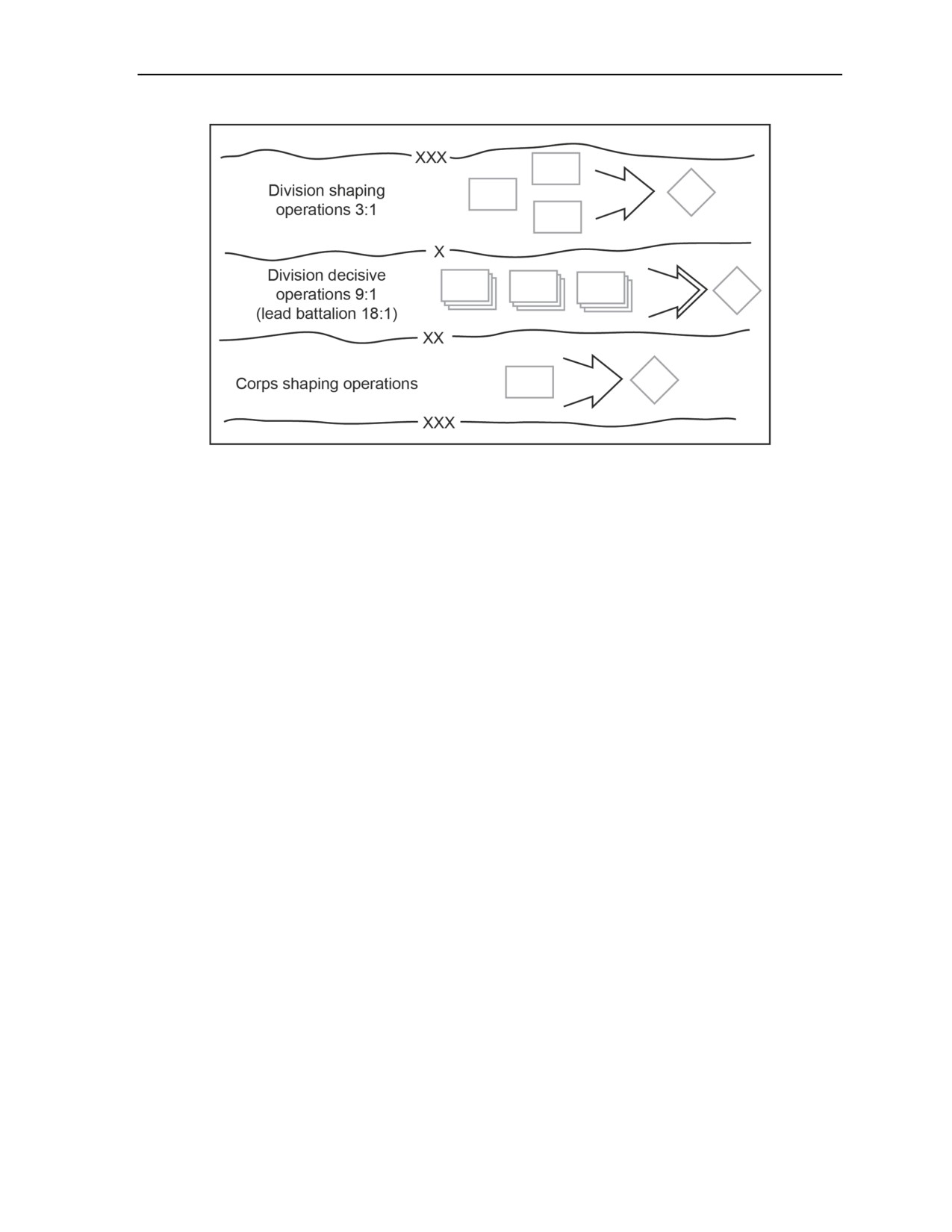
Basics of the Offense
Figure 1-8. Penetration: relative combat power
1-66. The commander resources a reserve to address expected or unexpected contingencies, such as an
enemy counterattack, to avoid diverting the assault element from attacking the final objective of the
penetration. The commander designates additional units missions of follow-and-support or
follow-and-assume to ensure rapid exploitation of initial success. The commander designates forces to fix
enemy reserves in their current locations and isolate enemy forces within the area selected for penetration.
Control Measures
1-67. A commander assigns, as a minimum, an AO to every maneuver unit, a LD or line of contact (LC);
time of the attack or time of assault; phase lines; objective; and a LOA to control and synchronize the
attack. (A commander can use a battle handover line instead of a LOA if the commander knows where the
likely commitment of a follow-and-assume force will occur.) The lateral boundaries of the unit making the
decisive operation are narrowly drawn to help establish the overwhelming combat power necessary at the
area of penetration. The commander locates the LOA beyond the enemy’s main defensive position to
ensure completing the breach. If the operation results in opportunities to exploit success and pursue a
beaten enemy, the commander adjusts existing boundaries to accommodate the new situation. (See figure
1-9 on page 1-16.)
1-68. A commander uses the graphics associated with breaching operations, such as points of breach and
lanes, on the small-scale maps used to control the maneuver of subordinate forces at each point where they
penetrate the enemy’s defenses.
1-69. Other control measures available to the commander include checkpoints, support by fire and attack
by fire positions, probable line of deployment, fire support coordination measures, attack position, assault
position, and time of assault. Within the unit’s AO, a commander can use either an axis of advance or a
direction of attack to further control maneuver.
22 March 2013
FM 3-90-1
1-15
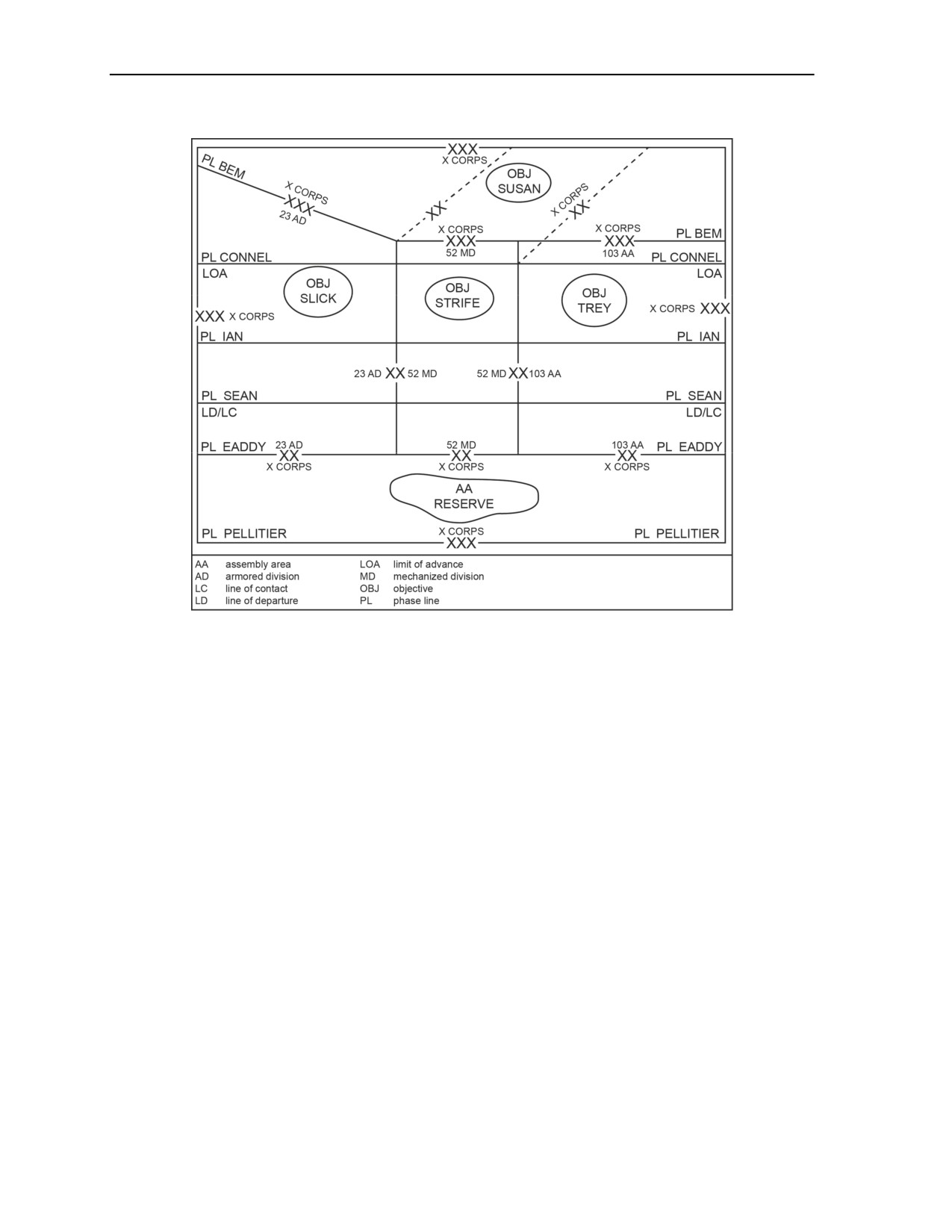
Chapter 1
Figure 1-9. Penetration: minimum graphic control measures
Planning a Penetration
1-70. The success of the penetration depends primarily on a coordinated and synchronized plan—violently
executed at a high tempo—against comparatively weak enemy defenses. However, the terrain behind the
area selected to penetrate must allow the penetration to proceed from the breach to a decisive objective.
1-71. The depth of the enemy position and the relative strength of attacking echelons determine the width
of the penetration. The availability of artillery, air support, and other combat multipliers for the attacking
force helps the commander determine relative combat power. A wider gap allows friendly forces to drive
deeper, making it more difficult for the enemy to close the gap. The deeper the penetration, the easier it is
for a unit to seize its objective and roll up the enemy’s flanks exposed by the breach and the less likely it is
that the enemy will be in a position to restore the enemy’s front by falling back.
1-72. Plans for penetrating a defensive position include isolating, suppressing, and destroying by fire
enemy forces in the area selected for the penetration. These plans should also address how to isolate the
area of penetration from support or reinforcement by enemy forces located outside the area. This
consideration includes how to fix enemy reserves and long-range weapons in their current locations.
Positioning friendly assets so that the commander can mass the effects of their combat power to accomplish
these results without giving away the location of the penetration is also a critical part of the plan.
1-73. The commander plans to place the majority of forces and assets in positions where the effects of
their combat power can be felt in the area selected for penetration. The commander’s plan for the
penetration normally has three phases:
z
Breaching the enemy’s main defensive positions.
z
Widening the gap created to secure the penetration’s flanks.
z
Seizing the objective and subsequently exploiting the success of the penetration.
1-16
FM 3-90-1
22 March 2013
Basics of the Offense
1-74. Planning the sequence of these phases depends on the specific situation. In some situations, if there
are weaknesses or gaps in the enemy’s front, it is possible for armored forces to breach the enemy’s
defenses and proceed straight to the objective. Simultaneously, light infantry units could conduct local
envelopment and exploitation operations. In other situations, the commander uses light infantry forces to
create the breach, holding armored or Stryker-equipped forces initially in reserve to exploit gaps in the
enemy’s defenses created by those light forces.
1-75. The commander plans shaping operations outside the area of penetration to contain the enemy on the
flanks of the penetration and fix enemy reserves in their current locations. Synchronizing the effects of
rotary- and fixed-wing aircraft, artillery fires, and obscuration smoke to delay or disrupt repositioning
forces is an example of such shaping operations. These shaping operations will involve the maintenance of
operations security and the conduct of military deception operations. The commander usually attempts to
penetrate the enemy’s defensive positions along enemy unit boundaries because defenses tend to be less
effective along a boundary.
1-76. The commander’s plans should address penetrating through the enemy’s defensive positions in
enough depth so the enemy is unable to reestablish a viable defense on more rearward positions. Until this
event takes place, the commander does not want to divert the strength of attacking units to widening the
gap to secure the flanks of the penetration. However, plans do address contingencies, such as hostile
counterattacks against the penetration’s flanks. The plan should provide assistance to attacking elements as
they close with the enemy and support the attack until the enemy’s power of resistance is broken.
Executing a Penetration
1-77. After the initial breach of the enemy’s main line of resistance, the sequence of the remaining two
phases is determined by the situation. If the enemy is in a weak position, it may be possible for the lead
attacking force to seize the penetration’s final objective while simultaneously widening the initial breach.
Breaching the Enemy’s Main Defensive Positions
1-78. The commander launches the actual penetration on a relatively narrow front. (See figure 1-10 on
page 1-18.) The commander narrows the AO of the unit or units conducting the decisive operation—the
penetration—by adjusting unit lateral boundaries to the exact point or points where the commander wants
to penetrate the enemy’s defenses. This allows the force conducting the penetration to focus overwhelming
combat power at that location. The commander assigns the assault force a close-in objective. The support
force locates where it can support by fire both the breach and the assault forces. The reconnaissance
squadron conducts a shaping operation by occupying support by fire position BOB. Local reserves, in this
case the 2nd Combined Arms Battalion (CAB) given a follow and assume mission, are held in readiness to
conduct a forward passage through or around units whose attacks have slowed or stopped.
1-79. Shaping operations focused on the remainder of the hostile front fix enemy forces in their current
positions and prevent them from disengaging to reinforce enemy units opposing the decisive operation. The
commander tracks the battle’s progress to ensure that subordinate forces penetrate entirely through the
enemy’s main defensive positions and not just the enemy’s security area.
1-80. The enemy normally tries to slow down or stop the breach to gain time to react to the changing
situation. Therefore, the attacking commander rapidly exploits and reinforces success. The attacker masses
resources and additional units as necessary to ensure completing the penetration through the enemy’s
defensive positions. The attacker also employs electronic warfare and military deception operations to
desynchronize the enemy’s reaction to the friendly breach.
22 March 2013
FM 3-90-1
1-17
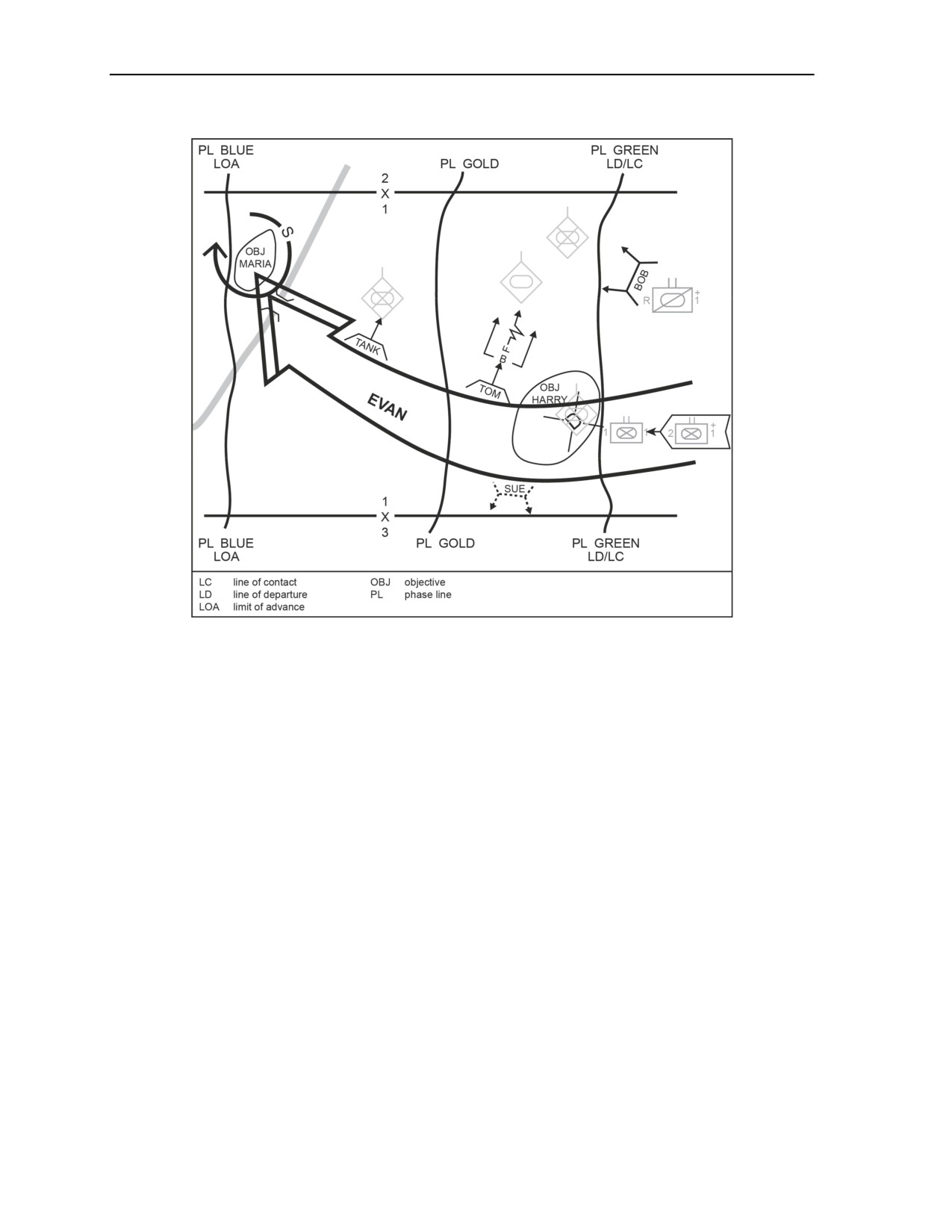
Chapter 1
Figure 1-10. The penetration
Widening the Breach to Secure the Flanks
1-81. Once the attacking force penetrates the main defenses, it begins to widen the penetration of the
enemy’s defensive positions by conducting a series of shallow envelopments or attacks by fire to roll back
its shoulders. (See figure 1-11.) The task of widening the initial gap of the penetration is normally assigned
to a follow-and-support force. In the example in figure 1-11, this is the 2nd CAB. That task can also be
assigned to the reserve as a contingency mission. If the commander commits the reserve to accomplish that
task, a reserve must be reconstituted from another part of the force. Alternatively, the commander may
assume the risk of not having a reserve for the time necessary to accomplish this task. The commander
makes plans to meet enemy counterattacks by shifting fires or committing reserves or follow-and-assume
forces. Units can use obstacles on the flanks of the penetration as a combat multiplier to assist in defeating
any local enemy counterattack and to provide additional security for the force.
Seizing the Objective and Subsequent Exploitation
1-82. The decisive operation after completing the penetration is the seizing of the objective, destroying the
continuity of the enemy’s defensive position. This may entail the destruction of a specific enemy force.
Frequently that objective is so far from the area of penetration that the unit or units initially conducting the
penetration cannot seize it without a pause. In that case, the commander plans to pass the reserve or
follow-and-assume forces through the initial attacking force early, leaving exploitation beyond the objective to
higher echelons. While the exact force mix depends on the mission variables of METT-TC, armored,
mechanized, and aviation forces are generally suited for subsequent exploitation. However, in the scenario
depicted in figure 1-12 on page 1-20 the initially attacking 2nd CAB is able to secure the objective.
1-18
FM 3-90-1
22 March 2013
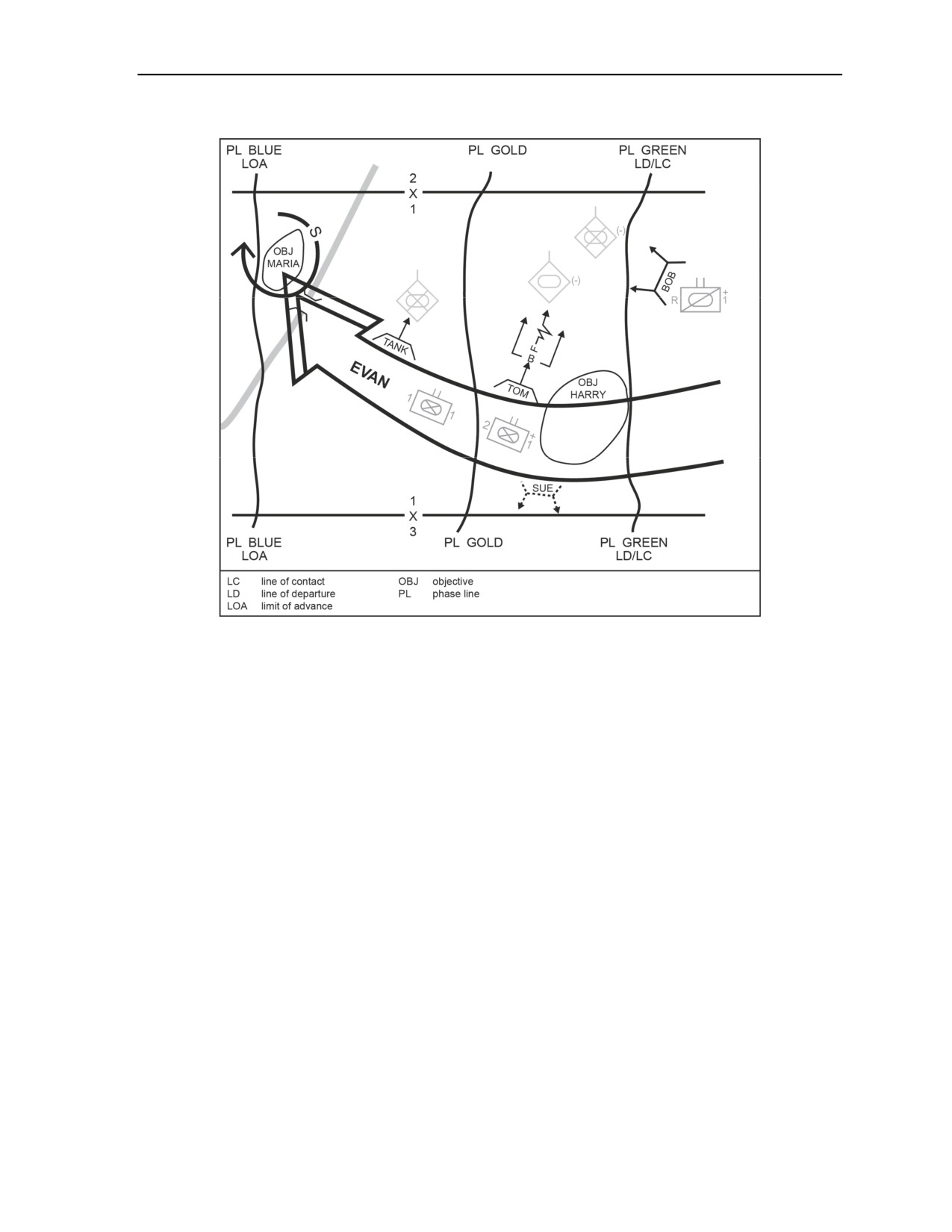
Basics of the Offense
Figure 1-11. Widening the breach to secure the flanks
1-83. In large commands, forces may initiate an attack by simultaneously launching two or more
convergent penetrations against weak localities on the hostile front. Often this method of attack helps
isolate an extremely strong, hostile defense. The commander assigns shaping operations to initially contain
any strong localities. When the multiple attacks have advanced sufficiently, the force reduces bypassed
enemy forces and unites the penetrating attacks into a single decisive operation.
FRONTAL ATTACK
1-84. A frontal attack is a form of maneuver in which an attacking force seeks to destroy a weaker
enemy force or fix a larger enemy force in place over a broad front. At the tactical level, an attacking
force can use a frontal attack to rapidly overrun a weak enemy force. A commander commonly uses a
frontal attack as a shaping operation in conjunction with other forms of maneuver. A commander normally
employs a frontal attack to—
z
Clear enemy security forces.
z
Overwhelm a shattered enemy during an exploitation or pursuit.
z
Fix enemy forces in place as part of a shaping operation.
z
Conduct a reconnaissance in force.
22 March 2013
FM 3-90-1
1-19
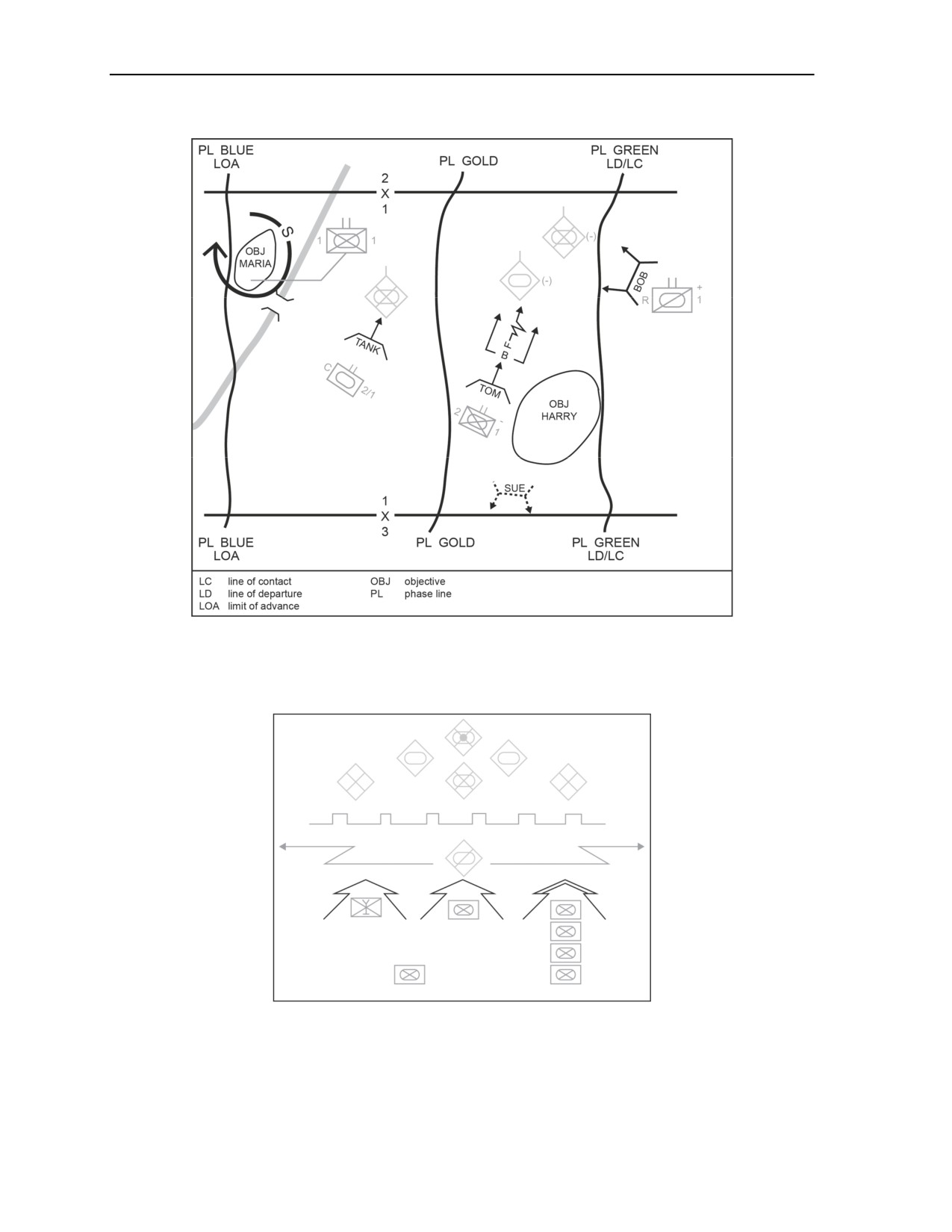
Chapter 1
Figure 1-12. Seizing the objective
Figure 1-13 depicts a frontal attack.
Figure 1-13. Frontal attack
1-85. It is also necessary to conduct a frontal attack when assailable flanks do not exist. Where a
penetration is a sharp attack designed to rupture the enemy position, the commander designs a frontal attack
to maintain continuous pressure along the entire front until either a breach occurs or the attacking forces
succeed in pushing the enemy back. Frontal attacks conducted without overwhelming combat power are
1-20
FM 3-90-1
22 March 2013
Basics of the Offense
seldom decisive. Consequently, the commander’s choice to conduct a frontal attack in situations where the
commander does not have overwhelming combat power is rarely justified unless the time gained is vital to
the operation’s success.
Organization of Forces
1-86. There is no unique organization of forces associated with this form of maneuver. A commander
conducting a frontal attack organizes the unit into an element to conduct reconnaissance and security
operations, a main body, and a reserve. The mission variables of METT-TC dictate the specific task
organization of the unit.
Control Measures
1-87. A commander conducting a frontal attack may not require any additional control measures beyond
those established to control the overall mission. This includes an AO, defined by unit boundaries, and an
objective, at a minimum. The commander can also use any other control measure necessary to control the
attack, including—
z
Attack positions.
z
Line of departure.
z
Phase lines.
z
Assault positions.
z
Limit of advance.
z
Direction of attack or axis of advance for every maneuver unit.
A unit conducting a frontal attack normally has a wider AO than a unit conducting a penetration.
Planning a Frontal Attack
1-88. It is seldom possible for a commander to exert sufficient pressure to overwhelm an enemy using a
frontal attack, since it strikes the enemy along a significant portion of the enemy’s front. The attacking
force’s primary objective is to maintain pressure and help fix the enemy force. The commander’s planning
effort should reflect these two considerations. When considering employing a frontal attack in a shaping
operation, the commander should also consider other means for holding the enemy in position, such as
feints and demonstrations employing indirect fires to preclude excessive losses.
Executing a Frontal Attack
1-89. The unit conducting a frontal attack advances on a broad front, normally with its subordinate ground
maneuver elements abreast (except for the reserve). This clears the enemy’s security area of enemy security
forces and intelligence, reconnaissance, surveillance, and target acquisition assets while advancing the
friendly force into the enemy’s main defenses. Once the unit makes enemy contact, the attacking force’s
subordinate elements rapidly develop the situation and report enemy dispositions immediately to the
commander, so the commander can direct the exploitation of enemy weaknesses. The attacking force fixes
enemy forces in their current locations and seeks to gain positional advantage to destroy them using fire
and movement.
1-90. If the attacking unit discovers a gap in the enemy’s defenses, the commander seeks to exploit that
weakness and disrupt the integrity of the enemy’s defense. After assessing the situation to make sure that it
is not a trap, the commander can employ the reserve to exploit the opportunity. The commander
synchronizes the exploitation with the actions of other maneuver and functional and multifunctional
support and sustainment units to prevent counterattacking enemy forces from isolating and destroying
successful subordinate elements of the attacking friendly force.
1-91. When a unit conducting a frontal attack can no longer advance, it adopts a defensive posture. The
commander may require it to assist the forward passage of lines of other units. It continues to perform
reconnaissance of enemy positions to locate gaps or assailable flanks.
22 March 2013
FM 3-90-1
1-21
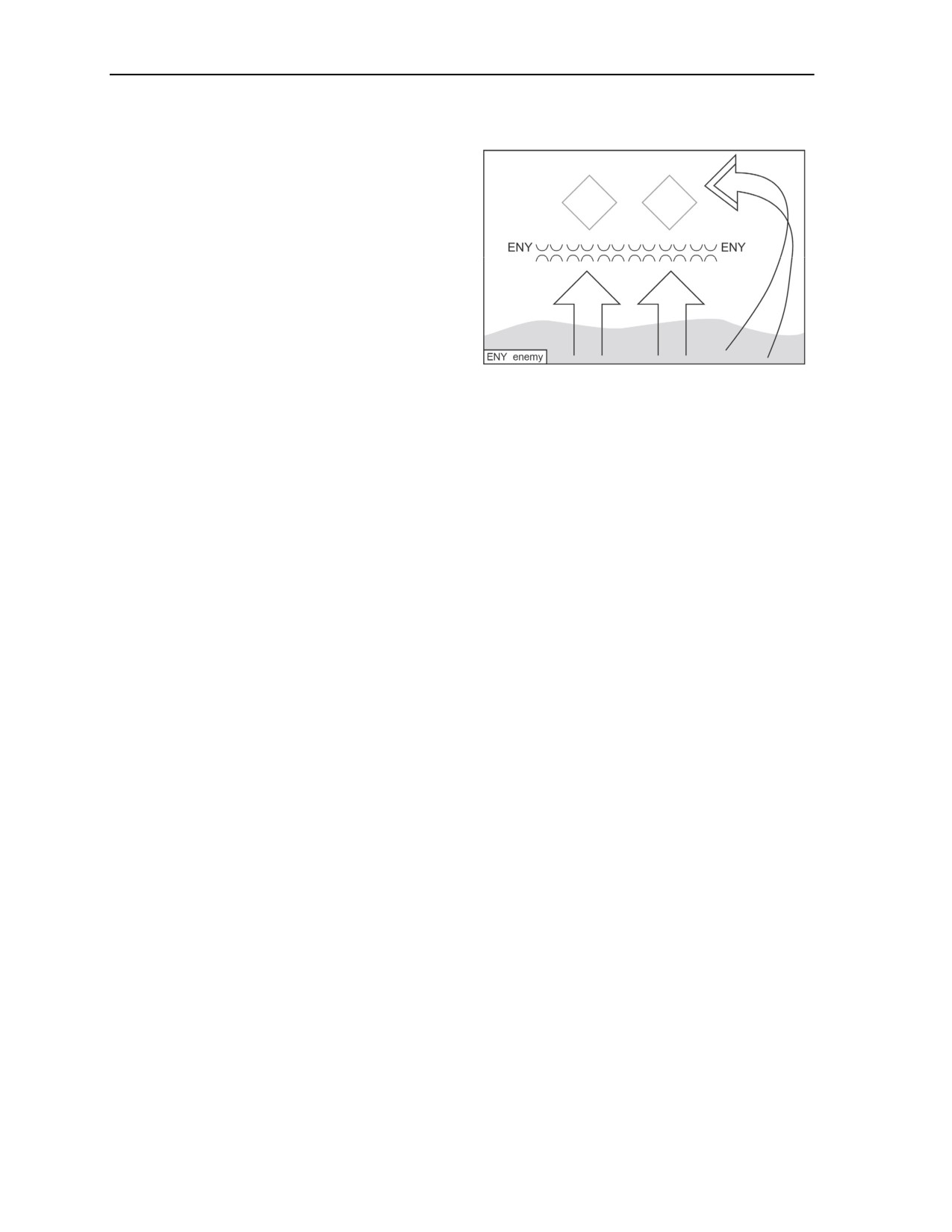
Chapter 1
FLANK ATTACK
1-92. A flank attack is a form of offensive
maneuver directed at the flank of an enemy.
(See figure 1-14.) A flank is the right or left side of
a military formation and is not oriented toward the
enemy. It is usually not as strong in terms of forces
or fires as is the front of a military formation. A
flank may be created by the attacker through the
use of fires or by a successful penetration. A
flanking attack is similar to an envelopment but
generally conducted on a shallower axis. It is
designed to defeat the enemy force while
minimizing the effect of the enemy’s
frontally-oriented combat power. Flanking attacks
are normally conducted with the main effort
Figure 1-14. Flank attack
directed at the flank of the enemy. Usually, a
supporting effort engages the enemy’s front by fire and maneuver while the main effort maneuvers to
attack the enemy’s flank. This supporting effort diverts the enemy’s attention from the threatened flank. It
is often used for a hasty attack or meeting engagement where speed and simplicity are paramount to
maintaining battle tempo and, ultimately, the initiative.
1-93. The primary difference between a flank attack and an envelopment is one of depth. A flank attack is
an envelopment delivered squarely on the enemy's flank. Conversely, an envelopment is an attack delivered
beyond the enemy's flank and into the enemy’s support areas, but short of the depth associated with a
turning movement.
1-94. Just as there is a relationship between unit size and the ability of a friendly force to execute a turning
movement instead of an envelopment, this relationship extends downward between an envelopment and a
flank attack. Corps and divisions are the most likely echelons to conduct turning movements. Divisions and
brigade combat teams (BCTs) are the echelons most likely to conduct envelopments—single or double.
Smaller-sized tactical units, such as maneuver battalions, companies, and platoons, are more likely to
conduct flank attacks than larger tactical units. This is largely a result of troop-to-space ratios and
sustainment and mission command constraints.
1-95. For these reasons, the organization of forces, control measures, and conduct—planning, preparation,
execution, and assessment—considerations associated with a flank attack are similar to those addressed in
the envelopment discussion in paragraphs 1-11 to 1-23. The primary difference between these forms of
maneuver is which portion of the enemy position is attacked.
COMMON OFFENSIVE PLANNING CONSIDERATIONS
1-96. Understanding, visualizing, describing, and directing are aspects of leadership common to all
commanders. The tactical commander begins with a designated AO, identified mission, and available
forces. The commander develops and issues planning guidance based on the commander’s visualization in
terms of the physical means to accomplish the mission.
1-97. The offense is basic to combat operations. Only a resolute offense, conducted at a high tempo and to
great depth, attains the enemy’s total destruction. The offense has a number of indisputable advantages.
The attacker’s principal advantage is possession of the initiative. Having the initiative allows a commander
to select the time, place, and specific tactics, techniques, and procedures used by the attacking force. The
attacker has the time and opportunity to develop a plan and to concentrate the effects of subordinate forces
and thoroughly prepare conditions for success when the commander has the initiative. The commander
strikes the enemy in unexpected ways at unexpected times and places. The commander focuses on
attacking the right combination of targets, not necessarily the biggest or the closest. These attacks are
rapidly executed, violently executed, unpredictable in nature, and they disorient the enemy. They enhance
the commander’s capability to impose the commander’s will on the enemy and thus to achieve decisive
victory.
1-22
FM 3-90-1
22 March 2013
Basics of the Offense
1-98. The commander maintains momentum by rapidly following up attacks to prevent enemy recovery.
The attacking commander denies the enemy commander any opportunity to adjust to friendly actions in
spite of the enemy’s desperate attempts to do so. The commander changes the attacking force’s means and
methods before the enemy can adapt to those in current use. The tempo of friendly operations must be fast
enough to prevent effective counteraction. The commander synchronizes unrelenting pressure by adjusting
combinations to meet the offensive’s ever-changing demands. The attacking force maintains relentless
pressure and exploits gains to make temporary battlefield success permanent.
1-99. Each battle or engagement, even those occurring simultaneously as a part of the same campaign, has
its own unique peculiarities, determined by the actual conditions of the situation. The widespread
application of highly accurate and lethal weapons, high degree of tactical mobility, dynamic nature, rapid
situational changes, and the noncontiguous and large spatial scope of unit AOs all characterize
contemporary combined arms warfare. The commander first able to see the battlefield, understand the
implications of existing friendly and enemy dispositions, and take effective action to impose the
commander’s will on the situation will enjoy tactical success. The planning considerations for the offense
in paragraphs
1-101 through
1-204 below also apply to the defense with situationally appropriate
modifications.
1-100. The following discussion uses those physical means—Soldiers, organizations, and equipment—that
constitute the six warfighting functions defined in ADRP 3-0 as the framework for discussing planning
considerations that apply to all primary and subordinate offensive tasks.
MISSION COMMAND
1-101. Commanders, assisted by their staffs, integrate numerous processes and activities within the
headquarters and across the force as they exercise mission command. The commander’s mission and intent
determine the scheme of maneuver and the allocation of available resources. Paragraphs 1-102 through
1-115 highlight the importance of the operations process and team development during the conduct of
offensive tasks. The other mission command warfighting function tasks occur, but they do not require
emphasis here. (See mission command doctrine for a discussion of the other mission command warfighting
function tasks.)
Operations Process
1-102. Commanders drive the operations process through their activities of understanding, visualizing,
describing, directing, leading, and assessing the conduct of the primary offensive task. If few resources are
available, the commander reduces the scope of the initial mission. For example, a commander could tell
subordinates to clear their AOs of all enemy platoon-sized and larger forces instead of clearing their areas
of operations of all enemy forces, if those subordinates lack the time or forces needed to accomplish the
latter task.
1-103. All offensive planning addresses the mission variables of METT-TC, with special emphasis on—
z
Missions and objectives, to include task and purpose, for each subordinate element.
z
Commander’s intent.
z
Enemy positions, obstacles, strengths, and capabilities.
z
AOs for the use of each subordinate element with associated control measures.
z
Time the operation is to begin.
z
Scheme of maneuver.
z
Targeting guidance and high-payoff targets.
z
Special tasks required to accomplish the mission.
z
Risk.
z
Options for accomplishing the mission.
Planning also addresses the prevention of unnecessary damage to property and disruption of the civilian
population within the area of operations.
22 March 2013
FM 3-90-1
1-23
Chapter 1
1-104. The commander and staff translate the unit’s mission into specific objectives for all subordinates, to
include the reserve. These objectives can involve any type or form of operations. If the type of operation
assigned has associated forms, the commander may specify which form to use, but should minimize
restrictions on subordinate freedom of action. ADRP 5-0 addresses the military decisionmaking process.
1-105. Synchronizing the six warfighting functions through prior planning and preparation increases a
unit’s effectiveness when executing operations. However, the fluid nature of combat requires the
commander to guide the actions of subordinates during the execution phase. Commanders determine where
they can best sense the flow of the operation to influence critical events through the redirecting the effects
of committed forces, changing priorities or support, or employing echelon reserves. This normally means
that the commander is well forward in the echelon’s combat formation, usually with the force designated to
conduct the decisive operation. Once the unit conducting the decisive operations makes contact with the
enemy, the commander quickly moves to the area of contact, assesses the situation, and directs appropriate
aggressive actions to direct the continuation of offensive tasks.
1-106. The commander anticipates any requirements to shift the main effort during the offensive to press
the battle and keep the enemy off balance. The commander develops decision points to support these
changes using both human and technical means to validate decision points.
1-107. In addition to assigning objectives and identifying decision points, commanders at all echelons
consider how to exploit advantages that arise during operations and the seizure of intermediate and final
objectives. The commander exploits success by aggressively executing the plan, taking advantage of junior
leader initiative, and employing trained units capable of rapidly executing standard drills. The echelon
reserve also provides a flexible capability to exploit unforeseen advantages.
1-108. The commander always seeks to surprise opponents throughout the operation. Military deception
and the choice of an unexpected direction or time for conducting offensive tasks can result in the enemy
being surprised. Surprise delays enemy reactions, overloads and confuses enemy command and control
(C2), induces psychological shock, and reduces the coherence of the enemy’s defenses. Tactical surprise is
more difficult to achieve once hostilities begin, but it is still possible. The commander achieves tactical
surprise by attacking in bad weather and over seemingly impassible terrain, conducting feints and
demonstrations, making rapid changes in tempo, and employing sound operations security (OPSEC)
measures.
1-109. The commander retains the capability to rapidly concentrate force effects, such as fires, throughout
the extent of the AO during the conduct of offensive tasks. This capability is also critical to the commander
when subordinate forces cross linear obstacles. Lanes and gaps resulting from combined arms breaching
operations or occurring naturally typically are choke points. There is a tendency for each subordinate
element to move out independently as it completes its passage through the choke point. This independent
movement detracts from the ability of the whole force to rapidly concentrate combat power on the far side
of an obstacle.
1-110. The commander briefs the plan and the plans of adjacent units and higher echelons to unit leaders
and the unit’s Soldiers. This helps units and individual Soldiers moving into unexpected locations to direct
their efforts toward accomplishing the mission. This exchange of information occurs in all operations.
1-111. The commander maintains communications and a free flow of information between all units
throughout the offense. The commander plans how to position and reposition information systems to
maintain a common operational picture throughout the operation. That common operational picture requires
timely and frequent updates of relevant information from the lowest tactical echelons upwards, particularly
information on the disposition and activities of friendly and enemy forces, if it is going to aid the
commander in maintaining situational awareness. The commander plans how to expand the
communications coverage to accommodate increased distances as the unit advances. Accordingly, the
commander provides for redundant communication means—including wire, radio, visible and ultraviolet
light, heat, smoke, audible sound, messengers, and event-oriented communications, such as the
casualty-producing device that initiates an ambush.
1-112. A unit with advanced information systems and automated decision aids enjoys reduced engagement
times and an enhanced planning process. This improves the unit commander’s ability to control the tempo
of the battle and stay within the enemy’s decisionmaking cycle. Greatly improved knowledge of the enemy
1-24
FM 3-90-1
22 March 2013
Basics of the Offense
and friendly situations facilitates the tactical employment of precision fires and decisive maneuver at
extended ranges. These digital systems also enhance the commander’s freedom to move to those battlefield
locations that best enable the commander’s ability to influence the battle or engagement at the critical time
and place.
Team Development Between Commanders
1-113. Generally, commanders rely on others to follow and execute their intent. Turning their visualization
of the offense into reality takes the combined efforts of many teams inside and outside the organization.
Commanders build solid, effective teams by developing and training them. As part of the commander’s task
of team development, the commander has the authority to organize assigned or attached forces to best
accomplish the mission based on the commander’s concept of operations. The commander task organizes
subordinate units as necessary, assigns responsibilities, establishes or delegates appropriate command and
support relationships, and establishes coordinating instructions. Sound organization provides for unity of
effort, centralized planning, and decentralized execution. Unity of effort is necessary for effectiveness and
efficiency. Centralized planning is essential for controlling and coordinating the efforts of the forces. When
organizing Army forces with multinational forces, simplicity and clarity are critical.
1-114. Subordinates work hard and fight tenaciously when they are well trained and sense that they are
part of a first-rate team. Collective confidence comes from succeeding under challenging and stressful
conditions, beginning in training before deployment. A sense of belonging derives from experiencing
technical and tactical proficiency—first as individuals and later collectively. That proficiency expresses
itself in the confidence team members have in their peers and their leaders. Many times that sense of
belonging is enhanced by the conduct of social activities. Those social activities have to be tailored to the
audience. What will motivate and inspire young Soldiers and junior noncommissioned officers may not
have the same impact on field grade officers and senior noncommissioned officers. Ultimately, cohesive
teams are the desired result. Effective organizations work as teams in synchronized ways to complete tasks
and missions.
1-115. Successful delegation of authority involves convincing subordinates that they are empowered and
have the freedom to act independently. This only comes from the subordinates’ experience with the
commander. Empowered subordinates understand that they bear more than the responsibility to get the job
done. They have the authority to operate as they see fit, within the limits of commander’s intent, missions,
task organization, and available resources. This helps them lead their people with determination.
MOVEMENT AND MANEUVER
1-116. The commander maneuvers to avoid enemy strengths and to create opportunities to increase the
effects of friendly fires. The commander secures surprise by making unexpected maneuvers, rapidly
changing the tempo of ongoing operations, avoiding observation, and using deceptive techniques and
procedures. The commander seeks to overwhelm the enemy with one or more unexpected blows before the
enemy has time to react in an organized fashion. This occurs when the attacking force is able to engage the
defending enemy force from positions that place the attacking force in a position of advantage with respect
to the defending enemy force, such as engaging the enemy from a flanking position. Echelon security
forces prevent the enemy from discovering friendly dispositions, capabilities, and intentions, or interfering
with the preparations for the attack. Finally, the commander maneuvers to close with and destroy the
enemy by close combat and shock effect. Close combat is warfare carried out on land in a direct-fire fight,
supported by direct and indirect fires and other assets (ADRP 3-0). Close combat defeats or destroys enemy
forces, or seizes and retains ground. Close combat encompasses all actions that place friendly forces in
immediate contact with the enemy where the commander uses direct fire and movement in combination to
defeat or destroy enemy forces or seize and retain ground.
1-117. A commander can overwhelm an enemy by the early seizing and retaining of key and decisive
terrain that provides dominating observation, cover and concealment, and better fields of fire to facilitate
the maneuver of friendly forces. Key terrain is any locality, or area, the seizure or retention of which
affords a marked advantage to either combatant (JP 2-01.3). Decisive terrain, when present, is key terrain
whose seizure and retention is mandatory for successful mission acomplishment. If decisive terrain is
present, the commander designates it to communicate its importance in the commander’s concept of
22 March 2013
FM 3-90-1
1-25
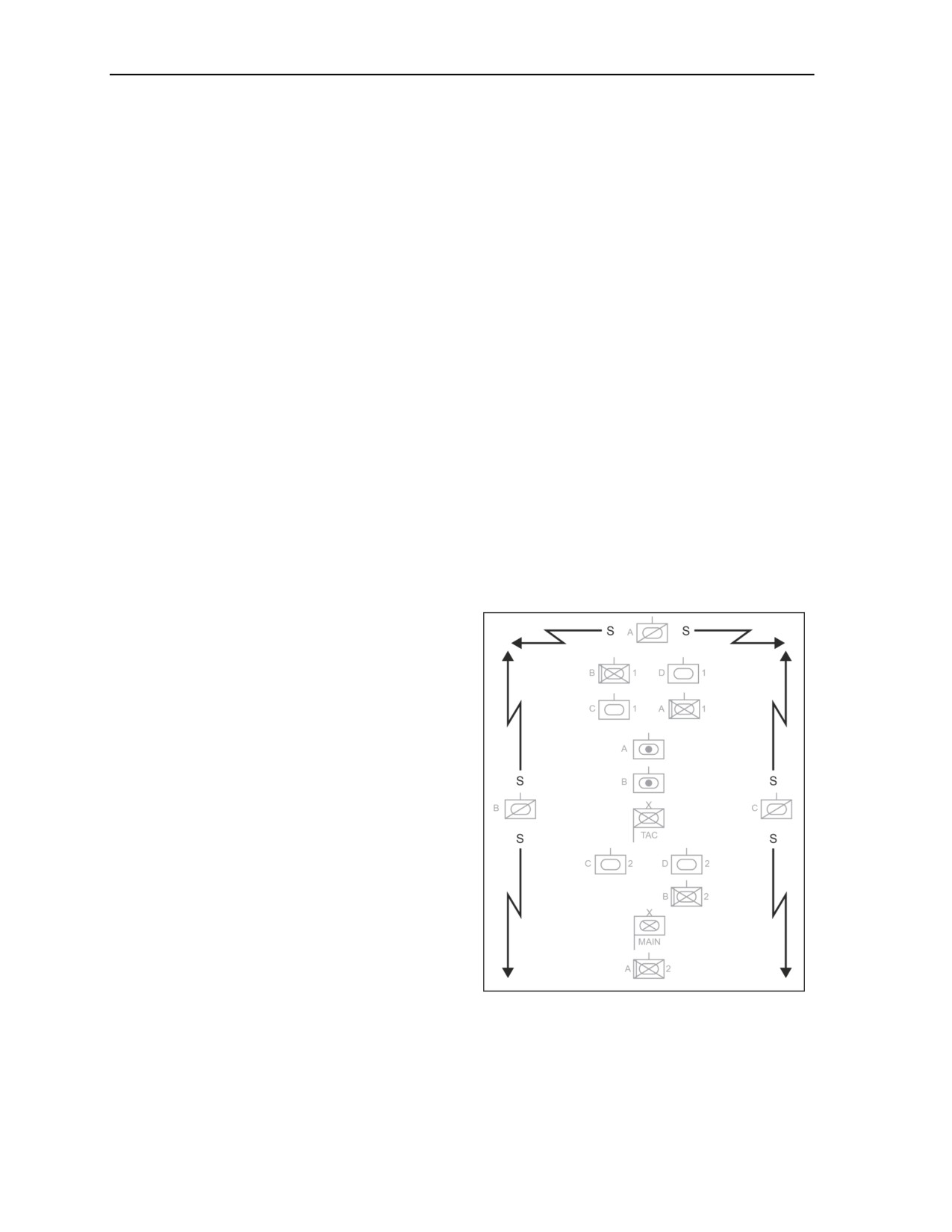
Chapter 1
operations, first to the echelon staff and later to subordinate commanders. The friendly force must control
decisive terrain to successfully accomplish its mission.
Combat Formations
1-118. A combat formation is an ordered arrangement of forces for a specific purpose and describes the
general configuration of a unit on the ground (ADRP 3-90). A commander can use seven different combat
formations depending on the mission variables of METT-TC: column, line, echelon (left or right), box,
diamond, wedge, and vee. Terrain characteristics and visibility determine the actual arrangement and
location of the unit’s personnel and vehicles within a given formation.
1-119. Combat formations allow a unit to move on the battlefield in a posture suited to the senior
commander’s intent and mission. A unit may employ a series of combat formations during the course of an
attack; each has its advantages and disadvantages. Subordinate units within a combat formation can also
employ their own combat formations, consistent with their particular situation. The commander considers
the advantages and disadvantages of each formation in the areas of mission command, maintenance,
firepower orientation, ability to mass fires, and flexibility when determining the appropriate formation for a
given situation. All combat formations use one or more of the three movement techniques: traveling,
traveling overwatch, and bounding overwatch. (FM 3-90-2 describes these three movement techniques.)
1-120. The commander’s use of standard formations allows the unit to rapidly shift from one formation to
another, giving additional flexibility when adjusting to changes in the mission variables of METT-TC.
(This results from a commander rehearsing subordinates so that they can change formations using standard
responses to changing situations, such as actions on contact.) By designating the combat formation planned
for use, the commander—
z
Establishes the geographic relationship between units.
z
Indicates probable reactions once the enemy makes contact with the formation.
z
Indicates the level of security desired.
z
Establishes the preponderant orientation
of subordinate weapon systems.
z
Postures friendly forces for the attack.
The number of maneuver units available makes
some formations, such as the box and the diamond,
impractical for modular armored and infantry
brigade combat teams, unless they are task
organized with additional maneuver forces.
Column
1-121. The column formation is a combat
formation in which elements are placed one
behind another. The unit moves in column
formation when the commander does not anticipate
early contact, the objective is distant, and speed
and control are critical. (Figure 1-15 illustrates a
armored brigade combat team [ABCT] in battalion
column.) The location of fire support units within
the column reflects the column’s length and the
range fans of those fire support systems. Normally,
the lead element uses a traveling overwatch
technique while the following units are in traveling
Figure 1-15. Armored brigade combat team in
formation. Employing a column formation—
battalion column
z
Provides the best formation to move
large forces quickly, especially with limited routes and limited visibility.
z
Makes enemy contact with a small part of the total force while facilitating control and allowing
the commander to quickly mass forces.
1-26
FM 3-90-1
22 March 2013
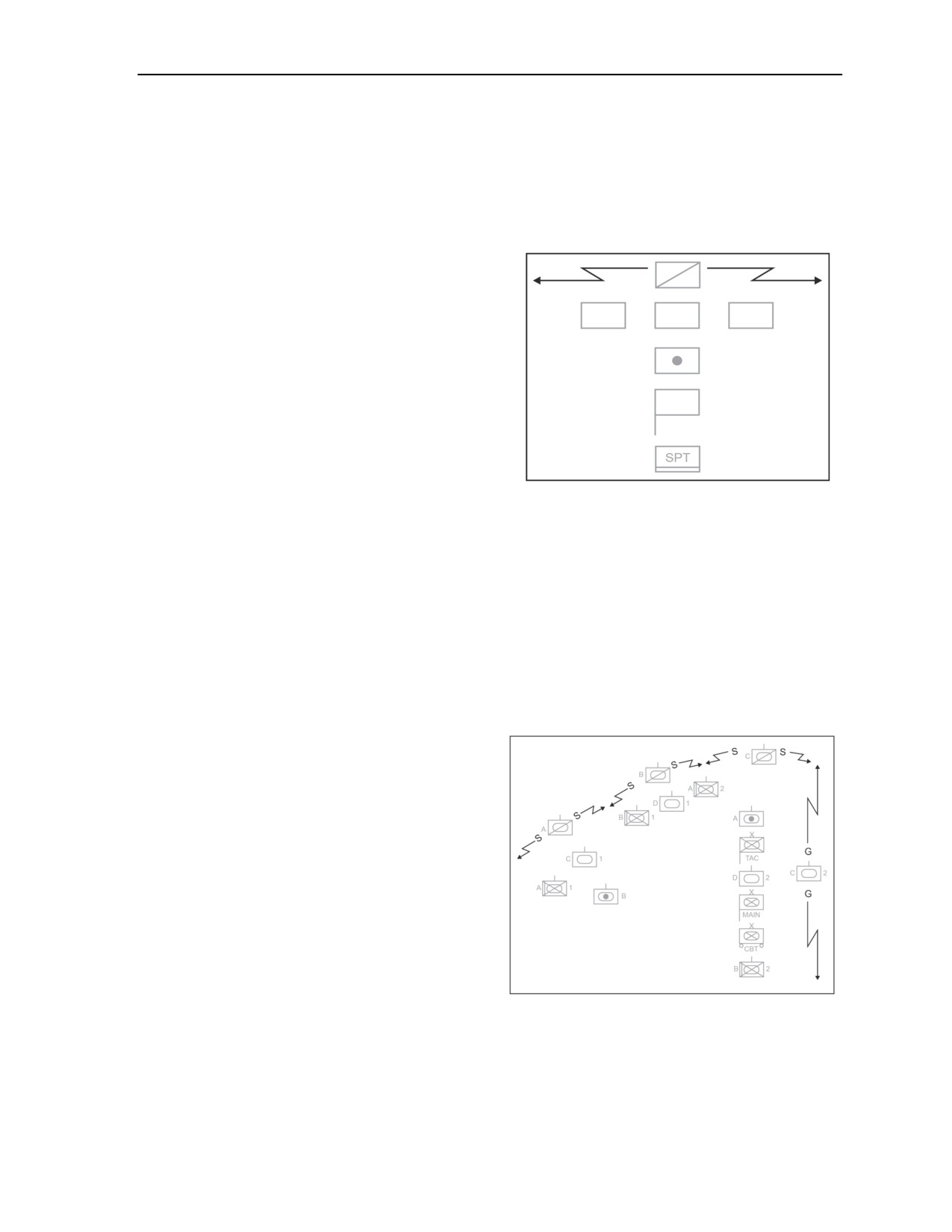
Basics of the Offense
z
Provides a base for easy transition to other formations.
z
Works in restricted terrain.
1-122. A disadvantage of using the column formation is that the majority of the column’s firepower can
only be immediately applied on the column’s flanks. The length of the column impacts movement and
terrain management. Additionally, there are the possibilities of inadvertently bypassing enemy units or
positions and exposing the unit’s flanks or running head on into an enemy deployed perpendicular to the
column’s direction of movement.
Line
1-123. In a line formation, the unit’s subordinate
ground maneuver elements move abreast of each
other. (See figure 1-16.) A commander employs this
formation when assaulting an objective because it
concentrates firepower to the front in the direction of
movement. A line formation also—
z
Facilitates speed and shock in closing with
an enemy.
z
Allows the coverage of wide frontages.
z
Facilitates the occupation of attack by fire
or support by fire positions.
Figure 1-16. Line formation
1-124. There are also disadvantages of a line
formation:
z
Provides less flexibility of maneuver than other formations since it does not distribute units in
depth.
z
Linear deployment allows a unit deployed on line to bring only limited firepower to bear on
either flank.
z
Provides limited or no reserve.
z
Limits overwatch forces.
z
Limits control of a unit using a line formation in restricted terrain or under conditions of limited
visibility.
Echelon
1-125. An echelon formation is a unit formation
with subordinate elements arranged on an angle
to the left or to the right of the direction of attack
(echelon left, echelon right). This formation
provides for firepower forward and to the flank
of the direction of the echelon. It facilitates
control in open areas. It provides minimal
security to the opposite flank of the direction of
the echeloning. A commander who has knowledge
of potential enemy locations can use an echelon
formation to deploy subordinate ground maneuver
units diagonally left or right. (See figure 1-17 and
figure 1-18 on page 1-28.) Units operating on the
flank of a larger formation commonly use this
formation. An echelon formation—
Figure 1-17. Armored brigade combat team in
echelon left formation
z
Facilitates control in open terrain.
z
Allows the concentration of the unit’s firepower forward and to the flank in the direction of
echelon.
22 March 2013
FM 3-90-1
1-27
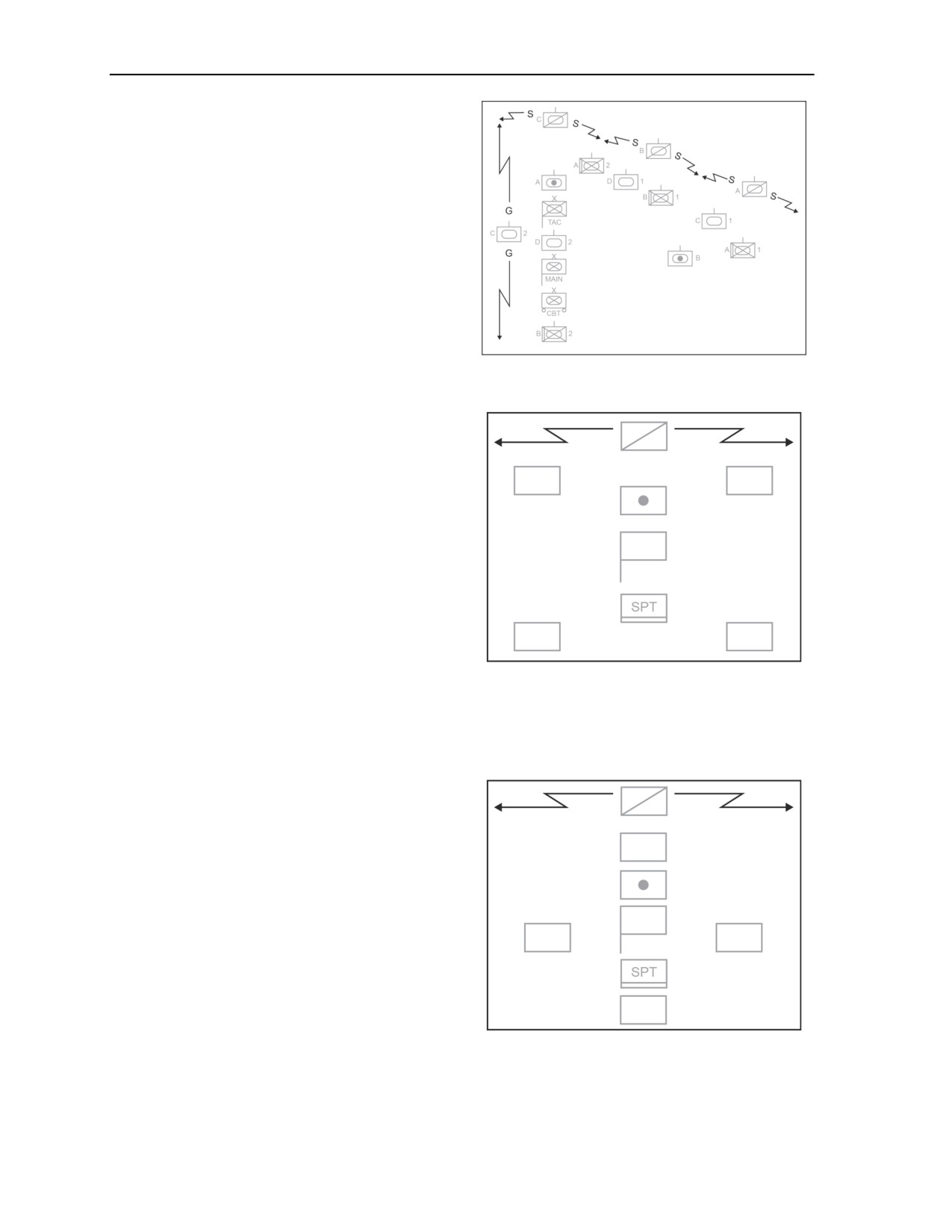
Chapter 1
z
Allows forces not in contact to
maneuver against known enemy forces,
because all elements will not
simultaneously make contact.
1-126. There are two primary disadvantages of
the echelon formation. First, it is more difficult to
maintain control over the unit in restricted terrain
than a column formation. Second, it lacks security
or firepower on the opposite side of the echelon.
Box
1-127. The box formation is a unit formation
with subordinate elements arranged in a box or
square, or two elements up and two elements
Figure 1-18. Armored brigade combat team
back. It is a flexible formation that provides
in echelon right formation
equal firepower in all directions. It is generally
used when the enemy location is known. This
formation can cause 50 percent of the force to
be decisively engaged at the same time,
therefore limiting the combat power available to
maneuver against an enemy. The box formation
arranges the unit with two forward and two trail
maneuver elements. (See figure 1-19.) A unit with
only three maneuver elements, such as an ABCT or
an infantry brigade combat team (IBCT) cannot
adopt the box formation unless it is reinforced. The
subordinate elements of the box usually move in a
column formation with flank security. It is often
used when executing an approach march,
exploitation, or pursuit when the commander has
only general knowledge about the enemy.
Figure 1-19. Box formation
Employing a box formation—
z
Allows the unit to change quickly and easily to any other formation.
z
Facilitates rapid movement, yet still provides all-around security.
z
Provides firepower to the front and flanks.
z
Maintains control more easily than a
line formation.
1-128. The primary disadvantages of a box
formation are that it requires sufficient maneuver
space for dispersion and the availability of multiple
routes. At the battalion and company level there
also exists the possibility of enemy units massing
on one element at a time as the other elements’
direct fires are masked by other friendly forces.
Diamond Formation
1-129. A diamond formation is a variation of the
box combat formation with one maneuver unit
leading, maneuver units positioned on each
flank, and the remaining maneuver unit to the
Figure 1-20. Diamond formation
rear. (See figure 1-20.) The subordinate elements
1-28
FM 3-90-1
22 March 2013
///////////////////////////////////////