FM 3-90-1 Offense and Defense (Volume 1, March 2013) - page 2
Basics of the Offense
of the diamond usually move in a column formation with flank security. It is most effective during
approach marches, exploitations, or pursuits when the commander has only general knowledge about the
enemy. Employing a diamond formation—
z
Allows the commander to maneuver either left or right immediately, without first repositioning,
regardless of which subordinate element makes contact with the enemy. (This is the chief
advantage of and the difference between a diamond and a box formation.)
z
Facilitates making enemy contact with the smallest possible force, yet provides all-around
security.
z
Provides firepower to the front and flanks.
z
Changes easily and quickly to another formation.
z
Facilitates speed of movement while remaining easy to control.
z
Provides an uncommitted force for use as a reserve.
1-130. The primary disadvantages of this formation are that it—
z
Requires sufficient space for dispersion laterally and in depth.
z
Requires four subordinate maneuver elements.
z
Requires the availability of multiple routes.
Wedge
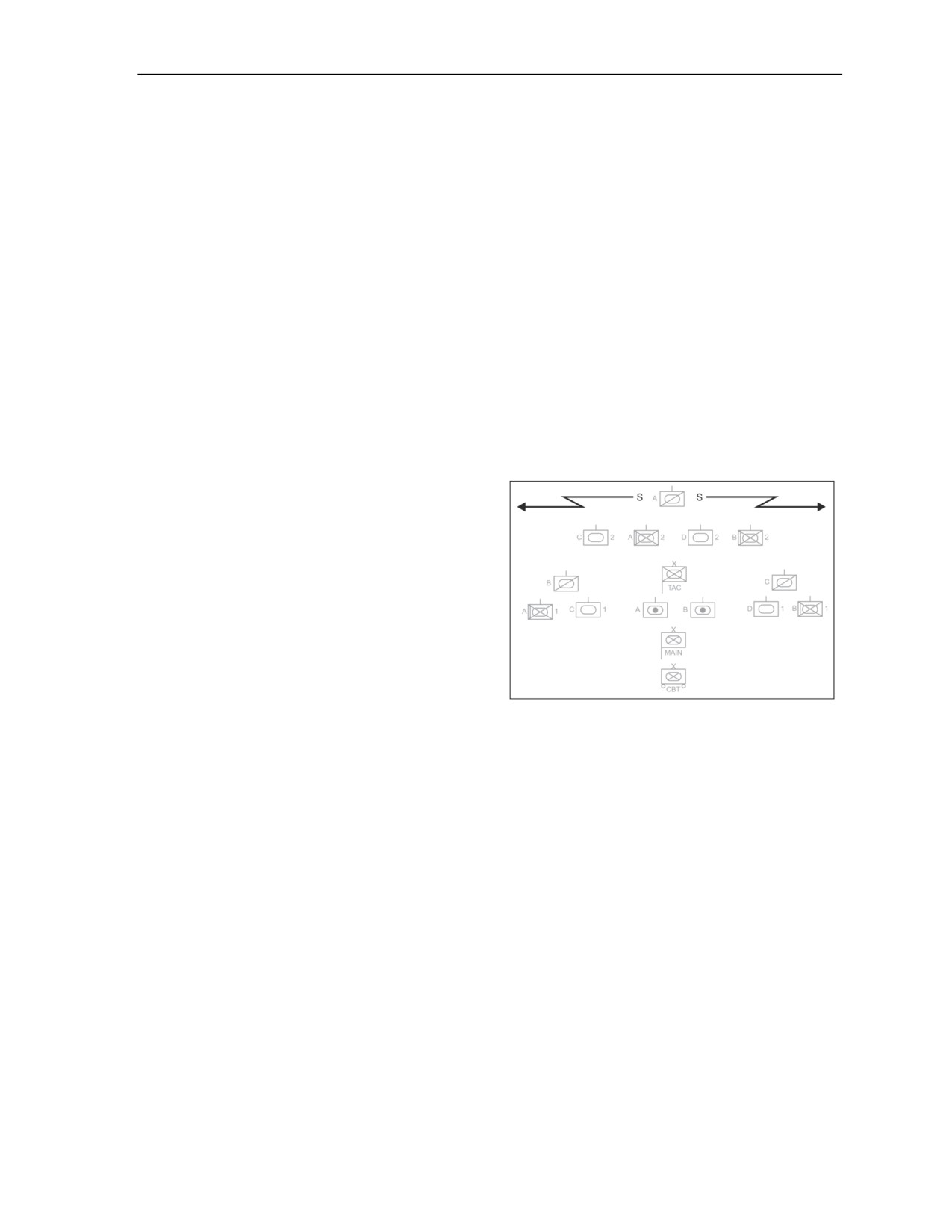
1-131. The wedge formation arranges forces to
attack an enemy appearing to the front and flanks.
(See figure
1-21.) A unit with only three
subordinate maneuver elements can adopt the
wedge formation. The commander uses the wedge
when contact with the enemy is possible or
expected, but the enemy’s location and dispositions
are vague. It is the preferred formation for a
movement to contact in an organization with three
subordinate maneuver units because it initiates
contact with one unit while retaining two other
subordinate uncommitted units positioned to
maneuver and further develop the situation. Within
the wedge, subordinate units employ the formation
Figure 1-21. Wedge formation
best suited to the terrain, visibility, and likelihood
of contact. Employing a wedge formation—
z
Provides maximum fire-power forward and allows a large portion of the unit’s firepower to be
used on the flanks.
z
Allows rapid crossing of open terrain when enemy contact is not expected.
z
Facilitates control.
z
Allows for rapid changes in the orientation of the force.
z
Facilitates the rapid change to a line, vee, echelon, or column formation.
1-132. The primary disadvantages to the wedge formation are that it—
z
Requires sufficient space for dispersion laterally and in depth.
z
Requires the availability of multiple routes.
z
Lacks ease of control in restricted terrain or poor visibility.
Vee
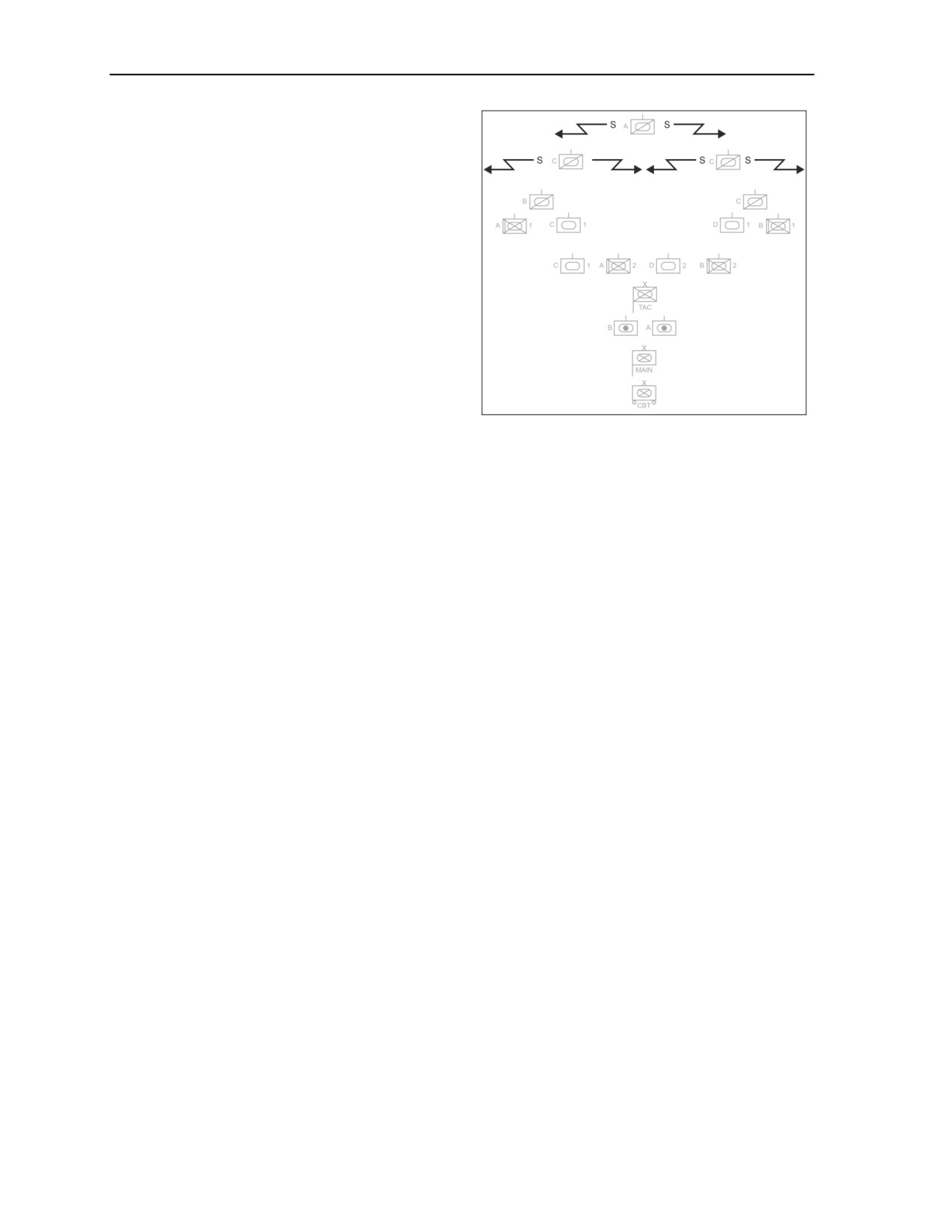
1-133. The vee formation disposes the unit with two maneuver elements abreast and one or more units
trailing. (See figure 1-22 on page 1-30.) This arrangement is well suited for an advance against a known
threat to the front. The commander may use this formation when expecting enemy contact and the enemy’s
location and disposition is known. Employing a vee formation—
22 March 2013
FM 3-90-1
1-29
Chapter 1
z
Provides maximum firepower forward
and good firepower to the flanks, but the
firepower on the flanks is less than that
provided by the wedge.
z
Facilitates a continued maneuver after
contact is made and a rapid transition to
the assault.
z
Allows the unit to change quickly to a
line, wedge, or column formation.
1-134. The primary disadvantages to this
formation are that it—
z
Makes reorientation of the direction of
movement, such as a 90-degree turn,
more difficult than using a wedge.
z
Makes control in restricted terrain and
under
limited-visibility
conditions
difficult.
Figure 1-22. Armored brigade combat team
z
Requires sufficient space for dispersion
in vee formation
laterally and in depth.
Limited-Visibility Conditions
1-135. The capability to fight at night and under limited-visibility conditions is an important aspect of
conducting maneuver. The conduct of operations during conditions of limited visibility operations should
be actively considered given the U.S. military’s current advantage in night vision devices. The commander
conducts field training exercises under limited-visibility conditions to ensure that the unit has this
capability. A commander conducts offensive actions at night or under limited-visibility conditions when a
daylight operation continues into the night. Offensive actions conducted in these conditions can achieve
surprise, gain terrain required for further operations, and negate enemy visual target acquisition capabilities
while taking advantage of the friendly force’s night-fighting capabilities.
1-136. All operations conducted in limited visibility or adverse weather require more planning and
preparation time than normal. They require designating reference points and establishing navigation aids,
such as GPS waypoints. The commander ensures that the night-vision and navigation systems required to
maneuver under these conditions are available and functional. The commander rehearses these operations
before execution to ensure complete integration and synchronization of the plan. Rehearsals also ensure
that the Soldiers in subordinate units have the necessary skills to accomplish the mission. Any problem
areas require resolution before beginning the operation.
1-137. Night operations degrade the capabilities of Soldiers and units. Cognitive abilities degrade more
rapidly than physical strength and endurance. Night-vision devices degrade the user’s depth perception.
This degradation in performance occurs after as little as
18 hours of sustained work.
(Additional
information concerning the impact of extended operations on Soldiers and units can be found in
FM 6-22.5.) The plan should allow time for both Soldiers and units to recuperate after conducting a night
attack before being committed to other operations. The weight that Soldiers must carry also directly affects
their endurance. The commander carefully determines the fighting load of the Soldiers in subordinate units,
taking into account the mission variables of METT-TC. The fighting load of Soldiers conducting night
operations should be limited. The equipment carried by Soldiers for extended periods should never exceed
one-third of their body weight.
Soldiers’ Load
1-138. The load that Soldiers carry is an important planning consideration. How much Soldiers carry, how
far, and in what configuration are critical mission considerations requiring command emphasis and
inspection. Historical experience and research shows that Soldiers can carry 30 percent of their body
weight and retain much of their agility, stamina, alertness, and mobility. For the average Soldier, who
1-30
FM 3-90-1
22 March 2013
Basics of the Offense
weighs 160 pounds, this means carrying 48 pounds. Success and survival in the offense demand that
Soldiers retain these capabilities. If an attacking unit’s Soldiers cannot move with stealth, agility, and
alertness, the success of the mission is at risk. For each pound over 30 percent of body weight, the Soldier
loses function. When the load exceeds 45 percent of body weight, or 72 pounds for the average Soldier, that
individual’s functional ability drops rapidly, and chances of becoming a casualty increase. Commanders
must ensure that Soldiers carry no more than 30 percent of their body weight when in contact, or when
contact is expected. At other times, the Soldier's load should not exceed 72 pounds. Sometimes, conditions
dictate that the Soldier’s load must exceed this recommended weight. However, the commander and
subordinate leaders must realize how that excess weight impacts unit effectiveness.
Assured Mobility
1-139. Assured mobility is a framework of processes, actions, and capabilities that assure the ability of a
force to deploy, move, and maneuver where and when desired, without interruption or delay, to achieve the
mission. The assured mobility fundamentals predict, detect, prevent, avoid, neutralize, and protect support
the assured mobility framework. This framework is one means of enabling a force to achieve the
commander’s intent. Assured mobility emphasizes the conduct of proactive mobility, countermobility, and
protection tasks in an integrated manner so as to increase the probability of mission accomplishment. While
focused primarily on the movement and maneuver warfighting function, the assured mobility concept links
to each warfighting function and both enables and is enabled by those functions. (See ATTP 3-90.4.)
Predict
1-140. Commanders and staffs must accurately predict potential obstacles to force mobility by analyzing
the enemy’s capabilities and tactics, techniques, and procedures. This involves understanding how the
enemy will evolve in reaction to friendly force countermeasures. It also involves understanding how the
effects of terrain and the effects of the population, such as vehicular traffic and dislocated civilians, will
impact force mobility. This helps build the mobility portion of the common operational picture and
facilitates decisionmaking.
Detect
1-141. Commanders and staffs use intelligence products and information collection assets to identify the
location of natural and man-made obstacles and potential means the enemy can use to create obstacles.
Commanders employ available information collection assets to detect enemy obstacle preparations and also
identify areas where there are no or only limited obstacles to ground movement and maneuver. This
knowledge can be obtained through sustained surveillance of an area. Commanders identify both actual and
potential obstacles and propose solutions and alternate COAs to minimize or eliminate their potential
impact.
Prevent
1-142. Commanders and staffs apply this fundamental by preventing civilian interference with operations
and denying the enemy’s ability to influence friendly mobility. This is accomplished by forces acting
proactively to elicit local populace support, or at least non-interference, and to eliminate enemy
countermobility capabilities before those capabilities can emplace or activate obstacles, and by mitigating
the factors that result in natural obstacles to friendly force movement and maneuver. This may include the
employment of information-related capabilities to decrease uncertainty among the population to build
support for or acceptance of operations.
1-143. Prevention may also consist of aggressive action to destroy enemy assets and capabilities before
they can be used to create obstacles. For example, this involved assigning high target priorities to Soviet
UMZ (universal mine-layer) truck-mounted scatterable mine systems when planning for major combat
operations during the Cold War. In recent operations this includes disrupting terrorist bomb-making cells
by all available means, such as cutting off their funding, eliminating safe house where the bombs can be
constructed, jamming frequencies to prevent remote detonators from being triggered, and either capturing
or killing members of these cells. Forces also apply this fundamental by conducting countermobility
operations to shape enemy movement and maneuver that may affect friendly movement and maneuver.
22 March 2013
FM 3-90-1
1-31
Chapter 1
This includes denying the enemy the ability and opportunity to attack critical infrastructure that supports
mobility, such as airfields, roads, and bridges; or that could result in an obstacle; or have an obstacle effect
if destroyed, such as dams and industrial chemical production and storage facilities.
Avoid
1-144. If prevention fails, the commander will move or maneuver forces to avoid impediments to mobility,
if this is viable within the scheme of maneuver. If friendly information collection efforts and intelligence
analysis can tell the commander where the enemy has not been, this frees up the unit to maneuver rapidly
through those areas, even if they are not the most favorable movement routes.
Neutralize
1-145. Commanders and staffs plan to neutralize, reduce, or overcome obstacles and impediments as soon
as possible to allow unrestricted movement of forces. The specific tactics, techniques, and procedures
employed will depend of the mission variables of METT-TC, rules of engagement, and where along the
joint range of military operations the unit finds itself. For example, a small unit involved in major
operations encountering surface-laid mines on a road in an urban area might attempt to destroy the mines in
place using organic methods, such as aimed rifle or machinegun fire, after only minimal checks to reduce
the danger to local civilians and accepting collateral damage to civilian buildings before proceeding on with
its mission. That same unit encountering the same situation during the conduct of a peace keeping operation
would more likely secure the site, evacuate civilians from the area, and call for an explosive ordnance
disposal tem to disarm the mines in place to preclude any collateral damage.
Protect
1-146. Commanders and staffs plan and implement survivability and other protection measures that will
prevent observation of the maneuvering force and thereby reduce the enemy’s ability to engage or
otherwise interfere with that force. This includes the use of combat formations and movement techniques. It
may involve the use of electronic warfare systems—such as counter-radio controlled improvised explosive
device electronic warfare (CREW) systems, mine plows and rollers, and modifications to the rules of
engagements. This may also include the conduct of countermobility missions to deny the enemy the
capability to maneuver in certain directions and thereby provide additional protection to friendly
maneuvering forces. It can also be as simple as altering patrol routes.
1-147. While engineers are the principal staff integrators for assured mobility, other staff sections play
critical roles in ensuring the effective application and integration of mobility, countermobility, and
protection tasks. In the case of amphibious operations, this would include naval forces that are responsible
for assured mobility from amphibious shipping to beach and landing zone exits. These critical roles include
providing information on threats to the routes. The senior engineer staff officer’s role within assured
mobility is similar to the role of the assistant chief of staff, intelligence (G-2) or the intelligence staff
officer’s (S-2) integrating role in the intelligence preparation of the battlefield process. Ultimately, assured
mobility is the commander’s responsibility.
(See engineer doctrine on assured mobility for more
information.)
Mobility
1-148. Mobility is a quality or capability of military forces which permits them to move from place to
place while retaining the ability to fulfill their primary mission (JP 3-17). Mobility operations are those
combined arms activities that mitigate the effects of natural and man-made obstacles to enable freedom of
movement and maneuver (ATTP 3-90.4). They include obstacle reduction by maneuver and engineer units
to reduce or negate the effects of existing or reinforcing obstacles. The objective is to maintain freedom of
movement for maneuver units, weapon systems, and critical supplies. Mobility operations include these six
primary tasks:
z
Breaching operations.
z
Clearing operations (areas and routes).
z
Gap-crossing operations.
1-32
FM 3-90-1
22 March 2013
Basics of the Offense
z
Combat roads and trails.
z
Forward airfields and landing zones.
z
Traffic operations.
1-149. Mobility is necessary for the conduct of successful offensive tasks. Its major focus is to enable
friendly forces to move and maneuver freely on the battlefield. The commander seeks the capability to
move, exploit, and pursue the enemy across a wide front. When attacking, the commander concentrates the
effects of combat power at selected locations. This may require the unit to improve or construct combat
trails through areas where routes do not exist. The surprise achieved by attacking through an area believed
to be impassable may justify the effort and time expended in constructing these trails. The force bypasses
existing obstacles and minefields identified before starting the offensive task instead of breaching them
whenever possible. Units mark bypassed minefields whenever the mission variables of METT-TC allow.
1-150. Maintaining the momentum of the offense requires the attacking force to quickly pass through
obstacles as it encounters them. There is a deliberate effort to capture bridges, beach and port exits, and
other enemy reserved obstacles intact. The use of amphibious, air assault, and airborne forces is an
effective technique to accomplish this goal. The preferred method of fighting through a defended obstacle
is employing a hasty (in-stride) breach, because it avoids the loss of time and momentum associated with
conducting a deliberate breach. The commander plans how and where subordinate forces conduct
breaching operations. Commanders plan breaching operations using a reverse planning sequence from the
objective back to the assembly area.
1-151. Rivers and other gaps remain major obstacles despite advances in high-mobility weapon systems
and extensive aviation support. Wet gap crossings are among the most critical, complex, and vulnerable
combined arms operations. A crossing is conducted as a hasty crossing and as a continuation of the attack
whenever possible because the time needed to prepare for a gap crossing allows the enemy more time to
strengthen the defense. The size of the gap, as well as the enemy and friendly situations, will dictate the
specific tactics, techniques, and procedures used in conducting the crossing. Functional engineer brigades
contain the majority of tactical bridging assets. Military police and chemical, biological, radiological, and
nuclear (CBRN) assets may also be required.
1-152. Clearing operations are conducted to eliminate the enemy‘s obstacle effort or residual obstacles
within an assigned area or along a specified route. A clearing operation is a mobility operation, and, as with
most mobility operations, it is typically performed by a combined arms force built around an
engineer-based clearing force. A clearing operation could be conducted as a single mission to open or
reopen a route or area, or it may be conducted on a recurring basis in support of efforts to defeat a sustained
threat to a critical route. (See Maneuver Support Center of Excellence doctrine, tactics, and procedures for
more information on clearing operations. This includes discussions of route clearance and its role within
the improvised explosive device [IED] defeat framework.)
Countermobility
1-153. Countermobility operations are those combined arms activities that use or enhance the effects of
natural and man-made obstacles to deny an adversary freedom of movement and maneuver (FM 3-34).
Countermobility operations help isolate the battlefield and protect the attacking force from enemy
counterattack, even though force mobility in offensive actions normally has first priority. Obstacles provide
security for friendly forces as the fight progresses into the depth of the enemy’s defenses. They provide
flank protection and deny the enemy counterattack routes. They assist friendly forces in defeating the
enemy in detail and can be vital in reducing the amount of forces required to secure a given area. Further,
they can permit the concentration of forces by allowing a relatively small force to defend a large AO. The
commander ensures the use of obstacles is integrated with fires and fully synchronized with the concept of
operations to avoid hindering the attacking force’s mobility.
1-154. During visualization, the commander identifies avenues of approach that offer natural flank
protection to an attacking force, such as rivers or ridgelines. Staff running estimates support this process.
Flanks are protected by destroying bridges, emplacing minefields, and by using scatterable mines to
interdict roads and trails. Swamps, canals, lakes, forests, and escarpments are natural terrain features that
can be quickly reinforced for flank security.
22 March 2013
FM 3-90-1
1-33
Chapter 1
1-155. Countermobility operations during the offense must stress rapid emplacement and flexibility.
Engineer support must keep pace with advancing maneuver forces and be prepared to emplace obstacles
alongside them. Obstacles are employed to maximize the effects of restrictive terrain, such as choke points,
or deny the usefulness of key terrain, since time and resources will not permit developing the terrain’s full
defensive potential. The commander first considers likely enemy reactions and then plans how to block
enemy avenues of approach or withdrawal with obstacles. The commander also plans the use of obstacles
to contain bypassed enemy elements and prevent the enemy from withdrawing. The plan includes obstacles
to use on identification of the enemy’s counterattack. Speed and interdiction capabilities are vital
characteristics of the obstacles employed. The commander directs the planning for air- and
artillery-delivered munitions on enemy counterattack routes. The fire support system delivers these
munitions in front of or on top of enemy lead elements once they commit to one of the routes. Rapid
cratering devices and surface minefields provide other excellent capabilities.
1-156. Control of mines and obstacles and accurate reporting to all units are vital. Obstacles will hinder
both friendly and enemy maneuver. Control of obstacle initiation is necessary to prevent the premature
activation of minefields and obstacles. (See Maneuver Support Center of Excellence doctrine, tactics,
techniques, and procedures for information on obstacle integration and mine warfare.)
INTELLIGENCE
1-157. The task generate intelligence knowledge is a continuous, user-defined task driven by the
commander. It begins before mission receipt and provides the relevant knowledge required regarding the
operational environment for the conduct of operations. The information and intelligence obtained are
refined into knowledge for use in intelligence preparation of the battlefield (IPB) and mission analysis.
Information is obtained through intelligence reach, research, data mining, database access, academic
studies, products, or materials, intelligence archives, open-source intelligence
(OSINT), and other
information sources.
1-158. A commander uses the products of the IPB process to identify any aspect within the AO or area of
interest that will affect how the friendly force accomplishes the mission. An area of interest is that area of
concern to the commander, including the area of influence, areas adjacent thereto, and extending into
enemy territory. This area also includes areas occupied by enemy forces who could jeopardize the
accomplishment of the mission (JP 3-0).
1-159. The entire staff, led by the echelon intelligence staff, uses the IPB process to identify any aspects of
the area of operations or area of interest that will affect enemy, friendly, and third party operations. The
IPB process is collaborative in nature and requires information from all staff elements and some
subordinate units. All staff and subordinate elements use the results and products of the IPB process for
planning. FM 2-01.3 describes the IPB process.
1-160. The commander uses available reconnaissance and surveillance assets to study the terrain and
confirm or deny the enemy’s strengths, dispositions, and likely intentions, especially where and in what
strength the enemy will defend. Indications of the location and composition of obstacles and the positioning
of engineer assets may be key in determining where and when the enemy will defend. These assets also
gather information concerning the civilian population within the AO to confirm or deny their numbers,
locations, and likely intentions, especially with regard to staying in shelters or fleeing from combat
operations.
1-161. By studying the terrain, the commander tries to determine the principal heavy and light avenues of
approach to the objective. The commander also tries to determine the most advantageous area for the
enemy’s main defense, routes that the enemy may use to conduct counterattacks, and other factors, such as
observation and fields of fire, avenues of approach, key terrain, obstacles, and cover and concealment
(OAKOC). The attacking unit must continuously conduct reconnaissance and surveillance for intelligence
collection during the battle because it is unlikely that the commander has complete knowledge of the
enemy’s intentions and actions.
1-162. The echelon intelligence and operations officers, in coordination with the rest of the staff, develop a
synchronized and integrated reconnaissance and surveillance plan that satisfies the commander’s maneuver,
1-34
FM 3-90-1
22 March 2013
Basics of the Offense
targeting, and information requirements. A commander’s information requirements are dictated by the
mission variables of METT-TC, but commonly include—
z
Locations, composition, equipment, strengths, and weaknesses of the enemy force, to include
high-priority targets and enemy reconnaissance and surveillance capabilities.
z
Locations of obstacles, prepared fighting positions, enemy engineer units, earth moving
equipment, breaching assets, and barrier material.
z
Probable locations of enemy reconnaissance objectives.
z
Locations of possible enemy assembly areas.
z
Locations of enemy indirect-fire weapon systems and units.
z
Locations of gaps, assailable flanks, and other enemy weaknesses.
z
Locations of areas for friendly and enemy air assault and parachute assault operations.
z
Locations of enemy air defense gun and missile units and air defense radars.
z
Locations of enemy electronic warfare units.
z
Effects of weather and terrain on current and projected operations.
z
Areas, structures, capabilities, organizations, people, and events (ASCOPE) related information
about civilians located within the unit’s area of operations.
z
Likely withdrawal routes for enemy forces.
z
Anticipated timetable schedules for the enemy’s most likely COA and other probable COAs.
z
Locations of enemy command and control and intelligence nodes and reconnaissance and
surveillance systems and the frequencies used by the information systems linking these systems.
z
Locations of enemy sustainment assets.
If friendly reconnaissance and surveillance assets cannot answer the commander’s information
requirements, the echelon intelligence staff can send a request for information to higher and adjacent units,
the commander can commit additional resources, or the commander can decide to execute the offense with
the current information.
1-163. The IPB process contributes to the protection warfighting function by developing products that help
the commander protect subordinate forces, including identification of key terrain features, man-made and
natural obstacles, trafficability and cross-country mobility analysis, line of sight overlays, and situation
templates. Line of sight overlays help protect the force. If an enemy cannot observe the friendly force, the
enemy cannot engage the friendly force with direct-fire weapons. Situation templates also help protect the
force. If a commander knows how fast an enemy force can respond to the unit’s offensive actions, unit
operations can be sequenced, so they occur at times and places where the enemy cannot respond
effectively. This occurs through determining enemy artillery range fans, movement times between enemy
reserve assembly area locations and advancing friendly forces, and other related intelligence items.
FIRES
1-164. The targeting process ensures the coordinated use of indirect fires, air and missile defense, and joint
fires to gain and maintain fire superiority throughout all offensive actions. (The joint community regards air
and missile defense as a protection function.) The commander uses a variety of methods and assets to
achieve the desired effects on targeted enemy forces and thereby to enable friendly maneuver.
Army Indirect Fires and Joint Fires
1-165. Using preparation fires, counterfire, suppression fires, and electronic warfare assets provides the
commander with numerous options for gaining and maintaining fire superiority. The commander uses
long-range artillery systems (cannon and rocket, naval surface fire support, and air support—rotary and
fixed wing) to engage the enemy throughout the depth of the enemy's defensive positions.
1-166. A U.S. Air Force (USAF) tactical air control party (TACP) is co-located with the fires cell at the
BCT and fires brigade main command posts. The USAF air liaison officer (ALO) leading the TACP is the
BCT and fires brigade commanders' principal advisor on air support. The ALO leverages the expertise of
the TACP with linkages to higher echelon TACPs to plan, prepare, execute, and assess air support for
22 March 2013
FM 3-90-1
1-35
Chapter 1
brigade operations. The ALO also maintains situational understanding of the total air support picture. The
brigade's aligned TACP is resourced to support brigade operations from that unit's tactical command post
as well as the main command post. The TACP's joint terminal attack controllers may be assisted by joint
fires observers. Joint fires observers may assist joint terminal attack controllers in the conduct of type 2 or 3
close air support (CAS).
1-167. Fire support planning is the continuing process of analyzing, allocating, and scheduling fires. It
determines how fires are used, what types of targets to attack, what collection assets are used to acquire and
track those targets, what assets are used to attack the target, and what assets verify effects on the target.
This planning does not stop at the objective or LOA. The commander gives attention to flanks and potential
enemy hide positions. Coordination among echelon fire cells and the proper use of fire support
coordination measures are critical to prevent fratricide. A commander plans to employ available fires to
delay or neutralize repositioning enemy forces to include enemy reserves. Fires are planned to support the
unit’s reconnaissance and breaching or penetration efforts. They are also used to suppress, neutralize, or
destroy those enemy forces and systems that can most affect the unit’s closure on the objective. Triggers
for the initiation, shifting, and lifting of preparatory fires are established that reflect the mission variables of
METT-TC.
1-168. The fire support coordinator (FSCOORD) or chief of fires (depending on the echelon) integrates
fires into the unit’s scheme of maneuver for the commander. The FSCOORD or chief of fires supports the
unit’s maneuver by planning preparation fires, harassing fires, interdiction fires, suppressive fires, and
destruction fires, and deception fires. These fires can be time- or event-driven. The FSCOORD or chief of
fires plans fires on known and likely enemy positions, which may include templated enemy positions.
Successful massing of indirect fires and fixed-wing attacks requires a fire cell that is proficient in the
tracking of friendly indirect fire asset positions and movements and knows the maximum ordinate
requirements. It also requires a TACP proficient in the timely execution of close air support. Fire planning
reconciles top-down planning and bottom-up refinement.
1-169. As the attacking force moves forward, preparatory fires sequentially neutralize, suppress, or destroy
enemy positions. However, the commander must weigh the probable effects of preparation fires against
achieving a greater degree of surprise against the enemy, especially under conditions of limited visibility, in
determining whether to fire an artillery preparation. The commander may decide to employ terminally
guided munitions to destroy select high-payoff targets or use these munitions in mass against part of the
enemy defense to facilitate a breach and negate the requirement for long-duration preparation fires using
area fire munitions.
1-170. The commander may choose to make the initial assault without using preparation fires to achieve
tactical surprise. However, fires are always planned to support each unit’s operations, so that they are
available if needed. Preparation fires are normally high-volume fires delivered over a short period of time
to maximize surprise and shock effect. These preparatory fires also include the conduct of electronic
warfare operations. They can continue while ground maneuver elements are moving. This consideration
applies to the conduct of all offensive tasks.
1-171. Artillery and mortars must occupy positions that are well forward and still within supporting range
of the flanks of maneuver forces to provide responsive indirect fires. The commander considers the effect
that movement by echelon or battery has on the amount of fire support provided. The commander should
support the unit’s decisive operation with priority of fires. The main effort before the initiation of the
decisive operation will have priority of fires, if the operation contains phases. The commander places
coordinated fire lines (CFLs) as close as possible to friendly maneuver forces and plans on-order CFLs on
phase lines so that they can be quickly shifted as the force moves. This allows the expeditious engagement
of targets beyond the CFL by the maximum number of available systems. Critical friendly zones (CFZs)
are established to protect critical actions, such as support-by-fire positions and breaching efforts.
1-172. The effective assignment of Army forward observers, joint forward observers, and target
acquisition assets to quick-fire or exclusive nets also provides responsive fires. Quick-fire nets allow the
lead observers to associate directly with specific field artillery or mortar fire units. These kinds of
communication arrangements enhance responsiveness through streamlined net structures and focused
priorities. Communications planning should also include the need for communication nets for the clearing
of targets for rotary- and fixed-wing attacks.
1-36
FM 3-90-1
22 March 2013
Basics of the Offense
1-173. The commander employs information capabilities to support the offense. As the friendly force
moves through the enemy’s security area and closes into the enemy’s main defensive positions, electronic
warfare jamming resources concentrate on neutralizing enemy fire control, target acquisition, and
intelligence-gathering systems. The commander uses military deception to prevent the enemy from
determining the location and objective of the friendly decisive operation. In addition, intelligence sensors
continue to provide intelligence and guidance to both friendly jammers and lethal indirect fire weapon
systems, so attacking units can destroy enemy command and control nodes, reconnaissance and
surveillance assets, artillery, and other high-value targets. The commander synchronizes the timing and
conduct of these offensive actions so they achieve maximum effectiveness.
Air and Missile Defense
1-174. A ground force’s primary air defense systems are joint fighter aircraft, such as today’s F-22 and
F-18s, conducting offensive counter-air operations operated by the joint force air component commander
(JFACC). During offensive actions, the commander directs the positioning of available organic or
supporting radars in those locations where they can best initially support the unit’s attack. The selection of
those positions reflects a risk assessment designed to preclude their early loss to enemy action. The air
defense airspace management (ADAM) element in the unit staff ensures that it has communications with
the appropriate air and missile defense (AMD) organization’s command post. That AMD command post
will provide additional information to the supported unit to expand the fidelity of the air picture, to include
information on the engagement of air threats by JFACC and Army Patriot air defense systems and short
range air defense. The attacking unit concentrates on conducting passive air defense measures during its
offensive actions. If attacked by enemy aerial systems in assembly areas, attack positions, or while moving,
the unit disperses and conducts small arms air defense. The commander at each echelon establishes air
defense priorities based on the concept of operations, scheme of maneuver, air situation, and the air defense
priorities established by higher headquarters. If the commander has Army air defense systems in direct
support of the attack, their coverage is generally weighted toward the unit’s decisive operation or main
effort and establishes a protective corridor over the terrain traversed by the subordinate unit or units
conducting that operation. Command of all air defense assets requires complete and timely communications
to ensure proper weapon status for the protection of friendly air support assets.
1-175. Passive air defense measures are an essential part of air and missile defense planning at all levels.
All units conduct passive actions in conjunction with their missions. Passive actions reduce the
effectiveness of the enemy air threat.
1-176. Targets selected to support echelon tactical air defense efforts include the following—
z
Enemy unmanned aircraft systems.
z
Enemy rotary- and fixed-wing aircraft.
z
Facilities supporting enemy air operations, such as airfields, launch sites, logistics support
facilities, technical support facilities, forward arming and refueling points, navigation aids, and
aerial command and control sites or communications nodes.
These facilities are normally engaged by maneuver and fire support elements and not air defense artillery
units. (See FM 3-01 for additional information on the use of active and passive air defense measures.)
SUSTAINMENT
1-177. The objective of sustainment in offensive actions is to assist the tactical commander in maintaining
the momentum. The commander wants to take advantage of windows of opportunity and execute offensive
tasks with minimum advance warning time. Therefore, sustainment—logistics, personnel, and health
service support—planners and operators must anticipate these events and maintain the flexibility to support
the offensive plan accordingly. A key to success in the offense is the ability to anticipate the requirement to
push support forward, specifically in regard to ammunition, fuel, replacements, and water. Sustainment
commanders must act, rather than react, to support requirements. The existence of habitual support
relationships facilitates this ability to anticipate.
22 March 2013
FM 3-90-1
1-37
Chapter 1
Logistics
1-178. Logistics maintains momentum of the attack by delivering supplies as far forward as possible. The
commander can use throughput distribution and preplanned and preconfigured packages of essential items
to help maintain offensive momentum and tempo. The commander examines the unit’s basic load to
determine its adequacy to support the operation. The commander determines the combat load, the supplies
carried by individual Soldiers and combat vehicles. The unit’s logistics load consists of what remains of the
unit’s basic load once the combat load is subtracted. Unit tactical vehicles carry the logistics load. The
commander also determines the supplies required for likely contingencies. The commander determines the
amount of cross-loading of supplies required by the situation to prevent all of one type of supply from
being destroyed by the loss of a single system.
1-179. Logistics units and material remain close to the maneuver force to ensure short turnaround time for
supplies and services. This includes uploading as much critical materiel—such as POL and ammunition—
as possible and coordinating to preclude attempted occupation of a piece of terrain by more than one unit.
The commander makes decisions regarding the risk that logistics preparations for the attack will be
detected by enemy forces and give indications of the unit’s tactical plans.
1-180. The availability of adequate supplies and transportation to sustain the operation becomes more
critical as it progresses. Supply LOCs are strained, and requirements for repair and replacement of weapon
systems increase. Requirements for POL increase because of the distance the combat vehicles of the
maneuver force are likely to travel. Sustainment units in direct support of maneuver units must be as
mobile as the forces they support. One way to provide continuous support is to task organize elements of
sustainment units or complete sustainment units with their supported maneuver formations as required by
the mission variables of METT-TC. ABCTs and IBCTs contain organic brigade support battalions and
forward support companies for this reason.
1-181. The variety and complexity of offensive actions requires the commander to establish a flexible and
tailorable transportation system. There may be a wide dispersion of forces and lengthening of LOCs.
Required capabilities include movement control, in-transit visibility of supplies being carried, terminal
operations, and mode operations.
1-182. Field maintenance assets move as far forward as consistent with the tactical situation to repair
inoperable and damaged equipment and to return it to battle as quickly as possible. Crews continue to
perform their preventive maintenance checks and services as modified for the climate and terrain in which
they find themselves. Battle damage assessment and repair may be critical to sustaining offensive actions.
Crews as well as maintenance and recovery teams conduct battle damage assessment and repair to rapidly
return disabled equipment for battlefield service by expediently fixing, bypassing, or using field expedient
components. Battle damage assessment and repair restores the minimum essential combat capabilities
necessary to support a specific combat mission or to enable the equipment to self-recover.
1-183. Establishing aerial resupply and forward logistics bases may be necessary to sustain maneuver
operations such as exploitation and pursuit conducted at great distances from the unit’s sustaining base. The
unit or support activity at the airlift’s point of origin is responsible for obtaining the required packing,
shipping, and sling-load equipment. It prepares the load for aerial transport, prepares the pickup zone, and
conducts air-loading operations. The unit located at the airlift destination is responsible for preparing the
landing zone to accommodate aerial resupply and for receiving the load.
1-184. Raids conducted by ground maneuver forces within the depths of the enemy’s support areas tend to
be audacious, rapid, and of short duration. Logistics support is minimal; units carry as much POL and
ammunition as possible, taking advantage of any captured enemy supplies. Once the raiding force crosses
its LD, only limited, emergency aerial resupply of critical supplies and medical evacuation are feasible
because of the absence of a secure LOC. The commander must thoroughly plan for aerial resupply of the
raiding force since it entails greater risk than normal operations. Under these conditions, units destroy
damaged equipment that is unable to maintain the pace of the operation.
1-38
FM 3-90-1
22 March 2013
Basics of the Offense
Health Service Support
1-185. The burden on medical resources increases due to the intensity of offensive actions and the
increased distances over which support is required as the force advances. The commander reallocates
medical resources as the tactical situation changes. Medical units can anticipate large numbers of casualties
in a short period of time due to the capabilities of modern conventional weapons and the employment of
weapons of mass destruction. These mass casualty situations can exceed the capabilities of organic and
direct support medical assets to effectively treat the numbers of casualties being sustained. To prevent this
from occurring, planners should anticipate this possibility and coordinate with area support medical units to
help absorb the acute rise in battlefield injuries. Careful planning and coordination will ensure that the
standard of medical care for injured Soldiers is not compromised. Effective management of mass casualty
situations is dependent on established and rehearsed mass casualty plans and detailed medical planning.
There are a number of other variables which can ensure the success of a unit’s mass casualty response plan.
These include, but are not limited to—
z
Coordination and synchronization of additional medical support and or augmentation, such as
medical evacuation support, forward resuscitative surgical intervention provided by forward
surgical teams, and established Class VIII resupply.
z
Quickly locating the injured and clearing them from the battlefield.
z
Providing effective emergency medical treatment for the injured.
z
Accurate triage and rapid medical evacuation of the injured to medical treatment facilities at the
next higher role of care.
PROTECTION
1-186. The fluidity and rapid tempo of the offense pose challenges in the protection of friendly assets. The
forward movement of subordinate units is critical to the commander’s maintaining the initiative necessary
for successful offensive actions. The commander denies the enemy a chance to plan, prepare, and execute
an effective response to friendly offensive actions through maintaining a high tempo. This is a key way to
ensure the survivability of the force. Techniques for maintaining a high offensive tempo include using
multiple routes, dispersion, highly mobile forces, piecemeal destruction of isolated enemy forces,
scheduled rotation and relief of forces before they culminate, and the wise use of terrain. The exact
techniques employed in a specific situation must reflect the mission variables of METT-TC.
1-187. The commander protects subordinate forces to deny the enemy the capability to interfere with their
ongoing operations. That protection also meets the commander’s legal and moral obligations to the
organization’s Soldiers. To help protect the force, the commander ensures that all protection tasks are
addressed during the unit’s planning, preparation, and execution, while also constantly assessing the
effectiveness of those protection tasks. Paragraphs 1-188 through 1-206 highlight areas of special emphasis
within the protection warfighting function during the conduct of offensive tasks. (See ADRP 3-37 and
medical doctrine for a complete discussion of all protection tasks.)
Personnel Recovery
1-188. Unit commanders and staff, subordinate leaders, and individual Soldiers are trained how to react to
an isolating incident. This training includes the Code of Conduct and survival, evasion, resistance, and
escape training. It stresses the five personnel recovery execution tasks: report, locate, support, recover, and
reintegrate. Unit commanders ensure that assigned and attached personnel are familiar with the command’s
personnel recovery guidance and the isolated Soldier guidance for each mission. Unit commanders also
should ensure that assigned and attached personnel are familiar with the key personnel recovery questions:
“How do I know when I am isolated?” “What do I do about that isolation?” and “How can I assist in my
own recovery?”
1-189. A quick response to an isolating incident is important in the successful resolution of a personnel
recovery incident for four reasons. First, isolated personnel are less likely to move or be moved very far
from their last known location, thus reducing the size of the search area. Second, prompt medical attention
reduces the probability that injuries suffered by isolated personnel will result in the loss of life or limb.
Third, a quick response keeps the enemy from reacting in a coordinated manner. Finally, by responding
22 March 2013
FM 3-90-1
1-39
Chapter 1
quickly, the impacts of hunger or thirst, environmental factors, such as cold and wet weather, endemic
diseases, and dangerous animals and insects on isolated personnel will be reduced.
Information Protection
1-190. The unit assistant chief of staff, signal (G-6) or signal staff officer (S-6) continues to refine the
unit’s information protection plan during the offense. The unit mission command cell works with the
protection cell to provide staff supervision of the implementation of information system intrusion and
attack detection devices. This is accomplished by monitoring perimeter protection tools and devices to
identify activities that constitute violations of the information protection plan and security policy. Selected
events are monitored to detect unauthorized access and inadvertent modification or destruction of data.
1-191. Network managers react to counter the effects of an incident on the network. Reaction to a network
or information system intrusion incorporates restoring essential information services, as well as initiating
attack response processes. Disaster recovery requires stopping the breach and restoring the network. (See
Signal Center of Excellence doctrine, tactics, and procedures for additional information.)
Friendly Fire Incident Avoidance
1-192. Confirmation briefs and rehearsals are primary tools for identifying and reducing fratricide risk
during the preparation phase of offensive actions. The following are considerations for their use:
z
Confirmation briefs and rehearsals ensure subordinates know where fratricide risks exist and
how to reduce or eliminate them.
z
Brief backs ensure subordinates understand the commander's intent. (They often reveal areas of
confusion, complexity, or planning errors.)
z
The types of risks identified depend on the type of rehearsal conducted.
z
Rehearsals should extend to all levels of command and involve all key players.
1-193. The following factors may reveal friendly fire incident risks during rehearsals:
z
Number and type of rehearsals.
z
Training and proficiency levels of units and individuals.
z
The habitual relationships between units conducting the operation.
z
The physical readiness (endurance) of the troops conducting the operation.
1-194. During execution, in stride risk assessment and reaction can overcome unforeseen fratricide risk
situations. The following are factors to consider when assessing fratricide risks—
z
Intervisibility between adjacent units.
z
Amount of battlefield obscuration.
z
Ability to positively identify targets.
z
Similarities and differences in equipment and uniforms between friendly and enemy forces.
z
Vehicle density on the battlefield.
z
The tempo of the battle.
1-195. Maintaining an awareness of the COP at all levels and at all times as an operation progresses is
another key to fratricide reduction. To aid leaders and Soldiers in this process, units develop and employ
effective techniques and standard operating procedures (SOPs) including—
z
Monitoring the next higher echelon’s radio net.
z
Radio cross-talk between units.
z
COP updates.
z
Accurate position reporting and navigation.
z
Training, use, and exchange of liaison officers.
1-40
FM 3-90-1
22 March 2013
Basics of the Offense
Operational Area Security and Antiterrorism
1-196. The operational area security and antiterrorism activities of the unit are discussed in ADRP 3-37.
The staff of the unit’s protection cell provides staff oversight of area security and antiterrorism activities in
the unit’s support area and prepares subordinate units located within that area to conduct these activities.
Subordinate forces conduct local security activities in their defensive positions, assembly areas, and attack
positions that provide security and antiterrorism protection to those forces.
1-197. Engineer units operating in the echelon support area (usually conducting general engineering or
survivability tasks) also have the potential to serve as a response force to level II threats within that support
area. These engineer units require time to assemble because they are normally dispersed when conducting
engineer missions on an area basis. They require augmentation in the areas of fire support and antitank
capabilities before commitment.
Survivability
1-198. Survivability includes all aspects of protecting personnel, weapons, and supplies while
simultaneously deceiving the enemy
(JP
3-34). The commander normally considers the impact of
constructing protective emplacements for artillery and sustainment concentrations as part of the planning
process. Units do not employ protective positions in the offense as extensively as they do in the defense.
However, the commander may require the hardening of key mission command facilities, especially those
with detectable electronic signatures. Maneuver units construct as many fighting positions as possible
whenever they halt or pause during the conduct of offensive tasks. They improve existing terrain by cutting
reverse-slope firing shelves or slots when possible. (See Maneuver Support Center of Excellence tactics,
techniques, and procedures publications for more information on constructing protective positions.) Forces
conducting offensive actions will continue to use camouflage, cover, and concealment. (See ATTP 3-34.39
for additional information on those topics.)
1-199. While survivability is an important engineer task, all units have an inherent responsibility to
improve their positions, whether they are located in fighting positions or a base. Survivability consists of
four areas designed to focus efforts in mitigating friendly losses to hostile actions or environments:
mobility; situational understanding; hardening; and camouflage, concealment, and military deception.
Force Health Protection
1-200. The unit surgeon continues to refine the unit’s medical support plan throughout all phases of
offensive actions. The surgeon staff section works with the protection cell to provide staff supervision of
the implementation of force health protection actions by subordinate units. Medical personnel actively
monitor the unit’s AO for disease; they conduct preventive services—such as immunizations and
prophylaxes; and they help when Soldiers get exposed to hazards. Medical personnel provide assistance
and subject matter expertise to control excessive occupational and environmental health exposure to
hazards such as noise, toxic industrial materials, waste streams, and climate extremes. They establish
medical, occupational, and environmental health screening as required. Through field sanitation team
training and water assessments, medical personnel educate Soldiers and noncombatants on disease and
non-battle injury prevention.
Chemical, Biological, Radiological, and Nuclear Defense Operations
1-201. CBRN defense consists of active and passive measures which contribute to the overall success of
CBRN defense. CBRN active defense consists of measures taken to stop a CBRN attack. CBRN passive
defense minimizes the vulnerability to the effects of CBRN attacks. The commander integrates CBRN
defensive considerations into all types of mission planning. Implementing many CBRN passive defensive
measures may slow the tempo, degrade combat power, and may also increase logistics requirements.
CBRN reconnaissance and surveillance consumes resources, especially time. Personnel in protective
equipment find it more difficult to work or fight. The principles of all CBRN defense activities are
contamination avoidance, protection, and decontamination. (See FM 3-11 for additional information on
CBRN defensive considerations.)
22 March 2013
FM 3-90-1
1-41
Chapter 1
Safety
1-202. Units implement their safety plans during offensive actions. The unit safety officer observes
safety-related issues and ensures units translate the plan into action by traveling throughout the unit AO.
Commanders emphasize safety during hazardous operations, such as aviation and wet gap crossing
operations, ensuring that units do not take unnecessary risks.
Operations Security
1-203. The echelon’s OPSEC program and any military deception or survivability efforts should conceal
the location of the friendly objective, the decisive operation, the disposition of forces, and the timing of the
offense task from the enemy or mislead the enemy regarding this information. These measures prevent the
enemy from launching effective spoiling attacks. (See JP 3-13 for additional information on OPSEC,
military deception, and information protection.)
Explosive Ordnance Disposal
1-204. Explosive ordnance disposal
(EOD) elements supporting the unit provide the capability to
neutralize hazards from conventional unexploded ordnance (UXO), high-yield explosives and associated
materials, and IEDs and booby traps containing both conventional explosives and chemical, biological,
radiological, nuclear, and high-yield explosives (CBRNE) that present a threat to the unit’s offensive
actions. These elements may dispose of hazardous foreign or U.S. ammunition, UXO, individual mines,
booby-trapped mines, and chemical mines. Breaching and clearance of minefields is primarily an engineer
responsibility. The EOD force serves as a combat multiplier by neutralizing UXO and booby traps that
restrict unit freedom of movement and deny access to or threaten supplies, facilities, and other critical
assets within the unit AO. (See FM 4-30.51 for additional information on UXO procedures.)
Internment and Resettlement Operations
1-205. During the conduct of all offensive tasks the unit can expect to accumulate a sizeable number of
detainees. Their classification will vary according to the operational environment. The unit protection cell
must work with the sustainment cell so that the necessary resources are made available to construct and
operate internment facilities for the number of detainees projected to be acquired during the conduct of the
mission. The actual number of detainees has to be monitored closely to avoid devoting too many or too few
resources to the performance of internment operations.
1-206. Individual Soldiers have to be reminded of the proper handling of detainees during their initial
capture by small units. It is at these dispersed locations where Soldiers are under extreme stress that
detainee abuse is most likely to occur. Military police Soldiers trained in internment and resettlement will
probably not be at these capture sites. (See military police doctrine for additional information on internment
and resettlement.)
TRANSITION
1-207. A transition occurs when the commander makes the assessment that the unit must change its focus
from one element of military operations to another. The following paragraphs explain why a commander
primarily conducting offensive tasks operations would transition to a focus on the conduct of defensive
tasks and describe techniques that a commander can use to ease the transition.
1-208. A commander halts an offense only when it results in complete victory and the end of hostilities,
reaches a culminating point, or the commander receives a change in mission from a higher commander.
This change in mission may be a result of the interrelationship of the other instruments of national power,
such as a political decision.
1-209. All offensive actions that do not achieve complete victory reach a culminating point when the
balance of strength shifts from the attacking force to its opponent. Usually, offensive actions lose
momentum when friendly forces encounter heavily defended areas that cannot be bypassed. They also
reach a culminating point when the resupply of fuel, ammunition, and other supplies fails to keep up with
expenditures, Soldiers become physically exhausted, casualties and equipment losses mount, and repairs
1-42
FM 3-90-1
22 March 2013
Basics of the Offense
and replacements do not keep pace with damage and losses. Because of enemy surprise movements,
offensive actions also stall when reserves are not available to continue the advance; the defender receives
reinforcements, or the defender counterattacks with fresh troops. Several of these causes may combine to
halt an offense. In some cases, the unit can regain its momentum, but this only happens after difficult
fighting or an operational pause.
1-210. The commander plans a pause to replenish combat power and phases the operation accordingly, if
the attacker cannot anticipate securing decisive objectives before subordinate forces reach their culminating
points. Simultaneously, the commander attempts to prevent the enemy from knowing when the friendly
forces become overextended.
TRANSITION TO A FOCUS ON THE CONDUCT OF DEFENSIVE TASKS
1-211. Once offensive actions begin, the attacking commander tries to sense when subordinates reach, or
are about to reach, their respective culminating points. Before they reach this point, the commander must
transition to a focus on the defensive element of decisive action. The commander has more freedom to
choose where and when to halt the attack, if the commander can sense that subordinate forces are
approaching culmination. The commander can plan future activities to aid the defense, minimize
vulnerability to attack, and facilitate renewal of the offense as the force transitions to branches or sequels of
the ongoing operation. For example, to prevent overburdening the extended LOCs resulting from the
advances beyond eight hours of travel from the echelon support area, some of the commander’s subordinate
units may move into battle positions before the entire unit terminates its offensive actions to start preparing
for the ensuing defensive-centric operation.
1-212. A lull in combat operations often accompanies a transition. The commander cannot forget about the
stability component of decisive action because the civilian populations of the unit’s AO tend to come out of
their hiding positions and request assistance from friendly forces during these lulls. The commander must
consider how to minimize the interference of these civilians with the force’s military operations while
protecting these civilians from future hostile actions in accordance with international law. The commander
must also consider the threat they pose to the force and its operations, if enemy intelligence agents or
saboteurs are part of the civilian population.
1-213. A commander anticipating the termination of unit offensive actions prepares orders that include the
time or circumstances under which the current offense transitions to a defensive-centric operation, the
missions and locations of subordinate units, and control measures. As the unit transitions from an offensive
focus to a defensive focus, the commander-
z
Maintains contact and surveillance of the enemy, using a combination of reconnaissance units
and surveillance assets to develop the information required to plan future actions.
z
Establishes a security area and local security measures.
z
Redeploys artillery assets to ensure the support of security forces.
z
Redeploys forces on probable future employment.
z
Maintains or regains contact with adjacent units in a contiguous AO and ensures that units
remain capable of mutual support in a noncontiguous AO.
z
Transitions the engineer effort by shifting the emphasis from mobility to countermobility and
survivability.
z
Consolidates and reorganizes.
z
Explains the rationale for transitioning from the offense to the unit’s Soldiers.
1-214. The commander conducts any required reorganization and resupply concurrently with other
transition activities. This requires a transition in the sustainment effort with a shift in emphasis from
ensuring the force’s ability to move forward (POL and forward repair of maintenance and combat losses) to
ensuring the force’s ability to defend on its chosen location (forward stockage of construction, barrier, and
obstacle material, and ammunition). A transition is often a time when units can perform equipment
maintenance. Additional assets may also be available for casualty evacuation and medical treatment
because of a reduction in the tempo.
22 March 2013
FM 3-90-1
1-43
Chapter 1
1-215. The commander should not wait too long to transition from the offense to the defense as
subordinate forces approach their culminating points. Without prior planning, transitioning to defensive
actions after reaching a culminating point is extremely difficult for several reasons. Defensive preparations
are hasty, and forces are not adequately disposed for defense. Defensive reorganization requires more time
than the enemy will probably allow. Usually, attacking forces are dispersed, extended in depth, and in a
weakened condition. Moreover, the shift to defense requires a psychological adjustment. Soldiers who have
become accustomed to advancing must now halt and fight defensively—sometimes desperately—on new
and often unfavorable terms.
1-216. A commander can use two techniques when transitioning to a defensive-centric operation. The first
technique is for the leading elements to commit forces and push forward to claim enough ground to
establish a security area anchored on defensible terrain. The main force moves forward or rearward as
necessary to occupy key terrain and institutes a hasty defense that progresses into a deliberate defense as
time and resources allow. The second technique is to establish a security area generally along the unit’s
final positions, moving the main body rearward to defensible terrain. The security force thins out and the
remaining force deploys to organize the defense. In both methods, the security area should be deep enough
to keep the main force out of the range of enemy medium artillery and rocket systems.
1-217. In the first technique, the security area often lacks depth because the force lacks sufficient combat
power to seize required terrain. In the second technique, enemy forces will probably accurately template the
forward trace of friendly units and engage with artillery and other fire support systems. These actions often
result in the loss of additional friendly Soldiers and equipment and the expenditure of more resources.
1-218. If a commander determines that it is necessary to terminate an offensive task and conduct a
retrograde, subordinate units typically conduct an area defense from their current locations until their
activities can be synchronized to conduct the retrograde operation. The amount of effort expended in
establishing the area defense depends on the specific mission variables of METT-TC.
TRANSITION TO A FOCUS ON THE CONDUCT OF STABILITY TASKS
1-219. At some point in time the unit will probably transition from one phase of the major operations or
campaign plan to another and begin executing a sequel to its previous offensive order. The end of offensive
tasks may not be the decisive act. The conduct of stability tasks may be the decisive operation in the major
operation or campaign. The transition to a focus on the conduct of stability tasks from the conduct of
offensive tasks cannot be an afterthought. Setting the conditions for the conduct of stability tasks may have
significant impact on the planning and execution of offensive-centric actions.
1-220. It is likely that a significant reorganization of the unit will occur to introduce those capabilities
required by the changes in the mission variables of METT-TC. Depending on the specific operational
environment the unit finds itself in, the appropriate official departmental publications dealing with other
operations and tasks should be referenced to refresh previous training and education in those subjects. The
mission command and protection functions remain important because it is likely that some Soldiers will
want to relax discipline and safety standards as the stress of active offensive actions disappears.
1-221. During major combat operations, the commander transitions to a stability-centric element of
decisive action, if the unit’s offensive actions are successful in destroying or defeating the enemy and the
situation makes a focus on the conduct of defensive tasks inappropriate. As in other operations, the
commander’s concept of operations and intent drive the design of and planning for stability tasks.
Generally, a tactical commander will focus on meeting the immediate essential service and civil security
needs of the civilian inhabitants of the area of operations in coordination with any existing host nation
government and non-governmental organizations before addressing the other three primary stability tasks.
Also, the commander will probably change the rules of engagement, and these rules must be transmitted
down to the squad and individual Soldier level.
1-222. When involved in other operations, such as peace operations, irregular warfare, and military
engagement, unit offensive actions normally are closely related to the movement to contact tasks of search
and attack (see paragraphs 2-66 to 2-80) or cordon and search (see paragraph 2-81). The conduct of
offensive tasks in these other operations will normally employ restrictive rules of engagement throughout
1-44
FM 3-90-1
22 March 2013
Basics of the Offense
the mission regardless of the element of decisive action dominant at any specific moment. In the conduct of
these operations, the emphasis on the stability element is much more dominant than the defensive element.
22 March 2013
FM 3-90-1
1-45
Chapter 2
Movement to Contact
When necessary, commanders order subordinates to conduct a movement to contact
regardless of which element of decisive action is currently dominant—offense,
defense, or stability. Commanders conduct a movement to contact to create favorable
conditions for subsequent tactical tasks. A commander conducts a movement to
contact when the tactical situation is not clear, or when the enemy has broken contact.
A properly executed movement to contact develops the combat situation and
maintains the commander's freedom of action after contact is gained. This flexibility
is essential in maintaining the initiative. All of the tactical concepts, control
measures, and planning considerations introduced in ADRP 3-90 apply to the conduct
of a movement to contact. The attack preparation considerations introduced in
chapter 3 of this publication also apply.
GENERAL CONSIDERATIONS FOR A MOVEMENT TO CONTACT
2-1. A movement to contact employs purposeful and aggressive movement, decentralized control, and the
hasty deployment of combined arms formations from the march to conduct offensive, defensive, or stability
tasks. The fundamentals of a movement to contact are—
z
Focus all efforts on finding the enemy.
z
Make initial contact with the smallest force possible, consistent with protecting the force.
z
Make initial contact with small, mobile, self-contained forces to avoid decisive engagement of
the main body on ground chosen by the enemy. (This allows the commander maximum
flexibility to develop the situation.)
z
Task-organize the force and use movement formations to deploy and attack rapidly in any
direction.
z
Keep subordinate forces within supporting distances to facilitate a flexible response.
z
Maintain contact regardless of the course of action (COA) adopted once contact is gained.
Close air support, air interdiction, and counterair operations are essential to the success of large-scale
movements to contact. Local air superiority or, as a minimum, air parity is vital to the operation’s success.
2-2. The Army’s improved intelligence capabilities reduce the need for corps and divisions to conduct a
movement to contact since modernized units normally have a general idea of the location of significant
enemy forces. However, enemy use of complex terrain, such as jungle, urban, and extensive forests,
operations security, and military deception operations designed to degrade the accuracy of the friendly
common operational picture (COP) will continue to require small tactical units to conduct a movement to
contact. Likewise, if opposing a peer competitor having a sophisticated command and control warfare or
electronic warfare system capable of seriously disrupting or degrading U.S. national-level intelligence and
surveillance systems, large tactical units may be required to conduct movements to contact.
2-3. A meeting engagement is a combat action that occurs when a moving force, incompletely
deployed for battle, engages an enemy at an unexpected time and place. The enemy force encountered
may be either stationary or moving. For a meeting engagement to occur, both forces do not have to be
surprised by their meeting. The force making unexpected contact is the one conducting a meeting
engagement. Such encounters often occur in small-unit operations when reconnaissance has been
ineffective.
22 March 2013
FM 3-90-1
2-1
Chapter 2
2-4. In a meeting engagement the force that reacts first to the unexpected contact generally gains an
advantage over its enemy. However, a meeting engagement may also occur when the opponents are aware
of each other and both decide to attack immediately to obtain a tactical advantage or seize key or decisive
terrain. A meeting engagement may also occur when one force attempts to deploy into a hasty defense
while the other force attacks before its opponent can organize an effective defense. Acquisition systems
may discover the enemy before the security force can gain contact. No matter how the force makes contact,
seizing the initiative is the overriding imperative. Prompt execution of battle drills at platoon level and
below, and standard actions on contact for larger units, can give that initiative to the friendly force.
ORGANIZATION OF FORCES FOR A MOVEMENT TO CONTACT
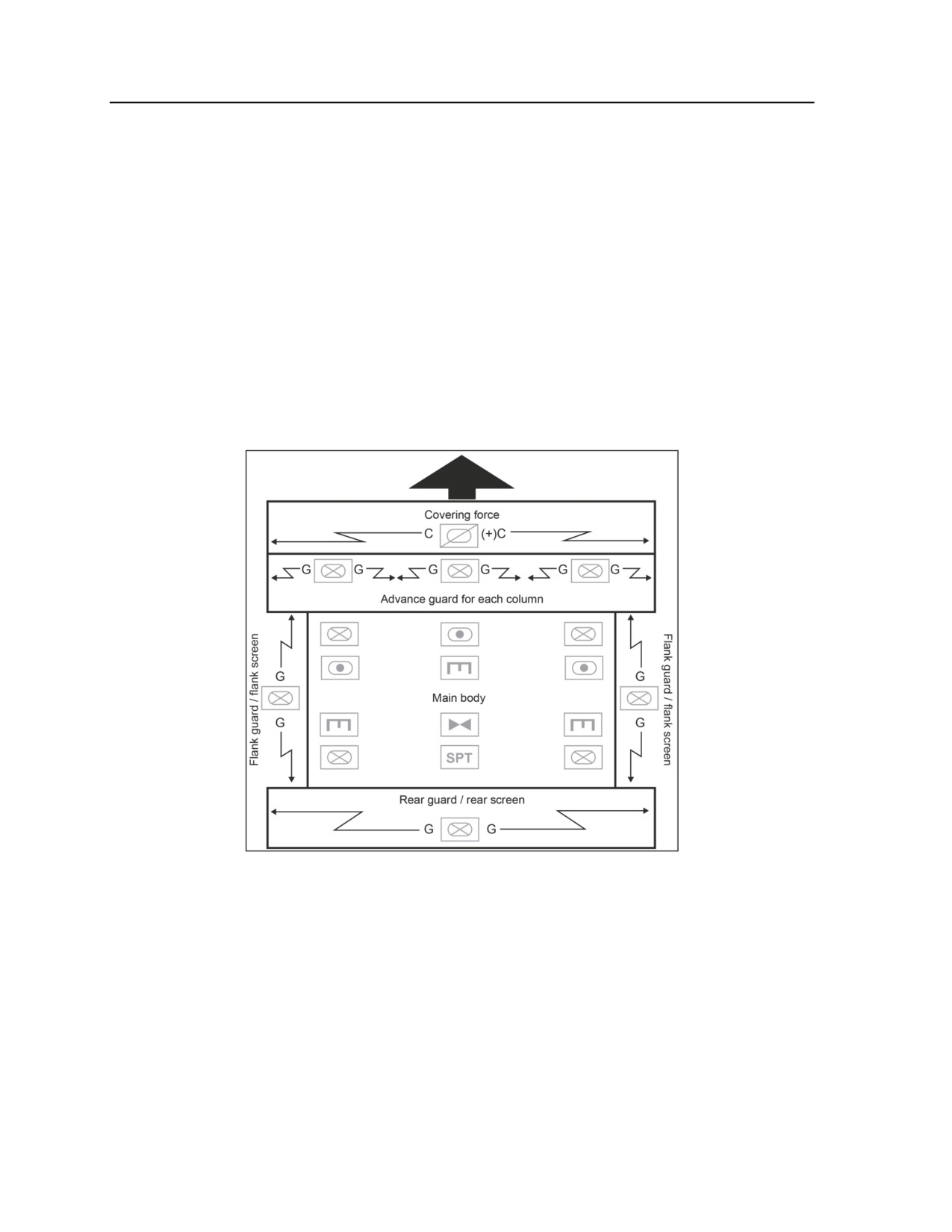
2-5. A movement to contact is organized (as a minimum) with a forward security force—either a covering
force or an advance guard—and a main body. A portion of the main body composes the commander’s
sustaining base. Based on the mission variables (mission, enemy, terrain and weather, troops and support
available, time available, and civil considerations) of METT-TC, the commander may increase the unit’s
security by resourcing an offensive covering force and an advance guard for each column, as well as flank
and rear security (normally a screen or guard). (See figure 2-1.) FM 3-90-2 discusses security operations.
Figure 2-1. Force organized for a movement to contact
2-6. A movement to contact mission requires the commander not to have contact with the enemy main
body. However, the commander may still know the location of at least some enemy reserve and follow-on
forces. If the corps or division commander has enough intelligence information to target enemy
uncommitted forces, reserves, or sustaining operations activities, the commander normally designates
forces, such as long-range artillery systems, attack helicopters, extended range unmanned aircraft, and
fixed-wing aircraft to engage known enemy elements regardless of their geographical location within the
area of operations
(AO). At all times the forward security element and the main body perform
reconnaissance.
2-2
FM 3-90-1
22 March 2013
Movement to Contact
Security Forces
2-7. A commander conducting a movement to contact typically organizes the security element into a
covering force to protect the movement of the main body and to develop the situation before committing
the main body. This security element is normally the unit’s initial main effort. A covering force is
task-organized to accomplish specific tasks independent of the main body such as conduct mobility and
selected countermobility operations in accordance with the mission variables of METT-TC. This covering
force reports directly to the establishing commander.
2-8. If a force conducting a movement to contact is unable to resource a covering force for independent
security operations, it may use an advance guard in the place of a covering force. An advance guard is a
task-organized combined arms unit or detachment that precedes a column formation to protect the main
body from ground observation or surprise by the enemy. This typically occurs when a brigade or battalion
conducts a movement to contact. In cases where the higher echelon (corps or division) creates a covering
force, subordinate elements can establish an advance guard behind the covering force and ahead of the
main body. This normally occurs when subordinate units are advancing in multiple parallel columns. In this
case, each main body column usually organizes its own advance guard.
2-9. The advance guard operates forward of the main body to ensure its uninterrupted advance by
reducing obstacles to create passage lanes, repair roads and bridges, or locate bypasses. The advance guard
also protects the main body from surprise attack and fixes the enemy to protect the deployment of the main
body when it is committed to action. The elements composing the advance guard should have equal or
preferably superior mobility to that of the main body. For this reason, combined arms units containing a
mixture of mechanized or Stryker equipped infantry, armor, and reconnaissance or cavalry elements are
most suitable for use in an advance guard. Engineer assets should also constitute a portion of the advance
guard, but the main body can also provide other support. However, there are some environments, such as
jungles and swamps, where providing the advance guard with mobility superior to that of the main body is
impossible.
2-10. The advance guard moves as quickly and as aggressively as possible, but, unlike the covering force,
remains within supporting range of the main body's weapon systems. It forces the enemy to withdraw or
destroys small enemy groups before they can disrupt the advance of the main body. When the advance
guard encounters large enemy forces or heavily defended areas, it takes prompt and aggressive action to
develop the situation and, within its capability, defeat the enemy. Its commander reports the location,
strength, disposition, and composition of the enemy and tries to find the enemy's flanks and gaps or other
weaknesses in its position. The main body may then join the attack. The force commander usually specifies
how far in front of the main body of the force the advance guard is to operate. The commander reduces
those distances in close terrain and under low-visibility conditions.
2-11. When the command’s rear or flanks are not protected by adjacent or following units, it must provide
its own flank and rear security. The command can accomplish this by establishing a screen or a guard on its
flanks or to its rear. The flank columns of the main body normally provide these flank security elements;
for example, the left flank brigade would provide the left flank screen for a division-level movement to
contact. The rear guard normally comes from one of the subordinate elements of the corps or division and
reports directly to the corps or division headquarters. A corps may conduct a flank cover if there is a clearly
identified, significant threat from the flank. A flank cover requires significant resources that are unavailable
to the main body. Combat aviation units may establish a flank screen, if the mission variables of METT-TC
allow it; however, this increases the risk to the main body. (See FM 3-90-2 for more specific information
concerning the conduct of the various reconnaissance and security tasks.)
Main Body
2-12. The main body consists of forces not detailed to security duties. It is normally the element that will
conduct the decisive operation within the conduct of the movement to contact. The combat elements of the
main body prepare to respond to enemy contact with the unit's security forces. For example, attack
helicopter units organic to combat aviation brigades supporting a division or corps conducting a movement
to contact normally remain under division and corps control until contact is made. If the situation allows,
the commander can assign a follow and support mission to a subordinate unit. This allows that subordinate
22 March 2013
FM 3-90-1
2-3
Chapter 2
unit to relieve security forces from such tasks as observing bypassed enemy forces, handling displaced
civilians, and clearing routes. This prevents security forces from being diverted from their primary mission.
2-13. The commander designates a portion of the main body for use as the reserve. The size of the reserve
is based upon the mission variables of METT-TC and the amount of uncertainty concerning the enemy. The
more vague the enemy situation, the larger the size of the reserve. The reserve typically constitutes
approximately one-fourth to one-third of the force. On contact with the enemy, the reserve provides
flexibility to react to unforeseen circumstances and allows the unit to quickly resume its movement.
2-14. When a movement to contact is conducted at the corps or division echelon, the corps and division
commanders conducting a movement-to-contact will not normally have a command relationship with
sustainment assets beyond that found in their attached brigades. Instead, those sustainment assets are
assigned to the Army Material Command and attached to or placed under the operational control of the
Army’s theater sustainment command or some type of joint sustainment command. They have a support
relationship with the corps or division. The division or corps headquarters staff coordinate with the
supporting sustainment organization so that the theater sustainment command or sustainment brigade
supporting the tactical unit adjusts the supporting sustainment unit’s internal organization to meet the
tactical commander’s needs. The corps or division echelon staff informs the commander of any shortfall in
available sustainment support so that the movement to contact concept of operations and tactical plan can
be modified to meet sustainment realities. This mainly occurs when the tactical unit conducting a
movement to contact is not conducting the decisive operation or main effort of its higher headquarters.
2-15. Brigade combat team (BCT) commanders tailor their units’ organic sustainment assets to the
mission. They decentralize the execution of the sustainment, but that support must be continuously
available to the main body. This includes using preplanned logistics packages (LOGPACs). A logistics
package is a grouping of multiple classes of supply and supply vehicles under the control of a single
convoy commander. Daily LOGPACs contain a standardized allocation of supplies. Special LOGPACs
can also be dispatched as needed.
2-16. The commander frequently finds that main supply routes (MSRs) become extended as the operation
proceeds. Aerial resupply may also be necessary to support large-scale movement to contacts or to maintain
the momentum of the main body. Combat trains containing fuel, ammunition, medical, and maintenance
assets move with their habitually associated supported battalion or company team. Fuel and ammunition
stocks remain loaded on tactical vehicles in the combat trains, so they can instantly move when necessary.
Battalion field trains move with a higher support echelon, such as the brigade support battalion, in the main
body of each BCT. Aviation units use forward arming and refuel points (FARPs) to reduce aircraft
turnaround time.
CONTROL MEASURES FOR A MOVEMENT TO CONTACT
2-17. A commander uses the minimal number and type of control measures possible in a movement to
contact because of the uncertain enemy situation. These measures include designation of an AO with left,
right, front, and rear boundaries, or a separate AO bounded by a continuous boundary (noncontiguous
operations). The commander further divides the AO into subordinate unit AOs to facilitate subordinate unit
actions.
2-18. The operation usually starts from a line of departure (LD) at the time specified in the operation order
(OPORD). The commander controls the movement to contact by using phase lines, contact points, and
checkpoints as required. (See figure 2-2.) The commander controls the depth of the movement to contact by
using a limit of advance (LOA) or a forward boundary. Figure 2-2 shows an LOA and not a forward
boundary. The commander could designate one or more objectives to limit the extent of the movement to
contact and orient the force. However, these are often terrain-oriented and used only to guide movement.
Although a movement to contact may result in taking a terrain objective, the primary focus should be on the
enemy force. If the commander has enough information to locate significant enemy forces, then the
commander should plan some other type of offensive action.
2-4
FM 3-90-1
22 March 2013
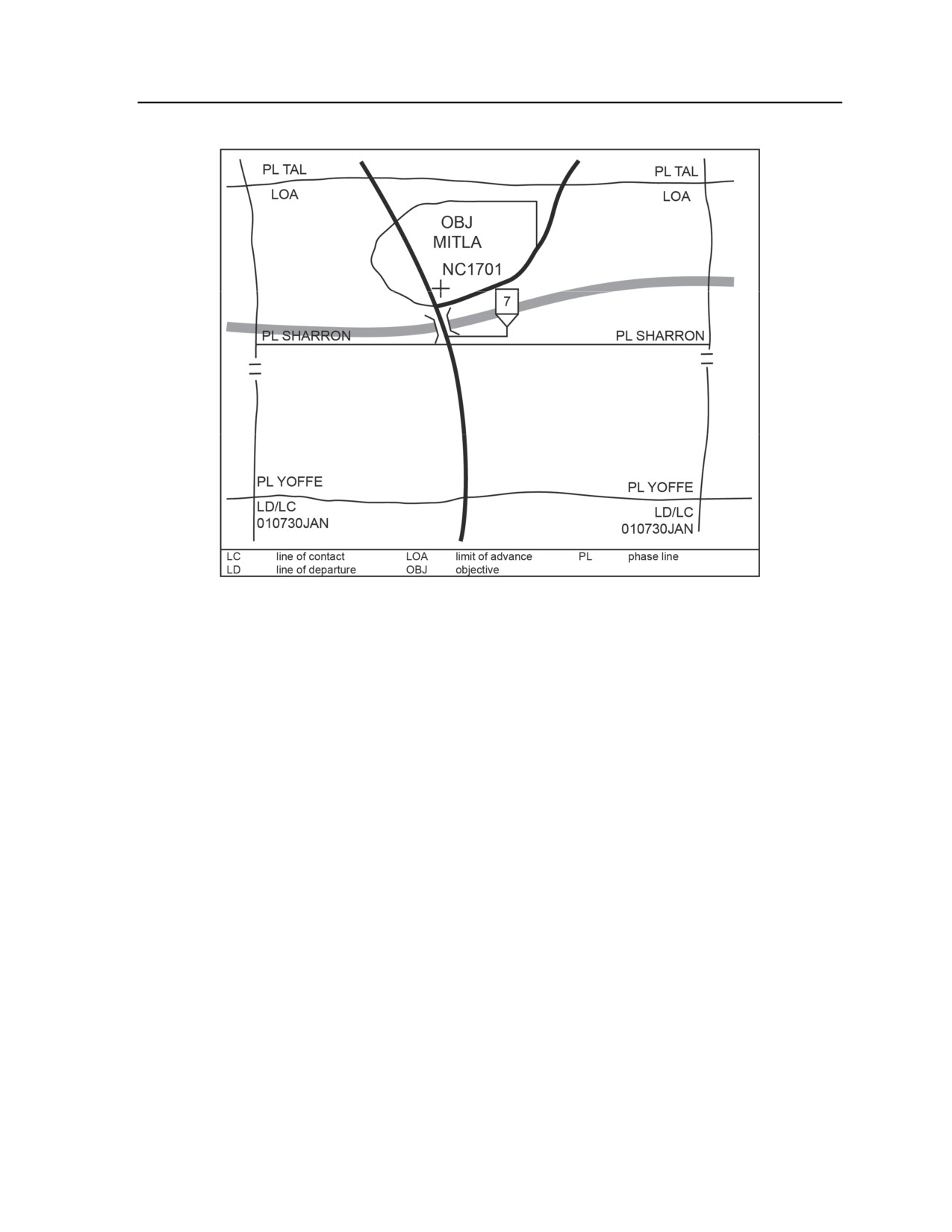
Movement to Contact
Figure 2-2. Movement to contact control measures
2-19. Corps, division, or BCT commanders use boundaries to separate the various organizational elements
and clearly establish responsibilities between different organizations. Battalion commanders use these
control measures along with mission orders, coupled with battle drills and formation discipline, to
synchronize the movement to contact. Company teams are not normally assigned their own areas of
operations during the conduct of a movement to contact.
2-20. The commander can designate a series of phase lines that can successively become the new rear
boundary of the forward security elements as that force advances. Each rear boundary becomes the forward
boundary of the main body and shifts as the security force moves forward. The rear boundary of the main
body designates the limit of responsibility of the rear security element. This line also shifts as the main
body moves forward. (See FM 3-90-2 for a discussion of security force boundaries.)
2-21. Commanders may use an axis of advance in limited visibility. However, there is the risk of enemy
forces outside the axis not being detected, and thus being inadvertently bypassed.
PLANNING A MOVEMENT TO CONTACT
2-22. The commander executes the intelligence annex to the OPORD to determine the enemy’s location
and intent while conducting security operations to protect the main body. This includes the use of available
fixed-wing aircraft. This allows the main body to focus its planning and preparation, to include rehearsals,
on the conduct of hasty attacks, bypass maneuvers, and hasty defenses. The plan addresses not only actions
anticipated by the commander based on available intelligence information, but also the conduct of meeting
engagements at anticipated times and locations where they might occur. The commander tasks the forward
security force with conducting route reconnaissance of routes the main body will traverse.
2-23. The commander seeks to gain contact by using the smallest elements possible. These elements are
normally ground scouts or aerial scouts performing reconnaissance, but may also be unmanned aircraft
systems (UASs) or other reconnaissance and surveillance assets. The commander may task organize the
unit’s scouts to provide them with additional combat power to allow them to develop the situation. The
22 March 2013
FM 3-90-1
2-5
Chapter 2
unit’s planned movement formation should contribute to the goal of making initial contact with the smallest
force possible. It should also provide for efficient movement of the force and adequate reserves. The
commander can choose to have all or part of the force conduct an approach march as part of the movement
to contact to provide that efficient movement. An approach march can facilitate the commander's decisions
by allowing freedom of action and movement of the main body. (See FM 3-90-2 for a discussion of an
approach march.)
2-24. The frontage assigned to a unit in a movement to contact must allow it to apply sufficient combat
power to maintain the momentum of the operation. Reducing the frontage normally gives the unit adequate
combat power to develop the situation on contact while maintaining the required momentum. Both the
covering force and advance guard commanders should have uncommitted forces available to develop the
situation without requiring the deployment of the main body.
2-25. The commander relies primarily on fire assets to weight the lead element’s combat power, but the
commander also provides it with the additional combat multipliers it needs to accomplish the mission. The
fires system helps develop fire superiority when organized correctly to fire immediate suppression missions
to help maneuver forces get within direct-fire range of the enemy.
2-26. The reconnaissance effort may proceed faster in a movement to contact than in a zone reconnaissance
because the emphasis is on making contact with the enemy. However, the commander must recognize that
by increasing the speed of the reconnaissance effort, there is an increased risk associated with the
operation.
2-27. Bypass criteria should be clearly stated and depend on the mission variables of METT-TC. For
example, an armored or Stryker BCT commander in an open desert environment could declare that no
mounted enemy force larger than a platoon can be bypassed. All other forces will be cleared from the
brigade’s axis of advance. Any force that bypasses an enemy unit must maintain contact with it until
handing it off to another friendly element, usually a force assigned a follow and support mission.
2-28. The echelon intelligence officer
(G-2 or S-2), assisted by the engineer and air defense staff
representatives, must carefully analyze the terrain to include air avenues of approach. The echelon
intelligence officer identifies the enemy's most dangerous COA in the war gaming portion of the military
decisionmaking process. Because of the force’s vulnerability, the G-2 must not underestimate the enemy
during a movement to contact. A thorough intelligence preparation of the battlefield (IPB)—by developing
the modified combined obstacle overlay to include intervisibility overlays and other products, such as the
event templates—enhances the force's security by indicating danger areas where the force is most likely to
make contact with the enemy. It also helps to determine movement times between phase lines and other
locations. Potential danger areas are likely enemy defensive locations, engagement areas, observation posts
(OPs), and obstacles. The fires system targets these areas, and they become on-order priority targets placed
into effect and cancelled as the lead element can confirm or deny enemy presence. The intelligence annex
of the movement to contact order must address coverage of these danger areas. If reconnaissance and
surveillance forces cannot clear these areas, more deliberate movement techniques are required.
2-29. The commander develops decision points to support changes in the force's movement formation or a
change from an approach march to a combat formation. Using both human and technical means to validate
decision points, the commander must determine the acceptable degree of risk, based on the mission. The
commander's confidence in the products of the IPB process and the acceptable risk determine the unit’s
combat formation and scheme of maneuver. In a high-risk environment, it is usually better to increase the
distance between forward elements and the main body than to slow the speed of advance.
2-30. Corps and divisions can execute shaping operations in support of their subordinate BCTs as part of a
movement to contact, although, by definition, a force conducts a movement to contact when the enemy
situation is vague or totally unknown. This occurs when the necessary information regarding enemy
reserves and follow-on forces is available, but information regarding those enemy forces in close proximity
to the friendly force is not available. As in any other type of operation, the commander plans to focus
operations on finding the enemy and then delaying, disrupting, and destroying each enemy force element as
much as possible before it arrives into direct-fire range. This allows BCT maneuver forces to prepare to
engage enemy units on their arrival.
2-6
FM 3-90-1
22 March 2013
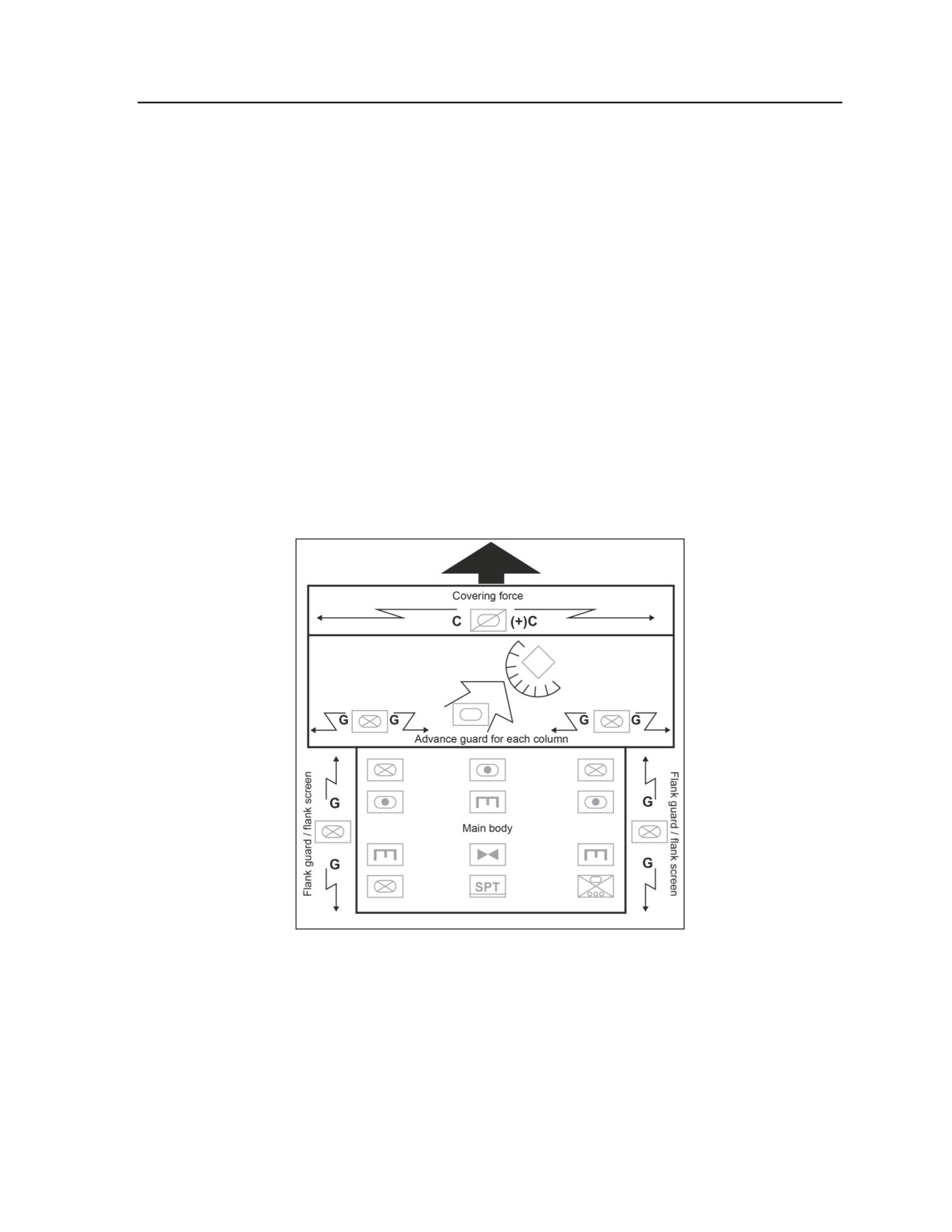
Movement to Contact
2-31. In a movement to contact, the commander can opt not to designate a decisive operation until forces
make contact with the enemy, unless there is a specific reason to designate it. In this case, the commander
retains resources under direct control to reinforce the decisive operation. The commander may designate
the decisive operation during the initial stages of a movement to contact because of the presence of a key
piece of terrain or an avenue of approach.
PREPARING FOR A MOVEMENT TO CONTACT
2-32. The preparations for the conduct of a movement to contact are the same as those for an attack. (See
the appropriate section of chapter 3 for additional information on this subject.)
EXECUTING A MOVEMENT TO CONTACT
2-33. Each element of the force synchronizes its actions with adjacent and supporting units, maintaining
contact and coordination as prescribed in orders and unit standard operating procedures (SOPs). The
advance guard maintains contact with the covering force (if one is established). The lead elements of the
main body maintain contact with the advance guard. The rear guard and flank security elements maintain
contact with and orient on the main body's movement. These security forces prevent unnecessary delay of
the main body and prevent the deployment of the main body as long as possible. Reconnaissance elements
operate to the front and flanks of each column's advance guard and maintain contact with the covering
force. The commander may instruct each column's advance guard to eliminate small pockets of resistance
bypassed by forward security force. (See figure 2-3.)
Figure 2-3. A column advance guard attacking to destroy a contained enemy force
2-34. The commander of the advance guard chooses a combat formation, based on the mission variables of
METT-TC, to make contact with the smallest possible force while providing flexibility for maneuver.
Whatever combat formation the commander chooses, the unit must be able to deploy appropriately once the
enemy’s location is determined. The commander ensures that the route or axis of advance traveled by the
main body is free of enemy forces. The main body may move continuously (using traveling and traveling
overwatch) or by bounds (using bounding overwatch). It moves by bounds when contact with the enemy is
imminent and the terrain is favorable. Some indirect-fire assets, such as a mortar platoon or artillery battery
and combat observation and lasing teams (COLTs), may be positioned with the advance guard. The COLTs
22 March 2013
FM 3-90-1
2-7
Chapter 2
can help overwatch the advance guard movement, and indirect fires focus on suppressing enemy weapons,
obscuring enemy observation posts, and screening friendly movement.
2-35. The main body keeps enough distance between itself and its forward security elements to maintain
flexibility for maneuver. This distance varies with the level of command, the terrain, and the availability of
information about the enemy. The main body may execute an approach march for all or part of the
movement to contact to efficiently use the available road network or reduce the time needed to move from
one location to another. Command posts and trains travel along high-mobility routes within the AO and
occupy hasty positions as necessary.
2-36. Behind these forward security elements, the main body advances over multiple parallel routes with
numerous lateral branches to remain flexible and reduce the time needed to initiate maneuver. (While it is
preferred for a battalion to use multiple routes, battalions and smaller units can move on just one route.) In
a movement to contact, the main body's march dispositions must allow maximum flexibility for
maneuvering during movement and when establishing contact with the enemy force.
2-37. The commander’s fire support systems tend to focus on suppression missions to disrupt enemy forces
as they are encountered and smoke missions to obscure or screen exposed friendly forces when conducting
a movement to contact. The commander schedules the movements of fire support systems in
synchronization with the movement of the rest of the force. Fire support systems that cannot match the
cross-country mobility of ground maneuver units cause them to slow their rate of advance. If these units do
not slow down, they run the risk of outrunning their fire support. The commander synchronizes the
employment of close air support to prevent the enemy from regaining balance while the commander’s
ground fire support assets are repositioning. The main body updates its priority target list during a
movement to contact operation.
2-38. Similar considerations apply to air and missile defense when the enemy possesses these capabilities.
The unit conducting a movement to contact remains aware of the air and missile defense umbrella provided
by Sentinel Radars and Army Air and Missile Defense Command Patriot systems, and the combat air patrol
provided by Air Force, Navy, and Marine Corps fighter aircraft.
2-39. The unit’s tempo, momentum, tactical dispersal, and attention to electromagnetic emission control
complicate the enemy’s ability to detect and target the main body until contact is made. Once the force
makes contact and concentrates its effects against detected enemy forces, it becomes vulnerable to strikes
by enemy conventional weapons and weapons of mass destruction (WMD). It must concentrate its combat
effects rapidly in a meeting engagement and disperse again as soon as it overcomes resistance to avoid
enemy counteractions, if the movement to contact is to continue. However, the results of that meeting
engagement and the mission variables of METT-TC will determine the specific COA selected.
2-40. Movement should be as rapid as the terrain, the mobility of the force, and the enemy situation permit.
Open terrain provides maneuver space on either side of the line of march and facilitates high-speed
movement. It also allows for greater dispersal and usually permits more separation between forward
security elements and the main body than restricted terrain allows. The commander should never commit
the main body to canalizing terrain before these forward security elements have advanced far enough to
ensure that the main body will not become fixed within that terrain. The enemy may have also established
fire support control measures that allow the enemy to employ non-observed harassing and interdiction fires
to interdict friendly forces traversing these choke points. As the enemy situation becomes known, the
commander may shorten the distance between elements to decrease reaction time or deploy the force to
prepare for contact.
2-41. At battalion and company levels, a moving force moves along covered or concealed routes from one
covered or concealed position to another, using terrain to minimize its vulnerability to enemy weapons.
Further, an overwatching force should cover the moving force.
(FM 3-90-2 describes movement
techniques, such as traveling overwatch.) Regardless of the specific movement technique employed,
subordinate elements need to provide mutual support and be knowledgeable about their counterpart’s
sectors of fire.
2-42. The force must attempt to cross any obstacles it encounters without loss of momentum by
conducting hasty (in-stride) breaches. The commander uses forward security forces in an attempt to seize
2-8
FM 3-90-1
22 March 2013
Movement to Contact
intact bridges whenever possible. Lead security elements bypass or breach obstacles as quickly as possible
to maintain the momentum of the movement. If these lead elements cannot overcome obstacles, the
commander directs subsequent elements of the main body to bypass the obstacle site and take the lead.
Following forces can also reduce obstacles that hinder the unit’s sustainment flow.
2-43. The commander moves well forward in the movement formation. Once the formation makes contact
with the enemy, the commander can move quickly to the area of contact, analyze the situation, and direct
aggressively. The unit's security elements conduct actions on contact to develop the situation once they find
the enemy. Once they make contact with the enemy, a number of actions occur that have been divided into
the following sequence. (Units equipped with a full set of digital information systems may be able to
combine or skip one or more of the steps in that sequence. Those units will conduct maneuver and remain
within supporting distance of each other with a significantly larger AO than units equipped with analog
systems.) These actions normally constitute a major portion of the unit’s shaping operations.
2-44. This publication discusses executing all four offensive tasks in a five-step sequence:
z
Gain and maintain enemy contact.
z
Disrupt the enemy.
z
Fix the enemy.
z
Maneuver.
z
Follow through.
This sequence is for discussion purposes only and is not the only way of conducting these offensive tasks.
The five steps used in this publication to illustrate the execution of offensive tasks actually tend to overlap
each other during the conduct of offensive actions. Normally the first three of these steps are shaping
operations or supporting efforts, while the maneuver step is the decisive operation or main effort. Follow
through is normally a sequel or a branch to the plan based on the current situation.
SHAPING OPERATIONS
2-45. A shaping operation is an operation at any echelon that creates and preserves conditions for the
success of the decisive operation through effects on the enemy, other actors, and the terrain (ADRP 3-0). If
the result of any of these three steps is the complete development of the situation and the establishment or
regaining of contact with the enemy main body, not just enemy security forces, then that step will have
been the decisive operation of the movement to contact.
Gain and Maintain Enemy Contact
2-46. All reconnaissance and surveillance assets focus on determining the enemy's dispositions and
providing the commander with current intelligence and relevant combat information; this ensures that the
commander can commit friendly forces under optimal conditions. The commander uses all available
sources of combat information to find the enemy's location and dispositions. Corps and divisions use the
long-range surveillance units and detachments, unmanned aircraft systems, and technical systems found in
the attached battlefield surveillance brigade
(BFSB) in conjunction with data provided by special
operations forces, joint, and multinational assets to gain contact with the enemy. BCTs and their
subordinate battalions use their organic reconnaissance assets to gain that contact. This contact may be in
any of seven forms: visual; physical; indirect fire; obstacles; aircraft; chemical, biological, radiological,
nuclear, and high-yield explosive (CBRNE); and direct fire. Commanders use these systems to cue the
conduct of aerial and ground reconnaissance by their attached BCTs and combat aviation brigades.
2-47. The enemy situation becomes clearer as the unit's forward security elements conduct actions on
contact to rapidly develop the situation in accordance with the commander's plan and intent. By
determining the strength, location, and disposition of enemy forces, these security elements allow the
commander to focus the effects of the main body’s combat power against the enemy main body. The
overall force must remain flexible to exploit both intelligence and combat information. The security force
should not allow the enemy force to break contact unless it receives an order from the commander. When a
strong covering force has not preceded the advance guard, it should seize terrain that offers essential
observation.
22 March 2013
FM 3-90-1
2-9
Chapter 2
2-48. Actions on contact are a series of combat actions often conducted simultaneously taken on contact
with the enemy to develop the situation (ADRP 3-90). Actions on contact are:
z
Deploy and report.
z
Evaluate and develop the situation.
z
Choose a course of action.
z
Execute selected course of action.
z
Recommend a course of action to the higher commander.
2-49. Once the lead elements of a force conducting a movement to contact encounter the enemy, they
conduct actions on contact. The unit treats obstacles like any other form of enemy contact, since it assumes
that the obstacles are covered by fire. The unit carries out these actions on contact regardless of whether the
enemy has detected its presence. The unit’s security force often gains a tactical advantage over an enemy
force by using tempo and initiative to conduct these actions on contact, allowing it to gain and maintain
contact without becoming decisively engaged. How quickly the unit develops the situation is directly
related to its security. This tempo is directly related to the unit's use of well-rehearsed SOPs and drills.
2-50. Deploy and Report. When a unit’s security element encounters an enemy unit or obstacle, it deploys
to a covered position that provides observation and fields of fire. If the security element is under enemy
fire, it uses direct and indirect fire to suppress the enemy and restore freedom of maneuver. Simultaneously,
the commander of the security element reports the contact using a spot report format to provide all
available information on the situation to the next higher headquarters and update the common operational
picture. This alerts the commander and allows the initiation of necessary actions. (FM 6-99.2 provides the
format for a spot report.)
2-51. Evaluate and Develop the Situation. The unit’s security force develops the situation rapidly within
mission constraints by employing techniques ranging from stealthy, foot-mobile reconnaissance to
reconnaissance by fire, which uses both direct and indirect fire weapons. After evaluating the situation, the
commander continues the security mission with other elements not currently in contact with the enemy
after evaluating the situation, if possible. This helps to develop the situation across the front and provides
more maneuver space to execute further actions. As the situation develops and the enemy’s dispositions,
strength, and intentions become clearer, the security force submits additional reports.
2-52. Choose a Course of Action. After the security force makes contact, its commander gathers
information, makes an assessment, and chooses a COA consistent with the higher commander's intent and
within the unit's capability. The unit initiates direct and indirect fires to gain the initiative, if it is
appropriate to engage the enemy. This allows the security force to resume its mission as soon as possible.
The commander cannot allow small enemy forces to delay the movement of the security force. Usually,
available intelligence and the concept of operations indicate the COA to follow. For obstacles not covered
by fire, the unit can either seek a bypass or create the required number of lanes to support its maneuver or
the maneuver of a supported unit. Once enemy contact is made, these COAs are normally to conduct an
attack, bypass, defend, delay, or withdrawal. For obstacles covered by fire, the unit can either seek a bypass
or conduct breaching operations as part of a hasty attack.
2-53. Execute Selected Course of Action. The security force commander should determine quickly whether
to bypass the enemy or attack. The security force attacks if it has sufficient, immediately available combat
power to overwhelm the enemy and the attack will not detract from mission accomplishment (see chapter
3). Such attacks are usually necessary to overcome enemy attempts to slow the movement of the security
force. If this initial attack fails to defeat enemy defenses, the security force commander must consider other
options, such as making a more deliberate attack or assuming the defense while continuing to find out as
much as possible about the enemy’s positions.
2-54. The security force may bypass the enemy if it does not have sufficient combat power or an attack
would jeopardize mission accomplishment. It must request permission to bypass an enemy force, unless the
operations order provides bypass criteria. The security force commander must report bypassed enemy
forces to the next higher headquarters, which then assumes responsibility for their destruction or
containment. Alternatively, the security force could keep a minimum force in contact with the bypassed
2-10
FM 3-90-1
22 March 2013
Movement to Contact
enemy so that the enemy cannot move freely around the battlefield. (See appendix B for a discussion of
bypass as a tactical task.)
2-55. If the security force cannot conduct either a hasty attack or a bypass, it attempts to establish a
defense (see chapter 6). In the defense, the security force maintains enemy contact, continues to perform
reconnaissance, and prepares to support other forces. When the security force commander decides to
defend, responsibility for further action rests with the higher commander. In the event other COAs would
lead to decisive engagements or destruction, the security force conducts those activities necessary to assure
self-preservation, such as delay or withdrawal (see chapter 9), but maintains enemy contact unless the
higher commander orders otherwise.
2-56. Recommend a Course of Action to the Higher Commander. Once the security force commander
selects a COA, keeping in mind the commander’s intent, the security force commander reports it to the
higher commander, who has the option of disapproving it based on its impact on the overall mission. To
avoid delay, unit SOPs may provide automatic approval of certain actions. If the higher commander
assumes responsibility for continuing to develop the situation, the security force supports the higher
commander’s actions, as ordered. The higher commander must be careful to avoid becoming overly
focused on initial security engagements to the determent of operations directed against the enemy main
body.
Disrupt the Enemy
2-57. Once contact is made, the main body commander brings overwhelming fires onto the enemy to
prevent the enemy from conducting either a spoiling attack or organizing a coherent defense. The security
force commander maneuvers as quickly as possible to find gaps in the enemy's defenses. The commander
uses reconnaissance and surveillance assets to gain as much information as possible about the enemy's
dispositions, strengths, capabilities, and intentions. As more intelligence becomes available, the main body
commander attacks to destroy or disrupt enemy command and control (C2) centers, fire control nodes, and
communication nets. The main body commander conducts operations to prevent enemy reserves from
moving to counter the commander’s actions.
Fix the Enemy
2-58. The security force commander does not allow enemy security and main body forces to maneuver
against the friendly main body. The organization, size, and combat power of the security force are the
major factors that determine the size of the enemy force it can defeat or fix in place without deploying the
main body.
2-59. The commander uses aerial maneuver and fire support assets to fix an enemy force in its current
positions by directly attacking enemy maneuver elements and command systems, and emplacing situational
obstacles. The typical priorities are to attack enemy forces in contact, enemy command and control and fire
direction control facilities, enemy fire support assets, and moving enemy forces not yet in contact, such as
follow-on forces and reserves. These priorities vary with the mission variables of METT-TC. Attack
helicopters and close air support fixed-wing aircraft working in joint air attack teams (JAAT) are ideally
suited to engage the enemy throughout the depth of the area of operations, if suppression of enemy air
defenses can reduce aircraft risk to an acceptable degree.
2-60. The techniques a commander employs to fix the enemy when both forces are moving are different
than those employed when the enemy force is stationary during the meeting engagement. In both situations,
when the security force cannot overrun the enemy by conducting a hasty frontal attack, the commander
must deploy a portion of the main body. When this occurs the unit is no longer conducting a movement to
contact but an attack.
DECISIVE OPERATION OR MANEUVER
2-61. If the security force cannot overrun enemy security forces with a frontal attack to make contact with
the enemy main body, the commander quickly maneuvers the friendly main body to conduct a penetration,
flank attack, or envelopment of those enemy security forces. At this point, this makes the main body the
22 March 2013
FM 3-90-1
2-11
Chapter 2
decisive operation of the movement to contact. This is one of the key reasons that commanders ensure that
their main body is not engaged until the time and place of their choosing. When and where possible, this
maneuver should be initiated at a tempo the enemy cannot match. (See chapter 3 for a discussion of attack.)
The commander does this to overwhelm the enemy security force before it can react effectively or
reinforce. The commander attempts to defeat enemy security forces in detail while still maintaining the
momentum of the advance, until the unit makes contact with the enemy main body.
2-62. Main body elements deploy rapidly to the vicinity of the line of contact, if the commander initiates a
frontal attack. Commanders of maneuvering units coordinate forward passage through friendly forces in
contact as required. The intent is to deliver the assault before the enemy force can deploy or reinforce its
engaged forces. The commander may order an attack from a march column for one of the main body's
columns, while the rest of the main body deploys. The commander can also wait to attack until the bulk of
the main body can be brought forward. The commander avoids piecemeal commitment, except when rapid
action is essential and the unit has combat superiority at the vital point and can maintain it throughout the
attack, or when compartmentalized terrain forces such a COA.
2-63. When trying to conduct an envelopment, the commander focuses on attacking the enemy's flanks
and rear before the enemy can prepare to counter these actions. The commander uses the security force to
fix the enemy while the main body maneuvers to look for an assailable flank or the commander uses the
main body to fix the enemy while the security force finds the assailable flank.
2-64. If the enemy is not rapidly defeated, the commander has three main options: bypass, transition to a
more deliberate attack, or conduct some type of defense. In all cases, the commander makes every effort to
retain the initiative by conducting violent and resolute attacks and prevent the enemy from stabilizing the
situation. Simultaneously the commander must maintain momentum by synchronizing the actions of
friendly maneuver, functional and multifunctional support, and sustainment elements.
FOLLOW THROUGH
2-65. After a successful attack, the main body commander resumes the movement to contact if the location
of the enemy main body is still unclear and the limit of advance has not been reached, or the commander
transitions to the appropriate task—deliberate attack, a defense, or retrograde—for the existing tactical
situation. (For more discussion of these types of operations, see the respective chapters in this publication.)
SEARCH AND ATTACK
2-66. Search and attack is a technique for conducting a movement to contact that shares many of the
characteristics of an area security mission. A commander employs this form of a movement to contact
when the enemy is operating as small, dispersed elements whose locations cannot be determined to
targetable accuracy by methods other than a physical search, or when the task is to deny the enemy the
ability to move within a given area. A search and attack is conducted primarily by dismounted infantry
forces and often supported by armor, mechanized, and Stryker equipped forces. A search and attack
normally occurs during the conduct of irregular warfare. However, it may also be necessary when
conducting noncontiguous operations within major combat operations.
2-67. All units can conduct search and attack operations. However, a division will rarely conduct search
and attack operations simultaneously throughout its AO. BCTs, maneuver battalions, and companies
normally conduct search and attack operations. However, during World War II, Germany and Japan, with
their allies, conducted division and even corps-sized search and attacks designed to secure major lines of
communications in Russia, the Balkans, and China. BCTs assist their subordinate maneuver battalions
conducting search and attack by ensuring the availability of indirect fires and other support.
ORGANIZATION OF FORCES FOR A SEARCH AND ATTACK
2-68. The commander can task organize a unit into reconnaissance, fixing, and finishing forces, each with
a specific purpose and task to accomplish. Alternatively, all units can be involved in the reconnaissance
effort with individual subordinate elements being tasked to perform the fixing and finishing functions based
on the specifics of the situation.
2-12
FM 3-90-1
22 March 2013
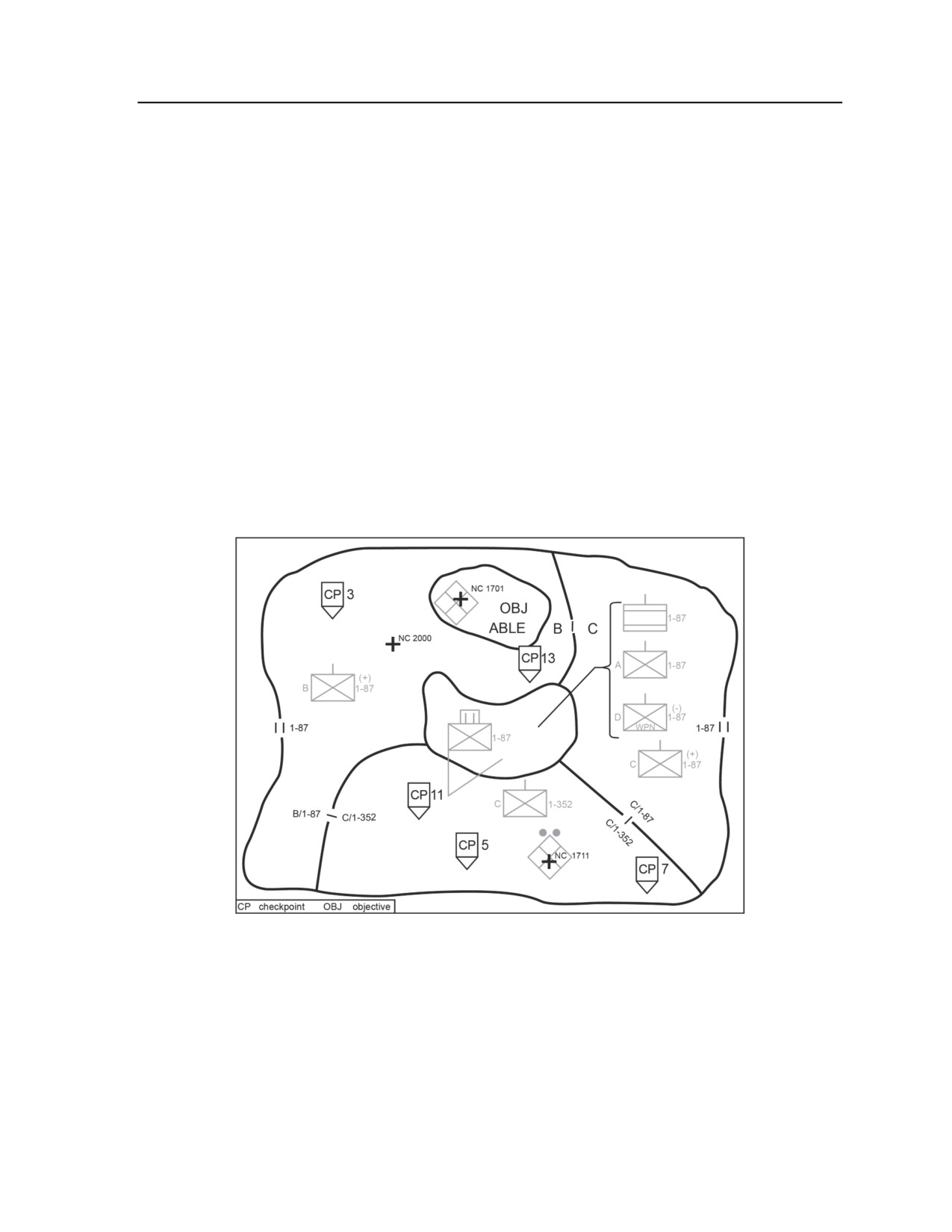
Movement to Contact
2-69. The size of the reconnaissance force is based on the available intelligence about the size of enemy
forces in the AO and the size of the AO in terms of both the geographical size and the size of the civilian
population contained in that AO. The less known about the situation, the larger the reconnaissance force.
The reconnaissance force typically consists of scout, infantry, aviation, and electronic warfare assets. The
fixing force must have enough combat power to isolate the enemy forces once the reconnaissance force
finds them. The finishing force is normally the main body of that echelon. It must have enough combat
power to defeat those enemy forces expected to be located within the AO. The commander can direct
subordinate units to retain their own finishing force, or the commander can retain direct control of the
finishing force. The commander may rotate subordinate elements through the reconnaissance, fixing, and
finishing roles. However, rotating roles may require a change in task organization and additional time for
training and rehearsal.
CONTROL MEASURES FOR A SEARCH AND ATTACK
2-70. The commander establishes control measures that allow for decentralized actions and small-unit
initiative to the greatest extent possible. The minimum control measures for a search and attack are an AO,
target reference points (TRPs), objectives, checkpoints, and contact points. (See figure 2-4.) The use of
TRPs facilitates responsive fire support once the reconnaissance force makes contact with the enemy. The
commander uses objectives and checkpoints to guide the movement of subordinate elements. Coordination
points indicate a specific location for coordinating fires and movement between adjacent units. The
commander uses other control measures, such as phase lines and named areas of interest (NAIs), as
necessary. (See appendix A for a discussion of these common control measures.)
Figure 2-4. Search and attack control measures
PLANNING A SEARCH AND ATTACK
2-71. A commander conducts a search and attack for one or more of the following purposes:
z
Destroy the enemy: render enemy units in the AO combat-ineffective.
z
Deny the area: prevent the enemy from operating unhindered in a given area; for example, in any
area the enemy is using for a base camp or for logistics support.
22 March 2013
FM 3-90-1
2-13
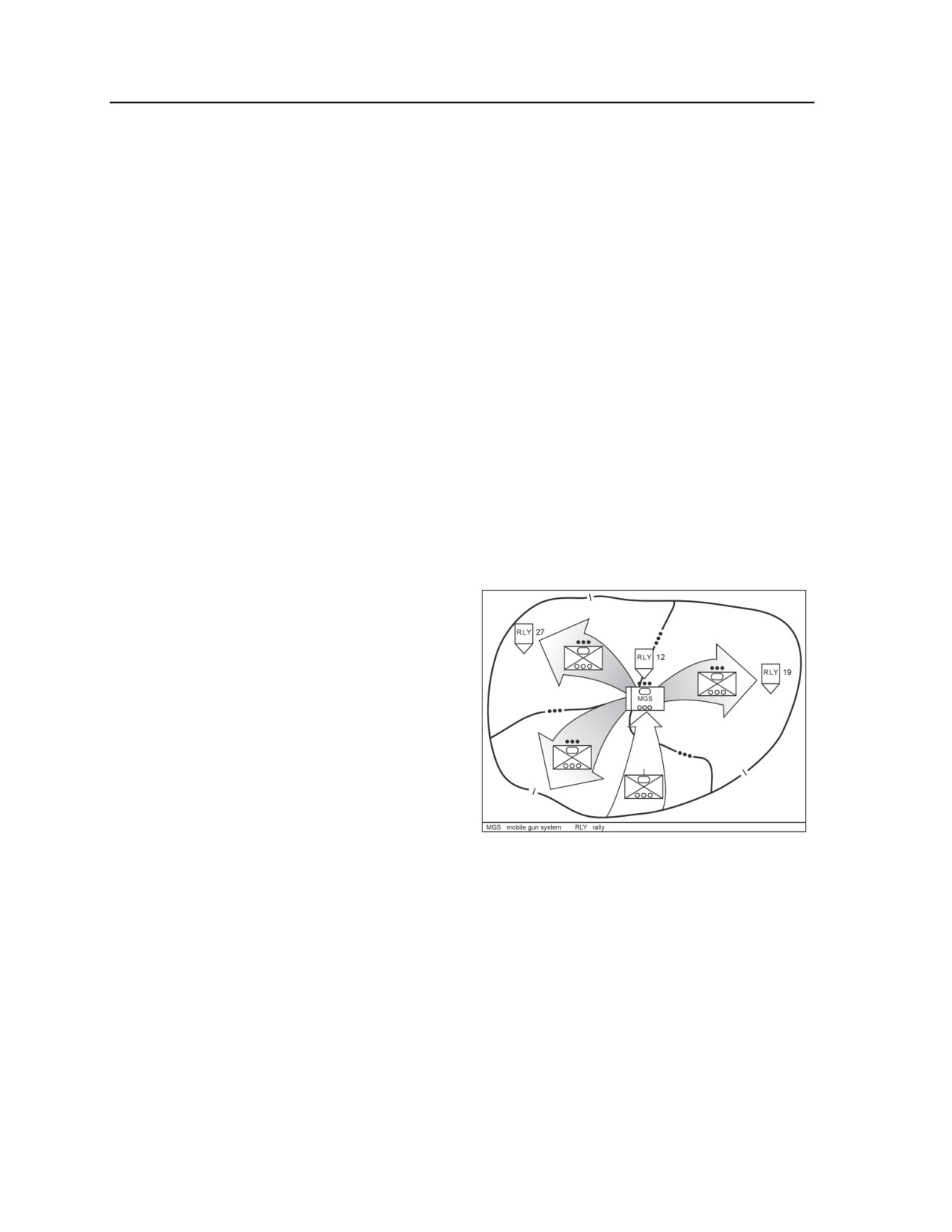
Chapter 2
z
Protect the force: prevent the enemy from massing to disrupt or destroy friendly military or
civilian operations, equipment, property, and key facilities.
z
Collect information: gain information about the enemy and the terrain to confirm the enemy
COA predicted as a result of the IPB process.
2-72. The products of the IPB process are critical to conducting a search and attack. They focus the force's
reconnaissance efforts on likely enemy locations.
2-73. The search and attack plan places the finishing force, as the decisive operation, where it can best
maneuver to destroy enemy forces or essential facilities once located by reconnaissance assets. Typically,
the finishing force occupies a central location in the AO. However, the mission variables of METT-TC may
allow the commander to position the finishing force outside the search and attack area. The commander
weights this decisive operation or main effort by using priority of fires and assigning priorities of support to
available combat multipliers, such as engineer elements and helicopter lift support. The commander
establishes control measures as necessary to consolidate units and concentrate the combat power of the
force before the attack. Once the reconnaissance force locates the enemy, the fixing and finishing forces
can fix and destroy it. The commander also develops a contingency plan in the event that the
reconnaissance force is compromised.
2-74. Fire support plans must provide for flexible and rapidly delivered fires to achieve the commander’s
desired effects throughout the AO. The commander positions fire support assets so they can support
subordinate elements throughout the AO. The commander must establish procedures for rapidly clearing
fires. To clear fires rapidly, command posts and small-unit commanders must track and report the locations
of all subordinate elements. Because of the uncertain enemy situation, the commander is careful to assign
clear fire-support relationships.
EXECUTING A SEARCH AND ATTACK
2-75. Each subordinate element operating in its
own AO is tasked to destroy the enemy within its
capability. Units may enter the AO by infiltrating
as an entire unit and then splitting out (see figure
2-5) or by infiltrating as smaller units via ground,
air, or water. The commander should have in place
previously established control measures and
communications means between any closing
elements to prevent fratricide and friendly fire
incidents. The reconnaissance force conducts a
zone reconnaissance to reconnoiter identified
NAIs.
2-76. Once the reconnaissance force finds the
enemy force, the fixing force develops the situation
Figure 2-5. Company search and attack
and executes one of two options based on the
commander's guidance and the mission variables of METT-TC. The first option is to block identified routes
that the detected enemy can use to escape or rush reinforcement over. The fixing force maintains contact
with the enemy and positions its forces to isolate and fix the enemy before the finishing force attacks. The
second option is to conduct an attack to fix the enemy in its current positions until the finishing force
arrives. The fixing force attacks if attacking meets the commander's intent and if it can generate sufficient
combat power against the detected enemy. Depending on the enemy's mobility and the likelihood of the
reconnaissance force being compromised, the commander may need to position the fixing force before the
reconnaissance force enters the AO.
2-77. Brigade combat teams (and possibly battalions) may establish fire-support bases as part of the
operations of their fixing force to provide fire-support coverage throughout the area of operations during
search and attack operations conducted in complex terrain. These positions should be mutually supporting
and prepared for all-around defense. They are located in positions that facilitate aerial resupply. The
development of these positions depends on the mission variables of METT-TC because their establishment
2-14
FM 3-90-1
22 March 2013
Movement to Contact
requires diverting combat power to ensure protecting fire support and other assets located within such
bases.
2-78. If conditions are not right to use the finishing force or main body to attack the detected enemy, the
reconnaissance or the fixing force can continue to conduct reconnaissance and surveillance activities to
further develop the situation. Whenever this occurs, the force maintaining surveillance must be careful to
avoid detection and possible enemy ambushes.
2-79. The finishing force or main body may move behind the reconnaissance and fixing forces, or it may
locate at a pickup zone and conduct air assault movement into a landing zone near the enemy, once the
enemy is located. The finishing force or main body must be responsive enough to engage the enemy before
the enemy can break contact with the reconnaissance force or the fixing force. The echelon intelligence
officer provides the commander with an estimate of the time it will take the enemy to displace from its
detected locations. The commander provides additional mobility assets, so the finishing force or main body
can respond within that timeframe.
2-80. The commander uses the finishing force or main body to destroy the detected and fixed enemy
during a search and attack by conducting hasty or deliberate attacks, maneuvering to block enemy escape
routes while another unit conducts the attack, or employing indirect fire or close air support to destroy the
enemy. The commander may have the finishing force or main body establish an area ambush and use the
reconnaissance and fixing forces to drive the enemy into the ambushes.
CORDON AND SEARCH
2-81. Cordon and search is a technique of conducting a movement to contact that involves isolating a
target area and searching suspected locations within that target area to capture or destroy possible
enemy forces and contraband. Cordon and search operations take place throughout the range of military
operations. Commanders conducting a cordon and search organize their units into four elements—
command, security, search or assault, and support. The security element must be large enough to establish
both an inner and an outer cordon around the target area of the search. In that regards, cordon and search
operations are similar to encirclement operations. (Encirclement operations are discussed in FM 3-90-2.)
Cordon and search is normally conducted at the maneuver battalion level and below. FM 3-06.20
establishes multi-Service tactics, techniques, and procedures for cordon and search operations.
22 March 2013
FM 3-90-1
2-15
Chapter 3
Attack
When the commander decides to attack, or the opportunity to attack occurs during
combat operations, the execution of that attack must mass the effects of
overwhelming combat power against selected portions of the enemy force with a
tempo and intensity that cannot be matched by the enemy. The resulting combat
should not be a contest between near equals. Attackers must be determined to seek
decision on the ground of their choosing through the deliberate synchronization and
employment of the combined arms team.
GENERAL CONSIDERATIONS FOR AN ATTACK
3-1. Attacks take place along a continuum defined at one end by fragmentary orders that direct the
execution of rapidly executed battle drills by forces immediately available. The other end of the continuum
includes published, detailed orders with multiple branches and sequels, detailed knowledge of all aspects of
enemy dispositions, a force that has been task organized specifically for the operation, and the conduct of
extensive rehearsals. Most attacks fall between the ends of the continuum as opposed to either extreme.
(ADRP 3-90 discusses this continuum between hasty and deliberate operations.)
3-2. This chapter addresses those considerations unique to the attack task. Those general offensive
warfighting function considerations discussed in chapter
1 continue to apply. There are no unique
sustainment and protection functional considerations that apply only to the attack.
ORGANIZATION OF FORCES FOR AN ATTACK
3-3. Once a commander determines the scheme of maneuver, the commander task organizes the force to
give each unit enough combat power to accomplish its mission. The commander normally organizes the
force into a security force, a main body, and a reserve, all supported by some type of sustainment
organization. The commander should complete any changes in task organization in time to allow units to
conduct rehearsals with their attached and supporting elements. The best place and time for an attacking
force to task organize is when it is in an assembly area.
SECURITY FORCES
3-4. Under normal circumstances, a commander resources dedicated security forces during an attack only
if the attack will uncover one or more flanks or the rear of the attacking force as it advances. In this case,
the commander designates a flank or rear security force and assigns it a guard or screen mission, depending
on the mission variables of mission, enemy, terrain and weather, troops and support available, time
available, and civil considerations
(METT-TC). Normally an attacking unit does not need extensive
forward security forces; most attacks are launched from positions in contact with the enemy, which reduces
the usefulness of a separate forward security force. An exception occurs when the attacking unit is
transitioning from the defense to an attack and had previously established a security area as part of the
defense.
MAIN BODY
3-5. The commander organizes the main body into combined arms formations to conduct the decisive
operation and necessary shaping operations. The commander aims the decisive operation toward the
decisive point which can consist of the immediate and decisive destruction of the enemy force, its will to
22 March 2013
FM 3-90-1
3-1
Chapter 3
resist, seizure of a terrain objective, or the defeat of the enemy’s plan. The scheme of maneuver identifies
the focus of the decisive operation. All of the force’s available resources operate in concert to assure the
success of the decisive operation. The subordinate unit or units designated to conduct the decisive operation
can change during the course of the attack. If the commander expects to conduct a breach operation during
the attack, the commander designates an assault, breach, and support force.
3-6. If it is impractical to determine initially when or where the echelon’s decisive operation will be, such
as during a hasty attack, the commander retains flexibility by arranging forces in depth, holding out strong
reserves, and maintaining centralized control of long-range fire support systems. As soon as the tactical
situation clarifies enough to allow the commander to designate the decisive operation, the commander
focuses available resources to support that decisive operation’s achievement of its objective. Enemy
actions, minor changes in the situation, or the lack of success by other elements cannot be allowed to divert
either force or its effects from the decisive operation.
3-7. The commander may need to designate a unit or units to conduct shaping operations to create
windows of opportunity for executing the decisive operation. The commander allocates the unit or units
assigned to conduct shaping operations the minimal combat power necessary to accomplish their missions,
since overwhelming combat power cannot be employed everywhere. Units conducting shaping operations
usually have a wider area of operations (AO) than those conducting a decisive operation. If the commander
has sufficient forces to conduct echelon shaping operations, the commander can assign the tasks of follow
and assume or follow and support to subordinate units. (Appendix B defines these two tactical mission
tasks.)
RESERVE
3-8. The commander uses the reserve to exploit success, defeat enemy counterattacks, or restore
momentum to a stalled attack. Once committed, the reserve’s actions normally become or reinforce the
echelon’s decisive operation, and the commander makes every effort to reconstitute another reserve from
units made available by the revised situation. Often a commander’s most difficult and important decision
concerns the time, place, and circumstances for committing the reserve. The reserve is not a committed
force; it is not used as a follow and support force or a follow and assume force.
3-9. In the attack, the combat power allocated to the reserve depends primarily on the level of uncertainty
about the enemy, especially the strength of any expected enemy counterattacks. The commander only needs
to resource a small reserve to respond to unanticipated enemy reactions when detailed information about
the enemy exists. When the situation is relatively clear and enemy capabilities are limited, the reserve may
consist of a small fraction of the command. When the situation is vague, the reserve may initially contain
the majority of the commander’s combat power.
3-10. In addition, the strength and composition of the reserve vary with the reserve’s contemplated
missions, the forces available, the form of offensive maneuver selected, the terrain, and the risk accepted.
For example, in a hasty attack the reserve can contain up to one-third of the force’s combat power.
Alternatively, in a deliberate attack the commander sizes the reserve to defeat the enemy’s projected
available counterattack forces. The commander should not constitute the reserve by weakening the decisive
operation. A reserve must have mobility equal to or greater than the most dangerous enemy ground threat,
and be able to counter that threat.
3-11. In an attack the commander generally locates the reserve to the rear of the unit, placing the decisive
operation in a location that provides maximum protection from hostile observation and fire. However, the
reserve must be able to move quickly to areas where it is needed in different contingencies. This is most
likely to occur if the enemy has strong counterattack forces. For armored and Stryker equipped reserve
forces, the key factor is cross-country mobility or road networks. For light forces, the key factors are the
existing road network, the availability of trucks and helicopters, or the availability of pickup zones (PZs)
for use by supporting helicopters that enable the reserve to conduct air assault operations. The commander
prioritizes the positioning of the reserve to reinforce the success of the decisive operation first, then to
counter the worst-case enemy counterattack.
3-2
FM 3-90-1
22 March 2013
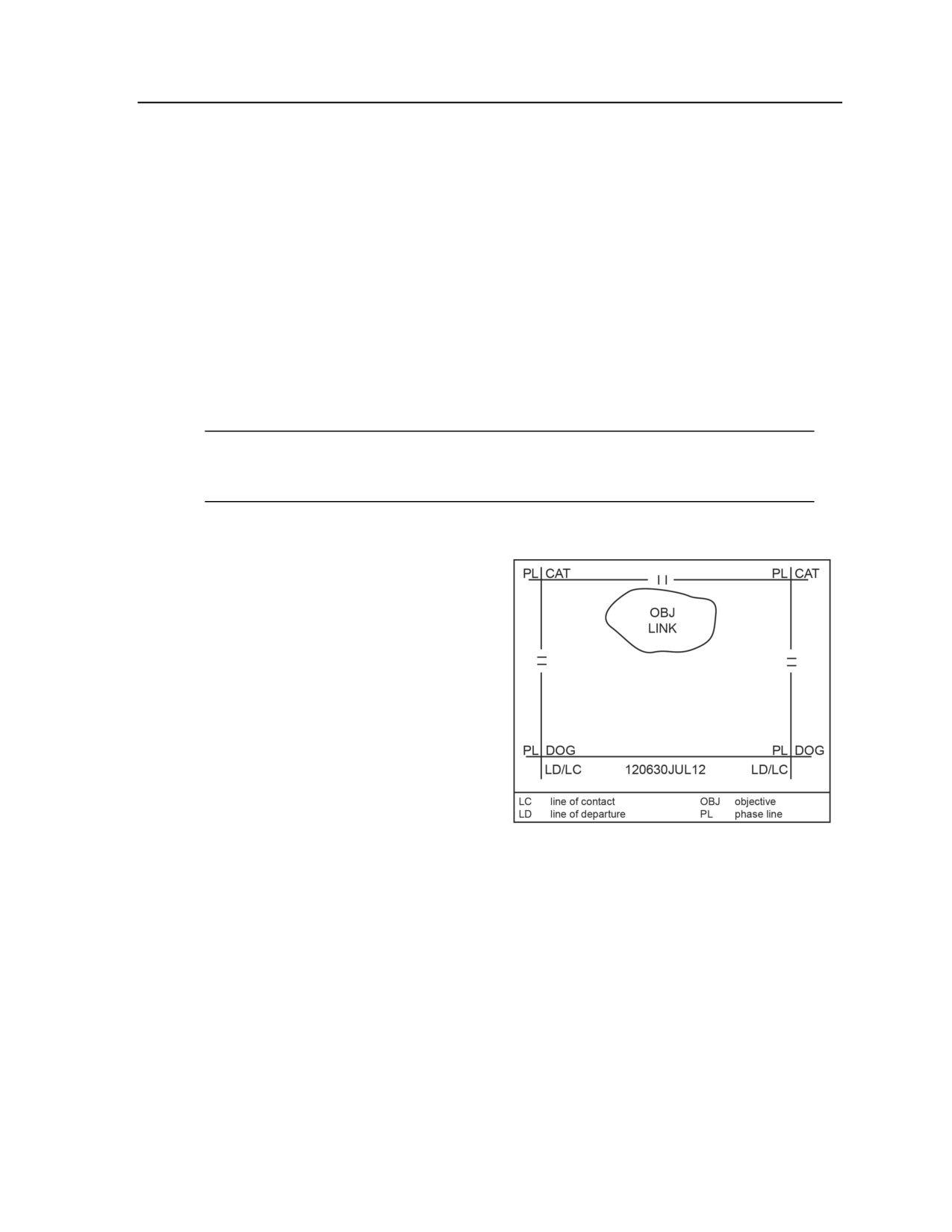
Attack
SUSTAINMENT
3-12. The commander resources sustaining operations to support the attacking force. A maneuver battalion
commander and that individual’s supporting brigade support battalion (BSB) commander organizes the
maneuver battalion’s supporting sustainment assets into combat and field trains. The Stryker brigade
combat team (SBCT) sustainment organization is different in structure from that of armored brigade
combat teams (ABCTs) and infantry brigade combat teams (IBCTs). Higher echelon commanders appoint
someone to control sustaining operations within their echelon support areas. For example, this is often the
BSB commander in an ABCT and the commander of a division’s attached maneuver enhancement brigade
(MEB). In an attack, the commander tries to position sustainment units well forward. From these forward
locations they can sustain the attacking force and provide priority of support to the units conducting the
decisive operation. As the attacking force advances, sustainment units and capabilities displace forward as
required to shorten supply lines, using displacement techniques designed to ensure uninterrupted support to
maneuver units. The size of the force a commander devotes to the echelon support area security mission
depends on the threat in the attacking force’s support area. A significant enemy threat requires the
commander to resource a tactical combat force. (FM 3-90-2 discusses tactics associated with the conduct of
area security operations.)
Note. An Army Maneuver Enhancement Brigade (MEB) should not be confused with a Marine
Expeditionary Brigade. They are two very different organizations with vastly different
capabilities.
CONTROL MEASURES FOR AN ATTACK
3-13. Units conducting offensive actions are
assigned an AO within which to operate. Within
the AO the commander normally designates the
following control measures regardless of whether
the attack takes place in a contiguous or
noncontiguous environment:
z
Areas of operations for subordinate units
of battalion size or larger.
z
A phase line as the line of departure
(LD), which may also be the line of
contact (LC).
z
The time to initiate the operation.
z
The objective.
If necessary, a commander can use either an axis of
advance or a direction of attack to further control
Figure 3-1. Minimum attack control measures
maneuver forces.
(Figure
3-1 depicts minimum
control measures for an attack.)
3-14. A commander can use any other control measures necessary to control the attack. Short of the LD or
LC, the commander may designate assembly areas and attack positions where the unit prepares for
offensive actions or waits for the establishment of the required conditions to initiate the attack. Beyond the
LD or LC the commander may designate checkpoints, phase lines (PLs), probable lines of deployment
(PLDs), assault positions, direct fire control measures, and indirect fire support coordination measures.
Between the PLD and the objective a commander can use a final coordination line (FCL), assault positions,
support by fire and attack by fire positions, and a time of assault to further control the final stage of the
attack. Beyond the objective the commander can impose a limit of advance (LOA), if the commander does
not want the unit to conduct exploitation or a pursuit. (Appendix A discusses these control measures.)
3-15. In an attack during limited-visibility conditions, the commander maintains control over the
movement of all attacking elements. Typically, additional control measures are imposed beyond those used
22 March 2013
FM 3-90-1
3-3
Chapter 3
in a daylight attack. These additional measures may include using a point of departure (PD) and a direction
of attack.
PLANNING AN ATTACK
3-16. In an attack, friendly forces seek to place the enemy in a position where the enemy can easily be
defeated or destroyed. The commander seeks to keep the enemy off-balance while continually reducing the
enemy’s options. In an attack the commander focuses movement and maneuver effects, supported by the
other warfighting functions, on those enemy forces that seek to prevent the unit from accomplishing its
mission and seizing its objective. Planning helps a commander synchronize the effects of combat power
through the military decisionmaking process and troop leading procedures outlined in ADRP 5-0.
3-17. Fire superiority is that degree of dominance in the fires of one force over another that permits
that force to conduct maneuver at a given time and place without prohibitive interference by the
enemy. The commander plans to focus the effects of friendly systems to achieve fire superiority and allow
friendly maneuver forces to breach the enemy’s defensive network. The force must gain and maintain fire
superiority at critical points during the attack. Having fire superiority allows the commander to maneuver
forces without prohibitive losses. The commander gains fire superiority by using a variety of tactics,
techniques, and procedures. This includes using counterfires and precision fires, suppressing enemy
positions, and destroying key facilities and assets. Achieving fire superiority requires the commander to
take advantage of—
z
The range, precision, and lethality of available weapon systems.
z
Temporary information superiority resulting from a blend of friendly information management;
knowledge management; intelligence, reconnaissance, and surveillance operations; and joint
information operations and Army inform and influence and cyber electromagnetic activities.
z
Movement to place the enemy in a position of disadvantage where enemy weapon systems can
be destroyed, one or more at a time, with little risk to friendly weapon systems.
MISSION COMMAND
3-18. The commander states the desired effect of fires on the enemy weapon systems, such as suppression
or destruction, as part of the planning process. The commander assigns subordinate units their missions and
imposes those control measures necessary to synchronize and maintain control over the operation.
3-19. Using the enemy situational and weapons templates previously developed, the commander
determines the probable line of contact and enemy trigger lines. As the commander arrays subordinate
elements to shape the battlefield, friendly weapon systems are matched against the enemy’s to determine
the PLD. Once the commander determines the PLD, the commander establishes how long it takes
subordinates to move from the LD to the PLD and any support by fire positions the attack requires. The
commander establishes when and where the force must maneuver into enemy direct-fire range.
3-20. In addition to accomplishing the mission, every attack plan must contain provisions for exploiting
success or any advantages that may arise during the operation. The commander exploits success by
aggressively executing the plan, promoting subordinate leader initiative, and using units that can rapidly
execute battle drills.
MOVEMENT AND MANEUVER
3-21. In the plan of attack, the commander seeks to surprise the enemy by choosing an unexpected
direction, time, type, or strength for the attack and by exploiting the success of military deception
operations. Surprise delays enemy reactions, overloads and confuses enemy command and control, induces
psychological shock in the enemy, and reduces the coherence of the enemy defense. The commander
achieves tactical surprise by attacking in bad weather and over seemingly impassible terrain, conducting
feints and demonstrations, maintaining a high tempo, destroying enemy forces, and employing sound
operations security (OPSEC). For example, a unit in extremely hilly or mountainous terrain may consider
transporting light infantry forces to the heights and have them maneuver down the terrain. The commander
may plan different attack times for the decisive and shaping operations to mislead the enemy and allow the
3-4
FM 3-90-1
22 March 2013
Attack
shifting of supporting fires to successive attacking echelons. However, simultaneous attacks provide a
means to maximize the effects of mass in the initial assault. They also prevent the enemy from
concentrating defensive fires against successive attacks.
3-22. In planning, the commander and subordinate leaders focus on the routes, formations, and
navigational aids they will use to traverse the ground from the LD or PD to the objective. Some terrain
locations may require the attacking unit to change its combat formation, direction of movement, or
movement technique when it reaches those locations. The unit can post guides at these critical locations to
ensure control over the movement.
3-23. The commander attacks targets throughout the depth of the enemy’s defense to keep the enemy off
balance and limit enemy freedom of action. However, at the point of the decisive operation, the commander
concentrates the effects of overwhelming combat power against the enemy to shatter the cohesion of the
defense. The commander accomplishes this by applying combat power against the enemy at a level of
violence and in a manner that the enemy cannot match. For example, the commander could concentrate an
Army combined arms battalion’s shock action and firepower against one enemy rifle platoon’s hastily
prepared defensive position.
3-24. Another aspect of concentration is the ability to rapidly concentrate force effects such as lethal fires
and electronic warfare capabilities during movement. This is especially critical when crossing linear
obstacles. Each subordinate element tends to move out independently when it completes passage through a
choke point. This independent movement detracts from the ability of the whole force to rapidly concentrate
combat power on the far side of the obstacle.
DAYLIGHT ATTACKS
3-25. Daylight attacks allow friendly forces to effectively use their equipment while facilitating control of
their maneuver. They are the least stressful psychologically and physically on the attacking units. One
major disadvantage is that the enemy force can effectively use its weapon systems to oppose the attack.
Another disadvantage is that it does not take advantage of the Army’s generally superior night vision
capabilities.
LIMITED-VISIBILITY ATTACKS
3-26. The mission variables of METT-TC normally require an attack conducted during limited visibility to
be more deliberate in nature than a daylight attack, except when it occurs as part of the follow-up to a
daylight attack or as part of an exploitation or pursuit operation. The commander planning a night attack
considers how limited visibility complicates controlling units, Soldiers, and fires. Limited visibility also
complicates identifying and engaging targets, navigating and moving without detection, locating, treating,
and evacuating casualties, and locating and bypassing or breaching obstacles.
3-27. Commanders attack in limited-visibility conditions to take advantage of American night-vision and
navigational superiority against most potential enemy ground forces. Intensively trained forces equipped
for this environment have significant advantages over an enemy who is unprepared for limited-visibility
operations. When the friendly force’s limited-visibility operations capabilities are significantly greater than
the enemy’s, limited-visibility attacks may become the normal type of attack. Table 3-1 on page 3-6
outlines the advantages and disadvantages of conducting limited-visibility attacks.
3-28. Highly-trained units equipped with modern night-vision devices conduct limited-visibility attacks
similar to the way they conduct daylight attacks. Units without extensive night-vision devices can use the
darkness to their advantage to conceal their movement, allowing them to get as close to the enemy
positions as possible, if the enemy also does not have extensive night-vision capabilities. Troops that are
well trained for limited-visibility operations and take full advantage of the superiority of their night-vision
equipment gain significant tactical and psychological advantages when attacking the enemy at night or in
other conditions of reduced visibility. The commander should understand the different night-vision
capabilities of all elements participating in the attack, to include the enemy’s night-vision capabilities, and
make any adjustments necessary to the plan based on these differences. The commander should take
advantage of superior night-fighting capabilities whenever possible.
22 March 2013
FM 3-90-1
3-5

Chapter 3
Table 3-1. Advantages and disadvantages of limited-visibility attacks
Advantages of
Disadvantages of
limited-visibility attacks
limited-visibility attacks
•
Defenses are more susceptible to
•
Control of maneuver forces in the absence of technical
infiltration.
means is more difficult.
•
Darkness can conceal the movement
•
The defender can react easier to changing situations.
of large forces.
•
The attacker has difficulty determining the limits of
•
Physical and psychological factors
obstacle systems.
favor the attacker, as shock,
•
Restrictive terrain is more difficult to traverse.
disorientation, and isolation are easier
•
Light, smoke, noise, and fires can deceive the attacker.
to achieve.
•
The attacker loses momentum because attacks are
•
Air assets can operate more safely
conducted at a reduced speed to maintain the coherence
because air defenders with only
of the unit.
optical sights have greater difficulty
•
Land navigation, without global positioning systems, is
acquiring targets at night.
more difficult at night; units may become separated,
•
The element of surprise may increase
cohesion can be lost, and support elements can move to
because defenders are more
the wrong positions.
susceptible to military deception
•
The enemy can reposition or emplace obstacles during
techniques, such as dummy lights,
noise, smoke, and fires.
darkness without being detected by friendly
reconnaissance, surveillance, and intelligence assets.
•
The defender cannot employ reserves
as quickly at night as the defender
•
Attacking units are easier to ambush at night.
can during daylight conditions.
•
Adjusting indirect fire is difficult, even with night-vision
devices or illumination.
•
U.S. forces training in a limited
visibility environment are superior to
•
Units require significantly larger quantities of signal
most potential opponents.
ammunition such as smoke, tracers, flares, and
illumination rounds.
•
Units have more difficulty locating and evacuating
casualties.
•
The risk of fratricide may increase.
3-29. The organization of forces for a limited-visibility or night attack is the same as for any other attack.
However, changing an existing task organization under limited-visibility conditions requires much more
time and effort than it does during daylight. Small tactical organizations, such as combat crews and infantry
squads, should be manned and equipped as close as possible to full strength, even if it means reducing the
total number of these small tactical groups.
3-30. The presence or lack of illumination characterizes the conduct of limited-visibility attacks.
Non-illuminated attacks offer the best chance of gaining surprise. Illumination, however, is normally
planned for every limited-visibility attack, so that it can be readily available if required. The commander
can choose to conduct a non-illuminated attack until subordinate forces make contact with the enemy. At
that point, the objective can be illuminated. The enemy can also choose to employ illumination to increase
the effectiveness of defensive efforts. Units generally conduct non-illuminated attacks, although they
always plan for illumination. All leaders within the attacking unit must understand the time, conditions, and
authority required to employ illumination.
3-31. Illuminated, supported attacks are almost like daylight attacks. They are most effective when speed
is essential, time for reconnaissance is limited, or the enemy is weak and disorganized. If the commander
employs illumination, it should continue until the force secures the objective. After the attacking force
reaches its assault position, the commander should place illumination beyond the objective to silhouette
objects on the objective. This helps the assaulting force see and fire at withdrawing or counterattacking
enemy forces. The commander may also employ illumination in several locations to confuse the enemy
about the exact place of attack.
3-32. The commander plans for limited-visibility operations in the same manner that the commander does
for daylight operations, with emphasis on—
3-6
FM 3-90-1
22 March 2013
Attack
z
Keeping the plan simple.
z
Taking additional time for reconnaissance.
z
Taking advantage of easily identifiable terrain features, such as roads and railroad tracks, when
establishing control measures.
z
Using intermediate objectives as necessary to control and maintain the correct movement
direction during the attack.
z
Concealing preparations.
z
Scheduling initial rehearsals during daylight, with the final rehearsal at night.
The commander establishes control measures to facilitate visualizing, describing, and directing subordinate
and supporting forces during limited visibility operations. Commanders should also take advantage of the
technical capabilities of the equipment available, such as those projected for the Land Warrior system.
3-33. To simplify control problems, the commander may weight the support element over the assault force
to reduce the number of friendly Soldiers moving on the objective in the darkness. The commander may
also develop a plan that does not require the unit to change its movement azimuth after it crosses the LD or
PD to simplify execution.
3-34. The commander must assume that the enemy possesses, in at least limited quantities, the same
limited-visibility observation capabilities as friendly forces—absent positive information to the contrary—
when conducting a limited-visibility attack. Using terrain to mask movement and deployment remains
critical because limited visibility may create a false sense of protection from enemy observation. During
movement, leaders reduce the distances between vehicles or individual Soldiers as necessary to allow one
system or Soldier to observe the other. This decreases the time necessary to react to enemy contact. The
attacking force strives to maintain its momentum; therefore, it does not preserve the alignment of units
within the selected combat formation at the expense of additional time. However, the attacking force must
adhere more closely to the plan of attack than under daylight conditions.
INTELLIGENCE
3-35. To employ the proper capabilities and tactics, the commander must have detailed knowledge of the
enemy’s organization, equipment, and tactics. The commander must understand the enemy’s strengths and
weaknesses. Ideally, this knowledge is available during the military decisionmaking process. The
commander and staff develop enemy situational and weapons templates based on analysis of all available
combat information and intelligence data. These templates must address both conventional and
unconventional threats. These templates help to determine the feasibility of available courses of action
(COAs) designed to achieve a position of advantage.
3-36. Before the attack, a unit conducts reconnaissance and surveillance activities to ascertain those
information requirements addressed in paragraphs 1-157 to 1-163. Other information requirements can
include—
z
The location and depth of enemy reserves.
z
The location and extent of contaminated areas.
z
The location and extent of obstacles, possible breach sites, and enemy engagement areas.
z
The location of areas where attacking units could become disoriented, such as rough or
restrictive terrain.
z
The most favorable routes of approach to the attack objective.
z
Areas that the attacker can use for flanking fire and maneuver, such as support by fire and attack
by fire positions.
z
Suitability of planned friendly assault, support, artillery, and sustainment positions.
z
Enemy deception operations.
Commanders and leaders at all echelons personally participate in this process.
3-37. The commander takes every opportunity to gain and refine combat information regarding the enemy.
Available reconnaissance and surveillance assets are employed to gather combat information and process it
22 March 2013
FM 3-90-1
3-7
Chapter 3
into intelligence. Information gathered during the planning phase of the plan, prepare, and execute cycle is
especially useful in determining the viability of each COA developed. Generally, if a commander does not
have good intelligence and, therefore, does not know where the overwhelming majority of the enemy’s
units and systems are located, the commander cannot conduct a deliberate attack. The attacking unit must
conduct a movement to contact, conduct a hasty attack, or collect more combat information.
3-38. The two fundamental employment techniques for reconnaissance in the attack are
reconnaissance-pull and reconnaissance-push. In reconnaissance-pull, the reconnaissance objective is to
find weaknesses in enemy dispositions that can be exploited by the main force. Reconnaissance is launched
over a broad area that allows the reconnaissance elements to identify enemy weaknesses to exploit and
enemy strengths to avoid. Once these are identified, the commander exploits the situation by choosing a
COA that allows the decisive operation to attack enemy weaknesses and penetrate gaps in the enemy’s
defense. The commander can then commit forces to widen the gap and envelop the enemy. The
reconnaissance elements continue to move, seeking paths of least resistance and pulling the main body
deep into the enemy’s rear.
3-39. In reconnaissance-push, the reconnaissance objective is to identify the obstacles and enemy forces
the attack forces must overcome to assault the objective in a previously chosen location in accordance with
a COA selected before the reconnaissance. Once friendly reconnaissance elements gain contact with the
enemy, they develop the situation within their capabilities. If the objective is an enemy force, the
reconnaissance element orients on it to maintain contact and determine as much as possible about its
dispositions.
3-40. The commander ensures that reconnaissance and surveillance of the enemy’s defensive positions and
any terrain critical to the scheme of maneuver continue throughout the attack. If the enemy units attempt to
modify their defenses, those actions will be detected. In turn, this allows the commander to adjust the
scheme of maneuver as the enemy situation becomes clearer. The commander can use human and
technological means, acting separately or in combination, to provide the required degree of reconnaissance
and surveillance.
3-41. A commander’s capability to gain information about the enemy and the AO’s environment varies by
echelon. Army brigade combat teams (BCTs) are the lowest tactical echelons with organic analysis
capabilities. However, continuing improvements in intelligence dissemination capabilities and greater
tactical internet bandwidth availability means that intelligence products developed by higher echelons will
be more available at low tactical levels—battalion and company level—in the future than they are today.
3-42. All intelligence disciplines can be found in the theater army’s intelligence brigade. The Army’s
battlefield surveillance brigade (BFSB) contains a military intelligence collection capability that includes
unmanned aircraft system (UAS) sensors, signals intelligence, human intelligence, and counterintelligence.
The BFSB’s reconnaissance and surveillance squadron provides ground reconnaissance and surveillance
capabilities. BCTs also contain organic UASs, signals intelligence, human intelligence, counterintelligence,
and ground reconnaissance capabilities although the organic reconnaissance and surveillance assets of a
BCT are less capable than those found in the BFSB. Maneuver battalions and companies have their own
reconnaissance capabilities. Non-maneuver battalions and companies can conduct reconnaissance patrols as
necessary to enhance their local security or to gain or improve their understanding of the mission variables
of METT-TC around their locations. (FM 3-90-2 contains the basic tactics associated with the conduct of
reconnaissance operations.)
FIRES
3-43. The planning process synchronizes the unit’s maneuver with the provision of fire support. It must
identify critical times and places where the commander needs the maximum effects from fire-support
assets. That planning must take into account existing limitations on the employment of fires, such as rules
of engagement and positive identification requirements, presence of special operations forces (SOF) within
the AO, desired conditions of subsequent phases, and requirements for collateral damage assessments. The
commander combines maneuver with fires to mass effects, achieve surprise, destroy enemy forces, and
obtain decisive results. The commander’s s guidance gives specified attack criteria for supporting fires
assets, thus focusing the planning and execution efforts on those critical times and events. The specified
3-8
FM 3-90-1
22 March 2013