FM 3-90-1 Offense and Defense (Volume 1, March 2013) - page 5
Chapter 7
complement surveillance with combat actions that test enemy intentions. Fighting for information can have
two benefits—it can force the enemy to reveal intentions and disrupt enemy preparations.
7-5. In the defense, reconnaissance and surveillance operations overlap the unit’s planning and preparing
phases. Leaders performing reconnaissance and surveillance tasks must understand that they often deploy
before the commander fully develops the plan. These leaders must be responsive to changes in orientation
and mission. The commander ensures that the staff fully plans, prepares, and assesses the execution of the
intelligence portion of the overall plan.
SECURITY
7-6. The commander balances the need to create a strong security force to shape the battle with the
resulting diversion of combat power from the main body’s decisive operation. The commander usually
allocates security forces to provide early warning and protect those forces, systems, and locations necessary
to conduct the decisive operation from unexpected enemy contact. On a battlefield where forces are
contiguous with one another, the location of security forces is usually in front of the main defensive
positions. On a noncontiguous battlefield they are located on avenues of approach between the protected
force and known or suspected enemy locations.
7-7. Maneuver battalion and brigade combat team (BCT) security forces normally conduct screen or guard
missions. At division level and above, the commander may use a covering force. A division commander
may elect to have the security force conduct a guard mission, if a corps covering force exists. Because an
area security mission usually ties in closely with flank units, flank security forces are needed if there are
gaps on the unit’s flanks, which occurs during noncontiguous operations, or if gaps develop during the
operation. A flank screen or guard is critical if an enemy avenue of approach into the defended area from
the flanks could be uncovered during the defense. A commander does not normally assign a force the
mission of conducting rear guard or rear cover during contiguous operations, since it is unlikely that the
force’s support area will become uncovered during the defense. The commander resources echelon support
area security forces, to include a tactical combat force (TCF) or accepts the risk to the sustainment effort of
not performing this function.
MAIN BATTLE AREA
7-8. The commander builds the decisive operation around identified decisive points, such as key terrain or
high-payoff targets. The commander’s decisive operation in an area defense focuses on retaining terrain by
using fires from mutually supporting, prepared positions supplemented by one or more counterattacks and
the repositioning of forces from one location to another. The commander’s decisive operation normally
involves close combat since an area defense emphasizes terrain retention.
7-9. The commander normally positions the echelon’s main body—the bulk of combat power—within the
MBA where the commander wants to conduct the decisive operation. The commander organizes the main
body to halt, defeat, and ultimately destroy attacking enemy forces. The majority of the main body deploys
into prepared defensive positions within the MBA. However, mobile elements of the force are ready to
deploy where and when needed.
RESERVE
7-10. The commander’s defensive plan should be able to succeed without using the reserve. However, the
most likely mission of the reserve is to conduct a counterattack in accordance with previously prepared
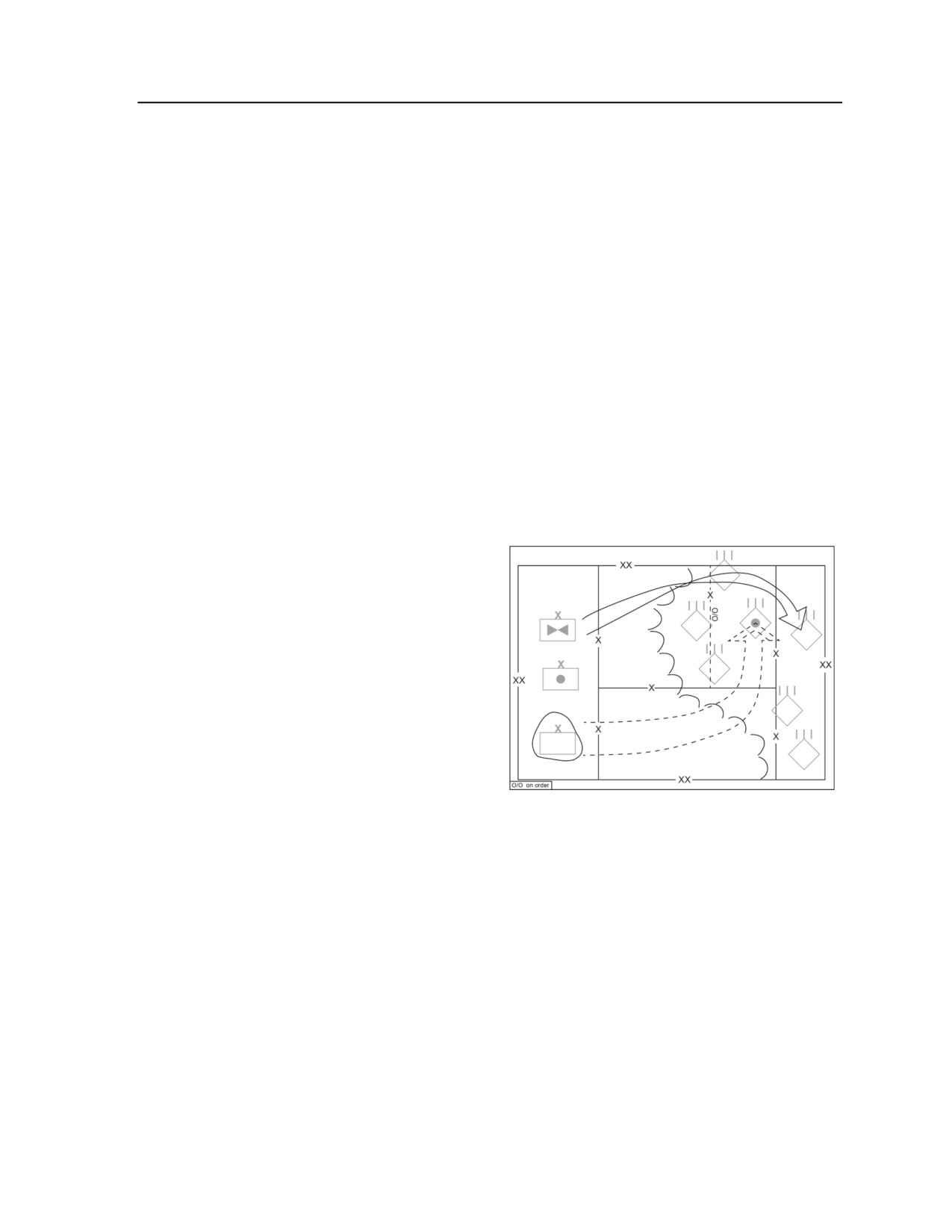
plans. Lower-echelon commanders use their reserves primarily to conduct local counterattacks to restore
the integrity of their defense or to exploit opportunities. A senior commander uses the reserve to seize the
initiative from the enemy when the opportunity presents itself. For example, a corps commander may target
the effects of the corps reserve against enemy fire support and follow-on forces to produce that effect.
7-11. The reserve is not a committed force. The commander can assign it a wide variety of tasks on its
commitment, and it must be prepared to perform other missions. In certain situations, it may become
necessary to commit the reserve to restore the integrity of the defense by blocking an enemy penetration or
reinforcing fires into an engagement area (EA). These secondary tasks include—
7-2
FM 3-90-1
22 March 2013
The Area Defense
z
Reinforcing the defense of committed forces.
z
Blocking or containing enemy forces that penetrate friendly defensive positions.
z
Relieving depleted units and providing for continuous operations.
z
Reacting to threats directed against the friendly force’s sustainment effort. (This includes acting
as the echelon TCF when a separate TCF cannot be resourced.)
z
Extending the flanks of a defending unit to prevent its envelopment.
z
Covering a retrograde movement.
7-12. Defending commanders usually have difficulties establishing and resourcing reserve forces because
they are normally facing an enemy with superior combat power. Nevertheless, commanders at each echelon
down to the battalion retain reserves as a means of ensuring mission accomplishment and for exploiting
opportunities through offensive action. (Maneuver company commanders may retain a reserve based on the
mission variables.) Commanders do not place artillery and other fire support systems in reserve. (Such
systems committed to echelon support operations are not in reserve.) Each echelon’s reserve must have the
mobility and striking power required to quickly isolate and defeat breakthroughs and flanking attempts. It
must be able to seize and exploit fleeting opportunities in a powerful manner to throw the enemy’s overall
offensive off balance. The commander must resource the reserve, so it can repeatedly attack, regroup,
move, and attack again.
7-13. The size of the reserve is relative to the commander’s uncertainty about the enemy’s capabilities and
intentions. The more uncertainty that exists, the larger the reserve. The reverse is also true. If the
commander knows the enemy’s size, dispositions, capabilities, and intentions, only a comparatively small
reserve is required.
7-14. In some situations, the commander may not be able to resource a separate reserve. Therefore, the
commander may constitute all or a portion of the reserve from the security force, after it conducts a
rearward passage of lines through MBA units. If the security force is the reserve for an area defense, the
commander must withdraw it, so it has sufficient time to occupy its reserve position, perform the necessary
degree of reconstitution, and prepare plans for its reserve role. However, this is not the preferred option.
Before battle handover, the senior commander must state the acceptable risk to the security force or the
disengagement criteria in quantifiable terms, such as friendly strength levels, time, or event. In this case,
after completing the rearward passage, the security force moves to an assembly area to prepare for its
subsequent operations. This area should be free from enemy interference and clear of MBA units, main
supply routes (MSRs), and the movements of other portions of the reserve.
7-15. Once committed, the reserve’s operations usually become the echelon’s decisive operation.
However, the commander can commit the reserve to shaping operations to allow the ongoing decisive
operation to achieve success. It no longer constitutes the force reserve on its commitment in either case, so
the commander should designate another uncommitted force as the reserve. If the commander does not
have that flexibility, the commander holds the reserve for commitment at a decisive moment and accepts
the associated risk.
SUSTAINMENT
7-16. The sustainment mission in an area defense requires a careful balance between establishing forward
supply stocks of petroleum, oil, and lubricants (POL); barrier material; and ammunition in adequate
amounts to support defending units and not having so many supplies located in forward locations that they
cannot be rapidly moved in conformance with enemy advances. Any suitable POL, barrier material,
construction equipment, and laborers that can be lawfully obtained from the civil infrastructure reduce the
defending unit’s transportation requirements. Proper forecasting of supply and support requirements is
important to the success of the area defense. (Commanders and staffs carefully determine the quantities of
supplies to be obtained locally to avoid introducing unnecessary instability in the local economy.)
Likewise, maintenance and medical support, with their associated repair parts and medical supplies, must
also be forward deployed. Those systems and Soldiers that cannot be quickly returned to the battle should
be rapidly evacuated from forward defensive positions to avoid unduly burdening maintenance and medical
elements. (See paragraphs 6-83 through 6-91 for additional defensive sustainment considerations.)
22 March 2013
FM 3-90-1
7-3
Chapter 7
CONTROL MEASURES FOR AN AREA DEFENSE
7-17. The commander organizes an area defense by designating the MBA and assigning AOs, battle
positions (BPs), or forward operating bases (FOBs) to subordinate units located within the MBA. The
commander creates a security area in front of the MBA or around a base of operations. When possible, the
boundaries of the subordinate elements of the security force coincide with those of the major defending
units in the MBA. The security area should be deep enough to make the enemy displace as much of the
enemy’s supporting forces as possible, such as cannon artillery, sensors, and air defense artillery gun
systems, before carrying the attack into the MBA. The commander also designates an echelon support area.
(See FM 3-90-2 for a discussion of security operations.)
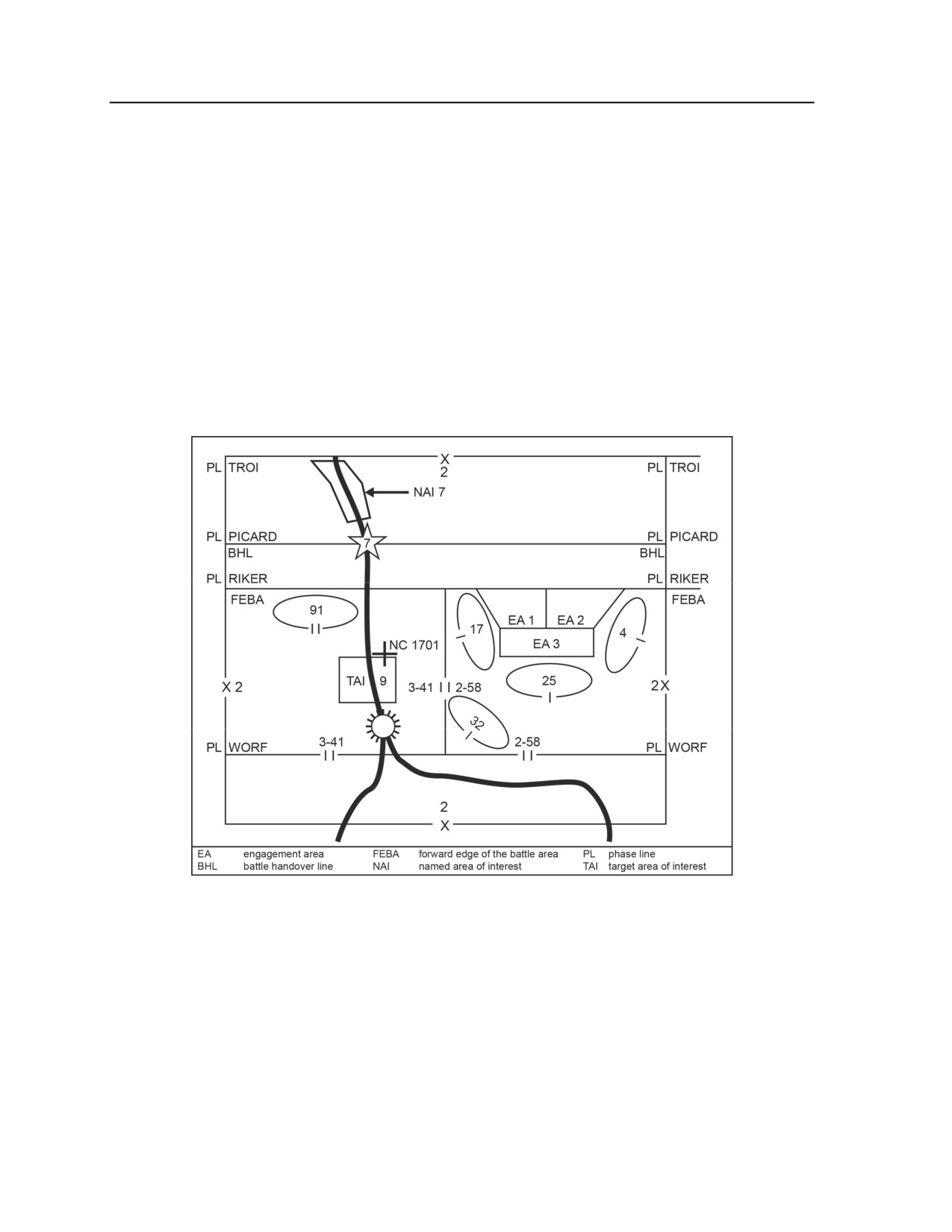
7-18. Area defense maneuver graphic control measures may include EAs, the forward edge of the battle
area (FEBA), the battle handover line (BHL), strong points, target reference points (TRPs), named areas of
interest
(NAIs), targeted areas of interest (TAIs), decision points, and various other fire control and
countermobility control measures. Tactical mission tasks assigned as part of the mission can also be control
measures. (Figure 7-1 depicts the most common control measures. Appendix A defines these defensive
control measures.)
Figure 7-1. Typical control measures for an area defense
7-19. If the commander assigns a battle position (BP) and an AO to a subordinate, the commander gives
the subordinate commander specific guidance on the initial positioning of forces. The commander ensures
the synchronization of subordinate units’ defensive plans, and that control measures, such as contact points
and phase lines, are sufficient to ensure the continued control of subordinates. The commander is
responsible for fire and movement planning between the positions of subordinate units. If subordinate unit
commanders prepare their defensive plans in isolation, one or more assailable flanks between subordinate
units could easily develop. (The tactics associated with conducting a passage of lines are addressed in FM
3-90-2.)
7-4
FM 3-90-1
22 March 2013
The Area Defense
PLANNING AN AREA DEFENSE
7-20. The key to a successful area defense is the integration and synchronization of all available assets.
The commander achieves this when the combined arms team is at the decisive time and place. (The general
defensive planning considerations addressed in chapter 6 apply to the area defense.) The commander
assigns missions, allocates forces, and apportions functional and multifunctional support and sustainment
resources within the construct of decisive, shaping, and sustaining operations. The commander decides
where to concentrate the effort and where to take risks. The commander can rapidly redirect attack aviation
and artillery systems initially allocated to shaping operations to support decisive operations at the
appropriate time. Commanders organize forces differently for contiguous and noncontiguous areas of
operations. A contiguous area of operations is where all subordinate forces’ areas of operations share
one or more common boundaries. A noncontiguous area of operations is where one or more of the
commander’s subordinate force’s areas of
operation do not share a common boundary.
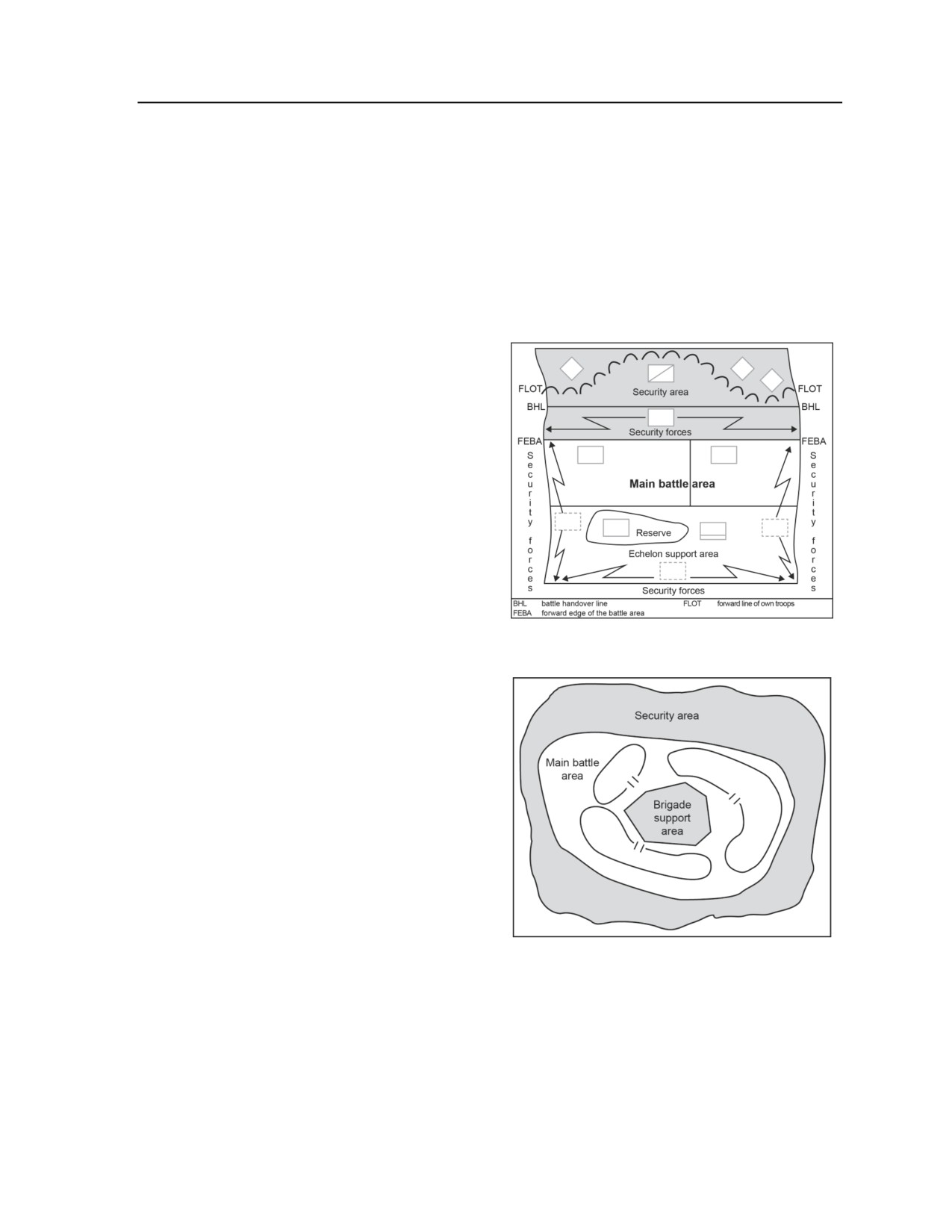
(See figures 7-2 and 7-3 for graphical depictions of
the organization of forces for an area defense in a
contiguous AO and in a noncontiguous AO.)
7-21. The commander describes the concept of
operations in sufficient detail so that the staff and
subordinate commanders understand precisely how
the commander intends to fight the battle. The
commander ensures the coordination of maneuver
and supporting actions among subordinates.
(ADRP 5-0 discusses the military decisionmaking
process.)
7-22. The commander’s keys to a successful area
defense are—
z
Capability to concentrate effects.
Figure 7-2. Organization of forces for an area
z
Depth of the defensive area.
defense-contiguous area of operations
z
Security.
z
Ability to take full advantage of the
terrain, such as intervisibility lines.
z
Flexibility of defensive actions.
z
Timely resumption of offensive actions.
7-23. The crux of the commander’s defensive
challenge is to gain time to ensure a synchronized,
effective defense. The commander organizes the
defensive effort based on an analysis of the mission
variables and the higher commander’s concept.
When conducting an area defense while
transitioning to a focus on the conduct of stability
tasks, the commander may also transition to the
joint operational variables—political, military,
economic, social, information, and infrastructure to
Figure 7-3. Organization of forces for an area
which the Army adds physical environment and
defense-noncontiguous area of operations
time
(PMESII-PT).
(ADRP 3-0 discusses
PMESII-PT in more detail.) The commander decides where to concentrate efforts and how to economize
forces. The commander forces the enemy units to enter established EAs. To succeed in its area defense
mission, the unit must also counteract the enemy’s initiative. The commander should take advantage of
available offensive opportunities that do not risk the integrity of the defense, such as a spoiling attack or
counterattack.
22 March 2013
FM 3-90-1
7-5
Chapter 7
7-24. In planning an area defense, the commander may choose between two forms of defensive maneuver.
The defending unit can organize either a defense in depth or a forward defense. A higher commander may
dictate the form of maneuver or impose restrictions that eliminate a subordinate commander’s form of
maneuver. These restrictions can include time, security concerns, and retention of specific terrain. These
two deployment choices are not totally exclusionary. Part of a defending commander’s unit can conduct a
forward defense, while the other part conducts a defense in depth.
7-25. In determining the form of maneuver, the commander decides where the defensible terrain is located
within the assigned AO based on its terrain characteristics and that individual’s estimate of the enemy’s
chosen course of action (COA). Those terrain characteristics include terrain relief patterns, avenues of
approach into and within the AO, the location of any key or decisive terrain, and existing obstacles and
choke points, to include rivers and fording sites. The other mission variables of mission, enemy, terrain and
weather, troops and support available, time available, and civil considerations (METT-TC) also influence
the commander’s decision.
POSITION SELECTION
7-26. A statement anecdotally attributed to Frederick the Great and Robert E. Lee, among others, is that
the commander who attempts to defend everything, defends nothing. Therefore, the commander carefully
designs the defense plan to ensure the defending force can halt the enemy attack and develop an
opportunity to seize the initiative and undertake offensive actions. The cohesion of the defending force has
a significant impact on the overall effectiveness of the defense. The commander must be prepared to adjust
the defensive dispositions to meet changes in the enemy’s dispositions to maintain that cohesion, if the
defense is to remain viable.
7-27. The area defense concept requires that units in defensive positions accomplish their mission
independently or in combination by defeating the enemy by fire, absorbing the strength of the attack within
the position, or destroying the enemy with a local counterattack. The commander combines the advantages
of fighting from prepared positions, obstacles, planned fires, and local counterattacks to isolate and
overwhelm selected enemy formations. The commander must be prepared to rapidly shift the nature and
location of the main effort throughout the AO. The commander may have to reposition defending units
within their defensive positions or reposition between terrain features to mass overwhelming fires against
the attacking enemy. The commander’s defensive plan designates axes of advance and routes for the
commitment or movement of reserves, or the forward or rearward passage of one unit through another. It
should identify air axes for aerial maneuver by attack helicopters, air assault units, or fixed-wing aircraft.
The operations process identifies decision points associated with the initiation of these counterattacks,
repositioning of forces, and other actions. This capability to dynamically reposition is dependent on the
defending force having superior tactical mobility. Without tactical mobility, defending forces stay in their
prepared positions and accept the possibility of becoming decisively engaged.
7-28. The commander assigning the defensive mission defines the area to defend. A commander defending
on a broad front is forced to accept gaps and conduct noncontiguous operations. The forward line of own
troops (FLOT) will not be contiguous. Defending shallow areas of operations reduces flexibility and
requires the commander to fight well forward. Narrow frontages and deep areas of operations increase the
elasticity of an area defense by increasing the commander’s maneuver options.
7-29. The ideal area defense is one where effective mutual support exists throughout the width and depth
of the defender’s tactical positions. The commander organizes and occupies these positions based on their
natural defensive strength; their retention ensures the integrity of the defense whether the defending
commander employs a defense in an AO, defends by BP, or employs a combination of both. The defending
unit maintains tactical integrity within each defensive area. A unit conducting an area defense normally
addresses the security requirements of each flank by assigning responsibility to a subordinate element or
organizing a security force to specifically accomplish that mission.
DEFENSE IN DEPTH
7-30. A defense in depth is normally the commander’s preferred option. Forces defending in depth absorb
the momentum of the enemy’s attack by forcing the enemy to attack repeatedly through mutually
7-6
FM 3-90-1
22 March 2013
The Area Defense
supporting positions in depth. Construction of these positions requires significant engineer and other
resources dedicated to survivability and countermobility. Depth gives the commander’s fire support assets
time to deliver devastating effects and affords the defending commander multiple opportunities to
concentrate the effects of overwhelming combat power against the attacking enemy. Depth also provides
more reaction time for the defending force to appropriately respond to the attack. The commander
continues to gather additional information about the attacking enemy’s intentions and capabilities between
the time combat starts and the time the enemy commits to a COA. This reduces the risk of the enemy force
quickly penetrating the main line of defense along an unexpected direction.
7-31. The commander also employs a defense in depth when the enemy has the capability to employ large
quantities of precision-guided munitions or weapons of mass destruction. A defense in depth results in
friendly units and facilities being dispersed throughout the defensive AO. The commander takes area
damage-control measures to reduce the effects of weapons of mass destruction on the friendly force and
denies the enemy lucrative targets. The degree of dispersal adopted by defending forces is both a function
of the enemy’s capabilities and the friendly forces’ capability to rapidly concentrate overwhelming combat
power at decisive points.
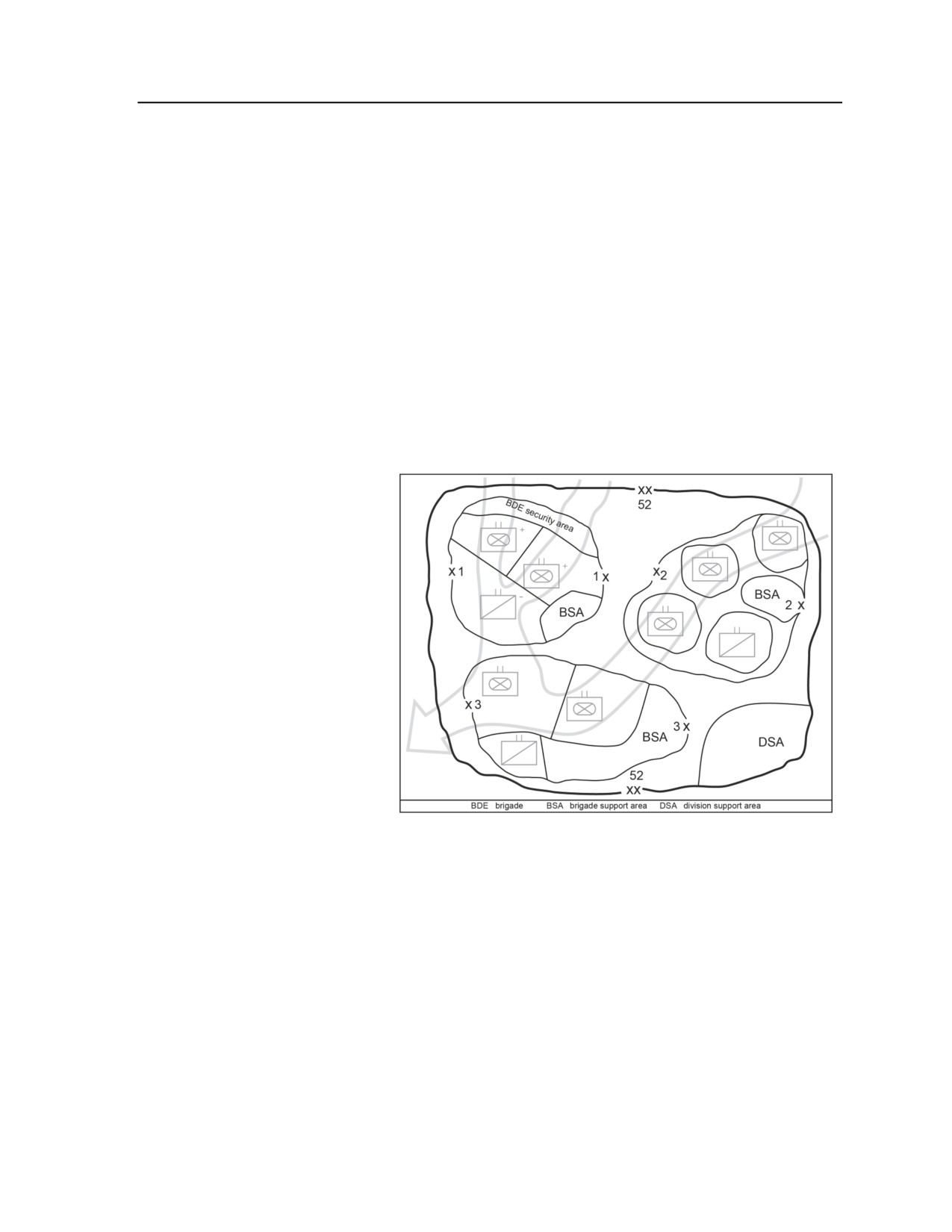
7-32. The commander positions defending units in successive layers of battle positions along likely enemy
avenues of approach when conducting a defense in depth. (See figure 7-4.) The commander usually decides
to conduct a defense in depth when—
z
The mission is not
restrictive and allows
the commander to
fight throughout the
depth
of
the
battlefield.
z
The terrain does not
favor a defense well
forward, and there is
better
defensible
terrain deeper within
the AO.
z
The AO is deep
compared to its width,
and there is significant
depth available.
z
The
cover
and
concealment on or
near the FEBA is
limited.
Figure 7-4. Division conducting a defense in depth with
z
The enemy has several
subordinate brigades deployed in noncontiguous areas of
times the combat
operations with enemy avenues of approach depicted
power of the defender.
7-33. Large units, such as a division or corps, employing a defense in depth can conduct an area defense
on a wider frontage than they can if they adopt a forward defense because a forward defense has no time or
space to reposition forces. A defense in depth allows the commander to use security and forces in the
forward part of the MBA to identify the enemy’s decisive operation and control the depth of the enemy’s
penetration into the MBA. By their defensive actions, these forces provide the commander with time to
react to enemy actions and allow the defending commander to take offensive steps that eliminate enemy
options, such as conducting a counterattack into the flank of an enemy force.
FORWARD DEFENSE
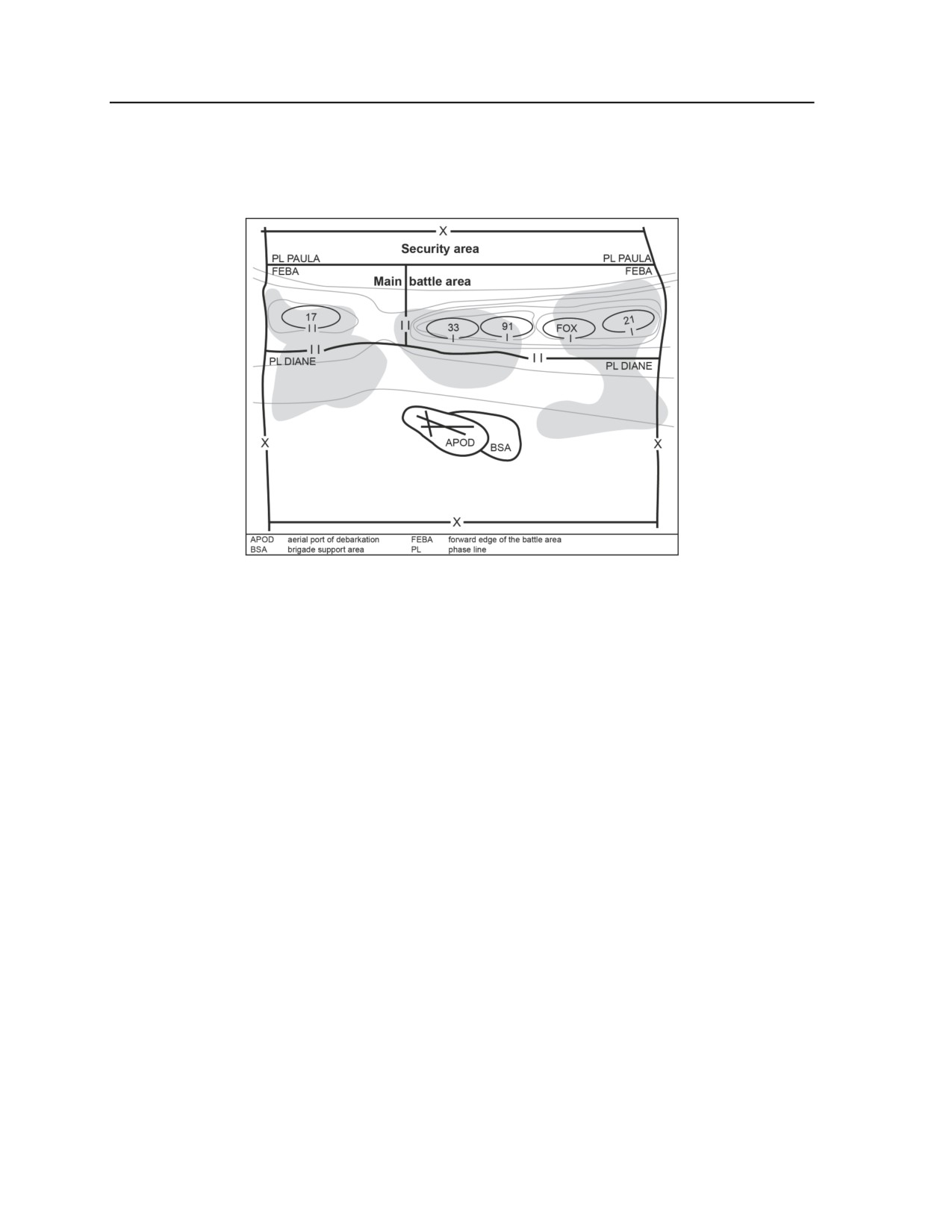
7-34. The commander conducts the decisive operation from forward defensive positions near the FEBA in
a forward defense. (See figure 7-5 on page 7-8.) The commander concentrates a significant portion of
22 March 2013
FM 3-90-1
7-7
Chapter 7
available combat power into EAs along the FEBA. The intent is to prevent significant enemy penetration
into the defensive area. The commander conducting a forward defense fights to retain these positions along
the FEBA and violently counterattacks any enemy penetration. However, if the enemy penetrates the main
defensive positions, the defender’s lack of depth may allow the enemy to rapidly exploit success.
Figure 7-5. Brigade conducting a forward defense in a contiguous area of operations
7-35. In general, the commander uses a forward defense when a higher commander directs the commander
to retain forward terrain for political, military, economic, and other reasons. Alternatively, a commander
may choose to conduct a forward defense when the terrain in that part of the AO—including natural
obstacles—favors the defending force because—
z
The best defensive positions are located along the FEBA.
z
Strong natural obstacles are located near the FEBA.
z
Natural EAs occur near the FEBA.
z
Cover and concealment in the rear portion of the AO are limited.
POSITIONING THE RESERVE
7-36. Whatever the commander’s choice—forward or in depth—once the enemy commits forces, the
defending commander has the ability to seize the initiative by counterattacking over familiar ground to
destroy a halted, disorganized enemy, while the counterattacking force is protected by overwatching fires
from friendly positions. Whenever possible, the commander should direct these counterattacks against the
enemy’s rear or flanks. The commander’s reserve is a key component of the counterattack.
7-37. When deciding where to place the reserve, the commander decides whether to orient the reserve on
its most likely mission or its most important mission. The commander and staff expend significant effort
during the planning process to ensure the commander can effectively use the reserve when needed. The
commander may locate the reserve within the AO where it can employ the road network to rapidly displace
throughout the AO in response to a number of opportunities or contingencies. The commander must
consider terrain, MSRs of forward units, enemy avenues of approach, and probable enemy penetrations
when determining the exact location for the reserve. The commander may choose to initially position the
reserve in a forward location to deceive the enemy and obscure subordinate unit boundaries, especially
those of dissimilar units such as armor and light infantry.
7-38. In restrictive terrain that lacks routes for movement, the commander can task organize the reserve
into small elements and position them where they can react quickly to local combat developments. This
7-8
FM 3-90-1
22 March 2013
The Area Defense
dispersion provides increased protection but reduces the ability of the reserve to mass fires. Covered lateral
and forward high-speed deployment routes should be available. The reserve must have movement priority
along those routes. The commander must ensure the maintenance of communication between these
dispersed elements. This may require establishing retransmission nodes for combat net radios. In open
terrain, the commander maintains a centrally located reserve positioned somewhat farther from the FLOT.
The commander considers the enemy’s potential to employ weapons of mass destruction and conduct air
interdiction when deciding where to position the reserve.
7-39. Whenever possible, the commander positions the reserve beyond the enemy’s direct fire range. This
is easier to achieve at higher echelons than at lower echelons. The reserve takes defensive measures to
prevent being acquired and attacked by enemy indirect fire systems. These include camouflage, local
security, and control of electronic emissions.
7-40. The commander also plans how to reconstitute a reserve on commitment of the original reserve. The
commander most easily designates subordinate unit reserves as the new echelon reserve. If the higher
headquarters has not committed its reserve, the commander has more flexibility and can take greater risk in
employing the reserve.
SPOILING ATTACKS AND COUNTERATTACKS
7-41. A spoiling attack preempts or seriously impairs the enemy’s ability to launch an attack, while a
counterattack prevents the enemy from exploiting successes. The forces conducting either form of attack
must be large and strong enough to develop the situation, defend themselves against those enemy forces
that they expect to encounter, and force the enemy to react, placing the enemy’s attack plan at risk.
7-42. The commander considers the enemy
situation and estimates the time and distance
factors of any follow-on enemy forces in planning
either a spoiling attack or a counterattack by the
reserve and other forces. Then the commander
determines which units will attack, where they will
be after the attack, and what interdiction is
necessary to isolate the targeted enemy element.
(See figure 7-6.) Counterattacking forces plan to
avoid enemy strength when possible. The most
effective attacks seize strong positions that permit
the counterattacking force to deliver fire on an
exposed enemy unit’s flanks and rear. If it is tasked
to stay and defend against enemy follow-on forces,
the counterattacking force must establish a viable
Figure 7-6. Division counterattack
defensive position before any following enemy
units can make contact.
7-43. Counterattack plans include assumptions regarding the size and shape of the anticipated penetration
or enemy formation, the strength and composition of the enemy force, and the status of the reserve and
forces in the MBA. Other factors that affect the counterattack include the capability to contain the enemy,
shaping operations to support the attack, and the strength and responsiveness of the reserve at the time of
the counterattack.
7-44. The commander’s staff prepares counterattack plans and then allocates subordinate headquarters
sufficient time to make their plans. The control measures for a counterattack are the same ones discussed in
chapter 3 for the attack. If possible, the commander distributes counterattack plans along with the base
defense plan. Reserve unit commanders conduct detailed counterattack planning that includes conducting
reconnaissance, selecting multiple routes, determining time and space factors, rehearsing, coordinating with
appropriate elements of the forward defending force, and fire planning. The commander adjusts
counterattack plans as necessary based on the lessons learned during rehearsals.
22 March 2013
FM 3-90-1
7-9
Chapter 7
7-45. Enemy movement into an NAI helps the commander determine the enemy’s scheme of maneuver
and possible objectives. The commander uses decision points and NAIs throughout the AO to trigger the
counterattack. The commander identifies TAIs for attack to support area defensive actions.
CIVIL CONSIDERATIONS IN THE AREA DEFENSE
7-46. The unit’s defensive plans must address how the preparations for, and the conduct of, the area
defense impact the civilian population of the AO. This includes the conduct of noncombatant evacuation
operations for U.S. civilians and other authorized groups. The commander’s legal obligations to that
civilian population must be met. Ideally, the host nation government will have the capability to conduct the
five primary stability tasks. To the extent that a host nation government is unable to conduct the immediate
subordinate stability tasks, the defending unit will have to attempt to make up the shortfall.
PREPARING AN AREA DEFENSE
7-47. Commanders planning an area defense focus their preparations on planning those additional
reconnaissance and surveillance operations required to answer the commander’s critical information
requirements, refining the plan, increasing coordination and synchronization, and conducting shaping
actions within the force’s capability and operations security guidelines. If the commander decides that a
deliberate defense must be conducted but knows that the enemy will attack before the defending force is
prepared, the commander may have to commit substantial forces to security operations or conduct a
spoiling attack. This buys time and space to prepare for a deliberate defense.
7-48. A unit normally transitions to the defense after it completes the deployment process of force
projection, completes its offensive actions, or is in an assembly area. The commander issues a warning
order stating the mission and identifying any special considerations. The unit staff conducts detailed
planning while the rest of the unit completes its current mission. The staff coordinates for the
pre-positioning of ammunition and barrier material in a secure area near the unit’s defensive positions
before starting the operation.
7-49. Before occupying any position, leaders at all echelons conduct some type of reconnaissance. This
reconnaissance effort is as detailed as the mission variables of METT-TC permit. It may consist of a simple
map reconnaissance or a more detailed leaders’ reconnaissance that determines the initial layout of the new
position. Leaders also take advantage of digital enablers, such as the Distributed Common Ground System
and geospatial intelligence (GEOINT), to increase their understanding of their area of operations.
7-50. The defending unit occupies its defensive positions as soon as practical after receiving the mission. It
conducts reconnaissance of the defensive area and establishes a forward security area before occupying
defensive positions. The unit may pre-position supplies such as ammunition and barrier materiel once it
establishes security. The unit can accomplish many defensive tasks simultaneously; the mission variables
of METT-TC are the deciding consideration in establishing priorities of work. Those priorities may be—
z
Establishing local security and deploying a security force.
z
Identifying EAs where the commander wants to engage and destroy the enemy.
z
Planning fire control measures, such as TRPs, trigger lines, and final protective fires to support
the EAs.
z
Positioning key weapon systems to engage into the EAs and TRPs and develop range cards and
sector sketches.
z
Positioning observers who can see both targets and trigger lines.
z
Positioning obstacle groups to support weapon systems.
z
Designating and clearing fields of fire.
z
Preparing primary fighting positions based on the anticipated fighting conditions, such as the
time of day and weather conditions.
z
Emplacing obstacles and surveying indirect fire targets to support these obstacles.
z
Providing concealment and camouflage for fighting and survivability positions as they are
constructed.
7-10
FM 3-90-1
22 March 2013
The Area Defense
z
Positioning any available critical friendly zones over friendly positions by establishing sensor
coverage and quickfire links between the sensor and shooter.
z
Installing night and limited-visibility aids, such as thermal hot spots and chemical lights on
TRPs during daylight.
z
Updating range cards and sector sketches as required.
z
Preparing alternate fighting positions.
z
Designating and preparing supplementary positions.
z
Designating hide positions and rehearsing movements to and from fighting positions. (Units may
place their combat and tactical vehicles in hide positions at any time while preparing the
defensive position.)
z
Positioning the reserve.
z
Establishing contact points with any adjacent units so that the defensive efforts of both units can
be tied together.
z
Emplacing communications assets in order to support the unit’s primary, alternate, contingency,
and emergency communications for each primary, supplemental, and alternative position.
z
Improving mobility on counterattack routes.
z
Prestocking ammunition in revetments or bunkers where it can survive the enemy’s preparatory
fires.
z
Rehearsing movements under daylight and limited-visibility conditions.
z
Establishing sleep and rest plans.
z
Continuing to improve the defense.
7-51. Survivability positions enhance the strength of a defensive position by providing Soldiers and
weapon systems with some degree of cover from enemy fires. Units initiate construction of survivability
positions in accordance with their priority of work and continue to build and improve them until the last
possible moment. The degree of overhead cover provided varies with the location of the sheltered troops
and enemy capabilities. As time and resources allow, the defending unit improves communication routes
throughout its defensive positions to ease movement of supplies and forces, particularly the reserve. It
quickly establishes tactical communications among its various subordinate elements to reduce its
electromagnetic signature.
7-52. The defending unit rehearses how to move from its hide positions to its primary positions and how it
will occupy alternate and supplementary positions to continue to engage the enemy, if the enemy’s attack
progresses into the unit’s defensive positions. These rehearsals establish the time necessary to conduct
these movements under different environmental conditions. It modifies existing plans based on the results
of rehearsals and changes in the mission variables of METT-TC. The commander takes steps to ensure that
the routes taken during these rehearsals do not show obvious signs of heavy use. These steps can include
the conduct of only dismounted rehearsals, only moving one vehicle per platoon, and taking steps to
eliminate signs of movement such as sweeping snow back over the tracks made during the rehearsal.
7-53. The commander ensures close coordination among subordinates. During the preparation phase,
subordinate commanders are taken to a vantage point in the MBA to rehearse the battle and plan
coordination among their units if such a site is available. This helps in transmitting the commander’s intent
and in establishing common control measures for subordinate units.
7-54. The location, composition, and movement of the reserve are essential elements of friendly
information. Enemy reconnaissance efforts focus on finding the reserve and reporting when and where it is
committed. Avoiding detection by the enemy is vital to the success of the reserve.
7-55. The commander integrates the sustainment rehearsal into the maneuver rehearsal to verify that routes
for support do not cross or conflict with routes used by reserve forces or other maneuver elements. The
commander should balance the use of ammunition caches against the defending unit’s ability to guard
them. The commander should also ensure that alternate MSRs are adequate to accommodate contingency
plans and that changing MSRs can be accomplished effectively.
22 March 2013
FM 3-90-1
7-11
Chapter 7
7-56. The commander ensures that available combat multipliers are completely integrated with the unit’s
intended maneuver. This includes the use of camouflage, military deception, and smoke to confuse enemy
reconnaissance assets. After issuing the order and receiving backbriefs from subordinate commanders and
other leaders, the commander verifies that they have a common understanding of the plan and can execute
it with minimal guidance.
EXECUTING AN AREA DEFENSE
7-57. A defending unit within the MBA uses a variety of tactics, techniques, and procedures to accomplish
the mission. At one end of the defensive continuum is a totally static defense oriented on terrain retention.
This defense depends on the use of firepower from fixed positions to deny the enemy terrain. At the other
end is a dynamic defense focused on the enemy. That defense depends on maneuver to disrupt and destroy
the enemy force.
7-58. A commander combines the static element to control, stop, or canalize the attacking enemy force and
the dynamic element to strike and defeat that force. A successful area defense uses forces in relatively fixed
positions to create the opportunity for the reserve to strike at the enemy from an unanticipated direction and
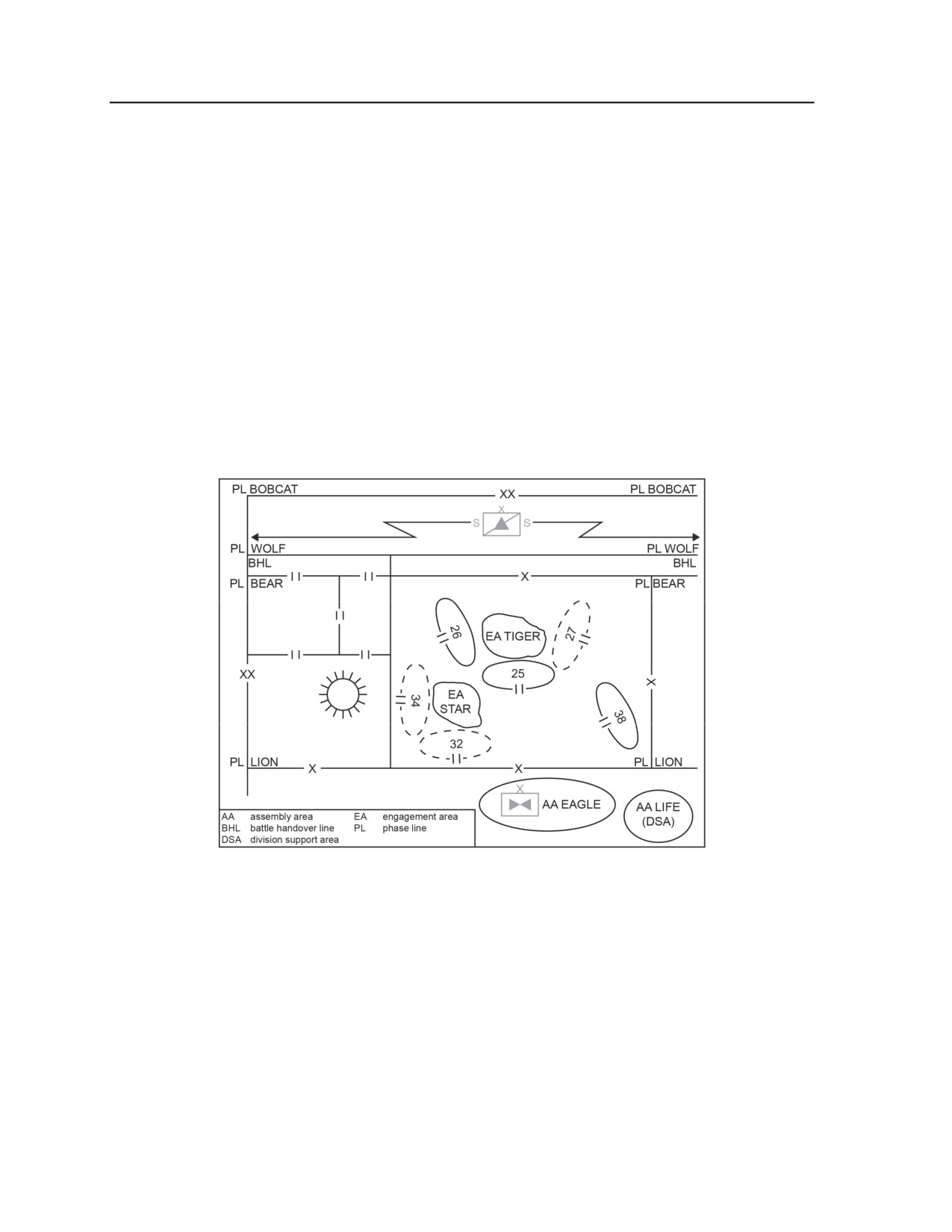
strength. (See figure 7-7.) The defending force repeatedly lures the enemy into EAs where it kills selected
portions of the enemy force.
Figure 7-7. Area defense using static and dynamic elements
7-59. In an area defense, defending forces fight mainly from prepared, protected positions to concentrate
combat power against attempted enemy breakthroughs and flanking movements. The commander uses
mobile forces to cover gaps between defensive positions, reinforce those positions as necessary, and
counterattack to seal penetrations or block enemy attempts at flanking movements.
7-60. Conducting shaping operations in an area defense is similar to shaping operations in the offense. The
mission variables of METT-TC determine how closely the commander synchronizes shaping operations
with the decisive operation. The commander conducts shaping operations designed to regain the initiative
by limiting the attacker’s options and disrupting the enemy’s plan. Shaping operations prevent enemy
forces from massing and create windows of opportunity for the conduct of a decisive offensive task,
allowing the defending force to defeat the attacking enemy in detail. The commander also employs shaping
operations to disrupt enemy operations by attacking command posts at critical stages in the battle or by
striking and eliminating key elements, such as river crossing equipment and supplies in a region that
7-12
FM 3-90-1
22 March 2013
The Area Defense
contains numerous unfordable rivers. Reconnaissance and security operations are normally components of
the echelon’s shaping operations.
7-61. As in the offensive chapters of this publication, this chapter divides execution into five steps for
discussion purposes. These steps are:
z
Gain and maintain enemy contact.
z
Disrupt the enemy.
z
Fix the enemy.
z
Maneuver.
z
Follow through (counterattack).
7-62. This does not mean that these steps occur sequentially; they may occur simultaneously. The first
three of these steps are almost always shaping operations. Depending on the circumstances, either of the
last two steps may be the echelon’s decisive operation.
GAIN AND MAINTAIN ENEMY CONTACT
7-63. Gaining and maintaining enemy contact in the face of the enemy’s determined efforts to destroy
friendly reconnaissance and surveillance assets is vital to the success of defensive actions. As the enemy’s
attack begins, the defending unit’s first concerns are to identify committed enemy units’ positions and
capabilities, determine the enemy’s intent and direction of attack, and gain time to react. Initially, the
commander accomplishes these goals in the security area. The sources of this type of intelligence include
reconnaissance and security forces, intelligence units, special operations forces, and aviation elements.
Battalions and companies are increasingly able to access combat information provided by technical means
belonging to higher echelons, such as unmanned aircraft systems and signals intelligence, to provide the
required reaction time. The commander ensures the distribution of a common operational picture
throughout the force during the battle as a basis for subordinate commanders’ actions. The commander uses
the information available, in conjunction with military judgment, to determine the point at which the enemy
commits to a COA.
7-64. The security force seeks to strip enemy reconnaissance forces and hide the defending force’s
dispositions, capabilities, and intent at the same time as friendly reconnaissance and surveillance assets
help to determine the enemy’s chosen COA. Ideally, the engagement in the security area should force the
enemy to conduct a movement to contact against a prepared defense.
7-65. A single force in the security area can perform both reconnaissance and security functions. The
security force uses every opportunity for limited offensive action to delay and harass the enemy and to gain
information. As the security element displaces, the commander makes preparations to pass it through or
around the MBA force as quickly as possible by using multiple passage points, gaps, or lanes along the
FEBA. This usually occurs in one location at a time until the security force has completely withdrawn.
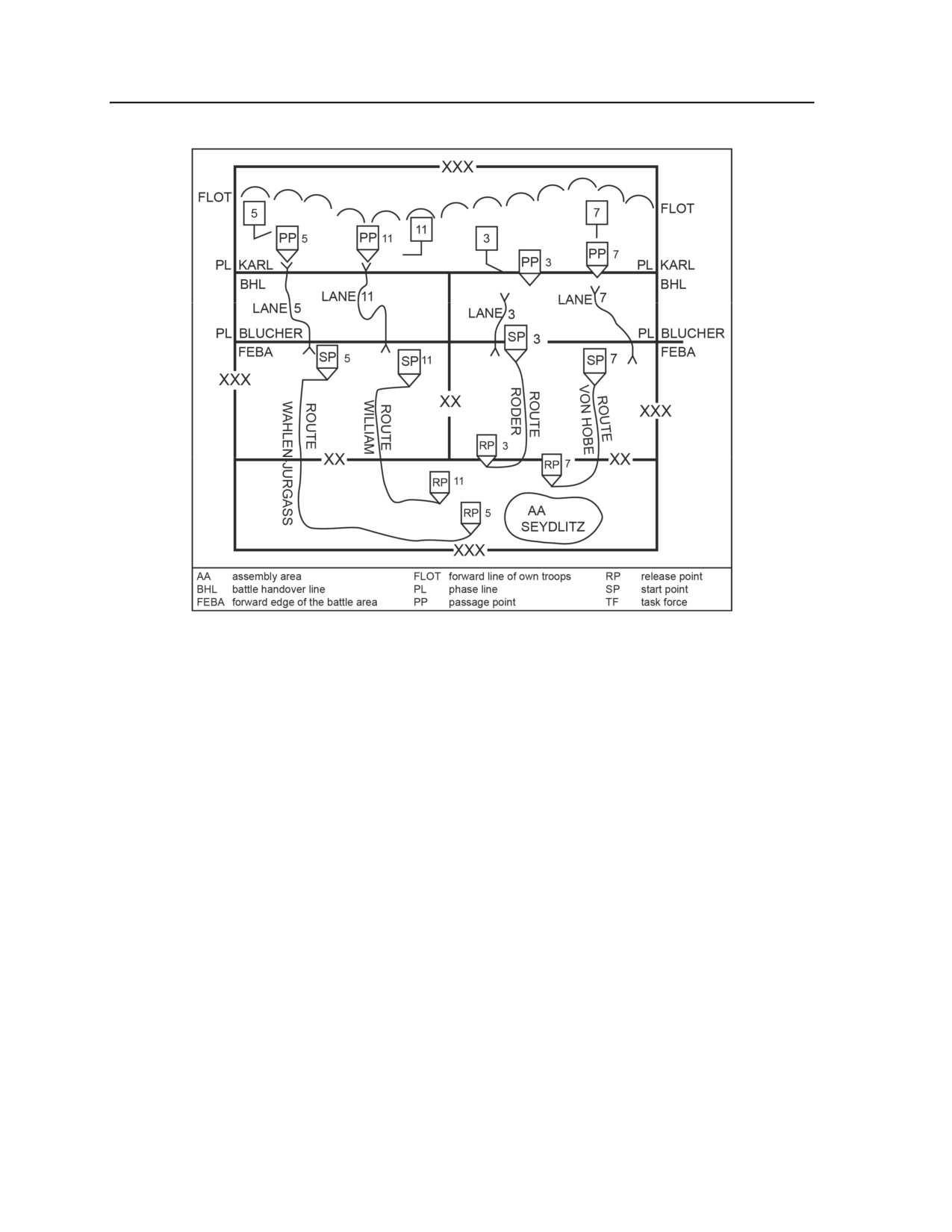
However, the security force may pass in sequence based on enemy pressure. Transfer of responsibility
occurs forward of the FEBA at the BHL. (See figure 7-8 on page 7-14.) Taking advantage of previous
liaison and plans, the security force makes any required last-minute coordination with MBA forces at
contact points to ensure its rapid passage through the MBA force.
22 March 2013
FM 3-90-1
7-13
Chapter 7
Figure 7-8. Battle handover line
7-66. The entire security force should not withdraw automatically as soon as the first enemy units reach
the FEBA. The commander can leave in place security elements located in areas where the enemy has not
advanced. The security force adjusts to the enemy’s advance and continues to conduct security operations
as far forward as possible. It continues to resist the enemy’s shaping operations, such as the enemy’s
reconnaissance effort, thereby upsetting the enemy’s coordination and allowing the MBA commander to
fight one engagement or battle at a time. Doing this increases the chances for success even if the enemy
attack penetrates the MBA in one or more areas. In some cases, the security force can attack the enemy
force from its rear, engage high-payoff targets, or drive between echelons to isolate leading enemy units.
7-67. As the enemy force approaches the MBA, the commander may order reconnaissance and
surveillance assets within the security force to displace to one or both sides of the enemy penetration and
continue to maintain surveillance. By observing and providing access to enemy flanks, reconnaissance and
surveillance elements can facilitate the conduct of friendly counterattacks. However, to prevent the
encirclement of these assets, the commander may plan to monitor those areas where the enemy has not
advanced into the MBA solely by technical means.
7-68. Commanders coordinate the battle handover between the security force and MBA forces as quickly
and efficiently as possible to minimize their vulnerability to enemy fire. The security force commander
must retain freedom to maneuver until the initiation of the passage of lines. The commander’s fire support
assets help cover the withdrawal of security forces. Functional and multifunctional support and sustainment
elements of the security force leave the security area as early as possible to avoid hampering the movement
of maneuver forces. Normally, battalion-sized units of the security force hand off the battle to the brigade
combat teams through which they pass. (See FM 3-90-2 for a discussion of the tactics associated with the
conduct of a rearward passage of lines.)
7-69. The commander must consider the security force’s next mission before battle handover between the
security force and the MBA force. Factors that may affect this decision are the status of the security force,
7-14
FM 3-90-1
22 March 2013
The Area Defense
its subsequent mission preparation requirements, and the size and nature of the reserve required by the
situation. The commander may decide to employ it immediately as the reserve, which would release the
initial reserve for other tasks. Alternately, the commander may decide to use the security force to conduct
additional security operations on the flanks of MBA forces as the battle progresses. However, it may be
some time before the security force is ready for commitment. Therefore, the commander is more likely to
wait until the security force has been reconstituted and the initial reserve committed before designating the
former security force as the reserve.
7-70. The commander should base the location of the security force’s assembly area on its follow-on
mission. The commander locates those assembly areas to rapidly support ongoing operations yet keep
withdrawn security units from interfering with ongoing decisive and shaping operations. After passage, the
security force normally moves to these locations to prepare for subsequent operations. At a minimum, the
commander must rearm and refuel the security force. Additional sustainment concerns include casualty
evacuation, maintenance requirements, and resupply.
DISRUPT THE ENEMY
7-71. The commander executes shaping operations, to include the conduct of military deception
operations, to disrupt the enemy regardless of the enemy’s location within the AO. After making contact
with the enemy, the commander seeks to disrupt the enemy’s plan, the enemy’s ability to control forces,
and the enemy’s combined arms team. Ideally, the results of the commander’s shaping operations should
force a disorganized enemy, whose ability to synchronize its elements has been degraded, to conduct a
movement to contact against prepared defenses. Once the process of disrupting the attacking enemy begins,
it continues throughout the conduct of the defense.
7-72. The commander initiates shaping operations simultaneously with the preparation of MBA positions.
These shaping operations typically focus on enemy high-payoff targets, such as command and control
nodes, engineer, fire support, and air defense assets for destruction or disruption. They can also force the
enemy to use avenues of approach covered by friendly EAs. These shaping operations destroy the enemy’s
cohesion and disrupt the tempo of the enemy’s approach to the MBA. This, in turn, disrupts the timely
introduction of enemy follow-on forces into the engagement. For example, electronic warfare directed
against the enemy’s command and control nodes and air defense assets increases the enemy’s vulnerability
to other shaping operations while simultaneously slowing the enemy’s reaction to these shaping operations.
(See FM 3-36 for a discussion of electronic warfare.) Follow-on engagements focus on degrading the
enemy’s fire support and engineer assets, thereby disrupting the movement of enemy approaching units.
7-73. Other targets for shaping operations include enemy reconnaissance and intelligence assets.
Destroying these assets allows the commander to repeatedly force enemy units to deploy into combat
formations on ground of the commander’s choosing, thus contributing to the disruption and
desynchronization of the enemy’s plan. The timing of these shaping operations is important. The enemy
cannot be allowed to recover from their effects before the decisive operation. The commander may also
execute offensive actions to further disrupt the enemy, such as spoiling attacks, raids, ambushes, feints, or
demonstrations.
FIX THE ENEMY
7-74. The commander does everything possible to limit the options available to the enemy when
conducting an area defense. In addition to disrupting the enemy, the commander conducts shaping
operations to constrain the enemy into a specific COA, control enemy movements, or fix the enemy in a
given location. These actions limit the enemy’s options. While executing these operations, the commander
continues to find, delay, or attrit enemy follow-on and reserve forces to keep them from entering the MBA.
7-75. The commander has several options to help fix an attacking enemy force. The commander can
design shaping operations—such as securing the flanks and point of a penetration—to fix the enemy and
allow friendly forces to execute decisive maneuver elsewhere. Combat outposts and strong points can also
deny enemy movement to or through a given location. (See chapter 6.) A properly executed military
deception operation can constrain the enemy to a given COA.
22 March 2013
FM 3-90-1
7-15
Chapter 7
7-76. The commander uses obstacles covered by fire to fix, turn, block, or disrupt to limit the enemy’s
available options. Properly executed obstacles are a result of the synthesis of top-down and bottom-up
obstacle planning and emplacement. Blocking forces can also affect enemy movement. A blocking force
may achieve its mission from a variety of positions depending on the mission variables of METT-TC.
MANEUVER
7-77. In an area defense, the decisive operation occurs in the MBA. This is where the effects of shaping
operations, coupled with sustaining operations, combine with the decisive operations of the MBA force to
defeat the enemy. The commander’s goal is to prevent the enemy’s further advance by using a combination
of fires from prepared positions, obstacles, and mobile reserves.
7-78. Generating massed effects is especially critical to the commander conducting the defense of a large
area against an enemy with a significant advantage in combat power. The attacker has the ability to select
the point and time of the attack. Therefore, the attacking enemy can mass forces at a specific point, thus
dramatically influencing the ratio of forces at the point of attack. An enemy three-to-one advantage in
overall combat power can easily turn into a local six-to-one or higher ratio. The defending commander
must quickly determine the intent of the enemy commander and the effects of terrain. This allows
defending units and their weapon systems to concentrate the effects of combat power against the enemy at
those points and restore a more favorable force ratio.
7-79. Forces in the MBA assume responsibility for the battle at the BHL. As the security force approaches
the FEBA, it may be necessary to increase the intensity of fire support from the MBA to allow the security
force to break contact. Both direct and indirect fire assets from MBA forces provide support to cover the
withdrawal of the security force and to close passage lanes through obstacle complexes. The commander
may also employ smoke to assist the security force with breaking contact with the enemy. The security
force’s withdrawal through the forward positions of the MBA must be carefully planned and coordinated.
The commander must guard gaps in obstacles left for the withdrawal of the security force and arrange for
closing them after the passage of the security force.
7-80. After the attacking enemy force reaches the MBA, it tries to find weak points and attempts to force a
passage, possibly by a series of probing attacks. As the attack develops, defending units engage the
enemy’s lead forces. The enemy advance may slow because of canalization and the increased density of
forces resulting from limited maneuver space, presenting good targets for defensive fire and air support.
The maximum effects of simultaneous and sequential fires are brought to bear at this stage of the battle.
7-81. The commander’s subordinate elements maneuver using massed direct and indirect fire and
movement to gain positional advantage over the assaulting enemy force. The commander also directs the
engineer obstacle and sustainment effort by the assignment of priorities. The commander must reposition
forces to meet the enemy where the enemy actually is rather than where the commander projected that the
enemy would be. The commander directs operations and supports subordinate elements by providing the
necessary functional and multifunctional support and sustainment assets. The commander controls the
commitment of the echelon reserve and, at division echelon and above, engages enemy follow-on forces
with long-range rockets and air support. If enemy follow-on forces can be delayed, the enemy’s attack may
be defeated in detail, one echelon at a time. If the defending unit can force the enemy to commit follow-on
forces sooner than planned, it can disrupt the enemy’s timetable, which can lead to the creation of
exploitable gaps between the committed and subsequent echelons.
7-82. Gaps between defensive positions may be necessary, but the commander does not leave them where
the enemy’s probable main effort will be. They are kept under surveillance, covered by fire or, where
possible, blocked by barriers or repositioned friendly forces. The commander clearly defines the
responsibility for dealing with each enemy penetration. The commander leverages the use of choke points
and obstacles to prevent enemy penetration. If the enemy succeeds in penetrating the MBA, the commander
blocks the penetration immediately and destroys this enemy force as soon as possible, using the mobile
reserve. The commander may extend actions within the depth of the AO to counter enemy penetrations that
cannot be stopped farther forward.
7-16
FM 3-90-1
22 March 2013
The Area Defense
7-83. The commander does not allow the attacking enemy to consolidate, unless it fits the scheme of
maneuver. The commander conducts a local counterattack with all available local resources to prevent the
enemy from consolidating gains. The lowest possible echelon conducts this local counterattack; however,
the commander must be aware of the problem of piecemeal commitment. A unit does not abandon a
position unless it fits within the higher commander’s intent, or that higher commander grants permission to
do so. If the defending force is unable to repulse the enemy, it tries to contain the enemy penetration until it
can attack in concert with major counterattacking forces. The commander coordinates counterattacks with
the efforts of the fire support system.
7-84. Although the commander plans for the counterattack in defensive planning, the plan may not
correspond exactly with the existing situation when the counterattack is launched. As the situation
develops, the commander reassesses the plan based on a revised situational understanding that results from
an updated common operational picture as new intelligence and combat information becomes available to
answer the following questions:
z
Is a counterattack feasible, or should the commander use the reserve to contain enemy
successes?
z
When and where should the defending forces counterattack?
z
In the case of enemy penetrations, what should the defending forces counterattack, and what
should they block or contain?
z
Is there enough time to complete the counterattack before the arrival of enemy follow-on forces?
z
Can the counterattack be conducted using only available fires or must ground maneuver forces
be committed?
7-85. When counterattacking, the commander employs all available resources necessary to ensure success.
The reserve’s counterattack usually becomes the echelon’s decisive operation on its commitment, so the
commander avoids its premature or piecemeal commitment. One of the commander’s most critical
decisions is committing the reserve. The commander may reinforce the reserve force before its commitment
to give it greater capability to counter enemy action. The commander does not counterattack as an
automatic reaction to an enemy penetration, nor does the commander commit the reserve solely because the
enemy has reached a certain phase line or other location. The commander may employ fire support assets
and local counterattacks by forces already defending to destroy, disrupt, or attrit enemy penetrations, thus
avoiding the need to commit the reserve. When possible, the commander launches the counterattack when
the enemy presents a flank or rear, overextends, or the enemy’s momentum dissipates. Once the flanks of
the enemy’s main effort are identified, the commander can target counterattacks to isolate and destroy
enemy forces within the MBA.
7-86. Sometimes the commander may determine that the reserve is unable to conduct a successful
counterattack. In this case, the commander uses available resources to block, contain, or delay the enemy to
gain time to employ higher-echelon reserves. In these cases, the commander and staff must plan how to
integrate reinforcing companies and battalions into the defensive scheme, adjust boundaries, and place
battle positions. The commander plans the routes these units will use, and what adjustments will be
necessary in existing mission command arrangements. The commander can speed the process of
positioning and moving reinforcements or the reserve by designating routes, allocating mobility assets, and
providing traffic-control personnel and guides at contact points to lead and brief them on the situation.
Maneuver battalion scouts, military police, and reconnaissance units are typically the assets used to provide
traffic control during the movement of these reserves because they have the combat power to protect
themselves from small enemy forces that may be encountered in this type of situation.
FOLLOW THROUGH (COUNTERATTACK)
7-87. The purpose of defensive actions is to retain terrain and create conditions for a counteroffensive that
regains the initiative. The area defense does this by causing the enemy to sustain unacceptable losses short
of any decisive objectives. A successful area defense allows the commander to transition to an attack. An
area defense could also result in a stalemate with both forces left in contact. Finally, it could result in the
defender being overcome by the enemy attack and needing to transition to a retrograde operation. Any
22 March 2013
FM 3-90-1
7-17
Chapter 7
decision to withdraw must take into account the current situation in adjacent defensive areas. Only the
commander who ordered the defense can designate a new FEBA or authorize a retrograde operation.
7-88. During this follow-through period, time is critical. Unless the commander has a large, uncommitted
reserve prepared to quickly exploit or reverse the situation, the commander must reset the defense as well
as maintain contact with the enemy. Time is also critical to the enemy, because the enemy will use it to
reorganize, establish a security area, and fortify positions.
7-89. There is a difference between local counterattacks designed to restore the defense and a decisive
operation designed to wrest the initiative from the enemy force and then defeat it. To conduct a decisive
counterattack, the defending force must bring the enemy attack to or past its culminating point before it
results in an unacceptable level of degradation to the defending force. To do this, the defending force must
disrupt the enemy’s ability to mass, causing the enemy to disperse its combat power into small groups or
attrit enemy forces to gain a favorable combat power ratio. The defending force must continue to disrupt
the enemy’s ability to introduce follow-on forces and attack the defender’s sustainment system. In the
defense, the commander must prepare to quickly take advantage of fleeting opportunities, seize the
initiative, and assume the offense. Ideally, the commander already has a counterattack plan appropriate to
the existing situation. The commander must rapidly reorganize and refit selected units, move them to attack
positions, and attack. Alternatively, the commander must conduct an attack using those units already in
contact with the enemy, which is normally the least favorable COA.
7-90. It is extremely difficult for the enemy to fight a defensive battle in response to a friendly
counterattack after the enemy reaches a culminating point for the following reasons:
z
Defensive preparations are hasty.
z
Forces are not adequately organized for defense.
z
Reorganizing for a defense requires more time than the friendly commander allows.
z
The enemy force is dispersed, extended in depth, and weakened.
z
Enemy attacks rarely culminate on ground ideally suited for defense.
z
Physical fatigue.
7-91. The shift to a defense requires enemy soldiers to make a psychological adjustment. Enemy soldiers
who have become accustomed to advancing, and thus winning, must now halt deep in the defending force’s
territory and fight defensively, sometimes desperately, on new and often unfavorable terms. If the enemy
commander decides to conduct retrograde operations to more defensible ground, enemy soldiers will tend
to find it even harder to adjust psychologically. The commander conducts prior planning to develop
decision points and control measures, such as retrograde routes, objectives, and target reference points to
exploit the opportunities offered in this situation.
7-92. If the defensive battle leads to a stalemate with both forces left in contact, the defending force
commander seeks to retain the initiative and set the conditions for the next encounter. The commander
prepares the defending unit to move rapidly to a subsequent defensive position during a lull in the battle
because it is risky to defend from the same position twice. The enemy will know the location of the
defending force’s position and subject it to supporting fires unless the defending force moves. The
defending unit should normally stay in place and continue to fight unless it can suppress the enemy’s
approaching forces or take other actions to distract the enemy. This is because of the risk to a unit when it
moves out of its prepared positions while still under enemy pressure.
7-93. If the defending unit is unable to maintain the integrity of its defense, it must transition to a
retrograde operation or risk destruction. The commander must analyze how to execute this transition and
prepare contingency plans. If the situation requires a retrograde movement, the commander conducts the
operation according to the retrograde fundamentals and principles addressed in chapter 9. In the retrograde,
if the defending force can trade space for time without sustaining unacceptable losses, the commander can
usually reestablish the conditions required for a successful defense.
7-18
FM 3-90-1
22 March 2013
Chapter 8
Mobile Defense
A mobile defense focuses on destroying the attacking force by permitting the enemy
to advance into a position that exposes the enemy to counterattack and envelopment.
The commander retains the majority of available combat power in a striking force for
the decisive operation, a major counterattack. The commander commits the minimum
possible combat power to the fixing force that conducts shaping operations to control
the depth and breadth of the enemy’s advance. The fixing force also retains the
terrain required to conduct the striking force’s decisive counterattack. The area
defense, on the other hand, focuses on retaining terrain by absorbing the enemy into
an interlocked series of positions, where the enemy is destroyed largely by fires.
NOTE: The Army and Marine Corps concept and terminology for the conduct of a mobile defense are
different. The Marine Corps does not use the fixing and striking force terminology. The Marine Corps
discussion of a mobile defense addresses allocating minimum forces to a positional defense while
allocating maximum combat power to counterattack forces.
GENERAL CONSIDERATIONS FOR A MOBILE DEFENSE
8-1. The mission variables of mission, enemy, terrain and weather, troops and support available, time
available, and civil considerations (METT-TC) may dictate that a unit conducts a mobile defense when
defending against an enemy force with greater combat power but less mobility. The following
circumstances favor the conduct of a mobile defense—
z
The defender possesses equal or greater mobility than the enemy.
z
The frontage assigned exceeds the defender’s capability to establish an effective area or
positional defense.
z
The depth of the area of operations (AO) allows the attacking enemy force to be drawn into an
unfavorable position where it can be attacked.
z
Time for preparing defensive positions is limited.
z
Sufficient armored, Styker, aviation, and long-range artillery forces and joint fires are available
to allow rapid concentration of combat power.
z
The enemy may employ weapons of mass destruction because this type of defense reduces the
vulnerability of the force to attack and preserves its freedom of action.
z
The mission does not require denying the enemy specific terrain.
z
The AO lacks well-defined avenues of approach and consists largely of flat, open terrain.
8-2. Commanders conducting a mobile defense anticipate enemy penetration into defended areas and use
obstacles and defensive positions to shape and control such penetrations. They also use local counterattacks
to either draw the enemy into entering planned penetration areas or to deceive the enemy commander as to
the nature of the defense. Among other risks associated with the conduct of a mobile defense are—
z
The fixing force may be isolated and defeated in detail because of the need to resource the
striking force to the detriment of the fixing force.
z
Operations in noncontiguous AOs associated with conducting a mobile defense can lead to
defeat in detail.
z
Enemy operations may impair the ability of the striking force to react at critical points.
z
The enemy may not move into the area intended by the defending commander.
22 March 2013
FM 3-90-1
8-1
Chapter 8
z
The attacking enemy force retains at least some momentum as it approaches the desired
engagement areas (EAs).
z
The defending force may not gain an accurate picture of the enemy’s locations and dispositions
required by the striking force to launch decisive operations in time to react.
z
The decentralized operations required by the mobile defense increase the potential for friendly
fire incidents.
8-3. Future technology associated with mission
command systems should improve the ability of the
friendly force to gain and maintain a common
operational picture, which reduces the risk
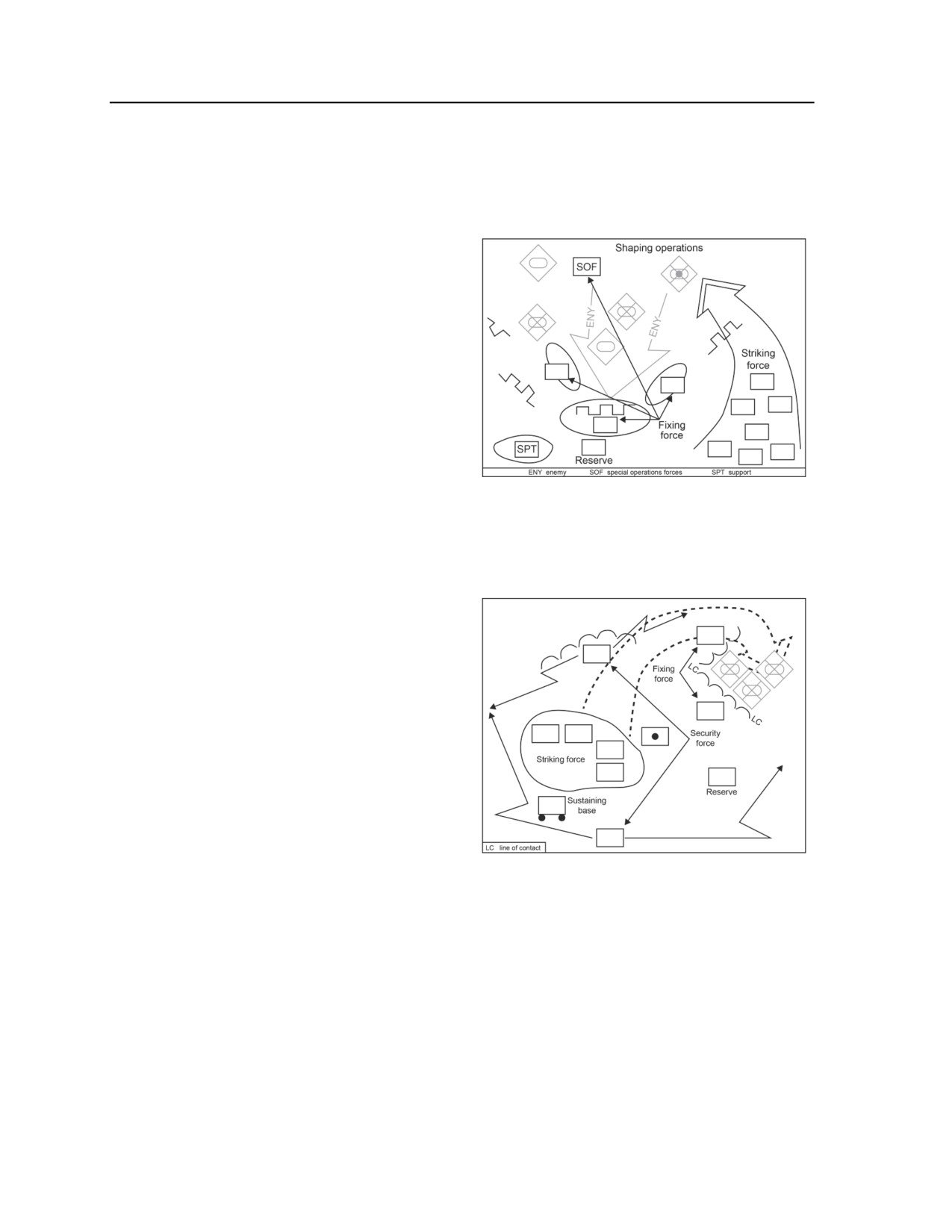
associated with this type of defense. Figure 8-1
depicts Army units conducting a mobile defense.
ORGANIZATION OF FORCES
FOR A MOBILE DEFENSE
8-4. Units smaller than a division do not normally
conduct a mobile defense because of their limited
capabilities to fight multiple engagements
throughout the width, depth, and height of the AO
Figure 8-1. Mobile defense
while simultaneously resourcing striking, fixing,
and reserve forces. Typically, the striking force in a mobile defense may consist of one-half to two-thirds of
the defender’s combat power. Army brigade combat teams (BCTs) and smaller units generally conduct an
area defense or a delay as part of the fixing force as the commander shapes the enemy’s penetration, or they
attack as part of the striking force. Alternatively, they can constitute a portion of the reserve.
8-5. Army commanders organize the main body
into two principal groups—the fixing force and the
striking
force.
In the mobile defense,
reconnaissance and security, reserve, and
sustaining forces accomplish the same tasks as in
an area defense. The commander completes any
required adjustments in task organization before
committing subordinate units to combat.
(See
figure 8-2.)
8-6. Organized by the commander with the
minimum combat power needed to accomplish its
mission, the fixing force turns, blocks, and delays
the attacking enemy force. It tries to shape the
enemy penetration or contain the enemy’s advance.
Typically, it has most of the countermobility assets
Figure 8-2. Army organization of forces for a
of the defending unit. The fixing force may
mobile defense
conduct defensive actions over considerable depth
within the main battle area (MBA). However, it must be prepared to stop and hold terrain on short notice to
assist the striking force on its commitment. The operations of the fixing force establish the conditions for a
decisive attack by the striking force at a favorable tactical location. The fixing force executes its portion of
the battle essentially as a combination of an area defense and a delaying action. The actions of the fixing
force are shaping operations.
8-7. The striking force decisively engages the enemy as attacking enemy forces become exposed in their
attempts to overcome the fixing force. The term “striking force” is used rather than reserve because the
term “reserve” indicates an uncommitted force. The striking force is a committed force and has the
resources to conduct a decisive counterattack as part of the mobile defense. It is the commander’s decisive
operation.
8-2
FM 3-90-1
22 March 2013
Mobile Defense
8-8. The striking force contains the maximum combat power available to the commander at the time of its
counterattack. The striking force is a combined arms force that has greater combat power and mobility than
the force it seeks to defeat or destroy. The commander considers the effects of surprise when determining
the relative combat power of the striking force and its targeted enemy unit. The striking force is normally
fully task organized with all functional and multifunctional support and sustainment assets before its actual
commitment. The commander positions engineer mobility-enhancing assets with the lead elements of the
striking force.
8-9. The striking force is the key to a successful mobile defense. All of its contingencies relate to its
attack. If the opportunity does not exist to decisively commit the striking force, the defender repositions
forces to establish the conditions for success. The striking force must have mobility equal to or greater than
that of its targeted enemy unit. It can obtain this mobility through proper task organization, countermobility
operations to slow and disrupt enemy movements, and mobility operations to facilitate the rapid shifting of
friendly formations. The striking force requires access to multiple routes because an attacking enemy
normally goes to great length to deny the defending force freedom of action.
8-10. The commander responsible for orchestrating the overall mobile defense should retain control of the
striking force unless communication difficulties make this impossible. Normally this is the overall
defending force commander. The commander’s most critical decisions are when, where, and under what
conditions the commander should commit the striking force. The commander normally accompanies the
striking force.
8-11. Resourcing a reserve in a mobile defense is difficult and requires the commander to assume risk. The
commander generally uses the reserve to support the fixing force. However, if the reserve is available to the
striking force, it exploits the success of the striking force.
CONTROL MEASURES FOR A MOBILE DEFENSE
8-12. A commander conducting a mobile defense uses control measures to synchronize the operation.
These control measures include designating the AOs of the fixing and striking forces with their associated
boundaries, battle positions, and phase lines. The commander designates a line of departure or a line of
contact as part of the graphic control measures for the striking force. The commander may designate an
axis of advance for the striking force. The commander can designate attack by fire or support by fire
positions. The commander uses EAs, target reference points, targeted areas of interest, and final protective
fires as necessary. The commander designates named areas of interest (NAI) to focus the efforts of
reconnaissance and surveillance assets. This allows the commander to determine the enemy’s chosen
course of action (COA). The commander designates checkpoints, contact points, passage points, passage
routes, and passage lanes for use by reconnaissance and surveillance assets, security units, and the striking
force. (See figure 8-3 on page 8-4.)
8-13. The commander must provide the striking force commander with control measures to focus the
striking force at the decisive time and place and to deconflict fires with the fixing force. As a minimum, the
striking force commander needs to know the anticipated objective decision points that could lead to the
commitment of the striking force, limit of advance, and boundaries of the striking force’s AO. If the overall
commander imposes either an axis of attack or a direction of attack as a control measure, that higher
commander restricts the striking force commander’s freedom of maneuver. However, such restrictions may
be necessary to avoid contact with enemy forces that could distract the striking force from accomplishing
its primary mission. The commander may have to determine and transmit these control measures rapidly
while the commander, staff, and subordinates move to take advantage of an opportunity to commit the
striking force in a decisive counterattack. They should also help the commander recover the defense’s
integrity, if the striking force is not successful in its attack. (Appendix A explains these control measures.)
22 March 2013
FM 3-90-1
8-3
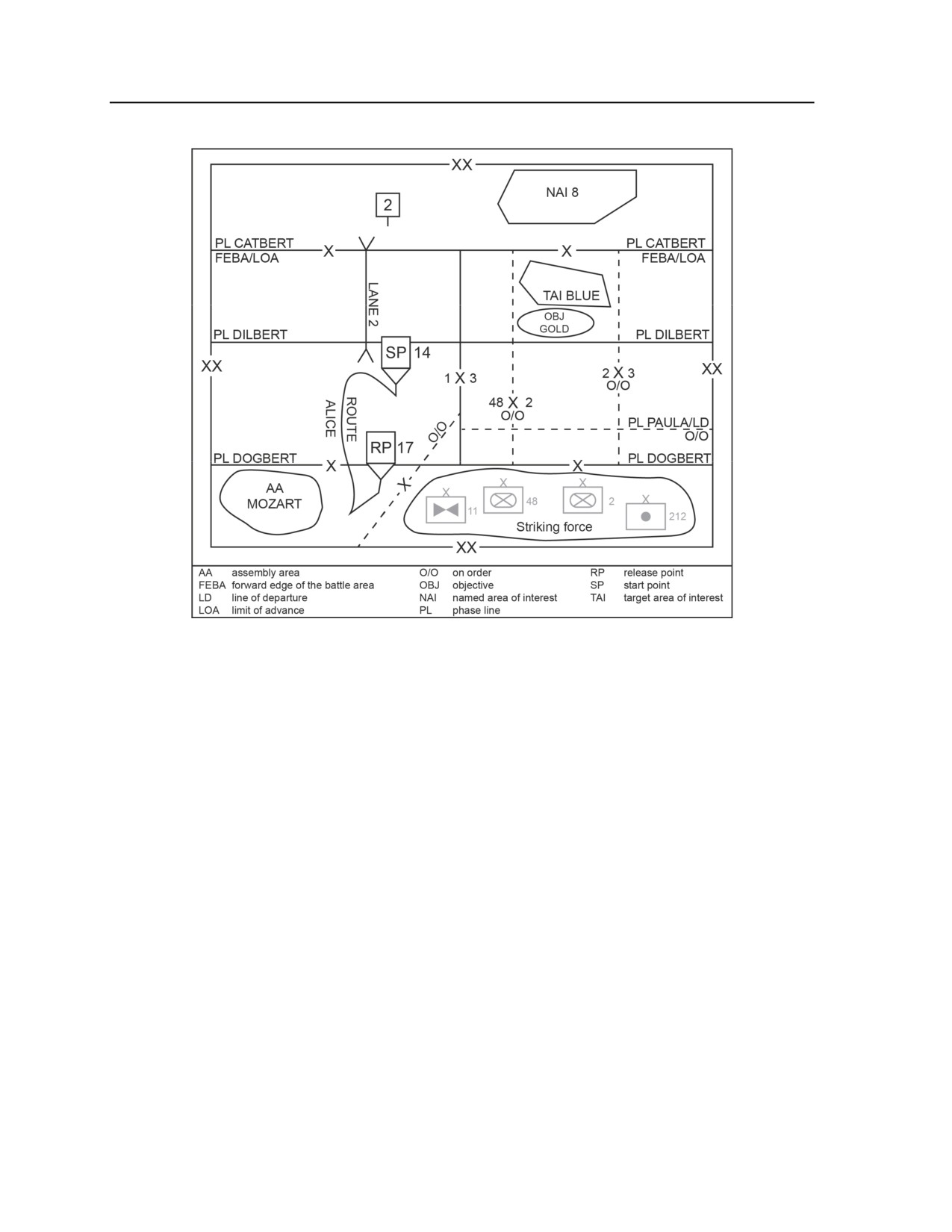
Chapter 8
Figure 8-3. Mobile defense control measures
PLANNING A MOBILE DEFENSE
8-14. The key to a successful mobile defense is the integration and synchronization of all available assets
to maximize the combat power of the defending unit, particularly the striking force. The commander
achieves integration and synchronization when employing their combined effects at decisive times and
places. (The general defensive planning considerations addressed in chapter 6 apply to the mobile defense.)
8-15. Just as in an area defense, in a mobile defense the unit’s plans must address how the preparations for,
and the conduct of, the mobile defense impact the civilian population of the AO. This is even more
important during a mobile defense than it is during an area defense because the scope of maneuver and
tempo of operations tends to be much larger. Civilian attempts to avoid advancing enemy formations and
locations where combat occurs will impede the ground maneuver of defending units unless steps are taken
to account for their presence and provide alternative routes for these dislocated civilians to use.
Commanders communicate these routes to the civilian population by a wide variety of means to ensure they
receive the information. Ideally, host nation civilian or military organizations will provide civilian traffic
regulation and immediate essential services along those civilian evacuation routes (along with the other
four primary stability tasks). However, if the host nation cannot perform these tasks, the defending unit will
have to perform them. Screening of civilians by units is necessary in this case to preclude enemy agents
from using these routes to infiltrate friendly defensive positions. At all times, commanders must meet legal
obligations to local civilian populations.
MOVEMENT AND MANEUVER
8-16. The commander’s ability to maintain the mobility advantage of the force is an important aspect of
the mobile defense. This mobility advantage may result from or be enhanced by countermobility actions
8-4
FM 3-90-1
22 March 2013
Mobile Defense
directed against the attacking enemy force. In the mobile defense plan, the commander ensures that
subordinate forces—including reserves and the striking force—can move freely around the battlefield,
while at the same time restricting the enemy’s mobility, slowing the enemy’s momentum, and guiding or
forcing the enemy into areas that favor the defense.
8-17. Most of the commander’s countermobility assets support the operations of the fixing force. Most of
the commander’s mobility assets support the operations of the striking force. Situational obstacles provide a
tremendous advantage to the defender in the conduct of a mobile defense. These obstacles are a combat
multiplier because they enable economy of force measures. The commander uses situational obstacles to
exploit enemy vulnerabilities, exploit success, separate enemy follow-on forces, and provide flank
protection.
FIRES
8-18. The effectiveness of a mobile defense is based on the carefully planned fires of all weapons. The
striking force conducts the commander’s decisive operation in a mobile defense. It requires continuous and
concentrated fire support. The commander weights the decisive operation, in part, by allocating field
artillery and other fire support weapon systems to it. The commander rapidly shifts indirect fire support
from the fixing force to the striking force. These fire support systems do not have to move with the striking
force, if it remains within supporting range.
8-19. If the striking force’s planned maneuver places it outside the supporting range of the defending
commander’s fire support systems, the commander must either plan to move fire support assets to locations
where they can support the striking force or incorporate them into the striking force. Fire support assets,
especially when employing precision munitions, can partially compensate for a lack of maneuver forces in
the striking force. The commander takes precautions to prevent fratricide as the striking force approaches
the fixing force’s EAs by establishing restrictive fire lines (RFLs), while supporting air and artillery assets
interdict enemy movements.
SUSTAINMENT
8-20. When planning for the mobile defense’s sustaining operations, sustainment planners must look
beyond the fixing force’s shaping operations to support the striking force’s decisive counterattack. The
greater the distance the striking force must cover when moving from its assembly area (AA) to its final
objective, the greater the amount of supplies needed to support that move. Once committed, units in the
striking force require priority of fuel, ammunition, and maintenance support over comparable units in the
fixing force. Commanders establish casualty treatment and evacuation procedures for both the fixing force
and the striking force. The fixing force will likely suffer a higher percentage of casualties than the striking
force as it absorbs the enemy’s attack. When the striking force must move a considerable distance from its
sustaining base, the commander should consider establishing an intermediate staging base (ISB). Before
establishing an ISB, the commander must weigh the benefits of establishing the base against the cost in
terms of combat power or effort diverted from the support mission to secure the ISB. (See FM 3-35 for
additional information on ISBs.)
PREPARING A MOBILE DEFENSE
8-21. Preparations for conducting a mobile defense include developing the fixing force’s defensive
positions and EAs. The commander aggressively uses reconnaissance assets to track enemy units as they
approach. Engineers participate in conducting route and area reconnaissance to find and classify existing
routes. They improve existing routes and open new routes for use during the battle.
8-22. The striking force assembles in one or more areas depending on the width of the AO, the terrain,
enemy capabilities, and the commander’s intent. Before the enemy attack begins, the striking force may
deploy some or all of its elements forward in the MBA to—
z
Deceive the enemy regarding the purpose of the force.
z
Occupy dummy battle positions.
22 March 2013
FM 3-90-1
8-5
Chapter 8
z
Create a false impression of unit boundaries, which is important when operating with a mix of
armored, Stryker, and infantry forces or multinational forces.
z
Conduct reconnaissance of routes between the striking force’s AAs and potential EAs.
8-23. The enemy attempts to discover the strength, composition, and location of the units that constitute
the fixing force and the striking force. The commander uses protective measures, such as security forces
and operations security, to deny the enemy this information and degrade the collection capabilities of
enemy reconnaissance and surveillance assets. The commander routinely repositions to mislead the enemy
and to protect the force. In addition, the commander incorporates information protection and other
defensive measures into plans and preparations. The commander attempts to portray an area defense to the
enemy while hiding the striking force.
EXECUTING A MOBILE DEFENSE
8-24. This publication divides the execution of a mobile defense into five steps for discussion purposes.
The length and nature of each step, if it occurs at all, varies from situation to situation according to the
mission variables of METT-TC. These steps are gain and maintain enemy contact, disrupt the enemy, fix
the enemy, maneuver, and follow through. The first three are normally shaping operations within a mobile
defense. The maneuver step is normally the mobile defense’s decisive operation, while the follow through
step is normally a branch or sequel operation.
8-25. A commander executing a mobile defense must have the flexibility to yield terrain and shape the
enemy penetration. The commander may even entice the enemy by appearing to uncover an objective of
strategic or operational value to the enemy. The striking force maneuvers to conduct the decisive
operation—the counterattack—once the results of the actions of the fixing force shape the situation to meet
the commander’s intent.
GAIN AND MAINTAIN ENEMY CONTACT
8-26. The commander conducting a mobile defense focuses on discovering the enemy’s strength and exact
locations to facilitate the effectiveness of the striking force. The security force (guard or cover) or the
fixing force confirms the enemy’s COA and the main avenues of approach used by the enemy. The
commander normally tasks other reconnaissance and surveillance assets to determine the location of enemy
reserves and follow-on forces. Early detection of the enemy’s decisive operation provides the commander
with reaction time to adjust the fixing force’s positions and shape the enemy penetration, which, in turn,
provides the time necessary to commit the striking force. The striking force commander requires as close to
real-time updates of the enemy situation as possible to ensure that the striking force engages the enemy at
the right location and time.
8-27. While conducting delaying operations (see FM 3-90-2), the security force determines what routes the
enemy is using, where the enemy is strong or weak, and where gaps in and between enemy formations
exist. This information aids the commander in seizing the initiative by identifying opportunities. Further, it
helps direct the striking force along the path of least resistance, as it maneuvers to employ its combat power
at the critical time and place.
DISRUPT THE ENEMY
8-28. In a mobile defense, the commander conducts shaping operations designed to shape the enemy’s
penetration into the MBA and disrupt the enemy’s introduction of fresh forces—reserves and follow-on
echelons—into the fight. These shaping operations help establish the preconditions for committing the
striking force by isolating the object of the striking force and destroying the enemy’s key command and
control (C2) nodes, logistics resupply units, and reserves. Whenever possible, the commander sequences
these shaping operations, to include electronic warfare, so that their effects coincide with the commitment
of the striking force. To generate a tempo that temporarily paralyzes enemy C2, the commander may
increase the intensity of these shaping operations dramatically on the commitment of the striking force. The
commander continues to conduct shaping operations once the striking force commits to prevent enemy
forces from outside the objective area from interfering with the decisive counterattack.
8-6
FM 3-90-1
22 March 2013
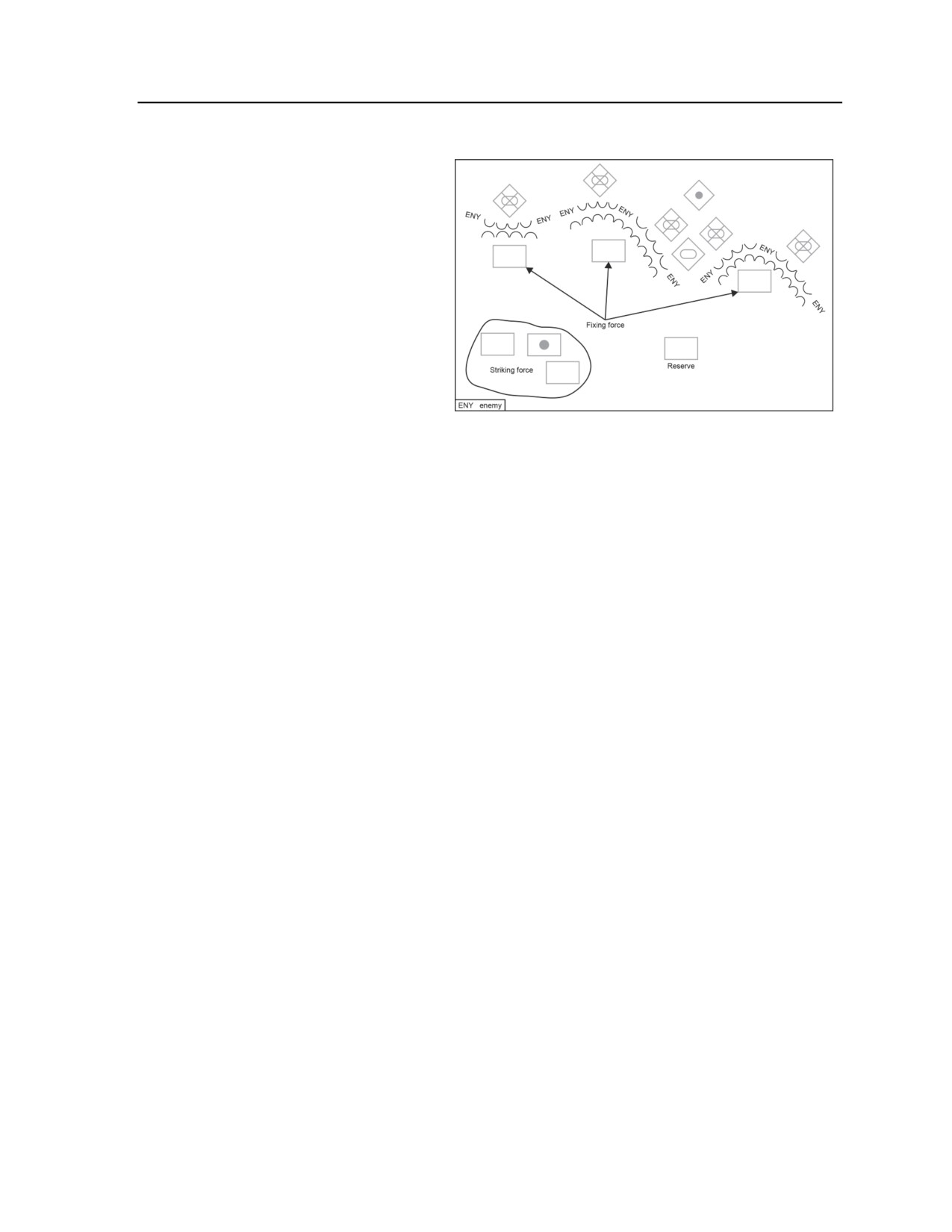
Mobile Defense
FIX THE ENEMY
8-29. Fixing the enemy is the second half
of shaping operations and establishes the
conditions
necessary
for
decisive
operations by the striking force. Typically,
the commander of the defending force
allows the enemy force to penetrate the
MBA before the striking force attacks.
(See figure
8-4.) The fixing force may
employ a combination of area defense,
delay, and strong point techniques to
shape the enemy penetration. The intent of
the fixing force is not necessarily to defeat
the enemy but to shape the penetration to
facilitate a decisive counterattack by the
striking force. The commander ensures
that the missions and task organization of
Figure 8-4. Mobile defense before commitment of
subordinate units within the fixing force
striking force
are consistent with the concept for
shaping the enemy penetration. Defensive
positions within the fixing force may not be contiguous since the fixing force contains only the
minimum-essential combat power to accomplish its mission.
8-30. The fixing force’s extensive use of obstacles supports this shaping effort and helps it gain an overall
mobility advantage over the enemy. The commander may want to yield ground quickly to make the
attacking enemy commander think that the attacking enemy force has been successful or to entice the
attacking enemy force to move to a decisive point where the striking force can attack. Normally, in a
mobile defense, the commander retains ground only to facilitate the commitment of the striking force.
8-31. When conducting a mobile defense, the commander may need to commit the reserve to reinforce the
fixing force and help shape the battlefield. The commander positions the reserve so that it effectively reacts
to the most likely contingency and the enemy’s most dangerous COA. Without a reserve, the commander
assumes significant risk in attempting to shape the enemy penetration. Circumstances may also force the
commander to employ elements of the striking force to assist the fixing force. If that occurs, the
commander uses available long-range fire support assets and attack helicopters. They are the best choice
because of their ability to rapidly disengage and shift their effects to support the rest of the striking force on
its commitment.
MANEUVER
8-32. The commander’s situational understanding is critical in establishing the conditions that initiate the
striking force’s movement and in determining the general area that serves as a focus for the counterattack.
Situational understanding includes identifying those points in time and space where the counterattack
proves decisive. A force-oriented objective or an EA usually indicates the decisive point. The staff
synchronizes the unit’s activities in time and space to sufficiently mass the effects of the striking force at
the right time and place.
8-33. The actions of the striking force are the echelon’s decisive operation on its commitment. The
commander’s reconnaissance and surveillance assets focus entirely on tracking the enemy’s advance. The
striking force commander continuously receives intelligence and combat information updates that allow
that commander to adjust the counterattack as necessary to defeat the targeted enemy. Once the enemy
force starts its attack, any forward-deployed elements of the striking force withdraw to assembly areas or
attack positions and prepare for their commitment.
22 March 2013
FM 3-90-1
8-7
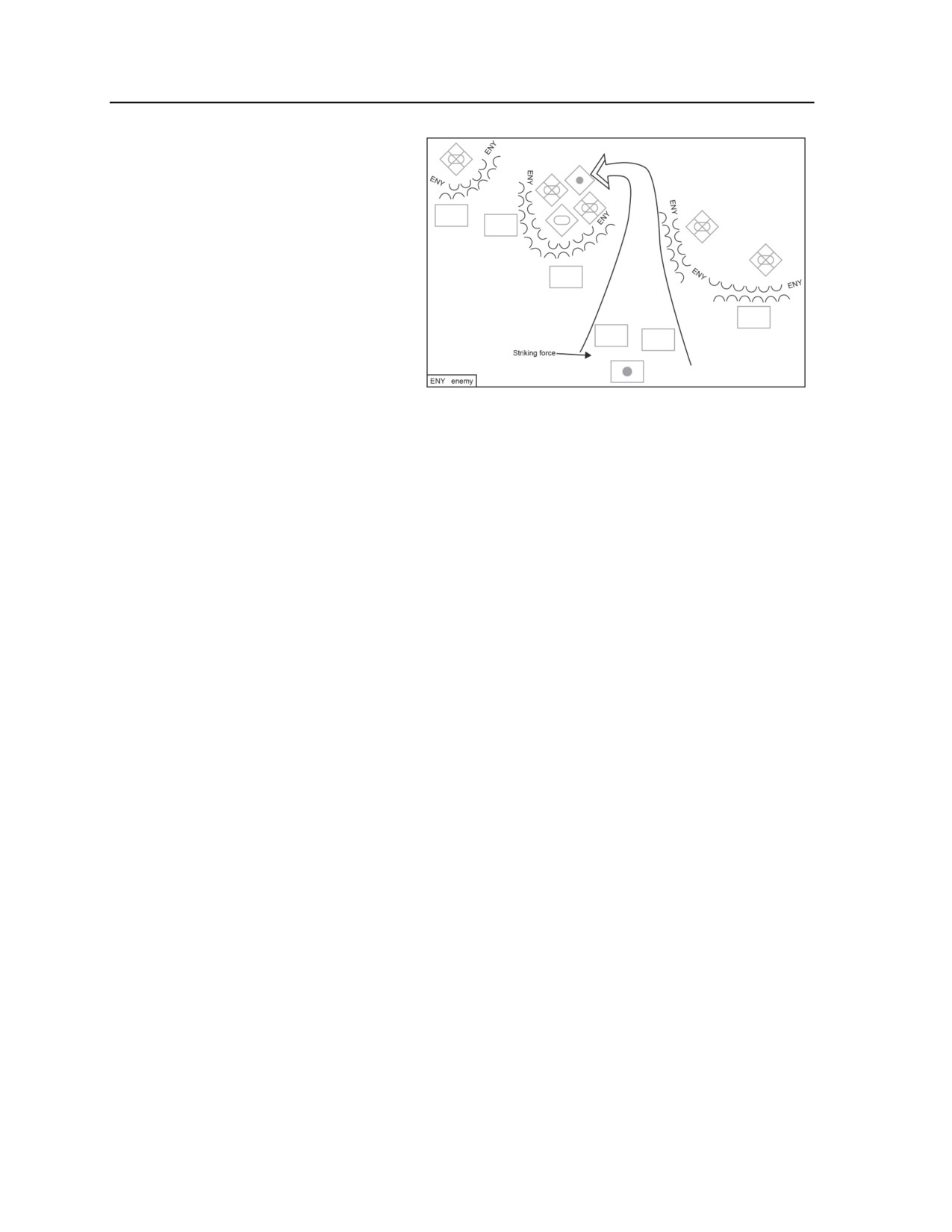
Chapter 8
8-34. The
defending
commander
launches the striking force in a
counterattack when its offensive power,
relative to that of the targeted attacking
enemy element, is the greatest. (See figure
8-5.) Piecemeal commitment of the
striking force in support of local
objectives jeopardizes the success of the
overall operation. The striking force must
execute the counterattack rapidly and
violently, employing all combat power
necessary to ensure success. The striking
force may be committed at a different
time than anticipated and in an entirely
different area than planned. Thus, it must
be able to respond to unexpected
Figure 8-5. Mobile defense after commitment of
developments rapidly and decisively.
striking force
8-35. Because the striking
force
normally attacks a moving enemy, it generally assumes a combat formation with a covering force, an
advance guard, a main body, and either a follow-and-support or a follow-and-assume force. The striking
force takes advantage of obstacles, such as rivers or obstacle zones, that block the enemy’s movement. The
strike force commander designates flank responsibilities and may even allocate a force against a
particularly vulnerable flank. However, the striking force moves quickly and takes risks on its flanks, using
its speed of movement and superior situational understanding to provide security.
8-36. The striking force attacks in a formation that provides maximum combat power forward to devastate
the enemy force and achieve decisive results. The striking force takes advantage of its mobility and fire
power to seize the initiative by overwhelming the enemy force with swift, violent blows that cripple the
enemy’s command and control system, disrupt attacking enemy formations, and destroy enemy combat
systems. The commander ensures that fire support and fixing force efforts capture the enemy’s attention
and posture the enemy for attack by the striking force. During the counterattack, the strike force
commander may have one element of the striking force occupy support by fire positions to suppress the
enemy, while another striking force element prepares to assault the objective. Armored, Stryker, and
infantry forces may make this assault. (Chapter 3 discusses the actual conduct of an assault on an
objective.)
8-37. Engineers should be well forward to enhance the mobility of the striking force. These lead engineers
search for existing obstacles and clear the route as much as possible within their capabilities. Follow-on
engineers expand breaches, improve routes, and replace assault bridges with more permanent structures.
Engineers with flank units focus on countermobility to protect the striking force’s flanks.
FOLLOW THROUGH
8-38. Commanders use defensive actions to create the opportunity to transition to the offense. In a mobile
defense, that transitional opportunity generally results from the success of the striking force’s attack. The
commander exploits success and attempts to establish conditions for a pursuit, if the result of the
commander’s assessment of the striking force’s attack shows that there are opportunities for future
offensive actions. (Chapters 4 and 5 discuss exploitation and pursuit.) If the mobile defense is unsuccessful
and the enemy retains the initiative, the commander must either reestablish a viable defense or conduct
retrograde operations. (Retrograde operations are the topic of chapter 9.)
8-8
FM 3-90-1
22 March 2013
Chapter 9
The Retrograde
The Army categorizes the retrograde as one of three primary defensive tasks. The
enemy may force these operations or a commander may execute them voluntarily. In
either case, the higher commander of the force executing the operation must approve
the retrograde. Retrograde operations are transitional operations; they are not
considered in isolation.
GENERAL CONSIDERATIONS FOR THE RETROGRADE
9-1. Retrograde movement is any movement of a command to the rear, or away from the enemy. It
may be forced by the enemy or may be made voluntarily. Such movements may be classified as
withdrawal, retirement, or delaying actions. The commander executes retrogrades to—
z
Disengage from operations.
z
Gain time without fighting a decisive engagement.
z
Resist, exhaust, and damage an enemy in situations that do not favor a defense.
z
Draw the enemy into an unfavorable situation or extend the enemy’s lines of communication
(LOCs).
z
Preserve the force or avoid combat under undesirable conditions, such as continuing an
operation that no longer promises success.
z
Reposition forces to more favorable locations or conform to movements of other friendly troops.
z
Position the force for use elsewhere in other missions.
z
Simplify sustainment of the force by shortening LOCs.
z
Position the force where it can safely conduct reconstitution.
z
Adjust the defensive scheme to secure more favorable terrain.
z
Deceive the enemy.
9-2. The three retrograde tasks are delay, withdrawal, and retirement.
Retrograde tasks
In each task, a force moves to the rear, using combinations of combat
formations and marches. (Chapter 1 discusses combat formations; FM
• Delay
3-90-2 discusses troop movement.) The commander may use all three
tasks singularly or in combination with other offensive or defensive
• Withdrawal
tasks.
• Retirement
9-3. Retrogrades can negatively affect the participating Soldiers’
attitudes more than any other type of operation because they may view the retrograde as a defeat. A
commander must not allow retrograde operations to reduce or destroy unit morale. Leaders must maintain
unit aggressiveness. By planning and efficiently executing the retrograde and ensuring that Soldiers
understand the purpose and duration of the operation, the commander can counter any negative effects of
the operation on unit morale. After completing a retrograde operation, the commander may reconstitute the
force. (See Sustainment Center of Excellence publications that contain the principles of reconstitution for
more information.)
DELAY
9-4. A delaying operation is an operation in which a force under pressure trades space for time by slowing
down the enemy’s momentum and inflicting maximum damage on the enemy without, in principle,
becoming decisively engaged (JP 3-04). The delay is one of the most demanding of all ground combat
22 March 2013
FM 3-90-1
9-1
Chapter 9
operations. A delay wears down the enemy so that friendly forces can regain the initiative through
offensive action, buy time to establish an effective defense, or determine enemy intentions as part of a
security operation. Normally in a delay, inflicting casualties on the enemy is secondary to gaining time. For
example, a flank security force conducts a delay operation to provide time for the protected force to
establish a viable defense along its threatened flank. Except when directed to prevent enemy penetration of
a phase line (PL) for a specific duration, a force conducting a delay normally does not become decisively
engaged.
9-5. A delay operation can occur when the commander does not have enough friendly forces to attack or
defend. It may also occur, based on a unit’s mission, in conjunction with a higher commander’s intent. The
decision to conduct a delay may not be based on the unit’s combat power, but on the other mission
variables of mission, enemy, terrain and weather, troops and support available, time available, and civil
considerations (METT-TC). For example, during security operations, the commander may conduct a delay
as a shaping operation to draw the enemy into an area where the attacking enemy force is vulnerable to a
counterattack. Another example is a delay instituted as an economy of force effort to allow the commander
to conduct offensive actions elsewhere.
9-6. The ability of a force to trade space for time requires depth within the area of operations (AO)
assigned to the delaying force. The amount of depth required depends on several factors, including the—
z
Amount of time to be gained.
z
Relative combat power of friendly and enemy forces.
z
Relative mobility of the forces.
z
Nature of the terrain.
z
Ability to shape the AO with obstacles and fires.
z
Degree of acceptable risk.
Ordinarily, the greater the available depth, the lower the risk involved to the delaying force and the greater
the chance for success.
9-7. A delay succeeds by forcing the enemy to repeatedly concentrate forces to fight through a series of
defensive positions. A delaying force must offer a continued threat of serious opposition, forcing the enemy
to repeatedly deploy and maneuver. Delaying forces displace to subsequent positions before the enemy is
able to concentrate sufficient resources to decisively engage and defeat delaying forces in their current
position. The length of time a force can remain in a position without facing the danger of becoming
decisively engaged is primarily a function of relative combat power and the mission variables of
METT-TC, such as terrain and weather.
ORGANIZATION OF FORCES
9-8. The commander normally organizes the delaying force into a main body, a security force, and a
reserve. The security force usually conducts a screen forward of the initial delay positions. For a division or
corps conducting a delay, the security force may be an armored brigade combat team (ABCT), a Stryker
brigade combat team (SBCT), or a task force based around a battlefield surveillance brigade’s (BFSB’s)
reconnaissance squadron. For a brigade combat team (BCT) conducting a delay, the security force may
consist of the BCT reconnaissance squadron, a battalion-sized task force, or another element tasked to
conduct security operations.
9-9. The main body, which contains the majority of the delaying force’s combat power, may use alternate
or subsequent positions to conduct the delay. The commander usually deploys the main body as a complete
unit into a forward position when conducting a delay from subsequent positions. The commander divides
the main body into two parts, roughly equal in combat power, to occupy each set of positions when
conducting a delay from alternate positions.
9-10. The commander normally retains a reserve to contain enemy penetrations between positions, to
reinforce fires into an engagement area (EA), or to help a unit disengage from the enemy. All of these
missions require that the reserve has the mobility and strength to strike with such force that an enemy has
no option but to react to it.
9-2
FM 3-90-1
22 March 2013
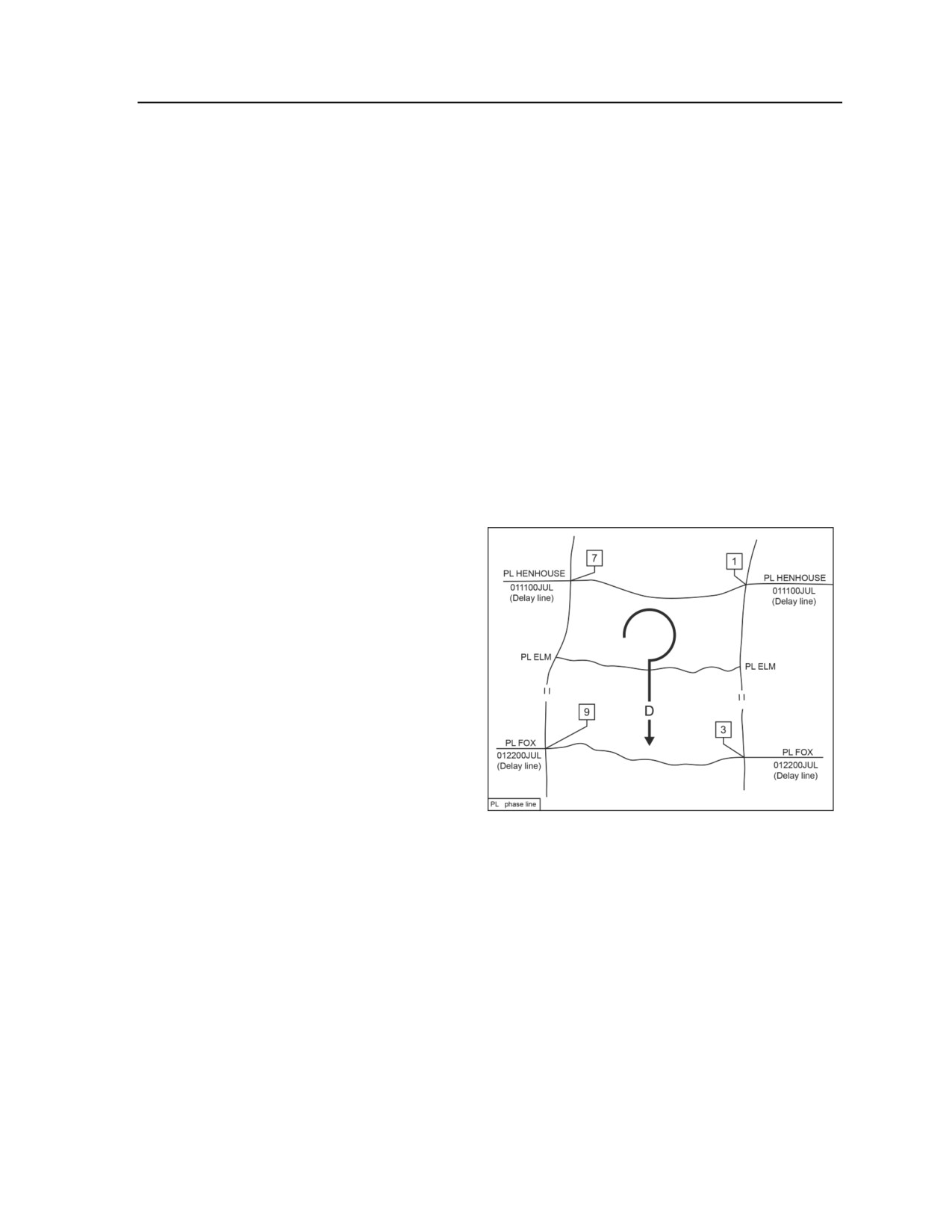
The Retrograde
9-11. The extended frontages and ranges common to retrograde operations make the provision of fire
support difficult and limit the commander’s ability to mass fires. Therefore, retrograde forces, especially
delay forces, often have more than the normal allocation of fire support assets. The commander’s risk of
losing supporting artillery systems and their ammunition also increases when conducting retrograde
operations. Therefore, the commander balances the decision to commit fire support systems forward against
anticipated requirements in subsequent battle stages. In particular, the commander protects towed artillery
systems from being overrun by a mobile enemy. The commander can use available rotary- and fixed-wing
aircraft to augment or replace artillery systems.
9-12. Functional and multifunctional support and sustainment assets are widely dispersed and often
attached to the units they support because of the width of the AOs normally assigned in a delay. Engineer
priorities are normally countermobility first, then mobility. However, restrictive terrain that impedes
friendly movement may require the commander to reverse priorities. Close coordination is necessary so that
engineer obstacles are covered by fire and do not impede the planned withdrawal routes of delaying forces
or the commitment of a counterattacking reserve force. The delaying force should have a
greater-than-normal allocation of fire support systems to include Service and joint aviation to allow the
delay force to break contact if necessary.
9-13. The requirement to maintain continuous support during the delay requires sustainment organizations
to echelon their assets throughout the area where the retrograde will take place. This echeloning, coupled
with the wide dispersion of combat forces that is inherent in a delay, complicates the conduct of the delay.
CONTROL MEASURES
9-14. The delay consists of a series of
independent small-unit actions that occur
simultaneously across the front. Subordinate
commanders must have freedom of action. The
tactical mission graphic for the delay appears in
figure 9-1. It is not a control measure. Tactical
mission graphics are used by planners
developing different courses of action. The
control measures used in the delay are the same
as those introduced in chapter
8. Common
graphics used in a delay include AOs, PLs,
battle positions
(BPs), coordination points,
checkpoints, EAs, trigger lines, target reference
points (TRPs), and disengagement lines. (See
figure
9-2 on page
9-4.) The commander
designates contact points in front of, between,
and behind units to assist coordination, ensure
Figure 9-1. Delay tactical mission graphic
continuity of the delay, and draw attention to
enemy avenues of approach into unit flanks.
(FM 3-90-2 addresses the use of passage points within its discussion of the tactics associated with the
conduct of a passage of lines.)
9-15. In planning for a delaying action, the commander assigns an AO to each committed unit down
through the company or troop level. The commander assigns each likely enemy avenue of approach to only
one subordinate unit when designating subordinate units’ AOs. When the commander draws the boundaries
of these subordinate AOs, terrain that controls fire and observation into those areas is included.
22 March 2013
FM 3-90-1
9-3
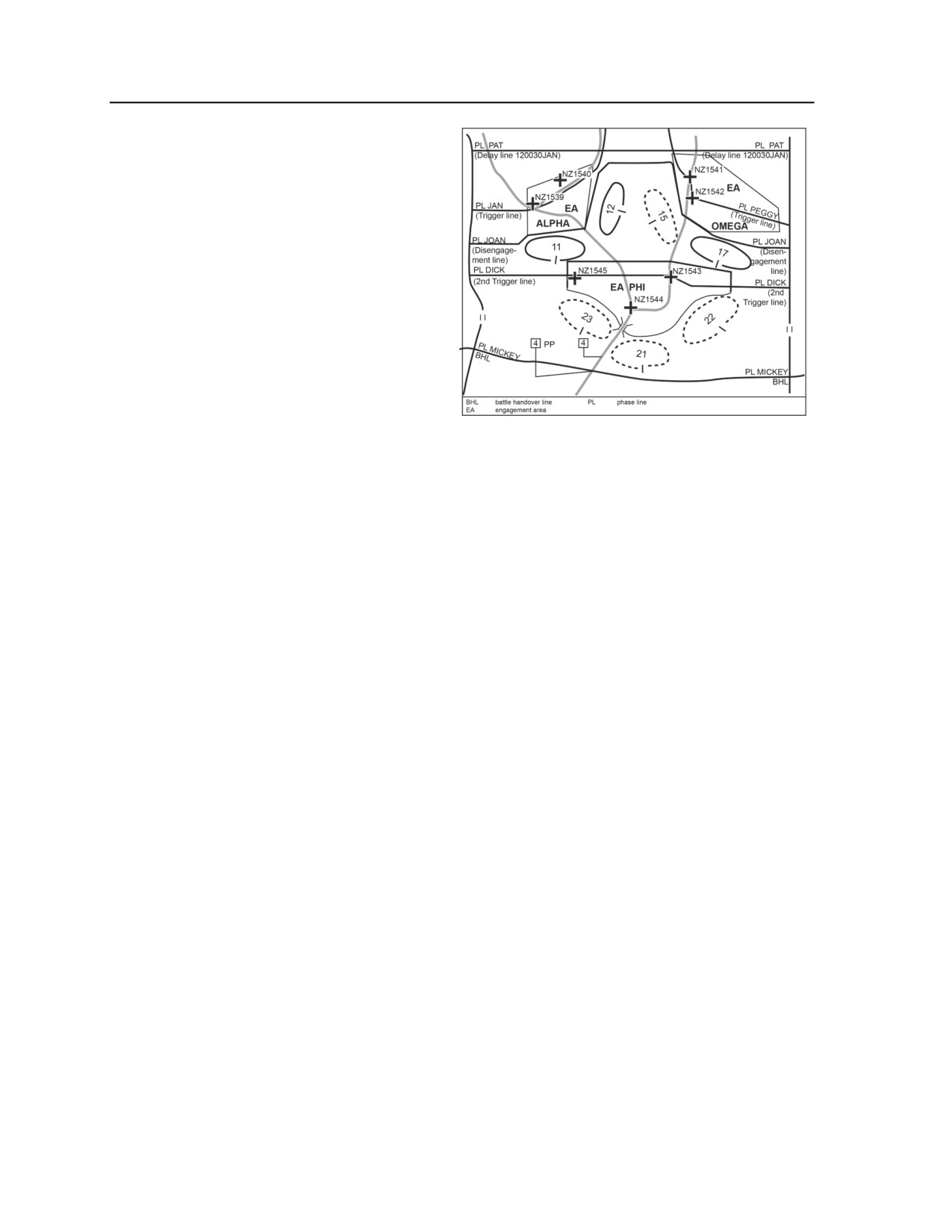
Chapter 9
9-16. The commander designates additional
PLs beyond those established by the higher
commander as necessary to control the unit’s
movement during the delay. A delay line is a
phase line where the date and time before
which the enemy is not allowed to cross the
phase line is depicted as part of the graphic
control measure. Designating delay lines is a
command decision that imposes a high degree
of risk on the delaying unit. The delaying unit
must do everything in its power—including
accepting decisive engagement—to prevent the
enemy from crossing that line before the time
indicated. A delay line may also be event
driven. For example, a commander can order a
delaying unit to prevent penetration of the
delay line until supporting engineers complete
construction of a rearward obstacle belt.
Figure 9-2. Control measures for a delay
PLAN
9-17. Unit commanders and their Soldiers must understand and exercise the basic defensive tactics
outlined in chapter
6 to conduct a successful delay. However, these defensive basics have unique
considerations, and the significance of these considerations varies depending on the mission variables of
METT-TC. In a delay, units operate on extended frontages at great risk from advancing enemy forces. The
tactical situation constantly changes with opportunities for maneuver existing for only extremely short
periods. Subordinate commanders must have the flexibility to take immediate action to retain the integrity
of their forces. This helps retain their freedom of maneuver and inflict maximum destruction on the enemy.
9-18. The commander identifies ground and air avenues for enemy attacks and friendly counterattacks.
When avenues of approach diverge or pass from one AO to another, adjacent units must coordinate with
each other. Using the intelligence preparation of the battlefield process, the commander designates initial
and subsequent delay positions on key terrain that covers likely enemy avenues of approach throughout the
depth of the AO allocated to the delay mission.
9-19. The commander of the delaying force must maintain a mobility advantage over the attacker to
successfully conduct a delay. Robust engineering and fire support are critical to this effort. The commander
maintains this advantage by fully utilizing the mobility inherent in the combat and tactical systems
available to the delaying force. In addition, the commander takes other steps to enhance friendly mobility
and degrade the enemy’s mobility, such as building combat trails between delaying positions and preparing
bridges over major rivers for demolition. The delaying force should be capable of constructing large
numbers of obstacles and delivering long-range fires. For example, while the enemy travels in movement
formations that allow the enemy force to quickly press its attack, the delaying force’s aim is to engage the
enemy as early and often as possible. This forces the enemy out of those formations through a multiple
series of time-consuming deployments into assault formations.
9-20. Air defense of a delaying force has three main considerations—the protection of the force while it is
in position, the protection of any forces left in contact, and the protection of the force as it moves to the
rear. Priority should be toward maintaining the mobility of the force. Air defense assets remain mobile yet
able to engage aerial targets with little advance warning. These assets should work in teams, able to move
to the rear in alternating bounds. This ensures that dedicated air defense assets will always be in position,
with the flexibility needed to keep pace with the operations. These firing points are not obvious positions
that an enemy would target as part of preparatory or supporting fires. Early warning of enemy air attack is
provided over combat net radios using the command net at the brigade echelon and below.
9-21. Flanks and gaps between units are always areas of concern. In a linear deployment, the enemy can
bypass or outflank the delaying force, if coordination between adjacent friendly units is weak, or if one unit
9-4
FM 3-90-1
22 March 2013
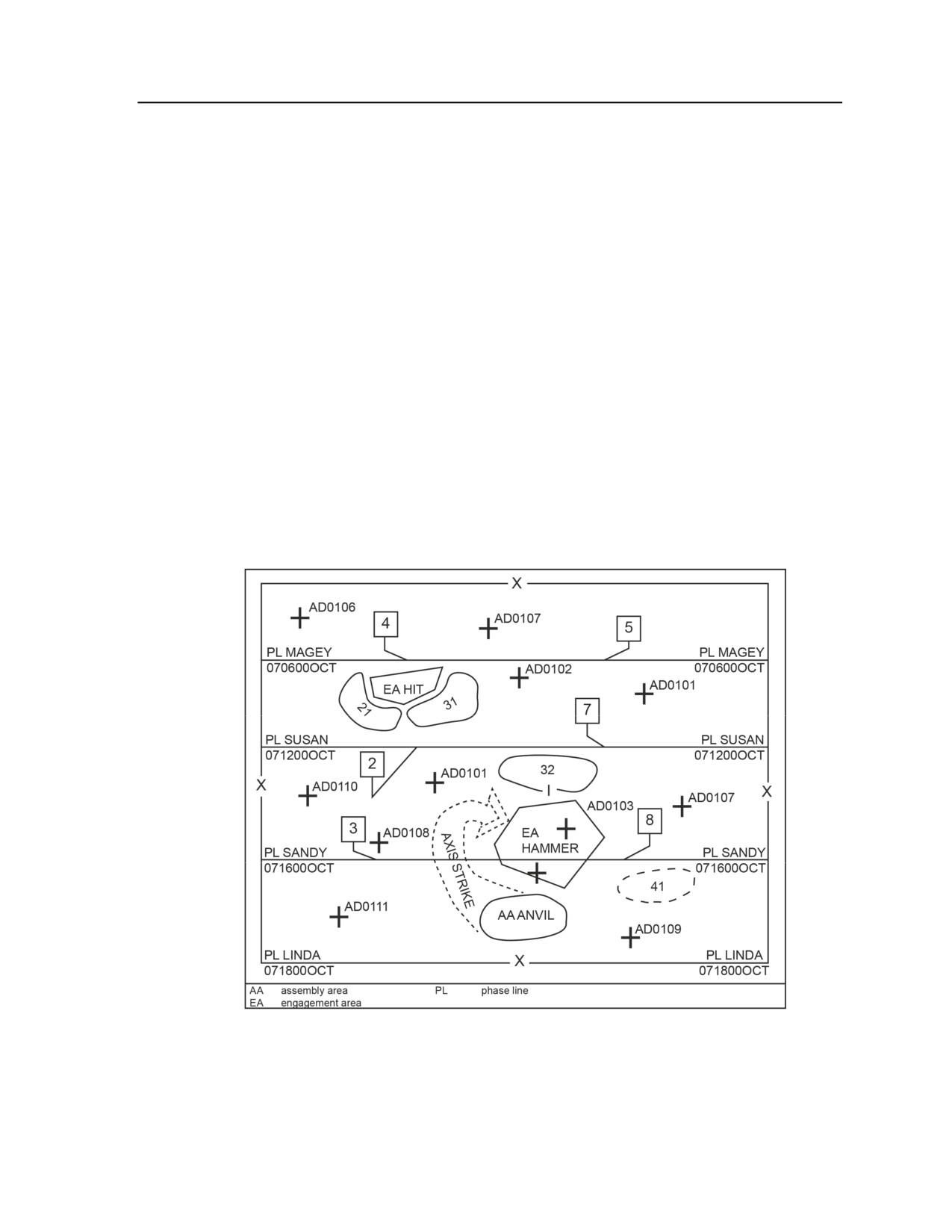
The Retrograde
creates a gap by moving rearward too rapidly. Therefore, the commander normally designates BPs to guard
approaches into the AO. Adjacent units of different commands must exchange liaisons.
9-22. Displacement criteria should specify at what point—either event or time-driven—the delaying force
should begin its displacement. The commander should calculate enemy closure rates for the terrain and
compare them to friendly displacement rates between positions. By comparing time and distance factors,
the commander can calculate the movement time. By applying the enemy’s probable rates of advance and
formations to the avenues of approach, the commander can decide what obstacles to use and where to
emplace them (covering them by fires). This comparison also helps the commander determine if and where
decisive engagement is likely or required to achieve the delay objective. Careful consideration of the
mission variables of METT-TC, especially terrain analysis, is an inherent part of delay planning.
PARAMETERS OF THE DELAY ORDER
9-23. The commander must specify certain parameters in an order for a delay mission. First, the
commander must direct one of two alternatives: delay within the AO or delay forward of a specified line or
terrain feature for a specified time. That time is usually based on another unit completing its activities, such
as establishing rearward defensive positions. A mission of delay within the AO implies that force integrity
is a prime consideration. In this case, the delaying force delays the enemy as long as possible while
avoiding decisive engagement. Generally, this force displaces once predetermined criteria have been met,
such as when the enemy force reaches a disengagement line. The control measures are the same for both
alternatives, except that during a delay forward of a specified line for a specified time, the commander
annotates the PL with the specified time. (See figure 9-3.) If the commander establishes a delay line,
mission accomplishment outweighs preservation of the force’s integrity. It may require that the force hold a
given position until ordered to displace.
Figure 9-3. Delay forward of a specified line for a specified time
9-24. The second parameter is that the order must specify the acceptable risk. Acceptable risk ranges from
accepting decisive engagement in an attempt to hold terrain for a given time to maintaining the integrity of
the delaying force. The depth of the AO available for the delay, the time needed by higher headquarters,
22 March 2013
FM 3-90-1
9-5

Chapter 9
and subsequent missions for the delaying force determine the amount of acceptable risk. A delay mission
that does not specify times, control of key terrain, or other guidance and control measures implies a lower
degree of risk.
9-25. Third, the order must specify whether the delaying force may use the entire AO or must delay from
specific BPs. A delay using the entire AO is preferable, but a delay from specific positions may be required
to coordinate two or more units in the delay. To enhance mission command and to coordinate the battle
across a broad front, the commander can assign units down to platoon-level specific BPs. However, the
commander may assign them missions to delay within their AO, if that best supports the scheme of
maneuver.
ALTERNATE AND SUBSEQUENT POSITIONS
9-26. The commander normally assigns subordinate units contiguous AOs that are deeper than they are
wide. The commander uses obstacles, fires, and movement throughout the depth of each assigned AO. The
delaying unit may be forced to fight from a single set of positions, if the commander plans the delay to only
last a short time or the AO’s depth is limited. If the commander expects the delay to last for a longer period,
or if sufficient depth is available, the delaying unit may delay from either alternate or successive positions.
9-27. In both techniques, delaying forces normally reconnoiter subsequent positions before occupying
them and, if possible, post guides on one or two subsequent positions. Additionally, in executing both
techniques, it is critical that the delaying force maintains contact with the enemy between delay positions.
(The advantages and disadvantages of the two techniques are summarized in Table 9-1.)
Table 9-1. Advantages and disadvantages of delay techniques
Method of delay
Use when
Advantages
Disadvantages
• Area of operations is
• Masses fires of all
• Limited depth to the
wide.
available combat
delay positions.
Delay from
elements.
subsequent
• Forces available do
• Less available time to
not allow themselves
prepare each position.
positions
to be split.
• Less flexibility.
• Area of operations is
• Allows positioning in
• Requires continuous
narrow.
depth.
coordination.
Delay from
• Forces are adequate
• Allows more time for
• Requires passage of
alternate
to be split between
equipment and Soldier
lines.
positions
different positions.
maintenance.
• Engages only part of
• Increases flexibility.
the force at one time.
9-28. A commander normally prefers to use alternate positions when adequate forces are available and the
AO has sufficient depth. In a delay from alternate positions, two or more units in a single AO occupy
delaying positions in depth. (See figure 9-4.) As the first unit engages the enemy, the second occupies the
next position in depth and prepares to assume responsibility for the operation. The first force disengages
and passes around or through the second force. It then moves to the next position and prepares to reengage
the enemy while the second force takes up the fight. Alternate positions are normally used when the
delaying force operates on a narrow front. A delay from alternate positions is particularly useful on the
most dangerous avenues of approach because it offers greater security than a delay from successive
positions. However, it requires more forces and continuous maneuver coordination. Additionally, the
delaying forces risk losing contact with the enemy between delay positions.
9-29. The commander uses a delay from subsequent positions when the assigned AO is so wide that
available forces cannot occupy more than a single tier of positions. (See figure 9-5.) In a delay from
subsequent positions, all delaying units are committed to each of the series of battle positions (BPs) or
across the AO on the same PL. Most of the delaying force is located well forward. The mission dictates the
delay from one BP or PL to the next. The commander staggers the movement of delaying elements so that
not all elements are moving at the same time.
9-6
FM 3-90-1
22 March 2013
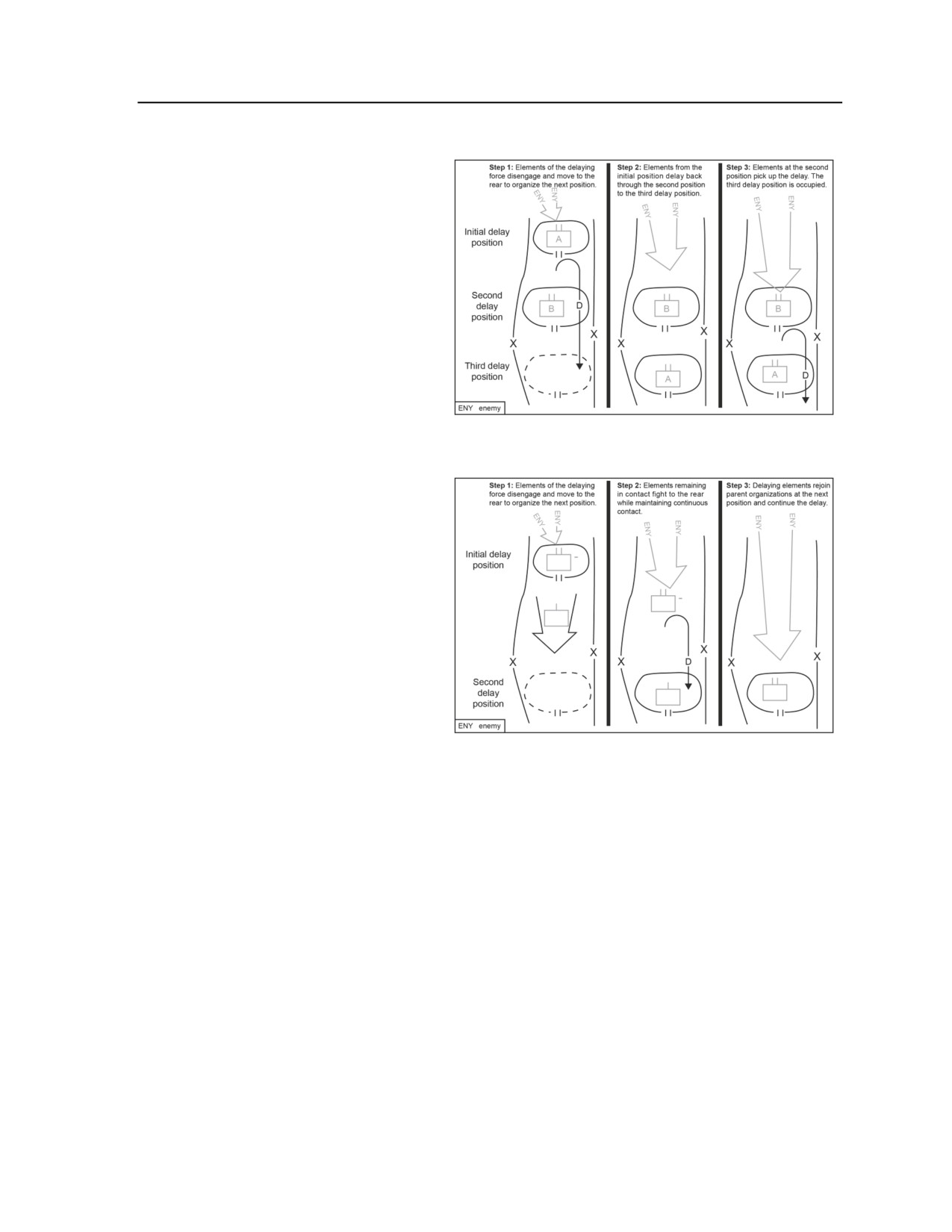
The Retrograde
EFFECTS OF TERRAIN
9-30. The commander always takes
advantage of the terrain when planning
how to position forces and conduct
operations. The commander selects terrain
that favors friendly actions and hampers
enemy actions. The terrain dictates where
a delaying force can orient on a moving
enemy force and ambush it. During a
delay,
compartmentalized
terrain
facilitates shorter displacements initiated
at closer range to the enemy. The
commander conducting operations in
compartmentalized
terrain
selects
locations that restrict the enemy’s
movement and prevent the enemy force
from fully exploiting its combat
Figure 9-4. Delay from alternate positions
superiority. On the other hand, flat or
open terrain requires earlier displacements
at greater distances to stay in front of the
advancing enemy. In open terrain, the
most important consideration in selecting
a position is a good, long-range field of
fire. A field of fire is the area that a
weapon or group of weapons may cover
effectively from a given position.
9-31. In restricted terrain, where a light
force conducts the primary action,
positions may be close together, except
when conducting a delay using air assault
techniques. In open terrain, delay
positions are often far apart. In selecting
positions, the commander considers
natural
and
artificial
obstacles,
Figure 9-5. Delay from subsequent positions
particularly when the enemy has
numerous armored combat systems.
9-32. The commander identifies routes that reinforcements, artillery units, command posts (CPs), and
sustainment elements will use and keeps them under the commander’s control and free of obstacles.
Alternate routes should be available, so that a friendly force can bypass choke points if they are closed or
contaminated.
9-33. Disengaging from the enemy while displacing from one position to the next is difficult. The unit’s
disengagement plans include the following:
z
The maneuver concept of operations for tactical elements after disengagement, which includes
the movement routes for each small unit.
z
Fires to suppress the enemy and cover the unit’s movement.
z
Electronic warfare activities to disrupt enemy command and control (C2) at critical moments.
z
Screening smoke to conceal the unit’s movement, conduct a military deception operation, or
cover passage points.
z
Contact and passage points if moving through friendly lines.
z
Disengagement start times.
22 March 2013
FM 3-90-1
9-7
Chapter 9
z
The earliest time for functional and multifunctional support and sustainment elements to move.
z
Designating units responsible for closing lanes through obstacles and executing reserve
obstacles.
MOVEMENT AND MANEUVER
9-34. A delay is one of the most difficult defensive tasks to execute. The primary reason is that the
delaying force must engage the enemy sufficiently to slow the attacking enemy force’s movement, yet not
become decisively engaged. Also, the delaying unit must maintain continuous coordination with any flank
units as it displaces rearward.
9-35. There are many similarities in the tactics and techniques of a mobile defense and a delay. However,
units conducting a delay normally do not become decisively engaged except to prevent the enemy from
prematurely crossing a delay line or to risk a part of the force to prevent the whole delaying force from
being jeopardized.
9-36. Armored and Stryker-equipped forces—equipped with tanks, Bradley fighting vehicles, and various
Stryker variants supported by indirect fires—are highly suitable for delay operations in most terrain. Their
organic firepower allows them to engage the enemy effectively at long ranges, and their mobility allows
them to move quickly between successive positions or to a flank. Their combat vehicles provide protection
that simplifies battlefield movement. These same characteristics also allow armored and Stryker-equipped
reserve forces to rapidly launch counterattacks to extract delaying forces from untenable situations.
9-37. Infantry forces are especially suited to conduct delays in broken, close, and built-up terrain. They
take advantage of such terrain, reinforced by the extensive use of situational obstacles, to hinder the
mobility of enemy combat systems and supporting tactical vehicles. They can also participate in
stay-behind operations. (See paragraphs 9-117 through 9-121.) This type of terrain offers cover for the
movement of friendly light infantry forces and favors using ambushes against the enemy. Because of the
restrictions on organic motorized transportation assets and the limited protection available to light infantry
units, the commander must specifically plan for their displacement. While all light infantry forces can move
rapidly by air by assault, cargo helicopter, or tilt-wing aircraft, a delay offers little opportunity for airborne
forces to use their unique capability.
9-38. The commander may employ air assault forces in a manner similar to that of other light infantry
units in a delay. However, they possess additional useful capabilities in a delay operation. Because of
typically habitual teaming with helicopter units, they can rapidly deploy, redeploy, and disperse in open
terrain if the weather is suitable and the necessary landing and pickup zones exist. The combination of light
infantry, attack and assault helicopters, and fire support systems found in air assault units allows the
delaying commander to rapidly concentrate combat power at key locations to attrit the enemy through
repeated ambushes. The combined arms nature of air assault units also makes them extremely useful for
conducting security and reserve operations over large geographical areas against heavy and light enemy
forces. However, their extraction is a high-risk activity when pressured by a heavy enemy or in the
presence of a significant air defense threat.
9-39. The mobility, lethality, and long range of Army attack helicopter and joint fixed-wing aviation
firepower make these assets invaluable to a force conducting a delay. The commander can also use them to
conduct counterattacks and spoiling attacks as part of a combined arms team. Other uses of Army aviation
in a delay include the rapid rearward movement of sustainment assets, the deployment of light infantry
forces, and reconnaissance.
9-40. Normally, countermobility is the most important engineer task, unless the delaying force must cross
one or more major obstacles, in which case the major engineer task is mobility, specifically breach
operations. The commander must set realistic and specific priorities for the engineer effort. The commander
monitors its progress to prevent it from dissipating countermobility efforts throughout the area. The
commander employs engineers in depth. This is crucial when the commander conducts noncontiguous
operations or when the enemy attacks deep into the support area of a force conducting contiguous
operations, or when the enemy has the ability to employ weapons of mass destruction. The maneuver
element provides security for the engineers, so that they can concentrate their efforts on engineer tasks.
9-8
FM 3-90-1
22 March 2013
The Retrograde
9-41. Because of the importance of mobility and countermobility tasks, a unit conducting a delay probably
has few engineer assets to devote to the survivability function. Units should maximize the use of smoke
when and where weather conditions allow to provide concealment for movement and assembly. Smoke
curtains, blankets, and haze may protect withdrawing columns, critical points, and routes. The commander
takes precautions to ensure that the smoke does not provide a screen for the enemy’s advance. (See
FM 3-11.50.)
INTELLIGENCE
9-42. When conducting a delay operation, the commander may not get the most effective use of supporting
intelligence assets. The commander echelons organic and supporting reconnaissance and surveillance
systems rearward to maintain at least partial coverage of the AO during the delay. This increases the need
to ensure the effective management of collection assets. However, the commander must rely on a
downward flow of intelligence from higher echelons and combat information, such as unmanned aircraft
systems and joint surveillance target attack radar system data, to make up for the degradation in collection
capabilities that occurs when systems displace.
9-43. Initially, intelligence assets attempt to determine if the enemy recognizes the delay. Subsequently,
they focus on how the enemy reacts to the delay. Intelligence analysis attempts to predict enemy course of
action and surveillance, and reconnaissance systems monitor enemy attempts to envelop the flanks or strike
the rear of the rearward-moving friendly force. They also focus on actions of any enemy airborne, air
assault, and attack aviation units that may try to interdict the movement of the friendly force. The delaying
commander must detect the enemy’s advance early to adjust the scheme of maneuver and concentrate
sufficient combat power to effectively delay the enemy.
MISSION COMMAND
9-44. Centralized planning and decentralized execution characterize mission command in a delay
operation. Communications are essential to the success of this type of operation, and the commander builds
redundancy into the communications architecture. Digital information systems help ensure that redundancy
by providing a common operating picture and a distributed database. This allows one CP to temporarily
assume the duties of another CP if the latter is destroyed.
9-45. The echelon main CP is normally the first CP within an echelon to displace during a delay, leaving
the tactical CP to control the delay, until it can be reestablished in a secure location. The main CP may
displace by echelon, leaving a residual mission command capability in the original location.
PREPARE
9-46. The defensive preparations outlined in chapter 6 also apply when conducting a delay. Resources—
including the time available—determine the extent of preparations. The commander assigns a high priority
to reconnaissance. Additionally, the preparation of subsequent positions receives a higher priority than it
does in either a mobile or an area defense. It is not always possible to complete all preparations before
starting the delay operation. Consequently, delaying units continue to prepare and adapt plans as the
situation develops.
9-47. In the delay, the commander uses BPs in a manner similar to the defense. However, when organizing
BPs, the commander places more emphasis on width than depth, as well as reconnaissance and preparing
routes for displacing. Within each BP, most of the available firepower is oriented toward the expected
enemy avenue of approach. However, the commander must provide adequate flank and rear security, since
the delaying unit must furnish its own security. Each crew and squad learns the routes from its primary
positions to alternate, supplementary, and sequential positions. In preparing a BP, a commander conducting
a delay places less emphasis on installing protective obstacles, final protective fires
(FPFs), and
ammunition stockpiling than would occur in either an area or a mobile defense. BPs are sometimes referred
to as delay positions during the conduct of a delay.
22 March 2013
FM 3-90-1
9-9
Chapter 9
EXECUTE
9-48. The complex nature of a delay requires the subordinate elements of a delaying force to execute
different, yet complementary, actions. In a single delaying operation, attacks, area defenses, mobile
defenses, and other actions may occur in any sequence or simultaneously. For example, the commander
may elect to assign one delaying element the task of holding a key road intersection for a period of time, so
a reserve force can strike the enemy’s flank. Therefore, the enemy must deploy into a hasty defense, which
delays any further enemy attacks.
9-49. The commander deploys the security force well forward of the initial delay position to give early
warning of any enemy approach. When the security force detects and reports an approach, the commander
reconciles these reports against decision support and event templates to confirm the enemy’s probable
course of action. Based on an analysis of ongoing events and a projection of how the battle will unfold, the
commander can direct one subordinate element to maneuver in a manner designed to draw the advancing
enemy into a position of disadvantage.
9-50. The security force fixes, defeats, and destroys the enemy’s reconnaissance and security elements
without risking decisive engagement. It directs fires at the approaching enemy force as far forward of the
delay positions as possible. Engaging a moving enemy at long ranges tends to inflict far more casualties on
an attacking enemy than the enemy can inflict on the delaying force; it also slows the enemy force’s tempo
of operations. The more a delaying force can blind an enemy force through the elimination of that force’s
reconnaissance assets, the more likely the enemy force is to hesitate and move with caution.
9-51. Once the security force makes contact with the enemy, it maintains contact. As the enemy
approaches, it moves by bounds back to the flanks of the defending units, keeping the enemy under
constant observation. This prevents the enemy from finding gaps between delaying units and attacking the
exposed flanks of delaying units. The security force uses covered, concealed, and coordinated routes to
avoid enemy and friendly fires.
9-52. Recovering security assets may be more difficult, if the security force needs to pass through the
range fan of friendly tanks and other direct-fire weapons in its movement. Recovery should be to the flanks
of delay positions and not through friendly EAs and TRPs, unless the tactical situation makes such
movement absolutely necessary. Security forces move so that they do not reveal the locations of other
friendly elements.
9-53. The main body uses a variety of tactics to execute the delay. These include ambushes,
counterattacks, spoiling attacks, artillery raids, jamming, and close air support. The commander of the
delay force preserves the force’s freedom to maneuver by engaging the enemy with sufficient force to
temporarily stop its advance. The delay force uses obstacles and defensive positions in depth to slow and
canalize the enemy and exploit the mobility of its combat systems to confuse and defeat the enemy. Once a
delay starts, units displace rapidly between positions. Whenever possible, the commander grasps any
fleeting opportunity to seize the initiative, even if only temporarily. By aggressively contesting the enemy’s
initiative through offensive action, the delaying force avoids passive patterns that favor the attacking
enemy. The delaying force may conduct strong counterattacks from unexpected directions to temporarily
confuse the enemy commander. Attacking an enemy throws the enemy off stride, disorganizes the enemy
force, confuses the enemy commander’s picture of the fight, and helps prolong the delay. In turn, this
confusion may affect the enemy’s tempo and momentum. It also affects the movement of enemy reserves
and other follow-on forces. However, the delaying force seeks to avoid decisive engagement.
9-54. In a delay, the commander uses fire support assets to delay enemy forces, inflict casualties on them,
and assist the friendly force in gaining a mobility advantage over them. Indirect fires continue throughout
the delay. The commander’s fire support assets can disrupt the enemy’s follow-on forces and restrict the
immediate battle to the enemy’s committed forces. Air interdiction using kill boxes, close air support, and
attack helicopters can engage enemy forces before they come within range of the supporting field artillery
systems. The commander should weigh the effects required, however, since rotary-wing attack aviation is a
limited resource and close air support (CAS) aircraft are a fleeting resource. The commander’s objective is
the massing of fires, to include the killing power of the unit in contact. However, this should not delay
integration of CAS aircraft, given limited loiter times.
9-10
FM 3-90-1
22 March 2013
The Retrograde
9-55. Artillery and mortar systems support the direct-fire fight to prevent the enemy from conducting a
combined arms attack on the delay position. As the advancing enemy force encounters each obstacle,
friendly fire support systems engage it. These fires should cause enemy armored forces to button up and
slow down. Artillery and mortar systems use fires to separate enemy formations by striking the enemy
force when it concentrates near choke points and in EAs. Integrating fires and obstacles makes it difficult
for the enemy to traverse EAs. The delaying force breaks the enemy’s momentum by forcing deployment
and by inflicting casualties. Fires assist delaying forces by—
z
Assisting in disengaging maneuver forces.
z
Suppressing the enemy.
z
Degrading the enemy’s ability to move and communicate.
z
Obscuring the enemy’s overwatching support by fire positions and degrading enemy intelligence
and target acquisition systems.
z
Reinforcing or closing breaches or lanes in obstacles.
z
Executing FPFs.
z
Screening friendly displacements and disengagements by using smoke. (This also degrades the
enemy’s terminal guidance of precision-guided munitions.)
z
Destroying high-payoff targets.
z
Supporting limited counterattacks.
9-56. As the advancing enemy force approaches the delay position, it crosses one or more trigger lines and
moves into EAs within the range of the delaying force’s anti-armor missiles, tank cannons, and small arms.
The commander holds the delaying force’s direct fire, until the enemy is positioned where the fire plan and
scheme of maneuver require their use. The commander controls these fires from the delaying force in the
same manner as in any defense. The more damage the delaying force can inflict on the enemy, the longer it
can stay in position.
9-57. As the enemy force presses its attack and maneuvers against the delaying force, the commander
constantly assesses the action to guide the displacements of the delay force to anticipate possible decisive
engagement while accomplishing its mission. When the enemy commander begins to think that the enemy
force is successfully maneuvering against a friendly position, the enemy force is engaged by indirect fires
while the delaying force disappears behind a cloud of smoke, dust, and exploding munitions. Intense FPFs
and fires aimed at and behind recently evacuated friendly delay positions allow the delaying force to
disengage from an attacking enemy.
9-58. Division and brigade commanders generally decentralize execution of a delay to battalion and lower
levels. Those senior commanders must rely on their subordinates to execute the mission and request help
when needed. The commander establishes the acceptable risk and displacement criteria. Subordinates
displace once they meet the previously established delay criteria. This displacement may be a preplanned
event or time dependent. The senior commander monitors the delay and intervenes when the displacement
of one unit threatens the survival of another.
9-59. The delaying force relies heavily on artillery fires and air support to suppress the enemy, so the force
can disengage, move, and occupy new positions. If a subordinate element cannot maintain separation from
the enemy, the commander can shift additional combat multipliers and other resources to that particular AO
to counter the enemy’s success. As one subordinate element displaces, the delaying commander may order
other subordinate elements to change their orientation to cover the move. Each displacing element travels
along its designated route, using demolitions as required and requesting additional fire support if the enemy
is able to maintain contact.
9-60. Passing through obstacle lanes during displacement between positions poses significant risks to the
delaying force. The unit passing through a linear obstacle becomes more vulnerable to enemy attack
because of the danger of the delaying force becoming congested on the far side of the obstacle. Obstacle
lanes also increase the time required for a passing unit to transit through an area. The commander prevents
the enemy from engaging the passing unit until it can redeploy into a tactical formation.
9-61. The commander retains the reserve for the decisive moment. As with aviation, the reserve should not
be committed early in the delay unless its integrity is threatened. Typically, the commander commits the
22 March 2013
FM 3-90-1
9-11
Chapter 9
reserve to help a unit disengage and regain its ability to maneuver or to prevent the enemy from exploiting
an advantage. The reserve normally uses a support by fire position for this task. If the commander commits
the reserve too early, the commander’s ability to influence the battle is greatly reduced unless the
commander can reconstitute a new reserve. It is possible to commit the reserve several times throughout the
battle, but only when it can be extracted, re-designated, or otherwise reconstituted quickly.
9-62. In the delay, the commander locates the force’s sustainment elements outside of enemy artillery
range but close enough to provide adequate support. Artillery ammunition stocks must be capable of
sustaining the quantity of fire support required in the delay. Maintenance operations focus on evacuating
rather than returning damaged vehicles to combat. Unless vehicles can be fixed quickly on the spot, the unit
should evacuate them to the echelon support area because vehicles left behind must be destroyed to prevent
their capture.
TERMINATION OF A DELAY
9-63. A delay operation terminates when the delaying force conducts a rearward passage of lines through a
defending force, the delaying force reaches defensible terrain and transitions to the defense, the advancing
enemy force reaches a culminating point, or the delaying force goes on the offense after being reinforced. If
the advancing enemy force reaches a culmination point, the delaying force may maintain contact in current
positions, withdraw to perform another mission, or transition to the offense. In all cases, the senior
commander must plan for the expected outcome of the delay. If the commander expects a friendly
counterattack, the commander plans for the forward passage of the counterattack force, conserves resources
to ensure relative combat superiority, and provides for the smooth handover of appropriate AOs.
WITHDRAWAL
9-64. Joint doctrine defines a withdrawal operation as a planned retrograde operation in which a force in
contact disengages from an enemy force and moves in a direction away from the enemy (JP 1-02). The
commander may or may not conduct a withdrawal under enemy pressure. Subordinate units may withdraw
without the entire force withdrawing. A unit conducts a withdrawal for a variety of reasons, which are
listed at the beginning of this chapter. In addition, a withdrawal may precede a retirement operation.
9-65. Although the commander avoids withdrawing from action under enemy pressure, this is not always
possible. The commander may conduct a withdrawal when the situation requires rapid action to save the
command from disaster. This usually occurs after a tactical reverse or after a unit reaches its culminating
point. When an aggressive enemy becomes aware of a friendly force’s withdrawal or its intention to
withdraw, the attacking enemy commander attempts to exploit the withdrawal, using all available
capabilities to try to turn the friendly force’s withdrawal into a rout. The attacking enemy may have ground
and air superiority and continuously attempt to pursue, encircle, and destroy the withdrawing force. The
attacking enemy commander will try to use a combination of direct pressure and enveloping forces and
fires to isolate the withdrawing friendly force for later destruction.
9-66. Withdrawals are inherently dangerous because they involve moving units to the rear and away from
what is usually a stronger enemy force. The heavier the previous fighting and the closer the contact with the
enemy, the more difficult the withdrawal. Operations security (OPSEC) is extremely important. A unit
usually confines its rearward movement to times and conditions when the advancing enemy force cannot
observe the activity, so that the enemy cannot easily detect the operation. To help preserve secrecy and
freedom of action, for example, the commander must consider visibility conditions and times when enemy
reconnaissance satellites can observe friendly movements. Operations security is especially critical during
the initial stages of a delay when most of the functional and multifunctional support and sustainment
elements displace.
9-67. A unit withdraws to an assembly area or a new defensive position. Alternatively, it can withdraw
indirectly to either area through one or more intermediate positions. When preparing the new position, the
commander balances the need for security with the need to get an early start on the defensive effort.
9-12
FM 3-90-1
22 March 2013
The Retrograde
ORGANIZATION OF FORCES FOR A WITHDRAWAL
9-68. The commander typically organizes the withdrawing unit into a security force, a main body, and a
reserve. The commander also organizes a detachment left in contact (DLIC) and stay-behind forces if the
scheme of maneuver requires them. Commanders avoid changing task organization unless subordinates
have sufficient planning time. However, circumstances may dictate rapid task organization changes
immediately before the withdrawal, such as when the unit must conduct an immediate withdrawal to
prevent encirclement.
9-69. The security force maintains contact with the enemy until ordered to disengage or until another force
takes over. It simulates the continued presence of the main body, which requires additional allocation of
combat multipliers beyond those normally allocated to a force of its size. The greater its mobility and range
advantages over the enemy, the easier for the security force to successfully cover the main body’s
withdrawal. The commander organizes the majority of available combat power to the security force as a
rear guard or a rear-covering force; the most probable threat to a withdrawing force is a pursuing enemy.
However, the commander must maintain all-around security of the withdrawing force. When the enemy can
infiltrate or insert forces ahead of the withdrawing force, the commander may establish an advance guard to
clear the route or AO. The commander designates a flank guard or screen, as the situation requires.
9-70. When a security zone exists between the two main opposing forces, the existing security force can
transition on order to a rear guard or rear-covering force. It then conducts delay operations until the
commander orders it to disengage and break contact with the enemy. When the withdrawing force is in
close contact with the enemy, a security zone does not normally exist. Withdrawals under these conditions
require that security forces adopt different techniques. One technique is to establish a DLIC to provide a
way to sequentially break contact with the enemy.
9-71. A detachment left in contact is an element left in contact as part of the previously designated
(usually rear) security force while the main body conducts its withdrawal. Its primary purpose is to
remain behind to deceive the enemy into believing the parent unit is still in position while most of the unit
withdraws. It simulates—as nearly as possible—the continued presence of the main body until it is too late
for the enemy to react by conducting activities such as electronic transmissions or attacks. The DLIC must
have specific instructions about what to do when the enemy attacks and when and under what
circumstances to delay or withdraw. If the DLIC must disengage from the enemy, it uses the same
techniques as in the delay. If required, the commander provides this detachment additional recovery,
evacuation, and transportation assets to use after disengagement to speed its rearward movement.
9-72. Two methods exist to resource the DLIC. The first is for each major subordinate element of the
withdrawing force to leave a sub-element in place. For example, in a BCT withdrawal, each maneuver
battalion leaves a task- organized company team in contact. Typically, these teams fall under a senior DLIC
commander designated by the BCT commander. Alternatively, one major subordinate command of the
withdrawing force can stay behind as the DLIC. For example, in figure 9-6 on page 9-14 a BCT with three
maneuver battalions leaves one task-organized battalion as the DLIC, which then expands its security
responsibilities to cover the width of the BCT’s AO.
9-73. Often, when a DLIC is used, the commander creates an additional security force behind the existing
main defensive positions to assist in the withdrawal process. The commander can create an additional force
from the withdrawing unit or from an assisting unit. The DLIC can delay to this additional security force
and join it, or delay back, conduct battle handover, and then conduct a rearward passage of lines. In either
case, the additional security force becomes the rear guard.
9-74. The main body of the withdrawing force consists of all elements remaining after the commander
resources a security force and the reserve. The commander in a withdrawal generally finds it difficult to
resource a reserve, but makes every attempt to do so. When the complete formation withdraws under
pressure, the reserve may take limited offensive action, such as spoiling attacks, to disorganize, disrupt, and
delay the enemy. It can counter penetrations between positions, reinforce threatened areas, and protect
withdrawal routes. Reserves may also extricate encircled or heavily engaged forces.
22 March 2013
FM 3-90-1
9-13
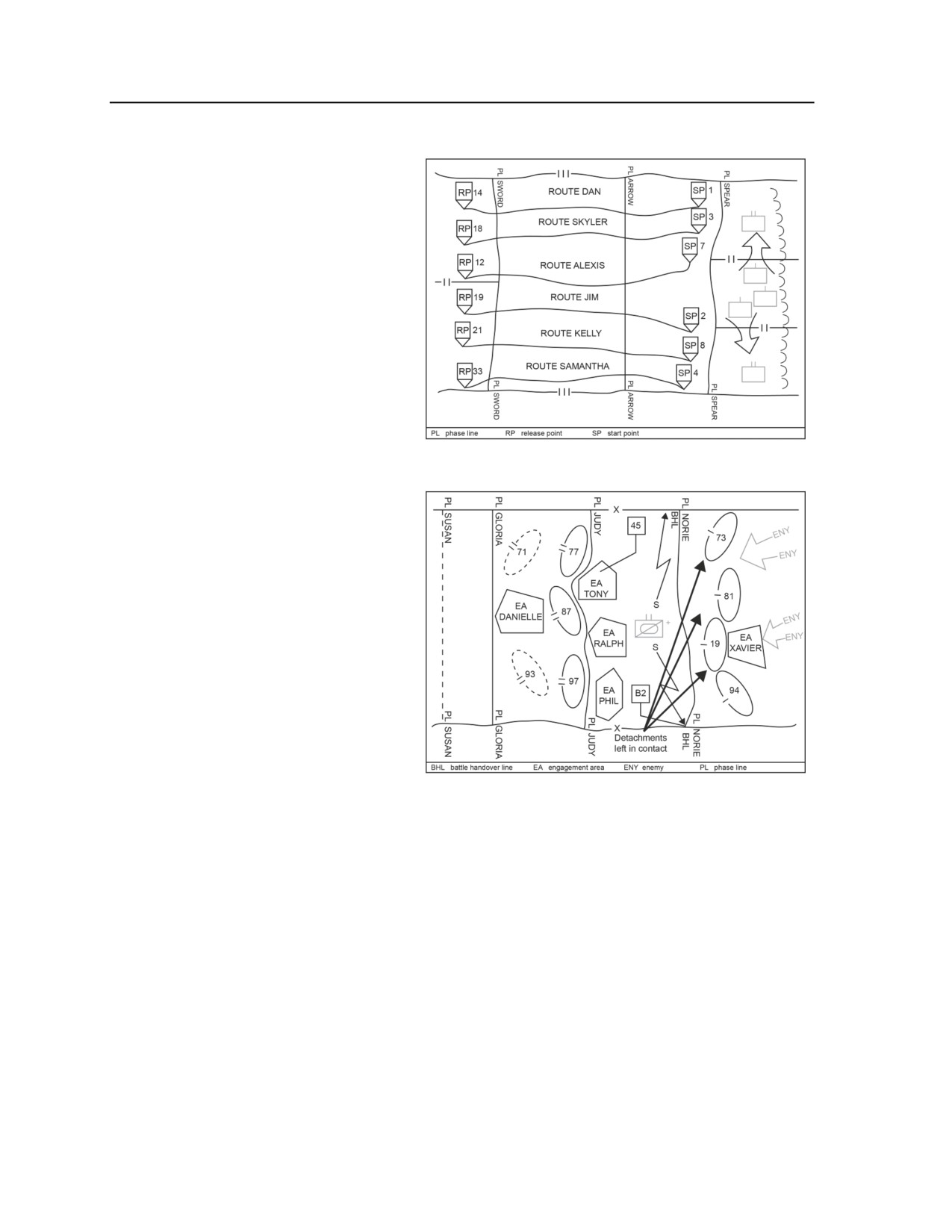
Chapter 9
CONTROL MEASURES
9-75. Withdrawing forces must apply
combat power to protect themselves while
simultaneously moving combat power
away from the enemy. This requires
careful coordination among all forces.
Throughout the operation, the commander
must tightly control rearward movement
and maintain the ability to concentrate
decisive combat power at key times and
places. As shown in figure 9-7, the control
measures used in the withdrawal are the
same as those in a delay or a defense. The
routes used by each unit in the withdrawal
and the block movement times are also
withdrawal control measures.
PLANNING A WITHDRAWAL
Figure 9-6. Detachment left in contact
9-76. The commander plans and
coordinates a withdrawal in the same
manner as a delay. Some mission
variables of METT-TC apply differently
because of the differences between a
delay and a withdrawal. A withdrawal
always begins under the threat of enemy
interference. Because the force is most
vulnerable if the enemy attacks, the
commander always plans for a withdrawal
under pressure. The commander then
develops contingencies for a withdrawal
without pressure. In both cases, the
commander’s main considerations are
to—
z
Plan a deliberate break from
the enemy.
Figure 9-7. Withdrawal control measures
z
Displace the main body
rapidly,
free
of
enemy
interference.
z
Safeguard the withdrawal routes.
z
Retain sufficient maneuver and
functional and multifunctional support and sustainment
capabilities throughout the operation to support forces in contact with the enemy.
9-77. A withdrawal may be assisted or unassisted. It may or may not take place under enemy pressure.
These two factors combined produce the four variations shown in figure 9-8. That figure also depicts the
tactical mission graphic for a withdrawal and a withdrawal under enemy pressure. The withdrawal plan
considers which variation the force currently faces. Each variation requires a different blend of the three
retrograde options.
9-78. A commander prefers to conduct a withdrawal while not under pressure and without assistance.
Actions by the enemy, as well as the additional coordination needed because of the presence of an assisting
unit, complicate the operation.
9-79. A withdrawing force can receive assistance from another force in the form of—
9-14
FM 3-90-1
22 March 2013
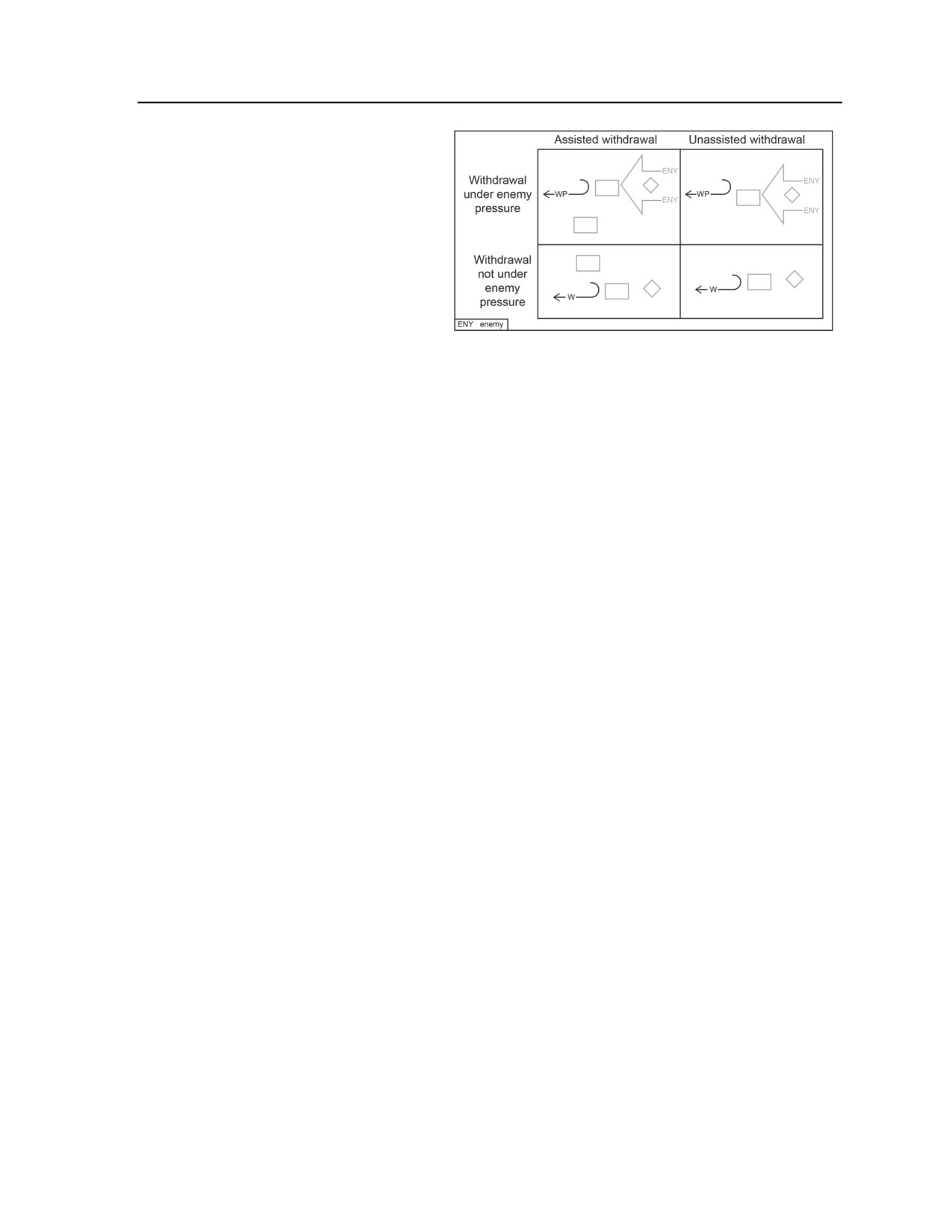
The Retrograde
z
Additional security for the area
through which the withdrawing
force will pass.
z
Information
concerning
withdrawal routes.
z
Forces to secure choke points
or key terrain along withdrawal
routes.
z
Elements to assist in movement
control, such as traffic control
points.
z
Required
maneuver
and
Figure 9-8. Types of withdrawal
functional and multifunctional
support and sustainment, which can involve conducting a counterattack to assist the withdrawing
unit in disengaging from the enemy.
9-80. In a withdrawal under enemy pressure, all units withdraw simultaneously when available routes
allow, using delaying tactics to fight their way to the rear. In the usual case, when simultaneous withdrawal
of all forces is not practical, the commander decides the order of withdrawal. Several factors influence this
decision:
z
Subsequent missions.
z
Availability of transportation assets and routes.
z
Disposition of friendly and enemy forces.
z
Level and nature of enemy pressure.
z
Degree of urgency associated with the withdrawal.
The commander must make three interrelated key decisions: when to start the movement of selected
functional and multifunctional support and sustainment elements, when forward elements should start
thinning out, and when the security force should start its disengagement operations. The commander avoids
premature actions that lead the enemy to believe a withdrawal is being contemplated. Commanders must
anticipate enemy means of interference and plan for employing security forces, attack helicopters
conducting close combat attack, and close air support.
9-81. The commander conducting a withdrawal without enemy pressure can plan when to begin the
withdrawal. The commander has the option of taking prudent risks to increase the displacement capabilities
of the withdrawing force. For example, the main body may be ordered to conduct a tactical road march
instead of moving in tactical formations. The commander can plan for stay-behind forces as part of the
operation. (The stay-behind discussion starts on page 9-21.)
PREPARING A WITHDRAWAL
9-82. Before withdrawing, the main body dispatches quartering parties to help it occupy the new position.
(FM 3-90-2 details the responsibilities of a quartering party.)
9-83. In an unassisted withdrawal, the withdrawing unit establishes its own security force and reserve. It
reconnoiters and secures the routes it will use in its rearward movement while sustaining itself during the
withdrawal. The withdrawing unit must disengage from the enemy.
9-84. By concealing supplies along movement routes, sustainment operators can simplify support
requirements and reduce the enemy’s ability to interfere with logistics operations. This allows sustainment
units to withdraw earlier than they otherwise could. The commander carefully considers whether to place
supplies in caches. Once cached, supplies are difficult to recover if the operation does not go as planned.
Other than medical items, the withdrawing unit evacuates or destroys all supplies that it is unable to
evacuate to prevent their capture. The commander establishes destruction criteria, which is time- or
event-driven, for each class of supply.
22 March 2013
FM 3-90-1
9-15