FM 3-90-1 Offense and Defense (Volume 1, March 2013) - page 7
Appendix B
z
The maneuver concept of operations for tactical elements after disengagement, along with the
movement routes for each subordinate unit.
z
Fires to suppress the enemy and cover the unit’s movement.
z
Screening smoke to conceal the unit’s movement, as part of a military deception operation, or to
cover passage points.
z
Contact and passage points if moving through friendly lines. (See FM 3-90-2.)
z
The time disengagement starts.
z
The earliest time that functional and multifunctional support and sustainment elements move.
B-21. The senior headquarters conducts operations to support the disengaging forces and relieve pressure
on units in contact with the enemy. For example, if a division is conducting a delay, the division
commander uses attached aviation assets to help a brigade combat team (BCT) disengage from the close
fight. Simultaneously, the division uses its long-range artillery, rocket, and electronic warfare
(EW)
systems to destroy or disrupt enemy follow-on echelons to prevent them from interfering with the
disengagement. The intent is to create conditions that allow the unit to disengage while avoiding decisive
combat.
B-22. To facilitate disengagement, the commander suppresses the enemy in contact by bombarding the enemy
force with large volumes of both direct and indirect fires provided by forces other than the disengaging unit. In open
terrain, the unit generally moves its short-range systems first. In close terrain, it generally moves its long-range
systems first to support by fire positions. The time involved to move a system to its next position also affects when
that system moves. Small-unit leaders usually direct this movement because of the limited range of combat net
radios and the fact that the tactical situation varies across a unit’s front. The process repeats as necessary. Once
disengagement starts, units must complete it rapidly. The commander can employ supporting units or reserves to
protect the disengaging unit’s flanks and assist in freeing any closely engaged elements. The unit then moves to its
next position using the appropriate movement techniques. (See FM 3-90-2.)
B-23. If enemy combat systems have not closed within direct-fire range of the friendly disengaging unit, all
its elements may be able to move simultaneously under the cover of intense fires and smoke. Speed of
execution and continued coordination are essential to the success of this task.
EXFILTRATE
B-24. Exfiltrate is a tactical mission task where a commander removes Soldiers or units from areas
under enemy control by stealth, deception, surprise, or clandestine means. Friendly forces exfiltrate
when they have been encircled by enemy forces and cannot conduct a breakout or be relieved by other
friendly forces. Forces returning from a raid, an infiltration, or a patrol behind enemy lines can also conduct
an exfiltration. The commander exfiltrates an encircled force to preserve a portion of the force; it is
preferable to the capture of the entire force. A force exfiltrates only after destroying or incapacitating all
equipment, except medical, that it must leave behind. Only as a last resort, when the alternative is the
capture of the entire force, does a force conducting an exfiltration leave its casualties in place with supplies,
chaplain support, and medical personnel.
B-25. Exfiltration is most feasible through rough or difficult terrain in areas lightly covered by enemy
observation and fire. These conditions often allow undetected movement of small elements, when
movement of the entire force would present more risk. Exfiltration requires resourcefulness, a high degree
of discipline, expert land navigation skills, and motivation. It is unlikely that the entire force will be able to
exfiltrate, since part of it may have to create a diversion. Good, small-unit leadership is essential in this
type of operation.
B-26. The exfiltrating force first establishes its rally points and exfiltration lanes. It coordinates its linkup
plans with other friendly units. The commander designates exfiltration lanes as restrictive fire areas (RFAs)
or no-fire areas (NFAs). The exfiltrating force uses preparatory fires to cover its movement and to expend
stockpiled ammunition. Based on reconnaissance and available intelligence, the exfiltrating force
subdivides into small groups and exfiltrates during periods of limited visibility, passing through or around
enemy defensive positions. If detected, it tries to bypass the enemy. Exfiltration may be more difficult with
B-6
FM 3-90-1
22 March 2013
Tactical Mission Tasks
combat and tactical vehicles because the noise they make and the limitations they impose on exfiltration
routes make detection more likely.
FOLLOW AND ASSUME
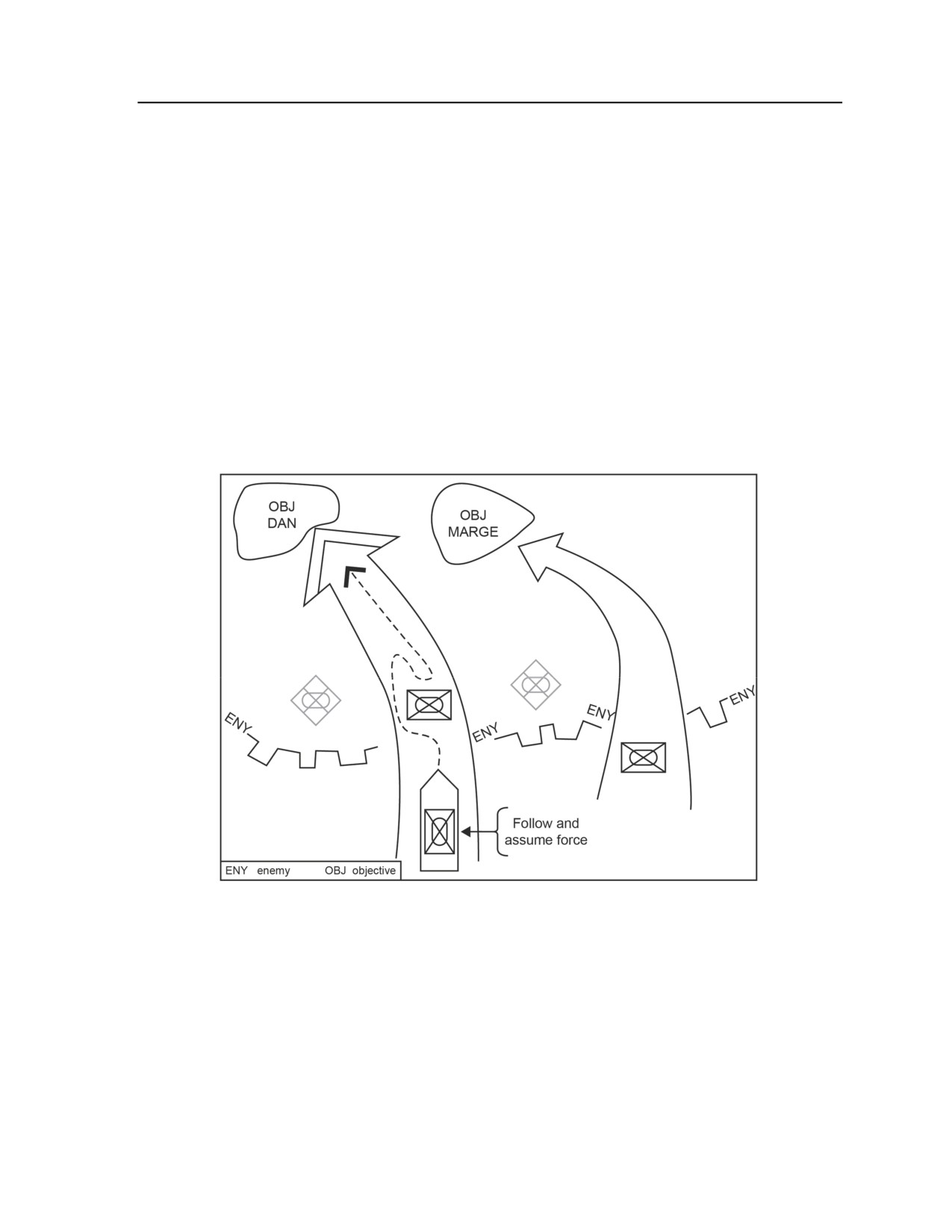
B-27. Follow and assume is a tactical mission task in which a second committed force follows a force
conducting an offensive task and is prepared to continue the mission if the lead force is fixed,
attrited, or unable to continue. The follow-and-assume force is not a reserve but is committed to
accomplish specific tasks. Figure B-6 shows the tactical mission graphic for follow and assume. The
commander places the box part of the graphic around the symbol of the unit being assigned this task.
B-28. Tasks for a follow-and-assume force include—
z
Preparing to execute all missions of the followed unit.
z
Maintaining contact with the trail elements of the leading force.
z
Preparing to conduct a forward passage of lines through the force it is following.
z
Monitoring all combat information and intelligence being provided to and from the force it is
following.
z
Avoiding engaging enemy forces bypassed by the force it is following.
Figure B-6. Follow and assume tactical mission graphic
B-29. A commander assigns a follow-and-assume mission to ensure that the attacking force maintains the
momentum of its offensive action. The follow-and-assume force ensures that it can immediately execute a
forward passage of lines and assume the mission of the lead force.
B-30. The commander assigning a unit the task of follow and assume has two options in establishing the
relationship between the lead and trail units. The commander normally retains command of both units and
requires that all requests for support from the supported unit to the supporting unit pass through the
commander’s headquarters. Alternatively, in situations where the commander will not be able to maintain
control over both units, the supporting unit is placed in a standard command relationship with the supported
unit, such as attached or operational control. An example of this occurs when both units are trying to
encircle a retrograding enemy force and the commander remains with the direct-pressure force.
22 March 2013
FM 3-90-1
B-7
Appendix B
FOLLOW AND SUPPORT
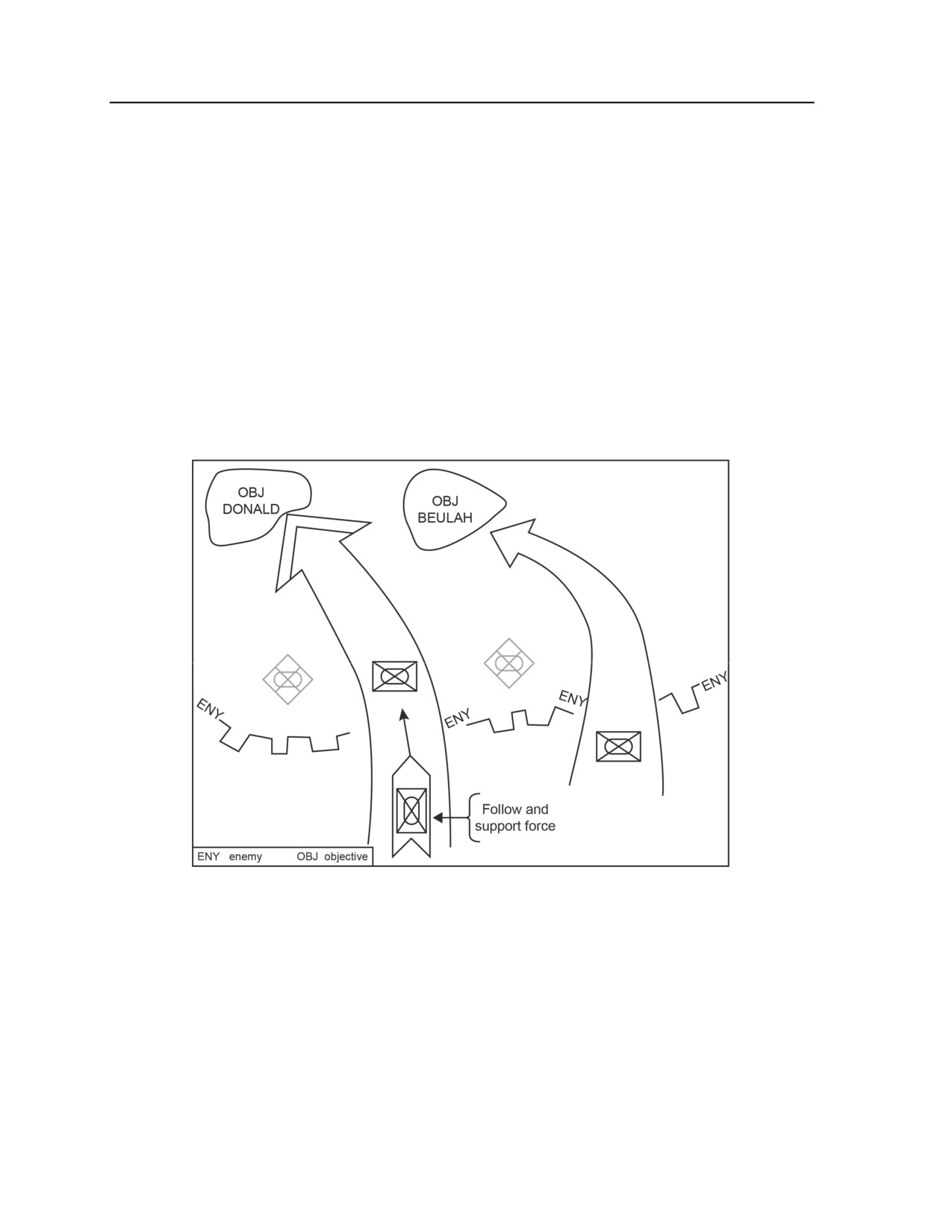
B-31. Follow and support is a tactical mission task in which a committed force follows and supports a
lead force conducting an offensive task. The follow-and-support force is not a reserve but is a force
committed to specific tasks. (Figure B-7 shows the tactical mission graphic for follow and support.) The
commander places the box part of the graphic around the symbol of the unit being assigned this task.
B-32. Tasks for a follow-and-support force include—
z
Destroying bypassed enemy units when the lead unit does not clear the AO as it advances.
z
Blocking movement of enemy reinforcements.
z
Relieving in place any direct-pressure or encircling force halted to contain the enemy.
z
Securing lines of communication.
z
Clearing obstacles.
z
Guarding prisoners, key areas, and installations.
z
Recovering friendly battle losses.
z
Securing key terrain.
z
Controlling dislocated civilians.
Figure B-7. Follow and support tactical mission graphic
B-33. A commander assigns a unit the task of follow and support to keep the supported force from having
to commit its combat power to tasks other than the decisive operation, which would slow the offensive
operation’s momentum and tempo. The follow-and-support force accomplishes its tasks to prevent the
enemy, obstacles, and other factors from interfering with offensive actions, especially along the lines of
communications.
B-34. The commander assigning the follow-and-support task has two options in establishing the
relationship between the supported and the supporting units. The commander can place the
follow-and-support unit in a standard command relationship with the supported unit, such as attached or
operational control. Alternatively, the commander can retain command of the follow-and-support force and
require that all tasking requests from the supported unit go through the commander’s headquarters.
B-8
FM 3-90-1
22 March 2013

Tactical Mission Tasks
OCCUPY
B-35. Occupy is a tactical mission task that involves moving a friendly force into
an area so that it can control that area. Both the force’s movement to and
occupation of the area occur without enemy opposition. A unit can control an area
without occupying it, but not vice versa. That is the difference between the tactical
mission tasks of occupy and control. (Figure B-8 shows the occupy tactical mission
graphic. The X on the tactical mission graphic has no significance, but the graphic
Figure B-8.
should encompass the entire area that the commander desires to occupy.) Units
typically occupy assembly areas, objectives, and defensive positions.
Occupy
tactical
mission
REDUCE
graphic
B-36. Reduce is a tactical mission task that involves the destruction of an encircled
or bypassed enemy force. There is no tactical mission graphic for this task. This task can occur at any
location on the battlefield. (FM 3-90-2 discusses the reduction of an encircled enemy.) Reduce is also a
mobility task that involves creating and marking sufficient lanes through, over, or around an obstacle to
negate its intended effect (ATTP 3-90.4).
RETAIN
B-37. Retain is a tactical mission task in which the commander ensures that a
terrain feature controlled by a friendly force remains free of enemy occupation or
use. The commander assigning this task specifies the area to retain and the duration of
the retention, which is time- or event-driven. While a unit is conducting this task, it
expects the enemy to attack and prepares to become decisively engaged. A unit tasked
to retain a specific piece of terrain does not necessary have to occupy it. (Figure B-9
shows the tactical mission graphic for retain. The direction of the arrow has no
Figure B-9.
significance, but the graphic includes the entire area the commander wants to retain.)
Retain tactical
mission
graphic
SECURE
B-38. Secure is a tactical mission task that involves preventing a unit, facility, or
geographical location from being damaged or destroyed as a result of enemy
action. This task normally involves conducting area security operations. (See FM 3-90
Volume 2.) A force given the mission of securing a unit, facility, or geographical
location, such as a route or base, not only prevents enemy forces from over-running or
occupying the secured location, but also prevents enemy direct fires and observed
Figure B-10.
indirect fires from impacting the secured location, unit, or facility. This is the primary
Secure tactical
difference between control and secure. The control tactical mission task allows enemy
mission
direct and indirect fires to affect the location being controlled. A unit does not have to
physically occupy the area immediately around the unit, facility, or geographical
graphic
location it is securing, if it can prevent the enemy from occupying or firing at that
location by other means. The commander states the mission duration in terms of time or event when
assigning a mission to secure a given unit, facility, or geographical location. (Figure B-10 shows the
tactical mission graphic for secure. The direction of the arrow has no significance, but the graphic includes
the entire area the commander wants to secure.)
22 March 2013
FM 3-90-1
B-9

Appendix B
SEIZE
B-39. Seize is a tactical mission task that involves taking possession of a designated area
by using overwhelming force. (Figure B-11 shows the tactical mission graphic for seize.) An
enemy force can no longer place direct fire on an objective that has been seized. The arrow
points to the location or objective to seize. This task differs from secure because it requires
offensive action to obtain control of the designated area or objective. It differs from the task of
Figure B-11.
occupy because it involves overcoming anticipated enemy opposition. Once a force seizes a
Seize tactical
physical objective, it clears the terrain within that objective by killing, capturing, or forcing the
mission
withdrawal of all enemy forces.
graphic
SUPPORT BY FIRE
B-40. Support by fire is a tactical mission task in which a maneuver force moves to a position where it can
engage the enemy by direct fire in support of another maneuvering force. The primary objective of the support
force is normally to fix and suppress the enemy so that the enemy cannot effectively fire on the maneuvering force.
The secondary objective is to destroy the enemy if the enemy tries to reposition. The commander specifies the
desired effect on the enemy when assigning this task.
B-41. A unit conducting the task of support by fire does not maneuver to capture enemy
forces or terrain. The commander gives this task to another unit as part of a larger maneuver.
When assigning a support by fire mission, the commander designates the enemy, when to
attack, the general location from which to operate, the friendly force to support, and the
purpose of the task, such as fix or suppress. (Figure B-12 shows the tactical mission graphic
Figure B-12.
for support by fire.) The ends of the arrows point in the general direction of the targeted unit or
Support by fire
location. The base of the area indicates the general area from which to deliver fires.
tactical
B-42. Once the commander gives an element the task of support by fire, it should occupy
mission
support by fire positions that have cover and concealment, good observation, and clear fields
graphic
of fire. Elements occupying support by fire positions should—
z
Check the security of the position.
z
Search for targets.
z
Orient weapons on likely or suspected enemy positions.
z
Assume fighting positions that provide some degree of protection. Armored and Stryker equipped forces
occupy hull-down firing positions, while infantry forces use trees, natural berms, buildings, and similar
existing terrain features.
z
Assign observation sectors to each Soldier or weapon system in the support by fire element.
z
Use available thermal sights to locate heat sources not visible to the naked eye, such as vehicles
concealed in tree lines or other wooded areas or personnel serving at observation posts (OPs).
B-43. Support by fire closely resembles the task of attack by fire. The difference is that support by fire supports
another force so that it can maneuver against the enemy, while an attack by fire does not support the maneuver of
another friendly force.
EFFECTS ON ENEMY FORCE
B-44. The following tactical mission tasks address effects on enemy forces. They
are the what or why of a mission statement. Most of these effects have associated
tactical mission graphics that are used in course of action development and
sketches as part of the military decisionmaking process.
BLOCK
Figure B-13. Block
B-45. Block is a tactical mission task that denies the enemy access to an area or
tactical mission
prevents the enemy’s advance in a direction or along an avenue of approach. A
graphic
blocking task normally requires the friendly force to block the enemy force for a certain
B-10
FM 3-90-1
22 March 2013
Tactical Mission Tasks
time, or until a specific event has occurred. The line perpendicular to the enemy’s line of advance indicates the limit
of enemy advance. A blocking unit may have to hold terrain and become decisively engaged. (Figure B-13
illustrates the tactical mission graphic for a blocking task.)
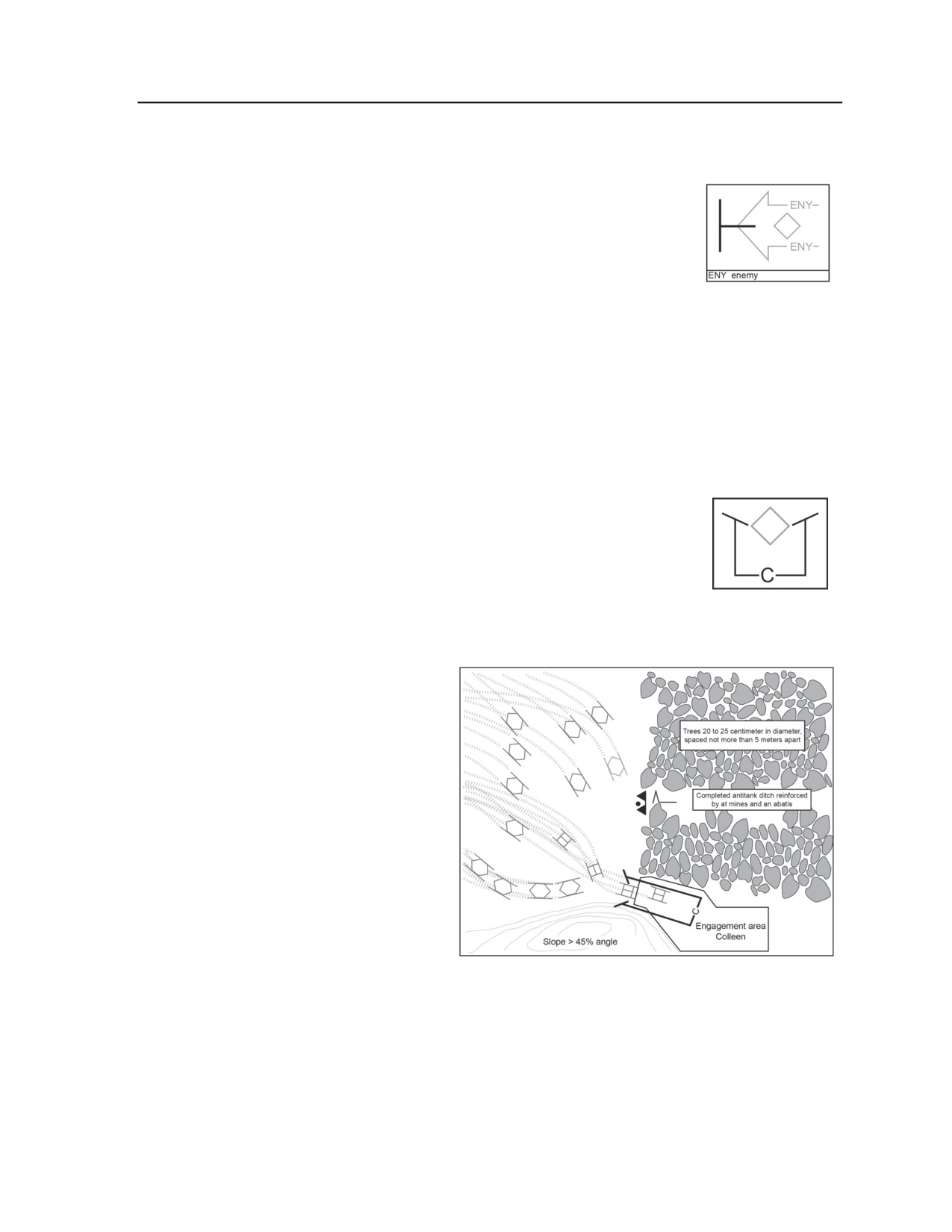
B-46. Block is also an obstacle effect that integrates fire planning and obstacle
efforts to stop an attacker along a specific avenue of approach or prevent the
attacking force from passing through an engagement area. The vertical line in
the obstacle effect graphic indicates the limit of enemy advance. It also indicates
where the obstacle ties in to restricted terrain. (Figure B-14 illustrates the block
obstacle effect graphic.) A force may employ blocking obstacles to assist in the
task. Blocking obstacles are complex, employed in depth, and integrated with fires
Figure B-14. Block
to prevent the enemy from proceeding along an avenue of approach, or to proceed
obstacle effect
only at unacceptable cost. When employed, blocking obstacles serve as a limit, not
graphic
allowing the enemy beyond that point. Obstacles alone cannot accomplish a blocking task. (FM 90-7
describes the block engineer obstacle effect.)
B-47. Block as a tactical mission task differs from the tactical mission task of fix because a blocked enemy
force can move in any direction other than the obstructed one, while a fixed enemy force cannot move in
any direction.
CANALIZE
B-48. Canalize is a tactical mission task in which the commander restricts
enemy movement to a narrow zone by exploiting terrain coupled with the use
of obstacles, fires, or friendly maneuver. (See figure B-15.) Figure B-16 shows
how successful canalization results in moving the enemy formation or individual
Soldiers and weapon systems into a predetermined position where they are
vulnerable to piecemeal destruction.
Figure B-15.
CONTAIN
Canalize tactical
mission graphic
B-49. Contain is a tactical mission task
that requires the commander to stop,
hold, or surround enemy forces or to
cause them to center their activity on a
given front and prevent them from
withdrawing any part of their forces for
use elsewhere. Containment allows an
enemy force to reposition itself within the
designated geographical area, while fixing
an enemy does not. Geographic terms or
time may express the limits of the
containment. The contain graphic
encompasses the entire area in which the
commander desires to contain the enemy
during the development of alternative
courses of action. (Figure B-17 on page
B-12 shows the tactical control graphic
for contain.)
Figure B-16. Canalizing terrain enhanced by
obstacles used with an engagement area
DEFEAT
B-50. Defeat is a tactical mission task that occurs when an enemy force has temporarily or
permanently lost the physical means or the will to fight. The defeated force’s commander is unwilling
or unable to pursue that individual’s adopted course of action, thereby yielding to the friendly
commander’s will and can no longer interfere to a significant degree with the actions of friendly
forces. Defeat can result from the use of force or the threat of its use.
22 March 2013
FM 3-90-1
B-11
Appendix B
B-51. A commander can generate different effects against an enemy to defeat that force:
z
Physical. The enemy loses the physical means to continue fighting. The enemy force no longer
has the personnel, weapon systems, equipment, or supplies to carry out its mission.
z
Psychological. The enemy loses the will to fight. Enemy commanders and their soldiers become
mentally exhausted, and their morale is so low that they can no longer accomplish their
missions.
These effects typically occur because of catastrophic losses inflicted over a very
short time or from sustained attrition. An opponent who is not ideologically
motivated may be defeated psychologically on observing preparations for the
delivery of clearly overwhelming combat power on the position that opponent
occupies. Defeat manifests itself in some sort of physical action, such as mass
surrenders, abandonment of significant quantities of equipment and supplies, or
retrograde operations.
Figure B-17.
Contain tactical
mission graphic
DESTROY
B-52. Destroy is a tactical mission task that occurs when an enemy force has
temporarily or permanently lost the physical means or the will to fight. The
defeated force's commander is unwilling or unable to pursue that individual's
adopted course of action, thereby yielding to the friendly commander's will
and can no longer interfere to a significant degree with the actions of friendly
forces. Defeat can result from the use of force or the threat of its use. The
amount of damage needed to render a unit combat-ineffective depends on the
unit’s type, discipline, and morale. Destroying armored or dug-in targets with area
Figure B-18.
fire weapons requires considerable ammunition and time, so forces do not normally
Destroy tactical
attempt it unless they have terminally guided munitions. (Figure B-18 shows the
mission graphic
tactical mission graphic for destroy.)
DISRUPT
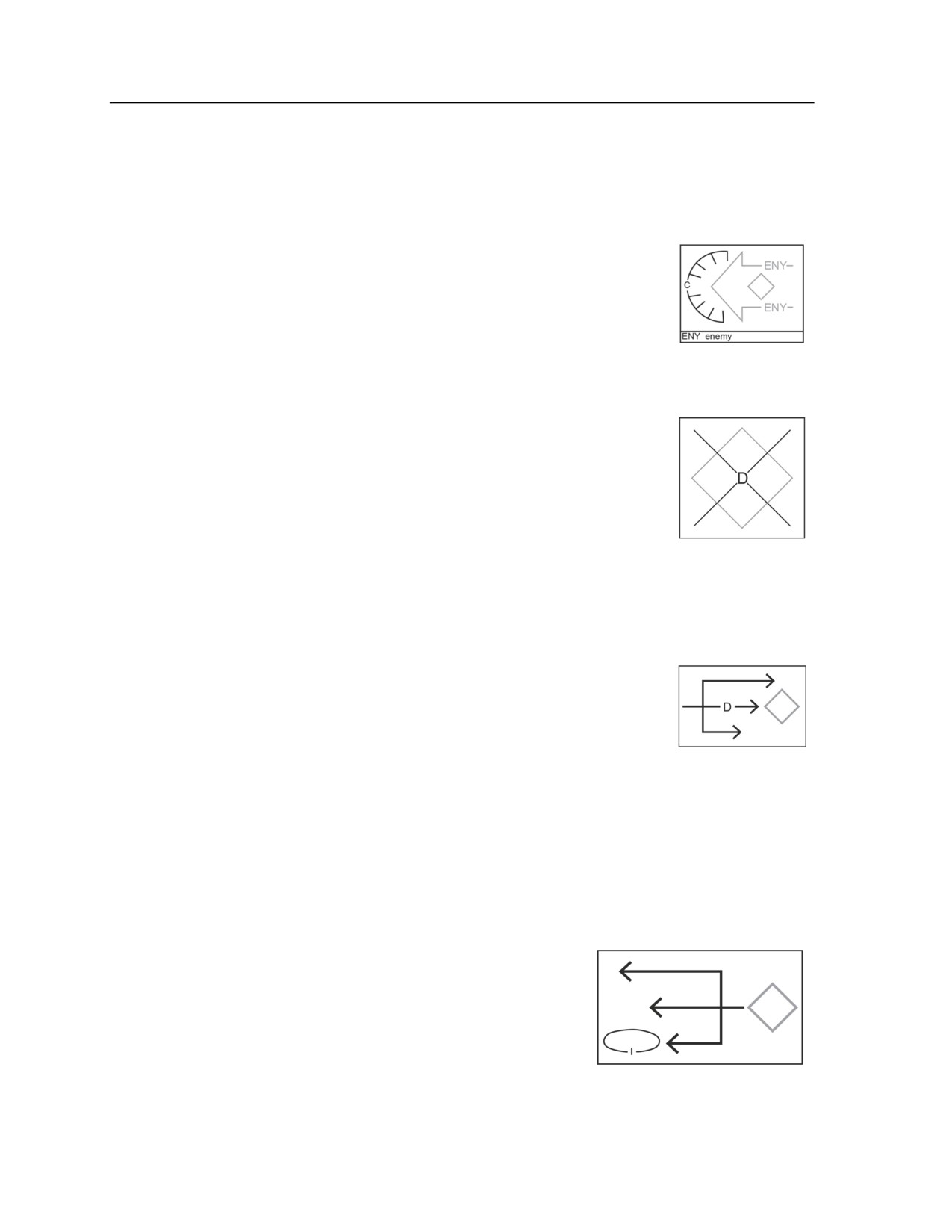
B-53. Disrupt is a tactical mission task in which a commander integrates
direct and indirect fires, terrain, and obstacles to upset an enemy’s formation
or tempo, interrupt the enemy’s timetable, or cause enemy forces to commit
prematurely or attack in a piecemeal fashion. This increases the enemy’s
vulnerability to friendly fires. It may temporarily knock a unit out of the battle.
Figure B-19.
Disruption is never an end; it is the means to an end. (Figure B-19 shows the
Disrupt tactical
tactical mission graphic for disrupt. The center arrow points toward the targeted
mission graphic
enemy unit.)
B-54. The maneuver force attempting to disrupt an enemy must attack the defending enemy with enough
combat power to achieve the desired results with one mass attack or sustain the attack until it achieves the
desired results. It may involve attacking the enemy force while it is still in its assembly areas or in an
approach march before it can deploy into a combat formation. The commander determines the degree of
acceptable risk based on anticipated friendly losses, the location of the attack, the number of attacks, and
other risk management factors.
B-55. Disrupt is also an obstacle effect that focuses fire planning
and obstacle effort to cause the enemy force to break up its
formation and tempo, interrupt its timetable, commit breaching
assets prematurely, and attack in a piecemeal effort. It also helps
to deceive the enemy concerning the location of friendly defensive
positions, to separate combat echelons, or to separate combat forces
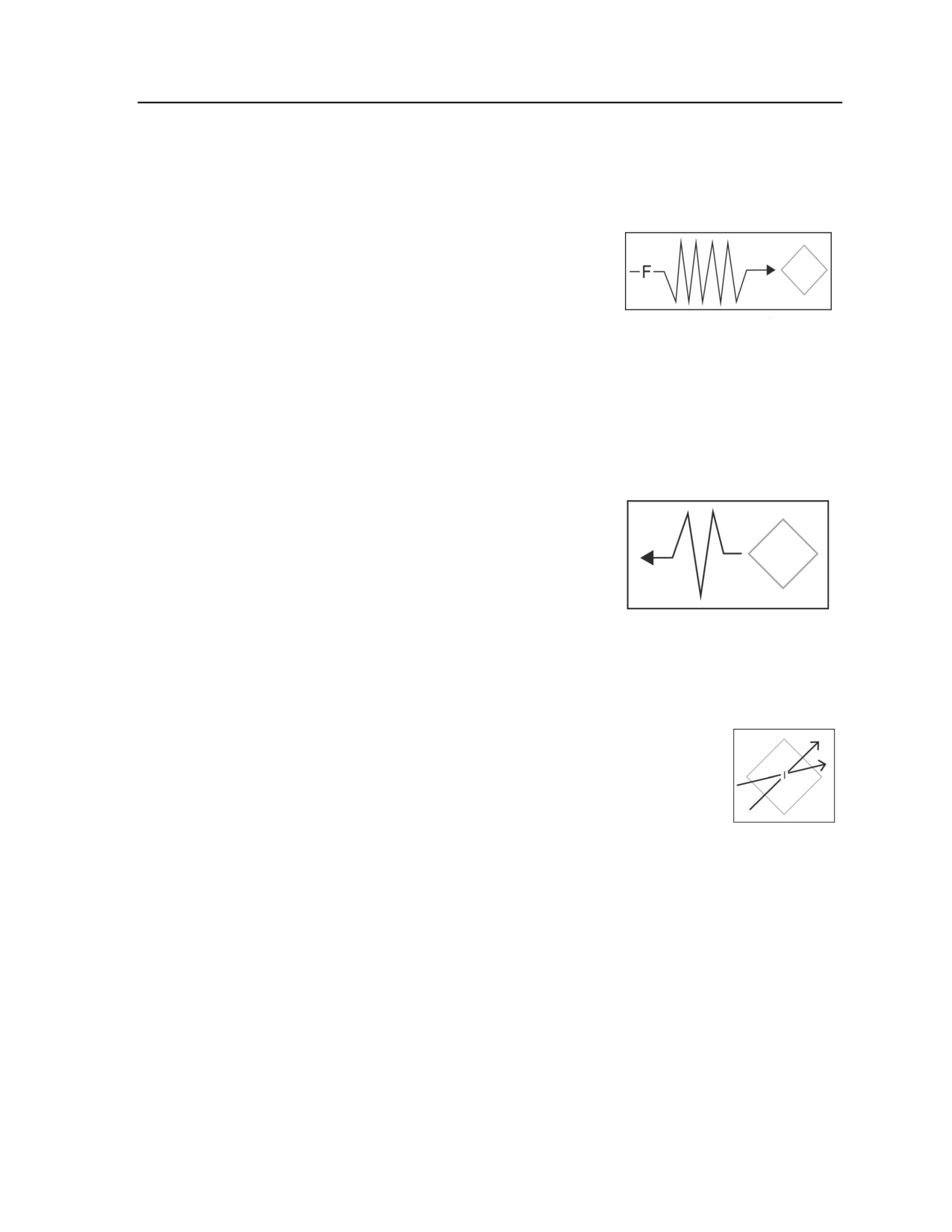
from their logistic support. As shown in figure B-20, the short
arrow(s) in the obstacle-effect graphic indicates where obstacles
Figure B-20. Disrupt obstacle
impact the enemy’s ability to maneuver. The longer arrow(s) indicate
intent graphic
where the commander allows the enemy to bypass the obstacle
B-12
FM 3-90-1
22 March 2013
Tactical Mission Tasks
effect, so the defending force can attack the enemy with fires. The arrows indicate the direction of enemy
attack. A defending commander normally uses the disrupt obstacle effect forward of EAs. Obstacles alone
cannot disrupt an enemy unit. (FM 90-7 describes the disrupt engineer obstacle effect.)
FIX
B-56. Fix is a tactical mission task where a commander prevents
the enemy force from moving any part of that force from a
specific location for a specific period. This may occur by engaging
the enemy force to prevent its withdrawal for use elsewhere, or by
using military deception, such as transmitting false orders. The
commander uses fix in offensive and defensive actions; it is always a
Figure B-21. Fix tactical
shaping operation. (Figure B-21 shows the tactical mission graphic
mission graphic
for fix.) The commander points the arrow toward the desired enemy
unit to fix. The broken part of the arrow indicates the desired location for that event to occur.
B-57. Fixing an enemy force does not mean destroying it. The friendly force has to prevent the enemy from
moving in any direction. This task usually has a time constraint, such as “fix the enemy reserve force until
OBJECTIVE FALON, the decisive operation, is secured.” The tactical mission task of fix differs from that
of block in that a fixed enemy force cannot move from a given location, but a blocked enemy force can
move in any direction other than the one obstructed.
B-58. Fix is also an obstacle effect that focuses fire planning and
obstacle effort to slow an attacker’s movement within a specified
area, normally an engagement area. The primary use of this effect
is to give the friendly unit time to acquire, target, and destroy the
attacking enemy with direct and indirect fires throughout the depth of
an EA or avenue of approach. The irregular part of the arrow in the
obstacle-intent graphic indicates the location where the enemy’s rate
of advance will be slowed by complex obstacles. The arrow indicates
Figure B-22. Fix obstacle
the direction of enemy advance.
(See Figure B-22.)
(FM 90-7
intent graphic
describes the fix engineer obstacle effect.)
INTERDICT
B-59. Interdict is a tactical mission task where the commander prevents, disrupts,
or delays the enemy’s use of an area or route. Interdiction is a shaping operation
conducted to complement and reinforce other ongoing offensive or defensive tasks.
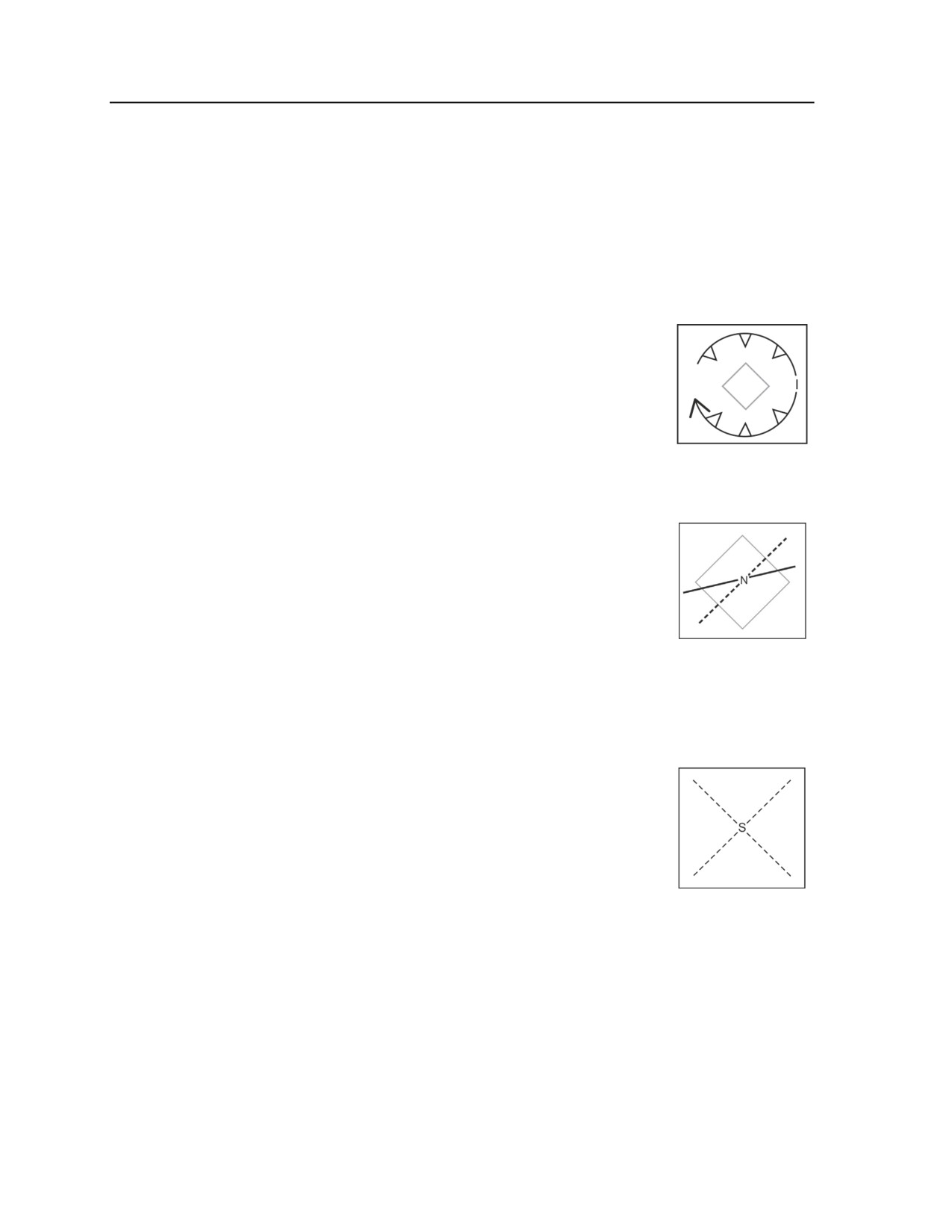
(Figure B-23 shows the tactical mission graphic for interdict.) The two arrows should
cross on the unit or location targeted for interdiction. An interdiction tasking must
specify how long to interdict, defined as a length of time or some event that must occur
Figure B-23.
before the interdiction is lifted, or the exact effect desired from the interdiction.
Interdict
B-60. The depth at which the attacking force conducts the interdiction generally
tactical
determines the friendly force’s freedom of action. Increasing the depth of operations
mission
reduces the danger of fratricide to air and surface forces, reduces the coordination
graphic
required, and allows increasingly flexible operations. Aerial forces, such as attack
helicopters and fixed-wing aircraft, can attack the enemy to interdict the enemy’s movement throughout the
AO.
B-61. The depth at which interdiction takes place also determines the speed with which its effects are
observed. Normally, ground maneuver units first focus on targets close to the forward of line own troops
(FLOT). Interdiction efforts there have immediate impact on enemy forces near the interdiction target but
do not affect the enemy’s ability to mass force effects. Attacks at greater distances from the FLOT have a
delayed impact on close combat but eventually degrade the enemy’s ability to mass effects.
B-62. The friendly force’s capability to interdict may have a devastating impact on the enemy’s plans and
ability to respond to friendly actions. For example, interdiction efforts that result in the enemy’s maneuver
22 March 2013
FM 3-90-1
B-13
Appendix B
being delayed or disrupted enhance the friendly force’s ability to achieve tactical advantages. Delaying or
disrupting enemy resupply efforts limits the enemy’s ability to sustain intense, high-tempo offensive or
defensive actions and restricts enemy mobility.
B-63. Interdicting the movement of enemy units can be extremely effective in assisting their encirclement
and eventual destruction. Fixed enemy ground forces—or those trapped by the loss of their mobility—
provide lucrative targets. The commander plans to interdict withdrawing enemy forces to enhance the
pursuit. While interdiction can contribute to success by hampering reinforcement and resupply, it can also
contribute by trapping enemy forces or canalizing their maneuvers, leading to their destruction in detail.
ISOLATE
B-64. Isolate is a tactical mission task that requires a unit to seal off—both
physically and psychologically—an enemy from sources of support, deny the
enemy freedom of movement, and prevent the isolated enemy force from
having contact with other enemy forces. A commander does not allow an
isolated enemy force sanctuary within its present position but continues to conduct
offensive actions against the enemy force. (Figure B-24 shows the tactical mission
graphic for isolate. The position or direction of the arrow has no significance, but
the graphic surrounds the targeted enemy unit.)
Figure B-24.
Isolate tactical
NEUTRALIZE
mission graphic
B-65. Neutralize is a tactical mission task that results in rendering enemy
personnel or materiel incapable of interfering with a particular operation.
(Figure B-25 shows the neutralize tactical mission graphic.) The two lines cross
over the symbol of the unit or facility targeted for neutralization. When assigning a
task to neutralize, the commander specifies the enemy force or materiel to
neutralize and the duration, which is time- or event-driven. The neutralized target
may become effective again when casualties are replaced, damage is repaired, or
effort resulting in the neutralization is lifted. The commander normally uses a
Figure B-25.
combination of lethal and nonlethal effects to neutralize enemy personnel or
Neutralize tactical
materiel. The assets required to neutralize a target vary according to the type and
mission graphic
size of the target and the weapon and munitions combination used.
SUPPRESS
B-66. Suppress is a tactical mission task that results in the temporary
degradation of the performance of a force or weapon system below the level
needed to accomplish its mission. It occurs when a commander employs direct or
indirect lethal and nonlethal effects, such as artillery, electronic warfare, or smoke
on enemy personnel, weapons, and equipment to prevent or degrade enemy fires,
sensors, and visual observation of friendly forces. Unlike the neutralization task,
the original target regains its effectiveness without needing to reconstitute, once
the effects of the systems involved in the suppression effort lift or shift to another
Figure B-26.
target. (Figure B-26 shows the suppress tactical mission task graphic.)
Suppress tactical
mission task
graphic
B-14
FM 3-90-1
22 March 2013
Tactical Mission Tasks
TURN
B-67. Turn is a tactical mission task that involves forcing an
enemy element from one avenue of approach or mobility
corridor to another. The commander relates obstacles, fires, and
terrain to improve the friendly tactical situation while degrading the
enemy’s situation. For example, in the offense, a commander might
want to turn an enemy force being pursued to place it in a position
Figure B-27. Turn tactical
where the enemy force can be destroyed. In the defense, a
mission graphic
commander might want to turn an attacking enemy force to allow the
friendly force to conduct a counterattack into the enemy’s flank.
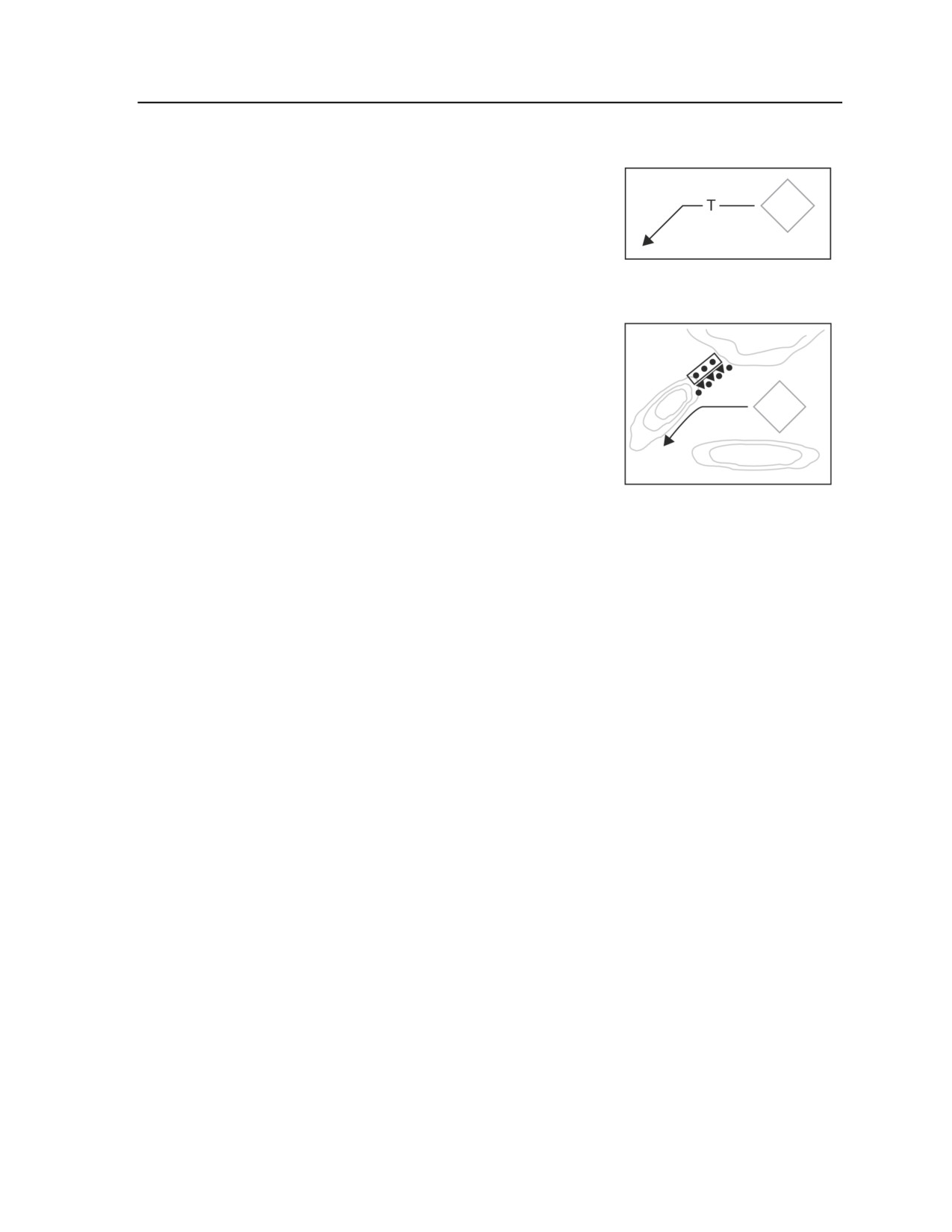
(Figure B-27 shows the turn tactical mission graphic. The place
where the arrow breaks indicates the general location of the obstacle
complex that will force the enemy to move from one avenue of
approach to another.)
B-68. Turn is also a tactical obstacle effect that integrates fire
planning and obstacle effort to divert an enemy formation from
one avenue of approach to an adjacent avenue of approach or
into an engagement area. Its development requires well-defined
mobility corridors and avenues of approach. To achieve this effect,
Figure B-28. Turn obstacle
the obstacles have a subtle orientation relative to the enemy’s
effect
approach as shown in figure B-28. The obstacles and their associated
fires allow bypasses in the direction desired by the friendly scheme
of maneuver. Finally, the obstacles tie into restrictive terrain at the initial point of the turn. A commander
normally uses the turn effect on the flanks of an EA. The direction of the arrow indicates the desired
direction of turn. (See FM 90-7 for more information on tactical obstacle effects.)
22 March 2013
FM 3-90-1
B-15
Glossary
The glossary lists acronyms and terms with Army, multi-Service, or joint definitions,
and other selected terms. Where Army and joint definitions are different, (Army)
follows the term. Terms for which FM 3-90 is the proponent publication
(the
authority) are marked with an asterisk (*). The proponent publication for other terms
is listed in parentheses after the definition.
SECTION I - ACRONYMS AND ABBREVIATIONS
AA
assembly area
AAMDC
Army air and missile defense command
ABCT
armored brigade combat team
ACM
airspace coordinating measure
ADAM
air defense airspace management
ADP
Army doctrine publication
ADRP
Army doctrine reference publication
ALO
air liaison officer
AMD
air and missile defense
AO
area of operations
ARFOR
Army forces
ASCC
Army Service component command
ASCOPE
areas, structures, capabilities, organizations, people, and events
ATTP
Army tactics, techniques, and procedures
BCT
brigade combat team
BFSB
battlefield surveillance brigade
BHL
battle handover line
BP
battle position
BSB
brigade support battalion
C2
command and control
CAB
combined arms battalion
CAS
close air support
CBRN
chemical, biological radiological, and nuclear
CBRNE
chemical, biological, radiological, nuclear, and high-yield explosives
CFL
coordinated fire line
CFZ
critical friendly zone
CI
counterintelligence
COA
course of action
COLT
combat observation and lasing team
COP
common operational picture
CP
command post
CREW
counter-radio controlled improvised explosive device electronic warfare
systems
22 March 2013
FM 3-90-1
Glossary-1
Glossary
DLIC
detachment left in contact
DOD
Department of Defense
EA
engagement area
EOD
explosive ordnance disposal
ENY
enemy
EW
electronic warfare
FARP
forward arming and refuel point
FCL
final coordination line
FEBA
forward edge of the battle area
FFA
free-fire area
FLOT
forward line of own troops
FM
field manual
FOB
forward operating base
FPF
final protective fire
FRAGORD
fragmentary order
FSCL
fire support coordination line
FSCM
fire support coordination measure
FSCOORD
fire support coordinator
G-1
assistant chief of staff, personnel
G-2
assistant chief of staff, intelligence
G-3
assistant chief of staff, operations
G-4
assistant chief of staff, logistics
G-6
assistant chief of staff, signal
G-8
assistant chief of staff, resource management
GEOINT
geospatial intelligence
GPS
global positioning system
IBCT
infantry brigade combat team
IED
improvised explosive device
IPB
intelligence preparation of the battlefield
ISB
intermediate staging base
JAAT
joint air attack team
JFACC
joint force air component commander
JP
joint publication
LC
line of contact
LD
line of departure
LOA
limit of advance
LOC
line of communication
LOGPAC
logistics package
LZ
landing zone
MBA
main battle area
MEB
maneuver enhancement brigade
Glossary-2
FM 3-90-1
22 March 2013
Glossary
METT-TC
mission, enemy, terrain and weather, troops and support available, time
available, and civil considerations
MISO
military information support operations
MLRS
Multiple Launch Rocket System
MOPP
mission-oriented protective posture
MSR
main supply route
NAI
named area of interest
NFA
no-fire area
OAKOC
observation and fields of fire, avenues of approach, key terrain, obstacles, and
cover and concealment
OP
observation post
OPCON
operational control
OPORD
operations order
OPSEC
operations security
ORA
obstacle restricted area
ORSA
operations research/systems analysis
OSINT
open-source intelligence
PAA
position area for artillery
PD
point of departure
PL
phase line
PLD
probable line of deployment
PMESII-PT
political, military, economic, social, information, infrastructure, physical
environment, and time
POL
petroleum, oils, and lubricants
PZ
pickup zone
QRF
quick response force
RFA
restrictive fire area
RFL
restrictive fire line
RIP
relief in place
RP
release point
S-1
personnel staff officer
S-2
intelligence staff officer
S-3
operations staff officer
S-4
logistics staff officer
S-6
signal staff officer
S-9
civil-military operations officer
SBCT
Stryker brigade combat team
SOF
special operations forces
SOP
standard operating procedure
SP
start point
TACP
tactical air control party
TAI
target area of interest
22 March 2013
FM 3-90-1
Glossary-3
Glossary
TCF
tactical combat force
TRP
target reference point
UAS
unmanned aircraft system
U.S.
United States
USAF
U.S. Air Force
UXO
unexploded ordnance
WMD
weapons of mass destruction
SECTION II - TERMS
actions on contact
A series of combat actions often conducted simultaneously taken on contact with the enemy to develop
the situation. (ADRP 3-90)
active air defense
Direct defensive action taken to destroy, nullify, or reduce the effectiveness of hostile air and missile
threats against friendly forces and assets. (JP 3-01)
air assault
The movement of friendly assault forces (combat, combat support, and combat service support) by
rotary-wing aircraft to engage and destroy enemy forces or to seize and hold key terrain. (JP 3-18)
airspace control
A process used to increase operational effectiveness by promoting the safe, efficient, and flexible use
of airspace. (JP 3-52)
alternate position
A defensive position that the commander assigns to a unit or weapon for occupation when the primary
position becomes untenable or unsuitable for carrying out the assigned task. (ADRP 3-90)
*ambush
An attack by fire or other destructive means from concealed positions on a moving or temporarily
halted enemy.
area defense
A defensive task that concentrates on denying enemy forces access to designated terrain for a specific
time rather than destroying the enemy outright. (ADRP 3-90)
area of influence
A geographical area wherein a commander is directly capable of influencing operations by maneuver
or fire support systems normally under the commander’s command or control. (JP 3-0)
area of interest
That area of concern to the commander, including the area of influence, areas adjacent thereto, and
extending into enemy territory. This area also includes areas occupied by enemy forces who could
jeopardize the accomplishment of the mission. (JP 3-0)
area of operations
An operational area defined by the joint force commander for land and maritime forces that should be
large enough to accomplish their missions and protect their forces. (JP 3-0)
assault position
A covered and concealed position short of the objective from which final preparations are made to
assault the objective. (ADRP 3-90)
Glossary-4
FM 3-90-1
22 March 2013
Glossary
assault time
The moment to attack the initial objectives throughout the geographical scope of the operation.
(ADRP 3-90)
*assembly area
An area a unit occupies to prepare for an operation.
attack
An offensive task that destroys or defeats enemy forces, seizes and secures terrain, or both.
(ADRP 3-90)
*attack by fire
A tactical mission task in which a commander uses direct fires, supported by indirect fires, to engage
an enemy force without closing with the enemy to destroy, suppress, fix, or deceive that enemy.
attack by fire position
The general position from which a unit conducts the tactical task of attack by fire. (ADRP 3-90)
attack position
(Army) The last position an attacking force occupies or passes through before crossing the line of
departure. (ADRP 3-90)
axis of advance
(Army) The general area through which the bulk of a unit’s combat power must move. (ADRP 3-90)
battle handover line
A designated phase line on the ground where responsibility transitions from the stationary force to the
moving force and vice versa. (ADRP 3-90)
battle position
A defensive location oriented on a likely enemy avenue of approach. (ADRP 3-90)
*block
A tactical mission task that denies the enemy access to an area or prevents the enemy’s advance in a
direction or along an avenue of approach. Block is also an obstacle effect that integrates fire planning
and obstacle efforts to stop an attacker along a specific avenue of approach or prevent the attacking
force from passing through an engagement area.
boundary
A line that delineates surface areas for the purpose of facilitating coordination and deconfliction of
operations between adjacent units, formations, or areas. (JP 3-0)
*box formation
A unit formation with subordinate elements arranged in a box or square, or two elements up and two
elements back. It is a flexible formation that provides equal firepower in all directions. It is generally
used when the enemy location is known. This formation can cause 50 percent of the force to be
decisively engaged at the same time, therefore limiting the combat power available to maneuver
against an enemy.
*breach
A tactical mission task in which the unit employs all available means to break through or establish a
passage through an enemy defense, obstacle, minefield, or fortification.
*breakthrough
A rupturing of the enemy’s forward defenses that occurs as a result of a penetration. A breakthrough
permits the passage of an exploitation force.
*bypass
A tactical mission task in which the commander directs the unit to maneuver around an obstacle,
position, or enemy force to maintain the momentum of the operation while deliberately avoiding
combat with an enemy force.
22 March 2013
FM 3-90-1
Glossary-5
Glossary
bypass criteria
Measures during the conduct of an offensive operation established by higher headquarters that specify
the conditions and size under which enemy units and contact may be avoided. (ADRP 3-90)
*canalize
(Army) A tactical mission task in which the commander restricts enemy movement to a narrow zone
by exploiting terrain coupled with the use of obstacles, fires, or friendly maneuver.
checkpoint
A predetermined point on the ground used to control movement, tactical maneuver, and orientation.
(ADRP 1-02)
*clear
A tactical mission task that requires the commander to remove all enemy forces and eliminate
organized resistance within an assigned area.
close combat
Warfare carried out on land in a direct-fire fight, supported by direct and indirect fires and other assets.
(ADRP 3-0)
*column formation
The column formation is a combat formation in which elements are placed one behind the other.
combat formation
A combat formation is an ordered arrangement of forces for a specific purpose and describes the
general configuration of a unit on the ground. (ADRP 3-90)
combined arms
The synchronized and simultaneous application of arms to achieve an effect greater than if each arm
was used separately or sequentially. (ADRP 3-0)
concept of operations
A verbal or graphic statement that clearly and concisely expresses what the joint force commander
intends to accomplish and how it will be done using available resources. (JP 5-0)
*consolidation
Organizing and strengthening a newly captured position so that it can be used against the enemy.
contact point
In land warfare, a point on the terrain, easily identifiable, where two or more ground units are required
to make physical contact. (JP 3-50)
*contain
(Army) A tactical mission task that requires the commander to stop, hold, or surround enemy forces or
to cause them to center their activity on a given front and prevent them from withdrawing any part of
their forces for use elsewhere.
*contiguous area of operations
Where all of a commander’s subordinate forces’ areas of operations share one or more common
boundaries.
*control
(Army) A tactical mission task that requires the commander to maintain physical influence over a
specified area to prevent its use by an enemy or to create conditions necessary for successful friendly
operations.
Glossary-6
FM 3-90-1
22 March 2013
Glossary
coordinated fire line
A line beyond which conventional and indirect surface fire support means may fire at any time within
the boundaries of the establishing headquarters without additional coordination. The purpose of the
coordinated fire line is to expedite the surface-to-surface attack of targets beyond the coordinated fire
line without coordination with the ground commander in whose area the targets are located. (JP 3-09)
*cordon and search
A technique of conducting a movement to contact that involves isolating a target area and searching
suspected locations within that target area to capture or destroy possible enemy forces and contraband.
counterattack
Attack by part or all of a defending force against an enemy attacking force, for such specific purposes
as regaining ground lost, or cutting off or destroying enemy advance units, and with the general
objective of denying to the enemy the attainment of the enemy’s purpose in attacking. In sustained
defensive operations, it is undertaken to restore the battle position and is directed at limited objectives.
(ADRP 1-02)
counterfire
Fire intended to destroy or neutralize enemy weapons. Includes counterbattery and countermortar fire.
(JP 3-09)
countermobility operations
Those combined arms activities that use or enhance the effects of natural and man-made obstacles to
deny an adversary freedom of movement and maneuver. (FM 3-34)
*counterreconnaissance
(Army) A tactical mission task that encompasses all measures taken by a commander to counter enemy
reconnaissance and surveillance efforts. Counterreconnaissance is not a distinct mission, but a
component of all forms of security operations.
critical friendly zone
An area, usually a friendly unit or location, which the maneuver commander designates as critical to
the protection of an asset whose loss would seriously jeopardize the mission. (ADRP 1-02)
decisive operation
The operation that directly accomplishes the mission. (ADRP 3-0)
*decisive terrain
Key terrain whose seizure and retention is mandatory for successful mission acomplishment.
*defeat
A tactical mission task that occurs when an enemy force has temporarily or permanently lost the
physical means or the will to fight. The defeated force’s commander is unwilling or unable to pursue
that individual’s adopted course of action, thereby yielding to the friendly commander’s will and can
no longer interfere to a significant degree with the actions of friendly forces. Defeat can result from the
use of force or the threat of its use.
defensive task
A task conducted to defeat an enemy attack, gain time, economize forces, and develop conditions
favorable for offensive or stability tasks. (ADRP 3-0)
*delay line
A phase line where the date and time before which the enemy is not allowed to cross the phase line is
depicted as part of the graphic control measure.
delaying operation
An operation in which a force under pressure trades space for time by slowing down the enemy’s
momentum and inflicting maximum damage on the enemy without, in principle, becoming decisively
engaged. (JP 3-04)
22 March 2013
FM 3-90-1
Glossary-7
Glossary
demonstration
In military decption, a show of force in an area where a decision is not sought that is made to deceive
an adversary. It is similar to a feint but no actual contact with the adversary is intended. (JP 3-13.4)
*denial operations
Actions to hinder or deny the enemy the use of space, personnel, supplies, or facilities.
*destroy
A tactical mission task that occurs when an enemy force has temporarily or permanently lost the
physical means or the will to fight. The defeated force's commander is unwilling or unable to pursue
that individual's adopted course of action, thereby yielding to the friendly commander's will and can no
longer interfere to a significant degree with the actions of friendly forces. Defeat can result from the
use of force or the threat of its use.
*detachment left in contact
An element left in contact as part of the previously designated (usually rear) security force while the
main body conducts its withdrawal.
*diamond formation
A diamond formation is a variation of the box combat formation with one maneuver unit leading,
maneuver units positioned on each flank, and the remaining maneuver unit to the rear.
*direct pressure force
A force employed in a pursuit operation that orients on the enemy main body to prevent enemy
disengagement or defensive reconstitution prior to envelopment by the encircling force. It normally
conducts a series of attacks to slow the enemy’s retirement by forcing the enemy to stand and fight.
direction of attack
A specific direction or assigned route a force uses and does not deviate from when attacking.
(ADRP 3-90)
*disengage
A tactical mission task where a commander has the unit break contact with the enemy to allow the
conduct of another mission or to avoid decisive engagement.
disengagement line
A phase line located on identifiable terrain that, when crossed by the enemy, signals to defending
elements that it is time to displace to their next positions. (ADRP 3-90)
*disrupt
1. A tactical mission task in which a commander integrates direct and indirect fires, terrain, and
obstacles to upset an enemy’s formation or tempo, interrupt the enemy’s timetable, or cause enemy
forces to commit prematurely or attack in a piecemeal fashion. 2. An obstacle effect that focuses fire
planning and obstacle effort to cause the enemy force to break up its formation and tempo, interrupt its
timetable, commit breaching assets prematurely, and attack in a piecemeal effort. (FM 90-7)
*double envelopment
This results from simultaneous maneuvering around both flanks of a designated enemy force.
*echelon formation
A unit formation with subordinate elements arranged on an angle to the left or to the right of the
direction of attack (echelon left, echelon right). This formation provides for firepower forward and to
the flank of the direction of the echelon. It facilitates control in open areas. It provides minimal
security to the opposite flank of the direction of the echeloning.
encirclement operations
Operations where one force loses its freedom of maneuver because an opposing force is able to isolate
it by controlling all ground lines of communication and reinforcement. (ADRP 3-90)
Glossary-8
FM 3-90-1
22 March 2013
Glossary
*encircling force
In pursuit operations, the force which maneuvers to the rear or flank of the enemy to block the enemy’s
escape so that the enemy can be destroyed between the direct pressure force and encircling force. This
force advances or flies along routes parallel to the enemy’s line of retreat. If the encircling force cannot
outdistance the enemy to cut the enemy off, the encircling force may also attack the flank of a
retreating enemy.
*engagement area
Where the commander intends to contain and destroy an enemy force with the massed effects of all
available weapons and supporting systems.
*engagement criteria
Protocols that specify those circumstances for initiating engagement with an enemy force.
*engagement priority
The order in which the unit engages enemy systems or functions.
*envelopment
A form of maneuver in which an attacking force seeks to avoid the principal enemy defenses by
seizing objectives behind those defenses that allow the targeted enemy force to be destroyed in their
current positions.
*exfiltrate
A tactical mission task where a commander removes Soldiers or units from areas under enemy control
by stealth, deception, surprise, or clandestine means.
exploitation
An offensive task that usually follows a successful attack and is designed to disorganize the enemy in
depth. (ADRP 3-90)
feint
In military deception, an offensive action involving contact with the adversary conducted for the
purpose of deceiving the adversary as to the location and/or time of the actual main offensive action.
(JP 3-13.4)
*field of fire
The area that a weapon or group of weapons may cover effectively from a given position.
final coordination line
A phase line close to the enemy position used to coordinate the lifting or shifting of supporting fires
with the final deployment of maneuver elements. (ADRP 3-90)
final protective fire
An immediately available preplanned barrier of fires designed to impede enemy movement across
defensive lines or areas. (JP 1-02)
*fire superiority
That degree of dominance in the fires of one force over another that permits that force to conduct
maneuver at a given time and place without prohibitive interference by the enemy.
fire support coordination line
A fire support coordination measure that is established and adjusted by appropriate land or
amphibious force commanders within their boundaries in consultation with superior, subordinate,
supporting, and affected commanders. Fire support coordination lines facilitate the expeditious attack
of surface targets of opportunity beyond the coordinating measure. A fire support coordination line
does not divide an area of operations by defining a boundary between close and deep operations or a
zone for close air support. The fire support coordination line applies to all fires of air, land, and sea-
based weapon systems using any type of ammunition. Forces attacking targets beyond a fire support
coordination line must inform all affected commanders in sufficient time to allow necessary reaction to
avoid fratricide. Supporting elements attacking targets beyond the fire support coordination line must
22 March 2013
FM 3-90-1
Glossary-9
Glossary
ensure that the attack will not produce adverse effects on, or to the rear of, the line. Short of a fire
support coordination line, all air-to-ground and surface-to-surface attack operations are controlled by
the appropriate land or amphibious force commander. The fire support coordination line should follow
well-defined terrain features. Coordination of attacks beyond the fire support coordination line is
especially critical to commanders of air, land, and special operations forces. In exceptional
circumstances, the inability to conduct this coordination will not preclude the attack of targets beyond
the fire support coordination line. However, failure to do so may increase the risk of fratricide and
could waste limited resources. (JP 3-09)
*fix
A tactical mission task where a commander prevents the enemy force from moving any part of that
force from a specific location for a specific period. Fix is also an obstacle effect that focuses fire
planning and obstacle effort to slow an attacker’s movement within a specified area, normally an
engagement area.
*flank attack
A form of offensive maneuver directed at the flank of an enemy.
*follow and assume
A tactical mission task in which a second committed force follows a force conducting an offensive task
and is prepared to continue the mission if the lead force is fixed, attrited, or unable to continue.
*follow and support
A tactical mission task in which a committed force follows and supports a lead force conducting an
offensive task.
forms of maneuver
Distinct tactical combinations of fire and movement with a unique set of doctrinal characteristics that
differ primarily in the relationship between the maneuvering force and the enemy. (ADRP 3-90)
*forward boundary
A boundary of an echelon that is primarily designated to divide responsibilities between it and its next
higher echelon.
forward edge of the battle area
The foremost limit of a series of areas in which ground combat units are deployed, excluding the areas
in which the covering or screening forces are operating, designated to coordinate fire support, the
positioning of forces, or the maneuver of units. (JP 3-09.3)
forward line of own troops
A line which indicates the most forward positions of friendly forces in any kind of military operation at
a specific time. (JP 3-03)
free-fire area
A specific area into which any weapon system may fire without additional coordination with the
establishing headquarters. (JP 3-09)
*frontal attack
A form of maneuver in which an attacking force seeks to destroy a weaker enemy force or fix a larger
enemy force in place over a broad front.
*infiltration
(Army) A form of maneuver in which an attacking force conducts undetected movement through or
into an area occupied by enemy forces to occupy a position of advantage behind those enemy positions
while exposing only small elements to enemy defensive fires.
*infiltration lane
A control measure that coordinates forward and lateral movement of infiltrating units and fixes fire
planning responsibilities.
Glossary-10
FM 3-90-1
22 March 2013
Glossary
*interdict
A tactical mission task where the commander prevents, disrupts, or delays the enemy’s use of an area
or route.
*isolate
A tactical mission task that requires a unit to seal off—both physically and psychologically—an enemy
from sources of support, deny the enemy freedom of movement, and prevent the isolated enemy force
from having contact with other enemy forces.
key terrain
Any locality, or area, the seizure or retention of which affords a marked advantage to either combatant.
(JP 2-01.3)
*kill zone
That part of an ambush site where fires are concentrated to isolate, fix, and destroy the enemy.
*lateral boundary
A boundary that extends from the rear boundary to the unit’s forward boundary.
limit of advance
A phase line used to control forward progress of the attack. The attacking unit does not advance any of
its elements or assets beyond the limit of advance, but the attacking unit can push its security forces to
that limit. (ADRP 3-90)
line formation
When the unit’s subordinate ground maneuver elements move abreast of each other.
line of communications
A route, either land, water, and/or air, that connects an operating military force with a base of
operations and along which supplies and military forces move. (JP 2-01.3)
*line of contact
A general trace delineating the location where friendly and enemy forces are engaged.
line of departure
(Army) A phase line crossed at a prescribed time by troops initiating an offensive operation.
(ADRP 3-90)
*linkup point
A point where two infiltrating elements in the same or different infiltration lanes are scheduled to meet
to consolidate before proceeding on with their missions.
*logistics package
A grouping of multiple classes of supply and supply vehicles under the control of a single convoy
commander.
main effort
A designated subordinate unit whose mission at a given point in time is most critical to overall mission
success. (ADRP 3-0)
main battle area
The area where the commander intends to deploy the bulk of the unit’s combat power and conduct
decisive operations to defeat an attacking enemy. (ADRP-3-90)
*meeting engagement
A combat action that occurs when a moving force, incompletely deployed for battle, engages an enemy
at an unexpected time and place.
mobile defense
A defensive task that concentrates on the destruction or defeat of the enemy through a decisive attack
by a striking force. (ADRP 3-90)
22 March 2013
FM 3-90-1
Glossary-11
Glossary
mobility
A quality or capability of military forces which permits them to move from place to place while
retaining the ability to fulfill their primary mission. (JP 3-17)
mobility operations
Those combined arms activities that mitigate the effects of natural and man-made obstacles to enable
freedom of movement and maneuver. (ATTP 3-90.4)
movement corridor
A designated area established to protect and enable ground movement along a route. (FM 3-90.31)
movement to contact
(Army) An offensive task designed to develop the situation and establish or regain contact.
(ADRP 3-90)
named area of interest
(Army) The geographical area where information that will satisfy a specific information requirement
can be collected. (ADRP 1-02)
*neutralize
(Army) A tactical mission task that results in rendering enemy personnel or materiel incapable of
interfering with a particular operation.
*noncontiguous area of operations
Where one or more of the commander’s subordinate force’s areas of operation do not share a common
boundary.
no-fire area
An area designated by the appropriate commander into which fires or their effects are prohibited.
(JP 3-09.3)
objective
(Army) A location on the ground used to orient operations, phase operations, facilitate changes of
direction, and provide for unity of effort. (ADRP 3-90)
objective rally point
A rally point established on an easily identifiable point on the ground where all elements of the
infiltrating unit assemble and prepare to attack the objective. (ADRP 3-90)
obstacle
Any natural or man-made obstruction designed or employed to disrupt, fix, turn, or block the
movement of an opposing force, and to impose additional losses in personnel, time, and equipment on
the opposing force. (JP 3-15)
obstacle belt
A brigade-level command and control measure, normally given graphically, to show where within an
obstacle zone the ground tactical commander plans to limit friendly obstacle employment and focus the
defense. (JP 3-15)
*obstacle control measures
Specific measures that simplify the granting of obstacle-emplacing authority while providing obstacle
control.
*obstacle groups
One or more individual obstacles grouped to provide a specific obstacle effect.
obstacle restricted areas
A command and control measure used to limit the type or number of obstacles within an area.
(JP 3-15)
Glossary-12
FM 3-90-1
22 March 2013
Glossary
obstacle zone
A division-level command and control measure, normally done graphically, to designate specific land
areas where lower echelons are allowed to employ tactical obstacles. (JP 3-15)
*occupy
A tactical mission task that involves moving a friendly force into an area so that it can control that
area. Both the force’s movement to and occupation of the area occur without enemy opposition.
offensive tasks
Tasks conducted to defeat and destroy enemy forces and seize terrain, resources, and population
centers. (ADRP 3-0)
passive air defense
All measures, other than active air defense, taken to minimize the effectiveness of hostile air and
missile threats against friendly forces and assets. (JP 3-01)
*penetration
(Army) A form of maneuver in which an attacking force seeks to rupture enemy defenses on a narrow
front to disrupt the defensive system.
phase line
A line utilized for control and coordination of military operations, usually an easily identified feature
in the operational area. (JP 3-09)
point of departure
The point where the unit crosses the line of departure and begins moving along a direction of attack.
(ADRP 3-90)
*position area for artillery
An area assigned to an artillery unit where individual artillery systems can maneuver to increase their
survivability. A position area for artillery is not an area of operations for the artillery unit occupying it.
primary position
The position that covers the enemy’s most likely avenue of approach into the area of operations.
(ADRP 3-90)
probable line of deployment
A phase line that designates the location where the commander intends to deploy the unit into assault
formation before beginning the assault. (ADRP 3-90)
pursuit
An offensive task designed to catch or cut off a hostile force attempting to escape, with the aim of
destroying it. (ADRP 3-90)
raid
An operation to temporarily seize an area in order to secure information, confuse an adversary, capture
personnel or equipment, or to destroy a capability culminating with a planned withdrawal. (JP 3-0)
rally point
1. An easily identifiable point on the ground at which aircrews and passengers can assemble and
reorganize following an incident requiring a forced landing. 2. An easily identifiable point on the
ground at which units can reassemble and reorganize if they become dispersed. (ADRP 1-02)
*rear boundary
A boundary that defines the rearward limits of a unit’s area. It usually also defines the start of the next
echelon’s support area.
22 March 2013
FM 3-90-1
Glossary-13
Glossary
*reduce
1. A tactical mission task that involves the destruction of an encircled or bypassed enemy force. 2. A
mobility task to create and mark lanes through, over, or around an obstacle to allow the attacking force
to accomplish its mission. (ATTP 3-90.4)
*reorganization
All measures taken by the commander to maintain unit combat effectiveness or return it to a specified
level of combat capability.
restrictive fire area
An area in which specific restrictions are imposed and into which fires that exceed those restrictions
will not be delivered without coordination with the establishing headquarters. (JP 3-09)
restrictive fire line
A line established between converging friendly surface forces that prohibits fires or their effects across
that line. (JP 3-09)
*retain
A tactical mission task in which the commander ensures that a terrain feature controlled by a friendly
force remains free of enemy occupation or use.
retirement
An operation in which a force out of contact moves away from the enemy. (ADRP 3-90)
retrograde
(Army) A defensive task that involves organized movement away from the enemy. (ADRP 3-90)
*retrograde movement
Any movement of a command to the rear, or away from the enemy. It may be forced by the enemy or
may be made voluntarily. Such movements may be classified as withdrawal, retirement, or delaying
actions.
*route
The prescribed course to be traveled from a specific point of origin to a specific destination.
*search and attack
A technique for conducting a movement to contact that shares many of the characteristics of an area
security mission.
*sector of fire
That area assigned to a unit, a crew-served weapon, or an individual weapon within which it will
engage targets as they appear in accordance with established engagement priorities.
*secure
A tactical mission task that involves preventing a unit, facility, or geographical location from being
damaged or destroyed as a result of enemy action.
security area
That area that begins at the forward area of the battlefield and extends as far to the front and flanks as
security forces are deployed. Forces in the security area furnish information on the enemy and delay,
deceive, and disrupt the enemy and conduct counterreconnaissance. (ADRP 3-90)
*seize
(Army) A tactical mission task that involves taking possession of a designated area by using
overwhelming force.
Glossary-14
FM 3-90-1
22 March 2013
Glossary
shaping operation
An operation at any echelon that creates and preserves conditions for success of the decisive operation
through effects on the enemy, other actors, and the terrain. (ADRP 3-0)
*single envelopment
A form of maneuver that results from maneuvering around one assailable flank of a designated enemy
force.
*spoiling attack
A tactical maneuver employed to seriously impair a hostile attack while the enemy is in the process of
forming or assembling for an attack.
*stay-behind operation
An operation in which the commander leaves a unit in position to conduct a specified mission while
the remainder of the forces withdraw or retire from an area.
striking force
A dedicated counterattack force in a mobile defense constituted with the bulk of available combat
power. (ADRP 3-90)
strong point
A heavily fortified battle position tied to a natural or reinforcing obstacle to create an anchor for the
defense or to deny the enemy decisive or key terrain. (ADRP 3-90)
subsequent position
A position that a unit expects to move to during the course of battle. (ADRP 3-90)
supplementary position
A defensive position located within a unit’s assigned area of operations that provides the best sectors
of fire and defensive terrain along an avenue of approach that is not the primary avenue where the
enemy is expected to attack. (ADRP 3-90)
*support by fire
A tactical mission task in which a maneuver force moves to a position where it can engage the enemy
by direct fire in support of another maneuvering force.
support by fire position
The general position from which a unit conducts the tactical mission task of support by fire.
(ADRP 3-90)
*suppress
(Army) A tactical mission task that results in the temporary degradation of the performance of a force
or weapon system below the level needed to accomplish its mission.
survivability
All aspects of protecting personnel, weapons, and supplies while simultaneously deceiving the enemy.
(JP 3-34)
survivability move
A move that involves rapidly displacing a unit, command post, or facility in response to direct and
indirect fires, the approach of an enemy unit, a natural phenomenon, or as a proactive measure based
on intelligence, meteorological data, and risk analysis of enemy capabilities and intentions (including
weapons of mass destruction). (ADRP 3-90)
sustaining operation
An operation at any echelon that enables the decisive operation or shaping operation by generating or
maintaining combat power. (ADRP 3-0)
22 March 2013
FM 3-90-1
Glossary-15
Glossary
*tactical mission task
The specific activity performed by a unit while executing a form of tactical operation or form of
maneuver. It may be expressed in terms of either actions by a friendly force or effects on an enemy
force.
target
An area designated and numbered for future firing. (JP 3-60)
target area of interest
The geographical area where high-value targets can be acquired and engaged by friendly forces. Not
all target areas of interest will form part of the friendly course of action; only target areas of interest
associated with high priority targets are of interest to the staff. These are identified during staff
planning and wargaming. Target areas of interest differ from engagement areas in degree. Engagement
areas plan for the use of all available weapons; target areas of interest might be engaged by a single
weapon. (JP 2-01.3)
target reference point
An easily recognizable point on the ground (either natural or man-made) used to initiate, distribute,
and control fires. (ADRP 1-02)
targeted area of interest
The geographical area or point along a mobility corridor where successful interdiction will cause the
enemy to abandon a particular course of action or requires the enemy to use specialized engineer
support to continue. It is where the enemy force can be acquired and engaged by friendly forces.
(ADRP 1-02)
time of attack
The moment the leading elements of the main body cross the line of departure, or in a night attack, the
point of departure. (ADRP 3-90)
time-sensitive target
A joint force commander designated target requiring immediate response because it is a highly
lucrative, fleeting target of opportunity or it poses (or will soon pose) a danger to friendly forces.
(JP 3-60)
trigger line
A phase line located on identifiable terrain that crosses the engagement area—used to initiate and mass
fires into an engagement area at a predetermined range for all or like weapon systems. (ADRP 1-02)
*turn
1. A tactical mission task that involves forcing an enemy element from one avenue of approach or
mobility corridor to another. 2. A tactical obstacle effect that integrates fire planning and obstacle
effort to divert an enemy formation from one avenue of approach to an adjacent avenue of approach or
into an engagement area.
*turning movement
(Army) A form of maneuver in which the attacking force seeks to avoid the enemy’s principle
defensive positions by seizing objectives behind the enemy’s current positions thereby causing the
enemy force to move out of their current positions or divert major forces to meet the threat.
vertical envelopment
A tactical maneuver in which troops, either air-dropped or airlanded, attack the rear and flanks of a
force, in effect cutting off or encircling the force. (JP 3-18)
withdrawal operation
A planned retrograde operation in which a force in contact disengages from an enemy force and moves
in a direction away from the enemy. (JP 1-02)
Glossary-16
FM 3-90-1
22 March 2013
References
Field manuals and selected joint publications are listed by new number followed by
old number.
REQUIRED PUBLICATIONS
These documents must be available to intended users of this publication.
ADRP 1-02. Operational Terms and Military Symbols. 31 August 2012.
JP 1-02. Department of Defense Dictionary of Military and Associated Terms. 8 November 2010.
RELATED PUBLICATIONS
These documents contain relevant supplemental information.
JOINT AND DEPARTMENT OF DEFENSE PUBLICATIONS
Most joint publications are available online: <http://www.dtic.mil/doctrine/new_pubs/jointpub.htm >.
JP 2-01.3. Joint Intelligence Preparation of the Operational Environment. 16 June 2009.
JP 3-0. Joint Operations. 11 August 2011.
JP 3-01. Countering Air and Missile Threats. 23 March 2012.
JP 3-02. Amphibious Operations. 10 August 2009.
JP 3-03. Joint Interdiction. 14 October 2011.
JP 3-04. Joint Shipboard Helicopter and Tiltrotor Aircraft Operations. 06 December 2012.
JP 3-09. Joint Fire Support. 30 June 2010.
JP 3-09.3. Close Air Support. 8 July 2009.
JP 3-10. Joint Security Operations in Theater. 3 February 2010.
JP 3-13. Information Operations. 27 November 2012.
JP 3-13.2. Military Information Support Operations. 07 January 2010.
JP 3-13.4. Military Deception. 26 January 2012.
JP 3-15. Barriers, Obstacles, and Mine Warfare for Joint Operations. 17 June 2011.
JP 3-17. Air Mobility Operations. 2 October 2009.
JP 3-18. Joint Forcible Entry Operations. 27 November 2012.
JP 3-34. Joint Engineer Operations. 30 June 2011.
JP 3-50. Personnel Recovery. 20 December 2011.
JP 3-52. Joint Airspace Control. 20 May 2010.
JP 3-60. Joint Targeting. 31 January 2013.
JP 3-61. Public Affairs. 25 August 2010.
ARMY PUBLICATIONS
Most Army doctrinal publications are available online: <http://www.apd.army.mil/ >. Army regulations
are produced only in electronic media and available at the same link.
ADP 3-0. Unified Land Operations. 10 December 2011.
ADP 3-37. Protection. 31 August 2012.
ADP 3-90. Offense and Defense. 31 August 2012.
ADP 5-0. The Operations Process. 17 March 2012.
22 March 2013
FM 3-90-1
References-1
References
ADRP 2-0. Intelligence. 31 August 2012.
ADRP 3-0. Unified Land Operations. 16 May 2012.
ADRP 3-07. Stability. 31 August 2012.
ADRP 3-09. Fires. 31 August 2012.
ADRP 3-37. Protection. 31 August 2012.
ADRP 3-90. Offense and Defense. 31 August 2012.
ADRP 5-0. The Operations Process. 17 May 2012.
ADRP 6-0. Mission Command. 17 May 2012.
ATTP 3-34.39. Camouflage, Concealment, and Decoys. 26 November 2010.
ATTP 3-34.80. Geospatial Engineering. 29 July 2010.
ATTP 3-90.4. Combined Arms Mobility Operations. 10 August 2011.
FM 2-01.3. Intelligence Preparation of the Battlefield/Battlespace. 15 October 2009.
FM 3-01. U.S. Army Air and Missile Defense Operations. 25 November 2009.
FM 3-06. Urban Operations. 26 October 2006.
FM 3-06.20. Multi-Service Tactics, Techniques, and Procedures for Cordon and Search Operations.
25 April 2006.
FM 3-09.12. Tactics, Techniques, and Procedures for Field Artillery Target Acquisition. 21 June 2002.
FM 3-09.34. Multi-Service Tactics, Techniques, and Procedures for Kill Box Employment. 4 August
2009.
FM 3-11. Multi-Service Doctrine for Chemical, Biological, Radiological, and Nuclear Operations.
1 July 2011.
FM 3-11.50. Battlefield Obscuration. 31 December 2008.
FM 3-24. Counterinsurgency. 15 December 2006.
FM 3-34. Engineer Operations. 4 August 2011.
FM 3-34.170. Engineer Reconnaissance. 25 March 2008.
FM 3-34.210. Explosive Hazards Operations. 27 March 2007.
FM 3-35. Army Deployment and Redeployment. 21 April 2010.
FM 3-36. Electronic Warfare.9 November 2012.
FM 3-39. Military Police Operations. 16 February 2010.
FM 3-52. Airspace Control. 8 February 2013.
FM 3-53. Military Information Support Operations. 4 January 2013.
FM 3-60. The Targeting Process. 26 November 2010.
FM 3-90-2. Reconnaissance, Security, and Tactical Enabling Tasks. 22 March 2013.
FM 3-90.31. Tactics, Techiniques, and Procedures for Fire Support for the Combined Arms
Commander. 1 October 2002.
FM 3-90.119. Combined Arms Improvised Explosive Device Defeat Operations. 21 September 2007.
FM 4-30.51. Unexploded Ordnance (UXO) Procedures. 13 July 2006.
FM 6-02.40. Visual Information Operations. 10 March 2009.
FM 6-22.5. Combat and Operational Stress Control Manual for Leaders and Soldiers. 18 March 2009.
FM 6-99.2. U.S. Army Report and Message Formats. 30 April 2007.
FM 27-10. The Law of Land Warfare. 18 July 1956.
FM 90-7. Combined Arms Obstacle Integration. 29 September 1994.
FM 100-30. Nuclear Operations. 29 October 1996.
References-2
FM 3-90-1
22 March 2013