FM 3-24 COUNTERINSURGENCY (DECEMBER 2006) - page 6
Social Network Analysis and Other Analytical Tools
B-30. SNA supports a commander’s requirement to describe, estimate, and predict the dynamic structure of
an insurgent organization. It also provides commanders a useful tool to gauge their operations’ effective-
ness. SNA allows analysts assess the insurgency’s adaptation to the operational environment and friendly
operations.
Social Network Analysis—Terms and Concepts
B-31. The social network graph is the building block of social network analysis. A social network graph
consists of individuals and connections between them. Individuals in a network are called actors or nodes.
(Actor and node are often used interchangeably.) The contacts between nodes are called links. The basic
element of a social network graph is the dyad. A dyad consists of two nodes and a single link. In the sim-
plest form of a network, the two nodes represent people and the link represents a relationship between
them. (See figure B-5.)
B-32. Social network measures allow units to analyze and describe networks. They fall into two categories:
organizational-level and individual-level.
Organizational-Level Analysis
B-33. Organizational-level analysis provides insight about the insurgent organization’s form, efficiency,
and cohesion. A regional insurgency may consist of large numbers of disconnected subinsurgencies. As a
result, each group should be analyzed based on its capacities as compared to the other groups. Organiza-
tional-level capacities can be described in terms of network density, cohesion, efficiency, and core-
periphery. Each measure describes a characteristic of a networked organization’s structure. Different net-
work structures can support or hinder an organization’s capabilities. Therefore, each organizational meas-
ure supports the analyst’s assessment of subgroup capabilities.
B-34. Network density is a general indicator of how connected people are in the network. Network or
global-level density is the proportion of ties in a network relative to the total number possible. Comparing
network densities between insurgent subgroups provides commanders with an indication of which group is
most capable of a coordinated attack and which group is the most difficult to disrupt. (Figure B-6 shows
three networks with different densities.)
Figure B-6. Comparison of network densities
15 December 2006
FM 3-24/MCWP 3-33.5
B-11
Appendix B
B-35. Most network measures, including network density, can be mapped out to evaluate performance over
time. Based on changes in network density over time, a commander can—
z
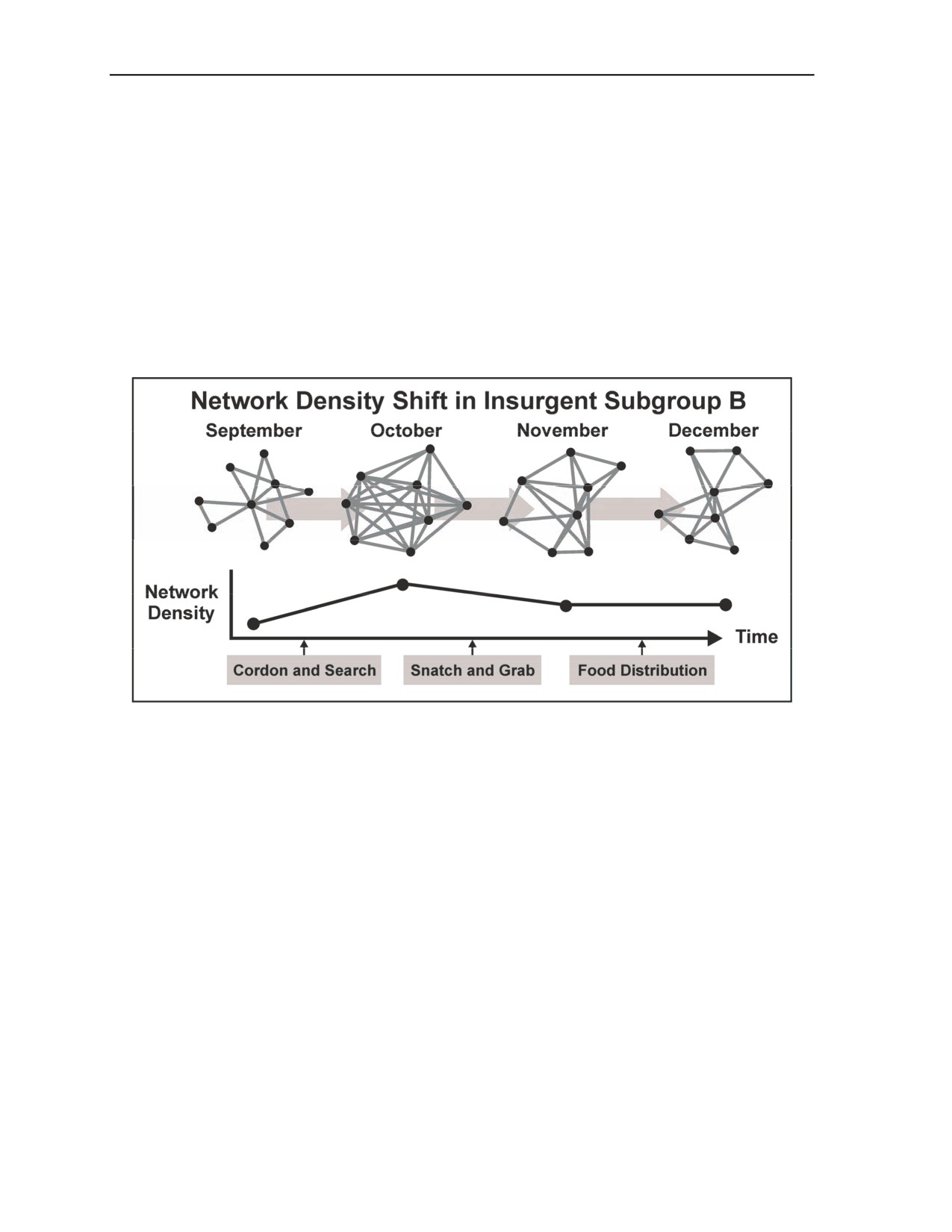
Monitor enemy capabilities.
z
Monitor the effects of recent operations.
z
Develop tactics to further fragment the insurgency.
B-36. An increase in network density indicates the likelihood that the insurgent group can conduct coordi-
nated attacks. A decrease in network density means the group is reduced to fragmented or individual-level
attacks. (Figure B-7 illustrates an example of how tactics and activities can change based on network den-
sity.) A well-executed COIN eventually faces only low-network-density subgroups. This is because high-
network-density subgroups require only the capture of one highly connected insurgent to lead counterin-
surgents to the rest of the group. So while high-network-density groups are the most dangerous, they are
also the easiest to defeat and disrupt.
Figure B-7. Example of changes to tactics based on density shift
B-37. Network density does not consider how distributed the connections are between the nodes in a net-
work. Better metrics of group and organizational performance would be network centrality, core-periphery,
and diameter. A few nodes with a high number of connections can push up the group network density,
even though the majority of the people nodes are only marginally linked to the group. In the case of a
highly centralized network dominated by one or a few very connected nodes, these nodes can be removed
or damaged to fragment the group further into subnetworks.
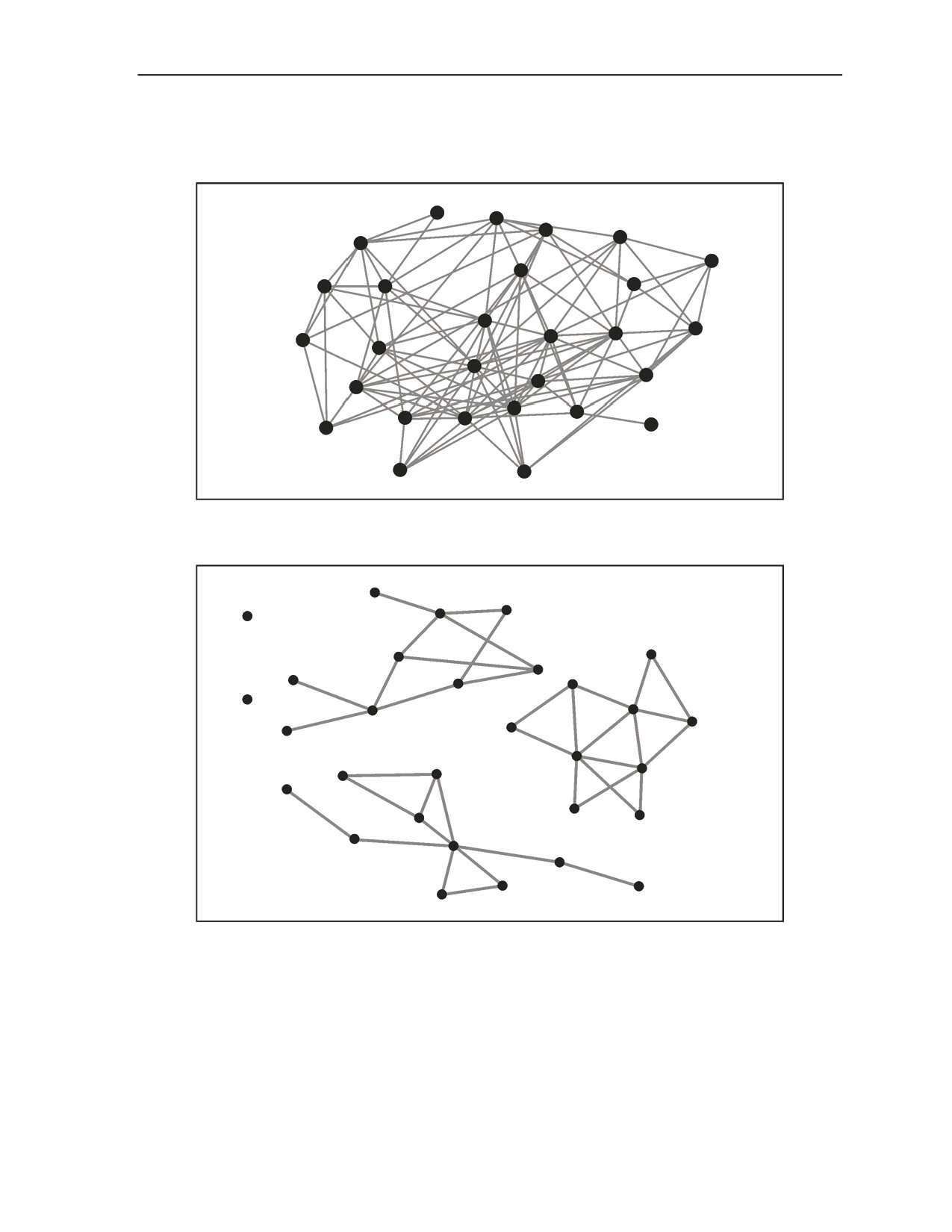
B-38. A fully connected network like the one figure B-8 portrays is an unlikely description of the enemy
insurgent order of battle. A regional insurgency can be fragmented within itself.
B-39. Sometimes a region may actually contain multiple subinsurgencies that are either unaware of, or
even competing with, other subinsurgent groups. In this case, the insurgency resembles a fragmented net-
work. (See figure B-9.)
Individual-Level Analysis
B-40. Individual-level analysis characterizes every member of an organization and identifies its key mem-
bers. Effective SNA allows analysts to identify key individuals from a large mass of data. SNA describes
individuals based on their network position in relation to the network position of every other individual in
the network. Descriptions are in terms of the following individual-level measures: degree centrality, be-
tweenness centrality, and diameter. Individual network centralities provide insight into an individual’s lo-
B-12
FM 3-24/MCWP 3-33.5
15 December 2006
Social Network Analysis and Other Analytical Tools
cation in the network. The relationship between the centralities of all nodes can reveal much about the
overall network structure.
Figure B-8. Networked organization with high connections
Figure B-9. Fragmented network
B-41. One node or a very few central nodes dominate a very centralized network. If these nodes are re-
moved or damaged, the network may quickly fragment into unconnected subnetworks. Hubs are nodes
with a very high degree of centrality. A network centralized around a well-connected hub can fail abruptly
if that hub is disabled or removed.
B-42. A less centralized network has no single points of failure. It is resilient in the face of many inten-
tional attacks or random failures. Many nodes or links can fail while allowing the remaining nodes to still
reach each other over other, redundant network paths.
15 December 2006
FM 3-24/MCWP 3-33.5
B-13
Appendix B
B-43. Degree centrality describes how active an individual is in the network. Network activity for a node is
measured using the concept of degrees—the number of direct connections a node has. Nodes with the most
direct connections are the most active in their networks. Common wisdom in organizations is “the more
connections, the better.” This is not always so. What really matters is where those connections lead and
how they connect the otherwise unconnected. If a node has many ties, it is often said to be either prominent
or influential.
B-44. Betweenness centrality indicates the extent to which an individual lies between other individuals in
the network, serving as an intermediary, liaison, or bridge. A node with high “betweenness” has great in-
fluence over what flows in the network. Depending on position, a person with high betweenness plays a
“broker” role in the network. A major opportunity exists for counterinsurgents if, as in group C of figure
B-6 (page B-11), the high betweenness centrality person is also a single point of failure which, if removed,
would fragment the organization.
B-45. Nodes on the periphery receive very low centrality scores. However, peripheral nodes are often con-
nected to networks that are not currently mapped. The outer nodes may be resource gatherers or individuals
with their own network outside their insurgent group. These characteristics make them very important re-
sources for fresh information not available inside their insurgent group.
The Capture of Saddam Hussein
The capture of Saddam Hussein in December 2003 was the result of hard work
along with continuous intelligence gathering and analysis. Each day another piece of
the puzzle fell into place. Each led to coalition forces identifying and locating more of
the key players in the insurgent network—both highly visible ones like Saddam Hus-
sein and the lesser ones who sustained and supported the insurgency. This process
produced detailed diagrams that showed the structure of Hussein’s personal security
apparatus and the relationships among the persons identified.
The intelligence analysts and commanders in the 4th Infantry Division spent the
summer of 2003 building link diagrams showing everyone related to Hussein by
blood or tribe. Those family diagrams led counterinsurgents to the lower level, but
nonetheless highly trusted, relatives and clan members harboring Hussein and help-
ing him move around the countryside. The circle of bodyguards and mid-level military
officers, drivers, and gardeners protecting Hussein was described as a “Mafia or-
ganization,” where access to Hussein controlled relative power within the network.
Over days and months, coalition forces tracked how the enemy operated. Analysts
traced trends and patterns, examined enemy tactics, and related enemy tendencies
to the names and groups on the tracking charts. This process involved making con-
tinual adjustments to the network template and constantly determining which critical
data points were missing.
Late in the year, a series of operations produced an abundance of new intelligence
about the insurgency and Hussein’s whereabouts. Commanders then designed a se-
ries of raids to capture key individuals and leaders of the former regime who could
lead counterinsurgents to him. Each mission gained additional information, which
shaped the next raid. This cycle continued as a number of mid-level leaders of the
former regime were caught, eventually leading coalition forces into Hussein’s most
trusted inner circle and finally to Hussein’s capture.
Social Network Analysis and Counterinsurgency
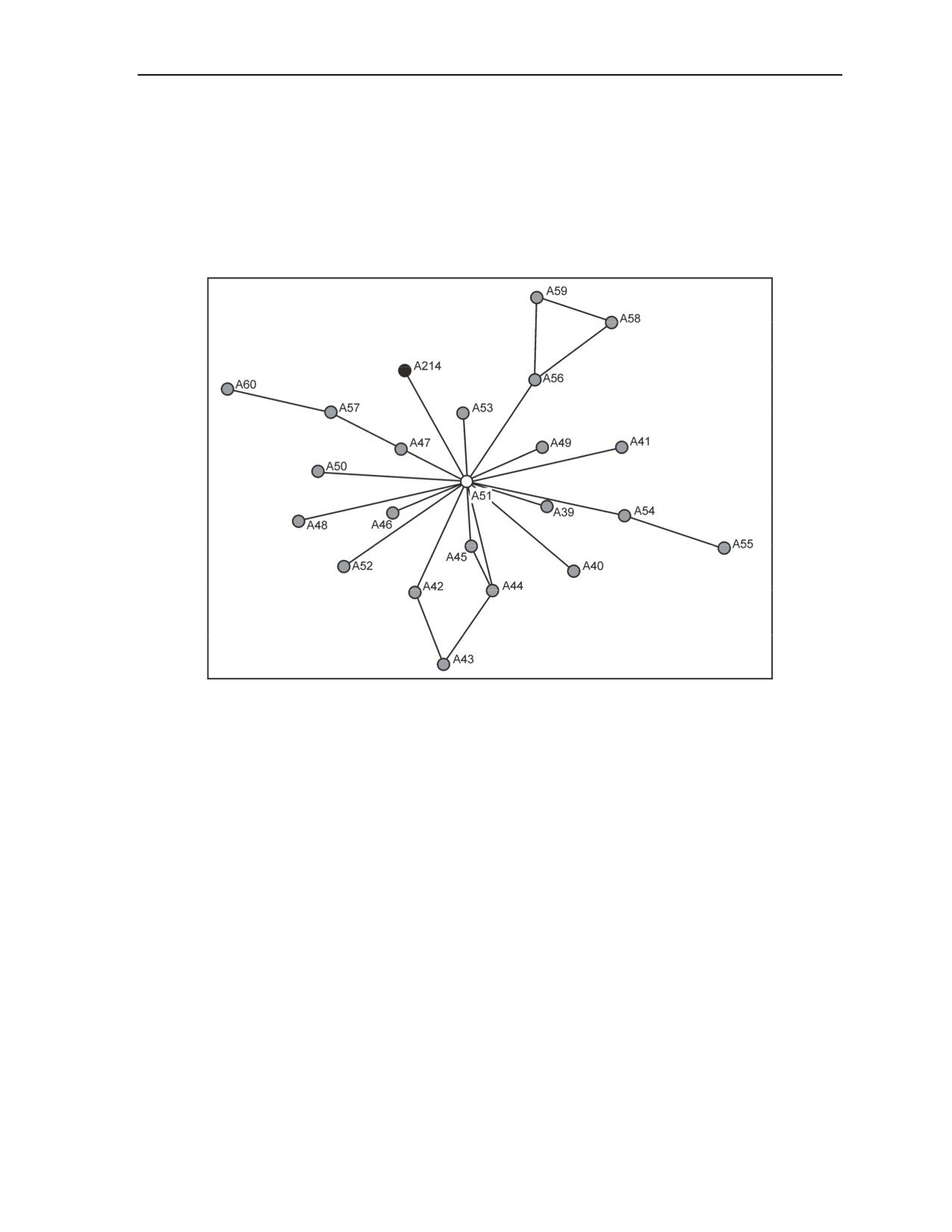
B-46. Figure B-10 shows a simple, social network of key individuals and relationships. The nodes in this
data set are from a modified, subnetwork of the link diagram representing Saddam Hussein and his connec-
tions to various family members, former regime members, friends, and associates. The original diagram
B-14
FM 3-24/MCWP 3-33.5
15 December 2006
Social Network Analysis and Other Analytical Tools
contained hundreds of names and took shape on a large 36-by-36-inch board. Each “box” in the network
contained personal information on a particular individual. This information included roles and positions of
certain people within the network—for example, chief of staff, chief of operations, and personal secretary.
These were not necessarily positions the individuals occupied before the fall of Hussein; rather they were
based on an understanding of the role they were filling in the insurgency or Saddam’s underground opera-
tions. Analysts assigned these roles based on an assessment of various personalities and recent reports.
Such a process helped coalition forces focus their efforts in determining those who were closest to Hussein
and their importance.
Figure B-10. Simple network
B-47. For an insurgency, a social network is not just a description of who is in the insurgent organization;
it is a picture of the population, how it is put together and how members interact with one another. A tribal
society already has affiliated social, economic, and military networks easily adapted to warfighting. The
ways in which insurgents exploit a tribal network does not represent an evolved form of insurgency but the
expression of inherent cultural and social customs. The social dynamic that sustains ongoing fighting is
best understood when considered in tribal terms—in particular, from the perspective of a traditionally net-
worked society. It is the traditional tribal network that offers rebels and insurgents a ready-made insurrec-
tionary infrastructure on which to draw.
B-48. The full functioning of a network depends on how well, and in what ways, its members are person-
ally known and connected to one another. This is the classic level of SNA, where strong personal ties, of-
ten ones that rest on friendship and bonding experiences, ensure high degrees of trust and loyalty. To func-
tion well, networks may require higher degrees of interpersonal trust than do other approaches to
organization, like hierarchies. Kinship ties, be they of blood or brotherhood, are a fundamental aspect of
many terrorist, criminal, and gang organizations. For example, news about Osama bin Laden and the Al
Qaeda network reveal his, and its, dependence on personal relationships formed over years with “Afghan
Arabs” from Egypt and elsewhere. These people are committed to anti-United States terrorism and Islamic
fundamentalism.
B-49. To draw an accurate picture of a network, units need to identify ties among its members. Strong
bonds formed over time by family, friendship, or organizational association characterize these ties. Units
gather information on these ties by analyzing historical documents and records, interviewing individuals,
15 December 2006
FM 3-24/MCWP 3-33.5
B-15
Appendix B
and studying photos and books. It is painstaking work, but there is really no alternative when trying to
piece together a network that does not want to be identified. Charts and diagrams lead to understanding the
insurgents’ means of operations. These same diagrams are also useful for understanding tribal, family,
NGO, and transnational terrorist elements. Each diagram and chart may have links to another or several
others, but they are not created overnight. It takes time, patience, detailed patrolling, and reporting and re-
cording of efforts.
B-50. As a unit builds its situational awareness, it must create easy-to-understand, adaptable, and accurate
diagrams and information sheets. These products feed one another and allow units to maintain and contrib-
ute to their understanding of the situation.
B-51. As commanders dispatch patrols to collect information, they can begin to build a graph of the popu-
lation in the AO. As graphs grow, they may show that traditional, static organizational line charts do not
produce viable explanations of insurgent organizational behavior. Individual insurgents may be constantly
adapting to the operational environment, their own capabilities, and counterinsurgent tactics. A com-
mander’s understanding of the insurgency is only as good as the patrol’s last collection.
B-52. Relationships (links) in large data sets are established by similarities between the nodes (people).
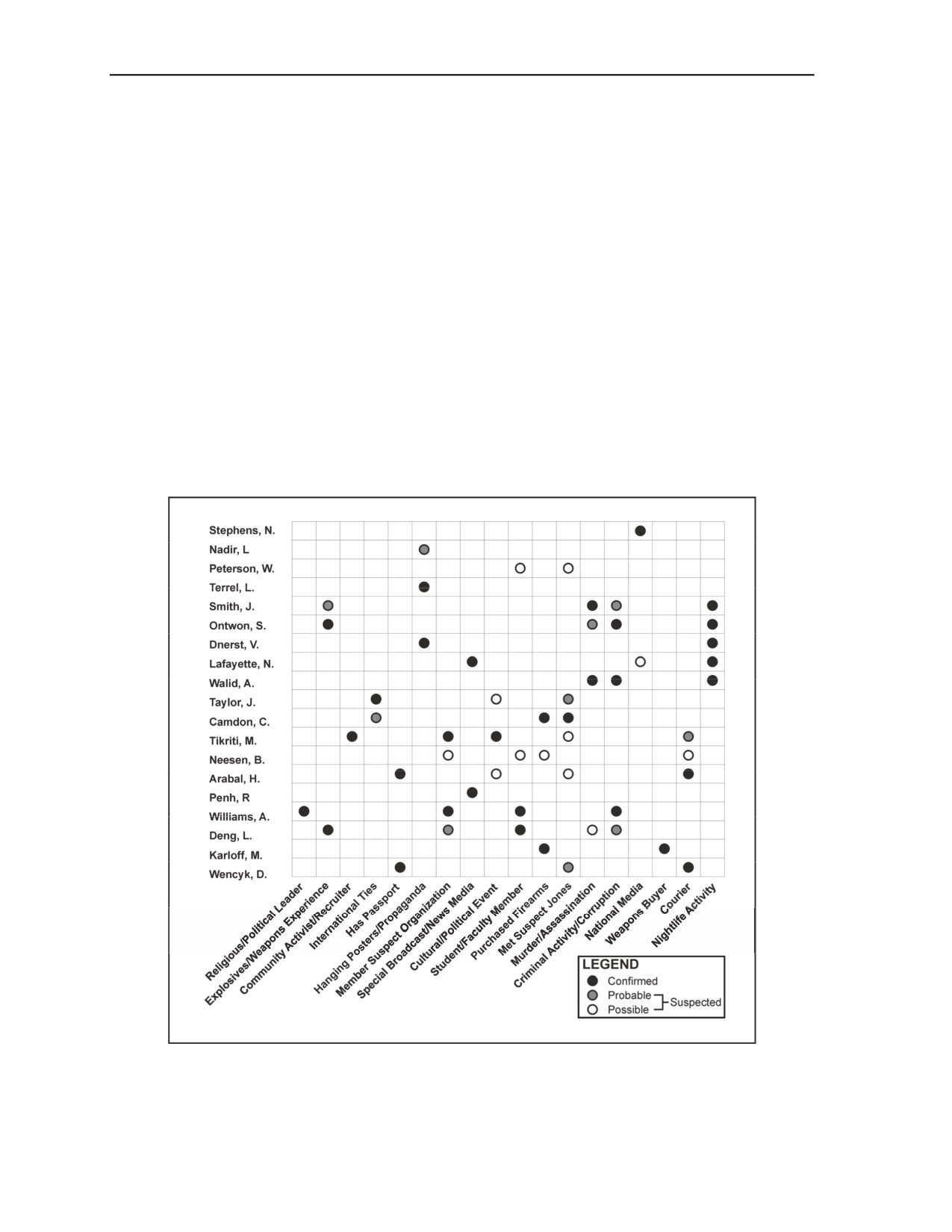
Figure B-11 shows an example activities matrix. People are identified by their participation in independent
activities. When graphed, pairs who have engaged in the same activity (columns with dots) are designated
with a link.
Figure B-11. Example activities matrix
B-16
FM 3-24/MCWP 3-33.5
15 December 2006
Social Network Analysis and Other Analytical Tools
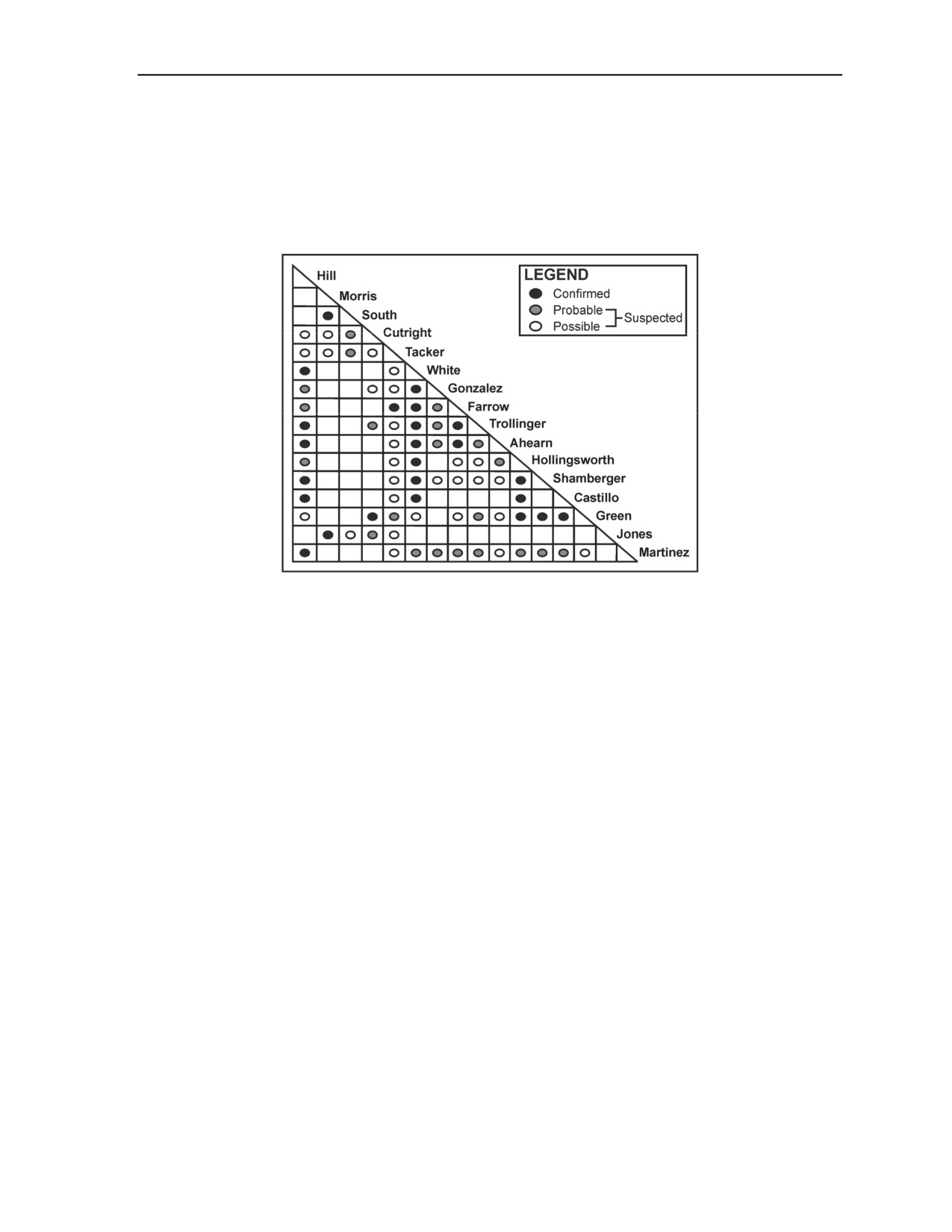
B-53. An association matrix portrays the existence of an association, known or suspected, between indi-
viduals. (See figure B-12.) Direct connections include such things as face-to-face meetings and confirmed
telephonic conversations. Association matrices provide a one-dimensional view of the relationships and
tend to focus on the immediate AO. Analysts can use association matrices to identify those personalities
and associations needing a more in-depth analysis to determine the degree of relationship, contacts, or
knowledge between the individuals. The structure of the insurgent organization is identified as connections
between personalities are made.
Figure B-12. Example association matrix
Social Network Analysis Summary
B-54. Insurgents often form a networked organization embedded in a sympathetic population. Differentiat-
ing between insurgents, insurgent supporters, neutrals, and the HN government supporters is difficult. With
every counterinsurgent success, the insurgent organization becomes further fragmented but remains danger-
ous.
B-55. SNA helps units formalize the informality of insurgent networks by portraying the structure of some-
thing not readily observed. Network concepts let commanders highlight the structure of a previously unob-
served association by focusing on the preexisting relationships and ties that bind together such groups. By
focusing on roles, organizational positions, and prominent or influential actors, commanders may get a
sense of how the organization is structured and thus how the group functions, how members are influenced
and power exerted, and how resources are exchanged.
B-56. COIN operations require assessing the political and social architecture of the operational environ-
ment, from both friendly and enemy perspectives. SNA can help commanders understand how an insurgent
organization operates. Insurgent networks often do not behave like normal social networks. However, SNA
can help commanders determine what kind of social network an insurgent organization is. That knowledge
helps commanders understand what the network looks like, how it is connected, and how best to defeat it.
15 December 2006
FM 3-24/MCWP 3-33.5
B-17
Appendix B
HISTORICAL TIME LINE
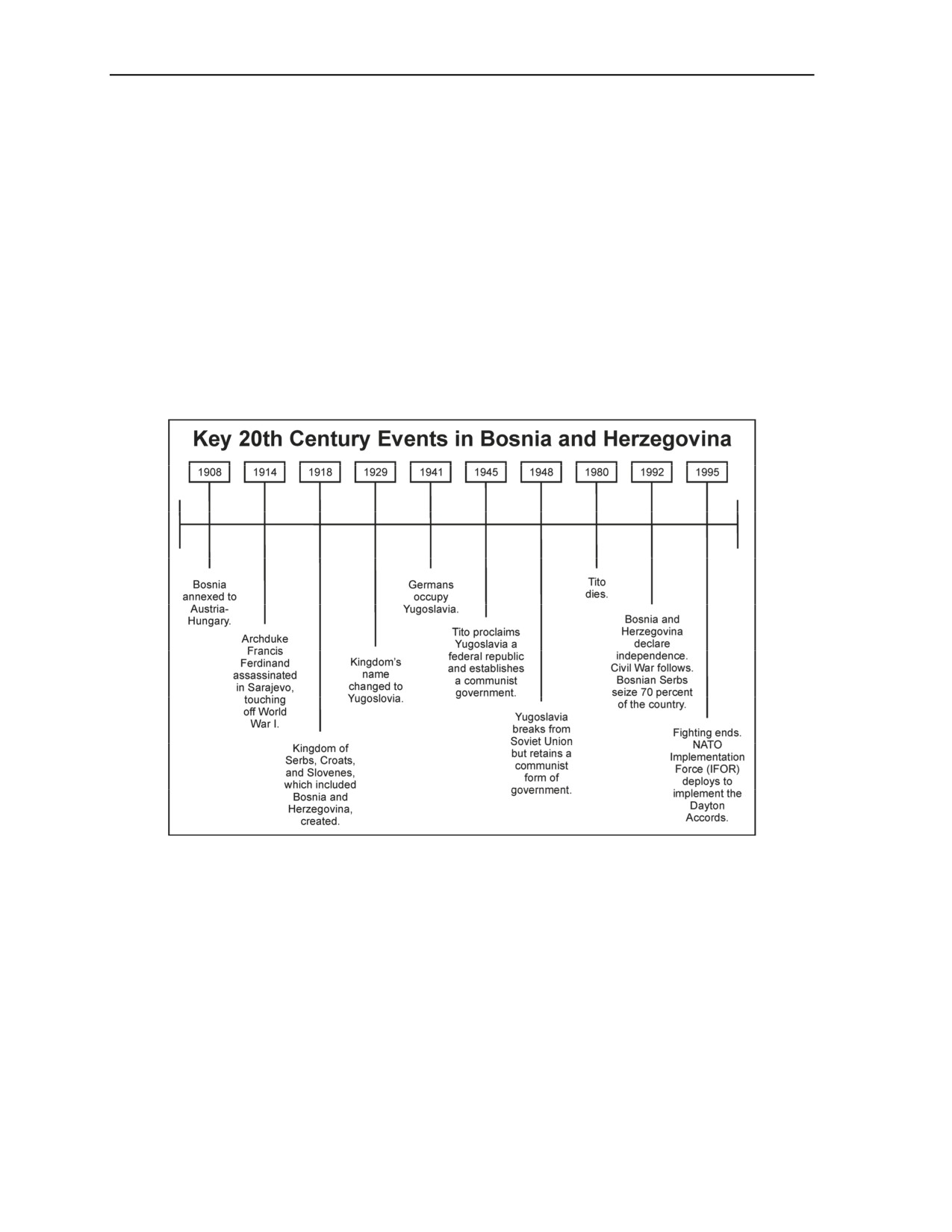
B-57. A time line is list of significant dates along with relevant information and analysis. Time lines seek
to provide a context to operational conditions. (See figure B-13.) Time lines often contain information re-
lated to areas and people as well as events. Some time lines describe population movements (areas) and po-
litical shifts (power and authority) that are relevant to the AO. Time lines can also include a brief historical
record of the population or area, highlighting the activities (events) of a certain population sector. As ana-
lytic tools, time lines might help analysts predict how key population sectors might react to certain circum-
stances.
B-58. Key local national holidays, historic events, and significant cultural and political events can be ex-
tremely important. Soldiers and Marines are often provided with a list of these key dates to identify poten-
tial dates of increased or unusual activity. These lists, however, rarely include a description of why these
dates are significant and what can be expected to happen on the holiday. In some cases, days of the week
are significant.
Figure B-13. Example historical time line
PATTERN ANALYSIS
B-59. Pattern analysis plot sheets, time-event charts, and coordinates registers are pattern analysis tools
used to evaluate a threat and determine threat courses of action. (FM 2-22.3 discusses how use these tools.)
Pattern Analysis Plot Sheet
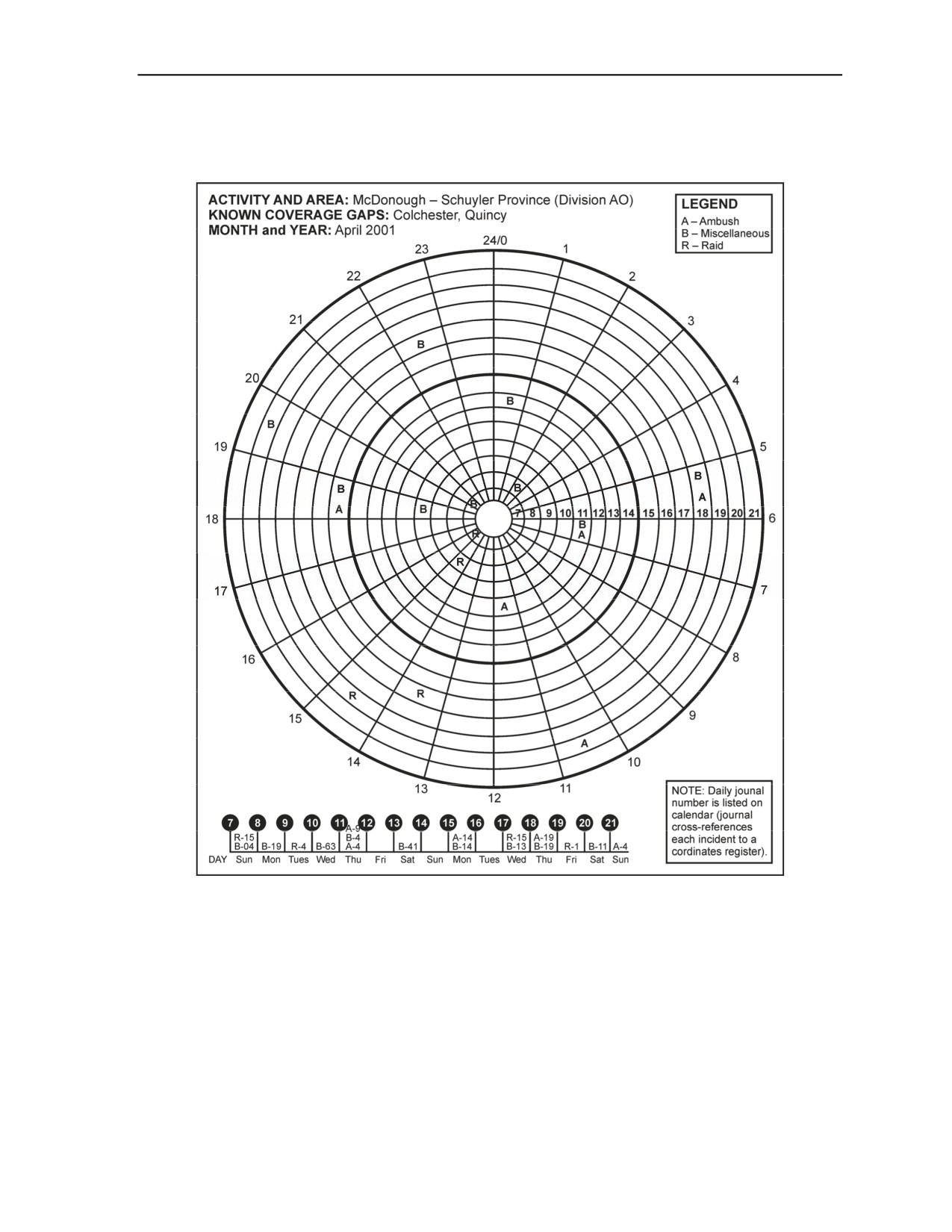
B-60. Pattern analysis plot sheets focus on the time and date of each serious incident that occurs within the
AO. (See figure B-14.) The rings depict days of the month; the segments depict the hours of the day. As
shown in the plot sheet’s legend, the chart depicts the actual events and identifies each by using an alpha-
numeric designation that corresponds to the legend used on the coordinates register. (See paragraph B-61.)
Another type of pattern analysis plot sheet helps distinguish patterns in activities associated with particular
days, dates, or times. When used in conjunction with the coordinates register and doctrinal templates, a pat-
B-18
FM 3-24/MCWP 3-33.5
15 December 2006
Social Network Analysis and Other Analytical Tools
tern analysis plot sheet supplies most of the data needed for an event template. Analysts may choose to
modify this product to track shorter periods to avoid clutter and confusion.
Figure B-14. Example pattern analysis plot sheet
15 December 2006
FM 3-24/MCWP 3-33.5
B-19
Appendix B
Coordinates Register
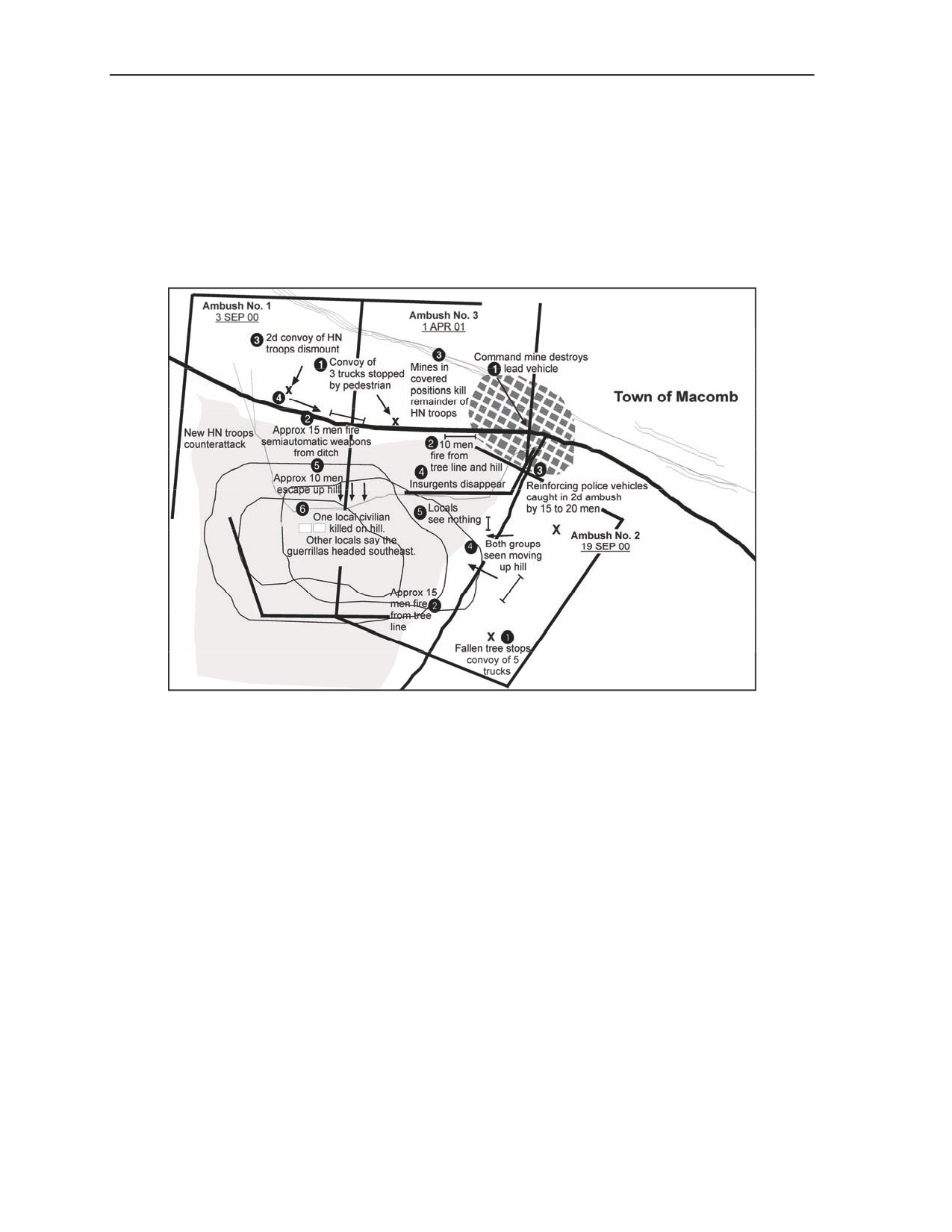
B-61. Another pattern analysis tool is the coordinates register, also known as an incident map. (See figure
B-15.) A coordinates register illustrates cumulative events that have occurred within an AO. It focuses on
the “where” of an event. Analysts may use multiple coordinates registers, each focusing on an individual
subject or a blend of subjects. Additionally, a coordinates register includes information like notes or graph-
ics. Analysts should always use the coordinates register in with the pattern analysis plot sheet.
Figure B-15. Example coordinates register
B-20
FM 3-24/MCWP 3-33.5
15 December 2006
Social Network Analysis and Other Analytical Tools
Link Diagrams
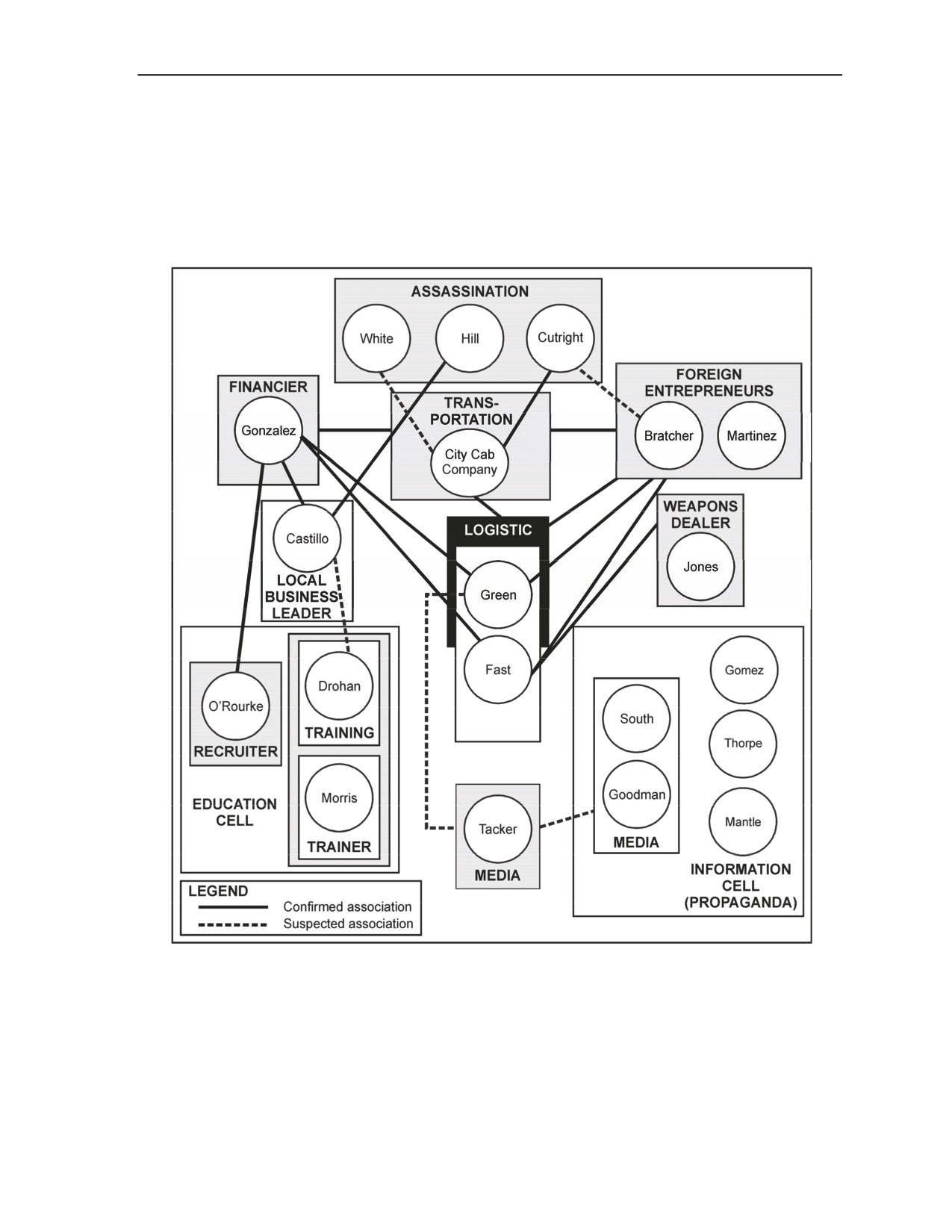
B-62. The link diagram graphically depicts relationships between people, events, locations, or other factors
deemed significant in any given situation. (See Figure B-16.) Link diagrams help analysts better under-
stand how people and factors are interrelated in order to determine key links. (For more information on link
diagrams, see FM 2-22.3.)
Figure B-16. Example link diagram
15 December 2006
FM 3-24/MCWP 3-33.5
B-21
Appendix B
Time-Event Charts
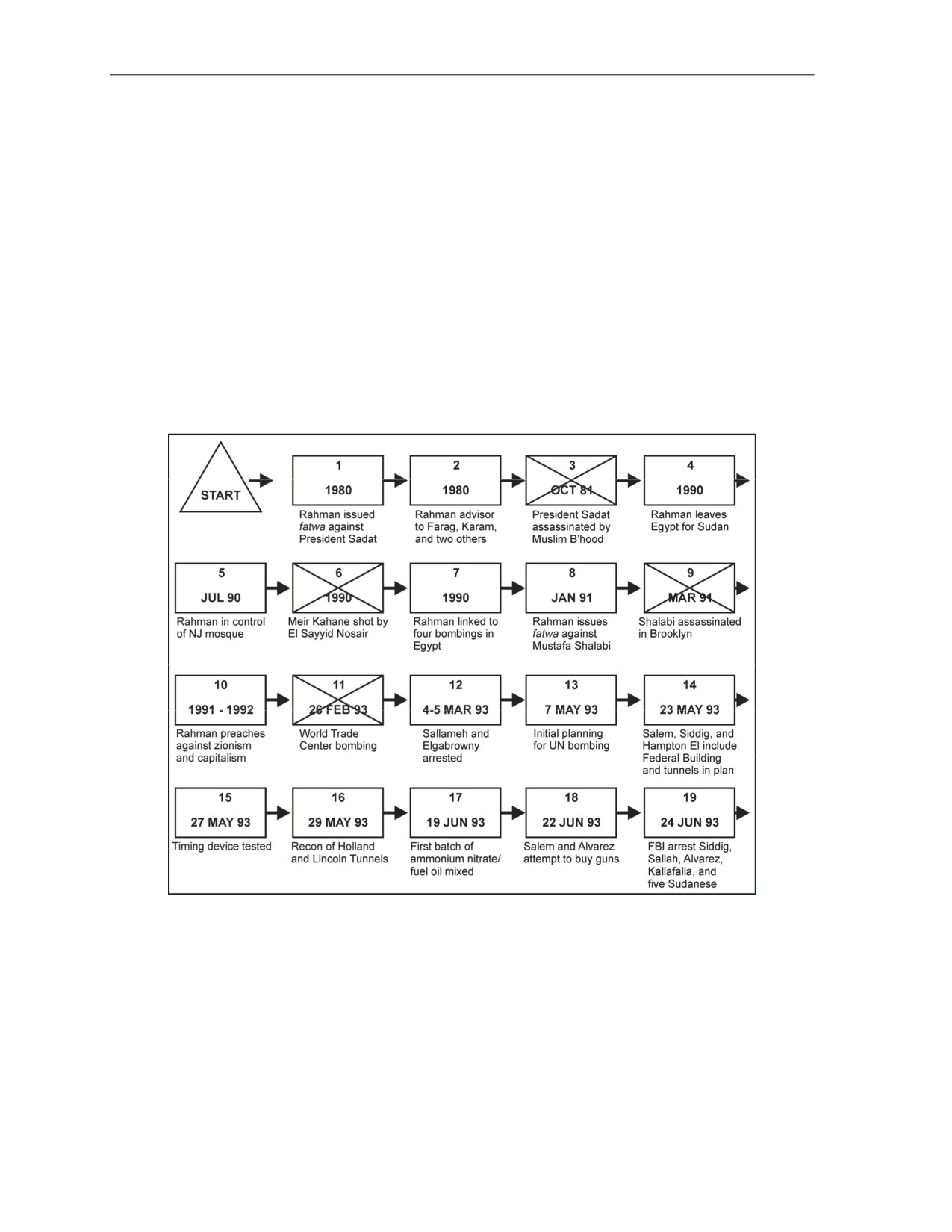
B-63. Time-event charts are chronological records of individual or group activities. They are designed to
store and display large amounts of information in a small space. Analysts can use time-event charts to help
analyze larger scale patterns of such things as activities and relationships. There is great latitude in prepar-
ing time-event charts. Some of their common characteristics are as follows:
z
The beginning and ends of the chart are shown with triangles.
z
Other events are shown with squares.
z
Particularly noteworthy events have an X drawn across the square.
z
The date is always on the symbol.
z
A description is below the symbol.
z
The flow is from left to right for each row.
(Figure B-17 is an example showing events surrounding the plot to attack several landmarks in New York
City in the early 1990s.)
Figure B-17. Example time-event chart
B-22
FM 3-24/MCWP 3-33.5
15 December 2006
Appendix C
Linguist Support
U.S. forces conducting counterinsurgency operations in foreign nations require lin-
guist support. Military intelligence units assigned to brigade and higher level com-
mands have organic interpreters (linguists) to perform human intelligence and signals
intelligence functions. However, the need for interpreters usually exceeds organic ca-
pabilities, and commanders should obtain external interpreter support early.
LINGUIST SUPPORT CATEGORIES
C-1. When possible, interpreters should be U.S. military personnel or category II or III linguists. Unit in-
telligence officers should maintain language rosters at home station to track assigned personnel with lin-
guistic capabilities before deployment. When requirements exceed organic capabilities, unit commanders
can hire host-nation (HN) personnel to support their operations. Contracted linguists can provide inter-
preter support and perform intelligence functions. They fall into three categories.
C-2. Category I linguists usually are hired locally and require vetting. They do not have a security clear-
ance. They are the most abundant resource pool; however, their skill level is limited. Category I linguists
should be used for basic interpretation for activities such as patrols, base entrance coverage, open-source
intelligence collection, and civil-military operations. Commanders should plan for 30 to 40 linguists from
category I for an infantry battalion. Brigade headquarters should maintain roughly 15 category I linguists
for surge operations.
C-3. Category II linguists are U.S. citizens with a secret clearance. Often they possess good oral and writ-
ten communication skills. They should be managed carefully due to limited availability. Category II lin-
guists interpret for battalion and higher level commanders or tactical human intelligence teams. Brigade
commanders should plan for 10 to 15 linguists from category II. That breaks down to one linguist for the
brigade commander, one for each infantry battalion commander, and approximately 10 linguists for the
supporting military intelligence company. Of those 10, three translate for each tactical human intelligence
team or operations management team, and two translate for each signals intelligence collection platform.
C-4. Category III linguists are U.S. citizens with a top secret clearance. They are a scarce commodity and
often retained at division and higher levels of command. They have excellent oral and written communica-
tions skills.
C-5. Some private companies provide linguist support through contracts. The required statement of work
or contract should define the linguist’s requirements and the unit’s responsibilities. Contracted category II
and III linguists should provide their own equipment, such as flak vests, Kevlar, and uniforms. (Category I
linguists normally do not.) The unit designates a linguist manager to identify language requirements and
manage assets. Site managers for the contractor are located at the division level to manage personnel issues
such as leave, vacation, pay, and equipment.
C-6. When hiring HN personnel to perform category I linguist requirements as interpreters, units should
consider the guidelines under the following categories:
z
Selecting interpreters.
z
Establishing rapport.
z
Orienting interpreters.
z
Preparing for presentations.
15 December 2006
FM 3-24/MCWP 3-33.5
C-1
Appendix C
z
Conducting presentations.
z
Speaking techniques.
SELECTING INTERPRETERS
C-7. Soldiers and Marines must try to vet interpreters before hiring them. All interpreters must meet a ba-
sic set of criteria. They should be native speakers. The target audience should willingly accept their social
status. All interpreters should speak English fluently. They should be able to translate correctly. Intelligent
translators are mandatory; those with technical knowledge are desired. Interpreters should be reliable,
loyal, and compatible with the military personnel. Their gender, age, race, and ethnicity must be compati-
ble with the target audience.
NATIVE SPEAKER
C-8. Interpreters should be native speakers of the socially or geographically determined dialect. Their
speech, background, and mannerisms should be completely acceptable to the target audience. The inter-
preters should not distract the interviewees. The target audience should give no attention to the way inter-
preters talk, only to what they say. Native speakers can better distinguish dialects of different regions and
provinces. This knowledge can help identify interviewees from other countries or from outside the local
area.
SOCIAL STATUS AND ETHNO-RELIGIOUS IDENTITY
C-9. If their social standing is considerably lower than that of the audience, interpreters may be limited in
their effectiveness. Examples include significant differences in military rank or membership in a shunned
ethnic or religious group. Soldiers and Marines must communicate with the local population. They must be
tolerant of local prejudices and choose an interpreter who is least likely to cause suspicion or miscommuni-
cation. Interpreters should also have a good reputation in the community and not be intimidated when deal-
ing with important audiences.
ENGLISH FLUENCY
C-10. An often overlooked consideration is how well the interpreter speaks English. If the interpreter un-
derstands the speaker and the speaker understands the interpreter, then the interpreter’s command of Eng-
lish is satisfactory. Soldiers and Marines can check that understanding by speaking something to the inter-
preter in English and asking the interpreter to paraphrase it.
UNDERSTANDING OF THE AUDIENCE
C-11. Interpreting goes both ways. Interpreters should accurately convey information expressed by inter-
viewees or the target audience. This is especially important when commanders speak with HN civilian
leaders and military personnel. Linguists involved in military discussions should understand military terms
and doctrine.
INTELLECTUAL CAPABILITIES
C-12. Interpreters should be quick and alert, able to respond to changing conditions and situations. They
should be able to grasp complex concepts and discuss them clearly and logically. Although education does
not equate to intelligence, it does expose students to diverse and complex topics. As a result, the better edu-
cated the interpreters, the better they perform.
TECHNICAL ABILITY
C-13. Sometimes Soldiers and Marines need interpreters with technical training or experience in special
subject areas. Such interpreters can translate the meaning as well as the words. For instance, if the subject
is nuclear physics, background knowledge is useful.
C-2
FM 3-24/MCWP 3-33.5
15 December 2006
Linguist Support
RELIABILITY
C-14. Soldiers and Marines should avoid a potential interpreter who arrives late for the vetting interview.
Throughout the world, the concept of time varies widely. In many countries, timeliness is relatively unim-
portant. Soldiers and Marines should stress the importance of punctuality with interpreters.
LOYALTY
C-15. If interpreters are local nationals, their first loyalty is probably to the host nation or ethnic group, not
to the U.S. military. The security implications are clear. Soldiers should be cautious when they explain
concepts. They should limit what information interpreters can overhear. Some interpreters, for political or
personal reasons, may have ulterior motives or a hidden agenda. Soldiers and Marines who detect or sus-
pect such motives should tell the commander or security manager.
GENDER, AGE, RACE, AND ETHNICITY
C-16. Gender, age, and race can seriously affect the mission effectiveness of interpreters. In predominantly
Muslim countries, cultural prohibitions may cause difficulties with gender. A female interpreter may be in-
effective in communicating with males, while a female interpreter may be needed to communicate with fe-
males. In regions featuring ethnic strife, such as the Balkans, ethnic divisions may limit the effectiveness of
an interpreter from outside the target audience. Since traditions, values, and biases vary from country to
country, Soldiers and Marines must thoroughly study the culture to determine the most favorable character-
istics for interpreters.
COMPATIBILITY
C-17. The target audience quickly recognizes personality conflicts between Soldiers and Marines and their
interpreters. Such friction can undermine the effectiveness of the communication. When selecting interpreters,
Soldiers and Marines should look for compatible traits and strive for a harmonious working relationship.
EMPLOYING LINGUISTS
C-18. If several qualified interpreters are available, Soldiers and Marines should select at least two. This is
particularly important if the interpreter works during long conferences or courses of instruction. With two
interpreters available, they should each work for thirty-minute periods. Due to the mental strain associated
with this task, four hours of active interpreting a day is usually the most that interpreters can work before
effectiveness declines. During short meetings and conversations with two or more available interpreters,
one can provide quality control and assistance for the one translating. This technique is useful when con-
ducting coordination or negotiation meetings, as one interpreter can actively interpret while the other pays
attention to the body language and side conversations of the audience. Many times, Soldiers and Marines
can learn important auxiliary information from listening to what others are saying among themselves. This
information can help in later negotiations.
C-19. Commanders must protect their interpreters. They should emplace security measures to keep inter-
preters and their families safe. Insurgents know the value of good interpreters and will often try to intimi-
date or kill interpreters and their family members. Insurgents may also coerce interpreters to gather infor-
mation on U.S. operations. Soldiers and Marines must actively protect against subversion and espionage, to
include using a polygraph.
C-20. Certain tactical situations may require using uncleared HN personnel as interpreters. Commanders
should recognize the increased security risk when using such personnel and carefully weigh the risk versus
potential gain. If uncleared interpreters are used, Soldiers and Marines must limit discussing sensitive in-
formation.
15 December 2006
FM 3-24/MCWP 3-33.5
C-3
Appendix C
ESTABLISHING RAPPORT
C-21. Interpreters are a vital link among Soldiers, Marines, and the target audience. Without supportive,
cooperative interpreters, the mission is jeopardized. Mutual respect and understanding are essential to ef-
fective teamwork. Soldiers and Marines should establish rapport early and maintain it throughout the op-
eration. Problems establishing rapport stem mostly from a lack of personal communication skills and mis-
understandings regarding culture.
C-22. Before they meet interpreters, Soldiers and Marines study the area of operations and its inhabitants.
This process is discussed in chapter 3. Many foreigners have some knowledge about the United States. Un-
fortunately, much of this comes from commercial movies and television shows. Soldiers and Marines may
need to teach the interpreter something realistic about the United States as well.
C-23. Soldiers and Marines working with an interpreter should research and verify the interpreter’s back-
ground. They should be genuinely interested in the interpreter and the interpreter’s family, aspirations, ca-
reer, and education. Many cultures emphasize family roles differently from the United States, so Soldiers
and Marines should first understand the interpreter’s home life. Though Soldiers and Marines should gain
as much cultural information as possible before deploying, their interpreters can be valuable sources for
filling gaps. However, information from interpreters will likely represent the views of the group to which
they belong. Members of opposing groups almost certainly see things differently and often view culture
and history differently.
C-24. Soldiers and Marines should gain an interpreter’s trust and confidence before discussing sensitive is-
sues. These issues include religion, likes, dislikes, and prejudices. Soldiers and Marines should approach
these topics carefully. Although deeply held personal beliefs may be revealing and useful in a professional
relationship, Soldiers and Marines should draw these out of their interpreters gently and tactfully.
C-25. One way to reinforce the bond between military personnel and their interpreter is to make sure the
interpreter has every available comfort. This includes providing personal protection equipment—boots, hel-
mets, and body armor—that the interpreter (especially a category I interpreter) may not already have. Sol-
diers and Marines must give interpreters the same comforts that military personnel enjoy. Interpreters need
the same base comforts—shelter, air conditioning, and heat—as military personnel. If and when an inter-
preter is assigned to a specific unit, the interpreter ought to live with that organization to develop a bond. If
there are several interpreters, it may be more effective for the interpreters to live together on the unit com-
pound.
ORIENTING INTERPRETERS
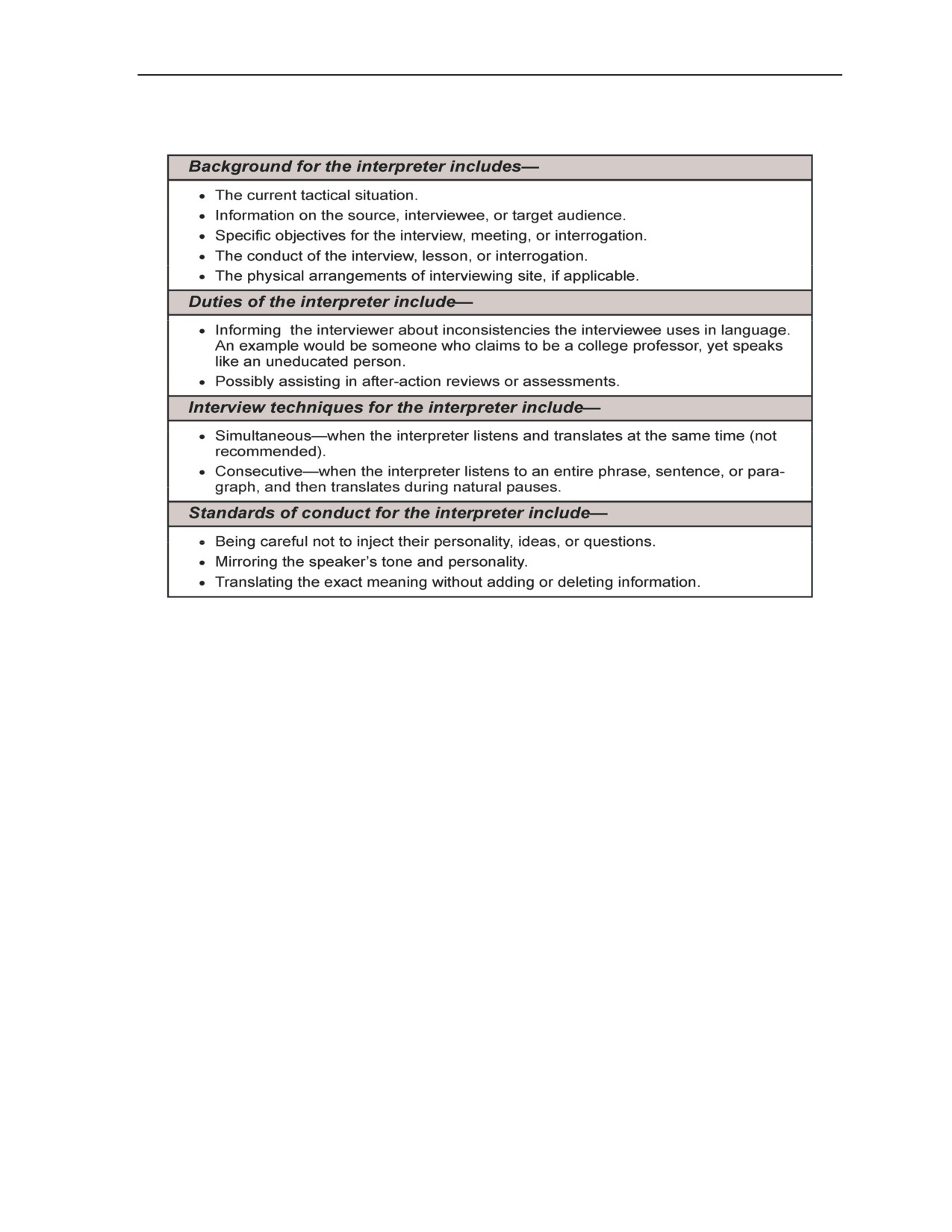
C-26. Early in the relationship, Soldiers and Marines must explain to interpreters their duties, expected
standards of conduct, interview techniques, and any other requirements and expectations. (Table C-1 lists
some information to include when orienting interpreters.)
PREPARING FOR PRESENTATIONS
C-27. Sites for interviews, meetings, or classes should be carefully selected and arranged. The physical ar-
rangement can be especially significant for certain groups or cultures.
C-28. Speakers should understand unique cultural practices before interviewing, instructing, or talking with
foreign nationals. For example, speakers and interpreters should know when to stand, sit, or cross one’s
legs. Gestures are a learned behavior and vary from culture to culture. If properly selected, interpreters
should be helpful in this regard.
C-29. Interpreters should mirror the speaker’s tone and personality. They must not add their own questions
or emotions. Speakers should instruct interpreters to inform them discreetly if they notice inconsistencies
or peculiarities of speech, dress, and behavior.
C-4
FM 3-24/MCWP 3-33.5
15 December 2006
Linguist Support
Table C-1. Orientation for interpreters
C-30. Soldiers and Marines must carefully analyze the target audience. This analysis goes beyond the
scope of this appendix. Mature judgment, thoughtful consideration of the target audience as individuals,
and a genuine concern for their receiving accurate information helps Soldiers and Marines accomplish the
mission. Soldiers and Marines should remember, for example, that a farmer from a small village has mark-
edly different expectations and requirements than a city executive.
C-31. Soldiers and Marines who work through an interpreter may take double or triple the time normally
required for an event. They may save time if they give the interpreter pertinent information beforehand.
This information may include briefing slides, questions to ask, a lesson plan, copies of any handouts, or a
glossary of difficult terms.
CONDUCTING PRESENTATIONS
C-32. As part of the initial training for interpreters, Soldiers and Marines emphasize that interpreters follow
their speaker’s lead. They become a vital communication link between the speaker and target audience.
Soldiers and Marines should appeal to the interpreter’s professional pride. They clarify how the quality and
quantity of the information sent and received directly depends on linguistic skills. Although interpreters
perform some editing as a function of the interpreting process, they must transmit the exact meaning with-
out additions or deletions.
C-33. Speakers should avoid simultaneous translations—the speaker and interpreter talking at the same
time—when conducting an interview or presenting a lesson. They should talk directly to the individual or
audience for a minute or less in a neutral, relaxed manner. The interpreter should watch the speaker care-
fully. While translating, the interpreter should mimic the speaker’s body language as well as interpret ver-
bal meaning. Speakers should observe interpreters closely to detect any inconsistent behaviors. After
speakers present one major thought in its entirety, interpreters then reconstruct it in their language. One
way to ensure that the interpreter is communicating exactly what the speaker means is to have a senior in-
15 December 2006
FM 3-24/MCWP 3-33.5
C-5
Appendix C
terpreter observe several conversations. The senior interpreter can provide feedback along with further
training.
C-34. Soldiers and Marines should be aware that some interpreters might attempt to save face or to protect
themselves by concealing their lack of understanding. They may translate what they believe the speaker or
audience said or meant without asking for clarification. This situation can result in misinformation and
confusion. It can also impact the speaker’s credibility. Interpreters must know that when in doubt they
should always ask for clarification.
C-35. During an interview or lesson, if the interviewee asks questions, interpreters should immediately re-
lay them to the speaker for an answer. Interpreters should never attempt to answer questions, even if they
know the correct answers. Neither speakers nor interpreters should correct each other in front of an inter-
viewee or class. They should settle all differences away from the subject or audience.
C-36. Establishing rapport with the interpreter is vital; establishing rapport with interviewees or the target
audience is equally important. Speakers and their interpreters should concentrate on this task. To establish
rapport, interviewees and target audiences should be treated as mature, important people who are worthy
and capable.
C-37. Several methods ensure that the speaker communicates directly to the target audience using the in-
terpreter as only a mechanism for that communication. One technique is to have the interpreter stand to the
side of and just behind the speaker. This position lets the speaker stand face-to-face with the target audi-
ence. The speaker should always look at and talk directly to the target audience, rather than to the inter-
preter. This method allows the speaker and the target audience to establish a personal relationship.
SPEAKING TECHNIQUES
C-38. An important first step for Soldiers and Marines communicating in a foreign language is to reinforce
and polish their English language skills. These skills are important, even when no attempt has been made to
learn the HN language. They should use correct words, without idioms or slang. The more clearly Soldiers
and Marines speak in English, the easier it is for interpreters to translate exactly. For instance, speakers
may want to add words usually left out in colloquial English, such as the “air” in airplane. This ensures
they are not misinterpreted as referring to the Great Plains or a carpenter’s plane.
C-39. Speakers should not use profanity at all and should avoid slang. Many times, interpreters cannot
translate such expressions. Even those they can translate might lose the desired meaning. Terms of surprise
or reaction such as “gee whiz” and “golly” are difficult to translate.
C-40. Speakers should avoid using acronyms. While these are part of everyday military language, most in-
terpreters and target audiences do not know them. The interpreter may have to interrupt the interview for
clarification. This can disrupt the rhythm of the interview or lesson. If interpreters constantly interrupt the
speaker for explanation, they could lose credibility in the eyes of the target audience. Such a reaction could
jeopardize the interview or lesson. If speakers use technical terms or expressions, they should be sure in-
terpreters convey the proper meaning. This preparation is best done in advance.
C-41. Before speaking impulsively, Soldiers and Marines should consider what they wish to say. They
should break their thoughts into logical bits and articulate them one at a time. Using short, simple words
and sentences helps the interpreter to translate quickly and easily. Speakers should never say more in one
sentence than they can easily repeat immediately after saying it. Each sentence should contain a complete
thought without the extra words.
C-42. Speakers should avoid American “folk” and culture-specific references. Target audiences may have
no idea what is being talked about. Even when interpreters understand the reference, they may find it diffi-
cult to quickly identify an appropriate equivalent in the target audience’s cultural frame of reference.
C-43. Transitional phrases and qualifiers may confuse nonnative speakers and waste valuable time. Exam-
ples include “for example,” “in most cases,” “maybe,” and “perhaps.”
C-44. Speakers should avoid American humor. Humor is culturally specific and does not translate well.
Cultural and language differences can lead to misinterpretations by foreigners.
C-6
FM 3-24/MCWP 3-33.5
15 December 2006
Linguist Support
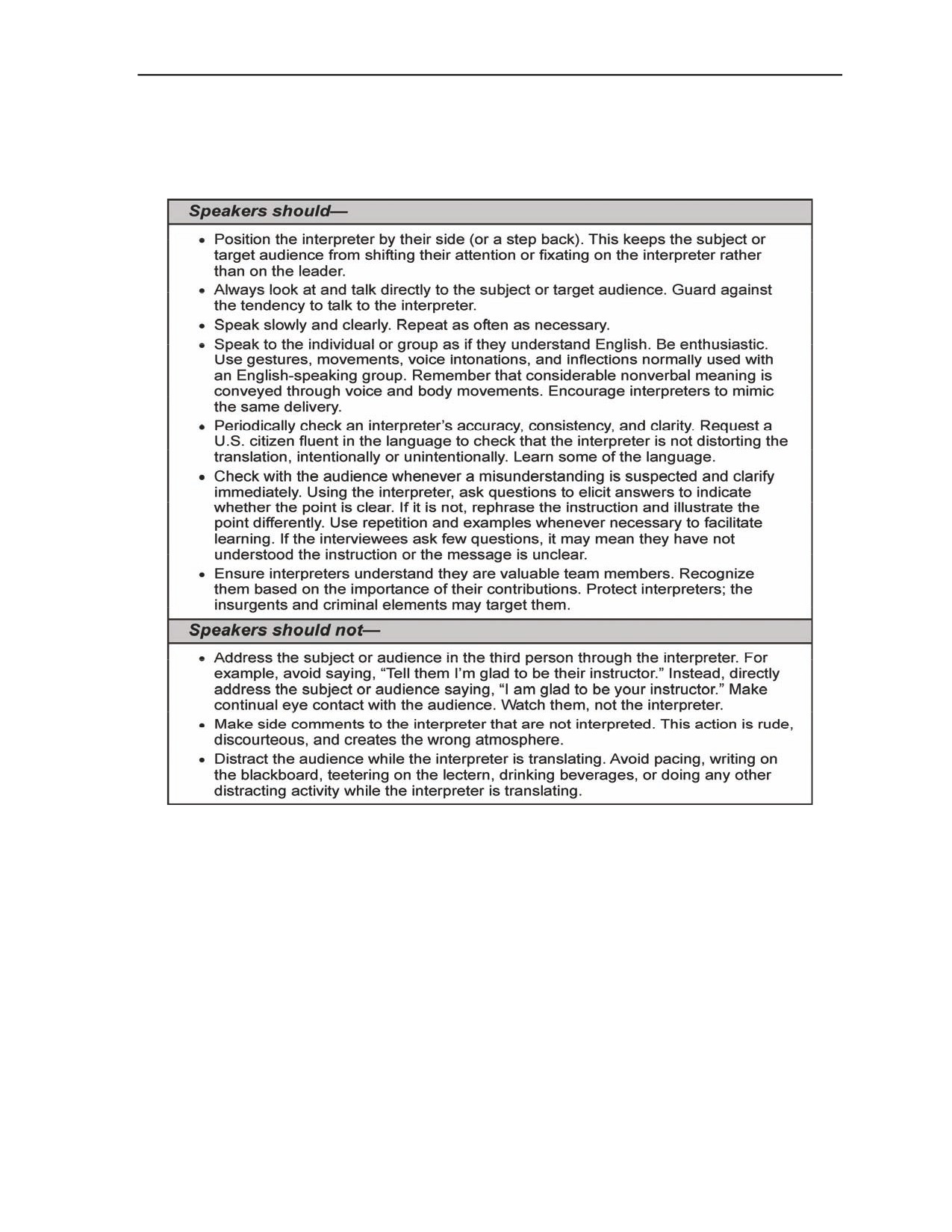
C-45. Speakers must consider some “dos” and “don’ts” for when working with interpreters. Table C-2
clarifies what speakers should and should not do.
Table C-2. Good and bad practices for speakers
15 December 2006
FM 3-24/MCWP 3-33.5
C-7
This page intentionally left blank.
Appendix D
Legal Considerations
Law and policy govern the actions of the U.S. forces in all military operations, in-
cluding counterinsurgency. For U.S. forces to conduct operations, a legal basis must
exist. This legal basis profoundly influences many aspects of the operation. It affects
the rules of engagement, how U.S. forces organize and train foreign forces, the au-
thority to spend funds to benefit the host nation, and the authority of U.S. forces to
detain and interrogate. Under the Constitution, the President is commander in chief of
the U.S. forces. Therefore, orders issued by the President or the Secretary of Defense
to a combatant commander provide the starting point in determining the legal basis.
This appendix summarizes some of the laws and policies that bear upon U.S. military
operations in support of foreign counterinsurgencies. Laws are legislation passed by
Congress and signed into law by the President, as well as treaties to which the United
States is party. Policies are executive orders, departmental directives and regulations,
and other authoritative statements issued by government officials. No summary pro-
vided here can replace a consultation with the unit’s supporting staff judge advocate.
AUTHORITY TO ASSIST A FOREIGN GOVERNMENT
D-1. U.S. forces have limited authority to provide assistance to foreign governments. For foreign internal
defense, U.S. forces may be authorized to make limited contributions. Assistance to police by U.S. forces
is permitted, but not with the Department of Defense (DOD) as the lead governmental department.
AUTHORITY FOR FOREIGN INTERNAL DEFENSE
D-2. The President or Secretary of Defense give the deployment and execution order. Without receiving a
deployment or execution order, U.S. forces may be authorized to make only limited contributions in sup-
port of a host nation’s counterinsurgency (COIN) effort. If the Secretary of State requests and the Secretary
of Defense approves, U.S. forces can participate in this action. The request and approval go through stand-
ing statutory authorities in Title 22, United States Code. Title 22 contains the Foreign Assistance Act, the
Arms Export Control Act, and other laws. It authorizes security assistance, developmental assistance, and
other forms of bilateral aid. The request and approval might also occur under various provisions in Title
10, United States Code. Title 10 authorizes certain types of military-to-military contacts, exchanges, exer-
cises, and limited forms of humanitarian and civic assistance in coordination with the U.S. Ambassador for
the host nation. In such situations, U.S. military personnel work as administrative and technical personnel.
They are part of the U.S. diplomatic mission, pursuant to a status of forces agreement, or pursuant to an
exchange of letters. This cooperation and assistance is limited to liaison, contacts, training, equipping, and
providing defense articles and services. It does not include direct involvement in operations.
DOD USUALLY NOT LEAD—GENERAL PROHIBITION ON ASSISTANCE TO POLICE
D-3. DOD is usually not the lead governmental department for assisting foreign governments, even for
the provision of security assistance—that is, military training, equipment, and defense articles and ser-
vices—to the host nation’s military forces. DOD contribution may be large, but the legal authority is typi-
cally one exercised by the Department of State. With regard to provision of training to a foreign govern-
ment’s police or other civil interior forces, the U.S. military typically has no authorized role. The Foreign
Assistance Act specifically prohibits assistance to foreign police forces except within carefully circum-
scribed exceptions, and under a Presidential directive, and the lead role in providing police assistance
15 December 2006
FM 3-24/MCWP 3-33.5
D-1
Appendix D
within those exceptions has been normally delegated to the Department of State’s Bureau of International
Narcotics and Law Enforcement Affairs. However, the President did sign a decision directive in 2004
granting authority to train and equip Iraqi police to the Commander, U.S. Central Command.
AUTHORIZATION TO USE MILITARY FORCE
D-4. Two types of resolutions authorize involvement of U. S. forces: a Congressional resolution and the
1973 War Powers Resolution. Congressional support is necessary if U.S. forces will be involved in actual
operations overseas. The 1973 Resolution lets the President authorize military forces for a limited time.
CONGRESSIONAL RESOLUTION
D-5. Congressional support is needed for any prolonged involvement of U.S. forces in actual operations
overseas. Often a Congressional resolution provides the central legal basis for such involvement within
domestic law. This is especially likely if U.S. forces are anticipated, at least initially, to be engaged in
combat operations against an identified hostile force.
STANDING WAR POWERS RESOLUTION
D-6. The 1973 War Powers Resolution requires the President to consult and report to Congress when in-
troducing U.S. forces into certain situations. There are times though when a specific Congressional au-
thorization for use of force is absent. In the absence of this authorization, the President—without conced-
ing that the
1973 Resolution binds the President’s own constitutional authority—makes a report to
Congress. The President must make the report within 48 hours of introducing substantial U.S. forces into
the host nation. This report details the circumstances necessitating introduction or enlargement of troops.
The President bases his or her action on the Constitutional or legislative authority and the estimated scope
and duration of the deployment or combat action. The 1973 Resolution states that if Congress does not de-
clare war or specifically authorize the deployment or combat action within 60 days of the report, the Presi-
dent must terminate U.S. military involvement and redeploy U.S. forces.
RULES OF ENGAGEMENT
D-7. Rules of engagement (ROE) are directives issued by competent military authority that delineate the
circumstances and limitations under which United States forces will initiate and/or continue combat en-
gagement with other forces encountered (JP 1-02). Often these directives are specific to the operation. If
there are no operation-specific ROE, U.S. forces apply standing rules of engagement (SROE). When work-
ing with a multinational force, commanders must coordinate the ROE thoroughly.
OPERATION-SPECIFIC RULES OF ENGAGEMENT
D-8. In a large-scale deployment, the Secretary of Defense may issue ROE specific to the operation to a
combatant commander. The combatant commander and subordinate commanders then issue ROE consis-
tent with the ROE received from the Secretary of Defense. ROE state the circumstances under which Sol-
diers or Marines may open fire. They may fire when they positively identify a member of a hostile force or
they have clear indications of hostile intent. ROE may include rules concerning when civilians may be de-
tained, specify levels of approval authority for using heavy weapons, or identify facilities that may be pro-
tected with deadly force. All ROE comply with the law of war. ROE in COIN are dynamic. Commanders
must regularly review ROE for their effectiveness in the complex COIN environment. Training counterin-
surgents in ROE should be reinforced regularly.
CHAIRMAN OF THE JOINT CHIEFS OF STAFF STANDING RULES OF ENGAGEMENT
D-9. In the absence of operation-specific ROE, U.S. forces apply CJCSI 3121.01B. This instruction refers
to SROE for U.S. forces. The SROE establish fundamental policies and procedures governing the actions
of U.S. force commanders in certain events. These events include military attacks against the United States
and during all military operations, contingencies, terrorist attacks, or prolonged conflicts outside the territo-
D-2
FM 3-24/MCWP 3-33.5
15 December 2006
Legal Considerations
rial jurisdiction of the United States. The SROE do not limit a commander’s inherent authority and obliga-
tion to use all necessary means available. They also do not limit the commander’s authority and obligation
to take all appropriate action in self-defense of the commander’s unit and other U.S. forces in the vicinity.
The SROE prescribe how supplemental ROE for specific operations are provided as well as the format by
which subordinate commanders may request ROE.
MULTINATIONAL RULES OF ENGAGEMENT
D-10. When U.S. forces, under U.S. operational or tactical control, operate with a multinational force, rea-
sonable efforts are made to effect common ROE. If such ROE cannot be established, U.S. forces operate
under the SROE or operation-specific ROE provided by U.S. authorities. To avoid misunderstanding,
commanders thoroughly discuss among multinational forces any differences in ROE or ROE interpretation.
They disseminate any differences in ROE to the units involved.
THE LAW OF WAR
D-11. COIN and international armed conflicts often overlap. COIN may take place before, after, or simul-
taneously with a war occurring between nations. U.S. forces obey the law of war. The law of war is a body
of international treaties and customs, recognized by the United States as binding. It regulates the conduct of
hostilities and protects noncombatants. The main law of war protections come from the Hague and Geneva
Conventions. They apply at the tactical and operational levels and are summarized in ten rules:
z
Soldiers and Marines fight only enemy combatants.
z
Soldiers and Marines do not harm enemies who surrender. They disarm them and turn them over
to their superiors.
z
Soldiers and Marines do not kill or torture enemy prisoners of war.
z
Soldiers and Marines collect and care for the wounded, whether friend or foe.
z
Soldiers and Marines do not attack medical personnel, facilities, or equipment.
z
Soldiers and Marines destroy no more than the mission requires.
z
Soldiers and Marines treat all civilians humanely.
z
Soldiers and Marines do not steal. They respect private property and possessions.
z
Soldiers and Marines do their best to prevent violations of the law of war.
z
Soldiers and Marines report all violations of the law of war to their superior.
D-12. When insurgency occurs during occupation, the law of war includes rules governing situations in
which the military forces of one state occupy the territory of another. Occupation is not a transfer of sover-
eignty. It does however grant the occupying power the authority and responsibility to restore and maintain
public order and safety. The occupying power must respect, as much as possible, the laws in force in the
host nation. One of the four Geneva Conventions of 1949—the Geneva Convention Relative to the Protec-
tion of Civilian Persons in Time of War—becomes a prominent source of law during occupation.
INTERNAL ARMED CONFLICT
D-13. During COIN operations, commanders must be aware of Common Article 3 of the Geneva Conven-
tions and the status of insurgents under the laws of the host nation.
GENEVA CONVENTION, COMMON ARTICLE 3
D-14. Although insurgencies can occur simultaneously with a legal state of war between two nations, they
are classically conflicts internal to a single nation, between uniformed government forces and armed ele-
ments that do not wear uniforms with fixed distinctive insignia, carry arms openly, or otherwise obey the
laws and customs of war. As such, the main body of the law of war does not strictly apply to these con-
flicts—a legal fact that can be a source of confusion to commanders and Soldiers. It bears emphasis, how-
ever, that one article contained in all four of the Geneva Conventions—Common Article 3—is specifically
intended to apply to internal armed conflicts:
15 December 2006
FM 3-24/MCWP 3-33.5
D-3
Appendix D
In the case of armed conflict not of an international character occurring in the territory
of one of the High Contracting Parties, each Party to the conflict shall be bound to ap-
ply, as a minimum, the following provisions:
(1) Persons taking no active part in the hostilities, including members of armed forces
who have laid down their arms and those placed “hors de combat” by sickness,
wounds, detention, or any other cause, shall in all circumstances be treated hu-
manely, without any adverse distinction founded on race, colour, religion or faith,
sex, birth or wealth, or any other similar criteria.
To this end, the following acts are and shall remain prohibited at any time and in
any place whatsoever with respect to the above-mentioned persons:
(a) Violence to life and person, in particular murder of all kinds, mutilation, cruel
treatment and torture;
(b) Taking of hostages;
(c) Outrages upon personal dignity, in particular humiliating and degrading treat-
ment;
(d) The passing of sentences and the carrying out of executions without previous
judgment pronounced by a regularly constituted court, affording all the judicial
guarantees which are recognized as indispensable by civilized peoples.
(2) The wounded and sick shall be collected and cared for.
An impartial humanitarian body, such as the International Committee of the Red
Cross, may offer its services to the Parties to the conflict.
The Parties to the conflict should further endeavor to bring into force, by means of
special agreements, all or part of the other provisions of the present Convention.
The application of the preceding provisions shall not affect the legal status of the
Parties to the conflict.
APPLICATION OF CRIMINAL LAWS OF THE HOST NATION
D-15. The final sentence of Common Article 3 makes clear that insurgents have no special status under in-
ternational law. They are not, when captured, prisoners of war. Insurgents may be prosecuted legally as
criminals for bearing arms against the government and for other offenses, so long as they are accorded the
minimum protections described in Common Article 3. U.S. forces conducting COIN should remember that
the insurgents are, as a legal matter, criminal suspects within the legal system of the host nation. Counterin-
surgents must carefully preserve weapons, witness statements, photographs, and other evidence collected at
the scene. This evidence will be used to process the insurgents into the legal system and thus hold them ac-
countable for their crimes while still promoting the rule of law.
D-16. Status of forces agreements establish the legal status of military personnel in foreign countries.
Criminal and civil jurisdiction, taxation, and claims for damages and injuries are some of the topics usually
covered in a status of forces agreement. In the absence of an agreement or some other arrangement with the
host nation, DOD personnel in foreign countries may be subject to its laws.
DETENTION AND INTERROGATION
D-17. Chapters 3, 5, and 7 indicate the need for human intelligence in COIN operations. This need can create
great pressure to obtain time-sensitive information from detained individuals. The Detainee Treatment Act
of 2005, FM 2-22.3, and other specific standards were created to guide U.S. forces working with detainees.
DETAINEE TREATMENT ACT OF 2005
D-18. U.S. law clearly prohibits U.S. forces, including officials from other government agencies, from us-
ing certain methods to obtain information. Instances of detainee abuse, including maltreatment involving
D-4
FM 3-24/MCWP 3-33.5
15 December 2006
Legal Considerations
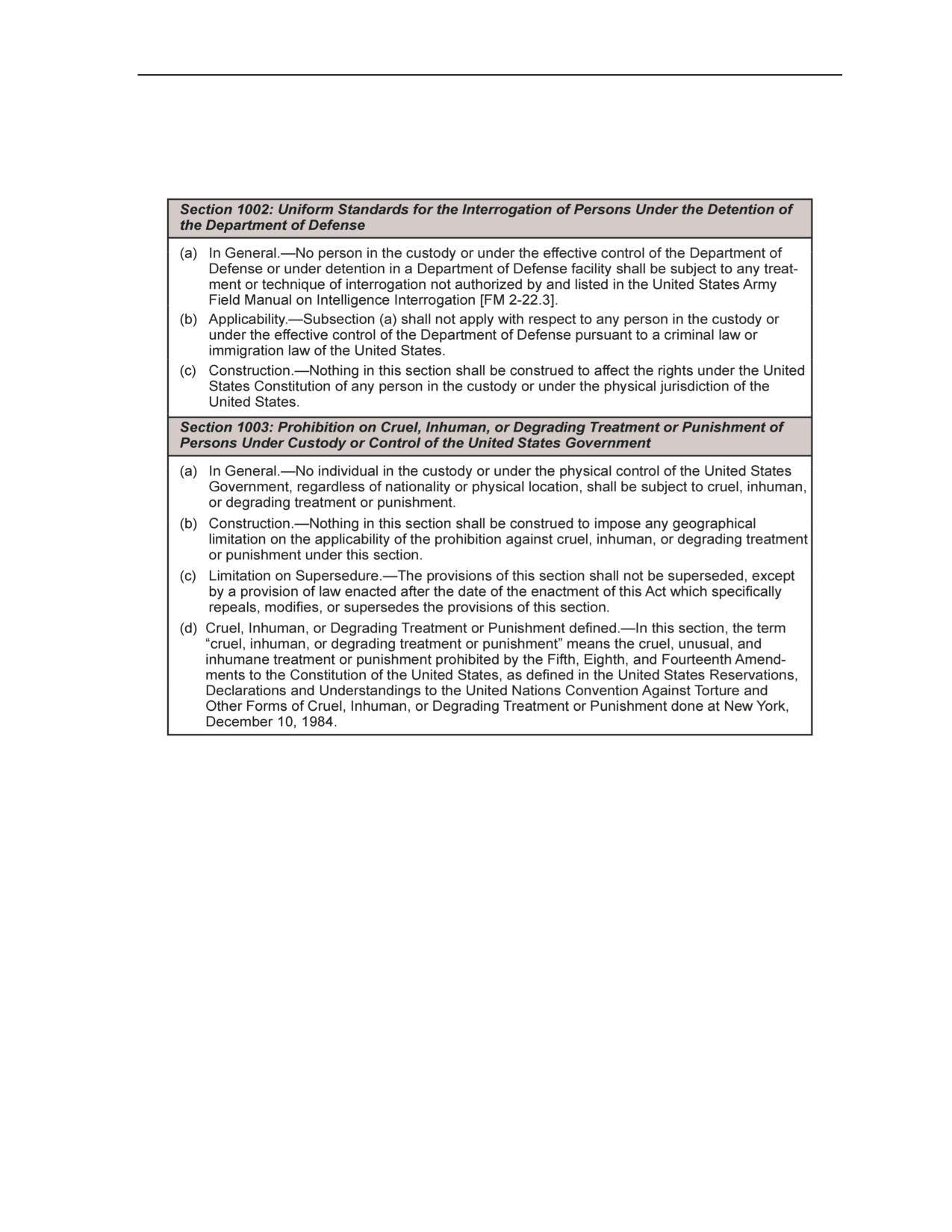
interrogation, were documented. In response, Congress passed, and the President signed into law, the De-
tainee Treatment Act of 2005. (See Table D-1.)
Table D-1. Extract of the Detainee Treatment Act of 2005
INTERROGATION FIELD MANUAL
D-19. The Detainee Treatment Act established FM 2-22.3 as the legal standard. No techniques other than
those prescribed by the field manual are authorized by U.S. forces. Commanders must ensure that interro-
gators receive proper training and supervision.
STANDARDS FOR DETENTION AND INTERNMENT
D-20. Regardless of the precise legal status of those persons captured, detained, or otherwise held in cus-
tody by U.S. forces, they must receive humane treatment until properly released. They also must be pro-
vided the minimum protections of the Geneva Conventions. Specially trained, organized, and equipped
military police units in adequately designed and resourced facilities should accomplish prolonged deten-
tion. Such detention must follow the detailed standards contained in AR 190-8/MCO 3461.1. The military
police personnel operating such facilities shall not be used to assist in or “set the conditions for” interroga-
tion.
TRANSFER OF DETAINEES TO THE HOST NATION
D-21. There are certain conditions under which U.S. forces may not transfer the custody of detainees to the
host nation or any other foreign government. U.S. forces retain custody if they have substantial grounds to
15 December 2006
FM 3-24/MCWP 3-33.5
D-5
Appendix D
believe that the detainees would be in danger in the custody of others. Such danger could include being
subjected to torture or inhumane treatment. (For more information on transferring detainees, see DODD
2310.01E and consult the legal advisor or staff judge advocate.)
ENFORCING DISCIPLINE OF U.S. FORCES
D-22. Despite rigorous selection and training, some personnel require discipline. The Uniform Code of
Military Justice is the criminal code of military justice applicable to all military members. Commanders
and general officers are responsible for their subordinates and their behavior. Commanders must give clear
guidance and ensure compliance. All civilians working for the U.S. Government also must comply with the
laws.
UNIFORM CODE OF MILITARY JUSTICE
D-23. Although the vast majority of well-led and well-trained U.S. military personnel perform their duties
honorably and lawfully, history records that some commit crimes amidst the decentralized command and
control, the strains of opposing a treacherous and hidden enemy, and the often complex ROE that charac-
terize the COIN environment. Uniformed personnel remain subject at all times to the Uniform Code of
Military Justice and must be investigated and prosecuted, as appropriate, for violations of orders, maltreat-
ment of detainees, assaults, thefts, sexual offenses, destruction of property, and other crimes, including
homicides, that they may commit during COIN.
COMMAND RESPONSIBILITY
D-24. In some cases, military commanders may be deemed responsible for crimes committed by subordi-
nates or others subject to their control. This situation arises when the criminal acts are committed pursuant
to the commander’s order. Commanders are also responsible if they have actual knowledge, or should have
knowledge, through reports received or through other means, that troops or other persons subject to their
control are about to commit or have committed a crime, and they fail to take the necessary and reasonable
steps to ensure compliance with the law or to punish violators.
GENERAL ORDERS
D-25. Orders issued by general officers in command during COIN likely include provisions, such as a pro-
hibition against drinking alcohol or against entering places of religious worship, important to maintaining
discipline of the force, to safeguarding the image of U.S. forces, and to promoting the legitimacy of the
host government. These orders are readily enforceable under the Uniform Code of Military Justice.
CIVILIAN PERSONNEL AND CONTRACTORS
D-26. Modern COIN operations involve many DOD civilians as well as civilian personnel employed by
government contractors. The means of disciplining such persons for violations differ from the means of
disciplining uniformed personnel. These civilians may be made subject to general orders. They are also
subject to U.S. laws and to the laws of the host nation. These civilians may be prosecuted or receive ad-
verse administrative action by the United States or contract employers. DOD directives contain further pol-
icy and guidance pertaining to U.S. civilians accompanying our forces in COIN.
HUMANITARIAN RELIEF AND RECONSTRUCTION
D-27. In COIN, like all operations, commands require specific authority to expend funds. That authority is
normally found in the DOD Appropriations Act, specifically, operation and maintenance funds. In recent
COIN operations, Congress appropriated additional funds to commanders for the specific purpose of deal-
ing with COIN. Recent examples include the commander’s emergency response program (CERP), the Iraq
Relief and Reconstruction Fund, Iraq Freedom Fund, and Commander’s Humanitarian Relief and Recon-
struction Program funds.
D-6
FM 3-24/MCWP 3-33.5
15 December 2006
Legal Considerations
DOD FUNDS GENERALLY NOT EXPENDABLE BY COMMANDERS FOR THIS PURPOSE
D-28. Congress specifically appropriates funds for foreign assistance. The United States Agency for Inter-
national Development expends such funds under the legal authorities in Title 22, United States Code. Pro-
visions of Title 10 authorize small amounts of money. These funds are appropriated annually for com-
manders to provide humanitarian relief, disaster relief, or civic assistance in conjunction with military
operations. These standing authorities are narrowly defined and generally require significant advance coor-
dination within the DOD and the Department of State. As such, they are of limited value to ongoing COIN
operations.
COMMANDERS EMERGENCY RESPONSE PROGRAM
D-29. Beginning in November of 2003, Congress authorized use of a specific amount of operations and
maintenance funds for a CERP in Iraq and Afghanistan. The legislation was renewed in successive appro-
priations and authorization acts. It specified that commanders could spend the funds for urgent humanitar-
ian relief and reconstruction projects. These projects had to immediately assist the Iraqi and Afghan peo-
ples within a commander’s area of operations. Congress did not intend the funds to be used as—
z
Security assistance such as weapons, ammunition, and supplies for security forces.
z
Salaries for Iraqi or Afghan forces or employees.
z
Rewards for information.
z
Payments in satisfaction of claims made by Iraqis or Afghanis against the United States (specific
legislation must authorize such payments).
D-30. The CERP provided tactical commanders a ready source of cash for small-scale projects. They could
repair public buildings, clear debris from roadways, provide supplies to hospitals and schools, and meet
other local needs. Because Congress had provided special authority for the program, normal federal acqui-
sition laws and regulations did not apply. The reporting requirements were minimal.
D-31. The CERP is not a standing program. Any similar future program should be governed by whatever
specific legislative provision Congress chooses to enact. In any program similar to CERP, commanders and
staffs must make sound, well-coordinated decisions on how to spend the funds. They must ensure that
maximum goodwill is created. Commanders must verify that the extra cash does not create harmful effects
in the local economy. One such side effect would be creating unsustainable wages that divert skilled labor
from a host-nation (HN) program essential to its legitimacy. Commanders must also ensure that projects
can be responsibly administered to achieve the desired objective and that they avoid financing insurgents
inadvertently.
TRAINING AND EQUIPPING FOREIGN FORCES
D-32. Effective foreign forces need training and equipment. U.S. laws require Congress to authorize such
expenditures. U.S. laws also require the Department of State to verify that the host nation receiving the as-
sistance is not in violation of human rights.
NEED FOR SPECIFIC AUTHORITY
D-33. All training and equipping of foreign security forces must be specifically authorized. Usually, DOD
involvement is limited to a precise level of man-hours and materiel requested from the Department of State
under the Foreign Assistance Act. The President may authorize deployed U.S. forces to train or advise HN
security forces as part of the operational mission. In this case, DOD personnel, operations, and mainte-
nance appropriations provide an incidental benefit to those security forces. All other weapons, training,
equipment, logistic support, supplies, and services provided to foreign forces must be paid for with funds
appropriated by Congress for that purpose. Examples include the Iraq Security Forces Fund and the Af-
ghan Security Forces Fund of fiscal year 2005. Moreover, the President must give specific authority to the
DOD for its role in such “train and equip” efforts. In May of 2004, the President signed a decision directive
that made the commander, U.S. Central Command, under policy guidance from the chief of mission, re-
sponsible for coordinating all U.S. Government efforts to organize, train, and equip Iraqi Security Forces,
15 December 2006
FM 3-24/MCWP 3-33.5
D-7
Appendix D
including police. Absent such a directive, DOD lacks authority to take the lead in assisting a host nation to
train and equip its security forces.
HUMAN RIGHTS VETTING
D-34. Congress typically limits when it will fund training or equipment for foreign security forces. If the
Department of State has credible information that the foreign security force unit identified to receive the
training or equipment has committed a gross violation of human rights, Congress prohibits funding. Such
prohibitions impose a requirement upon Department of State and DOD. These departments must vet the
proposed recipient units against a database of credible reports of human rights violations.
CLAIMS AND SOLATIA
D-35. Under certain conditions, the U.S. Government will make payments to HN civilians. The Foreign
Claims Act permits claims to be filed against the U.S. Government. In some countries, solatia payments are
made.
FOREIGN CLAIMS ACT
D-36. Under the Foreign Claims Act, claims by HN civilians for property losses, injury, or death caused by
service members or the civilian component of the U.S. forces may be paid to promote and maintain
friendly relations with the host nation. Claims that result from noncombat activities or negligent or wrong-
ful acts or omissions are also payable. Claims that are not payable under the Foreign Claims Act include
losses from combat, contractual matters, domestic obligations, and claims which are either not in the best
interest of the United States to pay, or which are contrary to public policy. Because payment of claims is
specifically governed by law and because many claims prove, upon investigation, to be not payable, U.S.
forces must be careful not to raise expectations by promising payment.
SOLATIA
D-37. If U.S. forces are conducting COIN in a country where payments in sympathy or recognition of loss
are common, solatia payments to accident victims may be legally payable. Solatia payments are not claims
payments. They are payments in money or in kind to a victim or to a victim’s family as an expression of
sympathy or condolence. The payments are customarily immediate and generally nominal. The individual
or unit involved in the damage has no legal obligation to pay; compensation is simply offered as an expres-
sion of remorse in accordance with local custom. Solatia payments should not be made without prior coor-
dination with the combatant command.
ESTABLISHING THE RULE OF LAW
D-38. Establishing the rule of law is a key goal and end state in COIN. Defining that end state requires ex-
tensive coordination between the instruments of U.S. power, the host nation, and multinational partners.
Additionally, attaining that end state is usually the province of HN authorities, international and intergov-
ernmental organizations, the Department of State, and other U.S. Government agencies, with support from
U.S. forces in some cases. Some key aspects of the rule of law include:
z
A government that derives its powers from the governed and competently manages, coordi-
nates, and sustains collective security, as well as political, social, and economic development.
This includes local, regional, and national government.
z
Sustainable security institutions. These include a civilian-controlled military as well as police,
court, and penal institutions. The latter should be perceived by the local populace as fair, just,
and transparent.
z
Fundamental human rights. The United Nations Declaration on Human Rights and the Inter-
national Convention for Civil and Political Rights provide a guide for applicable human rights.
The latter provides for derogation from certain rights, however, during a state of emergency. Re-
spect for the full panoply of human rights should be the goal of the host nation; derogation and
D-8
FM 3-24/MCWP 3-33.5
15 December 2006
Legal Considerations
violation of these rights by HN security forces, in particular, often provides an excuse for insur-
gent activities.
D-39. In periods of extreme unrest and insurgency, HN legal structures—courts, prosecutors, defense assis-
tance, and prisons—may cease to exist or function at any level. Under these conditions, counterinsurgents
may need to undertake a significant role in the reconstruction of the HN judicial system in order to estab-
lish legal procedures and systems to deal with captured insurgents and common criminals. During judicial
reconstruction, counterinsurgents can expect to be involved in providing sustainment and security support.
They can also expect to provide legal support and advice to the HN judicial entities. Even when judicial
functions are restored, counterinsurgents may still have to provide logistic and security support to judicial
activities for a prolonged period. This support continues as long as insurgents continue to disrupt activities
that support the legitimate rule of law.
15 December 2006
FM 3-24/MCWP 3-33.5
D-9
This page intentionally left blank.
Appendix E
Airpower in Counterinsurgency
Counterinsurgency operations are, by their nature, joint operations—and airpower
and landpower are interdependent elements of such operations. As this appendix ex-
plains, airpower and spacepower are important force multipliers for U.S., multina-
tional, and host-nation forces fighting an insurgency.
OVERVIEW
E-1. Airpower can contribute significant support to land forces conducting counterinsurgency (COIN)
operations. Aircraft can, for example, strike insurgents, and that can be enormously important in many
situations. However, given the nature of the COIN environment, airpower will most often transport troops,
equipment, and supplies and perform intelligence, surveillance, and reconnaissance missions. Rough ter-
rain and poor transportation networks can create serious obstacles for COIN forces while giving advan-
tages to insurgents. Airpower helps counterinsurgents overcome these obstacles. Thus, airpower both
serves as a significant force multiplier and enables counterinsurgents to operate more effectively.
E-2. Airpower provides considerable asymmetric advantages to counterinsurgents. If insurgents assemble
a conventional force, air assets can respond quickly with precision fires. In a sudden crisis, air mobility can
immediately move land forces where they are needed. In numerous COIN operations, airpower has demon-
strated a vital supporting role. In Malaya (1948 through 1960) and El Salvador (1980 through 1992), as
well as more recently in Colombia and Afghanistan, airpower contributed significantly to successful COIN
operations. In these cases, the ability to airlift British and U.S. Army and police units to remote locations
proved important in tracking down and eliminating insurgents. Airpower enables counterinsurgents to op-
erate in rough and remote terrain, areas that insurgents traditionally have used as safe havens.
E-3. Effective leaders also use airpower in roles other than delivering ordnance. In Colombia, aerial crop
dusters sprayed and eradicated coca fields that provided drug income for insurgents. During the El Salva-
dor insurgency, medical evacuation (MEDEVAC) helicopters provided to the Salvadoran forces played a
central role in improving the Salvadorans’ fighting capabilities. Salvadoran morale improved noticeably
when soldiers knew that, if they were wounded, MEDEVAC helicopters would get them to a hospital in
minutes. With this air support, the Salvadoran Army became much more aggressive in tracking down and
engaging insurgents.
E-4. Air transport can also quickly deliver humanitarian assistance. In isolated regions, using air transport
to airlift or airdrop food and medical supplies to civilians can help win the populace’s support. Air trans-
port is also important for COIN logistics. In areas where ground convoys are vulnerable, U.S. forces can
airlift supplies, enabling commanders to maintain forces in remote but strategically important locations.
AIRPOWER IN THE STRIKE ROLE
E-5. Precision air attacks can be of enormous value in COIN operations; however, commanders exercise
exceptional care when using airpower in the strike role. Bombing, even with the most precise weapons, can
cause unintended civilian casualties. Effective leaders weigh the benefits of every air strike against its
risks. An air strike can cause collateral damage that turns people against the host-nation (HN) government
and provides insurgents with a major propaganda victory. Even when justified under the law of war, bomb-
ings that result in civilian casualties can bring media coverage that works to the insurgents’ benefit. For ex-
ample, some Palestinian militants have fired rockets or artillery from near a school or village to draw a re-
taliatory air strike that kills or wounds civilians. If that occurs, the insurgents display those killed and
wounded to the media as victims of aggression.
15 December 2006
FM 3-24/MCWP 3-33.5
E-1
Appendix E
E-6. Even when destroying an obvious insurgent headquarters or command center, counterinsurgents
must take care to minimize civilian casualties. New, precise munitions with smaller blast effects can limit
collateral damage. When considering the risk of civilian casualties, commanders must weigh collateral
damage against the unintended consequences of taking no action. Avoiding all risk may embolden insur-
gents while providing them sanctuary. The proper and well-executed use of aerial attack can conserve re-
sources, increase effectiveness, and reduce risk to U.S. forces. Given timely, accurate intelligence, pre-
cisely delivered weapons with a demonstrated low failure rate, appropriate yield, and proper fuse can
achieve desired effects while mitigating adverse effects. However, inappropriate or indiscriminate use of air
strikes can erode popular support and fuel insurgent propaganda. For these reasons, commanders should
consider the use of air strikes carefully during COIN operations, neither disregarding them outright nor
employing them excessively.
AIRPOWER IN INTELLIGENCE COLLECTION
E-7. Given the challenges faced by human intelligence (HUMINT) assets in finding and penetrating in-
surgent networks, counterinsurgents must effectively employ all available intelligence collection capabili-
ties. A combination of unmanned aircraft systems, manned aircraft, and space-based platforms can provide
counterinsurgents with many collection capabilities.
E-8. When insurgents operate in rural or remote areas, aerial reconnaissance and surveillance proves use-
ful. Working with signals intelligence (SIGINT), aerial reconnaissance and surveillance uses imagery and
infrared systems to find hidden base camps and insurgent defensive positions. Persistent aerial surveillance
can often identify people, vehicles, and buildings—even when they are hidden under heavy growth.
Manned and unmanned aircraft can patrol roads to locate insurgent ambushes and improvised explosive
devices. Air-mounted SIGINT collection platforms can detect insurgent communications and locate their
points of origin.
E-9. Air assets have proven important in tactical operations and in convoy and route protection. Helicop-
ters have been especially useful in providing overwatch, fire support, alternate communications, and
MEDEVAC support. At the tactical level, air support requires a decentralized command and control system
that gives supported units immediate access to available combat air assets and to information collected by
air reconnaissance and support assets.
E-10. However, intelligence obtained through air and space platforms works best when it is quickly and ef-
ficiently routed to a joint intelligence center. This center fuses HUMINT information with that collected by
other intelligence disciplines. To provide a complete picture, air and space intelligence must be combined
with HUMINT. For example, while SIGINT and aerial surveillance and reconnaissance assets can deter-
mine that people are evacuating a village, they cannot explain why the people are leaving.
E-11. HUMINT is also a key enabler of airpower in the strike role. Commanders require the best possible
intelligence about a target and its surrounding area when considering an air strike. With proper placement
and access to a target, a HUMINT source can often provide the most accurate target data. Details might in-
clude optimum strike times, detailed descriptions of the surrounding area, and the presence of sensitive
sites like hospitals, churches, and mosques. Target data can include other important factors for collateral
damage considerations. Poststrike HUMINT sources equipped with a cell phone, radio, or camera can pro-
vide an initial battle damage assessment in near real time. With a thorough debriefing, the HUMINT source
can provide an accurate assessment of the functional and psychological effects achieved on the target.
Commanders can use this information to assess restrike options.
AIR AND SPACE INFORMATION OPERATIONS
E-12. Air and space forces have information operations
(IO) capabilities that include collecting,
controlling, exploiting, and protecting information. To make IO most effective, commanders should
seamlessly integrate it among all Service components. Air and space forces contribute to the execution of
three IO missions:
E-2
FM 3-24/MCWP 3-33.5
15 December 2006
Airpower in Counterinsurgency
z
Influence operations.
z
Electronic warfare.
z
Network operations.
E-13. Air and space forces conduct and support many influence operations. These operations include the
following:
z
Counterpropaganda.
z
Psychological operations.
z
Military deception.
z
Operations security.
z
Counterintelligence.
z
Public affairs (a related activity of IO).
Commanders must preplan and deconflict these activities to ensure success.
E-14. Airpower and spacepower also contribute to information superiority through electronic warfare op-
erations. Air and space assets are critical in the effort to shape, exploit, and degrade the enemy’s electronic
devices while protecting and enhancing those of counterinsurgents. The electronic warfare spectrum is not
limited to radio frequencies; it includes the optical and infrared regions as well.
E-15. In this context, network operations are activities conducted to operate and defend the Global Infor-
mation Grid (JP 1-02). Commanders enhance these operations by using air and space systems. Such tools
help achieve desired effects across the interconnected analog and digital network portions of the Global In-
formation Grid.
HIGH-TECHNOLOGY ASSETS
E-16. Today’s high-technology air and space systems have proven their worth in COIN operations. Un-
manned aircraft systems, such as the Predator, give counterinsurgents unprecedented capabilities in surveil-
lance and target acquisition. Aerial surveillance platforms with long loiter times can place an entire region
under constant surveillance. Tactical air control parties now provide ground commanders beyond-line-of-
sight awareness with ROVER (remote operations video enhanced receiver), which links to aircraft target-
ing pods and unmanned aircraft systems. Predators have been equipped with precision munitions and suc-
cessfully employed in the strike role against senior terrorist leaders. Air- and space-based SIGINT plat-
forms give U.S. forces and multinational partners important information collection capabilities. Modern
munitions, such as the joint direct attack munition, can guide accurately through clouds and bad weather to
destroy insurgent targets under adverse conditions.
LOW-TECHNOLOGY ASSETS
E-17. Today’s low-technology aspects of airpower have also proven effective in COIN operations. Light,
slow, inexpensive civilian aircraft often have successfully patrolled border areas. In the 1980s, Guatemala
mobilized its civilian light aircraft, formed them into an air force reserve, and used them to patrol main
roads to report suspected ambushes. This successfully deterred insurgent attacks along Guatemala’s major
routes. In Africa in the 1980s, South African forces used light aircraft to locate small groups of insurgents
trying to infiltrate Namibia from Angola. In Iraq, light aircraft fly patrols to spot insurgents crossing the
border. Israel and the United States have even used stationary balloons equipped with video cameras and
infrared sensors to watch for border incursions. These unmanned balloons are a simple, inexpensive, and
effective means to monitor activity in remote areas.
E-18. The United States and many small nations have effectively used aerial gunships as close air support
weapons in COIN operations. A gunship is a transport aircraft modified to carry and fire heavy guns and
light artillery from fixed mounts. Many gunship models exist. They range from the Air Force’s AC-130 to
smaller transports modified to carry weapons ranging from .50-caliber machine guns to 40-millimeter
rapid-fire cannons. The gunship’s major limitation is its vulnerability to antiaircraft weapons and missiles.
Gunships require a relatively benign environment to operate.
15 December 2006
FM 3-24/MCWP 3-33.5
E-3
Appendix E
AIRLIFT
E-19. Airlift provides a significant asymmetric advantage to COIN forces, enabling commanders to rapidly
deploy, reposition, sustain, and redeploy land forces. While land forces can execute these basic missions
alone, airlift bypasses weaknesses insurgents have traditionally exploited. For example, airlift enables land
forces to operate in rough and remote terrain and to avoid lines of communications (LOCs) targeted by in-
surgents. During Operation Iraqi Freedom, airlift has provided protected LOCs through convoy mitigation
flights. These flights rerouted typical convoy supplies and vehicles. Since insurgents frequently attacked
ground convoys, convoy mitigation flights saved lives.
E-20. Sources of airlift include multinational and HN rotary- and fixed-wing assets. Special operations
forces provide specialized airlift capabilities for inserting and extracting troops. Strategic intertheater airlift
platforms can provide a logistic pipeline. This pipeline moves large quantities of time-critical equipment,
supplies, and personnel into and out of a theater. Modern strategic airlift can often provide a direct delivery
capability, landing at relatively short, austere fields formerly serviced only by intratheater airlift.
E-21. Modes of airlift include airland and airdrop. Each mode provides advantages and disadvantages, de-
pending on the environment. Airland missions carry greater payloads, resulting in less potential for dam-
age. They also provide backhaul capability (critical for MEDEVAC), troop rotation, equipment repair, and
repositioning and redeployment of COIN forces. Fixed-wing assets on airland missions require longer and
better prepared landing surfaces. Vertical-lift assets on airland missions can operate from much smaller,
more austere fields; however, they fly at slower speeds and often have smaller payloads and shorter ranges.
Airdrop missions require the least amount of infrastructure at the receiving end and allow for rapid buildup
of forces—up to brigade size. Equally important, airdrop can provide precision insertion and sustainment
of numerous small units. Advances in precision-guided, steerable parachutes increase the capability of
high-value airdrop missions.
E-22. Airlift is more costly than surface transportation. It is usually a small percentage of the overall trans-
portation network during major combat operations; however, in particularly challenging situations, airlift
may become the primary transportation mode for sustainment and repositioning.
E-23. Airlift supports every logical line of operations. For example, it supports IO when COIN forces pro-
vide humanitarian airlift to a battered populace. It clearly supports combat operations. Likewise, airlift sup-
ports the essential services, governance, and economic development logical lines of operations. HN secu-
rity forces thus should include airlift development as the host nation’s first component of airpower and
spacepower.
THE AIRPOWER COMMAND STRUCTURE
E-24. COIN operations require a joint, multinational command and control architecture for air and space
that is effective and responsive. The joint structure applies to more than just U.S. forces; it involves coor-
dinating air assets of multinational partners and the host nation. COIN planning must thus establish a joint
and multinational airpower command and control system and policies on the rules and conditions for em-
ploying airpower in the theater.
E-25. During COIN operations, most planning occurs at lower echelons. Ideally, components at the opera-
tional level fully coordinate these plans. Air and space planners require visibility of actions planned at all
echelons to provide the most effective air and space support. Furthermore, COIN planning is often fluid
and develops along short planning and execution timelines, necessitating informal and formal coordination
and integration for safety and efficiency.
E-26. U.S. and multinational air units, along with HN forces, will likely use expeditionary airfields. COIN
planners must consider where to locate airfields, including those intended for use as aerial ports of debar-
kation and other air operations. Factors to consider include—
z
Projected near-, mid- and long-term uses of the airfield.
z
Types and ranges of aircraft to be operated.
z
Shoulder-launched, surface-to-air-missile threats to aircraft.
E-4
FM 3-24/MCWP 3-33.5
15 December 2006
Airpower in Counterinsurgency
z
Stand-off threats to airfields.
z
Proximity to other threats.
z
Proximity to land LOCs.
z
Availability of fuels.
Airpower operating from remote or dispersed airfields may present a smaller signature than large numbers
of land forces, possibly lessening HN sensitivities to foreign military presence. Commanders must properly
protect their bases and coordinate their defense among all counterinsurgents.
BUILDING HOST-NATION AIRPOWER CAPABILITY
E-27. U.S. and multinational operations strive to enable the host nation to provide its own internal and ex-
ternal defense. Planners therefore need to establish a long-term program to develop a HN airpower capabil-
ity. The HN air force should be appropriate for that nation’s requirements. For conducting effective COIN
operations, a HN air force requires the following basic capabilities:
z
Aerial reconnaissance and surveillance.
z
Air transport.
z
Close air support for land forces.
z
Helicopter troop lift.
z
MEDEVAC.
z
Counterair.
z
Interdiction.
E-28. The first step in developing HN airpower is developing the right organizational model for a HN air
force. Planning should identify gaps in the host nation’s ability to command, control, and employ airpower
in COIN operations.
E-29. The next step is to help the host nation develop its aviation infrastructure under a long-term plan.
Most developing nations need considerable assistance to develop an appropriate organization, a suitable
force structure, and basing plans. As airpower assets represent a large cost for a small nation, an effective
airfield security program is also necessary.
E-30. An important training asset is the U.S. Air Force Special Operations Command. This command has
teams qualified to operate the most common equipment used in developing nations. These teams also have
the language and cultural training to effectively support aircrew and personnel training. The Air Force can
also train HN pilots and aircrews through the International Military Education and Training Program.
E-31. Planners should consider HN economic and technological resources when selecting equipment. In
most cases, the host nation acquires, or the U.S. and multinational partners provide, a small air force. Al-
though this air force often has limited resources, the host nation still should effectively operate and main-
tain its aircraft and supporting systems. Multinational support in training and equipping the HN air force
can be very important. U.S. aircraft have tremendous capabilities, but they can be too expensive and too
complex for some developing nations to operate and maintain. Multinational partners with capable, but less
expensive and less sophisticated, aircraft can often help equip the host nation.
E-32. Training and developing a capable HN air force takes considerable time due to the requirements to
qualify aircrews, maintenance personnel, and other specialists. Working effectively in joint operations and
coordinating support to land forces requires a high skill level. Even when the HN army and police are
trained, U.S. personnel will likely stay with HN forces to perform liaison for supporting U.S. air assets and
to advise HN forces in the use of their own airpower.
E-33. Developing capable air forces usually takes longer than developing land forces. As a result, Air
Force units, advisors, and trainers will likely remain after land force trainers and advisors have completed
their mission. Effective air and land operations are complex and require many resources. Often host nations
continue to rely on U.S. air liaison personnel, land controllers, and aircraft for an extended period. Thus,
COIN planners must consider the long-term U.S. air support requirements in comprehensive COIN
planning.
15 December 2006
FM 3-24/MCWP 3-33.5
E-5
This page intentionally left blank.
Source Notes
These are the sources used, quoted, or paraphrased in this publication. They are listed
by page number. Where material appears in a paragraph, both page and paragraph
number are listed. Boldface indicates the titles of historical vignettes. Web sites were
accessed during December 2006.
ix
“This is a game of wits and will…”: Peter J. Schoomaker, quoted in “Serving a Nation at
War: A Campaign Quality Army with Joint and Expeditionary Capabilities,” (Statement
before the House Armed Services Committee, 21 Jul 2004), 17. United States House of
Representatives Web site
1-1
“Counterinsurgency is not just thinking man’s warfare…”: This sentence appeared in an
electronic mail message from a special forces officer serving in Iraq to the military assistant
to the deputy secretary of defense in 2005.
1-4
para 1-19. “The printing press is…”: T.E. Lawrence, “Evolution of a Revolt,” The Army
Quarterly (Devon, United Kingdom) 1, 1 (Oct 1920; reprint, Fort Leavenworth, KS: U.S.
Army Command and General Staff College, Combat Studies Institute, 1990): 11. Combined
Arms Research Library Web site < http://cgsc.leavenworth.army.mil/carl/download/csipubs
>.
1-12
1-67. …planners assumed that combatants required a 10 or 15 to 1 advantage…: Andrew F.
Krepinevich, The Army and Vietnam (Baltimore: Johns Hopkins University Press, 1986),
157; A better force requirement gauge…” John J. McGrath, Boots on the Ground: Troop
Density in Contingency Operations, Global War on Terrorism Occasional Paper 16 (Fort
Leavenworth, KS: Combat Studies Institute Press, 2006), 1, 6n1.
1-22
para 1-123. …revolutionary war was 80 percent political action and only 20 percent military:
cited in David Galula, Counterinsurgency Warfare: Theory and Practice (1964; reprint New
York: Praeger, 2005), 89 (hereafter cited as Galula); …he was involved with establishing
special schools…: Walter Sullivan, “China’s Communists Train Political Corps to Aid
Army,” The New York Times, 4 Jul 1949.
1-27
1-154. “There’s very clear evidence,…”: Creighton W. Abrams Jr., Commander’s Weekly
Intelligence Estimate (Headquarters, Military Assistance Command, Vietnam, 21 Nov 1970),
audiotape, U.S. Army Military History Institute, Carlisle Barracks, PA; Lewis Sorley, editor,
Vietnam Chronicles: The Abrams Tapes 1968-1972 (Lubbock: Texas Tech University Press,
2004), 633 (hereafter cited as Sorley); “Do not try and do too much…”: T.E. Lawrence,
“Twenty-seven Articles,” Arab Bulletin (20 August 1917), in T.E. Lawrence, Secret
Despatches [sic] from Arabia, A. W. Lawrence, ed. (London, Golden Cockerel Press, 1939),
2-1
“Essential though it is,…”: Galula, 89.
2-3
“Hand Shake Con” in Operation Provide Comfort: Anthony C. Zinni, “Non-Traditional
Military Missions: Their Nature, and the Need for Cultural Awareness and Flexible Think-
ing,” chapter 4 in Capital “W” War: A Case for Strategic Principles of War (Because Wars
Are Conflicts of Societies, Not Tactical Exercises Writ Large), by Joe Strange, Perspectives
on Warfighting 6 (Quantico, VA: Marine Corps University, 1998), 265-266. (Operation
Provide Comfort began on April 6, 1991 and ended July 24, 1991. Operation Provide
Comfort II was a show of force to deter new Iraqi attacks on the Kurds and had only limited
humanitarian aspects. Provide Comfort II began 24 July 1991 and ended 31 December 1996.)
15 December 2006
FM 3-24/MCWP 3-33.5
Source Notes-1
Source Notes
2-9
para 2-42. “To confine soldiers…”: Galula, 88.
2-10
para 2-48. The Foreign Service Act assigns…: Foreign Service Act of 1980, Public Law 96-
465, 96th Congress, 2d session (17 Oct 1980), sections 102(3) and 207a(1).
2-12
Provincial Reconstruction Teams in Afghanistan: Prepared based on the experiences of
several participants in operations in Afghanistan between 2003 and 2005.
2-12
Civil Operations and Rural Development Support and Accelerated Pacification in
Vietnam: Richard A. Hunt, Pacification: the American Struggle for Vietnam’s Hearts and
Minds (Boulder, CO: Westview Press, 1995), 86-279; Thomas W. Scoville, Reorganizing for
Pacification Support (Washington, DC: Center of Military History, 1991), 43-83.
2-14
para 2-57. “You [military professionals] must know…”: John F. Kennedy, Public Papers of
the Presidents of the United States: John F. Kennedy, Containing the Public Messages,
Speeches, and Statements of the President, January 20 to December 31,1961 (Washington,
DC: Government Printing Office, 1962), 448. (The remarks were made at Annapolis, MD, to
the graduating class of the U.S. Naval Academy on 7 June 1961.)
3-1
“Everything good that happens…”: Sorley, 506.
3-18
Asymmetric Tactics in Ireland: James Fintan Lalor to d’Arcy McGee, 30 March 1847,
Collected Writings of James Fintan Lalor, edited by L. Fogarty (Dublin, 1918), 83. Quoted in
Handbook for Volunteers of the Irish Republican Army: Notes on Guerrilla Warfare
(Boulder, CO: Paladin Press, 1985), 3; Charles Townshend, Political Violence in Ireland:
Government and Resistance Since 1848 (New York: Oxford University Press, 1983), 32.
4-1
“The first, the supreme,…” Carl von Clausewitz, On War, ed. and trans. Michael Howard and
Peter Paret (Princeton, NJ: Princeton University Press, 1976; reprint 1984), 88-89.
4-1
Campaign Assessment and Reassessment: George W. Smith, Jr., “Avoiding a Napoleonic
Ulcer: Bridging the Gap of Cultural Intelligence (Or, Have We Focused on the Wrong
Transformation?)” (Quantico, VA: Marine Corps War College, 2004).
4-7
Iterative Design During Operation Iraqi Freedom II: Lieutenant General James N. Mattis,
USMC, interviewed by Colonel Douglas M. King, USMC, Marine Corps Combat Develop-
ment Command, Feb-Mar, 2006.
5-1
“It is a persistently methodical approach…”: Sir Robert Thompson, Defeating Communist
Insurgency: The Lessons of Malaya and Vietnam ([New York: Praeger, 1966]; reprint with a
foreword by Robert Bowie, St. Petersburg, FL: Hailer Publishing, 2005), 171 (hereafter cited
as Thompson).
5-6
The Importance of Multiple Lines of Operations in COIN: Thomas A Marks, Counter-
revolution in China: Wang Sheng and the Kuomintang (London: Frank Cass, 1998), 77-117.
5-21
Clear-Hold-Build in Tal Afar, 2005-2006: Office of the Assistant Secretary of Defense
(Public Affairs), News Transcript, News Briefing with COL H.R. McMaster, 27 Jan 2006,
DOD News: News Briefing with COL H.R. McMaster Web site.
5-24
Combined Action Program: Matthew Danner, “The Combined Action Platoon: Seeds of
Success in Iraq,” United States Marine Corps Combined Action Platoon (USMC CAP) Web
5-25
“The two best guides,…”: Thompson, 170.
6-1
“[H]elping others to help themselves…”: “Quadrennial Defense Review Report,”
(Washington, DC: Office of the Secretary of Defense, 6 Feb 2006), 11.
6-18
Multinational Security Transition Command-Iraq: John R. Martin, “Training Indigenous
Security Forces at the Upper End of the Counterinsurgency Spectrum,” Military Review 86, 6
(Nov-Dec 2006): 58-64.
Source Notes-2
FM 3-24/MCWP 3-33.5
15 December 2006
Source Notes
6-21
Developing a Police Force in Malaya: James S. Corum, Training Indigenous Forces in
Counterinsurgency: A Tale of Two Insurgencies (Carlisle, PA: Strategic Studies Institute,
U.S. Army War College, Mar, 2006), 4-24 < http://www.StrategicStudiesInstitute.army.mil >.
7-1
“Leaders must have a strong sense…” MCDP 1, Warfighting (20 June 1997), 57.
7-3
Defusing a Confrontation: Excerpted from Dan Baum, “Battle Lessons, What the Generals
Don’t Know,” The New Yorker, Jan 17, 2005. The New Yorker : fact: content Web site
7-4
Patience, Presence, and Courage: Adapted from Nelson Hernandez, “Attacks Rock
Foundation That Marines Built in Anbar,” Washington Post, Feb. 7, 2006: 1.
7-7
para 7-39. “No person in the custody…”: Detainee Treatment Act of 2005, Public Law 109-
148, 109th Congress, 1st Session, (30 Dec 2005), sections 1002(a), 1003(a).
7-8
Lose Moral Legitimacy, Lose the War: Lou DiMarco, “Losing the Moral Compass: Torture
and Guerre Revolutionnaire in the Algerian War,” Parameters 36, 2 (Summer, 2006): 63-76.
8-1
“In my experience in previous wars,…: Senior Officer Debriefing Report: MG J.M. Heiser,
Jr., Commanding General, 1st Logistical Command, Period 2 August 1968 to 23 August 1969
(Department of the Army: Office of the Adjutant General, 23 Sep 1969), 343.
8-3
What is Different: Insurgent Perceptions of Military Logistics: “We have a claim…” Mao
Tse-Tung, “Problems of Strategy in China’s Revolutionary War,” Selected Military Writings
of Mao Tse-Tung (Peking: Foreign Language Press, 1966), 147; “Weapons are not difficult to
obtain.…”: Ming Fan, “A Textbook on Guerrilla Warfare,” translated by and reprinted in
Gene Z. Hanrahan, ed. Chinese Communist Guerrilla Warfare Tactics (Boulder, CO: Paladin
Press, 1974), 76-77.
8-3
“In one moment in time,…”: Charles C. Krulak, “The Three Block War: Fighting in Urban
Areas,” Vital Speeches of the Day 64, 5 (New York: December 15, 1997): 139-142. (Speech
given before the National Press Club, October 10, 1997. Quote appears on page 139.)
8-6
Vietnam: Meeting the Enemy and Convoy Security: John H. Hay, Vietnam Studies: Tac-
tical and Materiel Innovations (Washington, DC: Department of the Army, 1989), 154-155.
8-8
Air Delivery in Iraq: Maximizing Counterinsurgency Potential: Marine Corps Center for
Lessons Learned, “Initial Observations Report-Operation Iraqi Freedom II-1, Subject: Air
Delivery Operations,” (March, 2005).
8-10
Building a Military: Sustainment Failure: Julian Thompson, The Lifeblood of War:
Logistics in Armed Conflict (New York: Brassey’s, 1991), 217-218; Dong Van Khuyen,
RVNAF Logistics (Washington, DC: U.S. Army Center of Military History, 1980).
8-17
Host-Nation Contracting: A Potential Double-Edged Sword: Interview between Major
Sean Davis, USA, and Lieutenant Colonel Marian Vlasak, USA (Fort Leavenworth, KS, 1
May 2006).
A-1
Appendix A is based on David Kilcullen, “Countering Global Insurgency,” Journal of
Strategic Studies 28, 4 (August 2005): 597-617.
B-14
The Capture of Saddam Hussein: Brian J. Reed, “Formalizing the Informal: A Network
Analysis of an Insurgency” (Ph.D. dissertation, Department of Sociology, University of
Maryland, College Park, MD, 2006), 81-88.
D-3
para D-14. “In the case of armed conflict not…”: Geneva Convention Relative to the
Treatment of Prisoners of War, Article 3, August 12, 1949, 6 United States Treaties 3114, 75
United Nations Treaty Series 31.
D-5
table D-1. Detainee Treatment Act of 2005, Public Law 109-148, 109th Congress, 1st
Session, (30 Dec 2005), sections 1002, 1003.
15 December 2006
FM 3-24/MCWP 3-33.5
Source Notes-3
This page intentionally left blank.
Glossary
The glossary lists acronyms and terms with Army, multi-Service, or joint definitions,
and other selected terms. Where Army and joint definitions are different, (Army) fol-
lows the term. The proponent manual for other terms is listed in parentheses after the
definition. Terms for which the Army and Marine Corps have agreed on a common
definition are followed by (Army-Marine Corps).
SECTION I - ACRONYMS AND ABBREVIATIONS
ACR
armored cavalry regiment
AO
area of operations
AR
Army regulation
ASCOPE
A memory aid for the characteristics of civil considerations: area,
structures, capabilities, organizations, people, and events. See also
METT-TC.
CERP
commander’s emergency response program
CJCSI
Chairman of the Joint Chiefs of Staff instruction
CMO
civil-military operations
CMOC
civil-military operations center
COIN
counterinsurgency
CORDS
civil operations and revolutionary (rural) development support
COTS
commercial off-the-shelf
DA
Department of the Army
DOCEX
document exploitation
DOD
Department of Defense
DODD
Department of Defense Directive
DOTMLPF
Memory aid for the force development domains: doctrine, organization,
training, materiel, leadership and education, personnel, and facilities.
FARC
Fuerzas Armadas Revolucionarias de Colombia (Revolutionary Armed
Forces of Columbia)
FBI
Federal Bureau of Investigation
FID
foreign internal defense
FM
field manual
FMFRP
Fleet Marine Force reference publication
FMI
field manual interim
G-4
assistant chief of staff, logistics
GEOINT
geospatial intelligence
HMMWV
high-mobility, multipurpose, wheeled vehicle
HN
host-nation
15 December 2006
FM 3-24/MCWP 3-33.5
Glossary-1