FM 3-24 COUNTERINSURGENCY (DECEMBER 2006) - page 4
Executing Counterinsurgency Operations
the insurgents from external support by controlling nearby border areas and creating
an eight-foot-high berm around the city. The berm’s purpose was to deny the enemy
freedom of movement and safe haven in outlying communities. The berm prevented
free movement of fighters and weapons and forced all traffic to go through security
checkpoints manned by U.S. and Iraqi forces. Multinational checkpoints frequently
included informants who could identify insurgents. Multinational forces supervised
the movement of civilians out of contentious areas. Forces conducted house-to-
house searches. When they met violent resistance, they used precision fires from ar-
tillery and aviation. Targets were chosen through area reconnaissance operations,
interaction with the local populace, and information from U.S. and Iraqi sources.
Hundreds of insurgents were killed or captured during the encirclement and clearing
of the city. Carefully controlled application of violence limited the cost to residents.
Deployment of Security Forces (Hold)
Following the defeat of enemy fighters, U.S. and Iraqi forces established security in-
side Tal Afar. The security forces immediately enhanced personnel screening at
checkpoints based on information from the local population. To enhance police le-
gitimacy in the people’s eyes, multinational forces began recruiting Iraqi police from a
more diverse, representative mix comprising city residents and residents of surround-
ing communities. Police recruits received extensive training in a police academy.
U.S. forces and the Iraqi Army also trained Iraqi police in military skills. Concurrently,
the local and provincial government dismissed or prosecuted Iraqi police involved in
offenses against the populace. The government assigned new police leaders to the
city from Mosul and other locations. U.S. forces assisted to ensure Iraqi Army, police,
and their own forces shared common boundaries and were positioned to provide mu-
tual support to one another. At the same time, U.S. forces continued to equip and
train a border defense brigade, which increased the capability to interdict the insur-
gents’ external support. Among its successes, the multinational force destroyed an
insurgent network that included a chain of safe houses between Syria and Tal Afar.
Improving Living Conditions and Restoring Normalcy (Build)
With insurgents driven out of their city, the local population accepted guidance and
projects to reestablish control by the Iraqi government. The 3d ACR commander
noted, “The people of Tal Afar understood that this was an operation for them—an
operation to bring back security to the city.”
With the assistance of the Department of State and the U.S. Agency for International
Development’s Office of Transition Initiatives, efforts to reestablish municipal and
economic systems began in earnest. These initiatives included providing essential
services (water, electricity, sewage, and trash collection), education projects, police
stations, parks, and reconstruction efforts. A legal claims process and compensation
program to address local grievances for damages was also established.
As security and living conditions in Tal Afar improved, citizens began providing in-
formation that helped eliminate the insurgency’s infrastructure. In addition to informa-
tion received on the streets, multinational forces established joint coordination cen-
ters in Tal Afar and nearby communities that became multinational command posts
and intelligence-sharing facilities with the Iraqi Army and the Iraqi police.
Unity of effort by local Iraqi leaders, Iraqi security forces, and U.S. forces was critical
to success. Success became evident when many families who had fled the area re-
turned to the secured city.
COMBINED ACTION
5-81. Combined action is a technique that involves joining U.S. and HN troops in a single organization,
usually a platoon or company, to conduct COIN operations. This technique is appropriate in environments
15 December 2006
FM 3-24/MCWP 3-33.5
5-23
Chapter 5
where large insurgent forces do not exist or where insurgents lack resources and freedom of maneuver.
Combined action normally involves joining a U.S. rifle squad or platoon with a HN platoon or company,
respectively. Commanders use this approach to hold and build while providing a persistent counterinsur-
gent presence among the populace. This approach attempts to first achieve security and stability in a local
area, followed by offensive operations against insurgent forces now denied access or support. Combined
action units are not designed for offensive operations themselves and rely on more robust combat units to
perform this task. Combined action units can also establish mutual support among villages to secure a
wider area.
5-82. A combined action program can work only in areas with limited insurgent activity. The technique
should not be used to isolate or expel a well-established and supported insurgent force. Combined action is
most effective after an area has been cleared of armed insurgents.
5-83. The following geographic and demographic factors can also influence the likelihood of success:
z
Towns relatively isolated from other population centers are simpler to secure continuously.
z
Towns and villages with a limited number of roads passing through them are easier to secure
than those with many routes in and out. All approaches must be guarded.
z
Existing avenues of approach into a town should be observable from the town. Keeping these
areas under observation facilitates interdiction of insurgents and control of population move-
ments.
z
The local populace should be small and constant. People should know one another and be able
to easily identify outsiders. In towns or small cities where this is not the case, a census is the
most effective tool to establish initial accountability for everyone.
z
Combined action or local defense forces must establish mutual support with forces operating in
nearby towns. Larger reaction or reserve forces as well as close air support, attack aviation, and
air assault support should be quickly available. Engineer and explosive ordnance disposal assets
should also be available.
5-84. Combined action unit members must develop and build positive relationships with their associated
HN security forces and with the town leadership. By living among the people, combined action units serve
an important purpose. They demonstrate the commitment and competence of counterinsurgents while shar-
ing experiences and relationships with local people. These working relationships build trust and enhance
the HN government’s legitimacy. To build trust further, U.S. members should ask HN security forces for
training on local customs, key terrain, possible insurgent hideouts, and relevant cultural dynamics. HN
forces should also be asked to describe recent local events.
5-85. Combined action units are integrated into a regional scheme of mutually supporting security and in-
fluence; however, they should remain organic to their parent unit. Positioning reinforced squad-sized units
(13 to 15 Soldiers or Marines) among HN citizens creates a dispersal risk. Parent units can mitigate this
risk with on-call reserve and reaction forces along with mutual support from adjacent villages and towns.
5-86. Thoroughly integrating U.S. and HN combined action personnel supports the effective teamwork
critical to the success of each team and the overall program. U.S. members should be drawn from some of
the parent unit’s best personnel. Designating potential members before deployment facilitates the training
and team building needed for combined action unit success in theater. Preferably, team members should
have had prior experience in the host nation. Other desirable characteristics include—
z
The ability to operate effectively as part of a team.
z
Strong leadership qualities, among them—
Communicating clearly.
Maturity.
Leading by example.
Making good decisions.
z
The ability to apply the commander’s intent in the absence of orders.
z
Possession of cultural awareness and understanding of the HN environment.
z
The absence of obvious prejudices.
5-24
FM 3-24/MCWP 3-33.5
15 December 2006
Executing Counterinsurgency Operations
z
Mutual respect when operating with HN personnel.
z
Experience with the HN language, the ability to learn languages, or support of reliable translators.
z
Patience and tolerance when dealing with language and translation barriers.
5-87. Appropriate tasks for combined action units include, but are not limited to, the following:
z
Helping HN security forces maintain entry control points.
z
Providing reaction force capabilities through the parent unit.
z
Conducting multinational, coordinated day and night patrols to secure the town and area.
z
Facilitating local contacts to gather information in conjunction with local HN security force rep-
resentatives. (Ensure information gathered is made available promptly and on a regular basis to
the parent unit for timely fusion and action.)
z
Training HN security forces in leadership and general military subjects so they can secure the
town or area on their own.
z
Conducting operations with other multinational forces and HN units, if required.
z
Operating as a team with HN security forces to instill pride, leadership, and patriotism.
z
Assisting HN government representatives with civic action programs to establish an environ-
ment where the people have a stake in the future of their town and nation.
z
Protecting HN judicial and government representatives and helping them establish the rule of law.
Combined Action Program
Building on their early 20th-century counterinsurgency experiences in Haiti and Nica-
ragua, the Marine Corps implemented an innovative program in South Vietnam in
1965 called the Combined Action Program. This program paired teams of about 15
Marines led by a noncommissioned officer with approximately 20 host-nation security
personnel. These combined action platoons operated in the hamlets and villages in
the northern two provinces of South Vietnam adjacent to the demilitarized zone.
These Marines earned the trust of villagers by living among them while helping vil-
lagers defend themselves. Marines trained and led the local defense forces and
learned the villagers’ customs and language. The Marines were very successful in
denying the Viet Cong access to areas under their control. The Combined Action
Program became a model for countering insurgencies. Many lessons learned from it
were used in various peace enforcement and humanitarian assistance operations
that Marines conducted during the 1990s. These operations included Operations
Provide Comfort in northern Iraq (1991) and Restore Hope in Somalia (1992 through
1993).
LIMITED SUPPORT
5-88. Not all COIN efforts require large combat formations. In many cases, U.S. support is limited, fo-
cused on missions like advising security forces and providing fire support or sustainment. The longstand-
ing U.S. support to the Philippines is an example of such limited support. The limited support approach fo-
cuses on building HN capability and capacity. Under this approach, HN security forces are expected to
conduct combat operations, including any clearing and holding missions.
PATTERN OF TRANSITION
5-89. COIN efforts may require Soldiers and Marines to create the initial secure environment for the popu-
lace. Ideally HN forces hold cleared areas. As HN military and civil capabilities are further strengthened,
U.S. military activity may shift toward combined action and limited support. As HN forces assume internal
and external security requirements, U.S. forces can redeploy to support bases, reduce force strength, and
eventually withdraw. Special operations forces and conventional forces continue to provide support as
needed to achieve internal defense and development objectives.
15 December 2006
FM 3-24/MCWP 3-33.5
5-25
Chapter 5
ASSESSMENT OF COUNTERINSURGENCY OPERATIONS
The two best guides, which can not be readily reduced to statistics or processed through
a computer, are an improvement in intelligence voluntarily given by the population and a
decrease in the insurgents’ recruiting rate. Much can be learnt merely from the faces of
the population in villages that are subject to clear-and-hold operations, if these are vis-
ited at regular intervals. Faces which at first are resigned and apathetic, or even sullen,
six months or a year later are full of cheerful welcoming smiles. The people know
who is winning.
Sir Robert Thompson
Defeating Communist Insurgency: The Lessons of Malaya and Vietnam, 1966 3
5-90. Assessment is the continuous monitoring and evaluation of the current situation and progress of an
operation (FMI 5-0.1). Assessment precedes and is integrated into every operations-process activity and
entails two tasks:
z
Continuously monitoring the current situation (including the environment) and progress of the
operation.
z
Evaluating the operation against established criteria.
Commanders, assisted by the staff, continuously compare the operation’s progress with their commander’s
visualization and intent. Based on their assessments, commanders adjust the operation and associated ac-
tivities to better achieve the desired end state. (See FM 6-0, paragraphs 6-90 through 6-92 and 6-110 through 6-
121.)
DEVELOPING MEASUREMENT CRITERIA
5-91. Assessment requires determining why and when progress is being achieved along each LLO. Tradi-
tionally, commanders use discrete quantitative and qualitative measurements to evaluate progress. How-
ever, the complex nature of COIN operations makes progress difficult to measure. Subjective assessment at
all levels is essential to understand the diverse and complex nature of COIN problems. It is also needed to
measure local success or failure against the overall operation’s end state. Additionally, commanders need
to know how actions along different LLOs complement each other; therefore, planners evaluate not only
progress along each LLO but also interactions among LLOs.
ASSESSMENT TOOLS
5-92. Assessment tools help commanders and staffs determine—
z
Completion of tasks and their impact.
z
Level of achievement of objectives.
z
Whether a condition of success has been established.
z
Whether the operation’s end state has been attained.
z
Whether the commander’s intent was achieved.
For example, planning for transition of responsibility to the host nation is an integral part of COIN opera-
tional design and planning. Assessment tools may be used to assess the geographic and administrative
transfer of control and responsibility to the HN government as it develops its capabilities. Assessments dif-
fer for every mission, task, and LLO, and for different phases of an operation. Leaders adjust assessment
methods as insurgents adapt to counterinsurgent tactics and the environment changes.
5-93. The two most common types of assessment measures are measures of effectiveness (MOEs) and
measures of performance (MOPs).
3 Copyright © 1966 by Robert Thompson. Reproduced with permission of Hailer Publishing.
5-26
FM 3-24/MCWP 3-33.5
15 December 2006
Executing Counterinsurgency Operations
5-94. A measure of effectiveness is a criterion used to assess changes in system behavior, capability, or op-
erational environment that is tied to measuring the attainment of an end state, achievement of an objective,
or creation of an effect (JP 1-02). MOEs focus on the results or consequences of actions. MOEs answer the
question, Are we achieving results that move us towards the desired end state, or are additional or alterna-
tive actions required?
5-95. A measure of performance is a criterion to assess friendly actions that is tied to measuring task ac-
complishment (JP 1-02). MOPs answers the question, Was the task or action performed as the commander
intended?
5-96. Leaders may use observable, quantifiable, objective data as well as subjective indicators to assess
progress measured against expectations. A combination of both types of indicators is recommended to re-
duce the chance of misconstruing trends.
5-97. All MOEs and MOPs for assessing COIN operations should be designed with the same characteris-
tics. These four characteristics are—
z
Measurable. MOEs and MOPs should have quantitative or qualitative standards against which
they can be measured. The most effective measurement would be a combination of quantitative
and qualitative measures to guard against an inaccurate view of results.
z
Discrete. Each MOE and MOP must measure a separate, distinct aspect of the task, purpose, or
condition.
z
Relevant. MOEs and MOPs must be relevant to the measured task, outcome, and condition. HN
local, regional, and national leaders, and nongovernmental organization personnel, may provide
practical, astute, and professional ideas and feedback to craft relevant MOPs and MOEs.
z
Responsive. Assessment tools must detect environmental and situational changes quickly and
accurately enough to facilitate developing an effective response or counter.
BROAD INDICATORS OF PROGRESS
5-98. Numerical and statistical indicators have limits when measuring social environments. For example,
in South Vietnam U.S. forces used the body count to evaluate success or failure of combat operations. Yet,
the body count only communicated a small part of the information commanders needed to assess their op-
erations. It was therefore misleading. Body count can be a partial, effective indicator only when adversaries
and their identities can be verified. (Normally, this identification is determined through a uniform or pos-
session of an insurgent identification card.) Additionally, an accurate appreciation of what insurgent casu-
alty numbers might indicate regarding enemy strength or capability requires knowing the exact number of
insurgent armed fighters initially present. In addition, this indicator does not measure several important
factors: for example, which side the local populace blames for collateral damage, whether this fighting and
resultant casualties damaged the insurgent infrastructure and affected the insurgency strategy in that area,
and where families of dead insurgents reside and how they might react. For another example, within the es-
sential services LLO the number of schools built or renovated does not equate to the effective operation of
an educational system.
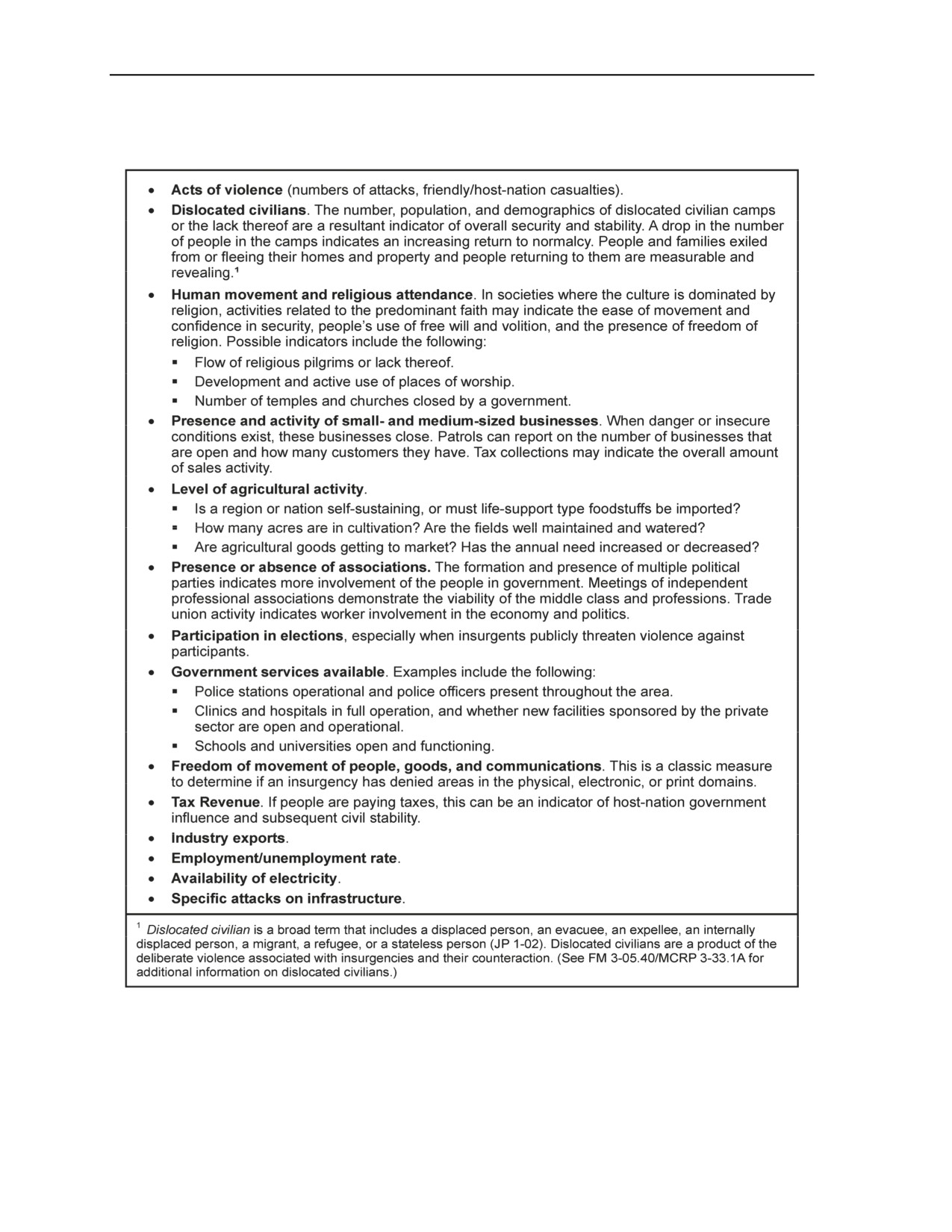
5-99. Planners should start with broad measures of social and economic health or weakness when assess-
ing environmental conditions. (Table 5-7 [page 5-28] lists possible examples of useful indicators in COIN.)
15 December 2006
FM 3-24/MCWP 3-33.5
5-27
Chapter 5
Table 5-7. Example progress indicators
5-28
FM 3-24/MCWP 3-33.5
15 December 2006
Executing Counterinsurgency Operations
TARGETING
5-100. The targeting process focuses operations and the use of limited assets and time. Commanders and
staffs use the targeting process to achieve effects that support the LLOs in a COIN campaign plan. It is im-
portant to understand that targeting is done for all operations, not just attacks against insurgents. The tar-
geting process can support IO, civil-military operations (CMO), and even meetings between commanders
and HN leaders, based on the commander’s desires. The targeting process occurs in the targeting cell of the
appropriate command post. (See JP 3-60, FM 3-09.31/MCRP 3-16C, and FM 6-20-10 for joint and Army
targeting doctrine. FM 3-13, appendix E, describes how to apply the targeting process to IO-related tar-
gets.)
5-101. Targeting in a COIN environment requires creating a targeting board or working group at all eche-
lons. The intelligence cell provides representatives to the targeting board or working group to synchronize
targeting with intelligence sharing and intelligence, surveillance, and reconnaissance operations. The goal
is to prioritize targets and determine the means of engaging them that best supports the commander’s intent
and the operation plan.
5-102. The focus for targeting is on people, both insurgents and noncombatants. There are several differ-
ent approaches to targeting in COIN. For example, all of the following are potential targets that can link
objectives with effects:
z
Insurgents (leaders, combatants, political cadre, auxiliaries, and the mass base).
z
Insurgent internal support structure (bases of operations, finance base, lines of communications,
and population).
z
Insurgent external support systems (sanctuaries, media, and lines of communications).
z
Legitimate government and functions (essential services, promotion of governance, develop-
ment of security forces, and institutions).
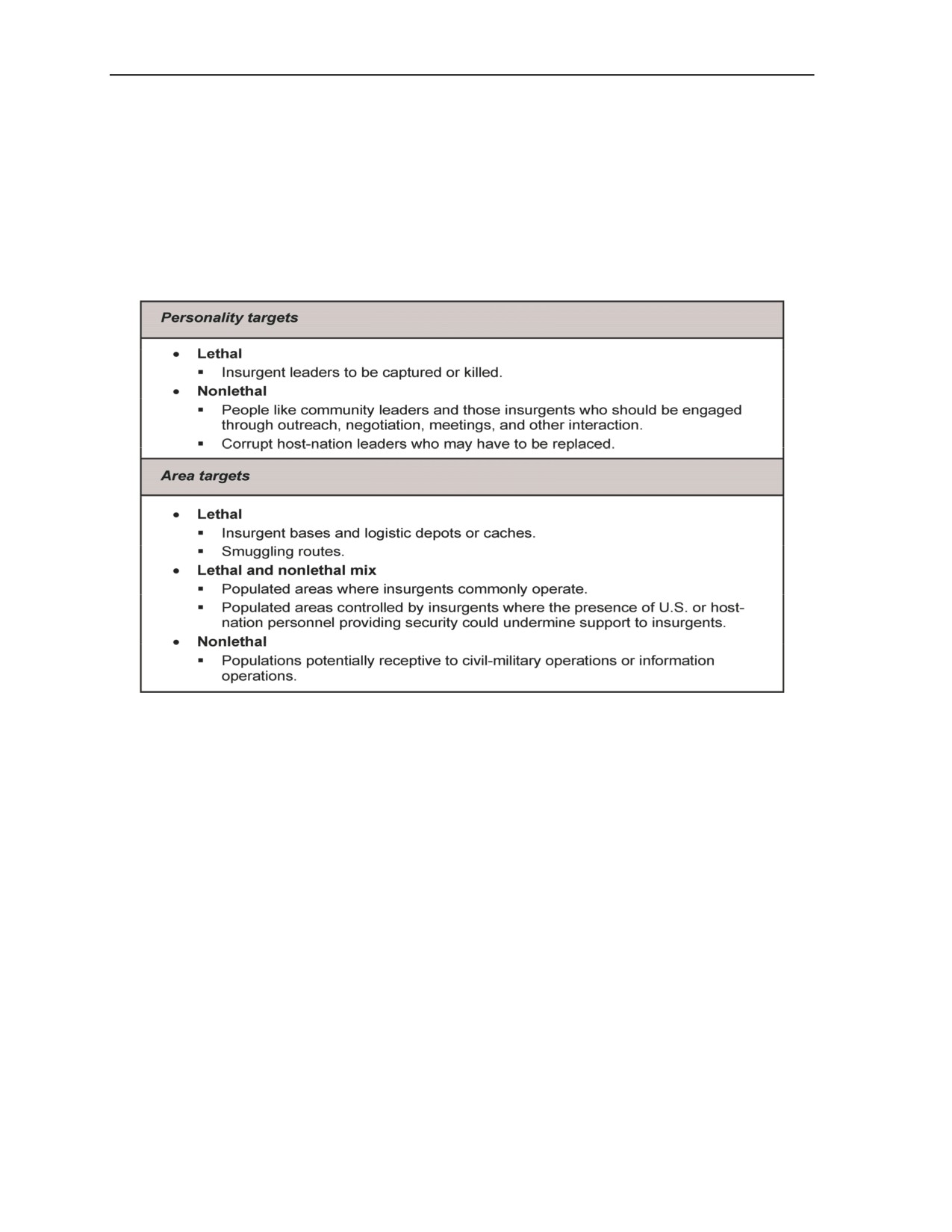
5-103. Effective targeting identifies the targeting options, both lethal and nonlethal, to achieve effects that
support the commander’s objectives. Lethal targets are best addressed with operations to capture or kill;
nonlethal targets are best engaged with CMO, IO, negotiation, political programs, economic programs, social
programs and other noncombat methods. Nonlethal targets are usually more important than lethal targets in
COIN; they are never less important. (Table 5-8 [page 5-30] lists examples of lethal and nonlethal targets.)
5-104. The targeting process comprises the following four activities:
z
Decide which targets to engage.
z
Detect the targets.
z
Deliver (conduct the operation).
z
Assess the effects of the operation.
5-105. Commanders issue targeting guidance during the “decide” activity. The commander’s guidance
drives subsequent targeting-process activities. Actions during the “detect” activity may give commanders
the intelligence needed to refine the guidance. It may be difficult to identify targets when a COIN cam-
paign begins. The focus during the “decide” activity should be on decisive points commanders can engage.
DECIDE
5-106. The decide activity draws on a detailed intelligence preparation of the battlefield and continuous
assessment of the situation. Intelligence personnel, with the commander and other staff members, decide
when a target is developed well enough to engage. Continuous staff integration and regular meetings of the
intelligence cell and targeting board enable this activity. Staff members consider finished intelligence
products in light of their understanding of the AO and advise commanders on targeting decisions. Intelli-
gence personnel provide information on the relative importance of different target personalities and areas
and the projected effects of lethal or nonlethal engagement. Specifically, the intelligence analysts need to
15 December 2006
FM 3-24/MCWP 3-33.5
5-29
Chapter 5
identify individuals and groups to engage as potential COIN supporters, targets to isolate from the popula-
tion, and targets to eliminate.
5-107. During the decide activity, the targeting board produces a prioritized list of targets and a recom-
mended course of action associated with each. Executing targeting decisions may require the operations
section to issue fragmentary orders. Each of these orders is a task that should be nested within the higher
headquarters’ plan and the commander’s intent. Targeting decisions may require changing the intelligence
synchronization plan.
Table 5-8. Examples of lethal and nonlethal targets
DETECT
5-108. The detect activity is performed continuously. It requires much analytical work by intelligence
personnel. They analyze large quantities of all-source intelligence reporting to determine the following:
z
Threat validity.
z
Actual importance of potential targets.
z
Best means to engage the target.
z
Expected effects of engaging the targets (which will guide actions to mitigate negative effects).
z
Any changes required to the exploitation plan.
As mentioned in paragraph 3-152 target exploitation in a COIN environment is similar to that in law en-
forcement. An exploitation plan not only facilitates gathering evidence but also may lead to follow-on tar-
gets after successful exploitation. This requires a detailed understanding of social networks, insurgent net-
works, insurgent actions, and the community’s attitude toward counterinsurgents. (See appendix B.)
5-109. Intelligence regarding the perceptions and interests of the populace requires particular attention.
This intelligence is crucial to IO and CMO targeting. It is also important for developing political, social,
and economic programs.
DELIVER
5-110. The deliver activity involves executing the missions decided upon by the commander.
5-30
FM 3-24/MCWP 3-33.5
15 December 2006
Executing Counterinsurgency Operations
ASSESS
5-111. The assess activity occurs continuously throughout an operation. During assessment, collectors
and analysts evaluate the operation’s progress. They adjust the intelligence synchronization plan and analy-
ses based on this evaluation. In addition to assessing changes to their own operations, intelligence person-
nel look for reports indicating effects on all aspects of the operational environment, including insurgents
and civilians. Relevant reporting can come from any intelligence discipline, open sources, or operational
reporting. Commanders adjust an operation based on its effects. They may expand the operation, continue
it as is, halt it, execute a branch or sequel, or take steps to correct a mistake’s damage. Therefore, an accu-
rate after-action assessment is very important. Metrics often include the following:
z
Changes in local attitudes (friendliness towards U.S. and HN personnel).
z
Changes in public perceptions.
z
Changes in the quality or quantity of information provided by individuals or groups.
z
Changes in the economic or political situation of an area.
z
Changes in insurgent patterns.
z
Captured and killed insurgents.
z
Captured equipment and documents.
5-112. As indicated in chapter 3, detainees, captured documents, and captured equipment may yield a lot
of information. Its exploitation and processing into intelligence often adds to the overall understanding of
the enemy. This understanding can lead to more targeting decisions. In addition, the assessment of the op-
eration should be fed back to collectors. This allows them to see if their sources are credible. In addition,
effective operations often cause the local populace to provide more information, which drives future opera-
tions.
LEARNING AND ADAPTING
5-113. When an operation is executed, commanders may develop the situation to gain a more thorough
situational understanding. This increased environmental understanding represents a form of operational
learning and applies across all LLOs. Commanders and staffs adjust the operation’s design and plan based
on what they learn. The result is an ongoing design-learn-redesign cycle.
5-114. COIN operations involve complex, changing relations among all the direct and peripheral partici-
pants. These participants adapt and respond to each other throughout an operation. A cycle of adaptation
usually develops between insurgents and counterinsurgents; both sides continually adapt to neutralize ex-
isting adversary advantages and develop new (usually short-lived) advantages of their own. Victory is
gained through a tempo or rhythm of adaptation that is beyond the other side’s ability to achieve or sustain.
Therefore, counterinsurgents should seek to gain and sustain advantages over insurgents by emphasizing
the learning and adaptation that this manual stresses throughout.
5-115. Learning and adapting in COIN is very difficult due to the complexity of the problems command-
ers must solve. Generally, there is not a single adversary that can be singularly classified as the enemy.
Many insurgencies include multiple competing groups. Success requires the HN government and counter-
insurgents to adapt based on understanding this very intricate environment. But the key to effective COIN
design and execution remains the ability to adjust better and faster than the insurgents.
SUMMARY
5-116. Executing COIN operations is complex, demanding, and tedious. There are no simple, quick solu-
tions. Success often seems elusive. However, contributing to the complexity of the problem is the manner
in which counterinsurgents view the environment and how they define success. The specific design of the
COIN operation and the manner in which it is executed must be based on a holistic treatment of the envi-
ronment and remain focused on the commander’s intent and end state. Success requires unity of effort
across all LLOs to achieve objectives that contribute to the desired end state—establishing legitimacy and
gaining popular support for the HN government. Operational design and execution cannot really be sepa-
rated. They are both part of the same whole.
15 December 2006
FM 3-24/MCWP 3-33.5
5-31
This page intentionally left blank.
Chapter 6
Developing Host-Nation Security Forces
[H]elping others to help themselves is critical to winning the long war.
Quadrennial Defense Review Report, 2006
This chapter addresses aspects of developing host-nation security forces. It begins
with a discussion of challenges involved and resources required. It provides a frame-
work for organizing the development effort. It concludes with a discussion of the role
of police in counterinsurgency operations.
OVERVIEW
6-1. Success in counterinsurgency (COIN) operations requires establishing a legitimate government sup-
ported by the people and able to address the fundamental causes that insurgents use to gain support.
Achieving these goals requires the host nation to defeat insurgents or render them irrelevant, uphold the
rule of law, and provide a basic level of essential services and security for the populace. Key to all these
tasks is developing an effective host-nation (HN) security force. In some cases, U.S. forces might be ac-
tively engaged in fighting insurgents while simultaneously helping the host nation build its own security
forces.
6-2. Just as insurgency and COIN are defined by a complex array of factors, training HN security forces
is also affected by a variety of determinants. These include whether sovereignty in the host nation is being
exercised by an indigenous government or by a U.S. or multinational element. The second gives counterin-
surgents more freedom of maneuver, but the first is important for legitimate governance, a key goal of any
COIN effort. If the host nation is sovereign, the quality of its governance also has an impact. The scale of
the effort is another factor; what works in a small country might not work in a large one. Terrain and civil
considerations are also important. A nation compartmentalized by mountains, rivers, or ethnicity presents
different challenges for the COIN effort. A large “occupying” force or international COIN effort can facili-
tate success in training HN security forces; however, it also complicates the situation. Other factors to con-
sider include the following:
z
Type of security forces that previously existed.
z
Whether the effort involves creating a completely new security force or changing an existing
one.
z
Existence of sectarian divisions within the forces.
z
Resources available.
z
Popular support.
Commanders must adapt these doctrinal foundations to the situation in the area of operations (AO).
6-3. The term “security forces” includes all HN forces with the mission of protecting against internal and
external threats. Elements of the security forces include, but are not limited to, the following:
z
Military forces.
z
Police.
z
Corrections personnel.
z
Border guards (including the coast guard).
Elements of the HN security forces exist at the local through national levels. Only in unusual cases will
COIN forces experience a situation where the host nation has no security force. With this in mind, this
15 December 2006
FM 3-24/MCWP 3-33.5
6-1
Chapter 6
chapter addresses methods to develop security forces, realizing that the range of assistance varies depend-
ing on the situation.
6-4. JP 3-07.1 contains foreign internal defense (FID) doctrine. JP 3-07.1 addresses the legal and fiscal
regulations and responsibilities concerning the planning, development, and administration of FID pro-
grams. It also discusses command and supervisory relationships of U.S. diplomatic missions, geographic
combatant commands, and joint task forces in applying military aid, support, and advisory missions. The
tenets presented in this chapter reinforce and supplement those in JP 3-07.1.
CHALLENGES, RESOURCES, AND END STATE
6-5. Each instance of developing security forces is as unique as each insurgency. In Vietnam, the United
States committed thousands of advisors for South Vietnamese units and hundreds of thousands of combat
troops but ultimately failed to achieve its strategic objectives. In El Salvador, a relative handful of Ameri-
can advisors were enough enable the HN government to execute a successful counterinsurgency, even
though that situation had evolved into a recognized, full-blown civil war. Many factors influence the
amount and type of aid required. These are discussed in more detail later, but include the following:
z
Existing HN security force capabilities.
z
Character of the insurgency.
z
Population and culture.
z
Level of commitment and sovereignty of the host nation.
z
Level of commitment from the United States and other nations.
6-6. U.S. and multinational forces may need to help the host nation in improve security; however, insur-
gents can use the presence of foreign forces as a reason to question the HN government’s legitimacy. A
government reliant on foreign forces for internal security risks not being recognized as legitimate. While
combat operations with significant U.S. and multinational participation may be necessary, U.S. combat op-
erations are secondary to enabling the host nation’s ability to provide for its own security.
CHALLENGES TO DEVELOPING EFFECTIVE SECURITY FORCES
6-7. Many common problems and issues arose in training missions U.S. forces undertook after World War
II. These problems generally fall under differing national perspectives in one of four broad categories:
z
Resources.
z
Leadership.
z
Exercising power.
z
Organizational structures.
6-8. Governments must properly balance national resources to meet the people’s expectations. Funding
for services, education, and health care can limit resources available for security forces. The result HN
spending priorities may be a security force capable of protecting only the capital and key government fa-
cilities, leaving the rest of the country unsecured. Undeveloped countries often lack resources to maintain
logistic units. This situation results in chronic sustainment problems. Conducting effective COIN opera-
tions requires allocating resources to ensure integration of efforts to develop all aspects of the security
force. Recognizing the interrelationship of security and governance, the HN government must devote ade-
quate resources to meeting basic needs like health care, clean water, and electricity.
6-9. Counterinsurgents may need to adjust the existing HN approach to leadership. HN leaders may be
appointed and promoted based on family ties or membership in a party or faction, rather than on demon-
strated competence or performance. Leaders may not seek to develop subordinates. The need to ensure the
welfare of subordinates may not be a commonly shared trait. In some cases, leaders enforce the subordi-
nates’ obedience by fear and use their leadership position to exploit them. Positions of power can lead to
corruption, which can also be affected by local culture.
6-10. The behavior of HN security force personnel is often a primary cause of public dissatisfaction. Cor-
rupting influences of power must be guarded against. Cultural and ethnic differences within a population
6-2
FM 3-24/MCWP 3-33.5
15 December 2006
Developing Host-Nation Security Forces
may lead to significant discrimination within the security forces and by security forces against minority
groups. In more ideological struggles, discrimination may be against members of other political parties,
whether in a minority cultural group or not. Security forces that abuse civilians do not win the populace’s
trust and confidence; they may even be a cause of the insurgency. A comprehensive security force devel-
opment program identifies and addresses biases as well as improper or corrupt practices.
6-11. Perhaps the biggest hurdle for U.S. forces is accepting that the host nation can ensure security using
practices that differ from U.S. practices. Commanders must recognize and continuously address that this
“The American way is best” bias is unhelpful. While relationships among U.S. police, customs, and mili-
tary organizations works for the United States, those relationships may not exist in other nations that have
developed differently.
RESOURCES
6-12. For Soldiers and Marines, the mission of developing HN security forces goes beyond a task assigned
to a few specialists. The scope and scale of training programs today and the scale of programs likely to be
required in the future have grown. While FID has been traditionally the primary responsibility of the spe-
cial operations forces (SOF), training foreign forces is now a core competency of regular and reserve units
of all Services. Multinational partners are often willing to help a nation against an insurgency by helping to
train HN forces. Partner nations may develop joint training teams or assign teams to a specific element of
the security force or a particular specialty. Training resources may be received from the following organi-
zations and programs:
z
Special operations forces.
z
Ground forces.
z
Joint forces.
z
Interagency resources.
z
Multinational resources.
z
International Military Education and Training (IMET) Program.
z
Contractor support.
Special Operations Forces
6-13. SOF focus on specific regions of the world and the study of languages and cultures. SOF have long
been the lead organization in training and advising foreign armed forces. (FM 31-20-3 outlines Army spe-
cial forces training programs and tactics, techniques, and procedures.) While SOF personnel may be ideal
for some training and advisory roles, their limited numbers restrict their ability to carry out large-scale mis-
sions to develop HN security forces. In a low-level COIN, SOF personnel may be the only forces assigned;
at the higher end of the spectrum, SOF may train only their counterparts in the HN forces.
Ground Forces
6-14. Large-scale training and advisory missions need to use large numbers of Soldiers and Marines who
may not have language training or regional expertise to levels common in SOF. However, such conven-
tional forces may have some advantages in training HN counterparts with similar missions. SOF and con-
ventional ground forces need linguist augmentation and additional cultural training. (Appendix C discusses
linguist support.) Commanders must assign the best qualified Soldiers and Marines to training and advisory
missions. Those personnel normally come from active-duty forces, but large-scale efforts require using Re-
serve Component personnel. All land forces assigned to this high-priority mission need thorough training,
both before deploying and in theater.
Joint Forces
6-15. Although other Services often play smaller roles, they can still make significant contributions be-
cause of their considerable experience in training foreign forces. For example, the Navy and Air Force can
train their HN counterparts. The Coast Guard may also be of value, since its coastal patrol, fisheries over-
sight, and port security missions correlate with the responsibilities of navies in developing countries. To
15 December 2006
FM 3-24/MCWP 3-33.5
6-3
Chapter 6
minimize the burden on land forces, specialists—such as lawyers and medical personnel—from other Ser-
vices participate in HN training wherever possible.
Interagency Resources
6-16. Interagency resources can support training HN security forces. Perhaps most important is training
nonmilitary security forces. The Departments of Justice and State can send law enforcement specialists
overseas to train and advise HN police forces. Police are best trained by other police. The quick reaction
capability of these agencies is limited, although they can attain necessary levels when given time. Such
forces are also expensive. During intensive counterinsurgencies, the environment’s high-threat nature lim-
its the effectiveness of civilian police advisors and trainers. These forces work more effectively when oper-
ating in a benign environment or when security is provided separately. Many legal restrictions about train-
ing nonmilitary forces exist. Normally the Department of State takes the lead in such efforts. However, the
President occasionally assigns military forces to these missions.
Multinational Resources
6-17. Although their support frequently plays more of a legitimizing role, multinational partners also assist
materially in training HN security forces. Some nations more willingly train HN forces, especially police
forces, than provide troops for combat operations. Some multinational forces come with significant em-
ployment restrictions. Each international contribution is considered on its own merits, but such assistance
is rarely declined. Good faith efforts to integrate multinational partners and achieve optimum effectiveness
are required.
International Military Education and Training Program
6-18. For more than 50 years, the U.S. military has run the IMET program to provide opportunities for
foreign personnel to attend U.S. military schools and courses. Most of these commissioned officers and
noncommissioned officers (NCOs) receive English language training before attending the U.S. courses. In
the case of Latin American armed forces, the United States operates courses in Spanish.
Contractor Support
6-19. In some cases, additional training support from contractors enables commanders to use Soldiers and
Marines more efficiently. Contractor support can provide HN training and education, including the following:
z
Institutional training.
z
Developing security ministries and headquarters.
z
Establishing administrative and logistic systems.
Contracted police development capabilities through the Department of State’s Bureau of International Nar-
cotics and Law Enforcement Affairs can provide expertise not resident in the uniformed military.
Organizing U.S. Forces to Develop Host-Nation Security Forces
6-20. Developing HN security forces is a complex and challenging mission. The United States and multi-
national partners can only succeed if they approach the mission with the same deliberate planning and
preparation, energetic execution, and appropriate resourcing as the combat aspects of the COIN operation.
Accordingly, COIN force commanders and staffs need to consider the task of developing HN security
forces during their initial mission analysis. They must make that task an integral part of all assessments,
planning, coordination, and preparation.
6-21. As planning unfolds, mission requirements should drive the initial organization for the unit charged
with developing security forces. To achieve unity of effort, a single organization should receive this responsibil-
ity.
6-22. For small-scale COIN efforts, SOF may be the only forces used. SOF organizations may be ideally
suited for developing security forces through the FID portion of their doctrinal mission.
6-4
FM 3-24/MCWP 3-33.5
15 December 2006
Developing Host-Nation Security Forces
6-23. If only a single component (land, maritime, air, or special operations) is being developed, command-
ers can assign the mission to a single-Service task force. For example, if the host nation requires a maritime
capability to guard oil distribution platforms, a Navy task force may receive the mission.
6-24. In an area in which COIN operations are already underway, developing security forces can be as-
signed to a specific unit, such as a brigade combat team, division, or Marine air-ground task force.
6-25. For large, multi-Service, long-duration missions, a separate organization with the sole responsibility
of developing security forces and subordinate to the COIN force commander may be required. Such an or-
ganization may be multi-Service, multinational, and interagency.
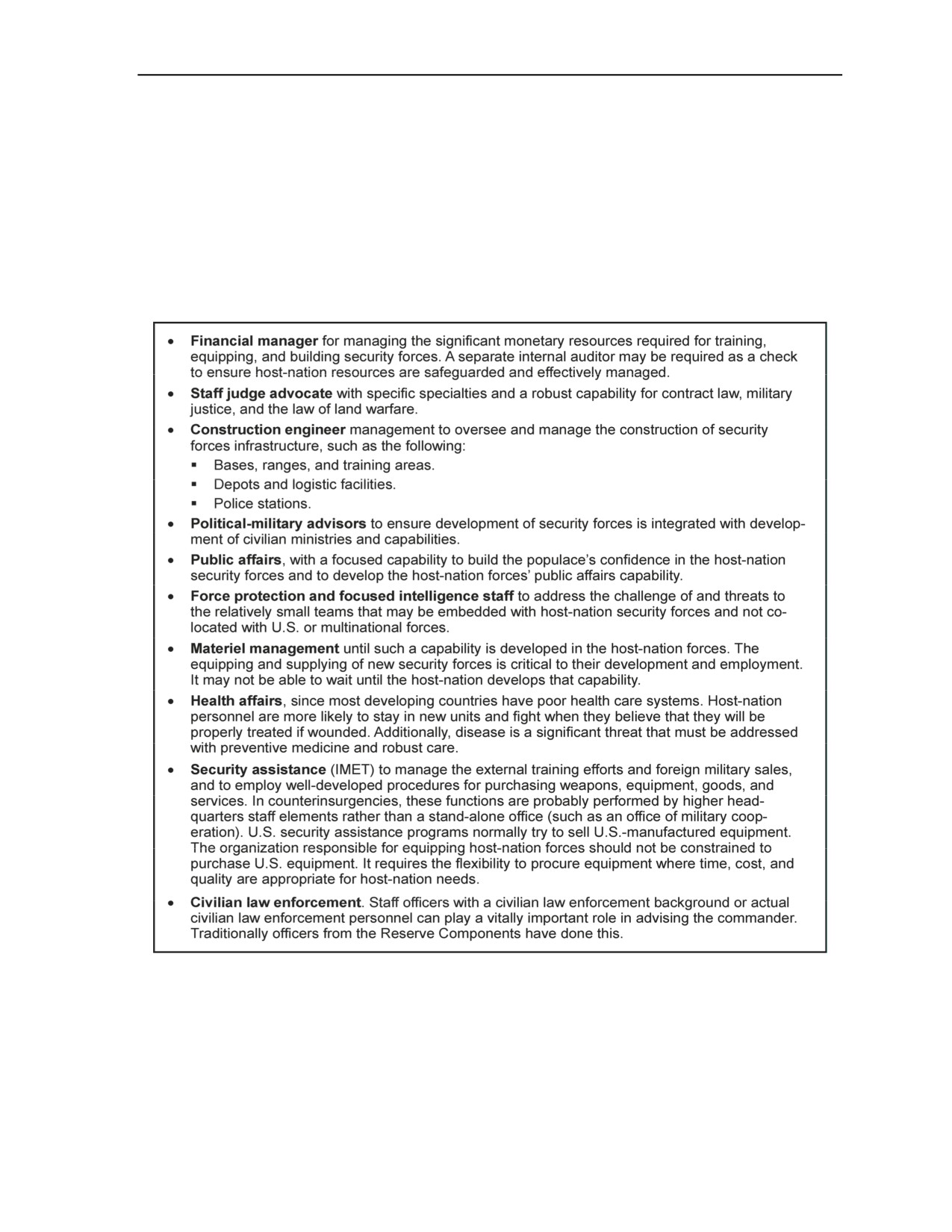
Table 6-1. Staff functions required when training host-nation security forces
6-26. The internal structure of the organization charged with developing security forces must reflect the
desired end state of those security forces. For example, if army, police, air, naval, and special operations
capabilities are being developed, the organization in charge of those programs requires teams charged spe-
cifically with each of those tasks. If civilian security components, such as a ministry of defense or interior,
are being developed, then ministerial teams are needed. Developing security forces in terms of profession-
alism and ethics is important; a separate element focused on training those values may be needed.
15 December 2006
FM 3-24/MCWP 3-33.5
6-5
Chapter 6
6-27. The U.S. or multinational force responsible for these programs requires a headquarters and staff
task-organized for the functions required to support all aspects of developing the security forces. (See
paragraph 6-31.) In addition to traditional staff functions, some or all of functions listed in table 6-1 (page
6-5) may require augmentation.
6-28. An effective security force development organization is flexible and adaptive. Requirements for de-
veloping the type, character, composition, and quantity of security forces change as security forces grow
and the COIN operation matures. The organization must anticipate such changes, since joint manning
document procedures and requests for forces have limited responsiveness. Temporary duty and contract
personnel may provide support to fill gaps until more permanent individuals or units arrive.
DESIRED END STATE
6-29. Training HN security forces is a slow and painstaking process. It does not lend itself to a “quick fix.”
Real success does not appear as a single decisive victory. To ensure long-term success, commanders clarify
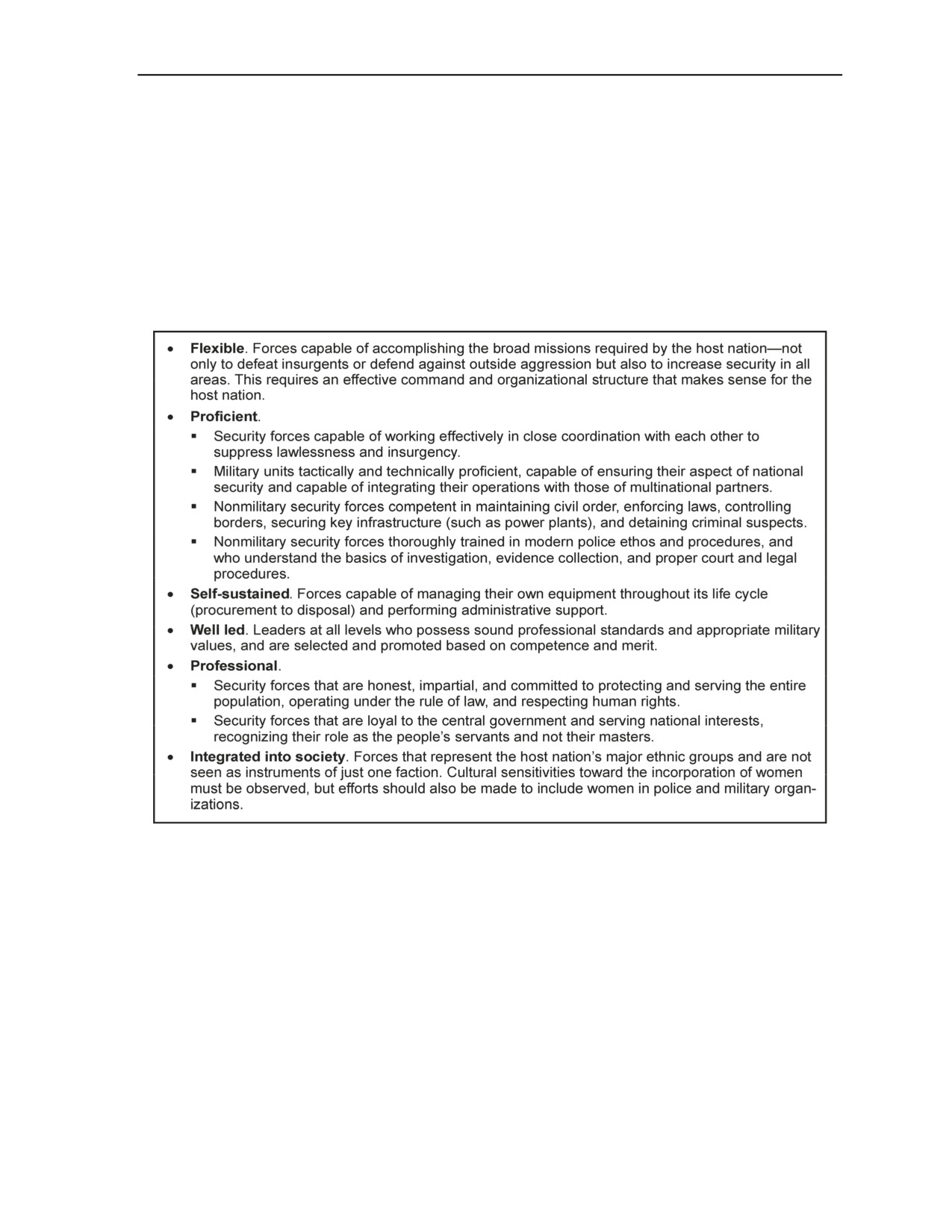
their desired end state for training programs early. This end state consists of a set of military characteristics
common to all militaries. (See table 6-2.) Those characteristics have nuances in different countries, but
well-trained HN security forces should—
z
Provide reasonable levels of security from external threats while not threatening regional security.
z
Provide reasonable levels of internal security without infringing upon the populace’s civil liber-
ties or posing a coup threat.
z
Be founded upon the rule of law.
z
Be sustainable by the host nation after U.S. and multinational forces depart.
6-30. When dealing with insurgents, HN military and police forces may perform functions not normally
considered conventional. The military may fill an internal security role usually reserved for the police. Po-
lice may have forces so heavily armed that they would normally be part of the military. In the near term,
the HN security forces should—
z
Focus on COIN operations, integrating military capabilities with those of local, regional, and na-
tional police.
z
Maintain the flexibility to transition to more conventional roles of external and internal defense,
based on long-term requirements.
To meet both near- and long-term objectives, trainers remember the cumulative effects of training. Effec-
tive training programs have short-, mid-, and long-term effects.
6-31. To achieve this end state and intermediate objectives, the host nation should develop a plan—with
multinational assistance when necessary. The plan should address all aspects of force development. U.S.
doctrine divides force development into domains: doctrine, organization, training, materiel, leadership and
education, personnel and facilities (DOTMLPF). Doctrine is listed first. However, these elements are
tightly linked, simultaneously pursued, and difficult to prioritize. Commanders monitor progress in all do-
mains. There is always a temptation for Soldiers and Marines involved in such programs to impose their
own doctrine and judgment on the host nation. The first U.S. advisors and trainers working with the South
Vietnamese Army aimed to create a conventional force to fight another Korean War. They did not recog-
nize their allies’ abilities or the real nature of the threat. The organization and doctrine adopted did not suit
the South Vietnamese situation and proved vulnerable to North Vietnamese guerrilla tactics. HN security
force doctrine, like the remaining DOTMLPF domains discussed in this chapter, must be appropriate to HN
capabilities and requirements.
FRAMEWORK FOR DEVELOPMENT
6-32. The mission to develop HN security forces can be organized around these tasks:
z
Assess.
z
Organize.
z
Build or rebuild facilities.
6-6
FM 3-24/MCWP 3-33.5
15 December 2006
Developing Host-Nation Security Forces
z
Train.
z
Equip.
z
Advise.
These incorporate all DOTMLPF requirements. Although described sequentially, these tasks are normally
performed concurrently. For example, training and equipping operations must be integrated and, as the op-
eration progresses, assessments will lead to changes. If U.S. forces are directly involved in operations
against insurgents, the development program requires a transition period during which major COIN opera-
tions are handed over to HN security forces.
Table 6-2. Characteristics of effective host-nation security forces
ASSESS
6-33. Commanders assess the situation at the start of every major military operation. The assessment is one
part of the comprehensive program of analyzing the insurgency. It includes looking at the society and the
economy. The analysis is performed in close collaboration with the U.S. country team, the host nation, and
multinational partners. These partners continually assess the security situation and its influence on other
logical lines of operations. From the assessment, planners develop short-, mid-, and long-range goals and
programs. As circumstances change, so do the goals and programs. A raging insurgency might require the
early employment of HN forces at various stages of development. Some existing security forces may be so
dysfunctional or corrupt that the organizations must be disbanded rather than rehabilitated. In some cases,
commanders will need to replace some HN leaders before their units will become functional.
6-34. While every situation is different, leaders of the development program should assess the following
factors throughout planning, preparation, and execution of the operation:
15 December 2006
FM 3-24/MCWP 3-33.5
6-7
Chapter 6
z
Social structure, organization, demographics, interrelationships, and education level of security
force elements.
z
Methods, successes, and failures of HN COIN efforts.
z
State of training at all levels, and the specialties and education of leaders.
z
Equipment and priority placed on maintenance.
z
Logistic and support structure, and its ability to meet the force’s requirements.
z
Level of sovereignty of the HN government.
z
Extent of acceptance of ethnic and religious minorities.
z
Laws and regulations governing the security forces and their relationship to national leaders.
6-35. A comprehensive mission analysis should provide a basis for establishing the scope of effort re-
quired. This analysis includes a troop-to-task analysis that determines the type and size of forces needed.
The HN security forces may require complete reestablishment, or they may only require assistance to in-
crease capacity. They may completely lack a capability (for example, internal affairs, federal investigative
department, corrections, logistics for military forces, formal schools for leaders), or they may only require
temporary reinforcement. As with other military operations, efforts to assist security forces should rein-
force success. For example, instead of building new police stations in every town, improve the good sta-
tions and use them as models for weaker organizations.
6-36. Leaders need decisions on what shortfalls to address first. The extent of the insurgency combined
with resource limitations inevitably forces commanders to set priorities. Follow-on assessments should
start by reviewing areas with restricted resources, determining where resources should be committed or re-
directed, and deciding whether to request additional resources. If the U.S. or another multinational partner
or international entity exercises sovereignty, such as during an occupation or regime change, decisions
about security force actions can be imposed on a host nation; however, it is always better to take efforts to
legitimize the HN leaders by including them in decisions.
6-37. Developing a strategic analysis and outlining a strategic plan for training the forces of a country fac-
ing an insurgency is not necessarily a long process. In fact, situations that include a security vacuum or
very active insurgency often require starting programs as soon as possible. Assessment is continuous; ini-
tial assessments and the programs they inspire must be adjusted as more experience and information are
gained. In 1981, when El Salvador faced a major insurgency, a team of ten U.S. officers visited there. The
team consulted with the HN command and the U.S. military assistance advisory group (referred to as the
MILGRP) for ten days. In that time, the team outlined a five-year comprehensive plan to rebuild, reorgan-
ize, train, and reequip the Salvadoran armed forces to counter the insurgency. The U.S. plan became part of
the foundation of a successful national COIN strategy. A team with a similar mission today should include
specialists from the Departments of State, Justice, and Homeland Security (in particular, border security
and customs experts) to assess the security force requirements.
ORGANIZE
6-38. Organizing HN forces depends on the host nation’s social and economic conditions, cultural and his-
torical factors, and security threat. The development program’s aim is to create an efficient organization
with a command, intelligence, logistic, and operations structure that makes sense for the host nation. Con-
ventional forces with limited special purpose teams (such as explosive ordnance disposal and special
weapons and tactics [SWAT]) are preferred. Elite units tend to divert a large share of the best leadership
and remove critical talent from the regular forces. Doctrine should be standard across the force, as should
unit structures. The organization must facilitate the collection, processing, and dissemination of intelli-
gence across and throughout all security forces.
6-39. Another organizational approach is establishing home guard units. In many COIN operations, these
units have effectively provided increased security to the populace. Home guards are part-time, lightly
armed, local security forces under HN government control. Often, career military and police officers su-
pervise home guards at the provincial and national levels. Home guards provide point security. They guard
vital installations that insurgents will likely target, such as government buildings and businesses. Home
guards can also provide security for small villages and man gates and checkpoints. While home guards are
6-8
FM 3-24/MCWP 3-33.5
15 December 2006
Developing Host-Nation Security Forces
not trained to conduct offensive operations, their constant presence reminds the populace that the HN gov-
ernment can provide security. Effective home guards can free police and military forces from stationary
guard duties.
General Considerations
6-40. As much as possible, the host nation should determine the security force organization’s structure.
The host nation may be open to proposals from U.S. and multinational forces but should at least approve
all organizational designs. As the HN government strengthens, U.S. leaders and trainers should expect in-
creasingly independent organizational decisions. These may include changing the numbers of forces, types
of units, and internal organizational designs. Culture and conditions might result in security forces given
what U.S. experience considers nontraditional roles and missions. HN police may be more paramilitary
than their U.S. counterparts, and the military may have a role in internal security. Eventually, police and
military roles should clearly differ. Police should counter crime while the military should address external
threats. However, the exact nature of these missions depends on the HN situation. In any event, police and
military roles should be clearly delineated.
6-41. Organized units should include all appropriate warfighting functions (formerly, battlefield operating
systems) or some adaptation for police forces. Some systems may be initially deployed in limited numbers
or excluded for various reasons, for example, cost, relevance, or training requirements. However, organiza-
tional plans should include eventually establishing all appropriate capabilities.
6-42. Organization should address all security force elements, from the ministerial level to the patrolling
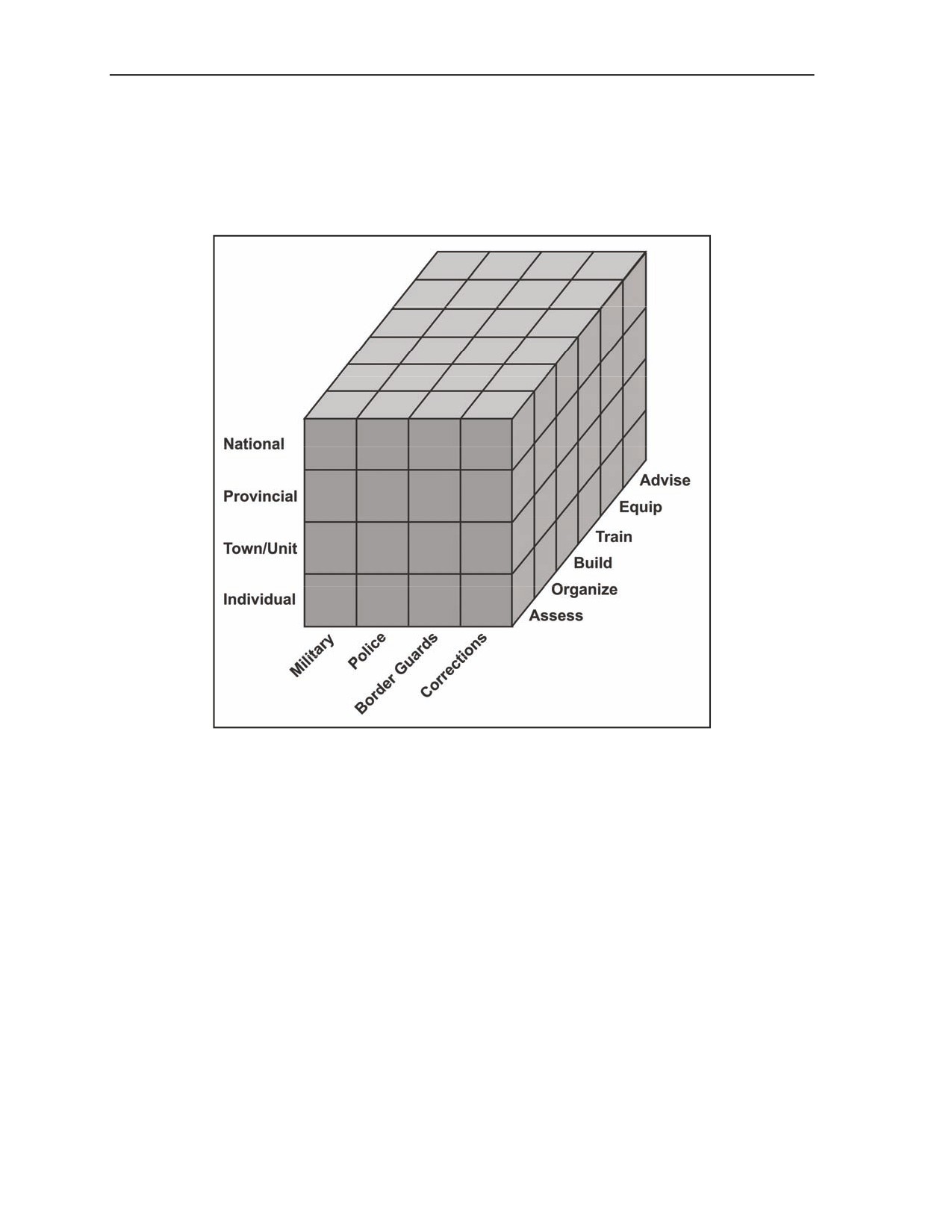
police officer and soldier. Figure 6-1 (page 6-10) illustrates the complex matrix of simultaneous develop-
ment programs. Building a competent HN civilian infrastructure—including civilian command and control
systems—is critical for success in COIN. The COIN force commander works with HN ministries responsi-
ble for national and internal security, including the ministry of national defense, the interior ministry, and
the justice ministry. The commander assesses strengths and weaknesses of the ministerial organization as
well as training requirements of civilian defense officials and employees. The U.S. and multinational advi-
sory team at the ministry level help the host nation develop a procurement and management system that ef-
fectively meets its requirements.
6-43. A thorough review of HN military and police doctrine is a necessary first step in setting up a training
program. Advisors review security force regulations to ensure they provide clear, complete instructions for
discipline, acquisitions, and support activities. Advisors review and refine doctrine (including tactics, tech-
niques, and procedures) to address COIN operations. Regulations should fit security force personnel’s level
of education and sophistication. Treatment of prisoners, detainees, and suspected persons should be clear
and consistent with the norms of international and military law.
Personnel Considerations
6-44. Organizing a security force requires resolving issues related to the following areas:
z
Recruiting.
z
Promotion screening and selection.
z
Pay and benefits.
z
Leader recruiting and selection.
z
Personnel accountability.
z
Demobilization of security force personnel.
Recruiting
6-45. Recruiting is critical when establishing security forces. The host nation designs the recruiting pro-
gram, considering local culture and themes that resonate with the populace. The program should ensure
that security forces include members from all major demographic groups. U.S. and multinational partners
should encourage and support HN efforts to recruit from minority populations. A mobile recruiting capa-
bility should be established to target specific areas, ethnic groups, or tribes to ensure demographic repre-
sentation within the security forces. Moderate groups and factions within hostile or potentially hostile eth-
15 December 2006
FM 3-24/MCWP 3-33.5
6-9
Chapter 6
nic groups should be encouraged to join the HN security forces. Most HN governments will likely resist
recruiting disaffected ethnic groups into their security forces. However, even moderate success in recruit-
ing from these groups provides enormous payoffs. It builds the security forces’ legitimacy and often quiets
legitimate fears of such groups regarding their relationship to the HN government. Effectively disarming,
demobilizing, and reintegrating former insurgents and their groups must be part of the overall COIN plan.
It must be included in the recruiting effort.
Figure 6-1. Factors affecting security force development
6-46. A proper recruiting program requires a clear set of appropriate mental, physical, and moral stan-
dards. Ideally, recruits are centrally screened and inducted. Recruiting centers need to be located in areas
safe from insurgent attacks; these centers are attractive targets. All recruits should undergo a basic security
check and be vetted against lists of suspected insurgents. As much as possible, HN agencies and personnel
should perform this screening. Membership in illegal organizations needs to be carefully monitored. Past
membership need not preclude a person from joining the security forces; however, any ongoing relation-
ship with an illegal organization requires constant monitoring. HN personnel need to ensure that no single
military or police unit contains too many prior members of an illegal unit, tribal militia, or other militant
faction.
Promotion Screening and Selection
6-47. Selection for promotion must stem from proven performance and aptitude for increased responsibil-
ity. Objective evaluations ensure promotion is by merit and not through influence or family ties. Two
methods for selecting leaders may be worth considering. One method identifies the most competent per-
formers, trains them, and recommends them for promotion. The second method identifies those with social
or professional status within the training group, then trains and recommends them for promotion. The first
method may lead to more competent leaders but could be resisted for cultural reasons. The second method
6-10
FM 3-24/MCWP 3-33.5
15 December 2006
Developing Host-Nation Security Forces
ensures the new leader will be accepted culturally but may sacrifice competence. The most effective solu-
tion comes from combining the two methods.
Pay and Benefits
6-48. Appropriate compensation levels help prevent a culture of corruption in the security forces. It is
cheaper to spend the money needed for adequate wages and produce effective security forces than to pay
less and end up with corrupt and abusive forces that alienate the populace. Paying the police adequately is
especially important; the nature of their duties and contact with the civilian community often expose them
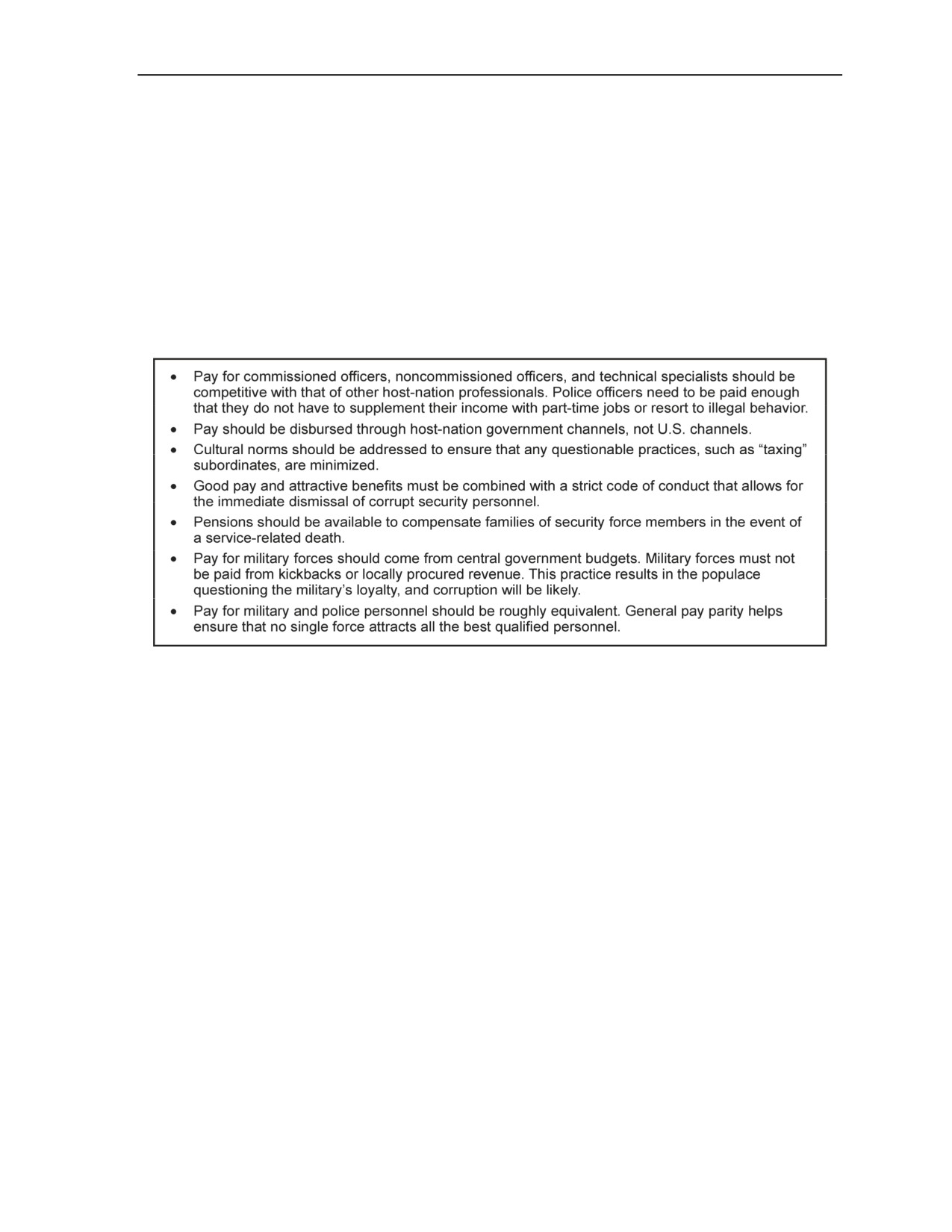
to opportunities for corruption. (Table 6-3 lists some important considerations concerning security force
pay.)
Table 6-3. Security force pay considerations
6-49. Effective security forces can help improve HN social and economic development through the bene-
fits each member receives. Every recruit should receive a basic education, job training, and morals and val-
ues inculcation.
Leader Recruiting and Selection
6-50. Officer candidate standards should be high. Candidates should be in good health and pass an aca-
demic test with a higher standard than the test for enlisted recruits. Officer candidates should be carefully
vetted to ensure that they do not have close ties to any radical or insurgent organization.
6-51. NCOs should be selected from the best enlisted security force members. Objective standards, includ-
ing proficiency tests, should be established and enforced to ensure that promotion to the NCO ranks comes
from merit, not through influence or family ties. Many armies lack a professional NCO corps; establishing
one for a host nation may be difficult. In the meantime, adjustments will have to be made, placing more re-
sponsibility on commissioned officers.
Personnel Accountability
6-52. HN leaders must carefully track and account for security force personnel. Proper personnel account-
ability reduces corruption, particularly in countries with manual banking systems where security force per-
sonnel are paid in cash. In addition, large numbers of personnel failing to report for duty can indicate pos-
sible attacks, low unit morale, or insurgent and militia influences on the security forces.
15 December 2006
FM 3-24/MCWP 3-33.5
6-11
Chapter 6
Demobilization of Security Force Personnel
6-53. Host nations should develop programs to keep a class of impoverished and disgruntled former offi-
cers and soldiers from forming. As the security forces mature, commissioned officers and NCOs who per-
form poorly or fail to meet the new, higher standards of the force will need to be removed. Providing some
form of government-provided education grants or low-interest business loans enables discharged personnel
to earn a living outside the military. Commissioned officers and NCOs who serve for several years and are
then removed should receive a lump-sum payment or small pension to ease their transition to civilian life.
These programs should not apply to those guilty of major human rights abuses or corruption. Demobiliza-
tion planning should start as soon as commanders anticipate the need. (It may not be required in all cases.)
Any plan should evolve with HN security force development to ensure its feasibility. Similar programs
may be required when demobilizing nongovernment militias.
6-54. As a conflict ends, some security forces may need to be disarmed, demobilized, and reintegrated into
civil society. To avoid producing a pool of recruits for the insurgency, the host nation should establish pro-
grams to keep large numbers of demobilized security force members from becoming immediately unem-
ployed. Civil service departments should provide a hiring preference to people completing an honorable
term of service. Government-financed education programs for demobilized members are another possibil-
ity.
BUILD OR REBUILD FACILITIES
6-55. HN security forces need infrastructure support. People need buildings for storage, training, and shel-
ter. Often requirements include barracks, ranges, motor pools, and other military facilities. Construction
takes time; the host nation needs to invest early in such facilities if they are to be available when needed.
Protection must be considered in any infrastructure design, including headquarters facilities, as infrastruc-
ture provides attractive targets for insurgents. (See FM 5-104 for information on hardening measures to in-
crease infrastructure survivability and improve protection.)
6-56. During an insurgency, HN military and police forces often operate from local bases. Building train-
ing centers and unit garrisons requires a long-term force-basing plan. If possible, garrisons should include
housing for the commissioned officers, NCOs, and families; government-provided medical care for the
families; and other benefits that make national service attractive.
6-57. The host nation may need to make large investments in time and resources to restore or create the na-
tionwide infrastructure necessary to effectively command and control HN security forces. Communications
facilities are especially important. Besides building local bases and police stations, the host nation will
need functional regional and national headquarters and ministries.
TRAIN
6-58. U.S. and multinational training assistance should address shortfalls at every level with the purpose of
establishing self-sustaining training systems.
Training the U.S. Trainers
6-59. Soldiers and Marines assigned training missions should receive training on the specific requirements
of developing HN forces. The course should emphasize the host nation’s cultural background, introduce its
language, and provide cultural tips for developing a good rapport with HN personnel. The course should
also include protection training for troops working with HN forces. U.S. trainees must become familiar
with the HN organization and equipment, especially weapons not in the U.S. inventory. This training must
emphasize the following:
z
Sustaining training and reinforcing individual and team skills.
z
Using the smallest possible student-to-instructor ratio.
z
Developing HN trainers.
z
Training to standards—not to time.
z
Providing immediate feedback; using after-action reviews.
6-12
FM 3-24/MCWP 3-33.5
15 December 2006
Developing Host-Nation Security Forces
z
Respecting the HN culture, but learning to distinguish between cultural practices and excuses.
z
Learning the HN language.
z
Working with interpreters.
6-60. U.S. forces should show respect for local religions and traditions. Soldiers and Marines should will-
ingly accept many aspects of the local and national culture, including food (if sanitation standards permit).
U.S. forces must make clear that they do not intend to undermine or change the local religion or traditions.
However, Soldiers and Marines have a mission to reduce the effects of dysfunctional social practices that
affect the ability to conduct effective security operations. U.S. trainers and advisors must have enough
awareness to identify and stop inappropriate behavior, or at least report it to the multinational and HN
chains of command.
Establishing Training Standards
6-61. Insurgent approaches and their corresponding responses from targeted governments vary widely;
however, the host nation and trainers can still establish clear measures for evaluating the training of indi-
viduals, leaders, and units. COIN operations require many of the same individual and collective skills per-
formed in conventional military operations but also include additional requirements for COIN. Small units
execute most COIN operations; therefore, effective COIN forces require strong junior leaders. All levels of
training for all components should include values training. Metrics for evaluating units should include sub-
jective measures, such as loyalty to the HN government, as well as competence in military tasks. Soldiers
and Marines know how to evaluate military training. However, the acceptance of values, such as ethnic
equality or the rejection of corruption, may be a better measure of training effectiveness in some COIN
situations. Gauging this acceptance is far more difficult than evaluating task performance.
6-62. Effective training programs require clear, detailed individual, leader, and unit performance stan-
dards. These standards take into account cultural factors that directly affect the ability of the individual or
unit to operate. For example, training a unit to conduct effective operations requires more time in countries
where the average soldier is illiterate. Similarly, staff training proves more difficult in countries with a low
educational level. Building a security force from the ground up takes far more time than creating one
around a trained cadre of HN personnel. With this in mind, it is usually better to use existing military per-
sonnel to form units and cadres for units, rather than creating novice security forces. Vetting may be re-
quired to determine loyalties and validate the abilities of existing security forces.
6-63. Poorly trained leaders and units are more prone to committing human rights violations than well-
trained, well-led units. Leaders and units unprepared for the pressure of active operations tend to use indis-
criminate force, target civilians, and abuse prisoners. These actions can threaten the popular support and
government legitimacy essential for COIN success. Badly disciplined and poorly led security forces be-
come effective recruiters and propagandists for insurgents.
6-64. Setting realistic metrics, both objective and subjective, for HN security forces and following through
on training plans consume time. The pressure is strong to find training shortcuts, employ “quick fixes,” or
to train personnel on the job. Trainers should resist such approaches. In the long term, such approaches
create more problems than they solve. However, trainers should also avoid the temptation to create long,
complex training programs based on unrealistic standards. Effective programs account for the host nation’s
culture, resources, and short-term security needs. No firm rules exist on how long particular training pro-
grams should take, but trainers can use existing and historical U.S. or multinational training programs as
starting points for planning. To a certain extent, the insurgent threat dictates how long training can take. As
security improves, training programs can expand to facilitate achievement of the long-term end state.
Training Methods
6-65. Training programs should be designed to prepare HN personnel to train themselves. HN trainers are
the best trainers and should be used as much as possible. Many training methods have proven successful;
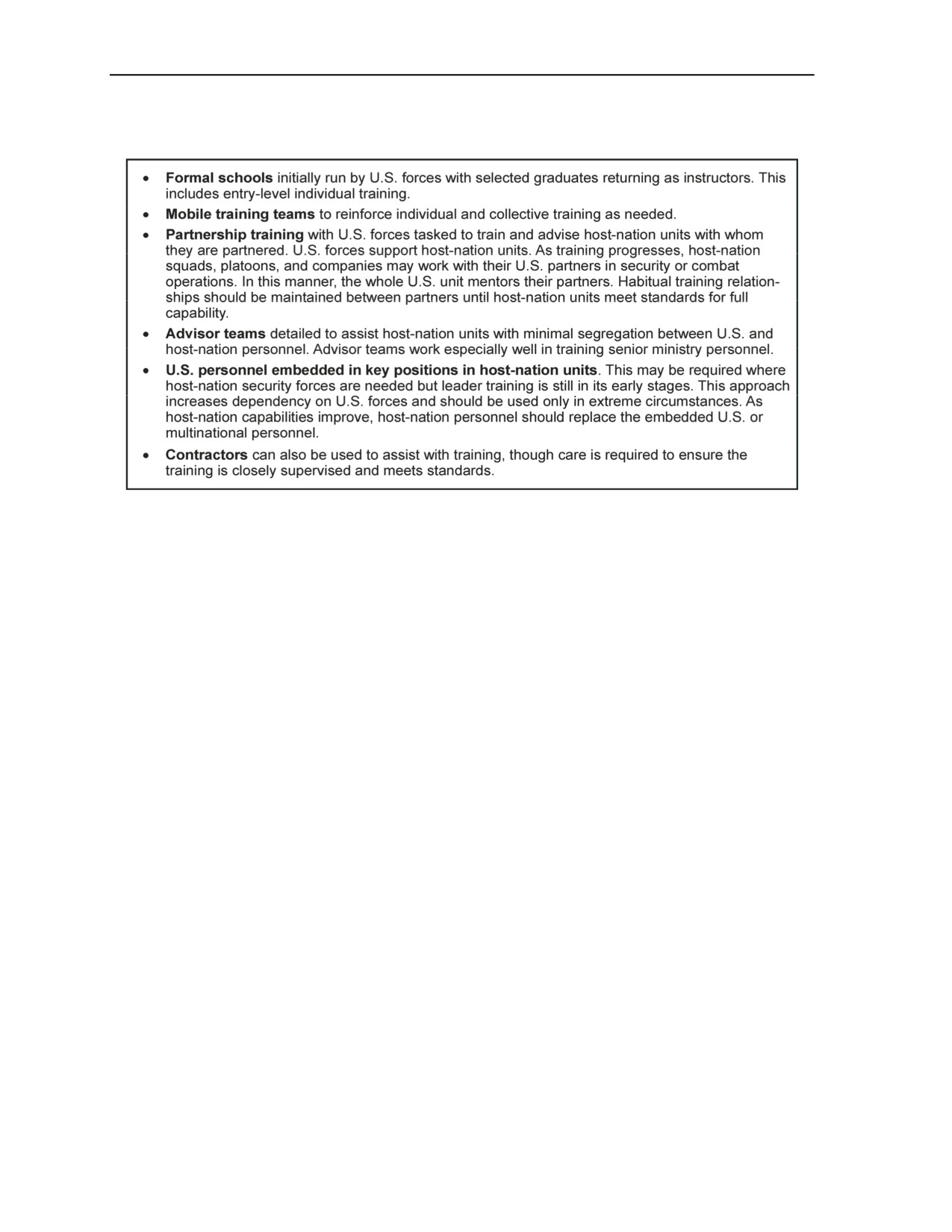
some also enhance developing HN training capability. (Table 6-4 [page 6-14] lists several successful train-
ing methods.)
15 December 2006
FM 3-24/MCWP 3-33.5
6-13
Chapter 6
Table 6-4. Methods of training host-nation security forces
Training Soldiers
6-66. Security force members must be developed through a systematic training program. The program first
builds their basic skills, then teaches them to work together as a team, and finally allows them to function
as a unit. Basic military training should focus first on COIN-related skills, such as first aid, marksmanship,
and fire discipline. Leaders must be trained in tactics, including patrolling and urban operations. Everyone
must master rules of engagement and the law of armed conflict. HN units should train to standard for con-
ducting the major COIN missions they will face. Required skills include the following:
z
Manage their security.
z
Provide effective personnel management.
z
Conduct logistic (planning, maintenance, sustainment, and movement) operations.
z
Conduct basic intelligence functions.
z
Coordinate indirect fires.
z
Provide for effective medical support.
Training Leaders
6-67. The effectiveness of the HN security forces directly relates to the quality of their leadership. Build-
ing effective leaders requires a comprehensive program of officer, staff, and specialized training. The ulti-
mate success of any U.S. involvement in a COIN effort depends on creating viable HN leaders able to
carry on the fight at all levels and build their nation on their own.
Leader Training Standards
6-68. The leader training methodology must reinforce the different levels of authority within the HN secu-
rity force. The roles and responsibilities of each commissioned officer and NCO rank must be firmly estab-
lished so recruits understand what is expected of them. Their subordinate relationship to civilian authorities
must also be reinforced to ensure civilian control. In addition, training should establish team dynamics. In
some cultures, security forces may need training to understand the vital role of members not in primary
leadership positions.
6-14
FM 3-24/MCWP 3-33.5
15 December 2006
Developing Host-Nation Security Forces
6-69. In addition to tactical skills, commissioned officers should be trained in accountability, decision
making, delegating authority, values, and ethics. Special requirements for COIN should be the primary fo-
cus of the initial curriculum. These subjects include the following:
z
Intelligence collection.
z
Day and night patrolling.
z
Point security.
z
Cordon and search operations.
z
Operations with police.
z
Treatment of detainees and prisoners.
z
Psychological operations.
z
Civic action.
As the insurgency declines, the curriculum can be adjusted for a long-term focus.
6-70. In addition, leader training should be conducted in a way that shows—
z
How to work as a team.
z
How to develop and take advantage of subordinates’ skills.
z
How to train subordinates.
z
How to maintain discipline and assume responsibility for one’s own and subordinates’ actions.
z
How to understand and enforce the rules of engagement.
Basic Commissioned Officer Education
6-71. Various models for basic officer education exist. These include the following:
z
One-year military college.
z
Four-year military college.
z
Officer candidate school (OCS).
z
Military training at civilian universities.
6-72. Time available may determine which model to use as the primary commissioning source. If the situa-
tion allows, four-year programs at military or civilian institutions may be the best choice. If not, the OCS
and one-year college models may be better. Theoretically, having a few high-quality officers may be better
than many adequate ones, but the insurgents may not allow this luxury. Citizens under attack would rather
have an adequate officer and unit now than a better leader and organization years later.
6-73. The British Army uses the one-year military college model. Prospective officers attend Sandhurst, an
intensive course that includes a rigorous program of basic training and a thorough grounding in the British
Army’s history and culture. It also emphasizes developing each future officer as a leader. At the end of the
year, each new officer attends a shorter specialty branch course.
6-74. The four-year military and civilian college models provide the best overall education, while prepar-
ing officers for work at the tactical and operational levels. The longer programs also are good for inculcat-
ing values. However, they require significant time and resources.
6-75. Under an OCS-style program, outstanding individuals come from the enlisted ranks or society. They
receive intensive training in the military skills junior officers require. OCS programs often last less than a
year. An OCS-style course should be followed by specialized branch training.
Intermediate and Advanced Commissioned Officer Education
6-76. Military units only become effective when their commanders and staffs can effectively plan, prepare,
execute, and assess operations. Initial intermediate-level commissioned officer training should focus on
building effective commanders and staffs for small units, then progressively move to higher echelons.
Thus, initial intermediate-level officer training focuses on the company and battalion levels (or police sta-
tion level). Later courses address higher echelons, depending on the size of the overall force to be devel-
oped.
15 December 2006
FM 3-24/MCWP 3-33.5
6-15
Chapter 6
6-77. A cadre of carefully selected low- and mid-level commissioned officers can receive an advanced
education at existing formal schools in the United States or other partner nations through IMET-like pro-
grams. This type of program builds a qualified leadership cadre. This cadre can, upon their return home,
assume leadership positions and become the faculty for HN schools. These officers should have increased
credibility when they return to their country. Officer students usually make and maintain strong personal
connections with their foreign hosts during and after their stay abroad. One of the key goals for developing
HN security forces is to professionalize them. The first-hand experience of their officers training at foreign
military schools, living abroad, and seeing military professional standards practiced proves invaluable. As
with officer commissioning programs, time is a key consideration. IMET-like programs are expensive and
time consuming. The best officers—those normally selected for such training—may be needed more in the
country’s combat forces fighting the insurgency.
Operational Employment of Newly Trained Forces
6-78. Building the morale and confidence of security forces should be a primary strategic objective. Com-
mitting poorly trained and badly led forces results in high casualties and invites tactical defeats. While de-
feat in a small operation may have little strategic consequence in a conventional war, even a small tactical
defeat of HN forces can have serious strategic consequences in a COIN. Insurgent warfare is largely about
perceptions. Effective insurgent leaders can quickly turn minor wins into major propaganda victories. De-
feat of one government force can quickly degrade the morale of others. If a HN force fails, the local popu-
lace may begin to lose confidence in the government’s ability to protect them. A string of relatively minor
insurgent victories can cause widespread loss of morale in the HN forces and encourage the “neutral major-
ity” to side with the insurgents. In short, the HN security forces must be prepared for operations so that
they have every possible advantage. The decision to commit units to their first actions and their employ-
ment method requires careful consideration. As much as possible, HN forces should begin with simpler
missions. As their confidence and competence grows, these forces can assume more complex assignments.
Collaborating with U.S. or multinational units can help new HN units to become accustomed to the stresses of
combat.
6-79. Newly trained units should enter their first combat operation in support of more experienced HN,
U.S., or multinational forces. Operational performance of such inexperienced organizations should be care-
fully monitored and evaluated so that weaknesses can be quickly corrected. The employment plan for HN
security units should allow enough time for additional training after each operation. Introducing units into
combat gradually allows identification of poor leaders to the HN leadership for retraining or other action.
Competent leaders are also identified and given greater authority and responsibility.
Training Defense Ministry Civilians
6-80. U.S. forces tasked with training HN personnel must also ensure that the military and security forces
have capable management in the top ranks. Combatant commanders place experienced U.S. officers and
Department of Defense personnel inside the HN defense and interior ministries as trainers and advisors for
HN managers and leaders. U.S. forces should also develop a training program for civilian personnel of the
ministry of defense. Personnel training should address the following:
z
Equipment acquisition.
z
Departmental administration.
z
Personnel management.
z
Financial management.
z
Maintenance and inventory controls.
z
Strategic (or national) level operations.
Selected ministry of defense personnel may receive specialized training in defense management through
U.S. or multinational partners’ schools (for example, the National Defense University) or in civilian institu-
tions that specialize in graduate programs for security studies.
6-16
FM 3-24/MCWP 3-33.5
15 December 2006
Developing Host-Nation Security Forces
EQUIP
6-81. The strategic plan for security force development should outline HN equipment requirements.
Equipment should meet the host nation’s requirements. Appropriate equipment is affordable and suitable
against the threat. The host nation must also be able to train on the equipment. Interoperability may be de-
sired in some cases. A central consideration includes the host nation’s long-term ability to support and
maintain the equipment.
6-82. The initial development plan should include phases with goals for HN forces to meet over a period
of three to four years. Due to the highly adaptive nature of insurgents and the often rapidly changing situa-
tion on the ground, commanders must continually asses the direction and progress of developing HN secu-
rity forces.
6-83. The requirement to provide equipment may be as simple as assisting with maintenance of existing
formations or as extensive as providing everything from shoes and clothing to vehicles, communications,
and investigation kits. If insurgents use heavy machine guns and rocket-propelled grenades, HN security
forces need comparable or better equipment. This especially applies to police forces, which are often
lightly armed and vulnerable to well-armed insurgents.
6-84. Primary considerations should include maintainability, ease of operation, and long-term sustainment
costs. Few developing nations can support highly complex equipment. In COIN operations, having many
versatile vehicles that require simple maintenance is often better than having a few highly capable armored
vehicles or combat systems that require extensive maintenance. Developing an effective HN maintenance
system often begins with major maintenance performed by contractors. The program then progresses to
partnership arrangements with U.S. forces as HN personnel are trained to perform the support mission.
6-85. Sources for HN materiel include U.S. foreign military sales, multinational or third-nation resale of
property, HN contracts with internal suppliers, or HN purchases on the international market. (Paragraphs
D-27 through D-34 discusses relevant legal considerations.) The HN, U.S., and multinational organizations
responsible for equipping HN forces should have the flexibility necessary to obtain equipment that meets
the HN force needs for quality, timeliness and cost. As part of their training, HN security forces also need
to learn the practices and importance of property accountability to reduce corruption and ensure proper
equipment usage. Part of equipping HN forces includes training them in the practices and importance of
property accountability. HN forces are expected to provide equipment the same level of control and protec-
tion that U.S. forces provide for similar equipment. (See AR 12-1 and DODD 5105.38M.)
ADVISE
6-86. Advisors are the most prominent group of U.S. personnel that serve with HN units. Advisors live,
work, and (when authorized) fight with their HN units. Segregation is kept at an absolute minimum. The
relationship between advisors and HN forces is vital. U.S. commanders must remember that advisors are
not liaison officers, nor do they command HN units.
6-87. Effective advisors are an enormous force enhancer. The importance of the job means that the most
capable individuals should fill these positions. Advisors should be Soldiers and Marines known to take the
initiative and who set the standards for others. (FM 31-20-3 provides additional information and guidelines
for advisors.)
6-88. More than anything else, professional knowledge and competence win the respect of HN troops. Ef-
fective advisors develop a healthy rapport with HN personnel but avoid the temptation to adopt HN posi-
tions contrary to U.S. or multinational values or policy.
6-89. Advisors who understand the HN military culture understand that local politics have national effects.
Effective advisors recognize and use cultural factors that support HN commitment and teamwork. A good
advisor uses the culture’s positive aspects to get the best performance from each security force member and
leader. Table 6-5 (page 6-18) lists important guidelines for advisors.
15 December 2006
FM 3-24/MCWP 3-33.5
6-17
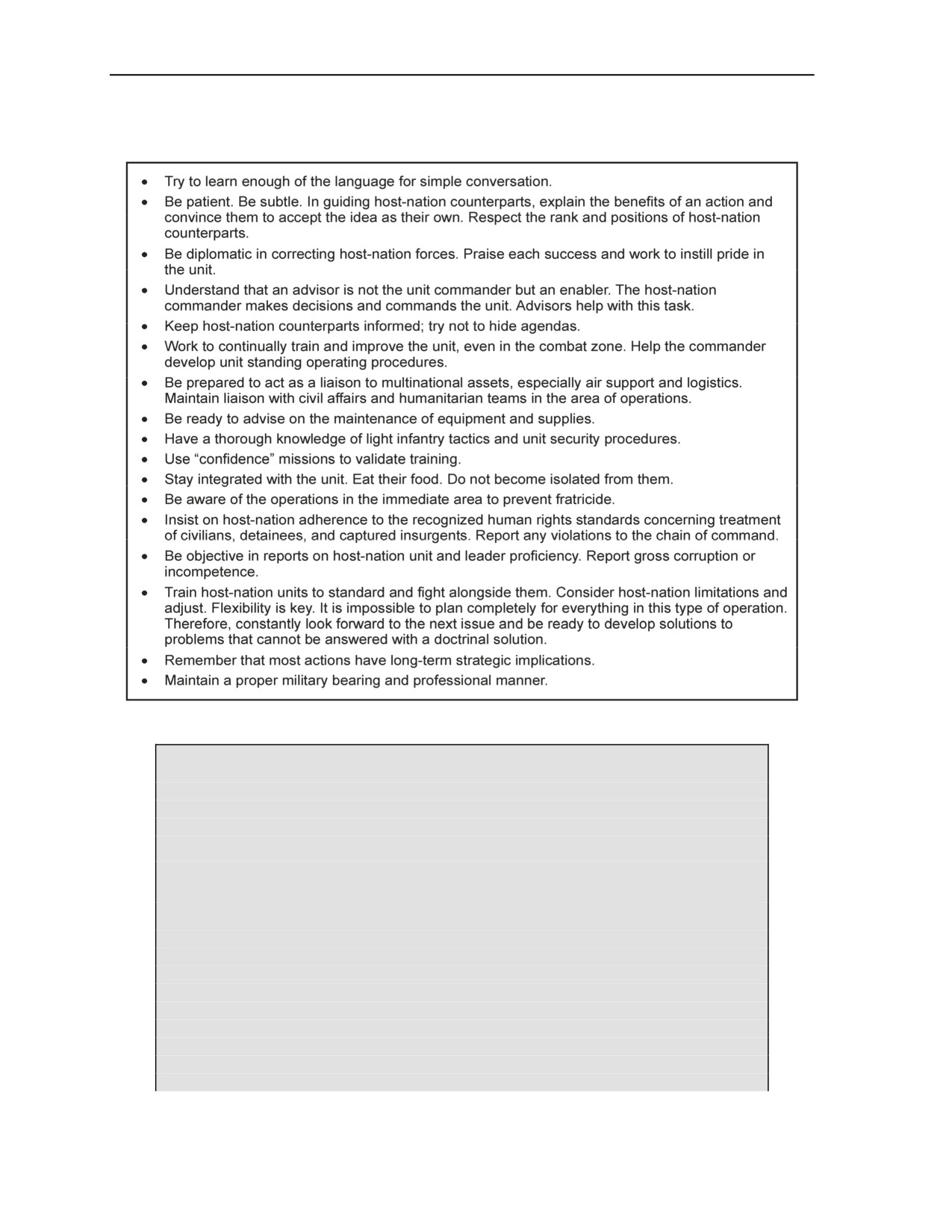
Chapter 6
Table 6-5. Guidelines for advisors
Multinational Security Transition Command-Iraq
The experience of Multinational Security Transition Command-Iraq (MNSTC-I) in
2005 demonstrates the challenges of developing and assisting host-nation security
forces facing an intensive insurgency. MNSTC-I programs were built on three pillars:
• Training and equipping the Iraqi security forces to standard.
• Using transition teams to guide the development of leaders and staffs.
• Partnerships between U.S. and multinational forces on the ground and developing
Iraqi forces.
Initial plans called for only a small army (to deal with external threats) supplemented
by conventional police forces (to maintain internal law and order). As the insurgency
matured, the decision was made to develop a larger Iraqi Army and to focus it on the
internal threat. A more robust police force was also developed. Training programs
matured, becoming longer and more focused on counterinsurgency tasks. Decisions
by the Iraqi government also necessitated training and organizational changes.
Training programs were adjusted, based on the experience of recruits, and eventu-
ally lengthened and changed in response to the increasing lethality of the insurgency
and lessons learned. Advisors assigned to Iraqi units were termed “transition teams”
6-18
FM 3-24/MCWP 3-33.5
15 December 2006
Developing Host-Nation Security Forces
and instructed to focus on the development of leaders and staffs at battalion level
and above.
As security forces grew significantly, it became evident that civilian ministry infra-
structure development was not keeping pace. So MNSTC-I assumed the additional
mission of creating ministerial-level organizations, finding resources, and changing
culture. Another significant challenge involved selecting and training competent host-
nation leadership—commissioned and noncommissioned officers. This grew more
challenging as the host nation regained sovereignty and asserted its authority, which
led to a greater focus on developing staffs by transition teams.
The MNSTC-I experience shows the advantage of doing a prompt initial assessment
and then adjusting as conditions change and lessons are learned. Developing HN
security forces from scratch in an active insurgency environment is often more about
overcoming friction than about perfect planning. MNSTC-I also demanded robust in-
teragency and multinational participation in the training effort and fought for the fund-
ing necessary to make it effective. MNSTC-I found that easily measured measures of
effectiveness, such as soldiers equipped or battalions fielded, were not as useful as
more complicated and more subjective metrics, such as the training level of fielded
units and their loyalty to the national government.
POLICE IN COUNTERINSURGENCY
6-90. The primary frontline COIN force is often the police—not the military. The primary COIN objective
is to enable local institutions. Therefore, supporting the police is essential. But the police are only a part of
the rule of law. Police require support from a law code, judicial courts, and a penal system. Such support
provides a coherent and transparent system that imparts justice. Upholding the rule of law also requires
other civil institutions and a HN ability to support the legal system. Commanders should ensure that robust
coordination mechanisms linking their efforts with the larger developmental process exist. If parts of the
rule of law do not work, then commanders must be prepared to meet detention requirements.
6-91. Few military units can match a good police unit in developing an accurate human intelligence picture
of their AO. Because of their frequent contact with populace, police often are the best force for countering
small insurgent bands supported by the local populace. In COIN operations, special police strike units may
move to different AOs, while patrol police remain in the local area on a daily basis and build a detailed in-
telligence picture of the insurgent strength, organization, and support.
ORGANIZING THE POLICE
6-92. Police often consist of several independent but mutually supporting forces. These may include—
z
Criminal and traffic police.
z
Border police.
z
Transport police for security of rail lines and public transport.
z
Specialized paramilitary strike forces.
In addition, a host nation may establish various reserve police units or home guards to provide local secu-
rity. The force may include paramilitary units. Police might be organized on a national or local basis.
Whatever police organization is established, Soldiers and Marines must understand it and help the host na-
tion effectively organize and use it. This often means dealing with several police organizations and devel-
oping plans for training and advising each one.
6-93. A formal link or liaison channel must exist between the HN police and military forces. This channel
for coordination, deconfliction, and information sharing enables successful COIN operations.
6-94. Military forces might have to perform police duties at the start of an insurgency; however, it is best
to establish police forces to assume these duties as soon as possible. U.S., multinational, and HN partners
15 December 2006
FM 3-24/MCWP 3-33.5
6-19
Chapter 6
should institute a comprehensive program of police training. Moreover, plans for police training need to
envision a several-year program to systematically build institutions and leadership.
6-95. Although roles of the police and military forces in COIN operations may blur, important distinctions
between the two forces exist. If security forces treat insurgents as criminals, the police may retain the pri-
mary responsibility for their arrest, detention, and prosecution.
6-96. Countering an insurgency requires a police force that is visible day and night. The host nation will
not gain legitimacy if the populace believes that insurgents and criminals control the streets. Well-sited and
protected police stations can establish a presence in communities as long as the police do not hide in those
stations. Police presence provides security to communities and builds support for the HN government.
When police have daily contact with the local populace, they can collect information for counterinsurgents.
6-97. Good pay and attractive benefits must be combined with a strict code of conduct that follows the rule
of law and allows for the immediate dismissal of police officers for gross corruption. Good planning en-
sures that police pay, housing, benefits, and work conditions attract a high quality of police recruit as well
as discourage petty corruption. Such corruption undermines the populace’s confidence in the police and
government. An important step in organizing a police force involves setting up an independent review
board composed of experts, government officials, or nongovernmental organization members. It should not
be under the direct command of the police force. This board should have the authority to investigate
charges of police abuse and corruption, oversee the complaints process, and dismiss and fine police found
guilty of misconduct.
TRAINING THE POLICE IN COUNTERINSURGENCY
6-98. Police training is best conducted as an interagency and multinational operation. In a multinational ef-
fort, a separate multinational police training and advisory command could work with the military training
command. Ideally, leaders for police training are civilian police officers from the Departments of Justice
and State along with senior police officers from multinational partners. Civilian police forces have person-
nel with extensive experience in large city operations. Department of Justice and multinational police or-
ganizations have extensive experience operating against organized crime groups. Experience countering
organized crime is especially relevant to COIN; most insurgent groups are more similar to organized crime
in their organizational structure and relations with the populace than they are to military units. U.S. military
police units serve best when operating as a support force for the professional civilian police trainers. How-
ever, military forces may be assigned the primary responsibility for police training; they must be prepared
to assume that role if required. (See paragraph D-3 for legal considerations associated with this mission.)
6-99. Military police can provide much of the initial police training. They are especially suited to teach the
HN police forces the following skills:
z
Weapons handling.
z
Small-unit tactics.
z
Special weapons employment.
z
Convoy escort.
z
Riot control.
z
Traffic control.
z
Prisoner and detainee handling and processing.
z
Police intelligence.
z
Criminal intelligence.
z
Criminal handling.
z
Stations management.
Higher level police skills—such as civilian criminal investigation procedures, antiorganized crime opera-
tions, and police intelligence operations—are best taught by civilian experts.
6-100. Military police or corrections personnel can also provide training for detention and corrections op-
erations. HN personnel should be trained to handle and interrogate detainees and prisoners according to in-
6-20
FM 3-24/MCWP 3-33.5
15 December 2006
Developing Host-Nation Security Forces
ternationally recognized human rights norms. Prisoner and detainee management procedures should pro-
vide for the security and the fair and efficient processing of those detained.
6-101. Police forces, just like military forces, need quality support personnel to be effective. This requires
training teams to ensure that training in support functions is established. Specially trained personnel re-
quired by police forces include the following:
z
Armorers.
z
Supply specialists.
z
Communications personnel.
z
Administrative personnel.
z
Vehicle mechanics.
6-102. Effective policing also requires an effective justice system that can process arrests, detentions,
warrants, and other judicial records. Such a system includes trained judges, prosecutors, defense counsels,
prison officials, and court personnel. These people are important to establishing the rule of law.
6-103. Advisors should help the host nation establish and enforce police roles and authority. The author-
ity to detain and interrogate, procedures for detention facilities, and human rights standards are important
considerations.
POLICE/MILITARY OPERATIONS
6-104. In COIN operations, police forces from the host nation, United States, and multinational partners
often conduct operations together. To work effectively together, the police and military coordinate rules of
engagement. These forces also—
z
Establish common standing operating procedures.
z
Conduct supporting information operations.
z
Perform combined planning.
z
Ensure command and control interoperability.
6-105. Military forces can support the police in carrying out numerous COIN functions in accordance
with U.S. law. This support can include the following:
z
Assisting in the arrest of war criminals.
z
Supporting police presence and search patrols.
z
Providing logistic support.
z
Controlling crowds and urban unrest.
z
Detaining suspected felons.
z
Securing key facilities.
z
Providing advisors to the police.
6-106. The Departments of Justice and State normally take the lead in helping the host nation develop a
workable judicial system through a ministerial-level advisory program. The military’s staff judge advocate
and civil affairs personnel may help develop the HN judicial system. As this system is developed and re-
formed, the military commander’s legal and political advisors should ensure that the military’s concerns
are addressed.
Developing a Police Force in Malaya
In 1948, the Malayan Communist Party, whose members were primarily ethnic Chi-
nese, began an insurgency against the British colonial government. The British first
responded by dramatically expanding the Malayan security forces. The police, not
the army, served as the lead counterinsurgency force. Between 1948 and 1950, the
number of Malayan police expanded fivefold to 50,000, while the British army garri-
son expanded to 40,000. However, there was only time to provide a few weeks of ru-
dimentary training to the new police officers before throwing them into operations.
15 December 2006
FM 3-24/MCWP 3-33.5
6-21
Chapter 6
Police with little training and little competent leadership were ineffective in conducting
operations. They also abused the civilian population and fell into corrupt practices.
The population largely regarded the police as hostile; they were reluctant to give
them information on the insurgents.
By 1952, the insurgency had reached a stalemate. The British then established a
new strategy. The strategy included reforming and retraining the entire Malaya Police
Force. First, 10,000 corrupt or incompetent police officers were removed from the
force. Then, police officers who had proven the most competent in operations were
made instructors in new police schools. During 1952 and 1953, every police officer
attended a four-month basic training course. Police commissioned and noncommis-
sioned officers were sent to three- to four-month advanced courses. All senior
Malayan police officers were required to attend the police intelligence school. There
they learned the latest criminal investigation techniques. Teams of Britain’s top police
officers taught them intelligence collection and analysis methods as well. Dozens of
the most promising Malayan officers attended the full yearlong course in advanced
police operations in Britain.
To win the ethnic Chinese away from the insurgents, the British worked closely with
ethnic Chinese organizations to recruit Chinese for the Malaya Police Force. In 1952,
the number of ethnic Chinese in the force more than doubled. Although the percent-
age of ethnic Chinese in the police force did not equal their percentage in the popula-
tion, the ethnic Chinese saw this reaching out as a sign that the government was ad-
dressing their interests. At the same time, some Chinese and Malay political groups
were building a coalition to establish an independent Malaya in which all the major
ethnic groups would participate. The two efforts complemented each other.
Better trained police officers and soldiers led by fully trained commissioned and non-
commissioned officers dramatically improved the Malayan security forces’ discipline.
Better relations between the population and security forces resulted, and the people
began to provide information on the insurgents. Thanks to their intelligence training,
the security forces could develop intelligence from that information and act on it.
They begin to break the insurgent organization. In 1953, the government gained the
initiative. After that, the insurgent forces and support structure declined rapidly. In
late 1953, the British began withdrawing forces. They progressively turned the war
over to the Malayans, who were fully prepared to conduct counterinsurgency opera-
tions without a drop in efficiency.
The Malaya insurgency provides lessons applicable to combating any insurgency.
Manpower is not enough; well-trained and well-disciplined forces are required. The
Malayan example also illustrates the central role that police play in counterinsur-
gency operations. British leaders concentrated on training the Malayan leadership.
The British insisted that chosen personnel receive the full British Army and police of-
ficer courses. These actions built the Malayan security forces on a sound foundation.
By taking a comprehensive approach to security force training and reform, the British
commanders transformed a demoralized organization into a winning force. This
transformation required only 15 months.
SUMMARY
6-107. A successful COIN effort establishes HN institutions that can sustain government legitimacy. De-
veloping effective HN security forces—including military, police, and paramilitary forces—is one of the
highest priority COIN tasks. Soldiers and Marines can make vital contributions to this mission by training
and advising the HN security forces. Effective commanders understand the importance of this mission and
select the right personnel as trainers and advisors. Developing all necessary HN security forces require a
considerable interagency effort and normally includes a significant multinational involvement as well.
6-22
FM 3-24/MCWP 3-33.5
15 December 2006
Chapter 7
Leadership and Ethics for Counterinsurgency
Leaders must have a strong sense of the great responsibility of their office; the resources
they will expend in war are human lives.
Marine Corps Doctrinal Publication 1, 1997
There are leadership and ethical imperatives that are prominent and, in some cases,
unique to counterinsurgency. The dynamic and ambiguous environment of modern
counterinsurgency places a premium on leadership at every level, from sergeant to
general. Combat in counterinsurgency is frequently a small-unit leader’s fight; how-
ever, commanders’ actions at brigade and division levels can be more significant.
Senior leaders set the conditions and the tone for all actions by subordinates. Today’s
Soldiers and Marines are required to be competent in a broad array of tasks. They
must also rapidly adapt cognitively and emotionally to the perplexing challenges of
counterinsurgency and master new competencies as well as new contexts. Those in
leadership positions must provide the moral compass for their subordinates as they
navigate this complex environment. Underscoring these imperatives is the fact that
exercising leadership in the midst of ambiguity requires intense, discriminating pro-
fessional judgment.
LEADERSHIP IN COUNTERINSURGENCY
7-1. Army and Marine Corps leaders are expected to act ethically and in accordance with shared national
values and Constitutional principles, which are reflected in the law and military oaths of service. These
leaders have the unique professional responsibility of exercising military judgment on behalf of the Ameri-
can people they serve. They continually reconcile mission effectiveness, ethical standards, and thoughtful
stewardship of the Nation’s precious resources—human and material—in the pursuit of national aims.
7-2. Army and Marine Corps leaders work proactively to establish and maintain the proper ethical cli-
mate of their organizations. They serve as visible examples for every subordinate, demonstrating cherished
values and military virtues in their decisions and actions. Leaders must ensure that the trying counterinsur-
gency (COIN) environment does not undermine the values of their Soldiers and Marines. Under all condi-
tions, they must remain faithful to basic American, Army, and Marine Corps standards of proper behavior
and respect for the sanctity of life.
7-3. Leaders educate and train their subordinates. They create standing operating procedures and other in-
ternal systems to prevent violations of legal and ethical rules. They check routinely on what Soldiers and
Marines are doing. Effective leaders respond quickly and aggressively to signs of illegal or unethical be-
havior. The Nation’s and the profession’s values are not negotiable. Violations of them are not just mis-
takes; they are failures in meeting the fundamental standards of the profession of arms.
LARGE- AND SMALL-UNIT LEADERSHIP TENETS
7-4. There are basic leadership tenets that apply to all levels of command and leadership in COIN, though
their application and importance may vary.
7-5. Effective leaders ensure that Soldiers and Marines are properly trained and educated. Such training
includes cultural preparation for the operational environment. In a COIN environment, it is often counter-
15 December 2006
FM 3-24/MCWP 3-33.5
7-1
Chapter 7
productive to use troops that are poorly trained or unfamiliar with operating close to the local populace.
COIN forces aim to mobilize the good will of the people against the insurgents. Therefore, the populace
must feel protected, not threatened, by COIN forces’ actions and operations.
7-6. Proper training addresses many possible scenarios of the COIN environment. Education should pre-
pare Soldiers and Marines to deal with the unexpected and unknown. Senior commanders should, at a
minimum, ensure that their small-unit leaders are inculcated with tactical cunning and mature judgment.
Tactical cunning is the art of employing fundamental skills of the profession in shrewd and crafty ways to
out-think and out-adapt enemies. Developing mature judgment and cunning requires a rigorous regimen of
preparation that begins before deployment and continues throughout. Junior leaders especially need these
skills in a COIN environment because of the decentralized nature of operations.
7-7. Senior leaders must determine the purpose of their operations. This entails, as discussed in chapter 4,
a design process that focuses on learning about the nature of unfamiliar problems. Effective commanders
know the people, topography, economy, history, and culture of their area of operations (AO). They know
every village, road, field, population group, tribal leader, and ancient grievance within it. The COIN envi-
ronment changes continually; good leaders appreciate that state of flux and constantly assess their situation.
7-8. Another part of analyzing a COIN mission involves assuming responsibility for everyone in the AO.
This means that leaders feel the pulse of the local populace, understand their motivations, and care about
what they want and need. Genuine compassion and empathy for the populace provide an effective weapon
against insurgents.
7-9. Senior leaders exercise a leadership role throughout their AO. Leaders directly influence those in the
chain of command while indirectly leading everyone else within their AO. Elements engaged in COIN ef-
forts often look to the military for leadership. Therefore, military actions and words must be beyond re-
proach. The greatest challenge for leaders may be in setting an example for the local populace. Effective
senior and junior leaders embrace this role and understand its significance. It involves more than just kill-
ing insurgents; it includes the responsibility to serve as a moral compass that extends beyond the COIN
force and into the community. It is that moral compass that distinguishes Soldiers and Marines from the insur-
gents.
7-10. Senior commanders must maintain the “moral high ground” in all their units’ deeds and words. In-
formation operations complement and reinforce actions, and actions reinforce the operational narrative. All
COIN force activity is wrapped in a blanket of truth. Maintaining credibility requires commanders to immedi-
ately investigate all allegations of immoral or unethical behavior and provide a prudent degree of transpar-
ency.
7-11. Army and Marine Corps leaders emphasize that on the battlefield the principles of honor and moral-
ity are inextricably linked. Leaders do not allow subordinates to fall victim to the enormous pressures asso-
ciated with prolonged combat against elusive, unethical, and indiscriminate foes. The environment that fos-
ters insurgency is characterized by violence, immorality, distrust, and deceit; nonetheless, Army and
Marine Corps leaders continue to demand and embrace honor, courage, and commitment to the highest
standards. They know when to inspire and embolden their Soldiers and Marines and when to enforce re-
straint and discipline. Effective leaders at all levels get out and around their units, and out among the popu-
lace. Such leaders get a true sense of the complex situation in their AO by seeing what subordinates are ac-
tually doing, exchanging information with military and interagency leaders, and—most importantly—
listening.
7-12. Leaders at every level establish an ethical tone and climate that guards against the moral compla-
cency and frustrations that build up in protracted COIN operations. Leaders remain aware of the emotional
toll that constant combat takes on their subordinates and the potential for injuries resulting from combat
stress. Such injuries can result from cumulative stress over a prolonged period, witnessing the death of a
comrade, or killing other human beings. Caring leaders recognize these pressures and provide emotional
“shock absorbers” for their subordinates. Soldiers and Marines must have outlets to share their feelings and
reach closure on traumatic experiences. These psychological burdens may be carried for a long time. Lead-
ers watch for signs of possible combat stress within individuals and units. These signs include—
7-2
FM 3-24/MCWP 3-33.5
15 December 2006
Leadership and Ethics for Counterinsurgency
z
Physical and mental fatigue.
z
Lack of respect for human life.
z
Loss of appetite, trouble with sleep, and no interest in physical hygiene.
z
Lack of unit cohesion and discipline.
z
Depression and fatalism.
(See FM 6-22.5/MCRP 6-11C for techniques first-line leaders can use to prevent, identify, and treat com-
bat stress reactions.)
7-13. Combat requires commanders to be prepared to take some risk, especially at the tactical level.
Though this tenet is true for the entire spectrum of conflict, it is particularly important during COIN opera-
tions, where insurgents seek to hide among the local populace. Risk takes many forms. Sometimes accept-
ing it is necessary to generate overwhelming force. However, in COIN operations, commanders may need
to accept substantial risk to de-escalate a dangerous situation. The following vignette illustrates such a case.
Defusing a Confrontation
[On 3 April 2005, a] small unit of American soldiers was walking along a street in Na-
jaf [en route to a meeting with a religious leader] when hundreds of Iraqis poured out
of the buildings on either side. Fists waving, throats taut, they pressed in on the
Americans, who glanced at one another in terror. …The Iraqis were shrieking, frantic
with rage.… [It appeared that a shot would] come from somewhere, the Americans
[would] open fire, and the world [would] witness the My Lai massacre of the Iraq war.
At that moment, an American officer stepped through the crowd holding his rifle high
over his head with the barrel pointed to the ground. Against the backdrop of the
seething crowd, it was a striking gesture…. “Take a knee,” the officer said…. The
Soldiers looked at him as if he were crazy. Then, one after another, swaying in their
bulky body armor and gear, they knelt before the boiling crowd and pointed their
guns at the ground. The Iraqis fell silent, and their anger subsided. The officer or-
dered his men to withdraw [and continue on their patrol].
7-14. Leaders prepare to indirectly inflict suffering on their Soldiers and Marines by sending them into
harm’s way to accomplish the mission. At the same time, leaders attempt to avoid, at great length, injury
and death to innocents. This requirement gets to the very essence of what some describe as “the burden of
command.” The fortitude to see Soldiers and Marines closing with the enemy and sustaining casualties day
in and day out requires resolve and mental toughness in commanders and units. Leaders must develop these
characteristics in peacetime through study and hard training. They must maintain them in combat.
7-15. Success in COIN operations requires small-unit leaders agile enough to transition among many types
of missions and able to adapt to change. They must be able to shift through a number of activities from na-
tion building to combat and back again in days, or even hours. Alert junior leaders recognize the dynamic
context of a tactical situation and can apply informed judgment to achieve the commander’s intent in a
stressful and ambiguous environment. COIN operations are characterized by rapid changes in tactical and
operational environments. The presence of the local populace within which insurgents may disappear cre-
ates a high degree of ambiguity. Adaptable leaders observe the rapidly changing situation, identify its key
characteristics, ascertain what has to be done in consultation with subordinates, and determine the best
method to accomplish the mission.
7-16. Cultural awareness has become an increasingly important competency for small-unit leaders. Percep-
tive junior leaders learn how cultures affect military operations. They study major world cultures and put a
priority on learning the details of the new operational environment when deployed. Different solutions are
required in different cultural contexts. Effective small-unit leaders adapt to new situations, realizing their
words and actions may be interpreted differently in different cultures. Like all other competencies, cultural
awareness requires self-awareness, self-directed learning, and adaptability.
15 December 2006
FM 3-24/MCWP 3-33.5
7-3
Chapter 7
7-17. Self-aware leaders understand the need to assess their capabilities and limitations continually. They
are humble, self-confident, and brave enough to admit their faults and shortcomings. More important, self-
aware leaders work to improve and grow. After-action reviews, exchanging information with subordinate
and interagency leaders, and open discussions throughout a COIN force are essential to achieve under-
standing and improvement. Soldiers and Marines can become better, stronger leaders through a similar
habit of self-examination, awareness, and focused corrective effort.
7-18. Commanders exercise initiative as leaders and fighters. Learning and adapting, with appropriate de-
cision-making authority, are critical to gaining an advantage over insurgents. Effective senior leaders es-
tablish a climate that promotes decentralized modes of command and control—what the Army calls mis-
sion command and the Marine Corps calls mission command and control. Under mission command,
commanders create the conditions for subordinates’ success. These leaders provide general guidance and
the commander’s intent and assign small-unit leaders authority commensurate with their responsibilities.
Commanders establish control measures to monitor subordinates’ actions and keep them within the bounds
established by commander’s intent without micromanaging. At the same time, Soldiers and Marines must
feel the commander’s presence throughout the AO, especially at decisive points. The operation’s purpose
and commander’s intent must be clearly understood throughout the force.
7-19. The practice of leaders sharing hardship and danger with subordinates builds confidence and esprit.
Soldiers and Marines are more confident in their chances of success when they know that their leaders are
involved. They understand their leaders are committing them to courses of action based on firsthand
knowledge. However, this concept of leaders being fighters does not absolve leaders from remembering
their position and avoiding needless risk.
7-20. COIN operations require leaders to exhibit patience, persistence, and presence. While leading Sol-
diers and Marines, commanders cooperate with, and leverage the capabilities of, multinational partners,
U.S. Government agencies, and nongovernmental organizations. Commanders also gain the confidence of
the local populace while defeating and discrediting the insurgents.
Patience, Presence, and Courage
For the first two months of 2006, the Marine platoon of the 22d Marine Expeditionary
Unit had walked the streets in Iraq on foot without serious incident. Their patrols had
moved fearlessly around lines of cars and through packed markets. For the most
part, their house calls began with knocks, not kicks. It was their aim to win the re-
spect of the city’s Sunni Arab population.
Suddenly things changed. An armored HMMWV on night patrol hit an improvised ex-
plosive device. The bomb destroyed the vehicle. Five Marines were wounded and
two died shortly thereafter. A third Marine, a popular noncommissioned officer, later
died of his wounds as well.
The platoon was stunned. Some of the more veteran noncommissioned officers
shrugged it off, but the younger Marines were keyed up and wanted to make the elu-
sive enemy pay a price. A squad leader stood up in the squad bay asserted that
there would be a pile of dead Arabs on the street when the platoon went out the next
day.
Just then, the company commander walked in. He was widely respected and gener-
ally short on words. He quickly sensed the unit’s mood and recognized the potential
danger in their dark attitude. Speaking directly to his Marines, the commander urged
them to remember why they were there. He reminded them that a very small per-
centage of the populace was out to create problems. It was that minority that bene-
fited from creating chaos. The enemy would love to see an overreaction to the attack,
and they would benefit from any actions that detracted from the Marines’ honor or
purpose. The commander urged his Marines not to get caught up in the anger of the
moment and do something they all would regret for a long time. Rather, they needed
to focus on what the force was trying to accomplish and keep their minds on the mis-
7-4
FM 3-24/MCWP 3-33.5
15 December 2006
Leadership and Ethics for Counterinsurgency
sion. They had taken some hits and lost some good men, the commander said, but
escalating the violence would not help them win. It would fall for the insurgents’ strat-
egy instead of sticking to the Marines’ game plan of winning the respect of the popu-
lace.
The commander knew his Marines and understood the operational environment. He
assessed the situation and acted aggressively to counter a dangerous situation that
threatened mission accomplishment. By his actions, the commander demonstrated
patience, presence, and courage.
ETHICS
7-21. Article VI of the U.S. Constitution and the Army Values, Soldier’s Creed, and Core Values of U.S.
Marines all require obedience to the law of armed conflict. They hold Soldiers and Marines to the highest
standards of moral and ethical conduct. Conflict brings to bear enormous moral challenges, as well as the
burden of life-and-death decisions with profound ethical considerations. Combat, including counterinsur-
gency and other forms of unconventional warfare, often obligates Soldiers and Marines to accept some risk
to minimize harm to noncombatants. This risk taking is an essential part of the Warrior Ethos. In conven-
tional conflicts, balancing competing responsibilities of mission accomplishment with protection of non-
combatants is difficult enough. Complex COIN operations place the toughest of ethical demands on Sol-
diers, Marines, and their leaders.
7-22. Even in conventional combat operations, Soldiers and Marines are not permitted to use force dispro-
portionately or indiscriminately. Typically, more force reduces risk in the short term. But American mili-
tary values obligate Soldiers and Marines to accomplish their missions while taking measures to limit the
destruction caused during military operations, particularly in terms of collateral harm to noncombatants. It
is wrong to harm innocents, regardless of their citizenship.
7-23. Limiting the misery caused by war requires combatants to consider certain rules, principles, and con-
sequences that restrain the amount of force they may apply. At the same time, combatants are not required
to take so much risk that they fail in their mission or forfeit their lives. As long as their use of force is pro-
portional to the gain to be achieved and discriminates in distinguishing between combatants and noncom-
batants. Soldiers and Marines may take actions where they knowingly risk, but do not intend, harm to non-
combatants.
7-24. Ethically speaking, COIN environments can be much more complex than conventional ones. Insur-
gency is more than combat between armed groups; it is a political struggle with a high level of violence.
Insurgents try to use this violence to destabilize and ultimately overthrow a government. Counterinsurgents
that use excessive force to limit short-term risk alienate the local populace. They deprive themselves of the
support or tolerance of the people. This situation is what insurgents want. It increases the threat they pose.
Sometimes lethal responses are counterproductive. At other times, they are essential. The art of command
includes knowing the difference and directing the appropriate action.
7-25. A key part of any insurgent’s strategy is to attack the will of the domestic and international opposi-
tion. One of the insurgents’ most effective ways to undermine and erode political will is to portray their
opposition as untrustworthy or illegitimate. These attacks work especially well when insurgents can portray
their opposition as unethical by the opposition’s own standards. To combat these efforts, Soldiers and Ma-
rines treat noncombatants and detainees humanely, according to American values and internationally rec-
ognized human rights standards. In COIN, preserving noncombatant lives and dignity is central to mission
accomplishment. This imperative creates a complex ethical environment.
WARFIGHTING VERSUS POLICING
7-26. In counterinsurgencies, warfighting and policing are dynamically linked. The moral purpose of com-
bat operations is to secure peace. The moral purpose of policing is to maintain the peace. In COIN opera-
tions, military forces defeat enemies to establish civil security; then, having done so, these same forces pre-
serve it until host-nation (HN) police forces can assume responsibility for maintaining the civil order.
15 December 2006
FM 3-24/MCWP 3-33.5
7-5
Chapter 7
When combatants conduct stability operations in a way that undermines civil security, they undermine the
moral and practical purposes they serve. There is a clear difference between warfighting and policing.
COIN operations require that every unit be adept at both and capable of moving rapidly between one and
the other.
7-27. The COIN environment frequently and rapidly shifts from warfighting to policing and back again.
There are many examples from Iraq and Afghanistan where U.S. forces drove insurgents out of urban areas
only to have the insurgents later return and reestablish operations. Insurgents were able to return because
U.S. forces had difficulty maintaining civil security. U.S. forces then had to deal with insurgents as an or-
ganized combatant force all over again. To prevent such situations, counterinsurgents that establish civil
security need to be prepared to maintain it. Maintaining civil security entails very different ethical obliga-
tions than establishing it.
7-28. Civil security holds when institutions, civil law, courts, prisons, and effective police are in place and
can protect the recognized rights of individuals. Typically this requires that—
z
The enemy is defeated or transformed into a threat not capable of challenging a government’s
sovereignty.
z
Institutions necessary for law enforcement—including police, courts, and prisons—are functioning.
z
These institutions are credible, and people trust them to resolve disputes.
7-29. Where a functioning civil authority does not exist, COIN forces must work to establish it. Where
U.S. forces are trying to build a HN government, the interim government should transition to HN authority
as soon as possible. Counterinsurgents must work within the framework of the institutions established to
maintain order and security. In these conditions, COIN operations more closely resemble police work than
combat operations.
PROPORTIONALITY AND DISCRIMINATION
7-30. The principle of proportionality requires that the anticipated loss of life and damage to property inci-
dental to attacks must not be excessive in relation to the concrete and direct military advantage expected to
be gained. Proportionality and discrimination require combatants not only to minimize the harm to non-
combatants but also to make positive commitments to—
z
Preserve noncombatant lives by limiting the damage they do.
z
Assume additional risk to minimize potential harm.
7-31. Proportionality requires that the advantage gained by a military operation not be exceeded by the
collateral harm. The law of war principle of proportionality requires collateral damage to civilians and ci-
vilian property not be excessive in relation to the military advantage expected to be gained by executing the
operation. Soldiers and Marines must take all feasible precautions when choosing means and methods of
attack to avoid and minimize loss of civilian life, injury to civilians, and damage to civilian objects.
7-32. In conventional operations, proportionality is usually calculated in simple utilitarian terms: civilian
lives and property lost versus enemy destroyed and military advantage gained. But in COIN operations,
advantage is best calculated not in terms of how many insurgents are killed or detained, but rather which
enemies are killed or detained. If certain key insurgent leaders are essential to the insurgents’ ability to
conduct operations, then military leaders need to consider their relative importance when determining how
best to pursue them. In COIN environments, the number of civilian lives lost and property destroyed needs
to be measured against how much harm the targeted insurgent could do if allowed to escape. If the target in
question is relatively inconsequential, then proportionality requires combatants to forego severe action, or
seek noncombative means of engagement.
7-33. When conditions of civil security exist, Soldiers and Marines may not take any actions that might
knowingly harm noncombatants. This does not mean they cannot take risks that might put the populace in
danger. But those risks are subject to the same rules of proportionality. The benefit anticipated must out-
weigh the risk taken.
7-34. Discrimination requires combatants to differentiate between enemy combatants, who represent a
threat, and noncombatants, who do not. In conventional operations, this restriction means that combatants
7-6
FM 3-24/MCWP 3-33.5
15 December 2006
Leadership and Ethics for Counterinsurgency
cannot intend to harm noncombatants, though proportionality permits them to act, knowing some noncom-
batants may be harmed.
7-35. In COIN operations, it is difficult to distinguish insurgents from noncombatants. It is also difficult to
determine whether the situation permits harm to noncombatants. Two levels of discrimination are
necessary:
z
Deciding between targets.
z
Determining an acceptable risk to noncombatants and bystanders.
7-36. Discrimination applies to the means by which combatants engage the enemy. The COIN environ-
ment requires counterinsurgents to not only determine the kinds of weapons to use and how to employ
them but also establish whether lethal means are desired—or even permitted. (FM 27-10 discusses forbid-
den means of waging war.) Soldiers and Marines require an innate understanding of the effects of their ac-
tions and weapons on all aspects of the operational environment. Leaders must consider not only the first-
order, desired effects of a munition or action but also possible second- and third-order effects—including
undesired ones. For example, bombs delivered by fixed-wing close air support may effectively destroy the
source of small arms fire from a building in an urban area; however, direct-fire weapons may be more ap-
propriate due to the risk of collateral damage to nearby buildings and noncombatants. The leader at the
scene assesses the risks and makes the decision. Achieving the desired effects requires employing tactics
and weapons appropriate to the situation. In some cases, this means avoiding the use of area munitions to
minimize the potential harm inflicted on noncombatants located nearby. In situations where civil security
exists, even tenuously, Soldiers and Marines should pursue nonlethal means first, using lethal force only
when necessary.
7-37. The principles of discrimination in the use of force and proportionality in actions are important to
counterinsurgents for practical reasons as well as for their ethical or moral implications. Fires that cause
unnecessary harm or death to noncombatants may create more resistance and increase the insurgency’s ap-
peal—especially if the populace perceives a lack of discrimination in their use. The use of discriminating,
proportionate force as a mindset goes beyond the adherence to the rules of engagement. Proportionality and
discrimination applied in COIN require leaders to ensure that their units employ the right tools correctly
with mature discernment, good judgment and moral resolve.
DETENTION AND INTERROGATION
7-38. Detentions and interrogations are critical components to any military operation. The nature of COIN
operations sometimes makes it difficult to separate potential detainees from innocent bystanders, since in-
surgents lack distinctive uniforms and deliberately mingle with the local populace. Interrogators are often
under extreme pressure to get information that can lead to follow-on operations or save the lives of non-
combatants, Soldiers, or Marines. While enemy prisoners in conventional war are considered moral and le-
gal equals, the moral and legal status of insurgents is ambiguous and often contested. What is not ambigu-
ous is the legal obligation of Soldiers and Marines to treat all prisoners and detainees according to the law.
All captured or detained personnel, regardless of status, shall be treated humanely, and in accordance with
the Detainee Treatment Act of 2005 and DODD 2310.01E. No person in the custody or under the control
of DOD, regardless of nationality or physical location, shall be subject to torture or cruel, inhuman, or de-
grading treatment or punishment, in accordance with, and as defined in, U.S. law. (Appendix D provides
more guidance on the legal issues concerning detention and interrogation.)
LIMITS ON DETENTION
7-39. Mistreatment of noncombatants, including prisoners and detainees is illegal and immoral. It will not
be condoned. The Detainee Treatment Act of 2005 makes the standard clear:
No person in the custody or under the effective control of the Department of Defense or
under detention in a Department of Defense facility shall be subject to any treatment or
technique of interrogation not authorized by and listed in the United States Army Field
Manual on Intelligence Interrogation [FM 2-22.3].
15 December 2006
FM 3-24/MCWP 3-33.5
7-7
Chapter 7
No individual in the custody or under the physical control of the United States Govern-
ment, regardless of nationality or physical location, shall be subject to cruel, inhuman,
or degrading treatment or punishment.
7-40. In COIN environments, distinguishing an insurgent from a civilian is difficult and often impossible.
Treating a civilian like an insurgent, however, is a sure recipe for failure. Individuals suspected of insur-
gent or terrorist activity may be detained for two reasons:
z
To prevent them from conducting further attacks.
z
To gather information to prevent other insurgents and terrorists from conducting attacks.
These reasons allow for two classes of persons to be detained and interrogated:
z
Persons who have engaged in, or assisted those who engage in, terrorist or insurgent activities.
z
Persons who have incidentally obtained knowledge regarding insurgent and terrorist activity, but
who are not guilty of associating with such groups.
People engaging in insurgent activities may be detained as enemies. Persons not guilty of associating with
insurgent or terrorist groups may be detained and questioned for specific information. However, since these
people have not—by virtue of their activities—represented a threat, they may be detained only long enough
to obtain the relevant information. Since persons in the second category have not engaged in criminal or in-
surgent activities, they must be released, even if they refuse to provide information.
7-41. At no time can Soldiers and Marines detain family members or close associates to compel suspected
insurgents to surrender or provide information. This kind of hostage taking is both unethical and illegal.
LIMITS ON INTERROGATION
7-42. Abuse of detained persons is immoral, illegal, and unprofessional. Those who engage in cruel or in-
human treatment of prisoners betray the standards of the profession of arms and U.S. laws. They are sub-
ject to punishment under the Uniform Code of Military Justice. The Geneva Conventions, as well as the
Convention against Torture and Other Cruel, Inhuman or Degrading Treatment or Punishment, agree on
unacceptable interrogating techniques. Torture and cruel, inhuman, and degrading treatment is never a
morally permissible option, even if lives depend on gaining information. No exceptional circumstances
permit the use of torture and other cruel, inhuman, or degrading treatment. Only personnel trained and cer-
tified to interrogate can conduct interrogations. They use legal, approved methods of convincing enemy
prisoners of war and detainees to give their cooperation. Interrogation sources are detainees, including en-
emy prisoners of war. (FM 2-22.3 provides the authoritative doctrine and policy for interrogation. Chapter 3
and appendix D of this manual also address this subject.)
7-43. The ethical challenges posed in COIN operations require commanders’ attention and action. Proac-
tive commanders establish procedures and checks to ensure proper handling of detainees. Commanders
verify that subordinate leaders do not allow apparent urgent requirements to result in violations of these
procedures. Prohibitions against mistreatment may sometimes clash with leaders’ moral imperative to ac-
complish their mission with minimum losses. Such situations place leaders in difficult situations, where
they must choose between obedience to the law and the lives of their Soldiers and Marines. U.S. law and
professional values compel commanders to forbid mistreatment of noncombatants, including captured
enemies. Senior commanders clearly define the limits of acceptable behavior to their subordinates and take
positive measures to ensure their standards are met.
7-44. To the extent that the work of interrogators is indispensable to fulfilling the state’s obligation to se-
cure its citizens’ lives and liberties, conducting interrogations is a moral obligation. The methods used,
however, must reflect the Nation’s commitment to human dignity and international humanitarian law. A
commander’s need for information remains valid and can be met while observing relevant regulations and
ethical standards. Acting morally does not necessarily mean that leaders give up obtaining critical informa-
tion. Acting morally does mean that leaders must relinquish certain methods of obtaining information, even
if that decision requires Soldiers and Marines to take greater risk.
7-8
FM 3-24/MCWP 3-33.5
15 December 2006
Leadership and Ethics for Counterinsurgency
Lose Moral Legitimacy, Lose the War
During the Algerian war of independence between 1954 and 1962, French leaders
decided to permit torture against suspected insurgents. Though they were aware that
it was against the law and morality of war, they argued that—
• This was a new form of war and these rules did not apply.
• The threat the enemy represented, communism, was a great evil that justified ex-
traordinary means.
• The application of torture against insurgents was measured and nongratuitous.
This official condoning of torture on the part of French Army leadership had several
negative consequences. It empowered the moral legitimacy of the opposition, un-
dermined the French moral legitimacy, and caused internal fragmentation among
serving officers that led to an unsuccessful coup attempt in 1962. In the end, failure
to comply with moral and legal restrictions against torture severely undermined
French efforts and contributed to their loss despite several significant military victo-
ries. Illegal and immoral activities made the counterinsurgents extremely vulnerable
to enemy propaganda inside Algeria among the Muslim population, as well as in the
United Nations and the French media. These actions also degraded the ethical cli-
mate throughout the French Army. France eventually recognized Algerian independ-
ence in July 1963.
THE LEARNING IMPERATIVE
7-45. Today’s operational environment requires military organizations at all echelons to prepare for a
broader range of missions than ever before. The Services are preparing for stability operations and post-
conflict reconstruction tasks with the same degree of professionalism and study given to the conduct of
combat operations. Similarly, COIN operations are receiving the attention and study merited by their fre-
quency and potential impact. This broader mission set has significant leader development, education, and
training implications, especially for land forces.
7-46. Army and Marine Corps leaders need to visualize the operational and informational impact of many
tactical actions and relate their operations to larger strategic purposes. Effectively blending traditional mili-
tary operations with other forms of influence is necessary. Effective leaders place a stronger emphasis on
organizational change, develop subordinates, and empower them to execute critical tasks in consonance
with broad guidance. Commanders must influence directly and indirectly the behavior of others outside
their chain of command. Leaders are increasingly responsible for creating environments in which individu-
als and organizations learn from their experiences and for establishing climates that tap the full ingenuity
of subordinates. Open channels of discussion and debate are needed to encourage growth of a learning en-
vironment in which experience is rapidly shared and lessons adapted for new challenges. The speed with
which leaders adapt the organization must outpace insurgents’ efforts to identify and exploit weaknesses or
develop countermeasures.
7-47. Effective individual professional development programs develop and reward initiative and adaptabil-
ity in junior leaders. Self-development, life-long learning, and reflection on experience should be encour-
aged and rewarded. Cultural sensitivity, development of nonauthoritarian interpersonal skills, and foreign
language ability must be encouraged. Institutional professional development programs must develop lead-
ers’ judgment to help them recognize when situations change from combat to policing. Effective leaders
are as skilled at limiting lethal force as they are in concentrating it. Indeed, they must learn that nonlethal
solutions may often be preferable.
SUMMARY
7-48. Senior leaders must model and transmit to their subordinates the appropriate respect for professional
standards of self-discipline and adherence to ethical values. Effective leaders create command climates that
15 December 2006
FM 3-24/MCWP 3-33.5
7-9