FM 3-24 COUNTERINSURGENCY (DECEMBER 2006) - page 2
Chapter 2
Unity of Effort: Integrating Civilian and Military Activities
Essential though it is, the military action is secondary to the political one, its primary
purpose being to afford the political power enough freedom to work safely with the popu-
lation.
David Galula, Counterinsurgency Warfare, 19641
This chapter begins with the principles involved in integrating the activities of mili-
tary and civilian organizations during counterinsurgency operations. It then describes
the categories of organizations usually involved. After that, it discusses assignment of
responsibilities and mechanisms used to integrate civilian and military activities. It
concludes by listing information commanders need to know about civilian agencies
operating in their area of operations.
INTEGRATION
2-1. Military efforts are necessary and important to counterinsurgency (COIN) efforts, but they are only
effective when integrated into a comprehensive strategy employing all instruments of national power. A
successful COIN operation meets the contested population’s needs to the extent needed to win popular sup-
port while protecting the population from the insurgents. Effective COIN operations ultimately eliminate
insurgents or render them irrelevant. Success requires military forces engaged in COIN operations to—
z
Know the roles and capabilities of U.S., intergovernmental, and host-nation (HN) partners.
z
Include other participants, including HN partners, in planning at every level.
z
Support civilian efforts, including those of nongovernmental organizations (NGOs) and inter-
governmental organizations (IGOs).
z
As necessary, conduct or participate in political, social, informational, and economic programs.
2-2. The integration of civilian and military efforts is crucial to successful COIN operations. All efforts
focus on supporting the local populace and HN government. Political, social, and economic programs are
usually more valuable than conventional military operations in addressing the root causes of conflict and
undermining an insurgency. COIN participants come from many backgrounds. They may include military
personnel, diplomats, police, politicians, humanitarian aid workers, contractors, and local leaders. All must
make decisions and solve problems in a complex and extremely challenging environment.
2-3. Controlling the level of violence is a key aspect of the struggle. A high level of violence often bene-
fits insurgents. The societal insecurity that violence brings discourages or precludes nonmilitary organiza-
tions, particularly external agencies, from helping the local populace. A more benign security environment
allows civilian agencies greater opportunity to provide their resources and expertise. It thereby relieves
military forces of this burden.
2-4. An essential COIN task for military forces is fighting insurgents; however, these forces can and
should use their capabilities to meet the local populace’s fundamental needs as well. Regaining the popu-
lace’s active and continued support for the HN government is essential to deprive an insurgency of its
power and appeal. The military forces’ primary function in COIN is protecting that populace. However,
1 © 1964 by Frederick A. Praeger, Inc. Reproduced with permission of Greenwood Publishing Group, Inc.,
Westport, CT.
15 December 2006
FM 3-24/MCWP 3-33.5
2-1
Chapter 2
employing military force is not the only way to provide civil security or defeat insurgents. Indeed, exces-
sive use of military force can frequently undermine policy objectives at the expense of achieving the over-
arching political goals that define success. This dilemma places tremendous importance on the measured
application of force.
2-5. Durable policy success requires balancing the measured use of force with an emphasis on nonmili-
tary programs. Political, social, and economic programs are most commonly and appropriately associated
with civilian organizations and expertise; however, effective implementation of these programs is more
important than who performs the tasks. If adequate civilian capacity is not available, military forces fill the
gap. COIN programs for political, social, and economic well-being are essential to developing the local ca-
pacity that commands popular support when accurately perceived. COIN is also a battle of ideas. Insur-
gents seek to further their cause by creating misperceptions of COIN efforts. Comprehensive information
programs are necessary to amplify the messages of positive deeds and to counter insurgent propaganda.
2-6. COIN is fought among the populace. Counterinsurgents take upon themselves responsibility for the
people’s well-being in all its manifestations. These include the following:
z
Security from insurgent intimidation and coercion, as well as from nonpolitical violence and
crime.
z
Provision for basic economic needs.
z
Provision of essential services, such as water, electricity, sanitation, and medical care.
z
Sustainment of key social and cultural institutions.
z
Other aspects that contribute to a society’s basic quality of life.
Effective COIN programs address all aspects of the local populace’s concerns in a unified fashion. Insur-
gents succeed by maintaining turbulence and highlighting local grievances the COIN effort fails to address.
COIN forces succeed by eliminating turbulence and helping the host nation meet the populace’s basic needs.
2-7. When the United States commits to helping a host nation defeat an insurgency, success requires ap-
plying the instruments of national power along multiple lines of operations. (Normally, these are logical
lines of operations [LLOs], as described in chapter 5.) Since efforts along one LLO often affect progress in
others, uncoordinated actions are frequently counterproductive.
2-8. LLOs in COIN focus primarily on the populace. Each line depends on the others. The interdepend-
ence of the lines is total: if one fails, the mission fails. Many LLOs require applying capabilities usually
resident in civilian organizations, such as—
z
U.S. government agencies other than the Department of Defense (DOD).
z
Other nations’ defense and nondefense agencies and ministries.
z
IGOs, such as the United Nations and its subordinate organizations.
z
NGOs.
z
Private corporations.
z
Other organizations that wield diplomatic, informational, and economic power.
These civilian organizations bring expertise that complements that of military forces. At the same time, ci-
vilian capabilities cannot be employed effectively without the security that military forces provide. Effec-
tive COIN leaders understand the interdependent relationship of all participants, military and civilian.
COIN leaders orchestrate their efforts to achieve unity of effort and coherent results.
UNITY OF COMMAND
2-9. Unity of command is the preferred doctrinal method for achieving unity of effort by military forces.
Where possible, COIN leaders achieve unity of command by establishing and maintaining the formal com-
mand or support relationships discussed in FM 3-0. Unity of command should extend to all military forces
supporting a host nation. The ultimate objective of these arrangements is for military forces, police, and
other security forces to establish effective control while attaining a monopoly on the legitimate use of vio-
lence within the society. Command and control of all U.S. Government organizations engaged in a COIN
mission should be exercised by a single leader through a formal command and control system. (FM 6-0,
chapter 5, discusses a commander’s command and control system.)
2-2
FM 3-24/MCWP 3-33.5
15 December 2006
Unity of Effort: Integrating Civilian and Military Activities
2-10. The relationships and authorities between military and nonmilitary U.S. Government agencies are
usually given in the document directing an agency to support the operation. (The document is usually a
memorandum of agreement or understanding.) Commanders exercise only the authority those documents
allow; however, the terms in those documents may form the basis for establishing some form of relation-
ship between commanders and agency chiefs.
2-11. As important as unity of command is to military operations, it is one of the most sensitive and diffi-
cult-to-resolve issues in COIN. The participation of U.S. and multinational military forces in COIN mis-
sions is inherently problematic, as it influences perceptions of the capacity and legitimacy of local security
forces. Although unity of command of military forces may be desirable, it may be impractical due to politi-
cal considerations. Political sensitivities about the perceived subordination of national forces to those of
other states or IGOs often preclude strong command relationships; however, the agreements that establish a
multinational force provide a source for determining possible authorities and command, support, or other
relationships.
2-12. The differing goals and fundamental independence of NGOs and local organizations usually prevent
formal relationships governed by command authority. In the absence of such relationships, military leaders
seek to persuade and influence other participants to contribute to achieving COIN objectives. Informal or
less authoritative relationships include coordination and liaison. In some cases, direct interaction among
various organizations may be impractical or undesirable. Basic awareness and general information sharing
may be the most that can be accomplished. When unity of command with part or all of the force, including
nonmilitary elements, is not possible, commanders work to achieve unity of effort through cooperation and
coordination among all elements of the force—even those not part of the same command structure.
UNITY OF EFFORT
2-13. Achieving unity of effort is the goal of command and support relationships. All organizations con-
tributing to a COIN operation should strive, or be persuaded to strive, for maximum unity of effort. In-
formed, strong leadership forms the foundation for achieving it. Leadership in this area focuses on the cen-
tral problems affecting the local populace. A clear understanding of the desired end state should infuse all
efforts, regardless of the agencies or individuals charged with their execution. Given the primacy of politi-
cal considerations, military forces often support civilian efforts. However, the mosaic nature of COIN op-
erations means that lead responsibility shifts among military, civilian, and HN authorities. Regardless, mili-
tary leaders should prepare to assume local leadership for COIN efforts. The organizing imperative is
focusing on what needs to be done, not on who does it.
“Hand Shake Con” in Operation Provide Comfort
Operation Provide Comfort provided relief to the Kurdish refugees from northern Iraq
and protection for humanitarian relief efforts. It began on 6 April 1991 and ended 24
July 1991. General Anthony C. Zinni, USMC, the multinational force commander, re-
lates the following conversation regarding his command and control arrangements:
“[Regarding command and control relationships with other multinational contingents,
t]he Chairman of the Joint Chiefs of Staff asked me… ‘The lines in your command
chart, the command relationships, what are they? OpCon [operational control]?
TaCon [tactical control]? Command?’ ‘Sir, we don’t ask, because no one can sign up
to any of that stuff.’ ‘Well, how do you do business?’ ‘Hand Shake Con. That’s it.’ No
memoranda of agreement. No memoranda of understanding.… [T]he relationships
are worked out on the scene, and they aren’t pretty. And you don’t really want to try
to capture them,…distill them, and say as you go off in the future, you’re going to
have this sort of command relationship…. [I]t is Hand Shake Con and that’s the way
it works. It is consultative. It is behind-the-scene.”
2-14. Countering an insurgency begins with understanding the complex environment and the numerous
competing forces within it. Gaining an understanding of the environment—including the insurgents, af-
fected populace, and different counterinsurgent organizations—is essential to an integrated COIN opera-
15 December 2006
FM 3-24/MCWP 3-33.5
2-3
Chapter 2
tion. The complexity of identifying the insurgency’s causes and integrating actions addressing them across
multiple, interrelated LLOs requires understanding the civilian and military capabilities, activities, and end
state. Various agencies acting to reestablish stability may differ in goals and approaches, based on their ex-
perience and institutional culture. When their actions are allowed to adversely affect each other, the popu-
lace suffers and insurgents identify grievances to exploit. Integrated actions are essential to defeat the ide-
ologies professed by insurgents. A shared understanding of the operation’s purpose provides a unifying
theme for COIN efforts. Through a common understanding of that purpose, the COIN leadership can de-
sign an operation that promotes effective collaboration and coordination among all agencies and the af-
fected populace.
COORDINATION AND LIAISON
2-15. Many organizations can contribute to successful COIN operations. An insurgency’s complex diplo-
matic, informational, military, and economic context precludes military leaders from commanding all con-
tributing organizations—and they should not try to do so. Interagency partners, NGOs, and private organi-
zations have many interests and agendas that military forces cannot control. Additionally, local legitimacy
is frequently affected by the degree to which local institutions are perceived as independent and capable
without external support. Nevertheless, military leaders should make every effort to ensure that COIN ac-
tions are as well integrated as possible. Active leadership by military leaders is imperative to effect coordi-
nation, establish liaison (formal and informal), and share information. Influencing and persuading groups
outside a commander’s authority requires skill and often subtlety. As actively as commanders pursue unity
of effort, they should also be mindful of their prominence and recognize the wisdom of acting indirectly
and in ways that allow credit for success to go to others—particularly local individuals and organizations.
2-16. Many groups often play critical roles in influencing the outcome of a COIN effort but are beyond the
control of military forces or civilian governing institutions. These groups include the following:
z
Local leaders.
z
Informal associations.
z
Religious groups.
z
Families.
z
Tribes.
z
Some private enterprises.
z
Some humanitarian groups.
z
The media.
Commanders remain aware of the influence of such groups and are prepared to work with, through, or
around them.
KEY COUNTERINSURGENCY PARTICIPANTS AND THEIR LIKELY
ROLES
2-17. Likely participants in COIN operations include the following:
z
U.S. military forces.
z
Multinational (including HN) forces.
z
U.S. Government agencies.
z
Other governments’ agencies.
z
NGOs.
z
IGOs.
z
Multinational corporations and contractors.
z
HN civil and military authorities (including local leaders).
2-4
FM 3-24/MCWP 3-33.5
15 December 2006
Unity of Effort: Integrating Civilian and Military Activities
U.S. MILITARY FORCES
2-18. Military forces play an extensive role in COIN efforts. Demanding and complex, COIN draws
heavily on a broad range of the joint force’s capabilities and requires a different mix of offensive,
defensive, and stability operations from that expected in major combat operations. Air, land, and maritime
components all contribute to successful operations and to the vital effort to separate insurgents from the
people they seek to control. The Army and Marine Corps usually furnish the principal U.S. military
contributions to COIN forces. Special operations forces (SOF) are particularly valuable due to their
specialized capabilities:
z
Civil affairs.
z
Psychological operations.
z
Intelligence.
z
Language skills.
z
Region-specific knowledge.
SOF can provide light, agile, high-capability teams able to operate discreetly in local communities. SOF
can also conduct complex counterterrorist operations.
2-19. U.S. military forces are vastly capable. Designed primarily for conventional warfare, they nonethe-
less have the capabilities essential to successfully conduct COIN operations. The most important military
assets in COIN are disciplined Soldiers and Marines with adaptive, self-aware, and intelligent leaders.
Military forces also have capabilities particularly relevant to common COIN requirements. These capabili-
ties include the following:
z
Dismounted infantry.
z
Human intelligence.
z
Language specialists.
z
Military police.
z
Civil affairs.
z
Engineers.
z
Medical units.
z
Logistic support.
z
Legal affairs.
z
Contracting elements.
All are found in the Army; most are found in the Marine Corps. To a limited degree, they are also found in
the Air Force and Navy.
2-20. U.S. forces help HN military, paramilitary, and police forces conduct COIN operations, including
area security and local security operations. U.S. forces provide advice and help find, disperse, capture, and
defeat insurgent forces. Concurrently, they emphasize training HN forces to perform essential defense
functions. These are the central tasks of foreign internal defense, a core SOF task. The current and more
extensive national security demands for such efforts require conventional forces of all Services be prepared
to contribute to establishing and training local security forces.
2-21. Land combat forces, supported by air and maritime forces, conduct full spectrum operations to dis-
rupt or destroy insurgent military capabilities. Land forces use offensive operations to disrupt insurgent ef-
forts to establish base areas and consolidate their forces. They conduct defensive operations to provide area
and local security. They conduct stability operations to thwart insurgent efforts to control or disrupt peo-
ple’s lives and routine activities. In all applications of combat power, commanders first ensure that likely
costs do not outweigh or undermine other more important COIN efforts.
2-22. Most valuable to long-term success in winning the support of the populace are the contributions land
forces make by conducting stability operations. Stability operations is an overarching term encompassing
various military missions, tasks, and activities conducted outside the United States in coordination with
other instruments of national power to maintain or reestablish a safe and secure environment, provide es-
sential governmental services, emergency infrastructure reconstruction, and humanitarian relief (JP 1-02).
15 December 2006
FM 3-24/MCWP 3-33.5
2-5
Chapter 2
Forces engaged in stability operations establish, safeguard, or restore basic civil services. They act directly
but also support government agencies. Success in stability operations enables the local populace and HN
government agencies to resume or develop the capabilities needed to conduct COIN operations and create
conditions that permit U.S. military forces to disengage.
2-23. Military forces also use their capabilities to enable the efforts of nonmilitary participants. Logistics,
transportation, equipment, personnel, and other assets can support interagency partners and other civilian
organizations.
MULTINATIONAL (INCLUDING HOST-NATION) MILITARY FORCES
2-24. The U.S. Government prefers that U.S. military forces operate with other nations’ forces and not
alone. Thus, Soldiers and Marines normally function as part of a multinational force. In COIN operations,
U.S. forces usually operate with the security forces of the local populace or host nation. Each multinational
participant provides capabilities and strengths that U.S forces may not have. Many other countries’ military
forces bring cultural backgrounds, historical experiences, and other capabilities that can be particularly
valuable to COIN efforts.
2-25. However, nations join coalitions for various reasons. Although the missions of multinational partners
may appear similar to those of the United States, rules of engagement, home-country policies, and sensi-
tivities may differ among partners. U.S. military leaders require a strong cultural and political awareness of
HN and other multinational military partners.
NONMILITARY COUNTERINSURGENCY PARTICIPANTS
2-26. Many nonmilitary organizations may support a host nation as it confronts an insurgency. Some of
these organizations are discussed below. (JP 3-08, volume II, discusses nonmilitary organizations often as-
sociated with joint operations.)
U.S. Government Organizations
2-27. Commanders’ situational awareness includes being familiar with other U.S. Government organiza-
tions participating in the COIN effort and aware of their capabilities. Planning includes determining which
organizations are supporting the force or operating in their area of operations (AO). Commanders and lead-
ers of other U.S. Government organizations should collaboratively plan and coordinate actions to avoid
conflict or duplication of effort. Within the U.S. Government, key organizations include—
z
Department of State.
z
U.S. Agency for International Development (USAID).
z
Central Intelligence Agency.
z
Department of Justice.
z
Drug Enforcement Administration (under Department of Justice).
z
Department of the Treasury.
z
Department of Homeland Security.
z
Department of Energy.
z
Department of Agriculture.
z
Department of Commerce.
z
Department of Transportation.
z
U.S. Coast Guard (under Department of Homeland Security).
z
Federal Bureau of Investigation (under Department of Justice).
z
Immigration Customs Enforcement (under Department of Homeland Security).
Other Governments’ Agencies
2-28. Agencies of other national governments (such as ministries of defense, foreign affairs, development,
and justice) are likely to actively participate in COIN operations. The list of possible participants from
2-6
FM 3-24/MCWP 3-33.5
15 December 2006
Unity of Effort: Integrating Civilian and Military Activities
other countries is too long to list. Leaders of U.S. contingents must work closely with their multinational
counterparts to become familiar with agencies that may operate in their AO. To the degree possible, mili-
tary leaders should use U.S. civilian representatives to establish appropriate relationships and awareness of
their multinational counterparts.
Nongovernmental Organizations
2-29. Joint doctrine defines a nongovernmental organization as a private, self-governing, not-for-profit or-
ganization dedicated to alleviating human suffering; and/or promoting education, health care, economic
development, environmental protection, human rights, and conflict resolution; and/or encouraging the es-
tablishment of democratic institutions and civil society (JP 1-02). There are several thousand NGOs of
many different types. Their activities are governed by their organizing charters and their members’ motiva-
tions. Some NGOs receive at least part of their funding from national governments or IGOs. Some may be-
come implementing partners in accordance with grants or contracts. (For example, USAID provides some
NGO funding.) In these cases, the funding organization often gains oversight and authority over how the
funds are used.
2-30. Some NGOs maintain strict independence from governments and belligerents and do not want to be
seen directly associating with military forces. Gaining the support of and coordinating operations with
these NGOs can be difficult. Establishing basic awareness of these groups and their activities may be the
most commanders can achieve. NGOs play important roles in resolving insurgencies, however. Many
NGOs arrive before military forces and remain afterwards. They can support lasting stability. To the great-
est extent possible, commanders try to complement and not override their capabilities. Building a comple-
mentary, trust-based relationship is vital.
2-31. Examples of NGOs include—
z
International Committee of the Red Cross.
z
World Vision.
z
Médecins sans Frontières (Doctors Without Borders).
z
Cooperative for Assistance and Relief Everywhere (CARE).
z
Oxford Committee for Famine Relief (OXFAM).
z
Save the Children.
z
Mercy Corps.
z
Academy for Educational Development.
Intergovernmental Organizations
2-32. Joint doctrine defines an intergovernmental organization as an organization created by a formal
agreement (for example, a treaty) between two or more governments. It may be established on a global, re-
gional, or functional basis for wide-ranging or narrowly defined purposes. IGOs are formed to protect and
promote national interests shared by member states (JP 1-02). The most notable IGO is the United Nations
(UN). Regional organizations like the Organization of American States and European Union may be in-
volved in some COIN operations. The UN in particular has many subordinate and affiliated agencies active
worldwide. Depending on the situation and HN needs, any number of UN organizations may be present,
such as the following:
z
Office of the Chief of Humanitarian Affairs.
z
Department of Peacekeeping Operations.
z
World Food Program.
z
UN Refugee Agency (known as UNHCR, the acronym for its director, the UN High Commis-
sioner for Refugees).
z
UN High Commissioner for Human Rights.
z
UN Development Program.
15 December 2006
FM 3-24/MCWP 3-33.5
2-7
Chapter 2
Multinational Corporations and Contractors
2-33. Multinational corporations often engage in reconstruction, economic development, and governance
activities. At a minimum, commanders should know which companies are present in their AO and where
those companies are conducting business. Such information can prevent fratricide and destruction of pri-
vate property.
2-34. Recently, private contractors from firms providing military-related services have become more
prominent in theaters of operations. This category includes armed contractors providing many different se-
curity services to the U.S. Government, NGOs, and private businesses. Many businesses market expertise
in areas related to supporting governance, economics, education, and other aspects of civil society as well.
Providing capabilities similar to some NGOs, these firms often obtain contracts through government agencies.
2-35. When contractors or other businesses are being paid to support U.S. military or other government
agencies, the principle of unity of command should apply. Commanders should be able to influence con-
tractors’ performance through U.S. Government contract supervisors. When under contract to the United
States, contractors should behave as an extension of the organizations or agencies for which they work.
Commanders should identify contractors operating in their AO and determine the nature of their contract,
existing accountability mechanisms, and appropriate coordination relationships.
Host-Nation Civil Authorities
2-36. Sovereignty issues are among the most difficult for commanders conducting COIN operations, both
in regard to forces contributed by other nations and by the host nation. Often, commanders are required to
lead through coordination, communication, and consensus, in addition to traditional command practices.
Political sensitivities must be acknowledged. Commanders and subordinates often act as diplomats as well
as warriors. Within military units, legal officers and their staffs are particularly valuable for clarifying legal
arrangements with the host nation. To avoid adverse effects on operations, commanders should address all
sovereignty issues through the chain of command to the U.S. Ambassador. As much as possible, sovereignty
issues should be addressed before executing operations. Examples of key sovereignty issues include the
following:
z
Aerial ports of debarkation.
z
Basing.
z
Border crossings.
z
Collecting and sharing information.
z
Protection (tasks related to preserving the force).
z
Jurisdiction over members of the U.S. and multinational forces.
z
Location and access.
z
Operations in the territorial waters, both sea and internal.
z
Overflight rights.
z
Police operations, including arrest, detention, penal, and justice authority and procedures.
z
Railheads.
z
Seaports of debarkation.
2-37. Commanders create coordinating mechanisms, such as committees or liaison elements, to facilitate
cooperation and build trust with HN authorities. HN military or nonmilitary representatives should have
leading roles in such mechanisms. These organizations facilitate operations by reducing sensitivities and
misunderstandings while removing impediments. Sovereignty issues can be formally resolved with the host
nation by developing appropriate technical agreements to augment existing or recently developed status of
forces agreements. In many cases, security assistance organizations, NGOs, and IGOs have detailed local
knowledge and reservoirs of good will that can help establish a positive, constructive relationship with the
host nation.
2-38. Coordination and support should exist down to local levels (such as villages and neighborhoods).
Soldiers and Marines should be aware of the political and societal structures in their AOs. Political struc-
2-8
FM 3-24/MCWP 3-33.5
15 December 2006
Unity of Effort: Integrating Civilian and Military Activities
tures usually have designated leaders responsible to the government and people. However, the societal
structure may include informal leaders who operate outside the political structure. These leaders may be—
z
Economic (such as businessmen).
z
Theological (such as clerics and lay leaders).
z
Informational (such as newspaper publishers or journalists).
z
Family based (such as elders or patriarchs).
Some societal leaders may emerge due to charisma or other intangible influences. Commanders should
identify the key leaders and the manner in which they are likely to influence COIN efforts.
KEY RESPONSIBILITIES IN COUNTERINSURGENCY
2-39. Participants best qualified and able to accomplish nonmilitary tasks are not always available. The re-
alistic division of labor does not match the preferred division of labor. In those cases, military forces per-
form those tasks. Sometimes forces have the skills required; other times they learn them during execution.
PREFERRED DIVISION OF LABOR
2-40. In COIN it is always preferred for civilians to perform civilian tasks. Whenever possible, civilian
agencies or individuals with the greatest applicable expertise should perform a task. Legitimate local au-
thorities should receive special preference. There are many U.S. agencies and civilian IGOs with more ex-
pertise in meeting the fundamental needs of a population under assault than military forces have; however,
the ability of such agencies to deploy to foreign countries in sustainable numbers and with ready access to
necessary resources is usually limited. The violence level in the AO also affects civilian agencies’ ability to
operate. The more violent the environment, the more difficult it is for civilians to operate effectively.
Hence, the preferred or ideal division of labor is frequently unattainable. The more violent the insurgency,
the more unrealistic is this preferred division of labor.
REALISTIC DIVISION OF LABOR
2-41. By default, U.S. and multinational military forces often possess the only readily available capability
to meet many of the local populace’s fundamental needs. Human decency and the law of war require land
forces to assist the populace in their AOs. Leaders at all levels prepare to address civilian needs. Com-
manders identify people in their units with regional and interagency expertise, civil-military competence,
and other critical skills needed to support a local populace and HN government. Useful skill sets may in-
clude the following:
z
Knowledge, cultural understanding, and appreciation of the host nation and region.
z
Functional skills needed for interagency and HN coordination (for example, liaison, negotiation,
and appropriate social or political relationships).
z
Language skills needed for coordination with the host nation, NGOs, and multinational partners.
z
Knowledge of basic civic functions such as governance, infrastructure, public works, econom-
ics, and emergency services.
2-42. U.S. Government agencies and IGOs rarely have the resources and capabilities needed to address all
COIN tasks. Success requires adaptable leaders who prepare to perform required tasks with available re-
sources. These leaders understand that long-term security cannot be imposed by military force alone; it re-
quires an integrated, balanced application of effort by all participants with the goal of supporting the local
populace and achieving legitimacy for the HN government. David Galula wisely notes, “To confine sol-
diers to purely military functions while urgent and vital tasks have to be done, and nobody else is available
to undertake them, would be senseless. The soldier must then be prepared to become…a social worker, a
civil engineer, a schoolteacher, a nurse, a boy scout. But only for as long as he cannot be replaced, for it is
better to entrust civilian tasks to civilians.” Galula’s last sentence is important. Military forces can perform
civilian tasks but often not as well as the civilian agencies with people trained in those skills. Further, mili-
tary forces performing civilian tasks are not performing military tasks. Diverting them from those tasks
should be a temporary measure, one taken to address urgent circumstances.
15 December 2006
FM 3-24/MCWP 3-33.5
2-9
Chapter 2
TRANSITIONS
2-43. Regardless of the division of labor, an important recurring feature of COIN is transitioning responsi-
bility and participation in key LLOs. As consistently and conscientiously as possible, military leaders en-
sure continuity in meeting the needs of the HN government and local populace. The same general guide-
lines governing battle handovers apply to COIN transitions. Whether the transition is between military
units or from a military unit to a civilian agency, all involved must clearly understand the tasks and respon-
sibilities being passed. Maintaining unity of effort is particularly important during transitions, especially
between organizations of different capabilities and capacities. Relationships tend to break down during
transitions. A transition is not a single event where all activity happens at once. It is a rolling process of lit-
tle handoffs between different actors along several streams of activities. There are usually multiple transi-
tions for any one stream of activity over time. Using the coordination mechanisms discussed below can
help create and sustain the links that support effective transitions without compromising unity of effort.
CIVILIAN AND MILITARY INTEGRATION MECHANISMS
2-44. Applying the principle of unity of effort is possible in many organizational forms. The first choice
should be to identify existing coordination mechanisms and incorporate them into comprehensive COIN ef-
forts. This includes existing U.S. Government, multinational, and HN mechanisms. Context is extremely
important. Although many of these structures exist and are often employed in other types of missions (such
as peacekeeping or humanitarian relief), there is an acute and fundamental difference in an insurgency en-
vironment. The nature of the conflict and its focus on the populace make civilian and military unity a criti-
cal enabling aspect of a COIN operation. The following discussion highlights some of the well-established,
general mechanisms for civilian and military integration. Many civil-military organizations and mecha-
nisms have been created for specific missions. Although the names and acronyms differ, in their general
outlines they usually reflect the concepts discussed below.
2-45. The U.S. Government influences events worldwide by effectively employing the instruments of na-
tional power: diplomatic, informational, military, and economic. These instruments are coordinated by the
appropriate executive branch officials, often with assistance from the National Security Council (NSC) staff.
2-46. The NSC is the President’s principal forum for considering national security and foreign policy mat-
ters. It serves as the President’s principal means for coordinating policy among various interagency organi-
zations. At the strategic level, the NSC directs the creation of the interagency political-military plan for
COIN. The NSC staff, guided by the deputies and principals, assists in integrating interagency processes to
develop the plan for NSC approval. (See JP 1.)
JOINT INTERAGENCY COORDINATION GROUP
2-47. Interagency coordination, within the context of Department of Defense involvement, is the coordi-
nation that occurs between elements of Department of Defense and engaged U.S. Government agencies for
the purpose of achieving an objective (JP 1-02). Joint interagency coordination groups (JIACGs) help
combatant commanders conduct COIN operations by providing interagency support of plans, operations,
contingencies, and initiatives. The goal of a JIACG is to provide timely, usable information and advice
from an interagency perspective to the combatant commander by information sharing, integration, syn-
chronization, training, and exercises. JIACGs may include representatives from other federal departments
and agencies and state and local authorities, as well as liaison officers from other commands and DOD
components. The interagency representatives and liaison officers are the subject matter experts for their re-
spective agencies and commands. They provide the critical bridge between the combatant commander and
interagency organizations. (See JP 3-08, volume I.)
COUNTRY TEAM
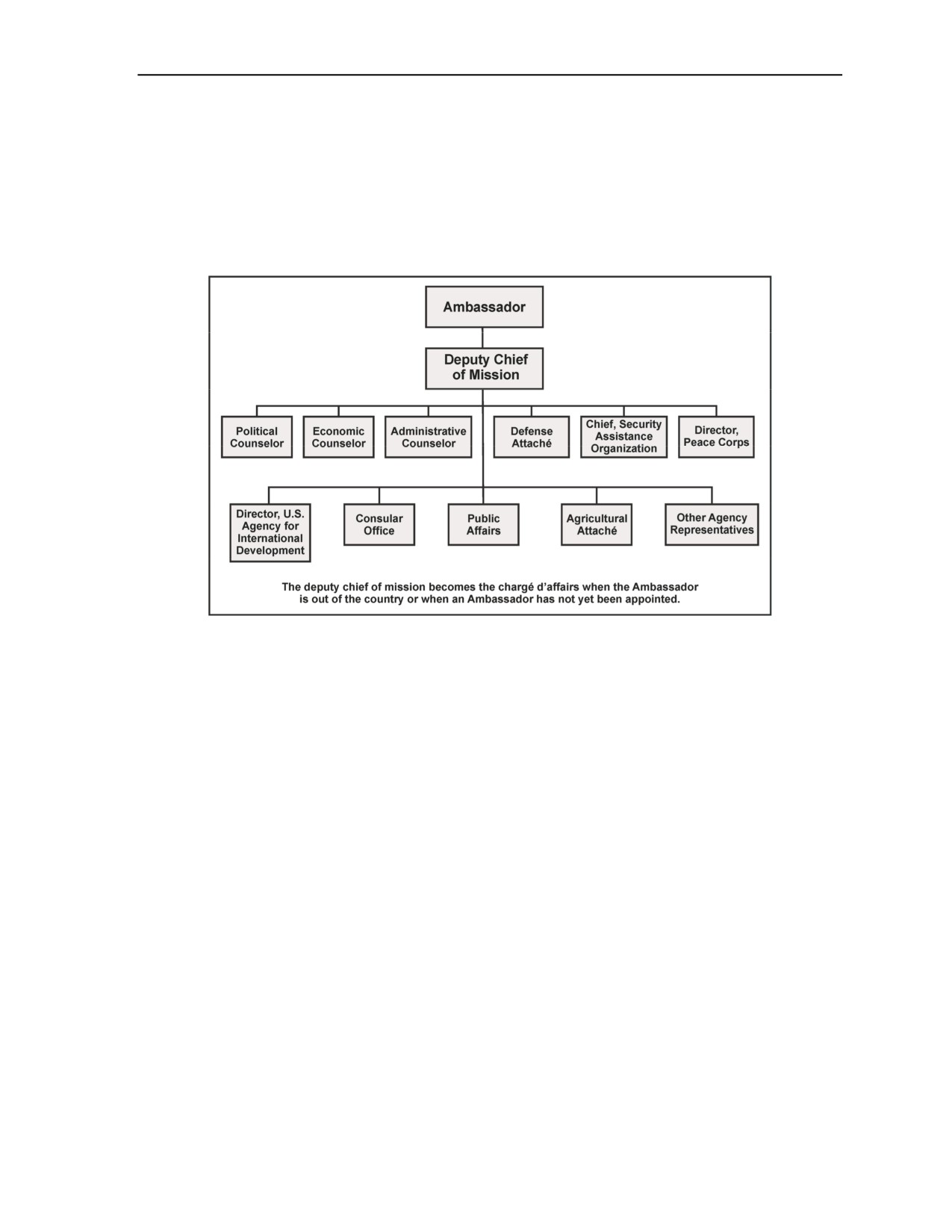
2-48. At the HN level, the U.S. country team is the primary interagency coordinating structure for COIN.
(See figure 2-1.) The country team is the senior in-country coordinating and supervising body, headed by
the U.S. chief of mission, usually the Ambassador. It is composed of the senior member of each repre-
sented department or agency. In a foreign country, the chief of mission is the highest U.S. civil authority.
2-10
FM 3-24/MCWP 3-33.5
15 December 2006
Unity of Effort: Integrating Civilian and Military Activities
The Foreign Service Act assigns the chief of mission to a foreign country responsibility for the direction,
coordination, and supervision of all government executive branch employees in that country except for
service members and employees under the command of a U.S. area military commander. As the senior U.S.
Government official permanently assigned in the host nation, the chief of mission is responsible to the
President for policy oversight of all United States government programs. The chief of mission leads the
country team and is responsible for integrating U.S. efforts in support of the host nation. As permanently
established interagency organizations, country teams represent a priceless COIN resource. They often pro-
vide deep reservoirs of local knowledge and interaction with the HN government and population.
Figure 2-1. Sample country team
2-49. The more extensive the U.S. participation is in a COIN and the more dispersed U.S. forces are
throughout a country, the greater the need for additional mechanisms to extend civilian oversight and assis-
tance. However, given the limited resources of the Department of State and the other U.S. Government
agencies, military forces often represent the country team in decentralized and diffuse operational envi-
ronments. Operating with a clear understanding of the guiding political aims, members of the military at all
levels must be prepared to exercise judgment and act without the benefit of immediate civilian oversight
and control. At each subordinate political level of the HN government, military and civilian leaders should
establish a coordinating structure, such as an area coordination center or civil-military operations center
(CMOC), that includes representatives of the HN government and security forces, as well as U.S. and mul-
tinational forces and agencies. CMOCs facilitate the integration of military and political actions. Below the
national level, additional structures where military commanders and civilian leaders can meet directly with
local leaders to discuss issues may be established. Where possible, IGOs and NGOs should be encouraged
to participate in coordination meetings to ensure their actions are integrated with military and HN plans.
(See JP 3-07.1 for additional information about COIN planning and coordination organizations.)
2-50. In practice, the makeup of country teams varies widely, depending on the U.S. departments and
agencies represented in country, the desires of the Ambassador, and the HN situation. During COIN, coun-
try team members meet regularly to coordinate U.S. Government diplomatic, informational, military, and
economic activities in the host nation to ensure unity of effort. The interagency representatives usually in-
clude at least the following:
z
Departments of State, Defense, Justice, and Treasury.
z
USAID.
z
Central Intelligence Agency.
z
Drug Enforcement Administration.
15 December 2006
FM 3-24/MCWP 3-33.5
2-11
Chapter 2
Participation of other U.S. Government organizations depends on the situation.
2-51. In almost all bilateral missions, DOD is represented on the country team by the U.S. defense atta-
ché’s office or the security assistance organization. They are key military sources of information for inter-
agency coordination in foreign countries. (Security assistance organizations are called by various names,
such as the office of defense cooperation, security assistance office, or military group. The choice is largely
governed by HN preference.)
Provincial Reconstruction Teams in Afghanistan
A model for civil-military cooperation is the provincial reconstruction teams (PRTs)
first fielded in 2003 in Afghanistan. PRTs were conceived as a means to extend the
reach and enhance the legitimacy of the central government into the provinces of Af-
ghanistan at a time when most assistance was limited to the nation’s capital. Though
PRTs were staffed by a number of coalition and NATO allied countries, they gener-
ally consisted of 50 to 300 troops as well as representatives from multinational de-
velopment and diplomatic agencies. Within U.S. PRTs, USAID and Department of
State leaders and the PRT commander formed a senior team that coordinated the
policies, strategies, and activities of each agency towards a common goal. In secure
areas, PRTs maintained a low profile. In areas where coalition combat operations
were underway, PRTs worked closely with maneuver units and local government en-
tities to ensure that shaping operations achieved their desired effects. Each PRT
leadership team received tremendous latitude to determine its own strategy. How-
ever, each PRT used its significant funding and diverse expertise to pursue activities
that fell into one of three general logical lines of operations: pursue security sector re-
form, build local governance, or execute reconstruction and development.
2-52. The country team determines how the United States can effectively apply interagency capabilities to
assist a HN government in creating a complementary institutional capacity to deal with an insurgency.
Efforts to support local officials and build HN capacity must be integrated with information operations so
HN citizens are aware of their government’s efforts. In addition, interagency capabilities must be applied at
the tactical level to give commanders access to options such capabilities make available. The Civil
Operations and Revolutionary—later Rural—Development Support approach developed during the
Vietnam War provides a positive example of integrated civilian and military structures that reached every level
of the COIN effort.
CORDS and Accelerated Pacification in Vietnam
During the Vietnam War, one of the most valuable and successful elements of COIN
was the Civil Operations and Revolutionary—later Rural—Development Support
(CORDS) program. CORDS was created in 1967 to integrate U.S. civilian and mili-
tary support of the South Vietnamese government and people. CORDS achieved
considerable success in supporting and protecting the South Vietnamese population
and in undermining the communist insurgents’ influence and appeal, particularly after
implementation of accelerated pacification in 1968.
Pacification was the process by which the government asserted its influence and
control in an area beset by insurgents. It included local security efforts, programs to
distribute food and medical supplies, and lasting reforms (like land redistribution). In
1965, U.S. civilian contributions to pacification consisted of several civilian agencies
(among them, the Central Intelligence Agency, Agency for International Develop-
ment, U.S. Information Service, and Department of State). Each developed its own
programs. Coordination was uneven. The U.S. military contribution to pacification
consisted of thousands of advisors. By early 1966, there were military advisory
teams in all of South Vietnam’s 44 provinces and most of its 243 districts. But there
were two separate chains of command for military and civilian pacification efforts,
making it particularly difficult for the civilian-run pacification program to function.
2-12
FM 3-24/MCWP 3-33.5
15 December 2006
Unity of Effort: Integrating Civilian and Military Activities
In 1967, President Lyndon B. Johnson established CORDS within the Military Assis-
tance Command, Vietnam (MACV), which was commanded by General William
Westmoreland, USA. The purpose of CORDS was to establish closer integration of
civilian and military efforts. Robert Komer was appointed to run the program, with a
three-star-equivalent rank. Civilians, including an assistant chief of staff for CORDS,
were integrated into military staffs at all levels. This placed civilians in charge of mili-
tary personnel and resources. Komer was energetic, strong-willed, and persistent in
getting the program started. Nicknamed “Blowtorch Bob” for his aggressive style,
Komer was modestly successful in leading improvements in pacification before the
1968 Tet offensive.
In mid-1968, the new MACV commander, General Creighton Abrams, USA, and his
new civilian deputy, William Colby, used CORDS as the implementing mechanism for
an accelerated pacification program that became the priority effort for the United
States. Significant allocations of personnel helped make CORDS effective. In this,
the military’s involvement was key. In September 1969—the high point of the pacifi-
cation effort in terms of total manpower—there were 7,601 advisors assigned to
province and district pacification teams. Of these 6,464 were military.
The effectiveness of CORDS was a function of integrated civilian and military teams
at every level of society in Vietnam. From district to province to national level, U.S.
advisors and U.S. interagency partners worked closely with their Vietnamese coun-
terparts. The entire effort was well established under the direction of the country
team, led by Ambassador Ellsworth Bunker. General Abrams and his civilian deputy
were clear in their focus on pacification as the priority and ensured that military and
civilian agencies worked closely together. Keen attention was given to the ultimate
objective of serving the needs of the local populace. Success in meeting basic needs
of the populace led, in turn, to improved intelligence that facilitated an assault on the
Viet Cong political infrastructure. By early 1970, statistics indicated that 93 percent of
South Vietnamese lived in “relatively secure” villages, an increase of almost 20 per-
cent from the middle of 1968. By 1972, pacification had largely uprooted the insur-
gency from among the South Vietnamese population and forced the communists to
rely more heavily on infiltrating conventional forces from North Vietnam and employ-
ing them in irregular and conventional operations.
In 1972, South Vietnamese forces operating with significant support from U.S. air-
power defeated large-scale North Vietnamese conventional attacks. Unfortunately, a
North Vietnamese conventional assault succeeded in 1975 after the withdrawal of
U.S. forces, ending of U.S. air support, and curtailment of U.S. funding to South Vietnam.
Pacification, once it was integrated under CORDS, was generally led, planned, and
executed well. CORDS was a successful synthesis of military and civilian efforts. It is
a useful model to consider for other COIN operations.
CIVIL-MILITARY OPERATIONS CENTER
2-53. Another mechanism for bringing elements together for coordination is the CMOC. CMOCs can be
established at all levels of command. CMOCs coordinate the interaction of U.S. and multinational military
forces with a wide variety of civilian agencies. A CMOC is not designed, nor should it be used as, a com-
mand and control element. However, it is useful for transmitting the commander’s guidance to other agen-
cies, exchanging information, and facilitating complementary efforts.
2-54. Overall management of a CMOC may be assigned to a multinational force commander, shared by a
U.S. and a multinational commander, or shared by a U.S. commander and a civilian agency head. A
CMOC can be used to build on-site, interagency coordination to achieve unity of effort. There is no estab-
lished CMOC structure; its size and composition depend on the situation. However, CMOCs are organic to
Army civil affairs organizations, from civil affairs command to company. Senior civil affairs officers nor-
mally serve as the CMOC director and deputy director. Other military participants usually include civil af-
15 December 2006
FM 3-24/MCWP 3-33.5
2-13
Chapter 2
fairs, legal, operations, logistic, engineering, and medical representatives of the supported headquarters.
Civilian members of a CMOC may include representatives of the following:
z
U.S. Government organizations.
z
Multinational partners.
z
IGOs.
z
HN or other local organizations.
z
NGOs.
(For more information on CMOCs, see FM 3-05.401/CRP 3-33.1A.)
TACTICAL-LEVEL INTERAGENCY CONSIDERATIONS
2-55. Tactical units may find interagency expertise pushed to their level when they are responsible for
large AOs in a COIN environment. Tactical units down to company level must be prepared to integrate
their efforts with civilian organizations.
2-56. To ensure integration of interagency capabilities, units should coordinate with all interagency repre-
sentatives and organizations that enter their AO. Despite the best efforts to coordinate, the fog and friction
inherent in COIN will often lead to civilian organizations entering an AO without prior coordination. (Ta-
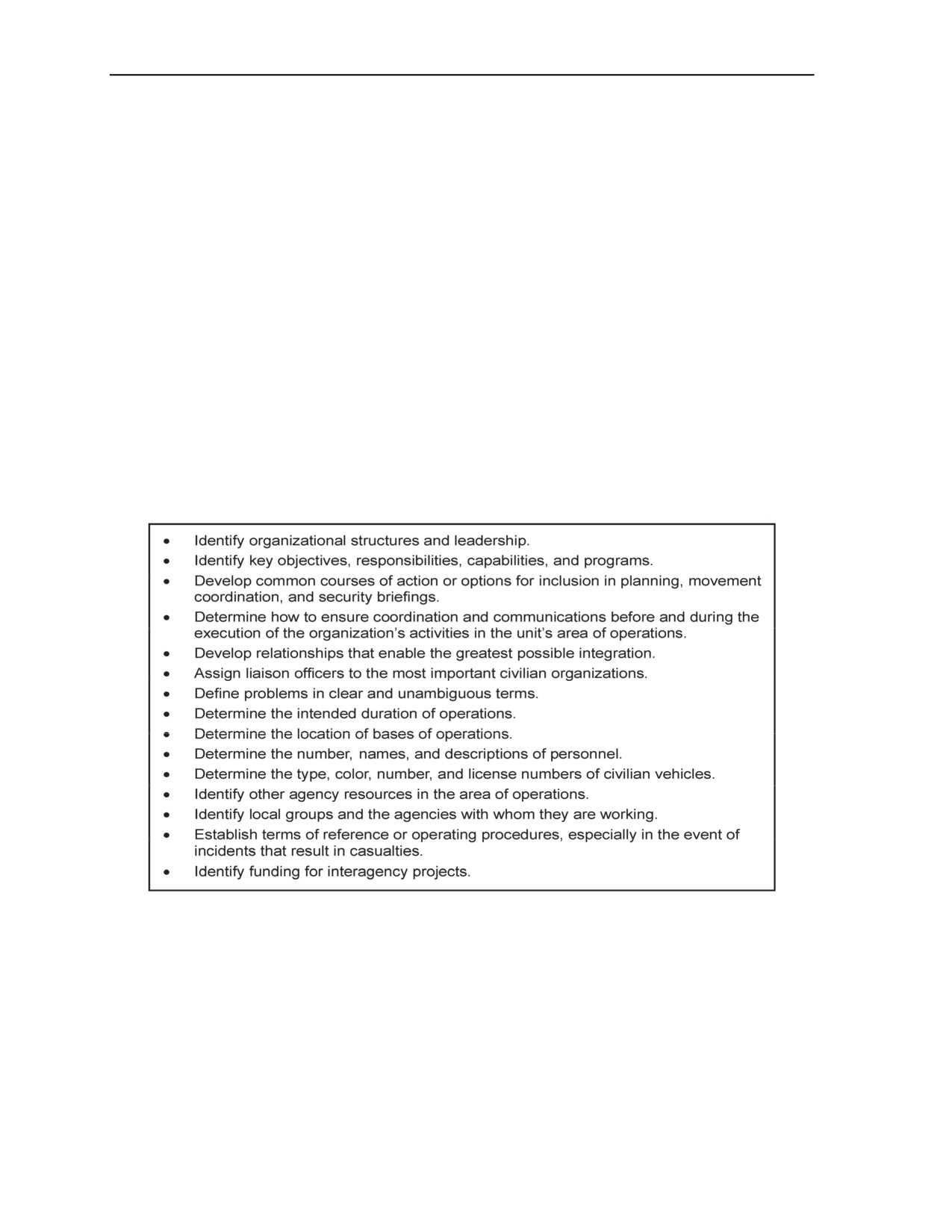
ble 2-1 is a suggested list for coordinating with interagency and other nonmilitary organizations.)
Table 2-1. Example interagency coordination checklist
SUMMARY
2-57. President John F. Kennedy noted, “You [military professionals] must know something about strategy
and tactics and…logistics, but also economics and politics and diplomacy and history. You must know eve-
rything you can know about military power, and you must also understand the limits of military power.
You must understand that few of the important problems of our time have…been finally solved by military
power alone.” Nowhere is this insight more relevant than in COIN. Successful COIN efforts require unity
of effort in bringing all instruments of national power to bear. Civilian agencies can contribute directly to
military operations, particularly by providing information. That theme is developed further in the next
chapter.
2-14
FM 3-24/MCWP 3-33.5
15 December 2006
Chapter 3
Intelligence in Counterinsurgency
Everything good that happens seems to come from good intelligence.
General Creighton W. Abrams Jr., USA, 1970
Effective, accurate, and timely intelligence is essential to the conduct of any form of
warfare. This maxim applies especially to counterinsurgency operations; the ultimate
success or failure of the mission depends on the effectiveness of the intelligence ef-
fort. This chapter builds upon previous concepts to further describe insurgencies, re-
quirements for intelligence preparation of the battlefield and predeployment plan-
ning, collection and analysis of intelligence in counterinsurgency, intelligence fusion,
and general methodology for integrating intelligence with operations. This chapter
does not supersede processes in U.S. military doctrine
(see FM 2-0, FM 34-
130/FMFRP 3-23-2, and FMI 2-91.4) but instead provides specific guidance for
counterinsurgency.
SECTION I - INTELLIGENCE CHARACTERISTICS IN COUNTERINSURGENCY
3-1. Counterinsurgency (COIN) is an intelligence-driven endeavor. The function of intelligence in COIN
is to facilitate understanding of the operational environment, with emphasis on the populace, host nation,
and insurgents. Commanders require accurate intelligence about these three areas to best address the issues
driving the insurgency. Both insurgents and counterinsurgents require an effective intelligence capability to
be successful. Both attempt to create and maintain intelligence networks while trying to neutralize their op-
ponent’s intelligence capabilities.
3-2. Intelligence in COIN is about people. U.S. forces must understand the people of the host nation, the
insurgents, and the host-nation (HN) government. Commanders and planners require insight into cultures,
perceptions, values, beliefs, interests and decision-making processes of individuals and groups. These re-
quirements are the basis for collection and analytical efforts.
3-3. Intelligence and operations feed each other. Effective intelligence drives effective operations. Effec-
tive operations produce information, which generates more intelligence. Similarly, ineffective or inaccurate
intelligence produces ineffective operations, which produce the opposite results.
3-4. All operations have an intelligence component. All Soldiers and Marines collect information when-
ever they interact with the populace. Operations should therefore always include intelligence collection re-
quirements.
3-5. Insurgencies are local. They vary greatly in time and space. The insurgency one battalion faces will
often be different from that faced by an adjacent battalion. The mosaic nature of insurgencies, coupled with
the fact that all Soldiers and Marines are potential intelligence collectors, means that all echelons both pro-
duce and consume intelligence. This situation results in a bottom-up flow of intelligence. This pattern also
means that tactical units at brigade and below require a lot of support for both collection and analysis, as
their organic intelligence structure is often inadequate.
3-6. COIN occurs in a joint, interagency, and multinational environment at all echelons. Commanders
and staffs must coordinate intelligence collection and analysis with foreign militaries, foreign and U.S. in-
telligence services, and other organizations.
15 December 2006
FM 3-24/MCWP 3-33.5
3-1
Chapter 3
SECTION II - PREDEPLOYMENT PLANNING AND INTELLIGENCE
PREPARATION OF THE BATTLEFIELD
3-7. Intelligence preparation of the battlefield is the systematic, continuous process of analyzing the
threat and environment in a specific geographic area. Intelligence preparation of the battlefield (IPB) is de-
signed to support the staff estimate and military decision-making process. Most intelligence requirements
are generated as a result of the IPB process and its interrelation with the decision-making process (FM 34-
130). Planning for deployment begins with a thorough mission analysis, including IPB. IPB is accom-
plished in four steps:
z
Define the operational environment.
z
Describe the effects of the operational environment.
z
Evaluate the threat.
z
Determine threat courses of action.
3-8. The purpose of planning and IPB before deployment is to develop an understanding of the opera-
tional environment. This understanding drives planning and predeployment training. Predeployment intel-
ligence must be as detailed as possible. It should focus on the host nation, its people, and insurgents in the
area of operations (AO). Commanders and staffs use predeployment intelligence to establish a plan for ad-
dressing the underlying causes of the insurgency and to prepare their units to interact with the populace ap-
propriately. The goal of planning and preparation is for commanders and their subordinates not to be sur-
prised by what they encounter in theater.
3-9. IPB in COIN operations follows the methodology described in FM 34-130/FMFRP 3-23-2. How-
ever, it places greater emphasis on civil considerations, especially people and leaders in the AO, than does
IPB for conventional operations. IPB is continuous and its products are revised throughout the mission.
Nonetheless, predeployment products are of particular importance for the reasons explained above. When-
ever possible, planning and preparation for deployment includes a thorough and detailed IPB. IPB in COIN
requires personnel to work in areas like economics, anthropology, and governance that may be outside
their expertise. Therefore, integrating staffs and drawing on the knowledge of nonintelligence personnel
and external experts with local and regional knowledge are critical to effective preparation.
3-10. Deployed units are the best sources of intelligence. Deploying units should make an effort to reach
forward to deployed units. The Secret Internet Protocol Router Network (SIPRNET) allows deploying
units to immerse themselves virtually in the situation in theater. Government agencies, such as the Depart-
ment of State, U.S. Agency for International Development, and intelligence agencies, can often provide
country studies and other background information as well.
3-11. Open-source intelligence is information of potential intelligence value that is available to the general
public (JP 1-02). It is important to predeployment IPB. In many cases, background information on the
populations, cultures, languages, history, and governments of states in an AO is in open sources. Open
sources include books, magazines, encyclopedias, Web sites, tourist maps, and atlases. Academic sources,
such as journal articles and university professors, can also be of great benefit.
DEFINE THE OPERATIONAL ENVIRONMENT
3-12. The operational environment is a composite of the conditions, circumstances, and influences that af-
fect the employment of capabilities and bear on the decisions of the commander. (JP 1-02). At the tactical
and operational levels, defining the operational environment involves defining a unit’s AO and determining
an area of interest. The area of interest is area of concern to the commander, including the area of influ-
ence, areas adjacent thereto, and extending into enemy territory to the objectives of current or planned op-
erations. This area also includes areas occupied by enemy forces who could jeopardize the accomplishment
of the mission (JP 1-02).
3-13. AOs may be relatively static, but people and information flow through AOs continuously. Therefore,
when defining an area of interest, commanders take into account physical geography and civil considera-
tions, particularly human factors. AOs often cut across physical lines of communications, such as roads, as
3-2
FM 3-24/MCWP 3-33.5
15 December 2006
Intelligence in Counterinsurgency
well as areas that are tribally, economically, or culturally defined. For instance, tribal and family groups in
Iraq and Afghanistan cross national borders into neighboring countries. The cross-border ties allow insur-
gents safe haven outside of their country and aid them in cross-border smuggling. The area of interest can
be large relative to the AO; it must often account for various influences that affect the AO, such as—
z
Family, tribal, ethnic, religious, or other links that go beyond the AO.
z
Communication links to other regions.
z
Economic links to other regions.
z
Media influence on the local populace, U.S. public, and multinational partners.
z
External financial, moral, and logistic support for the enemy.
3-14. At the combatant command level, the area of interest may be global, if, for example, enemy forces
have an international financial network or are able to affect popular support within the U.S. or multina-
tional partners. At the tactical level, commands must be aware of activities in neighboring regions and
population centers that affect the population in their AO.
3-15. As explained in chapter 2, another consideration for predeployment planning and defining the opera-
tional environment is understanding the many military and nonmilitary organizations involved in the COIN
effort. Intelligence planners determine the non-Department of Defense (DOD) agencies, multinational
forces, nongovernmental organizations, and HN organizations in the AO. Knowledge of these organiza-
tions is needed to establish working relationships and procedures for sharing information. These relation-
ships and procedures are critical to developing a comprehensive common operational picture and enabling
unity of effort.
DESCRIBE THE EFFECTS OF THE OPERATIONAL ENVIRONMENT
3-16. This IPB step involves developing an understanding of the operational environment and is critical to
the success of operations. It includes—
z
Civil considerations, with emphasis on the people, history, and HN government in the AO.
z
Terrain analysis (physical geography), with emphasis on the following:
Complex terrain.
Suburban and urban terrain.
Key infrastructure.
Lines of communications.
z
Weather analysis, focusing on how weather affects the populace’s activities, such as agriculture,
smuggling, or insurgent actions.
3-17. Including all staff members in this step improves the knowledge base used to develop an understand-
ing of the AO. For instance, civil affairs personnel receive training in analysis of populations, cultures, and
economic development. These Soldiers and Marines can contribute greatly to understanding civil consid-
erations. As another example, foreign area officers have linguistic, historical, and cultural knowledge about
particular regions and have often lived there for extended periods.
3-18. The products that result from describing the effects of the operational environment influence opera-
tions at all echelons. The description informs political activities and economic policies of combatant com-
manders. It drives information operations (IO) and civil-military operations planning. The knowledge
gained affects the way Soldiers and Marines interact with the populace.
3-19. Civil considerations are how the manmade infrastructure, civilian institutions, and attitudes and ac-
tivities of the civilian leaders, populations, and organizations within an area of operations influence the
conduct of military operations (FM 6-0). Civil considerations form one of the six categories into which
relevant information is grouped for military operations. (The glossary lists the other five categories under
the entry for METT-TC.) Civil considerations comprise six characteristics, expressed in the memory aid
ASCOPE: areas, structures, capabilities, organizations, people, and events. (Paragraphs B-10 through B-27
discuss these characteristics.) While all characteristics of civil considerations are important, understanding
15 December 2006
FM 3-24/MCWP 3-33.5
3-3
Chapter 3
the people is particularly important in COIN. In order to evaluate the people, the following six socio-
cultural factors should be analyzed:
z
Society.
z
Social structure.
z
Culture.
z
Language.
z
Power and authority.
z
Interests.
This analysis may also identify information related to areas, structures, organizations, and events.
SOCIETY
3-20. A society can be defined as a population whose members are subject to the same political authority,
occupy a common territory, have a common culture, and share a sense of identity. A society is not easily
created or destroyed, but it is possible to do so through genocide or war.
3-21. No society is homogeneous. A society usually has a dominant culture, but can also have a vast num-
ber of secondary cultures. Different societies may share similar cultures, such as Canada and the United
States do. Societies are not static, but change over time.
3-22. Understanding the societies in the AO allows counterinsurgents to achieve objectives and gain sup-
port. Commanders also consider societies outside the AO whose actions, opinions, or political influence
can affect the mission.
SOCIAL STRUCTURE
3-23. Each society is composed of both social structure and culture. Social structure refers to the relations
among groups of persons within a system of groups. Social structure is persistent over time. It is regular
and continuous despite disturbances. The relationships among the parts hold steady, even as groups expand
or contract. In a military organization, for example, the structure consists of the arrangement into groups
like divisions, battalions, and companies. In a society, the social structure includes groups, institutions, or-
ganizations, and networks. Social structure involves the following:
z
Arrangement of the parts that constitute society.
z
Organization of social positions.
z
Distribution of people within those positions.
Groups
3-24. A group is two or more people regularly interacting on the basis of shared expectations of others’
behavior and who have interrelated statuses and roles. A social structure includes a variety of groups.
These groups may be racial, ethnic, religious, or tribal. There may also be other kinship-based groups.
3-25. A race is a human group that defines itself or is defined by other groups as different by virtue of in-
nate physical characteristics. Biologically, there is no such thing as race among human beings; race is a so-
cial category.
3-26. An ethnic group is a human community whose learned cultural practices, language, history, ancestry,
or religion distinguish them from others. Members of ethnic groups see themselves as different from other
groups in a society and are recognized as such by others. Religious groups may be subsets of larger ethnic
groups. An ethnic group may contain members of different religions. For example, some Kurds are Mus-
lim, while others are Christian. Other ethnic groups may be associated with a particular religion—such as
Sri Lankan Sinhalese, who are almost exclusively Buddhist. Other religious groups have members of many
different ethnicities. A prominent example of such a group is the Roman Catholic faith.
3-27. Tribes are generally defined as autonomous, genealogically structured groups in which the rights of
individuals are largely determined by their ancestry and membership in a particular lineage. Tribes are es-
3-4
FM 3-24/MCWP 3-33.5
15 December 2006
Intelligence in Counterinsurgency
sentially adaptive social networks organized by extended kinship and descent with common needs for
physical and economic security.
3-28. Understanding the composition of groups in the AO is vital for effective COIN operations. This is
especially true when insurgents organize around racial, ethnic, religious, or tribal identities. Furthermore,
tensions or hostilities between groups may destabilize a society and provide opportunities for insurgents.
Commanders should thus identify powerful groups both inside and outside their AO and obtain the follow-
ing information about them:
z
Formal relationships (such as treaties or alliances) between groups.
z
Informal relationships (such as tolerance or friction) between groups.
z
Divisions and cleavages between groups.
z
Cross-cutting ties (for example, religious alignments that cut across ethnic differences) between
groups.
In some cases, insurgent leaders and their followers may belong to separate groups. In others, the bulk of
the population may differ from the insurgents. These characteristics may suggest courses of action aimed at
reinforcing or widening seams among insurgents or between insurgents and the population.
Networks
3-29. Networks may be an important aspect of a social structure as well as within the insurgent organiza-
tion (See paragraphs 1-94 and B-29 through B-56). Common types of networks include elite networks,
prison networks, worldwide ethnic and religious communities, and neighborhood networks. Networks can
have many purposes: economic, criminal, and emotional. Effective social network analysis, discussed be-
low, considers the structure of a network and the nature of interactions between network actors.
Institutions
3-30. Groups engaged in patterned activity to complete a common task are called institutions. Educational
institutions bring together groups and individuals whose statuses and roles concern teaching and learning.
Military institutions bring together groups and individuals whose statuses and roles concern defense and
security. Institutions, the basic building blocks of societies, are continuous through many generations. They
continue to exist, even when the individuals who compose them are replaced.
Organizations
3-31. Organizations, both formal and informal, are institutions with the following characteristics:
z
Bounded membership.
z
Defined goals.
z
Established operations.
z
Fixed facilities or meeting places.
z
Means of financial or logistic support.
3-32. Planners can generally group organizations into the following categories:
z
Communicating organizations have the power to influence a population’s perceptions.
z
Religious organizations regulate norms, restrain or empower activities, reaffirm worldviews,
and provide social support. A religious organization differs from a religious group. A religious
group is a general category, such as Christian; a religious organization is a specific community,
such as the Episcopal Church.
z
Economic organizations provide employment, help regulate and stabilize monetary flow, assist
in development, and create social networks.
z
Social organizations provide support to the population, create social networks, and can influence
ideologies. Examples include schools, civil society groups, and sports teams.
Organizations may belong to more than one category. For instance, an influential religious organization
may also be a communicating organization.
15 December 2006
FM 3-24/MCWP 3-33.5
3-5
Chapter 3
3-33. Organizations may control, direct, restrain, or regulate the local populace. Thus, commanders should
identify influential organizations both inside and outside of their AO. Commanders need to know which
members of what groups belong to each organization and how their activities may affect military opera-
tions. The next step is to determine how these organizations affect the local populace, whose interests they
fulfill, and what role they play in influencing local perceptions.
Roles and Statuses
3-34. Understanding a society requires identifying the most common roles, statuses, and institutions within
the society. Individuals in a society interact as members with social positions. These positions are referred
to as statuses. Most societies associate particular statuses with particular social groups, such as family, line-
age, ethnicity, or religion. Statuses may be achieved by meeting certain criteria or may be ascribed by birth.
Statuses are often reciprocal, such as that of husband and wife or teacher and student. Every status carries a
cluster of expected behaviors known as a role, which includes how a person of that status is expected to
think, feel, and act. A status may also include expectations about how others should treat a person of that
status. Thus, in American society parents (status) have the obligation to care for their children (role) and
the right to discipline them (role).
Social Norms
3-35. Violation of a role prescribed by a given status, such as failing to feed one’s children, results in so-
cial disapproval. The standard of conduct for social roles is known as a social norm. A social norm is what
people are expected to do or should do, rather than what people actually do. Norms may be either moral
(incest prohibition, homicide prohibition) or customary (prayer before a meal, removing shoes before en-
tering a house). When a person’s behavior does not conform to social norms, the person may be sanc-
tioned. Understanding the roles, statuses, and social norms of groups within an AO can clarify expected
behavior and provide guidelines on how to act. Some norms that may impact military operations include
the following:
z
The requirement for revenge if honor is lost.
z
Appropriate treatment of women and children.
z
Common courtesies, such as gift giving.
z
Local business practices, such as bribes and haggling.
CULTURE
3-36. Once the social structure has been thoroughly mapped out, staffs should identify and analyze the cul-
ture of the society as a whole and of each major group within the society. Social structure comprises the re-
lationships among groups, institutions, and individuals within a society; in contrast, culture (ideas, norms,
rituals, codes of behavior) provides meaning to individuals within the society. For example, families are a
core institutional building block of social structure found everywhere. However, marital monogamy, ex-
pectations of a certain number of children, and willingness to live with in-laws are highly variable in dif-
ferent societies. They are matters of culture. Social structure can be thought of as a skeleton, with culture
being the muscle on the bones. The two are mutually dependent and reinforcing. A change in one results in
a change in the other.
3-37. Culture is “web of meaning” shared by members of a particular society or group within a society.
(See FM 3-05.301/MCRP 3-40.6A.) Culture is—
z
A system of shared beliefs, values, customs, behaviors, and artifacts that members of a society
use to cope with their world and with one another.
z
Learned, though a process called enculturation.
z
Shared by members of a society; there is no “culture of one.”
z
Patterned, meaning that people in a society live and think in ways forming definite, repeating pat-
terns.
z
Changeable, through social interactions between people and groups.
3-6
FM 3-24/MCWP 3-33.5
15 December 2006
Intelligence in Counterinsurgency
z
Arbitrary, meaning that Soldiers and Marines should make no assumptions regarding what a so-
ciety considers right and wrong, good and bad.
z
Internalized, in the sense that it is habitual, taken for granted, and perceived as “natural” by peo-
ple within the society.
3-38. Culture might also be described as an “operational code” that is valid for an entire group of people.
Culture conditions the individual’s range of action and ideas, including what to do and not do, how to do or
not do it, and whom to do it with or not to do it with. Culture also includes under what circumstances the
“rules” shift and change. Culture influences how people make judgments about what is right and wrong,
assess what is important and unimportant, categorize things, and deal with things that do not fit into exist-
ing categories. Cultural rules are flexible in practice. For example, the kinship system of a certain Amazo-
nian Indian tribe requires that individuals marry a cousin. However, the definition of cousin is often
changed to make people eligible for marriage.
Identity
3-39. Each individual belongs to multiple groups, through birth, assimilation, or achievement. Each group
to which individuals belong influences their beliefs, values, attitudes, and perceptions. Individuals con-
sciously or unconsciously rank their identities into primary and secondary identities. Primary identities are
frequently national, racial, and religious. In contrast, secondary identities may include such things as
hunter, blogger, or coffee drinker. Frequently, individuals’ identities are in conflict; counterinsurgents can
use these conflicts to influence key leaders’ decisions.
Beliefs
3-40. Beliefs are concepts and ideas accepted as true. Beliefs can be core, intermediate, or peripheral.
3-41. Core beliefs are those views that are part of a person’s deep identity. They are not easily changed.
Examples include belief in the existence of God, the value of democratic government, the importance of
individual and collective honor, and the role of the family. Core beliefs are unstated, taken for granted, re-
sistant to change, and not consciously considered. Attempts to change the central beliefs of a culture may
result in significant unintended second- and third- order consequences. Decisions to do so are made at the
national-strategic level.
3-42. Intermediate beliefs are predicated on reference to authority figures or authoritative texts. Thus, in-
termediate beliefs can sometimes be influenced by co-opting opinion leaders.
3-43. From intermediate beliefs flow peripheral beliefs. These beliefs are open to debate, consciously con-
sidered, and easiest to change. For example, a belief about birth control may derive from an individual’s
beliefs about the Roman Catholic Church. Beliefs about the theory of sexual repression may come from a
person’s opinion of Sigmund Freud.
Values
3-44. A value is an enduring belief that a specific mode of conduct or end state of existence is preferable to
an opposite or converse mode of conduct or end state of existence. Values include beliefs concerning such
topics as toleration, stability, prosperity, social change, and self-determination. Each group to which a per-
son belongs inculcates that person with its values and their ranking of importance. Individuals do not un-
questioningly absorb all the values of the groups to which they belong; they accept some and reject others.
Most individuals belong to more than one social group. The values of each group are often in conflict: reli-
gious values may conflict with generational values or gender values with organizational practices. Com-
manders should evaluate the values of each group in the AO. They should determine whether the values
promoted by the insurgency correspond to the values of other social groups in the AO or to those of the
HN government. Based on that assessment, commanders can determine whether counterinsurgents can ex-
ploit these differences in values.
15 December 2006
FM 3-24/MCWP 3-33.5
3-7
Chapter 3
Attitudes and Perceptions
3-45. Attitudes are affinities for and aversions to groups, persons, and objects. Attitudes affect perception,
which is the process by which an individual selects, evaluates, and organizes information from the external
environment. Commanders should consider groups’ attitudes regarding the following:
z
Other groups.
z
Outsiders.
z
HN government.
z
United States.
z
U.S. military.
z
Globalization.
Belief Systems
3-46. The totality of the identities, beliefs, values, attitudes, and perceptions that an individual holds—and
the ranking of their importance—is that person’s belief system. Religions, ideologies, and all types of
“isms” fall into this category. As a belief system, a religion may include such things as a concept of God, a
view of the afterlife, ideas about the sacred and the profane, funeral practices, rules of conduct, and modes
of worship.
3-47. A belief system acts as a filter for new information: it is the lens through which people perceive the
world. What members of a particular group believe to be rational, normal, or true may appear to outsiders
to be strange, irrational or illogical. Understanding the belief systems of various groups in an AO allows
counterinsurgents to more effectively influence the population.
3-48. Commanders should give the belief systems of insurgents and other groups in the AO careful atten-
tion. An insurgency may frame its objectives in terms of a belief system or may use a belief system to mo-
bilize and recruit followers. Differences between the insurgents’ and civilian groups’ belief systems pro-
vide opportunities for counterinsurgents to separate the insurgents from the population. If local individuals
are members of more than one group, there maybe contradictions in their belief systems that can be ex-
ploited.
Cultural Forms
3-49. Cultural forms are the concrete expression of the belief systems shared by members of a particular
culture. Cultural forms include rituals, symbols, ceremonies, myths, and narratives. Cultural forms are the
medium for communicating ideologies, values, and norms that influence thought and behavior. Each cul-
ture constructs or invents its own cultural forms through which cultural meanings are transmitted and re-
produced. A culture’s belief systems can be decoded by observing and analyzing its cultural forms. Insur-
gent groups frequently use local cultural forms to mobilize the population. Counterinsurgents can use
cultural forms to shift perceptions, gain support, or reduce support for insurgents.
3-50. The most important cultural form for counterinsurgents to understand is the narrative. A cultural nar-
rative is a story recounted in the form of a causally linked set of events that explains an event in a group’s
history and expresses the values, character, or self-identity of the group. Narratives are the means through
which ideologies are expressed and absorbed by members of a society. For example, at the Boston Tea
Party in 1773, Samuel Adams and the Sons of Liberty dumped five tons of tea into the Boston Harbor to
protest what they considered unfair British taxation. This narrative explains in part why the Revolutionary
War began. However, it also tells Americans something about themselves each time they hear the story:
that fairness, independence, and justice are worth fighting for. As this example indicates, narratives may
not conform to historical facts or they may drastically simplify facts to more clearly express basic cultural
values. (For example, Americans in 1773 were taxed less than their British counterparts and most British
attempts to raise revenues from the colonies were designed to help reduce the crushing national debt in-
curred in their defense.) By listening to narratives, counterinsurgents can identify a society’s core values.
Commanders should pay particular attention to cultural narratives of the HN population pertaining to out-
3-8
FM 3-24/MCWP 3-33.5
15 December 2006
Intelligence in Counterinsurgency
laws, revolutionary heroes, and historical resistance figures. Insurgents may use these narratives to mobi-
lize the population.
3-51. Other cultural forms include ritual and symbols. A ritual is a stereotyped sequence of activities in-
volving gestures, words, and objects performed to influence supernatural entities or forces on behalf of the
actors’ goals and interests. Rituals can be either sacred or secular. A symbol is the smallest unit of cultural
meaning. Symbols are filled with a vast amount of information that can be decoded by a knowledgeable
observer. Symbols can be objects, activities, words, relationships, events, or gestures. Institutions and or-
ganizations often use cultural symbols to amass political power or generate resistance against external
groups. Commanders should pay careful attention to the meaning of common symbols in the AO and how
various groups use them.
LANGUAGE
3-52. Language is a system of symbols that people use to communicate with one another. It is a learned
element of culture. Successful communication requires more than just grammatical knowledge; it also re-
quires understanding the social setting, appropriate behaviors towards people of different statuses, and non-
verbal cues, among other things. An understanding of the social environment can facilitate effective com-
munication, even if counterinsurgents do not speak the local language and must work through translators or
interpreters.
3-53. The languages used in an AO have a major impact on operations. Languages must be identified to
facilitate language training, communication aids such as phrase cards, and requisitioning of translators.
Translators are critical for collecting intelligence, interacting with local citizens and community leaders,
and developing IO products. (Appendix C addresses linguist support.)
3-54. The transliteration of names not normally written using the English alphabet affects all intelligence
operations, especially collection, analysis, and fusion. Unfamiliar and similar place names can make it hard
find places on a map and cause targeting errors. In addition, detained insurgents may be released if their
name is misidentified. In countries that do not use the English alphabet, a combatant-command-wide stan-
dard for spelling names agreed upon by non-DOD agencies should be set.
POWER AND AUTHORITY
3-55. Once they have mapped the social structure and understand the culture, staffs must determine how
power is apportioned and used within a society. Power is the probability that one actor within a social rela-
tionship will be in a position to carry out his or her own will despite resistance. Understanding power is the
key to manipulating the interests of groups within a society.
3-56. There may be many formal and informal power holders in a society. The formal political system in-
cludes the following organizations:
z
Central governments.
z
Local governments.
z
Political interest groups.
z
Political parties.
z
Unions.
z
Government agencies.
z
Regional and international political bodies.
Understanding the formal political system is necessary but not sufficient for COIN operations. Informal
power holders are often more important. They may include ethno-religious groups, social elites, and reli-
gious figures.
3-57. For each group in an AO, counterinsurgents should identify the type of power the group has, what it
uses the power for (such as amassing resources and protecting followers), and how it acquires and main-
tains power. Commanders should also determine the same information about leaders within particular
groups. There are four major forms of power in a society:
15 December 2006
FM 3-24/MCWP 3-33.5
3-9
Chapter 3
z
Coercive force.
z
Social capital.
z
Economic resources.
z
Authority.
Coercive Force
3-58. Coercion is the ability to compel a person to act through threat of harm or by use of physical force.
Coercive force can be positive or negative. An example of coercion used positively is a group providing
security for its members (as in policing and defending of territory). An example of coercion used nega-
tively is a group intimidating or threatening group members or outsiders.
3-59. One essential role of government is providing physical security for its citizens by monopolizing the
use of coercive force within its territory. When a government fails to provide security to its citizens or be-
comes a threat to them, citizens may seek alternative security guarantees. Ethnic, political, religious, or
tribal groups in the AO may provide such guarantees.
3-60. Insurgents and other nongovernmental groups may possess considerable means of coercive force.
Such groups may use coercion to gain power over the population. Examples of organizations providing
such force are paramilitary units, tribal militias, gangs, and organizational security personnel. Groups may
use their coercive means for a variety of purposes unrelated to the insurgency. Protecting their community
members, carrying out vendettas, and engaging in criminal activities are examples. What may appear to be
insurgent violence against innocent civilians could in fact be related to a tribal blood feud rather than the
insurgency.
Social Capital
3-61. Social capital refers to the power of individuals and groups to use social networks of reciprocity and
exchange to accomplish their goals. In many non-Western societies, patron-client relationships are an im-
portant form of social capital. In a system based on patron-client relationships, an individual in a powerful
position provides goods, services, security, or other resources to followers in exchange for political support
or loyalty, thereby amassing power. Counterinsurgents must identify, where possible, groups and individu-
als with social capital and how they attract and maintain followers.
Economic Power
3-62. Economic power is the power of groups or individuals to use economic incentives and disincentives
to change people’s behavior. Economic systems can be formal, informal, or a mixture of both. In weak or
failed states, the formal economy may not function well. In such cases, the informal economy plays a cen-
tral role in people’s daily lives. The informal economy refers to such activities as smuggling, black market
activities, barter, and exchange. For example, in many societies, monies and other economic goods are dis-
tributed though the tribal or clan networks and are connected to indigenous patronage systems. Those
groups able to provide their members with economic resources through an informal economy gain follow-
ers and may amass considerable political power. Therefore, counterinsurgents must monitor the local in-
formal economy and evaluate the role played by various groups and individuals within it. Insurgent organi-
zations may also attract followers through criminal activities that provide income.
Authority
3-63. Authority is legitimate power associated with social positions. It is justified by the beliefs of the obe-
dient. There are three primary types of authority:
z
Rational-legal authority, which is grounded in law and contract, codified in impersonal rules,
and most commonly found in developed, Western societies.
z
Charismatic authority, which is exercised by leaders who develop allegiance among their fol-
lowers because of their unique, individual charismatic appeal, whether ideological, religious, po-
litical, or social.
3-10
FM 3-24/MCWP 3-33.5
15 December 2006
Intelligence in Counterinsurgency
z
Traditional authority, which is usually invested in a hereditary line or particular office by a
higher power.
3-64. Traditional authority relies on the precedent of history. It is a common type of authority in non-
Western societies. In particular, tribal and religious forms of organization rely heavily on traditional au-
thority. Traditional authority figures often wield enough power, especially in rural areas, to single-
handedly drive an insurgency. Understanding the types of authority at work in the formal and informal politi-
cal systems of the AO helps counterinsurgents identify agents of influence who can help or hinder achiev-
ing objectives.
INTERESTS
3-65. Commanders and staffs analyze the culture of the society as a whole and that of each group within
the society. They identify who holds formal and informal power and why. Then they consider ways to re-
duce support for insurgents and gain support for the HN government.
3-66. Accomplishing these tasks requires commanders and staffs to understand the population’s interests.
Interests refer to the core motivations that drive behavior. These include physical security, basic necessi-
ties, economic well-being, political participation, and social identity. During times of instability, when the
government cannot function, the groups and organizations to which people belong satisfy some or all of
their interests. Understanding a group’s interests allows commanders to identify opportunities to meet or
frustrate those interests. A group’s interests may become grievances if the HN government does not satisfy
them.
Physical Security
3-67. During any period of instability, people’s primary interest is physical security for themselves and
their families. When HN forces fail to provide security or threaten the security of civilians, the population
is likely to seek security guarantees from insurgents, militias, or other armed groups. This situation can
feed support for an insurgency. However, when HN forces provide physical security, people are more
likely to support the government. Commanders therefore identify the following:
z
Whether the population is safe from harm.
z
Whether there is a functioning police and judiciary system.
z
Whether the police and courts are fair and nondiscriminatory.
z
Who provides security for each group when no effective, fair government security apparatus exists.
The provision of security by the HN government must occur in conjunction with political and economic reform.
Essential Services
3-68. Essential services provide those things needed to sustain life. Examples of these essential needs are
food, water, clothing, shelter, and medical treatment. Stabilizing a population requires meeting these needs.
People pursue essential needs until they are met, at any cost and from any source. People support the
source that meets their needs. If it is an insurgent source, the population is likely to support the insurgency.
If the HN government provides reliable essential services, the population is more likely to support it.
Commanders therefore identify who provides essential services to each group within the population.
Economy
3-69. A society’s individuals and groups satisfy their economic interests by producing, distributing, and
consuming goods and services. How individuals satisfy their economic needs depends on the society’s
level and type of economic development. For instance, in a rural-based society, land ownership may be a
major part of any economic development plan. For a more urban society, public- and private-sector jobs
may be the greatest concern.
3-70. Sometimes economic disparities between groups contribute to political instability. Insurgent leader-
ship or traditional authority figures often use real or perceived injustices to drive an insurgency. Perceived
injustices may include the following:
15 December 2006
FM 3-24/MCWP 3-33.5
3-11
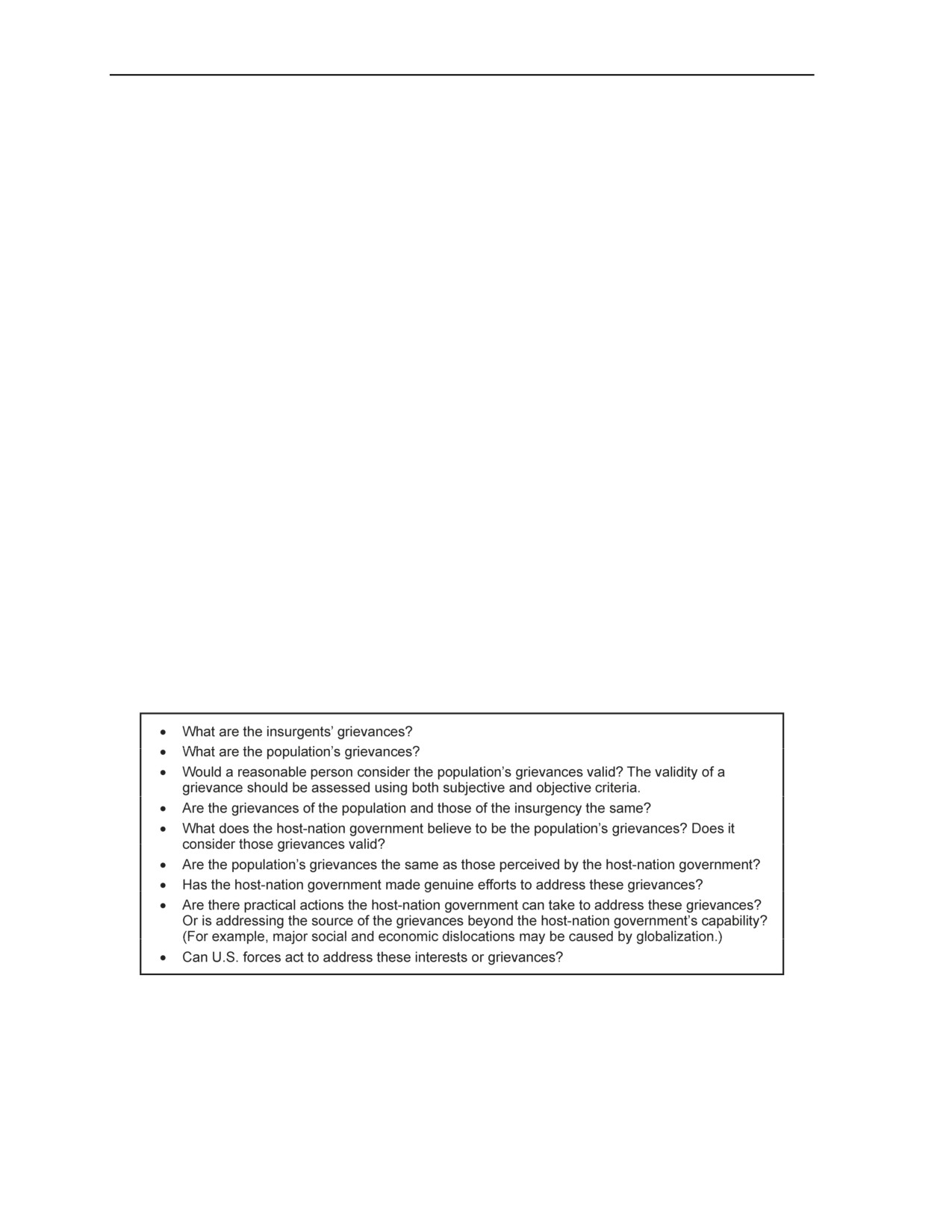
Chapter 3
z
Economic disenfranchisement.
z
Exploitative economic arrangements.
z
Significant income disparity that creates (or allows for) intractable class distinctions.
3-71. Military operations or insurgent actions can adversely affect the economy. Such disruption can gen-
erate resentment against the HN government. Conversely, restoring production and distribution systems
can energize the economy, create jobs and growth, and positively influence local perceptions. To determine
how to reduce support for insurgency and increase support for the government, commanders determine the
following:
z
Whether the society has a functioning economy.
z
Whether people have fair access to land and property.
z
How to minimize the economic grievances of the civilian population.
Political Participation
3-72. Another interest of the population is political participation. Many insurgencies begin because groups
within a society believe that they have been denied political rights. Groups may use preexisting cultural
narratives and symbols to mobilize for political action. Very often, they rally around traditional or charis-
matic authority figures. Commanders should investigate whether—
z
All members of the civilian population have a guarantee of political participation.
z
Ethnic, religious, or other forms of discrimination exist.
z
Legal, social, or other policies are creating grievances that contribute to the insurgency.
Commanders should also identify traditional or charismatic authority figures and what narratives mobilize
political action.
Grievances
3-73. Unsatisfied interests may become grievances. Table 3-1 lists factors to consider when an interest has
become a grievance.
Table 3-1. Factors to consider when addressing grievances
Evaluate the Threat
3-74. The purpose of evaluating the insurgency and related threats is to understand the enemy, enemy ca-
pabilities, and enemy vulnerabilities. This evaluation also identifies opportunities commanders may ex-
ploit.
3-12
FM 3-24/MCWP 3-33.5
15 December 2006
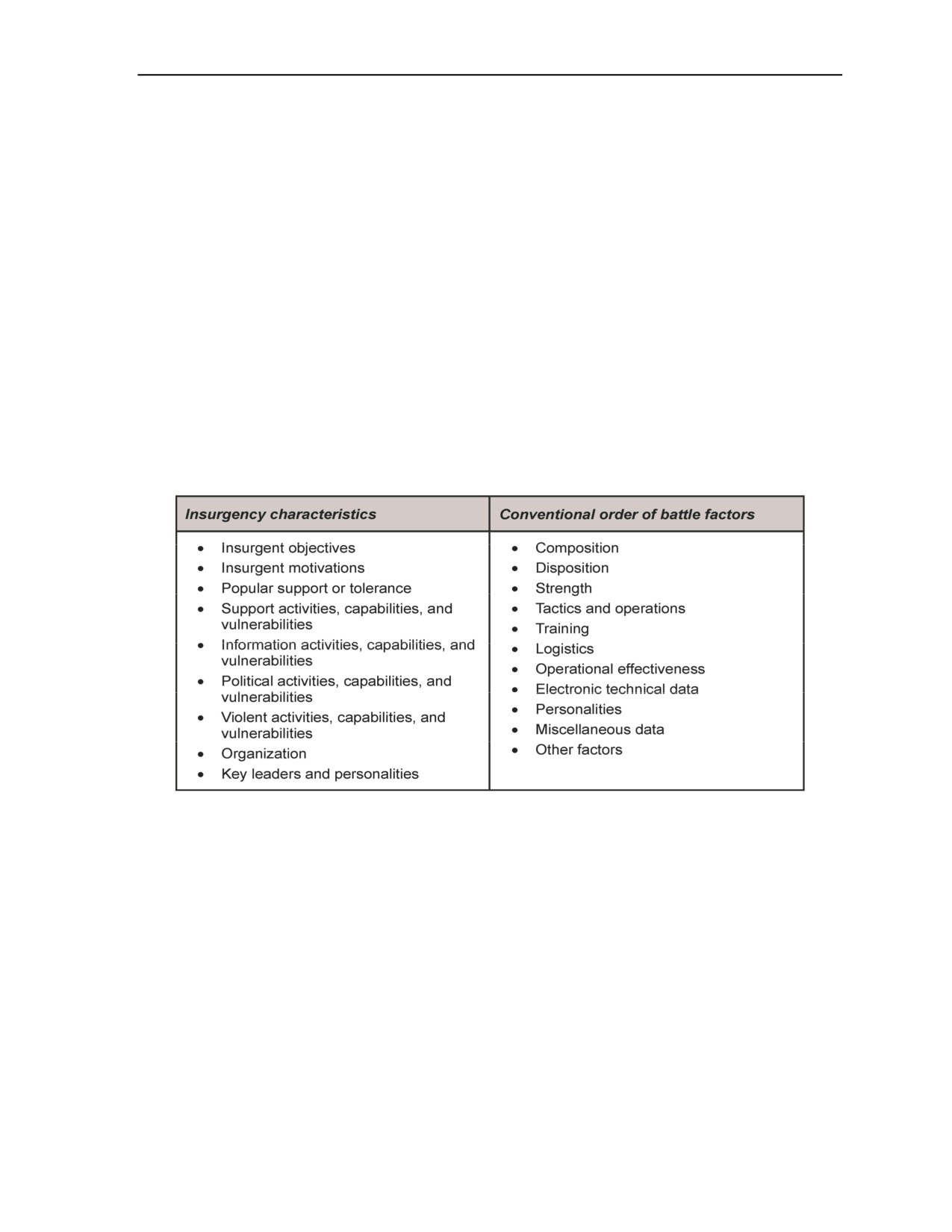
Intelligence in Counterinsurgency
3-75. Evaluating an insurgency is difficult. Neatly arrayed enemy orders of battle are neither available nor
what commanders need to know. Insurgent organizational structures are functionally based and continually
adaptive. Attempts to apply traditional order of battle factors and templates can produce oversimplified,
misleading conclusions. Commanders require knowledge of difficult-to-measure characteristics. These may
include the following:
z
Insurgent goals.
z
Grievances insurgents exploit.
z
Means insurgents use to generate support.
z
Organization of insurgent forces.
z
Accurate locations of key insurgent leaders.
However, insurgents usually look no different from the general populace and do their best to blend with
noncombatants. Insurgents may publicly claim motivations and goals different from what is truly driving
their actions. Further complicating matters, insurgent organizations are often rooted in ethnic or tribal
groups. They often take part in criminal activities or link themselves to political parties, charities, or reli-
gious organizations as well. These conditions and practices make it difficult to determine what and who
constitutes the threat. Table 3-2 lists characteristics of an insurgency that can provide a basis for evaluating
a threat. Table 3-2 also lists the conventional order of battle element as a supplement for analysts.
Table 3-2. Insurgency characteristics and order of battle factors
3-76. The following insurgency characteristics are often the most important intelligence requirements and
the most difficult to ascertain:
z
Objectives.
z
Motivations.
z
Means of generating popular support or tolerance.
In particular, the ability to generate and sustain popular support, or at least acquiescence and tolerance, of-
ten has the greatest impact on the insurgency’s long-term effectiveness. This ability is usually the insur-
gency’s center of gravity. Support or tolerance, provided either willingly or unwillingly, provides the fol-
lowing for an insurgency:
z
Safe havens.
z
Freedom of movement.
z
Logistic support.
z
Financial support.
z
Intelligence.
z
New recruits.
15 December 2006
FM 3-24/MCWP 3-33.5
3-13
Chapter 3
Support or tolerance is often generated using violent coercion and intimidation of the populace. In these
cases, even if people do not favor the insurgent cause, they are forced to tolerate the insurgents or provide
them material support.
3-77. Understanding the attitudes and perceptions of the society’s groups is very important to understand-
ing the threat. It is important to know how the population perceives the insurgents, the host nation, and
U.S. forces. In addition, HN and insurgent perceptions of one another and of U.S. forces are also very im-
portant. Attitudes and perceptions of different groups and organizations inform decision-making processes
and shape popular thinking on the legitimacy of the actors in the conflict.
3-78. As analysts perform IPB, they should focus on insurgent vulnerabilities to exploit and strengths to
mitigate. (See chapter 1.) Evaluating threats from insurgents and other armed groups and learning the peo-
ple’s interests and attitudes lets analysts identify divisions between the insurgents and the populace. This
analysis also identifies divisions between the HN government and the people. For instance, if the insurgent
ideology is unpopular, insurgents may use intimidation to generate support. Another example is discover-
ing that insurgents gain support by providing social services that the HN government neglects or cannot
provide. Determining such divisions identifies opportunities to conduct operations that expand splits be-
tween the insurgents and the populace or lessen divides between the HN government and the people.
OBJECTIVE AND MOTIVATION IDENTIFICATION
3-79. Insurgents have political objectives and are motivated by an ideology or grievances. The grievances
may be real or perceived. Identifying insurgent objectives and motivations lets counterinsurgents address
the conflict’s underlying causes. Broadly speaking, there are two kinds of insurgencies: national insurgen-
cies and resistance movements. Both can be further classified according to the five approaches explained in
paragraphs 1-25 through 1-39.
3-80. In a national insurgency, the conflict is between the government and one or more segments of the
population. In this type of insurgency, insurgents seek to change the political system, take control of the
government, or secede from the country. A national insurgency polarizes the population and is generally a
struggle between the government and insurgents for legitimacy and popular support.
3-81. In contrast, a resistance movement (sometimes called a liberation insurgency) occurs when insur-
gents seek to expel or overthrow what they consider a foreign or occupation government. The grievance is
foreign rule or foreign intervention. Resistance movements tend to unite insurgents with different objec-
tives and motivations. However, such an insurgency can split into competing factions when foreign forces
leave and the focus of resistance is gone. That situation may result in a civil war.
3-82. Identification of insurgent goals and motivations can be difficult for a number of reasons:
z
There may be multiple insurgent groups with differing goals and motivations. This case requires
separately monitoring each group’s goals and motivations.
z
Insurgent leaders may change and the movement’s goals change with them.
z
Movement leaders may have different motivations from their followers. For instance, a leader
may want to become a new dictator; followers may be motivated by a combination of political
ideology and money.
z
Insurgents may hide their true motivations and make false claims. For instance, the differences
between insurgents and outsiders generally make resistance movements easier to unify and mo-
bilize. Thus, insurgents may try to portray a national insurgency as a resistance movement.
z
The goals of an insurgency may change due to changes in the operational environment. Foreign
forces joining a COIN effort can transform a national insurgency into resistance movement. The
reverse may happen when foreign forces depart.
For all these reasons, analysts continuously track insurgent actions, internal communications, and public
rhetoric to determine insurgent goals and motivations.
3-14
FM 3-24/MCWP 3-33.5
15 December 2006
Intelligence in Counterinsurgency
Popular Support or Tolerance
3-83. Developing passive support (tolerance or acquiescence) early in an insurgency is often critical to an
insurgent organization’s survival and growth. Such support often has a great effect on the insurgency’s
long-term effectiveness. As an insurgent group gains support, its capabilities grow. New capabilities enable
the group to gain more support. Insurgents generally view popular support as a zero-sum commodity; that
is, a gain for the insurgency is a loss for the government, and a loss for the government is a gain for the insur-
gency.
Forms of Popular Support
3-84. Popular support comes in many forms. It can originate internally or externally, and it is either active
or passive. There are four forms of popular support:
z
Active external.
z
Passive external.
z
Active internal.
z
Passive internal.
The relative importance of each form of support varies depending on the circumstances. However, all
forms benefit an insurgency.
3-85. Active external support includes finance, logistics, training, fighters, and safe havens. These forms of
support may be provided by a foreign government or by nongovernmental organizations, such as charities.
3-86. Passive external support occurs when a foreign government supports an insurgency through inac-
tion. Forms of passive support include the following:
z
Not curtailing the activities of insurgents living or operating within the state’s borders.
z
Recognizing the legitimacy of an insurgent group.
z
Denying the legitimacy of the HN government.
3-87. Active internal support is usually the most important to an insurgent group. Forms of active support
include the following:
z
Individuals or groups joining the insurgency.
z
Providing logistic or financial support.
z
Providing intelligence.
z
Providing safe havens.
z
Providing medical assistance.
z
Providing transportation.
z
Carrying out actions on behalf of the insurgents.
3-88. Passive internal support is also beneficial. Passive supporters do not provide material support; how-
ever, they do allow insurgents to operate and do not provide information to counterinsurgents. This form of
support is often referred to as tolerance or acquiescence.
Methods of Generating Popular Support
3-89. Insurgents use numerous methods to generate popular support. These include the following:
z
Persuasion.
z
Coercion.
z
Encouraging overreaction.
z
Apolitical fighters.
3-90. Persuasion can be used to obtain either internal or external support. Forms of persuasion include—
z
Charismatic attraction to a leader or group.
z
Appeal to an ideology.
15 December 2006
FM 3-24/MCWP 3-33.5
3-15
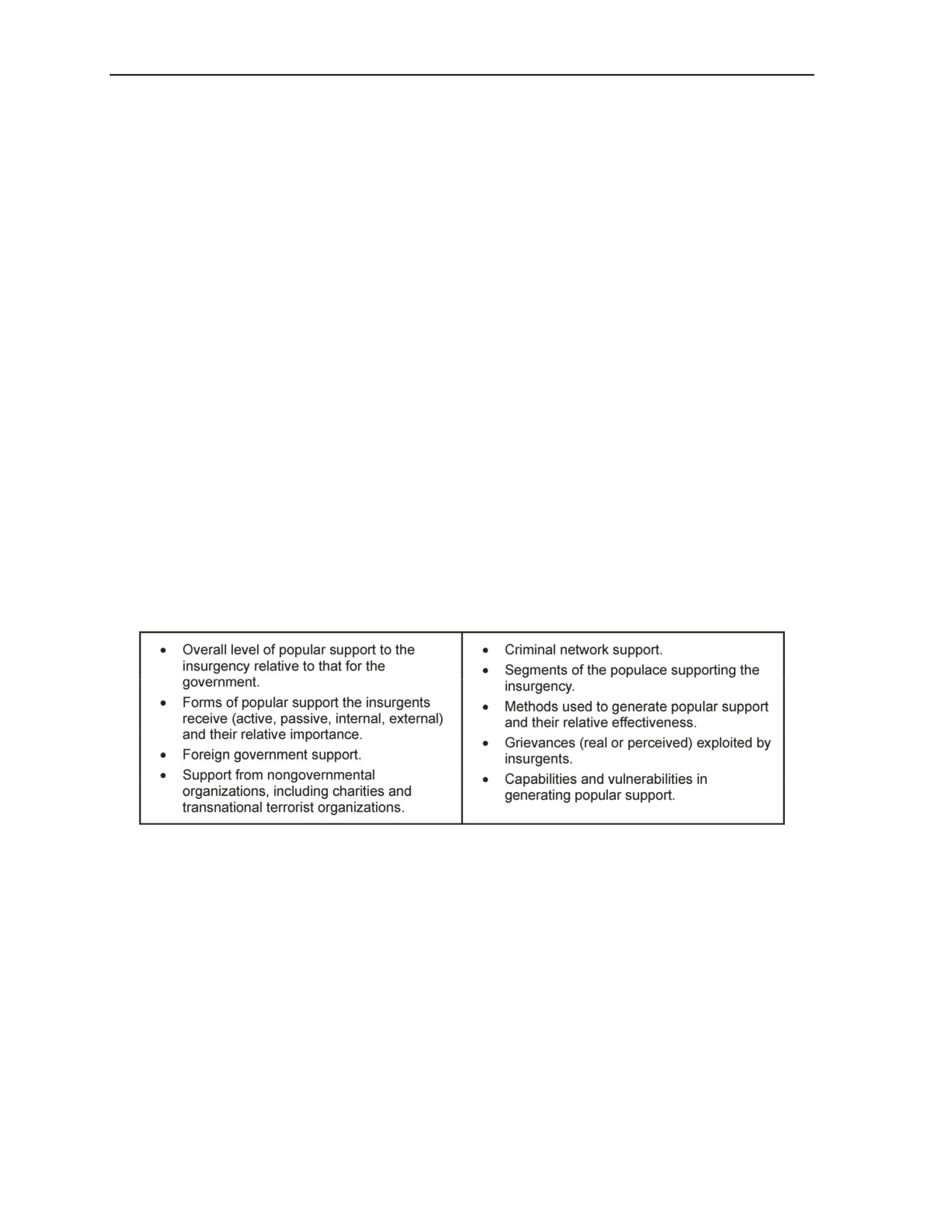
Chapter 3
z
Promises to address grievances.
z
Demonstrations of potency, such as large-scale attacks or social programs for the poor.
Persuasion through demonstrations of potency can be the most effective technique because it can create the
perception that the insurgency has momentum and will succeed.
3-91. Insurgents use coercion to force people to support or tolerate insurgent activities. Means of coercion
include terrorist tactics, violence, and the threat of violence. Coercion may be used to alter the behavior of
individuals, groups, organizations, or governments. Coercion is often very effective in the short term, par-
ticularly at the community level. However, terrorism against the general populace and popular leaders or
attacks that negatively affect people’s way of life can undermine insurgent popularity. Coercion is an easy
way for insurgents to generate passive support; however, this support exists only as long as insurgents are
able to intimidate.
3-92. Encouraging overreaction refers to enticing counterinsurgents to use repressive tactics that alienate
the populace and bring scrutiny upon the government. It is also referred to as provocation of a government
response.
3-93. Apolitical fighters may be attracted by many nonideological means. These means include monetary
incentives, the promise of revenge, and the romance of fighting a revolutionary war.
3-94. Although difficult to quantify, analysts evaluate the popular support an insurgent group receives and
its ability to generate more support. Open sources and intelligence reporting provide data to support this
analysis. Polling data can be a valuable, though imprecise, means of gauging support for the HN govern-
ment and support for the insurgency. Media and other open-source publications are important at all eche-
lons. Assessing community attitudes, by gauging such things as the reactions of local populace to the pres-
ence of troops or government leaders, can be used to estimate popular support at the tactical level. At a
minimum, the information in table 3-3 should be known.
Table 3-3. Critical information regarding popular support
Support Activities
3-95. Although noticeable, violence may be only a small part of overall insurgent activity. Unseen
insurgent activities include training and logistic actions. These are the support activities that sustain
insurgencies. They come from an insurgency’s ability to generate popular support. Like conventional military
forces, insurgencies usually require more sustainers than fighters. Insurgent support networks may be large,
even when violence levels are low. For this reason, it is easy to overlook them early in the development of an
insurgency.
3-96. Undermining an insurgency’s popular support is the most effective way to reduce insurgent support
capabilities. However, identifying support capabilities and vulnerabilities is still important. Doing this lets
analysts evaluate potential threat courses of action. Such analysis also lets commanders target vulnerable
parts of the insurgents’ support network. Table 3-4 lists support activities and capabilities to evaluate.
3-16
FM 3-24/MCWP 3-33.5
15 December 2006
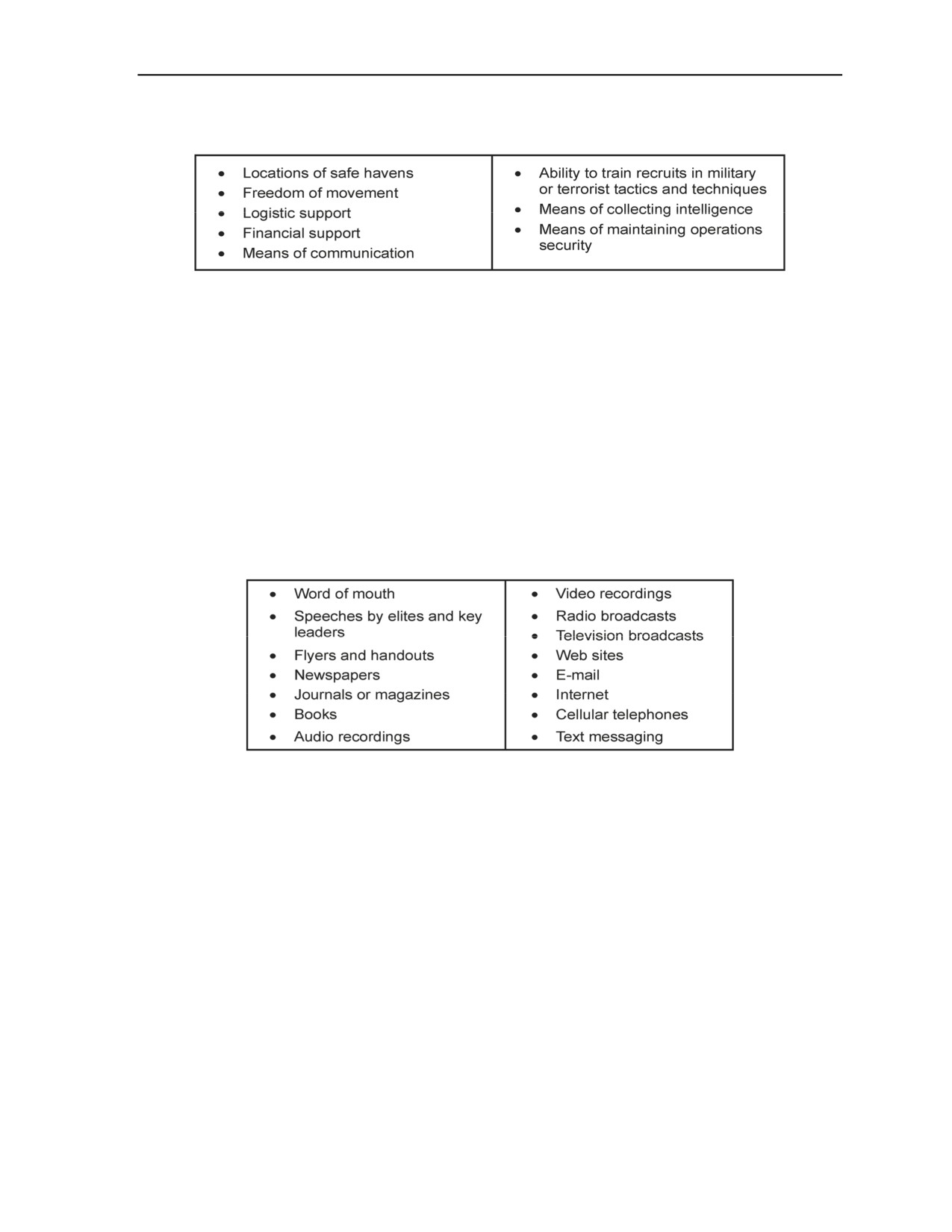
Intelligence in Counterinsurgency
Table 3-4. Insurgent support activities and capabilities
Information and Media Activities
3-97. Information and media activities can be an insurgency’s main effort, with violence used in support.
Insurgents use information activities to accomplish the following:
z
Undermine HN government legitimacy.
z
Undermine COIN forces.
z
Excuse insurgent transgressions of national and international laws and norms.
z
Generate popular support.
To achieve these effects, insurgents broadcast their successes, counterinsurgent failures, HN government
failures, and illegal or immoral actions by counterinsurgents or the HN government. Insurgent broadcasts
need not be factual; they need only appeal to the populace. Table 3-5 lists media forms that insurgents
commonly use.
Table 3-5. Media forms insurgents use
3-98. To supplement their own media activities, insurgents take advantage of existing private and public
media companies through press releases and interviews. These efforts, in addition to using the Internet,
broadcast insurgent messages worldwide. By broadcasting to a global audience, insurgents directly attack
public support for the COIN effort. Information and media activities to evaluate include the following:
z
Commitment of assets and personnel to information activities.
z
Types of media employed.
z
Professionalism of products, such as newspaper articles or videos.
z
Effectiveness and reach of information activities.
Political Activities
3-99. Insurgents use political activities to achieve their goals and enhance their cause’s legitimacy. Politi-
cal activities are tightly linked to information activities and violent acts. Political parties affiliated with an
insurgent organization may negotiate or communicate on behalf of the insurgency, thereby serving as its
public face. Insurgencies may grow out of political parties, or political parties may grow out of insurgen-
cies. However, links between insurgents and political parties may be weak or easily broken by disputes be-
tween insurgents and politicians. In such cases, political parties may not be able to keep promises to end
15 December 2006
FM 3-24/MCWP 3-33.5
3-17
Chapter 3
violent conflict. It is important to understand not only the links between insurgent groups and political or-
ganizations but also the amount of control each exerts over the other.
3-100. Understanding insurgent political activities enables effective political engagement of insurgents.
Without this knowledge, the wrong political party may be engaged, the wrong messages may be used, or
the government may make deals with political parties that cannot deliver on their promises. Political activi-
ties to be evaluated include the following:
z
Links, if any, between the insurgency and political parties.
z
Influence of political parties over the insurgency and vice versa.
z
Political indoctrination and recruiting by insurgent groups.
Violent Activities
3-101. Violent actions by insurgents include three major types, which may occur simultaneously:
z
Terrorist.
z
Guerrilla.
z
Conventional.
3-102. Insurgents are by nature an asymmetric threat. They do not use terrorist and guerrilla tactics be-
cause they are cowards afraid of a “fair fight”; insurgents use these tactics because they are the best means
available to achieve the insurgency’s goals. Terrorist and guerrilla attacks are usually planned to achieve
the greatest political and informational impact with the lowest amount of risk to insurgents. Thus, com-
manders need to understand insurgent tactics and targeting as well as how the insurgent organization uses
violence to achieve its goals and how violent actions are linked to political and informational actions.
Asymmetric Tactics in Ireland
In 1847, Irish insurgents were advised to engage the British Army in the following
way:
“The force of England is entrenched and fortified. You must draw it out of position;
break up its mass; break its trained line of march and manoeuvre, its equal step and
serried array… nullify its tactic and strategy, as well as its discipline; decompose the
science and system of war, and resolve them into their first elements.”
3-103. Terrorist tactics employ violence primarily against noncombatants. Terror attacks generally re-
quire fewer personnel than guerrilla warfare or conventional warfare. They allow insurgents greater secu-
rity and have relatively low support requirements. Insurgencies often rely on terrorist tactics early in their
formation due to these factors. Terrorist tactics do not involve mindless destruction nor are they employed
randomly. Insurgents choose targets that produce the maximum informational and political effects. Terror-
ist tactics can be effective for generating popular support and altering the behavior of governments.
3-104. Guerrilla tactics, in contrast, feature hit-and-run attacks by lightly armed groups. The primarily
targets are HN government activities, security forces, and other COIN elements. Insurgents using guerrilla
tactics usually avoid decisive confrontations unless they know they can win. Instead, they focus on harass-
ing counterinsurgents. As with terrorist tactics, guerrilla tactics are neither mindless nor random. Insurgents
choose targets that produce maximum informational and political effects. The goal is not to militarily de-
feat COIN forces but to outlast them while building popular support for the insurgency. Terrorist and guer-
rilla tactics are not mutually exclusive. An insurgent group may employ both forms of violent action simulta-
neously.
3-105. Insurgents rarely use conventional tactics. Conventional operations are not always necessary for
an insurgency’s success. However, insurgents may engage in conventional operations after the insurgency
develops extensive popular support and sustainment capabilities. The insurgents can then generate a con-
ventional military force that can engage HN government forces.
3-106. Knowledge of violent capabilities is used to evaluate insurgent courses of action. Commanders use
this knowledge to determine appropriate protection measures and tactics to counter insurgent actions. In
3-18
FM 3-24/MCWP 3-33.5
15 December 2006
Intelligence in Counterinsurgency
addition, knowledge of how insurgents conduct attacks provides a baseline that helps determine the effec-
tiveness of COIN operations. The following should be evaluated to determine insurgents’ capabilities for
violent action:
z
Forms of violent action used.
z
Weapons available and their capabilities.
z
Training.
z
Known methods of operating.
Frequency of attacks.
Timing of attacks.
Targets of attacks.
Tactics and techniques.
z
Known linkages between violent, political, and information actions. How do the insurgents use
violence to increase their popular support and undermine counterinsurgents?
z
Means of command and control during attacks (including communications means used).
Insurgent Organizational Structure and Key Personalities
3-107. Conducting the preceding activities requires some form of organizational structure and leadership.
Insurgencies can be organized in several ways. Each structure has its own strengths and limitations. The
structure used balances the following:
z
Security.
z
Efficiency and speed of action.
z
Unity of effort.
z
Survivability.
z
Geography.
z
Social structures and cultures of the society.
Organizations also vary greatly by region and time. Insurgent organizations are often based on existing so-
cial networks—familial, tribal, ethnic, religious, professional, or others. Analysts can use social network
analysis to determine organizational structure. (See paragraphs B-15 through B-18.)
3-108. An insurgency’s structure often determines whether it is more effective to target enemy forces or
enemy leaders. For instance, if an insurgent organization is hierarchical with few leaders, removing the
leaders may greatly degrade the organization’s capabilities. However, if the insurgent organization is non-
hierarchical, targeting the leadership may not have much effect. Understanding an insurgent organization’s
structure requires answers to the following questions:
z
Is the organization hierarchical or nonhierarchical?
z
Is the organization highly structured or unsystematic?
z
Are movement members specialists or generalists?
z
Do leaders exercise centralized control or do they allow autonomous action and initiative?
z
Are there a few leaders (promotes rapid decision making) or is there redundant leadership (pro-
motes survivability)?
z
Does the movement operate independently or does it have links to other organizations and net-
works (such as criminal, religious, and political organizations)?
z
Does the movement place more weight on political action or violent action?
3-109. As explained in paragraphs 1-58 through 1-66, insurgents fall into five overlapping categories:
movement leaders, combatants, political cadre, auxiliaries, and the mass base. Movement leaders are im-
portant because they choose the insurgency’s organization, approach, and tactics. The movement leaders’
personalities and decisions often determine whether the insurgency succeeds. Therefore, the movement
leaders must be identified and their basic beliefs, intentions, capabilities, and vulnerabilities understood.
Important leader characteristics include the following:
15 December 2006
FM 3-24/MCWP 3-33.5
3-19
Chapter 3
z
Role in the organization.
z
Known activities.
z
Known associates.
z
Background and personal history.
z
Beliefs, motivations, and ideology.
z
Education and training.
z
Temperament (for example, careful, impulsive, thoughtful, or violent).
z
Importance of the organization.
z
Popularity outside the organization.
ASSOCIATED THREATS
3-110. When an insurgency has widespread support, it usually means the HN government is weak and
losing control. In such situations, other armed groups—particularly criminal organizations, militias, and
terrorist groups—can be significant players. Moreover, these groups can support each other’s operations.
Criminal Networks
3-111. Criminal networks may not be a part of an insurgency. However, their activities—for example,
banditry, hijackings, kidnappings, and smuggling—can further undermine the HN government’s authority.
Insurgent organizations often link themselves to criminal networks to obtain funding and logistic support.
In some cases, insurgent networks and criminal networks become indistinguishable. As commanders work
to reassert government control, they need to know the following:
z
Which criminal networks are present.
z
What their activities are.
z
How they interact with insurgents.
Nongovernment Militias
3-112. As the HN government weakens and violence increases, people look for ways to protect them-
selves. If the government cannot provide protection, people may organize into armed militias to provide
that essential service. Examples of this sort of militia include the following:
z
Loyalist militias formed in Northern Ireland.
z
Right-wing paramilitary organizations formed in Colombia to counter the FARC.
z
Militias of various ethnic and political groups formed in Iraq during Operation Iraqi Freedom.
If militias are outside the HN government’s control, they can often be obstacles to ending an insurgency.
Militias may become more powerful than the HN government, particularly at the local level. They may also
fuel the insurgency and a precipitate a downward spiral into full-scale civil war.
3-113. Militias may or may not be an immediate threat to U.S. forces; however, they constitute a long-
term threat to law and order. The intelligence staff should track them just like insurgent and other armed
groups. Commanders need to understand the role militias play in the insurgency, the role they play in poli-
tics, and how they can be disarmed.
DETERMINE THREAT COURSES OF ACTION
3-114. The purpose of this IPB step is to understand insurgent approaches and tactics so they can be ef-
fectively countered. The initial determination of threat courses of action focuses on two levels of analysis.
The first is determining the overall approach, or combination of approaches, the movement leaders have se-
lected to achieve their goals. The second is determining tactical courses of action used to execute that ap-
proach.
3-115. The insurgents’ approach is based on their objectives, desired end state, and requirements of the
operational environment. The approach and the tactics used to execute it set the conditions for the insur-
3-20
FM 3-24/MCWP 3-33.5
15 December 2006
Intelligence in Counterinsurgency
gents to achieve their desired end state. Insurgents can accomplish this goal by maintaining preexisting ad-
verse conditions or by creating those conditions.
INSURGENT APPROACHES
3-116. As indicated in paragraphs 1-25 through 1-39, there are six approaches insurgents may follow:
z
Conspiratorial.
z
Military-focused.
z
Urban.
z
Protracted popular war.
z
Identity-focused.
z
Composite and coalition.
3-117. These approaches may be combined with one another. They may also occur in parallel as different
insurgent groups follow different paths, even within a single AO. In addition, insurgents may change ap-
proaches over time. The approach pursued affects the insurgents’ organization, types of activities, and em-
phasis placed on different activities.
3-118. Table 3-6 (page 3-22) lists potential indicators of different insurgent approaches. The conspirato-
rial and identity-focused approaches present distinct collection challenges. Insurgents using a conspiratorial
approach execute few overt acts until the conditions appear ripe to seize power. Thus, this approach is dif-
ficult to identify without sources within the insurgent organization. Similarly, members of an identity-
focused insurgency strongly identify with the insurgent organization. It is difficult to get such people to
provide useful information.
15 December 2006
FM 3-24/MCWP 3-33.5
3-21
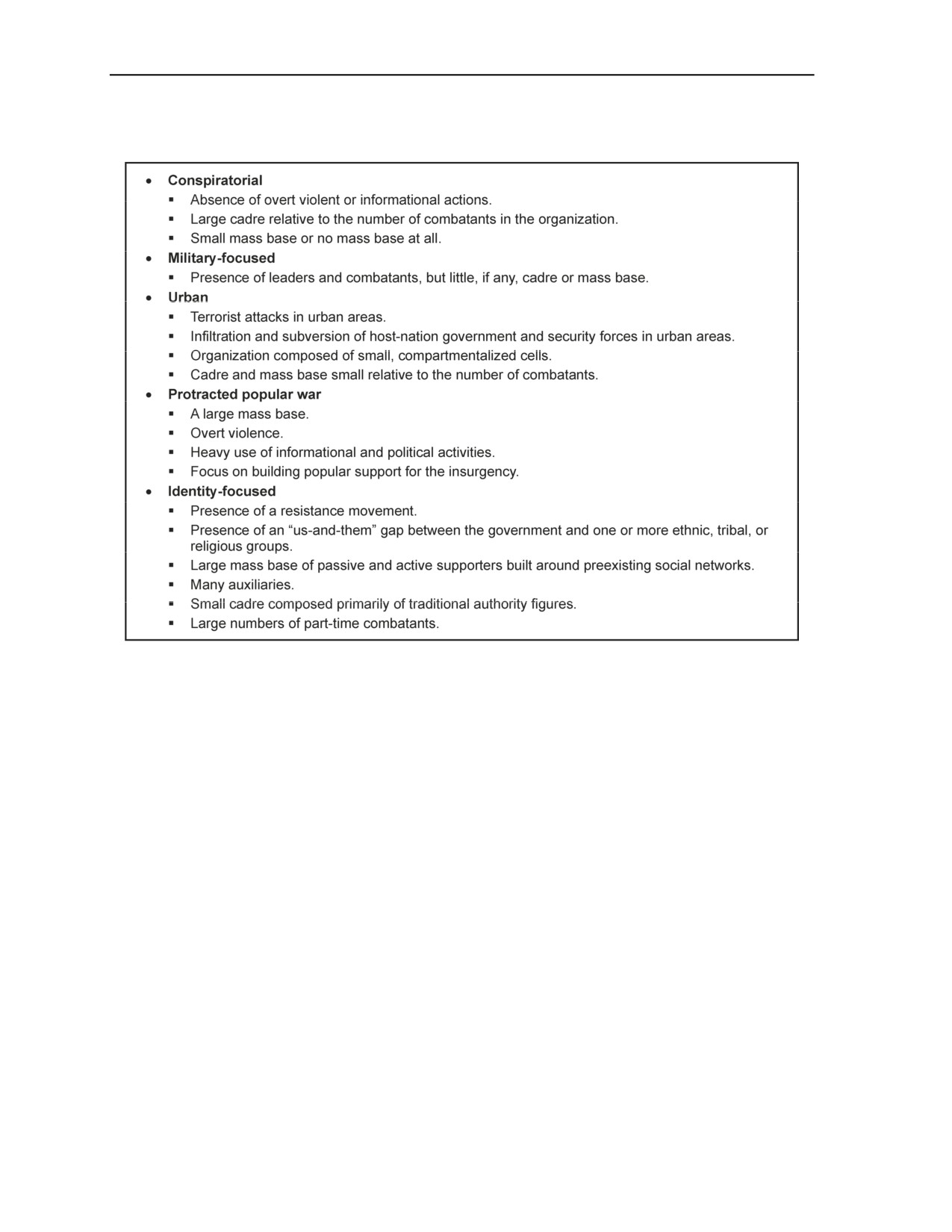
Chapter 3
Table 3-6. Potential indicators of insurgent approaches
3-119. It should be noted that insurgents may be inept at the use of a given approach. Alternatively, they
may misread the operational environment and use an inappropriate approach. Knowledge of misapplication
of approach or the use of different approaches by different insurgent groups may provide opportunities for
counterinsurgents to exploit. It is imperative not only to identify insurgent approaches but also to under-
stand their strengths and weaknesses in the context of the operational environment.
3-22
FM 3-24/MCWP 3-33.5
15 December 2006
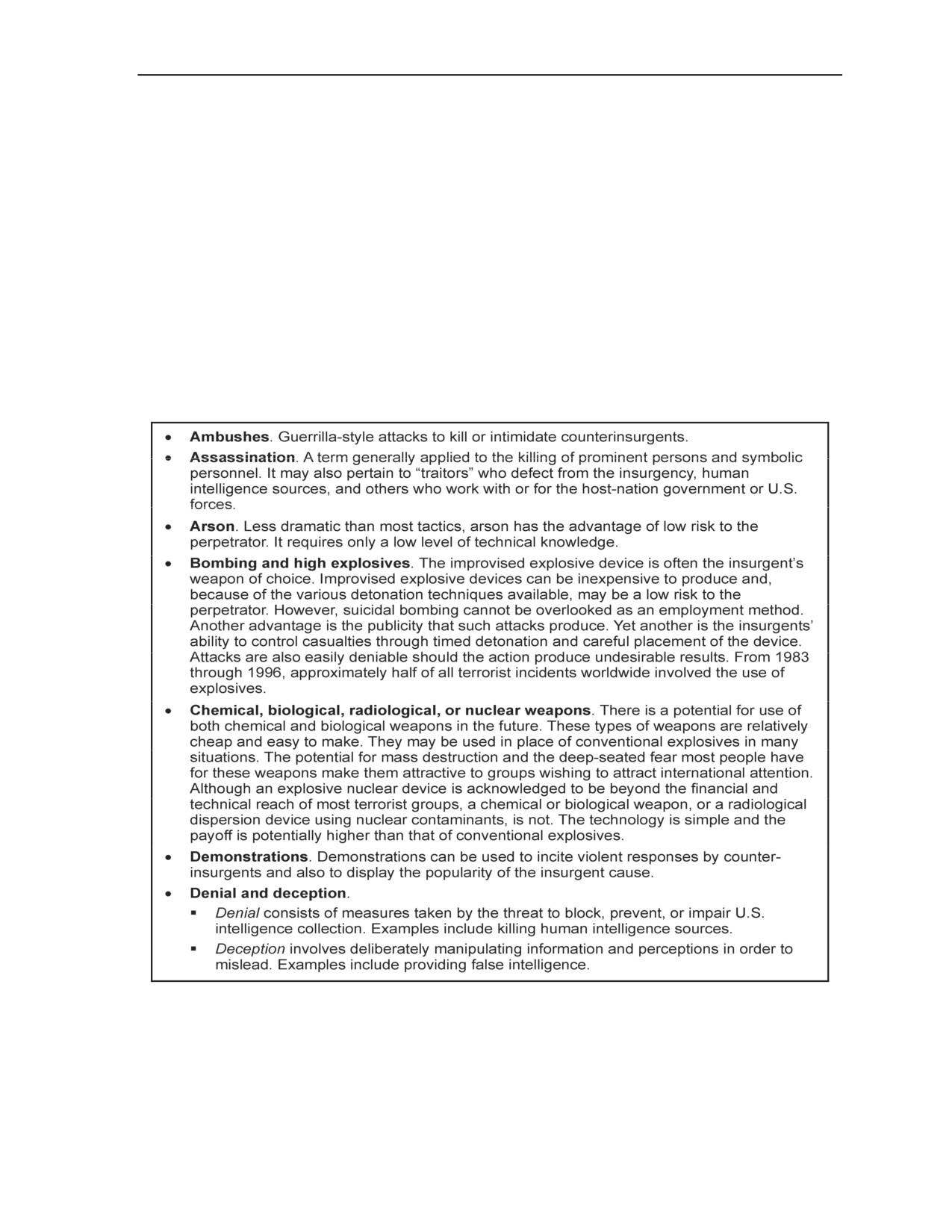
Intelligence in Counterinsurgency
TACTICAL COURSES OF ACTION
3-120. Insurgents base their tactical courses of action on their capabilities and intentions. Evaluating the
support, information, political, and violent capabilities of insurgent organizations was discussed in para-
graphs 3-95 through 3-106. The intentions come from goals, motivations, approach, culture, perceptions,
and leadership personalities. Insurgents may pursue many different courses of action in an AO at any time.
Their tactical courses of action change with both time and location. People and their attitudes, both within
the nation and often outside it, are the ultimate targets of the insurgents. Therefore, commanders pay spe-
cial attention to the effects insurgent actions have on the populace and how the insurgents achieve those ef-
fects. Finally, tactical actions can have strategic effects. This is because insurgent propaganda and media
reporting can reach a global audience, multiplying the effects of insurgent tactical actions. Insurgents can
employ a wide variety of tactics. (See table 3-7.)
Table 3-7. Examples of insurgent tactics
15 December 2006
FM 3-24/MCWP 3-33.5
3-23
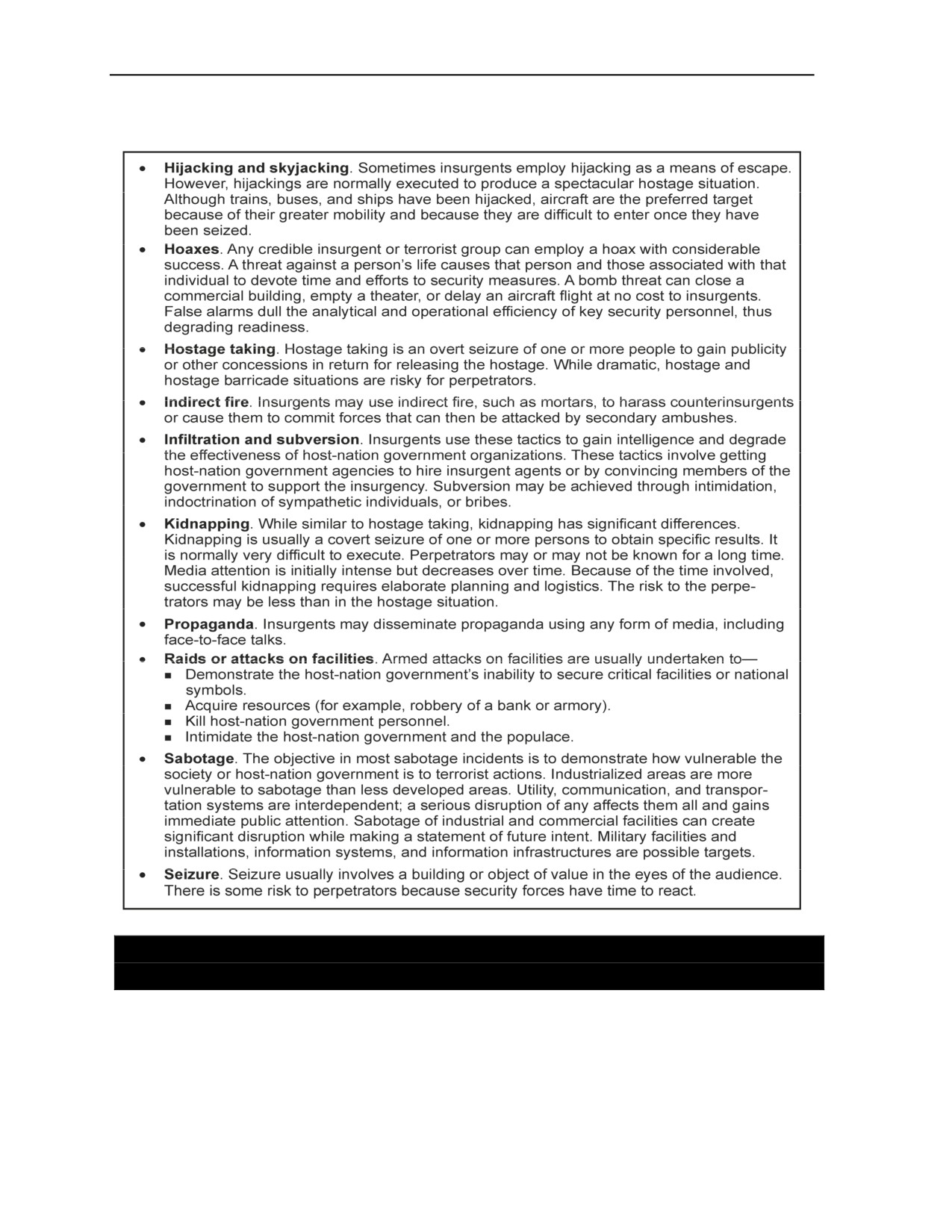
Chapter 3
SECTION III - INTELLIGENCE, SURVEILLANCE, AND RECONNAISSANCE
OPERATIONS
3-121. The purpose of intelligence, surveillance, and reconnaissance (ISR) operations during a COIN is
to develop the intelligence needed to address the issues driving the insurgency. Several factors are particu-
larly important for ISR operations in COIN environments. These include the following:
z
A focus on the local populace.
z
Collection occurring at all echelons.
z
Localized nature of insurgencies.
3-24
FM 3-24/MCWP 3-33.5
15 December 2006
Intelligence in Counterinsurgency
z
All Soldiers and Marines functioning as potential collectors.
z
Insurgent use of complex terrain.
3-122. Intelligence gaps and information requirements determined during IPB may range from insurgent
leaders’ locations, to the populace’s perceptions of insurgents, to HN political parties’ status. In general,
collection focuses on the populace, insurgents, and host nation.
3-123. The fact that all units collect and report information, combined with the mosaic nature of insur-
gencies, means that the intelligence flow in COIN is more bottom up than top down. Conducting aggres-
sive ISR operations and pushing intelligence collection assets and analysts to the tactical level, sometimes
as far as company level, therefore benefits all echelons. It strengthens local intelligence, enhances regional
and national reporting, and bolsters operations at all levels. Two techniques— either attaching a basic intel-
ligence analytical capability down to battalion or company level, or forming a company information man-
agement capability from assigned personnel—can help commanders handle the tactical information flow
better.
3-124. Collection may occur in any unit and collectors may be pushed to the lowest levels; nonetheless,
the overall intelligence synchronization plan (formerly the collection plan) must remain synchronized so
that all echelons receive the intelligence they require. There are several means of ensuring this happens.
One is to ensure that priority intelligence requirements (PIRs) are “nested” at all echelons. They may be
tailored to local or regional circumstances, but tactical and operational collection efforts should support
one another. Headquarters monitor requests for information from lower echelons and taskings from higher
echelons to get information to requestors when they need it. Commanders ensure their subordinates under-
stand the PIRs. Such understanding helps Soldiers and Marines know when to report something and what
they should report.
3-125. Feedback from analysts and intelligence consumers to collectors is important to synchronizing the
ISR effort. Responses tell collectors that a report is of interest and that they should follow it up. Such feed-
back may come from any unit at any echelon.
3-126. Also affecting intelligence synchronization is the requirement to work closely with U.S. Govern-
ment agencies, HN security and intelligence organizations, and multinational intelligence organizations.
Operational-level ISR planning drives the synchronization of these agencies’ and organizations’ efforts;
however, coordination occurs at all echelons. Communication among collection managers and collectors
down to the battalion level is important; it can eliminate circular reporting and unnecessary duplicate work.
(See section IV.)
3-127. Insurgents often try to use complex terrain and seams between maneuver units to their advantage.
(Seams are boundaries between units not adequately covered by any unit.) Collection managers do not ig-
nore areas of complex terrain. They monitor seams to ensure insurgents do not establish undetected bases
of operation.
THE INTELLIGENCE-OPERATIONS DYNAMIC
3-128. Intelligence and operations have a dynamic relationship. Even in permissive environments where a
great deal is known about the enemy, there is an intelligence aspect to all operations. Intelligence drives
operations and successful operations generate additional intelligence. For instance, an operation increasing
the security and general happiness of a town often increases the amount of information its inhabitants offer.
This information is processed into more intelligence, which results in more effective operations. The re-
verse is also true. Operations conducted without accurate intelligence may upset the populace and lead
them to offer less information. In many cases, newly arrived units have little intelligence on their AO. They
have to conduct operations to generate intelligence.
3-129. Because intelligence and operations are so closely related, it is important for collectors to be
linked directly to the analysts and operators they support. Analysts must remain responsive to their sup-
ported units’ intelligence requirements. Further, collectors should not passively wait for operators to sub-
mit requirements; rather, they should closely monitor the operational environment and recommend re-
quirements based on their understanding of operators’ needs.
15 December 2006
FM 3-24/MCWP 3-33.5
3-25
Chapter 3
HUMAN INTELLIGENCE AND OPERATIONAL REPORTING
3-130. Human intelligence (HUMINT) is the collection of information by a trained human intelligence
collector from people and their associated documents and media sources to identify elements, intentions,
composition, strength, dispositions, tactics, equipment, personnel, and capabilities (FM 2-22.3). (Trained
HUMINT collectors are Soldiers holding military occupational specialties 97E, 351Y [formerly 351C],
351M [formerly 351E], 35E, and 35F, and Marines holding the specialty 0251.) HUMINT uses human
sources as tools and a variety of collection methods, both passive and active, to gather information to sat-
isfy intelligence requirements and cross-cue other intelligence disciplines. Interrogation is just one of the
HUMINT tasks. (FM 2-22.3 provides the authoritative doctrine for HUMINT operations. It also contains
policy for interrogation.) HUMINT operations often collect information that is difficult or sometimes im-
possible to obtain by other, more technical, means. During COIN operations, much intelligence is based on
information gathered from people.
3-131. Operational reporting may also have information of intelligence value that originates from the lo-
cal populace. People may approach Soldiers and Marines during the course of their day-to-day operations
and offer information. Soldiers and Marines should take information and report it to the intelligence sec-
tion. Doing so allows for verification of the information and establishes a means for HUMINT collectors to
contact individuals offering information of value.
3-132. The lives of people offering information on insurgents are often in danger. Insurgents continu-
ously try to defeat collection operations. Careless handling of human sources by untrained personnel can
result in murder or intimidation of these sources. When this occurs, HUMINT can be dramatically reduced
due to the word spreading that U.S. forces are careless or callous about protecting their sources. HUMINT
collectors are trained in procedures that limit the risk to sources and handlers.
3-133. Counterinsurgents should not expect people to willingly provide information if insurgents have the
ability to violently intimidate sources. HUMINT reporting increases if counterinsurgents protect the popu-
lace from insurgents and people begin to believe the insurgency will be defeated.
3-134. People often provide inaccurate and conflicting information to counterinsurgents. They may be
spreading rumors or providing inaccurate information purposefully for their own reasons. Examples of rea-
sons include accomplishing the following:
z
Using counterinsurgents to settle tribal, ethnic, or business disputes.
z
Leading counterinsurgents into ambushes.
z
Enticing counterinsurgents into executing operations that upset the populace.
z
Learning about U.S. planning time and tactics.
z
Stretching COIN forces thin by causing them to react to false reports.
The accuracy of information obtained by Soldiers and Marines should be verified before being used to sup-
port operations. This means that information reported to patrols should be verified with all-source intelligence.
MILITARY SOURCE OPERATIONS
3-135. Because of their continuous contact with the populace, Soldiers and Marines regularly identify po-
tential sources for HUMINT personnel to develop. It is therefore imperative that all counterinsurgents
know the PIRs and that every patrol is debriefed. These debriefings should be as detailed as possible. Ana-
lysts and HUMINT collectors should work closely with operations staffs and other personnel to ensure new
sources are properly developed. (Table 3-8) lists some potential HUMINT sources.)
3-136. Establishing a reliable source network is an effective collection method. Military source operations
provide the COIN equivalent of the reconnaissance and surveillance conducted by scouts in conventional
operations. HUMINT sources serve as “eyes and ears” on the street and provide an early warning system
for tracking insurgent activity. Although counterinsurgents regularly get information from “walk-in” or
“walk-up” sources, only HUMINT personnel are trained and authorized to work with HUMINT sources.
Due to legal considerations, the potential danger sources face if identified, and the potential danger to
troops involved, only HUMINT personnel may conduct military source operations. All Soldiers and Ma-
rines may record information given to them by walk-up contacts, including liaison relationships, but they may
3-26
FM 3-24/MCWP 3-33.5
15 December 2006
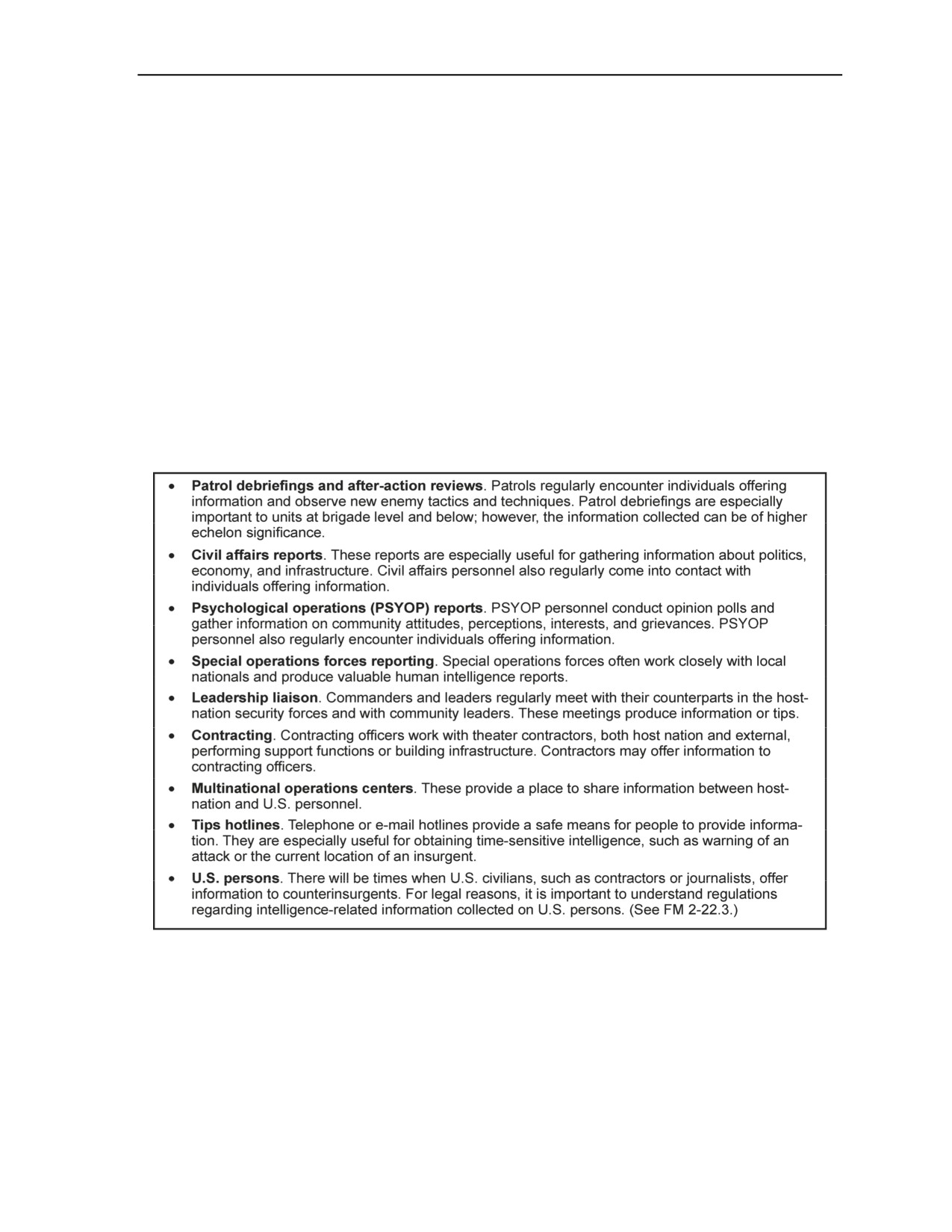
Intelligence in Counterinsurgency
not develop HUMINT sources or networks. (Refer to FM 2-22.3 for more information on military source
operations.)
INTERROGATION OF DETAINEES AND DEBRIEFING OF DEFECTORS
3-137. Detainees and insurgent defectors are important HUMINT sources. The information they provide
about the internal workings of an insurgency may be better than any other HUMINT source can provide. In
addition, defectors can provide otherwise unobtainable insights into an insurgent organization’s percep-
tions, motivations, goals, morale, organization, and tactics. Both detainees and defectors should be thor-
oughly questioned on all aspects of an insurgency discussed in section II. Their answers should be consid-
ered along with information obtained from captured equipment, pocket litter, and documents to build a
better understanding of the insurgency. Properly trained Soldiers and Marines can conduct immediate tacti-
cal questioning of detainees or defectors. However, only trained HUMINT personnel are legally authorized
to conduct interrogations. A trained debriefer should be used for questioning a defector. All questioning of
detainees is conducted to comply with U.S. law and regulation, international law, execution orders and
other operationally specific guidelines. (FM 2-22.3 provides the authoritative doctrine and policy for inter-
rogation. Chapter 7 and appendix D of this manual also address this subject.)
Table 3-8. Potential sources of human intelligence
SURVEILLANCE AND RECONNAISSANCE CONSIDERATIONS
3-138. Because all Soldiers and Marines are potential collectors, the ISR plan addresses all day-to-day
tactical operations. This means every patrol or mission should be given intelligence collection requirements
as well as operations requirements.
3-139. Overt area and zone reconnaissances are excellent means for tactical units to learn more about
their AO, especially the terrain, infrastructure, people, government, local leaders, and insurgents. Overt re-
15 December 2006
FM 3-24/MCWP 3-33.5
3-27