FM 3-24 COUNTERINSURGENCY (DECEMBER 2006) - page 1
FM 3-24
*MCWP 3-33.5
Field Manual
Headquarters
Department of the Army
No. 3-24
Washington, DC
Marine Corps Warfighting Publication
Headquarters
Marine Corps Combat Development Command
No. 3-33.5
Department of the Navy
Headquarters
United States Marine Corps
Washington, DC
15 December 2006
COUNTERINSURGENCY
Contents
Page
PREFACE
vii
INTRODUCTION
ix
Chapter 1
INSURGENCY AND COUNTERINSURGENCY
1-1
Overview
1-1
Aspects of Insurgency
1-2
Aspects of Counterinsurgency
1-19
Summary
1-28
Chapter 2
UNITY OF EFFORT: INTEGRATING CIVILIAN AND MILITARY ACTIVITIES 2-1
Integration
2-1
Key Counterinsurgency Participants and Their Likely Roles
2-4
Key Responsibilities in Counterinsurgency
2-9
Civilian and Military Integration Mechanisms
2-10
Tactical-Level Interagency Considerations
2-14
Summary
2-14
Chapter 3
INTELLIGENCE IN COUNTERINSURGENCY
3-1
Section I - Intelligence Characteristics in Counterinsurgency
3-1
Section II - Predeployment Planning and Intelligence Preparation of the
Battlefield
3-2
Define the Operational Environment
3-2
Distribution Restriction: Approved for public release; distribution is unlimited.
*This publication supersedes FMI 3-07.22, 1 October 2004, and MCWP 3-33.5, 29 January 1980.
Marine Corps PCN: 143 000124 00
i
Contents
Describe the Effects of the Operational Environment
3-3
Evaluate the Threat
3-12
Determine Threat Courses of Action
3-20
Section III - Intelligence, Surveillance, and Reconnaissance Operations 3-24
The Intelligence-Operations Dynamic
3-25
Human Intelligence and Operational Reporting
3-26
Surveillance and Reconnaissance Considerations
3-27
Considerations for Other Intelligence Disciplines
3-28
Section IV - Counterintelligence and Counterreconnaissance
3-30
Section V - All-Source Intelligence
3-30
Current Operations
3-31
Comprehensive Insurgency Analysis
3-31
Reachback
3-32
Analytic Continuity
3-32
Section VI - Intelligence Collaboration
3-33
Intelligence Cells and Working Groups
3-33
Protecting Sources
3-34
Host-Nation Integration
3-34
Section VII - Summary
3-35
Chapter 4
DESIGNING COUNTERINSURGENCY CAMPAIGNS AND OPERATIONS
4-1
The Importance of Campaign Design
4-1
The Relationship Between Design and Planning
4-2
The Nature of Design
4-3
Considerations for Design
4-3
Design for Counterinsurgency
4-4
Summary
4-9
Chapter 5
EXECUTING COUNTERINSURGENCY OPERATIONS
5-1
The Nature of Counterinsurgency Operations
5-1
Logical Lines of Operations in Counterinsurgency
5-3
Counterinsurgency Approaches
5-18
Assessment of Counterinsurgency Operations
5-26
Targeting
5-29
Learning and Adapting
5-31
Summary
5-31
Chapter 6
DEVELOPING HOST-NATION SECURITY FORCES
6-1
Overview
6-1
Challenges, Resources, and End State
6-2
Framework for Development
6-6
Police in Counterinsurgency
6-19
Summary
6-22
Chapter 7
LEADERSHIP AND ETHICS FOR COUNTERINSURGENCY
7-1
Leadership in Counterinsurgency
7-1
Large- and Small-Unit Leadership Tenets
7-1
Ethics
7-5
Warfighting Versus Policing
7-5
Proportionality and Discrimination
7-6
ii
FM 3-24/MCWP 3-33.5
15 December 2006
Contents
Detention and Interrogation
7-7
The Learning Imperative
7-9
Summary
7-9
Chapter 8
SUSTAINMENT
8-1
Logistic Considerations in Counterinsurgency
8-1
Logistic Support to Logical Lines of Operations
8-4
Contracted Logistic Support
8-17
Summary
8-20
Appendix A
A GUIDE FOR ACTION
A-1
Plan
A-1
Prepare
A-2
Execute
A-4
Ending the Tour
A-9
Three “What Ifs”
A-9
Summary
A-9
Appendix B
SOCIAL NETWORK ANALYSIS AND OTHER ANALYTICAL TOOLS
B-1
Describe the Effects of the Operational Environment
B-1
Evaluate the Threat
B-10
Appendix C
LINGUIST SUPPORT
C-1
Linguist Support Categories
C-1
Selecting Interpreters
C-2
Employing Linguists
C-3
Establishing Rapport
C-4
Orienting Interpreters
C-4
Preparing for Presentations
C-4
Conducting Presentations
C-5
Speaking Techniques
C-6
Appendix D
LEGAL CONSIDERATIONS
D-1
Authority to Assist a Foreign Government
D-1
Authorization to Use Military Force
D-2
Rules of Engagement
D-2
The Law of War
D-3
Internal Armed Conflict
D-3
Detention and Interrogation
D-4
Enforcing Discipline of U.S. Forces
D-6
Humanitarian Relief and Reconstruction
D-6
Training and Equipping Foreign Forces
D-7
Claims and Solatia
D-8
Establishing the Rule of Law
D-8
Appendix E
AIRPOWER IN COUNTERINSURGENCY
E-1
Overview
E-1
Airpower in the Strike Role
E-1
Airpower in Intelligence Collection
E-2
Air and Space Information Operations
E-2
High-Technology Assets
E-3
Low-Technology Assets
E-3
15 December 2006
FM 3-24/MCWP 3-33.5
iii
Contents
Airlift
E-4
The Airpower Command Structure
E-4
Building Host-Nation Airpower Capability
E-5
SOURCE NOTES
Source Notes-1
GLOSSARY
Glossary-1
ANNOTATED BIBLIOGRAPHY
Annotated Bibliography-1
MILITARY REFERENCES
References-1
INDEX
Index-1
Figures
Figure
1-1. Aspects of counterinsurgency operations
1-19
Figure
1-2. Support for an insurgency
1-20
Figure
2-1. Sample country team
2-11
Figure
4-1. Design and planning continuum
4-2
Figure
4-2. Iterative counterinsurgency campaign design
4-5
Figure
4-3. 1st Marine Division’s operational design for Operation Iraqi Freedom II
4-8
Figure
5-1. Example logical lines of operations for a counterinsurgency
5-3
Figure
5-2. Example goals and objectives along logical lines of operations
5-5
Figure
5-3. The strengthening effect of interrelated logical lines of operations
5-6
Figure
5-4. Example of essential services categories and objectives
5-15
Figure
6-1. Factors affecting security force development
6-10
Figure
8-1. Comparison of essential services availability to insurgency effectiveness
8-15
Figure
8-2. Tactical financial management organizations
8-20
Figure B-1. Example imagery photograph
B-3
Figure B-2. Example population support overlay
B-6
Figure B-3. Example ethnicity overlay
B-7
Figure B-4. Example perception assessment matrix
B-9
Figure B-5. Examples of dyads
B-10
Figure B-6. Comparison of network densities
B-11
Figure B-7. Example of changes to tactics based on density shift
B-12
Figure B-8. Networked organization with high connections
B-13
Figure B-9. Fragmented network
B-13
Figure B-10. Simple network
B-15
Figure B-11. Example activities matrix
B-16
Figure B-12. Example association matrix
B-17
Figure B-13. Example historical time line
B-18
Figure B-14. Example pattern analysis plot sheet
B-19
Figure B-15. Example coordinates register
B-20
Figure B-16. Example link diagram
B-21
Figure B-17. Example time-event chart
B-22
iv
FM 3-24/MCWP 3-33.5
15 December 2006
Contents
Tables
Table 1-1. Successful and unsuccessful counterinsurgency operational practices
1-29
Table 2-1. Example interagency coordination checklist
2-14
Table 3-1. Factors to consider when addressing grievances
3-12
Table 3-2. Insurgency characteristics and order of battle factors
3-13
Table 3-3. Critical information regarding popular support
3-16
Table 3-4. Insurgent support activities and capabilities
3-17
Table 3-5. Media forms insurgents use
3-17
Table 3-6. Potential indicators of insurgent approaches
3-22
Table 3-7. Examples of insurgent tactics
3-23
Table 3-8. Potential sources of human intelligence
3-27
Table 3-9. Comprehensive insurgency analysis tasks
3-32
Table 3-10. Possible intelligence community assets in a division area of operations
3-34
Table 5-1. Considerations for developing the information operations LLO
5-9
Table 5-2. Considerations for developing the combat operations/civil security
operations LLO
5-12
Table 5-3. Considerations for developing the host-nation security forces LLO
5-13
Table 5-4. Considerations for developing the essential services LLO
5-14
Table 5-5. Considerations for developing the governance LLO
5-16
Table 5-6. Considerations for the economic development LLO
5-17
Table 5-7. Example progress indicators
5-28
Table 5-8. Examples of lethal and nonlethal targets
5-30
Table 6-1. Staff functions required when training host-nation security forces
6-5
Table 6-2. Characteristics of effective host-nation security forces
6-7
Table 6-3. Security force pay considerations
6-11
Table 6-4. Methods of training host-nation security forces
6-14
Table 6-5. Guidelines for advisors
6-18
Table 8-1. Conventional and counterinsurgency operations contrasted
8-2
Table 8-2. Civil affairs capabilities used by logisticians
8-12
Table 8-3. Logistic units and their capabilities
8-14
Table B-1. Examples of key civilian areas
B-4
Table B-2. Examples of important structures
B-5
Table C-1. Orientation for interpreters
C-5
Table C-2. Good and bad practices for speakers
C-7
Table D-1. Extract of the Detainee Treatment Act of 2005
D-5
15 December 2006
FM 3-24/MCWP 3-33.5
v
Contents
Vignettes
“Hand Shake Con” in Operation Provide Comfort
2-3
Provincial Reconstruction Teams in Afghanistan
2-12
CORDS and Accelerated Pacification in Vietnam
2-12
Asymmetric Tactics in Ireland
3-18
Campaign Assessment and Reassessment
4-1
Iterative Design During Operation Iraqi Freedom II
4-7
The Importance of Multiple Lines of Operations in COIN
5-7
Clear-Hold-Build in Tal Afar
5-22
Combined Action Program
5-25
Multinational Security Transition Command-Iraq
6-18
Developing a Police Force in Malaya
6-21
Defusing a Confrontation
7-3
Patience, Presence, and Courage
7-4
Lose Moral Legitimacy, Lose the War
7-9
What is Different: Insurgent Perceptions of Military Logistics
8-3
Vietnam: Meeting the Enemy and Convoy Security
8-6
Air Delivery in Iraq: Maximizing Counterinsurgency Potential
8-9
Building a Military: Sustainment Failure
8-10
Host-Nation Contracting: A Potential Double-Edged Sword
8-18
The Importance of Perceptions in Operation Uphold Democracy
B-8
The Capture of Saddam Hussein
B-14
This publication is available at
General Dennis J. Reimer Training and Doctrine
vi
FM 3-24/MCWP 3-33.5
15 December 2006
Preface
This field manual/Marine Corps warfighting publication establishes doctrine (fundamental principles) for mili-
tary operations in a counterinsurgency (COIN) environment. It is based on lessons learned from previous coun-
terinsurgencies and contemporary operations. It is also based on existing interim doctrine and doctrine recently
developed.
Counterinsurgency operations generally have been neglected in broader American military doctrine and na-
tional security policies since the end of the Vietnam War over 30 years ago. This manual is designed to reverse
that trend. It is also designed to merge traditional approaches to COIN with the realities of a new international
arena shaped by technological advances, globalization, and the spread of extremist ideologies—some of them
claiming the authority of a religious faith.
The manual begins with a description of insurgencies and counterinsurgencies. The first chapter includes a set
of principles and imperatives necessary for successful COIN operations. Chapter 2 discusses nonmilitary or-
ganizations commonly involved in COIN operations and principles for integrating military and civilian activi-
ties. Chapter 3 addresses aspects of intelligence specific to COIN operations. The next two chapters discuss the
design and execution of those operations. Developing host-nation security forces, an essential aspect of suc-
cessful COIN operations, is the subject of chapter 6. Leadership and ethical concerns are addressed in chapter
7. Chapter 8, which concerns sustainment of COIN operations, concludes the basic manual. The appendixes
contain useful supplemental information. Appendix A discusses factors to consider during the planning, prepa-
ration, execution, and assessment of a COIN operation. Appendixes B and C contain supplemental intelligence
information. Appendix D addresses legal concerns. Appendix E describes the role of airpower.
Doctrine by definition is broad in scope and involves principles, tactics, techniques, and procedures applicable
worldwide. Thus, this publication is not focused on any region or country and is not intended to be a stand-
alone reference. Users should assess information from other sources to help them decide how to apply the doc-
trine in this publication to the specific circumstances facing them.
The primary audience for this manual is leaders and planners at the battalion level and above. This manual ap-
plies to the United States Marine Corps, the Active Army, the Army National Guard/Army National Guard of
the United States, and the United States Army Reserve unless otherwise stated.
This publication contains copyrighted material. Copyrighted material is identified with footnotes. Other sources
are identified in the source notes.
Terms that have joint, Army, or Marine Corps definitions are identified in both the glossary and the text. FM 3-
24 is not the proponent field manual (the authority) for any Army term. For definitions in the text, the term is
italicized and the number of the proponent manual follows the definition.
Headquarters, U.S. Army Training and Doctrine Command is the proponent for this publication. The preparing
agency is the Combined Arms Doctrine Directorate, U.S. Army Combined Arms Center. Send written com-
ments and recommendations on DA Form 2028 (Recommended Changes to Publications and Blank Forms)
directly to Commander, U.S. Army Combined Arms Center and Fort Leavenworth, ATTN: ATZL-CD (FM 3-
24), 201 Reynolds Avenue (Building 285), Fort Leavenworth, Kansas 66027-1352. Send comments and rec-
ommendations by e-mail to web-cadd@leavenworth.army.mil. Follow the DA Form 2028 format or submit an
electronic DA Form 2028.
15 December 2006
FM 3-24/MCWP 3-33.5
vii
Preface
ACKNOWLEDGEMENTS
Counterinsurgency Warfare: Theory and Practice, David Galula. Copyright © 1964 by Frederick A. Praeger,
Inc. Reproduced with permission of Greenwood Publishing Group, Inc., Westport, CT.
“Battle Lessons, What the Generals Don’t Know,” Dan Baum. The New Yorker, Jan 17, 2005. Reproduced with
permission of Dan Baum.
Defeating Communist Insurgency: The Lessons of Malaya and Vietnam, Sir Robert Thompson. Copyright ©
1966 by Robert Thompson. Reproduced with permission of Hailer Publishing.
viii
FM 3-24/MCWP 3-33.5
15 December 2006
Introduction
This is a game of wits and will. You’ve got to be learning and adapting constantly to sur-
vive.
General Peter J. Schoomaker, USA, 2004
The United States possesses overwhelming conventional military superiority. This capability has pushed its
enemies to fight U.S. forces unconventionally, mixing modern technology with ancient techniques of insur-
gency and terrorism. Most enemies either do not try to defeat the United States with conventional operations or
do not limit themselves to purely military means. They know that they cannot compete with U.S. forces on
those terms. Instead, they try to exhaust U.S. national will, aiming to win by undermining and outlasting public
support. Defeating such enemies presents a huge challenge to the Army and Marine Corps. Meeting it requires
creative efforts by every Soldier and Marine.
Throughout its history, the U.S. military has had to relearn the principles of counterinsurgency (COIN) while
conducting operations against adaptive insurgent enemies. It is time to institutionalize Army and Marine Corps
knowledge of this longstanding form of conflict. This publication’s purpose is to help prepare Army and Ma-
rine Corps leaders to conduct COIN operations anywhere in the world. It provides a foundation for study before
deployment and the basis for operations in theater. Perhaps more importantly, it provides techniques for gener-
ating and incorporating lessons learned during those operations—an essential requirement for success against
today’s adaptive foes. Using these techniques and processes can keep U.S. forces more agile and adaptive than
their irregular enemies. Knowledge of the history and principles of insurgency and COIN provides a solid
foundation that informed leaders can use to assess insurgencies. This knowledge can also help them make ap-
propriate decisions on employing all instruments of national power against these threats.
All insurgencies are different; however, broad historical trends underlie the factors motivating insurgents. Most
insurgencies follow a similar course of development. The tactics used to successfully defeat them are likewise
similar in most cases. Similarly, history shows that some tactics that are usually successful against conventional
foes may fail against insurgents.
One common feature of insurgencies is that the government that is being targeted generally takes awhile to rec-
ognize that an insurgency is occurring. Insurgents take advantage of that time to build strength and gather sup-
port. Thus, counterinsurgents often have to “come from behind” when fighting an insurgency. Another com-
mon feature is that forces conducting COIN operations usually begin poorly. Western militaries too often
neglect the study of insurgency. They falsely believe that armies trained to win large conventional wars are
automatically prepared to win small, unconventional ones. In fact, some capabilities required for conventional
success—for example, the ability to execute operational maneuver and employ massive firepower—may be of
limited utility or even counterproductive in COIN operations. Nonetheless, conventional forces beginning
COIN operations often try to use these capabilities to defeat insurgents; they almost always fail.
The military forces that successfully defeat insurgencies are usually those able to overcome their institutional
inclination to wage conventional war against insurgents. They learn how to practice COIN and apply that
knowledge. This publication can help to compress the learning curve. It is a tool for planners, trainers, and field
commanders. Using it can help leaders begin the learning process sooner and build it on a larger knowledge
base. Learning done before deployment results in fewer lives lost and less national treasure spent relearning
past lessons in combat.
In COIN, the side that learns faster and adapts more rapidly—the better learning organization—usually wins.
Counterinsurgencies have been called learning competitions. Thus, this publication identifies “Learn and
Adapt” as a modern COIN imperative for U.S. forces. However, Soldiers and Marines cannot wait until they
are alerted to deploy to prepare for a COIN mission. Learning to conduct complex COIN operations begins
with study beforehand. This publication is a good place to start. The annotated bibliography lists a number of
15 December 2006
FM 3-24/MCWP 3-33.5
ix
Introduction
other sources; however, these are only a sample of the vast amount of available information on this subject.
Adapting occurs as Soldiers and Marines apply what they have learned through study and experience, assess
the results of their actions, and continue to learn during operations.
As learning organizations, the Army and Marine Corps encourage Soldiers and Marines to pay attention to the
rapidly changing situations that characterize COIN operations. Current tactics, techniques, and procedures
sometimes do not achieve the desired results. When that happens, successful leaders engage in a directed search
for better ways to defeat the enemy. To win, the Army and Marine Corps must rapidly develop an institutional
consensus on new doctrine, publish it, and carefully observe its impact on mission accomplishment. This learn-
ing cycle should repeat continuously as U.S. counterinsurgents seek to learn faster than the insurgent enemy.
The side that learns faster and adapts more rapidly wins.
Just as there are historical principles underlying success in COIN, there are organizational traits shared by most
successful learning organizations. Forces that learn COIN effectively have generally—
• Developed COIN doctrine and practices locally.
• Established local training centers during COIN operations.
• Regularly challenged their assumptions, both formally and informally.
• Learned about the broader world outside the military and requested outside assistance in under-
standing foreign political, cultural, social and other situations beyond their experience.
• Promoted suggestions from the field.
• Fostered open communication between senior officers and their subordinates.
• Established rapid avenues of disseminating lessons learned.
• Coordinated closely with governmental and nongovernmental partners at all command levels.
• Proved open to soliciting and evaluating advice from the local people in the conflict zone.
These are not always easy practices for an organization to establish. Adopting them is particularly challenging
for a military engaged in a conflict. However, these traits are essential for any military confronting an enemy
who does not fight using conventional tactics and who adapts while waging irregular warfare. Learning organi-
zations defeat insurgencies; bureaucratic hierarchies do not.
Promoting learning is a key responsibility of commanders at all levels. The U.S. military has developed first-
class lessons-learned systems that allow for collecting and rapidly disseminating information from the field. But
these systems only work when commanders promote their use and create a command climate that encourages
bottom-up learning. Junior leaders in the field often informally disseminate lessons based on their experiences.
However, incorporating this information into institutional lessons learned, and then into doctrine, requires com-
manders to encourage subordinates to use institutional lessons-learned processes.
Ironically, the nature of counterinsurgency presents challenges to traditional lessons-learned systems; many
nonmilitary aspects of COIN do not lend themselves to rapid tactical learning. As this publication explains,
performing the many nonmilitary tasks in COIN requires knowledge of many diverse, complex subjects. These
include governance, economic development, public administration, and the rule of law. Commanders with a
deep-rooted knowledge of these subjects can help subordinates understand challenging, unfamiliar environ-
ments and adapt more rapidly to changing situations. Reading this publication is a first stop to developing this
knowledge.
COIN campaigns are often long and difficult. Progress can be hard to measure, and the enemy may appear to
have many advantages. Effective insurgents rapidly adapt to changing circumstances. They cleverly use the
tools of the global information revolution to magnify the effects of their actions. The often carry out barbaric
acts and do not observe accepted norms of behavior. However, by focusing on efforts to secure the safety and
support of the local populace, and through a concerted effort to truly function as learning organizations, the
Army and Marine Corps can defeat their insurgent enemies.
x
FM 3-24/MCWP 3-33.5
15 December 2006
Chapter 1
Insurgency and Counterinsurgency
Counterinsurgency is not just thinking man’s warfare—it is the graduate level of war.
Special Forces Officer in Iraq, 2005
This chapter provides background information on insurgency and counterinsurgency.
The first half describes insurgency, while the second half examines the more complex
challenge of countering it. The chapter concludes with a set of principles and impera-
tives that contribute to success in counterinsurgency.
OVERVIEW
1-1. Insurgency and counterinsurgency (COIN) are complex subsets of warfare. Globalization, techno-
logical advancement, urbanization, and extremists who conduct suicide attacks for their cause have cer-
tainly influenced contemporary conflict; however, warfare in the 21st century retains many of the charac-
teristics it has exhibited since ancient times. Warfare remains a violent clash of interests between
organized groups characterized by the use of force. Achieving victory still depends on a group’s ability to
mobilize support for its political interests (often religiously or ethnically based) and to generate enough
violence to achieve political consequences. Means to achieve these goals are not limited to conventional
forces employed by nation-states.
1-2. Insurgency and its tactics are as old as warfare itself. Joint doctrine defines an insurgency as an or-
ganized movement aimed at the overthrow of a constituted government through the use of subversion and
armed conflict (JP 1-02). Stated another way, an insurgency is an organized, protracted politico-military
struggle designed to weaken the control and legitimacy of an established government, occupying power,
or other political authority while increasing insurgent control. Counterinsurgency is military, paramilitary,
political, economic, psychological, and civic actions taken by a government to defeat insurgency (JP 1-
02). These definitions are a good starting point, but they do not properly highlight a key paradox: though
insurgency and COIN are two sides of a phenomenon that has been called revolutionary war or internal
war, they are distinctly different types of operations. In addition, insurgency and COIN are included
within a broad category of conflict known as irregular warfare.
1-3. Political power is the central issue in insurgencies and counterinsurgencies; each side aims to get the
people to accept its governance or authority as legitimate. Insurgents use all available tools—political (in-
cluding diplomatic), informational (including appeals to religious, ethnic, or ideological beliefs), military,
and economic—to overthrow the existing authority. This authority may be an established government or
an interim governing body. Counterinsurgents, in turn, use all instruments of national power to sustain the
established or emerging government and reduce the likelihood of another crisis emerging.
1-4. Long-term success in COIN depends on the people taking charge of their own affairs and consenting
to the government’s rule. Achieving this condition requires the government to eliminate as many causes
of the insurgency as feasible. This can include eliminating those extremists whose beliefs prevent them
from ever reconciling with the government. Over time, counterinsurgents aim to enable a country or re-
gime to provide the security and rule of law that allow establishment of social services and growth of eco-
nomic activity. COIN thus involves the application of national power in the political, military, economic,
social, information, and infrastructure fields and disciplines. Political and military leaders and planners
should never underestimate its scale and complexity; moreover, they should recognize that the Armed
Forces cannot succeed in COIN alone.
15 December 2006
FM 3-24/MCWP 3-33.5
1-1
Chapter 1
ASPECTS OF INSURGENCY
1-5. Governments can be overthrown in a number of ways. An unplanned, spontaneous explosion of
popular will, for example, might result in a revolution like that in France in 1789. At another extreme is
the coup d’etat, where a small group of plotters replace state leaders with little support from the people at
large. Insurgencies generally fall between these two extremes. They normally seek to achieve one of two
goals: to overthrow the existing social order and reallocate power within a single state, or to break away
from state control and form an autonomous entity or ungoverned space that they can control. Insurgency
is typically a form of internal war, one that occurs primarily within a state, not between states, and one
that contains at least some elements of civil war.
1-6. The exception to this pattern of internal war involves resistance movements, where indigenous ele-
ments seek to expel or overthrow what they perceive to be a foreign or occupation government. Such a re-
sistance movement could be mounted by a legitimate government in exile as well as by factions compet-
ing for that role.
1-7. Even in internal war, the involvement of outside actors is expected. During the Cold War, the Soviet
Union and the United States participated in many such conflicts. Today, outside actors are often transna-
tional organizations motivated by ideologies based on extremist religious or ethnic beliefs. These organi-
zations exploit the unstable internal conditions plaguing failed and failing states. Such outside involve-
ment, however, does not change one fact: the long-term objective for all sides remains acceptance of the
legitimacy of one side’s claim to political power by the people of the state or region.
1-8. The terrorist and guerrilla tactics common to insurgency have been among the most common ap-
proaches to warfare throughout history. Any combatant prefers a quick, cheap, overwhelming victory
over a long, bloody, protracted struggle. But to succeed against superior resources and technology,
weaker actors have had to adapt. The recent success of U.S. military forces in major combat operations
undoubtedly will lead many future opponents to pursue asymmetric approaches. Because the United
States retains significant advantages in fires and technical surveillance, a thinking enemy is unlikely to
choose to fight U.S. forces in open battle. Some opponents have attempted to do so, such as in Panama in
1989 and Iraq in 1991 and 2003. They were defeated in conflicts measured in hours or days. Conversely,
other opponents have offset America’s fires and surveillance advantages by operating close to civilians, as
Somali clans did in 1993 and insurgents in Iraq have done since mid-2003; these enemies have been more
successful in achieving their aims. This situation does not mean that counterinsurgents do not face open
warfare. Although insurgents frequently use nonviolent means like political mobilization and work stop-
pages (strikes), they do resort to conventional military operations when conditions seem right.
1-9. The contest of internal war is not “fair”; many of the “rules” favor insurgents. That is why insur-
gency has been a common approach used by the weak against the strong. At the beginning of a conflict,
insurgents typically hold the strategic initiative. Though they may resort to violence because of regime
changes or government actions, insurgents generally initiate the conflict. Clever insurgents strive to dis-
guise their intentions. When these insurgents are successful at such deception, potential counterinsurgents
are at a disadvantage. A coordinated reaction requires political and military leaders to recognize that an
insurgency exists and to determine its makeup and characteristics. While the government prepares to re-
spond, the insurgents gain strength and foster increasing disruption throughout the state or region. The
government normally has an initial advantage in resources; however, that edge is counterbalanced by the
requirement to maintain order and protect the population and critical resources. Insurgents succeed by
sowing chaos and disorder anywhere; the government fails unless it maintains a degree of order every-
where.
1-10. For the reasons just mentioned, maintaining security in an unstable environment requires vast re-
sources, whether host nation, U.S., or multinational. In contrast, a small number of highly motivated in-
surgents with simple weapons, good operations security, and even limited mobility can undermine secu-
rity over a large area. Thus, successful COIN operations often require a high ratio of security forces to the
protected population. (See paragraph1-67.) For that reason, protracted COIN operations are hard to sus-
tain. The effort requires a firm political will and substantial patience by the government, its people, and
the countries providing support.
1-2
FM 3-24/MCWP 3-33.5
15 December 2006
Insurgency and Counterinsurgency
1-11. Revolutionary situations may result from regime changes, external interventions, or grievances
carefully nurtured and manipulated by unscrupulous leaders. Sometimes societies are most prone to unrest
not when conditions are the worst, but when the situation begins to improve and people’s expectations
rise. For example, when major combat operations conclude, people may have unrealistic expectations of
the United States’ capability to improve their lives. The resulting discontent can fuel unrest and insur-
gency. At such times, the influences of globalization and the international media may create a sense of
relative deprivation, contributing to increased discontent as well.
1-12. The information environment is a critical dimension of such internal wars, and insurgents attempt
to shape it to their advantage. One way they do this is by carrying out activities, such as suicide attacks,
that may have little military value but create fear and uncertainty within the populace and government in-
stitutions. These actions are executed to attract high-profile media coverage or local publicity and inflate
perceptions of insurgent capabilities. Resulting stories often include insurgent fabrications designed to
undermine the government’s legitimacy.
1-13. Insurgents have an additional advantage in shaping the information environment. Counterinsur-
gents seeking to preserve legitimacy must stick to the truth and make sure that words are backed up by
deeds; insurgents, on the other hand, can make exorbitant promises and point out government shortcom-
ings, many caused or aggravated by the insurgency. Ironically, as insurgents achieve more success and
begin to control larger portions of the populace, many of these asymmetries diminish. That may produce
new vulnerabilities that adaptive counterinsurgents can exploit.
1-14. Before most COIN operations begin, insurgents have seized and exploited the initiative, to some
degree at the least. Therefore, counterinsurgents undertake offensive and defensive operations to regain
the initiative and create a secure environment. However, killing insurgents—while necessary, especially
with respect to extremists—by itself cannot defeat an insurgency. Gaining and retaining the initiative re-
quires counterinsurgents to address the insurgency’s causes through stability operations as well. This ini-
tially involves securing and controlling the local populace and providing for essential services. As secu-
rity improves, military resources contribute to supporting government reforms and reconstruction
projects. As counterinsurgents gain the initiative, offensive operations focus on eliminating the insurgent
cadre, while defensive operations focus on protecting the populace and infrastructure from direct attacks.
As counterinsurgents establish military ascendancy, stability operations expand across the area of opera-
tions (AO) and eventually predominate. Victory is achieved when the populace consents to the govern-
ment’s legitimacy and stops actively and passively supporting the insurgency.
THE EVOLUTION OF INSURGENCY
1-15. Insurgency has taken many forms over time. Past insurgencies include struggles for independence
against colonial powers, the rising up of ethnic or religious groups against their rivals, and resistance to
foreign invaders. Students and practitioners of COIN must begin by understanding the specific circum-
stances of their particular situation. The history of this form of warfare shows how varied and adaptive it
can be, and why students must understand that they cannot focus on countering just one insurgent ap-
proach. This is particularly true when addressing a continually complex, changing situation like that of
Iraq in 2006.
1-16. Insurgencies and counterinsurgencies have been common throughout history, but especially since
the beginning of the 20th century. The United States began that century by defeating the Philippine Insur-
rection. The turmoil of World War I and its aftermath produced numerous internal wars. Trotsky and
Lenin seized power in Russia and then defended the new regime against counterrevolutionaries. T.E.
Lawrence and Arab forces used guerrilla tactics to overcome the Ottoman Turks during the Arab Revolt.
1-17. Before World War I, insurgencies were mostly conservative; insurgents were usually concerned
with defending hearth, home, monarchies, and traditional religion. Governments were seldom able to
completely defeat these insurgencies; violence would recur when conditions favored a rebellion. For ex-
ample, the history of the British Isles includes many recurring insurgencies by subjugated peoples based
on ethnic identities. Another example of a conservative insurgency is the early 19th century Spanish up-
rising against Napoleon that sapped French strength and contributed significantly to Napoleon’s defeat.
15 December 2006
FM 3-24/MCWP 3-33.5
1-3
Chapter 1
1-18. Since World War I, insurgencies have generally had more revolutionary purposes. The Bolshevik
takeover of Russia demonstrated a conspiratorial approach to overthrowing a government; it spawned a
communist movement that supported further “wars of national liberation.” Lawrence’s experiences in the
Arab Revolt made him a hero and also provide some insights for today.
1-19. The modern era of insurgencies and internal wars began after World War II. Many of the resis-
tance movements against German and Japanese occupation continued after the Axis defeat in 1945. As
nationalism rose, the imperial powers declined. Motivated by nationalism and communism, people began
forming governments viewed as more responsive to their needs. The development of increasingly lethal
and portable killing technologies dramatically increased the firepower available to insurgent groups. As
important was the increase in the news media’s ability to get close to conflicts and transmit imagery lo-
cally and globally. In 1920, T.E. Lawrence noted, “The printing press is the greatest weapon in the armory
of the modern commander.” Today, he might have added, “and the modern insurgent,” though certainly
the Internet and compact storage media like cassettes, compact disks, and digital versatile disks (DVDs)
have become more important in recent years.
1-20. Thus, 20th century events transformed the purpose and character of most insurgencies. Most 19th
century insurgencies were local movements to sustain the status quo. By the mid-20th century they had
become national and transnational revolutionary movements. Clausewitz thought that wars by an armed
populace could only serve as a strategic defense; however, theorists after World War II realized that in-
surgency could be a decisive form of warfare. This era spawned the Maoist, Che Guevara-type focoist,
and urban approaches to insurgency.
1-21. While some Cold War insurgencies persisted after the Soviet Union’s collapse, many new ones
appeared. These new insurgencies typically emerged from civil wars or the collapse of states no longer
propped up by Cold War rivalries. Power vacuums breed insurgencies. Similar conditions exist when re-
gimes are changed by force or circumstances. Recently, ideologies based on extremist forms of religious
or ethnic identities have replaced ideologies based on secular revolutionary ideals. These new forms of
old, strongly held beliefs define the identities of the most dangerous combatants in these new internal
wars. These conflicts resemble the wars of religion in Europe before and after the Reformation of the 16th
century. People have replaced nonfunctioning national identities with traditional sources of unity and
identity. When countering an insurgency during the Cold War, the United States normally focused on in-
creasing a threatened but friendly government’s ability to defend itself and on encouraging political and
economic reforms to undercut support for the insurgency. Today, when countering an insurgency growing
from state collapse or failure, counterinsurgents often face a more daunting task: helping friendly forces
reestablish political order and legitimacy where these conditions may no longer exist.
1-22. Interconnectedness and information technology are new aspects of this contemporary wave of in-
surgencies. Using the Internet, insurgents can now link virtually with allied groups throughout a state, a
region, and even the entire world. Insurgents often join loose organizations with common objectives but
different motivations and no central controlling body, which makes identifying leaders difficult.
1-23. Today’s operational environment also includes a new kind of insurgency, one that seeks to impose
revolutionary change worldwide. Al Qaeda is a well-known example of such an insurgency. This move-
ment seeks to transform the Islamic world and reorder its relationships with other regions and cultures. It
is notable for its members’ willingness to execute suicide attacks to achieve their ends. Such groups often
feed on local grievances. Al Qaeda-type revolutionaries are willing to support causes they view as com-
patible with their own goals through the provision of funds, volunteers, and sympathetic and targeted
propaganda. While the communications and technology used for this effort are often new and modern, the
grievances and methods sustaining it are not. As in other insurgencies, terrorism, subversion, propaganda,
and open warfare are the tools of such movements. Today, these time-tested tools have been augmented
by the precision munition of extremists—suicide attacks. Defeating such enemies requires a global, stra-
tegic response—one that addresses the array of linked resources and conflicts that sustain these move-
ments while tactically addressing the local grievances that feed them.
1-4
FM 3-24/MCWP 3-33.5
15 December 2006
Insurgency and Counterinsurgency
INSURGENTS AND THEIR MOTIVES
1-24. Each insurgency is unique, although there are often similarities among them. In all cases, insur-
gents aim to force political change; any military action is secondary and subordinate, a means to an end.
Few insurgencies fit neatly into any rigid classification. In fact, counterinsurgent commanders may face a
confusing and shifting coalition of many kinds of opponents, some of whom may be at odds with one an-
other. Examining the specific type of insurgency they face enables commanders and staffs to build a more
accurate picture of the insurgents and the thinking behind their overall approach. Such an examination
identifies the following:
z
Root cause or causes of the insurgency.
z
Extent to which the insurgency enjoys internal and external support.
z
Basis (including the ideology and narrative) on which insurgents appeal to the target population.
z
Insurgents’ motivation and depth of commitment.
z
Likely insurgent weapons and tactics.
z
Operational environment in which insurgents seek to initiate and develop their campaign and
strategy.
INSURGENT APPROACHES
1-25. Counterinsurgents have to determine not only their opponents’ motivation but also the approach
being used to advance the insurgency. This information is essential to developing effective programs that
attack the insurgency’s root causes. Analysis of the insurgents’ approach shapes counterinsurgent military
options. Insurgent approaches include, but are not limited to, the following:
z
Conspiratorial.
z
Military-focused.
z
Urban.
z
Protracted popular war.
z
Identity-focused.
z
Composite and coalition.
Conspiratorial
1-26. A conspiratorial approach involves a few leaders and a militant cadre or activist party seizing con-
trol of government structures or exploiting a revolutionary situation. In 1917, Lenin used this approach in
carrying out the Bolshevik Revolution. Such insurgents remain secretive as long as possible. They emerge
only when success can be achieved quickly. This approach usually involves creating a small, secretive,
“vanguard” party or force. Insurgents who use this approach successfully may have to create security
forces and generate mass support to maintain power, as the Bolsheviks did.
Military-Focused
1-27. Users of military-focused approaches aim to create revolutionary possibilities or seize power pri-
marily by applying military force. For example, the focoist approach, popularized by figures like Che
Guevera, asserts that an insurrection itself can create the conditions needed to overthrow a government.
Focoists believe that a small group of guerrillas operating in a rural environment where grievances exist
can eventually gather enough support to achieve their aims. In contrast, some secessionist insurgencies
have relied on major conventional forces to try to secure their independence. Military-focused insurgen-
cies conducted by Islamic extremist groups or insurgents in Africa or Latin America have little or no po-
litical structure; they spread their control through movement of combat forces rather than political subver-
sion.
15 December 2006
FM 3-24/MCWP 3-33.5
1-5
Chapter 1
Urban
1-28. Organizations like the Irish Republican Army, certain Latin American groups, and some Islamic
extremist groups in Iraq have pursued an urban approach. This approach uses terrorist tactics in urban ar-
eas to accomplish the following:
z
Sow disorder.
z
Incite sectarian violence.
z
Weaken the government.
z
Intimidate the population.
z
Kill government and opposition leaders.
z
Fix and intimidate police and military forces, limiting their ability to respond to attacks.
z
Create government repression.
1-29. Protracted urban terrorism waged by small, independent cells requires little or no popular support.
It is difficult to counter. Historically, such activities have not generated much success without wider rural
support. However, as societies have become more urbanized and insurgent networks more sophisticated,
this approach has become more effective. When facing adequately run internal security forces, urban in-
surgencies typically assume a conspiratorial cellular structure recruited along lines of close association—
family, religious affiliation, political party, or social group.
Protracted Popular War
1-30. Protracted conflicts favor insurgents, and no approach makes better use of that asymmetry than the
protracted popular war. The Chinese Communists used this approach to conquer China after World War
II. The North Vietnamese and Algerians adapted it to fit their respective situations. And some Al Qaeda
leaders suggest it in their writings today. This approach is complex; few contemporary insurgent move-
ments apply its full program, although many apply parts of it. It is, therefore, of more than just historical
interest. Knowledge of it can be a powerful aid to understanding some insurgent movements.
Mao Zedong’s Theory of Protracted War
1-31. Mao’s Theory of Protracted War outlines a three-phased, politico-military approach:
z
Strategic defensive, when the government has a stronger correlation of forces and insurgents
must concentrate on survival and building support.
z
Strategic stalemate, when force correlations approach equilibrium and guerrilla warfare be-
comes the most important activity.
z
Strategic counteroffensive, when insurgents have superior strength and military forces move to
conventional operations to destroy the government’s military capability.
1-32. Phase I, strategic defensive, is a period of latent insurgency that allows time to wear down superior
enemy strength while the insurgency gains support and establishes bases. During this phase, insurgent
leaders develop the movement into an effective clandestine organization. Insurgents use a variety of sub-
versive techniques to psychologically prepare the populace to resist the government or occupying power.
These techniques may include propaganda, demonstrations, boycotts, and sabotage. In addition, move-
ment leaders organize or develop cooperative relationships with legitimate political action groups, youth
groups, trade unions, and other front organizations. Doing this develops popular support for later political
and military activities. Throughout this phase, the movement leadership—
z
Recruits, organizes, and trains cadre members.
z
Infiltrates key government organizations and civilian groups.
z
Establishes cellular intelligence, operations, and support networks.
z
Solicits and obtains funds.
z
Develops sources for external support.
Subversive activities are frequently executed in an organized pattern, but major combat is avoided. The
primary military activity is terrorist strikes. These are executed to gain popular support, influence recalci-
1-6
FM 3-24/MCWP 3-33.5
15 December 2006
Insurgency and Counterinsurgency
trant individuals, and sap enemy strength. In the advanced stages of this phase, the insurgent organization
may establish a counterstate that parallels the established authority. (A counterstate [or shadow govern-
ment] is a competing structure that a movement sets up to replace the government. It includes the adminis-
trative and bureaucratic trappings of political power and performs the normal functions of a government.)
1-33. Phase II, strategic stalemate, begins with overt guerrilla warfare as the correlation of forces ap-
proaches equilibrium. In a rural-based insurgency, guerrillas normally operate from a relatively secure
base area in insurgent-controlled territory. In an urban-based insurgency, guerrillas operate clandestinely,
using a cellular organization. In the political arena, the movement concentrates on undermining the peo-
ple’s support of the government and further expanding areas of control. Subversive activities can take the
form of clandestine radio broadcasts, newspapers, and pamphlets that openly challenge the control and le-
gitimacy of the established authority. As the populace loses faith in the established authority the people
may decide to actively resist it. During this phase, a counterstate may begin to emerge to fill gaps in gov-
ernance that the host-nation (HN) government is unwilling or unable to address. Two recent examples are
Moqtada al Sadr’s organization in Iraq and Hezbollah in Lebanon. Sadr’s Mahdi Army provides security
and some services in parts of southern Iraq and Baghdad under Sadr’s control. (In fact, the Mahdi Army
created gaps by undermining security and services; then it moved to solve the problem it created.) Hezbol-
lah provides essential services and reconstruction assistance for its constituents as well as security. Each is
an expression of Shiite identity against governments that are pluralist and relatively weak.
1-34. Phase III, strategic counteroffensive, occurs as the insurgent organization becomes stronger than
the established authority. Insurgent forces transition from guerrilla warfare to conventional warfare. Mili-
tary forces aim to destroy the enemy’s military capability. Political actions aim to completely displace all
government authorities. If successful, this phase causes the government’s collapse or the occupying
power’s withdrawal. Without direct foreign intervention, a strategic offensive takes on the characteristics
of a full-scale civil war. As it gains control of portions of the country, the insurgent movement becomes
responsible for the population, resources, and territory under its control. To consolidate and preserve its
gains, an effective insurgent movement continues the phase I activities listed in paragraph 1-32. In addi-
tion it—
z
Establishes an effective civil administration.
z
Establishes an effective military organization.
z
Provides balanced social and economic development.
z
Mobilizes the populace to support the insurgent organization.
z
Protects the populace from hostile actions.
1-35. Effectively applying Maoist strategy does not require a sequential or complete application of all
three stages. The aim is seizing political power; if the government’s will and capability collapse early in
the process, so much the better. If unsuccessful in a later phase, the insurgency might revert to an earlier
one. Later insurgents added new twists to this strategy, to include rejecting the need to eventually switch
to large-scale conventional operations. For example, the Algerian insurgents did not achieve much mili-
tary success of any kind; instead they garnered decisive popular support through superior organizational
skills and astute propaganda that exploited French mistakes. These and other factors, including the loss of
will in France, compelled the French to withdraw.
The North Vietnamese Dau Trahn
1-36. The Vietnamese conflict offers another example of the application of Mao’s strategy. The North
Vietnamese developed a detailed variant of it known as dau tranh (“the struggle”) that is most easily de-
scribed in terms of logical lines of operations (LLOs). In this context, a line of operations is a logical line
that connects actions on nodes and/or decisive points related in time and purpose with an objective (JP 1-02).
LLOs can also be described as an operational framework/planning construct used to define the concept of
multiple, and often disparate, actions arranged in a framework unified by purpose. (Chapters 4 and 5 dis-
cuss LLOs typically used in COIN operations.) Besides modifying Mao’s three phases, dau tranh deline-
ated LLOs for achieving political objectives among the enemy population, enemy soldiers, and friendly
forces. The “general offensive-general uprising” envisioned in this approach did not occur during the
Vietnam War; however, the approach was designed to achieve victory by whatever means were effective.
15 December 2006
FM 3-24/MCWP 3-33.5
1-7
Chapter 1
It did not attack a single enemy center of gravity; instead it put pressure on several, asserting that, over
time, victory would result in one of two ways: from activities along one LLO or the combined effects of
efforts along several. North Vietnamese actions after their military failure in the 1968 Tet offensive dem-
onstrate this approach’s flexibility. At that time, the North Vietnamese shifted their focus from defeating
U.S. forces in Vietnam to weakening U.S. will at home. These actions expedited U.S. withdrawal and laid
the groundwork for the North Vietnamese victory in 1975.
Complexity and the Shifting Mosaic
1-37. Protracted popular war approaches are conducted along multiple politico-military LLOs and are
locally configured. Insurgents may use guerrilla tactics in one province while executing terrorist attacks
and an urban approach in another. There may be differences in political activities between villages in the
same province. The result is more than just a “three-block war”: it is a shifting “mosaic war” that is diffi-
cult for counterinsurgents to envision as a coherent whole. In such situations, an effective COIN strategy
must be multifaceted and flexible.
Identity-Focused
1-38. The identity-focused approach mobilizes support based on the common identity of religious af-
filiation, clan, tribe, or ethnic group. Some movements may be based on an appeal to a religious identity,
either separately from or as part of other identities. This approach is common among contemporary insur-
gencies and is sometimes combined with the military-focused approach. The insurgent organization may
not have the dual military/political hierarchy evident in a protracted popular war approach. Rather, com-
munities often join the insurgent movement as a whole, bringing with them their existing social/military
hierarchy. Additionally, insurgent leaders often try to mobilize the leadership of other clans and tribes to
increase the movement’s strength.
Composite Approaches and Coalitions
1-39. As occurred in Iraq, contemporary insurgents may use different approaches at different times, ap-
plying tactics that take best advantage of circumstances. Insurgents may also apply a composite approach
that includes tactics drawn from any or all of the other approaches. In addition—and as in Iraq at pre-
sent—different insurgent forces using different approaches may form loose coalitions when it serves their
interests; however, these same movements may fight among themselves, even while engaging counterin-
surgents. Within a single AO, there may be multiple competing entities, each seeking to maximize its sur-
vivability and influence—and this situation may be duplicated several times across a joint operations area.
This reality further complicates both the mosaic that counterinsurgents must understand and the opera-
tions necessary for victory.
MOBILIZATION MEANS AND CAUSES
1-40. The primary struggle in an internal war is to mobilize people in a struggle for political control and
legitimacy. Insurgents and counterinsurgents seek to mobilize popular support for their cause. Both try to
sustain that struggle while discouraging support for their adversaries. Two aspects of this effort are mobi-
lization means and causes.
Mobilization Means
1-41. There are five means to mobilize popular support:
z
Persuasion.
z
Coercion.
z
Reaction to abuses.
z
Foreign support.
z
Apolitical motivations.
A mixture of them may motivate any one individual.
1-8
FM 3-24/MCWP 3-33.5
15 December 2006
Insurgency and Counterinsurgency
Persuasion
1-42. In times of turmoil, political, social, security, and economic benefits can often entice people to
support one side or the other. Ideology and religion are means of persuasion, especially for the elites and
leadership. In this case, legitimacy derives from the consent of the governed, though leaders and led can
have very different motivations. In Iraq, for example, an issue that motivated fighters in some Baghdad
neighborhoods in 2004 was lack of adequate sewer, water, electricity, and trash services. Their concerns
were totally disconnected from the overall Ba’athist goal of expelling U.S. forces and retaining Sunni
Arab power.
Coercion
1-43. The struggle in Iraq has produced many examples of how insurgent coercion can block govern-
ment success. In the eyes of some, a government that cannot protect its people forfeits the right to rule.
Legitimacy is accorded to the element that can provide security, as citizens seek to ally with groups that
can guarantee their safety. In some areas of Iraq and Afghanistan, for instance, militias established them-
selves as extragovernmental arbiters of the populace’s physical security—in some case, after first under-
mining that security.
1-44. Insurgents may use coercive force to provide security for people or to intimidate them and the le-
gitimate security forces into active or passive support. Kidnapping or killing local leaders or their families
is a common insurgent tactic to discourage working with the government. Militias sometimes use the
promise of security, or the threat to remove it, to maintain control of cities and towns. Such militias may
be sectarian or based on political parties. The HN government must recognize and remove the threat to
sovereignty and legitimacy posed by extragovernmental organizations of this type. (The dangers of mili-
tias are further described in paragraphs 3-112 and 3-113.)
Reaction to Abuses
1-45. Though firmness by security forces is often necessary to establish a secure environment, a gov-
ernment that exceeds accepted local norms and abuses its people or is tyrannical generates resistance to its
rule. People who have been maltreated or have had close friends or relatives killed by the government,
particularly by its security forces, may strike back at their attackers. Security force abuses and the social
upheaval caused by collateral damage from combat can be major escalating factors for insurgencies.
Foreign Support
1-46. Foreign governments can provide the expertise, international legitimacy, and money needed to
start or intensify a conflict. For example, although there was little popular support for the renewal of
fighting in Chechnya in 1999, the conflict resumed anyway because foreign supporters and warlords had
enough money to hire a guerrilla army. Also of note, nongovernmental organizations (NGOs), even those
whose stated aims are impartial and humanitarian, may wittingly or unwittingly support insurgents. For
example, funds raised overseas for professed charitable purposes can be redirected to insurgent groups.
Apolitical Motivations
1-47. Insurgencies attract criminals and mercenaries. Individuals inspired by the romanticized image of
the revolutionary or holy warrior and others who imagine themselves as fighters for a cause might also
join. It is important to note that political solutions might not satisfy some of them enough to end their par-
ticipation. Fighters who have joined for money will probably become bandits once the fighting ends
unless there are jobs for them. This category also includes opportunists who exploit the absence of secu-
rity to engage in economically lucrative criminal activity, such as kidnapping and theft. True extremists
are unlikely to be reconciled to any other outcome than the one they seek; therefore, they must be killed or
captured.
15 December 2006
FM 3-24/MCWP 3-33.5
1-9
Chapter 1
Causes
1-48. A cause is a principle or movement militantly defended or supported. Insurgent leaders often seek
to adopt attractive and persuasive causes to mobilize support. These causes often stem from the unre-
solved contradictions existing within any society or culture. Frequently, contradictions are based on real
problems. However, insurgents may create artificial contradictions using propaganda and misinformation.
Insurgents can gain more support by not limiting themselves to a single cause. By selecting an assortment
of causes and tailoring them for various groups within the society, insurgents increase their base of sym-
pathetic and complicit support.
1-49. Insurgents employ deep-seated, strategic causes as well as temporary, local ones, adding or delet-
ing them as circumstances demand. Leaders often use a bait-and-switch approach. They attract supporters
by appealing to local grievances; then they lure followers into the broader movement. Without an attrac-
tive cause, an insurgency might not be able to sustain itself. But a carefully chosen cause is a formidable
asset; it can provide a fledgling movement with a long-term, concrete base of support. The ideal cause at-
tracts the most people while alienating the fewest and is one that counterinsurgents cannot co-opt.
1-50. Potential insurgents can capitalize on a number of potential causes. Any country ruled by a small
group without broad, popular participation provides a political cause for insurgents. Exploited or re-
pressed social groups—be they entire classes, ethnic or religious groups, or small elites—may support
larger causes in reaction to their own narrower grievances. Economic inequities can nurture revolutionary
unrest. So can real or perceived racial or ethnic persecution. For example, Islamic extremists use per-
ceived threats to their religion by outsiders to mobilize support for their insurgency and justify terrorist
tactics. As previously noted, effective insurgent propaganda can also turn an artificial problem into a real
one.
1-51. Skillful counterinsurgents can deal a significant blow to an insurgency by appropriating its cause.
Insurgents often exploit multiple causes, however, making counterinsurgents’ challenges more difficult.
In the end, any successful COIN operation must address the legitimate grievances insurgents use to gener-
ate popular support. These may be different in each local area, in which case a complex set of solutions
will be needed.
Mobilizing Resources
1-52. Insurgents resort to such tactics as guerrilla warfare and terrorism for any number of reasons.
These may include disadvantages in manpower or organization, relatively limited resources compared to
the government, and, in some cases, a cultural predisposition to an indirect approach to conflict. To
strengthen and sustain their effort once manpower is mobilized, insurgents require money, supplies, and
weapons.
1-53. Weapons are especially important. In some parts of the world, lack of access to weapons may fore-
stall insurgencies. Unfortunately, there is widespread availability of weapons in many areas, with espe-
cially large surpluses in the most violent regions of the world. Explosive hazards, such as mines and im-
provised explosive devices, are likely to be common weapons in insurgencies. (See FMI 3-34.119/MCIP
3-17.01 for more information on improvised explosive devices.) Insurgents can obtain weapons through
legal or illegal purchases or from foreign sources. A common tactic is to capture them from government
forces. Skillful counterinsurgents cut off the flow of arms into the AO and eliminate their sources.
1-54. Income is essential not only for insurgents to purchase weapons but also to pay recruits and bribe
corrupt officials. Money and supplies can be obtained through many sources. Foreign support has already
been mentioned. Local supporters or international front organizations may provide donations. Sometimes
legitimate businesses are established to furnish funding. In areas controlled by insurgents, confiscation or
taxation might be utilized. Another common source of funding is criminal activity.
INSURGENCY AND CRIME
1-55. Funding greatly influences an insurgency’s character and vulnerabilities. The insurgents’ approach
determines the movement’s requirements. Protracted popular war approaches that emphasize mobilization
1-10
FM 3-24/MCWP 3-33.5
15 December 2006
Insurgency and Counterinsurgency
of the masses require the considerable resources needed to build and maintain a counterstate. In compari-
son, the military-focused approach, which emphasizes armed action, needs only the resources necessary to
sustain a military campaign. A conspiratorial or urban approach requires even less support.
1-56. Sustainment requirements often drive insurgents into relationships with organized crime or into
criminal activity themselves. Reaping windfall profits and avoiding the costs and difficulties involved in
securing external support makes illegal activity attractive to insurgents. Taxing a mass base usually yields
low returns. In contrast, kidnapping, extortion, bank robbery, and drug trafficking—four favorite insur-
gent activities—are very lucrative. The activities of the Fuerzas Armadas Revolucionarias de Colombia
(FARC) illustrate this point: profits from single kidnappings often total millions of U.S. dollars. For the
Maoist Communist Party of Nepal, directly taxing the mass base proved inferior to other criminal forms
of “revolutionary taxation,” such as extortion and kidnapping. Drugs retain the highest potential for ob-
taining large profits from relatively small investments. In the 1990s, insurgents in Suriname, South Amer-
ica, were asked why they were selling gold at half the market price; they responded that the quick profits
provided seed money to invest in the drug trade, from which they “could make real money.” Similarly,
failed and failing states with rich natural resources like oil or poppies (which provide the basis for heroin)
are particularly lucrative areas for criminal activity. State failure precipitated by violent regime change
further encourages criminal activity because of the collapse of law enforcement, the courts, and penal sys-
tems.
1-57. Devoting exceptional amounts of time and effort to fund-raising requires an insurgent movement
to shortchange ideological or armed action. Indeed, the method of raising funds is often at the heart of de-
bates on characterizing movements as diverse as the Provisional Irish Republican Army in Ulster and the
FARC in Colombia. The first has been involved in all sorts of criminal activity for many years; however,
it remains committed to its ideological aims. The second, through its involvement in the drug trade, has
become the richest self-sustaining insurgent group in history; yet it continues to claim to pursue “Boli-
varian” and “socialist” or “Marxist-Leninist” ends. FARC activities, though, have increasingly been la-
beled “narcoterrorist” or simply criminal by a variety of critics.
1-58. Throughout history, many insurgencies have degenerated into criminality. This occurred as the
primary movements disintegrated and the remaining elements were cast adrift. Such disintegration is de-
sirable; it replaces a dangerous, ideologically inspired body of disaffiliated individuals with a less danger-
ous but more diverse body, normally of very uneven character. The first is a security threat, the second a
law-and-order concern. This should not be interpreted, of course, as denigrating the armed capacity of a
law-and-order threat. Successful counterinsurgents are prepared to address this disintegration. They also
recognize that the ideal approach eliminates both the insurgency and any criminal threats its elimination
produces.
ELEMENTS OF INSURGENCY
1-59. Though insurgencies take many forms, most share some common attributes. An insurgent organi-
zation normally consists of five elements:
z
Movement leaders.
z
Combatants (main, regional, and local forces [including militias]).
z
Political cadre (also called militants or the party).
z
Auxiliaries (active followers who provide important support services).
z
Mass base (the bulk of the membership).
1-60. The proportion of each element relative to the larger movement depends on the strategic approach
the insurgency adopts. A conspiratorial approach does not pay much attention to combatants or a mass
base. Military-focused insurgencies downplay the importance of a political cadre and emphasize military
action to generate popular support. The people’s war approach is the most complex: if the state presence
has been eliminated, the elements exist openly; if the state remains a continuous or occasional presence,
the elements maintain a clandestine existence.
15 December 2006
FM 3-24/MCWP 3-33.5
1-11
Chapter 1
Movement Leaders
1-61. Movement leaders provide strategic direction to the insurgency. They are the “idea people” and
the planners. They usually exercise leadership through force of personality, the power of revolutionary
ideas, and personal charisma. In some insurgencies, they may hold their position through religious, clan,
or tribal authority.
Combatants
1-62. Combatants (sometimes called “foot soldiers”) do the actual fighting and provide security. They
are often mistaken for the movement itself; however, they exist only to support the insurgency’s broader
political agenda and to maintain local control. Combatants protect and expand the counterstate, if the in-
surgency sets up such an institution. They also protect training camps and networks that facilitate the flow
of money, instructions, and foreign and local fighters.
Political Cadre
1-63. The cadre forms the political core of the insurgency. They are actively engaged in the struggle to
accomplish insurgent goals. They may also be designated as a formal party to signify their political impor-
tance. The cadre implement guidance and procedures provided by the movement leaders. Modern non-
communist insurgencies rarely, if ever, use the term “cadre”; however these movements usually include a
group that performs similar functions. Additionally, movements based on religious extremism usually in-
clude religious and spiritual advisors among their cadre.
1-64. The cadre assesses grievances in local areas and carries out activities to satisfy them. They then at-
tribute the solutions they have provided to the insurgency. As the insurgency matures, deeds become more
important to make insurgent slogans meaningful to the population. Larger societal issues, such as foreign
presence, facilitate such political activism because insurgents can blame these issues for life’s smaller
problems. Destroying the state bureaucracy and preventing national reconstruction after a conflict (to sow
disorder and sever legitimate links with the people) are also common insurgent tactics. In time, the cadre
may seek to replace that bureaucracy and assume its functions in a counterstate.
Auxiliaries
1-65. Auxiliaries are active sympathizers who provide important support services. They do not partici-
pate in combat operations. Auxiliaries may do the following:
z
Run safe houses.
z
Store weapons and supplies.
z
Act as couriers.
z
Provide passive intelligence collection.
z
Give early warning of counterinsurgent movements.
z
Provide funding from lawful and unlawful sources.
z
Provide forged or stolen documents and access or introductions to potential supporters.
Mass Base
1-66. The mass base consists of the followers of the insurgent movement—the supporting populace.
Mass base members are often recruited and indoctrinated by the cadre. However, in many politically
charged situations or identity-focused insurgencies, such active pursuit is not necessary. Mass base mem-
bers may continue in their normal positions in society. Many, however, lead clandestine lives for the in-
surgent movement. They may even pursue full-time positions within the insurgency. For example, com-
batants normally begin as members of the mass base. In tribal- or clan-based insurgencies, such roles are
particularly hard to define. There is no clear cadre in those movements, and people drift between combat-
ant, auxiliary, and follower status as needed.
1-12
FM 3-24/MCWP 3-33.5
15 December 2006
Insurgency and Counterinsurgency
Employing the Elements
1-67. The movement leaders provide the organizational and managerial skills needed to transform mobi-
lized individuals and communities into an effective force for armed political action. The result is a contest
of resource mobilization and force deployment. No force level guarantees victory for either side. During
previous conflicts, planners assumed that combatants required a 10 or 15 to 1 advantage over insurgents
to win. However, no predetermined, fixed ratio of friendly troops to enemy combatants ensures success in
COIN. The conditions of the operational environment and the approaches insurgents use vary too widely.
A better force requirement gauge is troop density, the ratio of security forces (including the host nation’s
military and police forces as well as foreign counterinsurgents) to inhabitants. Most density recommenda-
tions fall within a range of 20 to 25 counterinsurgents for every 1000 residents in an AO. Twenty counter-
insurgents per 1000 residents is often considered the minimum troop density required for effective COIN
operations; however as with any fixed ratio, such calculations remain very dependent upon the situation.
1-68. As in any conflict, the size of the force needed to defeat an insurgency depends on the situation.
However, COIN is manpower intensive because counterinsurgents must maintain widespread order and
security. Moreover, counterinsurgents typically have to adopt different approaches to address each ele-
ment of the insurgency. For example, auxiliaries might be co-opted by economic or political reforms,
while fanatic combatants will most likely have to be killed or captured.
DYNAMICS OF AN INSURGENCY
1-69. Insurgencies are also shaped by several common dynamics:
z
Leadership.
z
Objectives.
z
Ideology and narrative.
z
Environment and geography.
z
External support and sanctuaries.
z
Phasing and timing.
These make up a framework that can be used to assess the insurgency’s strengths and weaknesses. Al-
though these dynamics can be examined separately, studying their interaction is necessary to fully under-
stand an insurgency.
1-70. The interplay of these dynamics influences an insurgency’s approach and organization. Effective
counterinsurgents identify the organizational pattern these dynamics form and determine if it changes. For
example, insurgents operating in an urban environment usually form small, cohesive, secretive organiza-
tions. In contrast, insurgents following a military-focused strategy often operate in a rural environment
and exploit international support to a greater extent. A change in location or the amount of external sup-
port might lead insurgents to adjust their approach and organization.
Leadership
1-71. Leadership is critical to any insurgency. An insurgency is not simply random violence; it is di-
rected and focused violence aimed at achieving a political objective. It requires leadership to provide vi-
sion, direction, guidance, coordination, and organizational coherence. Successful insurgent leaders make
their cause known to the people and gain popular support. Their key tasks are to break the ties between
the people and the government and to establish credibility for their movement. Their education, back-
ground, family and social connections, and experiences contribute to their ability to organize and inspire
the people who form the insurgency.
1-72. Some insurgent movements have their roots in a clash of cultures over power and preeminence.
Others begin as the tangible manifestation of some form of political estrangement. In either case, alienated
elite members advance alternatives to existing conditions. As their movement grows, leaders decide which
approach to adopt. The level of decentralization of responsibility and authority drives the insurgency’s
structure and operational procedures. Extreme decentralization results in a movement that rarely functions
as a coherent body. It is, however, capable of inflicting substantial casualties and damage. Loose networks
15 December 2006
FM 3-24/MCWP 3-33.5
1-13
Chapter 1
find it difficult to create a viable counterstate; they therefore have great difficulty seizing political power.
However, they are also very hard to destroy and can continue to sow disorder, even when degraded. It
takes very little coordination to disrupt most states.
1-73. Many contemporary insurgencies are identity-based. These insurgencies are often led by tradi-
tional authority figures, such as tribal sheikhs, local warlords, or religious leaders. As the Indonesian Dar
‘ul Islam rebellions of 1948 and 1961 demonstrate, traditional authority figures often wield enough power
to single-handedly drive an insurgency. This is especially true in rural areas. Identity-focused insurgencies
can be defeated in some cases by co-opting the responsible traditional authority figure; in others, the au-
thority figures have to be discredited or eliminated. Accurately determining whether a leader can be co-
opted is crucial. Failed attempts to co-opt traditional leaders can backfire if those leaders choose to op-
pose the counterinsurgency. Their refusal to be co-opted can strengthen their standing as they gain power
and influence among insurgents.
Objectives
1-74. Effective analysis of an insurgency requires identifying its strategic, operational, and tactical ob-
jectives. The strategic objective is the insurgents’ desired end state. Operational objectives are those that
insurgents pursue to destroy government legitimacy and progressively establish their desired end state.
Tactical objectives are the immediate aims of insurgent acts. Objectives can be psychological or physical.
One example of a psychological objective is discouraging support for the government by assassinating lo-
cal officials. An example of a physical objective is the disruption of government services by damaging or
seizing a key facility. These tactical acts are often linked to higher purposes; in fact, tactical actions by
both insurgents and counterinsurgents frequently have strategic effects.
Ideology and Narrative
1-75. Ideas are a motivating factor in insurgent activities. Insurgencies can gather recruits and amass
popular support through ideological appeal (including religious or other cultural identifiers). Promising
potential recruits often include individuals receptive to the message that the West is dominating their re-
gion through puppet governments and local surrogates. The insurgent group channels anti-Western anger
and provides members with identity, purpose, and community, in addition to physical, economic, and psy-
chological security. The movement’s ideology explains its followers’ difficulties and provides a means to
remedy those ills. The most powerful ideologies tap latent, emotional concerns of the populace. Examples
of these concerns include religiously based objectives, a desire for justice, ethnic aspirations, and a goal of
liberation from foreign occupation. Ideology provides a prism, including a vocabulary and analytical cate-
gories, through which followers perceive their situation.
1-76. The central mechanism through which ideologies are expressed and absorbed is the narrative. A
narrative is an organizational scheme expressed in story form. Narratives are central to representing iden-
tity, particularly the collective identity of religious sects, ethnic groupings, and tribal elements. Stories
about a community’s history provide models of how actions and consequences are linked. Stories are of-
ten the basis for strategies and actions, as well as for interpreting others’ intentions. Insurgent organiza-
tions like Al Qaeda use narratives very effectively in developing legitimating ideologies. In the Al Qaeda
narrative, for example, Osama bin Laden depicts himself as a man purified in the mountains of Afghani-
stan who is gathering and inspiring followers and punishing infidels. In the collective imagination of Bin
Laden and his followers, they are agents of Islamic history who will reverse the decline of the umma
[Muslim community] and bring about its inevitable triumph over Western imperialism. For them, Islam
can be renewed both politically and theologically only through jihad [holy war] as they define it.
1-77. Though most insurgencies have been limited to nation-states, there have been numerous transna-
tional insurgencies. Likewise, external powers have tried to tap into or create general upheaval by coordi-
nating national insurgencies to give them a transnational character. Al Qaeda’s ongoing activities also at-
tempt to leverage religious identity to create and support a transnational array of insurgencies.
Operational-level commanders address elements of the transnational movement within their joint opera-
tions areas. Other government agencies and higher level officials deal with the national-strategic response
to such threats.
1-14
FM 3-24/MCWP 3-33.5
15 December 2006
Insurgency and Counterinsurgency
1-78. As noted earlier, insurgent groups often employ religious concepts to portray their movement fa-
vorably and mobilize followers in pursuit of their political goals. For example, the Provisional Irish Re-
publican Army frequently used Roman Catholic iconography in its publications and proclamations, al-
though many of its members were not devout Catholics. In other cases, a religious ideology may be the
source of an insurgent group’s political goals. This is the case in Al Qaeda’s apparent quest to “reestablish
the Caliphate.” For many Moslems, the Caliphate produces a positive image of the golden age of Islamic
civilization. This image mobilizes support for Al Qaeda among some of the most traditional Muslims
while concealing the details of the movement’s goal. In fact, Al Qaeda’s leaders envision the “restored
Caliphate” as a totalitarian state similar to the pre-2002 Taliban regime in Afghanistan.
1-79. Religious extremist insurgents, like many secular radicals and some Marxists, frequently hold an
all-encompassing worldview; they are ideologically rigid and uncompromising, seeking to control their
members’ private thought, expression, and behavior. Seeking power and believing themselves to be ideo-
logically pure, violent religious extremists often brand those they consider insufficiently orthodox as ene-
mies. For example, extreme, violent groups like Al Qaeda routinely attack Islamic sects that profess be-
liefs inconsistent with their religious dogma. Belief in an extremist ideology fortifies the will of believers.
It confirms the idea, common among hard-core transnational terrorists, that using unlimited means is ap-
propriate to achieve their often unlimited goals. Some ideologies, such as the one underlying the culture
of martyrdom, maintain that using such means will be rewarded.
1-80. Cultural knowledge is essential to waging a successful counterinsurgency. American ideas of what
is “normal” or “rational” are not universal. To the contrary, members of other societies often have differ-
ent notions of rationality, appropriate behavior, level of religious devotion, and norms concerning gender.
Thus, what may appear abnormal or strange to an external observer may appear as self-evidently normal
to a group member. For this reason, counterinsurgents—especially commanders, planners, and small-unit
leaders—should strive to avoid imposing their ideals of normalcy on a foreign cultural problem.
1-81. Many religious extremists believe that the conversion, subjugation, or destruction of their
ideological opponents is inevitable. Violent extremists and terrorists are often willing to use whatever
means necessary, even violence against their own followers, to meet their political goals. Nevertheless,
they often pursue their ends in highly pragmatic ways based on realistic assumptions. Not all Islamic
insurgents or terrorists are fighting for a global revolution. Some are pursing regional goals, such as a
establishing a Sunni Arab-dominated Iraq or replacing Israel with an Arab Palestinian state. And militant
groups with nationalist as well as religious agendas seek cease fires and participate in elections when such
actions support their interests.
1-82. In that light, commanders must consider the presence of religious extremism in the insurgents’ ide-
ology when evaluating possible friendly and enemy courses of action. Enemy courses of action that may
appear immoral or irrational to Westerners may be acceptable to extremists. Moreover, violent extremists
resist changing their worldview; for them, coexistence or compromise is often unacceptable, especially
when the movement is purist (like Al Qaeda), in an early stage, or small. However, some extremists are
willing to overlook their worldview to achieve short-term goals. Terrorist groups, regardless of their ide-
ology, have cooperated with seemingly incompatible groups. For example, the Palestinian group Black
September used German terrorists to perform reconnaissance of the Olympic Village before its 1972 at-
tack on Israeli athletes. Currently, the Taliban is engaged in the drug trade in South Asia. Al Qaeda coop-
erates with a variety of diverse groups to improve its global access as well.
1-83. The rigid worldview of such extremist groups means that friendly actions intended to create good
will among the populace are unlikely to affect them. Similarly, if a group’s ideology is so strong that it
dominates all other issues, dialog and negotiation will probably prove unproductive. The challenge for
counterinsurgents in such cases is to identify the various insurgent groups and determine their motiva-
tions. Commanders can then determine the best course of action for each group. This includes identifying
the groups with goals flexible enough to allow productive negotiations and determining how to eliminate
the extremists without alienating the populace.
15 December 2006
FM 3-24/MCWP 3-33.5
1-15
Chapter 1
Environment and Geography
1-84. Environment and geography, including cultural and demographic factors, affect all participants in
a conflict. The manner in which insurgents and counterinsurgents adapt to these realities creates advan-
tages and disadvantages for each. The effects of these factors are immediately visible at the tactical level.
There they are perhaps the predominant influence on decisions regarding force structure and doctrine (in-
cluding tactics, techniques, and procedures). Insurgencies in urban environments present different plan-
ning considerations from insurgencies in rural environments. Border areas contiguous to states that may
wittingly or unwittingly provide external support and sanctuary to insurgents create a distinct vulnerabil-
ity for counterinsurgents.
External Support and Sanctuaries
1-85. Access to external resources and sanctuaries has always influenced the effectiveness of insurgen-
cies. External support can provide political, psychological, and material resources that might otherwise be
limited or unavailable. Such assistance does not need to come just from neighboring states; countries from
outside the region seeking political or economic influence can also support insurgencies. Insurgencies
may turn to transnational criminal elements for funding or use the Internet to create a support network
among NGOs. Ethnic or religious communities in other states may also provide a form of external support
and sanctuary, particularly for transnational insurgencies.
1-86. The meaning of the term sanctuary is evolving. Sanctuaries traditionally were physical safe ha-
vens, such as base areas, and this form of safe haven still exists. But insurgents today can also draw on
“virtual” sanctuaries in the Internet, global financial systems, and the international media. These virtual
sanctuaries can be used to try to make insurgent actions seem acceptable or laudable to internal and exter-
nal audiences.
1-87. Historically, sanctuaries in neighboring countries have provided insurgents places to rebuild and
reorganize without fear of counterinsurgent interference. Modern target acquisition and intelligence-
gathering technology make insurgents in isolation, even in neighboring states, more vulnerable than those
hidden among the population. Thus, contemporary insurgencies often develop in urban environments, lev-
eraging formal and informal networks for action. Understanding these networks is vital to defeating such in-
surgencies.
1-88. Insurgencies can also open up sanctuaries within a state over which the host nation’s forces cannot
extend control or significant influence. In these sanctuaries, nonstate actors with intentions hostile to the
host nation or United States can develop unimpaired. When it is to their advantage, such elements provide
support for insurgencies. The issue of sanctuaries thus cannot be ignored during planning. Effective COIN
operations work to eliminate all sanctuaries.
1-89. Changes in the security environment since the end of the Cold War and the terrorist attacks of 11
September 2001 have increased concerns about the role of nonstate actors in insurgencies. Nonstate ac-
tors, such as transnational terrorist organizations, often represent a security threat beyond the areas they
inhabit. Some pose a direct concern for the United States and its partners. These nonstate actors often
team with insurgents and, in this sense, profit from the conflict.
1-90. A feature of today’s operational environment deserving mention is the effort by Islamic extrem-
ists, including those that advocate violence, to spread their influence through the funding and use of enti-
ties that share their views or facilitate them to varying degrees. These entities may or may not be threats
themselves; however, they can provide passive or active support to local or distant insurgencies. Exam-
ples include the following:
z
Religious schools and mosques.
z
NGOs.
z
Political parties.
z
Business and financial institutions.
z
Militia organizations.
z
Terrorist training camps and organizations.
1-16
FM 3-24/MCWP 3-33.5
15 December 2006
Insurgency and Counterinsurgency
Phasing and Timing
1-91. Insurgencies often pass through common phases of development, such as those listed in paragraph 1-
31. However, not all insurgencies experience such phased development, and progression through all
phases is not required for success. Moreover, a single insurgent movement may be in different phases in
different parts of a country. Insurgencies under pressure can also revert to an earlier phase. They then re-
sume development when favorable conditions return. Indeed, this flexibility is the key strength of a
phased approach, which provides fallback positions for insurgents when threatened. The protracted popu-
lar war phases may not provide a complete template for understanding contemporary insurgencies; how-
ever, they do explain the shifting mosaic of activities usually present in some form.
1-92. Versions of protracted popular war have been used by movements as diverse as communist and
Islamist insurgencies because the approach is sound and based on mass mobilization—which is a common
requirement. Strategic movement from one phase to another does not end the operational and tactical ac-
tivities typical of earlier phases; it incorporates them. The North Vietnamese explicitly recognized this
fact in their doctrine, as was discussed in paragraph 1-36. Their approach emphasized that all forms of
warfare occur simultaneously, even as a particular form is paramount. Debates about Vietnam that focus
on whether U.S. forces should have concentrated on guerrilla or conventional operations ignore this com-
plexity. In fact, forces that win a mosaic war are those able to respond to both types of operations, often
simultaneously.
1-93. The phases of protracted popular war do not necessarily apply to the conspiratorial or military-
focused approach. These approaches emphasize quick or armed action and minimize political organiza-
tion. In many ways, these approaches are less difficult to counter. However, long-term political objec-
tives, as evidenced in the protracted popular war approach, are major parts of any insurgent approach. Ef-
fective counterinsurgents understand their overall importance and address them appropriately.
INSURGENT NETWORKS
1-94. A network is a series of direct and indirect ties from one actor to a collection of others. Insurgents
use technological, economic, and social means to recruit partners into their networks. Networking is a tool
available to territorially rooted insurgencies, such as the FARC in Colombia. It extends the range and va-
riety of both their military and political actions. Other groups have little physical presence in their target
countries and exist almost entirely as networks. Networked organizations are difficult to destroy. In addi-
tion, they tend to heal, adapt, and learn rapidly. However, such organizations have a limited ability to at-
tain strategic success because they cannot easily muster and focus power. The best outcome they can ex-
pect is to create a security vacuum leading to a collapse of the targeted regime’s will and then to gain in
the competition for the spoils. However, their enhanced abilities to sow disorder and survive present par-
ticularly difficult problems for counterinsurgents.
INSURGENT VULNERABILITIES
1-95. While this chapter so far has stressed the difficulties insurgencies present, they do have vulner-
abilities that skilled counterinsurgents can exploit. Chapters 4 and 5 discuss how to do this. However,
some potential vulnerabilities are worth highlighting here:
z
Insurgents’ need for secrecy.
z
Inconsistencies in the mobilization message.
z
Need to establish a base of operations.
z
Reliance on external support.
z
Need to obtain financial resources.
z
Internal divisions.
z
Need to maintain momentum.
z
Informants within the insurgency.
15 December 2006
FM 3-24/MCWP 3-33.5
1-17
Chapter 1
Secrecy
1-96. Any group beginning from a position of weakness that intends to use violence to pursue its politi-
cal aims must initially adopt a covert approach for its planning and activities. This practice can become
counterproductive once an active insurgency begins. Excessive secrecy can limit insurgent freedom of ac-
tion, reduce or distort information about insurgent goals and ideals, and restrict communication within the
insurgency. Some insurgent groups try to avoid the effects of too much secrecy by splitting into political
and military wings. This allows the movement to address the public (political) requirements of an insur-
gency while still conducting clandestine (military) actions. An example is the insurgency in Northern Ire-
land, comprised of Sinn Fein (its political wing) and the Irish Republican Army (its military wing).
Hamas and Hezbollah also use this technique.
Mobilization and Message
1-97. In the early stages of an insurgency, a movement may be tempted to go to almost any extremes to
attract followers. To mobilize their base of support, insurgent groups use a combination of propaganda
and intimidation, and they may overreach in both. Effective counterinsurgents use information operations
(IO) to exploit inconsistencies in the insurgents’ message as well as their excessive use of force or intimi-
dation. The insurgent cause itself may also be a vulnerability. Counterinsurgents may be able to “capture”
an insurgency’s cause and exploit it. For example, an insurgent ideology based on an extremist interpreta-
tion of a holy text can be countered by appealing to a moderate interpretation of the same text. When a
credible religious or other respected leader passes this kind of message, the counteraction is even more ef-
fective.
Base of Operations
1-98. Insurgents can experience serious difficulties finding a viable base of operations. A base too far
from the major centers of activity may be secure but risks being out of touch with the populace. It may
also be vulnerable to isolation. A base too near centers of government activity risks opening the insur-
gency to observation and perhaps infiltration. Bases close to national borders can be attractive when they
are beyond the reach of counterinsurgents yet safe enough to avoid suspicions of the neighboring author-
ity or population. Timely, resolute counterinsurgent actions to exploit poor enemy base locations and
eliminate or disrupt good ones can significantly weaken an insurgency.
External Support
1-99. Insurgent movements do not control the geographic borders of a country. In fact, insurgencies of-
ten rely heavily on freedom of movement across porous borders. Insurgencies usually cannot sustain
themselves without substantial external support. An important feature of many transnational terrorist
groups is the international nature of their basing. Terrorists may train in one country and fight or conduct
other types of operations in another country. The movement of fighters and their support is vulnerable to
intervention or attack.
Financial Weakness
1-100. All insurgencies require funding to some extent. Criminal organizations are possible funding
sources; however, these groups may be unreliable. Such cooperation may attract undue attention from HN
authorities and create vulnerabilities to counterinsurgent intelligence operations. In addition, cooperating
with criminals may not be ideologically consistent with the movement’s core beliefs, although it often
does not prevent such cooperation. Funding from outside donors may come with a political price that af-
fects the overall aim of an insurgency and weakens its popular appeal.
1-101. Counterinsurgents can exploit insurgent financial weaknesses. Controls and regulations that limit
the movement and exchange of materiel and funds may compound insurgent financial vulnerabilities.
These counters are especially effective when an insurgency receives funding from outside the state.
1-18
FM 3-24/MCWP 3-33.5
15 December 2006
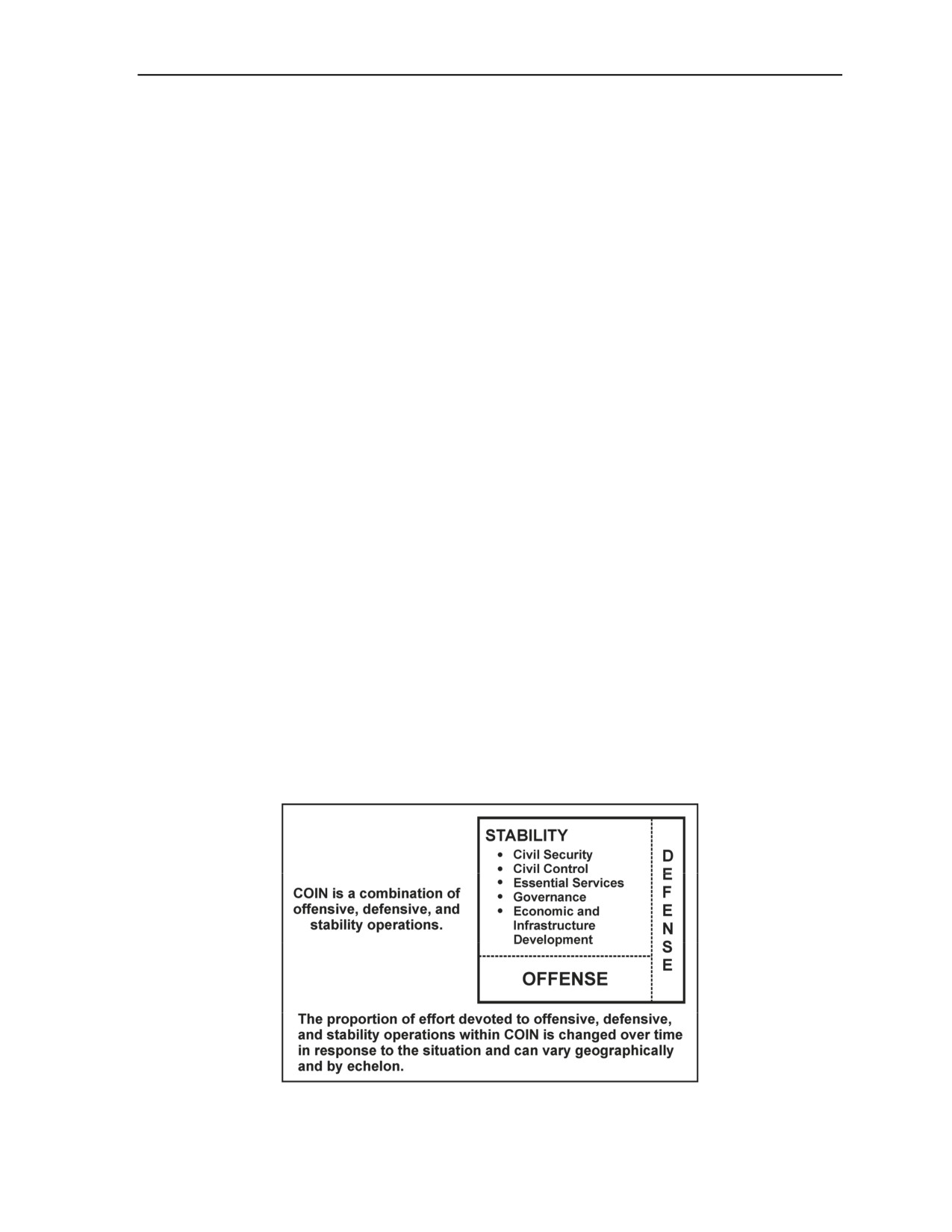
Insurgency and Counterinsurgency
Internal Divisions
1-102. Counterinsurgents remain alert for signs of divisions within an insurgent movement. A series of
successes by counterinsurgents or errors by insurgent leaders can cause some insurgents to question their
cause or challenge their leaders. In addition, relations within an insurgency do not remain harmonious
when factions form to vie for power. Rifts between insurgent leaders, if identified, can be exploited. Of-
fering amnesty or a seemingly generous compromise can also cause divisions within an insurgency and
present opportunities to split or weaken it.
Maintaining Momentum
1-103. Controlling the pace and timing of operations is vital to the success of any insurgency. Insurgents
control when the conflict begins and have some measure of control over subsequent activity. However,
many insurgencies have failed to capitalize on their initial opportunities. Others have allowed counterin-
surgents to dictate the pace of events and scope of activities. If insurgents lose momentum, counterinsur-
gents can regain the strategic initiative.
Informants
1-104. Nothing is more demoralizing to insurgents than realizing that people inside their movement or
trusted supporters among the public are deserting or providing information to government authorities.
Counterinsurgents may attract deserters or informants by arousing fear of prosecution or by offering re-
wards. However, informers must be confident that the government can protect them and their families
against retribution.
ASPECTS OF COUNTERINSURGENCY
1-105. The purpose of America’s ground forces is to fight and win the Nation’s wars. Throughout his-
tory, however, the Army and Marine Corps have been called on to perform many tasks beyond pure com-
bat; this has been particularly true during the conduct of COIN operations. COIN requires Soldiers and
Marines to be ready both to fight and to build—depending on the security situation and a variety of other
factors. The full spectrum operations doctrine (described in FM 3-0) captures this reality.
1-106. All full spectrum operations executed overseas—including COIN operations—include offensive,
defensive, and stability operations that commanders combine to achieve the desired end state. The exact
mix varies depending on the situation and the mission. Commanders weight each operation based on their
assessment of the campaign’s phase and the situation in their AO. They shift the weight among these op-
erations as necessary to address situations in different parts of the AO while continuing to pursue their
overall objectives. (See figure 1-1.)
Figure 1-1. Aspects of counterinsurgency operations
15 December 2006
FM 3-24/MCWP 3-33.5
1-19
Chapter 1
1-107. Offensive and defensive operations are integral to COIN. COIN differs from peacekeeping opera-
tions in this regard; indeed, this is a key point. In peacekeeping operations, combat is not expected and the
goal is an absence of violence. In COIN, such an absence may actually mask insurgent preparations for
combat. This was the case, for example, in the Sadr City area of Baghdad in 2003.
1-108. In almost every case, counterinsurgents face a populace containing an active minority supporting
the government and an equally small militant faction opposing it. Success requires the government to be
accepted as legitimate by most of that uncommitted middle, which also includes passive supporters of
both sides. (See figure 1-2.) Because of the ease of sowing disorder, it is usually not enough for counterin-
surgents to get 51 percent of popular support; a solid majority is often essential. However, a passive popu-
lace may be all that is necessary for a well-supported insurgency to seize political power.
Figure 1-2. Support for an insurgency
1-109. Counterinsurgents must be prepared to identify their opponents and their approach to insurgency.
Counterinsurgents must also understand the broader context within which they are operating. A mission to
assist a functioning government offers different options from situations where no such viable entity exists
or where a regime has been changed by conflict. The last two situations add complex sovereignty and na-
tional reconstruction issues to an already complex mission. The state of the infrastructure determines the
resources required for reconstruction. The level of violence is a factor in determining how agencies out-
side the Department of Defense support COIN operations. An extremely violent environment may hamper
their freedom of movement. These agencies may elect to operate only from secure areas within or outside
of the country.
1-110. The rest of this publication describes how to conduct COIN operations. The following discussion
addresses some general themes that shape the following chapters:
z
Historical principles for COIN.
z
Contemporary imperatives for COIN.
z
Paradoxes of COIN operations.
z
Successful and unsuccessful COIN practices.
1-111. The historical principles and contemporary imperatives derived from the historical record and de-
tailed below provide some guideposts for forces engaged in COIN operations. However, COIN operations
are complicated, and even following the principles and imperatives does not guarantee success. This para-
dox is present in all forms of warfare but is most obvious in COIN. The following principles and impera-
tives are presented in the belief that understanding them helps illuminate the challenges inherent in defeat-
ing an insurgency.
HISTORICAL PRINCIPLES FOR COUNTERINSURGENCY
1-112. The following principles are derived from past insurgencies.
1-20
FM 3-24/MCWP 3-33.5
15 December 2006
Insurgency and Counterinsurgency
Legitimacy Is the Main Objective
1-113. The primary objective of any COIN operation is to foster development of effective governance by
a legitimate government. Counterinsurgents achieve this objective by the balanced application of both
military and nonmilitary means. All governments rule through a combination of consent and coercion.
Governments described as “legitimate” rule primarily with the consent of the governed; those described as
“illegitimate” tend to rely mainly or entirely on coercion. Citizens of the latter obey the state for fear of
the consequences of doing otherwise, rather than because they voluntarily accept its rule. A government
that derives its powers from the governed tends to be accepted by its citizens as legitimate. It still uses co-
ercion—for example, against criminals—but most of its citizens voluntarily accept its governance.
1-114. In Western liberal tradition, a government that derives its just powers from the people and re-
sponds to their desires while looking out for their welfare is accepted as legitimate. In contrast, theocratic
societies fuse political and religious authority; political figures are accepted as legitimate because the
populace views them as implementing the will of God. Medieval monarchies claimed “the divine right of
kings.” Imperial China governed with “the mandate of heaven.” Since the 1979 revolution, Iran has oper-
ated under the “rule of the jurists [theocratic judges].” In other societies, “might makes right.” And some-
times, the ability of a state to provide security—albeit without freedoms associated with Western democ-
racies—can give it enough legitimacy to govern in the people’s eyes, particularly if they have experienced
a serious breakdown of order.
1-115. Legitimacy makes it easier for a state to carry out its key functions. These include the authority to
regulate social relationships, extract resources, and take actions in the public’s name. Legitimate govern-
ments can develop these capabilities more easily; this situation usually allows them to competently man-
age, coordinate, and sustain collective security as well as political, economic, and social development.
Conversely, illegitimate states (sometimes called “police states”) typically cannot regulate society or can
do so only by applying overwhelming coercion. Legitimate governance is inherently stable; the societal
support it engenders allows it to adequately manage the internal problems, change, and conflict that affect
individual and collective well-being. Conversely, governance that is not legitimate is inherently unstable;
as soon as the state’s coercive power is disrupted, the populace ceases to obey it. Thus legitimate govern-
ments tend to be resilient and exercise better governance; illegitimate ones tend to be fragile and poorly
administered.
1-116. Six possible indicators of legitimacy that can be used to analyze threats to stability include the
following:
z
The ability to provide security for the populace (including protection from internal and external
threats).
z
Selection of leaders at a frequency and in a manner considered just and fair by a substantial ma-
jority of the populace.
z
A high level of popular participation in or support for political processes.
z
A culturally acceptable level of corruption.
z
A culturally acceptable level and rate of political, economic, and social development.
z
A high level of regime acceptance by major social institutions.
1-117. Governments scoring high in these categories probably have the support of a sufficient majority of
the population. Different cultures, however, may see acceptable levels of development, corruption, and
participation differently. And for some societies, providing security and some basic services may be
enough for citizens to grant a government legitimacy; indeed, the importance of security in situations
where violence has escalated cannot be overemphasized. In such cases, establishing security can win the
people’s confidence and enable a government to develop legitimacy in other areas.
1-118. In working to understand the problem, commanders and staffs determine what the HN population
defines as effective and legitimate governance. This understanding continues to evolve as information is
developed. Commanders and staffs must continually diagnose what they understand legitimacy to mean to
the HN population. The population’s expectations will influence all ensuing operations. Additionally,
planners may also consider perceptions of legitimacy held by outside supporters of the HN government
and the insurgents. Differences between U.S., local, and international visions of legitimacy can further
15 December 2006
FM 3-24/MCWP 3-33.5
1-21
Chapter 1
complicate operations. But the most important attitude remains that of the HN population. In the end, its
members determine the ultimate victor.
1-119. The presence of the rule of law is a major factor in assuring voluntary acceptance of a govern-
ment’s authority and therefore its legitimacy. A government’s respect for preexisting and impersonal legal
rules can provide the key to gaining it widespread, enduring societal support. Such government respect for
rules—ideally ones recorded in a constitution and in laws adopted through a credible, democratic proc-
ess—is the essence of the rule of law. As such, it is a powerful potential tool for counterinsurgents.
1-120. Military action can address the symptoms of a loss of legitimacy. In some cases, it can eliminate
substantial numbers of insurgents. However, success in the form of a durable peace requires restoring le-
gitimacy, which, in turn, requires the use of all instruments of national power. A COIN effort cannot
achieve lasting success without the HN government achieving legitimacy.
Unity of Effort Is Essential
1-121. Unity of effort must be present at every echelon of a COIN operation. Otherwise, well-intentioned
but uncoordinated actions can cancel each other or provide vulnerabilities for insurgents to exploit. Ide-
ally, a single counterinsurgent leader has authority over all government agencies involved in COIN opera-
tions. Usually, however, military commanders work to achieve unity of effort through liaison with leaders
of a wide variety of nonmilitary agencies. The U.S. Ambassador and country team, along with senior HN
representatives, must be key players in higher level planning; similar connections are needed throughout
the chain of command.
1-122. NGOs often play an important role at the local level. Many such agencies resist being overtly in-
volved with military forces; however, efforts to establish some kind of liaison are needed. The most im-
portant connections are those with joint, interagency, multinational, and HN organizations. The goal of
these connections is to ensure that, as much as possible, objectives are shared and actions and messages
synchronized. Achieving this synergy is essential.
Political Factors Are Primary
1-123. General Chang Ting-chen of Mao Zedong’s central committee once stated that revolutionary war
was 80 percent political action and only 20 percent military. Such an assertion is arguable and certainly
depends on the insurgency’s stage of development; it does, however, capture the fact that political factors
have primacy in COIN. At the beginning of a COIN operation, military actions may appear predominant
as security forces conduct operations to secure the populace and kill or capture insurgents; however, po-
litical objectives must guide the military’s approach. Commanders must, for example, consider how op-
erations contribute to strengthening the HN government’s legitimacy and achieving U.S. political goals.
This means that political and diplomatic leaders must actively participate throughout the conduct (plan-
ning, preparation, execution, and assessment) of COIN operations. The political and military aspects of
insurgencies are so bound together as to be inseparable. Most insurgent approaches recognize that fact.
Military actions executed without properly assessing their political effects at best result in reduced effec-
tiveness and at worst are counterproductive. Resolving most insurgencies requires a political solution; it is
thus imperative that counterinsurgent actions do not hinder achieving that political solution.
Counterinsurgents Must Understand the Environment
1-124. Successful conduct of COIN operations depends on thoroughly understanding the society and cul-
ture within which they are being conducted. Soldiers and Marines must understand the following about
the population in the AO:
z
Organization of key groups in the society.
z
Relationships and tensions among groups.
z
Ideologies and narratives that resonate with groups.
z
Values of groups (including tribes), interests, and motivations.
z
Means by which groups (including tribes) communicate.
1-22
FM 3-24/MCWP 3-33.5
15 December 2006
Insurgency and Counterinsurgency
z
The society’s leadership system.
1-125. In most COIN operations in which U.S. forces participate, insurgents hold a distinct advantage in
their level of local knowledge. They speak the language, move easily within the society, and are more
likely to understand the population’s interests. Thus, effective COIN operations require a greater empha-
sis on certain skills, such as language and cultural understanding, than does conventional warfare. The in-
terconnected, politico-military nature of insurgency and COIN requires immersion in the people and their
lives to achieve victory. Specifically, successful COIN operations require Soldiers and Marines at every
echelon to possess the following within the AO’s cultural context:
z
A clear appreciation of the essential nature and nuances of the conflict.
z
An understanding of the motivation, strengths, and weaknesses of the insurgents.
z
Knowledge of the roles of other actors in the AO.
Without this understanding of the environment, intelligence cannot be understood and properly applied.
Intelligence Drives Operations
1-126. Without good intelligence, counterinsurgents are like blind boxers wasting energy flailing at un-
seen opponents and perhaps causing unintended harm. With good intelligence, counterinsurgents are like
surgeons cutting out cancerous tissue while keeping other vital organs intact. Effective operations are
shaped by timely, specific, and reliable intelligence, gathered and analyzed at the lowest possible level
and disseminated throughout the force.
1-127. Because of the dispersed nature of COIN operations, counterinsurgents’ own actions are a key
generator of intelligence. A cycle develops where operations produce intelligence that drives subsequent
operations. Reporting by units, members of the country team, and associated civilian agencies is often of
greater importance than reporting by specialized intelligence assets. These factors, along with the need to
generate a favorable tempo (rate of military operations), drive the requirement to produce and disseminate
intelligence at the lowest practical level. (Chapter 3 addresses intelligence in COIN.)
Insurgents Must be Isolated from Their Cause and Support
1-128. It is easier to separate an insurgency from its resources and let it die than to kill every insurgent.
Clearly, killing or capturing insurgents will be necessary, especially when an insurgency is based in reli-
gious or ideological extremism. However, killing every insurgent is normally impossible. Attempting to
do so can also be counterproductive in some cases; it risks generating popular resentment, creating mar-
tyrs that motivate new recruits, and producing cycles of revenge.
1-129. Dynamic insurgencies can replace losses quickly. Skillful counterinsurgents must thus cut off the
sources of that recuperative power. Some sources can be reduced by redressing the social, political, and
economic grievances that fuel the insurgency. Physical support can be cut off by population control or
border security. International or local legal action might be required to limit financial support. Urban in-
surgents, however, are especially difficult to isolate from their cause and sources of support. They may
operate in small, compartmentalized cells that are usually independent or semi-independent. These cells
often have their own support mechanisms and few, if any, ties to the population that counterinsurgents can
track.
1-130. As the HN government increases its legitimacy, the populace begins to assist it more actively.
Eventually, the people marginalize and stigmatize insurgents to the point that the insurgency’s claim to
legitimacy is destroyed. However, victory is gained not when this isolation is achieved, but when the victory
is permanently maintained by and with the people’s active support and when insurgent forces have been
defeated.
Security Under the Rule of Law is Essential
1-131. The cornerstone of any COIN effort is establishing security for the civilian populace. Without a
secure environment, no permanent reforms can be implemented and disorder spreads. To establish legiti-
macy, commanders transition security activities from combat operations to law enforcement as quickly as
15 December 2006
FM 3-24/MCWP 3-33.5
1-23
Chapter 1
feasible. When insurgents are seen as criminals, they lose public support. Using a legal system established
in line with local culture and practices to deal with such criminals enhances the HN government’s legiti-
macy. Soldiers and Marines help establish HN institutions that sustain that legal regime, including police
forces, court systems, and penal facilities. It is important to remember that the violence level must be re-
duced enough for police forces to maintain order prior to any transition; otherwise, COIN forces will be
unable to secure the populace and may lose the legitimacy gained by the transition.
1-132. Illegitimate actions are those involving the use of power without authority—whether committed
by government officials, security forces, or counterinsurgents. Such actions include unjustified or exces-
sive use of force, unlawful detention, torture, and punishment without trial. Efforts to build a legitimate
government though illegitimate actions are self-defeating, even against insurgents who conceal them-
selves amid noncombatants and flout the law. Moreover, participation in COIN operations by U.S. forces
must follow United States law, including domestic laws, treaties to which the United States is party, and
certain HN laws. (See appendix D.) Any human rights abuses or legal violations committed by U.S. forces
quickly become known throughout the local populace and eventually around the world. Illegitimate ac-
tions undermine both long- and short-term COIN efforts.
1-133. Every action by counterinsurgents leaves a “forensic trace” that may be required sometime later in
a court of law. Counterinsurgents document all their activities to preserve, wherever possible, a chain of
evidence. Accurate documentation can also be an important means to counter insurgent propaganda.
Counterinsurgents Should Prepare for a Long-Term Commitment
1-134. Insurgencies are protracted by nature. Thus, COIN operations always demand considerable expen-
ditures of time and resources. The populace may prefer the HN government to the insurgents; however,
people do not actively support a government unless they are convinced that the counterinsurgents have the
means, ability, stamina, and will to win. The insurgents’ primary battle is against the HN government, not
the United States; however, U.S. support can be crucial to building public faith in that government’s vi-
ability. The populace must have confidence in the staying power of both the counterinsurgents and the
HN government. Insurgents and local populations often believe that a few casualties or a few years will
cause the United States to abandon a COIN effort. Constant reaffirmations of commitment, backed by
deeds, can overcome that perception and bolster faith in the steadfastness of U.S. support. But even the
strongest U.S. commitment will not succeed if the populace does not perceive the HN government as hav-
ing similar will and stamina. U.S. forces must help create that capacity and sustain that impression.
1-135. Preparing for a protracted COIN effort requires establishing headquarters and support structures
designed for long-term operations. Planning and commitments should be based on sustainable operating
tempo and personnel tempo limits for the various components of the force. (Operating tempo and person-
nel tempo are defined in the glossary.) Even in situations where the U.S. goal is reducing its military force
levels as quickly as possible, some support for HN institutions usually remains for a long time.
1-136. At the strategic level, gaining and maintaining U.S. public support for a protracted deployment is
critical. Only the most senior military officers are involved in this process at all. It is properly a political
activity. However, military leaders typically take care to ensure that their actions and statements are forth-
right. They also ensure that the conduct of operations neither makes it harder for elected leaders to main-
tain public support nor undermines public confidence.
CONTEMPORARY IMPERATIVES OF COUNTERINSURGENCY
1-137. Recent COIN experiences have identified an important set of additional imperatives to keep in
mind for success.
Manage Information and Expectations
1-138. Information and expectations are related; skillful counterinsurgents manage both. To limit discon-
tent and build support, the HN government and any counterinsurgents assisting it create and maintain a
realistic set of expectations among the populace, friendly military forces, and the international commu-
nity. IO (including psychological operations and the related activities of public affairs and civil-military
1-24
FM 3-24/MCWP 3-33.5
15 December 2006
Insurgency and Counterinsurgency
operations) are key tools to accomplish this. Achieving steady progress toward a set of reasonable expec-
tations can increase the populace’s tolerance for the inevitable inconveniences entailed by ongoing COIN
operations. Where a large U.S. force is present to help establish a regime, such progress can extend the
period before an army of liberation becomes perceived as an army of occupation.
1-139. U.S. forces start with a built-in challenge because of their reputation for accomplishment, what
some call the “man on the moon syndrome.” This refers to the expressed disbelief that a nation able to put
a man on the moon cannot quickly restore basic services. U.S. agencies trying to fan enthusiasm for their
efforts should avoid making unrealistic promises. In some cultures, failure to deliver promised results is
automatically interpreted as deliberate deception, rather than good intentions gone awry. In other cultures,
exorbitant promises are normal and people do not expect them to be kept. Effective counterinsurgents un-
derstand local norms; they use locally tailored approaches to control expectations. Managing expectations
also involves demonstrating economic and political progress to show the populace how life is improving.
Increasing the number of people who feel they have a stake in the success of the state and its government
is a key to successful COIN operations. In the end, victory comes, in large measure, by convincing the
populace that their life will be better under the HN government than under an insurgent regime.
1-140. Both counterinsurgents and the HN government ensure that their deeds match their words. They
also understand that any action has an information reaction. Counterinsurgents and the HN government
carefully consider that impact on the many audiences involved in the conflict and on the sidelines. They
work actively to shape responses that further their ends. In particular, messages to different audiences
must be consistent. In the global information environment, people in the AO can access the Internet and
satellite television to determine the messages counterinsurgents are sending to the international commu-
nity and the U.S. public. Any perceived inconsistency reduces credibility and undermines COIN efforts.
Use the Appropriate Level of Force
1-141. Any use of force generates a series of reactions. There may be times when an overwhelming effort
is necessary to destroy or intimidate an opponent and reassure the populace. Extremist insurgent combat-
ants often have to be killed. In any case, however, counterinsurgents should calculate carefully the type
and amount of force to be applied and who wields it for any operation. An operation that kills five insur-
gents is counterproductive if collateral damage leads to the recruitment of fifty more insurgents.
1-142. In a COIN environment, it is vital for commanders to adopt appropriate and measured levels of
force and apply that force precisely so that it accomplishes the mission without causing unnecessary loss
of life or suffering. Normally, counterinsurgents can use escalation of force/force continuum procedures
to minimize potential loss of life. These procedures are especially appropriate during convoy operations
and at checkpoints and roadblocks. Escalation of force (Army)/force continuum (Marine Corps) refers to
using lesser means of force when such use is likely to achieve the desired effects and Soldiers and Ma-
rines can do so without endangering themselves, others, or mission accomplishment. Escalation of
force/force continuum procedures do not limit the right of self-defense, including the use of deadly force
when such force is necessary to defend against a hostile act or demonstrated hostile intent. Commanders
ensure that their Soldiers and Marines are properly trained in such procedures and, more importantly, in
methods of shaping situations so that small-unit leaders have to make fewer split-second, life-or-death de-
cisions.
1-143. Who wields force is also important. If the HN police have a reasonable reputation for competence
and impartiality, it is better for them to execute urban raids; the populace is likely to view that application
of force as more legitimate. This is true even if the police are not as well armed or as capable as military
units. However, local circumstances affect this decision. If the police are seen as part of an ethnic or sec-
tarian group oppressing the general population, their use may be counterproductive. Effective counterin-
surgents thus understand the character of the local police and popular perceptions of both police and mili-
tary units. This understanding helps ensure that the application of force is appropriate and reinforces the
rule of law.
15 December 2006
FM 3-24/MCWP 3-33.5
1-25
Chapter 1
Learn and Adapt
1-144. An effective counterinsurgent force is a learning organization. Insurgents constantly shift between
military and political phases and tactics. In addition, networked insurgents constantly exchange informa-
tion about their enemy’s vulnerabilities—even with insurgents in distant theaters. However, skillful coun-
terinsurgents can adapt at least as fast as insurgents. Every unit needs to be able to make observations,
draw and apply lessons, and assess results. Commanders must develop an effective system to circulate
best practices throughout their command. Combatant commanders might also need to seek new laws or
policies that authorize or resource necessary changes. Insurgents shift their AOs looking for weak links,
so widespread competence is required throughout the counterinsurgent force.
Empower the Lowest Levels
1-145. Mission command is the conduct of military operations through decentralized execution based
upon mission orders for effective mission accomplishment. Successful mission command results from
subordinate leaders at all echelons exercising disciplined initiative within the commander’s intent to ac-
complish missions. It requires an environment of trust and mutual understanding (FM 6-0). It is the
Army’s and Marine Corps’ preferred method for commanding and controlling forces during all types of
operations. Under mission command, commanders provide subordinates with a mission, their com-
mander’s intent, a concept of operations, and resources adequate to accomplish the mission. Higher com-
manders empower subordinates to make decisions within the commander’s intent. They leave details of
execution to their subordinates and expect them to use initiative and judgment to accomplish the mission.
1-146. Mission command is ideally suited to the mosaic nature of COIN operations. Local commanders
have the best grasp of their situations. Under mission command, they are given access to or control of the
resources needed to produce timely intelligence, conduct effective tactical operations, and manage IO and
civil-military operations. Thus, effective COIN operations are decentralized, and higher commanders owe
it to their subordinates to push as many capabilities as possible down to their level. Mission command en-
courages the initiative of subordinates and facilitates the learning that must occur at every level. It is a ma-
jor characteristic of a COIN force that can adapt and react at least as quickly as the insurgents.
Support the Host Nation
1-147. U.S. forces committed to a COIN effort are there to assist a HN government. The long-term goal is
to leave a government able to stand by itself. In the end, the host nation has to win on its own. Achieving
this requires development of viable local leaders and institutions. U.S. forces and agencies can help, but
HN elements must accept responsibilities to achieve real victory. While it may be easier for U.S. military
units to conduct operations themselves, it is better to work to strengthen local forces and institutions and
then assist them. HN governments have the final responsibility to solve their own problems. Eventually all
foreign armies are seen as interlopers or occupiers; the sooner the main effort can transition to HN institu-
tions, without unacceptable degradation, the better.
PARADOXES OF COUNTERINSURGENCY OPERATIONS
1-148. The principles and imperatives discussed above reveal that COIN presents a complex and often
unfamiliar set of missions and considerations. In many ways, the conduct of COIN is counterintuitive to
the traditional U.S. view of war—although COIN operations have actually formed a substantial part of the
U.S. military experience. Some representative paradoxes of COIN are presented here as examples of the
different mindset required. These paradoxes are offered to stimulate thinking, not to limit it. The applica-
bility of the thoughts behind the paradoxes depends on a sense of the local situation and, in particular, the
state of the insurgency. For example, the admonition “Sometimes, the More Force Used, the Less Effec-
tive It Is” does not apply when the enemy is “coming over the barricades”; however, that thought is appli-
cable when increased security is achieved in an area. In short, these paradoxes should not be reduced to a
checklist; rather, they should be used with considerable thought.
1-26
FM 3-24/MCWP 3-33.5
15 December 2006
Insurgency and Counterinsurgency
Sometimes, the More You Protect Your Force, the Less Secure You May Be
1-149. Ultimate success in COIN is gained by protecting the populace, not the COIN force. If military
forces remain in their compounds, they lose touch with the people, appear to be running scared, and cede
the initiative to the insurgents. Aggressive saturation patrolling, ambushes, and listening post operations
must be conducted, risk shared with the populace, and contact maintained. The effectiveness of establish-
ing patrol bases and operational support bases should be weighed against the effectiveness of using larger
unit bases. (FM 90-8 discusses saturation patrolling and operational support bases.) These practices en-
sure access to the intelligence needed to drive operations. Following them reinforces the connections with
the populace that help establish real legitimacy.
Sometimes, the More Force Is Used, the Less Effective It Is
1-150. Any use of force produces many effects, not all of which can be foreseen. The more force applied,
the greater the chance of collateral damage and mistakes. Using substantial force also increases the oppor-
tunity for insurgent propaganda to portray lethal military activities as brutal. In contrast, using force pre-
cisely and discriminately strengthens the rule of law that needs to be established. As noted above, the key
for counterinsurgents is knowing when more force is needed—and when it might be counterproductive.
This judgment involves constant assessment of the security situation and a sense of timing regarding in-
surgents’ actions.
The More Successful the Counterinsurgency Is, the Less Force Can Be Used and the More Risk
Must Be Accepted
1-151. This paradox is really a corollary to the previous one. As the level of insurgent violence drops, the
requirements of international law and the expectations of the populace lead to a reduction in direct mili-
tary actions by counterinsurgents. More reliance is placed on police work, rules of engagement may be
tightened, and troops may have to exercise increased restraint. Soldiers and Marines may also have to ac-
cept more risk to maintain involvement with the people.
Sometimes Doing Nothing Is the Best Reaction
1-152. Often insurgents carry out a terrorist act or guerrilla raid with the primary purpose of enticing
counterinsurgents to overreact, or at least to react in a way that insurgents can exploit—for example,
opening fire on a crowd or executing a clearing operation that creates more enemies than it takes off the
streets. If an assessment of the effects of a course of action determines that more negative than positive ef-
fects may result, an alternative should be considered—potentially including not acting.
Some of the Best Weapons for Counterinsurgents Do Not Shoot
1-153. Counterinsurgents often achieve the most meaningful success in garnering public support and le-
gitimacy for the HN government with activities that do not involve killing insurgents (though, again, kill-
ing clearly will often be necessary). Arguably, the decisive battle is for the people’s minds; hence syn-
chronizing IO with efforts along the other LLOs is critical. Every action, including uses of force, must be
“wrapped in a bodyguard of information.” While security is essential to setting the stage for overall pro-
gress, lasting victory comes from a vibrant economy, political participation, and restored hope. Particu-
larly after security has been achieved, dollars and ballots will have more important effects than bombs and
bullets. This is a time when “money is ammunition.” Depending on the state of the insurgency, therefore,
Soldiers and Marines should prepare to execute many nonmilitary missions to support COIN efforts. Eve-
ryone has a role in nation building, not just Department of State and civil affairs personnel.
The Host Nation Doing Something Tolerably Is Normally Better than Us Doing It Well
1-154. It is just as important to consider who performs an operation as to assess how well it is done.
Where the United States is supporting a host nation, long-term success requires establishing viable HN
leaders and institutions that can carry on without significant U.S. support. The longer that process takes,
the more U.S. public support will wane and the more the local populace will question the legitimacy of
15 December 2006
FM 3-24/MCWP 3-33.5
1-27
Chapter 1
their own forces and government. General Creighton Abrams, the U.S. commander in Vietnam in 1971,
recognized this fact when he said, “There’s very clear evidence,…in some things, that we helped too
much. And we retarded the Vietnamese by doing it.…We can’t run this thing.…They’ve got to run it. The
nearer we get to that the better off they are and the better off we are.” T.E. Lawrence made a similar ob-
servation while leading the Arab Revolt against the Ottoman Empire in 1917: “Do not try to do too much
with your own hands. Better the Arabs do it tolerably than that you do it perfectly. It is their war, and you
are to help them, not to win it for them.” However, a key word in Lawrence’s advice is “tolerably.” If the
host nation cannot perform tolerably, counterinsurgents supporting it may have to act. Experience, knowl-
edge of the AO, and cultural sensitivity are essential to deciding when such action is necessary.
If a Tactic Works this Week, It Might Not Work Next Week; If It Works in this Province, It
Might Not Work in the Next
1-155. Competent insurgents are adaptive. They are often part of a widespread network that communi-
cates constantly and instantly. Insurgents quickly adjust to successful COIN practices and rapidly dis-
seminate information throughout the insurgency. Indeed, the more effective a COIN tactic is, the faster it
may become out of date because insurgents have a greater need to counter it. Effective leaders at all levels
avoid complacency and are at least as adaptive as their enemies. There is no “silver bullet” set of COIN
procedures. Constantly developing new practices is essential.
Tactical Success Guarantees Nothing
1-156. As important as they are in achieving security, military actions by themselves cannot achieve suc-
cess in COIN. Insurgents that never defeat counterinsurgents in combat still may achieve their strategic
objectives. Tactical actions thus must be linked not only to strategic and operational military objectives
but also to the host nation’s essential political goals. Without those connections, lives and resources may
be wasted for no real gain.
Many Important Decisions Are Not Made by Generals
1-157. Successful COIN operations require competence and judgment by Soldiers and Marines at all lev-
els. Indeed, young leaders—so-called “strategic corporals”—often make decisions at the tactical level that
have strategic consequences. Senior leaders set the proper direction and climate with thorough training
and clear guidance; then they trust their subordinates to do the right thing. Preparation for tactical-level
leaders requires more than just mastering Service doctrine; they must also be trained and educated to
adapt to their local situations, understand the legal and ethical implications of their actions, and exercise
initiative and sound judgment in accordance with their senior commanders’ intent.
SUCCESSFUL AND UNSUCCESSFUL COUNTERINSURGENCY PRACTICES
1-158. Table 1-1 lists some practices that have contributed significantly to success or failure in past coun-
terinsurgencies.
SUMMARY
1-159. COIN is an extremely complex form of warfare. At its core, COIN is a struggle for the popula-
tion’s support. The protection, welfare, and support of the people are vital to success. Gaining and main-
taining that support is a formidable challenge. Achieving these aims requires synchronizing the efforts of
many nonmilitary and HN agencies in a comprehensive approach.
1-160. Designing operations that achieve the desired end state requires counterinsurgents to understand
the culture and the problems they face. Both insurgents and counterinsurgents are fighting for the support
of the populace. However, insurgents are constrained by neither the law of war nor the bounds of human
decency as Western nations understand them. In fact, some insurgents are willing to commit suicide and
kill innocent civilians in carrying out their operations—and deem this a legitimate option. They also will
do anything to preserve their greatest advantage, the ability to hide among the people. These amoral and
1-28
FM 3-24/MCWP 3-33.5
15 December 2006
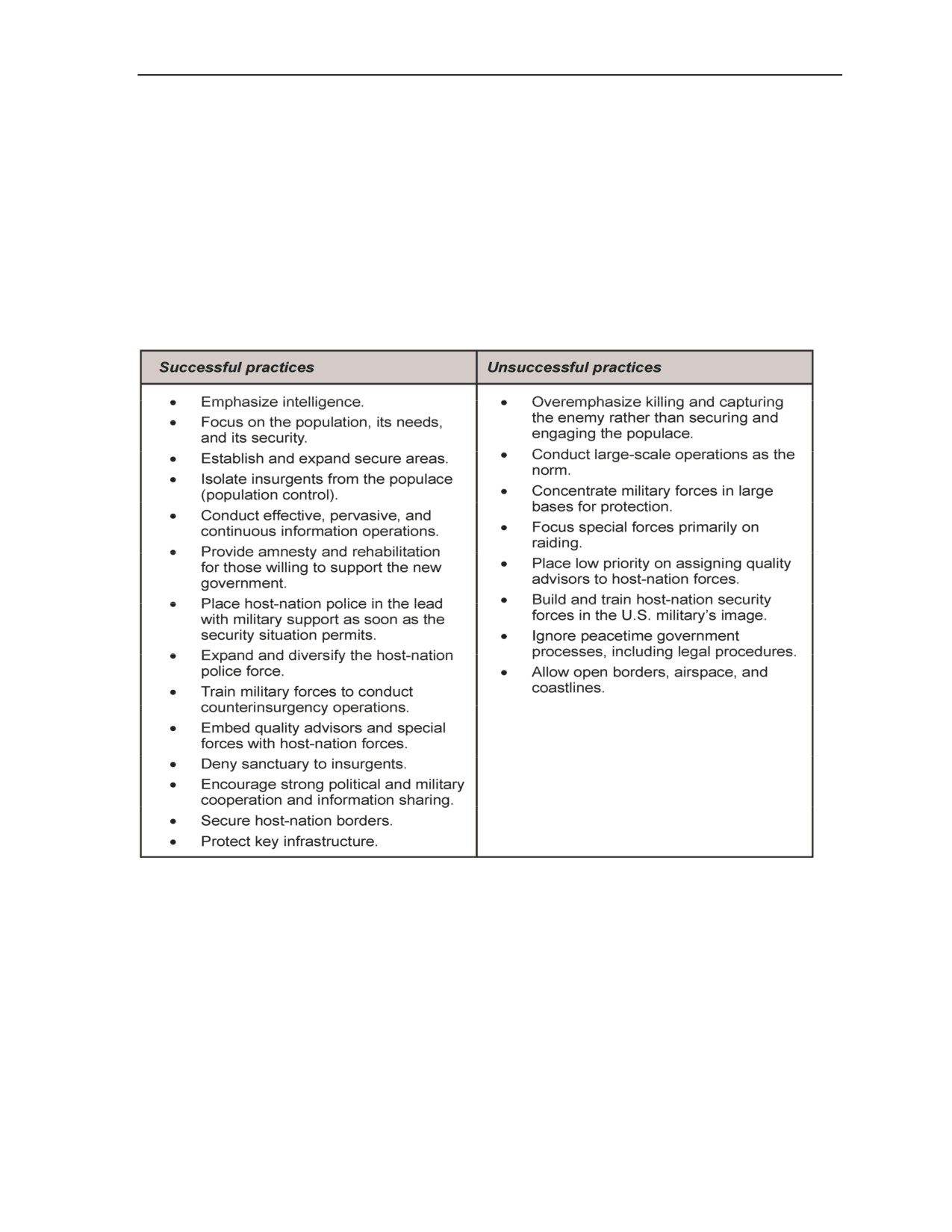
Insurgency and Counterinsurgency
often barbaric enemies survive by their wits, constantly adapting to the situation. Defeating them requires
counterinsurgents to develop the ability to learn and adapt rapidly and continuously. This manual empha-
sizes this “Learn and Adapt” imperative as it discusses ways to gain and maintain the support of the peo-
ple.
1-161. Popular support allows counterinsurgents to develop the intelligence necessary to identify and de-
feat insurgents. Designing and executing a comprehensive campaign to secure the populace and then gain
its support requires carefully coordinating actions along several LLOs over time to produce success. One
of these LLOs is developing HN security forces that can assume primary responsibility for combating the
insurgency. COIN operations also place distinct burdens on leaders and logisticians. All of these aspects
of COIN are described and analyzed in the chapters that follow.
Table 1-1. Successful and unsuccessful counterinsurgency operational practices
15 December 2006
FM 3-24/MCWP 3-33.5
1-29
This page intentionally left blank.
///////////////////////////////////////