FM 3-24 COUNTERINSURGENCY (DECEMBER 2006) - page 3
Chapter 3
connaissance by patrols allows commanders to fill intelligence gaps and develop relationships with local
leaders, while simultaneously providing security to the populace.
3-140. Covert reconnaissance and surveillance operations employing scouts or concealed observation
posts are often ineffective in places where the populace is alert and suspicious of outsiders. Such places in-
clude urban areas, suburban areas, and close-knit communities. In those places, it is very difficult for
scouts to conduct reconnaissance or surveillance without being observed by insurgents or people who may
tip off insurgents. Reconnaissance of a target may be noticed and cause insurgents to leave the area. Like-
wise, small groups of scouts may be attractive targets for insurgent attacks if the scouts’ location is known.
For these reasons, using a HUMINT network or aerial imagery platforms is often preferable to ground re-
connaissance and surveillance. Successful ground reconnaissance in populated areas requires leaders to be
creative in how they establish observation posts. One technique is for dismounted night patrols to leave a
small “stay behind” observation post while the rest of a patrol moves on. Another effective technique is se-
cretly photographing a place of interest while driving by it. However, commanders must weigh the benefits
of these operations with the potential cost of insurgents receiving early warning of counterinsurgent inten-
tions.
CONSIDERATIONS FOR OTHER INTELLIGENCE DISCIPLINES
3-141. An intelligence discipline is a well-defined area of intelligence collection, processing, exploitation,
and reporting using a specific category of technical or human resources (JP 1-02). HUMINT is one of these
disciplines. The following discussion addresses COIN-specific considerations for other selected intelli-
gence disciplines and information types. Because of their importance to COIN, counterintelligence is cov-
ered separately in section IV and all-source analysis in section V.
SIGNALS INTELLIGENCE
3-142. In conventional environments, signals intelligence (SIGINT) collection is a good source for de-
termining enemy locations, intentions, capabilities, and morale. The same applies in COIN operations.
SIGINT is often helpful for confirming or denying HUMINT reporting and may be the primary source of
intelligence in areas under insurgent control. Pushing SIGINT collection platforms down to tactical units
can therefore improve intelligence collection.
OPEN-SOURCE INTELLIGENCE
3-143. Open-source intelligence (OSINT) is valuable for understanding the operational environment. It is
often more useful than any other discipline for understanding public attitudes and public support for insur-
gents and counterinsurgents. OSINT is also an important means of determining the effectiveness of IO.
Monitoring a wide variety of media in multiple languages benefits the COIN effort. If possible, monitoring
should occur at every echelon with collection requirements. Each echelon should monitor the media that
contain information relevant to operations at that echelon. For instance, reporting by major news networks
often matters a lot at the combatant command level; in contrast, local newspapers or radio stations may be
more important to tactical units.
IMAGERY INTELLIGENCE
3-144. In COIN operations, imagery intelligence (IMINT) platforms may be used for surveillance of
likely insurgent safe houses and other facilities. Further, aerial IMINT platforms are also effective at de-
tecting unusual personnel and supply movements. This information can help commanders determine where
best to interdict insurgent lines of communications.
3-145. Static imagery, such as aerial photos of facilities, is useful for detecting long-term changes in
structures or activities.
3-146. Real-time video, often from aerial surveillance platforms, is critical to assessing whether particular
locations are likely sites of insurgent activity. This capability may also be used to track insurgents during
3-28
FM 3-24/MCWP 3-33.5
15 December 2006
Intelligence in Counterinsurgency
operations. If flown high enough that insurgents cannot hear the platform, real-time video provides surveil-
lance in areas where it is difficult or impossible to use observation posts.
TECHNICAL INTELLIGENCE
3-147. Insurgents often adapt their tactics, techniques, and procedures rapidly. Technical intelligence on
insurgent equipment can help understand insurgent capabilities. These may include how insurgents are us-
ing improvised explosive devices, homemade mortars, and other pieces of customized military equipment.
MEASUREMENT AND SIGNATURES INTELLIGENCE
3-148. Measurement and signature intelligence (MASINT) sensors can provide remote monitoring of ave-
nues of approach or border regions for smugglers or insurgents. They can also be used to locate insurgent
safe havens and cache sites and determining insurgent activities and capabilities. MASINT can also con-
tribute to targeting.
GEOSPATIAL INTELLIGENCE
3-149. Geospatial intelligence (GEOINT) is the exploitation and analysis of imagery and geospatial in-
formation to describe, assess, and visually depict physical features and geographically referenced activities
on the Earth. GEOINT consists of imagery, IMINT, and geospatial information. GEOINT may have some
benefit for identifying smuggling routes and safe havens. Imagery can be very beneficial to operations in
urban areas as well. It can help identify structures of interest and aid urban terrain navigation. (Paragraphs
B-5 through B-9 contain more GEOINT-related information.)
INTELLIGENCE-RELATED ACTIVITIES
3-150. There are several activities and information sources important to COIN that are not intelligence
disciplines but are related to them. Chief among these are target exploitation (TAREX), document exploita-
tion (DOCEX), property ownership records, and financial records.
Target Exploitation and Document Exploitation
3-151. Documents and pocket litter, as well as information found in computers and cell phones, can pro-
vide critical information that analysts need to evaluate insurgent organizations, capabilities, and intentions.
TAREX and DOCEX are also of great benefit to HUMINT collectors in substantiating what detainees
know and whether they are telling the truth.
3-152. TAREX in a COIN environment is like evidence collection in a law enforcement environment.
Procedures that ensure captured equipment and documents are tracked accurately and attached to the cor-
rect insurgents is necessary. Evidence needs to be enough to justify using operational resources to appre-
hend the individuals in question; however, it does not necessarily need be enough to convict in a court of
law. Pushing HUMINT or law enforcement personnel to the battalion level and below can improve
TAREX and DOCEX by tactical units. Procedures for ensuring that tactical units get the results of higher
level TAREX and DOCEX are also important. Units must be able to receive intelligence collected from the
documents, equipment, and personnel they capture in enough time to exploit it.
Property Ownership Records
3-153. Property ownership records include census records, deeds, and other means of determining owner-
ship of land and buildings. They help counterinsurgents to determine who should or should not be living in
a specific area and help them secure the populace. In some cases, it may be necessary for Soldiers and Ma-
rines to go door to door and collect census data themselves.
15 December 2006
FM 3-24/MCWP 3-33.5
3-29
Chapter 3
Financial Records
3-154. Information gathered on sources of insurgent funding can be very helpful to the COIN effort. Col-
lection of financial records often requires help from agencies like the Department of the Treasury and fi-
nancial institutions. It may also require analyzing criminal activities or traditional means of currency trans-
fer.
SECTION IV - COUNTERINTELLIGENCE AND COUNTERRECONNAISSANCE
3-155. Counterintelligence counters or neutralizes intelligence collection efforts through collection, coun-
terintelligence investigations, operations, analysis and production, and functional and technical services.
Counterintelligence includes all actions taken to detect, identify, exploit, and neutralize the multidiscipline
intelligence activities of friends, competitors, opponents, adversaries, and enemies.
3-156. Insurgents place heavy emphasis on gathering intelligence. They use informants, double agents,
reconnaissance, surveillance, open-source media, and open-source imagery. Insurgents can potentially use
any person interacting with U.S. or multinational personnel as an informant. These include the same people
that U.S. forces use as potential HUMINT sources. Operations security is thus very important; U.S. per-
sonnel must carefully screen the contractors, informants, translators, and other personnel working with
them. Failure to do so can result in infiltration of U.S. facilities and deaths of U.S. personnel and their part-
ners.
3-157. Background screenings should include collection of personal and biometric data and a search
through available reporting databases to determine whether the person is an insurgent. (Biometrics con-
cerns the measurement and analysis of unique physical or behavioral characteristics [as fingerprint or voice
patterns].) Identification badges may be useful for providing security and personnel accountability for local
people working on U.S. and HN government facilities. Biometric data is preferable, when available, be-
cause identification badges may be forged or stolen and insurgents can use them to identify people working
with the HN government.
3-158. Insurgents have their own reconnaissance and surveillance networks. Because they usually blend
well with the populace, insurgents can execute reconnaissance without easily being identified. They also
have an early warning system composed of citizens who inform them of counterinsurgent movements.
Identifying the techniques and weaknesses of enemy reconnaissance and surveillance enables commanders
to detect signs of insurgent preparations and to surprise insurgents by neutralizing their early warning sys-
tems.
3-159. Insurgents may also have a SIGINT capability based on commercially available scanners and ra-
dios, wiretaps, or captured counterinsurgent equipment. Counterinsurgents should not use commercial ra-
dios or phones because insurgents can collect information from them. If Soldiers and Marines must use
commercial equipment or unencrypted communications, they should employ authorized brevity codes to
reduce insurgents’ ability to collect on them.
SECTION V - ALL-SOURCE INTELLIGENCE
3-160. Joint doctrine defines all-source intelligence as products and/or organizations and activities that
incorporate all sources of information, most frequently including human resources intelligence, imagery in-
telligence, measurement and signature intelligence, signals intelligence, and open-source data in the pro-
duction of finished intelligence (JP 1-02). Intelligence organizations fuse data and information into all-
source intelligence products to support COIN operations. Analysis for COIN operations is very challeng-
ing, due in part to the—
z
Need to understand perceptions and culture.
z
Need to track hundreds or thousands of personalities.
z
Local nature of insurgencies.
z
Tendency of insurgencies to change over time.
3-30
FM 3-24/MCWP 3-33.5
15 December 2006
Intelligence in Counterinsurgency
3-161. Databases are very important for analyzing insurgent activities and personalities. At a minimum,
there should be common searchable combatant command databases of insurgent actions and personnel, as
well as another database of all intelligence reporting. These should be accessible by analysts in and out of
theater. The common operational picture should include reporting from all units and organizations involved
in the effort.
3-162. Because all echelons collect and use intelligence, all staffs are heavily involved in analysis. Units
are simultaneously intelligence producers and consumers. This situation is normal at brigade and above;
however, battalion staffs often do not have the personnel to collect patrol debriefs, analyze incoming in-
formation from multiple sources, produce finished intelligence products, and disseminate products to appro-
priate consumers. In many cases brigade intelligence sections may also be inadequate for a COIN environ-
ment.
3-163. COIN requirements may require pushing analysts to battalion and brigade staffs to give those
echelons the required analytical support. There are also instances when analysts can be beneficial at the
company level. This is the case when a maneuver company must collect large amounts of information on
the local populace and insurgents. An analyst can help collect and process this information and develop an
operational picture of the AO. Pushing analysts to brigade level and below places analysts closer to collec-
tors, improves the common operational picture, and helps higher echelon staffs receive answers to their
PIRs. Commanders may need to be creative in developing analytical capabilities within their units. Though
it is not ideal, commanders have assigned nonintelligence personnel to work in the intelligence section.
3-164. Analysis at brigade and below is the basis for operational-level intelligence. This is due to the bot-
tom-up flow of intelligence in COIN. Battalions and brigades develop intelligence for their AOs; higher
echelons fuse it into combatant-command-wide intelligence of the insurgency. Operational-level intelligence
adds information about national and international politics and their effects on the operational environment.
3-165. Analysis of enemy actions and comprehensive insurgency analysis are done at battalion level and
above. These processes build on IPB and use the tools discussed in appendix B. Analysis of enemy actions,
commonly called current operations, focuses on what the enemy is doing now. Comprehensive insurgency
analysis focuses on the people in the AO. It develops information about relationships among them and the
ideas and beliefs driving their actions. Comprehensive insurgency analysis brings together all other forms
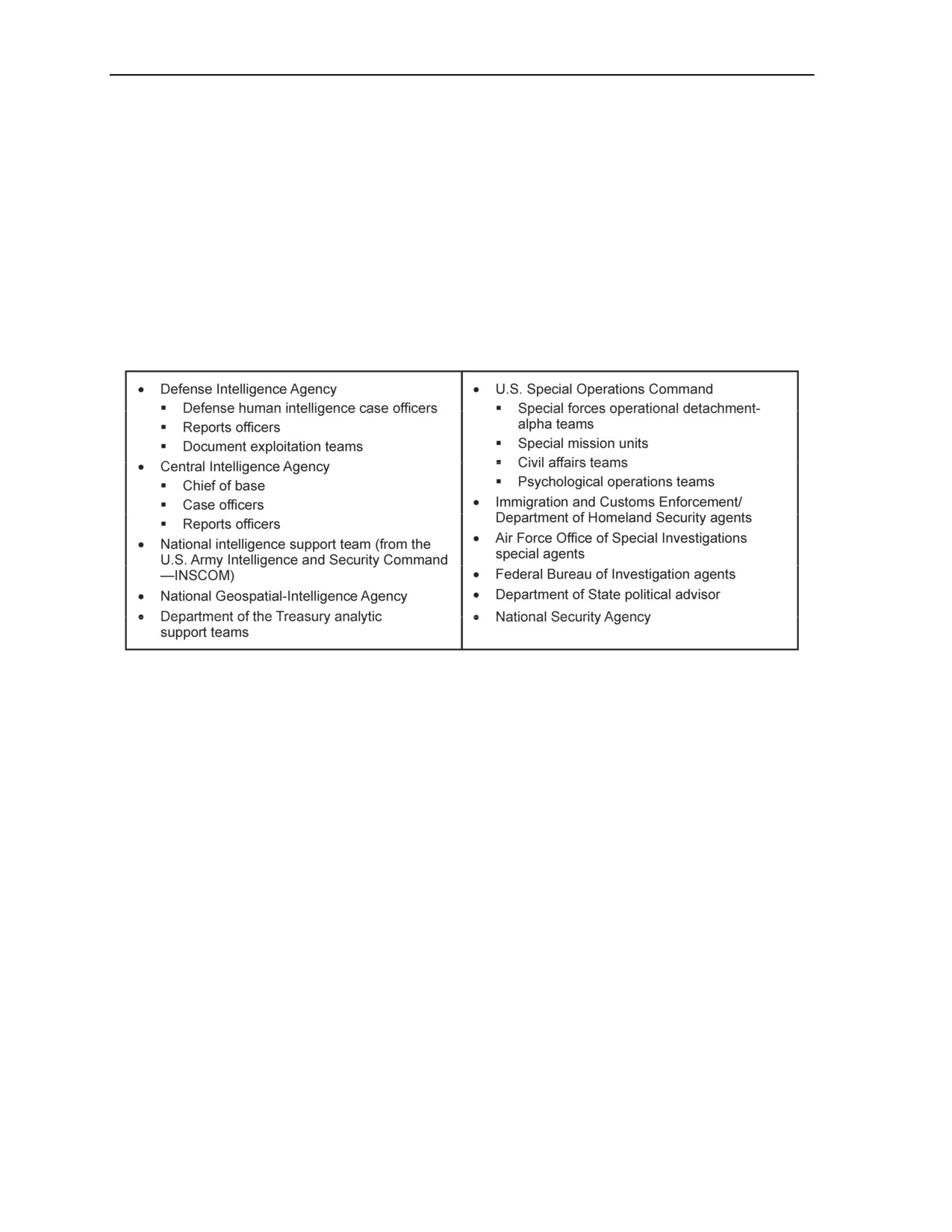
of analysis.
CURRENT OPERATIONS
3-166. Current operations intelligence supports a commander’s understanding of what insurgents are cur-
rently doing. The basic tasks of analysts working in current operations are to—
z
Analyze past and current enemy actions (event analysis and pattern analysis) to look for changes
in the insurgents’ approach or tactics.
z
Track the effects of friendly operations on the populace and insurgents.
z
Provide intelligence support to ongoing operations.
z
Disseminate immediate threat warnings to appropriate consumers.
3-167. Intelligence for current operations comes from a variety of sources, but operations reports are par-
ticularly important. This is because current enemy activities are more often reported by patrols, units con-
ducting raids, or observation posts than they are by dedicated intelligence collectors. OSINT is important
for tracking IO effects. Current operations analysis depends on the insurgent actions database for determin-
ing changes in insurgent tactics and techniques.
COMPREHENSIVE INSURGENCY ANALYSIS
3-168. Accurate and thorough intelligence on insurgent organizations, leadership, financial support net-
works, and the operational environment contribute to more effective friendly operations. Comprehensive
insurgency analysis integrates a range of analytic tools to develop this intelligence. (These tools include
social network analysis and socio-cultural factors analysis.) Comprehensive insurgency analysis provides
information upon which commanders and staffs base their understanding of the following:
15 December 2006
FM 3-24/MCWP 3-33.5
3-31
Chapter 3
z
Insurgent organization.
z
Insurgent leadership.
z
Key nodes in the insurgent organization.
z
Insurgents’ approach, capabilities, and motivations.
z
Insurgents’ support base.
z
Insurgent links to the community.
Effectively developing and integrating information from a range of intelligence and operations sources pro-
vides the detailed knowledge and insights required to exploit insurgents’ vulnerabilities and mitigate their
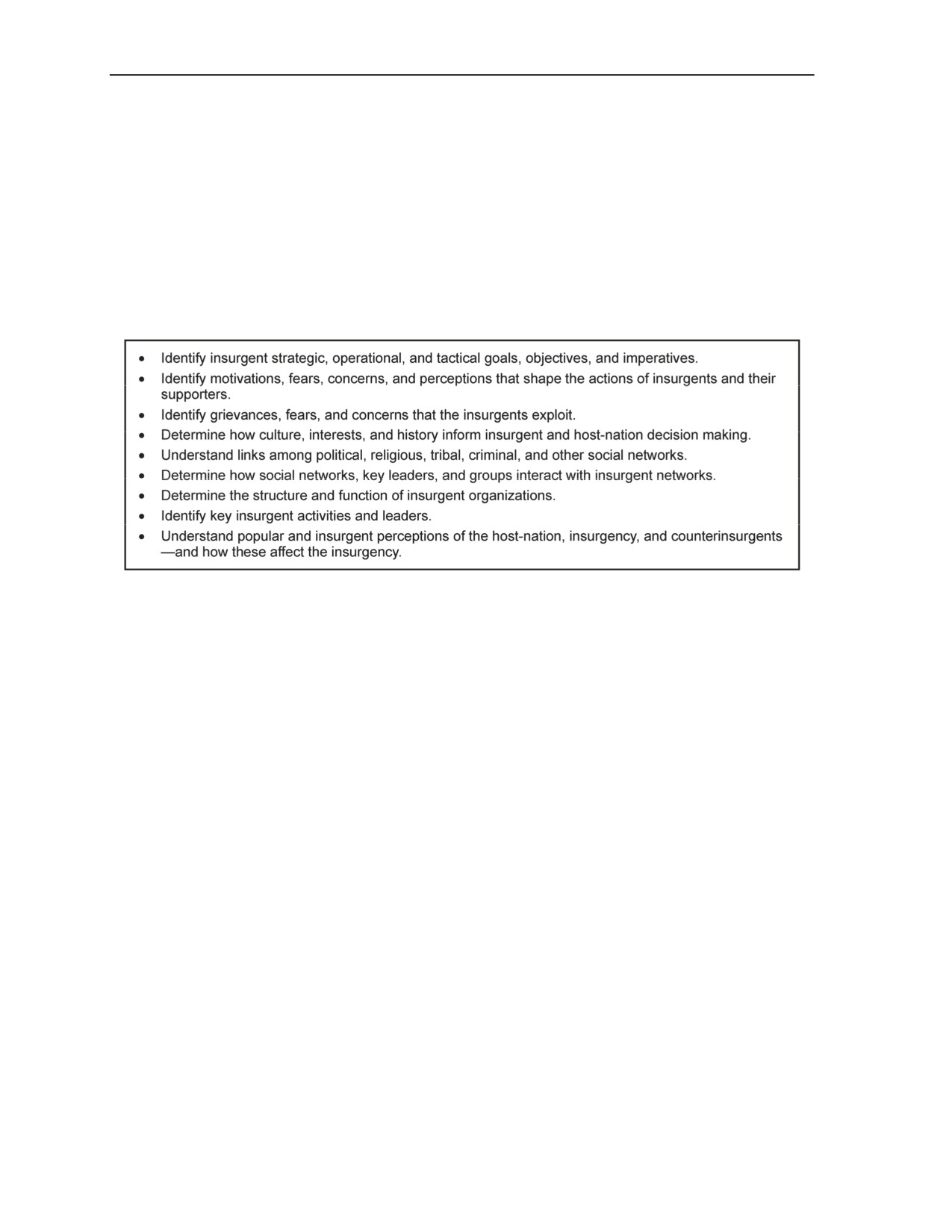
strengths. Table 3-9 lists key tasks associated with comprehensive insurgency analysis.
Table 3-9. Comprehensive insurgency analysis tasks
3-169. Developing knowledge and using network analytic tools requires an unusually large investment of
time compared to conventional analytic problem-solving methods. Comprehensive insurgency analysis
may not provide immediate usable intelligence. Analysts may have to spend weeks or months analyzing
numerous all-source intelligence reports before providing an accurate picture of insurgent groups, leaders
and activities. It is essential that commanders designate a group of analysts to perform comprehensive in-
surgency analysis. This team must be insulated from the short-term demands of current operations and day-
to-day intelligence demands. These analysts focus on long-term intelligence development. It is ultimately
the commander’s responsibility to ensure that comprehensive and basic insurgent network analysis still oc-
curs despite high-profile demands and time sensitive requirements.
3-170. Comprehensive insurgency analysis examines interactions among individuals, groups, and beliefs
within the operational environment’s historic and cultural context. One of the more important products of
this analysis is an understanding of how local people think. This knowledge allows predictive analysis of
enemy actions. It also contributes to the ability to develop effective IO and civil-military operations.
REACHBACK
3-171. Reachback refers to the process of obtaining products, services, and applications, or forces, or
equipment, or material from organizations that are not forward deployed (JP 1-02). Deployed or deploying
units should use reach capabilities to “outsource” time-intensive aspects of analysis. Reachback is particu-
larly useful when deployments occur with little warning and when organizations used for reach have a
great deal of expertise available on a given subject. Analysts may receive reach assistance from higher
echelons or external sources. Most organizations affiliated with DOD regard assisting field commanders as
one of their primary missions.
ANALYTIC CONTINUITY
3-172. The complexity and difficulty of analyzing an insurgency means it often takes analysts months to
understand the operational environment and the insurgency. The most productive analysts and action offi-
3-32
FM 3-24/MCWP 3-33.5
15 December 2006
Intelligence in Counterinsurgency
cers generally have more than a year focused on an aspect of the insurgency problem; therefore, command-
ers should try to maintain continuity among their analysts. Intelligence and other staff sections should track
operations from their home station and immerse themselves in related intelligence before deploying. This
flattens the learning curve of units rotating in to an AO and increases their effectiveness during the deploy-
ment.
3-173. Part of unit transition should include exchange of relevant databases and knowledge of the AO. Ef-
fective intelligence handover saves time and effort for an incoming unit and ensures consistency of ap-
proach.
SECTION VI - INTELLIGENCE COLLABORATION
3-174. Effective intelligence collaboration organizes the collection and analysis actions of various units
and organizations into a coherent, mutually supportive intelligence effort. Collaboration and synchroniza-
tion of the effort between lower and higher echelon units and organizations reduces the likelihood of gaps
in the intelligence effort. Some of the important operational- and strategic-level analytic support is called
“tactical overwatch.” The intelligence portion of the common operational picture and other supporting in-
telligence for COIN operations is complex. Insurgencies do not normally lend themselves to generaliza-
tions like “if this leader is removed, the insurgency is over” or “this group drives the movement.” It is im-
portant not to oversimplify an insurgency. However, analysts and commanders still require a commonly
understood means of defining and describing the enemy. One such means is using the following categories
to track and report the insurgency:
z
Region.
z
Insurgent organization.
z
Key personalities.
z
Insurgent goals and motivations.
The mutual support that various intelligence units and organizations provide across all echelons facilitates
timely and relevant intelligence.
3-175. Insurgencies are often localized; however, most have national or international aspects to them.
This characteristic complicates intelligence collaboration between adjacent units and among various eche-
lons. For instance, if numerous insurgent groups operate in one country, adjacent battalions within the
country may face very different threats. Higher echelon analysts must then understand multiple insurgent
organizations and determine the links, if any, among them. Usually, battalions focus on the population and
insurgents in their AO. Higher echelon analysts determine links and interactions among the populace and
insurgents across unit boundaries. Combatant-command-level analysts determine the major linkages within
the area of responsibility and internationally. Based on these requirements, a common database based on
intelligence reporting is a prerequisite for effective intelligence fusion.
3-176. Also complicating collaboration is the fact that COIN operations involve many government agen-
cies and foreign security forces. Analysts must establish good working relationships with various agencies
and elements to ensure they can fuse intelligence.
INTELLIGENCE CELLS AND WORKING GROUPS
3-177. Intelligence community assets operating in an AO work in or coordinate with the intelligence cell
in one of the unit’s command posts. They are under the staff supervision of the unit intelligence officer.
Table 3-10 (page 3-34) lists examples of intelligence community assets that may operate in a division AO.
3-178. As necessary, intelligence officers form working groups or boards to synchronize collection,
analysis, and targeting efforts. Cells and working groups conduct regular meetings to accomplish the fol-
lowing:
z
Establish and maintain shared situational awareness.
z
Share collection priorities.
z
Deconflict activities and operations.
15 December 2006
FM 3-24/MCWP 3-33.5
3-33
Chapter 3
z
Discuss target development.
z
Share results of operations.
These meetings build mutual trust and understanding of each member’s mission, capabilities, and limita-
tions. Meetings should be coordinated with meetings of other staff cells, working groups, and boards (for
example, the targeting board) as part of the command post’s battle rhythm.
3-179. An effective intelligence cell enhances the commander’s knowledge of the enemy, local populace,
and friendly forces and agencies operating in the unit’s AO. Incorporating HN representatives (for exam-
ple, intelligence services, military forces, and local government officials) and multinational partners into
the intelligence cell should also be considered to foster teamwork, gain insight into the local society, and
prepare the host nation to assume the COIN mission when multinational forces depart.
Table 3-10. Possible intelligence community assets in a division area of operations
Protecting Sources
3-180. Protecting sources is another important consideration when sharing intelligence. Organizations
may sometimes choose not to share information because acting on intelligence can compromise its sources.
Using the targeting process to synchronize targeting decisions is usually a good way to protect sources.
(See paragraphs 5-100 through 5-112.)
HOST-NATION INTEGRATION
3-181. COIN operations require U.S. personnel to work closely with the host nation. Sharing intelligence
with HN security forces and government personnel is an important and effective means of supporting their
COIN efforts. However, HN intelligence services may not be well developed and their personnel may not
be well trained. Thus, HN intelligence should be considered useful but definitely not the only intelligence
available. Usually, HN services are not the most important intelligence source. It is essential for U.S. per-
sonnel to evaluate HN intelligence capabilities and offer training as required.
3-182. In addition, infiltration of HN security forces by insurgents or foreign intelligence services can
create drawbacks to intelligence sharing. Insurgents may learn what is known about them, gain insight into
COIN intelligence sources and capabilities, and get early warning of targeting efforts.
3-183. When sharing intelligence with the host nation, it is important to understand the level of infiltra-
tion by insurgents or foreign intelligence services. Insofar as possible, intelligence should be tailored so re-
quired intelligence still gets to HN consumers but does not give away information about sources and capa-
bilities. In addition, care is needed when providing targeting information; it should be done such that
3-34
FM 3-24/MCWP 3-33.5
15 December 2006
Intelligence in Counterinsurgency
insurgents do not receive early warning of an upcoming operation. As trust develops between HN and U.S.
personnel, the amount of intelligence shared should grow. This will make the COIN effort more effective.
SECTION VII - SUMMARY
3-184. What makes intelligence analysis for COIN so distinct and so challenging is the amount of socio-
cultural information that must be gathered and understood. However, truly grasping the operational envi-
ronment requires commanders and staffs to devote at least as much effort to understanding the people they
support as they do to understanding the enemy. All this information is essential to get at the root causes of
the insurgency and to determine the best ways to combat it. Identifying the real problem and developing
solutions is the essence of operational design, which is discussed in the next chapter.
15 December 2006
FM 3-24/MCWP 3-33.5
3-35
This page intentionally left blank.
Chapter 4
Designing Counterinsurgency Campaigns and Operations
The first, the supreme, the most far-reaching act of judgment that the statesman and
commander have to make is to establish…the kind of war on which they are embarking;
neither mistaking it for, nor trying to turn it into, something that is alien to its nature.
This is the first of all strategic questions and the most comprehensive.
Carl von Clausewitz, On War
This chapter describes considerations for designing counterinsurgency campaigns
and operations. For Army forces, this chapter applies aspects of command and con-
trol doctrine and planning doctrine to counterinsurgency campaign planning. While
campaign design is most often associated with a joint force command, all command-
ers and staffs need to understand it.
THE IMPORTANCE OF CAMPAIGN DESIGN
4-1. In chapter 1, insurgency is described as an organized, protracted politico-military struggle designed
to weaken government control and legitimacy while increasing insurgent control. Ultimately, the long-term
objective for both sides in that struggle remains acceptance by the people of the state or region of the le-
gitimacy of one side’s claim to political power. The reason an insurgency forms to challenge the existing
order is different in each case. The complexity of insurgency presents problems that have incomplete,
contradictory, and changing requirements. The solutions to these intensely challenging and complex
problems are often difficult to recognize as such because of complex interdependencies. While attempting
to solve an intensely complex problem, the solution of one of its aspects may reveal or create another, even
more complex, problem. The purpose of design is to achieve a greater understanding, a proposed solution
based on that understanding, and a means to learn and adapt. For a U.S. military commander directed to
counter an insurgency, knowing why an insurgent movement has gained support and the purpose of
American involvement is essential in designing a counterinsurgency (COIN) campaign. Failure to under-
stand both factors can have disastrous consequences, as illustrated by Napoleon’s experience in Spain.
Campaign Assessment and Reassessment
During Napoleon’s occupation of Spain in 1808, it seems little thought was given to
the potential challenges of subduing the Spanish populace. Conditioned by the deci-
sive victories at Austerlitz and Jena, Napoleon believed the conquest of Spain would
be little more than a “military promenade.” Napoleon’s campaign included a rapid
conventional military victory but ignored the immediate requirement to provide a sta-
ble environment for the populace.
The French failed to analyze the Spanish people, their history, culture, motivations,
and potential to support or hinder the achievement of French political objectives. The
Spanish people were accustomed to hardship, suspicious of foreigners and con-
stantly involved in skirmishes with security forces. Napoleon’s cultural miscalculation
resulted in a protracted occupation struggle that lasted nearly six years and ulti-
mately required approximately three-fifths of the Empire’s total armed strength, al-
most four times the force of 80,000 Napoleon originally designated.
15 December 2006
FM 3-24/MCWP 3-33.5
4-1
Chapter 4
The Spanish resistance drained the resources of the French Empire. It was the be-
ginning of the end for Napoleon. At the theater level, a complete understanding of the
problem and a campaign design that allowed the counterinsurgency force to learn
and adapt was lacking.
4-2. Design and planning are qualitatively different yet interrelated activities essential for solving com-
plex problems. While planning activities receive consistent emphasis in both doctrine and practice, discus-
sion of design remains largely abstract and is rarely practiced. Presented a problem, staffs often rush di-
rectly into planning without clearly understanding the complex environment of the situation, purpose of
military involvement, and approach required to address the core issues. This situation is particularly prob-
lematic with insurgencies. Campaign design informs and is informed by planning and operations. It has an
intellectual foundation that aids continuous assessment of operations and the operational environment.
Commanders should lead the design process and communicate the resulting framework to other command-
ers for planning, preparation, and execution.
THE RELATIONSHIP BETWEEN DESIGN AND PLANNING
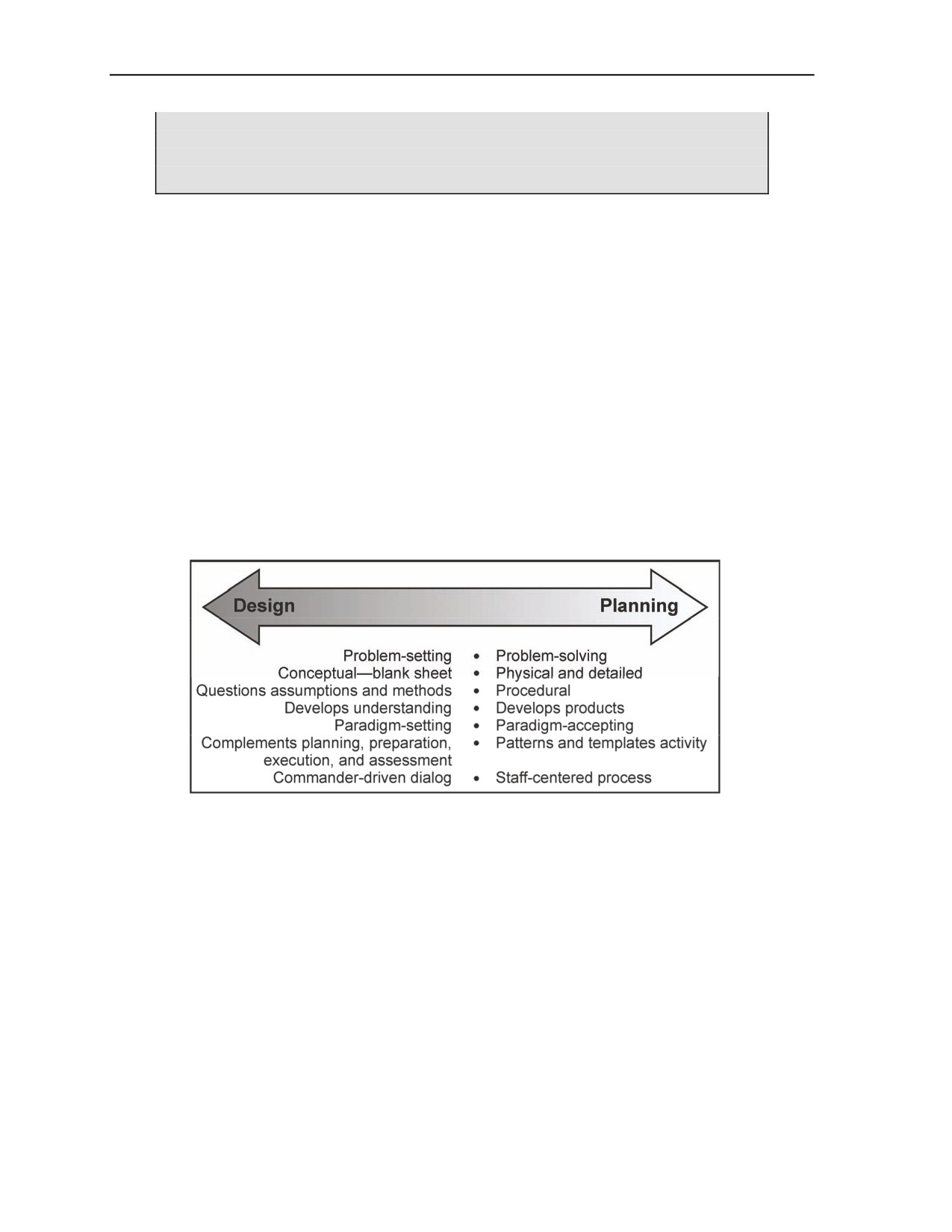
4-3. It is important to understand the distinction between design and planning. (See figure 4-1.) While
both activities seek to formulate ways to bring about preferable futures, they are cognitively different.
Planning applies established procedures to solve a largely understood problem within an accepted frame-
work. Design inquires into the nature of a problem to conceive a framework for solving that problem. In
general, planning is problem solving, while design is problem setting. Where planning focuses on generat-
ing a plan—a series of executable actions—design focuses on learning about the nature of an unfamiliar
problem.
Figure 4-1. Design and planning continuum
4-4. When situations do not conform to established frames of reference—when the hardest part of the
problem is figuring out what the problem is—planning alone is inadequate and design becomes essential.
In these situations, absent a design process to engage the problem’s essential nature, planners default to
doctrinal norms; they develop plans based on the familiar rather than an understanding of the real situation.
Design provides a means to conceptualize and hypothesize about the underlying causes and dynamics that
explain an unfamiliar problem. Design provides a means to gain understanding of a complex problem and
insights towards achieving a workable solution.
4-5. This description of design at the tactical level is a form of what Army doctrine calls commander’s
visualization. Commanders begin developing their design upon receipt of a mission. Design precedes and
forms the foundation for staff planning. However, design is also continuous throughout the operation. As
part of assessment, commanders continuously test and refine their design to ensure the relevance of mili-
tary action to the situation. In this sense, design guides and informs planning, preparation, execution, and
assessment. However, a plan is necessary to translate a design into execution. (FM 6-0, paragraphs 4-17
through 4-25, discusses commander’s visualization.)
4-2
FM 3-24/MCWP 3-33.5
15 December 2006
Designing Counterinsurgency Campaigns and Operations
4-6. Planning focuses on the physical actions intended to directly affect the enemy or environment. Plan-
ners typically are assigned a mission and a set of resources; they devise a plan to use those resources to ac-
complish that mission. Planners start with a design (whether explicit or implicit) and focus on generating a
plan—a series of executable actions and control measures. Planning generally is analytic and reductionist.
It breaks the design into manageable pieces assignable as tasks, which is essential to transforming the de-
sign into an executable plan. Planning implies a stepwise process in which each step produces an output
that is the necessary input for the next step. (FM 5-0 contains Army planning doctrine. MCDP 5 contains
Marine Corps planning doctrine.)
THE NATURE OF DESIGN
4-7. Given the difficult and multifaceted problems of insurgencies, dialog among the commander, princi-
pal planners, members of the interagency team, and host-nation (HN) representatives helps develop a co-
herent design. This involvement of all participants is essential. The object of this dialog is to achieve a
level of situational understanding at which the approach to the problem’s solution becomes clear. The un-
derlying premise is this: when participants achieve a level of understanding such that the situation no
longer appears complex, they can exercise logic and intuition effectively. As a result, design focuses on
framing the problem rather than developing courses of action.
4-8. COIN design must be iterative. By their nature, COIN efforts require repeated assessments from dif-
ferent perspectives to see the various factors and relationships required for adequate understanding. As-
sessment and learning enable incremental improvements to the design. The aim is to rationalize the prob-
lem—to construct a logical explanation of observed events and subsequently construct the guiding logic
that unravels the problem. The essence of this is the mechanism necessary to achieve success. This mecha-
nism may not be a military activity—or it may involve military actions in support of nonmilitary activities.
Once commanders understand the problem and what needs to be accomplished to succeed, they identify the
means to assess effectiveness and the related information requirements that support assessment. This feed-
back becomes the basis for learning, adaptation, and subsequent design adjustment.
CONSIDERATIONS FOR DESIGN
4-9. Key design considerations include the following:
z
Critical discussion.
z
Systems thinking.
z
Model making.
z
Intuitive decision making.
z
Continuous assessment.
z
Structured learning.
4-10. Rigorous and structured critical discussion provides an opportunity for interactive learning. It deep-
ens shared understanding and leverages the collective intelligence and experiences of many people.
4-11. Systems thinking involves developing an understanding of the relationships within the insurgency
and the environment. It also concerns the relationships of actions within the various logical lines of opera-
tions (LLOs). This element is based on the perspective of the systems sciences that seeks to understand the
interconnectedness, complexity, and wholeness of the elements of systems in relation to one another.
4-12. In model making, the model describes an approach to the COIN campaign, initially as a hypothesis.
The model includes operational terms of reference and concepts that shape the language governing the
conduct (planning, preparation, execution, and assessment) of the operation. It addresses questions like
these: Will planning, preparation, execution, and assessment activities use traditional constructs like center
of gravity, decisive points, and LLOs? Or are other constructs—such as leverage points, fault lines, or
critical variables—more appropriate to the situation?
4-13. The Army and Marine Corps define intuitive decision making as the act of reaching a conclusion
which emphasizes pattern recognition based on knowledge, judgment, experience, education, intelligence,
15 December 2006
FM 3-24/MCWP 3-33.5
4-3
Chapter 4
boldness, perception, and character. This approach focuses on assessment of the situation vice comparison
of multiple options (FM 6-0/MCRP 5-12A). An operational design emerges intuitively as understanding of
the insurgency deepens.
4-14. Continuous assessment is essential as an operation unfolds because of the inherent complexity of
COIN operations. No design or model completely matches reality. The object of continuous assessment is
to identify where and how the design is working or failing and to consider adjustments to the design and
operation.
4-15. The objective of structured learning is to develop a reasonable initial design and then learn, adapt,
and iteratively and continuously improve that design as more about the dynamics of the COIN problem be-
come evident.
DESIGN FOR COUNTERINSURGENCY
4-16. Through design commanders gain an understanding of the problem and the COIN operation’s pur-
pose within the strategic context. Communicating this understanding of the problem, purpose, and context
to subordinates allows them to exercise subordinates’ initiative. Subordinates’ initiative is assumption of
responsibility for deciding and initiating independent actions when the concept of operations or order no
longer applies or when an unanticipated opportunity leading to the accomplishment of the commander’s in-
tent presents itself (FM 6-0). (Subordinates’ initiative is discussed in FM 6-0, paragraphs 2-83 through 2-
92.) It facilitates decentralized execution and continuous assessment of operations at all levels throughout
the campaign. While traditional aspects of campaign design as expressed in joint and Service doctrine re-
main relevant, they are not adequate for a discussion of the broader design construct for a COIN environ-
ment. Inherent in this construct is the tension created by understanding that military capabilities provide
only one component of an overall approach to a COIN campaign. Design of a COIN campaign must be
viewed holistically. Only a comprehensive approach employing all relevant design components, including
the other instruments of national power, is likely to reach the desired end state.
4-17. As noted above, this description of campaign design is a form that Army doctrine calls commander’s
visualization. Design begins with identification of the end state, as derived from the policy aim. (Joint doc-
trine defines the end state as the set of required conditions that defines achievement of the commander’s
objectives [JP 1-02]). The end state provides context and logic for operational and tactical decision mak-
ing. Consequently, strategic goals must be communicated clearly to commanders at every level. While
strategy drives design, which in turn drives tactical actions, the reverse is also true. The observations of
tactical actions result in learning and greater understanding that may generate modifications to the design,
which in turn may have strategic implications. The COIN imperative to “Learn and Adapt” is essential in
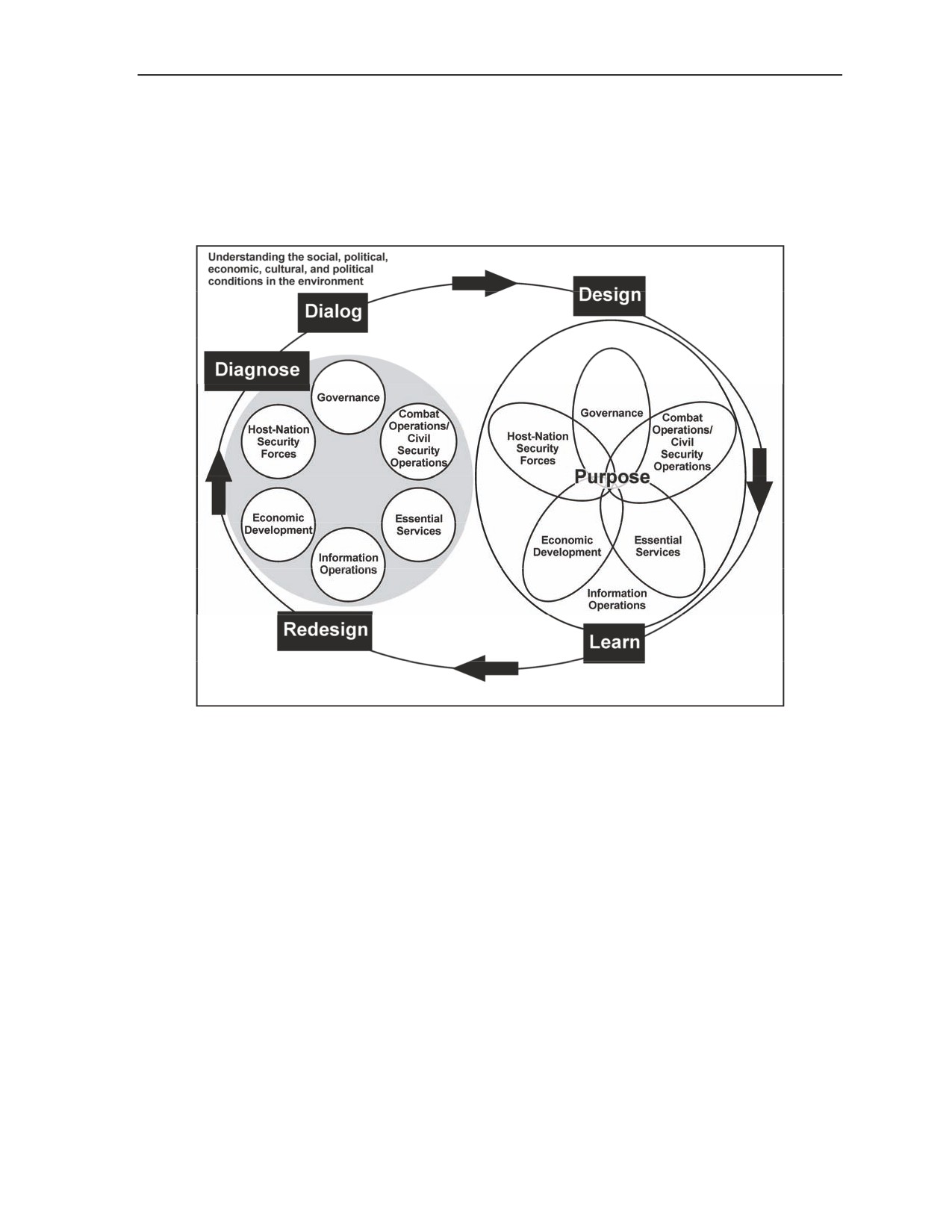
making the design process work correctly. Figure 4-2 illustrates the iterative nature of COIN campaign de-
sign and the large number of factors involved.
COMMANDER’S INTENT AND VISION OF RESOLUTION
4-18. Guided by the campaign’s purpose, commanders articulate an operational logic for the campaign that
expresses in clear, concise, conceptual language a broad vision of what they plan to accomplish. The op-
erational logic is the commander’s assessment of the problem and approach toward solving it. Command-
ers express it as the commander’s intent. Ideally, the operational logic is expressed clearly and simply but
in comprehensive terms, such as what the commander envisions achieving with various components or par-
ticular LLOs. This short statement of the operational logic helps subordinate commanders and planners, as
well as members of other agencies and organizations, see the campaign’s direction. It provides a unifying
theme for interagency planning.
4-19. In addition, commanders also issue a form of planning guidance called the vision of resolution. The
vision of resolution is usually expressed in the form of LLOs. LLOs for a counterinsurgency may include
the following:
z
Conduct information operations.
z
Conduct combat operations/civil security operations.
z
Train and employ HN security forces.
4-4
FM 3-24/MCWP 3-33.5
15 December 2006
Designing Counterinsurgency Campaigns and Operations
z
Establish or restore essential services.
z
Support development of better governance.
z
Support economic development.
This list is an example only. Commanders determine the LLOs appropriate to the situation based on their
assessment and their dialog with the leaders of other participating organizations.
Figure 4-2. Iterative counterinsurgency campaign design
4-20. LLOs like those listed in paragraph 4-19 are not intended as a “success template.” Selecting and ap-
plying them requires judgment. The mosaic nature of insurgencies and the shifting circumstances within
each area of operations (AO) requires a different emphasis on and interrelationship among the various
lines. The situation may also require that military forces closely support, or temporarily assume responsi-
bility for, tasks normally accomplished by other government agencies and private organizations. By
broadly describing how the LLOs interact to achieve the end state, commanders provide the operational
logic to link the various components in a comprehensive framework. This framework guides the initiative
of subordinate commanders as they establish local conditions that support achieving the overall end state. It
also promotes unity of effort among joint, interagency, multinational, and HN partners.
LOCAL RELEVANCE
4-21. Informed by the commander’s intent—including the end state and vision of resolution—subordinate
commanders tailor and prioritize their actions within the LLOs based on the distinct and evolving
circumstances within their respective AOs. Military forces are accustomed to unity of command; however,
the interagency and multinational nature of COIN operations usually makes such arrangements unlikely.
All participating organizations do share attitudes and goals. General cooperation on matters of mutual
concern, established through informal agreements, may be the most practicable arrangement. Therefore,
effective commanders empower subordinate leaders to perform the coordination, cooperation, and
innovation needed to achieve unity of effort and execute operations in the manner best suited to local
15 December 2006
FM 3-24/MCWP 3-33.5
4-5
Chapter 4
conditions. The design—consisting of the commander’s intent, vision of resolution and other guidance
issued as the campaign unfolds, and end state—provides the framework within which subordinates exercise
this form of initiative.
LEARNING IN EXECUTION
4-22. Before commanders deploy their units, they make every effort to mentally prepare their Soldiers or
Marines for the anticipated challenges, with a particular focus on situational awareness of the anticipated
AO. Situational awareness is knowledge of the immediate present environment, including knowledge of
the factors of METT-TC (FMI 5-0.1). COIN operations require a greater focus on civil considerations—the
C in METT-TC—than conventional operations do. This situational awareness is only the beginning of an
understanding of the AO that will mature as operations progress. However, commanders use it to begin to
establish a common frame of reference.
4-23. Design begins based on this initial awareness. Aspects of the problem and means of resolving them
do not remain static. Conditions are seldom consistent throughout any AO and continue to change based on
actions by friendly, enemy, neutral, and other involved organizations. Rather than being uniform in charac-
ter, the operational environment is likely to display a complex, shifting mosaic of conditions. To be effec-
tive, commanders—and indeed all personnel—continually develop and enhance their understanding of the
mosaic peculiar to their AO. Observing tactical actions and the resulting changing conditions deepens un-
derstanding of the environment and enables commanders to relearn and refine their design and implemen-
tation actions.
4-24. Initially, situational awareness will probably be relatively low and the design will, by necessity, re-
quire a number of assumptions, especially with respect to the populace and the force’s ability to positively
influence their perception of events. The design can be viewed as an experiment that tests the operational
logic, with the expectation of a less-than-perfect solution. As the experiment unfolds, interaction with the
populace and insurgents reveals the validity of those assumptions, revealing the strengths and weaknesses
of the design.
4-25. Assessment is the continuous monitoring and evaluation of the current situation and progress of an
operation (FMI 5-0.1). Effective assessment is necessary for commanders to recognize changing conditions
and determine their meaning. It is crucial to successful adaptation and innovation by commanders within
their respective AOs. A continuous dialog among commanders at all echelons provides the feedback the
senior commander needs to refine the design. The dialog is supported by formal assessment techniques and
red-teaming to ensure commanders are fully cognizant of the causal relationships between their actions and
the insurgents’ adaptations. Accordingly, assessment is a learning activity and a critical aspect of design.
This learning leads to redesign. Therefore, design can be viewed as a perpetual design-learn-redesign activ-
ity, with the commander’s intent, vision of resolution, and end state providing the unifying themes.
4-26. The critical role of assessment necessitates establishing measures of effectiveness during planning.
Commanders should choose these carefully so that they align with the design and reflect the emphasis on
and interrelationship among the LLOs. Commanders and staffs revise their assessment and measures of ef-
fectiveness during the operation in order to facilitate redesign and stay abreast of the current situation.
Sound assessment blends qualitative and quantitative analysis with the judgment and intuition of all lead-
ers. Great care must be applied here, as COIN operations often involve complex societal issues that may
not lend themselves to quantifiable measures of effectiveness. Moreover, bad assumptions and false data
can undermine the validity of both assessments and the conclusions drawn from them. Data and metrics
can inform a commander’s assessment. However they must not be allowed to dominate it in uncertain
situations. Subjective and intuitive assessment must not be replaced by an exclusive focus on data or met-
rics. Commanders must exercise their professional judgment in determining the proper balance.
GOALS IN COUNTERINSURGENCY
4-27. In an ideal world, the commander of military forces engaged in COIN operations would enjoy clear
and well-defined goals for the campaign from the very beginning. However, the reality is that many goals
emerge only as the campaign develops. For this reason, counterinsurgents usually have a combination of
4-6
FM 3-24/MCWP 3-33.5
15 December 2006
Designing Counterinsurgency Campaigns and Operations
defined and emerging goals toward which to work. Likewise, the complex problems encountered during
COIN operations can be so difficult to understand that a clear design cannot be developed initially. Often,
the best choice is to create iterative solutions to better understand the problem. In this case, these iterative
solutions allow the initiation of intelligent interaction with the environment. The experiences of the 1st Ma-
rine Division during Operation Iraqi Freedom II illustrate this situation.
Iterative Design During Operation Iraqi Freedom II
During Operation Iraqi Freedom II (2004-2005), the 1st Marine Division employed an op-
erational design similar to that used during the Philippine Insurrection (circa 1902). The
commanding general, Major General James N. Mattis, USMC, began with an assessment
of the people that the Marines, Soldiers, and Sailors would encounter within the division’s
area of operations. The area of operations was in western Iraq/Al Anbar Province, which
had a considerably different demographic than the imam-led Shia areas in which the divi-
sion had operated during Operation Iraqi Freedom I.
Major General Mattis classified provincial constituents into three basic groups: the tribes,
former regime elements, and foreign fighters. The tribes constituted the primary identity
group in western Iraq/Al Anbar Province. They had various internal tribal affiliations and
looked to a diverse array of sheiks and elders for leadership. The former regime elements
were a minority that included individuals with personal, political, business, and profes-
sional ties to the Ba’ath Party. These included civil servants and career military personnel
with the skills needed to run government institutions. Initially, they saw little gain from a
democratic Iraq. The foreign fighters were a small but dangerous minority of transnational
Islamic subversives.
To be successful, U.S. forces had to apply a different approach to each of these groups
within the framework of an overarching plan. As in any society, some portion of each
group included a criminal element, further complicating planning and interaction. Major
General Mattis’s vision of resolution comprised two major elements encompassed in an
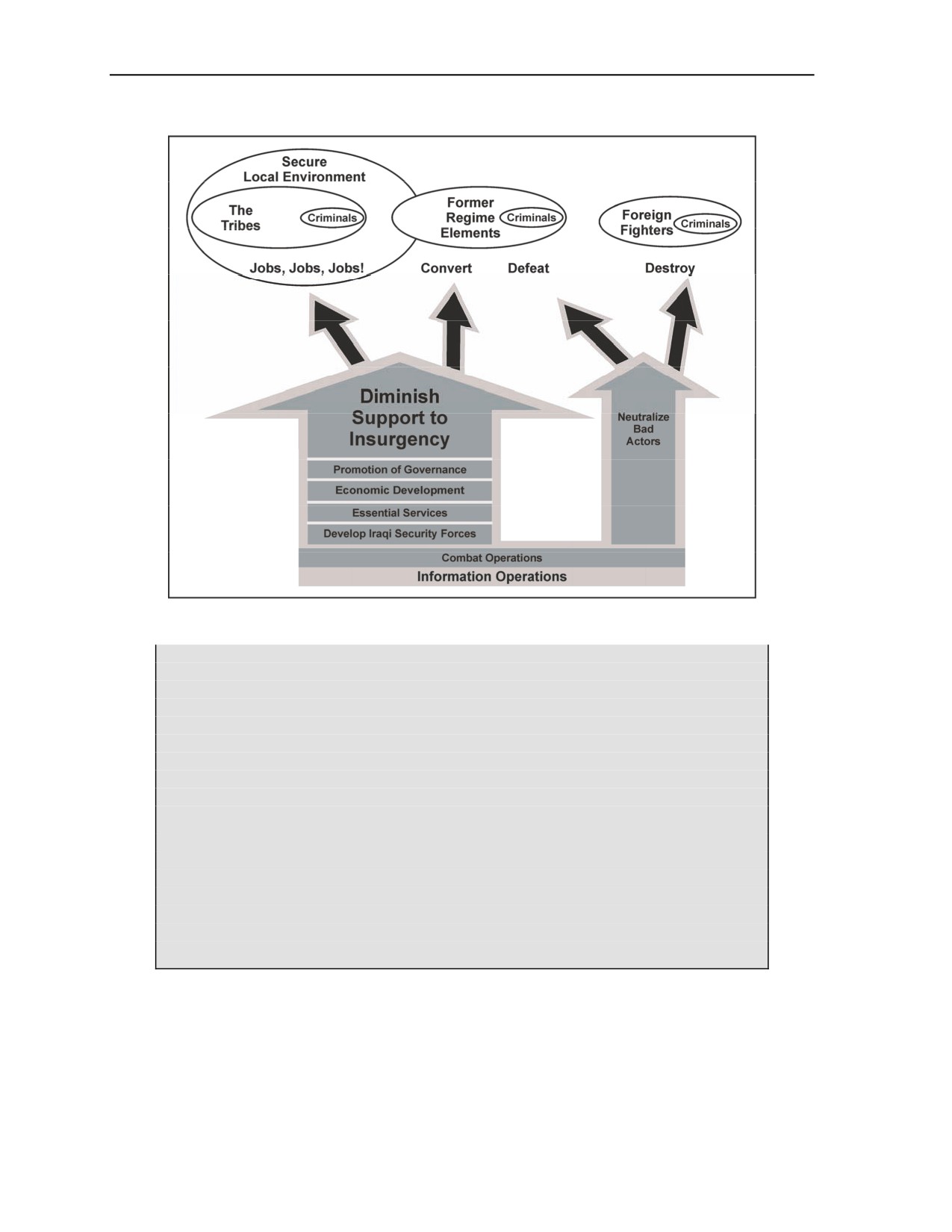
overarching “bodyguard” of information operations. (See figure 4-3, page 4-8.)
The first element and main effort was diminishing support for insurgency. Guided by the
maxims of “first do no harm” and “no better friend-no worse enemy,” the objective was to
establish a secure local environment for the indigenous population so they could pursue
their economic, social, cultural, and political well-being and achieve some degree of local
normalcy. Establishing a secure environment involved both offensive and defensive com-
bat operations with a heavy emphasis on training and advising the security forces of the
fledgling Iraqi government. It also included putting the populace to work. Simply put, an
Iraqi with a job was less likely to succumb to ideological or economic pressure to support
the insurgency. Other tasks included the delivery of essential services, economic devel-
opment, and the promotion of governance. All were geared towards increasing employ-
ment opportunities and furthering the establishment of local normalcy. Essentially, dimin-
ishing support for insurgency entailed gaining and maintaining the support of the tribes, as
well as converting as many of the former regime members as possible. “Fence-sitters”
were considered a winnable constituency and addressed as such.
The second element involved neutralizing the bad actors, a combination of irreconcilable
former regime elements and foreign fighters. Offensive combat operations were con-
ducted to defeat recalcitrant former regime members. The task was to make those who
were not killed outright see the futility of resistance and give up the fight. With respect to
the hard-core extremists, who would never give up, the task was more straightforward:
their complete and utter destruction. Neutralizing the bad actors supported the main effort
by improving the local security environment. Neutralization had to be accomplished in a
discrete and discriminate manner, however, in order to avoid unintentionally increasing
support for insurgency.
15 December 2006
FM 3-24/MCWP 3-33.5
4-7
Chapter 4
Figure 4-3. 1st Marine Division’s operational design for Operation Iraqi Freedom II
Both elements described above were wrapped in an overarching “bodyguard” of in-
formation operations. Information operations, both proactive and responsive, were
aggressively employed to favorably influence the populace’s perception of all coali-
tion actions while simultaneously discrediting the insurgents. These tasks were in-
credibly difficult for a number of reasons. Corruption had historically been prevalent
among Iraqi officials, generating cynicism toward any government. Additionally, dec-
ades of Arab media mischaracterization of U.S. actions had instilled distrust of
American motives. The magnitude of that cynicism and distrust highlighted the critical
importance of using information operations to influence every situation.
In pursuing this vision of resolution, the 1st Marine Division faced an adaptive enemy.
Persistent American presence and interaction with the populace threatened the in-
surgents and caused them to employ more open violence in selected areas of Al An-
bar province. This response resulted in learning and adaptation within the 1st Marine
Division. The design enabled 1st Marine Division to adjust the blend of “diminishing
support for insurgents” and “neutralizing bad actors” to meet the local challenges.
Throughout the operation, 1st Marine Division continued learning and adapting with
the vision of resolution providing a constant guide to direct and unify the effort.
4-8
FM 3-24/MCWP 3-33.5
15 December 2006
Designing Counterinsurgency Campaigns and Operations
SUMMARY
4-28. Campaign design may very well be the most important aspect of countering an insurgency. It is cer-
tainly the area in which the commander and staff can have the most influence. Design is not a function to
be accomplished, but rather a living process. It should reflect ongoing learning and adaptation and the
growing appreciation counterinsurgents share for the environment and all actors within it, especially the in-
surgents, populace, and HN government. Though design precedes planning, it continues throughout plan-
ning, preparation, and execution. It is dynamic, even as the environment and the counterinsurgents’ under-
standing of the environment is dynamic. The resulting growth in understanding requires integrated
assessment and a rich dialog among leaders at various levels to determine the need for adaptation through-
out the COIN force. Design should reflect a comprehensive approach that works across all LLOs in a man-
ner applicable to the stage of the campaign. There should only be one campaign and therefore one design.
This single campaign should bring in all players, with particular attention placed on the HN participants.
Design and operations are integral to the COIN imperative to “Learn and Adapt,” enabling a continuous
cycle of design-learn-redesign to achieve the end state.
15 December 2006
FM 3-24/MCWP 3-33.5
4-9
This page intentionally left blank.
Chapter 5
Executing Counterinsurgency Operations
It is a persistently methodical approach and steady pressure which will gradually wear
the insurgent down. The government must not allow itself to be diverted either by coun-
termoves on the part of the insurgent or by the critics on its own side who will be seeking
a simpler and quicker solution. There are no short-cuts and no gimmicks.
Sir Robert Thompson,
Defeating Communist Insurgency: The Lessons of Malaya and Vietnam, 1966 2
This chapter addresses principles and tactics for executing counterinsurgency (COIN)
operations. It begins by describing the different stages of a COIN operation and logi-
cal lines of operations that commanders can use to design one. It continues with dis-
cussions of three COIN approaches and how to continuously assess a COIN opera-
tion. The chapter concludes by describing lethal and nonlethal targeting in a COIN
environment.
THE NATURE OF COUNTERINSURGENCY OPERATIONS
5-1. Counterinsurgency (COIN) operations require synchronized application of military, paramilitary, po-
litical, economic, psychological, and civic actions. Successful counterinsurgents support or develop local
institutions with legitimacy and the ability to provide basic services, economic opportunity, public order,
and security. The political issues at stake are often rooted in culture, ideology, societal tensions, and injus-
tice. As such, they defy nonviolent solutions. Military forces can compel obedience and secure areas; how-
ever, they cannot by themselves achieve the political settlement needed to resolve the situation. Successful
COIN efforts include civilian agencies, U.S. military forces, and multinational forces. These efforts pur-
posefully attack the basis for the insurgency rather than just its fighters and comprehensively address the
host nation’s core problems. Host-nation (HN) leaders must be purposefully engaged in this effort and ul-
timately must take lead responsibility for it.
5-2. There are five overarching requirements for successful COIN operations:
z
U.S. and HN military commanders and the HN government together must devise the plan for at-
tacking the insurgents’ strategy and focusing the collective effort to bolster or restore govern-
ment legitimacy.
z
HN forces and other counterinsurgents must establish control of one or more areas from which
to operate. HN forces must secure the people continuously within these areas.
z
Operations should be initiated from the HN government’s areas of strength against areas under
insurgent control. The host nation must retain or regain control of the major population centers
to stabilize the situation, secure the government’s support base, and maintain the government’s
legitimacy.
z
Regaining control of insurgent areas requires the HN government to expand operations to secure
and support the population. If the insurgents have established firm control of a region, their mili-
tary apparatus there must be eliminated and their politico-administrative apparatus rooted out.
z
Information operations (IO) must be aggressively employed to accomplish the following:
2 © 1966 by Robert Thompson. Reproduced with permission of Hailer Publishing.
15 December 2006
FM 3-24/MCWP 3-33.5
5-1
Chapter 5
Favorably influence perceptions of HN legitimacy and capabilities.
Obtain local, regional, and international support for COIN operations.
Publicize insurgent violence.
Discredit insurgent propaganda and provide a more compelling alternative to the insurgent
ideology and narrative.
5-3. COIN operations combine offensive, defensive, and stability operations to achieve the stable and se-
cure environment needed for effective governance, essential services, and economic development. The fo-
cus of COIN operations generally progresses through three indistinct stages that can be envisioned with a
medical analogy:
z
Stop the bleeding.
z
Inpatient care—recovery.
z
Outpatient care—movement to self-sufficiency.
Understanding this evolution and recognizing the relative maturity of the operational environment are im-
portant to the conduct (planning, preparation, execution, and assessment) of COIN operations. This knowl-
edge allows commanders to ensure that their activities are appropriate to the current situation.
INITIAL STAGE: “STOP THE BLEEDING”
5-4. Initially, COIN operations are similar to emergency first aid for the patient. The goal is to protect the
population, break the insurgents’ initiative and momentum, and set the conditions for further engagement.
Limited offensive operations may be undertaken, but are complemented by stability operations focused on
civil security. During this stage, friendly and enemy information needed to complete the common opera-
tional picture is collected and initial running estimates are developed. Counterinsurgents also begin shaping
the information environment, including the expectations of the local populace.
MIDDLE STAGE: “INPATIENT CARE—RECOVERY”
5-5. The middle stage is characterized by efforts aimed at assisting the patient through long-term recov-
ery or restoration of health—which in this case means achieving stability. Counterinsurgents are most ac-
tive here, working aggressively along all logical lines of operations (LLOs). The desire in this stage is to
develop and build resident capability and capacity in the HN government and security forces. As civil se-
curity is assured, focus expands to include governance, provision of essential services, and stimulation of
economic development. Relationships with HN counterparts in the government and security forces and
with the local populace are developed and strengthened. These relationships increase the flow of human
and other types of intelligence. This intelligence facilitates measured offensive operations in conjunction
with the HN security forces. The host nation increases its legitimacy through providing security, expanding
effective governance, providing essential services, and achieving incremental success in meeting public
expectations.
LATE STAGE: “OUTPATIENT CARE—MOVEMENT TO SELF-SUFFICIENCY”
5-6. Stage three is characterized by the expansion of stability operations across contested regions, ideally
using HN forces. The main goal for this stage is to transition responsibility for COIN operations to HN
leadership. In this stage, the multinational force works with the host nation in an increasingly supporting
role, turning over responsibility wherever and whenever appropriate. Quick reaction forces and fire support
capabilities may still be needed in some areas, but more functions along all LLOs are performed by HN
forces with the low-key assistance of multinational advisors. As the security, governing, and economic ca-
pacity of the host nation increases, the need for foreign assistance is reduced. At this stage, the host nation
has established or reestablished the systems needed to provide effective and stable government that sus-
tains the rule of law. The government secures its citizens continuously, sustains and builds legitimacy
through effective governance, has effectively isolated the insurgency, and can manage and meet the expec-
tations of the nation’s entire population.
5-2
FM 3-24/MCWP 3-33.5
15 December 2006
Executing Counterinsurgency Operations
LOGICAL LINES OF OPERATIONS IN COUNTERINSURGENCY
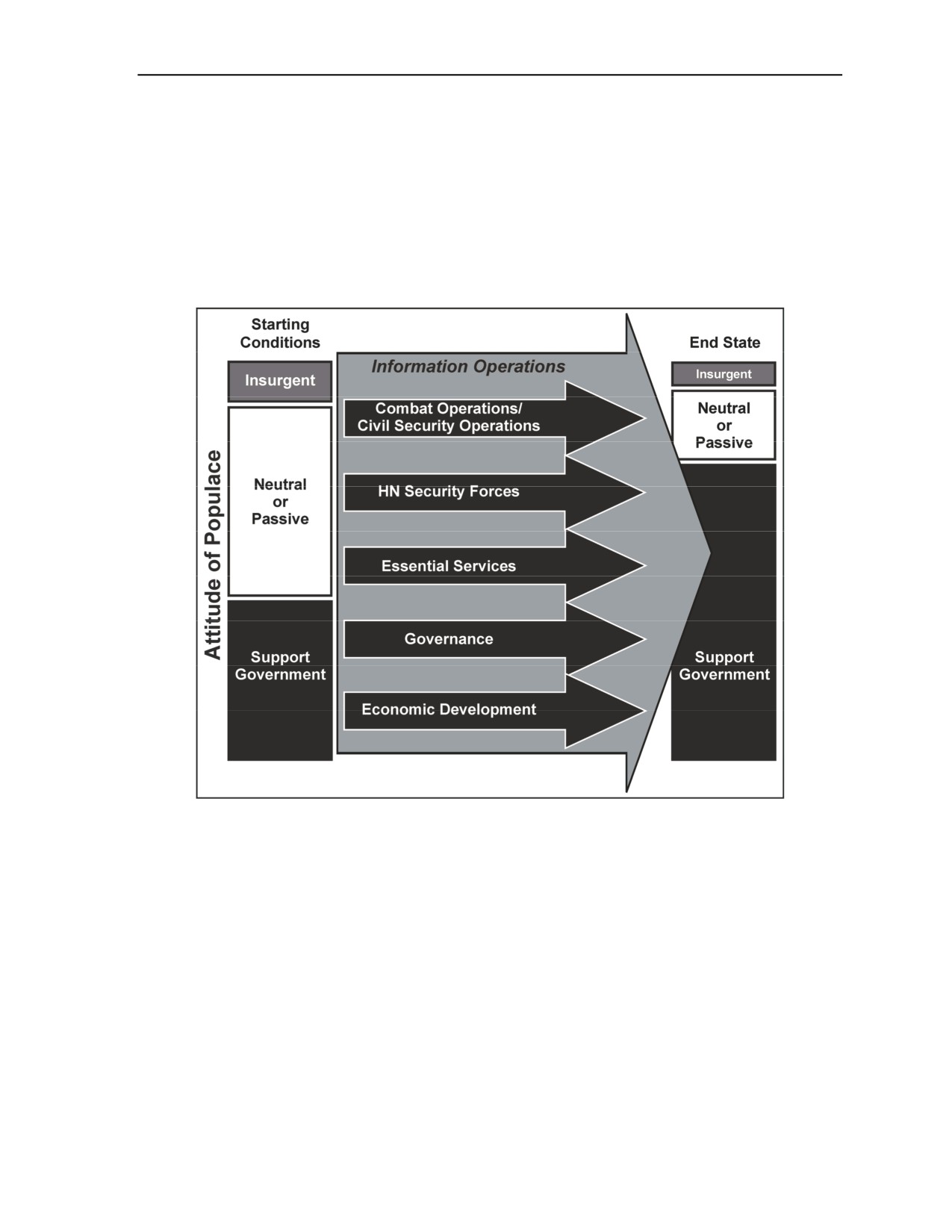
5-7. Commanders use LLOs to visualize, describe, and direct operations when positional reference to en-
emy forces has little relevance. (See figure 5-1.) LLOs are appropriate for synchronizing operations against
enemies that hide among the populace. A plan based on LLOs unifies the efforts of joint, interagency, mul-
tinational, and HN forces toward a common purpose. Each LLO represents a conceptual category along
which the HN government and COIN force commander intend to attack the insurgent strategy and establish
HN government legitimacy. LLOs are closely related. Successful achievement of the end state requires
careful coordination of actions undertaken along all LLOs.
Figure 5-1. Example logical lines of operations for a counterinsurgency
5-8. Success in one LLO reinforces successes in the others. Progress along each LLO contributes to at-
taining a stable and secure environment for the host nation. Stability is reinforced by popular recognition of
the HN government’s legitimacy, improved governance, and progressive, substantive reduction of the root
causes of the insurgency. There is no list of LLOs that applies in all cases. Commanders select LLOs based
on their understanding of the nature of the insurgency and what the COIN force must do to counter it.
Commanders designate LLOs that best focus counterinsurgent efforts against the insurgents’ subversive
strategy.
5-9. Commanders at all echelons can use LLOs. Lower echelon operations are nested within the higher
echelon’s operational design and LLOs; however, lower echelon operations are conducted based on the op-
erational environment in each unit’s area of operations (AO).
5-10. The commander’s intent and vision of resolution, expressed as LLOs, describe the design for a
COIN operation. Commanders and staffs synchronize activities along all LLOs to gain unity of effort. This
approach ensures the LLOs converge on a well-defined, commonly understood end state.
15 December 2006
FM 3-24/MCWP 3-33.5
5-3
Chapter 5
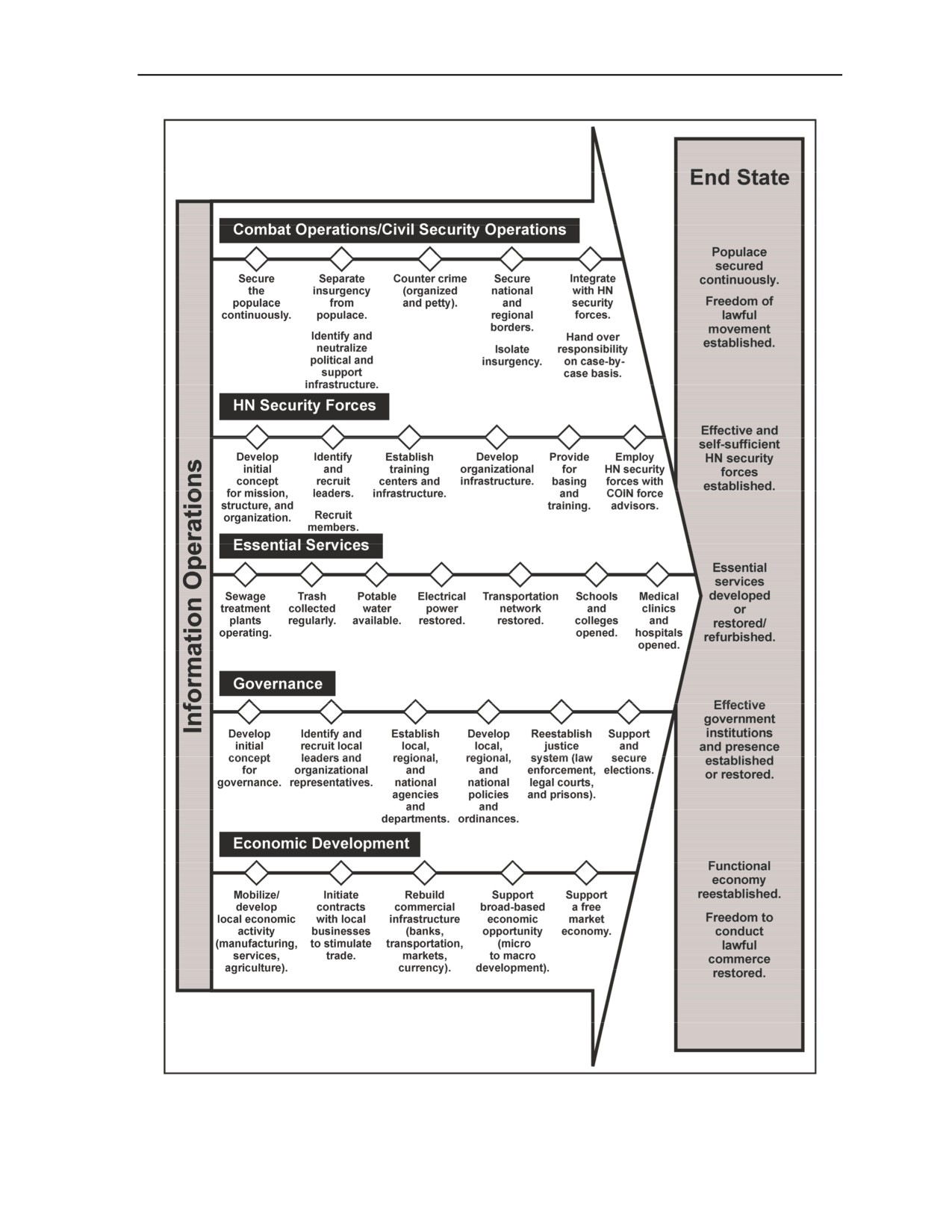
5-11. LLOs are directly related to one another. They connect objectives that, when accomplished, support
achieving the end state. Operations designed using LLOs typically employ an extended, event-driven time-
line with short-, mid-, and long-term goals. These operations combine the effects of long-term operations,
such as neutralizing the insurgent infrastructure, with cyclic and short-term events, like regular trash col-
lection and attacks against insurgent bases. (See figure 5-2.)
5-4
FM 3-24/MCWP 3-33.5
15 December 2006
Executing Counterinsurgency Operations
Figure 5-2. Example goals and objectives along logical lines of operations
15 December 2006
FM 3-24/MCWP 3-33.5
5-5
Chapter 5
5-12. Commanders determine which LLOs apply to their AO and how the LLOs connect with and support
one another. For example, commanders may conduct offensive and defensive operations to form a shield
behind which simultaneous stability operations can maintain a secure environment for the populace. Ac-
complishing the objectives of combat operations/civil security operations sets the conditions needed to
achieve essential services and economic development objectives. When the populace perceives that the en-
vironment is safe enough to leave families at home, workers will seek employment or conduct public eco-
nomic activity. Popular participation in civil and economic life facilitates further provision of essential ser-
vices and development of greater economic activity. Over time such activities establish an environment
that attracts outside capital for further development. Neglecting objectives along one LLO risks creating
vulnerable conditions along another that insurgents can exploit. Achieving the desired end state requires
linked successes along all LLOs.
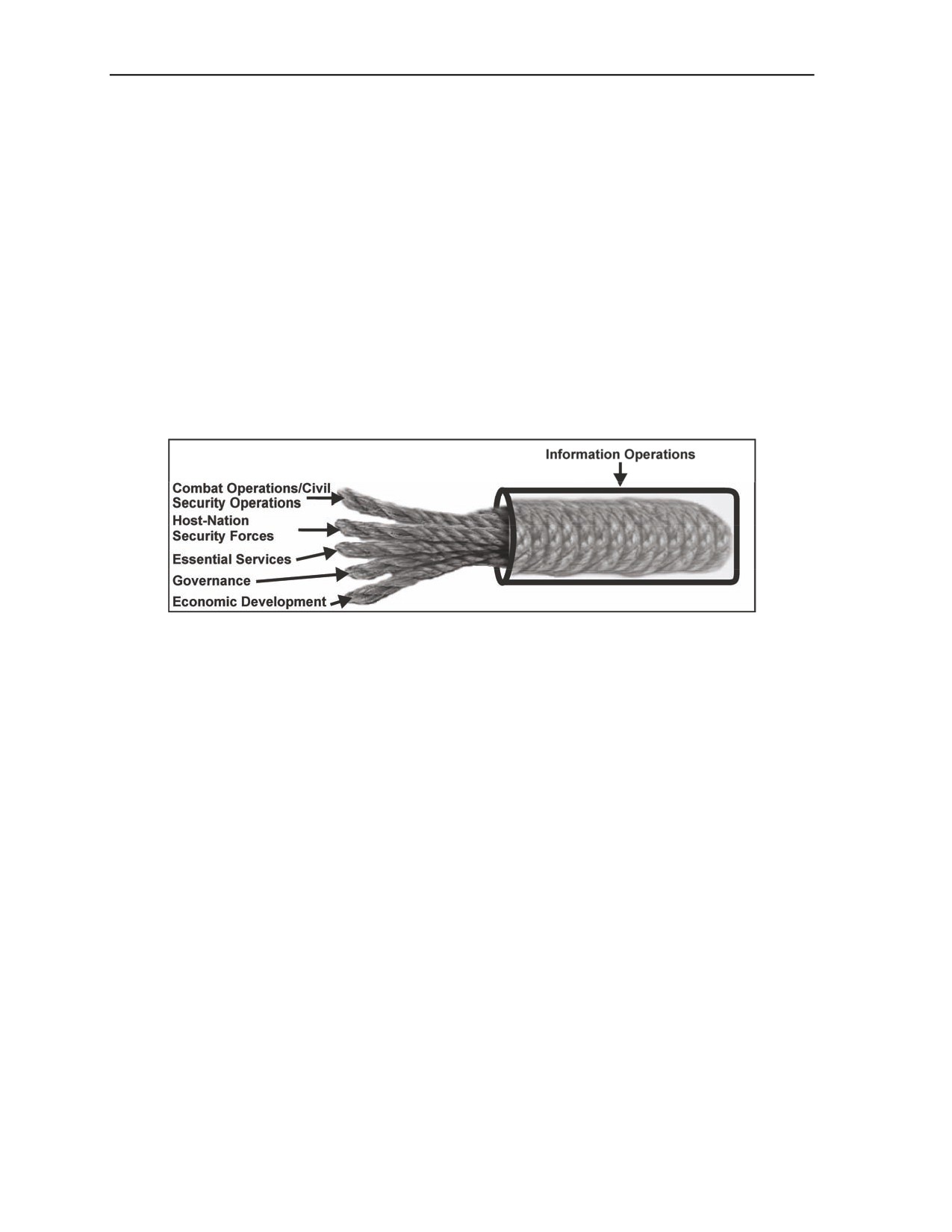
5-13. The relationship of LLOs to the overall operation is similar to the stands of a rope. (See figure 5-3.)
Each LLO is a separate string. Operations along it cannot accomplish all objectives required for success in
a COIN operation. However, a strong rope is created when strands are woven together. The overall COIN
effort is further strengthened through IO, which support and enhance operations along all LLOs by high-
lighting the successes along each one.
Figure 5-3. The strengthening effect of interrelated logical lines of operations
5-14. LLOs help commanders identify missions, assign tasks, allocate resources, and assess operations.
Commanders specify the LLO that is the decisive operation; others shape the operational environment for
the decisive operation’s success. This prioritization usually changes as COIN operations create insurgent
vulnerabilities, insurgents react or adjust their activities, or the environment changes. In this sense, com-
manders adapt their operations not only to the state of the insurgency, but also to the environment’s overall
condition. Greater stability indicates progress toward the end state.
5-15. Well-designed operations are based on LLOs that are mutually supportive between echelons and ad-
jacent organizations. For example, similar LLOs among brigade combat teams produce complementary ef-
fects, while brigade-level accomplishments reinforce achievement of division objectives. LLOs are nor-
mally used at brigade and higher levels, where the staff and unit resources needed to use them are
available; however, battalions can use LLOs. Commanders at various levels may expect subordinates to
describe their operations in these terms.
5-16. Commanders at all levels should select the LLOs that relate best to achieving the desired end state in
accordance with the commander’s intent. The following list of possible LLOs is not all inclusive. However,
it gives commanders a place to start:
z
Conduct information operations.
z
Conduct combat operations/civil security operations.
z
Train and employ HN security forces.
z
Establish or restore essential services.
z
Support development of better governance.
z
Support economic development.
5-6
FM 3-24/MCWP 3-33.5
15 December 2006
Executing Counterinsurgency Operations
The Importance of Multiple Lines of Operations in COIN
The Chinese Civil War illustrates the importance of pursuing and linking multiple logi-
cal lines of operations. Chiang Kai-shek’s defeat in 1949 resulted from his failure to
properly establish security, good governance, the rule of law, essential services, and
economic stability. Failures in each undermined his government’s position in the others.
In China during 1945, Chiang Kai-shek adopted a strategy to secure and defend the
coastal financial and industrial centers from the communist insurgency led by Mao
Zedong. These areas had been the Chinese government’s prewar core support ar-
eas. Although a logical plan, this strategy suffered in implementation. Republic of
China administration and military forces were often corrupt. They neither provided
good governance and security nor facilitated provision of essential services. Fur-
thermore, the government, because of an insufficient number of soldiers, relied on
warlord forces, which lacked quality and discipline. Their actions undermined the le-
gitimacy of and popular support for the government within the very core areas vital to
government rejuvenation. Likewise, when government forces attempted to re-
establish their presence in the Chinese countryside, their undisciplined conduct to-
wards the rural populace further undermined the legitimacy of the Chinese govern-
ment. Because of these actions, Chiang’s forces were unable to secure or expand
their support base.
As a result, there was increasing lack of material and political support for the gov-
ernment, whose legitimacy was undercut. The government’s inability to enforce ethi-
cal adherence to the rule of law by its officials and forces, combined with widespread
corruption and economic collapse, served to move millions from being supporters
into the undecided middle. When economic chaos eliminated any government ability
to fund even proper and justified efforts, an insurgent victory led by the Chinese
Communist Party became inevitable.
As government defeat followed defeat, a collapse of morale magnified the impact of
material shortages. Chiang’s defeat in Manchuria, in particular, created a psychologi-
cal loss of support within China It caused economic dislocation due to substantial
price inflation of foodstuffs and sowed discord and dissension among government al-
lies. As the regime lost moral authority, it also faced a decreasing ability to govern.
All these factors served to create a mythical yet very powerful psychological impres-
sion that the success of the Chinese Communist Party was historically inevitable.
The failure of the leaders of the Republic of China to address the requirements of
logical lines of operations like good governance, economic development, and essen-
tial services magnified their military shortcomings and forced their abandonment of
the Chinese mainland.
5-17. These lines can be customized, renamed, changed altogether, or simply not used. Commanders may
combine two or more of the listed LLOs or split one LLO into several. For example, IO are integrated into
all LLOs; however, commanders may designate a separate LLO for IO if necessary to better describe their
intent. Likewise, some commanders may designate separate LLOs for combat operations and civil security
operations.
5-18. LLOs should be used to isolate the insurgents from the population, address and correct the root
causes of the insurgency, and create or reinforce the societal systems required to sustain the legitimacy of
the HN government. The following discussion addresses six LLOs common during COIN operations. The
IO LLO may be the most important one. However, IO are interwoven throughout all LLOs and shape the
information environment in which COIN operations are executed.
15 December 2006
FM 3-24/MCWP 3-33.5
5-7
Chapter 5
CONDUCT INFORMATION OPERATIONS
5-19. The IO LLO may often be the decisive LLO. By shaping the information environment, IO make sig-
nificant contributions to setting conditions for the success of all other LLOs. (See JP 3-13 and FM 3-13 for
IO doctrine. IO include elements not addressed here.) By publicizing government policies, the actual situa-
tion, and counterinsurgent accomplishments, IO, synchronized with public affairs, can neutralize insurgent
propaganda and false claims. Major IO task categories include the following:
z
Ensure that IO are synchronized at all levels and nested within the interagency strategic commu-
nications operation.
z
Identify all the audiences (local, regional, and international), the various news cycles, and how
to reach them with the HN government’s message.
z
Manage the local populace’s expectations regarding what counterinsurgents can achieve.
z
Develop common, multiechelon themes based on and consistent with HN government policies
and the operation’s objectives. Sustain unity of the message.
z
Coordinate and provide a comprehensive assessment of the information environment, incorpo-
rating the activities of all other LLOs.
z
Remember actions always speak louder than words—every Soldier and Marine is an integral
part of IO communications. IO are executed every day through the actions of firm, fair, profes-
sional, and alert Soldiers and Marines on the streets among the populace.
z
Work to establish and sustain transparency that helps maintain HN government legitimacy.
5-20. Commanders and staffs synchronize IO with operations along all other LLOs. IO address and man-
age the public’s expectations by reporting and explaining HN government and counterinsurgent actions.
When effectively used, IO address the subject of root causes that insurgents use to gain support. (Table 5-1)
lists considerations for developing the IO LLO.)
5-21. IO are tailored to address the concerns of the populace of specific areas. IO should inform the public
of successfully completed projects and improvements, including accomplishments in security, infrastruc-
ture, essential services, and economic development. This publicity furthers popular acceptance of the HN
government’s legitimacy.
5-22. Effective IO use consistent themes based on policy, facts, and deeds—not claims or future plans, be-
cause these can be thwarted. Themes must be reinforced by actions along all LLOs. Making unsubstanti-
ated claims can undermine the long-term credibility and legitimacy of the HN government. Counterinsur-
gents should never knowingly commit themselves to an action that cannot be completed. However, to
reduce the negative effects of a broken promise, counterinsurgents should publicly address the reasons ex-
pectations cannot be met before insurgents can take advantage of them.
5-23. Command themes and messages based on policy should be distributed simultaneously or as soon as
possible using all available media. Radio, television, newspapers, flyers, billboards, and the Internet are all
useful dissemination means. Polling and analysis should be conducted to determine which media allow the
widest dissemination of themes to the desired audiences at the local, regional, national, and international
levels.
5-24. Insurgents are not constrained by truth; they create propaganda that furthers their aims. Insurgent
propaganda may include lying, deception, and creating false causes. Historically, as the environment
changes, insurgents change their message to address the issues that gain them support. IO should point out
the insurgency’s propaganda and lies to the local populace. Doing so creates doubt regarding the viability
of the insurgents’ short- and long-term intentions among the uncommitted public and the insurgency’s
supporters.
5-8
FM 3-24/MCWP 3-33.5
15 December 2006
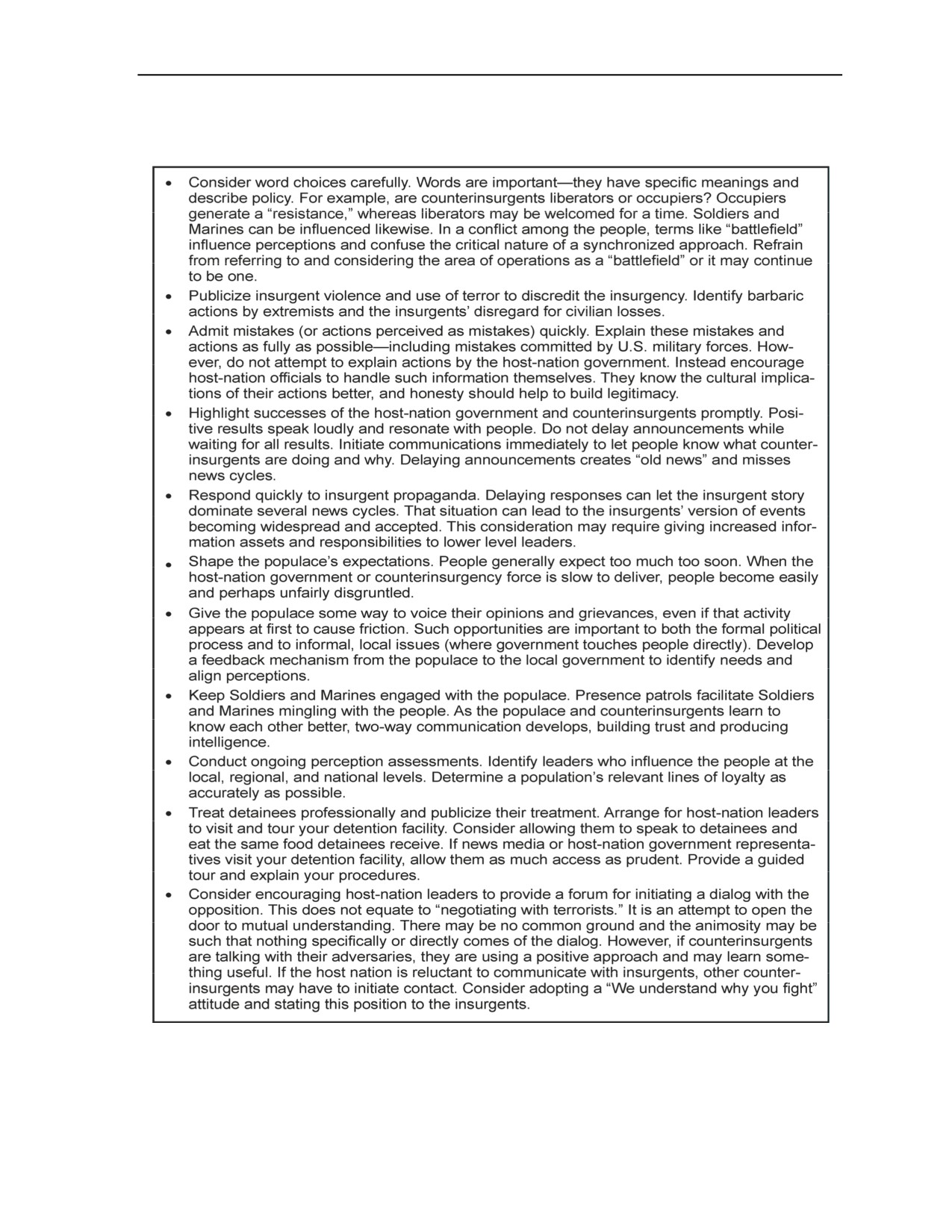
Executing Counterinsurgency Operations
Table 5-1. Considerations for developing the information operations LLO
15 December 2006
FM 3-24/MCWP 3-33.5
5-9
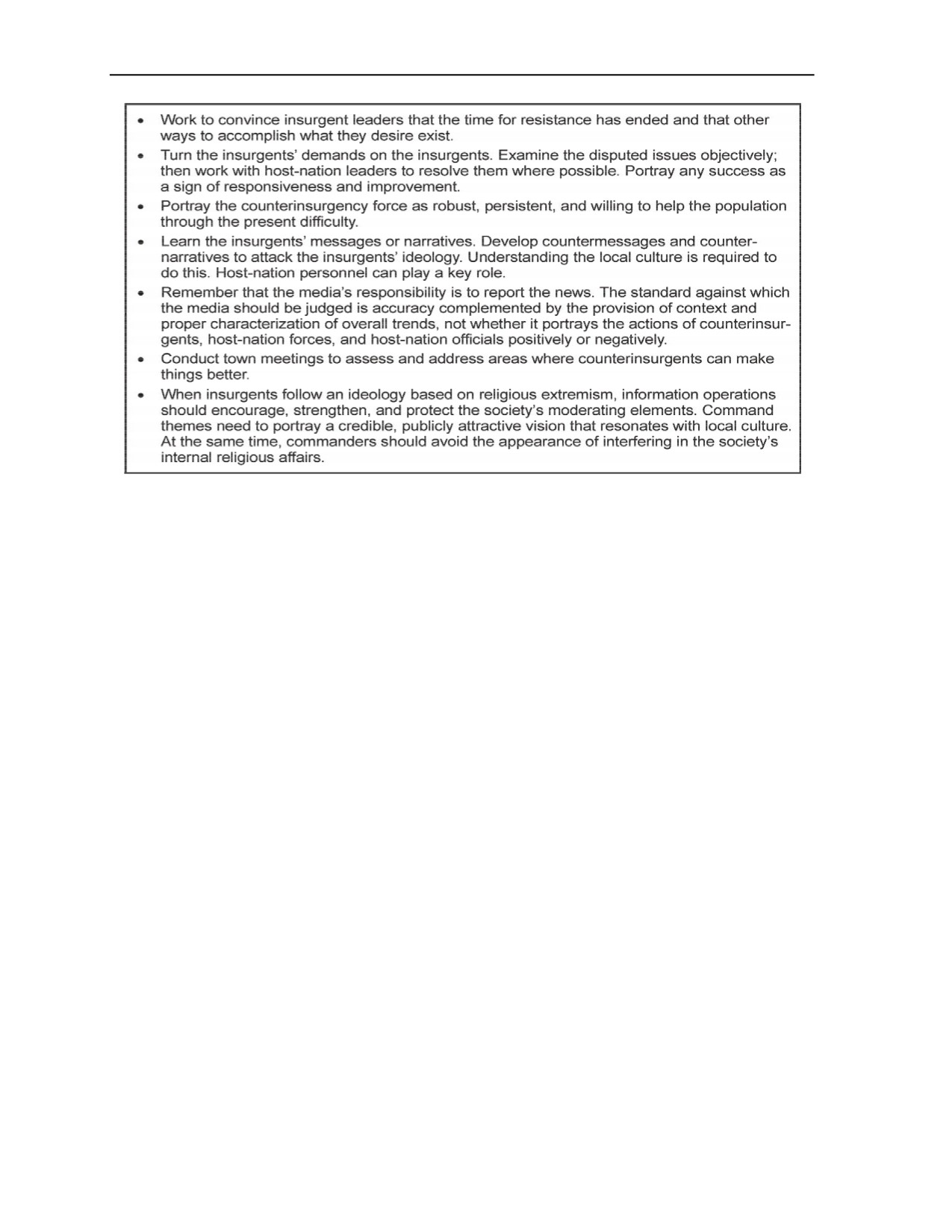
Chapter 5
5-25. Impartiality is a common theme for information activities when there are political, social, and sectar-
ian divisions in the host nation. Counterinsurgents should avoid taking sides, when possible. Perceived favorit-
ism can exacerbate civil strife and make counterinsurgents more desirable targets for sectarian violence.
5-26. Effective commanders directly engage in a dialog with the media and communicate command
themes and messages personally. The worldwide proliferation of sophisticated communication technolo-
gies means that media coverage significantly affects COIN operations at all echelons. Civilian and military
media coverage influences the perceptions of the political leaders and public of the host nation, United
States, and international community. The media directly influence the attitude of key audiences toward
counterinsurgents, their operations, and the opposing insurgency. This situation creates a war of percep-
tions between insurgents and counterinsurgents conducted continuously using the news media.
5-27. Commanders often directly engage the local populace and stakeholders through face-to-face meet-
ings, town meetings, and community events highlighting counterinsurgent community improvements.
These engagements give commanders additional opportunities to assess their efforts’ effects, address
community issues and concerns, and personally dispel misinformation. These events often occur in the
civil-military operations center.
5-28. The media are a permanent part of the information environment. Effective media/public affairs op-
erations are critical to successful military operations. All aspects of military operations are subject to im-
mediate scrutiny. Well-planned, properly coordinated, and clearly expressed themes and messages can sig-
nificantly clarify confusing situations. Clear, accurate portrayals can improve the effectiveness and morale
of counterinsurgents, reinforce the will of the U.S. public, and increase popular support for the HN gov-
ernment. The right messages can reduce misinformation, distractions, confusion, uncertainty, and other fac-
tors that cause public distress and undermine the COIN effort. Constructive and transparent information
enhances understanding and support for continuing operations against the insurgency.
5-29. There are several methods for working with the media to facilitate accurate and timely information
flow. These include the following:
z
Embedded media.
z
Press conferences.
z
Applying resources.
z
Network with media outlets.
5-30. Embedded media representatives experience Soldiers’ and Marines’ perspectives of operations in the
COIN environment. Media representatives should be embedded for as long as practicable. Representatives
5-10
FM 3-24/MCWP 3-33.5
15 December 2006
Executing Counterinsurgency Operations
embedded for weeks become better prepared to present informed reports. Embedding for days rather than
weeks risks media representatives not gaining a real understanding of the context of operations. Such short
exposure may actually lead to unintended misinformation. The media should be given access to Soldiers
and Marines in the field. These young people nearly always do a superb job of articulating the important
issues for a broad audience. Given a chance, they can share their courage and sense of purpose with the
American people and the world.
5-31. Commanders may hold weekly press conferences to explain operations and provide transparency to
the people most affected by COIN efforts. Ideally, these sessions should include the HN media and HN of-
ficials. Such events provide opportunities to highlight the accomplishments of counterinsurgents and the
HN government.
5-32. Commanders should apply time, effort, and money to establish the proper combination of media out-
lets and communications to transmit the repetitive themes of HN government accomplishments and insur-
gent violence against the populace. This might require counterinsurgents to be proactive, alerting the media
to news opportunities and perhaps providing transportation or other services to ensure proper coverage.
Helping establish effective HN media is another important COIN requirement. A word of caution: the
populace and HN media must never perceive that counterinsurgents and HN forces are manipulating the
media. Even the slightest appearance of impropriety can undermine the credibility of the COIN force and
the host nation.
5-33. Good working relationships between counterinsurgent leaders and members of the U.S. media are in
the Nation’s interest. Similar relationships can be established with international media sources. When they
do not understand COIN efforts, U.S. media representatives portray the situation to the American public
based on what they do know. Such reports can be incomplete, if not incorrect. Through professional rela-
tionships, military leaders can ensure U.S. citizens better understand what their military is doing in support
of the Nation’s interests.
5-34. The media are ever present and influence perceptions of the COIN environment. Therefore, success-
ful leaders engage the media, create positive relationships, and help the media tell the story. Operations se-
curity must always be maintained; however, security should not be used as an excuse to create a media
blackout. In the absence of official information, some media representatives develop stories on their own
that may be inaccurate and may not include the COIN force perspective. (See JP 3-61, FM 46-1, FM 3-61.1
for public affairs doctrine.)
CONDUCT COMBAT OPERATIONS/CIVIL SECURITY OPERATIONS
5-35. This LLO is the most familiar to military forces. Care must be taken not to apply too many resources
to this LLO at the expense of other LLOs that facilitate the development or reinforcement of the HN gov-
ernment’s legitimacy. Commanders may describe actions related to combat operations and civil security
operations as a single LLO or as multiple LLOs. Commanders base their decision on conditions in the AO
and their objectives. (Table 5-2 [page 5-12] lists considerations for developing the combat operations/civil se-
curity LLO.)
5-36. Under full spectrum operations, forces conduct simultaneous offensive, defensive, and stability opera-
tions. Offensive and defensive operations focus on defeating enemy forces. Security operations, including
area security, pertain to actions taken to protect the force. They are associated with offensive and defensive
operations. In contrast, stability operations focus on security and control of areas, resources, and popula-
tions. Civil security and civil control are types of stability operations. Army commanders expect a mission
of protecting and providing security for a population to be expressed in terms of civil security or civil control.
5-37. Within the COIN context, Marine Corps doctrine does not draw a distinction in this manner; rather,
it places tasks related to civil security and area security under combat operations. A Marine force assigned
an area security mission during a COIN operation executes it as a combat operation. The force establishes
and maintains measures to protect people and infrastructure from hostile acts or influences while actively
seeking out and engaging insurgent forces.
15 December 2006
FM 3-24/MCWP 3-33.5
5-11
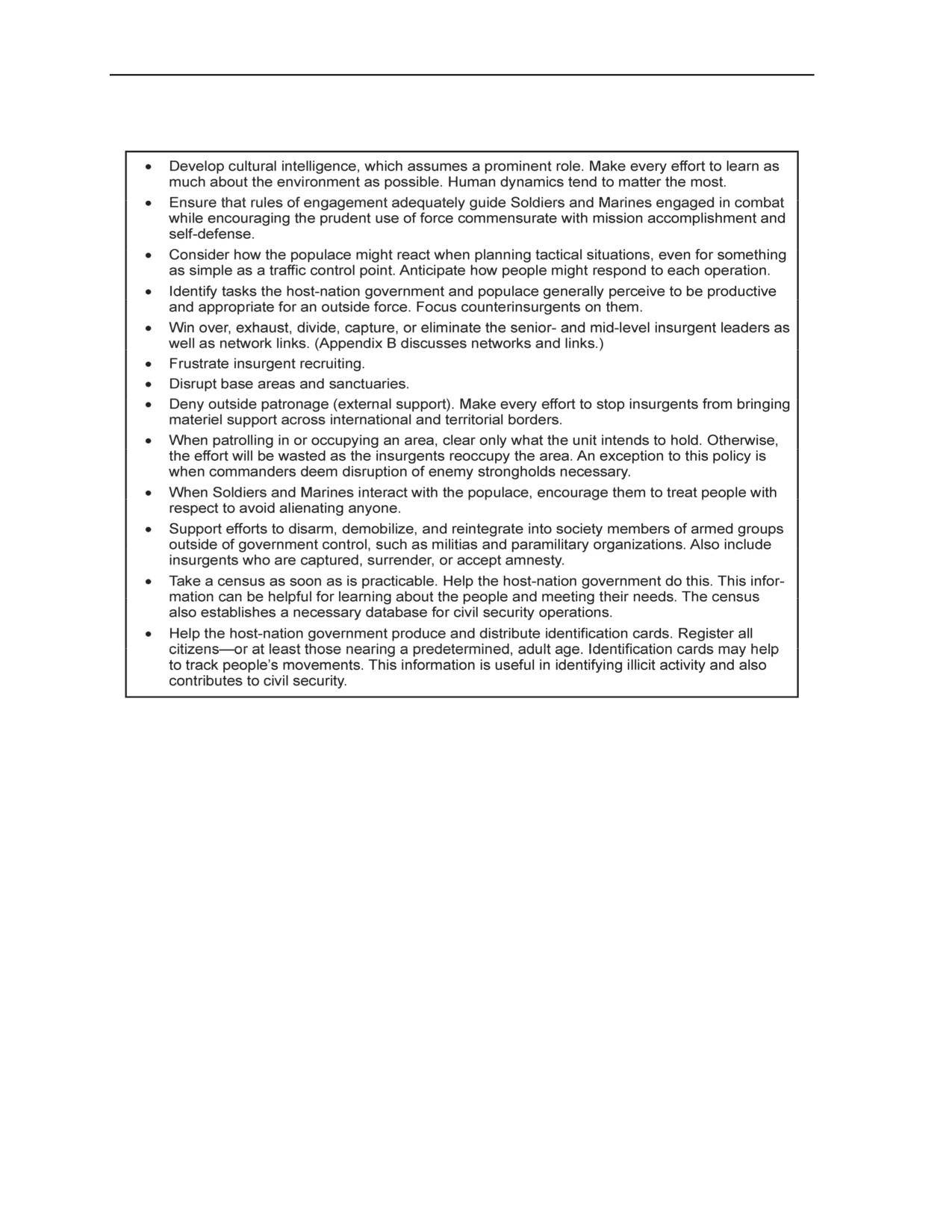
Chapter 5
Table 5-2. Considerations for developing the combat operations/civil security operations LLO
5-38. Insurgents use unlawful violence to weaken the HN government, intimidate people into passive or
active support, and murder those who oppose the insurgency. Measured combat operations are always re-
quired to address insurgents who cannot be co-opted into operating inside the rule of law. These operations
may sometimes require overwhelming force and the killing of fanatic insurgents. However, COIN is “war
amongst the people.” Combat operations must therefore be executed with an appropriate level of restraint
to minimize or avoid injuring innocent people. Not only is there a moral basis for the use of restraint or
measured force; there are practical reasons as well. Needlessly harming innocents can turn the populace
against the COIN effort. Discriminating use of fires and calculated, disciplined response should character-
ize COIN operations. Kindness and compassion can often be as important as killing and capturing insur-
gents.
5-39. Battalion-sized and smaller unit operations are often most effective for countering insurgent activi-
ties. Counterinsurgents need to get as close as possible to the people to secure them and glean the maxi-
mum amount of quality information. Doing this helps counterinsurgents gain a fluidity of action equal or
superior to that of the enemy. This does not mean larger unit operations are not required. Brigades are usu-
ally synchronizing headquarters. Divisions shape the environment to set conditions and facilitate brigade
and battalion success. The sooner counterinsurgents can execute small-unit operations effectively, the better.
5-12
FM 3-24/MCWP 3-33.5
15 December 2006
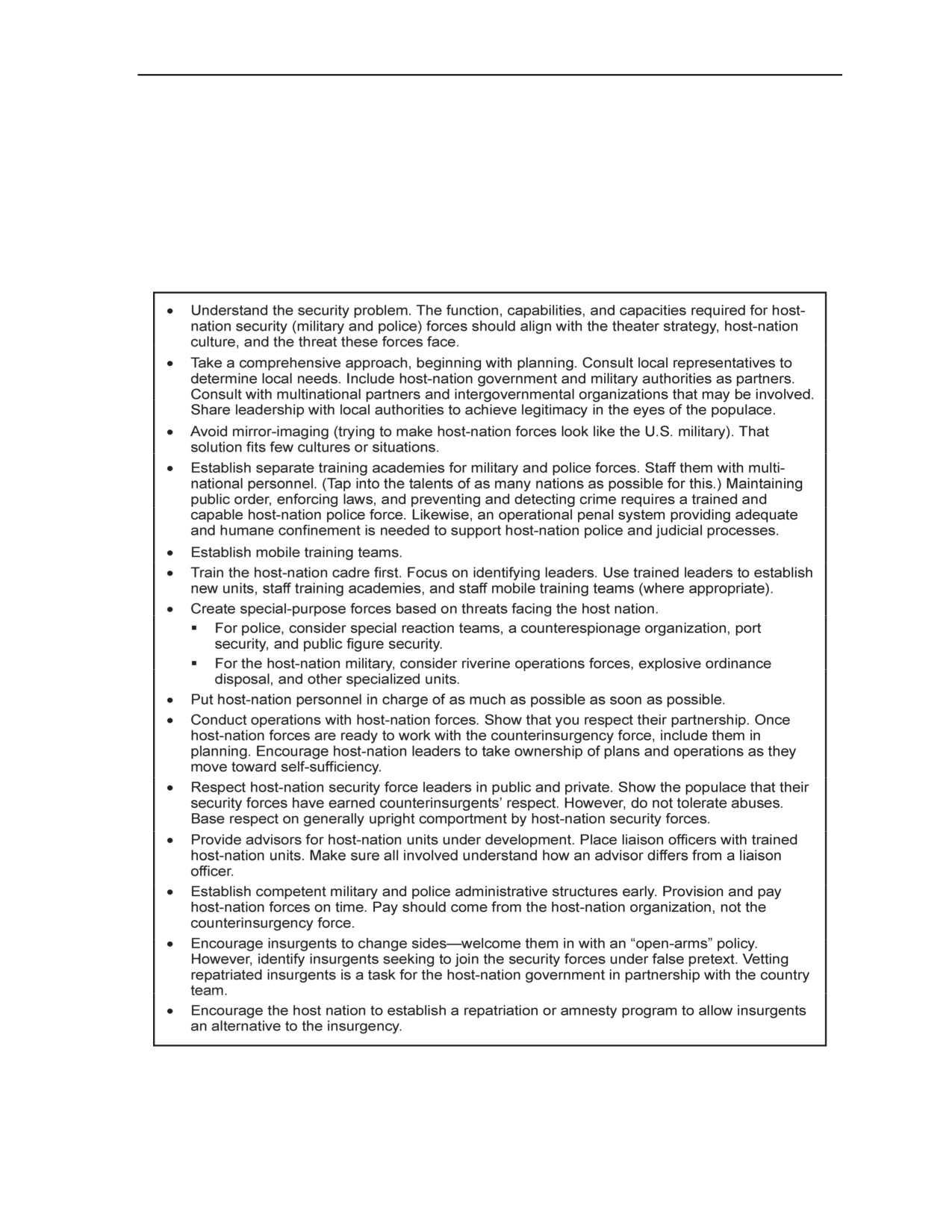
Executing Counterinsurgency Operations
TRAIN AND EMPLOY HOST-NATION SECURITY FORCES
5-40. Most societal and government functions require a secure environment. Although U.S. and multina-
tional forces can provide direct assistance to establish and maintain security, this situation is at best a pro-
visional solution. Ultimately, the host nation must secure its own people. (Table 5-3 lists considerations for
developing the HN security forces LLO. Chapter 6 addresses this LLO in detail.)
Table 5-3. Considerations for developing the host-nation security forces LLO
15 December 2006
FM 3-24/MCWP 3-33.5
5-13
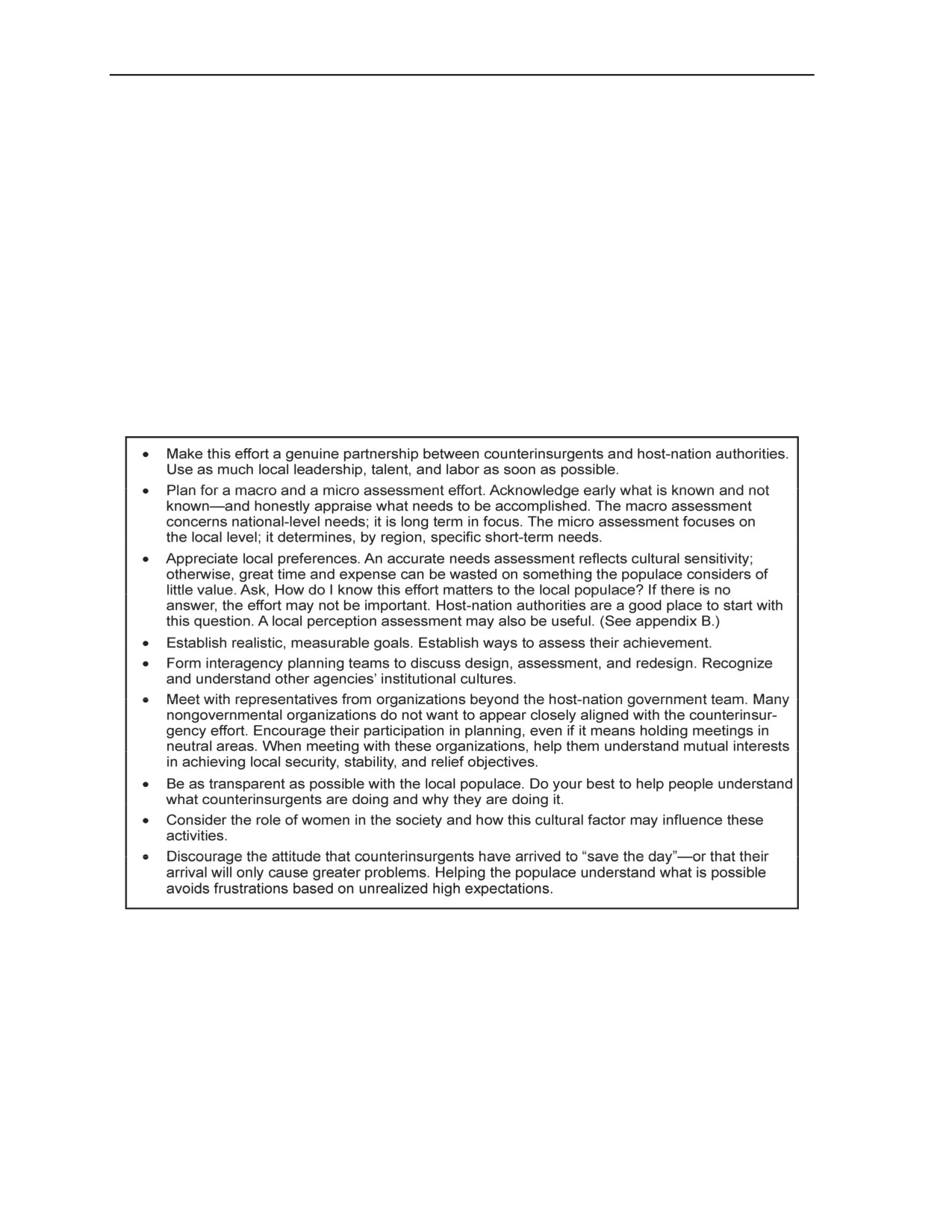
Chapter 5
5-41. The U.S. military can help the host nation develop the forces required to establish and sustain stabil-
ity within its borders. This task usually involves other government agencies and multinational partners.
This assistance can include developing, equipping, training, and employing HN security forces. It may ex-
tend to operations in which multinational military units fight alongside the newly formed, expanded, or re-
formed HN forces.
ESTABLISH OR RESTORE ESSENTIAL SERVICES
5-42. Essential services address the life support needs of the HN population. The U.S. military’s primary
task is normally to provide a safe and secure environment. HN or interagency organizations can then de-
velop the services or infrastructure needed. In an unstable environment, the military may initially have the
leading role. Other agencies may not be present or might not have enough capability or capacity to meet
HN needs. Therefore, COIN military planning includes preparing to perform these tasks for an extended
period. (Table 5-4 lists considerations for developing the essential services LLO.)
Table 5-4. Considerations for developing the essential services LLO
5-43. Counterinsurgents should work closely with the host nation in establishing achievable goals. If lofty
goals are set and not achieved, both counterinsurgents and the HN government can lose the populace’s re-
spect. The long-term objective is for the host nation to assume full responsibility and accountability for
these services. Establishing activities that the HN government is unable to sustain may be counterproduc-
tive. IO nested within this LLO manage expectations and ensure that the public understands the problems
involved in providing these services, for example, infrastructure sabotage by insurgents. Figure 5-4 shows
an example of common essential services categories. Accomplishing objectives in each category contrib-
utes to achieving the higher commander’s desired end state.
5-14
FM 3-24/MCWP 3-33.5
15 December 2006
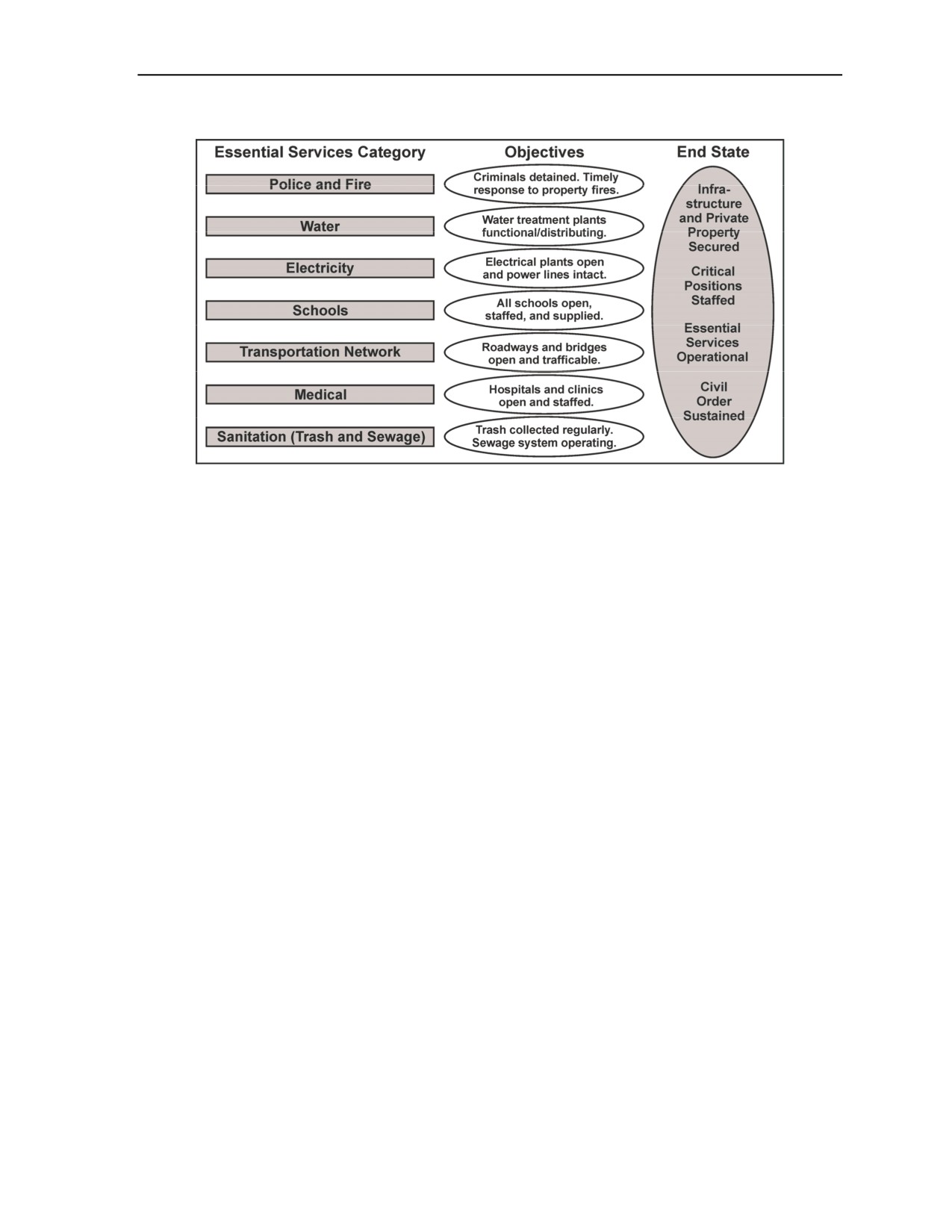
Executing Counterinsurgency Operations
Figure 5-4. Example of essential services categories and objectives
SUPPORT DEVELOPMENT OF BETTER GOVERNANCE
5-44. This LLO relates to the HN government’s ability to gather and distribute resources while providing
direction and control for society. These include regulation of public activity; taxation; maintenance of secu-
rity, control, and essential services; and normalizing the means of succession of power. Good governance
is normally a key requirement to achieve legitimacy for the HN government. Activities related to it include
the following:
z
Controlling military and police activities.
z
Establishing and enforcing the rule of law.
z
Public administration.
z
Justice (a judiciary system, prosecutor/defense representation, and corrections).
z
Property records and control.
z
Public finance.
z
Civil information.
z
Historical, cultural, and recreational services.
z
An electoral process for representative government.
z
Disaster preparedness and response.
5-45. Sometimes no HN government exists or the government is unable or unwilling to assume full re-
sponsibility for governance. In those cases, this LLO may involve establishing and maintaining a military
government or a civil administration while creating and organizing a HN capability to govern. In the long
run, developing better governance will probably affect the lives of the populace more than any other COIN
activities. When well executed, these actions may eliminate the root causes of the insurgency. Governance
activities are among the most important of all in establishing lasting stability for a region or nation. (Table
5-5 (page 5-16) lists considerations for developing the governance LLO.)
15 December 2006
FM 3-24/MCWP 3-33.5
5-15
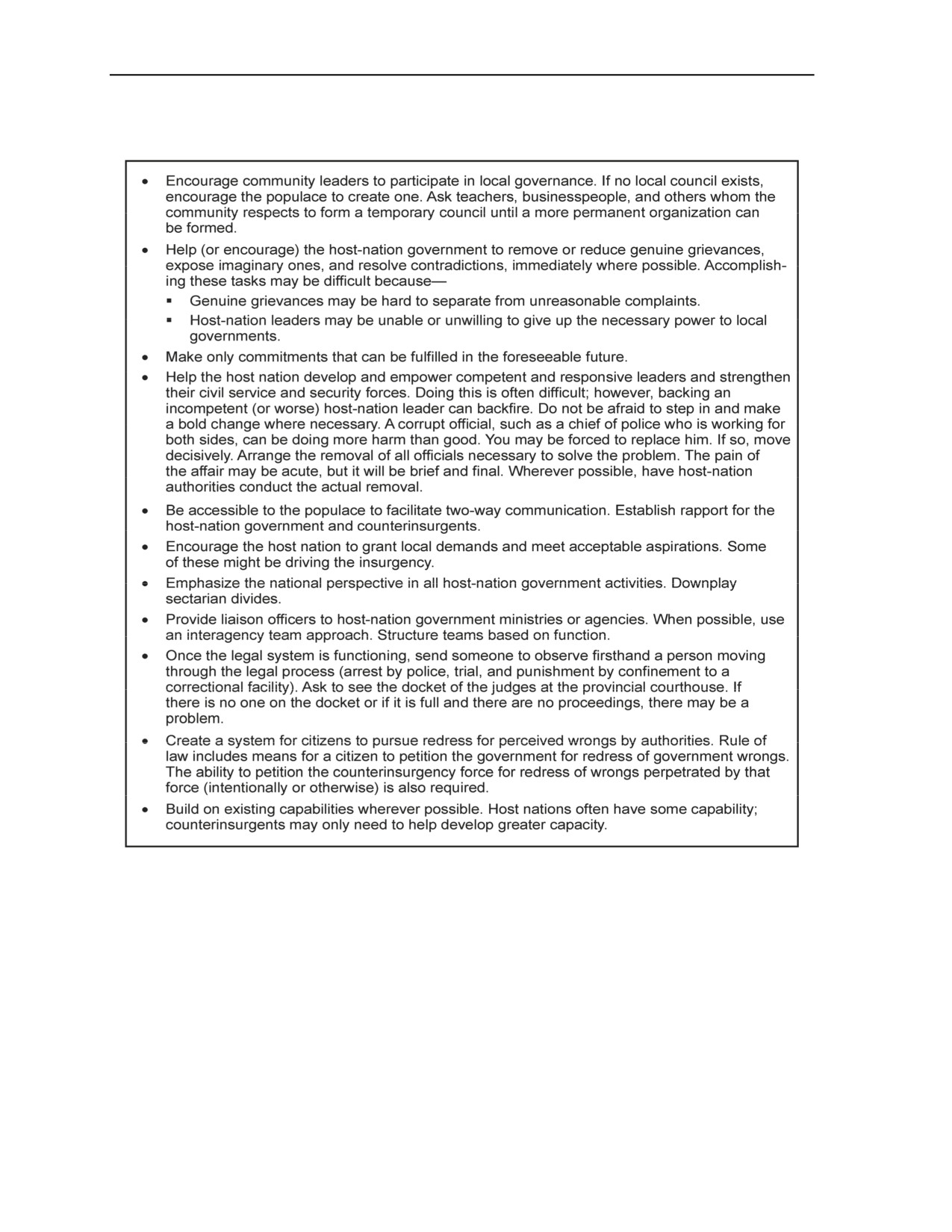
Chapter 5
Table 5-5. Considerations for developing the governance LLO
SUPPORT ECONOMIC DEVELOPMENT
5-46. The economic development LLO includes both short- and long-term aspects. The short-term aspect
concerns immediate problems, such as large-scale unemployment and reestablishing an economy at all lev-
els. The long-term aspect involves stimulating indigenous, robust, and broad economic activity. The stabil-
ity a nation enjoys is often related to its people’s economic situation and its adherence to the rule of law.
However, a nation’s economic health also depends on its government’s ability to continuously secure its
population.
5-47. Planning economic development requires understanding the society, culture, and operational envi-
ronment. For example, in a rural society, land ownership and the availability of agricultural equipment,
seed, and fertilizer may be the chief parts of any economic development plan. In an urban, diversified soci-
ety, the availability of jobs and the infrastructure to support commercial activities may be more important.
Except for completely socialist economies, governments do not create jobs other than in the public bu-
5-16
FM 3-24/MCWP 3-33.5
15 December 2006
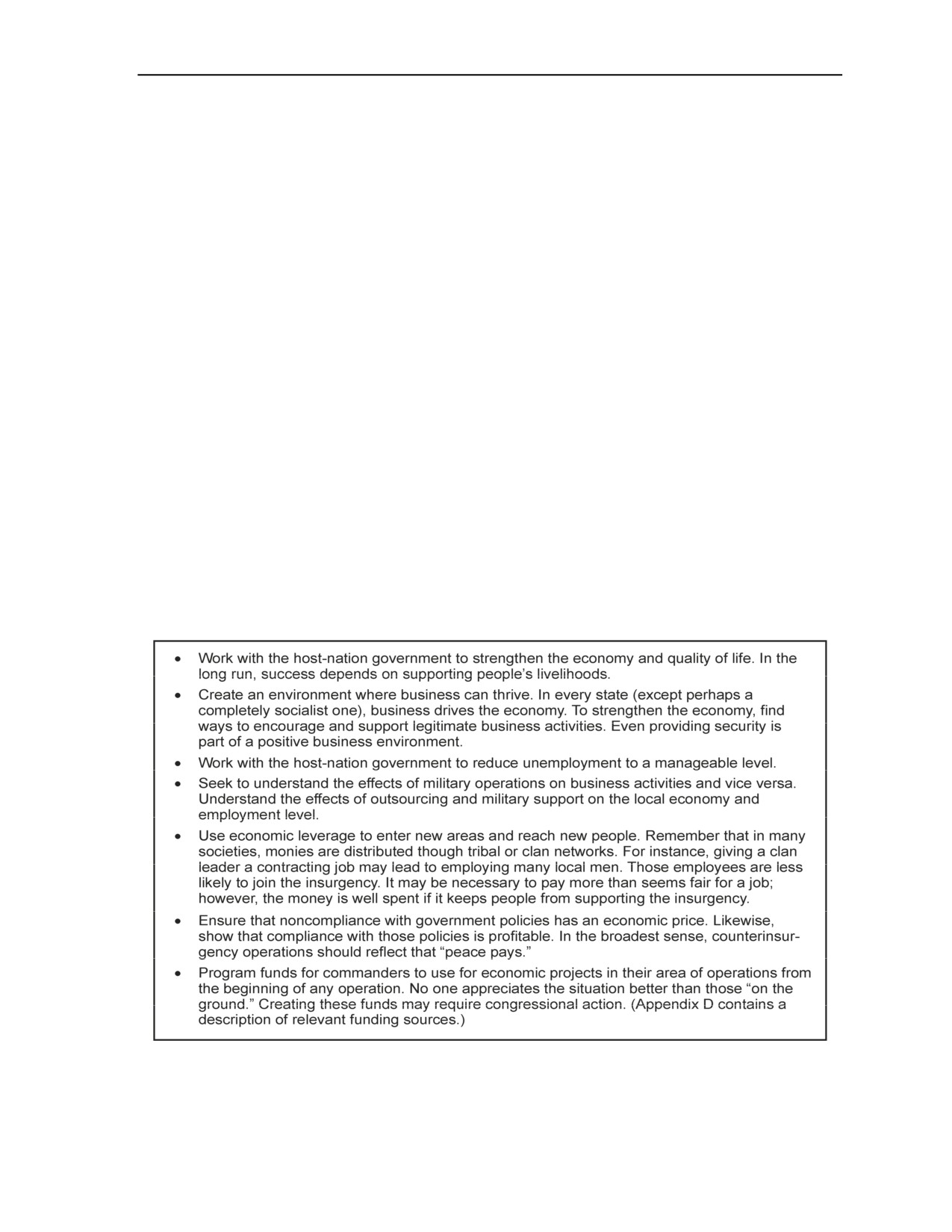
Executing Counterinsurgency Operations
reaucracy. However, the micro economy can be positively stimulated by encouraging small businesses de-
velopment. Jump-starting small businesses requires micro finance in the form of some sort of banking ac-
tivities. So then, supporting economic development requires attention to both the macro economy and the
micro economy.
5-48. Without a viable economy and employment opportunities, the public is likely to pursue false prom-
ises offered by insurgents. Sometimes insurgents foster the conditions keeping the economy stagnant. In-
surgencies attempt to exploit a lack of employment or job opportunities to gain active and passive support
for their cause and ultimately undermine the government’s legitimacy. Unemployed males of military age
may join the insurgency to provide for their families. Hiring these people for public works projects or a lo-
cal civil defense corps can remove the economic incentive to join the insurgency. The major categories of
economic activity include the following:
z
Fossil fuels, mining, and related refining infrastructure.
z
Generation and transmission of power and energy.
z
Transportation and movement networks.
z
Stock and commodities exchange.
z
Banking.
z
Manufacturing and warehousing.
z
Building trades and services.
z
Agriculture, food processing, fisheries, and stockyard processing.
z
Labor relations.
z
Education and training.
5-49. Table 5-6 lists considerations for developing the economic development LLO.
Table 5-6. Considerations for the economic development LLO
15 December 2006
FM 3-24/MCWP 3-33.5
5-17
Chapter 5
COUNTERINSURGENCY APPROACHES
5-50. There are many approaches to achieving success in a COIN effort. The components of each ap-
proach are not mutually exclusive. Several are shared by multiple approaches. The approaches described
below are not the only choices available and are neither discrete nor exclusive. They may be combined, de-
pending on the environment and available resources. The following methods and their components have
proven effective. However, they must be adapted to the demands of the local environment. Three examples
of approaches are—
z
Clear-hold-build.
z
Combined action.
z
Limited support.
CLEAR-HOLD-BUILD
5-51. A clear-hold-build operation is executed in a specific, high-priority area experiencing overt insurgent
operations. It has the following objectives:
z
Create a secure physical and psychological environment.
z
Establish firm government control of the populace and area.
z
Gain the populace’s support.
Popular support can be measured in terms of local participation in HN programs to counter the insurgency
and whether people give counterinsurgents usable information about insurgent locations and activities.
5-52. COIN efforts should begin by controlling key areas. Security and influence then spread out from se-
cured areas. The pattern of this approach is to clear, hold, and build one village, area, or city—and then re-
inforce success by expanding to other areas. This approach aims to develop a long-term, effective HN gov-
ernment framework and presence that secures the people and facilitates meeting their basic needs. Success
reinforces the HN government’s legitimacy. The primary tasks to accomplish during clear-hold-build are—
z
Provide continuous security for the local populace.
z
Eliminate insurgent presence.
z
Reinforce political primacy.
z
Enforce the rule of law.
z
Rebuild local HN institutions.
5-53. To create success that can spread, a clear-hold-build operation should not begin by assaulting the
main insurgent stronghold. However, some cases may require attacks to disrupt such strongholds, even if
counterinsurgents cannot clear and hold the area. “Disrupt and leave” may be needed to degrade the insur-
gents’ ability to mount attacks against cleared areas. Clear-hold-build objectives require lots of resources
and time. U.S. and HN commanders should prepare for a long-term effort. All operations require unity of
effort by civil authorities, intelligence agencies, and security forces. Coherent IO are also needed.
5-54. Clear-hold-build operations should expand outward from a secure base. An example is an urban in-
dustrial complex whose population supports the government effort and where security forces are in firm
control. No population subjected to the intense organizational efforts of an insurgent organization can be
won back until certain conditions are created:
z
The counterinsurgent forces are clearly superior to forces available to the insurgents.
z
Enough nonmilitary resources are available to effectively carry out all essential improvements
needed to provide basic services and control the population.
z
The insurgents are cleared from the area.
z
The insurgent organizational infrastructure and its support have been neutralized or eliminated.
z
A HN government presence is established to replace the insurgents’ presence, and the local
populace willingly supports this HN presence.
5-18
FM 3-24/MCWP 3-33.5
15 December 2006
Executing Counterinsurgency Operations
5-55. The following discussion describes some examples of activities involved in the clear-hold-build ap-
proach. Its execution involves activities across all LLOs. There can be overlap between steps—especially
between hold and build, where relevant activities are often conducted simultaneously.
Clearing the Area
5-56. Clear is a tactical mission task that requires the commander to remove all enemy forces and elimi-
nate organized resistance in an assigned area (FM 3-90). The force does this by destroying, capturing, or
forcing the withdrawal of insurgent combatants. This task is most effectively initiated by a clear-in-zone or
cordon-and-search operation. This operation’s purpose is to disrupt insurgent forces and force a reaction by
major insurgent elements in the area. Commanders employ a combination of offensive small-unit opera-
tions. These may include area saturation patrolling that enables the force to defeat insurgents in the area,
interdiction ambushes, and targeted raids.
5-57. These offensive operations are only the beginning, not the end state. Eliminating insurgent forces
does not remove the entrenched insurgent infrastructure. While their infrastructure exists, insurgents con-
tinue to recruit among the population, attempt to undermine the HN government, and try to coerce the
populace through intimidation and violence. After insurgent forces have been eliminated, removing the in-
surgent infrastructure begins. This should be done so as to minimize the impact on the local populace.
Rooting out such infrastructure is essentially a police action that relies heavily on military and intelligence
forces until HN police, courts, and legal processes can assume responsibility for law enforcement within the
cleared area.
5-58. If insurgent forces are not eliminated but instead are expelled or have broken into smaller groups,
they must be prevented from reentering the area or reestablishing an organizational structure inside the
area. Once counterinsurgents have established their support bases, security elements cannot remain static.
They should be mobile and establish a constant presence throughout the area. Use of special funds should
be readily available for all units to pay compensation for damages that occur while clearing the area of in-
surgent forces. Offensive and stability operations are continued to maintain gains and set the conditions for
future activities. These include—
z
Isolating the area to cut off external support and to kill or capture escaping insurgents.
z
Conducting periodic patrols to identify, disrupt, eliminate, or expel insurgents.
z
Employing security forces and government representatives throughout the area to secure the
populace and facilitate follow-on stages of development.
5-59. Operations to clear an area are supplemented by IO focused on two key audiences: the local popu-
lace and the insurgents. The message to the populace focuses on gaining and maintaining their overt sup-
port for the COIN effort. This command theme is that the continuous security provided by U.S. and HN
forces is enough to protect the people from insurgent reprisals for their cooperation. Conversely, the popu-
lace should understand that actively supporting the insurgency will prolong combat operations, creating a
risk to themselves and their neighbors. The command message to the insurgents focuses on convincing
them that they cannot win and that the most constructive alternatives are to surrender or cease their activi-
ties.
Holding with Security Forces
5-60. Ideally HN forces execute this part of the clear-hold-build approach. Establishment of HN security
forces in bases among the population furthers the continued disruption, identification, and elimination of
the local insurgent leadership and infrastructure. The success or failure of the effort depends, first, on ef-
fectively and continuously securing the populace and, second, on effectively reestablishing a HN govern-
ment presence at the local level. Measured offensive operations continue against insurgents as opportuni-
ties arise, but the main effort is focused on the population.
5-61. Key infrastructure must be secured. Since resources are always limited, parts of the infrastructure vi-
tal for stability and vulnerable to attack receive priority for protection. These critical assets should be iden-
tified during planning. For instance, a glassmaking factory may be important for economic recovery, but it
may not be at risk of insurgent attack and therefore may not require security.
15 December 2006
FM 3-24/MCWP 3-33.5
5-19
Chapter 5
5-62. There are four key target audiences during the hold stage:
z
Population.
z
Insurgents.
z
COIN force.
z
Regional and international audiences.
5-63. Command themes and messages to the population should affirm that security forces supporting the
HN government are in the area to accomplish the following:
z
Protect the population from insurgent intimidation, coercion, and reprisals.
z
Eliminate insurgent leaders and infrastructure.
z
Improve essential services where possible.
z
Reinstate HN government presence.
IO should also emphasize that U.S. and HN security forces will remain until the current situation is re-
solved or stated objectives are attained. This message of a persistent presence can be reinforced by making
long-term contracts with local people for supply or construction requirements.
5-64. The commander’s message to the insurgents is to surrender or leave the area. It emphasizes the per-
manent nature of the government victory and presence. The HN government might try to exploit success by
offering a local amnesty. Insurgent forces will probably not surrender, but they may cease hostile actions
against the HN government agencies in the area.
5-65. The commander’s message to the COIN force should explain changes in missions and responsibili-
ties associated with creating or reinforcing the HN government’s legitimacy. The importance of protecting
the populace, gaining people’s support by assisting them, and using measured force when fighting insur-
gents should be reinforced and understood.
5-66. Operations during this stage are designed to—
z
Continuously secure the people and separate them from the insurgents.
z
Establish a firm government presence and control over the area and populace.
z
Recruit, organize, equip, and train local security forces.
z
Establish a government political apparatus to replace the insurgent apparatus.
z
Develop a dependable network of sources by authorized intelligence agents.
5-67. Major actions occurring during this stage include—
z
Designating and allocating area-oriented counterinsurgent forces to continue offensive opera-
tions. Other forces that participated in clearing actions are released or assigned to other tasks.
z
A thorough population screening to identify and eliminate remaining insurgents and to identify
any lingering insurgent support structures.
z
Conducting area surveys to determine available resources and the populace’s needs. Local lead-
ers should be involved.
z
Environmental improvements designed to convince the populace to support the HN government,
participate in securing their area, and contribute to the reconstruction effort.
z
Training of local paramilitary security forces, including arming them and integrating them into
successful operations against the insurgents.
z
Establishing a communications system that integrates the area into the HN communications grid
and system.
Building Support and Protecting the Population
5-68. Progress in building support for the HN government requires protecting the local populace. People
who do not believe they are secure from insurgent intimidation, coercion, and reprisals will not risk overtly
supporting COIN efforts. The populace decides when it feels secure enough to support COIN efforts.
5-69. To protect the populace, HN security forces continuously conduct patrols and use measured force
against insurgent targets of opportunity. Contact with the people is critical to the local COIN effort’s suc-
5-20
FM 3-24/MCWP 3-33.5
15 December 2006
Executing Counterinsurgency Operations
cess. Actions to eliminate the remaining covert insurgent political infrastructure must be continued; an in-
surgent presence will continue to threaten and influence people.
5-70. Tasks that provide an overt and direct benefit for the community are key, initial priorities. Special
funds (or other available resources) should be available to pay wages to local people to do such beneficial
work. Accomplishing these tasks can begin the process of establishing HN government legitimacy. Sample
tasks include—
z
Collecting and clearing trash from the streets.
z
Removing or painting over insurgent symbols or colors.
z
Building and improving roads.
z
Digging wells.
z
Preparing and building an indigenous local security force.
z
Securing, moving, and distributing supplies.
z
Providing guides, sentries, and translators.
z
Building and improving schools and similar facilities.
Population Control Measures
5-71. Population control includes determining who lives in an area and what they do. This task requires
determining societal relationships—family, clan, tribe, interpersonal, and professional. Establishing control
normally begins with conducting a census and issuing identification cards. A census must be advertised
and executed systematically. Census tasks include establishing who resides in which building and each
household’s family head. Those heads of households are required to report any changes to the appropriate
agencies. Census records provide information regarding real property ownership, relationships, and busi-
ness associations.
5-72. Insurgents may try to force people to destroy their identification cards. The benefits of retaining
identification cards must be enough to motivate people to resist losing them. Insurgents may participate in
the census to obtain valid identification cards. Requiring applicants to bring two men from outside their
family to swear to their identity can reduce this probability. Those who affirm the status of an applicant are
accountable for their official statements made on behalf of the applicant. Identification cards should have a
code that indicates where the holders live.
5-73. Other population control measures include—
z
Curfews.
z
A pass system (for example, one using travel permits or registration cards) administered by se-
curity forces or civil authorities.
z
Limits on the length of time people can travel.
z
Limits on the number of visitors from outside the area combined with a requirement to register
them with local security forces or civil authorities.
z
Checkpoints along major routes to monitor and enforce compliance with population control
measures.
5-74. The HN government should explain and justify new control measures to the affected population.
People need to understand what is necessary to protect them from insurgent intimidation, coercion, and re-
prisals. Once control measures are in place, the HN government should have an established system of pun-
ishments for offenses related to them. These should be announced and enforced. The host nation should es-
tablish this system to ensure uniform enforcement and conformity with the rule of law throughout its
territory. The HN government must be able to impose fines and other punishments for such civil infrac-
tions.
Increasing Popular Support
5-75. Counterinsurgents should use every opportunity to help the populace and meet its needs and expecta-
tions. Projects to improve economic, social, cultural, and medical needs can begin immediately. Actions
speak louder than words. Once the insurgent political infrastructure is destroyed and local leaders begin to es-
15 December 2006
FM 3-24/MCWP 3-33.5
5-21
Chapter 5
tablish themselves, necessary political reforms can be implemented. Other important tasks include the follow-
ing:
z
Establishing HN government agencies to perform routine administrative functions and begin
improvement programs.
z
Providing HN government support to those willing to participate in reconstruction. Selection for
participation should be based on need and ability to help. People should also be willing to secure
what they create.
z
Beginning efforts to develop regional and national consciousness and rapport between the popu-
lation and its government. Efforts may include participating in local elections, making commu-
nity improvements, forming youth clubs, and executing other projects.
5-76. Commanders can use IO to increase popular support. Command messages are addressed to the popu-
lace, insurgents, and counterinsurgents.
5-77. The IO message to the population has three facets:
z
Obtaining the understanding or approval of security force actions that affect the populace, such
as control measures or a census. Tell the people what forces are doing and why they are doing it.
z
Establishing human intelligence sources that lead to identification and destruction of any re-
maining insurgent infrastructure in the area.
z
Winning over passive or neutral people by demonstrating how the HN government is going to
make their life better.
5-78. The IO message to insurgents should aim to create divisions between the movement leaders and the
mass base by emphasizing failures of the insurgency and successes of the government. Success is indicated
when insurgents abandon the movement and return to work with the HN government.
5-79. Commanders should emphasize that counterinsurgents must remain friendly towards the populace
while staying vigilant against insurgent actions. Commanders must ensure Soldiers and Marines understand
the rules of engagement, which become more restrictive as peace and stability return.
5-80. The most important activities during the build stage are conducted by nonmilitary agencies. HN gov-
ernment representatives reestablish political offices and normal administrative procedures. National and in-
ternational development agencies rebuild infrastructure and key facilities. Local leaders are developed and
given authority. Life for the area’s inhabitants begins to return to normal. Activities along the combat op-
erations/civil security operations LLO and HN security force LLO become secondary to those involved in
essential services, good governance, and essential services LLOs.
Clear-Hold-Build in Tal Afar
In early 2005, the city of Tal Afar in northern Iraq had become a focal point for Iraqi
insurgent efforts. The insurgents tried to assert control over the population. They
used violence and intimidation to inflame ethnic and sectarian tensions. They took
control of all schools and mosques, while destroying police stations. There were fre-
quent abductions and executions. The insurgents achieved some success as the
populace divided into communities defined by sectarian boundaries. Additionally, Tal
Afar became an insurgent support base and sanctuary for launching attacks in the
major regional city of Mosul and throughout Nineveh province.
During the summer of 2005, the 3d Armored Cavalry Regiment (ACR) assumed the
lead for military efforts in and around Tal Afar. In the months that followed, the 3d
ACR applied a clear-hold-build approach to reclaim Tal Afar from the insurgents.
Destruction or Expulsion of Insurgent Forces (Clear)
In August 2005, the 3d ACR and Iraqi forces began the process of destroying the in-
surgency in Tal Afar. Their first step was to conduct reconnaissance to understand
the enemy situation; understand the ethnic, tribal, and sectarian dynamics; and set
the conditions for effective operations. Iraqi security forces and U.S. Soldiers isolated
5-22
FM 3-24/MCWP 3-33.5
15 December 2006