FM 3-24 COUNTERINSURGENCY (DECEMBER 2006) - page 5
Chapter 7
reward professional conduct and punish unethical behavior. They also are comfortable delegating author-
ity. However, as always, accountability for the overall behavior and performance of a command cannot be
delegated. Commanders remain accountable for the attainment of objectives and the manner in which they
are attained.
7-10
FM 3-24/MCWP 3-33.5
15 December 2006
Chapter 8
Sustainment
In my experience in previous wars, the logistic soldier was generally regarded as a rear
area soldier.… Over here in Vietnam, that is completely changed.…There is no rear area
soldier, as such. Because of this, more than ever before, the man in logistics has to be
first, a soldier, in the full sense of the word, and yet at the same time he has to know his
MOS so that he can do his logistics job.
Major General James M. Heiser, USA, 1969
This chapter begins with a general discussion and analysis of how logistics in coun-
terinsurgency (COIN) operations differ from logistics in conventional operations.
This is followed by a survey of COIN-specific factors that affect how commanders
can leverage available logistic assets and assign logisticians to meet special require-
ments needed to support different COIN logical lines of operations. Discussions that
follow acknowledge that COIN operations may be entered into from various military
conditions ranging from unstable peace to general war. The chapter concludes with a
discussion of contracting support to COIN operations.
LOGISTIC CONSIDERATIONS IN COUNTERINSURGENCY
8-1. In counterinsurgency (COIN), the support provided by sustainment units often extends beyond sus-
taining operations; support provided to the population may become an important shaping operation or even
the decisive operation. Logistic providers are often no longer the tail but the nose of a COIN force. Some
of the most valuable services that military logisticians can provide to COIN operations include the means
and knowledge for setting up or restarting self-perpetuating sustainment designs. The development of ef-
fective sustainment designs gives the populace a stake in stability and hope for the future. One COIN para-
dox is that many of the logisticians’ best weapons for countering an insurgency do not shoot. Logistic units
provide some of the most versatile and effective nonlethal resources available to Soldiers and Marines. Lo-
gisticians prepare to provide support across all logical lines of operations (LLOs) visualized and articulated
by the commander. Often, logisticians already supporting COIN combat operations may be the only avail-
able source of prompt, essential knowledge, capabilities, and materials. This chapter focuses on capabilities
and responsibilities of logistic units and logisticians. Commanders of all types of units at all levels must
also be aware of the characteristics of COIN support.
WHAT IS DIFFERENT ABOUT LOGISTICS IN COUNTERINSURGENCY
8-2. In COIN operations, logistic units and other logistic providers perform all the functions they do in
conventional operations as well as some different ones. Conventional operations usually involve two rec-
ognizable military organizations engaging each other in contiguous areas of operations. In COIN opera-
tions, the usual logistic functions—as well as COIN-specific activities—are performed in a frequently dis-
orienting environment complicated by important social, political, and economic implications. Security
conditions in these environments can rapidly change from moment to moment and every few hundred
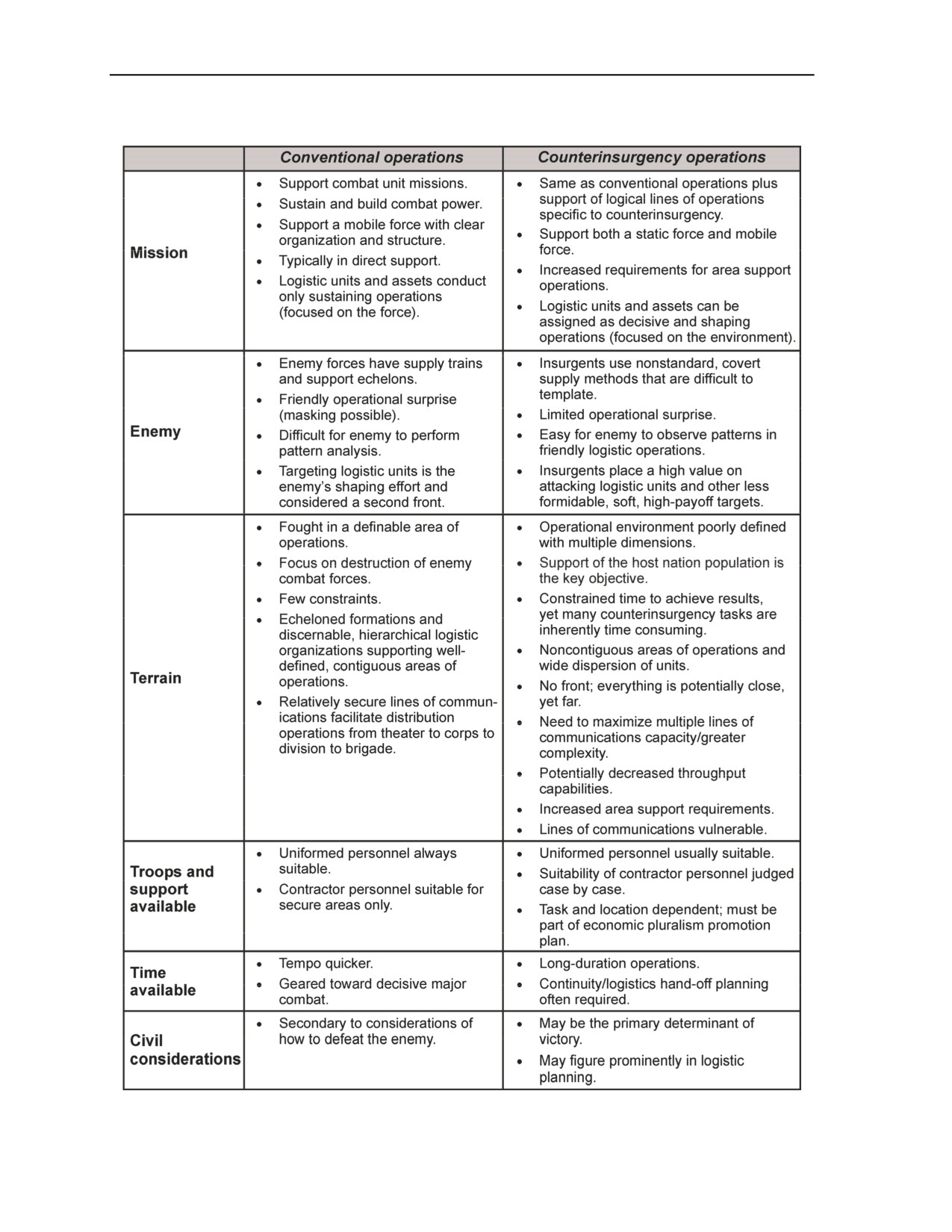
yards over various terrain conditions. (Table 8-1 [page 8-2] lists differences between the characteristics of
logistic support to conventional operations and to COIN operations.)
15 December 2006
FM 3-24/MCWP 3-33.5
8-1
Chapter 8
Table 8-1. Conventional and counterinsurgency operations contrasted
8-2
FM 3-24/MCWP 3-33.5
15 December 2006
Sustainment
8-3. Differences in COIN logistics fit into the following major considerations:
z
Logistic units are an essential part of COIN operations.
z
Logistic units are perceived by insurgents as high-payoff targets and potential sources of sup-
plies; thus, lines of communications (LOCs) are a main battle area for insurgents.
What is Different: Insurgent Perceptions of Military Logistics
Insurgents have a long history of exploiting their enemies’ lines of communications
as sources of supply. During the Revolutionary War, American forces significantly
provisioned themselves from the British Army’s overindulgent and carelessly de-
fended logistic tail. In the 1930s, Mao Zedong codified a doctrine for insurgency lo-
gistics during the fight against the Japanese occupation of China. Without exaggerat-
ing, Mao stated,
“We have a claim on the output of the arsenals of
[our
enemies],…and, what is more, it is delivered to us by the enemy’s transport corps.
This is the sober truth, it is not a jest.” For Mao’s forces, his enemy’s supply trains
provided a valuable source of supply. Mao believed the enemy’s rear was the guerril-
las’ front; the guerrillas’ advantage was that they had no discernable logistic rear.
This relative lack of logistic capacity was not an insurmountable problem for Mao or
one of his logistic theorists, Ming Fan. According to Ming, “Weapons are not difficult
to obtain. They can be purchased from the people’s ‘self-preservation corps.’ Almost
every home has some sort of weapon that can be put to use.… Ammunition can be
obtained in the following ways: (1) From supplies given by friendly troops and head-
quarters on higher echelons. (2) Purchased or appropriated from the people. (3)
Captured by ambushing enemy supply columns. (4) Purchased undercover from the
enemy army. (5) From salvage in combat areas. (6) From the field of battle. (7) Self-
made. (8) Manufactured by guerrilla organizations. (Such items as hand grenades,
ammunition, etc.)” Beyond these specifics, this doctrine prescribes a mindset of ac-
tively seeking parasitic logistic relationships with not only the conventional enemy
forces that the insurgents seek to co-opt and defeat but also active linkages to local
black market activities and the cultivation of host-nation sympathizers.
For these reasons, forces conducting counterinsurgency operations must protect all
potential supplies. Forces must also vigorously protect their lines of communications,
scrupulously collect and positively control dud munitions and access to other con-
vertible materiel, and actively seek ways to separate insurgents from black market
activities.
In one moment in time, our service members will be feeding and clothing displaced refu-
gees, providing humanitarian assistance. In the next moment, they will be holding two
warring tribes apart—conducting peacekeeping operations—and, finally, they will be
fighting a highly lethal mid-intensity battle—all in the same day…all within three city
blocks. It will be what we call the “three block war.”
General Charles C. Krulak, USMC, 1997
8-4. In a COIN environment, units providing logistic support potentially can be involved in more compli-
cated tasks than even those of the three block war metaphor. COIN operations significantly differ in that
logistic units must prepare to provide conventional logistic support to highly lethal, mid-intensity combat
operations while supporting humanitarian operations. Logistic units may be required to maintain this sup-
port until conditions stabilize locally and civilian organizations can assume those duties.
8-5. The COIN environment requires logisticians to seek distribution efficiencies wherever possible. Lo-
gisticians must strive to eliminate backtracking and unnecessary distribution traffic. Ideally, logisticians
maximize throughput methods that bypass—either on the ground or by air—population centers and heavily
used civilian transportation nets. These practices are especially valuable in COIN operations. They improve
logistic security, speed delivery, and minimize adverse effects and stress on the local populace.
15 December 2006
FM 3-24/MCWP 3-33.5
8-3
Chapter 8
8-6. Because of the diverse requirements, logisticians stay involved from the beginning of the planning
process. They begin planning in detail as early as possible. Because of the complex logistic requirements
and conditions under which COIN operations are pursued, commanders must ensure a careful logistic
preparation of the area of operations (AO).
LOGISTIC PREPARATION OF THE COUNTERINSURGENCY AREA OF OPERATIONS
8-7. Logistic preparation of the AO relates to and can be treated as a COIN-specific logistic preparation
of the theater. (FM 4-0, paragraphs 5-34 through 5-57, discusses logistics preparation of the theater.) In
COIN operations, detailed analysis of civil logistic and economic assets takes on great importance. These
assets can potentially support insurgents as well as the development and sustainment of host-nation (HN)
security forces and the restoration of other essential services. Some examples of essential information for
COIN logistic planning include the following:
z
Analysis of the HN conventional force’s existing logistic resources as a source of supply for de-
veloping HN security forces as well as the potential for insurgent black market activity.
z
Effects of requirements generated by combat operations and collateral damage.
z
Effects of multinational distribution requirements on HN lines of commerce.
z
HN economic base (such as industry, manufacturing, and agriculture).
z
HN lines of commerce (such as main supply routes, industrial cities, technical cities, pipelines,
rail lines, and air and maritime ports).
z
HN public works, utilities, and health, transportation, legal, and justice systems.
z
Potential or existing dislocated civilian requirements.
ANALYSIS OF INSURGENT LOGISTIC CAPABILITIES
8-8. In COIN operations, analysis of the insurgents’ logistic capabilities and shortfalls is especially sig-
nificant. Logisticians and intelligence personnel perform what was formerly known as reverse-BOS (battle-
field operating systems) analysis. This analysis does not just target enemy logistic capabilities and LOCs; it
also assesses the suitability of supply sources for developing and sustaining insurgent forces. Effective
analysis includes assessment of black market material, including salvage goods that insurgents might use to
improvise equipment.
LOGISTIC SUPPORT TO LOGICAL LINES OF OPERATIONS
8-9. Although logisticians support all LLOs, logistic support during COIN focuses on the following
LLOs:
z
Conduct combat operations/civil security operations.
z
Train and employ HN security forces.
z
Establish or restore essential services.
z
Support development of better governance.
z
Support economic development.
SUPPORT TO COMBAT OPERATIONS/CIVIL SECURITY OPERATIONS
8-10. Most logisticians and nonlogisticians are familiar with the combat operations/civil security opera-
tions LLO. The paramount role of logistic units remains to support Soldiers and Marines in accomplishing
the mission and meeting other Title 10 responsibilities. Using logistic units to augment civil programs sup-
porting other LLOs must not detract from the logistic system’s capability to support combined arms forces
engaged in combat operations.
Support to and from Operating Bases
8-11. Logistic support to COIN combat operations is often accomplished from bases (see FM 3-90, para-
graph E-19 through E-29) or forward operating bases (see FM 3-05). Operating bases provide combined
8-4
FM 3-24/MCWP 3-33.5
15 December 2006
Sustainment
arms units with relatively secure locations from which to plan and prepare for operations. As a result, these
bases take on new significance in operations executed in a noncontiguous COIN environment.
Considerations for Situating Operating Bases
8-12. In COIN operations, base site selection becomes extremely important for more reasons than provid-
ing optimal support to combat operations. Under certain geographic conditions, such as in rugged moun-
tains with few passes or desolate desert terrain, placing secure operating bases astride or near the insur-
gents’ LOCs can improve counterinsurgents’ interdiction and disruption capabilities. In urban areas and
jungles, insurgents may negate advantages of such a position by rerouting their LOCs around the base.
This happened when U.S. forces tried to interdict insurgent supplies on the Ho Chi Minh Trail in Vietnam.
8-13. Other reasons for carefully considering base placements involve sensitivities and concerns of the lo-
cal populace. The potential for ill-considered bases to substantially disrupt the local populace’s daily lives
and produce other unintentionally negative effects is significant, even if counterinsurgents arrive with posi-
tive intentions. Bases must be set up so that they do not project an image of undue permanency or a posture
suggesting a long-term foreign occupation. Similarly, logistic postures that project an image of unduly
luxurious living by foreign forces while HN civilians suffer in poverty should be avoided. Such postures
undermine the COIN message and mission. Insurgent propaganda can twist such images into evidence of
bad intentions by counterinsurgents. While these considerations take on special significance in COIN op-
erations, none of them override the primary concern that operating bases be securable and defendable.
8-14. Selecting and developing operating base sites requires the additional consideration and balance of
other factors. In COIN operations, logisticians must provide support through a careful mix of supply-based
or supply-point (“just-in-case”) practices with distribution-based or unit distribution (“just-in-time”) logis-
tic methods. Situations can swiftly develop that require equally rapid logistic responses to prevent further
deterioration of security conditions. Under these COIN-specific circumstances, just-in-time practices may
still not be quick enough; using just-in-case capabilities may be more appropriate, effective, and timely,
while conserving resources. A fire-fighting analogy best illustrates this dilemma of COIN logistics. A
small fire confined to a pan on the stove can be put out easily with the five-pound extinguisher. But when
this extinguisher is not immediately available to put out the fire, half the house may burn before fire fight-
ers arrive. Then extinguishing the fire requires trucks, hoses, and thousands of gallons of water. The house
also needs construction materials and time to be restored to its former state. Commanders and logisticians
supporting COIN operations must correctly identify which materials equate to “five-pound fire extinguish-
ers” for counterinsurgents. Logisticians must then ensure that items are available at the most appropriate
location.
8-15. This carefully considered balance between distribution- and supply-based methods supports the goal
of minimizing the size of operating bases. When required, Soldiers and Marines can relocate smaller bases
more easily. Such bases are also less intrusive and antagonizing to the local populace.
8-16. Planners must consider an operating base’s purpose when selecting its location. If planners anticipate
extensive logistic throughput, they pay close attention to entry and exit points. Ideally, more than one entry
and exit point should exist. (FM 5-104 discusses the construction of entry control points and facilities.)
Where possible, at least one control point should not require convoys to travel though a populated area. In
addition, at least one entry point requires a staging area for convoys and should be located to avoid having
to transit the base to form up.
8-17. Due to the noncontiguous nature of COIN operations, logisticians develop weblike LOCs and main
supply routes between operating bases and logistic bases. Weblike links between bases have two advan-
tages. By dispersing logistic operations, weblike LOCs minimize intrusive effects of these operations on
the populace. They also provide redundancy in distribution capabilities, making the system more robust
and limiting the effects of any one LOC’s interdiction. In addition, more ground LOC routes provide more
opportunities to observe the populace and gather information from them. Wherever possible in COIN op-
erations, planners should identify multiple LOCs between bases.
15 December 2006
FM 3-24/MCWP 3-33.5
8-5
Chapter 8
Protection
8-18. Protection of logistic activities takes on greater significance during COIN operations. Historically,
insurgents have deliberately sought out and engaged logistic units, particularly poorly defended, easy tar-
gets. COIN operations have intensive manpower requirements and a dispersed nature. Logistic units cannot
assume that combined arms units will be available to assist them with protection. For this reason, logistic
units play a larger role in defending bases and LOCs. These units must assume responsibility to protect ci-
vilian logistic augmenters, whether Department of Defense (DOD) civilians or contractors, working in
their AOs.
Vietnam: Meeting the Enemy and Convoy Security
The year 1968 proved a turning point for units of the 48th Transportation Group sta-
tioned in the Republic of Vietnam. The group was assigned to transport supplies to
25th Infantry Division units operating in Vietnam’s Cu Chi province. In August, North
Vietnamese Army and Vietcong units ambushed a supply convoy from the group.
The maneuver brigade responsible for clearing that part of the main supply route had
been recently assigned other missions, and its resources were spread thin. The am-
bushers chose their moment to attack well. Monsoon conditions prevailed, and the
site was outside the range of supporting indirect fire. In addition, the supplies were
destined for the unit tasked with responding to such attacks. Under dangerous
weather conditions, two UH-1C “Huey” gun ships arrived first to assist the belea-
guered convoy. From the air, aviators witnessed enemy soldiers unloading supplies
from U.S. vehicles onto trucks hidden in the tree line off the road. Almost three hours
later, the first relief force arrived on the ground. This force barely had enough capa-
bility to continue a minimal defense of the remaining convoy assets and surviving
personnel. Finally, seven hours later, a U.S. armored cavalry force arrived and forced
the attackers to withdraw.
Thirty Soldiers were killed, 45 were wounded, and 2 were taken prisoner. This event
forced the 48th Group and 25th Infantry Division to rethink their convoy tactics. The
two units started to hold detailed convoy planning meetings and renewed their en-
forcement of Soldier discipline. They placed security guards on every vehicle, hard-
ened cabs of supply trucks with steel plates, and mounted M-60 machine guns on
every vehicle possible. The greatest improvement was the clarification of command
and support relationships and responsibilities between the 48th Group and 25th In-
fantry Division. This included publishing common convoy standing operating proce-
dures. With these new practices in place, convoy ambushes soon had different end-
ings. A change in thinking about a logistic problem converted convoy operations from
unglamorous defensive activities into valuable opportunities to engage insurgents of-
fensively.
Combat Logistic Convoys
8-19. During COIN operations, every logistic package or resupply operation becomes a mounted combat
operation, or combat logistic convoy. Insurgents see attacks on resupply operations as a potential source of
dramatic propaganda as well as a source of supplies and materiel. For this reason, combat logistic convoys
should project a resolute (“hard and prickly”) image that suggests that they will not be an easy (“soft and
chewy”) target. Combat logistic convoys project their available combat power to the maximum extent pos-
sible, as would any other combat convoy or patrol. Under these conditions, logistic units—or anyone else
involved in resupply operations—perform a detailed intelligence preparation of the battlefield and prepare
a fire support plan. These units also identify usable intelligence, surveillance, and reconnaissance assets.
Additionally, combat logistic convoys should gather information, report on road statuses, and contribute to
intelligence collection plans. Logisticians must remember that while the materiel is in transit, it is not only
unusable but also vulnerable to insurgent attacks. In a COIN environment, distribution-based practices may
actually provide insurgents with more opportunities to target resupply activities. These opportunities stem
8-6
FM 3-24/MCWP 3-33.5
15 December 2006
Sustainment
from the large blocks of time the materiel is in ground transit. Likewise, logisticians must remember that
insurgents constantly and deliberately seek out adaptive countermeasures to logistic activities. For exam-
ple, the development and proliferation of improvised explosive devices were a natural counter to U.S. dis-
tribution-based doctrine. As a result, engineer assets and other combined arms elements should prepare to
execute periodic route clearance operations. Logisticians must carefully analyze conditions and perform
thorough combat preparations before launching combat logistic convoys.
Unit Equipment for Counterinsurgency
8-20. COIN operations shift quite rapidly. Logistic units and supported units often deploy with some
equipment unsuitable for prevailing operational and tactical trends when they arrive. This dynamic often
forces logisticians to seek equipment modifications and new items. For this reason, COIN operations espe-
cially benefit from new procurement programs, such as rapid fielding initiatives and the purchase of com-
mercial off-the-shelf (COTS) items. These approaches make sense for counterinsurgents when insurgents’
capabilities also come from their creative exploitation of commercially available technologies and materials
as well as their lack of bureaucratic encumbrance.
8-21. Counterinsurgents benefit from using more streamlined materiel procurement procedures. They re-
ceive what they need when they need it. Specific and localized environmental and cultural conditions cre-
ate unseen needs. Streamlined procedures often meet these needs more quickly. Examples of COIN re-
quirements that can be met by COTS procurement are—
z
Public address systems.
z
Language translation devices.
z
Nonlethal weapons.
z
Backpack drinking water systems.
z
Cargo all-terrain vehicles (“Gators”).
8-22. Examples of rapid fielding initiatives are—
z
Up-armoring kits for light wheeled vehicles.
z
Body armoring improvements.
z
Improved explosive detectors.
z
Improvised explosive device signal jammers.
8-23. A potential drawback when adopting COTS equipment concerns maintenance support packages. Re-
pair parts may be inadequate or difficult to obtain in theater. Many commercial manufacturers lack the ex-
perience or infrastructure needed to support their equipment under military conditions and in quantity. Of-
ten, they are unaccustomed to operating in hostile austere theaters, far from their regular markets and
customer base. It may take time to get needed parts into normal supply channels and trained personnel in
theater to fix COTS equipment. Logisticians must consider other measures to assure the continuous opera-
tion of this type of new, vital equipment. They should consider establishing pools of low-density COTS
items that can provide exchanges through procedures similar to those used for operational readiness floats.
These procedures provide time to evacuate exchanged equipment to locations where it can be maintained
and repaired and where the required commercial parts are readily available.
15 December 2006
FM 3-24/MCWP 3-33.5
8-7
Chapter 8
8-24. During COIN operations, units may temporarily have to draw additional or specialized equipment in
theater. For long-term COIN operations, leaders may have to establish theater property books. These pro-
cedures help maintain and account for rotationally issued additions to standard equipment as well as spe-
cialized or specially modified equipment. In-theater special issues and fieldings may include materiel and
equipment procured through military channels, rapid fielding initiatives, or COTS sources. Units might
draw supplementary or modified equipment to a greater or lesser degree depending on the unit’s non-COIN
primary function. For example, an artillery unit normally equipped with self-propelled howitzers may draw
numerous hardened HMMWVs to conduct security missions. This unit would probably leave many of its
howitzers at home station. Conversely, a military police unit might already be well equipped to conduct se-
curity activities and might only have to draw a few pieces of the latest specialized equipment. Examples of
other items that counterinsurgents might need include—
z
Up-armored vehicles.
z
Cargo trucks.
z
All-terrain cargo vehicles (“Gators”).
z
Improvised explosive device jammers.
z
Body armor.
z
Specialized mine-clearing equipment (“Buffaloes”).
8-25. Units conducting COIN operations can expect somewhat different maintenance requirements than in
conventional operations. Units that put high mileage on their wheeled vehicles need more frequent servic-
ing. Armor packages may wear out shock absorbers and springs much faster; these would require replace-
ment sooner than in conventional operations. COIN missions and the remoteness of many operating bases
may compel maintenance sections to perform higher echelons of maintenance than normal and encourage
greater organic capability.
Unit Basic Loads and Operational Reach
8-26. In places like Somalia and Sadr City during Operation Iraqi Freedom, Soldiers and Marines conduct-
ing COIN operations risked being cut off from bases and forward operating bases due to weather changes,
enemy action, or civil protests. Such rapidly developing situations can deny units access to resupply for ex-
tended periods. Units operating away from supporting bases carry the maximum amount of basic sup-
plies—water, food, ammunition, first aid, and equipment batteries—on their vehicles. Additionally, some
COIN operations can consume surprisingly high quantities of ammunition (specifically small arms) be-
cause of combined defensive and offensive actions. Logisticians supporting these operations adjust stock-
age levels for unit basic loads and other sustainment commodities. In turn, logisticians and their supported
units should rethink how to best configure their supporting vehicles as supply platforms to meet these
COIN-specific needs. Competent authorities should validate successful solutions. This process ensures
standardization across formations to ensure safety and to support planning for effective employment.
8-27. When developing their operating base requirements, commanders and logisticians must plan for ar-
eas to store ammunition and explosives. Ideally, units are issued ammunition and explosives, anticipating
that it may be some time before resupply is available. Units normally carry only their basic load. The rest
should be staged appropriately.
Aerial Distribution
8-28. During COIN operations, logisticians should maximize intratheater aerial resupply. This practice re-
duces the vulnerability of resupply activities to ground-based attacks by insurgents. Its also minimizes
negative effects of COIN logistic activities on public roadways and reduces the potential for alienating the
populace. Site selection for bases and forward operating bases includes assessing aircraft support capabili-
ties. Site selection also considers maximizing the possible options for aerial delivery by rotary- and fixed-
wing aircraft, airdrops, and landings. Additionally bases with medical capability (level II or higher) require
a helicopter pad near the medical area. (FM 4-02, paragraph 2-4, and NAVMED P-117, article 19-24, dis-
cuss levels of medical care.)
8-8
FM 3-24/MCWP 3-33.5
15 December 2006
Sustainment
Air Delivery in Iraq: Maximizing Counterinsurgency Potential
For almost five months in 2004, two Marine battalions with attached units operating in
remote areas of Iraq were resupplied by airdrops from rotary- and fixed-wing aircraft.
Until then, cargo airdrops from helicopters had been suspended since the mid-1990s
due to technical difficulties that posed unacceptable peacetime risks. The high tempo in
Iraq, coupled with severe challenges in using ground supply methods to reach remote
locations, made circumstances opportune to reexamine helicopter airdrop possibilities.
A careful analysis of earlier challenges resulted in a clarification of flying procedures
during drops. Furthermore, technological advances made it possible to drop bundles
by parachute with some directional adjustment after release. This new ability greatly
increased the accuracy and utility of helicopter airdrops. These improved procedures
replaced dangerous nine-hour convoys with quicker and more secure flights covering
three-quarters the ground distance. During this period, Marines received more than
103 tons of supplies from airdrops. A logistic method that previously had been set
aside as unworkable found new utility when operational conditions changed and
planners addressed technological shortcomings.
With the need to deliver many supplies to diverse locations quickly, counterinsur-
gents discovered that adopting various air delivery procedures significantly improved
their logistic posture under challenging conditions. Such procedures also minimized
the risk of negative encounters with the populace and insurgents.
SUPPORT TO TRAINING AND EMPLOYING HOST-NATION SECURITY FORCES
8-29. One of the most important LLOs for U.S. forces engaged in COIN operations is training and em-
ploying HN security forces. Various support and training activities contribute to security sector reform.
Each activity can substantially involve military logisticians. Usually, developing HN police forces and sus-
taining their training falls under the auspices of non-DOD agencies. These agencies include the Depart-
ment of State, the Department of Justice, or United Nations mandated missions. The development and sup-
port of HN military forces is a COIN mission that military logisticians must prepare to support, from
planning at the strategic level to practical implementation on the ground. (Chapter 6 covers the support of
HN security forces in more detail.)
8-30. Some tasks required to establish HN security forces might initially fall to military logistic units until
other government agencies’ programs start, logistic support can be contracted, or HN logistic organizations
begin to function. Examples of HN security force support tasks include the following:
• Providing operating base space or establishing other supportable, secure locations to recruit,
receive, and train HN security forces.
• Providing initial logistic support to forming HN security forces, possibly to include equip-
ping, arming, feeding, billeting, fueling, and providing medical support.
• Providing logistic training to newly formed HN security force logistic organizations.
Equipping and Sustaining Host-Nation Security Forces
8-31. Logisticians can expect to help develop plans and programs for sustaining HN security forces. They
must ensure that equipment selected is suitable to and sustainable through the host nation’s capabilities.
Equipment and support programs must fall within the host nation’s resources, including budget and techno-
logical capabilities. In many cases “good enough to meet standards” equipment that is indigenously sus-
tainable is preferable to “high-technology, best available” equipment that requires substantial foreign assis-
tance for long-term maintenance. Foreign high-technology equipment can provide the insurgent movement
with a valuable propaganda point that could negate any potential technological advantages.
8-32. One acknowledged difficulty in establishing HN security forces is identifying sources of suitable
materiel and equipment. Often, multinational partners develop plans to equip the host nation from multiple
donor nations and agency sources. Logisticians may need to become familiar with these agencies’ capabili-
15 December 2006
FM 3-24/MCWP 3-33.5
8-9
Chapter 8
ties and donor nations’ supply and maintenance systems, even though support packages may not be in-
cluded with the donation.
Host-Nation Security Forces Logistics
8-33. Logisticians involved in training logistic personnel to support HN security forces need to be aware of
several special challenges. Part of the problem with previously dysfunctional military cultures in many un-
stable countries is a pervasive climate of corruption and graft that can cripple attempts to develop effective
support services. Logisticians conducting such training should expect to stress repeatedly the long-term
benefits of supply discipline and materiel accountability. Logisticians must also emphasize how these prac-
tices affect HN security and development. For this reason, emphasis should be placed on inventory proce-
dures. Logisticians should monitor the black market to check for pilfered military equipment and to evalu-
ate the effectiveness of logistic procedures and accountability training. Of all capabilities, logistic functions
may take the longest for HN forces to develop. These functions are rife with inherent complexity and po-
tential cultural challenges. Hence, HN forces may take a long time to operate independently of U.S. or mul-
tinational logistic support. (AR 12-1 and DODD 5105-38M discuss control and accountability require-
ments for property transferred to a host nation [end-use monitoring].)
8-34. HN-produced materiel should be procured and used to support HN security forces whenever it can
meet requirements and is reasonably and reliably available. This practice helps stimulate the HN economic
base and promotes an attitude of self-sufficiency in HN forces. It reinforces the important political message
that HN security forces are of the people, not agents of foreign powers. When promoting these practices,
logisticians may find themselves outside the normal scope of their duties when they assess the suitability of
locally available materials and advise how to make such materials suitable for self-sustainment. The most
valuable lesson logisticians may give to HN security forces and those supporting them is not “what to do”
but “how to think about the problem of sustainment” and its link to security effectiveness.
Building a Military: Sustainment Failure
By 1969, pressure was on for U.S. forces in Vietnam to turn the war over to the host
nation in a process now known as Vietnamization. While assisting South Vietnamese
military forces, the United States armed and equipped them with modern small arms,
communications, and transportation equipment—all items produced by and sus-
tained from the U.S. industrial base. This modern equipment required an equally so-
phisticated maintenance and supply system to sustain it. Sustaining this equipment
challenged the South Vietnamese economically and culturally, despite the training of
several thousand South Vietnamese in American supply and maintenance practices.
In short, the American way of war was not indigenously sustainable and was incom-
patible with the Vietnamese material culture and economic capabilities. South Viet-
nam’s predominately agrarian-based economy could not sustain the high-technology
equipment and computer-based systems established by U.S. forces and contractors.
Consequently, the South Vietnamese military transformation was artificial and super-
ficial. Many South Vietnamese involved in running the sustainment systems had little
faith in them. Such attitudes encouraged poor administration and rampant corruption.
After U.S. forces left and most U.S. support ended, the logistic shortcomings of the
supposedly modern South Vietnamese military contributed to its rapid disintegration
when the North Vietnamese advanced in 1975.
SUPPORT TO ESTABLISHING OR RESTORING ESSENTIAL SERVICES
8-35. According to existing U.S. military logistic doctrine, no provision exists for U.S. forces to become
decisively or exclusively engaged in providing essential services to the populace. However, this doctrinal
position does not prohibit units from applying skills and expertise to help assess HN essential services
needs. Along with these assessments, logistic and other units may be used to meet immediate needs, where
8-10
FM 3-24/MCWP 3-33.5
15 December 2006
Sustainment
possible and in the commander’s interest. These units can also assist in the handoff of essential service
functions to appropriate U.S. agencies, HN agencies, and other civilian organizations.
Assessing Essential Services Requirements
8-36. Logistic preparation of the theater and detailed assessments of COIN-specific issues should give lo-
gisticians good insights into HN capabilities, requirements, and shortfalls. (See paragraph 8-7.) Logistic as-
sessments should be combined with information from civil affairs area assessments. Logisticians working
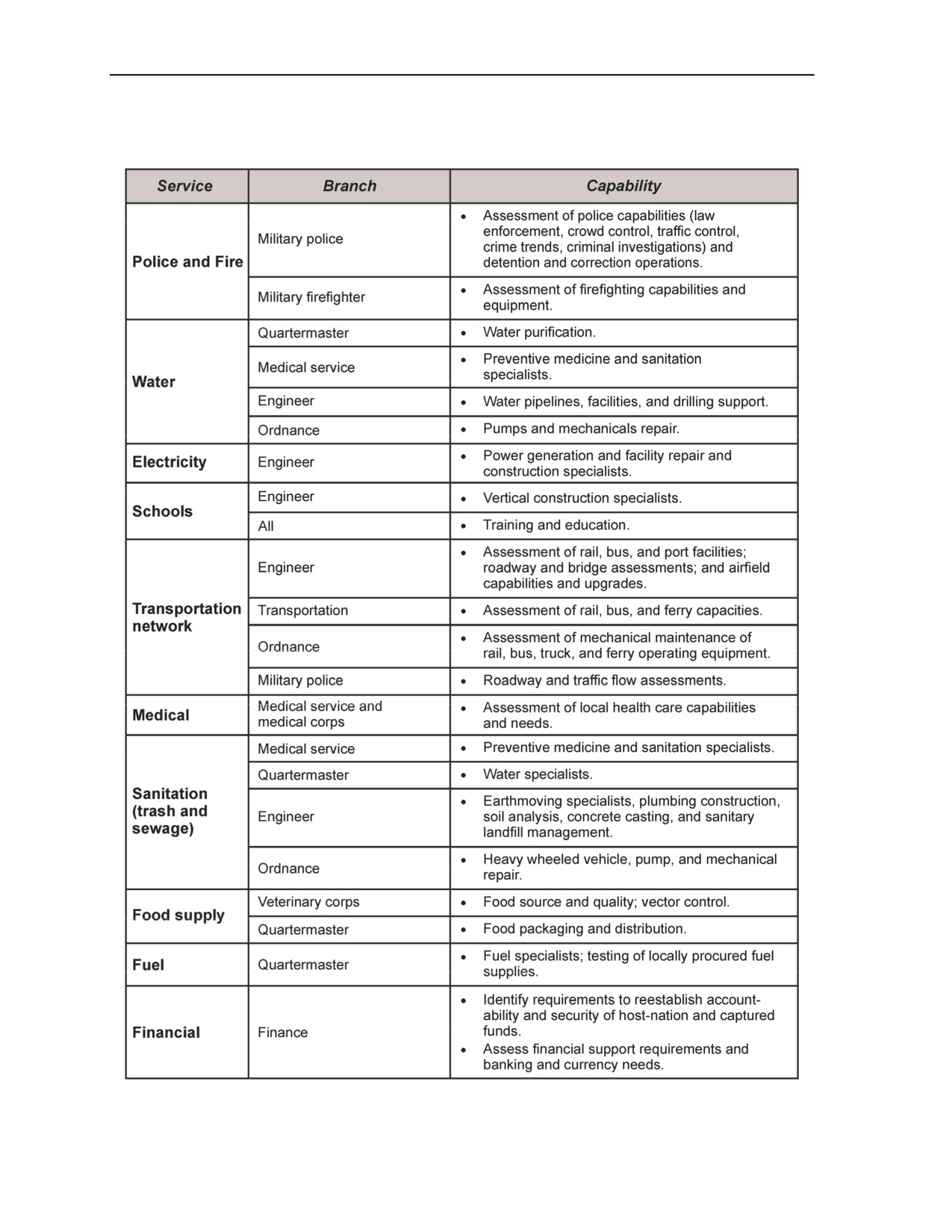
closely with other branches can contribute to these area assessments. (Table 8-2 [page 8-12] identifies the
areas that concern civil affairs. Logisticians can help assess these areas.)
15 December 2006
FM 3-24/MCWP 3-33.5
8-11
Chapter 8
Table 8-2. Civil affairs capabilities used by logisticians
8-12
FM 3-24/MCWP 3-33.5
15 December 2006
Sustainment
Time as a Logistic Commodity
8-37. The speed with which COIN operations are executed may determine their success and whether the
populace supports them. This is especially true for operations that involve restoring essential services.
Planners must strive to have the smallest possible gap of time between when they assess essential services
and when U.S. forces begin remediation efforts. To keep this time gap as small as possible and manage the
development of popular expectations, logistic units may need to initiate remedial services until HN authori-
ties and agencies can assume these functions. For example, think of the populace as a patient destabilized
by the trauma of insurgency. In COIN operations, logistic and other units may need to function much like
the first-responder medic on the scene. The medic conducts initial assessments of a patient’s needs, pro-
vides lifesaving first aid, and lets the hospital know what more specific higher level care the patient re-
quires. Medical and COIN first responders work best when they can assess and initiate life support treat-
ment immediately. In COIN operations, “treatment” is harder to determine without obvious calibrated vital
signs—such as blood pressure, pulse, and temperature—and “immediately” may last weeks or months. For
this reason, COIN logistic units may have to take whatever measures they can for immediately stabilizing
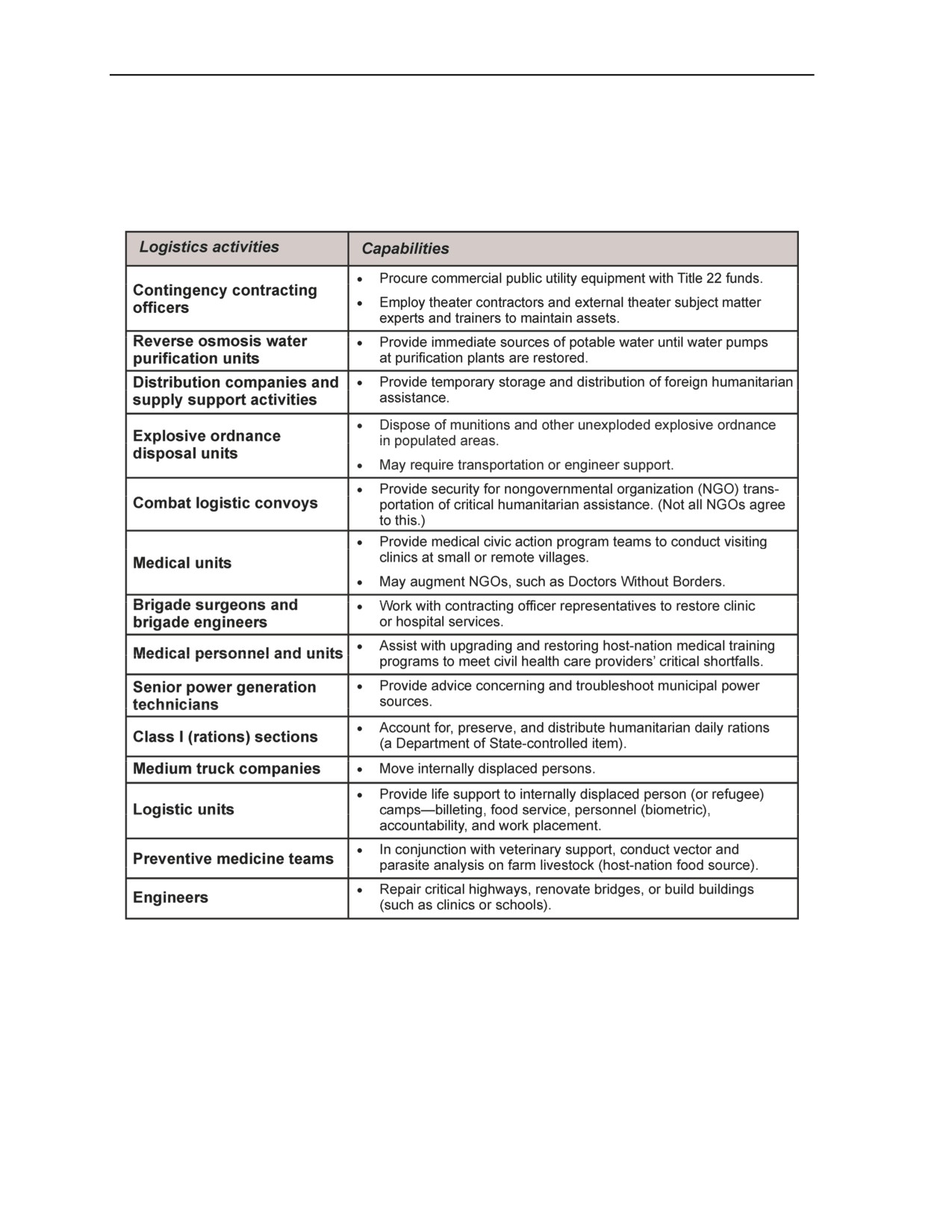
essential services and preventing deteriorating conditions. (Table 8-3 [page 8-37] lists some examples of
how military logistic assets and capabilities can be used to bridge the essential services gap and meet im-
mediate and essential service needs.)
Handoff of Essential Services
8-38. Frequently, logisticians who have provided stopgap essential services may be the only ones with ac-
curate knowledge of essential services needs and priorities. Logisticians providing these services may stay
actively involved in the handoff to other government agencies and their designated civil organizations.
Their involvement should continue until HN agencies and activities can function and meet essential ser-
vices needs. A poor handoff can provide insurgents with propaganda opportunities and evidence of the “in-
sincerity” of COIN efforts.
8-39. When U.S. forces restore and transition essential services to the HN government, they remove one of
the principal causes insurgents exploit. This action greatly assists the HN government in its struggle for le-
gitimacy. Competent leaders can expect insurgents to conduct attacks against restored services. During this
handoff, multinational logistic assets may need to maintain a logistic quick reaction force. This force en-
sures the continuity of services and marginalizes counteractions and messages by insurgents.
Public Transportation, Population Movement, and Life Support to Internally Displaced
Persons and Refugees
8-40. Under conditions of national crisis or insurgency, public transportation systems often fall into disar-
ray. Counterinsurgents may have to recover stolen or misappropriated buses, trucks, cars, and other gov-
ernment vehicles (including former military equipment) and restore them to public service. This action
helps alleviate urgent requirements for public transportation. It also sends an unmistakable message of re-
sumption of governmental authority and can substantially reduce the amount of replacement equipment
counterinsurgents must procure. Logistic units and personnel can expect to assist in this process—from re-
establishing accountability procedures to assessing repair and maintenance needs—until competent HN
public or government authorities can resume these duties.
8-41. An insurgency often creates many groups of internally displaced persons and refugees on short no-
tice. Attending to internally displaced person and refugee needs can quickly become an urgent logistic re-
quirement. Planners draw on all essential services to provide secure emergency shelter, camps for inter-
nally displaced persons and refugees, and life support (food, water, and medical care). Nongovernmental
organizations and other civilian agencies normally furnish this support to internally displaced persons and
refugees. However, conditions may prevent these agencies from providing these services quickly. Further-
more, in COIN operations, internally displaced person and refugee security may take on heightened mili-
tary importance. Traumatized and dislocated persons may become vulnerable to insurgent threats and re-
cruitment. The restoration and maintenance of public transportation services can help internally displaced
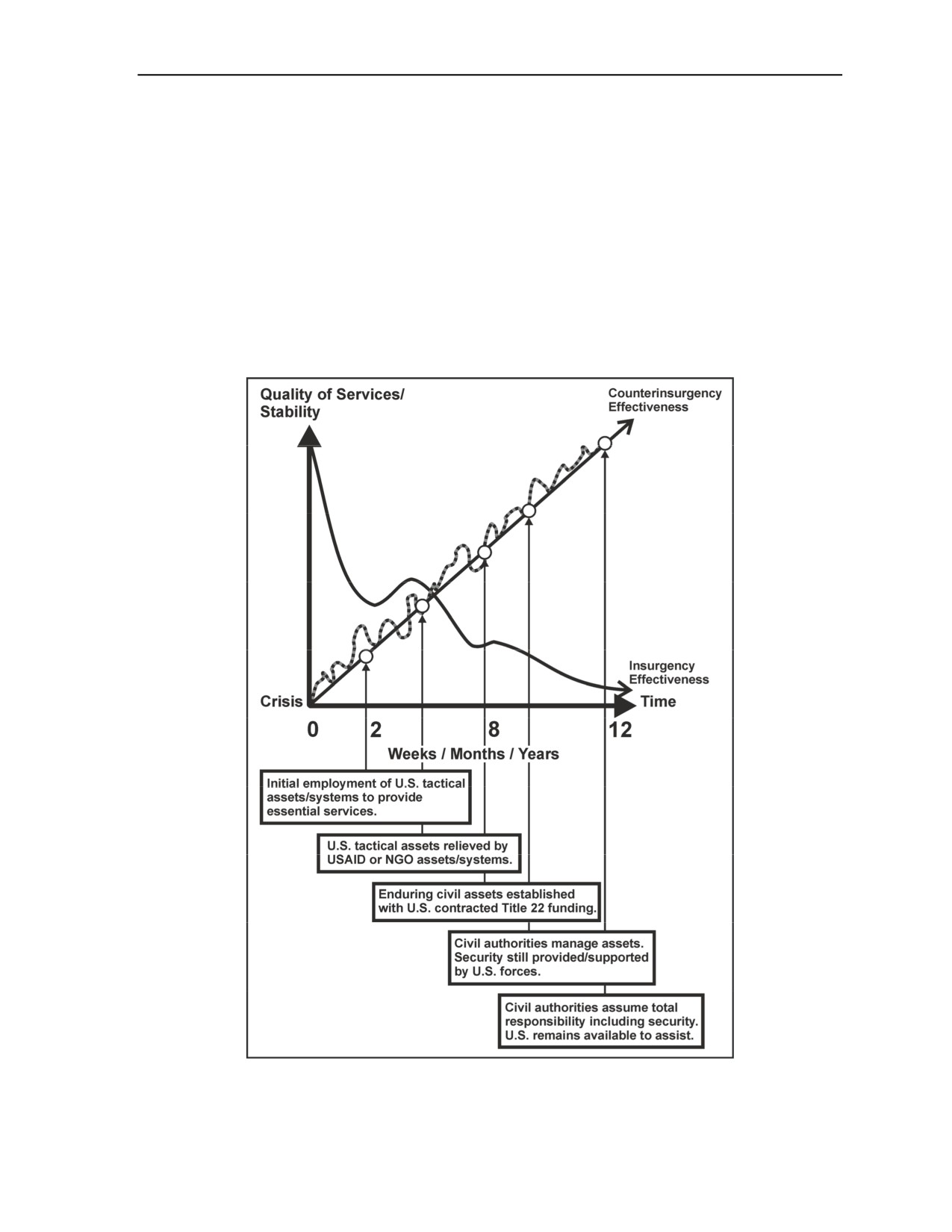
persons and refugees. Figure 8-1 (page 8-15) shows that as essential services projects take root, they start
to provide tangible benefits for the populace. Progress in these individual endeavors may experience indi-
15 December 2006
FM 3-24/MCWP 3-33.5
8-13
Chapter 8
vidual setbacks as planners calibrate programs and projects to localized needs. Before implanting agency
transfers, planners should measure overall progress. As essential services become more effective, insurgent
activities lose influence and popular support. As a general rule, it is best to provide essential services to
people in their native areas and thereby discourage their displacement.
Table 8-3. Logistic units and their capabilities
SUPPORT TO DEVELOPING BETTER GOVERNANCE
8-42. COIN operations strive to restore order, the rule of law, and civil procedures to the authority of the
HN government. All counterinsurgent actions must be those of agents of a legitimate and law-abiding HN
government. Multinational and U.S. forces brought in to support this objective must remember that the popu-
lace will scrutinize their actions. People will watch to see if Soldiers and Marines stay consistent with this
avowed purpose. Inconsistent actions furnish insurgents with valuable issues for manipulation in propaganda.
8-14
FM 3-24/MCWP 3-33.5
15 December 2006
Sustainment
Legal Support to Operations
8-43. Legal support to COIN operations can cover many areas. (See FM 4-0, chapter 12; MCWP 4-12,
page A-4; and appendix D of this manual.) It includes continuously monitoring and evaluating rules of en-
gagement. This legal status may affect the conduct of contractors and their requirements for protection. Le-
gal support also includes status of forces agreements. These agreements need to be negotiated and revised
as the HN government becomes able to responsibly assume and exercise sovereignty. Status of forces
agreements affect how legal disputes between U.S. forces and local nationals are handled, including those
disputes emerging from contracting and other commercial activities. Contracts and claims require sensitive
and fair construction and execution so perceptions of exploitation and favoritism do not undermine overall
COIN initiatives. COIN operations often depend on many funding sources. Leaders get judge advocate le-
gal advice on fiscal law to ensure compliance with domestic statutes governing the funding of military and
nonmilitary activities. Leaders may ask judge advocates to advise the HN government at all political levels
about how to establish and administer appropriate legal safeguards.
Figure 8-1. Comparison of essential services availability to insurgency effectiveness
15 December 2006
FM 3-24/MCWP 3-33.5
8-15
Chapter 8
Legal Aspects of Contracting and Claims
8-44. In COIN operations, two circumstances may require extensive civil law support. The first situation is
when counterinsurgents engage in commercial contracts with people for provision of goods and or ser-
vices. The second occasion is when people seek compensation for damages, injuries, or deaths that they or
their relatives claim to have suffered due to actions by counterinsurgents.
8-45. Legally reviewing COIN contracts negotiated with HN contractors establishes several important
conditions. First, the process makes clear to HN contractors that established procedures rooted in law gov-
ern such transactions. It sends the message that favoritism and partisanship are not part of the process in a
legitimate government. Second, this review potentially forestalls contracts going to individuals who may be
part of the insurgency and may already be named or identified as subjects of other ongoing investigations
or legal actions.
8-46. In the case of claims for damages allegedly caused by counterinsurgents, legal reviews show genu-
inely wronged people that the HN government takes their grievances seriously. (See paragraphs D-35
through D-37.) When insurgents or opportunists misrepresent terms or conditions under which “damages”
occur, legal reviews effectively assess the validity or falsehood of such claims and thereby prevent counter-
insurgents from squandering resources or inadvertently supporting insurgents.
Restoration of Civil Judicial Functions
8-47. In periods of extreme unrest and insurgency, HN legal structures—courts, prosecutors, defense assis-
tance, prisons—may fail to exist or function at any level. Under these conditions, to establish legal proce-
dures and precedents for dealing with captured insurgents and common criminals, U.S. forces may make
provisions to establish special tribunals under the auspices of either a provisional authority or a United Na-
tions mandate. While legal actions fall under these provisions, counterinsurgents can expect to provide sus-
tainment and security support as well as legal support and advice on these functions.
8-48. Even when HN authorities have restored judicial functions, counterinsurgents may have to provide
logistic and security support to judicial activities. If insurgents continue to disrupt activities supporting the
rule of law, the support may be prolonged. With restoration of legislative and judicial functions to the HN
government, counterinsurgents must recognize and acknowledge that not all laws will look familiar. Laws
passed by the legislature of the HN government may differ from those experienced by multinational forces
in their home countries. Under such conditions, counterinsurgents need to consult their legal advisors,
commanders, and diplomatic representatives for guidance on dealing with sensitive matters.
SUPPORT TO ECONOMIC DEVELOPMENT
8-49. Many commanders are unfamiliar with the tools and resources required for promoting economic plu-
ralism. In COIN operations, economic development is probably the LLO with the greatest logistic signifi-
cance. Military commanders using resource managers (comptrollers) and contingency contracting officers
are usually involved with this LLO. Staff officers will need to deliver financial resources that—
z
Maximally benefit the HN population.
z
Support achieving objectives along other LLOs.
z
Ensure the funds stay out of insurgent hands.
Achieving these objectives depends on logisticians keeping a thorough and accurate logistic preparation of
the theater as well as commanders and contracting officers obtaining goods and services consistent with its
assessments. Such purchasing must also promote vendors and businesses whose practices support wide-
spread job stimulation and local investment. In addition to the logistic preparation of the AO issues dis-
cussed in paragraph 8-7, other areas for assessment and analysis include the following:
z
HN economic capabilities and shortfalls suitable for filling by external means.
z
Methods of determining land and other real property ownership, means of transfers, and dispute
resolution.
z
Methods for promoting and protecting property and asset rights as well as open access to trade
goods and services.
8-16
FM 3-24/MCWP 3-33.5
15 December 2006
Sustainment
z
Prevailing wage rate standards and correlation to occupational category (unskilled, skilled, and
professional labor).
z
Historic market demographics.
z
Identification of potential vendors with local sources of supply in the AO.
8-50. Various funding sources usually support COIN operations. (See paragraphs D-27 through D-31.)
U.S. forces most commonly operate under two types of funds:
z
Title 10 funds, which are strictly for the supply, support, and sustainment of DOD service mem-
bers and employees.
z
Title 22 funds, which are appropriated for foreign relations purposes and used solely for the
benefit and support of the HN government and population.
8-51. Other sources of funding in COIN operations may include those provided by other government
agencies. Such agencies can include the U.S. Agency for International Development, the Department of
State, other donor nations and agencies, the United Nations, or even the host nation. In some cases, coun-
terinsurgents may seize or capture misappropriated or illicit funds. Confiscated funds may be redistributed
to fund COIN activities. Under these complex fiscal circumstances, resource managers and staff judge ad-
vocates provide the best guidance on the legal use of different types of funds. (Appendix D covers this sub-
ject in more detail.)
CONTRACTED LOGISTIC SUPPORT
8-52. In COIN operations, logistic contractors might support U.S. forces. Contractor activities fall into
three different categories:
z
Theater support contractors.
z
External support contractors.
z
System contractors.
(See FM 4-0, paragraphs 5-92 through 5-95; MCWP 4-12, page 4-8.)
8-53. Theater support contractors can make significant contributions to promoting economic pluralism be-
cause they rely the most on HN employees and vendors. External support contractors and the Logistic Ci-
vilian Augmentation Program (LOGCAP) provide logistic services, usually through large-scale prear-
ranged contracts with major contractors, who may in turn subcontract various components of their large
contracts to smaller theater-based providers. Systems contracts are designed by systems program managers
to support special or complex equipment; they generally have little influence on promoting economic plu-
ralism.
THEATER SUPPORT CONTRACTORS
8-54. Theater support contractors can be obtained either under prearranged contracts or by contracting of-
ficers serving under the direct authority of the theater principle assistant responsible for contracting. Thea-
ter support contractors usually obtain most of their materials, goods, and labor from the local manufactur-
ing and vendor base. Some examples of goods and services that theater support contractors provide
include—
z
Construction, delivery, and installation of concrete security barriers for the defense of counterin-
surgent bases and HN public buildings.
z
Construction of security fencing.
z
Public building construction and renovations (such as site preparation, structure construction,
electrical and plumbing installation, and roofing).
z
Sanitation services.
z
Maintenance augmentation in motor pools.
z
Road construction and repair.
z
Trucking and cartage.
15 December 2006
FM 3-24/MCWP 3-33.5
8-17
Chapter 8
z
Manual labor details (such as grounds maintenance and sandbag filling).
z
Housekeeping (such as warehouses).
COUNTERINSURGENCY CONTRACTOR CONSIDERATIONS
8-55. In a COIN environment, commanders carefully consider when to use theater support contractors and
local hires. Commanders also supervise contracted personnel to ensure they do not undermine achieving
COIN objectives. Due to the subversive nature of many insurgent activities, all contractors and their em-
ployees require vetting through the intelligence section. All contractors and their employees require tam-
perproof, photograph, biometric-tagged identification. This identification needs to be coded to indicate ac-
cess areas, security level, and supervision required. In the case of HN employees, “badging” can also be an
accountability tool if U.S. forces issue and receive badges at entry control points daily. Contractor security
breaches are one concern; another is the security and safety of the contractor’s employees. Though insur-
gents may target logistic contractors and their employees, the employees are not combatants. They are clas-
sified as “civilians accompanying the force.” This status must not be jeopardized and the military units
with which they work must keep them secure in the workplace. Units employing HN contractors and em-
ployees must watch for signs of exploitive or corrupt business practices that may alienate segments of the
local populace and inadvertently undermine COIN objectives. Treated fairly and respectfully, HN employ-
ees can provide good insights into the local language, culture, and perceptions of COIN activities as well as
other issues affecting communities in the AO.
Host-Nation Contracting: A Potential Double-Edged Sword
Early in Operation Iraqi Freedom, a brigade from the 101st Airborne Division was as-
signed a large area of operations near Tal Afar, in northern Iraq. The terrain the unit
was required to cover and support exceeded the distribution capabilities of its ground
transportation assets. Logistic officers supporting the brigade sought out and found a
local business leader with a family-owned transportation company. He was positive
towards U.S. aims for improving Iraq and willing to work with U.S. forces by providing
various truck and bus services.
After two months of ad hoc daily arrangements for services at the U.S. forces’ com-
pound entry point, the unit established a six-month contract to make this transporta-
tion support more regular. As the working relationship became more solid, the con-
tractor and his employees also furnished insights into the effectiveness of U.S.
information operations as well as information on the presence and activities of suspi-
cious persons possibly affiliated with the insurgency. The arrangement worked ex-
ceptionally well, effectively supported counterinsurgency activities, and maintained
peace and security—as long as the original unit that established the services was
stationed in the area.
Eventually, a smaller task force replaced the first unit that established the contract,
and the security situation in the area began to deteriorate. Upon detecting this
change in security posture, insurgents quickly found the contractor and killed him. No
doubt their intent was to degrade the U.S. forces’ logistic posture and to send the
message to other local vendors that doing business with the Americans was costly.
Eventually the contactor’s brother took over operations, but understandably support
deteriorated.
When setting up logistic contracting arrangements with HN contractors in a COIN
environment, U.S. logisticians and contracting officers must remember the grave
risks people take by accepting these jobs. Insurgents are exceptionally adept at find-
ing ways to attack logistics. When insurgents attack people branded as traitors, there
is an added terror or political message benefit. Inadequate or shifting U.S. security
arrangements can provide openings for insurgents to more easily attack host-nation
contractors and logistic providers.
8-18
FM 3-24/MCWP 3-33.5
15 December 2006
Sustainment
EXTERNAL SUPPORT CONTRACTORS
8-56. Many of the same considerations that apply to theater contractors apply to external support contrac-
tors and their subcontracted employees, particularly if they are local or in-theater hires who are not U.S. or
multinational partner citizens.
SYSTEM CONTRACTORS
8-57. System contractors generally work on technologically complicated military systems, such as vehi-
cles, weapons systems, aircraft, and information systems. This support is provided under contracts negoti-
ated by program executive officers and program managers. These contractors provide systems expertise.
Most are U.S. citizens, and many of them are former U.S. military members. These contractors generally
meet deployment and security requirements similar to DOD civilian requirements.
CONTINGENCY CONTRACTING OFFICERS AND OTHER AGENTS
8-58. In COIN operations, the timely and well-placed distribution of funds at the local level can serve as
an invaluable force multiplier. Many challenges to accomplishing payments and purchases in the COIN
environment exist. These challenges can include—
z
Problems with the security of financial institutions, agents, and instruments.
z
Potential for sudden volatility in the HN economy.
z
Reliability issues with local supplier and vendors.
z
Peculiarities of local business cultures.
8-59. Contracting officers and other agents authorized to make payments to support COIN activities often
find it difficult to obtain reliable information upon which to make decisions and conduct negotiations. Mili-
tary means to accomplish this type of purchasing are found at two levels:
z
Contingency contracting officer, who acts on unit-generated purchasing requests and commit-
tals.
z
Ordering officer for smaller purchases.
8-60. Legal requirements keep U.S. funds for different purposes separate and distinct. (See paragraphs D-
27 through D-31.) COIN units must maintain two types of purchasing officer teams:
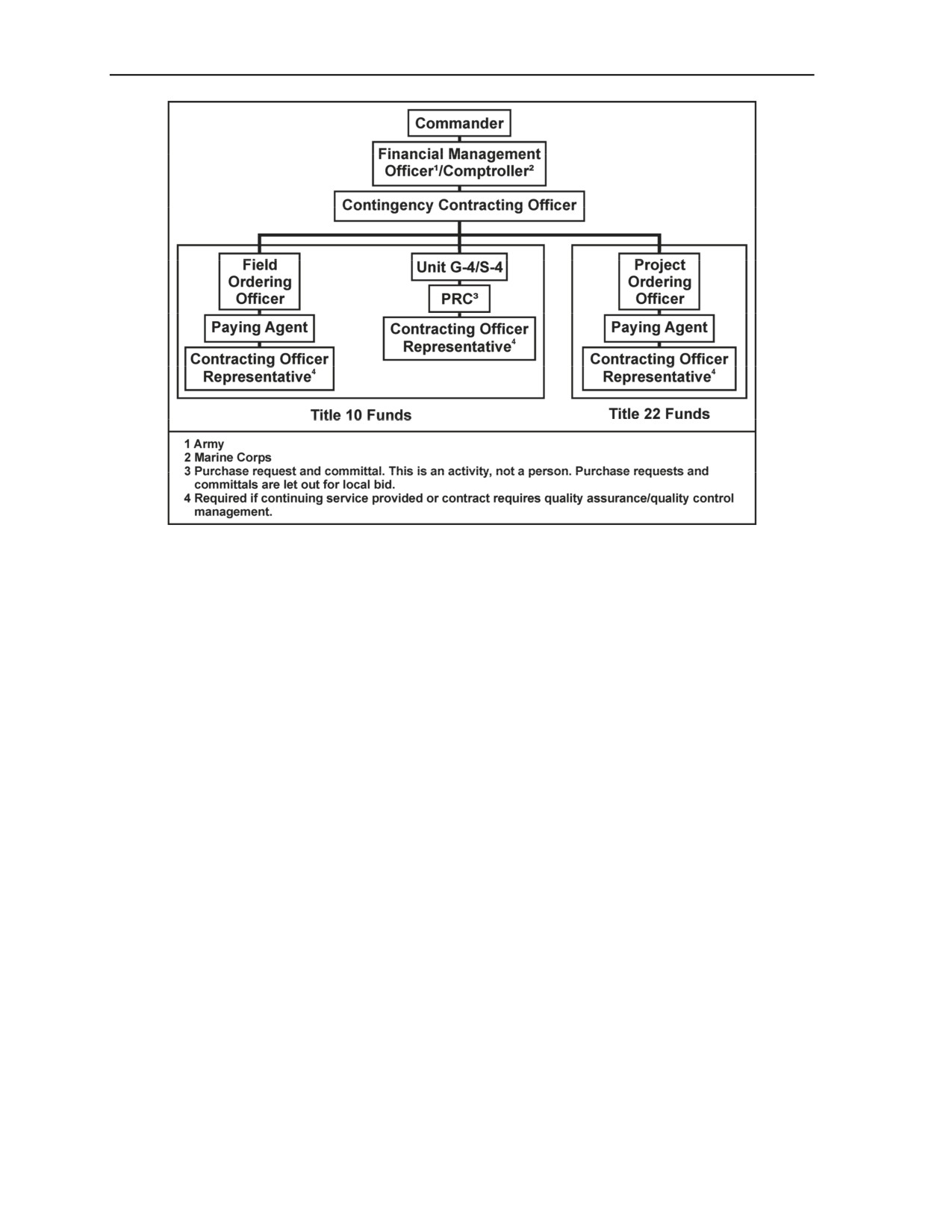
z
Field ordering officer teams for Title 10 funds.
z
Project ordering officer teams for Title 22 funds.
(Figure 8-2 [page 8-20] portrays the relationships and roles among different contracting and ordering offi-
cers, and the types of funds that they manage.)
CONTINGENCY CONTRACTING
8-61. Because contingency contracting officers can set contracts for larger sums than ordering officers can,
they normally place purchasing request and committal requirements out for bid to local vendors. During
COIN operations, contacting officers must spread contracts across different vendors to forestall any ap-
pearance of partiality.
FIELD ORDERING AND PROJECT ORDERING OFFICER TEAMS
8-62. Both field ordering and project ordering officer teams consist of the respective contracting officer
agent, a paying agent, and a security detail. Both teams operate under similar regulatory constraints. These
officers’ duties differ not only with respect to the type of funds they disburse but also in the increment caps
applied. Field ordering officers with Title 10 funds are limited to individual payments not to exceed
$2,500. Project ordering officers can make individual contract payments of up to $20,000, since projects
are associated with higher costs and scales. In both cases, these teams are an invaluable asset for reaching
into HN communities and promoting economic pluralism while assessing the economic effects of purchas-
ing activities and economic stability initiatives.
15 December 2006
FM 3-24/MCWP 3-33.5
8-19
Chapter 8
Figure 8-2. Tactical financial management organizations
8-63. Due to their activities throughout HN communities and their cultivation of local business connec-
tions, field ordering and project ordering officer teams should be viewed as potential means of gathering
and distributing information. Vendor observations and actions may also reveal much about the real status
of the COIN effort. Vendors may notice commonplace events that, taken together, are significant. For ex-
ample, vendors may notice outsiders moving into the area, contractors failing to deliver goods, and HN
employees asking to leave early. Together these events might indicate an impending attack. By doing busi-
ness with counterinsurgents, local contractors and vendors may put themselves at great risk. Protection of
their activities can pose a great challenge to U.S. forces and must be seriously considered when doing
business with them.
SUMMARY
8-64. Logistic activities are an integral part of COIN operations. These activities take the traditional form
of support to combat and security forces as well as the unconventional form of providing mixes of essential
and timely support to many HN security and stability-enhancing activities that may seem purely civil in
character. Initially, uniformed military logistic providers may have to provide this support. However,
COIN logistic objectives should include encouraging and promoting HN providers as soon as security con-
ditions make this feasible. This transition is a delicate one. Logistic providers must constantly determine
whether their practices are contributing to achieving the end state and adjust their methods if necessary. If
there is a final paradox in counterinsurgency, it is that logistic postures and practices are a major part of the
effort and may well determine the operation’s success.
8-20
FM 3-24/MCWP 3-33.5
15 December 2006
Appendix A
A Guide for Action
Translating lessons of this manual into practice begins with planning and preparation
for deployment. Successful counterinsurgents execute wisely and continually assess
their area of operations, the impact of their own operations, and their enemy’s strat-
egy and tactics to adapt and win. This appendix discusses several techniques that
have proven successful during counterinsurgency operations. They are discussed
within the framework of the operations process. However, this does not limit their use
to any operations process activity. Successful counterinsurgents assess the operational
environment continuously and apply appropriate techniques when they are needed.
PLAN
A-1. Planning is the process by which commanders (and staffs, if available) translate the commander’s
visualization into a specific course of action for preparation and execution, focusing on the expected results
(FMI 5-0.1). Planning for counterinsurgency (COIN) operations is no different from planning for conven-
tional operations. However, effective COIN planning requires paying at least as much attention to aspects
of the environment as to the enemy force.
ASSESS DURING PLANNING: PERFORM MISSION ANALYSIS
A-2. Learn about the people, topography, economy, history, religion, and culture of the area of operations
(AOs). Know every village, road, field, population group, tribal leader, and ancient grievance. Become the
expert on these topics. If the precise destination is unknown, study the general area. Focus on the precise
destination when it is determined. Ensure leaders and staffs use the Secret Internet Protocol Router Net-
work (SIPRNET) to immerse themselves virtually in the AO into which the unit is deploying. Understand
factors in adjacent AOs and the information environment that can influence AOs. These can be many, par-
ticularly when insurgents draw on global grievances.
A-3. Read the map like a book. Study it every night before sleep and redraw it from memory every morn-
ing. Do this until its patterns become second nature. Develop a mental model of the AO. Use it as a frame
into which to fit every new piece of knowledge.
A-4. Study handover notes from predecessors. Better still, get in touch with personnel from the unit in
theater and pick their brains. In an ideal world, intelligence officers and area experts provide briefings.
This may not occur. Even if it does, there is no substitute for personal mastery.
A-5. Require each subordinate leader, including noncommissioned officers, to specialize on some aspect
of the AO and brief the others.
ANALYZE THE PROBLEM
A-6. Mastery of the AO provides a foundation for analyzing the problem. Who are the insurgents? What
drives them? What makes local leaders tick? An insurgency is basically a competition among many groups,
each seeking to mobilize the populace in support of its agenda. Thus, COIN operations are always more
than two sided.
A-7. Understand what motivates the people and how to mobilize them. Knowing why and how the insur-
gents are getting followers is essential. This requires knowing the real enemy, not a cardboard cutout. In-
surgents are adaptive, resourceful, and probably from the area. The local populace has known them since
15 December 2006
FM 3-24/MCWP 3-33.5
A-1
Appendix A
they were young. U.S. forces are the outsiders. The worst opponents are not the psychopathic terrorists of
the movies; rather, they are charismatic warriors who would excel in any armed force. Insurgents are not
necessarily misled or naive. Much of their success may stem from bad government policies or security
forces that alienate the local populace.
A-8. Work the problem collectively with subordinate leaders. Discuss ideas and explore possible solu-
tions. Once leaders understand the situation, seek a consensus on how to address it. If this sounds unmili-
tary, get over it. Such discussions help subordinates understand the commander’s intent. Once in theater,
situations requiring immediate action will arise too quickly for orders. Subordinates will need to exercise
subordinates’ initiative and act based on the commander’s intent informed by whatever knowledge they
have developed. Corporals and privates will have to make quick decisions that may result in actions with
strategic implications. Such circumstances require a shared situational understanding. They also require a
command climate that encourages subordinates to assess the situation, act on it, and accept responsibility
for their actions. Employing mission command is essential in this environment. (Mission command, subor-
dinates’ initiative and commander’s intent are defined in the glossary. See FM 6-0, paragraphs 1-67
through 1-80, 2-83 through 2-92, and 4-26 through 4-31 for discussions of the principles involved.)
PREPARE
A-9. Preparation consists of activities by the unit before execution to improve its ability to conduct the
operation, including, but not limited to, the following: plan refinement, rehearsals, reconnaissance, coordi-
nation, inspection, and movement (FM 3-0). Compared with conventional operations, preparing for COIN
operations requires greater emphasis on organizing for intelligence and for working with nonmilitary or-
ganizations. These operations also require more emphasis on preparing small-unit leaders for increased re-
sponsibility and maintaining flexibility.
ORGANIZE FOR INTELLIGENCE
A-10. Intelligence and operations are always complementary, especially in COIN operations. COIN opera-
tions are intelligence driven, and units often develop much of their own intelligence. Commanders must
organize their assets to do that.
A-11. Each company may require an intelligence section, including analysts and an individual designated
as the “S-2.” Platoon leaders may also have to designate individuals to perform intelligence and operations
functions. A reconnaissance and surveillance element is also essential. Augmentation for these positions is
normally not available, but companies still must perform the tasks. Put the smartest Soldiers and Marines in
the intelligence section and the reconnaissance and surveillance element. This placement results in one less
rifle squad, but an intelligence section pays for itself in lives and effort saved.
A-12. There are never enough linguists. Commanders consider with care where best to use them. Linguists
are a battle-winning asset, but like any other scarce resource, commanders must allocate them carefully.
During predeployment, the best use of linguists may be to train Soldiers and Marines in basic language
skills.
ORGANIZE FOR INTERAGENCY OPERATIONS
A-13. Almost everything in COIN is interagency. Everything from policing to intelligence to civil-military
operations (CMO) to trash collection involves working with interagency and host-nation (HN) partners.
These agencies are not under military control, but their success is essential to accomplishing the mission.
Train Soldiers and Marines in conducting interagency operations. Get a briefing from the Department of
State, aid agencies, and the local police or fire departments. Designate interagency subject matter experts in
each subordinate element and train them. Look at the situation through the eyes of a civilian who knows
nothing about the military. Many civilians find rifles, helmets, and body armor intimidating. Learn how not
to scare them. Seek advice from those who come from that nation or culture. Most importantly, know that
military operations create temporary breathing space. But to prevail, civilian agencies need long-term de-
velopment and stabilization.
A-2
FM 3-24/MCWP 3-33.5
15 December 2006
A Guide for Action
TRAVEL LIGHT AND HARDEN YOUR SUSTAINMENT ASSETS
A-14. A normal combat load for Soldiers and Marines includes body armor, rations, extra ammunition,
communications gear, and many other things—all of which are heavy. Insurgents may carry a rifle or
rocket-propelled grenade, a headscarf, and a water bottle. Without the extra weight, insurgents can run and
maneuver easily. U.S. forces must lighten their combat loads and enforce a habit of speed and mobility.
Otherwise, insurgents consistently outrun and outmaneuver them. However, make sure Soldiers and Ma-
rines can always reach back for fires or other support.
A-15. Remember to harden sustainment bases. Insurgents often consider them weak points and attack there.
Most attacks on coalition forces in Iraq in 2004 and 2005, other than combat actions, were against sustain-
ment installations and convoys. Ensure sustainment assets are hardened and have communications. Make
sure to prepare Soldiers and Marines whose primary task is providing logistic support to fight ground com-
bat operations. While executing their sustaining operations, they may do more fighting than some rifle
squads.
FIND A POLITICAL AND CULTURAL ADVISOR
A-16. A force optimized for COIN operations would have political and cultural advisors at company level.
The current force structure gives corps and division commanders a political advisor. Lower echelon com-
manders must improvise. They select a political and cultural advisor from among their troops. This person
may be a commissioned officer, but may not. The position requires someone with “people skills” and a feel
for the environment. Commanders should not try to be their own cultural advisor. They must be fully aware
of the political and cultural dimension, but this is a different role. In addition, this position is not suitable
for intelligence professionals. They can help, but their task is to understand the environment. The political
advisor’s job is to help shape the environment.
TRAIN THE SQUAD LEADERS—THEN TRUST THEM
A-17. Squads and platoons execute mostly COIN operations. Small-unit actions in a COIN environment of-
ten have more impact than similar actions during major combat operations. Engagements are often won or
lost in moments; whoever can bring combat power to bear in seconds wins. The on-scene leader controls
the fight. This situation requires mission command and subordinates’ initiative. Train leaders at the lowest
echelons to act intelligently and independently.
A-18. Training should focus on basic skills: marksmanship, patrolling, security on the move and at the halt,
and basic drills. When in doubt, spend less time on company and platoon training and more time on
squads. Ruthlessly replace ineffective leaders. Once trained, give Soldiers and Marines a clear com-
mander’s intent and trust them to exercise subordinates’ initiative within it. This allows subordinates to
execute COIN operations at the level at which they are won.
IDENTIFY AND USE TALENT
A-19. Not everyone is good at counterinsurgency. Many leaders do not understand it, and some who do
cannot execute it. COIN operations are difficult and anyone can learn the basics. However, people able to
intuitively grasp, master, and execute COIN techniques are rare. Learn how to spot these people and put
them into positions where they can make a difference. Rank may not indicate the required talent. In COIN
operations, a few good Soldiers and Marines under a smart junior noncommissioned officer doing the right
things can succeed, while a large force doing the wrong things will fail.
CONTINUE TO ASSESS AND PLAN DURING PREPARATION: BE FLEXIBLE
A-20. Commander’s visualization is the mental process of developing situational understanding, determin-
ing a desired end state, and envisioning how the force will achieve that end state (FMI 5-0.1). It begins
with mission receipt and continues throughout any operation. The commander’s visualization forms the ba-
sis for conducting (planning, preparing for, executing, and assessing) an operation.
15 December 2006
FM 3-24/MCWP 3-33.5
A-3
Appendix A
A-21. Commanders continually refine their visualization based on their assessment of the operational envi-
ronment. They describe and direct any changes they want made as the changes are needed. They do not
wait for a set point in any process. This flexibility is essential during preparation for COIN operations.
Some are tempted to try to finalize a plan too early. They then prepare to execute the plan rather than what
changes in the operational environment require. However, as commanders gain knowledge, their situ-
ational understanding improves. They get a better idea of what to do and of their own limitations. This lets
them refine their visualization and direct changes to the plan and their preparations. Even with this, any
plan will change once operations begin. If there is a major shift in the environment, commanders may need
to scrap the plan. However, a plan is still needed. Developing it gives leaders a simple robust idea of what
to achieve, even if the methods change. Directing changes to it based on continuous assessment is one as-
pect of the art of command.
A-22. One planning approach is to identify phases of the operation in terms of major objectives to achieve
such as establishing dominance, building local networks, and marginalizing the enemy. Make sure forces
can easily transition between phases, both forward to exploit successes and backward to recover from set-
backs. Insurgents can adapt their activity to friendly tactics. The plan must be simple enough to survive
setbacks without collapsing. This plan is the solution that began with the shared analysis and consensus
that began preparation. It must be simple and known to everyone.
EXECUTE
A-23. Execute means to put a plan into action by applying combat power to accomplish the mission and us-
ing situational understanding to assess progress and make execution and adjustment decisions (FM 6-0).
The execution of COIN operations demands all the skills required to execute conventional operations. In
addition, it also requires mastery of building alliances and personal relationships, attention to the local and
global media, and additional skills that are not as heavily tasked in conventional operations.
ESTABLISH AND MAINTAIN A PRESENCE
A-24. The first rule of COIN operations is to establish the force’s presence in the AO. If Soldiers and Ma-
rines are not present when an incident happens, they usually cannot do much about it. The force cannot be
everywhere at once. The more time Soldiers and Marines spend in the AO, the more likely they are where
the action is. If the force is not large enough to establish a presence throughout the AO, then determine the
most important places and focus on them. This requires living in the AO close to the populace. Raiding
from remote, secure bases does not work. Movement on foot, sleeping in villages, and night patrolling all
seem more dangerous than they are—and they are what ground forces are trained to do. Being on the
ground establishes links with the local people. They begin to see Soldiers and Marines as real people they
can trust and do business with, rather than as aliens who descended from armored boxes. Driving around in
an armored convoy actually degrades situational awareness. It makes Soldiers and Marines targets and is
ultimately more dangerous than moving on foot and remaining close to the populace.
ASSESS DURING EXECUTION: AVOID HASTY ACTIONS
A-25. Do not act rashly; get the facts first. Continuous assessment, important during all operations, is vital
during COIN operations. Violence can indicate several things. It may be part of the insurgent strategy, in-
terest groups fighting among themselves, or individuals settling vendettas. Or, it may just be daily life.
Take the time to learn what normalcy looks like. Insurgents may try to goad Soldiers and Marines into
lashing out at the local populace or making a similar mistake. Unless leaders are on the spot when an inci-
dent occurs, they receive only second-hand reports and may misunderstand the local context or interpreta-
tion. This means that first impressions are often highly misleading, particularly in urban areas. Of course,
leaders cannot avoid making judgments. When there is time, ask an older hand or trusted local people for
their opinions. If possible, keep one or two officers from your predecessor unit for the first part of the tour.
Avoid rushing to judgment.
A-4
FM 3-24/MCWP 3-33.5
15 December 2006
A Guide for Action
BUILD TRUSTED NETWORKS
A-26. Once the unit settles into the AO, its next task is to build trusted networks. This is the true meaning
of the phrase “hearts and minds,” which comprises two separate components. “Hearts” means persuading
people that their best interests are served by COIN success. “Minds” means convincing them that the force
can protect them and that resisting it is pointless. Note that neither concerns whether people like Soldiers
and Marines. Calculated self-interest, not emotion, is what counts. Over time, successful trusted networks
grow like roots into the populace. They displace enemy networks, which forces enemies into the open, let-
ting military forces seize the initiative and destroy the insurgents.
A-27. Trusted networks are diverse. They include local allies, community leaders, and local security forces.
Networks should also include nongovernmental organizations (NGOs), other friendly or neutral nonstate
actors in the AO, and the media.
A-28. Building trusted networks begins with conducting village and neighborhood surveys to identify
community needs. Then follow through to meet them, build common interests, and mobilize popular sup-
port. This is the true main effort; everything else is secondary. Actions that help build trusted networks
support the COIN effort. Actions that undermine trust or disrupt these networks—even those that provide a
short-term military advantage—help the enemy.
GO WITH THE GRAIN AND SEEK EARLY VICTORIES
A-29. Do not try to crack the hardest nut first. Do not go straight for the main insurgent stronghold or try to
take on villages that support insurgents. Instead, start from secure areas and work gradually outwards. Ex-
tend influence through the local people’s networks. Go with, not against, the grain of the local populace.
First, win the confidence of a few villages, and then work with those with whom they trade, intermarry, or
do business. This tactic develops local allies, a mobilized populace, and trusted networks.
A-30. Seek a victory early in the operation to demonstrate dominance of the AO. This may not be a combat
victory. Early combat without an accurate situational understanding may create unnecessary collateral damage
and ill will. Instead, victories may involve resolving a long-standing issue or co-opting a key local leader.
Achieving even a small early victory can set the tone for the tour and help commanders seize the initiative.
PRACTICE DETERRENT PATROLLING
A-31. Establish patrolling tactics that deter enemy attacks. An approach using combat patrols to provoke,
then defeat, enemy attacks is counterproductive. It leads to a raiding mindset, or worse, a bunker mentality.
Deterrent patrolling is a better approach. It keeps the enemy off balance and the local populace reassured.
Constant, unpredictable activity over time deters attacks and creates a more secure environment. Accom-
plishing this requires one- to two-thirds of the force to be on patrol at any time, day or night.
BE PREPARED FOR SETBACKS
A-32. Setbacks are normal in counterinsurgencies, as in all operations. Leaders make mistakes and lose
people. Soldiers and Marines occasionally kill or detain the wrong person. It may not be possible to build
or expand trusted networks. If this happens, drop back to the previous phase of the plan, recover, and re-
sume operations. It is normal in company-level COIN operations for some platoons to do well while others
do badly. This situation is not necessarily evidence of failure. Give subordinate leaders the freedom to ad-
just their posture to local conditions. This creates flexibility that helps survive setbacks.
REMEMBER THE GLOBAL AUDIENCE
A-33. The omnipresence and global reach of today’s news media affects the conduct of military operations
more than ever before. Satellite receivers are common, even in developing countries. Bloggers and print,
radio, and television reporters monitor and comment on everything military forces do. Insurgents use ter-
rorist tactics to produce graphics that they hope will influence public opinion—both locally and globally.
15 December 2006
FM 3-24/MCWP 3-33.5
A-5
Appendix A
A-34. Train Soldiers and Marines to consider how the global audience might perceive their actions. Sol-
diers and Marines should assume that the media will publicize everything they say or do. Also, treat the
media as an ally. Help reporters get their story. That helps them portray military actions favorably. Trade
information with media representatives. Good relationships with nonembedded media, especially HN me-
dia, can dramatically increase situational awareness.
ENGAGE THE WOMEN; BE CAUTIOUS AROUND THE CHILDREN
A-35. Most insurgent fighters are men. However, in traditional societies, women are hugely influential in
forming the social networks that insurgents use for support. When women support COIN efforts, families
support COIN efforts. Getting the support of families is a big step toward mobilizing the local populace
against the insurgency. Co-opting neutral or friendly women through targeted social and economic pro-
grams builds networks of enlightened self-interest that eventually undermine insurgents. Female counterin-
surgents, including interagency people, are required to do this effectively.
A-36. Conversely, be cautious about allowing Soldiers and Marines to fraternize with local children.
Homesick troops want to drop their guard with kids. But insurgents are watching. They notice any friend-
ships between troops and children. They may either harm the children as punishment or use them as agents.
It requires discipline to keep the children at arm’s length while maintaining the empathy needed to win lo-
cal support.
ASSESS DURING EXECUTION
A-37. Develop measures of effectiveness early and continuously refine them as the operation progresses.
These measures should cover a range of social, informational, military, and economic issues. Use them to
develop an in-depth operational picture. See how the operation is changing, not just that it is starting or
ending. Typical measures of effectiveness include the following:
z
Percentage of engagements initiated by friendly forces versus those initiated by insurgents.
z
Longevity of friendly local leaders in positions of authority.
z
Number and quality of tips on insurgent activity that originate spontaneously.
z
Economic activity at markets and shops.
These mean virtually nothing as a snapshot; trends over time indicate the true progress.
A-38. Avoid using body counts as a measure of effectiveness. They actually measure very little and may
provide misleading numbers. Using body counts to measure effectiveness accurately requires answers to
the following questions:
z
How many insurgents were there at the start?
z
How many insurgents have moved into the area?
z
How many insurgents have transferred from supporter to combatant status?
z
How many new fighters has the conflict created?
Accurate information of this sort is usually not available.
MAINTAIN MISSION FOCUS THROUGHOUT
A-39. Once a unit is established in its AO, Soldiers and Marines settle into a routine. A routine is good as
long as the mission is being accomplished. However, leaders should be alert for the complacency that often
accompanies routines.
A-40. It often takes Soldiers and Marines at least one-third of the tour to become effective. Toward the
tour’s end, leaders struggle against the “short-timer” mentality. Thus, the middle part of the tour is often
the most productive. However, leaders must work to keep Soldiers and Marines focused on the mission and
attentive to the environment.
A-6
FM 3-24/MCWP 3-33.5
15 December 2006
A Guide for Action
EXPLOIT A SINGLE NARRATIVE
A-41. Since counterinsurgency is a competition to mobilize popular support, it pays to know how people
are mobilized. Most societies include opinion-makers—local leaders, religious figures, media personalities,
and others who set trends and influence public perceptions. This influence often follows a single narra-
tive—a simple, unifying, easily expressed story or explanation that organizes people’s experience—and
provides a framework for understanding events. Nationalist and ethnic historical myths and sectarian
creeds are examples of such narratives. Insurgents often try to use the local narrative to support their cause.
Undercutting their influence requires exploiting an alternative narrative. An even better approach is tapping
into an existing narrative that excludes insurgents.
A-42. Higher headquarters usually establishes the COIN narrative. However, only leaders, Soldiers, and
Marines at the lowest levels know the details needed to tailor it to local conditions and generate leverage
from it. For example, a nationalist narrative can be used to marginalize foreign fighters. A narrative of na-
tional redemption can undermine former regime elements seeking to regain power. Company-level leaders
apply the narrative gradually. They get to know local opinion makers, win their trust, and learn what moti-
vates them. Then they build on this knowledge to find a single narrative that emphasizes the inevitability
and rightness of the COIN operation’s success. This is art, not science.
HAVE LOCAL FORCES MIRROR THE ENEMY, NOT U.S. FORCES
A-43. By mid-tour, U.S. forces should be working closely with local forces, training or supporting them
and building an indigenous security capability. The natural tendency is to create forces in a U.S. image.
This is a mistake. Instead, local HN forces need to mirror the enemy’s capabilities and seek to supplant the
insurgent’s role. This does not mean they should be irregular in the sense of being brutal or outside proper
control. Rather, they should move, equip, and organize like insurgents but have access to U.S. support and
be under the firm control of their parent societies. Combined with a mobilized populace and trusted net-
works, these characteristics allow HN forces to separate the insurgents from the population.
A-44. U.S. forces should support HN forces. At the company level, this means raising, training, and em-
ploying local HN auxiliary forces (police and military). These tasks require high-level clearance, but if
permission is given, companies should each establish a training cell. Platoons should aim to train one local
squad and then use that squad as a nucleus for a partner platoon. The company headquarters should train an
HN leadership team. This process mirrors the development of trusted networks. It tends to emerge naturally
with the emergence of local allies willing to take up arms to defend themselves.
CONDUCT CIVIL-MILITARY OPERATIONS
A-45. COIN operations can be characterized as armed social work. It includes attempts to redress basic so-
cial and political problems while being shot at. This makes CMO a central COIN activity, not an after-
thought. Civil-military operations are one means of restructuring the environment to displace the enemy
from it. They must focus on meeting basic needs first. A series of village or neighborhood surveys, regu-
larly updated, are invaluable to understanding what the populace needs and tracking progress in meeting
them.
A-46. Effective CMO require close cooperation with national, international, and local interagency partners.
These partners are not under military control. Many NGOs, for example, do not want to be too closely as-
sociated with military forces because they need to preserve their perceived neutrality. Interagency coopera-
tion may involve a shared analysis of the problem, building a consensus that allows synchronization of
military and interagency efforts. The military’s role is to provide protection, identify needs, facilitate CMO,
and use improvements in social conditions as leverage to build networks and mobilize the populace.
A-47. There is no such thing as impartial humanitarian assistance or CMO in COIN. Whenever someone is
helped, someone else is hurt, not least the insurgents. So civil and humanitarian assistance personnel often
become targets. Protecting them is a matter not only of providing a close-in defense, but also of creating a
secure environment by co-opting local beneficiaries of aid and their leaders.
15 December 2006
FM 3-24/MCWP 3-33.5
A-7
Appendix A
REMEMBER SMALL IS BEAUTIFUL
A-48. Another tendency is to attempt large-scale, mass programs. In particular, Soldiers and Marines tend
to apply ideas that succeed in one area to another area. They also try to take successful small programs and
replicate them on a larger scale. This usually does not work. Often small-scale programs succeed because
of local conditions or because their size kept them below the enemy’s notice and helped them flourish un-
harmed. Company-level programs that succeed in one AO often succeed in another; however, small-scale
projects rarely proceed smoothly into large programs. Keep programs small. This makes them cheap, sus-
tainable, low-key, and (importantly) recoverable if they fail. Leaders can add new programs—also small,
cheap, and tailored to local conditions—as the situation allows.
FIGHT THE ENEMY’S STRATEGY
A-49. When COIN efforts succeed, insurgents often transition to the offensive. COIN successes create a
situation that threatens to separate insurgents from the populace. Insurgents attack military forces and the
local populace to reassert their presence and continue the insurgency. This activity does not necessarily in-
dicate an error in COIN tactics (though it may, depending on whether insurgents successfully mobilized the
population). It is normal, even in the most successful operations, to have spikes of offensive insurgent activity.
A-50. The obvious military response is a counteroffensive to destroy enemy’s forces. This is rarely the best
choice at company level. Only attack insurgents when they get in the way. Try not to be distracted or
forced into a series of reactive moves by a desire to kill or capture them. Provoking combat usually plays
into the enemy’s hands by undermining the population’s confidence. Instead, attack the enemy’s strategy.
If insurgents are seeking to recapture a community’s allegiance, co-opt that group against them. If they are
trying to provoke a sectarian conflict, transition to peace enforcement operations. The possible situations
are endless, but the same principle governs the response: fight the enemy’s strategy, not enemy forces.
ASSESS DURING EXECUTION: RECOGNIZE AND EXPLOIT SUCCESS
A-51. Implement the plan developed early in the campaign and refined through interaction with local part-
ners. Focus on the environment, not the enemy. Aim at dominating the whole district and implementing so-
lutions to its systemic problems. Continuously assess results and adjust as needed.
A-52. Achieving success means that, particularly late in the campaign, it may be necessary to negotiate
with the enemy. Local people supporting the COIN operation know the enemy’s leaders. They even may
have grown up together. Valid negotiating partners sometimes emerge as the campaign progresses. Again,
use close interagency relationships to exploit opportunities to co-opt segments of the enemy. This helps
wind down the insurgency without alienating potential local allies who have relatives or friends among in-
surgents. As an insurgency ends, a defection is better than a surrender, a surrender better than a capture,
and a capture better than a kill.
PREPARE DURING EXECUTION: GET READY FOR HANDOVER FROM DAY ONE
A-53. It is unlikely the insurgency will end during a troop’s tour. There will be a relief in place, and the re-
lieving unit will need as much knowledge as can be passed to them. Start handover folders in every platoon
and specialist squad immediately upon arrival, if they are not available from the unit being relieved. The
folders should include lessons learned, details about the populace, village and patrol reports, updated maps,
and photographs—anything that will help newcomers master the environment. Computerized databases are
fine. Keep good back-ups and ensure a hard copy of key artifacts and documents exists. Developing and
keeping this information current is boring, tedious work. But it is essential to both short- and long-term
success. The corporate memory this develops gives Soldiers and Marines the knowledge they need to stay
alive. Passing it on to the relieving unit does the same for them. It also reduces the loss of momentum that
occurs during any handover.
A-8
FM 3-24/MCWP 3-33.5
15 December 2006
A Guide for Action
ENDING THE TOUR
A-54. As the end of the tour approaches, the key leadership challenge becomes keeping the Soldiers and
Marines focused. They must not drop their guard. They must continue to monitor and execute the many
programs, projects, and operations.
A-55. The tactics discussed above remain applicable as the end-of-tour transition approaches. However,
there is an important new one: keep the transition plan secret. The temptation to talk about home becomes
almost unbearable toward the end of a tour. The local people know that Soldiers and Marines are leaving
and probably have a good idea of the generic transition plan. They have seen units come and go. But de-
tails of the transition plan must be protected; otherwise, the enemy might use the handover to undermine
any progress made during the tour. Insurgents may stage a high-profile attack. They may try to recapture
the populace’s allegiance by scare tactics. Insurgents will try to convince the local populace that military
forces will not protect them after the transition. Insurgents may try to persuade the local populace that the
successor unit will be oppressive or incompetent. Set the follow-on unit up for success. Keep the transition
plan details secret within a tightly controlled compartment in the headquarters. Tell the Soldiers and Ma-
rines to resist the temptation to say goodbye to local allies. They can always send a postcard from home.
THREE “WHAT IFS”
A-56. The discussion above describes what should happen, but things do go wrong. Here are some “what
ifs” to consider.
WHAT IF YOU GET MOVED TO A DIFFERENT AREA?
A-57. Efforts made preparing for operations in one AO are not wasted if a unit is moved to another area. In
mastering the first area, Soldiers and Marines learned techniques applicable to the new one. For example,
they know how to analyze an AO and decide what matters in the local society. The experience provides a
mental structure for analyzing the new AO. Soldiers and Marines can focus on what is different, making
the process easier and faster. They need to apply this same skill when they are moved within battalion or
brigade AOs.
WHAT IF YOU HAVE NO RESOURCES?
A-58. Things can be things done in a low-priority AO. However, commanders need to focus on self-
reliance, keeping things small and sustainable and ruthlessly prioritizing efforts. Local leaders can help.
They know what matters to them. Commanders should be honest with them, discuss possible projects and
options, and ask them to recommend priorities. Often commanders can find translators, building supplies,
or expertise. They may only expect support and protection in making their projects work. Negotiation and
consultation can help mobilize their support and strengthen social cohesion. Setting achievable goals is key
to making the situation work.
WHAT IF THE THEATER SITUATION SHIFTS?
A-59. Sometimes everything goes well at the tactical level, but the theater situation changes and invalidates
those efforts. When that happens, drop back a stage, consolidate, regain balance, and prepare to expand
again when the situation allows. A flexible, adaptive plan helps in such situations. Friendly forces may
have to cede the initiative for a time; however, they must regain it as soon as the situation allows.
SUMMARY
A-60. This appendix has summarized one set of tactics for conducting COIN operations. Like all tactics,
they need interpretation. Constant study of the AO is needed to apply them to the specific circumstances a
unit faces. Observations and experience helps Soldiers and Marines apply them better. Whatever else is
done, the focus must remain on gaining and maintaining the support of the population. With their support,
victory is assured; without it, COIN efforts cannot succeed.
15 December 2006
FM 3-24/MCWP 3-33.5
A-9
This page intentionally left blank.
Appendix B
Social Network Analysis and Other Analytical Tools
Situational understanding involves determining the relationships among the factors of
METT-TC. This appendix discusses several tools used to describe the effects of the
operational environment and evaluate the threat. One of the most important of these
is social network analysis, a powerful threat evaluation tool. Commanders and staffs
use these tools to help them understand the operational environment. This under-
standing facilitates making decisions and developing plans and orders.
DESCRIBE THE EFFECTS OF THE OPERATIONAL ENVIRONMENT
B-1. Describing the effects of the operational environment requires an analysis of the terrain, weather, and
civil considerations. This discussion addresses terrain and civil considerations at length because of their
importance in a counterinsurgency (COIN) environment. Terrain and civil considerations have distinct as-
pects in COIN that analysts must understand to effectively describe the operational environment. Imagery,
geospatial analysis tools, overlays, and graphics can help depict these aspects.
DESCRIBE TERRAIN EFFECTS
B-2. As in conventional operations, terrain analysis in COIN includes examining the terrain’s effects on
the movement of military units and enemy personnel. However, because COIN focuses on people, terrain
analysis usually centers on populated areas and the effects of terrain on the local populace. During COIN
operations, Soldiers and Marines spend a lot of time in suburban and urban areas interacting with the popu-
lace. This battlefield is three dimensional. Multistory buildings and underground lines of communications,
such as tunnels and sewers, can be very important. Insurgents also use complex natural terrain to their ad-
vantage as well. Mountains, caves, jungles, forests, swamps, and other complex terrain are potential bases
of operations for insurgents. (See FM 34-130 for additional information on terrain analysis. See FMI 2-
91.4 for terrain analysis in urban operations.)
B-3. An important terrain consideration in COIN is urban and suburban land navigation. This can be dif-
ficult in areas without an address system and in cities where 10-digit grids may not be accurate enough to
locate a specific apartment. Knowledge of how local people find one another’s houses and what type of
address system they use are beneficial. Recent, accurate maps that use overhead imagery are also helpful.
In addition, tourist maps and locally produced maps facilitate understanding the names local people use to
describe places.
Military Aspects of Terrain for Counterinsurgency
B-4. At the tactical level, Soldiers and Marines consider different details of the military aspects of terrain
to describe the operational environment.
z
Observation and fields of fire. In COIN operations, Soldiers and Marines look for areas with
good fields of fire that may serve as ambush points. In addition, they also consider different
ways insurgents might observe them. These ways include surveillance, the use of spies and infil-
trators, and locations with line of sight on counterinsurgent positions.
z
Avenues of approach. Insurgents use any means possible to get into counterinsurgent installa-
tions. Possible entry points include sewers, rooftops, roads, and sidewalks. Insurgents exploit
their ability to blend with the populace. They may try to infiltrate by posing as contractors work-
ing for counterinsurgents or the host-nation (HN) government. Along border regions, insurgents
15 December 2006
FM 3-24/MCWP 3-33.5
B-1
Appendix B
may use smuggling routes to move people and materiel in and out of the country. An additional
avenue of approach to consider is how insurgents influence public opinion.
z
Key terrain. Tactically, key terrain may be important structures, economically and politically
important areas, areas of religious or cultural significance, access control points, and lines of
communications.
z
Obstacles. In addition to terrain obstacles, obstacles in a COIN environment include anything
that hinders insurgent freedom of operation or counterinsurgent operations. Traffic control
points, electronic security systems, and guard plans are examples of obstacles to insurgents. Use
of places protected under rules of engagement, translators, the ability to communicate with the
populace, culture, and politics may all be obstacles for U.S. and HN government forces.
z
Cover and concealment. In COIN, cover and concealment includes the means by which insur-
gents hide themselves and their activities. These include using disguises and false identification
badges, and hiding supplies underground or in buildings.
Geospatial Intelligence
B-5. Geospatial intelligence (GEOINT) is the intelligence derived from the exploitation, analysis, and fu-
sion of imagery with geospatial information to describe, assess, and visually depict physical features and
geographically referenced activities in an area of operations (AO). GEOINT consists of imagery, imagery
intelligence, and geospatial information. Geospatial information and services remains a core mission of the
engineer branch and provides the foundation for GEOINT. Imagery intelligence remains a core mission of
the military intelligence branch and provides the intelligence layers and analytic fusion for GEOINT. The
result is digitally integrated intelligence products that support all-source analysis, planning, decision mak-
ing and support to current operations.
Geospatial Tools
B-6. Geospatial products (tools) that can be provided by the geospatial information and services team in-
clude the following:
z
Terrain databases.
z
Special terrain studies and products prepared by U.S. or HN agencies, and special maps, charts,
and geodetic studies.
z
Current photography.
z
Real-time terrain reconnaissance.
z
Terrain factor matrices.
Imagery
B-7. Imagery products include both aerial photography and satellite imagery. In many cases, aerial recon-
naissance platforms, such as unmanned aircraft systems, respond directly to commanders. This practice
aids timely, focused data collection. Each collection system has its own capabilities. The situation deter-
mines whether black and white or infrared imagery offers the better view of a target. (Figure B-1 shows an
example of an imagery product.)
B-2
FM 3-24/MCWP 3-33.5
15 December 2006
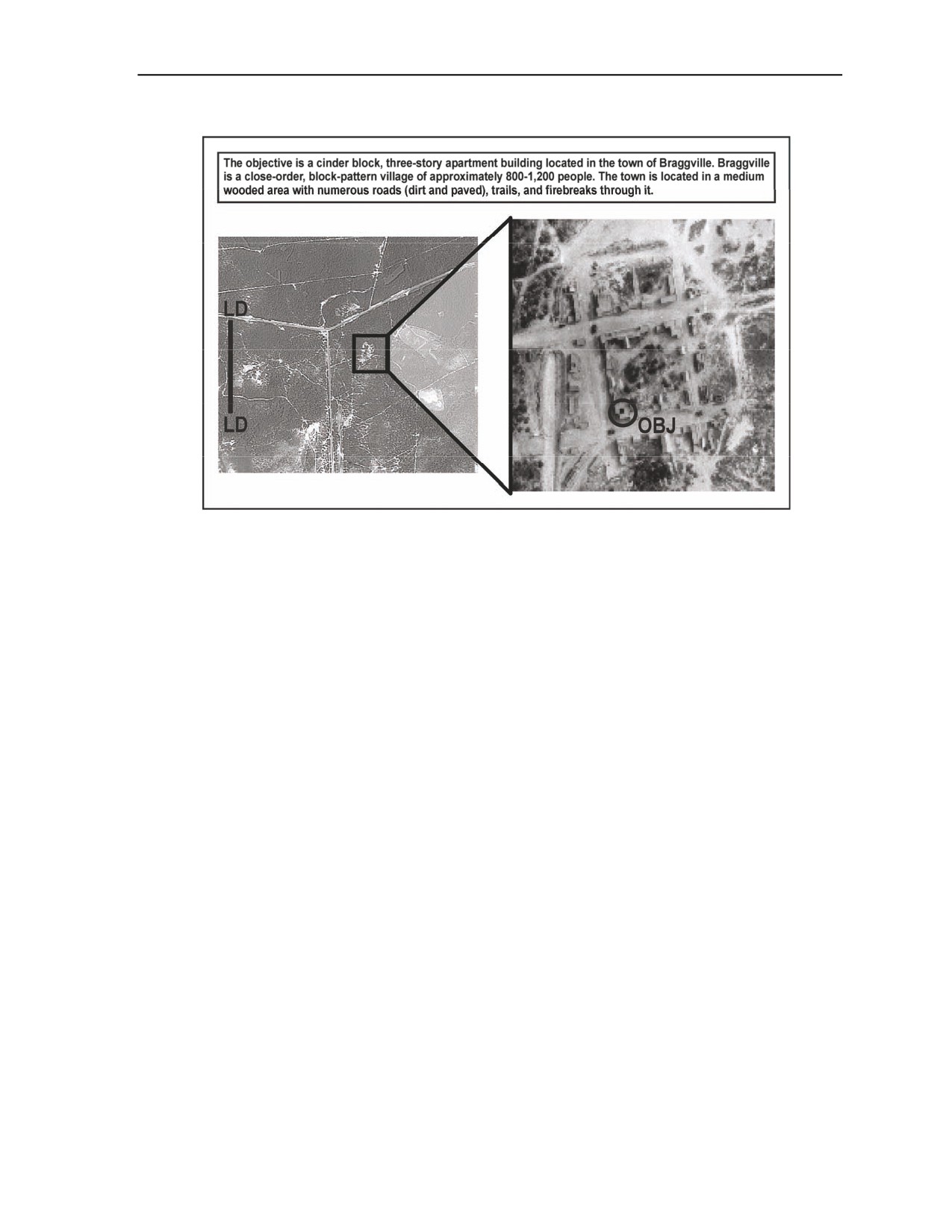
Social Network Analysis and Other Analytical Tools
Figure B-1. Example imagery photograph
B-8. A key element in future operations may be the imagery downlink capabilities of space-based intelli-
gence collection platforms. Space-based systems use state-of-the-art spectral, infrared, electro-optical, and
synthetic aperture radar imaging. They can provide important information. Data collected from such
sources is transferred in a digital format that can be manipulated to address specific requirements. Intelli-
gence staffs remain aware of the capabilities and limitations of these systems and the procedures for request-
ing this support.
B-9. Advanced GEOINT products are produced using any combination of imaging platforms—visible, in-
frared, radar, or spectral—depending on requestor needs. These products have many applications. Present-
ing imagery in an oblique perspective by combining it with digital terrain elevation data provides a per-
spective view. Spectral imagery uses heat distribution patterns and changes in a scene imaged at various
times to discover and distinguish manmade from indigenous activity. Other uses include facility analysis,
structural analysis, target detection, soil analysis, and damage assessment.
DESCRIBE CIVIL CONSIDERATIONS (ASCOPE)
B-10. Civil considerations concern the manmade infrastructure, civilian institutions, and attitudes and ac-
tivities of the civilian leaders, populations, and organizations within an area of operations influence the
conduct of military operations (FM 6-0). Because the purpose of COIN is to support a HN government in
gaining legitimacy and the support of the populace, civil considerations are often the most important fac-
tors to consider during mission analysis.
B-11. Civil considerations generally focus on the immediate impact of civilians on operations in progress.
However, at higher levels, they also include larger, long-term diplomatic, informational, and economic is-
sues. At the tactical level, civil considerations directly relate to key civilian areas, structures, capabilities,
organizations, people, and events within the AO. These characteristics are represented by the memory aid
ASCOPE. Socio-cultural factors analysis, discussed in paragraphs 3-19 through 3-73, provides a more in-
depth evaluation of civil considerations.
15 December 2006
FM 3-24/MCWP 3-33.5
B-3
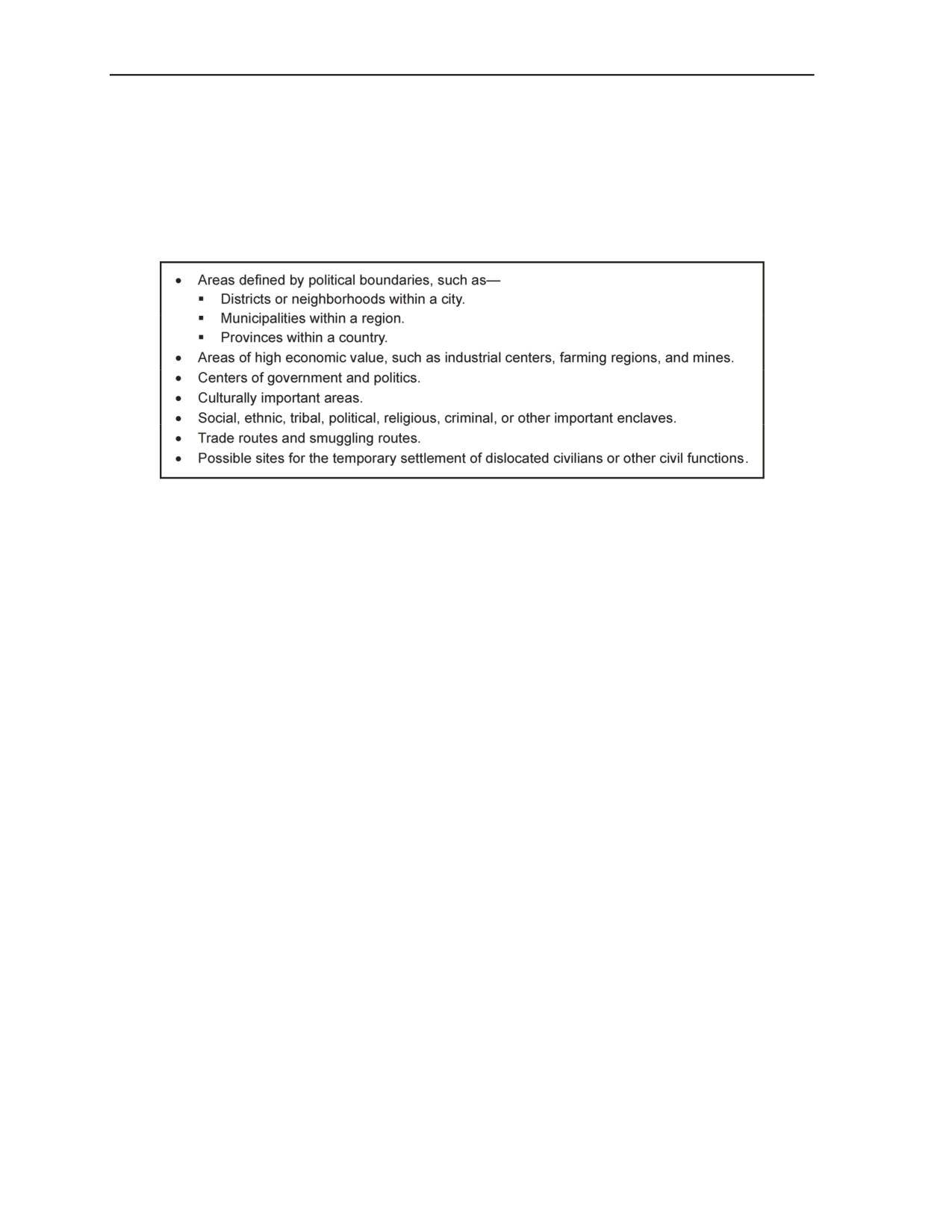
Appendix B
Areas
B-12. Key civilian areas are localities or aspects of the terrain within an AO that have significance to the
local populace. This characteristic approaches terrain analysis from a civilian perspective. Commanders
analyze key civilian areas in terms of how they affect the missions of individual units as well as how mili-
tary operations affect these areas. (Table B-1 lists examples of key civilian areas.)
Table B-1. Examples of key civilian areas
Structures
B-13. Analyzing a structure involves determining how its location, functions, and capabilities can support
operations. Commanders also consider the consequences of using it. Using a structure for military purposes
often competes with civilian requirements. Commanders carefully weigh the expected military benefits
against costs to the community that will have to be addressed in the future. (Table B-2 lists examples of
important structures in an AO.)
Capabilities
B-14. Capabilities can refer to the ability of local authorities—those of the host nation or some other
body—to provide a populace with key functions or services. Commanders and staffs analyze capabilities
from different perspectives but generally put priority on understanding the capability of the HN govern-
ment to support the mission. The most essential capabilities are those required to save, sustain, or enhance
life, in that order. Some of the more important capabilities are—
z
Public administration—effectiveness of bureaucracy, courts, and other parts of the HN govern-
ment.
z
Public safety—provided by the security forces and military, police, and intelligence organizations.
z
Emergency services—such agencies as fire departments and ambulance services.
z
Public health—clinics and hospitals.
z
Food.
z
Water.
z
Sanitation.
Organizations
B-15. Organizations are nonmilitary groups or institutions in the AO. They influence and interact with the
populace, counterinsurgents, and each other. They generally have a hierarchical structure, defined goals,
established operations, fixed facilities or meeting places, and a means of financial or logistic support. Some
organizations may be indigenous to the area. These may include—
z
Religious organizations.
z
Political parties.
z
Patriotic or service organizations.
B-4
FM 3-24/MCWP 3-33.5
15 December 2006
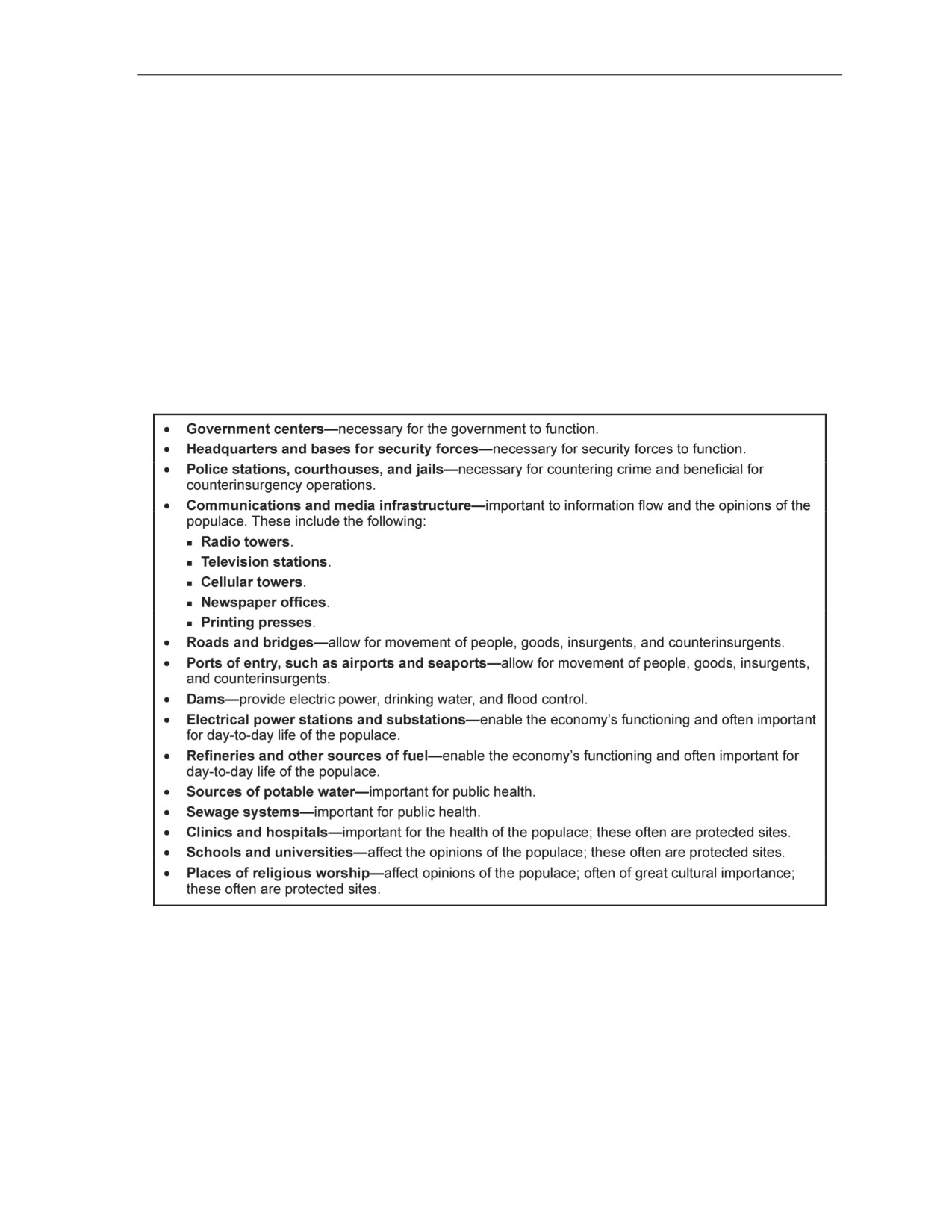
Social Network Analysis and Other Analytical Tools
z
Labor unions.
z
Criminal organizations.
z
Community organizations.
B-16. Other organizations may come from outside the AO. Examples of these include—
z
Multinational corporations.
z
Intergovernmental organizations (IGOs), such as United Nations agencies.
z
Nongovernmental organizations (NGOs), such as the International Red Cross.
B-17. Operations often require commanders to coordinate with IGOs and NGOs. Information required for
evaluation includes these groups’ activities, capabilities, and limitations. Situational understanding includes
knowing how the activities of different organizations may affect military operations and how military op-
erations may affect these organizations’ activities. From this analysis, commanders can determine how or-
ganizations and military forces can work together toward common goals.
Table B-2. Examples of important structures
B-18. In almost every case, military forces have more resources than civilian organizations. However,
some civilian organizations possess specialized capabilities that they may be willing to share. Commanders
do not command civilian organizations in their AOs. However some operations require achieving unity of
effort with these groups. These situations require commanders to influence the leaders of these organiza-
tions through persuasion, relying on the force of argument and the example of actions.
15 December 2006
FM 3-24/MCWP 3-33.5
B-5
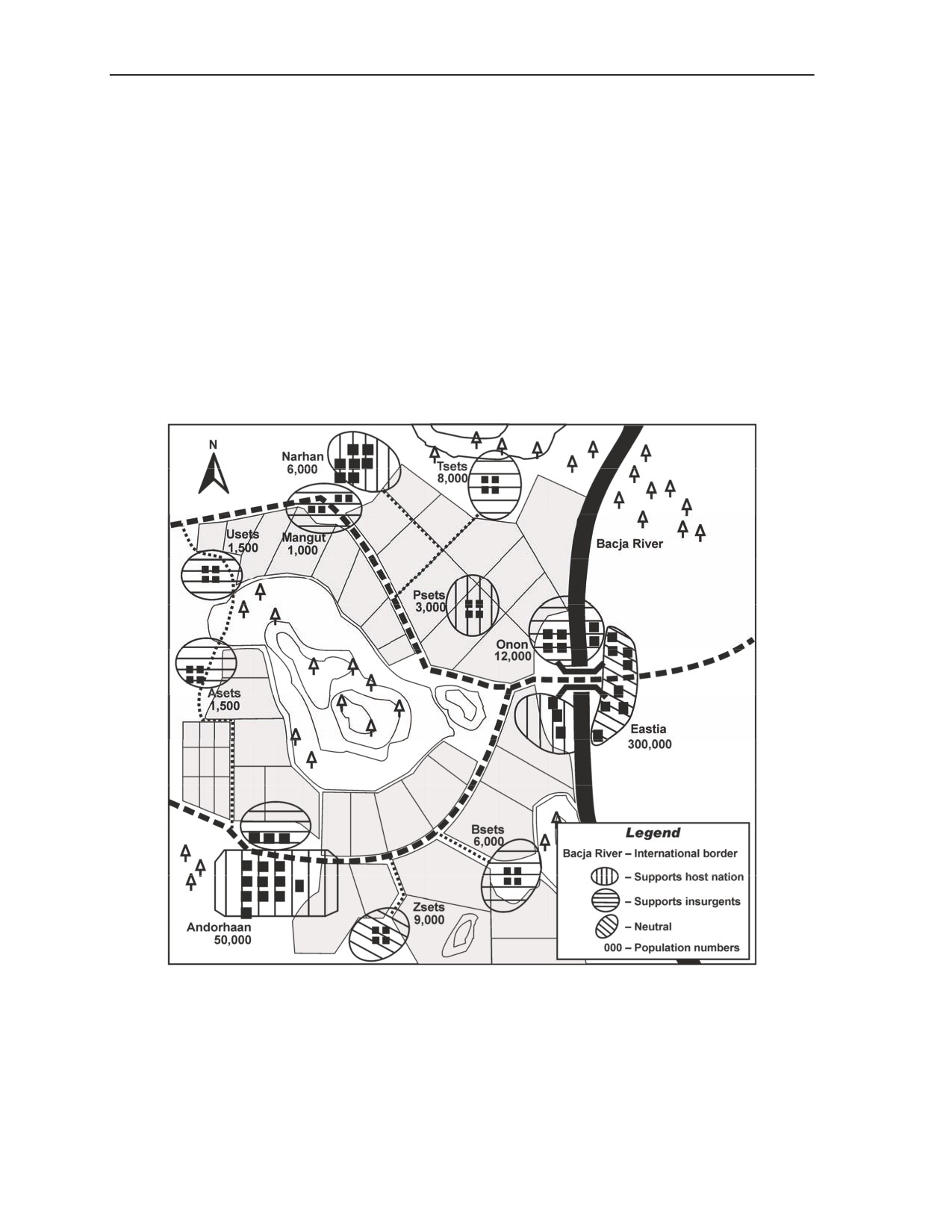
Appendix B
People
B-19. People refers to nonmilitary personnel encountered by military forces. The term includes all civilians
within an AO (the populace) as well as those outside the AO whose actions, opinions, or political influence
can affect the mission. To display different aspects of the populace, analysts can use population support
overlays and religion, race, and ethnicity overlays. (FMI 2-91.4 contains information about these overlays.)
Perception is another significant people factor in COIN. The perception assessment matrix is a tool that
compares the intent of friendly operations to the populace’s perception of those operations.
Population Support Overlay
B-20. The population support overlay can graphically depict the sectors of the populace that are progov-
ernment, antigovernment, proinsurgent, anti-insurgent, uncommitted, and neutral. (See figure B-2.) These
overlays are important because they help analysts determine whether the local populace is likely support
the HN government or support the insurgency.
Figure B-2. Example population support overlay
B-6
FM 3-24/MCWP 3-33.5
15 December 2006
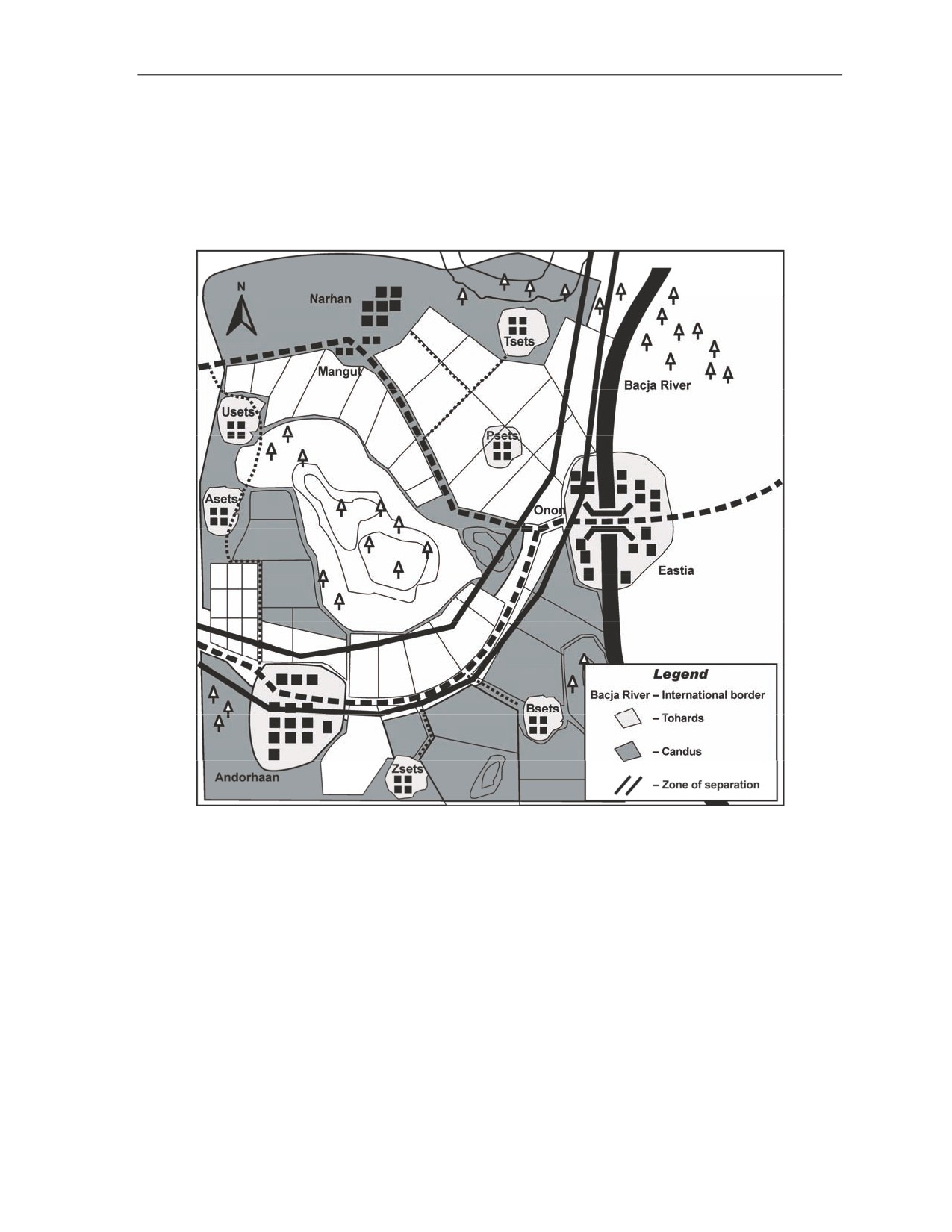
Social Network Analysis and Other Analytical Tools
Religion, Race, and Ethnicity Overlay
B-21. Religion, race, and ethnicity issues often contribute to conflicts. Religious, race, and ethnicity over-
lays depict the current ethnic and religious make-up of an AO. These overlays can also display any specific
religious-, racial-, or ethnicity-specific areas and any zones of separation agreed upon by peace accords.
These three overlays may be separate or combined. (Figure B-3 shows an example of an ethnicity overlay.)
Figure B-3. Example ethnicity overlay
Perception Assessment Matrix
B-22. Perceptions influence how insurgents are targeted and engaged. Important considerations include
how insurgents perceive counterinsurgents, themselves, their environment, the nature and reasons for the
conflict, and their success criteria. Perception is complicated but key to successfully targeting, engaging,
and evaluating success. In-depth knowledge and understanding of the national, regional, and local cultures,
norms, moralities, and taboos are needed to understand the operational environment and reactions of the
insurgents and populace.
B-23. Perception assessment matrices are often used by psychological operations personnel and other staff
elements and can be a valuable tool for intelligence analysts. (See figure B-4 [page B-9].) Counterinsurgent
activities intended to be benign or benevolent might have negative results if the populace’s perceptions are
not considered, and then evaluated or measured. This is true because perceptions—more than reality—
drive a commander’s decision making and can influence the populace’s reactions. A perception assessment
matrix displays how well counterinsurgents are able to achieve an effect during an operation. In this sense,
15 December 2006
FM 3-24/MCWP 3-33.5
B-7
Appendix B
the matrix can be used to directly display the effectiveness of the unit’s civil affairs, public affairs, and
psychological operations efforts.
The Importance of Perceptions in Operation Uphold Democracy
One proposed psychological operations action developed for Operation Uphold De-
mocracy in Haiti in 1994 illustrates why perception assessment is necessary. Before
deployment, leaflets were prepared informing the Haitian populace of U.S. intentions.
The original leaflet was printed in Dutch, the language of the Haitian elite. However,
the one actually used was published in Creole, the official language of Haiti, because
an astute team member realized the need to publish to the wider audience.
If a flier in Dutch had been dropped, it could have undermined the American mission
to the country in several ways. The majority of the population would have been un-
able to read the flier. The subsequent deployment of U.S. forces into the country,
therefore, could have been perceived as hostile. The mission, which was intended in
part to restore equity within Haiti’s social structure, could have backfired if the Hai-
tians viewed the Dutch flier as an indication of U.S. favoritism toward the Haitian
elite.
B-24. Perception can work against operational objectives. Perceptions should therefore be assessed before
and during an operation. It is not possible to read the minds of the local populace; however, there are sev-
eral means of measuring its perceptions. These include the following:
z
Demographic analysis and cultural intelligence are key components of perception analysis.
z
Understanding a population’s history can help predict expectations and reactions.
z
Human intelligence can provide information on perceptions.
z
Reactions and key activities can be observed to determine whether people act based on real or
perceived conditions.
z
Editorial and opinion pieces of relevant newspapers can be monitored for changes in tone or
opinion shifts that can steer, or may be reacting to, the opinions of a population group.
B-25. Perception assessment matrices aim to measure the disparities between friendly force actions and
what population groups perceive. In addition to assessing the perceptions of the population groups within
an AO, commanders may also want to assess the perceptions that their Soldiers and Marines have of unit
activities. Assessing counterinsurgents’ perceptions can begin to answer the following questions:
z
Are counterinsurgents exhibiting Western or American values that the populace does not appre-
ciate?
z
Are embedded American beliefs preventing the unit from understanding the HN population or
its multinational partners?
z
Is what the intelligence and command staff perceives really what is happening?
z
Does the populace believe what the unit believes?
z
Is there something that is part of the populace’s (or a subgroup’s) perception that can be detri-
mental to the unit?
B-8
FM 3-24/MCWP 3-33.5
15 December 2006
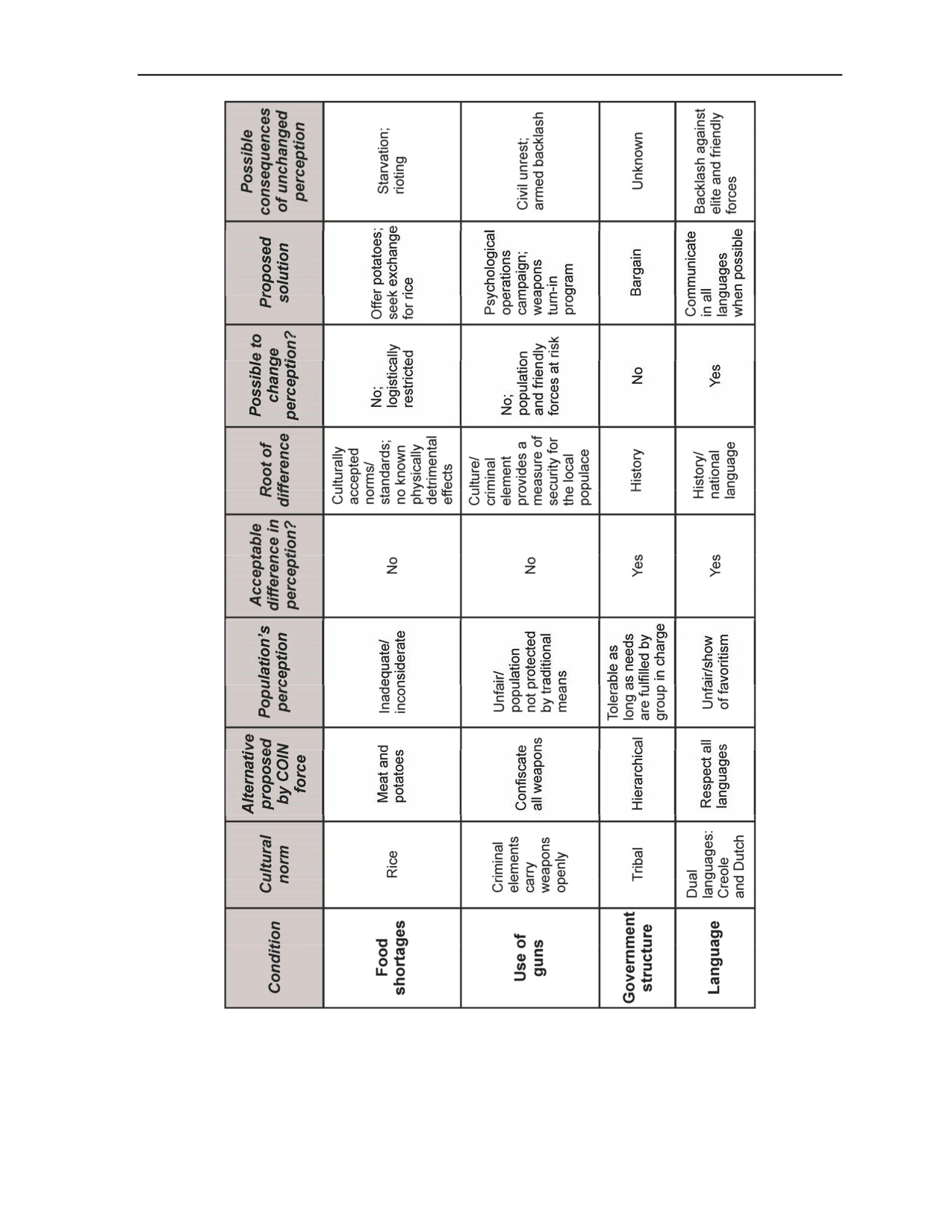
Social Network Analysis and Other Analytical Tools
Figure B-4. Example perception assessment matrix
15 December 2006
FM 3-24/MCWP 3-33.5
B-9
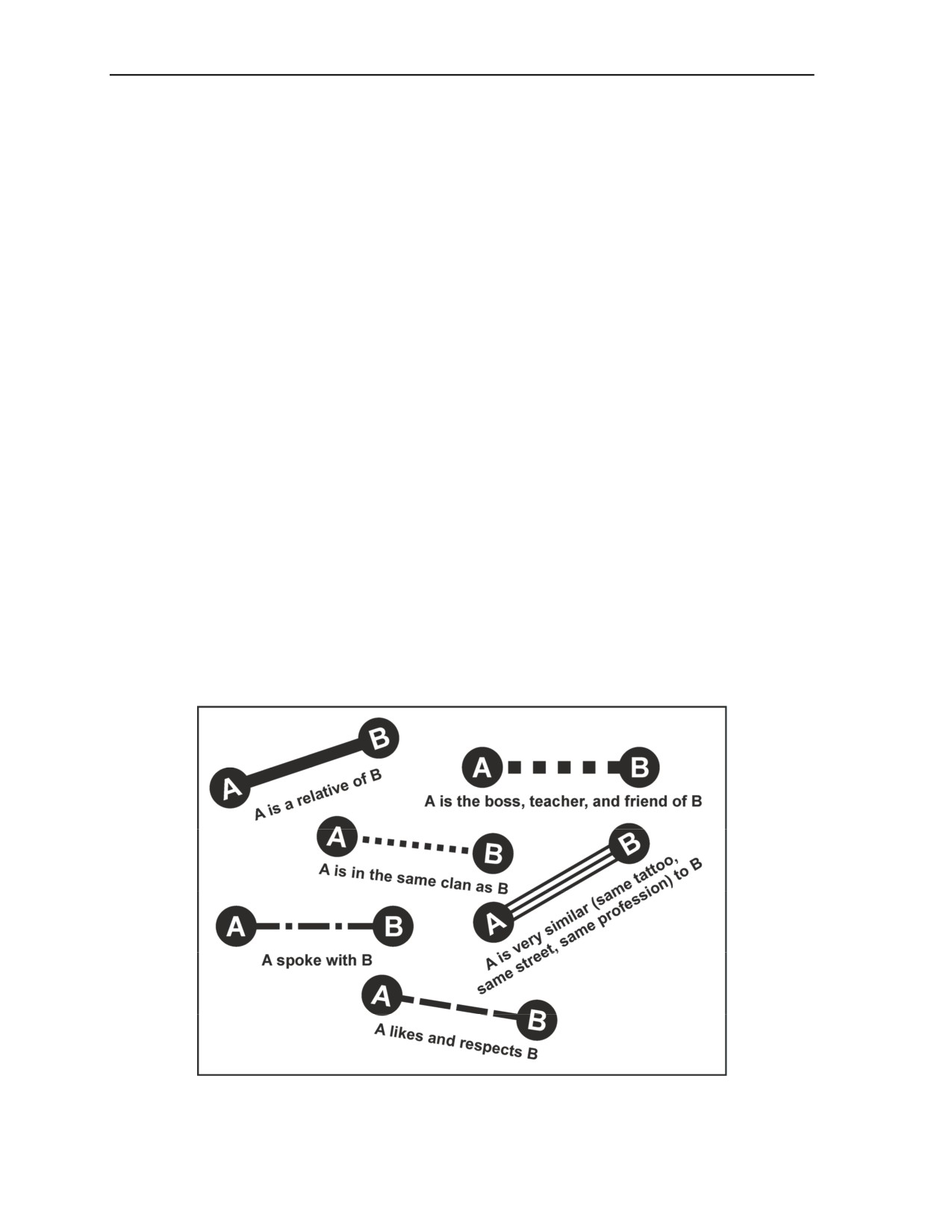
Appendix B
Events
B-26. Events are routine, cyclical, planned, or spontaneous activities that significantly affect organizations,
people, and military operations. They are often symbols, as described in paragraph 3-51. Examples include
the following:
z
National and religious holidays.
z
Agricultural crop, livestock, and market cycles.
z
Elections.
z
Civil disturbances.
z
Celebrations.
B-27. Other events include disasters from natural, manmade, or technological sources. These create hard-
ships and require emergency responses. Examples of events precipitated by military forces include combat
operations, deployments, redeployments, and paydays. Once significant events are determined, it is impor-
tant to template the events and analyze them for their political, economic, psychological, environmental,
and legal implications.
EVALUATE THE THREAT
B-28. Evaluating the threat involves analyzing insurgent organizations, capabilities, and tactics to identify
vulnerabilities to exploit. Tools like social network analysis, link diagrams, and association matrices help
analysts do this. Other tools such as historical time lines and pattern analysis tools assist in developing
event and doctrinal templates to depict enemy tactics.
SOCIAL NETWORK ANALYSIS
B-29. Social network analysis (SNA) is a tool for understanding the organizational dynamics of an insur-
gency and how best to attack or exploit it. It allows analysts to identify and portray the details of a network
structure. Its shows how an insurgency’s networked organization behaves and how that connectivity affects
its behavior. SNA allows analysts to assess the network’s design, how its member may or may not act
autonomously, where the leadership resides or how it is distributed among members, and how hierarchical
dynamics may mix or not mix with network dynamics.
Figure B-5. Examples of dyads
B-10
FM 3-24/MCWP 3-33.5
15 December 2006