FM 4-02.10 THEATER HOSPITALIZATION (JANUARY 2005) - page 5
FM 4-02.10
f.
Procedures for Feeding Patients Using a Contract Food Service. When a contracted dining
facility provides the hospital staff and patients with food and food service supplies, a dietitian and the
appropriate number of nutrition care specialists must be deployed to ensure that the required patient
nutritional services are met. Research the provisions of the contract prior to deploying. If the contract
provides only some of the foods listed in the medical diet supplement, then arrange with the deploying food
advisor or supply officer to order the remaining items. The team should—
• Set up an area(s) on or near the wards to assemble patient meals and nourishments. The
minimal equipment required for this set up is a table, serving supplies, refrigerator, a blender, rodent-proof
containers for nourishments, and shelves. The minimal equipment required for this set up is a table work
surface; patient trays; a refrigerator; a microwave; a blender; rodent-proof containers for nourishments;
and shelves.
• At a minimum, they should use the contractor’s daily menu and make modifications for
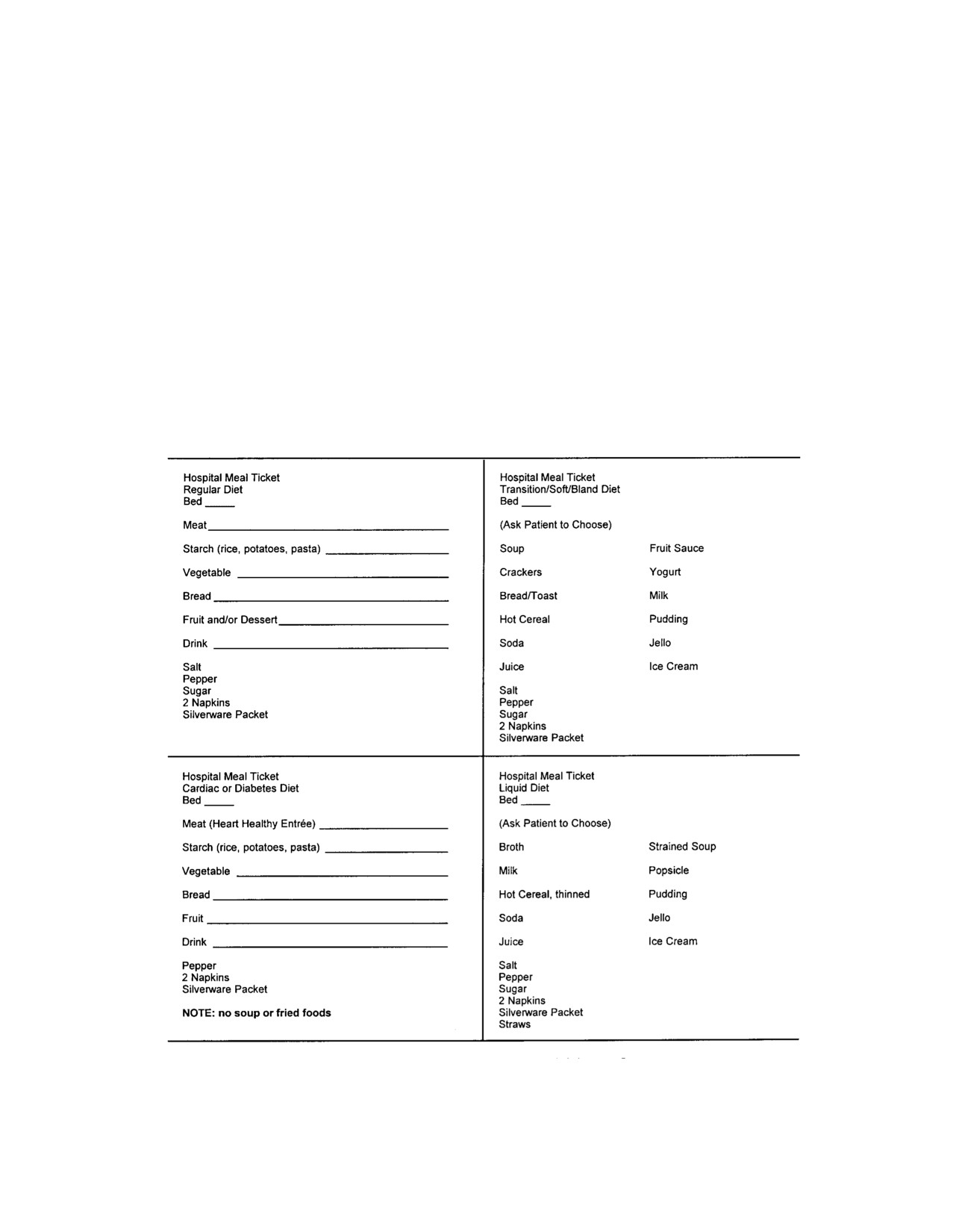
patient diets; see Figure K-9 for sample patient meal tickets that can be used to simplify this process. Turn
in meal tickets to the contract staff to fill the order. Also, establish a system to order and pick up food from
the contract dining facility. Carry the covered food from the contract facility to the hospital in boxes or
insulated containers. Assemble the patient trays in the pantry and deliver to the patient.
• Establish a method for disposing of patient trays and other waste (see Appendix J and
FMs 4-02.17 and 4-25.10).
K-14. Health Promotion and Nutrition Education
a. A strong and fit soldier is less likely to be injured accidentally; can more readily withstand
exposure to disease and stress; and will require less recovery time for wounds, injuries, or illnesses.
Maintaining a healthy and fit body enables the individual to support the unit in accomplishing its mission.
b. Health concerns mind, body, and spirit; therefore, a multidisciplinary team must work together
to develop a complete program. Depending on the health promotion program planned and available
providers, team members may include nutrition care, physical therapy, COSC, chaplain, preventive medicine
and nursing personnel, and physicians.
c.
To have a good health promotion program several steps must be accomplished. They include,
but are not limited to—
• Conduct a population assessment.
• Establish goals and objectives.
• Plan the program.
• Conduct the program.
K-14
FM 4-02.10
• Document the programs successes and failures.
• Make changes to the program to emphasize the successes and eliminate the failures for
future use in the program.
K-15. Nutrition Care Section After Action Report
At the end of a deployment or training exercise the chief, nutrition care section, should prepare an after
action report (AAR) on nutrition care activities. The AAR should be prepared in accordance with the
hospital SOP. Provide a copy of the section AAR to the Chief, Army Medical Specialist Corps (AMSC)
upon approval by the hospital commander.
Figure K-9. Sample patient meal tickets.
K-15
FM 4-02.10
APPENDIX L
SUPPLEMENTAL INFORMATION ON NUTRITIONAL SUPPORT
L-1. Nutrient Sources and Functions
Nutritional care is a critical part of patient care; providing the correct nutritional care enhances the patient’s
recovery. To meet this need, nutritional care personnel must ensure that foods served to the patients meet
their nutritional requirements. Knowing the nutrient functions of various food items enables nutritional care
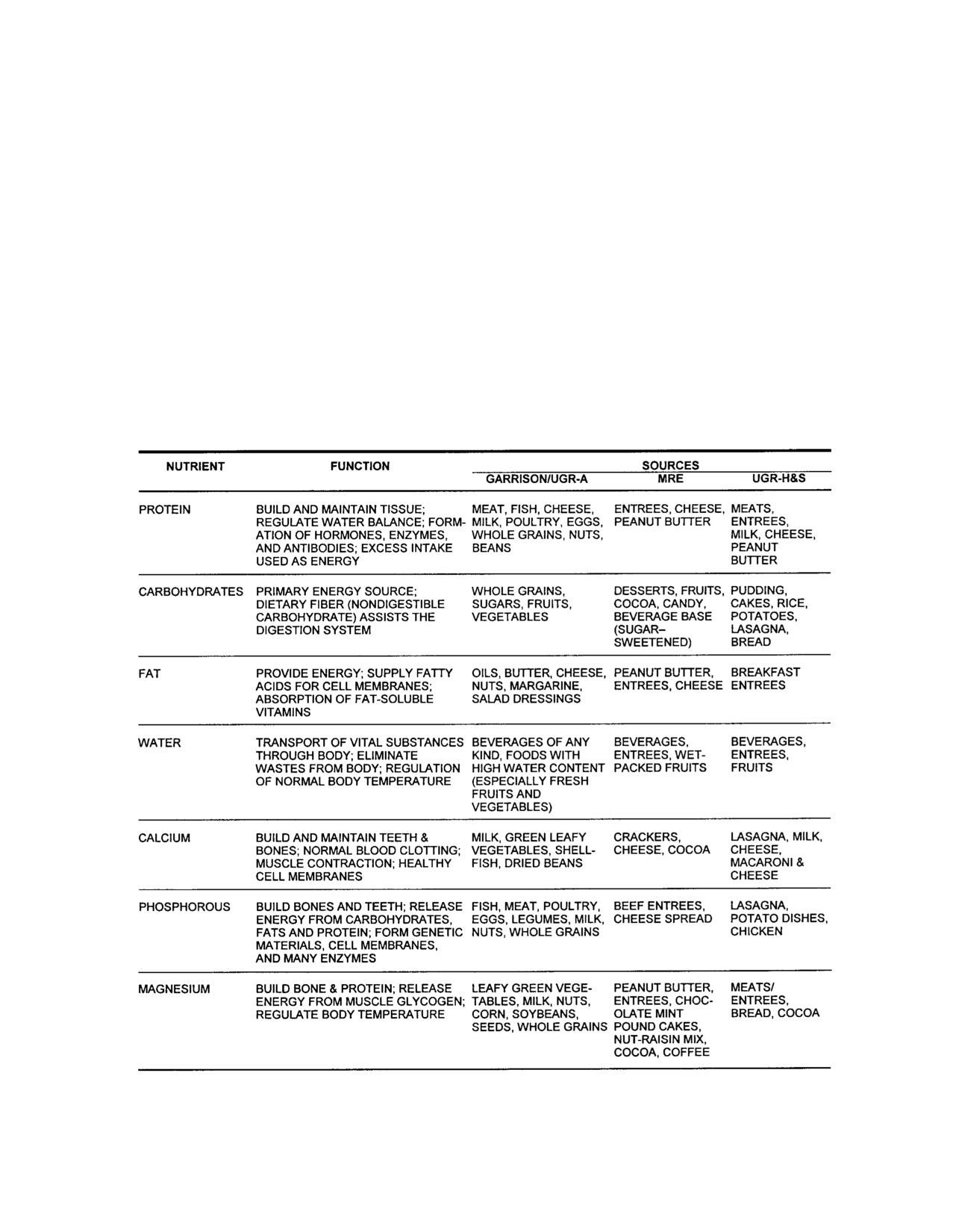
personnel to meet these needs. See Table L-1 for an overview of the nutrient sources and functions of food
items in A-rations, MRE, and UGRs.
Table L-1. Nutrient Sources and Functions
L-1
FM 4-02.10
L-2. Medical Diet Supplements
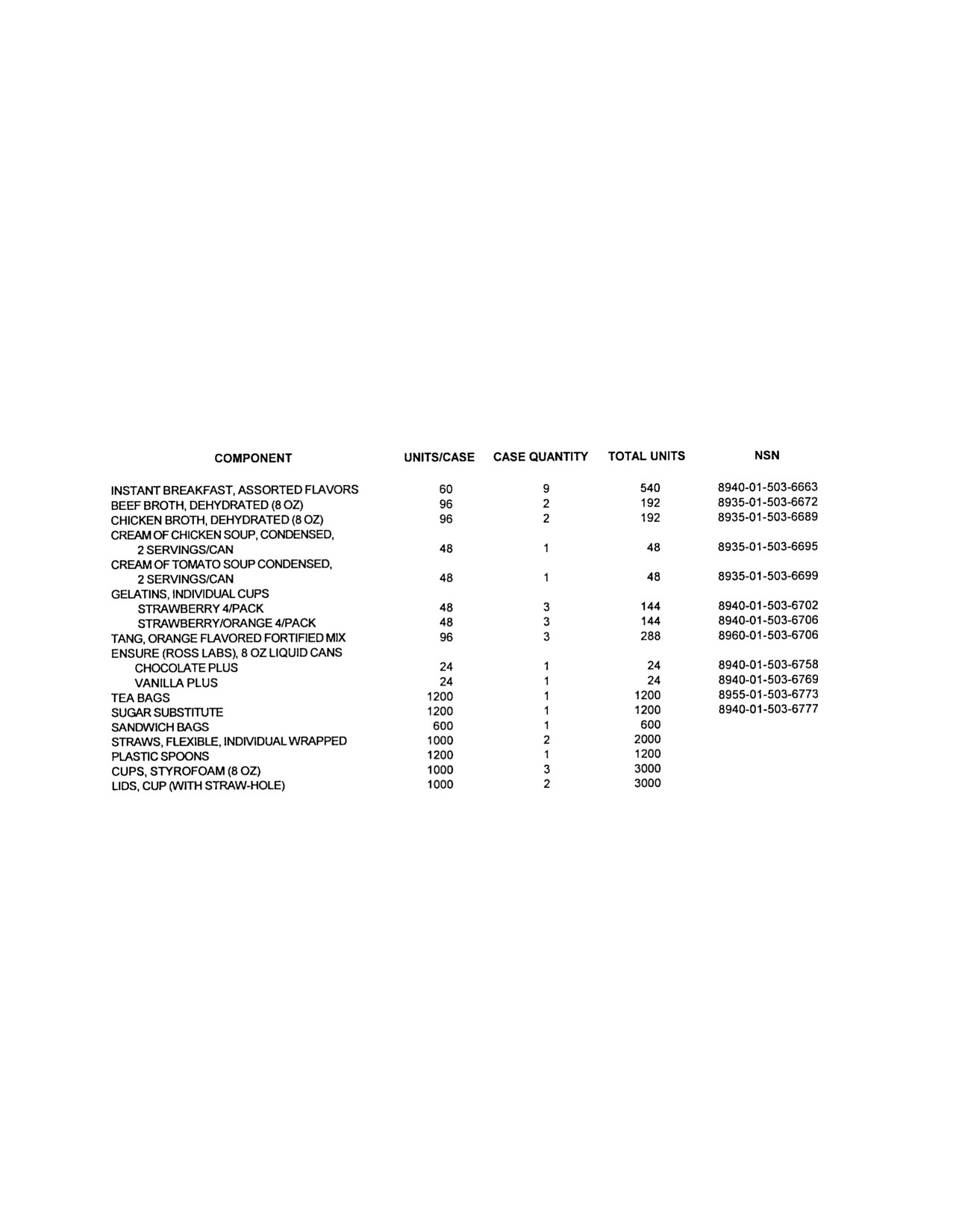
a. The medical diet supplement, used in combination with the MRE and UGR provides
commercial semiperishable food components required to prepare therapeutic diets. Each medical diet
supplement (see Figure L-1) supports 50 patients for a 15-day period based on the following diet mix:
28
regular; 5 high-calorie—high-protein; 11 blenderized liquid; and 6 clear liquid. The medical diet supplement
is shipped in a triwall container with the following unit load dimensions:
33” wide by 41” length by 49”
height; the cube is 38.37’; and the weight is 443 lbs. The medical diet supplement is ordered from Defense
Supply Center Philadelphia with the NSN: 8970-01-470-5077. If necessary, individual components may be
ordered separately.
Figure L-1. Medical diet supplements for MRE and UGR rations.
b. Enteral feeding products can be ordered through the medical supply section of the hospital.
Coordination for ordering components of the medical diet supplement and enteral feeding products should
be done prior to any exercise or deployment. Due to potential delays in receiving products, the above list of
components from the medical diet supplement and a supply of enteral feeding products should be packed
prior to deployment for immediate availability.
L-3. Therapeutic Diet Menus
The medical diet supplements are used to provide therapeutic diet menus for patients with components of the
MRE and UGR to promote acceptability and nutritional adequacy of the hospital diet. The diet distribution
L-4
FM 4-02.10
is estimated for the population. Exact distribution may vary with the scenario and type of military
operation. Other less popular diets such as diabetic or cardiac may be necessary under special conditions.
L-4. Therapeutic Diet Preparation
Therapeutic diets are prepared to accommodate each patient’s diet order as stated in the patient’s medical
record and recorded on the patient ward roster. These diets may be modified to meet the patient’s particular
medical conditions and personal requests. The ADA Manual is the primary reference for therapeutic diet
instructions. The menu components for these diets come from the MRE, UGR, and the medical diet
supplement list.
a. Regular Diet. This diet will use the standard MRE or UGR menu with bread, milk, and
cereal. Enhancements should be incorporated into the diet plan as soon as they are available, such as fresh
fruits and salads. In between meal snacks may be incorporated into the diet upon request. Patient
preferences should be incorporated into the meal plan to the maximum extent possible.
b. Clear Liquid Diet. This diet is intended to supply fluid and energy in a form that requires
minimal digestion. It consists primarily of broth, gelatin, and juice. The orange juice is strained before it is
served to the patient. If refrigeration is unavailable, the gelatin can be served in a liquid form. Carbonated
beverages can be added to the diet, when available. Between meals feeding are encouraged.
c.
Blenderized Liquid Diet. This diet is designed to provide adequate calories, protein, and fluids
for patients who are unable to chew, swallow, or digest solid foods. This diet consists of fluids and foods
blenderized to a liquid form. The viscosity of blended items ranges from the thickness of fruit juice to that
of cream soup. Frequent small feedings may be necessary to facilitate ingestion of adequate calories and
protein.
d. Mechanically Altered Diet. This diet is designed to minimize the amount of chewing necessary
to ingest food. This diet includes food modified only in texture, such as blended, chopped, ground, and
pureed foods to promote ease of chewing. All vegetables included should be well cooked to minimize the
need for chewing. Most raw fruits and vegetables are excluded. Spices are encouraged to increase
palatability of the diet. Between meal snacks may be arranged upon request.
e.
Low Sodium Diet. This diet is used to promote management of hypertension. Due to the high
number of canned and instant food items found in the UGR and the contents of MRE, a highly restrictive
sodium diet is not possible without severely compromising caloric and other nutrient needs. When available,
use fresh vegetables in the place of canned vegetables. If canned vegetables must be used, rinse and drain
them to reduce the sodium content. Between meals snack may be arranged upon request.
f.
Cardiac Diet. This diet is designed to reduce elevated serum cholesterol and promote healthy
eating. It consists of modifications in total fat, saturated fat, cholesterol, sodium, caffeine, and fiber. All
meat entrees should be as lean as possible (trimming fat, removing skin from chicken, using minimal fat in
preparation, and draining fat off of products). Lower fat entrees from the MRE may be an acceptable
substitute for some of the highest fat entrees in the UGR; for example, the bean and rice burrito could be
L-5
FM 4-02.10
substituted for chili con carne. Low sodium cooking methods are used. Avoid soups and broths; they are
high in sodium content. Use fresh fruits and vegetables to replace canned fruits and vegetables, whenever
available. Increase fiber with whole grain products when available. Dessert items may be added to the
menu plan depending on the item content and diet restrictions. Between meals snack may be arranged upon
request.
g. High-Calorie/High-Protein Diet. This diet is designed to provide additional calories and
protein to the regular diet. The additional calories are primarily in the form of added fruit and extra bread.
The additional protein is provided by increasing entrée portion sizes and including a medical diet supplement
high protein beverage or a milk shake as a between meal snack. Milk shakes may be made using milk,
instant breakfast, flavored syrups, and fruits.
h. Diabetic Diet. This diet is used to improve blood glucose levels and control diabetes. It is set
up as three meals and 1 to 3 snack regimes consisting of approximately 2200 calories. Most of the cardiac
modifications including low fat, low sodium, and high fiber should be followed. Meals should be set up
around 60 to 75 grams of carbohydrates and snacks should contain 15 to 30 grams of carbohydrate until
modified by a dietitian. One starch, fruit, or milk exchange contains 15 grams of carbohydrate.
i.
Tube Feeding. Tube feeding is a highly specialized diet tailored to meet the needs of a small
population of patients that must be close coordinated with the medical staff. Commercial tube feeding
formulas are the preferred menu item. However, commercially prepared formulas may not always be
available when needed. To prepare tube feeding menu items a powdered commercial nutrition drink is the
optional ingredient is available. Nutrition care specialists will reconstitute the powdered commercial
product. For preparation, all equipment must be properly sanitized and the product refrigerated immediately
after preparation. Limit the contents of each tube-feeding package to a 500-cubic centimeter intravenous
bag. Due to limited refrigeration on the wards, progressive preparation and delivery of tube feedings to the
wards may be necessary. Additional powdered commercial tube feedings are available as a standard
subsistence (NSN 8940-01-304-3620) or medical supply item ordered through the pharmacy. Nutritional
analysis of the tube feedings is available on the nutrition label of the powdered commercial nutrition
product.
L-5. Recipe Modifications
Providing food items for patients needs include making modifications not normally needed for standard
menus. Modifying recipes for consistency are a part of this process. Principles for modifying a recipe for
consistency includes, but is not limited to—
• Modifying UGR items for consistency.
• Checking the ADA Manual and the menu patterns shown in Tables L-2 and L-3 for foods
allowed on each diet type.
• Cutting meat items into bite-sized pieces, grinding or pureeing meats for consistency.
L-6
FM 4-02.10
• Blenderizing foods with additional liquids until the required consistency is reached.
• Using liquids that add calories (such as gravy, soup, sauce, milk or juice) for thinning.
• Using heated liquids for thinning if the blended item is a hot food item.
• Pouring the blended and thinned food item through a strainer to remove lumps.
• Proper consistency of the final product requires that:
•
The item is thick enough to coat a spoon like a sauce or gravy; but thin enough to flow
through a straw freely.
•
The food item is at the correct serving temperature after blending, thinning, and straining.
•
The seasoning is blended in the items so that they are not bland (such as, adding garlic
powder to pureed meats).
L-6. Supplemental Fluids
An estimated 40 to 50 percent of all patients will need supplemental fluids. Have milk and juice available at
most meals. The UGRs also contain a fruit flavored beverage that can be used to meet fluid requirements.
These beverages, along with water, can also be made available for between meal nourishment.
L-7. Nourishments and Snacks
Nourishments and snacks are important elements of many of the therapeutic diets. They should be served
three times per day, midway between meals and in the evening. Many of the snack items listed on the
therapeutic menus are prepared from the UGRs of the previous meal, for example, the peanut butter and
jelly from the lunch UGR for the mechanically altered diet is saved and used as the afternoon snack. Table
L-7
FM 4-02.10
APPENDIX M
MEDICATION USE AND PHARMACY OPERATIONS
M-1. Purpose
This appendix establishes general policies and procedures for the use of medications within the theater
hospital system as well as key matters regarding pharmacy support operations. It further describes the
roles, responsibilities, and scopes of several key personnel with regards to medication use processes.
M-2. References
a. AR 40-3, Medical, Dental, and Veterinary Care, 30 July 1999.
b. AR 40-7, Use of Investigational Drugs and Devices in Humans and the Use of Schedule I
Controlled Drug Substances, 4 January 1991.
c.
AR 40-38, Clinical Investigation Program, 1 September 1989.
d. AR 40-61, Medical Logistics Policies and Procedures, 25 January 1995.
e.
AR 40-66, Medical Record Administration and Health Care Documentation, 10 March 2003.
f.
AR 40-68, Clinical Quality Managements, 26 February 2004.
g. AR 40-562, Immunizations and Chemoprophylaxis, 1 November 1995.
h. STP 8-91Q15-SM-TG, Soldier’s Manual, Skill Levels 1/2/3/4/5 and Trainer’s Guide, MOS
91Q, Pharmacy Specialist, 1 April 2003.
M-3. Applicability
This appendix applies to all health care personnel involved in the medication use process, to include the
acquisition and procurement, ordering, transcribing, dispensing, distributing, and monitoring of medications
and responses to therapies.
M-4. Roles and Responsibilities
a. The hospital commander is responsible for all aspects of medication use within the facility.
This includes all phases of medication employment from procurement through use and monitoring of patient
responses. The hospital commander must develop and execute policies and procedures that ensure the safe
and effective use of drugs for the prevention, diagnosis, or treatment of disease, and conform to the highest
standards of medical care.
M-1
FM 4-02.10
b. The deputy commander for clinical services (DCCS) is responsible to the hospital commander
for all medication use processes employed by the clinical staff of the facility. Policies must be developed to
ensure rational prescribing, administering, and monitoring of medication therapies. The DCCS normally
chairs several hospital committees to ensure these processes are instituted. One such committee involved
with medication use is the Pharmacy and Therapeutics (P&T) Committee.
c.
The chief, pharmacy services is charged with development of pharmacy policy and imple-
menting hospitalwide programs to ensure the safe and effective use of medications. This individual is
normally given the responsibility of facilitating and recording proceedings of the P&T Committee.
M-5. Hospital Formulary Development
a. The hospital commander approves the formulary to be employed by his facility. Premission
planning must entail detailed mission analysis, including evaluation of the mission (assigned and implied
tasks), enemy forces, troops/personnel supported, terrain/environment of the operation (endemic diseases/
medical threats), and time available to determine any special medication requirements.
b. The CSH formulary is developed by the P&T Committee.
c.
Included in this review and formulary development should be an alignment with the joint
deployment formulary (JDF). The JDF consists of medications recommended for use by all military
departments that have been standardized and published by the JRCAB. Use of JDF items, when appropriate,
improves supply chain responsiveness and enhances predictability for all personnel involved in the
medication use process.
d. The unit’s authorized stockage list (UAL) should also be examined to determine what items
might be included in a standardized unit deployment package (UDP) that could be issued by the USAMMA.
e.
Lastly, if deploying to a theater with an established supply chain, the P&T Committee should
examine the current levels of theater support available and any theater formulary that might be in place.
M-6. Combat Support Hospital Pharmacy and Therapeutics Committee
a. As within a fixed facility the CSH commander will appoint hospital staff members to a
P&T Committee. Membership will include a mixture of clinical and administrative personnel.
b. The key objectives of the CSH P&T Committee include:
(1) Recommend facilitywide medication use policies to assure safe, appropriate, and effective
use of drugs.
(2) Evaluate and select CSH formulary items, taking into consideration medications found in
the JDF, the UAL, the mission assigned to the CSH, and any special medication requirements.
M-2
FM 4-02.10
(3) Recommend policies for the storage, distribution, use, and monitoring of medications,
and other matters related to medication safety within the CSH.
(4) Recommend or develop programs to educate the CSH staff on matters related to the safe
use of medications.
(5) Review DOD-Medical Materiel Quality Control (MMQC) messages and disseminate
pertinent information to staff.
(6) Evaluate the internal quality assurance/quality control measures over the medication use
processes within the CSH, including patient care area inspections, controlled substance accountability, and
physical security.
(7) Monitor adverse drug events and medication errors. Recommend interventions as
appropriate. Assess performance improvement measures to reduce further risks.
(8) Monitor medication use within the facility and make recommendations to optimize
therapies.
(9) Monitor the use of controlled substances. Reduce risk of drug diversion.
(10) Report pharmacy workload.
(11) Monitor the management of any investigational new drug (IND) items that are employed
within the CSH.
(12) Report procurement of any non-FDA approved medications in accordance with AR 40-7.
M-7. Predeployment Mission Planning
In addition to formulary development, several key aspects of medication use and pharmacy support should
be assessed prior to deployment. These include:
a. Maturity of the Theater of Operations. The speed and likelihood of resupply of medications
will be dependent upon the maturity of the supply chain. In an immature theater of operations the facility
(or an early entry module) may need to deploy with a larger “days of supply” amount of materiel to ensure
continuity of care.
b. Mission. The mission of the unit and personnel to be supported will impact the amount and
types of care to be provided. This is extremely critical if the unit is tasked with providing humanitarian aid
to the local population
(either refugees or internally displaced persons) or enemy prisoners of war.
Medication needs and follow up could be much greater if supporting humanitarian missions. Types of care
provided may include pediatrics, obstetrics and gynecology, and geriatrics.
M-3
FM 4-02.10
c.
Equipment Needs. Equipment required to ensure the safe and appropriate storage, shipment,
and use of medications, as well as their control/security and accountability should be assessed. Make every
effort to obtain/fill all critical equipment shortages prior to deployment. Refer to the UAL for all authorized
equipment. Additional equipment needed based on expanded mission requirements should be procured. A
pharmacy automation package that will support the provision of drug information, inpatient pharmacy
services, outpatient pharmacy services, bulk drug distribution, controlled substance management, and
inventory tracking is a must for efficient field pharmacy operations. The JRCAB’s Joint DEPMEDS
database contains a recommended pharmacy automation support package. Additionally, the Joint
DEPMEDS database recommends an automatic tablet/capsule counting machine to facilitate prepacking and
filling of outpatient prescriptions.
d. Information Requirements. Intelligence assessments should drive medication requirements.
Additionally, proper medical and medication references should be available to support hospital staff
medication information needs in the deployed theater.
e.
Staff Organization. The primary duties and responsibilities of personnel involved in medication
use management as well as pharmacy support operations must be identified and assigned.
f.
Special Deployment Medications. Based upon intelligence estimates and endemic disease
threats certain deployment medications may be needed. Identify these requirements, procure the necessary
medications and provide appropriate information to all personnel receiving these medications.
g. Provision of Investigational Medications or Devices. If any INDs or investigational devices
are to be employed during operations, an associate investigator must be identified and appointed to manage
the investigational protocol and the legal/regulatory requirements. Control and accountability of investi-
gational agents is similar to controlled substances. It is strongly recommended that the pharmacy services
section in the CSH be the inventory control point for all IND products.
h. Tactical SOP. The CSH Tactical SOP must stress medication use procedures and planning
throughout the entire CSH facility.
i.
Pharmacy Services Section SOP. The pharmacy services section must develop and review its
internal procedures to ensure the facility will be supported with safe medication use policies.
(For an
example of an SOP on medication use and pharmacy operations, refer to website http://dcss.cs.amedd.army.
mil/phar/pharhome.htm.)
j.
Maintenance Medication Requirements. The current CSH mission does not include the
provision of maintenance medications for forces operating within the supported area. Refill of prescriptions
for maintenance medication should be provided by the refill pharmacy augmentation team/system as
described in Annex Q of the theater operations order.
(1) During deployment preparations, internal CSH personnel must be screened for their
chronic medication needs and accompanying monitoring requirements. Soldier readiness processing (SRP)
M-4
FM 4-02.10
sites should incorporate pharmacy personnel during screening to assist with medication evaluation and
Composite Health Care System (CHCS) entry.
(2) If monitoring requirements exceed the capabilities of the deployed medical forces patients
should be referred for medical care to the local military medical treatment facility for evaluation of their
deployable status prior to actual deployment.
(3) If patients are taking medications not found on the JDF or theater formulary/stockage
list, conversion to a therapeutic alternative that is stocked should be considered to facilitate future
replenishment in theater.
(4) Patients stabilized on maintenance medications should deploy with up to 180-days supply
of these medications.
(5) To the fullest extent possible, all prescriptions should be entered into CHCS to permit
medication tracking and future screening for refill needs.
(6) Using the DOD Pharmacoeconomic Center’s Predeployment Medication Analysis and
Reporting Tool (P-MART), data for an entire unit can be passed to the theater pharmacy consultant/
maintenance medication refill coordinator. The P-MART can be used to provide the listing of maintenance
medication needs to the refill pharmacy augmentation system established to support refills of maintenance
medications in theater as defined in Annex Q of the theater operations plan/order. The P-MART website
can be found at http://www.pec.ha.osd.mil/.
(7) A refill pharmacy augmentation team/system can consolidate the maintenance medication
requirements for all in-theater personnel, validate their needs, stock the required drugs, process and refill
prescriptions, and push the medication refills to the patients’ units through existing medication logistics
infrastructure.
k.
Echeloning of Supplies and Equipment. If the CSH’s EEH EL, containing a 44-bed slice of
the CSH, is detached, assess the medication needs for this package. For accountability purposes consolidate
controlled substances and other medications within the pharmacy module during movement.
M-8. Deployment/Movement Medication Use Needs
During unit movement the CSH medical staff will likely be called upon to provide sick call care and
possibly emergency medical treatment. Some quantity of medication should be segregated/packaged as a
small EMT/sick call readiness kit. This kit must always be readily available to the medical staff and
pharmacy personnel to provide for urgent care needs.
M-9. Considerations for the Employment of Pharmacy Services Staff
a. Early Entry Hospitalization Element. The CSH’s EEH EL should be staffed with at least one
pharmacy officer, one pharmacy NCO, and two additional pharmacy specialists to provide initial 24-hour
coverage.
M-5
FM 4-02.10
b. Consolidation Under 84-Bed Company. Pharmacy operations will be consolidated once the
entire 84-bed company has deployed and merges with the EEH EL.
c.
Corps CSH 164-Bed Company. The pharmacy services section in the 164-bed company is
designed to operate either independently (split-base) of the 84-bed company or may be consolidated into one
single pharmacy services section.
d. Echelons Above Corps CSH Pharmacy Services. These services are contained wholly within
the 84-bed company. An EEH EL may be employed for initial deployment, but the EAC pharmacy services
section is not designed to conduct split-base operations. The EAC CSH pharmacy services section provides
medication use and pharmacy support services to the entire 248-bed facility.
M-10. Redeployment Requirements
a. All personnel must be screened for medical conditions and medication needs prior to
redeployment.
b. Medications and drug information for postexposure treatment of endemic diseases will be
provided if appropriate. Each individual’s medications will be screened for potential interactions with any
existing medication therapies to preclude preventable adverse events.
c.
Screening should also include evaluation of patients’ maintenance medication needs to ensure
they possess an adequate amount to treat them until they return for care at home station.
M-11. Establishment of Pharmacy Services/Employment and Functions of Combat Support Hospital
Pharmacy Services Personnel
a. Ensure safe and effective medication therapy. Monitor appropriateness of medications for
disease state management.
b. Medication use surveillance. Adjusting items and quantities stocked based on demands,
susceptibilities, or anticipated requirements.
c.
Review all medication orders. Recommend therapeutic alternatives when primary medication
desired is in a shortage situation or unavailable. Screen orders for drug-drug interactions, drug-food
interactions, and medication allergies. Assess appropriateness of dosage, route of administrations, and
potential for adverse effects.
d. Provide medication consultation services.
(1) Provide consultation services to the medical and nursing staff to resolve patient medication
questions and concerns.
M-6
FM 4-02.10
(2) Provide consultation services to the MEDLOG section to assist them with item identi-
fication and alternate/substitute procurement.
(3) Assess medications that may have been “temperature compromised” during either storage
or shipment to determine if they should be recalled, destroyed, or can still be administered to patients.
Stress maintenance of appropriate storage and shipping conditions for all pharmaceuticals to the CSH
commander and all CSH staff members.
(4) Coordinate with higher headquarters pharmacy consultant and other pharmacy officers
on pharmaceutical issues, drug information, and pharmacy policy matters.
e.
Report medication related patient safety problems. Investigate and report adverse drug and
vaccine events.
f.
Assess nutritional needs in cooperation with physicians and dietitians. If the pharmacy services
section is expected to provide parenteral nutritional support, a tabletop laminar airflow hood is needed to
safely prepare these products. Parenteral nutrition products are highly susceptible to microbial contamination
and a laminar airflow hood is essential to reduce the risk of contamination. A tabletop laminar flow hood
has been standardized in the Joint DEPMEDS database maintained by the JRCAB.
g. Conduct therapeutic monitoring of patients’ drug therapies and provide pharmacokinetic
consultation when appropriate.
h. Monitor patients for and report adverse drug reactions.
i.
Make medication adjustments as necessary.
j.
Participate in patient care rounds, whenever possible.
k.
Participate in clinic operations to provide direct patient care services.
l.
Provide medication information services. Maintain a reference library for drug/disease
information. An automation system, standardized and approved by JRCAB, is recommended for use by the
CSH pharmacy services section for this purpose. This automation system will also support other medication
use documentation processes within the pharmacy services section.
m. Provide inservice training.
n. Provide inpatient pharmacy services. The pharmacy services in conjunction with the hospital
staff must decide if they will provide a unit dose distribution system or a unit of use (for example, 2- or
3-days supply) distribution system for inpatient care.
o. Provide sterile products preparation services. It is highly recommended that pharmacy staffs
employ a “binary connector” system linking medication vials directly to intravenous piggyback containers
to the maximum extent possible. Use of binary connectors permits batch preparation in anticipation of
M-7
FM 4-02.10
needs while reducing waste since products prepared in this manner are generally stable for 30 days if not
mixed. Several of these devices have been standardized by the JRCAB.
p. Provide outpatient pharmacy services (may include a self-care program). Provide patient
medication counseling to all outpatients.
q. Provide direct support to patient care areas during mass casualty events or patient codes, and
maintain medications on all crash carts within the facility.
r.
Provide bulk medication supply and controlled substances to hospital sections.
s.
Coordinate and ensure procurement of appropriate drugs to support CSH patient care require-
ments.
t.
Provide oversight of immunization programs in conjunction with preventive medicine services.
u. Prepare and submit daily reports in accordance with the command SOP.
v.
Collect, record, tabulate, and report pharmacy workload data to commander and senior
pharmacy consultant.
M-8
FM 4-02.10
APPENDIX N
PRE- AND POSTDEPLOYMENT HEALTH ASSESSMENT
This appendix contains two health assessment forms. It is very important that each individual complete
DD Form 2795 (Figure N-1) during predeployment processing and DD Form 2796 (Figure N-2) during
postdeployment processing. These forms, filled out by the concerned individual, are used to assess whether
or not an individual is medically fit for deployment and to assess possible long-term health impacts upon
their return.
N-1
FM 4-02.10
APPENDIX O
COMMANDERS’ CHECKLIST
Section I. PERSONNEL CHECKLIST—MOBILIZATION
O-1. Personnel and Administration
a. Maintain individual records alphabetically by last name. If records are maintained by an
activity separate from the hospital, provide that activity an updated personnel roster as of the 15th of each
month to arrive not later than the 20th. Reserve Component hospitals use the most current DA Form 1379.
b. Identify nondeployable personnel and initiate procedures for reassignment and/or separation.
c.
Identify and color code all reference publications to be taken with the hospital upon
deployment.
d. Maintain personnel readiness folders and review them quarterly.
e.
Ensure that hospital members’ (to include PROFIS) identification tags and Geneva Conventions
cards are on hand and are in serviceable condition.
f.
Ensure that all physicians and nonphysician health care providers have gone through a
credentialing committee according to AR 40-68 and their scope of practice is documented.
g. Identify files to accompany the hospital in case of deployment, as well as those to be destroyed.
h. Maintain a 60-day supply of blank forms for deployment.
i.
Maintain a deployment set of DA Form 3955 on all assigned personnel in alphabetical order.
j.
Appoint a (unit) family member’s assistance officer.
k.
Conduct personal affairs briefing.
l.
Identify personnel shortages by grade and military occupational specialty (MOS).
m. Submit requisition for personnel shortages.
n. Ensure that assigned personnel have enrolled their dependents in Defense Enrollment Eligibility
Reporting System (DEERS). It is the service member’s responsibility to verify DEERS enrollment for their
family members prior to deployment. This will ensure that family members can receive medical care while
the service member is deployed. To confirm enrollment contact DEERS at 1-800-538-9552.
o. Ensure service members check the expiration date of all dependent ID cards prior to
deployment. If the cards expire prior to the end of the deployment, you should contact the appropriate
personnel office to initiate the paperwork.
O-1
FM 4-02.10
p. Ensure that dependent care plans are on file and adequate for soldiers and PROFIS personnel
who are sole parents, or are married to another soldier and have children.
q. Appoint a unit mail clerk.
r.
Requisition and maintain recreational equipment and supplies.
s.
Appoint a unit safety officer and an NCO.
t.
Maintain in a current status the personnel data cards (PDCs) for all personnel assigned, to
include designated PROFIS personnel.
u. Appoint a unit records management coordinator to pick up and transport the hospital’s
individual records (personnel, medical, dental, and finance) in case of a deployment.
v.
Ensure assigned personnel maintain current MOS evaluation scores; if personnel have failed to
verify their MOS, conduct training in deficient tasks.
w. Establish procedures to recall personnel absent from the unit in the event of increased readiness
conditions.
x.
Obtain sufficient boxes to carry unit files and personnel, dental, and medical records.
y.
Maintain records (PDC files) on PROFIS personnel.
z.
Appoint rear detachment commander.
aa. Check to ensure military drivers’ licenses are current and schedule driver training/testing to
ensure sufficient numbers of drivers are available for movement of unit’s assigned vehicles.
ab. Assure all personnel, especially those newly assigned from far away, link their “significant
others” (not limited to “entitled beneficiaries”) with the unit family support group.
O-2. Finance
a. Maintain a current roster of all assigned and PROFIS personnel.
b. Ensure that orders for purchasing officer and Class A agent are current and that each individual
is thoroughly briefed on his duties.
c.
Upon mobilization, ensure that the Class A agent contacts the mobilization station finance and
accounting office (FAO) and identifies any immediate finance requirements.
d. Establish contact with FAO upon arrival at the mobilization station to enhance personnel
processing.
O-2
FM 4-02.10
e.
Arrange for emergency financial assistance, as required.
f.
Advise personnel to adjust or initiate allotments for dependents, as appropriate. Direct deposit
is the fastest and most convenient way to receive your pay while you are deployed. By utilizing direct
deposit, your pay will be automatically credited to your checking or savings account. For more information
check with your bank or credit union.
g. Upon mobilization and deployment notification, advise personnel of the amount of cash
and/or credit cards they should bring. Advise personnel to adjust or initiate allotments for dependents, as
appropriate. Direct deposit is the fastest and most convenient way to receive pay while deployed. By
utilizing direct deposit, pay will be automatically credited to your checking or savings account. For more
information check with your bank or credit union.
O-3. Medical
a. Ensure that the home station medical and dental treatment facilities (supporting mobilization/
deployment operations) record the deploying soldier’s essential health and dental care information on DD
Form 2766. The health record (DA Form 3444 or DA Form 8005-series [Medical and Dental Treatment
Record]) folders of deploying soldiers will not accompany them to combat areas. For additional information,
see AR 40-66.
(1) The preparation and use of DD Form 2766 is applicable to deploying military personnel
as well as civilian employees who may accompany the unit.
(2) If the health record is not available, DD Form 2766 will be completed based on soldier
interviews and any other locally available data. A health record may not be available for Individual Ready
Reserves, Individual Mobilization Augmentees, and retired personnel because their health records may be
on file at the US Army Reserve Personnel Center.
(3) The CSH will maintain the DD Form 2766 in an outpatient field file for reference as
needed. The field file will consist of, in part, DD Form 2766, and possibly, Standard Form (SF) 600
(Health Record—Chronological Record of Medical Care), SF 558 (Medical Record—Emergency Care and
Treatment), SF 603 (Health Record—Dental), or DD Form 1380 (US Field Medical Card).
(4) Ensure that all soldiers complete the Predeployment Health Assessment (DD Form 2795,
see Appendix N). A copy of this form will go in the individual’s medical record and a copy will be sent to
Army Medical Surveillance Activity (AMSA) in accordance with Joint Staff Memorandum MCM 0006-02
and DODI 6490.3. As prescribed by the Under Secretary of Defense Memorandum on Enhanced
Postdeployment Health Assessments, DOD Health Affairs Memorandum on Pre- and Postdeployment
Health Assessments, both pre- and postdeployment health surveys are required in order to assess a service
member’s state of health before and after deployment to assist military health care providers in identifying
health concerns and providing medical care. The predeployment health assessment should be administered
at the home station or at the mobilization processing station within 30 days prior to deployment.
O-3
FM 4-02.10
b. Ensure that immunizations for unit personnel are current.
c.
Verify temporary physical profiles every 3 months.
d. Maintain a record copy of all permanent physical profiles.
e.
Ensure all personnel requiring spectacles have at least two pairs, as well as optical inserts for
their protective mask.
f.
Ensure that each individual has a duplicate panographic dental x-ray on file and that a
deoxyribonucleic acid (DNA) specimen is on file with the DOD DNA Registry and Repository.
g. Requisition and maintain medical supplies based upon modification TOE, mission(s), and
contingency plans. Medical supplies that have a shelf life of less than 60 months are centrally managed and
funded by the USAMMA. At the deployment station, units receiving alert deployment certification will
receive potency and dated supplies in unit deployment package configuration from USAMMA. The
installation medical supply activity (IMSA) will issue UDP and procure any UDP shortages locally. Unit
deployment packages are intended to go as to accompany troops (TAT).
h. Ensure that each individual has an ample supply of all personal medications (up to 180 days)
and other personal supplies and that the medications are necessary and are medically safe and can be
resupplied under deployment conditions.
i.
Ensure that the correct blood type is posted to individual records.
j.
Ensure all soldiers have their annual hearing examination and have medically fitted hearing
protection.
k.
Request information on the health threat and countermeasures in the AO.
l.
Ensure all field sanitation team supplies are on hand and all field sanitation equipment is
mission capable.
m. Ensure all personnel have a current human immunodeficiency virus test according to
requirements of AR 611-110.
O-4. Discipline, Law, and Order
a. Prepare plans for security of unit equipment, weapons, and ammunition.
b. Designate a unit physical security officer.
c.
Brief unit personnel on policy that prohibits bringing privately owned firearms to the
mobilization station.
O-4
FM 4-02.10
d. Conduct a shakedown inspection for contraband prior to movement to mobilization station.
e.
Implement plans for storage and/or care of privately owned vehicles (POVs), firearms, pets,
and other personal property.
f.
Vehicle Information—While deployed it is recommended that you make storage arrangements
for your vehicle(s). Some installations have long-term storage available. Additionally, you should check
your vehicle registration expiration date. If your registration will expire while you are deployed, you should
renew your registration prior to deployment or make arrangements for someone with your power of
attorney to take care of it for you. Also, some insurance companies offer reduced rates to service members
who are deployed if their vehicle will not be in use. Contact your insurance agency to see if this is an option
for you.
O-5. Religion
a. Ensure that religious services are available.
b. Provide necessary training for chapel activity specialists.
c.
Obtain appropriate religious equipment and supplies.
O-6. Legal
a. Seek assistance from the Staff Judge Advocate in preparing unit for deployment.
b. Contact the Office of the Staff Judge Advocate to ensure all personnel are able to consult an
attorney concerning powers of attorney, wills, and other personal legal matters. Coordinate with the Office
of the Staff Judge Advocate for legal support to soldier readiness processing operations.
c.
Consult the servicing Trial Counsel at the Office of the Staff Judge Advocate concerning
pending disciplinary actions. Appropriate arrangements must be made to dispose of disciplinary action, and
to ensure the availability of testimony for investigations and hearings from persons who will deploy.
d. Contact the Office of the Staff Judge Advocate to request training and legal briefings before
deployment on such areas as applicable rules of engagement, law of war (appropriate portions of the Hague
Regulations and Geneva Conventions), Status of Forces Agreements, and any unique laws in the countries
of deployment which may impact operations (any entry and exit requirements, status of deployed personnel,
local traffic and criminal laws, and so forth).
O-7. Public Affairs
a. Make provisions to recall unit personnel through the use of electronic media outlets; that is,
radio and television stations.
O-5
FM 4-02.10
b. Brief personnel on the nature and background of the emergency that has required the
mobilization.
c.
Brief unit personnel on the history, geography, religion, language, and customs of the country
or area of eventual military operations.
d. Make sure assigned personnel are aware of required actions to take if contacted by members
of the news media.
e.
Inform personnel of actions to take and agencies available to support their family members
after mobilization; for example, legal assistance, health care, financial arrangements, and so forth.
f.
Assure all personnel, especially those newly assigned from far away, link their “significant
others” (not limited to “entitled beneficiaries”) with the unit family support group.
g. Advise personnel not to discuss sensitive information outside of the unit; for example,
movement dates, times, departure points, troop lists, means of transportation, special training, special
equipment, status of morale, and so forth.
Section II. OPERATIONS CHECKLIST—MOBILIZATION
O-8. Operations
a. Maintain current alert notification rosters (both telephonic and nontelephonic); update monthly
and conduct exercises periodically.
b. Brief key personnel on contingency plans and exercise requirements.
c.
Report attainment of deployability posture according to FORSCOM alert and deployment
procedures and plans and policies of the mobilization site.
d. Monitor unit SRP and mobilization processing operations and request guidance and assistance
as required.
e.
Provide current access roster to the emergency operations center (EOC) and update as needed.
f.
Prepare hospital movement plans.
g. Establish liaison and communications with the EOC.
h. Obtain mission briefing and plans required for execution of deployment mission.
O-6
FM 4-02.10
O-9. Security and Intelligence
a. The S2 officer accomplishes all duties related to security and intelligence matters.
(See the
Assistant Chief of Staff [Intelligence] [G2]/S2 responsibilities in FM 101-5.) The commander is briefed as
required.
b. Review the personnel security status of the unit and request, in order of priority, interim
security clearances to ensure the correct personnel have proper clearance consistent with mission
requirements, to include classified material escort responsibilities.
c.
Ensure appropriate hospital personnel are familiar with duties and responsibilities in con-
junction with movement and shipment of classified material, protection of movement data, and execution of
classified moves, as applicable.
d. Prepare to enforce primary Wartime Information Security Program.
(1) Appoint primary censors (one for every 100 personnel).
(2) Prepare requisition for censorship stamp.
(3) Initiate censorship education program.
e.
Conduct operations security (OPSEC) training according to AR 530-1 and local supplements.
f.
Prepare briefing for hospital personnel to be conducted when movement is imminent. Include
the following:
(1) Subversion and Espionage Directed Against US Army according to AR 381-12.
(2) Procedures for classified moves.
g. Ensure access rosters are current; prepare and submit access rosters to the appropriate
mobilization site staff and higher headquarters, if appropriate.
h. Expedite processing of pending security clearance actions.
i.
Ensure all personnel, including fillers, are briefed on OPSEC practices.
j.
Brief command and staff personnel on the nature of the threat of electronic warfare (EW) and
signal intelligence.
k.
Ensure personnel are aware of intelligence acquisition tasks, responsibilities, techniques, and
reporting procedures.
O-7
FM 4-02.10
l.
If sealed-off staging areas are used—
(1) Conduct mission briefings at the latest possible time prior to out-loading. Classified
mission briefings will be as determined by the commander.
(2) Restrict briefed personnel to sealed-off area.
(3) Establish and enforce controlled pass procedures.
(4) Monitor and control telephone use.
m. Identify the classified documents that will not accompany the hospital.
n. Review plans for the conduct of a counterintelligence (CI) inspection of the hospital area upon
departure.
o. Ensure timely transfer or destruction of classified material not to accompany the hospital.
p. Request assistance for security briefings.
q. Ensure all plans contain OPSEC and CE security planning considerations.
r.
Maintain a list of map requirements and prestock. Submit requirements to the appropriate
staff section at the mobilization site.
s.
Ensure SIGSEC plans include—
(1) Nature and amount of information to be transmitted or protected.
(2) Communications system capabilities and limitations.
(3) Selection of available SIGSEC kits and instructions for use.
(4) Basic load, source, and manner of resupply for key cards, authentication codes, and
other security-related codes.
(5) Operating procedures to include C2 warfare techniques and any special requirements.
(6) Emergency destruction of classified operating instructions and associated materials.
t.
Identify all intelligence requirements and submit to the appropriate security staff at the
mobilization site.
u. Identify all linguist-qualified personnel and potential translator needs based upon mission(s)
and contingency plans.
O-8
FM 4-02.10
v.
Review plans for the conduct of a classified move according to AR 380-5.
w. If deployment is from a civilian port, make a request for port security to higher headquarters.
x.
Coordinate with the appropriate staff for any unique unit requirements.
O-10. Training
a. Train field sanitation teams (FM 4-25.12).
b. Conduct training in air and rail movement.
c.
Conduct MOS training as required.
d. Conduct PVNTMED refresher training (FM 21-10). Training should include—
• The transmission and countermeasure information for endemic and epidemic diseases
prevalent in the AO.
• Heat and cold weather injury prevention.
• Poisonous plant, wild animals, and reptiles (land and water).
• Pest management.
e.
Conduct stress management skills training and stress inoculation to specific, anticipated
stressors.
f.
Conduct weapons qualification and CBRNE training.
g. Conduct training for potential civic action programs that include medical
operations (FM 8-42).
h. Conduct defense team training.
Section III. LOGISTICS CHECKLIST—MOBILIZATION
O-11. Subsistence
a. Complete basic load of Class I (DA Form 3161) and forward to troop issue subsistence
officer.
O-9
FM 4-02.10
b. Complete ration requirements for air deployment: 3 days subsistence for Army pre-position of
stocked hospitals and 5 days for non-Army pre-positioned stocked hospitals.
c.
Identify rations required for personnel to accompany sea-deploying equipment.
d. For hospitals operating their own dining facility—
(1) Coordinate with the appropriate staff section to close accounts and turn in or transfer
dining facility supplies and equipment.
(2) Coordinate for subsistence support of hospital personnel during the period between the
closure of the hospital’s dining facility and hospital deployment.
e.
For a CSH currently subsisting in another organization’s dining facility—
(1) Coordinate with the supporting dining facility manager to withdraw hospital food service
personnel during deployment preparations.
(2) Prepare plans to collect and turn in meal cards to the supporting facility prior to unit
deployment.
(3) Prepare a roster of all deployable and nondeployable personnel receiving basic allowance
for subsistence; for example, separate rations. For deployable personnel, establish a termination date for
the basic allowance for subsistence and coordinate with the supporting dining facility and the finance
officer.
f.
Ensure ration requirements for patient feeding in the AO have been planned for and are
available. Planning for a basic load of unique patient-feeding items may be needed until the TO can support
these items.
O-12. Supplies and Equipment
a. Ensure assigned personnel have all required individual clothing and supplies, to include
permethrin, DEET (75 percent N, N-diethyl-meta-toluamide), and personal hygiene items. Cover shortages
by requisition, cash collection voucher, or scheduled individual purchase.
b. Ensure personnel have all required organizational clothing and equipment and that items are
marked, as required. Cover shortages by requisition, cash collection vouchers, or individual purchases.
c.
Expendable supplies.
(1) Prepare a list of expendable supplies required for 15-day usage.
(2) Ensure all expendable supplies required are on hand, requisitioned, or readily available
through the self-service supply center (SSSC).
O-10
FM 4-02.10
(3) Ensure hospital draft loading plan makes provisions for carrying the 15-day supply of
expendables as TAT baggage.
d. Identify all station property and coordinate to ensure turn in during deployment preparation.
e.
Ensure supply personnel are familiar with procedures to close out SSSC and other accounts.
f.
Ensure unit field sanitation teams have required equipment listed in FMs 4-02.17 and 21-10.
O-13. Petroleum, Oils, and Lubricants
a. Determine requirements for packaged products for deployment. Ensure necessary items are
on hand, requisitioned, or readily available through the SSSC.
b. Bulk POL.
(1) Have required 5-gallon fuel cans on hand or on requisition.
(2) Have bulk POL containers serviceable, or initiate appropriate repair or replacement action.
(3) Coordinate with the appropriate staff element for the purging of bulk containers prior to
deployment. Have replacement filters on hand or on requisition for this equipment.
O-14. Ammunition
a. Compute unit basic load and have computations verified by the appropriate staff element at the
mobilization site/home station.
b. Prepare and submit DA Form 581 for basic load.
c.
If appropriate, include that portion of the basic load in hospital TAT load plans.
d. Identify requirements for guard ammunition for equipment and classified material escorts.
O-15. Major End Items
a. Ensure all TOE/modification TOE-required items are on hand or on requisition.
b. Have all excesses identified and turned in prior to deployment.
c.
Have all requisitions for shortages screened for status, proper unit movement data, and
priority.
O-11
FM 4-02.10
d. Identify impact of shortages to the appropriate headquarters and in unit readiness report.
e.
Ensure that major training sets such as the DEPMEDS minimal essential equipment for
training sets are either turned in or prepared for shipment to the mobilization site or POE.
O-16. Medical Supplies and Equipment
a. Coordinate with installation Department of Defense Activity Address Code (DODAAC)
coordinator for contingency DODAACs, split-base operations and deployments, change of addresses, and
unique tasked force structure requirements (AR 710-2).
b. Have all required medical supplies and equipment items on hand or requisitioned through the
supporting Class VIII organization. Both the UDP provided by USAMMA and any locally procured by the
IMSA must accompany the unit as TAT.
c.
Have requisitions for shortages validated and obtain latest status.
d. Address the effect of shortages to the appropriate headquarters and in the unit readiness
report.
e.
Ensure that enough refrigerated and heated storage is available for the temperature-controlled
items for shipment.
f.
Ensure that medical supplies (such as cylinders containing oxygen and anesthesia gases, Code
R items, and other hazardous materials) requiring special handling are identified and on hand or on
requisition.
g. Ensure that required support kits are on hand.
h. Ensure all supply catalogs are on hand and current.
O-17. Prescribed Load List
a. Review hospital’s prescribed load list (PLL) on all equipment.
b. Provide PLL to the appropriate supporting staff.
c.
Have all PLL items on hand or on requisition.
d. Include PLL in hospital loading plans.
e.
Include blocking, bracing, packing, crating, and tie-down (BBPCT) necessary to protect PLL
in the hospital’s BBPCT forecast.
O-12
FM 4-02.10
f.
Adjust PLL to reflect continuous equipment operations.
g. Provide list of PLL shortages having or anticipated to have an impact on unit readiness to the
appropriate staff element or higher headquarters.
O-18. Maintenance
a. Initiate equipment records for all newly received items in accordance with DA Pam 738-750.
b. Identify all excess equipment and coordinate with the support activity for turn in.
c.
Have all items requiring direct support- or general support-level maintenance, to include
equipment to be purged, job-ordered to the appropriate support activity.
d. Ensure calibration of equipment is completed, or scheduled for completion.
e.
Upgrade job order priorities to reflect anticipated deployment dates.
f.
Notify the EOC or higher headquarters of any conflict or shortfalls between the estimated
completion date of equipment repairs and the required-to-load date for deployment.
g. Request maintenance assistance in conducting final inspection of major equipment prior to
movement and loading.
O-19. Laundry
a. Review procedures necessary to close out laundry account; prepare and submit paperwork, as
necessary.
b. Notify laundry manager of anticipated deployment date.
O-20. Transportation
a. Keep the hospital’s automated unit equipment list and computerized movement and status
system reports current. Coordinate with local movement control teams for additional transportation assets.
Medical supply shortages and any surgeon-directed Class VIII must be planned for movement with the unit
as TAT.
b. Train hospital personnel in the following areas:
(1) How to load unit equipment on aircraft, trucks, and railcars for deployment, including
hazardous materials certification.
O-13
FM 4-02.10
(2) Preparation of packing lists.
(3) Marking of containers.
(4) Preparation of transportation control and movement document (TCMD) (DD Form 1384).
(5) Preparation of personnel manifests as required by the Air Mobility Command (AMC).
(6) Blocking, bracing, packing, crating, and tie-down.
(a) Computation of hospital BBPCT requirements for both air and sea deployment.
Have requirements validated by the transportation support activity and place a job order for BBPCT.
(b) Computation of supplemental packing and crating requirements and, if required,
submit appropriate request to the USAF for those requirements that cannot be met. This request should be
for fabrication of supplemental packing and crating for—
1.
Air deployment.
2.
Rail deployment.
3.
Surface (sea) deployment.
(c) Maintaining supplemental packing and crating items.
(7) Determining center of gravity and marking vehicle and cargo loads.
(8) Loading vehicles for both air and/or sea deployment, as appropriate.
(9) Preparation of movement documents for items requiring special handling and packing
and hazardous materials certification.
c.
Review with the Installation Transportation Officer, Port Support Activity, or Arrival/
Departure Airfield Control Group, the support requirements for the following areas:
(1) Preparing, packing, and marking loads.
(2) Augmenting vehicle requirements to support movement to POE and other transportation
requirements.
(3) Providing MHE support to assist in loading.
(4) Load team and driver team requirements.
(5) Application of Logistics Application of Automated Marking and Reading Symbols
(LOGMARS) labels.
O-14
FM 4-02.10
(6) Operation of marshaling area at POE.
d. Prepare hospital movement plans to include—
(1) Convoy or move to POE.
(2) Logistical support of hospital elements at POE.
(3) Guard personnel and equipment at POE.
(4) Handling of hazardous and special cargo and preparation of necessary certificates.
(5) Preparation of equipment and items which use or store combustibles; that is, generators,
water heaters, and so forth for shipment.
O-21. Miscellaneous Logistics
a. Develop guidance and plans for the establishment of a rear detachment, to include transfer of
property and signature cards (DA Form 1687).
b. Establish procedures to terminate all signature cards and authorizations on departure of the last
hospital element.
c.
Personal property.
(1) Ensure proper disposition of civilian clothing and personal property.
(2) Have on hand or on order sufficient C-boxes and inventory forms for packing and storing
of personal items that cannot be disposed of by the individual.
(3) Train supply personnel in inventorying, packing, marking, and transferring personal property.
d. Billeting.
(1) Advise personnel who reside in bachelor officers’ quarters (BOQ), bachelor enlisted
quarters (BEQ), or off-post housing of necessary termination and clearance procedures on notification of
deployment.
(2) Prepare a listing of personnel who will have their basic allowance for quarters (BAQ)
terminated upon deployment.
e.
Provide personnel with a list of personal comfort items that should be obtained and a list of
prohibited items based upon projected deployment locations, local customs and religion, and PVNTMED
guidance.
O-15
FM 4-02.10
f.
Establish a list of personal support items to be obtained based upon projected deployment
locations, such as lip balm, bug repellant, sunscreen, and mosquito netting.
g. Real property facilities.
(1) Maintain a current roster of real property facilities (RPF) managers for all RPF assigned
to the hospital.
(2) Identify interim RPF managers who will not deploy and will assume accountability for
assigned RPF.
O-22. Contracting
Notify the contracting activity of the anticipated termination date of any supply or service support provided
by civilian contractors.
Section IV. PERSONNEL CHECKLIST—DEPLOYMENT
O-23. Personnel and Administration
a. Upon notification of deployment, recall all personnel, including those on leave, special duty,
and temporary duty (except MOS-producing schools).
b. Coordinate with higher headquarters for PROFIS personnel. The PROFIS is met primarily
through the designation of officers and enlisted personnel within the MEDCOM to meet AMEDD
professional filler requirements (see AR 601-142).
c.
Submit personnel status report.
d. Conduct final SRP processing. Identify nondeployable personnel and initiate procedures for
reassignment and/or separation.
e.
Have unit records management coordinator assist the officer in charge at the POR processing
site.
f.
Clear nondeployable personnel from the hospital after final POR. Return their records and
update the personnel roster.
g. Following final POR, receipt for medical and dental records. Pack them in boxes to accompany
the hospital. Personnel records will remain at the installation for 90 days pending determination of where to
ship them. Dental records (necessary for identification of remains) will not be transported on the same
vessel or airplane as soldiers.
O-16
FM 4-02.10
h. Ensure that a set of DA Form 3955 accompanies the hospital for filing at the postal activity in
the AO.
i.
If not initiated, submit DA Form 17 for publications and blank forms.
j.
Pack files, publications, and blank forms that will accompany the hospital. Retire or destroy
remaining files. Turn in excess publications and blank forms.
k.
Carry copies of the movement orders with the hospital.
l.
Carry a copy of the current enlisted promotion list with the hospital.
m. Ensure that personnel are cleared of post activities; follow up on discrepancies.
n. Conduct safety orientation for all unit personnel regarding the deployment operation.
o. Orient personnel on the Status of Forces Agreement in the AO.
p. Conduct personal affairs briefing in accordance.
q. Close unit morale support fund account and dispose of fund property.
r.
Arrange for emergency financial assistance of hospital personnel, as needed, with Army
Emergency Relief and Red Cross, or other appropriate agencies.
s.
Inform the installation postal officer, in writing, of the day and time of the last postal pick up;
provide the postal officer a copy of the movement orders.
t.
Initiate action to terminate separate rations as of the day the hospital departs the installation.
u. Turn in recreational services clothing and equipment except for items accompanying the
hospital.
O-24. Medical
a. Ensure convoy and serial commanders know the sources and methods of obtaining emergency
medical support while en route and at the POEs.
b. Identify medical personnel to provide EMT during convoy and stationary operations. Ensure
that enough air bags, litters, and other equipment are set aside for their support.
c.
Identify evacuation and medical treatment support (usually on an area basis) for each stage of
deployment and movement.
O-17
FM 4-02.10
O-25. Discipline, Law, and Order
a. Have soldiers’ POVs placed in temporary storage or ensure that other suitable arrangements
have been made for disposal or upkeep. For POVs temporarily stored on the installation, have soldier
provide power of attorney authorization to a responsible individual to pick up the vehicle, or have the
soldier arrange for long-term commercial storage at his own expense.
b. Report assigned personnel who are absent without leave.
c.
Prepare for disposition of privately owned weapons stored in the unit arms room.
d. Implement plans for storage and/or care of POVs, firearms, pets, and other personal property.
O-26. Religion
Ensure that religious services are available to all personnel.
O-27. Legal
a. Contact the Office of the Staff Judge Advocate to ensure all personnel are able to consult an
attorney concerning powers of attorney, wills, and other personal legal matters. Coordinate with the Office
of the Staff Judge Advocate for legal support to soldier readiness processing operations.
b. Consult the servicing Trial Counsel at the Office of the Staff Judge Advocate concerning
pending investigations and disciplinary actions. Appropriate arrangements must be made to dispose of
disciplinary actions and to ensure the availability of testimony for investigations and hearings from persons
who will deploy.
c.
Contact the Office of the Staff Judge Advocate to request training and legal briefings before
deployment on such areas as applicable rules of engagement, Standards of Conduct, Code of Conduct, law
of war (appropriate portions of the Hague Regulations and Geneva Conventions), Status of Forces
Agreements, and any unique laws in the countries of deployment which may impact operations (any entry
and exit requirements, status of deployed personnel, local traffic and criminal laws, and so forth).
O-28. Public Affairs
a. Keep hospital personnel apprised of the current overall emergency situation requiring the
mobilization and deployment.
b. Apprise personnel of any operational changes to the hospital’s mission.
c.
Brief personnel on their eventual AO.
O-18
FM 4-02.10
d. Use the hometown news release program, if warranted.
e.
Continue coordination with installation.
f.
Continue command information program throughout the period of mobilization and deployment.
Section V. OPERATIONS CHECKLIST—DEPLOYMENT
O-29. Operations
a. Conduct overseas orientation.
b. Report attainment of deployability posture in accordance with FORSCOM emergency action
procedures and installation EOC policies and procedures.
c.
Monitor hospital SRP operations, and provide guidance and assistance, as required.
d. Prepare appropriate plans and orders.
e.
Coordinate hospital movement.
f.
With the approval of the hospital commander, appoint an officer or NCO as rear detachment
commander.
O-30. Security and Intelligence
a. Review the personnel security status to ensure sufficient numbers of personnel are properly
cleared consistent with mission requirements, to include classified material escort responsibilities.
b. Ensure appropriate personnel are familiar with the duties and responsibilities in conjunction
with classified movement and shipment, if applicable.
c.
Initiate censorship education program.
d. Conduct OPSEC program.
e.
Prepare briefing for unit personnel to be conducted when movement is imminent. Briefing
will include, but not be limited to, the following:
(1) Dissemination of movement data on a need-to-know basis.
(2) Procedure for handling movement documents.
O-19
FM 4-02.10
(3) Procedures for handling classified material in transit.
(4) Subversion and Espionage Directed Against US Army.
(5) Procedures for classified moves.
f.
Ensure all personnel, including fillers, are briefed on OPSEC practices.
g. Brief command and staff personnel on the nature of the threat’s EW/signals intelligence
capabilities.
h. If sealed-off staging areas are used—
(1) Establish strict security.
(2) Enforce blackout camouflage.
(3) Conduct mission briefings at the latest possible time prior to out-loading.
(4) Restrict briefed personnel to sealed-off area.
(5) Establish and enforce controlled pass procedures.
(6) Monitor and control telephone use.
(7) Ensure personnel hospitalized or confined during staging are isolated until public
announcement of the operation.
(8) Collect letters and other personal mail and place in sealed mailbags until public
announcement of the operation.
i.
Identify classified documents that will not accompany the hospital.
j.
Ensure timely transfer or destruction of classified material not to accompany the hospital.
k.
Review plans for the conduct of a CI inspection of the area upon departure.
l.
Review plans for the return of cryptographic material, not accompanying the hospital, to the
office of record or issue; transfer as appropriate.
m. Ensure all plans contain OPSEC and CE security planning considerations.
n. Plan for the distribution of maps and related topographical materials.
o. If deploying from a civilian port, forward request for port security to US Army Intelligence
and Security Command through appropriate channels.
O-20
FM 4-02.10
Section VI. LOGISTICS CHECKLIST—DEPLOYMENT
O-31. Subsistence
a. Draw unit basic load of rations and store with TAT cargo.
b. Draw rations to support deployment (3 days for Army pre-positioned stocked units, 5 days for
non-Army pre-positioned stocked units) and load in a readily accessible manner.
c.
Arrange subsistence support to any portion of the unit that will not accompany the main body.
d. For hospitals operating their own dining facility—
(1) Close out all accounts and hand receipts.
(2) Turn in or transfer all unused rations and condiments.
(3) Make arrangements to subsist assigned personnel at another activity from the closure of
the dining facility until deployment.
e.
For hospitals supported at another activity’s dining facility—
(1) Make arrangements with the supporting facility for final turn in of meal cards.
(2) Coordinate with supporting dining facility for the release of deploying food service
personnel.
f.
Submit the necessary paperwork to the finance office to terminate basic allowance for
subsistence for any personnel receiving it; arrange to subsist personnel on the termination of their basic
allowance for subsistence.
O-32. Supplies
a. Pack the hospital’s 15-day supply of expendables with TAT cargo.
b. Report significant shortfalls in expendable supplies to the supporting element.
c.
Report shortfalls in individual clothing items to the supporting element.
d. Report shortfalls in organizational clothing and equipment to the supporting element.
e.
Report shortfalls in tools and/or test equipment to the supporting element.
f.
Close out all station property accounts.
O-21
FM 4-02.10
g. Close out SSSC account, and complete credit and turn in.
h. Ensure that coordination has been completed with the installation DODAAC coordinator for
contingency DODAACs, split-base operations and deployments, change of addresses and unique tasked
force structure requirements (AR 710-2).
O-33. Ammunition
a. Draw basic load of ammunition; include in the TAT cargo load plans.
b. Draw necessary ammunition to guard equipment during deployment.
O-34. Major End Items
a. Turn in all excess items and other equipment not accompanying the hospital.
b. Pick up all incoming items of equipment on the property records.
c.
Report shortages to the EOC and the supporting element.
O-35. Medical Items
a. Ensure all medical items and supplies are received and included in the loading plans.
b. Report shortages to the EOC and the supporting element.
c.
Ensure that all medical supplies requiring special handling (paragraph O-16f) are on hand and
included in the loading plans.
d. Ensure all required medical equipment support kits are on hand or on order.
O-36. Repair Parts
a. Adjust PLL to reflect any equipment increases and expected increased utilization; have PLL at
100 percent fill; if not, report critical shortage to the supporting element.
b. Prepare loading plans that place the PLL in a readily available location.
O-37. Maintenance
a. Complete calibration.
O-22
FM 4-02.10
b. Close out direct support and general support job orders at the maintenance support facility.
c.
Conduct inspection of vehicles and other major end items to ensure that they are ready for
deployment. Take corrective action as required.
d. Complete equipment records for newly received equipment according to DA Pam 738-750.
e.
Have unit mechanics available to support convoy moves to the POE. Arrange for toolboxes.
f.
Arrange for recovery support, both internal and external, and address in the movement plans.
g. Maintain floats for those that cannot be taken out of support maintenance.
O-38. Transportation
Transportation planning and requirements represent the most detailed and transient elements of the
deployment process. As a result, a complete checklist of all possible requirements would be too bulky for
meaningful use by the commander. Therefore, the commander and the unit movement coordinator must be
thoroughly familiar with FORSCOM and installation mobilization requirements. Presented below are
major topics that are common to the various modes of deployment.
a. General.
(1) Configure unit vehicle loads for air and/or sea deployment, as appropriate.
(2) Mark all vehicles, crates, and pallets as required.
(3) Have all vehicles clean and free from leaks and seeps.
(4) Have fuel pods and bladders prepared and certified.
(5) Mark all TAT cargo with 3-inch red or yellow disk and stencil “TAT” on the disk.
(6) Prepare packing lists (DD Form 1750).
(7) Designate armed guards for classified and sensitive cargo.
b. Blocking, Bracing, Packing, Crating, and Tie-Down.
(1) Determine, in coordination with the appropriate office, specific BBPCT requirements for
deployment based on actual personnel and equipment for movement; actual method of movement; equipment
for movement; and POE.
(2) Request any necessary BBPCT support from the USAF. The request should identify—
O-23
FM 4-02.10
(a) The location of the POE at which the support is required.
(b) The date and time which hospital personnel will report to the POE, and the date and
time they will depart (deploy).
(3) Request any packing and crating support necessary to supplement organic assets for
sealing previously fabricated supplemental packing items.
(4) Provide space in the unit area for packing and crating operations.
(5) Deliver equipment and supplies to the designated packing and crating base of operations.
(6) Maintain a packing list for each box packed.
(7) Provide sufficient trained teams to execute rail, air, and sea loading operations. Type
team is dependent upon specified method of deployment.
c.
Convoy Operations.
(1) Submit road clearances (DD Form 1265) and oversized cargo clearance (DD Form
1266) to the supporting transportation element for unit moves to POE.
(2) For movement to seaport POE—
(a) Provide convoy and serial commanders with strip maps, EMT and emergency
maintenance instructions, and other points of contact.
(b) Coordinate and finalize billeting and messing arrangements for drivers.
(c) Ensure priority for unit recovery capability is given to POE convoy.
(3) Allocate maintenance personnel to each convoy to assist in final preparation of vehicles
for loading.
(4) Brief each serial commander on refueling and defueling requirements.
(5) Arrange, as required, for civilian or military escort.
d. Forms.
(1) Have TCMDs (DD Form 1384) completed; one form for each vehicle or other exterior
container.
(2) Have load plans completed for each vehicle; load plans will reflect necessary last minute
adjustments.
O-24