FM 4-02.10 THEATER HOSPITALIZATION (JANUARY 2005) - page 4
FM 4-02.10
H-4. Estimated Hospital Water Planning Factors
a. Table H-2 provides estimated water planning factors that are unique to the CSH. The
planning factors are applicable to both the corps and EAC CSH. Estimated water requirements for the 44-
bed increment can be determined from the data presented. The table does not include the Department of the
Army (DA) water planning factors, which are common to all Army elements. Paragraph H-4b provides
estimated water planning factors for operations under a chemical environment. To compute detailed water
requirements, use the planning factors published in Chapter 3 and Appendix B of FM 10-52.
b. Estimated water planning factors while operating under a chemical environment.
(1) Decontamination (decon).
Individual
7 gal/decon
Major end item
380 gal/decon
Vehicle
450 gal/decon
(2) Vehicle maintenance.
1/2 gal per vehicle (temperate)
1 gal per vehicle (hot climate)
(3) Estimated water consumptive factors (under chemical environment, 72-hour scenario).
Staff
Drinking
1.5 gal/man/day
Hygiene
1.0 gal/man/day
Feeding
0.25 gal/man/day
Patient Care
4 gal/patient/bed/day
Surgical
3 gal/case/day
H-9
FM 4-02.10
Section II. ECHELONS ABOVE CORPS HOSPITAL PLANNING FACTORS
H-5. Personnel Deployment Planning Factors
HHD
84 BED
164 BED
TOTAL (248 Bed)
Officer
15
78
67
160
Warrant Officer
2
0
0
2
Enlisted
33
172
73
278
Total
50
250
140
440
248 Bed
Personnel-weight (combat-equipped,
includes 15-lb hand-carry bag)
220 lbs/man (440)
96,800 lbs
Mobilization bag-weight
25 lbs/man
11,000 lbs
Mobilization bag-cube
1 cu ft/man
440 cu ft
Check-in baggage-weight
70 lbs/man
30,800 lbs
Check-in baggage-cube
3 cu ft/man
1,320 cu ft
Total personnel-weight and cube with all gear
138,600 lbs
1,760 cu ft
HHD
Personnel-weight (combat-equipped,
includes 15-lb hand-carry bag)
220 lbs/man (50)
11,000 lbs
Mobilization bag-weight
25 lbs/man
1,250 lbs
Mobilization bag-cube
1 cu ft/man
50 cu ft
Check-in baggage-weight
70 lbs/man
3,500 lbs
Check-in baggage-cube
3 cu ft/man
150 cu ft
Total personnel-weight and cube with all gear
15,750 lbs
200 cu ft
84 Bed
Personnel-weight (combat-equipped,
includes 15-lb hand-carry bag)
220 lbs/man (250)
55,000 lbs
Mobilization bag-weight
25 lbs/man
6,250 lbs
Mobilization bag-cube
1 cu ft/man
250 cu ft
Check-in baggage-weight
70 lbs/man
17,500 lbs
Check-in baggage-cube
3 cu ft/man
750 cu ft
Total personnel-weight and cube with all gear
78,750 lbs
1,000 cu ft
H-11
FM 4-02.10
164 Bed
Personnel-weight (combat-equipped,
includes 15-lb hand-carry bag)
220 lbs/man (140)
30,800 lbs
Mobilization bag-weight
25 lbs/man
3,500 lbs
Mobilization bag-cube
1 cu ft/man
140 cu ft
Check-in baggage-weight
70 lbs/man
9,800 lbs
Check-in baggage-cube
3 cu ft/man
420 cu ft
Total personnel-weight and cube with all gear
44,100 lbs
560 cu ft
H-6. Logistics Planning Factors (Classes I, II, III, IV, VI, and VIII)
The logistics planning factors for Class I, II, III, IV, VI, and VIII for the EAC CSH are the same as the
corps CSH planning factors identified in paragraph H-2.
a. Estimated Water Planning Factors (Gallons of Water Per Day). See paragraph H-4. The
major difference between the corps CSH and the EAC CSH water estimate is the laundry requirement. The
corps CSH has organic laundry capability for patient-related linens while the EAC CSH does not. The
difference in personnel authorizations will have minimal impact on overall water calculations. Otherwise,
all other estimated water calculations remain the same.
b. Showers. See Paragraph H-2j.
c.
Laundry. The Surgeon General’s policy statement (theater hospital laundry support) states
that hospitals operating in the COMMZ will use area support facilities for laundry. Planning for establishing
hospitals in the COMMZ normally will include the provision of shower facilities for patients. Clothing
exchange functions will be a responsibility of the medical holding element.
d. Wastewater Planning Factors. The hospital should plan for all patient and staff water and all
laundry water requirements to become wastewater.
e.
Solid Waste Factors.
(1) Solid waste calculation (estimated):
Total patients (beds) x 15 lbs
= total patient solid waste per day
Staff x 12.5 lbs
= total staff solid waste per day
(2) Hospital infectious waste planning factors (estimated):
3 lbs (1 cu ft) of infectious waste generated per bed per day
H-12
FM 4-02.10
APPENDIX I
SAFETY
Section I. INTRODUCTION
I-1.
Safety Policy and Program
An effective safety program is essential to any unit. Leaders must stress the importance of constant
vigilance to detect potential hazards and reduce or eliminate these hazards.
a. Policy. The safety policy of the Army is to reduce and keep to a minimum accidental
manpower (and monetary) loss, thus providing more efficient use of resources and advancing combat
effectiveness.
b. Program. The unit safety program should be designed to cover all operations and take into
consideration all conditions peculiar to the specific operation of the unit. Implementation of the program
includes the establishment of a safety organization consisting of a unit safety officer responsible for the
supervision and coordination of all unit safety activities and other personnel as required to assist him (see
AR 385-10).
I-2.
Responsibility for Accident Prevention
a. Commander. The hospital commander must establish and promote safety and occupational
health directives and policies to protect the personnel and equipment under his command. He must
coordinate and integrate these directives and policies with those of higher headquarters and other commands
and Services. The hospital commander appoints a qualified individual as the hospital safety officer (see AR
385-10).
b. Hospital Safety Officer. The hospital safety officer serves as a principal advisor to the com-
mander. He manages the safety program by integrating safety into all functions conducted within the
hospital. The safety officer can serve as an advisor to both the radiation control and infection control assets.
He must continuously monitor the safety program for effectiveness and identify new methods for accident
prevention.
c.
Supervisors. Supervisors enforce command safety directives and policies through specific
training programs, routine inspections of work areas, accident investigations, and prompt evaluation and
action to eliminate or minimize potential hazards identified by personnel.
d. Individuals. All personnel should be made to realize that safety rules have been established
for their protection. It is their responsibility to report all unsafe conditions/acts, accidents, and near misses
to their immediate supervisor; to follow all instructions; and to properly use all personal protective equipment
and safeguards.
I-1
FM 4-02.10
I-3.
Principles of Accident Prevention
An effective safety program depends on the proper application of the following principles of accident
prevention:
a. Stimulation of Interest. Emphasis on safety must be vigorous and continuous, and it must
originate with the hospital commander. Group discussions, safety meetings, bulletin board notices, posters,
and recognition of individuals for participation create interest in the safety program.
b. Applicability. Practical safety controls should be provided in all planning, training, tactical
operations, professional activities, and off-duty activities.
c.
Fact Finding. This refers to the assembly of information bearing upon the occurrence and
prevention of accidents. For each accident, the following facts should be determined:
(1) Who was injured, and what was damaged.
(2) The time and place where the accident or injury occurred.
(3) The severity and cost of the accident or injury.
(4) The root cause of the accident or injury.
(5) Measures that can be instituted to guard against future occurrences.
d. Corrective Action Based on Facts. Any corrective action that is adopted should be based on
available and pertinent facts surrounding the accident or injury. Near accidents also should be reported
with all available information so that hazards and unsafe procedures or conditions can be eliminated.
Similarly, any procedure or condition that might be dangerous should be reported so that remedial action
can be instituted.
e.
Safety Education and Training. The objectives of safety education and training are to develop
the individual’s safety awareness so he performs his tasks with minimal risk to himself and to others.
f.
Inspections. The purpose of safety inspections is to identify and evaluate hazards and unsafe
work practices, and then avoid, eliminate, or control them to keep associated risks at an acceptable level.
g. Stress Control. Stressors such as work overload, inadequate staffing and resources, shift
work, continuous change, complex tasks and equipment, and death and dying have been linked to job
dissatisfaction, burnout, anxiety, depression, absenteeism, and substance abuse and dependency. Leadership
can alleviate the effects of a stressful work environment stress by:
(1) Instituting a formal stress management program.
(2) Discussing stress awareness and stress control measures with personnel.
I-2
FM 4-02.10
(3) Providing accessible counseling.
(4) Establishing reasonable and flexible work schedules.
(5) Addressing staffing and resource issues.
I-4.
Safety Plan
Many items that can be included in any safety plan are listed below, but the list is neither all-inclusive nor
restrictive. Certain conditions or geographical areas may require guidance to conform with those needs.
Precautions for certain medical/dental procedures or equipment are included here.
a. Accident Reporting. Basic to any safety plan is accident reporting. A definite procedure
should be established that emphasizes prompt and complete reporting of all accidents or injuries (AR 385-
40). Supervisors must investigate all accidents and injuries and, when needed, seek the assistance of the
safety officer to determine the root cause(s) and take corrective action to prevent their recurrence. Any
accident resulting in damage to equipment should be reported immediately. Continued operation of damaged
equipment can subsequently result in injuries to personnel.
b. Safety Color Code Markings and Signs. A safety color code prescribes the use of color
combinations that are effective in preventing accidents and in improving production, visual perception, and
housekeeping. The code defines the application of colors for such specific purposes as the uniform
markings of physical hazards, showing the location of safety equipment, identifying fire-fighting equipment,
and designating colors to be used if local conditions warrant the use of color coding (29 Code of Federal
Regulations 1910.144/145).
c.
Fire Prevention.
(1) A hospital fire plan or a fire SOP should be included in the safety program. It should
contain fire prevention guidance and information on what to do if a fire occurs.
(2) NO SMOKING signs should be posted wherever fire hazards exist, such as oxygen
administration and flammable materials storage areas. Smoking should be permitted only in designated
smoking areas.
(3) Fire-fighting equipment should be available, and all personnel should be familiar with its
location and operation. This equipment should be inspected frequently to determine if it is serviceable,
operative, and accessible.
(4) Fire drills should be conducted often enough for all personnel to be familiar with the
procedures. Guard personnel should be alert to fire hazards at night.
(5) Gasoline, oil, paint, and other flammables should be stored in approved locations and in
authorized containers. Oxygen and acetylene tanks must be stored separately and apart from other
flammables. Electrical power cables should not be exposed to vehicular and/or foot traffic.
I-3
FM 4-02.10
d. Generators. Generators in the field produce the same potential electrical hazards that are
found with electricity at permanent installations and demand the same precautions. Only those personnel
who have been properly trained and certified on the use of power generation equipment should handle or
work with this equipment. Personnel working around generators or electrical wiring should remove rings
and watches. Generators should be grounded and not refueled while they are in operation. Generators used
for patient treatment areas should be located to reduce, as much as possible, their noise in the operative area
(MILVANs strategically placed in proximity to generators serve as excellent noise buffers).
e.
Housekeeping. All work areas must be kept clean and orderly at all times. Hazards to
personnel and equipment can be eliminated or controlled by enforcing high housekeeping standards.
f.
Heaters. When heaters are used, they should be watched closely for potential tent fire. Spark
arresters or flue guards on stove exhaust pipes and metal shields in stovepipe openings in tents should be
used when heaters are in operation. Ensure tents are well ventilated to prevent carbon monoxide over
exposures. Fireguards are required when stoves are in use to monitor stoves for correct operations and alert
others of any potential fire hazards.
g. M-2 Burners. The M-2 burner unit is a heat source used in the nutrition care division. These
units require safety precautions and trained operators who know what to do if the burners malfunction or a
fire starts. The commander may require a licensed operator to operate the burners. The burner units have
a U-shaped tank containing fuel under pressure. When burners are used, they should be closely monitored
because of potential fire and safety hazards. Burners must be used in well-ventilated areas because of the
buildup of carbon monoxide gas produced.
h. Modern Burner Unit. The modern burner unit (MBU) is a variable firing rate, food service
field burner that will be the primary heat source for all Army field food service equipment. It will replace
the M-2 burner, which has been in the field for over 30 years and can only operate on gasoline. The MBU
will operate on JP-8 to comply with the single battlefield fuel initiative. Heat output is from 20,000 to
60,000 British thermal unit/hour. To eliminate shock hazards, it will operate from 28-volt direct current
power and requires approximately 50 watts (less than a standard light bulb). It can operate from a vehicle
or a power converter that will draw power from a 110-volt alternating current generator. It will utilize a
closed circuit, electric refueling system, electric ignition, and fuel atomization technology to eliminate all of
the hazards and inconveniences associated with the M-2 burner. Because of these innovations, the MBU
can be refueled, ignited, operated, and stored in the kitchen, only being removed for maintenance. These
units require safety precautions and trained operators who know what to do if the burners malfunction or a
fire starts. The commander may require a licensed operator to operate the burners.
i.
Vehicle Operation. Army Regulation 385-55 contains guidance on government vehicle
operation.
j.
Weapons and Ammunition. Continual command emphasis should be directed toward training
each individual in the hospital in the handling of weapons and ammunition. Training should begin when an
individual joins the hospital. Commanders should ensure that all personnel are briefed on the handling of
weapons that accompany patients to the treatment facility. Weapons of hospital personnel should be cleared
and placed on safety until required otherwise. Army Regulation 190-11 and provides guidance on the
physical security of weapons and ammunition.
I-4
FM 4-02.10
I-5.
Accident Investigation and Reporting
a. Investigations. Accident investigation is necessary for accident prevention. Investigation
seeks to determine the cause of accidents by finding the elements and sources from which accidents develop.
Corrective measures may then be instituted.
b. Reporting. In accordance with AR 385-40, the Army accident reporting system provides for
the initial reporting of accidents at unit level. This is done to notify the higher echelon of the command that
a mishap has occurred; to record information that will identify causes and corrective actions, indicate
trends, and provide a basis for formulating future plans; and to evaluate progress in accident prevention.
Section II. DEPLOYED MEDICAL UNIT SAFETY CONSIDERATIONS
I-6.
X-ray Protective Measures and Standards
a.
General. X-ray facilities established during deployments usually do not meet the quality
control and construction standards that are required for fixed medical and dental X-ray facilities. Because of
the limitations associated with operation in the field and the lack of lead shielding there may be situations
that may increase radiation exposures to patients, staff, and nearby personnel. Commanders must balance
operational requirements with radiological safety concerns when establishing policies for using medical and
dental X-ray systems during deployments.
b. Implementing a Quality Control and Radiation Protection Program.
(1) The hospital commander should designate a medical radiation protection officer (MRPO),
usually the senior X-ray technician, to develop and implement a Quality Control and Radiation Protection
Program (QC/RPP). The QC/RPP should be designed to meet the requirements of AR 11-9 and Technical
Bulletin Medical (TB MED) 521. The MRPO should review, and revise as necessary, the QC/RPP for each
site where X-ray systems are used during a deployment. The MRPO should coordinate with the nuclear
medical science officer (normally assigned to the corps) to conduct radiation protection surveys on diagnostic
X-ray systems prior to their use on human patients.
(2) The MRPO should coordinate for medical maintenance performance verification and
where necessary, system calibration prior to using the systems on patients. During extended deployments, a
health physics survey of the installed X-ray equipment should be performed in accord with the requirements
of TB MED 521. Following return from deployment the X-ray systems should be performance verified,
and recalibrated if necessary. In all instances except long-term storage (LTS), the X-ray equipment is
subject to annual calibration and performance verification.
(3) The MRPO can request individual radiation dosimeters, if required, from the US Army
Aviation Missile Command, US Army Ionizing Radiation Dosimetry Branch (AIRDB), ATTN: AMSAM-
TMD-SR-D, Redstone Arsenal, AL
35898-5000, DSN 746-7674/1858 or commercial (206) 876-7674/
1858. The requirements for using, handling, processing, and storing individual dosimeters are specified in
the AIRDB Dosimetry Customer’s Handbook.
I-5
FM 4-02.10
(4) Patients, staff, and personnel in adjacent areas should be afforded the same level of
radiation protection established by AR 11-9 and TB MED 521. Operational conditions may prevent
including all requirements of AR 11-9 and TB MED 521 in the QC/RPP. The hospital commander must
consider the current status of the QC/RPP, and the current operational circumstances, when establishing
policies for using X-ray systems during deployments.
c.
Maximizing Diagnostic Image Quality. Obtaining diagnostically useful X-ray images under
field conditions can be difficult. The source generator of electrical power may be the largest variable in
determining image quality, so should be located within the limitations of the phase cables (max 100’) and
the service cable feeding the ISO shelter (max 50’) or tent system (max 100’). Image quality can be
improved by ensuring the proficiency of X-ray technicians and verifying the functionally of supporting
equipment.
(1) X-ray technicians can maintain their proficiency by spending at least two weeks per year
performing X-ray procedures in an active MTF. If X-ray technicians cannot be rotated through medical
facilities prior to deployment, consideration should be given to rotating technicians from relatively inactive
to more active X-ray facilities during the deployment.
(2) Film cassettes should be periodically checked to ensure they are functional and sensitive.
Cassettes should be compared with the cassettes used at an active medical facility prior to deployment.
Alternatively, cassettes can be compared against each other after deployment. Cassettes can be checked
using the following procedure:
(a) Ensure that each group of cassettes is prepared with the same type of intensifier
screen, for example, par, high speed, or super speed, as the case may be. Do not mix the screens within a
cassette.
(b)
Load each cassette of a same speed group with the appropriate film.
(c)
Select a standard source image distance (SID) from the X-ray source to the
image receptor, typically 40 to 48”. All cassettes tested will be at the same SID and same relative location to
the X-ray tube.
(d) Place a container with between 7 and 10 inches of water (a sharps container or
bucket) on the X-ray table, or on top of the cassette.
(e) If photodetector exposure termination is available on the X-ray system, select it and
prepare to make an exposure of the water filled bucket over the image receptor. Place a lead marker with
cassette ID in the area to be X-rayed. It is recommended to use a lead marker and number system to identify
each cassette tested.
(f)
Expose each cassette through the water while either using a phototimer to terminate
the exposure or establish an X-ray technique that produces a gray (not black) image.
(g) Develop the films and determine the average film density in the exposed areas
under the water filled bucket. For phototimed exposures, the finished film densities will be very similar.
I-6
FM 4-02.10
The image density can be verified with a densitometer. If a cassette shows a consistent lighter than normal
pattern, verify the speed of the intensifying screen and if correct, do not use the screens. Order replacement-
intensifying screens for all cassettes that are not within 20 percent of the average density. Without the use of a
densitomenter, remove from use any cassette with images noticeably lighter than the best (darkest) cassette.
(3) Poor quality or unstable electrical power may cause significant variations in an X-ray
System’s output. Poor or unstable electrical power can diminish image quality and increase the number of
X-ray retakes. X-ray systems should be located as close to the electrical generators as practical within the
distance limits established by the use of one phase cable set and one distribution cable set to the X-ray
equipment being used. Inside tentage, the X-ray system should be directly connected to the distribution
box, not to the extension cables that may be used to power the receptacles on the wall. In general, the X-ray
system should be powered by a generator that is loaded to about 40 to 50 percent of its rating. A small
portable X-ray system that uses about 4000 watts can be powered by a 10,000 watt power source that is
preloaded to about 40 to 50 percent of normal maximum rating. A higher power X-ray system, 300
milliampere or so can use about 45,000 watts during an exposure. Such equipment should be powered by a
generator (typically a 100 kilowatt generator set) operating at about 40 to 50 percent of maximum rated
power. In rare instances, the X-ray system may be powered by a “Dedicated Generator” if such resources
are determined to be the only way of producing a satisfactory or diagnostic X-ray. Unfortunately, the
dedicated generator does not lend itself to consistent accuracy and reproducibility.
(4) An inanimate object should be imaged daily to verify general functionality of the X-ray
system, film-cassette combination, and film processor and/or procedures. The ideal object for daily
imaging would be one that produced image areas ranging from very dark to very light.
d. Protecting Patients. Diagnostic X-rays produced under field conditions may be of diminished
quality, particularly when normal quality control requirements cannot be met. Hospital commanders must
consider the radiological risks and treatment benefits when establishing policies for using X-ray systems
during deployments.
(1) All standard procedures for protecting X-ray patients
(gonadal shielding, proper
techniques, collimation, and so forth) should be employed.
(2) Portable X-ray systems should not be used for assessing chronic conditions, performing
medical screening, or as part of routine physical exams. Portable X-ray systems produce a more variable
quality X-ray image when used for dense or large sections of the body, such as the pelvis or abdomen, than
fixed general purpose X-ray systems. Patients requiring routine high-quality diagnostic imaging should be
referred to a hospital with a general purpose X-ray system supported by an adequate quality control
program.
e.
Protecting X-ray Technicians. The maximum permissible whole-body exposure for X-ray
technicians is 5,000 millirem (mrem) per year, or approximately 100 mrem per week. Personnel likely to
receive over 10 percent of the maximum permissible exposure must be issued a personnel dosimeter.
Therefore, either the design of X-ray facilities should ensure technicians will not receive over 10 mrem per
week, or technicians should be issued a personnel dosimeter. For busy facilities, technicians should use the
personal dosimeter.
I-7
FM 4-02.10
(1) Technicians and physicians performing fluoroscopic studies often stand very close to the
patient. Facility design alone generally cannot ensure technicians and physicians will receive less than 10
mrem per week during fluoroscopic studies. Technicians and physicians performing fluoroscopic procedures
should be issued a personnel dosimeter.
(2) The design of general-purpose X-ray facilities normally ensures X-ray technicians will
receive less than 10 mrem per week. A personnel dosimeter is generally not required for these technicians,
provided the following conditions can be met:
(a) The primary X-ray beam is not aimed at the technician’s position.
(b)
The technician is provided adequate shielding from scattered radiation. Shields
designed specifically to shield X-ray technicians, typically with lead-glass viewing windows, are ideal.
When determined necessary where the X-ray primary beam will directly face into an occupied area, the
facility should consider the use of sandbags as a primary radiation shield.
(3) When fixed shielding for X-ray technicians is not possible, the technician’s distance from
the radiation source and the patient should be maximized. In these situations, technicians should wear
protective leaded aprons and use the maximum length of the exposure cord. In addition, these personnel
should be issued a personnel dosimeter.
f.
Protecting Personnel in Adjacent Areas. X-ray facilities in the field environment should be
designed to place such areas out of the mainstream path for both patient and staff. Facilities should be
designed to maintain exposures to persons in adjacent areas below 2 mrem per week.
(1) The primary beam from the X-ray system must be shielded from adjacent areas, unless
the beam is directed at the ground. When the X-ray beam cannot be directed at the ground, it should be
directed at an outside wall. Example of field expedient shields for the primary beam includes a lead
protective apron hung behind the vertical image receptor.
(2) An exclusion area of 50 feet for all directions around the X-ray system, or a formal
evaluation of the facility design, can ensure personnel in adjacent areas will receive less than 2 mrem
per week. Exclusion areas should remain unoccupied whenever the X-ray system is used. The USACHPPM
Health Physics Program Manager at DSN 584-3502 can assist in performing formal shielding evaluation.
(3) When neither a 50-foot exclusion area nor a formal review of the facility design is
practical, field expedient techniques should be used to protect personnel in adjacent areas. The best
technique available to the facility is to use distance as the main protection factor. The physical location of
the X-ray system should be at the outside edge or at the end of the facility with the primary beam pointing to
unoccupied arrears. Additional protection may include radiation absorbers, such as sandbagged walls for
shielding, and maximizing the distance to occupied areas. In general, a single wall of sandbags parallel to
the interior wall, 5 feet high will ensure adequate shielding in almost all situations from primary beam
X-radiation.
I-8
FM 4-02.10
g. Documenting Radiation Exposures.
(1) The AIRDB maintains individual dosimetry records of radiation exposures recorded with
personnel dosimeters. These records can be supplemented with administrative dose assignments in
accordance with AR 11-9 and with procedures described in DA Pamphlet (Pam) 40-18.
(2) Postdeployment evaluations of radiation exposures may be desirable if exposures in
adjacent areas may have exceeded 2 mrem in a week, if exposures to X-ray technicians not wearing
personnel dosimeters may have exceeded 10 mrem in a week, or if field expedient shielding methods were
used. The USACHPPM Health Physics Program Manager at DSN 584-3502 can assist in calculating
possible radiation exposures. The accuracy of these evaluations would depend primarily on the adequacy of
records made during the deployment. Records should include a description of the facility (including a
diagram), distances between the X-ray machine and potentially exposed individuals, X-ray beam direction,
the identity and social security numbers (SSNs) of potentially exposed individuals, a description of any
shielding present, the types of activities conducted in adjacent areas, the radiographic technique involved
(including milliamperes, time, and kilovolt peak), and the dates and number of X-rays taken.
I-7.
Hearing Conservation
a. The DA Pam 40-501 provides the guidance on unit hearing conservation programs.
b. Units should contact the PVNTMED activity of the area medical support activity for
identification of noise hazardous equipment, job sites, and exposed personnel. This is to be accomplished
by conducting sound level surveys on field equipment (that is, compressors, generators, medical and dental
handpieces, field laboratory equipment, and military vehicles). These data are used to identify individuals
who will require a fitting for a hearing protective device, medical surveillance, and health education.
c.
Personnel identified in this survey are entered in the hearing conservation program and
monitored by the medical unit for response to noise exposure and adequacy of hearing-protective devices by
the periodic testing of hearing levels. Audiograms are conducted annually, as a minimum.
d. Hearing protectors are issued to all unit personnel. Their use will be required when operating
or in proximity to noise hazardous equipment such as (but not limited to) generators, compressors, field
laboratory equipment, and tactical vehicles, 21/2 tons and larger. Areas around this equipment should be
identified by placing NOISE HAZARDOUS AREA, HEARING PROTECTION REQUIRED signs as
directed in the hospital’s TSOP.
e.
Noise hazardous equipment, such as generators and compressors, should be positioned and
sandbagged as directed by PVNTMED personnel or the hospital’s TSOP to reduce the noise hazard and
noise signature.
I-8.
Compressed Gas Cylinders
a. All compressed gas cylinders should be considered full for handling purposes. They should
never be dropped or struck by any object. While cylinders are being transported in vehicles or stored in an
I-9
FM 4-02.10
upright position, they should be restrained to prevent them from falling. Cylinders must be protected from
dampness, excessive temperatures, and sources of ignition. Smoking is prohibited near cylinders in use as
well as near compressed gas storage areas. Valve protection caps must be installed on each cylinder. All
compressed gas cylinders should be labeled and tagged with the contents of the container to avoid confusion
of what material is in each cylinder. Army Regulation 700-68 provides comprehensive safety rules for
handling and storing compressed gases.
b. Oxygen must be tested before use to verify that it meets medical grade oxygen purity standards
(TB MED 245 and HQ MEDCOM Supply Management Bulletin 1-94). Also, oxygen should be stored in
areas separated from flammable gases and combustible materials by at least 20 feet.
c.
Nitrous oxide must be secured to prevent unauthorized access.
d. Gases used in laboratory procedures require caution in handling.
I-9.
Flammable, Explosive, or Corrosive Materials
These materials must be kept in approved safety containers and away from any potential source of ignition.
Acids used in laboratory procedures should be stored in noncorrosive containers and cabinets designed to
hold caustic/corrosive material. Incompatible materials must be stored separately. In general, reactives
must be segregated from ignitables; acids must be segregated from caustics; corrosives must be segregated
from flammables; and oxidizers should be separated from everything. Most organic reactives must be
segregated from inorganic reactive metals.
I-10. Special Equipment for Vision Conservation
Protection of the eyes and face from injury by physical agents, chemical agents, and radiation is vital.
Individuals using high-speed medical/dental units, and those working in the laboratory may be exposed to
any or all of these hazards. Eye protective devices such as splash goggles, plano cylinder or prescription
safety eyewear should be carefully selected, fitted, and used to prevent injuries to the eyes. See DA Pam
40-506 for details on vision safety.
I-11. Radio Frequency Radiation
a. Radio frequency (RF) data and communications sources are integral to fulfilling mission re-
quirements for the CSH (Chapter 3) and TAMMIS (Chapter 5). These sources may require radiation safety
control measures. Department of Defense Instruction (DODI) 6055.11, Army Regulation 11-9, TB MED
523, and MEDCOM Regulation 40-42 provide guidance on RF radiation safety programs and standards and
electromagnetic interference (EMI) issues with regard to electronic medical equipment in hospitals.
b. Units/personnel should observe the radiation safety guidelines (if applicable) for the specific
RF source being used. These procedures will generally be found in the system specific TMs or in Technical
I-10
FM 4-02.10
Bulletin (TB) 43-0133. If the necessary information is not readily available, units should contact the
radiation safety officer (RSO) or PVNTMED activity of the area medical support activity.
c.
MEDCOM Regulation 40-42 also provides guidance regarding prevention of EMI to electronic
medical equipment in hospitals. This guidance includes:
(1) Restrict the use of all personal wireless transmitting RF devices, including but not limited
to cellular phones, bidirectional pagers, computers and walkie-talkies, in all areas designated as critical care
areas. These normally include, but are not limited to, areas such as intensive care units, surgical wards,
neonatal wards, and emergency rooms.
(2) Limit the use of wireless RF transmitting devices, including but not limited to cellular
phones, bidirectional pagers, personal digital assistants and walkie-talkies, in the emergency room and
associated areas. Wireless RF transmitting devices should only be used in these areas when used to render
medical treatment and should be used at least 1 meter from any electronic medical equipment.
d. The USACHPPM Radio Frequency Program Manager, DSN 584-3353 or 410-436-3353, may
also be contacted for assistance on determining appropriate safety procedures, analysis, investigation of
suspected overexposures or problems with EMI and medical equipment.
I-12. Department of Defense Federal Hazard Communication Training Program
Department of Defense Instruction 6050.5 directed the elements of DOD to develop a training program to
meet the requirements of the Occupational Safety and Health Administration (OSHA) Hazard Communi-
cation Standard (29 Code of Federal Regulation, 1910.1200). The OSHA issued this standard to ensure
everyone’s right to work in a safe environment. It requires that everyone understand the hazards of the
materials they work with and know how to minimize these hazards. It requires supervisors to develop and
maintain current listings of all hazardous materials used at a work site and the specific hazards of each
material. Material safety data sheets must be maintained at each work location, and personnel should be
trained in the hazards of their occupation.
I-13. United States Army Center for Health Promotion and Preventive Medicine
There are PVNTMED assets located within each division and at corps level. These units have subject
matter experts in most areas of environmental health, sanitation, industrial hygiene, and health promotion to
promote and encourage healthy behaviors. Additionally, the USACHPPM has the mission of looking out
for the soldiers’ welfare worldwide. The USACHPPM is an excellent source for advice and assistance in
areas related to environmental quality, occupational health, rapid health assessments, health promotion,
DNBI prevention, and deployment medical surveillance and epidemiology. Any Army official safety
representative (for example, unit safety officer) can request assistance from this organization. Potential
areas for assistance include, but are not limited to—
• Technical assistance on monitoring the use of ionizing radiation, telephone: DSN 584-3502.
I-11
FM 4-02.10
• Hospital hazardous waste management on-site visits, CONUS/OCONUS, DSN 584-3651.
• Industrial Hygiene Medical Safety Management Program on-site visits, CONUS/OCONUS,
DSN 584-2439.
• Pre- and postdeployment health assessments and DNBI surveillance, DSN 584-0471.
The USACHPPM also provides document review services that may be of assistance in evaluating a unit
safety, PVNTMED, and field sanitation programs. Requests for on-site visits should be coordinated in
advanced with higher headquarters, particularly for OCONUS locations.
I-14. Infection Control
Special precautions must be taken during patient treatment procedures to avoid the transmission of infections.
Infection control, to include medical waste disposal, is covered in Appendix J.
I-12
FM 4-02.10
APPENDIX J
FIELD WASTE
The accumulation and disposal of waste of all types is a major concern on the modern battlefield. Improper
handling and disposal of field waste can adversely impact military operations by leaving an operational
footprint and causing health and sanitation problems, to include serving as breeding grounds for rodents
and arthropods that cause disease. Further, the accumulation of waste contributes to environmental
contamination.
Section I. OVERVIEW
J-1.
General
Army policy is that all solid and hazardous waste will be disposed of in an environmentally acceptable
manner consistent with good sanitary engineering principles and the accomplishment of unit mission. While
operating OCONUS, either in training or actual contingency operations, the theater commander will
determine the applicability of both US and host-country policies. While operating in CONUS, the
commander will follow all applicable US laws and regulations.
J-2.
Responsibility for Disposal of Waste
a. Depending on the nature and volume of waste created, units generating the waste are
responsible for its collection and disposal.
b. Certain types of waste require special handling that may be beyond the capability of the unit or
facility. Units generating larger amounts of solid/liquid waste, such as hospitals, may not have the
resources or equipment to properly dispose of the waste. In these cases, supporting engineer units should
be contacted to provide waste disposal support. Medical planners should address this additional support in
the HSS plan and annexes.
J-3.
Categories of Waste
Waste can be subdivided into four distinct categories: solid waste, hazardous waste, medical waste, and
wastewater. Any military unit can generate solid waste and hazardous waste. Medical waste is only
generated by medical elements, such as treatment, research, and laboratory. Supporting engineer and
PVNTMED personnel can provide guidance and assistance on the handling, processing, and disposing of
waste.
a. Solid Waste. This category includes all waste not specifically classified as medical waste or
hazardous waste. It includes such items as—
• Paper and plastic products (which are the most abundant solid waste generated in a field
environment).
J-1
FM 4-02.10
• Garbage (generated by dining facilities).
• Scrap material (wood, metal, and so forth).
b. Hazardous Waste. This includes waste that is ignitable, corrosive, reactive, or toxic, especially
petroleum, oils, and lubricants
(POL), batteries, some chemicals, and some waste pharmaceuticals.
Hazardous waste usually requires special handling, transportation, disposal, and documentation, or treatment
to render it nonhazardous.
c.
Medical Waste. There are two types of medical waste; nonregulated and regulated.
Nonregulated medical waste is defined as solid material generated from the direct result of patient diagnosis,
treatment, or therapy that requires no further treatment and can be disposed of as general waste. Regulated
medical waste (RMW) is defined as medical or laboratory waste that is potentially capable of causing
disease in people and may pose a risk to individuals or public health if not handled or treated properly. An
example of this type of medical waste includes soiled dressings, bandages, disposable catheters, swabs, used
disposable drapes, gowns, masks, and gloves, empty used specimen cups, and gauze or cotton rolls, to
include saliva-soaked and blood-tinged gauze.
d. Wastewater. Wastewater is sometimes further classified as “black” water (consisting of feces
and urine) and “gray” water (consisting of shower, laundry, and kitchen wastewater). For all practical
purposes and from a public health perspective, gray water should be considered sewage and should be
treated as such.
Section II. SOLID AND HAZARDOUS WASTE
J-4.
General
All military units produce solid and hazardous waste. Control and disposal of these types of waste requires
planning and the development of unit SOP. See FM 3-100.4, Appendix C, for additional information and
examples of unit environmental SOP.
J-5.
Sources of Solid and Hazardous Waste
a. The primary sources of solid and hazardous waste are—
• Routine troop support operations.
• Maintenance and motor pool operations.
• Administrative and some minor health care facility operations from MTFs.
• Dining facility operations.
• Medical treatment facilities.
J-2
FM 4-02.10
b. In all of these operations or functions, a major effort must be made to reduce the amounts of
waste generated and, thus, to lessen the burden on the disposal system.
J-6.
Disposal of Solid and Hazardous Waste
a. Most solid waste is buried or burned by the generating element. It can be transported in
organic vehicles to a waste disposal point (sanitary landfill). It is important to remember that vehicles used
to transport waste must be properly cleaned and sanitized with a 0.5% chlorine solution (or other comparable
disinfectant) before being used for ration or patient transportation operations. During training exercises and
real-world operations, supporting engineers are responsible for the construction and operation of landfills.
Coordination with the supporting engineers is key to proper landfill construction and maintenance. See FM
21-10 (FM 4.25-10) for more information and construction of garbage pits and grease traps.
b. The actual method of choice for the disposal of solid waste is determined during the
predeployment planning phase. The decision should be made during communications with the host nation if
possible in order to accommodate, or at least understand any sensitivities of the local population. If not
possible (forced entry operations), planners should be careful in determining both the location and type of
waste disposal methods.
c.
If existing landfills are not available, burial of waste should employ the characteristics typical
of landfill operations that include segregation of solid waste by type. Landfill operations will not be
conducted in the vicinity of watercourses or in areas of high water tables. Burning of solid waste may be an
acceptable alternative.
d. Putrescible waste from dining facilities, while not hazardous or infectious in and of itself, can
become a serious aesthetic and health problem, as well as a breeding site for disease-carrying rodents and
arthropods. This class of solid waste must be removed and disposed of after every meal. Burial of this type
waste should be at least 30 yards (or meters) from the food service facility. Normally, one garbage pit is
required per 100 soldiers per day (FM 4-25.12). See FM 21-10 (FM 4.25-10) for information considering
the location and construction of garbage pits.
e.
Used oil and POL products are classified as hazardous waste. Disposal methods for this waste
must comply with federal, state, local, and HN regulations. Military engineer and PVNTMED support
elements can advise on required disposal procedures. Refer to Annex L of the Operations Order for more
information concerning the disposal of hazardous waste.
Section III. MEDICAL WASTE
J-7.
General
a. Medical waste includes all biomedical wastes such as limbs, organs and blood, needles,
syringes, pharmaceuticals and any medical associated chemicals such as X-ray fluids. Medical waste in a
J-3
FM 4-02.10
theater of operations will be disposed of either by incineration, other suitable methods or by contract with
medical agencies of the host nation. Medical authorities should ensure disposal method(s) do not present
any immediate or future danger to soldiers or the local populace. Ashes should be disposed of in an
appropriate landfill site.
b. Regulated medical waste is the category of medical waste that requires special handling,
treatment, and/or disposal. Classes of RMW are as follows:
(1) Class 1—Culture stocks and vaccines. Cultures and stocks of infectious agents and
associated biologicals, including cultures from medical and pathological laboratories, discarded live and
attenuated vaccines, and culture dishes and devices used to transfer, inoculate, and mix cultures.
(All other
laboratory waste except Class 2 and Class 3 is considered general waste.)
(2) Class 2—Pathological waste. Human pathological waste, including tissues, organs,
body parts, extracted human teeth, and body fluids removed during surgery or autopsy and during other
medical procedures as well as specimens of body fluids.
(3) Class 3—Blood and blood products.
(a) Free-flowing human blood, plasma, serum, and other blood derivatives that are
waste (for example, blood in blood bags, blood and/or body drainage in suction containers).
(b) Items such as gauze or bandages, saturated or dripping with human blood, including
items produced in dental procedures, such as gauze or cotton rolls saturated or dripping with saliva.
(4) Class 4 and 7—All used and unused sharps. Sharps used in animal or patient care or
treatment in medical, research, or support laboratories (including hypodermic needles, syringes [with or
without the attached needle], Pasteur pipettes, scalpel blades, blood collection tubes and vials, test tubes,
needles attached to tubing, and culture dishes [regardless of presence of infectious agents]). Other types of
broken or unbroken glassware that were in contact with infectious agents (for example, used slides and
cover slips).
(5) Class 5—Animal waste. Animal carcasses, body parts, and bedding contaminated or
suspected of contamination with infectious agents. Roadkills, euthanized animals, and animals dying of
natural causes are not considered Class 5.
(6) Class 6—Isolation centers for disease control and prevention risk Group IV waste.
Biological waste and discarded materials contaminated with blood, excreta, or secretions from humans or
animals isolated to protect others from highly communicable diseases. Disease agents classified in centers
for disease control and prevention risk Group IV are considered highly communicable.
J-8.
Responsibility for Disposal of Medical Waste
a. The hospital commander is responsible for implementing polices for medical waste management
to include—
• Identification.
J-4
FM 4-02.10
• Segregation.
• Handling.
• Storage.
• Disposal.
• Transportation.
b. The hospital commander will normally designate a member of his staff to serve as the infectious
disease control officer. This officer assists the hospital commander in establishing infectious disease control
procedures. Infectious disease control procedures are established to preclude the spread of infection within
the hospital and to prevent the spread of infectious disease outside the facility.
c.
The PVNTMED advisor is responsible for providing the commander with technical guidance
on proper identification, segregation, and handling of medical waste, including RMW, and compliance with
bloodborne pathogen regulations.
d. Medical treatment personnel are responsible for the proper identification, segregation, and
handling of medical waste generated during patient care.
e.
Supply and service section is responsible for the handling, transportation, and disposal of the
medical waste.
J-9.
Source of Medical Waste
The major sources of medical waste are patient care areas, especially the emergency room or EMT/triage
areas, ORs, and ICUs. Medical wards and laboratories are also medical waste generators. The actual
amount of medical waste generated is dependent on the intensity and nature of medical operations.
J-10. Handling and Transporting Medical Waste
a. Proper handling is the key to an effective hospital waste program. Segregation of RMW from
general waste at the point of generation is a must. Procedures for handling medical waste are as follows:
• Personnel who transport and dispose of RMW must wear a disposable mask, Butyl
rubber apron, and gloves.
• Regulated medical waste is collected in double-lined impervious containers lined with
leak-resistant bags; otherwise, double plastic bags are used.
(The hospital should consider ordering 30-
gallon drums to store RMW on site.) The containers are clearly marked as RMW. All bags are sealed after
being filled to only two-thirds capacity. The bags are sealed by lapping the gathered open end and binding
J-5
FM 4-02.10
it with tape or a closure device. This ensures that liquid waste cannot leak. A method of segregating RMW
from general waste is the use of distinctly colored bags (red) for RMW, if available (AR 40-5).
• Sharps are placed in a rigid, puncture-resistant container clearly marked with the universal
biohazard symbol.
NOTE
Needle/syringe clippers are not authorized for use.
• Blood, blood products, and semisolid waste are placed in unbreakable capped or stoppered
containers.
• Medical waste is stored in designated areas, protected from the elements and stray
animals, rodents, and insects, either secured or under direct physical control.
• Regulated medical waste is removed from the point of generation and is disposed of at
least every 24 hours.
b. Medical waste within the hospital is transported in rigid, leakproof containers, marked and
used exclusively for transportation purposes. A vehicle used to transport medical waste to disposal sites
must not be used to transport rations, clean laundry, or medical supplies, or used for other purposes until
after the vehicle has been thoroughly cleaned and sanitized, using a 5 percent chlorine solution (48 ounces
of granules of 0.7 calcium hypochlorite in 10 gallons of water).
J-11. Disposal of Medical Waste
The purpose of properly treating and disposing of medical waste is to render it nonpathogenic, un-
recognizable, and to make it unusable (sharps). Depending on the quantity and type of waste, command
policies, and availability of disposal facilities and engineer support, a variety of options exist. Every effort
should be made to use the safest and most complete method of disposing of this waste.
a. Training and Tactical Deployment. During training deployment in CONUS and training/
tactical deployment in many OCONUS locations (such as Europe), the HN environmental regulations are
such that disposal of medical waste via field expedient methods is not permitted. Furthermore, the
quantities and types of medical waste generated during training are relatively limited due to the limited
amount of actual patient care. As such, the option of choice is to haul the medical waste, via military
vehicle or contract services, to fixed installations (preferably large fixed medical facilities) for treatment and
disposal according to command policies. While proper field medical waste techniques are difficult or
against regulation to train in the field, it is still important to plan for during operations. The requirements
for segregating and handling waste are critical and remain an essential part of training.
J-6
FM 4-02.10
b. Steam Sterilization. Some types of medical waste, especially in small quantities, can be
rendered nonpathogenic by autoclave (steam sterilization). This technique or system is particularly
appropriate for small amounts of waste generated in EMT areas and the laboratory element (for example,
contaminated dressings, needles, syringes, cultures, culture plates, pipettes, and blood tubes). To ensure
complete disinfection, the steam sterilizer must operate at a minimum of 250 degrees Fahrenheit (121
degrees centigrade), under 15 to 17 pounds of pressure per square inch, for 45 minutes. Two factors must
be kept in mind when using the autoclave—the size of the load placed in the chamber and the exposure time.
There are a number of different types of autoclaves; therefore, for detailed information on the operation of a
specific autoclave, refer to the manufacture’s instructions or TM. Never autoclave waste in a sterilizer that
is used to prepare sterile packs or instruments for medical uses. Also, some plastics (red bags) and sharps
containers may melt during an autoclave cycle, causing uncontained waste to stick to the autoclave. It may
be necessary to use autoclave bags that can withstand the physical conditions produced by the sterilizer.
c.
Controlled Incineration. Incineration is the method of choice for most types of medical waste,
but it must be controlled. Burning medical waste requires incinerators specifically designed for the various
types of medical waste. In full operation, the temperatures in the combustion chamber range from 1,400
degrees Fahrenheit to a maximum of 2,000 degrees Fahrenheit. During OCONUS mobilization deployment,
the CSH should coordinate with the engineers for an acceptable and efficient incinerator for disposal of
medical waste.
d. Disposal by Burying. As a last resort, and with command approval, medical waste can be
buried. The burying depth will be below scavenger depth (approximately eight feet). Engineer support is
required for construction of the waste disposal site. The waste must be covered immediately with refuse
(trash) then soiled to ensure the waste is not accessible to scavenging. All previous options are considered
before accepting burial as the final option. All areas used for the burial of medical waste must be marked as
such. The grid coordinates of the disposal site must be reported to PVNTMED with details annotated
within the EBS conducted on this site for incorporation into the current and future versions of Appendix 2
(ENVIRONMENTAL CONSIDERATIONS) of Annex F (ENGINEER) to the current OPORD. An
environmental impact statement for the disposal site will be completed and attached to the EBS. The
hospital must record the type and amount of waste buried in that location, this information and the date of
closure, must be reported to PVNTMED and through command channels.
Section IV. HUMAN WASTE
J-12. General
a. Correct human waste (feces and urine) disposal is essential to prevent the spread of diseases
caused by direct contact, contamination of water supplies, or dissemination by rodents or arthropods. It is
even more critical in a hospital environment because patients are more susceptible to diseases transmitted
through fecal contact. All human waste must be disposed of in a manner consistent with command policy
and good sanitary engineering practices.
b. The handling of storage and disposal of human waste in a way that best supports the mission,
protects the environment, and protects human health serves to enhance the overall success of the mission.
J-7
FM 4-02.10
This factor is particularly significant in densely populated areas where basic public health services may be
disrupted and standard field sanitation procedures are inadequate. Existing sanitary latrine, sewers, and
treatment plants should be used to the maximum extent possible. If such facilities have exceeded their
capacity or do not exist, human waste will be disposed of according to the operation and the situation
encountered. The preferred method of disposal in order of precedence is sanitary wastewater disposal
systems, portable latrines, and slit trenches. Expeditionary sewage collection and disposal will be sited and
operated to minimize environmental impacts according to unit field sanitation procedures. If possible, do
not conduct open wind burning upwind of populated areas. As a minimum, all slit trenches will be covered
with not less than 24 inches of earth fill (12 inches of compacted fill level to the site. A sign showing the
date of closure and the words, “CLOSED LATRINE” will be posted at each closed site). The location and
status of human waste disposal facilities will be annotated on the current EBS for that location/site.
J-13. Responsibility for Disposal of Human Waste
The hospital commander is responsible to provide human waste disposal facilities. This may require the
supporting engineer element to assist in the construction of latrine facilities.
a. Field Medical Treatment Facilities. In some locations, construction and use of actual field
expedient waste facilities may be prohibited. In this case, one option is to obtain engineer support. The
option of choice is to establish the hospital in an area with permanent or semipermanent latrine facilities
already constructed and connected to an established sanitary sewer system. However, this may only be
possible in areas designated as deployment sites. In many instances, it may be possible for hospitals to
contract waste removal or latrine facilities through an HN support contract. Procedures will vary depending
on the command policy and local (HN) agreements, but waste will still have to be separated into types by
the unit. The use of chemical or self-contained toilets is another option instead of constructing field
expedient latrines. Sufficient latrines are required to accommodate 4 percent of the males and 6 percent of
the females at one time. In addition, urinals should be provided to accommodate 2 percent of the male
population. In all types of arrangements, the hospital field sanitation team and PVNTMED personnel are
responsible for monitoring the achievement of field sanitation requirements (FM 4-25.12).
b. Field Expedient Facilities.
(1) Type selection.
(a) The type of field latrine selected for a given situation depends on a variety of
factors, such as—
• Number of personnel (staff and patients).
• Duration of stay at the site.
• Geological and climatic conditions.
(b) The hospital commander should consider all types of latrines and only use “burnout
latrines” as a last resort due to the hazards associated with the burning of human waste and the logistical
J-8
FM 4-02.10
requirements (construction materials and fuel). Supporting PVNTMED personnel and the hospital’s field
sanitation team can assist the commander in determining the appropriate type of latrines, their locations, and
size. Consultation with supporting PVNTMED personnel should be conducted prior to the operation to
determine the most appropriate latrines for the operation.
(c) Specific guidance on selection criteria is provided in FMs 21-10 and 4-25.12.
(2) Location. Latrines should be located in a manner that prevents the contamination of food
and water. Hospital latrines are located at least 100 yards (90 meters) downwind (prevailing wind) from the
hospital food service facility, at least 33 yards (30 meters) from any ground water source, and at least 33
yards/30 meters from the hospital faculty and living areas but within reasonable distance for easy access
(FM 4-25.12). For the CSH, multiple latrine sites are required due to the size of hospital layout and
distances between patient care, administrative, and sleeping areas.
(3) Maintenance. Sanitation and maintenance of the hospital’s latrine facilities are critical to
prevent disease transmission. Handwashing facilities must be placed at each latrine.
c.
Closing and Marking. Closing and marking of latrines will be in accordance with command
policy and good field sanitation practice in accordance with FMs 21-10 and 4-25.12. The location and status
of human waste disposal facilities will be annotated on the current EBS for that location/site.
J-14. Patient Facilities
a. Ambulatory patients will use the same latrines as the staff. The number of latrines established
will be based on both the number of staff and the anticipated patient load. However, male and female
latrines are required. Latrines need to be close enough to the ward areas for convenience of access while
maintaining distances from dining facilities, water sources, and the like.
b. Nonambulatory patients require the use of bedpans and urinals. Disposal (of feces and urine)
and sanitation of bedpans and urinals for the nonambulatory patient is a major concern. One or more of the
hospital latrines should be designated for bedpans and urinals, to include their cleaning and sanitizing. The
hospital should consult with PVNTMED personnel on the latest and best method for cleaning and sanitation
of bedpans and urinals. An alternative consideration is the use of plastic bedpan liners. If plastic liners are
used, they will reduce the requirement for cleaning and sanitizing the bedpan. The plastic linings will then
be managed as solid waste. The use of plastic linings will increase the amount of solid waste generated;
therefore, planning for solid waste disposal must be adjusted accordingly.
Section V. WASTEWATER
J-15. General
Water usage generally results in the production of wastewater that requires disposal. Depending on the
source, wastewater may contain suspended solids and particulate matter, organic material, grease, dissolved
J-9
FM 4-02.10
salts, biological, pathological, and pathogenic organisms, and toxic elements. Just the volume of wastewater
alone, without consideration of the various contaminants, can cause substantial operational and health-
related issues if not properly managed and disposed.
J-16. Requirement for Disposal
a. All wastewater and waterborne waste generated in a field environment must be collected and
disposed of in a manner that—
• Protects water resources from contamination.
• Preserves public health while minimizing mission impairment or adversely impacting on
the readiness of the force.
• Protects the local environment from adverse harm.
• Complies with applicable environmental law.
b. When operating OCONUS, or in an actual contingency operation, units may have to comply
with applicable HN laws and procedures. Commanders should consult their servicing Staff Judge Advocate
for specific legal advice about environmental legal requirements. Irrespective of laws and regulations,
proper disposal of wastewater is essential to protect the health of the force by precluding contamination of
water supplies and development of rodent and arthropod breeding sites.
J-17. Responsibility for Disposal
Units generating wastewater in the field are responsible for their own wastewater collection and disposal.
Large volume wastewater generators, such as hospitals, may require engineer support. Theater combat
engineers will provide support during OCONUS deployments or contingency operations. In any case, the
hospital commander has the final responsibility for coordinating disposal of his unit’s wastewater.
J-18. Wastewater Sources and Collection
Hospitals generate a significant volume of wastewater corresponding to the volume of water consumed.
The hospital should plan for all patient and staff water, and all laundry water requirements to become
wastewater (see Appendix H). Support operations of the hospitals, such as laundry, shower, and food
service operations, generate the largest volumes of wastewater. While this type of wastewater is not unique
to a hospital, it contributes to an enormous volume requiring collection and disposal. However, wastewater
generated from direct patient care functions is unique to the hospitals and may be contaminated with blood,
other body fluids, particulate matter, and potentially infectious organisms. In addition to the quantity of
wastewater, an added problem is the multiplicity of sources within the hospital that contribute to the
complexity of collection.
J-10
FM 4-02.10
a. Field Sinks. Field sinks are a primary source of wastewater from staff handwashing, patient
hygiene, instrument cleaning, and the like. This liquid waste is generated intermittently and the volume is
highly variable depending on the functional area and patient workload. The sinks can operate with the drain
line placed in an empty 5-gallon water can. The 5-gallon water can must be periodically emptied into a
disposal system.
NOTE
Extreme care must be taken to ensure that 5-gallon cans used for
wastewater are not mistaken or confused with 5-gallon cans used
for potable water; clear labeling is critically essential.
If wastewater collection cans or the DEPMEDS wastewater management set are not used, the sinks will
drain to the immediate exterior of the hospital shelter, resulting in an unacceptable pooling of wastewater
throughout the hospital area.
b. Medical Treatment Facility Sources. Sources of wastewater other than the sinks are limited
and will generate relatively small volumes of waste liquids. In most cases, this wastewater can be collected
and discharged into a nearby sink. An exception may be the water used for facility and major equipment
sanitation; for example, wastewater from washing OR tables, OR floors, litters, ambulances, and other
medical materiel.
c.
Field Showers.
(1) While not an actual part of the hospital system, quartermaster field showers may collocate
with or be near the hospital to support both patient and staff. These showers may also support personnel of
other units within the area. The quartermaster personnel operating field showers are responsible for
wastewater collection and disposal.
(2) If quartermaster support is not available, hospital personnel must provide their own
showers (FMs 21-10 and 4-25.12). The hospital is responsible for the collection and disposal of this
wastewater.
d. Field Laundries. The field laundry is one of the largest generators of wastewater. Field
laundries may be collocated with or near hospitals to provide support and can present an inordinate
wastewater disposal problem. Like the showers, quartermaster personnel operating laundries are responsible
for wastewater collection and disposal. Because of the large volume of water required for laundry
operations, the facility may have to be located away from a hospital and closer to a water source. In effect,
this location would reduce or remove what may be a wastewater disposal problem from the immediate area
of the hospital.
(Preventive medicine personnel must ensure that laundry personnel are trained in properly
implementing procedures for handling contaminated linens.)
e.
Field Kitchen. Army field kitchens are also significant sources of wastewater. In addition to
the volume, the greases and particulate matter in wastewater from a field kitchen must be dealt with in a
J-11
FM 4-02.10
much more deliberate manner. For instance, grease traps must be constructed to remove food particles and
grease from the kitchen wastewater before disposal. Information for the construction and operation of the
filter and baffle grease traps is provided in FM 21-10 and FM 4-25.12. Also, hospital commanders may
obtain technical assistance from the supporting PVNTMED unit.
J-19. Disposal of Wastewater
a. In disposing of wastewater, a number of factors should be considered. These include—
• Volume and characteristics of the wastewater.
• Operational considerations (for example, duration of stay in a given location and the
intensity of combat operations).
• Geological conditions (for example, type of terrain and soil characteristics, or depth of
the water table).
• Climatic conditions.
• Availability of engineer support.
• Accessibility of established sewage collection, treatment, and disposal systems.
• Applicability of command environmental programs.
b. In light of the above factors, there are a number of wastewater disposal alternatives that a
hospital commander may select. These include—
• Connecting to an established sanitary sewer system.
• Collecting and holding wastewater for engineer or HN agency removal to a fixed
treatment facility.
• An engineer-constructed semipermanent wastewater collection and disposal system.
c.
In many OCONUS noncombat operations, especially in the more developed countries, use of
existing installation disposal facilities should be the method of choice. Even in some contingency operations,
preplanned siting of hospitals can take advantage of preestablished connections to the existing sewer system.
Coordinate with the local waste disposal facility prior to connecting to the sewer system or dumping waste
into the system to ensure the facility can handle the extra waste and for compliance with environmental
laws. Assistance from supporting engineers is required to establish the necessary connections and access to
the sewer system. However, grease traps or filters may still have to be used in some areas, such as the
dining facility’s wastewater stream. Traps and filters will be required to remove grease and particulate
matter that would adversely affect the operation of the wastewater pumps.
J-12
FM 4-02.10
d. If use of a HN sewer is possible, but direct connection is not readily available, an alternate
approach is to consolidate and collect wastewater in containers for eventual removal to a sewage treatment
plant or a sanitary sewer access by supporting engineers or HN agency. As these storage containers are not
part of the hospital’s TOE and wastewater tank trucks and pumping equipment are not standard engineer
equipment, this option requires extensive prior planning and coordination.
e.
All AMEDD personnel are required to know how to construct and operate field expedient
waste facilities. For the hospital, some engineer support in the form of excavation equipment is almost
always required. This requirement will be due, in part, to the large volumes of wastewater generated by the
hospital and its associated facilities (kitchen, shower, and laundry). Engineer support must be coordinated
and included in the site preparation planning.
f.
Traditional field expedient methods of wastewater disposal consist of soakage pits, soakage
trenches, and/or evaporation beds. The effectiveness of these methods depends on the geological conditions
and the climate. While these disposal devices, especially soakage pits, are generally constructed for small
volumes of wastewater, with proper design and operation they can be effective for larger volumes. Because
these methods result in final disposal, it is necessary to remove grease, particulate matter, and other such
organic material that could reduce the effectiveness of the process. Guidance on designs and construction of
these devices is available in FMs 21-10 and 4-25.12 and from supporting engineer and PVNTMED
personnel.
g. In arctic environments, or when geological or climatic conditions are to such extreme that
soakage or evaporation is not possible, the only alternative may be to collect the wastewater in containers
and coordinate removal with Army engineers, or use HN operators.
J-13
FM 4-02.10
APPENDIX K
NUTRITION CARE OPERATIONS
K-1. Mission
a. The nutrition care section provides services as part of the Army deployable hospital systems.
This section is responsible for providing hospital nutrition care services (meal preparation and service to
patients and staff, dietetic planning, medical nutrition therapy, patient education, advising the commander
on health and nutrition, and the theater health promotion training program).
b. In stability operations and support operations—
• Contract food service support may be procured for the deployed force. When the
contract includes feeding the hospital staff and patients, only one dietitian and one or two nutrition care
specialists, may be deployed. However, if the mission requires support to a large population, the full
nutrition care section may be deployed. Regardless of the number of personnel deployed, the nutrition care
personnel are responsible for ensuring that hospital nutrition care services are provided (dietetic planning,
patient education, advising the commander on health and nutrition, and the theater health promotion training
program). They are also responsible for ensuring that the correct patient diets and nourishments are
provided by the contractor at the right times. To ensure that patient needs are met, a process is developed
(with the contractor, the nutrition care section, and nursing services working together) for ordering and
delivering patient meals and nourishments.
• Nutrition care services may involve feeding a healthy population or working with a HN
malnourished population. Nutrition care services may be provided directly to the HN population through
nutrition assessment, therapeutic feeding, and population-based feeding programs. Indirect nutrition care
assistance includes serving as a consultant to the HN medical education system in the development of
nutrition programs for the HN population.
K-2. Deployment Actions
a. The nutrition care section must maintain the readiness of all section equipment and supplies for
deployments. The section must continually train in preparation for deployments. Training may be conducted
in the section, in a classroom, or during field training exercises. The key is to have all personnel trained to
proficiency in their specialties and in their common soldiering tasks. Professional Officer Filler System
(PROFIS) personnel must be included in the section training activities. Even if the PROFIS personnel
cannot actively participate in the section training at the installation, they must be provided copies of all
section-training schedules, lesson plans, outlines, references, and other pertinent training material to ensure
that they are prepared to perform their duties in the section.
b. During the predeployment phase, the nutrition care section staff must ensure that they are
prepared for the mission. Figure K-1 provides a checklist to assist the section’s staff in planning and
coordinating their predeployment actions.
c.
During deployment, the nutrition care section provides staff and patient feeding activities or
ensures that feeding is accomplished as required by the contractor. They ensure that food and medical diet
supplements are requisitioned, received, stored, and prepared in a sanitary manner. They provide nutrition
K-1

FM 4-02.10
assessment and appropriate medical nutrition therapy to hospitalized patients, and health promotion education
programs for supported organizations, as well as for hospital staff and patients. They
also serve as
consultants to the command on nutrition issues.
ACTIONS REQUIRED
COMPLETED
Receive mission requirements from the hospital commander.
Ensure staff members are qualified at the skill levels needed.
Conduct patient play scenarios with nutrition screening and assessment, modified diet preparation, and patient food
delivery and service.
Update the section SOPs.
Ensure all equipment is operable and repair parts are on hand.
Rehearse ARTEP task steps and performance measures.
Train personnel using individual task list.
Rehearse movement procedures for nutrition care section for deployment.
Coordinate nutrition care operations/support with the following:
PROFIS Dietitian
Company Commander and First Sergeant
Hospital Commander and hospital Layout Staking Team
Supply Officer/Supply Sergeant
Training NCO
Publications NCO
Movement Control Officer
Motor Pool Sergeant
Chief Nurse and Wardmaster
Supporting Class I Activity
Figure K-1. Nutrition care section preparation checklist.
d. Upon redeployment the section cleans, repairs, or requests replacement items and repair parts
for unserviceable equipment, obtains new stocks of expendable supplies, and stores supplies and equipment
for the next deployment. They continue to provide the required nutrition and health promotion educations
programs, as directed.
K-3. Administrative Procedures
a. The nutrition care section will establish a reference library for the section of all essential pub-
lications and blank forms. The section is authorized a “Nutrition Care Book Set” that must be kept up to date.
The set issued to the section may not have current editions of publications. Therefore, it is critical that new
K-2
FM 4-02.10
and revised publications be obtained and placed in the set, as they are available (see DA Pam 25-30 and
references in this publication). Publications are available at website https://akocomm.us.army.mil/usapa/.
b. The section develops and updates, as necessary, SOPs. Several SOPs may be needed to
ensure that personnel have guidance on how the section will conduct operations. Nutrition care section
SOPs describe how the section provides support. They should describe any special supply requirements,
(such as procedures for securing subsistence, supplies, funds, and equipment).
c.
Establish and maintain records and logs that reflect unit activities such as, records of training;
equipment and maintenance; ration accounting; and patient meals served.
d. Prepare and submit daily reports as directed or in accordance with the command SOP.
e.
Prepare after action reports on the deployment/training exercise.
K-4. Organic Personnel Requirements
Each unit has a TOE that provides the personnel requirements. It is important that the chief and
noncommissioned officer in charge (NCOIC) work together to identify personnel shortages and request fills
in anticipation of short notice deployments. Some personnel may be PROFIS to your unit. The chief and
NCOIC must ensure that the PROFIS roster for their section is current. Any section positions, including
PROFIS, not filled must be reported to the chief, administrative services for replacements.
K-5. Personnel Task Organization
a. The CSH (EAC) nutrition care section is not staffed to operate split-based.
b. The CSH (Corps) 248-bed has two nutrition care sections with corresponding chiefs and
NCOICs. When operating split-based the two sections are organized on the TOE appropriately. When
operating together the sections will combine and task organize according to the number of personnel and
rank to perform the mission.
K-6. Staff Responsibilities
a. The dietitian—
• Formulates policies, develops procedures, and directs and supervises the operation of
nutrition care services and the provision of comprehensive nutrition care programs in the deployable
hospital.
• Manages medical food preparation and service systems.
• Coordinates and ensures the procurement and receipt of safe, wholesome food items/
rations for patients and staff.
K-3
FM 4-02.10
• Provides nutrition health promotion programs for the military community and develops
and directs nutrition education or dietary intervention programs for the military.
• Assists the physician with patient nutritional assessment and therapeutic dietary inter-
vention.
• Serves as a consultant at all levels of nutrition related health and performance issues, and
medical food service operation.
• Develops, implements, and directs nutrition and medical food service education programs
for nutrition care specialists and other medical personnel.
b. The nutrition care specialist—
• Performs clinical dietetic functions in the dietary management and treatment of patients
and staff.
• Assists in the nutritional assessment and screening of individual patients.
• Assists in the health promotion program activities.
• Prepares and serves modified and regular food items in the management of the nutritional
needs of individuals (across the life span and a diversity of people, cultures, and religions in support of the
mission), under the supervision of a dietitian or senior NCO.
c.
For detailed information on the qualifications and responsibilities of the dietitian and nutrition
care specialist see DA Pam 611-21.
K-7. Additional Personnel Requirements
The hospital commander is responsible for providing military personnel for support duties in the nutrition
care section. Based on the mission, additional personnel support will be required for sanitation duties and
patient food delivery. It is essential that representatives from the nutrition care sections be involved in the
initial planning stage of all deployments to ensure nutrition care section requirements are included. The
number of personnel needed for support duties will be based on the mission. The soldiers assigned for
support duties may be unfamiliar with food service sanitation principles and patient food delivery support;
therefore, extensive supervision is required. In operations where civilian contracted dining facility attendants
are available, the chief and NCOIC will provide the contracting representative with the number of attendants
required, a clear statement of work, and shift schedules. Interpreter support and translation of work
instructions may be required for the contracted attendants.
K-8. Additional Duties
Based on the unit’s mission, nutrition care section personnel may have additional duties that interfere with
or disrupt patient feeding requirements. The chief and NCOIC must accurately communicate the section’s
K-4
FM 4-02.10
nutrition care workload to the hospital commander to ensure that the nutrition care section can accomplish
it’s primary mission of feeding the staff and patients. When additional duties interfere with or disrupt
patient feeding, it must be communicated to the hospital commander.
K-9. Equipment
a. The hospital TOE lists the authorized nutrition care section equipment. The hospital TOE lists
the nomenclatures and quantities of the nutrition care section’s equipment. This appendix only discusses the
major line items. Common items that are also found in other sections of the CSH such as tentage, com-
munication equipment, and vehicles are not described in this appendix. Regardless of the type of equipment,
every piece should have a corresponding TM or manufacturer’s instructions that describe it’s operation,
user maintenance, and support maintenance. The TM also lists repair parts and special tools for each item
of equipment. The nutrition care section should maintain and deploy with all equipment TMs. All nutrition care
section personnel must be familiar with the TMs to ensure that all equipment is maintained and operated
properly. The TMs are critical references for training personnel on use and maintenance of the equipment.
b. Each nutrition care section is assigned one 150 cubic foot refrigerator. Depending on the
ration delivery schedule, the 150 cubic foot refrigerator may not have enough storage space for all perishable
rations. To ensure sufficient refrigeration space is available, the nutrition care chief or NCOIC should
request the issue of an 8 x 8 x 20 foot refrigerated container. When a standard 8 x 8 x 20 refrigerated
container is not available, a request for contract should be submitted to obtain one, if funds are available.
K-10. Normal Nutrition
a. Normal nutrition and assessment are addressed in the American Dietetic Association’s (ADA)
Manual of Clinical Dietetics, hereafter referred to as the ADA Manual. It is not the intent of this appendix
to repeat any of the information from the ADA Manual. This appendix provides other sources of information
that enhances the application of the ADA Manual procedures for use in a field setting with limited types of
food items available to prepare patient meals.
b. For military dietary reference intakes (MDRIs) see AR 40-25. The MDRI is intended for
healthy and fit soldiers performing their mission. The MDRIs are provided in the currently fielded opera-
tional rations. Consuming the daily ration provides soldiers with essential calories, vitamins, and minerals.
K-11. Nutrition and Disease
The medical nutrition therapy for specific conditions and diagnoses are defined in the ADA Manual. This
publication provides dietetic modifications, related physiology, examples of food selection, and adequacy of
each therapy.
a. Diet Orders. The most common diet orders on a deployment are regular, high-calorie—
high-protein, clear liquid, and full/blenderized liquid. Use available rations and medical diet supplements
K-5
FM 4-02.10
to prepare other therapeutic diets listed in the ADA Manual. Humanitarian assistance deployments will be
in support of civilians (ages from infants to the very old) for whom a wide variety of dietetic needs will be
required. Thus, health care personnel must be prepared to respond to these complex patient needs. Even in
war, nutrition care personnel may be required to respond to situations where the very young and very old
require support.
b. Disease and Health Risk. Considering worldwide deployments, it is important to understand
the diseases and health risks inherent to each country. The dietary habits of the culture impact on
humanitarian support missions. When contracting agents hire local civilians to work in the food service
facility, there may be additional health risk to the supported population. Preventive medicine personnel
should have detailed reports on endemic/epidemic diseases and possibly dietary habits of local civilians in
the deployment area. Invaluable information on diseases, injuries, and nutritional requirements in areas of
deployment can be obtained from—
• United States Armed Forces Medical Intelligence Center. Website: http://mic.afmic.
detrick.army.mil/.
• United States Army Research Institute of Environmental Medicine (USARIEM). Web-
• United States Army Medical Research Institute of Infectious Diseases (USAMRIID).
Website: http://www.usamriid.army.mil/.
• United States Army Center for Health Promotion and Preventive Medicine (USACHPPM).
Website: http://chppm-www.apgea.army.mil/.
• World Health Organization (WHO). Website: http://www.who.int/en/.
• The Centers for Disease Control and Prevention (CDC). Website: http://www.cdc.gov.
• Center for Army Lessons Learned (CALL). Website: http://call.army.mil/.
K-12. Nutrition for Military Operations
a. Nutrition Guidance. The USARIEM publishes technical notes that are valued references for
nutrition in military operations. The technical notes are periodically updated with new information on
nutritional information. Example: Technical notes on “Nutritional Guidance for Military Operations in
Temperate and Extreme Environments” may be obtained from USARIEM (see website address above).
b. Military Rations. The rations most often used by deployable hospitals are described below.
Other available military rations are listed in NATICK PAM 30-25.
• Unitized group ration. Unitized group rations are designed to simplify and streamline
the process of providing the highest quality meals in the field. They integrate modules of H&S (formerly
K-6
FM 4-02.10
T-Rations) and A-Rations with quick-prepared, user-friendly brand name commercial products. The UGR
is used by unit food service facilities to sustain groups of personnel during worldwide operations.
Refrigeration is required with UGR-A-Rations, but not with the UGR-H&S. Menus and recipes are
included with each module. Each module provides 50 complete meals. The UGR contains supplements of
milk, bread, and cold cereal, and provides an average of 1450 kilocalories (commonly referred to as
calories). For additional information on preparing regular diets, refer to FM 10-23.
• Medical diet supplement to the unitized group ration. The medical diet supplement list is
used in combination with the UGR to prepare modified patient diets. See Appendix M for a list of medical
diet supplements to support 50 patients for five days. The medical diet supplements can be combined with
the UGR to meet the requirements for high-calorie—high-protein, blenderized liquid, full liquid, and clear
liquid diets. The purchase and resupply of these items must be coordinated for during the hospital’s
predeployment phase.
•
Meal, ready-to-eat, individual. The individual MRE is a packaged meal designed for
issue, either in individual meals or in multiples of three meals for a complete ration. The components are
packaged in flexible envelopes with flameless ration heaters. Each meal provides an average of 1250
kilocalories. There are 24 MRE menus of which four are vegetarian menus. Each box of 12 MRE has two
vegetarian menu meals. See Appendix L for a list of medical diet supplements to support 50 patients for
five days. As with the UGRs, the medical diet supplements can be combined with the MRE to meet the
requirements for high-calorie—high-protein, blenderized liquid, full liquid, and clear liquid diets.
c.
Nutrition Advice for Field Feeding. The key issues in field feeding are: dehydration, inadequate
energy and carbohydrate intake and gastrointestinal complaints. Even an individual that is mildly dehydrated
(body water losses amounting to as little as two percent of body weight) will have impaired performance,
reduced appetite, and sluggishness. To prevent diarrhea and constipation, advise soldiers to hydrate,
choose high-fiber foods, eat wholesome foods maintained in sanitary conditions, and avoid eating or
drinking locally produced foods unless approved by veterinary personnel. Stress the value of consuming
military rations; they are designed to provide essential food elements. See Figure K-2 for medical field
feeding positives and negatives.
POSITIVES
NEGATIVES
DO accentuate the positive aspects of the ration; food is a
DON’T assume that a ration issued is a ration fully consumed.
tactical weapon. It maintains mental and physical performance.
Stress the need to consume the full ration.
DON’T allow soldiers to use field exercises or deployments as
weight-loss programs.
DO emphasize water discipline.
DON’T allow consumption of foods locally procured unless
DO provide group/hot meals whenever possible; soldiers tend
approved by food inspection officer.
to eat more when eating “socially.”
DON’T encourage less nutritious food to become a replace-
DO schedule meal times when possible, even when individual
ment for more nutritious rations.
operational rations are the planned meal.
DON’T take nutritional supplements instead of eating meals.
DO watch to see what the soldiers are eating.
DON’T add sugar-sweetened drink mixes or flavorings directly
DO encourage consumption of the fortified ration components.
to a canteen, camel back, or bulk water storage containers.
Figure K-2. Medical field feeding positives and negatives.
K-7
FM 4-02.10
d. Nutrition Advice Concerning Supplements. The military rations (with the exception of special
purpose rations) are designed to meet soldier’s nutritional needs. However, many soldiers are looking for
that edge to improve their performance; for guidance on nutrition supplements see Appendix L.
NOTE
The use of over-the-counter dietary supplements without counseling
may cause undesired effects. Products marked for performance
enhancement and weight loss contain stimulants that may result in
adverse events to include dehydration, dizziness, palpitations, high
blood pressure, stroke and/or heart attack. Furthermore, exercise,
dehydration, caffeine, and some medications (to include over-the-
counter medications) used in conjunction with these products will
increase the risk of these adverse side effects as well as the severity.
e.
Nutrition Advice for Military Operations in a Hot Environment. The nutritional concerns in
hot environments include: dehydration, inadequate food intake, and waterborne and foodborne illnesses.
Most individuals’ appetite may be suppressed during their first eight days of exposure to a hot environment.
To maintain adequate sodium or salt intake, individuals should eat at least 2 meals a day. To prevent
dehydration individuals should follow the water consumption rates as described in FM 4-25.10. See Figure
K-3 for hot weather hydration and nutrition positives and negatives.
POSITIVES
NEGATIVES
DO coordinate drinking and work/rest cycles.
DON’T allow soldiers to become dehydrated.
DO maintain and enforce routine water and food discipline.
DON’T eat foods that are salty or high in protein if water is not
available.
DO provide adequate quantities of potable, palatable water.
DON’T use the deployment to a hot environment as an opportu-
DO instruct soldiers to monitor the color and relative volume
nity to start a diet.
of their urine to check for dehydration.
DON’T skip meals.
DO monitor weight loss if possible.
DON’T consume unsanitary (untreated) ice.
DO eat slightly more food than usually eaten in garrison.
DON’T eat uncooked or unpeeled fresh fruits and vegetables
DO encourage consumption of at least two meals per day
that have not been sanitized during operations in developing
to replace the salt lost in sweat.
countries.
DO encourage consumption of complex carbohydrate
foods and beverages.
DO establish specific meal times and have soldiers
continue to consume snack foods throughout the day
as time permits.
Figure K-3. Hot weather hydration and nutrition positives and negatives.
K-8
FM 4-02.10
f.
Nutrition Advice for Military Operations in a Cold Environment. Key nutritional concerns in a
cold environment include: hypothermia, dehydration, and high-energy food requirements. Individual
caloric needs may increase by as much as 25 to 50 percent during cold weather operations; calories produce
heat and fuel muscular activity. See Figure K-4 for cold weather nutrition positives and negatives.
POSITIVES
NEGATIVES
DO eat 10 to 40 percent more calories than usually eaten
DON’T eat snow or ice for moisture.
in garrison.
DON’T adopt bizarre dietary habits (such as eating only meat
DO heat food and beverages at every opportunity prior to
and butter) just because of being in the cold.
eating.
DON’T take multivitamin tablets to “ward off cold stress.”
DO drink more than thirst dictates.
DON’T eat food cold because of being too busy to eat it when it’s
DO eat snacks between meals and before going to sleep.
hot or too busy to stop and heat MRE food items.
DON’T use field-training exercises in cold weather as an oppor-
tunity to lose weight.
DON’T consume alcohol to “ward off” cold.
Figure K-4. Cold weather nutrition positives and negatives.
g. Nutrition Advice for Military Operations in a High-Altitude Environment. Nutritional concerns
in high-altitude operations include weight loss, low-carbohydrate intake, dehydration, and gastrointestinal
complaints. The cold temperatures combined with the physical demands of activities over rugged terrain
increase energy expenditures to as much as 6000 kilocalories per day. Acute mountain sickness (AMS)
decreases the appetite; a high-carbohydrate diet may be better tolerated by individuals with AMS. High-
altitudes increase dehydration. See Figure K-5 for high-altitude nutrition positives and negatives.
POSITIVES
NEGATIVES
DO monitor weight loss if possible.
DON’T allow soldiers to use a mountain exercise as an oppor-
tunity to lose weight.
DO emphasize a high-carbohydrate diet, preferably complex
carbohydrates.
DON’T skip meals.
DO serve at least one hot meal per day.
DON’T fill up on high-fat foods.
DO discourage high-fat snack items.
DON’T force food when nauseous or vomiting.
DO encourage consumption of portions of all ration components.
DON’T drink unpurified water or melted snow.
DO schedule and enforce drinking, making sure soldiers drink at
DON’T restrict water intake in order to “save it for later” or avoid
least 4 to 6 quarts of beverages per day.
having to urinate.
DO provide a variety of noncaffeinated beverages.
DO monitor the color and volume of urine to check for dehydration.
DO discourage alcohol consumption.
Figure K-5. High-altitude nutrition positives and negatives.
K-9
FM 4-02.10
K-13. The Clinical Dietetics Process
The clinical dietetics process is the systematic process of providing nutritional care to patients. The process
begins with the patient being admitted to the hospital and ends when the patient is discharged as outlined
below—
• The patient is admitted to hospital, a diet order is written, and the ward diet roster is updated.
• Nutrition care personnel complete the patient nutrition screening within 24 hours; document in
medical record.
• Initiate medical nutrition therapy protocol based on nutrition screening.
• Interview patient for food preferences and tolerances.
• Create menu and give to patient tray service personnel.
• Document nourishments and forced fluids requirements.
• Deliver meals and nourishments to patients.
• Monitor changes to diet order.
• Conduct daily follow-ups on high/medium risk patients and on all patients every 5 to 7 days of
hospitalization, patient load permitting.
a. Clinical Dietetics Documentation. The form needed for the clinical dietetics process is the
Ward Diet Roster, DA Form 1829 (see DA Pam 25-30). See Figure K-6 for a sample nutrition risk factor
criteria. See Figure K-7 for a sample nutrition screening chart. See Figure K-8 for a sample patient food
preference and tolerance checklist. During humanitarian assistance situations, refer to the references in this
manual for appropriate references on screening and nutrition therapy.
K-10

FM 4-02.10
HIGH RISK
MODERATE RISK
Systems/Disease States:
Systems/Disease States:
BATTLEFIELD INJURIES/DISEASES—
Anemia; Ascites; Congestive Heart Failure; Dehydration;
Gunshot wounds to the abdomen; Fracture of Head, Neck, or
Peptic Ulcer Disease; Sigmoidectomy
Jaw; Closed Head Injury; Multiple Trauma; Respiratory Failure
(on Ventilator); Bowel Obstruction; Sepsis; Malaria; Anthrax;
Dengue.
STABILITY OPERATIONS AND SUPPORT OPERATIONS—
Acquired Immune Deficiency Syndrome/Human Immuno-
deficiency Virus; Anorexia/Bulimia; Cancer; Colitis; Chronic
Obstructive Pulmonary Disease; Crohn’s Disease; Decubitus
Ulcer; Diabetes (New or Uncontrolled); Diverticulitis; Dysphagia;
Esophageal Stricture; Gastric Bypass; Gastrointestinal Bleed;
Inflammatory Bowel Disease; Leforte (Wired Jaw); Malignant
Hypertension (HTN) (HTN Crisis or Uncontrolled HTN); Non-
healing Wound; Pancreatitis; Pericarditis; Pulmonary Edema;
Renal Failure.
Weight History:
Weight History:
10 percent weight loss in one month
5 percent weight loss in 1 month
Laboratory Values:
Laboratory Values:
Albumin
3.0 grams (g)/deciliter (dl) or less
Albumin
3.1-3.5 g/dl
Age:
Age:
75+ years
65+ years
<12 years
Feeding Modalities:
Feeding Modalities:
Parenteral Nutrition
Transitional Feedings (stable)
Tube Feeding
NPO for 3 days
Nothing by mouth (NPO) and/or Clear Liquids > 3 days
PO Intake Inadequate
By mouth (PO) Intake Inadequate
Procedures:
Procedures:
Major Surgeries
Rehabilitation
Figure K-6. Sample nutrition risk factor criteria.
K-11
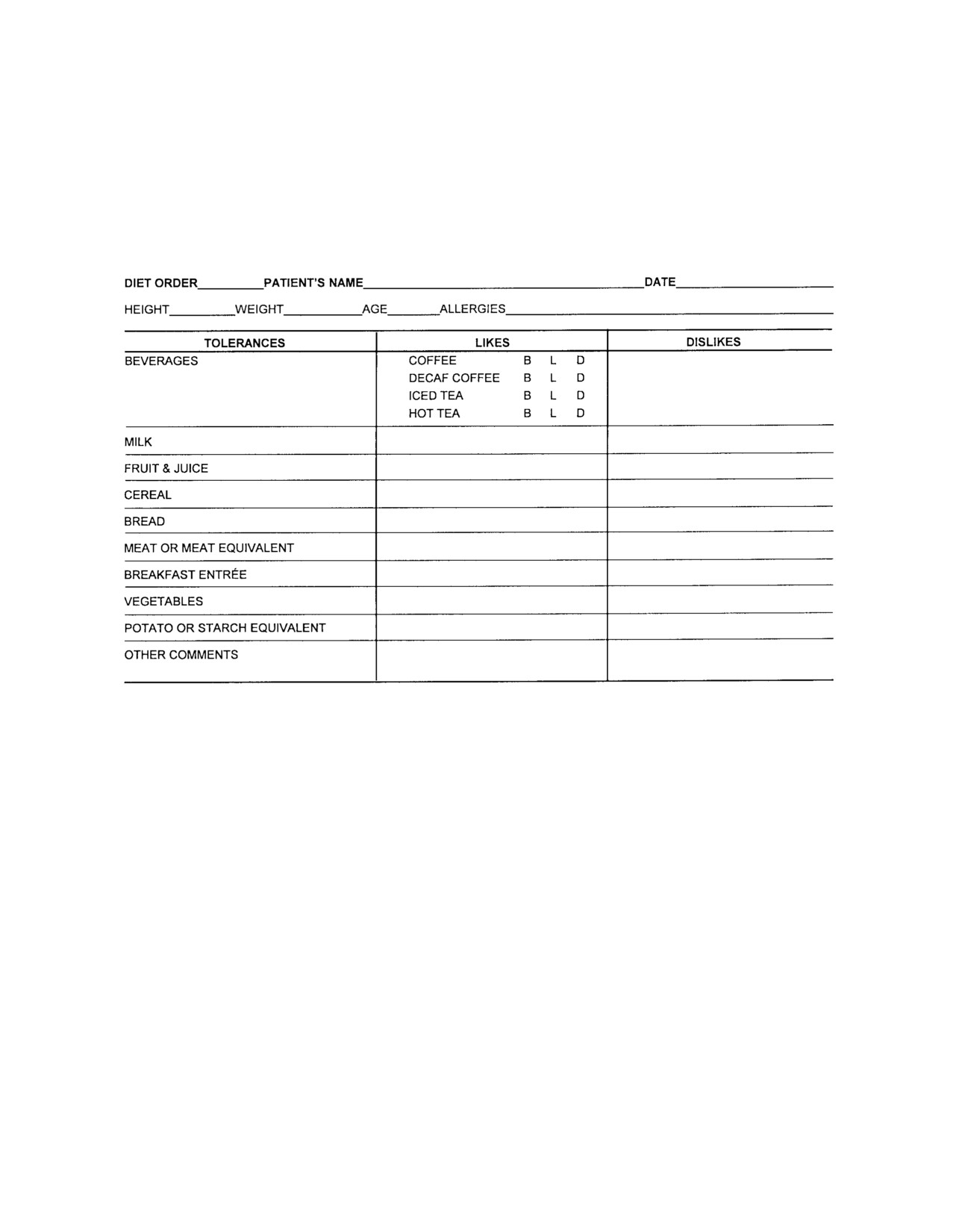
FM 4-02.10
Figure K-8. Sample patient food preference and tolerance checklist.
b. Patient Feeding Policy. The Army Patient Feeding Policy mandates 3 hot meals a day. In
emergencies patients may be served MRE.
c.
Common Diet Orders and Preparation. For a brief description of the most common diet
orders and preparation tips using the UGR-A and UGR-H&S see Appendix L.
d. Menu Patterns. See Appendix L for menu pattern to provide special diets using UGR-A and
the UGR-H&S with the addition of medical diet supplement.
e.
Procedures for Adjusting MRE for Use in Patient Feeding. Occasionally an operation will
happen so quickly that logistics only allows for shipment of MRE rations at the start. Also, the hospital may
have to initiate operation using the CBRNE CPS system and the nutrition care section will have to discontinue
operations in the modular field kitchen until normal operations resume (see FM 4-02.7). One technique to
ensure that a temporary supply of medical diet supplements are available is to include at least a footlocker or
Number 3 medical chest full of medical diet supplements with the unit personnel’s baggage. While these
are intended to supplement the UGR-A or UGR-H&S, the medical diet supplements will also help adjust
MRE to patient needs. See Appendix L for examples on adjusting the MRE to therapeutic diets.
K-13