FM 4-02.10 THEATER HOSPITALIZATION (JANUARY 2005) - page 2
FM 4-02.10
(16) Radiology services section. This section provides radiological services to all areas of the
hospital unit. It prepares digital x-rays for transmission to the radiologist of the CSH or other consulting
radiologists as requested by physicians. The radiology services are found in the corps hospital Company B.
It functions as a single service with the radiology section of hospital Company A, when consolidated. For
an example of an SOP on CSH radiology operations, refer to website http://radiology.amedd.army.mil/.
(17) Hospital ministry team. This section is responsible to the commander for religious
support and pastoral care ministry for all staff and patients. It promotes spiritual health within the unit and
performs liaison and consultative functions to ensure continuity of patient care between the hospital unit,
CSC units, and the patient’s unit of origin. The team advises the commander on spiritual support for unit
personnel. It works with the psychiatric personnel of the specialty clinic to provide stress control, including
debriefing, to patients and staff. It is responsible for providing inpatient daily clinical ministry to all nursing
wards and the EMT section, as required. The hospital ministry team is found in the corps hospital
Company B (164 bed). When consolidated, the hospital ministry teams of the corps CSH function as a
single team.
Section II. HEADQUARTERS AND HEADQUARTERS DETACHMENT,
248-BED COMBAT SUPPORT HOSPITAL (CORPS), TOE 08950A000
2-10. General
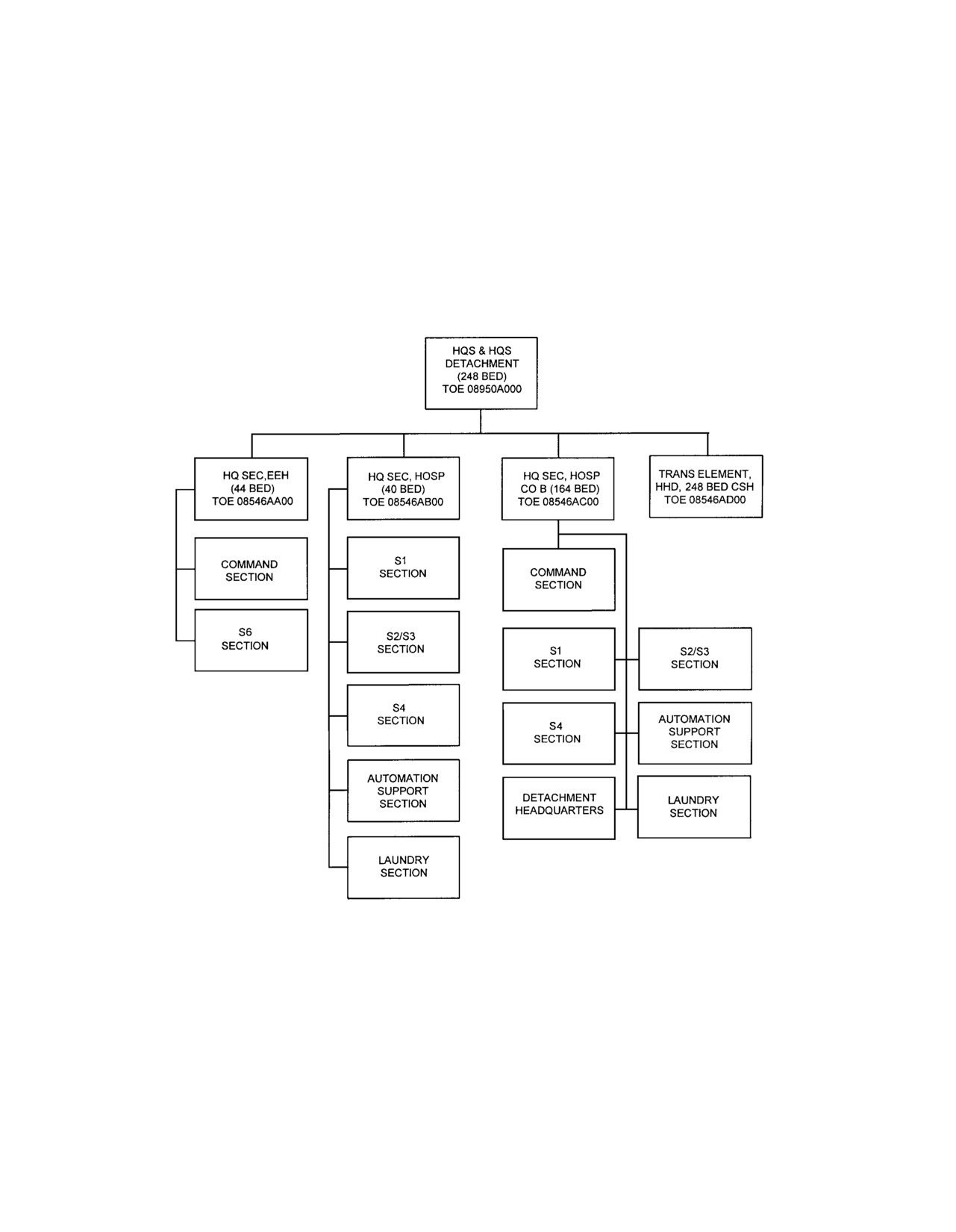
The HHD, corps CSH, TOE 08950A000, is modularly designed to provide C2 for split-base operations and
enhances the ability to tailor HSS to adapt to mission requirements of a smaller magnitude. This section
discusses the headquarters section, early entry hospitalization element (44 bed), TOE 08546AA00, the
headquarters section, hospital augmentation element (40 bed), TOE 08546AB00, the headquarters section,
hospital Company B (164 bed), TOE 08546AC00, and the transportation element, HHD, (248-bed CSH),
TOE 08546AD00. Figure 2-8 shows the corps CSH HHD organization.
2-11. Headquarters Section, Early Entry Hospitalization Element (44 Bed), TOE 08546AA00
a. This headquarters section provides C2, administrative services, logistics support, and
communications support to include information management to the early entry hospitalization element (44
bed), hospital Company A (84 bed), and assigned and attached units. It is authorized on the basis of one per
CSH (284 bed), TOE 08945A000 (see Figure 2-8). It will be deployed with the early entry hospitalization
element (44 bed), hospital Company A (84 bed), during the initial phase of split-base operation to form
stand-alone hospitalization for up to 72 hours without further logistical support. When the headquarters
section is deployed with the early entry hospitalization element (44 bed), it will require sustainment support
as identified in paragraph 2-4. Additionally, the headquarters section will require field feeding, power
generation for power consumers not requiring a dedicated generator, and unit maintenance of all organic
equipment except CE from the unit of attachment.
2-22
FM 4-02.10
b. The headquarters section is capable of transporting 5,000 pounds (208 cubic feet [cu ft]) of
TOE equipment with organic vehicles. It has 1,659 pounds (67 cu ft) of TOE equipment requiring
transportation.
c.
For additional information see Appendix H.
Figure 2-8. Corps combat support hospital headquarters and headquarters detachment organization.
2-12. Headquarters Section, Hospital Augmentation Element (40 Bed), TOE 08546AB00
a. This headquarters section provides C2, administrative services, and logistics augmentation to
the hospitalization augmentation element (40 bed), hospital Company A, (84 bed), and to assigned and
attached units during split-base operations. It is authorized on the basis of one per CSH (248 bed), TOE
08945A000 (see Figure 2-8). It provides augmentation to operations and personnel sections, logistical and
2-23
FM 4-02.10
communications support to include information management. It is also provides patient related linen and
coordination for all other laundry support. It will require sustainment support as identified in paragraph
2-4. Conceptually, this section will reunite when the early entry hospitalization element (44 bed) and its
supporting headquarters section within 72 hours to form hospital Company A (84 bed).
b.
The headquarters section is capable of transporting 10,200 pounds (502 cu ft) of TOE
equipment with organic vehicles. It has 6,637 pounds (333 cu ft) of TOE equipment requiring transportation.
c.
For additional information see Appendix H.
2-13. Headquarters Section, Hospital Company B (164 Bed), TOE 08546AC00
a. This headquarters section provides C2, administrative services, and logistics augmentation to
the hospital Company B (164 bed) and to assigned and attached units during split-base operations. It is
authorized on the basis of one per CSH (248 bed), TOE 08945A000 (see Figure 2-8). It provides
augmentation to operations and personnel sections, logistical and communications support to include
information management. It also provides patient-related linen and coordination for all other laundry
support. When this headquarters section is deployed with the hospitalization augmentation element (164
bed), it will require sustainment support as identified in paragraph 2-4.
b. The headquarters section is capable of transporting 5,200 pounds (213 cu ft) of TOE equipment
with organic vehicles. It has 3,208 pounds (108 cu ft) of TOE equipment requiring transportation.
c.
For additional information see Appendix H.
2-14. Transportation Element, Headquarters and Headquarters Detachment, 248-Bed Combat
Support Hospital, TOE 08546AD00
a. This element provides organic transportation for the HHD, CSH (248 bed), TOE 08950A000.
It is authorized on the basis of one per CSH (248 bed), TOE 08945A000 (see Figure 2-8). This element has
no personnel authorizations. It is dependent upon the unit of attachment for vehicle operations,
accountability, and maintenance.
b. The transportation element is capable of transporting 9,000 pounds (722 cu ft) of TOE
equipment with organic vehicles. It has 40 pounds (0 cu ft) of TOE equipment requiring transportation.
Section III. HOSPITAL COMPANY A (84 BED), TOE 08960A000
2-15. General
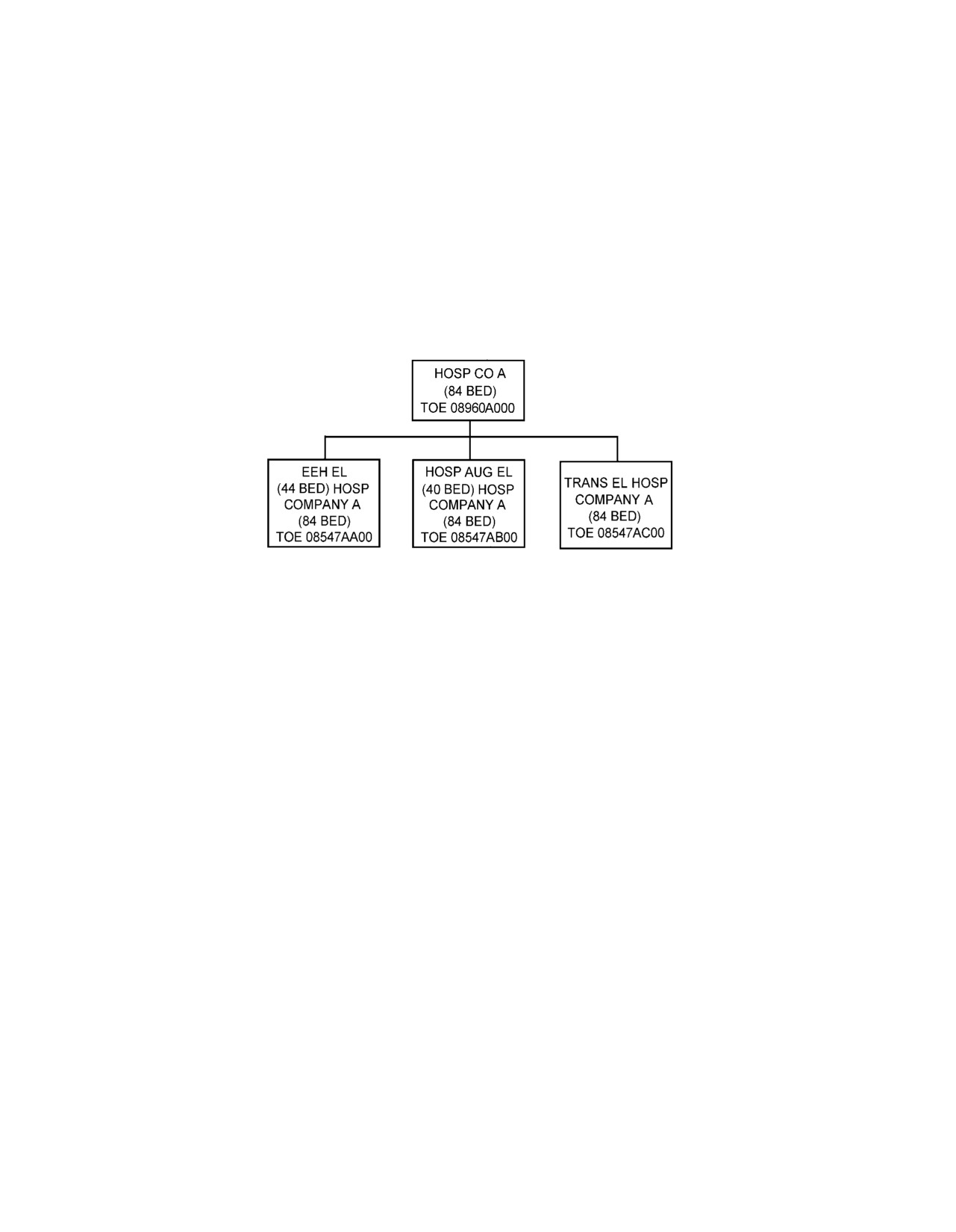
Hospital Company A (84 bed), TOE 08960A000, is modularly designed to provide split-base operations and
enhances the ability to tailor HSS to adapt to mission requirements of a smaller magnitude. It consist of
2-24
FM 4-02.10
three separate organizations: early entry hospitalization element (44 bed), TOE 08547AA00, hospital-
ization augmentation element (40 bed), TOE 08547AB00, and transportation element, hospital Company A
(84 bed), TOE 08547AC00. This section discusses each of the TOEs and their application in support of
hospital deployment. Figure 2-9 shows the organization for this company.
Figure 2-9. Hospital Company A (84 Bed).
2-16. Early Entry Hospitalization Element (44 Bed), Hospital Company A (84 Bed), TOE 08547AA00
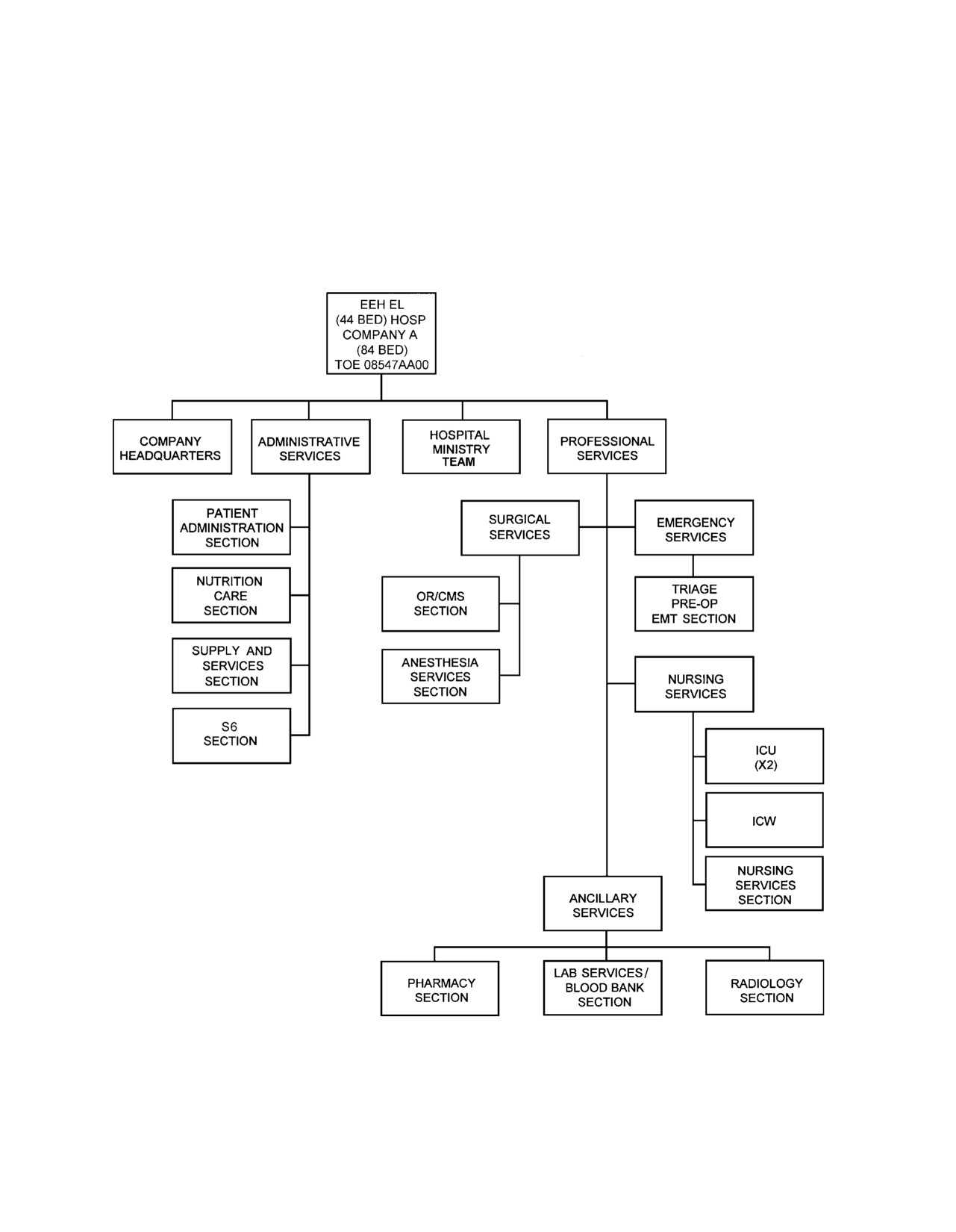
a. The modular design of the corps CSH allows specialized support capabilities to match mission
requirements. The split-base operations capability of the CSH reduces strategic-lift requirements and in-
theater support requirements. The early entry hospitalization element
(44 bed), with its supporting
headquarters section and transportation element, can be readily deployed to support Army, joint,
multinational, and humanitarian contingencies when a complete CSH is not required (see Figure 2-10).
This element, with augmentation from the headquarters section and transportation element, has the capability
for 72 hours of stand-alone operations without resupply. If the force needs additional hospital assets later,
medical commanders/planners can deploy the remaining hospital augmentation element (40 bed), hospital
Company B (164 bed) and supporting headquarters sections. When it is determined that medical assets are
no longer required they could be incrementally redeployed back to home station or to other locations.
b. The early entry hospitalization element (44 bed) provides hospitalization services for all classes
of patients. It is authorized on the basis of one per CSH (248 bed), TOE 08945A000. It provides all
clinical and ancillary support as discussed in paragraphs 2-7 and 2-8. It will require sustainment support as
identified in paragraph 2-4.
c.
The early entry hospitalization element (44 bed) is capable of transporting 773,099 pounds
(50,050 cu ft) of TOE equipment with organic vehicles. It has 306,892 pounds (35,419 cu ft) of TOE
equipment requiring transportation.
d. For additional information see Appendix H.
2-25
FM 4-02.10
Figure 2-10. The 44-bed hospital Company A.
2-26
FM 4-02.10
2-17. Hospitalization Augmentation Element (40 Bed), TOE 08547AB00
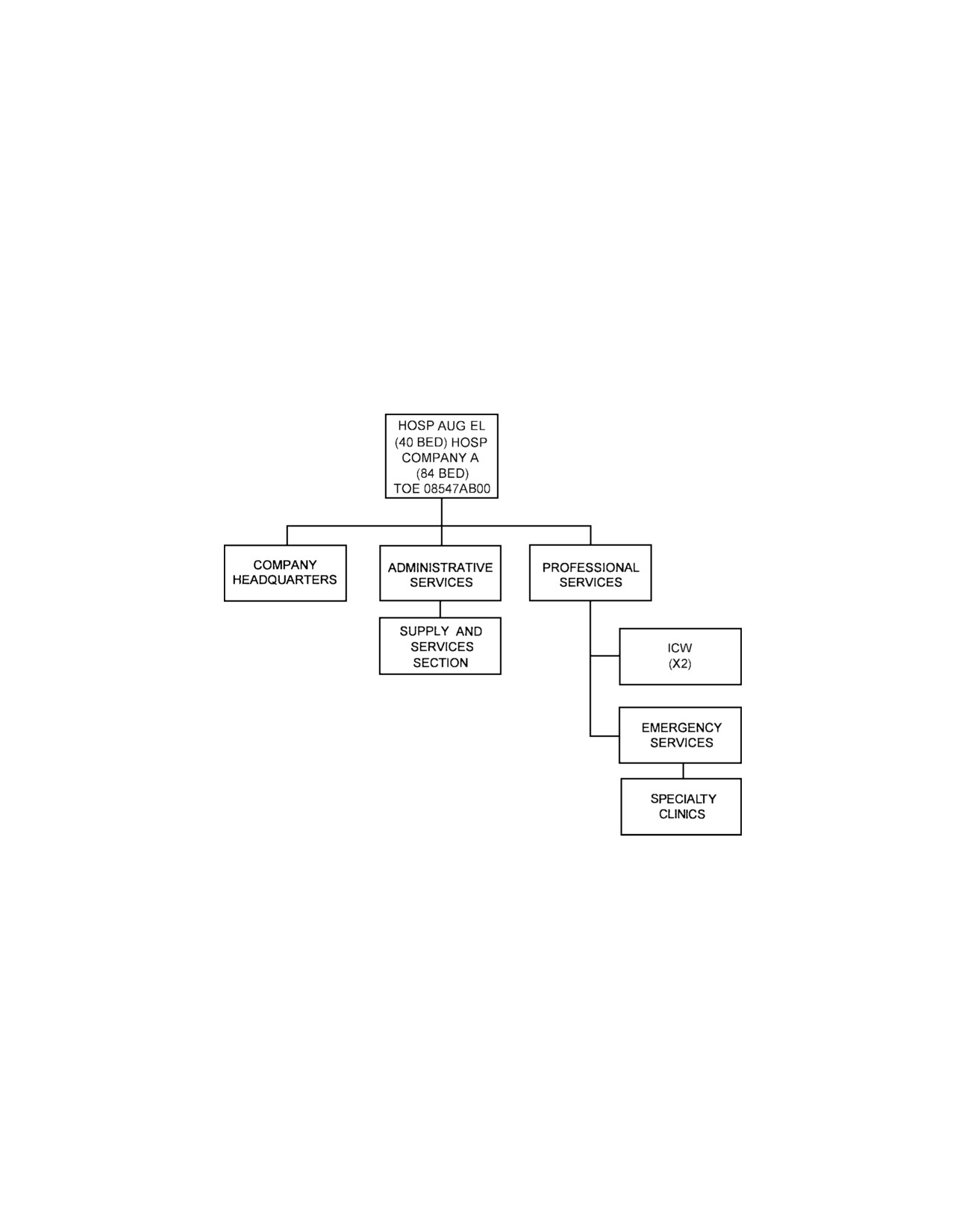
a. The hospitalization augmentation element (40 bed) augments the early entry hospitalization
element (44 bed), hospital Company A (84 bed), TOE 08547AA00, by providing outpatient specialty clinic
services, 40 intermediate care beds, and augmentation to the company headquarters and supply and service
section. This unit is authorized on the basis of one per CSH (248 bed), TOE 08960A000 (see Figure 2-11).
It will require sustainment support as identified in paragraph 2-4.
Figure 2-11. The 40-bed hospital Company A.
b. This element has no organic transportation assets. When augmented by the transporta-
tion element, hospital Company A (84 bed), TOE 08547AC00, it is capable of transporting 200,000 pounds
(11,890 cu ft) of TOE equipment. It has 71,598 pounds (10,955 cu ft) of equipment requiring transpor-
tation.
c.
For additional information see Appendix H.
2-27
FM 4-02.10
2-18. Transportation Element, Hospital Company A (84 Bed), Combat Support Hospital (248 Bed),
TOE 08547AC00
a. This transportation element provides organic transportation for elements of hospital Com-
pany A, TOE 08960A000. It is authorized on the basis of one per CSH (248 bed), TOE 08945A000 (see
Figure 2-9). It is assigned to the CSH (248 bed) and further attached to hospital Company A (84 bed). It is
dependent upon the unit of attachment for vehicle operations, accountability, and maintenance. This
element has no personnel authorizations.
b. The transportation element is capable of transporting 282,500 pounds (10,706 cu ft) of TOE
equipment with organic vehicles. It provides 100 percent mobility to meet mission and function of the early
entry hospitalization element (44 bed), and 35 percent to the remaining hospital Company A (84 bed).
c.
The transportation element has 363,201 pounds (43,504 cu ft) of TOE equipment requiring
transportation.
2-28
FM 4-02.10
CHAPTER 3
COMMAND, CONTROL, AND COMMUNICATIONS OF THE
COMBAT SUPPORT HOSPITAL
3-1.
Command and Control
The major corps and EAC C2 medical units are the MEDCOMs and the medical brigades. The mission of
the MEDCOM and medical brigade is to C2 and supervise assigned and attached units. The MEDCOM is
assigned on the basis of one per theater and one per corps. The medical brigade is assigned to MEDCOMs
on the basis of one per three to eight battalion-size equivalent units commanded per MEDCOM theater and
MEDCOM corps. The types and number of HSS units assigned to the medical C2 units depend on various
factors such as size, composition, and location of supported forces; types of operations conducted; anticipated
workload; and theater evacuation policy. The MEDCOMs control the majority of their assigned units
through subordinate medical brigades. However, in stability operations and support operations, and
humanitarian assistance missions, a CSH or hospital Company A (84 bed) may be the largest medical unit
deployed, and the hospital commander, as the senior medical officer, may be the medical task force
commander. The CSH will need to assure communications for subordinate PVNTMED, veterinary,
combat operational stress control (COSC), and evacuation units in the task force, that are mobile throughout
the AO.
3-2.
Communications
Management and control of HSS operations is dependent on the hospital headquarters’ ability to communicate
with its staff, the MEDCOM, the medical brigade, MEDEVAC organizations, other CSS units, and to
monitor the battle. Hospital’s communications consist of communications and information systems (IS)
designed to interoperate with current and future communication systems. These communications assets
include assigned and attached communications assets: high frequency (HF)- and very high frequency
(VHF)-frequency modulated (FM) radios; triservice tactical communications (TRI-TAC); mobile subscriber
equipment (MSE); and interim commercial technologies used as a bridge to the future capabilities of the
Warfighter Information Network-Tactical (WIN-T). The goal of these systems is to provide reliable, redun-
dant and timely net-centric communications leveraging the power of the Global Information Grid (GIG).
a. Communications Planning. Extensive communications planning is required for joint military-
civilian stability operations and support operations. The S6 is responsible to the commander for all aspects
of communications and in coordination with the hospital S2/S3 plans for communications requirements and
usage. Each phase of military operation—predeployment, deployment, sustainment operations, and
redeployment must be addressed in this plan. A HN commercial communications system may be available
for use by the S6 in communications planning. The communications networks should interface with existing
joint and combined communications systems and any available local HN telephone and telegraph systems.
This interface is accomplished as outlined in applicable STANAGs and HN support agreements. It should
be noted that military, civilian agency, and civilian law enforcement communications systems might not be
interoperable, and may require additional coordination.
b. Communications Support. Communications support for organizations within a TO is based
upon a unit’s level of operations. Signal support for the EAC CSH is coordinated through the theater
3-1
FM 4-02.10
deputy chief of staff for operations and the deputy chief of staff for information management. The corps
CSH S6 will request signal support through the corps assistant chief of staff (signal) (G6), command,
control, communications, and computers (C4) operations and should be supported by the corps signal
brigade. For additional information on theater signal support see FM 6-02.45.
c.
Combat Support Hospital. The CSH has been reengineered and restructured to support
current operations. The restructured CSH will be communications- and information system-intensive,
employing telemedicine in various forms (voice, still imagery, x-ray, and full motion video) internally and
externally to other medical facilities in theater and in CONUS. Through an agreement between the US
AMEDDC&S and the US Army Signal Center network-switching nodes will be organic to the CSH. These
organic nodes will provide internal voice and data services that the currently fielded switching systems
supporting the MF2K hospitals cannot accommodate. This organic network-switching node replaces the
small extension node (SEN) that is currently provided by the supporting signal battalion. It should be noted
that there may continue to be a requirement for the signal elements to provide line of sight (LOS) or beyond
LOS connectivity to the organic switch at the CSH. During split-base operations, where the CSH has
hospital elements forward, both the organic switching node and the additional switching assets may be
required to provide services to both locations. The signal officer (S6) is the interface for all signal matters.
d. Communications-Electronics Section. The S6 section personnel are responsible for performing
management operations and overseeing the IOM of all communications and IS within the CSH. The S6 is
responsible to the commander for all signal matters and for coordinating with the supporting signal elements
for connectivity to the wide area network (WAN). Table 3-1 lists additional tasks and functions of the S6.
e.
Staff Responsibilities. Each staff element of the CSH is responsible for adhering to the unit’s
tactical standing operating procedure (TSOP) and signal support policies in accordance with AR 25-2 during
their daily operations.
f.
Network Support. Network support to the CSH is provided by organic network support assets
supported by nonorganic networked systems operated by signal units. These nonorganic assets currently
consist of TRI-TAC at EAC and MSE at echelons corps and below (ECB), combined these systems are
commonly called the Area Common-User System (ACUS). These networks are programmed for
replacement by the WIN-T and on some occasions by interim commercial technologies used as a bridge to
the future capabilities of WIN-T.
(1) The ACUS is the hospital’s primary means of communications and consist of a series of
network node switching centers connected primarily by nonorganic LOS multichannel radios and tactical
satellites (TACSATs). This network provides voice and data transmission capabilities for C2, operations/
intelligence, administration, and logistics functions. The ACUS is interconnected allowing the network at
ECB to interoperate with the networks at EAC and with adjacent units and networks. The ACUS is
designed to form a communications grid providing the force with digital, secure, and flexible features that
compensate for link or functional element outages, overload in traffic, and rapid movement of users. The
ACUS provides voice and data communications on an automatic, discrete-addressed, fixed-directory basis
using the flood search routing technique with a tactical packet network (TPN) switch installed for passing
data traffic. Organic to the signal elements are TACSAT equipment and tropospheric scatter radio (TROPO)
equipment providing range extension. Range extension improves the employment capability of the ACUS.
For additional information see FM 11-55.
3-2
FM 4-02.10
Table 3-1. Tasks and Functions of the S6
TASKS
FUNCTIONS
NETWORK
ESTABLISHES, MANAGES, AND MAINTAINS CSH COMMUNICATIONS CONNECTIVITY.
EMPLOYMENT
ADVISES THE COMMANDER ON COMMUNICATIONS SUPPORT REQUIREMENTS.
PLANS, COORDINATES, AND MANAGES NETWORK IS TERMINALS (REGARDLESS OF
AFFILIATION).
NETWORK
DETERMINES THE SYSTEM REQUIREMENTS NEEDED TO SUPPORT THE TACTICAL SITUATION.
CONFIGURATION
COORDINATES AND PLANS CSH LAN CONFIGURATION.
DETERMINES COMMUNICATIONS AND/OR TRANSMISSION CONNECTIVITY REQUIREMENTS.
INFORMS THE COMMANDER ON PRIMARY AND ALTERNATE COMMUNICATIONS.
DEVELOPS INITIALIZATION INSTRUCTIONS FOR NEW OR MODIFIED COMMUNICATIONS
SYSTEMS.
ASSISTS OPERATORS WITH DATABASE CONFIGURATIONS.
SUPERVISES NETWORK CONFIGURATION, INITIALIZATION, AND TACTICAL LAN INSTALLATION.
ESTABLISHES AND ENFORCES NETWORK POLICIES AND PROCEDURES.
DETECTS, REPORTS, AND TAKES CORRECTIVE ACTION ON SECURITY VIOLATIONS AND
POSSIBLE INTERNAL AND EXTERNAL INTRUSIONS.
DEVELOPS THE C4 ANNEX TO THE OPERATION ORDER (OPORD).
ADVISES THE COMMANDER AND USERS ON THE REQUIREMENTS, CAPABILITIES, AND USE OF
THE SYSTEMS.
NETWORK STATUS
MONITORS THE STATUS OF C2 DEVICES USING NETWORK MANAGEMENT TOOLS.
MONITORING AND
MONITORS THE STATUS OF COMMUNICATIONS LINKS.
REPORTING
MONITORS NETWORK PERFORMANCE AND DATABASE CONFIGURATION AND RECONFIGURA-
TION.
REPORTS NETWORK CHANGES TO THE COMMANDER.
NETWORK CONTROL
PROVIDES SUPERVISION, GUIDANCE, FAULT ISOLATION, AND CORRECTIVE ACTIONS ON THE
AND
CSH LAN.
RECONFIGURATION
TROUBLESHOOTS INTERCONNECTION DEVICE PROBLEMS THROUGHOUT THE SYSTEMS.
DETERMINES THE NEED FOR CONFIGURATION CHANGES.
PLANS SYSTEM RECONFIGURATIONS CAUSED BY CHANGES IN THE TACTICAL SITUATION,
COMMUNICATIONS CONNECTIVITY, AND SYSTEM INITIALIZATION INSTRUCTIONS.
SUPERVISES CHANGES IN SYSTEM CONFIGURATION, INITIALIZATION, AND LAN INSTALLA-
TIONS.
PROVIDES SUPERVISION AND GUIDANCE ON INITIALIZATION AND CONFIGURATION INSTRUC-
TIONS.
REPLICATES, DISTRIBUTES, AND CONTROLS COMMON OPERATING ENVIRONMENT (COE)
SOFTWARE IN ACCORDANCE WITH INSTRUCTIONS IN APPROPRIATE TBs AND SOPs.
TRAINING
ASSISTS IN TRAINING C2 SYSTEMS PERSONNEL.
SUPPORTS THE DEVELOPMENT AND EXECUTION OF TRAINING FOR IS PERSONNEL AND
COLLECTIVE TRAINING FOR THE UNIT.
PROVIDES TRAINING IN ESTABLISHING AND INTERCONNECTING NETWORKS TO USERS AND
SUPERVISORS.
SECURITY
PREPARES COMMUNICATIONS NETWORK SECURITY PLANS, INSTRUCTIONS, AND SOPs.
DEVELOPS SECURITY POLICIES AND PROCEDURES FOR NETWORK OPERATIONS.
MONITORS THE SECURITY INTEGRITY OF THE NETWORK AND REPORTS BREACHES IN THAT
SECURITY.
REPORTS THREATS TO NETWORK SECURITY.
ESTABLISHES PROCEDURES TO RESTRICT ENTRY OF UNAUTHORIZED USERS, TRANS-
ACTIONS, OR DATA.
ENSURES ALL OPERATE IN ACCORDANCE WITH APPLICABLE ARMY REGULATIONS (ARs) AND
LOCAL SECURITY SOPs.
ENSURES THE IMPLEMENTATION OF ACCESS CONTROL PROCEDURES.
ENSURES INFORMATION ASSURANCE SECURITY OFFICER (IASO) IS APPOINTED FOR EACH IS.
3-3
FM 4-02.10
(2) The WIN-T will replace the MSE, TRI-TAC, and interim commercial solutions fielded
to Army elements. The WIN-T is the Army’s tactical telecommunications system consisting of infrastructure
and network components connecting all users from the maneuver battalion to the theater rear boundary, to
joint and multinational elements and the GIG. The WIN-T provides capabilities that are mobile, secure,
survivable, seamless, and capable of supporting multimedia tactical information systems. The network’s
capability to support unit task reorganization and real-time retasking of battlefield support elements is vital.
The WIN-T will allow all Army commanders, and other communications network users, at all echelons, to
exchange information internal and external to the theater, from wired or wireless telephones, computers
(internet-like capability) or from video terminals. Signal and nonsignal units employ organic WIN-T
systems to integrate wide and local area networks into a commercial information technology-based tactical
network.
(3) The WIN-T employs a combination of terrestrial, airborne, and satellite-based transport
options providing a robust and redundant connectivity. The WIN-T information services help achieve
information superiority by providing the necessary communications capabilities so that situational
information, collaborative planning, sensor-to-shooter linkages, continuous precision operations and focused
logistics can be achieved as required by both Joint Vision 2010 and Army Vision 2010. The WIN-T’s
infrastructure provides commanders and other users the ability to communicate via voice, data, and video
simultaneously at all levels of security. The WIN-T supports the Army requirement for battle command
on the move (BCOTM) by integrating the major WIN-T elements into Army mobile tactical operations
center (TOC) platforms and leveraging the Joint Tactical Radio System (JTRS), legacy wideband digital
radios, and wireless LAN technologies. Major components of the WIN-T network infrastructure include
switching, routing, transport, transmission media, network management, information assurance (IA),
subscriber services and user interfaces to support user multimedia (voice, data, messaging, and video)
requirements.
g. Hospital Radio Nets. The CSHs and their staffs depend on both combat net radios (CNRs) and
area communications systems to operate. These systems are used to facilitate patient management, air and
ground evacuation, and medical regulation of patients. The hospital nets link the hospitals with the
MEDCOM and/or medical brigade, which is the net control station (NCS) for the HSS operations net.
h. Combat Net Radio System. The CNR system is authorized for both the corps CSH and the
EAC CSH. The CNR system includes the VHF-FM radios, primarily the Single-Channel Ground and
Airborne Radio System (SINCGARS) radios, and HF radios.
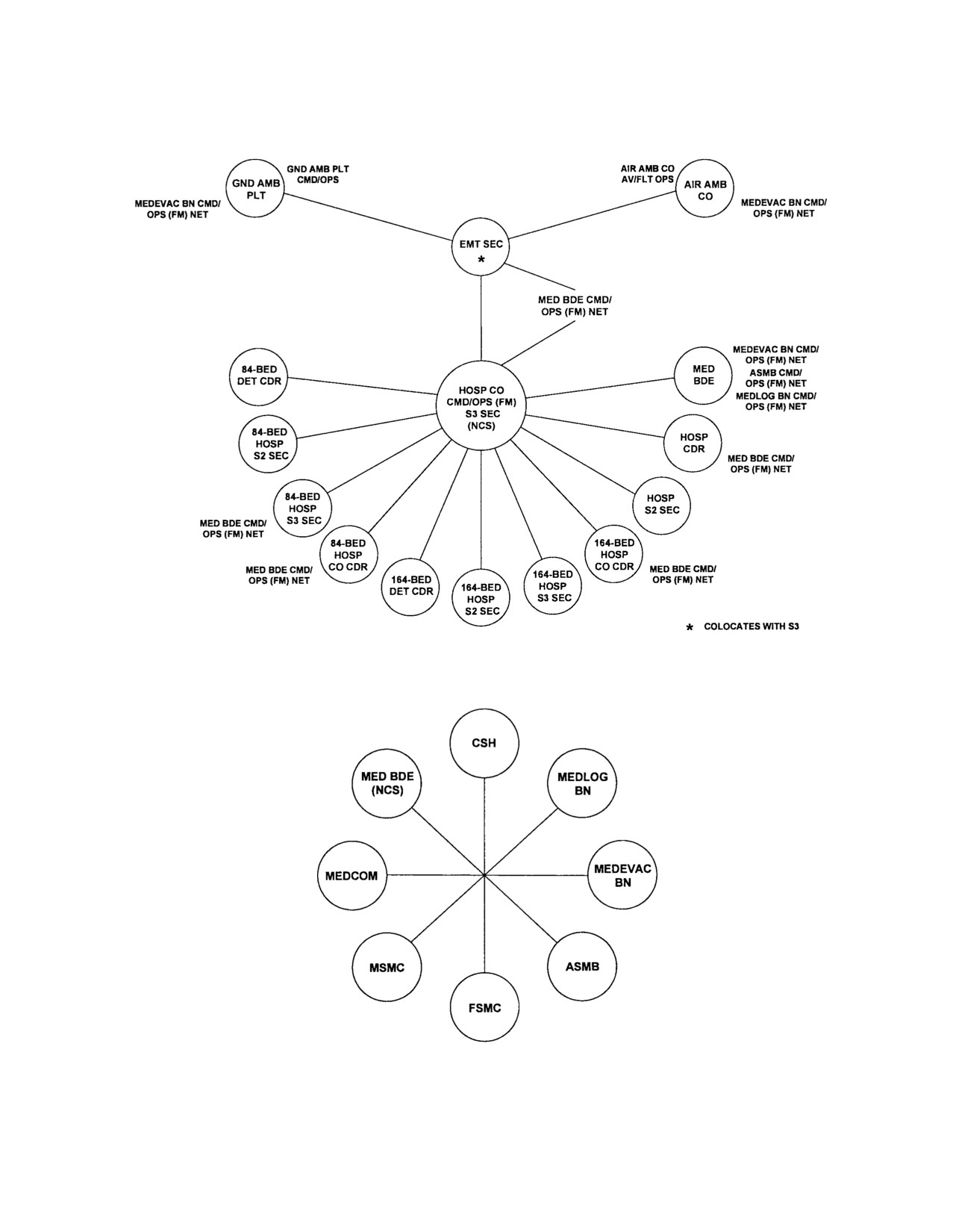
(1) Very high frequency-frequency modulated radio. The hospital’s VHF-FM radio net is
shown in Figure 3-1 with the SINCGARS being the primary VHF-FM system used today. The VHF-FM
radios are designed for simple and quick operation at relatively short range (maximum 20 miles without a
retransmission system). The SINCGARS is frequency-hopping capable and operates in the 30 to 88
megahertz (MHz) frequency range.
(2) High-frequency radio. The HF radios provide mid-to-far range capability (15 to 2000
miles) and have a frequency range of 2 to 30 MHz. They use “nature’s satellite” or the ionosphere to
bounce radio waves back to earth (frequencies above 30 MHz pass through the ionosphere rather than
bouncing back). The hospital’s HF-FM net is shown in Figure 3-2.
3-4
FM 4-02.10
Figure 3-1. Hospital net—VHF-FM.
Figure 3-2. Combat support hospital net—HF-FM.
3-5
FM 4-02.10
i.
Signal Security. As part of the overall security program, all hospital elements must practice
signal security (SIGSEC). The hospital operations section is responsible for SIGSEC and COMSEC. Some
considerations include—
• Using terrain features, such as hills, vegetation, and buildings to mask transmissions.
• Maintaining radio-listening silence.
• Using the radio only when absolutely necessary.
• Distributing codes on a need-to-know basis.
• Using only authorized call signs and brevity codes.
• Using authentication and encryption codes specified in the current signal operation
instructions (SOI).
• Keeping transmissions short (less than 12 seconds, if possible).
• Reporting all COMSEC discrepancies to appropriate authorities.
j.
Security Checklist. Table 3-2 provides the information needed to ensure the unit is operating
the IS equipment in accordance with applicable ARs and local unit TSOP.
3-6
FM 4-02.10
Table 3-2. Security Checklist
A.
BASIC INFORMATION
UNIT IDENTIFICATION: ______________________________________________________________________
NUMBER OF SYSTEM WORKSTATIONS: _______________________________________________________
UNIT LOCATION: ___________________________________________________________________________
IASO APPOINTED FOR THE TECHNICAL INSPECTION (TI): ________________________________________
UNIT SECURITY MANAGER’S NAME/TITLE/PHONE: ______________________________________________
SUPERVISOR’S NAME/TITLE/PHONE: _________________________________________________________
B.
ACCESS
ALL PERSONNEL WHO HAVE ACCESS TO THE ARMY BATTLE COMMAND SYSTEM (ABCS) HAVE A SECRET
SECURITY CLEARANCE.
ACCESS ROSTERS AND PERSONAL RECOGNITION WILL BE USED TO CONTROL ACCESS TO THE TI.
(ACCESS TO THE ABCS IS ONLY GRANTED ONCE THE SECURITY CLEARANCE AND NEED-TO-KNOW
IS VERIFIED.)
ALL PERSONNEL WHO HAVE ACCESS TO THE ABCS HAVE A NEED-TO-KNOW FOR ALL ACTIVITIES.
ALL SYSTEMS THAT CONNECT TO THE ABCS LAN WILL BE ACCREDITED SECRET.
C.
AUDIT
COMMAND AND CONTROL PROCESSOR (C2P) TOOLS ARE USED TO CAPTURE AUDIT EVENTS.
AUDIT TOOLS ARE REVIEWED FOR EVIDENCE OF UNAUTHORIZED ACCESS OR TAMPERING.
D.
CLEARING, PURGING, AND DECLASSIFYING ELECTRONIC MEDIA
WHEN LEFT UNATTENDED, THE ABCS COMPONENTS MUST BE PLACED IN A PURGED, DECLASSIFIED
STATE. ALL CLASSIFIED MAGNETIC MEDIA IS REMOVED, SWITCH WORKSTATION RANDOM ACCESS
MEMORY (RAM) IS PURGED, AND PRINTER RAM IS PURGED.
FLOPPY DISKS WITH CLASSIFIED INFORMATION STORED ON THEM ARE ALWAYS TREATED AS
CLASSIFIED AND NOT USED AT THE UNCLASSIFIED SENSITIVE LEVEL. (FLOPPY DISKS CAN ONLY
BE PURGED USING A TYPE I OR II DEGAUSSER THAT IS NOT FURNISHED WITH THE TI.)
E.
HARDWARE SECURITY
ALL ABCS COMPONENTS ARE INSTALLED AND MAINTAINED ACCORDING TO APPLICABLE TMs.
ALL ABCS COMPONENT FAILURES OR MALFUNCTIONS ARE DOCUMENTED AND REPORTED TO THE
IASO OR TERMINAL AREA SECURITY OFFICER (TASO).
(THE IASOs WILL DETERMINE IF THE
MALFUNCTIONS SHOULD BE REPORTED AS A TECHNICAL VULNERABILITY.)
MAINTENANCE PERSONNEL HAVE SECRET SECURITY CLEARANCE.
MAINTENANCE PERSONNEL WHO DO NOT HAVE A SECRET SECURITY CLEARANCE AND WHO DO NOT
ACCESS CLASSIFIED INFORMATION DURING THEIR OPERATIONS ARE OBSERVED BY AN
AUTHORIZED INDIVIDUAL WITH A SECRET SECURITY CLEARANCE TO ENSURE THEY PERFORM NO
OBVIOUS UNAUTHORIZED MODIFICATIONS.
CLASSIFIED ABCS COMPONENTS ARE NOT REMOVED FROM THE SHELTER BY UNCLEARED
MAINTENANCE PERSONNEL.
F.
SOFTWARE SECURITY
SYSTEM WORKSTATION SOFTWARE ERRORS OR FAILURES ARE DOCUMENTED AND REPORTED TO
THE IASO OR TASO. (IASOs WILL DETERMINE IF SOFTWARE ERRORS SHOULD BE REPORTED AS A
TECHNICAL VULNERABILITY.)
NO UNAPPROVED MODIFICATIONS OR ALTERATIONS ARE MADE TO THE SYSTEM WORKSTATION
SOFTWARE.
3-7
FM 4-02.10
Table 3-2. Security Checklist (Continued)
G.
PHYSICAL SECURITY
WHEN UNATTENDED, THE ABCS COMPONENTS ARE SECURED WITH DOUBLE BARRIER PROTECTION
(FOR EXAMPLE, LOCKED IN A MILITARY VEHICLE OR IN A LOCKED AND SECURED MOTOR POOL).
THE ABCS IS OPERATED IN AN ENVIRONMENT WHICH IS AUTHORIZED FOR PROCESSING SECRET
MATERIAL.
THE ABCS COMPONENTS ARE MAINTAINED UNDER THE CONTROL OF CLEARED, AUTHORIZED USERS
OR SUPERVISORS. CLASSIFIED INFORMATION, MAGNETIC MEDIA, AND OTHER MATERIAL
ASSOCIATED WITH THE ABCS ARE SECURED IN A GENERAL SERVICES ADMINISTRATION (GSA)-
APPROVED CONTAINER, SAFE, OR CLASS B VAULT WHEN NOT UNDER THE DIRECT CONTROL OF
AN AUTHORIZED INDIVIDUAL. THE ABCS COMPONENTS ARE PROPERLY DECLASSIFIED PRIOR TO
BEING LEFT UNATTENDED.
H.
PROCEDURAL SECURITY
IASO IS APPOINTED.
TASO FOR ABCS COMPONENTS NOT UNDER THE DIRECT CONTROL OF UNIT IASO APPOINTED.
UNIT SECURITY MANAGER ASSISTS IASO AND TASO IN ACCOMPLISHING ABCS SECURITY.
I.
PERSONNEL SECURITY
INITIAL SECURITY TRAINING AND AWARENESS BRIEFING FOR ALL SWITCH WORKSTATION USERS AND
SUPERVISORS ARE GIVEN.
PERIODIC SECURITY AND AWARENESS TRAINING PROGRAM IS GIVEN.
ALL PERSONNEL WHO HAVE ACCESS TO THE ABCS HAVE A MINIMUM OF SECRET SECURITY
CLEARANCE IN ACCORDANCE WITH AR 380-67.
J.
INFORMATION SECURITY
ALL WORKSTATION REMOVABLE MAGNETIC MEDIA IS CLEARLY MARKED TO INDICATE THE
CLASSIFICATION OF INFORMATION STORED ON IT (SF 707 OR SF 710 LABEL).
ALL WORKSTATION PRINTER OUTPUT IS MARKED AND SAFEGUARDED AS SECRET UNTIL REVIEWED
AND MARKED ACCURATELY BY AN AUTHORIZED INDIVIDUAL.
PRINTER RIBBONS USED BY THE WORKSTATION TO PRINT CLASSIFIED INFORMATION ARE MARKED
AND STORED WITH APPROPRIATE CLASSIFICATION LEVEL.
ALL CLASSIFIED MATERIAL, DOCUMENTS, REMOVABLE MAGNETIC MEDIA, PRINTER OUTPUT, AND
COMSEC MATERIAL ARE SECURED IN A GSA-APPROVED CONTAINER FOR SECURING CLASSIFIED
MATERIAL, A CLASS B VAULT, OR GUARDED BY AN AUTHORIZED INDIVIDUAL.
K.
EMERGENCY DESTRUCTION
PROCEDURES TO DESTROY WORKSTATIONS TO PREVENT COMPROMISE OF CLASSIFIED AND
UNCLASSIFIED SENSITIVE INFORMATION ASSOCIATED WITH THE SWITCH ARE IN PLACE.
EMERGENCY DESTRUCTION PROCEDURES ARE IN PLACE FOR ABCS COMPONENTS DURING
TACTICAL MOVEMENTS.
EMERGENCY DESTRUCTION PROCEDURES ARE PERIODICALLY REHEARSED.
L.
TRANSPORTATION SECURITY
PROCEDURES ARE IN PLACE TO PROTECT ABCS COMPONENTS DURING TACTICAL MOVEMENTS.
PROCEDURES ARE IN PLACE TO PROTECT ABCS COMPONENTS DURING ADMINISTRATIVE
MOVEMENTS.
M.
MISCELLANEOUS
SOP IS ON HAND.
THE COMMAND HAS CONDUCTED A LOCAL RESOURCE MANAGEMENT REVIEW.
3-8
FM 4-02.10
CHAPTER 4
DEPLOYMENT, EMPLOYMENT, AND REDEPLOYMENT
OF THE COMBAT SUPPORT HOSPITAL
4-1.
Threat Environment
a. Ethnic, religious, territorial, and economic tensions, held in check by the pressures of bipolar
global competition, erupted when Cold War constraints dissolved. The world has entered a period of
radical and often violent change. The threats today are more diverse, yet less predictable, than during any
other period in our history.
b. Since the events of 11 September 2001, immediate threat to the US nation’s survival appears
much more real than ever before. Still, our worldwide interests require that we remain engaged in the
world. The National Military Strategy notes four principal dangers to which we must be prepared to
respond—regional instability, proliferation of weapons of mass destruction, transnational dangers, and
threats to democracy and reform.
c.
Regional instability, often based on ethnic or territorial disputes, is evident throughout the
world. Somalia, Rwanda, Haiti, Bosnia, Iraq, and Afghanistan are just a few examples of countries where
America’s interests have been affected by instability. Some regional powers, specifically those with strong
conventional armies and aggressive modernization programs, can threaten American interests directly. In
addition, thousands of CBRNE warheads and strategic delivery systems exist throughout the world. These
weapons of mass destruction present a very real danger in the hands of terrorists or rogue states. Terrorism,
drug trafficking, and other transnational dangers pose a significant threat to all if left unchecked. In
response to threats to democracy and reform, the US is committed to strong, active support for nations
transitioning into the democratic community. The failure of democratic reform would adversely affect our
nation and its interests.
4-2.
Medical Threat Assessment
a. A critical element of the HSS assessment is a thorough appraisal of the medical threat. This
assessment includes the medical threat to the deploying forces and the residents in the AO. The US soldier
is placed at increased risk in stability operations and support operations scenarios since the incidence of and
exposure to infectious diseases and environmental hazards are greater in man-made or natural disaster areas
and in developing nations. The medical threat is derived through established intelligence channels and from
a variety of informational sources outside of the military.
b. The ability to obtain, interpret, and use medical intelligence is critical to the success of the
HSS mission. Regardless of whether the action is conducted within the US or abroad, man-made and
natural disasters can cause a resurgence of diseases once thought to be at low epidemiological levels. A
combination of factors can result in the spread of communicable diseases in epidemic proportions and
increased opportunity for exposure to CBRNE/toxic industrial material (TIM) hazards. These factors are—
• Disruption of sanitation services (such as garbage disposal or sewer systems).
• Intentional contamination, disruption or destruction of food and water.
4-1
FM 4-02.10
• Development of new breeding grounds for rodents and arthropods (such as in rubble or
in stagnant pools of water).
• Disruption of industrial operations.
• Dispersion of biological, chemical, or radiological waste by improper handling or terrorist
activity.
(1) Medical intelligence is the product resulting from the collection, evaluation, analysis,
integration, and interpretation of all available general health and bioscientific information. Medical
intelligence is concerned with one or more of the medical aspects of foreign nations or the AO and which
is significant to HSS or general military planning. Until medical information is processed, it is not
considered to be medical intelligence. Medical information pertaining to foreign nations is processed
by the Armed Forces Medical Intelligence Center (AFMIC). The website for AFMIC is: http://
mic.afmic.detrick.army.mil/. Medical threat information in AOs within the US can be obtained from—
• United States Army MEDCOM.
• United States AMEDD medical centers and activities within the immediate area.
• United States Army Center for Health Promotion and Preventive Medicine
(USACHPPM). Website: http://chppm-www.apgea.army.mil/.
• United States Civil Affairs and Psychological Operations Command.
• Local public health officials.
• American Public Health Association (FM 4-02.33).
• Centers for Disease Control and Prevention. Website: http://www.cdc.gov/.
• World Health Organization. Website: http://www.who.int/en/.
• Armed Forces Pest Management Board
(AFPMB). Website: http://
(2) The special training of PVNTMED personnel, as well as other medical professionals, is
used to provide a clear assessment of the medical and occupational and environmental health threats.
Preventive medicine personnel are specifically trained and equipped to collect, analyze, and interpret health
information. When the assessment includes oral, dental, or maxillofacial considerations, the dental public
health officer has similar specialized training in his field. The veterinary officer can provide expertise in the
public health ramifications of zoonotic diseases, food processing and safety, and biological warfare (BW)
agents. The chemical corps officer/noncommissioned officer (NCO) in the medical brigade can provide
expertise on chemical warfare (CW)/BW agents. The PVNTMED officer specializing in health physics can
provide expertise on the nuclear and radiological health threat. These personnel can make recommendations
4-2
FM 4-02.10
for types of activities to be accomplished and their priority for support. Using these skills maximizes the
efficient use of limited HSS resources. For consultation purposes during the assessment, the medical
personnel conducting the assessment must have access to all medical professionals within the HSS force and
the local medical community.
c.
Health service support planners must acquaint themselves with current intelligence products.
These products include national-level intelligence products such as the Medical Capabilities Studies, the
AFMIC products, reports, and resources, and the Disease Occurrence Worldwide Reports and access to
Intellink that is located at brigade or higher level. These reports are specifically produced to support US
military HSS operations conducted outside continental United States (OCONUS). These reports can be
obtained through operational and medical intelligence channels (such as the medical brigade/MEDCOM.
d. As HSS plans and operations progress, the requirements for additional medical intelligence
will occur. All such requirements should be requested through intelligence channels as soon as they are
validated; when required, coordination should be effected with local agencies.
e.
In all operations, the HSS planner must make himself aware of the health threat posed by the
disaster
(such as continued flooding, earthquakes and aftershocks, or further explosions) and groups,
factions, opponents, terrorists, or enemy forces operating within the AO. This threat also includes the
capabilities and potential use of weapons systems and munitions, such as CBRNE, directed-energy (DE)
weapons or devices, or conventional armaments, radiological dispersal devices (RDDs), and the potential
for terrorist attacks or incidents, including the use of CW and BW agents without weapons delivery systems.
Health service support planning and force survivability necessitates that HSS units understand and utilize
threat and medical intelligence to enhance their daily operations.
f.
The medical threat includes the stress threat. The stress threat encompasses all stressors in
the environment, which are likely to threaten the mission and the soldier’s current and future well being.
The baseline stress threat in any deployment includes separation from home, where there may be unresolved
problems, and immersion in a continuous military field environment with limited privacy, sometimes
in austere and dangerous conditions. Boredom and uncertainty about the mission can cause severe stress.
Combat adds the challenge of personal danger and receiving increased US casualties (perhaps mass
casualties). Even stability operations and support operations and humanitarian missions may expose US
personnel to the suffering, injustice, and dead bodies of innocents, which can cause severe distress
or delayed reactions. The hospital’s psychiatric staff should receive CSC training in the assessment of
the stress threat, and in preventive and treatment interventions. The stress threat, uncontrolled, can
result in—
• Misconduct stress behaviors.
• Combat/operations stress reactions (battle fatigue).
• Neuropsychiatric disorders including organic mental disorders (especially in CBRNE
situations).
• Posttraumatic stress disorder and other postdeployment syndromes.
4-3
FM 4-02.10
g. Should HSS personnel gain information of potential medical intelligence value while per-
forming their duties, they are required to report it to their S2 or supporting military intelligence element.
h. For additional information on infectious diseases and their prevalence, refer to FM 4-02.33.
i.
For additional information on the medical threat and intelligence preparation of the battlefield,
refer to FM 4-02, FM 4-02.17, FM 8-42, and FM 34-130.
j.
For additional information on conducting food and water vulnerability assessments, refer to
USACHPPM, Technical Guide (TG) 188, Food and Water Vulnerability Assessments.
4-3.
Planning Health Service Support
a. The emerging world situation has resulted in an evolution from a forward-deployed army to
one capable of projecting combat power worldwide. Our Army is becoming smaller and primarily CONUS-
based. For the Army to accomplish the assigned mission, it must rely on its ability to mobilize, deploy,
sustain, reconstitute, and redeploy a crisis response force and reinforcing forces, if required. It must be
able to project power from CONUS or forward presence locations in response to requirements from the
National Command Authorities. To meet the challenge, the AMEDD must be proactive in projecting HSS.
Once the mission is assigned, the commander and his staff use the planning process to determine the most
effective means to accomplish the mission. This process enables the commander to estimate, analyze, and
determine the courses of action to be undertaken. These courses of action are designed to maximize the
accomplishment of the mission.
b. Planning at the CSH echelons entails preparing plans for a variety of situations, such as—
• Activities to be conducted at the various defense readiness condition (DEFCON) postures.
• Split-base operations.
• Hospital operations conducted in a CBRNE environment.
• Joint and multinational deployments.
• Relocation of the hospital complex, to include patient disposition.
• Contingency missions (such as humanitarian assistance or disaster relief).
• Mass casualty situations.
• Rear AO support.
• Reinforcement or reconstitution support for forward medical elements.
• Combating terrorism activities.
4-4
FM 4-02.10
• Environmental considerations, policies and requirements.
• Convoy operations.
• Peacekeeping operations.
• Stability operations.
• Support operations.
c.
To be complete, HSS planning must consider all functional areas within the AMEDD. These
functional areas are—
• Medical evacuation and medical regulating. Refer to FMs 8-10-6, 8-10-26, and 8-55.
• Hospitalization. In addition to this publication, refer to FM 8-55.
• Health service logistics/blood management. Refer to FM 4-02.1.
• Medical laboratory services. Refer to FM 4-02.
• Dental services. Refer to FM 4-02.19.
• Veterinary services. Refer to FM 8-10.18.
• Preventive medicine services. Refer to FMs 4-02.17, 4-25.12 and 21-10, AR 40-5, TB
MED 530 and USACHPPM TG 188.
• Combat operational stress control. Refer to FMs 8-51 and 22-51.
• Medical treatment. Refer to FMs 4-02.6 and 4-02.24.
• Command, control, communications, computers, and intelligence. In addition to this
manual, refer to FMs 4-02 and 11-43.
4-4.
Mobilization
a. Concept of Operations.
(1) In the event of contingencies in support of sustainment and support operations or war,
the DOD initiates appropriate action for the deployment of forces in response to the scenario. Based on the
situation, selected Active Component (AC) and Reserve Component (RC) CSHs and other units are alerted
through command channels. For those units located in CONUS, the United States Army Forces Command
(FORSCOM) uses the Time-Phased Force Deployment Data (TPFDD) based on the theater commander’s
4-5
FM 4-02.10
requirements, and the air and sea resources available. For deployable AC hospitals, an increase in
DEFCON is directed by the post or installation commander, or by higher headquarters. For RC hospitals,
mobilization notification constitutes an increase in readiness posture.
(2) Deployment operations for hospital readiness validation are controlled by a force-
projection platform, sometimes referred to as a power-projection platform. This is a designated Army
installation that is responsible for assisting in and validating the deployment of the Army units moving
to an AO. The designated installation plans and coordinates all deployment preparation support for the
deploying hospital and monitors and controls all facets of the deployment operation, to include reporting to
higher headquarters. Department of Defense Directive (DODD) 6490.2 and AR 40-66 mandates that pre-
and postdeployment health assessments and medical surveillance be accomplished. Appendix N contains
two mandatory health assessment forms that are required for pre- and postdeployment.
(See paragraph 4-5f
below for environmental considerations.) Also, refer to Army Training and Evaluation Program (ARTEP)
8-855 (MRI)-Mission Training Plan (MTP) for additional guidance on planning unit deployment/
redeployment.
akocomm.us.army.mil/usapa/.
(3) The hospitals may deploy by land, sea, or air (or a combination of these modes) from
locations designated by higher headquarters. Priority of effort is given to those methods of movement
outlined in current plans.
(4) Active Component hospitals maintain the capability for emergency deployment on short
notice to execute assigned missions.
(5) Mobilizing RC hospitals must attain and maintain the capability for mobilizing on short
notice and arriving at their designated mobilization site according to unit mobilization plans.
(6) Once mobilization is validated, hospitals prepare for deployment on short notice (72
hours or less). During validation, the appropriate status reports are submitted to higher headquarters.
b. Conduct of Operations.
(1) Commanders of deploying hospitals develop movement plans and TSOPs to accomplish
the necessary preparations for deployment. Provisions are made for accomplishing all mandatory training
and other requirements during all phases of the deployment. The checklists contained in Appendix O can be
used as a guide for developing deployment operation procedures in support of movement by air and surface
modes, or a combination thereof. The checklists are applicable to both AC and RC units and are detailed
only as a guide for commanders. Installation mobilization stations and/or higher headquarters may
prescribe different procedures for your unit.
(2) During deployment preparations, all CSH personnel must be screened for their chronic
medication needs and accompanying monitoring requirements. If monitoring requirements exceed the
capabilities of the deployed medical forces, patients should be referred for medical care to the local military
medical treatment facility for evaluation of their deployable status prior to actual deployment. If patients
are taking medications not found on the Joint Deployment Formulary or theater formulary/stockage list,
4-6
FM 4-02.10
conversion to a therapeutic alternative that is stocked should be considered to facilitate future replenishment
in theater. Patients stabilized on maintenance medications should deploy with a 6-month supply of these
medications.
(3) Active Component hospitals maintain the capability necessary to achieve a deployment
posture in the time required by any alert warning order or deployment instructions received. For planning
purposes, the readiness posture maintained is consistent with the shortest notification period presented in the
mobilization plan.
(4) Reserve Component hospitals maintain the readiness posture necessary to meet planned
deployment dates contained in current FORSCOM and mobilization documents. Upon arrival at the
designated mobilization site, hospitals are placed in an increased or advanced deployability posture, based
on the published priorities of plans for which the hospitals are listed. The hospitals are managed through the
RC chain of command, with input by the mobilization installation commander during the premobilization
period.
(5) All hospitals are scheduled for deployment validation by unit line number, based on the
published validation schedule. Hospitals can be expected to deploy within 72 hours following validation.
Actual deployment date and times are directed by higher headquarters.
4-5.
Deployment
a. Port of Embarkation. When directed by higher headquarters through the port call or airlift
message, the CSH will move to the designated port of embarkation (POE) for deployment. Designating a
POE facilitates the loading and movement of personnel and equipment according to the established priority
of the combatant commander. Deployment from the POE will be as directed by the US Transportation
Command (USTRANSCOM). For a detailed discussion and planning guidance, see FMs 4-01.011 and
100-17 and ARTEP 8-855 (MRI)-MTP.
b. Medical Supplies. In a Force Projection Army, METT-TC will drive the amount of supplies
required to support the force. For planning purposes, the hospital normally deploys with 10 days of medical
supplies, the medical assemblage for each work area contains a basic load of 3 days of supplies, and the
medical supply set maintained by the supply and service section contains a 7-day basic load for the entire
hospital. Medical resupply is accomplished by configured loads (CLS) until the MEDLOG battalion
support elements have been established. These CLS are throughput directly to the hospital via the
transportation system. These CLS may be pre-positioned “mobilization stocks,” or may be built and
shipped from the Defense Logistics Agency (DLA) depot system. Hospital logistics personnel coordinate
with their next higher command headquarters for all logistical support to include resupply. Early deploying
hospitals that arrive prior to their higher medical C2 headquarters must coordinate with port transportation
personnel for shipment and receipt of supplies and equipment. Once the MEDLOG battalion support
elements are established, hospital logistics personnel coordinate directly with the supporting MEDLOG
element for resupply of Class VIII materiel. All other resupply is requisitioned through higher headquarters
with the appropriate supporting organization. Effective coordination is the key to responsible logistical
support. To be effective, coordination must be early and it must be often.
4-7
FM 4-02.10
c.
Ports of Debarkation. The ports of debarkation (PODs), either aerial or sea, are the geographic
points at which cargo and personnel are discharged. Aerial ports of debarkation (APODs) serve as the
primary port of entry for all deploying personnel, as well as for early entry forces normally airlifted into an
AO with their equipment. Activities at the APOD include terminal control; loading, unloading, and
servicing of aircraft; clearing of personnel and cargo; and life support. Seaports of debarkation (SPOD)
serve as the primary ports of entry for equipment, where vessels are off-loaded, and where cargo and
personnel are cleared and moved to the staging area for movement forward.
d. Reception and Integration.
(1) Effective force projection largely depends on the speed with which forces assemble at the
required location. The essential process that transitions deploying forces into forces capable of meeting the
combatant commander’s operational requirements is reception, staging, onward movement, and integration
(RSO&I). Joint Publication (JP) 4-01.8 and FMs 4-01.8 (100-17-3) and 3-35.4 and ARTEP 8-855 (MRI)-
MTP contain detailed discussions of the RSO&I process.
(2) Reception operations include all of those functions necessary to receive and clear
personnel, equipment, and materiel through the APOD/SPOD. Personnel and cargo are off-loaded at
terminals, processing through the reception center to determine how and where they are to be moved.
During major deployments, the majority of personnel arrive via strategic airlift and most equipment and
materiel arrive by strategic sealift.
e.
Staging and Onward Movement. Once reception is completed, the CSH proceeds to the next
phase of RSO&I—staging and onward movement. Staging includes the assembly, temporary holding, and
organizing of arriving personnel and equipment and preparing them for onward movement to their AO.
f.
Environmental Considerations.
(1) During deployment operations, the hospital commander needs to be aware of key
environmental factors in order to make informed decisions regarding soldier health and environmental
protection (see FM 3-34 [FM 5-100]). Prior to deployment from CONUS, the hospital commander can
request this information from the supporting MEDCOM/medical brigade and PVNTMED activity. During
the RSO&I early planning stage when the hospital location/site selection has been identified, the hospital
commander should request key environmental factors information on the site from its supporting MEDCOM/
medical brigade. This information should include the latest environmental health information and related
intelligence and a copy of the Environmental Baseline Survey (EBS) if one has been conducted. If an EBS
has not been conducted, the hospital commander, prior to or soon after occupation of the site, should
request an EBS.
(2) While the hospital commander may not be required to actually perform the EBS, he must be
aware of the information gathered in the conduct of this survey and contained in the report. The commander
can request support from external organizations (medical brigade, engineer command, Joint Task Force
Engineer, or PVNTMED organizations) in order to complete this survey for the site/area that is occupied.
(3) During in-theater movement, the hospital may be deploying to an area previously
occupied by friendly forces who may have completed both the initial and closure EBS for that area/site.
4-8
FM 4-02.10
Information contained within these reports (if completed) is instrumental to the decision-making process
during base-camp planning for hospital planning and construction. For example, the site planned for
occupation may have been previously utilized as a refueling station by a logistical unit. Placement of
the fuel pods and fueling areas would be annotated on the EBS developed by the previous organization.
This information could be used to make an informed decision regarding hospital facility placement, for
example wards, latrines, and feeding locations (see FM 3-100.4 [3-34.500]/MCRP 4-11B for more
information).
(4) Environmental considerations, such as identification of TIMs should be addressed during
the deployment, occupation and redeployment phases. The environment considerations will assist in
occupational and environmental health surveillance and posthealth assessments/evaluations.
g. Liaison Personnel. Upon arrival at the theater point of entry or the staging area, it is essential
that contact with the assigned MEDCOM or medical brigade be made immediately. Normally, the
MEDCOM or medical brigade has liaison personnel meet and assist the hospital staff with coordination and
movement to its AO. An inventory for accountability and damage assessment is conducted. Vehicles are
serviced and necessary repairs are made, or coordination is made with the supporting maintenance element
for the repairs. Documentation for replacement of unusable supplies or equipment damaged beyond repair
is initiated through the MEDCOM or medical brigade headquarters element. Vehicle loads are adjusted for
convoy operations. For equipment that was transported separately from the hospital, coordination is made
for receiving and transporting it upon arrival. Once the hospital has moved to its AO, the MEDCOM or
medical brigade staff elements conduct formal personnel in-processing and an orientation on current
operating policies and procedures. The orientation includes information on the following:
• Mission update, to include geographical support area.
• Health service support issues.
• Medical rules of engagement.
• Force protection measures and rules of engagement.
• Defense against radiological dispersal devices.
• Medical support to contractors.
• Host-nation support.
• Local laws and customs.
• Health threat update.
• Occupational and environmental health threats update.
4-9
FM 4-02.10
• Environmental considerations, policies, and requirements.
• Threat update.
• Security requirements.
• Personnel restrictions.
• Personnel replacements.
• Uniform requirements.
• Emergency warning signals.
• Religious support.
• Vehicle and unit movement requirements.
• Geneva Conventions (see Appendix P).
• Supply support activities and procedures (all classes).
4-6.
Concept of Employment
During the initial stages of military operations, HSS to US forces will be austere and limited to the unit’s
organic medical capabilities. A short theater evacuation policy is normally established and tailored hospital
support is required. The contingency and projected patient workloads will dictate the composition of the
hospital. The modular design of the CSH allows the commander to plan the employment of operating beds
in different increments as needed.
a. Corps Combat Support Hospital.
(1) The medical brigade will provide C2 and support to assigned hospitals. The CSH is
organized as stated in Chapter 2 and as shown in Figure 2-1. It will provide hospitalization, consultation,
and outpatient services for all classes of patients, those that require stabilization and those that will be
returned to duty within the theater evacuation policy. Patients will be received from MTFs located in the
division and corps, medical companies of the ASMB, and the FST. The CSH will provide medical and
dental treatment to contractors as specified in existing policy, the contingency plan, OPLAN, OPORD, and
contract.
(2) Hospital Company A, 84-bed, TOE 08960A000, is a complete hospital module capable
of stand-alone operation for up to 30 days without further augmentation from the hospital, but will require
logistical support. The modular design provides the hospital with a split-base operation capability (see
Chapter 2, Section II, and Appendix H).
4-10
FM 4-02.10
(3) The corps 84-bed hospital Company A (TOE 08960A000) may be echeloned for strategic
deployment as a 44-bed early entry hospitalization element (TOE 08547AA00) with the early entry
headquarters section (TOE 08546AA00) and the transportation element (hospital Company A, 84 bed [TOE
08547AC00]). The 44-bed early entry hospitalization element is capable of operating for three days without
being resupplied or reestablished as hospital Company A (84 bed). Establishment as hospital Company A
(84 bed) entails the follow-on of the hospitalization augmentation element (40 bed), TOE 08547AB00, and
the headquarters section hospitalization augmentation element (40 bed).
(4) The corps hospital Company A (84 bed) may also be deployed in support of contingency
operations where a complete hospital is not needed. See Chapter 2 and Appendix H.
(5) With hospital Company A (84 bed) deployed, the remaining headquarters section, hospital
Company B (164 bed), TOE 08546AC00, and the hospital Company B (164 bed), TOE 08948A000, are
fully functional for 72 hours and will require logistical support thereafter. These remaining elements have
no mobility.
(6) The hospital’s capability may be increased by attaching medical and surgical hospital
augmentation teams. The hospital augmentation teams centralize and efficiently manage selected specialty
capabilities that are required within the theater, but not required at every hospital (Appendixes A—G). The
hospital augmentation team, special care may be attached in support of stability operations and support
operations. The CSH depends upon the medical detachment, minimal care, to provide required minimal
care beds. The corps MEDCOM and medical brigades will direct the employment of the CSH and its
subordinate and attached elements. See Appendix H for additional hospital planning factors.
(7) The hospital, by virtue of its dependency on other support units, must locate in an area
where it can be easily supported by elements of the corps support group, the corps signal brigade, the corps
engineer brigade, and the COSCOM movement control center (MCC). Direct coordination between the
CSH is usually required with—
• The corps support group and its subordinate elements for specific-type logistics
support (to include MA and evacuation support for deceased patients).
• The corps signal brigade for external signal support.
• The corps contingency engineer manager for engineer support.
• The COSCOM MCC for transportation support and highway clearance.
• The corps provost marshal or base commander for security.
• The MEDCOM or medical brigade for air and ground ambulance support.
(8) Appendix Q depicts an example of a functional layout using the DEPMEDS tent,
extendable, modular, personnel (TEMPER) and ISO system. Paragraph H-3 provides an estimate of
hospital operational space requirements.
4-11
FM 4-02.10
(9) Because of its size, relocating the corps CSH should be limited. For planning purposes,
this unit may be required to move on an average of one time every 25 days. The average move will be
approximately 100 kilometers. With required personnel, it is estimated that 72 hours are needed to erect the
hospital completely for operations. The same amount of time is needed to prepare for relocation. The
commander may designate certain hospital elements to be erected on a priority basis to expedite the
receiving of patients upon relocation.
(10) The size and composition of health services in support of military operations will be
tailored based on—
• Mission.
• Size of force being supported.
• Projected patient workloads.
• Anticipated civic action programs.
• Availability of evacuation assets.
• Evacuation policy.
b. Echelon Above Corps Combat Support Hospital.
(1) The medical brigade will provide C2 and support to the EAC hospitals. The EAC CSH
is organized essentially the same as the corps CSH as noted in Chapter 2. The EAC CSH provides
hospitalization for all classes of patients, those that require stabilization for further evacuation and those that
will be returned to duty within the theater evacuation policy. Patients will be received from CSHs located in
the corps, the medical companies of the ASMB providing Level II support at EAC, and the EAC supported
area.
(2) The EAC CSH will normally deploy as either an 84-bed hospital company or a 248-bed
hospital. The EAC 84-bed and 164-bed hospital companies cannot be deployed as separate modules; it does
not have split-base capability. The EAC hospital has no organic mobility. It is authorized limited vehicles
for administration and housekeeping functions only. The EAC MEDCOM and medical brigades will direct
the employment of the hospital and its subordinate and attached units. See Appendix H for additional
hospital planning factors.
(3) The hospital’s capability may be increased by attaching medical and surgical hospital
augmentation teams (see Appendixes A—G).
(4) The EAC hospitals should be located where they can best acquire patients from the CZ
and COMMZ. By virtue of their lack of mobility and dependency on EAC support units, their location
should be in an area where they can be easily supported by elements of the TSC, the theater signal brigade,
the district contingency engineer manager, and the TSC Movement Control Agency.
4-12
FM 4-02.10
4-7.
Hospital Displacement
a. Concept of Operations.
(1) The MEDCOM or medical brigade commander moves the CSH in support of sustainment
operations. Hospital displacement may be in response to forward moves in support of tactical operations, or
rearward moves during a retrograde to maintain appropriate distances from the forward line of own troops
(FLOT). The MEDCOM or medical brigade commander normally issues orders, either verbally or in
writing, to the hospital commander. Frequently, the time to respond to orders is short; therefore, the
hospital commander must disseminate his guidance to his staff in the most expedient method. Upon
receiving the commander’s guidance, the hospital staff conducts the mission analysis, incorporating changes
based on new information or situation. The hospital saves time by rehearsing moves, using knowledge from
past experience, and maintaining a detailed TSOP.
(2) The hospital operations section develops the OPORD in accordance with the MEDCOM’s
or the medical brigade’s plan, FM 8-55, FM 101-5, and the TSOP. The hospital commander, in consultation
with the hospital XO, approves the OPORD. The hospital commander ensures that the move is coordinated
with higher headquarters and all supported elements. All supported elements must be aware of when
medical operations at the current location will be curtailed and the date and time of opening medical
operations at the new site. Hospital displacement necessitates the transfer of patients and medical operations
to other MTFs. To minimize hospital operations disruption, the CSH should move in echelons.
Displacement by echelons is contingent upon the higher commander’s intent, the tactical situation, and the
availability of support requirements.
b. Conduct of Operations.
(1) Warning order.
(a) A move is usually initiated by a warning order issued by the MEDCOM or medical
brigade headquarters. The warning order serves notice of a contemplated action or order that is to follow.
Warning orders are brief oral or written orders. The amount of detail included in a warning order depends
on the time available, the means of communications, and the information necessary for the hospital
commander
(b)
Upon receiving the warning order, the hospital commander analyzes the mission
and provides planning guidance to his staff. Using the MEDCOM’s or medical brigade’s service support
annex, status reports, and other appropriate documents, the hospital staff formulates the hospital service
support estimate for the commander’s approval.
(Field Manual 8-55 discusses staff estimates and functions
in greater detail.) With the acceptance and approval of the staff estimates, the hospital commander provides
his decision and concept of operations. Concurrently with the staff estimate sequence, other hospital
personnel conduct preliminary equipment checks and equipment loading procedures. Based on the
commander’s decision, the patient administration division (PAD) coordinates with the MEDCOM or medical
brigade to affect the transfer of patients to other MTFs.
4-13
FM 4-02.10
(c) In preparation for displacement, the hospital commander should organize the
hospital into manageable echelons, preserving hospital integrity as much as possible. Review paragraph
2-4 for additional planning considerations. Preparation for displacement requires—
• Identifying external support requirements; for example, MHE.
• Phasing down and transferring hospital operations.
• Patient movement/transfer.
• Performing map, ground, and/or air reconnaissance of the routes, and selecting
the new site when possible.
• Selecting routes.
• Designating start points (SPs) and release points (RPs).
• Reconnoitering the route to the SP.
• Providing for fuel, security, maintenance, supply, and equipment evacuation.
• Determining the march order (echelons), rate of march, maximum speed of
vehicles, catch-up speed, and distance between vehicles.
• Establishing checkpoints and halts.
• Establishing communications security procedures.
• Establishing mission-oriented protective posture (MOPP) level.
• Dispatching reconnaissance and advanced parties.
• Controlling traffic.
• Environmental considerations, policies and requirements.
• Issuing orders.
(2) Operation orders.
(a) The operations officer has staff responsibility for formulating, publishing, and
obtaining the commander’s approval of and distributing the OPORD. The OPORD provides hospital staff
and personnel the information needed to carry out an operation. Preparation of this order normally follows
the completion of area reconnaissance and an estimate of the situation. When time is available and the
existing tactical situation conditions prevent detailed planning or area reconnaissance, the MEDCOM or
4-14
FM 4-02.10
medical brigade prepares an initial march plan and issues fragmentary orders (FRAGOs) to modify these
plans as needed. If conditions and time permit, information in the OPORD includes—
• Destination and routes.
• Rate of march, maximum speeds, and order of march.
• Start points and SP times.
• Scheduled halts, vehicle distances, and RPs.
• Required communications.
(b) Each hospital division or section reports its supply, vehicle, equipment, workload,
and maintenance status to the operations officer. This information is used in coordination with higher
headquarters to finalize the convoy organization, compute additional transportation and external support
requirements, and perform march computations.
(For additional information on march computations, see
FM 55-30.)
(3) Area reconnaissance.
(a) The MEDCOM or medical brigade headquarters normally prescribes the recon-
naissance route. The hospital operations section uses a map reconnaissance in such cases to confirm
checkpoints, identify problem areas, and begin planning positions of the CSH in the new area. This effort
includes the gathering of data already generated, if any, on the route and the new area that includes specific
environmental health risks, environmental considerations, and related information. If the route is not
prescribed and the CSH is not included as part of a reconnaissance party with other units, the operations
section briefs the reconnaissance team on the displacement plan and provides the team with a strip map and
the designated MOPP level and notifies higher headquarters of the route selected. The composition of the
reconnaissance team is directed by the hospital commander.
(b) The reconnaissance party wears the appropriate MOPP gear based on the threat
analysis and monitors all radiological and chemical detection devices. It performs duties to—
• Verify map information
• Note capabilities of road networks.
• List significant terrain features and potential problem areas.
• Identify and mark contaminated areas and minefields.
• Compute travel times and distances.
• Perform route and ground reconnaissance to include hospital site selection and
layout.
4-15
FM 4-02.10
(4) Advanced party. The advanced party moves before the main body and is dispatched as
directed by the hospital commander. Its composition is recommended by the medical operations officer and
approved by the hospital commander. It prepares the new site for arrival of the main body. The advanced
party performs duties to—
• Conduct a security sweep of the new site to ensure the area is free of enemy activity
and monitor radiation exposure measurements within the area of the new site. This is normally done by
security support forces.
• Position chemical alarms.
• Establish communications with higher headquarters and old location.
• Designate boundaries of hospital elements, based on unit defense plans and
consistent with types of weapons and personnel availability.
• Increase security by manning key points along the perimeter.
• Establish a command post.
• Stake the hospital layout (see Appendix R).
• Ensure personnel follow dispersion and other measures.
• Position personnel to guide main body from the RP to designated locations.
(5) Main body. The main body moves as directed in the OPORD. The last echelon
normally closes out any remaining operations, ensuring the old site is clear of any intelligence evidence
valuable to the enemy, and moves to the new site. This echelon includes maintenance elements to deal with
disabled vehicles from the rest of the convoy. It also picks up guides and markers along the route. As the
main body arrives at the new site, it is met by the advanced party and guided to designated positions.
Erection of the hospital and the establishment of hospital operations follows the priorities set by the
commander.
(6) Crossing a CBRNE-contaminated area. The hospital should bypass all biological or
chemical areas. The hospital should avoid nuclear areas at all cost. If the hospital has no recourse but to
cross a contaminated area the following are recommended procedures:
(a) Operations section.
• The operations officer conducts a map reconnaissance of the area and briefs
the commander on the best possible route.
• Based on the commander’s approval, a route reconnaissance is conducted
prior to moving the convoy through the contaminated area.
4-16
FM 4-02.10
• The reconnaissance team wears the appropriate MOPP level, and carries
monitoring equipment.
• The route selected should minimize hospital exposure when crossing the area.
(b) Convoy operations.
• Prior to convoy operations, the commander designates the MOPP level.
• The convoy travels at a maximum safe speed with no scheduled stops within
the contaminated area.
• The lead vehicle of each segment of the convoy has monitoring capabilities
and survey instruments, with a map indicating areas of contamination. The map includes data from the
reconnaissance party report. Continuous monitoring is conducted through the contaminated area.
• Spacing of vehicles should take into consideration dust generated by the next
forward vehicle.
• Disabled vehicles are abandoned after personnel are recovered with notation
of location.
(c) Decontamination.
• Immediately upon completion of the move, the hospital is responsible for
decontaminating its personnel and equipment (see FM 3-5). Decontamination beyond the capability of the
hospital will be requested from the supporting chemical company.
• The decontamination site is annotated on the map.
(d) Reports. Upon completion of the move, the operations officer reports immediately
to the hospital commander and higher headquarters any contamination acquired during the move. Other
required reports are also included.
4-8.
Emergency Displacement
When confronted with an adverse tactical situation and/or when directed by higher headquarters, the CSH
may be required to relocate expeditiously. The movement procedures identified above may be modified to
accommodate the situation. As soon as the threat appears inevitable, all available means are used for
evacuation of casualties, hospital personnel, and equipment. Wounded soldiers have priority on trans-
portation assets. The critically wounded who cannot be moved are left behind with medical personnel,
supplies, and equipment. The decision to leave patients behind is made by the tactical commander. The
medical staff officer keeps the tactical commander informed in order that he may make a timely decision.
Medical supplies and equipment are not intentionally destroyed, even to prevent them from falling into
4-17
FM 4-02.10
enemy hands. Paragraph 5 of Article 12, Geneva Convention for the Amelioration of the Condition of the
Wounded and Sick in the Armed Forces (GWS), provides that if we must abandon wounded or sick, we
have a moral obligation to, “as far as military considerations permit,” leave medical supplies and personnel
to assist in their care.
4-9.
Chemical, Biological, Radiological, Nuclear, and High-Yield Explosive Operations
a. Considerations.
(1) A major consideration for the hospital commander is the potential enemy use of CBRNE
weapons against friendly forces. These weapons through use, or threat of use, can cause shifts in HSS
courses of action. Although the hospital may not be specifically targeted, locating it close to other combat
support (CS) and CSS units, major airfields, and road junctions makes it vulnerable to CBRNE weapons.
The hospital’s TEMPERs are relatively permeable. Therefore, when the threat of CBRNE weapons use is
high, increased protection should be established or hospital assets can experience a significant amount of
contamination and damage from CBRNE strikes.
(2) Contamination avoidance is essential for successful operations when faced with a CBRNE
threat. By applying contamination avoidance procedures allows the hospital to maintain its level of support
by keeping medical care providers out of increased MOPP levels.
(3) Force protection is imperative in this environment. The hospital commander can ensure
unit survivability by—
• Preparing the unit for CBRNE operations (such as using chemically protected [CP]
DEPMEDS).
• Ensuring all supplies and equipment are covered or inside shelters to protect against
contamination.
• Establishing decontamination priorities/procedures (including plans for acquiring
nonmedical personnel from base cluster or adjacent units for patient decontamination).
• Ensuring hospital personnel use CBRNE contamination avoidance procedures.
• Using terrain for shielding against effects of nuclear weapons and RDD.
• Establishing improved positions (berms, trenches, sandbags, and additional cover)
to prevent contamination of key equipment, shelters, and supplies.
• Establishing MOPP level requirements and procedures.
• Ensuring CBRNE detectors and warning systems are properly employed.
• Ensuring adequate planning has taken place to defend against a CBRNE attack.
4-18
FM 4-02.10
• Ensuring adequate planning has taken place to establish isolation and restriction of
movement procedures for suspected biologically contagious casualties.
• Training relentlessly in CBRNE defense procedures until they become ingrained,
while maintaining a realistic but success-oriented attitude.
• Conducting periodic inspections of individual and collective CBRNE equipment to
ensure readiness.
(4) Because of the unique requirements and challenges of nontactical CBRNE hazards by
hospital elements during stability operations and support operations, the ability to avoid contamination can
and will be extremely limited. The commander and the hospital staff must ensure that—
• Methods and locations for decontamination of patients and hospital assets are in
place and operational.
• The spread of contamination in noncontaminated areas by air/ground evacuation,
support operations, and decontamination operations is limited.
b. Collective Protection.
(1) With collective protection, the CSH can operate in a CBRNE environment. However,
individual and unit performance is degraded when operations are conducted in MOPP. Routine medical
tasks and other tasks, such as maintenance, vehicle operation, and night operations, become infinitely more
difficult when conducted in MOPP Level 4. The degradation caused by the hospital operating in MOPP can
be significantly decreased by conducting the actual operation in field training exercises while in MOPP
gear. All hospital operations must be routinely practiced while in MOPP gear for this degradation to be
minimized.
(2) The DEPMEDS-equipped patient care areas of the corps and EAC CSH may employ the
CP DEPMEDS. It will protect patient and staff from chemical/biological (CB) agents and some protection
against nuclear fallout effects. However, it will not protect personnel or patients from the thermal, blast,
and initial radiation effects of nuclear weapons. Areas of the hospital that are not included in the CP
DEPMEDS are administrative areas, food service, supply (including Class VIII), and staff quarters. The
system includes CB—
• Protected (M28) liners for TEMPERS and passageways.
• Filtered and conditioned (heated or cooled) air.
• Protected ambulatory, litter, and supply air locks.
• Protected latrines and bedpan wash areas.
• Protected seals for ISO shelters.
• Protected water supply system.
4-19
FM 4-02.10
(3) When the threat of CBRNE action is anticipated in the AO, the collective protection
shelter (CPS) components must be set up as the hospital is being established. The system cannot be set up in
a hospital that has already been established; to do so requires the hospital to be closed, all TEMPERs to be
struck, and erected with the M28 liners installed during the erection process. To establish CPS in a
DEPMEDS-equipped hospital, follow the procedures as described in TM 10-5410-283-14&P. Figures Q-1,
Q-2, and Q-3 present suggested layouts that can be used for the CP DEPMEDS protected patient care areas
of the CSH. Refer to FM 4-02.7 for additional information on hospital operations in a CBRNE environment.
(4) When employing CP DEPMEDS, provisions for waste disposal and protected water and
food supplies within the system are established. Additionally, Class VIII supplies must be protected from
contamination. Supplies not in use or needed in the protected operational areas are stored in medical chest,
shipping containers, or wrapped in layers of plastic that are inside covered areas, such as closed military-
owned demountable containers (MILVANs), tents, tarpaulins, or multiple layers of heavy plastic sheeting.
When contamination is present, only open these storage areas for operational area emergency resupply.
Wrap supplies in plastic or other barrier material for movement from the storage area to the resupply air
lock of the collective protection shelter (CPS).
• A water supply system with distribution hoses is established inside the CP
DEPMEDS areas. Pumps continuously circulate the water from the storage tank through the hose system
back to the storage tank. The continuous circulation ensures that the chlorine residual is maintained in the
water supply. Personnel in areas that are not included in the continuous flow system must draw water from
the system and carry it to their work areas in 5-gallon water cans or other containers. Water resupply is
accomplished by passing a hose through the utility port at the end of the TEMPER and M28 liner for a
connection to the water transport vehicle. The ends of both hoses must be decontaminated with a 5 percent
chlorine solution before connecting together. The vehicle must have a tank or water supply container that is
CBRNE-protected to ensure that the water supplied is free of CBRNE contamination.
• Rations, as determined by the hospital commander, should be available within the
protected area for personnel and patients. Under emergency conditions, patients may be fed meal(s), ready-
to-eat (MRE) combined with medical diet supplements when other ration types are not safe or available. To
aid in patient feeding, blenders may be placed in the protected area for liquefying the MRE. Attempts must
be made to ensure the required types of rations for patient feeding are available in the CPS. The rations can
be stored in any available space; however, the rations must be protected from exposure to possible
contaminants. Ration control measures are established to ensure that the rations are only consumed as
provided for in the hospital TSOP.
• Chemically and biologically protected latrine systems are included in the CP
DEPMEDS. The latrines contain bedpan wash areas. The waste from the latrines is collected in an outside
receiving container. The waste is removed from the container and disposed of as outlined in the unit TSOP.
• Solid waste (including medical) must be placed in plastic bags. Seal the top of
the bags to prevent spillage, odors, or spread of infections/disease. NEVER overfill the bags; always
leave enough room in the bag to make a good seal. Place the sealed bags in the supply air lock. Inside
personnel close the inner door to the air lock. Outside personnel check to ensure that the inner air lock door
is closed before opening the outside door. Remove the bags and take them to the designated waste
4-20
FM 4-02.10
collection/disposal site. Disposal may be by burial on site or by transport to a designated disposal facility.
Transport may be by organic vehicles or contractor support vehicles. The specific technique for disposal
will be outlined in the unit TSOP.
• All liquid waste produced within the CP DEPMEDS is collected through an outside
piped liquid waste system to a central collection container. The waste container for the latrines may be used
to collect the liquid waste from the operational areas of the CP DEPMEDS. The container is emptied and
the waste disposed of as outlined in the unit TSOP.
c.
Protecting Equipment.
(1) International Organization for Standardization shelter. To protect the ISO shelters, seal
all seams and openings of the ISO to prevent the entry of CB agents. The seals connecting the various sides
and floor of the shelter may be a CB-protected material; thus providing a seal to the shelter. When the seals
are not of a CB-protected material, the seams must be taped to provide a barrier over the soft seals. Any
openings not being used for introduction of support power lines, water lines or wastewater lines must be
sealed to prevent entry of CB agents. All access panels must be securely closed to prevent entry of vapors.
(2) Vestibules. The vestibules connect TEMPERs to TEMPERs, ISOs to ISOs, and ISOs to
TEMPERs. To protect the vestibules, install the CB liners inside and fasten the ends to the liners of the
TEMPER or to the doors of the ISOs. Vestibule liner connectors are provided for use at the entry of each
ISO.
(3) Air handler equipment.
(a) The field deployable environmental control unit (FDECU) is CB protected. For
conventional operations, the FDECU can be operated without the CB filters. When required to operate in
the CB mode, the fresh air intake on the FDECU is closed and the CB filter blower is turned on drawing
fresh air through the filters to support the FDECU and to provide clean air for the CPS. Additionally,
recirculation filters are placed within the shelter system to remove any agent that may have entered through
any of the entry/exit areas or through breaches in the shelter system.
(b) When heaters are required, they must be CB protected to prevent entry of
contamination. The CB filter units are connected to the fresh air intake side of the heater and the heated air
discharge side of the heater is connected to the air supply of the TEMPER/ISO.
d. Additional Information. For detailed information on HSS operations in a CBRNE environment,
see FM 4-02.7. For detailed information on treatment of CBRNE casualties, see FM 4-02.283, FM 8-284,
and FM 8-285 (4-02.285).
4-10. Risk Management
Risk management is the process of making operations safer without compromising the mission. It is a tool
that allows soldiers to operate successfully in high-risk environments. Leaders at every level have the
4-21
FM 4-02.10
responsibility to identify hazards, to take measures to reduce or eliminate those hazards, and then to
accept risk only to the point that the benefits outweigh the potential costs.
(For more information, see FM
100-14.)
4-11. Force Protection and Security Measures
a. Force protection is a complex process in which each action impacts upon many others.
Planning for force protection is a continuous process. In stability operations and support operations
scenarios, force protection can pose significant challenges. Medical unit structure only considers the
medical tasks and is not augmented for force protection; force protection can be achieved with reduced
medical capability.
b. The hospital commander is responsible for providing security for his unit and the patients
under his care. In some scenarios, a combat or CS unit may provide security forces to assist in the defense
of medical units. In other situations, the medical unit may not be collocated with other types of CSS units
and the medical commander must then provide completely for his own security. As outlined in Appendix D
of AR 71-32, as a Category III unit, hospital personnel are authorized individual small arms (limited to
pistols and rifles, or authorized substitutes) on the basis of one per two individuals. These weapons are
authorized for personal defense and for the protection of the wounded and sick in their charge (see
Appendix P of this FM). For guidance on planning hospital defense, see ARTEP 8-855 (MRI)-MTP. In the
corps/EAC, the CSHs are normally located in areas of troop concentration in a base cluster. The base
cluster commander has the overall responsibility for the security of units located within his base cluster.
c.
In stability operations and support operations, medical units may be deployed into a given
geographical area prior to the deployment of combat and CS forces. During humanitarian assistance and
disaster relief operations, the perceived terrorist threat may be low, but the commander must ensure that his
security measures are adequate for the appropriate threat level. Further, he must ensure he has the
capability to increase these protective measures should the operational scenario change and mission creep
occur. If the political, social, or economic status of the HN or region deteriorates, an increase in the
potential for terrorist activity may also be experienced. The hospital commander must continuously
evaluate the potential for terrorist activity and adjust his force protection plan accordingly. See FM 100-14
for definitive information of risk management.
d. Unit and individual protective measures are discussed in detail in JP 3-07.3.
4-12. Redeployment
a. Upon completion of an operation/contingency, the CSH as a unit or an individual rotation,
will complete their postdeployment health assessment and redeploy out of the AO as METT-TC allows.
Orderly withdrawal ensures that essential medical support remains until no longer needed and that movement
of medical personnel and equipment does not inadvertently hinder the overall redeployment process. Field
Manual 100-17-5 and ARTEP 8-855 (MRI)-MTP describes in detail redeployment procedures.
4-22
FM 4-02.10
b. As the operational situation dictates, the CSH may redeploy prior to the completion of the
operation/contingency. Quality and responsiveness of support, force protection, cost, or transfer to HN
control are some of the reasons that may create this situation. When the CSH redeploys and the support it is
providing is still required, there must be an orderly transfer or transition of that support. Support may be
transferred to another military hospital or the HN infrastructure. Regardless, the transitioning of support
must be considered and planned for, so that the redeployment of a CSH does not result in the loss of medical
support. For redeployments from overseas to CONUS, quarantine and retrograde cargo requirements must
be met. See Technical Information Memorandum Number 31. This publication is available on the Armed
Forces Pest Management Board website at http://www.afpmb.org/pubs/tims/tim31.htm
c.
As part of the redeployment process and real estate transition to either another military
organization or the host nation, commanders will determine the necessity for the completion of an EBS
closure report (Phase II). If it is determined that an EBS is required, coordination will be made through
command channels for engineer command (ENCOM) support in completing this survey. The closure EBS
is part of the hospital and base camp closure standards and incorporates information found in the initial EBS
(Phase I) and the log of periodic environmental conditions reports (ECRs) that have been completed on the
particular site/area. Environmental officers appointed by the commander assist the commander and staff in
this coordination effort.
4-13. Port of Embarkation
a. Redeployment POEs perform essentially the same functions as those involved in deployment.
The procedures are similar, whether the CSH is redeploying to its point of origin (home station) or to
another AO. Redeploying a CSH will normally do so in the same manner in which they deploy.
b. Prior to arriving at the aerial port of embarkation (APOE)/seaport of embarkation (SPOE),
and depending on the destination, specific wash-down and customs requirements for vehicles and equipment
must be met. Following compliance with custom requirements, vehicles and equipment are prepared for
shipment. If redeploying to another AO, the CSH may be provided with additional equipment and supplies
and any additional training required to conduct follow-on support. Once all preparations are completed,
personnel and equipment proceed to the designated port (air or sea) for final processing and departure.
Similar to deployment, accountability measures continue as the CSH proceeds through the redeployment
process.
4-14. Continental United States Reception and Outprocessing
Unit personnel who deployed through a CONUS Replacement Center (CRC) may be required to return
through the same processing center for final outprocessing. The CRC is responsible for assisting the return
of individuals and ensuring individual protection, privacy, and transition from the deployment area to home.
The CRC will ensure that personnel receive a postdeployment medical screening and briefings on signs and
symptoms of diseases to watch for, such as tuberculosis. Appendix N contains a health assessment
questionnaire that will be used for redeployment screening.
4-23
FM 4-02.10
CHAPTER 5
INFORMATION SYSTEMS OF THE
COMBAT SUPPORT HOSPITAL
This chapter is divided into two sections. Section I describes the TAMMIS that is currently being used by
some CSHs until conversion to MRI. Section II describes MC4 and its use by some CSHs deployed in
support of current operations.
Section I. THEATER ARMY MEDICAL MANAGEMENT
INFORMATION SYSTEM
5-1.
Theater Army Medical Management Information System Support
a. The TAMMIS supports the information management requirements for the current force
field medical units in peacetime and wartime. The TAMMIS supports selected Level II through IV
(division, corps, and EAC) units. For Level II, TAMMIS is limited to the division medical supply office
(DMSO)of the division support medical company. The TAMMIS is an automated microcomputer system
designed to assist commanders and staff by providing medical information in the area of medical supply
(MEDSUP).
b. Controlled accessibility is a TAMMIS feature included both to simplify the system and to
increase security. During system setup, the local manager establishes each user’s accessibility to the system
through system setup files; the user may review only the portion of the system that pertains to his job
responsibilities. The local manager can also adjust his unit’s system to accommodate local requirements and
the operating environment.
c.
The TAMMIS has communication capabilities and can relay information between units in
various ways. The preferred medium is via modem; however, direct communication between computers
through a LAN or MSE may be utilized. When direct electronic communications links are not available,
users may pass information by courier via electronic media or hard copy.
5-2.
The Medical Supply System
a. The TAMMIS-MEDSUP automates the comprehensive management and requisitioning of
medical materiel required to support medical units. It is designed to operate at the DMSO within US Army
divisions; at MEDLOG battalions; and at TOE hospitals within the corps and EAC. The TAMMIS will
operate on commercial off-the-shelf (COTS) boxes. The TAMMIS-MEDSUP interfaces with the Standard
Army Management Information System (STAMIS), specifically the Department of the Army Movement
Management System-Redesign (DAMMS-R), Combat Service Support Control System (CSSCS), Standard
Army Retail Supply System (SARSS), Standard Property Book System— Redesign (SPBS-R), and the
emerging Battle Command Sustainment Support System (BCS3).
5-1
FM 4-02.10
b. The TAMMIS-MEDSUP provides the user with automated capabilities in the following areas:
(1) Customer processing. Enables the user to—
• Enter routine and emergency customer requests for medical materiel.
• Enter, approve, reject, or receive customer turn-ins.
• Maintain a customer request file where requests can be reviewed, modified, or
canceled, and supply status can be provided to the customer.
• Build and maintain an automated customer reorder list.
• Produce various customer supply and financial reports.
• Prepare files for customers.
• Load and process files from customers.
(2) Supply requisitioning and receiving and due ins. Allows the user to—
• Generate, review, and enter replenishment requisitions.
• Review, modify, or cancel due-in records.
• Generate follow-up requests and print the due-in items report.
• Enter, process, review, and reverse receipts.
• Prepare files for the supplier.
• Load and process files from the supplier.
(3) Local stock maintenance, quality control, and reporting.
(a) Enables the user to—
• Maintain local stock records and levels by adding or changing stock record
files and processing stock number changes.
• Review the item request history for stockage of an item.
• Recompute the requisitioning objective or reorder point (ROP) for stocked
items.
• Review contingency versus active stocks.
5-2