FM 4-02.10 THEATER HOSPITALIZATION (JANUARY 2005) - page 1
FM 4-02.10
THEATER
HOSPITALIZATION
HEADQUARTERS, DEPARTMENT OF THE ARMY
JANUARY 2005
DISTRIBUTION RESTRICTION: Approved for public release; distribution is unlimited.
FM 4-02.10
FIELD MANUAL
HEADQUARTERS
NO. 4-02.10
DEPARTMENT OF THE ARMY
Washington, DC, 3 January 2005
THEATER HOSPITALIZATION
TABLE OF CONTENTS
Page
PREFACE
ix
CHAPTER
1.
HOSPITALIZATION SYSTEM IN A THEATER OF OPERATIONS
1-1
1-1.
Health Service Support in a Theater of Operations
1-1
1-2.
Principles of Health Service Support
1-2
1-3.
Levels of Health Service Support
1-3
1-4.
Medical Evacuation and Medical Regulating
1-4
1-5.
Theater Hospital System
1-5
CHAPTER
2.
THE COMBAT SUPPORT HOSPITAL
2-1
Section
I.
248-Bed Combat Support Hospital
2-1
2-1.
General
2-1
2-2.
Mission
2-1
2-3.
Allocation
2-1
2-4.
Assignment and Capabilities
2-1
2-5.
Hospital Support Requirements
2-3
2-6.
Hospital Organization and Functions
2-3
2-7.
Headquarters and Headquarters Detachment
2-3
2-8.
The 84-Bed Hospital Company
2-9
2-9.
The 164-Bed Hospital Company
2-16
Section
II.
Headquarters and Headquarters Detachment, 248-Bed Combat
Support Hospital (Corps), TOE 08950A000
2-22
2-10.
General
2-22
2-11.
Headquarters Section, Early Entry Hospitalization Element (44 Bed),
TOE 08546AA00
2-22
2-12.
Headquarters Section, Hospital Augmentation Element (40 Bed),
TOE 08546AB00
2-23
2-13.
Headquarters Section, Hospital Company B (164 Bed),
TOE 08546AC00
2-24
2-14.
Transportation Element, Headquarters and Headquarters Detachment,
248-Bed Combat Support Hospital, TOE 08546AD00
2-24
DISTRIBUTION RESTRICTION: Approved for public release; distribution is unlimited.
*This publication supersedes FM 4-02.10, 29 December 2000.
i
FM 4-02.10
Page
Section
III.
Hospital Company A (84 Bed), TOE 08960A000
2-24
2-15.
General
2-24
2-16.
Early Entry Hospitalization Element (44 Bed), Hospital Company A
(84 Bed), TOE 08547AA00
2-25
2-17.
Hospitalization Augmentation Element (40 Bed), TOE 08547AB00
2-27
2-18.
Transportation Element, Hospital Company A (84 Bed), Combat
Support Hospital (248 Bed), TOE 08547AC00
2-28
CHAPTER
3.
COMMAND, CONTROL, AND COMMUNICATIONS OF THE
COMBAT SUPPORT HOSPITAL
3-1
3-1.
Command and Control
3-1
3-2.
Communications
3-1
CHAPTER
4.
DEPLOYMENT, EMPLOYMENT, AND REDEPLOYMENT OF
THE COMBAT SUPPORT HOSPITAL
4-1
4-1.
Threat Environment
4-1
4-2.
Medical Threat Assessment
4-1
4-3.
Planning Health Service Support
4-4
4-4.
Mobilization
4-5
4-5.
Deployment
4-7
4-6.
Concept of Employment
4-10
4-7.
Hospital Displacement
4-13
4-8.
Emergency Displacement
4-17
4-9.
Chemical, Biological, Radiological, Nuclear, and High-Yield Explosive
Operations
4-18
4-10.
Risk Management
4-21
4-11.
Force Protection and Security Measures
4-22
4-12.
Redeployment
4-22
4-13.
Port of Embarkation
4-23
4-14.
Continental United States Reception and Outprocessing
4-23
CHAPTER
5.
INFORMATION SYSTEMS OF THE COMBAT SUPPORT
HOSPITAL
5-1
Section
I.
Theater Army Medical Management Information System
5-1
5-1.
Theater Army Medical Management Information System Support
5-1
5-2.
The Medical Supply System
5-1
Section
II.
Medical Communications Combat Casualty Care/Theater Medical
Information Program
5-4
5-3.
Medical Communications for Combat Casualty Care Overview
5-4
5-4.
System Description
5-5
5-5.
Software Capability
5-5
5-6.
Hardware Systems
5-6
5-7.
Telecommunications Systems
5-6
5-8.
Objective Operational Concept
5-6
ii
FM 4-02.10
Page
5-9.
Medical Communications for Combat Casualty Care/Theater Medical
Information Program Support to Contingency Operations
5-10
5-10.
Operational Facility Rules and Equipment
5-13
APPENDIX
A.
MEDICAL DETACHMENT, MINIMAL CARE, TOE 08949A000 ...
A-1
A-1.
Introduction
A-1
A-2.
Mission
A-1
A-3.
Assignment
A-1
A-4.
Capabilities
A-1
A-5.
Limitations
A-2
A-6.
Basis of Allocation
A-2
A-7.
Mobility
A-2
A-8.
Employment
A-2
A-9.
Concept of Operations and Functions
A-3
APPENDIX
B.
MEDICAL DETACHMENT, TELEMEDICINE, TOE 08539AA00 ..
B-1
B-1.
Introduction
B-1
B-2.
Mission
B-1
B-3.
Assignment
B-1
B-4.
Capabilities
B-1
B-5.
Limitations
B-1
B-6.
Basis of Allocation
B-2
B-7.
Mobility
B-2
B-8.
Employment
B-2
B-9.
Concept of Operations and Functions
B-2
APPENDIX
C.
HOSPITAL AUGMENTATION TEAM, HEAD AND NECK,
TOE 08527AA00
C-1
C-1.
Introduction
C-1
C-2.
Mission
C-1
C-3.
Assignment
C-1
C-4.
Capabilities
C-1
C-5.
Limitations
C-1
C-6.
Basis of Allocation
C-2
C-7.
Mobility
C-2
C-8.
Employment
C-2
C-9.
Concept of Operations and Functions
C-2
APPENDIX
D.
HOSPITAL AUGMENTATION TEAM, SPECIAL CARE,
TOE 08538AA00
D-1
D-1.
Introduction
D-1
D-2.
Mission
D-1
D-3.
Assignment
D-1
iii
FM 4-02.10
Page
D-4.
Capabilities
D-1
D-5.
Limitations
D-1
D-6.
Basis of Allocation
D-2
D-7.
Mobility
D-2
D-8.
Employment
D-2
D-9.
Concept of Operations and Functions
D-2
APPENDIX
E.
HOSPITAL AUGMENTATION TEAM, PATHOLOGY,
TOE 08537AA00
E-1
E-1.
Introduction
E-1
E-2.
Mission
E-1
E-3.
Assignment
E-1
E-4.
Capabilities
E-1
E-5.
Limitations
E-1
E-6.
Basis of Allocation
E-2
E-7.
Mobility
E-2
E-8.
Employment
E-2
E-9.
Concept of Operations and Functions
E-2
APPENDIX
F.
MEDICAL TEAM, RENAL HEMODIALYSIS, TOE 08537LB00
F-1
F-1.
Introduction
F-1
F-2.
Mission
F-1
F-3.
Assignment
F-1
F-4.
Capabilities
F-1
F-5.
Limitations
F-1
F-6.
Basis of Allocation
F-1
F-7.
Mobility
F-1
F-8.
Employment
F-2
F-9.
Concept of Operations and Functions
F-2
APPENDIX
G.
MEDICAL TEAM, INFECTIOUS DISEASE, TOE 08537LC00
G-1
G-1.
Introduction
G-1
G-2.
Mission
G-1
G-3.
Assignment
G-1
G-4.
Capabilities
G-1
G-5.
Limitations
G-1
G-6.
Basis of Allocation
G-1
G-7.
Mobility
G-1
G-8.
Employment
G-2
G-9.
Concept of Operations and Functions
G-2
APPENDIX
H.
HOSPITAL PLANNING FACTORS
H-1
Section
I.
Corps Hospital Planning Factors
H-1
H-1.
Personnel Deployment Planning Factors
H-1
iv
FM 4-02.10
Page
H-2.
Logistics Planning Factors (Classes I, II, III, IV, VI, and VIII)
H-3
H-3.
Hospital Operational Space Requirements
H-8
H-4.
Estimated Hospital Water Planning Factors
H-9
Section
II.
Echelons Above Corps Hospital Planning Factors
H-11
H-5.
Personnel Deployment Planning Factors
H-11
H-6.
Logistics Planning Factors (Classes I, II, III, IV, VI, and VIII)
H-12
APPENDIX
I.
SAFETY
I-1
Section
I.
Introduction
I-1
I-1.
Safety Policy and Program
I-1
I-2.
Responsibility for Accident Prevention
I-1
I-3.
Principles of Accident Prevention
I-2
I-4.
Safety Plan
I-3
I-5.
Accident Investigation and Reporting
I-5
Section
II.
Deployed Medical Unit Safety Considerations
I-5
I-6.
X-ray Protective Measures and Standards
I-5
I-7.
Hearing Conservation
I-9
I-8.
Compressed Gas Cylinders
I-9
I-9.
Flammable, Explosive, or Corrosive Materials
I-10
I-10.
Special Equipment for Vision Conservation
I-10
I-11.
Radio Frequency Radiation
I-10
I-12.
Department of Defense Federal Hazard Communication
Training Program
I-11
I-13.
United States Army Center for Health Promotion and Preventive
Medicine
I-11
I-14.
Infection Control
I-12
APPENDIX
J.
FIELD WASTE
J-1
Section
I.
Overview
J-1
J-1.
General
J-1
J-2.
Responsibility for Disposal of Waste
J-1
J-3.
Categories of Waste
J-1
Section
II.
Solid and Hazardous Waste
J-2
J-4.
General
J-2
J-5.
Sources of Solid and Hazardous Waste
J-2
J-6.
Disposal of Solid and Hazardous Waste
J-3
Section
III.
Medical Waste
J-3
J-7.
General
J-3
J-8.
Responsibility for Disposal of Medical Waste
J-4
J-9.
Source of Medical Waste
J-5
J-10.
Handling and Transporting Medical Waste
J-5
J-11.
Disposal of Medical Waste
J-6
v
FM 4-02.10
Page
Section
IV.
Human Waste
J-7
J-12.
General
J-7
J-13.
Responsibility for Disposal of Human Waste
J-8
J-14.
Patient Facilities
J-9
Section
V.
Wastewater
J-9
J-15.
General
J-9
J-16.
Requirement for Disposal
J-10
J-17.
Responsibility for Disposal
J-10
J-18.
Wastewater Sources and Collection
J-10
J-19.
Disposal of Wastewater
J-12
APPENDIX
K.
NUTRITION CARE OPERATIONS
K-1
K-1.
Mission
K-1
K-2.
Deployment Actions
K-1
K-3.
Administrative Procedures
K-2
K-4.
Organic Personnel Requirements
K-3
K-5.
Personnel Task Organization
K-3
K-6.
Staff Responsibilities
K-3
K-7.
Additional Personnel Requirements
K-4
K-8.
Additional Duties
K-4
K-9.
Equipment
K-5
K-10.
Normal Nutrition
K-5
K-11.
Nutrition and Disease
K-5
K-12.
Nutrition for Military Operations
K-6
K-13.
The Clinical Dietetics Process
K-10
K-14.
Health Promotion and Nutrition Education
K-14
K-15.
Nutrition Care Section After Action Report
K-15
APPENDIX
L.
SUPPLEMENTAL INFORMATION ON NUTRITIONAL
SUPPORT
L-1
L-1.
Nutrient Sources and Functions
L-1
L-2.
Medical Diet Supplements
L-4
L-3.
Therapeutic Diet Menus
L-4
L-4.
Therapeutic Diet Preparation
L-5
L-5.
Recipe Modifications
L-6
L-6.
Supplemental Fluids
L-7
L-7.
Nourishments and Snacks
L-7
APPENDIX
M.
MEDICATION USE AND PHARMACY OPERATIONS
M-1
M-1.
Purpose
M-1
M-2.
References
M-1
M-3.
Applicability
M-1
M-4.
Roles and Responsibilities
M-1
vi
FM 4-02.10
Page
M-5.
Hospital Formulary Development
M-2
M-6.
Combat Support Hospital Pharmacy and Therapeutics Committee
M-2
M-7.
Predeployment Mission Planning
M-3
M-8.
Deployment/Movement Medication Use Needs
M-5
M-9.
Considerations for the Employment of Pharmacy Services Staff
M-5
M-10.
Redeployment Requirements
M-6
M-11.
Establishment of Pharmacy Services/Employment and Functions of
Combat Support Hospital Pharmacy Services Personnel
M-6
APPENDIX
N.
PRE- AND POSTDEPLOYMENT HEALTH ASSESSMENT
N-1
APPENDIX
O.
COMMANDERS’ CHECKLIST
O-1
Section
I.
Personnel Checklist—Mobilization
O-1
O-1.
Personnel and Administration
O-1
O-2.
Finance
O-2
O-3.
Medical
O-3
O-4.
Discipline, Law, and Order
O-4
O-5.
Religion
O-5
O-6.
Legal
O-5
O-7.
Public Affairs
O-5
Section
II.
Operations Checklist—Mobilization
O-6
O-8.
Operations
O-6
O-9.
Security and Intelligence
O-7
O-10.
Training
O-9
Section
III.
Logistics Checklist—Mobilization
O-9
O-11.
Subsistence
O-9
O-12.
Supplies and Equipment
O-10
O-13.
Petroleum, Oils, and Lubricants
O-11
O-14.
Ammunition
O-11
O-15.
Major End Items
O-11
O-16.
Medical Supplies and Equipment
O-12
O-17.
Prescribed Load List
O-12
O-18.
Maintenance
O-13
O-19.
Laundry
O-13
O-20.
Transportation
O-13
O-21.
Miscellaneous Logistics
O-15
O-22.
Contracting
O-16
Section
IV.
Personnel Checklist—Deployment
O-16
O-23.
Personnel and Administration
O-16
O-24.
Medical
O-17
O-25.
Discipline, Law, and Order
O-18
O-26.
Religion
O-18
O-27.
Legal
O-18
vii
FM 4-02.10
Page
O-28.
Public Affairs
O-18
Section
V.
Operations Checklist—Deployment
O-19
O-29.
Operations
O-19
O-30.
Security and Intelligence
O-19
Section
VI.
Logistics Checklist—Deployment
O-21
O-31.
Subsistence
O-21
O-32.
Supplies
O-21
O-33.
Ammunition
O-22
O-34.
Major End Items
O-22
O-35.
Medical Items
O-22
O-36.
Repair Parts
O-22
O-37.
Maintenance
O-22
O-38.
Transportation
O-23
O-39.
Miscellaneous Logistics
O-25
Section
VII.
Redeployment/Demobilization
O-26
APPENDIX
P.
LAW OF WAR OBLIGATIONS FOR MEDICAL PERSONNEL
P-1
P-1.
Law of War
P-1
P-2.
Medical Implications of Geneva Conventions
P-1
P-3.
Compliance with the Geneva Conventions
P-5
APPENDIX
Q.
EXAMPLE OF HOSPITAL LAYOUT
Q-1
APPENDIX
R.
STAKING PLAN AND LAYOUT
R-1
R-1.
General
R-1
R-2.
Starting Point
R-1
R-3.
Baseline
R-2
R-4.
Control Point
R-2
R-5.
Cross-Corridor Point
R-2
R-6.
Cross-Corridor Line
R-3
R-7.
Tent, Extendable, Modular, Personnel Staking
R-5
R-8.
Tent, Extendable, Modular, Personnel Door Panel to International
Organization for Standardization Side Closeout Panel
R-6
R-9.
International Organization for Standardization Side Closeout Panel
to International Organization for Standardization End Closeout
Panel
R-8
R-10.
International Organization for Standardization End Closeout Panel
to Tent, Extendable, Modular, Personnel Endwall Door
R-9
R-11.
Tent, Extendable, Modular, Personnel Door Panel to Tent,
Extendable, Modular Personnel Door Panel
R-10
R-12.
International Organization for Standardization Side Closeout Panel
to Tent, Extendable, Modular, Personnel Endwall Door
R-11
viii
FM 4-02.10
Page
R-13.
Tent, Extendable, Modular, Personnel Endwall Door to Tent,
Extendable, Modular, Personnel Endwall Door
R-12
GLOSSARY
Glossary-1
REFERENCES
References-1
INDEX
Index-1
PREFACE
The Army Medical Department (AMEDD) continues to pursue the transformation vision. To achieve
complete alignment with the transformation process, the AMEDD is committed to a Current and Future
Force. Until the transition from Current Force to Future Force is completed, the AMEDD will have a
mixed Level III and IV hospital support base.
Under the current Medical Force 2000 (MF2K) concept, theater hospitalization is provided by three
hospitals, the combat support hospital (CSH), the field hospital (FH) and the general hospital (GH). These
hospitals were designed and based upon the North Atlantic Treaty Organization (NATO) scenario and
workloads. Current MF2K hospital doctrine is provided in Field Manual (FM) 8-10-14 for the CSH and
FM 8-10-15 for the FH and the GH.
Under the current Medical Reengineering Initiative (MRI), theater (corps and echelons above corps
[EAC]) hospitalization is provided by a single CSH. The CSH is designed based on lessons learned from
Desert Shield/Desert Storm, recent contingency operations, and the requirements of the future war fighting.
In particular, hospital size and bed mix are based upon these experiences as well as the casualty rates,
disease and nonbattle injury (DNBI) rates, and projected evacuation policy for the major regional conflict
scenarios.
To support the transforming Army to the Future Force, the MRI corps CSH has been redesigned into
adaptive medical increments (AMI). The AMI, with its modular design, enhances the ability to tailor health
service support (HSS) to adapt to mission requirements of a smaller magnitude when a complete CSH is not
required.
The purpose of this publication is to describe the Current (MRI) Force CSH and the redesigned corps
CSH in support of the Future Force. The CSH incorporates doctrine based on the A-edition Table(s) of
ix
FM 4-02.10
Organization and Equipment (TOE) 08945A000 (corps CSH) and 08855A000 (EAC). The organizational
structures presented in this publication reflect those established in the A-edition TOE in effect on the date of
this publication. For a copy of your modified TOE (MTOE), contact the Authorizations Documentation
Directorate, 9900 Belvoir Road, Suite 120, ATTN: MOFI-FMA, Fort Belvoir, Virginia 22060-2287.
This publication incorporates the Universal Joint Task List (UJTL) (see Chairman, Joint Chiefs of
Staff Manual [CJCSM] 3500.04C) and the Army Universal Task List (AUTL) (see FM 7-15) that are
applicable to HSS commanders throughout the operational continuum. These task lists are used to form the
doctrinal foundation for the Army tactical task (ART) in support of mission operations and collective tasks.
The following AUTL ART are incorporated into this FM and will be discussed in depth as to their
applicability across the operational continuum.
AUTL ART
ART 5.3
Conduct Survivability Operations
ART 6.1
Provide Supplies
ART 6.2
Provide Maintenance
ART 6.8
Provide Religious Support
ART 6.13
Conduct Internment and Resettlement Activities
ART 7.8
Conduct Continuous Operations
ART 7.9
Develop and Implement Command Safety Program
ART 8.4
Conduct Support Operations
The use of the term level of care in this publication is synonymous with the terms echelon of care and
role of care. The term echelon of care is the former NATO term. The term role of care is the current
NATO and American, British, Canadian, and Australian Armies term.
The information presented in this FM is consistent with and supports FM 4-02 (Force Health Protection
in a Global Environment). Throughout this publication, the term HSS is synonymous with Force Health
Protection in a Global Environment.
This publication is designed primarily for the hospital commander, his staff, assigned personnel, and
medical planners. The structural layout of the hospital is flexible and situationally determined (for example,
mission requirements, commander’s guidance, and terrain features). It requires intensive prior planning
and training of all personnel to establish the facility. Users should be familiar with FM 3-0.
The proponent of this publication is the United States (US) Army Medical Department Center and
School (AMEDDC&S). Users of this publication are encouraged to submit comments and recommendations
to improve the publication. Comments should include the page, paragraph, and line(s) of the text where the
change is recommended. Comments and recommendations should be forwarded directly to Commander,
AMEDDC&S, ATTN: MCCS-FCD-L, 1400 East Grayson Street, Fort Sam Houston, Texas
78234-
5052, or by using the e-mail address: Medicaldoctrine@amedd.army.mil.
x
FM 4-02.10
This publication implements or is in consonance with the following NATO International Standardization
Agreements (STANAGs) and American, British, Canadian, and Australian (ABCA) Quadripartite Standard-
ization Agreement (QSTAG):
STANAG
QSTAG
TITLE
2068
Emergency War Surgery
2931
Orders for the Camouflage of the Red Cross and Red Crescent
on Land in Tactical Operations
2026
Principles and Procedures for Tracing and Tracking Person-
nel in an ABCA Coalition Force
Unless this publication states otherwise, masculine nouns and pronouns do not refer exclusively to
men.
The use of trade names or trademarks in this publication is for illustrative purposes only and does
not imply endorsement by the Department of Defense (DOD).
xi
FM 4-02.10
CHAPTER 1
HOSPITALIZATION SYSTEM IN A
THEATER OF OPERATIONS
1-1.
Health Service Support in a Theater of Operations
a. A theater of operations (TO) is that portion of an area of conflict necessary for military
operations, either offensive or defensive, to include administration and logistical support. The scenario
depicts the size of the TO and the US forces to be deployed. The theater is normally divided into a combat
zone (CZ) and a communications zone (COMMZ). The CZ begins at the Army/corps rear boundary and
extends forward to the extent of the commander’s area of influence. The COMMZ begins at the corps rear
boundary and extends rearward to include the area(s) needed to provide support to the forces in the CZ. In
some instances, the COMMZ may be outside the TO and located in offshore support facilities, third country
support bases, or in the continental United States (CONUS).
b. The Army Service Component Command (ASCC) is responsible for providing HSS for the
Army component in a TO.
c.
The medical command (MEDCOM) commander or the senior medical commander in the
theater functions as the deputy chief of staff for medicine (DCSMED) for the ASCC. As the DCSMED, he
provides information, recommendations, and professional medical advice to the ASCC commander and
special staffs. He also maintains current data regarding the status, capabilities, and requirements for HSS.
As the DCSMED, he is responsible to the ASCC commander for staff planning and coordinating and
developing policies for HSS of the theater Army forces.
d. The mission of the AMEDD is to conserve the fighting strength. This mission of HSS is a
continuous and integrated function throughout the TO. It extends from the CZ back through the COMMZ
and ends in CONUS. Health service support maximizes the system’s ability to maintain presence with the
supported soldier, to return injured, sick, and wounded soldiers to duty, and to clear the battlefield of
soldiers who cannot return to duty (RTD). Patients are examined, treated, and identified as RTD or
nonreturn to duty (NRTD) as far forward as is medically possible. Initial identification is performed by the
treating primary care provider and continues in the evacuation chain with constant reassessment. Patients
requiring evacuation out of the division who are expected to RTD within the theater evacuation policy are
evacuated to a corps and/or COMMZ hospital. Those patients classified as NRTD follow the evacuation
chain for evacuation out of the theater.
e.
The HSS system is a continuum from the forward edge of the battle area through the CONUS
sustainment base. It is a system that provides medical management throughout all levels of care. The
challenge is to simultaneously provide medical support to deploying forces; provide health care services to
the CONUS base; and establish an HSS system within the theater. Additionally, there will be a requirement
to provide medical support to redeployment and demobilization operations at the conclusion of military
combat operations. Furthermore, HSS requirements will surface in support of stability operations and
support operations. The basic tenets of HSS for a Force Projection Army involve strict adherence to Army
medical battlefield rules. These battlefield rules provide the basis for the development of medical
organizations and force structure. Table 1-1 lists these rules in order of precedence.
1-1
FM 4-02.10
Table 1-1. Army Medical Battlefield Rules
BE THERE (MAINTAIN A MEDICAL PRESENCE WITH THE SOLDIER)
MAINTAIN THE HEALTH OF THE COMMAND
SAVE LIVES
CLEAR THE BATTLEFIELD OF CASUALTIES
PROVIDE STATE-OF-THE-ART MEDICAL CARE
ENSURE EARLY RETURN TO DUTY OF THE SOLDIER
1-2.
Principles of Health Service Support
a. Conformity. Conformity with the theater plan is the most fundamental element for effectively
providing HSS. Only by participating in the development of the theater operation plan (OPLAN) can the
medical planner ensure adequate HSS at the right time and at the right place.
b. Continuity. Health service support must be continuous since an interruption of treatment may
cause an increase in morbidity and mortality. Procedures are standardized at each organizational level to
ensure that all required medical treatment is accomplished. No patient is evacuated any farther to the rear
than his physical condition or the military situation requires. In the COMMZ, patients are not evacuated to
the CONUS support base if they can be returned to duty within the provisions of the theater evacuation
policy.
c.
Control. Control of medical resources must rest with the medical commander. Health service
support staff officers must be proactive and keep their commanders apprised of the impact of future
operations on HSS assets. The medical commander must ensure that the HSS system is responsive to the
requirements of the theater. He must be able to tailor his HSS resources and direct them to focal points of
demand throughout the area of operations (AO). Since HSS resources are limited, it is essential that their
control be retained at the highest HSS level consistent with the tactical situation.
d. Proximity. In the CZ, the location of HSS assets in support of combat operations is dictated by
the tactical situation (mission, enemy, terrain and weather, troops and support available, time available, and
civil considerations [METT-TC] factors) and the availability of evacuation resources. In the COMMZ, the
hospitals should be located to facilitate access to medical evacuation (MEDEVAC) resources (Army, United
States Air Force [USAF], and Navy, if available), host nation (HN) rehabilitation resources (if applicable),
and command and control (C2) facilities.
e.
Flexibility. A change in tactical plans or operations may require redistribution or relocation of
medical resources. No more medical resources should be committed nor medical treatment facilities
(MTFs) established than are required to support the expected patient densities.
1-2
FM 4-02.10
f.
Mobility. Mobility is measured by the extent to which a unit can move its personnel and
equipment with organic transportation. When totally committed to patient care, the CSH can retain its
limited mobility only by immediate patient evacuation. The hospital’s limited mobility severely restricts its
capability to relocate assigned personnel and equipment. It is imperative that medical planners program
transportation requirements into the system and coordinate with management nodes to ensure adequate
transportation assets are requested. Each hospital must have contingency plans to affect a move should one
be required; they should routinely do those administrative measures that will enhance the facilities’ ability to
move. For example, load plans must be developed, maintained, and updated as necessary to ensure that all
necessary equipment and supplies are included in the move. The medical planner will identify transportation
requirements that exceed the hospital’s capability and coordinate requirements with the supporting
transportation element.
1-3.
Levels of Health Service Support
The HSS system is organized into five levels of support. The TO is normally organized into four levels of
support that extend rearward throughout the theater. The fifth level is located in CONUS. Each level has
the same capabilities as the level before it, but adds a new treatment capability that distinguishes it from the
previous level. In the TO, HSS is tailored and phased to enhance patient acquisition, treatment, evacuation,
and RTD as far forward as the tactical situation will permit. Hospital resources located at Levels III and IV
will be employed on an area basis to provide the utmost benefit to the maximum number of personnel in the
AO. Wounded, sick, or injured soldiers will normally be treated, returned to duty, and/or evacuated to
CONUS (Level V) through the theater’s four levels. For an additional discussion on the levels of medical
care, see FM 4-02.
a. Level I—The first medical care a soldier receives is provided at this level. This care includes
immediate lifesaving measures, emergency medical treatment (EMT), advanced trauma management (ATM),
disease prevention, stress prevention, casualty collection, and evacuation from supported unit to supporting
MTF. Level I elements are found in divisions, corps, and at EAC units. These elements include the trauma
specialist assisted by first aid (self-aid/buddy aid) and enhanced first aid (combat lifesaver) and the Level I
MTF (battalion aid station [BAS]). Some or all of these elements are found in maneuver, combat support,
and combat service support (CSS) units. When a Level I medical capability is not present in a unit, this
support is provided, on an area support basis, to that unit by the supporting Level II medical unit.
b. Level II—Capabilities duplicate Level I and expand available services by adding operational
dental care, laboratory, x-ray, and patient holding capabilities. Some Level II facilities also have mental
health and preventive medicine (PVNTMED) capabilities. Emergency medical treatment and ATM is
continued. If necessary, additional emergency measures are instituted; however, these measures do not
exceed those dictated by the immediate needs. Level II units are located in the CZ (brigade, division, corps
support areas) and at EAC. Forward support, brigade support, main support, division support, area support
medical companies, and medical troops provide Level II medical care. The forward surgical team (FST)
from the corps collocates with a medical company/troop and provides emergency resuscitative surgical
capability. The combined medical company and FST are generally considered to be Level II+. This
capability is organic to the medical company/troop, main support battalion, division support command,
airborne and air assault divisions, and the support squadron, armor cavalry regiment (light).
1-3
FM 4-02.10
c.
Level III—This level of support expands the support provided at Level II. Level III
characterizes the care that is provided by the CSH in the corps. Minimum operational functions required
for a Level III hospital include: command, control, and communications; patient administration; nutritional
care; supply and services; triage; emergency medical treatment; preoperative care; orthopedics; general
surgery; operating rooms and central materiel and supply services; anesthesia, nursing services (to include
intensive and intermediate care wards); pharmacy; clinical laboratory and blood banking; radiology services;
and hospital ministry team services. Operational conditions may require Level III units to locate in offshore
support facilities, third country support bases, or in other locations. Level III hospitalization provides
hospital care to all classes of patients and with medical resupply can indefinitely sustain care. The Level III
hospital in some environments may be augmented with specialty teams, such as head and neck or renal
hemodialysis team.
d. Level IV—This level of care is provided at an EAC CSH that is normally augmented with
additional and specialized medical and surgical capabilities and with additional patient holding capabilities.
The EAC CSH is staffed and equipped for general and specialized medical and surgical treatment. This
level of care provides further treatment to stabilize those patients requiring evacuation to CONUS.
e.
Level V (CONUS Support Base)—This definitive level of care is provided in the CONUS
support base. The patient is treated in hospitals staffed and equipped to provide the most definitive care
available. Hospitals used to provide this care are not limited to US Army hospitals. Hospitals from the
other military Services, the Department of Veterans Affairs (VA), and the civilian health care systems may
also be included. Civilian hospitals include those hospitals that are members of the National Disaster
Medical Systems (NDMS).
1-4.
Medical Evacuation and Medical Regulating
a. Definition.
(1) Medical evacuation is the timely, efficient movement and en route care provided by
medical personnel of wounded, injured, and ill soldiers from the battlefield or other locations within the
TO. Evacuation begins when medical personnel receive the injured or ill soldier and continues as far
rearward as the patient’s medical condition warrants or the tactical situation allows. The higher level is
responsible for coordinating for the evacuation of patients from the lower level of care.
(2) Medical regulating entails identifying the patients awaiting evacuation, locating the
available beds, and coordinating the transportation means for movement. Careful control of patient
evacuation to the appropriate hospital is necessary to—
• Effect an even distribution of cases.
• Ensure adequate beds are available for current and anticipated needs.
• Route patients requiring specialized treatment to the appropriate MTF.
1-4
FM 4-02.10
b. Theater Evacuation Policy.
(1) The theater evacuation policy is established by the Secretary of Defense with the advice
of the Joint Chiefs of Staff and upon the recommendation of the theater commander. The policy establishes,
in the number of days, the maximum number of days of noneffectiveness (hospitalization and convalescence)
that patients may be held within the TO for treatment. This policy does not mean that a patient is held in the
TO for the entire period of noneffectiveness. A patient who is not expected to be ready to RTD within the
number of days established in the theater evacuation policy is evacuated to the CONUS or some other safe
haven. This is done providing that the treating physician determines that such evacuation will not aggravate
the patient’s disabilities or medical condition.
(2) To the degree that a significant increase in patients occurs (due perhaps to an epidemic or
heavy combat casualties), a temporary reduction in the policy may be necessary. This reduction is used to
adjust the volume of patients to be held in the TO hospital system. A reduction in the evacuation policy
increases the number of patients requiring out-of-theater evacuation, and it increases the requirement for
evacuation assets. This action is necessary to relieve the congestion caused by the patient increases. A
decrease in the theater evacuation policy decreases the hospitalization requirements.
(3) The time period established in the theater evacuation policy starts on the date the patient
is admitted to the first hospital (CZ or COMMZ). The total time a patient is hospitalized in the TO
(including transit time between MTFs) for a single, uninterrupted episode of illness or injury should not
exceed the number of days stated in the theater evacuation policy. Though guided by the evacuation policy,
the actual selection of a patient for evacuation is based on clinical judgment as to the patient’s ability to
tolerate and survive the movement to the next level of HSS.
1-5.
Theater Hospital System
The theater hospital system consists of a CSH structure with two variants (a corps CSH and an EAC CSH);
a medical detachment, minimal care; a medical detachment, telemedicine; three hospital augmentation
teams; two medical teams; and an FST.
• Combat Support Hospital. Corps and EAC CSHs provide definitive care and HSS to all
patients who will either be returned to duty or stabilized for evacuation out of the corps or theater. Theater
hospitalization is discussed in detail in the remaining contents of this publication.
• Medical Detachment, Minimal Care. See Appendix A.
• Medical Detachment, Telemedicine. See Appendix B.
• Hospital Augmentation Team, Head and Neck. See Appendix C.
• Hospital Augmentation Team, Special Care. See Appendix D.
• Hospital Augmentation Team, Pathology. See Appendix E.
1-5
FM 4-02.10
• Medical Team, Renal Hemodialysis. See Appendix F.
• Medical Team, Infectious Disease. See Appendix G.
• Forward Surgical Team. See FM 4-02-25.
1-6
FM 4-02.10
CHAPTER 2
THE COMBAT SUPPORT HOSPITAL
Section I. 248-BED COMBAT SUPPORT HOSPITAL
2-1.
General
This section provides an overall discussion of the CSH, its mission, allocation, assignment and capabilities,
organization, and functions. It makes reference to other components of this publication that discusses the
corps hospital’s adaptive medical increments and its split-base capability.
2-2.
Mission
To provide hospitalization and outpatient services for all classes of patients within the theater.
2-3.
Allocation
a. Corps. This hospital variant supports the requirement for all CZ intensive care unit/
intermediate care ward (ICU/ICW) bed requirements (75 percent of the total conventional [wounded in
action (WIA)/DNBI] bed requirements; 78.5 percent of blister; and 45 percent of nerve). To support the
minimal care ward (MCW) bed requirements (25 percent of the total WIA/DNBI; 21.5 percent of blister;
and 55 percent of nerve), the minimal care detachment, TOE 08949A000, must be added to the hospital bed
requirements.
b. Echelon Above Corps. This hospital variant supports the requirement for all COMMZ ICU/
ICW care bed requirements (25 percent of the total bed requirements with a 70 percent skip policy [see
glossary for skip policy definition]). To support the MCW bed requirements (75 percent of the total bed
requirement in the COMMZ with a 70 percent skip policy), the minimal care detachment, TOE 08949A000,
must be added to the hospital bed requirements.
2-4.
Assignment and Capabilities
a. The CSH will normally be assigned to a medical brigade (corps, TOE 08422A100 or EAC,
TOE 08422A200), but may be assigned to a MEDCOM (corps [TOE 08411A000] or theater [TOE
08611A000]) or a joint/combined task force.
b. The CSH provides hospitalization for up to 248 patients and treatment for all classes of
patients. For information on patient condition codes and treatment briefs, refer to website http://
www.jrcab.army.mil/ (password is required). For assistance, contact the Joint Readiness Clinical Advisory
Board, Assistant Staff Director for Information Systems Division at DSN 343-2001/4142 or commercial
(301) 619-2001/4142.
c.
Surgical capacity is based on six operating room (OR) tables staffed for 96 operating table
hours per day. The six OR tables are contained in three OR International Organization for Standardization
2-1
FM 4-02.10
(ISO) shelters. Surgical capabilities include general, orthopedic, thoracic, urological, gynecological, and
oral maxillofacial.
d. Other capabilities include—
• Command and control of organic and attached elements to include HSS planning, policies,
and support operations within the hospital’s areas of responsibility.
• Emergency treatment to receive, triage, and resuscitate casualties to include civilians and
enemy prisoners of war (EPWs) as required.
• Consultation services for inpatient and outpatient support.
• Pharmacy, psychiatry, community health nursing, clinical laboratory, blood banking,
radiology, physical therapy, and nutrition care services.
• Medical administrative and logistical services.
• Routine and emergency dental treatment.
• Medical logistics support to the FST when attached.
• Reconstitution of the FST as directed by higher headquarters or the OPLAN.
e.
For maximum use of the CSH, the entire organization should deploy together. However, due
to its limited mobility and the availability of transportation support, it may be necessary to deploy by
modules/echelons.
f.
There are specific differences between the corps CSH and the EAC CSH. The corps CSH has
been reorganized into adaptive medical increments to provide for split-base capability (see Sections II and
III of this chapter, Chapter 4, and Appendix H). The EAC CSH does not have split-base capability. In the
corps CSH, the hospital Company A (84 bed) and hospital Company B (164 bed) with their supporting
headquarters sections and transportation element are completely functional hospital companies (see Sections
II and III). Hospital Company A (84 bed) of the corps CSH is a modular design providing the capability of
early entry hospitalization element (EEH EL) of 44 beds, a hospitalization augmentation element of 40 beds,
and a transportation element (see Section III). In the EAC CSH, the 84-bed hospital company with its
headquarters and headquarters detachment (HHD) is a functional hospital company; the 164-bed hospital
company is not a functional element. The EAC 164-bed hospital company can augment the EAC 84-bed
company with two additional ORs, two ICUs, seven ICWs, and dental capabilities. The supply and services
and mobility of the EAC CSH is reduced. Also, the EAC CSH has no laundry service capability. Other
differences between the corps and the EAC 84-bed and 164-bed companies are shown in Figures 2-4
through 2-7.
2-2
FM 4-02.10
2-5.
Hospital Support Requirements
The corps/EAC CSH is dependent upon appropriate elements of the MEDCOM, corps, ASCC, or support-
ing elements within the AO for personnel and administrative services; legal; finance; mortuary affairs;
security of enemy prisoners of war patients and US prisoner patients; transportation services when single-lift
requirements exceed unit capability; vehicle recovery operations; transportation and reequipping for RTD
personnel, to include individual clothing and equipment, seasonal outer garments, chemical protective gar-
ments; and bath and laundry services for other than patient-related linens. Other support requirements include—
• Quartermaster supply company, TOE 42447L000, for Class I rations, and the medical diet
supplement required for patient feeding.
• Engineer combat battalion, heavy, TOE 05415L00, for site preparation, construction or
modification of waste disposal areas, force protection, and minor construction.
• Surveillance detachment, TOE 08419A000, for veterinary support for zoonotic disease control
and investigation, and inspection of medical and nonmedical rations, to include suspected chemical,
biological, and radiological-contaminated rations and disposition recommendations; inspection and
procurement of bottled water and ice manufacturing facilities for consumption by US Forces; and
investigation of animal bites.
• Medical detachment, preventive medicine, TOE 08429A000, for inspections of food service
facilities; water potability; field sanitation activities; wet bulb globe temperature index; medical and
nonmedical waste disposal; industrial hygiene; medical laboratory; bloodborne pathogens; waste anesthetic
gases; and provision of pest management actions, including retrograde cargo inspections, that are beyond
the capabilities of the hospital staff.
2-6.
Hospital Organization and Functions
The CSH (corps and EAC) is a modular-designed facility that consists of a HHD and two hospital companies
(one 84-bed hospital company and one 164-bed hospital company).
(Note the difference between the two
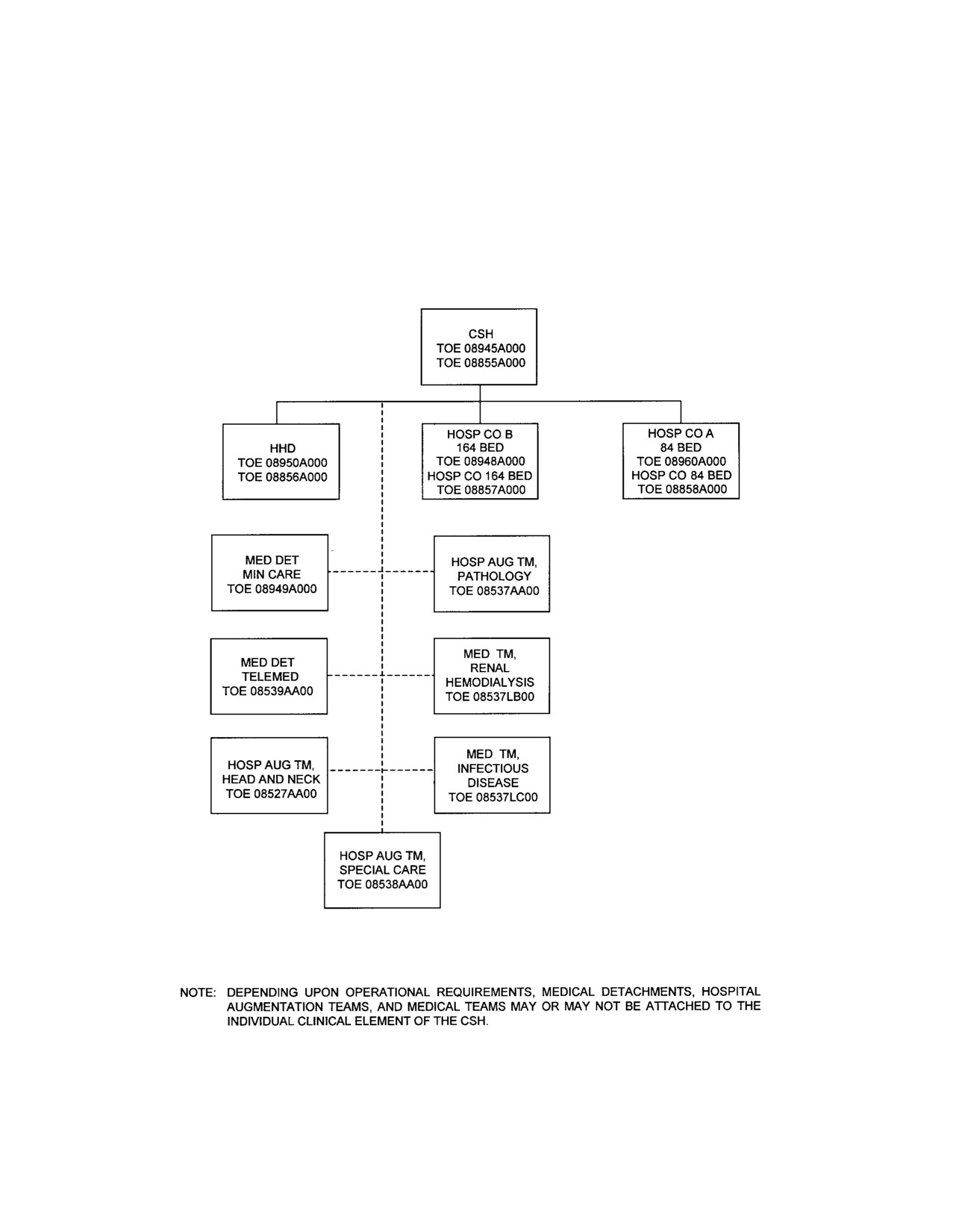
CSHs as stated in paragraph 2-4f.) Each CSH can be further augmented with medical detachments, hospital
augmentation teams, and medical teams to increase its capabilities (Figure 2-1).
2-7.
Headquarters and Headquarters Detachment
a. The HHD provides C2 of all organic/attached units, to include medical planning, policies, and
support operations within the CSH’s AO. The HHD is dependent upon other support units in the corps/
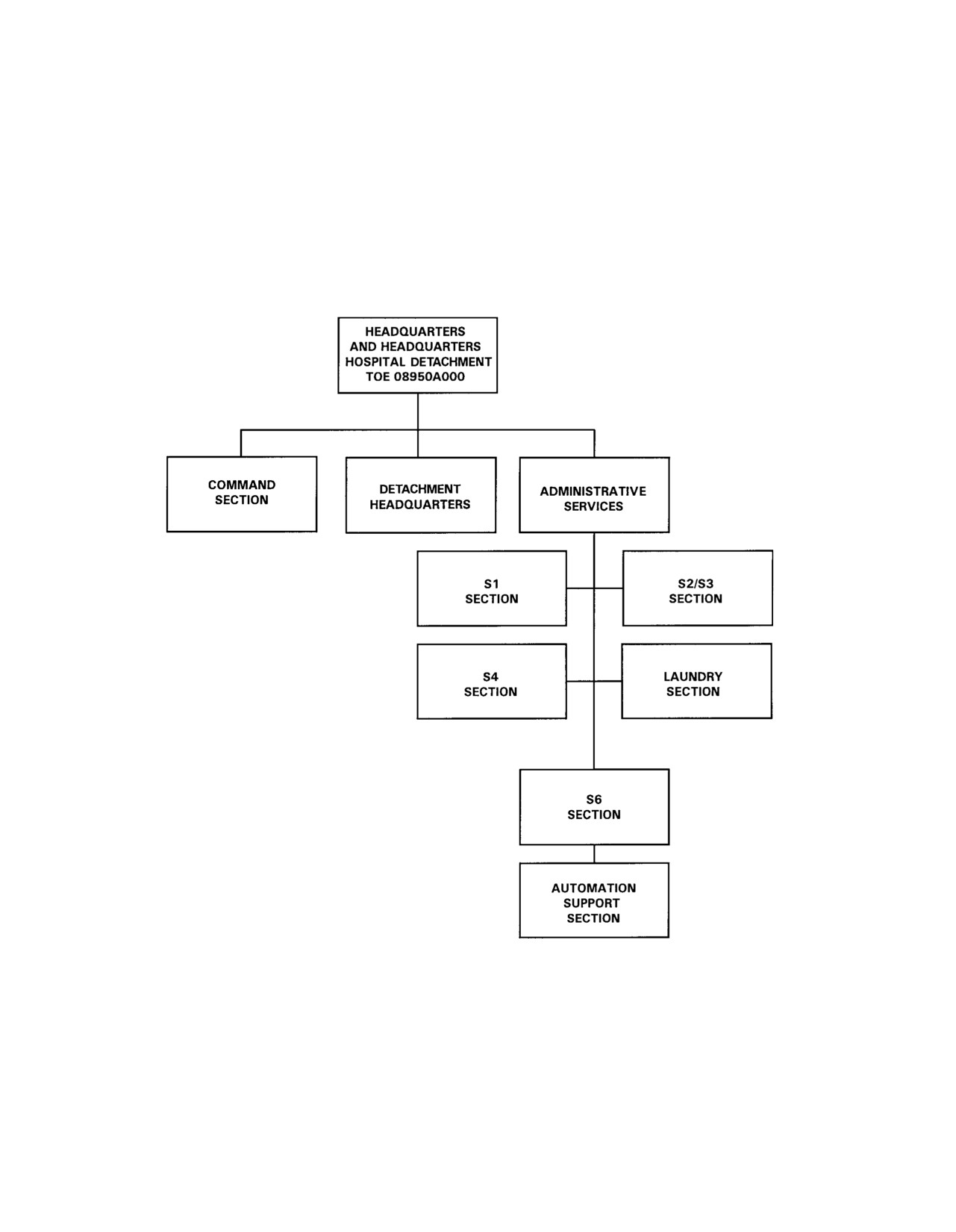
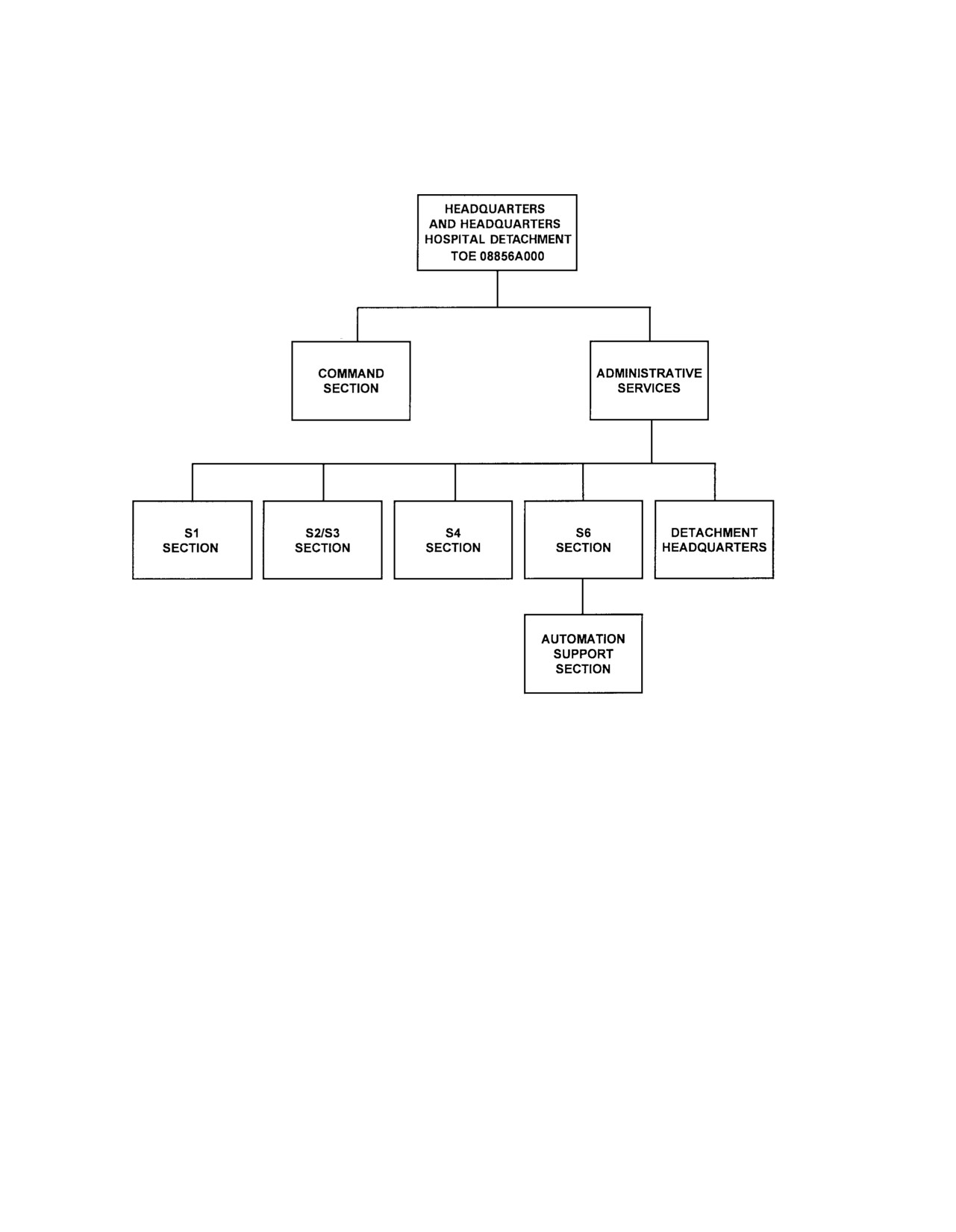
EAC and will be located where elements of these support units can provide support. Figure 2-2 and Figure
2-3 show the corps and EAC HHD organization. See Figure 2-8 for the corps CSH HHD adaptive medical
increment organization structure to support split-base operations.
b. The HHD (TOE 08950A000) of the corps CSH augments hospital Company A (84 Bed), TOE
08960A000), and hospital Company B (164 Bed), TOE 08948A000, for split-base operations. For a
discussion on HHD split-base operations support, see Section II of this chapter, Chapter 4 and Appendix H.
2-3
FM 4-02.10
c.
The HHD (TOE 08856A000) provides C2 of the EAC CSH. The EAC CSH has no split-base
capability.
Figure 2-1. Combat support hospital organization.
2-4
FM 4-02.10
Figure 2-2. Corps headquarters and headquarters detachment organization.
2-5
FM 4-02.10
Figure 2-3. Echelon above corps headquarters and headquarters detachment organization.
d. The methods of operation and functions for the HHD corps and EAC are provided below.
For the HHD corps organizational structure to support split-base operations, see Section II.
(1) Command section.
(a) The command section provides internal C2 and management of the hospital. It
provides administrative support, prepares unit plans for movement, routine and specialized operations, and
mission-related task organization. Personnel of this section supervise and coordinate surgical, nursing,
medical, pastoral, operations, information management/communications, logistical, and administrative
services of the HHD and the hospital, when consolidated. When deployed with the hospital Company A (84
bed), these personnel will augment the surgical, nursing, pastoral, administrative, and operation services.
The chiefs of surgical and nursing services are trained in advanced trauma management. The chief, surgical
service also functions as the deputy commander for professional services. The chief, nursing service is the
principal advisor to the hospital commander for nursing activities. All operation element functions will be
under the direct supervision of the deputy commander for operations and administrative services (this
2-6
FM 4-02.10
officer will also function as the hospital executive officer [XO]). This section is found in both the corps and
EAC HHD. The hospital adjutant is located in the corps HHD. In the EAC, the adjutant is located in the
S1 section.
(b) The hospital commander will appoint a unit safety officer (see Appendix I).
(2) Administrative adjutant (US Army) (S1) section. This section provides overall admin-
istrative services for the hospital, to include personnel administration, mail distribution, awards and
decorations, leaves, and typing support. This section coordinates with elements of the corps and EAC for
finance, personnel, and administrative services. This section is found in both the corps and EAC HHD. As
stated above, the hospital adjutant for the EAC CSH is located here.
(3) Hospital operations (intelligence officer [US Army] [S2]/operations and training officer
[US Army] [S3]) section. This section is responsible for plans, operations, security, deployment, and
relocation of the hospital. It uses automated tools for movement control and terrain analysis for unit lay
down and security plans. It provides the commander with the necessary summary data to facilitate course of
action analysis, resource management, and planning. This section is located in both the corps and EAC
HHD.
(4) Supply officer (US Army) (S4) section.
(a) The S4 section serves as the focal point for coordination/communication with other
general logistics supply and service units. It provides logistics functions throughout the hospital, to include
general and medical supplies and maintenance; blood management; utilities such as water distribution,
waste disposal (see Appendix J), and environmental control of patient treatment areas; power and vehicle
maintenance; and equipment records and repair parts and fuel distribution. This section coordinates with
corps/theater elements for materiel handling equipment (MHE) for movement of the hospital’s Deployable
Medical System (DEPMEDS) equipment, environmental control units, and power distribution equipment.
This section is located in both the corps and EAC HHD.
(b) This section requests resupply from the supporting medical logistics (MEDLOG)
battalion and corps/theater elements, using the Theater Army Medical Management Information Systems
(TAMMIS) or a functional module of the Theater Medical Information Program (TMIP) and Medical
Communications for Combat Casualty Care (MC4) systems. The TMIP/MC4 is the seamless, integrated,
automated medical information system to support a TO and will rely on the Army communications
architecture for transmission of medical data (see Chapter 5).
(c) This section plans and coordinates contractual support requirements for the hospital.
Examples where contracting support may be used are: food service, bath and laundry, general housekeeping,
health care providers (physicians, nurses, and so forth), and medical equipment operators. The health
service materiel officer will identify and coordinate contract support requirements with higher headquarters,
which in turn coordinates with the commander’s designated principal assistant responsible for contracting.
When possible, contract support requirements should be identified by higher headquarters in contingency
plans and operations orders. For a detailed discussion on contractors on the battlefield, see FM 3-100.21.
2-7
FM 4-02.10
(d) This section is also responsible for maintaining the unit property book and for
establishing a temporary morgue for handling remains until transported to supporting mortuary affairs (MA)
organization.
(e) This section will ensure each RTD soldier has or is issued one basic serviceable
uniform and will also coordinate with the corps support command (COSCOM)/theater support command
(TSC) for the transportation of RTD soldiers to the replacement companies.
(f)
This section will coordinate patient movement item (PMI) requirements with the
supporting MEDLOG battalion (see FM 4-02.1). This section will also return excess PMIs to the MEDLOG
battalion.
(g) When the corps CSH is operating in a split-base mode, assets of the S4 section,
HHD, will augment the supply and service section, hospital Company A (84 bed) and hospital Company B
(164 bed), to provide logistical continuity.
(5) Communications-electronics section. The communications-electronics (CE) officer (US
Army) (S6) section is responsible for installation, operation, and maintenance (IOM) of the future switch.
This section is also responsible for the installation, operation, management, security, and maintenance of
the local area network (LAN), to include unit file servers, archive devices and data storage procedures,
information management systems resident on the LAN, and peripheral equipment in all sections of the
hospital and attached units. It also plans for the integration of the hospital elements when consolidated.
Other responsibilities include coordinating with the supporting signal unit commander for—
• Training in network operations.
• Hospital connectivity to area network.
• Hardware/software maintenance support to the hospital switch.
• Managing network (frequency allocation, communications security [COMSEC],
and so forth).
This section also provides unit-level maintenance and troubleshooting for all communications equipment.
The S6 (captain (CPT)/major (MAJ), area of concentration [AOC] 25A00) is the primary interface between
the hospital and the signal unit for all signal support requirements. This section is located in both the corps
and EAC HHD.
(6) Automation support section. This section is responsible for the planning and operation of
the unit information management systems to include MC4/TMIP. Each hospital section, with the exception
of the hospital ministry, will be equipped with MC4/TMIP systems to process health care or patient
administration information applicable to its functionality. The automation support section assists the
commander and staff in the use of automated tools and plans for the horizontal and vertical internet of the
hospital for any given mission. It maintains compact disk-read only memory (CD-ROM) unclassified
libraries of medical and operational information required for the HHD and hospital operations, to include
2-8
FM 4-02.10
medical references, FMs, and technical manuals (TMs). The section plans for emergency backup procedures
in the event of component failures or catastrophic events. It coordinates with organic and attached hospital
units to ensure integration of information management systems and telemedicine services. The health
service systems management officer is the hospital’s agent for the automation information systems. This
section is located in both the corps and EAC HHD.
(7) Laundry section. The laundry section is only organic to the corps hospital and provides
laundry services for patient-related linens. It coordinates with the corps supporting element for all other
laundry support. The EAC CSH has no laundry service capability; the S4 section coordinates all laundry
support with the EAC supporting element.
(8) Detachment headquarters. The detachment headquarters is responsible for company-level
command, duty rosters, weapons control, general supply support, and mandatory training. A detachment
headquarters is located in both the corps and EAC HHD.
2-8.
The 84-Bed Hospital Company
a. This company provides hospitalization for up to 84 patients consisting of two wards providing
critical care nursing for up to 24 patients and three wards providing intermediate care nursing for up to 60
patients (see Figures 2-4 and 2-5). Surgical capability includes general surgery and orthopedic surgery and
is based on two OR tables staffed for 36 OR table hours per day. Requirements for additional surgical
specialties in the corps hospital Company A (84 Bed) can be met by elements of hospital Company B (164
Bed), the FST (when not deployed forward), or the hospital augmentation team, head and neck.
Requirements for additional surgical specialties in the EAC 84-bed hospital company can be met by
elements of the 164-bed hospital company and the hospital augmentation team, head and neck.
b. The corps hospital Company A (84 bed) and EAC 84-bed hospital company provides
emergency treatment to receive, triage, and prepare incoming patients for surgery and to provide consultation
and outpatient clinic services for patients referred from other MTFs. Telemedicine consultation capability
will be provided by the medical detachment, telemedicine (see Appendix B).
c.
This company also provides pharmaceutical, radiology and clinical laboratory services, to
include limited basic microbiology screening, and blood banking. It provides the administrative, patient
administration, logistical, and nutritional care services required for full hospitalization. Organic hospital
personnel set up and break down the unit shelter systems in preparation for unit operations or movement.
d. Assets of the corps hospital Company A (84 bed) may be used for incremental employment.
See Section III of this chapter, Chapter 4, and Appendix H for additional information.
e.
The methods of operation and functions for this company are provided below.
(1) Company headquarters. This section is responsible for company-level command, duty
rosters, weapons control, general supply support, and mandatory training. The company headquarters is
found in both the corps hospital Company A (84 bed) and EAC 84-bed hospital company.
2-9
FM 4-02.10
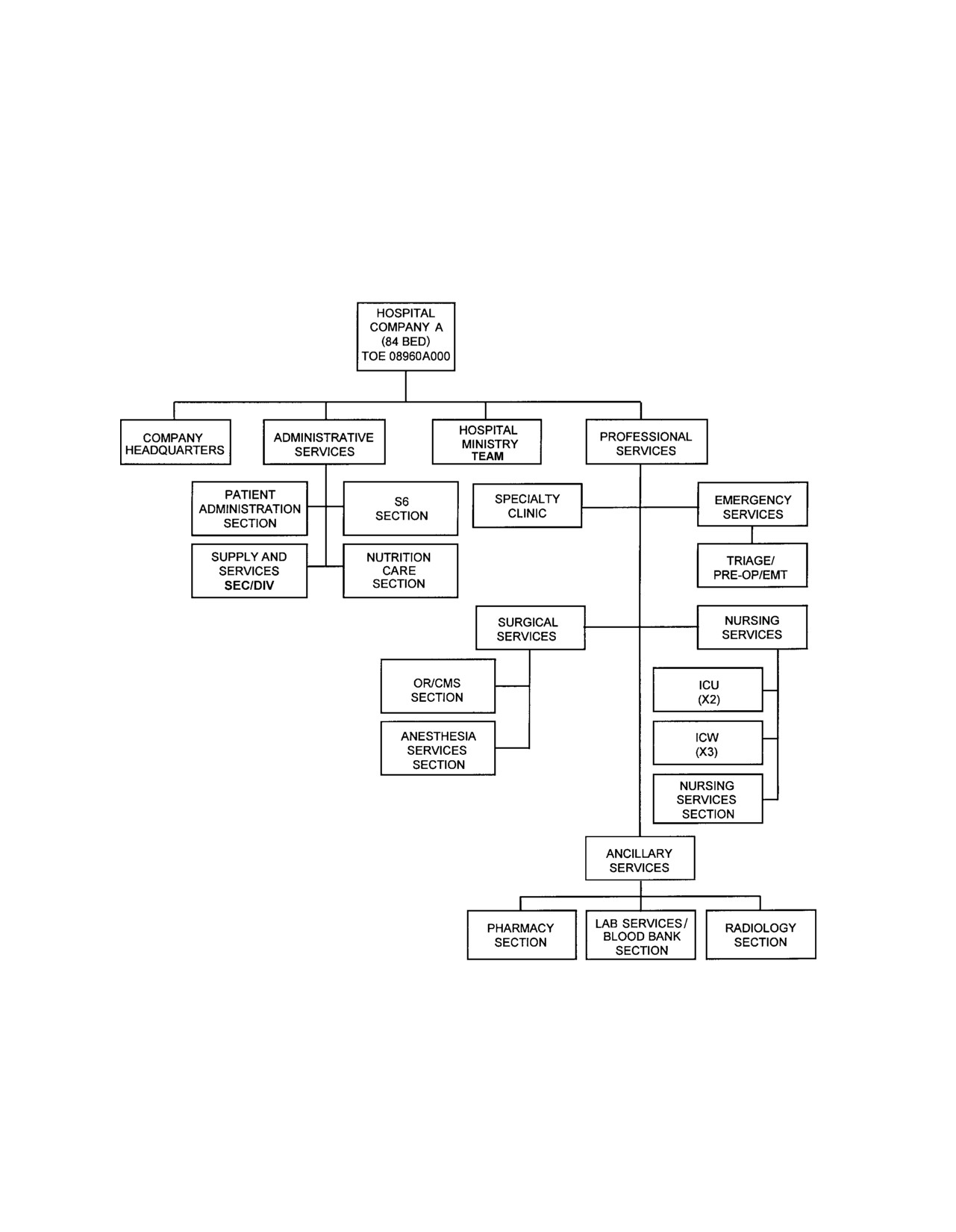
Figure 2-4. The corps hospital Company A (84 bed) organization.
2-10
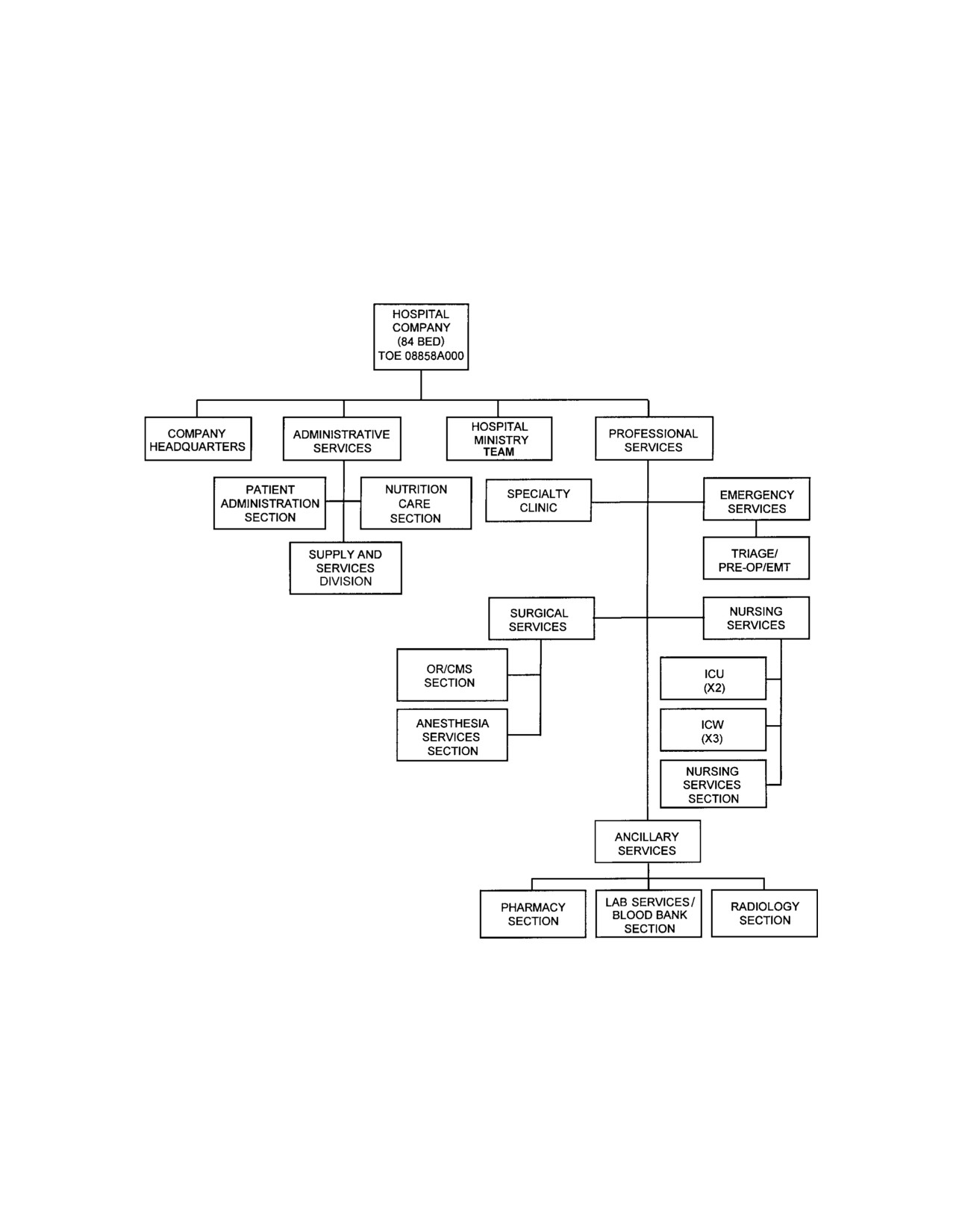
FM 4-02.10
Figure 2-5. The echelon above corps 84-bed hospital company organization.
2-11
FM 4-02.10
(2) Communications-electronics section. This section is responsible for installation, opera-
tion, management, and maintenance of the information management system and internal and external
communications links for the company and attached elements. It plans for the communications and
electronics integration of the company with the CSH when consolidated. This section establishes the LAN
connectivity for this company’s module as well as integration with the full CSH and attached units. This
section is only found in the corps hospital Company A (84 bed).
(3) Patient administration section. This section is responsible for the admission and
disposition of patients, maintenance of patient records, security of patients’ valuables, and preparation of
patient-statistical reports for the company. It also coordinates requests for patient evacuation and provides
reports to higher headquarters. This section is found in both the corps hospital Company A (84 bed) and
EAC 84-bed hospital company.
(4) Nutrition care section. This section is responsible for nutrition services, meal preparation,
and meal distribution to patients and staff, dietetic planning, medical nutrition therapy, patient education,
and command advice on health and nutrition and theater health promotion program. This section is found in
both the corps and EAC 84-bed hospital company. The EAC 84-bed hospital company provides field
feeding for the EAC CSH. The corps hospital Company A (84 bed) only has fielding feeding capability for
its company. See Appendix K for additional information nutrition care operations. See Appendix L for
information on medical diet supplements for medical field feeding operations.
(5) Supply and services section/division. This section/division provides logistical functions
for the hospital company and attached units, to include general and medical supplies; medical maintenance
(MEDMNT); blood management; water distribution, waste disposal, and environmental control of patient
treatment areas; power and vehicle maintenance; fuel distribution; and equipment records and repair parts
management. The logistical capability is found in both the corps hospital Company A (84 bed) and EAC
84-bed hospital company. As shown in Figures 2-4 and 2-5, the logistics functions are performed by the
supply and services section in the corps hospital Company A (84 bed). In the EAC 84-bed hospital
company (nonsplit base [NSB]), these functions are performed by the supply and services division.
(6) Triage/preoperative/emergency medical treatment section. This section provides for the
receiving, triaging, and stabilizing of incoming patients. The staff will receive patients, assess their medical
condition, provide EMT, and transfer them to the appropriate areas of the hospital unit. The staff will be
trained in basic and advanced cardiac life support, EMT, and ATM, as appropriate to grade and skill level.
The staff monitors patient conditions and prepares those requiring immediate surgery for the OR. The litter
bearers are responsible for the transportation of patients within the hospital unit. The EMT personnel read
from and input to the automated clinical record, using available information systems for both inpatients and
outpatients. They use automated tools for access to medical and essential operational information. The
section communicates directly with incoming evacuation platforms (ground and air) to provide en route
telementoring and to ensure readiness to receive incoming patients. The section also provides on-site and
remote consultation services via the medical detachment, telemedicine, when attached. This section is
found in both the corps hospital Company A (84 bed) and EAC 84-bed hospital company.
(7) Specialty clinic section. This section combines an outpatient medical treatment section,
orthopedic services, psychiatric services, PVNTMED surveillance capability of DNBI, and facilities support.
2-12
FM 4-02.10
The staff provides inpatient and outpatient on-site and remote consultations, as requested; evaluation and
treatment of infectious disease and internal medicine disorders; evaluation and treatment of skin disorders;
and treatment of patients with gynecological disease, injury, or disorders. They also provide inpatient and
outpatient assessment and inpatient stabilization of neuropsychiatric patients. Neuropsychiatric stabilization
is undertaken in the ICW under the supervision of the neuropsychiatric staff and attending physician. The
section also provides casting, splinting, and traction services. The section provides remote consultation
services via the medical detachment, telemedicine, when attached. The specialty clinic section is found in
both the corps hospital Company A (84 bed) and EAC 84-bed hospital company.
(8) Operating room/central material services section. This section provides supervision of
the OR and central material service (CMS). It schedules the nursing staff, prepares and maintains the OR
and CMS, and maintains surgical and nursing standards within these areas. It functions with the anesthesia
service section to perform initial surgery for battle and nonbattle injuries and follow-on surgery for patients
who have received initial surgery at other MTFs. It provides general and orthopedic surgical services with
two OR tables for a total of 36 hours of operating table time per day. When augmented by specialty
surgeons and equipment from other elements of the CSH and the hospital augmentation team, head and
neck, it can provide thoracic, urological, obstetrics/gynecology, and oral maxillofacial surgical services.
The FST, when not deployed forward, is an additional augmentation for the corps CSH. The OR/CMS
section provides records and reports to the commander for input to the commander’s situation report. The
staff reads from and inputs to automated clinical records, using available information systems. The staff
provides remote consultation services via the medical detachment, telemedicine, when attached. The
section functions with the CSH OR/CMS section as one surgical service, when consolidated. The OR/CMS
section is found in both the corps hospital Company A (84 bed) and EAC 84-bed hospital company.
(9) Anesthesia services section. This section provides and manages the anesthesia program
and respiratory services for the unit. It provides supervision and administration of anesthetics to patients
undergoing surgery. It ensures appropriate supervision of respiratory therapy for patients. It ensures the
clinical validation of medical equipment and supply sets for each mission, the readiness of clinical standard
operating procedures, and the proficiency of AOC 66F and career management field (CMF) 91D to execute
the mission of this section. The staff coordinates with and assists the EMT section in trauma care services.
The staff provides remote consultation services via the medical detachment, telemedicine, when attached.
When consolidated, this section functions with the CSH anesthesia and respiratory services section as one
service. The anesthesia service section is found in both the corps hospital Company A (84 bed) and EAC
84-bed hospital company.
(10) Nursing services section. The chief, nursing service, HHD, is the chief nurse for this
section. This section is responsible for the management of daily operations of nursing services throughout
the unit, to include scheduling and supervision of nursing staff; preparation and coordination of duty
rosters; emergency mass casualty plans; and contingency staffing. It plans, organizes, executes, and directs
nursing care practices and activities of the unit. This section ensures training and readiness for deployment
of AOC 66 officers and CMF 91 personnel. It also ensures the clinical validation of medical equipment and
supply sets of the unit for each mission, the readiness of clinical standard operating procedures, and the
proficiency of AOC 66 officers and CMF 91 personnel to execute the mission of this unit. The section
plans, coordinates, and supervises the layout and design of the hospital physical facilities. This section is
found in both the corps hospital Company A (84 bed) and EAC 84-bed hospital company.
2-13
FM 4-02.10
(11) Intensive care units. Two 12-bed ICUs provide for critically injured or ill patients and
are responsible to the nursing service section. The ICUs manage surgical or medical patients, adult and/or
pediatric, whose physiological status is so disrupted that they require immediate and continuous medical
and/or nursing care. The staff is specially trained with the clinical and managerial skills necessary to
deliver safe nursing care to patients with complex nursing and medical problems. The ICUs are also used as
a preoperative stabilization area and post anesthesia recovery area for patients either awaiting surgery or
recovering from surgery. The staff provides remote consultation services via the medical detachment,
telemedicine, when attached. The ICUs are found in both the corps hospital Company A (84 bed) and EAC
84-bed hospital company.
(12) Intermediate care ward. The three ICWs manage surgical or medical patients whose
conditions require observation for real or potential life-threatening disease/injury. The acuity of care may
range from those requiring constant observation to those patients able to ambulate and to begin to assume
responsibility for their care. The level of care and acuity of these patients may fluctuate depending on the
intensity of conflict. Although not routine, ICW patients may require monitoring devices and ventilator
support. Each ward consists of 20 beds. The staff provides remote consultation services via the medical
detachment, telemedicine, when attached, in accordance with their technical expertise. The ICWs are
found in both the corps hospital Company A (84 bed) and EAC 84-bed hospital company.
(13) Ancillary services. The senior officer in the pharmacy, laboratory, or radiology section
is dual-hatted as the chief, ancillary services. This person reports to either the chief, professional services
or directly to the hospital commander, depending on local policy. The chief, ancillary services is responsible
for overseeing the daily operations of these three clinical support sections, to include tracking critical
supplies, equipment, manpower issues, emergency mass casualty plans, and contingency staffing. This
officer represents these sections at command/staff meetings and hospital committees. The chief, ancillary
services ensures training, readiness, and cooperation of personnel in these sections. The chief, ancillary
services validates readiness and suitability of medical materiel sets of these sections for each mission, the
readiness of section standard operating procedures, and the proficiency of personnel assigned to execute the
mission. The chief, ancillary services plans, coordinates, and supervises the layout and design of these
sections of the hospital. This position is found in both the corps hospital Company A (84 bed) and EAC 84-
bed hospital company.
(14) Pharmacy section. The pharmacy is responsible for developing, coordinating, and
executing programs and policies that ensure the safe and appropriate medication use within the CSH (see
Appendix M). The following are key functions performed by the pharmacy service personnel. Develop,
maintain, and publish the approved hospital formulary; screen all medication orders for drug-drug, drug-
nutrient interactions, or medication allergies; monitor individual medication therapies for safe and
appropriate disease state management; recommend alternative drug regimens to meet situational require-
ments; monitor and report on all medication-related patient safety problems; provide consultation services
to medical and logistical staff; monitor and enforce hospital-wide quality control of pharmaceuticals;
provide outpatient pharmacy services; provide inpatient pharmacy services, including sterile products
preparation services; provide drug/medication information services; provide bulk drug and controlled
substance distribution support for patient care areas; provide direct patient care services, and pharmacy
supply and support services. The pharmacy services section exercises appropriate control and accountability
for all controlled substances and rosters with signature documentation for all individuals approved by the
2-14
FM 4-02.10
CSH commander to prescribe, receive, order, or distribute controlled drugs. The pharmacy provides
outpatient medications for the required number of days to complete therapy and/or the supply of medications
required for air evacuation out of the corps or theater. It uses automated systems for requisition of
pharmacy supplies and interfaces with other unit sections for bulk pharmacy orders and with the supply and
services section for resupply. The staff provides remote consultation services via the medical detachment,
telemedicine, when attached, in accordance with their technical expertise. The pharmacy section is found in
the corps hospital Company A (84 bed) and hospital Company B (164 bed) and the EAC 84-bed hospital
company. When consolidated, the pharmacy sections of the hospital Company A and hospital Company B
in the corps CSH function as one service. All pharmacy services for the EAC CSH are in the pharmacy
section of the
84-bed hospital Company. For an example of a standing operating procedure (SOP)
on medication use and pharmacy operations, refer to website http://dcss.cs.amedd.army.mil/phar/
pharhome.htm. Additional information on pharmacy operations may be requested by calling DSN 471-
8887 or commercial (210) 221-8887.
(15) Laboratory services/blood bank section. This section performs analytical procedures in
hematology, urinalysis, chemistry, blood banking, and limited basic microbiology screening. The EAC
CSH has the capability to perform analytical procedures in microbiology; the corps CSH requires the
attachment of the hospital augmentation team, pathology for this capability. The staff provides blood
banking services, including all routine blood grouping and typing, abbreviated crossmatching procedures,
emergency blood collection, and blood inventory management. This section stores and issues liquid blood
components and fresh frozen plasma (FFP). It coordinates with the supply and services section and directly
with the MEDLOG battalion and, as required, with the blood program office for blood supply and resupply
requirements. It provides automated records and reports of current and projected blood status to the
commander and higher headquarters. The staff provides remote consultation services via the medical
detachment, telemedicine, when attached, in accordance with their technical expertise. The corps hospital
Company A (84 bed) and hospital Company B (164 bed) and EAC 84-bed hospital company have laboratory
and blood support capabilities. When consolidated, the laboratory services and blood bank of hospital
Company A and hospital Company B in the corps CSH function as one service. All laboratory and blood
banking services for the EAC CSH are in the 84-bed hospital Company.
(16) Radiology section. This section provides radiological services to all areas of the hospital
unit and operates on a 24-hour basis. It prepares digital x-rays for transmission to the radiologist of
the CSH or other consulting radiologists as requested by physicians. This section is responsible to the
radiologist of the CSH for SOP and policies. The radiology section is found in both the corps hospital
Company A (84 bed) and the EAC 84-bed hospital company. The radiology section is also found in
the corps hospital Company B (164 bed). When consolidated, the radiology sections of hospital Company
A (84 bed) and hospital Company B (164 bed) of the corps CSH function as one service. For an example
SOP on CSH radiology operations, refer to website http://radiology.amedd.army.mil/. Additional
information on radiology operations may be requested by calling DSN 471-7614/8597 or commercial (210)
221-7614/8597.
(17) Hospital ministry team. This team is responsible to the commander for religious support
and pastoral care ministry for all staff and patients. It promotes spiritual health within the unit and performs
liaison and consultative functions to ensure continuity of patient care between the hospital unit, CSC units,
and the patient’s unit of origin. The team advises the commander on spiritual and CSC for unit personnel.
2-15
FM 4-02.10
It is responsible for providing inpatient daily clinical ministry to all nursing wards and the EMT section, as
required. The hospital ministry team is found in both the corps hospital Company A (84 bed) and EAC 84-
bed hospital company. It is also found in the corps hospital Company B (164 bed). When consolidated, the
hospital ministry team of hospital Company A (84 bed) and hospital Company B (164 bed) of the corps CSH
function as one service. In the EAC, all hospital ministry for the two hospital companies is consolidated in
the 84-bed hospital company. The senior chaplain in each CSH is in the command section of the HHD.
2-9.
The 164-Bed Hospital Company
a. This company provides hospitalization for up to 164 patients, consisting of two wards providing
critical care nursing for up to 24 patients, and seven wards providing intermediate care nursing for up to
140 patients (see Figures 2-6 and 2-7). Surgical capability, including general, orthopedic, thoracic,
urological, gynecological, and oral maxillofacial, is based on four OR tables staffed for 60 OR table hours
per day. This company, when attached, also provides OR space and time for OR table hours required by
the hospital augmentation team, head and neck. Requirements for additional surgical specialties in the corps
hospital Company B (164 bed) and EAC 164-bed hospital company can be met by the hospital augmentation
team, head and neck. Requirements for additional surgical capability in the corps hospital Company B (164
bed) can be met by the FST (when not deployed forward).
b. The corps hospital Company B (164 bed) provides emergency treatment to receive, triage, and
prepare incoming patients for surgery and provides consultation and outpatient clinic services for patients
referred from other MTFs in the corps. The EAC 164-bed hospital company augments the EAC 84-bed
hospital company to provide these services. A telemedicine consultation capability will be provided by the
medical detachment, telemedicine.
c.
This company also provides a clinical laboratory, to include limited basic microbiology, blood
banking, and radiology services in the corps CSH.
(These services are only found in the 84-bed hospital
company of the EAC CSH.) It provides the administrative, logistical, patient administration, and nutritional
care services required for full hospitalization. Organic hospital personnel set up and break down the unit
shelter systems in preparation for unit operations or movement.
d. The methods of operation and functions by paragraph for the corps hospital Company B (164
bed) and EAC 164-bed hospital company are detailed below; paragraphs are annotated to reflect differences.
Figures 2-6 and 2-7 reflect organizational differences.
(1) Company headquarters. This headquarters is responsible for company-level command,
duty rosters, weapons control, general supply support, and mandatory training. A company headquarters is
found in the corps hospital Company B (164 bed) and EAC 164-bed hospital company.
(2) Patient administration section. This section is responsible for the admission and
disposition of patients, maintenance of patient records, security of patient valuables, and preparation of
patient statistical reports for the company. It also coordinates requests for patient evacuation and provides
reports to the hospital commander. The patient administration section is not found in the EAC 164-bed
hospital company.
2-16
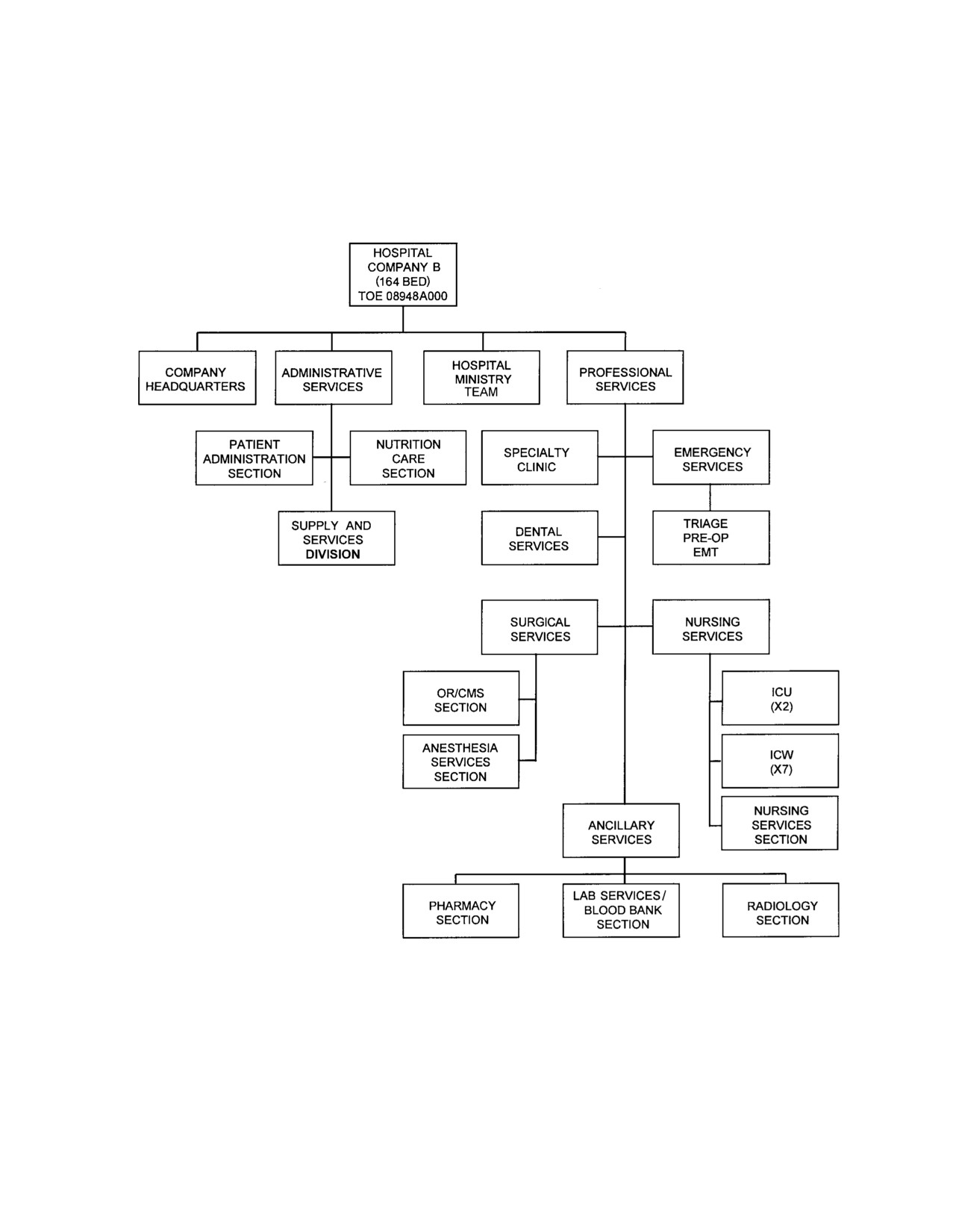
FM 4-02.10
Figure 2-6. The corps hospital Company B (164 bed) organization.
2-17
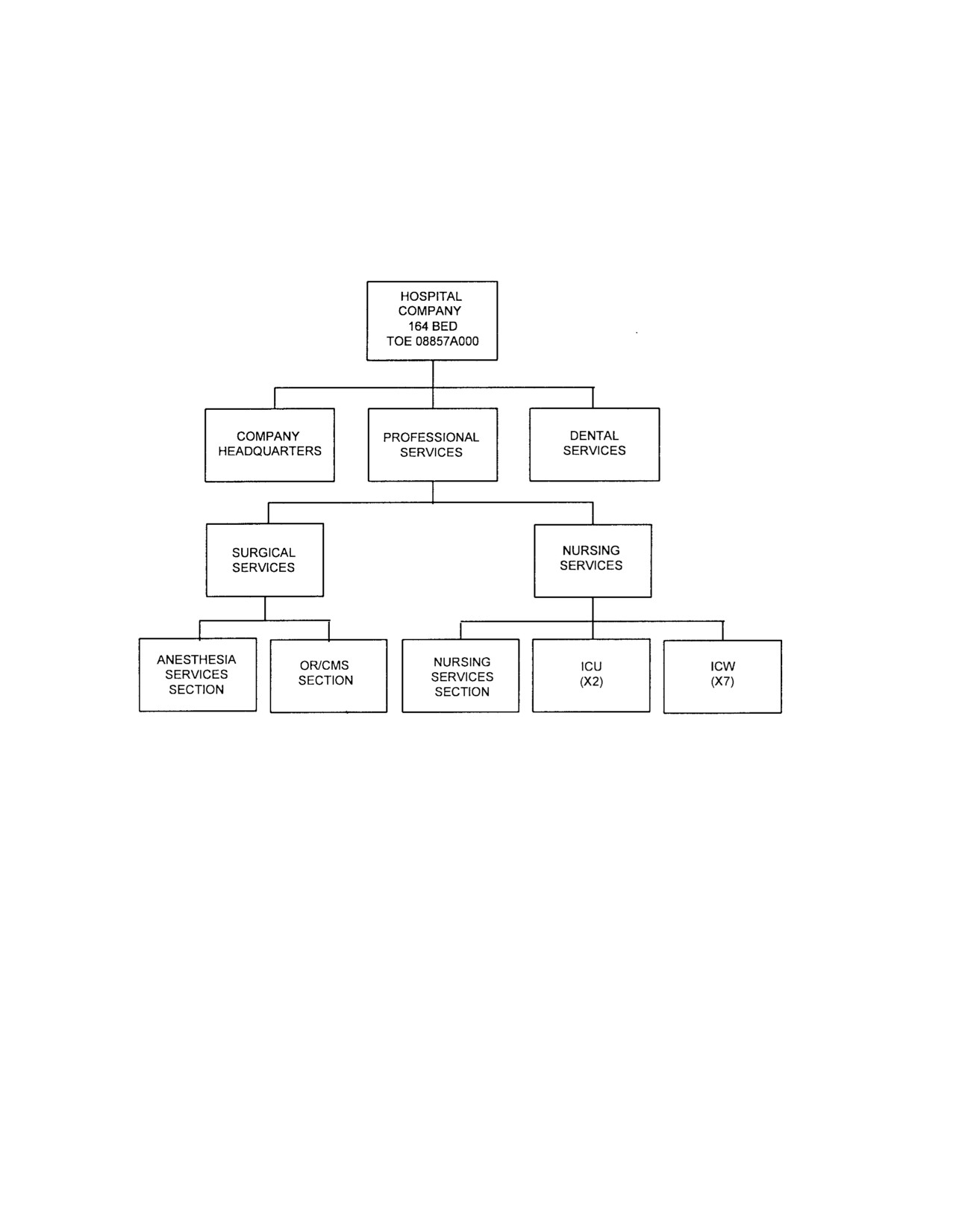
FM 4-02.10
Figure 2-7. The echelon above corps 164-bed hospital company organization.
(3) Nutrition care section. This section is responsible for providing hospital unit nutrition
services, meal preparation and service to patients and staff, dietetic planning, medical nutrition therapy,
patient education, and command advisor on health and nutrition and theater health promotion program. This
section is not found in the EAC 164-bed hospital company. See Appendix K for additional information
nutrition care operations. See Appendix L for information on medical diet supplements for medical field
feeding operations.
(4) Supply and services division. This division is responsible for the logistical functions of
the hospital company and attached units, to include general and medical supplies; MEDMNT; blood
management; water distribution, waste disposal, and environmental control of patient treatment areas;
power and vehicle maintenance; fuel distribution; and equipment records and repair parts management.
Additionally, this division is responsible for coordinating with the supporting element of the MEDLOG
battalion for the return of PMIs. Medical logistics will be managed utilizing the TAMMIS-MEDLOG (see
Chapter 5). This division is not found in the EAC 164-bed hospital company.
2-18
FM 4-02.10
(5) Triage/preoperative/emergency medical treatment section. This section provides for the
receiving, triaging, and stabilizing of incoming patients. The staff will receive patients, assess their medical
condition, provide EMT, and transfer them to the appropriate areas of the hospital unit. The staff will be
trained in basic and advanced cardiac life support, EMT, and ATM as appropriate to grade and skill level.
The staff monitors patient conditions and prepares those requiring immediate surgery for the OR. The litter
bearers are responsible for transportation of patients within the hospital unit. The EMT personnel read
from and input to the automated clinical records, using available information systems for both inpatients and
outpatients. They use automated tools to access medical and essential operational information. The section
communicates directly with incoming evacuation platforms (ground and air) to provide en route tele-
mentoring and to ensure readiness of the section to receive incoming patients. The section also provides
supervision and management of MEDEVAC battalion elements, when attached. It provides on-site and
remote consultation services via the medical detachment, telemedicine, when attached. This section is not
found in the EAC 164-bed hospital company.
(6) Operating room/central material services section. This section provides supervision of
the OR and CMS. It schedules nursing staff, prepares and maintains the OR and CMS, and maintains
surgical and nursing standards within these areas. It functions with the anesthesia section to perform initial
surgery for battle and nonbattle injuries and follow-on surgery for patients received from other MTFs. It
provides general, orthopedic, thoracic, urological, gynecological, and oral maxillofacial surgical services
with four OR tables for a total of 60 hours of table time per day. It uses automated tools to maintain pro-
jected OR schedules and determine OR surgical backlog in terms of projected hours to complete each
surgery and numbers of patients. It provides records and reports to the commander for input to the com-
mander’s situation report. The staff reads from and inputs to the automated clinical record using available
information systems. It accesses digital x-ray files for patient care during surgery. The section provides
remote consultation services via the medical detachment, telemedicine, when attached. The section functions
with the 84-bed hospital company, OR/CMS as one surgical service, when consolidated. The OR/CMS is
found in both the corps hospital Company B (164 bed) and EAC 164-bed hospital company.
(7) Anesthesia services section. This section provides and manages the anesthesia program
and respiratory services for the unit. It provides supervision and administration of anesthetics to patients
undergoing surgery. The staff ensures the clinical validation of medical equipment and supply sets for each
mission, the readiness of clinical standard operating procedures, and the proficiency of AOC 66F and CMF
91D to execute the mission of this section. The section coordinates with and assists the EMT section in
trauma care services. The staff provides remote consultation services via the medical detachment,
telemedicine, when attached. When consolidated, it functions with the 84-bed hospital company anesthesia
and respiratory services section as one service. This section is found in both the corps hospital Company B
(164 bed) and EAC 164-bed hospital company.
(8) Specialty clinic section. This clinic provides patient services including sick call for staff
and attached units. The clinic staff provides primary care and internal medicine consultation services for
hospital patients and patients referred from other MTFs. This clinic functions in conjunction with the EMT
section to efficiently provide treatment for incoming ambulatory patients. It evaluates and treats
dermatological and gynecological diseases, injuries, and disorders. It provides orthopedic and physical
therapy services. It also provides PVNTMED surveillance capability to monitor DNBI. This clinic also
provides outpatient psychiatry and inpatient neuropsychiatric consultation services. Neuropsychiatric
2-19
FM 4-02.10
stabilization is undertaken in the ICW beds or minimal care detachment under the care of the psychiatric
staff and attending physician. The clinic provides remote consultation services via the medical detachment,
telemedicine, when attached. Note that this clinic is found only in the corps hospital Company B (164 bed).
(9) Dental services section. This section provides dental services and consultation for
patients and staff. The alternate wartime role for this section is to augment the hospital with an additional
combat casualty care capability. During mass casualty situations, the dentists assist in the delivery of ATM.
The staff reads from and inputs to the automated clinical record using available information systems for both
inpatients and outpatients. The staff provides remote consultation services via the medical detachment,
telemedicine, when attached. The dental section is found in both the corps hospital Company B (164 bed)
and EAC 164-bed hospital company.
(10) Nursing services section. This section is responsible to the chief nurse for the management
of daily operations of nursing services throughout the unit to include scheduling and supervision of nursing
staff, preparation and coordination of duty rosters, emergency mass casualty plans, and contingency staffing.
It plans, organizes, executes, and directs nursing care practices and activities of the unit. This section
ensures training and readiness for deployment of AOC 66 officers and CMF 91 personnel. It also ensures
the clinical validation of medical equipment and supply sets of the unit for each mission, the readiness of
clinical standard operating procedures, and the proficiency of AOC 66 officers and CMF 91 personnel to
execute the mission of this unit. The section plans, coordinates, and supervises the layout and design of the
hospital physical facilities. This section is found in both the corps hospital Company B (164 bed) and EAC
164-bed hospital company. It functions as a single nursing services section when the hospital functions as a
248-bed MTF.
(11) Intensive care units. Two 12-bed ICUs provide for critically injured or ill patients and
are responsible to the nursing service section. The ICUs manage surgical or medical patients, adult and/or
pediatric, whose physiological status is so disrupted that they require immediate and continuous medical
and/or nursing care. The staff is specially trained with the clinical and managerial skills necessary to
deliver safe nursing care to patients with complex nursing and medical problems. The ICUs are also used as
a preoperative stabilization area and postanesthesia recovery area for patients either awaiting surgery or
recovering from surgery. The staff provides remote consultation services via the medical detachment,
telemedicine, when attached. The ICUs are found in both the corps hospital Company B (164 bed) and
EAC 164-bed hospital company.
(12) Intermediate care ward. The seven ICWs manage surgical or medical patients whose
conditions require observation for real or potentially life-threatening disease/injury. The degree of care
may range from those requiring constant observation to those patients able to ambulate and to begin to
assume responsibility for their care. The level of care and acuity of these patients may fluctuate depending
on the intensity of conflict. Although not routine, ICW patients may require monitoring devices and
ventilator support. Each ward consists of 20 beds. The staff provides remote consultation services via the
medical detachment, telemedicine, when attached, in accordance with their technical expertise. The ICWs
are located in both the corps hospital Company B (164 bed) and EAC 164-bed hospital company.
(13) Ancillary services. The senior officer in the pharmacy, laboratory, or radiology section
is dual-hatted as the chief, ancillary services. This person reports to either the chief, professional services
2-20
FM 4-02.10
or directly to the hospital commander, depending on local policy. The chief, ancillary services is responsible
for overseeing the daily operations of these three clinical support sections, to include tracking critical
supplies, equipment, manpower issues, emergency mass casualty plans, and contingency staffing. This
officer represents these sections at command/staff meetings and hospital committees. The chief, ancillary
services ensures training, readiness, and cooperation of personnel in these sections. The chief, ancillary
services validates readiness and suitability of medical materiel sets of these sections for each mission, the
readiness of section standard operating procedures, and the proficiency of personnel assigned to execute the
mission. The chief, ancillary services plans, coordinates, and supervises the layout and design of these
sections of the hospital. This position is found in both the corps hospital Company A (84 bed) and EAC 84-
bed hospital company.
(14) Pharmacy section. The pharmacy is responsible for developing, coordinating, and
executing programs and policies that ensure the safe and appropriate medication use within the CSH (see
Appendix M). The following are key functions performed by the pharmacy service personnel. Develop,
maintain, and publish the approved hospital formulary; screen all medication orders for drug-drug, drug-
nutrient interactions, or medication allergies; monitor individual medication therapies for safe and
appropriate disease state management; recommend alternative drug regimens to meet situational require-
ments; monitor and report on all medication-related patient safety problems; provide consultation services
to medical and logistical staff; monitor and enforce hospital-wide quality control of pharmaceuticals;
provide outpatient pharmacy services; provide inpatient pharmacy services, including sterile products
preparation services; provide drug/medication information services; provide bulk drug and controlled
substance distribution support for patient care areas; provide direct patient care services, and pharmacy
supply and support services. The pharmacy services section exercises appropriate control and accountability
for all controlled substances and rosters with signature documentation for all individuals approved by the
CSH commander to prescribe, receive, order, or distribute controlled drugs. This section is located in the
corps hospital Company B (164 bed). It functions as a single service with the pharmacy services section
of the corps hospital Company A when consolidated. For an example of an SOP on medication use
and pharmacy operations, refer to website http://dcss.cs.amedd.army.mil/phar/pharhome.htm. Additional
information on pharmacy operations may be requested by calling DSN 471-8887 or commercial (210)
221-8887.
(15) Laboratory services/blood bank section. This section performs analytical procedures in
hematology, urinalysis, chemistry, blood banking, and limited basic microbiology screening. The EAC
CSH has the capability to perform analytical procedures in microbiology; the corps CSH requires the
attachment of the hospital augmentation team, pathology, for this capability. The staff provides blood
banking services, including all routine blood grouping and typing, abbreviated crossmatching procedures,
emergency blood collection, and blood inventory management. This section stores and issues liquid blood
components and FFP. It coordinates with the supply and services section and directly with the MEDLOG
battalion and, as required, with the blood program office for blood supply and resupply requirements. It
provides automated records and reports of current and projected blood status to the commander and higher
headquarters. The staff provides remote consultation services via the medical detachment, telemedicine,
when attached, in accordance with their technical expertise. The corps hospital Company A (84 bed) and
hospital Company B (164 bed) and EAC 84-bed hospital company have laboratory and blood support
capabilities. It functions as a single service with the laboratory services/blood bank section of the CSH,
when consolidated.
2-21
///////////////////////////////////////