FM 4-02.10 THEATER HOSPITALIZATION (JANUARY 2005) - page 3
FM 4-02.10
(b)
Allows the user to—
• Maintain a stock location file.
• Produce location reports.
• Conduct more efficient physical inventories.
• Perform inventory adjustments.
• Produce inventory reports.
(c)
Allows the user to perform quality controls and destruction actions by—
• Processing quality control alert messages.
• Scheduling quality control surveillance inspections.
• Entering quality control data for materiel received.
• Entering or updating destruction records.
• Adjusting the stock record file for destruction.
• Printing quality control and destruction reports.
(d)
Enables the user to—
• Obtain information for current stock status and process catalog changes.
• Perform monthly summary purge and create the Standard Financial System
file.
• Perform periodic and special purpose reporting, such as C2 and numerous
supply management reports.
• Perform excess stock management and reporting.
(4) Query by the national stock number (NSN), due in or due out, or transaction history.
Allows the user to—
• View current stock status, due in or out transaction history, and demand history on
the screen.
• Modify or cancel customer requests.
5-3
FM 4-02.10
• Review, modify, or cancel due-in records.
(5) Setting up and maintaining system procedures. Enables the user at initial system setup or
during normal system operation to—
• Build or update the supported customer file.
• Build or update the supporting activity file.
• Build or update the environmental data file by entering and updating local
destruction date, financial description data, requisitioning objective or ROP calculation data, processing
default data, and control data.
• Update month and cut-off dates.
• Update reporting, printing, and display options.
• Perform file archiving.
• Build an updated cost file.
• Update the elements of expense file.
(6) Reviewing exceptions referred to manager. Allows the user to review and process
exception records from the due-in exception file, customer demand exception file, receipt exception file,
and replenishment exception file.
(7) User designed reports. Allows the user to create, modify, delete, and print user-
designed temporary reports.
Section II. MEDICAL COMMUNICATIONS COMBAT CASUALTY CARE/
THEATER MEDICAL INFORMATION PROGRAM
5-3.
Medical Communications for Combat Casualty Care Overview
a. The MC4 system is the approved Army medical information system to support the warfighter
and health care provider in a TO. The system is the medical component of the Army’s digitization
initiative, to support the Current and Future Force, and is the Army component of the joint TMIP.
Beginning in fiscal year 2002, initial MC4/TMIP capability was issued to the Stryker Brigade Combat Team
(SBCT) and the First Digitized Division, 4th Infantry Division. Limited MC4/TMIP capabilities were issued
to certain Level III medical units, to include CSHs deployed in support of Operation Iraqi Freedom (OIF).
Limited system capabilities were issued down to Level I for the SBCTs deployed in support of the sustainment
5-4
FM 4-02.10
phase of OIF. The MC4 system provides the cornerstone medical information system as the Army
transitions to the Future Force.
b. The MC4 system will be achieved by the integration of emerging information management
technologies with existing and emerging digital communications technologies. This system will start with
the individual soldier and continue throughout the health care continuum. The best way to visualize the
MC4 system capability is as a piece of the Army digital computer network where all ten HSS functional
areas have been digitized, and this HSS information is freely shared with everyone on the Army network
with a need to know. It provides near-real time medical information to support C2, situational understanding
and commodity management by seamlessly linking both vertically and horizontally all levels of medical care
and logistics. The MC4 system significantly enhances medical force protection through automating the
medical record system at all levels of health care. The MC4 system will not only provide the warfighting
commanders with HSS information, it will also provide a seamless transition to the joint HSS environment.
5-4.
System Description
a. The MC4 system will be a worldwide, automated HSS system, which provides commanders,
health care providers, and medical support providers, at all levels, with integrated medical information.
The system will provide digital enablers to link, both vertically and horizontally, all ten HSS functional
“business systems.” The MC4 system will receive, store, progress, transmit, and report medical C2,
medical surveillance, medical treatment, medical situational understanding, and MEDLOG data across all
levels of care. This will be achieved through the integration of a network of medical information systems
linked through the Army data communications structure. The MC4 system will be developed incrementally
through rapid prototyping and the spiral development process, which will process the system from limited
functional capabilities to fully integrated objective capabilities.
b. The MC4 system will consist of three basic components—software, hardware, and tele-
communications systems. These three basic components are discussed in paragraphs 5-5 through 5-7.
5-5.
Software Capability
a. The Joint TMIP will provide government off-the-shelf (GOTS)/COTS software to support
joint theater operations. The software provides an integrated medical information system that will support
all levels of care in a theater of operations with links to the sustaining base. Medical capabilities provided to
support commanders in the theater will address medical C2 (including medical capability assessment/
sustainability analysis and medical intelligence); MEDLOG (including blood product management and
medical maintenance management); casualty evacuation; and health care delivery.
b. The MC4 system will support Army-unique requirements and any software needed to be
interoperable with emerging warrior systems, the Movement Tracking System, and current and emerging
Army C2 and CSS information systems, for example, BCS3 and Global Combat Support System-Army
(GCSS-A).
c.
The TMIP software capabilities will be fielded in increments. Each successive increment will
add additional capabilities and improve upon earlier capabilities. Increment I is the infrastructure phase
5-5
FM 4-02.10
where the hardware and some software capability will be fielded. The software will provide the following
functionalities: medical logistics, immunization tracking, medical record generation, health care information,
medical reference, patient movement, and interface with the personal information carrier (PIC). Increment
II will be the interoperability phase where the capabilities of Increment I will be improved and inter-
operability with other Army systems will be achieved. Increment III is the objective phase where full
functionality of the software application will be achieved, the system will function using the Warfighter
Information Network (WIN), and voice activation technology will be introduced. As the Army transitions
toward the Future Force, and technological advances are introduced, the required capabilities of the MC4
system will be assessed and adjusted as necessary.
5-6.
Hardware Systems
The hardware will consist of automation equipment supporting the above software capabilities. Examples
include, but are not limited to, computers, printers, networking devices, and the PIC. The term PIC will be
used throughout the document as the label to represent the technology that will store personal health and
demographic information about the soldier. The MC4 system will have the capability to read and write to
the PIC in order to update health care information and provide a health record for the individual soldier.
5-7.
Telecommunications Systems
The MC4 system will rely on current and proposed Army solutions for tactical, operational, and strategic
communications systems to transmit and receive digitized medical information throughout the theater and
back to the sustaining base. The MC4 system will include hardware or software required to interface with
current and emerging technologies supporting manual, wired, and wireless data transmission. At end-state,
the MC4 system users will exchange data electronically via the WIN architecture. In the interim, until the
WIN architecture is fully fielded and can support the requirement, the MC4 system will provide, to selected
medical units, a solution (such as commercial satellite and/or high-frequency radios) to transmit digital
medical data.
5-8.
Objective Operational Concept
a. Soldier Level.
(1) Soldiers have long required the ability to carry medical information with them for
purposes of individual readiness, continuity of care, medical surveillance, and postdeployment health care
follow-up. Virtually all this critical medical information is currently documented on paper after the fact. In
order to become a part of the soldier’s permanent medical record, the pieces of paper must be physically
transported back to the soldier’s home station and then physically placed in that record. Because of weight,
preparation difficulties (rain, cold, darkness), and storage limitations, it is impossible to maintain a high
level of paper documentation during an operational deployment.
(2) With the MC4 system, medical information about each soldier will be entered into a local
database maintained at the supporting BAS or troop medical clinic (TMC). This information will include
5-6
FM 4-02.10
the soldier’s immunization status, medical deployability status, and dental deployability status. A
commander, faced with a deployment, will be able to simply query the database to gain the deployability
status of the entire command. Time previously spent on physically searching paper records will be
available for other tasks.
(3) With the MC4 system, each soldier will be issued a PIC. The PIC is an electronic device
that will store personal information about the individual soldier. The PIC specifications will be addressed in
a separate DOD capabilities document, which incorporates Army operational capabilities into this standard
joint device. The PIC will be used to record all of the soldier’s health care events and the soldier’s
readiness status. Each time a soldier receives medical care or immunizations, the medical history on the
PIC will be updated. When a soldier is deployed, his PIC will contain baseline clinical data. During
processing for deployment the medical staff will be able to read all of this immunization, medical, dental,
and medical history data directly from the PIC, greatly speeding up the process. Once in an operational
theater, the soldier’s PIC will continue to provide a backup record of all medical events that occur during
the deployment. Any medical data generated by a medical event will be entered onto the PIC as well as
being entered into the MC4 information system. The preservation of medical data will no longer rely on the
safeguarding and transporting of stacks of paper records.
(4) As part of the Future Force Land Warrior Program, a Warfighter Physiological Status
Monitor (WPSM) is under development. The WPSM will be a suite of external sensors that will monitor
numerous elements of a soldier’s body functions, obtaining data on vital signs, thermal strain, hydration
state, and sleep/alert status. These sensors will feed the physiologic data to a body-worn computer (also
part of the warrior system). An artificial intelligence program on the computer will process the data
obtained and will provide a red-amber-green soldier status to the supervisor. The system will also allow the
trauma specialist to monitor soldier vital signs and ultimately provide a remote triage capability, generating
an alert if physiologic parameters fall outside of preset ranges. This alert will be transmitted by the soldier’s
warrior radio to the platoon leader/platoon sergeant and trauma specialist, warning that the soldier may
have become a casualty. In addition, the warrior system will also provide a call-for-help button that the
soldier can press if he requires medical assistance. The alert button will transmit a distress call to the
platoon leader/platoon sergeant and trauma specialist. When either alarm is activated, the vital sign
information coming from the WPSM will automatically be broadcast to the trauma specialist as well as
recorded onto the PIC. Additional capabilities such as psychological stress, workload capacity, and energy
balance monitoring are anticipated.
b. Databases. With the MC4 system, medical information on soldiers will be stored at different
levels. This will allow commanders and command surgeons at the various levels to access medical
information on their soldiers to find out specific information and to conduct analysis of disease/injury
trends. These lower level databases also provide a means for information redundancy should an informa-
tion node destruct or a communications outage occur. Personnel (medical commanders, and staff surgeons)
at each level with the MC4 system management functionality will be able to query the database. The
HSS information required by CSSCS will pass from the MC4 system through GCSS-A or directly to
CSSCS.
(1) Personal information carrier. The PIC will contain the medical information relevant to
one soldier.
5-7
FM 4-02.10
(2) Battalion aid station/forward support medical company (FSMC)/division support medical
company (DSMC)/TMC/area support medical battalion (ASMB)/CSH. Units responsible for the treatment
of soldiers will maintain a database containing medical information relevant to the soldiers that it supports.
(3) Division surgeon/corps surgeon. The surgeons will maintain a database containing
medical information relevant to the soldiers in that division or corps.
(4) Combatant command surgeon. The surgeon will maintain a database containing all
medical information relevant to the entire theater. This will be the interim theater database (ITDB), which
provides information to update sustaining base medical information systems such as the computer-based
patient record and health surveillance system and is used for medical threat and trend analysis.
c.
Level I.
(1) Trauma specialist. The trauma specialist (formerly referred to as the combat medic) will
be the first point where a casualty interfaces with the MC4 system. Each trauma specialist will be equipped
with a device capable of reading and writing to the casualty’s PIC. Any medical care provided to the
casualty by the trauma specialist will be recorded on the PIC. Where communication assets allow, this
information will also be transmitted to the supporting BAS. Under the warrior program, trauma specialists
assigned to maneuver battalions will have some additional capabilities. A warrior medic version of the
warrior ensemble is being developed with specific medical requirements. The medic warrior ensemble will
include a body-worn computer, a Global Positioning System (GPS) locator system, and a warrior radio. If
a soldier’s WPSM/computer system broadcasts an alert or a soldier activates his trauma specialist call
button, the trauma specialist will receive these alerts and the flow of vital sign information over his warrior
radio. The trauma specialist’s GPS locator will allow the trauma specialist to quickly locate and reach the
casualty. The trauma specialist’s computer will be able to read vital signs directly from the casualty’s
WPSM. All of these capabilities will enhance the trauma specialist’s ability to quickly detect, reach, and
treat a casualty. In the event of multiple casualties, the flow of WPSM data to the trauma specialist will
allow him to prioritize the casualties using remote triage in order to reach the worst injured first.
(2) Evacuation. If a casualty’s injuries or illness require treatment beyond the trauma
specialist’s abilities, the casualty is evacuated to a higher level of medical care, most often the BAS.
Evacuation is accomplished via dedicated MEDEVAC vehicles, wheeled or tracked ambulances, and
helicopters. During this evacuation, onboard medical attendants apply en route treatment and monitor the
casualty. Digital onboard medical equipment eliminates the difficulties with manual vital signs monitoring
which are oftentimes impossible. With the MC4 system, each evacuation vehicle will be equipped with an
onboard computer that will interface with the casualty’s PIC. En route care received will be recorded on
the PIC and will also be transmitted to the destination MTF. Digital linkages to medical C2 units/medical
regulators allow for redirecting the casualty en route should the need arise. The request for evacuation from
the trauma specialist’s site will be made over Force XXI Battle Command Brigade and Below System
(FBCB2) utilizing a built-in MEDEVAC request.
(3) Battalion aid station. At the BAS, the casualty will receive routine or emergency
resuscitative care. The medical staff will use MC4 computers to read the casualty’s PIC, learning what
medical care the casualty has already received and any relevant medical history. This information, along
5-8
FM 4-02.10
with any information generated by the treatment that the casualty receives at the BAS, will be recorded onto
the local database. The information will also be transmitted to the next higher level of medical care (the
FSMC) and ultimately to the ITDB.
(4) Medical logistics. The present MEDLOG system at Level I is a totally manual system.
Under MC4, the trauma specialist will utilize FBCB2 to request medical supplies from the BAS. This
request will be a built-in report on the FBCB2 system. At the BAS, requests for medical resupply will be
made utilizing the MC4 system. This automation will not only speed the resupply process, but will also
allow the combatant commander to maintain visibility of his unit’s MEDLOG status, either through FBCB2
or through MC4’s link to CSSCS through GCSS-A.
d. Level II.
(1) At the Level II medical units (FSMCs and DSMCs), the MC4 system will provide the
same augmentations to treatment documentation, evacuation, and MEDLOG seen at Level I. Through the
use of the medical detachment, telemedicine, Level II medical companies will have the ability to digitize
medical data (x-rays, pictures, and so forth) and transmit it to medical experts at levels above division. This
teleconsultation ability will result in some casualties being treated further forward in the theater, will
increase the RTD rate and will reduce overevacuation.
(2) The medical materiel management branch at the division materiel management center is
the Class VIII commodity manager and, using the same automated tools as the other commodity managers,
makes arrangements to fill the request through the battlefield distribution system. The MC4 system will
automate linkage of Class VIII to the transportation system. The management of the complex medical sets
along with the quality control of Class VIII material is also automated, improving efficiency over the
current manual system. The joint software design supports the Army MEDLOG units’ support mission to
other Services.
e.
Levels III and IV. These levels contain hospitals and all of the specialized medical units
required to support the theater. The MC4 system will link all of these medical functions. The MC4 system
will equip corps treatment and evacuation teams with personally carried and mobile computers for the
collection and forwarding of medical information to the forward, division, or area support medical company.
Likewise, CSC, veterinary, dental, and PVNTMED teams operating in the brigade rear area will be
equipped with personally carried or mobile computers. These MC4 provided devices will be loaded with
the appropriate software functionality. Corps/theater medical regulators/medical C2 will be able to rapidly
and accurately match treatment capability with the soldier’s need for care. The MC4 corps medical
regulating system (TRANSCOM Regulating and Command and Control Evacuation System [TRAC2ES])
provides this functionality via WIN. A seamless Class VIII (including blood) automated system links the
theater to prime vendor systems in CONUS.
f.
Command and Control. At all levels, the MC4 system will automatically provide information
such as evacuation status, current fitness for combat, and hazard exposure information to the commander’s
situational understanding system. The MC4 system will provide the commander with the ability to track
and record the date and location of exposure to health hazards, which include environmental, occupational,
industrial, and CBRNE hazards. This information is critical to the force protection health hazard analysis
5-9
FM 4-02.10
necessary to identify emerging DNBI problems and trends. Commanders will have real-time information
on food source safety/quality, operationally significant zoonotic diseases, health surveillance/trends, and
near real-time health hazard assessment data for CBRNE/endemic disease threats and occupational or
environmental health threats. This information will be provided to the commander from the MC4 system
functional digital systems through GCSS-A to CSSCS. Commanders, for the first time, will have a
complete picture of the battlefield, which will allow them to accurately influence current operations while
synchronizing HSS with other activities.
g. Level V. All care/exposure information will be digitally stored. The documentation of
immunizations, for example, will eliminate challenges that have surfaced post deployment for vaccines such
as anthrax and botulism. This information is stored not only in the Level I database supporting the soldier,
but is transmitted to the ITDB and the soldier’s permanent computerized record. The digital documentation
of medical treatment/exposure information will make addressing health exposure issues, as seen in the Gulf
War and more recent deployments, much easier.
5-9.
Medical Communications for Combat Casualty Care/Theater Medical Information Program
Support to Contingency Operations
a. Limited MC4/TMIP capabilities were issued to certain Level III medical units, to include
CSHs, deployed in support of OIF. The lessons learned from the experimental use of the limited MC4/
TMIP capabilities during OIF will provide the foundation for implementing improvements to the systems
during the acquisition process prior to the formal fielding process.
b. The following MC4 hardware/software components were deployed:
(1) Handheld computer with Battlefield Medical Information System-Tactical (BMIS-T)
software.
(2) Notebook computer with Composite Health Care System II-Theater (CHCS II-T),
Defense Medical Logistic Standard System-Assemblage Management (DMLSS-AM), Theater Army Medical
Management Information System Customer Assistance Module (TCAM), Micromedex® and TMIP as the
primary software applications. Some notebook computers also were deployed with laserjet printers and
label printers. Some notebooks also served as server computers.
(3) Server computer with hub and router with the same software as the notebook computers.
c.
A description of the software functionalities follows:
(1) Battlefield Medical Information System-Tactical. This software will be use to document
medical care at the treatment team level. It will provide the capability to rapidly enter the limited data
required during initial medical encounters. The BMIS-T data also feeds the theater medical surveillance
systems and will become part of the patient’s permanent medical record.
(2) Composite Health Care System II-Theater. A joint developed software, CHCS II-T,
provides a medical information system for documenting outpatient care at Levels I through IV. The system
5-10
FM 4-02.10
provides digital data for theater medical surveillance and trend analysis. The patient information from
CHCS II-T will become part of the individual’s permanent medical record.
(3) Defense Medical Logistic Standard System-Assemblage Management. This is a medical
logistics software that enables theater medical units to manage their medical assemblages.
(4) Theater Army Medical Management Information System Customer Assistance Module.
This software is a web-based extension of the TAMMIS medical logistics module. It will allow theater
medical units to order medical supplies.
(5) Micromedex®. This is a CD medical reference.
(6) Web browser for TRAC2ES and Patient Accounting and Reporting Real-Time Tracking
System (PARRTS).
(a) TRAC2ES. This is a joint system that will provide strategic MEDEVAC C2 and
patient regulation between theater and supporting base hospitals. The systems will also provide in-transit
visibility during the evacuation process.
(b) PARRTS. This is a web-based Army program developed by the Patient Admin-
istration System and Biostatistics Activity (PASBA). It offers casualty location and medical condition
information.
d. Data will originate with the BMIS-T on the handheld device. Data will be transmitted to
Level II MC4 devices and on to Level III and IV CSHs if a patient requires medical care by those facilities.
As casualties are received, they will be accompanied by records of any care they received prior to arriving
at the CSH. These records will either be handwritten (DD 1380 or SF 600), digital records on casualties’
PIC, or both. The CSH EMT section will review this information as they assess the casualty. As a status is
determined for the casualty, these received records will be added to the records generated by the CSH and
stored in the CSH local database. For purposes of this document, the data flow will be confined to the data
flow with the CSH.
e.
The CSH at levels III and IV are identical in functionality and in the manner in which they
utilize information management (IM)/information technology (IT) assets. The CSH will maintain a
hospitalwide LAN. The LAN will include the notebook computers used by the various sections as well as
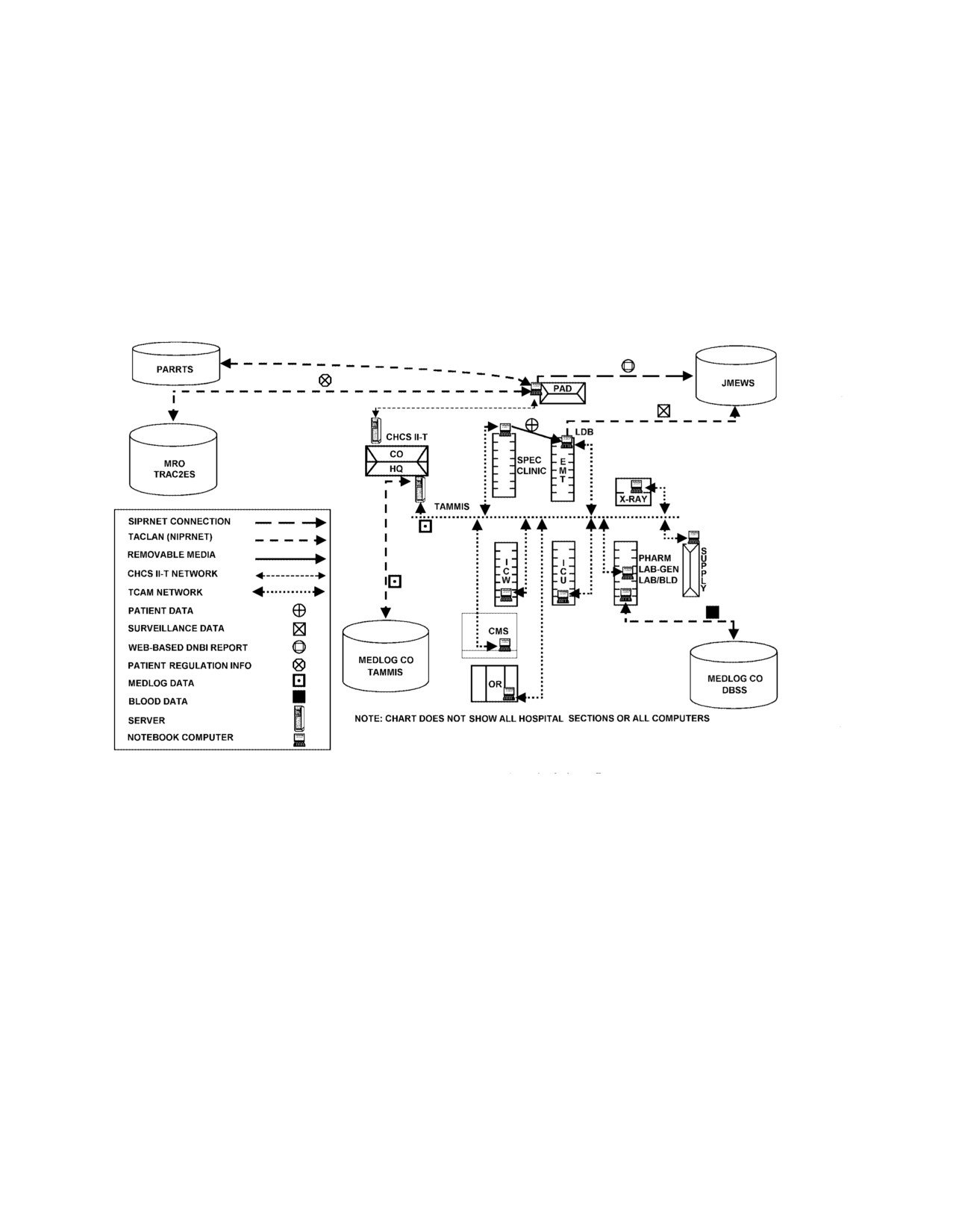
separate servers for clinical systems and medical logistics systems. Figure 5-1 illustrates an example of data
flow within the CSH.
f.
The CSH will provide routine (sick call), emergency, and inpatient care. The TRIAGE/PRE-
OP/EMT section treatment teams will use BMIS-T software on handheld computers and CHCS II-T
software on notebook computers to document encounters. The outpatient clinic section of the hospital will
also use CHCS II-T to document care. Once a status has been determined for a casualty (admit, RTD,
evacuate, died) the encounter will be closed and all data for that encounter will be consolidated on the team
notebook. The CHCS II-T server will serve as the local database.
5-11
FM 4-02.10
Figure 5-1. Example of combat support hospital data flow.
g. Once a patient is admitted, the data that has been generated by CHCS II-T and/or BMIS-T will
be printed out and added to the patient’s inpatient record. The CHCS II-T and BMIS-T data will also be
added to the local database (LDB) and transmitted to the Joint Medical Workstation (JMeWS). The JMeWS
medical surveillance system will provide limited surveillance and trend analysis at the command surgeon
level. Transmission of data to the JMeWS database will only contain those data elements from a medical
encounter that are relevant to medical surveillance rather than a complete record of the encounter.
h. The consolidated encounter data for all RTDs will be collected on the CSH LDB. Every 8 to
12 hours, all new data will be transmitted to the JMeWS database. This transmission will include any data
received from the supported medical companies and the battalion aid stations. Upon redeployment, RTD
encounters will be printed and placed in the appropriate medical records.
5-12
FM 4-02.10
i.
When a casualty is evacuated to a higher level of care, the collected encounter data will be
printed out and will accompany the casualty. Any paper record from lower levels of care will also
accompany the casualty. Surveillance relevant data will be transmitted as part of the regular JMeWS
update.
j.
Upon the death of a casualty, all medical encounter data will be printed and will accompany
the body.
k.
The above information pertains to the concept of operations pertaining to the limited
deployment of MC4/TMIP in support of current contingency operations. Upon formal fielding of MC4/
TMIP systems pursuant to the DOD acquisition process and as the systems mature and business processes
are refined, the concept is subject to change.
5-10. Operational Facility Rules and Equipment
To ensure effective communications, a system has evolved which authorizes specific types and numbers of
radios for a unit. The system is the operational facility (OPFAC) rule and it is the tool used to determine
where, type, and numbers of communication devices are needed. The OPFAC rule is the smallest of a TOE
to which a piece of communications equipment is assigned; such as the commander, staff officer, or section
or platoon. The OPFAC rules are the basis for documenting C4 equipment in the basis of issue plans and
TOEs. The OPFAC rule system is an ongoing validation. These rules are subject to change. To view the
OPFAC rule for your unit, refer to website: https://www.aimd.army.mil. Once you have entered the
website, go to “password request.” A password is required to enter the AIMD product area and will be for
view only.
5-13
FM 4-02.10
APPENDIX A
MEDICAL DETACHMENT, MINIMAL CARE,
TOE 08949A000
A-1. Introduction
The medical detachment, minimal care, is a new organization as a result of the MRI. This unit replaces
Medical Company, Holding (TOE 08458L000), and Hospital Unit, Holding (TOE 08739L000).
A-2. Mission
This detachment provides minimal care/convalescent care hospitalization, nursing, and rehabilitative services
in support of corps and EAC hospitalization. Provides oversight of holding and monitoring facilities for
decontaminated biologic patients/communicable disease contacts.
A-3. Assignment
This detachment will be assigned to a medical brigade and normally attached to a hospital.
A-4. Capabilities
This detachment provides—
a. Command and control of organic elements to include health support planning, policies, and
support operations within the detachment’s area of responsibility.
b. Information to commanders and their staffs on the health and status of soldiers in their
command.
c.
Augmentation of the hospital to which attached to provide hospitalization, minimal nursing
care, for up to 120 patients and for reconditioning and rehabilitation for those patients who can RTD within
the theater evacuation policy or who are awaiting further MEDEVAC.
d. Physical therapy and occupational therapy services for patients.
e.
Augmentation of the emergency nursing capabilities of the hospital to which attached during
mass casualty situations.
f.
Augmentation to the nutrition care capabilities of the hospital to which attached to support
patient feeding of this detachment.
g. Augmentation to the patient administration section capabilities of the hospital to which attached.
h. Three days of supply level for all organic elements upon deployment and during routine
operations.
A-1
FM 4-02.10
A-5. Limitations
This unit is dependent upon—
a. Appropriate elements of the corps or theater for religious, legal, finance, personnel and
administrative services, laundry and bath, clothing exchange, mortuary affairs, transportation, maintenance,
and communication/information management support.
b. The hospital to which attached for food service, water distribution, personnel and admin-
istrative services, unit health services, medical treatment, patient administration, medical maintenance,
supply (all classes), and unit maintenance for the detachment’s communications equipment and power
generator.
c.
The hospital to which attached for additional power requirements.
d. The medical company, dental services and the medical company, CSC for augmentation of
treatment capabilities.
A-6. Basis of Allocation
This detachment supports the requirement for all CZ MCW bed requirements (25 percent of the total WIA/
DNBI; 21.5 percent of blister; 55 percent of nerve; and 50 percent biological contacts) and all COMMZ
MCW bed requirements (75 percent of total bed requirements with an 70 percent skip policy). To get the
total bed requirements, Minimal Care Detachment (standard requirement code [SRC] 08949A000) bed
requirements must be added to the ICU/ICW bed requirements generated by corps and EAC hospitals. For
programming purposes, 2.604 minimal care detachments per 1,000 hospital patients in the corps and 4.792
minimal care detachments per 1,000 hospital patients in EAC.
A-7. Mobility
a. This unit has no mobility.
b. This unit has 181,305 pounds (16,600 cu ft) of TOE assets requiring transportation.
c.
When providing support to hospitals, elements of this unit will not move on a regular basis.
A-8. Employment
The medical brigade will provide C2 to assigned medical detachment, minimal care and will ensure
continuous provisions of minimal care beds as required to the corps and EAC hospitals. The medical
detachment, minimal care will be further attached to the hospital for support and is designed to provide 120
beds of minimal and convalescent care. Each squad of the detachment may be employed separately
A-2
FM 4-02.10
providing 40 minimal care beds per squad. The medical detachment, minimal care provides nursing,
physical therapy, and occupational therapy services for those patients expected to RTD within the theater
evacuation policy or who are awaiting further medical evacuation. The medical company, dental services
and the medical company or detachment, CSC can provide appropriate support to augment the medical
detachment, minimal care treatment capabilities, if required.
A-9. Concept of Operations and Functions
The function of this detachment is to perform minimal care nursing, occupational therapy, and physical
therapy for the patients admitted to the hospital to which attached and to other eligible personnel as
determined by the MEDCOM/medical brigade. Organic personnel of the detachment set up and break
down unit shelters and power-generating equipment in preparation for detachment operations or detachment
movement, set up the nursing care and occupational therapy/physical therapy areas, and perform routine
minimal care nursing and rehabilitation/reconditioning for patients expected to RTD within the theater
evacuation policy or who are awaiting medical evacuation and require continued nursing supervision, this
includes those individuals being monitored after suspected biological/communicable disease contact. The
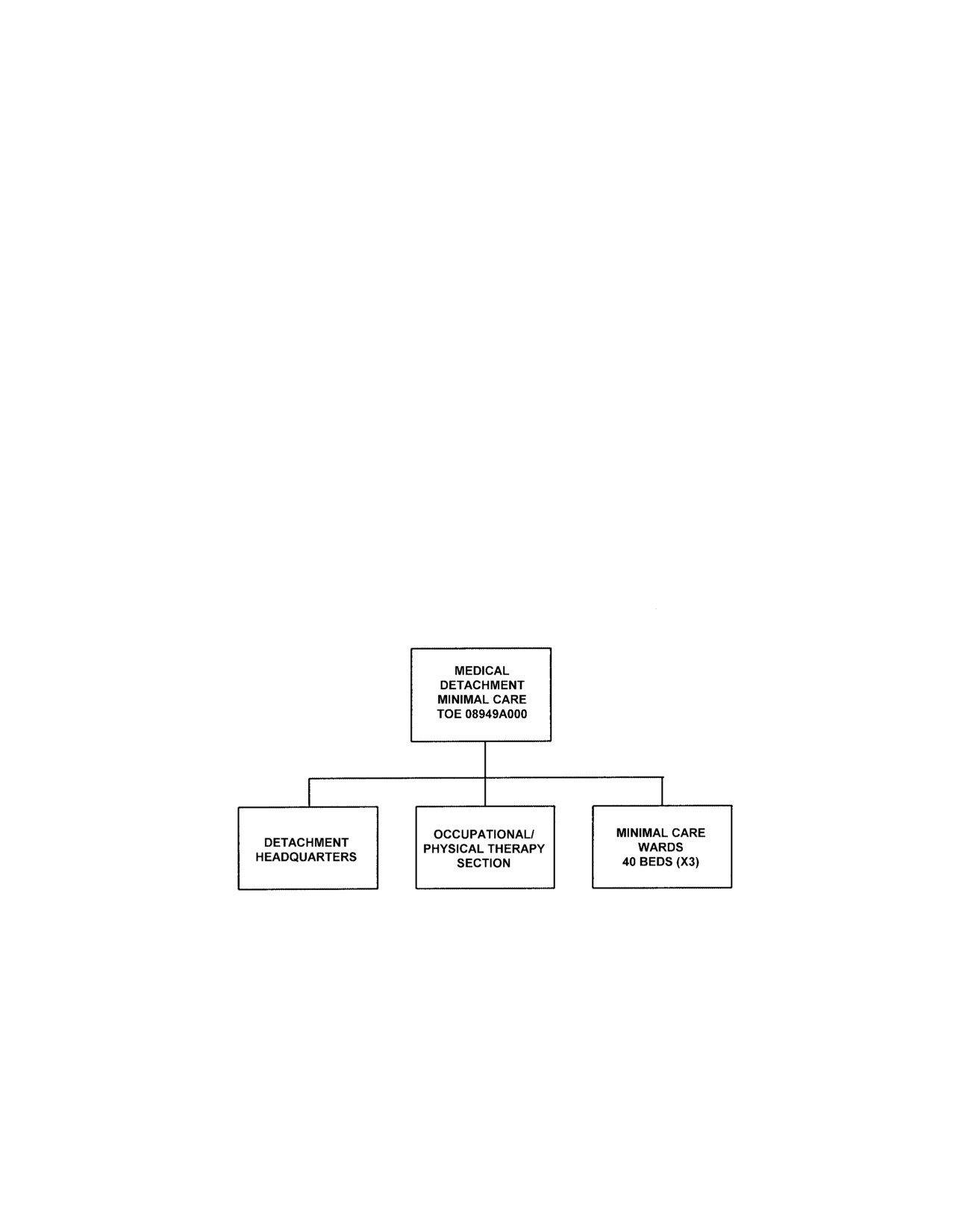
detachment is normally attached to the hospital and provides a detachment headquarters, an occupational/
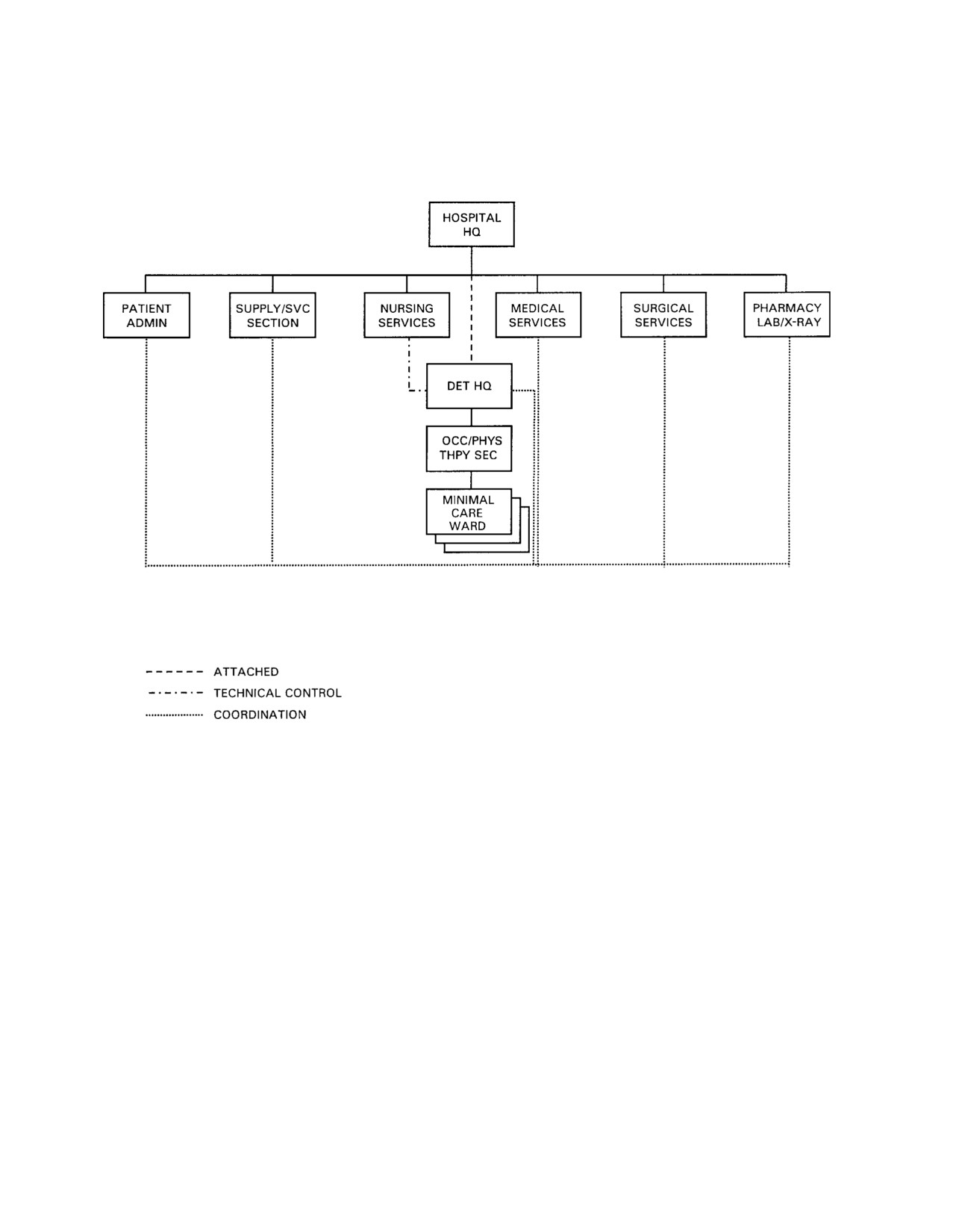
physical therapy section, and three minimal care wards. See Figures A-1 and A-2 for organization and
operational and command relationship.
Figure A-1. Medical detachment, minimal care.
a. Detachment Headquarters. The detachment headquarters provides C2 and administrative
support. It performs unit plans and movement, routine and specialized operations, mission-related task
organization, and coordinates directly with the hospital to which attached. Personnel of the headquarters
and support section provide maintenance and supply and services to augment the respective sections of the
hospital to which attached.
A-3
FM 4-02.10
Figure A-2. Medical detachment, minimal care operational and command relationship.
b. Occupational/Physical Therapy Section. This section provides occupational therapy and
physical therapy services to the detachment’s inpatients. Personnel in this section augment the respective
sections of the hospital to which attached.
c.
Minimal Care Wards. Three minimal care wards provide nursing supervision and management
of medical or surgical patients who are ambulatory and partially self-sufficient and are in the final stages of
recovery awaiting RTD or who are awaiting further MEDEVAC. The focus of nursing management is on
an aggressive therapeutic environment which speeds recovery for RTD or which ensures stabilization and
preparation for MEDEVAC. Nursing personnel administer medications and treatments which cannot be
done by the patient and provide instruction in self-care and posthospitalization health maintenance. Nursing
personnel coordinate with occupational/physical therapy personnel for rehabilitation and reconditioning of
patients. Nursing personnel also coordinate with the hospital to which attached for routine and emergency
medical treatment needs of patients. Nursing personnel also monitor individuals who may have been
exposed to an infectious agent and require isolation until disease manifests or individual is determined not to
be infected/infectious.
A-4
FM 4-02.10
APPENDIX B
MEDICAL DETACHMENT, TELEMEDICINE,
TOE 08539AA00
B-1. Introduction
The medical detachment, telemedicine, is a new organization as a result of the MRI. It is not replacement
for any unit.
B-2. Mission
The mission is to provide telemedicine services in support of MTFs within the division, corps, and theater
AO.
B-3. Assignment
This detachment will normally be assigned to a CSH and further attached to the medical company of the
forward support battalion, main support battalion, or ASMB.
B-4. Capabilities
This detachment provides—
a. Command and control of organic telemedicine teams, to include planning and coordination of
telemedicine support across all supported MTFs within the division, corps, or theater AO.
b. Augmentation teams for up to seven MTFs, providing integrated telemedicine service to the
host MTF, teleconsultation, telementoring, teleradiology, telepathology, telepreventive medicine, and other
forms of telemedicine support.
c.
An interface for MTF clinicians through interactive or store and forward telemedicine support,
to include the multimedia transmission of clinical information in the form of video, voice, high-resolution
still images, and/or text data.
d. Telemedicine links for on-site capability for video access to remote medical and allied health
specialists for real-time mentoring of complex treatment and surgical procedures.
e.
Three days of supply for all organic elements upon deployment and during routine operations.
B-5. Limitations
This detachment is dependent upon—
a. Appropriate elements of the theater Army, corps, or division for religious, legal, finance,
personnel, and administrative services, laundry and bath, and supplemental transportation of equipment.
b. The hospital or medical company to which assigned or attached for food service, water
distribution, personnel and administrative services, unit health services, medical maintenance, supply (all
B-1
FM 4-02.10
classes), power generation, and unit maintenance for the detachment’s wheeled vehicles and communications
equipment.
c.
The hospital or medical company for LAN and WAN connectivity.
d. The corps and theater signal brigade for communications support, general support of
communications maintenance, and coordination for long-range communications.
B-6. Basis of Allocation
The basis of allocation is one medical detachment, telemedicine, per division in the CZ and one per theater.
B-7. Mobility
a. This unit is capable of transporting 34,000 pounds (2,631 cu ft) of TOE assets with organic
vehicles.
b. This unit has 8,262 pounds (485 cu ft) of TOE assets requiring transportation.
c.
The headquarters section of this unit requires organic transportation for the commander.
d. When providing support to MTFs, the commander and each forward telemedicine team may be
required to move on an average of 25 to 50 kilometers every two days.
B-8. Employment
The MEDCOM/medical brigade directs the employment of the detachment. The detachment will provide
telemedicine teams for up to seven MTFs. The headquarters element of the detachment will locate with one
of the telemedicine teams, preferably with one attached to a hospital. Each team will be equipped for
attachment to either a hospital or a medical company in order to provide organizational flexibility. The
teams will be dependent upon the MTF to which attached for other forms of support. The telemedicine
teams of the detachment provide initial set up of telemedicine services and shelter systems, on-site and
remote operational assistance, and periodic operator maintenance of telemedicine equipment and associated
information systems for up to seven MTFs.
B-9. Concept of Operations and Functions
The function of the detachment is to provide expert capability to plan and execute telemedicine services in
support of MTFs. Operational planning for support of a major theater of war (MTW) requires the detachment
to plan support for up to two hospitals, one area support medical company, one MSMC, and three FSMCs
for each division force equivalent in the corps. The telemedicine detachment will plan support for
B-2
FM 4-02.10
consultation on the management of biological/communicable disease entities and other issues of public/
occupational health importance. The detachment will also plan for telemedicine support of peace operations,
humanitarian assistance, and operations in aid of civil authorities as determined by higher headquarters.
Organic personnel of the detachment set up and break down unit shelters, communication and information
management hardware/software, and patient examination equipment in preparation for unit operations or unit
movement. Telemedicine personnel assist in initiating remote medical consultations and provide on-site
maintenance and repair/replacement of communication and information management hardware/software.
They also assist hospital/medical company health care providers in completing patient examinations for the
purpose of remote consultations and to provide on-site training to hospital/medical company personnel in the
use of telemedicine equipment for consultations and for other uses, such as medical maintenance,
administration, and communication of policies and procedures. The detachment is normally attached to a
hospital and provides teams to support an additional six MTFs. The following paragraphs outline the
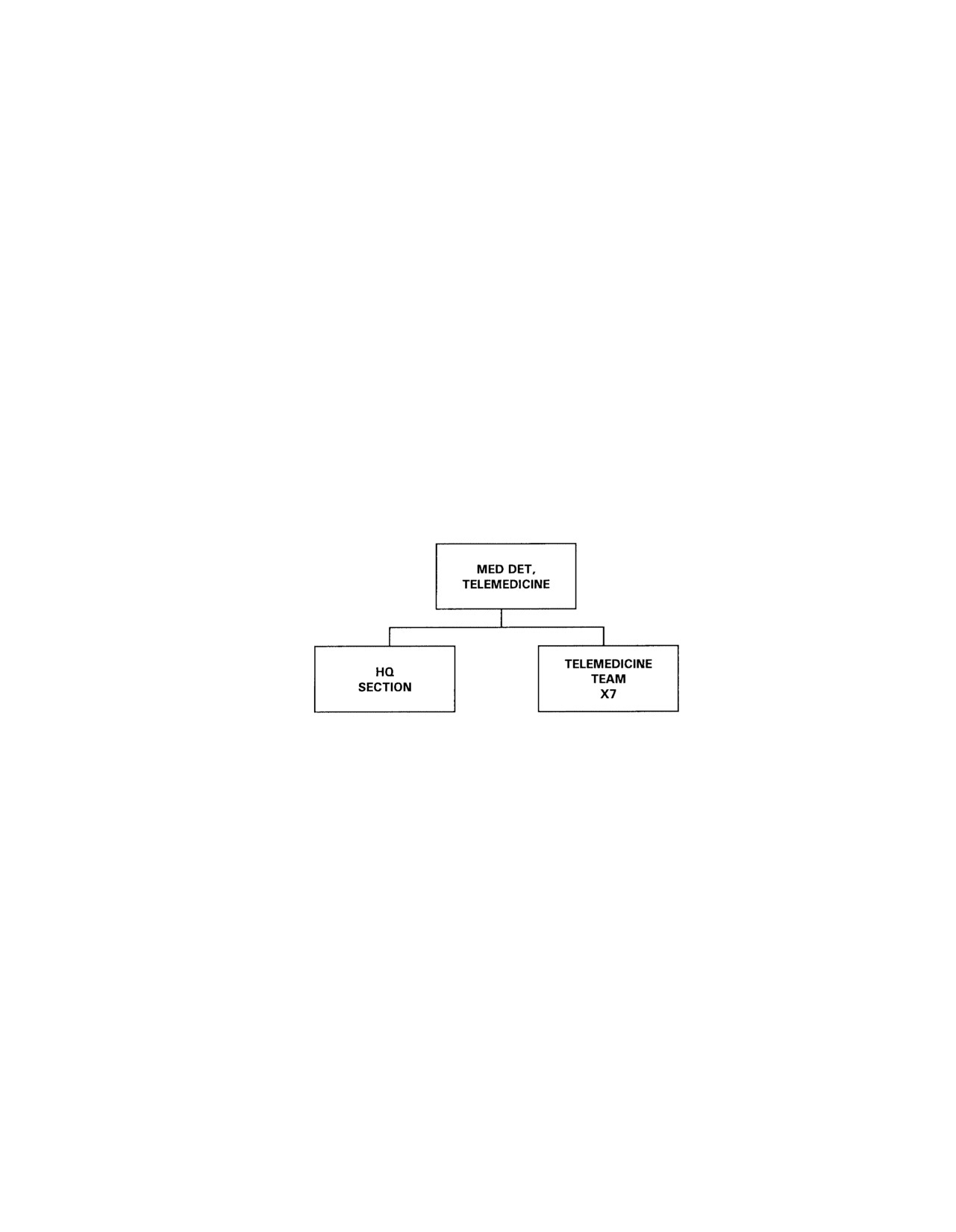
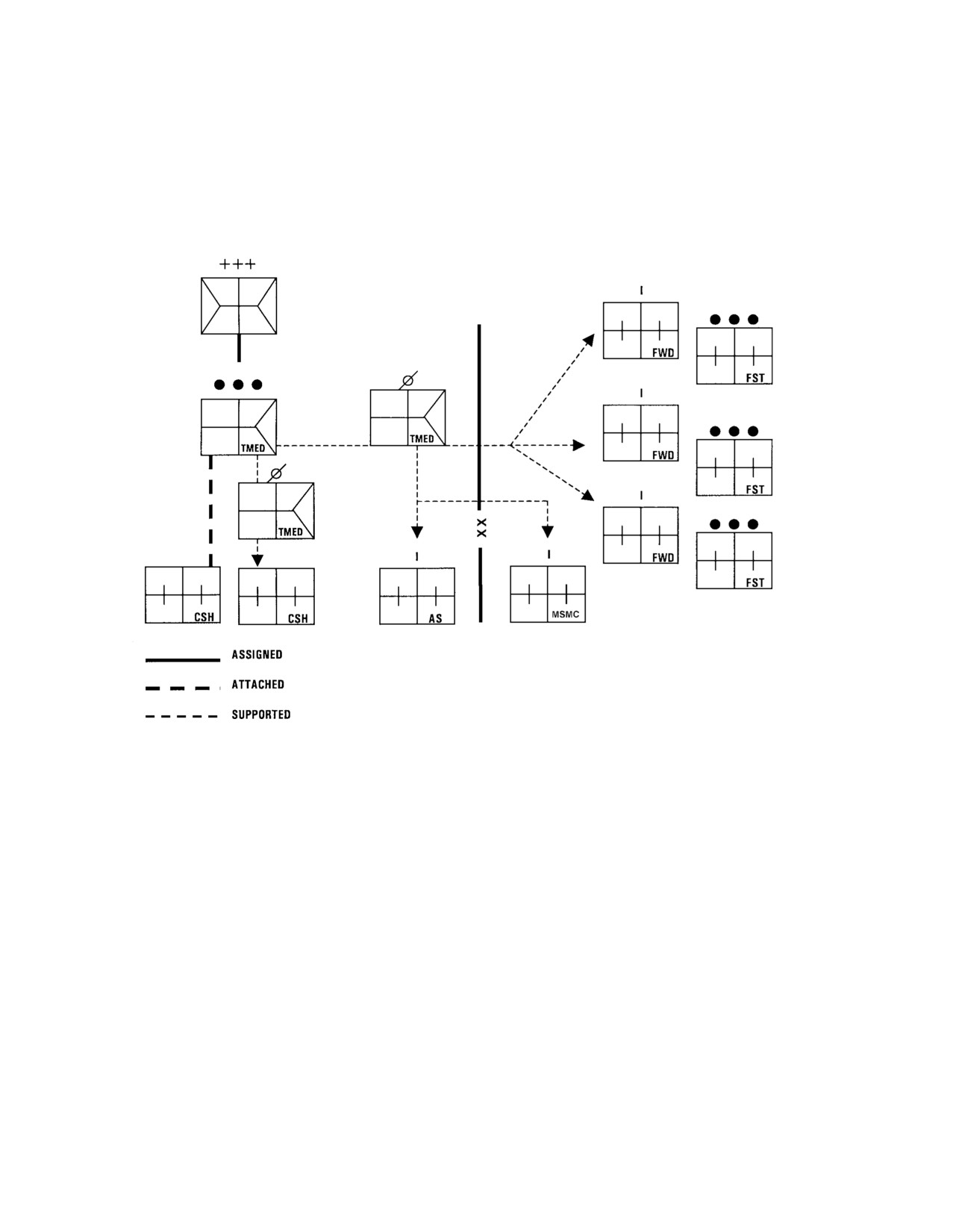
functions of the headquarters section and telemedicine teams. The organization is shown in Figure B-1. The
operational and command relationship is shown in Figure B-2.
Figure B-1. Medical detachment, telemedicine organization.
a. Headquarters Section. The headquarters of the medical detachment, telemedicine provides
telemedicine advice to the MEDCOM/medical brigade and provides C2 of subordinate telemedicine teams.
This includes telemedicine support across all supported MTFs and supervision of the telemedicine teams.
The headquarters section will coordinate with the supporting signal units to ensure adequate communications
support. The headquarters section will also coordinate with the supported MTFs to ensure the integration of
clinical services, medical imaging, information systems, and communications for the conduct of telemedicine.
b. Telemedicine Teams. The telemedicine teams provide an integrated telemedicine service to a
MTF. Each team can be attached to either a hospital or medical company. The team provides referring
telemedicine services to multiple clinical areas within the MTF and provides the ability to perform consulting
telemedicine services for more forward health care providers on the battlefield. The team coordinates with
the MTF clinicians, establishes links to the health information system in order to utilize electronic patient
records, collects multimedia patient data, and establishes links to the information-communications system in
order to establish external communications connectivity. These teams are required to provide this service 24
hours per day.
B-3
FM 4-02.10
Figure B-2. Medical detachment, telemedicine operational and command relationship.
B-4
FM 4-02.10
APPENDIX C
HOSPITAL AUGMENTATION TEAM, HEAD AND NECK,
TOE 08527AA00
C-1. Introduction
The hospital augmentation team, head and neck, is a new organization as a result of the MRI. The hospital
augmentation team, head and neck, replaces and consolidates the functions of the MF2K Medical Team,
Head and Neck Surgery (TOE 08527LA00), the Medical Team, Neurosurgery (TOE 08527LB00), and the
Medical Team, Eye Surgery (TOE 08527LC00).
C-2. Mission
The mission of this team is to provide ear, nose, and throat surgery, neurosurgery, and eye surgery
augmentation in support of theater hospitals and consultative services as required.
C-3. Assignment
This team will be assigned to a medical brigade or MEDCOM and normally will be attached to a hospital.
C-4. Capabilities
This unit provides—
a. Initial and secondary ear, nose, and throat surgery and consultation services in support of
theater hospitals.
b. Initial and secondary neurosurgery and consultation services in support of theater hospitals.
c.
Initial and secondary eye surgery and consultation services in support of theater hospitals.
d. Augmentation of the hospital OR surgical and nursing services.
e.
The medical materiel set (MMS) (radiology, computerized tomography), which will give the
hospital the capability to perform computerized tomography examinations.
f.
Three days of supply for all organic elements upon deployment and during routine operations.
C-5. Limitations
This unit is dependent upon—
a. Appropriate elements of the corps for legal, religious, finance, personnel, and administrative
services, laundry, bath, clothing exchange, patient decontamination, MA, and EPW security during pro-
cessing and evacuation.
C-1
FM 4-02.10
b. The hospital to which it is attached to provide sheltered ORs, commonly used equipment, pre-
and postoperative nursing care for all patients, field feeding (to include patient food service), HSS, water
distribution, security, personnel and administrative services, transportation, unit maintenance for generator,
power support for all equipment (except that related to the computerized tomography), patient administration,
coordination of medical evacuation, and all classes of supply.
c.
The United States Army Medical Materiel Agency (USAMMA) for the procurement of the
MMS (radiology, computerized tomography).
C-6. Basis of Allocation
The basis of allocation is one per four hospitals in the corps.
C-7. Mobility
a. This unit has no organic mobility.
b. This unit has 55,046 pounds (5,031 cu ft) of TOE assets requiring transportation.
c.
Teams will move one time every two days on average. The average move will be
approximately 25 kilometers.
C-8. Employment
The medical brigade will provide C2 and support to the assigned hospital augmentation team, head and
neck, and will ensure continuous provision of neurosurgery, ear, nose and throat surgery, and ophthalmic
surgery services to the corps and EAC. The hospital augmentation team, head and neck, will be employed
with and further attached for support to hospitals.
C-9. Concept of Operations and Functions
The function of the hospital augmentation team, head and neck is to provide preoperative assessment and
perform neurosurgery, ear, nose, and throat surgery, and ophthalmic surgery for patients admitted to the
hospital to which the unit is attached. The team will also provide the hospital with neurosurgical, ophthalmic,
and otolaryngological consultation services and postoperative follow up. The equipment for the hospital
augmentation team, head and neck includes the MMS (radiology, computerized tomography). This will
provide the hospital augmentation team, head and neck, with the capability to perform computerized
tomography scans prior to surgery and will decrease the previous requirement for exploratory surgery. The
hospital augmentation team, head and neck will include the power supply, radiology technicians, and
medical equipment repair support required for the MMS (radiology, computerized tomography). The
hospital augmentation team, head and neck, does not include an OR and work areas and will perform
C-2
FM 4-02.10
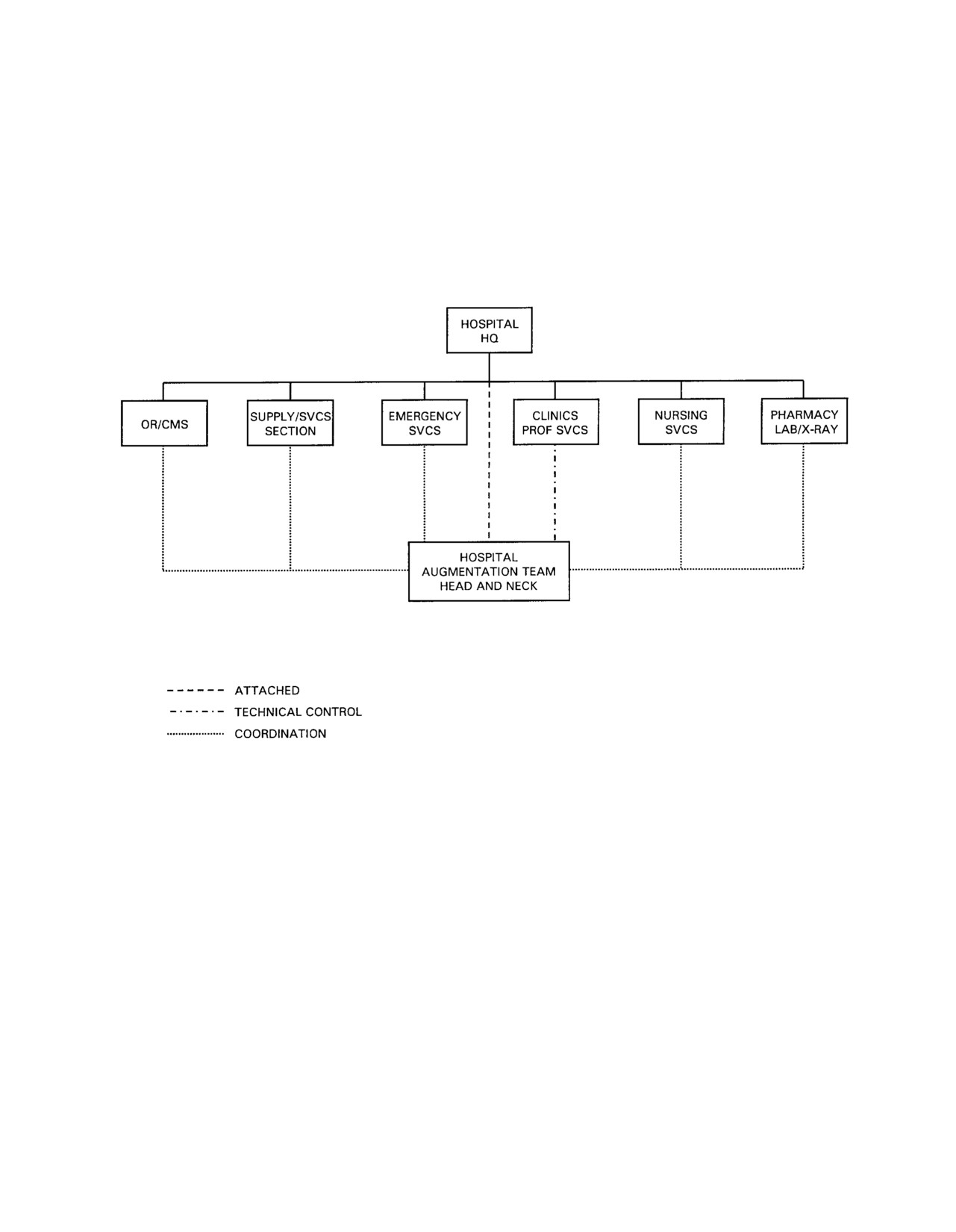
surgery utilizing the OR/CMS complex of the hospital to which it is attached. The operational and
command relationship is shown in Figure C-1.
Figure C-1. Hospital augmentation team, head and neck, operational and command relationship.
C-3
FM 4-02.10
APPENDIX D
HOSPITAL AUGMENTATION TEAM, SPECIAL CARE,
TOE 08538AA00
D-1. Introduction
The hospital augmentation team, special care, is a new organization as a result of the MRI. It is not a
replacement for any current unit.
D-2. Mission
The mission of this team is to augment an MTF with the necessary health personnel and equipment to
provide HSS to other military operations.
D-3. Assignment
This unit will be assigned to a medical brigade or MEDCOM and normally will be attached to a hospital or
other MTF.
D-4. Capabilities
This unit provides—
a. Pediatric inpatient, consultation, and nurse practitioner services.
b. Obstetrics/gynecology and specialty nursing services.
c.
Preventive medicine services.
d. Community health nursing services.
e.
Family physician services.
D-5. Limitations
This unit is dependent upon—
a. Appropriate elements of the theater for legal, religious, finance, personnel and administrative
services, laundry, bath, patient decontamination, mortuary affairs, clothing exchange, HSS, and EPW
security during processing and evacuation.
b. The hospital to which it is attached to provide sheltered working space, commonly used
equipment, inpatient nursing care for all patients, patient and food service, water distribution, transportation,
D-1
FM 4-02.10
security, personnel and administrative services, maintenance for organic equipment, patient administration,
coordination of MEDEVAC, power to support all equipment, and all classes of supply except medical
equipment set (MES), humanitarian care augmentation.
c.
The Department of the Army Assistant Chief of Staff (Operations and Plans) (G3) to grant
release authority to the Office of The Surgeon General (OTSG) for issue of the MES, humanitarian care
augmentation.
D-6. Basis of Allocation
The basis of allocation is one team per theater.
D-7. Mobility
a. This unit has no organic mobility. The PVNTMED physician, community health nurse, and
family nurse practitioner will require a vehicle from the supported unit to perform their mission.
b. This unit has 239 pounds (36 cu ft) of TOE assets requiring transportation.
c.
Teams will move as directed by higher command.
D-8. Employment
The medical brigade will provide C2 and support to the assigned hospital augmentation team, special care,
and will ensure continuous provision of health support during operations. The team will be employed and
further attached for support to hospitals.
D-9. Concept of Operations and Functions
The hospital augmentation team, special care, provides pediatric services, obstetrics/gynecology services,
PVNTMED services, community health nursing services, and family physician services. This team will be
dependent upon the hospital to which assigned or attached for sheltered working space and Class VIII
supply. It will depend upon OTSG and USAMMA for the MES, humanitarian care upon deployment. The
MES will provide an MTF with the additional pediatric, obstetrics/gynecology, general medical, and
nutritional supplies to support a civilian population of 10,000 people for 30 days. This MES will provide
basic items and is suitable for use as an initial push package to meet initial requirements. The intent is to
deploy the team and a pre-positioned MES separately for issue in theater. The MES is not organic to the
MTF MTOE. It augments the MTF to support humanitarian missions. As such, the MES is not included in
unit status reporting under the provisions of AR 220-1. The function of the hospital augmentation team,
special care, is to provide additional health personnel to augment an MTF for increased capability to
minimize nonbattle occupational injuries, support humanitarian missions, provide public health management
D-2
FM 4-02.10
of communicable disease/reportable conditions events, and to advise and provide health promotion services
to optimize health maintenance during long term deployments. The increased capability will enhance
medical capacity to prevent/control/eliminate nonbattle injuries, epidemics, and other diseases/illness. This
will be accomplished by enhanced on-site monitoring and analysis of injury, communicable disease and
other illness reports; performance of epidemiologic investigations; contact tracing; environmental controls
implementation; commander, staff, patient and community education regarding required disease and injury
control interventions. Additionally, the enhanced capability will include inpatient/outpatient care for a
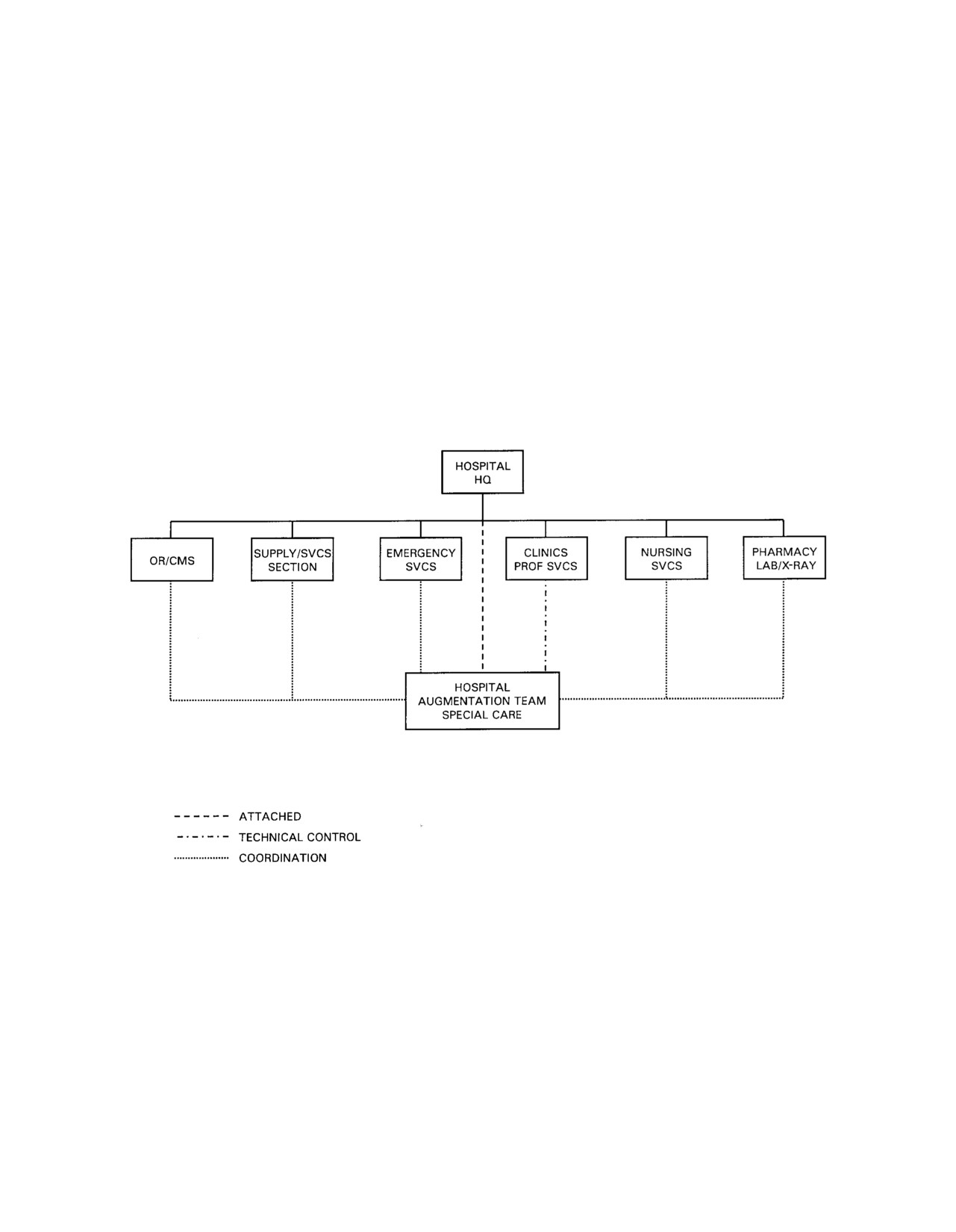
civilian population. The operational and command relationship is shown in Figure D-1.
Figure D-1. Hospital augmentation team, special care, operational and command relationship.
D-3
FM 4-02.10
APPENDIX E
HOSPITAL AUGMENTATION TEAM, PATHOLOGY,
TOE 08537AA00
E-1. Introduction
The Medical Team, Pathology, TOE 08537LA00, was initially organized based on MF2K requirements.
Under MRI, the Medical Team, Pathology, was reorganized as the Hospital Augmentation Team, Pathology,
TOE 08537AA00, which is the basis for this appendix. The TOE 08537LA00 will be rescinded when units
are no longer organized thereunder.
E-2. Mission
The mission is to provide pathology augmentation in support of theater hospitals and consultative services as
required.
E-3. Assignment
Assignment will be to a medical brigade or a MEDCOM and will normally be attached to a hospital.
E-4. Capabilities
The capabilities of this team are based on METT-TC. The team may provide—
a. Theater hospitals with an additional and an enhanced pathology capability in the following
areas:
• Anatomic pathology (for example, histology, cytology, and postmortem examination).
• Enhanced chemistry (for example, toxicology, immunochemistry, and therapeutic drug
monitoring).
• Enhanced microbiology.
b. Three days of supply for all organic elements upon deployment and during routine operations.
E-5. Limitations
This team is dependent upon—
a. Appropriate elements of the theater or corps for legal, religious, finance, personnel and
administrative services, bath and laundry support, clothing exchange, decontamination of remains, and
transportation support when the unit is required to relocate.
E-1
FM 4-02.10
b. The hospital to which it is attached to provide partial sheltered working space, commonly used
equipment, food service, water distribution, HSS, security, personnel and administrative services, unit
maintenance for generators, transportation, and all classes of supply.
E-6. Basis of Allocation
The basis of allocation is one per 2,360 conventional hospital patients in theater.
E-7. Mobility
a. This unit has no organic mobility.
b. This unit has 12,974 pounds (1,874 cu ft) of TOE assets requiring transportation.
E-8. Employment
The medical brigade or MEDCOM will provide C2 and support to the assigned hospital augmentation team,
pathology, and will ensure continued provision of pathology services to the corps and EAC. The hospital
augmentation team, pathology, will be employed with and further attached for support to hospitals.
E-9. Concept of Operations and Functions
The function of the hospital augmentation team, pathology, is to augment hospital laboratories with a
standardized team having capabilities for anatomic pathology, enhanced chemistry, and enhanced micro-
biology. Medical materiel sets will augment existing clinical laboratory equipment to support anatomic
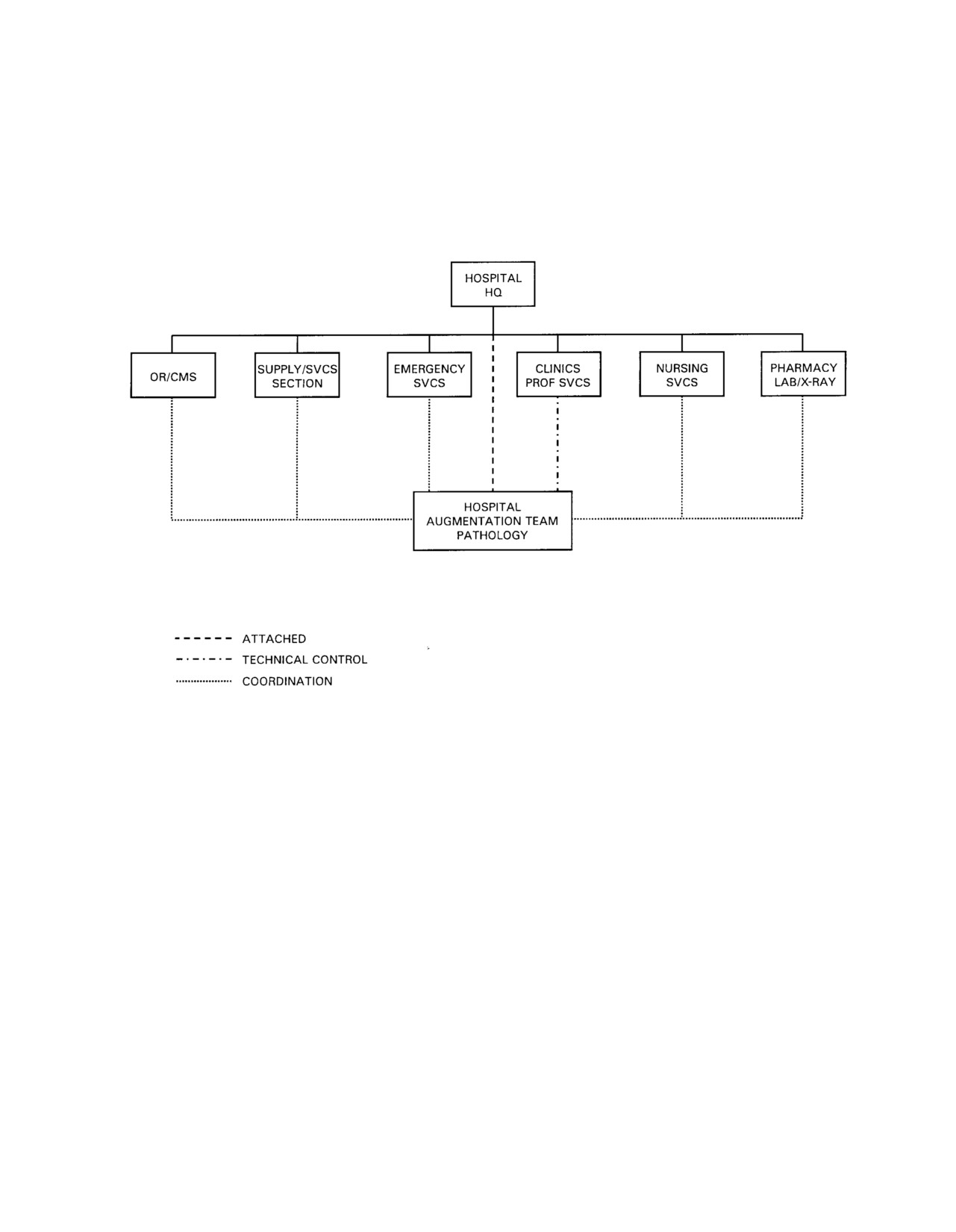
pathology and enhanced chemistry capabilities. The operational and command relationship is shown in
Figure E-1. The laboratory section has technical control of the pathology augmentation team.
E-2
FM 4-02.10
Figure E-1. Hospital augmentation team, pathology, operational and command relationship.
E-3
FM 4-02.10
APPENDIX F
MEDICAL TEAM, RENAL HEMODIALYSIS, TOE 08537LB00
F-1. Introduction
The medical team, renal hemodialysis, was initially developed based on MF2K requirements and was not
changed under the MRI. It is a part of and is included in the MRI hospitalization support system.
F-2. Mission
The mission is to provide medical augmentation to corps and EAC hospitals.
F-3. Assignment
Assignment is to a MEDCOM or a medical brigade and may be further attached to subordinate hospitals, as
required.
F-4. Capabilities
The medical team, renal hemodialysis, provides renal hemodialysis care for patients with acute renal failure
and consultative services on an area basis.
F-5. Limitations
This team is dependent on—
a. Appropriate elements of the corps or ASCC for legal, religious, finance, bath, laundry, and
clothing exchange support.
b. The hospital to which it is attached to provide sheltered working space, commonly used
equipment, field feeding (to include patient field feeding), HSS, personnel and administrative services, unit
level maintenance, transportation, security, patient administration, coordination of MEDEVAC, power to
support all equipment, and all classes of supply.
F-6. Basis of Allocation
The basis of allocation for this team is one per 550 conventional hospital patients in theater.
F-7. Mobility
This team requires no organic mobility.
F-1
FM 4-02.10
F-8. Employment
The MEDCOM or medical brigade will provide C2 and support to the assigned medical team and will
ensure its continued support to the corps and EAC. It will be attached to theater hospitals as required.
F-9. Concept of Operations and Functions
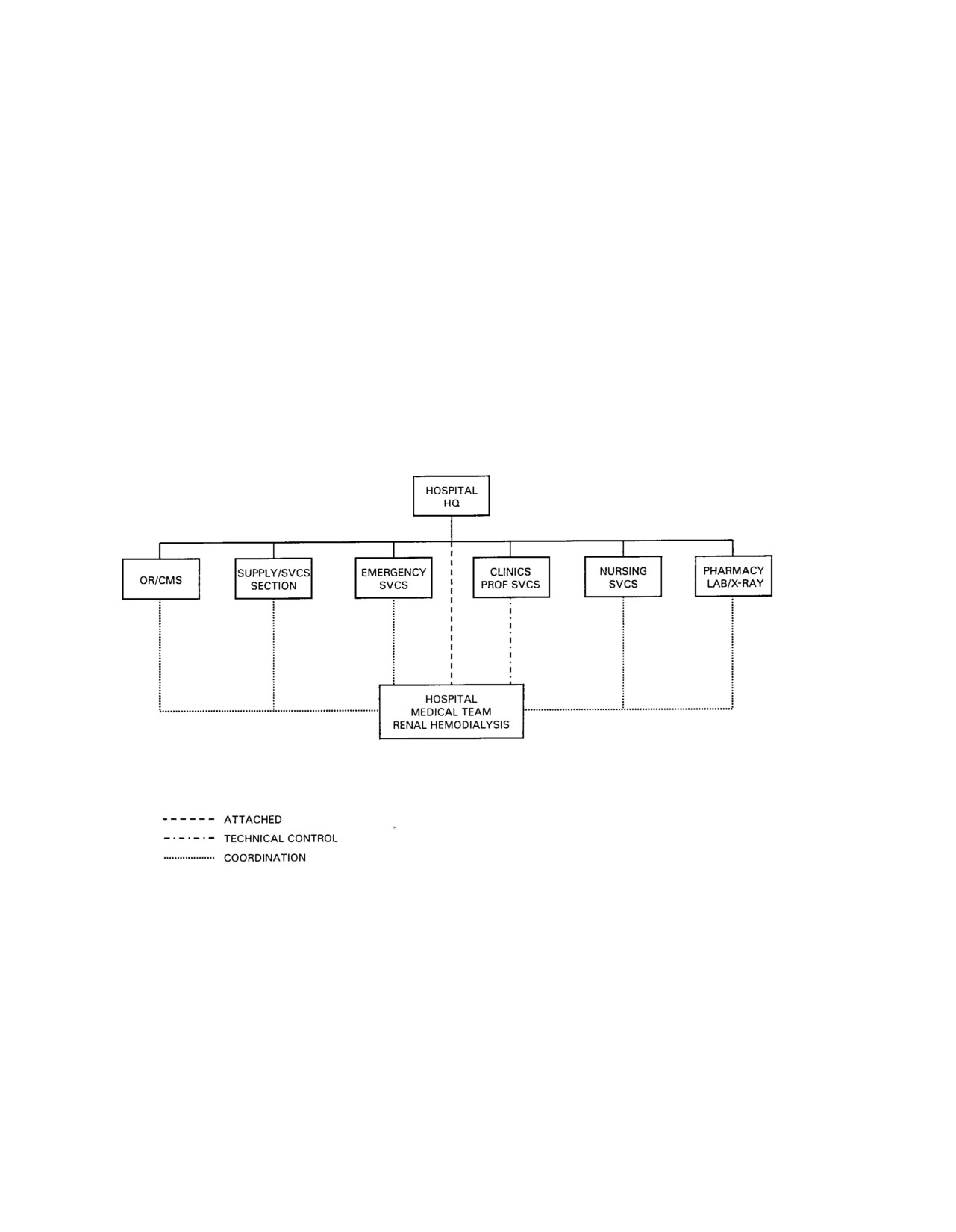
The function of this medical team is to provide support to hospitals as assigned. Its assignment will be
determined by the medical planners of the MEDCOM/medical brigade. The operational and command
relationship is shown in Figure F-1.
Figure F-1. Medical team, renal hemodialysis, operational and command relationship.
F-2
FM 4-02.10
APPENDIX G
MEDICAL TEAM, INFECTIOUS DISEASE, TOE 08537LC00
G-1. Introduction
The medical team, infectious disease, was initially developed based on MF2K requirements and was not
changed under the MRI. It has been integrated into the MRI hospitalization support system.
G-2. Mission
The mission of this team is to provide medical augmentation to corps and EAC hospitals.
G-3. Assignment
Assignment is to a MEDCOM or a medical brigade and may be further attached to a subordinate hospital,
as required.
G-4. Capabilities
This team provides infectious disease investigation, takes measures to control the spread of the disease,
assures access to health services, and provides consultative services to the health service unit to which
attached. This team may include or partner with special care teams with a PVNTMED/community health
nurse when public health measures are required.
G-5. Limitations
This team is dependent on—
a. Appropriate elements of the Corps or ASCC for legal, religious, finance, laundry, bath, and
clothing exchange support.
b. The hospital to which it is attached to provide sheltered working space, commonly used
equipment, field feeding (to include patient field feeding), HSS, personnel and administrative services, unit
level maintenance, transportation, security, patient administration, coordination of medical evacuation,
power to support all equipment, and all classes of supply.
G-6. Basis of Allocation
The basis of allocation for this team is one per 800 conventional hospital patients in theater.
G-7. Mobility
This team does not have organic lift capability and requires support from the CSH for mobility.
G-1
FM 4-02.10
G-8. Employment
The MEDCOM or medical brigade will provide C2 and support to the assigned medical team and will
ensure its continued support to the corps and EAC. It will be attached to a corps hospital as required.
G-9. Concept of Operations and Functions
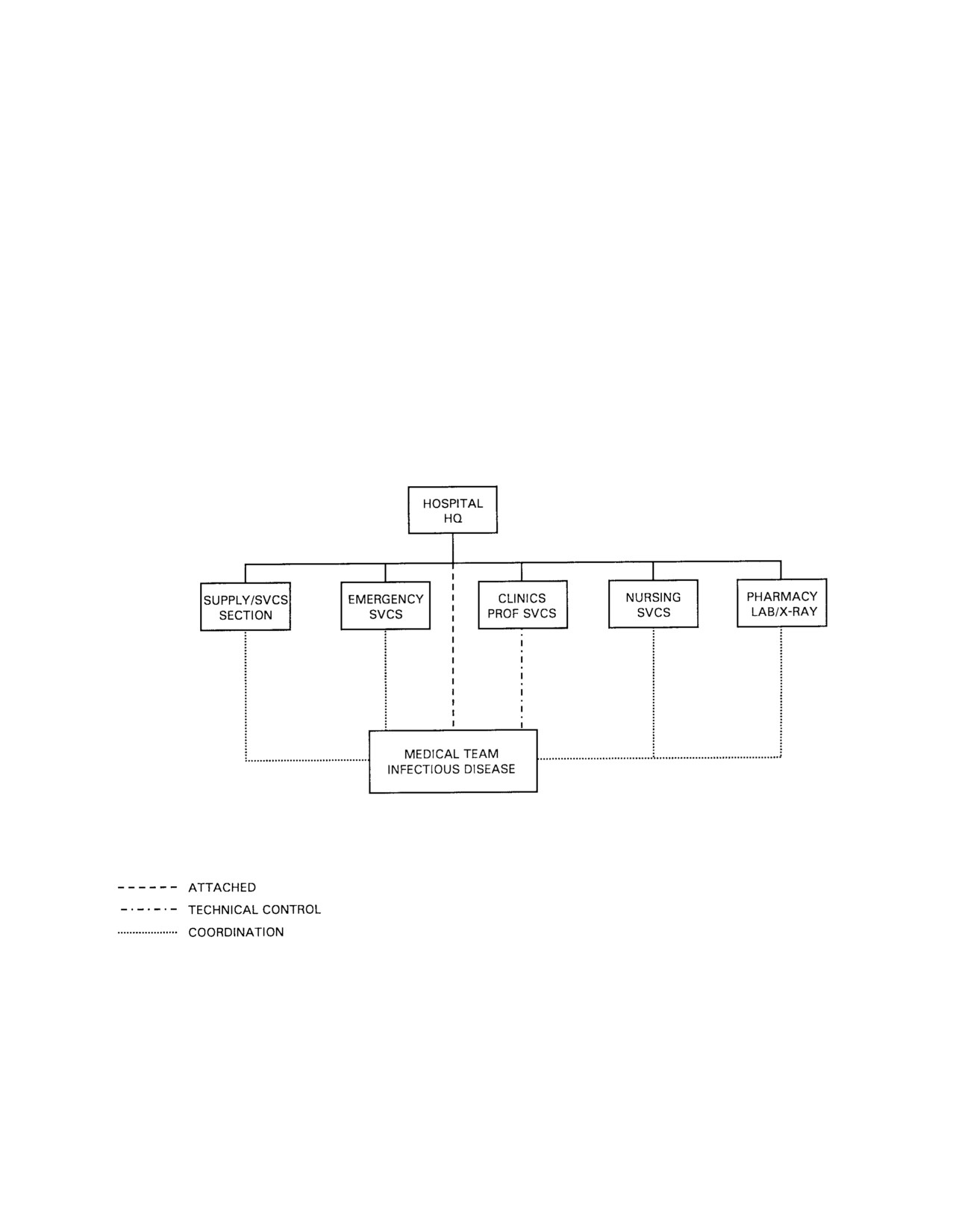
The function of this medical team is to provide support to hospitals as assigned. The medical planners of the
MEDCOM/medical brigade will determine its assignment. The operational and command relationship is
shown in Figure G-1.
Figure G-1. Medical team, infectious disease, operational and command relationship.
G-2
FM 4-02.10
APPENDIX H
HOSPITAL PLANNING FACTORS
This appendix provides information for CSH commanders, their staff, and assigned personnel. It contains
estimated planning factors for personnel, transportation and movement, supply, personnel service support,
HSS planning for hospitalization, and engineer requirements effective as of the date of this publication.
The data is an estimate and is not intended to be all-inclusive. Fluctuations and changes in the data
presented are contingent upon modifications to the TOE, its mission, and the scenario. This appendix does
not negate responsibility for the commander and his staff to initiate deployment planning and coordination
for his unit based on METT-TC. The CSH TOEs can be accessed at https://www.usafmsardd.army.mil.
This is a secure site requiring an access password. Hospital commanders should ensure that selected staff
members of the HHD, 84-bed and 164-bed medical companies attend a unit movement course to enhance
strategic deployment. For information on the Unit Movement Officer Deployment Planning Course,
contact the Commandant, US Army Transportation School, ATTN: ATSP-TDD-SD, Fort Eustis, VA
23604-5001. The telephone number is DSN 826-2039, commercial (757) 878-2039. Commanders should
use the MTOE to compute the unit’s specific movement data based on unit loads tailored for the mission.
Section I. CORPS HOSPITAL PLANNING FACTORS
H-1. Personnel Deployment Planning Factors
HHD
84 BED
164 BED
TOTAL (248 Bed)
Officer
13
56
84
153
Warrant Officer
2
0
0
2
Enlisted
44
114
172
330
Total
59
170
256
485
248 Bed
Personnel-weight (combat-equipped, includes
15-lb hand-carry bag)
220 lbs/man (485)
106,700 lbs
Mobilization bag-weight
25 lbs/man
12,125 lbs
Mobilization bag-cube
1 cu ft/man
485 cu ft
Check-in baggage-weight
70 lbs/man
33,950 lbs
Check-in baggage-cube
3 cu ft/man
1,455 cu ft
Total personnel-weight and cube with all gear
152,775 lbs
1,940 cu ft
HHD
Personnel-weight (combat-equipped, includes
15-lb hand-carry bag)
220 lbs/man (59)
12,980 lbs
Mobilization bag-weight
25 lbs/man
1,475 lbs
Mobilization bag-cube
1 cu ft/man
59 cu ft
Check-in baggage-weight
70 lbs/man
4,130 lbs
Check-in baggage-cube
3 cu ft/man
177 cu ft
Total personnel-weight and cube with all gear
18,585 lbs
236 cu ft
H-1
FM 4-02.10
Hospital Company A (84 Bed)
Personnel-weight (combat-equipped, includes
15-lb hand-carry bag)
220 lbs/man (170)
37,400 lbs
Mobilization bag-weight
25 lbs/man
4,250 lbs
Mobilization bag-cube
1 cu ft/man
170 cu ft
Check-in baggage-weight
70 lbs/man
11,900 lbs
Check-in baggage-cube
3 cu ft/man
510 cu ft
Total personnel-weight and cube with all gear
53,550 lbs
680 cu ft
Hospital Company B (164 Bed)
Personnel-weight (combat-equipped, includes
15-lb hand-carry bag)
220 lbs/man (256)
56,320 lbs
Mobilization bag-weight
25 lbs/man
6,400 lbs
Mobilization bag-cube
1 cu ft/man
256 cu ft
Check-in baggage-weight
70 lbs/man
17,920 lbs
Check-in baggage-cube
3 cu ft/man
768 cu ft
Total personnel-weight and cube with all gear
80,640 lbs
1,024 cu ft
44-Bed Early Entry Hospitalization Element
HHD (for 44 Bed)
Personnel-weight (combat-equipped, includes
15-lb hand-carry bag)
220 lbs/man (20)
4,400 lbs
Mobilization bag-weight
25 lbs/man
500 lbs
Mobilization bag-cube
1 cu ft/man
20 cu ft
Check-in baggage-weight
70 lbs/man
1,400 lbs
Check-in baggage-cube
3 cu ft/man
60 cu ft
Total personnel-weight and cube with all gear
6,300 lbs
80 cu ft
44 Bed
Personnel-weight (combat-equipped, includes
15-lb hand-carry bag)
220 lbs/man (133)
29,260 lbs
Mobilization bag-weight
25 lbs/man
3,325 lbs
Mobilization bag-cube
1 cu ft/man
133 cu ft
Check-in baggage-weight
70 lbs/man
9,310 lbs
Check-in baggage-cube
3 cu ft/man
399 cu ft
Total personnel-weight and cube with all gear
41,895 lbs
532 cu ft
H-2
FM 4-02.10
HHD (for 40-Bed)
Personnel-weight (combat-equipped, includes
15-lb hand-carry bag)
220 lbs/man (18)
3,960 lbs
Mobilization bag-weight
25 lbs/man
450 lbs
Mobilization bag-cube
1 cu ft/man
18 cu ft
Check-in baggage-weight
70 lbs/man
1,260 lbs
Check-in baggage-cube
3 cu ft/man
54 cu ft
Total personnel-weight and cube with all gear
5,670 lbs
72 cu ft
40 Bed
Personnel-weight (combat-equipped, includes
15-lb hand-carry bag)
220 lbs/man (36)
7,920 lbs
Mobilization bag-weight
25 lbs/man
900 lbs
Mobilization bag-cube
1 cu ft/man
36 cu ft
Check-in baggage-weight
70 lbs/man
2,520 lbs
Check-in baggage-cube
3 cu ft/man
108 cu ft
Total personnel-weight and cube with all gear
11,340 lbs
144 cu ft
HHD (for 164 Bed)
Personnel-weight (combat-equipped, includes
15-lb hand-carry bag)
220 lbs/man (21)
4,620 lbs
Mobilization bag-weight
25 lbs/man
525 lbs
Mobilization bag-cube
1 cu ft/man
21 cu ft
Check-in baggage-weight
70 lbs/man
1,470 lbs
Check-in baggage-cube
3 cu ft/man
63 cu ft
Total personnel-weight and cube with all gear
6,615 lbs
84 cu ft
H-2. Logistics Planning Factors (Classes I, II, III, IV, VI, and VIII)
a. Classes of Supply Planning Factor Rates.
Class of Supply
Planning Factor
Class I
4.03 pounds per man per day (PMD)
Class I—Information on available operational rations and menu planning in a TO is available in FM 10-23.
The DLA C-8900-SL Federal Supply Classification (FSC) Stock List Group 89, Subsistence, lists the
NSNs, item information, and weight and cube information for all operational rations. Menu planning
should be coordinated with the theater Class I manager to ensure the availability of the ration mix needed to
H-3
FM 4-02.10
support medical requirements. At a minimum, a 21-day basic load of medical nutritional supplements
should be deployed until the logistical system is fully capable of Class I support.
Class II
3.67 PMD
Class III
53.70 PMD (bulk)
0.59 PMD (packaged)
Class IV
8.500 PMD (includes 4.0 barrier materiel and
4.5 base construction)
Class VI
3.20 PMD
All soldiers should deploy with at least 30 days supply of personal demand items. If exchange support is not
readily available or cannot be established, health and comfort items are packaged and issued as a Health and
Comfort Pack (HCP). The DLA C-8900-SL FSC Stock List Group 89, Subsistence, lists the NSNs and
weight and cube information for the HCP Types I (all soldiers) and II (female only). Army Regulation
710-2 provides guidance on planning and requisition of these items. Adjustments in quantity or selection of
items in the HCP should be submitted to the theater Class I manager. The issue of HCPs will cease when
exchange facilities are available.
Class VIIIA (weight and cube planning factors are based on total Army analysis
[TAA] 11)
WIA
WIA
NBI
NBI
DIS
DIS
CHEM CHEM
Wt per Cube per Wt per
Cube per Wt per
Cube per Wt per
Cube per
Echelon Casualty Casualty
Casualty Casualty
Casualty Casualty
Casualty Casualty
IA
2.15
0.14
1.18
0.08
0.18
0.01
0.35
0.02
IB
12.83
0.41
3.07
0.14
0.45
0.03
0.62
0.03
II
14.28
0.70
7.41
0.35
3.90
0.18
1.28
0.04
IIF
62.00
0.00
62.00
0.00
0.00
0.00
0.00
0.00
III
325.11
12.97
108.76
4.94
77.88
2.35
41.15
1.69
IV
103.29
5.96
37.86
2.36
6.04
0.19
33.97
1.13
The above figures are an average of both theaters (Northeast Asia and Southwest Asia), broken down by
type of casualty (WIA, NBI, DIS, CHEM) showing the amount of materiel used at each level of care.
These amounts are shown in weight and cube.
Legend:
WIA — wounded in action
NBI — nonbattle injury
DIS — disease
CHEM — chemical
H-4
FM 4-02.10
b. Army Medical Field Feeding Policy. The Army medical field feeding policy for hospitalized
patients is three hot meals daily. The meals will consist of Unitized Group Rations (UGR) with the medical
diet supplement. The UGR is available in two options, UGR-Heat and Serve (H&S) which is nonperishable
and UGR-A, which includes perishable/frozen type entrees. Unitized Group Rations require mandatory
enhancements such as bread, milk, and cold cereal for completion. The MRE are not authorized for feeding
hospitalized patients except in emergencies when other rations are not available. In a mature TO, contract
food service may be used to feed hospitalized patients. The medical diet supplement may be used
with UGR, MRE, or contractor-provided foods for preparation of patient meals and nourishments (see
Appendixes K and L).
c.
Meal(s), Ready-to-Eat Policy for Soldiers. The Surgeon General’s policy on sole source
consumption of MRE for soldiers allows MRE to be consumed as the sole source of subsistence for up to 21
days. When available, bread, fruit, and milk as enhancements to the MRE are recommended. See Appendixes K
and L for additional information on use of MRE with medical diet supplements for patient feeding.
d. Patient Meals. Patients are exempt from the theater rations policy and will receive three
prepared hot meals per day. To support 24-hour patient care, the hospital may prepare four meals per
day—breakfast, lunch, dinner, and a night meal. The night meal may utilize a breakfast or lunch/dinner
menu according to local procedures.
e.
Staff Meals. Staff assigned to medical units will be fed according to the service theater ration
policy. However, to simplify procurement, meal preparation, and service, staff may be served the patient
regular hot meal if available.
f.
Nutrition Care in Stability Operations and Support Operations.
(1) The hospital nutrition care section may be involved in feeding a healthy or malnourished
population. The nutrition care services may be provided directly to the HN population or displaced persons
through nutrition assessment, therapeutic feeding, and population-based feeding programs. Indirect nutrition
care assistance includes serving as a consultant to the HN medical education system to develop HN
nutritional care specialists and nutritional programs.
(2) Contract food service support may be procured for the deployed force. When the
contract includes feeding the hospital staff and patients, only one dietitian and one or two nutrition care
specialists may be deployed. However, if the mission requires support to a large population, the full
nutrition care section should be deployed. Regardless of the number of personnel deployed, the nutrition
care personnel are responsible for ensuring that hospital nutrition care services are provided. They must
ensure that the correct patient diets and nourishments are provided by the contractor at the right times.
To ensure that patient needs are met, a process is developed (with the contractor, the nutrition care
section, and hospital nursing services working together) for ordering and delivering patient meals and
nourishments.
(3) The provision of adequate fluids for rehydration and minimizing the effects of diarrhea is
imperative. The CSH dietitian is capable of providing expertise on the increased fluid requirements for
rehydration and minimizing the effects of diarrhea.
H-5
FM 4-02.10
g. Nutrition Care Section Support for the Stay-Behind 40-Bed Slice of the 84-Bed CSH (Corps).
When the hospital forward deploys a 44-bed hospital, the entire nutrition care section (personnel and
equipment) deploys with it. There are no nutrition care personnel or equipment that would be left with the
stay-behind 40-bed slice. Personnel in the stay behind 40-bed slice must obtain food service support from
the 164-bed company or from another unit in the area.
h. Management and Planning Blood Requirements.
(1) The management and distribution of blood in the TO is a function of combat health
logistics. In the long term, and in a mature theater, blood management is based on resupply from the
CONUS blood donor base, using a combination of liquid and frozen blood products. Each CSH stores
liquid blood and a combination of liquid and frozen blood products of various groups and types.
(2) Liquid blood products enter the theater through the USAF Blood Transshipment Centers
(BTCs) for further distribution to the Army blood support detachment, located with the MEDLOG battalion.
The blood support detachment provides collection, manufacturing, storage, and distribution of blood and
blood products to division, corps, and EAC MTFs. The blood support detachment is resupplied from a
supporting USAF BTC. The blood support detachment commander may also serve as the Area Joint Blood
Program Officer (AJBPO) if a DOD AJBPO is not available.
(3) Blood collection in the theater is governed by theater policy, but normally is done to
provide platelets for emergency situations. Limited testing of blood drawn in the theater is done to
minimize danger to recipients.
(4) Blood shipped into the AO will be packed red blood cells (RBC) and FFP and, possibly,
frozen platelets. Subject to availability, RBC shipped from CONUS are packed with the following unit
group and type distribution:
Blood Group/Type
Distribution
O Rh Positive
40%
O Rh Negative
10%
A Rh Positive
35%
A Rh Negative
5%
B Rh Positive
8%
B Rh Negative
2%
(5) Blood planning factors.
Blood Component
Planning Factor
Red Blood Cells
*4 units for each WIA and NBI casualty initially
admitted to a hospital
Fresh Frozen Plasma
0.08 units for each hospitalized WIA or NBI
Frozen Platelet Concentrate
0.04 units for each hospital WIA or NBI
*For blood planning purposes, count the WIA or NBI only one time in the system, not each
time the patient is seen or admitted.
H-6
FM 4-02.10
(6) The expected admission rates per day are critical in computing initial blood requirements.
These rates, along with the above blood planning factors, provide the planner with an initial estimate of
daily blood requirements.
Sample Calculations for Initial Blood Requirements
Expected Initial Admission rate for WIA and NBI = 8 per 1,000 per day
Total Personnel = 10,000
RBC Planning Factor = 4 units
Formula:
(Total Personnel/1,000) x Admission Rate Per Day x Factor = Blood or Blood
Component Per Day
Example:
(10,000/1,000) x 8 x 4 = 320 units of RBCs per day
(For additional information on blood requirements and calculations, see FM 8-55.)
i.
Estimated Oxygen Planning Factors and Requirements.
(1) Estimated planning factors.
OR Table: 2.8 liters/minute during operational time.
ICU Beds: 4.5 liters/minute for 17 percent of the total ICU beds (patients on resuscitator/
ventilator).
ICU Beds:
3.1 liters/minute for 17 percent of the total ICU beds (patients on nasal
cannula/mask).
Miscellaneous Requirements: An additional factor of 10 percent is applied to the total of
OR and ICU requirements to account for oxygen requirements in other areas of the
hospital.
(2) Oxygen conversion factors.
1 gal (gaseous oxygen)
=
0.1333 cu ft
95 gal “D” cylinder
=
12.7 cu ft
1650 gal “H” cylinder
=
220 cu ft
1 cu ft (gaseous oxygen)
=
28.317 liters
95 gal “D” cylinder
=
359.63 liters
1650 gal “H” cylinder
=
6229.74 liters
j.
Showers.
(1) The OTSG recommends, from a health maintenance perspective, a minimum of one
shower and one change of uniform per soldier per week. While this meets the minimum health standard
requirements, from a morale standpoint the Army goal is one standard shower and one expedient shower
per week with two changes of uniform. The central hygiene and laundry planning factors are based on
these two showers and fifteen pounds of laundry per soldier per week.
H-7
FM 4-02.10
(2) Central hygiene, shower and laundry water is required by theater quartermaster elements
to provide individual soldier laundry and bath field services. Water for centralized hygiene, such as
field showers, can be disinfected nonpotable fresh water when approved by PVNTMED. Water for laundry
services can be nonpotable fresh water. Water used for personal hygiene will be potable water only.
The health threat may impact the water quality standards and limit the use of nonpotable water for field
services.
k.
Wastewater Planning Factors. The hospital should plan for all patient and staff water, and all
laundry water requirements to become wastewater. See Appendix J for the disposal of wastewater.
l.
Solid Waste Factors.
(1) Solid waste calculation (estimated):
Total patients (beds) x 15 lbs = total patient solid waste per day
Staff x 12.5 lbs
= total staff solid waste per day
(2) Hospital infectious waste planning factors (estimated):
3 lbs (1 cu ft) of infectious waste generated per bed per day
H-3. Hospital Operational Space Requirements
Table H-1 provides estimated operational space requirements that are applicable to both the corps and EAC
CSH. This FM does not provide exact operational space requirements for all situations. Due to the
modular nature of DEPMEDS, the recommended space requirements serve as guidelines only. The actual
space requirement will be dependent on the specific hospital configuration for a given mission, the available
terrain, and the terrain topography.
Table H-1. Estimated Operational Space Requirements
164-BED HOSPITAL COMPANY
246,394 SQ FT
÷
43,560 SQ FT PER ACRE
=
5.7 ACRES
84-BED HOSPITAL COMPANY
248,454 SQ FT
÷
43,560 SQ FT PER ACRE
=
5.7 ACRES
EARLY ENTRY HOSPITALIZATION
156,816 SQ FT
÷
43,560 SQ FT PER ACRE
=
3.6 ACRES
ELEMENT (44 BED)
HOSPITALIZATION AUGMENTATION
87,555 SQ FT
÷
43,560 SQ FT PER ACRE
=
2.01 ACRES
ELEMENT (40 BED)
248-BED COMBAT SUPPORT HOSPITAL
403,432 SQ FT
÷
43,560 SQ FT PER ACRE
=
9.3 ACRES
H-8