FM 4-02.10 THEATER HOSPITALIZATION (JANUARY 2005) - page 6
FM 4-02.10
(3) Submit request to AMC for personnel being air transported.
(4) Prepare required forms for hazardous cargo to be airlifted.
(5) Prepare DA Form 2940-R for vehicles, trailers, MILVANs, pallet loads, or other exterior
shipping containers.
(6) Prepare aircraft load plans as required by Military Airlift Command.
O-39. Miscellaneous Logistics
a. Finalize support arrangements for rear detachment, if required.
b. Have all supply and maintenance accounts closed out and signature cards canceled.
c.
Notify the appropriate activity, in writing, of the termination date of any contract that provides
supplies or services.
d. Billeting.
(1) All personnel in BOQ or BEQ will clear quarters.
(2) Notify finance of the cutoff date for BAQ for all single personnel.
(3) Brief dependent families on family quarters policies and procedures.
(4) All personnel residing off-post will either terminate their leases or make other suitable
arrangements.
e.
Secure personal property.
(1) Inventory and pack personal property.
(2) Provide soldiers with a copy of the personal property inventory.
(3) Transfer all personal property to the supporting transportation element.
f.
Real property facilities.
(1) Request termination of assigned RPF.
(2) Request designation of interim RPF manager through command channels.
(3) Transfer accountability for RPF to the interim RPF manager prior to deployment.
O-25
FM 4-02.10
Section VII. REDEPLOYMENT/DEMOBILIZATION
Redeployment and demobilization activities are essentially the same functions as those involved in
mobilization and deployment. The procedures are similar, whether the CSH is redeploying to its point of
origin (home station) or to another AO. Redeploying a CSH will normally do so in the same manner in
which they mobilized and deployed. Field Manuals 3-35.5 (100-17-5) and 100-17, JP 4-05, and ARTEP 8-
855 (MRI)-MTP describes in detail redeployment demobilization procedures (see Chapter 4). Redeploy-
ment/demobilization activities will ensure that all solders complete the Postdeployment Health Assessment
Form (DD Form 2796, see Appendix N). A copy of this form will go in the individual’s medical record and
a copy will be sent to AMSA in accordance with Joint Staff Memorandum MCM 0006-02 and DODI
6490.3.
O-26
FM 4-02.10
APPENDIX P
LAW OF WAR OBLIGATIONS FOR MEDICAL PERSONNEL
P-1. Law of War
a. Sources.
(1) Sources for the law of war obligations of the US are treaties ratified by the US. As such,
they are part of the supreme law of the land. The US is obligated to adhere to these treaty obligations even
when an opponent does not. It is the policy of the DOD and the US Army to conduct its military operations
in a manner consistent with these treaty obligations.
(2) In the area of HSS, the law of war sources are the Geneva Conventions for the Protection
of War Victims of 12 August 1949. Questions regarding implementation and interpretation of these treaties
should be directed to the command judge advocate, or to the Office of the Judge Advocate General of the
Army.
b. Geneva Conventions. The four 1949 Geneva Conventions are as follows:
(1) Geneva Convention for the Amelioration of the Condition of the Wounded and Sick in the
Armed Forces (GWS). This convention provides for the protection of Armed Forces personnel who are
wounded and sick on the battlefield. It requires States Parties to a conflict to take all possible measures to
search for and collect the military wounded and sick; to protect them against pillage and ill treatment; to
ensure their adequate care; and to search for the military dead. It also provides for the protection of
AMEDD personnel. The GWS is the primary source for the obligations set forth in this appendix.
(2) Geneva Convention for the Amelioration of the Condition of Wounded, Sick and
Shipwrecked Members of the Armed Forces at Sea (GWS [Sea]). This treaty extends the guarantees of the
GWS for wounded, sick or shipwrecked military personnel at sea. Once those personnel are placed on
land, the GWS provisions apply.
(3) Geneva Convention Relative to the Treatment of Prisoners of War (GPW). This treaty
provides protection for military personnel who fall into enemy hands. Captured military wounded and sick
remain prisoners of war during their recovery from their wounds or sickness, and for the duration of their
captivity.
(4) Geneva Convention Relative to the Protection of Civilian Internees in Time of War (GC).
The convention provides for the protection of civilians in the hands of enemy military forces, or who are in
enemy-occupied territory. It also sets forth standards for their medical care.
P-2. Medical Implications of Geneva Conventions
a. Provisions for Collection of Wounded and Sick. Provisions must be made for the collection
and treatment of military wounded and sick personnel, whether friend or foe. Only urgent medical reasons
may determine priority in the order of treatment to be administered. This means that military wounded or
sick enemy personnel may require treatment before military wounded US or allied personnel. The principle
P-1
FM 4-02.10
of triage is consistent with this obligation. For military wounded or sick enemy military personnel, a dual
responsibility exists—custodial and medical. The custodial activity of guarding military wounded or sick
EPW should be carried out by assets other than AMEDD personnel. The echelon commander will
designate nonmedical units to act as guards when EPW are in medical channels.
b. Accountability and Custody of Enemy Prisoners of War. Enemy prisoners of war or retained
personnel (RP) evacuated through medical channels must be identified and their accountability established
prior to evacuation per appropriate TSOP. Sick, injured, and wounded EPW or RP may be evacuated
through normal medical channels, but segregated from US and allied personnel. They may also be
evacuated through dedicated or task-organized evacuation assets, particularly in rear areas where they are
likely to be moved in a group.
c.
Responsibility for and Handling of Prisoners of War. The US Army is responsible for the care
and treatment of EPW and RP Army units capture, and for EPW/RP captured by other US Services or allies
upon their transfer to Army custody. Below brigade level, EPW/RP are handled by combat troops who
bring them to the forward or brigade collecting points. Subject to the tactical situation and available
resources, EPW/RP wounded, injured, or sick will be evacuated from the CZ as soon as possible. Only
those injured, sick, or wounded EPW/RP who would run a greater health risk by being immediately
evacuated may be temporarily kept in the CZ. When intelligence sources indicate that large numbers of
EPW/RP may result from an operation, medical units may require reinforcement to support the additional
EPW/RP patient workload. In this case, the care of wounded, injured, and sick EPW/RP becomes a joint
matter between the ground combat commander and the medical commander. For a more detailed discussion
on the administration, handling, treatment, and identification of EPW/RP, see AR 190-8.
d. Identification and Protection of Medical Personnel.
(1) Personnel exclusively engaged in the performance of medical duties in connection with
the wounded, injured, or sick in medical units or establishments may wear, affixed to the left arm, a water-
resistant brassard/armband bearing the distinctive emblem (a red cross on a white background) prescribed
by GWS and GWS (Sea). The wearing of brassards/armbands will be at the discretion of the tactical
commander in far forward areas.
(2) Medical personnel as identified in paragraph (1) are to carry a special identity card, DD
Form 1934 (Geneva Conventions Identity Card for Medical and Religious Personnel Who Serve in or
Accompany the Armed Forces), issued to all persons qualifying as protected medical personnel (see AR
600-8-14). This special identification card will be carried in addition to their regular identification card.
(3) Enemy military personnel meeting the definition of medical personnel contained in
paragraph (1) who are captured are considered RP and not EPW. They will receive the benefits and
protection afforded them by the GWS and GPW. They may be required to treat injured, wounded, or sick
EPW/RP. United States medical personnel or medical units that are captured may be required to do
likewise, continuing to provide medical support for injured or sick US or allied prisoners of war/RP while
in captivity. In such a situation, this probably would be a primary source of treatment for US prisoners of
war and RP, although enemy wounded could be treated also.
P-2
FM 4-02.10
(4) Personnel protected as medical personnel under the GWS must be exclusively engaged in
medical duties or administration of medical units. This includes all military personnel permanently assigned
to a medical unit and exclusively engaged in its mission, including cooks, mechanics, drivers, or admin-
istration personnel. Performance of any activity inconsistent with this mission removes the protection, and
the DD Form 1934 must be withdrawn. For example, if an ambulance driver is tasked with driving an
unmarked tactical vehicle forward with ammunition prior to evacuating casualties, he would not be exclu-
sively engaged in medical duties and would not be entitled to continued classification as medical personnel.
e.
Self-Defense.
(1) Medical personnel may carry small arms for personal defense of themselves and defense
of their patients. This does not mean that they may resist capture or otherwise fire on the advancing enemy.
It means that, if civilians or enemy military personnel are attacking and ignoring the marked medical status
of medical personnel, medical transportation or the medical unit, the medical personnel may provide
self-protection. If an enemy force merely seeks to assume control of a military medical facility or a vehicle
for the purposes of inspection and without firing on it, the facility or vehicle may not resist.
(2) Medical personnel are entitled to carry defensive small arms only. By Army policy these
are defined as service rifles (M-16) and pistols (M9 or M11).
(3) An overall defense plan may not require medical units to take offensive or defensive
action against enemy troops at any time. If a medical force is part of a defensive area containing nonmedical
units, medical personnel may not be responsible for manning part of the overall perimeter. If located in
isolation, the medical unit may provide its own local and internal security if other support is not available.
However, a medical unit may not be defended from capture or inspection by enemy forces by military
police or other soldiers acting as pickets.
(4) If medical personnel fire on enemy troops or otherwise abuse their protected status by engag-
ing in acts harmful to the enemy, they may be attacked. It is also possible that such a violation could result in an
allegation of violation of the law of war by the capturing force. For example, if an enemy force was advancing
on a marked medical facility and medical personnel within the facility then took advantage of their protected
status to fire at the enemy, the enemy forces would be entitled to return fire and medical personnel sub-
sequently captured may be charged with a violation of the law of war. Under the law of war, this action would
constitute an act of perfidy. It would be akin to firing on enemy soldiers while bearing a flag of truce.
This paragraph implements STANAG 2931.
f.
Marking of Medical Units/Facilities and Transportation.
(1) Medical units and facilities.
(a) The distinctive emblem (red cross on a white background) provided in the GWS
and GWS (Sea) for medical units, facilities, and transportation shall be displayed only over such medical
P-3
FM 4-02.10
units and facilities (except veterinary) as are entitled to be respected under the conventions, subject to the
authorization of the tactical commander of a brigade-size or larger unit. The marking of facilities and the
use of camouflage are incompatible and should not be undertaken concurrently. The camouflage of medical
units is regulated by ARs and also, in the European theater, by NATO STANAG 2931. It is not envisioned
that fixed, large medical facilities will be camouflaged. The medical commander must be aware of who has
the authority to order camouflage and its duration. The camouflage of medical facilities is one of the more
difficult issues to reconcile with operational necessities. The problem has been present in past wars but now
is more critical due to the ability of intelligence assets to see deep into the rear AO. If the failure to
camouflage endangers or compromises the tactical mission, the camouflage of medical facilities may be
ordered by a NATO commander of at least brigade level or equivalent. Such an order is to be temporary
and local in nature and is rescinded as soon as circumstances permit.
(b) The camouflage of a medical unit does not deprive it of its protected status.
However, an enemy force is not required to forego an attack on a camouflaged facility unless it recognizes it
as a medical facility. The use of defensive arms by medical personnel at a camouflaged site attacked by
ground maneuver forces is not authorized unless the actions of the attacking forces clearly are illegal rather
than the result of mistaken identity. Medical personnel should attempt to make the attackers aware of their
status rather than fighting back.
(c) If medical facilities are used to commit acts harmful to the enemy, the protection of
those facilities may be withdrawn if the acts are not stopped after warning. This might be the case where a
facility is used as an observation post or if combat information was reported or relayed through the facility.
(2) Medical transportation.
(a) Standard air and ground ambulances should be marked with the distinctive emblem
when performing medical missions. Medical transportation may not bear the distinctive emblem if and so
long as it is used for nonmedical missions. Fighting vehicles, such as a tank, are not entitled to bear the
distinctive emblem even when used for battlefield evacuation. However, aviators and drivers with status as
medical personnel may not perform nonmedical tasks without risk of loss of their medical personnel status.
As such, the policy that benefits the mission to the greatest degree is to use air and ground medical
transportation exclusively for medical tasks.
(b) Crew-served weapons may not be mounted on ambulances or air ambulances, even
if mounting brackets are present.
(c) Vehicles other than fighting vehicles (such as tanks) may be used in a dual role,
moving wounded to the rear bearing removable distinctive emblems. However, the distinctive emblems
must be removed before nonmedical tasks are attempted. Care must be taken so that the protection
provided by the distinctive emblem is not abused.
(d) The protection provided medical aircraft bearing the distinctive emblem extends
only to areas in which it is entitled to operate due to the absence of enemy forces or, if enemy forces are
present, with the consent of enemy forces. If the latter, medical aircraft may operate only at such times and
on such routes for which there is agreement, and medical aircraft must land to be searched if summoned to
P-4
FM 4-02.10
do so by enemy forces. Failure to respond to a summons to land may entitle the enemy to attack the
aircraft. Medical aircraft may be used for combat search and rescue (CSAR) missions if all vestiges of its
medical aircraft status, such as the distinctive emblem, are removed for the duration of the CSAR mission.
In such cases, it would not be operating as a medical aircraft but as a military aircraft. The legal prohibition
is not on the use of an aircraft normally dedicated to medical missions, but on use of its status as a medical
aircraft during any CSAR mission. If used for CSAR missions, military aircraft are not entitled to
protection from enemy attack.
g. Civilians—Wounded and Sick. Civilians who are injured, wounded, or become sick as a result
of military operations may be collected and provided initial medical treatment in accordance with theater
policies. If treated, treatment will be on the basis of medical priority only. If treated, they shall be
transferred to appropriate civil authorities as soon as possible. The echelon commander and medical unit
commanders jointly exercise responsibilities for custody and treatment of the sick, injured, or wounded
civilian personnel. Enemy civilians detained by US forces are entitled to military medical care during their
detention. Treatment will be on the basis of medical priority only.
h. Captured Medical Supplies and Equipment. Because medical supplies and equipment captured
from the enemy are considered neutral and protected, they are not to be intentionally destroyed. If these
items are considered unfit for use, or if they are not needed for US and allied forces, noncombatants, or
EPW patients, they may be abandoned for enemy use. Since captured medical personnel are familiar with
their medical supplies and equipment, the captured items are especially valuable in the treatment of EPW.
Use of these captured items for EPW and the indigenous population helps to conserve other medical
supplies and equipment. When the capture of US medical supplies and equipment by enemy forces is
imminent, these items are not to be purposely destroyed. Every attempt must be made to evacuate them.
Those items that cannot be evacuated should be abandoned; however, such abandonment is a command
decision.
P-3. Compliance with the Geneva Conventions
a. As the US is a signatory to the Geneva Conventions, all medical personnel should thoroughly
understand the provisions that apply to HSS activities. Violation of these Conventions can result in the loss
of the protection afforded by them. Medical personnel should inform the tactical commander of the
consequences of violating the provisions of these Conventions.
b. Outright violations of the Geneva Conventions result when—
• Medical personnel are used to man or help man the perimeter of nonmedical facilities,
such as unit trains, logistics areas, or base clusters.
• Medical personnel are used to man any offensive-type weapons or weapons systems.
• Medical personnel are ordered to engage enemy forces in other than self-defense, or in
the defense of patients and MTFs.
P-5
FM 4-02.10
• Crew-served weapons are mounted on a medical vehicle.
• Mines or booby traps are placed in and around medical units and facilities.
• Hand grenades, light antitank weapons, grenade launchers, or any weapons other than
rifles and pistols are issued to a medical unit or its personnel.
• The site of a medical unit is used as an observation post, a fuel dump, or an ammunition
storage site.
c.
Possible consequences of violations described in b above are—
• Loss of protected status for the medical unit and personnel.
• Medical facilities attacked and destroyed by the enemy.
• Medical personnel being considered prisoners of war rather than retained persons when
captured.
• Health service support capabilities are decremented.
d. Other examples of violations of the Geneva Conventions include—
• Making medical treatment decisions for the wounded and sick on any basis other than
medical priority, urgency, or severity of wounds.
• Allowing the interrogation of enemy wounded or sick even though medically con-
traindicated.
• Allowing anyone to kill, torture, mistreat, or in anyway harm a wounded or sick enemy
soldier.
• Marking nonmedical unit facilities and vehicles with the distinctive emblem or making
any other unlawful use of this emblem.
• Using medical vehicles marked with distinctive Geneva emblem for transporting
nonmedical troops, equipment, and supplies.
• Using a medical vehicle as a tactical operations center.
e.
Possible consequences of violations described in d above are—
• Criminal prosecution for war crimes.
• Reprisals taken against our wounded in the hands of the enemy.
P-6
FM 4-02.10
• Medical facilities attacked and destroyed by the enemy.
• Medical personnel being considered prisoners of war rather than RP when captured.
P-7
FM 4-02.10
APPENDIX Q
EXAMPLE OF HOSPITAL LAYOUT
This appendix provides an example of a hospital layout for the 44-bed, 84-bed, 164-bed and 248-bed
configurations. The example layouts support modular deployment and split-base operations. The examples
support hospital incremental deployment and relocation with minimal disruption of hospital operations. The
layouts support hospital operations in a contaminated environment.
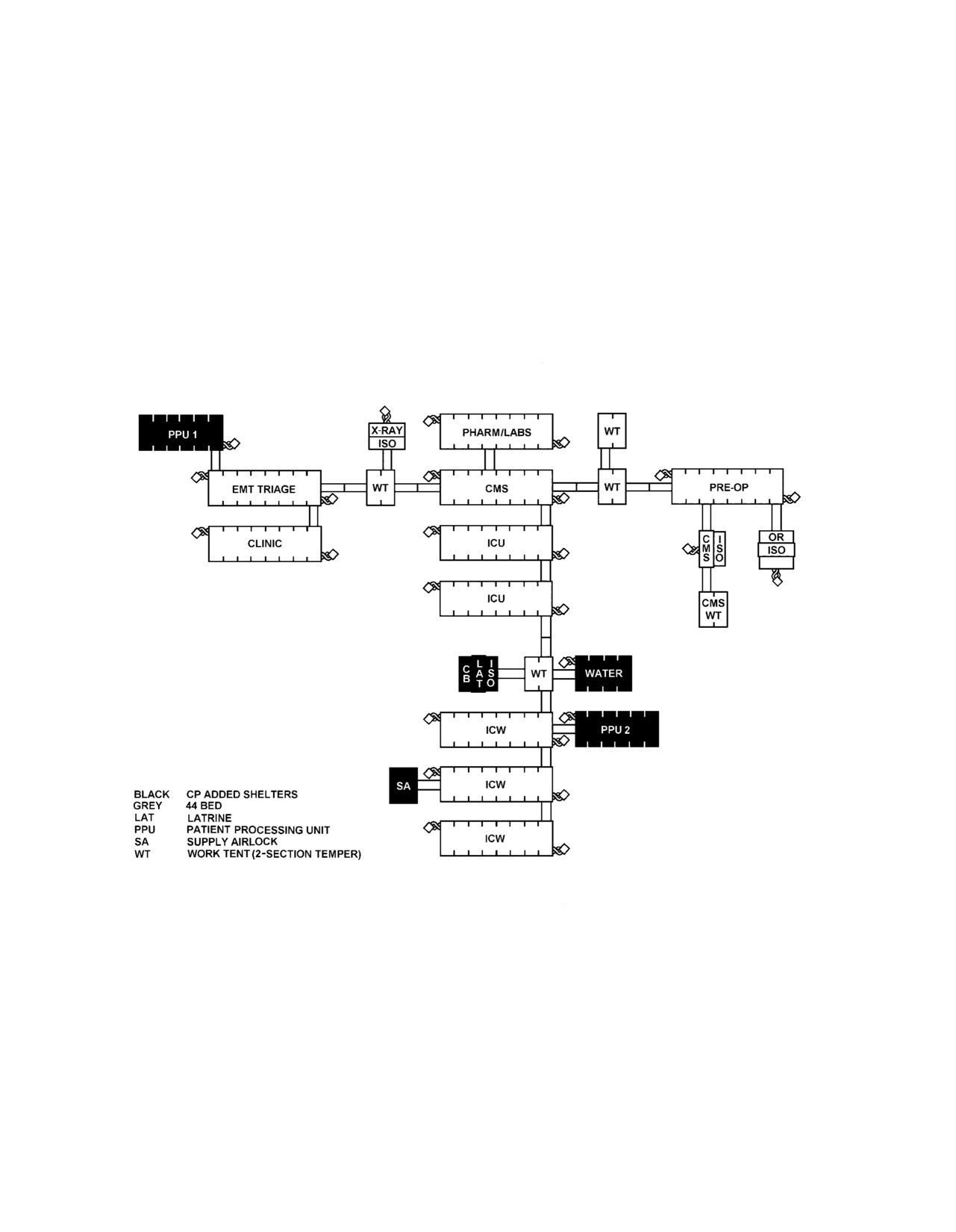
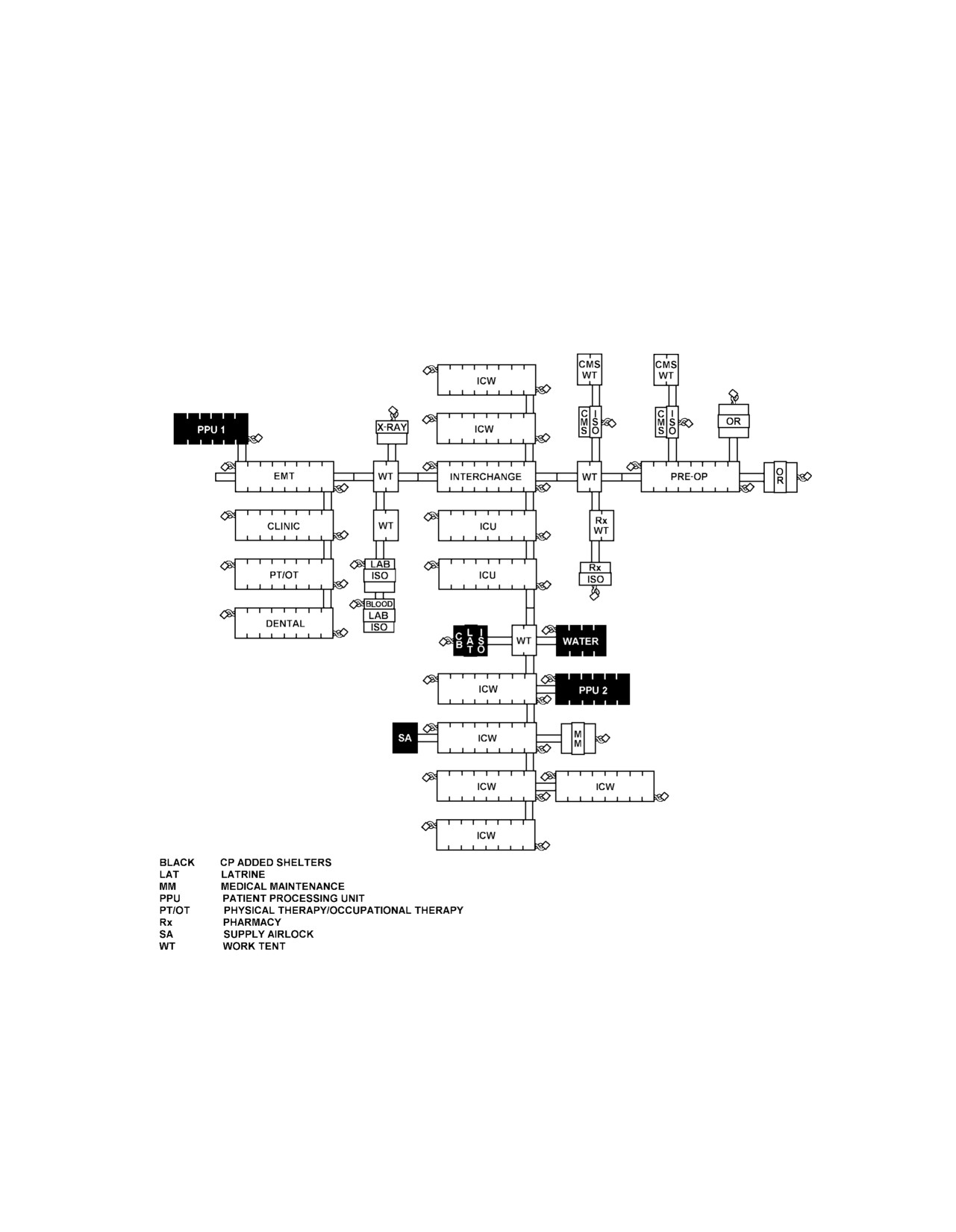
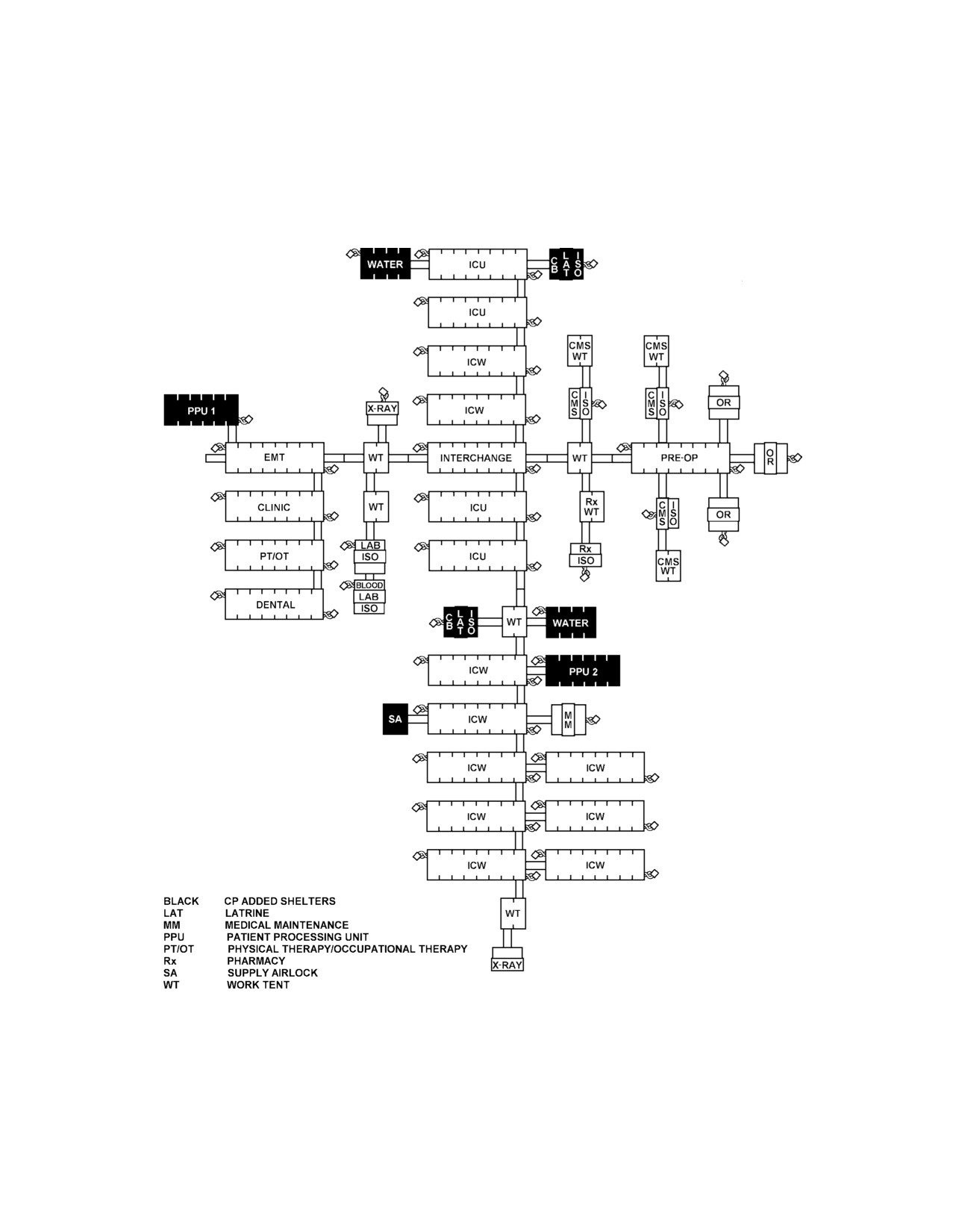
a. The 84- and 164-bed configuration can be deployed independently of one another or be
combined to make a 248-bed hospital. An example of a 44-bed/84-bed hospital company layout is shown in
Figure Q-1 (page Q-2). An example of a 164-bed hospital company is shown in Figure Q-2 (page Q-3).
Figure Q-3 (page Q-4) gives a recommended 248-bed hospital layout. The actual layout of the hospital is
contingent upon the METT-TC factors and guidance provided by the hospital commander.
b. The corps and EAC CSHs are very similar in design (see Figures 2-4 through 2-7 and
paragraphs 2-4f and 4-6a—b). With minor adjustments, Figure Q-1 can be used as the basis for the layout
of the EAC CSH. The EAC CSH has no split-base capability.
c.
When issued collective protection (CP) equipment, the CSH will be capable of establishing the
chemical and biological protected shelter system for operation in a contaminated environment. Hospitals
are issued CP equipment at the time of deployment. The hospital commander, in coordination with the
theater surgeon, must make the decision whether or nor CP equipment will be installed when the hospital is
initially being set up. If not installed when the hospital is initially being set up, the hospital complex would
have to be struck and reset up with the CP equipment. Refer to FM 4-02.7, TM 10-8340-224-13, and TM
10-8340-224-23P for establishment and operational procedures.
d. Issue of CP equipment will require additional transportation support. Additional generators
will be issued with the CP equipment. The following are additional requirements to operate in a CP mode:
• The 84- and 164-bed adds two patient processing units (48’ TEMPER), one CB latrine
(3:1 ISO), one water tent (32’ TEMPER), and a supply airlock (16’ TEMPER).
• The 248-bed MRI adds two patient processing units (48’ TEMPER), two CB latrines (3:1
ISO), two water tents (32’ TEMPER), and a supply airlock (16’ TEMPER).
e.
The hospital will set up and locate the patient decontamination area at least 30 to 50 yards
downwind of the hospital.
Q-1
FM 4-02.10
Figure Q-1. Example of a combat support hospital 44-bed/84-bed hospital company layout.
Q-2
FM 4-02.10
Figure Q-2. Example of a combat support hospital 164-bed hospital company layout.
Q-3
FM 4-02.10
Figure Q-3. Example of a combat support hospital (248 bed) layout.
Q-4
FM 4-02.10
APPENDIX R
STAKING PLAN AND LAYOUT
R-1. General
a. There are many variations in which a DEPMEDS hospital can be complexed. As previously
stated, the commander has the final approval as to how the hospital will be laid out. This section provides
specific dimensional criteria and instructions to ensure the proper alignment of TEMPERs and ISOs.
b. Six sets of dimensions are critical for complexing DEPMEDS hospitals. These dimensions
provide for connecting the various shelters, passageways, and vestibules.
(1) The TEMPER door panel to an ISO side closeout panel.
(2) The ISO side closeout panel to an ISO end closeout panel.
(3) The ISO end closeout panel to a TEMPER endwall door.
(4) The TEMPER side door panel to a TEMPER side door panel.
(5) The TEMPER endwall door to an ISO side closeout panel.
(6) The TEMPER endwall door to a TEMPER endwall door.
R-2. Starting Point
You know what is to be set up, and you have a rough drawing of the complex. Where are you going to
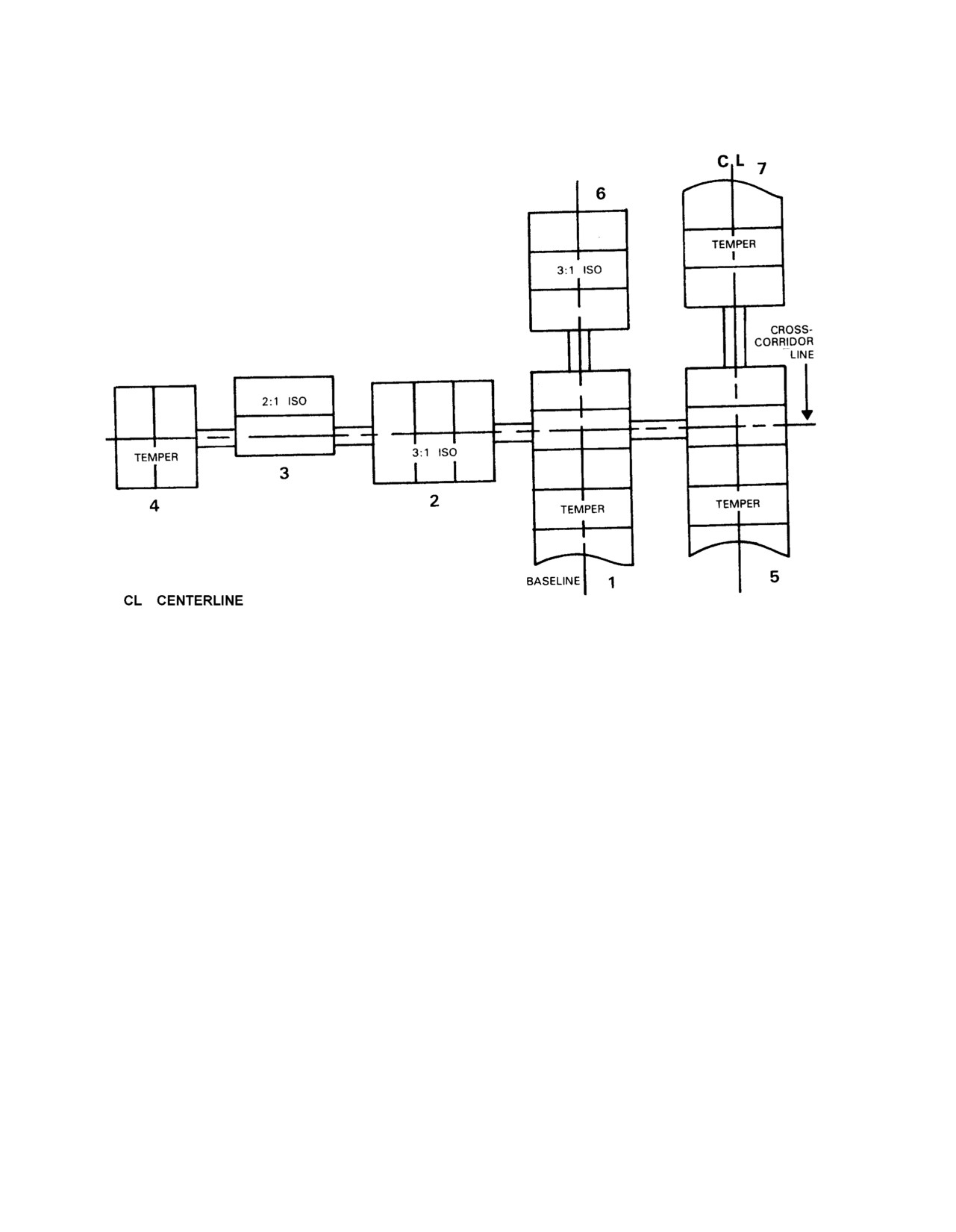
start? For an example, we are going to explain the setup of the complex shown in Figure R-1. Our starting
point will be the eight-section TEMPER marked 1. The starting point may be any shelter you desire. The
only criteria are that it be as near the center of the complex as possible. The shelter in Figure R-1 could be
the EMT/triage MMS. We will stake the shelters in the order shown in Figure R-1.
R-1
FM 4-02.10
Figure R-1. Deployable Medical System complex.
R-3. Baseline
Establish a baseline by physically placing a strip of engineer tape on the ground (see Figure R-2). This strip
of tape should run the entire length of your planned complex. Notice that the baseline in Figure R-1 runs
through the center of an eight-section TEMPER and a 3:1 ISO.
R-4. Control Point
Establish a control point (Stake A) and mark it on the baseline (see Figure R-2). Use a stake, can lid, or
other material to mark this or any other point. Our only suggestion is that the marker be something that can
readily be identified. All of the measurements on the baseline will be made from this control point.
R-5. Cross-Corridor Point
When completed, your hospital will be a complex of ISOs and TEMPERs, joined by corridors. The
corridors are marked as cross-corridor points in Figure R-2. Referring to the figure, notice that the cross-
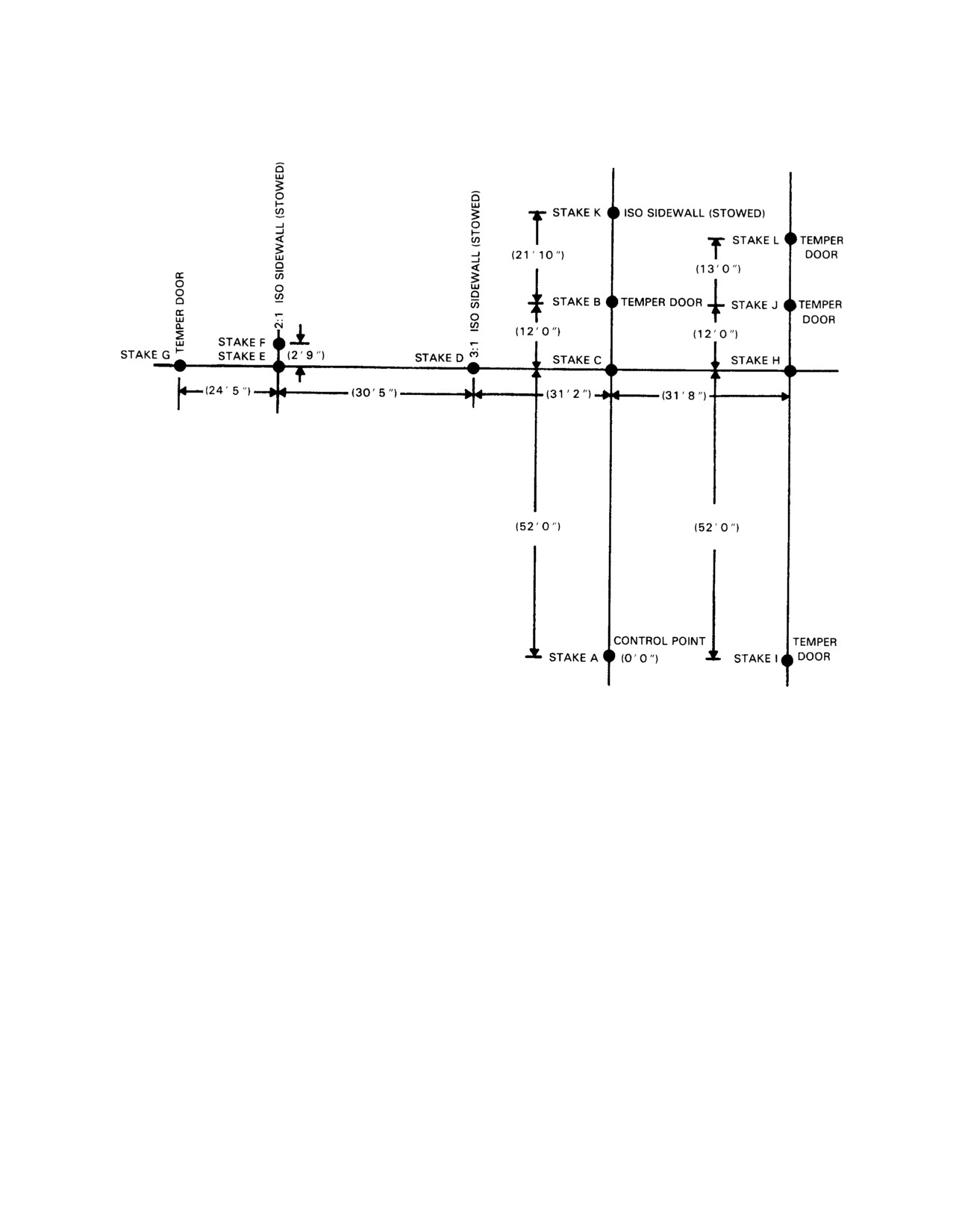
corridor point on the baseline is 52 feet from the control point. There are two reasons for this. First, the
cross-corridor point for a TEMPER must be placed in the center of a door section, or 4 feet from the end of
that section. The end section of a TEMPER issued prior to May 1989, must be a window section. Door
sections do not have the inlets and outlets for the air conditioner/heater.
R-2
FM 4-02.10
Figure R-2. Staking plan.
R-6. Cross-Corridor Line
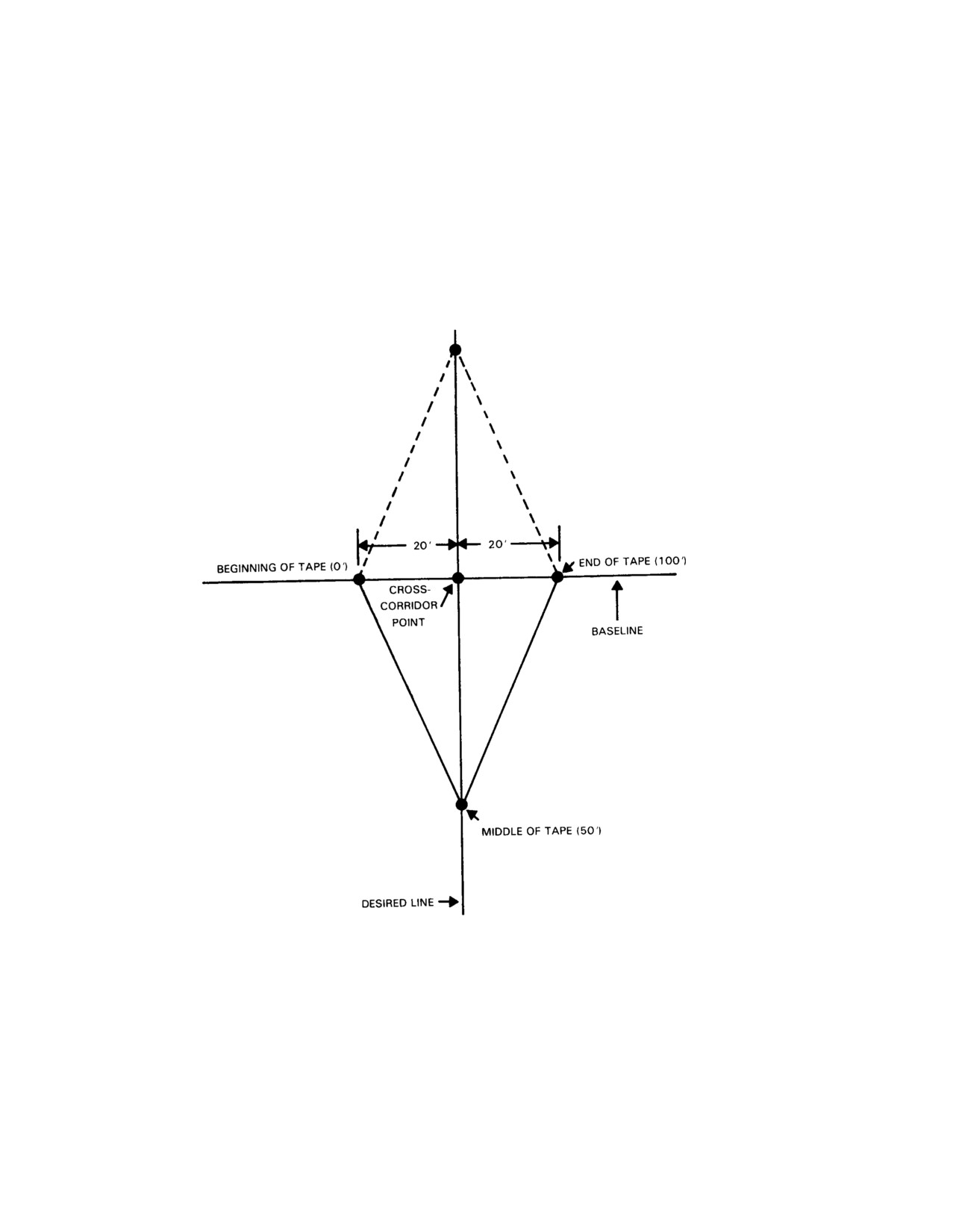
a. The line at the cross-corridor point is at a right angle to the baseline. How do you establish a
right angle in the field? There are several ways. The easiest requires a 100-foot tape measure and three
soldiers (see Figure R-3).
• On the baseline, measure and mark a point 20 feet to the left of the cross-corridor point.
• Measure and mark another point 20 feet to the right of the cross-corridor point.
• Position a soldier at each point. Have one soldier hold the “O” mark on the tape
measure. Instruct the other soldier to hold the “100-foot” mark.
• Instruct the third soldier to grasp the tape measure at the 50-foot mark. Stretch the tape
out in the direction of the desired line. The tape should be stretched to its full length.
• Mark the point on the ground where the 50-foot mark on the tape reaches.
R-3
FM 4-02.10
• Have the third soldier move to the other side of the baseline and repeat the above steps.
• Stretch a length of engineer tape between the two points just marked.
Figure R-3. Plotting a right angle.
b. The line formed by this length of engineer tape is at a 90-degree angle to the baseline. Extend
this cross-corridor line the entire width of the compound. A cross-corridor line may be established at any
point on any line using these procedures.
R-4
FM 4-02.10
R-7. Tent, Extendable, Modular, Personnel Staking
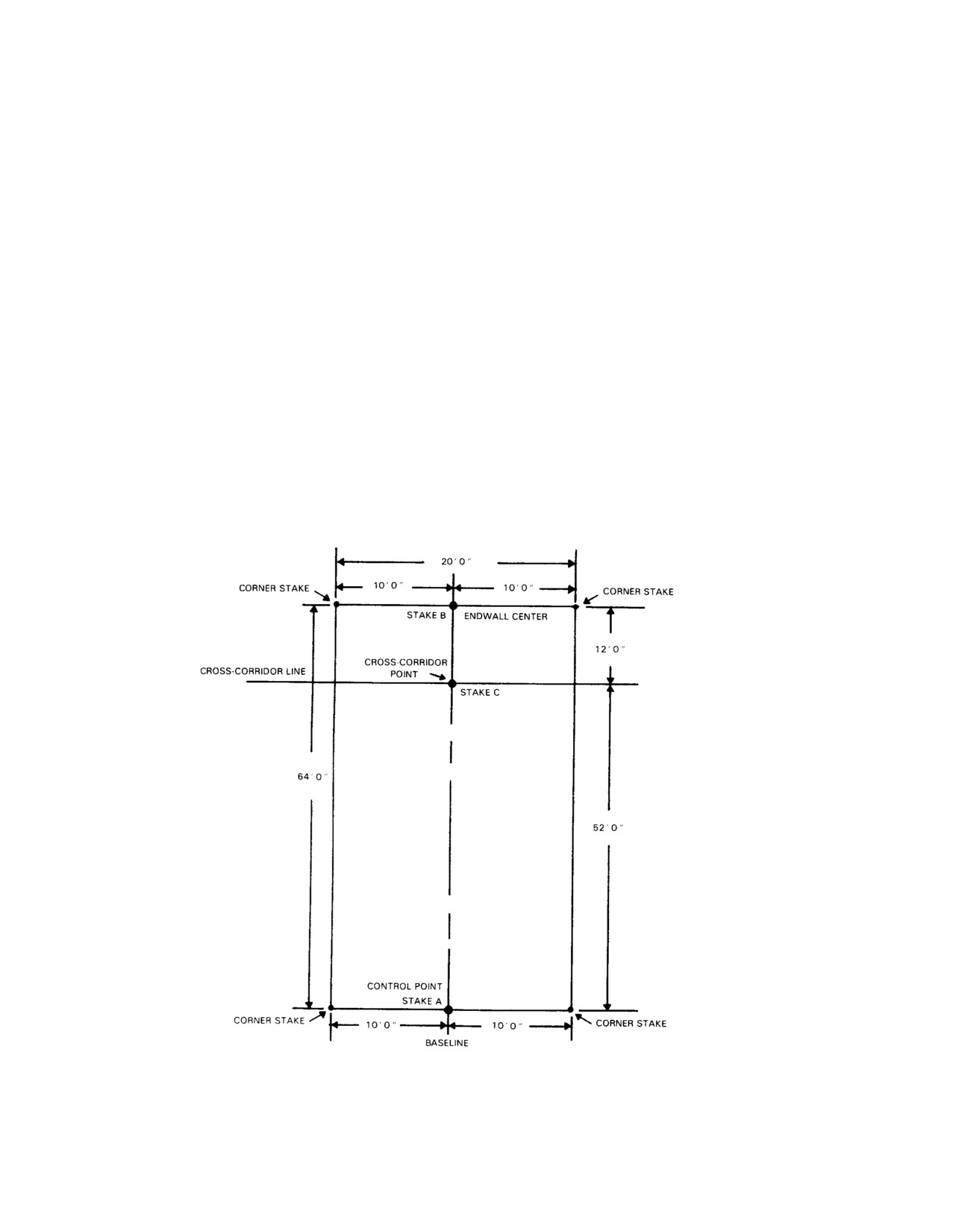
The baseline will extend through the center of the TEMPER. We suggest, however, that you do not attempt
to center the TEMPER over the line. Instead, we suggest that you measure and mark the four corners (see
Figure R-4).
a. If you will recall, the control point marks the center of the door on the TEMPER endwall.
Measure 10 feet on both sides of the control point (Stake A) and mark those spots. Use the procedures in
paragraph R-6 to ensure that the spots are at right angles to the baseline.
b. Measure off 64 feet on the baseline from the control point, or 12 feet from the cross-corridor
point (Stake C). Mark this spot (Stake B). Remember that the cross-corridor point (Stake C) is 52 feet from
the control point. This spot will mark the center of the endwall door at the other end of the TEMPER.
c.
Repeat the procedures in paragraph R-7a at this point. When completed, you will have
marked the four corners of the TEMPER.
Figure R-4. Tent, extendable, modular, personnel staking.
R-5
FM 4-02.10
R-8. Tent, Extendable, Modular, Personnel Door Panel to International Organization for Stan-
dardization Side Closeout Panel
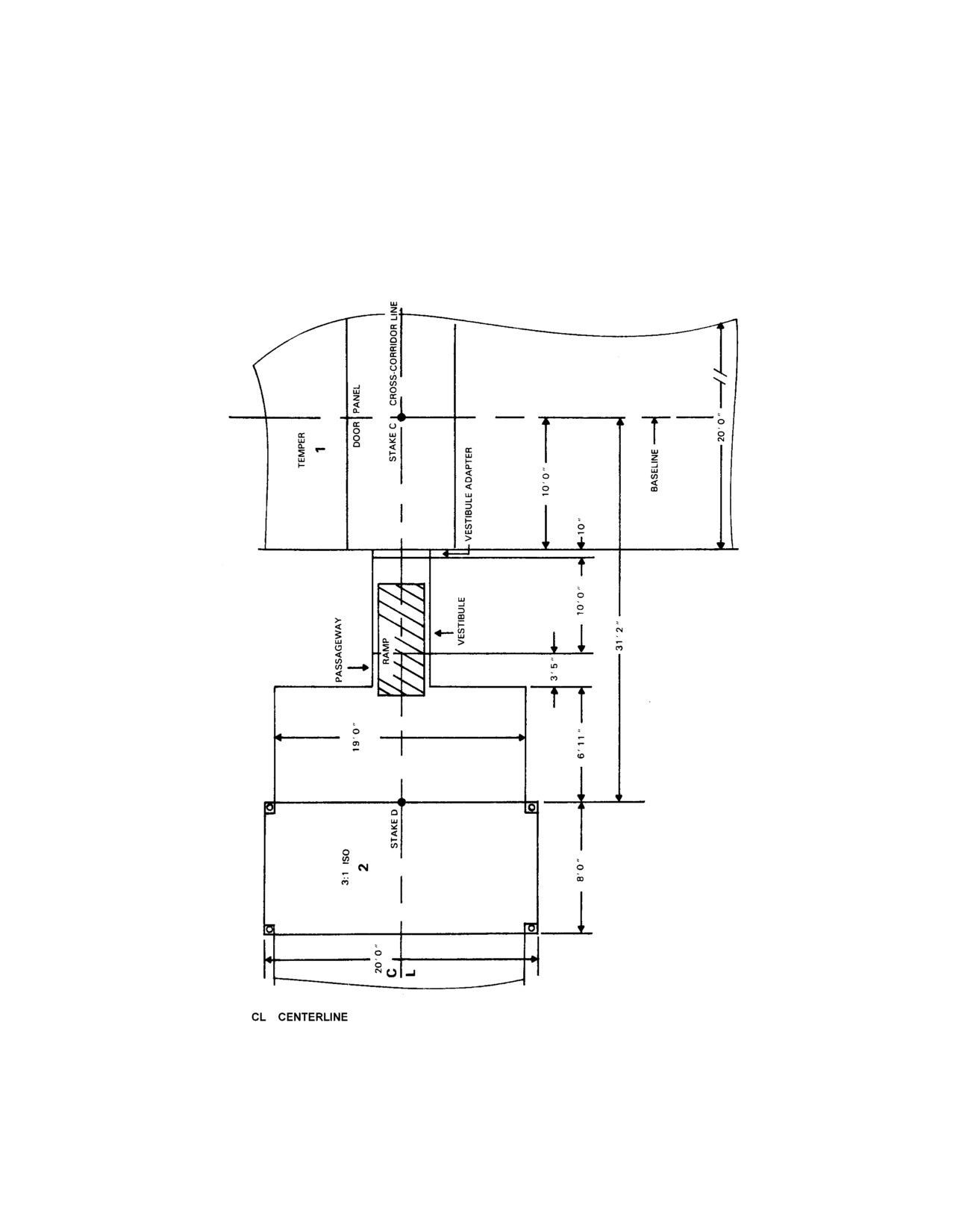
The next shelter to be staked is a 3:1 (pronounced 3 for 1) ISO (No. 2 in Figure R-1). According to our
plan, the TEMPER just staked will be connected to the side closeout panel of the ISO (see Figure R-5).
a. Where do you want the ISO placed when it is moved to the site? There are several things that
you must take into consideration.
(1) The ISO, of course, will be unexpanded when moved into position. Therefore, you must
allow for the width of the expansion; 6 feet, 11 inches.
(2) There are two types of passageways.
(a) The first is an ISO to TEMPER passageway. This passageway measures 3 feet, 5
inches. It has a metal ramp that measures 11 feet, 2 inches.
(b) The ISO to ISO passageway is 6 feet long. It has a ramp that is 8 feet, 2 inches long.
(3) Vestibules are issued with each TEMPER. The vestibule is 10 feet long and is designed
to connect two TEMPERs. Due to the length of the ramp, we strongly recommend that you use a vestibule
with the passageway when connecting an ISO to a TEMPER. If not, the ramp will extend 6 feet, 11 inches
into the TEMPER itself. This could present some safety hazards, especially if an ISO is connected to the
other side of the TEMPER. It also reduces the amount of floor space.
(4) Each TEMPER door has a flap around it called a vestibule adapter. The vestibule is
attached to the adapter. The only difference between the endwall door adapter and the sidewall adapter is
their length. The endwall vestibule adapter measures 1 foot, 6 inches, while the door section adapter
measures only 10 inches.
b. As you will notice in Figure R-5, the ISO staking point (Stake D) is 31 feet, 2 inches from the
baseline (Stake C). This allows—
(1) Ten feet from the baseline (Stake C) to the TEMPER door.
(2) Ten inches for the vestibule adapter around the TEMPER door.
(3) Ten feet for the vestibule.
(4) Three feet, five inches for the passageway.
(5) Six feet, eleven inches for the ISO expansion.
c.
Measure the 31 feet, 2 inches on the cross-corridor line and mark the spot (Stake D). From
there, mark the corners of the ISO. Measure 10 feet to the left and right as you face the baseline, and mark
R-6
FM 4-02.10
both spots. If the corners are straight, they should each measure 31 feet, 2 inches to the baseline. If not, adjust
the corner marks as needed.
Figure R-5. The TEMPER door panel to ISO side panel.
R-7
FM 4-02.10
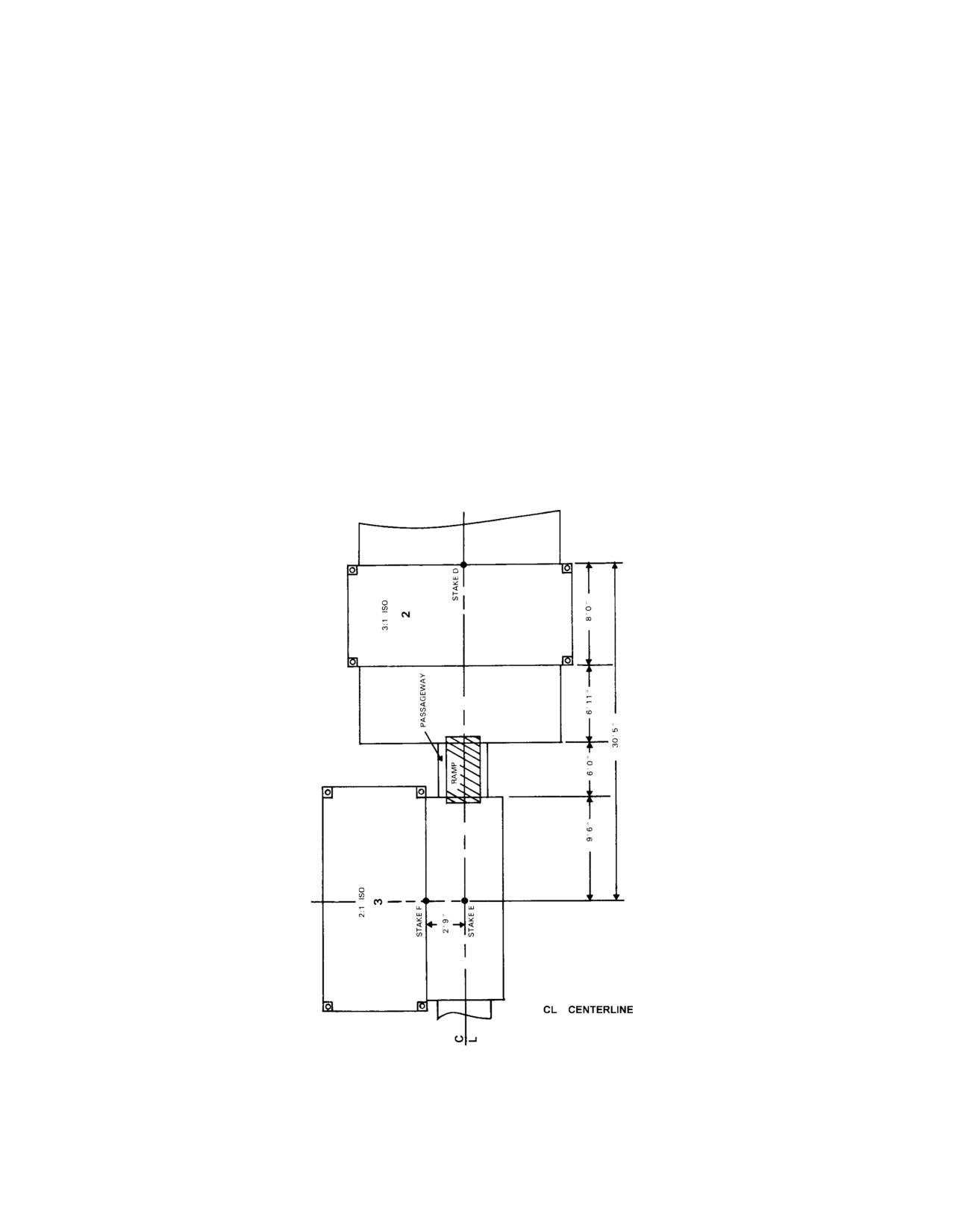
R-9. International Organization for Standardization Side Closeout Panel to International Organi-
zation for Standardization End Closeout Panel
a. Our plan now calls for the connection of the end closeout panel of a 2:1 ISO (No. 3 in Figure
R-1) to the other side of the 3:1 ISO just staked (see Figure R-6). Measure from the staking point for the
3:1 ISO (Stake D) on the cross-corridor line. The distance to the next staking point (Stake E) is 30 feet,
5 inches. This will take you to the center of the 2:1 ISO expansion. This measurement includes—
(1) Eight feet for the 3:1 ISO.
(2) Six feet, eleven inches for the 3:1 ISO expansion.
(3) Six feet for the passageway.
(4) Nine feet, six inches to the center of the 2:1 ISO expansion (Stake E).
Figure R-6. The ISO side panel to ISO end panel.
R-8
FM 4-02.10
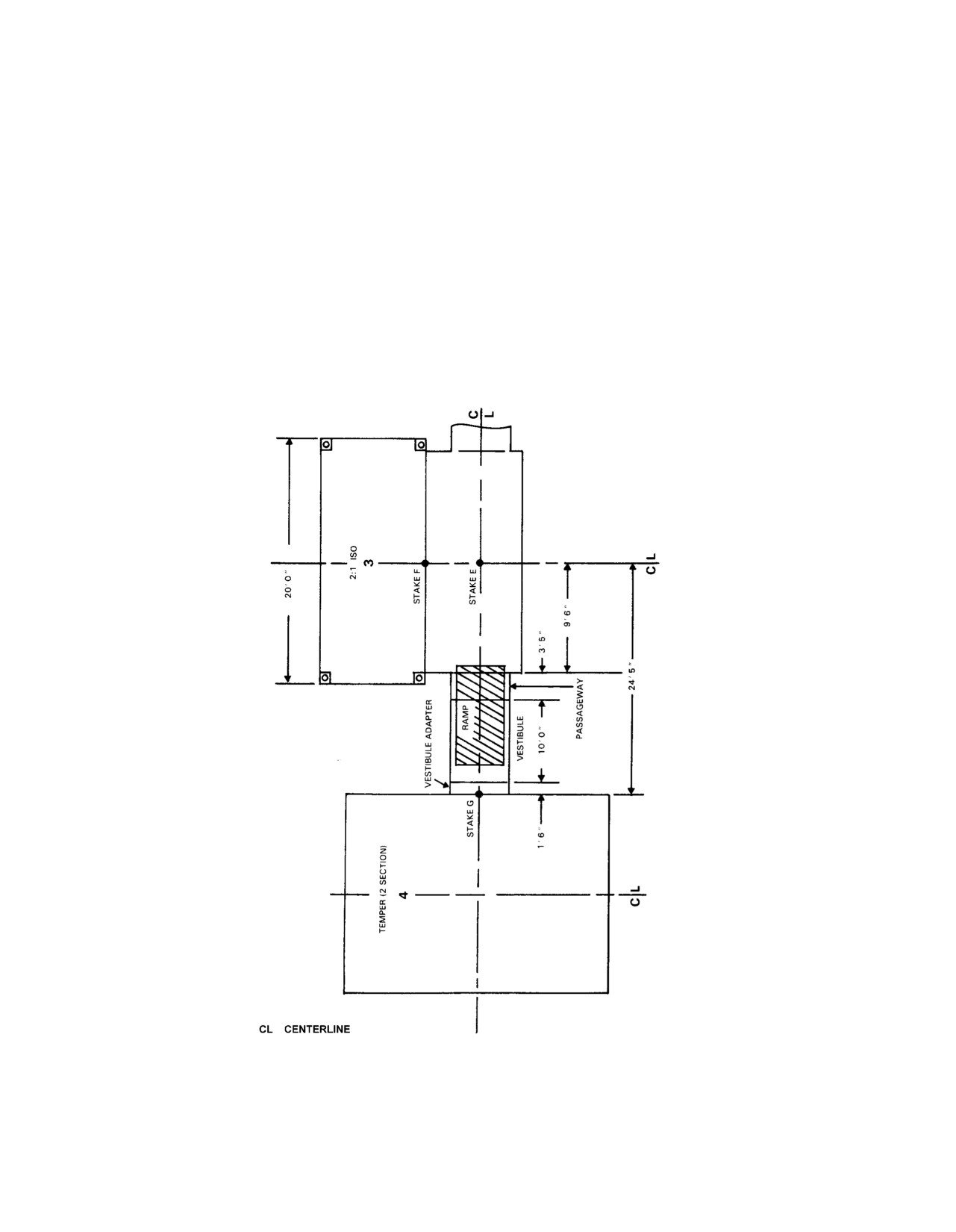
R-10. International Organization for Standardization End Closeout Panel to Tent, Extendable,
Modular, Personnel Endwall Door
Follow the procedures in paragraph R-8 to connect the end closeout panel of an ISO to a TEMPER endwall
(see Figure R-7). Some of the measurements, however, are different. The vestibule adapter on a TEMPER
endwall is 1 foot, 6 inches rather than the 10 inches on the door section adapter. The TEMPER to be
erected here is a two-section shelter (No. 4 in Figure R-1), measuring 16 feet. The total measurement here
then is 24 feet, 5 inches (Stake E to Stake G). Stake the four corners of the TEMPER in accordance with
paragraph R-7.
Figure R-7. The ISO end panel to TEMPER endwall.
R-9
FM 4-02.10
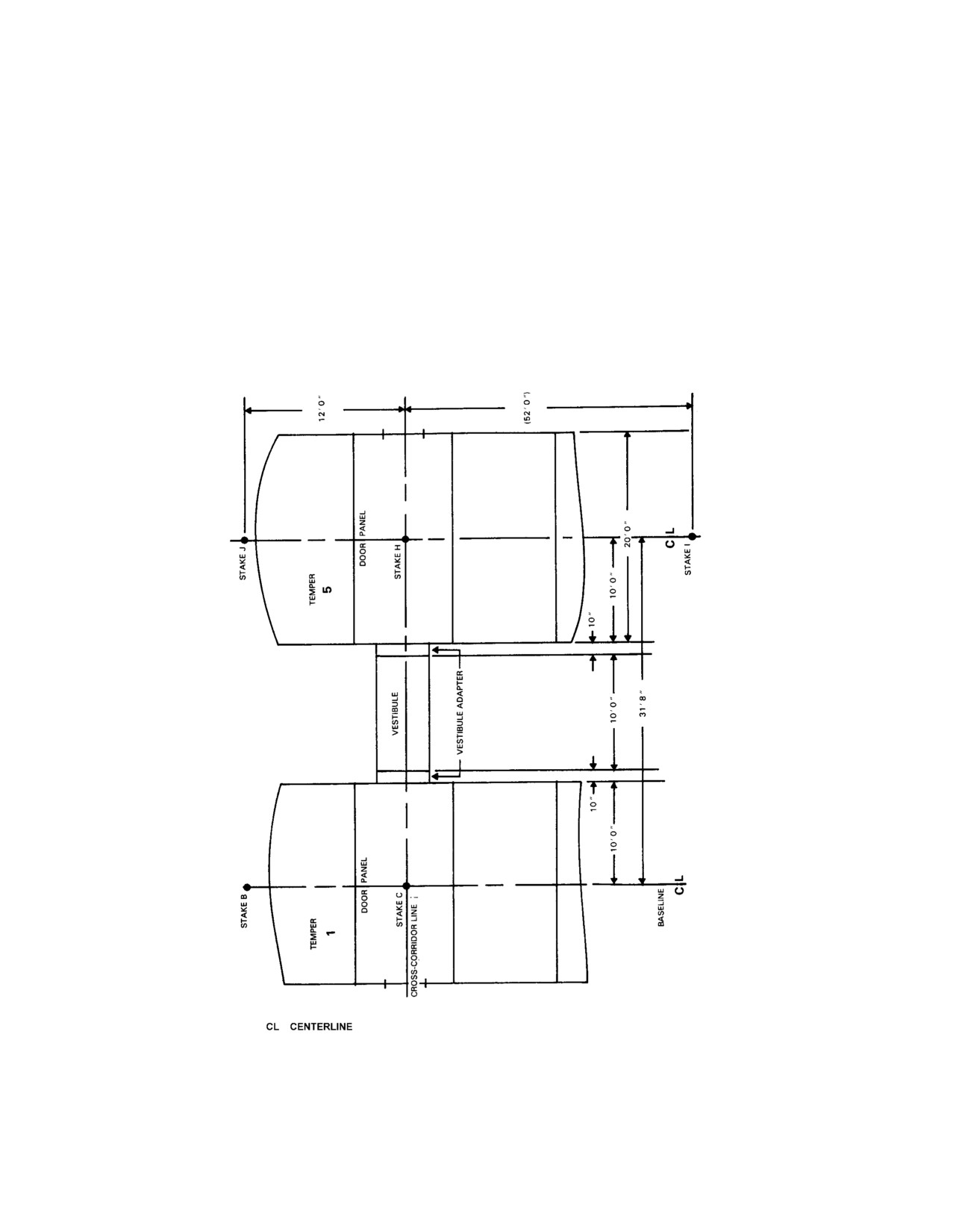
R-11. Tent, Extendable, Modular, Personnel Door Panel to Tent, Extendable, Modular, Personnel
Door Panel
The center line of the second eight-section TEMPER (No. 5 in Figure R-1) is 31 feet, 8 inches from the
baseline or from Stake C to Stake H (see Figure R-8). To ensure that the lines are parallel, measure the 31
feet, 8 inches from both the control point (Stake A) and the cross-corridor point (Stake C). Stake the
corners of this TEMPER the same as you did in paragraph R-7.
Figure R-8. The TEMPER door panel to TEMPER door panel.
R-10
FM 4-02.10
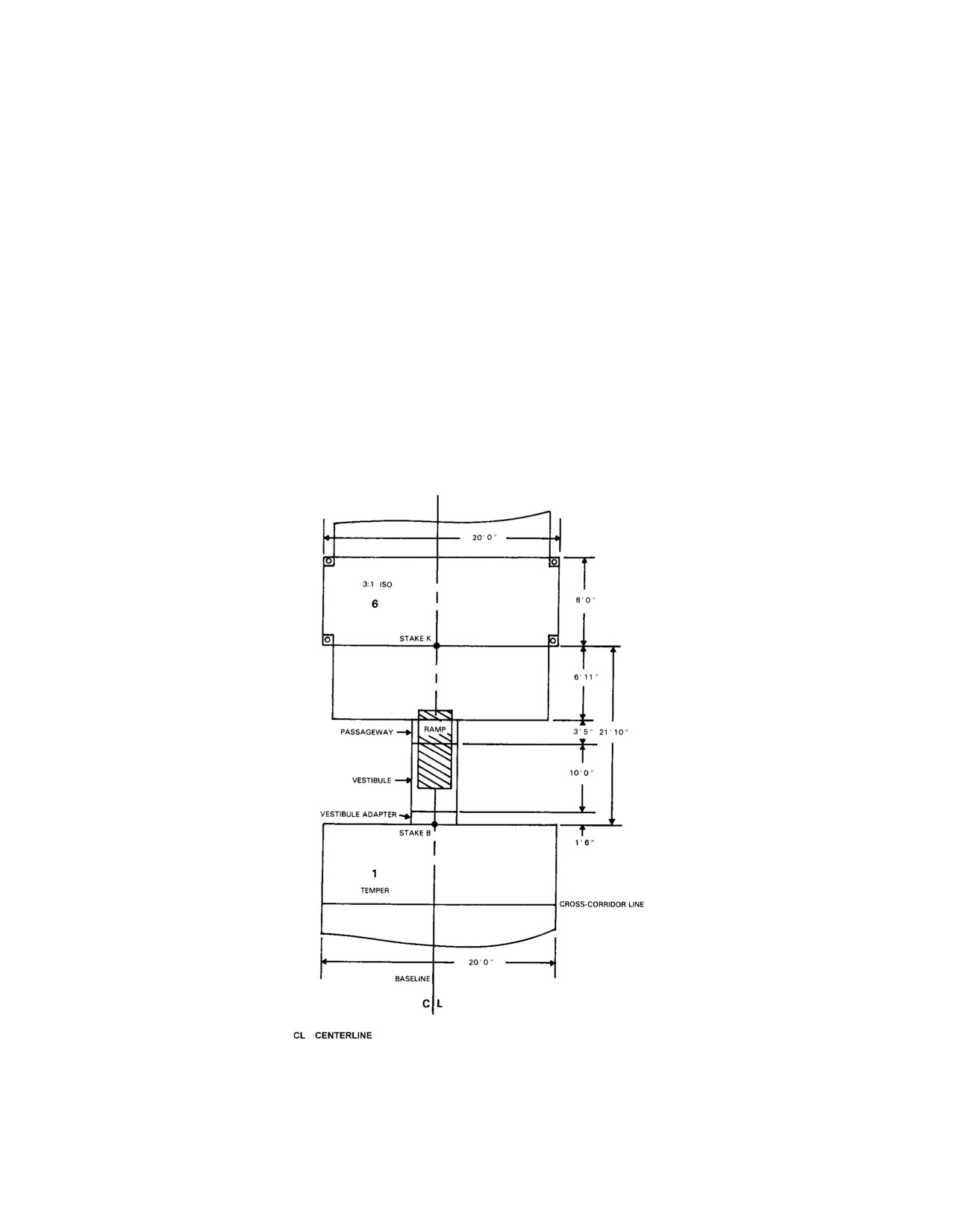
R-12. International Organization for Standardization Side Closeout Panel to Tent, Extendable,
Modular, Personnel Endwall Door
The procedures here are the same as those used to connect any other ISO to a TEMPER (see Figure R-9). It
is important though to remember the measurements. The ISO staking point (Stake K) is 21 feet, 10 inches
from the TEMPER (Stake B). On the baseline, measure from the TEMPER endwall—
a.
One foot, six inches for the vestibule adapter.
b. Ten feet for the vestibule.
c.
Three feet, five inches for the passageway.
d. Six feet, eleven inches for the ISO expansion.
Figure R-9. The ISO side panel to TEMPER endwall.
R-11
FM 4-02.10
R-13. Tent, Extendable, Modular, Personnel Endwall Door to Tent, Extendable, Modular, Personnel
Endwall Door
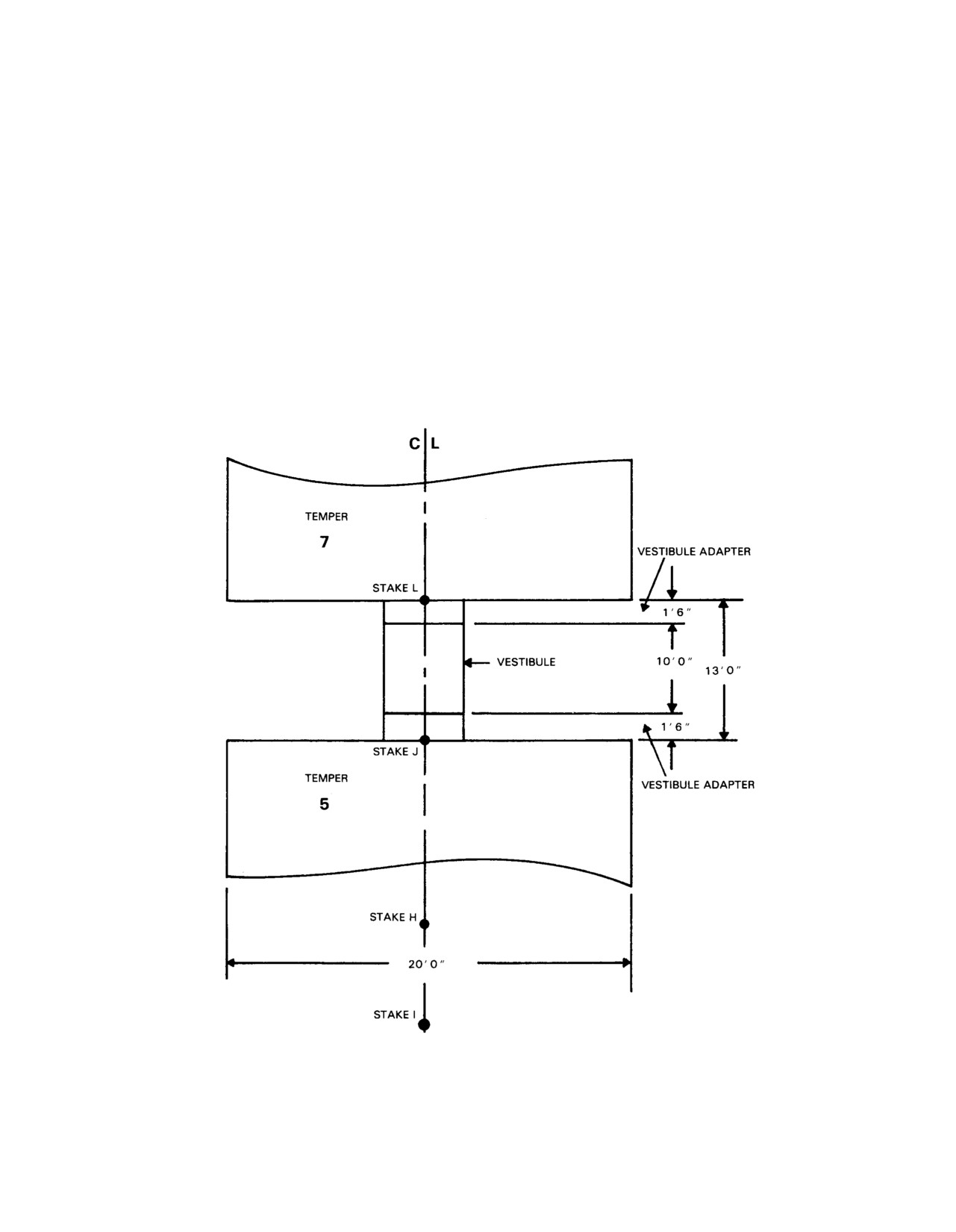
The last combination possible is the connection of a TEMPER endwall to another TEMPER endwall (see
Figure R-10). This TEMPER (No. 7 in Figure R-1) will be connected to the eight-section TEMPER in
paragraph R-11. The measurement between the two endwall sections is 13 feet. This includes two 1-foot,
6-inch vestibule adapters and a 10-foot vestibule. Measure the 13 feet from the center of the first door
(Stake J). This will mark the center of the door of the new TEMPER (Stake L). Follow the instructions in
paragraph R-7 to stake the corners of this last shelter.
Figure R-10. The TEMPER endwall to TEMPER endwall.
R-12
FM 4-02.10
GLOSSARY
ABBREVIATIONS, ACRONYMS, AND DEFINITIONS
AAR after action report
ABCA American, British, Canadian, and Australian
ABCS Army Battle Command System
AC Active Component/cyanide
ACUS Area Common-User System
ADA American Dietetic Association
admin administration
AFMIB Armed Forced Medical Intelligence Branch
AFMIC Armed Forces Medical Intelligence Center
AFPMB Armed Forces Pest Management Board
AFSC Air Force Specialty Code
AIRDB Army Ionizing Radiation Dosimetry Branch
AJBPO Area Joint Blood Program Officer
amb ambulance
AMC Air Mobility Command
AMEDD Army Medical Department
AMEDDC&S Army Medical Department Center and School
AMI adaptive medical increments
AMS acute mountain sickness
AMSA Army Medical Surveillance Activity
AMSC Army Medical Specialist Corps
AO area of operations
AOC area of concentration
APOD aerial port of debarkation
Glossary-1
FM 4-02.10
APOE aerial port of embarkation
AR Army Regulation
ART Army tactical task
ARTEP Army Training and Evaluation Program
AS area support
ASCC Army Service Component Command
ASMB area support medical battalion
ATM advanced trauma management
attn attention
AUG augmentation
AUTL Army Universal Task List
AV aviation
BAQ basic allowance for quarters
BAS battalion aid station
BBPCT blocking, bracing, packing, crating, and tie-down
BCOTM battle command on the move
BCS3
Battle Command Sustainment Support System
bde brigade
BEQ bachelor enlisted quarters
bld blood
BMIS-T Battlefield Medical Information System-Tactical
bn battalion
BOQ bachelor officers’ quarters
Glossary-2
FM 4-02.10
BTC Blood Transshipment Center
BW biological warfare
C2
command and control
C2P command and control processor
C4
command, control, communications, and computers
C4I command, control, communications, computers, and intelligence
CALL Center for Army Lessons Learned
CB chemical/biological
CBRNE chemical, biological, radiological, nuclear, and high-yield explosive(s)
CD-ROM compact disk-read only memory
CDC Centers for Disease Control and Prevention
CDR commander
CE communications-electronics
CHCS Composite Health Care System
CHCS II-T Composite Health Care System II-Theater
CHEM chemical
CI counterintelligence
CJCSM Chairman, Joint Chiefs of Staff Manual
CLS configured loads
cmd command
CMF career management field
CMS central material service
CNR combat net radio
Glossary-3
FM 4-02.10
co company
COE common operating environment
COMMZ communications zone
COMSEC communications security
CONUS continental United States
COSC combat operational stress control
COSCOM corps support command
COTS commercial off-the-shelf
CP chemically protected/collective protection
CPS collective protection shelter
CPT captain
CS combat support
CSAR combat search and rescue
CSH combat support hospital
CSS combat service support
CSSCS Combat Service Support Control System
cu cubic
CW chemical warfare
CZ combat zone
DA Department of the Army
DAMMS-R Department of the Army Movement Management System — Redesign
DBW desired body weight
DCCS deputy commander for clinical services
Glossary-4
FM 4-02.10
DCSMED deputy chief of staff for medicine
DD Department of Defense
DE directed energy
decon decontamination
DEERS Defense Enrollment Eligibility Reporting System
DEET
75 percent N, N-diethyl-meta-toluamide
DEFCON defense readiness condition
DEPMEDS Deployable Medical System
det detachment
DIS disease
dl deciliter
DLA Defense Logistics Agency
DMLSS-AM Defense Medical Logistic Standard System-Assemblage Management
DMSO division medical supply office
DNA deoxyribonucleic acid
DNBI disease and nonbattle injury
DOD Department of Defense
DODAAC Department of Defense Activity Address Code
DODD Department of Defense Directive
DODI Department of Defense Instruction
DSMC division support medical company
DSN Defense Switched Network
EAC echelon(s) above corps
Glossary-5
FM 4-02.10
EBS Environmental Baseline Survey
ECB echelons corps and below
ECR environmental condition report
EEH EL early entry hospitalization element
EMI electromagnetic interference
EMT emergency medical treatment
ENCOM engineer command
ENT ear, nose and throat
EOC emergency operations center
EPW enemy prisoner of war
evacuation policy Command decision indicating the maximum number of days of noneffectiveness that
patients may be held within the command for treatment. For example a 7/15 evacuation policy sets 15
days as the maximum time in theater of which only 7 can be in the CZ. Changes in the evacuation
policy primarily impacts RTD numbers.
EW electronic warfare
FAO finance and accounting office
FBCB2
Force XXI Battle Command Brigade and Below System
FDECU field deployable environmental control unit
FFP fresh frozen plasma
FH field hospital
FLOT forward line of own troops
FLT flight
FM field manual; frequency modulated
Glossary-6
FM 4-02.10
force protection Force protection consists of those actions to prevent or mitigate hostile actions against
DOD personnel (including family members), resources, facilities, and critical information. It coordinates
and synchronizes active and passive (offensive and defensive) measures to enable the force to perform
while degrading the opportunities for the enemy. Force protection includes air, space, and missile
defense; NBC defense; antiterrorism; defensive information operations; and security to operational
forces and means. Force protection does not include actions to protect against accidents, weather, and
disease. It is the commander’s responsibility to ensure that force protection measures are planned for
and executed.
FORSCOM United States Army Forces Command
FRAGO fragmentary order
FSC Federal Supply Classification
FSMC forward support medical company
FST forward surgical team
ft feet/foot
fwd forward
g grams
G2
Assistant Chief of Staff (Intelligence)
G3
Assistant Chief of Staff (Operations and Plans)
G6
Assistant Chief of Staff (Signal)
gal gallon(s)
GC Geneva Convention Relative to the Protection of Civilian Internees in Time of War
GCSS-A Global Combat Support System-Army
GEN general
GH general hospital
GI gastrointestinal
GIG Global Information Grid
Glossary-7
FM 4-02.10
gnd ground
GOTS government off-the-shelf
GPS Global Positioning System
GPW Geneva Convention Relative to the Treatment of Prisoners of War
GSA General Services Administration
GU genitourinary
GWS Geneva Convention for the Amelioration of the Condition of the Wounded and Sick in the Armed
Forces
GWS (Sea) Geneva Convention for the Amelioration
of
the
Condition
of
the
Wounded, Sick,
and
Shipwrecked Members of the Armed Forces at Sea
GYN gynecology
H&S heat and serve
HCP Health and Comfort Pack
HF high frequency
HHD headquarters and headquarters detachment
HN host nation
hosp hospital
HQ headquarters
HSS health service support
HTN hypertension
IA information assurance
IASO Information Assurance Security Officer
ICU intensive care unit
Glossary-8
FM 4-02.10
ICW intermediate care ward
IM information management
IMSA See installation medical supply activity.
IND investigational new drug
info information
installation medical supply activity (IMSA) The IMSA in CONUS is the supply support activity (SSA)
for medical materiel for an installation or geographic area. The supporting installation, some of which
are specifically designated as force projection
(sometimes called power projection) platforms, is
responsible for providing support to deploying/redeploying military forces. When directed by the
OPLAN/OPORD, these installations assist with the predeployment processing and facilitate the
movement of personnel and equipment to the designated POE. Additionally, they may provide assistance
or garrison-type life support in staging areas. Outside the continental United States, the IMSA is
normally the primary SSA for medical materiel for a designated geographic area.
IOM installation, operation, and maintenance
IS information systems
ISO International Organization for Standardization
IT information technology
ITDB interim theater database
JDF joint deployment formulary
JMeWS Joint Medical Workstation
JP joint publication
JRCAB Joint Readiness Clinical Advisory Board
JTRS Joint Tactical Radio System
LAB laboratory
LAN local area network
lb/lbs pound/pounds
Glossary-9
FM 4-02.10
LDB local database
LOGMARS Logistics Application of Automated Marking and Reading Symbols
LOS line of sight
LTS long-term storage
MA mortuary affairs
MAJ major
MAX maximum
MBU modern burner unit
MC minimal care
MC4
medical communications for combat casualty care
MCC movement control center
MCW minimal care ward
MDRI military dietary reference intake
med medical
MEDCOM medical command
MEDEVAC medical evacuation
medical threat Medical threat is defined as “a collective term used to designate all potential or continuing
enemy actions and environmental situations that could adversely affect the combat effectiveness of
friendly forces, to include wounds, injuries, or sickness incurred while engaged in a joint operation.”
(See Joint Publication 4-02.) In Army and multiservice publications, the term is defined as a composite
of all ongoing potential enemy actions and environmental conditions (disease and nonbattle injuries
[DNBIs]) that may render a soldier combat ineffective. Commanders and unit leaders are responsible
for protecting and preserving Army personnel and equipment against injury, damage, or loss that may
result from food-, water-, and arthropodborne diseases, as well as environmental injuries (for example,
heat and cold injuries) and occupational hazards
MEDLOG medical logistics
Glossary-10
FM 4-02.10
MEDMNT medical maintenance
MEDSUP medical supply
MES medical equipment set
METT-TC mission, enemy, terrain and weather, troops and support available, time available, and civil
considerations
MF2K Medical Force 2000
MHE materiel handling equipment
MHz megahertz
MILVAN military-owned, demountable container
min minimal/minimum
MMS medical materiel set
MOPP mission-oriented protective posture
MOS military occupational specialty
MRE meal(s), ready-to-eat
mrem millirem
MRI Medical Reengineering Initiative
MRO medical regulating office
MRPO medical radiation protection officer
MSE mobile subscriber equipment
MSMC main support medical company
MTF medical treatment facility
MTOE modified table(s) of organization and equipment
MTP Mission Training Plan
MTW major theater of war
Glossary-11
FM 4-02.10
N/A not applicable
NATO North Atlantic Treaty Organization
NBC nuclear, biological, and chemical
NBI nonbattle injury
NCO noncommissioned officer
NCOIC noncommissioned officer in charge
NCS net control station
NDMS National Disaster Medical Systems
NEC Navy Enlisted Code
NET network
NIPRNET Nonsecure Internet Protocol Router Network
NPO nothing by mouth
NRTD nonreturn to duty
NSB nonsplit based
NSN national stock number
OCC occupational
OCONUS outside continental United States
OIF Operation Iraqi Freedom
OPFAC operational facility
OPLAN operation plan
OPORD operation order
OPS operation(s)
OPSEC operations security
Glossary-12
FM 4-02.10
OPZONE operational zone
OR operating room
OSHA Occupational Safety and Health Administration
OTSG Office of The Surgeon General
P&T pharmacy and therapeutics
P-MART Predeployment Medication Analysis and Reporting Tool
PAD patient administration division
pam pamphlet
PARRTS Patient Accounting and Reporting Real-Time Tracking System
PASBA Patient Administration System and Biostatistics Activity
PDC personnel data card
pharm pharmacy
phys physical
PIC personal information carrier
PLL prescribed load list
plt platoon
PMD pounds per man per day
PMI patient movement item
PO by mouth
POD port of debarkation
POE port of embarkation
POL petroleum, oils, and lubricants
POV privately owned vehicle
PRE-OP preoperative
Glossary-13
FM 4-02.10
prof professional
PROFIS Professional Officer Filler System
PVNTMED preventive medicine
QC quality control
QSTAG Quadripartite Standardization Agreement
radio frequency radiation (RFR) radio frequency radiation. Electromagnetic radiation in the frequency
range 3 kilohertz to 300 gigahertz. The RFR is nonionizing in that there is insufficient energy to ionize
atoms. The primary health effect of RF energy is a result of heating. Exposure standards are based on
preventing thermal problems. Use of RFR includes: radars, radios, communication transmitters, medical
treatments, processing and cooking of foods, heat sealers, and welders.
RAM random access memory
RBC red blood cells
RC Reserve Component
RD registered dietician
RDD radiological dispersal device(s)
RF radio frequency
RFR See radio frequency radiation.
Rh rhesus factor
RMW regulated medical waste
ROP reorder point
RP release point; retained personnel
RPF real property facilities
RPP Radiation Protection Program
RSO radiation safety officer
RSO&I reception, staging, onward movement, and integration
Glossary-14
FM 4-02.10
RTD return to duty
S1
Adjutant (US Army)
S2
Intelligence Officer (US Army)
S3
Operations and Training Officer (US Army)
S4
Supply Officer (US Army)
S6
Communications-Electronics Officer (US Army)
SARSS Standard Army Retail Supply System
SBCT Stryker Brigade Combat Team
sec section
SEN small extension node
SF standard form
SID source image distance
SIGSEC signal security
SINCGARS Single-Channel Ground and Airborne Radio System
skip policy Skip policy (or skip factor) is defined in the Joint Strategic Capability Plan Health Support
Planning Guidance as “the percentage of patients evacuated directly from Operational Zone (OPZONE)
1 to OPZONE 3”. The OPZONE 1 is the CZ, OPZONE 2 is the communications zone, and OPZONE
3 is the Continental United States. A key point is the skip policy only applies to patients originating in
the combat zone that will not RTD within the theater evacuation policy.
SOI signal operation instructions
SOP standing operating procedure(s)
SP start point
SPBS-R Standard Property Book System-Redesign
spec specialty
Glossary-15