FM 3-04.111 Aviation Brigades (DECEMBER 2007) - page 5
Appendix B
z
HF and VHF.
z
Transponder; modes 1, 2, 3, and 4.
z
EPLRS, BFT, and improved data modem (IDM).
z
AN/PRC-112 survival radio and AN/APR-186 (VHF).
B-30. The section also discusses airborne facilitators-such as the UH-60 C2 aircraft, EUH-60 A2C2S, and
joint systems—that aid aviation units when relaying communications and challenges to mission
communications.
AIRCRAFT COMMUNICATION TYPES
Single-Channel Ground and Airborne Radio System
B-31. SINCGARS is the common battlefield radio system employed by Army ground and aviation forces.
It provides secure or plain voice communications over the VHF-FM frequency range of 30.000 to
87.975-MHz at 25-KHz intervals. Its frequency-hopping mode of operation counters enemy jamming
efforts. Earlier radio models require the KY-58 to provide secure communications. The single-channel
ground and airborne radio system-system improvement program
(SINCGARS-SIP) has embedded
encryption, an automated GPS interface, and improved data capability for faster data communications.
However, even the airborne SINCGARS-SIP requires KY-58 interface for cipher text communications.
SINCGARS is a LOS system with limited range at terrain flight altitudes.
B-32. Army aviation’s component of SINCGARS is the AN/ARC-201 compatible with other service
SINCGARS radios to include the AN/ARC-210 and AN/ARC-222 radios used by other services and Army
HH-60L/M air ambulances.
B-33. Aircraft SINCGARS are filled using the automated network control device (ANCD). The AMPS,
when available, provides simplified setup of SINCGARS and other radio systems. CTCs have noted
common problems with time drift and the need to perform over-the-air rekeying as missions progress.
Have Quick II
B-34. The AN/ARC-164 is a common UHF-AM radio employed by joint aircraft. It provides aviation
brigade subordinate units with a means of communicating internally on company battle nets. It also allows
interface with sister-service aircraft during JAAT and other joint flight operations. Its frequency hopping
mode of operation counters enemy jamming efforts. Like SINCGARS, it is a LOS system with limited
range at terrain flight altitudes.
B-35. The AMPS, when available, provides simplified setup of Have Quick II time of day (TOD) and word
of day for AH-64D and OH-58D aircraft.
B-36. Units must use Have Quick II in the frequency-hopping mode during training to ensure effective
communication during actual operations. Word of the day loading is not difficult, but TOD can be
problematic if aircraft lack a Have Quick II/GPS interface. Aircraft without GPS interface can request and
accept a GPS TOD from other unit aircraft. In addition, on long operations beyond 4 hours, the TOD
begins to drift. A single aircraft, such as the UH-60 C2 aircraft, are then designated as the base point for
TOD updates as unit aircraft begin to drop out of the net because of drifting TOD.
High Frequency Radio
B-37. The AN/ARC-220 HF radio system is an NOE, long-range radio system that provides voice and data
communication beyond the range of SINCGARS and Have Quick II systems. It operates in the 2 to 29.999-
MHz frequency range in 100-Hz steps on 20 preselectable channels for a total of 280,000 possible
frequencies. Aircraft not equipped with a 1553 data bus have an additional control display unit for
operation of the radio.
B-38. The system has a NLOS range of at least 300 kilometers. The 30 to 100 kilometer range is often the
most challenging distance to maintain effective communications.
B-8
FM 3-04.111
7 December 2007
Communications
B-39. Automatic link establishment (ALE) reduces aircrew workload and improves connectivity. In this
mode, the caller enters the desired radio address and presses the microphone key. The radio then sounds on
the preprogrammed frequency set listening for the best signal. When found, both radios tune to that
optimum frequency and a connection occurs. One shortcoming of ALE is third parties do not hear message
traffic. If passive listening is necessary and all parties on the net need the same information, the net control
station (NCS) chooses the manual or electronic counter-countermeasure frequency-hopping mode. When
stations do not rely on each other’s reports to perform their mission, ALE is the preferred mode.
B-40. Aircrews can communicate using secure voice or secure data. In data mode, the system can create,
edit, and store up to 10 formatted and free text messages of up to 500 characters each. It interfaces with the
KY-100 to provide secure communications and the AN/VRC-100 ground radio in aviation ground CPs.
B-41. Secure voice is the primary method of operation for the HF radio in ALE, manual, and frequency-
hopping modes. In poor conditions-such as low magnetic flux number, night operations when the
ionosphere dissipates, and thunderstorms-aircrews should employ secure data at 300 bits per second. Data
transmission increases aircrew workload during flight; the radio stores up to 10 messages in memory,
allowing the crew to preload a set of anticipated messages before flight.
B-42. For identical messages with changing location, it often is easier to edit in the new location in an
existing memory message than to initiate a whole new entry. In addition, a reduced workload results when
commanders use the control display unit’s feature permitting HF transmittal of current position with one
button press.
B-43. If brigade units have not used HF radios habitually in training, the brigade S-3 should direct HF
radio exercises before operations to ensure units use HF to its best advantage.
Very High Frequency Radio
B-44. The AN/ARC-186 is an administrative VHF-AM radio primarily used to communicate with ATS.
Normally, it operates in the 116 to 151.975 VHF-AM frequency range. In wired and configured aircraft, it
can back up the SINCGARS radio in the same 30 to 89.975 MHz frequency range. It generally lacks a KY-
58 interface to provide secure FM communications, and it has no frequency-hopping mode compatible with
SINCGARS. The AN/ARC-186 is a LOS radio system with limited range at terrain flight altitudes but
greater range at administrative altitudes normally associated with ATS communication.
Transponder
B-45. The transponder enables the helicopter to identify itself automatically when properly challenged by
friendly surface and airborne radar equipment. The receiver-transmitter range is limited to LOS
transmission. With its frequency of operation in the UHF band range, it is dependent on altitude for range
and reception.
Improved Data Modem
B-46. The MD-1295/A is a digital transfer modem that allows equipped aviation forces to exchange
complex battlefield information in short, coded bursts. Digital calls for fire are processed through the IDM.
The IDM has a preplanned product improvement that incorporates software for processing joint variable
message format (JVMF) messages, allowing interoperability with ATCCS and FBCB2.
B-47. A number of joint systems incorporate IDM for data interoperability. The JSTARS CGS, located in
brigades and division CPs, also has IDM capability.
AN/PRC-112 Survival Radio
B-48. This small radio, carried in aircrew survival vests, enables downed aircrews to be located by aircraft
equipped with the AN/ARS-6 pilot locating system. It receives short, periodic bursts from the AN/ARS-6
and responds with its own coded reply to allow secure location of aircrews. An AM voice mode allows
unsecured communication on guard, 282.2 MHz, or two additional UHF channels. The PRC-112A radio
7 December 2007
FM 3-04.111
B-9
Appendix B
has upgraded voice communication security that scrambles voice communication for greater security. Both
the PRC-112 and -112A permit voice contact with nearby aircrews if aircraft radios are damaged on
impact.
Enhanced Position Location Reporting System
B-49. EPLRS provides a computer controlled communications network which transmits digital information
to support TACOPS on the battlefield. EPLRS provides two major functions—data distribution and
position location and reporting. It is a secure, jam-resistant, near real-time data communications support
system for the five battlefield functional areas of the ATCCS. Because of the real-time unit positioning
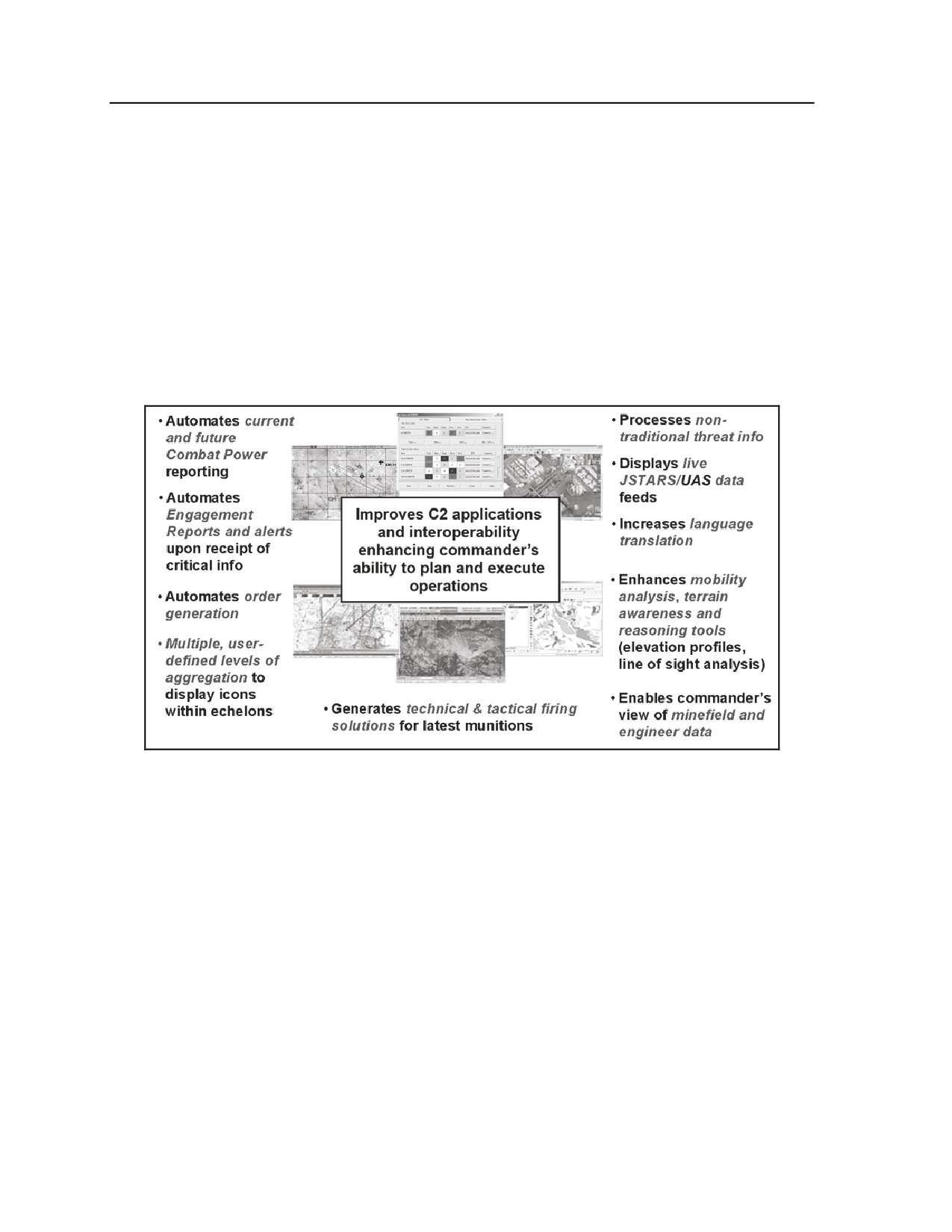
data supplied by EPLRS, accurate battle management capability increases. This allows the battle
commander to not only move forces forward, but to also quickly and accurately counter opposition moves.
This information greatly enhances C2 of tactical units by providing commanders with the location of
friendly units, a dynamic representation of the FLOT, and abbreviated SITREPs for conditions and
identification of adjacent equipped units.
Blue Force Tracker
B-50. BFT, a component of the FBCB2 system, is an efficient tool commander use for SA, airspace
deconfliction, and C2. As a C2 tool, BFT allows the commander to track aircraft locations and provides an
alternative means of over-the-horizon communications to meet this challenge. It also fills communication
gaps by providing the capability to pass text messages between stations. Code words and similar short text
transmissions are easily passed to supplement, or even replace, radio calls.
B-51. In planning, BFT enhances C2 by enabling the COP to readily be shared between headquarters and
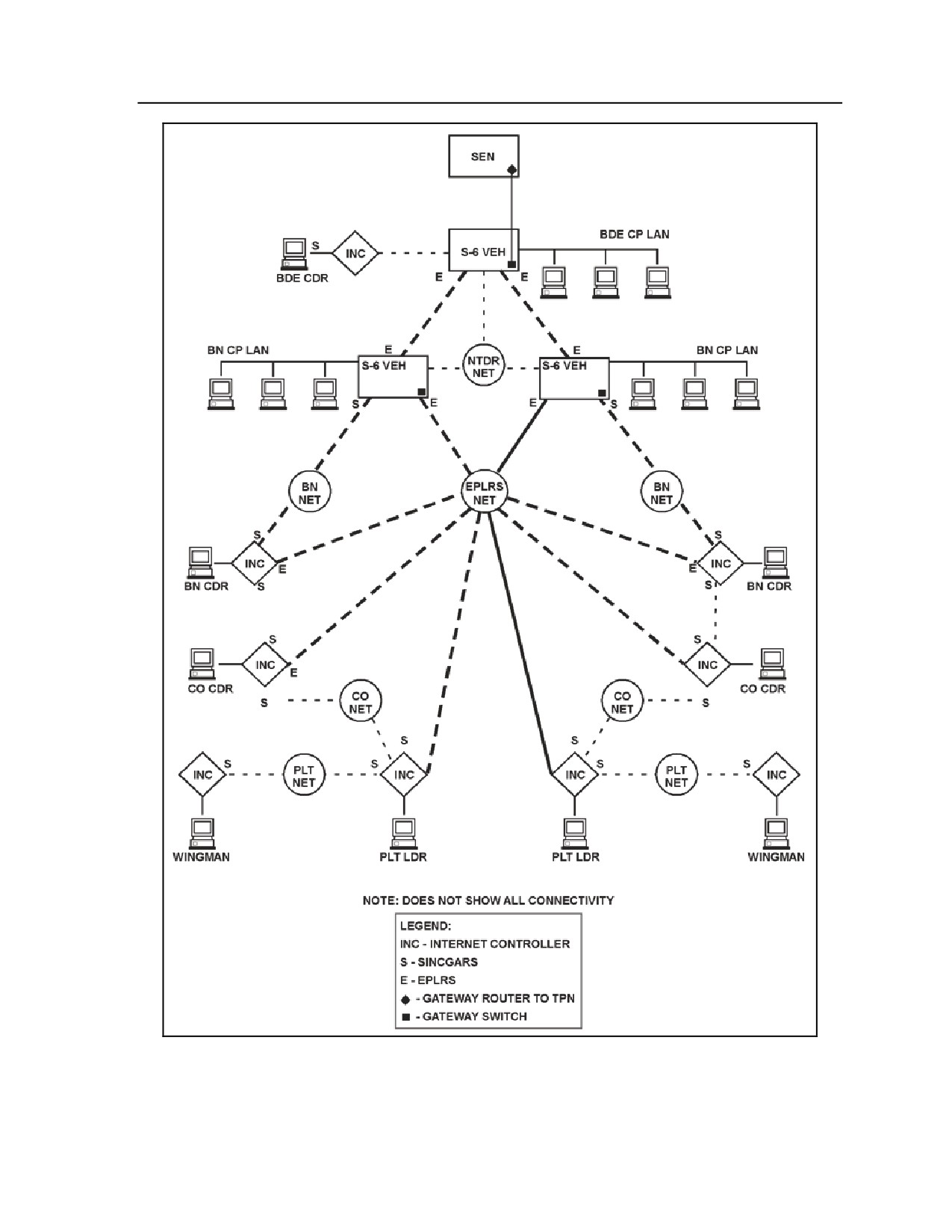
between aircraft. Graphic control measures such as PZs, flight routes, restricted operations areas, LZs, and
FSCMs can be developed, plotted, and shared with other BFT-equipped units as a computer-graphics
overlay file. These graphics can be downloaded at each BFT station (whether stationary, aircraft-, or
vehicle-mounted) to enable viewing by crews.
UTILITY HELICOPTER COMMAND AND CONTROL CONSOLE
B-52. UH-60 aircraft equipped with the AN/ASC-15B C2 console provide users with in-flight SA and
communications access. The modified console provides SINCGARS, Have Quick II, HF, VHF-AM, and
SATCOM. Console systems are supported by aircraft power and internal aircraft antennas. The aircraft has
one SINCGARS 201 radio and three AN/ARC 210 multimode radios capable of operation on SINCGARS
FM, UHF, or VHF frequencies. This permits the capability to simultaneously operate the command
network and monitor the O&I or higher headquarters command networks. It provides operators with a
means of choosing between either active SINCGARS communication or retransmission. Retransmission of
Have Quick II and VHF-AM is also possible with the system.
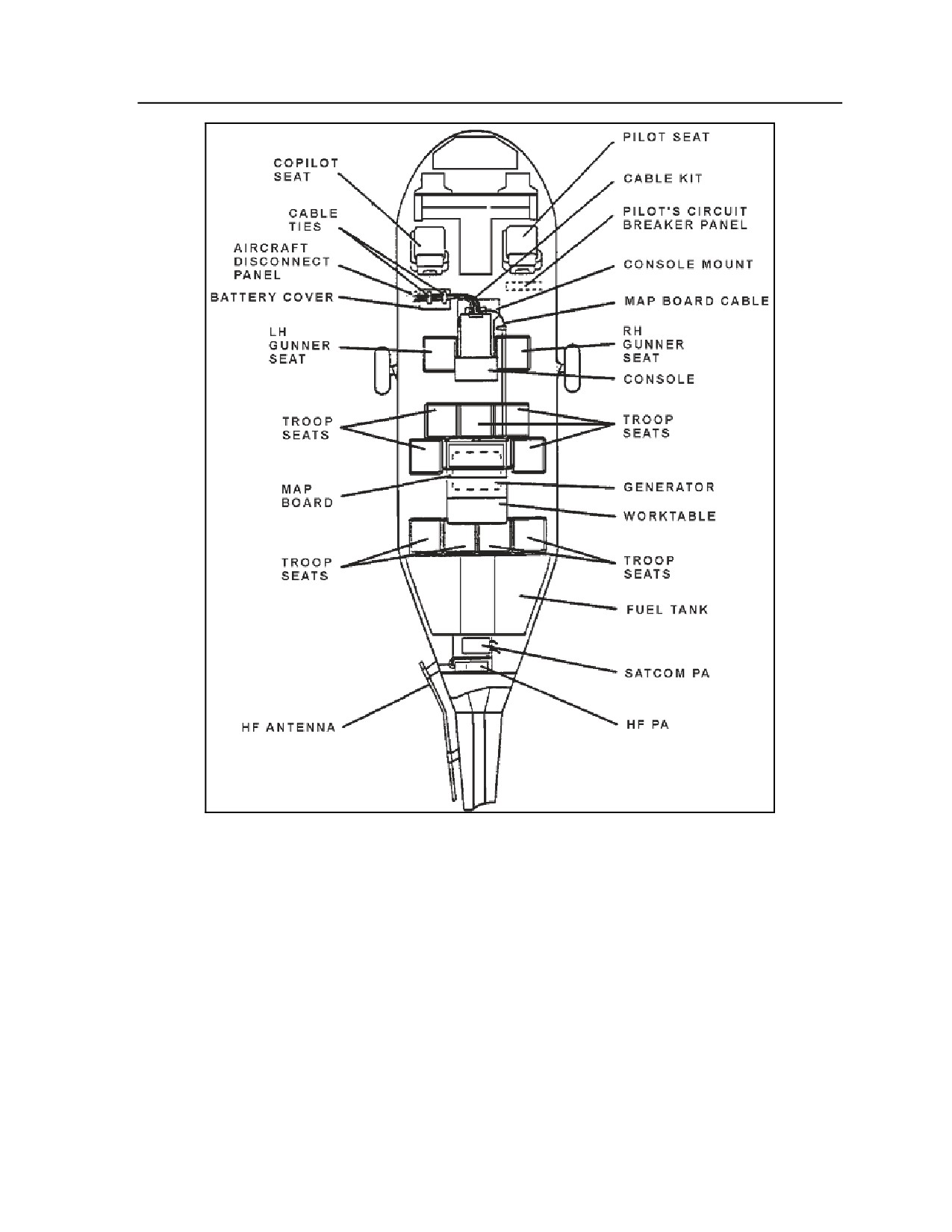
B-53. The aircraft console contains radio sets, console controls, and six internal communication system
boxes. In the rear, four additional internal communication system boxes and a map board allow up to 10
personnel to monitor the console’s radio systems. The C2 console’s lights are compatible with NVG. It is
the supported unit’s responsibility to provide a trained console operator; the crew chief is not trained to
perform this function.
B-54. The C2 console can operate in the ground mode. In this configuration, the console can remain
mounted on the aircraft or be dismounted. In the ground mode, the C2 console requires generator power
and external antennas. Four trained personnel can remove the console from the aircraft in 1 hour. Figure B-
6, page B-11, shows the aircraft configuration.
B-10
FM 3-04.111
7 December 2007
Communications
Figure B-6. UH-60 command and control aircraft configuration
ARMY AIRBORNE COMMAND AND CONTROL SYSTEM
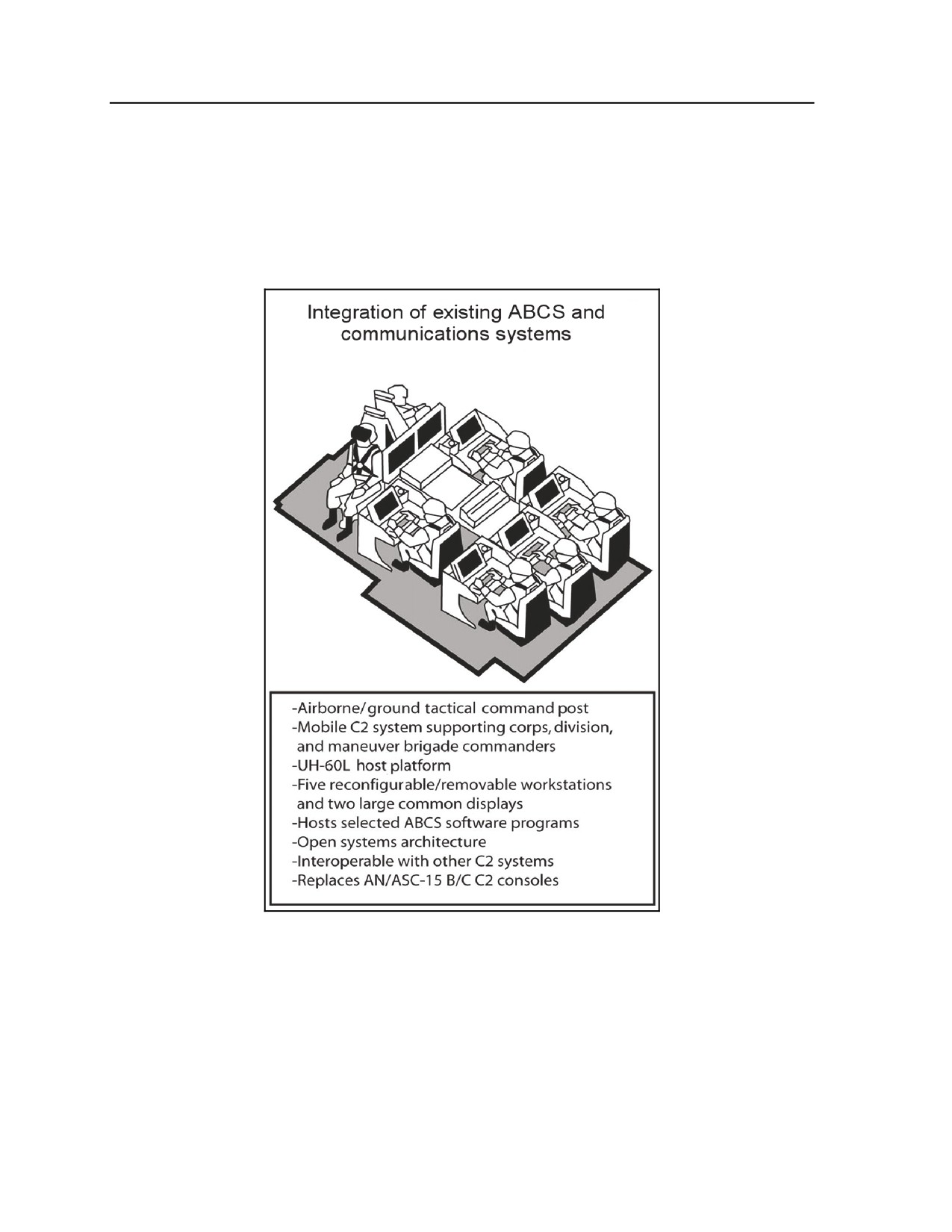
B-55. The A2C2S is a UH-60 based C2 system (referred to as the EUH-60) that serves as an airborne TAC
CP. Through its onboard MCS, ASAS, advanced field artillery tactical data system (AFATDS), air and
missile defense work station (AMDWS), combat service support control system (CSSCS), and FBCB2,
A2C2S provides continuous battlefield SA. It also is the source of digital information for nondigitized
aircraft supporting the operation. A2C2S provides maneuver commanders—from ARB/ARS to EAB—
with on-the-move C2. The system supports three major operational functions—mission planning, mission
execution, and mission support. Its primary function is to monitor execution of current operations while the
main CP focuses primarily on planning future operations.
7 December 2007
FM 3-04.111
B-11
Appendix B
Capabilities
B-56. A2C2S enables the commander and his staff to traverse the OE to critical places at critical times. The
commander and staff can perform all battle command and coordination functions from A2C2S. It has
simultaneous multiband voice and data channels and dynamic visual battlefield SA and C2 via command,
control, communications, computers, and intelligence connectivity. A2C2S provides access to the TI to
manipulate, store, manage, and analyze SA information, intelligence data, mission plans, and mission
progress data to support the C2 decisionmaking process. The system has triservice interoperability and is
compatible with NATO, civil aviation, maritime, and law-enforcement communications (figure B-7).
Figure B-7. Army airborne command and control system configuration
Features and Performance
B-57. A2C2S provides—
z
Robust LOS and NLOS communications through SINCGARS advanced system improvement
program, SATCOM demand assigned multiple access, Have Quick II, EPLRS
(friendly
positions), NTDR (SA), and HF.
B-12
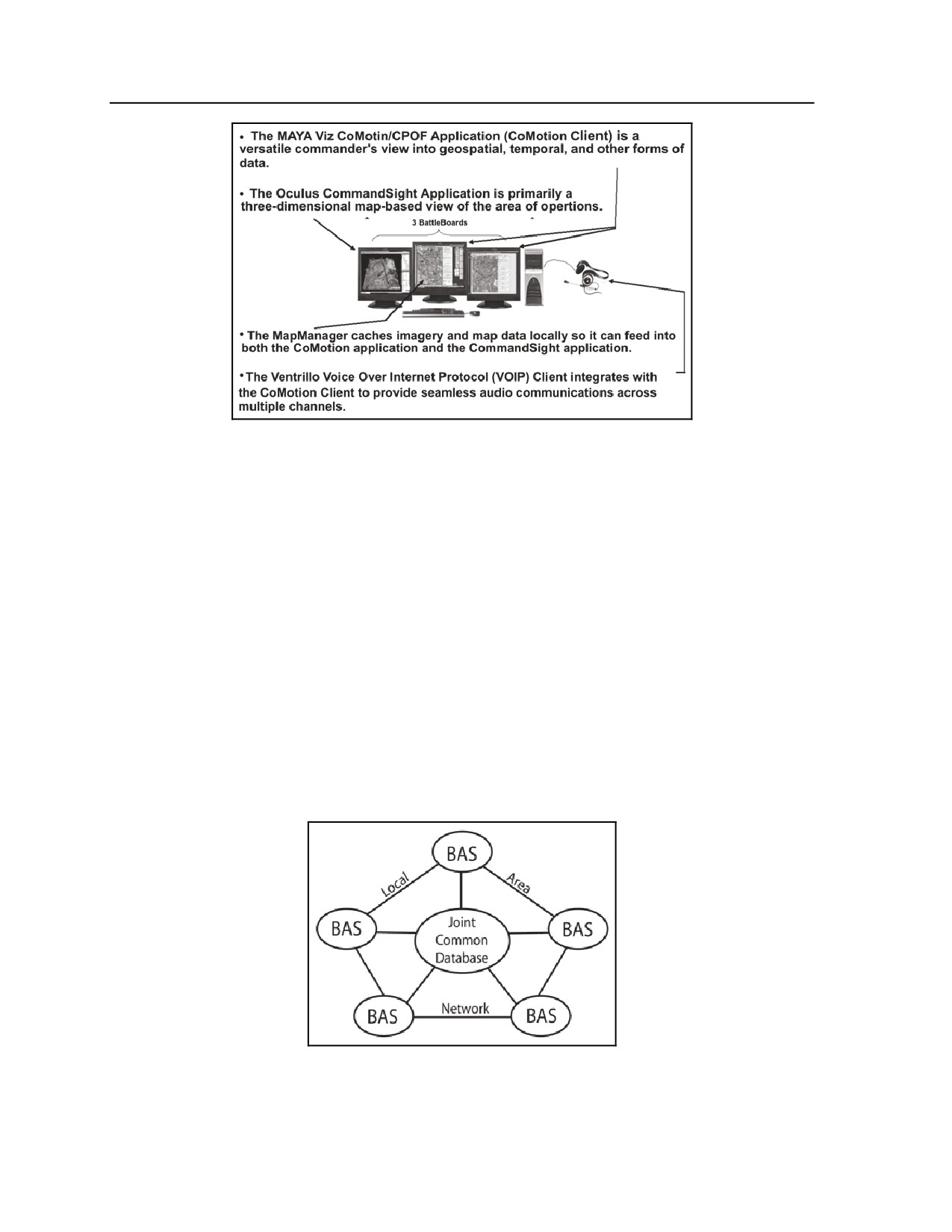
FM 3-04.111
7 December 2007
Communications
z
GPS for present position and standard National Geospatial-Intelligence Agency (NGA) maps
with overlays for a complete picture of the battlefield.
z
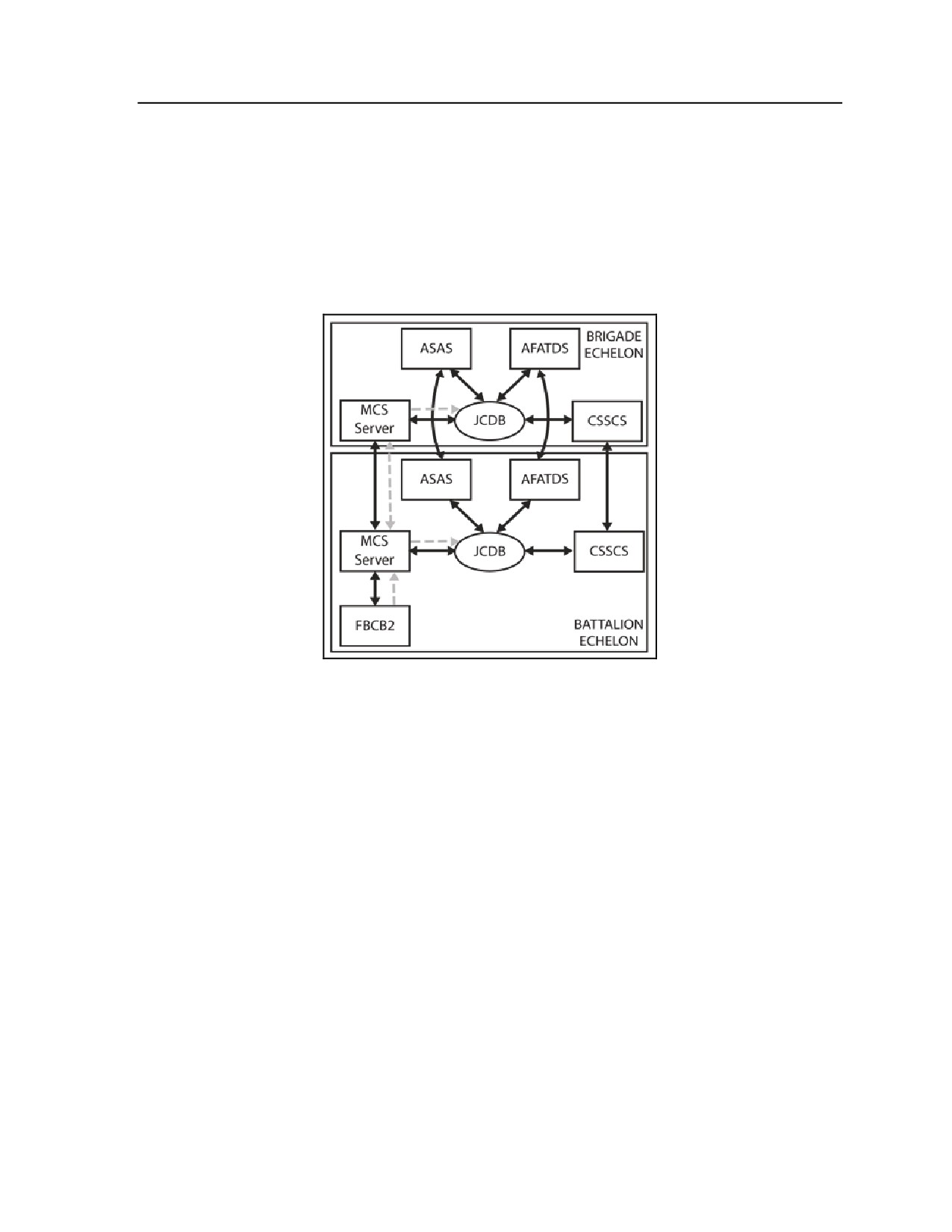
Automated display of COP information and C2.
z
Five automated, reconfigurable, and removable workstations, a command database, and two
large common displays; each workstation incorporates a keyboard, monitor, and audio
communications unit.
z
Real-time OE control and monitoring.
z
Common displays.
z
Enhanced control of battle.
z
Digital connectivity with all ABCSs.
z
Standard communications and information security.
z
Airborne and ground operational modes.
Interfaces
B-58. A2C2S interfaces with—
z
JSTARS and SATCOM.
z
Maneuver CPs.
z
CH-47Fs, AH-64Ds, and OH-58Ds.
z
M1 main battle tanks and M2/M3 cavalry fighting vehicles.
z
MLRS.
Operation as a Ground Command Post
B-59. When operating as a ground CP, the preferred power source is commercial power. If commercial
power is not available, a generator is the next preferred power source. If external power is not available,
aircraft power is required. Extended ground times may require a ground power unit, which may be brought
in via sling load or tactical ground vehicle, such as a HMMWV with a generator kit.
Employment
B-60. The IM capabilities of A2C2S are focused on controlling operation execution; planning capability is
limited. Mission data are transferred to A2C2S from the digital CP to bring it to the start of a mission
operational status.
Information Flow
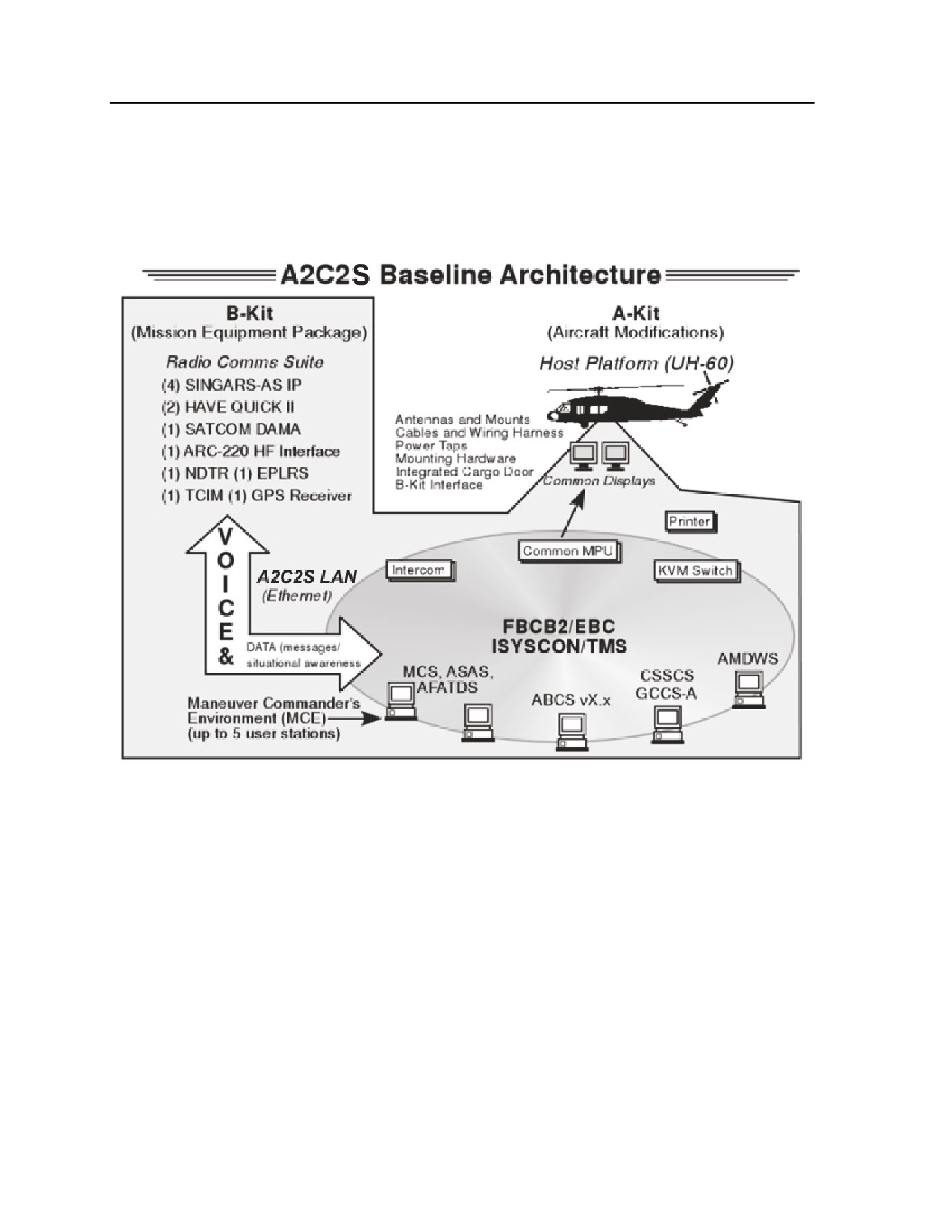
B-61. The ATCCSs are primarily top-down planning tools. Once the execution phase begins, the primary
flow of information is bottom-up via FBCB2. A2C2S draws real-time data from broadcast sources to
determine changes to the enemy situation during the mission’s execution phase. The intelligence
information provided by ASAS is an analyzed and formal product. Intelligence information A2C2S
receives from tactical related applications, tactical data information exchange-broadcast, and tactical
information broadcast service broadcast sources is raw data (figure B-8, page B-14).
Battlefield Employment
B-62. A2C2S expands the battlefield by providing the means to exercise C2 and gather tactical information
in support of a mission while on the move. From A2C2S, the commander and staff influence the battle via
direct exchange of voice and digital information with units conducting the mission. They simultaneously
develop the situation beyond the range of their unit’s sensors and shooters by accessing broadcast
intelligence sources.
7 December 2007
FM 3-04.111
B-13
Appendix B
Covering Force and Unassigned Areas
B-63. A2C2S enhances lethality during covering-force missions and shaping operations in unassigned
areas by moving its command forward to maintain contact with the maneuver forces. From A2C2S, the
commander and staff can synchronize deliberate and hasty artillery fires. A2C2S has a direct link to
artillery, including the Army tactical missile system. However, direct linkage is not necessary for direct FS
or priority of fires.
Figure B-8. Army airborne command and control system information flow
Assigned Areas
B-64. Integral activities during operations in assigned areas include maneuver, close combat (including
FAS), indirect FS, forces and sustainment of committed forces and command, control, communications,
and intelligence. Aviation organizations may be employed as a security or reserve force in the security or
main battle area. A2C2S gives the commander a clear picture of the close battle and allows him or her to
coordinate and synchronize maneuver and fires. Linked with other automated systems, A2C2S can pull
information on demand allowing the commander to operate at his own tempo without the information
delays characteristic of traditional reporting methods.
Sustainment Areas
B-65. The aviation brigade gives the division commander a highly mobile and lethal combat force to
counter a Level III incursion into the sustainment area. As a maneuver headquarters, the brigade may be
tasked as a TCF to respond to a significant threat. A2C2S provides a flexible and highly mobile tactical CP
to control operations.
B-14
FM 3-04.111
7 December 2007

Communications
Stability Operations
B-66. During stability operations, the system provides connectivity to special operations, C2, embassy, law
enforcement, maritime, civil, and/or other humanitarian information and communication networks. A2C2S
can also improve the ability of local, state, and federal agencies to communicate and coordinate in a crisis
environment such as a hurricane or forest fire during civil support operations.
AIRBORNE RELAY
B-67. Some operations in unassigned areas have priority to justify communications relay as a means of
overcoming difficulty in communicating. If allocated, the C-12 may perform HF relay or even SINCGARS
and Have Quick II relay if the threat permits flight within range of those radio systems. The AWACS, E-8
JSTARS, C-130 airborne battlefield C2 center, EA-6, airborne FACs, participating deep JAAT and AI, or
other joint aircraft may be available to relay HF, Have Quick II, and in some cases, SINCGARS
communications. EPLRS capabilities on the A2C2S aircraft allow automated relay of data
communications. In addition, future UAS may have retransmit mission capabilities for FM command nets.
Table B-1 illustrates the potential for relay with higher-flying aircraft if coordinated by staff members in
advance.
Table B-1. Joint aircraft potentially interoperable for communications or relay
Comms/Relay
C-12
E-3
E-8C
C-130
EA-6B
FAC
AI/JAAT
Capable
AWACS
JSTARS
ABCC
C
SINCGARS
X
X
X
X
X
Have Quick II
X
X
X
X
X
X
X
HF
X
X
X
X
X
X
X
EPLRS
X
X
X
X
F16 Block 30
IDM
X
X
X
F16C
F16D
AIRCRAFT COMMUNICATIONS CHALLENGES
B-68. The primary challenge to aircraft communication is the combined effect of terrain-flight altitudes and
operational distances between aircraft and their CPs. The HF radio is the primary materiel solution to the
NOE communications requirement and need to communicate over greater distances. In addition, unlike
SINCGARS, only a single HF radio is available on most aircraft. These constraints relegate the HF role to
a secondary communications system available when other communications are impossible.
B-69. Army aircraft share common radio systems and have communications interoperability. One
exception is the OH-58D that lacks HF capability. The AH-64A and CH-47D also have a single
SINCGARS radio. This situation prohibits commanders/staffs from simultaneously monitoring both
command and O&I nets. It also inhibits routine data communication. Table B-2 compares Army aircraft
communications capabilities.
Table B-2. Aircraft communications interoperability
Tactical Aircraft
AH-64D
AH-64A
OH-58D
UH-60AL
CH-47D
HH-60/M
Communications
AN/ARC-186 VHF-AM/FM
X
X*
X
X
X
AN/ARC-201 VHF-FM
(SINCGARS)
X (2)
X (1)
X (2)
X (2)
X (1)
X (2)
7 December 2007
FM 3-04.111
B-15

Appendix B
Tactical Aircraft
AH-64D
AH-64A
OH-58D
UH-60AL
CH-47D
HH-60/M
Communications
AN/ARC-220 (HF)
X
X
X
AN/ARC-164 (Have
Quick)
X
X
X
X
X
X
AN/ARC-222 VHF-AM/FM
X
MD-1295/A (IDM)
X
X
X
*Same antenna for VHF-AM and FM 2 commo.
GROUND COMMUNICATIONS
ELECTRONIC
B-70. For unclassified traffic, units can utilize several commercial electronic communications resources.
These resources include—
z
Email (both civilian and military addresses).
z
Instant messaging.
z
Text messaging.
B-71. SIPRNET is a worldwide router-based network which allows a secure means to transmit classified
data, imagery, and video teleconferencing. SIPRNET can only be accessed by designated secure terminals,
and is available on AKO.
WIRE
B-72. Wire communication should be the primary means of communicating within the CP areas when
practicable. Subordinate and attached battalion main CPs run wire to the aviation brigade main CP. Wire
across roads either overhead or through culverts and bury as soon as possible to hinder enemy tapping.
GROUND SINGLE-CHANNEL GROUND AND AIRBORNE RADIO SYSTEM
B-73. Ground SINCGARS is the primary C2 network within the brigade and corps/division. It is also used
for O&I and A&L networks. Some systems require KY-57 for security. The newer SINCGARS-SIP has
data rate adapters and encryption embedded. On vehicle-mounted SINCGARS, the user looks for /A after
the SINCGARS numerical designation to identify systems with integrated COMSEC. The ANCD or
AMPS allows loading of SINCGARS and IFF information.
GROUND HAVE QUICK II
B-74. This ground radio allows communications with Have Quick II UHF-AM airborne radio systems. It
includes a portable GPS for aligning TOD and a KY-57 for secure communications. It is backward
compatible with first-generation Have Quick systems and non-Have Quick UHF-AM radios. It is
compatible with , Navy, and Marine Corps Have Quick II systems, but LOS constraints may hinder
communication with joint systems from the ground.
MOBILE SUBSCRIBER EQUIPMENT
B-75. The MSE network architecture forms a nodal grid system capable of providing multiple
communication paths between node centers throughout the Army’s AO. Multiple paths via LOS radios and
tactical satellite links between node centers ensure a high degree of system survivability. Small extension
nodes (SENs) are connected to node centers providing communications support to smaller units. MSE
employs ground LOS, troposphere scatter, and satellite transport. The SMART-T, if available, can also be
used to provide satellite range extension for the MSE network. MSE provides the aviation brigade the
ability to maintain connectivity with dispersed aviation units engaged in operational missions.
B-16
FM 3-04.111
7 December 2007

Communications
B-76. MSE is designed to provide a connection between the aviation brigade’s main CP and higher
headquarters as well as providing support to the brigade’s organic units as assets allow. SENs and radio
access unit support provide both MSE telephone and mobile subscriber radio-telephone coverage for the
aviation brigade and battalion CPs.
B-77. For unclassified data traffic and interfaces to the commercial internet, MSE utilizes links to the
DOD’s GIG which carries the NIPRNET. NIPRNET provides a trusted interface between the DOD intra-
net to commercial internet systems and the World Wide Web through Department of Defense Information
Systems Agency designed and maintained gateways called demilitarized zones. These gateways ensure the
DOD network maintains its integrity and guards against computer attack.
B-78. MSE also provides a link to the DOD’s SIPRNET carried on the GIG. SIPRNET is a worldwide
network which allows a secure means to transmit classified data, imagery, and video teleconferencing.
SIPRNET can only be accessed by designated secure terminals, and is also available on AKO. SIPRNET is
a closed network; however actions have been taken to interface SIPRNET with the Department of
Homeland Security’s Homeland Security Network. Refer to FM 11-55 for a more complete description of
MSE equipment, architecture, and operations.
NODE CENTERS
B-79. Node centers serve as access points for large nodes, SENs, and remote access units and are linked
together to form the backbone of the MSE network. For a typical division, the grid is made up of 4 node
centers. A typical corps has 42 node centers. Node centers can be emplaced up to 40 kilometers apart.
B-80. SENs provide communication network access to smaller units such as battalion and brigade CPs.
Access for static units is by wire.
GROUND HIGH FREQUENCY
B-81. The AN/VRC-100, coupled to the KY-100, provides secure communications with airborne HF
radios. The VRC-100 and aircraft ARC-220 have virtually identical components packaged differently.
B-82. Because HF radio waves bounce off the ionosphere, short-range HF is difficult to direction find and
jam. If jamming does occur in the ALE mode, ALE simply finds a better frequency. If jamming occurs in
manual mode, the NCS may not be able to announce a mode switch to all stations. Aircrews that lose HF
communications must exhaust other possibilities before assuming jamming is the problem and switching to
the electronic counter-countermeasures frequency-hopping mode without net notification.
B-83. Antenna selection and angle are critical to effective communication using the high frequency radio.
Table B-3 illustrates different antenna configurations and applications. Only the FANLITE near-vertical
incident skywave antenna comes standard with the radio system.
Table B-3. Antenna configuration effect on operational range
Antenna Type
Radiation
Antenna Takeoff
Value to Operations
Pattern
Angle
32 ft whip, vertical
Omnidirectional
45 degrees with ground
Fair at medium range
radials installed
16 ft whip, vertical
Omnidirectional
Vertical to 45 degrees
Poor, for mobile use only
Standard FANLITE
Near vertical
45 degrees to horizontal
Good at short range
sloping or horizontal
Resonant di-pole,
Bidirectional
45 degrees to horizontal
Good at medium range
horizontal
Log periodic
Unidirectional
Where pointed
Very good at long range when
pointed on the horizon; very good
at short range when vertical
Yagi
Unidirectional
Where pointed
Good at long range when pointed
on the horizon; good at short
range when vertical
7 December 2007
FM 3-04.111
B-17
Appendix B
B-84. Besides antenna considerations, frequency selection is another critical variable for effective HF
communications. HF radio frequencies for effective short-range (30 to 100 kilometers) communications are
usually below 8 MHz. The FANLITE antenna works better and the ground wave is longer at lower HF
frequencies. However, the corps or division signal office typically assigns frequencies without considering
these parameters. The brigade S-6 must ensure the higher headquarters signal office is aware of optimal
aviation HF frequencies.
B-85. At night, the ionosphere dissipates, resulting in less reflection of HF radio waves. When this
situation occurs, relay over a longer path may prove effective. A more distant station may receive the HF
signal better than a close one. Ground HF operators should have a list of frequencies and call signs to
contact other distant aviation brigades or stations that can relay C2 information.
B-86. In the ALE mode, if the radio channel is inactive for a period of time, the radio reverts to the scan
mode and another ALE sequence must occur to reconnect. To prevent this situation, stations operating in
the ALE mode sound periodically to retain a good frequency for communication. This sounding ensures an
ALE connection is already in place, thereby saving time when a message must be sent. Radios can be set
up to automatically sound at a periodic rate. The ground HF radio operator generally can perform sounding
to reduce aircrew workload.
AIR TRAFFIC SERVICES COMMUNICATIONS
B-87. Air traffic control radios are available for AC2, limited flight following, and localized control of
inbound and outbound aircraft. Radios also permit recovery of aircraft that experience inadvertent IMC.
These systems may provide brigade commanders with a backup means of communicating with units,
although this should not be their primary mission. Commanders must recognize radios emit unique
signatures and locating them to the brigade CP must be balanced with the knowledge some enemies can
identify and target signature location. Another option available to brigade commanders is employment of
better ATS antennas used with other tactical radios.
B-88. The TAIS provides fully automated capability to support airspace management at theater, corps, and
division level. TAIS is fully integrated with ABCS. When used with other ABCS, TAIS provides
automated AC2 planning and airspace deconfliction. The tactical terminal control system, AN/TSQ-198,
provides tactical ATS capabilities in more austere environments. It can also provide backup
communications capabilities at aviation CPs or in unassigned or sustainment areas.
GROUND SATELLITE COMMUNICATIONS
B-89. Different SATCOM ground systems may be available to aviation brigades. For effective use, CP
locations must permit LOS between the dish antenna and geosynchronous satellites. For instance, a CP
location next to a mountain or among tall trees may obstruct SATCOM LOS. To prevent SATCOM bleed-
over, a minimum of 10 MHz frequency separation should exist between outgoing and incoming signals.
B-90. Common SATCOM systems include the PSC-5 Spitfire and AN/PRC-117F. These systems include
SINCGARS and Have Quick capability. The SMART-T is a larger SATCOM system that interfaces with
military strategic and tactical relay satellites for data transfer at low and medium rates to extend the MSE
network range.
B-91. Units should avoid over reliance on SATCOM for longer-range communications during large-scale
conflict as channels can become oversubscribed. In addition, SATCOM may not be a viable solution in
certain latitudes and areas of the world where geosynchronous satellite coverage is sparse.
PORTABLE HAND-HELD TWO-WAY RADIOS
B-92. The walkie-talkie radio is nonsecure and operates in the 138 to 160 MHz FM range. The Army
version (AN/PRC-127) has fourteen available channels, and the frequency is set from an integral keypad.
These radios provide personnel with a low-power means of localized communication.
B-18
FM 3-04.111
7 December 2007
Communications
COMMERCIAL TELEPHONE LINES AND CELLULAR TELEPHONES
B-93. In many areas, commercial telephone lines and cellular phones can support nonsecure voice and data
communications or prompting between parties to attempt communications using secure means.
VIDEO TELECONFERENCE
B-94. Tactical VTC capability resides in several brigade CPs, but not yet at battalion level. A VTC
provides the capability to communicate visually with audio between several linked VTC stations.
VISUAL AND SOUND COMMUNICATIONS
B-95. Visual card systems, landing lights, hand-and-arm signals, flags, pyrotechnics, and other visual cues
can provide simplified communications when radio transmission may not be possible or tactically sound.
Visual cues are especially valuable in FARP, sling-load, and ATS operations near AAs. Audio cues are
another possibility, such as for alert of chemical attacks, but around operating vehicles and aircraft audio
signals may prove inaudible.
MESSENGER
B-96. Ground and air messengers may transport hard-copy messages and larger documents as part of a
regularly scheduled shuttle between CPs, field trains, and higher and lower headquarters. An alternative to
dedicated messengers is delivery with ground and air of supplies such as meals delivered to a tactical CP.
Messengers may deliver combat plans and orders, written coordination and control measures, graphics,
logistics requests and estimates, or other extensive documents that would consume excess time to send
electronically.
SECTION IV - AIRCRAFT COMMUNICATIONS EMPLOYMENT
B-97. SINCGARS is the primary combat net radio. Airborne commanders operate on the command net.
Reports are sent on the O&I network. Logisticians and FARPs operate on the A&L net. Have Quick II
supports internal communication between aircraft at the company level and provides a means of
communicating with any joint air systems participating in the mission. HF communications enhance terrain
flight communications with distant CPs. If UH-60 C2 system-equipped or EUH-60 A2C2S aircraft are
available, SATCOM provides another long-distance communication option. Units minimize voice
communications by employing brevity codes and digital data communications.
ATTACK RECONNAISSANCE BATTALION/SQUADRON
B-98. Longbow-equipped units have secure FM1 and FM2 SINCGARS capability to simultaneously
operate on two nets. One radio can habitually operate for voice and the other for data.
B-99. Have Quick II voice mode or IDM data transfer facilitates company and platoon internal
communication. Designated aircrews can make reports to battalion on the O&I SINCGARS net, while
keeping the company commander aware on an internal Have Quick II O&I net. The HF radio is available
as a secondary means of voice or data communication with the battalion. AH-64A units have neither dual
secure FM radios nor an IDM capability. These units can employ HF secure data communication as an
alternative to FM2 secure/IDM.
B-100. OH-58D aircraft have secure FM1 and FM2 SINCGARS, Have Quick II, and VHF capability. The
following is a preferred means of internal battalion communications:
z
FM1 (secure) battalion command net
(battalion commander, XO, S-3, and company
commanders).
z
FM1 (secure) platoon command net.
z
FM2 (secure) digitized O&I network/supported unit/FS net.
z
Have Quick II (secure) company command net.
z
VHF (nonsecure) coordination net for all elements.
7 December 2007
FM 3-04.111
B-19
Appendix B
B-101. The FM2 may be designated as a digital SA network for IDM-transmitted SPOTREPs,
SITREPs/STATREPs, and BDA reports. These digitized reports are sent via FM2 directly to battalion and
company FBCB2-equipped vehicles.
ASSAULT HELICOPTER BATTALION
B-102. Battalion UH-60 aircraft missions range from single ship air movement to major air assaults
involving multiple aircraft. As with other units, the primary combat net radio is SINCGARS, which is
employed for command, O&I, and A&L nets. For intra-aircraft communication, units use Have Quick II. In
the absence of a SINCGARS/IDM capability and given typical air assault distances, HF is a secondary and
often crucial communications tool for maintaining contact with distant CPs. To minimize voice traffic on
air assaults, AMCs employ HF ALE data transmission with preloaded short messages for anticipated
reports to the rear. These could include—
z
Staging phase: arrival PPs, crossing phase line, arrival PZ, executing bump plan, PZ unsecured,
executing/arrival alternate PZ, request maintenance, enemy contact, and downed aircraft.
z
Air movement phase: arrival start point/RP, reporting airspace control plan 1, executing bump
plan, executing/arrival alternate LZ, request maintenance, unanticipated enemy contact, downed
aircraft, and request for aeromedical evacuation.
B-103. Single ship air movements can occur at extended distances. Unit CPs can communicate changes in
pickup and drop-off points and other en route changes using the HF ALE mode to assure communications
contact.
GENERAL SUPPORT AVIATION BATTALION
B-104. The GSAB has EUH-60 A2C2S aircraft. Ground brigade commanders and staffs employ A2C2S,
as required, without interference from aircrews. Aircrews may be asked to monitor certain SINCGARS
nets on aircraft radios and relay key messages to staff members in the sustainment area. This requirement
and distance involved may require aircrews to use HF communication to maintain contact with the
command aviation battalion CP or relay messages for supported commanders if C2 system HF radios are in
use or ineffective.
B-105. A secondary mission of EUH-60 A2C2S aircraft is C2 of some aviation brigade missions such as
operations in unassigned areas and air assaults. In these missions, the aviation brigade commander and
selected staff may employ the A2C2S aircraft as a tactical CP. Relative proximity to mission aircraft
facilitates SINCGARS voice and IDM data transmission between brigade and battalion commanders. The
availability of HF and SATCOM ensures long-distance communications with the division or corps CP.
B-106. Heavy helicopter missions are frequently single ship long-distance operations and require HF for
communications with the battalion CP. Some units employ multiple CH-47s for air assaults to move
artillery, HMMWVs, and other key mission equipment. These missions require organic SINCGARS
capability to communicate on assault battalion nets; however, only one SINCGARS is generally available.
Have Quick II provides internal communication between CH-47s.
AVIATION BATTALION TASK FORCE
B-107. An ABTF forms and deploys for missions not requiring an entire aviation brigade but supporting a
broad spectrum of aviation missions. The AH-64D, OH-58D, and HH-60L/M have IDM capability for data
communications; the AH-64A, UH-60A/L, and CH-47 aircraft do not. All aircraft share SINCGARS, HF,
and Have Quick II interoperability with the exception of the OH-58D, which lacks HF capability.
B-108. For some missions requiring extensive digital communications, such as attack, only IDM-capable
OH-58D and AH-64D aircraft may participate. However, OH-58D aircraft may be task-organized with
non-IDM AH-64As. During reconnaissance and air assaults, all aircraft may participate. TF commanders
require cross-trained staff personnel and possibly A2C2S aircraft to C2 the TF.
B-20
FM 3-04.111
7 December 2007
Communications
SECTION V - DIGITIZATION
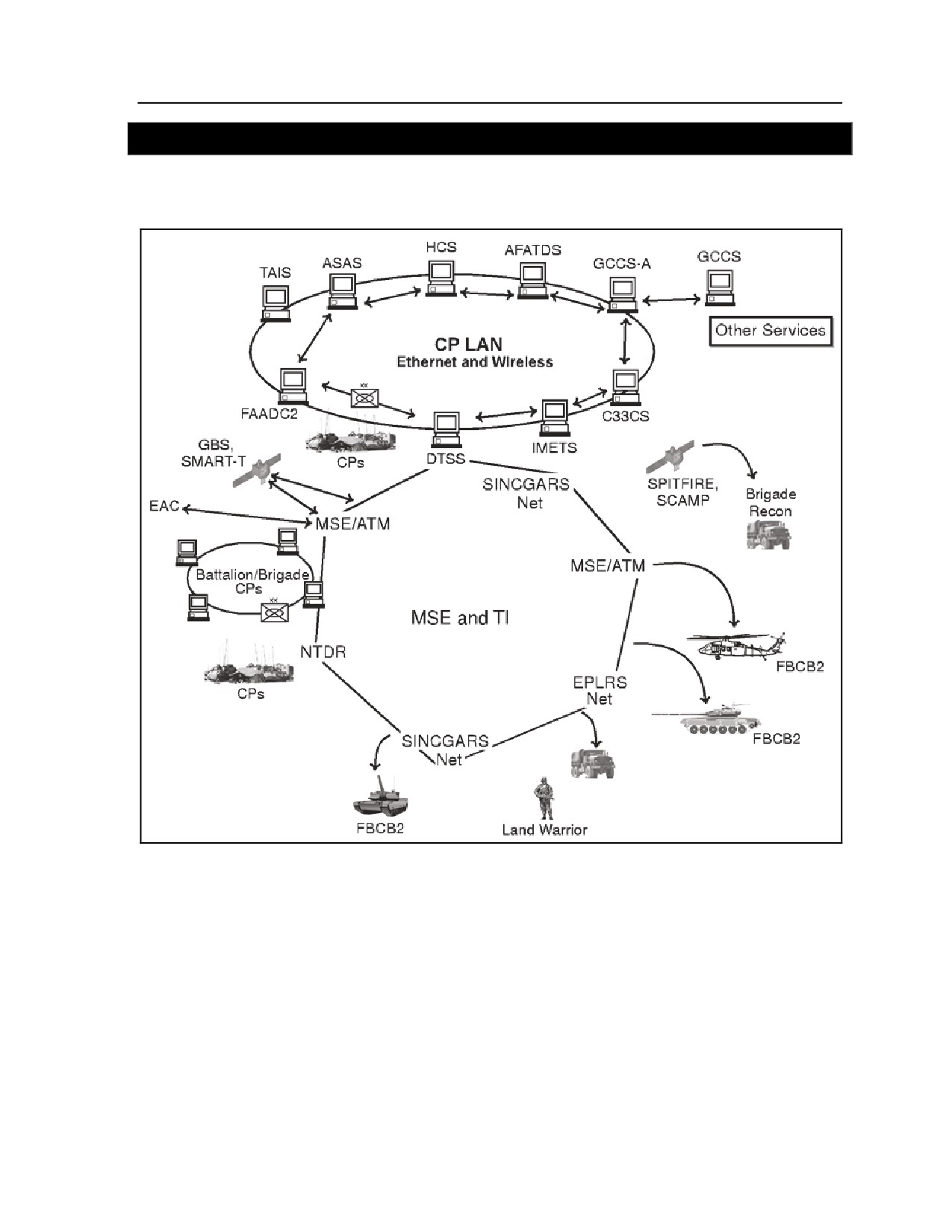
B-109. Force projection, split-base operations, information warfare, and joint or combined operations are
doctrinal concepts for warfighting. Crucial to these capabilities is the effective information flow to support
warfighting throughout all phases of an operation (figure B-9, page B-21).
Figure B-9. Digitized communications
ARMY BATTLE COMMAND SYSTEM
B-110. ABCS provides rapid and reliable information nets enabling the Army to project and protect the
force, gain information superiority, determine the OE, conduct decisive operations, and sustain the force. It
provides real-time and near-real-time information that enables sound decisionmaking inside the enemy’s
decision cycle.
B-111. ABCS is a collection of IM systems that assist the commander in exercising C2 and gaining SU.
ABCS permits him or her to apply judgment more productively, use command presence more efficiently,
to develop and disseminate his vision effectively, and understand better the dynamics of war (in general)
and specific operation (in particular).
7 December 2007
FM 3-04.111
B-21
Appendix B
B-112. ABCS provides a visual means to see friendly and enemy forces and the ability to arrange and
maneuver forces to accomplish missions. The ABCS components assist in answering the following
questions:
z
Where am I?
z
What is my status?
z
Where are the other friendly units?
z
What is their status?
z
Where is the enemy?
z
What is the enemy’s status?
B-113. ABCS Version 6.4 (figure B-10) provides for key technology enhancements of the current ABCS
to include integration and dissemination of terrestrial and satellite based FBCB2 BFT and C2 data,
transitions battle command systems from specialized workstations to commercial-off-the-shelf laptops, and
introduces net-centric, XML-based publish and subscribe architecture.
Figure B-10. Army battle command system 6.4 operational enhancements
B-114. Digitization capability is an evolutionary process occurring over many years. When capability is
incomplete, the challenge is to devise ways to mix traditional, manual methods with the automated systems
that permit more rapid planning and synchronized execution. As always, these guidelines should be applied
to a degree that complements the existing level of automation.
COMMON PICTURES
B-115. The terms COP and common tactical picture (CTP) are often used interchangeably, but have
distinctly different definitions.
z
The COP is an operational picture tailored to the user’s requirements, based on common data
and information shared by more than one command; the COP facilitates collaborative planning
and assists all echelons in achieving SU, which helps to synchronize execution.
z
The CTP is an application available on ABCS computers and supporting systems; it uses a
common mapping background, is accessed through a common user interface, and displays
information shared from the joint common database (JCDB). The CTP is dynamically updated
as data changes in the JCDB.
B-22
FM 3-04.111
7 December 2007
Communications
B-116. Examples of COP overlays are force disposition, enhanced by overlaying the operational overlay;
FS overlays; and AC2 overlay. Additional information is available at the description of each system.
B-117. ABCS assists by providing a COP of the OE through timely presentation of information in various
types of formats including voice, data, imagery, graphics, and video. The operational picture also
provides—
z
Access to planning documents.
z
STATREPs.
z
Timely, automatic warnings of air, missile, and CBRN attacks.
B-118. Although each battlefield automated system (BAS) of ABCS makes contributions that support its
own Army WFF-oriented tasks, the key contribution of ABCS is as an interoperable system of systems.
The synergistic capabilities of ABCS allow commanders to reach across the Army WFFs to request, select,
and evaluate data from diverse resources to create relevant information. The COP begins with a common
map background against which a commander can display a variety of information such as—
z
Friendly locations and graphic-control measures.
z
Enemy units and equipment.
z
FSCMs, range fans, and targets.
z
Air tracks and tactical ballistic missile tracks.
z
Logistics status and joint information.
B-119. The COP includes all relevant elements such as—
z
Army units.
z
Joint, allied or coalition forces.
z
Enemy forces.
z
Neutral elements.
z
Unknown forces.
B-120. Each user can tailor his COP to show as little or as much information as he or she requires.
ABCS's essential contribution to C2 is it provides identical, shared data. ABCS enhances warfighting in the
following ways:
z
Accelerates the MDMP, preparation of estimates, COA development, wargaming, and orders
production and dissemination.
z
Assists in gathering and displaying relevant information while filtering unnecessary data.
z
Allows dissemination of information in near-real time and minimizes latency of information
exchanges.
z
Facilitates synchronization of sustainment by increasing opportunities for real-time
coordination.
z
Exploits digital map data and terrain-analysis products.
z
Facilitates rehearsal and training through compatibility with current and future simulation and
simulation systems.
z
Enhances interoperability through commonality of task procedures.
z
Provides data access to the commander in austere environments through reach-back capability.
COMMON SERVICES
B-121. ABCS provides collaborative tools, training programs, and applications.
Collaboration Tools
B-122. Collaboration tools include—
z
VTC, whiteboard, and shared applications.
z
Messaging.
7 December 2007
FM 3-04.111
B-23
Appendix B
z
File transfers.
z
Calendar creation/scheduling.
z
Task management.
z
Internet browser.
z
Database query tools.
Training Programs
B-123. These provide training and simulation capabilities for individual and collective training events.
Applications
B-124. Common applications include word processor, spreadsheet, and presentation/graphics programs.
Document interchange services support document exchanges between heterogeneous computer systems
using common file formats. The operational picture application creates a shared picture of the OE. The
planning application automates aspects of the MDMP and enables parallel and collaborative planning.
ARMY BATTLE COMMAND SYSTEM COMMUNICATIONS NET
B-125. Connectivity is provided by tactical communications systems—MSE, NTDR, SINCGARS, and
EPLRS. The ABCSs within brigade, division, and corps CPs are supported by a wide area network (WAN)
and LAN switch/router architecture (figure B-11, page B-25).
OTHER DIGITAL SYSTEMS
B-126. Additional systems interfacing with ABCS may include A2C2S, digital topographic support
system/quick response multicolor printer, and CGS.
SUBSYSTEMS TO THE ARMY BATTLE COMMAND SYSTEM
B-127. ABCS consists of information technology applications, nets, and communications enabling data
exchange subsystems throughout the force. Each subsystem supports and provides information to other
systems to improve battlefield SU. By integrating the ABCS components to a JCDB, the COP can be
viewed at any workstation according to the commander’s specific requirements. In addition, ABCS
subsystems provide an array of specialized capabilities and applications for units at all levels.
B-128. ABCS consists of the following subsystems:
z
GCCS-A.
z
FBCB2.
z
TAIS.
z
Digital Topographical Support System (DTSS).
z
Integrated meteorological system (IMETS).
z
ATCCS.
B-24
FM 3-04.111
7 December 2007
Communications
Figure B-11. Example of an Army battle command system communications net
7 December 2007
FM 3-04.111
B-25
Appendix B
ARMY BATTLE COMMAND SYSTEM AND THE COMMON TACTICAL PICTURE
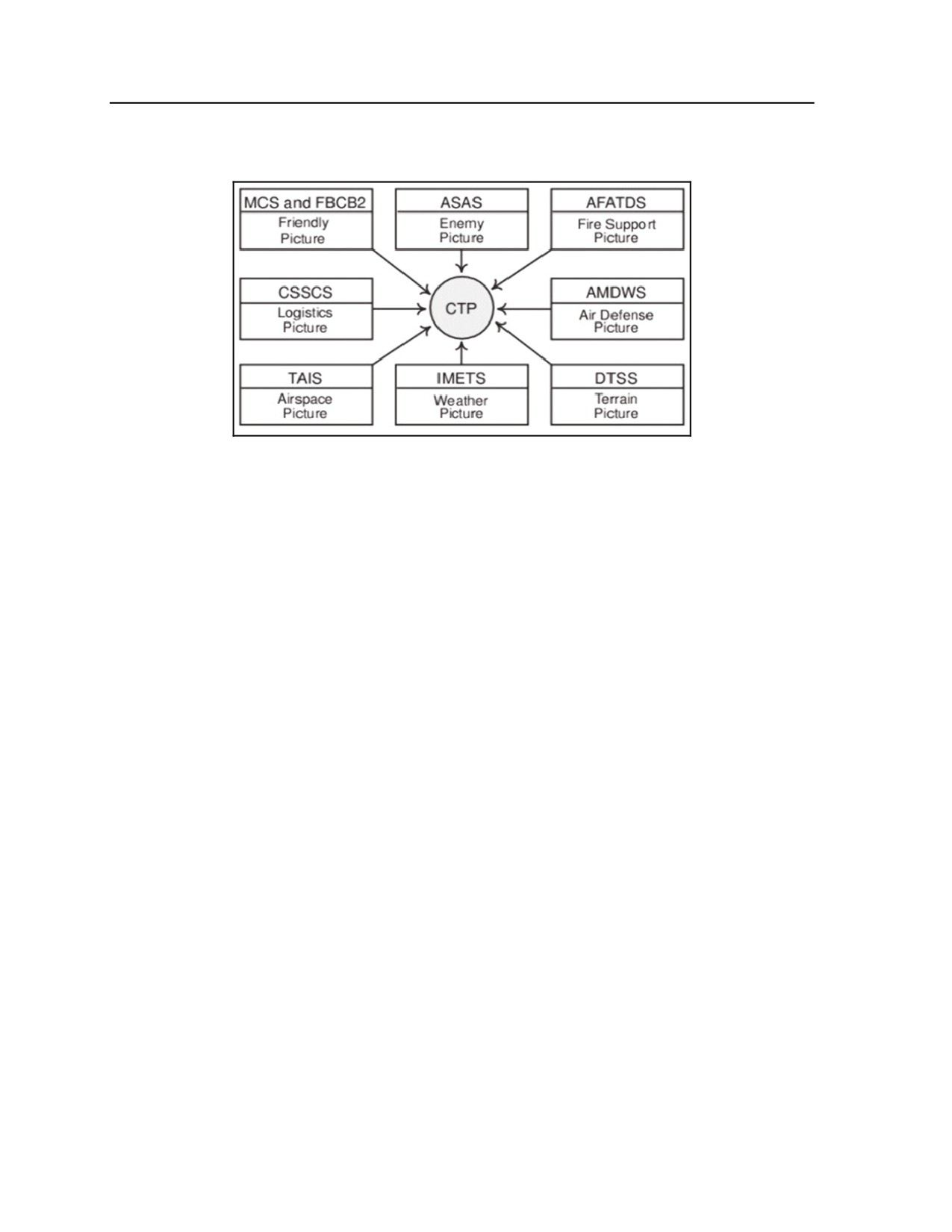
B-129. Figure B-12 shows the ABCS’s input that forms the CTP.
Figure B-12. Common Tactical Picture
GLOBAL COMMAND AND CONTROL SYSTEM-ARMY
B-130. GCCS-A is the Army hardware and software directly supporting Army implementation of the joint
global command and control system (GCCS). It supports monitoring, planning, and execution of joint,
combined, and Army operations for theater GCCS-A ensures Army access to key information within the
joint realm such as force tracking, host-nation and civil affairs support, theater AD, targeting,
psychological operations, C2, logistics, and medical and personnel status. In turn, this information supports
corps-level planning, execution, and monitoring of mobilization, deployment, sustainment, and
redeployment.
B-131. A GCCS-A system is at the corps main and tactical CPs.
Capabilities
B-132. The commander’s force analyzer provides current TPFDD. This information is key to planning
movement of forces and monitoring unit status and availability.
B-133. The logistics analyzer allows planners to forecast resources needed in various combat situations.
B-134. GCCS-A shares the client-server architecture common operating environment with the joint GCCS
for general functions of teleconferencing, messaging, file transfers, office automation, utilities, and system
administration.
FORCE XXI BATTLE COMMAND BRIGADE AND BELOW
B-135. FBCB2 provides C2 and SU to the lowest tactical echelons. It supports OPCON chiefly through
the transmission and receipt of orders, reports, and data via combat messages. FBCB2 employs position
navigation and reporting capability to depict and transmit the unit’s own location. FBCB2 can also access
other friendly units’ locations, as well as intelligence, to show the friendly and enemy picture in near-real
time, even while on the move.
B-136. FBCB2 is found on platforms from the commander to the Soldier level.
Capabilities
B-137. FBCB2 assists SU by telling the user his location and locations of other friendly forces, observed
enemy forces, and reported battlefield obstacles. The user can adjust his picture of the battlefield by
B-26
FM 3-04.111
7 December 2007
Communications
selecting which overlays, graphics, and icons are shown. Unit displays can be altered by grouping icons
according to unit type or echelon.
B-138. FBCB2 automates frequently used urgent messages for reporting the enemy, requesting
MEDEVAC, CBRN attack, call-for-fire, cease fire, and unit situation reporting. Enemy information can be
rapidly formatted via an automated report. This information is forwarded to all other FBCB2 users and the
ASAS supporting the user, usually the TF or brigade S-2.
B-139. FBCB2 supports the call-for-fire process via a message in JVMF sent directly to AFATDS. The
integration of the laser ranger finder with FBCB2’s ground positioning system greatly improves speed and
accuracy of both calls for fire and enemy SPOTREPs. It provides key information to the CSSCS on unit
logistics status.
TACTICAL AIRSPACE INTEGRATION SYSTEM
B-140. TAIS is a digitized, integrated airspace management and decision support system assisting the
ground commander’s role in the air battle. It supports automated AC2 planning and operations and ATS. It
also helps planners build Army input for the joint ACO to distribute the approved AC2 overlay. TAIS can
display ACMs in two or three dimensions while monitoring the real-time airspace situation. TAIS provides
SU of the third dimension by providing real-time airspace information that displays location and movement
of aircraft transiting the OE overlaid against current ACMs.
B-141. A TAIS is found at the division main CP. A second TAIS is located at the division tactical CP or
aviation brigade where it can optimally provide flight-following functionality. At corps level, one TAIS is
at the main CP while a second is placed consistent with the tactical situation. TAIS is also at theater.
Capabilities
B-142. TAIS deconflicts (mathematically and graphically), in real time, airspace usage in the third and
fourth dimensions (altitude and time). For example, the operator can graphically rotate a three-dimensional
representation of the airspace to see ACMs from different angles, enabling him or her to see how they
intersect and overlap.
B-143. The ATS display includes information from the ACO and ATO. TAIS operators can use this
display to track aircraft flight. If an aircraft leaves the safe transition corridor, TAIS can alert the operator.
TAIS is able to communicate (voice and data) with current and future military aircraft (joint/combined),
civilian aircraft and air traffic control systems and other U.S. and allied forces airspace users.
DIGITAL TOPOGRAPHICAL SUPPORT SYSTEM
B-144. DTSS enables topographic support personnel to receive, format/reformat, store, retrieve, create,
update, and manipulate digital topographic data. It gives digital terrain analysis, terrain databases, updated
terrain products, and hard-copy reproduction of topographic products to include maps. Its tactical decision
aids support COA analysis and the MDMP. These aids include mobility analysis, intervisibility (LOS)
analysis, environmental and climatology analysis, terrain elevation, and other special products. Using the
global broadcast service, DTSS receives and distributes digital terrain data from the NGA. DTSS can
update existing digital maps from satellite imagery and produce full-size, color paper maps from any DTSS
product. DTSS is found at the corps main CP and tactical and brigade CPs.
Capabilities
B-145. DTSS produces sophisticated mobility analysis products. For example, it provides a detailed
analysis comparing off-road mobility of the HMMWV and M1 tank.
B-146. DTSS performs intervisibility analysis, which is overlaid on a terrain map backdrop. For example,
from any point on the map, it can depict every other point within LOS of the first point.
7 December 2007
FM 3-04.111
B-27
Appendix B
B-147. DTSS depicts a three-dimensional view such as a fly-through area. Colored areas show threat and
friendly AD domes superimposed on satellite imagery. The DTSS database contains detailed terrain
information but not weapon characteristics and locations; these must be obtained from the intelligence
staff.
INTEGRATED METEOROLOGICAL SYSTEM
B-148. IMETS is the meteorological component of ABCS. It provides an automated, high-resolution
weather system to receive, process, and disseminate current weather observations, forecasts, and weather
and environmental effects decision aids. IMETS workstations, manned by staff weather teams, are at the
aviation brigade, division, and corps main CPs.
Capabilities
B-149. IMETS receives and integrates weather information from polar-orbiting civilian and military
meteorological satellites, the Global Weather Center, artillery meteorological teams, remote sensors, and
civilian forecast centers.
B-150. IMETS processes and collates forecasts, observations, and climatological data to produce timely
and accurate weather products tailored to the warfighter’s specific needs. Additional weather information is
available via the IMETS web pages. Severe weather warnings are disseminated to units via U.S. message
text format message.
B-151. The integrated weather effects decision aid displays weather effects on weapon systems or
missions. For example, it can show various weather effects-whether favorable, marginal, or unfavorable-
on various weapons over the next 24 hours.
ARMY TACTICAL COMMAND AND CONTROL SYSTEM
B-152. ATCSS is a family of automated C2 tools. ATCCS consists of the following:
z
MCS.
z
Maneuver control system-light (MCS-L).
z
ASAS.
z
All source analysis system-light (ASAS-L).
z
AFATDS.
z
AMDWS.
z
CSSCS.
Maneuver Control System
B-153. MCS is the S-3’s tool. It displays the current battle and enables planning for the future battle. It
provides the ability to collect, coordinate, and act on near-real time battlefield information. MCS integrates
information horizontally and vertically to provide the COP with friendly, enemy, and noncombatant
locations. MCS is found at echelons from battalion through corps.
Capabilities
B-154. A message processor is available on all MCS workstations. It is used to create, edit, transmit, print,
and store messages in both U.S. message text format and JVMF.
B-155. With word-processing templates and web-browser technology, MCS can rapidly produce and
distribute OPLANs, OPORDs, FRAGOs, and WARNOs. Task organizations are created, edited, and
displayed using the unit task order (UTO) tool.
B-156. MCS collaborative planning tools enable multinode collaborative planning sessions within or
between CPs. These tools include data conferencing, chat, and whiteboard. The whiteboard is a powerful
capability for war-gaming, orders briefs, and back-briefs. The chat feature is similar to current chat
B-28
FM 3-04.111
7 December 2007
Communications
programs available on personal computers. Multiple users can communicate simultaneously by posting text
messages that can be read simultaneously by all chat participants.
Maneuver Control System-Light
B-157. MCS-L operates as a client of Medical Support Command. It is able to obtain data directly from
the JCDB and update it with friendly locations and battlefield geometry. The main difference between
MCS-L and MCS is the ability of the latter system to perform various net server functions and interface
with FBCB2. MCS-L is found at battalion, brigade, and certain separate companies.
Capabilities
B-158. The MCS-L can be used to—
z
Produce orders, plans, and annexes; used to develop task organizations, overlays, and
synchronization matrices.
z
Develop and assess COAs; MCS-L includes a distance/rate tool.
z
Create messages and generate reports; used to maintain the staff journal.
z
Record and depict NAI, target areas of interests, and CCIR including HVTs and HPTs.
z
Function as file transfer protocol client/server; MCS-L possesses Adobe Acrobat, a file zip
utility, Microsoft Office, and web browser.
All Source Analysis System
B-159. ASAS is the intelligence fusion system. It receives and processes intelligence and information
from sensors, processors, and communications systems at national, theater, and tactical echelons and
SPOTREPs from FBCB2. It provides a timely, accurate picture of the enemy situation. The S-2 uses his
ASAS remote workstation (RWS) for automated situation development, COAs, targeting, tactical warning,
and BDA.
B-160. ASAS is at echelons from battalion to corps. An ASAS RWS can function as a stand-alone system
or an adjunct to an analysis and control element (ACE) at corps and division level and the analysis and
control team at brigade level.
Capabilities
B-161. Intelligence personnel can use the analysis tools in the ASAS RWS for their IPB. For example, it
is able to depict tracked vehicle GO and NO-GO areas overlaid on a terrain map. The ASAS RWS assists
the warfighter’s COA analysis with information on enemy units, equipment, locations, and movements.
B-162. Using reports and sensor inputs, the RWS can alert operator to enemy targets and automatically
nominate them for friendly supporting fires. Commanders and staff can even focus ASAS on specific types
of targets best supporting the mission.
B-163. ASAS also monitors the current enemy situation. Using the latest combat information and
intelligence, it maintains and displays timely, detailed data on enemy units.
All Source Analysis System-Light
B-164. ASAS-L has vertical and horizontal interoperability with MCS, AFATDS, FBCB2, and other
ASAS terminals. It is intended primarily for those who use preprocessed intelligence information and
graphic IPB products from the analysis and control team, ACE, and the S-2’s ASAS RWS (chief ASAS
platform at corps, division, and BCT echelons). ASAS-L receives and processes initial INTREP and
information received via FBCB2. It forwards these reports to the analysis and control team and ACE where
the information undergoes intelligence processing and integration before returning to the brigade S-2 as
fully correlated intelligence information. ASAS-L is located at battalion.
7 December 2007
FM 3-04.111
B-29
Appendix B
Capabilities
B-165. The ASAS-L provides ISR management and analytic support to the battalion S-2 for SU, tactical
warning, force protection, and targeting. It provides an analyzed enemy picture to the operational picture.
Advanced Field Artillery Tactical Data System
B-166. AFATDS is the artillery management system employed by FS personnel. It provides fully
automated FS planning, coordination, and control of close support; counterfire; interdiction; suppression of
enemy ADs; and operations in unassigned areas. AFATDS matches FS weapons with targets based on
target type, commander’s guidance, unit availability, weapon status, and ammunition availability. It
encompasses FS platforms across the services-including mortars, FA cannons, rockets, missiles, CAS,
attack reconnaissance helicopters, and naval surface fire support (NSFS). AFATDS is a multiservice
system.
B-167. AFATDS is at the firing platoon through theater Remote terminals allow commanders, LNOs, and
other FS personnel to monitor FS operations and issue guidance.
Capabilities
B-168. AFATDS analyzes a potential target and then identifies which available FS systems are most
effective. This information is shown to the operator through a visual display.
B-169. Based on command guidance, AFATDS prioritizes targets and supported units, specifying the
method of engagement and volume of fire for each type of target. These priorities can vary according to
specific guidance for each phase of an operation to best support the commander’s intent and scheme of
maneuver.
B-170. AFATDS processes fire missions through combat messages in dialogue with MCS, CSSCS,
AMDWS, and FBCB2 and reports mission results to ASAS.
B-171. In addition to managing the FS of current operations, AFATDS assists FS planning for future
operations. Its planning mode offers decision aids and analytical tools to determine which FS plan best
supports a COA.
Air and Missile Defense Work Station
B-172. AMDWS is the AD system that enables monitoring of the current air operation while planning for
future events. It also provides SU of the third dimension. The force operations capability of AMDWS
supports the planning, coordination, and preparation for and sustainment of the AD mission. It integrates
AD fire units, sensors, and C2 centers into a coherent system for defeating the aerial threat. Defense
planning and analysis functions support development of AD missions and distribution and merging of
missions between echelons. AMDWS also supports air battle management by displays that show ACOs,
current fire unit status, alert posture, missile expenditure, and personnel ready for duty. AMDWS is located
at the AD battery CP with the BCT main CP, division CPs, corps CPs, and theater.
Capabilities
B-173. The AD unit status screen shows location, alert status, on-hand munitions, vehicles, and personnel
for AD units from section through battalion echelon.
B-174. Its weapon and sensor visibility feature supports placement of AD weapons and sensors. By
analyzing platform capabilities and digitized terrain elevation data, AMDWS can determine area coverage
of weapons and sensors at different locations.
B-175. The AMDWS mission planner shows zones of sensor coverage, weapons coverage, friendly and
hostile air tracks, air avenues of approach, and airfields. The commander can use this display to
synchronize AD coverage with the planned scheme of maneuver. Operators can set parameters to depict
aircraft at various altitudes based on the surrounding terrain.
B-30
FM 3-04.111
7 December 2007
Communications
Combat Service Support Control System
B-176. CSSCS is the automated system for planning and controlling the sustainment of combat
operations. Warfighters can logistically assess future COAs using current or planned task organizations
and approved planning factors. CSSCS tracks the maneuver sustainment posture throughout task
organization down to company level. CSSCS terminals are found from the battalion through theater.
Capabilities
B-177. Logistics reports depict unit and resource status with a color code of green, amber, red, or black by
using corresponding percentages set by the user. Reports can be displayed as web-based custom reports or
standard, preformatted reports. The standard report shows the logistics readiness of a unit and its
subordinate units. The user can focus on parts of the report to isolate specific units and materiel items. This
capability helps identify how an individual status affects the overall readiness rating of the unit. In the
custom report, the user can track the status of specific units and resources.
z
The capability report shows a unit’s logistics ability to conduct sustained combat operations; this
report provides unit resource status in relation to combat posture and intensity for the current
day and next 4 days.
z
The supply class report shows resource status with items grouped by class of supply.
z
The personnel daily summary depicts unit personnel status and is available for all company-size
units and separate battalions.
COMMAND POST OF THE FUTURE
B-178. Another collaboration tool being developed is the CP of the future. It is a suite of executive level
decision support systems providing SU and collaboration tools to support decisionmaking.
B-179. It is designed to support parallel, synchronous and asynchronous, cross functional planning and
execution. Team members share workspaces that embody their thinking about the current situation and
collaborate to create a rich, multi-perspective, shared operational picture.
B-180. CP of the future operates over MSE/local LAN and will eventually be used over SATCOM.
B-181. CP of the future is not a replacement for the ABCS, rather it depends on ABCS for the majority of
its data. It is partially integrated with the ABCS and limited to receiving one-way feeds from MCS,
FBCB2, ASAS, and MTS. However, the Defense Advanced Research Projects Agency is working on 2-
way ABCS integration and adding air and fire pictures.
B-182. CP of the future creates a more user friendly environment with which to manipulate the data and
conduct collaboration. The CP of the future consists of the four main applications shown in figure B-13,
page B-32.
B-183. The workspace consists of a two-dimensional map with a personal pasteboard for the commander
and shared pasteboard for other participants, three-dimensional map, and VoIP. The commander’s
pasteboard provides the ability to draw and highlight data, force tracking, and map imagery. The
pasteboard for other commanders and staffs contains real-time updating, master schedule; SITREP table;
size, activity, location, unit, time, and equipment report table; and other displays as desired. All of the
displays are shareable.
B-184. CoMotion client application provides a versatile commander’s view into geospatial, temporal, and
other forms of data.
B-185. The Oculus map provides a three-dimensional picture which allows terrain manipulation and rapid
terrain appreciation. It can be linked to any CoMotion client map, showing same data and area. It can
provide entity representation of BLUE elements. The time slider function allows visualization of forces
flowing over time.
7 December 2007
FM 3-04.111
B-31
Appendix B
Figure B-13. Client system—four main applications
B-186. The MapManager application caches imagery and map data locally to be utilized on the CP of the
future, and the VoIP application integrates with the CoMotion client application to provide seamless audio
communications across multiple channels.
DIGITAL COMMAND POST OPERATIONS
B-187. The Army is making rapid and drastic changes in CP design, taking full advantage of the newest
computer technology. The CPs for digitized units will be mobile, deployable, and equipped to access,
process, and distribute information and orders for their echelon. This section outlines the internal
operations of a digital CP. FM 71-100-2, FM 71-100-3, and FM 5-0 contain detailed discussion.
DATA EXCHANGE
B-188. Central to digital CP operations is the manner in which they exchange data. ABCSs share
information either directly with one another or through the JCDB. The JCDB resides on all ABCS
computers in a CP and provides data for common applications that generate the COP. Battlefield
information dynamically flows back and forth between ABCSs and the JCDB. When data are entered
through a BAS, this change is forwarded to all ABCS subscribers on the CP’s TACLAN and posted to the
COP (figure B-14).
Figure B-14. Data exchange within a command post local area network
B-32
FM 3-04.111
7 December 2007
Communications
B-189. Data are also exchanged between CPs. This exchange allows the same data to be maintained in the
JCDBs in different CPs. Data generated by each BAS flows to its counterpart BAS at adjacent echelons.
Each BAS then transfers this information to the JCDB at that echelon via the TI. Friendly position
information flows from FBCB2 upward through the server located at each echelon. This information is
then deposited into that echelon’s JCDB. This data exchange ensure all CPs have JCDBs resembling one
another. This is key to creating the COP. Figure B-15 shows data flow between an example battalion and
brigade with their MCS operating as servers. Note the flow of friendly position information (depicted by
dashed arrows) moving between these echelons and into their JCDBs. Each BAS can, in turn, access this
friendly picture from the JCDB at its echelon. The flow of data from a BAS to other BASs and the JCDB is
shown by solid arrows.
Figure B-15. Example of a data exchange between command posts
DIGITAL COMMAND POST LAYOUT
B-190. The standardized integrated command post system (SICPS) is the new generation of CP facility
systems to support digitized units. SICPS is a C2 enabler, providing the platform to conduct digital CP
activities. Its primary purpose is to support C2 of digitized units by housing their ABCSs. SICPS is
designed to facilitate CP operations by providing flexibility, commonality, and operational capabilities
needed to enhance unit mobility and integrate ABCS and associated communication and networking
equipment. It supports integration of these command, control, communications, computers, ISR assets into
platforms that can serve as a stand-alone CP or an integrated element in a larger digitized CP.
B-191. The SICPS has seven CP variants to include track- and wheeled-vehicle-mounted vans, tents, and
hard shelters. The digital CP collocates staff sections and supporting communications systems to facilitate
both face-to-face interaction and digital data exchange.
B-192. Unit SOPs will dictate the CP layout. As with the analog CP, the digital CP’s physical setup must
facilitate communication and analysis of information as well as accommodating computer hardware
requirements. Within the digital CP, information is processed at two locations—individual workstations
and the combat information center (CIC).
INDIVIDUAL WORKSTATIONS
B-193. The focus of the individual workstation is the individual BAS and specific Army WFF it supports.
At his workstation, the staff member inputs and monitors data within his sphere of responsibility. He or she
7 December 2007
FM 3-04.111
B-33
Appendix B
also accesses data posted to web pages and shared files by other staff sections in the LAN and WAN to
carry out Army WFFs and duties.
COMBAT INFORMATION CENTER
B-194. The focus of the CIC is integrated battle monitoring and decisionmaking. It is a special location
within the CP for the display of information. The CIC is the central area for viewing information for the
commander and his staff to maintain SA.
Large Screen Display
B-195. The large screen display (LSD) is the only area in the CP where all key BAS data can be viewed
simultaneously. It is the place where battlefield vision is best supported. The commander uses the CIC to
illustrate his guidance and, with his staff’s assistance, to develop and maintain the COP. CICs vary by
MTOE. However, the typical CIC has two LSDs, each capable of displaying nine subscreens. Each
subscreen can display the COP and be configured in various ways to best support the commander’s
information display preferences. The more subscreens used, the lower the image resolution. It is
recommended each LSD screen use no more than four subscreens. Two LSDs allow display of eight
subscreens. The addition of the engineer battalion LSD increases this display capability.
Data Display Management
B-196. IO plays a key role in a commander and staff’s ability to maintain an accurate picture of the
battlefield in the CIC. With feeds from each ABCS, the LSD enables them to see more of the battlefield
and receive greater amounts of real-time battlefield information by Army WFF than is available with
analog systems.
B-197. More information is not necessarily beneficial to mission planning and accomplishment. Data
must be filtered, fused, and focused to create meaningful informational displays relevant to the mission.
These displays or tactical pictures must be presented in a logical manner on the LSD to support SU. CP
digitization has replaced analog maps, acetate, and wing-boards with digital overlays and electronic files.
Because electronically stored information is readily available through a minimum number of computer
keystrokes, there is less need to print paper copies of the information. Leaders and staff must know what
data are available to them to make decisions about what will be displayed.
B-198. Although the LSD can display any BAS electronic data, the narrative and static aspects of some
information still lend themselves to paper-copy posting within the CP. This is especially true for
information less likely to change during a mission such as CCIR and the synchronization matrix. In turn,
this optimizes the use of LSD subscreens by freeing them to depict dynamic ABCS digital content. The
commander, XO, S-3, and battle captain must be able to orchestrate Army WFF coordination through the
display of key information on the LSD. Each staff section must, therefore, maintain information relating to
its Army WFF using visual graphics that support the COP. Staff sections and their supporting systems
should be arranged around the LSD to facilitate information control, interaction, coordination, and
information analysis.
B-199. The COP is displayed on the LSD through one ABCS, typically the S-3’s MCS or MCS-L. COP
control and manipulation and CP LAN administration are aided by centrally collocating the CP server and
BAS that projects the COP. The ability to view the LSD through the BAS controlling the COP also
facilitates communication and navigation through data. During discussions in the CIC, personnel can focus
staff on key portions of the COP. Data are displayed on the LSD via the COP using the ABCS COP
application or through overlays provided by individual BASs. To portray the COP graphically requires
METT-TC analysis of information. The COP displays enemy (red feed and graphics), friendly (blue feed
and graphics), terrain (characteristics and impact), and civilian considerations (gray feed and graphics).
B-200. Friendly analysis occurs in the CIC by all sections and systems. Each BAS provides Army WFF
overlays for subsequent data manipulation and consolidated viewing of operational pictures that form the
COP. Enemy analysis is especially time-sensitive information.
B-34
FM 3-04.111
7 December 2007
Communications
B-201. The MCS whiteboard or electronic whiteboard equips leaders and staffs to conduct collaborative
sessions. Participants at distributed locations view the same enemy and friendly COP on an MCS display
and are linked with audio. The telestration feature of whiteboard allows each participant to use a mouse
with a crayon drawing capability to visually depict locations, graphics, and other coordination measures
seen on the participants’ screens.
DIGITAL RUNNING ESTIMATES
B-202. Not all key information can be graphically depicted on the LSD. Such information must be
captured in a readily available, continuous update format for quick dissemination and assimilation. FM 5-0
emphasizes each staff section should maintain a running estimate (in narrative form, at division and higher
and, in graphical form, at brigade and battalion). In the analog CP, these graphical running estimates
correspond to the wing board and map data.
B-203. Digitization has eliminated the need to post information to wing boards but has created the need to
organize digital data. Units must capitalize on the TACLAN web pages maintained by each staff section
for organizing and posting critical mission data. By placing digital running estimates on a web page, each
staff section supports the commander and staff needs to quickly review, update, and use information for
battle monitoring and planning.
B-204. Establishing a standard running estimate format facilitates navigation through the estimate and
cross-referencing between estimates. Running estimates should also list available Army WFF overlays by
name to better focus graphical review within the ABCS COP application and to focus all echelons and staff
on the same, most current data. Through digitally equipped LNOs, analog units should access these digital
running estimates to obtain current operational data and help synchronize their operations with digital
units.
INFORMATION MANAGEMENT
B-205. The staff must be organized to support the IM process of filter-fuse-focus. This process is guided
by doctrine, TTP, and unit SOPs. The staff must operate according to established procedures that specify
access to common databases, common displays, and report formats. The staff must be organized to allow
vertical and horizontal flow of information. This organization should provide links between teams within
staff sections, staff sections within a CP, and CPs at the same, higher, and lower echelons.
B-206. Digitization enables commanders and staff members to focus more on execution of combat
operations and much less on planning, coordination, and processing of information. Commanders and staff
will have much more data upon which to base their decisions. Their challenge will be to manage the flow
of vast amounts of data so the right information gets to the right person at the right time. These specific
challenges are—
z
Relevancy: Determine relevant information from among the vast amount of data available.
z
Responsibility: Ensure each product is the assigned responsibility of a specific staff section.
z
Accuracy and currency: Ensure data are correct and up-to-date.
z
Dissemination: Ensure information generated by the staff is supplied to the right personnel.
z
Evaluation: Ensure information is appropriately assessed.
Relevancy
B-207. Because of the large quantity of data available, the commander needs to establish information
priorities to focus the staff during data collection. These priorities must address information relevant to the
specific operation. The commander provides this focus via CCIR that are—
z
Specified by the commander and applicable only to him or her.
z
Situation dependent and linked to present and future operations.
7 December 2007
FM 3-04.111
B-35

Appendix B
z
Based on predictable events or activities.
z
Time sensitive (answers to CCIR must be reported to the commander by the most rapid and
effective means).
B-208. Table B-4 summarizes the CCIR responsibilities.
Table B-4. Commander’s critical information requirement responsibilities
Duty Position
Sample Briefing Items
Commander
Establish CCIR.
Establish priorities for information collection and distribution.
Assign assets to collection of information.
Determine display of information throughout his command during an operation.
Chief of Staff/
Manage CCIR.
Executive Officer
Establish TTP for tracking when and how CCIR are answered.
Assign responsibilities to personnel within the staff sections and CPs to manage
information.
Supervise commander’s guidance for collecting, processing, and circulating
information.
Staff Leaders
Manage information within WFFs.
Recommend CCIR based on analyses.
Record, evaluate, analyze, and report collected information to answer CCIR.
Staff Section
Monitor ABCS traffic.
Operators
Know what to file, what data to display, what to name/rename files, and where to
store them.
Know what graphics to display.
Be alert to CCIR and know how to act on CCIR for these requirements.
Accuracy and Currency
B-209. ABCS is automated allowing information to flow quickly and accurately; however, most of its
information does not flow automatically. Only friendly position data, which supports the friendly or blue
picture, flows automatically via FBCB2 and the TI. For all other data to enter and flow throughout ABCS
each BAS must be properly initialized and its data maintained. Staff sections will have ready and routine
access to many products of other staffs and units at varied echelons. This outside access may take place
without a staff section’s knowledge. Staffs must ensure they continuously post their most up-to-date
products and maintain them on staff web pages or shared folders. CP internal procedures must specify
routines and suspenses for producing and revising ABCS products and specify where they will be
maintained.
Dissemination
B-210. Because of bandwidth limitations, it may not be possible to routinely send products through e-
mail; but, it is not enough to merely post information to a web site or shared folder and expect others to use
it. With the exception of routine, scheduled postings and updates, the staff must proactively notify users
when such changes are made. When a product is posted or revised, staff sections must notify other staff
sections and units at the same, lower, and higher echelons. This notification must include instructions on
precisely where to find the product and its file name. Units must establish SOPs that specify file-naming
conventions and file-management procedures. Whether forwarding products or providing notification of
product postings in shared files/web pages, the right personnel must receive the right information. Correct
address information using the ABCS address books and message handling tables must be established to
ensure data are sent to the correct BASs. Addressees must be the users employing the individual ABCS
rather than generic role names in the address book. If this is not done correctly, information on one BAS
will not flow to other BASs even in the same CP. During initialization, operators must also create and
distribute databases, which can be done via messages in ABCS. These databases ensure BASs can share
correct information.
B-36
FM 3-04.111
7 December 2007
Communications
Evaluation
B-211. Computer data tends to be accepted at face value as it is computer-based and assumed to always be
correct. Users of digital systems must resist this tendency. Error can be introduced through failures in
BASs, databases, and communications systems; human error in inputting data; and failing to update
information in a timely manner. Data must be evaluated within the context provided by SU to verify that
they are accurate and current. Users must follow up on discrepancies to ensure they have the correct
information.
DIGITAL DUTIES AND RESPONSIBILITIES
B-212. The diverse products produced using ABCS must be the responsibility of specific staff sections.
This responsibility is usually obvious, being based on doctrine. Unit SOPs/TTP must confirm these
doctrinal responsibilities while ensuring all other products are the assigned responsibilities of specific staff
sections.
B-213. Staff functions as described in FM 5-0 will not fundamentally change in the digital CP. However,
these functions will be carried out differently using the digital tools ABCS provides. Digitization also
requires personnel to perform new functions as listed below. These digital CP tasks should be conducted in
addition to, and as a part of, standard staff responsibilities.
COMMANDER
B-214. The commander has the following digital duties and responsibilities:
z
Provides command guidance for employing ABCS.
z
Provides C2 of automation resources.
z
Establishes automation support priorities.
z
Specifies unit COP.
z
Establishes the CCIR and ensures these requirements are depicted in ABCS.
z
Ensures subordinate leaders are trained in employment, operation, and sustainment of
automation.
z
Trains subordinate leaders and staff to create, maintain, distribute, and use the COP.
EXECUTIVE OFFICER
B-215. The XO has the following digital duties and responsibilities:
z
Coordinates the staff to ensure ABCS integration across BAS.
z
Ensures staff integrates and coordinates its ABCS activities internally, vertically (with higher
headquarters and subordinate units), and horizontally (with adjacent units).
z
Manages the CCIR; ensures satisfaction of the CCIR.
z
Directs creation and distribution of the COP to include procedures for updating enemy and
friendly SU.
z
Monitors information filters, collection plans, and networks that distribute the COP.
z
Provides guidance for automation support.
z
Coordinates the staff to ensure automation support.
z
Coordinates procedures for inter-CP VTCs and whiteboard sessions.
z
Monitors liaison teams with analog
(nondigitized) units and joint/allied forces for their
contribution to the COP.
7 December 2007
FM 3-04.111
B-37
Appendix B
PERSONNEL OFFICER
B-216. The S-1 has the following digital duties and responsibilities:
z
Is responsible for personnel functions of CSSCS.
z
Employs CSSCS to monitor and report on personnel-related portions of the commander’s
tracked item list.
z
Manages Electronic Military Personnel Office (enlisted)/Total Officer Personnel Management
Information System II (officer) interface with CSSCS.
INTELLIGENCE OFFICER
B-217. The S-2 has the following digital duties and responsibilities:
z
Acts as staff proponent for ASAS and IMETS.
z
Supervises ASAS and IMETS operations and support.
z
Provides guidance on employment and support of ASAS and IMETS.
z
Supervises the information security program; evaluates security vulnerabilities.
z
Assists the S-6 in implementing and enforcing LAN security policies.
z
Provides software application expertise on proponent systems.
OPERATIONS STAFF OFFICER
B-218. The S-3 has the following digital duties and responsibilities:
z
Acts as staff proponent for MCS, AFATDS, AMDWS, FBCB2, and AMPS.
z
Plans, integrates, and employs ABCS.
z
Develops the ABCS annex for plans and orders.
z
Develops ABCS annexes to garrison and TACSOPs.
z
Oversees IO.
z
Provides operational and support guidance regarding network employment to subordinate units.
z
Integrates AMPS and distributed planning data.
z
Creates, maintains, and displays the COP; maintains SU of all units.
z
Coordinates with S-6 for communications connectivity in support of ABCS.
z
Plans and monitors operator digital sustainment training.
z
Provides software application expertise on proponent systems.
z
Assigns LNOs and coordinates digital support.
z
Collects and distributes postmission results/BDA.
LOGISTICS STAFF OFFICER
B-219. The S-4 has the following digital duties and responsibilities:
z
Acts as staff proponent for CSSCS.
z
Supervises CSSCS operations and support.
z
Provides guidance on employment and support of CSSCS.
z
Monitors and reports on status of all automation equipment.
z
Provides software application expertise on proponent systems.
SIGNAL OFFICER
B-220. The S-6 has the following digital duties and responsibilities:
z
Serves as signal SME to the commander; advises the commander and staff on all signal support
matters.
z
Monitors WAN performance; integrates the CP LAN.
B-38
FM 3-04.111
7 December 2007
Communications
z
Is responsible for all automation information systems, automation and network management,
and information security.
z
Ensures consistency and compatibility of automation systems.
z
Manages the TI; is responsible for network employment, configuration, and status monitoring
and reporting.
z
Receives planning worksheets with LAN/WAN requirements.
z
Ensures unit information network connectivity between unit and higher/lower echelons.
z
Plans, coordinates, and manages network terminals.
z
Develops, modifies, and manages network need lines, UTO, and base configuration files.
z
Plans, coordinates, and manages communications links to include reach-back communications.
z
Coordinates with higher echelon S-6s for additional communications support.
z
Develops and coordinates the signal digital support plan.
z
Determines system and retransmission requirements for the tactical situation.
z
Coordinates with higher, adjacent, and subordinate units in development of the signal digital
support plan.
z
Manages the release of ABCS software within the unit.
z
Provides a focal point for automation support (help desk).
z
Implements and enforces LAN security policies.
z
Establishes COMSEC accountability, distribution, destruction, and security procedures within
the unit.
MISSION APPLICATION ADMINISTRATOR
B-221. The mission application administrator has the following digital duties and responsibilities:
z
Assists the S-6 in managing the network.
z
Plans and coordinates the linking of BAS to the unit CP.
z
Supervises and performs unit-level maintenance and installs and performs maintenance on
multifunctional/multi-user information processing systems, peripheral equipment, and associated
devices in mobile and fixed facilities.
z
Performs analyst functions; constructs, edits, and tests computer system programs.
z
Performs preliminary tasks necessary for CP LAN initialization.
z
Assists in troubleshooting digital systems.
z
Conducts data system studies and prepares documentation and specifications for proposals.
z
Maintains master copies of software.
z
Backs up data for user-owned and -operated automation information systems.
z
Assists in recovery of digital data at the user level.
z
Operates and performs PMCS on assigned vehicles and power generators.
z
Monitors BAS PMCS program.
z
Coordinates repairs with the S-6 section.
BATTLE CAPTAIN/BATTLE STAFF NONCOMMISSIONED OFFICER
B-222. The battle captain/battle staff NCO has the following digital duties and responsibilities:
z
Oversees operations of assigned BAS.
z
Controls/directs initialization of the BAS within the CP LAN (battle staff NCO).
z
Ensures information flow and coordination take place between and within each staff section and
with higher, adjacent, and lower headquarters.
z
Accesses and employs information through ABCS in support of operations and planning.
z
Ensures key BAS products are available and current in support of the mission.
7 December 2007
FM 3-04.111
B-39
Appendix B
BATTLEFIELD AUTOMATED SYSTEM OPERATORS
B-223. The BAS operator has the following digital duties and responsibilities:
z
Installs and operates assigned digital hardware and software.
z
Establishes connectivity of assigned BAS within LAN/WAN; ensures the system interfaces with
correct tactical communications.
z
Inputs operational data.
z
Produces automated reports required by commanders and staff leaders.
z
Performs PMCS on assigned BAS.
z
Isolates, identifies, and tracks digital system problems.
z
Maintains continuity of digital operations.
z
Maintains portions of the COP, as assigned.
z
Ensures unit-level information security.
MANAGEMENT OF DIGITAL COMMAND POST PERSONNEL
BATTLE ROSTERS
B-224. Each section within the CP must maintain a digital battle roster listing the section operators
assigned to each BAS. At a minimum, sections should plan for three operators per system. Two Soldiers
man a 12-hour shift each plus one Soldier serves as a backup and provides periodic relief. The roster
should list the following:
z
Personnel name and rank.
z
Assigned BAS.
z
Assigned shift.
z
Date of most recent training on system.
z
Software version of most recent training.
z
Estimated date of departure from unit.
B-225. Operators are managed in a manner similar to unit vehicle drivers according to the following
principles:
z
Depth: Have more trained operators than needed to ensure BAS coverage even when
unanticipated losses occur.
z
Anticipate: Know when personnel are scheduled to depart the unit, and train their replacements
well in advance.
z
Leaders: Section leaders should be prepared to function as operators; in addition to providing
additional coverage, this ability enables section leaders to better supervise and employ the BASs
they oversee.
z
Currency: Operators must be trained on the most current software carried on their BAS.
SHIFT MANAGEMENT
B-226. Shift changes are usually scheduled at 12-hour intervals. Commanders consider offsetting shift
changes at midshift for key personnel. Staggering personnel in this manner maintains a constant interface
of new and old shift personnel. This practice ensures at least one individual knows what happened during
the previous shift. Figure B-16, page B-41, provides an example.
B-227. Soldiers must conduct a one-on-one exchange of information with the person they are relieving.
This exchange must be followed by section wide debriefs to ensure continuity in information flow and
handoff of ongoing staff actions.
B-40
FM 3-04.111
7 December 2007
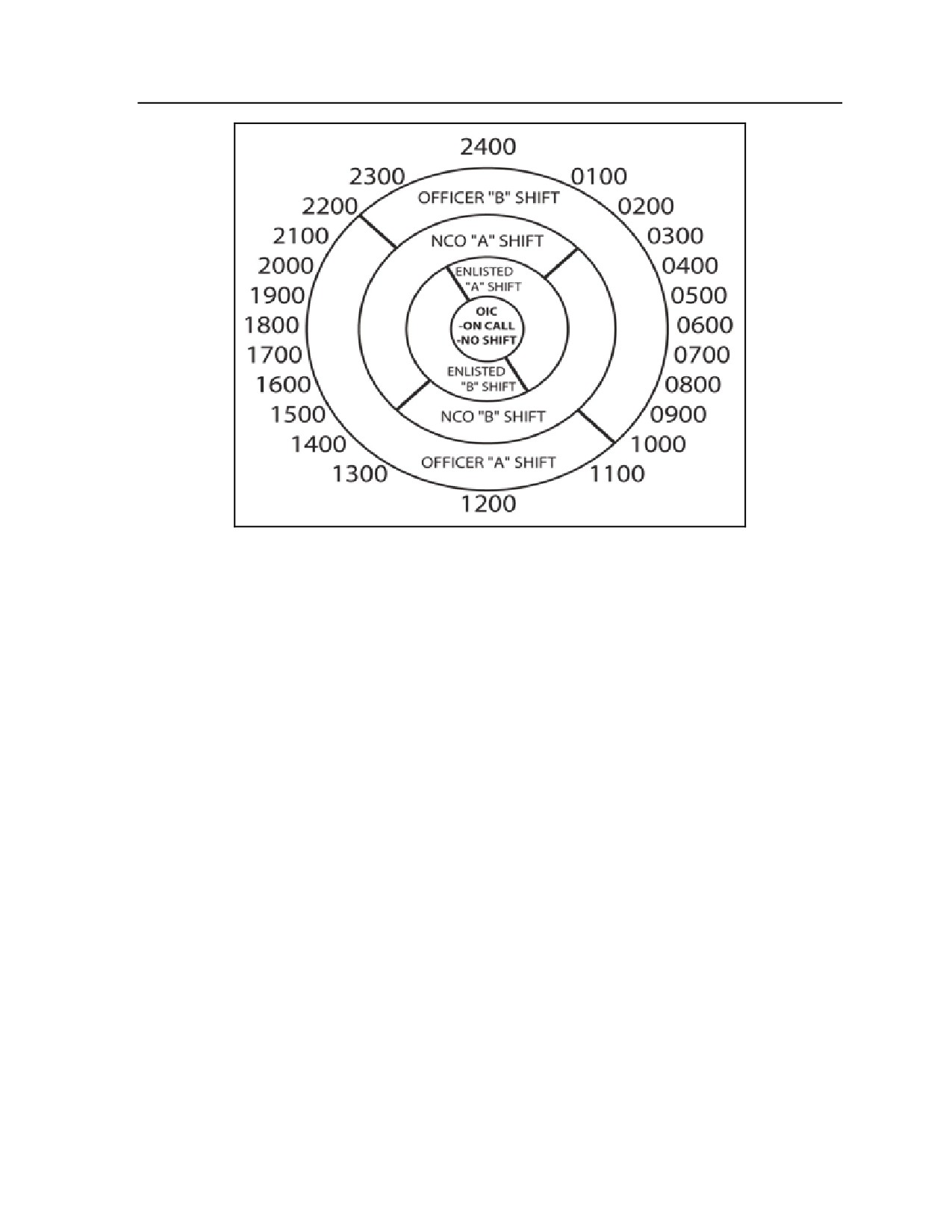
Communications
Figure B-16. Example of staggered shift changes
B-228. Following the individual brief, section-level products and actions are reviewed. Each staff section
accomplishes the following actions:
z
Review digital journal for the past 12 hours.
z
Review and update any CCIR.
z
Review current approved overlays.
z
Review current COP products.
z
Check files to ensure standard naming conventions are used.
z
Review the UTO.
z
Check section web products for updating and ensure they are properly posted.
B-229. A collective information exchange, in the form of a shift change brief, must be conducted so the
incoming shift receives a positive change of control. Personnel from different staff sections will have
access to key information produced by other sections and CPs. Handover briefings focus much less on the
rote exchange of information. Rather, these briefing sessions can function to focus personnel on available
information, evaluation of information, status of current operations, and tasks supporting future operations.
B-230. Critical digital considerations are briefed collectively within the CP. Table B-5, page B-42,
provides an example of what this brief may look like. There is presently no doctrinal guidance on this
process. Units should develop SOPs to address this requirement.
7 December 2007
FM 3-04.111
B-41

Appendix B
Table B-5. Example of a command post shift change brief
Staff Position
Sample Briefing Items
S-3 Battle
Current higher and brigade changes to task organization.
Captain
Disposition /status of units.
Current and future missions.
Current operations and timelines.
LNO updates.
Combat power status.
Projected operations over next 12 hours.
S-3/Air
Brief current and future AC2.
Provide AC2 status in conjunction with AD office, FS officer, and ALO.
S-2/Weather
PIR/CCIR.
Provide SU and location/status of all ISR assets (national to division/brigade).
Request for information to higher headquarters (ARFOR or national).
Weather-next 12 hours impact/effects on friendly and enemy systems.
HVT/HPT.
BDA.
Significant activities during past 12 hours.
FSE
Organization for combat.
Unit locations and status.
Priority of fires.
HPT/attack guidance matrix.
FSCMs.
Significant activities.
ALO
Preplanned request status.
Immediate request status.
In-flight reports.
AD
Organization for combat.
Current AD warning and control status.
Aircraft engagements.
Location and status of AD units.
Engineer
Operations since last update.
Status of equipment and class IV/V.
Future engineer operations.
Recommendations for the commander.
Chemical
CBRN condition.
Current and recommended MOPP.
Enemy CBRN activity.
Chemical unit locations and status.
S-1/S-4/Surgeon
Equipment status.
Class VIII status.
Priority of support.
Personnel status/health service status.
BATTLE RHYTHM
B-231. Battle rhythm is a doctrinal term describing a process essential to effective and efficient battle staff
operations. The cycle of recurring events within a CP focuses staff members to meet information and
action requirements. These recurring events include—
z
Shift changes.
z
Targeting meetings.
z
Reports.
z
Battle updates without the commander.
z
Battle update briefings.
z
Commanders’ collaborative sessions.
z
Battle captain collaborative sessions.
B-42
FM 3-04.111
7 December 2007

Communications
B-232. The staff must achieve a battle rhythm for updating and viewing information and understand how
to use it to effect operations. A well-established battle rhythm aids the commander and staff with CP
organization, IM and display, decisionmaking, and fighting the battle from the CIC and via satellite C2
systems. Battle rhythm demands careful planning and design. The many competing demands must be
deconflicted. Even subordinate units affect a higher echelon’s battle rhythm based on their needs and unit
procedures. Two key things to consider when establishing SOPs for battle rhythm are scheduled updates
(both with higher and subordinate units) and bandwidth. ABCS competes for bandwidth with the
commander’s digital updates or VTCs primarily if data passes over communications links between CPs.
The MDMP can have one of the most dramatic effects on battle rhythm. The process is lengthy and
detailed and must be closely coordinated with other ongoing actions.
BATTLE UPDATE BRIEFING
B-233. The battle update briefing provides the commander with analyzed information essential to
decisionmaking and to synchronize the staff’s actions. COP use expedites the battle update and makes it
more current. The more information used from the COP, the more time the staff has to analyze and
evaluate the information. The battle update briefing itself centers on the COP displayed in the CIC. The
staff must be selective as to what other information is presented given the wealth of data and availability at
each BAS. Unit SOPs, command guidance, and operational requirements guide what information is
briefed. Facts and capabilities may be presented in digital staff estimates for the commander to review
before the briefing. This allows the battle update briefing to focus on by-exception information and specific
commander issues. Methods to update the commander depend on his location, connectivity, and
information he or she requires. Table B-6 compares delivery methods.
Table B-6. Update delivery comparison
Commander in an aviation CP
Commander in another CP
Verbal.
Voice (radio, phone).
Over the shoulder of an operator.
FBCB2.
Commander’s update page and pull-up
MCS or access to another BAS at this location.
information.
Links to staff section pages and pull-up
information.
Collaboration session.
Collaboration session.
LSD.
B-234. Traditionally, these updates were a recounting of significant events since the last update. To build
the update, the CP would establish an information cut-off time. The focus was on maintaining SU. ABCS
has altered this briefing from a staff brief to a constantly available information package focusing on the
commander’s needs. Table B-7 shows how the briefing has evolved from its traditional analog form to its
digital form.
Table B-7. Traditional versus digital
Traditional
Digital
Significant events since last update.
Commander accesses his own critical information needs.
Current as of cut-off time.
Updated continuously.
Periodic event.
Available anytime.
Current SU.
Enhances SU.
Staff presentations and their preparation
Staff routinely maintains information files, which continues
were significant events.
with normal operations.
B-235. Battle update briefs should maximize the use of information from BASs to aid in understanding
the COP. Cutting and pasting information to non-ABCS briefing slides focus on fact finding and less on
analysis. The traditional form also consumes considerable time-more than 1 hour to build/transmit slides, 1
hour to present (at brigade level), and 1 additional hour to present (at the division level). When slides are
briefed, their information is outdated and inconsistent with the more current COP.
7 December 2007
FM 3-04.111
B-43
Appendix B
ANALOG UNIT INTERACTION
B-236. Digitized units must be prepared to operate with nondigital units not having the technology to
access the digital COP. Liaison parties will almost nearly be necessary to ensure full exchange of
information between digitized and nondigitized units. The primary tasks of digital l teams are—
z
Receipt and transmission of orders, graphics, and intelligence data via BAS.
z
Provision of friendly and enemy SU to the analog unit using its BAS.
z
Manual creation of the analog unit friendly and enemy SU and its transmission back to the
parent organization.
z
FS and coordination.
PLANNING
B-237. A digitized unit must exchange liaison teams with nondigitized units early and consistently
throughout the planning process. Nondigitized units must strive to conduct parallel planning but will be at
a disadvantage without digital staff tools. Parallel planning requires rapid exchange of information with
analog units during the planning process. Involving higher, adjacent, and lower staff elements early in the
planning process allows the entire staff to see both current and future operations and identify known or
potential problem areas.
LIAISON TEAMS
B-238. Digital liaison teams may be sent to the analog unit’s CP. Liaisons provide at least some digital
capability to analog units. These teams support SU for both the digital and nondigital unit, issue of orders,
and informal information exchange. The number of liaison teams is limited, and these alone cannot solve
the C2 challenges of analog units without digitally based SU. Liaison teams may be needed to escort
elements of the analog unit, even down to single vehicles if necessary. This latter option provides SU for
these analog elements but is only practical if the digital unit forms additional liaison elements.
B-239. The equipment and skills required of the liaison teams are a function of the type of operation being
conducted and force with which the team is coordinating. The following three basic forms of liaison effect
task organization of liaison teams:
z
Digital unit to digital unit: Requires the least equipment and personnel; information is easily
shared in near-real time; critical SU is maintained in each unit’s knowledge base.
z
Digital unit to analog unit: May occur when conducting operations with some active
component units, most RC units, and coalition forces; these teams require a full suite of digital
systems to maintain the parent unit’s COP and provide SU of the nondigitized force back to the
digital headquarters. Representation from each staff section may be required on the team.
z
Digital unit to nonmilitary forces/agencies: Is the same as for analog units but augmented with
additional specialties such as the S-9/Assistant Chief of Staff-Civil Military Operations.
B-44
FM 3-04.111
7 December 2007
Appendix C
Personnel Recovery Operations
Even though PR can be performed by ground units, this appendix addresses use of
aviation assets to affect a recovery. Army aviation PR is a mission performed by a
designated aircrew for the specific purpose of PR when the tactical situation
precludes SAR assets from responding, and survivors and their location have been
confirmed. Mission success largely depends on thorough premission planning,
accurate and timely intelligence, verifiable survivor location, flexible and redundant
C2, and highly trained PR forces.
SECTION I - GENERAL
C-1. The Army’s PR philosophy is one of leadership and accountability. It comprises primarily the
Soldier’s Creed, directed responsibilities, and practical considerations. The Army conducts PR as a
collection of architecture and activities designed to affect the recovery of personnel who are isolated,
missing, detained, or captured (IMDC). PR is no longer just CSAR, special operation force or air asset
centric operation designed primarily for the rescue of aviators.
C-2. The Army PR function is defined as “the sum of military, diplomatic, and civil efforts to affect the
recovery and return of U.S. military, DOD civilians and contractor personnel, and/or other personnel as
determined by the Secretary of Defense, who are IMDC in an OE.” PR is one of the highest priorities
within the DOD. FM 3-50.1 outlines how the Army conducts PR within the joint services construct.
C-3. Army aviation’s role is in the execution of pre-established procedures and well rehearsed operations
to report, locate, support, recover, and repatriate IMDC personnel. While it is every Soldier’s responsibility
to assist IMDC personnel, aviation assets are generally employed in the recovery of personnel within the
unit or supported units’ AO when the IMDC personnel’s location is known. Four principle methods of
recovery are used when planning and executing recoveries—immediate, deliberate, external supported and
unassisted.
IMMEDIATE
C-4. Immediate recovery is the sum of actions conducted to locate and recover IMDC personnel by forces
directly observing the isolating event or, through the reporting process, determining that IMDC personnel
are close enough to conduct a rapid recovery. Immediate recovery assumes that the tactical situation
permits a recovery using the forces at hand without detailed planning or coordination.
DELIBERATE
C-5. Deliberate recovery is the sum of actions conducted by friendly forces when an incident is reported,
and an immediate recovery is not feasible or successful. Weather, enemy actions, IMDC personnel
location, and recovery force capabilities are examples of factors that may require the detailed planning and
coordination of a deliberate recovery.
EXTERNAL SUPPORTED
C-6. External support recovery is the sum of actions conducted when immediate or deliberate recovery is
not feasible or successful. External support recovery is either the support provided by the Army to other
joint TF components, interagency organizations, or multinational forces, or the support provided by these
7 December 2007
FM 3-04.111
C-1
Appendix C
entities to the Army. CAS, ISR, and airborne C2 are examples of capabilities that may be required from
different components to execute an external support recovery.
UNASSISTED
C-7. Unassisted recovery comprises actions taken by IMDC personnel to achieve their own recovery
without outside assistance. An unassisted recovery typically involves an evasion effort by IMDC personnel
to return to friendly forces, or a point where they can be recovered via another method. While the code of
conduct requires IMDC personnel to make every effort to evade or escape, commanders must strive to
recover these personnel utilizing one or a combination of the other methods.
SECTION II - PLANNING
C-8. The ability of the aviation brigade to successfully conduct PR is a function of proper MDMP, risk
management, training and providing resources. PR integration into all brigade missions trains critical skills
needed at every level to allow the safe return of friendly forces and deny the enemy an easy way to
capitalize on mistakes in planning. The planning and training of the CAB encompasses everything from the
identification of high-risk isolating events for ground and air missions, to the execution of movement with
gun escort to rapidly recover BCT Soldiers stalled with vehicle problems in a potentially unsafe area. It
extends to supporting external joint assets with CAB assets to affect a recovery. In-depth planning
guidance may be found in the FM 3-50.1. Some basic elements to consider are—
z
The primary mission continues parallel to the recovery effort.
z
The goal is recovery of the IMDC person.
Plan a system that enforces accurate reporting.
Ensure the system provides for accurate record keeping without degrading the PR effort.
z
Prevent the IMDC event.
z
Prepare for the IMDC event.
z
Design the PR architecture within the C2 system.
z
Organize, train, and equip for PR.
z
Integrate contractor and DA civilians into OPLAN/OPORD.
z
Transition the PR capability (IMDC events may occur early in the deployment).
z
Plan for integrated rehearsals.
z
Employ the recovery force based on METT-TC.
z
Develop the plan from receipt of the report to reintegration of the IMDC.
C-9. The integration of the entire staff is crucial to developing sound PR plans during MDMP.
Commanders ensure that PR is included in the MDMP, and in the eventual plan or order that results. PR
planners coordinate their actions with all functional staff elements, leveraging the expertise of staff
members in their individual areas to develop PR COAs and plans that enable PR coverage across the AO.
By focusing planning on the five PR execution tasks (report, locate, support, recover, and reintegrate), and
the abilities of commanders, staffs, units, and potential IMDC personnel to perform together to execute
those tasks during a PR mission, PR planners develop robust PR plans that support the overall mission.
TRAINING
C-10. Training must be conducted at all levels within the brigade and constantly reinforced to be effective.
PR academics and survival, evasion, resistance, and escape (SERE) skills allow each Soldier to understand
how to survive an isolating incident and that there is a plan for their safe recovery. The brigade staff, with
the personnel recovery officer (PRO), should develop plans and actions within CP drills and SOPs to
facilitate the PR execution tasks. These elements should be integrated into garrison and combat daily
operations. This may be accomplished by acting on routine precautionary landings and vehicle
maintenance problems as if in combat, or adding isolating events to collective training exercises. Honest
C-2
FM 3-04.111
7 December 2007

Personnel Recovery Operations
assessment of daily reactions to isolating incidents will give commanders a measure of effectiveness in
their PR programs.
ROLES AND RESPONSIBILITIES
C-11. Each PR event has the possibility of becoming a joint mission depending on the situation of forces
involved in a recovery. Some joint participants receive specialized training to execute their role in a
recovery. A thorough understanding of the roles and responsibilities of all participants ensures recoveries
that begin as immediate or deliberate may be continued as externally supported with a minimum of
confusion. This level of functionality and modularity requires an understanding of terms, recovery training
and action drill rehearsals at all levels (table C-1).
Table C-1. Personnel recovery terms
Joint
Army
Civilian
Joint Personnel Recovery Center (JPRC)
JPRC
Rescue Coordination Center
Personnel Recovery Coordination Cell (PRCC)
PRCC
Rescue Sub-center
PRO
PRO
SAR Mission Coordinator
On-scene Commander (OSC)
OSC
OSC
Airborne Mission Commander
S-3/Battle Captain/C2
Aircraft Coordinator
CSAR Unit
No Army term
SAR Unit
Helicopter Recovery Force
Helicopter Recovery Force
SAR Unit
Rescue Escort (RESCORT)
Gun Escort
No civilian term
RESCORT Commander
AMC (attack)
No civilian term
ON-SCENE COMMANDER
C-12. The OSC is the person designated to coordinate recovery operations within a specified area. He or
she does not have to be in an aircraft; he or she may be ground or vessel based, but must be proficient in all
PR procedures and have the ability to communicate with higher headquarters. While this qualifies a pilot to
act as OSC, any Army aircrew may be called upon to act in this capacity. In fact, if any aircraft goes down,
the first aircraft to arrive on scene (wingman) assumes OSC responsibilities regardless of proficiency. The
OSC checklist may be found in the theater SPINS. Other responsibilities of the OSC include—
z
Establishing and authenticating communication with isolated personnel.
z
Locating isolated personnel and passing initial information to the AMC via the rescue mission
brief.
z
Conducting a threat assessment of the objective area (avoid highlighting the isolated personnel’s
location).
z
Completing the OSC checklist.
z
Determining the health/condition of isolated personnel and passing status to the AMC.
z
Re-authenticating isolated personnel after OSC changeover only when the situation warrants.
RESCUE MISSION COMMANDER
C-13. The rescue mission commander (RMC) is the designated AMC maintaining control of the entire
recovery during the launch, en route and terminal phases. Careful consideration of RMC selection should
include knowledge of the overall mission, capabilities of the helicopter recovery force, requirements for
communication, night vision capabilities, and joint interoperability.
RECOVERY FORCE
C-14. The PR force consists of the personnel affecting the actual recovery of the isolated personnel. This
includes security personnel for the area around the extraction point; recovery personnel that authenticate
and move the isolated personnel to the aircraft; and medical personnel that provide immediate assistance to
7 December 2007
FM 3-04.111
C-3