FM 3-04.111 Aviation Brigades (DECEMBER 2007) - page 6
Appendix C
the isolated personnel or injured security force personnel. The size and composition of this force may vary
with the mission supported and the perceived or actual threat. During recovery operations, the RMC should
be in the gun escort for SA at the objective; however, this is mission dependant.
Note. In medium aviation brigades, pathfinders generally conduct security force operations
during personnel recoveries. When security forces from outside the CAB are utilized, it is even
more critical to conduct training and rehearsals to ensure proper integration between
participating units.
HELICOPTER RECOVERY FORCE
C-15. The helicopter recovery force consists of lift aircraft used to move the recovery force to and from the
objective area and move the recovered IMDC personnel back to friendly forces. The helicopter recovery
force will designate an AMC. The AMC coordinates all PR force efforts on the objective. The recovery
force should include sufficient forces to move the isolated personnel to the recovery aircraft and provide
immediate medical attention if required. If the situation dictates, a security force and personnel trained to
remove injured personnel from wreckage may be added.
GUN ESCORT
C-16. The attack reconnaissance assets utilized to provide security escort to the helicopter recovery force
may also be called the RESCORT. The primary duty of the gun escort or RESCORT is to provide
protection and SA for the helicopter recovery force. The principles of air assault security are used in
execution of this task. Priority is to avoid, suppress, and destroy targets posing a threat to the ground or
helicopter recovery force, and to initiate communication with the OSC or IMDC personnel (if no OSC is
on station).
PERSONNEL RECOVERY EXECUTION TASKS
C-17. The PR system is comprised of the five PR execution tasks. These tasks are central to any PR
mission and must be accomplished to ensure a successful recovery.
REPORT
C-18. Timely, accurate reporting to the PR cell by subordinate units—
z
Is the most critical and time sensitive PR action.
z
Provides the commander options related to isolating incidents
z
Suggests possible assets that may assist in recovery planning time.
C-19. Inaccuracies in reports such as call sign errors, location errors, unverified information, lack of
personnel information, and lack of delegation within the staff causes problems that increase in magnitude
due to the parallel nature of the PR planning process.
C-20. Historically, commanders have been hesitant to report a possible loss of accountability. Failure to
report rapidly or have procedural controls in place to identify IMDC personnel causes a delay in
responding. Rapid, coordinated action to recover the IMDC capitalizes on the enemy’s relative confusion
that generally surrounds an IMDC event.
LOCATE
C-21. If the IMDC location is unknown at the time of the initial report, every effort must be made to
determine its location. Recovery efforts cannot commence until the IMDC’s location is known. This
highlights the criticality of gaining and maintaining SA. Once “eyes-on” and basic communication has
been achieved, every effort must be made to maintain that level of SA. This requires an understanding of
basic signaling and the management of assets to maintain contact.
C-4
FM 3-04.111
7 December 2007
Personnel Recovery Operations
SUPPORT
C-22. The support task includes actions taken to mentally, physically, and emotionally sustain IMDC
personnel and their families, throughout the five tasks. Support to IMDC personnel includes establishing
communications, conducting resupply, maintaining morale, and providing protection. While planning
continues, IMDC personnel require support until units can conduct a recovery. IMDC personnel are
authenticated to confirm their identities, family support is initiated with the rear detachment, and planning
for the recovery is finalized and briefed to decision makers. All battlefield enablers should be employed to
provide support to IMDC personnel. Creative use of “show CAS”, FS, ISR, and CAB assets may be
combined to ensure the isolated person understands he or she will be recovered.
RECOVER
C-23. The recover task includes the employment of forces to regain positive and procedural control of
IMDC personnel and does not end until the IMDC personnel are handed over by the recovery element to
medical personnel for reintegration. Once a COA has been approved, the order is passed to the recovery
force. It may be necessary to launch the recovery force immediately to put them into a position to execute
the recovery in a timely manner. The CAB commander generally retains the execute authority to ensure
that more forces are not put at risk and all planning factors have been integrated to mitigate risk.
C-24. During the recovery, the PR cell continuously monitors the progress of the mission and keeps the
PRCC informed to ensure that additional assets may be employed in a timely manner should the mission
not progress as envisioned. Once the recovery of the IMDC has occurred, it is critical that
medical/reintegration assets are updated and transportation is coordinated.
REINTEGRATE
C-25. PR execution does not stop with the successful recovery of IMDC personnel; it continues through
the reintegration process. The goals of reintegration are two-fold—attend to the medical needs of the
recovered personnel; and gather information about the event that has an immediate impact on current and
future operations. The overriding concern during reintegration is the health and welfare of the recovered
personnel. These factors take precedence over all others during the reintegration process. Reintegration
team personnel must often balance these factors with the need to gather pertinent information from the
recovered personnel. Reintegration also includes preparing IMDC for potential media interaction and
providing other support to reduce their anxiety and possible frustration during recovery activities.
C-26. Every isolating incident affects individuals differently. Without medical and psychological
assessments it is difficult to determine the exact affect. Commanders occasionally fear losing an individual
to the process. This concern should be mitigated by the risk of sending personnel who have experienced
emotional trauma back to duty.
7 December 2007
FM 3-04.111
C-5
Appendix D
Army Aviation Composite Risk Management
The tactical environment provides ever-changing demands and unpredictable
problems, often under stressful conditions. The interface of man, machine, and
environment is constantly shifting. We are challenged by a wide range of new
technologies requiring our leaders to use creative measures to provide protection to
our Soldiers on the battlefield. In this environment, mission accomplishment requires
leader involvement and flexible decisionmaking. Not surprisingly, accidents and
injuries increase during combat operations. Safety in the combat environment
depends upon compliance with established standards; however, due to fluid
conditions in the tactical environment, safe mission accomplishment relies heavily on
complete integration of CRM into both planning and execution phases. CRM assists
commanders in anticipating and controlling hazards in the planning phase and in
dealing with unexpected hazards as they arise in the execution phase.
SECTION I - COMPOSITE RISK MANAGEMENT
GENERAL
D-1. CRM teaches Soldiers
“how to think” rather than
“what to think.” Tough, realistic training
conducted to standard is the cornerstone of Army warfighting skills. An intense training environment
stresses both Soldiers and equipment, creating a high potential for accidents. The potential for accidents
increases as training realism increases. Commanders must find ways to protect their Soldiers and
equipment from accidents during realistic training to prepare for war. An accidental loss in war is no
different in its effects from a combat loss; the asset is gone.
D-2. The CRC, located at Fort Rucker, Alabama, is the authority on CRM. Refer to FM 5-19 or visit the
CRC website at https://crc.army.mil for more information.
THE PROCESS
D-3. The CRM process is defined in FM 5-19. CRM is the Army’s primary decisionmaking process for
identifying hazards and controlling risks across the entire spectrum of Army missions, functions,
operations, and activities. CRM is a commonsense way of accomplishing the mission with the least risk
possible. It is a method of getting the job done by identifying the areas that present the highest risk and
taking action to eliminate, reduce, or control the risk. CRM thereby becomes a fully integrated part of
mission planning and execution.
COMPOSITE RISK MANAGEMENT PLAN
D-4. CRM is an integral part of the MDMP. CRM is a decisionmaking process used to mitigate risks
associated with all hazards that have the potential to injure or kill personnel, damage or destroy equipment,
or otherwise impact mission effectiveness. The guiding principles of CRM are as follows:
z
Integrate CRM into all phases of missions and operations. Effective CRM requires that the
process is integrated into all phases of mission or operational planning, preparation, execution,
and recovery.
7 December 2007
FM 3-04.111
D-1
Appendix D
z
Make risk decisions at the appropriate level. As a decisionmaking tool, CRM is only effective
when the information is passed to the appropriate level of command for decision. Commanders
are required to establish and publish approval authority for decisionmaking. This may be a
separate policy, specifically addressed in regulatory guidance, or addressed in the commander’s
training guidance. Approval authority for risk decisionmaking is usually based on guidance from
higher headquarters.
z
Accept no unnecessary risk. Accept no level of risk unless the potential gain or benefit
outweighs the potential loss. CRM is a decisionmaking tool to assist the commander, leader, or
individual in identifying, assessing, and controlling risks in order to make informed decisions
that balance risk costs (losses) against mission benefits (potential gains).
z
Apply the process cyclically and continuously. CRM is a continuous process applied across
the entire spectrum of Army training and operations, individual and collective day-to-day
activities and events, and base operations functions. It is a process that is used to identify and
assess hazards, develop and implement controls, and evaluate outcomes.
z
Do not be risk averse. Identify and control the hazards; complete the mission.
z
Knowledge of risk factors is a key to planning and decisionmaking. With this knowledge
leaders quantify risks, detect problem areas, reduce risk of injury or death, reduce property
damage, and ensure compliance with regulations. Unit leaders should conduct risk assessments
before conducting any training, operations, or logistics activities.
COMPOSITE RISK MANAGEMENT PLAN STEPS
D-5. CRM is a five-step process of assessment (steps 1 and 2) and management (steps 3 through 5)
techniques used to eliminate or reduce hazards. The five-step process is—
z
Step 1 - Identify hazards.
z
Step 2 - Assess hazards to determine risk.
z
Step 3 - Develop controls and make risk decisions.
z
Step 4 - Implement controls.
z
Step 5 - Supervise and evaluate.
TRACKING AND DOCUMENTATION
D-6. To maintain continuity with mission tasks and requirements, it is necessary to track the CRM process
in a standardized manner. Many tools are available that can be tailored to portray CRM information to suit
a particular mission, situation, operation, or event. When time and situation allow, DA Form 7566
(Composite Risk Management Worksheet) or an electronic version is used to document the CRM process.
In addition to providing an Army standard, continuous use of this worksheet reinforces CRM application
and trains leaders, Soldiers, and individuals to think in terms of a five-step CRM process. Locally
generated substitute forms, approved by individual commands, must contain as a minimum all information
included on DA Form 7566.
SECTION II - OPERATIONAL TEMPO AND BATTLE RHYTHM
D-7. Battle rhythm allows units and leaders to function at a sustained level of efficiency for extended
periods. Effective battle rhythm permits an acceptable level of leadership at all times. It can focus
leadership at critical points in the fight or during particular events. Procedures and processes facilitating
efficient decisionmaking and parallel planning are critical to achieving battle rhythm. Every component of
battle rhythm contributes uniquely to sustained operations.
FATIGUE
D-8. Aviation operations are inherently dangerous. Commanders and leaders must be aware of increased
dangers present in sustained operations. Additionally, leaders must be able to recognize the symptoms of
D-2
FM 3-04.111
7 December 2007

Aircraft Characteristics
chronic and acute fatigue and how to deal with fatigued aircrews. FM 3-04.301 provides an in-depth
review of aero medical factors associated with aviation fatigue. Unit flight surgeons are trained to advise
and assist the commander with managing or eliminating symptoms of fatigue.
FIGHTER MANAGEMENT
D-9. Fighter management describes a process essential to effective and efficient aircrew and battle staff
operations. The aircrews are those personnel in the unit who execute the unit’s flight mission. The battle
staff are those personnel in the unit who manage the operations. Successful continuous operations at the
unit level are sustained when commanders enforce rest periods. The unit requires an SOP defining rest
periods, especially for crew members and mission critical personnel. The S-3 and operations personnel at
battalion or higher levels can assist in monitoring, while commanders, flight surgeons and SOs manage this
program. Commanders should utilize a tracking device to help manage a fighter management program.
Table D-1 provides and example of the fighter management tracking system.
Table D-1. Example of fighter management tracking system
RANK:
NAME:
SSN:
MONTH
Daily Totals
14-Day Totals
30-Day Totals
Reset w/10 hrs rest
Reset w/24 hrs rest
Reset w/48 hrs rest
Duty Hrs
Flight Hrs
Duty Hrs
Flight Hrs
Duty Hrs
Flight Hrs
Carry Fwd
1
2
3
4
5
6
7
8
9
10
11
12
13
14
15
16
17
18
19
20
21
22
23
24
25
26
27
28
29
30
31
D-10. AR 95-1 provides regulatory guidance for aviation duty periods and associated flight hours. Local
commanders are the approval authority and designate duty hour, flight hour, and rest period requirements
for their command. Table D-2, page D-4, provides an example of the duty period and flight-hour matrix.
7 December 2007
FM 3-04.111
D-3

Appendix D
Table D-2. Example of a duty period/flight-hour matrix
Time Period
Duty Period
Flight Hours
24 hrs
14 hrs
8-hour day (SR to SS) or
*6 hrs-any combination (max 5 hrs may be N or NVD)
5 hrs-N or NVD
7 days
**84 hrs
42 Flight hrs
30 days
***90 Flight hrs
* Also includes Hood, weather, and MOPP. All MOPP level 3 or 4 flights will be factored at a rate of 2:1.
MOPP training should not be conducted in wet bulb globe temperature above 85 degrees Fahrenheit.
**If 84 hours are exceeded in a 7-day period, the individual will receive a 24-hour reset day before
performing crew duties again.
***Crew members reaching 90 hours within a 30-day period must consult with a flight surgeon before
performing further flight duties. If a flight surgeon is not reasonably available, the crewmember may
resume crew duties after receiving a minimum of 48 hours off-duty time by the commander. After
resuming flight duties, the crewmember must be cleared by a flight surgeon every 10 hours as long as
they exceed 90 flight hours in the current 30-day period.
D-11. A 10-hour rest period is provided for aircrew members prior to beginning a new duty period. The
rest period may be reduced to 8 hours for no more than 2 consecutive days by battalion/TF commander 0-5
or above). An 8-hour rest period is provided for nonflight personnel prior to beginning a new duty period.
D-12. If a 14-day duty or flight limit is reached, a 24-hour rest period is required. Any 24-hour rest period,
within the 14th day duty or 48-hour rest period within the 30-day duty time, will reset the duty day time
clock.
D-13. Extensions are not granted on a “blanket” basis; they are approved only on a “case-by-case” basis.
Extension authority is outlined below:
z
Company commander—can add 2 hours duty, not to exceed 14 hours, and one additional flight
hour.
z
Battalion/TF commander (0-5 or above—can add 2 hours duty not to exceed 16 hours and one
additional flight hour.
z
First 0-6 in the chain of command—can designate duty and flight hours as necessary (may only
be deligated to 0-5 who is in command for a specified period).
SECTION III - AVIATION HAZARDS
D-14. Aviation operations involve inherently higher risk (higher probability of accidents and more severe
consequences) than most ground operations. Historically, when deployed to combat theaters Army aviation
has suffered more losses to accidents than to enemy action. Aviation accidents in combat are typically the
same type experienced in peacetime. Because of this, commanders of units involved in aviation operations
must emphasize the safety component of protecting the force. Commanders, supervisors, and safety
managers at all levels must comply with certain policies regarding the aviation safety component for
protecting the force as outlined in AR 385-10.
HAZARDS TO FLIGHT
D-15. Experience, judgment, maturity and discipline define today’s Army aviators. Aviation commanders
and leaders at all levels must continue to coach, teach and mentor one another. Aviation branch demands
“standards”. The following is a list of hazards and control measures to flight (table D-3, page D-5). This
list is not all encompassing; however, by identifying hazards and controls associated with accidents that
have already occurred, we can continue to learn from others and reduce overall aviation mishaps.
D-4
FM 3-04.111
7 December 2007

Aircraft Characteristics
Table D-3. Hazards to flight
Hazards
Controls
Failure to estimate closure rates and necessary
Maintain SA for proper distance estimation and closure
control inputs.
rates.
Abrupt steep turns, high speed flight, low altitude
Maintain aircraft with in power limitations for conditions.
and power management.
Inadequate pre-mission planning.
Plan and brief missions at the appropriate level.
Inadequate AMC duties.
Define and outline requirements for AMC program.
Zero illumination, combat formations, and
Thorough planning, briefing and risk management.
unfamiliar areas.
Lack of mission training proficiency.
Conduct mission training to standard.
Lack of crew coordination.
Conduct aircrew coordination training enhanced (ACT-E).
Overconfidence and inadequate supervision.
Maintain unit discipline and leadership standards.
Engine failure.
Execute proper emergency procedure.
Inadequate scanning causes aircrews to impact
Conduct continuous scan and crew coordination.
wires, birds or flight hazards.
7 December 2007
FM 3-04.111
D-5

Appendix E
Aircraft Characteristics
This appendix provides an overview of basic characteristics and capabilities of
aircraft organic to aviation brigades or available in an aviation TF.
SECTION I - ROTARY WING AIRCRAFT
OH-58D (R) KIOWA WARRIOR
E-1. The primary missions of this aircraft are armed reconnaissance and attack. The OH-58D aircraft
discussed herein are the version addressed with affectivity code “R” in TM 1-1520-248-10.
DESCRIPTION
E-2. The OH-58D is a single-engine, dual-seat, armed observation aircraft. It has an improved master
controller processing unit system providing highly integrated communication, navigation, aircraft, and
mission equipment subsystems. The video crosslink can store compressed images in memory and enables
transmission of video images between aircraft. The mast-mounted sight (MMS) contains a suite of sensors
including a high-resolution television camera, IR thermal imaging, laser rangefinder, laser designator, and
videotape recorder. Table E-1 outlines OH-58D aircraft characteristics.
Table E-1. OH-58D characteristics
Specifications:
Length: 41 ft 2.4 in
Height: 12 ft 10.6 in
Fuselage width (w/weapons pylons): 9 ft 2 in
Main Rotor Diameter: 35 ft
Max Speed (Level): 110 kts
Max Gross Wt: 5500 lbs (5200 lbs by interim statement of airworthiness qualification)
Cruise Airspeed: 90 kts*
Combat Radius: 120 km*
Armament:
Missile range (Hellfire): 8,000 m
Missile range (ATA Stinger): 5,000 m
Rocket range (Hydra 70): 6,000m (Airburst), 8000m (Contact)
Gun Range (.50 Cal):
2000 m (1600 m tracer burnout)
Optics - MMS:
TIS:
Detection 10+ km
Recognition 6-7 km
Identification 3 km
Television Sensor:
Detection 8+km
Recognition 7 km
Identification 4-6 km
7 December 2007
FM 3-04.111
E-1
Appendix E
Table E-1. OH-58D characteristics
Laser Range Finder/Designator:
Maximum ranging distance 9.99 km.
Lasing a known point will update the navigation system.
Maximum designating distance limited only by TIS/television sensor.
Navigation Equipment:
Inertial Navigation System (INS)/GPS.
Can slave MMS to grid input by operator.
* varies with environmental/mission conditions
CAPABILITIES
E-3. The OH-58D provides the following:
z
Day, night, battlefield obscurant, and limited adverse-weather fighting capabilities.
z
Data transfer system permitting upload from AMPS DTM and downloading of selected
postmission data.
z
Countermeasure suite of IR jammers, radar warning receivers, and laser warning detectors.
z
Moving map display.
z
Video recording and cockpit playback of television and thermal imagery from the mission.
z
Advanced navigation and mission planning equipment; transportable in the C-130, C-141, C-5,
and C-17.
ARMAMENT SYSTEMS
E-4. The OH-58D armament capabilities consist of a .50-caliber machine gun, 2.75-inch rockets, Hellfire
missiles, and Stinger air-to-air missiles. These systems are mounted on two universal weapons pylons. The
aircraft has a laser rangefinder/designator used to designate for the weapons system as well as provide
range-to-target information for onboard weapons systems. Additionally, the OH-58D utilizes an AIM-1 IR
Laser Aiming Light as an aiming device for night combat engagements. The AIM-1 can also be utilized to
identify and/or confirm enemy targets.
.50-Caliber Machine Gun
E-5. The machine gun is an air-cooled, belt fed, recoil operated, electronically controlled weapon. The
gun is mounted in a fixed position to the universal weapon pylon on the left side of the aircraft. It is
capable of firing 750-850 rounds per minute at a maximum effective range of 2,000m. The ammunition
feed and storage system holds approximately 500 rounds.
2.75-Inch Rocket System
E-6. The 2.75-inch weapon system is a light assault weapon for use against enemy personnel, light
armored vehicles, and other soft-skinned targets. The system is comprised of one or two 7-shot rocket
launchers and may be installed on one or both sides of the aircraft. This area system can launch multiple
rockets with various warhead mixes including high explosive, high-explosive MPSM, white phosphorous,
illumination, and flechette. The maximum range is 6,000m for airburst warheads, and 8,000m for contact
warheads.
Hellfire Missile
E-7. The Hellfire missile system is an air-to-surface, laser guided missile system. The hellfire missile is a
point target weapon system using high explosive anti-tank (HEAT) warheads to destroy armored targets
and blast fragmentation and thermo-baric warheads to defeat all targets, except armor targets, utilizing blast
and fragmentation. The Hellfire missile system can be comprised of one or two launchers containing up to
two missiles each. However, weight restrictions may limit the aircraft to just one launcher. The minimum
E-2
FM 3-04.111
7 December 2007
Aircraft Characteristics
engagement range is 500 meters; maximum range is 8,000 meters. Laser designation may be autonomous
or by remote ground or airborne designators.
Air-to-Air Stinger Missile System
E-8. The air-to-air Stinger is an IR, heat-seeking, fire-and-forget missile capable of engaging airborne
targets day or night. The OH-58D can carry two Stinger missiles per pylon for a maximum of four missiles.
The maximum range is more than 4,000 meters.
ARMAMENT CONFIGURATIONS
E-9. Table E-2 provides typical OH-58D ordnance loads.
Table E-2. Typical OH-58D helicopter ordnance loads
Aircraft
Gun
2.75-in Rockets
Missiles
OH-58D
500
7
OH-58D
14
OH-58D
500
2 air-to-air Stingers
OH-58D
4 Hellfire
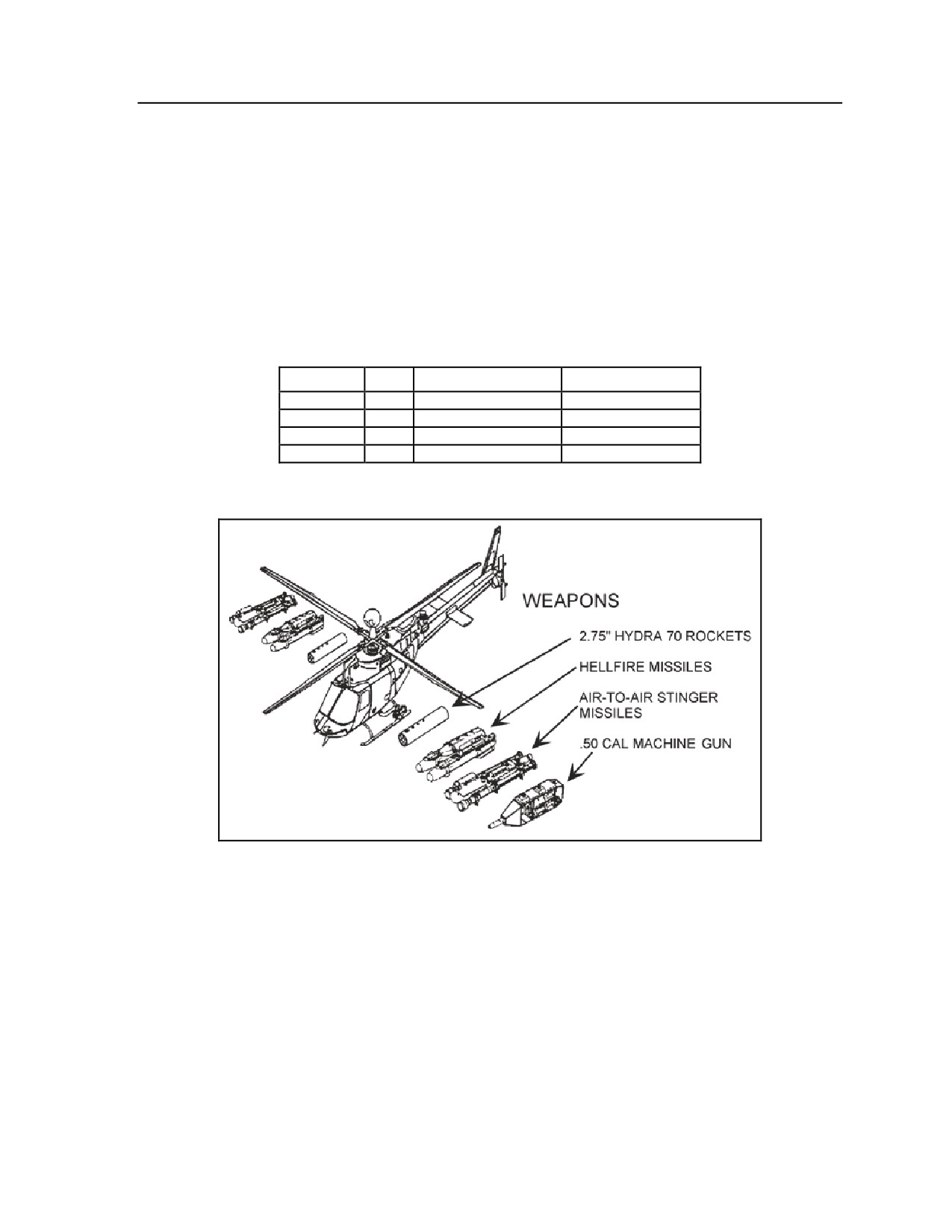
E-10. Figure E-1 illustrates an example of mission load configurations. Only one system at a time may be
mounted per side.
Figure E-1. OH-58D weapons loading
COMMUNICATIONS
E-11. The OH-58D has the following communications systems:
z
Two AN/ARC-201D SINCGARS with embedded encryption and data capability. Both operate
in the 30 to 87.975 MHz frequency range and have antijam, frequency-hopping capability.
z
The AN/ARC-186 provides VHF-AM (116 to 151.975 MHz).
z
The AN/ARC-164 Have Quick II provides antijam frequency-hopping UHF-AM
communications in the 225 to 399.975 MHz range at 25 KHz intervals.
z
An IDM transfers digital messages. The KY-58 provides secure communications for Have
Quick II and VHF-AM/FM radios.
7 December 2007
FM 3-04.111
E-3
Appendix E
NAVIGATION SYSTEM
E-12. The embedded global positioning system/inertial navigation system (EGI) is a self-contained, all-
attitude navigation system that works with the radar altimeter and laser rangefinder/designator. Its
embedded GPS receiver supports both pure and blended GPS, and INS solutions. The system is capable of
storing waypoint and target information for making flight plan routes and altering these routes if a mission
changes. EGI also provides target location in longitude and latitude or MGRS coordinates and altitude in
meters or feet MSL when range, bearing, and declination to the target are provided to the navigation
subsystem for the MMS.
LIMITATIONS
E-13. The following paragraphs discuss limitations of the OH-58D.
Infrared Radiation Crossover
E-14. The thermal imaging sensor operates by determining temperature differentials; when targets and
their surroundings reach the same temperature, target detection degrades.
Obscurants
E-15. Some obscurants (dust, rain, haze, or smoke) can keep laser energy from reaching the target and hide
it from the incoming munitions seeker.
Low Cloud Ceilings
E-16. Consideration must be given to cloud ceilings determining maximum employment range of the SAL
Hellfire. Depending on the distance to target, trajectory mode selected, and lasing techniques, the missile
may climb into low cloud ceilings causing the seeker to break track from the laser spot or preventing the
seeker from acquiring the laser spot.
Hellfire Remote Designation Constraints
E-17. The designating crew may offset a maximum of 60 degrees from the gun-to-target line and must not
position its aircraft within a 30-degree safety fan from the firing aircraft.
Instrument Meteorological Conditions
E-18. The OH-58 Kiowa Warrior is not certified for IFR operations.
APACHE (ALPHA/DELTA)
E-19. The AH-64 is a highly stable aerial weapons-delivery platform. Its primary role is to attack. It can
fight to destroy, attrit, disrupt, or delay enemy forces. Armed reconnaissance and security are secondary
roles.
DESCRIPTION
E-20. The AH-64 is a twin-engine, tandem-seat, aerial weapons platform. It is equipped with a target
acquisition designation sight (TADS), tri-service laser designator/range finder, and a pilot night vision
sensor (PNVS) allowing the two-man crew to navigate and attack at night at extended standoff ranges, and
in some adverse weather conditions. The Apache has a full range of ASE.
E-21. The AH-64D is a remanufactured AH-64A. Its improved navigation system integrates dual INS/GPS
and Doppler radar for acceleration cueing. Some Longbow models are equipped with a millimeter wave
fire control radar (FCR) allowing the helicopter to identify, classify, prioritize, and track certain targets to
the maximum range of the Hellfire weapon system. Table E-3 compares Apache aircraft specifications.
Table E-4 details AH-64D characteristics.
E-4
FM 3-04.111
7 December 2007

Aircraft Characteristics
Table E-3. Comparison of Apache specifications
AH-64D w/o
AH-64D
Model
AH-64A
Radar
Longbow
Length (ft)
57.67
57.67
57.67
Height (ft)
15.25
13.33
16.08
Width (ft)
17.17
15.50
15.05
Main Rotor Span (ft)
48
48
48
Max Gross Wt (lbs)
21,000
23,000
23,000
Cruise Speed (kts)
120*
130*
130*
Combat Radius (km)
200*
200
200
Combat Radius w/One 230-Gallon Aux Fuel Tank (km)
350*
350*
350*
Self-Deployability
Yes
Yes
Yes
*Varies with a multitude of factors such as temperature, wind, gross weight, and mission-specific time requirements.
Table E-4. AH-64D characteristics
Armament:
Maximum autonomous Hellfire missile range: 7,000m
Maximum remote designated Hellfire missile range: 8,000m
2.75” Rocket hover fire most effective dispersion pattern: 3,000 - 5,000m for MPSM and unitary
warhead
2.75” Rocket running/diving fires in CCA accuracy degrades beyond 1,000-1,200m
Maximum 30mm Gun range: 4,000 m
Maximum effective gun range from a hover using TADS: 1,500 point targets, 3,000m area targets
Running/diving fires in CCA accuracy degrades beyond 800-1,000m
Optics:
TADS/Day TV (Low Light, Daytime) Allows autonomous laser designation of tank size target with
image auto tracker at 6,000m, 4,000m using manual tracking
TADS/TIS (day, night, weather, obscurants) Allows autonomous laser designation of tank sized target
with image auto tracker at 3,500m, 3,000 using manual tracking.
PNVS (night, weather, obscurants)
MTADS (Second generation TIS) greatly increases TADS capability to detect and identify, not
available on all AH-64D aircraft.
Navigation Equipment:
Dual EGI/GPS, Doppler radar, ADF
Flight Characteristics:
Max speed in level flight is a function of environmental conditions, aircraft weight and engine
capabilities and will not normally exceed 140-145 Kts.. Normal cruise speed: 110 - 120 kts
Additional Capabilities:
Aircraft can be configured with up to four 230 gallon external fuel tanks for ferrying/self-deployment
missions.
Use of IZLID laser for AGI to allow ground units to view laser through NVDs.
Can be configured with Roberson internal fuel tank to increase flight endurance by 45-55 minutes.
Limitations:
Threat ID; IR crossover; Weather may inhibit Hellfire engagements (seeker must be able to “see” the
laser designated spot); overwater operations severely degrade navigation system; PNVS cannot
detect wires or other small obstacles. TADS and PNVS TIS quality can be severely degraded by
weather conditions that will not normally affect ground maneuver forces, such as rain, fog, snow.
Aircrews may or may not have NVG capability.
7 December 2007
FM 3-04.111
E-5
Appendix E
Fire-Control Radar
E-22. The Apache Longbow system consists of an integrated millimeter wave FCR, along with a radio
frequency interferometer
(RFI). The FCR enables Apache Longbow helicopters to detect, classify,
prioritize, and engage targets with radar frequency Hellfire missiles without visually acquiring the target.
Apache Longbow crews may also employ radar frequency Hellfire missile during poor visibility when
laser, optical, and TIS sensors are degraded. The FCR will not identify friend or foe, however the RFI can
detect and identify radar systems and display targeting information on the same screen as the information
from the FCR.
E-23. Apaches equipped with the Longbow system are denoted as either AH-64D with radar or AH-64D
Longbow. The Longbow is equipped with FCR, a radar frequency interferometer, and upgraded 701C
engines to compensate for the additional weight of the Longbow system. The Longbow system is
integrated with the TADS to allow simultaneous and autonomous operation of the TADS and the FCR.
Without Radar
E-24. The AH-64D without radar includes all preceding Longbow aircraft upgrades except an FCR, a radar
frequency interferometer system, and their associated black boxes. The aircraft may not have the improved
701C engine installed. The AH-64D without radar can be converted to an AH-64D with radar upon
installation of the Longbow system and 701C engines. The AH-64D without radar can fire the radar
frequency Hellfire missile autonomously (with LOS to the target) or by using FCR targeting data handed
over from an AH-64D with radar.
CAPABILITIES
E-25. The AH-64 provides the following:
z
Precision attacks during day or night, or when the battlefield is obscured (Longbow).
z
Wide array of firepower options.
z
Detection, classification, and prioritization of stationary and moving ground and airborne targets
(Longbow).
z
Robust suite of EW systems.
z
Lethal destruction of enemy ADs.
z
Real-time SA and intelligence of the battlefield to the digitized aviation/ground commander;
data transfer system to upload from the AMPS data-transfer cartridge and download postmission
data.
z
HF radio for NOE long-distance NLOS communications.
ATTACK HELICOPTER ARMAMENT SYSTEMS
E-26. The AH-64 can carry up to a total of 16 Hellfire laser-designated missiles on four wing store pylons,
or up to a total of 76 2.75-inch folding fin aerial rockets on four wing store pylons, and up to 1,200 rounds
of ammunition for its 30-millimeter cannon. Wing stores may be configured to allow both hellfire and
rockets to be carried. Each pylon may carry up to 19 rockets or 8 hellfire missiles. Environmental
conditions may significantly restrict weapons loads and station time associated with those loads. In
addition, the use of a Roberson internal auxiliary fuel tank will limit 30mm to 300 rounds.
E-27. The Apache Longbow system enhances the rapid employment of all available weapons including
Hellfire missiles, aerial rocket system, and the 30-millimeter cannon. Once the FCR detects, classifies, and
prioritizes targets, the gunner selects the desired weapon for attack. These data are automatically
transferred to the weapon and displayed on the selected weapon sight.
30-Millimeter Chain Gun
E-28. The M230E1 is a chain-driven area weapons system mounted to a hydraulically driven turret under
the helicopter forward fuselage. It fires the U.S. M789 NATO standard ammunition HEDP round. It can
E-6
FM 3-04.111
7 December 2007

Aircraft Characteristics
penetrate more than 2 inches of armor at 2,500 meters and produces antipersonnel effects within a 4-meter
radius. At typical engagement ranges, HEDP ammunition will defeat BMP type targets. The AH-64 can
carry 1,200 rounds of 30-millimeter ammunition. It has a rate of fire of 600 to 650 rounds per minute with
a maximum effective range from a hover using TADS of approximately 1,500 meters against point targets
and 3,000 meters against area targets. Running/diving fires in a CCA environment are limited by range
source selection and often fired using the helmet sight at ranges of less than 1,000m.
2.75-Inch Rocket System
E-29. When configured with four 19 shot rocket pods, the AH-64D can carry a maximum of 76 folding-fin
aerial rockets for use against enemy personnel, light armored vehicles, and other soft-skinned targets. The
system can launch multiple rockets with various warhead mixes to include; high explosive point
detonating, high-explosive MPSMs, white phosphorous, red phosphorous, overt and covert illumination,
and flechette. Aircrews select the quantity and type to be fired. The maximum range varies with warhead.
If configured with four rocket pods, hellfire launchers are not installed. Environmental conditions may
significantly restrict weapons loads and station time.
Hellfire Missile
E-30. The Hellfire is used primarily to destroy tanks, armored vehicles, and other hard-material targets.
The AH-64A is capable of firing only the SAL Hellfire while the AH64D is capable of firing both the SAL
and radar frequency Hellfire missiles. SAL and radar frequency Hellfire can defeat any known armor. The
minimum engagement range is 500 meters, the maximum range is 8,000 meters, and the maximum aircraft
load when configured with four hellfire launchers is 16 missiles. If configured with four hellfire launchers,
2.75-inch rocket pods are not installed. Environmental conditions may significantly restrict weapons loads
and station time.
Semiactive Laser Hellfire
E-31. The SAL Hellfire requires a laser target designation that may be autonomous or remote
E-32. The remote designator may offset a maximum of 60 degrees from the gun-to-target line and must not
position its self within a 30 degree safety fan from the firing aircraft.
Longbow Radar Frequency Hellfire
E-33. The Longbow radar frequency Hellfire is a millimeter wave guided missile and a true fire-and-forget
weapon. The millimeter wave radar and missile can engage targets through weather and battlefield
obscurants. The radar frequency missile receives targeting information (to include north, east, and down
data) from the acquisition source—TADS, FCR, or another aircraft. Targeting data can be transferred from
a Longbow to an AH-64D without radar as a radar frequency handover.
MISSION CONFIGURATIONS
E-34. Table E-5 is a matrix of AH-64D mission profiles and typical ammunition loads (weight limits may
require reduction in mission loads).
Table E-5. AH-64D weapons loads, weights, and radius
Weapons:
A
B
C
Weights & Radius:
A
B
C
(110 kts airspeed)
Hellfire
8
16
12
Operate
13897
14009
13953
Rockets
38
0
19
Fuel
2870
2870
2870
30mm
340
340
340
Load
2103
1862
1982
T/O
18870
18741
18805
Radius KM
210.6
210.6
210.6
Radius NM
113.7
113.7
113.7
Endurance
2.23
2.23
2.23
7 December 2007
FM 3-04.111
E-7
Appendix E
COMMUNICATIONS
E-35. The AH-64D has the following communications systems:
z
The AN/ARC-201D SINCGARS with embedded encryption and data capability (operates in the
30 to 87.975 MHz frequency range and has antijam, frequency-hopping capability).
z
The AN/ARC-164 Have Quick II provides antijam frequency-hopping UHF-AM
communications in the 225 to 399.975 MHz range at 25 KHz intervals.
z
The AN/ARC-186 provides VHF-AM (116 to 151.975 MHz).
z
The AN/ARC-220 HF radio provides NOE long-range communications in the 2 to 29.999 MHz
range and secure mode when employed with the KY-100.
z
The TSEC/KY-100 provides secure communications for the AN/ARC-220 HF radio.
z
The TSEC/KY-58 interfaces with AN/ARC-201D and AN/ARC-201 radios to provide secure
voice for these radios.
z
The IDM transfers digital messages.
z
Some aircraft may have a second SINCGARS radio in place of the HF radio.
NAVIGATION SYSTEMS
E-36. The navigation subsystem consists of the following major components:
z
Embedded global positioning system/inertial navigation system (EGI), primary and backup.
z
Doppler radar velocity sensor.
z
Radar altimeter.
z
Automatic direction finder (ADF).
z
High integrated air data computer.
z
Flight management computer.
LIMITATIONS
E-37. Prominent limitations of the AH-64 are discussed in the following paragraphs.
Threat Identification
E-38. Threat identification through the TIS is extremely difficult. Although the crew can easily find the
heat signature of a vehicle, it may not be able to determine whether it is friend or foe. FCR target
identification is limited to radar cross section return data and does not determine actual target validity.
Infrared Radiation Crossover
E-39. The TIS and PNVS operate by determining temperature differentials. When targets and their
surroundings reach the same temperature (normally twice a day), target detection is degraded; these
conditions make flight difficult while using the TIS. The same effect occurs when temperatures do not
significantly vary throughout the day or night, or heavy cloud cover exists for long periods of time. For
example, sustained rainfall may reduce the TIS quality to unusable for flight or targeting during certain
times of the year.
Obscurants
E-40. Some obscurants (such as dust, rain, haze, or smoke) can prevent laser energy from reaching the
target. It also hides the target from incoming munitions seekers for SAL Hellfire and prevents effective use
of TIS. AH-64D FCR and radar frequency Hellfire see and shoot through obscurants.
E-8
FM 3-04.111
7 December 2007

Aircraft Characteristics
Low Cloud Ceilings
E-41. Determination of the SAL Hellfire’s maximum employment range requires consideration of cloud
ceilings. Depending on range to target, trajectory mode selected, and lasing techniques, the missile may
climb into low cloud ceilings causing the seeker to break track from the laser spot or preventing the seeker
from acquiring the laser spot.
Instrument Flight Rules
E-42. The AH-64D is not currently certified for IFR operations.
BLACK HAWK
E-43. The primary missions of this aircraft are air assault, air movement, and C2 Support. Additional roles
include PR, aircraft recovery, parachute operations, disaster relief, and fire fighting.
DESCRIPTION
E-44. The UH-60A/L is a twin-engine, dual-seat, utility helicopter. The minimum required crew is a pilot
and copilot. It is designed to carry 11 combat-loaded air assault troops (seats installed). It also can move a
105-millimeter howitzer and 30 rounds of ammunition. The UH-60A/L is equipped with a full instrument
package and certified for IMC as well as day and NVG operations. Table E-6 provides UH-60A/L aircraft
characteristics.
Table E-6. UH-60A/L aircraft characteristics
Specifications:
Length: 64 ft 10 in rotors turning, 41 ft 4 in rotors/pylons
Cabin door dimensions: 69 in wide x 54.5 in
folded.
high.
Height: 12 ft 4 in center hub, 16 ft 10 in tail rotor.
Maxi gross weight, UH-60A/L: 22,000 lbs*.
Width: 9 ft 8.6 in main landing gear, 14 ft 4 in stabilator.
Maximum cargo hook load, UH-60A: 8,000
Width with external stores support system (ESSS)
lbs*.
installed: 21 ft.
Maximum cargo hook load, UH-60L: 9,000
Main rotor and tail rotor diameter: 53 ft 8 in main rotor, 11-
lbs*.
ft tail rotor at 20-degree angle.
Cruise airspeed: 130 kts *.
Cabin floor dimensions: 73 in wide x 151 in long.
Combat radius: 225 km *.
Armament:
2 x M60D or M240 (7.62 MGs) (self protection only).
Optics:
Pilots use AN/AVS-6 to fly the aircraft at night.
Navigation Equipment:
Doppler/GPS navigation set.
Flight Characteristics:
Max speed (Level): 156 kts.
Normal cruise speed: 120-145 kts.
With external slingloads: 140 kts max. Up to 8,000 lbs/120 kts max. 8,000-9,000 lbs.
Additional Capabilities:
The ESSS allows configuration for extended operations without refueling (5+ hours) (2 X 200 gallon fuel
tanks) and ferry and self-deployment flights (4 X 200 gallon fuel tanks).
The enhanced C2 console provides the maneuver commander with an airborne platform supporting six
secure FM radios, one HF radio, two VHF radios, and two UHF radios.
Can be configured with the Volcano Mine Dispensing System; requires 8 hours to install.
Capable of inserting and extracting troops with FRIES/SPIES.
Limitations:
Use of the ESSS for fuel limits access to the cabin doors for troops and bulky cargo or litters. It also
greatly decreases the payload and maximum speed.
UH-60A cannot sling-load a TOW HMMWV.
Cruise speed is greatly decreased by light, bulky sling-loads (less than 80 kts).
* varies with environmental/mission conditions
7 December 2007
FM 3-04.111
E-9
Appendix E
CAPABILITIES
E-45. The UH-60A/L provides the following:
z
Countermeasure suite of IR jammers and radar warning receivers.
z
Data-transfer system to upload from the AMPS data-transfer cartridge and download
postmission data.
z
Internal transport of 11 combat-loaded troops with seats installed and approximately 16 combat-
loaded troops with seats removed. Actual number of troops carried is limited by space and
environmental conditions.
z
Self-deployable range of 558 NM with the ERFS, with 30-minute reserve.
z
Transportable by the C-5 and C-17 aircraft.
ARMAMENT SUBSYSTEMS
E-46. The UH-60 has provisions for door mounting of two M60D/M240 7.62-millimeter machine guns.
The subsystem is pintle-mounted in each gunner’s window at the forward end of the cabin section. The two
machine guns are free pointing but limited in traverse, elevation, and depression.
AIR VOLCANO
E-47. The air Volcano is a helicopter-mounted, automated, scatterable mine-delivery system able to deliver
mines day or night. The system can rapidly emplace a 278-meter, 557-meter, or 1,115- by 140-meter field
at up to 960 mines (800 AT and 160 anti-personnel) per sortie. AT density yields an 80 percent chance of
encounter. Mines can be set to self destruct after 4 hours, 48 hours, or 15 days. The air Volcano system has
the following limitations:
z
The UH-60 with air Volcano mounted, a full crew, and one system operator will be at high gross
weight, which reduces range and maneuverability.
z
Minefield emplacement is conducted at low airspeeds (80 kts or less), making the aircraft more
vulnerable to detection and engagement.
z
Crew cannot operate the M60D/M240 machine gun with the air Volcano installed.
z
Installation requires approximately 8 hours.
z
Requires two 5-ton cargo trucks for transport; it is an engineer responsibility to provide
transportation assets to move these systems.
E-48. Four types of minefields can by emplaced using Volcano—disrupt, fix, turn, and block. Refer to FM
1-113 for additional information.
COMMUNICATIONS
E-49. The UH-60 A/L has the following communications systems:
z
The AN/ARC-186 provides two-way voice communications in both the VHF-AM-FM ranges. It
provides VHF-AM ATS communications.
z
The AN/ARC-164 (V) Have Quick II provides two-way voice communications in the UHF-AM
frequency range of 225 to 399.975 MHz; the sets provide an antijam frequency-hopping
capability.
z
The AN/ARC-201 (SINCGARS) is a VHF-FM antijam frequency-hopping radio, providing
communications in the 30 to 87.975 MHz frequency range at 25 KHz intervals.
E-10
FM 3-04.111
7 December 2007
Aircraft Characteristics
z
The AN/ARC-220 HF radio provides NOE, long-range communication with the AN/ARC-100
in the CP and with other HF receivers.
z
The TSEC/KY-58 interfaces with the ARC-186 (V), Have Quick II, and SINCGARS radios to
provide secure communications.
NAVIGATION SYSTEMS
E-50. The UH-60A/L has the following navigation systems:
z
The ASN-128B/D Doppler/GPS navigation set provides present position or destination
navigation information in latitude and longitude or MGRS coordinates.
z
The AN/ARN-89 or AN/ARN-149 (V) provides automatic direction-finding capability for
instrument navigation and approach.
z
The AN/ARN-123
(V) or AN/ARN-147
(V) VOR/LOC/GS/MB receiving sets provide
instrument navigation and approach.
HEADS-UP DISPLAY AN/AVS-7
E-51. The heads-up display (HUD) system serves as an aid to pilots using the AN/AVS-6 NVG by
providing operational symbology information directly into the NVG. It always displays airspeed, altitude
from MSL, attitude, and engine torque and can display up to 29 symbols.
LIMITATIONS
E-52. The following are limitations of the UH-60A/L aircraft:
z
UH-60A/L aircrews employ AN/AVS-6 NVG that lack the same night capabilities as AH-64
and OH-58D TISs.
z
UH-60A/L aircraft are instrument-certified but cannot operate in all environmental conditions.
z
Aircraft equipped with extended-range fuel tanks may not offer the same accessibility to the
aircraft cabin for loading; self-defense machine guns have a limited range of motion when ERFS
kits are installed.
HH-60L BLACK HAWK
E-53. The HH-60L Black Hawk’s primary mission is aeromedical evacuation. Secondary missions include
transport of medical personnel and equipment, emergency transport of class VIII to include blood products
and biologicals, PR support, and support to Title 10 U.S. Code taskings.
DESCRIPTION
E-54. The HH-60L is a twin-engine, dual seat, utility helicopter. The minimum required crew is a pilot and
copilot. For aeromedical evacuation missions, the crew includes up to three medical attendants (typical
configuration includes one crew chief and two medical attendants). The HH-60L is equipped with a full
instrument package and certified for IMC, as well as day and NVG operations. In addition to its basic
configuration, the HH-60L includes a nose mounted TIS and kit installations allowing rescue hoist,
extended-range fuel, and aeromedical evacuation operations. The interior design of the HH-60L allows for
the installation of life-saving instruments and equipment for use by on-board medical attendants. Normal
cabin configurations of the HH-60L can accommodate up to four primary litter patients or six ambulatory
(seated) patients. However, when necessary, two Standardization Agreement (STANAG) litters can be
placed on the floor under the forward lifts for a total of six litter patients. The unique platform design also
includes oxygen distribution and suction systems, an airway management capability, and provisions for
stowing intravenous solutions. The interior also features the following capabilities essential to providing
the highest degree of patient care when every second counts:
z
Oxygen generating systems.
z
NVG compatible lighting throughout.
7 December 2007
FM 3-04.111
E-11

Appendix E
z
An environmental control system.
z
Medical equipment.
z
Patient monitoring equipment.
z
Neonatal isolettes.
E-55. Table E-7 outlines HH-60L aircraft specifications.
Table E-7. HH-60L specifications
Length
64 ft 10 in rotors turning, 41 ft 4 in rotors/pylon folded
Height
12 ft 4 in center hub, 16 ft 10 in tail rotor
Width
9 ft 8.6 in main landing gear, 14 ft 4 in stabilator
Main rotor & tail rotor diameter
53 ft 8 in main rotor, 11 ft tail rotor at 20-degree angle
Cabin floor & door dimensions
73 in wide x 151 in long, 69 in wide x 54.5 in high
Maximum gross wt
22,000 lbs
Rescue hoist/cargo hook max wts
600 lbs rescue hoist; 8,000 lbs, cargo hook
Maximum range w/ERFS
630 NM w/400 lbs reserve
Patient capacity
6 litter or 6 ambulatory
Crew capacity
2 pilots, 1 crew chief, 2-3 medical attendants
Fuel capacity
360 gallons and additional 400 gallons w/ERFS
CAPABILITIES
E-56. The HH-60L provides transport of the following:
z
Six litter patients and two medical attendants.
z
Six ambulatory patients and two medical attendants.
z
Internally and externally loaded medical supplies.
z
Medical personnel.
ARMAMENT
E-57. The HH-60L is an unarmed aircraft (no gunner windows).
COMMUNICATIONS
E-58. The HH-60L has the following communication systems:
z
The AN/ARC-201 (SINCGARS) provides VHF-FM communications in the 30 to 87.975 MHz
frequency range and has antijam, frequency-hopping capability.
z
The AN/ARC-222 provides VHF-AM/FM communications and a maritime capability.
z
The ARC-164 (V) provides UHF-AM communications in the 225 to 399.975 MHz frequency
range and has antijam, frequency-hopping capability.
z
The AN/ARC-220 HF radio provides NOE long-range communications in the 2 to 29.999 MHz
frequency range.
z
The KY-58 provides secure communications for the SINCGARS, Have Quick II, and AN/ARC-
222 radios.
z
The KY-100 provides secure communications for the AN/ARC-220 high frequency radio.
NAVIGATION SYSTEMS
E-59. The HH-60L has the following navigation systems:
z
AN/ARN-149 ADF.
z
AN-ARN-147 VOR/LOC/GS/MB receiving set.
E-12
FM 3-04.111
7 December 2007

Aircraft Characteristics
z
AN/ASN 128D Doppler/GPS navigation set.
z
AN/ASN 153 (V) tactical air navigation.
AN/ARS-6(V) PILOT HEADS-UP DISPLAY AN/AVS-7
E-60. The HUD system serves as an aid to pilots using the AN/AVS-6 NVG by providing operational
symbology information directly into the NVG. It always displays airspeed, altitude (MSL), attitude, and
engine torque and can display up to 29 symbols.
LIMITATIONS
E-61. The following are limitations of the HH-60L aircraft:
z
HH-60L aircrews employ AN/AVS-6 NVG that lack the same night capabilities as AH-64 and
OH-58D TISs. The HH-60L TIS is for mission detection of Soldiers to be evacuated. It is not
compatible for flying the aircraft.
z
HH-60L aircraft are instrument certified but cannot operate in all environmental conditions,
depending on threat and NAVAID availability.
z
Aircraft equipped with extended-range fuel tanks may not offer the same accessibility to the
aircraft cabin for loading.
z
The medical equipment in the HH-60L is hard-mounted and cannot be removed for conversion
to a UH-60L.
CHINOOK
E-62. The primary missions of this aircraft are air assault and air movement. Additionial roles include PR,
CASEVAC, aircraft recovery, parachute operations, disaster relief, and fire fighting.
DESCRIPTION
E-63. The CH-47D is a twin-turbine engine, tandem-rotor helicopter. The minimum crew required to fly it
is a pilot, copilot, and flight engineer. Additional crew members, as required, may be added at the
discretion of the commander. Tactical missions normally require the addition of one or two crew chiefs.
Table E-8 outlines CH-47D characteristics.
Table E-8. CH-47D characteristics
Specifications:
Length: 98.9 ft
Max load for forward and aft hooks: 17,000 lbs
Height: 18.9 ft
Max tandem load for forward and aft hooks: 25,000 lbs
Fuselage width: 12.4 ft
Max load for center hook: 26,000 lbs
Main rotor span: 60 ft
Cruise airspeed: 130* kts
Cargo space: 1,500 cu ft
Max continuous airspeed: 170* kts
Floor space: 225 sq ft
Combat radius (16,000 lbs cargo): 50* NM (90 km)
Maximum gross weight:50,000 lbs
Combat radius (31 troops): 100* NM (180 km)
Armament:
2 M60D 7.62 MGs (self protection only).
Optics:
Pilots use AN/AVS-6 to fly the aircraft at night.
Navigation Equipment:
Doppler/GPS navigation set.
Flight Characteristics:
Max Speed (Level): 170 kts
Normal Cruise Speed: 120-145 kts
7 December 2007
FM 3-04.111
E-13
Appendix E
Table E-8. CH-47D characteristics
Additional Capabilities:
Can be configured w/additional fuel for mobile FARE system (Fat Cow) or for ferrying/self-deployment
missions.
Aircraft has an internal load winch to ease loading of properly configured cargo.
The CH-47D can sling-load virtually any piece of equipment in the Light Infantry, Airborne or Air
Assault Divisions.
Limitations:
Cruise speed is greatly decreased by light, bulky sling-loads (less than 80 kts).
*Varies with factors such as temperature, wind, gross weight, internal versus external load, and time in PZ/LZ.
CAPABILITIES
E-64. The CH-47D provides the following:
z
Countermeasure suite of IR jammers, radar-warning receivers, and laser-warning detectors.
z
Data-reduction transfer system to upload from the AMPS data-transfer cartridge and download
postmission data.
z
Internal transport of two HMMWVs or a HMMWV with a 105-millimeter howitzer and gun
crew.
z
Evacuation of 24-litter patients and 2 medics.
z
Self-deployable range of 1,056 NM with the ERFS, with 30-minute reserve; transportable in the
C-5 aircraft.
ARMAMENT SUBSYSTEMS
E-65. The armament subsystems are M24 and M41 machine-gun systems installed in the cabin door, cabin
escape hatch, and on the ramp. Both subsystems use the M60D 7.62-millimeter machine gun. The two
flexible 7.62-millimeter machine guns are free pointing but limited in traverse, elevation, and depression.
COMMUNICATIONS
E-66. The CH-47D has the following communications systems:
z
The AN/ARC-164 Have Quick II radios provide UHF-AM two-way communications in the 225
to 399.975 MHz range in 25 KHz intervals; they can operate in normal or antijam, frequency-
hopping mode.
z
The AN/ARC-201 SINCGARS provides two-way communications in the VHF-FM range of 30
to 87.975 MHz in 25 KHz intervals; it employs antijam, frequency-hopping capability, and,
when used with the KY-58, provides secure voice and cipher-mode communications. Later
SINCGARS has embedded encryption and does not require KY-58 interface.
z
One or two AN/ARC-186 VHF-AM-FM radio sets are installed, providing broad VHF
communications on either the number 1 or 3 position on the function control selector of the
controls and function, interphone control.
z
The AN/ARC-220 HF radio supports NOE long-distance communications from 2 to 29.999
MHz in 100-hertz steps on
20 preselectable channels, for a total of
280,000 possible
frequencies; as one of the radios available to the commander, it is accessible in the number 4
position on the function control selector.
z
The KY-58 interfaces with the AN/ARC-186 VHF-AM-FM radio in the FM range to provide
secure communications.
z
The KY-100 provides secure communications for the AN/ARC-220 high frequency radio.
E-14
FM 3-04.111
7 December 2007

Aircraft Characteristics
NAVIGATION SYSTEMS
E-67. The CH-47 has the following navigation systems:
z
The AN/ASN-128B Doppler/GPS navigation set provides present position or destination
navigation information in latitude and longitude or the MGRS coordinates. In the primary
combined mode, the GPS updates Doppler position at a 1-MHz rate; other CH-47 aircraft have
the AN/ASN-128 Doppler navigation without GPS.
z
The AN/ARN-89 ADF provides automatic direction finding for instrument navigation and
approach.
z
The AN/ARN-123 (V) VOR/LOC/GS/MB provides instrument navigation and approach.
HEADS-UP DISPLAY AN/AVS-7
E-68. The HUD system serves as an aid to pilots using the AN/AVS-6 NVG by providing operational
symbology information directly into the NVG. It always displays airspeed, altitude (MSL), attitude, and
engine torque and can display up to 29 symbols.
AIRCRAFT SURVIVABILITY EQUIPMENT
E-69. Refer to FM 1-113 for detailed information on CH-47D ASE.
LIMITATIONS
E-70. The following are limitations of the CH-47D aircraft:
z
CH-47D aircrews employ AN/AVS-6 NVG that lack the same night capabilities as AH-64 and
OH-58D TISs.
z
CH-47D aircraft are instrument certified but cannot operate in all environmental conditions.
TYPICAL FUEL EXPENDITURE RATES, CAPACITIES, AND
STANDARD LOAD CAPACITIES
E-71. Table E-9 depicts typical rates of fuel expenditures per helicopter and fuel capacities without
additional tanks.
Table E-9. Typical helicopter fuel expenditure rates and capacities
Helicopter
Average Gallons per Hour
Fuel Capacity
AH-64D
175
370
OH-58D
44
112
OH-58D (Armed)
110
112
UH-60 A/L/HH
178
362
CH-47
514
1030
E-72. Aircraft may be capable of carrying more than is indicated on the lists in table E-10 and table E-11,
page E-16. However safety, loading procedures, and space limitations play a large part in determining
authorized loads for each helicopter. Environmental conditions (high altitude/high temperature decrease
max gross weight) and configuration (internal load size/dimensions) constraints affect the ACL for each
aircraft.
Table E-10. Typical helicopter load capacities
Type
Empty Wt Plus Crew &
Max Gross Wt
Max Sling Load
Fuel
UH-60A
15,000
22,000
8,000
UH-60L
15,000
23,500*
9,000
CH-47D
30,000
50,000*
26,000
*Max gross weight from 8,000 to 9,000 lbs
7 December 2007
FM 3-04.111
E-15

Appendix E
Table E-11. Typical planning weights for combat equipment and vehicles
Vehicle/Equipment
Weight in
Pounds
M998 HMMWV
7,535
M996 TOW HMMWV
8,095
M149 Water Buffalo (Empty)
2,540
(Loaded)
6,060
M101A1 ¾ Ton Trailer (Empty)
1,350
(Loaded)
2,850
500 Gallon Fuel Drum (Empty)
275
(Full) JP
3,625
M102 105mm Howitzer
3,360
M119 105mm Howitzer
4,000
M114A1 155mm Howitzer
15,200
M198 155mm Howitzer
15,740
M167 Vulcan (Towed)
3,260
A22 Bag (Loaded)
2,200
Conex, Steel, Empty
2,140
Conex, Aluminum, Empty
14,600
Conex (Either) Max Load
6,500
Scamp Crane
1,560
One Mil-Van
4,710
Electronic Shop with Wheels
3,940
Tool Set, Shop with Wheels
3,030
Shop, Portable, Aircraft Maintenance (Empty)
4,220
(Loaded)
5,425
M1008 Pick-Up (Empty)
5,900
(Loaded)
8,800
JD-550 Dozer
16,800
SECTION II - FIXED-WING AIRCRAFT
CARGO-12 HURON (C, D, T1, AND T2 MODELS)
E-73. The C-12 provides high speed air movement capability.
DESCRIPTION
E-74. The C-12 is a twin-engine, turboprop, FW aircraft. Many different C-12 models are fielded. The C-
12C and D1 have PT6A-41 engines; the C-12D2, T1, and T2 have PT6A-42 engines. Aircraft can normally
carry eight passengers and a crew of two. All models have an aft passenger door, and all (except the C-
12C) have a separate cargo door. Table E-12, page E-17, outlines C-12 specifications.
E-16
FM 3-04.111
7 December 2007

Aircraft Characteristics
Table E-12. C-12 specifications
Length
43 ft 10 in
Height
15 ft 5 in
Wingspan
C-12C: 54 ft 6 in, C-12D: 55 ft 6.5 in, C-12T1/T2: 55 ft 6.5 in
Max gross weight at
13,500 lbs. (C and D1 models),
takeoff
14,000 lbs.(D2, T1, and T2 models)
C-12C not installed
Cargo door dimensions
C-12D and C-12T1/T2 52 in x 52 in
Cruise airspeed
Max 260 kts indicated airspeed, varies with conditions
Ceiling
Max 31,000 MSL, varies with conditions
Varies; for example, 386-gallon main fuel yields 960 NM & 4.5 hours
endurance (standard day, zero wind, cruise pressure altitude of 26,000
Range
ft, 1,700 RPM): same conditions w/544-gallon full main & auxiliary fuel
yield more than 1,600 NM & 7 hrs endurance
Crew
2 pilots
CAPABILITIES
E-75. The C-12 provides the following:
z
Transport of up to eight personnel.
z
Communication equipment capable of supporting key passengers.
z
Light cargo transport capability.
ARMAMENT SYSTEMS
E-76. The C-12 is unarmed.
COMMUNICATIONS
E-77. The C-12 has the following communication systems, depending on the model:
z
The AN/ARC-164 (C, D1, and D2) provides two-way voice communications in the 225 to
399.975 MHz range for a normal range of 50 miles.
z
The UHF-20B (C and D1) provides VHF-AM communications in the 116- to 151.975-MHz
frequency range for a normal range of 50 miles.
z
The 718U HF command set (C and D1) provides high frequency communications in the
frequency range of 2 to 29.999 MHz.
z
The AN/ARC-186 (C and D1) provides VHF-AM/FM communications.
z
The AN/ARC-210 (V) (T1 and T2) provides multifrequency communications in the 30 to 88
FM band, 108 to 136 AM band, 136 to 156 FM band, 156 to 174 FM maritime band, and 225 to
400 AM/FM Have Quick and SATCOM bands.
z
The VHF-22C (D2, T1, and T2) provides VHF communications.
z
The KHF 950 (D2, T1, and T2) provides high frequency, long-range communications.
NAVIGATION SYSTEMS
E-78. The C-12 has the following navigation systems:
z
The KLN-90B GPS provides GPS navigation.
z
Two very high frequency omnidirectional range instrument landing system receiver (VIR)-30s
are installed, one without marker beacon capability for instrument navigation.
z
The KR 87 ADF provides automatic direction finding capability with AM transmitters.
7 December 2007
FM 3-04.111
E-17

Appendix E
z
The DME-40 provides distance-measuring equipment capability.
z
The AP-106 autopilot system works with other navigation equipment to fly the aircraft en route.
LIMITATIONS
E-79. The C-12 has no self-defense protection system and is not normally flown at terrain-flight altitudes.
CARGO-23 SUPER SHERPA (B AND B+)
E-80. The C-23B or B+ supports theater aviation air movement needs.
DESCRIPTION
E-81. The C-23B Super Sherpa is a twin turboprop, FW aircraft. Its rectangular-shaped cabin readily
accommodates palletized cargo; up to
500 pounds of additional baggage can be stored in
a
nose
compartment. The C-23B has a crew of three. Table E-13 outlines C-23B specifications.
Table E-13. C-23B/B+ specifications
Length
58 ft ½ in
Wingspan
74 ft 8 in
Height
16 ft 3 in
Cabin dimensions
29 ft long x 5 ft 6 in wide x 6 ft 6 in high
Maximum payload
7,100 lbs
Maximum gross wt
25,500 lbs
Maximum airspeed
190 kts
Range
More than 1,000 miles (varies w/environmental/mission conditions)
Typical mission range
770 miles w/5,000-lb payload
CAPABILITIES
E-82. The C-23 provides transport to the following:
z
Up to 30 seated passengers.
z
27 paratroopers.
z
18 litters and 2 medical attendants.
z
Palletized cargo.
ARMAMENT SYSTEMS
E-83. The C-23B is an unarmed aircraft.
COMMUNICATIONS
E-84. The C-23B and B+ lack SINCGARS, Have Quick, and HF capability. The two organic AN/ARC-
182(V) radios operate in the 30 to 399.975 MHz frequency ranges.
NAVIGATION SYSTEMS
E-85. The C-23B has the following navigation systems:
z
Two VIR-32A VHF navigation receivers with DME 42 and instrument landing system/glide
slope.
z
Two radio magnetic indicator-36s.
z
One ADF-60A ADF.
z
Two electronic horizontal situation indicator-74s.
E-18
FM 3-04.111
7 December 2007
Aircraft Characteristics
z
One transmittal data relay-90 transponder.
z
One AN/APX-100(V) transponder.
C-23B LIMITATIONS
E-86. The C-23B is not pressurized; therefore, aircrew members and passengers require oxygen for
sustained flights above 10,000 feet.
E-87. The narrow cabin will not permit internal loading of Army vehicles such as the HMMWV.
7 December 2007
FM 3-04.111
E-19
Appendix F
Rules of Engagement
ROE are directives issued by competent military authority delineating circumstances
and limitations under which U.S. forces initiate/continue combat engagement with
other forces.
SECTION I - GENERAL
F-1. In a general war between two uniformed, similarly-equipped opponents, complexity of ROE is
normally low. The Soldier in contact with the enemy is usually instructed on the priority of target classes to
engage, with restricted targets delineated by the Laws of War. In the same conflict, however, Soldiers
performing support missions may find their ROE are more complex, reflecting ROE more often associated
with stability operations, rather than those associated with direct combat.
F-2. ROE must be clear. Soldiers operating with confusing or uncertain guidance can compromise the
mission.
F-3. Despite similarities existing between operations, each has its own ROE. These rules are generally
delineated in the OPLAN ROE annex (figure F-1, page F-2); however, based on changing circumstances,
they may be further refined in the OPORD. For continuing operations, any further changes are specified in
follow-on FRAGOs. The overall commander approves these rules with advice from the Staff Judge
Advocate, S-9, political advisor, and others as required.
LAW OF WAR
F-4. International treaties signed by the U.S., such as the Geneva Convention, and customary laws found
in federal documents or judicial decisions form the basis of the Law of War to which Soldiers are expected
to adhere. The purpose of establishing and abiding by Laws of War is to—
z
Protect both combatants and noncombatants from unnecessary suffering.
z
Safeguard certain fundamental human rights of persons who fall into the hands of the enemy,
particularly prisoners of war, the wounded and sick, and civilians.
z
Facilitate the restoration of peace.
F-5. ROE, as with any military order, cannot violate the Laws of War. Those that do are illegal and are
not to be followed. Refer to FM 27-10 for additional information.
7 December 2007
FM 3-04.111
F-1
Appendix F
Copy ____ of _____ copies
HQs, TF 1-19
Camp Deployed, Any Country
Date/Time Group
ANNEX E (ROE) to 1-19 TF OPORD 01-01
References: No change.
1. ROE.
ROE will be briefed in detail to all Soldiers upon issuance of each 1-19 TF OPLAN/OPORD/FRAGO. The
commander will resolve conflicts between ROE and the 1-19 TF OPLAN/OPORD/FRAGO.
Nothing in these rules limits the rights of individual Soldiers to defend themselves or the rights and
responsibilities of leaders to defend their units.
ROE follow:
SOLDIERS CARD: You will carry this card at all times.
MISSION: Your mission is to assist in the implementation of and to help ensure compliance with this
peacekeeping operation.
SELF DEFENSE:
You have the right to use necessary and proportional force in self-defense.
You will use only the minimum force necessary to defend yourself.
GENERAL RULES:
You will use only the minimum force necessary to accomplish your mission.
You will not harm hostile force/belligerents who want to surrender. Disarm them and turn them over to your
superiors.
You will treat everyone, including civilians and detained hostile forces/belligerents, humanely.
You will collect and care for the wounded, whether friend or foe.
You will respect private property. Do not steal. Do not take war trophies.
You will prevent or report to your superiors all suspected violations of the Law of Armed Conflict.
CHALLENGING AND WARNING SHOTS:
If the situation permits, issue a challenge:
English: U.S. Forces! STOP or I WILL FIRE
Local Language #1:
U.S. Forces! STOP or I WILL FIRE!
Local Language #2:
U.S. Forces! STOP or I WILL FIRE!
If the person fails to halt, you may be authorized by the OSC or by standing orders to fire a warning shot.
OPENING FIRE: You may open fire only if you, friendly forces, or persons or properties under your protection are
threatened with deadly force. This means that:
You may open fire against an individual who fires or aims a weapon at, or otherwise demonstrates intent to
imminently attack you, friendly forces, or persons or property designated as under your protection.
You may open fire against an individual who plants, throws, or prepares to throw an explosive or incendiary
device at, or otherwise demonstrates intent to imminently attack you, friendly forces, or persons or property
designated as under your protection.
You may open fire against an individual deliberately driving a vehicle at you, friendly forces, or persons or
property designated as under your protection.
You may fire against an individual who attempts to take possession of friendly force weapons, ammunition, or
property designated as under your protection if there is no other way to prevent this act.
You may use minimum force, including opening fire, against an individual who unlawfully commits, or is about to
commit, an act which endangers life, in circumstances if there is no other way to prevent the act.
MINIMUM FORCE: If you have to open fire, you must:
Fire only aimed shots.
Fire no more rounds than necessary.
Take all reasonable efforts to avoid unnecessary destruction of property.
Stop firing as soon as the situation is resolved.
Refrain from intentional attack on civilians, or property that is exclusively civilian or religious in character unless
the property is being used for military purposes or engagement is authorized by your commander.
Figure F-1. Example rules of engagement operation plan/operation order/fragmentary order
annex
F-2
FM 3-04.111
7 December 2007

Rules of Engagement
SECTION II - FORCE-PROTECTION LEVELS
F-6. Department of Defense Directive (DODD) 2000.12 sets out DOD Antiterrorism/Force Protection
Program responsibilities. DODD 0-2000.12H establishes guidance for force-protection levels. Department
of Defense Instruction (DODI) 2000.16 sets out responsibilities for establishing force-protection levels.
Full references can be downloaded from http://www.dtic.mil/whs/directives.
F-7. The graduated series of force-protection conditions range from force-protection conditions normal to
force protection conditions delta. Table F-1 provides force-protection measures.
Table F-1. Force protection measures
Personnel
Vehicle
Weapon
Base Camp
O
Soft cap
H
2 veh, 2 pax/veh
W
Wpn and ammo
A
One roving patrol, towers
in arms room
& fighting positions
unmanned, QRF on 2-
hour recall
I
Kevlar, load-
I
3 veh, 2 pax/veh,
X
Wpn carried,
B
2 pax in towers, 1 roving
bearing
M16+ per veh, commo
magazine in
patrol, QRF 1-hour recall,
equipment
check every hour
pouch
commo check every hour
(LBE), weapon
II
Kevlar, LBE,
J
4 veh, 2 pax/veh,
Y
Wpn carried,
C
2 pax in towers, 2 roving
weapon, body
M16+ per veh, crew-
magazine in
patrols, QRF 30-min
armor
served wpn, commo
wpn, no rounds
recall, commo check
check every 30 min
chambered
every 30-min
III
Kevlar, LBE,
K
4 veh, 2 pax/veh,
Z
Wpn carried,
D
2 pax in towers, 2 roving
weapon, body
M16+ per veh, crew-
magazine in
patrols, all fighting
armor, mask
served wpn,
wpn, rounds
positions manned; pull in
continuous commo,
chambered,
OPs, CPs, & remote
military police escort,
wpn on safe
sites, QRF at REDCON
line traffic coordinator
1, continuous
permission
comunication
F-8. The four-force protection conditions above normal are described in the following paragraphs.
ALPHA
F-9. These conditions apply when there is a general threat of possible terrorist activity against personnel
and facilities, the nature and extent of which are unpredictable, and circumstances do not justify full
implementation of force protection conditions BRAVO measures. The measures in these force protection
conditions must be capable of being maintained indefinitely.
BRAVO
F-10. These conditions apply when an increased and more predictable threat of terrorist activity exists. The
measures in these force-protection conditions must be capable of being maintained for weeks without
causing undue hardship, affecting operational capability, and aggravating relations with local authorities.
CHARLIE
F-11. These conditions apply when an incident occurs or intelligence is received indicating some form of
terrorist action against personnel and facilities is imminent. Implementation of measures in these force-
protection conditions for more than a short period may create a hardship and affect peacetime activities of
the unit and its personnel.
7 December 2007
FM 3-04.111
F-3
Appendix F
DELTA
F-12. These conditions apply in the immediate area where a terrorist attack has occurred or when
intelligence has been received that terrorist action against a specific location or person is likely. Normally,
these force-protection conditions are declared as a localized condition.
SECTION III - RULES OF ENGAGEMENT REHEARSALS
F-13. ROE cards are excellent reminders, however to ensure ROE are understood, situational training
exercises are essential. For example, an ROE may be “fire only in self-defense.” But when does a Soldier
know he or she is really being fired upon? Is it possible the shooter is just some inebriated person in the
crowd shooting into the air? If an aircrew sees tracers going by, does it mean personnel on the ground saw
the aircraft and are firing at it or is it just celebratory fire?
F-14. This manual will not debate the correct answer to the above; it only points out that Soldiers need
clear examples of situations to ensure they fully understand the ROE. An exercise to demonstrate the above
would require role players, the training unit, observer-controllers, and a range safety plan.
F-15. ROE situations should be rehearsed in detail before deploying or executing a mission. No situation
should occur in which personnel are unsure whether they should use force and what types of force, to
include deadly force, are warranted.
F-4
FM 3-04.111
7 December 2007
Appendix G
Brigade Command Post Layout
This appendix provides a suggested layout for CAB command posts and individual cells. These designs are
intended to standardize CP layouts as described in FMI
5-0.1. Refer to FMI
5-0.1 for additional
information.
SECTION I - OVERVIEW
G-1. Many design considerations affect CP effectiveness. At a minimum, CP cells and staff elements
should be positioned to facilitate communication and coordination. Other design considerations include—
z
Ease of information flow.
z
User interface with communication systems.
z
Positioning information displays for ease of use.
z
Integrating complementary information on maps and displays.
z
Adequate workspace for the staff and commander.
z
Ease of displacement (set-up, tear-down, and mobility).
G-2. A well-designed CP integrates command and staff efforts. Accomplishing this requires matching CP
personnel, equipment, information systems, and procedures with its internal layout and utilities. Organizing
the CP into functional and integrating cells promotes efficiency and coordination.
G-3. Standardization increases efficiency and eases CP personnel training. Commanders should develop
detailed SOPs for all aspects of CP operations. These SOPs should be revised throughout training
activities.
FUNCTIONAL CELLS
G-4. Functional cells are organized by WFF with the addition of the C4OPS cell.
INTELLIGENCE
G-5. The intelligence cell coordinates activities and systems that facilitate understanding the enemy,
terrain, weather, and civil considerations. This includes tasks associated with IPB and ISR. The unit’s S-2
leads this cell.
MOVEMENT AND MANEUVER
G-6. The movement and maneuver cell coordinates activities and systems that move forces to achieve a
position of advantage in relation to the enemy. This includes tasks associated with employing forces in
combination with direct fire or fire potential (maneuver), force projection (movement), mobility, and
countermobility. The movement and maneuver cell may also form the base of the current operations cell.
The unit’s S-3 or assistant S-3 leads this cell.
FIRE SUPPORT
G-7. The fire support cell coordinates activities and systems that provide collective and coordinated use of
Army indirect fires and joint fires. This includes tasks associated with targeting and the targeting process.
7 December 2007
FM 3-04.111
G-1
Appendix G
The fire support cell integrates lethal and nonlethal fires, including IO, through the targeting process. The
unit’s fire support coordinator leads this cell.
PROTECTION
G-8. The protection cell coordinates activities and systems that preserve the force. This includes
protecting personnel, physical assets, and information of the U.S. and multinational partners. Other tasks
are found in FMI 5-0.1. Commanders normally select this cell’s leader from among the air and missile
defense coordinator, chemical officer, engineer coordinator, and provost marshal.
SUSTAINMENT
G-9. The sustainment cell coordinates activities and systems that provide support and services to ensure
freedom of action, extend operational reach, and prolong endurance. Other tasks are found in FMI 5-0.1.
The commander normally selects either the S-1 or S-4 as the cell leader.
COMMAND, CONTROL, COMMUNICATIONS, AND COMPUTER OPERATIONS
G-10. The C4OPS cell coordinates activities and systems that provide support to continuous and assured
communications. This includes tasks associated with C4OPS, network operations, and information systems
support to information management. The unit’s S-6 leads this cell.
INTEGRATING CELLS
G-11. Integrating cells group personnel and equipment to integrate functional cell activities. CPs normally
include current operations, future operations, and plans cell. The plans cell is normally located in the main
CP. The current operations and future operations cells are normally located at the TAC CP.
CURRENT OPERATIONS
G-12. The current operations cell is responsible for assessing the current situation while regulating forces
and WFFs in accordance with the commander’s intent. Normally, all staff sections are represented in the
current operations cell. The unit’s S-3, or assistant S-3, leads this cell. Personnel in the movement and
maneuver cell are also normally members of the current operations cell.
G-13. Staff representatives in the current operations cell actively assist subordinate units. They provide
them information, synchronize their activities, and coordinate their support requests. The current
operations cell solves problems and acts within the authority delegated by the commander. It also performs
short-range planning using MDMP in a time-constrained environment or makes decision and
resynchronizes operations as described in FMI 5-0.1.
FUTURE OPERATIONS
G-14. The future operations cell is responsible for planning and assessing operations for the mid-range
time horizon. This includes preparing branches. Corp and Army service component commands have a
FUOPS cell. Battalion through division headquarters are not resources for one; the plans and current
operations cells share its responsibility. The future operations use MDMP or MDMP in a time-constrained
environment to develop plans and orders. The cell consists of a core group of planners led by the assistant
S-3. All staff sections assist as required.
PLANS
G-15. The plans cell is responsible for planning operations for the mid- to long-range time horizons. It
develops plans, orders, branches, and sequels. This cell is also responsible for long-range assessment of an
operation’s progress. It consists of a core group of planners and analysts led by the S-5. All staff sections
assist as required.
G-2
FM 3-04.111
7 December 2007
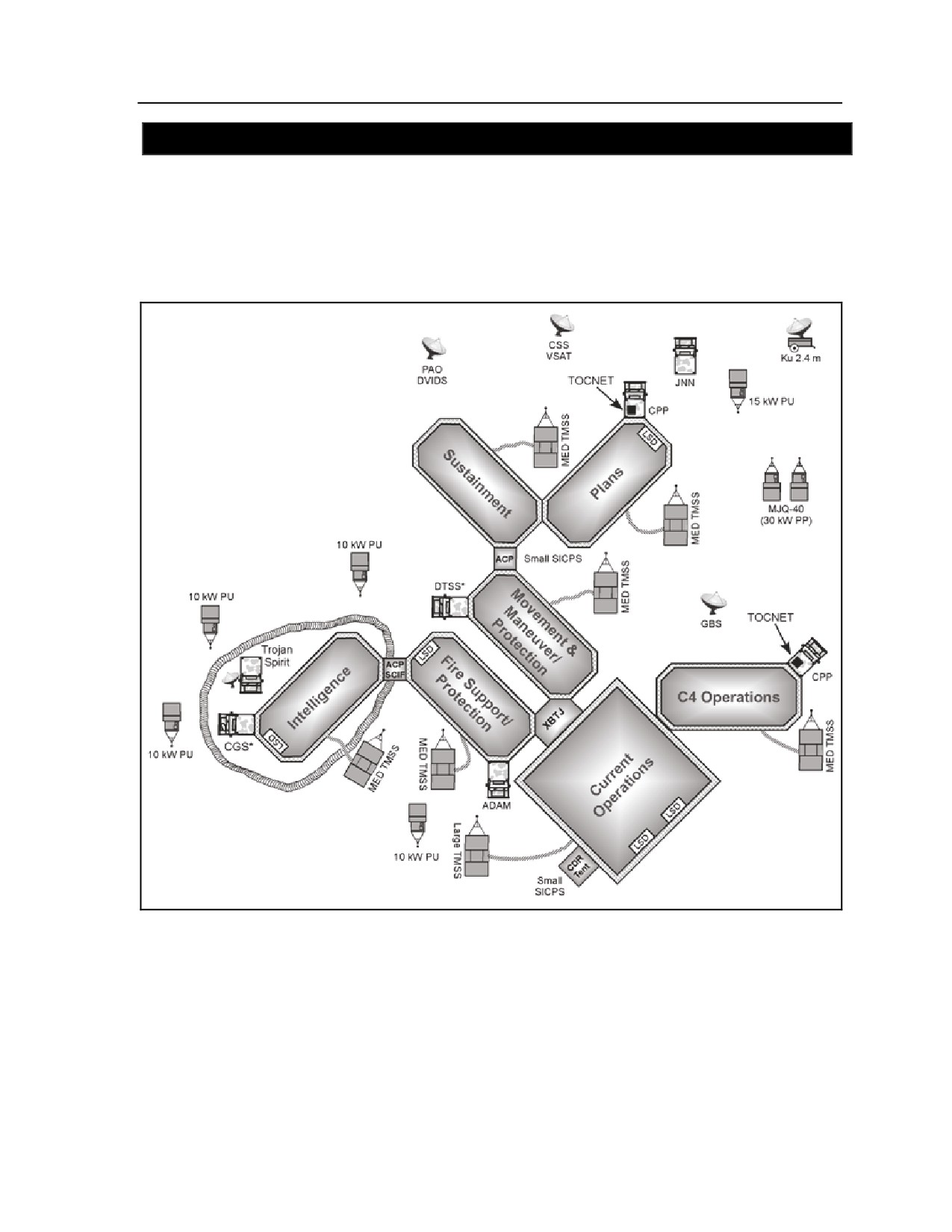
Brigade Command Post Layout
SECTION II - COMBAT AVIATION BRIGADE MAIN COMMAND POST
G-16. The main command post is a command and control facility that contains the portion of the unit
headquarters in which the majority of planning, analysis, and coordination occurs (FMI 5-0.1). The main
CP includes representatives of all staff sections. It is larger in size and personnel and less mobile than the
TAC CP. The main CP controls current operations when the TAC CP cannot or is not employed. Figure G-
1, figure G-2 (page G-4), figures G-3 and G-4 (page G-5), figure G-5 and G-6 (page G-6), and figures G-7
and G-8 (page G-7) illustrate a typical layout for a CAB main CP.
Figure G-1. Main command post
7 December 2007
FM 3-04.111
G-3
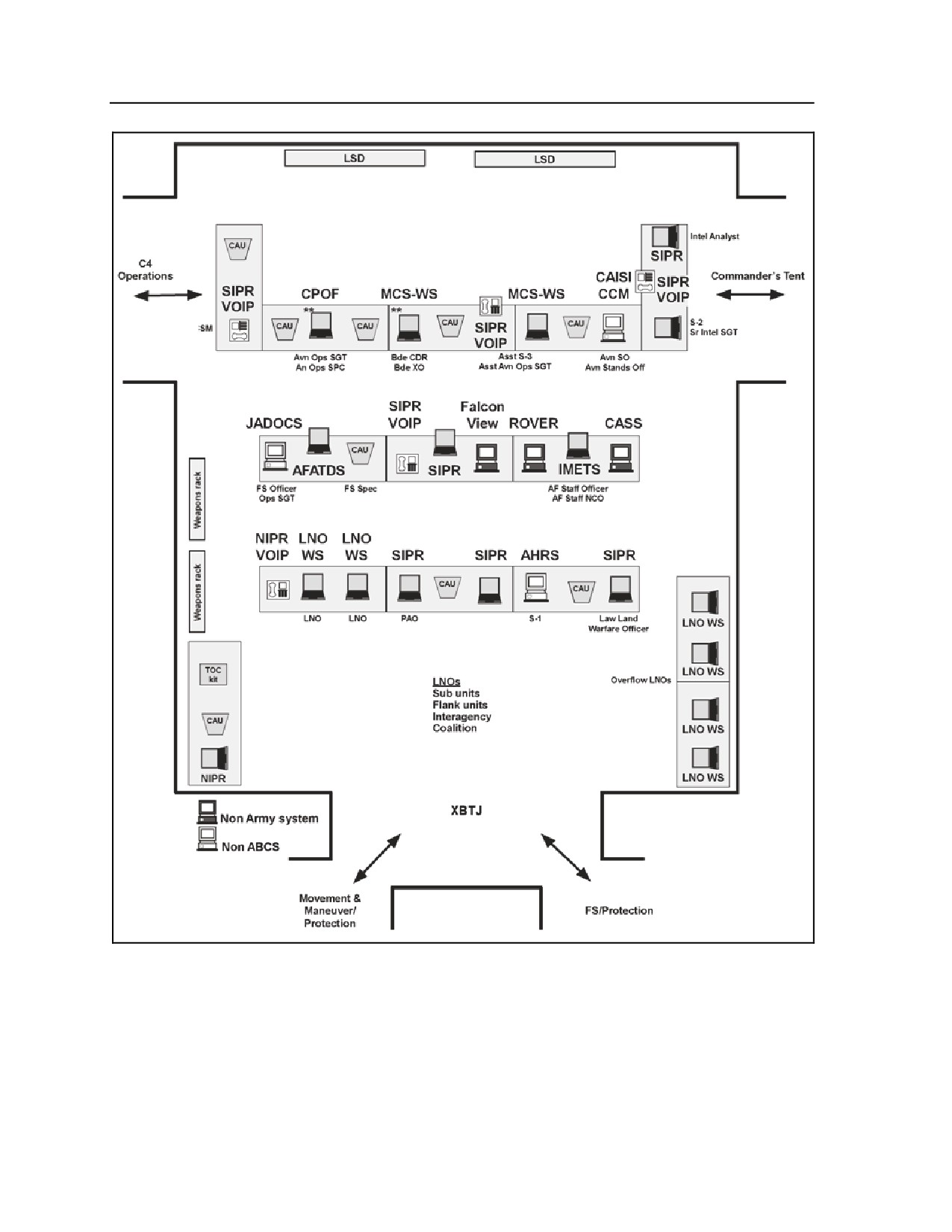
Appendix G
Figure G-2. Current operations
G-4
FM 3-04.111
7 December 2007
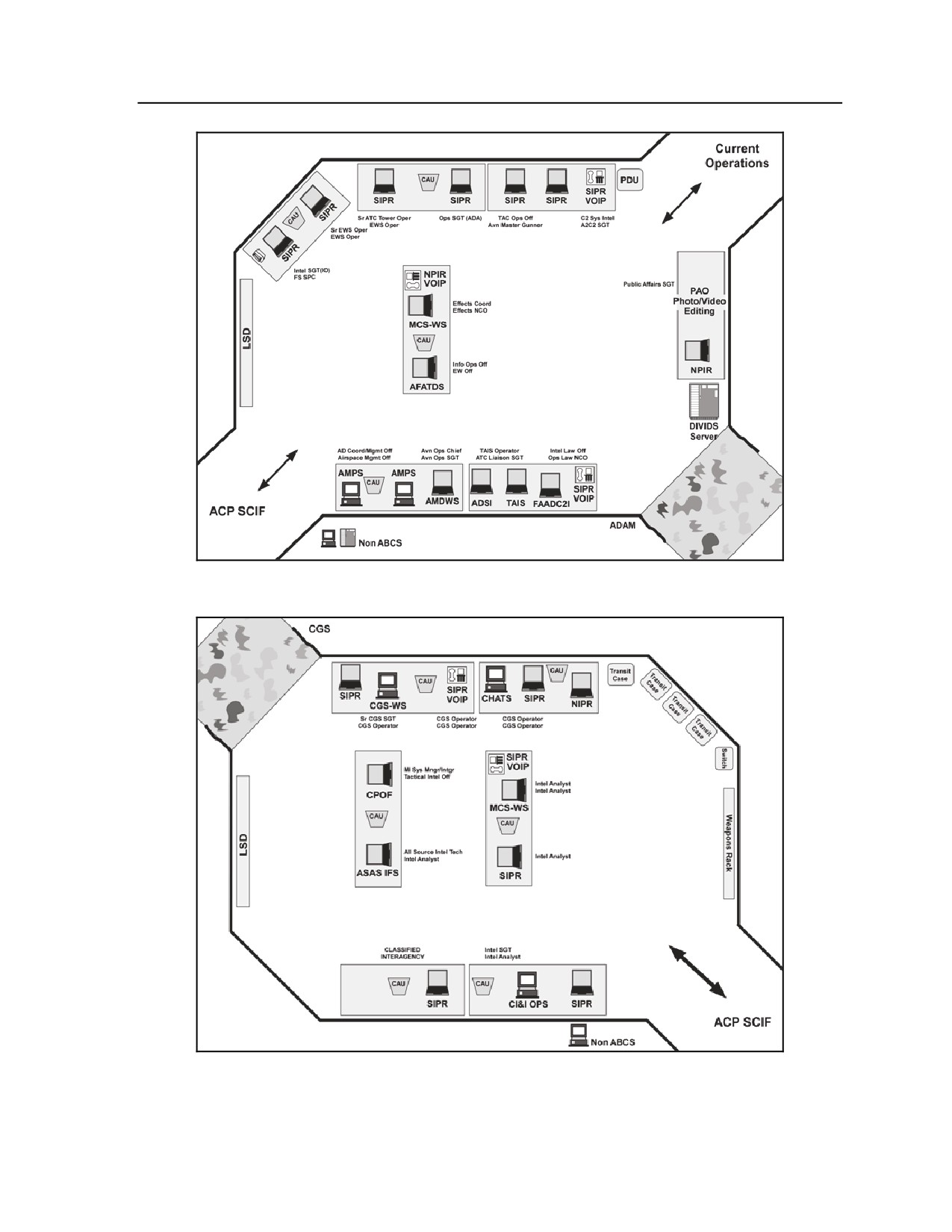
Brigade Command Post Layout
Figure G-3. Fire support/protection
Figure G-4. Intelligence
7 December 2007
FM 3-04.111
G-5
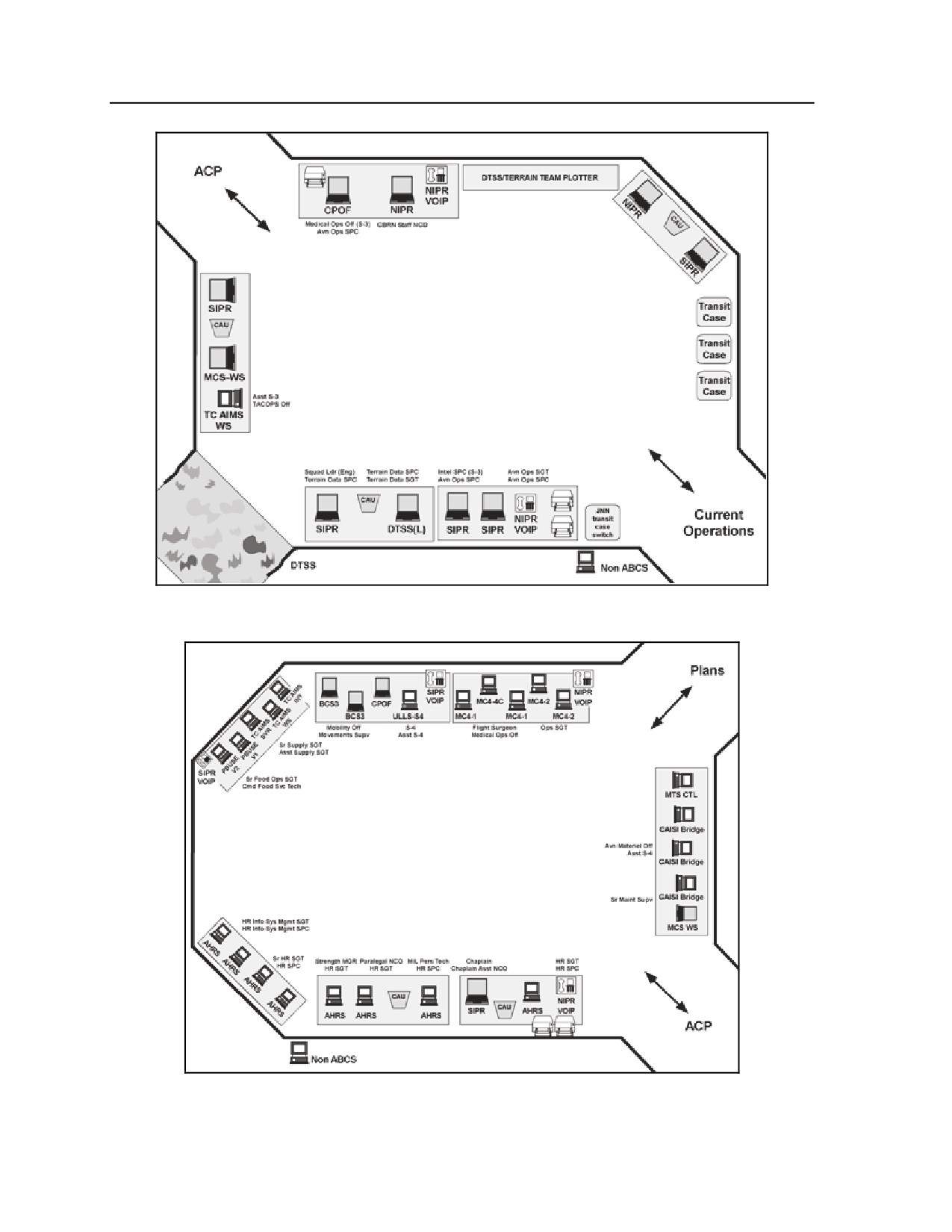
Appendix G
Figure G-5. Movement and maneuver/protection
Figure G-6. Sustainment
G-6
FM 3-04.111
7 December 2007
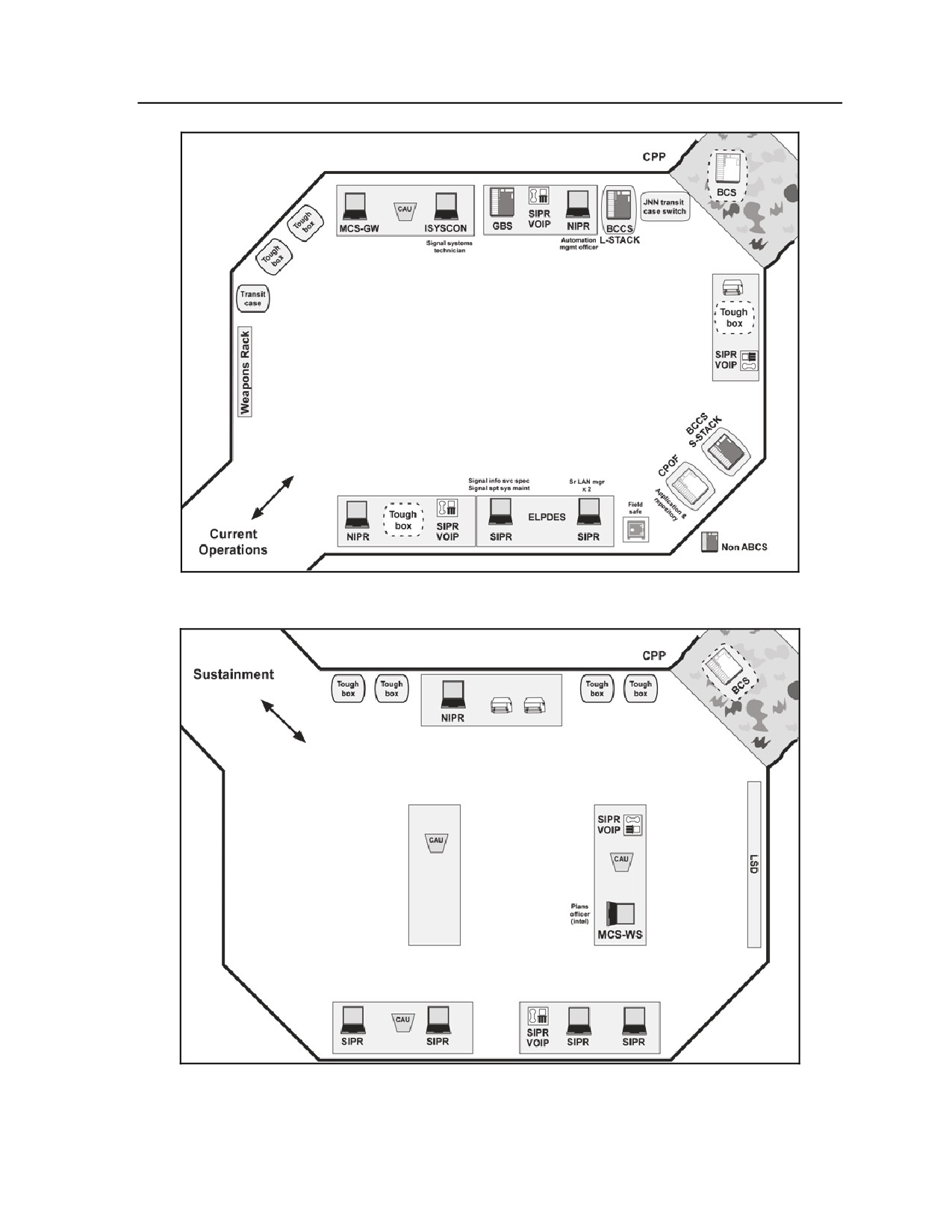
Brigade Command Post Layout
Figure G-7. Command, control, communications, and computers operations
Figure G-8. Plans
7 December 2007
FM 3-04.111
G-7
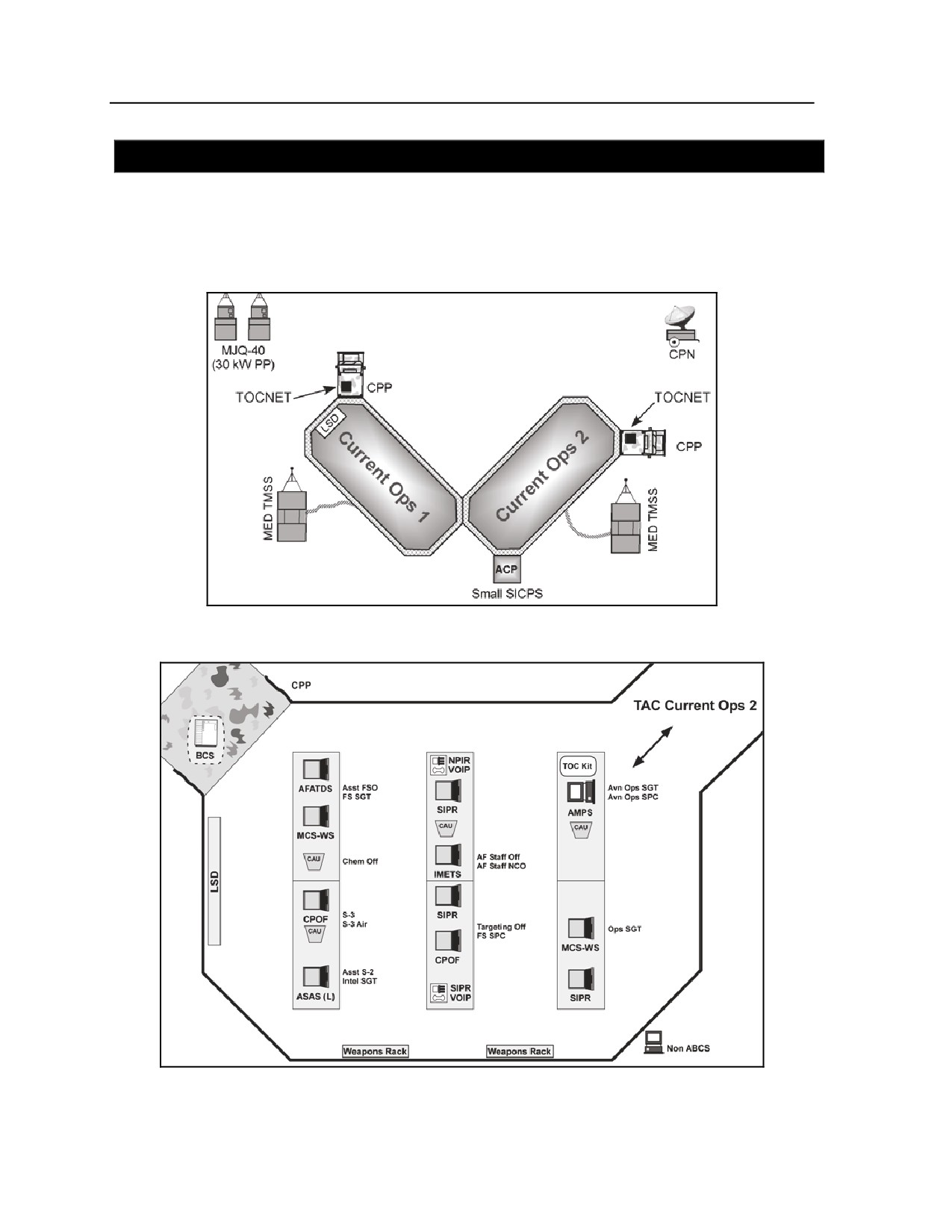
Appendix G
SECTION III - COMBAT AVIATION BRIGADE TACTICAL COMMAND POST
G-17. The tactical command post is a command and control facility containing a tailored portion of a unit
headquarters designed to control current operations (FMI 5-0.1). The TAC CP is fully mobile. As a rule, it
includes only Soldiers and equipment essential to control current operations. The TAC CP relies on the
main CP for planning, detailed analysis, and coordination. The S-3 usually leads the TAC CP. Figures G-9
and G-10 and figure G-11 (page G-9) illustrate a typical TAC CP layout.
Figure G-9. Tactical command post
Figure G-10. Current operations 1
G-8
FM 3-04.111
7 December 2007
Glossary
1SG
first sergeant
A&L
administrative and logistics
AC2
airspace command and control
A2C2S
Army airborne command and control system
AA
assembly area
AAMC
air ambulance medical company
AATF
air assault task force
ABCS
Army battle command system
ABTF
aviation battle task force
ACE
analysis and control element
ACL
allowable cabin load
ACM
airspace coordinating measure
ACO
air control order
ACS
air cavalry squadron
AD
air defense
ADAM
air defense and airspace managment
AEB
aviation expeditionary brigade
AFATDS
advanced field artillery tactical data system
AH
attack helicopter
AHB
attack helicopter battalion
AHC
assault helicopter company
AI
air interdiction
AKO
Army Knowledge Online
ALE
automatic link establishment
ALO
air liaison officer
ALSE
aviation life support equipment
AM
amplitude modulated
AMC
air mission commander
AMDWS
air and missile defense work station
AMO
aviation materiel officer
AMPS
aviation mission planning system
AMSS
Army materiel status system
ANCD
automated network control device
AO
area of operations
APOD
aerial port of debarkation
AR
Army regulation
ARB
attack reconnaissance battalion
ARC
attack reconnaissance company
7 December 2007
FM 3-04.111
Glossary-1
Glossary
ARFORGEN
Army force generation
ARNG
Army National Guard
ARP
airframe repair platoon
ARS
attack reconnaissance squadron
ART
attack reconnaissance troop
ASAS
all source analysis system
ASAS-L
all source analysis system-light
ASB
aviation support battalion
ASE
aircraft survivability equipment
ASL
authorized stockage list
ATCCS
Army Tactical Command and Control System
ATHP
ammunition transfer holding point
ATO
air tasking order
ATP
ammunition transfer point
ATS
air traffic services`
ATX
aviation training exercise
AVCATT
aviation combined arms tactical trainer
AWACS
airborne warning and control system
BAE
brigade aviation element
BAS
battlefield automated system
BCOTM
battle command on the move
BCS-3
battle command sustainment support system
BCT
brigade combat team
BDA
battle damage assessment
BDAR
battle damage assessment and repair
BFT
Blue Force Tracker
BOLT
brigade operational law team
BP
battle position
BSA
brigade support area
BSS
brigade surgeon section
C2
command and control
C4OPS
command, control, communications, and computer operations
CAB
combat aviation brigade
CAC
command aviation company
CAS
close air support
CASEVAC
casualty evacuation
CBRN
chemical, biological, radiological, and nuclear
CBRNE
chemical, biological, radiological, nuclear, and high yeild explosives
CCA
close combat attack
CCIR
commander’s critical information requirement
Glossary-2
FM 3-04.111
7 December 2007