FM 3-04.111 Aviation Brigades (DECEMBER 2007) - page 4
Logistics Operations
UNSCHEDULED MAINTENANCE
5-88. Unscheduled maintenance or repair is generated by premature or unexpected malfunction, improper
operation, or battlefield damage. Units must be doctrinally and organizationally prepared to apply
responsive corrective action on an as-needed basis. Maintenance support teams (MSTs) must be identified
prior to missions and assigned to scheduled shifts to quickly react to unscheduled maintenance
requirements, ensuring aircraft availability for follow-on missions.
BATTLEFIELD MANAGEMENT OF DAMAGED AIRCRAFT
5-89. BDAR/recovery operations are planned and coordinated in detail in conjunction with PR operations
to minimize risk. Recovery operations are those that move an aircraft system or component from the
battlefield to a maintenance facility. Recovery may require on-site repair for a one-time flight, or
movement by another aircraft or surface vehicle. In extreme circumstances, only portions of inoperative
aircraft may be recovered. An aircraft will be cannibalized at a field site only when the combat situation
and aircraft condition are such that the aircraft would otherwise be lost to enemy forces. Refer to FM 3-
04.500 and FM 3-04.513 for more detailed information on aircraft recovery.
AVIATION LIFE SUPPORT SYSTEM
5-90. Commanders ensure mission-required aviation life support equipment
(ALSE) is on hand in
sufficient quantities, and is in serviceable condition. Commanders are required to establish an aviation life
support system maintenance management and training program budget to meet resource requirements.
Funding for equipment, supplies, and repair parts is imperative. When preparing the budget, review AR 95-
1, common table of allowances (CTA) 8-100, CTA 50-900, and applicable MTOEs and tables of
distribution and allowances.
SAFETY DURING MAINTENANCE OPERATIONS
5-91. An effective safety program for maintenance operations is a basic requirement in all units. Everyone
must be alert to immediately recognize and correct potentially dangerous situations. Accidents can cause
more losses than enemy action unless safety is embraced by the unit.
ACCIDENT CAUSES
5-92. An accident in the shop, FARP, or air is seldom caused by a single factor such as human error or
materiel failure. Accidents are more likely to result from a series of contributing incidents. The following
areas require constant command attention to prevent aviation accidents:
z
Human factors.
z
Training, education, and promotion.
z
Equipment design, adequacy, and supply.
z
Normal and emergency procedures.
z
Maintenance operations.
z
Work Environment.
5-93. More complex aircraft have higher maintenance-related mishap rates. Commanders and maintenance
supervisors must ensure their personnel learn from maintenance errors generated in their own units.
Flightfax and other publications provide additional examples and information. All personnel must strictly
adhere to published maintenance procedures and apply CRM at all levels of operations.
SAFETY REGULATIONS
5-94. AR 385-10 regulates overall safety. AR 385-10 regulates the Army aviation accident prevention
program. Department of the Army pamphlet
(DA Pam) 385-40 and AR 385-10 cover accident
investigation and reporting.
7 December 2007
FM 3-04.111
5-15
Chapter 5
RESPONSIBILITIES
5-95. The quality assurance (QA) section has primary responsibility of safety for all maintenance work
performed on aircraft or their components. However, everyone in the unit has responsibilities in the unit's
maintenance safety and aviation accident prevention programs. General responsibilities for key personnel
are outlined in the following paragraphs. Appendix D contains additional information.
Unit Commander
5-96. Commanders ensure all unit activities are conducted according to established safety rules and
regulations. These regulations include AR
385-10, DA Pam 385-40, FM 5-19 and local directives.
Commanders also determine the cause of accidents and ensure corrections are made to prevent recurrence.
When deviation from an established safety rule is desired, commanders obtain permission from the
appropriate higher commander.
Leaders
5-97. Effective supervision is key to accident prevention. Supervisors must apply all established accident
prevention measures in daily operations. They should frequently brief subordinates on safety procedures,
get suggestions for improving safety practices, and announce any new safety procedures. Recommended
agenda items are listed below.
z
Overall job and expected results.
z
The how, why, and when of the job, and any ideas from the group on ways to improve methods
and procedures.
z
Part each person contributes.
z
Existing and anticipated hazards and action needed to resolve these problems.
z
The need for prompt, accurate reporting of all injuries, accidents, or near accidents.
z
Basic first aid procedures, training, and readiness.
z
The need to search constantly for, detect, and correct unsafe practices and conditions to prevent
accidents and injuries.
Individuals
5-98. All personnel must be aware of the safety rules established for their individual and collective
protection. Each person must read and follow unit SOPs, instructions, checklists, and other safety-related
information. They must report safety voids, hazards, and unsafe or incomplete procedures. Each Soldier
must follow through until the problem is corrected.
SECTION IV - AVIATION SUSTAINMENT UNITS
FLIGHT COMPANY
5-99. Crew chiefs perform aircraft launch and recovery operations, and maintain aircraft logbooks in
accordance within Army guidance and unit SOPs. They perform both scheduled and unscheduled unit
maintenance to include replacement of major subsystem components, maintenance operational checks, and
main and tail rotor vibration analysis. The battalion flight companies receive backup support from the
aviation maintenance company to perform both scheduled and unscheduled maintenance. Refer to FM 3-
04.500 for additional information.
AVIATION MAINTENANCE COMPANY
5-100. The aviation maintenance company is comprised of three modular aviation support platoons
including the headquarters platoon, airframe repair platoon, and component repair platoon (CRP). The
5-16
FM 3-04.111
7 December 2007
Logistics Operations
purpose of the aviation maintenance company is to repair and maintain aircraft. The company is organized
to provide quick, responsive, real-time internal maintenance support and repair within its capability.
5-101. The aviation maintenance company troubleshoots airframe and component malfunctions and
performs maintenance and repair actions requiring less than 2 days to complete. The aviation maintenance
company is authorized to perform maintenance at the unit level in accordance with the maintenance
allocation chart (MAC). It conducts BDAR and DART within its capability. During operations, most
aviation platoons or companies are in the forward portion of the support area.
5-102. The aviation maintenance company provides mobile, responsive support through MSTs used to
repair aircraft onsite or prepare them for evacuation. The aviation maintenance company commander and
production control officer coordinate and schedule maintenance at forward locations of the battalion.
Members of the forward element must be able to diagnose aircraft damage or serviceability rapidly and
accurately. MSTs follow these principles:
z
Teams may be used for aircraft, component, avionics, or armament repair.
z
When time and situation allow, teams repair on site rather than evacuate aircraft.
z
Teams must be 100 percent mobile and transported by the fastest means available (normally by
helicopter).
z
Teams sent forward must be oriented and equipped for special tasks.
5-103. In some situations, normal maintenance procedures must be expedited to meet operational
objectives. In such cases, the unit commander may authorize use of aircraft combat maintenance and
BDAR procedures. Aircraft combat maintenance and BDAR is an aviation maintenance company
responsibility with backup from supporting ASB units. The concept uses specialized assessment criteria,
repair kits, and trained personnel to return damaged aircraft to the battle as soon as possible. Often, these
repairs are only temporary. Permanent repairs may be required when the tactical situation permits. This
method is used to meet operational needs. It is not used when the situation allows application of standard
methods.
HEADQUARTERS PLATOON
5-104. The headquarters platoon is comprised of four sections—headquarters; production control; QA;
and technical supply. This platoon provides internal management, quality of repairs, and logistics support
within the battalion. The technical supply section operates logistics STAMIS, requisitions class IX (A)
spares and manages the battalion PLL. Oversight is provided by the battalion aviation material officer
assigned to the S-4.
AIRFRAME REPAIR PLATOON
5-105. Airframe repair platoons (ARPs) assigned to an aviation maintenance company provide their
supported aviation units with scheduled and unscheduled maintenance support. Primary responsibility for
unscheduled maintenance falls on the owning unit. However, when unit OPTEMPO increases, unscheduled
maintenance support can be coordinated and requested through the aviation maintenance company
production control office. If the line company cannot complete the unscheduled maintenance in 1 day or
less, it should contact the production control office and request airframe repair platoon (ARP) maintenance
support. Location of the maintenance action can then be further coordinated by the line company and the
production control section. Primary responsibility for periodic scheduled maintenance falls upon the
owning unit. Prolonged scheduled maintenance—including aircraft phases, compliance with recently
published aviation safety action messages/technical bulletins—can lead a supported unit to request
maintenance support from the aviation maintenance company. Maintenance support can be coordinated and
requested by the owning unit through the production control office.
COMPONENT REPAIR PLATOON
5-106. The CRP is assigned a headquarters section, shops section, and a systems repair section. The CRP
contains assigned aviation repair specialty military occupational specialties (MOSs) to include avionics,
7 December 2007
FM 3-04.111
5-17
Chapter 5
armament, powerplant/powertrain, hydraulics, pneumatics, and sheet metal repair assets. The CRP
diagnoses airframe and component malfunctions and performs maintenance, repair actions, and removes
and installs LRUs within its capabilities.
5-107. The shops section contains an armament/avionics/electrical repair team. The armament team is
responsible for troubleshooting and repairing armament systems, subsystems, and components. Personnel
assigned to the armament systems repair team conduct preventive maintenance and conduct testing and
troubleshooting of aircraft weapons systems and subsystems. These personnel also perform cleaning,
servicing, and ammunition loading and unloading of weapons systems to include configuration changes.
The armament team is responsible for repairing and replacing weapons platforms components in
accordance with applicable publications.
5-108. The CRP systems repair section performs preventive maintenance of aircraft components and
structures that require specialized technical skills. In addition, maintainers assigned to this section perform
scheduled and unscheduled maintenance, troubleshoot faulty components, remove and replace aircraft
components, perform BDAR procedures and manage assigned sets, kits, and outfits at the platoon level,
and provide mission support to flight companies.
AVIATION SUPPORT BATTALION
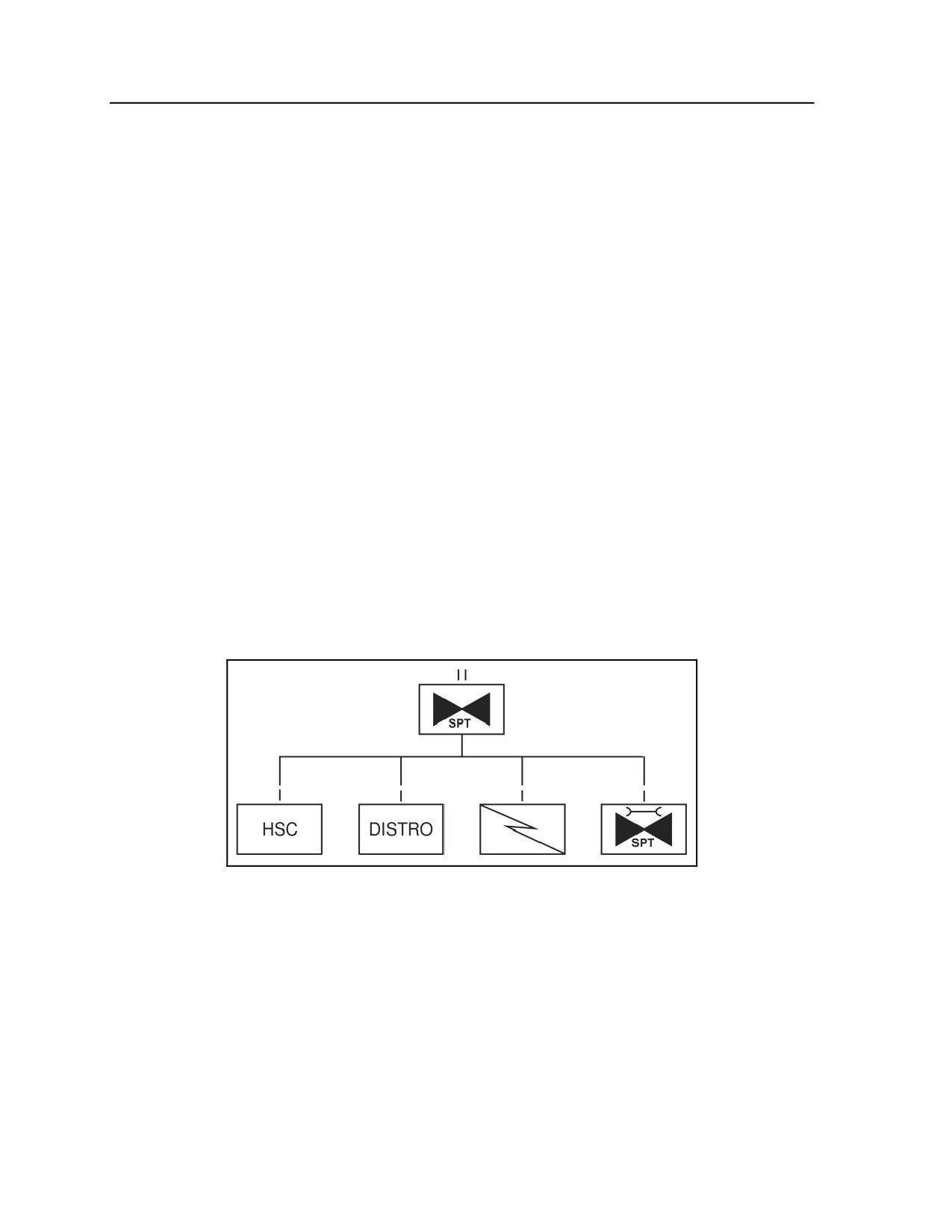
5-109. The ASB (figure 5-3) is the primary aviation logistics organization above aviation battalion. The
ASB is organic to the aviation brigade and provides all logistics functions necessary to sustain the aviation
brigade during full spectrum operations. It consists of four companies—the HSC, distribution company,
NSC, and ASC. The ASB provides aviation and ground field maintenance, network communications,
resupply, and medical support. The HSC provides medical support and conducts ground field maintenance
and recovery. The distribution company functions as a SSA and distributes supplies to subordinate units of
the aviation brigade. The NSC provides network and signal support to the aviation brigade headquarters.
The ASC provides field level maintenance, to include intermediate level maintenance, and support for on-
aircraft and critical off-aircraft maintenance of UAS. The ASC also conducts BDAR and provides backup
support to the aviation maintenance companies.
Figure 5-3. Aviation support battalion
MISSION
5-110. The ASB distributes supply classes I, II, III, IV, V, VIII, and IX. It performs field maintenance
and recovery (air and ground), and possesses the HSS assets to conduct force health protection Level I
enhanced for the aviation brigade. The ASB carries logistics stocks that exceed the organic carrying
capability of the aviation brigade battalions that are generally one DOS for most classes of supply except
classes III (B) and IV where it is one combat load for the brigade. FSCs have the same type of carrying
capacity relative to the support of their battalion. The ASB plans and coordinates for the aviation brigade’s
logistics requirements in coordination with the brigade S-4 during the brigade’s MDMP. The ASB
executes replenishment operations for the FSCs and aviation maintenance companies in concert with the
5-18
FM 3-04.111
7 December 2007
Logistics Operations
OPLAN developed by the brigade. The ASB is the parent battalion headquarters for the NSC in support of
brigade headquarters.
TASKS
5-111. ASB tasks are—
z
Conduct field maintenance, both ground and air, to include UAS and recovery operations.
z
Provide signal and network support for the aviation brigade headquarters to enable C2 of
subordinate battalions and the aviation brigade or ABTF.
z
Provide logistics for ground, air, missile, and above ground support equipment systems.
z
Monitor and update the current situation such as developing logistics and tactical COPs.
z
Plan, synchronize, manage, and execute sustainment operations at brigade level within the
aviation commander’s battle rhythm.
z
Plan, establish, maintain, and synchronize distribution management operations within the
aviation brigade; link back with the division for coordination of requirements and
synchronization of flow.
z
Determine and anticipate logistics requirements for maneuver operations.
z
Provide Level I enhanced medical support plus emergency resuscitative surgery. Plan,
coordinate, and provide emergency medical treatment and advanced trauma management for
wounded and disease and nonbattle injury patients and sick call services.
z
Provide mass casualty management to include triage, treatment, and evacuation.
z
Integrate mission tailored logistics augmentation to support the concept of maneuver as
required.
LIMITATIONS
5-112. The ASB is not designed to provide the following logistics functions:
z
Medical support is limited to an enhanced Level I medical platoon.
z
Field services.
z
Mortuary affairs
(planning only). No collection, processing and evacuation without
augmentation.
z
Laundry and bath is not organic at this level. Support is provided by the sustainment brigade.
z
Limited financial management.
z
Limited class VIII/IX storage capability.
z
Limited capability to reconfigure load. Ammunition from EAB must be in strategic or
operational configured loads.
z
No fire fighting capability.
z
Explosive ordnance disposal is provided by the maneuver enhancement brigade.
z
Human resources other than its own unit S-1 human resource operations. Relies on the
sustainment brigade to provide additional critical wartime personnel support.
z
Legal support is limited to the assigned BOLT; augmentation to support all Judge Advocate
General functions are required.
z
There is no built-in ground maintenance back-up support to the maneuver units; however, the
ASB commander can provide support when capacity is available.
z
No optical fabrication and blood product management support.
z
No organic aeromedical evacuation support. Aeromedical evacuation support is organic to the
aviation brigade.
7 December 2007
FM 3-04.111
5-19
Chapter 5
HEADQUARTERS AND SUPPORT COMPANY
5-113. The HSC contains a typical logistics battalion staff structure with a command section, S-1,
consolidated S-2/S-3, S-4, UMT, S-6, and support operations section. The battalion headquarters provides
C2 and administration support for all organic and attached ASB units. The battalion headquarters also
plans, directs, and supervises logistics support for the aviation brigade. The ASB has an organic CSSAMO
that provides support for the entire brigade’s logistics network and system, including unit level logistics
systems-aviation (ULLS-A).
5-114. The support operations section is organized to coordinate logistics support and provide
distribution management to the aviation brigade. The support operations section is also manned to
accomplish contracting, medical and medical logistics, petroleum, ammunition, movement control,
transportation, and mortuary affairs functions.
Support Company
5-115. The support company provides ground maintenance, medical, supply, and food service support to
units organic and attached to the ASB.
5-116. The maintenance platoon is responsible for field level maintenance for all of the ASB’s organic
ground equipment.
5-117. The medical platoon provides Level I enhanced medical care. The platoon includes a flight
surgeon, physician’s assistant, health care NCOs, and health care specialists. The platoon is organized into
headquarters, treatment, and evacuation sections. Additionally, the platoon has four ambulances. The
brigade HHC and flight battalions retain their organic flight surgeons and medics in their organic medical
treatment team. The medical platoon provides the following capabilities for the ASB:
z
Emergency medical treatment and acute trauma management for wounded and disease and
nonbattle injury patients.
z
Sick call services.
z
Ground ambulance evacuation from supported units.
z
Mass casualty triage and management.
z
Limited patient decontamination.
DISTRIBUTION COMPANY
5-118. The distribution company provides the aviation brigade a single source for all supply (less class
VIII) and transportation operations. The distribution company includes a fuel and water platoon, supply
platoon, and transportation platoon.
5-119. The fuel and water platoon has the capability to store and distribute 105,000 gallons (one DOS) of
fuel for the brigade using three load-handling system modular fuel farms. Additionally, the platoon has the
capability to set up and run multiple refuel points for brigade aircraft. The fuel and water platoon also has
the capability to purify 30,000 gallons of water daily and can store 18,000 gallons of water. The platoon
has an organic quartermaster petroleum QA team assigned to provide QA testing for bulk aviation fuel.
The team performs quality evaluation and provides technical assistance for handling, storing, sampling,
and identifying petroleum products and their containers for the aviation brigade.
5-120. The supply platoon has an SSA and ammunition transfer and holding point section. This platoon
provides classes II, III (P), IV, V, VI, VII and IX DS to the brigade. The supply platoon receives, stores
(limited), and issues classes II, III (P), IV, and IX. It also receives and distributes classes I and VI under the
distribution based doctrine of pushing supplies to the FSCs and aviation maintenance companies, and
receives and issues class VII as required. The platoon also maintains the classes II, III (P), IV and IX ASL
for the brigade. The ATHP section supports the brigade with class IV and operates the brigade ATHP.
5-20
FM 3-04.111
7 December 2007
Logistics Operations
5-121. The transportation platoon’s purpose is to add organic transportation and distribution capability to
the brigade and increase mobility of the ASB. The transportation platoon also has the ability to transport
classes V and IX to the supported FSCs and ASCs.
NETWORK SUPPORT COMPANY
5-122. The NSC provides 24-hour operations supporting the aviation brigade network. It provides signal
elements designed to engineer, install, operate, maintain, and defend the network. It extends defense
information systems network services to the brigade and its subordinate elements and provides basic
network management capabilities. The company executes its technical mission under functional control of
the brigade S-6 based on brigade OPORDs or other directives. The S-6 directs actions and movement of
signal elements in support of brigade operations. The NSC commander maintains command authority over
the company's assigned operational platoons or attached elements. Refer to appendix B for additional
information.
AVIATION SUPPORT COMPANY
5-123. Aircraft maintenance above aviation battalion level is provided by the ASC of the ASB. The ASC
is comprised of three platoons—headquarters, ARP, and CRP. Modularity within the ASC is based on a
contact support team concept and uses five shop equipment contact maintenance vehicles per platoon. The
ASC is capable of supporting brigade split based operations and appropriate support to ABFTs. The ASC
primarily performs intermediate maintenance in accordance with the MAC; however, it also provides
backup unit maintenance in support of aviation battalions. The ASC provides aviation logistics support
operations for aviation brigade assets. It provides aviation and ground equipment maintenance, in a
sustained combat environment, to include UAS and air traffic control equipment. The ASC also performs
production control and quality control, conducts maintenance management, and provides maintenance test
pilot (MP) functions. Additionally, ASCs have six-man electro-optics test facilities augmentation teams
assigned.
Headquarters Platoon
5-124. The headquarters platoon contains the production control and QA sections and technical supply
section. This platoon provides internal management of repairs, and quality of repairs and logistics support
within the battalion. The tech supply section operates logistics STAMIS, requisitions class IX (A) spares
and manages the battalion PLL. Oversight is provided by the battalion aviation material officer assigned to
the S-4.
Aircraft Repair Platoon
5-125. The ARP performs maintenance actions which require more than 3 days to complete (such as
phase maintenance and preventative maintenance and services). The ARP performs in depth
troubleshooting and diagnosis of airframe and component malfunctions; fixes and fuels organic battalion
equipment, ground vehicles and aviation general support equipment (GSE); operates and performs field
level maintenance on aviation ground power units, generators and GSE; and performs BDAR. The ARP
contains modular maintenance contact teams to support battalion level deployments (five sections/one per
battalion). The primary methods of returning aviation systems to a mission capable status for a field level
maintenance activity are through use of repair parts, BDAR, controlled substitution, controlled exchange,
and class VII replacement. As the senior logistician in the brigade, the ASB commander tailors the ARP to
support multiple ASCs and the aviation brigade’s mission. Each ARP is assigned to a supported aviation
battalion. In addition, component repair organizations may be attached to the ARP to facilitate rapid
turnaround of critical sustainment level off aircraft tasks/components. The ARP is designed to provide on
aircraft and critical off aircraft aviation field level maintenance, both unit and intermediate, in accordance
with the MAC. The ARP also performs BDAR for all assigned aircraft and UAS in the aviation brigade.
Long-duration low-frequency services such as phases are accomplished at the ARP.
7 December 2007
FM 3-04.111
5-21
Chapter 5
Component Repair Platoon
5-126. The CRP repairs LRU components to TM standard and returns them to the user. The CRP fixes
the night vision goggle (NVG) systems, ALSE, and avionics-electrical and hydraulic components to TM
standard. It has limited capability to fabricate hydraulic lines and perform engine repair, prop and rotor
repair, and armament and armament sub-system repair. The CRP also provides limited fabrication
capability using welding and machine shops and operates intermediate level STAMIS. It also repairs and
troubleshoots unit level STAMIS with support from CSSAMO in the HSC.
COMMAND AND CONTROL
5-127. ASBs use echeloned C2 to plan and direct operations. Battle command is tailored to meet the
requirements of each operation. The battalion command group normally operates within the aviation
brigade’s OE as appropriate to meet the sustainment and force protection requirements. It consists of the
commander and those selected to assist in controlling the operational and sustaining elements of the
battalion. The commander determines the composition, nature, and tasks of the command group based on
METT-TC analysis. As a minimum, the command group—
z
Integrates support battalion and attached logistics assets in support of sustainment operations
and signal operations.
z
Controls sustainment operations and force protection operations.
z
Maintains SU.
z
When not at the main CP, the command group provides close situation information to the main
CP of observations achieved by proximity to the activity.
5-128. The commander, SPO, and S-2/S-3 monitor the battle, develop the situation, analyze COAs, and
control the companies except as noted for the NSC. The ASB commander’s C2 structure for replenishment
and security operations, and the systems that assist the commander, are used to see the battlefield and lead
the battalion as it conducts operations.
5-129. The commander and S-2/S-3 are the only battalion level leaders that can issue tasking orders. The
SPO should coordinate requirements and provide WARNOs for replenishment operations in support of the
brigade, but the S-3 issues the tasking order.
5-130. The ASB commander’s C2 structure for logistics centers on three entities—the ASB commander’s
location, his command group, and ASB CP. The logistician’s headquarters enables the commander to
maximize command, control, and IM for logistics and TACOPS. The ASB CP employs the current battle
command systems required to C2 the ASB’s organic and supporting Army WFFs and units. The ASB
commander’s C2 systems also enhance the logistics staff’s ability to provide the commander with timely
information; maintain an accurate COP; efficiently process, analyze, and disseminate battlefield
information; and provide updated mission orders rapidly. The commander operates independently,
establishing BCOTM as necessary, or operates from the ASB CP based on the situation and phase of the
operation.
5-131. ASB C2 consists of key personnel, equipment, and CP from which the battalion commander,
assisted by the battle staff, directs operations and sustains the force. METT-TC dictates the organization of
C2 personnel, facilities, and location of the command group.
5-132. The duties of the ASB commander and support operations section are different enough from
aviation battalion functions that an explanation of their responsibilities is warranted. The other functions of
the battalion staff are generally similar to the Army’s operational aviation battalions.
Commander
5-133. The ASB commander is the senior logistician for the brigade. He or she manages logistics through
use of an array of digital information systems and a technologically competent battle staff capable of
capitalizing on all other technological innovations. The ASB commander directs all units organic or
attached to the battalion in support of the brigade’s mission. He or she also has control of all elements in
5-22
FM 3-04.111
7 December 2007
Logistics Operations
the aviation BSA for security and terrain management. He or she provides subordinate elements with clear
missions, taskings, and a statement of his intent.
5-134. The battalion commander provides aviation maintenance and distribution management at the
brigade level and maintains SU of the logistics assets required to support the brigade’s responsibilities. The
ASB commander’s responsibilities include leadership, discipline, tactical employment, training,
administration, personnel management, supply, maintenance, communications, and logistics activities of
the battalion. The ASB commander’s duties include—
z
Establishing his CCIR and EEFI.
z
Understanding capabilities and limitations of the battalion's personnel and equipment in
performing the logistics mission to include security operations as well as those of logistics
elements attached to him or her.
z
Developing and providing a LCOP in meaningful terms for the brigade commander and his
staff.
z
Staying personally involved in and apprised of replenishment operations and the tactical
situation throughout the brigade AO and BSA OE.
z
Being proficient in the tactical employment of the battalion and its assigned and attached
logistics elements.
z
Establishing an effective perimeter defense plan for all assets within the BSA fully coordinated
with the brigade S-3. Personally ensure establishment of the plan by subordinate
commanders/leaders with on-site inspections.
z
Developing fully coordinated, effective combat convoy movement plans with the brigade
commander and his staff for execution if necessary with combined arms forces.
z
Understanding the full capabilities of the tactical and logistics radio and data transmission
capabilities available to the commander and his staff.
z
Maintaining contact with higher, lower, and adjacent supported and supporting units. A liaison
should be used if that is the best solution.
z
Ensuring connectivity of STAMIS and FBCB2 with the brigade and supporting units.
z
Knowing the responsibilities and capabilities of higher, lower, and supporting units and
knowing the support required and what support each level or type of organization can provide.
z
Using effective oral communications and writing clear directives and orders. For example—
Providing commander's intent and mission guidance.
Reviewing battle staff estimates of the tactical and logistics situation, their COA analysis,
and then recommending the COA that best supports the brigade mission by sustaining the
fighting capability of the brigade.
Stating his estimate of the situation and announcing his decision.
z
Being familiar with the law of land warfare with respect to civilians, civil affairs, and CMO.
z
Ensuring there is a well-known and rehearsed plan of command succession.
Commander’s Location on Battlefield
5-135. Commanders consider their position in relation to the units they command and the mission. Their
location can have important consequences for executing sustainment operations. Modern information
systems can help commanders command throughout the AO without losing access to information and
analysis of the CPs. Should commanders require a larger facility to temporarily exercise C2, a subordinate
tactical CP can be used to establish communications to their CP.
5-136. At battalion level logistics, the ASB CP is normally the focus of information flow and planning.
Yet the logistics commander cannot always visualize the battlefield and direct and synchronize operations
from there. He or she must sometimes assess the situation on the ground—face-to-face with subordinate
commanders and their Soldiers. Commanders design their C2 systems to position them where they can best
command without losing the SU that allows them to anticipate situations and respond to opportunities and
changing circumstances.
7 December 2007
FM 3-04.111
5-23
Chapter 5
5-137. At the ASB level, commanders lead more indirectly through their subordinates. Commanders may
want to have personal contact with or intervene to make decisions at the location or with the command
executing the decisive operation. Similarly, when commanders lose sight of the situation, they need to
reestablish a COP to achieve clear SU.
Support Operations Section
5-138. This section, under direction of the SPO, provides centralized, integrated, and automated C2 and
planning for all distribution management operations within the battalion. It coordinates with logistics
leaders, staff planners, and medical personnel in the fields of supply, maintenance, force health protection,
mortuary affairs, and movement management for the support of all units assigned or attached in the brigade
area. Its primary concern is supported units and increasing the responsiveness of support provided by
subordinate units. It continually monitors support and advises the battalion commander on the ability to
support future TACOPS. With the GCCS-A, BCS-3, FBCB2, and MTS, the support operations section has
access to and receives information in near real time. Therefore, the support operations section possesses the
capability to view the LCOP and combat power in the maneuver units allowing quick identification of
problems to allocate resources more efficiently. The BCS-3 gives support operations the visibility of the
logistics status from the ASB back to the sustainment brigade and potentially throughout the world
depending on the level of detail required.
5-139. The support operations section serves as the point of contact (POC) for supported units. It directs
problems to appropriate technical experts within subordinate branches. The duties of the support operations
section include the following:
z
Conducts continuous brigade focused LBP.
z
Plans and coordinates for aerial resupply and plans for LZs in the vicinity of the BSA.
z
Develops the logistics synchronization matrix.
z
Submits logistics forecasts to the division sustainment brigade.
z
Manages all flatracks throughput to and retrograding from the BSA.
z
Coordinates and provides technical supervision for the ASB’s sustainment mission, which
includes supply activities, maintenance support, force health protection, and coordination of
transportation assets.
z
Identifies tentative force structure and size to be supported.
z
Coordinates preparation of the support operations estimate on external support.
z
Provides support posture and planning recommendations to the ASB commander.
z
Sets up and supervises the logistics operations center located in the ASB CP.
z
Coordinates with brigade S-3 air routes for supply and aeromedical evacuation support.
z
Provides centralized coordination for units providing support to the brigade.
z
Analyzes the impact of BCS-3 reports.
z
Advises the battalion commander on the status of logistics support.
z
Coordinates logistics support for units passing through the brigade’s area. Works with ASB S-3,
aviation brigade S-3, as appropriate, for terrain management and movement across other unit’s
AO.
z
Analyzes contingency mission support requirements.
z
Revises customer lists (as required by changing requirements, workloads, and priorities) for
support of TACOPS.
z
Coordinates external logistics provided by subordinate units.
z
Advises the battalion commander on supportability of ASB support missions and of shortfalls
impacting mission accomplishment.
z
Serves as the single point of coordination for supported units to resolve logistics support
problems.
z
Plans and coordinates contingency support.
z
Develops supply, service, maintenance, and transportation policies including logistics
synchronization and maintenance meetings.
5-24
FM 3-04.111
7 December 2007
Logistics Operations
5-140. The SPO performs functions as the BCS-3 manager. The SPO must work in conjunction with the
S-2/S-3, S-4, and S-6 to establish and manage the BCS-3 network and database. The SPO must maintain
supply point and maintenance data entered into the system.
Supply and Services Cell
5-141. The support operations supply and service officer plans and recommends the allocation of
resources in coordination with the supported chain of command, including coordination with the
distribution section. The supply and service officer also forecasts and monitors distribution of supplies
within the brigade. Information is entered into BCS-3 at the brigade S-4 and transferred to BCS-3 at
support operations. This allows support operations to identify problems quickly and allocate resources
more efficiently. The supply and service officer is responsible for mortuary affairs activities carried out
within the brigade AO. He or she is also responsible to coordinate and monitor all transportation
movements of replenishment stocks and services for and within the ASB.
5-142. The supply and services cell has two traffic management coordinators assigned to control
movement of transportation assets in and around the ASB. The traffic management coordinators—
z
Monitor, control, and supervise movement of personnel, equipment, and cargo.
z
Develop and review movement programs (to include convoy planning) for logistics support
functions within the ASB/BSA.
z
Advise in preparation of support plans where transportation is required.
z
Verify accuracy of movement control documents.
z
Ensure allocation of transport capability is appropriate to accomplish each mission in a cost-
effective manner.
z
Coordinate support with the movement control office in the sustainment brigade’s support
operation section when transportation requirements exceed the ASB’s capability.
z
Anticipate and recommend use of main supply routes (MSRs) to the movement control office.
5-143. The addition of new enabling technologies allows the traffic management coordinators to track,
trace, and divert transportation platforms operating in the brigade AO. The traffic management
coordinators are responsible for the ITV in the theater of operations. ITV is best accomplished by the ASB
movements NCO interfacing with other STAMIS to develop inbound/outbound requirements. ITV uses the
MTS and other ITV technology to get a near real-time location of transportation assets and supplies. In
addition, the traffic management coordinators are able to synchronize the delivery schedule via FBCB2
with customer units to minimize the offload/upload times. With FBCB2 and the MTS control station, the
traffic management coordinators are now able to give specific coordinating instructions to vehicle
operators without having to rely on manned control points. These new technologies allow information to be
transferred between the brigade S-4, battalion S-4, ASB support operations section and the traffic
management coordinators to schedule and synchronize transportation requirements within or in support of
brigade/battalion operations.
Maintenance Cell
5-144. The support operations maintenance officer
(MO) plans and recommends the allocation of
resources in coordination with the supported unit’s chain of command, including coordination of
maintenance company operations. The support operations MO also forecasts and monitors the workload for
all equipment by type. The MO and maintenance NCO use standard Army maintenance system-level 2
(SAMS-2) to collect and process maintenance operations data and assist in the management of maintenance
operations. SAMS-2 processes maintenance information required to control workload, manpower, and
supplies. The SAMS-2 capabilities are designed to assist in both maintenance and readiness management.
5-145. The aviation battalions transmit logistics SITREPs electronically to the brigade S-4 and ASB SPO.
This allows support operations to identify problems quickly and allocate resources more efficiently.
FBCB2 also provides map graphics that portray unit locations, grid coordinates, and terrain features so
support operations can track maintenance on the battlefield.
7 December 2007
FM 3-04.111
5-25
Chapter 5
5-146. The support operations maintenance cell develops plans and policies for repairable exchange and
class IX operations. It monitors shop production and job STATREPs in the field maintenance company and
FSCs. It also monitors and reviews combat spares and coordinates critical parts status with the sustainment
brigade. For unserviceable items, the standard Army retail supply system box in the distribution company
generates disposition instructions based on commander’s guidance. Instructions include evacuation,
controlled exchange, and controlled exchange policies. With the brigade S-4, the support operations
maintenance cell reviews backlogs on critical weapon systems. For any additional support requirements,
the ASB support operations section coordinates through the division materiel management branch.
Health Service Support Cell
5-147. For brigade force health protection operations, the HSS cell provides input to the brigade surgeon
section (BSS) for inclusion into the force health protection annex of the brigade OPLAN. Refer to FM 4-
02.21 for additional information on the BSS. The health service support officer provides BSS information
on all medical activities to include attachment of sustainment brigade medical elements, class VIII
resupply, MEDEVAC, and priority of force health protection for the BSA and brigade AO. The HSS cell
plans for the use of nonmedical platforms for CASEVAC, and the support operations section manages their
use during mass casualty operations.
5-148. The medical communications for combat casualty care system assist the force health protection
cell and BSS in performing their responsibilities through the collection, integration, and transmission of
medical information. These sections have near real-time information on the status of medical units, brigade
unit medical readiness information, CASEVAC, medical supplies, and medical treatment.
SECURITY OF AVIATION SUPPORT BATTALION ASSETS
5-149. Sustainment elements locate most of their assets in the aviation BSA. These elements deploy in a
manner that maintains unit cohesion, supports integration into the defensive plan for collocated units, and
provides responsive support to the battalions. FM 3-04.500 contains additional information about logistics
movement and operations.
5-150. The brigade commander's goal is to retain overall freedom of action for fighting military
operations. This means MSRs are clear, unobstructed, and secure; units can move quickly and in an orderly
fashion throughout the brigade area; logistics resupply via logistics convoys and reconstitution are
sustained; and all sustainment and logistics units are secure.
5-151. The brigade commander is responsible for plans and operations throughout the brigade AO. He or
she assigns tasks to subordinate and supporting commanders to accomplish all brigade missions. The
brigade S-3 includes detailed planning for the ASB AO as part of operational planning for offensive,
defensive, and sustainment operations and support operations missions.
5-152. The ASB commander is responsible for defense of the BSA. Hence, the BSA’s perimeter defense
is under C2 of the ASB commander. The ASB commander’s plan of action must achieve adequate
protection to ensure accomplishment of missions by BSA elements with as small a force as necessary, since
any drain of time and personnel from operational activities adversely affect accomplishment of their
missions. However, survival of the ASB is most important for the continuing success of the aviation
brigade’s ability to sustain itself.
5-153. The security planning starts with the aviation brigade’s first WARNO during the brigade MDMP;
whereas the sustainment concept of the support plan the ASB executes is developed during the brigade’s
MDMP. The ASB, like all other subordinate battalions of the brigade, conducts security operations
planning for itself and the units within the BSA.
5-154. The ASB commander has control of all elements in the BSA for defense and positioning. The
major elements in the BSA assist with forming the perimeter in a contiguous manner. It is possible due to
METT-TC conditions the perimeter be broken into BPs of individual perimeter defense that are
independent but interlocking for defense. The senior individual in each position is the commander for the
perimeter defense. The ASB SOP covers as many defense procedures as possible.
5-26
FM 3-04.111
7 December 2007
Logistics Operations
5-155. Key support elements from the ASB are designated to evacuate the BSA to allow minimum
support to the maneuver brigade should the enemy confront the BSA in sufficient strength to impact upon
the ability to defend the BSA. The ASB should develop a displacement plan to support this requirement.
However, all units must be able to defend against Level I activities (sniper, agents, saboteurs, or terrorist
activities). They should be able to impede Level II attacks until assistance arrives. ASB units must defend
themselves against attempts to disrupt their operations. They must be able to minimize destruction and
reinforce their units. ASB units must also be able to gain time until response forces arrive.
5-156. If an enemy incursion exceeds the capability of response forces, TCFs must be committed to
neutralize the threat. Assistance may come from a military police unit as a response force or TCF under
control of the ASB commander. No logistics unit can sustain a defense against a determined Level II or III
attack, but it should plan and train to protect itself until a TCF arrives to repel the enemy attack with
assistance from the BSA. The ASB must be able to synchronize self-defense with BSA assets, military
police, attached/OPCON maneuver units and the TCF when it arrives.
5-157. When the ASB commander plans in coordination with the aviation brigade S-3 for defense of the
ASB’s AO, he or she needs to have complete knowledge of—
z
The elements in his sector of responsibility.
z
The assets each unit has that allow it to defend itself.
z
If the elements needed to defend against a large enemy threat are available.
5-158. Most supporting units (signal, engineer, and logistics) in the ASB’s AO are located in the BSA.
Sometimes due to METT-TC, many small elements form BPs with the entire group of BPs making up a
BSA, which in itself is perimeter defense.
5-159. Commanders at all levels must consider, at some point, the time and effort used by sustainers to
defend logistics locations degrades their ability to perform the support mission. There needs to be a
dialogue between the aviation brigade commander and ASB commander regarding the ability of the BSA
to conduct sustainment operations and its force protection requirements. There is a continuum of balancing
requirements as the risk of enemy threat increases the amount of sustainment operations to be conducted
decreases. The brigade commander and ASB commander must have this discussion as to what is a
reasonable amount of risk to accept and then plan accordingly with as much risk mitigation as possible.
SECTION V - STANDARD ARMY MANAGEMENT INFORMATION SYSTEMS
ARCHITECTURE
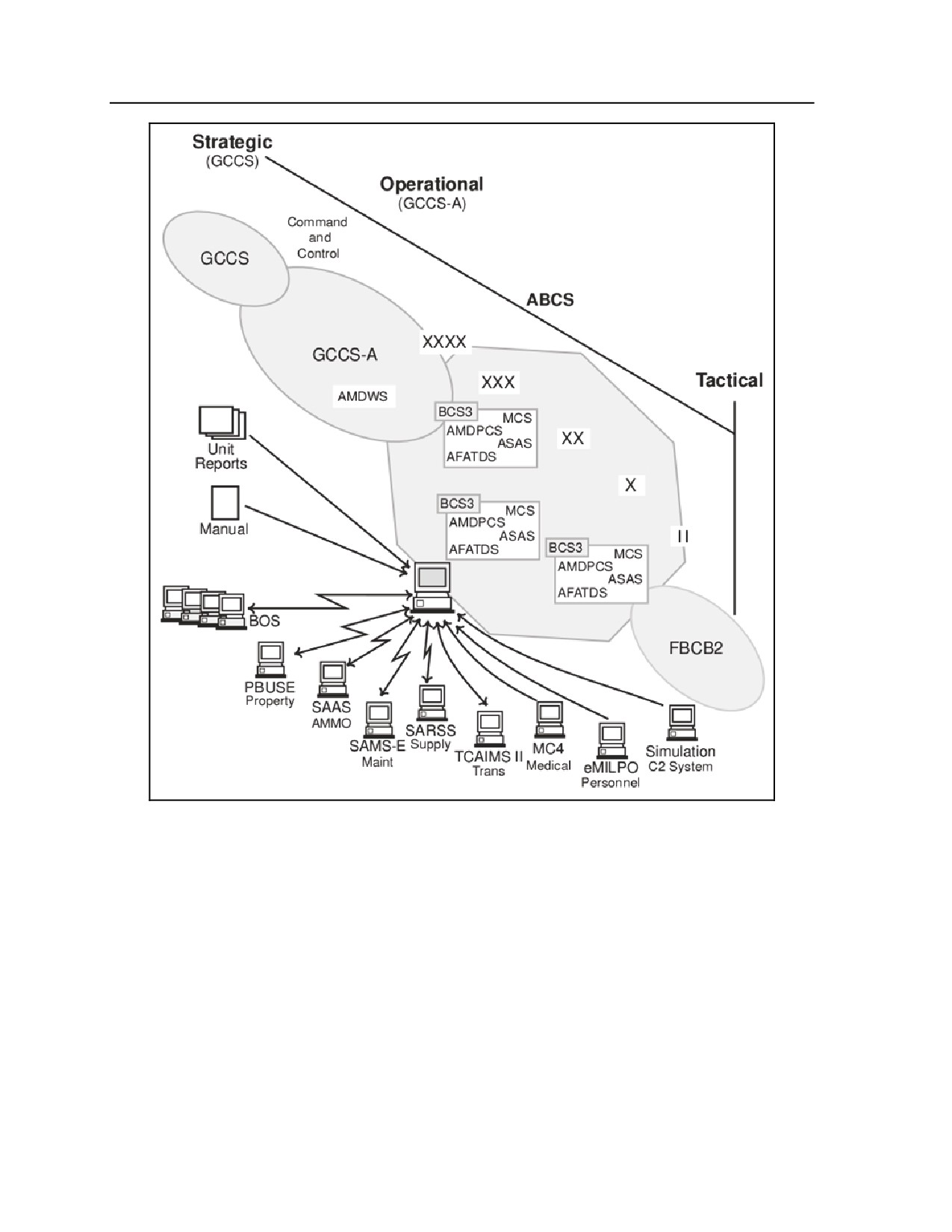
5-160. STAMIS (figure 5-4, page 5-28) consists of computer hardware and software systems that
automate diverse functions based on validated customer requirements. STAMIS facilitates vertical and
horizontal flow of logistics and maintenance status information to units Army wide.
7 December 2007
FM 3-04.111
5-27
Chapter 5
Figure 5-4. Standard Army management information systems architecture
STANDARD ARMY RETAIL SUPPLY SYSTEM
5-161. The standard Army retail supply system (SARSS) is a STAMIS for retail supply operations and
management. The system includes all units and installations (regular Army, RC, and NG). SARSS provides
supply-related data to the integrated logistics analysis program system.
5-162. SARSS comprises the following integrated systems:
z
Standard Army retail supply system-level 1 (SARSS-1) at the SSA level.
z
Standard Army retail supply system-level 2B at installation and U.S. Property and Fiscal
Officer.
z
Standard Army retail supply system-level
2A/C (SARSS-2A/C) at the corps and theater
automated data processing service center.
5-28
FM 3-04.111
7 December 2007
Logistics Operations
z
Standard Army retail supply system-gateway
(SARSS-Gateway), formerly known as the
objective supply capability.
UNIT-LEVEL LOGISTICS SYSTEMS
5-163. Unit level logistics systems
(ULLSs) consist of software and hardware which automate the
logistics systems for unit supply, maintenance, and materiel readiness management operations. ULLS
prepares unit supply documents, maintenance management records, readiness reports, and property records.
ULLS consists of three applications—ULLS-A, unit level logistics system-ground (ULLS-G), and unit
level logistics system-supply (ULLS-S4).
UNIT-LEVEL LOGISTICS SYSTEM-AVIATION
5-164. ULLS-A enables aviation production control officers to generate and manage unit level work
orders and post status to the maintenance request register. It also provides quality control officers
automated component, inventory, and inspection master files. Production control receives a master
maintenance data file updated and supplied from logistics support activity.
5-165. The Army materiel status system (AMSS) reporting capability within ULLS-A replaces the
manual readiness reporting requirements outlined in AR 700-138. AMSS is the commander's link to
monitoring the supply and maintenance posture of the unit.
UNIT-LEVEL LOGISTICS SYSTEM-GROUND
5-166. ULLS-G is located at units that have an organizational maintenance facility. It automates vehicle
dispatching, PLL management, and the Army maintenance management system. The automotive
information test interrogator is connected directly to the ULLS-G. ULLS-G is linked to the wholesale
supply system through SARSS-Gateway.
UNIT-LEVEL LOGISTICS SYSTEM-SUPPLY
5-167. ULLS-S4 is located at unit-level supply rooms and battalion and brigade S-4 sections. ULLS-S4
automates the supply property requisitioning/document register process, hand/subhand receipts,
component, budget, and logistics planning activities. It also receives and produces AMSS reports generated
by ULLS-G, ULLS-A, or another ULLS-S4 system. The automotive information test interrogator is
connected directly to ULLS-S4. ULLS-S4 interfaces with the standard property book system-redesign
(SPBS-R), ULLS-G and ULLS-A (for budget and AMSS data transferring), standard Army ammunition
system, STANDARD Army retail supply system-objective (SARSS-O) at the DS level, standard Army
intermediate level logistics system supply, SARSS-Gateway, and BCS-3.
STANDARD ARMY MAINTENANCE SYSTEM
5-168. This system includes standard Army maintenance system-level 1 (SAMS-1) and SAMS-2.
STANDARD ARMY MAINTENANCE SYSTEM-1
5-169. SAMS-1 enables automated processing of DS/GS maintenance shop production functions,
maintenance control work orders, and key supply functions. Requisitions are prepared automatically and
automatic status is received from SARSS-1. SAMS-1 interfaces with other systems such as ULLS and
SARSS-O. It also provides completed work order data to the logistics support activity for equipment
performance and other analyses.
STANDARD ARMY MAINTENANCE SYSTEM-2
5-170. SAMS-2 is an automated maintenance management system used at the FSC and ASB level to—
7 December 2007
FM 3-04.111
5-29
Chapter 5
z
Enable monitoring of equipment not mission capable status, and control and coordinate
maintenance actions and repair parts usage to maximize equipment availability.
z
Receive and process maintenance data to meet information requirements of the manager and
fulfill reporting requirements to customers, higher SAMS-2 sites, and the wholesale
maintenance level. Data can be accessed instantly to enable management control, coordination,
reports, analysis, and review.
z
Provide maintenance and management information to each level of command from the user to
the wholesale and DA levels.
STANDARD ARMY MAINTENANCE SYSTEM-ENHANCED
5-171. SAMS-enhanced integrates ULLS-G, SAMS-1 and SAMS-2 by incorporating the Windows
graphical user interface operating systems. Standard Army maintenance system-enhanced (SAMS-E) acts
as a bridge between current functionality and the enterprise resource planning solution. The following are
benefits with SAMS-E:
z
Fully replicates the functional capabilities of the current legacy systems—ULLS-G and SAMS-1
and 2.
z
Reduces the number of computers and operators on the battlefield.
z
Operates in the Windows 2003/XP environment that fully replicates the capabilities of the three
legacy systems; ULLS-G and SAMS-1 become integrated and utilizes the same relational
database as SAMS-2.
z
Enables ordnance corps’ two-level maintenance concept.
PROPERTY BOOK AND UNIT SUPPLY ENHANCED PROGRAM
5-172. Property book and unit supply enhanced provides close to real-time, accurate visibility of the
unit’s property book account operating on the AKO portal. The following are benefits with the use of
property book and unit supply enhanced:
z
Replaces two legacy systems—SPBS-R and ULLS-S4.
z
Accurate visibility of unit level weapons systems and stocks.
z
Use one common platform (light weight Pentium laptop) versus multiple platforms.
z
Operational support with web-enabled capabilities
(operates on any computer with web
connection).
z
Provides office automation, e-mail, on-line help and end user manual and automated catalog
changes.
z
Provides support for unit transfer/TF/split operations.
z
Centralized database eliminates the need for thousands of smaller.
z
Collaboration and interoperability provided by a common source of information required to
support war planning via the global combat support system and joint C2 system.
INTEGRATED LOGISTICS ANALYSIS PROGRAM
5-173. The integrated logistics analysis program family of existing and planned management information
utilities provides logistics and resource managers with integrated views of cross-functional data. Data are
taken from the STAMIS at local, regional, and national levels, and Defense Finance and Accounting
Service. These data are then integrated and displayed at levels of aggregation appropriate for each
management level.
DEFENSE AUTOMATIC ADDRESSING SYSTEM
5-174. Logistics information processing system, which is maintained by the defense automatic addressing
system, is DOD’s central repository for information on the status of requisitions. It also augments global
transportation network in monitoring the status of nonunit cargo shipments.
5-30
FM 3-04.111
7 December 2007
Appendix A
Ready, Deploy, and Redeploy
Any discussion of deployment and redeployment begins with an understanding of
Army Force Generation
(ARFORGEN). Once ARFORGEN is understood the
discussion continues with an explanation of deployment; RSOI; and redeployment of
personnel, ground vehicles, equipment, and aircraft. Aviation’s requirements for
ARFORGEN are to produce a trained and ready aviation force package; deploy and
fight that force effectively; and once mission complete, safely and efficiently
redeploy.
SECTION I - INTRODUCTION
A-1. The fundamental posture of the Army is power projection. For the Army to fulfill its role, it must be
capable of rapidly deploying trained and ready force packages to any potential theater of operations and be
able to achieve the military objectives set by the appropriate command.
A-2. Aviation units are among the first deployable package units and set conditions for follow-on forces.
Aviation’s unique ability to provide reconnaissance, security, CCA, ISR, C2 support, aeromedical
evacuation, and sustainment support allows the sequencing of forces to accomplish the commander’s intent
by placing critical capabilities required in the AO first, and increasing the force tailorable package over
time.
A-3. Aviation units publish detailed SOPs, conduct training, and develop plans to support deployment,
RSOI, and redeployment. SOPs describe important preparatory activities such as personnel recall and
preparation of aircraft, vehicles, and equipment for overseas shipment. In addition to conducting training in
tasks related to post-deployment operations, aviation units also conduct training in tasks associated with
deployment operations. Training occurs before and after aviation units are alerted for deployment.
Likewise, planning for deployment and contingency operations begins prior to deployment notification.
After notification for deployment, aviation units refine existing plans to account for new operational
considerations not addressed in the original contingency plan.
SECTION II - ARMY FORCE GENERATION
A-4. ARFORGEN is a structured progression of increased unit readiness over time. This results in
recurring periods of availability of trained, ready, and cohesive units prepared for operational deployment
in support of regional combatant commander requirements. ARFORGEN is the process Forces Command
uses to generate capable land forces for the JTF commander. The tenets of ARFORGEN are modular
forces configured into tailored force packages, resourced and trained to the capability required for the
specified mission, progressing in capability over time, with commanders responsible for determining their
unit capabilities.
A-5. ARFORGEN defines how to organize, and provides the basis for how to equip, resource, train, and
deploy forces. It is a progressive readiness strategy that builds on increasing capability levels. Combat
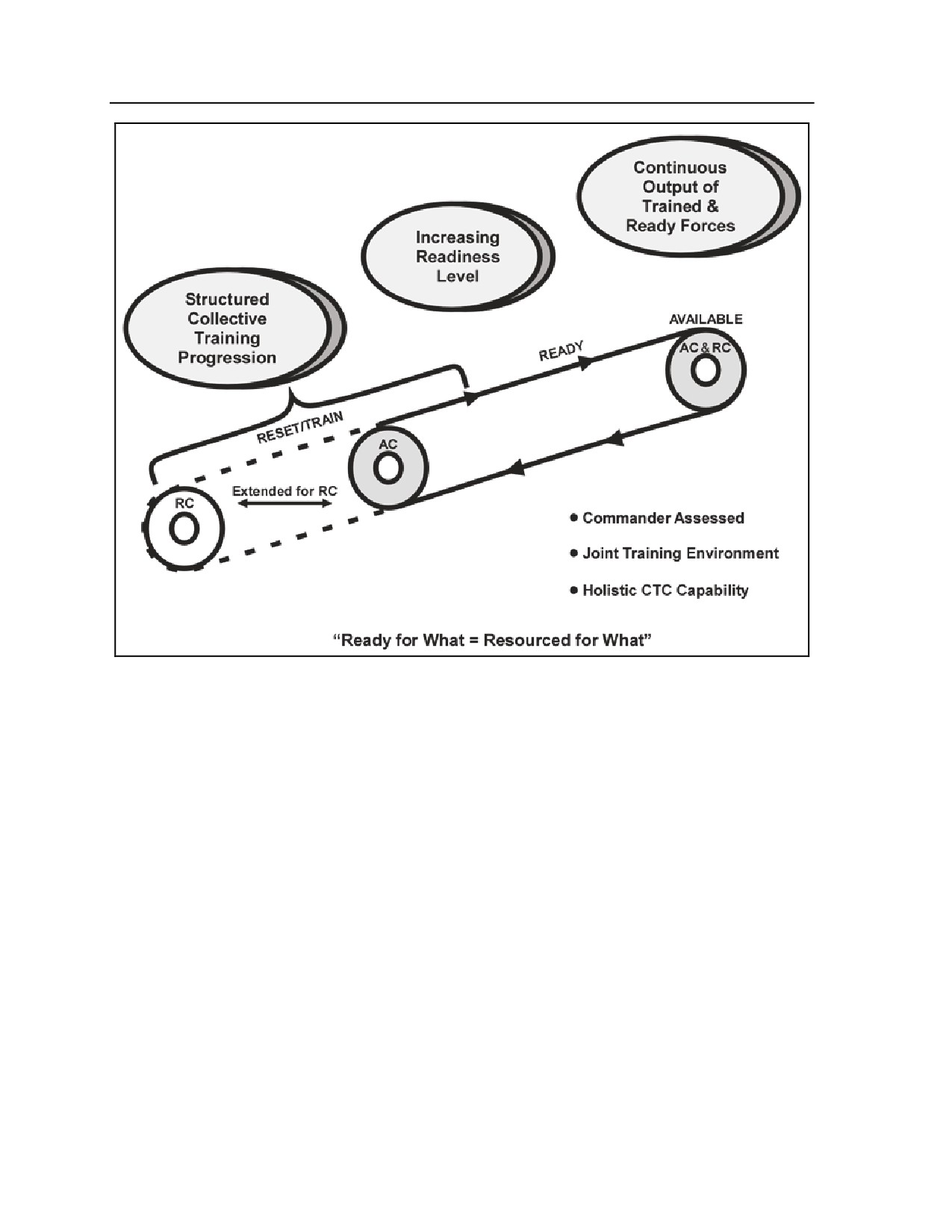
capable forces are the critical output. The ARFORGEN standard for units is "ready for what = resourced
for what = report against what." The “what” in this standard is the unit’s sourced mission requirement
(figure A-1, page A-2).
7 December 2007
FM 3-04.111
A-1
Appendix A
Figure A-1. Army force generation training and readiness strategy
A-6. ARFORGEN is a mix of force packaging and pools. The force packages provide mission focus for
the development of METLs and focuses resource priorities across the force. Force pools (reset/train, ready,
and available) are a management process by which the Army is able to provide flexible options for
contingency planning and decisionmaking.
A-7. The ARFORGEN training and readiness strategy focuses on output, providing the requisite number
of ready units required by the combatant commander. It is a progressive, gated, manning, equipping, and
training strategy permitting commanders to constantly train to the highest level possible. It is driven by the
force package mission, mission assumption dates, and METL. The strategy is designed to move units as
quickly as possible through gates in order to develop operational depth and meet operational requirements.
Training resources are prioritized from those nearest the fight to those farthest away. Commanders are not
limited to floor or phase capability levels and may progress quickly to the highest capability levels
achievable.
FORCE PACKAGES
A-8. ARFORGEN is a mix of three force packages—deployment expeditionary force (DEF), contingency
expeditionary force (CEF), and ready expeditionary force (REF).
DEPLOYMENT EXPEDITIONARY FORCE
A-9. DEFs are task organized units designed to execute planned operational requirements and those
currently executing deployed missions.
A-2
FM 3-04.111
7 December 2007
Ready, Deploy, and Redeploy
Note. RC units in a DEF are sourced against a future requirement, have been mobilized, or are
currently mobilized.
CONTINGENCY EXPEDITIONARY FORCE
A-10. CEFs are the remaining available force pool units (not in a DEF) task organized to meet OPLANs
and contingency requirements. These forces are capable of rapid deployment but are not yet alerted to
deploy (regular Army) or mobilize (RC). CEF forces transition into DEFs if alerted.
READY EXPEDITIONARY FORCE
A-11. REFs are task organized units designed to train/prepare for potential future operational requirements
or task organized to best execute full spectrum training.
FORCE POOLS
A-12. ARFORGEN provides a continuous output of capable forces focused on sourced operational
requirements. It is the basis for allocation of resources to ensure forces are prepared to defend the
homeland, focus on critical regions, swiftly defeat the opposition, and win decisively. Forces move in a
cyclical progressive manner through the force pools progressing in capability to the available force.
Generally, forces in reset/train concentrate on reconstitution and achieving organizational capabilities. The
ready force contains units conducting mission preparation and higher level collective training and provides
strategic depth to sustain on-going operations or meet unanticipated threats. The available force provides
initial response regular Army and RC forces.
A-13. All units projected from CONUS are rotational force pool units and move through the three force
pools discussed below to progress from reset/train, ready force to the available force based on sourced
mission requirements which assign them to expeditionary force packages. Units are equipped at MTOE
level to achieve capability and meet projected Army force requirements. Once sourced to a specific
mission, equipment types and level are tailored to meet operational requirements.
RESET/TRAIN FORCE
A-14. A reset/train force includes units that redeploy from long term operations, are experiencing
significant reorganization, or are unable to sustain ready or available force floor capability levels. The
reset/train force begins upon either a unit’s return from deployment or completion of 1 year in the available
force. Units immediately begin reconstitution activities to bring equipment and personnel levels up to
prescribed reset/train-day levels. Reset/train-day is a coordinated approved date, codified in an order and is
the beginning of the unit’s operational readiness cycle. DEF units perform theater focused training
beginning on reset/train-day. CEF/REF units focus training on their core organizational mission.
A-15. Reset/train events and activities normally begin with a change of command, unit reconstitution to
authorized unit strength levels, and conduct new/displaced equipment fielding and training. Units develop
individual and crew gunnery, as required, and work toward staff proficiency based on core mission
essential tasks. During the reset/train phase, the aviation brigade may be required to provide a platoon or
company to a BCT for training and integration. Commanders move their units as quickly as possible into
the ready force pool by attaining required capability levels. The gated event for progression to the Ready
Phase is battalion level proficiency certified by a CTC, FTX, battalion level EXEVAL or equivalent.
READY FORCE
A-16. The ready force pool consists of ARFOR capable of performing at floor unit capability levels,
conducting mission preparation, and executing higher level collective training with other horizontal and
vertical operational headquarters. These units focus their training on their “ready for what” sourced METL.
7 December 2007
FM 3-04.111
A-3
Appendix A
RC forces in the ready force pool may be alerted, mobilized, and required to conduct post mobilization
training for sourced operational missions. All units focus training on assigned DEF, CEF, or REF missions.
A-17. Ready force pool training focuses on assembling the aviation brigade package to sustain staff
proficiency and attain ABTF level maneuver proficiency. During this phase the aviation brigade may
execute a linked ATX within the higher headquarters mission readiness exercise or be validated by live
participation in the mission readiness exercise. Headquarters and organic subordinate units participate in
battle command training programs, combat training centers (CTCs), and joint exercises as required.
Deploying units conduct theater specific mission focused training and participate in the mission readiness
exercise. Additionally, the aviation brigade may provide subordinate units or ABTFs to support BCT CTC
events. Regardless of whether a unit is designated DEF, CEF, or REF, they train to achieve proficiency on
the respective theater or OPLAN mission(s). The aviation brigade is ready to move into the available force
pool upon successful completion of support brigade warfighter exercise phase II embedded in MRX,
BCTP, or standalone BCTP supported ATX. (ATX may be used as a separate gated event prior to MRX).
AVAILABLE FORCE
A-18. These units are capable of conducting theater specific or full spectrum operations. All regular Army
and RC units begin a 1-year available force pool based on an assigned mission available date. DEFs are
either prepared to deploy as indicated on execution orders, deploying, or deployed. The CEFs constitute
the remaining available force pool units not deployed and are task organized to meet contingency plan and
unanticipated requirements. These CEF forces are capable of rapid deployment and minimal pre-mission
training. All CEFs become DEFs upon alert notification. A unit may receive an MTOE revision along the
force modernization path prior to execution of the mission readiness exercise, but no further MTOE
changes will be accepted after completion of the mission readiness exercise. Units return to reset/train after
1 year in the available force pool, upon returning from deployment, or on order from Forces Command.
A-19. Available force pool training for CEF units focuses on OPLAN mission requirements and sustaining
full spectrum capabilities. The DEF units train on theater-related METL. The aviation brigade may be
alerted for deployment as a brigade or ABTF.
SECTION III - DEPLOYMENT
A-20. Deployment is the movement of forces and materiel, and their sustainment, from point of origin to a
specific AO to conduct operations outlined in a plan or order. It encompasses all activities from origin or
home station through destination, specifically including intra-continental U.S., intertheater, and intra-
theater movement legs. This combination of dynamic actions supports the combatant commander’s concept
of operations for employment of the force.
A-21. Deployments consist of the following four distinct and interrelated phases, which may not be
sequential and could overlap or occur simultaneously:
z
Predeployment activities.
z
Movement to and activities at the POE—fort-to-port.
z
Movement to port of debarkation (POD)—port-to-port.
z
RSOI—port-to-destination.
A-22. Successful deployment planning requires knowledge of the unit’s deployment responsibilities,
understanding of the total deployment process, and intellectual appreciation of the link between
deployment and employment. Deployment planning is an invariable, logical process focusing on Soldiers
and equipment for deployment, ways to deploy them, and information and means to track them. In
particular, deployment plans require specific, detailed information to guide the unit through an effective
deployment. The heart of deployment planning is a precise list of Soldiers and equipment that must
deploy—the unit deployment list, developed in the Transportation Coordinators’ Automated Information
for Movement System II. Its importance exemplifies its use; such as, manifesting unit equipment for
deployment and updating the time-phased force and deployment data (TPFDD) so the appropriate lift is
scheduled for the deployment.
A-4
FM 3-04.111
7 December 2007
Ready, Deploy, and Redeploy
A-23. Successful deployment planning requires knowledge of the unit’s deployment responsibilities, an
understanding of the total deployment process, and an intellectual appreciation of the link between
deployment and employment. Steps used in planning and preparation during predeployment activities
include—
z
Analyze the mission.
z
Structure forces.
z
Refine deployement data.
z
Prepare the force.
z
Sechedule the movement.
FMI 3-35 provides additional information.
DEPLOYMENT TRAINING
A-24. Training allows aviation units to minimize post-notification predeployment activities. Deployment
training addresses critical tasks related to movement facilitating aviation’s ability to deploy. Although
much of this training is focused on individual technical skills and applicable primarily at the company
level, brigade and battalion staffs participate in deployment training for purposes of staff supervision and
addressing deployment requirements.
UNIT MOVEMENT OFFICER TRAINING
A-25. Army policy requires company unit movement officers (UMOs) to plan and coordinate technical
aspects of unit sea, rail, and air movement. The brigade and battalion staff is responsible for conducting
deployment planning; however, it is useful for the staff to have some personnel—particularly in the S-3
and S-4 sections—trained in the technical details of associated duties. The scope of UMO technical
training includes—
z
USAF airlift operations.
z
Characteristics and capabilities of the types of vessels, aircraft, or railcars the unit may use for
deployment.
z
Highway, rail, and port operations.
UNIT LOAD TEAM TRAINING
A-26. Aviation units must have appropriate numbers of personnel trained on aircraft and vehicle
preparation and aircraft, sea vessel, and rail loading/unloading techniques. Brigade and battalion staffs, as
well as companies, should designate load teams and train them in the following tasks:
z
Preparation of aircraft and vehicle load plans.
z
Preparation of vehicles for shipment by reducing operational dimensions, protecting fragile
components such as windshields and mirrors, and weighing and marking procedures for air and
rail modes.
z
Tie-down procedures for vehicles, aircraft, and railcars.
z
Operation of vehicles in conditions simulating loading/unloading techniques for aircraft and rail.
HAZARDOUS MATERIAL TRAINING
A-27. Each company, and the brigade and battalion S-4 sections, should have at least one school-trained
person to certify hazardous cargo. Hazardous cargo certification teams visit most installations annually or
semiannually. Regardless of whether the company has anyone who is school-trained or not, the UMO/NCO
should be familiar with the contents of TM 38-250 and Code of Federal Regulations 49. Military Standard-
129 and TC 38-3 contain additional packing assistance.
7 December 2007
FM 3-04.111
A-5
Appendix A
STANDING OPERATING PROCEDURE DEVELOPMENT
A-28. Aviation units use SOPs to document critical deployment tasks beginning with alert activities, and
continuing through RSOI to redeployment. Actions described in SOPs require periodic training and
updating as deployment requirements change.
A-29. Examples of topics related to deployment that must be addressed in SOPs include—
z
Family readiness group (FRG) functions and resourcing.
z
Personnel recall procedures to include alert roster implementation responsibilities and recall of
personnel on leave and temporary duty.
z
C2 requirements.
z
Local security.
z
Media guidance.
FAMILY READINESS GROUP PLANNING
A-30. FRG main goals are to—
z
Serve as a link between the deployed unit and families, whether those families remain at home
station or not. In this capacity, the FRG serves as a conduit for command information on
deployment and redeployment dates, changes in the unit's status or mission, and other items of
interest to family members.
z
Facilitate deployment and redeployment briefings and activities in conjunction with the unit
commander, rear detachment commander, and installation support agencies.
z
Serve as a mutual support group for family members, stepping in with advice, personal
counseling, or assistance when families have problems during unit deployment.
A-31. The most effective FRGs are those established as part of the unit's ongoing and routine mission
preparation, rather than those created just prior to deployment.
A-32. The primary factor in determining the success of a unit's FRG is the energy levels of FRG leaders.
Company- and battalion-level FRG operations live or die based on the energy of the personnel leading the
family support initiatives at home station and on command emphasis placed on FRG operations by the
unit's leadership. In most cases, the best approach to identifying leaders of the FRG is to ask spouses to
volunteer. Successful FRG leaders generally are charismatic, people-oriented, caring people who tend to
volunteer their time in the community in other ways as well.
CONTINGENCY PLAN REFINEMENT AND POST ALERT TRAINING
A-33. Deploying aviation units access their higher headquarters’ and the overseas gaining command’s
tactical intelligence home page using the All Source Analysis System (ASAS) to obtain information
concerning threat, terrain, weather, and other data concerning the area in which the unit will deploy. This
information, along with other operational guidance from higher headquarters is used to drive refinement of
existing contingency plans.
A-34. Aviation units allocate time for mission-related training during deployment activities in response to
changes and to develop additional proficiency in mission essential tasks. Use of virtual and constructive
simulations (AVCATT, Longbow copilot trainer, synthetic flight training system, and ATXs) is efficient
options for conducting this type of training.
ALERT ACTIVITIES
A-35. Notification for deployment may occur as part of an operation planned many months in advance, or
it may happen as a short notice response to a crisis or emergency. In the case of little or no notice, aviation
units must respond quickly and efficiently by mustering personnel, preparing aircraft, vehicles, and
equipment for shipment, establishing security as required, and using any available time to conduct further
predeployment training.
A-6
FM 3-04.111
7 December 2007
Ready, Deploy, and Redeploy
PERSONNEL CONSIDERATIONS
A-36. The aviation unit’s S-1 and S-1 section plan personnel support for deployment operations. This plan
is based on the organization’s deployment timeline; identification of appropriate times and locations for
completion of personnel asset inventory medical screening; and preparation for overseas rotation events
and other personnel activities such as—
z
Identifying personnel shortages.
z
Identifying nondeployable personnel.
z
Initiating recall of personnel attending schools, on leave, and temporary duty.
z
Requisitioning additional personnel.
z
Identifying personnel records to deploy with the unit.
PREPARATION OF EQUIPMENT FOR DEPLOYMENT
A-37. As soon as sufficient personnel are mustered, or after movement to the aerial port of debarkation
(APOD)/sea port of debarkation (SPOD), units should begin preparing aircraft, vehicles, and equipment for
deployment. Brigade and battalion staff planners must be proactive in identifying requirements during
coordination with supporting installation staff or transportation elements. Cargo and other equipment are
prepared for shipment based on the SOP and instructions from supporting installation transportation
authorities.
COMMAND POST ESTABLISHMENT
A-38. Preparation for deployment requires effective C2. In addition to conducting internal C2 procedures,
aviation units must use all available assets, such as ABCS and commercial service, to maintain contact with
higher headquarters, supporting installation staff, and the gaining command. Shortly after alert or
deployment notification, aviation organizations establish CPs to control various deployment activities.
Initially a CP may be established as an emergency operations center, or other SOP-directed variant, to
control recall activities and maintain communications. As elements begin movement and staging activities
it may be useful to establish other CPs with functions similar to those of a TAC CP.
FAMILY READINESS GROUP CONSIDERATIONS
A-39. A functional FRG has many tasks when a unit is notified of a deployment. Commanders and FRG
leaders need to screen for Soldiers whose family members have special circumstances or special care
needs. In addition to screening family members for pregnancies, exceptional family member medical
conditions, and other situations prior to deployment, units should be aware of family members who might
not speak English in order to plan alternate ways of keeping these family members informed. After
identifying individuals with special circumstances, FRG personnel must adapt an overall plan to meet the
needs of these families.
A-40. An FRG should also determine which spouses plan to depart home station after the unit deploys.
Some spouses may want to live with relatives for support during the deployment, so units and FRG leaders
need to make special provisions disseminating information to them, and assisting with medical and dental
care and other personnel services. Specific problems may also include access to other military facilities.
FORCE PROTECTION CONSIDERATIONS
A-41. Planners must give careful consideration to all possible threats during deployment operations and
then implement appropriate levels of OPSEC and force protection. In some cases it may be necessary to
limit access to certain areas in the aviation unit’s garrison offices or impose traffic and parking controls.
Security during a road movement to an APOD/SPOD requires coordination with supporting installation or
higher headquarters staff for local law enforcement agency support and assistance.
7 December 2007
FM 3-04.111
A-7
Appendix A
MEDIA CONSIDERATIONS
A-42. Media impact on deployment operations is substantially greater today than any previous time in
history. The news media's capability to gain and transmit ongoing deployment activities globally must not
be discounted. News technology requires establishment of a single POC for releasing information
regarding ongoing operations. The aviation brigade's PAO coordinates all media actions and responds to
public requests for information as appropriate. The higher headquarters develops procedures and guidelines
for releasing information within security, propriety, and safety considerations of the ongoing operation.
ESTABLISHMENT OF REAR DETACHMENT
A-43. In some cases a rear detachment may be designated when an aviation element deploys. The rear
detachment commander and personnel have responsibilities for all personnel and equipment remaining at
home station during a unit's deployment. Additionally, the rear detachment has significant family readiness
responsibilities and provides FRG leaders with a point of entry into official Army financial, legal, and
other personnel services systems. A positive and supportive relationship between rear detachment
personnel, the deployed unit, and FRG leaders is critical to the overall success of the family readiness
effort.
METHODS OF DEPLOYMENT
A-44. Aviation normally deploys in one of two methods—sea and air transport, or self-deployment.
SEA AND AIR TRANSPORT
Planning and Preparation
A-45. Successful movement depends on detailed planning, SOPs for deployment by various methods, and
identification, training, and validation of deployment and load teams. Each team member has specific
duties, from preparation at home station, to clearance of the POD, to arrival at destination. The unit must
continually validate automated unit equipment lists and time phase deployment lists in preparation for
future deployments.
A-46. Upon receiving the WARNO, and time permitting, advance parties are sent to POEs and PODs to set
conditions for reception of unit personnel and equipment, and provide command, control, and
communications.
A-47. The following references discuss deployment actions and considerations:
z
UMO Deployment Handbook Reference 97-1.
z
FM 3-04.500.
z
FM 4-01.41.
z
FM 4-01.30.
z
FMI 3-35.
z
CAB TACSOP.
A-48. Surface Deployment and Distribution Command Transportation Engineering Agency (SDDCTEA)
pamphlets provide specific guidance for preparation of equipment for movement. The following pamphlets
can be downloaded from http://www.tea.army.mil/pubs/deploy.asp:
z
SDDCTEA Pamphlet 55-19.
z
SDDCTEA Pamphlet 55-20.
z
SDDCTEA Pamphlet 55-21.
z
SDDCTEA Pamphlet 55-22.
z
SDDCTEA Pamphlet 55-23.
z
SDDCTEA Pamphlet 55-24.
z
SDDCTEA 70-1.
A-8
FM 3-04.111
7 December 2007
Ready, Deploy, and Redeploy
z
SDDCTEA Pamphlet 700-2.
z
SDDCTEA Pamphlet 700-4.
z
SDDCTEA 700-5.
z
SDDCTEA Pamphlet 700-6.
A-49. Aircraft preparation, lifting, and tie-down must be in accordance with appropriate preparation for
shipment manuals and specific loading manuals for military aircraft
(FW air shipments only). The
following TMs can be downloaded from https://www.logsa.army.mil/etms/online.cfm:
z
EM 0126. TM 1-1520-Apache/Longbow.
z
TM 1-1520-237-S.
z
TM 55-1520-238-S.
z
TM 1-1520-248-S.
z
TM 1-1520-241-S.
z
TM 1-1520-252-S.
A-50. Not all contingencies for unit movement can be foreseen due to the wide range of missions and
world events that may occur. Units must be aware of battle book plans, and wargame probable and possible
scenarios. Skeleton plans are established to cover contingencies.
A-51. Unit movement personnel are familiar with the POEs available to their organization and mission
requirements. Special needs and considerations are addressed as early as possible for each POE. Unit
movement personnel—
z
Establish and periodically update telephone lists, points of contact, and special requirements for
likely POEs.
z
Conduct periodic leader reconnaissance of POEs to include members of unit load teams and
advance party personnel.
z
Identify advance party personnel and define duties.
z
Identify OPSEC requirements during movement and embarkation activities.
z
Plan and coordinate workspace for personnel during the embarkation phase (empty offices,
borrowed tentage from nondeploying units, and rented or borrowed trailers).
z
Identify and prepare requests for communications requirements (commercial lines, wire, radio,
and cellular phone).
z
Determine transportation requirements at POE for movement teams and key personnel
(borrowed vehicles and rental cars).
z
Plan messing, billeting, MTFs, refueling/defueling points, and special requirements for weapons
and ammunition.
Movement
A-52. Upon receiving the order, units ferry their aircraft and move ground vehicles along preselected
routes to the POE. Units performing depot-level maintenance normally operate at these embarkation points.
As the units arrive, a dedicated sustainment support team assists in preparing vehicles, equipment, and
aircraft for deployment. Preparation includes required maintenance and installation of ferry equipment.
A-53. On receipt of the deployment order, ASB commanders dispatch preselected facility teams.
Deployment headquarters staff members locate command facilities at each termination site to facilitate
integration of aircraft, vehicles, and personnel into the theater force structure.
SELF-DEPLOYMENT
Planning Considerations
A-54. Self-deployment is an alternative method used to rapidly move aircraft. Units consider the following
factors when planning self-deployments:
7 December 2007
FM 3-04.111
A-9
Appendix A
z
Securing departure, flight routes, and arrival points prior to movement.
z
Establishing proper facilities, personnel, equipment, and supplies at the destination ensuring
quick transition to operations.
z
Pre-positioning ground support teams at stopover points along self-deployment flight routes.
Ground support teams include personnel, equipment, and repair parts to provide limited services
(POL products, supply, ammunition, HSS, communications, weather forecasting, and flight
planning).
z
Avoiding self-deployment over large bodies of water except in an emergency when other
methods are not available. Overwater operations require extensive CRM; crewmembers must be
trained and proficient with specialized ALSE and emergency procedures for overwater flight.
For extensive legs of overwater flight, plans should include naval assets along the flight route to
provide intermediate fuel stops or SAR.
z
Minimizing deploying combat troops on self-deploying aircraft. Available space is typically
used to accommodate those supplies, tools, parts, survival equipment, and limited support
personnel necessary to make flights self-sustaining during the deployment.
z
Coordinating alternative transport of some weapon systems, equipment, and baggage for aircraft
self-deploying over long distances.
z
Ensuring ASE is properly functioning and calibrated (TACOPS provides proper codes for AO),
even when traveling over assumed friendly territory.
z
Coordinating attack reconnaissance aircraft (or any aircraft without cargo capability) to travel
with lift assets carrying emergency supplies, maintenance equipment and personnel, and backup
aircrews in case of an unscheduled landing.
z
Ensuring aircrews are familiar with established downed aircrew and aircraft recovery
procedures.
Personnel
A-55. Aircrews and passengers may require passports and visas for each country of intended landing. The
mission may require crew members or other support personnel with specific foreign language proficiency
for those countries in which refueling or extended stopovers are planned.
A-56. Extensive distances may require aircrews to fly many hours. The challenge is ensuring crews are
able to conduct operational missions upon arrival in-theater. Commanders adjust work and rest schedules
before and during deployment. Commanders must plan to rotate crews through pilot duties whenever
possible. Deploying units could carry backup crews from nondeploying units on CH-47 and UH-60
aircraft.
Intelligence
A-57. Units obtain threat intelligence information for those countries that are overflown and where
landings are planned. Terrorist threats, counterintelligence, and specific force protection concerns are
important to aircrews for planned and potential stops.
A-58. Routes into possible hostile airspace should be avoided. If unavoidable, unarmed aircraft must be
escorted.
Training
A-59. Commanders must place emphasis on predeployment training. This training includes water survival,
ALSE functions, fuel system management, high gross-weight operations, International Civil Aviation
Organization flight planning, navigation equipment, communication requirements, shipboard operations,
and rescue operations.
A-60. En route and destination environmental considerations—such as high altitude, mountainous and
jungle terrain, and overwater flight—are considered. Crews must be trained for survival in the environment
and use of special equipment required for each environment.
A-10
FM 3-04.111
7 December 2007
Ready, Deploy, and Redeploy
A-61. Theater-specific ROE, Status of Forces Agreements, local customs, language training, and OPSEC
requirements that can be anticipated should be performed at home station, if possible.
Logistics
A-62. Self-deploying and supporting units request and coordinate maintenance and crew-rest facilities,
fuel, transportation, security, and messing for stopover-point teams and self-deploying aircrews. If U.S.
ground support teams are not available, units coordinate with friendly nations to provide required services.
The S-9 acts as the POC for staff officers dealing with host nations. If no S-9 is assigned, the S-3 performs
this function.
A-63. When aviation units deploy to destinations lacking fixed-base facilities, pre-positioned ground
support teams perform those functions. S-4s of self-deploying and supporting units are responsible for
logistics requirements along the self-deployment route and at the destination. Aviation MOs organize a
maintenance support operation to prepare aircraft for self-deployment and meet maintenance requirements
along the route and upon arrival at the destination.
A-64. Staff members verify the availability, quantity, and type of fuel at en route fuel stops, rather than
depend solely on Department of Defense flight information publications (DOD FLIP). An appropriate
agency verifies fuel quality at each location before refueling.
A-65. If required at stopover sites, contracting officers or Class A agents should be members of the
advance party.
A-66. Units issue appropriate survival equipment and clothing for climates encountered in the route of
flight.
A-67. To facilitate mission readiness movement planners, logisticians, and maintenance personnel carefully
wargame arrival of units and equipment into the theater.
Mission Planning
A-68. AD identification zone procedures, as well as international interception signals, must be clearly
understood by all aircrew members.
A-69. If applicable, all aircrew members must obtain and understand approved international clearances
before departure. The SP and TACOPS officer provide assistance in disseminating the
SPINS/ACO/aviation procedures guide.
Flight Organization and Aircraft Configuration
A-70. Each departing flight must contain multiple aircraft and be self-sustaining in terms of food, water,
limited maintenance capability, and force protection. Aircraft with limited cargo capacity—such as AH-64s
or OH-58Ds—require task organization with UH-60s or CH-47s. USAF or naval support is essential for
downed aircrew recovery. Ideally, an escort PR aircraft is assigned. Without escort, each flight should
include at least two aircraft with rescue hoists.
A-71. MPs and personnel are included in each flight and/or are pre-positioned at various planned stopover
locations.
A-72. Depending on the type of aircraft and space available, a maintenance support package might include
an auxiliary fuel system, tow bars, packaged POL, limited spare parts, a mechanic’s toolbox, and tug or
tow vehicle.
Communications
A-73. Units must—
z
Coordinate frequencies for internal flight following throughout movement.
z
Coordinate and verify compatibility of specific frequencies for supporting naval vessels and PR
elements.
7 December 2007
FM 3-04.111
A-11
Appendix A
z
Take SATCOM sets if available; SATCOM enables each flight to communicate its status to
home station and theater of operations.
z
Coordinate and deconflict frequencies for overflight of international/host nation airspace.
z
Equip advance parties with communication equipment and flight frequencies for arrival at
stopover points and the POD.
z
Coordinate and verify compatibility of specific frequencies for JSTARS or airborne warning and
control system
(AWACS) monitoring of aircraft movement within a particular theater of
operations.
z
Coordinate for proper SPINS/ACO.
Equipment
A-74. Survival vests, rafts, survival kits, rescue hoists, survival radios, food, and water are essential
mission equipment. Units maintain a critical equipment list at home station for planning considerations.
A-75. Each flight should have multiple aircraft with extra survival equipment that can be dropped to
downed crewmembers.
Weapons
A-76. Individual and crew-served weapons should normally remain out of sight during flight and ground
operations. They should be loaded, but not armed, to assist with protection from possible sudden
engagements.
A-77. The controlling headquarters issues ROE when deploying units carry weapons and ammunition.
SECTION IV - RECEPTION, STAGING, ONWARD MOVEMENT, AND
INTEGRATION
A-78. The goal of aviation RSOI planning to support efficient and timely equipment preparation at the
POD and rapid deployment to an AA as required by the gaining higher headquarters. Communications and
digital connectivity are established with subordinate, adjacent, and higher headquarters. Aviation RSOI
activities are conducted concurrently with follow-on mission planning and preparation, and while
maintaining required levels of force protection. The four RSOI steps are reception, staging, onward
movement and integration.
z
Reception: The process of unloading personnel and materiel from strategic transport;
marshalling deploying units; transporting them to staging areas, if required; and providing life
support to deploying personnel.
z
Staging: The process of assembling, holding, and organizing arriving personnel and equipment
into units and forces, incrementally building combat power and preparing units for onward
movement, and providing life support for personnel until the unit becomes self-sustaining.
z
Onward movement: The process of moving units and accompanying material from reception
facilities and staging areas to tactical AAs or other destinations, moving arriving nonunit
personnel to gaining commands, and moving arriving sustainment material from reception
facilities to distribution sites.
z
Integration: The synchronized transfer of authority (TOA) over units and forces to a designated
component or functional commander for employment in the theater of operations.
A-79. RSOI generates combat power. Limited time requires that aviation units execute RSOI tasks rapidly
to facilitate integration of essential aviation support into JTF operations.
PLANNING CONSIDERATIONS
A-80. Air and sea deployment modes terminate at the designated POD. Depot or ASB facilities are in the
theater. Personnel at these facilities assist the unit with removal of ferry equipment, installation of mission
A-12
FM 3-04.111
7 December 2007
Ready, Deploy, and Redeploy
equipment, and perform required maintenance and inspections to prepare equipment for the mission. They
also coordinate immediate backhaul of designated support teams and ferry equipment.
ADVANCE PARTY ACTIVITIES
A-81. Advance party tasks are critical to the aviation unit’s success during RSOI operations. Tasks the
advance party may perform include—
z
Rapidly establish CPs to control and coordinate RSOI efforts.
z
Coordinate POD requirements with higher headquarters and supporting transportation
organizations.
z
Maintain communications with parent unit while the aviation unit main body deploys.
z
Conduct coordination with gaining command to define future combat operations.
A-82. By performing these tasks the advance party establishes conditions to facilitate aviation integration
into JTF operations.
TASK ORGANIZATION
A-83. Arriving elements task organize and reconfigure vehicles and aircraft as appropriate for the mission.
Sustainment efforts are prioritized to build combat-capable units and C2 architecture.
FORCE PROTECTION
A-84. Aviation forces are particularly vulnerable during the build-up phase when the unit is not at full
strength, and aircraft and vehicles may not be fully assembled for combat. The security plan must be
understood and executed; the first priority of work immediately upon arrival at designated POD. This plan
should include passive and active measures to combat air and ground threats.
A-85. Aviation forces are often among the first units to arrive in-theater. They may have to provide
reconnaissance, security, and attack operations securing a lodgment before more forces arrive in-theater.
This situation may require that aviation units conduct immediate and continuous operations from offshore
or remote locations while the main body moves into the lodgment area.
A-86. To reduce risk of fratricide, crew members must understand—
z
The ground maneuver plan.
z
The commander’s intent.
z
The composition and location of friendly forces.
z
Theater-specific IFF procedures.
TRAINING
A-87. Local area orientations, test flights, or other requirements not executed in advance may be required.
Commanders should attempt to phase the arrival of personnel—such as mission training plans, test pilots,
and key leaders—to begin before the unit’s main body arrives. If units are already present in country, these
key personnel deploy as early as possible to train with those units. The advance party is briefed on the
requirements and plan for execution in order to identify and coordinate required external support.
A-88. Acclimation training may be required. Many units moving from one environmental extreme to
another need to adjust to the new climate. The unit commander arranges training and conditioning to
accelerate acclimation.
A-89. Most deployments involve operating in a joint or multinational environment. Early-arriving units
may be able to schedule training with other services. Liaison elements from the S-3 shop are designated to
ensure smooth coordination.
7 December 2007
FM 3-04.111
A-13
Appendix A
RELIEF-IN-PLACE
A-90. Upon arrival into theater, the unit may conduct a relief-in-place with another aviation unit. The
relief-in-place is planned, coordinated, and executed by the relieved unit. This unit should coordinate with
the unit being replaced to ensure all personnel are briefed on relief-in-place procedures prior to deployment
into theater. The relief-in-place begins with arrival of the relieving unit’s personnel and equipment and
concludes with a TOA. The TOA signifies that the relieving unit possesses OPCON and mission execution
requirements of the designated AO.
A-91. Relief-in-place procedures differentiate between each AO and type of unit replaced. However,
aviation utilizes common planning factors common to most AOs. Each brigade, battalion, and company
conducts relief-in-place tasks to prepare for TOA.
Tasks
A-92. The aviation brigade is responsible overall for ensuring all relief-in-place tasks are completed by
battalions, companies, and attached elements. Common relief-in-place tasks completed by staff elements
may include—
z
Theater/country/AO briefs.
z
Local area orientations.
z
Leave/pass policies (procedures, locations, and emergency leaves).
z
Brief/report formats, suspenses, and contingencies.
z
Mail procedures.
z
Officer/NCO evaluation report procedures (submission requirements for theater).
z
Threat area and enemy weapons systems brief.
z
Arms room, sensitive item military van (container), and courier card procedures.
z
Battle update briefing procedures.
z
Battle rhythm/CP shift manning procedures.
z
Flight schedule, flying-hour report, and very important person procedures.
z
Force protection.
z
FS targeting and fire procedures.
z
Falcon view, data transfer, airspace, and boundary crossing procedures.
z
Range facilities (requesting, occupying, test fire, and capabilities).
z
Classes of supply (requisition, storage, contract, and delivery).
z
Property book procedures.
z
Contracting officer training.
z
Local nation vendor transactions.
z
Life support systems orientation (laundry, gym, and morale, welfare, and recreation).
z
Communications structure, operation, and accountability (secret internet protocol router [SIPR],
nonsecure internet protocol router [NIPR], and retransmission).
z
Pre-accident plan.
z
Adjacent unit orientation/visit.
z
TOA ceremony.
Battalion and Company Tasks
A-93. Common relief-in-place training tasks completed by battalion and company aircrew and personnel
may also include—
z
Mission orientation/execution (left/right seat rides).
z
Emergency procedures (battle drills, mass casualty, and breach of security perimeter) training.
z
Local area orientations.
A-14
FM 3-04.111
7 December 2007
Ready, Deploy, and Redeploy
Flight planning systems.
Flight operations and procedures such as flight planning area, ATO/ACO, SPINS, notices to
airmen, ATS updates, helicopter LZ diagrams, flight mission boards and flight plans,
weather facilities, weather briefings and updates, wire hazards data, maps, chart updates,
DOD FLIP, and aircrew reading file.
Range test fire procedures.
High intensity radio transmission area information.
Boundary crossing procedures.
Local flying area.
ALSE procedures.
Aeromedical evacuation procedures (local medical facilities, frequencies, and telephone
numbers).
Airfield layout and procedures (NAVAIDs, high intensity radio transmission area sites,
arrival and departure procedures, hazards to flight, no fly areas, helipads and runways,
instrument approaches, ATS information, and maintenance test flight areas).
Flight TTP.
Weather minimums.
Weapon control status.
Test fire procedures.
ROE.
Inadvertent IMCs.
FARP locations and procedures.
PR operations.
Aviation QRF operations.
Aviation procedures guide impact (airspace overview. altitude policies, lighting policies.
z
Joint property inventories.
z
Transfer of stay behind equipment.
z
Installation property book transfer
(barracks; automation; office equipment; communication
equipment; and morale, welfare, and recreation).
z
Continuity book handover.
z
OPSEC program and procedures.
z
Contingency plan review and handover.
z
Joint logistics convoys and mission rehearsals/mission packets.
z
Training and range resource overview.
z
DART operations.
z
Familiarization training for new equipment.
z
Force protection program and procedures (guard mount, gate guard, and OP).
z
Intermediate and DS maintenance operations.
z
Fuel system supply point operations.
z
SSA procedures.
SECTION V - REDEPLOYMENT
A-94. Aviation units conduct redeployment operations in order to meet the schedule established by higher
headquarters, possibly in response to another contingency mission. When redeploying to home station in
the CONUS, aviation units conform to the requirements of the U.S. Customs Service and the U.S.
Department of Agriculture regarding shipment and condition of aircraft, vehicles, equipment, and cargo.
Aviation units conduct redeployment while maintaining required levels of force protection.
7 December 2007
FM 3-04.111
A-15
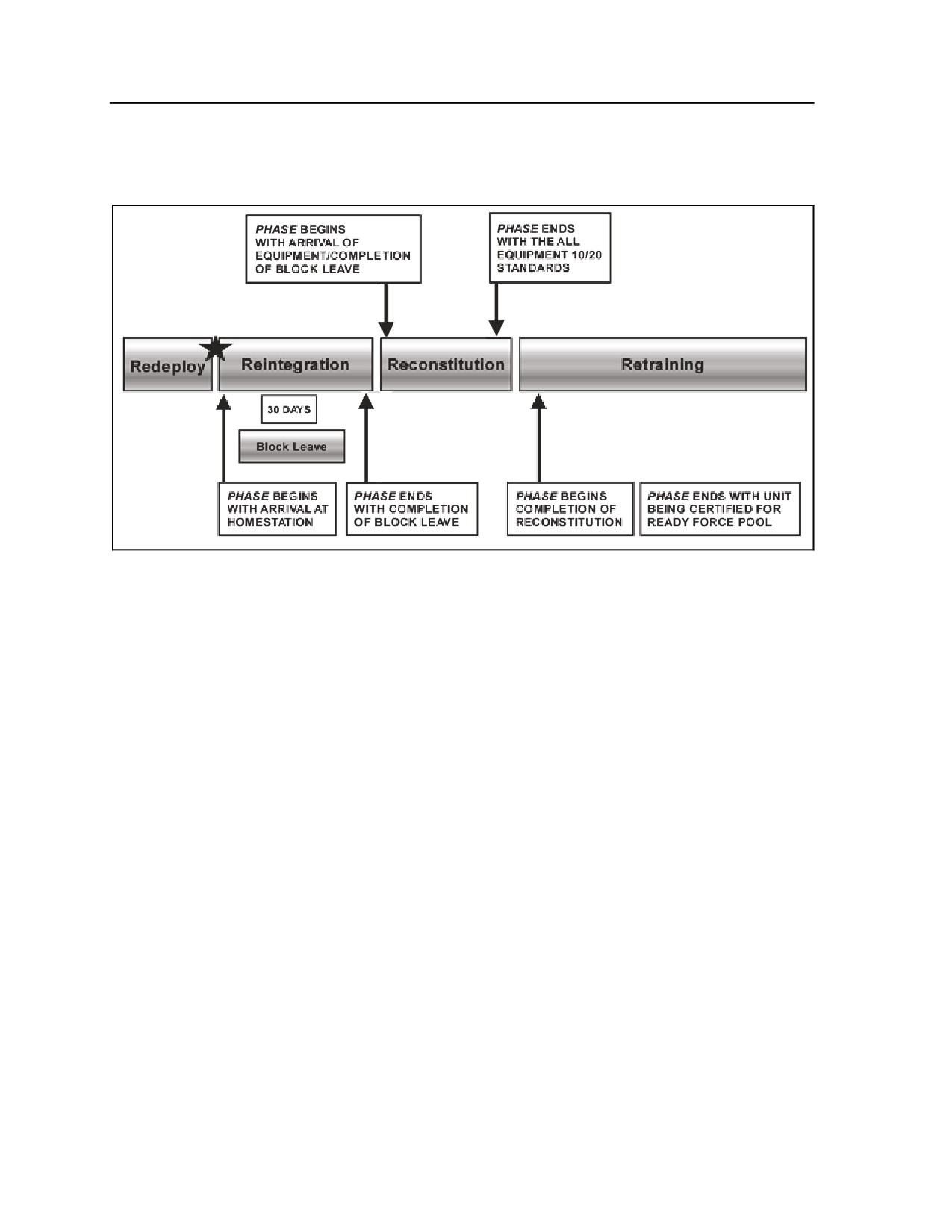
Appendix A
A-95. Redeployment is not a stand alone operation, but a combination of continued daily tactical missions,
a relief-in-place, and a plethora of redeployment activity. Units may use the R4 redeployment model during
this operation. The four phases of the R4 model are redeploy, reintegration, reconstitution, and retraining
(figure A-5) (see TC 1-400).
Figure A-2. Redeployment, reintegration, reconstitution, and retraining model
REDEPLOY
A-96. Aviation units may redeploy to home station or a different theater of operations. Aviation units
redeploy in the following four phases:
z
Recovery, reconstitution, and preparation for redeployment activities.
z
Movement to and activities at POEs.
z
Movement to PODs.
z
RSOI when deploying to another AO.
A-97. Redeployment begins as directed and as METT-TC allows. It presents the same challenges to
commanders with task organizing and echeloning forces as deployment. Preparation for redeployment
begins as units start assisting other organizations with relief-in-place. Brigade and battalion staffs plan for
redeployment using the same planning considerations during deployment operations as discussed in section
I.
A-98. Initially, aviation units redeploy advance parties, and less essential personnel and equipment. During
this stage, unit strength and equipment status may change often; however, accurate accountability is key to
reconstitution. Additionally, commander's conduct training programs to maintain individual and unit
METL proficiency. Aside from individual training tasks, units may conduct individual and crew served
weapons qualification and familiarization, rehearse convoy operations, validate and update deployment
SOPs, and conduct limited convoy live fire exercises (if time and resources are available). Protection of the
force remains critical. If critical deployment personnel (UMO, hazardous materials, or logistics personnel)
were lost during the operation due to expiration term of service, inter theater moves, or combat loss,
commanders must coordinate training of additional personnel to perform these functions.
A-99. Aviation companies must perform vigilant maintenance on all equipment, especially aircraft and
rolling stock. UMOs update and validate load plans, including input to the TPFDD. Units identify
nonessential equipment and personnel for early return and identify stay behind equipment for follow-on
A-16
FM 3-04.111
7 December 2007
Ready, Deploy, and Redeploy
units. Aviation units must also ensure LNOs and C2 cells are placed in key nodes and LNOs are
knowledgeable of unit equipment levels and deployment procedures.
A-100. After an aviation unit is alerted for redeployment, arrangements should be made through the home
station FRG to conduct family reunion briefings. It may be appropriate to provide counseling and briefings
on likely sources of friction among family members after a lengthy separation for all deployed Soldiers
prior to arrival at home station.
REAR DETACHMENT OPERATIONS
A-101. Aviation units use a rear detachment during redeployment operations to conduct important tasks
after the redeployment of the main body. Critical rear detachment tasks include—
z
Preparing aircraft, vehicles, and equipment for redeployment.
z
Conducting air, rail, and ship-loading activities.
z
Maintaining communications with the main body after redeployment.
z
Coordinating with U.S. Department of Agriculture personnel, U.S. Customs Service authorities,
and supporting transportation and port authorities.
z
Coordinating disposition of supplies and equipment that cannot redeploy.
z
Coordinating turnover of facilities to host nation authorities or a relieving unit.
z
Providing operational and threat update to relieving unit.
REINTEGRATION
A-102. The reintegration phase begins with arrival at home station and ends with completion of block
leave. The focus of the reintegration phase is on getting the Soldier well.
A-103. The rear detachment plays a vital role during the reintegration phase. Critical tasks performed by
the rear detachment may include—
z
Receiving aircraft, equipment, and personnel.
z
Coordinating redeployment briefings for arriving personnel.
z
Coordinating with FRG for reception of personnel.
z
Maintaining C2 until completion of block leave.
RECONSTITUTION
A-104. Reconstitution begins with arrival of the unit’s equipment and completion of block leave, and ends
with all equipment in reset or at 10/20 standards. Reconstitution places the unit in the reset/train force pool
of ARFORGEN. During reconstitution, unit focus is maintenance intensive, as well as reestablishing C2
systems and personnel levels. Section II provides more information on reset/train force pool.
RETRAINING
A-105. Retraining begins with completion of reconstitution and ends with the unit being certified for the
ready force pool. The retraining phase focuses on battalion and company METL, individual/crew/collective
training, aerial gunnery, ASE/EW standard exercises, individual/crew small-arms qualification, and staff
operations. Section II provides more information on reset/train force pool.
7 December 2007
FM 3-04.111
A-17
Appendix B
Communications
This appendix outlines communication tools and generalized TTP to ensure effective
C2 of aviation, ground, and flight operations and current digital communications
equipment designed to facilitate SA and SU. Communications personnel and
equipment are one of the commander’s most valuable assets, a fact not lost on
planning cells targeting communications sites and nodes early in an operational
campaign.
SECTION I - NETWORK SUPPORT COMPANY
B-1. Aviation brigade elements frequently operate over long distances, wide fronts, and extended depths
from their controlling headquarters. Communications must be redundant and long range to meet internal
and external requirements. Long range communications can be augmented through the aviation brigade’s
organic NSC. Emphasis on information sharing and network layers makes the NSC mission more
important than before.
B-2. The NSC provides network and signal support to the aviation brigade headquarters as well as
implementation of the communications plan for the entire aviation brigade with technical oversight
provided by the aviation brigade S-6. The entire information system, to include the communications
network, network regulation, and all the systems that process, store, and distribute information are
installed, operated, and maintained by the NSC.
B-3. The NSC implements multiple layers of communications including terrestrial, airborne, and space
layers (SATCOM) both commercial and military. The NSC provides communications implementation for
the multilayered network and installs and maintains the links that establish the aviation brigade network
with higher level and subordinate networks. The NSC also provides connectivity to Army external
elements or joint/multinational elements via a link from the current generation of tactical common user
systems. The NSC services subordinates installing, operating, and maintaining the TI that uses FBCB2 to
provide SU and battle command data exchange to mobile users such as aircraft and tactical vehicles.
B-4. Within the aviation brigade CP, the NSC is responsible for providing connectivity for an entire
spectrum of communications needs to include VTC capability via mobile subscriber equipment
(MSE)/joint network node (JNN) or satellite VTC.
B-5. Part of the NSC’s responsibility is to ensure communication means are available to carry the data the
aviation brigade needs to perform its mission. The complex digital communications systems require proper
connectivity and functional integration throughout the entire digital architecture before the aviation brigade
commander can digitally communicate with confidence. A step-by-step check of individual and collective
functioning of the ABCS is required to validate the architecture and troubleshoot the system.
B-6. The S-6, in conjunction with the NSC, verifies the digital systems architecture to ensure there is a
plan to communicate with units in the task organization and higher headquarters. Since the internet
protocol based unit addressing system does not allow for dynamic changes of units entering and leaving the
task organization, the importance of digital architecture validation is the foundation for success. This
architecture validation is a system-by-system check done in conjunction with the users’ platform-by-
platform (vehicles) check to ensure each individual system has all the required component parts and
functions properly.
7 December 2007
FM 3-04.111
B-1
Appendix B
B-7. After architecture validation, connectivity testing of the upper and lower TI begins in each battlefield
functional area. Every identified problem that is resolved must be retested to ensure the fix meets
architecture standards which ensure connectivity and stability. A fix plan must be developed to ensure
problems are solved in a fashion that strengthens the digital chain.
SECTION II - NETWORK ARCHITECTURE AND TACTICAL INTERNET
B-8. Network-centric warfare enables the Army and other U.S. forces to achieve an advantage through
improved information sharing. The ability to develop and leverage this information advantage and use it to
achieve increased combat power is key to success of the aviation brigade. Networking the force into a
single virtual infosphere provides the warfighter with a distinct information advantage.
B-9. The Army’s network architecture is the warfighter information network-tactical (WIN-T). It is an
evolving tactical telecommunications system consisting of infrastructure and network components from the
combined arms battalion to the theater AO. It comprises multiple systems and pathways designed to
facilitate information distribution and access to information services.
B-10. The TI is one element of WIN-T. The TI consists of tactical communications radios, linked by
routers, using commercial standards for addressing and information protocols. It allows digital systems to
send and receive COP information and C2 messaging.
B-11. Both COP information and C2 pass simultaneously over the TI. The TI’s design provides capabilities
that are mobile, secure, survivable, seamless, and capable of supporting multimedia tactical information
systems. These capabilities continue despite masking terrain, distance, enemy EW, loss of key signal
elements or CPs, or replacement of individual platforms. The TI consists of two segments:
z
A lower TI connecting echelons brigade and below.
z
An upper TI providing inter-brigade and division connections and above.
LOWER TACTICAL INTERNET COMMUNICATIONS
B-12. Digital communications connectivity for COP information and other lower TI C2 data for brigade
and below has three primary components:
z
EPLRS—data-only communication (platform position and network coordination).
z
Single-channel ground and airborne radio system
(SINCGARS)—voice and data
communications.
z
Internet controller (INC)—routing and interface capability.
B-13. Not all FBCB2 ground or aviation platforms are EPLRS equipped. The non-EPLRS platforms pass
FBCB2 data, via the INC, to servers with SINCGARS and EPLRS. Every platform is associated with an
EPLRS server through which all COP information and C2 data are routed. Platforms consistently evaluate
server quality and jump to an alternate server if the primary server output degrades. Vehicles and aircraft
without FBCB2 require verbal reporting and manual tracking. Vehicles and aircraft with EPLRS and
FBCB2 will have displays showing the COP, tailorable to the needs of that platform (figure B-1, page B-
3).
B-2
FM 3-04.111
7 December 2007
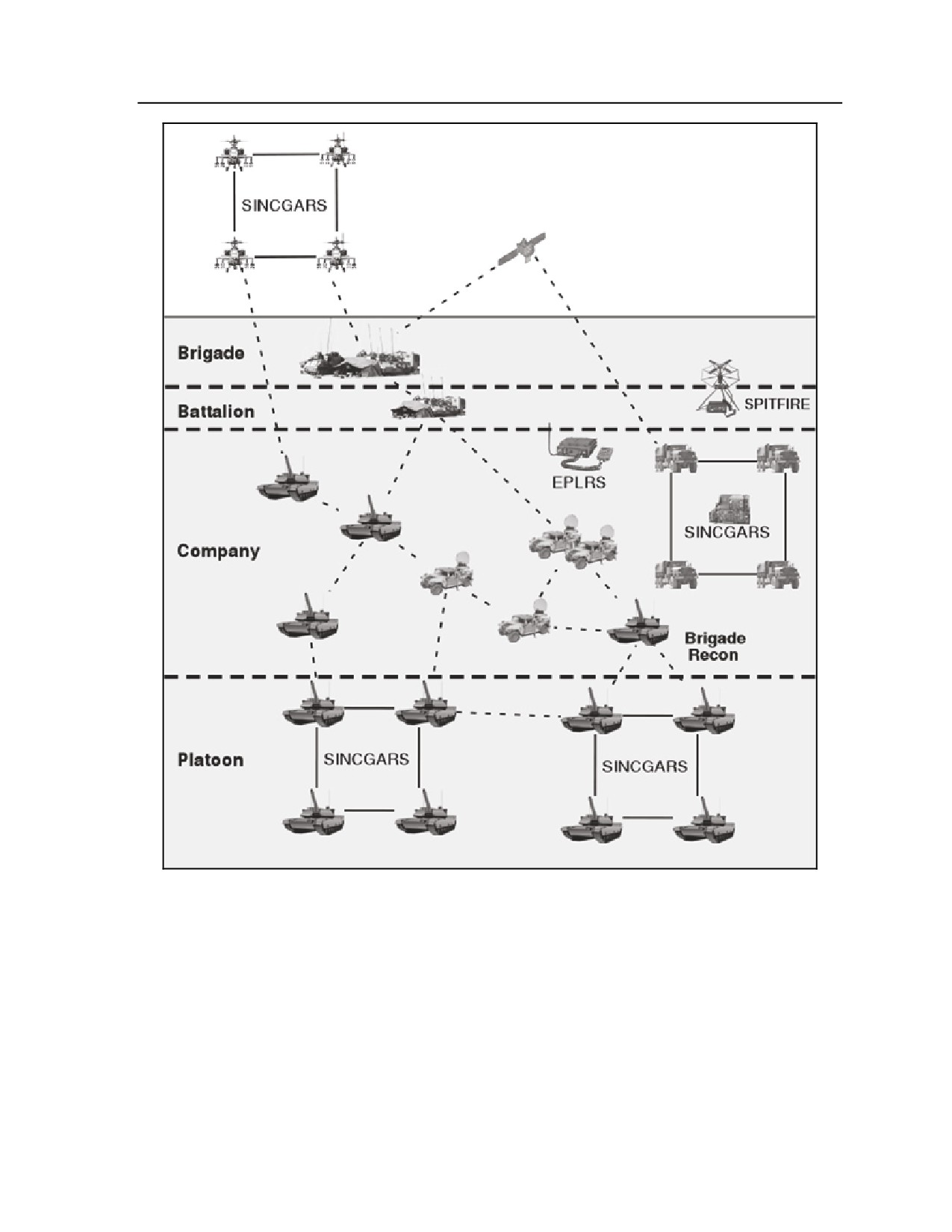
Communications
Figure B-1. Lower tactical internet communications
UPPER TACTICAL INTERNET COMMUNICATIONS
B-14. MSE and near term digital radio (NTDR) provide upper TI access/interface to battalion and brigade
CPs. Upward dissemination of the FBCB2 COP and C2 data occurs over the upper TI between the
battalion and brigade CP and to higher echelons. The upper TI also permits access to intelligence data of
the Army battle C2 system of higher and adjacent headquarters. The NTDR handles the bulk of data
between the battalion and brigade CPs with dissemination to and from higher headquarters via MSE (figure
B-2, page B-4).
7 December 2007
FM 3-04.111
B-3
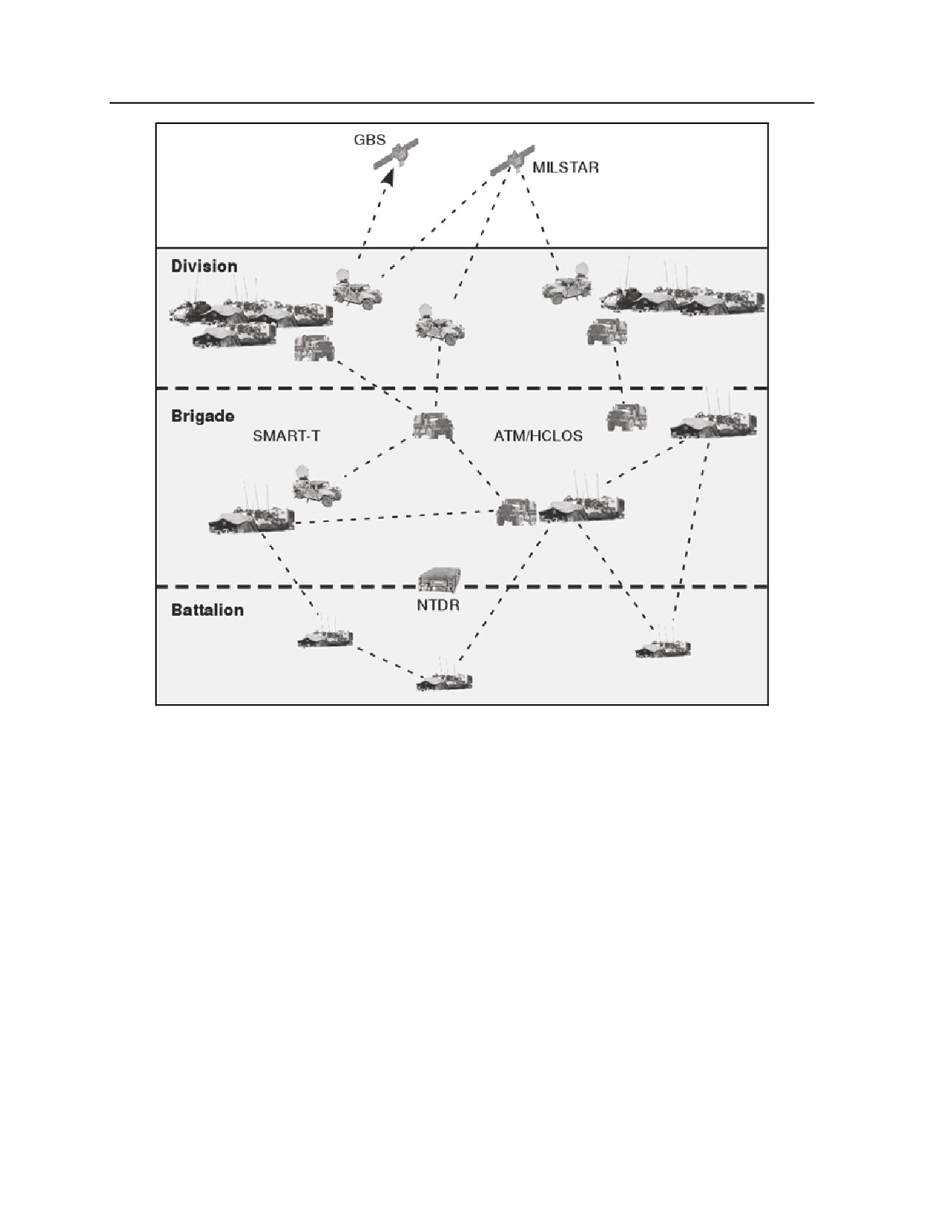
Appendix B
Figure B-2. Upper tactical internet communications
B-15. At the battalion CP, the CP INC routes the COP information and C2 data over the CP LAN and
NTDR. At the brigade CP, the CP INC routes the COP information and C2 data to other brigades and
division over the CP LAN, NTDR, and MSE.
B-16. The upper TI is part of the WIN-T that connects tactical echelons to distant headquarters and
information sources via the global broadcast service, military SATCOM terminals and satellites, and
high-capacity LOS transmission.
SEAMLESS TACTICAL INTERNET AND NETWORK
ARCHITECTURE CONNECTIVITY
B-17. Both the upper and lower TI permits seamless exchange of COP information and C2 data (figure B-
3, page B-5). Brigade is where such transfer occurs between the upper and lower TI. The following four
elements are essential to sharing COP information and C2 messaging all the way down to a vehicle or
aircraft platform:
z
Appropriate radio waveform (SINCGARS, EPLRS, NTDR, and JTRS).
z
Application software (FBCB2 and ABCS).
z
Network architecture (TI and WIN-T elements).
z
Platform processing and display (COP information software and display).
B-4
FM 3-04.111
7 December 2007
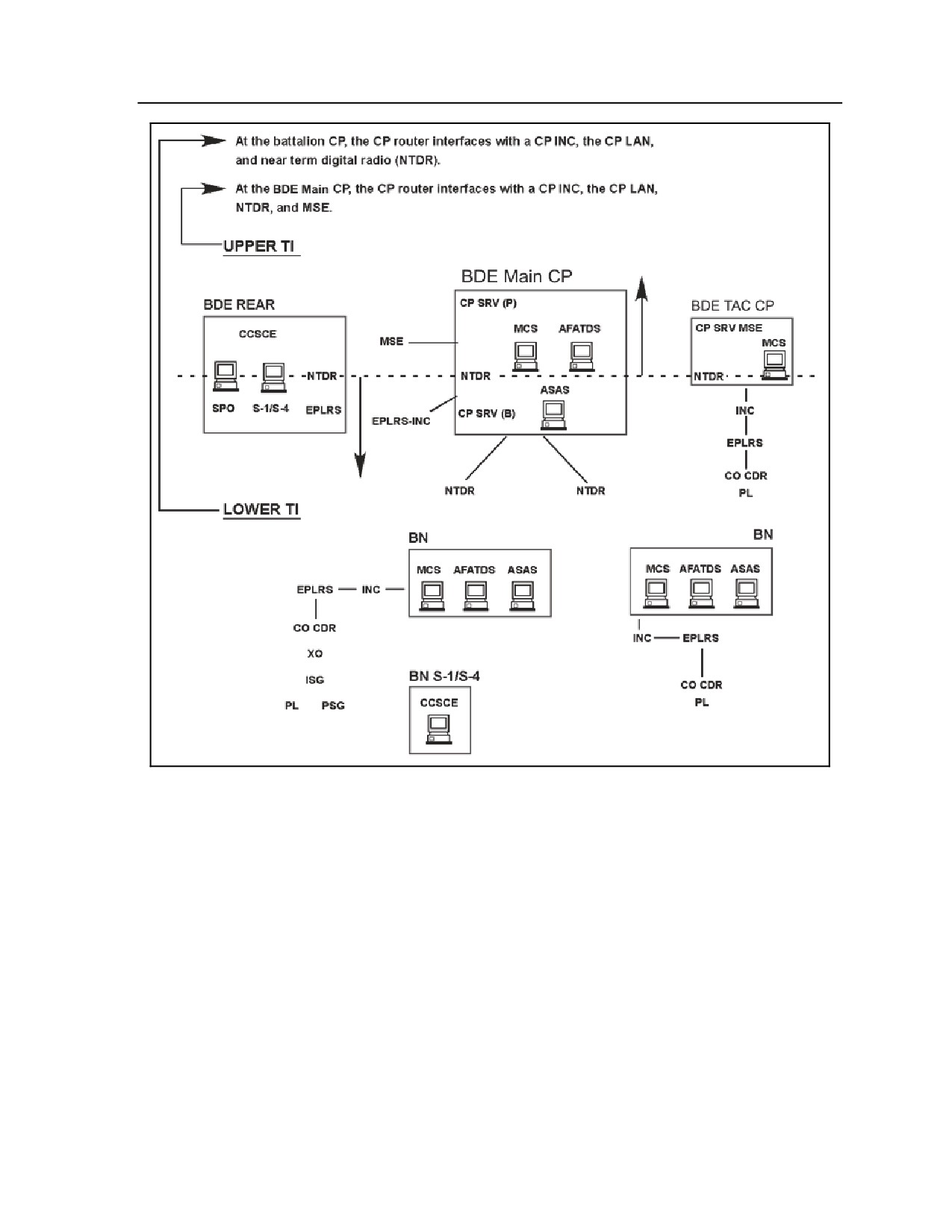
Communications
Figure B-3. Upper and lower tactical internet interface
JOINT NETWORK TACTICAL CAPABILITY SYSTEM
B-18. The Army’s Joint Network Tactical Capability System is made up of two major components—the
JNN found at brigade and higher levels and battalion level CPs module allocated to battalion level CPs.
The joint network tactical node (JNTC) architecture has three main components—hub node, JNN, and
battalion level node.
B-19. The hub node is designed to support division-level forces. The JNN, located at brigade/BCT level,
connects into the hub using satellite links. However, the hub node could deploy as GS to a brigade or BCT
depending on mission circumstances.
B-20. The division hub, which could be GS to the aviation brigade, consists of one 3.7 meter satellite dish
transmitting 40 to 50 Mbps bandwidth and supporting 16 time division multiple access (TDMA) nets via
six frequency division multiple access links.
B-21. The JNN is deployed at brigade/BCT and division level and is designed to interface with MSE via
two simultaneous MSE digital terminal groups supporting voice and data. It connects to a hub (either
tactical or strategically mobile hub depending on the network configuration) for further connectivity/access
7 December 2007
FM 3-04.111
B-5
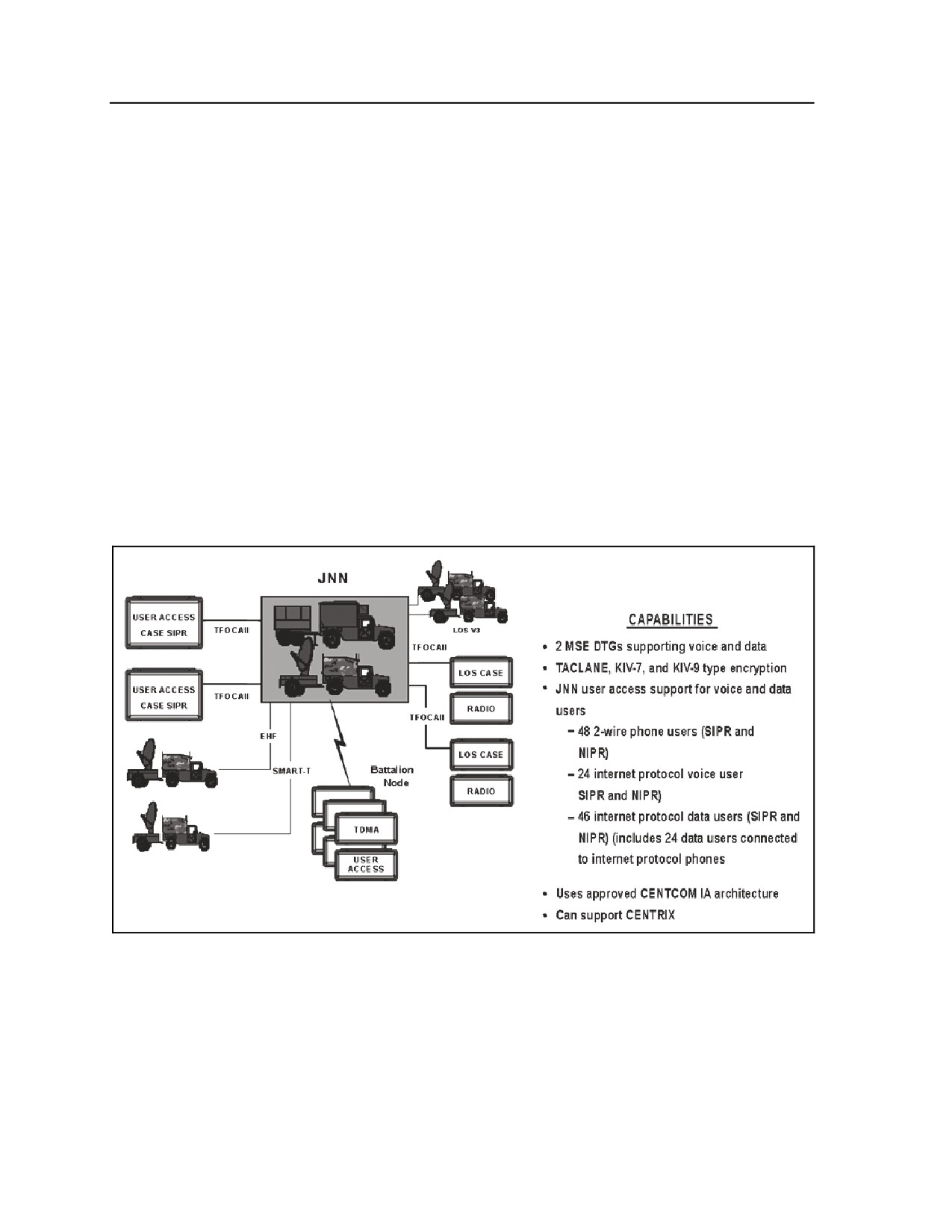
Appendix B
to the DOD’s global information grid (GIG) network. The JNN provides circuit switched and internet
protocol-based Ku-band commercial satellite capability with up to 7-Mbps in bandwidth.
B-22. The JNN has no transport capability internal to the JNN shelter. It leverages new Ku-band SATCOM
equipment along with associated Ku-band TDMA and frequency division multiple access hubs. The JNN
also leverages existing capabilities such as Secure Mobile Anti-Jam Reliable Tactical-Terminal (SMART-
T), the AN/TSC 85/93 (MSE generation satellite), and high capacity LOS radios for CP to CP links and
reach-back links to wide-area services (such as the GIG) and home station. This satellite based transport
provides improved mobility and range of individual nodes and CP structures.
B-23. The JNN’s tactical local area network (TACLAN) encryptor, KIV-7 and KIV-19 Type 1 encryption
can support—
z
48 two wire phone users (SIPR and NIPR).
z
24 internet protocol voice users (SIPR and NIPR).
z
46 internet protocol data users (SIPR and NIPR) (includes 24 data users connected to internet
protocol phones).
z
Hosts H.323 video conferences and is compatible with the Defense Collaborative Tool Suite.
B-24. The JNN provide top secret/SCI tunneling capability from Trojan Spirit and improves points of
presence and mobility in the tactical environment. The JNN is interoperable with U.S. Central Command's
combined enterprise regional information exchange network to provide multinational communications
support.
B-25. A JNN node is made up of the components shown in figure B-4 and figure B-5, page B-7.
Figure B-4. Joint network node system diagram
B-6
FM 3-04.111
7 December 2007
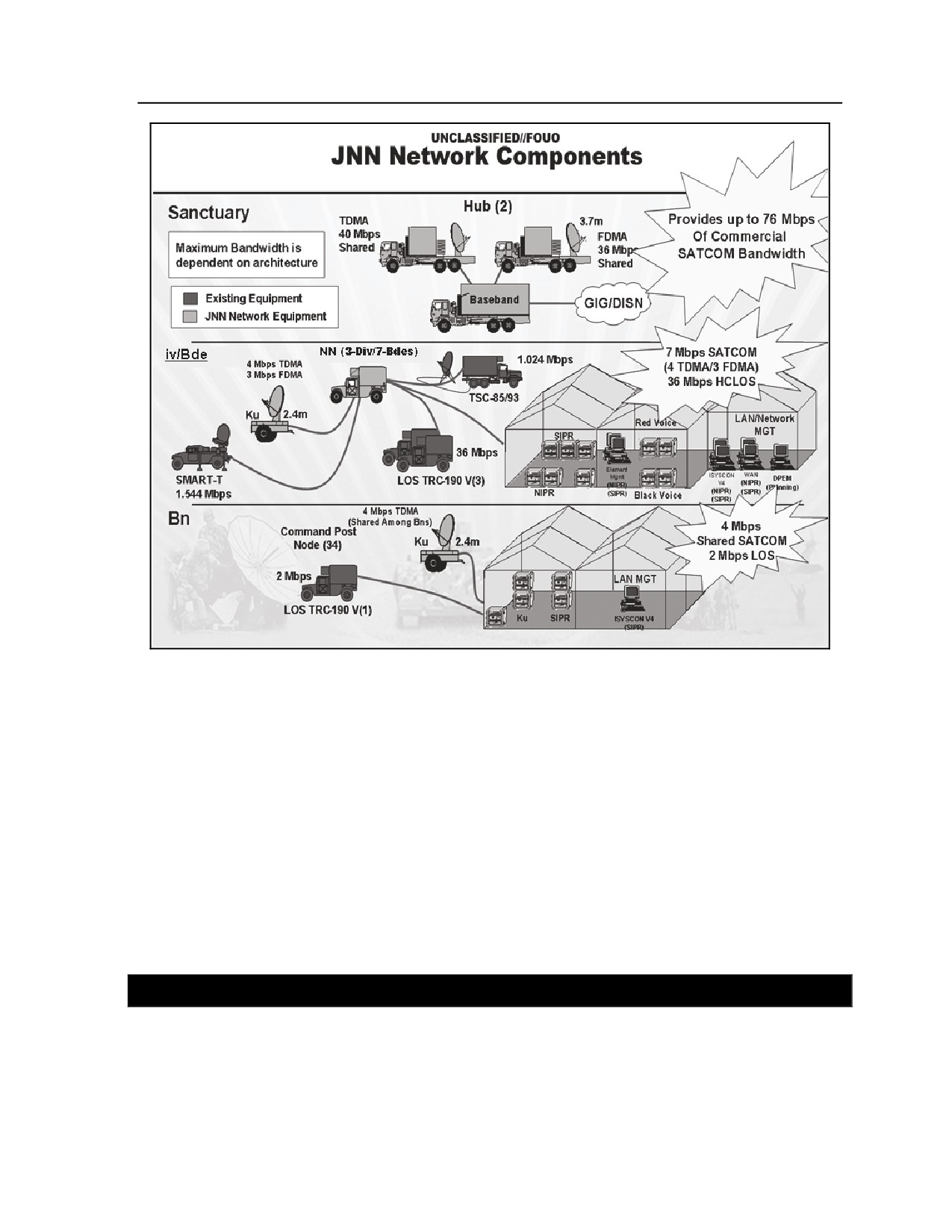
Communications
Figure B-5. Joint network node components
B-26. The battalion level or small CP node module is a HMMWV mounted system with a trailer mounted
2.4 meter satellite dish. The module contains a transit cased virtual private network router and TACLAN
encryptor security device and provides hub routers for CP and voice over internet protocol (VoIP) phones
along with a file server. The battalion level CP module provides 4 Mbps wideband SECRET Internet
Protocol Router Network (SIPRNET) data along with VoIP phones to the aviation battalions and links to
the JNN through TDMA satellite architecture.
B-27. For unclassified data traffic and interfaces to commercial internet, JNTC utilizes links to DOD’s
nonsecure internet protocol network
(NIPRNET) system. NIPRNET provides for a trusted interface
between the DOD intra-net to commercial Internet systems and the World Wide Web through Department
of Defense Information Systems Agency designed and maintained demilitarized zone.
B-28. JNTC can provide a link to DOD’s SIPRNET. SIPRNET is a worldwide network which allows a
secure means to transmit classified data, imagery, and video teleconferencing. SIPRNET can only be
accessed by designated secure terminals, and is also available via AKO.
SECTION III - AIRCRAFT AND GROUND COMMUNICATIONS
AIRCRAFT COMMUNICATIONS
B-29. This section discusses capabilities of the following aircraft radios and digital modems:
z
SINCGARS (frequency modulated).
z
Have Quick II (UHF).
7 December 2007
FM 3-04.111
B-7