FM 3-04.111 Aviation Brigades (DECEMBER 2007) - page 3
Employment
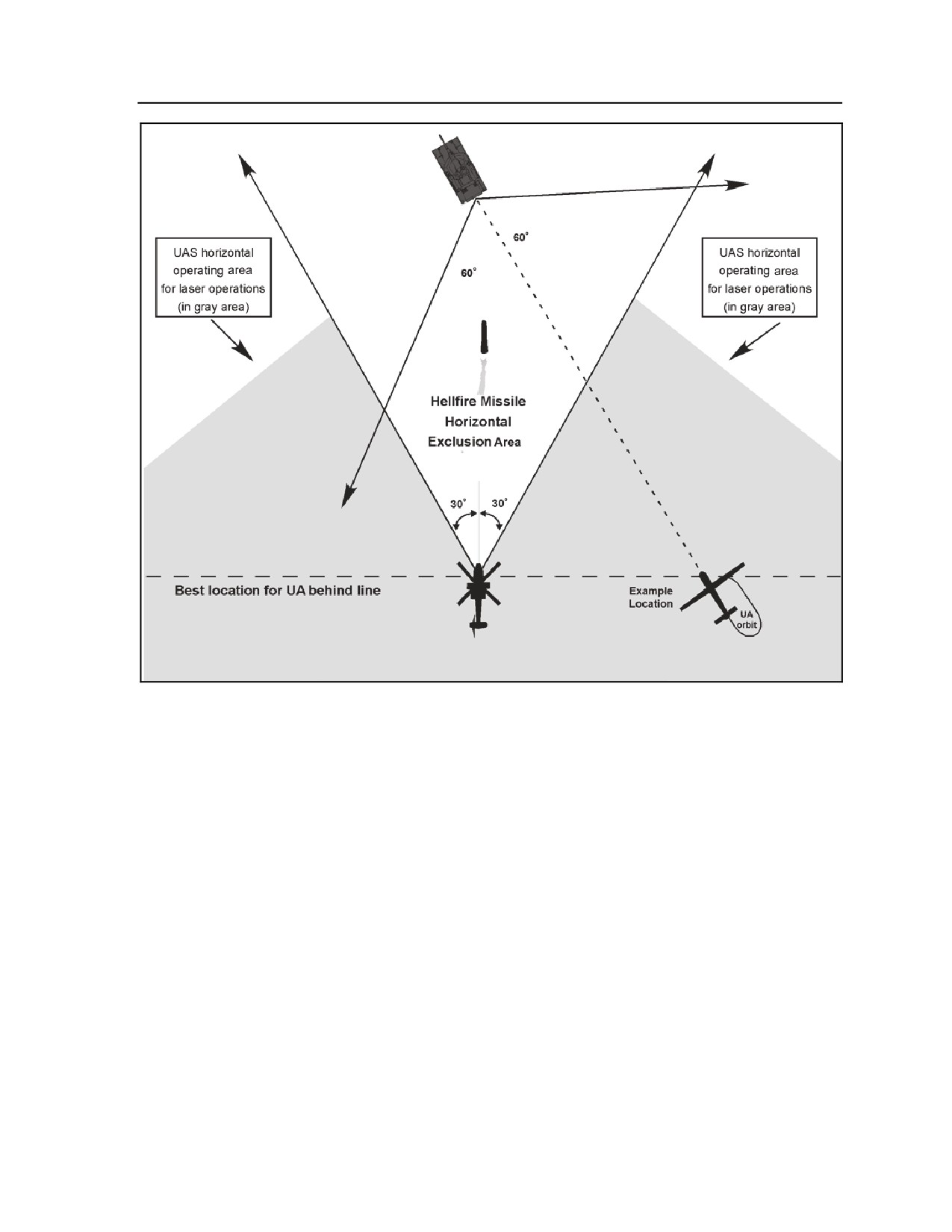
Figure 3-2. Unmanned aircraft system support to Hellfire (horizontal)
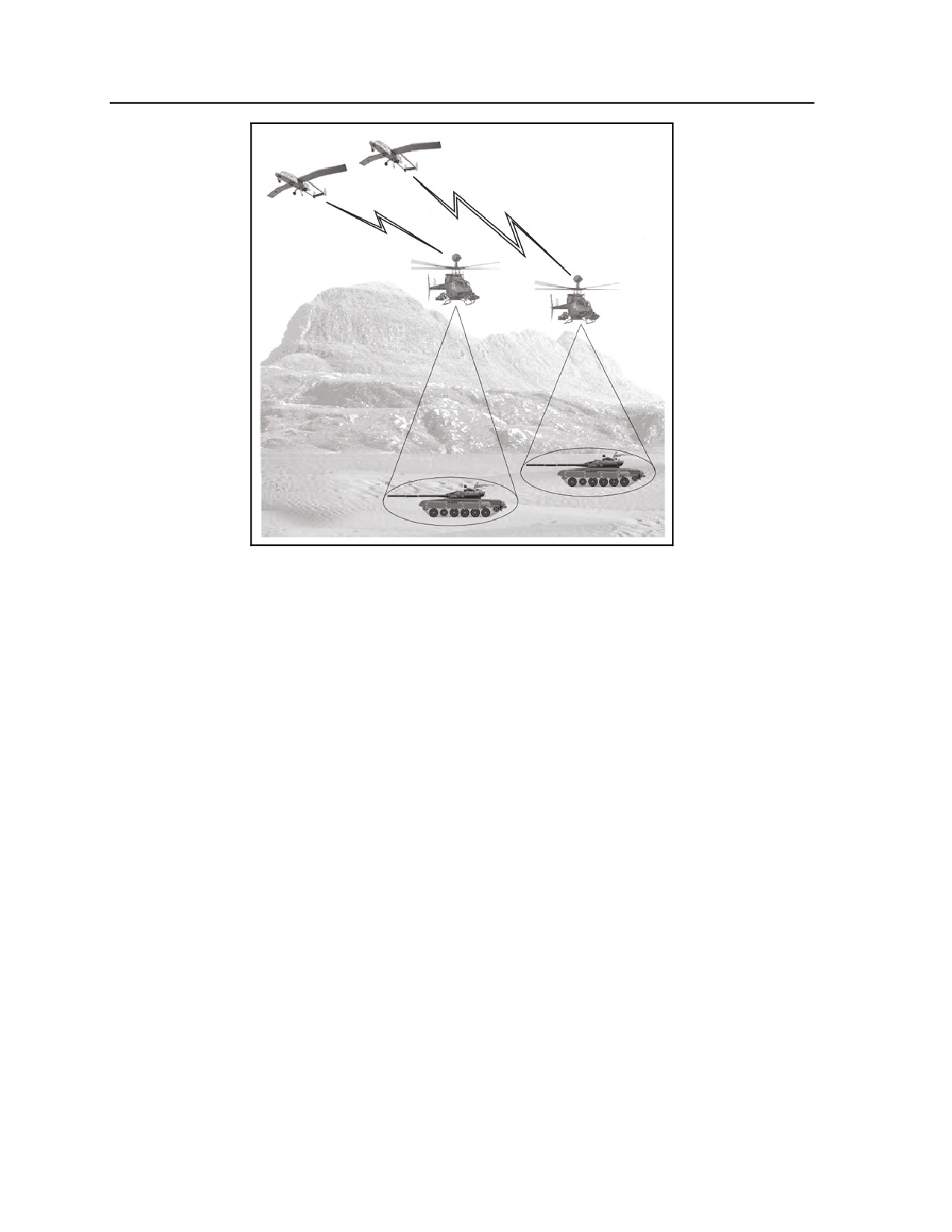
AVIATION UNIT TO UNMANNED AIRCRAFT SYSTEM HANDOVER
3-109. The brigade acquires the enemy force and maintains observation. HPTs are handed over to UAS
for continued observation and engagement by FA or CAS. The brigade then conducts a bypass of enemy
forces, and continues the reconnaissance effort or moves back to an FAA or the AA (figure 3-3, page 3-
20).
7 December 2007
FM 3-04.111
3-19
Chapter 3
Figure 3-3. Aviation unit to unmanned aircraft system handover
AVIATION UNIT AND UNMANNED AIRCRAFT SYSTEM AREA OF OPERATIONS
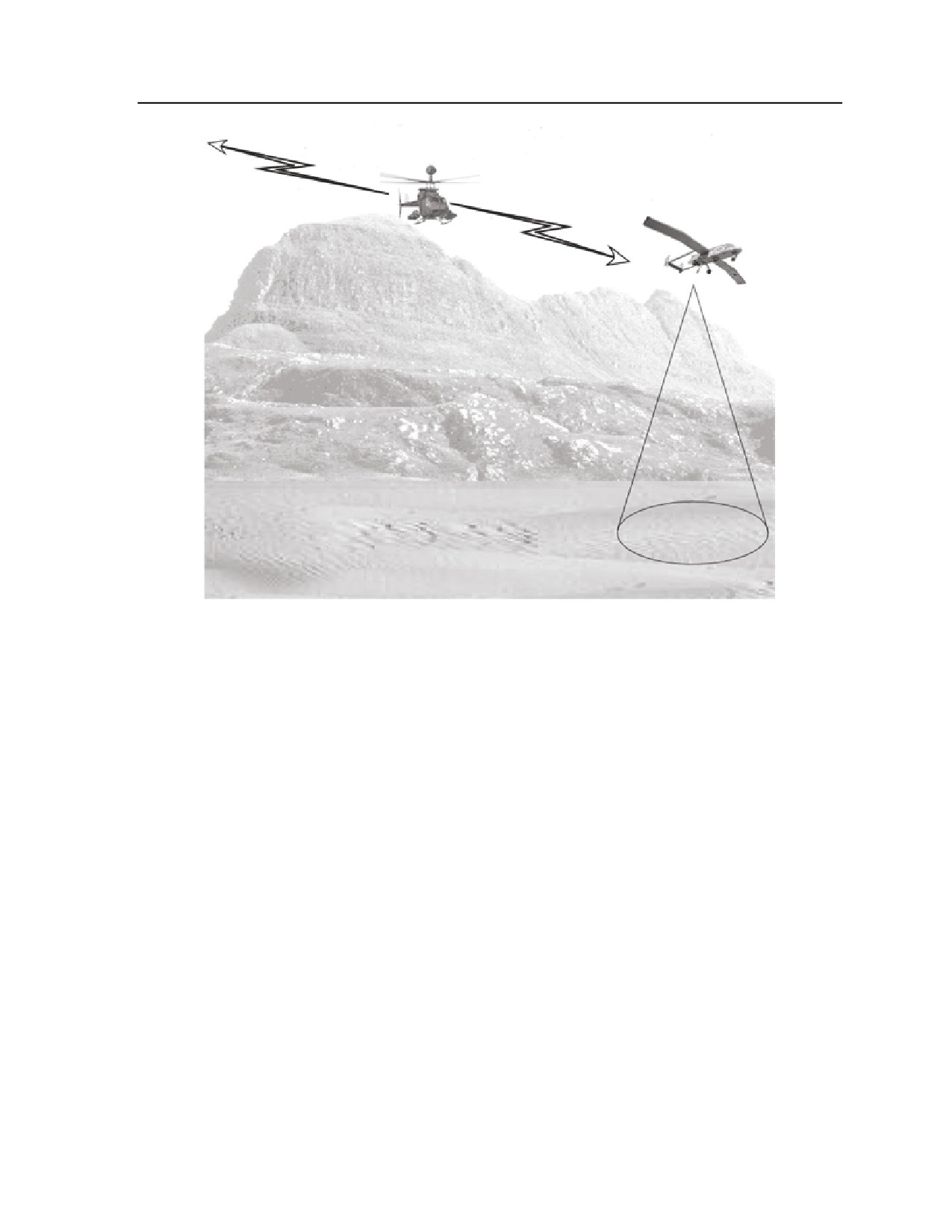
3-110. METT-TC is the basis for aviation unit and UAS AO assignments. If the situation dictates, they
can switch AO. This option maximizes the capabilities of both systems; however, it requires the most
coordination. This option allows the brigade to extend its AO and concentrate manned elements on the
most critical AO (figure 3-4).
3-20
FM 3-04.111
7 December 2007
Employment
Figure 3-4. Aviation unit and unmanned aircraft system area of operations
7 December 2007
FM 3-04.111
3-21
This page intentionally left blank.
Chapter 4
Aviation Battalion Task Force Operations
The concepts expressed in this chapter are focused on formation and employment of
ABTFs. These concepts and considerations also apply to the aviation brigade and
should be reviewed and considered when the brigade receives additional aviation
units.
SECTION I - GENERAL
4-1. Aviation brigades by design are intented to
operate as TFs and create ABTFs based on METT-
Contents
TC.
Section I - General
4-1
4-2. In order to provide appropriate forces for a
Section II - Organization and Mission
4-2
particular mission or to cover large AOs, the
Section III - In-Theater Operational
aviation brigade can form ABTFs. The CAB divides
Considerations
4-10
its organic attack reconnaissance, utility, cargo,
Section IV - Task Organization
sustainment, and C2 assets to meet the requirments
Considerations
4-13
of the mission. Additional augmentation may be
Section V - Unit Considerations
4-15
required in some cases. While the GSAB is capable
Section VI - Employment Principles
4-17
of serving as an ABTF headquarters, it normally
provides C2, cargo helicopter, aeromedical
evacuation, and ATS assets to support brigade and ABTF operations.
4-3. The ABTF deploys with all personnel and equipment required to accomplish its mission. Competing
requirements often challenge TF needs for limited equipment and personnel. TF shortfalls not met within
the parent unit may have to be filled from other units. Additionally, internal and external ABTF operating
procedures have to be tailored for combined or multinational operations and specific theater requirements.
FIXED BASE OPERATIONS
4-4. Deploying aviation units initially seek operating locations that best replicate their home station
facilities and capabilities. The goal of this initial staging base is establishing and maintaining a secure area
for aviation operations. If available, aviation units occupy areas in and around an airfield or improved
surface to facilitate sustainment operations in preparation for combat. Desired facilities include an
operational tower, NAVAIDs, hanger facilities, helicopter parking areas, and barracks. As the unit moves
forward, this base may be used to conduct phases and depot-level maintenance.
SPLIT-BASED OPERATIONS
4-5. The aviation brigade can conduct split-based operations, defined as the division of logistics, staff,
management, and command functions over two or more AOs.
4-6. By task organizing, the aviation brigade can realistically produce three ABTFs. If three ABTFs are
deployed apart from the brigade, the aviation brigade is no longer capable of executing its core
competencies.
7 December 2007
FM 3-04.111
4-1
Chapter 4
OPERATIONAL OVERVIEW
4-7. The ABTF is assigned, attached, or OPCON to the supported unit. It may be deployed without a
senior aviation headquarters or as part of a larger aviation force. The ABTF or its higher aviation
headquarters normally operates within the AO of a supported BCT, division, corps, or joint TF. Elements
of the ABTF may operate in multiple locations within that AO.
COMMAND RELATIONSHIPS
IN-THEATER
4-8. All aspects of planned command relationships must be considered to ensure necessary C2, liaison,
and support personnel and equipment are provided to the ABTF organization. The following are examples
of ABTF command relationship options. This list is not all inclusive; some of the relationships reflect
emerging doctrine. The ABTF can be in a command relationship that is—
z
Directly subordinate to the joint task force (JTF) headquarters (figure 4-1).
z
Directly subordinate to the Army Component Command, s Component Command, or Naval
Component Command.
z
Further assigned, attached, or placed OPCON or TACON to any of the components above.
z
Subordinate to a corps, division, or BCT.
z
Subordinate to an aviation brigade.
In small scale contingencies, the ABTF may be assigned to a JTF. The JTF assigns
the ABTF to a carrier strike group for the first phase of the operation. The carrier
battle group places the ABTF TACON to the Marine air ground TF. Once the Marines
achieve the objective, they are relieved by an Army division TF that will also become
the land component commander. The ABTF is relieved of assignment to the carrier
strike group and assigned to a BCT or the division’s aviation brigade, if present.
In addition to normal planning associated with operations, the ABTF develops its
OPLANs at its own headquarters as an integral part of its higher headquarters staff,
or both.
Figure 4-1. Example of command relationship scenario
SECTION II - ORGANIZATION AND MISSION
4-9. The ABTF performs maneuver, support, and sustainment missions. It also possesses the unique
ability of a single battalion-size organization to perform reconnaissance, security, attack, air assault, air
movement, and C2 operations.
4-10. The following principles pertain to ABTF formulation:
z
Aviation planning principles remain consistent across aircraft types and missions.
z
Each organization combines its various TTP at TF level to provide a TF battalion-sized unit
supplying aviation support across the full spectrum of operations.
z
Once formed and trained, the ABTF possesses rapid deployment capability and conducts Army
or joint operations in any OE.
z
An ABTF may incorporate active Army and RC units.
z
Proper ABTF organization, planning, and training are essential to accomplish assigned missions.
z
Aviation maintenance and logistics support requires special emphasis.
4-2
FM 3-04.111
7 December 2007
Aviation Battalion Task Force Operations
ORGANIZATION
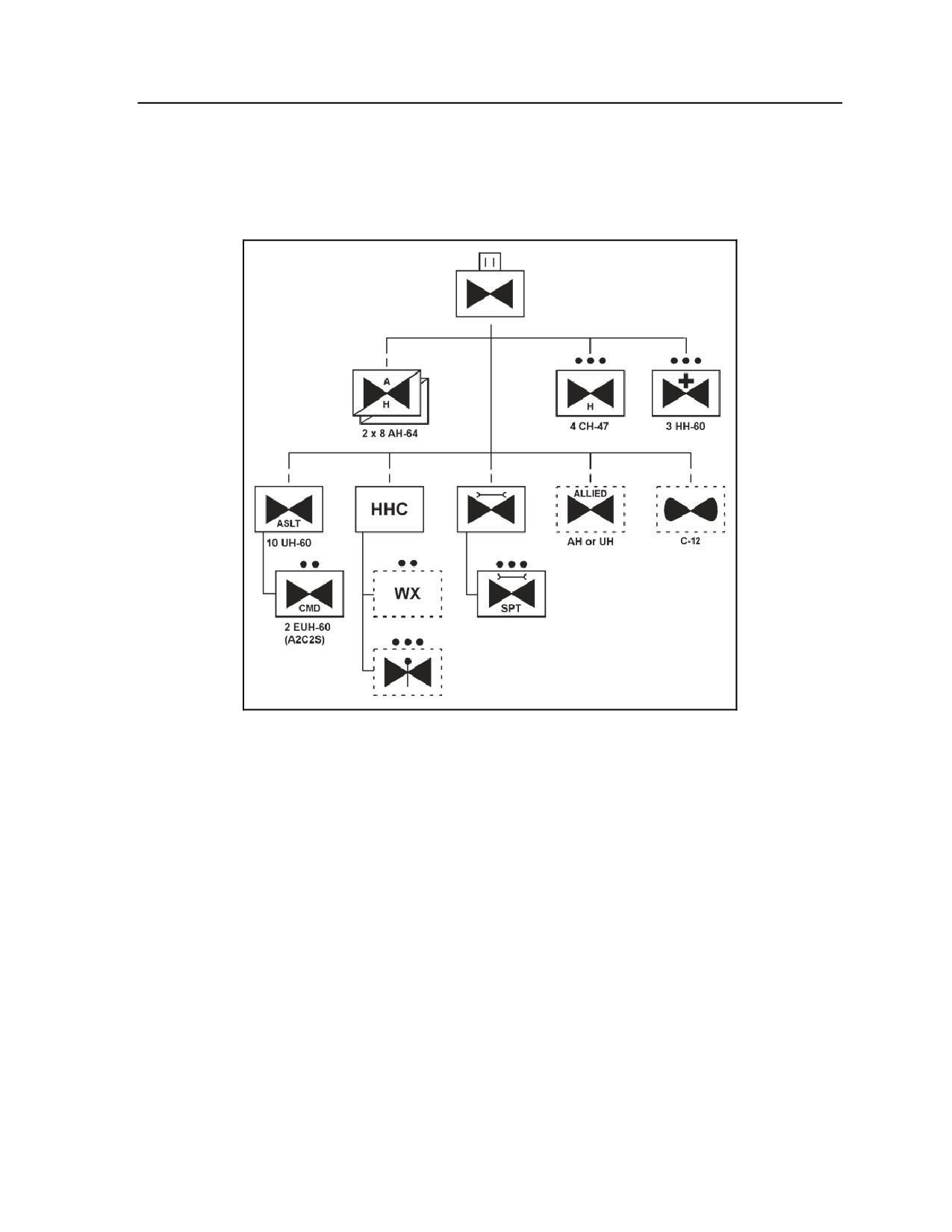
4-11. The ABTF is not a standing unit with a published TOE. An ABTF’s organizational structure is
tailored to meet mission requirements. There are numerous possibilities when organizing an ABTF.
METT-TCs are driving factors for ABTF organization. Figure 4-2 provides a sample ABTF (heavy)
organization.
Figure 4-2. Sample aviation battalion task force (heavy) organization
4-12. The ABTF may receive additional assault and cargo helicopter forces from its divisional aviation
brigade GSAB, theater aviation brigade, or uncommitted divisions to augment its air assault capability.
Likewise, it may receive additional attack reconnaissance assets if employment is expected to be more
reconnaissance, security, or attack centric. Such augmentation could be in the form of full companies,
platoons, or sections, or it could be as small as additional crews with or without additional aircraft.
MISSION
4-13. An ABTF is capable of conducting all aviation missions. Specific ABTF tasks and roles include—
z
Conduct screen operations to maintain surveillance and provide early warning of contact with
enemy forces.
z
Conduct guard and covering force operations as part of a larger force.
z
Employ attack reconnaissance helicopter elements as part of a combined arms force of the
respective higher headquarters.
z
Conduct or support raids.
z
Increase the tempo of friendly operations.
z
Conduct operations to destroy enemy formations, communications, and logistics assets.
7 December 2007
FM 3-04.111
4-3
Chapter 4
z
Provide aerial escort and suppressive fires in support of air assault, convoy security and other
TACOPS.
z
Provide mobile firepower to exploit the effects of artillery and other indirect fire.
z
Conduct limited J-SEAD operations.
z
Coordinate and adjust indirect fires.
z
Conduct JAAT operations with CAS and FA forces.
z
Conduct company-sized air assaults (if seats are removed from UH-60s).
z
Conduct fast-rope insertion/extraction system
(FRIES)/special patrol infiltration/exfiltration
system (SPIES) operations.
z
Conduct air movement of supplies using external or internal loads.
z
Conduct aeromedical evacuation, CASEVAC and personnel replacement operations.
z
Provide refuel capability using Fat Hawk (external fuel tank refueling operations).
z
Conduct aerial mine delivery operations (Volcano).
z
Conduct C2 operations.
z
Conduct DART operations.
z
Participate in PR operations.
z
Conduct operations in multiple locations simultaneously.
z
Conduct day and night aviation operations during visual and marginal weather conditions.
z
Conduct limited operations during IMC.
z
Perform unit maintenance on assigned aircraft, armament, and avionics.
z
Perform unit maintenance on assigned equipment (except medical and COMSEC equipment).
HEADQUARTERS AND HEADQUARTERS COMPANY
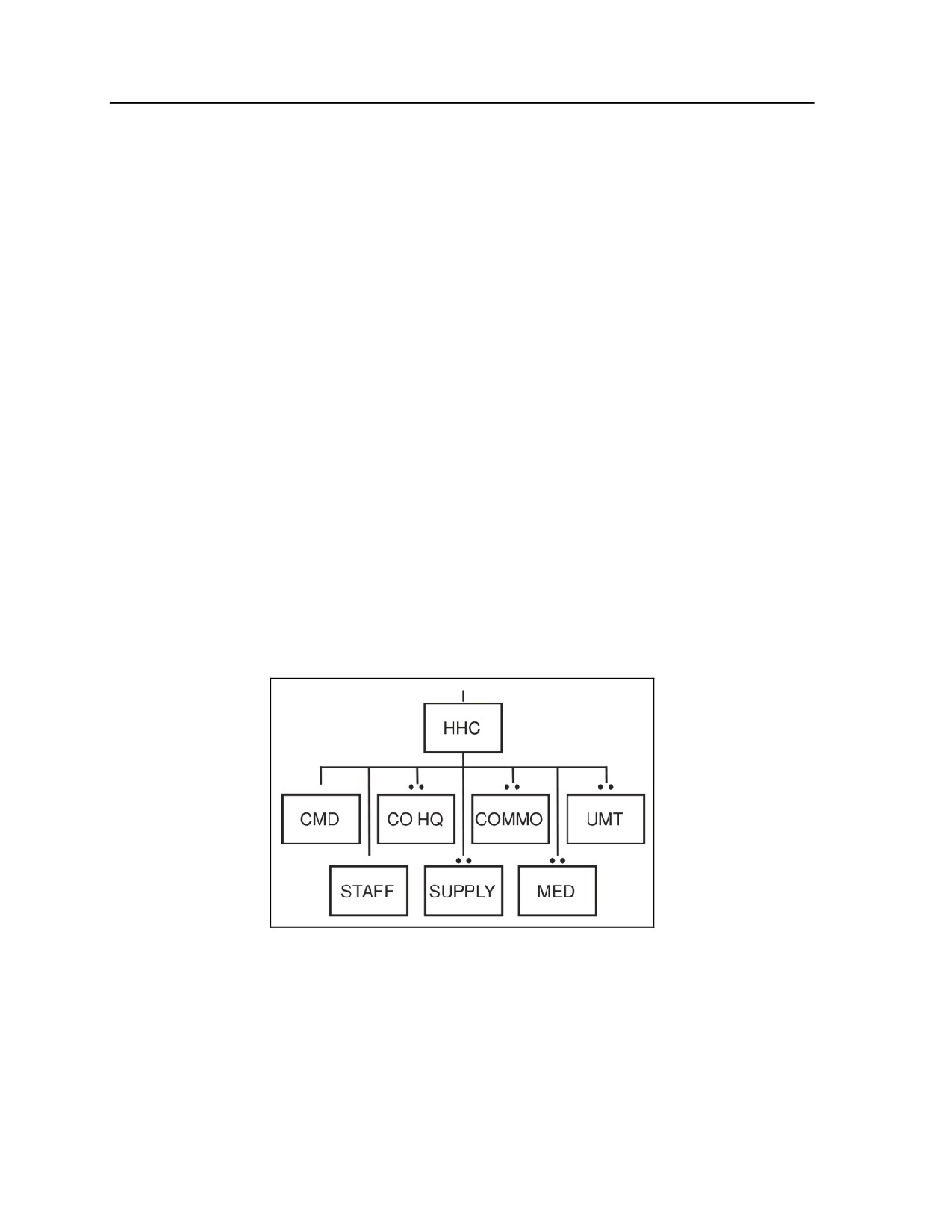
4-14. The HHC (figure 4-3) provides personnel and equipment for C2 functions of the ABTF, and security
and defense for the CP. The HHC also provides unit level personnel service, UMT, logistics, and CBRN
support.
Figure 4-3. Headquarters and headquarters company
FORWARD SUPPORT COMPANY
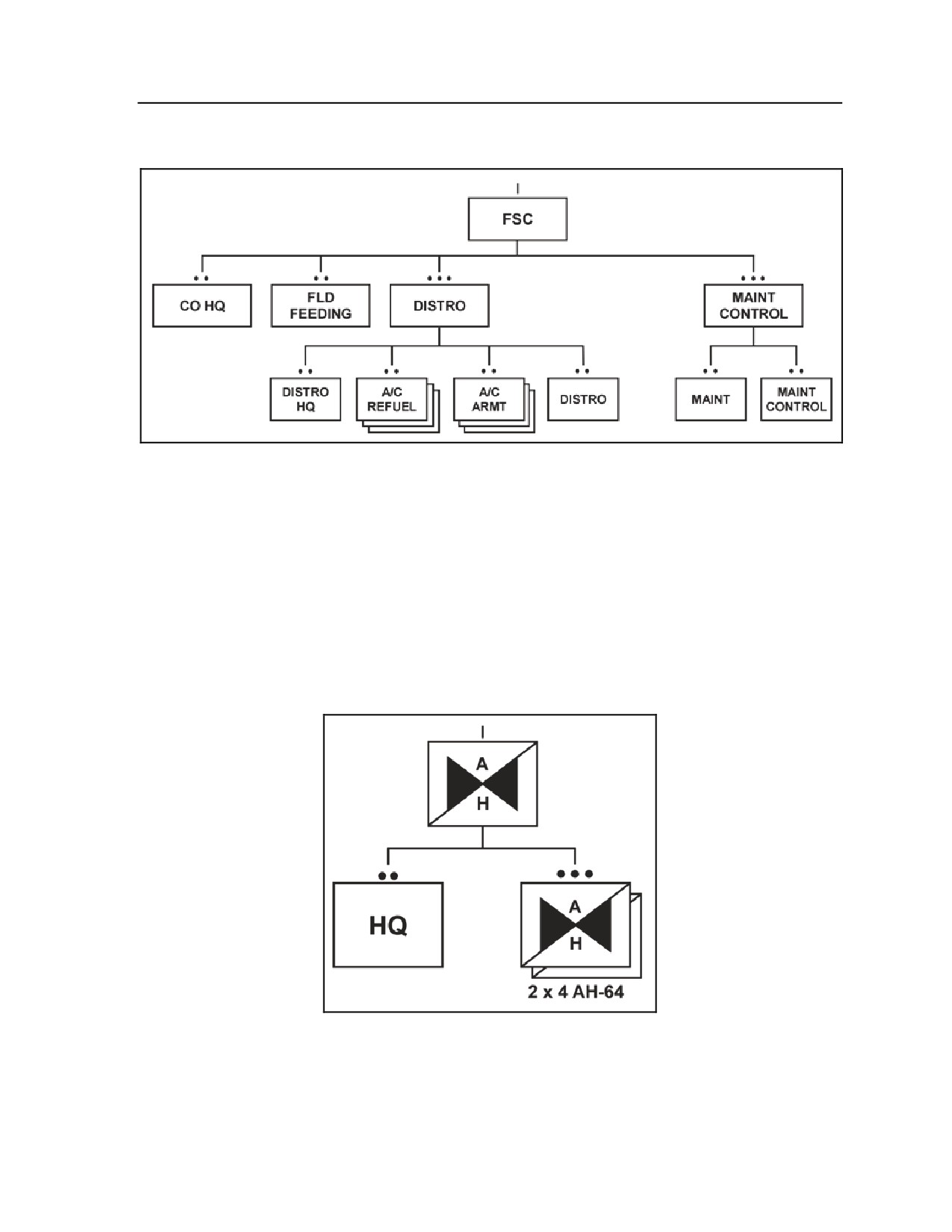
4-15. The forward support company (FSC) (figure 4-4, page 4-5) has a company headquarters, field
feeding section, distribution platoon, and ground maintenance platoon. The FSC provides field feeding,
transportation, refueling, ammunition, and ground maintenance support, and coordinates with the ASB for
additional support as required. Battalions contributing assets to the ABTF may also be required to
4-4
FM 3-04.111
7 December 2007
Aviation Battalion Task Force Operations
contribute appropriate support assets to augment those in the ABTF or support those functions not
normally organic to the battalion forming a TF.
Figure 4-4. Forward support company
ATTACK RECONNAISSANCE ELEMENT
ORGANIZATION
4-16. The attack reconnaissance unit is comprised of one attack reconnaissance company (ARC) and one
attack reconnaissance troop (ART).
Attack Reconnaissance Company
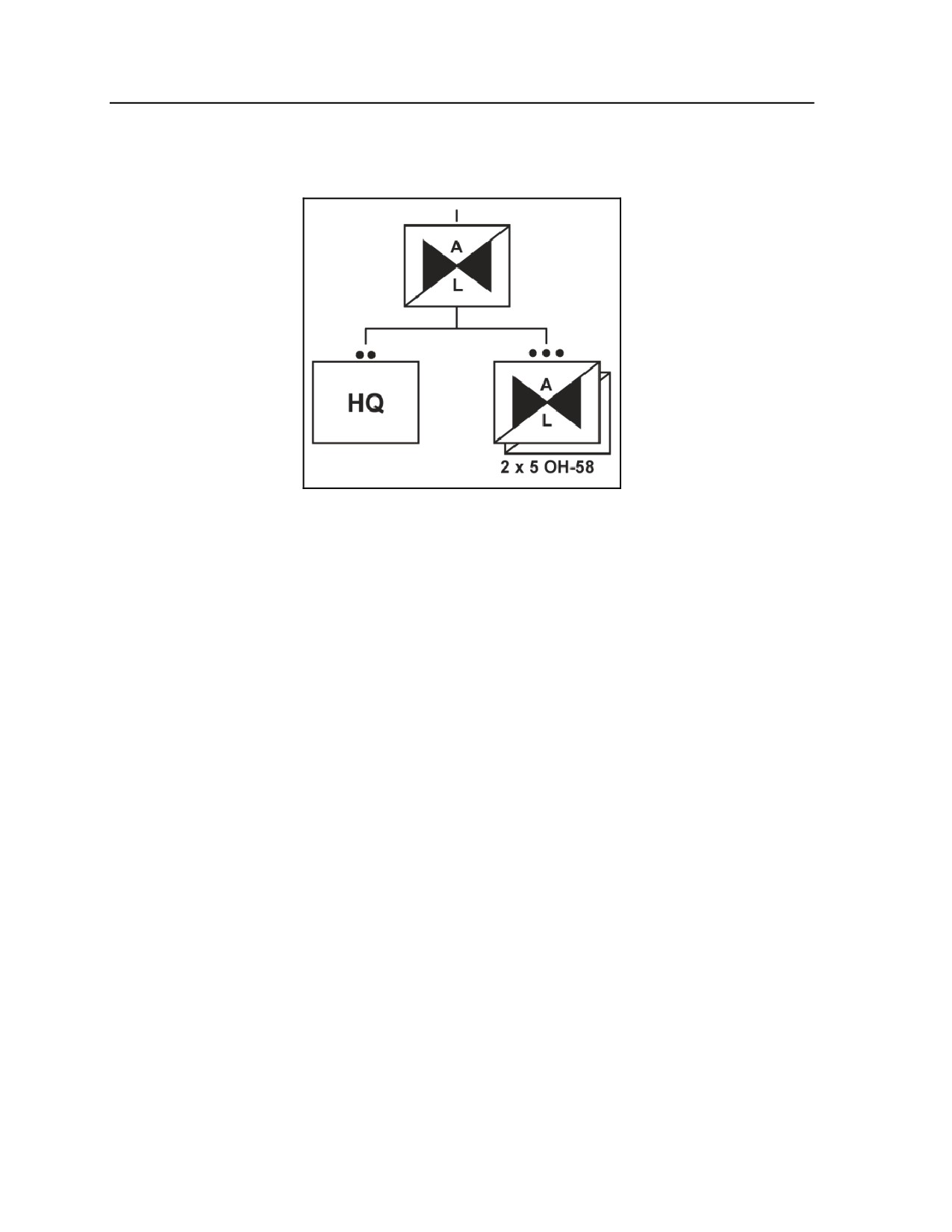
4-17. The ARC (figure 4-5) is organized with a company headquarters and two attack reconnaissance
platoons with four AH-64D aircraft each.
Figure 4-5. Attack reconnaissance company
7 December 2007
FM 3-04.111
4-5
Chapter 4
Attack Reconnaissance Troop
4-18. The ART
(figure
4-6, page
4-6) consists of a troop headquarters section and two attack
reconnaissance platoons with five OH-58D aircraft each.
Figure 4-6. Attack reconnaissance troop
MISSION
4-19. The primary missions of ARCs and ARTs are the following:
z
Reconnaissance
z
Security
z
Movement to contact
z
Attack
4-20. Specific tasks and roles of ARCs and ARTs include—
z
Destroy enemy formations.
z
Support friendly maneuver forces through CCA.
z
Provide aerial escort and suppressive fires in support of air assault and other TACOPS.
z
Provide mobile firepower to exploit the effects of artillery and other indirect fire.
z
Conduct screening operations maintaining surveillance and providing early warning of contact
with enemy forces.
z
Conduct guard and covering force operations as part of a larger force.
z
Conduct raids.
z
Conduct team operations in multiple locations simultaneously.
z
Conduct CBRN reconnaissance including aerial radiological surveys.
ASSAULT HELICOPTER COMPANY
ORGANIZATION
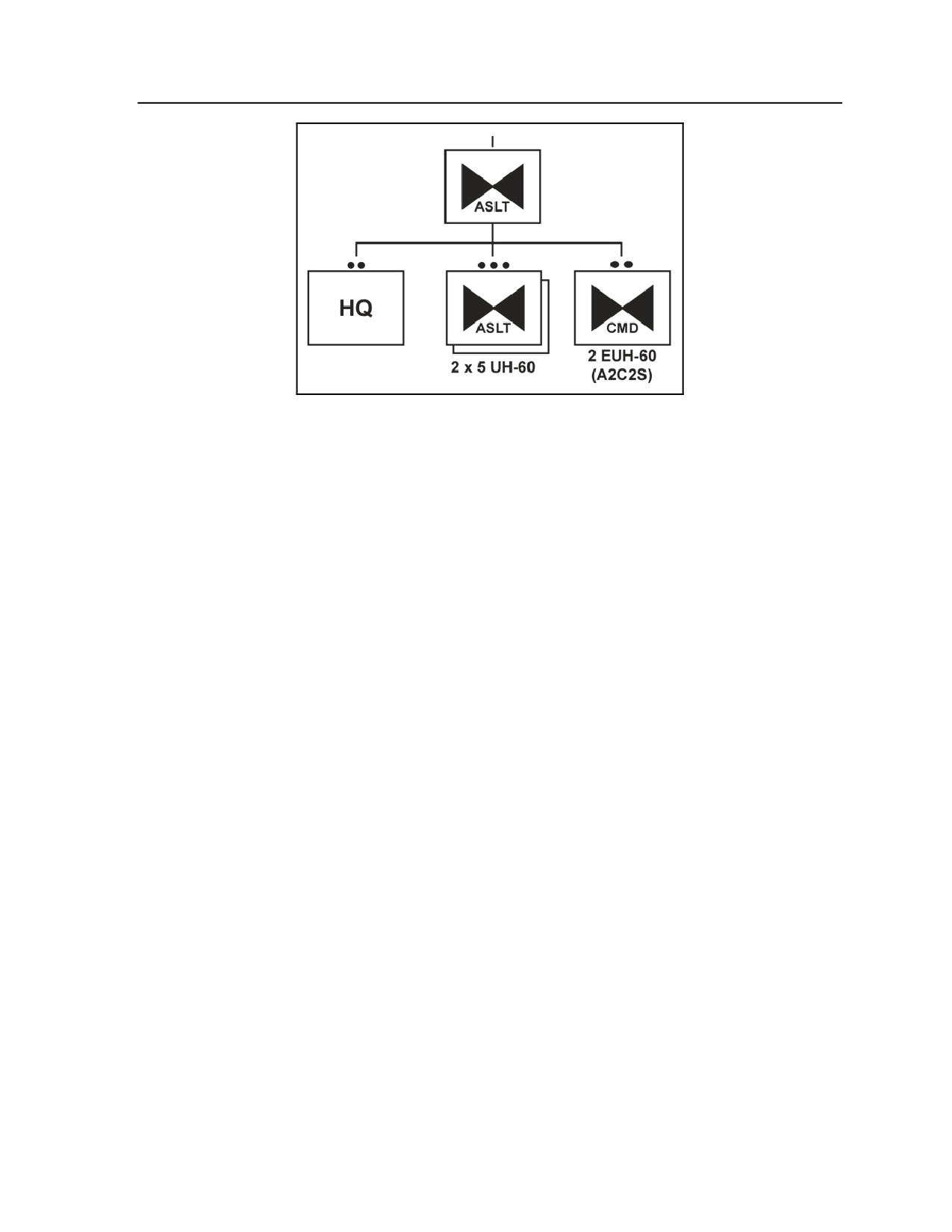
4-21. The assault helicopter company (AHC) is organized with a company headquarters section and two
assault helicopter platoons of five UH-60 aircraft each. When organized as part of an ABTF, AHCs may
have a section of two EUH-60 aircraft from a GSAB equipped with A2C2Ss. Figure 4-7, page 4-7, depicts
an AHC with GSAB A2C2S augmentation.
4-6
FM 3-04.111
7 December 2007
Aviation Battalion Task Force Operations
Figure 4-7. Assault helicopter company with general support aviation battalion Army airborne
command and control system augmentation
MISSION
4-22. Primary AHC missions are the following:
z
Air assault.
z
Air movement.
z
Command and control support.
z
CASEVAC.
z
Personal recovery support.
4-23. Specific AHC tasks and roles include—
z
Conduct wet-hawk operations.
z
Conduct SPIES, FRIES.
z
Conduct team insertion/extraction.
z
Conduct aerial mine delivery operations (Volcano-equipped UH-60).
z
Conduct psychological operations missions (leaflet drop, speaker missions).
z
Evacuate downed aircraft and personnel, when required by METT-TC or the nonavailability of
logistic support aircraft.
HEAVY HELICOPTER PLATOON
ORGANIZATION
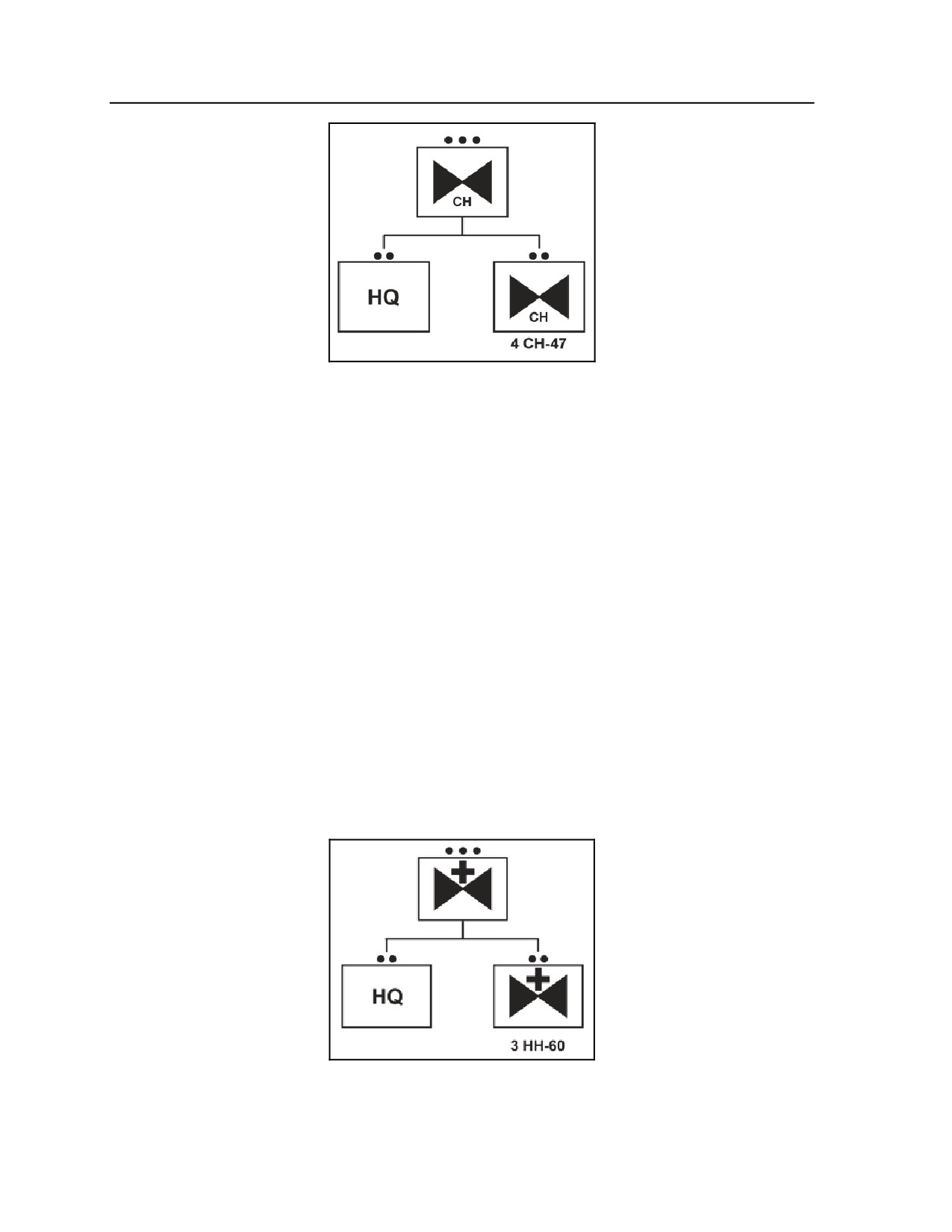
4-24. The cargo helicopter platoon (figure 4-8, page 4-8) consists of a platoon headquarters section and
one section with four CH-47 aircraft.
7 December 2007
FM 3-04.111
4-7
Chapter 4
Figure 4-8. Cargo helicopter platoon
MISSION
4-25. The primary missions of the cargo helicopter platoon is the following:
z
Air assault.
z
Air Movement.
z
CASEVAC.
z
Personal recovery support.
4-26. Specific cargo helicopter tasks/roles include—
z
Artillery raid.
z
Team insertion/extraction.
z
Fat Cow refueling operations.
4-27. Because of CH-47 characteristics, cargo helicopters can perform high-altitude operations and
oversized, heavy, and special munitions movement.
FORWARD SUPPORT MEDICAL EVACUATION TEAM
ORGANIZATION
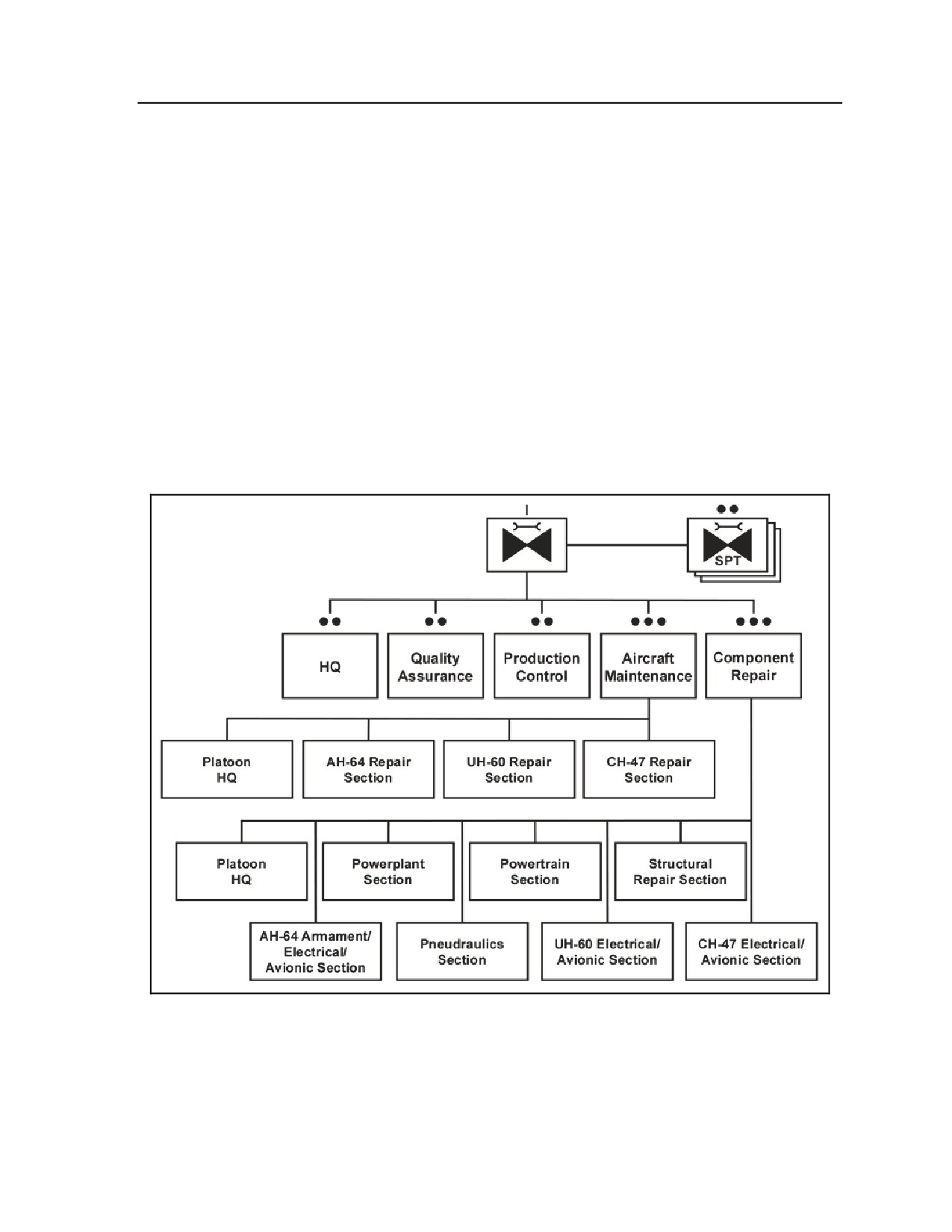
4-28. The forward support medical evacuation team (FSMT) (figure 4-9) consists of three HH-60 aircraft
supporting 24-hour operations.
Figure 4-9. Forward support medical evacuation team
4-8
FM 3-04.111
7 December 2007
Aviation Battalion Task Force Operations
MISSION
4-29. The primary mission of the FSMT is aeromedical evacuation; however, it also provides the
following:
z
Patient movement between MTFs (patient transfers).
z
Class VIII resupply.
z
Joint blood program support.
z
Medical C2.
z
Movement of medical personnel and equipment.
z
Air crash rescue support.
AVIATION MAINTENANCE COMPANY
ORGANIZATION
4-30. The aviation maintenance company (figure 4-10) must be structured and augmented to provide
aviation unit-level field maintenance to all assigned or attached aircraft. Battalions contributing helicopters
to the ABTF must also supply appropriate maintenance assets to support those aircraft not normally
organic to the ABTF.
Figure 4-10. Sample aviation maintenance company
7 December 2007
FM 3-04.111
4-9
Chapter 4
MISSION
4-31. The aviation maintenance company is designed to provide DS; tailored, critical, and routine aviation
field level maintenance; battle damage assessment and repair (BDAR); as well as maneuver sustainment to
its supported ABTF. The aviation maintenance company has the ability to perform the following functions:
z
Repair aircraft, components, avionics, and armament.
z
Provide aircraft unit-level maintenance, combat maintenance, and BDAR.
z
Provide armament support collocated with FARPs.
SECTION III - IN-THEATER OPERATIONAL CONSIDERATIONS
4-32. An ABTF can be formed after units have deployed and are established in-theater. The ABTF may be
established for a specific period of time or operation. If an ABTF is formed in the middle of a campaign,
additional operational factors must be considered. These considerations include support relationships, unit
status, operational updates, and aircraft specific considerations.
ACTIONS UPON NOTIFICATION
4-33. Upon notification that an additional aviation unit will be under the control of the ABTF, the main CP
requires the following information from that unit:
z
Current chain of command.
z
An officer to assist in operational planning and ensure proper mission employment.
z
Number of aircraft to be attached, OPCON, or TACON.
z
Call signs and frequencies of elements.
z
TACSOP of incoming element.
z
Current operations being conducted, if any.
4-34. Initial coordination should provide the following additional information:
z
Current location.
z
Location in the next 24 to 48 hours.
z
Attachments and detachments.
z
Mission configured aircraft (such as Fat Hawk/Fat Cow).
z
Available aircraft’s number, type, and model.
z
Planning allowable cabin load (ACL) per aircraft, if different due to environmental factors.
z
Number of day and night crews available.
z
Experience level of crews.
z
Logistics requirements.
4-35. The ABTF S-4 requires the following information to ensure adequate support for the new unit:
z
Current aircraft availability and bank time status.
z
Current mission equipment status
(such as M-240 machine guns, forward area refueling
equipment [FARE], internal fuel tanks).
z
Expected aircraft and major system status in the next 24 to 48 hours.
z
Current fuel and ammunition status.
z
Parts status and parts location.
z
Expected daily consumption rate for fuel and other consumables per aircraft flight hour.
z
The portion of organic maintenance elements accompanying them.
z
Any additional personnel accompanying the element, such as cooks, operations, and class III
personnel.
4-10
FM 3-04.111
7 December 2007
Aviation Battalion Task Force Operations
z
For long term operations, the phase maintenance or progressive phase maintenance interval for
the aircraft.
z
Location of current aviation intermediate field maintenance support unit.
SPECIAL CONSIDERATIONS
4-36. Each unit has unique challenges. Specific things to consider include—
z
Whether the element is to be collocated within the ABTF AA.
z
The unit’s ability to secure its portion of the perimeter.
z
Aircraft parking and separation requirements (substantially greater for CH-47s than with other
aircraft).
z
Hot refuel requirements (CH-47s require a minimum of 30 minutes at refuel point).
z
Other factors such as rotor wash from hovering CH-47s pose a significant risk to other aircraft
and temporary structures without proper separation.
OPERATIONAL REQUIREMENTS
4-37. Units attached or placed OPCON or TACON to also require up-to-date operational information.
Often elements coming from higher levels do not have access to tactical information at division level and
below. At a minimum, information provided by the ABTF commander and staff to the incoming element
should include the following:
z
Operational reference material.
z
Current operations.
z
AO general information.
z
Upcoming missions.
OPERATIONAL REFERENCE MATERIAL
4-38. Current operational documents and products essential for smooth integration include—
z
ABTF TACSOP.
z
Aviation procedures guide.
z
Helicopter landing sites.
z
Kneeboard products.
z
ROE.
z
SPINS.
z
ACOs and ATOs.
z
Current imagery, if applicable.
z
Communications and security information for the ABTF.
z
Intelligence.
4-39. By-products of the current ABTF IPB necessary to gain SA include—
z
Threat situation.
z
Known threat locations.
z
Threat actions in the vicinity of the aviation unit’s AA (past 24 to 48 hours).
z
Expected threat contacts in the AO.
z
Probable COAs.
z
Weather forecasts for anticipated mission times.
z
Weather constraints affecting the mission.
7 December 2007
FM 3-04.111
4-11
Chapter 4
CURRENT OPERATIONS
4-40. Current operational information should include the following:
z
ABTF main CP and TAC CP locations (current and future).
z
Subordinate unit locations.
z
FARP locations (current and future).
z
Coordinated airspace for operating in the AO.
z
AC2 measures in the AO.
z
Operational coordination (from the ABTF).
4-41. A clear understanding in regard to current operations must be achieved between all elements of the
ABTF. Basics requirements include—
z
Readiness condition (REDCON) status.
z
Launch decision points.
z
Planning time lines.
z
Overall current mission (two levels up).
z
Command relationships.
z
Initial planning graphics.
z
Call signs and frequencies.
z
Time hack.
AREA OF OPERATIONS GENERAL INFORMATION
4-42. General information on the AO should include—
z
EW support.
z
Decontamination sites.
z
Medical support.
z
Boundaries.
UPCOMING MISSIONS
4-43. If missions are being prepared for execution with ground elements, incoming elements require
additional detailed information on their planned roles. This information should include—
z
Ground commander’s mission and concept of the operation.
z
Ground commander’s intent for aviation use.
z
OPORD and graphics.
z
Special equipment requirements.
z
Locations of friendly TAC CPs, brigade support areas (BSAs), and battalion/TF combat trains.
z
Front line trace of friendly units.
z
Target lists from the FSE.
z
Location of friendly artillery current and preplanned FPs.
z
Location of friendly AD assets.
z
Frequencies and call signs.
z
Challenge and password.
4-12
FM 3-04.111
7 December 2007
Aviation Battalion Task Force Operations
SECTION IV - TASK ORGANIZATION CONSIDERATIONS
SYNCHRONIZATION OF ASSETS
4-44. TF elements often come from different organizations and locations. These organizations may be
active Army or RCs. Locations may be in the continental United States
(CONUS) or outside the
continental United States (OCONUS). TF elements have varying degrees of mission proficiency and may
have different procedures for tactical and administrative tasks. Thus, the ABTF commander and staff, and
subordinate commanders and leaders must synchronize TF assets.
STANDARDIZATION OF PROCEDURES
4-45. The immediate challenge facing commanders and their staffs is the requirement to organize and train
the ABTF as quickly and thoroughly as possible. Because the ABTF must function as a unit or be further
task organized, it is essential to operate from a common SOP. SOPs are tailored to the unit’s METL,
theater procedures, and expected OEs.
CHARACTERISTICS
4-46. The ABTF is not a standing unit with a published TO&E; its organizational structure must be
tailored to meet mission requirements placed upon it.
Structure
4-47. The ABTF should be structured to provide—
z
A balanced mix of attack reconnaissance and assault company-sized units and appropriate
portions of the GSAB providing the ABTF commander with a full range of aviation capabilities.
z
The capability to create aviation teams of mixed aircraft at platoon and company level
capitalizing on the synergy inherent in a mix of attack reconnaissance, assault, and GS lift
helicopters.
z
C2 support to ABTF’s higher headquarters (two additional EUH-60s in the assault company).
z
ATS to meet the ABTF’s own requirements.
z
An aeromedical evacuation capability. If multiple ABTFs are deployed in-theater, only one
ABTF may require aeromedical evacuation aircraft as part of the TF. To preclude complications
involved in separate organizations (parts, critical skills, airspace management) not normally
reporting to each other, the command relationship between the ABTF and aeromedical
evacuation element is critical. Attachment is recommended.
z
The capability to accept further aviation attachments in any form
(U.S. or allied attack
reconnaissance, air assault, heavy lift, FW, or UAS).
z
The capability to accept attachment, OPCON, or TACON of ground units.
z
An augmented aviation maintenance company capable of supporting all aircraft in the ABTF. In
most cases, allied aircraft and UAS will come with their own maintenance structure; however,
all aspects of support must be determined before the maintenance structure can be completed.
z
Integrated aviation intermediate field maintenance support.
z
Management of aviation maintenance requirements exceeding its organic capabilities. It is often
necessary to reachback to the major command supporting the overall operation, and Army
organizations and vendors in the U.S. This reachback capability is necessary when ensuring
critical parts, specialized skills, and timely support are available if required.
Responsive
4-48. The ABTF is a fast-moving force providing versatile means of attaining accurate SA, while
seamlessly linking with other Army and joint systems. Additionally, when assigned AH-64 helicopters, the
7 December 2007
FM 3-04.111
4-13
Chapter 4
ABTF has the capability to disrupt and potentially destroy a regimental-sized armored force. The ABTF
can conduct the following operations while mitigating risk in rapidly changing situations.
z
The ARC expands the commander’s area of influence throughout the OE utilizing armed
reconnaissance, attack, and coordination of indirect fires.
z
Air movement of forces and delivery of aerial mines with its AHC help overcome the effects of
complex terrain while seizing the initiative.
z
Cross-attached organizations consisting of attack reconnaissance, assault, and GS helicopters
supported by UAS provide the ability to conduct operations from MCO through civil support
operations worldwide and within the U.S.
z
Air assets can operate from naval ships, greatly extending the joint commander’s area of
influence and employment options in coastal areas.
z
UH-60 and AH-64 aircraft may be able to self-deploy. Assigned CH-47 and C-12 aircraft can
self-deploy.
z
The ABTF has the ability to take full advantage of en route planning and rehearsal systems, as
these systems become available.
z
The ABTF can prepare to fight soon after arrival with minimum reliance on RSOI assets within
the AO.
Deployable
4-49. The ABTF is strategically deployable and can be task organized internally and externally to meet
unique OEs. Its hybrid capabilities of attack reconnaissance and assault permit a full range of integrated
aviation operations immediately upon arrival in-theater. An airlifted ABTF may be a suitable economy of
force asset in support of the JTF until other aviation brigade assets can deploy by sea. The AH-64 and UH-
60 can deploy by C-5 and C-17 aircraft. The OH-58D is transportable aboard C-130 and C-141 aircraft, as
well as larger strategic air lifters.
Agile
4-50. The ABTF design, organization, and inherent flexibility to rapidly attach, detach, and cross attach
assets ensure a TF with the physical agility necessary for commanders to maximize the operational
potential of the force.
Versatile
4-51. Combining attack reconnaissance and assault aircraft in the same TF provides the ABTF versatility
normally associated with an aviation brigade, even though the TF may have only a third of the aircraft
found in the brigade. Additionally, the ABTF’s modularity allows task organization between multiple
ABTFs to quickly mass specific aircraft system capabilities when multiple ABTFs are deployed.
Lethal
4-52. The ABTF can provide fires with its ARCs/ARTs while rapidly refueling and rearming these assets
with its AHC and cargo helicopter assets. This force, in conjunction with ground combat forces and
augmented with joint and combined forces, becomes an even more lethal combat multiplier.
Survivable
4-53. The mobility of the ABTF greatly enhances its survivability. The ability to stand off from both
enemy direct fire and AD weapons, coupled with its array of ASE, further reduces its vulnerability.
Sustainable
4-54. The ABTF’s motor maintenance, mess, medical, supply elements, and aviation maintenance
company (when properly structured and supplemented by appropriate ASB sustainment and maintenance)
4-14
FM 3-04.111
7 December 2007
Aviation Battalion Task Force Operations
allow it to sustain itself while operating independently, under aviation brigade control, or attached to
ground maneuver units.
TRAINING
4-55. The ABTF must train as a TF together with its supported BCT before deployment. Such training
allows proficiency in the most critical missions. The ABTF must refine, internalize, and practice a common
SOP. Critical to preparation is a full understanding of in-theater requirements.
SECTION V - UNIT CONSIDERATIONS
BATTALION AND ABOVE
4-56. The parent brigade of the ABTF headquarters, remnants of the core battalion that formed the ABTF,
and the battalions contributing units assigned to the ABTF must adjust to the creation of the ABTF. All
parties must coordinate in formation of the ABTF and adjust operations to compensate for reduced
capabilities and resources.
PARENT BRIGADE
4-57. The aviation brigade commander ensures the ABTF is properly resourced and trained to operate in
accordance with the mission of the ABTF. He or she then assesses the capability of remaining battalions to
maintain and continue normal brigade operations. The aviation brigade commander and his or her staff
must adjust to compensate for the altered force structure.
4-58. The brigade determines the status of those stay behind forces of the core TF battalion. Based on
remaining personnel and equipment, the unit may continue normal operations with a reduced staff and
interim commander. If remaining resources preclude normal operations, the brigade commander may attach
the remnants to another battalion within the brigade (the core battalion of an ABTF is an AHB receiving
units and elements from the AHB, GSAB, and ASB). It is very likely one of the AHB’s companies will
remain behind to support brigade missions. Often the brigade is not only concerned with the formation,
training and deployment of the ABTF; it must also consider employment and support of the remaining
AHC.
4-59. The brigade provides support to the remnants of the core battalion that formed the ABTF. If not
reassigned to another fully capable battalion, remaining personnel must continue to have support, or be
given permission to access support, from other brigade or installation assets.
STAY BEHIND FORCES
4-60. ABTF organizations may not include all core battalion organic resources, a portion of the core
battalion will continue to operate and provide support from an AO or home station.
4-61. The ABTF headquarters must first determine battalion personnel and equipment that will fall under
ABTF control. The remaining elements must then reorganize into a battalion-minus structure to continue
operations and prepare to support or reinforce the ABTF as necessary.
4-62. In close coordination with the parent brigade, the ABTF commander must give the rear detachment
commander training and operational guidance for the stay behind forces. This includes accommodations to
compensate for those capabilities under ABTF control not accessible to the rear detachment.
CONTRIBUTING BATTALIONS
4-63. The battalions and companies who contribute forces to the ABTF must also adjust to operating with
diminished forces, each of which is left with varied degrees of capability. The commander must adjust the
unit’s operations compensating for the altered force structure.
7 December 2007
FM 3-04.111
4-15
Chapter 4
4-64. If the ABTF headquarters leaves a portion of its organization in the rear and those elements are not
capable of conducting normal operations, the aviation brigade commander may attach the remnants to one
of the contributing battalions. The contributing battalion may then be faced with supporting two completely
separate missions, and may be required to carry on normal operations at an AO or home station while
supervising the remnants of the ABTF.
COMPANY AND BELOW
FLIGHT COMPANY
4-65. Flight companies are dependent upon the aviation maintenance company, HHC, FSC, and the ABTF
staff for operations, intelligence, personnel service, maintenance, and logistics support. Accordingly, they
have little or no capability for independent operations. They are dependent on—
z
The aviation maintenance company for maintenance above that provided by its assigned crew
chiefs and for class IX (air) supply support.
z
The HHC and FSC for religious, paralegal, unit-level combat health support, personnel and
administrative services, and unit-level logistics support, including supply (except class IX air),
automotive and communications maintenance, food service, CBRN support, and unit-level
supply support for classes III and V.
z
The ABTF S-2 for intelligence.
AIRCRAFT OPERATIONS
4-66. Operational limitations for ABTF aircraft and units are similar to those when assigned to their parent
units. Examples of operational limitations include—
z
Extreme environmental effects (temperature, altitude) reduce payloads and flight endurance.
z
If used, auxiliary fuel tanks or Kevlar blankets limit allowable cargo load (ammunition loads,
personnel, and equipment).
z
Use of seats in assault aircraft limits allowable cargo load but increase troop protection during a
crash sequence.
z
Weather, in some cases, may preclude aviation operations (visibility, ice, high winds, and
excessive turbulence).
z
Limited visibility from weather effects
(fog, heavy rain, blowing snow) or battlefield
obscuration (smoke, dust) may limit sensor and optic capabilities, observation, target acquisition
(TA), engagement ranges, and speed of aircraft movement.
z
Low ceilings affect target engagement options.
z
Weather may require aviation deployments under IMC. OH-58 and AH-64 aircraft are not IMC
rated.
z
Units have limited capability to secure unit AAs and concurrently conduct required operations
and aircraft maintenance. Mutual support can reduce the amount of dedicated security needed by
the ABTF.
z
Crew endurance and aircraft maintenance requirements may impact aircraft availability.
z
Terrain may limit the availability of adequate AAs, PZs, or LZs.
ATTACK RECONNAISSANCE COMPANY/TROOP
4-67. An ARC consists of eight AH-64 aircraft and an ART consists of ten OH-58D aircraft.
4-68. The AH-64 can be deployed by C-5 and C-17 aircraft. The OH-58D is transportable aboard C-130
and C-141 aircraft, as well as C-5 and C-17 aircraft.
4-16
FM 3-04.111
7 December 2007
Aviation Battalion Task Force Operations
ASSAULT HELICOPTER COMPANY
4-69. The AHC has ten aircraft and is usually organized into two platoons of five aircraft each. The AHC
is often augmented with a section of two A2C2S-equipped EUH-60 aircraft from the GSAB.
4-70. The AHC must continually balance lift requirements with C2 requirements. The commander
organizes the aircraft available for assault operations to meet mission requirements.
4-71. The AHC’s UH-60 can be deployed by C-5 and C-17 aircraft.
COMMAND AVIATION COMPANY
4-72. The CAC has two flight platoons; one C2 platoon with four EUH-60 aircraft, and one GS platoon
with four UH-60 aircraft. One of these UH-60s is fitted with the A2C2S A mission kit.
4-73. CAC aircraft are often further placed OPCON to the maneuver commander. When utilizing a A2C2S
aircraft, the commander enjoys maximum mobility without sacrificing access to information or
jeopardizing continuity of operations due to CP relocation.
4-74. The CAC’s EUH-60s and UH-60s can be deployed by C-5 and C-17 aircraft.
HEAVY HELICOPTER COMPANY
4-75. Heavy HCs are organic to all aviation brigades. Each GSAB has one heavy HC consisting of a
company headquarters, and three flight platoons with four aircraft each. The ABTF can receive one or
more of these heavy HC platoons.
4-76. Because many of the theater aviation brigade’s heavy HCs are RC, collective training prior to
employment is essential for maximum operational capability. Units may activate and deploy as part of a
rotation of forces supporting ABTFs operating in stability operations.
4-77. Theater cargo helicopter assets remain under theater aviation brigade C2, even when dispersed in
support of other organizations. Centralized control by theater aviation brigades ensures tasking and
planning access and better focuses DS and GS assets on the higher commander’s priorities. However, they
may operate under control of the ABTF.
AIR AMBULANCE MEDICAL COMPANY
4-78. The AAMC consists of a company headquarters and four FSMTs. Each FSMT consists of three HH-
60 aircraft that support 24-hour operations. Each aircraft can be individually or group deployed in support
of the ABTF.
4-79. Whether deployed as a unit or an individual FSMT, AAMC assets are dependent upon the supported
unit for food, fuel, security, intelligence, sector communications, wheeled vehicle maintenance, and all
classes of supply except class IX (air).
4-80. Air ambulance assets can self-deploy if equipped with extended range fuel systems (ERFSs). The
AAMC’s HH-60s can also be deployed by C-5 and C-17 aircraft.
SECTION VI - EMPLOYMENT PRINCIPLES
AVIATION BATTALION TASK FORCE
4-81. The ABTF's primary role is to plan and execute the entire spectrum of aviation operations and can
expect to operate anywhere in the assigned unit’s AO. The ABTF allocates resources based on METT-TC,
scheme of maneuver, available assets, and higher headquarters commander's priorities.
4-82. Recent conflicts in Kosovo, Afghanistan, and Iraq illustrate a noncontiguous battlefield is fast
becoming the normal. As such, it leaves ABTF aircraft increasingly vulnerable to small arms and rocket-
7 December 2007
FM 3-04.111
4-17
Chapter 4
propelled grenade fire anywhere on the battlefield during conduct of air movement. Security provided by
attack reconnaissance aircraft may be essential for single- and dual-aircraft missions based on mission
analysis and theater SOP.
4-83. In support of stability operations, the ABTF may transport allied leaders and perform team
insertion/extraction. Aircraft may operate from remote base camps supporting patrolling forces and
reaction teams, as well as counter-drug efforts.
ATTACK RECONNAISSANCE COMPANY/TROOP
ATTACK
4-84. During MCO, ARCs/ARTs are most effective when used en mass and providing continuous
operations on enemy flanks and rear. During stability operations, ARCs/ARTs are most effective when
used in teams. The ABTF may be tasked to conduct attack operations as a TF. Augmentation permits a
balanced ABTF sustaining continuous attack operations. Although the ABTF has a limited number of
attack reconnaissance aircraft, this limitation is somewhat offset by its own lift assets used for logistics
support. The AHC provides substantial flexibility in resupply of class III/V and insertion of ground troops
in blocking positions or OPs. The AHC operates under TF control in GS of the ARC/ART during attack
operations. Based on METT-TC, the ABTF staff must backward plan from operations in the EA to
preparatory actions in the AA. Planning may include method of employment (continuous, phased, or
maximum destruction), occupation of BPs, holding areas, and air movement routes (include passage of
lines, if required).
RECONNAISSANCE AND SECURITY
4-85. The ABTF is capable of conducting all security missions including screen, guard, and cover
missions; however, it normally participates in guard and covering force operations as part of a larger force.
To act as the covering force headquarters, the ABTF requires additional ground troops and DS artillery.
4-86. The firepower, sensors, and maneuverability of the ARCs and ARTs coupled with the logistics and
assault flexibility afforded by the AHC, provide the ABTF with significant advantages when conducting
traditional air cavalry missions.
4-87. When augmented with ground forces and UAS, the ABTF operates as a reaction force developing
the situation, occupying ground OPs, seizing key terrain, and conducting raids. METT-TC determines
whether the ABTF commander operates with companies pure or task organized.
ASSAULT HELICOPTER COMPANY
4-88. Assault helicopters operate throughout the battlefield day and night as a fully integrated member of
the combined arms team. An AHC in an ABTF can expect to conduct maneuver, support, and sustainment
operations. Even though the UH-60 lacks sophisticated weapons and sensors, when pressed, the ABTF
may use the AHC to conduct limited reconnaissance and surveillance in accordance with METT-TC.
AIR ASSAULT AND AIR MOVEMENT
4-89. The ABTF can perform company-sized air assaults or air movements, and may, when augmented,
conduct larger scale operations. TF air assault operations are normally conducted with the ARC/ART
providing overwatch fires, route reconnaissance, and security. Successful operation execution is based on a
careful analysis of METT-TC factors and a detailed, precise, reverse planning sequence.
4-90. The supported unit must supply all slings and rigging equipment for air movement and air assault
operations. The supported unit is also responsible for preparing all loads for movement. Failure to establish
this responsibility early in the planning process leads to major mission delays and possible mission failure.
During training and mission planning it is wise for aviation leaders to assist ground units in training proper
load and rigging operations.
4-18
FM 3-04.111
7 December 2007
Aviation Battalion Task Force Operations
CASUALTY EVACUATION
4-91. For casualty rates exceeding the capabilities of aeromedical evacuation elements, assault and cargo
helicopters may be employed for CASEVAC. UH-60 and CH-47 aircraft can be employed using several
different configurations for CASEVAC operations. The number of casualties transported is dependent on
the type of casualty (ambulatory versus litter) and severity of injuries and wounds.
COMMAND AVIATION COMPANY
4-92. The CAC provides a means by which air and ground commanders can rapidly traverse and see the
battlefield. The CAC also provides airborne C2, aerial retransmission, and GS, as directed.
4-93. The CAC supports BCOTM requirements with its platoon of A2C2S-equipped aircraft employed in
support of the higher headquarters’ command group, and maneuver and aviation brigade commander’s C2
requirements. A2C2S gives the commander an enhanced capability to C2 assets over extended distances.
With networked digitized communication systems, commanders and staffs can assimilate significantly
greater amounts of data faster and with greater clarity. The A2C2S primary roles are—
z
BCOTM.
z
Ground and aerial TAC CP.
z
Early entry CP.
z
First responder during national disasters.
4-94. The onboard communications linkages allow for continuous contact between the commander and
committed forces. These linkages also help maintain SA, issue and receive FRAGOs with graphics,
synchronize fires and maneuver, and extend coverage. Refer to appendix B for additional information on
A2C2S.
4-95. The GS platoon provides GS as directed. These aircraft are also used in support of aircraft
sustainment requirements. CAC aircraft allow commanders to maintain communications with their forces
and provide timely information supporting critical decisions without sacrificing mobility and efficiency.
HEAVY HELICOPTER COMPANY
4-96. Heavy helicopter units can conduct support and sustainment operations day and night throughout the
OE. They routinely transport heavier equipment such as high mobility multi-purpose wheeled vehicles
(HMMWVs) and howitzers, and support logistics efforts. The ABTF commander, based on the ground
commander's support plan, determines how to best employ cargo helicopters. METT-TC influence the
missions assigned to cargo helicopter units.
4-97. HvyHC elements may insert and extract long range surveillance detachment Soldiers, and transport
other intelligence equipment, such as Prophet Systems (signals intelligence/EW) and HMMWVs in support
of AATFs and attack reconnaissance helicopter raids. The heavy HC requires detailed intelligence of en
route threats during these missions, as well as potential threats and terrain/weather considerations at the
LZ. A similar level of intelligence is necessary for false insertions that may be part of a team insertion or
separate diversionary mission.
4-98. Heavy helicopter elements provide the ABTF with tremendous capability. The CH-47D can
transport up to 31 combat loaded troops. Air assault missions for cargo helicopters may include artillery
raids, externally transporting M105 (105-millimeter) or M198 (155-millimeter) howitzers, their prime
movers, and ammunition.
4-99. Air assault forces normally arrive in an LZ with only minimum essential supplies. Heavy helicopters
must provide follow-up support to an air assault force by providing resupply (normally classes I and V).
Heavy helicopters must be prepared to rapidly refuel and return to a designated PZ to load additional
critical supplies or wait for a designated serial launch time. Air assault staff planning must include resupply
of air assault forces as part of the overall operation.
7 December 2007
FM 3-04.111
4-19
Chapter 4
4-100. Heavy helicopter units are subject to operating limitations the commander must consider when
planning for cargo helicopter employment. These limitations include—
z
Availability of adequate PZs and LZs due to terrain.
z
A larger IR signature making cargo helicopters more vulnerable to IR missiles.
z
Extensive fuel, maintenance, and parts support required for extended operations.
EMERGENCY RESUPPLY
4-101. Units conduct emergency resupply from logistics support areas forward to a unit in contact or a
unit having recently broken contact. This critical rapid resupply operation is often necessary for ground
forces to continue the attack. Consideration must be given to the friendly and enemy situation, AC2
measures established, friendly weapons control status, and call signs and frequencies of the receiving unit
before the mission can be executed. Time is essential during emergency class V resupply. Prior
coordination by the ABTF staff can result in anticipation of this mission and ultimately a quicker response
time.
AVIATION RESUPPLY
4-102. Heavy helicopters may also be used to move classes III and V supplies forward to establish jump
FARPs in support of ongoing aviation operations. CH-47s may be given missions to transport helicopter
ammunition forward from main FARPs or ammunition transfer points (ATPs) to sustain the rapid tempo of
attack reconnaissance helicopter operations.
FAT COW
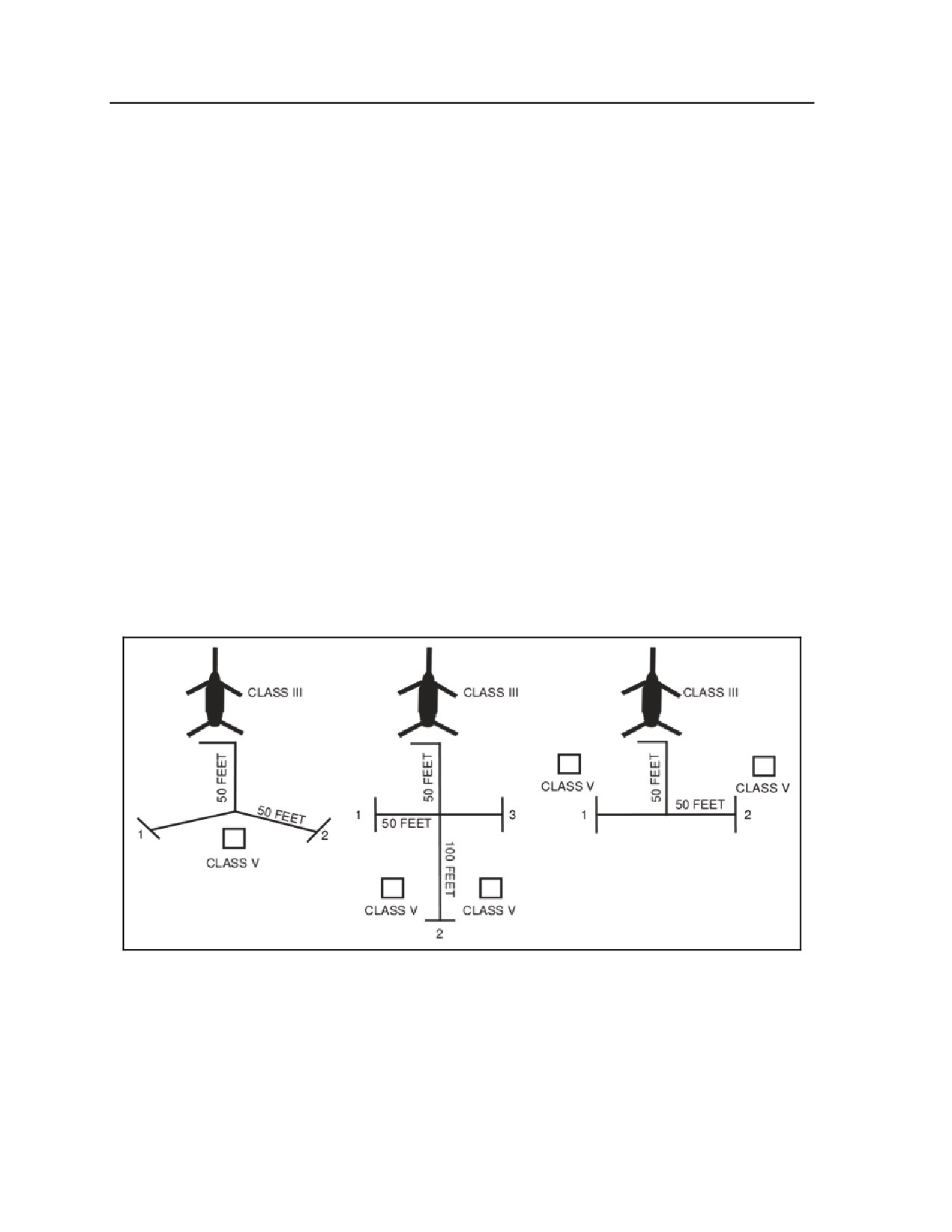
4-103. The CH-47, equipped with improved ERFS located in the heavy bay, can operate up to four refuel
points. The system can be equipped with two 800-gallon fuel cells. The Fat Cow site configuration is
depicted in figure 4-11.
Figure 4-11. CH-47 Fat Cow forward arming and refueling point site
AIRCRAFT RECOVERY
4-104. Combat operations result in a greater demand for operational aircraft and a large increase in flying
hours. These increased requirements are further complicated by higher attrition and battle damage, which
create shortages of repair parts and replacement aircraft. To offset these shortages and maintain an
4-20
FM 3-04.111
7 December 2007
Aviation Battalion Task Force Operations
effective combat aviation force, the rapid recovery and repair of aircraft is essential. The CH-47 is the only
helicopter able to recover every aircraft in the U.S. Army inventory, including itself.
CASUALTY EVACUATION
4-105. If the casualty rate exceeds the capabilities of aeromedical evacuation elements, cargo helicopters
may be employed for CASEVAC. CH-47s can be employed using several different configurations for
CASEVAC operations.
z
Seats folded. With seats folded up, the number of casualties transported is dependent upon the
type of casualty (ambulatory versus litter) and severity of injuries and wounds.
z
Seats down. With seats folded down, the lifting capacity for patients is reduced to 30-seated
ambulatory casualties transported with an accompanying medic, while litter patients can be
placed on the floor as directed by the aircrew.
z
Litter configuration. CH-47s can be equipped with a litter kit giving them the capacity to
transport 24 litter patients. In this litter configuration, the CH-47 seats are replaced with six tiers
of litters, four litters high. The CH-47 litter support kit consists of poles and supports only.
Medical assets supporting the unit must provide litters and tie-down straps.
AIR AMBULANCE MEDICAL COMPANY
4-106. Army AAMCs are the only dedicated aeromedical assets within the Department of Defense
(DOD). In both the DS and GS roles, FSMT efforts should not be rigidly tied to any area or supported unit.
FSMTs must retain flexibility in employment.
4-107. Air ambulance assets are a limited resource and are located where they are most needed. This can
be with troops most often engaged in combat, high population density areas, area of famine or disease with
high civilian casualties, refugee areas, or geographically centralized locations.
4-108. FSMTs performing area or GS accomplish the patient transfer mission that develops between
FSMTs and MTFs, between MTFs, and between MTFs and intertheater movement locations. These
FSMTs must also be responsible for the DS mission within their immediate vicinity.
4-109. Air ambulance headquarters may collocate with the supported BCT, AHC or TF CP as required.
Task organization of aeromedical evacuation assets requires careful planning to ensure adequate resources
(maintenance, flight operations and communications capabilities) are provided by the ABTF headquarters
or appropriate supported element. Refer to FM
1-113 for additional information on air ambulance
employment.
7 December 2007
FM 3-04.111
4-21
This page intentionally left blank.
Chapter 5
Logistics Operations
This chapter describes sustainment (maintenance and logistics) doctrine with a focus
on the ASB, and how the battalion optimizes organizational effectiveness while
balancing sustainability, mobility, and survivability against requirements for rapid
strategic deployability. It also provides a general explanation of TTPs that can be
employed to exploit the ASB's range of logistics capabilities and ensure versatility
across the full range of potential requirements.
SECTION I - INTRODUCTION
5-1. Today’s OE significantly impacts Army
logistics. In a theater of operations with combat
Contents
forces widely distributed and operating in
Section I - Introduction
5-1
noncontiguous areas, support must be provided in
Section II - Logistics Fundamentals
5-6
innovative ways, leveraging new technologies and
ideas.
Section III - Maintenance
5-12
Section IV - Aviation Sustainment
5-2. Current OEs place mid-grade and junior
Units
5-16
leaders in complex situations, with the potential of
Section V - Standard Army Management
having international, informational, and political
Information Systems Architecture
5-27
ramifications. It is in these complex situations that
leaders must recognize and solve challenging tactical action issues.
OPERATIONS
5-3. The aviation brigade receives sustainment from various elements depending on the logistics
organizational structure at the brigade and division sustainment brigade. Brigade and battalion XOs are
responsible to their respective commanders for overwatching sustainment operations and inserting
themselves where appropriate to ensure success. S-4s identify logistics requirements for the maneuver plan
and provide them to the FSC, ASC, or coordinate with the ASB commander as appropriate.
COMMAND RESPONSIBILITY
5-4. The aviation brigade commander ensures sustainment is provided not only for his organic and
attached elements, but also for any elements OPCON to or supporting units. The brigade S-4 coordinates
logistics for the attachments and verifies who provides sustainment and how to request support for
attachments. When a unit is attached to the aviation brigade, the attachment should bring an appropriate
modular unit of logistics assets.
5-5. These assets are controlled by the unit they support. They can be attached to the ASB, the aviation
battalion’s FSC, or the aviation maintenance company in accordance with attachment instructions. The
attached unit leader must coordinate with the brigade S-1 and furnish him or her a copy of the unit battle
roster as well as provide the status of all key elements of equipment to the brigade S-4. Thereafter, the
attached unit submits reports and requests support according to the aviation brigade SOP.
7 December 2007
FM 3-04.111
5-1

Chapter 5
PLANNING FOR LOGISTICS OPERATIONS
5-6. The brigade S-4, brigade surgeon, and ASB support operations officer (SPO), operating from their
respective CPs, monitor sustainment operations and ensure appropriate collaboration and synchronization
of support. They use the logistics estimate, a product of the logistics preparation of the battlefield (LPB), to
determine logistics capabilities, anticipate support requirements, identify and resolve shortfalls, and
develop support plans. In addition, they work with their respective S-2s to develop the enemy threat to
logistics operations from the IPB. They integrate all planning to develop, collaborate, and synchronize
logistics with maneuver and fire plans. Logistics planners must thoroughly understand the mission, tactical
plans, and commander’s intent and develop the LPB. This culminates during the MDMP with a fully
developed and integrated logistics/force health protection plan. Table 5-1 provides each MDMP step’s
inputs, actions, and outputs. Use of C2 products by the logistics planners and ASB commander is very
helpful for developing SU. Throughout this entire process, staff estimates are also used to assist with
maintaining the commander’s SU.
Table 5-1. Sustainment aspect of military decisionmaking process—inputs, actions, and
outputs
MDMP Step
Inputs
Actions
Outputs
Receipt of mission and mission analysis
Higher HQ WARNO or
Understand higher maneuver
Initial WARNO upon mission
OPORD.
plan.
receipt.
Facts from higher, lower, &
Conduct logistics staff estimate -
Logistics portion of mission
adjacent logistics planners.
organize & analyze facts.
analysis brief (end state analysis,
Higher HQ LPB & staff LPB
Identify specified/implied tasks.
logistics effects development).
products.
Determine & portray friendly &
Draft logistics radar frequency
Enemy COA from S-2.
threat INFOSYS capabilities &
interferometers.
HVTs by phase or critical
vulnerabilities.
Recommend logistics tasks ROE
event.
Translate status of logistics
guidance.
Facts from logistics assets.
assets into
Logistics CCIR/EEFI inputs.
Cdr’s initial logistics guidance.
capabilities/limitations.
Initial logistics/force health
Staff estimates.
Analyze effects of LPB on
protection rehearsal guidance.
Constraints & ROE.
sustainment.
CDR approves initial logistics or
Develop draft desired logistics
modifies.
effects.
CDR gives other sustainment
Identify logistics related CCIR &
guidance.
essential elements of friendly
WARNO after mission analysis
information (EEFI).
brief.
Identify logistics
constraints/restrictions.
Obtain CDR’s initial logistics
priorities.
COA development
See outputs from previous
Determine logistics tasks for
For each COA developed:
step.
each COA.
• Concept of support
Allocate logistics assets to
• ISR Plan
sustain.
Allocate logistics assets forces to
• Logistics affects
each IO task.
• IO execution timelines as
Identify requirements for
they pertain to logistics.
additional resources.
• Input to force protection
Integrate sustainment triggers
plan
with maneuver COA.
Analyze relative logistics combat
• Refined logistics tasks.
power.
Use battle calculus.
Assist S-2 in ISR plan
development to support logistics.
5-2
FM 3-04.111
7 December 2007

Logistics Operations
Table 5-1. Sustainment aspect of military decisionmaking process—inputs, actions, and
outputs
MDMP Step
Inputs
Actions
Outputs
Prepare logistics portion of
COA/sketch.
COA analysis & COA comparison
See outputs from previous
Wargame the brigade COA &
Final Drafts:
step.
integrated logistics plans vs.
Paragraph 4
enemy COAs.
Logistics annex.
ID coordination requirements to
produce synchronization matrix.
Synchronize logistics effects.
Finalize logistics tasks.
Modify/refine inputs as required.
Refine & test logistics plans.
COA approval & orders production staff supervision
See outputs from previous
Approval briefing.
Commander: Selects, modifies or
step.
Logistics plan briefed as part of
approves COA.
each COA.
Bde S-3: Issue WARNO as
Bde S-4 or ASB SPO presents
required.
logistics analysis.
Finalize logistics products.
Issue logistics plan & annexes with
OPORD.
Logistics planner’s backbrief.
Manage refinement.
Rehearsals.
Logistics digital planning tools
5-7. The LPB and MDMP are tools that enable commanders to see, understand, act, and finish decisively.
Commanders and battle staffs at all levels must have a thorough knowledge of these processes .
5-8. The aviation brigade’s organic ASB provides distribution-based, centralized logistics and is fully
digitally enabled with battle command sustainment support system (BCS-3), FBCB2, and movement
tracking system (MTS). These digital enablers assist in providing a logistics common operational picture
(LCOP) with communications linkages to the STAMIS. These systems enable the ASB support operations
section to gain and maintain oversight of logistics requirements. The increasing use of assured
communications and improvements in digital information technology provide the logistics operator and
unit S-4 with tools needed to tailor the logistics package (LOGPAC). Through near real-time information,
the aviation brigade staff and ASB staff are able to make timely adjustments in their support requirements.
5-9. The ASB commander, supported by his SPO and in conjunction with the aviation brigade S-1/S-4
and surgeon, closely monitors the implementation of the logistics concept of support as outlined in the
brigade OPORD’s logistics annex. The ASB commander adjusts logistics operations or shifts resources
within his unit to account for a change in METT-TC factors or to replace lost logistics capabilities.
Recommendations to surge logistics assets from units within the brigade, but not subordinate to the ASB,
or request higher echelon support are made to the brigade commander by the ASB commander and brigade
logistics staff.
LOGISTICS PREPARATION OF THE BATTLEFIELD
5-10. LPB is the process of gathering data against pertinent battlefield components, analyzing their impact
on logistics, and integrating them into tactical planning so that support actions are synchronized with
maneuver.
7 December 2007
FM 3-04.111
5-3
Chapter 5
5-11. LPB is a conscious effort to identify and assess those factors, which facilitate, inhibit, or deny
support to combat forces. Just as IPB is important to the conduct of actual combat operations, LPB is
equally important to sustaining the combat power of the force. Working together, leaders must synchronize
support actions with maneuver in a unified plan making logistics a factor in the success of a mission rather
than a cause of failure. In addition to METT-TC, LPB focuses on determining the status and impact of the
specific components that make up tactical logistics. It assesses how time and space requirements and
restrictions of the battlefield affect support.
5-12. The process requires tacticians to understand the data needed by logisticians for planning and
providing timely, effective support. It requires logisticians to understand the mission, tactical plan, and
battlefield's time and space implications for support.
5-13. It is a coordinated effort to prepare the battlefield logistically. The basic steps in systemizing the
process are—
z
Determine battlefield data pertinent to support actions.
z
Determine sources from which raw data can be derived.
z
Gather pertinent data.
z
Analyze collected data elements and translate them into decision information by assessing their
impact on the mission and competing COAs.
z
Integrate decision information into tactical planning by incorporating it in logistics estimates and
brigade or battalion (as appropriate) plans and orders.
5-14. LPB products include the following:
z
A logistics estimate.
z
A visualization of the pending battle and logistics activity required by phase of operation.
z
Anticipated logistics challenges and shortfalls, and their solutions.
z
How, when, and where to position logistics units to best support the tactical commander’s plan.
z
A synchronized tactical and logistics effort.
Logistics Estimate
5-15. A logistics estimate is an analysis of logistics factors affecting mission accomplishment. The key
concerns of logistics planners are the status of supply classes III, IV, and V; and the operational status of
critical generators of combat power such as infantry Soldiers, aircraft, tanks, BFTs, Stryker, and other units
that provide combat power. Logistics estimates at the combat battalion level are often not written, though at
the ASB and brigade written products include combat power charts, periodic updated briefings, or
commander’s updates. They are frequently formulated in terms that answer the following questions:
z
What is the current and projected status of maintenance, supply, and transportation?
z
How much of what supplies are needed to support the operation?
z
How will it be transported to where it is needed?
z
What external echelons above brigade (EAB) support is needed?
z
Can the requirements be met using host nation or throughput from EAB or are other techniques
such as aerial resupply necessary?
z
What are the shortfalls and negative impacts?
z
What COAs can be supported?
Reconstitution
5-16. Reconstitution is a set of actions the commander plans and implements to restore his unit to a desired
level of combat readiness commensurate with mission requirements and availability of resources.
Reconstitution is a total process. Its major elements are assessment, reorganization, and regeneration.
Although not a logistics function, reconstitution is often logistics intensive, especially regeneration.
Reconstitution decisions rest with the commander. The commander, with his staff’s support, assesses unit
effectiveness (refer to FM 100-9). He or she does not base his reconstitution decisions solely on facts,
5-4
FM 3-04.111
7 December 2007
Logistics Operations
figures, and STATREPs from subordinate units. His assessment relies also, and probably more importantly,
on other factors. These include—
z
Knowledge of his Soldiers.
z
Condition and effectiveness of subordinate commanders and leaders.
z
Previous, current, and anticipated situations and missions.
5-17. Planners must be prepared for mass casualties, mass destruction of equipment, and destruction or
loss of effectiveness of entire units. The aviation battalion or companies catastrophically depleted or
rendered ineffective are returned to combat effectiveness through this mission staging operation (MSO).
Reconstitution differs from sustaining operations and replenishment and sustainment operations in that it is
undertaken only when a unit is at an unacceptable level of combat readiness. Replenishment and
sustainment operations are routine actions to maintain combat readiness. Weapon system replacement
operations can be part of replenishment and sustainment operations.
Assessment
5-18. Assessment measures the unit's capability to perform a mission. Subordinate unit commanders assess
their units before, during, and after operations. If a commander determines his unit is no longer mission
capable even after reorganization, he or she notifies the aviation brigade commander. The aviation brigade
commander either changes the mission of the unit to match its degraded capability or removes it from
combat. Commanders can reconstitute their units by reorganization or regeneration to bring their units up
to the necessary readiness level for the next mission.
Reorganization
5-19. Reorganization is the action taken to shift resources within a degraded organization to increase its
combat power. Measures taken include cross-leveling equipment and personnel, matching operational
weapons systems with crews, or forming composite units. It can be conducted down to and including
company level. Depending upon the type of reorganization, the unit’s own assets or higher echelon
resources may be used.
5-20. Immediate battlefield reorganization is the quick and often temporary restoration of organizations
conducted during an operation; for example, reorganizing on the objective and implementing the
established succession of command is a quick method not requiring an MSO to achieve the desired results.
5-21. Deliberate reorganization is a permanent restructuring of the unit. It is the type of reorganization
considered during reconstitution planning. Deliberate reorganization is supported with higher echelon
resources (such as maintenance and transportation), and additional replacements and other resources may
be made available during a MSO. Deliberate reorganization must be approved by the parent-unit
commander one echelon higher than that reorganized. For example, the aviation battalion commander
cannot approve the deliberate reorganization of an attached company; however, the parent aviation
battalion commander or aviation brigade commander can.
Regeneration
5-22. Regeneration is incremental or whole-unit rebuilding through large-scale replacement of personnel,
equipment, and supplies; reestablishing or replacing essential C2; and conducting the necessary training for
the rebuilt unit. Regeneration is used when the unit has become combat ineffective.
5-23. The unit must be removed from combat to be regenerated during an MSO. The division or corps is
responsible for the regeneration of aviation battalions. Aviation brigade regeneration is a theater
responsibility. To regenerate a unit, the appropriate command must balance priorities for supplies,
equipment, or other logistics requirements to include medical, and task the appropriate support
organizations for needed support.
5-24. Aviation brigade regeneration could occur with redeployment back to its home station or an equally
suitable environment. This requirement places the brigade in a location to effectively receive requisite
7 December 2007
FM 3-04.111
5-5
Chapter 5
resourcing (personnel and equipment) and a stable environment to retrain. A new aviation brigade is
deployed to assume its mission requirements in the AO.
SECTION II - LOGISTICS FUNDAMENTALS
5-25. It is essential for all leaders, not just logisticians, to understand the fundamentals of supporting
military operations. By understanding how the logistician is trained, manned, and equipped for sustainment
operations, the supported commander will know what to expect. The following paragraphs discuss logistics
characteristics and methods of resupply.
LOGISTICS SUPPORT DURING COMBAT OPERATIONS
5-26. Sustainment operations are inseparable from decisive and shaping operations, although they are not
by themselves decisive or shaping. Sustainment operations occur throughout the AO, not just within the
support areas. Sustaining operations determine how fast forces reconstitute and how far they can exploit
success. At the tactical level, sustaining operations underwrite the tempo of the overall operation; they
assure the ability of the brigade to take immediate advantage of any opportunity.
5-27. To support sustainment operations, logistics units must be able to conduct combat operations
themselves. The enemy will use many different tactics to degrade the logistics infrastructure critical to
support military operations. Unfortunately, the Army does not always know which tactics will by chosen
by the enemy, so the aviation brigade’s logistics assets must be prepared to defeat or destroy the enemy to
mitigate enemy intent and action.
5-28. Aviation logistics units are equipped and manned to operate in a hostile environment while
accomplishing sustainment operations. All commanders must acknowledge the basic concept that as
security requirements increase, the ability to conduct sustainment operations decrease.
5-29. The aviation logistics commander must consider what level of force protection his unit can
accomplish while still performing sustainment and support operations; for example, destroy Level I, defeat
Level II with assistance, and employment of a TCF for Level III. This does not presume a 100 percent level
of sustainment operations can occur 100 percent of the time. Sustainment may fluctuate depending on
threat level and enemy operations. If the enemy threat is stronger than the ability of the aviation logistics
unit to destroy or defeat, then the commander knows additional forces are required to sustain logistics
operations at the level desired or risk their destruction.
5-30. Aviation logistics leaders must understand the concepts of battle command as discussed in FM 6-0.
This requires that logistics Soldiers gain and sustain competency in executing individual and collective
level combat tasks required for their unit and its associated OE.
5-31. Maneuver commanders must be willing to allocate combat power as an essential part of the mission
to defend high risk aviation logistics units, and open and maintain ground and aerial LOCs as necessary.
This may take the form of maneuver unit(s) escorting logistics convoy attaching a maneuver unit to
reinforce perimeter defense, or occupying an area with sufficient force for a stated period of time to
eliminate an air or ground threat.
5-32. The implied task for the aviation logistics commander is to possess the requisite skills to integrate
the maneuver commander’s forces into his security plan. All logistics leaders must be capable of defending
an assigned AO by employing organic assets. As appropriate, the aviation logistics commander should
coordinate with the aviation brigade for assistance in development of the area defense plan.
5-33. Aviation logistics leaders and their Soldiers must know how to execute the tactical enabling
operations of road marches and tactical resupply convoy or LOGPACs.
LOGISTICS DOCTRINE FOR THE AVIATION BRIGADE
5-34. One goal of a transformed logistics system is to reduce reliance on stockpiles and static inventories
located at each echelon that was characteristic of previous Army supply-based systems. In addition, the
5-6
FM 3-04.111
7 December 2007
Logistics Operations
reduction of large stockpiles has assisted the accuracy of reporting by the user and logistician within their
assigned STAMIS system.
5-35. This does not mean there are no on-hand supplies within the aviation brigade. For example, the unit
has limited combat spares (comprised of authorized stockage list [ASL] items, prescribed load list (PLL),
shop, and bench stock, as appropriate). Hence, once the request is submitted, it is expected to be satisfied
in a timely manner. Use of the BCS-3 provides accurate and timely COP for logistics actions.
5-36. This type of logistics system combines a COP for logistics actions and its capabilities with efficient,
yet effective delivery systems to form a seamless distribution pipeline. In essence, the supply pipeline
becomes part of the warehouse representing inventory in motion, thereby reducing, but not eliminating,
both organizational and materiel layering in forward areas.
5-37. Logisticians control the destination, speed, and volume of the distribution system. In-transit visibility
(ITV), total asset visibility (TAV), advanced materiel management, and advanced decision support system
technology provide logisticians with access and visibility over all items within the distribution pipeline.
This visibility allows them to redirect, cross-level, and mass logistics assets more effectively in support of
the commander's intent. Logisticians also maintain SU of the OE via the BCS-3, greatly facilitating
planning and execution.
5-38. The logistics system relies on reduced order to receipt time to produce efficiency, but is designed
with an overall intent to be effective in a combat environment. A goal of distribution-based logistics is
direct throughput from the theater’s sustainment brigade to the aviation brigade’s ASB or, as needed, to the
FSC or aviation maintenance company in the aviation battalion. Throughput distribution bypasses one or
more echelons in the supply system to minimize handling and speed delivery to forward units. Improved
materiel management systems allow supplies to be tailored, packaged into configured loads for specific
supported units. This is based on a specific time and location point of need, and synchronized through
distribution management channels based on the combat commander's mission and OPTEMPO.
5-39. Improved delivery platforms, such as the palletized load system and container roll in/roll out
platform are used to deliver materiel to support units. Using ITV/TAV, delivery is tracked and managed
from higher echelons to points as far forward as possible. Additional enablers include advanced satellite
based tracking systems, movement tracking systems (MTSs), and radio frequency identification. Radar
tracking station tags provide detailed distribution platform interrogation of items/material/stocks that, in
turn, provide detailed asset visibility to the distribution system managers and forward units. This tracking
much improves the materiel management system. BCS-3 greatly assists in this process.
5-40. Lastly, a secure intermediate staging base located in close proximity to the area of responsibility may
be required to conduct rapid resupply when needed. All these aforementioned methodologies allow
modular logistics units to focus on their supported units while conducting security operations.
ORGANIZATIONAL DESIGN OF THE SUSTAINMENT BRIGADE
5-41. A sustainment brigade conducts EAB replenishment operations to the aviation brigade. The
sustainment brigade performs the functions of COSCOMs, DISCOMs, and ASGs.
5-42. The sustainment brigade has a command and staff structure capable of providing logistics
management at the tactical and operational level. This includes providing an aviation brigade with external
support to area support or the unassigned areas on a noncontiguous battlefield. In support of an aviation
brigade, the sustainment brigade staff coordinates with the division Assistant Chief of Staff-Logistics (G-4)
to plan and direct sustainment operations. Figure 5-1, page 5-8, illustrates the general structure of a
sustainment brigade.
7 December 2007
FM 3-04.111
5-7
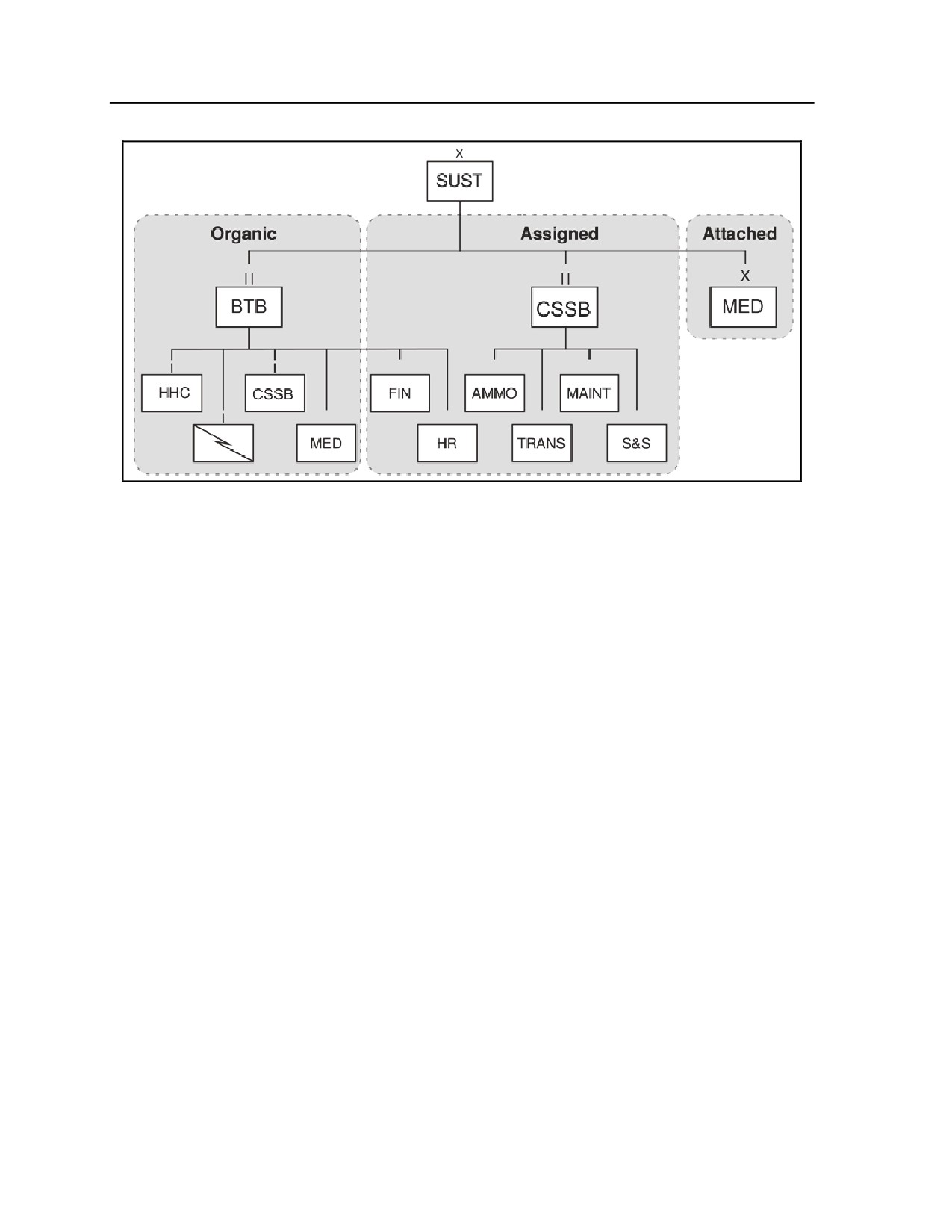
Chapter 5
Figure 5-1. Example organization of the sustainment brigade
AVIATION BRIGADE LOGISTICS DESIGN
5-43. Preplanned pauses in battle rhythm allow combat forces to replenish routinely. Pulse operations
include movement from the decisive operations zone to MSOs and redeployment to the decisive operations
zone.
5-44. Aviation logistics organizations are designed to place the right logistics resources at the right
location at the right time. Aviation logistics organizations primarily consist of an ASB within the aviation
brigade at division and corps level, aviation support platoon at the theater level, and aviation maintenance
company and FSC with each operational aviation battalion. These units collectively form the framework
for aviation logistics in the Army’s redesigned force structure.
5-45. In the area of logistics organization and C2, the following is true for the aviation brigade:
z
The ASB commander and battle staff manage the change from legacy push to talk C2 systems to
the digitized C2 architecture.
z
The aviation brigade S-4, ASB, and battalion S-4s use the BCS-3 to achieve the LCOP.
z
FSCs and aviation maintenance companies are organic to and logistics providers for aviation
brigade battalions.
z
The ASB is organized and equipped to support split-based sustainment and security operations.
z
The ASB has a class IV storage capability at its ATP, which enables establishing an ammunition
transfer holding point (ATHP).
z
The ASB’s ground maintenance capability primarily supports the ASB’s assigned companies
and aviation brigade headquarters. The ASB’s ground maintenance capability provides limited
or no back-up to the FSCs or aviation maintenance companies within the brigade’s aviation
battalions.
z
The ASB has a Level I enhanced medical capability with its organic medical platoon.
z
The ASB has a combat service support automation management office (CSSAMO) to support
the aviation brigade logistics automation systems.
5-8
FM 3-04.111
7 December 2007
Logistics Operations
AVIATION BATTALION FORWARD SUPPORT COMPANY
5-46. An FSC is assigned to each operational aviation battalion and consists of a headquarters platoon,
distribution platoon, and ground maintenance platoon. The FSC is designed to provide ground, air, missile,
and above ground support equipment systems support; refueling and rearming support; and necessary
logistics support. The FSC coordinates with the ASB for additional logistics as required. Each of the
FARPs can be task organized to support continuous operations by providing support for maintenance,
armament, and rearming and refueling. The FSC also maintains 2 days of supply (DOSs) of class I,
provides field feeding and distribution support, maintains class IX (ground) repair parts, and conducts
ground maintenance, while maintaining one combat load of class III (B) and class V for its supported
battalion.
LOGISTICS CHARACTERISTICS
5-47. The Army has developed basic logistics fundamentals for supporting military operations. How well
the combat commander emphasizes accurate and timely reporting and incorporates logistics leaders into the
planning and preparing process impacts success or failure. The following paragraphs discuss logistics
characteristics and methods of resupply. The commander on the ground must always plan and prepare for
mission execution based on his own mission analysis.
5-48. The combat commander succeeds or fails by how well the logistics operators on the battlefield
understand and adhere to the logistics characteristics as discussed in FM 4-0. The logistics characteristics
are—
z
Responsiveness.
z
Simplicity.
z
Flexibility.
z
Attainability.
z
Sustainability.
z
Survivability.
z
Economy.
z
Integration.
PULSED LOGISTICS
5-49. Support that does not come in a continuous stream but arrives in distinct packages is called pulsed
logistics. Pulsed LOGPACs include the support units, as well as engineers, air and missile defense, and
combat units for security—a combined arms approach for logistics support. Pulsed logistics assist combat
commanders in maintaining a high degree of combat power, while at the same time reducing the
requirement on logistics units or their supported units to secure line of communications (LOC) at all times
and in all places within the OE.
5-50. Pulse operations are used where division and corps operations allow for cycling of maneuver BCTs
to temporary bases in which the brigade rests, refits, and receives large quantities of supplies. Hence, pulse
operations are used so maneuver units pulse in and out of contact to be replenished and returned to the
fight, or readied for another mission. Pulsed logistics are especially important when sustaining combat
units widely distributed over a noncontiguous battlefield or a battlefield with LOCs that can only be
secured temporarily.
METHODS OF DISTRIBUTION
5-51. Units use voice and digital means to request resupply and report status. The method used is
determined after an analysis of the factors of METT-TC. The three distribution methods or resupply are—
z
Supply point distribution. Supply point distribution requires unit representatives to move to a
supply point to pick up supplies using their organic transportation.
7 December 2007
FM 3-04.111
5-9
Chapter 5
z
Unit distribution. Unit distribution provides delivery of supplies directly to the unit. A unit
representative meets the resupply package at the logistics resupply point and guides the package
to the unit’s position. The ASB may use logistics convoys to conduct unit distribution
operations.
z
Throughput distribution. Shipments bypass one or more echelons in the supply chain and
speed delivery forward. Throughput is more responsive to the user, provides more efficient use
of transportation assets, and supplies are handled or transloaded less. Throughput to forward
areas leverages configured loads, containerization, information, force structure design,
technological enablers, and C2 relationships to deliver sustainment from the operational level
directly to the customer or its supporting unit. Throughput is used frequently to resupply FARP
operations.
SUPPLY OPERATIONS
5-52. Supply operations involve acquisition, management, receipt, storage, and issue of all classes of
supply except class VIII. FM 3-04.500, FM 4-0, joint publication (JP) 4-0, JP 4-03, and FM 10-1 give
more details on supply operations.
Class I (Subsistence)
5-53. The class I supply system during the initial phase of an operation pushes rations. Personnel strength,
unit location, type of operations, and feeding capabilities determine the quantities and types of rations
pushed forward. As the battlefield stabilizes, the supply system converts to a pull system. Rations are
throughput as far forward as possible.
5-54. The brigade S-4 generates ration replenishment requests for basic loads and monitors operational
ration requests. Requests are based on personnel strength. Class I ration requests are consolidated by the
battalion S-4 sections and forwarded to the aviation brigade S-4 or appropriate support area if operating
independently. Extra rations usually are not available at distribution points; therefore, ration requests must
accurately reflect personnel present for duty, including attached personnel. The brigade S-4 section draws
rations from the distribution point and issues them to subordinate units.
Classes II, III (Packaged), IV
5-55. Classes II, III, and IV construction materials are handled in a manner similar to class I. Requisitions
originate at the brigade unless a subordinate unit is operating under another headquarters. Normally, the
materiel management center (MMC) authorizes shipment to the supply point in the support area via unit
distribution. The items are then distributed to the battalions using supply point distribution. In some cases,
the items may be throughput from the division, corps, or theater to subordinate battalions.
Class III (Bulk Petroleum, Oils, and Lubricants)
5-56. The basic load of class III bulk is the hauling capacity of the unit's fuel vehicles including the fuel
tanks of unit vehicles. Topping off aircraft, vehicles, and equipment when possible, regardless of the fuel
level, is essential to continuous operations.
5-57. Units normally use fuel forecasts to determine bulk petroleum, oils, and lubricants
(POL)
requirements. Battalions estimate the amount of fuel required based on projected operations, usually for the
period covering 72 hours beyond the next day. Battalion S-4s forward requests through the brigade S-4 to
the appropriate MMC. Units draw bulk POL from the support area class III supply point by unit
distribution. Fuel trucks return to battalion areas either as a part of the LOGPACs or to refueling points in
FARPs.
5-58. A key exception to this principle is refuel-on-the-move operations. Although these operations may
use unit assets, typically they involve equipment of the supporting fuel unit. The purpose is to ensure the
supported unit's vehicles and bulk fuel assets are topped before critical phases of an operation.
5-10
FM 3-04.111
7 December 2007
Logistics Operations
5-59. Class III bulk for the aviation brigade is delivered by sustainment brigade assets. The sustainment
brigade can store a one-day supply of class III bulk. The fuel is stored and distributed from collapsible
bladders or 5,000-gallon tanker trailers. Class III bulk normally is delivered to the ASB, and routinely
delivered by the sustainment brigade as far forward as the aviation BSA. However, it may be delivered as
far forward as FARPs in certain situations.
Class V (Conventional Ammunition)
5-60. Conventional ammunition is the standard ammunition associated with conventional weapons such as
M240 machine-guns for the UH-60 and weapon systems mounted on the AH-64 and OH-58D. These
classes include standard explosives such as hand grenades, claymores, C-4, and pyrotechnics (flares, star
clusters, and smoke grenades). Special ammunition, which generally does not apply to the aviation brigade,
includes nuclear ammunition, special missile warheads, and rocket motors.
5-61. Normally, the S-4 requests ammunition from the appropriate MMC. Ammunition managers use
combat loads rather than DOSs. Combat loads measure the amount of class V a unit can carry into combat
on its weapons system. Once the request has been authenticated, the ammunition is distributed to the
battalion FSC by the ASB’s distribution company.
Required Supply Rate
5-62. The RSR is the estimated amount of ammunition needed to sustain operations of a combat force
without restrictions for a specific period. RSR is expressed in rounds per weapon per day. This RSR is
used to state ammunition requirements. The S-3 in conjunction with the S-4 normally formulates the
brigade RSR, but it is often adjusted by higher headquarters.
Controlled Supply Rate
5-63. The controlled supply rate (CSR) is the rate of ammunition consumption (expressed in rounds per
day per unit, weapon system, or individual) that can be supported for a given period. It is based on
ammunition availability, storage facilities, and transportation capabilities. A unit may not exceed its CSR
for ammunition without authority from higher headquarters. The S-4 compares the CSR against the RSR;
then remedies shortages by requesting more ammunition, sub-allocating ammunition, cross-leveling, or
prioritizing support to subordinate units. The commander establishes CSRs for subordinate units.
Basic Load
5-64. Basic load is the quantity of ammunition authorized by the theater commander for wartime purposes
and required to be carried into combat by a unit. The basic load provides the unit with enough ammunition
to sustain itself in combat until the unit can be resupplied. The unit basic load (UBL) may not be the
appropriate load to conduct operations based upon contingencies. Any deviation from the UBL is requested
early for approval and resourcing.
Combat Load
5-65. Combat load is the quantity of supplies such as fuel or ammunition carried by the combat system or
Solider into combat.
Class VI (Personal Demand Items)
5-66. Class VI supplies may be made available through local procurement, transfer from theater stocks, or
requisitioning from the Army and Exchange Service. Available shipping space dictates class VI supply to
theater. Class VI items are personal care items, candy, and other items for individual consumption. Health
and comfort items (formally referred to as ration supplement sundry packages) are class VI supply items
managed by the Defense Personnel Supply Center. They are issued through the standard supply system
(normally class I supply channels) without cost to Soldiers in the early stages of a deployment. They
7 December 2007
FM 3-04.111
5-11
Chapter 5
contain items such as disposable razors, toothbrushes, toothpaste, and other personal care items. Defense
Logistics Agency Regulation 4145.36 contains additional information on these packages.
Class VII (Major End Items)
5-67. Class VII supplies consist of major end items such as vehicles and aircraft. Because of their
importance to combat readiness and high costs, class VII items usually are controlled through command
channels and managed by the supporting MMC. Each echelon manages the requisition, distribution,
maintenance, and disposal of these items to ensure visibility and operational readiness. Units report losses
of major items through both supply and command channels. Replacement requires coordination among
materiel managers, class VII supply units, transporters, maintenance elements, and personnel managers.
Class IX and Class IX (A) (Repair Parts)
5-68. The division MMC normally manages class IX. Within the battalions, the ASCs maintain bench
stock and PLL. ASL items are maintained at the ASB level.
5-69. Class IX requisitions begin with the unit filling requisitions from its benchstock, shoptstock, or PLL.
If the item is not on hand or stocked or at zero balance, the requisition is passed to the supply support area
(SSA). This unit fills the request from its ASL stocks or passes the requisition to the MMC. The ground
maintenance sections of aviation units normally maintain class IX ASL for ground equipment.
SUPPORT BY HOST NATION
5-70. Logistics support and transportation may be provided by host nation organizations and facilities.
Common classes of supply may be available and obtained from local civilian sources. Items may include
barrier and construction materials, fuel for vehicles, and some food and medical supplies. Requisition and
distribution are coordinated through logistics and liaison channels.
SECTION III - MAINTENANCE
PRINCIPLES
5-71. Maintenance is a combat multiplier. When enemy forces have relative parity in numbers and quality
of equipment, the force that combines skillful use of equipment with an effective maintenance system has a
decisive advantage. Such a force has an initial advantage in that it enters battle with equipment likely to
remain operational longer. A subsequent advantage is it can repair damaged equipment, make it
operational, and return it to the battle faster.
5-72. The maintenance system is organized around forward support. All damaged or malfunctioning
equipment should be repaired onsite or as close to the site as possible.
SUPPORT SYSTEM STRUCTURE
5-73. The maintenance support system is a two-level structure—defined as field maintenance and
sustainment maintenance. Field maintenance units concentrate on the rapid turnaround of equipment to the
battle, while sustainment-level maintenance units repair and return equipment to the supply system.
Field Maintenance
5-74. Field maintenance is performed by aviation brigade personnel. Aviation battalions perform
maintenance within their capability both in the flight companies and within their internal aviation
maintenance companies. They are limited by sets, kits, outfits, and tools to keep them responsive and
flexible, thus making them more agile. Battalions are authorized to perform unit maintenance detailed in
the technical manuals (TMs) in accordance with AR 750-1. The ASC contained within the ASB is
5-12
FM 3-04.111
7 December 2007
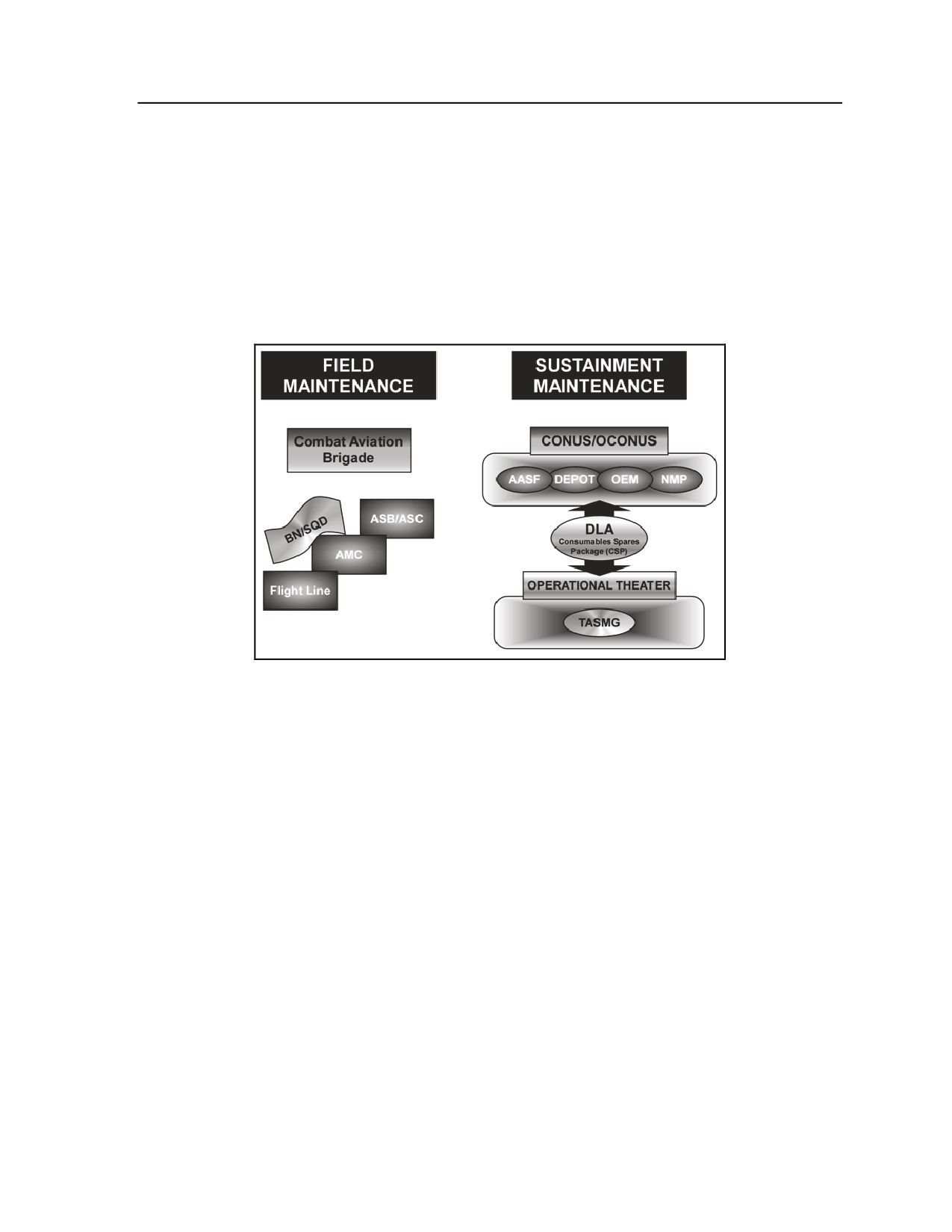
Logistics Operations
equipped with enhanced sets, kits, outfits, and tools to perform intermediate maintenance detailed in
aircraft TMs. The ASC is authorized to perform intermediate maintenance in accordance with AR 750-1.
Sustainment Maintenance
5-75. Sustainment maintenance is performed within field repair activities, Army Depot, Aviation
Classification and Repair Depot and original equipment manufactures either by contracted representatives
or within their factories. On a case by case basis, the aviation brigade may obtain authorization via the
assigned Aviation and Missile Command logistics assistance representative to affect repairs classified as
depot in accordance with aircraft TMs. Army depots are often positioned at fixed bases within the CONUS.
A graphic depiction of two-level maintenance, which also illustrates the relationship of field to sustainment
maintenance, is shown in figure 5-2.
Figure 5-2. Two-level aviation maintenance and sustainment
VEHICLE AND GROUND EQUIPMENT MAINTENANCE AND
RECOVERY OPERATIONS
MAINTENANCE SUPPORT STRUCTURE
5-76. Ground maintenance support for each battalion is provided by their organic FSC. The ASB’s
headquarters and support company (HSC) provides ground maintenance support to the aviation brigade
HHC and ASB. Sustainment level units provide maintenance assistance as required.
PREVENTIVE MAINTENANCE CHECKS AND SERVICES
5-77. The operator or crew and organizational maintenance personnel perform unit maintenance that
includes scheduled and unscheduled unit-level maintenance, repair, and preventive maintenance checks
and services
(PMCS). PMCS maintains the operational readiness of equipment through preventive
maintenance and early diagnosis of problems.
FIELD MAINTENANCE
5-78. Field maintenance units are tailored to the weapons systems of the supported unit and provide
maintenance with a multi-capable mechanic. They provide extensive maintenance expertise and component
7 December 2007
FM 3-04.111
5-13
Chapter 5
replacement and limited component repair. This level of maintenance is normally found in the HSC of the
ASB and FSC of the aviation battalion.
SUSTAINMENT MAINTENANCE
5-79. Sustainment maintenance is characterized by extensive component repair capability. It repairs
damaged systems for issue through the supply system as classes II, VII, or IX items. This level of
maintenance is normally found at theater or depot level.
VEHICLE AND EQUIPMENT RECOVERY PROCEDURES
5-80. The recovery manager coordinates recovery operations with the overall repair effort to best support
the commander's priorities and tactical situation. FM 4-30.31 describes the technical aspects of vehicle
recovery operations.
Recovery Principles
5-81. When the unit recovers its equipment but lacks the physical means to recover an item, it requests
assistance from the supporting maintenance element. Management of recovery operations is centralized at
the battalion whenever possible.
5-82. Maintenance personnel repair equipment as far forward as possible within the limits of the tactical
situation, amount of damage, and available resources. Recovery vehicles return equipment no further to the
rear than necessary, usually to the maintenance collection point of the supporting maintenance unit.
5-83. Recovery missions that might interfere with combat operations, or compromise security, are
coordinated with the tactical commander.
AVIATION MAINTENANCE OPERATIONS
5-84. The aviation maintenance company within each battalion provides unit maintenance above the
capability of the flight companies. The ASC assigned to the ASB provides primarily intermediate
maintenance and secondarily backup unit maintenance to the aviation brigade’s battalions.
5-85. Aviation maintenance is performed on a 24-hour basis. Emphasis is on component replacement
rather than repair. Such replacement requires increased stockage of line replaceable units (LRUs) and
quick change assemblies. Damaged or inoperable aircraft requiring time-consuming repair actions are
handled in more secure areas toward the rear. FM 3-04.500 provides more detail.
SCHEDULED MAINTENANCE
5-86. Commanders avoid situations that cause an excessive number of aircraft to require scheduled
maintenance at the same time, or they avoid situations in which scheduled maintenance must be overflown.
All imminent scheduled maintenance should be accomplished before deployment or initiation of surge
operations. Refer to FM 3-04.500 for further information concerning scheduled maintenance flow.
PHASE AND PROGRESSIVE PHASE MAINTENANCE
5-87. Ongoing operations, training exercises, and deployments can have a major impact on readiness (for
example, flying too many aircraft into scheduled maintenance at a critical time). OPTEMPO, deployments,
training, and availability of resources (tools, maintenance personnel, repair parts, special equipment) must
be considered when planning phase maintenance (AH-64, CH-47, and UH-60) and progressive phase
maintenance (OH-58D) inspections. To facilitate phases in fast-moving operations, phases normally are
done at the ASB.
5-14
FM 3-04.111
7 December 2007