FM 3-04.111 Aviation Brigades (DECEMBER 2007) - page 1
FM 3-04.111
Aviation Brigades
DECEMBER 2007
DISTRIBUTION RESTRICTION: Approved for public release; distribution is unlimited.
Headquarters, Department of the Army
*FM 3-04.111
Field Manual
Headquarters
Department of the Army
No. 3-04.111
Washington, D.C., 7 December 2007
Aviation Brigades
Contents
Page
PREFACE
viii
Chapter 1
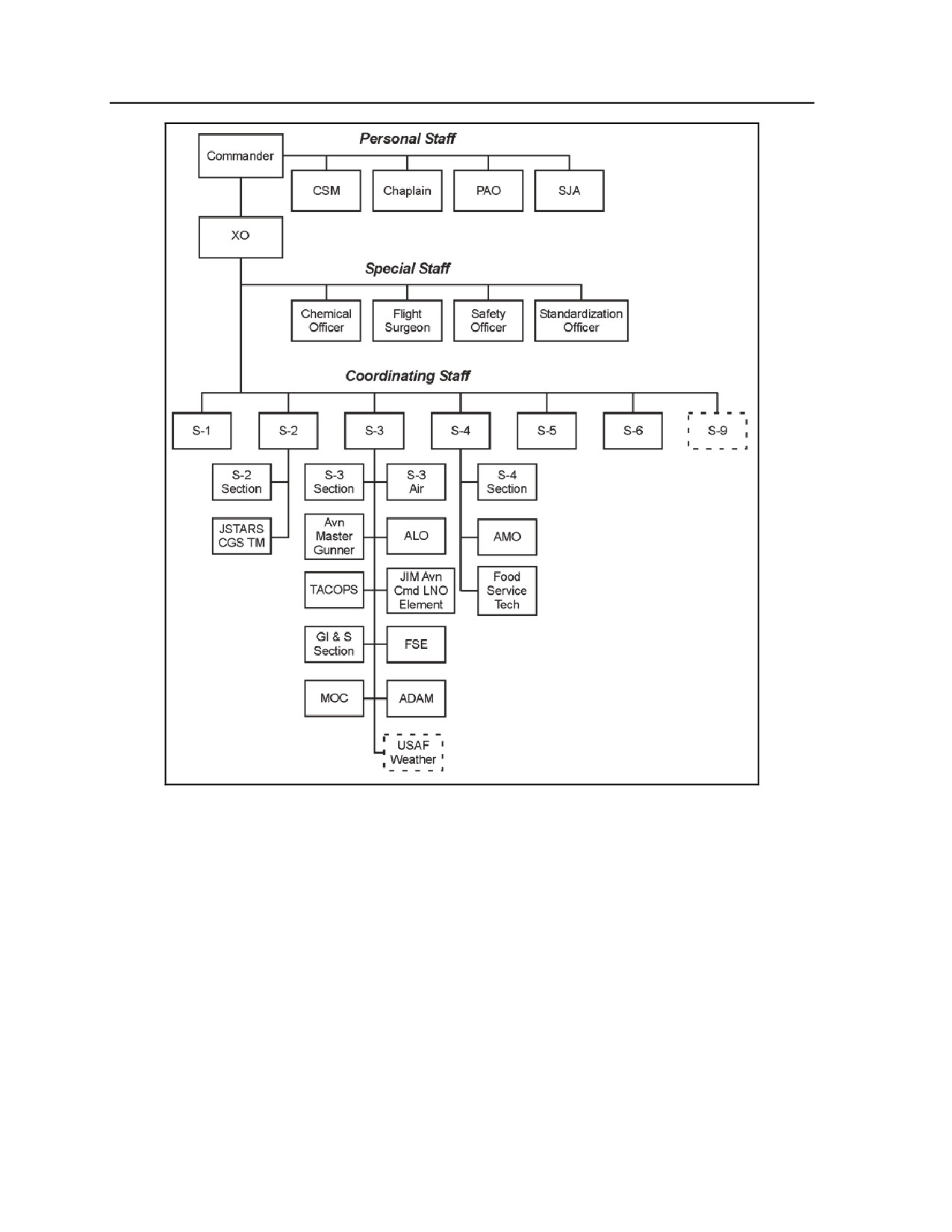
MISSIONS AND ORGANIZATION
1-1
Section I - Overview
1-1
The Spectrum of Conflict
1-1
Section II - Missions
1-3
Section III - Organization
1-4
Heavy, Medium, and Light Combat Aviation Brigades
1-4
COMBAT AVIATION BRIGADES (EXPEDITIONARY)
1-4
Theater Aviation Brigades
1-6
Subordinate Aviation Battalions
1-6
Chapter 2
COMMAND AND CONTROL
2-1
Section I - Overview
2-1
Command
2-1
Command and Control System
2-2
Battle Command
2-2
Section II - Brigade Command Group
2-3
Staff Organization
2-3
Personal Staff
2-5
Special Staff
2-6
Coordinating Staff
2-6
Section III - Brigade Aviation Element
2-13
Section IV - Aviation Liaison Teams
2-13
Section V - Aviation Brigade Command Posts
2-14
Main Command Post
2-14
Tactical Command Post
2-17
Section VI - Brigade Planning
2-18
Section VII - Aviation brigade communications
2-33
Distribution Restriction: Approved for public release; distribution is unlimited.
*This publication supersedes FM 3-04-111, 21 August 2003.
i
Table of Contents
Communication Nets
2-37
Section VIII - Command post survivability
2-39
Chapter 3
EMPLOYMENT
3-1
Section I - General
3-1
Types of Operations
3-1
Principles
3-3
Section II - Army Aviation Missions
3-5
Reconnaissance
3-5
Security
3-6
Attack
3-6
Movement to Contact
3-6
Air Assault
3-7
Air Movement
3-7
Command and Control Support
3-7
Aeromedical Evacuation
3-7
Casualty Evacuation
3-8
Personnel Recovery
3-8
Aviation Enabling Missions
3-8
Section III - Air-Ground Integration
3-9
Command and Control
3-10
Air-Ground Control
3-10
Section IV - Operations in Asymmetric Environments
3-10
Asymmetry
3-10
Threat
3-10
Training
3-11
Fratricide
3-11
Sustainment
3-11
Command and Control
3-12
Section V - Chemical, Biological, Radiological, and Nuclear
3-12
Contamination Avoidance
3-12
Protective Measures
3-12
Section VI - Special Environments
3-12
Urban Environment
3-13
Mountains and High Altitudes
3-14
Snow, Ice, and Extreme Cold Weather
3-15
Jungles
3-15
Deserts
3-15
Shipboard and Overwater Operations
3-16
Smoke and Obscurants
3-16
Section VII - Unmanned Aircraft Systems Operations
3-17
Reconnaissance, Surveillance, and Target Acquisition Operations
3-17
Concepts of unmanned aircraft system and Aviation Brigade Cooperative
Employment
3-17
Chapter 4
AVIATION BATTALION TASK FORCE OPERATIONS
4-1
Section I - General
4-1
ii
Fm 3-04.111
7 December 2007
Table of Contents
Fixed Base Operations
4-1
Split-Based Operations
4-1
Operational Overview
4-2
Command Relationships
4-2
Section II - Organization and Mission
4-2
Organization
4-3
Mission
4-3
Headquarters and Headquarters Company
4-4
Forward Support Company
4-4
Attack Reconnaissance Element
4-5
Assault Helicopter Company
4-6
Heavy Helicopter Platoon
4-7
Forward Support medical evacuation Team
4-8
Aviation Maintenance Company
4-9
Section III - In-Theater Operational Considerations
4-10
Actions Upon Notification
4-10
Special Considerations
4-11
Operational Requirements
4-11
Section IV - Task Organization Considerations
4-13
Synchronization of Assets
4-13
Section V - Unit Considerations
4-15
Battalion and Above
4-15
Company and Below
4-16
Section VI - Employment Principles
4-17
Aviation Battalion Task Force
4-17
Attack Reconnaissance Company/Troop
4-18
Assault Helicopter Company
4-18
Command Aviation Company
4-19
Heavy Helicopter Company
4-19
Air Ambulance Medical Company
4-21
Chapter 5
LOGISTICS OPERATIONS
5-1
Section I - Introduction
5-1
Operations
5-1
Section II - Logistics Fundamentals
5-6
Sustainment During Combat Operations
5-6
Logistics Doctrine for the Aviation Brigade
5-6
Organizational Design of the Sustainment Brigade
5-7
Aviation Brigade Logistics Design
5-8
Logistics Characteristics
5-9
Section III - Maintenance
5-12
Principles
5-12
Vehicle and Ground Equipment Maintenance and Recovery Operations
5-13
Aviation Maintenance Operations
5-14
Battlefield Management of Damaged Aircraft
5-15
Aviation Life Support System
5-15
Safety During Maintenance Operations
5-15
7 December 2007
FM 3-04.111
iii
Table of Contents
Section IV - Aviation Sustainment Units
5-16
Flight Company
5-16
Aviation Maintenance Company
5-16
Aviation Support Battalion
5-18
Section V - Standard Army Management Information Systems
Architecture
5-27
Standard Army Retail Supply System
5-28
Unit-Level Logistics Systems
5-29
Standard Army Maintenance System
5-29
Integrated Logistics Analysis Program
5-30
Defense Automatic Addressing System
5-30
Appendix A
READY, DEPLOY, AND REDEPLOY
A-1
Appendix B
COMMUNICATIONS
B-1
Appendix C
PERSONNEL RECOVERY OPERATIONS
C-1
Appendix D
ARMY AVIATION COMPOSITE RISK MANAGEMENT
D-1
Appendix E
AIRCRAFT CHARACTERISTICS
E-1
Appendix F
RULES OF ENGAGEMENT
F-1
Appendix G
BRIGADE COMMAND POST LAYOUT
G-1
GLOSSARY
Glossary-1
REFERENCES
References-1
INDEX
Index-1
iv
Fm 3-04.111
7 December 2007
Table of Contents
Figures
1-2
Figure 1-1. The spectrum of conflict and operational themes
1-2
Figure 1-2. Heavy, medium, and light combat aviation brigade
1-5
Figure 1-3. Combat aviation brigade (expeditionary)
1-6
Figure 1-4. Theater aviation brigade
1-7
Figure 1-5. Theater aviation brigade (composite)
1-7
Figure 2-1. Aviation brigade staff organization
2-4
Figure 2-2. Brigade planning responsibilities, aviation forces in support of a ground
unit
2-27
Figure 2-3. Brigade planning responsibilities, aviation forces under aviation brigade
control
2-28
Figure 2-4. Aviation brigade conducts an attack
2-29
Figure 2-5. Aviation brigade conducts an air assault
2-30
Figure 2-6. Aviation brigade supports ground brigade operations
2-31
Figure 2-7. Military decisionmaking process
2-32
Figure 2-8. Brigade command net
2-37
Figure 2-9. Brigade operations and intelligence net
2-38
Figure 2-10. Brigade administrative and logistics net
2-38
Figure 3-1. Unmanned aircraft system to aviation unit handover
3-18
Figure 3-2. Unmanned aircraft system support to Hellfire (horizontal)
3-19
Figure 3-3. Aviation unit to unmanned aircraft system handover
3-20
Figure 3-4. Aviation unit and unmanned aircraft system area of operations
3-21
Figure 4-1. Example of command relationship scenario
4-2
Figure 4-2. Sample aviation battalion task force (heavy) organization
4-3
Figure 4-3. Headquarters and headquarters company
4-4
Figure 4-4. Forward support company
4-5
Figure 4-5. Attack reconnaissance company
4-5
Figure 4-6. Attack reconnaissance troop
4-6
Figure 4-7. Assault helicopter company with general support aviation battalion Army
airborne command and control system augmentation
4-7
Figure 4-8. Cargo helicopter platoon
4-8
Figure 4-9. Forward support medical evacuation team
4-8
Figure 4-10. Sample aviation maintenance company
4-9
Figure 4-11. CH-47 Fat Cow forward arming and refueling point site
4-20
Figure 5-1. Example organization of the sustainment brigade
5-8
Figure 5-2. Two-level aviation maintenance and sustainment
5-13
Figure 5-3. Aviation support battalion
5-18
Figure 5-4. Standard Army management information systems architecture
5-28
Figure A-1. Army force generation training and readiness strategy
A-2
Figure A-2. Redeployment, reintegration, reconstitution, and retraining model
A-16
Figure B-1. Lower tactical internet communications
B-3
7 December 2007
FM 3-04.111
v
Table of Contents
Figure B-2. Upper tactical internet communications
B-4
Figure B-3. Upper and lower tactical internet interface
B-5
Figure B-4. Joint network node system diagram
B-6
Figure B-5. Joint network node components
B-7
Figure B-6. UH-60 command and control aircraft configuration
B-11
Figure B-7. Army airborne command and control system configuration
B-12
Figure B-8. Army airborne command and control system information flow
B-14
Figure B-9. Digitized communications
B-21
Figure B-10. Army battle command system 6.4 operational enhancements
B-22
Figure B-11. Example of an Army battle command system communications net
B-25
Figure B-12. Common Tactical Picture
B-26
Figure B-13. Client system—four main applications
B-32
Figure B-14. Data exchange within a command post local area network
B-32
Figure B-15. Example of a data exchange between command posts
B-33
Figure B-16. Example of staggered shift changes
B-41
Figure E-1. OH-58D weapons loading
E-3
Figure F-1. Example rules of engagement operation plan/operation
order/fragmentary order annex
F-2
Figure G-1. Main command post
G-3
Figure G-2. Current operations
G-4
Figure G-3. Fire support/protection
G-5
Figure G-4. Intelligence
G-5
Figure G-5. Movement and maneuver/protection
G-6
Figure G-6. Sustainment
G-6
Figure G-7. Command, control, communications, and computers operations
G-7
Figure G-8. Plans
G-7
Figure G-9. Tactical command post
G-8
Figure G-10. Current operations 1
G-8
Figure G-11. Current operations 2
G-9
vi
Fm 3-04.111
7 December 2007
Table of Contents
Tables
Table 1-1. Aviation brigade’s role in Army warfighting functions
1-3
Table 2-1. Planning phases
2-26
Table 2-2. Brigade and battalion planning responsibilities
2-26
Table 2-3. Threat levels
2-42
Table 3-1. Types of offensive operations
3-1
Table 3-2. Types of defensive operations
3-2
Table 3-3. Types of stability operations
3-2
Table 3-4. Types of civil support operations
3-2
Table 3-5. Command and support relationship to inherent responsibility
3-3
Table 5-1. Sustainment aspect of military decisionmaking process—inputs, actions,
and outputs
5-2
Table B-1. Joint aircraft potentially interoperable for communications or relay
B-15
Table B-2. Aircraft communications interoperability
B-15
Table B-3. Antenna configuration effect on operational range
B-17
Table B-4. Commander’s critical information requirement responsibilities
B-36
Table B-5. Example of a command post shift change brief
B-42
Table B-6. Update delivery comparison
B-43
Table B-7. Traditional versus digital
B-43
Table C-1. Personnel recovery terms
C-3
Table D-1. Example of fighter management tracking system
D-3
Table D-2. Example of a duty period/flight-hour matrix
D-4
Table D-3. Hazards to flight
D-5
Table E-1. OH-58D characteristics
E-1
Table E-2. Typical OH-58D helicopter ordnance loads
E-3
Table E-3. Comparison of Apache specifications
E-5
Table E-4. AH-64D characteristics
E-5
Table E-5. AH-64D weapons loads, weights, and radius
E-7
Table E-6. UH-60A/L aircraft characteristics
E-9
Table E-7. HH-60L specifications
E-12
Table E-8. CH-47D characteristics
E-13
Table E-9. Typical helicopter fuel expenditure rates and capacities
E-15
Table E-10. Typical helicopter load capacities
E-15
Table E-11. Typical planning weights for combat equipment and vehicles
E-16
Table E-12. C-12 specifications
E-17
Table E-13. C-23B/B+ specifications
E-18
Table F-1. Force protection measures
F-3
7 December 2007
FM 3-04.111
vii
Preface
Doctrine provides a military organization with unity of effort and a common philosophy, language, and
purpose. This document is the Army’s keystone doctrine for fighting and sustaining aviation brigades.
This field manual (FM) is intended for all aviation commanders, staffs, and any United States (U.S.) military
personnel expecting to conduct operations with Army aviation units. The operational concepts described in this
manual reinforce fundamental principles found in Army doctrine. It provides overarching doctrinal guidance
for employing aviation brigades in full spectrum operations and a foundation for developing tactics, techniques,
and procedures (TTP) in other/follow-on Army manuals.
FM 3-04.111 expands employment doctrine for aviation units and describes considerations for forming aviation
battalion task forces (ABTFs).
z
Chapter 1 focuses on aviation brigade organizations and missions and provides aviation brigade
fundamentals for reader consideration.
z
Chapter 2 provides doctrine for organizing operations’ command and control (C2) systems. It
provides the organization for command post (CP) structure and general guides for roles and
functions of CPs and their cells. Chapter 2 also describes duties of brigade leaders and staff.
z
Chapter 3 discusses employment of the aviation brigade, planning considerations, and air-
ground integration.
z
Chapter 4 focuses on the formation and employment of ABTFs. It provides considerations for
task organization based on mission and theater, and discussion of aviation task force
employment principles.
z
Chapter 5 discusses aviation brigade maintenance and logistics providing insight regarding the
need to optimize mission accomplishment while balancing sustainability, mobility, and
survivability. This chapter also focuses on the aviation support battalion’s (ASB’s) mission and
function.
The appendices provide guidance, procedures and recommendations concerning specific subjects and amplify
concepts referred to in the chapters. Appendix A discusses the Army Force Generation Model. Appendix E
provides basic aircraft characteristics.
This FM applies to aviation forces through all operational themes—peacetime military engagements to major
combat operations—and full spectrum operations—offensive, defensive, stability, and civil support.
This manual applies to the Active Army, the Army National Guard/Army National Guard of the United States,
and the United States Army Reserve unless otherwise stated. Procedures described herein are intended as a
guide and are not to be considered inflexible. Each situation in combat must be resolved by an intelligent
interpretation and application of the doctrine set forth herein.
Finally, FM 3-04.111 furnishes a foundation for subordinate doctrine, force design, materiel acquisition,
professional education, and individual and unit training.
The proponent of this publication is United States Army Training and Doctrine Command (TRADOC). Send
comments and recommendations on Department of the Army (DA) Form 2028 (Recommended Changes to
publications and Blank Forms) or automated link (http://www.usapa.army.mil/da2028/daform2028.asp ) to
Commander, United States Army Aviation Warfighting Center (USAAWC), ATTN: ATZQ-TD-D, Fort
Rucker, Alabama 36362-5263. Comments may be e-mailed to the Directorate of Training and Doctrine
(DOTD) at av.doctrine@us.army.mil. Other doctrinal information can be found on the Internet at Army
Knowledge Online (AKO) https://us.army.mil/suite/page/389908
This publication has been reviewed for operations security (OPSEC) considerations.
viii
FM 3-04.111
7 December 2007
Chapter 1
Missions and Organization
Aviation brigades are organized and equipped to support Army combined arms
operations as well as joint, interagency, and multinational (JIM) operations. This
chapter describes the mission and organization of each type of aviation brigade, and
the fundamentals common to all aviation brigades. The description for each type of
aviation brigade is based on the official table of organization and equipment (TOE).
Operationally, all units are resourced according to the modified table of organization
and equipment (MTOE). Actual organizations may vary from TOEs described in this
field manual.
SECTION I - OVERVIEW
1-1. The aviation brigade is organized to
synchronize operations of multiple aviation
Contents
battalions simultaneously. Because the brigade is
Section I - Overview
1-1
modular and tailorable, it can task organize as
required for reconnaissance, security, close combat
Section II - Missions
1-3
attack (CCA), interdiction attack, air assault, and air
Section III - Organization
1-4
movement operations in support of ground forces.
1-2. Aviation brigades must rely on realistic training and established standing operating procedures
(SOPs) to facilitate task organization and the addition or subtraction of subordinate units.
1-3. Throughout this manual, the term company includes troop and battalion includes squadron. Where
appropriate the terms troop and squadron may be used when specifically discussing attack reconnaissance
squadrons (ARSs), air cavalry squadrons (ACSs), or their respective subordinate units.
THE SPECTRUM OF CONFLICT
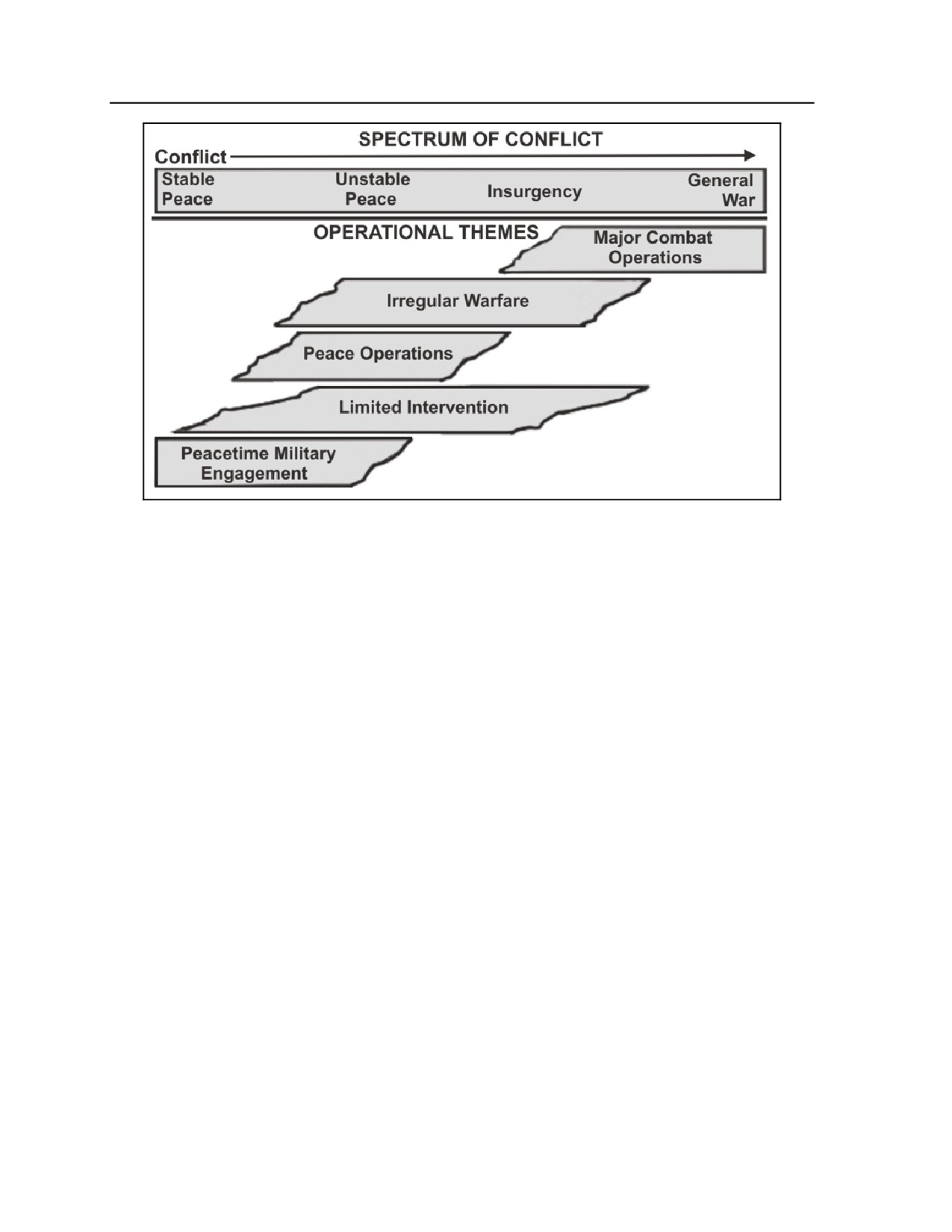
1-4. The spectrum of conflict, described in FM 3-0, ranges from stable peace to general war. See figure
1-1, page 1-2. Overlapping operational themes that occur along the spectrum are—
z
Peacetime military engagement.
z
Limited intervention.
z
Peace operations.
z
Irregular warfare.
z
Major combat operations (MCO).
1-5. Aviation brigades execute various missions along this spectrum according to the operational theme
characterized by the situation at the time. Generally, more than one operational theme is active at a given
time, causing differences in the way the missions are executed, according to appropriate rules of
engagement (ROE) and rules of interaction (ROI).
7 December 2007
FM 3-04.111
1-1
Chapter 1
Figure 1-1. The spectrum of conflict and operational themes
1-6. Operational themes may change over time for various reasons including planned phases; changes
caused by friendly, enemy, or neutral activity; revised political guidance; and unexpected opportunities.
Operational themes should not be confused with tactical tasks or activities. As a rule, operational themes
are too general for assigning missions. Rather, they describe the general characteristics of the major
operation, not the details of execution.
COMPONENTS OF FULL SPECTRUM OPERATIONS
1-7. There are four components of full spectrum operations—offensive, defensive, stability, and civil
support.
1-8. Offensive operations defeat and destroy enemy forces, and seize terrain, resources, and population
centers. They impose the commander’s will on the enemy and achieve decisive victory.
1-9. Defensive Operations defeat an enemy attack, buy time, economize forces, or develop conditions
favorable for offensive or stability operations
1-10. Stability Operations restore, establish, preserve, or exploit security and control over areas,
populations, and resources. Stability operations are executed outside the U.S.
1-11. Civil Support Operations are conducted to address the consequences of natural or manmade
disasters, accidents, and incidents within the U.S. and its territories.
Combat Power
1-12. Combat power is the actual application of force; the conversion of fighting potential into effective
action. Combat power is derived from the six warfighting functions (WFFs) tied together by leadership.
Aviation brigades combine WFFs to generate combat power. Table 1-1, page 1-3, provides examples of
tasks aviation brigades conduct to support each WFF.
1-2
FM 3-04.111
7 December 2007

Mission and Organization
Table 1-1. Aviation brigade’s role in Army warfighting functions
Army Warfighting
Aviation Brigade’s Role
Function
Movement & Maneuver
Support ground maneuver elements in contact through CCA.
Conduct air assault in support of search and attack operations.
Conduct movement to contact to locate and destroy enemy forces.
Intelligence
Conduct area reconnaissance to identify adequate routes and locate
bypasses.
Perform surveillance to confirm or deny enemy activity.
Fires
Utilize attack reconnaissance helicopters to conduct battle damage
assessment (BDA) of fires.
Designate for laser-guided artillery or other service munitions during
joint air attack team (JAAT) operations.
Sustainment
Perform aircraft recovery to include insertion of downed aircraft
recovery teams (DARTs) and ground maintenance contact teams.
Support forward arming and refueling point (FARP) emplacement and
resupply operations.
Perform casualty evacuation (CASEVAC) and aeromedical
evacuation (MEDEVAC).
C2
Provide battle command on the move (BCOTM).
Provide retransmission capability to air and ground commander.
Provide air traffic services (ATS).
Protection
Provide convoy security.
Conduct area security through counter mortar and rocket operations.
CONCEPT OF OPERATIONS
1-13. The aviation brigade participates in all three operations that are expressed in the commander’s
concept (refer to FM 3-0). These operations include—
z
Decisive operations that directly accomplish the mission assigned by higher headquarters and
conclusively determine the outcome of major operations, battles or engagements.
z
Shaping operations that create and preserve conditions for a successful decisive operation.
z
Sustaining operations that enable the above two operations by generating and maintaining
combat power.
SECTION II - MISSIONS
1-14. The role of the aviation brigade is to conduct and/or support ground maneuver through aviation
operations. The brigade must prepare to fight as a whole, support brigade combat teams (BCTs) using pure
or task-organized units, and conduct multiple independent missions requiring pure or task-organized units.
Each aviation brigade is tailored for specific missions; however, each accepts other organizations and
performs missions not necessarily defined in the TOE mission statement. Aviation brigade missions
include—
z
Reconnaissance.
z
Security.
z
Movement to contact.
z
Attack.
z
Air assault.
z
Air movement.
z
C2 support.
7 December 2007
FM 3-04.111
1-3
Chapter 1
z
Aeromedical evacuation.
z
Casualty Evacuation (CASEVAC).
z
Personnel Recovery (PR) operations.
1-15. The aviation brigade is also capable of conducting enabling missions to support operations and
facilitate regeneration of combat power. These enabling missions include—
z
Downed aircraft recovery.
z
FARP operations.
z
Aviation maintenance.
z
Air Traffic Services (ATS).
1-16. All combat aviation brigades (CABs) have the capability to perform as a BCT when reinforced with
appropriate ground units. These brigades can perform screen missions without augmentation, and can
perform guard and cover missions when properly reinforced.
SECTION III - ORGANIZATION
1-17. There are six distinct types of aviation brigades. These brigades can work directly with supported
maneuver units as a brigade or by forming aviation task forces (TFs) for specific missions for specific
periods of time. The aviation brigades are—
z
CAB (Heavy).
z
CAB (Medium).
z
CAB (Light).
z
CAB (Expeditionary)
z
Theater Aviation Brigade.
z
Theater Aviation Brigade (Composite).
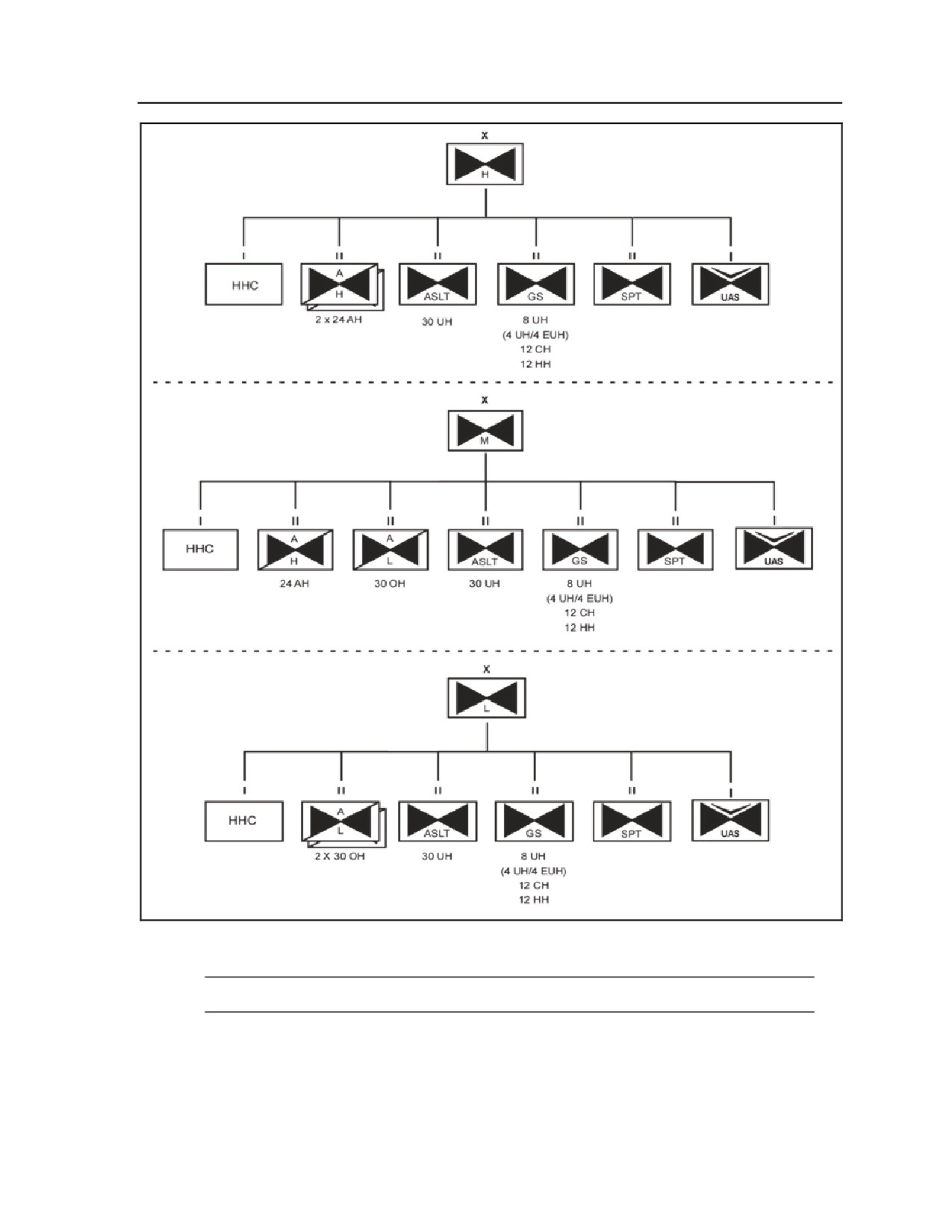
HEAVY, MEDIUM, AND LIGHT COMBAT AVIATION BRIGADES
1-18. These CABs are organized along the same construct varying only by the number and type of ARBs.
The base construct for a CAB is two ARBs, an attack helicopter battalion (AHB), general support aviation
battalion (GSAB), and ASB. Each brigade contains a headquarters and headquarters company (HHC)
providing personnel and equipment for brigade C2 functions, and security and defense for the brigade CP.
1-19. Heavy and medium CABs have more robust firepower capability, while the light CABs require
smaller-sized United States Air Force (USAF) lift to deploy ARS helicopters. The divisions that have
medium CABs have a forced entry mission, requiring a mix of flexibility, speed, and firepower.
1-20. When fully fielded, each CAB will have one unmanned aircraft system (UAS) company.
1-21. Figure 1-2 (page 1-5) illustrates the organization of the heavy, medium and light CAB.
COMBAT AVIATION BRIGADES (EXPEDITIONARY)
1-22. The CAB (Expeditionary [E]) is designed primarily to focus on homeland security operations. These
operations include counter-drug missions, humanitarian assistance, disaster relief, civil disturbance,
counterterrorism, and domestic support, of which the National Guard is uniquely suited to perform.
Elements of the CAB (E) can be task organized for deployment abroad.
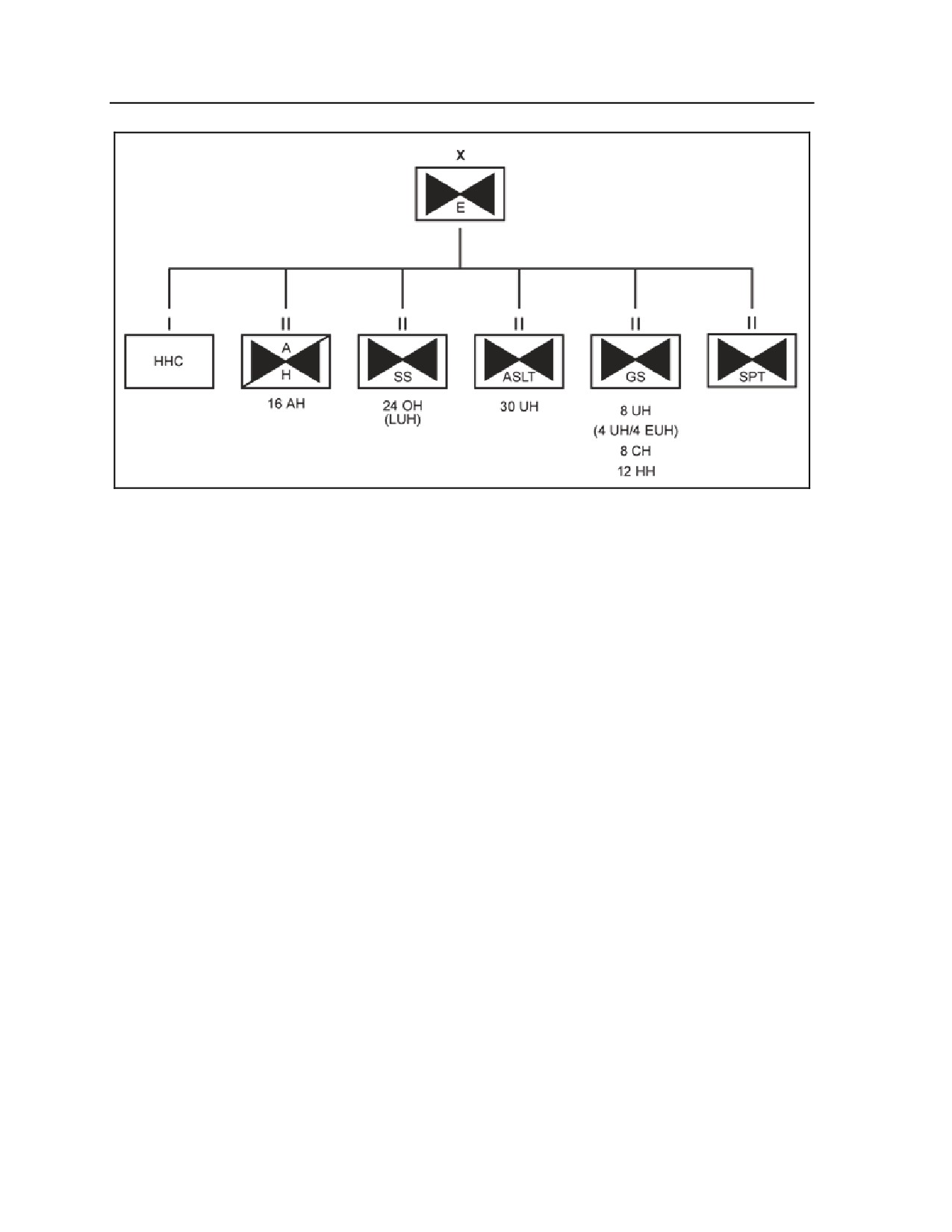
1-23. The Army National Guard (ARNG) CAB (Expeditionary) (figure 1-3, page 1-6) is similar to the
heavy aviation brigade except for a security and support battalion (S&S BN) (in lieu of one attack
reconnaissance battalion [ARB]) currently equipped with OH-58Cs and, when fielded, the light utility
helicopter (LUH). The ARB is resourced at 16 AH-64s on hand, while the GSAB has 8 CH-47s.
1-4
FM 3-04.111
7 December 2007
Mission and Organization
Figure 1-2. Heavy, medium, and light combat aviation brigade
Note. Medium aviation brigades also have a Pathfinder company located within the AHB.
7 December 2007
FM 3-04.111
1-5
Chapter 1
Figure 1-3. Combat aviation brigade (expeditionary)
THEATER AVIATION BRIGADES
1-24. Each theater aviation brigade (TAB) is structured to conduct assault or general support aviation
missions in support of the theater and its subordinate commands.
1-25. Unlike CABs, TABs do not contain ARBs or ATS companies. It reinforces divisional aviation
brigades with assault, general support, heavy lift, aeromedical evacuation, or fixed-wing (FW) assets..
1-26. TABs conduct, air assault, air movement, and sustainment operations for itself and to reinforce
divisional aviation brigades.
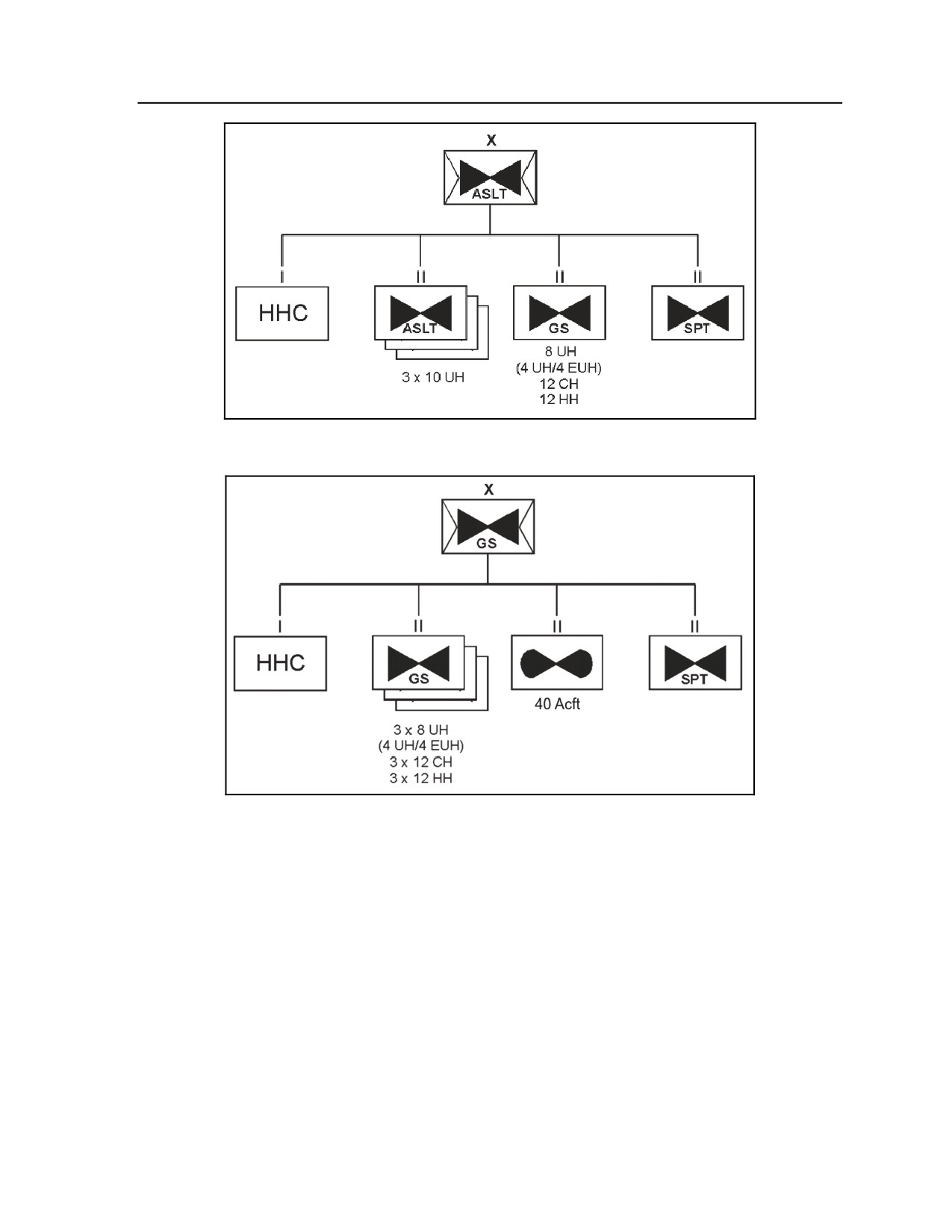
1-27. The theater aviation brigade (figure 1-4, page 1-7) consists of an HHC, 3 AHBs with 30 UH-60s
each; a GSAB (figure 1-5, page 1-7) with 4 UH-60s, 4 EUH-60s, 12 CH-47s, and 12 HH-60s; and an ASB.
The theater aviation brigade (composite) consists of an HHC; 3 GSABs with 4 UH-60s, 4 EUH-60s, 12
CH-47s, and 12 HH-60s each; a FW battalion with 40 aircraft; and an ASB.
SUBORDINATE AVIATION BATTALIONS
1-28. The numbers and types of subordinate battalions included in a specific brigade are based on the
brigade's mission. Separate companies or battalions may be assigned, attached, or placed operational
control (OPCON) to aviation brigades. This situation presents challenges for C2 as the brigade staff must
prepare plans and orders on the level of detail normally found at battalion level.
1-6
FM 3-04.111
7 December 2007
Mission and Organization
Figure 1-4. Theater aviation brigade
Figure 1-5. Theater aviation brigade (composite)
1-29. Subordinate battalions found in aviation brigades are—
z
An ARS with 30 OH-58s (refer to FM 3-04.126).
z
An ARB with 24 AH-64s (refer to FM 3-04.126).
z
An assault helicopter battalion with 30 UH-60s (refer to FM 3-04.113).
z
A GSAB with 4 EUH-60s, 4 UH-60s, 12 CH-47s, and 12 HH-60s (refer to FM 3-04.113).
z
A fixed-wing aviation battalion with 40 FW aircraft.
z
An S&S BN (currently equipped with 24 OH-58s, and in the future with the LUH).
z
An ASB.
z
A UAS company (refer to FMI 3-04.155).
1-30. The ARB/ARS can support early tactical operations
(TACOPS) and ground maneuver with
reconnaissance, security, and attack. It is effective against massed-moving, point (such as cave entrances,
bunker apertures, and specific windows in buildings), and other hard or soft targets.
7 December 2007
FM 3-04.111
1-7
Chapter 1
1-31. The AHB provides air assault and air movement capability.
1-32. GSAB assets participate in all brigade operations.
z
The command aviation company (CAC) provides aerial C2 and GS.
z
The heavy helicopter company (HvyHC) provides heavy-lift support.
z
The air ambulance medical company (AAMC) provides aeromedical evacuation support.
z
The ATS company provides ATS support.
z
The UAS company provides intelligence, surveillance, and reconnaissance (ISR).
1-33. The fixed wing aviation battalion conducts flight missions required for battle command of theater
operations; liaison among theater commands; and transportation of supplies, equipment, and personnel
within the theater.
1-34. The security and support battalion is intended to support a variety of federal, state and homeland
security missions.
1-35. The ASB plans, coordinates, and executes the aviation brigade’s sustainment and signal support
requirements.
1-36. UAS operations support battlefield commanders and their staffs as they plan, coordinate, and execute
operations. UAS increase the situational awareness (SA) of commanders through ISR .
1-8
FM 3-04.111
7 December 2007
Chapter 2
Command and Control
The C2 system is an arrangement of personnel, information management (IM),
procedures, equipment, and facilities essential to the commander in conducting
operations (FM 6-0). There are two parts of this system; the commander and the
control system. This chapter briefly discusses the brigade commander’s role in C2
and details the purpose and characteristics of the CPs that form the brigade’s control
system. It also discusses the responsibilities and duties of staff officers, the brigade
communications systems, and brigade-level planning to facilitate successful
operations. Refer to FMI 5-0.1 for additional information on the C2 system.
SECTION I - OVERVIEW
2-1. Effective and efficient C2 is a process
beginning and ending with the commander. The
Contents
commander must develop techniques and
procedures promoting an expeditious flow of
Section I - Overview
2-1
information throughout the entire C2 process. These
Section II - Brigade Command Group
2-3
techniques and procedures should be in the unit's
Section III - Brigade Aviation
tactical standing operating procedures (TACSOP).
Element/Aviation Liaison Teams
2-13
FM 6-0 describes command and control.
Section V - Aviation Brigade
Command Posts
2-14
2-2. C2 is the exercise of authority and direction
Section VI - Brigade Planning
2-18
by a properly designated commander over assigned
and attached forces in the accomplishment of a
Section VII - Aviation brigade
communications
2-33
mission
(FMI
5-0.1). Command includes both
authority and responsibility for effectively using
Section VIII - Command post
survivability
2-39
available resources to accomplish missions.
COMMAND
2-3. Command is the art of motivating and directing people and organizations to accomplish missions. It
requires visualization of the current state of friendly and enemy forces and the future state of those forces
that must exist to accomplish the mission; and formulates concepts of operations to achieve victory.
CONTROL
2-4. Control is regulating forces and WFFs in executing the commander's intent. It helps commanders
and staffs compute requirements, allocate means, and integrate efforts. Control is necessary in determining
the status of organizational effectiveness, identifying variance from set standards, and correcting deviations
from these standards. It permits commanders to acquire and apply means to accomplish their intent and
develop specific instructions from general guidance. Ultimately, it provides commanders a means to
measure, report, and correct performance. Control allows commanders freedom to operate, delegate
authority, place themselves in the best position to lead, and synchronize actions throughout the operational
area. Commanders exercise authority and direction through and with the assistance of a C2 system.
7 December 2007
FM 3-04.111
2-1
Chapter 2
COMMAND AND CONTROL SYSTEM
2-5. C2 systems are defined as facilities, equipment, communications, procedures, and personnel essential
to a commander for planning, directing, and controlling operations of assigned forces. The C2 system gives
the commander a structure, a means to make and convey decisions, and the ability to evaluate the situation
as it develops. Decisions and higher-level intent are then translated into productive actions.
2-6. Army battle command system (ABCS), as described in FM 6-0, provides unit commanders the
electronic architecture to build SA. Signal planning increases the commander's options by providing
requisite signal support systems for varying operational tempos. These systems pass critical information at
decisive times; thus, they leverage and exploit tactical success and make future operations easier. Appendix
B contains additional information on ABCS. ABCS consists of—
z
Global Command and Control System-Army (GCCS-A).
z
Army Tactical Command and Control System (ATCCS).
z
Force XXI Battle Command Brigade and Below (FBCB2).
2-7. The airspace command and control (AC2) system is the airspace management component of the
Army air-ground system. It outlines the Army’s integration of airspace usage and C2 within the framework
of the theater air-ground system (TAGS). Ground and air joint forces must be able to operate aerial
vehicles and weapons systems within shared airspace with maximum freedom consistent with priorities, the
degree of operationally acceptable risk, and the joint force commander's (JFC's) intent. Refer to FM 3-52
for additional information.
BATTLE COMMAND
2-8. Battle command is the art and science of visualizing, describing, directing, leading forces, and
assessing forces in operations against a hostile, thinking, and adaptive enemy. Battle command applies
leadership to translate decisions into actions—by synchronizing forces and WFFs in time, space, and
purpose—to accomplish missions. Battle command is guided by professional judgment gained from
experience, knowledge, education, intelligence, and intuition. Refer to FM 3-0 for additional information.
2-9. Commanders visualize the operational environment (OE), the desired end state, and a broad concept
of how to transform the conditions of the environment from the current state to the end state. Visualization
is passed to the staff and subordinate commanders through commander’s intent and planning guidance;
commanders express gaps in their operational knowledge through commander’s critical information
requirements
(CCIRs). Commanders direct actions to achieve success and lead forces to mission
accomplishment. Refer to FM 3-0 for additional information.
BATTLE COMMAND ON THE MOVE
2-10. BCOTM is the ability to lead Soldiers and command all elements of combat power by shaping and
sustaining decisive actions seamlessly while on the battlefield. Commanders must synchronize the elements
in close combat from any vantage point on the battlefield. The ability to reposition rapidly as the situation
develops enables commanders to better see the battlefield and be at the critical point at the critical time.
2-11. BCOTM performs the following functions:
z
Sees and understands the common operational picture (COP).
z
Directs and controls maneuver operations.
z
Controls direct/indirect fires and effects.
z
Monitors enemy and intelligence activities.
z
Synchronizes forces.
z
Directs reconnaissance/counter reconnaissance operations.
z
Executes operation orders (OPORDs).
z
Issues fragmentary orders (FRAGOs).
z
Receives and renders reports.
2-2
FM 3-04.111
7 December 2007
Command and Control
SECTION II - BRIGADE COMMAND GROUP
2-12. The brigade command group consists of the commander and selected staff members who accompany
commanders and enable them to exercise command and control away from the command post, (FMI 5-0.1)
The command group is organized and equipped to suit the commander’s decisionmaking and leadership
requirements. The members typically consist of at least the executive officer and the primary staff
members. This group operates as dictated by the commander and at any location that provides for effective
C2.
COMMANDER
2-13. The brigade commander commands and controls the aviation brigade. He or she is responsible for
the outcome of his or her force's actions. The variety and impact of tasks confronting him or her are
unique. His or her main concerns are accomplishing the mission and ensuring the welfare of Soldiers.
2-14. The brigade commander visualizes the operating environment, analyzes the situation ,defines the
mission, and directs actions for the mission’s execution. The brigade commander controls the current
operation and provides guidance for planning future operations.
2-15. The aviation brigade's forces influence an enormous area of the OE therefore; the commander must
have extensive situational awareness of the environment. Tactical decisions must be constantly aimed at
synchronizing his or her unit’s combat efforts with those of multiple combined, joint, interagency, and
multinational forces.
EXECUTIVE OFFICER
2-16. The executive officer (XO) is second in command and principal assistant to the commander. The
scope of XO duties is often tailored by the commander’s requirements. Normally, the XO directs,
supervises, and ensures coordination of staff work and logistics, except in those specific areas reserved by
the brigade commander. He or she must understand the commander’s guidance and intent as he or she
supervises the entire process. He or she ensures the staff has the information, guidance from the
commander, and facilities it needs. He or she determines timelines for the staff, establishes backbrief times
and locations, enforces the IM plan, and provides any unique instructions to guide the staff in completing
the military decisionmaking process (MDMP).
2-17. The XO is the primary senior leader on the brigade staff and additionally ensures appropriate
planning and execution of the logistics and maintenance effort.
STAFF ORGANIZATION
2-18. The staff consists of officers and enlisted personnel who plan, supervise, and synchronize planning
and execution of aviation brigade operations, to include sustainment, according to the brigade commander's
concept and intent (figure 2-1, page 2-4). Except in scope, duties and responsibilities of the brigade staff
are similar to those of a BCT staff and are often similar to the higher echelon staff. Key staff personnel
must be positioned on the battlefield where they can carry out their duties.
STAFF RESPONSIBILITIES
Standing Operating Procedures
2-19. The aviation brigade SOP must clearly define the responsibilities of key personnel to preclude
conflicts and ensure all functions are planned, coordinated, executed and supervised. SOPs streamline
procedures and reports by providing standardized processes, briefings and reports. The SOP also identifies
specific individuals and sections, who request, receive, process, and disseminate information.
2-20.
7 December 2007
FM 3-04.111
2-3
Chapter 2
Figure 2-1. Aviation brigade staff organization
Running Estimates
2-21. Running estimates may be informal at brigade level and below; however, they must address
battlefield activity, project course of action (COA), and predict results. Careful IPB, selection of the most
important enemy indicators, and development of contingency plans facilitate estimates and allow timely
response. The key person in this process is the XO. He or she ensures the staff maintains a proper
perspective. Refer to FMI 5-0.1 for additional information on running estimates.
Communications with the Commander
2-22. The staff must provide the commander with critical, concise, accurate information, especially that
information the commander identified as CCIR. Critical information is communicated to the commander on
a priority basis set by the commander or the XO’s guidance.
2-23. Information flow, both horizontally and vertically, must be on a priority basis. Operational
conditions dictate priorities.
2-4
FM 3-04.111
7 December 2007
Command and Control
PERSONAL STAFF
2-24. The personal staff works under the commander’s immediate directon, but may also work through the
XO or a specific coordinating staff officer for coordination and control purposes. Members of the personal
staff normally have direct access to the commander due to the nature of their assigned duties.
COMMAND SERGEANT MAJOR
2-25. The command sergeant major (CSM) acts in the name of the commander and is his or her primary
advisor concerning enlisted soldiers. The CSM focuses attention on functions critical to the success of the
operation. The CSM assists the commander in the following ways:
z
Monitors noncommissioned officer (NCO) development, promotions, and assignments.
z
Identifies, plans, and assesses soldier training tasks to support the performance of collective
(unit) tasks on the mission essential task list (METL).
z
Monitors subordinate unit morale.
z
Provides recommendations and expedites procurement and preparation of enlisted replacements
for subordinate units.
z
Monitors food service and other logistics operations.
z
Conducts informal investigations.
z
Assists in controlling brigade movements.
z
May lead the brigade advance or quartering party during a major movement, coordinating
closely with the HHC commander.
CHAPLAIN
2-26. The aviation brigade chaplain provides unit level religious support to all personnel assigned/attached
to the brigade including nondenominational coverage and ministry for mass casualties and hospitalized
members of the brigade. The chaplain advises the commander on religious, moral, and Soldier welfare and
morale issues. He or she establishes liaison with unit ministry teams (UMTs) of higher and adjacent units.
He or she also supervises subordinate unit chaplains and provides backup services as required. The
chaplain and chaplain's assistant compose the UMT, usually operating from the same location as the
adjutant.
PUBLIC AFFAIRS OFFICER
2-27. The public affairs officer
(PAO) leads the public affairs cell, which coordinates media and
community relations. The public affairs cell provides coordination of public affairs and strategic messaging
advice and counsel to the commander. The public affairs cell further coordinates requests for public affairs
support from the division or higher echelon command, and provides support to all accredited media
operating in the aviation brigade area of operations (AO).
STAFF JUDGE ADVOCATE
2-28. The brigade judge advocate, along with the operational law judge advocate and paralegal NCO, form
the brigade operational law team (BOLT). The brigade judge advocate serves as a personal and special
staff officer. The BOLT provides legal advice to the commander and staff. The members of the BOLT
serve as subject matter experts (SMEs) on ROE, targeting, international law, law of armed conflict
(including treatment of detainees, enemy prisoners of war, civilians on the battlefield and other
noncombatants), and all other legal aspects of operations. The BOLT provides or coordinates with other
legal offices for legal services in military justice, administrative and civil law, contract and fiscal law,
claims, and legal assistance. The paralegal NCO provides administrative and paralegal support to the judge
advocates in the BOLT and supervises the paralegals in the aviation battalions.
7 December 2007
FM 3-04.111
2-5
Chapter 2
SPECIAL STAFF
2-29. Special staff officers help the brigade commander and other staff members perform their functional
responsibilities.
CHEMICAL OFFICER
2-30. The chemical officer operates from the operations staff officer
(S-3) section and advises the
commander on—
• Chemical, biological, radiological, and nuclear (CBRN) defense.
• Decontamination.
• Smoke operations.
• Use of obscurants and flame.
FLIGHT SURGEON
2-31. The brigade flight surgeon advises and assists commanders on matters concerning the medical
condition of the command including preventive, curative, and restorative care. The brigade flight surgeon,
with subordinate unit flight surgeons, conducts flight physicals for unit personnel. The flight surgeon
determines requirements for the requisition, procurement, storage, maintenance, distribution, management,
and documentation of medical equipment and supplies for the brigade HHC. The flight surgeon, in
conjunction with the physician assistant, operates the brigade aid station normally located in the brigade
assembly area (AA).
SAFETY OFFICER
2-32. The safety officer (SO) serves as the principle advisor to the commander and staff on aviation and
ground safety matters. The SO assists the staff and commander during the composite risk management
(CRM) process, and monitors brigade and subordinate unit missions to identify and address potential
hazards. He or she recommends actions to ensure safe mission accomplishment.
2-33. The brigade SO implements and monitors safety-related programs and advises subordinate unit SOs
as required. The brigade SO is responsible for standardization of the safety contents of the reading files.
The SO should be rated in the highest-density type aircraft in the brigade.
STANDARDIZATION INSTRUCTOR PILOT
2-34. The SP is the primary advisor to the commander for the flight standardization program. The SP
develops, integrates, implements, monitors, and manages the aircrew training and standardization
programs. Along with the Master Gunner and TACOPS officer, the brigade SP provides advice and
counsel to commanders on mission planning and aviation TTP. The brigade SP provides advice on the
crew selection process, and in concert with the Master Gunner, monitors the employment of aircraft
systems, sensors, and weapons. He or she is a principal trainer and peer leader for subordinate unit SPs and
instructor pilots (IPs). The brigade SP acts as the coordinating staff officer for reading file standardization.
Additionally, the SP assists the commander in the following ways:
z
Provides recommendations and assists in expediting warrant officer replacements for
subordinate units.
z
Monitors warrant officer development and assignments.
z
Conducts informal investigations.
z
Performs specific missions as directed by the brigade commander.
COORDINATING STAFF
2-35. The coordinating staff is composed of the commander’s principle assistants who are responsible for
one or a combination of broad fields of interest (personnel, intelligence, operations, logistics, planning, and
2-6
FM 3-04.111
7 December 2007
Command and Control
communications). Coordinating staff members help the commander coordinate and supervise execution of
plans, operations, and activities. Collectively, through the XO, they are accountable for the commander’s
entire field of responsibility.
HUMAN RESOURCE SECTION
2-36. The personnel staff officer (S-1) has coordinating responsibility for finance, religious activities,
public affairs, and legal services support of the unit. The S-1 is normally collocated with the S-4 in the
sustainment cell of the main CP. The S-1 and S-4 will cross-train to enable continuous operations.
2-37. The S-1 is responsible for all matters concerning human resources including personnel readiness and
services. The S-1 manages personnel strength and replacement; works with the flight surgeon to plan
health services; coordinates morale support activities and legal, financial, and postal services; maintains the
awards program; oversees administration of discipline, law, and order with the provost marshal (if present)
and brigade judge advocate; and provides casualty operations management.
INTELLIGENCE SECTION
Intelligence Officer
2-38. The intelligence staff officer (S-2) leads the intelligence staff section consisting of the S-2 section,
tactical command post (TAC CP), and joint surveillance target attack radar system (JSTARS) common
ground station (CGS) team. The S-2 is responsible for all matters concerning ISR. The S-2 provides
current information and analyzed intelligence of tactical value concerning terrain, weather, and the enemy.
Intelligence Section
2-39. The S-2 section provides combat intelligence, including collecting and processing information. The
S-2 section prepares intelligence collection plans; receives and analyzes battlefield information;
disseminates intelligence products; and provides up-to-date intelligence information to assist in planning
for and coordinating operations.
2-40. The S-2 section performs the following functions:
z
Coordinates intelligence activities.
z
Converts information requirements of the commander into the CCIR.
z
Facilitates the IPB process.
z
Helps develop the decision support template.
z
Develops the intelligence collection and reconnaissance and surveillance plan.
z
Frequently updates the commander and staff on the enemy situation.
z
Maintains isolated personnel reports.
z
Performs intelligence support to effects and targeting.
z
Processes relevant information to assist in creating the COP.
z
Provides aircrews with intelligence summaries and pre-flight update briefs.
z
Conducts post-flight debrief for intelligence gathering.
z
Identifies potential high-payoff targets (HPTs) and high-value targets (HVTs).
Joint Surveillance Target Attack Radar System Common Ground Station Team
2-41. The JSTARS CGS team provides the commander with near-real-time wide area surveillance and
deep targeting data on moving and fixed targets during daylight and darkness in all weather conditions.
The team receives, processes, correlates, and disseminates imagery data from the JSTARS. The CGS
receives, manipulates, displays, stores, and disseminates JSTARS, unmanned aircraft system (UAS), Army
aviation, signal intelligence, broadcast intelligence and secondary imagery from tactical, theater, and
national systems.
7 December 2007
FM 3-04.111
2-7
Chapter 2
OPERATIONS SECTION
Operations Staff Officer
2-42. The S-3 is responsible for matters pertaining to the organization, employment, training, and
operations of the brigade and supporting elements. The S-3 monitors the battle, ensures necessary
sustainment assets are provided when and where required, anticipates developing situations, and executes
the appropriate actions within the scope of the commander’s guidance.
Operations Section
2-43. The S-3 section provides planning and task organization of brigade elements for operations. The S-3
section maintains routine reporting and coordinates activities of liaison personnel. It also coordinates
consistently with the plans staff officer (S-5) to synchronize future operations and the transition from
current operations to a future operation. The S-3 section, through the command, control, communications,
and computer operations (C4OPS) cell, ensures procedures are in place ensure effective communications.
The S-3 section maintains close coordination with the S-4 and S-1 for brigade logistics and personnel
status.
S-3 Air
2-44. The aviation brigade S-3 Air is responsible for coordinating air space issues, JAAT operations, and
joint air operations. The aviation brigade S-3 Air is responsible for the integration of A2C2 planning,
coordination, and airspace deconfliction for combined arms JIM operations in the aviation brigade.
2-45. The S-3 Air oversees the following functions:
z
Developing AC2 procedures, plans, SOPs, and annexes.
z
Submitting requests for airspace coordinating measures (ACMs).
z
Ensuring AC2 restrictions are incorporated in FS planning.
z
Obtaining and distributing the current air control order (ACO) for each subordinate battalion
size headquarters.
z
Obtaining and distributing applicable portions of the special instructions (SPINS) and air tasking
order (ATO) to subordinate units.
z
Incorporating applicable AC2 measures into the aviation brigade scheme of maneuver.
z
Maintaining the AC2 overlay.
z
Establishing and monitoring the flight following net (ATS network) for brigade aircraft, when
required.
z
Assisting the S-3 and fire support element (FSE) in joint suppression of enemy air defense (J-
SEAD) fires planning.
z
Coordinating for additional Army and joint aviation support to support aviation operations such
as movement of unit equipment, supplies, ammunition, and fuel.
z
Assisting the S-3 in planning, organizing, and coordinating aviation brigade participation in
JAAT operations.
Tactical Operations Officer
2-46. TACOPS officers advise the commander and staff on appropriate aircraft survivability equipment
(ASE) techniques and procedures and integration of joint assets for each mission. TACOPS officers
conduct the ASE part of the CRM process, integrate the unit’s operation plan (OPLAN) into the theater
airspace structure, assist with development of unit TTP, manage the organization’s PR program, and are
involved in the MDMP, close air support (CAS), and FS. TACOPS officers are primary SMEs for the
organic AMPS and its associated products. They also assist in training members of ground maneuver
brigade aviation elements (BAEs) and subordinate unit TACOPS officers.
2-8
FM 3-04.111
7 December 2007
Command and Control
Air Liaison Officer
2-47. Depending on the expected types of missions, an air liaison officer (ALO) may be provided. The
ALO is a USAF officer who is a member of the tactical air control party (TACP). The ALO may serve as a
forward air controller (FAC) or have additional officers assigned to the ALO as FACs. The ALO advises
the commander and staff on employment of air support, including CAS, air interdiction (AI), J-SEAD,
aerial reconnaissance, and airlift. In the absence of an ALO, the S-3 ensures these duties are accomplished.
Aviation Master Gunner
2-48. The master gunner serves as the advisor to the commander and staff on aviation weapons
employment. He or she interfaces with the S-3, S-5 and TACOPS officer during the mission planning
process and is primarily responsible for the targeteering and weaponeering process. Master gunners
develop and recommend tactics, techniques, and procedures
(TTP) to optimize aviation weapons
effectiveness and collaborate with the TACOPS officer on route selection.
2-49. The brigade master gunner is a primary advisor to the S-3 assisting in forecasting and allocating
ammunition and monitoring gunnery training device usage. The master gunner monitors gunnery-related
programs throughout the brigade, and advises subordinate unit master gunners as required. He or she
supports the battalions in developing advanced gunnery training tables to include realistic target arrays, and
assists in the coordination of scheduling with local range-control officials. The master gunner should be
SP-qualified and current in one of the attack/reconnaissance aircraft within the brigade.
Joint, Interagency, and Multinational Aviation Command Liaison Element
2-50. The JIM aviation command liaison element provides necessary liaison between the aviation brigade
and JIM aviation CP. This element is essential for planning and execution of aviation missions in the
brigade area, and represents the brigade commander at a separate location to facilitate communication and
aviation planning.
2-51. Brigade commanders must empower liaison teams to act on their behalf and ensure they are fully
supported. In return, commanders expect positive two-way communication. Liaison teams do not commit
aviation brigade assets or approve changes to a plan without brigade S-3 or commander coordination.
2-52. Liaison teams must have access to current brigade status information to provide the most accurate
picture of capabilities. Constant communication with the parent unit is essential for updates on aircraft
availability, maintenance, and FARP status.
Fire Support Element
2-53. The FSE provides FS planning, coordination, and execution through the following tasks:
z
Conducts nonlethal FS operations and information operations (IO).
z
Conducts lethal FS.
z
Employs fire support coordinating measures (FSCMs).
z
Provides firepower in support of operational maneuver.
z
Provides CAS integration for surface forces.
z
Employs positive and procedural control measures.
Fire Support Coordinator
2-54. The FSE is headed by the fire support coordinator (FSCOORD). He or she provides support for the
scheme of maneuver with fires and direct targeting process execution (detect, deliver, and assess). Both
missions are critical to the success of aviation operations. The FSCOORD accomplishes this by close
coordination with the S-3 and brigade commander.
2-55. The FSCOORD plans, controls, and synchronizes all lethal and nonlethal FS for brigade operations.
He or she coordinates J-SEAD, and integrates and coordinates offensive IO into FS planning. He or she
works with the S-3 and A2C2 element regarding field artillery (FA) firing unit locations and changes to
FSCMs and ACMs. The FSCOORD maintains communications with supporting artillery.
7 December 2007
FM 3-04.111
2-9
Chapter 2
Geographic Information and Services Topographic Engineer Element
2-56. The geospatial information and services topographic engineer element provides the following
support:
z
Database management.
z
Topographic database development.
z
Terrain analysis.
z
Topographic survey.
z
Topographic production.
Air Defense and Airspace Management Cell
2-57. The air defense and airspace management (ADAM) cell provides liaison between the aviation
brigade and air defense (AD) units. The employment of the ADAM element is essential in deconflicting
airspace and preventing fratricide of friendly aircraft operating throughout the AO.
United States Air Force Weather Team
2-58. The brigade may receive weather team support when local facilities or assets are unable to provide
required weather information. The team locates with the brigade main CP and provides their own weather
equipment.
Medical Operations Cell
2-59. The medical operations cell
(MOC) provides assistance in planning and coordination for air
ambulance employment and utilization. The MOC consists of a medical service corps officer and NCO
who provide assistance with synchronization of the air and ground evacuation plan. It is the conduit for
communication between higher echelons of medical C2 and the CAB. The medical service corps officer
and NCO also manage medical treatment facility (MTF) information from medical support commands and
surgeon cells of higher echelons including hospital locations and status, evacuation routes, casualty
collection points, and ambulance exchange points. The MOC also performs the following functions:
z
Establishes flight procedures specific to aeromedical evacuation missions within the CAB. This
may include special routes or corridors as well as procedures for escort aircraft link-up.
z
Ensures lines of communication (LOCs) to supported units and higher echelons of medical
command are available. The MOC also ensures supported units understand aeromedical
evacuation procedures and capabilities—an educational endeavor that is an ongoing process.
z
Establishes aeromedical evacuation briefing and launch procedures. Ensures 24-hour access to
those able to launch high and very-high risk missions.
z
Maintains awareness of the tactical and medical situation. Coordinates with medical regulators
at higher echelons to efficiently conduct GS and works in concert with adjacent units.
z
Assists the AAMC and GSAB/CAB staff in conducting aeromedical evacuation operations.
LOGISTICS SECTION
Logistics Staff Officer
2-60. The logistics staff officer (S-4) is responsible for brigade level coordination of all external and
internal logistics support including supply, maintenance, transportation, and equipment status records. The
S-4, as the brigade's logistics planner, coordinates with battalion S-4s, separate company supply officers, or
first sergeants (1SGs) regarding the status of maintenance, equipment, and supplies. The S-4 ensures
logistics visibility for the brigade commander and staff. The S-4 develops the logistics support plan, and
coordinates with supporting units and higher headquarters staffs ensuring logistics support is continuous.
2-10
FM 3-04.111
7 December 2007
Command and Control
Logistics Section
2-61. The S-4 section provides supervision and coordination of food service, supply, transportation, and
maintenance support for the brigade. S-4 section responsibilities include-
z
Recommending basic loads and supply requirements.
z
Recommending the ammunition required supply rate (RSR) to the S-3.
z
Coordinating all classes of supply (except class VIII).
z
Coordinating equipment recovery, evacuation, and repair.
z
Conducting planning for operational movement control and mode and terminal operations.
z
Coordinating with the civil affairs cell for host nation support.
z
Coordinating services including water purification, mortuary affairs, aerial resupply, laundry,
shower, and food preparation.
z
Coordinating battlefield procurement and contracting.
Brigade Aviation Materiel Officer
2-62. The brigade aviation materiel officer (BAMO) is an aviation staff officer assigned to the S-4 section.
The BAMO is an advisor to the brigade commander and staff for aviation maintenance issues. The aviation
materiel officer (AMO) ensures close coordination with the ASB on aviation maintenance issues. The
brigade AMO is a trainer and peer leader for the subordinate unit AMOs. He or she should be rated in the
highest-density type aircraft in the brigade. See FM 3-04.500.
2-63. The BAMO is the primary adviser to the brigade commander for the effectiveness and efficiency of
the aviation maintenance program in the unit. The BAMO recommends actions and forecasts future
capabilities based on the existing maintenance posture.
2-64. The BAMO plans maintenance actions based on operational necessities. He or she also maintains a
daily status of all aircraft in the combat aviation brigade. The BAMO is normally a maintenance evaluator,
responsible for the following:
z
Provides advice to the battalion commander on all aviation maintenance and logistics issues.
z
Oversees quality control functions.
z
Resolves aircraft maintenance standardization issues.
z
Attends the brigade safety and standardization meeting.
2-65. The BAMO and battalion AMOs should work hand-in-hand with AMC production control
personnel.
2-66. The BAMO manages personnel, supply, equipment, and facility assets to maintain and repair Army
rotary- and fixed-wing aircraft. He or she organizes maintenance elements to inspect, service, test,
disassemble, repair, reassemble, adjust, and replace parts and retest aircraft or aircraft components. He or
she prepares, implements, and maintains standing operating procedures for management of maintenance
activities.
2-67. The BAMO interprets regulations; technical manuals, including ETMs/IETMs; and orders pertaining
to maintenance and logistics actions of Army aircraft for commanders and subordinates. He or she
supervises the aviation equipment maintenance and repair shop, section, or platoon. He or she also directs
maintenance and accountability of organizational test equipment, supplies, and recovery equipment.
2-68. Enlisted personnel may be assigned to the section to assist the BAMO in order to provide continuous
maintenance and logistics information to the commander and staff. The BAMO keeps the command
informed about current and future capabilities based on the current maintenance posture and plans
maintenance actions based on operational necessities.
Food Service Technician
2-69. The aviation food service officer is a staff officer assigned to the S-4 section. He or she is an advisor
to the brigade commander and staff for the food service program and class I issues. The food service
officer evaluates field feeding requirements and develops milestone plans to support major field exercises.
7 December 2007
FM 3-04.111
2-11
Chapter 2
He or she reviews and monitors requisitions for classes I, III, and IX supplies, and coordinates planning of
food service support for field training. The food service officer evaluates garrison and field feeding
operations, ensuring food service personnel are complying with food service regulations relative to food
preparation, service, accountability, and sanitation.
PLANS SECTION
Plans Staff Officer
2-70. The S-5 is responsible for planning future operations. The S-5 monitors the COP, stays abreast of
current operations by coordinating with the S-3, and plans sequels accordingly. The S-5 plans for
operations to be conducted in the next phase, normally occurring in the brigade’s contingency or
orientation planning horizons (refer to FM 5-0 for additional information). However, the commander may
task him or her to plan operations in the current phase or near-term horizon. Other S-5 responsibilities
include—
z
Producing OPORDs and warning orders (WARNOs) transition to future operations.
z
Coordinating with the S-3 for transitioning from current to future operations.
z
Producing current OPLANs for the S-3, when requested.
z
Participating in the targeting process.
z
Performing long-range assessment of an operation’s progress.
COMMUNICATIONS-ELECTRONICS SECTION
Signal Officer
2-71. The S-6 advises the commander on signal matters, CP location, and signal facilities, assets, and
activities. He or she maintains authority and responsibility for all network operations within the aviation
brigade. Execution of network operations is the responsibility of the network support company (NSC)
within the ASB.
2-72. The S-6 and NSC commander operate in close communication, resulting in a unity of effort for
communications support to the aviation brigade. The NSC commander reports all network-associated
issues to the S-6. The aviation brigade S-6 and his or her staff plan Command, Control, Communications
and Computer Operations (C4OPS) support for the aviation brigade CPs and subordinate units organic to,
assigned to, or operating within the aviation brigade AO. The aviation brigade S-6 works closely with both
the division Assistant Chief of Staff- C4OPS (G-6) and the NSC commander.
Communication-Electronics Section
2-73. The S-6 section plans, coordinates, and oversees implementation of communications systems. It
performs unit-level maintenance on ground radio and field wire communications equipment. It installs,
operates, and maintains the radio retransmission site. This section monitors the maintenance status of signal
equipment, coordinates preparation and distribution of the signal operation instructions (SOI), and manages
communications security (COMSEC) activities. The S-6 section’s responsibilities include supervision of
electronic mail on both unclassified and classified nets and the local area network (LAN).
CIVIL-MILITARY OPERATIONS SECTION
Civil-Affairs Staff Officer
2-74. A civil affairs staff officer (S-9) is normally not available to the brigade. However, in certain
operations, one may be designated or attached. The S-3 is responsible for S-9 when no S-9 is provided. In
operations where the areas of responsibility for the S-3 and S-9 overlap, the S-9 is subordinate to the S-3.
S-9 personnel working in any of the brigade's subordinate unit areas are subordinate to the commander of
that subordinate unit, regardless of rank.
2-12
FM 3-04.111
7 December 2007
Command and Control
Civil-Military Operations Center
2-75. When accomplishing S-9 duties, the designated officer may have to coordinate with a civil-military
operations (CMO) center. The CMO center is formed from civil affairs assets and serves as the primary
interface between the U.S. Armed Forces and local civilian population, humanitarian organizations,
nongovernmental organizations, private volunteer organizations, other international agencies, multinational
military forces, and other agencies of the U.S. government. The CMO center ensures continuous
coordination among key participants regarding civil-military matters. It is a flexible, mission-dependent
organization formed at brigade and higher-level headquarters.
SECTION III - BRIGADE AVIATION ELEMENT
2-76. The BAE is in the light, medium, and heavy BCTs and the battlefield surveillance brigade. Though
not part of the aviation brigade staff; it plays an important role in aviation planning, execution, and AC2.
Aviation brigade and aviation TF commanders must be personally involved in training, equipping, and
mentoring BAEs.
2-77. The BAE is a planning and coordination cell organic to each BCT whose major function is
incorporating aviation into the ground commander’s scheme of maneuver. The BAE focuses on providing
employment advice and initial planning for aviation missions including; UAS, airspace planning and
coordination, and Army aviation synchronization with the ALO and FSCOORD. The BAE also
coordinates directly with the aviation brigade or supporting aviation TF for detailed mission planning.
2-78. The BAE does not take the place of aviation TF involvement in the planning process. It assists the
BCT in aviation planning and provides the aviation brigade or supporting aviation TF leadership with BCT
mission information. It is critical for aviation commanders and S-3s to participate and lead aviation mission
planning in support of the BCT.
2-79. The BAE is organized and equipped to support the BCT and consists of a sufficient number of
personnel for 24-hour operations. It uses the ABCS, which can network with the joint planning and
communications architecture. The BAE is normally composed of a major, captain, senior warrant officer,
and three enlisted Soldiers. See training circular (TC) 1-400 for additional BAE information.
2-80. The BAE is involved in the mission from receipt of the WARNO from higher headquarters through
planning; movement to the port of embarkation (POE); deployment; reception, staging, onward movement,
and integration
(RSOI) into the force; MDMP; combat operations; and redeployment, reintegration,
reconstitution, and retraining (R4).
2-81. The BAE provides—
z
Integration and synchronization of aviation into the BCT commander’s scheme of maneuver.
z
AC2 planning, coordination, airspace deconfliction for combined arms, and JIM operations.
z
Focus on incorporating aviation into the commander’s plan.
z
Direct coordination with aviation brigades and ABTFs.
z
Close integration/synchronization with the ALO and FSCOORD.
SECTION IV - AVIATION LIAISON TEAMS
2-82. The aviation brigade headquarters contains an aviation liaison team to facilitate operations with
higher headquarters and/or supported ground maneuver units. Since the aviation brigade has limited liaison
assets available, liaison teams are organic to aviation battalions and represent their units as directed to
facilitate air-ground integration and planning.
2-83. Although a BAE conducts many of the functions traditionally performed by liaison officers (LNOs),
aviation liaison teams remain a critical part of the process and thus must be staffed appropriately.
2-84. While a BAE works directly for the BCT commander as a permanent member of his or her staff,
aviation liaison teams represent the supporting aviation TF at designated maneuver headquarters for the
duration of a specific operation.
7 December 2007
FM 3-04.111
2-13
Chapter 2
2-85. If collocated with a BAE, the liaison team normally works directly with the brigade aviation officer
as a functioning addition to the BAE staff section. Effective employment of LNOs is imperative for
coordination and synchronization. Often aviation liaison teams coordinate with the BAE and proceed to a
supported ground maneuver battalion location. An example would be an aviation liaison team in support of
an infantry battalion performing an air assault to seize a key piece of terrain.
2-86. Liaison teams maintain and provide current—
z
Aviation unit locations.
z
Aircraft/equipment status.
z
Crew availability and fighter management cycle status.
z
Class III/V status.
z
Continuous updates to the aviation commander and staff on the BCT’s plan.
SECTION V - AVIATION BRIGADE COMMAND POSTS
2-87. To assist in controlling operations, the brigade commander organizes his or her staff into CPs that
provide staff expertise, communications and information systems that work in concert to aid the
commander in planning and controlling operations. (Refer to FM I 5-0.1 and Appendix G of this
publication) Activities common to all CPs include—
z
Maintaining running estimates and the common operating picture.
z
Information management (See FM 3-0 and FM 6-0).
z
Develope and disseminate orders (see FM 5-0)
z
Controlling operations (FMI 5-0.1).
z
Assesing operations (FMI 5-0.1).
z
Coordinating with higher, lower, and adjacent units
z
CP administration
2-88. CPs throughout the brigade serve the C2 needs of the commander and staff. The dynamics of the
battlefield require the highest level of organizational and operational efficiency within every CP. C2
facilities include—
z
Main CP.
z
TAC CP.
z
Command group.
z
Subordinate unit CPs.
MAIN COMMAND POST
2-89. The main CP is a C2 facility containing the portion of unit headquarters in which the majority of
planning, analysis, and coordination occurs. The main CP is organized into seven functional cells as
described below. The brigade XO is responsible for the main CP. (See FMI 5-0.1) See appendix G for a
sample layout of the brigade CP.
2-90. During combat operations the commander and staff are normally located in the brigade main CP.
Often the commander and selected members of the main CP will go forward as a tailored force to C2
current operations. This may be the TAC CP or other location.
ELEMENTS
2-91. The main CP is composed of seven cells, orienting loosely on the WFFs—
z
Current Operations (C2)
z
Movement and Maneuver/Protection
z
Fire Support/Protection
z
Intelligence
2-14
FM 3-04.111
7 December 2007
Command and Control
z
Sustainment
z
Plans
z
C4OPS
2-92. The main CP is the primary C2 structure for the brigade. Its primary missions are to control
operations and to prepare and publish orders and plans. The commander operates from the main CP when
not operating from the TAC CP, command vehicle, or an aircraft. The cells usually operate in shifts
ensuring 24-hour capability. The plans cell may or may not operate on a 24-hour cycle.
Current Operations
2-93. The current operations cell is where the commander usually locates when at the main CP. The battle
captain, usually the most experienced operations officer other than the S-3, continuously monitors
operations within the operations cell ensuring proper personnel are available for the mission at hand. He or
she does not command the battle, but performs battle tracking and makes operational decisions within
assigned responsibilities.
2-94. The current operations cell is responsible for assessing the current situation while regulating forces
and WFFs in accordance with the commander’s intent. Normally, all staff sections are represented in the
current operations cell. The unit’s S-3 supported or an assistant S-3, leads this cell. Members of the
movement and maneuver cell are normally also members of the current operations cell.
2-95. Staff representatives in the current operations cell actively assist subordinate units. They provide
them information, synchronize their activities, and coordinate their support requests. The current
operations cell solves problems and acts within the authority delegated by the commander. It also performs
short-range planning using the MDMP in a time-constrained environment or makes decisions and
resynchronizes operations.
Fire Support/Protection
2-96. The fire support cell coordinates activities and systems that provide collective and coordinated use of
Army indirect fires and joint fires. This includes tasks associated with targeting and the targeting process.
The fire support cell integrates lethal and nonlethal fires, including offensive IO, through the targeting
process. The FSCOORD leads this cell.
Intelligence
2-97. The intelligence cell coordinates activities and systems that facilitate understanding the enemy,
terrain, weather, and civil considerations. This includes tasks associated with intelligence preparation of the
battlefield and ISR. The unit’s S-2 leads this cell.
Protection
2-98. The protection cell may be physically divided among the movement and maneuver element and the
fire support element. It coordinates the activities and systems that preserve the force. This includes
protecting personnel, physical assets, and information. Commanders normally select this cell’s leader from
among the air and missile defense coordinator, chemical officer, engineer coordinator, and provost
marshal.
Movement and Maneuver/Protection
2-99. The movement and maneuver cell coordinates activities and systems that move forces to achieve a
position of advantage in relation to the enemy. This includes tasks associated with employing forces in
combination with direct fire or fire potential (maneuver), force projection (movement), mobility, and
countermobility. The movement and maneuver cell may also form the base of the current operations cell.
The unit’s G-3/S-3 or a deputy G-3/S-3 leads this cell.
7 December 2007
FM 3-04.111
2-15
Chapter 2
Plans Cell
2-100. The plans cell is led by the S-5 and consists of personnel required to plan for operations, such as
representatives from the S-2, FSE, ALO, S-1, S-4, S-6, engineer, S-9, and attached units. The plans cell is
responsible for planning operations for the mid- to long-range time horizons. It develops plans, orders,
branches, and sequels. This cell is also responsible for long-range assessment of an operation’s progress.
Sustainment
2-101. The sustainment cell is normally led by the S-1 and S-4 while supervised by the XO. The
sustainment cell coordinates activities and systems that provide support and services to ensure freedom of
action, extend operational reach, and prolong endurance. It includes the tasks listed in paragraph 1-29. The
commander normally designates the S-1 or S-4 as this cell’s leader.
Command, Control, Communications, and Computers Operations
2-102. The C4OPS cell coordinates activities and systems that provide support to continuous and assured
communications. This includes tasks associated with C4OPS, network operations, and information systems
support to information management. The S-6 leads this cell.
MAIN COMMAND POST FUNCTIONS
2-103. The main CP coordinates, directs, and controls operations and plans for future operations. The
main CP—
z
Communicates with subordinate, higher, and adjacent units.
z
Informs and assists the commander and subordinate commanders.
z
Operates on a 24-hour basis.
z
Conducts future planning continuously.
z
Estimates the situation continuously.
z
Maintains SA across the Army WFFs.
z
Receives, evaluates, and processes tactical information from subordinate units and higher
headquarters.
z
Maintains maps graphically depicting friendly, enemy, and noncombatant situations.
z
Maintains journals.
z
Validates and evaluates intelligence.
z
Controls all immediate FS including CAS for units under aviation brigade C2 (may also be done
by TAC CP).
z
Coordinates airspace C2 and AD operations.
z
Coordinates maneuver and sustainment requirements.
z
Coordinates terrain management for C2 facilities.
z
Coordinates and tracks sustainment (logistics, air and ground maintenance capabilities, and
status).
z
Makes recommendations to the commander.
z
Prepares and issues FRAGOs, OPORDs, OPLANs, intelligence summaries, intelligence reports
(INTREPs), and situation report (SITREPs).
z
Plans and orchestrates brigade briefings, debriefings and rehearsals.
Critical Item Reporting
2-104. The commander must be notified immediately of factors affecting the mission.
Friendly Factors
2-105. Friendly force factors that can affect the mission include—
z
Changes in higher, subordinate, or adjacent unit mission.
z
Changes in task organization.
2-16
FM 3-04.111
7 December 2007
Command and Control
z
Changes in boundaries.
z
Changes in supporting fires or CAS priority.
z
Losses of unit combat effectiveness including direct support (DS) or attached units, whether
maneuver, Army forces, or sustainment (maintenance and logistics).
z
Critical changes in classes III and V availability or location.
z
Changes in status of obstacles and contaminated areas.
z
Use of smoke.
z
Use of nuclear and directed-energy weapons.
z
Other elements of information according to the brigade commander's guidance.
Enemy Factors
2-106. Enemy factors affecting the mission include—
z
Contact with or sighting of enemy maneuver or FS forces.
z
Absence of enemy forces in an area or zone.
z
Movement of enemy units—withdrawal, lateral, or forward.
z
Employment of the enemy's reserve.
z
Use of CBRN weapons or sighting of CBRN capable equipment.
z
Use of directed-energy weapons.
z
Use of smoke.
z
AD forces.
z
Logistics stockpiles.
z
Other elements of information according to the brigade commander's guidance.
TACTICAL COMMAND POST
2-107. The tactical command post is a command and control facility containing a tailored portion of a unit
headquarters designed to control current operations. The TAC CP includes representatives of all the WFFs.
The TAC CP is established to enhance C2 of current operations. It can be deployed to higher or
subordinate headquarters facilitating parallel planning, or when distances are too extended to operate from
the main CP. It must communicate with higher headquarters, adjacent units, employed subordinate units,
and the main CP.
2-108. Normal TAC CP functions include the following:
z
Control current operations, to include resynchronizing forces and WFFs.
z
Provide information to the common operational picture.
z
Monitor and assess the progress of operations.
z
Monitor and assess the progress of higher and adjacent units.
z
Perform targeting for current operations.
z
Perform short-range planning.
z
Provide input to future operations planning.
z
Provide a facility for the commander to control operations, issue orders, and conduct rehearsals.
z
Maintain the COP and assisting in developing situational understanding (SU).
z
Analyze information for immediate intelligence.
z
Develop combat intelligence of immediate interest to the commander.
z
Maneuver forces.
z
Control and coordinate FS.
z
Coordinate with adjacent units and forward AD elements.
z
Monitor and communicate sustainment requirements (classes III and V) to the main CP.
2-109. The TAC CP is small in size and electronic signature to facilitate security and rapid, frequent
displacement. Its organizational layout, personnel, and equipment must be in the unit SOP.
7 December 2007
FM 3-04.111
2-17
Chapter 2
2-110. The TAC CP is normally comprised of the command group, personnel from the S-2 and S-3, and
the FSE. The S-3 section is responsible for the TAC CP. Augmentation may include—
z
SP, TACOPS officer, SO, and other selected warrant officers.
z
ALO, engineer, and S-9, if available.
z
Representatives from the S-1 and/or S-4 (if the main CP is displacing).
2-111. METT-TC may dictate that an effective TAC CP operates from a C2-equipped UH-60.
SECTION VI - BRIGADE PLANNING
2-112. The aviation brigade is the first echelon at which the synchronization of all aspects of Army
aviation operations occurs. It is comprised of staff possessing the expertise for battle command, and
planning and coordination; and contains the logistics support necessary for force tailoring all types of
aviation units and execution of the core competencies of aviation.
2-113. Aviation operations are inherently combined arms operations. Since aviation battalions are
principally focused in a particular functional area, such as lift or attack reconnaissance, brigades are
required to conduct full spectrum operations, planning, and to synchronize and orchestrate operations of
different types of aviation battalions.
2-114. The aviation battalion, as the principal fighting component of the brigade, is optimized to conduct
and support TACOPS. It contains the first level of staff planning, integration, coordination, and
sustainment for aviation in joint or combined arms operations. It is normally the lowest level aviation unit
operating independently or autonomously for any extended period of time, and then only with required
support from the parent brigade, especially if task organized. The company, as the primary fighting
component of the battalion, is the basic building block of aviation and is optimized for offensive actions.
2-115. The aviation brigade develops its OPLANs as an integral part of its higher headquarters staff, at its
own headquarters, or both.
BRIGADE'S HIGHER HEADQUARTERS
2-116. When the aviation brigade assists the higher headquarters staff in the development of the overall
plan, it saves time. The intelligence situation and ATO changes and restrictions are immediately available
to all planners. Additionally, because aviation expertise is involved throughout the planning process, it
ensures that aviation-related issues are resolved concurrently with plan development. All of the above
preclude time-consuming queries associated with planning at different locations, thus saving critical time in
developing and distributing the required orders to execute the plan.
AVIATION BRIGADE HEADQUARTERS
2-117. In addition to operational mission planning, the aviation brigade must ensure all aviation
operations details are also accomplished. Those details are planned, coordinated, and rehearsed
concurrently with OPLAN development. Examples of ongoing preparation include—
z
Task organization actions, such as unit movements or exchange of liaison personnel.
z
Airspace C2 coordination.
z
TAGS, ACO, ATO, and SPINS.
z
Selected rehearsals and training.
z
FARP movement, composition, and emplacement.
z
Maintenance support movement, composition, and emplacement.
z
Weather checks and analysis.
z
Passage of lines planning.
z
AD status.
z
Ammunition availability.
z
External fuel tank distribution and management.
2-18
FM 3-04.111
7 December 2007
Command and Control
z
Internal configuration of assault and GS aircraft.
z
Communications planning.
z
ASE requirements and settings.
z
Identification, friend or foe (IFF) procedures and Mode 4 settings.
z
PR planning.
z
Brigade AA management.
2-118. Planning becomes more complicated for air assaults, insertions/extractions, and interdiction
attacks on HPTs/HVTs out of contact with supported ground maneuver brigades. Operations beyond
friendly lines may involve deep penetrations, wide sweeps, and bypassing enemy forces and terrain
obstacles, usually at night. To react quickly to intelligence on hostile forces, planning and execution must
keep pace with the accelerated attack tempo, maximizing surprise to ensure effective execution at the
decisive place and time.
Aircraft Considerations
2-119. Training, planning, and operations differ between battalions due to different aircraft types organic
to each. For example, although both the AHB and GSAB conduct air movement operations, missions
involving heavy loads or high/hot flight environments are better left for the CH-47s in the GSAB. Refer to
appendix F for additional information on aircraft characteristics.
Operational Limitations
2-120. Examples of operational limitations for helicopters and helicopter units include the following:
z
Weather dictates flying some missions and deployments using instrument flight rules (IFR).
z
High temperatures, humidity, altitudes, and other environmental effects reduce payloads and
flight endurance.
z
Weather effects (fog, heavy rain, blowing snow) or battlefield obscuration (smoke, dust) may
limit day and night aided visibility and aircraft speed.
z
Low ceilings limit terrain flight in mountainous or rolling terrain.
z
Weather conditions (visibility, ice, high winds, and excessive turbulence) may preclude aviation
operations.
z
If used, auxiliary fuel tanks limit allowable ammunition loads.
z
Although aerial firepower has the ability to momentarily dominate terrain, aviation units do not
possess the ability to hold terrain.
z
Crew endurance and aircraft maintenance requirements impact aircraft availability.
z
Terrain may limit the ability to properly mask the aircraft or conduct terrain flight.
Security/Force Protection
2-121. Aviation units have limited capability to secure unit AAs while concurrently conducting
operations and performing maintenance. Battlefields of a noncontiguous, asymmetric nature require
aviation forces carefully consider security requirements. This kind of OE rarely has clearly defined flanks
or sustainment areas. Forces must be allocated to protect critical assets against conventional and terrorist
attacks. Mutual support can reduce the amount of dedicated security needed by aviation forces.
Fratricide Prevention
2-122. Six errors contributing to a fratricide incident are—
z
Target misidentification.
z
Inaccurate target location.
z
Communication errors.
z
Incorrect computations.
z
Improper weapon employment.
z
Mechanical malfunction.
7 December 2007
FM 3-04.111
2-19
Chapter 2
2-123. SA, specifically timely and accurate information on friendly and enemy locations, is by far the
best prevention technique. Technological advances, coordinated planning, and close communication are the
best techniques to increase SA and decrease the risk of fratricide. Specific preventative measures include
the following:
z
Habitual relationships between ground and aviation units.
z
Associated mission graphics, control measures, and ground commander’s intent disseminated
and understood at aircrew level.
z
Distinctive and easily identifiable markings on friendly equipment using materials visible at
night, such as thermal imagery tape or infrared (IR) lights.
z
Fratricide prevention measures integrated into SOPs.
z
FSCMs.
z
Well-rehearsed plans, fully supported by tested battle drills involving all elements of the air and
ground force.
2-124. Aviators may have to fly helicopters near friendly units during mission execution. Factors able to
reduce potential ground and air fratricide include the following:
z
Automated identification measures such as IFF, FBCB2, Blue Force Tracker (BFT), and
enhanced position location reporting system (EPLRS).
z
Precision-guided munitions.
z
Planned or hasty coordination and control.
z
Knowledge of the ground tactical plan.
z
Knowledge of the exact location of friendly forces.
z
Knowledge of the exact location of aircraft.
z
Knowledge of friendly marking techniques.
z
Positive identification of targets.
z
Familiarity between the supported and aviation units.
z
An AD weapon control status of weapons tight or weapons hold (FM 1-02).
Weapons tight-weapons systems may be fired only at targets recognized as hostile.
Weapons hold-weapons systems may only be fired in self-defense or in response to a formal
order.
2-125. The BAE plays a key role in coordinating aviation support to the ground commander. Refer to TC
1-400 for additional BAE information. The BAE helps reduce fratricide risk by fostering communication,
coordinating AC2, and keeping both aviation and ground units informed of friendly locations.
2-126. The aviation commander and division engineer coordinator ensure obstacle graphics are updated
and all maneuver elements are alerted following a Volcano mission.
Logistics Support
2-127. The combination of the OE and the diversity of the aviation brigade's battalions often require
FARPs and maintenance teams to operate simultaneously at different locations. Establishment and resupply
operations require careful planning and coordination. When possible, these activities should be part of the
mission rehearsal.
MISSION, ENEMY, TERRAIN AND WEATHER, TIME AVAILABLE, TROOPS AND SUPPORT
AVAILABLE AND CIVIL CONSIDERATIONS
2-128. Planning considerations are predicated on METT-TC. Some of these elements are specific to the
mission and are discussed in chapter 3. This section addresses planning considerations common to any
mission the brigade might be assigned.
2-20
FM 3-04.111
7 December 2007
Command and Control
Mission
2-129. Higher headquarters assign missions to the aviation brigade. Commanders determine their
specified and implied tasks by analyzing their assigned mission and coordinating with supported units.
Results of this analysis yield essential tasks that, together with the purpose of the operation, clearly indicate
the actions required. The mission includes which tasks must be accomplished; who is to complete them;
and when, where, and why they are to be conducted. It also includes CRM considerations.
Mission Criteria
2-130. For any mission, the commander seeks to establish criteria maximizing his or her probability of
success (ground conditions, visibility, and force ratios). The supported commander and brigade higher
headquarters set mission criteria. During the planning process, mission criteria are quantified and stated in
easily understood terms. If any of the stated criteria are achieved before or during the mission, the
designated commander should execute predetermined actions. Following are several considerations
influencing mission criteria.
z
Weather. AR 95-1 sets minimum weather conditions, stated as ceiling and visibility, for certain
types of helicopter missions over certain types of terrain. Weather conditions must be at or
above minimums for the entire time aircraft are flying and over the entire area in which they are
operating, unless waived by the Commanding General due to criticality of a specific combat
operation. Commanders may establish minimum weather requirements above those stated in AR
95-1.
z
Aircraft available. Mission effectiveness with minimum casualties requires rapid massing of
combat power at the critical place and time. If the mission requires more aircraft than available
(either due to combat loss, nonmission-capable aircraft, or lack of aircrews), then the
commander may terminate the mission.
z
Time. If mission delays mean aircraft cannot apply required combat power at a specified hard
time, the commander may modify or terminate the mission.
z
Lack of mission-essential combat power. Possibly the result of increased enemy or decreased
friendly capability. If the attack reconnaissance force meets stronger than expected resistance or
loses combat or supporting assets en route, the commander may request additional division,
corps, or joint support before modifying or terminating the mission.
z
Mission criticality. The importance of the mission drives the abort criteria. Less critical
missions are quicker to terminate. For example, attack reconnaissance aircraft may perform
corps or higher echelon shaping operations. While some operations may depend on the success
of an attack reconnaissance mission, others may be harassing in nature and not as critical to the
campaign.
z
Enemy. Enemy activity along flight routes or in battle positions (BPs) resulting in extensive
friendly losses may require a mission termination. Critical joint mission needs that divert
supporting fires may arise just before or during a mission. A catastrophic event, such as a
nuclear explosion or unexpected use of chemical weapons, may also cause higher headquarters
or the commander to terminate or modify the mission.
Mission Modifications
2-131. The battalion assists in planning actions and reactions for these situations, but specific
modification or mission termination criteria must be set prior to execution. If any of the stated criteria are
achieved before or during the mission, the air mission commander (AMC) must be prepared to advise the
commander. Example actions include delay, divert, or terminate in part.
z
Delay. If sufficient time remains and circumstances can reverse with ground combat and other
supporting fires, the commander may delay a mission. He or she may place aircraft in a
"racetrack" pattern, reduce their airspeed, or land them in holding areas (HAs). The commander
might decide to take similar actions if forecast weather suddenly changes forcing aircraft to land
or proceed at slower airspeeds and/or lower altitudes.
7 December 2007
FM 3-04.111
2-21
Chapter 2
z
Divert. If time, fuel, or safe laager areas are not available to permit a delay, the commander may
execute a divert contingency. Examples include use of alternate flight routes to avoid threats or
foggy areas and use of alternate BPs.
z
Postpone or terminate in part. If a situation exists that a delay or divert cannot correct, the
commander may decide to postpone or terminate a mission phase and attempt to continue with
available forces and support.
Enemy
2-132. Analysis of the enemy includes information about its strength, location, activity, and capabilities.
Commanders and staffs also assess the most likely enemy COAs. Analysis includes adversaries, potentially
hostile parties, and other threats to success. Threats may include the spread of infectious disease, regional
instabilities, or misinformation. Commanders consider asymmetric as well as conventional threats.
2-133. Brigades conduct a threat analysis during planning based upon the IPB prepared with higher
headquarters. A common mistake is orienting too much on terrain as opposed to the enemy. Knowing the
enemy's location, its forces, capabilities, and intentions are key to success. Knowledge of the enemy
ensures the best use of terrain to exploit its weaknesses and capitalize on friendly strengths.
2-134. ASE settings depend on accurately analyzing the enemy AD threat. Knowing the threat is critical
to effective passive and active countermeasures.
Terrain and Weather
2-135. Terrain includes manmade features such as cities, airfields, bridges, railroads, ports, and
contaminated areas. Terrain and weather also have pronounced effects on ground and air maneuver,
precision munitions, air support, and sustainment operations. To find tactical advantages, commanders and
staffs analyze and compare environmental limitations on friendly, enemy, and neutral forces.
Terrain Analysis
2-136. Commanders and staffs perform terrain analysis whether using digitized tools or paper maps. They
evaluate terrain for cover and concealment, its impact on maneuver, and the enemy's movements. The key
elements of terrain analysis are summarized in the following mnemonic OAKOC:
z
Observation and fields of fire.
z
Avenues of approach.
z
Key terrain.
z
Obstacles.
z
Cover and concealment.
Obstacles
2-137. Obstacles and reinforcement of terrain must be included in the tactical plan. Engineers use
obstacles to disrupt, fix, turn, or block the enemy. Disruptive obstacles cause enemy formations to separate
or bunch up, which disrupts their maneuver and attack. Fixing obstacles slow enemy progress and allow
friendly fires the opportunity to mass effects. Turning obstacles drive the enemy toward friendly
engagement areas (EAs) and massed fires, or force the enemy to expose its flanks. Blocking obstacles deny
the enemy access to an area or prevent advance in a given direction. Although the brigade probably will
not have engineer support to establish obstacles, the commander must understand the ground force
commander's obstacle plan and use it to his or her advantage.
Terrain Reconnaissance
2-138. Because maps are sometimes inaccurate or incomplete, commanders should conduct detailed,
personal reconnaissance. Brigade commanders should create conditions where battalion commanders can
ensure their aircrews are familiar with the terrain and scheme of maneuver. If possible, battalion
commanders—and their crews—should perform a map reconnaissance; visit landing zones (LZs), PZs,
BPs, and firing positions (FPs); and conduct rehearsals. These actions help crew members understand the
2-22
FM 3-04.111
7 December 2007
///////////////////////////////////////