FM 3-04.111 Aviation Brigades (DECEMBER 2007) - page 2
Command and Control
scheme of maneuver and commander's intent, and quicken their reactions during the chaos of battle.
Commanders consider all sources of intelligence. Aerial photographs, satellite imagery, and human
intelligence can be critical.
Weather
2-139. Weather affects Soldiers, equipment, operations, and terrain. Cloud cover, wind, rain, snow, fog,
dust, light conditions, and temperature extremes combine in various ways to affect human efficiency. They
also limit the use of weapons and equipment. Weather impacts both friendly and enemy assets. For
example, rain can degrade thermal imaging systems
(TISs), but it also inhibits the cross-country
maneuverability of enemy forces. Each system used on the battlefield has its strong and weak points in
relation to the weather. Commanders must know the strengths of their systems and use them to attack the
weaknesses of enemy systems.
Visibility
2-140. Limited visibility affects operations and often favors ground maneuver. Fog and smoke reduce the
effective range of many weapon systems, including AD weapons. Commanders use concealment of limited
visibility to maneuver forces to a positional advantage. The brigade should plan operations maximizing
advantages of its superior sensor systems.
Troops and Support Available
2-141. Commanders assess the training level and psychological state of friendly forces. This analysis
includes availability of critical systems and joint support. They examine maneuver, Army forces, and
sustainment assets including contractors. The status of all aviation brigade units should be readily available
for the commander and staff in accordance with SOP.
Supporting Fires
2-142. The brigade will frequently have access to supporting fires from a coordinated fires network.
These complementary fires could facilitate movement to the objective through J-SEAD, engage targets
bypassed by aircraft, or provide indirect fires on the objective. Knowing what type of FS is available, and
when it is available, are important considerations during mission planning and EA development. Efforts to
coordinate joint fires for actions on the objective could be critical toward success of long-range operations.
Airspace Coordination
2-143. Total familiarity with the TAGS is essential to deconflict operations and prevent mission delays.
Brigades may need to comply with provisions in the ACO, ATO, and SPINS. They have strict timelines
and FSCMs to take into account during brigade and subordinate planning cycles.
2-144. An ACO is an order implementing the airspace control plan by providing details of the approved
requests for ACMs. It is published either as part of the ATO or as a separate document. ACO coordination
is required operations outside Army controlled airspace.
2-145. An ATO is a method of tasking and disseminating to components, subordinate units, and C2
agencies projected sorties, capabilities, and/or forces to targets and specific missions. It normally provides
specific instructions including call signs, targets, and controlling agencies as well as general instructions.
Air Ground Integration and Coordination
2-146. The BAE is an aviation planning and coordination cell organic to the BCT that synchronizes
aviation operations into the ground commander’s scheme of maneuver. Working in conjunction with the
BAE, the aviation brigade must ensure all aspects of the mission are thoroughly planned, coordinated, and
rehearsed with the supported unit. Supported unit graphics are essential for SU. Aviation often conducts
passage of lines with supported units, and those operations require close coordination. Fires are considered
to ensure necessary artillery is available when called. When appropriate, aviation brigade liaison teams
augment the BAE in coordinating and executing aviation missions for the BCT.
7 December 2007
FM 3-04.111
2-23
Chapter 2
Time Available
2-147. Commanders assess time available for planning, preparing, and executing the mission. They
consider how friendly and enemy forces will use the time and the possible results. Proper use of time
available can be a key to success. The one-third/two-third rule is used whenever possible. Concurrent
planning makes the best use of time. Emerging digital systems enhance concurrent planning capabilities.
Civil Considerations
2-148. Army forces operate among populations with diverse cultures and political orientations that may
support, oppose, or remain ambivalent to their presence. Dealing with local populations requires assessing
a myriad of factors. These are civil considerations. Although some civil considerations are mechanistic and
predictable (such as electric power grids and railway networks) most include the human dimension.
Economies, political systems, and social institutions exhibit willful behavior that is unpredictable and
unruly. Understanding how civil considerations interrelate facilitates understanding direct and indirect
consequences of actions. For this reason, IPB includes an analysis and evaluation of civil considerations.
2-149. Civil considerations involve the impact of the local populace on operations and the impact of
operations on the local populace. At higher levels, civil considerations also include larger, long-term
diplomatic, informational, and economic issues. Civil considerations are comprised of six characteristics—
areas, structures, capabilities, organizations, people, and events (expressed in the memory aid ASCOPE).
Refer to FM 3-0 and FM 6-0.
Civil Impact
2-150. Civil considerations at the tactical level generally focus on the immediate impact of civilians on
current operations; however, they also consider larger, long-term diplomatic, economic, and information
issues. Civil considerations can tax the resources of tactical commanders. The local population and
displaced persons influence commanders' decisions. Their presence and the need to address their control,
protection, and welfare affect the choice of COAs and allocation of resources. In stability operations,
civilians can be a central feature of planning.
Political Boundaries
2-151. Political boundaries of nations, provinces, and towns are important considerations. Conflict often
develops across boundaries, and boundaries may impose limits on friendly action. Boundaries, whether
official or not, determine which civilian leaders and institutions can influence a situation.
Media Presence
2-152. Media presence guarantees a global audience views military activity in near real-time. The
activities of the force—including individual Soldiers—can have far-reaching effects on domestic and
international opinion.
PLANNING MODELS
2-153. Aviation brigades plan missions to support ground units. An air assault is an example of a mission
in support of a ground unit. Aviation brigades also plan missions commanded and controlled by the
aviation brigade. An attack by aviation forces across the forward line of own troops (FLOT) using attack
reconnaissance helicopters is an example of a mission under the C2 of the aviation brigade.
Common Planning Process
2-154. The planning process for aviation brigade operations does not differ from the doctrinal processes
already in place. Because the brigade may have units joining it from each aviation mission area, it is critical
to discuss the common factors and differences each brings to the brigade. Critical planning includes
reconnaissance, security, CCA, interdiction attacks, air assault, air movement, aerial mine emplacement,
AD, AC2, FS, C2, ATS, FARP operations, and aeromedical evacuation. Brigade planners may be available
2-24
FM 3-04.111
7 December 2007
Command and Control
from each aviation mission area. If not available, planners must still plan missions to the same level of
expertise and detail expected of a mission area SME.
Reverse Planning Process
2-155. Planning begins with the terminal end of the mission—actions at the objective, the cargo delivery
point, and the passenger drop-off point. Table 2-1, page 2-26, shows the commonality of the planning
phases of each mission area. It is intended as a starting point to assist in team building.
7 December 2007
FM 3-04.111
2-25

Chapter 2
Table 2-1. Planning phases
Air Assault
Attack
Recon and Security
Air Movement
C2
Ground tactical
Observation and
Pax and cargo
EA plan.
C2 support plan.
plan.
engagement plan.
delivery plan.
Landing plan.
BP/HA occupation plan.
Recon plan.
Landing plan.
Landing plan.
Air movement
Movement techniques
Movement techniques
Movement
Movement
plan
techniques
techniques
Loading plan
Loading plan
Loading plan
Loading plan (ammo).
Loading plan (ammo).
(Pax & equip).
(Pax & cargo).
(Cdrs & staff).
Staging plan
Staging plan (forward
(pickup zone
Staging plan (FAA).
Staging plan (PZ).
Staging plan (PZ).
assembly area [FAA]).
[PZ]).
PLANNING RESPONSIBILITIES
2-156. For most operations aviation brigade and subordinate battalions plan at different levels. Table 2-2
provides a general guide for planning responsibilities.
2-157.
Table 2-2. Brigade and battalion planning responsibilities
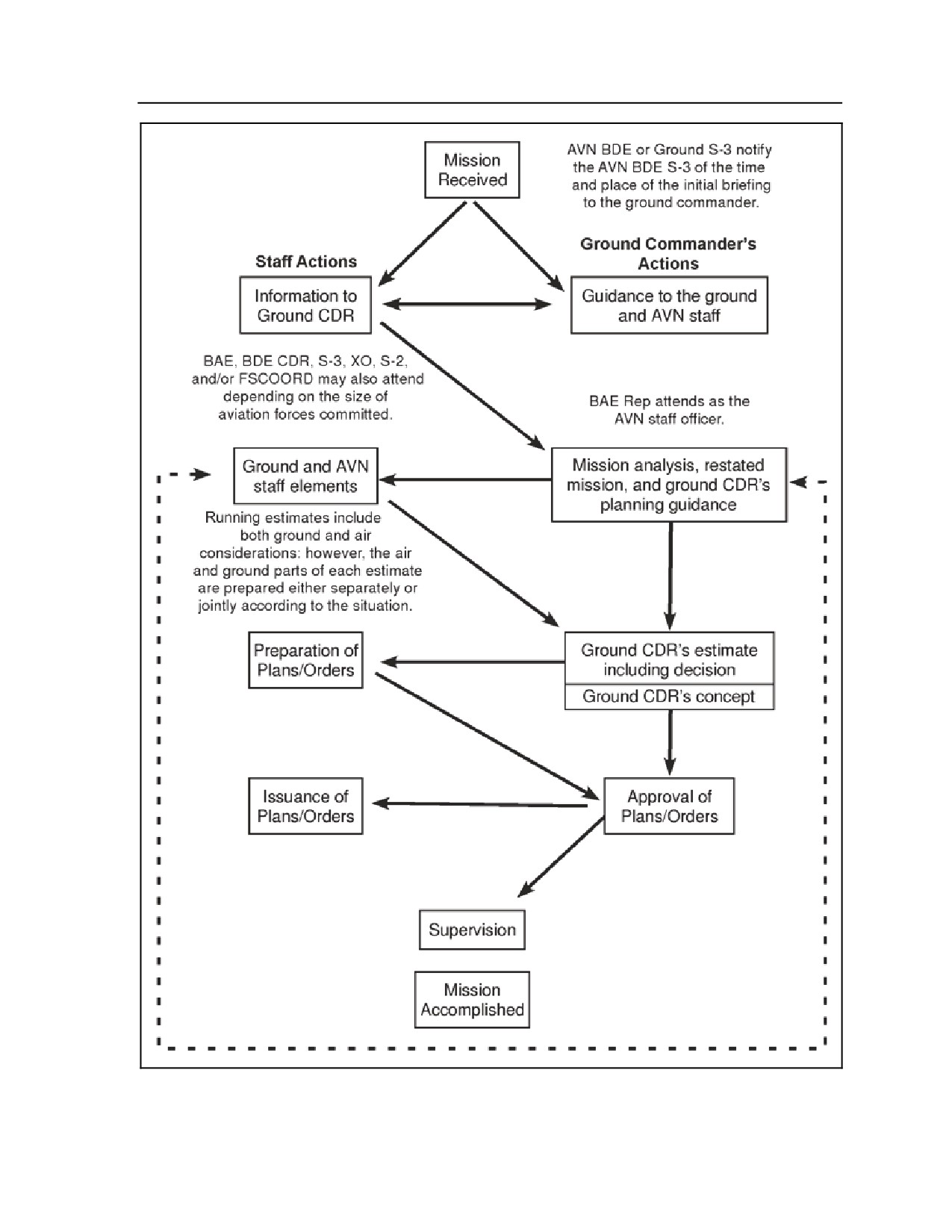
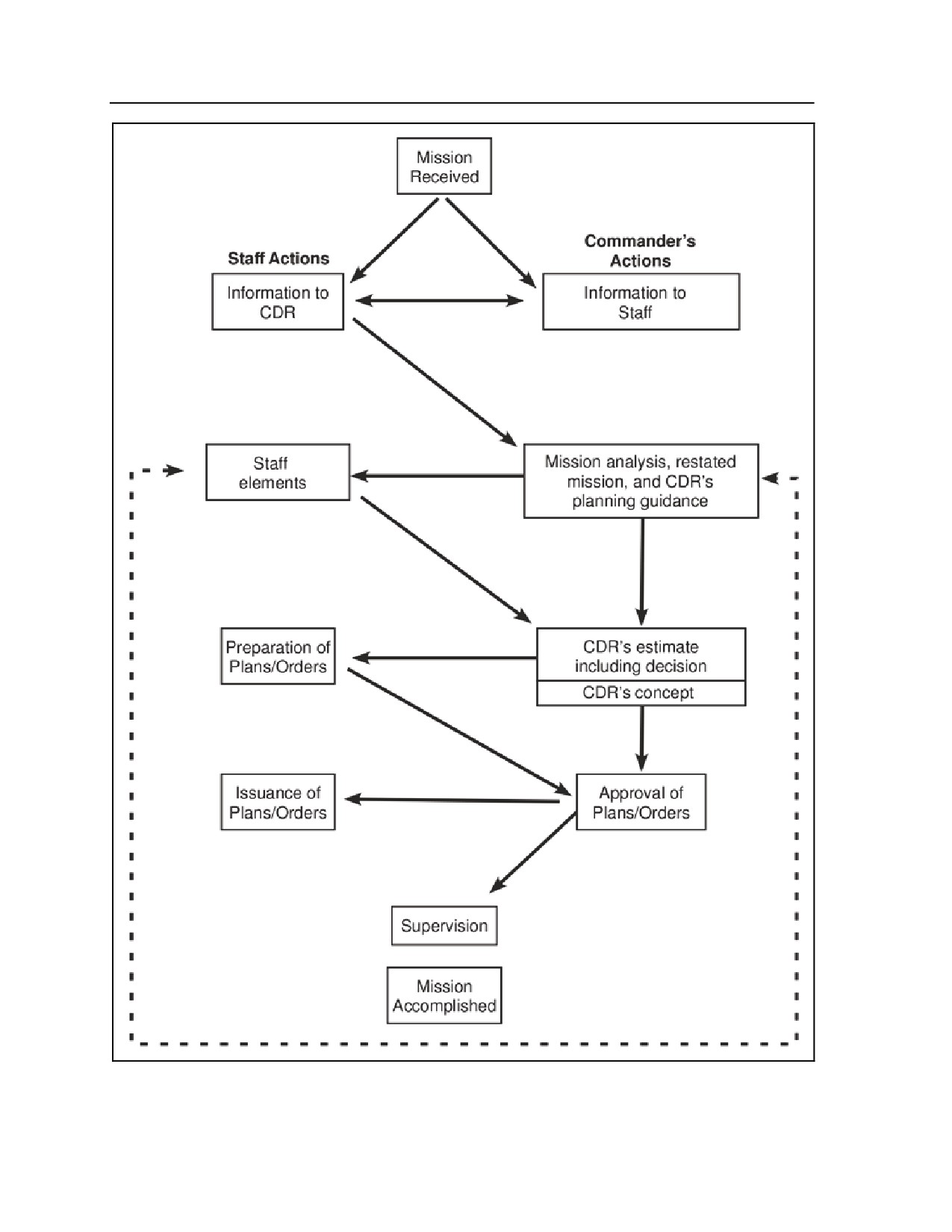
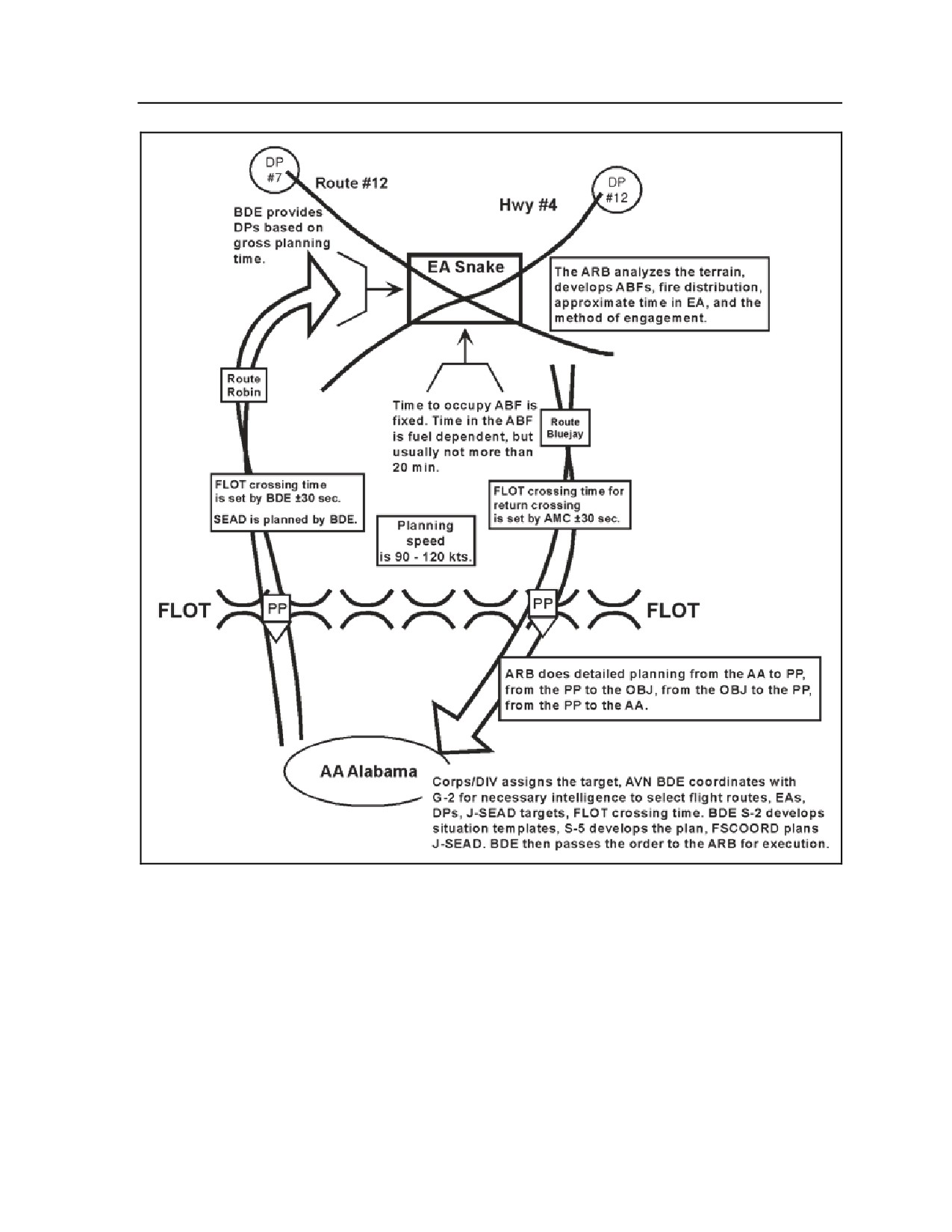
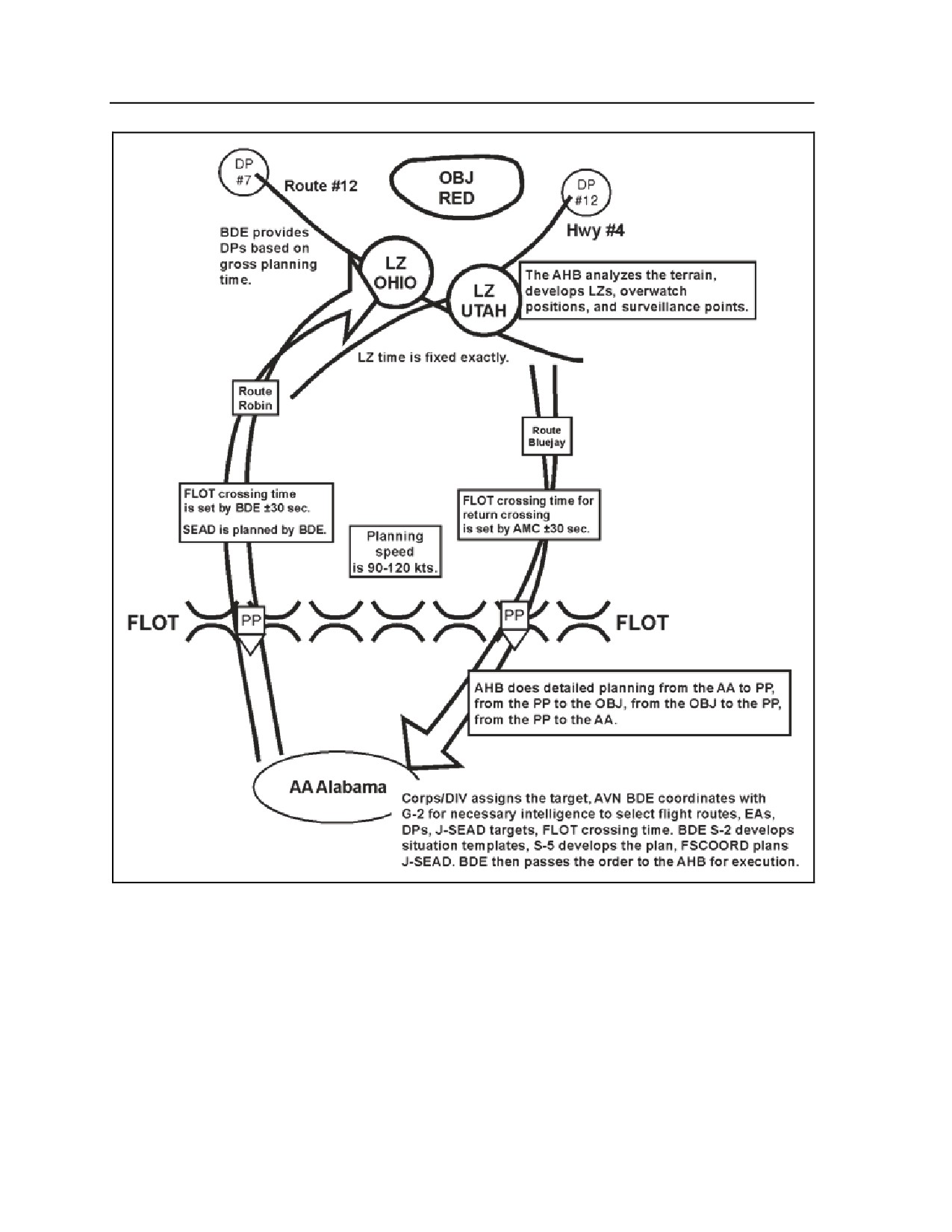
Aviation Brigade provides Battalion
Aviation Battalion determines
General timings.
Exact speeds, routes, flight modes, & timings.
H-hour (line of departure [LD], LZ).
Adjustments as LD time nears.
Passage point (PP) locations.
Exact flight route.
Suppression of enemy air defense (SEAD) /J-
Exact planning times from AA to LD, PP, BP, PZ, or LZ.
SEAD plan.
EAs, LZs, PZs, areas of potential BPs.
Exact flight routes.
Flight axes.
Exact surveillance plan
Named areas of interest (NAIs)/target areas
Release points (RPs), rally points, FPs, attack by fire
of interest/decisive points (DPs).
positions, exact BPs, kill zones, landing areas
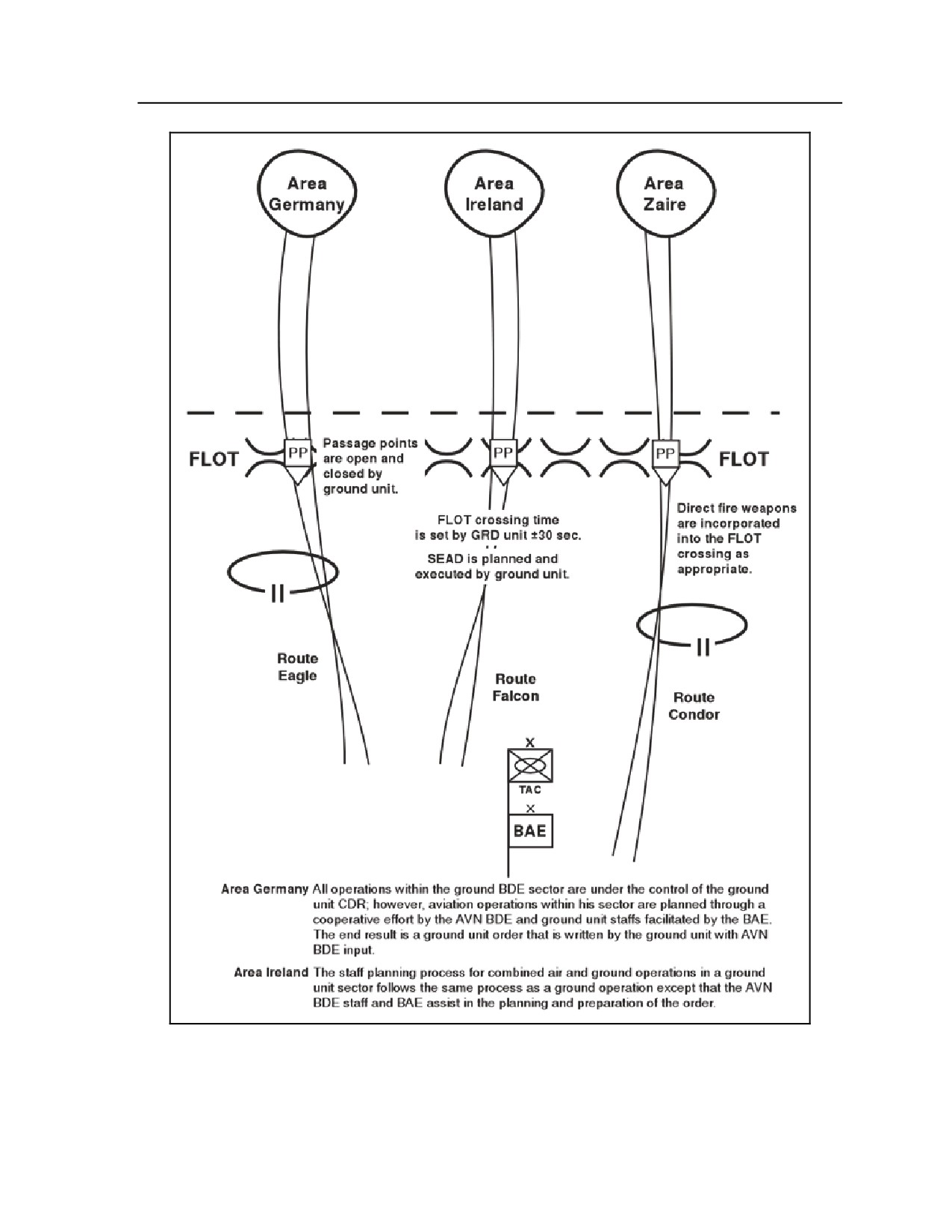
2-158. Figures 2-2, page 2-27, and figure 2-3, page 2-28, graphically depict the planning responsibilities
for air ground integration and incorporate the general rules in table 2-2. They also include some of the
planning steps of the aviation brigade's higher headquarters.
2-159. Figure 2-4, page 2-29, depicts an attack by the aviation brigade forward of the FLOT. Figure 2-5,
page 2-30, depicts an air assault supported by the aviation brigade. Figure 2-6, page 2-31, depicts an
aviation brigade supporting a ground brigade both in front of and behind the FLOT.
2-160. Times and airspeeds depicted in these figures are examples. Additionally, circumstances may
require the brigade provide the exact routes (airspace coordination) and times to affect timely coordination
with supporting elements.
2-26
FM 3-04.111
7 December 2007
Command and Control
Figure 2-2. Brigade planning responsibilities, aviation forces in support of a ground unit
7 December 2007
FM 3-04.111
2-27
Chapter 2
Figure 2-3. Brigade planning responsibilities, aviation forces under aviation brigade control
2-28
FM 3-04.111
7 December 2007
Command and Control
Figure 2-4. Aviation brigade conducts an attack
7 December 2007
FM 3-04.111
2-29
Chapter 2
Figure 2-5. Aviation brigade conducts an air assault
2-30
FM 3-04.111
7 December 2007
Command and Control
Figure 2-6. Aviation brigade supports ground brigade operations
7 December 2007
FM 3-04.111
2-31
Chapter 2
MILITARY DECISIONMAKING PROCESS
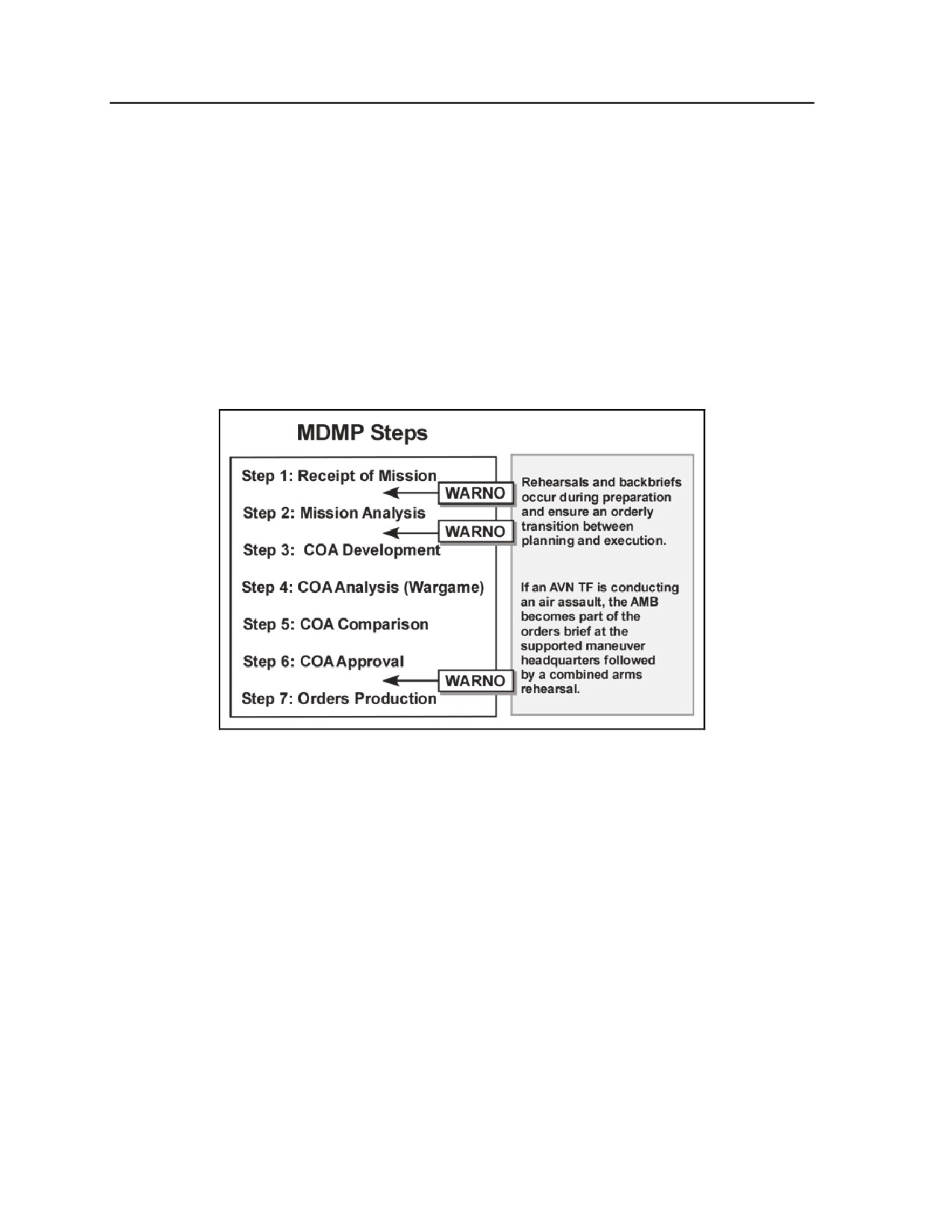
2-161. To plan and coordinate missions effectively, the commander and staff follow the MDMP (figure 2-
7). Staff planners must focus on previously listed aviation planning considerations to formulate a complete
plan. Because of the complexity inherent in the process, regular MDMP exercises are essential prior to
deployment. FM 5-0 and FMI 5-0.1 discuss this process in detail.
2-162. The dynamic battlefield does not often allow a complete MDMP because of time constraints. The
commander and staff must know current operational readiness in order to assess feasibility of mission
requests immediately.
2-163. The steps of an abbreviated MDMP are the same as those for the full process; however, the
commander performs many of them mentally or with less staff involvement (figure 2-7). The commander
may direct a COA based on experience to expedite planning. The products developed during an
abbreviated MDMP may be the same as those developed using the full process; however, they are usually
less detailed. Some may be omitted altogether. Unit SOPs should address how to abbreviate the MDMP
based on the commander’s preferences.
Figure 2-7. Military decisionmaking process
OPERATIONS IN CONTIGUOUS AND UNASSIGNED AREAS
2-164. Mission planning factors vary between operations in contiguous and unassigned areas. These
differences include the following:
z
Graphics for contiguous operations normally include restrictive control measures to prevent
fratricide during engagements in close proximity to friendly elements.
z
Actions on the objective for the two operations differ. In a close fight, the attack reconnaissance
unit maneuvers in concert with ground elements to observe and deliver ordnance on the enemy
force. With an enemy out of contact with ground forces, aviation units conduct a movement to
contact to develop the situation.
z
Weapons loads for AH-64s may vary as auxiliary fuel tanks are added for extended range
operations. Further, commanders may choose to include auxiliary fuel tanks on aircraft in close
fights increasing station time at the objective area.
z
Operations in unassigned areas involve coordinated planning with higher echelons and joint
elements, while operations in close proximity can be organized at division and BCT levels. For
instance, unassigned area operations primarily involve joint fires while contiguous operations
use ground unit direct fires, FA support, and joint fires.
2-32
FM 3-04.111
7 December 2007
Command and Control
z
C2 headquarters for close fights are normally located with the ground element in contact.
Operations out of contact with ground units are normally controlled from the aviation brigade.
AVIATION MISSION PLANNING SYSTEM
2-165. Aviation mission planning system (AMPS) is an automated mission planning and synchronization
tool designed specifically for aviation operations. Aviation brigade, battalion, and company flight planning
sections or CPs use AMPS to automate all mission planning tasks, including functions such as tactical
planning, mission management, and aircraft data loading. Portions of AMPS may be used as part of the
rehearsal process.
Tactical Planning Function
2-166. The tactical planning function of AMPS includes brigade- and battalion-level planning tasks, such
as intelligence data processing and route, communications, and navigation planning. This facilitates review
and preparation of the air mission brief. Additional AMPS uses are—
z
Creation of detailed terrain analysis.
z
Determination of line of sight (LOS) and intervisibility between a BP and an EA.
z
Determination of prominent terrain along the route to be flown, using the perspective view
feature.
z
Creation and distribution of graphics.
2-167. The BAE and division CPs have AMPS available to assist in COA development and wargaming
during the MDMP, reverse-planning, and coordination processes. During air assaults, the ground maneuver
air assault task force (AATF) staff can exploit AMPS to simplify preparation of the landing, air movement,
and loading plans. The brigade may employ AMPS to plan shaping operations and integrate aviation routes
with other J-SEAD and shaping fires.
2-168. Because BAE, aviation brigade, and battalion and below planners have AMPS access, planning
can occur concurrently. Planners can use AMPS to pass aviation brigade and ground maneuver planning to
lower echelons updating their plans. The orders function of AMPS assists OPORD, WARNO, and FRAGO
development and distribution to lower echelons. This facilitates passing up-to-date information and
changes from higher headquarters and supported units.
2-169. The mission management function also facilitates company and platoon level planning. These
tasks include aircraft performance planning, weight and balance calculations, flight planning, and fighter
management. They also include OPLAN changes and OPORD development. It helps companies and
platoons conduct rehearsals using the route visualization and intervisibility features of AMPS.
SECTION VII - AVIATION BRIGADE COMMUNICATIONS
2-170. Combat information reporting and its exploitation are fundamental to combat operations. This
information and the opportunities it presents are of interest to other maneuver units and higher
headquarters staffs. Combat information reporting requires wide and rapid dissemination. Brigade elements
frequently operate over long distances, wide fronts, and extended depths from their controlling
headquarters. Communications must be redundant and long range to meet internal and external
requirements. Long-range communications can be augmented through signal support. The systems must be
in place before they are needed.
2-171. Communication is a major challenge for the aviation brigade. Operations in close proximity to the
enemy require terrain flight altitudes that make LOS communications difficult. CPs and aircrews may
employ radio relay, retransmission, or alternate communications to maintain contact. High frequency (HF)
radio provides alternate non-line of sight (NLOS) communications for longer distance missions and nap-
of-the-earth (NOE) communications. Satellite communications (SATCOM) is available to support both C2
aircraft customers and the brigade's own C2 needs. When UAS have the capability of conducting radio
relay and retransmission missions they may enhance and ensure better communications over extended
distances.
7 December 2007
FM 3-04.111
2-33
Chapter 2
HIGHER TO SUBORDINATE
2-172. Brigade headquarters ensures its communications architecture
(command, operations and
intelligence [O&I], administrative and logistics [A&L], FS, and SATCOM) is operational at all times. The
retransmission system is dedicated to on-call restoration of communications on any net. Possible
retransmission locations must be identified and checked before starting operations. The brigade has signal
support from higher headquarters during operations.
SUBORDINATE TO HIGHER
2-173. Battalions and separate companies continually monitor brigade nets as directed (usually command
and O&I). Likewise, the brigade continually monitors its higher headquarters nets.
SUPPORTING TO SUPPORTED
2-174. Liaison elements supporting the brigade maintain communications between their organization and
the aviation brigade.
COMMUNICATIONS DISRUPTION
2-175. Communications, particularly electromagnetic, are subject to disruption. This may result from
unintentional friendly interference, intentional enemy action, equipment failure, atmospheric conditions,
electromagnetic pulse, or terrain interference. To compensate for these, the commander should—
z
Provide for redundancy in means of communication.
z
Ensure subordinates understand commander's intent.
z
Avoid overloading the communications systems.
z
Minimize use of radio.
z
Ensure signal security and COMSEC practices are followed.
COMMUNICATION RESPONSIBILITIES
2-176. All levels of command gain and maintain communications with necessary headquarters and
personnel. Communications methods and procedures should be established in unit SOPs and practiced
during battle drills and flight operations. Traditional communications responsibilities are—
z
Higher to lower. The higher unit establishes and maintains communications with a lower unit.
An attached unit of any size is considered lower to the command to which it is attached.
z
Supporting to supported. A supporting unit establishes and maintains communications with
the supported unit.
z
Reinforcing to reinforced. A reinforcing unit establishes and maintains communications with
the reinforced unit.
z
Passage of lines. During passage of lines (forward, rearward, or lateral), the passing unit
establishes initial contact with the stationary unit. However, the primary flow of information
must be from the unit in contact.
z
Lateral communications. Establishing communications between adjacent units may be fixed
by the next higher commander, by order, or by SOP. If responsibility is not fixed, the
commander of the unit on the left establishes communications with the unit on the right.
z
Rear to front communications. The commander of a unit positioned behind another unit
establishes communications with the forward unit.
2-177. Regardless of establishment responsibility, all units take prompt action to restore lost
communications.
AIRBORNE COMMAND AND CONTROL
2-178. Inherent in the brigade mission is transport of commanders and staff officers allowing them to see
the battlefield and more effectively C2 their units. A2C2S equipped aircraft, found in the GSAB, can serve
2-34
FM 3-04.111
7 December 2007
Command and Control
as an airborne TAC CP with the same digital capabilities as the ground TAC CP. Appendices B and E
provide additional information.
AERIAL RECONNAISSANCE
2-179. Brigade elements may be employed to verify enemy and friendly unit locations or even their
existence. For example, if the higher headquarters commander loses communications with a subordinate
unit, that commander may ask the aviation commander to verify the unit's location and status.
Video Teleconference
2-180. Video teleconferences (VTCs) among corps, divisions, and brigades are becoming more common.
Some brigades are already fielded with this capability. VTCs save commanders time and are an excellent
method of long distance coordination.
Wire
2-181. Normally wire is used for communications within the CP, AA, and support area. It is the primary
and most secure means of communication whenever the situation permits. Initially, wire is laid on the
ground. Then, if time permits, wire is buried or installed overhead. Buried wire is the preferred method to
counter enemy intrusion and electromagnetic pulse. However, wire should be overhead when crossing
roads, except where culverts and bridges are available. Overhead wire should be a minimum of 18 feet (5.5
meters) above ground. Wire should be tagged according to a system in the SOP. At a minimum, tags
should be at the ends of each line. This facilitates reattaching wires when they are pulled out or cut. Use of
overhead wire in the vicinity of helipads and airfields should be avoided; however, if used, they must be
clearly marked.
Telephone
2-182. Telephone, cellular telephone, and satellite telephone are convenient means to communicate
unclassified information. Commercial lines are used when approved by higher headquarters. It is
inadvisable to rely on these means heavily during training due to limited security and availability on the
battlefield. To deny enemy collection efforts, secure devices should be used with commercial lines. If a
unit is forced to withdraw, and with the approval of higher headquarters, existing wire lines (including
commercial lines) are cut and sections removed to prevent use by the enemy. Commanders must ensure
their Soldiers do not transmit sensitive information such as Soldier mishaps, unit locations, or unit strength
over cellular telephones or other non-secure means of communication.
Computers
2-183. Computers allow the exchange of intelligence, intent, orders, plans, and direction in a timely
manner. The mission and structure of the brigade determine specific information flow and processing
requirements. In turn, the brigade's information requirements dictate the general architecture and specific
configuration of the communications and computer systems. Unit SOPs should address the use of
computers.
Radio
2-184. Operations often depend on radio as the primary means of communication. This is especially true
during mobile combat operations. Radio communications should be kept to an absolute minimum until
enemy contact is made.
2-185. Frequency modulated (FM) communications are the primary O&I and A&L nets, and the means of
communicating with ground forces. However, aviation has a broad range of other radios facilitating joint,
internal, long-range, and NOE communications. Appendix B discusses the following systems:
z
High frequency (HF) for long distance and NOE communications.
z
Ultra high frequency (UHF) for internal communications and communication with joint aircraft.
z
Very high frequency (VHF) for internal communications and communications with ATS.
z
Tactical satellite and SATCOM for long distance communications.
7 December 2007
FM 3-04.111
2-35
Chapter 2
2-186. To avoid detection by enemy direction-finding equipment, the brigade uses all other means of
communication to supplement radio. Although secure equipment may prevent the enemy from knowing the
content of communications, location and volume are easy to detect and analyze giving the enemy valuable
combat information.
Radio Retransmission/Relay
2-187. Brigade retransmission stations are employed according to the tactical situation providing FM radio
communications between stations too far apart to communicate directly. Brigade can deploy both ground
and air retransmission stations. Ground retransmission normally supports the brigade command net. Airborne
retransmission has a limited time on station, but is a vulnerable asset. Preplanning is essential to the effective
use of airborne retransmission. Moving ground retransmission by sling-load is an efficient and effective
method of emplacing radio retransmission.
2-188. The brigade can insert and resupply ground retransmission teams into sites inaccessible by ground.
Brigade aircraft may carry retransmission equipment, relay equipment, or both. Aircrews can transmit or
relay with onboard equipment.
Messengers
2-189. Messengers may be used anywhere, but normally are used for critical communications between
CPs and higher and lower headquarters. Messengers are used during electronic and radio silence as well.
While ground messengers are slower than other means of communications, aviation provides a rapid
capability if preplanned. Aviation messengers may be particularly useful in carrying A&L messages when
en route to and from rear units. They can be used even if units are in contact and especially when jamming
or interception hampers radio communication. During electronic and radio silence, opening and closing
flight plans by land lines may be required to control helicopter movements.
Message and Document Delivery
2-190. Electronic transmission of messages and documents may not be possible due to nuclear weapons
employment, enemy jamming operations, imposition of radio silence, or inoperable equipment. Messages
and documents warranting aerial delivery include combat plans and orders; written coordination and
control measures; and graphics. They also include public affairs materials to sustain public understanding
and support for the Army's continued operations. Using aviation to deliver messages or documents is a
sound technique; however, it is most efficient when there is a prepared plan for execution. If an aviation
messenger service is anticipated, it should be part of the aviation brigade and higher headquarters SOPs.
Tactical Internet
2-191. When digitized systems are fielded, units may receive missions via the tactical internet (TI) along
with OPORDs and supporting information (appendix B). This accelerates the planning cycle and allows
swift interaction among supporting elements.
Visual and Audio
2-192. Visual and audio signals are found in the SOI or SOP. The SOP may establish signals not included
in the SOI. Commanders and staff planners carefully determine how sound and visual signals will be used
and authenticated. Sound and visual signals include pyrotechnics, hand-and-arm, flag, metal-on-metal, rifle
shot, whistles, horns, and bells. Visual cues are especially valuable in the FARP.
INTELLIGENCE, SURVEILLANCE, AND RECONNAISSANCE
2-193. ISR is distinct from the larger framework of information support as it focuses primarily on the
enemy. Poor intelligence has been the immediate cause for innumerable defeats. Inadequate surveillance
and reconnaissance are prime contributors. Conversely, excellent intelligence breeds bold action that
negates enemy superiority. Normally, timely and accurate intelligence depends on persistent surveillance
and aggressive, efficient reconnaissance.
2-36
FM 3-04.111
7 December 2007
Command and Control
2-194. The brigade is a key supplier of ISR; however, it is also a consumer of BCT and higher echelon
(Army, joint force, and national) ISR products. By its tie-in to higher echelon ISR information, brigade
executes its mission in an environment characterized much more by what is known rather than unknown.
COMMUNICATION NETS
2-195. Each aviation brigade communicates by one or more of the following systems:
z
LAN (secure and nonsecure).
z
Amplitude modulated (AM)/FM radio.
z
HF radio.
z
SATCOM.
z
Maneuver control system (MCS)/FBCB2.
z
Commercial lines.
z
Wire.
RADIO NETS
2-196. Brigades normally operate on their own and their higher headquarters command, O&I, and A&L
nets. Aviation brigades also operate on fire nets. Additionally, each aviation brigade must often monitor
lower, adjacent, and supported unit radio nets. This can be especially valuable when supporting and
conducting air assaults and close fires.
2-197. Critical higher headquarters radio nets must be monitored at all times.
z
Higher command net. The brigade commander, all brigade CPs, and the S-3 enter and operate.
z
Higher O&I net. The S-2 and all brigade CPs enter and operate.
z
Higher A&L net. The S-1 and S-4 enter and operate.
z
Other staff sections and officers enter other nets as appropriate.
Brigade Command Net
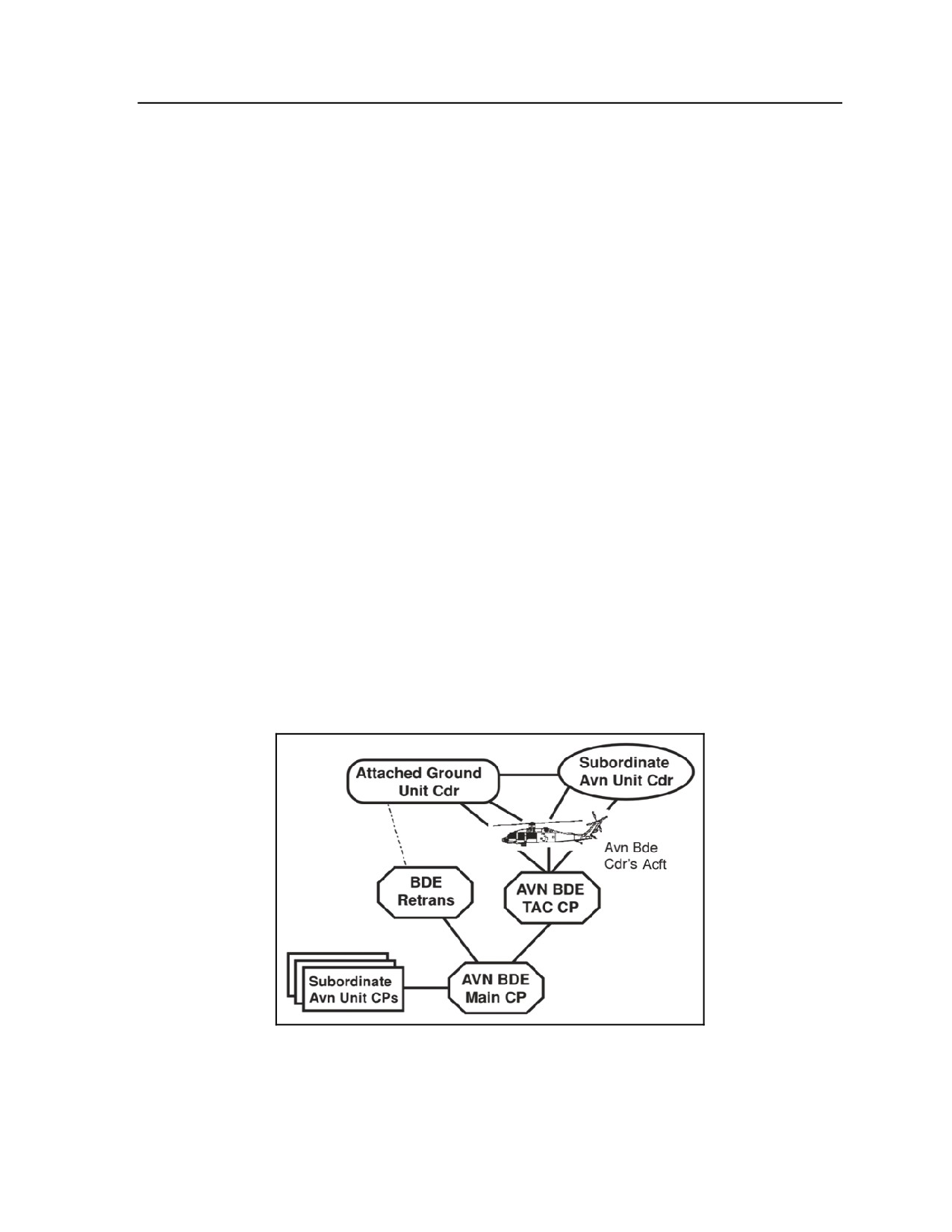
2-198. A secure command net, controlled by the S-3, is used for C2. All subordinate and supporting
maneuver and sustainment units normally operate in this net. As a rule, only commanders, XOs, or S-3s
communicate on the net (figure 2-8, page 2-38).
Figure 2-8. Brigade command net
7 December 2007
FM 3-04.111
2-37
Chapter 2
Brigade Operations and Intelligence Net
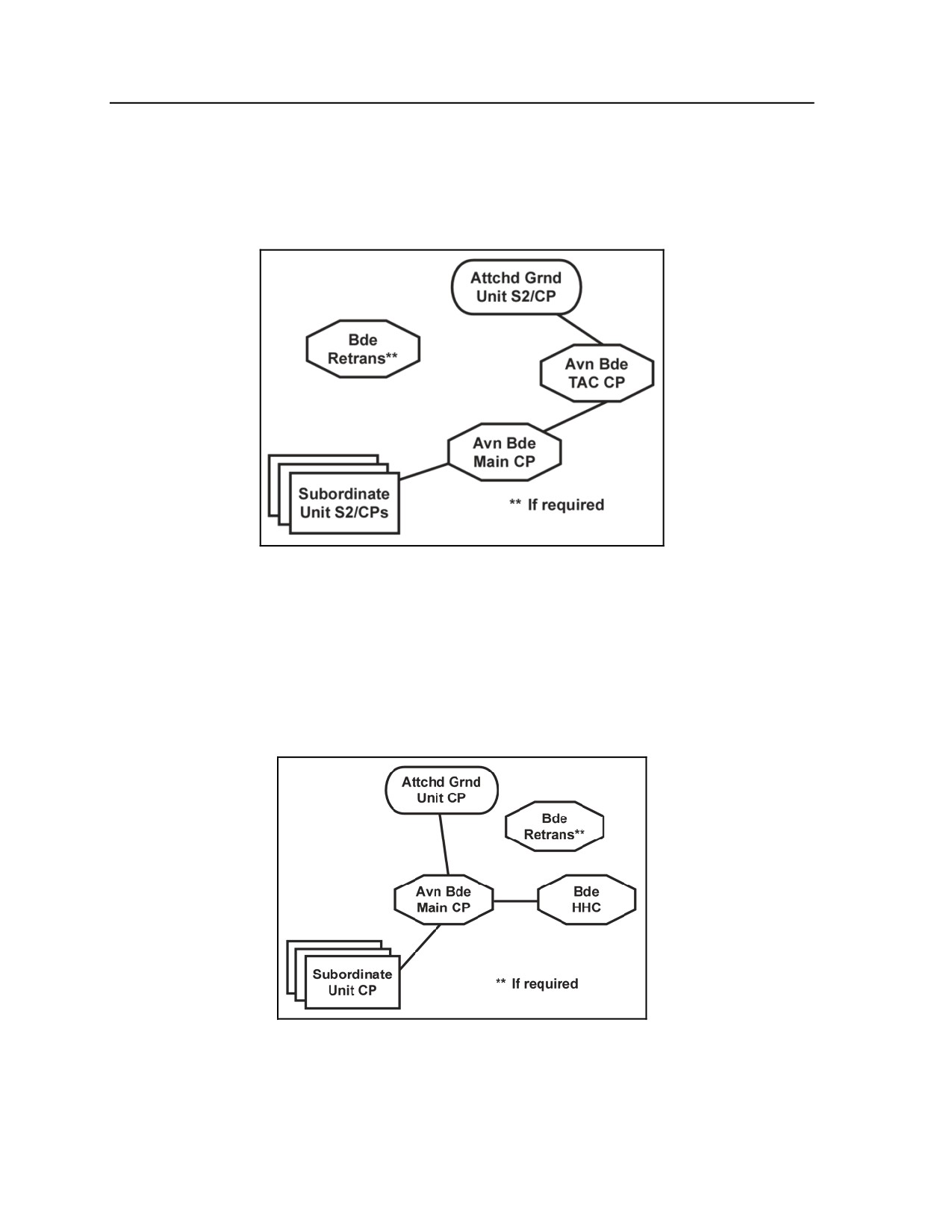
2-199. The O&I net is controlled by the S-2 and is used for routine operations and INTREPs). The O&I
net is not normally monitored by all elements of the brigade or subordinate staff. This net provides details
and discussion that lead to analysis. When completed, this analysis is relayed to the appropriate
commander. The S-2 and XO, operating in the main CP, ensure this analysis is conducted and relayed in a
timely manner by appropriate means (figure 2-9). It also functions as a surveillance net when required.
Figure 2-9. Brigade operations and intelligence net
Brigade Administrative and Logistics Net
2-200. This net is controlled by the S-1 and S-4, and is used for A&L traffic. The A&L net, like the O&I
net, is normally not monitored by all elements of the brigade or subordinate commanders. The net is used
for details and discussion leading to the resolution of administration and logistics matters. Critical
information is relayed to the appropriate commander or discussed on the command net. The XO, operating
in the main CP, ensures analysis is conducted and relayed in a timely manner by appropriate means (figure
2-10, page 2-39).
Figure 2-10. Brigade administrative and logistics net
2-38
FM 3-04.111
7 December 2007
Command and Control
Combat Aviation Net
2-201. The AMC, AATF commander , infantry force commander, and pickup zone control officer
(PZCO) use this secure FM net for air-to-ground communication at the PZ/LZ, and to transmit SITREPs
and mission changes. Aviation forces monitor this net during air assault operations and selected air
movement operations, especially in the vicinity of the PZ/LZ.
Fire Control Nets
2-202. The FSCOORD operates in the supporting FA command net and a designated fire direction net to
coordinate artillery fires. USAF ALO, when attached, CAS through a USAF CAS request net (HF/single
side band) and a UHF/AM air-ground net.
Monitored Radio Nets
2-203. Aviation brigades must monitor the nets of subordinate, adjacent, supporting, or supported units
often. This can be especially valuable in complex or fast moving operations.
2-204. The brigade commander should have three FM nets, one UHF/VHF net, one HF radio, and one
SATCOM radio. These nets enable him or her to monitor subordinate unit, supported unit command, O&I,
A&L, or other nets deemed important to the mission at hand.
DIGITAL SITUATIONAL AWARENESS NET
2-205. The digital SA net is designated primarily for constant transmission of digital information on the
battlefield. Digital information traffic shares the net with digital communications. The brigade AMPS is the
net hub and each battalion links to the brigade AMPS. The brigade AMPS collects spot reports
(SPOTREPs), SITREPs, status reports (STATREPs), and BDA reports.
STANDARD ARMY MANAGEMENT INFORMATION SYSTEMS NETS
2-206. Standard Army Management Information Systems (STAMISs) consist of computer hardware and
software systems automating diverse functions based on validated customer requirements and facilitating
the vertical flow of logistics and maintenance status information to units Army wide. Chapter 5 addresses
STAMIS architecture.
ARMY BATTLE COMMAND SYSTEM NETS
2-207. Appendix B addresses digitized unit nets.
SECTION VIII - COMMAND POST SURVIVABILITY
2-208. CPs present electronic, thermal, acoustic, visual, and moving-target signatures easily detected.
Upon detection, CPs can be destroyed through overt enemy action or disrupted and exploited by electronic
means unless measures are taken to reduce vulnerability. Measures include—
z
Maintaining local security.
z
Locating on reverse slopes to deny enemy direct and indirect fire effects.
z
Locating in urban areas to harden and reduce IR or visual signatures. Collateral damage to the
local population must be considered if exercising this option.
z
Remotely locating and dispersing antennas.
z
Dispersing CP sub-elements.
z
Displacing as required by METT-TC.
z
Using low probability of interception techniques—landlines, directional antennas, and
messengers.
z
Providing COMSEC.
7 December 2007
FM 3-04.111
2-39
Chapter 2
2-209. In most cases, survivability requires commanders to employ a combination of the protective
measures listed above. Commanders must balance employment of these measures against maintaining CP
operations and effectiveness. Frequent displacement, for example, might reduce the vulnerability of a CP,
but such movement may greatly degrade its C2 functions.
MAIN COMMAND POST SITE SELECTION
2-210. Units deploy their CPs on the battlefield according to METT-TC. Common methods include—
z
CPs set up separately from unit locations.
z
CPs set up with units.
z
CPs using a combination of the above.
2-211. Setting up the CP independent of subordinate units separates the signatures associated with CP and
helicopter operations. However, it makes face-to-face coordination more difficult unless adequate digital
connectivity is available. Commanders decide which method to use during the IPB process.
2-212. The most important considerations for selecting any CP site are security and communications with
higher, subordinate, and adjacent headquarters. Range of enemy artillery, accessibility to adequate entry
and departure routes, cover, concealment, drainage, and space for dispersing are other considerations. An
adequate LZ should be nearby. The S-3 selects the general location of the main CP, while the HHC
commander and S-6 normally select the exact location. When selecting the general location of the CP, the
S-3 chooses at least one alternate site in the event the primary site proves inadequate.
Offensive Operations
2-213. During offensive operations, the main CP should be well forward. In fast-moving operations, the
main CP may have to operate on the move. Staff coordination and communications are usually degraded
when CPs are moving; thus, CPs must train to operate while moving.
Defensive Operations
2-214. During defensive operations, the main CP normally locates in a secure location out of enemy
direct and indirect fire capability to minimize its vulnerability. The exact location depends on the threat,
terrain, road network, and ability to communicate.
Urban Operations
2-215. The main CP often sets up in built-up areas. Barns, garages, and warehouses minimize the need
for detailed camouflage. Basements offer protection from enemy fires. Built-up areas also reduce IR and
electromagnetic signatures.
Reverse Slopes
2-216. Reverse slopes cover and conceal CPs from direct observation and fires. Reverse slopes can
degrade the enemy's ability to collect, monitor, and jam electronic transmissions. Electronic profiles run by
the S-6 provide information for determining the ability to transmit and receive. Profile analysis by the S-2
provides information needed for determining the enemy's ability to degrade CP capabilities or intercept
traffic.
Prominent Terrain Features
2-217. Units should avoid establishing CPs on prominent terrain or major road junctions. Such features
are often enemy preplanned artillery and air targets.
MAIN COMMAND POST DISPLACEMENT
2-218. The main CP displaces in either a single or phased move. The method selected depends on METT-
TC, the distance to be moved, and communications requirements. Movement degrades communication on
all nets; however, the higher headquarters, brigade, and subordinate command nets must be maintained.
2-40
FM 3-04.111
7 December 2007
Command and Control
Maintaining contact with higher headquarters may require alternate communications means, such as
aircraft or vehicle mounted systems. When operations are ongoing, moving the main CP is accomplished in
a phased move in coordination with the displacement of the TAC CP. During displacement, critical aspects
of C2 must be maintained. Displacements are planned ensuring the main CP is stationary during critical
phases of planning and operations.
Displacement Steps
2-219. The S-3 establishes the general area for the new CP. The HHC commander, S-6, and a CBRN
team conduct detailed reconnaissance. Following are steps for this displacement.
z
The reconnaissance party identifies possible routes and sites. Locations must provide effective
communications and accommodate all required vehicles and equipment. Several possible sites
must be identified, reconnoitered, and planned to provide flexibility and alternate sites.
z
The reconnaissance party makes route and site sketch maps showing the exact element locations
within the new CP location.
z
The S-3 or commander approves the primary and alternate sites.
z
A movement order is published. An SOP practiced and drilled greatly reduces the effort required
to produce the order.
z
Security personnel and guides are dispatched. The security force ensures the area is clear of
enemy and contamination, and the guides prevent wrong turns and assist elements in occupation.
Signals are especially important for low visibility and night displacements.
z
Reporting and coordinating functions are shifted as required. The shift may be within main CP
echelons or to the TAC CP.
z
CP and HHC elements prepare and execute movement per SOP. The main CP may displace in
one echelon if the TAC CP can provide C2 for the interim. If the TAC CP cannot execute the
required C2, the main CP displaces in two echelons. The first echelon displaces with enough
assets and personnel to establish minimum C2. The second echelon remains in place and
provides C2 until the first echelon assumes control, then displaces.
AUSTERITY
2-220. The main CP is a major source of electromagnetic and IR energy. Enemy forces may detect these
emissions and fix the location of the main CP and place indirect fire, CAS, or electronic warfare (EW)
strikes on it. The nature of the threat may require frequent CP movement. Frequent CP moves require the
following considerations:
z
The main CP should be as light as possible and drilled in rapid teardown, movement, and setup.
The larger and more elaborate a CP, the less rapidly it can move.
z
Frequent movement may hinder C2 planning, degrade communications, and sacrifice time.
Frequent moves may also increase the chances of enemy detection.
SECURITY AND DEFENSE
2-221. The HHC commander plans, organizes, and supervises the security and defense of the main CP.
The plan establishes teams, squads, sections, and platoons. It also establishes a chain of command for
perimeter defense and the quick reaction force (QRF). The brigade XO approves the plan. Refer to FM 3-
04.126 and FM 1-113 for additional information on CP and AA procedures.
2-222. The threat is divided into three levels that provide a general description and categorization of
threat activities, identify the defense requirements to counter them, and establish a common reference for
planning guidelines. Table 2-3 lists these threat levels and their likely appropriate responses. Refer to FM
3-19.1 for additional information
7 December 2007
FM 3-04.111
2-41

Chapter 2
Table 2-3. Threat levels
Threat
Example
Response
Level
Unit, base, & base-cluster
I
Agents, saboteurs, sympathizers, & terrorists.
self-defense measures.
Self-defense measures &
Small tactical units, unconventional-warfare forces, guerillas, &
II
response forces
bypassed enemy forces.
w/supporting fires.
Large tactical-force operations (including airborne, heliborne,
Timely commitment of a
III
amphibious, infiltration, & bypassed enemy forces).
tactical combat force (TCF).
2-223.
.Fighting positions are well prepared, mutually supporting, and known to all. Alarms are
established and known to all; minimum alarms include ground, air, and CBRN attacks. Rehearsals are
conducted and actions are greatly simplified if part of the SOP and drills are conducted often to ensure
readiness.
2-224. The staff supports the HHC commander by providing personnel for defense and security. In an
actual attack, the main CP continues C2 of the brigade unless the situation compels use of all personnel in
the defense.
Reaction Forces
2-225. Reaction forces and attachments must be fully integrated into the overall plan. Each individual
must have a clear and current SU of friendly and enemy forces in the AO. For example, a CP reaction force
should know if military police are conducting mounted patrols near the CP. The overall reaction force plan
must integrate those military police units or establish boundaries between the reaction force and the
military police unit.
2-226. A clear chain of command and training supported by battle drills are essential for reaction force
preparedness. They must assemble and be ready to fight in 10 minutes or less. Proper preparation includes
the following:
z
Alarms should be the same throughout the brigade, division, and corps. These alarms should be
in the SOP.
z
Reaction plans are rehearsed and executed on a routine basis. Prior to deployment and at in-
country training centers, multiple integrated laser engagement system gear and live or blank
ammunition supplemented by pyrotechnics should be used whenever possible to enhance
training realism. The reaction to a night attack on the main CP must be second nature if the
enemy force is to be repelled.
2-227. Each reaction force assembles based on an alarm or orders. Personnel move to a predetermined
rally point, establish communications, and conduct operations as required to counter the threat.
Preparation for Security and Defense
2-228. Physical preparation for defense of the main CP site includes—
z
Ensuring each Soldier is briefed, and has a copy and understands the ROE (for complicated
ROE, it is often necessary to conduct situational training exercises to ensure understanding).
z
Concealment including use of urban areas and camouflage.
z
Cover for fighting positions and protective shelters.
z
Vehicle revetments, transitory vehicle dismount points, and parking areas.
z
Protective wire barriers.
z
Prepared defensive positions.
z
Prepared alternate and supplementary positions.
2-42
FM 3-04.111
7 December 2007
Command and Control
z
Prepared routes for supply and evacuation.
z
Minefields to cover avenues of approach, if approved for use. Adherence to correct procedures
makes mine recovery less dangerous when it is time to displace. Minefields must be observed.
z
Prepared sleep areas that are dug in or revetted to protect against enemy direct or indirect fires.
z
Listening posts/observation posts (OPs) covering approaches to the main CP. These positions
must be prepared to prevent visibility when approached from the front.
z
Devices such as ground surveillance radar, personnel detection devices, and field expedients to
enhance early warning of enemy approach or infiltration.
z
Crew served weapons emplaced to cover suspected avenues of approach. Cleared fields of fire.
z
Wire and directional antennas to prevent detection by enemy EW elements.
z
Air and ground patrols to inhibit observation and attack of the main CP. Returning aircraft
should be given patrol areas to survey before landing. Ground patrols should conduct
reconnaissance as required to detect enemy observers or civilians who may be enemy
informants.
z
Daily stand-to to establish and maintain a combat-ready posture for combat operations on a
recurring basis. Stand-to includes all steps and measures necessary to ensure maximum
effectiveness of personnel, weapons, vehicles, aircraft, communications, and CBRN equipment.
Units assume a posture during stand-to enabling them to commence combat operations
immediately. Although stand-to is normally associated with begin morning nautical twilight,
unit operations may dictate another time.
Standing Operating Procedures
2-229. CP organization, operations, and sustainment must be standardized in the SOP. Personnel
associated with a CP must be completely knowledgeable of CP aspects. Training drills are essential for CP
movement, setup, teardown, security, and operations. Drills to counter loss of critical personnel and
equipment must be standardized and practiced day and night. Critical SOP items include—
z
Personnel duties for each phase of CP operations and movement.
z
Communications setup priorities—radio, wire, LAN, TI, and SATCOM.
z
Critical friendly and enemy information reporting.
z
Maintenance of maps and graphics.
z
Maintenance of computers and automation equipment.
z
Setup, teardown, and movement duties.
z
Camouflage priorities.
z
Light and noise discipline.
z
Maintenance of generators.
z
COMSEC changeover times.
z
Maintenance of journals.
z
CP security and admission procedures.
7 December 2007
FM 3-04.111
2-43
This page intentionally left blank.

Chapter 3
Employment
This chapter addresses employment aspects for the aviation brigade. Factors common
to all four types of operations—offensive, defensive, stability, and civil support—
include planning considerations based on METT-TC and air-ground integration
throughout the planning, preparation, and execution of a mission. Emerging
battlefield elements affecting operations procedures include asymmetric threat,
airspace deconfliction, CBRN weapons, and special environments.
SECTION I - GENERAL
3-1. Aviation brigades are tailored to execute
operations supporting the ground force commander.
Contents
The principal role of the brigade is to set conditions
Section I - General
3-1
for the success of its units.
Section II - Army Aviation Missions
3-5
3-2. Modularity of forces means that aviation
Section III - Air-Ground Integration
3-9
brigades may be tasked to support units from
Section IV - Operations in Asymmetric
different divisions, such as teaming of a light
Environments
3-10
aviation brigade with one or more HBCTs.
Section V - Chemical, Biological,
Especially in cases such as this, early development
Radiological, and Nuclear
3-12
of liaison and combined training is important.
Section VI - Special Environments
3-12
Section VII - Unmanned Aircraft Systems
Operations
3-17
TYPES OF OPERATIONS
3-3. Army forces conduct offensive, defensive,
and stability operations as part of joint campaigns outside the U.S. Army forces conduct civil support
operations inside the U.S. and its territories to support homeland security. Homeland security has two
components-homeland defense and civil support. Homeland defense includes offense, defense, and
stability missions to defend the homeland if threatened by hostile armed forces. Civil support missions
include support to civil authorities and law enforcement; protection of military and civilian critical assets;
and response and recovery. Types of Army operations are outlined in table 3-1 and tables 3-2 through 3-4
(page 3-2).
Table 3-1. Types of offensive operations
Offense
Definition
Movement to
Employs movement to develop the situation, establish contact, or regain contact with the
Contact
enemy.
Search and Attack: Utilizes smaller, light maneuver units and attack reconnaissance or
air assault forces in large area to destroy enemy forces or deny area to the enemy.
Attack
Destroys or defeats enemy forces through aerial firepower, mobility, and shock effect.
CCA: Application of Army aviation into the close fight using integrated air-ground
operations.
Interdiction attack: Combines ground-based fires, attack aviation, unmanned systems,
and joint assets to mass effects (beyond friendly forces in contact). Focused on key
objectives, fleeting HVTs, and threats to friendly maneuver.
7 December 2007
FM 3-04.111
3-1

Chapter 3
Table 3-1. Types of offensive operations
Offense
Definition
Special Purpose: Special purpose attacks achieve objectives different from those of
other attacks. Counterattacks are usually phases of a larger operation. Raids and
ambushes are generally single-phased operations conducted by small units.
Exploitation
Follow-up of gains to take full advantage of success in battle.
Pursuit
An action against a retreating enemy force.
Table 3-2. Types of defensive operations
Defense
Definition
Mobile
Orients on defeat or destruction of the enemy force by allowing it to advance to
a point where it is exposed to a decisive attack.
Area
Orients on denying the enemy designated terrain. Conducted to defend
specified terrain, when the enemy enjoys a mobility advantage over the
defending force, when well-defined avenues of approach exist, and the
defending force has sufficient combat power to cover the likely enemy avenues
of approach.
Retrograde (Delay)
Mission that trades space for time while retaining flexibility and freedom of
action.
Retrograde
A planned, voluntary disengagement that anticipates enemy interference.
(Withdrawal)
Retrograde
A force not in contact with the enemy moves away from the enemy.
(Retirement)
Table 3-3. Types of stability operations
Stability Operations
Definition
Civil Security
Protecting the populace from external and internal threats.
Civil Control
Regulating the behavior and activity of individuals and groups to reduce the
risk to individuals or groups to promote security.
Restore Essential
Providing the populace with essential services including life-saving medical
Services
care, the prevention of epidemic disease, provision of food and water,
provision of emergency shelter from the elements, and the provision of basic
sanitation.
Support to Governance
Providing societal control functions that include regulation of public activity,
rule of law, taxation, maintenance of security, control and essential services,
and normalizing means of succession of power.
Support to Economic
Operations to provide direct and indirect military assistance to local, regional,
and Infrastructure
and national economic and infrastructure development to provide an
Development
indigenous capacity for continued economic and infrastructure development.
Table 3-4. Types of civil support operations
Civil Support
Definition
Support Civil Law
Providing support to local, state, and federal law enforcement officers. In
Enforcement
extreme cases, when directed by the President, Regular ARFOR maintain law
and order under martial law.
Provide Support in
Providing C2, protection, and sustainment to government officials at all levels to
Response to Disaster
support governance until these agencies are able to function without Army
support.
Provide Other Support,
Conduct response to natural or man-made disaster in order to provide essential
as required
services to affected area. Essential services include rescue, emergency
medical care, prevention of epidemic disease, provision of food and water,
provision of emergency shelter from the elements, and the provision of basic
sanitation.
3-2
FM 3-04.111
7 December 2007

Employment
PRINCIPLES
3-4. The aviation brigade's primary role is to set conditions for success by—
z
Ensuring required C2 facilities are in place and operational.
z
Ensuring SU (enemy and friendly).
z
Ensuring necessary liaison to and from other organizations is in place.
z
Coordinating brigade's movements and operations within the OE.
z
Having necessary support and sustainment.
3-5. Aviation brigades have the organic capability of striking an enemy from multiple directions, either in
support of BCTs or independently. Attack reconnaissance aircraft carry a combination of missiles, rockets,
and guns to destroy HPTs, shield maneuver forces as they move out of contact, and enable shaping of the
OE. In addition to traditional attack functions, the attack reconnaissance unit executes all functions of
traditional air cavalry. As an armor killer, it is deadly against massed-moving targets, and is also effective
against enemy FA, AD, communications, logistics units, and point targets (bunkers, caves, windows in
buildings). The attack reconnaissance unit cannot occupy terrain; however, it can deny terrain for a limited
period of time with direct and indirect fire.
3-6. Assault and GS aircraft provide organic capability for air assaults, aerial mine delivery, and
sustainment operations in support of the aviation brigade or supported BCT. Assault and GS aircraft allow
the commander to shape the battlefield utilizing air assaults to support seizure of key terrain or allow light
forces to gain a maneuver advantage over enemy forces. They also provide the commander the ability to
conduct BCOTM with aerial C2 support and A2C2S equipped platforms. In addition, the aviation brigade
has the ability to provide air movement of sustainment assets, aeromedical evacuation, CASEVAC, and
heavy lift support to the BCT.
COMMAND AND SUPPORT RELATIONSHIPS
3-7. Command and support relationships are fundamental to aviation operations. Table 3-5 depicts
appropriate relationships and responsibilities.
Table 3-5. Command and support relationship to inherent responsibility
Inherent
If Relationship is—
Responsibilities
Command
Support
are—
Attached
OPCON
Tactical
Assigned
DS
GS
control
(TACON)
Has command
Gaining
Gaining unit
Gaining
Parent unit
Parent
Parent
relationship with—
unit
unit
unit
unit
Task-organized by—
Gaining
Parent &
Parent unit
Parent unit
Parent
Parent
unit
gaining units:
unit
unit
gaining unit
may pass
OPCON to
lower HQ
Receives
Gaining
Parent unit
Parent unit
Parent unit
Parent
Parent
sustainment from—
unit
unit
unit
Assigned position or
Gaining
Gaining unit
Gaining
Gaining unit
Supporte
Supported
AO by—
unit
unit
d unit
unit
Provides liaison to—
As
As required
As required
As required
Supporte
As
required
by gaining
by gaining
by parent
d unit
required
by gaining
unit
unit
unit
by parent
unit
unit
Establishes/maintain
Unit to
As required
As required
As required
Parent
As
s communication
which
by gaining &
by gaining
by gaining
unit:
required
with—
attached
parent units
& parent
units
supporte
by parent
7 December 2007
FM 3-04.111
3-3

Chapter 3
Table 3-5. Command and support relationship to inherent responsibility
Inherent
If Relationship is—
Responsibilities
Command
Support
are—
Attached
OPCON
Tactical
Assigned
DS
GS
control
(TACON)
units
d unit
unit
Priorities created
Gaining
Gaining unit
Gaining
Parent unit
Supporte
Parent
by—
unit
unit
d unit
unit
Gaining unit can
Attached;
OPCON;
GS; DS
N/A
**
N/A
impose further
OPCON;
TACON; DS,
command or support
TACON;
GS
relationship of—
GS; DS
* In the North Atlantic Treaty Organization (NATO), the gaining unit may not task organize a multinational unit.
** Commanders of units in DS may further assign support relationships between their subordinate units and elements of
the supported unit after coordination with the supported commander.
COMMAND RELATIONSHIPS
3-8. Command relationships are assigned, attached, OPCON, or TACON. A subordinate unit of the
aviation brigade is attached only to a unit that can support its logistics needs. The aviation unit is placed
OPCON or TACON when it is to be used for a specific mission, the effective time of the relationship is
short, or the gaining unit is unable to provide logistics support. Normally, the parent headquarters retains
control of the aviation unit.
3-9. Aviation units are traditionally OPCON or attached when operating outside the brigade. At the
division level, units are placed OPCON to other units in support of ground operations. When operating as
part of a TF or augmenting another unit for an extended period of time, the unit will be attached.
Assigned
3-10. Assigned is the placement of units or personnel in an organization where such placement is relatively
permanent. The organization controls and administers the units or personnel for the primary function (or
greater portion of the functions) of the unit or personnel.
Attached
3-11. Attached is the placement of units or personnel in an organization where such placement is relatively
temporary. Subject to limitations imposed by the attachment order, the commander of the unit receiving the
attachment provides sustainment support above its organic capability. Normally, the parent unit is
responsible for transfers, promotion of personnel, nonjudicial punishment, courts-martial, and
administrative actions.
Operational Control
3-12. OPCON is the authority to perform those functions of command over subordinate forces involving
organizing and employing commands and forces, assigning tasks, designating objectives, and giving
authoritative direction necessary to accomplish the mission. OPCON may be delegated and includes
authoritative direction over all aspects of military operations and joint training necessary to accomplish
missions assigned to the command. OPCON normally provides full authority to organize commands and
forces and employ those forces as the commander considers necessary in accomplishing assigned missions.
OPCON does not, in and of itself, include authoritative direction for logistics or matters of administration,
discipline, internal organization, or unit training.
3-4
FM 3-04.111
7 December 2007
Employment
Tactical Control
3-13. TACON is the command authority limited to the detailed, and usually local, direction and control of
movements or maneuvers necessary to accomplish missions or tasks assigned. TACON is inherent in
OPCON. TACON may be delegated. TACON allows commanders to apply force and direct tactical use of
logistics assets, but does not provide authority to change organizational structure or direct administrative
and logistics support.
SUPPORT RELATIONSHIPS
3-14. The support relationships of utility and heavy helicopter assets are DS and GS. Specific definitions
and missions follow.
Direct Support
3-15. DS refers to a mission requiring a force to support another specific force and authorizing it to answer
directly to the supported force's request for assistance. A unit assigned a DS relationship retains its
command relationship with its parent unit, but is positioned by and has priorities of support established by
the supported unit. Assault and cargo helicopter units will often be placed in a DS role for air movement
operations, particularly logistics movement. When operating in a DS role, these missions can be
coordinated directly between the aviation unit and the supported unit.
General Support
3-16. GS is support given to the supported force as a whole and not to any particular subdivision thereof.
For example, assault helicopter units assigned at theater and corps levels may be placed in GS to several
units within the theater or corps. These units will receive missions from their parent headquarters based
upon support priorities established by theater and corps commanders. When operating in a GS role, the
supported unit must request aviation support from the appropriate headquarters (division Assistant Chief of
Staff-Operations (G-3) for divisional aviation assets, corps G-3 for theater aviation assets).
SECTION II - ARMY AVIATION MISSIONS
3-17. Aviation forces normally operate as part of the combined arms team integrated from BCT level to
theater level. Aviation is organized and equipped to support both joint and Army operations. An aviation
TF supporting the BCT primarily conducts reconnaissance, security, CCA, air assault, air movement and
aeromedical evacuation. When reinforced with ground combat units, the aviation brigade can be employed
as a BCT.
RECONNAISSANCE
3-18. Attack reconnaissance aircraft are employed to support the commander’s scheme of maneuver and
significantly extend the OE of both the BCT and echelons above the BCT. Attack reconnaissance aircraft
assist in locating the threat, building and sharing the COP, enhancing force protection, enabling freedom of
movement, clearing the way for air assault missions, securing routes for aerial/ground resupply, and
allowing the commander to focus combat power. Sensor video recording capability can provide the
supported commander excellent reconnaissance and BDA information.
3-19. Attack reconnaissance assets can fight for information. They work through and counter enemy
deception efforts, provide an expedient and reliable means of assessing terrain that the enemy is trying to
configure to its advantage, can further develop the situation, and can effectively disseminate real-time
information to commanders. The organic weapons systems of attack reconnaissance aircraft enhance the
synergy achieved through employment of external fires and effects, giving commanders at all levels a
robust counter reconnaissance capability.
7 December 2007
FM 3-04.111
3-5
Chapter 3
AERIAL SURVEILLANCE
3-20. Primarily a mission for UAS, the aviation brigade may conduct surveillance with manned and
unmanned assets. Aerial surveillance is defined as systematic observation to obtain detailed information of
a specific target or area. The focus of surveillance is generally a point target such as a house, car, section of
road, or any other defined area with specific threat indicators to trigger priority intelligence requirements
(PIRs). Brigade elements use the same fundamentals to conduct surveillance as with any reconnaissance
mission. When performed by the ARB, surveillance is normally overt in nature with the purpose of
deterring enemy movement or activity.
SECURITY
3-21. The aviation TF supporting the BCT can conduct security operations. Each can accomplish screen,
guard, and cover operations with augmentation for the latter two operations. Security operations are
particularly valuable during early entry operations when the COP is degraded and dynamics of the
battlefield change fast. The combination of attack reconnaissance aircraft and UAS enable commanders at
all levels to quickly move or deploy interactive and interpretive intelligence collectors over great distances
to provide early warning, and gain and disseminate a timely picture of the battlefield. These aircraft
quickly transition from a reconnaissance/counter reconnaissance or security mission to an economy of
force or attack mission to provide reaction time, maneuver space, and protection for air-ground operations.
The ACS, not normally a part of an aviation brigade, provides BCTs with added flexibility to conduct
operations throughout their entire AO.
ATTACK
3-22. An attack is an offensive operation that destroys or defeats enemy forces, seizes and secures terrain,
or both. Attack reconnaissance units of the aviation brigade conduct attacks in support of higher
headquarters and supported BCT commanders. The ARB and ARS of the aviation brigade conduct both
interdiction attacks and CCAs.
INTERDICTION ATTACK OPERATIONS
3-23. The interdiction attack capability of the aviation brigade, particularly when coupled with Army and
joint fires and effects, extends the battle to the maximum range of organic and supporting sensors. The
aviation brigade headquarters is most appropriate for the planning of interdiction attacks. During the
conduct of interdiction attack operations, the aviation brigade normally requires OPCON or DS long range
fires and supporting joint assets. Refer to FM 3-04.126 for additional information on interdiction attack
operations.
CLOSE COMBAT ATTACK
3-24. The ARB and ARS of the aviation brigade provide the commander with the capability to support
ground forces that are engaged. CCA is carried out with direct fire weapons supported by indirect fire and
CAS. The range between combatants may vary from several thousand meters to hand-to-hand combat.
During CCA, attack reconnaissance aircraft engage targets near friendly forces, thereby requiring detailed
integration of fire and maneuver of ground and aviation forces. To achieve desired effects and reduce risk
of fratricide, air-ground integration must take place down to team levels. Refer to FM 3-04.126 for
additional information on CCA operations.
MOVEMENT TO CONTACT
3-25. A movement to contact is conducted to gain initial contact or regain lost contact with enemy forces.
The ARB, ARS, and ACS are ideally suited to conduct the movement to contact mission for the aviation
brigade or supported BCT commander. Using joint, combined, and organic fires, the attack reconnaissance
assets harass, impede, and destroy enemy elements to preclude their influence on the BCT main body.
3-6
FM 3-04.111
7 December 2007
Employment
Attack reconnaissance units support the ground forces with fires, maintain surveillance, and contain small
forces until follow-on elements arrive to destroy the enemy.
SEARCH AND ATTACK
3-26. The search and attack mission utilizes smaller, light maneuver units and attack reconnaissance or air
assault forces in large areas to destroy enemy forces or deny area to the enemy. Search and attack
operations may be conducted against a dispersed enemy in close terrain unsuitable for ground maneuver, in
sustainment areas against enemy SOFs or infiltrators, or as an area security mission to clear assigned zones.
The search and attack technique is best used when the enemy is operating in small teams using hit-and-run
tactics over a large area in a generally decentralized manner.
AIR ASSAULT
3-27. Aviation brigade assault and GS helicopter assets provide the maneuver commander the ability to
conduct air assaults. Air assault operations for heavy BCTs are normally ground maneuver company sized
air assaults. Air assault operations for forced entry operations and in support of infantry BCTs are ground
maneuver battalion TF sized air assaults. Air assault operations extend the tactical reach of the maneuver
commander, negate effects of terrain, seize key nodes, attain the advantage of surprise, and dislocate or
isolate the enemy. The aviation brigade at division level has the organic capability to air assault the
dismounted elements of a combined arms battalion and its required support equipment in a single lift and to
provide air assault security.
AIR MOVEMENT
3-28. Air movement operations are conducted to reposition units, personnel, supplies, equipment, and
other critical combat elements in support of current and/or future operations. The utility and cargo
helicopters of the aviation brigade supplement ground transportation to help sustain continuous offensive
and defensive operations. Air movement requires extensive precoordination with the supported force to
ensure loads are properly rigged and placed in the PZ. FARPs emplaced by lift aircraft and ground assets
enable aviation to support operations throughout the AO.
COMMAND AND CONTROL SUPPORT
3-29. The A2C2S, a UH-60-based package, represents a significant enhancement to the commander’s
ability to C2 forces. The A2C2S has the following five operational roles:
z
BCOTM platform.
z
Ground TAC CP.
z
Jump TAC CP.
z
Early entry CP.
z
First responder during national disasters.
3-30. Onboard communications linkages allow the commander to be continuously in contact with
committed forces, untethered to a ground based operations center, maintain SA, issue and receive FRAGOs
with graphics, synchronize fires and maneuver, and extend his or her coverage throughout the entire OE.
A2C2S systems are normally found in the GSAB of the aviation brigade. Refer to FM 1-113 for additional
information.
AEROMEDICAL EVACUATION
3-31. Evacuation of casualties is the responsibility of the health support service
(HSS) system. Air
evacuation is the preferred method of evacuation of seriously wounded and ill Soldiers. The aviation
brigade has an organic AAMC found in the GSAB. AAMC assets can collocate with HSS organizations,
the aviation TF, the supported BCT, or higher to provide air ambulance support throughout the AO. Air
7 December 2007
FM 3-04.111
3-7
Chapter 3
ambulance aircraft are equipped with medical personnel and equipment enabling en route care of
casualties.
CASUALTY EVACUATION
3-32. Assault and GS helicopter units may conduct CASEVAC operations when the number of medical
aircraft is inadequate or not readily available. Refer to FM 1-113 for additional information.
PERSONNEL RECOVERY
3-33. All component commanders are responsible for establishing and coordinating recovery operations.
For the BCT, the division and corps have additional communications linkages and detection capabilities,
which may enable the rescue operation to be performed with greater safety and efficiency, within the
constraints of METT-TC. The division and corps will then augment subordinate elements with the required
assets in order to accomplish the PR mission. Corps PR is planned to support its own operations and to
provide mutual PR support at both the intra- and inter-service levels as required. PR contingencies are
incorporated into all mission plans; SPINS will be issued for each plan and brigades will be prepared to
generate PR support requests.
3-34. Aviation brigade aircraft are not normally equipped, nor are personnel trained, to perform the CSAR
mission. Appendix C provides additional information on PR operations.
AVIATION ENABLING MISSIONS
DOWNED AIRCRAFT RECOVERY
3-35. Downed aircraft recovery operations are coordinated at division and corps level by the ASB. The
appropriate ABTF or GSAB of the aviation brigade will normally accomplish this mission. The goal is to
recover aircraft with minimal risk to Soldiers involved in the operation.
AVIATION MAINTENANCE
3-36. The highly technical and complex aircraft of the aviation brigade require robust and redundant
maintenance, repair, and ground support. Aviation maintenance must be fluid and able to adapt to the
complexities and challenges of accelerated operating tempos (OPTEMPOs) and maximize the aviation
brigade’s contribution to the overall ground component commander’s plan.
FORWARD ARMING AND REFUELING POINT OPERATIONS
3-37. Attack reconnaissance, utility, and cargo units all depend on the FARP to provide fuel and
ammunition where and when they are needed. The FARP increases the time on station and extends the
range of aircraft for by reducing the turnaround time associated with refueling and rearming. FARPs
thereby give the commander more time to apply continuous pressure on the enemy. Refer to FM 3-04.104
for additional information.
AIR TRAFFIC SERVICES
3-38. ATS assets promote safe, flexible, and efficient use of airspace. They provide AC2 and ATS support
enabling commanders to orchestrate air and ground maneuver, lethal and nonlethal fires, and AD to
conduct decisive operation. ATS support is provided through automated airspace planning and en route
services, terminal control tower, precision recovery, and airfield operations services throughout the BCT
and division AO. These assets provide ATS and AC2 support through the tactical airspace integration
system (TAIS) throughout the corps AO. TAIS is the AC2 node of the ABCS. AC2 cells organic to the
battle staff at brigade and above assist in deconflicting, synchronizing and integrating all airspace
requirements, including UAS. AC2 cells develop and maintain a real-time single integrated air picture
3-8
FM 3-04.111
7 December 2007
Employment
through multi-path communications with all members of the air-ground team, allowing simultaneous access
to airspace.
3-39. Army aviation can expect to operate from diverse locations often with aviation units from other
services and nations. The desire of all aviation forces to operate from airfields or improved areas increases
the probability of the brigade collocating with several different aviation units. This also increases the
burden on ATS to deconflict operations, necessitating close coordination between commanders and the
establishment of standard procedures. Refer to FM 3-04.120 for additional information on ATS operations.
Airfield Management
3-40. When more than one unit occupies an airfield, the appropriate joint forces commander will appoint
an airfield commander. The airfield commander is responsible for the safe operation and accommodation
of aircraft. This is accomplished through construction and maintenance of facilities and implementation of
procedures and controls. Responsibility for daily operations can be delegated to an airfield manager.
3-41. Care must be taken at airfields to mitigate effects of environmental conditions on aviation operations.
Severe weather and temperatures can cause catastrophic damage to equipment and loss of life, not to
mention the corrosive effect of wind, rain, snow, and sand. Wartime OPTEMPO and consolidation of
several units in one location can exacerbate wear and tear on airfield facilities and runways. Airfield
managers must allocate engineer resources to reinforce, improve, and maintain high-traffic areas and those
structures not originally designed to accommodate sustained operations.
SECTION III - AIR-GROUND INTEGRATION
3-42. Aviation and ground units require effective integration and synchronization to conduct operations
successfully and minimize the potential for fratricide and civilian casualties. Integration starts at home
station with the implementation of effective TACSOPs, habitual relationships, and training. It continues
through planning, preparation, and execution of the operation.
3-43. To ensure effective integration, commanders and staffs must consider some fundamentals for air-
ground integration. The following fundamentals provide the framework for enhancing the effectiveness of
both air and ground maneuver assets:
z
Understanding capabilities and limitations of each force.
z
Use of SOPs.
z
Habitual relationships.
z
Regular training events.
z
C2.
z
Maximizing and concentrating effects of available assets.
z
Employment methods.
z
Synchronization.
3-44. Synchronization is the merging of the air and ground fights into one with the goal being proper
application of aviation capabilities in accordance with the supported BCT commander’s intent.
Synchronization ideally begins early in the planning process with the involvement of the BAE. The BAE
advises the BCT commander on aviation capabilities and the best way to utilize aviation to support mission
objectives. Of equal importance is ensuring the LNO/BAE pass along task and purpose for aviation support
and continually provide updates as needed. Simply stated, ensuring the aviation brigade and subordinate
unit staffs fully understand the BCT scheme of maneuver and commander’s intent is critical to successful
air-ground integration.
3-45. Employment of attack reconnaissance aviation with ground maneuver forces requires coordinated
force-oriented control measures and the CCA call for fire allowing aviation forces to support ground
maneuver with direct fires while minimizing fratricide risks. LNOs should identify early in the planning
process the minimum BCT graphics required for operations (boundaries, phase lines, attack by fire
7 December 2007
FM 3-04.111
3-9
Chapter 3
positions, objectives, etc.). BAE and LNO personnel should also ensure that supported units are familiar
with CCA procedures and marking techniques discussed in FM 3-04.126.
COMMAND AND CONTROL
3-46. Aviation assets normally remain under aviation brigade, ABTF, or aviation battalion control.
Subordinate battalion and company commanders operate on the command network but coordinate detailed
actions on other nets or face-to-face. The commander ensures the focus of subordinate elements remains
synchronized while executing various missions. He or she also clarifies coordination priorities and issues
orders to each subordinate element, particularly on support issues, such as FARPs. This does not preclude
direct coordination between ground and aviation elements.
AIR-GROUND CONTROL
3-47. Formation of air-ground TFs or teams may be used as an alternate C2 method. This relationship is
used to deal with a specific situation on a temporary basis. OPCON is the normal command relationship.
Specific employment guidelines must be established before operations. Air-ground teams are best used
when decentralized company operations are required. Based on METT-TC, control may reside with either
the ground or air commander. Rehearsals are essential with a focus on clearance of fires procedures.
SECTION IV - OPERATIONS IN ASYMMETRIC ENVIRONMENTS
3-48. Recent military conflicts have gravitated from conventional engagements executed on a contiguous
battlefield to more undefined operations against an asymmetrical threat on a noncontiguous battlefield.
Although a conventional, contiguous environment is still relevant, commanders must be familiar with the
emerging unconventional battlefield environment.
ASYMMETRY
3-49. Asymmetry is defined as the dissimilarities in organization, equipment, doctrine, capabilities, and
values between other armed forces (formally organized or not) and U.S. forces. Asymmetric operations
exist when forces, technologies, and weapons are significantly different, or a resort to terrorism and
rejection of more conventional ROE are normal. Asymmetric engagements can be extremely lethal,
especially if the target is not ready to defend itself against the asymmetric threat. Asymmetry tends to
decay over time as adversaries adapt to dissimilarities exposed in action. The likelihood of asymmetric
attack increases with the continued conventional dominance of U.S. forces and the growing threat of
weapons of mass destruction (WMD).
3-50. Countering asymmetric attacks may require altering ROE, organization, doctrine, training, or
equipment. To reduce the vulnerability of asymmetric attacks and minimize their effects, Army
organizations, training, and equipment emphasize flexible employment in diverse situations. Protective
measures, such as physical security and operations security (OPSEC), lessen the effects of asymmetry. A
credible CBRN defense capability at the tactical level deters the use of WMD. The threat of asymmetric
action requires emphasis on security, even in low-threat environments.
THREAT
3-51. Often unable to challenge the Army in conventional combat, adversaries seek to frustrate Army
operations by resorting to asymmetric means, weapons, or tactics. Attacks pose threats from a variety of
directions with a broad range of weapons systems designed to stress the enemy’s defenses. For example,
luring attack helicopters into an AD artillery ambush by displaying a prominent target (tank) is a common
asymmetric operation. The enemy can also be expected to take refuge in any available restrictive or urban
terrain to conduct operations.
3-10
FM 3-04.111
7 December 2007
Employment
3-52. Potential threats vary from heavy conventional units to adaptive, asymmetric forces structured for
local and regional use. Enemy forces may be widely dispersed and numerically superior. In nontraditional
environments, the enemy can be expected to take advantage of restrictive and urban terrain. Adversaries
will also seek and obtain technologies challenging U.S. strengths in information technology, navigation,
night vision systems, and precision targeting and strike capabilities. The proliferation of WMD and long-
range delivery systems will enable adversaries to threaten U.S. forces at greater ranges with increased
lethality and precision.
3-53. Because of the difficulty in predicting asymmetric threats, IPB is essential. Accurate intelligence
decreases the uncertainty critical to enemy success. Operational success requires identifying enemy
capabilities
(strengths and vulnerabilities), intentions, and COAs. Identifying and disseminating
intelligence gaps to operational units prevents a false sense of security.
3-54. Army aviation primarily utilizes reconnaissance, search and attack, and CCA closely integrated with
ground maneuver elements. Without a massed threat, friendly units are organized into small, decentralized,
combined arms teams.
3-55. Aviation can expect to conduct 24-hour operations supporting reconnaissance, CCA, QRF, and
resupply requests. The brigade will depend on each BCT BAE and aviation battalion liaison teams working
with supported units to coordinate aviation support requests.
3-56. Small arms, rocket-propelled grenades, and shoulder-fired surface-to-air missiles creates a dangerous
environment for rotary-wing aircraft. By operating in small teams, engaged aircraft can focus on
survivability while directing lethal fires from CAS or attack aircraft on enemy positions.
3-57. Because of the constantly adapting enemy, aviation brigade elements should minimize steady state
trends. Alternating routes, take off times, and TTPs may reduce the threat generated by an asymmetric
enemy. Running fire, suppressive fires, and maneuvering flight are most effective during CCA or
unexpected en route engagements.
TRAINING
3-58. Training and preparation are critical to countering the asymmetric threat and minimizing the inherent
advantages. Collective training in the AO, or in similar conditions prior to deployment, will promote
familiarity with the terrain and enemy tactics. Aviation units use aviation combined arms tactical trainers
(AVCATT) and aviation training exercises (ATXs) with asymmetric terrain databases to develop and
validate TTP for use in projected environments. By minimizing the element of surprise and maintaining
heightened security, enemy operations are more effectively countered.
3-59. The present conventional dominance of the U.S. military and recent conflicts imply future operations
are more likely to be asymmetric. Adhering to the “train as you fight” philosophy, training must involve
more asymmetric scenarios and continue once deployed in that environment. Since each situation is unique,
units must experiment and adapt to their specific environment disseminating and training effective TTP.
FRATRICIDE
3-60. The potential for fratricide increases due to the fluid nature of the noncontiguous battlefield and the
changing disposition of attacking and defending forces. The presence of noncombatants in the AO further
complicates operations. In this setting, commanders exercise judgment in clearing fires, both direct and
indirect.
SUSTAINMENT
3-61. The dispersed nature of noncontiguous AOs often separate flight, maintenance, and refuel
operations, requiring extended LOCs and innovative means to conduct sustaining operations. Demand for
helicopter security of convoy and air movement operations can be expected to increase as sustainment
distances and asymmetric threats increase.
7 December 2007
FM 3-04.111
3-11
Chapter 3
COMMAND AND CONTROL
3-62. Noncontiguous and asymmetric operations frequently involve a larger AO and increased
communication requirements. Reliable C2 architecture is critical to aviation’s responsiveness.
SECTION V - CHEMICAL, BIOLOGICAL, RADIOLOGICAL, AND NUCLEAR
3-63. CBRN functions are found at division level and below; chemical, biological, radiological, nuclear,
and high yield explosives (CBRNE) functions are found at corps level and higher. U.S. forces are most
likely to encounter a CBRN environment, especially when facing a militarily less-capable threat resorting
to asymmetric responses. The aviation brigade must avoid the effects of CBRN weapons, take protective
measures, respond to their use, and continue the mission. SOPs and training are the best preparation for
operations in a CBRN environment. Refer to FM 3-11 and FM 3-11.4 for additional information.
3-64. The commander must consider exposure guidance from higher headquarters, enemy capability, unit
mission, and condition of the unit when establishing the unit's mission-oriented protective posture (MOPP).
Because of the degradation of aircrew effectiveness in MOPP equipment, intensive fighter management is
required. To reduce risk in a CBRN environment, units must—
z
Avoid detection.
z
Retain mobility.
z
Seek terrain shielding by carefully selecting AAs and preparing shelters and fighting positions.
z
Instill discipline and physical conditioning to prepare Soldiers for the confusion and physical
demands of a CBRN environment.
z
Plan for continued operations if attacked.
CONTAMINATION AVOIDANCE
3-65. The term avoidance does not necessarily mean aborting a mission or suspending operations. Soldiers
enter contaminated areas only when necessary; however, it is preferable to avoid these areas by bypassing
when possible. Units use the CBRN warning and reporting system, and reconnaissance, monitoring, and
surveys to assist in identifying contaminated areas.
PROTECTIVE MEASURES
3-66. When elements cannot avoid contamination, or are under direct attack, Soldiers must take
appropriate actions to survive. Specific actions are taken before, during, and after attack. To sustain
operations in CBRN environments, personnel must understand and practice individual and collective
protection. Individual protection involves those measures each Soldier must take to survive and continue
the mission. These measures include immediately donning MOPP gear, seeking cover, and using other
protective equipment and devices. Collective protection provides a contamination-free environment for
selected personnel and precludes continuous wear of MOPP gear. Considerations for CBRN protection
include—
z
Positioning CBRN reconnaissance assets at likely locations for enemy employment.
z
Combining reachback intelligence with battlefield sources to anticipate enemy use of WMD.
z
Using smoke to support disengagement.
SECTION VI - SPECIAL ENVIRONMENTS
3-67. The brigade will be called upon to execute its mission in a variety of environments. It is imperative
that commanders understand the impact of these environments on their Soldiers and equipment.
Commanders need to think through the impact of environmental conditions and provide necessary training.
The Army's concept of "just in time" training, supported by the use of distance learning products, provides
opportunities for commanders to meet some of the unique training challenges special environments
demand.
3-12
FM 3-04.111
7 December 2007
Employment
URBAN ENVIRONMENT
3-68. In urban areas, fields of fire are restricted, landing areas are limited, and buildings provide cover for
enemy forces to engage helicopters with near impunity. The presence of noncombatants, protected
structures, and important resources and facilities normally demands careful weapons and munitions
selection to avoid collateral damage. The proximity of enemy and friendly ground forces increases the risk
of fratricide. Communications may be degraded by many structures. Thermal effects from paved surfaces
and the channeling effects of buildings can cause wind conditions to vary significantly from point to point.
Special, restrictive ROE should be expected. Standoff is key to aviation survival.
3-69. Manmade structures and the density of noncombatants in urbanized terrain affect the tactical options
available to commanders and aircrews. Whether engaged in major theater war or stability operations, the
aviation brigade will conduct operations in urbanized terrain. This is partly due to growing populations, but
also results from a potential adversary's tendency to create a noncontiguous battlefield rather than attempt
to face U.S. forces directly. Potential adversaries can be expected to use urbanized terrain for cover and
concealment, and reduce U.S. combat superiority by taking advantage of weapons restrictions and reduced
options available to commanders under ROEs, rules of interaction (ROIs), and Laws of War. ROE and ROI
must be rehearsed, practiced, and reinforced continually throughout the operation. FM 3-06.1, FM 1-113,
and FM 3-04.126 provide additional information on operations in urban terrain.
CONDUCTING OPERATIONS
3-70. U.S. forces may conduct operations in urbanized terrain for the following reasons:
z
The unit is force-oriented and the enemy occupies a built-up area.
z
The political importance of the urban area justifies using time and resources to liberate it.
z
The area controls key routes of commerce and provides a tactical advantage to the commander
controlling it.
z
The enemy in the urban area, if bypassed, might be able to interdict LOCs.
z
Critical facilities within the urban areas must be retained or protected.
3-71. U.S. forces may avoid operations in urbanized terrain for the following reasons:
z
The enemy, if bypassed, presents no substantial threat to friendly operations.
z
The commander does not have sufficient forces to seize and clear the area.
z
The urban area is declared an open city, making an attack illegal under the Law of War.
PLANNING AND EXECUTION
3-72. Operations in urban terrain generally follow the same planning and execution concepts as in other
terrain; however, special planning and consideration of characteristics unique to urban terrain are required.
Refer to FM 3-06.1 and FM 3-06.11 for additional information on urban operations. Aircraft must standoff
to engage targets in urban areas. Overflight and engagement of targets within urban areas may require
night operations and special preparation due to possible enemy direct fire at close range. Hovering in urban
areas exposes aircraft to small arms fires and should only be attempted if essential to the mission and
adequate overwatch fires are available. Wire, tower, and antenna hazards are especially prevalent and must
be considered in the IPB. Other examples include—
z
Demographics of the local population.
z
Subterranean, ground level, and above-ground terrain analysis.
z
Civilian maps and diagrams.
z
Airfields, helipads, and rooftops used as LZs.
z
Structures and areas protected by the Law of War or restricted by ROE.
z
Supplementary electronic and visual signals to differentiate friend from foe.
z
Weapons selected to produce the desired affect while minimizing collateral damage and
maximizing standoff.
7 December 2007
FM 3-04.111
3-13
Chapter 3
3-73. Helicopters can emplace forces on rooftops, in parks, stadiums, parking areas, and other similar
areas. The presence of wires, poles, antennas, debris, and other obstacles may limit some landing areas.
Attack reconnaissance aircraft cover landings and minimize exposure by engaging targets using running
fire and diving fire. Helicopters must minimize ground time and hovering to avoid sniper, grenade, and
rocket-propelled grenade engagement when inserting or overwatching forces.
3-74. Because of the dynamics of urban growth, current maps and photographs are essential for accurate
planning. In the absence of these materials, detailed reconnaissance is required to minimize risk.
CIVIL CONCERNS
3-75. Operations in urbanized terrain have a significant impact on noncombatants. Special considerations
are required. Units should maintain liaison with local police, ATS, and civil and military authorities.
Care of Civilians
3-76. Civilians may be removed from the area or protected in their homes. In some cases, the aviation
brigade may be required to arrange for supply, transportation, medical care, and other support for civilians.
Security
3-77. The threat of espionage, sabotage, and terrorism must be carefully considered and guarded against
during all phases of aviation operations.
Civilian Interference with Military Operations
3-78. The aviation brigade must ensure civilians do not interfere with the execution of military operations.
The aviation brigade relies on military police, Staff Judge Advocate representatives, and human
intelligence teams to liaison with local law enforcement officials. They control displaced civilian flow
while they help identify and interrogate any suspicious displaced persons moving through the AO.
MOUNTAINS AND HIGH ALTITUDES
3-79. Mountainous environments—particularly the severe and rapidly changing weather—affect aircraft
performance capabilities, accelerate crew fatigue, and influence basic flight techniques. Limited visibility
operations in the mountains are extremely hazardous and require extensive aircrew training. Common
problems associated with mountain operations are more complex at night, even when using night vision
devices (NVDs).
3-80. While high altitude limits load-carrying capabilities, compartmentalized mountain terrain enhances
rapid movement to the flanks and rear of an isolated enemy force. Enemy mechanized forces are slowed
and canalized as they move up steep grades and down narrow valleys or are restricted to roads and trails.
Mountains provide excellent terrain masking and allow easy avoidance of radar and visual acquisition;
however, high ridges also provide effective FPs for AD guns and hand-held missiles. Mountain flying
techniques are critical to taking advantage of this terrain.
HIGH-ALTITUDE TRAINING SITE
3-81. The High-Altitude Army Aviation Training Site, located in Eagle, Colorado, provides excellent high
altitude and power management training for rotary-wing aviators. If possible, all pilots-in-command should
attend this course before deploying. The course is valuable for operating at high gross weights or high
altitude. Course length is 1 week and an exportable training package is available.
3-14
FM 3-04.111
7 December 2007
Employment
SNOW, ICE, AND EXTREME COLD WEATHER
3-82. Operations in snow, ice, and extreme cold weather pose operational and maintenance challenges.
Unpredictable weather conditions complicate the planning process and commonly cause a deliberate
reduction in OPTEMPO.
3-83. Ice can prevent proper weapons and missile function. Uncovered aircraft require frequent checks and
services to prevent icing. Aircraft that become ice-covered may take hours to de-ice. Aircraft skis may be
required.
3-84. The depth and consistency of snow in a landing area is an important consideration. Blowing snow
can create whiteout conditions, especially during takeoff, landing, or hovering. The AMC should increase
the spacing between aircraft in snow-covered landing areas, and preparation teams should pack the snow
prior to arrival. Low and slow-flying aircraft may produce large snow clouds the enemy can easily detect.
They may also blow snow off trees leaving a trail visible to enemy aircrews or UAS.
3-85. Frozen bodies of water make excellent LZs as they are level and have minimal loose snow due to
wind scouring. Suitability of the landing area depends on aircraft weight and ice thickness.
3-86. Navigation using terrain following and maps is degraded over snowfall and frozen waterways.
Navigational aids (NAVAIDs) and global positioning systems (GPSs) are essential in this environment.
3-87. Units not normally operating in these conditions should request SOPs and guidance from those units
experienced in these conditions. Measures to combat lower temperatures and snow will constrain the
OPTEMPO.
JUNGLES
3-88. Dense jungles and wooded areas degrade fields of fire and target identification, and can negate
advantages afforded by superior acquisition systems. Humid, tropical air decreases the effectiveness of
optics. It also decreases payload capacity. While a tropical jungle can be one of the harshest terrains
available for aviation operations, mobility advantages offered by aviation over ground forces are
exponentially increased.
3-89. Downed aircraft without a smoke signature can be difficult to locate. Aviation life support system
radios, GPSs, and survival gear are especially critical as are effective flight following use of GPS
coordinates and preplanned posted routes. SOPs must address aircrew recovery.
DESERTS
3-90. The brigade can effectively operate in the desert, but open desert terrain increases the unit’s
vulnerability to enemy long-range observation and acquisition. Leaders should take advantage of periods
of limited visibility, or consider a wider dispersion of aircraft.
3-91. The weather in desert regions can be extremely unpredictable. Sandstorms, accompanied by
constantly fluctuating wind speeds, may reduce visibility from more than 50 kilometers to zero in less than
5 minutes. Pilots must be carefully briefed on prevailing weather conditions before takeoff. Warning of any
expected variations in conditions must be transmitted immediately to all airborne aircraft.
3-92. Desert surface composition affects the choice of LZs, maintenance sites, FARPs, and operating
bases. Hard-packed sand provides the best conditions; however, prolonged use will produce finer sand
particles resulting in degraded ground and air operations. Leaders must seek airfields and hardstand
surfaces when possible; if unavailable, sealant, oil, diesel fuel, or water may be applied after a thorough
environmental assessment to limit dust clouds.
3-93. Heat limits the load bearing capability of aircraft. Placing FARPs closer to objective areas can
mitigate the effects of reduced payload capabilities. Aircrews can employ running landings to carry a
greater payload. Because many deserts have extremes in temperature, missions are best conducted at night
when temperatures are cooler.
7 December 2007
FM 3-04.111
3-15
Chapter 3
3-94. Flight below 50 feet above ground level in a desert environment can be a difficult transition for
brigade aircrews. Many aircrews use the IR searchlight to improve terrain definition while using night
vision imaging systems. Units must balance the risk of sophisticated enemies detecting such searchlights
against that of radar AD engagement at higher altitudes, or accidental terrain contact. Regular training with
NVDs can reduce reliance on the IR searchlight and its accompanying risks.
3-95. Aircraft flying low and slow during takeoff, hover, and landing produce large dust clouds the enemy
can easily detect. Dust clouds produce brownout conditions that obscure pilot vision during the day and
under NVDs. These activities are extremely damaging to turbine engines, rotor blades, and nearby ground
equipment, reducing their operational lifespan. Aircrews must minimize hovering, expedite takeoffs and
landings, or fly instrument meteorological condition (IMC) if brownout occurs. Units must train in a desert
combat environment to be comfortable operating a blacked-out aircraft in brownout conditions.
SHIPBOARD AND OVERWATER OPERATIONS
3-96. Shipboard operations provide many options to joint force and component commanders. Army
helicopter operational capabilities are greatly expanded when ships are available for operations near large
bodies of water and islands. Shipboard operations require special training prior to helicopters landing on or
operating from ships.
3-97. Overwater operations may be necessary to defeat enemy waterborne operations or move from one
location to another. As in desert environments, openness increases the unit's vulnerability to enemy long-
range observation and acquisition. The lack of NAVAIDs and prominent terrain features makes navigation
extremely difficult without GPS, Doppler, or some other form of navigation assistance. Overwater
operations require special equipment and training (water wings, rafts, and helicopter emergency egress
devices). Units normally not operating in these conditions should request SOPs and guidance from those
units with experience in these conditions. Refer to AR 95-1and JP 3-04.1, for additional information.
SMOKE AND OBSCURANTS
3-98. Smoke and obscurants are integral parts of most potential adversaries' doctrine, tactics, equipment,
and training. Enemy forces will use smoke to increase effectiveness and reduce vulnerability. Specifically,
the enemy can use smoke to—
z
Deny information.
z
Mask use of chemical weapons.
z
Disrupt movement, operations, and C2.
z
Restrict NOE and contour flight.
z
Reduce effectiveness of sensors, range finders, target designators, and visual observation.
OBSCURANT EMPLOYMENT
3-99. Through the use of smoke, the brigade can—
z
Suppress visually sighted enemy AD systems and small arms.
z
Sector portions of EAs, isolating part of the enemy force.
z
Obscure LZ or PZ operations from enemy view.
z
Screen displacement of attack reconnaissance aircraft while they move or break contact.
3-100. For deliberate operations, battalions can employ multi-spectral smoke-generating equipment.
Helicopters can employ white phosphorus rockets on enemy positions to obscure vision if—
z
Adequate numbers of rockets are available.
z
Weather conditions are favorable.
z
The mission is coordinated in advance with friendly forces in the immediate area.
3-101. The downside of friendly or enemy use of obscurants is a degraded performance of sensors and a
potential negative effect on use of semi-active laser (SAL) Hellfire (radar frequency Hellfire is unaffected
3-16
FM 3-04.111
7 December 2007
Employment
by smoke). During air-ground integration planning, both air and ground units must plan schemes of
maneuver and support by fire positions that consider the effect smoke may have in obscuring friendly
observation and designation.
SECTION VII - UNMANNED AIRCRAFT SYSTEMS OPERATIONS
3-102. UAS linked to brigade assets enhance operations. Maximum use of UAS and joint UAS assets can
greatly reduce requirements on the commander's internal resources for security. UAS units can perform all
basic observation tasks, thus freeing helicopters for higher priority actions. UAS integration can reduce
flying-hour requirements and support fighter management. While TTP governing UAS operations are
emerging, every opportunity to use UAS should be exploited. Refer to FMI 3-04.155 and FM 3-04.15 for
additional information on UAS employment.
3-103. Communications and coordination with UAS controllers are essential for integrating UAS. If a
UAS unit conducts screen of an area, accepts handover from or handover to an attack reconnaissance unit,
necessary C2 must be planned in great detail to ensure proper coverage of the security area. The C2 of
UAS and manned aircraft is further complicated if the unit controlling the UAS is at another location or the
higher headquarters location.
3-104. Combined UAS and attack reconnaissance operations are an excellent force multiplier. SOPs,
battle drills, rehearsals, and training exercises contribute to the success of combined UAS and manned
aircraft system operations.
RECONNAISSANCE, SURVEILLANCE, AND TARGET ACQUISITION
OPERATIONS
3-105. UAS capabilities make them ideal to support brigade reconnaissance and security missions.
Locating enemy systems is a critical mission for UAS. UAS can cue brigade forces during screen, guard,
and cover missions. Likewise, during economy of force missions, UAS can alert dispersed brigade forces
to mass effects on a particular enemy force. The fielding/retro-fitting of armed UAS is a near future combat
multiplier for the aviation brigade.
CONCEPTS OF UNMANNED AIRCRAFT SYSTEM AND AVIATION
BRIGADE COOPERATIVE EMPLOYMENT
3-106. Three employment options for Army aviation and UAS assets are discussed below. These
employment methods refer to tactical level UAS (Hunter, Shadow, and Warrior) that operate above the
coordinating altitude. Small UAS such as Raven operate at the same altitudes as manned aircraft making
airspace coordination and deconfliction problematic. See Appendix B of FMI
3-04.155 for more
information on small UAS and manned aircraft deconfliction.
UNMANNED AIRCRAFT SYSTEM TO AVIATION UNIT HANDOVER
3-107. The staff section controlling UAS acquires the enemy force and maintains observation. UAS
capabilities enable commanders to view the OE in near real-time. HPTs are handed over to the brigade for
continued observation or destruction (figure 3-1, page 3-18).
7 December 2007
FM 3-04.111
3-17
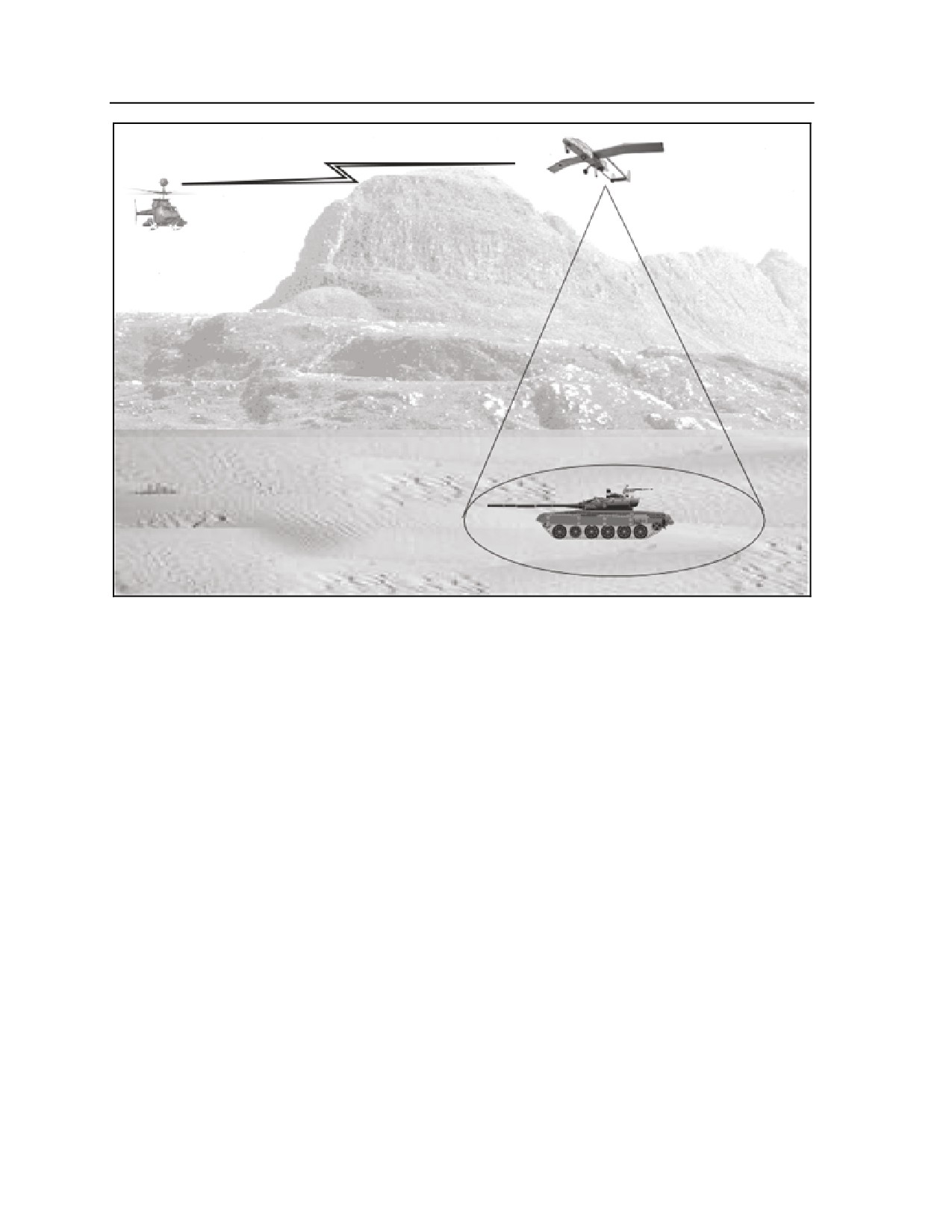
Chapter 3
Figure 3-1. Unmanned aircraft system to aviation unit handover
3-108. This includes UAS equipped with laser designators teaming with attack reconnaissance helicopters
to attack point targets with Hellfire missiles. This option allows for accurate and responsive fire while
maintaining maximum standoff for manned aviation (figure 3-2, page 3-19).
3-18
FM 3-04.111
7 December 2007