FM 3-09.15 TACTICS, TECHNIQUES, AND PROCEDURES FOR FIELD ARTILLERY METEOROLOGY (OCTOBER 2007) - page 4
MET Messages
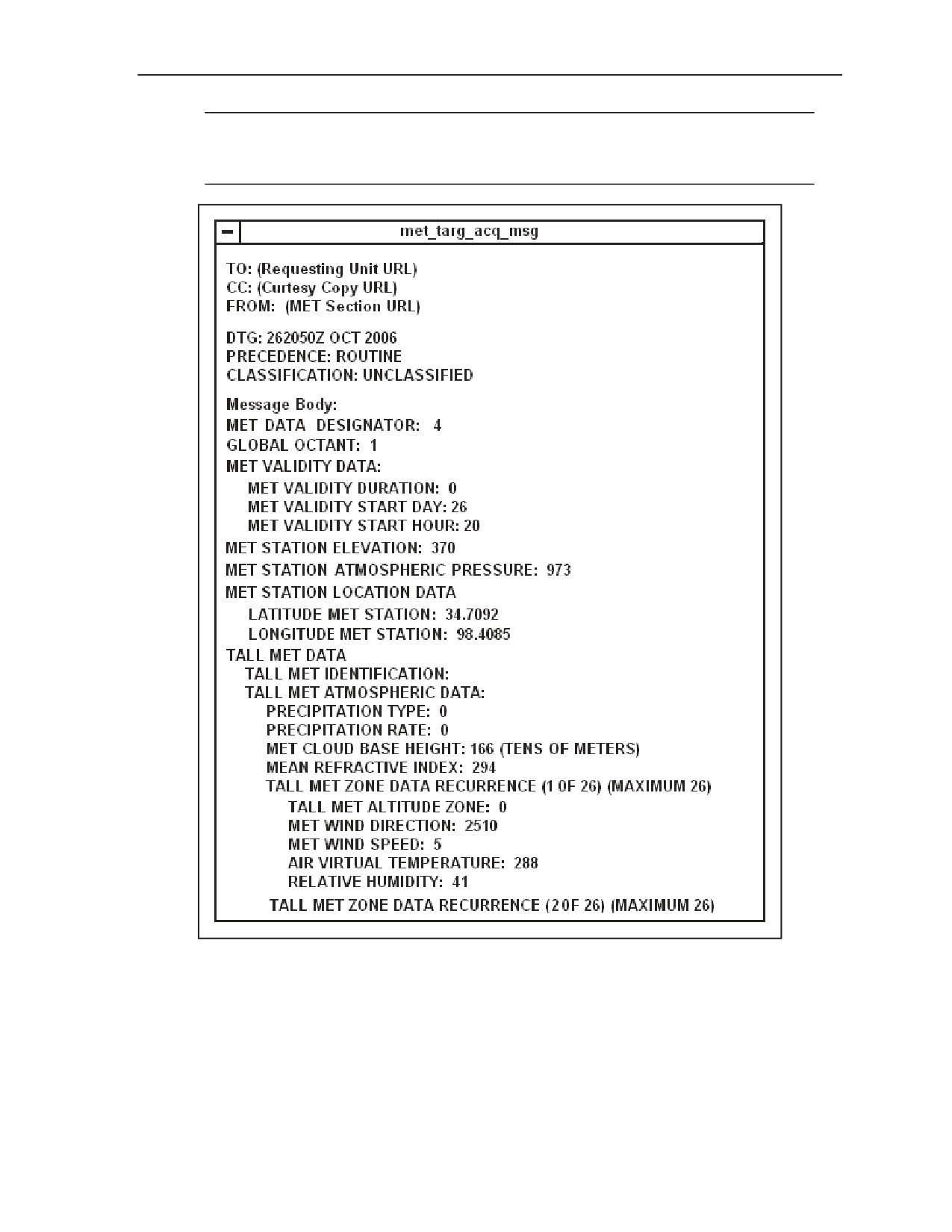
NOTE: There is no STANAG agreement for the TAM messages. Currently the only units that
will use a target area MET message are Multiple Launch Rocket System (MLRS) equipped
units. They will use the TAM for a decision aid only.
Figure A-18. Target area MET message format
Target Acquisition (TA) MET Message
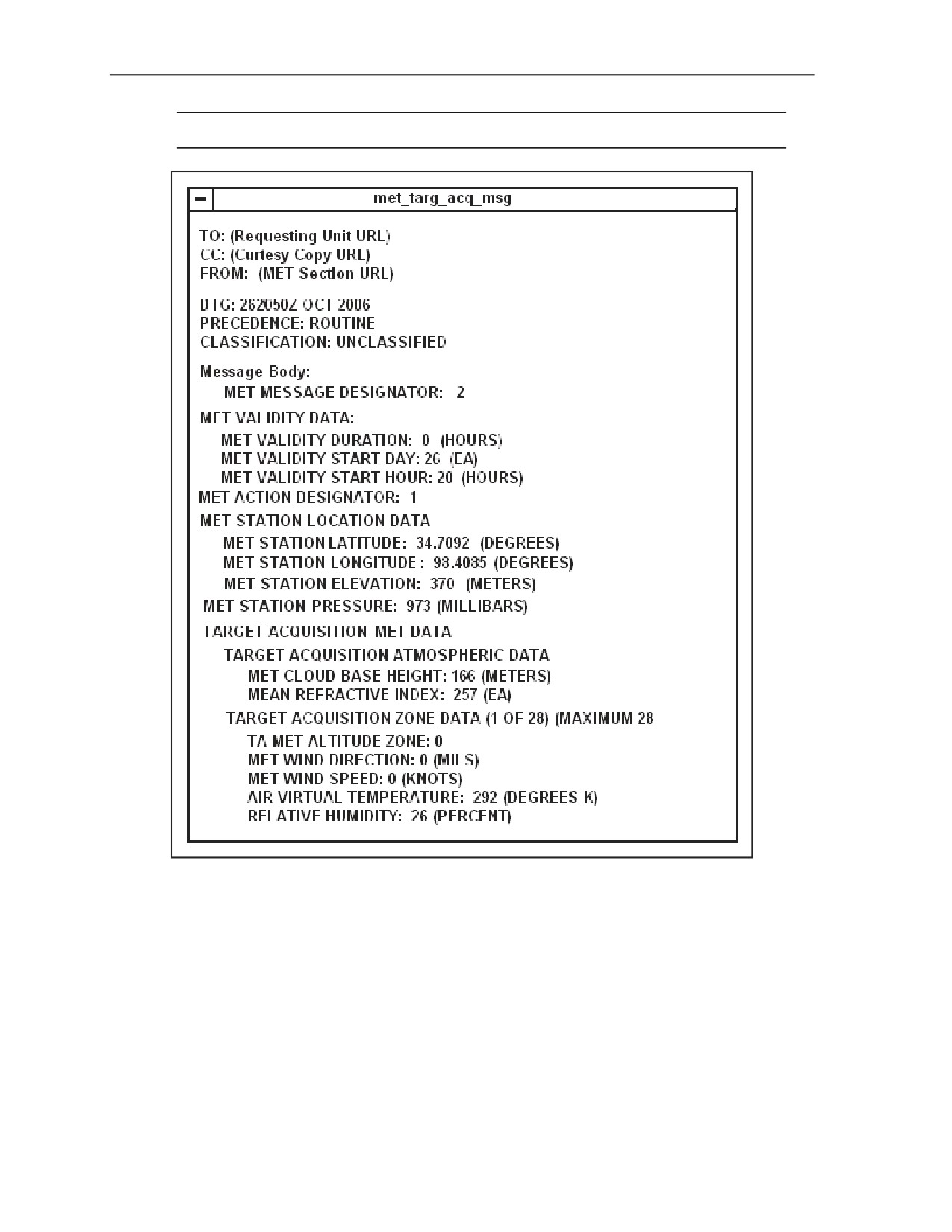
A-33. The target acquisition (TA) MET message figure A-19 contains atmospheric data (that is, wind
speed/direction, temperature, and relative humidity), which is used by the target acquisition systems (that
is, Ground Surveillance Radars and Firefinder Radars) on the battlefield.
25 October 2007
FM 3-09.15/MCWP 3-16.5
A-13
Appendix A
NOTE: For the field artillery, the primary requestor will be the Firefinder Radar.
Figure A-19. Target area MET message format
Basic Wind Report
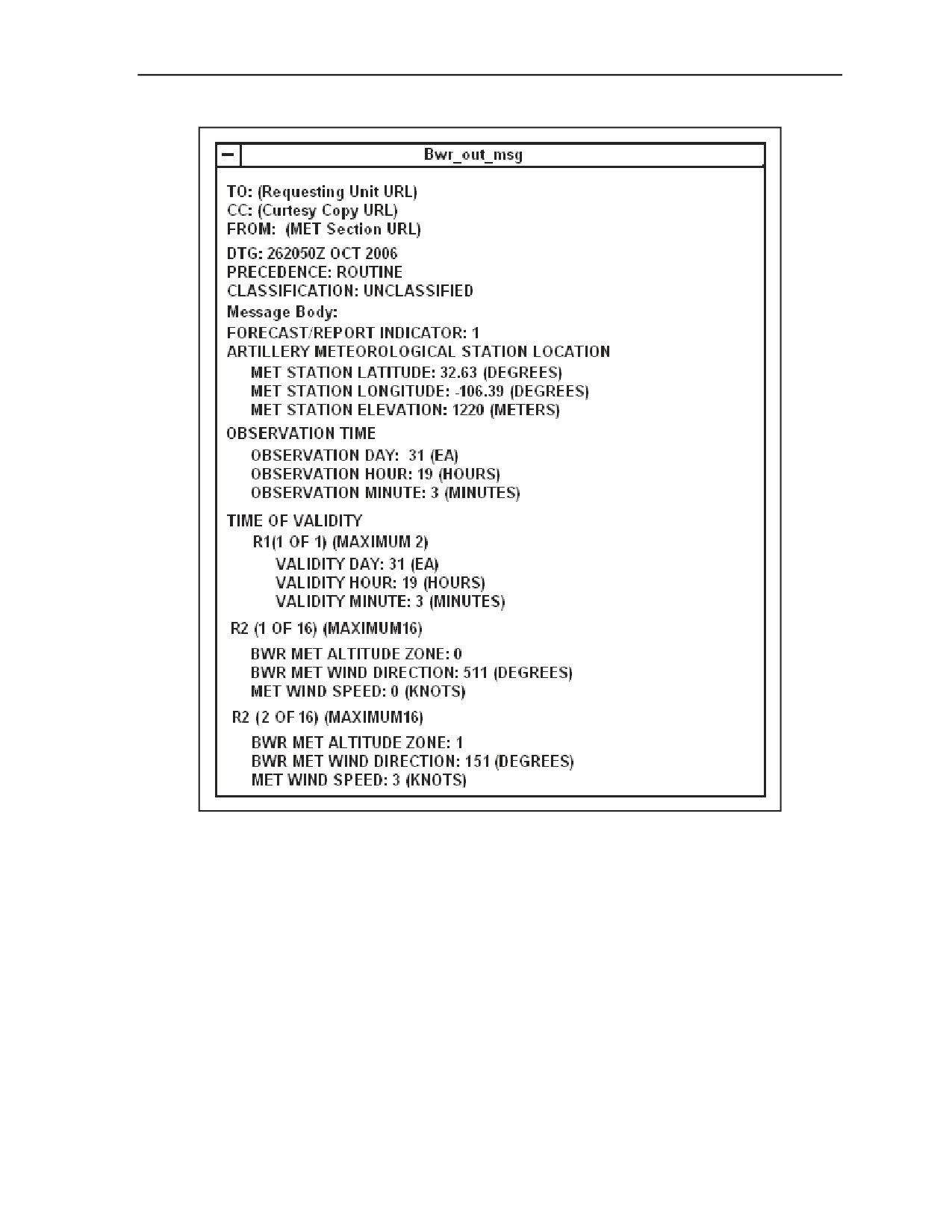
A-34. The basic wind report figure A-20, formally known as the fallout MET message, contains wind data
(that is, direction and speed) from surface to 30,000 meters that is used by the SWO to produce the
chemical downwind report, which is used to predict the downwind hazard area and fallout patterns.
A-14
FM 3-09.15/MCWP 3-16.5
25 October 2007
MET Messages
Figure A-20. Basic wind report
Upper Air Message
A-35. The upper air message, also known as the WMO MET message, consists of high-altitude data (that
is, wind speed/direction, pressure, height, temperature, and humidity), which is sent to either the SWO for
weather predictions or the Integrated Meteorological System IMETS for transmission to other weather
teams.
COMMON MESSAGE PROCESSOR
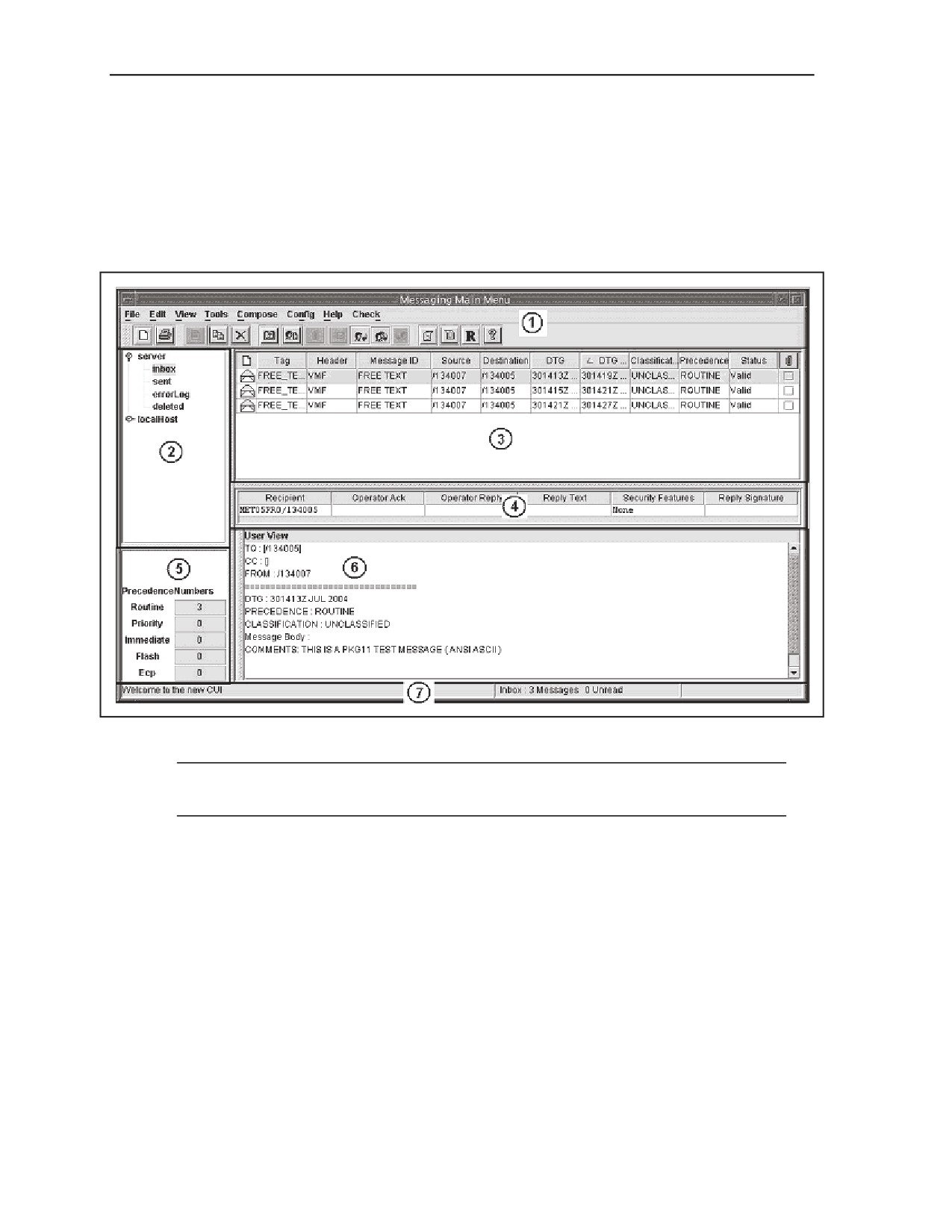
A-36. Common message processor (CMP) is the operator’s interface to the digital communications
network. The graphical user interface (GUI) for the CMP is the messaging main menu screen. The
messaging main menu is similar to a typical E-mail browser. Using messaging main menu figure A-21, the
operator can send and receive, view, and transmit message traffic. The main menu screen is divided into
areas with different functions. These include—
25 October 2007
FM 3-09.15/MCWP 3-16.5
A-15
Appendix A
z
Title bar, menu bar, and toolbar (1).
z
Folder select area (2).
z
Folder display area (3).
z
Message transmission information (4).
z
Precedence listing (5).
z
User view (6).
z
Status bar (7).
Figure A-21. Main message menu screen
Refer to TM 11-6660-293-12&P, appendix G, for a detailed explanation of using the CMP with
the MMS-P.
Communications Setup
Communications GUI
A-37. The communications GUI provides the MMS-P operator with a method for defining the network
configuration, establishing the system’s address, and turning the network on and off. The network is
configured based on the type system with which the MMS-P is to communicate. Consult the unit
communications SOPs for guidance determining network configuration settings. Refer to TM 11-6660-
293-12&P, appendix I, for a detailed explanation of the use of the communication GUI.
IP Address
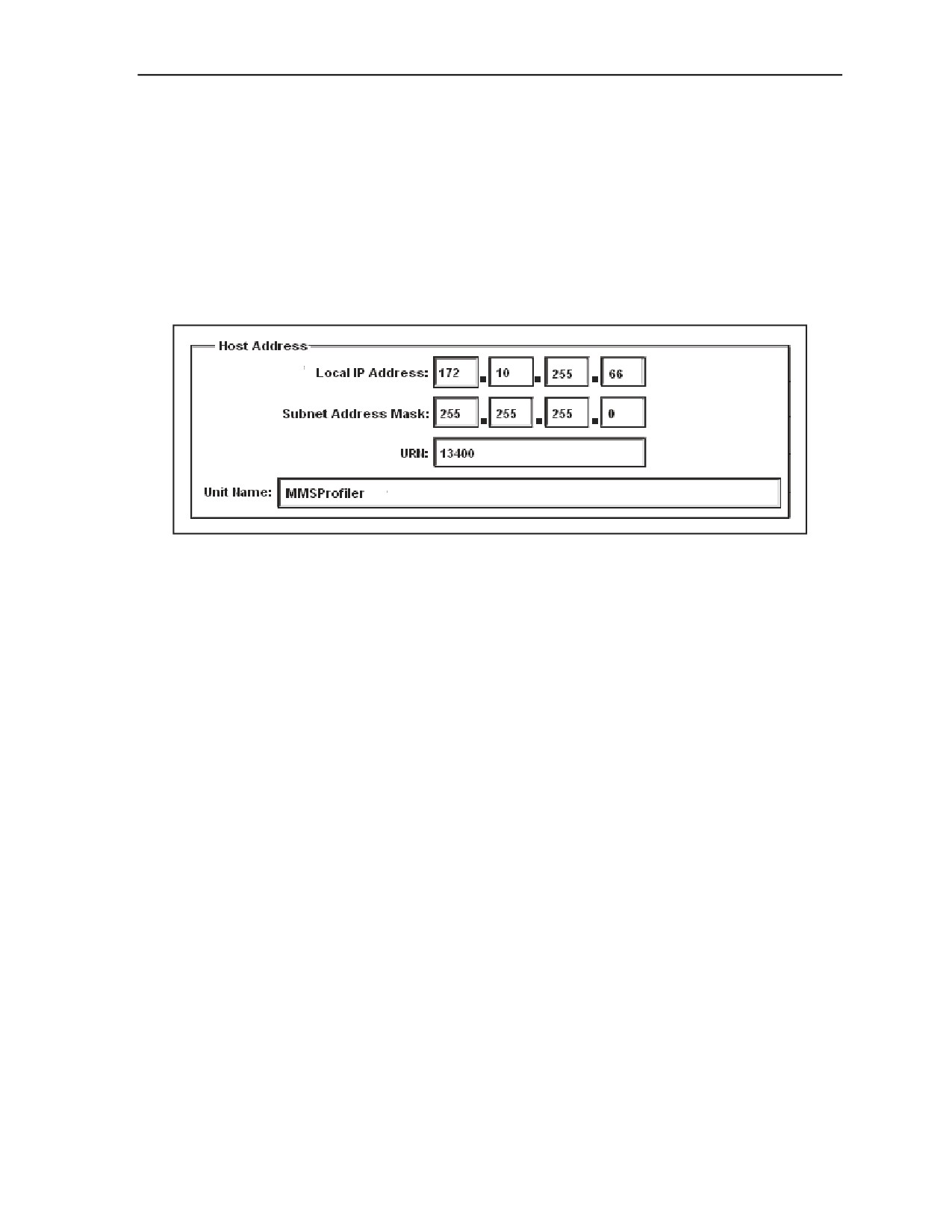
A-38. The internet protocol
(IP) address is used by the TCIM device for sending and receiving
communications. This is the address other units in the field will use to address the MMS-P section. It is
A-16
FM 3-09.15/MCWP 3-16.5
25 October 2007
MET Messages
entered in dotted decimal format. This address is assigned by unit SOP. Figure A-22 shows an example of
the local IP address.
A-39. The subnet mask address establishes defines which parts of the IP address belong to the network
address and the host address. The subnet mask is entered in dotted decimal format. This address is assigned
by unit SOP. Figure A-22 shows an example of the subnet mask address.
Unit Reference Number
A-40. The unit reference number (URN) is specified by the commanding AFATDS master unit list (MUL)
and assigned to the MMS-P section. Any incoming messages with a destination URN that matches the
MMS-P section URN will be delivered to the CMP inbox. Figure A-22 shows an example of the URN.
Figure A-22. Host address block
Subscriber Table
A-41. Prior to establishing communications, the MMS-P operator is required to populate the subscriber
table. The subscriber table contains the unit name, URN, and IP address for each element communicating
with the section.
Address Book
A-42. After populating the subscriber table, the MMS-P operator adds each of the units listed in the
subscriber table to the CMP address book. The operator will now be able to send message traffic to all
elements of the subscriber table.
JOINT VARIABLE MESSAGE FORMAT
A-43. The MMS-P message generator automatically populates MET messages with meteorological data in
the requested format. All other messages are created using message templates. As a common message
processor, the CMP contains various message sets with the corresponding message templates. This allows
the CMP to be used on a variety of platforms. The operator will have to determine which message set to
use for the current operation.
A-44. The MMS-P was developed to use the joint variable message format (JVMF) message set (baseline).
Systems not based on the variable message format (VMF) message set will not be able to use information
request message to request MET data. The information request message is automatically processed by the
MMS-P systems using 220 Protocols above version A. Requesting units not able to use the information
request message can request MET using a free text message containing the unit location, target location,
and the type MET needed. Requests for MET using a free text message is not automatically processed by
the MMS-P. Refer to TM 11-6660-293-12&P, appendix G, for a detailed explanation of VMF message
formats.
25 October 2007
FM 3-09.15/MCWP 3-16.5
A-17
Appendix A
TRANSMITTING MESSAGES
A-45. The manner messages are transmitted is dependent upon the message type and the conditions under
which the messages is being generated. Messages generated by the message generation function (MET
messages) are placed in the draft folder of the CMP to allow the section personnel to perform MET
checking procedures prior to transmitting the message to the requesting unit. These messages are
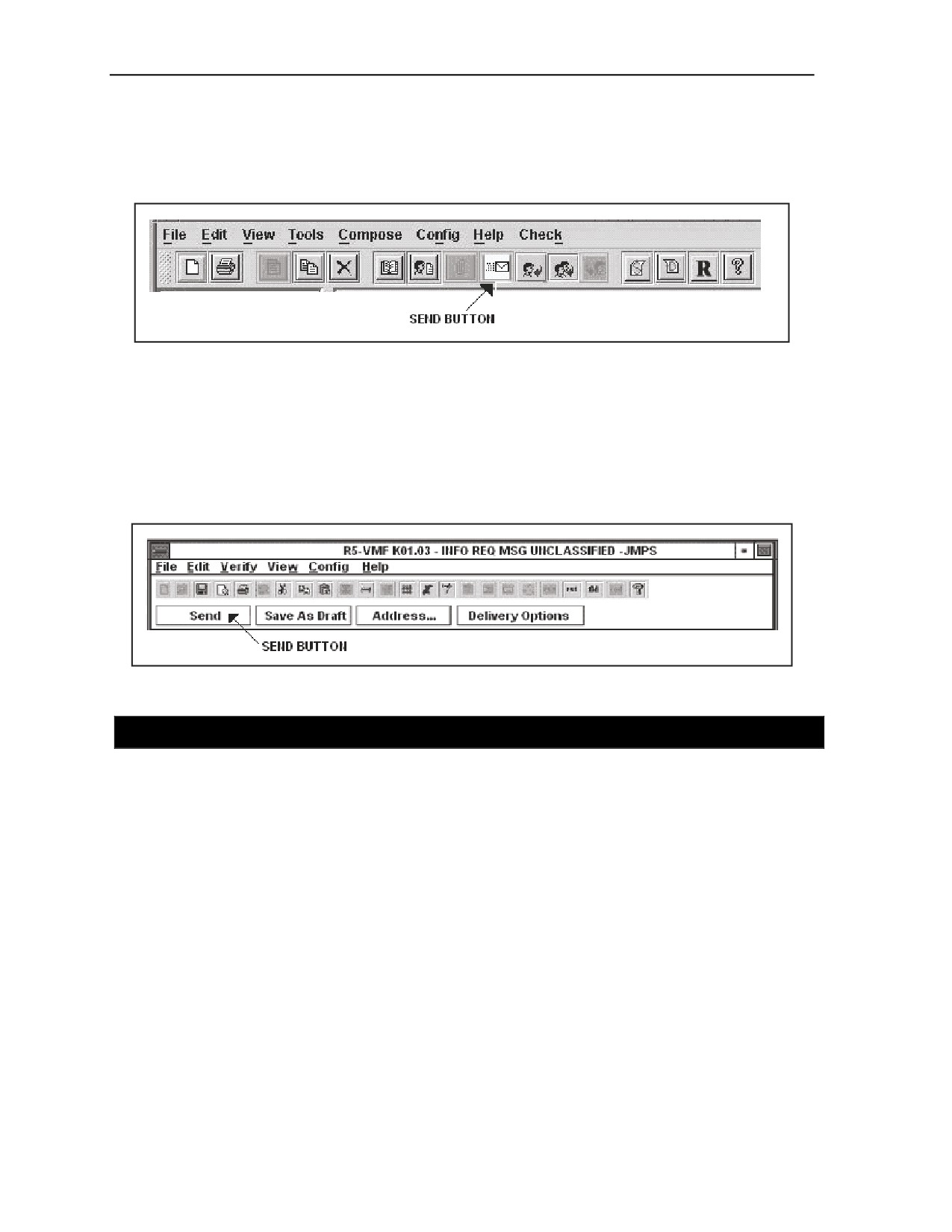
transmitted using the Send button on the CMP toolbar. Figure A-23 shows the location of the Send button
on the CMP toolbar.
Figure A-23. CMP toolbar
A-46. Messages created from a message format can be transmitted using the Send button located on
message format. Messages selected for editing display in the same message format used to create the
message and can be transmitted in the same manner. Figure A-24 shows the location of the Send button on
the message format toolbar.
Figure A-24. Message format toolbar
SECTION III STANDARD MET MESSAGES
TRANSMISSION OF STANDARD MET MESSAGES
A-47. Standard MET messages can be transmitted to users by radio, messenger, or any other means
necessary. When radio is to be the primary means of transmission, the MET section normally broadcasts to
all users at the same time. Each standard MET message is discussed in the following paragraphs.
COMPUTER MET MESSAGE
A-48. The computer MET message is the primary MET message used by artillery units. The computer
MET message differs from the ballistic message as follows:
z
Zone structure is different.
z
Zone values are not weighted.
z
Atmospheric pressure is reported instead of air density.
z
Weather elements are reported as zone values.
COMPUTER MET MESSAGE ENCODING
A-49. DA Form 3677-R (Computer MET Message [LRA]) is used for recording purposes. A coded
computer message is shown in Figure A-25. A reproducible copy of this form is at the rear of this manual.
A-18
FM 3-09.15/MCWP 3-16.5
25 October 2007
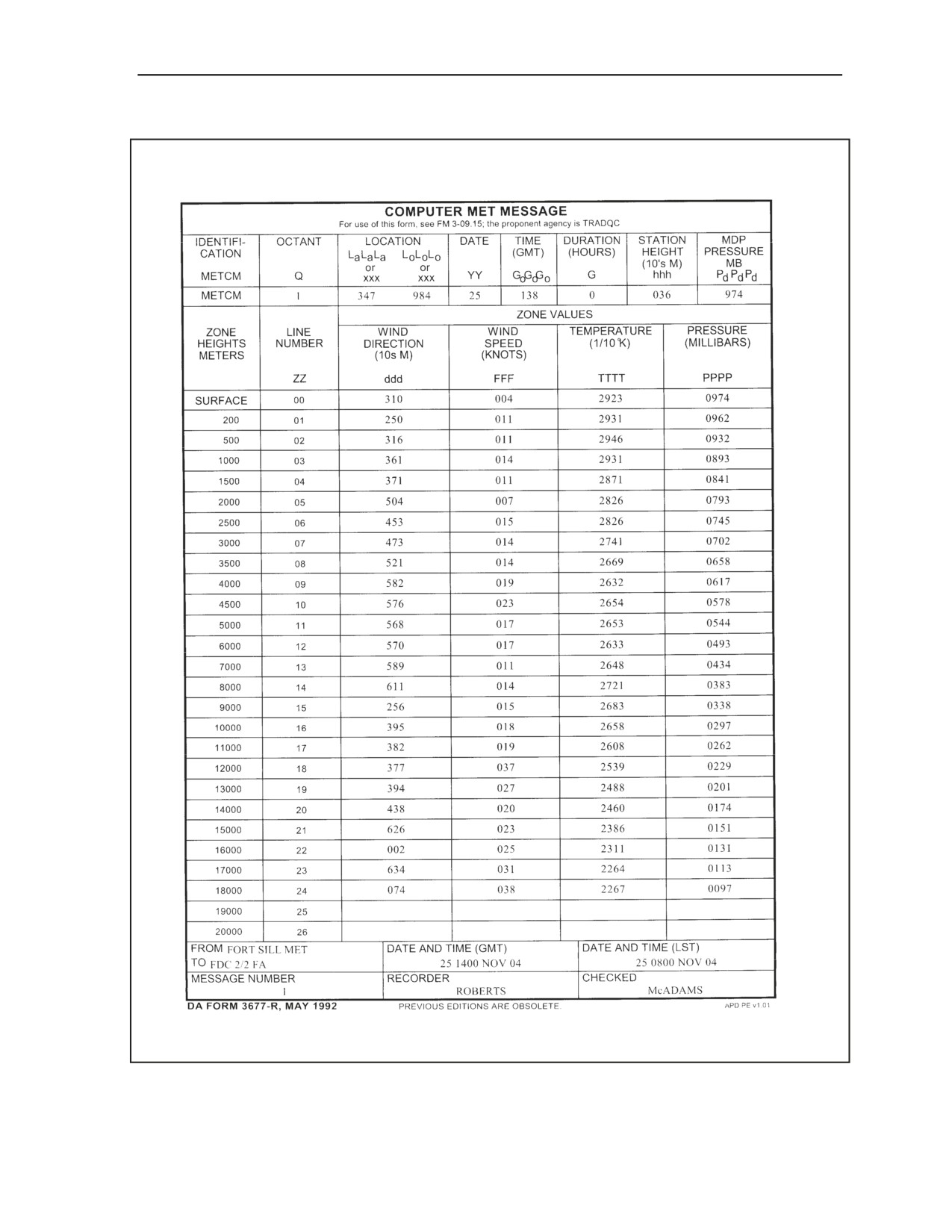
MET Messages
Figure A-25. DA Form 3677-R
25 October 2007
FM 3-09.15/MCWP 3-16.5
A-19
Appendix A
IDENTIFICATION LINE
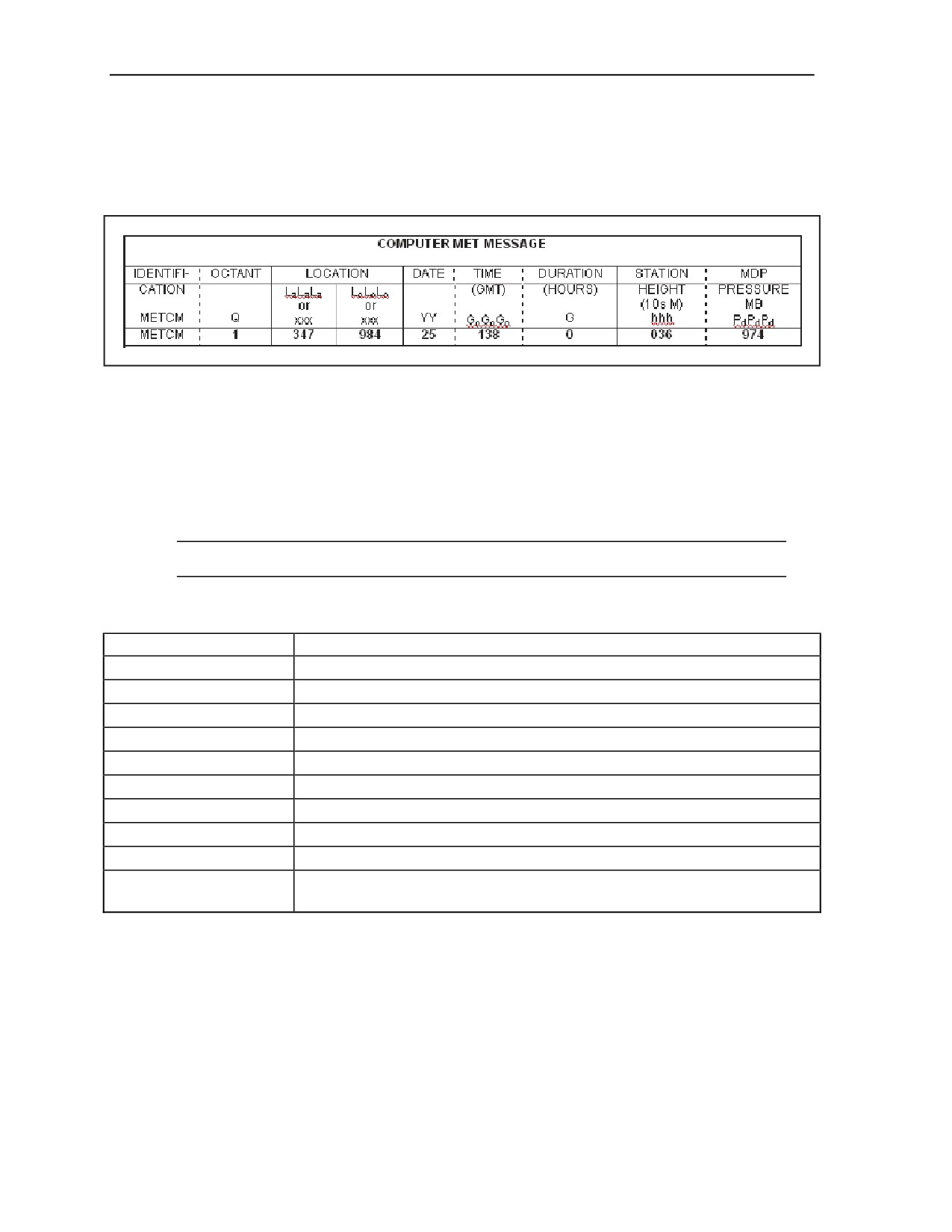
A-50. The identification (ID) line is arranged in four 6-digit groups. A symbolic code is used to identify
and encode the data in the proper format. Thus the symbols for the ID line are METCMQ, LaLaLaLoLoLo,
YYGoGoGoG, and hhhPdPdPd. In Figure A-26, the ID line is shown encoded.
Figure A-26. Computer MET message identification line
Group 1
A-51. Group 1 consists of METCMQ. The symbol METCM is placed at the beginning of each computer
message. This symbol indicates that it is a MET message and that it contains computer-type MET data. The
digit under the symbol Q represents the global octant in which the MET section is located. For convenience
in determining the geographical location of the reporting MET section, the globe was divided into octants
numbered 0 through 8. Table A-9 lists the octants of the globe.
NOTE: The number 4 is not used. The number 9 is used when the location is coded.
Table A-9 Octant of Globe Q Code
Symbols
Definitions
0
North latitude-0° to 90° west longitude
1
North latitude-90° to 180° west longitude
2
North latitude-180° to 90° east longitude
3
North latitude-90° to 0° east longitude
4
Not used
5
South latitude-0° to 90° west longitude
6
South latitude-90° to 180° west longitude
7
South latitude-180° to 90° east longitude
8
South latitude-90° to 0° east longitude
9
To be used when the location of the MET station is not indicated by
latitude and longitude.
Group 2
A-52. Group 2 consists of LaLaLaLoLoLo or XXXXXX. These six spaces are used to specify the location to
the nearest tenth of a degree. The symbol LaLaLa represents the latitude to the nearest tenth of a degree. The
symbol LoLoLo represents the longitude to the nearest tenth of a degree. When the longitude is over 100
degrees, the first digit is dropped.
Group 3
A-53. Group 3 consists of YYGoGoGoG. The symbol YY represents two digits for reporting the Greenwich
date of the observation on which the message is based. The Greenwich date may differ from the local date,
A-20
FM 3-09.15/MCWP 3-16.5
25 October 2007
MET Messages
depending on the location and the hour of the day. The symbol GoGoGo represents three digits for reporting
hours in tens, units, and tenths of hours. Appendix G contains a chart of the world map that gives the
information needed to convert local standard time and date to GMT and date. The symbol G represents the
duration of validity of the message in hours. U.S. Forces always enter 0 in the space under G since the
period of validity is not predicted. Other NATO forces use digits 1 through 8 in this space. A code of 9
indicates a predicted validity of 12 hours.
Group 4
A-54. Group 4 consists of hhhPdPdPd. The symbol hhh represents the MET station altitude in tens of meters
above mean sea level. The symbol PdPdPd represents the surface pressure in millibars. When the surface
pressure is 1,000 millibars or higher, the first digit is dropped.
Explanation Identifiction Line
A-55. The identification line (for transmittal) is shown in figure A-26 and explained as follows:
z
The METCM1 indicates a computer-type message and a station location in octant 1.
z
The 347984 indicates station location at 34°42’N latitude and 98°24’W longitude.
z
The 251380 indicates the date of the message is the 25th day of the month, GMT date, at 1348,
and it is from a U.S. Army artillery MET section. (This does not predict the period of validity of
the message.)
z
The 036974 indicates the station altitude is 360 meters above mean sea level and the surface
pressure is 974 millibars.
Message Body
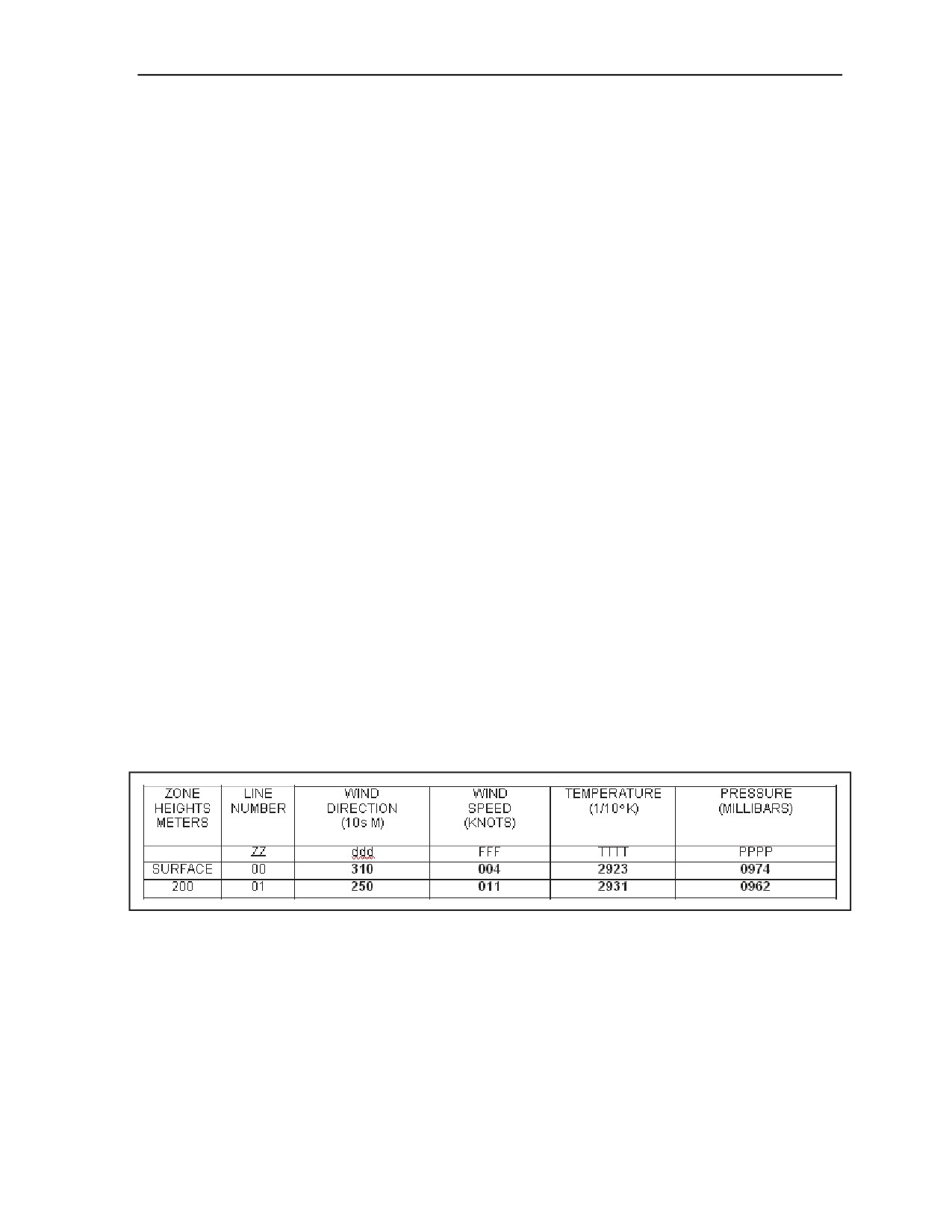
A-56. The remaining lines of the message (ZZdddFFF TTTTPPPP) represent surface and zone MET data.
The symbol ZZ represents the line number that identifies the reported MET information with the
appropriate atmospheric layer. The line numbers begin with 00 (surface) and are numbered consecutively
through line 26. The symbol ddd represents the true direction from which the wind is blowing. The
direction is reported in tens of mils. The symbol FFF represents the true wind speed in knots. The symbol
TTTT represents the virtual temperature. This temperature is expressed to the nearest 0.1°K. The symbol
PPPP represents the air pressure. This pressure is expressed to the nearest millibar. The lines of the
computer MET message are encoded and transmitted in eight-digit groups with two groups for each line.
An example of the first two lines of a computer MET message is shown in figure A-27. The lines are
explained in the following paragraphs.
Figure A-27. Example MET message body
First Line
A-57. The 00 indicates surface level, 310 is a wind direction of 3,100 mils, 004 is a wind speed of 4 knots,
2923 is a temperature of 292.3°K, and 0974 is a pressure of 974 millibars.
Second Line
A-58. The 01 indicates surface level, 250 is a wind direction of 2,500 mils, 011 is a wind speed of 11
knots, 2931 is a temperature of 293.1°K, and 0962 is a pressure of 962 millibars.
25 October 2007
FM 3-09.15/MCWP 3-16.5
A-21
Appendix A
Authentication and Dissemination Blocks
A-59. At the bottom of the form, spaces are provided for entering the units to whom the message was sent
or from whom it was received, the message number, the names of the persons who recorded and checked
the message, and the date-time groups.
Reverse Side
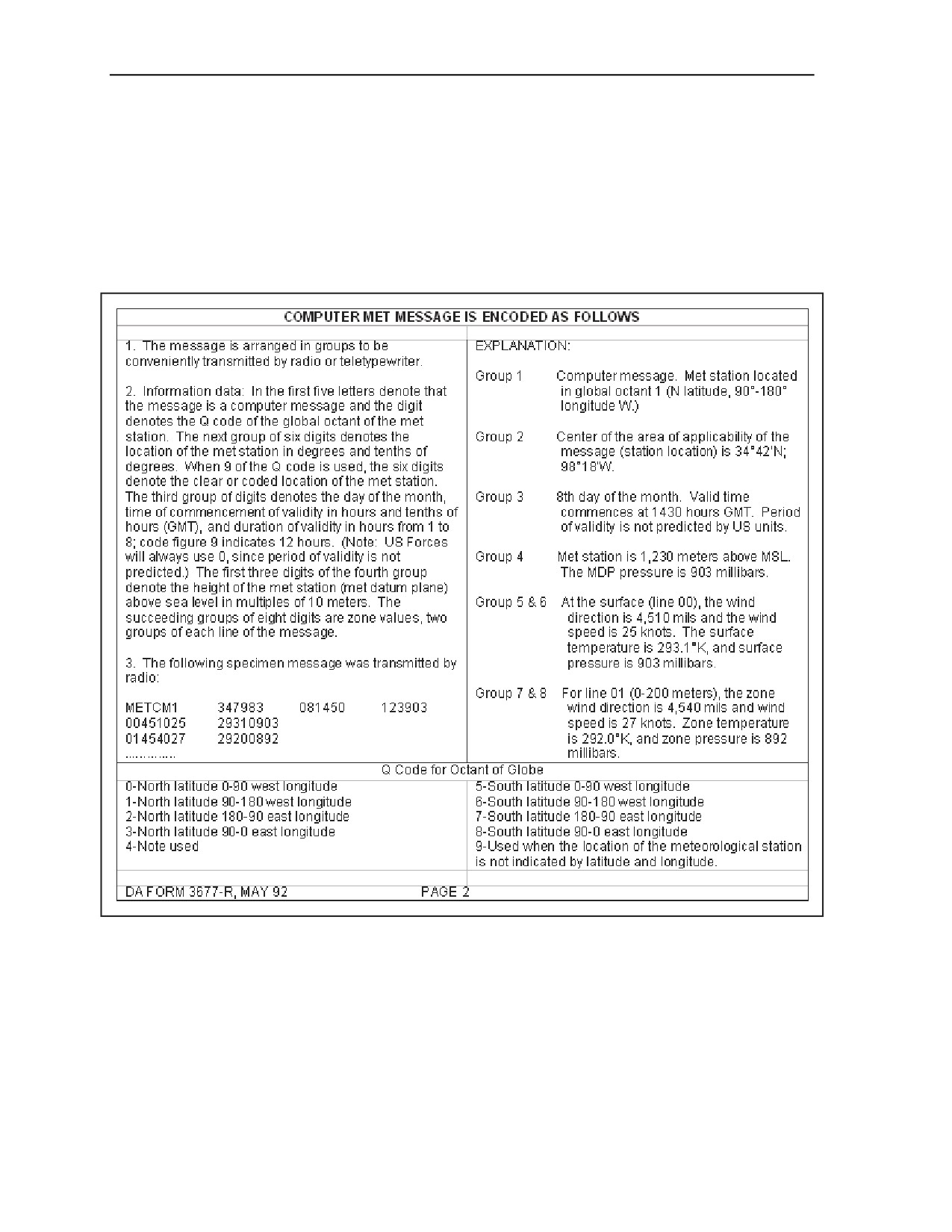
A-60. The back of DA Form 3677-R (figure A-28) shows a sample computer MET message and explains
the coding of the message. Also, the coding for octant of the globe is shown.
Figure A-28. DA Form 3677-R (Reverse)
BALLISTIC MET MESSAGE
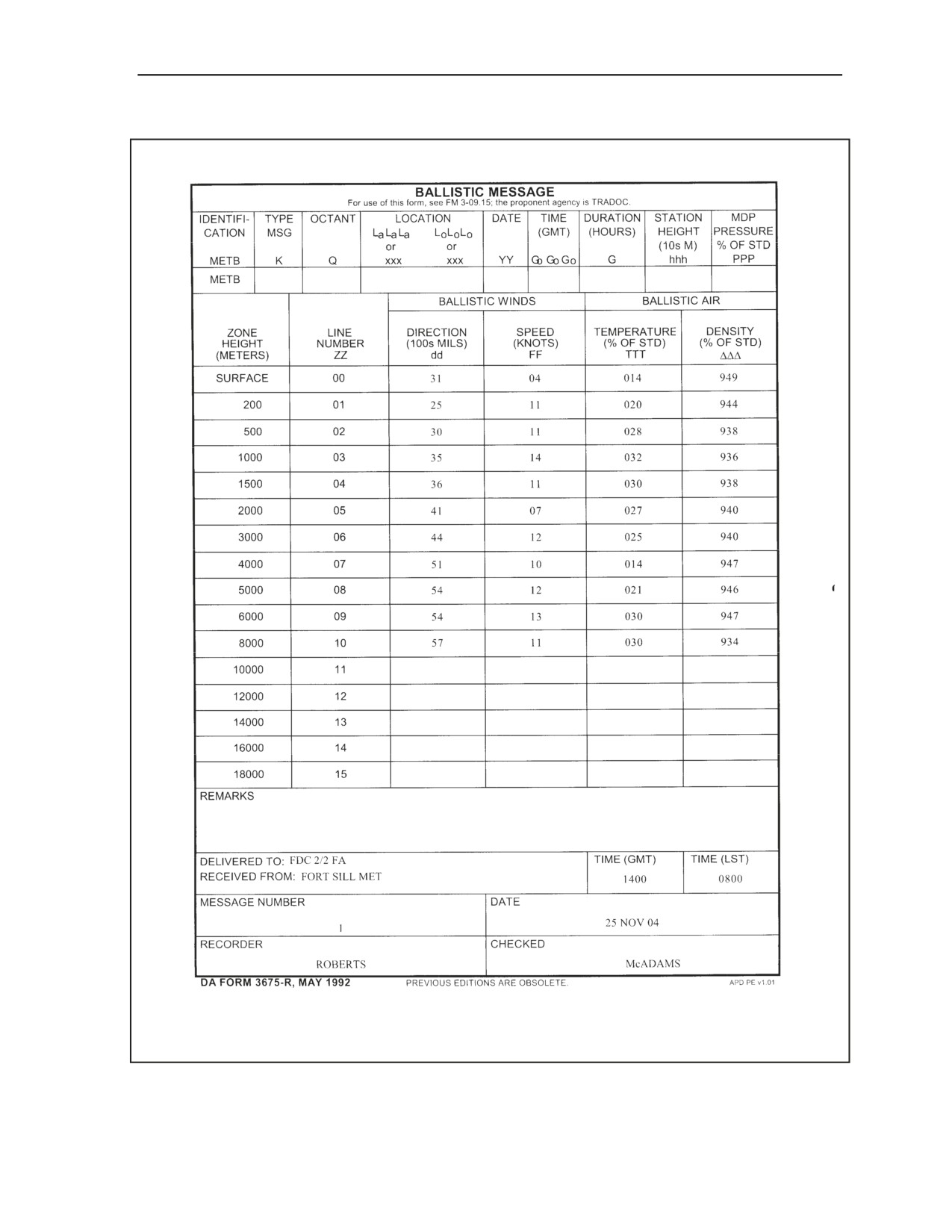
A-61. The standard ballistic MET message provides for the common use and exchange of ballistic MET
data among the allied countries during joint combat operations. DA Form 3675-R, Ballistic Message
(LRA), is used for encoding the standard MET message (Figure A-29). A copy of this form is located at the
rear of this manual.
A-22
FM 3-09.15/MCWP 3-16.5
25 October 2007
MET Messages
Figure A-29. DA Form 3675-R
25 October 2007
FM 3-09.15/MCWP 3-16.5
A-23
Appendix A
BALLISTIC MET MESSAGE ENCODING
A-62. A symbolic code is used to conveniently encode the ballistic MET message data in proper format.
The data are arranged in six-digit groups for transmitting the message.
IDENTIFICATION LINE
A-63. The first four 6-digit groups pertain to the ID line of the ballistic MET message. The symbols are not
transmitted; they are only used by the encoder to put the information in proper format and sequence.
Detailed explanations of the symbols and the coding procedures for the ID line are discussed in the
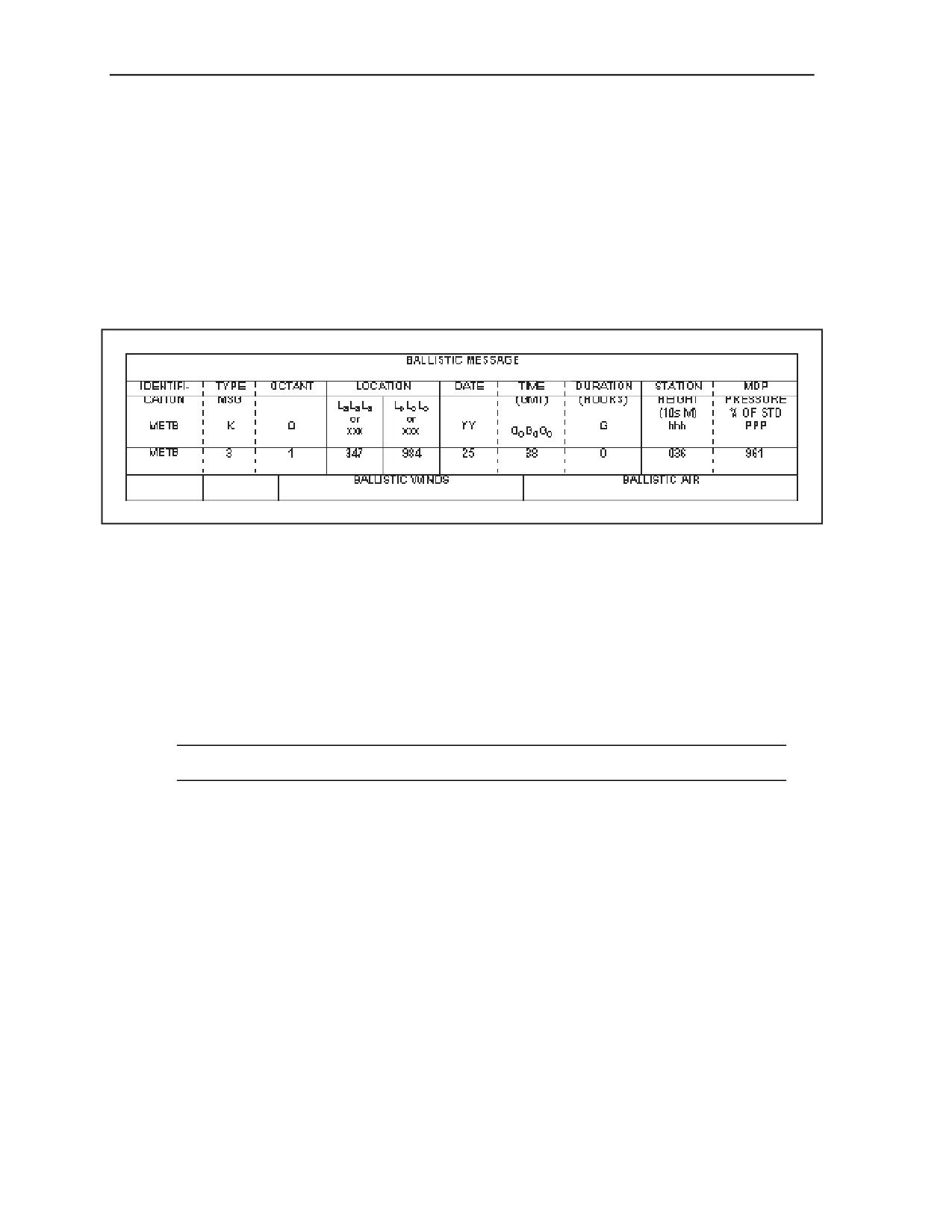
following paragraphs. Figure A-30 shows an encoded identification line.
Figure A-30. Ballistic MET message identification line
Group 1
A-64. Group 1 consists of METBKQ. The symbol METB is placed at the beginning of each ballistic MET
message. These letters indicate that it is a MET message and that it includes ballistic MET data. Either a 2
or a 3, depending on the type of ballistic MET message, is entered for the symbol K. The type 2 message is
prepared for surface-to-air trajectories. The type 3 message is prepared for surface-to-surface trajectories.
The digit under the symbol Q represents the code for the global octant in which the MET section is located.
For convenience in determining the geographical location of the reporting MET station, the globe was
divided into octants numbered 0 through 8.
NOTE: The number 4 is not used. The digit 9 is used when the location is coded.
Group 2
A-65. Group 2 consists of LaLaLaLoLoLo or XXXXXX. The symbol LaLaLa represents the latitude to the
nearest tenth of a degree. The symbol LoLoLo represents the longitude to the nearest tenth of a degree.
When the longitude is over 100 degrees, the first digit is dropped.
Group 3
A-66. Group 3 consists of YYGoGoGoG. The symbol YY represents two digits for reporting the Greenwich
date of the observation on which the message is based. The Greenwich date may differ from the local date,
depending on the location and the hour. The symbol GoGoGo represents three spaces for reporting the time
of commencement of the validity of the message in hours and tenths of hours. Local standard time must be
corrected to reflect GMT in this block. This correction can be made by referring to the world map in
appendix G. The symbol G represents the duration of validity of the MET message in hours from 1 to 8.
The code numeral 9 indicates a period of validity of 12 hours. U.S. Forces always enter a 0 in the space
under G since the period of validity is not predicted.
A-24
FM 3-09.15/MCWP 3-16.5
25 October 2007
MET Messages
Group 4
A-67. Group 4 consists of hhhPPP. The symbol hhh represents the three digits indicating the altitude of the
MET station. The three spaces under hhh are used to express the altitude in tens of meters above mean sea
level. The symbol PPP represents the three digits indicating the atmospheric pressure at the MET station to
the nearest 0.1 percent of the ICAO standard. When pressure is 100 percent or over, the first digit is
dropped.
Explanation
A-68. The identification line is shown in Figure A-30 and explained as follows:
z
The METB31 indicates a ballistic message type 3, surface to surface, and a station location in
octant 1.
z
The 347984 indicates a station location at 34° 42’N latitude and 98° 24’W longitude.
z
The 251380 indicates the date of the message is the 25th day of the month, GMT date, at 1348,
and it is from a U.S. Army MET section (This does not predict validity).
z
The 036961 indicates the station altitude is 360 meters above mean sea level and the surface
pressure is 96.1 percent of standard.
MESSAGE BODY
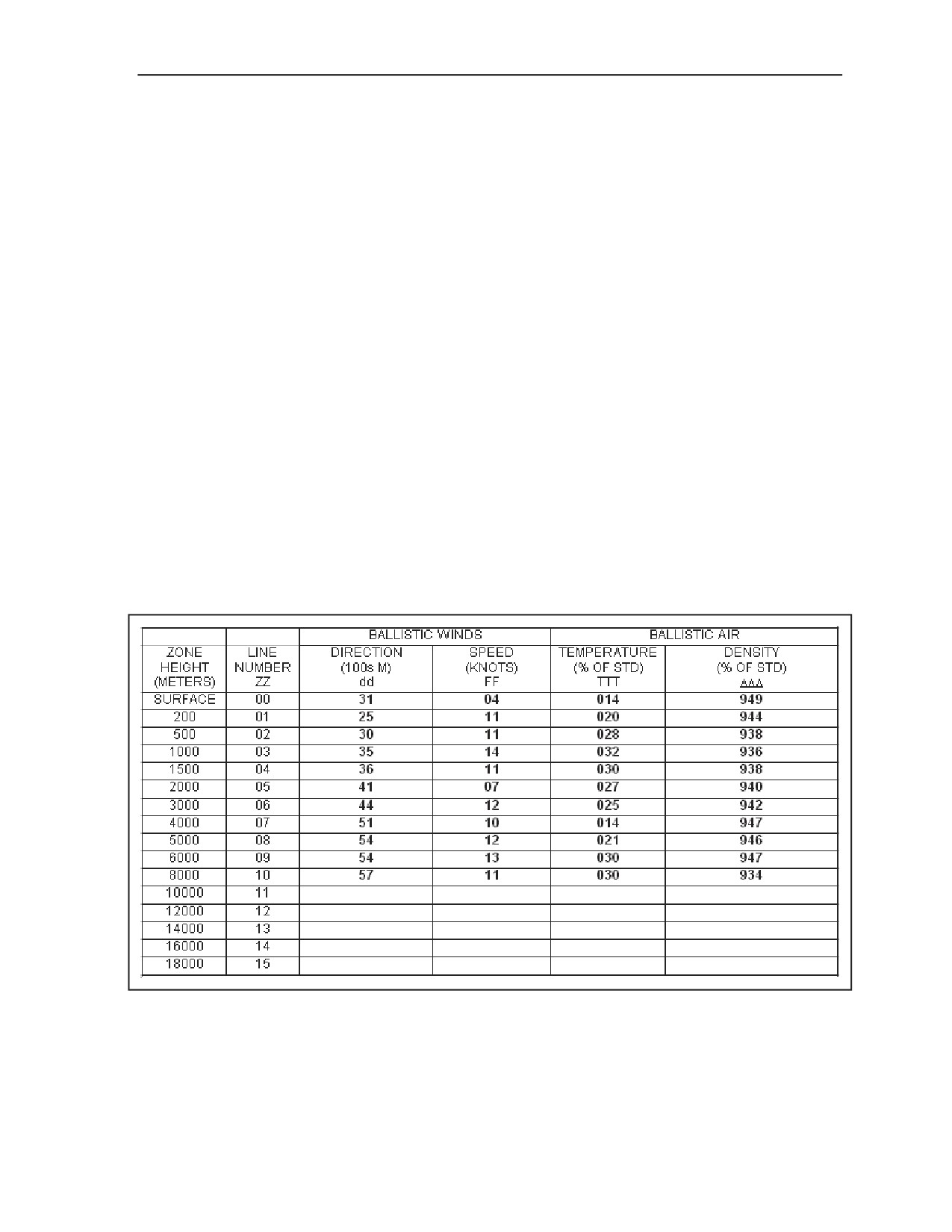
A-69. The columns and lines in the body of the message (figure A-31) are used for encoding the ballistic
data for each line of the ballistic message. The first column is a list of the standard zone heights in meters.
The zone height data are not transmitted. The second column lists the line numbers identifying each
artillery zone of the atmosphere. The remaining four columns are used for encoding the ballistic MET data
pertaining to each line. Each line is transmitted in two 6-digit groups representing the line number and the
ballistic data in each standard zone. For example, the symbols for a line are ZZddFF and TTT ΔΔΔ.
Figure A-31. Ballistic MET message body
25 October 2007
FM 3-09.15/MCWP 3-16.5
A-25
Appendix A
Group 1
A-70. The symbol ZZ indicates 00 for surface, 01 for line 1, 02 for line 2, and so on. The symbol dd
represents the two digits indicating ballistic wind direction in hundreds of mils. The symbol FF represents
the two digits indicating ballistic wind speed in knots.
Group 2
A-71. The symbol TTT represents the three digits indicating ballistic temperature in percentage of standard
to the nearest tenth of a percent. For temperatures above 100 percent, the first digit is dropped. The symbol
ΔΔΔ represents the three digits indicating ballistic density in percentage of standard to the nearest tenth of a
percent. For densities over 100 percent, the first digit is dropped.
Explanation
A-72. The first line, (003104 and 014949), of the MET message (figure A-31) indicates the following:
z
00-Surface information follows.
z
31-Surface wind direction is 3,100 mils.
z
04-Surface wind speed is 4 knots.
z
014-Surface temperature is 101.4 percent of standard.
z
949-Surface density is 94.9 percent of standard.
Winds Exceeding 100 Knots
A-73. Anytime a ballistic wind exceeds 100 knots, 100 is subtracted from the speed (for example, 105 -
100 = 05). The result (05) is entered in the winds speed column of the ballistic message. To permit easy
identification of a line number in which the ballistic wind exceeds 100 knots, 80 is added to that line
number (for example, line 05 + 80 = 85).
Remarks Section
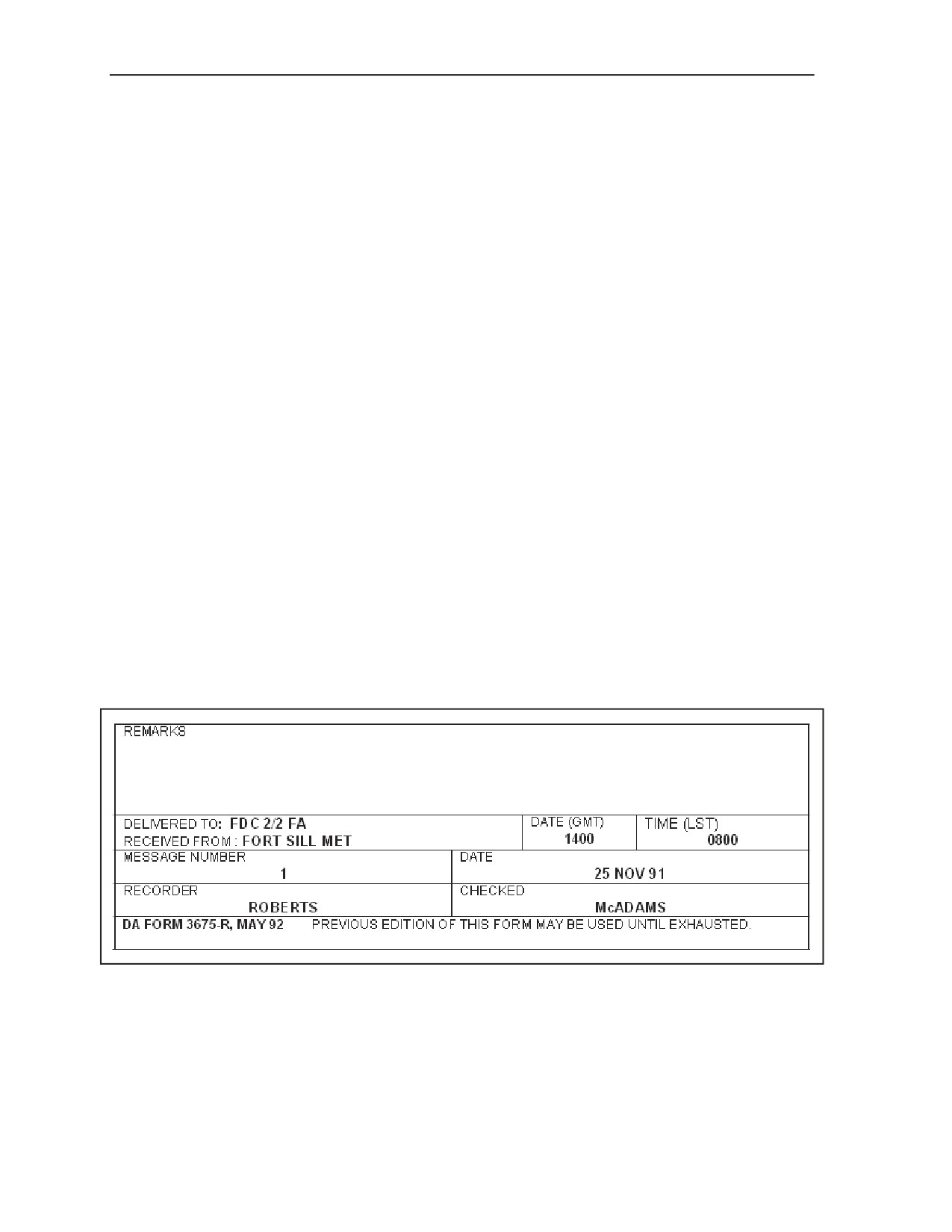
A-74. Below the ballistic data (figure A-32), a space is provided for any remarks deemed appropriate, such
as a comment on any unusual data in the message.
Figure A-32. DA Form 3675-R
Authentication and Dissemination Blocks
A-75. At the bottom of the form, spaces are provided for entering the units to whom the message was sent
or from whom it was received, the message number, the names of the persons who recorded and checked
the message, and the date-time groups.
A-26
FM 3-09.15/MCWP 3-16.5
25 October 2007
MET Messages
Reverse Side
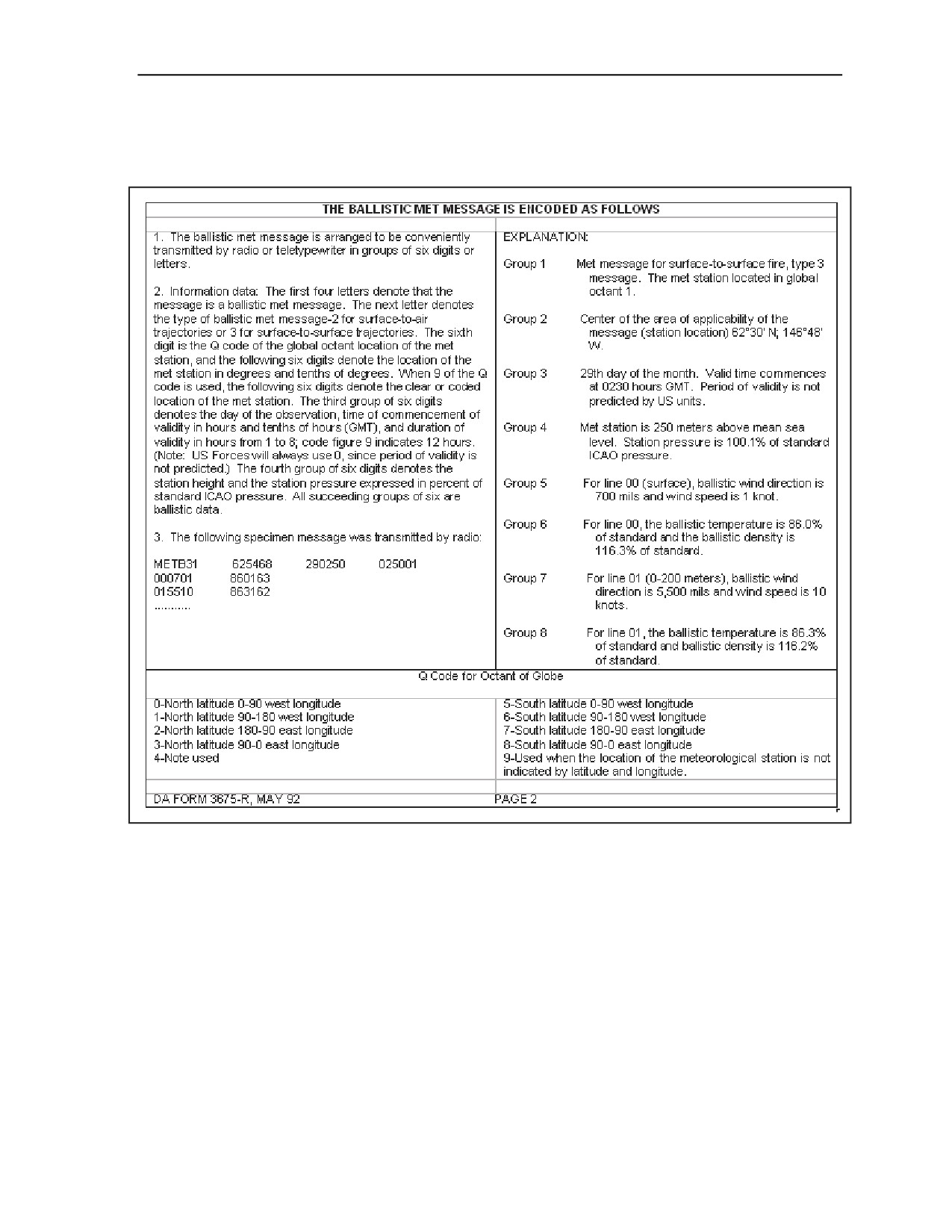
A-76. The back of the form (figure A-33) shows a sample ballistic MET message and explains the
encoding. Also, the information for coding the octant of the globe is shown.
Figure A-33. DA Form 3675-R (Reverse)
TARGET ACQUISTION MET MESSAGE
A-77. The TA MET message defines a format for use with unmanned aerial systems (UASs), remotely
piloted vehicles (RPVs), drones, and weapons-locating radars (WLRs). The TA MET message standardizes
the number of information digits in the message and their meanings. This standardization makes it possible
for all armed forces to understand and use TA MET message information issued by any service of any
armed forces.
TARGET ACQUISTION MET MESSAGE ENCODING
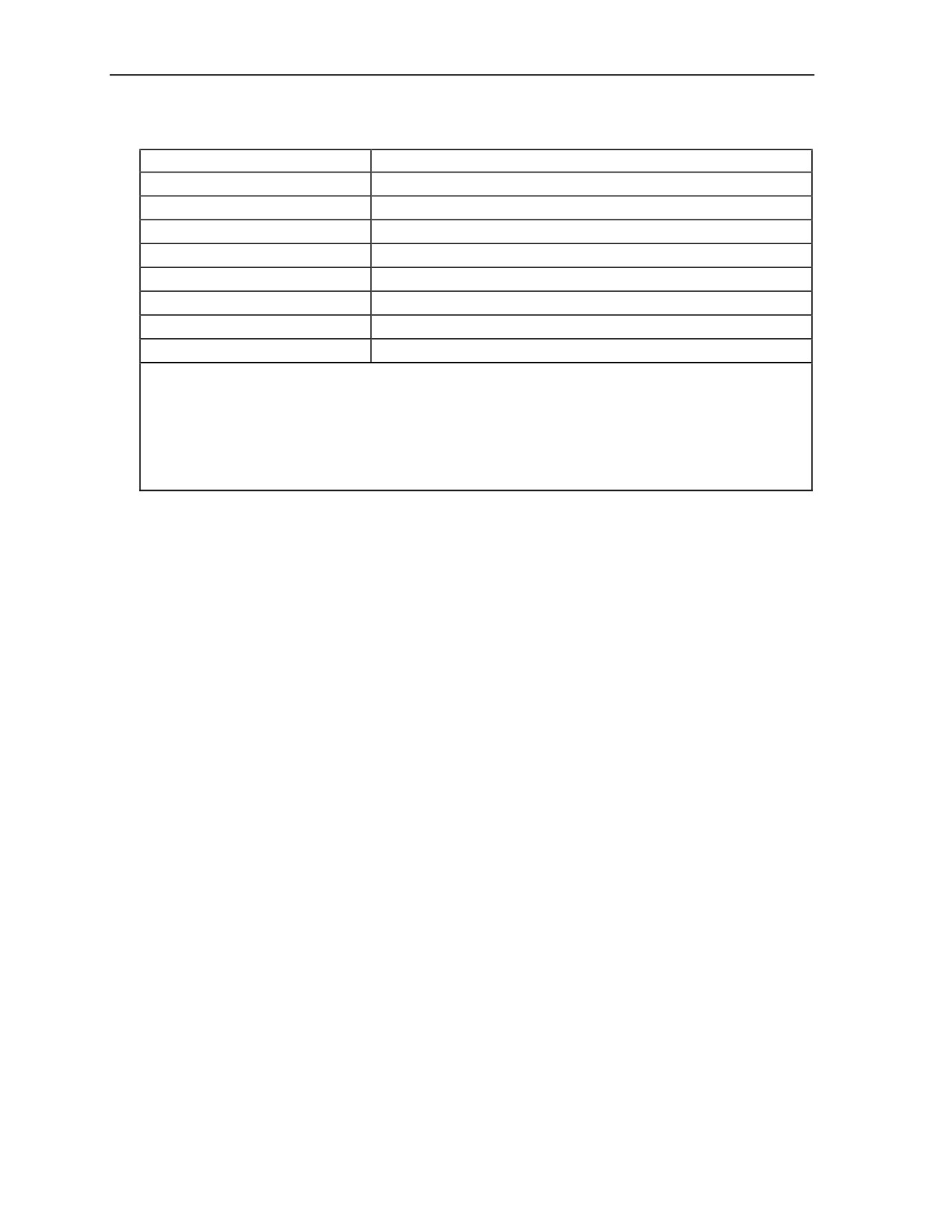
A-78. The sequence and number of symbols for a TA MET message are in table A-10.
25 October 2007
FM 3-09.15/MCWP 3-16.5
A-27
Appendix A
Table A-10. TA MET Message Groups
Groups
Symbols
1
METTAQ
2
LaLaLaLoLoLo or XXXXXX
3
YYGoGoGoG
4
hhh PdPdPd
5
CCC NNN
6
ZtZtddd FFF
7
ttttUU
8
99999
NOTES:
1. Group 6 and 7 are repeated for each zone number of the message. Only those zones of the
message that are required by the recipient need be used.
2. If any data are not available, the missing data are indicated with a slash (/) for each missing
digit. This note applies also to optional groups such as NNN in group 5.
GROUP 1
A-79. Group 1 consists of METTAQ. The symbol METTA indicates that this is a TA MET message. The
symbol Q represents the octant of the globe.
GROUP 2
A-80. Group 2 consists of LaLaLaLoLoLo or XXXXXX. The symbol LaLaLa represents the latitude to the
nearest tenth of a degree. The symbol LoLoLo represents the longitude to the nearest tenth of a degree.
When the longitude is over 100, the first digit is dropped.
GROUP 3
A-81. Group 3 consists of YYGoGoGoG. The symbol YY represents the day of the month (GMT) of the
commencement of the period of validity of the message. The symbol GoGoGo represents the time of
commencement of the period of validity of the message. Time is recorded in tens, units, and tenths of an
hour (GMT). The symbol G represents the duration of the period of validity in hours from 1 to 8. Code
figure 9 indicates 12 hours. U.S. Forces use 0 since the period of validity is not predicted.
GROUP 4
A-82. Group 4 consists of hhhPdPdPd. The symbol hhh represents the height of the MET section above
mean sea level in tens of meters. The symbol PdPdPd represents the pressure at the MET section location
expressed in hundreds, tens, and units of millibars. When the value of the air pressure is 1,000 millibars or
more, the first digit is omitted.
GROUP 5
A-83. Group 5 consists of CCCNNN. The symbol CCC represents the height of the base of the lowest
cloud at the point of observation. It is given in tens of meters according to the cloud code in table A-11.
The symbol NNN represents mean refractive index at the surface in N units. If NNN is not to be included
in the message, these missing data will be indicated by three slashes (///).
A-28
FM 3-09.15/MCWP 3-16.5
25 October 2007
MET Messages
Table A-11 Cloud Code
Code
Description
000
Indicates sky obscured by fog.
001-160
Indicates visual estimate of base of lowest cloud, in tens of meters, below 1,600
meters.
166
Indicates visual estimate of base of lowest cloud above 1,600 meters.
199
Indicates clear sky.
301-460
Indicates base of lowest cloud observed by searchlight or laser. Subtract 300 to
obtain base of lowest cloud observed by searchlight or laser, in tens of meters, if
below 1,600 meters.
466
Indicates base of lowest cloud observed by searchlight or laser above 1,600
meters.
477
Indicates searchlight or laser observation unreliable.
499
Indicates no cloud detected by searchlight or laser.
501-660
Indicates height at which a balloon was lost in cloud. Subtract 500 to obtain height
at which a balloon was lost in cloud, in tens of meters, if below 1,600 meters.
666
Indicates balloon lost above 1,600 meters.
677
Indicates balloon observation unreliable.
NOTE: Each service uses that portion of the code appropriate to its own procedures.
GROUP 6
A-84. Group 6 consists of ZtZtdddFFF. The symbol ZtZt represents the zone number code. Table A-12 lists
zone number codes. The symbol ddd represents the mean wind direction for the zone given in thousands,
hundreds, and tens of mils. For zone number 00, the value is the wind direction at the MET section
location. The symbol FFF represents the mean wind speed of the zone in hundreds, tens, and units of knots.
For zone number 00, the value is the wind speed at surface.
Table A-12. Zone Number Code
ZtZt
Height Of Midpoint Of
Height Above MDP Of Zone (Meters)
Zone Above MDP
(Meters)
Base
Top
00
0
-
-
01
25
0
50
02
75
50
100
03
150
100
200
04
250
200
300
05
350
300
400
06
450
400
500
07
550
500
600
08
650
600
700
09
750
700
800
10
850
800
900
11
950
900
1,000
25 October 2007
FM 3-09.15/MCWP 3-16.5
A-29
Appendix A
Table A-12. Zone Number Code
ZtZt
Height Of Midpoint Of
Height Above MDP Of Zone (Meters)
Zone Above MDP
(Meters)
12
1,050
1,000
1,100
13
1,150
1,100
1,200
14
1,250
1,200
1,300
15
1,350
1,300
1,400
16
1,450
1,400
1,500
17
1,550
1,500
1,600
18
1,650
1,600
1,700
19
1,750
1,700
1,800
20
1,850
1,800
1,900
21
1,950
1,900
2,000
22
2,050
2,000
2,100
23
2,150
2,100
2,200
24
2,250
2,200
2,300
25
2,350
2,300
2,400
26
2,450
2,400
2,500
27
2,550
2,500
2,600
GROUP 7
A-85. This group consists of ttttUU. The symbol tttt represents the mean air temperature of the zone in
hundreds, tens, units, and tenths of a degree Kelvin. For zone number 00, the value is the air temperature at
surface. The symbol UU represents the mean RH expressed as a percentage in tens and units. A mean RH
of 100 percent is denoted by 00.
GROUP 8
A-86. Group 8 consists of 99999. This group is a message terminator. It is used only when the message is
transmitted by telegraphic means.
SOUND RANGING MET MESSAGE
A-87. Sound ranging MET messages are used by sound ranging platoons to determine the location of
sound sources. Locating sound sources requires hourly updates concerning the atmosphere through which
the sound waves pass. Required data is the effective temperature characteristics of the atmosphere between
the sound source and the sound base and the effect of the wind on the rate and direction of travel of the
sound wave. Sound ranging platoons can provide the required data themselves on an hourly basis. MET
sections can provide the data only when soundings are made as scheduled, but normally not hourly. Also,
MET sections may be positioned a great distance from a sound ranging platoon. Because the U.S. Army no
longer has sound ranging platoons in the force structure, MET sections will probably have a requirement
for sound ranging MET messages only when supporting allied operations.
SOUND RANGING MET MESSAGE ENCODING
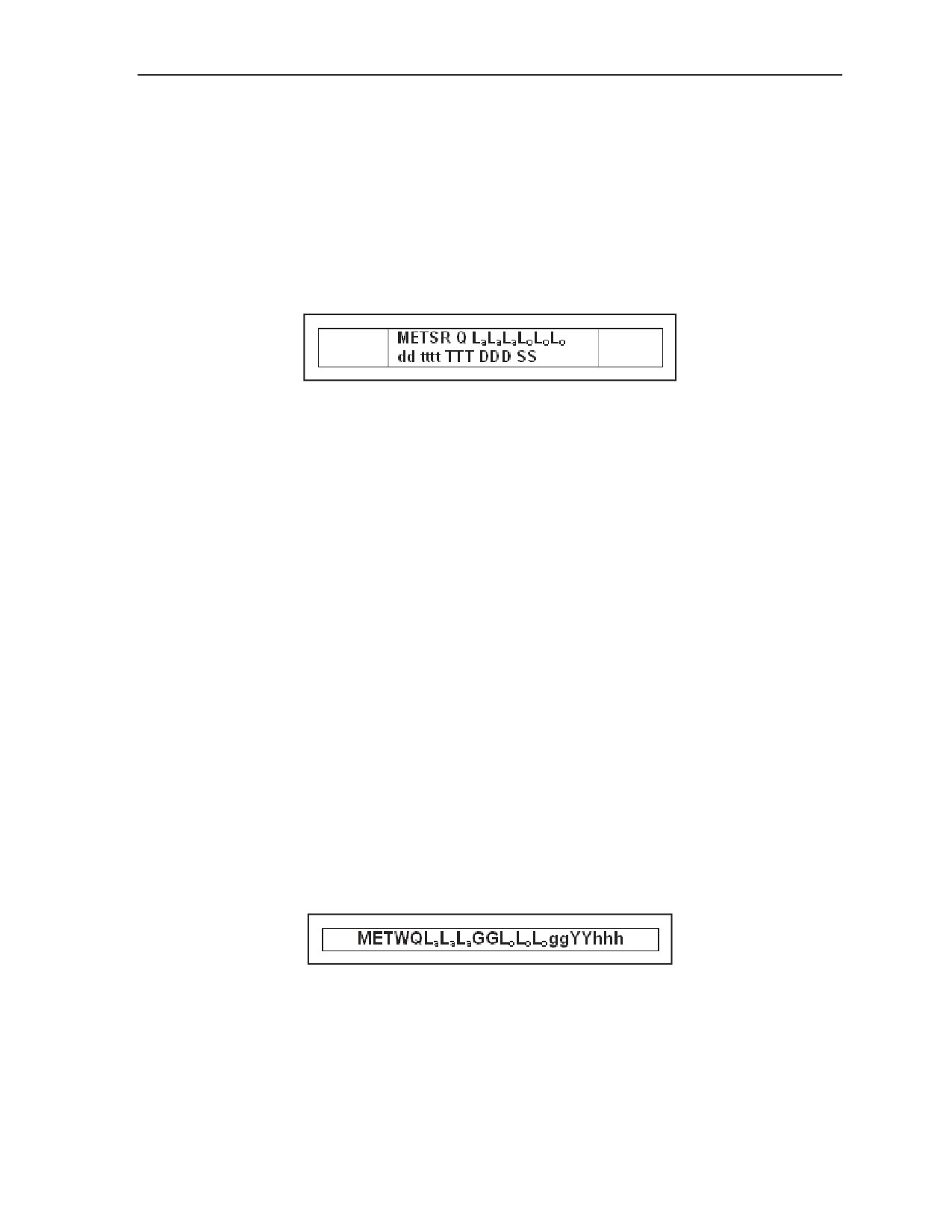
A-88. When used, the sound ranging MET message is provided in the format shown in figure A-34. The
parts of the sound ranging MET message are as follows:
z
The symbol METSR indicates that this is a sound ranging MET message.
A-30
FM 3-09.15/MCWP 3-16.5
25 October 2007
MET Messages
z
The symbol Q represents the octant of the globe in which the MET station is located.
z
The symbol LaLaLa represents the latitude of the MET station to the nearest tenth of a degree.
z
The symbol LoLoLo represents the longitude of the MET station to the nearest tenth of a degree.
z
The symbol dd represents the day of the month (GMT) of the sound ranging MET message.
z
The symbol tttt represents the time message validity begins.
z
The symbol TTT represents the effective (sonic) temperature to the nearest tenth of a degree
Celsius.
z
The symbol DDD represents the effective wind direction in mils.
z
The symbol SS represents the effective wind speed in knots.
Figure A-34. Sound ranging MET message format
WORLD METEOROLOGICAL ORGANIZATION MET MESSAGE
A-89. The WMO MET message provides high-altitude sounding data. The MET section automatically
provides the message in the WMO format to support the SWO.
WORLD METEOROLGICAL ORGANIZATION MET MESSAGE
ENCODING
A-90. The automated WMO message consists of a heading and a message body. The encoded format
conforms to the WMO format for worldwide transmission of MET data. The body of the message is in six
parts; each part consists of groups of five digits.
HEADING
A-91. The heading of the WMO MET message is an identification line encoded in the format shown in
figure A-35. The parts of the MET message identification line are as follows:
z
The symbol METW identifies the MET message as being a MET message in WMO format.
z
The symbol Q represents the octant of the globe. The octant identifies the part of the globe in
which the MET section is located.
z
The symbol LaLaLa identifies the latitude of the MET station location.
z
The symbol GG identifies the release hour (GMT) of the sounding.
z
The symbol LoLoLo identifies the longitude of the MET station location.
z
The symbol gg identifies the release time to the nearest minute (GMT).
z
The symbol YY represents the date of release (GMT).
z
The symbol hhh represents MET station altitude in tens of meters.
Figure A-35. WMO MET message identification line
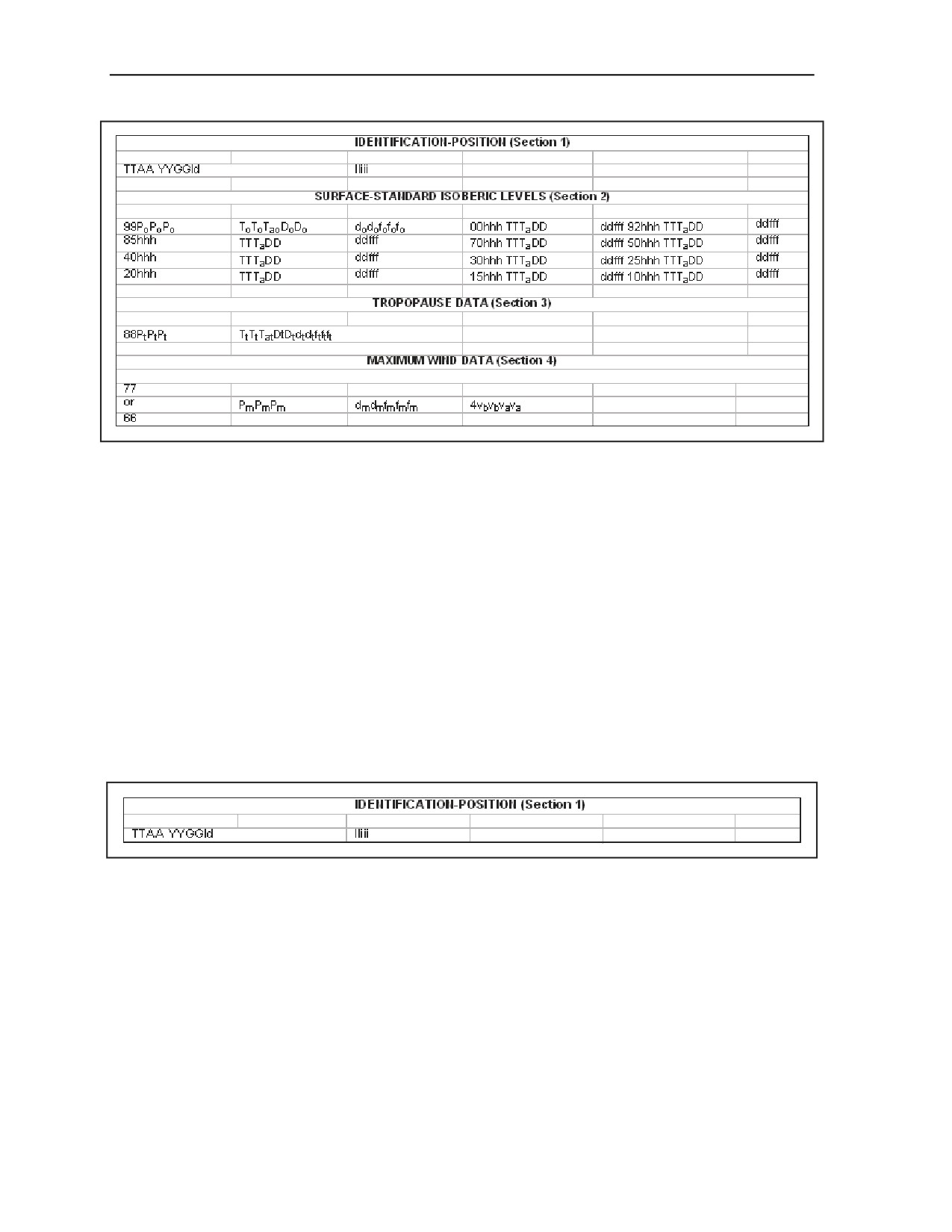
PART A (TTAA)-MANDATORY LEVEL DATA
A-92. Part A consists of mandatory level temperature, dew point (DP), and wind direction and speed below
100 millibars. The format of part A data is in figure A-36.
25 October 2007
FM 3-09.15/MCWP 3-16.5
A-31
Appendix A
Figure A-36. Format for part A (TTAA) of WMO MET message
Section 1
A-93. Section 1 of part A contains individual position identification data. Individual entries for section 1 of
part A are discussed below. The format for section 1 is shown in figure A-37.
z
The symbol TTAA identifies the data as Part A (mandatory levels).
z
The symbol YY represents the date of the flight (GMT).
z
NOTE: If wind speeds are recorded in knots, then 50 is added to the date. For example, 15 May
is encoded 65. If wind speeds are recorded in meters per second, then the date is recorded in the
normal manner.
z
The symbol GG represents the time of observation to the nearest whole hour (GMT).
z
The symbol Id represents the hundreds' digit of the last millibar level that winds are available.
See Table A-13 lists the codes for last millibar level that winds are available.
z
The symbol IIiii is a USAF location code. The II identifies the country or geographic area. The
iii identifies individual stations within the country or geographic area.
Figure A-37. Format for section 1, part A (TTAA) of WMO MET message.
A-32
FM 3-09.15/MCWP 3-16.5
25 October 2007
MET Messages
Table A-13. Codes for Last Millibar Level That Winds Are Available
Code Figure
Wind group reported up to and including the following standard isobaric surfaces:
Part A
Part C
1
100 OR 15 mb
10 mb
2
200 or 250 mb
20 mb
3
300 mb
30 mb
4
400 mb
5
500 mb
50 mb
6
7
700 mb
70 mb
8
850 mb
9
0
1,000 mb
/
No wind groups reported for any of
No wind groups reported for any of the
the standard isobaric surfaces
standard isobaric surfaces
Section 2
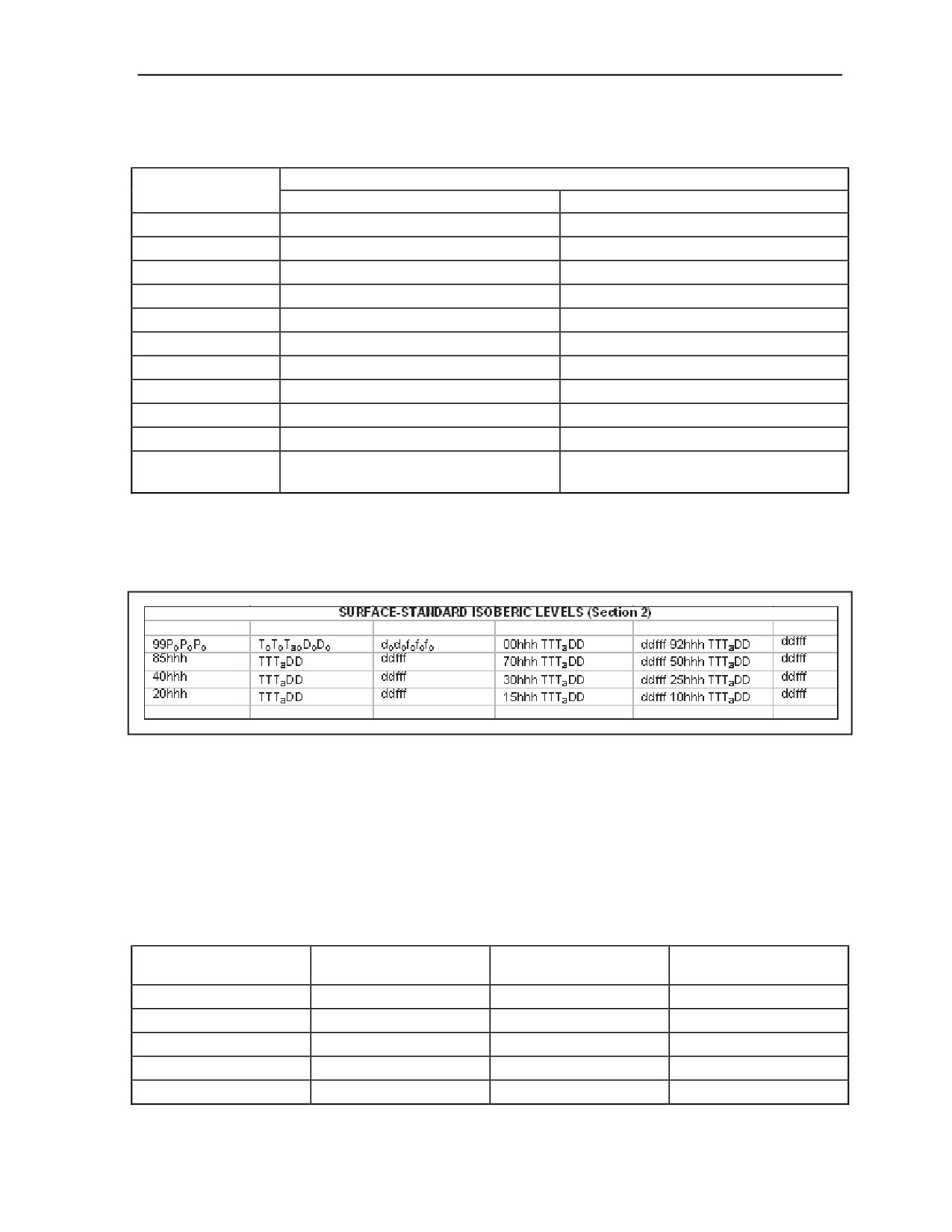
A-94. Surface data and standard isobaric surfaces data comprise section 2 of part A. Entries for section 2
are discussed in the following paragraphs. The format for section 2 is shown in figure A-38.
Figure A-38. Format for section 2, part A (TTAA) of WMO MET message
A-95. The number 99 is the surface indicator.
A-96. The symbol PoPoPo represents the surface pressure. If the surface pressure is over 1,000 millibars,
drop the thousands' digit.
A-97. The symbol ToToTao represents the temperature to the tenths of a degree Celsius. The last digit (Tao)
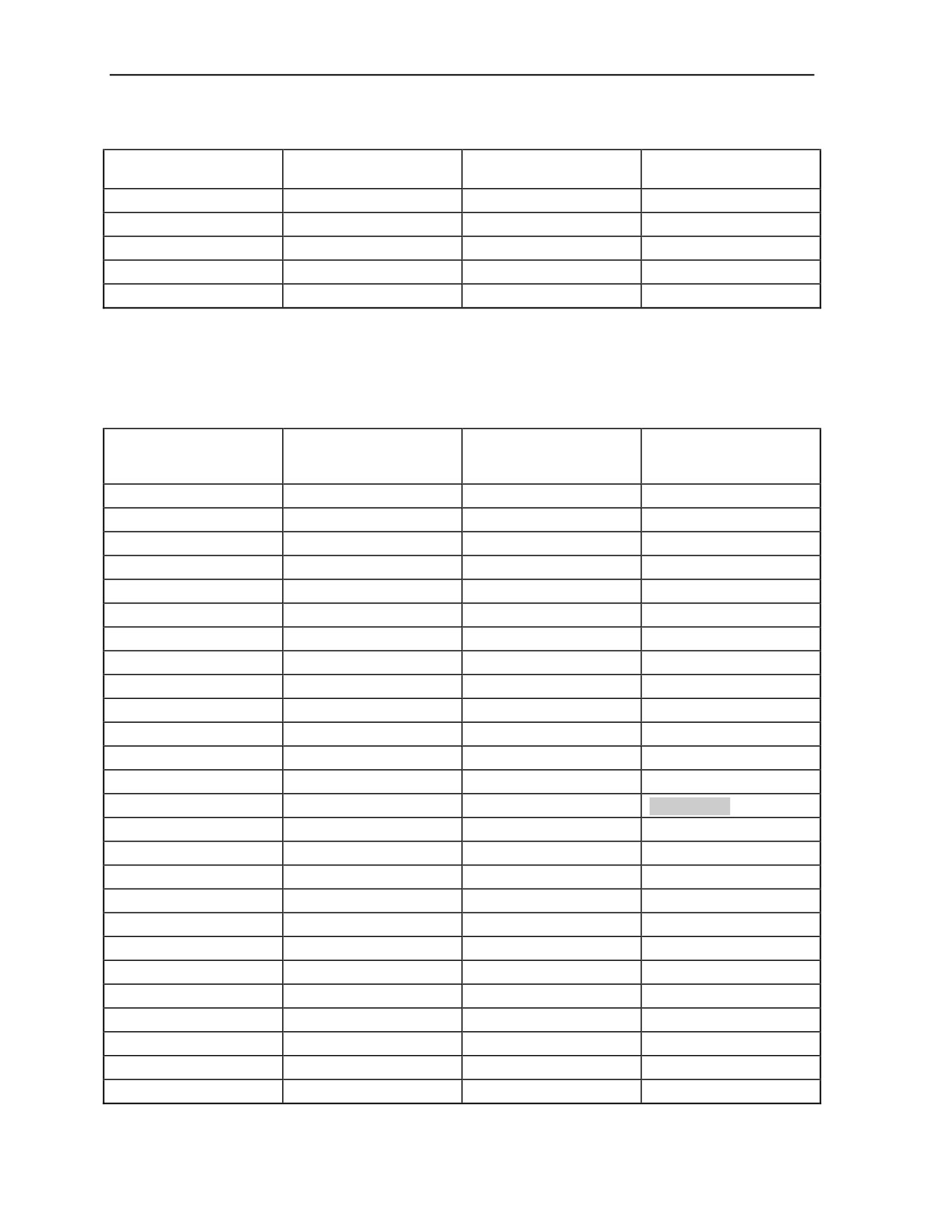
indicates if it is a positive or negative temperature value. Table A-14 lists temperature codes.
Table A-14. Temperature Tenths Value Code
Positive Temperature
Code Figure
Negative Temperature
Code Figure
Tenths Value
Tenths Value
.0
0
.0
1
.1
0
.1
1
.2
2
.2
3
.3
2
.3
3
.4
4
.4
5
25 October 2007
FM 3-09.15/MCWP 3-16.5
A-33
Appendix A
Table A-14. Temperature Tenths Value Code
Positive Temperature
Code Figure
Negative Temperature
Code Figure
Tenths Value
Tenths Value
.5
4
.5
5
.6
6
.6
7
.7
6
.7
7
.8
8
.8
9
.9
8
.9
9
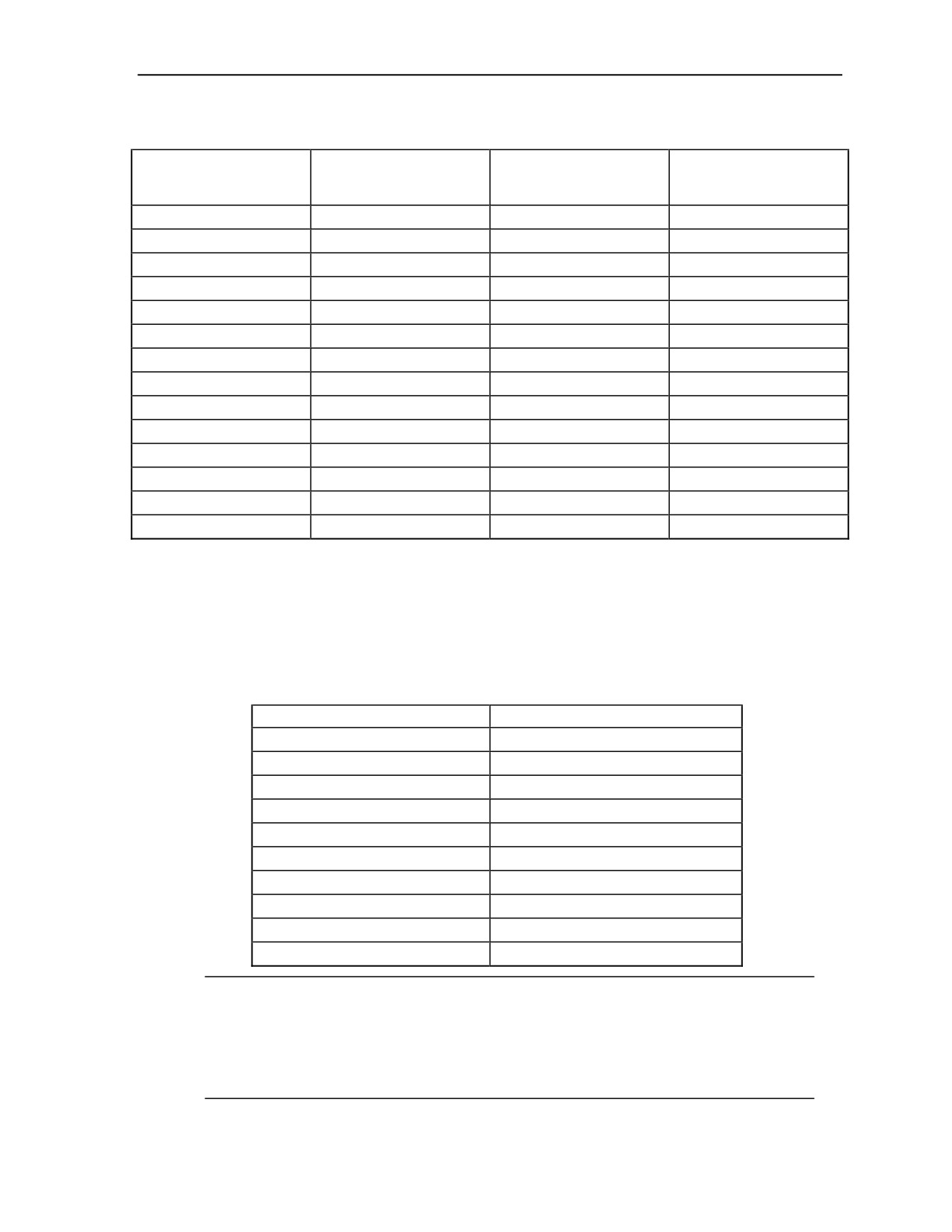
A-98. The symbol DoDo represents the DP depression. Table A-15 lists DP depression codes. DP
depressions of 0.0 to 4.9 are encoded as 00 to 49. DP depressions from 5.0 to 5.5 are encoded as 50. DP
depressions 5.5 and above are rounded off to the nearest whole degree and 50 is added to the result. (For
example, DP depression 15.8 is encoded 16 + 50 = 66.)
Table A-15. Dew Point Depression Code
Code Figure
Depression of the Dew
Code Figure
Depression of the Dew
Point in Degrees
Point in Degrees
Celsius
Celsius
00
0.0
40
4.0
01
0.1
41
4.1
02
0.2
42
4.2
03
0.3
43
4.3
04
0.4
44
4.4
05
0.5
45
4.5
06
0.6
46
4.6
07
0.7
47
4.7
08
0.8
48
4.8
09
0.9
49
4.9
10
1.0
50
5
11
1.1
51
12
1.2
52
13
1.3
53
NOT USED
14
1.4
54
15
1.5
55
16
1.6
56
6
17
1.7
57
7
18
1.8
58
8
19
1.9
59
9
20
2.0
60
10
21
2.1
61
11
22
2.2
-
-
23
2.3
70
20
24
2.4
71
21
25
2.5
-
-
A-34
FM 3-09.15/MCWP 3-16.5
25 October 2007
MET Messages
Table A-15. Dew Point Depression Code
Code Figure
Depression of the Dew
Code Figure
Depression of the Dew
Point in Degrees
Point in Degrees
Celsius
Celsius
26
2.6
80
30
27
2.7
81
31
28
2.8
-
-
29
2.9
89
39
30
3.0
90
40
31
3.1
91
41
32
3.2
-
-
33
3.3
98
48
34
3.4
99
49 or more
35
3.5
36
3.6
37
3.7
38
3.8
39
3.9
A-99. The symbol dodofofofo represents wind direction and speed. Wind direction is rounded to the nearest 5
degrees. The last digit of the wind direction is added to the first digit of the wind speed when wind speed
exceeds 99 knots. (For example, a wind direction of 293 and a wind speed of 45 knots are encoded as
29545. A wind direction of 115 and a wind speed of 126 knots are encoded as 11626.)
A-100. The symbol hhh represents height in geopotential meters. This is a mandatory data entry for
mandatory pressure levels. Table A-16 lists mandatory pressure levels.
Table A-16. Mandatory Pressure Levels
Level
Millibars
00
1,000
92
925
85
850
70
700
50
500
40
400
30
300
20
200
15
150
10
100
NOTES:
1. Geopotential heights are reported in whole geopotential meters for surface up to 500 mb.
Geopotential heights are reported in tens of geopotential meters for heights at the 500 mb level
and above. Geopotential heights below mean sea level are coded by adding 500 to the absolute
value. (For example, -239 is encoded as 739 [500+239])
25 October 2007
FM 3-09.15/MCWP 3-16.5
A-35
Appendix A
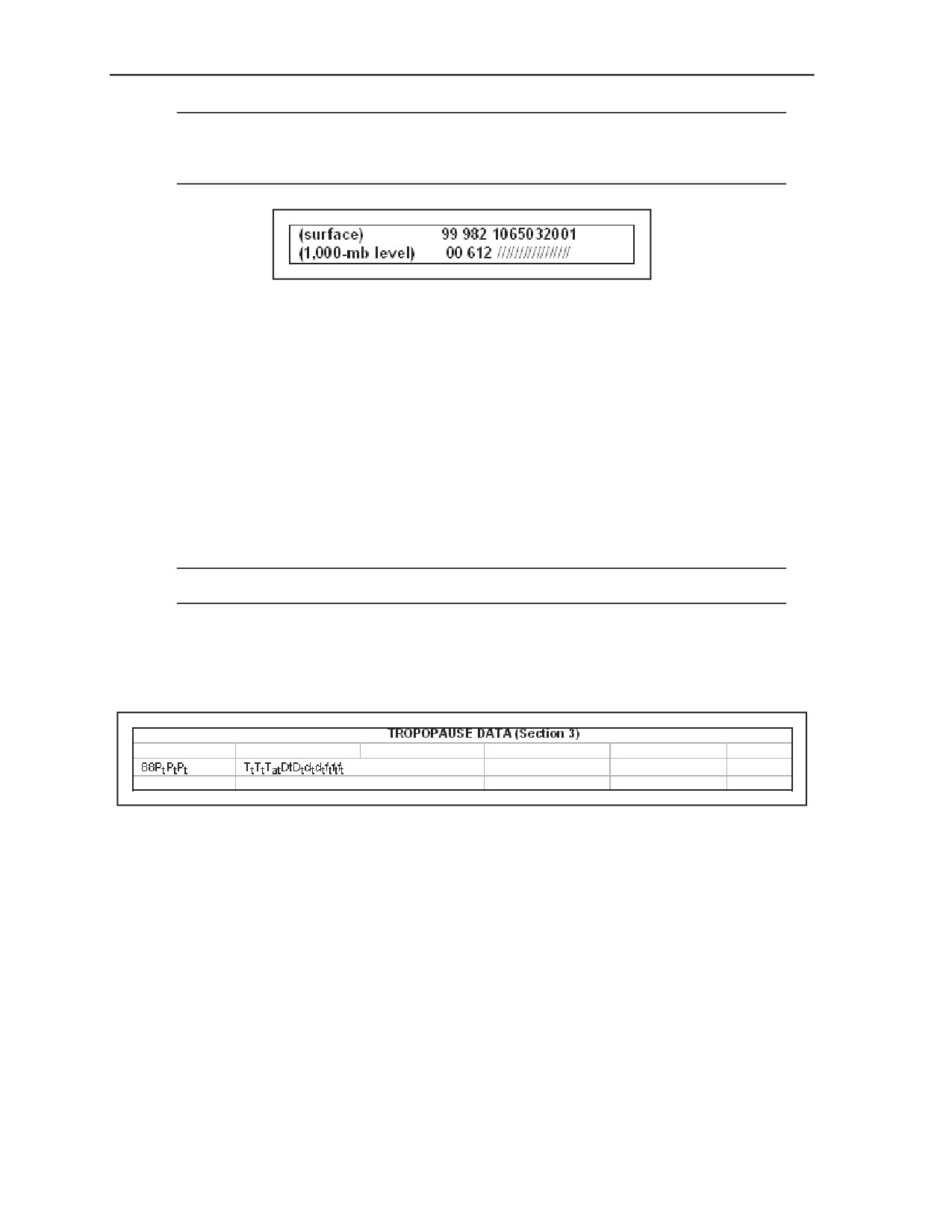
2. Sometimes the surface pressure is lower than 1,000 mb, 850 mb, and so on. In this case, the
1,000 mb level is reported with slashes (///) after the height entry. Figure A-39 shows an
example of this reporting.
Figure A-39. Surface pressure reporting
A-101. The symbol TTTa represents the surface temperature. This is a mandatory data entry for standard
isobaric surfaces.
A-102. The symbol DD represents the DP depression. This is a mandatory data entry for standard isobaric
surfaces.
A-103. The symbol ddfff represents the wind direction and speed. This is a mandatory data entry for
standard isobaric surfaces.
Section 3
A-104. Tropopause data entries are in Section 3 of Part A. These entries are discussed below. The format
for section 3 is shown in Figure A-40.
z
The number 88 is the tropopause data indicator.
NOTE: If tropopause data are missing, the missing data are reported encoded as 88999.
z
The symbol PtPtPt represents the pressure of the tropopause.
z
The symbol TtTtTat represents the temperature at the tropopause.
z
The symbol DtDt represents the DP depression at the tropopause.
z
The symbol dtdtftftft represents the wind direction and speed at the tropopause.
Figure A-40. Format for section 3, part A (TTAA) of WMO MET message
Section 4
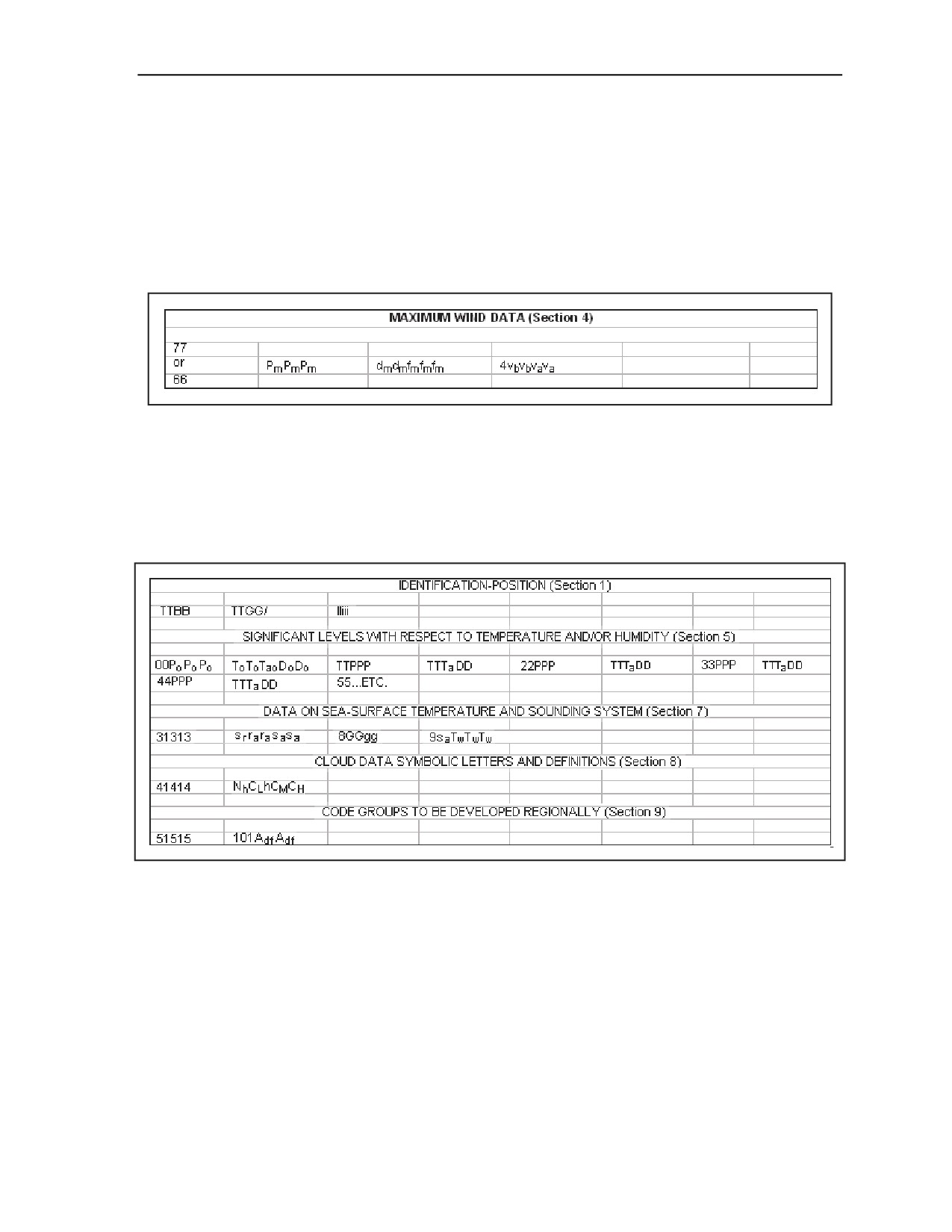
A-105. Maximum wind data entries are in section 4 of part A. These entries are discussed below. The
format for section 4 is shown in figure A-41.
z
The number 66 or 77 is the maximum wind indicator. A 66 maximum wind indicator indicates
the greatest wind speed observed throughout the sounding and occurring at the terminating level
of sounding. A 77 maximum wind indicator indicates the level of maximum wind speed
occurring within the sounding. Maximum winds must be above the 500-mb level and over 60
knots in speed to be reported. When no maximum wind data is observed, 77999 shall be
reported for Section 4.
z
The symbol PmPmPm represents the pressure at wind data.
z
The symbol dmdmfmfmfm represents the maximum wind direction and speed. Wind direction is
encoded to the nearest 5°. The rounded digit is added to the hundreds digit of the speed. (For
example, 30160 is 300° at 160 knots.)
A-36
FM 3-09.15/MCWP 3-16.5
25 October 2007
MET Messages
z
The symbol 4vbvbvava represents the vertical wind shear data. These values are derived by using
analytical geometry and are not easily checked in the field. The data reported with this entry are
as follows:
4 - Vertical wind shear data indicator.
vbvb - Value of vector difference between maximum wind speed and the
wind blowing at 3,000 feet below the level of the maximum winds, in
knots.
vava - Value of the vector difference between the maximum wind speed and
the wind blowing at 3,000 feet above the level of the maximum winds, in
knots.
Figure A-41. Format for section 4, part A (TTAA) of WMO MET message
PART B (TTBB)-SIGNIFICANT DATA (TEMPERATURE AND DEW POINT) BELOW 100
MILLIBARS
A-106. The format for part B (TTBB) is shown in figure A-42.
Figure A-42. Format for part B (TTBB) of WMO MET message
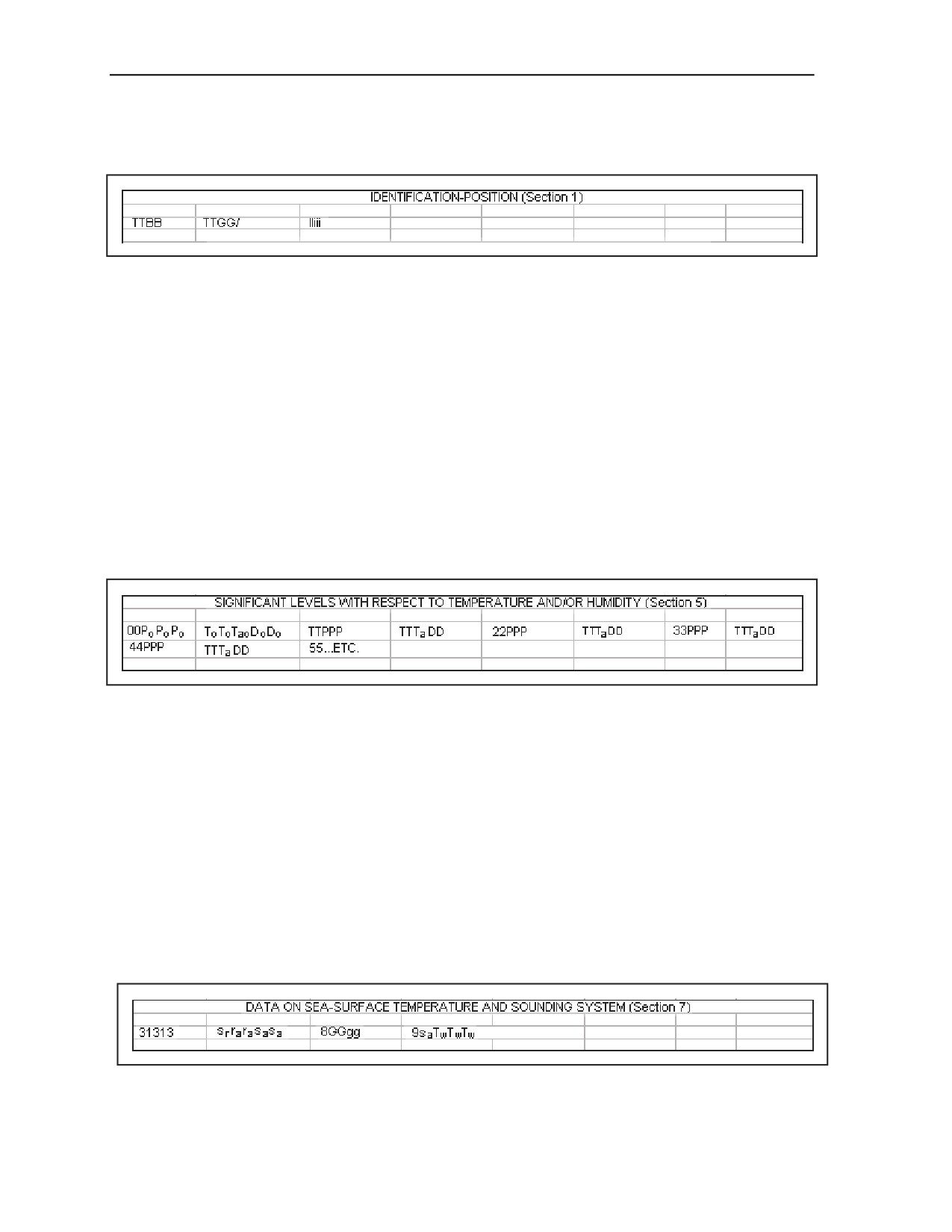
Section I
A-107. Section 1 of Part B contains position identification data. The data entries are discussed below.
Section I is shown in figure A-43.
z
The symbol TTBB is the Part B significant levels indicator. TT means sounding was made by a
land-based station. UU means the sounding was made by a ship-based station.
z
The symbol YY represents the date (GMT).
z
The symbol GG represents the time of observation to the nearest whole hour (GMT).
25 October 2007
FM 3-09.15/MCWP 3-16.5
A-37
Appendix A
z
The symbol / represents the last level at which wind data were obtained.
z
The symbol IIiii is a USAF identification code. The II identifies the country or geographic area.
The iii identifies individual stations within the country or geographic area.
Figure A-43. Section 1, part B (TTBB) of WMO MET message
Section 5
A-108. Section 5 of part B (TTBB) is composed of surface data and significant levels of temperature and
DP. The surface data entries and the significant level data entries are discussed below. Section 5 is shown
in figure A-44.
z
The symbol 00 is a surface indicator.
z
The symbol PoPoPo represents the surface pressure.
z
The symbol ToToTao represents the surface temperature.
z
The symbol DoDo represents the surface DP depression.
z
The symbol 11 and symbols continuing on in multiples of 11 are level indicators.
z
The symbol PPP represents pressure.
z
The symbol TTTa represents temperature.
z
The symbol DD represents DP depression.
Figure A-44. Section 5, part B (TTBB) of WMO MET message
Section 7
A-109. Section 7 of part B (TTBB) contains data on sea-surface temperature and sounding system used.
The 31313 is the section indicator. Section 7 is shown in figure A-45.
z
The symbol Sr represents solar and infrared radiation correction.
z
The symbol RaRa is the radiosonde/sounding system used.
z
The symbol SaSa is the tracking technique/status of the system used.
z
The symbol 8 is the indicator for time.
z
The symbol Gggg represents time of observation, in hours and minutes.
z
The 9 is the indicator for the sign of data, relative humidity, and sea-surface temperature.
z
The symbol Sn represents the sign of data and relative humidity indicator.
z
The symbol TwTwTw is the sea-surface temperature reported in tenths of a degree Celsius.
Figure A-45. Section 7, part B (TTBB) of WMO MET message
A-38
FM 3-09.15/MCWP 3-16.5
25 October 2007
MET Messages
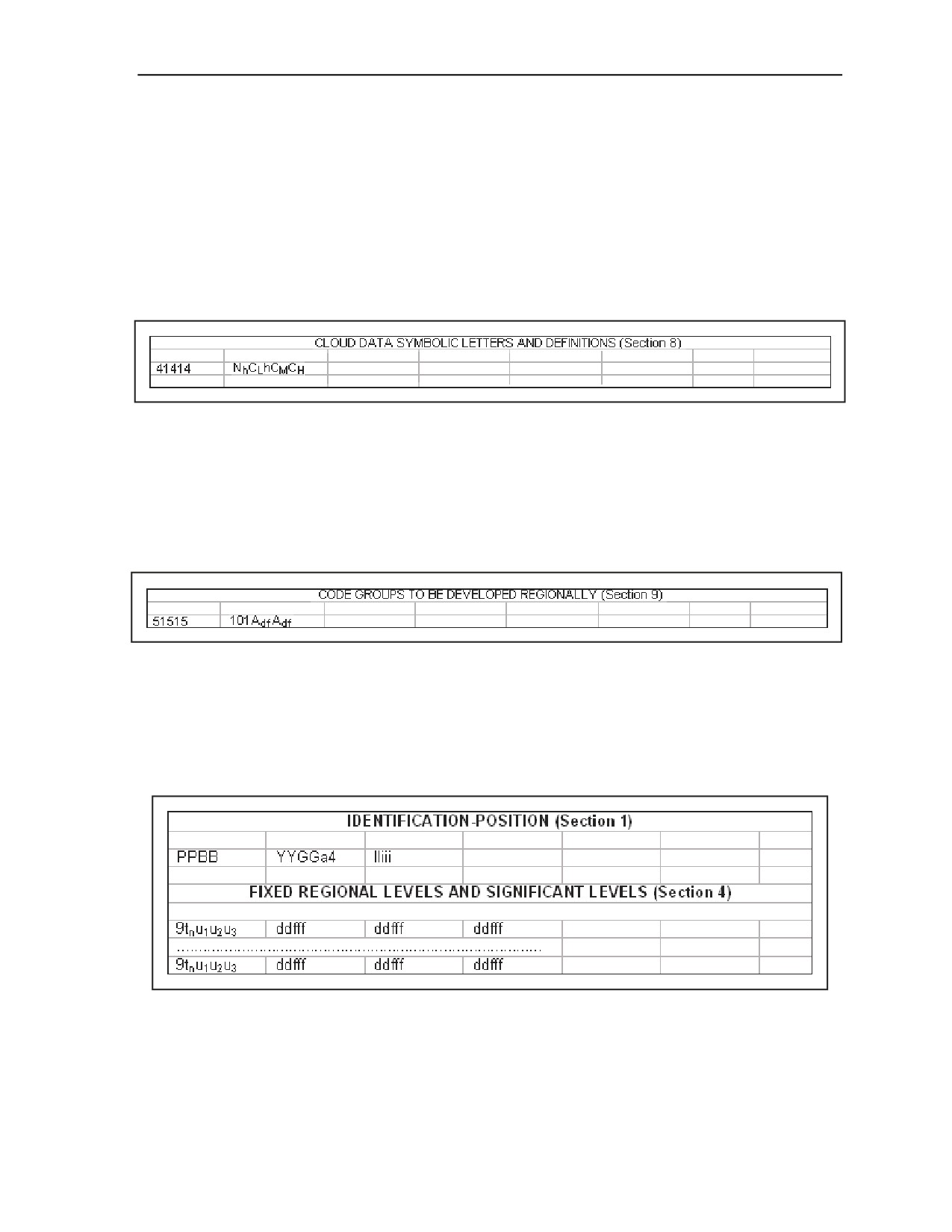
Section 8
A-110. Section 8 of part B (TTBB) contains cloud code information. 41414 is the section indicator. The
codes can be found in appendix B of this manual. Section 8 is shown in figure A-46.
z
The symbol Nh is the amount of CL present or, if no CL is present, the amount of all the CM cloud
present.
z
The symbol CL represents cloud classes stratocumulus, stratus, cumulus, and cumulonimbus.
z
The symbol h represents the height above surface of the base of the lowest cloud seen.
z
The symbol CM represents cloud classes altocumulus, altostratus, and nimbostratus.
z
The symbol CH represents cloud classes cirrus, cirrocumulus, and cirrostratus.
Figure A-46. Section 8, part B (TTBB) of WMO MET message
Section 9
A-111. Section 9 of part B (TTBB) contains additional codes developed regionally. Section 9 is shown in
Figure A-47.
z
The 51515 is the section indicator.
z
The symbol AdfAdf represents the form of the additional data reported.
Figure A-47. Section 9, part B (TTBB) of WMO MET message
PART B (PPBB)-SIGNIFICANT DATA (WIND DIRECTION AND SPEED) BELOW 100
MILLIBARS
A-112. The format for part B (PPBB) is shown in figure A-48.
Figure A-48. Format for part B (PPBB) of WMO MET messages
25 October 2007
FM 3-09.15/MCWP 3-16.5
A-39

Appendix A
Section I
A-113. Section 1 of part B (PPBB) contains position identification data. Data entries are discussed below.
z
The symbol PPBB is the part B (winds data) below 100 millibars.)
z
The symbol YY represents the date (GMT).
z
The symbol GG represents the time of observation to the nearest whole hour (GMT).
z
The symbol a4 represents the type of instrument used in the observation. The symbol IIiii is a
USAF location code. The II identifies the country or geographic area.
z
The iii identifies individual stations within the country or geographic area.
Section 4
A-114. Section 4 of part B (PPBB) contains fixed regional levels data. The data entries are discussed in
the following paragraphs. Fixed regional level data for part B are in table A-17. Heights indicated are
above mean sea level.
Table A-17. Fixed Regional Levels
Feet
Meters
1,000
300
2,000
600
3,000
900
4,000
1,200
6,000
1,800
7,000
2,100
8,000
2,400
9,000
2,700
12,000
3,600
14,000
4,200
16,000
4,800
20,000
6,000
25,000
7,500
30,000
9,000
35,000
10,500
50,000
15,000
A-115. In the symbol 9tnu1u2u3, the 9 is a height indicator, and tn is the 10,000-foot indicator. The u1 is the
first wind level, u2 is the second wind level, and u3 is the third wind level. (For example, 90012 indicates
surface level, 1,000-foot level, and 2,000-foot level. If surface level were over 1,000 feet above sea level,
the indicator would be 90023. The 9205/ indicates 20,000-foot level and 25,000-foot level.)
A-116. The symbol ddfff represents wind direction and speed. Wind direction is given to the nearest 10
degrees. Winds are reported to the nearest 5 degrees by adding 500 to wind speed.
A-40
FM 3-09.15/MCWP 3-16.5
25 October 2007
MET Messages
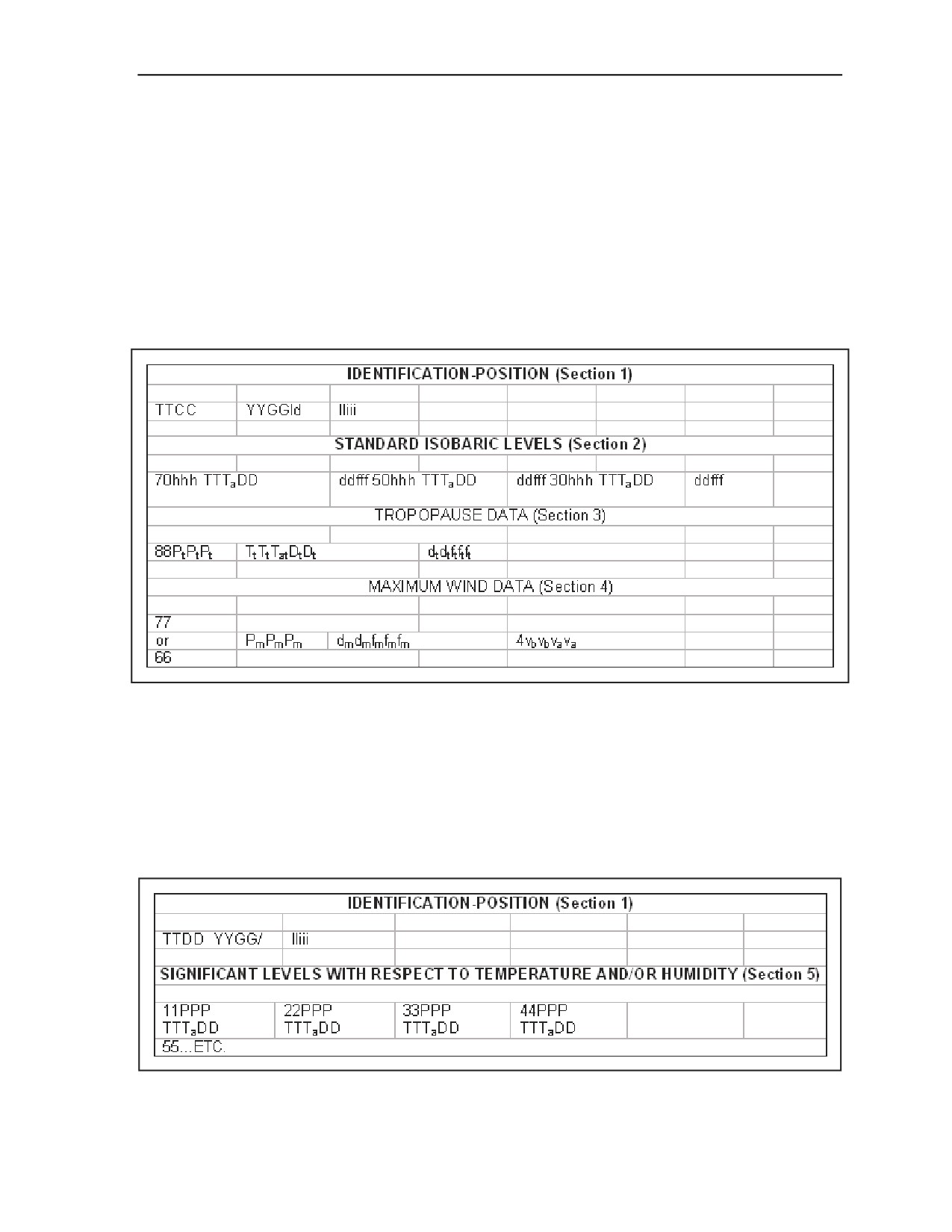
PART C (TTCC)-MANDATORY LEVEL TEMPERATURE, DEW POINT, AND WIND DATA
ABOVE 100 MILLIBARS
A-117. The format for part C (TTCC) is shown in figure A-49. Identification of individual entries is the
same for part C (TTCC) as for part A (TTAA). This section is omitted if the balloon bursts between 100
and 70 millibars. However, in this case, TTDD and PPDD must be transmitted so that the user can
determine what data are available between 100 and 70 millibars.
Figure A-49. Format of part C (TTCC) of WMO MET message
PART D (TTDD) - SIGNIFICANT LEVEL (TEMPERATURE AND DEW POINT ABOVE 100
MILLIBARS
A-118. The format for part D (TTDD) is shown in Figure A-50. Identification of individual entries is the
same for part D (TTDD) as for part B (TTBB).
Figure A-50. Format of part D (TTDD) of WMO MET message
25 October 2007
FM 3-09.15/MCWP 3-16.5
A-41
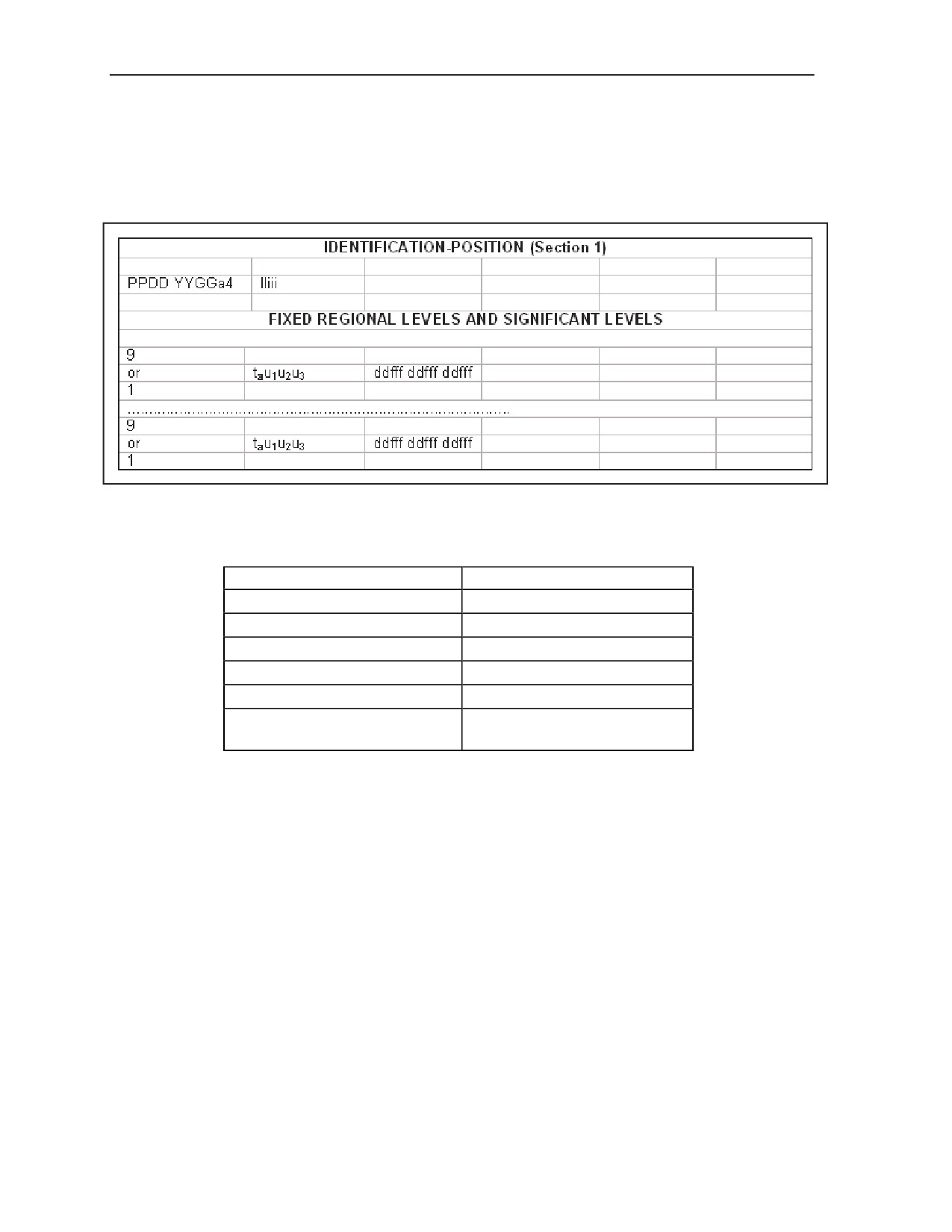
Appendix A
PART D (PPDD)-SIGNIFICANT DATA (WIND DIRECTION AND SPEED) ABOVE 100
MILLIBARS
A-119. The format for part D (PPDD) is shown in figure A-51. Identification of individual entries is the
same for part D (PPDD) as for part B (PPBB). Fixed regional level data for part D are included in Table
A-18. Altitudes are above mean sea level.
Figure A-51. Format of part D (PPDD) of WMO MET message
Table A-18. Fixed Regional Level Data
Feet
Meters
70,000
21,000
90,000
27,000
100,000
30,000
110,000
33,000
140,000
42,000
and for every 10,000-foot level
and for every 3,000-meter
upward
level upward
FALLOUT MET MESSAGES
A-120. The FOMET message contains only wind data recorded at 2,000-meter intervals from the surface
to 30,000 meters. This data is used by CBRN personnel mainly at division and corps levels to develop the
downwind messages that predict fallout patterns.
ENCODING FALLOUT MET MESSAGES
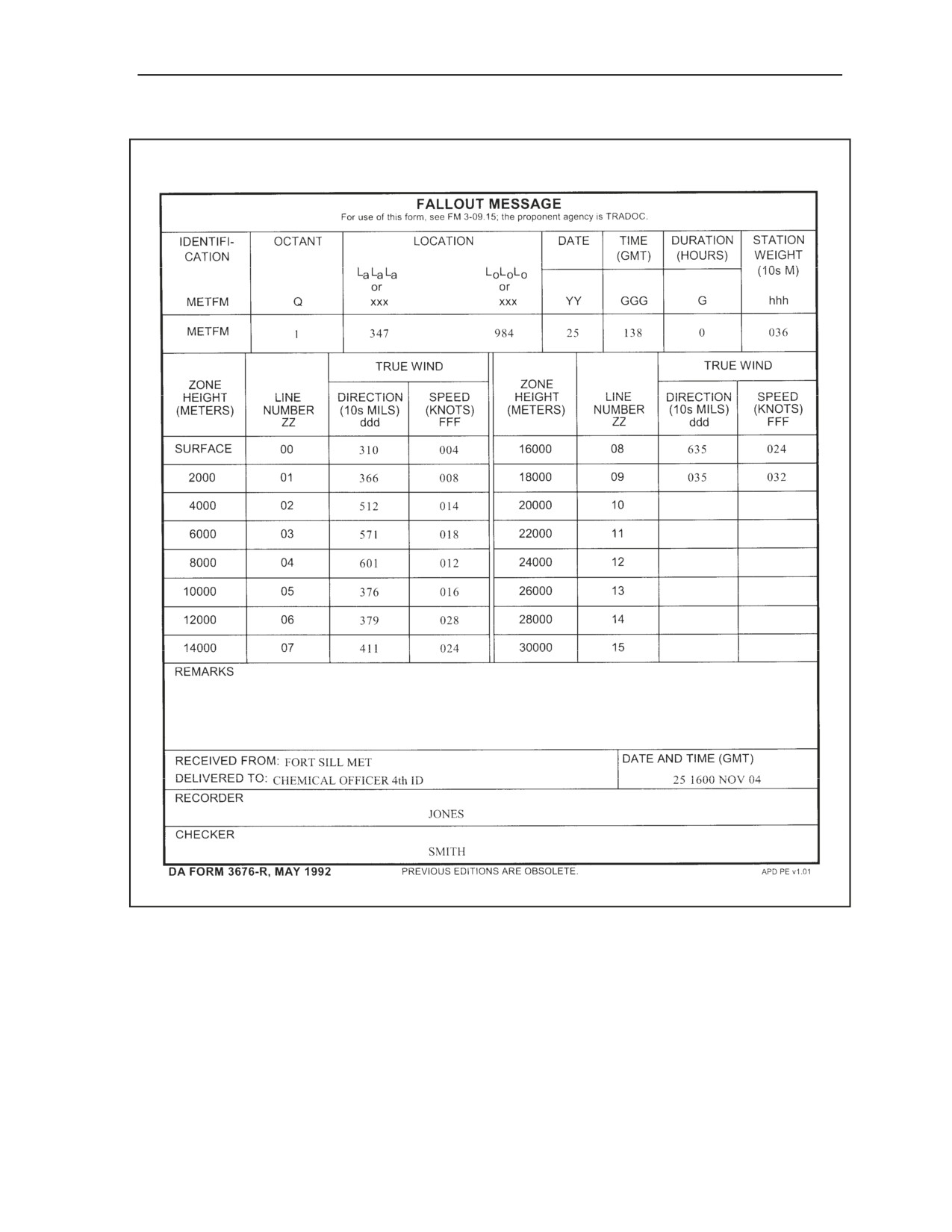
A-121. Met data for fallout predictions are recorded on DA Form 3676-R, Fallout Message (LRA). Figure
A-52 shows an encoded fallout message. A copy of this form is at the rear of this manual. The following
paragraphs discuss how the data recorded on the form are encoded.
A-42
FM 3-09.15/MCWP 3-16.5
25 October 2007
MET Messages
Figure A-52. DA Form 3676-R
OCTANT AND LOCATION
A-122. The area is identified by either a geographic location or a coded location of the MET station. In
either case, the location is preceded by a number from the Q code, which designates the octant of the globe
in which the station is located. The geographic location of the MET station may be determined from a
military map and is recorded in degrees and tenths of degrees. If the longitude is equal to 100 degrees or
more, the first digit, 1, is dropped. For example, latitude 34°42°N, longitude 98°24’W would be encoded
as 1 347984. When operations require that the station be identified by a code, the Q code number 9 is used
25 October 2007
FM 3-09.15/MCWP 3-16.5
A-43
Appendix A
to signify that the next six digits are a coded location of the MET station. The using unit must understand
the code used for the location.
A-123. The day of the month is entered in two digits. For example, the number 25 indicates the message is
for the 25th day (GMT) of the month.
A-124. The release time in hours and tenths of hours is entered in three digits. Thus, the number 138
indicates a release time of 1348 GMT.
A-125. A digit from 1 to 8 is entered to represent duration of validity in hours. Code figure 9 indicates 12
hours. U.S. Forces use the digit 0 since they do not predict how long MET messages will be valid.
A-126. The altitude of the MET station above mean sea level is entered in tens of meters. The altitude of
the station may be determined from a military map or from the survey section and is encoded in three
digits. For example, the number 036 indicates the station is 360 meters above mean sea level.
A-127. The line number is identified by two digits that correspond to the zone number. The first line
number, 00, indicates surface; 01, surface to 2,000 meters; 02, 2,000 meters to 4,000 meters; and so on.
A-128. Wind direction is encoded in three digits to the nearest 10 mils. Wind speed is encoded in three
digits to the nearest knot. The number 310 indicates the wind direction is 3,100 mils. The number 004
indicates a speed of 4 knots.
A-129. The remarks block is used to record other pertinent data.
A-130. The FOMET message is transmitted in a certain code group format. An example of the format is
METFMQ LaLaLaLoLoLo (pause) YYGGGG (pause) hhh (pause) ZZdddFFF (pause) ZZdddFFF, and so on.
ENCODING STANDARD MESSAGES FROM MMS-P MET
MESSAGES
A-131. MMS and STANAG MET message formats are arranged in a tabular format. The message will
contain heading information followed by line numbers corresponding to a predetermined atmospheric
zone. Associated with the line number are the wind speed, wind direction, temperature, and pressure for
that atmospheric zone.
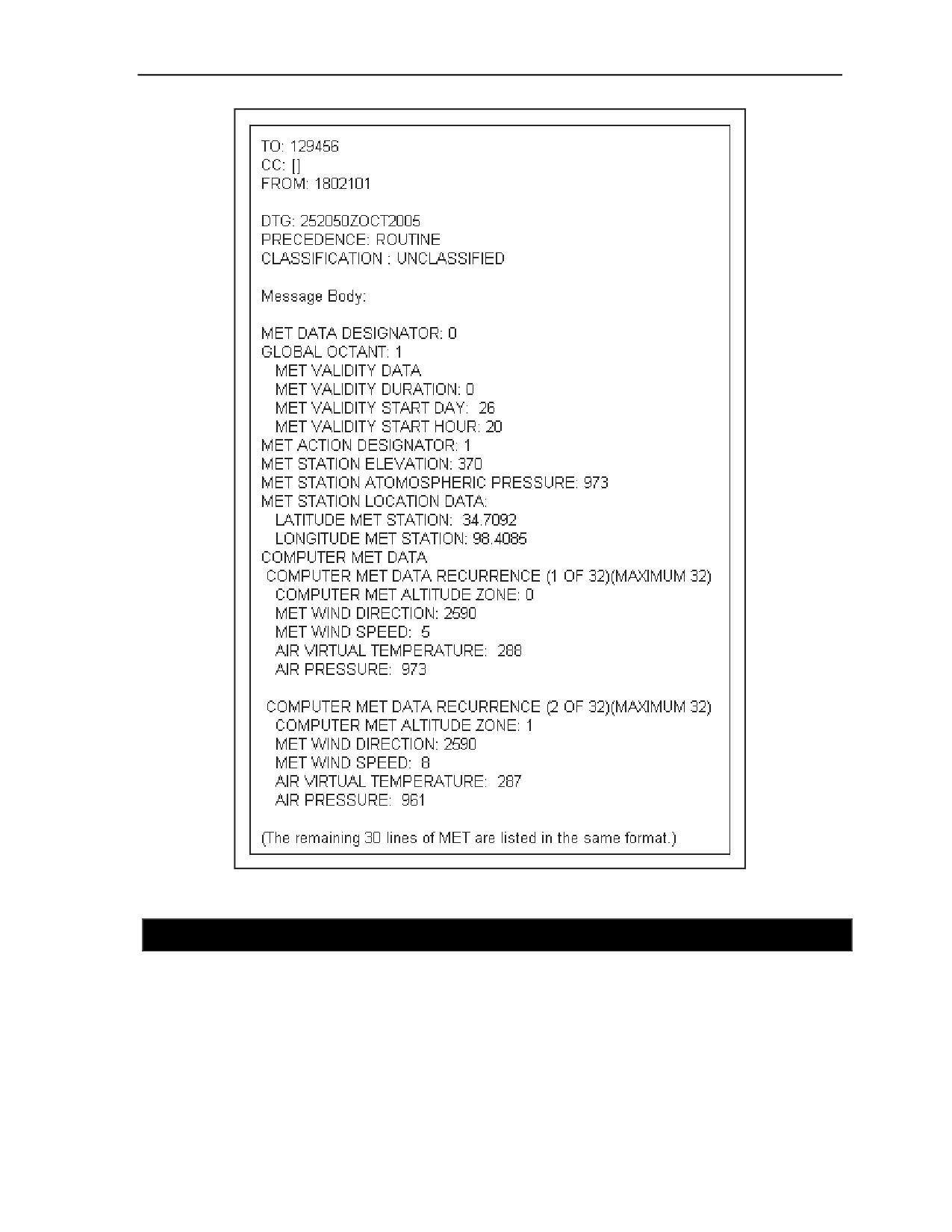
A-132. MMS-P system generates the same MET data for each type of message as required by STANAG
agreement. The MMS-P system displays the data in a different format. Each line of the message contains
one item of data. It is displayed with the data label and the value. Once familiar with the STANAG forms,
transferring the data from the MMS-P format is self-explanatory. Figure A-53 shows the MMS-P message
format.
A-44
FM 3-09.15/MCWP 3-16.5
25 October 2007
MET Messages
Figure A-53. MMS-P MET message format
SECTION IV ARTILLERY LIMITED SURFACE OBSERVATION MET MESSAGE
OVERVIEW
A-133. All FA MET sections can produce an artillery limited surface observation (ALSO) MET message
in support of Army tactical operations. Only surface observation equipment is used to collect the data,
which are entered on DA Form 5033-R, Limited Surface Observation (LRA). A copy of this form is at the
rear of this manual. MET sections deliver the data to requesting agencies in plaintext format. The message
will be transmitted in six-digit groups. The order of groups must be maintained. Only the 99 group will be
considered optional and may be omitted if not applicable. If an element within a group cannot be reported,
25 October 2007
FM 3-09.15/MCWP 3-16.5
A-45
Appendix A
it must be entered as a slash. Correct procedures for producing an ALSO MET message are described
below.
MESSAGE IDENTIFIER (SUPRP Q)
A-134. Use the five-letter SUPRP identifier followed by octant of globe for the first six-letter/number
group.
STATION LOCATION (LALALA LOLOLO)
A-135. In the second six-number group, three numbers are for latitude and three are for longitude to a
tenth of a degree. When the location must be coded, the code is in agreement with the receiving and
transmitting units.
DATE AND TIME (YY GGGG)
A-136. Both are given in GMT in hours and minutes at time of observation.
TOTAL AMOUNT OF CLOUD COVER (NA)
A-137. Of all the weather conditions that adversely affect aircraft operations, low clouds and low
visibility are by far the most common. Sky condition observations consist of two elements, the amount of
clouds or obscuration present and remarks about the sky condition in the area that would be helpful to the
weather forecaster or to the aviator. This paragraph describes the method of observing the sky conditions.
Sky Cover Amounts (Na)
A-138. The total amount of the sky covered by clouds or an obscuration can be described by using one of
the following words:
z
Clear. Less than 1/8 of the sky is covered by clouds.
z
Scattered. 1/8 to less than 1/2 of the sky is covered (approximately 10-50 percent).
z
Broken. 1/2 or more of the sky is covered (approximately 60-90 percent).
z
Overcast. Sky is totally covered by clouds or other materials; that is., fog, blowing snow,
blowing sand, or smoke.
Determining Sky Cover
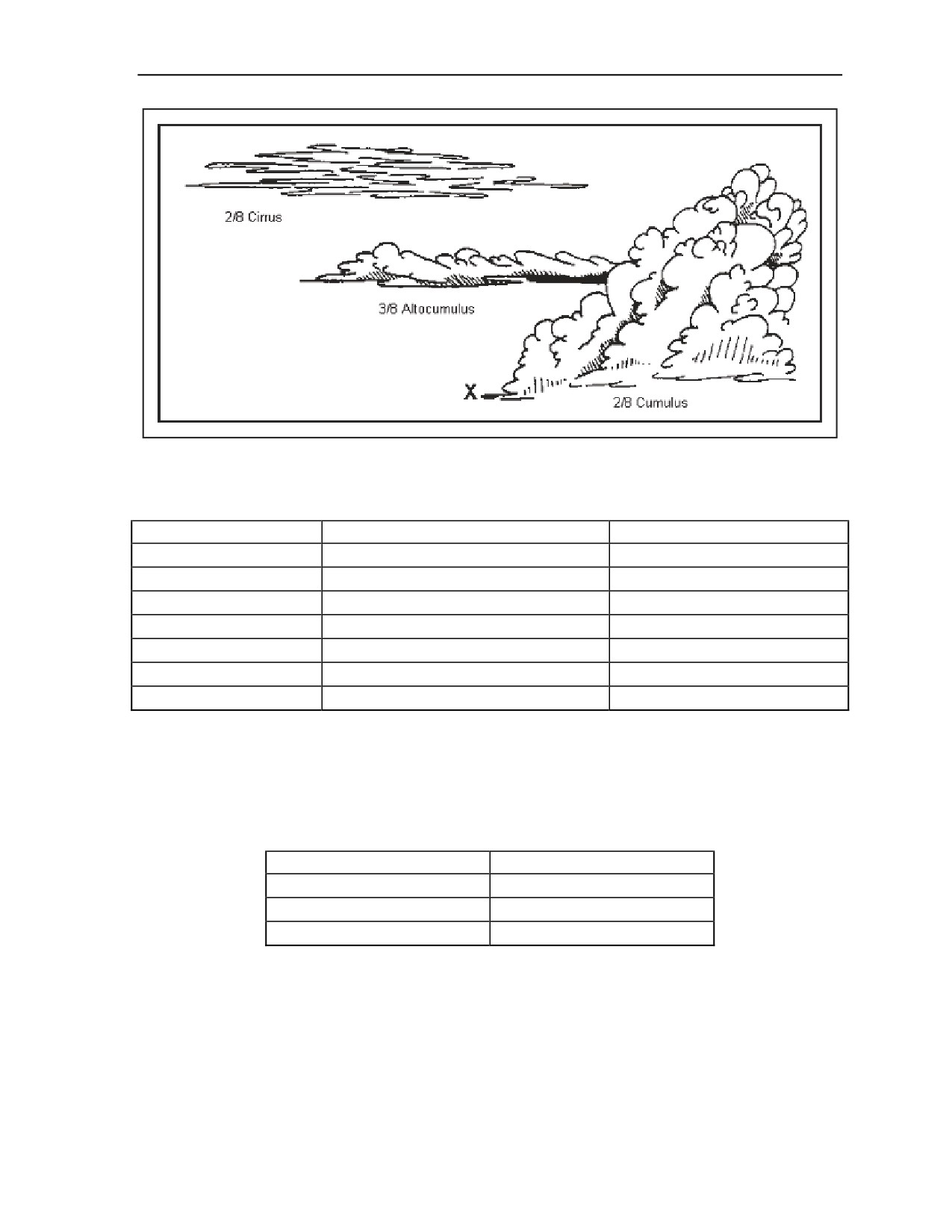
A-139. The total cloud amount is determined by considering the sky above as a celestial dome divided
into eight equal parts. For example, the observer is standing at point X in figure A-54. There are three
different cloud layers above you. There is 7/8 cloud cover, but the cirrus and the altocumulus overlap by
about 1/8, so the total cloud amount is reported as 6/8, or a broken condition. Table A-19 indicates amount
of cloud cover codes.
A-46
FM 3-09.15/MCWP 3-16.5
25 October 2007
MET Messages
Figure A-54. Cloud cover
Table A-19. Na-Total Amount of Cloud Cover
Code Figure
Explanation
For Work Sheet Abbreviation
0
Clear (no clouds)
CLR
2
Scattered (1/8 - 4/8)
SCTD
3
Scattered (hills in clouds)
SCTD II
5
Broken (5/8 - 7/8)
BRKN
6
Broken (hills in clouds)
BRKN
7
Overcast (8/8)
OVC
8
Overcast (hills in clouds)
OVC II
Additional Codes
A-140. Very often, significant features of sky cover cannot be explained simply by scattered, broken, and
so forth. Explanations for hilly or mountainous stations are included in the code and must be used. These
codes, which are extremely important to aircraft operations, are listed in table A-20.
Table A-20. Additional Codes
Code
Description
3 - Scattered
(Hills in clouds)
6 - Broken
(Hills in clouds)
8 - Overcast
(Hills in clouds)
WIND DIRECTION AND SPEED (D F)
A-141. Wind speed and direction are necessary in forecasting weather, especially in locations where
weather is often associated with frontal systems. Wind direction and speed can be used to locate these
fronts and to determine their movement. Frequently, the combination of wind direction and terrain
produces significant variation in wind speed over very short distances. Local variations in wind speed can
also produce deviations in weather conditions.
25 October 2007
FM 3-09.15/MCWP 3-16.5
A-47
Appendix A
Direction (D)
A-142. Wind direction is defined as the direction from which the wind is blowing. Wind may be read
from an anemometer. Table A-21 lists the codes for wind direction.
Table A-21. D-Direction From Which Surface Wind is Blowing
Code Figure
Explanation
Degrees
0
Calm
1
NE
023-067
2
E
068-112
3
SE
113-157
4
S
158-202
5
SW
203-247
6
W
248-292
7
NW
293-337
8
N
338-022
9
Variable
Speed (F)
A-143. Wind speed may also be read from an anemometer. If no wind equipment is available, the speed
may be estimated by using table A-22.
Table A-22. F-Force of Surface Wind (Beaufort Scale)
Code Figure
Description
Specifications
Approximate Knots
0
Calm
Smoke rises vertically
Less than 2
2
Light Breeze
Wind felt on face and leaves rustle
3-8
4
Moderate breeze
Dust and loose paper fly about;
9-18
small branches move
6
Strong breeze
Large branches in motion,
19-29
whistling in wires
8
Gale
Twigs broken off trees; progress of
30-42
person walking generally impeded
VISIBILITY (V)
A-144. Visibility is an important limiting factor in flying operations. Poor visibility restricts visual
surveillance and flying observations. Visibility is the greatest distance an object can be seen and identified
by the normal eye without the aid of optical devices such as binoculars and starlight scopes. In actual
practice, visibility is the greatest distance that prominent objects such as trees, buildings, water towers, or
natural landmarks (hills) can be seen clearly enough to be identified. Visibility is reported in meters, to the
nearest hundred meters, as listed in table A-23. The visibility that is reported must be representative of at
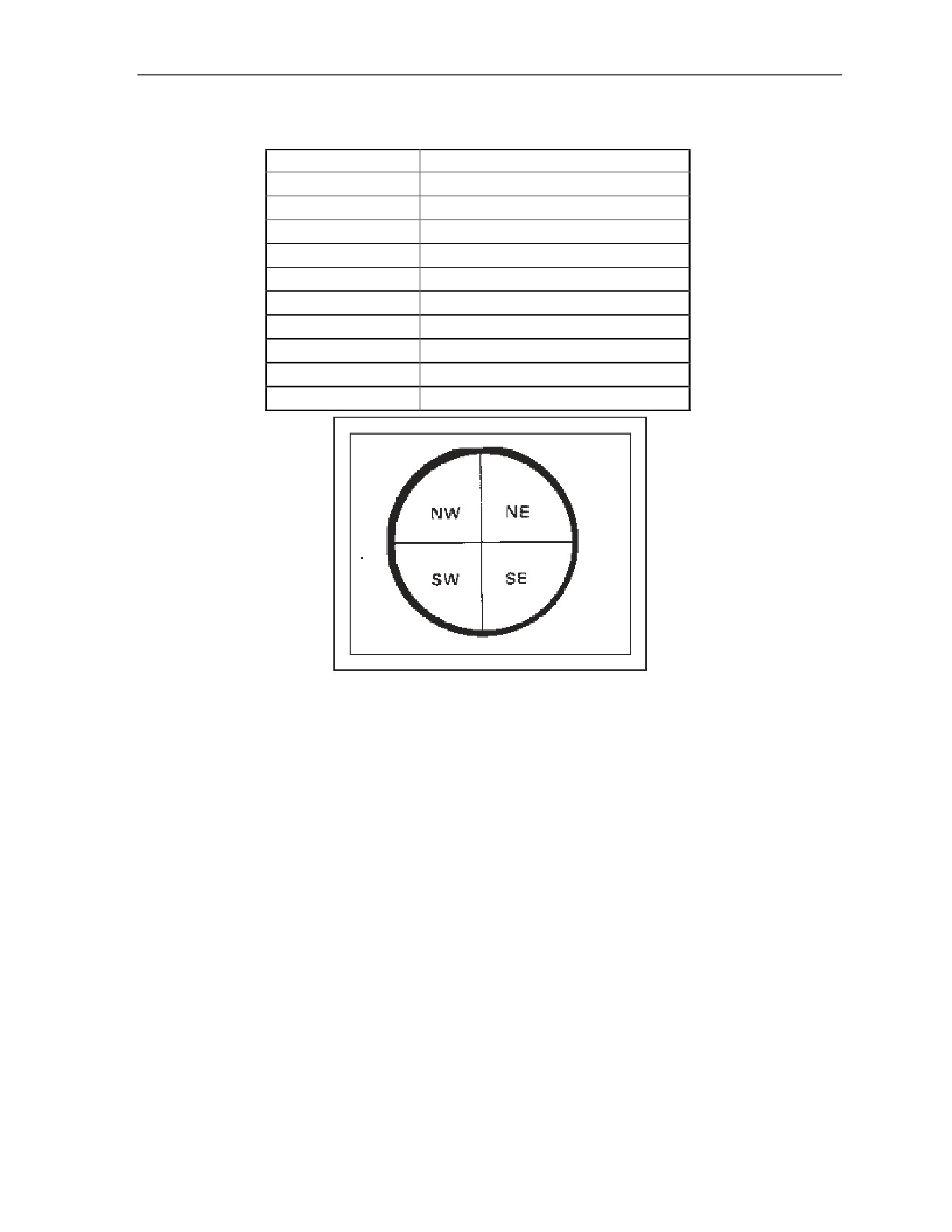
least half of the horizon circle. In making this determination, the horizon circle is normally divided into
quadrants as shown in figure A-55. Any two quadrants may be used to determine the prevailing visibility.
Quadrant visibility may be reported as a remark at the end of the observation. If the observer feels that the
visibility in one quadrant is significantly different from the prevailing visibility, he should include a
remark, for example, Visibility N, meters. Any quadrant or direction may be used for this remark.
A-48
FM 3-09.15/MCWP 3-16.5
25 October 2007
MET Messages
Table A-23. V-Visibility at Surface
Code Figure
Explanation
0
Less than 50 meters
1
50-200 meters
2
200-500 meters
3
5000-1,000 meters
4
1-2 km
5
2-4 km
6
4-10 km
7
10-20 km
8
20-50 km
9
50 km or more
Figure A-55. Quadrant visibility
Daytime
A-145. In daytime, any building, water tower, telephone pole, road, hill, clumps of trees, and others that
can be seen under ideal conditions may be used as a visibility marker if the distance to the object is known.
Night
A-146. At night, the above objects can be used if their silhouettes can be identified. However, the best
nighttime marker is an unfocused light at a known distance from the observation point. This does not
include searchlights, airport rotating beacons, or automobile headlights aimed directly at you.
PRESENT WEATHER AND OBSTRUCTIONS TO VISION (W)
A-147. The important effect visibility has on operations has already been mentioned. It would not be
logical to report a reduction in visibility without describing it in terms of the weather phenomena upon
which the visibility depends. These weather phenomena are divided into two main groups, weather and
obstructions to vision. They are discussed separately in detail in the following paragraphs. Table A-24 lists
the codes for present weather.
25 October 2007
FM 3-09.15/MCWP 3-16.5
A-49
Appendix A
Table A-24. w-Present Weather and Obstructions to Vision
Code Figure
Explanation
0
No significant weather
1
Smoke or haze
2
Fog in valley
3
Sandstorm, dust storm, or blowing snow
4
Fog
5
Drizzle
6
Rain
7
Snow or rain and snow mixed
8
Shower(s)
9
Thunderstorm(s) with or without precipitation
Smoke
A-148. Smoke is fine ash particles suspended in the air. When smoke is present, the disk of the sun
appears very red at sunset and sunrise and has a reddish tinge throughout the day. Smoke at a distance,
such as from a forest fire, usually has light grayish or bluish color.
Haze
A-149. Haze is dust and other material too small to be seen individually by the unaided eye. Haze reduces
visibility and resembles a uniform veil over the landscape that subdues the colors. Haze appears bluish
against a dark background but dirty or orange against a bright background such as the sun. In contrast, fog
appears grayish and feels damp on the skin.
Fog
A-150. Fog is very small drops of water suspended in the air that reduce visibility.
Blowing Sand and or Dust
A-151. Blowing sand or dust is dust or sand raised by the wind to such an extent that visibility is
impaired.
Blowing Snow
A-152. Blowing snow occurs when there is no appreciable amount of falling snow, but snow from the
ground is carried into the air by the wind and visibility is reduced.
Precipitation
A-153. Precipitation includes all forms of moisture that fall to the earth's surface, such as rain, snow, and
hail. All forms of precipitation can be classified as liquid, freezing, or frozen. Of special importance are the
freezing types of precipitation that present a great hazard to aviation. Precipitation is reported as
amplification of phenomenon reported by w. Table A-25 contains the appropriate codes.
A-50
FM 3-09.15/MCWP 3-16.5
25 October 2007
MET Messages
Table A-25. A’-Amplification of Phenomenon Reported by w
Code Figure
Explanation
0
No precipitation occurring
1
Light
2
Heavy
3
In the past hour, but not at the time of observation
4
Precipitation within sight
5
Freezing precipitation
9
Hail or ice pellets
Liquid Precipitation
A-154. There are two forms of liquid precipitation, drizzle and rain. Drizzle is very small water droplets
that seem almost to float in the air and visibly follow air motion. Drizzle falls from fog or very low clouds.
Rain is precipitation that reaches the earth's surface as relatively large drops. Rain can be classed as light,
moderate, or heavy, depending upon the rate of fall.
Freezing Precipitation
A-155. There are two forms of freezing precipitation, freezing rain and freezing drizzle. Freezing rain is
precipitation in the form of very cold raindrops, a portion of which freezes and forms a smooth coating of
ice upon striking an exposed surface. Freezing drizzle is precipitation in the form of very cold drizzle that
freezes in the same manner as freezing rain.
Frozen Precipitation
A-156. There are four forms of frozen precipitation: ice pellets, hail, snow, and snow grains. Ice pellets
are frozen raindrops formed by rain falling through a layer of cold air. Ice pellets may adhere to any
exposed surface, forming an uneven layer of ice. Hail is precipitation in the form of balls or irregular lumps
of ice. Hail results when water drops are repeatedly carried aloft to the colder air by the violent air currents
usually associated with thunderstorms. Snow is precipitation composed of ice crystals. Snow grains are
small grains of snow that are soft and opaque and lack the six-sided appearance of the ordinary snowflake.
Thunderstorms
A-157. A thunderstorm may or may not be accompanied by rain or hail.
Tornado
A-158. A tornado is a circular whirl or wind of great velocity and small horizontal diameter. The
horizontal diameter of a tornado varies from a few feet up to a mile, and the wind speeds often exceed 200
miles per hour. Tornadoes are short-lived, usually not lasting more than an hour or two. If a tornado is
sighted, the observer should call his reporting station immediately and give its location and direction of
movement. Speed in reporting the sighting is of the utmost importance to all concerned.
STATE OF ROAD IN VICINITY OF OBSERVATION POINT (R)
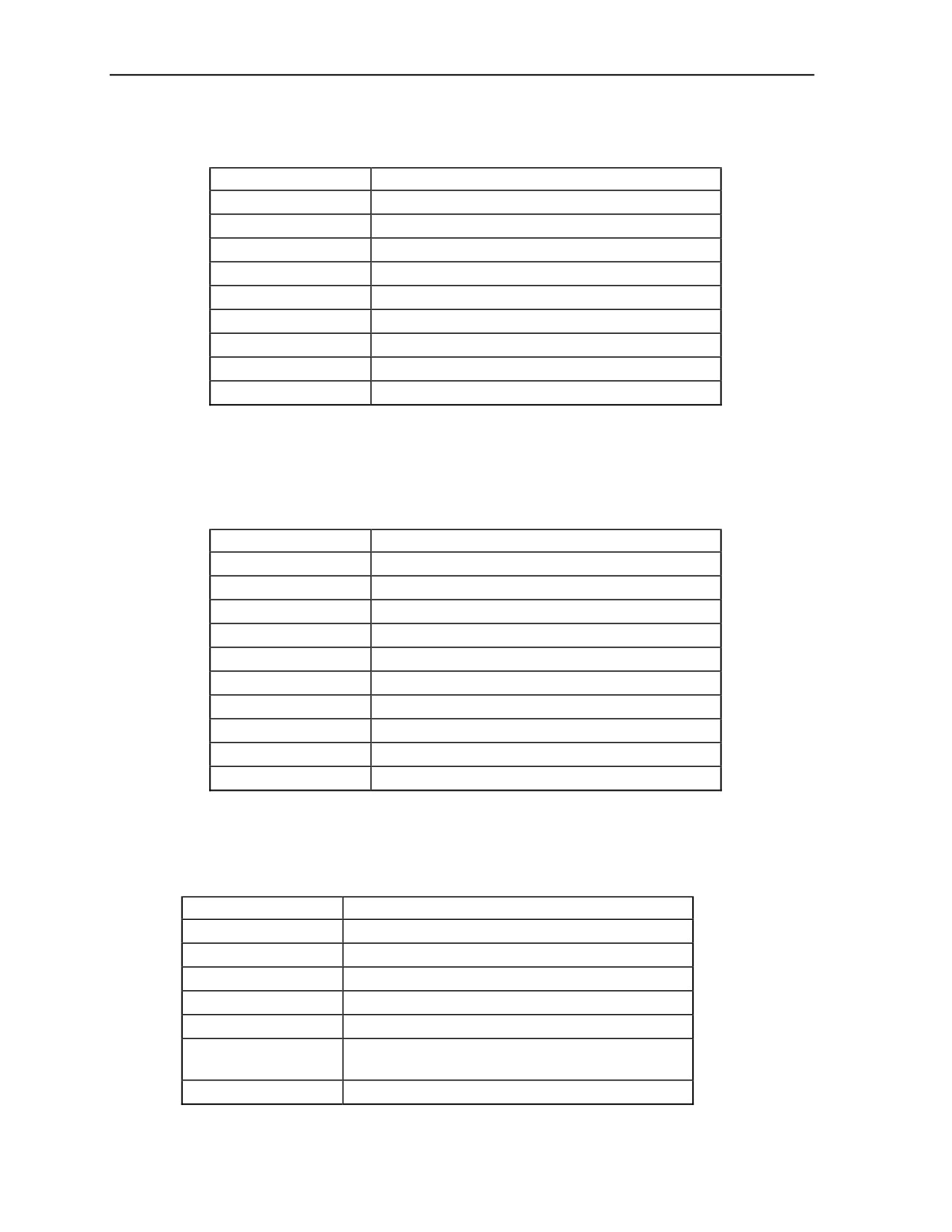
A-159. Table A-26 lists the codes for road conditions.
25 October 2007
FM 3-09.15/MCWP 3-16.5
A-51
Appendix A
Table A-26. R-State of Road in Vicinity of the Observation Point
Code Figure
Explanation
0
Dry
1
Wet
2
Flooded
3
Slush
4
Ice patches
5
Glazed Ice
6
Snow depth 1 to 19 cm
7
Snow depth 20 cm or more
8
Snow drift
STATE OF TERRAIN IN VICINITY OF OBSERVATION POINT (T)
A-160. Table A-27 lists the codes for terrain conditions.
Table A-27. T-State of Terrain in the Vicinity of the Observation
Point
Code Figure
Explanation
0
Dry
1
Wet
2
Pools of water on surface;
3
Flooded
4
Ground frozen 0 to 4 cm
5
Ground frozen 5 cm or more
6
Snow depth 0 to 4 cm
7
Snow depth 5 to 24 cm
8
Snow depth 25 to 44 cm
9
Snow depth 45 cm or more
STATE OF WATER SURFACE (A)
A-161. Table A-28 lists the codes for water surface conditions.
Table A-28. A-Sate of Water Surface
Code Figure
Explanation
0
Water level normal
1
Water level much below normal
2
Water level high, but not overflowing
3
Banks overflowing
4
Floating ice (more than half)
5
Thin ice, complete cover, impassable for
persons, 0-4 cm thick
6
Ice, complete cover, passable for persons,
A-52
FM 3-09.15/MCWP 3-16.5
25 October 2007