FM 3-09.15 TACTICS, TECHNIQUES, AND PROCEDURES FOR FIELD ARTILLERY METEOROLOGY (OCTOBER 2007) - page 3
Meteorological Measuring Set-Profiler, AN/TMQ-52
ASSOCIATED EQUIPMENT
6-12. The radiosonde is a small electronic instrument carried aloft by a free-flight balloon. The radiosonde
senses and transmits pressure, temperature, and relative humidity to the MET section. Wind direction and
speed are determined through relative measurements of the position of the radiosonde while in flight. The
AN/TMQ-52 uses different types of radiosondes (NAVAID or GPS), depending on the operating mode
selected for the planned sounding.
COMMUNICATIONS EQUIPMENT
6-13. The communications equipment of previous MET system was configured to transmit MET data
based on a planned schedule (push method). The MMS-P communications equipment is configured to
allow units to request MET data on demand
(pull method). This is accomplished by establishing
communications with the Advanced Field Artillery Tactical Data System (AFATDS) device located at the
controlling headquarters. The AFATDS device relays requests for MET data to the MMS-P and the
resulting MET message to the requesting unit. (Only MMS-P systems using 220C protocol can auto-
process MET requests).
Radios
6-14. The MET section is authorized SINCGARS. They are used for communications with MET users and
command and control.
Operator Interface Computer
6-15. The operator interface computer contains the CMP software. The CMP allows the operator to view
and generate digital message traffic. The OIC interfaces with the tactical communications interface module
(TCIM) and the SINCGARS radios used for sending and receiving digital communications between the
MET section and remote users.
Interface Unit, Automatic Data Processing (CA-67)
6-16. This telephone, with associated wire connections, is a MSE device that allows for voice and digital
communications. The CA-67 provides access to the common user area communications network.
VEHICULAR EQUIPMENT
6-17. Each section is authorized three HMMWV and three trailers. The three vehicles are the heavy-
variant HMMWV, and each is equipped with a 200-amp kit. Vehicle one transports the operations shelter.
Vehicle two transports helium bottles and tows the trailer containing the balloon inflation equipment and
expendable supplies. Vehicle three and trailers transport supplementary equipment. Section IV provides
example load plans.
SECTION II AN/TMQ-52 SECTION SITE OPERATIONS
SITE SELECTION
6-18. MET sections are positioned by the operations officer and MET station leader to provide the best
possible area of coverage. The modeling capability and the large size (60-kilometer radius) of the MMS-P
coverage area gives planners increased flexibility when positioning the system. When selecting a site, the
MET section leader must weigh the following considerations:
z
Safety.
z
Tactical situation.
z
Line of sight to satellite (NOGAPS).
z
Availability of LORAN and GPS signals.
25 October 2007
FM 3-09.15/MCWP 3-16.5
6-3
Chapter 6
z
Security.
z
Communications modes and nets.
z
Operating frequencies.
z
Electronic warfare activities.
z
Areas of coverage.
z
Terrain.
z
Logistical support.
z
Unit attachment.
SURVEY AVAILABLE
6-19. The MET station leader conducts a ground reconnaissance to determine the exact positions for major
items of equipment. The MET station leader emplaces the system to fifth-order accuracy or with the GPS.
The survey section will provide the MET section with the latitude, longitude, and height of the MET
section. The MET station leader can determine station location using the PLGR II. When using the PLGR
II, the MET station leader needs to verify the station altitude.
SURVEY NOT AVAILABLE
6-20. If survey support is not available, the MET station leader determines station altitude and location
from an area map. The map datum is World Geodetic System 84.
EQUIPMENT SHELTER EMPLACEMENT
6-21. The MET station leader should take into consideration the following when positioning the shelter:
z
The shelter should be positioned on firm level ground.
z
The shelter cannot be positioned more than 100 feet (30 meters) from the T-VSAT antenna or
TACMET because of cable length.
z
The shelter should not be positioned under power lines.
z
The GPS antenna requires a clear view of the sky for best satellite visibility.
z
The T-VSAT antenna requires line of sight to the satellite for the operational area. When
locating the T-VSAT antenna, ensure there is no upslope exceeding 3 degrees in front of the
antenna.
BALLOON INFLATION SITE
6-22. Upon entering the area of operation, the vehicle transporting the balloon inflation and launching
equipment moves to the inflation site. The necessary equipment is unloaded, and the vehicle moves to a
concealed area. The inflation site should be downwind of the equipment shelter if possible.
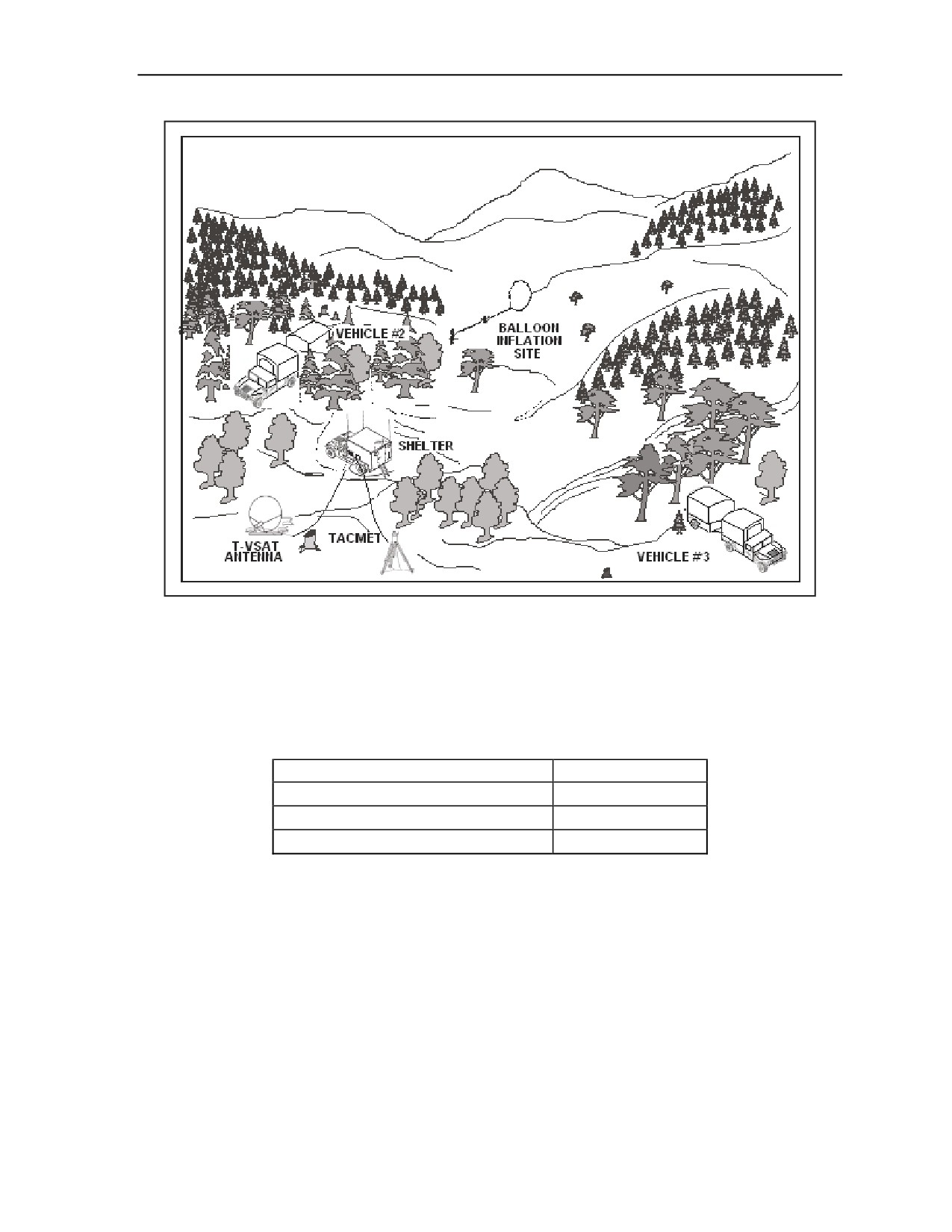
6-23. Figure 6-2 provides an example of a site occupation. Because the maximum cable length is 100 feet
(30 meters), the distance between the shelter and its interfacing equipment cannot exceed the following:
z
Shelter to T-VSAT antenna - 100 feet (30 meters) maximum.
z
Shelter to TACMET sensor- 100 feet (30 meters) maximum.
6-4
FM 3-09.15/MCWP 3-16.5
25 October 2007
Meteorological Measuring Set-Profiler, AN/TMQ-52
Figure 6-2. Site occupation
CAMOUFLAGE
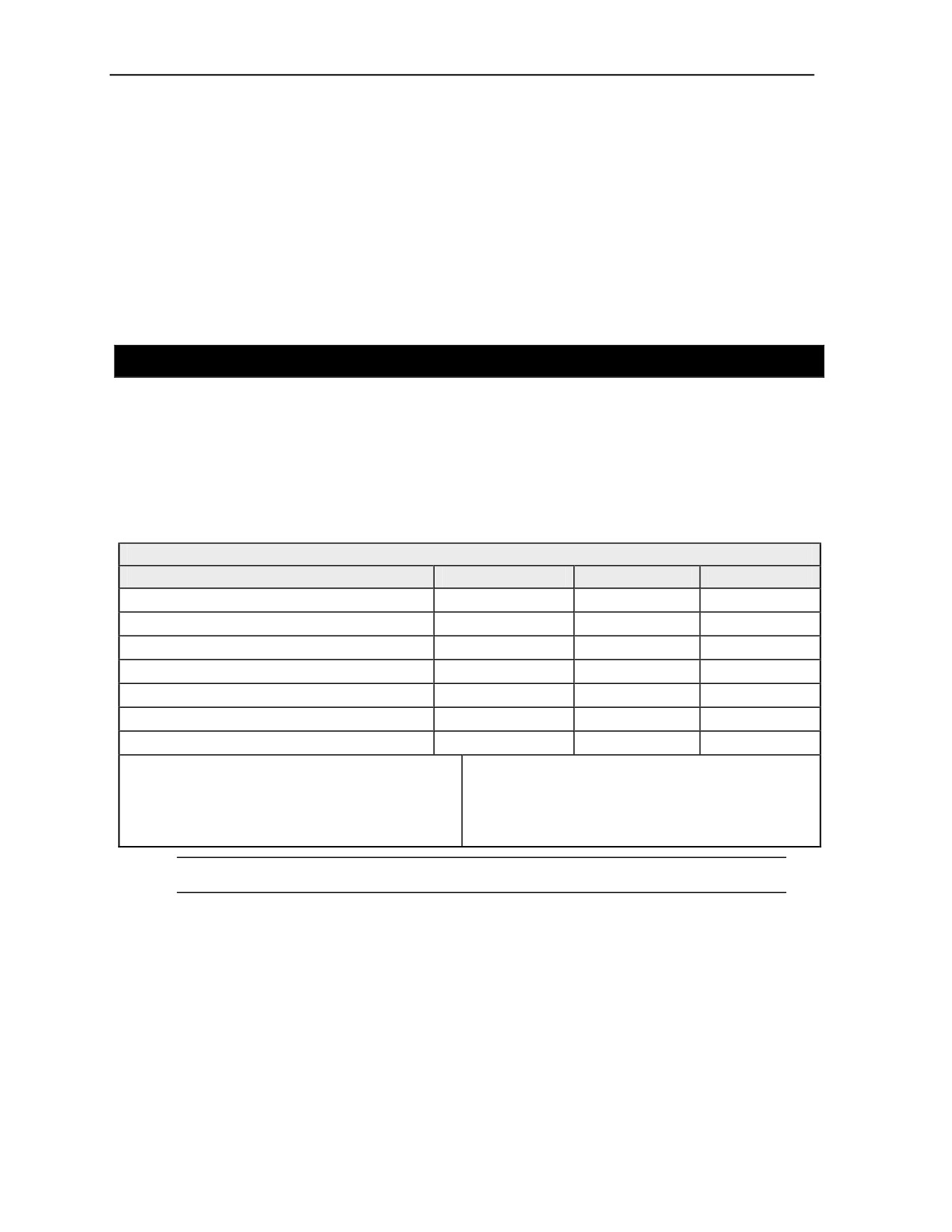
6-24. The modules of radar-scattering camouflage in table 6-1 are required for camouflaging the system.
Camouflage procedures are outlined in TM 5-1080-200-13&P.
Table 6-1. Radar Scattering Camouflage Modules
Equipment
Modules
1 1/4-ton truck (shelter) with trailer
3
1 1/4-ton truck with trailer
3
1 1/4-ton truck with trailer
3
DISPLACEMENT PROCEDURES
6-25. Commanders move MET sections as needed to maintain MET support. Therefore, crew members
must be trained and able to displace, move, and occupy a new site rapidly during critical periods of the
battle. The MET station leader informs the operations officer when the validity of the last message from the
current position will expire and how much time is required to march-order the section. He recommends the
best time to make the displacement and a course of action to relay MET data from adjacent sections while
the section is displacing. The MET station leader’s briefing of section personnel before each displacement
should include, as applicable, the following:
z
Broadcast time of the last MET message from the current position.
z
Broadcast time of the first MET message from the next position.
25 October 2007
FM 3-09.15/MCWP 3-16.5
6-5
Chapter 6
z
Download time for current NOGAPS data. (NOGAPS data is transmitted every 12 hours and
provides the section with 72 hours of valid data. If the section is displacing during the NOGAPS
download period, coordination is made with adjacent MMS-P to acquire NOGAPS download.)
z
Procedures for monitoring, copying, and transmitting MET data from adjacent MET sections on
both the left and right flanks.
z
Section march-order sequence and when the camouflage systems will be dropped, packed, and
loaded.
z
Departure time and whether the section has road clearance to move independently.
z
Where the MET vehicles will be positioned in the battery column.
z
Route of march and any significant landmarks.
z
Designation of the section representative on the reconnaissance party.
SECTION III AN/TMQ-52 SECTION PERSONNEL
6-26. The MOS and Rank for personnel in a MMS Section is directly related to the level of
responsibility and knowledge required. The more senior the Rank, the more responsibility and
knowledge the individual is expected to possess (see Table 6-2).
6-27. All personnel within the MMS section will possess the 13W MOS. However, two positions will
have an Additional Skill Identifier (ASI) that indicates they have successfully completed the Unit level
maintenance course for Meteorology Equipment.
Table 6-2. AN/TMQ-52 Section Personnel (U.S. Army)
U.S. ARMY
Title
MOS
Rank
Quantity
MET station leader
13W40
SFC
1
FA MET section chief
13W30
SSG
1
FA MET equipment repairer
13W20H1
SGT
1
FA MET equipment repairer
13W10H1
SPC
1
FA MET crew member
13W10
SPC
1
FA MET crew member
13W10
PFC
1
Total
6
Legend:
SFC = Sergeant First Class
SPC = Specialist
SSG = Staff Sergeant
PFC = Private First Class
SGT = Sergeant
NOTE: Marine Corps do not currently field MMS-P system.
FA MET STATION LEADER (SFC, MOS 13W40)
6-28. The MET station leader will—
z
Advise the operations officer and staff of tactical and technical considerations affecting
employment of the MMS-P and assist in preparing the MET plan.
z
Supervise MET section operations.
z
Coordinate with the S4 for logistical support.
z
Coordinate with the signal staff officer to prioritize means of communication and dissemination
of messages.
6-6
FM 3-09.15/MCWP 3-16.5
25 October 2007
Meteorological Measuring Set-Profiler, AN/TMQ-52
z
Perform site selection and location.
z
Direct the operation, emplacement, and displacement of the MET section.
z
Maintain quality control of MET data, submit necessary reports, and maintain a flight log.
z
Retain the flight log and copies of messages in accordance with AR 25-400-2.
z
Advise the operations officer on all factors affecting mission capabilities, such as personnel,
maintenance, and logistics.
z
Review, consolidate, and prepare technical, personnel, and administrative reports covering MET
section and station activities.
z
Organize and supervise the MET section training program.
z
Supervise operator maintenance of MET, communications, and vehicular equipment.
z
Supervise preparation and distribution of all MET messages.
z
Ensure adherence to all safety procedures.
z
Manage met section logistics for repair parts and expendable items.
z
Assign personnel to MET teams.
z
Instruct and lead crew members in MET procedures.
z
Determine information relative to NOGAPS download
(transmission times and satellite
information).
z
Perform first sergeant type duties when operating away from the unit for extended periods of
time.
FA MET SECTION SERGEANT (SSG, MOS 13W30)
6-29. The FA MET section sergeant will—
z
Provide leadership and technical guidance to subordinate personnel.
z
Serve as off-shift senior sergeant during periods of extended operation.
z
Check data and records.
z
Examine data samples for quality control.
z
Inspect grounding equipment.
z
Decode wind messages.
FA MET EQUIPMENT REPAIRER (SGT, MOS 13W20H1)
6-30. The FA MET equipment repairer sergeant will—
z
Supervise the second shift during 24-hour operations.
z
Perform unit maintenance on section MET equipment.
z
Ensure communications are maintained with all users.
z
Perform administrative duties as required.
z
Supervise subordinate equipment repairer during maintenance procedures.
FA MET EQUIPMENT REPAIRER (SPC, MOS 13W10H1)
6-31. The FA met equipment repairer specialist will—
z
Operate MET equipment on his assigned shift.
z
Perform unit maintenance on section MET equipment.
z
Operate organic communications equipment.
z
Drive the vehicle.
FA MET CREWMEMBER (SPC, MOS 13W10)
6-32. The FA MET crew member specialist will—
z
Operate MET equipment on his assigned shift.
z
Help prepare the balloon train.
z
Drive the vehicle.
25 October 2007
FM 3-09.15/MCWP 3-16.5
6-7
Chapter 6
FA MET CREWMEMBER (PFC, MOS 13W10)
6-33. The FA met crew member private will—
z
Operate MET equipment on his assigned shift.
z
Help prepare the balloon train.
z
Drive the vehicle.
SECTION IV SUGGESTED LOAD PLANS
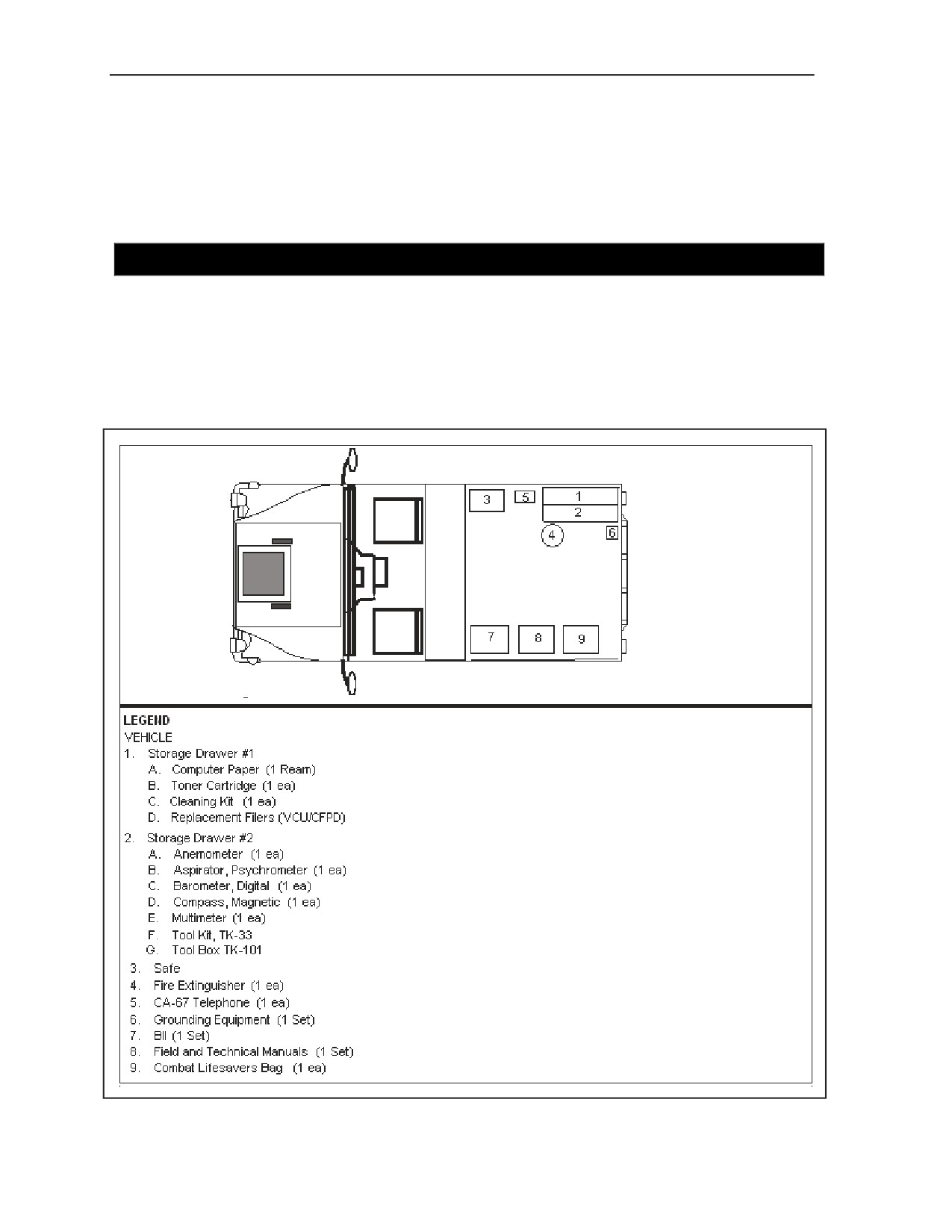
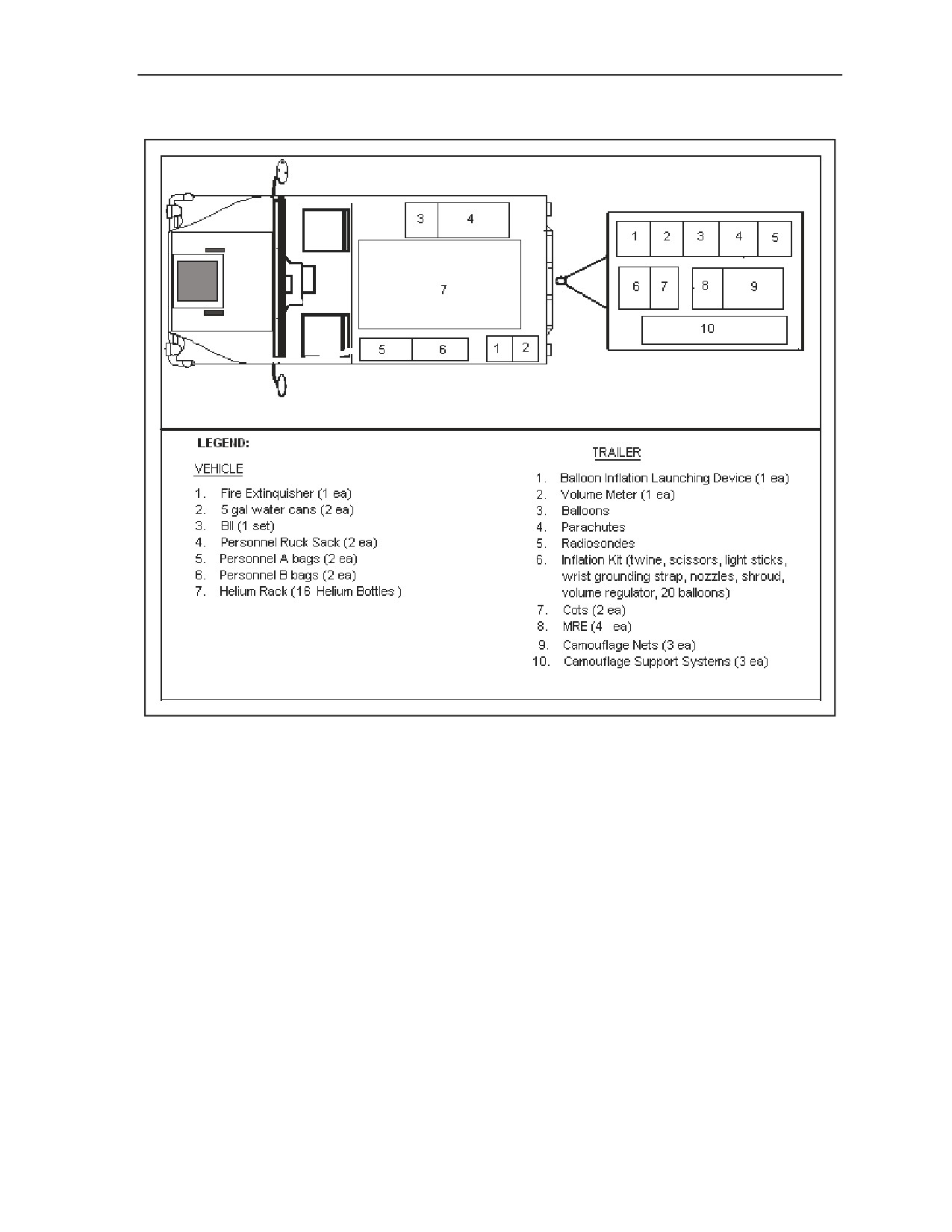
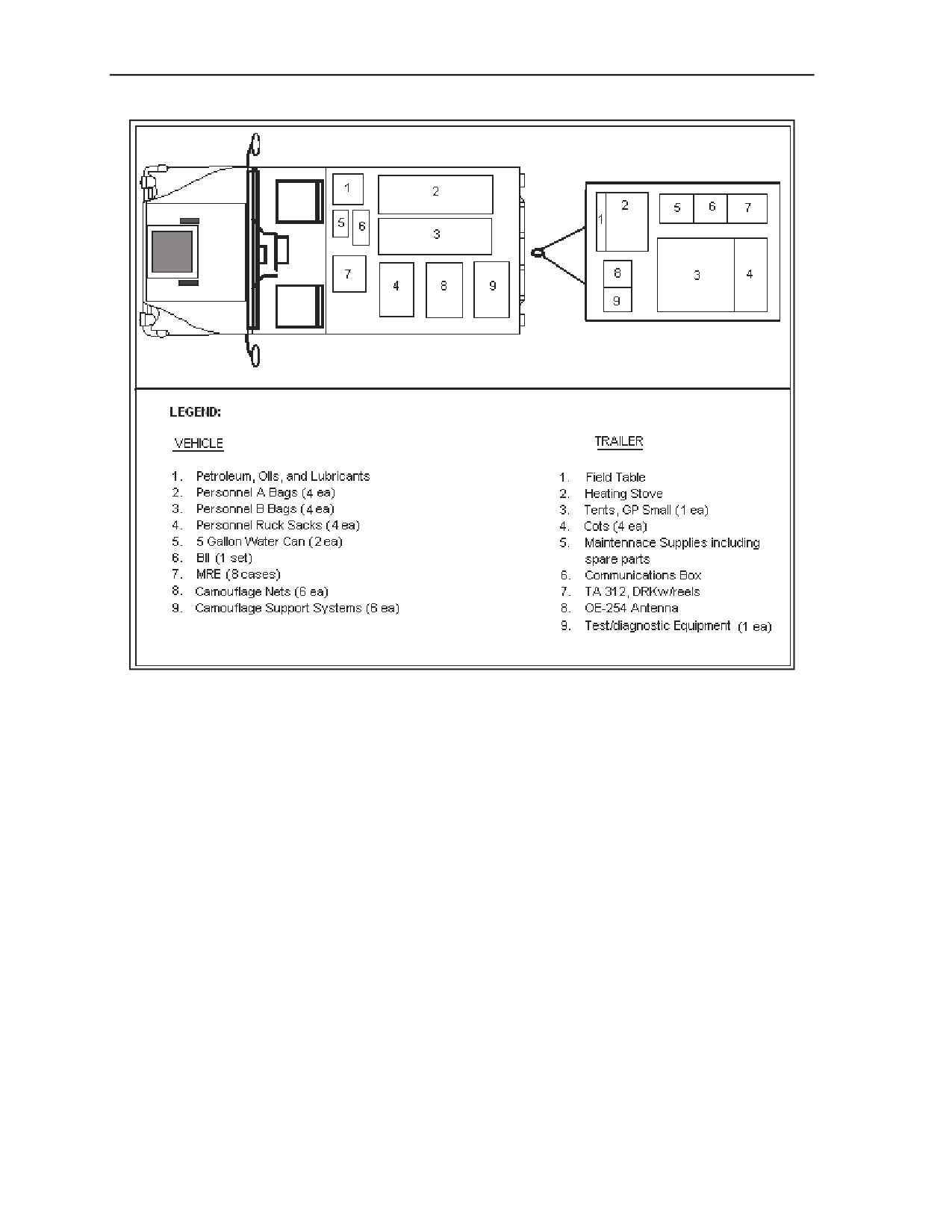
6-34. The loading plan for the MMS Section is extremely important. Loading plans are the key to
ensuring everyone knows where each component or piece of equipment is located (for examples see figure
6-3, 6-4, and 6-5.
6-35. A good load plan will cut down on the time required to find items as well as store items for transport.
Figure 6-3 Vehicle 1 (shelter) load plan
6-8
FM 3-09.15/MCWP 3-16.5
25 October 2007
Meteorological Measuring Set-Profiler, AN/TMQ-52
Figure 6-4 Vehicle 2 load plan
25 October 2007
FM 3-09.15/MCWP 3-16.5
6-9
Chapter 6
Figure 6-5 Vehicle 3 load plan
6-10
FM 3-09.15/MCWP 3-16.5
25 October 2007
Chapter 7
Balloon Inflation and Launching Procedures
This chapter describes the procedures for inflating and launching balloons.
SECTION I OVERVIEW
WARNING
HYDROGEN GAS IS EXTREMELY FLAMMABLE AND SHOULD BE
CONSIDERED EXPLOSIVE WHEN CONFINED UNDER PRESSURE
IN THE PRESENCE OF AMBIENT AIR. STORAGE, HANDLING,
AND DISPOSAL PROCEDURES MUST BE STRICTLY FOLLOWED.
SEE APPENDIX G FOR DETAILED INFORMATION.
7-1. While the MET equipment is being emplaced, powered, and initialized, the MET station leader
dispatches two crew members to the balloon inflation area to prepare a balloon for the sounding. Since
balloon inflation is the most time-consuming of all the section tasks, the section should begin this task as
soon as possible after it arrives at the site (MMS equipped sections). The MET section inflates sounding
balloons by using the inflation and launching device or an inflation shelter. The balloons are inflated by
compressed gas.
SAFETY PROCEDURES
7-2. In addition to the normal safety measures prescribed for all Soldiers, MET personnel must be
cautious when using compressed gas.
HYDROGEN GAS
7-3. Hydrogen gas is highly flammable. Since helium is an inert gas, it should be used, when available, to
inflate balloons. If hydrogen must be used, the safety precautions below must be carefully followed. MET
crew members should—
z
Display conspicuous warning signs where hydrogen is generated, used, or stored. For example,
DANGER-HYDROGEN - No Smoking Within 50 Feet (15 meters).
z
Never light a match, smoke, or create sparks near a site where hydrogen is used. They should
remove all possible sources of flame and sparks.
z
Wear rubber-soled shoes during inflation. They should not wear shoes with exposed nails,
which might strike against metal, stones, or concrete floors and produce a spark. Materials such
as wool and nylon should not be worn when inflating with hydrogen gas.
z
Never drop or strike metal tools against anything that might cause a spark.
z
Remove all metal objects, such as watches and key chains, prior to inflating the balloon.
z
Never mix hydrogen with air. They should expel all air from the balloon before inflating it with
hydrogen.
z
Never expose the hydrogen cylinders to direct sunlight. Always store hydrogen bottles in the
shade.
25 October 2007
FM 3-09.15/MCWP 3-16.5
7-1
Chapter 7
z
Remove all constrictions from the balloon neck; keep all hydrogen passages clear.
z
Use inflation and launching device to minimize balloon handling.
z
Inflate the balloon slowly on days of low relative humidity when static electricity is easily
generated. If the air temperature is above freezing, MET crew members should lightly sprinkle
the inflation area with water.
z
Inflate the balloon slowly when using compressed hydrogen or helium in order to avoid bursting
or over-inflation. They should use the compressed gas regulator. A crew member adjusts the
regulator so that no more than 10 pounds per square inch (PSI) (.7030696 Kg/Cm squared) of
gas is being released into the balloon.
z
Never deflate a hydrogen-filled balloon; release it gradually.
WARNING
IF THE HISSING SOUND OF A GAS LEAK FROM THE BALLOON
IS HEARD, CLOSE THE CYLINDER VALVE IMMEDIATELY. TWIST
THE NECK OF THE BALLOON, REMOVE IT FROM THE
INFLATION LAUNCHING DEVICE, AND RELEASE IT.
z
Wear a metal wristband connected to a flexible wire that leads to a good ground when in an area
where inflation is in progress. The band and wire will provide a path to ground for static
electricity.
z
Ground the inflation equipment to provide a path to ground for any static electricity generated in
the equipment. They should also use ground cables to interconnect all metal parts of the inflation
equipment with ground.
z
Follow the two-man rule for safety even though not all procedures require two personnel.
z
See TMs
11-6660-222-12,
11-2413, and
11-6660-287-13, and Federal Meteorological
Handbook (FMH) No. 3 for further information on hydrogen safety precautions. Safety
precautions for handling commercial hydrogen are in AR 700-68.
GROUNDING PROCEDURES
7-4. Whenever hydrogen is used, MET crew members must use ground cables to connect all metal parts
of the equipment to each other and to a grounding field made of a minimum of two ground rods. On days
of low relative humidity, when static electricity is high, use additional grounding rods. Metal surfaces are
cleaned with sandpaper to get a good connection. Then ground clamps or alligator clips are used to connect
the cables to the metal. A crew member in the immediate area where hydrogen is being used should be
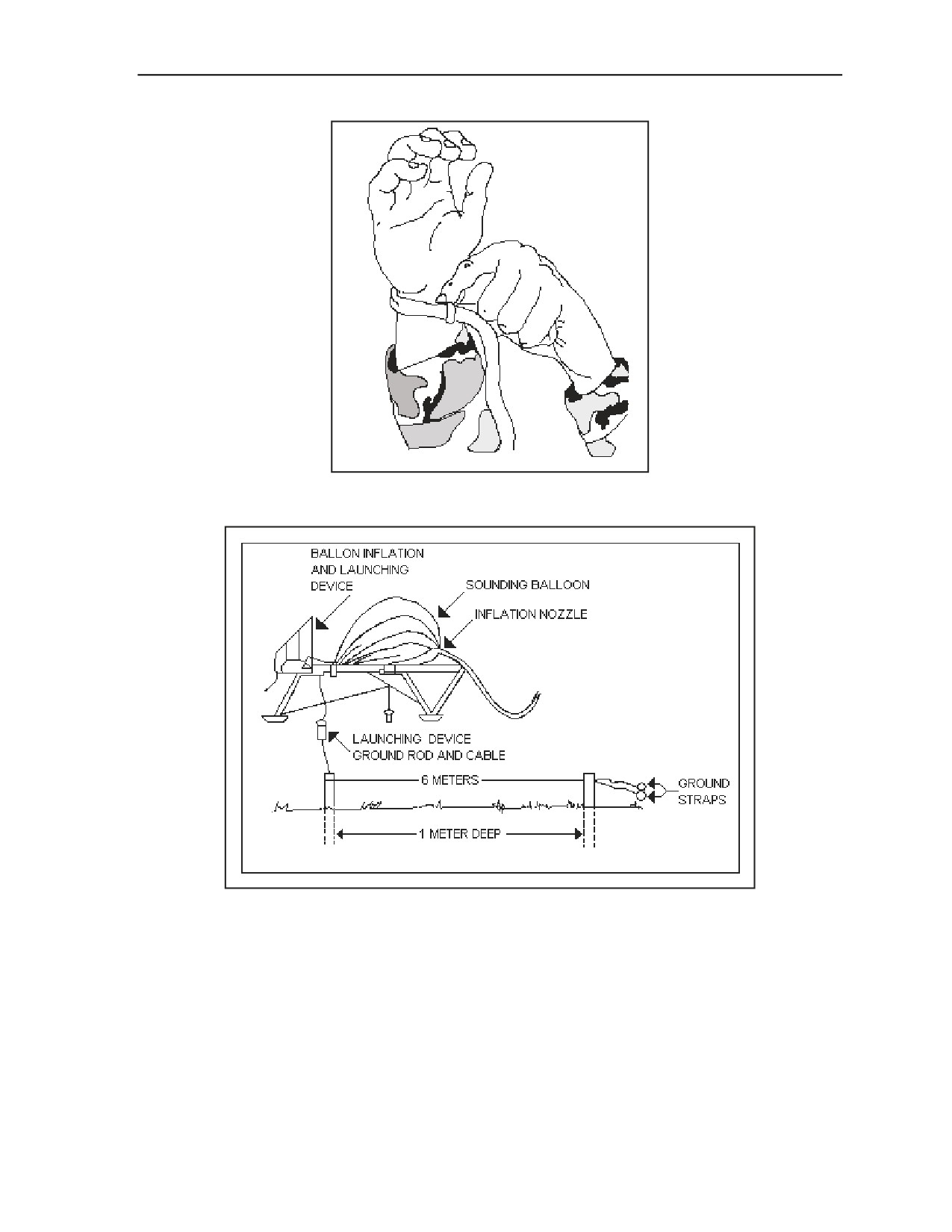
individually grounded by using the issued grounding strap assemblies. A path to ground for static
electricity is particularly important for the crew member who actually handles the balloon. Detailed
grounding techniques are explained in TC 11-6 and FMH No. 3. Also, see figures 7-1 and 7-2 for
examples.
7-2
FM 3-09.15/MCWP 3-16.5
25 October 2007
Balloon Inflation and Launching Procedures
Figure 7-1. Personnel ground
Figure 7-2. Completed grounding field
GASES USED FOR INFLATION
7-5. The MET section inflates all balloons with either hydrogen or helium gas. Helium and hydrogen are
available commercially in compressed gas cylinders. MET sections normally use cylinders containing
approximately 200 cubic feet (5.67 cubic meters) of gas. The MET station leader must plan time carefully
to ensure that a balloon is fully inflated and ready for release at the scheduled release time.
25 October 2007
FM 3-09.15/MCWP 3-16.5
7-3
Chapter 7
HELIUM
7-6. Helium is the safest gas to use because it is not explosive, but it cannot be made artificially. Helium
is extracted from mines, stored in heavy cylinders, and shipped in cylinders for MET section use. Using
commercially produced helium gas to inflate a balloon is quicker and much safer than inflating with locally
generated hydrogen; however, it is difficult to resupply.
HYDROGEN
7-7. Hydrogen gas, unlike helium, is explosive and using it is dangerous. Accordingly, MET
crewmembers must follow all safety procedures for use of hydrogen to include using the balloon inflation
launching device. The MET station leader schedules classes on inflation using hydrogen gas to maintain
section members’ proficiency.
SECTION III INFLATION PROCEDURES
BALLOON INFLATION AND LAUNCHING DEVICE, ML-594/U
7-8. The balloon inflation and launching device, ML-594/U, is a portable inflation shelter and launch
platform designed for field use. It secures the sounding balloon and protects it from weather during
inflation and launching. It can be used with a compressed gas supply by using the hydrogen-helium volume
meter ML-605/U. It should be used whenever hydrogen gas is used for inflation. The balloon inflation and
launching device is explained in TM 11-6660-238-15.
COMMERCIAL GAS REGULATORS
7-9. Pressure regulators are used along with associated couplings with commercial hydrogen or helium
cylinders to control the pressure of the compressed gas being released for inflation of a balloon. The
regulator also indicates the amount of gas remaining in the cylinder. The regulators are adjusted to allow
no more than 10 PSI (.7032 kg/cm) of gas to be released into the balloon.
BALLOONS
7-10. Balloons should be kept sealed in their original containers until just before use. They should be
stored in a dry place and at moderate temperatures. All balloons deteriorate with age; therefore, oldest
balloons should be used first.
SOUNDING BALLOONS
7-11. The sounding balloon carries aloft a radiosonde and associated equipment, such as a parachute and a
night-lighting unit. Sounding balloons are made of neoprene and are designed to lift radiosondes to certain
minimum altitudes at specified rates of ascent. The bursting altitude of a sounding balloon depends on its
condition and type and on the inflation procedure used. High-altitude balloons weigh 1,000 to 1,200 grams
and burst near an altitude of 32,000 meters. At night, the balloons normally burst at lower altitudes.
Bursting altitudes are with respect to mean sea level.
PILOT BALLOON
7-12. This balloon provides a means of determining the speed and direction of winds aloft. The 100-gram
pilot balloon also can be used as a sounding balloon up to 3,000 meters. The theodolite operator can
observe a pilot balloon to a height of about 14,000 meters. Under various sky conditions, some colors are
more easily detected by the eye than others. For this reason, pilot balloons are issued in several colors. The
most common colors are white, red, and black. A general rule in selecting the color of the balloon is the
darker the sky, the darker the balloon.
7-4
FM 3-09.15/MCWP 3-16.5
25 October 2007
Balloon Inflation and Launching Procedures
7-13. Pilot balloons are also used to determine cloud height. This is done by inflating the balloon to a
known rate of rise and timing the balloon until it goes into the clouds.
PREPARATION OF BALLOONS
7-14. After exposure to relatively low temperatures and extended periods in storage, neoprene balloons
lose some of their elasticity through the crystallization of the balloon film. Neoprene balloons burst
prematurely if used in this state. MET personnel should inspect balloons prior to their use and discard any
that are brittle,-especially when using hydrogen. MET personnel should also discard any balloons older
than 5 years.
BALLOON CONDITIONING
7-15. Usually, exposure of the balloon to room temperature (21°C) for 24 hours is all the conditioning
required. Store balloons in their sealed package and do not expose to direct light or heat. Discoloration has
no effect on the balloon film as long as it is not the result of exposure to direct sunlight for several hours.
In direct sunlight and in most types of artificial lighting, discoloration is caused by the antioxidant included
in the compounding.
INFLATION
7-16. A balloon may be inflated immediately after conditioning, or it may be kept under normal storage
conditions and then inflated. All balloons should be at room temperature before inflation.
NIGHT-LIGHTING UNIT
7-17. The night-lighting unit provides a light source that allows the tracking of pilot and sounding balloons
at night. The lighting unit is called a light stick. A light stick is a small transparent tube containing a liquid
chemical. When the light stick is snapped, the chemical begins to emit enough light for tracking balloons.
DETERMINING LIFT FOR BALLOONS
7-18. A crew member determines the amount of gas required for the balloon to be used before beginning
the inflation process. The procedure below is used to determine the amount of gas required.
DETERMINING REQUIRED FREE LIFT
7-19. Free lift is the net upward force required for the balloon to ascend at a given rate. The ascent rate of
the balloon mainly depends on the amount of gas in the balloon. Other factors affecting ascent rate are the
shape, size, and physical texture of the balloon and the state of the atmosphere through which the balloon
travels. Table 7-1 is used to determine the amount of free lift for sounding and pilot balloons during fair
weather.
25 October 2007
FM 3-09.15/MCWP 3-16.5
7-5

Chapter 7
Table 7-1. Balloon Ascent Rate, Free Lift, Weight, and Bursting Altitude
Balloon Type
Ascent Rate (meters
Free Lift Weight
Balloon Weight
Bursting Altitude
per minute)
(grams)
(grams)
(meters)
Sounding Balloons
(Day)
200 Gram Balloon
320
510
200
21,200
ML-635
400
1,100
150
10,668
ML-537
305
1,600
1,000
30,479
ML-519
300
1,200
300
16,000
(Night)
ML-635
400
1,300
150
10,668
ML-537
305
1,900
1,000
30,479
ML-519
300
1,200
300
16,000
Pilot Balloons
ML-159A (White)
302
500
100
15,000
ML-160A (Black)
302
500
100
15,000
ML-161A (Red)
302
500
100
15,000
ML-50A (White)
183
140
30
10,000
ML-51A9 (Black)
183
140
30
10,000
ML-64A (Red)
183
140
30
10,000
COMPUTING REQUIRED TOTAL LIFT
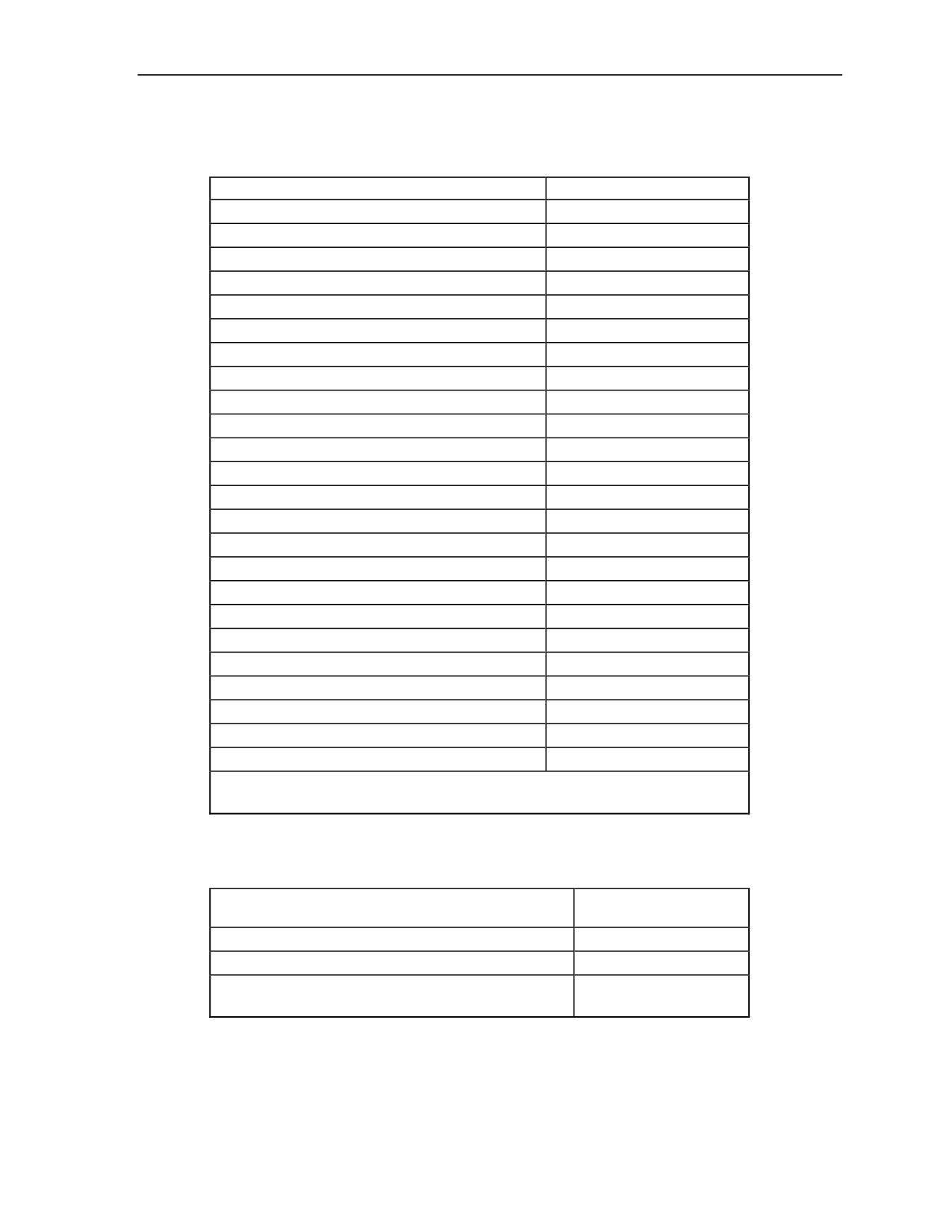
7-20. Total lift is defined as the weight (grams) of the balloon with attachments that must be balanced by
the gas volume in the inflated balloon for the balloon to ascend at a desired rate. Total lift is composed of
the weight of the balloon, its free lift, the weight of any attachment to the balloon train, and the weight
added, if any, to compensate for adverse weather. See table 7-2 for weights of attachments. Table 7-3
indicates additional weights needed to compensate for adverse weather conditions.
7-6
FM 3-09.15/MCWP 3-16.5
25 October 2007
Balloon Inflation and Launching Procedures
Table 7-2. Weights of Attachments
Attachment
Weight (grams)
Radiosonde with Battery
ML-659
823
ML-662
250
ML-663
250
ML-664
250
ML-665
450
ML-666
450
ML-667
450
RS-92-KL
250
RS-92-AM
270
Parachute-ML 132
150
Commercial Parachute
80
Lighting Unit
15
Sounding Balloons
ML-635
150
ML-537
1,000
ML-519
300
Pilot Balloons (PIBAL)
ML-159A
100
ML-160A
100
ML-161A
100
ML-50A
30
ML-51A
30
ML-64A
30
NOTE: Balloon weights vary. The weight of the balloon is stamped on the
box.
Table 7-3. Additional Weights for Adverse Weather Conditions
(Sounding only)
Weather Conditions
Additional Weight
Required (Grams)
Light precipitation
200
Heavy precipitation
400
Zone winds averaging more than 60 knots (1000-
600-1,200
gram or larger balloons only)
DETERMINING GAS VOLUME REQUIRED
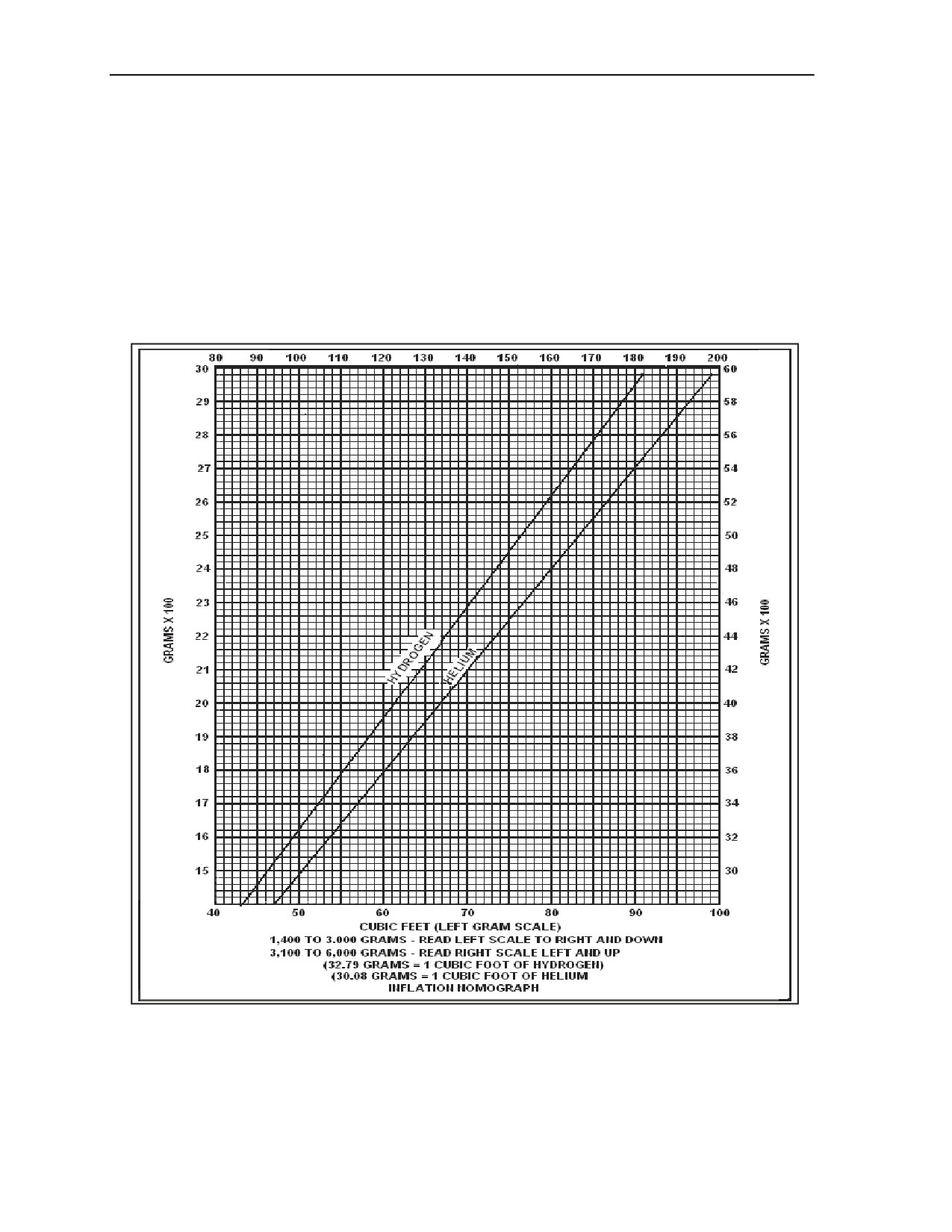
7-21. To obtain the proper amount of gas required for total lift, a crew member must convert total lift in
grams to cubic feet. He does this by using the nomograph (figure 7-3).
25 October 2007
FM 3-09.15/MCWP 3-16.5
7-7
Chapter 7
TOTAL LIFT LESS THAN 3,000 GRAMS
7-22. If total lift is from 1,400 to 3,000 grams, he enters the nomograph with total lift in grams along the
left edge. He reads across to the line on the chart that represents the gas to be used (helium or hydrogen)
and then down from the line to the metered cubic feet required for total lift.
TOTAL LIFT GREATER THAN 3,100 GRAMS
7-23. If total lift is 3,100 grams or greater, he enters the nomograph with total lift along the right edge. He
reads across to the line on the chart that represents the gas to be used (helium or hydrogen) and then up
from the line to the metered cubic feet required for total lift.
Figure 7-3. Inflation Nomograph
INFLATION USING THE INFLATION AND LAUNCHING DEVICE
7-24. The inflation and launching device should be used when inflating with hydrogen. When the inflation
launching device is used, the crew members inflate the sounding balloon with the required amount of gas
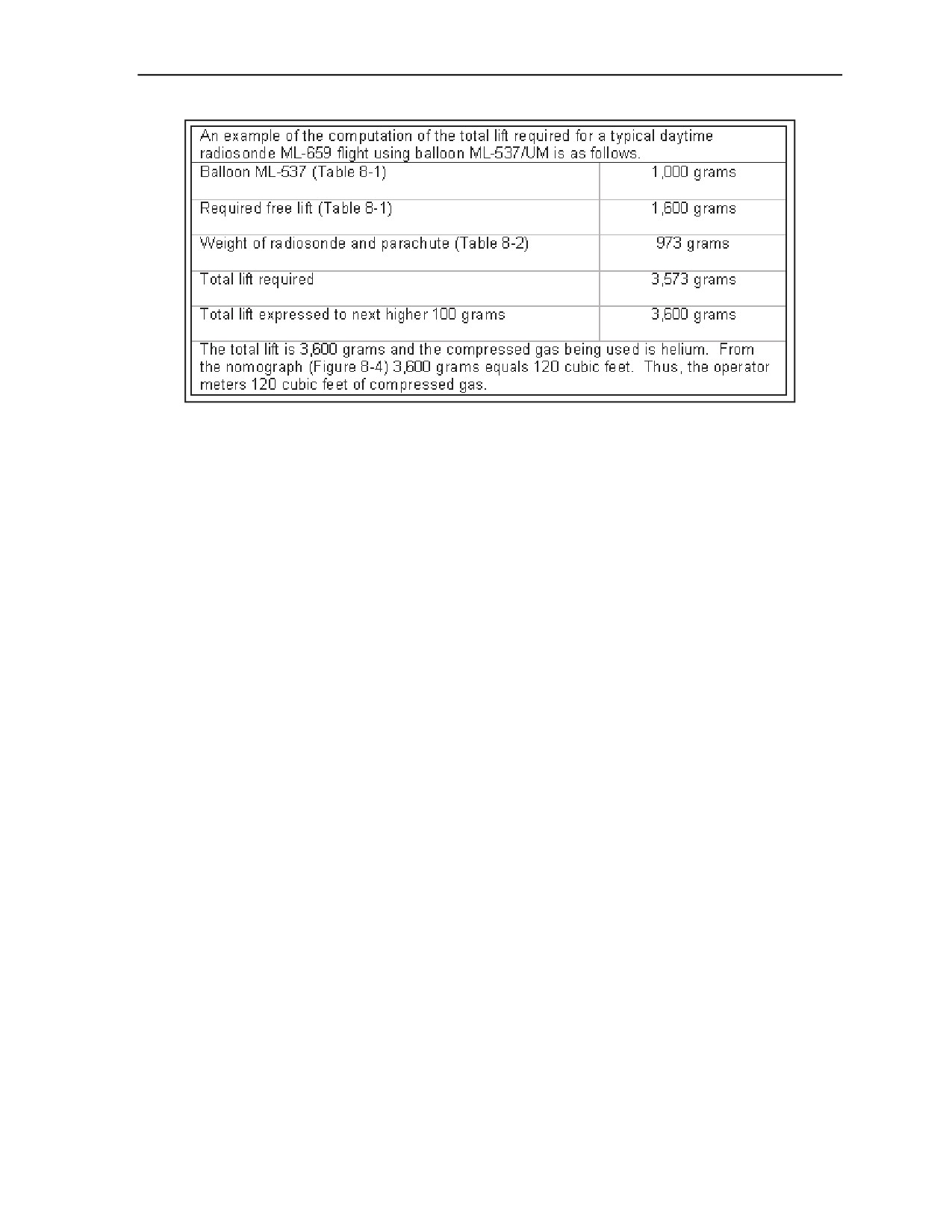
volume determined from the nomograph. See figure 7-4 for an example.
7-8
FM 3-09.15/MCWP 3-16.5
25 October 2007
Balloon Inflation and Launching Procedures
Figure 7-4. Required total lift example
7-25. When crew members use commercial gas for inflation, they obtain the correct total lift by inflating
the balloon until the volume meter ML-605/U reads the cubic feet required as determined from the
nomograph.
INFLATION SHELTER
7-26. There may be times when a MET station is in a fixed position and has some type of inflation shelter.
If an inflation shelter is available, MET section personnel do not use the inflation and launching device.
The section uses an inflation shelter; that is., the covered cargo area of a prime mover, to inflate the small
pilot balloon.
WEIGHING-OFF PROCEDURE
7-27. When an inflation shelter is used for inflation, the crew members determine when the balloon is
properly inflated by using a weighing-off procedure. A crew member attaches the balloon to an inflation
nozzle with appropriate weights to simulate the effect of free lift and the weight of the balloon train. When
the sounding balloon lifts the inflation nozzle off the surface, it is properly inflated. The pilot balloon is
properly inflated when it hangs suspended in midair, neither rising nor falling.
WEIGH-OFF CALCULATIONS
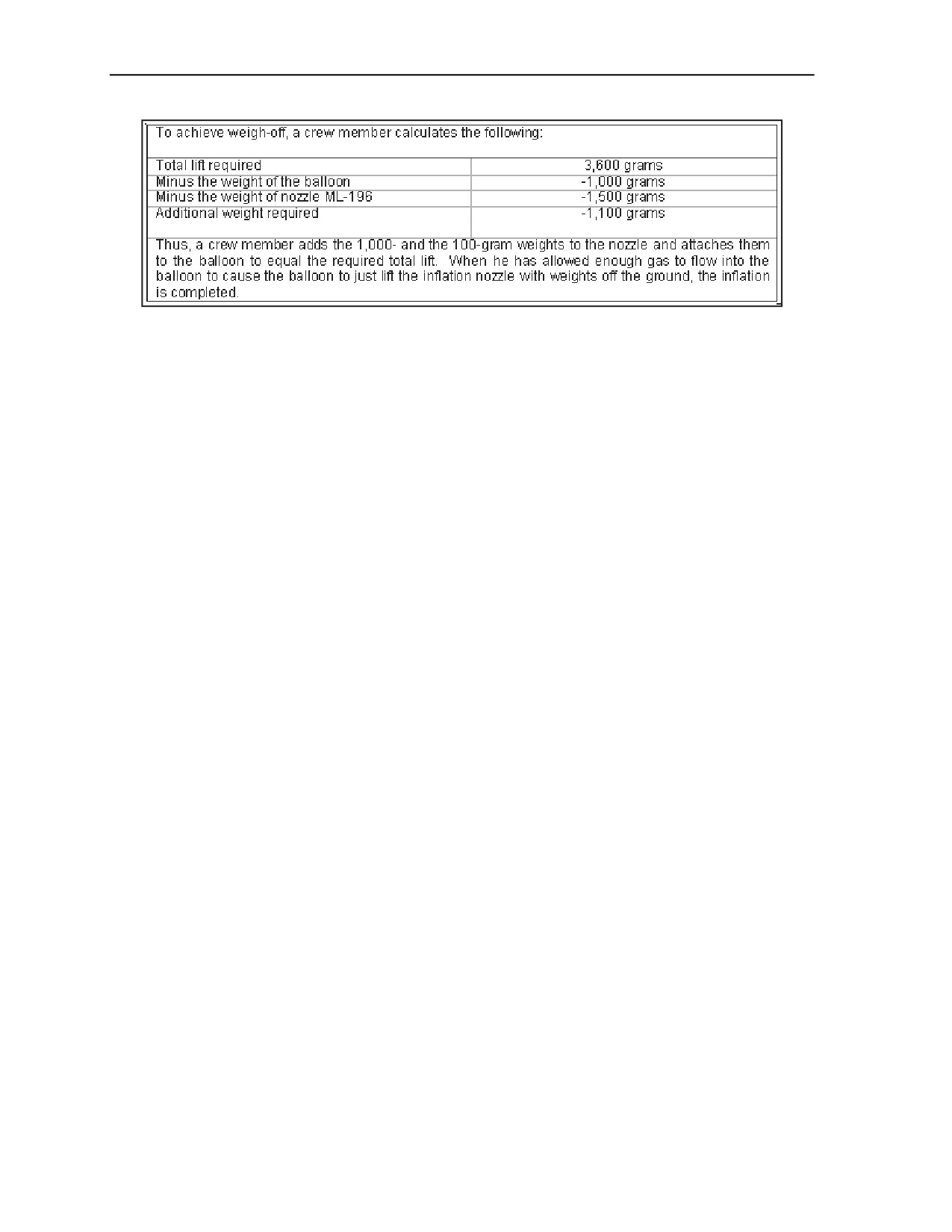
7-28. To achieve weigh-off, a crew member must calculate the required weights to be added to the
inflation nozzle. For example, to calculate the weight required to be added to the ML-196 nozzle of a
sounding balloon, a crew member must determine total lift. The weight of the balloon is not figured in the
total weight because as the balloon is inflated it automatically compensates for itself. The nozzle weight
(1,500 grams) is deducted, and the remainder is the additional weight required to be placed on the nozzle.
The nozzle weights are 100, 200, 400, 500, and 1,000 grams. See figure 7-5 for an example.
25 October 2007
FM 3-09.15/MCWP 3-16.5
7-9
Chapter 7
Figure 7-5. Weigh-Off example
NOZZLES AND WEIGHTS
7-29. Inflation nozzle ML-575, ML-373/GM, and ML-196 are component parts of the MET station. They
are used in the weighing-off procedure performed in an inflation shelter or in an area of still air. They
provide a connection between the hose ML-81 and the balloon during inflation and act as a calibrated
weight in determining the correct amount of total lift during weigh-off.
PILOT BALLOON NOZZLES
7-30. ML-575 or ML-373 nozzles are used to inflate the pilot balloon. The correct free lift for a 100-gram
pilot balloon is 500 grams. The ML-575 and the ML-373 with its collar weight compensate for the free lift.
SOUNDING BALLOON NOZZLE
7-31. The inflation nozzle ML-196 weighs 1,500 grams and is issued with five weights. A crew member
must add the correct combination of weights to the nozzle to simulate free lift and balloon train weight
before inflation.
NOZZLE CARE
7-32. Crew members must keep the nozzles free of dirt, lime, or other foreign matter that will alter its
weight or obstruct the gas passages.
INFLATING THE PILOT BALLOON
7-33. A crew member first shakes the balloon to remove the powder inside and rolls it up to expel any air.
To expel the air and debris from the hose and connections to the gas source, briefly turn the gas on and
immediately shut the gas off. The balloon is weighed-off properly when it hangs suspended in midair with
appropriate weights attached. When inflating the pilot balloon, a crewmember must first install weights,
when required, on the neck of the nozzle. If a night-lighting device is to be attached to the balloon, he must
add additional weights to the nozzle to compensate for the greater air resistance caused by the increased
size of the balloon. The additional weights required are 70 grams for the 30-gram pilot balloon and 50
grams for the 100-gram pilot balloon. Once he has added the weights to the nozzle, he then stretches the
neck of the balloon over the connection of the nozzle.
INFLATING THE SOUNDING BALLOON
7-34. The procedures for inflating the sounding balloon when using the inflation and launching device and
when using an inflation shelter are discussed below.
7-10
FM 3-09.15/MCWP 3-16.5
25 October 2007

Balloon Inflation and Launching Procedures
INFLATION AND LAUNCHING DEVICE
7-35. The inflation and launching device should be used when inflating with hydrogen. A crew member
first shakes the balloon to remove the powder inside and rolls it up to expel any air. To inflate the sounding
balloon with the required volume of gas, crew members use the procedure in TM 11-6660-238-15. Crew
members must fill the balloon with gas by using the volume meter.
INFLATION SHELTER
7-36. A crewmember first shakes the balloon to remove the powder inside and rolls it up to expel any air.
The balloon is attached to the inflation nozzle by tying it with a small piece of twine. The crewmenber then
attaches to the inflation nozzle the combination of weights required to balance the required total lift.
TYING OFF THE BALLOON
7-37. When inflation of either the pilot balloon or the sounding balloon is complete, the crewmember
firmly seals the balloon neck with twine and disconnects the hose from the inflation nozzle. The inflation
nozzle and any weights used from the tied off balloon is removed. The crewmember is then ready to attach
the balloon train to the balloon, if one is required. Figure 7-6 shows the correct tying off procedures.
Figure 7-6. Tying off the balloon
BALLOON TRAIN
7-38. The balloon train is the trailing end of the twine used to seal or tie off the inflated balloon.
Components such as the radiosonde and parachute are further attached to the balloon train and become a
part of it. A night-lighting device may be included in the train between the parachute and the radiosonde to
aid initial tracking of the balloon-borne radiosonde. The balloon train is normally approximately 20 meters
long in order to dampen the oscillation of the radiosonde.
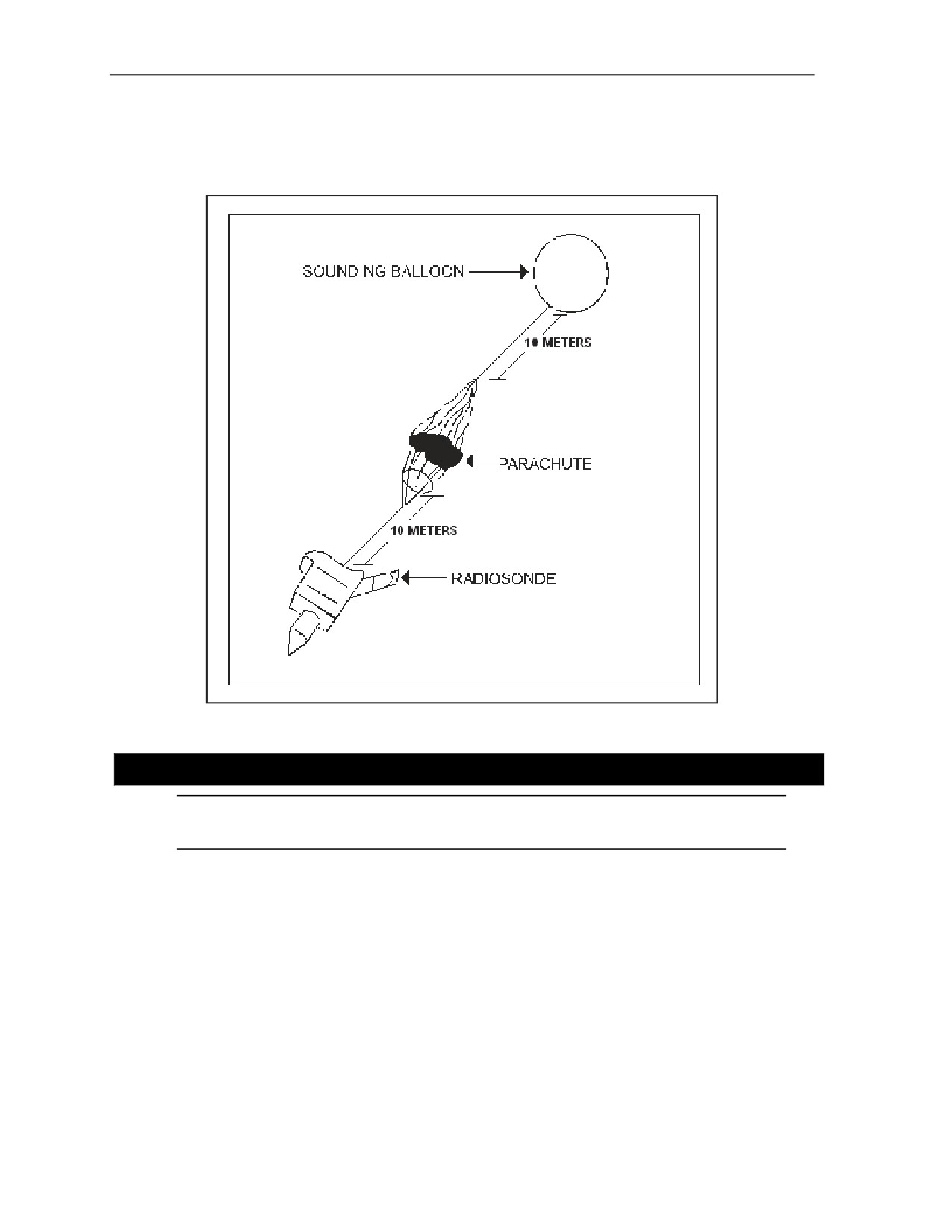
7-39. When a crew member has properly inflated the balloon, he/she removes the inflation nozzle and
seals and ties off the balloon. The crew member doubles a 20-meter length of twine to a 10-meter length
(double strength) and ties and seals the neck of the balloon with the open end of the twine. Next, unless the
crew member is in an active theater of operations, the parachute is secured to the closed end of the doubled
twine. Normally, the parachute is not used in combat operations. The crew member then doubles another
20-meter length of twine, secures the open end to the bottom of the parachute suspension lines, and ties the
radiosonde to the closed end. If the radiosonde being used has an unwinder, the crew member shortens the
25 October 2007
FM 3-09.15/MCWP 3-16.5
7-11
Chapter 7
length of twine from the balloon to the parachute to approximately 1 meter and ties the radiosonde directly
to the parachute suspension lines. In moderate to high winds, twine should be manually unwound and
secured to prevent damage to the radiosonde during release. Figure 7-7 shows the balloon train.
Figure 7-7. Balloon train
SECTION IV RELEASE PROCEDURES
NOTE: If operating in the vicinity of an airfield, notify the air traffic control tower prior to
balloon release.
7-40. Because of the time it takes to prepare each sounding and the cost of the components, the MET
section crew members must make every effort to release a balloon without damaging the components.
Damaging the train during release causes disruption of the scheduled release times. This could affect the
mission of the artillery. There are several release methods. Which method to use depends on the surface
weather conditions at the time of release. The release methods for the balloon train are discussed below.
They should be followed to ensure that the balloon train release is achieved without damaging any
component.
RELEASING FROM THE INFLATION AND LAUNCHING DEVICE
7-41. During periods of no wind, one crewmember can release the balloon train by using the inflation and
launching device; however, release normally requires two or more persons. During periods of moderate
winds, two crew members release the balloon train. If there are high winds or rain or if the section is using
7-12
FM 3-09.15/MCWP 3-16.5
25 October 2007
Balloon Inflation and Launching Procedures
a larger sounding balloon, additional crewmembers may need to help in the release. After the balloon is
inflated, crewmembers move the inflation and launching device with the balloon train attached downwind
and position it with the front of the inflation and launching device pointing downwind. If there are high
winds, they may have to stake the skids of the inflation and launching device to the ground to ensure
stability. Just before release, a crew member removes the safety strap from the lift dot fastener stud and
manually positions the release strap fastener in the groove on the stud to ensure that the proper release
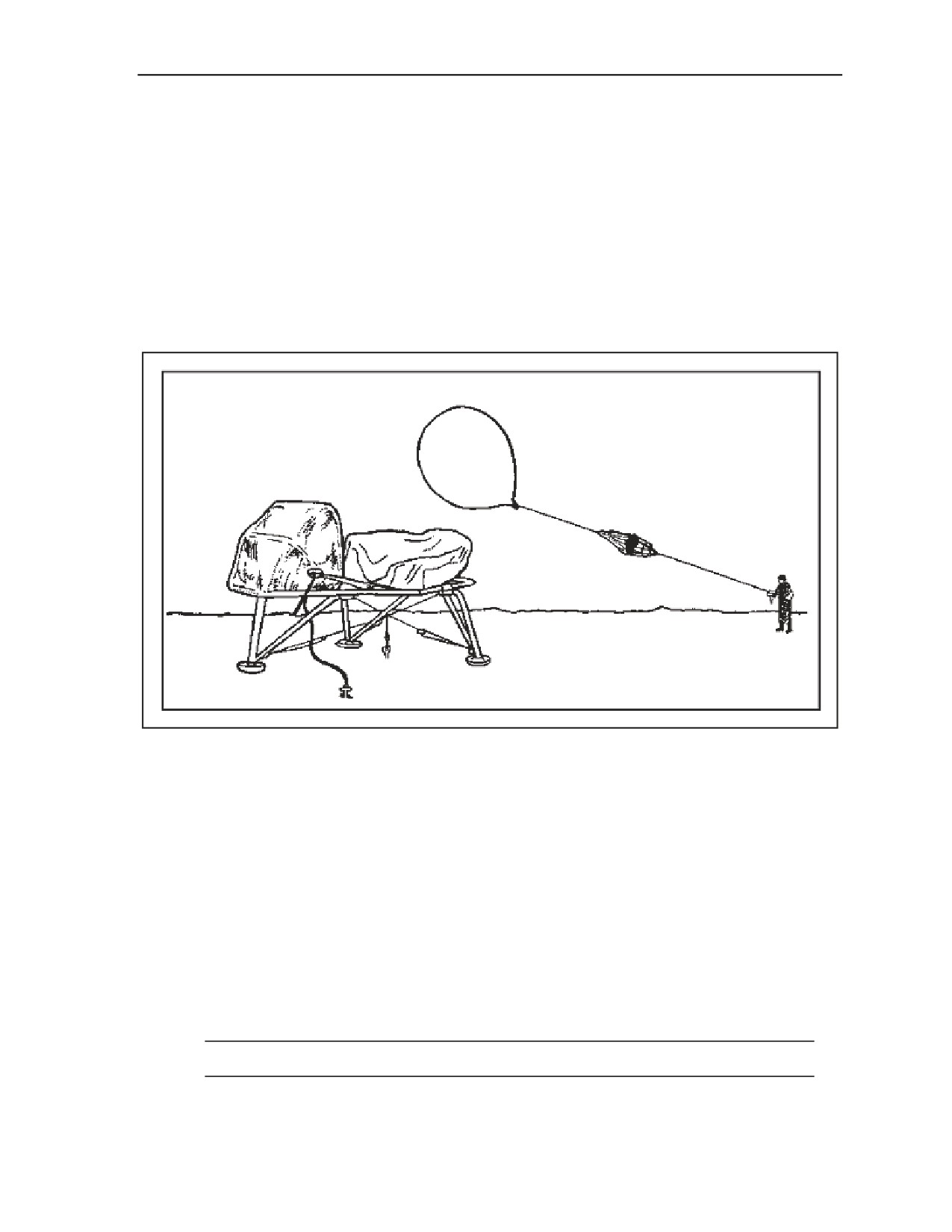
action will occur. When the section is ready to release, a crew member takes the radiosonde part of the
balloon train downwind from the inflation and launching device. The crewmember holding the radiosonde
pulls on the radiosonde end of the balloon train. This action frees the master loop and allows the end of the
canopy to open. When the canopy opens, the balloon is released. When the balloon has risen to an altitude
where the balloon train supports the attached components clear of the ground, the release of the radiosonde
is completed and the sounding is underway. Figure 7-8 shows a release from the inflation and launching
device.
Figure 7-8. Release from the inflation and launching device
RELEASING FROM AN INFLATION SHELTER
7-42. When the section uses an inflation shelter to inflate the balloon, the crewmembers release the balloon
by using either the hand-over-hand method or the two-man running-release method.
HAND-OVER-HAND
7-43. The section uses the hand-over-hand method when the surface winds are relatively calm. Normally,
use of this method of release requires two crew members. One crewmember takes the radiosonde and
moves downwind until the length of the train is taut. This crew member serves as the balloon train anchor
until time of release. The second crew member grasps the balloon by the neck and removes the balloon
from the inflation shelter. He/she then plays out the balloon and its attached train in a hand-over-hand
fashion, moving toward the first crew member and keeping the twine taut until the radiosonde is lifted off
the ground.
NOTE: Do not use this method with a hydrogen-filled balloon.
25 October 2007
FM 3-09.15/MCWP 3-16.5
7-13
Chapter 7
TWO-MAN RUNNING RELEASE
7-44. The section uses the two-man running-release method in moderate to high winds. One crew member
holds the balloon neck. Another crew member holds the radiosonde upright and assumes a position the full
length of the train downwind from the balloon. The first crew member releases the balloon at the given
signal, and as the balloon rises, the crew member holding the radiosonde runs with it while trying to keep
the train taut and maintain a position downwind of the rising balloon. When the balloon is directly
overhead and the train is taut, the crew member holding the radiosonde allows the balloon to lift the
radiosonde from the hands.
RELEASE USING A BALLOON SHROUD
7-45. When using the inflation shelter in moderate to high wind conditions, the crew member may choose
to use the shroud to aid in the release of the balloon train. The shroud is designed to protect the sounding
balloon while it is being moved to the point of release and to aid in releasing it under high wind conditions.
The shroud consists of a hood, four flaps (each of which terminate in a D handle), and a top cord. The
procedure for releasing a balloon by using a balloon shroud is discussed below.
NOTE: Do not use the balloon shroud with a hydrogen-filled balloon.
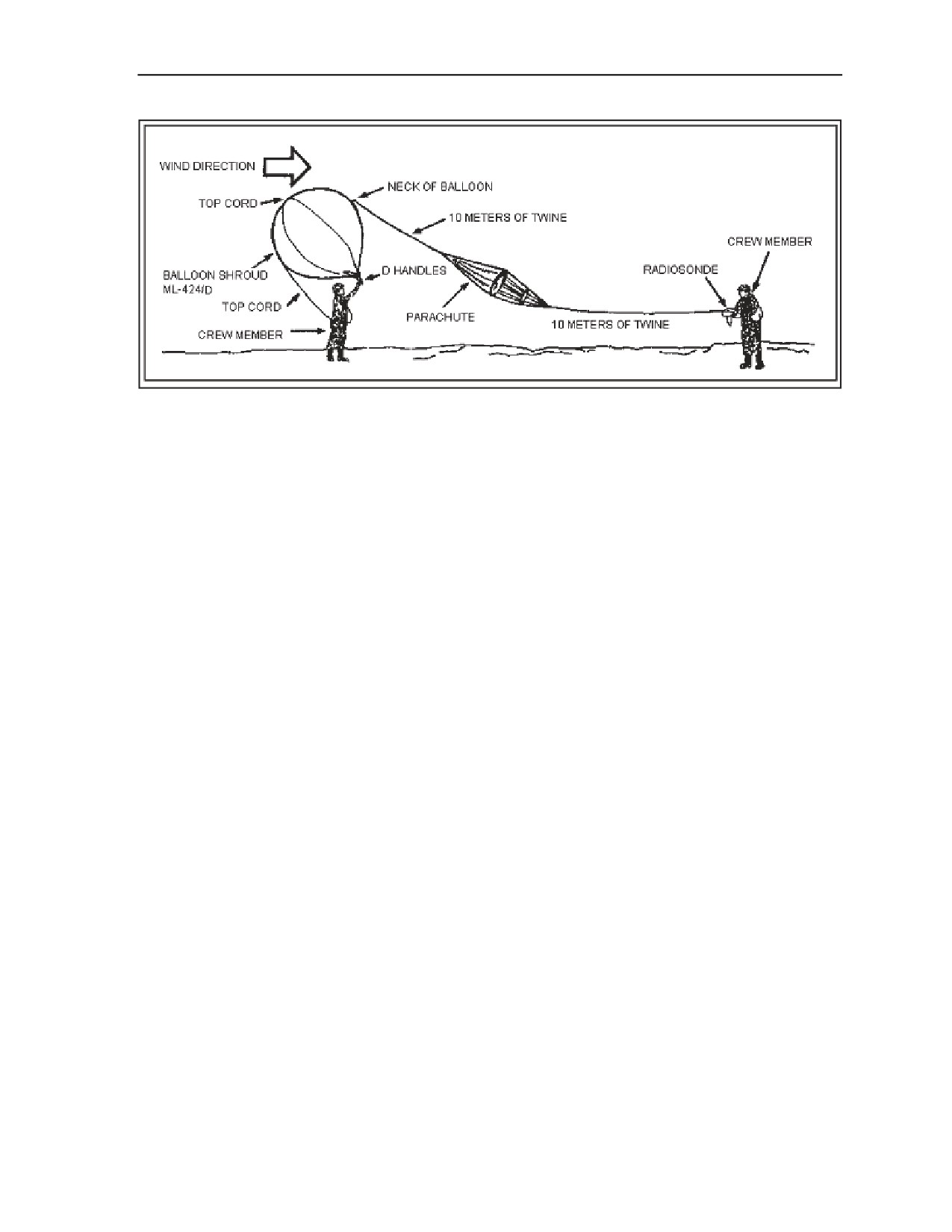
SHROUD POSITIONING
7-46. To place the balloon in the shroud, a crew member must lower the balloon as close as possible to the
ground. The crew member then places two of the shroud flaps over one side of the balloon and allows the
balloon to rise under the shroud. The top cord is attached to the loop at the top of the shroud so that the
crew member can handle the bottom end of the top cord. The crew member holds the four D handles with
one hand and the top cord with the other and moves the balloon to the release point. Ordinarily, the balloon
can be moved to the release point by one crew member holding the D handles and the top cord while a
second crew member carries the radiosonde and parachute. In very high winds, two crew members are
needed to hold the balloon, one to hold the top cord and the other to hold the D handles.
NOTE: To prevent accidental loss of the shroud if all four D handles are released, the top cord
should be tied to the crew member releasing the balloon.
RELEASE PROCEDURE
7-47. Normally, one crew member holds the shroud while the other crew member holds the radiosonde
downwind from the balloon. The crew member holding the shroud releases the front two D handles at the
same time while continuing to hold the rear two D handles and the top cord. The balloon slides out from
under the shroud. As the balloon ascends, the second crew member maintains a position directly under the
drifting balloon until the radiosonde lifts from the hands. Figure 7-9 shows a release using a shroud.
7-14
FM 3-09.15/MCWP 3-16.5
25 October 2007
Balloon Inflation and Launching Procedures
Figure 7-9. Release using a shroud
25 October 2007
FM 3-09.15/MCWP 3-16.5
7-15
This page intentionally left blank.
Chapter 8
Personnel, Logistics, and Maintenance
Manning, fixing, and sustaining the force is essential for effective combat operations.
Sound planning is essential so that MET support is always available in the area of
operations. Planning is done at force artillery headquarters to ensure MET sections
receive adequate and timely support. This chapter focuses on logistic planning
considerations that are the responsibility of the MET station leader and the
operational supervisors.
PERSONNEL
8-1. Strength accounting is the process by which personnel combat readiness is measured. It keeps track
of the troops on hand, identifies those that have been lost, and identifies those that are needed.
READINESS MANAGEMENT
8-2. Commanders must be very cautious when filling vacancies for the MET personnel because of the
low density and criticality of the 13W MOS. Commanders must request personnel far enough in advance to
ensure a smooth rotation of MET personnel. Further care must be taken to ensure that the request for repair
personnel (13WlOHl, 13W2OHl) contains the required additional skill identifier (ASI) of Hl after the base
MOS. If the Hl ASI is not annotated, only MET crew members without maintenance training will be
received by the unit. This leaves the MET section without the required maintenance personnel to repair the
MET equipment. All requests for replacements and evacuation reporting should be handled by the unit S1.
All shortages of positions that require the H1 ASI should be reported as critical.
SUSTAINING SOLDIERS
8-3. Commanders and MET station leaders must diligently manage and execute sustainment support for
MET personnel. Oftentimes the MET section is not with its parent organization; therefore, timely food,
medical, chaplain, pay, and postal services must be provided to ensure Soldier morale and combat
effectiveness. MET station leaders must coordinate with supported units for this support. MET station
leaders must also direct the health and welfare activities of section personnel. These include but are not
limited to the following:
z
Coordinate for food, water, and other life support.
z
Inspect Soldier’s personal hygiene.
z
Inspect Soldier’s personal gear.
z
Ensure medical problems are promptly attended.
z
Schedule rest periods.
LOGISTICS PLANNING
8-4. Logistic planning must include the requirements for sustaining MET sections during extended
combat operations. The logistic plan based on adequate and timely support of the tactical operation must be
complete, simple, and flexible. Logistic planning must address the following:
z
Movement and load planning.
z
Basic loads and stock levels.
z
Supply channels and location of reserve stocks.
25 October 2007
FM 3-09.15/MCWP 3-16.5
8-1
Chapter 8
z
Communications.
z
Maintenance concept.
BASIC LOAD AND STOCKAGE LEVELS
8-5. Met Personnel must be fully aware of the status of basic load quantities. The successful
accomplishment of the mission depends on having the necessary of quantities of expendables to perform
the mission.
8-6. The status of the basic load should be monitored at all times to ensure sufficient expendables remain
available to accomplish the mission.
8-7. A MET section basic load is the amount of expendables (radiosondes, balloons, parachutes, and so
forth) required to sustain combat operations for 72 hours. Basic loads for MET sections are determined by
the amount of expendables needed for the maximum number of balloon releases per section per day of
operations. A MET section can run one flight per hour, up to a maximum of 12 flights per day. Each
section is allocated 6 hours per day for maintenance and movement. The maximum numbers of flights cited
here are for intense battle only. The cost of expendables precludes the maximum number of flights being
flown for training.
8-8. Current authorized stockage levels are listed in TM 11-6660-218-20P, TM 11-6660-283-13, and TM
11-6660-293-12&P (MMS-P equipped sections).
LOGISTICAL SUPPLY CHANNELS AND LOCATIONS OF RESERVE
STOCKS
8-9. In addition to monitoring the status of the basic load, it is necessary to establish a reorder level for all
expendables. The tempo of operations will be the determining factor in establishing the best reorder level.
8-10. Met personnel should be aware of the location of all resupply points
SUPPLY CHANNELS
8-11. With current authorizations of vehicles and personnel, each MET section can only transport a 72-
hour supply of expendables. As supplies are expended, resupply must be done by the division support
command (DISCOM). Maneuver experience factors indicate that the DISCOM should keep a 14-day
supply level per MET section and the corps support command (COSCOM) should keep a 30-day supply
level per MET section.
RESUPPLY PUBLICATIONS
8-12. The nomenclature and quantities of items authorized per MET section are in TM 11-6660-265-10-
HR, TM 11-6660-218-20P, and TM 11-6660-283-13, and TM 11-6660-293-12&P (MMS-P equipped
sections). Because MET section expendables are very low-density items, division and corps stockage levels
must be carefully monitored. Careful management prevents exhaustion of supplies and subsequent
interruption of MET support on the battlefield.
ADDITIONAL RESUPPLY
8-13. Met sections require other forms of supplies. The most important supplies are petroleum, oils, and
lubricants (POL); spare parts; food; water; and ammunition. It is very important that all aspects of resupply
are considered when developing the resupply rate for MET sections. The MET station leader must develop
proper usage rates for all supplies to ensure smooth, continuous operations.
8-2
FM 3-09.15/MCWP 3-16.5
25 October 2007
Personnel, Logistics, and Maintenance
COMMUNICATIONS
8-14. For the MET section to achieve its mission, communications must be established quickly and
maintained. Primary references for MET section communications are TM 11-5820-401-10-1 and -2. The
MET station leader must ensure all members of the section are properly trained in correct communications
procedures and on section communications equipment. The MET section point of contact for
communications requirements and training is the unit signal officer. The MET station leader is responsible
for maintaining all aspects of communications to include the following:
z
Familiarity with the unit signal operating instructions (SOI).
z
Communication systems initialization and setup.
z
Assigned frequencies and network protocols.
z
Encryption procedures.
z
Radio procedures.
z
Communications security.
z
Message development and emergency procedures.
z
Alternate forms of communication.
MAINTENANCE CONCEPT
8-15. The Army adheres to a two-level maintenance concept as outlined in the maintenance allocation
chart
(MAC) for each system. The MAC designates overall authority and responsibility for the
performance of all maintenance and repair functions. Under the two-level maintenance concept, the levels
are organized as follows:
z
The field level includes operator
/crew maintenance, unit maintenance, and direct support
maintenance.
z
The sustainment level includes general support and depot level maintenance.
8-16. The increasing complexity of equipment has lead to systems designed around the concept of line
replaceable units (LRU). When a faulty unit is identified, the LRU is replaced and sent to depot for repair.
Depot level maintenance is often performed by the original equipment manufacturer or contractor through
a Commercial Logistical Support warranty program.
8-17. The limited availability of spare LRUs and the time required for faulty units to be repaired at depot
level places an additional burden on logistics planners to ensure systems are not nonoperational due to lack
of operational LRUs. When troubleshooting the system, MET equipment repairers need to make every
effort to ensure an LRU is faulty prior to turning the component in for repair.
8-18. There is one maintenance standard. This standard is based on TM 10 and 20 series preventive
maintenance checks and services (PMCS). The goal of all levels of maintenance is to limit the downtime of
equipment. The objective of maintenance in combat is to fix as far forward as possible.
FIELD LEVEL
8-19. Field level maintenance consists of operator, unit, and direct support maintenance. The majority of
the system maintenance is accomplished as ‘fix forward’ maintenance.
8-20. The unit level maintainer is charged with all field maintenance.
Operator/Unit Maintenance
8-21. Unit level maintenance is the most critical. Unit level maintenance consists of the operator and MET
equipment repairer.
z
Operator maintenance includes the following:
Before, during, and after operations checks.
PMCS.
Scheduled maintenance.
25 October 2007
FM 3-09.15/MCWP 3-16.5
8-3
Chapter 8
z
Met equipment repairer performs unit maintenance consists of the following:
Visual inspections.
Execution of diagnostic programs.
Services and replacements as authorized by the MAC.
Scheduled and unscheduled maintenance, to include adjustments and
alignments authorized by the MAC.
8-22. Unscheduled maintenance includes diagnosis and fault isolation as authorized by the MAC. To
analyze malfunctions, the trained mechanics in the MET section use built-in test equipment (BITE) along
with appropriate technical manuals.
Direct Support Maintenance
8-23. Direct support (DS) maintenance is performed by the supporting DS maintenance unit. DS electronic
repair personnel provide required maintenance support when maintenance falls outside the echelon of the
MET section repairer. Most DS repair is performed onsite at the MET section location. If repair cannot be
performed onsite or the problem requires equipment evacuation to a higher level, the MET equipment is
evacuated to its supporting DS unit by the most appropriate method. This can be done by the unit supply
section or S4. Because of the low density of MET equipment and the difficulty in procuring repair parts,
the DS unit must keep an adequate stock of repair items on hand. This prevents long downtimes due to
unavailability of parts.
SUSTAINMENT LEVEL
8-24. Sustainment level maintenance is performed on the MMS-P by the manufacturer. Prior to sending a
system to the manufacturer, the logistics assistance representative and/or the field support representative
should be consulted.
8-25. Sustainment level maintenance is performed on the MMS by the DS maintenance initially. In most
cases, the entire system should not be sent to depot. Only the affected component is forwarded. Prior to
forwarding any item to depot, the logistics assistance representative and/or field support representative
should be consulted.
General Support Maintenance
8-26. General support (GS) maintenance is not used for MET systems peculiar items; however, GS
maintenance is required for associated items of support. MET peculiar equipment that cannot be repaired at
the DS level must be evacuated to depot. Non-MET peculiar items undergo GS maintenance as identified
on their particular maintenance allocation chart.
Depot Maintenance
8-27. The depot repairs those modules and assemblies that are beyond field-level capability and overhauls
or rebuilds MET equipment as required.
SOFTWARE MAINTENANCE (COMPUTER PROGRAMS)
8-28. Computer software is the responsibility of Headquarters, Communications-Electronics Command
(CECOM), at Fort Monmouth, NJ. CECOM will distribute updated programs to the user as changes are
made.
CAUTION
Personnel in field units will not create computer programs or
update existing programs.
8-4
FM 3-09.15/MCWP 3-16.5
25 October 2007
Appendix A
MET Messages
All MET messages are coded in a format that is recognized and used by United States
and allied forces and weather services worldwide. These formats are mandated by
several standardization agreements and quadripartite standardization agreements and
the World Meteorological Organization. This appendix discusses these messages.
This appendix implements STANAG 4061, STANAG 4082, STANAG 4131, STANAG 4140.
SECTION I MMS FATDS MET MESSAGES
OVERVIEW
A-1. Digital transmission is the primary means of sending MET messages to FA units. The MMS
equipped MET section contains advanced field artillery tactical data system (AFATDS) formats for all
MET messages. MET messages are sent to FA firing units and FSEs, as required. The MET messages
normally are transmitted to the controlling headquarters fire control element (FCE). The communications
aspect (message address, message source, and authentication) of data transmission is in the first message
element, the communications (comm) line. There are two format differences between a digital MET
message and a standard MET message. The first is the comm line, which is required to transmit the
message. The second difference is the format of the MET data provided, which is by data line.
MET MESSAGE COMMUNICATIONS LINE
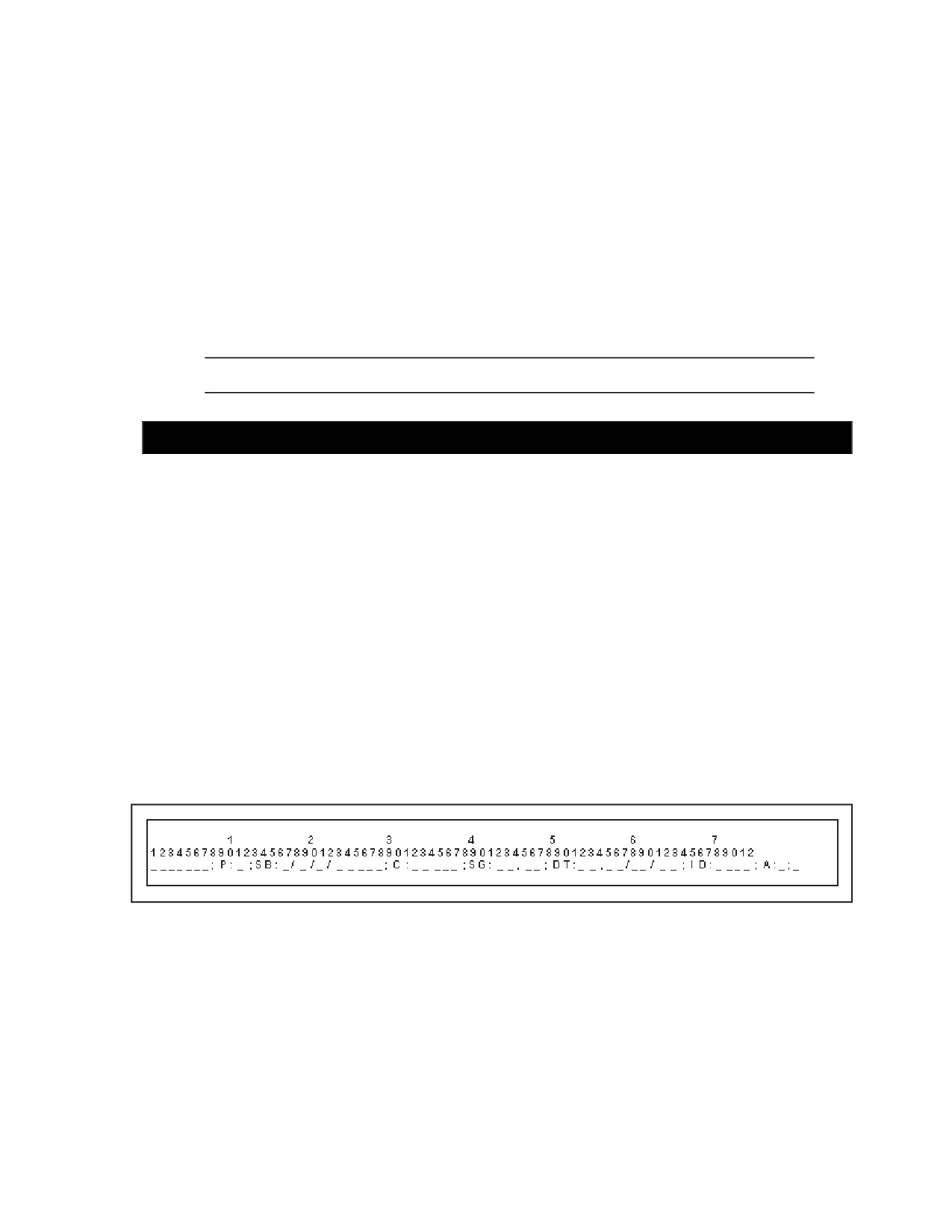
A-2. The first line of every message segment is the comm line which contains the same information for all
MET messages. The comm line consists of nine parts. Each part has a field. A semicolon separates each
field. The format of the comm line is shown in figure A-1. The numbers above the comm line format
indicate position spaces only (72 total). These numbers are not part of the message.
Figure A-1. Comm line format
HEADER
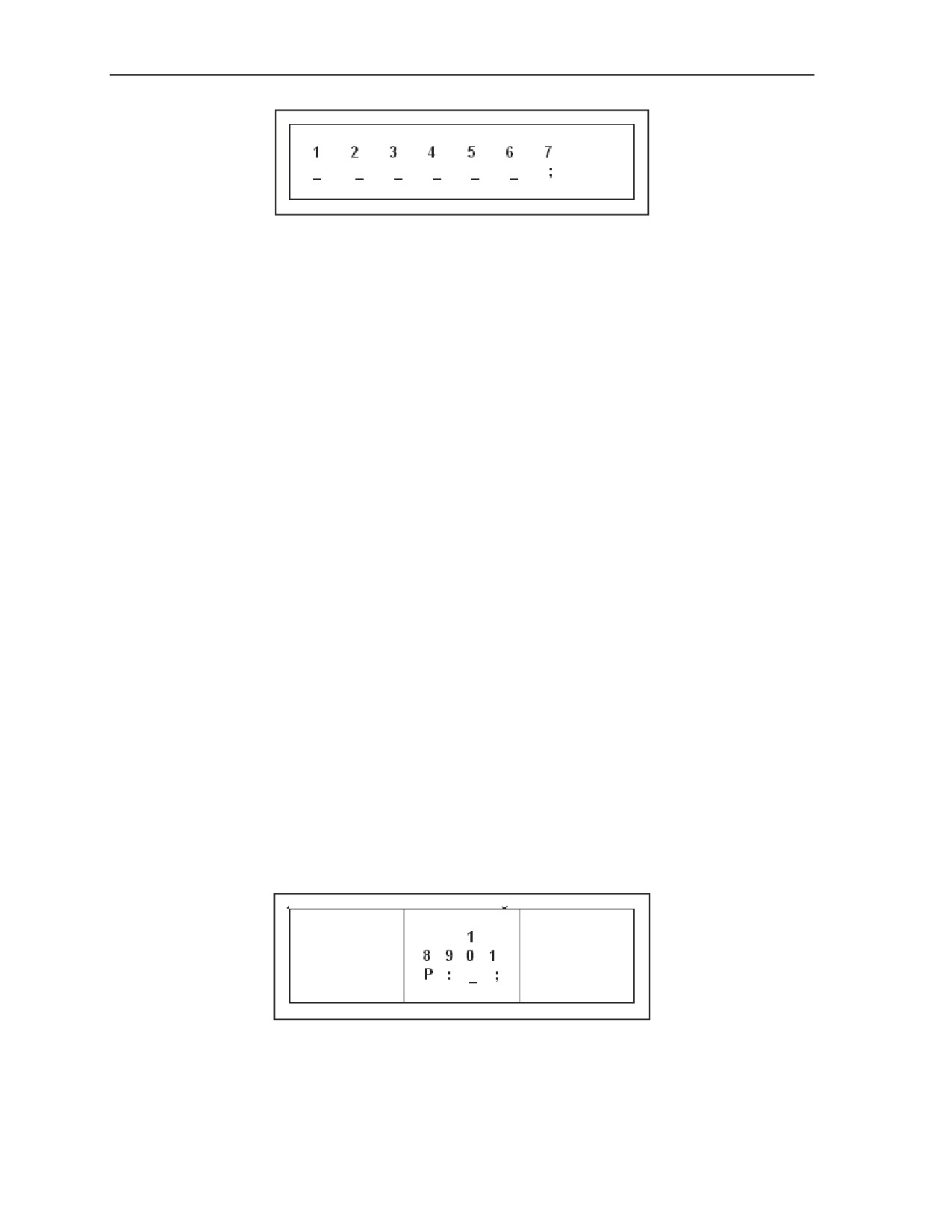
A-3. The first six character positions in the comm line comprise the header field. The first six positions
are entry variables. The semicolon (seventh position) signifies the end of the header. The format for the
comm line header is shown in figure A-2.
25 October 2007
FM 3-09.15/MCWP 3-16.5
A-1
Appendix A
Figure A-2. Comm line header format
Destination
A-4. The first position in the header field shows the destination of the message. On a received message,
the first position shows the sender. Specific FDCs may be addressed by using any letter or number, as
specified by the controlling FDC or FCE, SOI, or standing operating procedures (SOP).
Transmission Repeat Number
A-5. The second position contains the transmission repeat number (TRN). The TRN is first set to zero.
The TRN is advanced by one digit each time the message is retransmitted. After four unsuccessful
transmissions, voice contact is required to determine the problem.
Authentication Characters
A-6. Positions 3 and 4 are the authentication or serialization characters. These characters are the next
unused authentication codes. If no acknowledgment is received, the next set of numbers is used, and the
TRN is advanced one number.
Message Type
A-7. The message type (position 5) is a single number that represents the type of message being
composed for transmission or processing. The message type must be entered in the header by the operator
when he composes the message. MET messages are always type 3.
Message Source
A-8. The message source character (position 6) represents the source that transmitted the message as
specified by the controlling FDC or FCE, the SOI, or the SOP. The source character for a message
originated by a MET section is entered during initialization.
PRIORITY
A-9. The message priority is determined by the message category and type. It is specified by the
controlling FDC at the time of loading or system initialization. The priority scheme is numbered from 1 to
8, with 1 being highest priority. Message priority should not be altered by the MET system operator. The
priority field occupies positions 8 through 11. Its format in the comm line is shown in figure A-3.
Figure A-3. Priority field format
A-2
FM 3-09.15/MCWP 3-16.5
25 October 2007
MET Messages
SUBSCRIBER
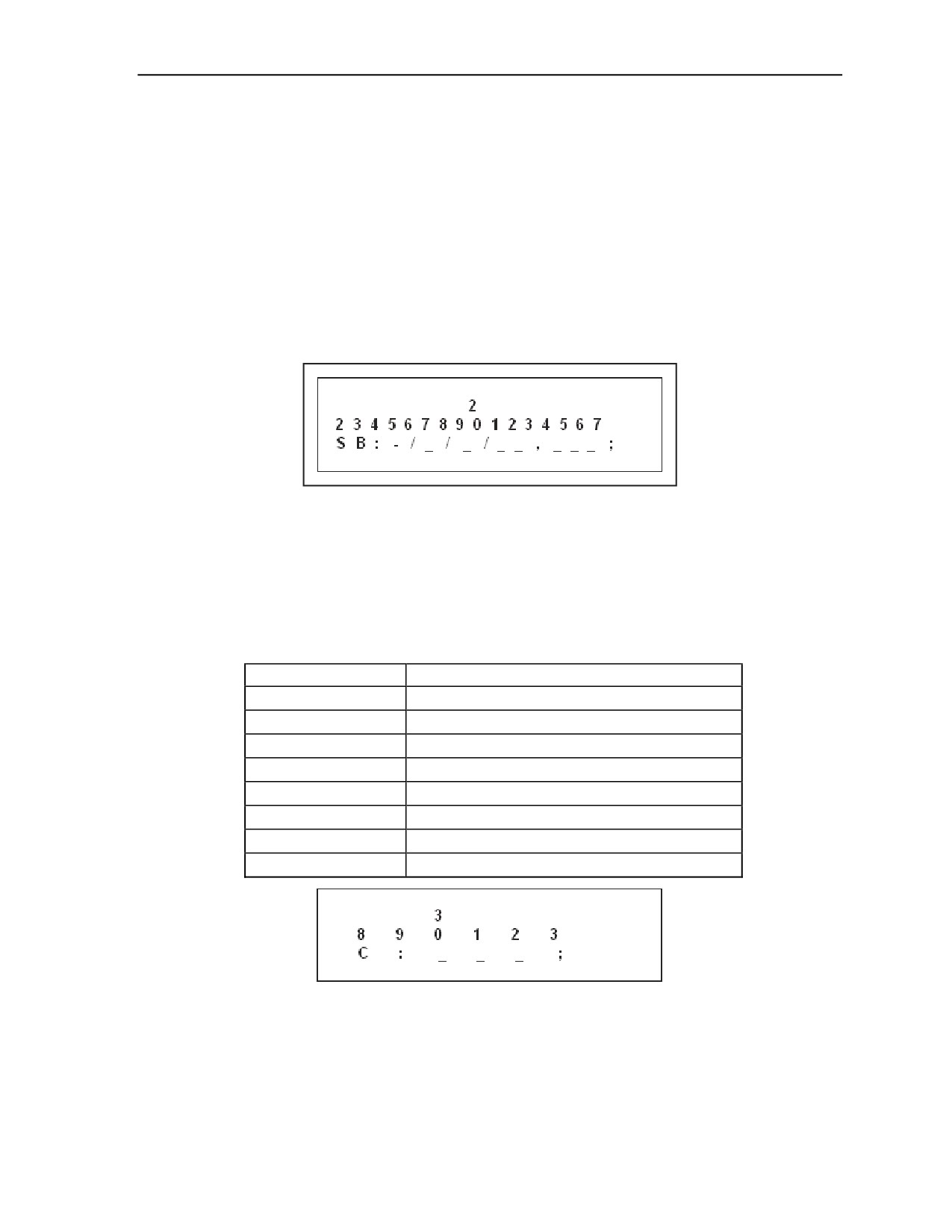
A-10. The subscriber is the logical name of the recipient of the message. The subscriber is specified by SOI
or controlling headquarters SOP. The subscriber field (figure A-4) occupies positions 12 through 27 in the
comm line and consists of five separate subfields (indicated by slashes and commas). The first subfield
(position 15) is the section number, and the second (position 17) is the platoon number. These two
subfields are not used for all subscribers. The third subfield (position 19) designates the battery. The fourth
subfield designates the battalion and has two positions (21 and 22) for numbers. The fifth subfield
designates the regiment and has three positions (24, 25, and 26). When the MET section originates a
message, the subscriber name of the addressee may be specified; however, the destination code in the
header must be specified. If the subscriber name is left blank, the subscriber name defaults to the logical
name of the destination code. Therefore, the sender should enter the subscriber name if he wishes to relay
the message through to another subscriber.
Figure A-4. Subscriber field format
SECURITY CLASSIFICATION
A-11. The security classification field occupies positions 28 through 33. It is entered automatically. This
field contains one of the entries in table A-1. The security classification field format is shown in figure A-
5.
Table A-1. Security Classification Field Entries
Entries
Meanings
UN
Unclassified
ETO
Encrypt for transmission only
C
Confidential
S
Secret
CFR
Secret formerly restricted data
SRD
Secret restricted data
C*C
Secret cryptography (crypto)
S#C
Secret Crypto
Figure A-5. Security Classification Field
SEGMENT INFORMATION
A-12. The segment information field (figure A-6) occupies positions 34 through 42. Positions 37 and 38
indicate the message segment. Positions 40 and 41 indicate the total number of segments in the message
25 October 2007
FM 3-09.15/MCWP 3-16.5
A-3
Appendix A
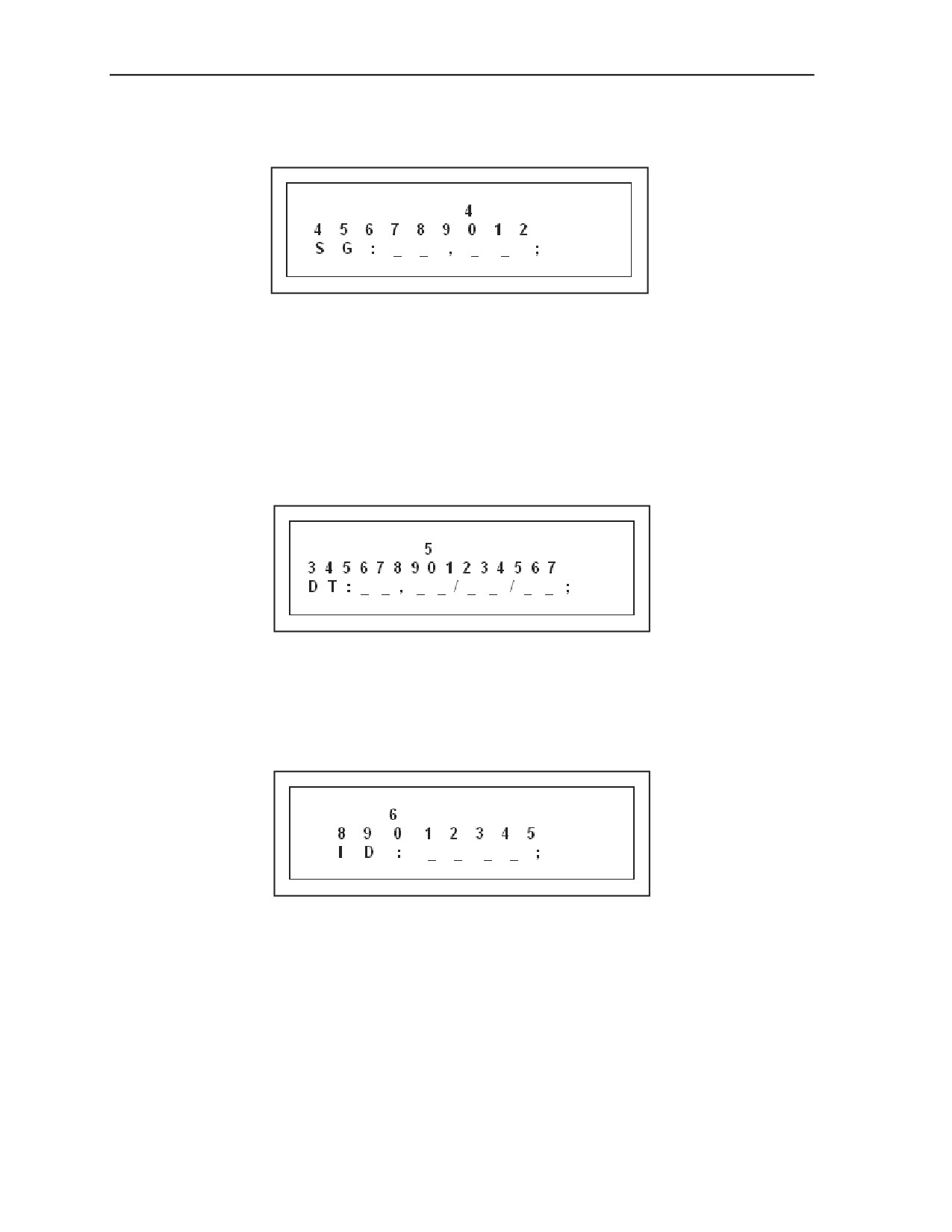
chain. For example, “SG: 03,10;” means that this message segment is the third of 10 message segments. If
the field is not specified, one segment is assumed by the receiving computer. Message segment numbers
are automatically inserted in all transmitted messages.
Figure A-6. Segment information field format
DATE-TIME GROUP
A-13. The date-time-group field (figure A-7) occupies positions 43 through 57 of the comm line. For FDC
originated messages, the FDC enters the time of the last computer action or transmission. For MET section
originated messages, the date-time group should be left blank since the FDC inserts the time of receipt.
Positions 46 and 47 indicate the day of the month (1 through 31). Positions 49 and 50 indicate the hour (00
through 23). Positions 52 and 53 indicate the minutes (00 through 59). Positions 55 and 56 indicate the
seconds (00 through 59).
Figure A-7. Date-time-group field format
MESSAGE IDENTIFICATION NUMBER
A-14. This number is a unique serial identification number assigned by the computer at the FCE. This field
(figure A-8) occupies positions 58 through 65.
Figure A-8. Message identification number field format
A-4
FM 3-09.15/MCWP 3-16.5
25 October 2007
MET Messages
AUTOMATIC TRANSMISSION
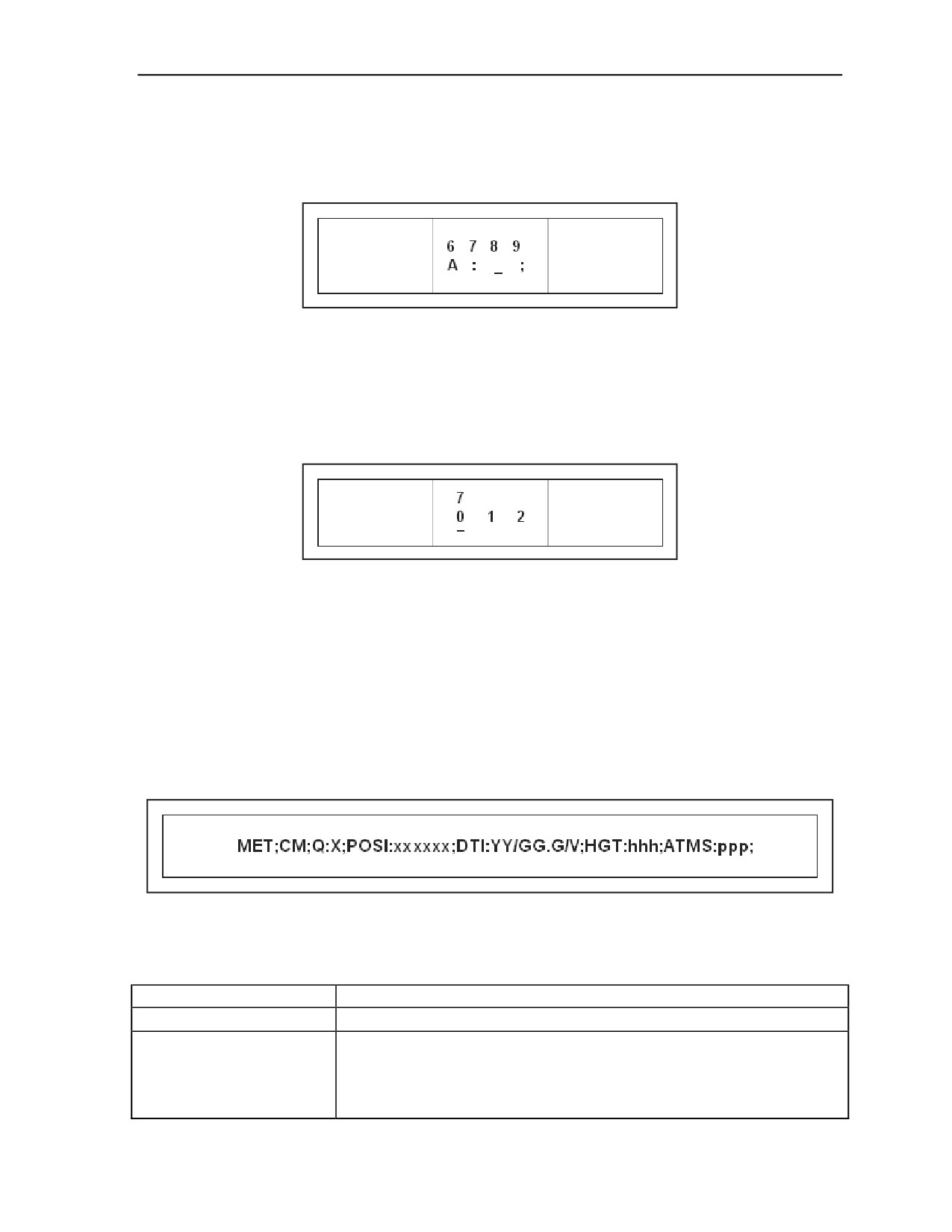
A-15. The automatic transmission field (figure A-9) occupies positions 66 through 69. The initial setting of
this field is left blank. If automatic transmission is used, the computer inserts the character A in position
68.
Figure A-9. Automatic transmission field format
DIGITAL DATA TERMINAL
A-16. Position 70 indicates the digital data terminal (DDT) at the FDC that is used to transmit the message.
Positions 71 and 72 are not used. Figure A-10 shows the DDT field format.
Figure A-10. Digital data terminal field format
MET MESSAGE BODY
A-17. The body of the MET message is composed of a heading and up to five data lines.
HEADING
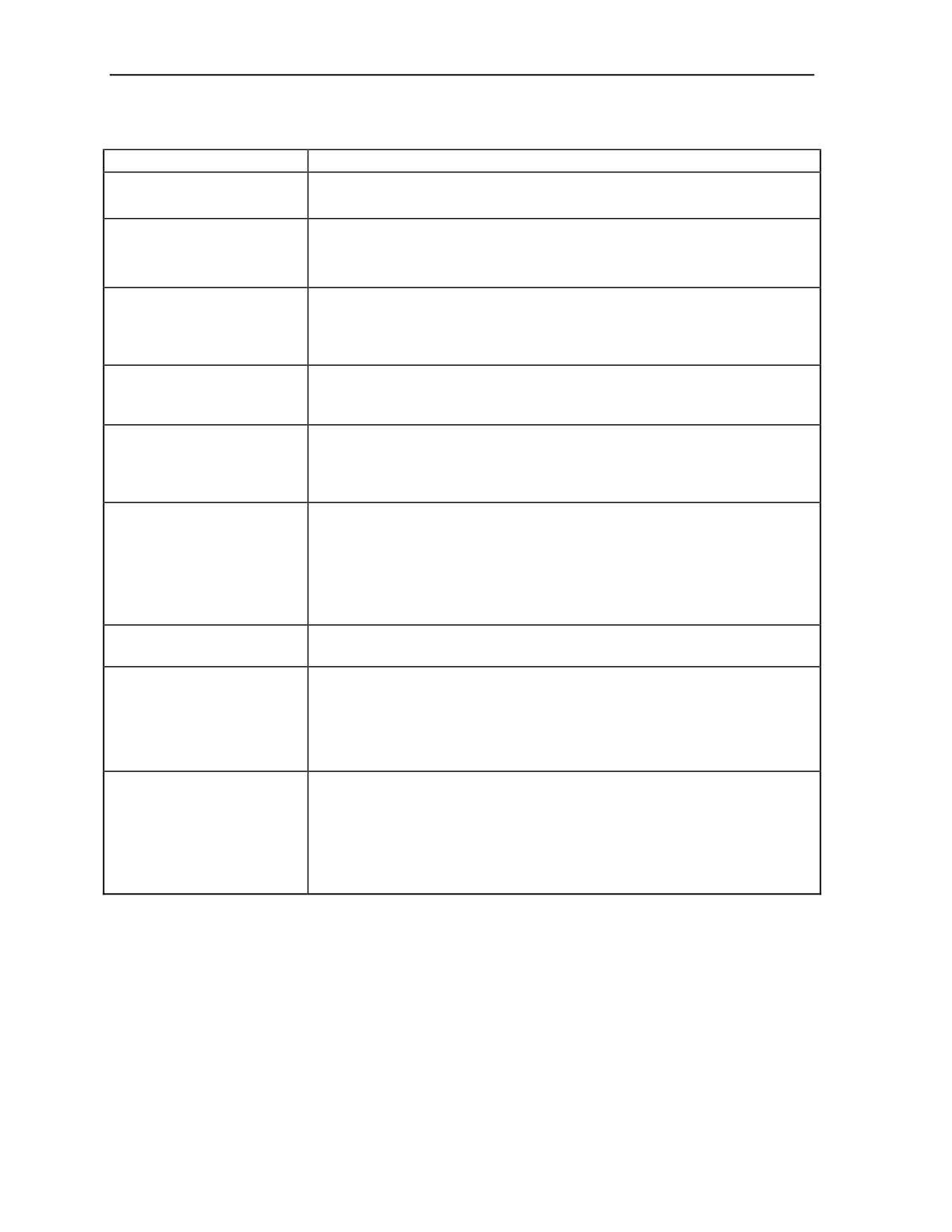
A-18. The message heading gives the message type, location of the MET section, date and time group in
Greenwich Mean Time (GMT), altitude above sea level, atmospheric pressure, and for the target
acquisition (TA) message, the cloud height from surface and the mean refractive index. Figure A-11 is an
example of the heading of a MET message. Table A-2 identifies individual fields of the heading.
Figure A-11. FATDS MET message heading format
Table A-2. FATDS MET Message Heading Fields
Fields
Descriptions
MET;
Designates message category-meteorological.
CM;
Designates message type (for this example, computer). Other message
designator types are as follows:
BM - ballistic (plaintext message [PTM]).
CFL - fallout.
25 October 2007
FM 3-09.15/MCWP 3-16.5
A-5
Appendix A
Table A-2. FATDS MET Message Heading Fields
Fields
Descriptions
TA - target acquisition.
W - WMO (PTM)
K;t; (ballistic only)
Designates the types of ballistic messages as follows:
2 - surface to air.
3 - surface to surface.
_/_/_/_ _ _; (target
Identifies MET station. The first five spaces are left blank. Fires
acquisition only)
battalion units may use FB1 or FB2 in the last three spaces. FA brigade
units may use BD1 or what is designated by tactical standing operating
procedure (TSOP).
Q:X;
Designates octant of the globe. The X is Octant 0, 1, 2, 3, 5, 6, 7, 8, or
9. Octant 4 is not used. Octant 9 is used when location is other than by
latitude and longitude.
POSI:xxxxxx;
Designates location of station in six digits. The first three digits are used
to encode the latitude and the last three to encode the longitude in
degrees and tenths of degrees. When longitude is greater than 100, the
hundreds digit is omitted. The location may be expressed in code.
DTI:YY/GG.G/V;
Designates date-time. The YY is the day of he month. The GG.G is the
time of day in hours and tenths of an hour (24-hour clock). The V is the
valid time period.
NOTE: U.S. Forces use 0 for valid time, since they do not predict a
period of validity.
HGT:hhh;
Designates altitude of the MET station above mean sea level in tens of
meters.
ATMS:PPP;
Designates MET station pressure to the nearest millibar. For pressures
greater than 1,000 mb, thousands digit (000 to 999) is omitted.
NOTE: This field is used for all MET messages except the fallout MET
message.
CBMRI:CCC/NNN;
Designates cloud height (CCC) above the surface of the lowest cloud at
the point of observation and the mean refractive index in “N” units.
Cloud height is in tens of meters. If NNN is not included in the
message, the spaces are left blank.
NOTE: This field is used only for the target acquisition MET message.
DATA LINES
A-19. Each data line contains the MET data for several zones, rather than each zone being transmitted by a
separate line as in the standard message. Data for each zone within the data line are terminated by a
comma. The data line is terminated by a semicolon.
Computer MET Message
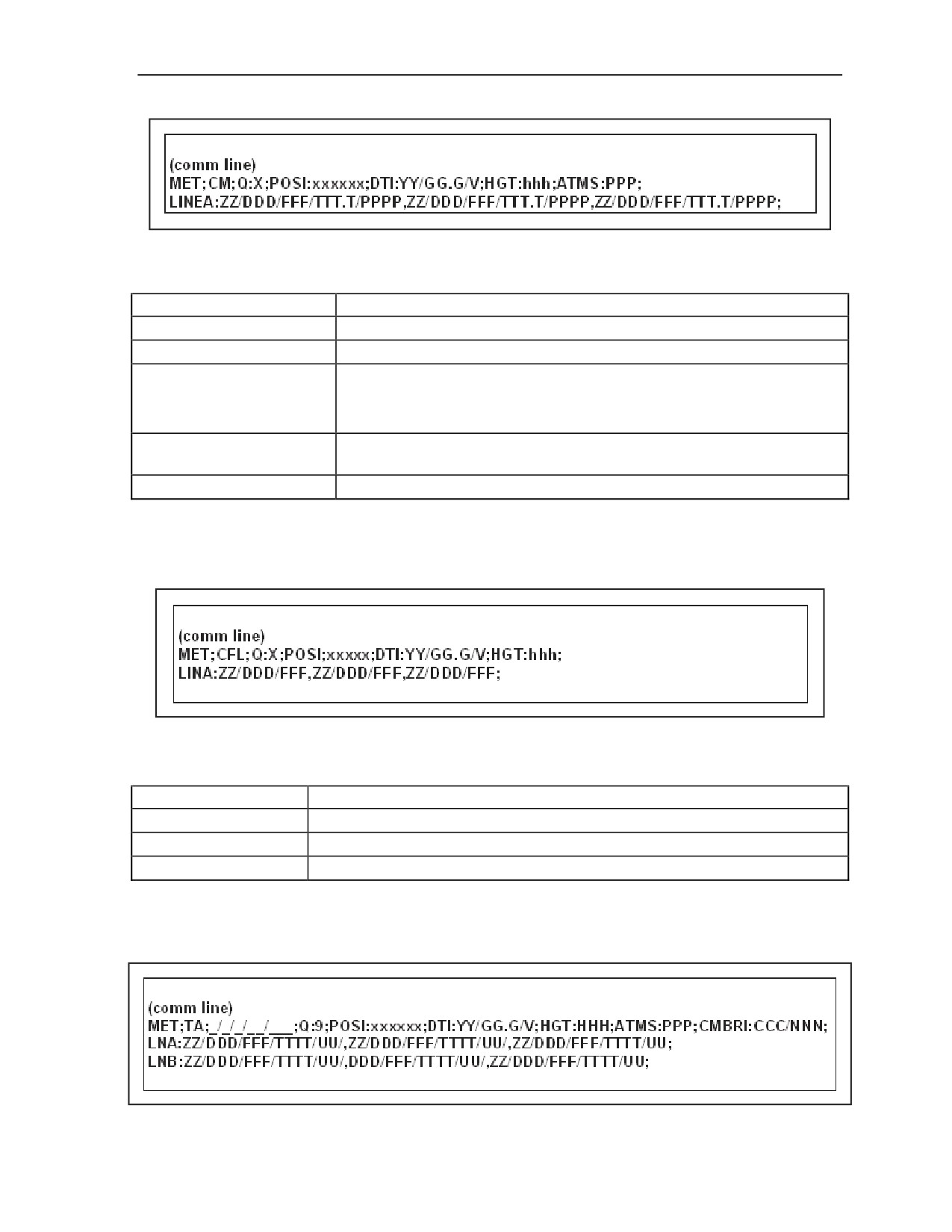
A-20. Each data line in the body of the computer message contains zone data for line number, wind
direction and speed, and temperature and midpoint pressure. Figure A-12 shows the format for a computer
MET message. The symbols in the body of the computer MET message are defined in table A-3.
A-6
FM 3-09.15/MCWP 3-16.5
25 October 2007
MET Messages
Figure A-12. FATDS computer MET message format
Table A-3. FATDS Computer MET Message Body Symbols
Symbols
Definitions
ZZ/
Line number (zone) for message (00 to 26)
DDD/
Zone wind direction in tens of mils (000 to 640)
FFF/
Zone wind speed in knots (000 to 300)
NOTE: When FFF is 000, then DDD is 000.
TTT.T/
Zone mean virtual temperature to the nearest tenth of a degree Kelvin
(000.0 to 500.0)
PPPP
Zone midpoint pressure in millibars (0000 to 1,100)
Fallout MET Message
A-21. Each data line in the body of the FOMET message contains zone data for zone number and wind
direction and speed. Figure A-13 shows the format for the FOMET message. The symbols in the body of
the FOMET message are defined in table A-4.
Figure A-13. FATDS fallout MET message format
Table A-4. FATDS Fallout MET Message Body Symbols
Symbols
Definitions
ZZ/
Line designator for 2,000-meter zones (00 to 15)
DDD/
Zone wind direction in tens of mils (000 to 640)
FFF
Zone wind velocity in knots (001 to 300)
A-22. Each data line in the body of the TA MET message contains zone data for zone number, wind
direction, wind speed, temperature, and relative humidity (RH). Figure A-14 shows the format for the TA
MET message. The symbols in the body of the TA MET message are defined in table A-5.
25 October 2007
FM 3-09.15/MCWP 3-16.5
A-7
Appendix A
Figure A-14. FATDS target acquisition MET message format
Table A-5. FATDS Target Acquisition Message Symbols
Symbols
Definitions
ZZ/
Line number code (00 to 27)
DDD/
Wind direction in tens of mils (000 to 640)
FFF/
Wind speed in knots (000 to 300)
TTTT/
Air temperature in tenths of Kelvin (000.0 to 500.0)
UU
Relative humidity as a percentage (01 to 00, where 00 is 100 percent)
PLAIN TEXT MET MESSAGES
A-23. As stated before, some receiving systems may not have the formats for the ballistic MET message or
the WMO MET message in their database. However, a ballistic MET message can be transmitted to an FA
unit in a plaintext message (PTM) and the WMO MET message can be sent to the SWO by PTM. The
comm line of the PTM is the same as the comm line of the computer, fallout, and TA MET messages. The
main differences are the heading and the body of the messages.
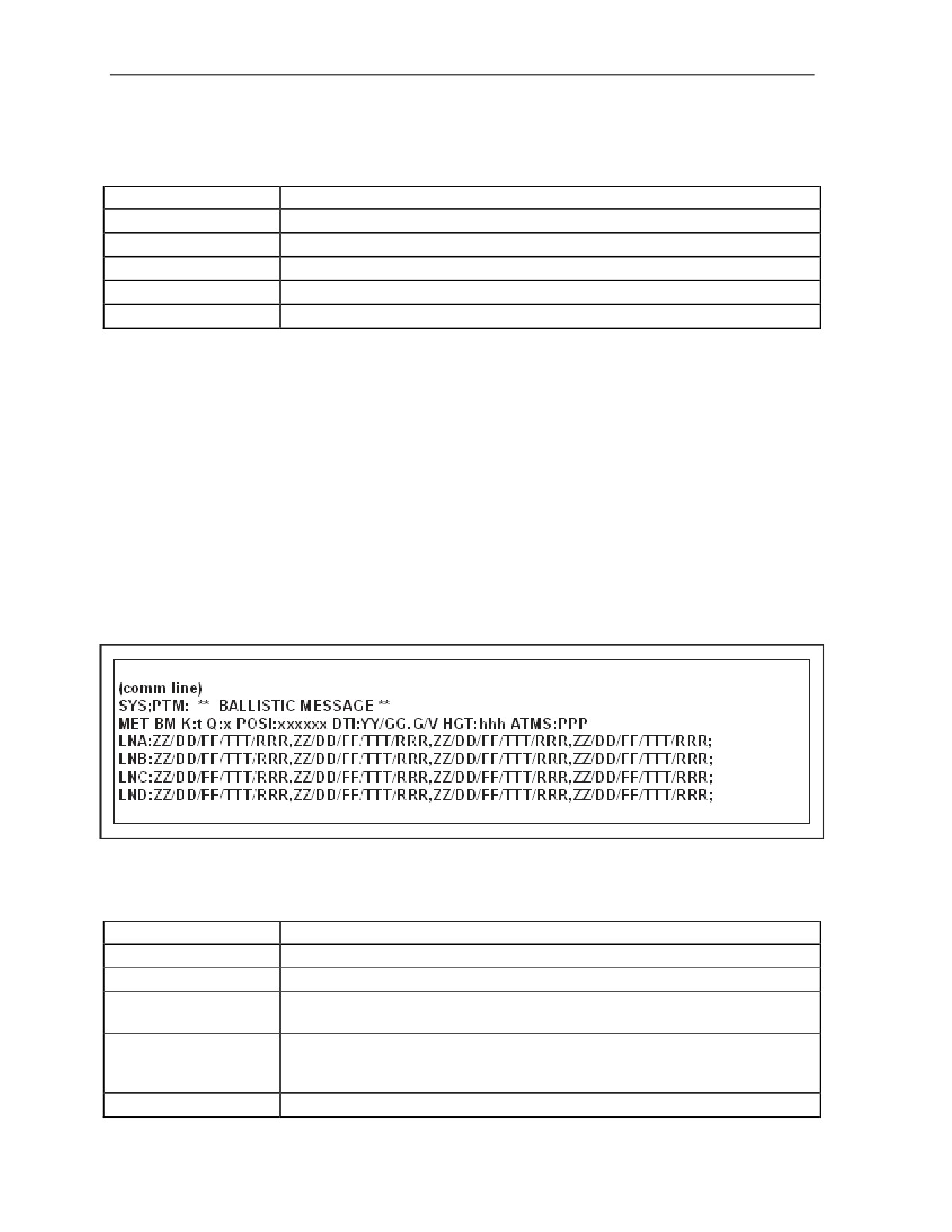
BALLISTIC MET MESSAGE
A-24. The heading of the ballistic MET message contains the same information as the formatted messages.
However, the ballistic MET message is preceded by the words ** BALLISTIC MESSAGE **. Symbols in
the heading of the PTM format ballistic MET message are defined in table A-6. The body of the PTM
ballistic MET message (figure A-15) contains four data lines (LNA through LND). Each data line consists
of four zones separated by commas. Symbols in the body of the PTM format ballistic MET message are
defined in table A-7.
Figure A-15. Ballistic MET message (PTM) format
Table A-6. FATDS Ballistic MET Message Heading Symbols
Symbols
Definitions
MET
Designates message category-meteorological.
BM
Designates message type-ballistic.
K:t
Designates type of ballistic MET message. The t is a 2 for type 2 (surface to
air) or a 3 for type 3 (surface to surface) message.
Q:X
Designates octant of the globe. The X is octant 0, 1, 2, 3, 5, 6, 7, 8, or 9.
Octant 4 is not used. Octant 9 is used when location is other than by
latitude and longitude.
POSI:xxxxxx
Designates location of station is six digits. The first three digits are used to
A-8
FM 3-09.15/MCWP 3-16.5
25 October 2007
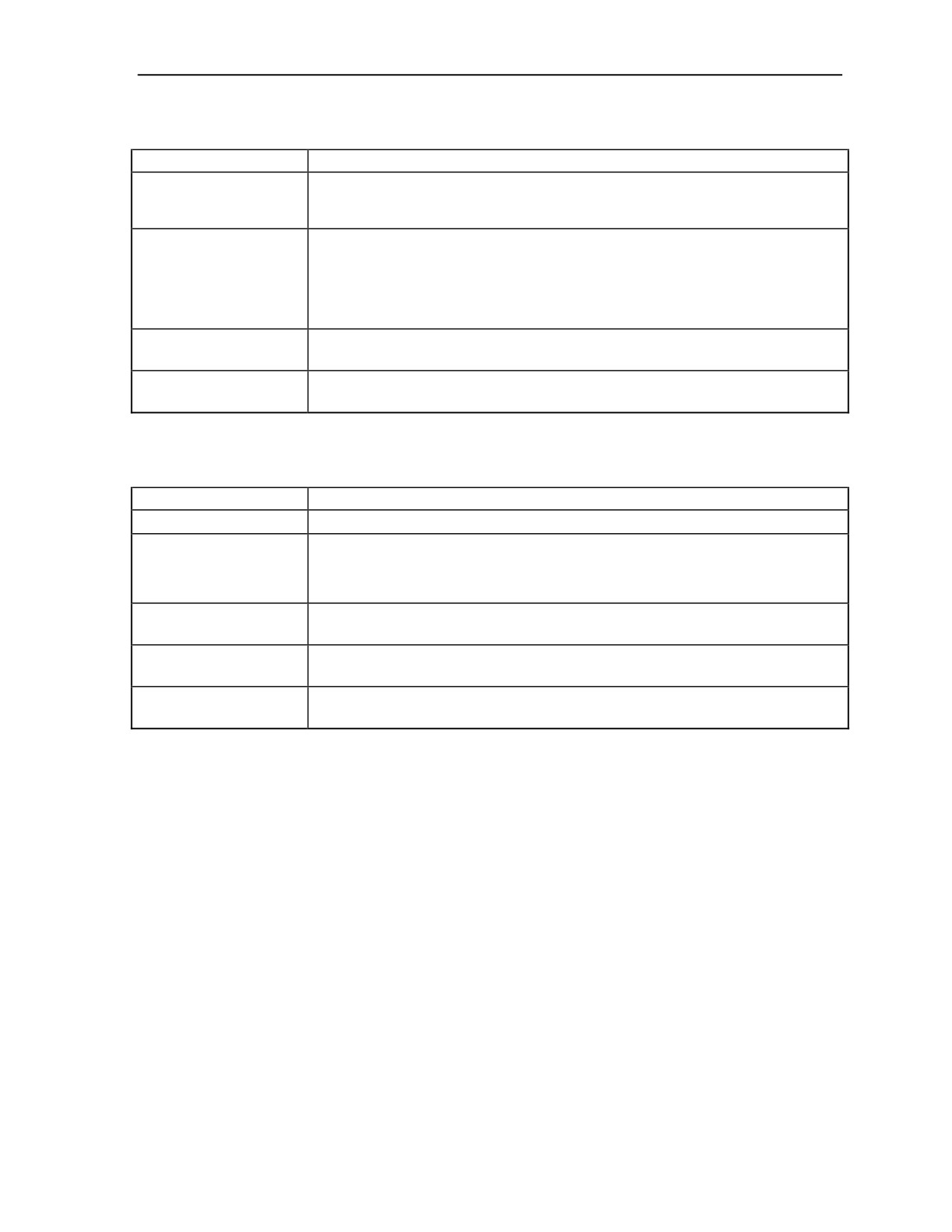
MET Messages
Table A-6. FATDS Ballistic MET Message Heading Symbols
Symbols
Definitions
encode the latitude and the last three to encode the longitude in degrees
and tenths of degrees. When longitude is greater than 100 degrees, the
hundreds digit is omitted. The location may be expressed in code.
TI:YY/GG.G/V
Indicates date-time. The YY is day of the month. The GG.G is the time of
day in hours and tenths of an hour (24-hour clock). The V is the valid time
period.
NOTE: U.S. Forces use 0 for valid time, since they do not predict a period
of validity.
HGT:hhh
Designates altitude of the MET station above mean sea level (MSL) in tens
of meters.
ATMS:PPP
Designates MET station pressure to 0.1 percent of standard. If pressure is
greater than 100 percent the hundreds digit is omitted.
Table A-7. Ballistic MET Message Body Symbols
Symbols
Definitions
ZZ/
Line number (zone) (00 to 15)
DD/
Ballistic wind direction in hundreds of mils (00 to 64)
NOTE: When FF is 00, the DD is 00.
FF/
Ballistic wind speed in knots (00 to 99). (When wind speed equals or
exceeds 100 knots, add 80 to the line number [ZZ].)
TTT/
Ballistic air temperature in percent of standard to the nearest 0.1 percent
(000 to 999)
RRR
Ballistic air density in percent of standard to the nearest 0.1 percent (000 to
999)
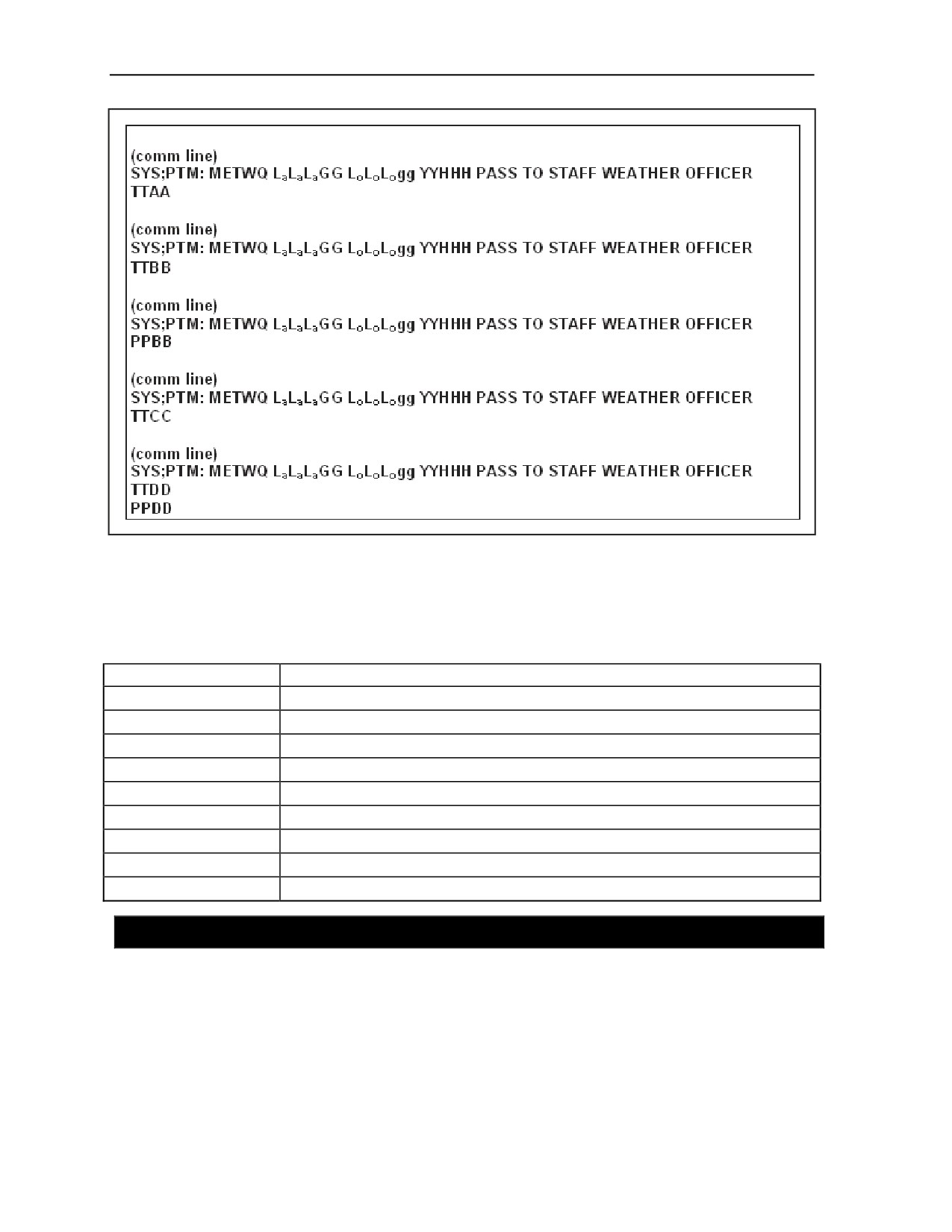
WORLD METEOROLOGICAL ORGANIZATION MET MESSAGE
A-25. The heading of the WMO MET message is included in the SYS;PTM line instead of having a
separate line as with other messages. The body of the message contains atmospheric data presented in the
standard WMO message format, not in the data line format. The PTM format for the WMO MET message
is shown in figure A-16. All of the entries for each part are not shown. The symbols in the heading of the
PTM format WMO MET message are defined in table A-8.
25 October 2007
FM 3-09.15/MCWP 3-16.5
A-9
Appendix A
Figure A-16. WMO MET message PTM format
Table A-8. WMO MET Message Heading Symbols
Symbols
Definitions
MET
Message category-meteorological
W
Message type-WMO
Q
Octant of the globe (0 to 3 or 5 to 9)
LaLaLa
Latitude of the station
GG
Release hour GMT (00 to 23)
LoLoLo
Longitude of the station
Gg
Release minute (GMT) (00 to 59)
YY
Date of release (GMT)
HHH
Altitude of MET station in tens of meters
SECTION II JVMF MET MESSAGES (MMS-P)
OVERVIEW
A-26. Digital transmission is the primary means of sending MET messages to FA units. The MMS-P
equipped MET section produces MET messages on demand in the format requested by the using unit. This
is a shift from the manner MET messages were previously disseminated. Previously, a MET message was
generated on a planned schedule and transmitted to the controlling headquarters FCE. The MET message
was then broadcast (push method) to using units. The MMS-P processes requests for MET (pull method)
A-10
FM 3-09.15/MCWP 3-16.5
25 October 2007
MET Messages
from using units. Upon the receipt of a request for MET, the MMS-P system generates MET data based on
the midpoint between the unit’s location and the target location.
A-27. Requests for MET and the resulting MET messages are normally routed through the controlling
FCE. Using the primary/indirect option on the Advanced Field Artillery Tactical Data System (AFATDS),
the using units can send requests to the MMS-P equipped system.
A-28. The MMS-P equipped section uses the common message processor (CMP). CMP use is mandated in
all newer systems to increase interoperability between systems. The MET messages generated by the
MMS-P display in a format consistent with the requirements of the CMP. The data generated complies
with all standardized agreements, and can be generated in STANAG format when that option is selected.
The MMS-P system can produce all messages generated by the MMS if specifically selected during the
sounding operation.
A-29. The exception is the target area MET (TAM) message. There is currently no STANAG agreement
for this message.
MMS-P MET MESSAGES
A-30. The MMS-P message generation function generates five different MET messages. The four MET
messages generated upon request are the computer MET, target area MET, target acquisition MET, and
basic wind report. The fifth MET message generated by the MMS-P is the upper air message. The upper
air message is automatically generated by the MMS-P at the termination of a sounding flight.
Computer MET Message
A-31. The computer MET
(local area MET) message contains atmospheric data
(that is, wind
direction/speed, temperature, and air pressure) for the midpoint of the trajectory (highest point a round
would travel) between the unit grid and the target area grid. Refer to figure A-17 for computer MET
message format.
z
Atmospheric data at midpoint of the trajectory covers a
4- by 4-kilometer square by 30
kilometer high area.
z
Target grid is determined from the actual or suspected target location.
25 October 2007
FM 3-09.15/MCWP 3-16.5
A-11
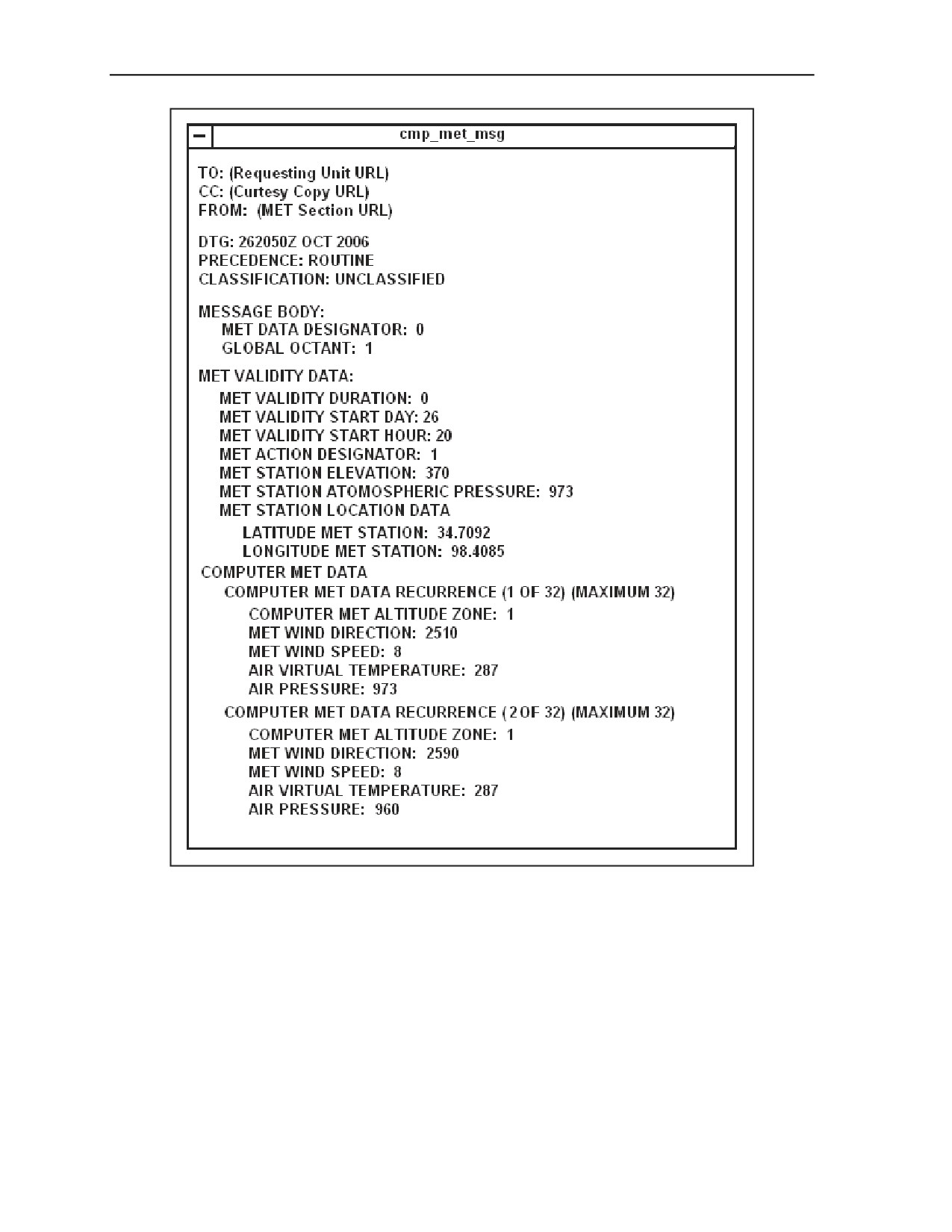
Appendix A
Figure A-17. Computer MET message format
Target Area MET (TAM) Message
A-32. The target area MET (TAM) message figure A-18 contains the atmospheric and visibility data (that
is, winds, cloud height, precipitation type/rate, and horizontal visibility) at the target location.
z
Target grid is determined from the actual target location.
z
Data can be used to determine the appropriate munitions to use on the target. For example, if the
winds, precipitation, or visibility conditions in the target area are too great, then instead of using
laser-guided munitions, where the laser could be refracted off the target, a GPS guided, or dumb
munitions, may be used instead.
A-12
FM 3-09.15/MCWP 3-16.5
25 October 2007