FM 3-09.15 TACTICS, TECHNIQUES, AND PROCEDURES FOR FIELD ARTILLERY METEOROLOGY (OCTOBER 2007) - page 1
FM 3-09.15
MCWP 3-16.5
TACTICS, TECHNIQUES,
AND PROCEDURES FOR
FIELD ARTILLERY
METEOROLOGY
OCTOBER 2007
HEADQUARTERS, DEPARTMENT OF THE ARMY
DISTRIBUTION RESTRICTION: Approved for public release; distribution is unlimited.
*FM 3-09.15 (FM 6-15)
MCWP 3-16.5
Field Manual
Headquarters
Department of the Army
No. 3-09.15
Washington, DC, 25 October 2007
Tactics, Techniques, and Procedures for Field
Artillery Meteorology
Contents
Page
PREFACE
x
Chapter 1
Commander and Staff Considerations
1-1
Section I overview
1-1
Mission
1-1
U.S. Army MET Sections
1-2
U.S. Marine Corps MET Section
1-2
MET Systems
1-2
Capabilities
1-2
Command and Control
1-4
Section II Operational Considerations
1-5
Scheduling and Positioning
1-5
Profiler Characterization
1-9
Chapter 2
Additional Sources of Meteorological Information
2-1
Allied Nations
2-1
U.S. Air Force
2-2
U.S. Navy
2-2
Marine Corps
2-2
Numerical Weather Prediction
2-2
Chapter 3
Weather and Its Effects
3-1
Distribution Restriction: Approved for public release, distribution is unlimited.
*This publication supersedes FM 6-15-, 13 August 1997.
i
Contents
Section I Elementary Meteorology
3-1
Atmosphere
3-1
Heat
3-2
Moisture
3-3
Atmospheric Pressure
3-4
Clouds
3-5
Air Masses
3-9
Section II Weather As It Applies To The Artillery
3-12
Field Artillery MET
3-12
Mesoscale Modeling
3-17
MET Effects On Smart Munitions
3-22
Chapter 4
Operating Principles
4-1
Section I MMS Sections
4-1
Navigational Aid (NAVAID) System
4-1
RDF Operations
4-3
GPS Operations
4-3
Section II MMS-P Sections
4-3
Degraded Mode Operations
4-4
Section III Visual MET
4-5
Pilot Balloon (PIBAL) Observations (USMC)
4-5
Chapter 5
Meteorological Measuring Set, AN/TMQ-41
5-1
Section I MMS AN/TMQ-41 Equipment
5-1
Section II AN/TMQ-41 Section Site Operations
5-3
Site Selection
5-3
Survey Requirements
5-4
RDF Emplacement
5-4
Equipment Shelter Emplacement
5-4
Balloon Inflation Site
5-4
Camouflage
5-5
Section III AN/TMQ-41 Section Personnel
5-6
Field artillery (FA) MET Station Leader (SFC, MOS 13W40)
5-7
FA MET Section Sergeant (SSG, MOS 13W30)
5-8
FA MET Equipment Repairer (SGT, MOS 13W20H1)
5-8
FA MET Equipment Repairer (SPC, MOS 13W10H1)
5-8
FA MET Crewmember (SPC, MOS 13W10)
5-8
FA MET Crewmember (PFC, MOS 13W10)
5-9
Section IV Suggested Load Plans
5-10
Chapter 6
Meteorological Measuring Set-Profiler, AN/TMQ-52
6-1
Section I MMS-P AN/TMQ-52 Equipment
6-1
Shelter Equipment Group
6-1
Section II AN/TMQ-52 Section Site Operations
6-3
Site Selection
6-3
Equipment Shelter Emplacement
6-4
Balloon Inflation Site
6-4
Camouflage
6-5
ii
FM 3-09.15/MCWP 3-16.5
25 October 2007
Contents
Displacement Procedures
6-5
Section III AN/TMQ-52 Section Personnel
6-6
FA MET Station Leader (SFC, MOS 13W40)
6-6
FA MET Section Sergeant (SSG, MOS 13W30)
6-7
FA MET Equipment Repairer (SGT, MOS 13W20H1)
6-7
FA MET Equipment Repairer (SPC, MOS 13W10H1)
6-7
FA MET Crewmember (SPC, MOS 13W10)
6-7
FA MET Crewmember (PFC, MOS 13W10)
6-8
Section IV Suggested Load Plans
6-8
Chapter 7
Balloon Inflation and Launching Procedures
7-1
Section I Overview
7-1
Safety Procedures
7-1
Gases Used For Inflation
7-3
Section III Inflation Procedures
7-4
Balloon Inflation And Launching Device, ML-594/U
7-4
Commercial Gas Regulators
7-4
Balloons
7-4
Preparation of Balloons
7-5
Night-Lighting Unit
7-5
Determining Lift For Balloons
7-5
Determining Gas Volume Required
7-7
Inflation Using the Inflation and Launching Device
7-8
Inflation Shelter
7-9
Nozzles and Weights
7-10
Inflating the Pilot Balloon
7-10
Inflating the Sounding Balloon
7-10
Tying Off the Balloon
7-11
Balloon Train
7-11
Section IV Release Procedures
7-12
Releasing From the Inflation and Launching Device
7-12
Releasing From an Inflation Shelter
7-13
Release Using a Balloon Shroud
7-14
Chapter 8
Personnel, Logistics, and Maintenance
8-1
Personnel
8-1
Logistics Planning
8-1
Basic Load and Stockage Levels
8-2
Logistical Supply Channels and Locations of Reserve Stocks
8-2
Communications
8-3
Maintenance Concept
8-3
Appendix A
Met Messages
A-1
SECTION I MMS FATDS MET MESSAGES
A-1
Overview
A-1
Section II JVMF MET Messages (MMS-P)
A-10
Common Message Processor
A-15
Section III Standard MET Messages
A-18
25 October 2007
FM 3-09.15/MCWP 3-16.5
iii
Contents
Encoding Standard Messages From MMS-P MET Messages
A-44
Section IV Artillery Limited Surface Observation MET Message
A-45
overview
A-45
Section V MET Message Checking Procedures
A-55
Appendix B
World Meteorological Organization Cloud Codes
B-1
Appendix C
MET Support Request Procedures
C-1
Appendix D
Example MET Plan
D-1
Example MET Plan
D-1
Appendix E
Global Positioning System (GPS)
E-1
GPS System
E-1
Appendix F
NAVAID Coverage Charts and Tables
F-1
Appendix G
Safety and Environmental Requirements
G-1
General
G-1
Appendix H
Environmental Awareness
H-1
Section I-Army Environmental Awareness
H-1
Section II-Meteorology Environmental Considerations
H-1
Maintenance
H-3
Supply
H-4
Section III-Regulatory Requirements
H-5
Section IV. Environmental Risk Management
H-7
Appendix I
Time Zones, Octants, and Regions
I-1
Time Zones
I-1
Global Octants
I-1
Climatic Regions
I-1
GLOSSARY
Glossary-1
REFERENCES
References-1
INDEX
Index-1
Figures
Figure 1-1. MMS MET message area of validity
1-8
Figure 1-2 MMS-P MET message area of validity
1-9
Figure 1-3. Examples of positioning for wind
1-10
Figure 1-4. MET day
1-11
Figure 1-5. Leapfrog movement technique
1-14
Figure 1-6. Nonlinear battlefield
1-17
Figure 2-1. 45 kilometers
2-3
Figure 2-2. 15 kilometers
2-4
Figure 2-3. 5 kilometers
2-4
Figure 3-1. Earth’s atmosphere
3-1
iv
FM 3-09.15/MCWP 3-16.5
25 October 2007
Contents
Figure
3-2. Temperature scales
3-3
Figure
3-3. Atmospheric pressure
3-4
Figure
3-4. Cloud types
3-7
Figure
3-5. General circulation pattern
3-8
Figure
3-6. Cold front
3-10
Figure
3-7. Warm front
3-11
Figure
3-8. Warm front occlusion
3-12
Figure
3-9. Cold front occlusion
3-12
Figure
3-10. Effect of a 20-knot tail wind
3-16
Figure
3-11. Effect of a 20-knot crosswind
3-16
Figure
3-12. Effect of temperature
3-17
Figure
3-13. Effect of density
3-17
Figure
3-15. Nested domains
3-19
Figure
3-16. Atmospheric profile
3-20
Figure
3-17. NEEDS CAPTION
3-21
Figure
3-18. MET data reference point
3-22
Figure
4-1. Southeast U.S. chain
4-2
Figure
4-2. Remote launch capability
4-3
Figure
4-3. Example degraded mode timeline
4-5
Figure
5-1. AN/TMQ-41 equipment
5-1
Figure
5-2. Site occupation
5-5
Figure
5-3. Vehicle 1 with trailer
5-10
Figure
5-4. Vehicle 2 with trailer
5-11
Figure
5-5. Vehicle 3 with trailer
5-12
Figure
6-1. AN/TMQ-52 equipment
6-1
Figure
6-2. Site occupation
6-5
Figure
6-3 Vehicle 1 (shelter) load plan
6-8
Figure
6-4 Vehicle 2 load plan
6-9
Figure
6-5 Vehicle 3 load plan
6-10
Figure
7-1. Personnel ground
7-3
Figure
7-2. Completed grounding field
7-3
Figure
7-3. Inflation nomograph
7-8
Figure
7-4. Required total lift example
7-9
Figure
7-5. Weigh-off example
7-10
Figure
7-6. Tying fff the balloon
7-11
Figure
7-7. Balloon train
7-12
Figure
7-8. Release from the inflation and launching device
7-13
Figure
7-9. Release using a shroud
7-15
Figure A-1. Comm line format
A-1
Figure A-2. Comm line header format
A-2
Figure A-3. Priority field format
A-2
25 October 2007
FM 3-09.15/MCWP 3-16.5
v
Contents
Figure A-4. Subscriber field format
A-3
Figure A-5 Security Classification Field
A-3
Figure A-6. Segment information field format
A-4
Figure A-7. Date-time-group field format
A-4
Figure A-8. Message identification number field format
A-4
Figure A-9. Automatic transmission field format
A-5
Figure A-10. Digital data terminal field format
A-5
Figure A-11. FATDS MET message heading format
A-5
Figure A-12. FATDS computer MET message format
A-7
Figure A-13. FATDS fallout MET message format
A-7
Figure A-14. FATDS target acquisition MET message format
A-8
Figure A-15. Ballistic MET message (PTM) format
A-8
Figure A-16. WMO MET message PTM format
A-10
Figure A-17. Computer MET message format
A-12
Figure A-18. Target area MET message format
A-13
Figure A-19. Target area MET message format
A-14
Figure A-20. Basic wind report
A-15
Figure A-21. Main message menu screen
A-16
Figure A-22. Host address block
A-17
Figure A-23. CMP toolbar
A-18
Figure A-24. Message format toolbar
A-18
Figure A-25. DA Form 3677-R
A-19
Figure A-26. Computer MET message identification line
A-20
Figure A-27. Example MET message body
A-21
Figure A-28. DA Form 3677-R (Reverse)
A-22
Figure A-29. DA Form 3675-R
A-23
Figure A-30. Ballistic MET message identification line
A-24
Figure A-31. Ballistic MET message body
A-25
Figure A-32. DA Form 3675-R
A-26
Figure A-33. DA Form 3675-R (Reverse)
A-27
Figure A-34. Sound ranging MET message format
A-31
Figure A-35. WMO MET message identification line
A-31
Figure A-36. Format for part A (TTAA) of WMO MET message
A-32
Figure A-37. Format for section 1, part A (TTAA) of WMO MET message
A-32
Figure A-38. Format for section 2, part A (TTAA) of WMO MET message
A-33
Figure A-39. Surface pressure reporting
A-36
Figure A-40. Format for section 3, part A (TTAA) of WMO MET message
A-36
Figure A-41. Format for section 4, part A (TTAA) of WMO MET message
A-37
Figure A-42. Format for part B (TTBB) of WMO MET message
A-37
Figure A-43. Section 1, part B (TTBB) of WMO MET message
A-38
Figure A-44. Section 5, part B (TTBB) of WMO MET message
A-38
vi
FM 3-09.15/MCWP 3-16.5
25 October 2007
Contents
Figure A-45. Section 7, part B (TTBB) of WMO MET message
A-38
Figure A-46. Section 8, part B (TTBB) of WMO MET message
A-39
Figure A-47. Section 9, part B (TTBB) of WMO MET message
A-39
Figure A-48. Format for part B (PPBB) of WMO MET messages
A-39
Figure A-49. Format of part C (TTCC) of WMO MET message
A-41
Figure A-50. Format of part D (TTDD) of WMO MET message
A-41
Figure A-51. Format of part D (PPDD) of WMO MET message
A-42
Figure A-52. DA Form 3676-R
A-43
Figure A-53. MMS-P MET message format
A-45
Figure A-54. Cloud cover
A-47
Figure A-55. Quadrant visibility
A-49
Figure B-1 Format for part B (TTBB) of WMO MET message
B-1
Figure C-1. Message request structure
C-1
Figure C-2. MET message request
C-5
Figure E-1. GPS satellite constellation
E-2
Figure F1. LORAN-C, Calcutta chain GRI 5543
F-7
Figure F-2. LORAN-C, Canadian east coast Chain GRI 5930
F-8
Figure F3. LORAN-C, Russian-American chain GRI 5980Figure F4. LORAN-C,
Canadian west coast chain, GRI 5990
F-9
Figure F4. LORAN-C, Canadian west coast chain, GRI 5990
F-10
Figure F5. LORAN-C, Bombay chain GRI 6042
F-11
Figure F6. LORAN-C, Lessay chain GRI 6780
F-12
Figure F7. LORAN-C, China south sea GRI 6780
F-13
Figure F8. LORAN-C, Bo chain GRI 7001
F-14
Figure F-9. LORAN-C, south Saudi Arabian chain, GR 7030
F-15
Figure F10. LORAN-C, Newfoundland east coast GRI 7270
F-16
Figure F11. LORAN-C, China north sea GRI 7430
F-17
Figure F12. LORAN-C, Sylt chain GRI 7499
F-18
Figure F13. LORAN-C, eastern Russia Chayka chain GRI 7950
F-19
Figure F-14. LORAN-C, Gulf of Alaska chain, GRI 7960
F-20
Figure F-15. LORAN-C, southeast United States chain, GRI 7980
F-21
Figure F-16. LORAN-C, Mediterranean chain, GRI 7990
F-22
Figure F-17. LORAN-C, north central United States chain, GRI 8290
F-23
Figure F-18. LORAN-C, north Saudi Arabian chain, GRI 8830
F-24
Figure F-19. LORAN-C, Great Lakes chain, GRI 8970
F-25
Figure F-20. LORAN-C, south central United States chain, GRI 9610
F-26
Figure F-21. East Asia GRI 9930
F-27
Figure F-22. LORAN-C, United States west coast chain, GRI 9940
F-28
Figure F-23. LORAN-C, northeast United States chain, GRI 9960
F-29
Figure F-24. LORAN-C, north Pacific chain, GRI 9990
F-30
Figure I-1. Time zones, octants, and regions
I-2
25 October 2007
FM 3-09.15/MCWP 3-16.5
vii
Contents
Tables
Table 3-1. Atmospheric Structure of MET Message
3-14
Table 5-1. Radar Scattering Camouflage Modules
5-5
Table 5-2. AN/TMQ-41 Section Personnel (U.S. Army) and AN/TMQ-41 Section
Personnel (U.S. Marine Corps)
5-6
Table
6-1. Radar Scattering Camouflage Modules
6-5
Table
6-2. AN/TMQ-52 Section Personnel (US Army)
6-6
Table
7-1. Balloon Ascent Rate, Free Lift, Weight, and Bursting Altitude
7-6
Table
7-2. Weights of Attachments
7-7
Table
7-3. Additional Weights for Adverse Weather Conditions (Sounding only)
7-7
Table A-1. Security Classification Field Entries
A-3
Table A-2. FATDS MET Message Heading Fields
A-5
Table A-3. FATDS Computer MET Message Body Symbols
A-7
Table A-4. FATDS Fallout MET Message Body Symbols
A-7
Table A-5. FATDS Target Acquisition Message Symbols
A-8
Table A-6. FATDS Ballistic MET Message Heading Symbols
A-8
Table A-7. Ballistic MET Message Body Symbols
A-9
Table A-8. WMO MET Message Heading Symbols
A-10
Table A-9 Octant of Globe Q Code
A-20
Table A-10. TA MET Message Groups
A-28
Table A-11 Cloud Code
A-29
Table A-12. Zone Number Code
A-29
Table A-13. Codes for Last Millibar Level That Winds Are Available
A-33
Table A-14. Temperature Tenths Value Code
A-33
Table A-15. Dew Point Depression Code
A-34
Table A-16. Mandatory Pressure Levels
A-35
Table A-17. Fixed Regional Levels
A-40
Table A-18. Fixed Regional Level Data
A-42
Table A-19. Na-Total Amount of Cloud Cover
A-47
Table A-20. Additional Codes
A-47
Table A-21. D-Direction From Which Surface Wind is Blowing
A-48
Table A-22. F-Force of Surface Wind (Beaufort Scale)
A-48
Table A-23. V-Visibility at Surface
A-49
Table A-24. w-Present Weather and Obstructions to Vision
A-50
Table A-25. A’-Amplification of Phenomenon Reported by w
A-51
Table A-26. R-State of Road in Vicinity of the Observation Point
A-52
Table A-27. T-State of Terrain in the Vicinity of the Observation Point
A-52
Table A-28. A-Sate of Water Surface
A-52
Table A-29. Nh-Amount of Cloud Reported at Height ha
A-53
viii
FM 3-09.15/MCWP 3-16.5
25 October 2007
Contents
Table A-30. ha-Height of the Lowest Cloud Layer Above the Observation Point
A-54
Table A-31. Hs-Average Height of Breakers
A-54
Table A-32. Ps-Period of Breakers (Seconds) Time Required for Successive
Breakers to Pass a Given Point
A-54
Table A-33. Dw-Direction of Approach of Waves To Beach (Observers Back to Sea)
A-54
Table A-34. Ws-Width of Surf Zone (Distance from Edge of Water to the Point
Seaward that the White Caps of the Surf Begin to Appear)
A-55
Table B-1. Amount of Low/Middle Cloud, Nh
B-2
Table B-2. Coding of Low Cloud, CL
B-2
Table B-3. Height of Cloud Base Above Ground, h
B-3
Table B-4. Coding of Middle Cloud, CM
B-4
Table B-5. Coding of High Cloud, CH
B-5
Table C-1. Symbols in Message Request for MET Support
C-1
Table C-2. Q Code for Octant of the Globe
C-2
Table C-3. Line Codes for Ballistic MET Messages (Type 2 or 3)
C-2
Table C-4. Zone Number Codes for Target Acquisition MET Message
C-3
Table C-5. Zone Number Codes for Computer MET Messages
C-4
Table D-1. Acronyms and Abbreviations
D-1
Table F-1. LORAN Chains’ Stations
F-1
Table H-1 Material Safety Data Sheet
H-3
Table H-2. Environmental Laws and Regulations
H-5
Table H-3. Regulatory Training Requirements
H-6
Table H-4. Common Environmental Hazards
H-8
Table H-5. Examples of Environmental Controls
H-9
25 October 2007
FM 3-09.15/MCWP 3-16.5
ix
Contents
Preface
This publication provides the United States Army and United States Marine Corps (USMC) commanders,
artillerymen, and meteorology (MET) crew members with tactics, techniques, and procedures for the
employment of MET sections. This publication describes the equipment and tasks required to develop MET
data from the selection of the MET station location to the dissemination of the MET data.
This publication implements the following North Atlantic Treaty Organization
(NATO) standardization
agreements (STANAGs).
• STANAG 4044, Adoption of a Standard Atmosphere.
• STANAG 4061, Adoption of a Standard Ballistic Meteorological Message.
• STANAG 4082, Adoption of Standard Artillery Computer Meteorological Message.
• STANAG 4103, Format of Request for Meteorological Message for Ballistic and Special
Purposes.
• STANAG 4140, Adoption of a Standard Target Acquisition Meteorological Message.
• STANAG 4168, Characteristics of Hydrogen Generating Equipment.
This publication applies to U.S. Army and Marine Corps planning and warfighting personnel, the Active Army,
the Army National Guard/Army National Guard of the United States, and the United States Army Reserve
unless otherwise stated.
The proponent of this publication is United States Training and Doctrine Command. Send comments and
recommendations on DA Form 2028 (Recommended Changes to Publications and Blank Forms) directly to:
Commandant
U.S. Army Field Artillery School
ATTN: ATSF-DD
Fort Sill, OK 73503-5600
x
FM 3-09.15/MCWP 3-16.5
25 October 2007
Commander and Staff Considerations
Chapter 1
Commander and Staff Considerations
Combat experience has proven the importance of providing accurate and timely
meteorological data to both artillery and other units. MET sections provide data to
enhance first round accuracy, effective downwind predictions, intelligence
preparation of the battlefield, and forecast capabilities of the staff weather officer.
The commander and staff must include meteorology in the planning process. The
planning process focuses on what data is needed, who needs it, and how will they get
it. Artillery meteorology, as one of the five requirements for accurate predicted fires,
plays an increasingly vital role in today’s changing operational environment.
Accuracy of indirect fires increases the lethality and directly relates to other issues of
strategic importance such as collateral damage.
1-1. Since MET is one of the five requirements for accurate and predicted fires it is considered part of the
precision fires system of systems. MET sections provide data to enhance first round accuracy, effective
downwind predictions, intelligence preparation of the battlefield, and forecast capabilities of the staff
weather officer. The commander and staff who include meteorology in the planning process should always
use the most accurate MET data available as it will benefit the most. The planning process focuses on what
data is needed, who needs it, and how will they acquire it.
SECTION I OVERVIEW
NOTE: The U.S. Army Intelligence Center and Fort Huachuca is the proponent for Army
general and tactical weather requirements, except those relating to artillery MET.
MISSION
1-2. The mission of the MET section is to produce and disseminate valid and timely MET data in
formatted messages. Example messages and checking procedures are at appendix A. These messages are as
follows:
z
Computer
z
Ballistic (type 2 and type 3)
z
Target acquisition
z
Target area MET (Meteorological Measuring Set-Profiler [MMS-P] only)
z
Basic wind report (MMS-P only)
z
Fallout MET (FOMET)
z
World Meteorological Organization (WMO) messages
z
Sound ranging messages to allied units.
25 October 2007
FM 3-09.15/MCWP 3-16.5
1-1
Chapter 1
U.S. ARMY MET SECTIONS
1-3. Under the modular structure, Army MET sections are deployed as follows:
z
Each brigade combat team (BCT) will have one Fires Battalion that will include a MET section.
z
Each STRYKER Brigade will have one field artillery (FA) battalion (BN) that will include a
MET section.
z
Each Fires Brigade will have three MET sections as part of the Target Acquisition Battery.
U.S. MARINE CORPS MET SECTION
1-4. The MET section is divided into four MET teams in an artillery regiment. These teams provide
support to the battalions and batteries of the regiment. The teams are given tactical missions based on
current as well as future operations.
MET SYSTEMS
1-5. There are two basic MET systems deployed throughout the field artillery: The Meteorological
Measuring Set
(MMS), AN/TMQ-41, and the Meteorological Measuring Set-Profiler
(MMS-P),
AN/TMQ-52. These systems are highly mobile, automated data processing and MET data acquisition
systems. Both systems operate in any type of climatic condition and over any type of terrain where tactical
operations require employment of FA. The preferred meteorological support assets during traditional
maneuver warfare are the MMS-P and the MMS. Both systems are vehicle-borne systems. The MMS-P
provides localized now-casts of atmospheric numerical weather predictions, whereas the MMS provides
meteorological data to using units by tracking a balloon borne radiosonde, which provides vertical zoned
atmospheric numerical meteorological output.
MMS (AN/TMQ-41)
1-6. The AN/TMQ-41 uses three passive modes to track a balloon-borne radiosonde that transmits the
upper air data to the ground station. These are the radio navigational aid (NAVAID), radio direction
finding (RDF), and Global Positioning System (GPS) modes. The NAVAID and GPS modes have a remote
launch capability. The AN/TMQ-41 can track the radiosonde and process data while on the move.
MMS-P (AN/TMQ-52)
1-7. The AN/TMQ-52 uses mesoscale modeling (MM5) with 4-kilometer grid spacing granularity, as
well as software coupled with the Unified Post Processing System (UPPS) to generate MET data upon
request. The MM5 model ingests upper air data (NAVAID and GPS modes), surface observation data,
terrain data, regional observations, and large scale weather data. The MM5 model also takes into
consideration historical, topographical, climatological weather data, as well as vertical and horizontal
resolutions. The resulting model output is transferred to the UPPS to eliminate model biases. The model
restarts every 30 minutes, providing data with a staleness of no more than 30 minutes. Using this data, the
MMS-P generates MET data for the mid point of the trajectory, which is based on the gun location and the
target location as well as target area MET. Additionally, the AN/TMQ-52 is capable of operating in two
degraded modes (see paragraph 1-9). Future block improvements to MMS-P include decreasing the
reliance on radiosondes, decreasing the amount of section equipment, and decreasing the number of section
personnel. The ultimate goal of profiler is to be imbedded on to the firing platform.
CAPABILITIES
1-8.
The capabilities of the met section vary based on the specific system being used. Both systems
provide met data for use by the field artillery. The mms system is the older system and operational concept
is based on providing met data from radiosonde observations. The mms-p operational concept is based on
the system ingesting a variety of sources of raw met input and producing met data via a model.
1-2
FM 3-09.15/ MCWP 3-16.5
25 October 2007
Commander and Staff Considerations
1-9.
While both systems retain the essential capabilities of obtaining, processing, and disseminating
met data, the operational concept of the MMS-P provides the met section with more capabilities than the
mms.
MMS EQUIPPED SECTION
1-10. The MMS is equipped to produce electronic soundings of the atmosphere to 30,000 meters, day or
night, in various types of weather. An important factor in providing MET data is the time required for a
balloon to reach a required height. Generally, altitude requirements for artillery MET messages are low,
10,000 meters or less. Air Force weather (AFW) and chemical, biological, radiological, and nuclear
(CBRN) support are high altitude soundings requiring more time. The MET section can provide hourly
artillery MET data if necessary during high-intensity battle. The artillery meteorologists do not forecast
weather; that is the responsibility of the staff weather officer (SWO). However, the MET crew member can
distinguish major types and changes of weather that will affect the validity of MET messages. This
knowledge allows the crew member to recommend changes to MET sounding schedules to provide
accurate MET data during changing weather conditions.
MMS-P EQUIPPED SECTION
1-11. The MMS-P utilizes sounding data, but requires fewer soundings to maintain continuous MET
coverage. The important factor in providing MET data for the MMS-P is the availability of large scale
atmospheric data. Large scale atmospheric data is generated by the Naval Operational Global Atmospheric
Prediction System (NOGAPS) and is transmitted every 12 hours by the Air Force Weather Agency
(AFWA) via satellite. Each NOGAPS transmission provides the system with 72 hours of valid large scale
atmospheric data. The profiler is capable of providing MET out to a distance of 500 kilometers from the
MMS-P location. This has been characterized with excellent results, but has only been certified to 60
kilometers. Additionally the MMS-P characterization results demonstrated that with
48-hour-old
NOGAPS, the radiosonde provided only minimal improvement to model accuracy. Commanders should
consider using MMS-P without the radiosonde as a viable solution for MET when radiosondes are scarce
or not available and current NOGAPS is available. Degraded operations mode is defined as either no
radiosonde and current NOGAPS or no current NOGAPS and operating with only radiosondes.
1-12. The AN/TMQ-41 and AN/TMQ-52 contain external backup systems for obtaining meteorological
data when electronic systems are unavailable. The Extrapolated MET Program incorporated into the
AN/TMQ-55 tactical meteorology (TACMET) sensor will provide a nine-line extrapolated computer
message. Initial development and statistical evaluation demonstrate that the extrapolated MET message
provides estimated vertical profile data with the same accuracy as
3-hour-old electronic met data.
Simulated artillery firing results show a significant improvement over the default (standard) computer
MET message. The extrapolated MET message is to be used only when there is no electronic means to
collect upper air sounding data. Additionally, FA units should be advised when the MET section provides
MET data using the Extrapolated MET Program.
1-13. USMC MET sections have an additional back-up capability consisting of visual MET. Visual MET
is also used when the electronic means of collecting MET is not available. Visual MET procedures will be
discussed in chapter 4. Visual MET messages contain accurate winds data as a result of data gathered from
visually tracking a pilot balloon with a theodolite. Temperature and pressure data are measured at surface,
which serves as a basis for developing temperature and pressure profiles. The accuracy of a visual MET
message is dependent on the stability of the atmosphere. The more stable the atmosphere, the more
accurate the temperature and pressure profile.
25 October 2007
FM 3-09.15/MCWP 3-16.5
1-3
Chapter 1
COMMAND AND CONTROL
1-14. Command and control (C2) of artillery MET sections is exercised at the artillery headquarters to
which the MET section is assigned or attached. During periods when there are multiple MET sections
located in proximity, a senior MET representative may be appointed to coordinate flight schedules,
logistics, and MET section location to ensure adequate coverage of the area of operations. He may
recommend tasking the mission for high-altitude soundings (WMO and FOMET messages) to MET
sections on a rotational basis. An example of decentralized control of MET assets is a MET section
deployed forward to support the covering force battle. In this situation, it is best to attach the supporting
MET section to the force artillery headquarters of the covering force.
1-15. In the modular force, each BCT, whether heavy or light, will have one MET system. Each fires
brigade will have three MET systems; however, owing to lack of assets, each fires brigade will initially be
fielded with one MET system.
ARTILLERY S3
1-16. The artillery operations officer (S3) has primary staff responsibility for the control and operations of
artillery MET assets. The operations officer is advised on the technical aspects of MET systems by the
MET station leader. For MET employment, the operations officer—
z
Prepares the MET plan, which is a tab to the FA support plan. During the preparation of the
MET plan, considers the following:
Commander’s intent and concept of the operation.
Tactical situation.
Terrain features and wind direction.
MET assets available.
Location of units to be supported.
Communications means required.
Scheduling requirements.
z
Coordinates with the SWO to determine AFW requirements.
z
Coordinates with MET station leader and unit signal staff officers to prioritize means of
communication and dissemination of messages and to assign radiosonde frequencies.
z
Coordinates all radiosonde flight schedules of MET sections within the area of operations (AO)
to provide optimal coverage to supported units. This is very important when providing MET
support for other than artillery requirements, since flight times are longer for these missions.
z
Monitors the operational status of MET sections regarding personnel, maintenance, and
logistics.
z
Advises the commander on factors affecting MET section mission capabilities.
z
Coordinates with adjacent units and the assistant operations officer at the next higher command
echelon to maximize MET message coverage. MET messages from adjacent units may be used.
z
Coordinates with the MET station leader to develop a positioning scheme for all MET assets in
support of the mission.
z
Coordinates with maneuver and supported units to gain approval to move MET sections through
and to occupy terrain.
z
Coordinates with the MET section and supported units to execute remote launch procedures to
expand areas of validity.
MET STATION LEADER
1-17. The MET station leader is the primary advisor to the artillery in all matters pertaining to MET
support in the division area. With the operations officer, he plans the tactical employment of all MET
1-4
FM 3-09.15/ MCWP 3-16.5
25 October 2007
Commander and Staff Considerations
assets. He also is responsible for the day-to-day operations of the MET section. Specifically, the MET
station leader—
z
Helps the operations officer prepare the MET plan.
z
Advises the operations officer on the employment and operation of the MET assets within the
division area.
z
Supervises MET section operations.
z
Coordinates with the logistics officer for logistical support.
z
Performs site selection and location.
z
Directs the operation, emplacement, and displacement of the MET section.
z
Performs first sergeant type duties when operating independently.
z
Maintains quality control of MET data.
z
Organizes and supervises the MET section training program.
z
Advises the operations officer on all factors affecting mission capabilities, such as personnel,
maintenance, and logistics.
SECTION II OPERATIONAL CONSIDERATIONS
SCHEDULING AND POSITIONING
1-18. Proper scheduling and positioning of met sections can enhance the effectiveness of a single met
section and maximize the effectiveness of multiple met sections.
1-19. Scheduling and positioning of met sections should be accomplished based on each systems
capabilities to best support the mission.
NOTICE TO AIRMEN
1-20. Routine radiosonde observations are, in general, exempt from the provisions of Federal Aviation
Regulation 101 relative to filing a notice to airmen (NOTAM) for the following reasons:
z
Radiosondes do not weigh more than 4 pounds (1.8 kilograms) or have a weight/size ratio of
more than 3 ounces per square inch on any surface of the package.
z
Balloons do not carry a total payload package weighing more than 6 pounds (2.72 kilograms).
z
Balloons do not transport two or more packages that weigh more than 12 pounds (5.44
kilograms).
z
Trains do not use a rope or other devices for suspension of the payload that require an impact
force of more than 50 pounds (22.88 kilograms) to separate the suspended payload from the
balloon.
NOTE: In most cases, local aviation policies and regulations require aviation tower or flight
operations to be notified prior to release of a balloon in an aviation operations area.
SCHEDULING
1-21. Scheduling considerations are different for the MMS and MMS-P systems. The MMS system
determines MET data from balloon-borne radiosondes. The resulting MET data is broadcast to users (Push
method) based on a schedule of balloon flights determined by operational requirements. The MMS-P
system determines MET data from a mesoscale model of the area of operations. Data produced by the
MMS-P may be disseminated by a user querying the system (Pull) or met data may be broadcast to users
(Push).
MMS Scheduling
1-22. The operations officer is responsible for scheduling flights within the area of operations. Users who
require MET support and who are not in normal MET message dissemination schemes forward their
25 October 2007
FM 3-09.15/MCWP 3-16.5
1-5
Chapter 1
request for MET support to the artillery operations officer. The format for the request is in appendix C. The
operations officer will coordinate with firing units and other MET data users (especially the SWO for
AFW requirements and the chemical officer for downwind prediction requirements) to determine if there
are any special requirements that must be considered. This includes the flight schedule in the MET support
plan. MET data will be transmitted to subscriber units
(Push method) based on this schedule. In
coordination with the MET station leader, the operations officer develops a flight schedule based on the
following:
z
Mission requirements (low and high altitude flights).
z
Area of validity (terrain).
z
Prevailing winds.
z
Transition periods.
z
Availability of supplies.
MMS-P Scheduling
1-23. The MMS-P system provides more scheduling flexibility owing to the nature of how the MMS-P
obtains MET data. The MMS-P does not solely rely on a balloon borne radiosonde to provide a MET data.
When operating under normal conditions, the MMS-P primarily relies on a mesoscale model to develop
MET data. Modeling provides the MMS-P the capability of producing an updated MET message every 30
minutes. Options for scheduling MET from an MMS-P equipped section are—
z
MET may be requested (pull method) by subscriber units.
z
MET may be scheduled at predetermined times (Push method).
z
MET may be scheduled based on changes in weather conditions as determined by the MET
section leader.
z
MET may be scheduled on call as determined by the artillery mission.
1-24. When operating in MMS only degraded mode, the MMS-P relies on balloon-borne radiosonde
soundings to develop a MET message. MET messages are generated upon request, but the area of MET
validity is reduced from 60 to 30 kilometers.
NOTE: A practical approach should be observed when scheduling MET from MMS or MMS-P
equipped sections. Scheduling should be based on times when MET data will make the greatest
contribution to correcting MET error. MET station leaders are encouraged to provide the
artillery operations officer information relating to routine and nonroutine changes in the
weather. This allows the operations officer to schedule MET at time most beneficial to the
artillery.
1-25. Request for MET for an MMS-P equipped section may take the form of—
z
Manual plain text message (or secure) digital message.
z
Automated digital message request.
z
Voice (radio or landline).
z
Courier.
NOTE: All requests for MET for an MMS-P equipped section must include the gun and target
information. If the MET request is for multiple firing units, the gun location will be the battery
center.
Scheduling MET for Firing Units Supporting Maneuver Units on the Move
1-26. Scheduling MET for firing units that are supporting maneuver units on the move will be different as
a result of the different capabilities of the MMS and MMS-P. The different areas of validity for the two
system will dictate scheduling MET for firing units supporting maneuver on the move.
1-6
FM 3-09.15/ MCWP 3-16.5
25 October 2007
Commander and Staff Considerations
1-27. Another consideration when scheduling MET for firing units supporting maneuver units on the move
is the process by which met data is produced. When scheduling MET from a MMS, consideration should
be given to the time required to conduct a radiosonde observation. Whereas the MMS-P does not have the
limitation of waiting on the completion of a Radiosonde Observation prior to producing Met Data. MET
Data (Push Method)
MET Data (Push Method)
1-28. If data is pushed, the MET section chief will coordinate a schedule of broadcast times and ensure the
user provides gun and target locations for the requested MET messages. If the firing units are operating in
close proximity to each other and firing on the same target, the gun location for all guns may be the battery
center. This will preclude having to process multiple MET messages resulting from the different locations
of the guns. Additionally, the MET chief will coordinate a means of broadcasts (radio, LAN, wire, courier,
phone, others)
MET Data (Pull Method)
1-29. When data is pulled
(Protocol
220C), MET data is requested by the user via the user’s
communications system using the K02.56 Message Request or the K01.03 Information Request Message.
The messages require the requestor to provide the unit reference number (URN), gun and target location,
and the type message requested. The profiler automatically generates the MET data in the requested
format. The request is automatically sent to the MMS-P where the system generates MET data based on
the user’s request. The MET data generated by the system is validated and sent to the requester by the
operator. If the MMS-P is equipped with Protocol 220A, the user requests MET using a free text message
containing the required information.
Scheduling MET for Firing Units Supporting Fixed Locations
1-30. Scheduling MET for firing units supporting fixed locations is less complex than scheduling MET
for firing units supporting maneuver units on the move. The required area of coverage is usually such that
both systems will operate from fixed locations.
1-31. When providing MET with the MMS, consideration must be given to the time required to conduct
Radiosonde Observations. The MMS-P does not have the limitation of waiting on the completion of a
Radiosonde Observation to provide data.
MET Data (Push Method)
1-32. When providing MET to firing units providing counter-fire support, the MET section chief
coordinates a schedule of broadcasts. If the gun and target locations are known, the MET section chief will
ensure the correct gun and target locations are entered for message processing.
1-33. When providing MET to firing units supporting fixed locations, the gun location is known; however,
the target location may not be known until just before the firing unit conducts a fire mission. In this case,
enter the gun location data in the target location fields (gun and target location will be the same).
MET Data (Pull Method)
1-34. When data is pulled
(Protocol
220C), MET data is requested by the user via the user’s
communications system using the K02.56 Message Request or the K01.03 Information Request Message.
The messages require the requestor to provide the URN, Gun and target location and the type message
requested. The profiler automatically generates the MET data in the requested format. The request is
automatically sent to the MMS-P where the system generates MET data based on the user’s request. The
MET data generated by the system is validated and sent to the requester by the operator. If the MMS-P is
equipped with Protocol 220A, the user requests MET using a free text message containing the required
information.
25 October 2007
FM 3-09.15/MCWP 3-16.5
1-7
Chapter 1
MMS Mission Requirements
1-35. A limiting factor in determining mission assignments is the time required for a sounding balloon to
reach a required altitude. When in position, a MET section can produce all types of MET messages for
low-level artillery fire about 30 minutes after releasing the balloon. A high-altitude mission requires about
90 minutes from the release time. When units are coordinating MET requirements, they must be careful not
to request higher altitudes
(more lines) than required. Requesting higher altitudes causes a delay of
message delivery times due to the increased time needed to reach the higher altitudes. See appendix C for
MET message request format.
MMS-P Mission Requirements
1-36. The MMS-P, with the mesoscale model initialized, produces requested MET messages without the
time considerations associated with the Radiosonde Observation (RAOB). When the MMS-P is operating
in a MMS-only degraded mode, the time constraints associated with flying a RAOB will exist prior to
producing a MET message.
Positioning MET Sections and Area of MET Validity
1-37. The operations officer consults with the MET station leader to analyze the terrain and its effect on
the area of meteorology validity (AMV). The following is a planning guide based on the meteorological
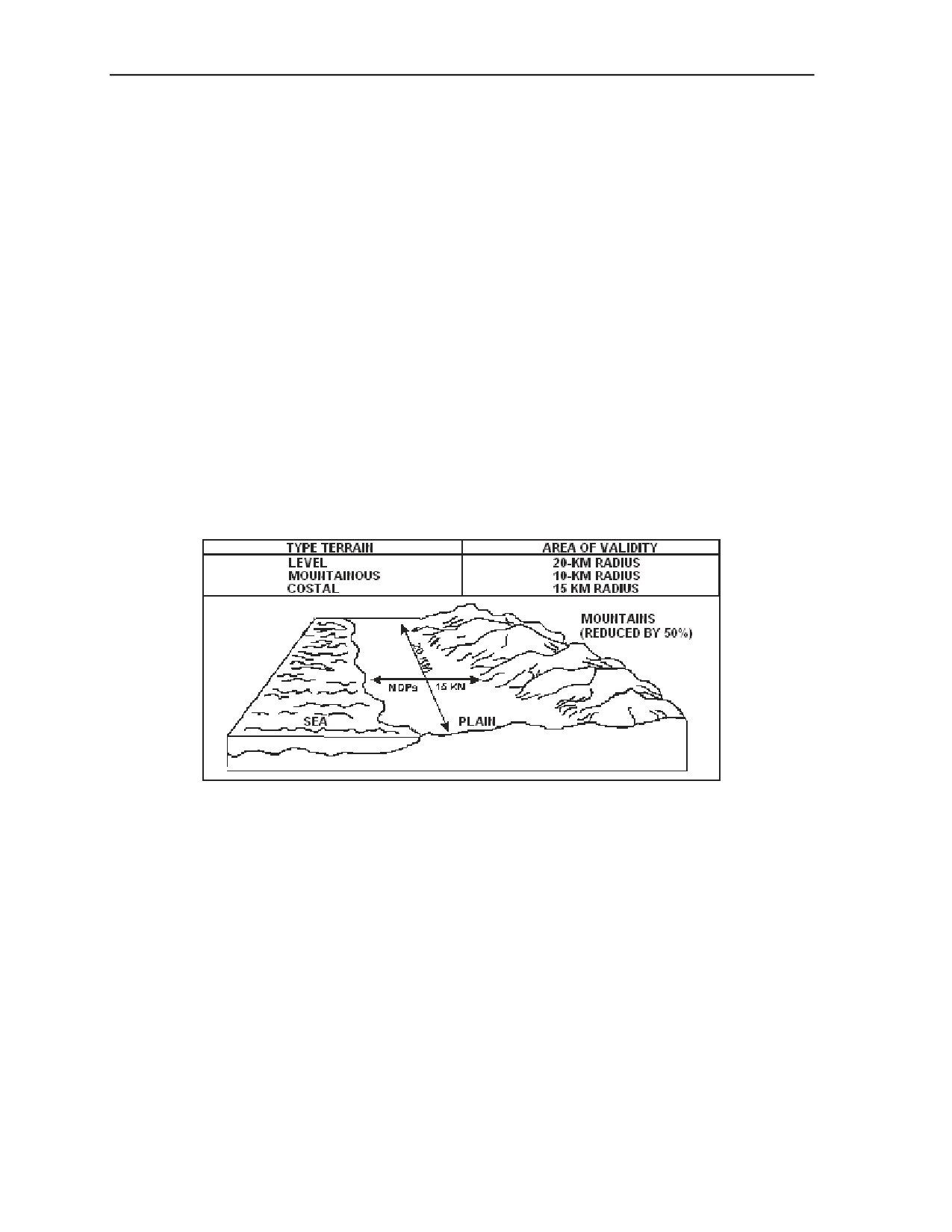
datum plane (MDP). See figure 1-1 for the AMV for the MMS.
Figure 1-1. MMS MET message area of validity
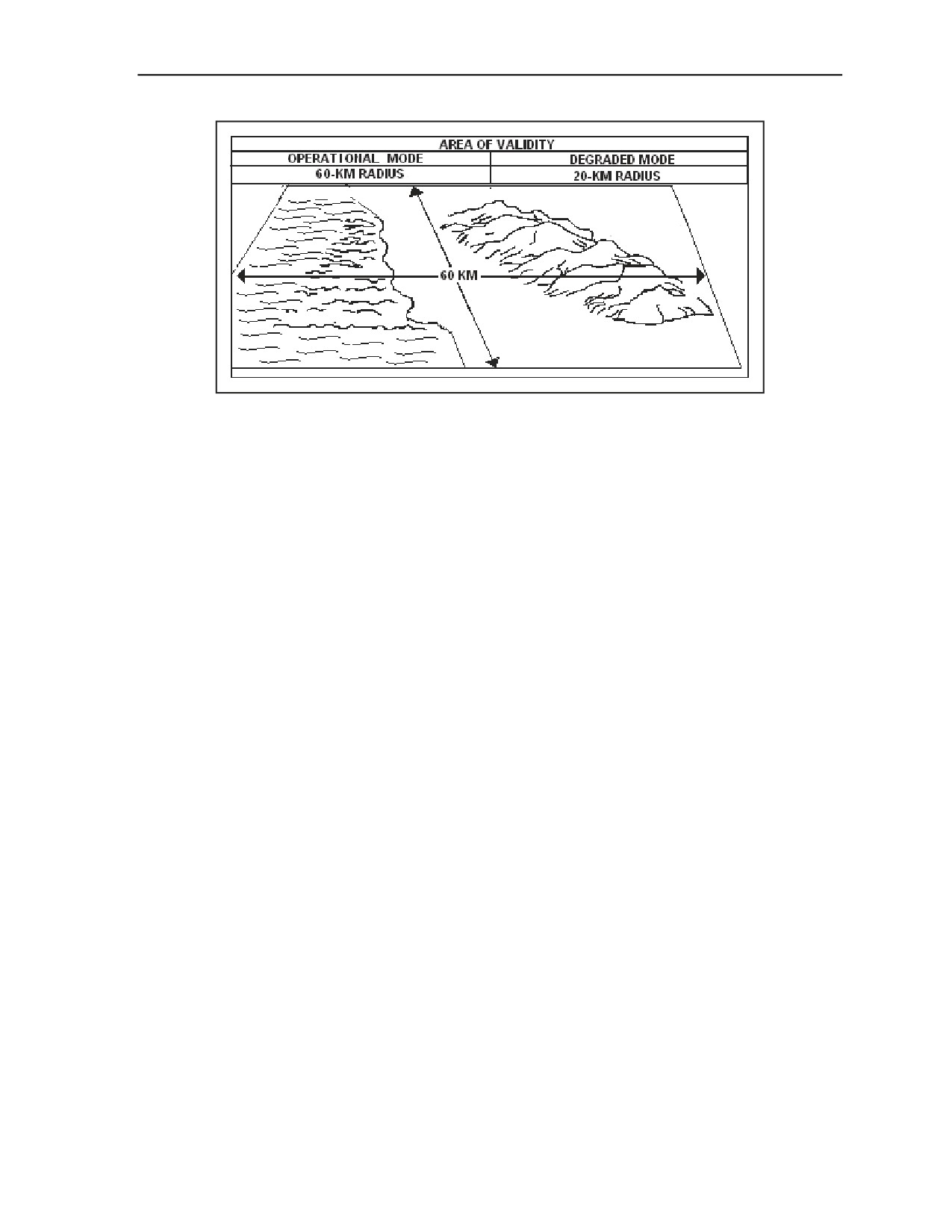
1-38. The area of validity for the MMS-P is 60 kilometers. This extended AMV gives planners additional
flexibility in providing MET coverage. The MMS-P uses terrain data when calculating MET data negating
the effects of terrain on AMV. If the MMS-P is operating in degraded mode (valid NOGAPS data is not
available), the AMV for the MMS-P is 30 kilometers. See figure 1-2 for the AMV for the MMS-P.
1-8
FM 3-09.15/ MCWP 3-16.5
25 October 2007
Commander and Staff Considerations
Figure 1-2 MMS-P MET message area of validity
1-39. The MMS-P generates MET data based on the midpoint between the requesting unit’s location and
the target location. This capability coupled with the 60-kilometer AMV provides planners with increased
flexibility when positioning the MMS-P.
PROFILER CHARACTERIZATION
1-40. Characterization of the Profiler can be looked at as an evaluation to determine its strengths and
weaknesses. There have been three characterizations of the Profiler to determine how well the system
could perform out to 500 KM from its’ position without the radiosonde. The characterization results
indicate the radiosonde had little effect on accuracy of the MET DATA produced by the Profiler when
current NOGAPS is used by the system. The overall accuracy of the system was similar to that seen during
the Developmental Test.
1-41. Based on the characterization results, Profiler without a balloon and radiosonde should be considered
a viable solution for accurate MET data when radiosondes are scarce or not available.
PREVAILING WINDS
1-42. Prevailing winds has a greater effect on positioning mms equipped sections than MMS-P equipped
sections. The manner in which met data is produced and the increased area of validity for the mms-p
removes much of the effect of prevailing winds on the positioning of the MMS-P.
1-43. MMS equipped sections are significantly affected by prevailing winds due to the need to produce
data from radiosonde observations.
MMS Equipped Sections
1-44. The prevailing winds and their effects on the flight path of the balloon are important factors in
positioning the MMS equipped MET section. The soundings made by the MET section only begin at the
location where the instrument is released. The remainder of the data is acquired along the balloon path as it
rises. The ideal MET section location allows for the balloon to travel to the horizontal and vertical location
corresponding to the maximum ordinate of the projectile. Using knowledge of the prevailing winds in the
area, the MET station leader advises the operations officer on the sites that will provide the best MET
coverage of the battlefield. Information on prevailing winds in general may be obtained from the
climatological data provided in the operation order (OPORD). This data can also be obtained from the
supporting SWO.
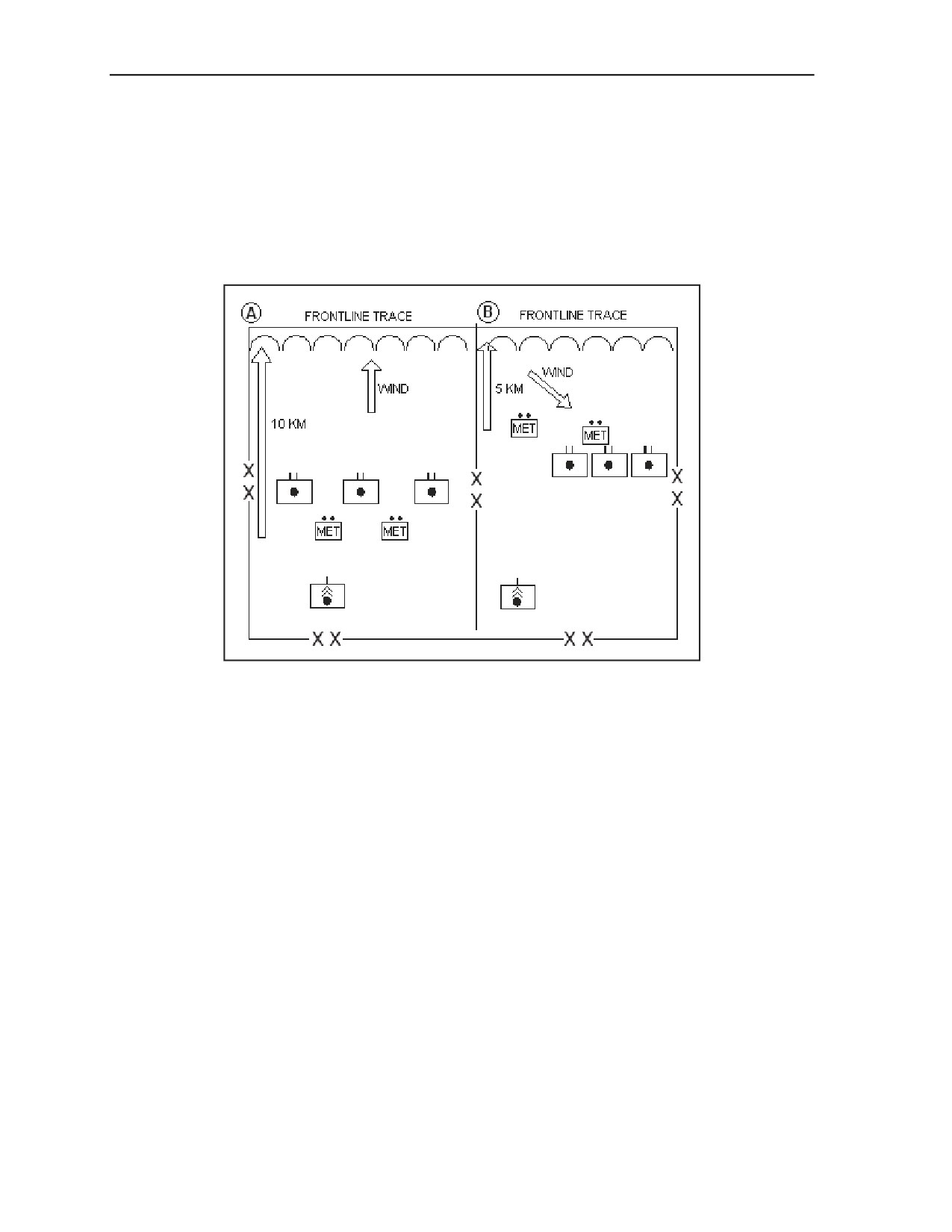
1-45. If the prevailing wind pattern is such that the contemplated balloon path is beyond the forward line
of own troops (FLOT), the section may be employed farther from the FLOT. (See figure 1-3, [A]).
25 October 2007
FM 3-09.15/MCWP 3-16.5
1-9
Chapter 1
1-46. If the prevailing wind pattern is from a flank, (see figure 1-3, [B]), the MET section is employed so
that the sounding balloon will measure the atmosphere in the zones where most of the weapon trajectories
will pass.
MMS-P Equipped Sections
1-47. Wind is not a critical consideration when positioning the MMS-P. The MMS-P determines MET
data based on the midpoint between the gun location and the target location. The MMS-P also provides a
target area Met message.
Figure 1-3. Examples of positioning for wind
TRANSITION PERIODS
1-48. The validity of a MET message decreases over time. There are no specific rules for determining how
long a MET message is usable because that determination depends on the atmospheric conditions. The
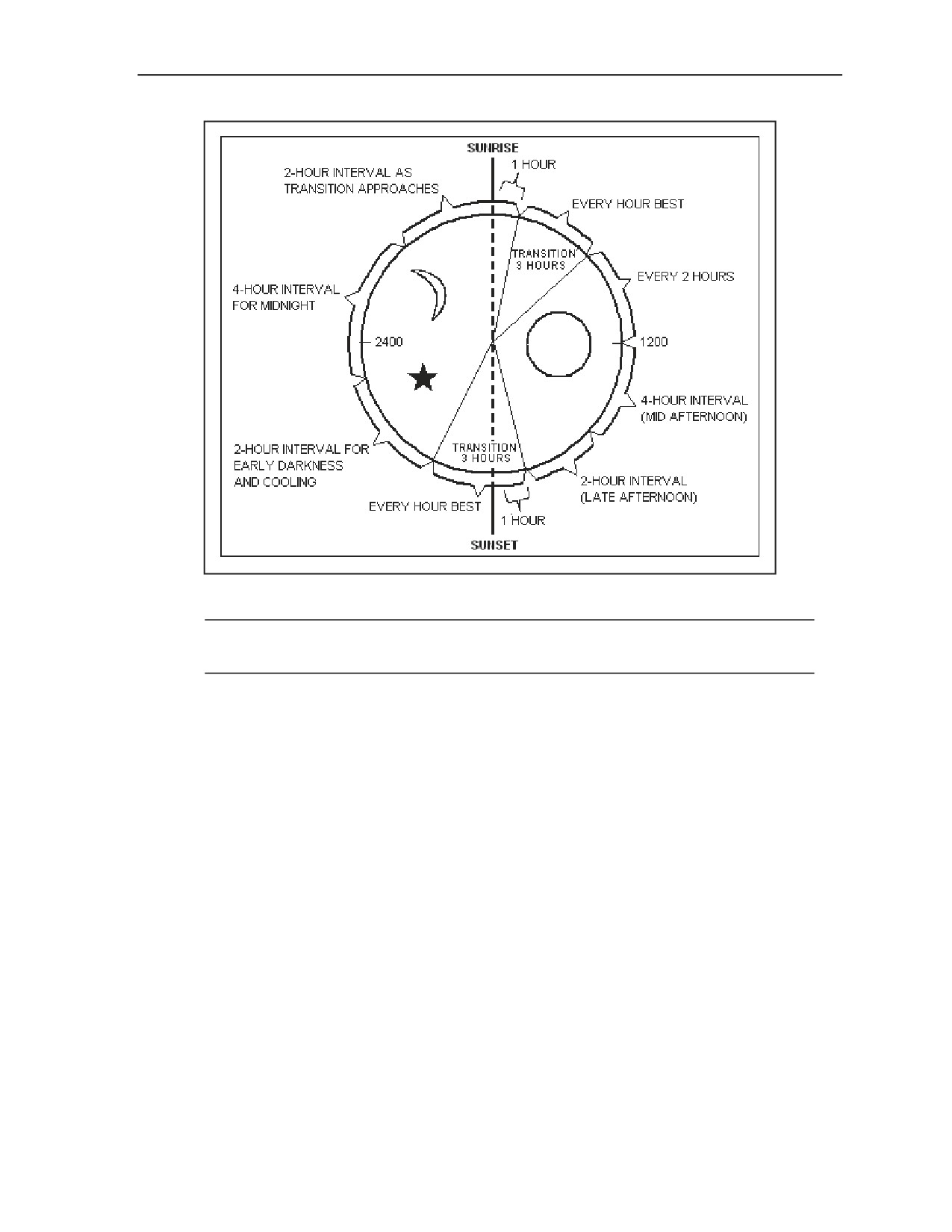
general guidance to help the operations officer prepare flight schedules for soundings is discussed below.
(See figure 1-4.)
1-49. During and just after sunrise, temperature changes occur as the atmosphere becomes heated.
Temperatures are more stable throughout the afternoon. Therefore, soundings are performed more often
(every 2 hours) in the morning and less often (every 4 hours) in the afternoon.
1-50. As sunset approaches, the air cools rapidly. During this time, changing temperatures are monitored
closely. Flight schedules may need adjusting (to one every 2 hours) as the atmosphere cools. The cooling
of the air stabilizes about 2 hours after sunset.
1-51. During night and early morning hours, the atmosphere reaches maximum cooling and becomes
stabilized. During this time, soundings could be taken at intervals that exceed 2 hours, and 4-hour intervals
between flights are common.
1-10
FM 3-09.15/ MCWP 3-16.5
25 October 2007
Commander and Staff Considerations
Figure 1-4. MET day
NOTE: The MMS-P provides more flexibility during transition periods as a result of the
systems capability to generate a new MET message every 30 minutes.
FRONTAL PASSAGES
1-52. The passage of a weather front is associated with changes in current conditions. Because of this, the
MET section should conduct a sounding immediately following the passage of a front. As a result, MET
schedules may be adjusted. The modeling capability of the MMS-P predicts the effects of frontal activity
when processing data for MET messages. The effects of frontal passages are similar for the MMS and the
MMS-P when the MMS-P is operating in a degraded mode.
COMMANDER’S INTENT
1-53. Regardless of the above, the tactical situation and the immediate needs of the field artillery
commander are the main considerations that determine positioning and scheduling.
MET MESSAGE SELECTION
1-54. Met message selection is selecting the best met message from multiple sections for a particular
mission. When multiple met sections are producing met in a single area of operations, the most appropriate
(best) met data for the mission should be provided to firing units.
1-55. there is selection criteria for mms equipped sections that should be applied to provide the best met
data. The message selection criteria is not as important for MMS-P equipped sections because the MMS-P
produces MET data on demand.
25 October 2007
FM 3-09.15/MCWP 3-16.5
1-11
Chapter 1
MMS EQUIPPED SECTION
1-56. When MET messages from several sections are available, the selection criteria below should be used
to determine which MET section should provide support to a given unit. The following criteria are
established and proven by controlled live-fire testing. Variations of this priority may exist. The MET
station leader can provide guidance in this area and advise when the use of one MET message is better than
the use of another.
z
The best data are current and provided by a MET section and balloon flight path within 20
kilometers of the midpoint of the projectile trajectory.
z
The second best data are less than 2 hours old and from the nearest section within 80 kilometers
from the trajectory midpoint (upwind is best).
z
The third best data are between 2 to 4 hours old and from a section within 20 kilometers of the
trajectory midpoint.
z
The fourth best data are from a 4-hour old message, if provided by a section and balloon flight
path within 20 kilometers of the projectile trajectory midpoint.
MMS-P EQUIPPED SECTION
1-57. The MMS-P generates MET data upon demand based on the gun location and the target location.
Units request MET messages as required.
1-58. The MET data provided by the MMS-P is provided for a location at the center-point of the gun
location and target location.
1-59. MET messages provided by the MMS-P, when operating in MMS degraded mode, are NATO
formatted Met messages.
EMPLOYMENT PLANNING
NOTE: Army MET sections may use hydrogen gas for inflation. This gas is extremely volatile.
Leaders at all levels must consider safety and environmental protection requirements during the
planning process. For MMS-P equipped sections, hydrogen gas is only available in commercial
bottles. See appendix H for additional information
1-60. When planning the employment of artillery assets in the division area, the commander and staff use
the staff planning process outlined in FM 5-0. The planning of MET operations in support of the
commander's intent and concept of the operation should be included in this process. This planning is done
by the operations officer and the MET station leader.
MISSION, ENEMY, TERRAIN, TROOPS, TIME AVAILABLE, AND CIVIL
CONSIDERATIONS
1-61. Selection of modes of operation and general position areas for MET sections is influenced by a
thorough analysis of the mission, enemy, terrain, troops, time available, and civilians (METT-TC).
MISSION
1-62. The type of mission assigned to a MET section greatly influences its positioning. The main
consideration in positioning a MET section when it is providing MET data in support of artillery operations
is to locate the section where it provides optimum coverage for the most firing units. Other (high-altitude)
MET support requirements, such as AFW support and FOMET message production to support smoke or
Chemical Biological Radiological and Nuclear (CBRN) operations, also influence the positioning of MET
assets.
1-63. The MMS-P has the capability of generating target area meteorology (TAM) data. This data is used
by planners when selecting the type of munitions to use against a target. Meteorological conditions may
1-12
FM 3-09.15/ MCWP 3-16.5
25 October 2007
Commander and Staff Considerations
limit the effectiveness of certain types of munitions. TAM data allows planners to select the most effective
munitions to neutralize the target.
ENEMY
1-64. The enemy situation, capabilities, and probable courses of action developed by the S2 during
intelligence preparation of the battlefield (IPB) greatly determine the employment of MET assets. Security
of the sections must be weighed against mission requirements.
TERRAIN
1-65. Terrain acts upon the area of validity of MET messages for the MMS system. Generally, the AMV
decreases as the distance from the user increases. Mountainous terrain and large bodies of water also affect
validity areas. The MMS-P system uses terrain data. Using this data, the weather model accounts for the
affects of terrain. Terrain does not have an effect on the AMV for the MMS-P system.
TROOPS
1-66. The size of the area to be covered and the disposition of artillery units greatly govern the way the
MMS MET section is employed. The section must be positioned where it can provide support for the
largest number of firing units. MET sections also should be located where logistical support can be
provided. Finally, MET sections must be within effective and practical communications range of the units
they support. Positioning of the MMS-P section is less dependent on the location of the firing units owing
to the 60-kilometer AMV.
TIME AVAILABLE
1-67. The operations officer and the MET station leader must consider how much time is required for
reconnaissance, movement, and occupation of initial and subsequent section positions. Upon arrival at a
location, the MET section requires about 20 minutes to emplace. Displacement time is approximately 15
minutes. Travel time is figured at the standard rate for the local conditions for wheeled vehicles.
CIVIL CONSIDERTIONS
1-68. Civil considerations relate to the civilian population, culture, organizations, and leaders within the
AO. The operations officer and the MET station leader must consider how all MET operations may directly
or indirectly affect the civilian population. This will include civilian activities and attitudes in the profiler’s
employment area
EMPLOYMENT IN SUPPORT OF INTELLIGENCE PREPARATION OF THE
BATTLEFIELD
1-69. The weather analysis has a great impact on both friendly and enemy capabilities. Analyzing the
weather data in detail to determine their effect on friendly and enemy capabilities to move, shoot, and
communicate is essential to the IPB process. Because weather also has a tremendous effect on terrain, MET
section input to terrain and weather analysis is a crucial part of the METT-TC methodology. MET sections
have the capability of providing limited surface observation data that includes terrain, visibility, water
surface, and surface atmospheric data.
1-70. The SWO is responsible for providing weather information for the AO and the area of interest (AI)
as part of the weather analysis process. The artillery MET section provides critical surface and upper
atmospheric weather data in support of weather analysis to the SWO.
1-71. The S-3 considers high-altitude requirements, WMO, and FOMET, as well as artillery requirements
when positioning and scheduling a MET section. Direct coordination among the intelligence officer, SWO,
and operations officer is required to determine requirements in support of the weather analysis process.
25 October 2007
FM 3-09.15/MCWP 3-16.5
1-13
Chapter 1
TACTICAL MOVEMENT
1-72. A MET section may deploy anywhere on the battlefield to achieve its mission of providing MET
support. Movement may be toward or away from the frontline trace or laterally, depending on weather
conditions
(mainly prevailing wind direction) and the tactical situation. The requirement to provide
continuous coverage is an important consideration in determining movement schedules. A number of
widely separated section positions must be planned. Additionally, an analysis of areas of MET validity is
necessary. Primary, alternate, and possibly even third-choice position areas are selected. The operations
officer coordinates with the maneuver element to receive approval for occupation of positions and to obtain
route clearances. MET sections then must conduct reconnaissance and select the most suitable sites within
the areas.
1-73. The increased AMV and capability of the MMS-P to generate MET data based on the midpoint
between the firing unit location and target provides greater flexibility to planners when deploying
MMS-P equipped MET sections. The ability of the MMS-P to generate MET data is not affected by
prevailing winds and terrain and is not a limiting factor when positioning the system.
MET SUPPORT IN THE OFFENSE
1-74. Each MET section must be prepared to increase the frequency of message production. For MMS
equipped MET sections, planning in support of the operation must ensure adequate supplies are available
to meet increased demand. Prior planning allows the MMS equipped MET section to increase frequency of
flights and transmissions of MET data. The MMS-P equipped MET section, using the weather model, is
not required to increase balloon flights to respond to increased demands for MET data.
MOVEMENT TECHNIQUE
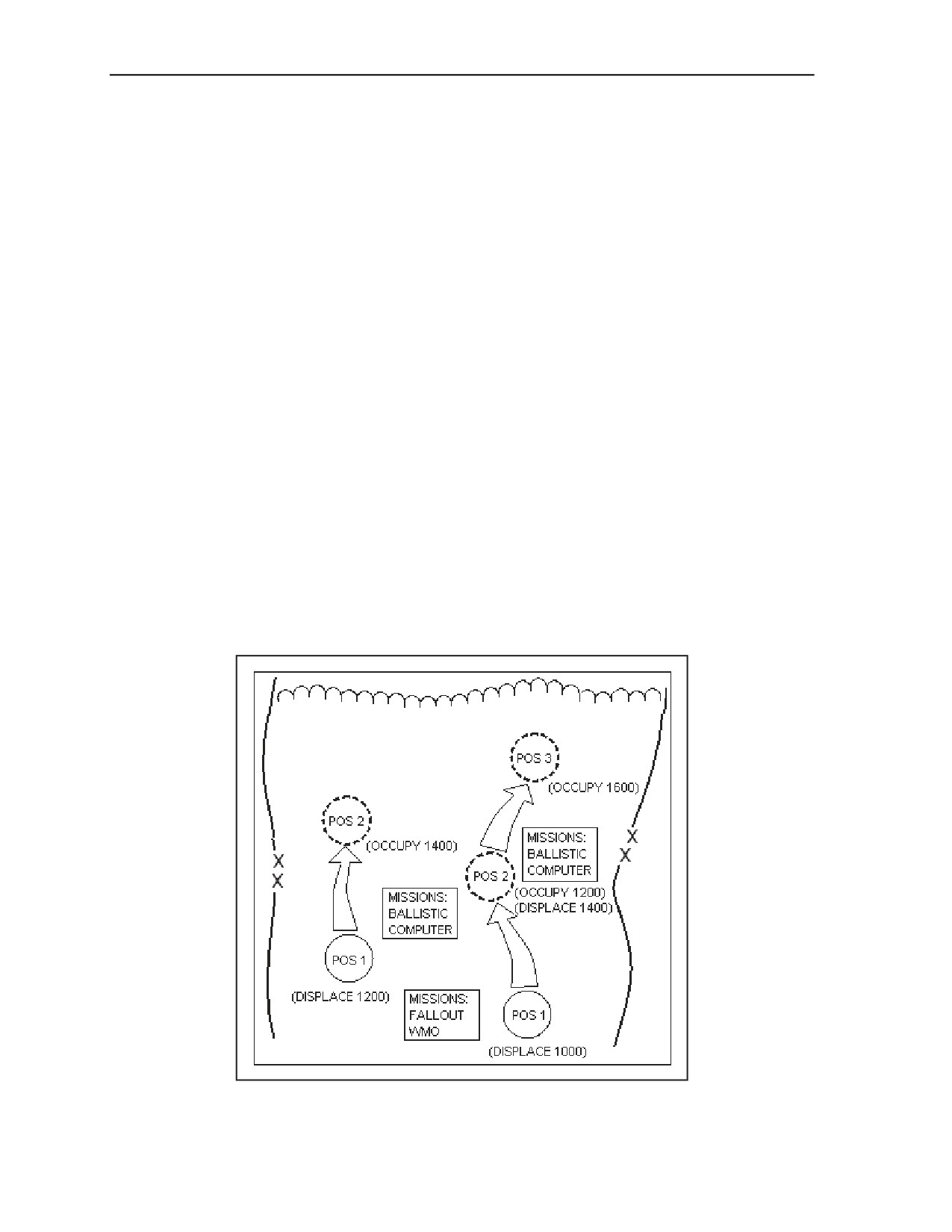
1-75. The basic movement technique is leapfrogging. When the battle is fluid and the rate of movement is
rapid, MET sections may employ the leapfrogging technique to keep pace. In this technique, one MET
section, having established a position, remains in operation while a second displaces to a new location.
When the second section becomes operational, the first section is displaced by moving past the newly
occupied position of the second section. This procedure is repeated as often as necessary. (See figure1-5.)
Figure 1-5. Leapfrog movement technique
1-14
FM 3-09.15/ MCWP 3-16.5
25 October 2007
Commander and Staff Considerations
1-76. The leapfrogging technique is still a valid movement technique for the MMS-P equipped section.
The increased AMV of the MMS-P system requires less movement to keep up with the flow of the
battlefield. Movement planners will have to monitor the AMV of the MMS-P systems and reposition
systems as necessary to maintain continuous coverage.
MET SUPPORT IN THE DEFENSE
1-77. Accurate, concentrated artillery fire is a key element in any defense. MET messages improve the
effectiveness of the artillery response by increasing the accuracy. Control of the MET section in the
defense is normally centralized once the main battle commences. Movements are limited to ensure
continuous support.
COMMUNICATIONS
1-78. Disseminating met data to the firing units is an important part of the mission of the met section. A
specific plan for disseminating met data is necessary.
1-79. The communications plan will provide critical information relating to methods of communication,
coordination procedures, and operational procedures.
COMMUNICATIONS PLANS
1-80. MET data is perishable. The timely dissemination of messages is essential. Digital communications
is the primary means of MET message distribution. MET messages may be disseminated in a centralized or
decentralized manner, depending on the tactical situation. Centralized dissemination normally is used when
the tactical situation is stable. Decentralized dissemination may be used when the controlling headquarters
is continually relocating or its capability to relay data was terminated. The communications plans must
support the deployment of MET assets within the AO. The operations officer establishes communications
priorities and means of dissemination and incorporates them into the MET plan. Unit plans and procedures
documents should address the following:
z
Communications means.
z
Assignment of radiosonde frequencies.
z
Procedures for coordinating MET support from adjacent units.
z
Network identification information.
z
Procedures for passing AFW and FOMET messages to the staff weather officer.
METHODS OF COMMUNICATIONS
1-81. The MMS equipped MET section normally transmits all messages (Push method) to its controlling
headquarters’ fire direction center (FDC). The FDC then passes the MET messages electronically to the
using elements. The FDC must pass the AFW and FOMET messages to the controlling fire support
element (FSE) for dissemination to the SWO and chemical officers. This data is used for forecasting,
downwind predictions, and close air support.
1-82. The MMS-P equipped MET section (220C Protocol) transmits MET messages upon request (pull
method) directly to the using unit with the controlling headquarters acting as a relay. (MMS-P sections
using 220A Protocols uses the push method of disseminating MET.)
RADIO COMMUNICATIONS
1-83. Each MET section is authorized the single-channel ground and airborne radio system (SINCGARS).
The section operates in two tactical radio nets as directed by the controlling headquarters. Normally, these
are the FA command net for C2 and a FA operations/fire net for MET message dissemination. When
digital radio communication is not possible, the MET section may disseminate messages by frequency
modulation voice.
25 October 2007
FM 3-09.15/MCWP 3-16.5
1-15
Chapter 1
WIRE
1-84. Whenever practical, wire lines are installed for voice and digital communications with the supported
units. Radios serve as a backup means of dissemination.
MESSENGERS
1-85. Messengers may be used when communications systems are not functioning or if the supported unit
is nearby. However, extensive travel time for delivery may exhaust the validity time.
MET PLAN DEVELOPMENT
1-86. The MET plan contains the information needed to understand how MET assets will be used during a
specific operation. The MET plan conforms to the standard five-paragraph OPORD format. The heading of
the plan includes the security classification, the title line, references, and the time zone used throughout.
The classification is shown at the top and bottom of each page of the document. Major paragraphs of the
plan are the same as the five-paragraph OPORD format. See appendix D for an example of a MET plan.
STABILITY OPERATIONS
1-87. Field artillery MET sections can provide upper air data, wind speed and direction, temperature, and
pressure in support of these operations. Military and civilian authorities use this information to maintain
current weather maps and to assist them in predicting future conditions. The MET sections are also
equipped with SINCGARS, which could support the operation as the commander deemed necessary.
SAFETY IN STABILITY OPERATIONS
1-88. During these operations helium should be used for inflating balloons. If the section must use
hydrogen gas, extreme caution must be taken especially in built-up areas.
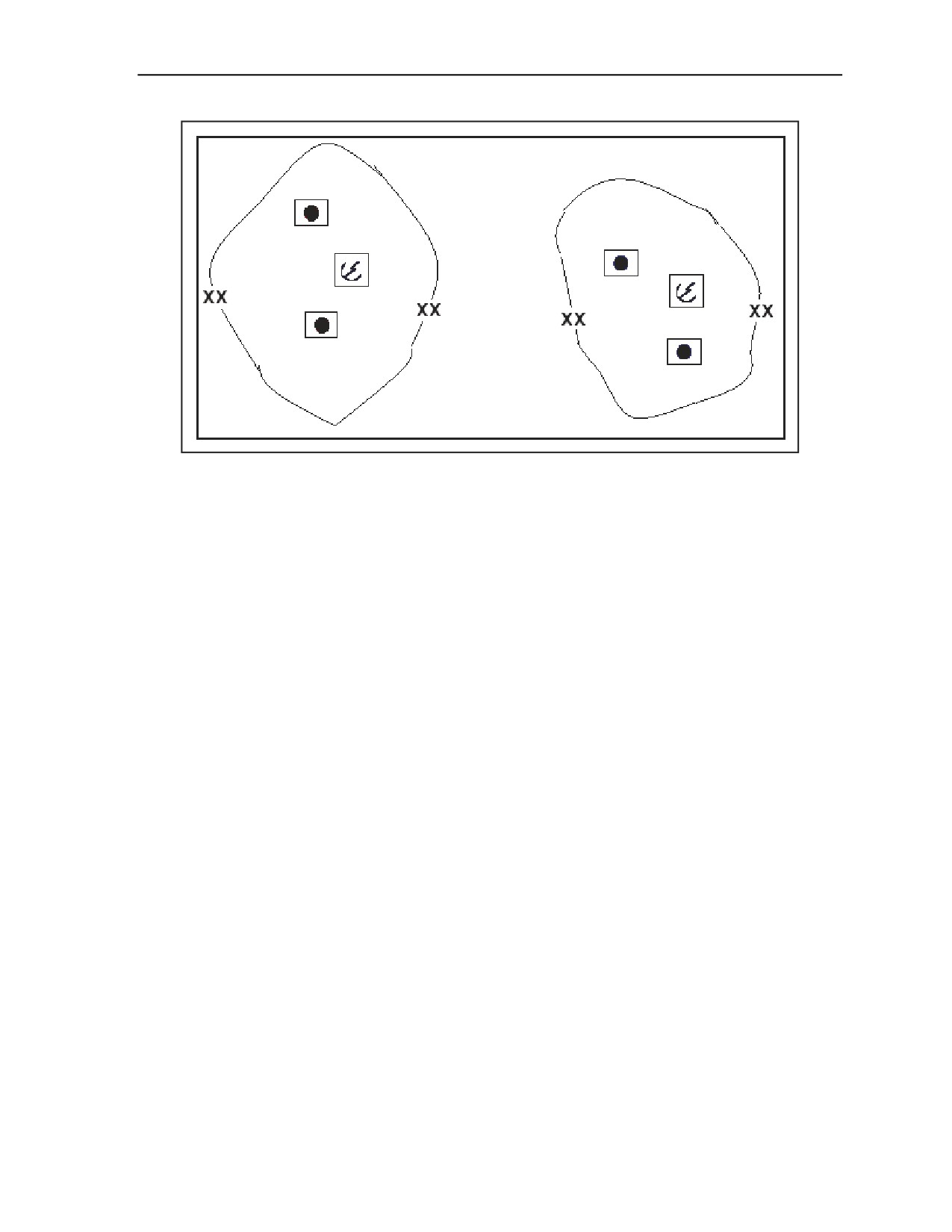
NONLINEAR BATTLEFIELD
1-89. Operating in an area where the enemy operates in small groups and there are no defined enemy
concentrations creates a nonlinear battlefield. (see figure 1-6) In a nonlinear battlefield, forward operating
bases (FOBs) are created. Each FOB has a responsibility for a specified area based on the capabilities of
the assigned units.
1-90. MET operations in a FOB are outlined in the MET plan portion of the operations order. While
operating from a FOB, it may be practical for MMS-P equipped sections to push MET data to units. This is
not the normal procedures for MMS-P, but can be accomplished because the gun locations are known to
the section. Using the message generation function, the section can enter the gun location into both the gun
location fields and the target location fields. The system will generate MET data for the gun location. The
MET message is then transmitted based on an established schedule.
1-16
FM 3-09.15/ MCWP 3-16.5
25 October 2007
Commander and Staff Considerations
Figure 1-6. Nonlinear battlefield
25 October 2007
FM 3-09.15/MCWP 3-16.5
1-17
This page intentionally left blank.
Chapter 2
Additional Sources of Meteorological Information
There are additional sources of meteorological (MET) information when MET data is
not available from organic assets. This chapter discusses these sources.
ALLIED NATIONS
2-1. Because there will be occasions when the artillery of one nation may wish to use the MET data
produced by the MET services of another, standard forms of MET message structure and standards have
been agreed upon. Through North Atlantic Treaty Organization (NATO) standardization agreements
(STANAGs) the U.S., along with several of its allies, has adopted a standard database from which all MET
information is derived. This means that atmospheric data can be freely exchanged among member
countries with the assurance that the same atmospheric standards were used. Member countries produce
ballistic data that is applicable to U.S. Army weapons systems. When exchanging data between member
countries, commanders and operations officers must ensure that the validity criteria explained in chapter 1
are applied. MET station leaders can advise commanders and operations officers on these matters. The
following is a list of countries that have adopted these standards:
z
Belgium
z
Bulgaria
z
Canada
z
Czech Republic
z
Denmark
z
Estonia
z
France
z
Germany
z
Greece
z
Hungary
z
Iceland
z
Italy
z
Latvia
z
Lithuania
z
Luxembourg
z
Netherlands
z
Norway
z
Poland
z
Portugal
z
Romania
z
Slovakia
z
Slovenia
z
Spain
z
Turkey
z
United Kingdom
z
United States
25 October 2007
FM 3-09.15/MCWP 3-16.5
2-1)
Chapter 2
U.S. AIR FORCE
2-2. The United States Air Force (USAF) currently has fixed and deployable weather teams deployed
throughout the world capable of performing upper air soundings. The information they gather cannot be
used for ballistic solutions to the gunnery problem; however, this information can be used by chemical
sections for downwind predictions when fallout messages from organic MET sections are not available.
This additional source of MET does not relieve U.S. Army MET sections of the responsibility; however,
this information can be provided when the U.S. Army cannot produce the data. When available, these
teams will normally be employed at corps or higher; however, they could be positioned in areas forward of
the division main. Other USAF assets include special observation weather teams (SOWTs) attached to
Special Forces Groups. When approved by the group commander, SOWT members may assist operational
detachments in gathering critical weather observations in denied areas to support deep strike operations.
This SOWT-derived information is obtained through coordination with the Special Operations Command
and Control Element normally attached to corps and higher levels. The weather data gathered through
SOWTs in cross-FLOT/fire support coordination line (FSCL) areas are similar in scope to that derived by
forward area limited observation program operations conducted in corps/division operational areas.
Although this information is unsuitable for MET ballistic gunnery solutions, it may prove invaluable for
deep attack (missile/rocket) targeting solutions for chemical downwind predictive measurements. Fire
support coordinators (FSCOORDs)/Fires Cell (FC) should consider SOWT capabilities when conducting
mission analysis for deep strike operations.
U.S. NAVY
2-3. The U.S. Navy has mobile environmental teams capable of sounding the atmosphere and producing
ballistic data. The message produced is in STANAG format. These teams are deployed on a mission basis.
The teams are composed of one to five members. They typically support their own units, but also support
joint operations and could be requested to support U.S. Army artillery operations. Requests for support
must be coordinated well in advance of the time of need.
2-4. The U.S. Navy produces the worldwide forecast model data using the Navy Operational Global
Atmospheric Prediction System (NOGAPS). The data is not direct MET observation data, but resultant
forecast data created after analysis. The NOGAPS data is broadcast via satellite twice daily (every 12
hours) by the Air Force Weather Agency (AFWA). Each transmission provides 72 hours of valid data.
MARINE CORPS
2-5. The Marine Corps fields four MET teams per artillery regiment. Each team is equipped with the
AN/TMQ-49 Meteorological Station Group (MSG), which includes the AN/TMQ-41 meteorological
measuring set (MMS), as well as visual meteorological measuring equipment (PI-BAL). These teams are
capable of producing meteorological data in useable formats for artillery, mortar, target acquisition assets,
nuclear biological and chemical downwind data and data that can be incorporated into meteorological
models.
NUMERICAL WEATHER PREDICTION
2-6. Current operational concepts, which address the full spectrum of warfare, require that additional
capabilities are available to support indirect fires. Marine Air-Ground Task Force (MAGTF) concepts such
as Distributed Operations, Over the Horizon operations, and Ship to Objective Maneuver
(STOM)
operations must rely on non-hardware based solutions such as numerical weather prediction. Groups such
as the Joint Air Force and Army Weather Information Network (JAAWIN) and the Fleet Numerical
Meteorological Oceanographic Center
(FNMOC) have implemented web-based interfaces to access
modeled meteorological data forming the foundation of numeric weather prediction in support of indirect
fires. Numeric weather prediction has been characterized with excellent results out to 500 kilometers, but
has not yet been certified by the Army. Any backup capabilities should only be used when MMS or MMS-
P systems are not available.
2-2
FM 3-09.15/ MCWP 3-16.5
25 October 2007
Additional Sources of Meteorological Information
2-7. Numerical Weather Prediction takes into account historical, topographical, climatological weather
data, as well as vertical and horizontal resolutions, to form a mesoscale model of the atmosphere. Local
Upper Air Observations ((Radiosonde Observations) in the form of World Meteorological Organization
(WMO) messages can be ingested into this model to refine the numerical data and decrease model bias.
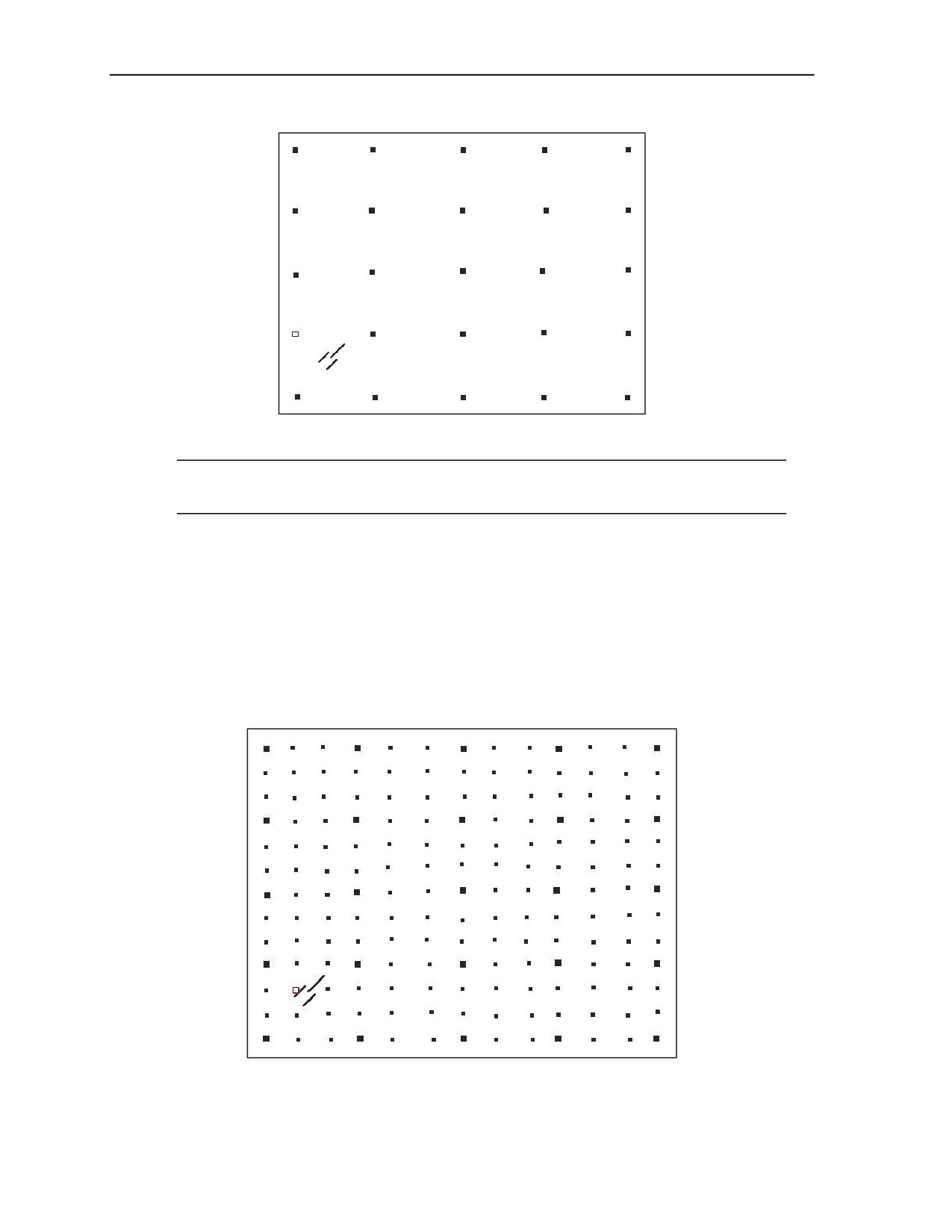
The resolution chosen for a certain region will determine how many MET points are available to pull
numerical data from a particular area. There are currently three different resolutions used: 45 kilometers,
15 kilometers, and 5 kilometers. (see figures 2-1, 2-2, and 2-3)
2-8. The 45-kilometer resolution is the least preferred resolution. When this resolution is chosen for an
area of operations, the using unit could be a maximum of 22.5 kilometers away from the closest MET
point. The 45-kilometer resolution can produce a numerical forecast every 3 hours for up to 72 hours in
advance.
Figure 2-1. 45 kilometers
NOTE: Using 45-kilometer resolution, your MET point can be up to 22.5 kilometers away from
the requesting unit.
2-9. The 15-kilometer resolution is available in most regions. When using the 15 kilometers for an area,
the using unit could be a maximum of 7.5 kilometers away from the closest MET point. The numerical
forecast from the 15-kilometer resolution can be produced every 3 hours for up to 48 hours in advance.
Non-classified Internet Protocol Router Network (NIPRNET) is required to obtain 45 kilometers and 15
kilometers data.
25 October 2007
FM 3-09.15/MCWP 3-16.5
2-3
Chapter 2
Figure 2-2. 15 kilometers
NOTE: Using 15-kilimeter resolution, your MET location can be up to 7.5 kilometers away
from the requesting unit.
2-10. The 5-kilimeter resolution is the preferred resolution when available. However, it is currently only
available in contingency areas and other locations for brief periods of time during testing operations or
upon special requests. Five-kilometer resolutions are only available on the Secret Internet Protocol Router
Network (SIPRNET). When the 5-kilometer resolution is selected for an area, the using unit could be a
maximum of 2.5 kilometers away from the closest MET point. The 5-kilometer resolution can produce a
numerical forecast every hour on the hour for up to 24 hours in advance. Currently, 5 kilometers is the best
resolution available. A 1.66-kilometer resolution will soon be available via the SIPRNET as well. Data
obtained from Numerical Weather Prediction is usually manually entered into fire direction programs.
Remember that when operating in contingency areas, the best resolution possible will always be available.
Figure 2-3. 5 kilometers
2-4
FM 3-09.15/ MCWP 3-16.5
25 October 2007
Additional Sources of Meteorological Information
NOTE: Using 5-kilometer resolution, your MET location can be up to 2.5 kilometers away from
the requesting unit.
2-11. Commanders should consider this capability as a viable option for Meteorological support, if their
MMS or MMS-Profiler are not operational and should always; whenever possible, consult Meteorological
personnel for the best available option of Meteorological support for a specific area of operations. For
more information on numerical weather prediction, contact the Meteorology Instruction School, Fort Sill,
Oklahoma.
NOTE: If the altitude on the Computer Meteorological Message (METCM) is different from the
firing battery altitude, the Advanced Field Artillery Tactical Data System (AFATDS) will adjust
the pressure and temperature to the altitude of the firing battery, however the winds will not be
changed.
25 October 2007
FM 3-09.15/MCWP 3-16.5
2-5
This page intentionally left blank.
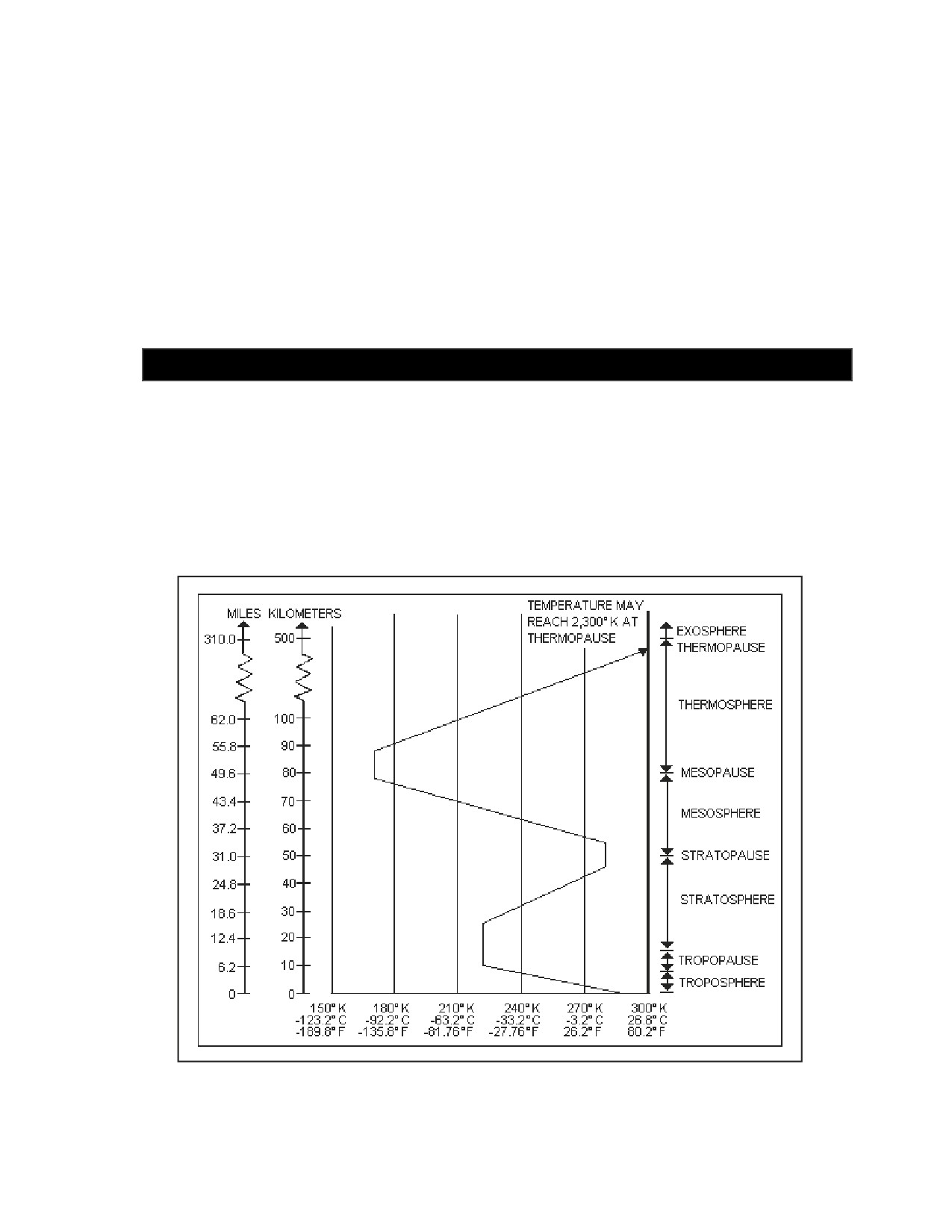
Chapter 3
Weather and Its Effects
Weather greatly impacts military operations. Weather data is part of the intelligence
information required to plan and conduct combat operations. This chapter discusses
terms and the impact weather has on the field artillery operations.
SECTION I ELEMENTARY METEOROLOGY
3-1. Meteorology is the science dealing with the earth's atmosphere and its phenomena, including weather
and climate. Besides the physics, chemistry, and dynamics of the atmosphere, MET includes many of the
direct effects of the atmosphere on the earth's surface, the oceans, and life in general. MET effects such as
wind, temperature, air density, and other phenomena influence military operations.
ATMOSPHERE
3-2. The atmosphere (figure 3-1) is the envelope of air that surrounds the earth in several distinct layers.
It is the lower portion of the atmosphere that concerns artillery meteorologists.
Figure 3-1. Earth’s atmosphere
25 October 2007
FM 3-09.15/ MCWP 3-16.5
3-1
Chapter 3
TROPOSPHERE
3-3. About three-quarters of the air in the atmosphere is compressed into the lowest layer, which is called
the troposphere. In this layer, the change of temperature in relation to height is relatively large. It is the
region where clouds form and air masses continuously mix. Within the troposphere, air consists of 78
percent nitrogen; 21 percent oxygen; and 1 percent argon, carbon dioxide, and minute amounts of other
gases. Air also contains variable amounts of water vapor and a mixture of minute impurities, such as
particles of dust and salt. The thickness of the troposphere varies with the season of the year. However, it is
generally 8 kilometers thick at the poles and 18 kilometers thick at the equator.
TROPOPAUSE
3-4. The top of the troposphere is known as the tropopause. It is a transition zone between the
troposphere and the stratosphere. It acts as a lid that tends to hold in the lower atmosphere. This lid
contains occasional breaks and overlaps that provide paths for high-velocity winds called jet streams. The
jet streams cause constant turbulence and mixing of the lower atmosphere. It is this mixing of air masses
that causes our weather. The weather below the tropopause has the greatest effect on artillery operations.
STRATOSPHERE
3-5. The layer immediately above the tropopause is the stratosphere. It has a stable temperature in the
lower half of the layer and an almost complete lack of clouds. In the upper half of the stratosphere, at about
25 kilometers, the temperature begins to increase with height up to about 50 kilometers at the stratopause.
In the stratopause, the temperature is about the same as that at the earth’s surface. This warm region is
caused by the presence of ozone, which absorbs part of the ultraviolet radiation from the sun. Without the
ozone layer, life on earth would be difficult, if not impossible. Further layers are not discussed because
artillery data is gathered only to an altitude of 30,000 meters.
HEAT
3-6. Determining the level of heat and how heat is transferred is significant when considering weather
effects.
3-7. Understanding the correlation of the different temperature scales enhances accuracy when utilizing
or converting between the different temperature scales.
CONVECTION
3-8. Convection is the transfer of heat by the physical movement of heated substances, such as liquid or
gas. In MET, convection denotes vertical air motion.
CONDUCTION
3-9. Conduction is the transfer of heat between two parts of a stationary system caused by a temperature
difference between the parts. Conduction warms the layer of air in contact with the earth's surface during
daylight, which causes it to expand and become less dense. The less dense air rises and is replaced by
cooler air, which is warmed in turn, thus creating a convective cell.
TURBULENCE
3-10. On a small scale, this vertical motion is called turbulence and is quite irregular because of unequal
heating and cooling over various types of terrain. On a large scale, the vertical motion in conjunction with
the horizontal motion carries excess heat from equatorial regions to the cooler areas at higher latitudes.
This mass transfer of heat by means of large-scale movement of the atmosphere is essential in the overall
heat balance of the world.
3-2
FM 3-09.15/ MCWP 3-16.5
25 October 2007
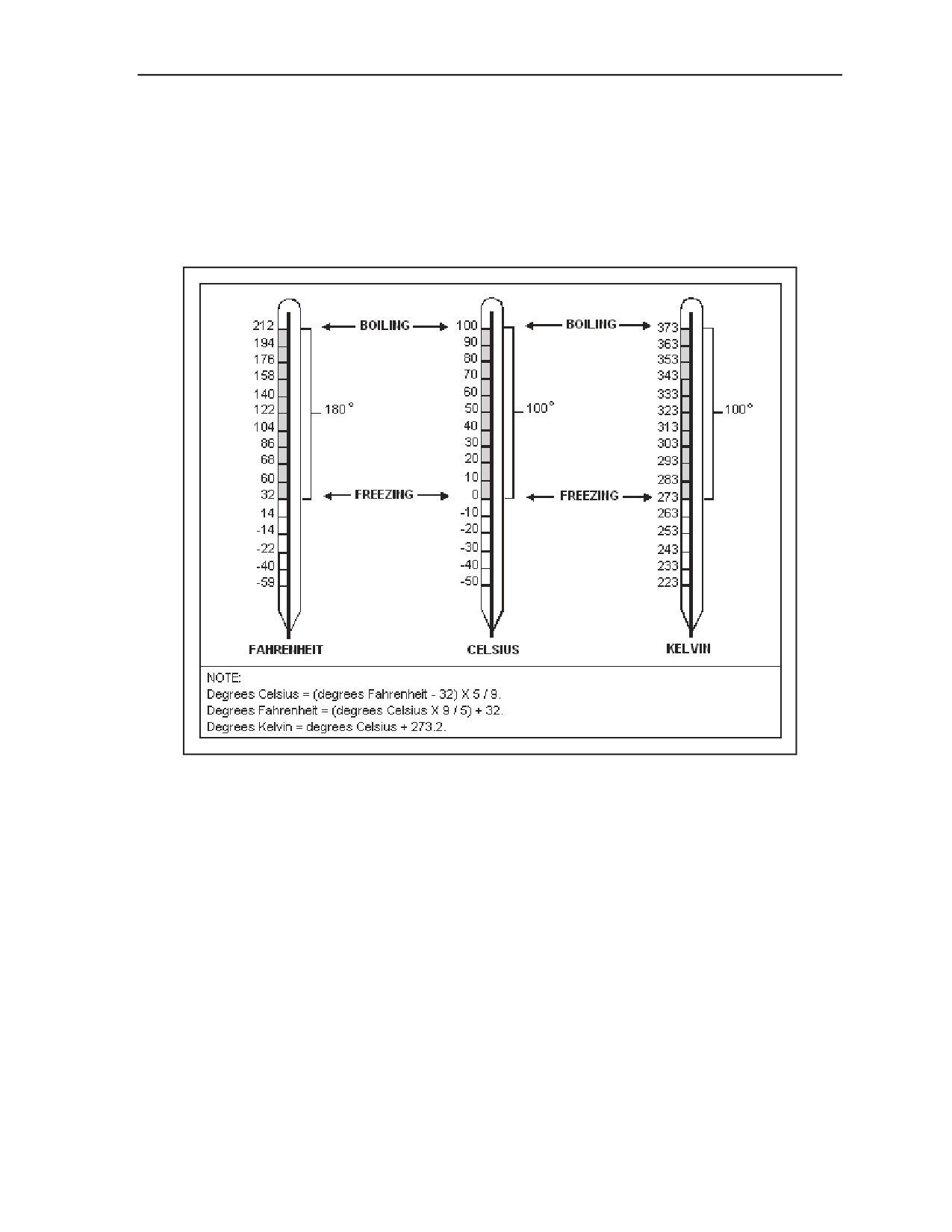
Weather and Its Effects
TEMPERATURE SCALES
3-11. There are three different scales used to express temperature. The most familiar is the Fahrenheit (F)
scale. On the Fahrenheit scale, the freezing point of water is 32 degrees. Another scale is the Celsius (C)
scale on which the freezing point of water is O degrees. The third scale is the Kelvin (K) scale on which
the freezing point of water is 273.2 degrees. The Kelvin scale has no negative values and is often used for
temperature computations. A direct relation exits between these scales (figure 3-2).
Figure 3-2. Temperature scales
MOISTURE
3-12. The various forms of moisture are more involved with weather than any other weather aspects.
Almost no important weather takes place without it. Without some form of moisture, there would be no
clouds or precipitation.
3-13. The discussion of water vapor and relative humidity is essential to understanding the development
process of many significant aspects of weather.
WATER VAPOR
3-14. The oceans provide the major source of moisture for the air. Every day the energy from the sun
transforms millions of tons of water into water vapor. Air currents then distribute the water vapor within
the atmosphere. Though water vapor represents only a small percentage of the atmospheric gases, it is by
far the most important in relation to weather processes. There is an upper limit to the amount of water
vapor that can be contained in any given volume of air at a specific temperature. Warm air can hold more
water than cool air.
25 October 2007
FM 3-09.15/MCWP 3-16.5
3-3
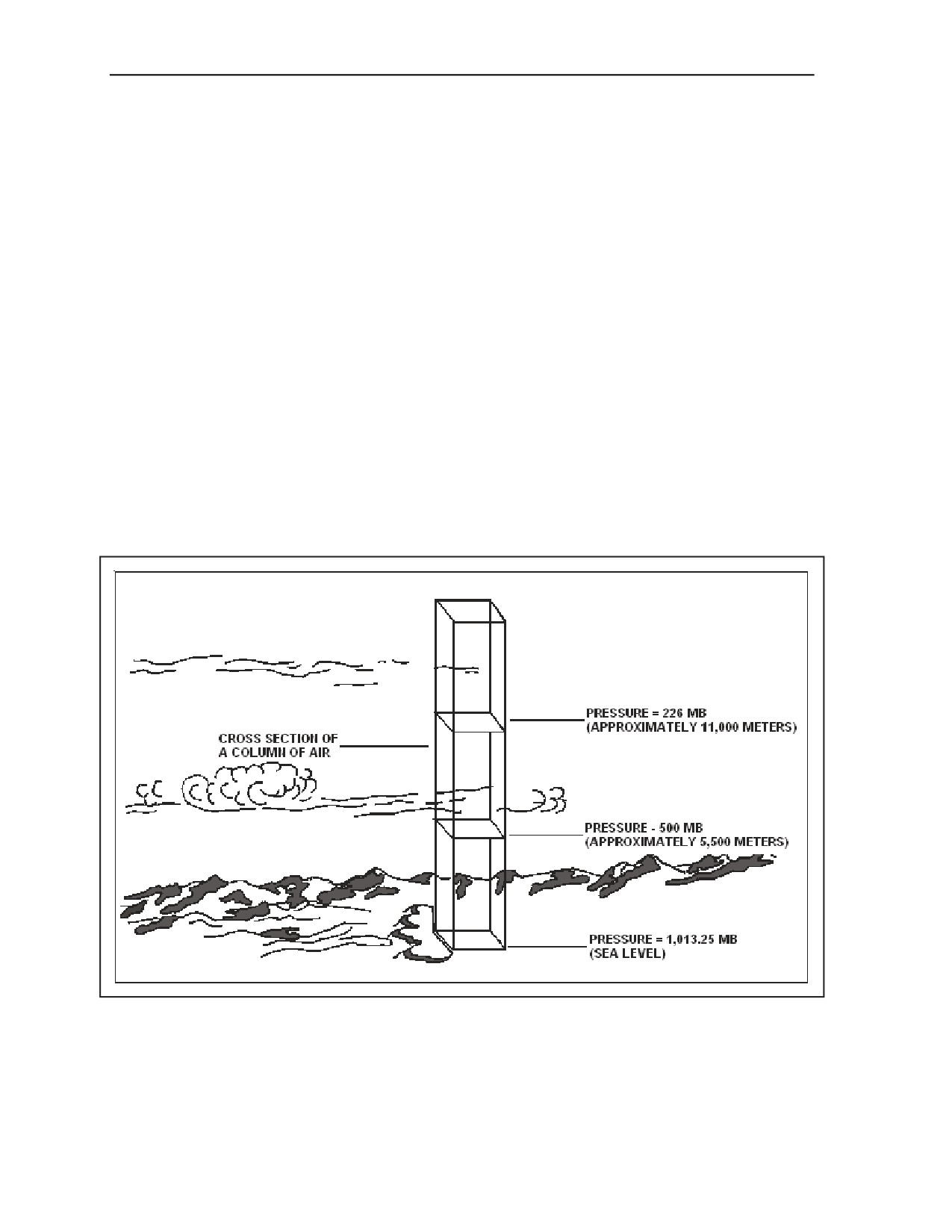
Chapter 3
RELATIVE HUMIDITY
3-15. The moisture content of air can be expressed in several different terms. However, the most common
term is relative humidity. Relative humidity is the ratio (percentage) of the actual amount of water vapor
present in the air to the maximum amount of water vapor the air could hold at the existing pressure and
temperature. As the air cools and its ability to hold water vapor decreases, the percentage of relative
humidity increases until saturation (100 percent) occurs. At this saturation point, water vapor begins to
condense into water droplets around particles of salt or dust in the atmosphere. As droplets grow bigger
and heavier, they eventually fall toward the earth as rain or snow, depending on the temperature of the
atmospheric levels through which they pass.
ATMOSPHERIC PRESSURE
DEFINITION
3-16. Since the atmosphere is a mixture of gases, it is quite natural to think of air as being very light in
weight. However, the total weight of the entire atmosphere is tremendous. If the entire weight of the
atmosphere were replaced by an equal weight of water, the water would cover the earth's entire surface to a
depth of 10 meters. The weight of the air pressing down upon itself produces atmospheric pressure.
Pressure is continuously changing, mainly because of changes in air density brought about by variations in
temperature and moisture content. At higher altitudes in the air column, the air pressure is less because
there is less air above the higher altitude. More specifically, atmospheric pressure is the weight of a column
of air that extends upward to the top of the atmosphere. (See figure 3-3.)
Figure 3-3. Atmospheric pressure
PRESSURE MEASUREMENT
3-17. Air pressure is measured with barometers and reported in millibars (mb). One type of barometer is
mercurial, which is very accurate but not portable. A mercurial barometer measures air pressure in inches
3-4
FM 3-09.15/ MCWP 3-16.5
25 October 2007
///////////////////////////////////////