FM 3-09.15 TACTICS, TECHNIQUES, AND PROCEDURES FOR FIELD ARTILLERY METEOROLOGY (OCTOBER 2007) - page 2
Weather and Its Effects
of mercury, which are then converted to millibars. Another type of barometer is the aneroid, which
measures air pressure in millibars and is portable. A third type of barometer is a digital device that
measures and displays pressure. Artillery MET sections use the aneroid and digital barometers.
CLOUDS
3-18. Most weather phenomena are associated either directly or indirectly with clouds. Therefore, observer
personnel must understand the significance of clouds. This enables them to make pertinent and timely
decisions on the effect of weather on operations.
CLOUD COMPOSITION
3-19. Clouds are composed of millions of water droplets and/or ice crystals suspended in the atmosphere.
Condensation
3-20. Condensation is the process whereby water vapor is changed into small droplets of water. For
condensation to occur there must be something present in the atmosphere upon which the water vapor can
condense. Virtually billions of minute particles, which result from ordinary dust, combustion products, and
sea salt crystals, exist in the atmosphere. These particles are condensation nuclei. Condensation of water
vapor upon these particles forms clouds and fog. Condensation may result from a decrease in temperature,
a decrease of pressure, or an increase of water vapor in the air. In the atmosphere, condensation normally
occurs when warm, moist air rises and cools by expansion. Frontal activity, terrain features, and unequal
heating of land and sea surfaces cause the air to be lifted.
Precipitation
3-21. Precipitation is visible moisture, either liquid or solid, that falls from a cloud to the surface of the
earth. It occurs when the cloud particles become so large that the pull of gravity overcomes the buoyant
force of the surrounding air in the cloud. The size of cloud droplets may be increased by collisions with
other droplets or by the freezing of super-cooled water droplets on ice crystals.
Virga
3-22. Clouds do not always produce precipitation since the initial water droplets are extremely small and
simply float in the atmosphere. Precipitation may fall from clouds without reaching the earth’s surface
because on many occasions it evaporates before reaching the surface. This phenomenon is called virga.
CLOUD CATEGORIES
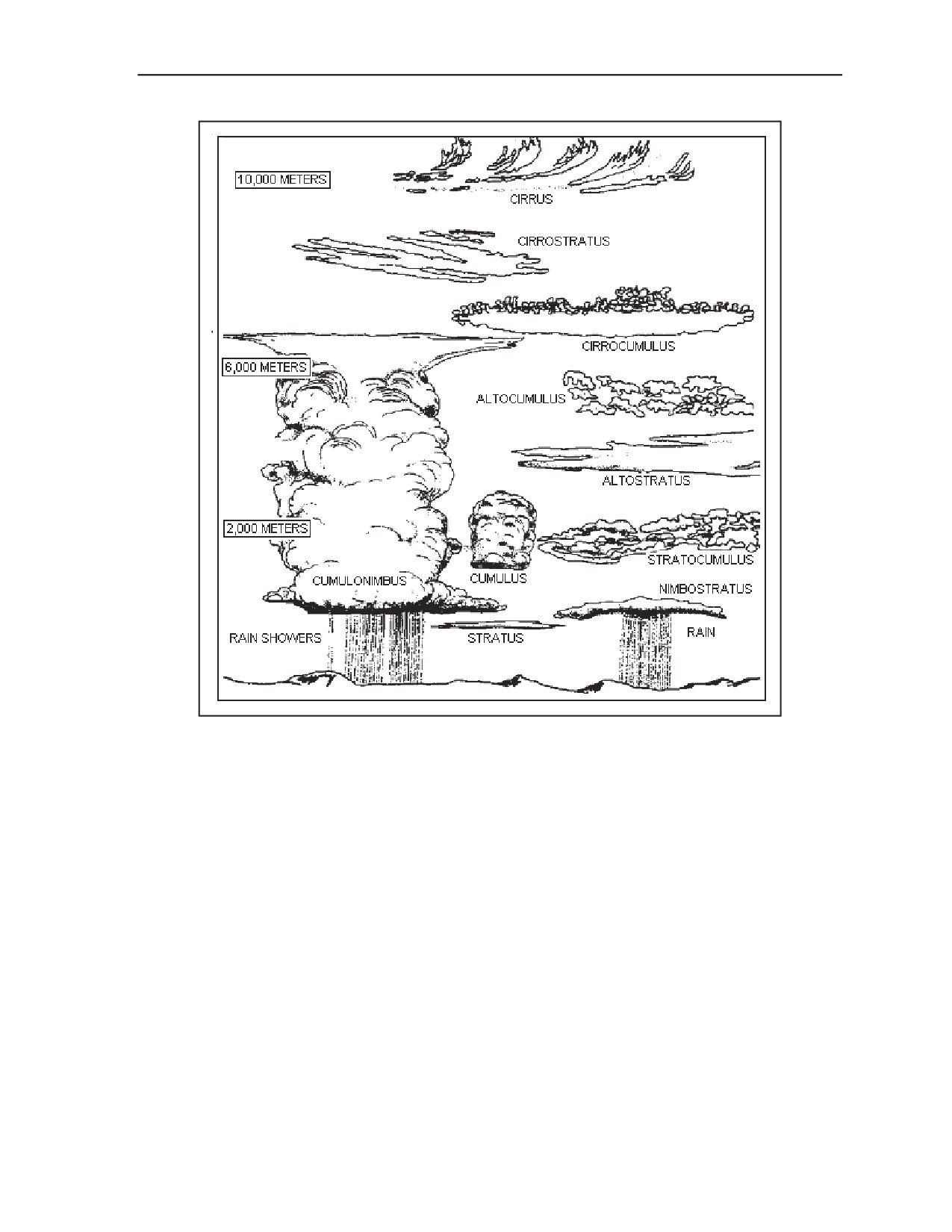
3-23. Clouds are classified by their appearance and the physical processes that produce them. All clouds,
by their shape, fall into two general categories, cumuliform (cumulus) and stratiform (stratus) (Seefigure3-
4.)
Cumulus
3-24. Cumulus means heaped or accumulated. Cumulus clouds look that way because they are always
formed by rising air currents. Cumulus clouds may produce local showers or severe thunderstorms and
extremely strong vertical air currents.
Stratus
3-25. Stratus or sheets like, clouds are formed when a layer of air is cooled below its saturation point
without pronounced vertical motion. The vertical thickness of stratiform-type clouds may range from
several meters up to a few kilometers. Precipitation, if any, from stratiform clouds is generally continuous
with only gradual changes in intensity and covers a relatively large area.
25 October 2007
FM 3-09.15/MCWP 3-16.5
3-5
Chapter 3
CLOUD CLASSIFICATION
3-26. Clouds may be further classified as high, middle, low, and towering. (See figure 3-4.)
Low
3-27. When the bases of clouds are lower than 2,000 meters above the surface of the earth, the clouds
generally are designated as cumulus or stratus, unless they are producing precipitation. In that case, they
are referred to as cumulonimbus or nimbostratus. Nimbus means rain cloud. Another common low cloud,
with some of the characteristics of both cumulus and stratus clouds, is called stratocumulus.
Middle
3-28. Between 2,000 and 6,000 meters, clouds generally are identified with the prefix alto preceding the
cloud name. Altocumulus and altostratus clouds are in this category.
High
3-29. Above 6,000 meters, clouds are composed of ice crystals and generally have a delicate appearance.
These clouds are designated as cirrocumulus and cirrostratus. At still greater altitudes, a fibrous type of
cloud, which appears as curly wisps and is composed of ice crystals, is designated as cirrus.
Towering
3-30. Bases of towering clouds may be as low as the typical low clouds, but their tops may extend to, or
even above, the tropopause.
3-6
FM 3-09.15/ MCWP 3-16.5
25 October 2007
Weather and Its Effects
Figure 3-4. Cloud types
AIR CIRCULATION
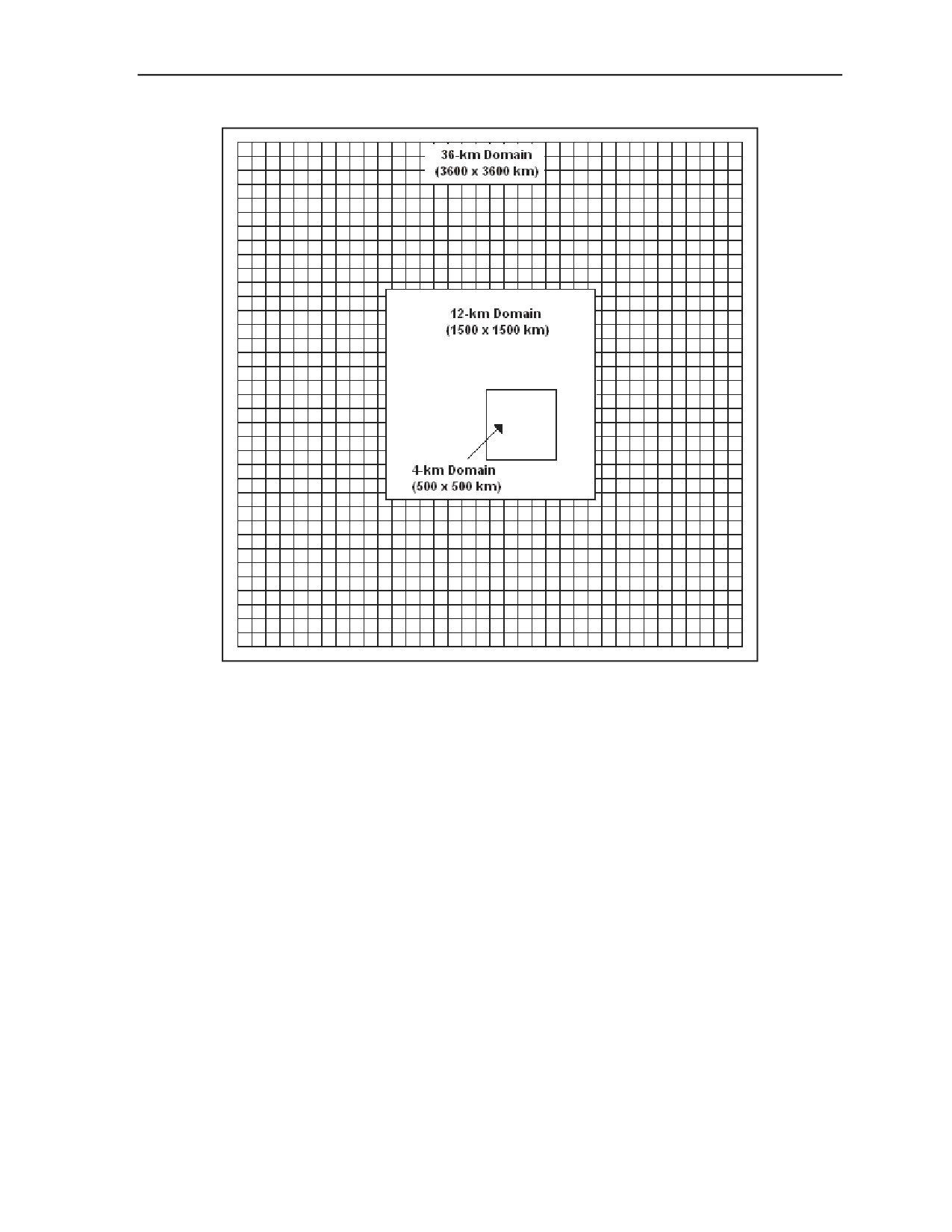
3-31. Simple atmospheric circulation is the movement of air over the surface of the earth. Solar radiation is
the energy source that heats the atmosphere and sets it into motion. The equator receives the greatest
amount of solar heating, whereas the poles receive the least. This unequal heating creates temperature
differences between various locations on the earth. The temperature differences produce pressure changes
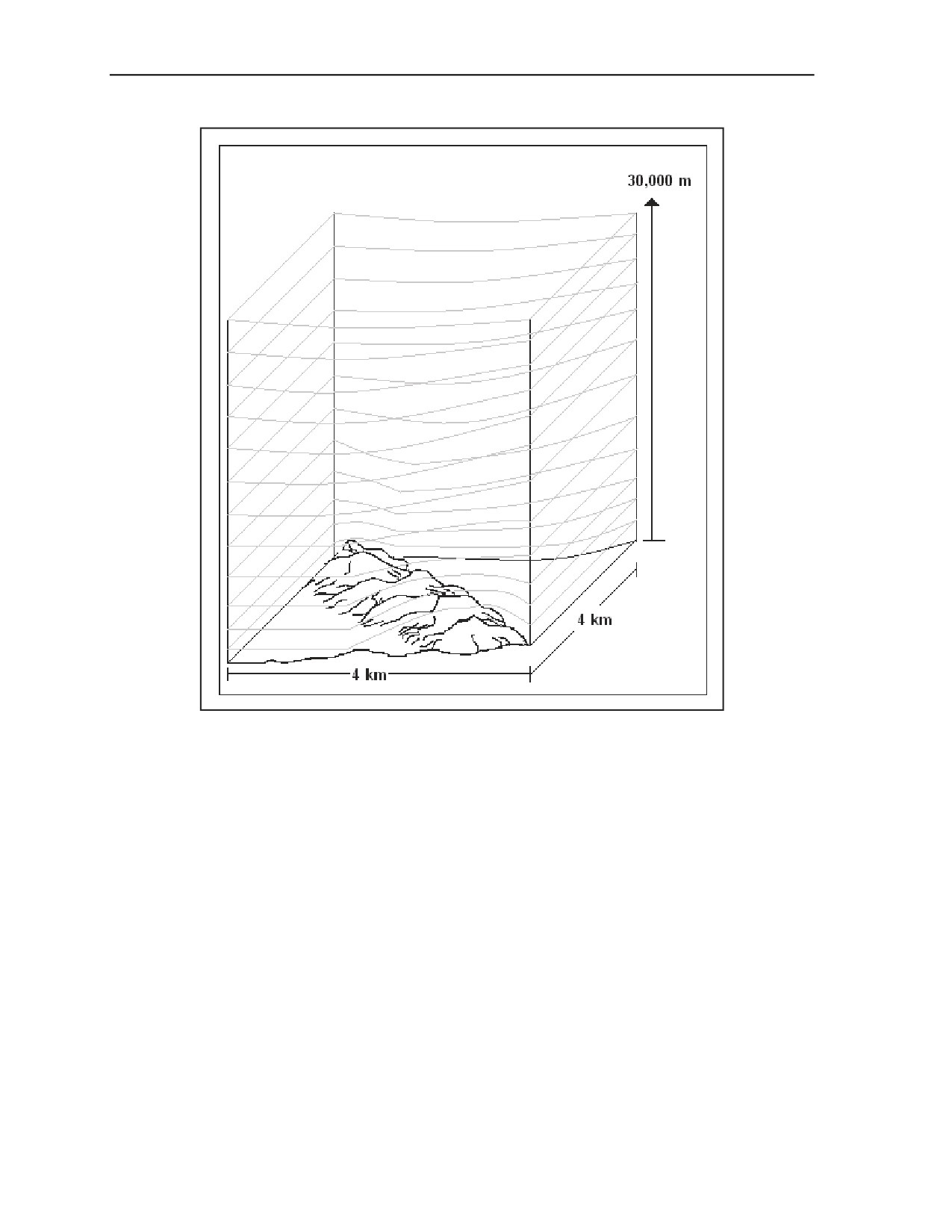
that cause air motion in our atmosphere.
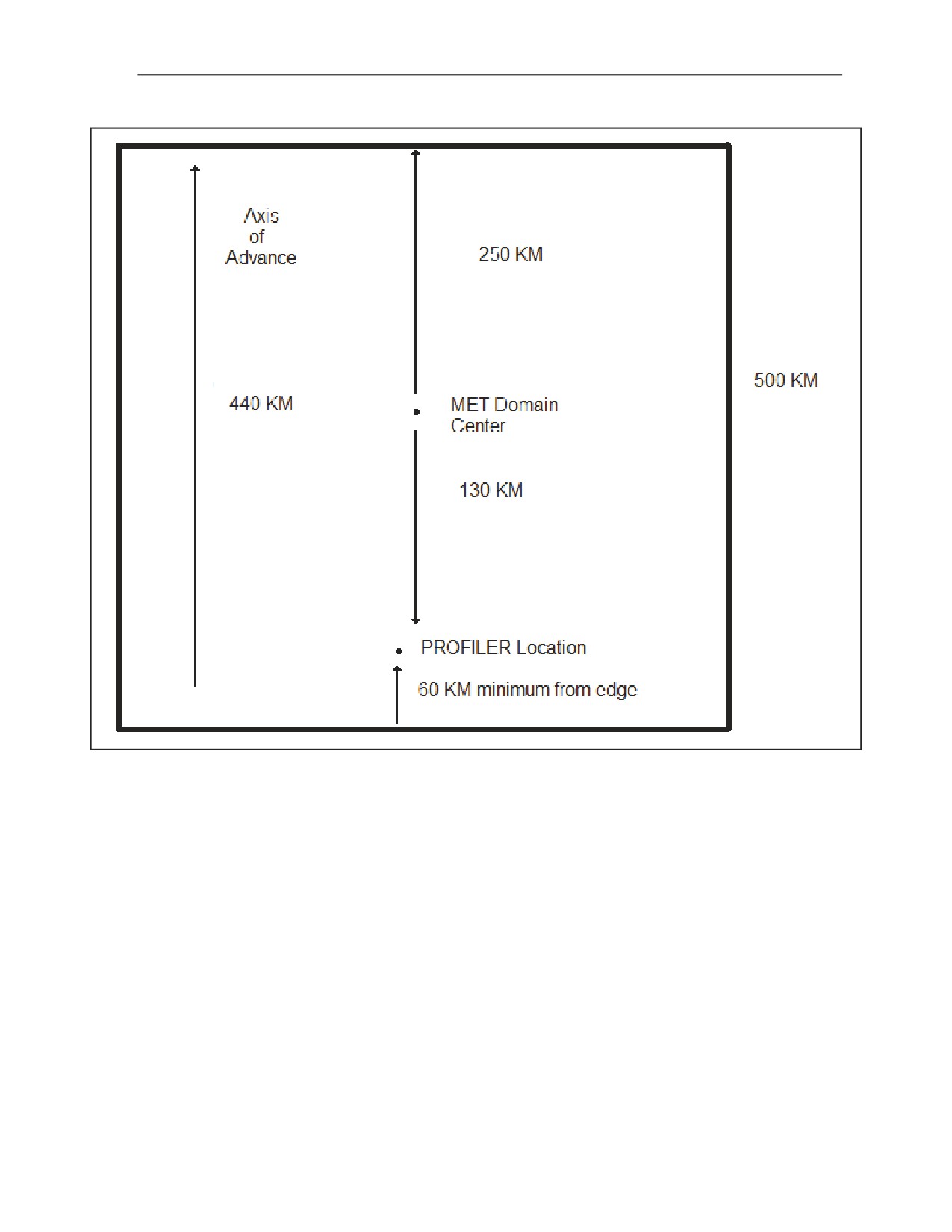
General Circulation
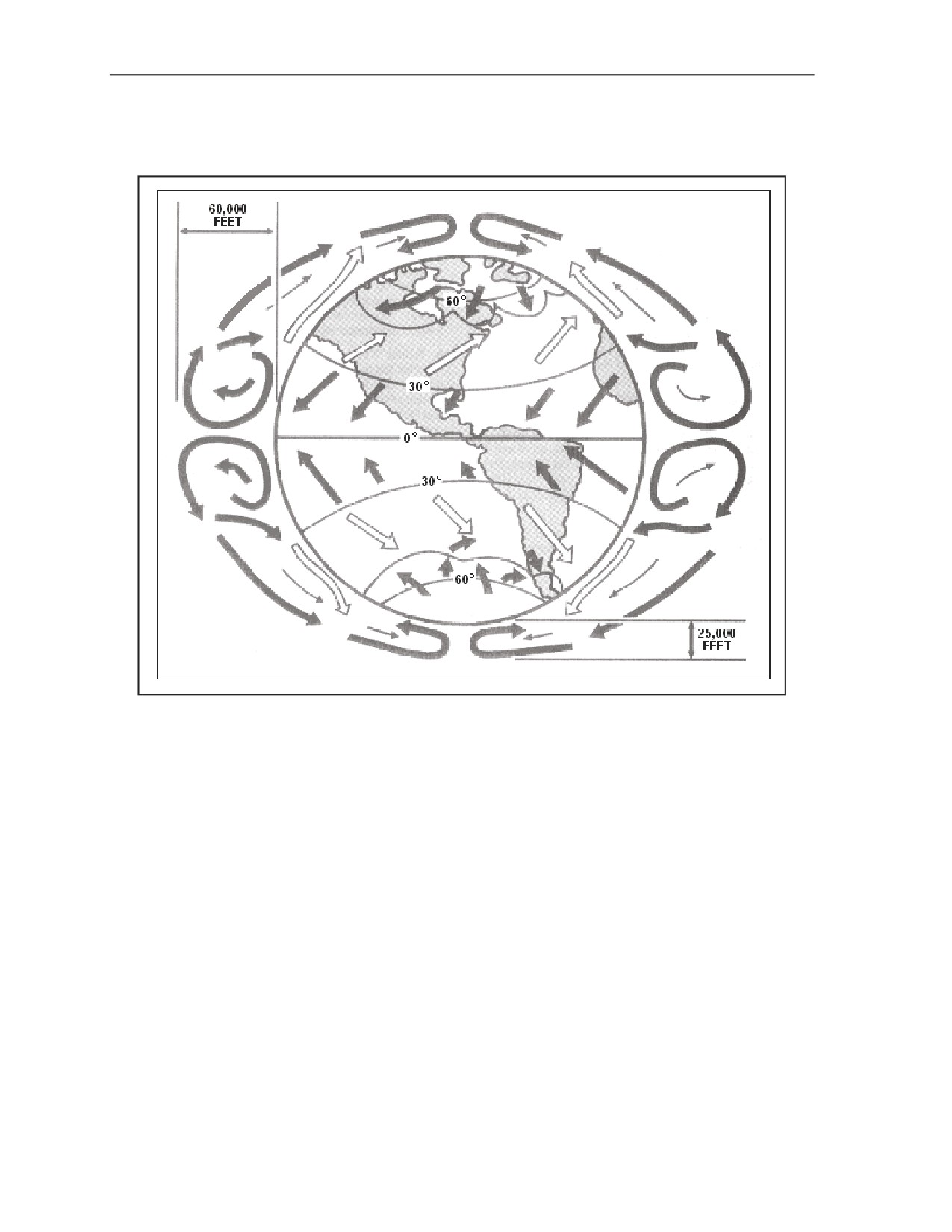
3-32. General air circulation can be explained by the three-cell theory. Hot, moist air near the equator rises
to high altitudes and flows toward the poles. As the air rises and travels away from the equator, it cools and
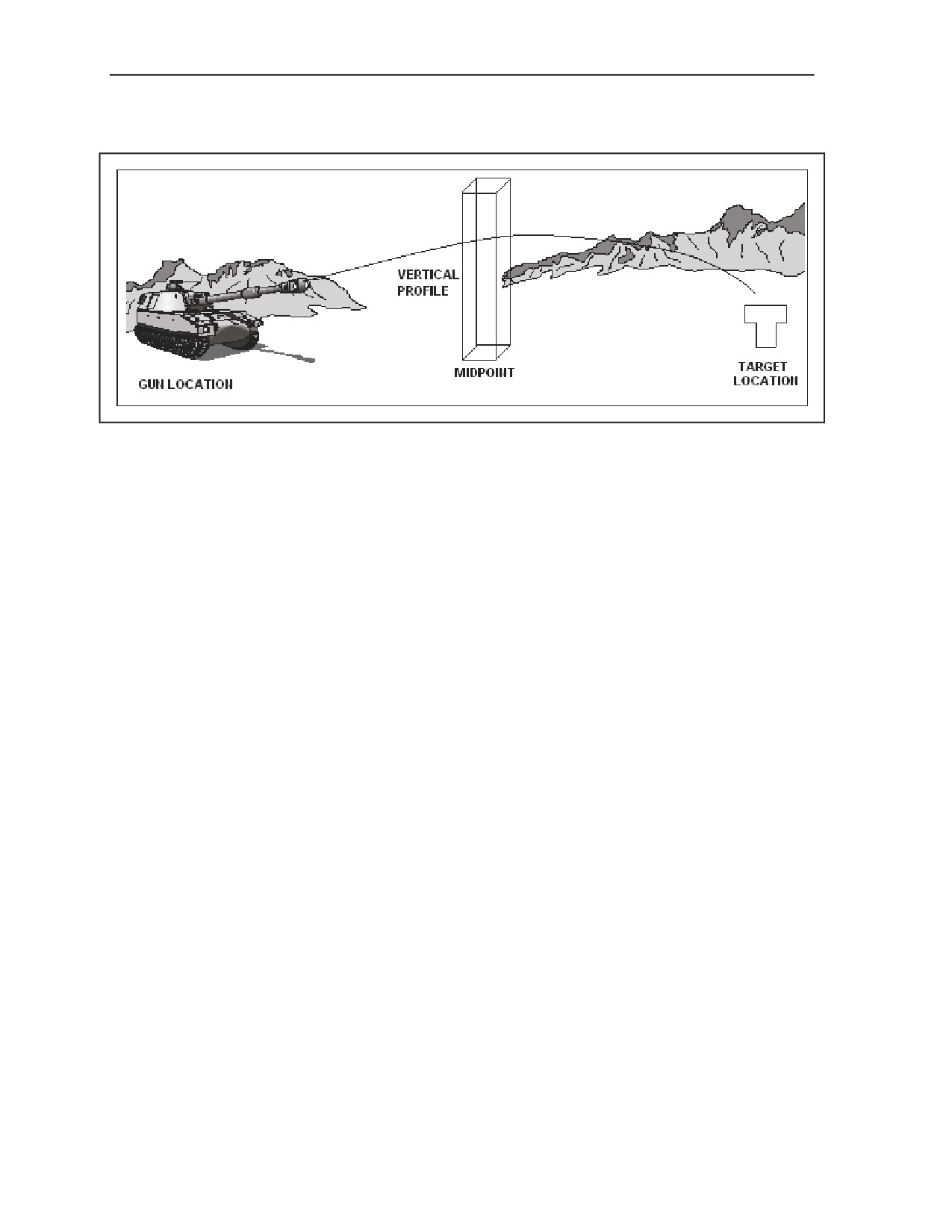
dries, becoming denser. Some of the cold, dry air sinks back to the surface at about 30 degrees latitude.
Some of the descending air returns to the equator, replacing the rising, less dense air. Thus, the first cell of
circulation is complete. The remainder of the descending air at 30 degrees latitude travels toward the poles
along the earth's surface. At about 60 degrees latitude, this cool air meets the very cold air flowing along
the surface away from the poles. The cool air is forced upward until it rejoins the remaining upper air
moving from the equator to the poles. Thus, the second and third cells of circulation are formed. (See
figure 3-5.) Within this general pattern of circulation, several semi-permanent pressure regions exist. Low-
25 October 2007
FM 3-09.15/MCWP 3-16.5
3-7
Chapter 3
pressure regions exist at the equator and at 60 degrees latitude. High-pressure regions exist at 30 degrees
latitude and in the polar regions.
Figure 3-5. General circulation pattern
Earth’s Effect on General Circulation
3-33. Irregular formations of land and water, the rotation of the earth, and the tilted axis of the earth affect
air circulation. Because water heats and cools much slower than does land, local patterns are set up and
superimposed on the general flow. High pressures form over land during winter and over the oceans during
summer. This results in large-scale seasonal circulation, such as the monsoon. On a smaller scale, this
unequal heating causes a daily circulation pattern along the shoreline. During fair weather, the land is
warmed by the sun during the day and cooled by terrestrial radiation at night. This creates a sea breeze by
day and a land breeze by night. The rotation and tilted axis of the earth affect circulation patterns.
Secondary Circulation
3-34. When air circulates, several forces act to create disturbances and irregularities in the lower levels of
the troposphere. The result is secondary circulation, which consists of moving pressure systems that are
smaller than the general circulation patterns. These forces are as follows:
z
Pressure gradient force.
z
Coriolis force.
z
Centrifugal force.
z
Frictional force.
3-8
FM 3-09.15/ MCWP 3-16.5
25 October 2007
Weather and Its Effects
Pressure Gradient Force
3-35. The pressure gradient force tends to move air from high to low pressure, normally both vertically
and horizontally. Since pressure decreases with altitude, an upward force exists. Vertical air motion may
occur over large areas where the mean vertical velocities generally are very slow. Vertical air motion that is
restricted to a small column (an updraft) may have velocities greater than 20 knots. Pressure also varies in
the horizontal between surface pressure systems. This produces horizontal pressure gradients, which tend
to displace the air in the direction of the lower pressure. Although vertical air motion is important in cloud
formation and weather, the large-scale wind systems throughout the world consist mainly of horizontal air
motion.
Coriolis Force
3-36. If the earth did not rotate, the air would always move directly toward lower pressure. However, the
rotation of the earth causes a deflective force, Coriolis force, which tends to counteract both the vertical
and horizontal pressure gradient forces. Coriolis force causes moving air to deflect to the right in the
Northern Hemisphere and to the left in the Southern Hemisphere.
Centrifugal Force
3-37. Lines of constant pressure (isobars) usually are curved around pressure systems. This curvature
results in a centrifugal force upon the wind. The effect of the centrifugal force depends on the speed and
the existing path of the air. In high latitudes, the Coriolis force has a greater effect than does the centrifugal
force. However, near the equator, centrifugal force has a greater effect.
Friction
3-38. Friction tends to slow air movement. Frictional effects on the air are greatest near the ground, but
they also are carried aloft by turbulence. Surface friction has a slowing effect on the wind up to about
2,000 feet. Above 2,000 feet, altitude friction effects are negligible.
AIR MASSES
3-39. The physical properties of air masses are largely determined by the type of surface over which they
form. A source region for an air mass is an extensive portion of the earth’s surface on which temperature
and moisture properties are fairly uniform. The time required for a mass of air to acquire the properties of
an underlying surface varies greatly with the surface and, in some cases, may take a period of weeks.
CONTINENTAL AND MARITIME MASSES
3-40. The type of surface determines the basic moisture properties of an air mass. The latitude establishes
the basic temperature characteristics of an air mass. The two types of surfaces are continental (land) and
maritime (oceanic). The location at which the air mass is formed is either polar or tropical. Therefore, air
masses originating in polar regions over land are called continental polar, and air masses formed in tropical
regions over the ocean are called maritime tropical.
MOVEMENT OF AIR MASSES
3-41. When an air mass leaves its source region, the state of equilibrium that existed with the underlying
surface becomes disturbed and the air mass undergoes a modification. The degree of modification depends
on the contrast with the underlying surface and the speed at which the air mass is traveling. The
modification process is important. It affects the stability of the air mass, which, in turn, influences the type
of weather that may be expected. For example, when a continental polar air mass moves over a warmer
surface, it absorbs heat from the surface and develops instability in its lower levels because cold air is lying
on top of a warm surface. This unstable condition leads to convective activity and the formation of
cumulus clouds. The cumulus clouds may provide showers or possibly thunderstorms.
25 October 2007
FM 3-09.15/MCWP 3-16.5
3-9
Chapter 3
Fronts
3-42. When two or more different air masses come together, the boundary on the surface between the air
masses is called a front. Fronts are classified by the relative motion of the warm and cold air masses. The
frontal system may be from 10 to 500 kilometers wide, the width varying with the type of front. The height
of the front may vary considerably because the frontal surface is not vertical. This is due to the differing
densities of the two air masses. The colder air, which is denser (and thus heavier), always wedges under the
warmer air mass, causing the warmer air to be lifted. All true fronts actually separate distinct air masses of
different densities. A frontal position is characterized by a distinct change in wind direction. The weather
associated with fronts is called frontal weather and is more complex and variable than air mass weather.
The type and intensity of frontal weather largely depend on such factors as the slope of the frontal surface,
the amount of moisture, the stability of the air masses, and the speed of frontal movement. Because of the
variability of these factors, frontal weather may range from a minor wind shift with no clouds to
thunderstorms, hail, and severe turbulence. The passage of a front may cause rather abrupt changes in the
weather.
Cold Front
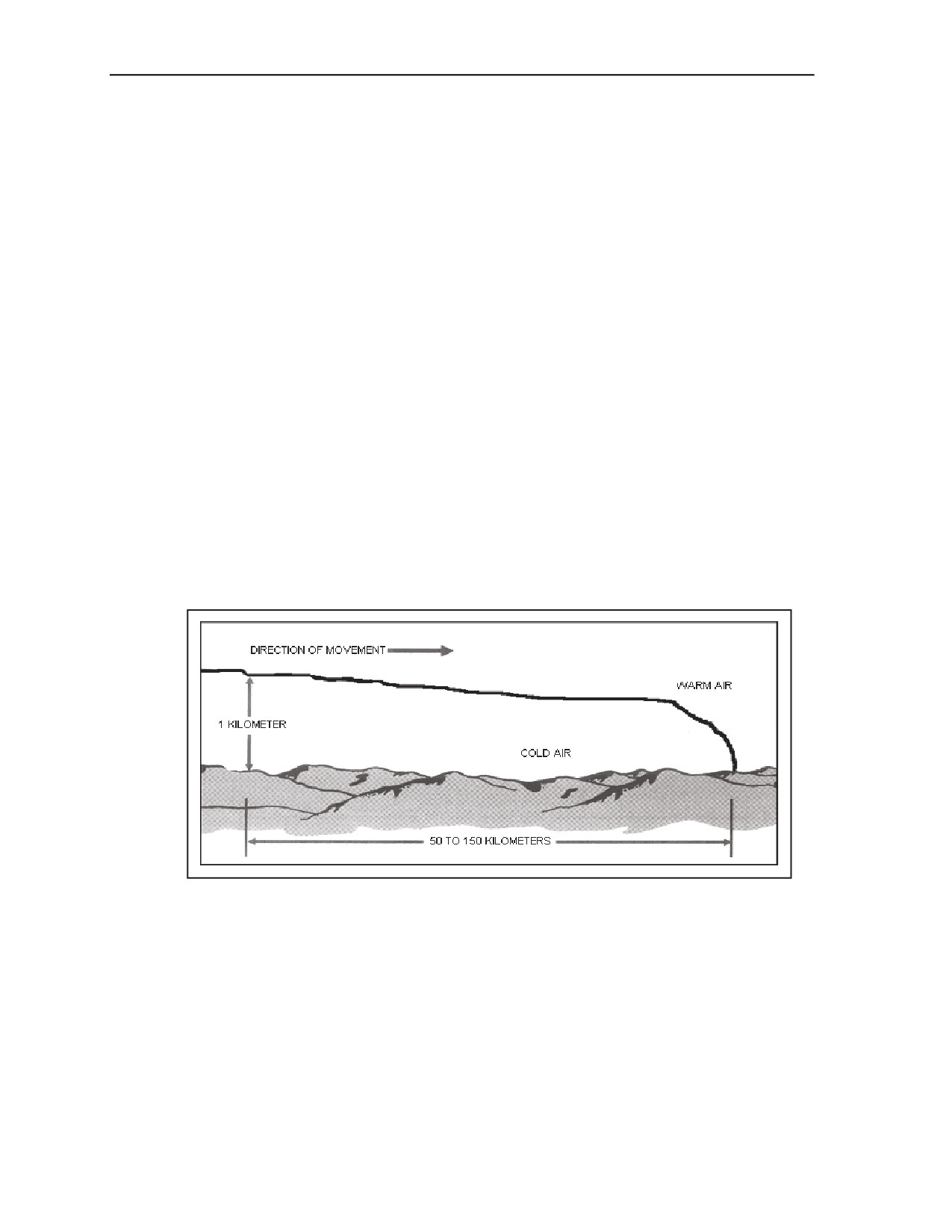
3-43. When cold air displaces warm air at the earth's surface, it is called a cold front (figure 3-6). A slow-
moving cold front has a rather gentle slope. However, as the front accelerates, the slope becomes steeper
(more vertical) near the surface because of the friction of the terrain. Cold fronts normally move faster and
have steeper slopes than warm fronts. The advancing wedge of cold air lifts the lighter warm air mass and
produces a relatively narrow band of clouds.
Figure 3-6. Cold front
3-44. The type of clouds formed by the cold front depends on the properties of the air masses involved and
the speed of the frontal system. Fast-moving cold fronts, when lifting moist, unstable air, generate
cumuliform clouds that are slightly ahead of the front. A line of thunderstorms that frequently develops
parallel to and some distance ahead of rapidly moving cold fronts may have cloud systems that extend to
the rear of the surface position of the front. The clouds are mainly stratiform when the warm air is moist
and stable. When the warm air is quite dry, little or no cloudiness occurs with the passage of a cold front.
At the surface, the passage of a cold front is characterized by—
z
An abrupt decrease in temperature.
z
A marked shift of surface wind, usually greater than 90 degrees.
3-10
FM 3-09.15/ MCWP 3-16.5
25 October 2007
Weather and Its Effects
z
A decrease in moisture content of the air.
z
A marked decrease in pressure as the front approaches, followed by a rising pressure after the
front passes.
Warm Front
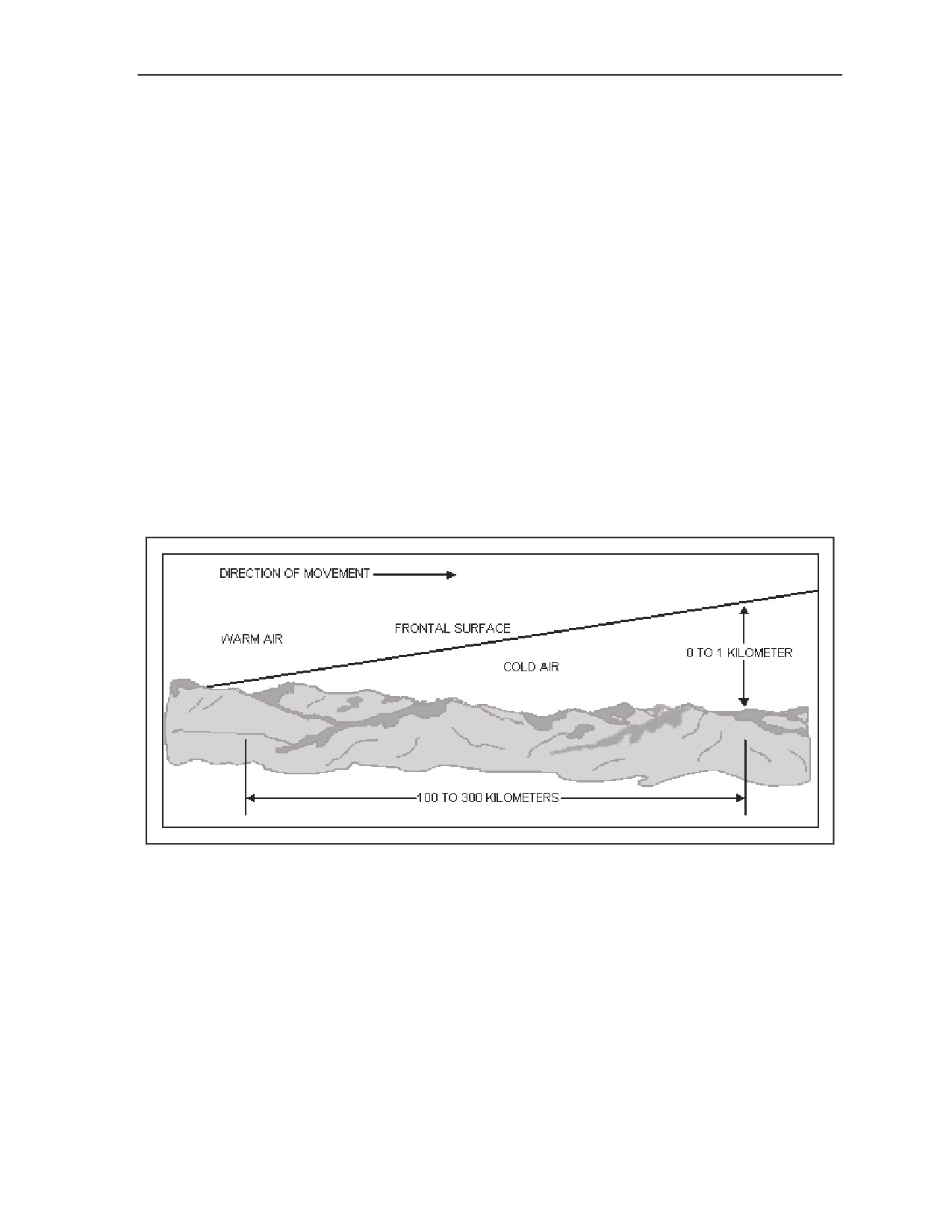
3-45. When warm air replaces cold air at the surface, it is called a warm front (figure 3-7). The speed of
the advancing warm air is greater than that of the retreating cold air. Therefore, the warm air flows upward
over the sloping wedge of dense, cold air. The force of the rising warm air slowly pushes the cold air back.
The effect of the earth's surface causes the slope of the warm front to be very flat. The dimensions of a
warm front wedge range from 100 to 300 kilometers horizontal distance with an altitude from 0 to 1
kilometer. With the same winds, the speed of a warm front is about half that of a cold front. The clouds
associated with a warm front are mainly stratiform and extend well ahead of the surface position of the
front. The weather depends largely on the stability and moisture content of the overrunning air. Steady
precipitation with low ceiling and limited visibility is normal in advance of warm fronts. At the surface, the
passage of a warm front is characterized by—
z
A marked increase in temperature.
z
A slight shift of surface wind, usually less than 90 degrees.
z
An increase in moisture content of the air.
z
A decrease in pressure as the front approaches, followed by a leveling off or slowly rising
pressure after the front passes.
Figure 3-7. Warm front
Occluded Front
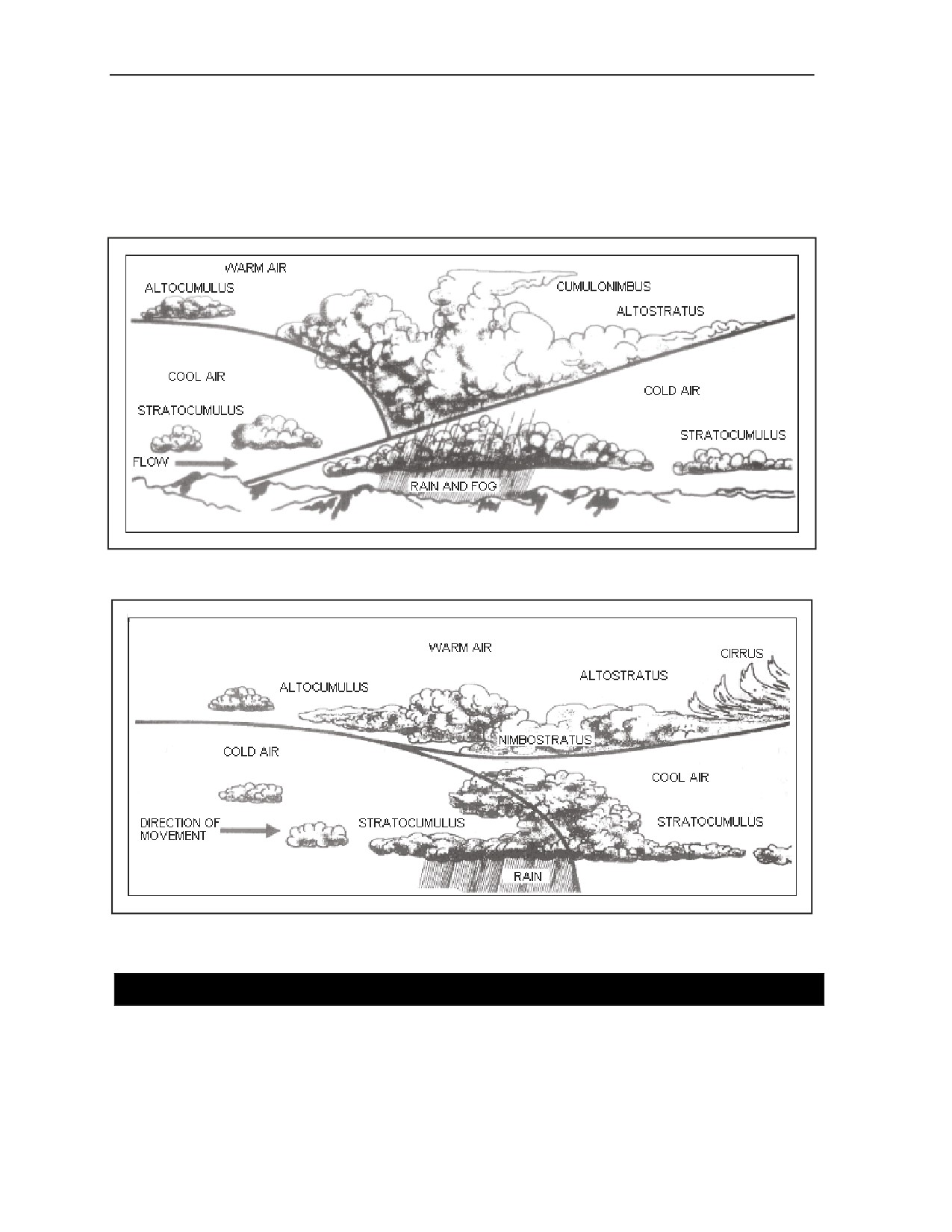
3-46. An occluded front is formed when a cold front overtakes a warm front and forces aloft the warm air
that originally occupied the space between the two fronts. There are two types of occlusions: the warm
front occlusion (figure 3-8) and the cold front occlusion (figure 3-9). The type that will occur depends on
whether the cold air of the advancing cold front is colder or warmer than the retreating wedge of cold air in
advance of the warm front. However, the essential point in both warm and cold front occlusions is that two
cold air masses meet and force the warm air aloft. This causes extensive cloudiness. The weather
associated with an occlusion depends on the properties of the three air masses involved.
25 October 2007
FM 3-09.15/MCWP 3-16.5
3-11
Chapter 3
Stationary Front
3-47. On occasion, both warm and cold air masses contain almost equal amounts of energy and neither can
move appreciably. During the period when little or no frontal movement takes place, the system is known
as a stationary front. The weather associated with a stationary front is quite similar to that with a warm
front.
Figure 3-8. Warm front occlusion
Figure 3-9. Cold front occlusion
SECTION II WEATHER AS IT APPLIES TO THE ARTILLERY
FIELD ARTILLERY MET
3-48. Field artillery MET deals with the techniques and procedures for determining current atmospheric
conditions. Atmospheric conditions along the trajectory of a projectile or rocket directly affect its accuracy
and may cause the projectile or rocket to miss the desired point of impact. A 5 to 10 percent effect on the
3-12
FM 3-09.15/ MCWP 3-16.5
25 October 2007
Weather and Its Effects
firing tables is possible even with stable atmospheric conditions. For example, tests in Southwest Asia have
shown that firing artillery at maximum ranges in extreme heat and low air density resulted in MET
corrections up to 4,700 meters.
3-49. MET data is one of the prerequisites for accurate predicted fire. With today's emphasis on first round
fire for effect and trends toward longer distances, accurate MET corrections for artillery fires are crucial.
The use of invalid or no MET corrections could cause artillery projectiles to impact on friendly troops.
Accurate MET data must be obtained and appropriate corrections applied to all fires to—
z
Conserve ammunition.
z
Decrease time in adjustment.
z
Obtain a greater surprise effect.
z
Reduce the potential for fratricide.
3-50. Despite automation, all MET section crew members should have a common understanding of certain
atmospheric and ballistic terms and the effects of MET conditions on artillery fires. Supervisors also must
be able to recognize adverse weather changes that could abruptly negate the accuracy of MET messages.
ATMOSPHERIC TERMS
3-51. In addition to the weather-related terms identified earlier in this chapter, there are other atmospheric
terms used consistently by the FA MET crew member. They are called ballistic terms and are discussed in
the following paragraphs.
Standard Atmosphere
3-52. When computing trajectories, ordnance ballisticians use the International Civil Aviation
Organization (ICAO) standard atmosphere. This standard atmosphere is the basis for all data of the ballistic
solution as well as a point of departure for ballistic MET corrections. The ICAO atmosphere at sea level is
described as follows:
z
Dry air.
z
No wind.
z
Surface temperature of 15 Celsius degrees with a decrease, or lapse rate, of -6.5 Celsius degrees
per 1,000 meters up to a height of 11,000 meters and a constant temperature of -56.5 Celsius
degrees between 11,000 and 25,000 meters.
z
Surface pressure of 1,013.25 millibars, decreasing with height.
z
Surface density of 1,225 grams per cubic meter (gm/m3), decreasing with height.
Atmospheric Zones
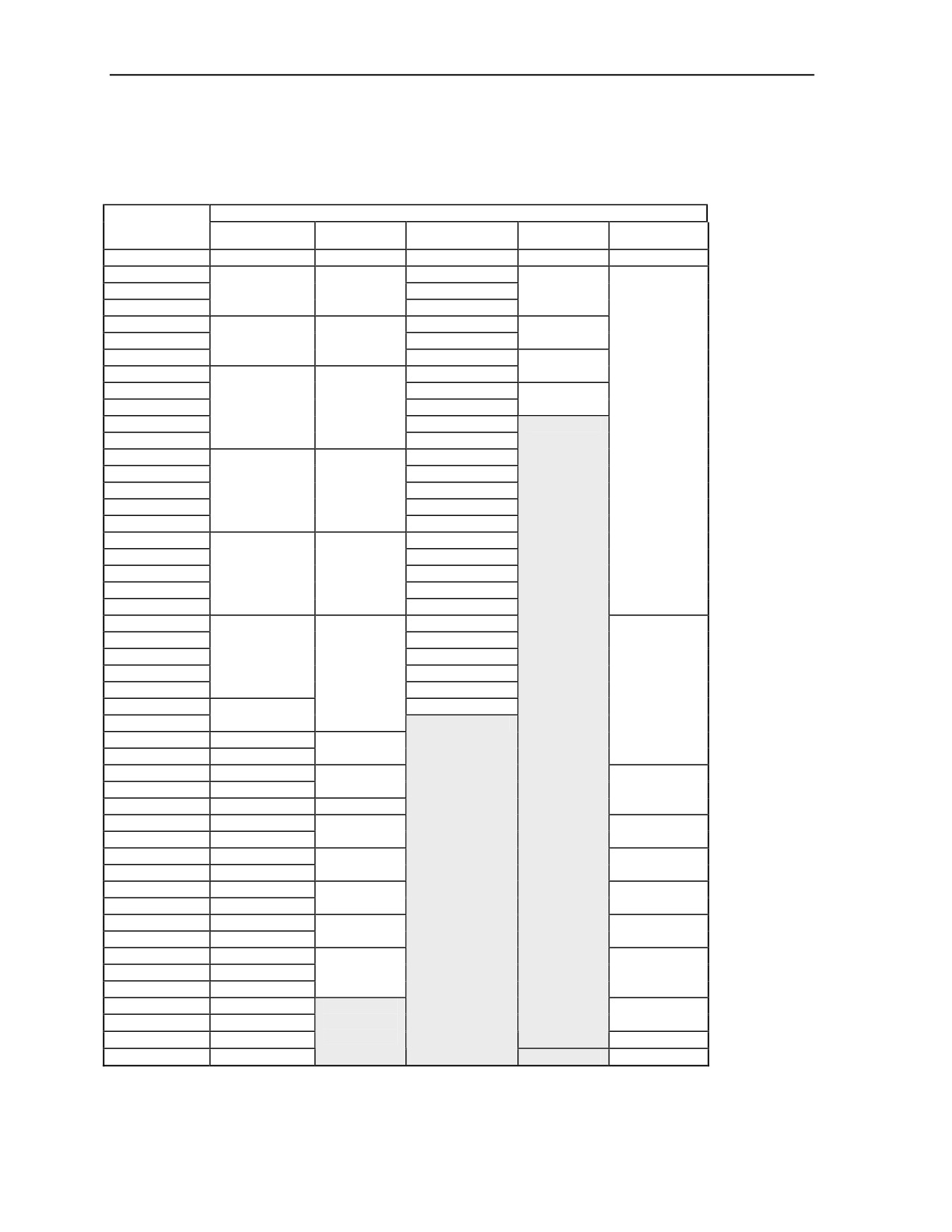
3-53. For convenience in computing, reporting, and applying corrections, the standard atmosphere is
further identified by atmospheric zones. The atmospheric zones for various MET messages and the
thickness and heights of the zones are in table 3-1.
25 October 2007
FM 3-09.15/MCWP 3-16.5
3-13
Chapter 3
Table 3-1. Atmospheric Structure of MET Message
HEIGHT
LINE (ZONE) NUMBERS
(meters)
COMPUTER
BALLISTIC
TARGET
SOUND
FALLOUT
ACQUISITION
RANGING
SURFACE
0
0
0
0
0
50
1
100
1
1
2
1
200
3
300
4
400
2
2
5
2
500
6
600
7
3
700
8
800
3
3
9
4
900
10
1,000
11
1
1,100
12
1,200
13
1,300
4
4
14
1,400
15
1,500
16
1,600
17
1,700
18
1,800
5
5
19
1,900
20
2,000
21
2,100
22
2,200
23
2,300
6
24
6
2,400
25
2,500
26
2
2,600
27
3,000
7
3,500
8
4,000
9
7
4,500
10
5,000
11
8
3
6,000
12
9
7,000
13
8,000
14
10
4
9,000
15
10,000
16
11
5
11,000
17
12,000
18
12
6
13,000
19
14,000
20
13
7
15,000
21
16,000
22
14
8
18,000
24
19,000
25
20,000
26
10
******
*****
30,000
15
3-14
FM 3-09.15/ MCWP 3-16.5
25 October 2007
Weather and Its Effects
Ballistic Wind
3-54. Ballistic wind is a wind of constant speed and direction that has the same effect on a projectile
during its flight as all the varying winds serially encountered by the projectile.
Ballistic Density
3-55. Ballistic density is a constant density, expressed as a percentage of standard density that has the same
effect on a projectile's trajectory as the varying densities serially encountered by the projectile.
Ballistic Temperature
3-56. Ballistic temperature is a constant vertical temperature, expressed as a percentage of standard
temperature that has the same effect on a projectile in flight as the varying temperatures serially
encountered by the projectile.
MET EFFECTS ON ARTILLERY
3-57. It is important to identify the weather effects on artillery because it provides MET personnel an
understanding of the importance of the met section’s mission.
3-58. The following text provides detailed information and a graphical explanation of how certain aspects
of weather affects the artillery.
Wind
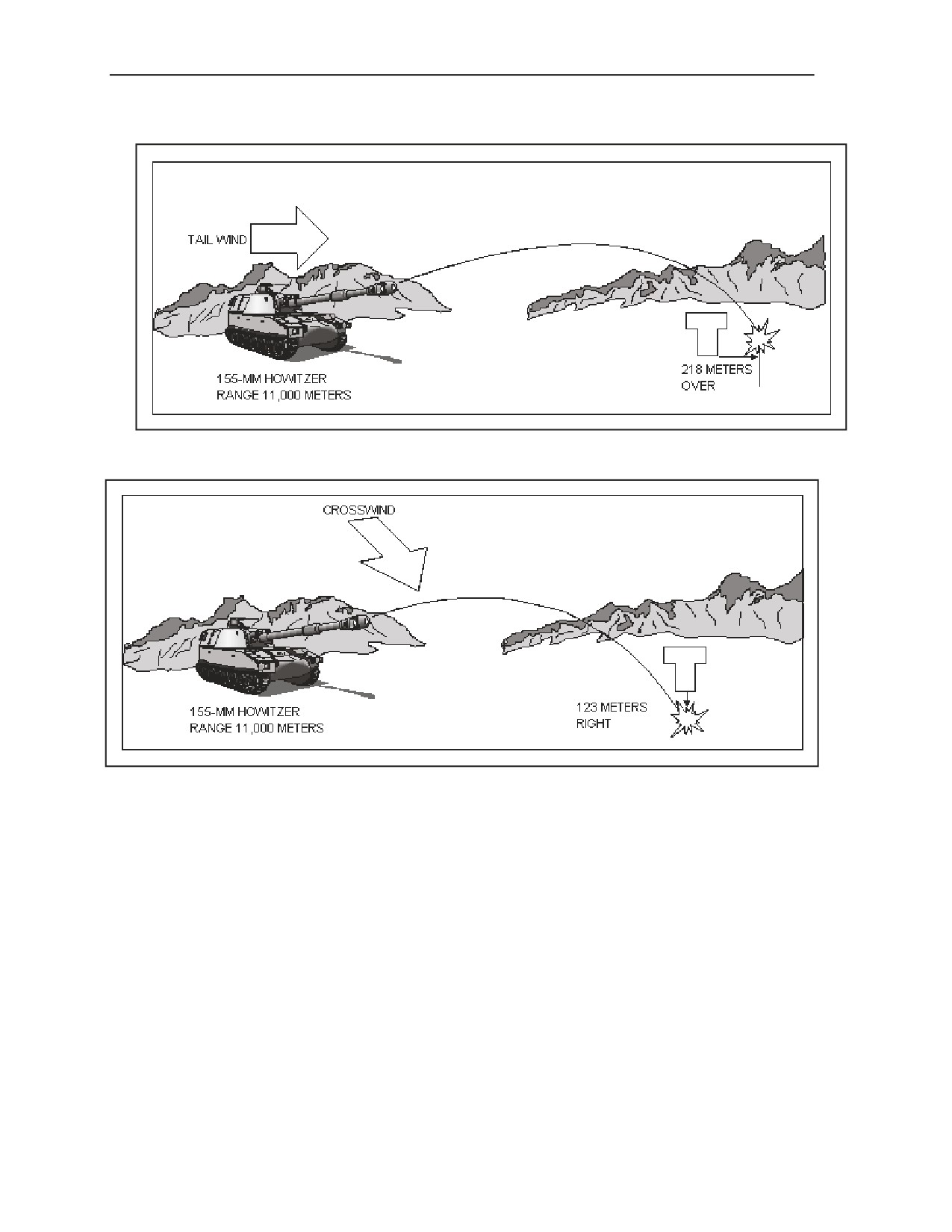
3-59. The effects of wind on a projectile are easy to understand. A tail wind causes an increase in range,
and a head wind causes a decrease in range. A crosswind blows the projectile to the right or left, which
causes a deflection error. FDC personnel convert ballistic wind measurements into range and deflection
and apply corrections to the deflection and elevation of the artillery piece. Figures 3-10 and 3-11 show the
effects of a 20-knot wind on a 155-millimeter howitzer firing at a range of 11,000 meters, charge 7 white
bag (WB).
25 October 2007
FM 3-09.15/MCWP 3-16.5
3-15
Chapter 3
Figure 3-10. Effect of a 20-knot tail wind
Figure 3-11. Effect of a 20-knot crosswind
Temperature
3-60. Variations in air temperature cause two separate effects on a projectile. One effect is caused by the
inverse variation of density with temperature (equation of state). This effect is compensated for when
density effects are considered. The second effect is regarded as the true temperature effect. It is the result
of the relationship between the speed of the projectile and the speed of the air compression waves that form
in front of or behind the projectile. These air compression waves move with the speed of sound, which is
directly proportional to the air temperature. The relationship between the variation in air temperature and
the drag on the projectile is difficult to determine. This is particularly true for supersonic projectiles since
they break through the air compression waves after they are formed. As firing tables indicate, an increase
in air temperature may increase, decrease, or have no effect on achieved range, depending on the initial
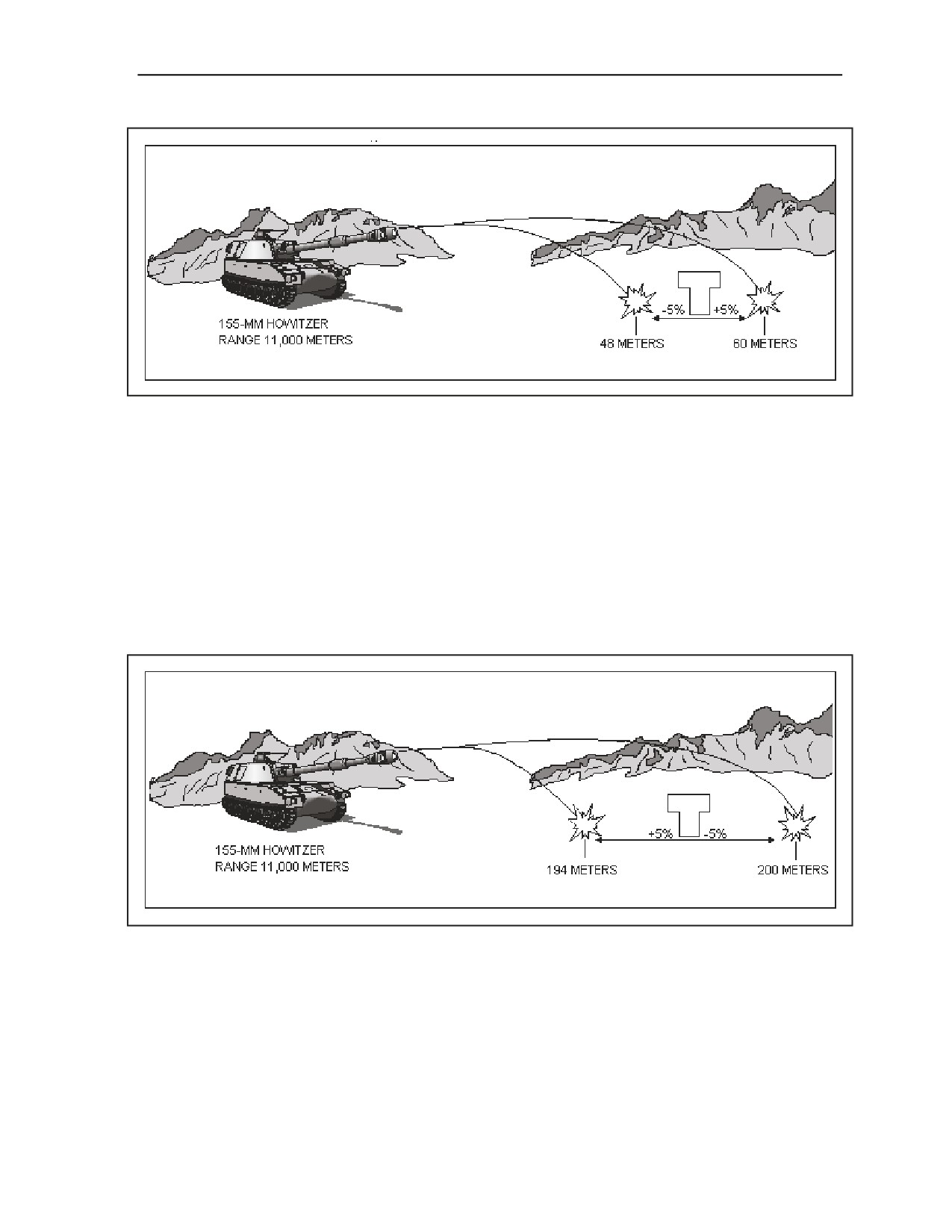
elevation and muzzle velocity of the weapon. Figure 3-12 shows the effect of a 5-percent deviation from
standard temperature.
3-16
FM 3-09.15/ MCWP 3-16.5
25 October 2007
Weather and Its Effects
Figure 3-12. Effect of temperature
Density
3-61. Density of the air through which a projectile passes creates friction that affects the forward
movement of the projectile. This affects the distance the projectile travels. The density effect is inversely
proportional to the projectile ranges; that is, an increase in density causes a decrease in range. Figure 3-13
shows the effect of a 5-percent deviation from the standard air density. Air density decreases rapidly with
height. Therefore, the altitude of the firing battery and the ordinate of the trajectory have a direct effect on
the magnitude of the density correction. Given equal deviations from standard of each MET effect on the
flight of a projectile, air density has the greatest range effect.
Figure 3-13. Effect of density
MESOSCALE MODELING
3-62. Throughout history, man has attempted to predict weather and its effects. Advances in technology
have allowed meteorologists to measure weather phenomenon on a global scale. This large scale data is of
little use in predicting weather until it is evaluated against the factors affecting weather
(terrain,
temperature, bodies of water, vegetation, and others) and applied to a specific area. Scientists have
25 October 2007
FM 3-09.15/MCWP 3-16.5
3-17
Chapter 3
developed computer modeling programs to evaluate the massive amounts of data, giving meteorologist a
tool to accurately predict weather.
3-63. Artillery MET sections are concerned with creating a vertical profile of the atmosphere, which is
used by artillery units to develop more accurate firing solutions. Traditionally, this vertical profile of the
atmosphere was created from surface observations and data collected from balloon-borne sondes. While
this method provides accurate data at the MET section’s location, the further away the firing unit is located
from the MET section the less effective the data for computing firing solutions.
3-64. The Mesoscale model has been developed in order to provide sufficient data to create accurate
vertical profiles. The vertical profiles can be generated anywhere within a 60-kilometer radius of the MET
section location. The MMS-P equipped MET section, using the Mesoscale model, can generate MET data
on demand.
3-65. The capability of the model to generate a vertical profile within a 60-kilometer radius of the MET
section allows the system to generate target area MET for targets within the radius. The system generates a
vertical profile over the target that is used to increase the accuracy of smart munitions.
INITIALIZING THE MODEL
3-66. Model processing is done automatically by the MMS-P computers. Data from all available sources
are incorporated into the model. The more data provided to the model, the more accurate the model output
will be.
3-67. While MET personnel cannot see the numerical values processed by the model, they can observe the
system building each domain on the model status screen. The model status screen will indicate when each
domain has completed processing. Additionally, the model status screen will provide information when
output is available from each model run.
Domains
3-68. Initialization of the Mesoscale model begins with establishing domains. A domain is a grid system
defining the geographic area for which MET data will be collected and processed.
3-69. The MMS-P equipped MET section establishes three domains when initializing the system by
entering each domain’s center point. The outer and largest domain measures 3,600 x 3,600 kilometers. It is
divided into a grid of 36-kilometer squares and is referred to as the “36-kilometer domain.” Nested within
the 36-kilometer domain, and using the same center point, lies a 1,500 x 1,500-kilometer area divided into
a grid of 12-kilometer squares and referred to as the “12-kilometer domain.” Nested within the 12-
kilometer domain, and using a center point that does not have to be the same as the other grids, lies a 500 x
500-kilometer area divided into a grid of 4-kilometer squares known as the “4-kilometer domain.” Figure
3-14 shows the nested domains.
3-18
FM 3-09.15/ MCWP 3-16.5
25 October 2007
Weather and Its Effects
Figure 3-14. Nested domains
3-70. The MM5 model first builds the 36-kilometer domain. The model applies terrain data to the grid
acquired from the National Imagery and Mapping Agency (NIMA) Digital Terrain Elevation Data (DTED)
database contained on the system computers. Terrain data includes elevation, land use (vegetation), and
land-water mask information.
3-71. The MM5 model next applies worldwide forecast model data generated by the Naval Operational
Global Atmospheric Prediction System (NOGAPS). NOGAPS data is not direct MET observation data, but
resultant forecast data created after analysis. NOGAPS data is broadcast via satellite twice daily by the Air
Force Weather Agency (AFWA). Each transmission provides the MMS-P equipped section with 72 hours
of forecast data. The MM5 model requires a minimum of 24 hours of valid NOGAPS data to be able to
initialize.
3-72. In addition to the NOGAPS data, the model applies surface observations and local observations
(upper air data generated by balloon-borne sondes) acquired by the MET section. Additional local
observations acquired by other MET sections in the area of operations can also be used by the model to
increase the accuracy of the output.
3-73. The MM5 model data from the computation of the 36-kilometer domain is used to compute the 12-
kilometer domain. The data generated from the computation of the 12-kilometer domain is used to compute
the 4-kilometer domain. This results in a refined vertical profile of the atmosphere in each domain up to
30,000 meters. The MM5 model reinitializes every 30 minutes using the newest inputs. This allows the
MM5 model to generate freshest possible data. Figure 3-15 shows the atmospheric profile.
25 October 2007
FM 3-09.15/MCWP 3-16.5
3-19
Chapter 3
Figure 3-15. Atmospheric profile
3-74. The MET domain establishes for the mesoscale model and the post processor its
“area of
operations.” The default location for the MET domain is the profiler location in the center of the 4-
kilometer resolution of 500 x 500-kilometer grid. This coverage should be sufficient for most operations.
The MET domain center however can be different than the profiler location. This is useful if the line of
march/operational area is known for the mission. For example, given a line of march moving in a due north
direction, a profiler could be located at the southern edge (60 kilometers from the MET domain end) of the
MET domain (figure 3-16). This gives the profiler greater coverage as it moves north with friendly forces.
This is important as the model reduces its error over time if left running without a change in domain. If
either the MET domain changes or the system is shutdown the model will need to rerun.
3-20
FM 3-09.15/ MCWP 3-16.5
25 October 2007
Weather and Its Effects
Figure 3-16. MET Domain Profiler Location
UNIFIED POST PROCESSING SYSTEM
3-75. Once the MM5 model is initialized, the MMS-P equipped system is prepared to generate MET data
upon demand based on type of MET data required. The data from the model alone is not sufficiently
accurate for use by artillery units. The data from the model is transferred to the Unified Post Processing
System (UPPS).
Nowcasts
3-76. The UPPS processes the MM5 model output, surface observations data, and upper air data to reduce
model bias to produce a nowcast, which can be reformatted into the type of MET message requested by the
user. The UPPS repeatedly recycles, creating nowcasts using the newest available data.
3-77. A request for MET from a user contains the gun location and the target location. The UPPS
identifies the gun location and the target location within the model domain. Using the current nowcast, the
UPPS generates the requested MET data based on the midpoint between the gun location and the target
location. The resulting data is input into the appropriate message format and sent to the Common Message
25 October 2007
FM 3-09.15/MCWP 3-16.5
3-21
Chapter 3
Processor for verification and transmission to the requesting user. Figure 3-17 shows the reference point
where MET data was generated when requested.
Figure 3-17. MET data reference point
MET EFFECTS ON SMART MUNITIONS
3-78. MET conditions at the target location effects the accuracy of smart munitions. Smart munitions are
subject to the same affects of wind, temperature, and humidity as a free flight projectile. These effects are
moderated by the ability of smart munitions to make in-flight corrections using passive guidance methods.
The greatest effect of MET conditions on smart munitions is the effect of conditions on the ability of the
smart munitions acquiring targets. Smart munitions that acquire targets by visual means can have difficulty
identifying targets when the target area is obscured by clouds or blowing sand and other adverse
conditions.
3-79. The MMS-P equipped section can generate a target area MET message. This knowledge of the
target area MET can be used to increase the accuracy of smart munitions or can influence the decision to
utilize these expensive munitions. The MET conditions may be such that fire planners will select a
different asset to engage the target.
3-22
FM 3-09.15/ MCWP 3-16.5
25 October 2007
Chapter 4
Operating Principles
Although the operating principles of the Meteorological Measuring Set
(MMS)
system and the Meteorological Measuring Set - Profiler (MMS-P) system are very
different, the principles of data collection are basically the same with a few
exceptions. This chapter discusses these principles and differences beginning with the
navigational aid systems and then describes the operating modes.
SECTION I MMS SECTIONS
4-1. The MMS equipped section produces MET data from upper-air data collected by balloon-borne
radiosondes. The MMS uses one of three operating modes to track the radiosonde. These operating modes
are Long-Range Aid to Navigation (LORAN) , Radio Direction Finding (RDF), and Global Positioning
System (GPS)
NAVIGATIONAL AID (NAVAID) SYSTEM
4-2. The NAVAID system producing signals suitable for use by MET sections is Long Range Aid to
Navigation (LORAN). A NAVAID signal receiver inside a radiosonde in flight receives transmissions
from groups of fixed stations. The radiosonde then transmits the NAVAID information to the ground
equipment. The differences in the time of arrival of the signal and the phases of the signals are computed
by using triangulation to determine the geographical position of the radiosonde.
4-3. The LORAN system is an established low-frequency commercial navigational system. The LORAN
produces a highly stable ground wave that can be received about 2,000 kilometers from the system
transmitters. Ideal atmospheric conditions can extend the range of LORAN system transmitters to 8,000
kilometers.
4-4. The LORAN system currently has several operational groups of stations called chains. These chains
cover a substantial part of the world's coastal areas. One station of each chain is the primary transmitting
station, identified as the master station. The others are secondary stations. The primary and secondary
transmitters emit synchronized signals that radiate away from the antenna.
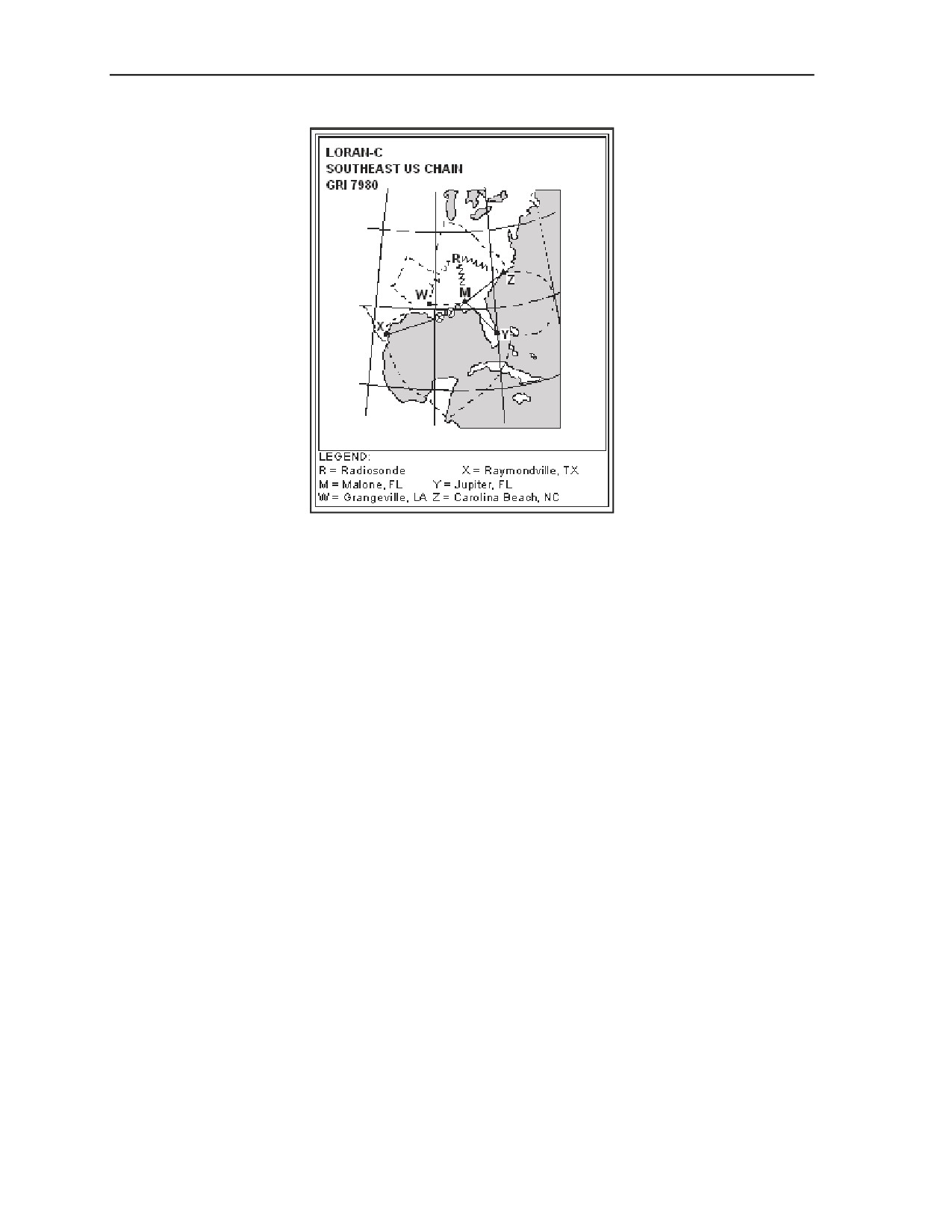
4-5. The map at figure 4-1 represents a LORAN chain in the southeastern part of the United States. It has
five transmitting stations. Station M, or Malone, is the primary station. Assume, for example, that a
NAVAID radiosonde is operating aloft at point R on the map. The signals received by the radiosonde from
stations W, M, and Z arrive at different times. The met system receives and processes these different arrival
times. The met system then determines the phase relationship of the signals received from the radiosonde.
Finally, the met system converts the information into wind data aloft. A list of LORAN chains is at
appendix F.
25 October 2007
FM 3-09.15/ MCWP 3-16.5
4-1
Chapter 4
Figure 4-1. Southeast U.S. chain
4-6. In the NAVAID mode the met section can operate from a fixed location, while on the move, or the
section can conduct a remote launch.
4-7. Fixed location operations allow the met section to provide continuous met coverage for a particular
area of interest.
4-8. Mobile operations allow a met section to start a NAVAID sounding before moving to another site.
The system will continue to process data while the section is moving and messages can be transmitted once
the section has stopped in the new location. Mobile operations allow an uninterrupted sounding schedule.
The operations officer should consider this capability when planning met section employment.
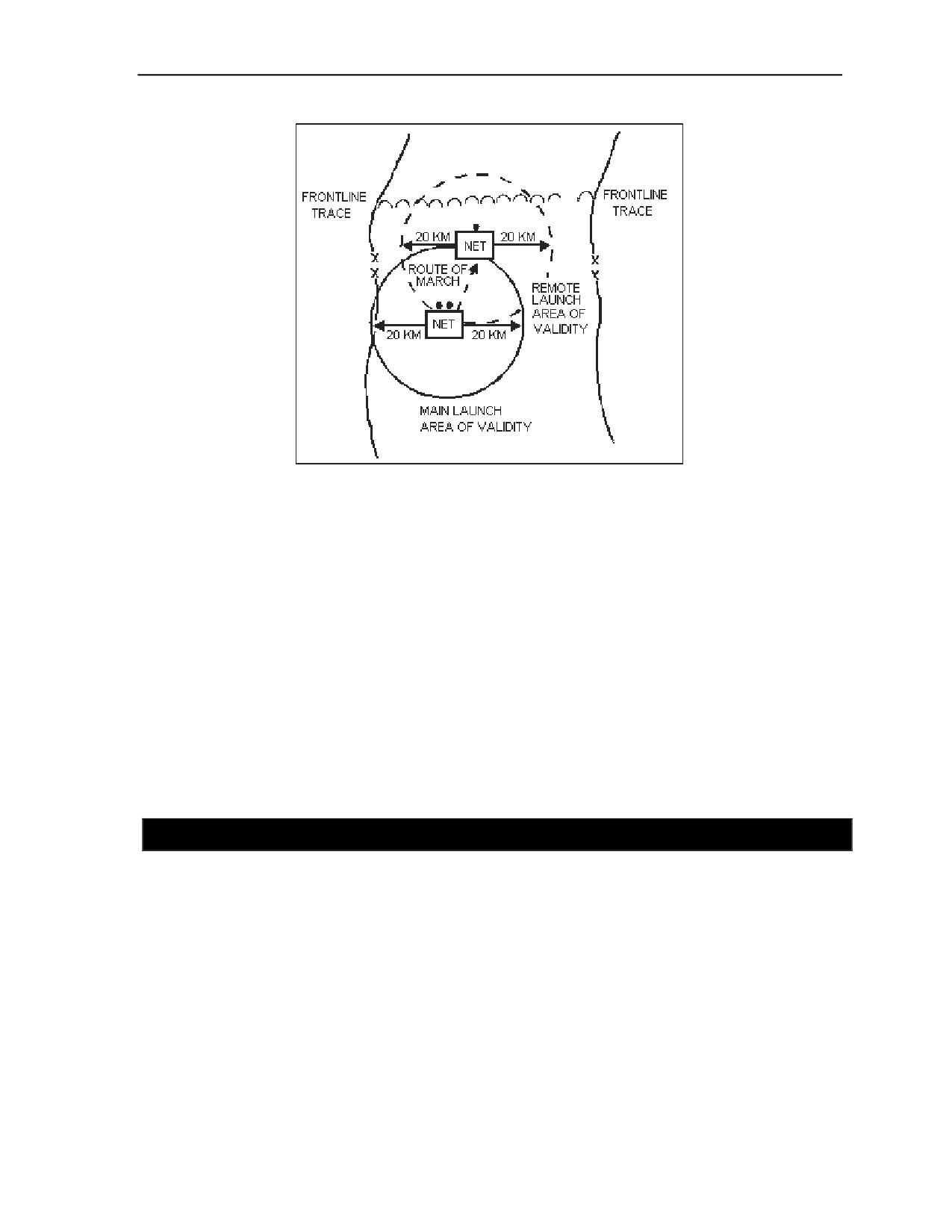
4-9. Remote launch allows the section to release balloon-borne radiosondes from a position up to 20
kilometers from the primary section location. Remote launch allows data to be collected close to the area of
interest without displacing the entire section. When coordinated properly, this capability can greatly
increase the AMV of one section. Limiting factors of remote launch are detailed in the paragraphs below.
4-10. During offensive operations, supported units may move quickly forward out of AMV coverage.
Remote launch helps to provide continuous availability of valid MET data to rapidly moving artillery units.
An example of a routine use of the NAVAID remote launch capability is to deploy a balloon launch team
forward with artillery advance parties. The launch team receives commands from the primary section
location by radio. On arrival at the remote launch site, the team takes surface measurements and launches
the balloon on command of the section headquarters. The launch team either returns immediately to the
primary section location, travel to a second remote launch site, or remain at its present location. Figure 4-2
shows a graphic example of remote launch capability.
4-2
FM 3-09.15/ MCWP 3-16.5
25 October 2007
Operating Principles
Figure 4-2. Remote launch capability
4-11. Each remote launch mission is different and requires extensive planning before execution. The
operations officer and the MET station leader plan remote launches and incorporate them into the MET
section positioning scheme.
RDF OPERATIONS
4-12. The RDF operating mode is designed to be used whenever NAVAID systems are unavailable. It only
operates from a fixed location. A ground device tracks the path of a radiosonde as it rises in the
atmosphere. Angular and meteorological data are passed on to the equipment shelter for processing and
dissemination.
GPS OPERATIONS
4-13. The GPS operating mode uses satellites to track the path of the radiosonde as it rises in the
atmosphere. Angular and meteorological data are passed to the equipment shelter for processing and
dissemination. See appendix E for an explanation of GPS satellite coverage.
SECTION II MMS-P SECTIONS
4-14. Previous MET systems used upper air data collected from a balloon-borne radiosonde to generate
MET data required to support operations. The MMS-P produces MET data from an atmospheric model of
the operational area. While upper air data is collected by balloon-borne radiosondes, it is but one of the
inputs utilized by the mesoscale modeling software (MM5). The additional inputs required by the MM5
model are large-scale weather data received via satellite and area observations.
4-15. Operational Modes for the MMS-P are described as operational mode (with model initialized) and
degraded mode (without model initialized). In the operational mode, the AMV for the MMS-P is 60
kilometers. When in degraded mode, the AMV for the MMS-P is reduced to 30 kilometers. This reduction
in AMV requires the operations officer and MET station leader to adjust the MET section positioning
scheme when the system is in degraded mode.
25 October 2007
FM 3-09.15/MCWP 3-16.5
4-3
Chapter 4
SURFACE OBSERVATION DATA
4-16. Surface observation data is acquired using the TACMET surface sensor and provides the system
with surface wind speed/direction, temperature, and air pressure at the section location.
SOUNDING DATA
4-17. MMS-P equipped sections uses two modes for determining upper air data, LORAN-Commercial
(LORAN-C) and GPS.
LORAN-C MODE
4-18. A NAVAID signal receiver inside a radiosonde in flight receives transmissions from groups of fixed
stations. The radiosonde then transmits the NAVAID information to the ground equipment. The
differences in the time of arrival of the signal and the phases of the signals are computed by using
triangulation to determine the geographical position of the radiosonde.
4-19. The MMS-P is currently not capable of mobile operations. LORAN-C can only be performed from a
fixed location.
GPS MODE
4-20. The GPS operating mode uses satellites to track the path of the radiosonde as it rises in the
atmosphere. Angular and meteorological data are passed to the equipment shelter for processing and
dissemination. See appendix E for an explanation of GPS satellite coverage.
4-21. The MMS-P is currently not capable of mobile operations. GPS can only be performed from a fixed
location.
NOGAPS DATA
4-22. The MMS-P requires large-scale weather data to initialize the MM5 model. This data is generated
by the Naval Operational Global Atmospheric Prediction System (NOGAPS). This data is transferred to
the Air Force Weather Agency (AFWA) where it is broadcast via satellite. Each transmission of NOGAPS
data contains 72 hours of valid data.
4-23. The MMS-P equipped section downloads NOGAPS transmissions using the Tactical-Very Small
Aperture Terminal (T-VSAT). The NOGAPS data is processed by the system and made available to the
MM5 model. A secondary method for input of NOGAPS data is using a CD-ROM. The CD-ROM can be
created by another MMS-P with valid data or the data can be downloaded from the internet and written to
a disk. The CD-ROM should be destroyed once the NOGAPS data is downloaded to the profiler.
AREA OBSERVATIONS
4-24. Area observations are meteorological observations that come in via messages over the SINCGARS
network from other MMS and MMS-P systems in the current theater of operations. While not required for
the MMS-P to be operational, the area observation data is used to increase the accuracy of the model
output.
REGIONAL OBSERVATIONS
4-25. Regional Observations are transmitted hourly by Air Force Weather Teams. This information is
downloaded via satellite using the T-VSAT and ingested by the MM5 Mesoscale model.
DEGRADED MODE OPERATIONS
4-26. When sufficient NOGAPS data is not available to initialize the MM5 model, the MMS-P system
operates in degraded mode. In degraded mode, the MMS-P equipped section must conduct a sounding in
4-4
FM 3-09.15/ MCWP 3-16.5
25 October 2007
Operating Principles
order to generate MET messages with valid data. The sounding data is processed by the Unified Post
Processing System (UPPS).
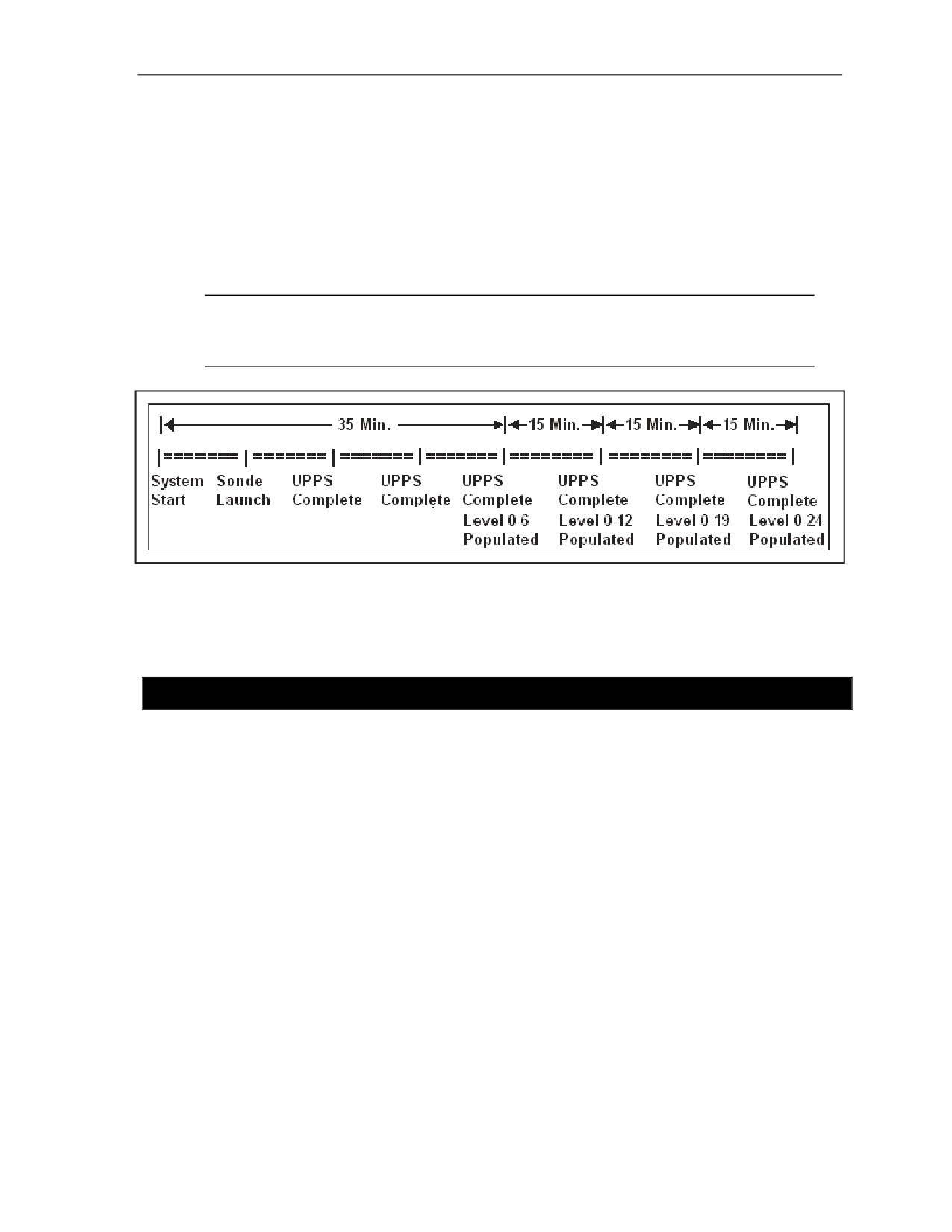
4-27. From the time the sonde is launched, it takes approximately 35 to 65 minutes for sounding data to be
processed to the point where a MET message can be populated with data. Typically, the first run of the
UPPS cycle that ingests sounding data contains data for MET zones zero through six. As the sounding
progresses in altitude and feeds data to the system, subsequent MET zones will be populated. The operator
can generate a MET message following each cycle of the UPPS until the number of levels required for the
message is achieved. See figure 4-3 for an example timeline showing how degraded mode operates when
initializing the system without valid NOGAPS data.
NOTE: Times may vary depending on startup, initialization and sonde launch times. The
timeline shows a scenario where it takes 35 minutes for sonde data to be made available and to
be ingested by the UPPS.
Figure 4-3. Example degraded mode timeline
4-28. The MMS-P system returns to a fully operational mode upon receipt of valid NOGAPS data
downloaded via T-VSAT antenna or input using a CD-ROM. The system computers have to be rebooted in
order to return to a fully operational mode.
SECTION III VISUAL MET
PILOT BALLOON (PIBAL) OBSERVATIONS (USMC)
4-29. The primary means to determine meteorological data is using electronic meteorological equipment.
When electronic meteorological equipment fails or is not available, MET data may be determined from
observation of pilot balloons along with approved MET software. MET data determined from PIBAL
observation is not as accurate as MET data determined from electronic meteorological equipment. PIBAL
is only accurate in the form of wind speed and wind direction. Temperature and pressure are derived from
a set lapse rate based off the surface readings the operator provides to the Visual Meteorology Computer
Program.
4-30. PIBALs are issued in two sizes, 30-gram and 100-gram (representing the weights of the deflated
balloons). Under various sky conditions, some colors are more easily detected by the eye than others. For
this reason, PIBALs are issued in several colors, the most common being white, red, and black. The rule to
remember when deciding which color balloon to use is “darker the sky the darker the balloon.”
4-31. The rate of rise of the 30-gram balloon is approximately 180 meters per minute, after a steady rate of
rise is attained. The rate of rise of a 100-gram balloon is approximately 300 meters per minute after a
steady rate of rise is attained.
4-32. Approximate cloud heights may be determined by timing the ascent of PIBAL, multiplying the time
by the rate of rise to determine the height of the balloon. When timing the ascent of the PIBAL to
25 October 2007
FM 3-09.15/MCWP 3-16.5
4-5
Chapter 4
determine cloud height, the balloon is timed until it is obscured by the lowest level of clouds. Computing
cloud height in this manner provides an approximate cloud height.
INFLATING PIBALS
4-33. When inflating PIBALs, the nozzle ML-373/GM is connected to the hose ML-81. The ML-81 is
connected to the gas cylinder. The ML-373/GM provides a valve for controlling the flow of gas, and to act
as a calibrated weight to determine the correct amount of gas needed for inflation. The ML-373/GM may
be used when inflating with helium or hydrogen. Therefore, when using the ML 373/GM with helium, you
must use locally produced work sheet with properly computed times for tops of zones.
4-34. The ML-373/GM nozzle has two connections at opposite ends: a large connection for PIBALs with a
large neck and a small connection for PIBALs with a small neck. Most commercially purchased balloons
must be connected to the smaller connection on the ML-373/GM nozzle. Projecting from the middle of the
nozzle is the fitting for the hose ML-81. Opposite the hose fitting is a wing nut, which controls the valve.
The nozzle alone weighs 132 grams, which is the correct free lift weight for a 30-gram PIBAL during a
daytime flight. Adding the 443-gram weight to the nozzle brings the complete nozzle weight to 575 grams,
the correct free lift for a 100-gram PIBAL during a daytime flight.
4-35. When a nighttime flight is flown, additional weights are added to the nozzle to compensate for the
greater air resistance caused by increased size of the balloon. The additional weights required are 70 grams
for the 30 gram PIBAL and 50 grams for the 100-gram PIBAL. Also, remember when using nonstandard
night lighting devices during nighttime flights, the devices should be connected to the nozzle during
inflation to account for the additional weight.
4-36. Once the proper weights are attached to the nozzle, free lift must be obtained. Free lift is the net
upward force required for the balloon to ascend at a given rate. Simply stated, the balloon must be inflated
until it is suspended in midair with the nozzle and additional weights (if any were needed) still attached to
the balloon without the hose ML-81. Once free lift is achieved, you may now disconnect the balloon from
the nozzle and tie the balloon off. The balloon is now properly inflated and ready for release.
TRACKING AND RECORDING PROCEDURES
4-37. The primary function of the theodolite in the meteorology section is to visually observe an ascending
PIBAL while providing azimuth and elevation angles from the theodolite to the pilot balloon. The azimuth
and elevation angles are observed and recorded at predetermined times. These times are the time it takes
the PIBAL to reach specific heights. The times for specific heights are determined based on a known
ascent rate of the balloon. For example, if the balloon rises at 200 meters per minute, it would take 5
minutes for the balloon to reach 1,000 meters.
4-38. Recording worksheet will contain the times at which azimuth and elevation angles should be read
and recorded. This form will also contain all of the surface readings and information needed by the
operators prior to release of the balloon. Ensure before release of the balloon that the balloon is downwind
from the theodolite so it does not fly directly over the theodolite and that the recorder records the offset
azimuth. The offset azimuth is the azimuth from the theodolite to the balloon just before it is released. It is
important that the azimuth and elevation angles are read at the exact time identified on the worksheet.
4-39. Additionally, when the elevation and azimuth angles are read, the balloon should be centered in the
crosshairs of the eyepiece of the theodolite. The timer/recorder must alert the theodolite operator when it is
approaching the time the azimuth and elevation angles are to be read. The timer/recorder must alert the
theodolite operator in order that the operator will ensure the balloon is in the center of the crosshairs at
precisely the moment the azimuth and elevation angles are read.
4-40. The timer/recorder must alert the operator at least 5 seconds before the azimuth and elevation angles
are to be read. The timer/recorder alerts the theodolite operator with the command ‘WARNING’. Once the
command ‘WARNING’ is given, the theodolite operator should ensure the balloon is exactly centered in
the crosshairs of the theodolite’s eyepiece.
4-6
FM 3-09.15/ MCWP 3-16.5
25 October 2007
Operating Principles
4-41. After the ‘WARNING’ command is given, the timer/recorder should voice the command ‘Read’ at
the moment the predetermined times are reached. The timer/recorder may record the azimuth and elevation
angles from one of the digital displays on the theodolite, or the theodolite operator may read the angles
from the mechanical angles located in the eyepiece of the theodolite.
4-42. The azimuth and elevation angles are recorded on the form provided to“tenth of a degree” accuracy.
The azimuth and elevation angles from the form will be entered in data fields of a visual meteorology
computer program. The computer program will process the information and produce a formatted
meteorology computer message (METCM) that may be delivered by courier, voice radio or entered into a
digital communication device for digital transmission. For more information on PIBAL operations, refer to
Operations Manual 79-95M01.
4-43. All forms and MET messages are to be maintained in the manner of electronic MET messages and
forms.
25 October 2007
FM 3-09.15/MCWP 3-16.5
4-7
This page intentionally left blank.
Chapter 5
Meteorological Measuring Set (MMS), AN/TMQ-41
This chapter discusses the components, site considerations, and personnel of the
AN/TMQ-41 equipped section.
SECTION I MMS AN/TMQ-41 EQUIPMENT
SHELTER EQUIPMENT GROUP
5-1. The AN/TMQ-41 is an automated meteorological data processing system. It consists of two main
equipment groups, the Shelter Group and the Radio Direction Finding (RDF) group. This section discusses
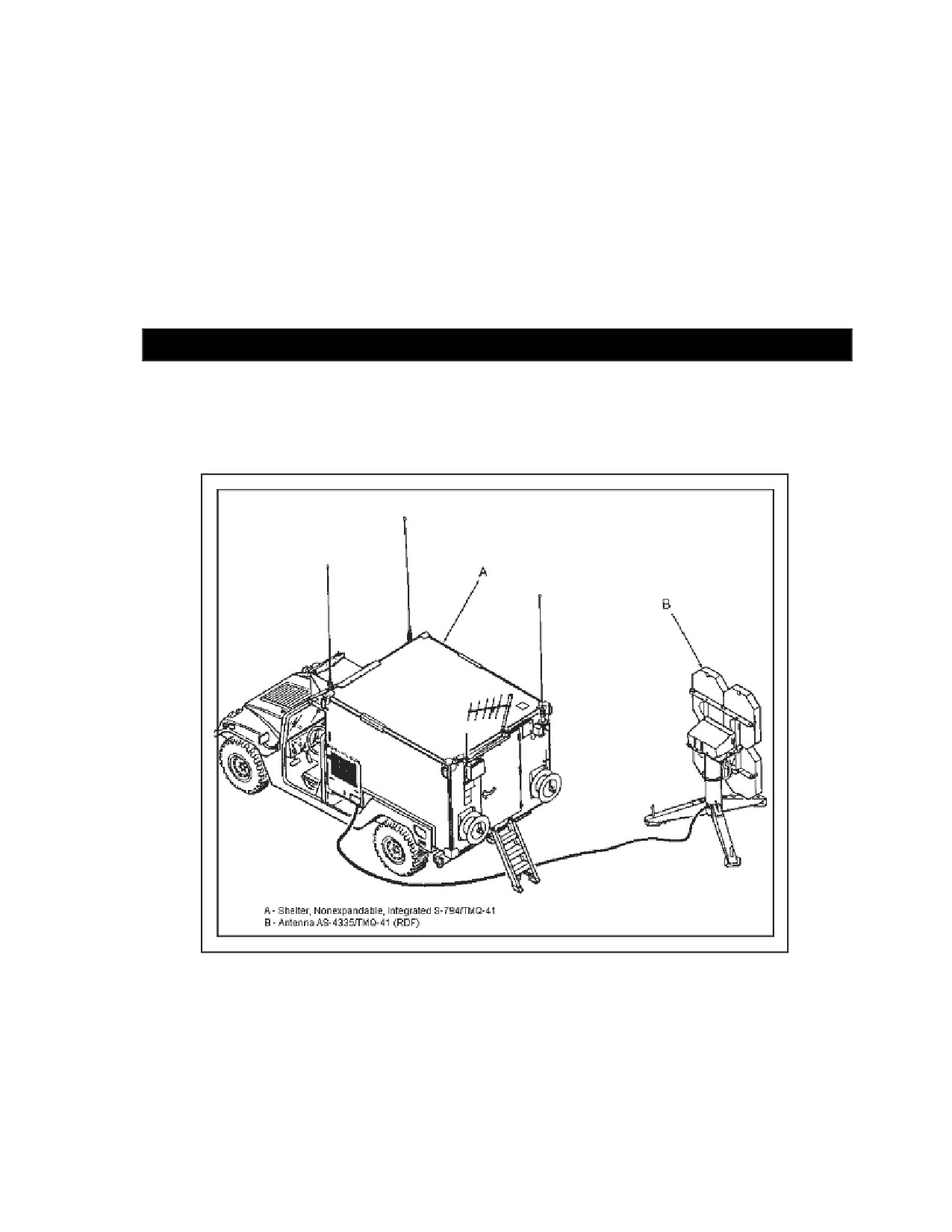
the AN/TMQ-41 and additional equipment. Figure 5-1 shows the AN/TMQ-41 equipment.
Figure 5-1. AN/TMQ-41 equipment
5-2. The shelter equipment group contains the equipment needed to receive and process MET data
transmitted by a radiosonde. The shelter equipment group consists of the systems described below.
NAVIGATIONAL AID (NAVAID) ANTENNA SYSTEM
5-3. When the AN/TMQ-41 operates in the NAVAID mode, the NAVAID antennas receive signals from
very low frequency (VLF) antenna.
25 October 2007
FM 3-09.15/MCWP 3-16.5
5-1
Chapter 5
RECEIVING SYSTEM
5-4. This system amplifies and converts signals received by the Global Positioning System (GPS),
NAVAID and RDF antennas and passes them to the Marwin processor. The Marwin processor contains a
GPS card that processes GPS signals enabling the Marwin to determine wind speed and direction.
COMMUNICATIONS SYSTEM
5-5. The Marwin receives and processes MET data and position information. It formats the data into
MET messages for transmission to using units.
PAGE PRINTER
5-6. The printer provides a hard copy record of all MET messages.
POWER SUPPLY SYSTEM
5-7. The AN/TMQ-41 operates from a 230 volts alternating current (VAC) or +28 volts direct current
(VDC) primary power input. A power entry assembly and power control unit convert the supplied power to
the correct voltage for operating the equipment. The RDF and air conditioners can be operated only when
alternating current AC power is used.
RDF EQUIPMENT GROUP
5-8. The RDF is a tripod-mounted antenna system that automatically tracks the radiosonde in the
atmosphere. It receives MET data and detects position information used for wind computation. The RDF
passes this data to the shelter equipment for processing and dissemination. A hand terminal connected to
the antenna by cable allows for manual control of the positioning system as well as the receiver tuning
circuit.
GENERATOR CABLE EQUIPMENT
5-9. The cable equipment provides primary AC power to the system. It consists of two 50-foot cables and
a pigtail cable to connect the generator or commercial power source to the power entry assembly at the
shelter. A cable reel is provided for storing one cable on the back of the equipment shelter. The second
cable and the pigtail are stored in the tunnel.
ASSOCIATED EQUIPMENT
Radiosonde
5-10. The radiosonde is a small electronic instrument carried aloft by a free-flight balloon. The aloft
radiosonde senses and transmits pressure, temperature, and relative humidity to the MET section. The
AN/TMQ-41 uses different types of radiosondes, depending on the operating mode selected for the
planned sounding.
Power Equipment
5-11. The AN/TMQ-41 operates either from vehicle power or an external power source. When performing
mobile operations, power is supplied by the vehicle on which it is mounted. When the air conditioners are
on or when operating the RDF, an external source of power is required. A trailer-mounted power plant is
towed by one of the sections vehicles to provide power.
COMMUNICATIONS EQUIPMENT
5-12. The met section usually disseminates met data via on-board communications equipment. There are
multiple options available to the met section to disseminate met data.
5-2
FM 3-09.15/MCWP 3-16.5
25 October 2007
Meteorological Measuring Set-(MMS), AN/TMQ-52
5-13. Care must be taken to use the appropriate communications equipment when disseminating met data.
The communications equipment will be identified during the section planning process
Radios
5-14. The MET section is authorized single-channel ground and air-borne radio system (SINCGARS).
They are used for communications with MET users and command and control.
Digital Computer System, Lightweight Computer Unit
5-15. This two-way interface device is used for routing digital communications between the MET section
and remote users.
Digital Nonsecure Voice Terminal
5-16. This telephone, with associated wire connections, is a mobile subscriber equipment (MSE) device
that allows for voice and digital communications. The digital nonsecure voice terminal DNVT provides
access to the common user area communications network.
VEHICULAR EQUIPMENT
5-17. Each section is authorized three high-mobility multipurpose wheeled vehicles (HMMWVs) and three
trailers. The three vehicles are the heavy-variant HMMWV, and each is equipped with a 200-amp kit.
Vehicle one transports the operations shelter and tows the power generator. Vehicle two transports
supplemental equipment and tows the trailer containing the balloon inflation equipment and expendable
supplies. Vehicle three transports section equipment. Section IV provides example load plans.
SECTION II AN/TMQ-41 SECTION SITE OPERATIONS
SITE SELECTION
5-18. MET sections are positioned by the S-3 and MET station leader to provide the best possible area of
coverage and most valid MET data. Section deployment depends largely on the location of firing units,
targets, terrain, and weather. When selecting a site, the MET section leader must weigh the following
considerations:
z
Safety.
z
Tactical situation.
z
Weather forecast and prevailing winds.
z
Availability of NAVAID signals.
z
Security.
z
Communications modes and nets.
z
Operating frequencies.
z
Electronic warfare activities.
z
Areas of coverage.
z
Terrain.
z
Availability of adequate supply of water.
z
Logistical support.
z
Unit attachment.
SURVEY REQUIREMENTS
5-19. The met station leader conducts a ground reconnaissance to determine the exact positions for major
items of equipment. Once this is done, the station leader selects two reference points to facilitate orienting
25 October 2007
FM 3-09.15/MCWP 3-16.5
5-3
Chapter 5
the RDF to true north. Reference points should be fixed, easily identified objects, such as a tall pole or the
fork of a large tree.
SURVEY AVAILABLE
5-20. The MET station leader emplaces the system to fifth-order accuracy or with the GPS. The survey
section will provide the MET section with the latitude, longitude, and height of the MET section.
SURVEY NOT AVAILABLE
5-21. If survey support is not available, the MET station leader determines station altitude and location
from an area map. The map datum is World Geodetic System 84.
RDF EMPLACEMENT
NOTE: If the soundings are performed in the NAVAID or GPS modes, the RDF is not
emplaced.
5-22. The RDF cannot be emplaced more than 100 feet (30 meters) from the equipment shelter owing to
cable length. The RDF should be placed on reasonably level terrain. It should not be screened by large
obstacles that may interfere with signal reception. The position selected for the RDF should have a clear
area downwind to observe balloon release. There must be no tall objects to obstruct line of sight from the
RDF to a radiosonde in flight.
EQUIPMENT SHELTER EMPLACEMENT
5-23. The MET station leader positions the shelter on firm level ground. The shelter cannot be positioned
more than 100 feet (30 meters) from the RDF or power equipment owing to cable length. It should not be
positioned under power lines.
POWER EQUIPMENT EMPLACEMENT
5-24. The power plant provides the shelter with power. It can be no more than 100 feet (30 meters) from
the shelter. Once the power equipment trailer is disconnected from the vehicle that tows it, the vehicle
moves to a concealed area.
BALLOON INFLATION SITE
5-25. Upon entering the area of operation, the vehicle transporting the balloon inflation and launching
equipment moves to the inflation site. The necessary equipment is unloaded, and the vehicle moves to a
concealed area. The inflation site should be downwind of the equipment shelter and RDF, if possible.
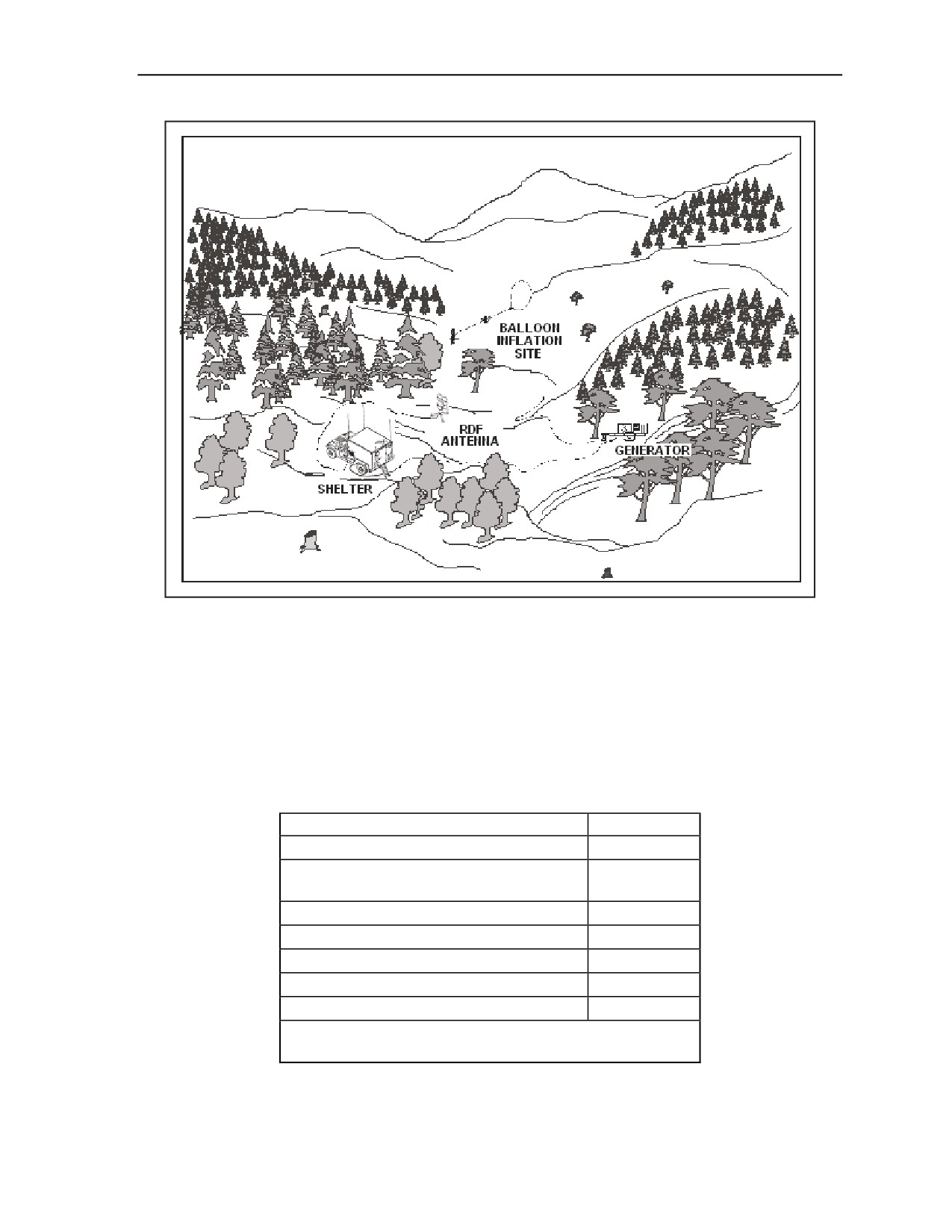
5-26. Figure 5-2 provides an example of a site occupation. Because the maximum cable length is 100 feet
(30 meters), the distance between the shelter and its interfacing equipment cannot exceed the following:
z
Shelter to RDF antenna (one cable W103) - 100 feet (30 meters) maximum.
z
Shelter to generator trailer (two cables W401 and one cable W405) - 100 feet (30 meters)
maximum.
z
Shelter to remote NAVAID antennas (one cable W111, one cable W112) - 100 feet (30 meters)
maximum.
5-4
FM 3-09.15/MCWP 3-16.5
25 October 2007
Meteorological Measuring Set-(MMS), AN/TMQ-52
Figure 5-2. Site occupation
CAMOUFLAGE
5-27. The modules of radar-scattering camouflage in table 5-1 are required for camouflaging the system.
Camouflage procedures are outlined in TM 5-1080-200-13&P.
Table 5-1. Radar Scattering Camouflage Modules
Equipment
Modules
1 1/4-ton truck with shelter
2
1 1/4-ton truck (transports MHG if
3
issued)*
1 1/4-ton truck
2
1 1/4-ton trailer (3 each)
3
NAVAID Antenna Set
1
RDF
1
Tent
2
*Ensure the generator chimney is not covered with
camouflage when generator is operating.
5-28. Commanders move MET sections as needed to maintain MET support. Therefore, crew members
must be trained and able to displace, move, and occupy a new site rapidly during critical periods of the
25 October 2007
FM 3-09.15/MCWP 3-16.5
5-5

Chapter 5
battle. The MET station leader informs the operations officer when the validity of the last message from the
current position will expire and how much time is required to march-order the section. He recommends the
best time to make the displacement and a course of action to relay MET data from adjacent sections while
the section is displacing. The MET station leader’s briefing of section personnel before each displacement
should include, as applicable, the following:
z
Broadcast time of the last met message from the current position.
z
Broadcast time of the first met message from the next position.
z
Procedures for monitoring, copying, and transmitting met data from adjacent met sections on
both the left and right flanks.
z
Section march-order sequence and when the camouflage systems will be dropped, packed, and
loaded.
z
Departure time and whether the section has road clearance to move independently.
z
Where the MET vehicles will be positioned in the battery column.
z
Route of march and any significant landmarks.
z
Designation of the section representative on the reconnaissance party.
SECTION III AN/TMQ-41 SECTION PERSONNEL
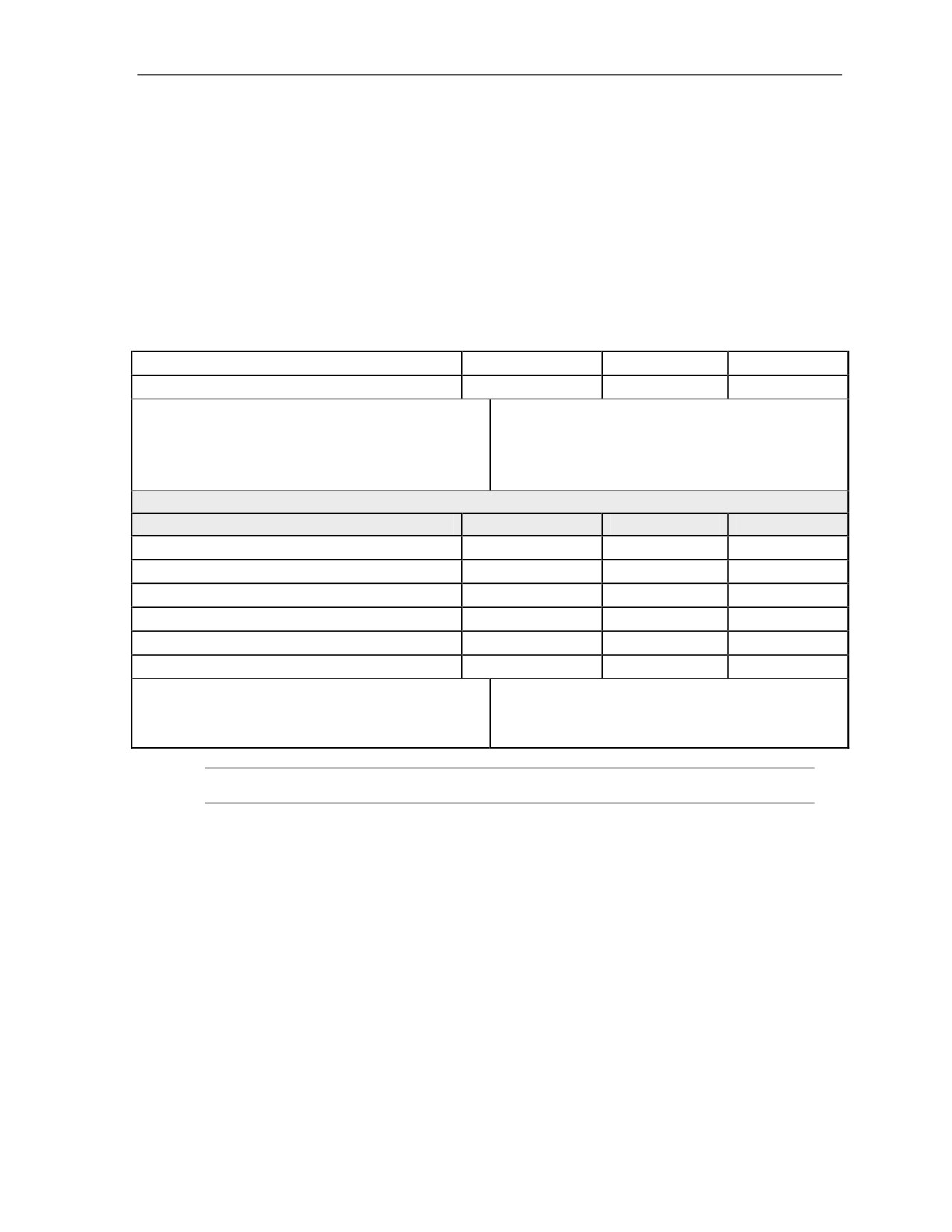
Table 5-2. AN/TMQ-41 Section Personnel (U.S. Army) and AN/TMQ-41 Section Personnel (U.S.
Marine Corps)
5-29. The MOS and Rank for personnel in a MMS Section is directly related to the level of responsibility
and knowledge required. The more senior the Rank, the more responsibility and knowledge the individual
is expected to possess.
5-30. All personnel within the MMS section will possess the 13W MOS. However, two positions will
have an Additional Skill Identifier (ASI) that indicates they have successfully completed the Unit level
maintenance course for Meteorology Equipment.
U.S. ARMY
Title
MOS
Rank
Quantity
MET station leader
13W40
SFC
1
FA MET section sergeant
13W30
SSG
1
FA MET equipment repairer
13W20H1
SGT
1
FA MET equipment repairer
13W10H1
SPC
1
FA MET crew member
13W10
SPC
1
5-6
FM 3-09.15/MCWP 3-16.5
25 October 2007
Meteorological Measuring Set-(MMS), AN/TMQ-52
Table 5-2. AN/TMQ-41 Section Personnel (U.S. Army) and AN/TMQ-41 Section Personnel (U.S.
Marine Corps)
5-29. The MOS and Rank for personnel in a MMS Section is directly related to the level of responsibility
and knowledge required. The more senior the Rank, the more responsibility and knowledge the individual
is expected to possess.
5-30. All personnel within the MMS section will possess the 13W MOS. However, two positions will
have an Additional Skill Identifier (ASI) that indicates they have successfully completed the Unit level
maintenance course for Meteorology Equipment.
FA MET crew member
13W10
PFC
1
Total
6
Legend:
SFC = Sergeant First Class
SPC = Specialist
SSG = Staff Sergeant
PFC = Private First Class
SGT = Sergeant
U.S. MARINE CORPS
Title
MOS
Rank
Quantity
Team chief
0848
SSGT
1
Arty MET man
0847
SGT
1
Arty MET man
0847
CPL
1
Arty MET man/driver
0847
LCPL
1
Arty MET man/driver
0847
PFC
2
Total
6
Legend:
CPL = Corporal
SSGT = Sergeant First Class
LCPL = Lance Corporal
SGT = Staff Sergeant
PFC = Private First Class
NOTE: Duties are the same for both Army and Marine Corps personnel.
FIELD ARTILLERY (FA) MET STATION LEADER (SFC, MOS 13W40)
5-31. The FA met station leader will—
z
Help the operations officer prepare the MET plan.
z
Advise the operations officer on the employment and operation of the MET assets within the
division area.
z
Supervise MET section operations.
z
Coordinate with the S4 for logistical support.
z
Coordinate with the signal staff officer to prioritize means of communication and dissemination
of messages.
z
Perform site selection and location.
z
Perform first sergeant-type duties when operating independently.
z
Direct the operation, emplacement, and displacement of the MET section.
25 October 2007
FM 3-09.15/MCWP 3-16.5
5-7
Chapter 5
z
Maintain quality control of MET data. Submit necessary reports, and maintain a flight log
showing the following:
Dates.
Location.
Flight number.
Expendables consumed.
Other pertinent information.
z
Retain the flight log and copies of messages in accordance with AR 25-400-2.
z
Advise the operations officer on all factors affecting mission capabilities, such as personnel,
maintenance, and logistics.
z
Review, consolidate, and prepare technical, personnel, and administrative reports covering MET
section and station activities.
z
Organize and supervise the MET section training program.
z
Supervise operator maintenance of MET, communications, and vehicular equipment.
z
Supervise preparation and distribution of all MET messages.
z
Ensure adherence to safety procedures during inflation.
z
Manage met section logistics for repair parts and expendable items.
z
Assign personnel to MET teams.
z
Instruct and lead crew members in MET procedures.
FA MET SECTION SERGEANT (SSG, MOS 13W30)
5-32. The FA met section sergeant will—
z
Provide leadership and technical guidance to subordinate personnel.
z
Serve as off-shift senior sergeant during periods of extended operation.
z
Check data and records.
z
Examine data samples for quality control.
z
Inspect grounding equipment.
z
Decode wind messages.
FA MET EQUIPMENT REPAIRER (SGT, MOS 13W20H1)
5-33. The FA met equipment repairer sergeant will—
z
Supervise the second shift during 24-hour operations.
z
Perform unit maintenance on section MET equipment.
z
Ensure communications are maintained with all users.
z
Perform administrative duties as required.
FA MET EQUIPMENT REPAIRER (SPC, MOS 13W10H1)
5-34. The FA met equipment repairer specialist will—
z
Operate MET equipment on his assigned shift.
z
Perform unit maintenance on section MET equipment.
z
Operate organic communications equipment.
z
Drive the vehicle.
FA MET CREWMEMBER (SPC, MOS 13W10)
5-35. The FA MET crew member specialist will—
z
Operate MET equipment on his assigned shift.
5-8
FM 3-09.15/MCWP 3-16.5
25 October 2007
Meteorological Measuring Set-(MMS), AN/TMQ-52
z
Help prepare the balloon train.
z
Drive the vehicle.
FA MET CREWMEMBER (PFC, MOS 13W10)
5-36. The FA MET crew member private will—
z
Operate MET equipment on his assigned shift.
z
Help prepare the balloon train.
z
Drive the vehicle.
25 October 2007
FM 3-09.15/MCWP 3-16.5
5-9
Chapter 5
SECTION IV SUGGESTED LOAD PLANS
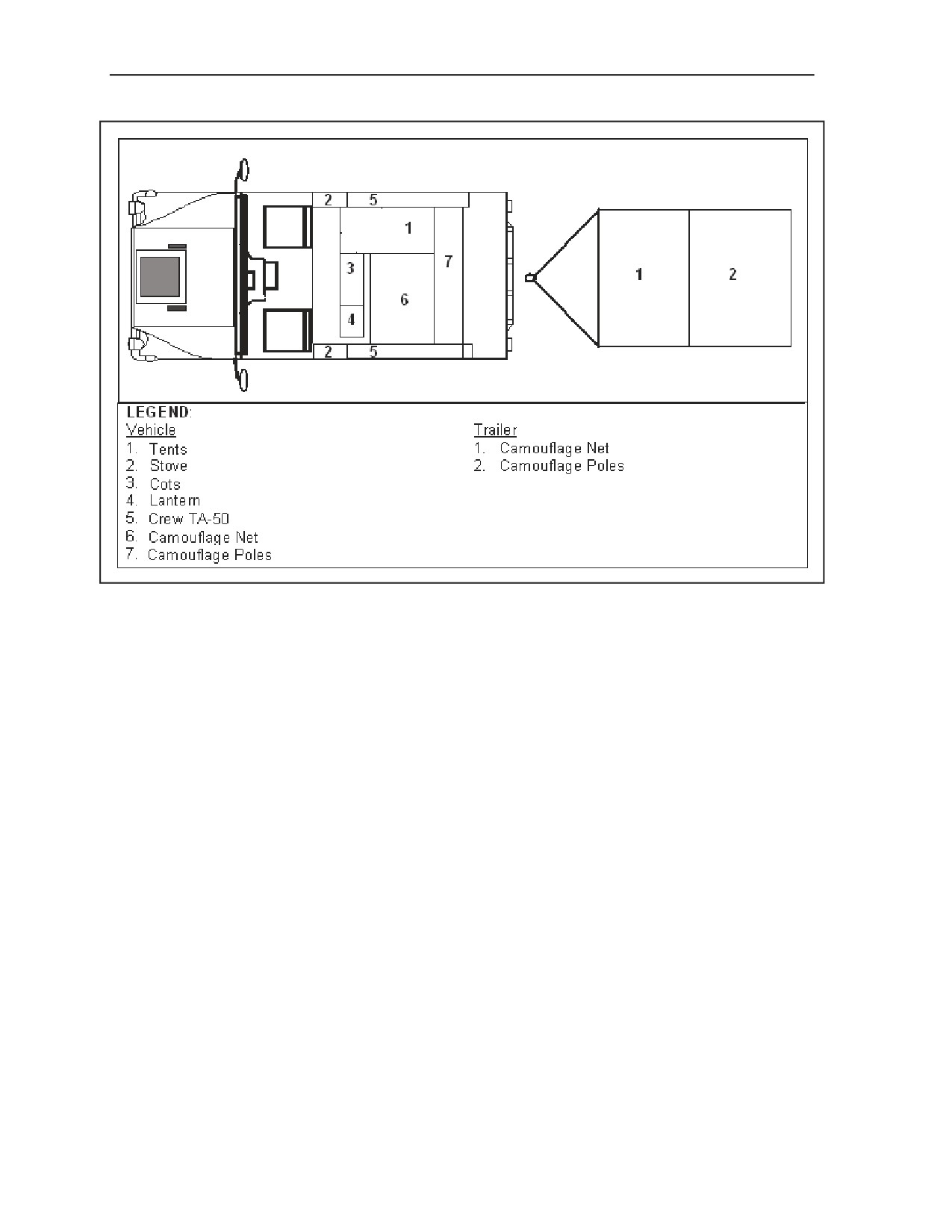
5-37. The loading plan for the MMS Section is extremely important. Loading plans are the key to
ensuring everyone knows where each component or piece of equipment is located.
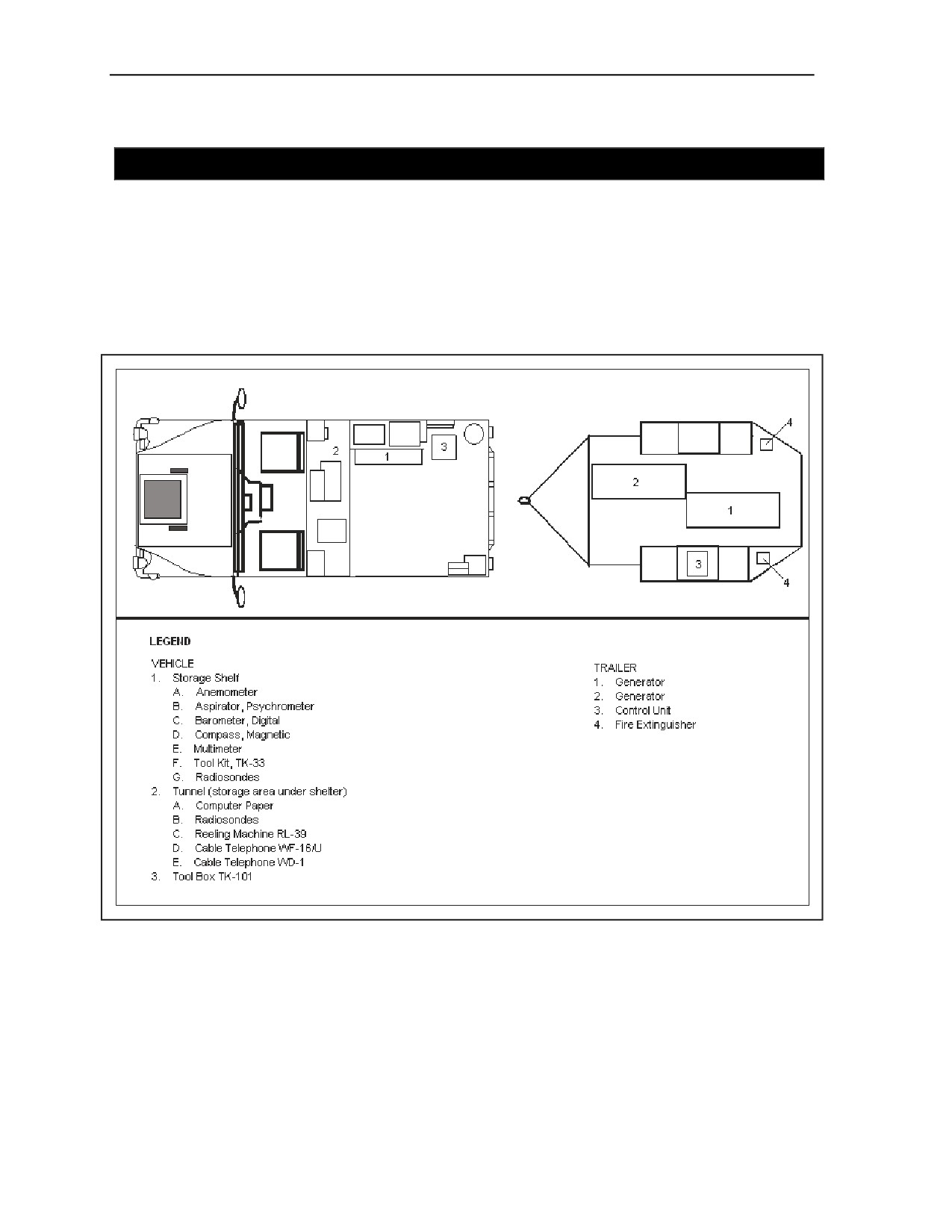
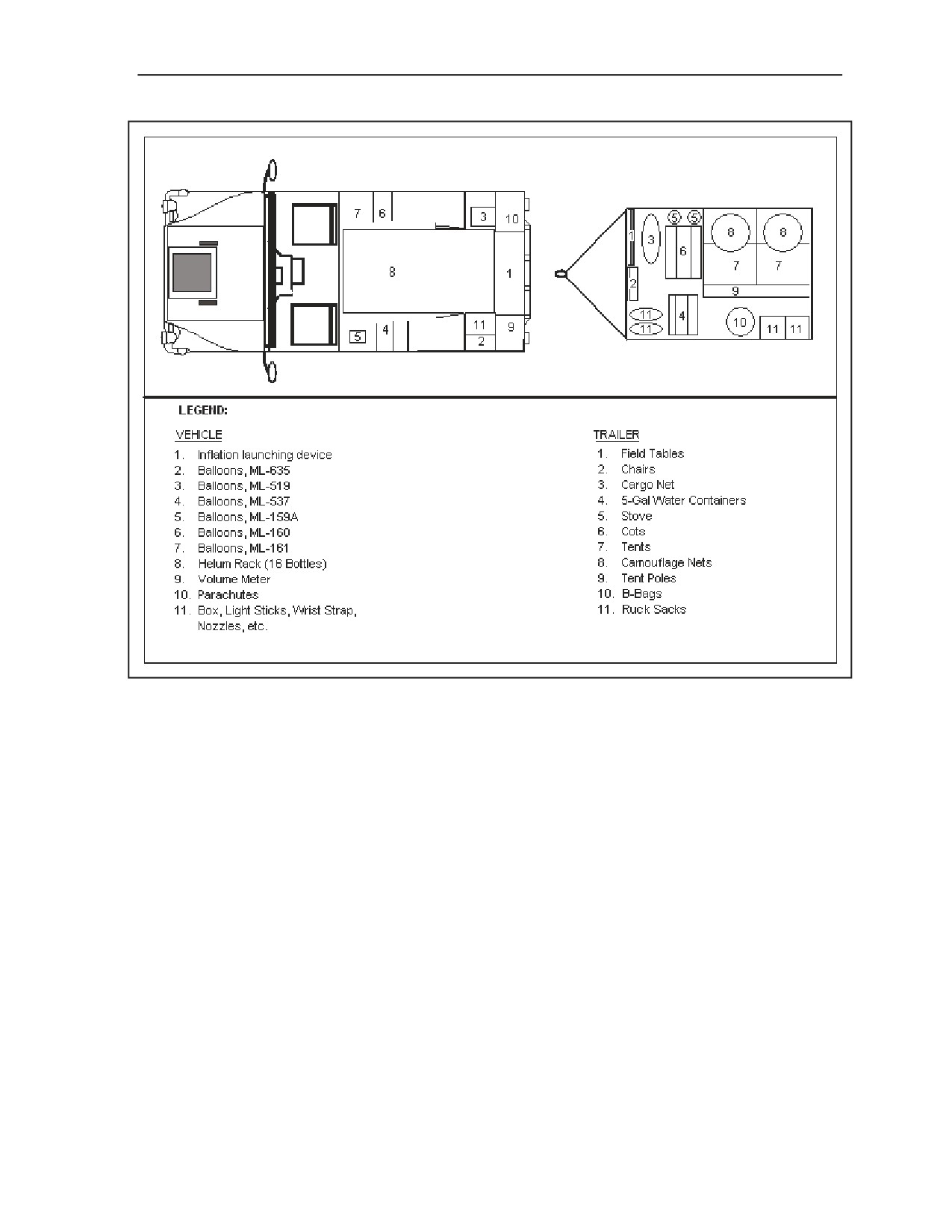
5-38. A good load plan will cut down on the time required to find items as well as store items for transport
(for examples see figures 5-3, 5-4, and 5-5.
Figure 5-3. Vehicle 1 with trailer
5-10
FM 3-09.15/MCWP 3-16.5
25 October 2007
Meteorological Measuring Set-(MMS), AN/TMQ-52
Figure 5-4. Vehicle 2 with trailer
25 October 2007
FM 3-09.15/MCWP 3-16.5
5-11
Chapter 5
Figure 5-5. Vehicle 3 with trailer
5-12
FM 3-09.15/MCWP 3-16.5
25 October 2007
Chapter 6
Meteorological Measuring Set-Profiler, AN/TMQ-52
This chapter discusses the components, site considerations, and personnel of the
AN/TMQ-52 equipped section.
SECTION I MMS-P AN/TMQ-52 EQUIPMENT
SHELTER EQUIPMENT GROUP
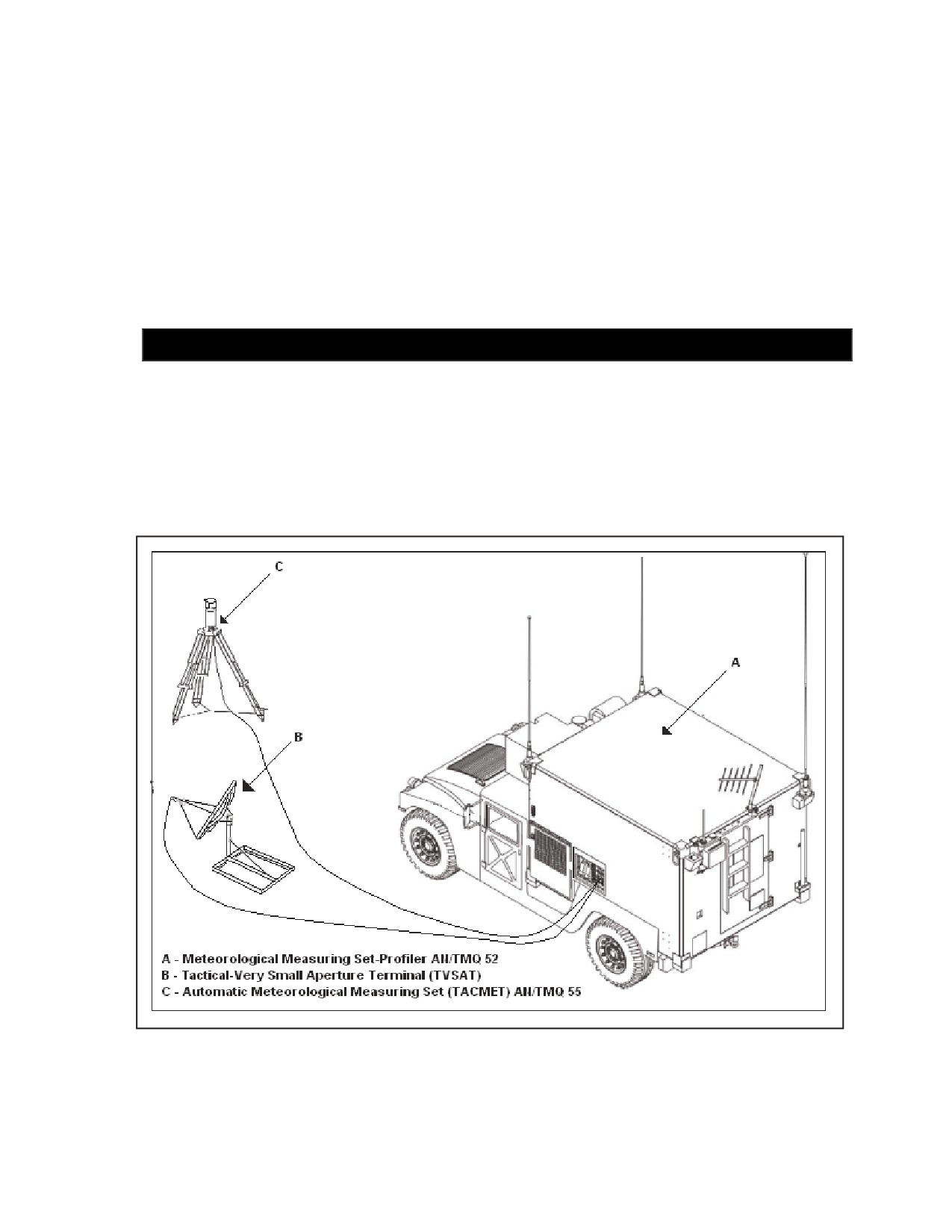
6-1. The AN/TMQ-52 is a mobile upper air meteorological data collection, processing, and dissemination
system. The AN/TMQ-52 system consists of the S-832/G non-expandable shelter housing the system
components mounted on a high mobility multipurpose wheeled vehicle (HMMWV) M-1113, the Tactical-
Very Small Aperture Terminal (T-VSAT) antenna, and the Meteorological Station, Automatic, AN/TMQ-
55 (TACMET). This section discusses the AN/TMQ-52 and additional equipment. Figure 6-1 shows the
AN/TMQ-52 equipment.
Figure 6-1. AN/TMQ-52 equipment
25 October 2007
FM 3-09.15/MCWP 3-16.5
6-1
Chapter 6
6-2. The shelter equipment group contains the equipment needed to receive and process MET data
transmitted by a radiosonde, obtained by a surface sensor, and received via satellite. The shelter equipment
group consists of the systems described below.
NAVAID ANTENNA SYSTEM
6-3. When the AN/TMQ-52 operates in the NAVAID mode, the system receives signals from a
radiosonde using a VLF antenna. The signal is amplified and passed to the Marwin processor to be used in
wind finding.
GPS ANTENNA SYSTEM
6-4. When the AN/TMQ-52 operates in the GPS mode, the system receives signals from satellites using
the GPS antenna.
6-5. Signals received by the GPS antenna are sent to the Marwin III through the PLGR II/DAGR to be
used in GPS wind finding. Using the PLGR II/DAGR provides the MMS-P the capability for using the
Precise Positioning Service
(PPS) provided by the GPS system. This will allow future Selective
Availability Anti-Spoofing Module (SAASM) compliance.
RECEIVING SYSTEM
6-6. In both NAVAID and GPS modes, temperature, pressure, and humidity (PTU) data is received by
either the omni or directional antenna, amplified by the system and passed to the Marwin processor.
COMMUNICATIONS SYSTEM
6-7. The Unified Post Processing System (UPPS) generates the MET data required to populate the
requested MET message. The data is formatted and transferred to the common message processor (CMP)
located on the operator interface computer (OIC). The data is available for review in the CMP and is
transmitted via SINCGARS radio to the requesting unit.
LIGHTWEIGHT LASER PRINTER (LLP 2)
6-8. The printer provides a hard copy record of all MET messages.
POWER SUPPLY SYSTEM
6-9. The AN/TMQ-52 operates from an onboard 10-kilowatt auxiliary power unit (APU) providing 240
VAC primary input. The power entry panel and shelter control panel converts the supplied power to the
correct voltage for operating the equipment. The system has the capability to be powered by an external
power source or can operate using the HMMWV battery and generator system (28 VDC). The air
conditioners can be operated only when AC power is used.
T-VSAT ANTENNA
6-10. The T-VSAT antenna is the primary communications method for receiving a large volume of
weather data from the Air Force Weather Agency (AFWA). AFWA transmits, via satellite, NOGAPS data
every 12 hours and regional observations each hour. The data is downloaded by the MMS-P using the T-
VSAT antenna.
TACMET (AN/TMQ-55)
6-11. The TACMET is a tripod-mounted system that measures barometric pressure, temperature, humidity,
and wind speed and direction at the earth’s surface. The TACMET is connected to the shelter signal entry
panel and surface meteorological data is routed to the OIC. The OIC makes this data available to the
modeling software and the Marwin III in support of radiosonde launches.
6-2
FM 3-09.15/MCWP 3-16.5
25 October 2007