FM 6-02.53 TACTICAL RADIO OPERATIONS (August 2009) - page 6
Appendix B
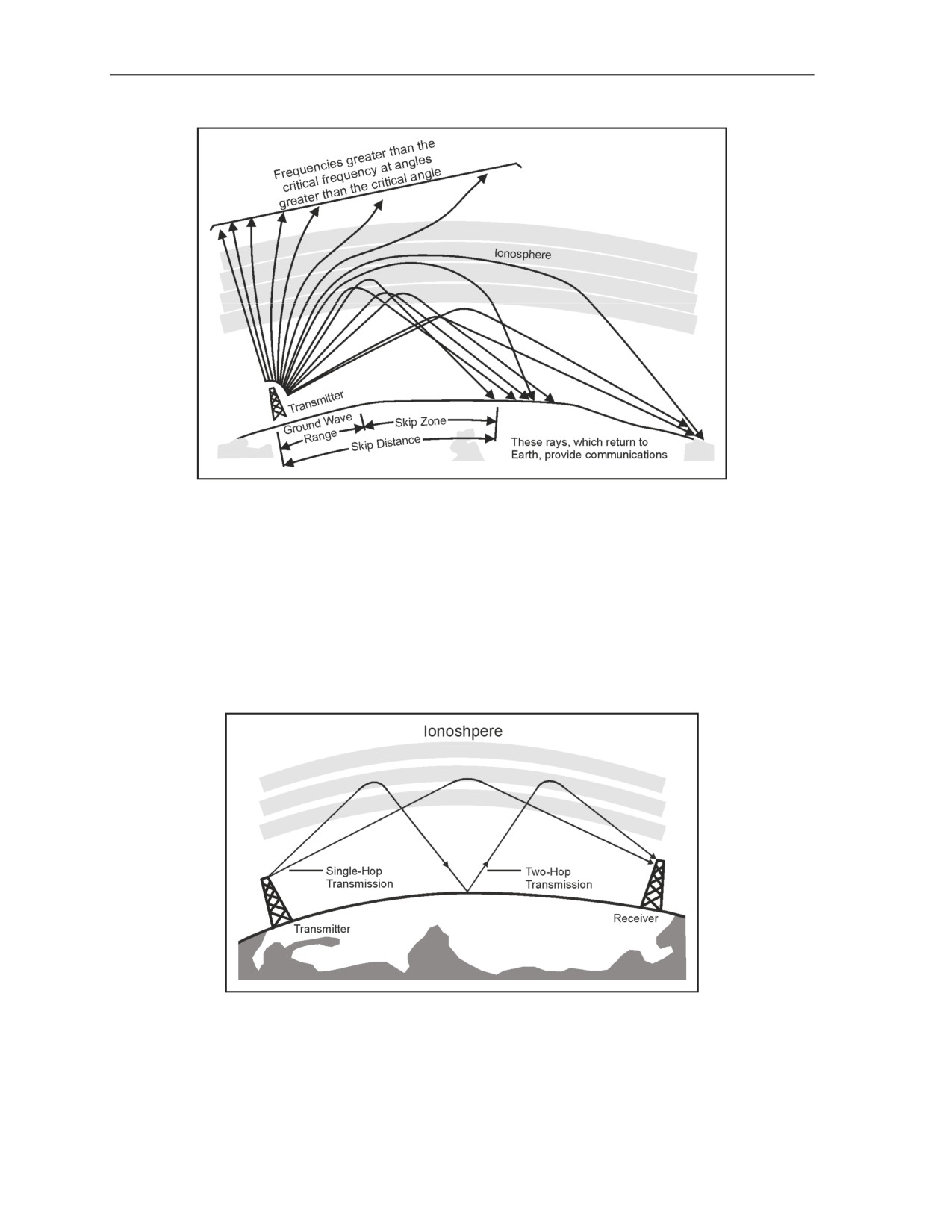
Figure B-6. Sky wave transmission paths
B-49. Lowering the angle of incidence can produce a skip zone in which no usable signal can be received.
This area is bounded by the outer edge of usable ground wave propagation and the point nearest the
antenna at which the sky wave returns to earth. In corps area communications situations, the skip zone is
not a desirable condition. However, low angles of incidence make long distance communications possible.
B-50. When a transmitted wave is reflected back to the surface of the earth, the earth absorbs part of its
energy. The remainder of its energy is reflected back into the ionosphere and reflected back to earth again.
This means of transmission (by alternately reflecting the radio wave between the ionosphere and the earth)
is called hops. Hops enable radio waves to be received at great distances from the point of origin. Figure B-
7 is an example of sky wave transmission hop paths.
Figure B-7. Sky wave transmission hop paths
Fading
B-51. Fading is the periodic increase and decrease of received signal strength. Fading occurs when a radio
signal is received over a long distance path in the HF range. The precise origin of this fading is seldom
B-10
FM 6-02.53
5 August 2009
Single-Channel Radio Communications Principles
understood. There is little common knowledge of what precautions to take to reduce or eliminate fading’s
troublesome effects. Fading associated with sky wave paths is the greatest detriment to reliable
communications. Too often, those responsible for communications circuits rely on raising the transmitter
power or increasing antenna gain to overcome fading. Unfortunately, such actions often do not work and
seldom improve reliability. Only when the signal level fades down below the back ground noise level for
an appreciable fraction of time will increased transmitter power or antenna gain yield an overall circuit
improvement. Choosing the correct frequency and using transmitting and receiving equipment intelligently
ensure a strong and reliable receiving signal, even when low power is used.
Maximum Usable Frequency and Lowest Usable Frequency
B-52. The maximum usable frequency (MUF) is the maximum frequency at which a radio wave will return
to earth at a given distance, when using a given ionized layer and a transmitting antenna with a fixed angle
of radiation. It is the monthly median of the daily highest frequency that is predicted for sky wave
transmission over a particular path at a particular hour of the day. The MUF is always higher than the
critical frequency because the angle of incidence is less than 90 degrees.
B-53. If the distance between the transmitter and the receiver is increased, the MUF will also increase.
Radio waves lose some of their energy through absorption by both the D region, and a portion of the E
region of the ionosphere, on certain transmission frequencies. The total absorption is less, and
communications more satisfactory, as higher frequencies are used up to the level of the MUF.
B-54. The absorption rate is greatest for frequencies ranging from approximately 500 kHz-2 MHz during
the day. During the night, the absorption rate decreases for all frequencies. As the frequency of
transmission over any skywave path is increased from low to high, a frequency will be reached at which
the received signal overrides the level of atmospheric and other radio noise interference. This is called the
lowest usable frequency, because frequencies lower than these are too weak for useful communications. It
should be noted that the lowest usable frequency also depends on the power output of the transmitter, and
the transmission distance. When the lowest usable frequency is greater than the MUF, no sky wave
transmission is possible. The frequency manager uses SPECTRUM XXI to identify optimum frequency
groupings.
Other Factors Affecting Propagation
B-55. In VHF and UHF ranges, extending from 30-300 MHz and beyond, the presence of object
(buildings or towers for example) may produce strong reflections that arrive at the receiving antenna in
such a way that they cancel the signal from the desired propagation path and render communications
impossible.
B-56. Receiver locations that avoid the proximity of an airfield should be chosen due to possible adverse
interference from signals bouncing off of the aircrafts. Avoid locating transmitters and receivers where an
airfield is at or near midpoint of the propagation path of frequencies above 20 MHz.
B-57. Many other factors may affect the propagation of a radio wave. Hills, mountains, buildings, water
towers, tall fences, and even other antenna can have a marked affect on the condition and reliability of a
given propagation path. Conductivity of the local ground or body of water can greatly alter the strength of
the transmitted or received signal. Energy radiation from the Sun’s surface also greatly affects conditions
within the ionosphere and alters the characteristics of long-distance propagation at 2-30 MHz.
Path Loss
B-58. Radio waves become weaker as they spread outwards from the transmitter. The ratio of the received
power is called path loss. LOS paths at VHF and UHF require relatively little power since the total path
loss at the radio horizon is only about 25 dB greater than the path loss over the same distance in free space
(absence of ground). This additional loss results from some energy being reflected from the ground,
canceling part of the direct wave energy. This is unavoidable in almost every practical case. The total path
loss for an LOS path above average terrain varies with the following factors: total path loss between
5 August 2009
FM 6-02.53
B-11
Appendix B
transmitting and receiving antenna terminals, frequency, distance, transmitting antenna gain, and receiving
antenna gain.
Reflected Waves
B-59. Often, it is possible to communicate beyond the normal LOS distance by exploiting the reflection
from a tall building, nearby mountain, or water tower. If the top portion of a structure or hill can be seen
readily by both transmitting and receiving antennas, it may be possible to achieve practical
communications by directing both antennas toward the point of maximum reflection. If the reflecting
object is very large in terms of a wavelength, the path loss, including the reflection, can be very low.
B-60. If a structure or hill exists adjacent to an LOS path, reflected energy may either add to or subtract
from the energy arriving from the direct path. If the reflected energy arrives at the receiving antenna with
the same amplitude (strength) as the direct signal but has the opposite phase, both signals will cancel and
communication will be impossible. However, if the same condition exists but both signals arrive in phase,
they will add and double the signal strength. These two conditions represent destructive and constructive
combinations of the reflected and direct waves.
B-61. Reflection from the ground at the common midpoint between the receiving and transmitting antennas
may also arrive in a constructive or destructive manner. Generally, in the VHF and UHF range, the
reflected wave is out of phase (destructive) with respect to the direct wave at vertical angles less than a few
degrees above the horizon. However, since the ground is not a perfect conductor, the amplitude of the
reflected wave seldom approaches that of the direct wave. Thus, even though the two arrive out of phase,
complete cancellation does not occur. Some improvement may result from using vertical polarization rather
than horizontal polarization over LOS paths because there tends to be less phase difference between direct
and reflected waves. The difference is usually less than 10 dB, however, in favor of vertical polarization.
Diffraction
B-62. Unlike the ship passing beyond the visual horizon, a radio wave does not fade out completely when
it reaches the radio horizon. A small amount of radio energy travels beyond the radio horizon by a process
called diffraction. Diffraction also occurs when a light source is held near an opaque object, casting a
shadow on a surface behind it. Near the edge of the shadow a narrow band can be seen which is neither
completely light nor dark. The transition from total light to total darkness does not occur abruptly, but
changes smoothly as the light is diffracted.
B-63. A radio wave passing over either the curved surface of the Earth or a mountain ridge behaves in
much the same fashion as a light wave. For example, people living in a valley below a high, sharp,
mountain ridge can often receive a TV station located many miles below on the other side. TV station are
diffracted by the mountain ridge and bent downward in the direction of the town. It is emphasized,
however, that the energy decays very rapidly as the angle of propagation departs from the straight LOS
path. Typically, a diffracted signal may undergo a reduction of 30 to 40 dB by being bent only 5 ft (1.5
meters) by a mountain ridge. The actual amount of diffracted signal depends on the shape of the surface,
the frequency, the diffraction angle, and many other factors. It is sufficient to say that there are times when
the use of diffraction becomes practical as a means for communicating in the VHF and UHF over long
distances.
Refraction
B-64. Refraction is the bending of a wave as it passes through air layers of different density (refractive
index). In semitropical regions, a layer of air
5-100 meters
(16.4-328 ft)
(thick with distinctive
characteristics may form close to the ground, usually the result of a temperature inversion. For example, on
an unusually warm day after a rainy spell, the Sun may heat up the ground and create a layer of warm,
moist air. After sunset, the air a few meters above the ground will cool very rapidly while the moisture in
the air close to the ground serves as a blanket for the remaining heat. After a few hours, a sizable difference
in temperature may exist between the air near the ground and the air at a height of 10-20 meters (32.8-65.6
ft) resulting in a marked difference in air pressure. Thus, the air near the ground is considerably denser
than the air higher up. This condition may exist over an area of several hundred square kilometers or over a
B-12
FM 6-02.53
5 August 2009
Single-Channel Radio Communications Principles
long area of land near a seacoast. When such an air mass forms, it usually remains stable until dawn, when
the ground begins to cool and the temperature inversion ends.
B-65. When a VHF or UHF radio wave is launched within such air mass, it may bend or become trapped
(forced to follow the inversion layer). This layer then acts as a duct between the transmitting antenna and a
distant receiving site. The effects of such ducting can be seen frequently during the year in certain locations
where TV or VHF FM stations are received over paths of several hundred kilometers. The total path loss
within such a duct is usually very low and may exceed the free space loss by only a few dBs.
B-66. It is also possible to communicate over long distances by means of tropospheric scatter. At altitudes
of a few kilometers, the air mass has varying temperature, pressure, and moisture content. Small
fluctuations in tropospheric characteristics at high altitude create blobs. Within a blob, the temperature,
pressure, and humidity are different from the surrounding air. If the difference is large enough, it may
modify the refractive index at VHF and UHF. A random distribution of these blobs exists at various
altitudes at all times. If a high-power transmitter (greater than 1 kW) and high gain antenna (10 dB or
more) are used, sufficient energy may be scattered from these blobs down to the receiver to make reliable
communication possible over several hundred kilometers. Communication circuits employing this mode of
propagation must use very sensitive receivers and some form of diversity to reduce the effects of the rapid
and deep fading. Scatter propagation is usually limited to path distances of less than about 500 km (310.6
miles).
Noise
B-67. Noise consists of all undesired radio signals, manmade or natural. Noise masks and degrades useful
information reception. The radio signal’s strength is of little importance if the signal power is greater than
the received noise power. This is why S/N ratio is the most important quantity in a receiving system.
Increasing receiver amplification cannot improve the S/N ratio since both signal and noise will be
amplified equal and S/N ratio will remain unchanged. Normally, receivers have more than enough
amplification.
B-68. Natural noise has two principle sources: thunderstorms (atmospheric noise) and stars (galactic
noise). Both sources generate sharp pulses of electromagnetic energy over all frequencies. The pulses
propagate according to the same laws as manmade signals, and receiving systems must accept them along
with the desired signal. Atmospheric noise is dominant from 0-5 MHz, and galactic noise is most
important at higher frequencies. Low frequency transmitters must generate very strong signals to overcome
noise. Strong signals and strong noise mean that the receiving antenna does not have to be large to collect a
usable signal. A 1.5 meter (4.9 ft) tuned whip antenna will adequately deliver all of the signals that can be
received at frequencies below 1 MHz.
B-69. Manmade noise is a product of urban civilization that appears wherever electric power is used. It is
generated anywhere that there is an electric arc (automobile, power lines, motors or fluorescent lights).
Each source is small, but there are so many that together they can completely hide a weak signal that would
be above the natural noise in rural areas. Manmade noise is troublesome when the receiving antenna is near
the source, but being near the source gives the noise waves characteristics that can be exploited. Waves
near a source tend to be vertically polarized. A horizontally polarized receiving antenna will generally
receive less noise than a vertically polarized antenna.
B-70. Manmade noise currents are induced by any conductors near the source, including the antenna,
transmission line, and equipment cases. If the antenna and transmission line are balanced with respect to
the ground, then the noise voltages will be balanced and cancel with respect to the receiver input terminals
(zero voltage across terminals), and this noise will not be received. Near perfect balance is difficult to
achieve, but any balance may help.
B-71. Other ways to avoid manmade noise are to locate the most troublesome sources and turn them off, or
move the receiving system away from them. Moving at least one km (.6 miles) away from a busy street or
highway will significantly reduce noise. Although broadband receiving antennas are convenient because
they do not have to be tuned to each working frequency, sometimes a narrowband antenna can make the
difference between communicating and not communicating. The HF band is now so crowded with users
5 August 2009
FM 6-02.53
B-13
Appendix B
that interference and noise, not signal strength, are the main reasons for poor communications. A
narrowband antenna will reject strong interfering signals near the desired frequency and help maintain
good communications.
WAVE MODULATION
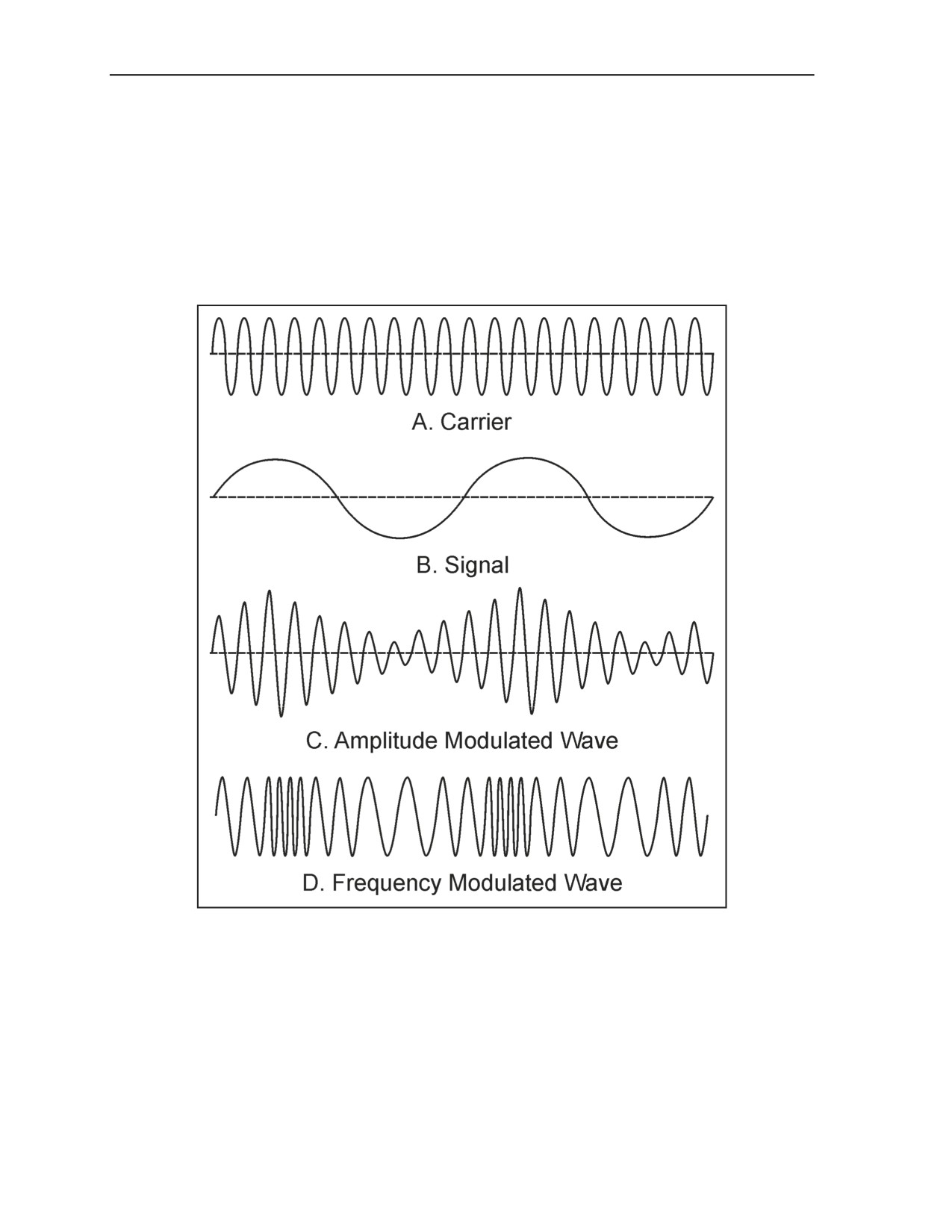
B-72. Both FM and AM transmitters produce RF carriers. The carrier is a wave of constant amplitude,
frequency, and phase which can be modulated by changing its amplitude, frequency, or phase. Thus, the
RF carrier carries intelligence by being modulated. Modulation is the process of superimposing intelligence
(voice or coded signals) on the carrier. Figure B-8 shows different wave shapes.
Figure B-8. Wave shapes
FREQUENCY MODULATION
B-73. FM is the process of varying the frequency (rather than the amplitude) of the carrier signal in
accordance with the variations of the modulating signals. The amplitude or power of the FM carrier does
not vary during modulation. The frequency of the carrier signal, when it is not modulated, is called the
center, or rest, frequency. When a modulating signal is applied to the carrier, the carrier signal will move
up and down in frequency away from the center, or rest, frequency.
B-14
FM 6-02.53
5 August 2009
Single-Channel Radio Communications Principles
B-74. The amplitude of the modulating signal determines how far away from the center frequency the
carrier will move. This movement of the carrier is called deviation; how far the carrier moves is called the
amount of deviation. During reception of the FM signal, the amount of deviation determines the loudness
or volume of the signal.
B-75. The FM signal leaving the transmitting antenna is constant in amplitude, but varies in frequency
according to the audio signal. As the signal travels to the receiving antenna, it picks up natural and
manmade electrical noises that cause amplitude variations in the signal. All of these undesirable amplitude
variations are amplified as the signal passes through successive stages of the receiver, until the signal
reaches a part of the receiver called the limiter. The limiter is unique to FM receivers, as is the
discriminator.
B-76. The limiter eliminates the amplitude variations in the signal, and then passes it on to the
discriminator, which is sensitive to variations in the frequency of the RF wave. The resultant constant
amplitude FM signal is then processed by the discriminator circuit, which changes the frequency variations
into corresponding voltage amplitude variations. These voltage variations reproduce the original
modulating signal in a headset, loudspeaker, or teletypewriter. Radiotelephone transmitters operating in the
VHF and higher frequency bands generally use FM.
AMPLITUDE MODULATION
B-77. AM is the variation of the RF power output of a transmitter at an audio rate. Stated differently, the
RF energy increases and decreases in power, according to the audio frequencies superimposed on the
carrier signal.
B-78. When audio frequency signals are superimposed on the RF carrier signal, additional RF signals are
generated. These additional frequencies are equal to the sum and the difference of the audio frequency and
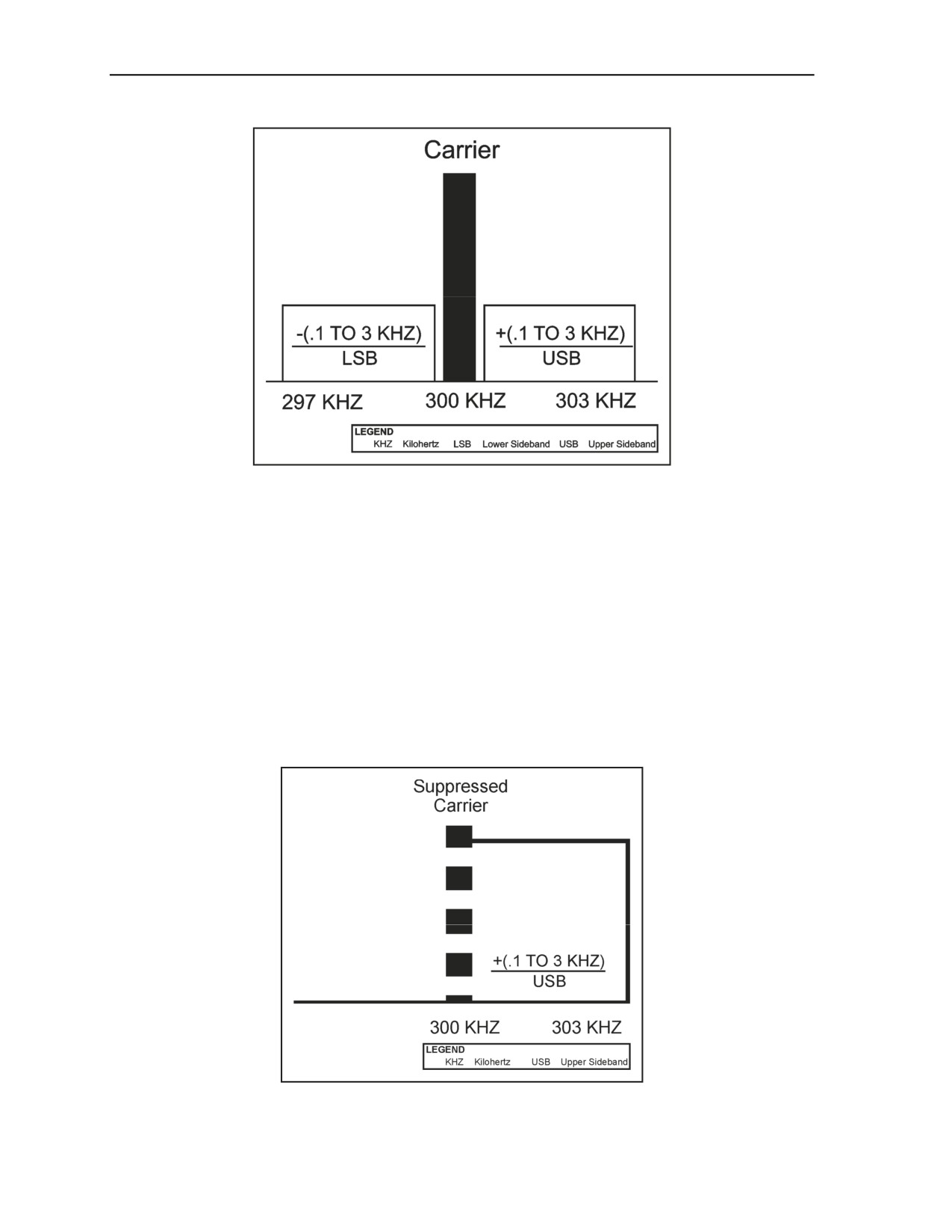
RF used. For example, assume a 500 kHz carrier is modulated by a one kHz audio tone. Two new
frequencies are developed, one at 501 kHz (the sum of 500 kHz and one kHz) and the other at 499 kHz
(the difference between 500 kHz and 1 kHz). If a complex audio signal is used instead of a single tone, two
new frequencies will be created for each of the audio frequencies involved. New frequencies resulting from
superimposing an audio frequency signal on a RF signal are called sidebands.
B-79. When the RF carrier is modulated by complex tones, such as speech, each separate frequency
component of the modulating signal produces its own upper and lower sideband frequencies. The upper
sideband contains the sum of the RF and audio frequency signals, and the lower sideband contains the
difference between the RF and audio frequency signals. Figure B-9 shows an AM system.
5 August 2009
FM 6-02.53
B-15
Appendix B
Figure B-9. AM system
B-80. The space occupied by a carrier and its associated sidebands in the RF spectrum is called a channel.
In AM, the width of the channel (bandwidth) is equal to twice the highest modulating frequency. For
example, if a 5,000 kHz (5 MHz) carrier is modulated by a band of frequencies ranging from 200-5,000
cycles (.2-5 kHz); the upper sideband extends from 5000.2-5005 kHz. The lower sideband extends from
4,999.8-4,995 kHz. Thus, the bandwidth is the difference between 5,005 Hz-4,995 kHz, a total of 10 kHz.
B-81. Radiotelephone transmitters operating in the medium and HF bands generally use AM; the
intelligence of an AM signal exists solely in the sidebands.
SINGLE SIDE BAND
B-82. Each sideband contains all the intelligence needed for communications. Although both sidebands are
generated within the modulation circuitry of the SSB radio set, the carrier and one sideband are removed
before any signal is transmitted. Figure B-10 shows an SSB system.
Figure B-10. SSB system
B-16
FM 6-02.53
5 August 2009
Single-Channel Radio Communications Principles
B-83. The upper side band is higher in frequency than the carrier and the lower side band is lower in
frequency. Either sideband can be used for communications, provided both the transmitter and the receiver
are adjusted to the same sideband. Most Army SSB equipment operates in the upper side band mode.
B-84. The transmission of only one sideband leaves open that portion of the RF spectrum normally
occupied by the other sideband of an AM signal. This allows more emitters to be used within a given
frequency range.
B-85. SSB transmission is used in applications where it is desired to—
z
Obtain greater reliability.
z
Limit size and weight of equipment.
z
Increase effective output without increasing antenna voltage.
z
Operate a large number of radio sets without heterodyne interference (whistles and squeals)
from RF carriers.
z
Operate over long ranges without loss of intelligibility due to selective fading.
5 August 2009
FM 6-02.53
B-17
This page intentionally left blank.
Appendix C
Antenna Selection
Merely selecting an antenna that radiates at a high elevation angle is not enough to
ensure optimum communications. This appendix addresses the importance of HF,
VHF and UHF antenna selection.
HIGH FREQUENCY ANTENNA SELECTION
C-1. The HF portion of the radio spectrum is very important to communications. Radio waves in the 3-30
MHz frequency range are the only ones that are capable of being reflected or returned to Earth by the
ionosphere with predictable regularity. To optimize the probability of a successful sky wave
communications link, select the frequency and take-off angle that is most appropriate for the time of day
transmission is to take place.
C-2. Various large conducting objects, in particular the Earth’s surface, will modify an antenna’s
radiation pattern. Sometimes nearby scattering objects may modify the antenna’s pattern favorable by
concentrating more power toward the receiving antenna. Often, the pattern alteration results in less signals
being transmitted toward the receiver.
C-3. When selecting an antenna site, the operator should avoid as many scattering objects as possible.
Although NVIS is the chief mode of short-haul HF propagation, the ground wave and direction (LOS)
modes are also useful over short paths. How far a ground wave is useful depends on the electrical
conductivity of the terrain or body of water over which it travels. The direct wave is useful only to the
radio horizon, which extends slightly beyond the visual horizon.
ANTENNA SELECTION PROCEDURES
C-4. Selecting the right antenna for an HF radio circuit is very important. When selecting an HF antenna,
first consider the type of propagation. Ground wave propagation requires low take-off angle and vertically
polarized antennas. The whip antenna included with most radio sets provides good omnidirectional ground
wave radiation.
C-5. Selecting an antenna for sky wave propagation is very complex. First, find the circuit (range)
distance so that the required take-off angle can be determined. A circuit distance of 966 km (600 miles)
requires a take-off angle of approximately 25 degrees during the day and 40 degrees at night. Select a high
gain antenna (25-40 degrees). If propagation predictions are available, skip this step, since the predictions
will probably give the take-off angles required.
C-6. Next, determine the required coverage. A radio circuit with mobile (vehicle) stations or several
stations at different directions from the transmitter requires an omnidirectional antenna. A point-to-point
circuit uses either a bidirectional or directional antenna. Normally, the receiving station location dictates
this choice. Refer to Table C-1 for take-off angles versus distance.
5 August 2009
FM 6-02.53
C-1

Appendix C
Table C-1. Take-off angle versus distance
Take off
Distance
Angle
F2 Region Daytime
F2 Region Nighttime
(Degrees)
km
miles
km
miles
0
3220
2000
4508
2800
5
2415
1500
3703
2300
10
1932
1200
2898
1800
15
1450
900
2254
1400
20
1127
700
1771
1100
25
966
600
1610
1000
30
725
450
1328
825
35
644
400
1127
700
40
564
350
966
600
45
443
275
805
500
50
403
250
685
425
60
258
160
443
275
70
153
95
290
180
80
80
50
145
90
90
0
0
0
0
C-7. Before selecting a specific antenna, examine the available construction materials. At least two
supports are needed to erect a horizontal dipole, with a third support in the middle for frequencies of 5
MHz or less. When support items are unavailable, the dipole cannot be constructed, and another antenna
should be selected. Examine the proposed antenna site to determine if the antenna will fit the mission
requirements. If not, select a different antenna.
C-8. The site is another important consideration. Usually, the tactical situation determines the position of
the communications antenna. The ideal setting would be a clear, flat area (no trees, fences, power lines, or
mountains). Unfortunately, an ideal location is seldom available. Choose the clearest, flattest area possible.
Often, an antenna must be constructed on irregular sites. This does not mean that the antenna will not
work. It means that the site will affect the antenna’s pattern and function.
C-9. After selecting the antenna, determine how to feed the power from the radio to the antenna. Most
tactical antennas are fed with coaxial cable (RG-213). Coaxial cable is a reasonable compromise of
efficiency, convenience, and durability. Issued antennas include the necessary connectors for coaxial cable
or for direct connection to the radio.
C-10. Problems may arise in connecting field expedient antenna. The horizontal half-wave dipole uses a
balanced transmission line (open-wire). Coaxial cable can be used, but it may cause unwanted RF current.
C-11. A balun prevents unwanted RF current flow, which causes a radio to be hot or shock the RTO.
Install the balun at the dipole feed point (center) to prevent unwanted RF current flow on the coaxial cable.
If a balun is unavailable, use the coaxial cable that feeds the antenna as a choke. Connect the cable’s center
wire to one leg of the dipole and the cable braid to the other leg. Form the coaxial cable into a 6-inch coil
(consisting of ten turns), and tape it to the antenna under the insulator for support.
DETERMINING ANTENNA GAIN
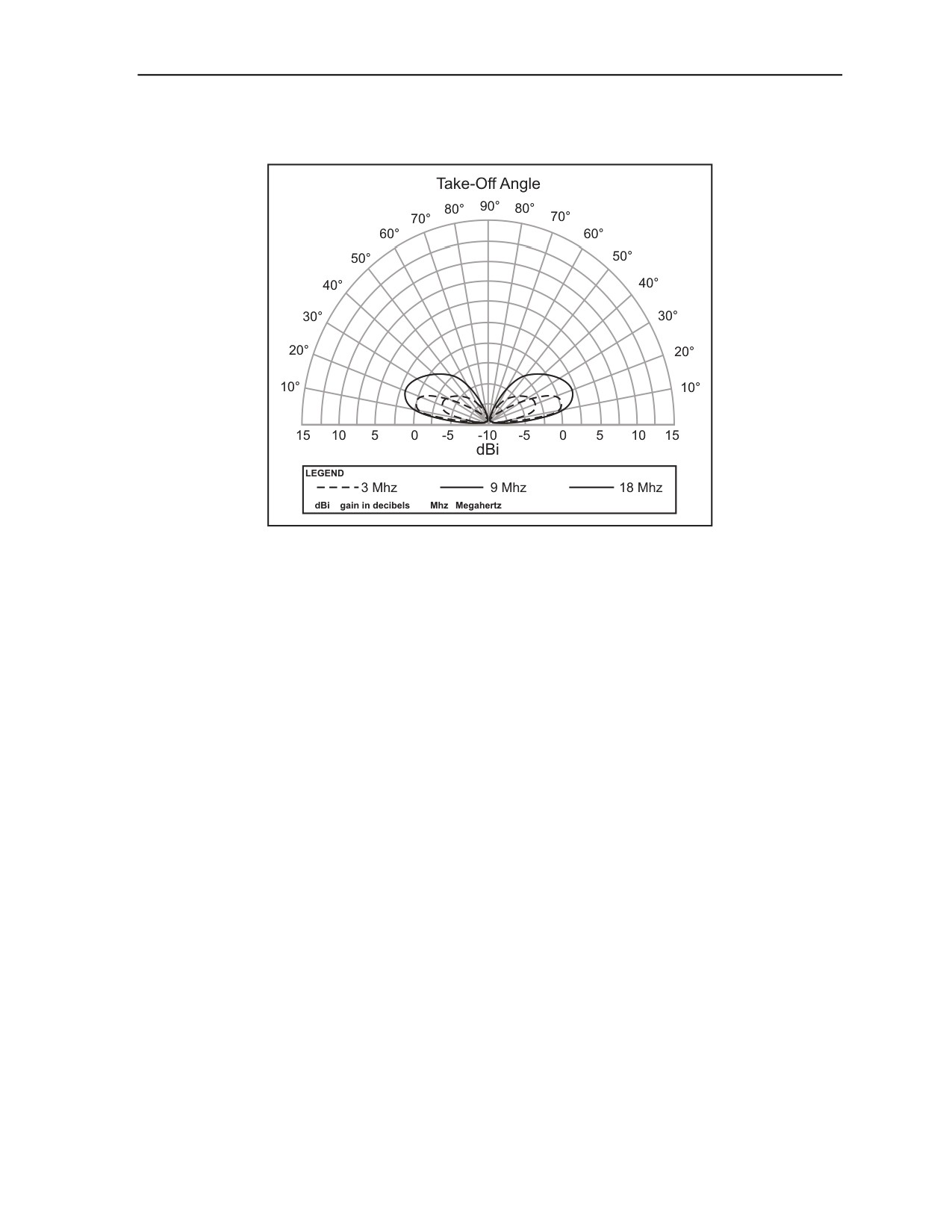
C-12. Figure C-1 shows the vertical antenna pattern for the 32 foot vertical whip antenna. The numbers
along the outer ring (90, 80 and 70 degrees) represent the angle above the Earth; 90 degrees would be
C-2
FM 6-02.53
5 August 2009
Antenna Selection
straight up, and 0 degrees would be along the ground. Along the bottom of the pattern are numbers from -
10 (at the center) to = 15 (at the edges). These numbers represent the dBi over an isotropic radiator.
Figure C-1. 32-foot vertical whip, vertical antenna pattern
C-13. To find the antenna gain at a particular frequency and take-off angle, locate the desired take-off
angle on the plot. Follow that line toward the center of the plot to the pattern of the desired frequency.
Drop down and read the gain from the bottom scale. If the gain of 32 foot vertical whip at 9 MHz and 20
degree take-off angle is desired, locate 20 degrees along the outer scale. Follow this line to the 9 MHz
pattern line. Move down to the bottom scale. The gain is a little less than 2.5 dBi. The gain of the 32 foot
vertical whip at 9 MHz and 20 degrees is 2 dBi.
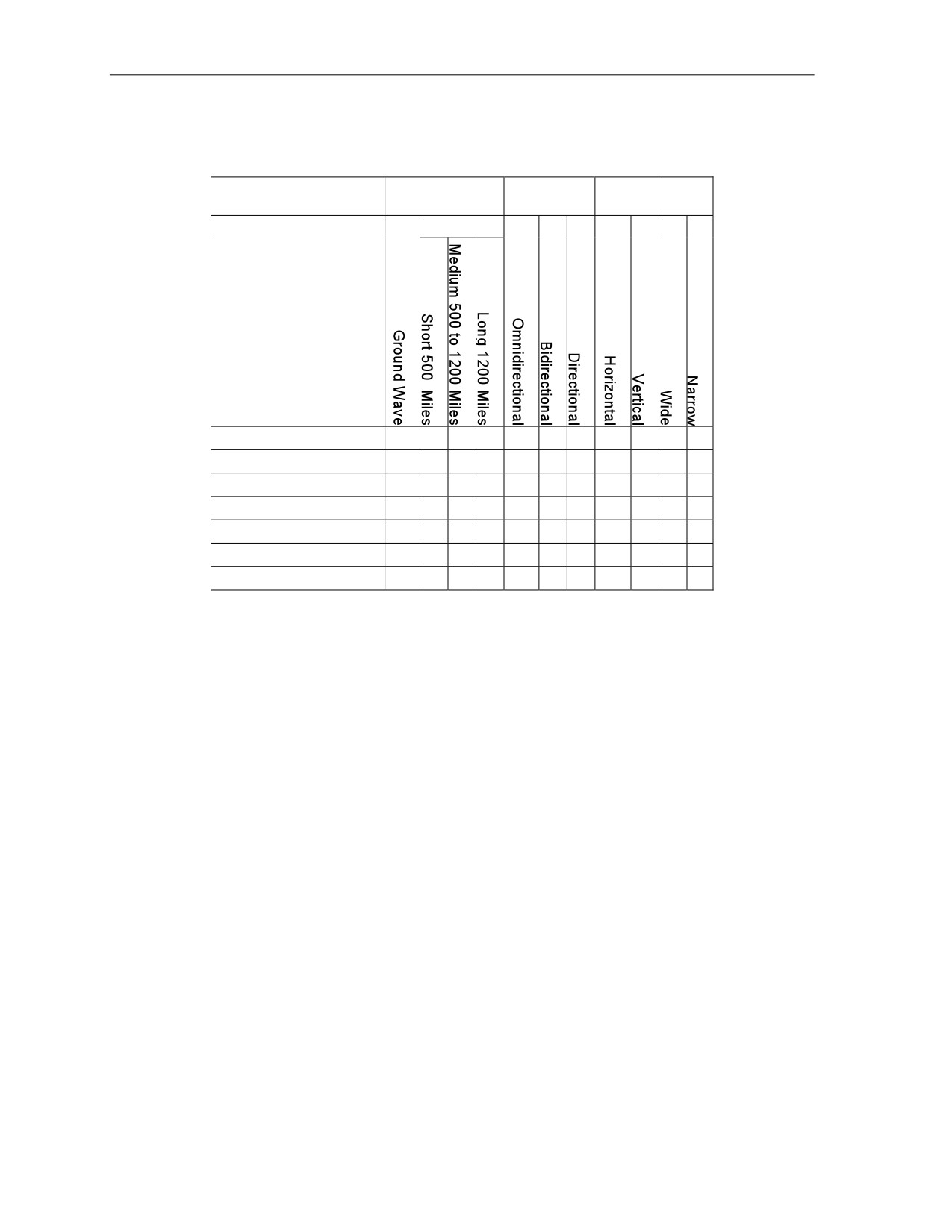
C-14. Once the antenna’s overall characteristics are determined, use the HF antenna selection matrix
(Table C-2) to find the specific antenna for a circuit. If the proposed circuit requires a short-range,
omnidirectional, wideband antenna, the selection matrix shows that the only antenna that meets all the
criteria is the AS-2259/GR.
5 August 2009
FM 6-02.53
C-3
Appendix C
Table C-2. HF antenna selection matrix
Use
Directivity
Polariz
Band
ation
width
Skywave
AS-2259/GR
X
X
X
Vertical Whip
X
X
X
X
Half-Wave Dipole
X
X
X
X
X
Long Wire
X
X
X
X
X
X
X
Inverted L
X
X
X
X
X
X
X
X
Sloping V
X
X
X
X
X
X
Vertical Half Rhombic
X
X
X
X
X
X
UHF AND VHF ANTENNA SELECTION
C-15. The VHF portion of the radio spectrum extends from 30-300 MHz and the UHF range reaches from
300-3,000 MHz (3 GHz). Both frequency ranges are extremely useful for short-range (less than 50 km or
31 miles) communications. This includes point-to-point, mobile, air-to-ground, and general purpose
communications. Wavelengths at these frequencies ranges are considerably shorter than those in the HF
range and simple antennas are much smaller.
C-16. Because VHF and UHF antennas are small, it is possible to use multiple radiating elements to form
arrays, which provide a considerable gain in a given direction or directions. An array in an arrangement of
antenna elements, usually dipoles, used to control the direction in which most of the antenna’s power is
radiated.
C-17. Within the VHF and UHF portion of the spectrum, there are sub-frequencies bands for specific uses
such VHF aircraft band, UHF aircraft band and public communications. (Refer to FMI 6-02.70 for more
information on spectrum management.)
POLARIZATION
C-18. In many countries, FM and television broadcasting in the VHF range use horizontal polarization.
One reason is because it reduces ignition interference, which is mainly vertically polarized. Mobile
communications often is vertical polarization or two reasons. First, the vehicle antenna installation has
physical limitations, and second, so that reception or transmission will not be interrupted as the vehicle
changes it’s heading to achieve omnidirectionality.
C-19. Using directional antennas and horizontal polarization (when possible) will reduce manmade noise
interference in urban locations. Horizontal polarization, however, should be chosen only where an antenna
height of many wavelengths is possible. Ground reflections tend to cancel horizontally polarized waves at
low angles. Use only vertically polarized antennas when the antenna must be located at a height of less
than 10 meters (32.8 ft) above the ground, or where omnidirectional radiation or reception is desired.
C-4
FM 6-02.53
5 August 2009
Antenna Selection
GAIN AND DIRECTIVITY
C-20. VHF and UHF (above 30 MHz) antenna gain are extremely important for several reasons. Assuming
the same antenna gain and propagation path, the received signal strength drops as frequency is increased.
At VHF and UHF, more of the received signal is lost in the transmission line than is lost at HF. A 10-20
dB loss it not uncommon in a 30 meter (98.4 ft) length of coaxial line at 450 MHz.
C-21. At frequencies below 30 MHz, system sensitivity is almost always limited by receive noise rather
than by noise external to the antenna. Generally, wider modulation or signal bandwidths are employed in
VHF and UHF transmissions than at HF. Since system noise power is directly proportional to bandwidth,
additional antenna gain is necessary to preserve a usable S/N ratio.
C-22. VHF and UHF antenna directivity (gain) aids security by restricting the amount of power radiated in
unwanted directions. Receiver sensitivity is generally poorer at VHF and UHF (with the exception of high
quality state-of-the-art receivers). Obstructions (buildings, trees, hills) may seriously decrease the signal
strength available to the receiving antenna because VHF and UHF signals travel a straight LOS path.
C-23. Obtaining communications reliability over difficult VHF and UHF propagation paths requires
considerable attention to the design of high-gain directive antenna arrays. Unlike HF communications, the
shorter VHF and UHF wavelengths support walkie-talkie transceivers and simple mobile transmissions
units. Communicating or receiving with such devices over distance beyond 1 or 2 km (.6 or 1.2 miles)
requires maximum antenna gain at the base station or fixed end of the link.
C-24. Because VHF and UHF wavelengths are so short, reliability prediction of diffraction, refraction, and
reflection effects are not practical. LOS paths must be entirely depended on. The best VHF and UHF
communications are established with LOS paths that are free from obstacles. The VHF and UHF
wavelengths are short enough that it is possible to construct resonant antenna arrays.
C-25. An array provides directivity (the ability to concentrate radiated energy into a beam that can be
aimed at the intended receiver). Arrays of resonant elements, (half-wave dipoles, can be constructed of
rigid metal rods or tubing or copper foil laid out or pasted on a flat non-conducting surface. Directing
power helps to increase the range of the communications path and tends to decrease the likelihood of the
interception of jamming from hostile radio stations. However, such highly directive antennas place an
added burden on the RTO to ensure that the antenna is pointed properly.
ANTENNA PLANNING PROGRAMS
C-26. Several LOS radios require the planner/operator to do an analysis and prediction of the antennas
LOS paths to ensure communications will be available from different planned locations. There are several
programs designed to generate, store and disseminate communications information for antenna analysis
and prediction. Several other programs can used to generate information even though it is not their primary
purpose (such as ISYSCON [V]4/Tactical Internet Management System and Terrabase) The following
paragraphs address several, but not all, programs that are available for use.
SYSTEM PLANNING, ENGINEERING AND EVALUATION DEVICE
C-27. The system planning, engineering, and evaluation device (SPEED) program is hosted by the Marine
Corps Tactical Systems Support Activity. SPEED is a software package that provides communications
planners with the tools necessary to engineer and plan radio communications analysis.
C-28. SPEED is a complete stand alone, self installing software package that provides the tools necessary
to plan and analyze communications equipment. SPEED software contains HF analysis, radio coverage
analysis, point-to-point, and satellite planning tools, which allows planning in response to rapidly changing
communications architectures.
C-29. Communications planners will have to load topographical information before each operation to
generate report, maps and matrices.
5 August 2009
FM 6-02.53
C-5
Appendix C
VOICE OF AMERICA COVERAGE ANALYSIS PROGRAM
C-30. Voice of America Coverage Analysis Program (VOACAP) software was released to the public and
can be downloaded from the US Department of Commerce (National Telecommunications Information
Administration/Institute for Telecommunications Sciences; Boulder, Colorado) to use as a HF prediction
and analysis tool. VOACAP started as the Ionospheric Communications Analysis and Prediction
(IONCAP) Program. (Voice of America is now organized as a component of the International Bureau of
Broadcasting)
C-31. VOACAP offers the following capabilities—
z
Easy to use graphical user interface.
z
Detailed point-to-point graphs and area coverage maps for parameters such as:
S/N radio.
Required power gain.
Signal power.
MUF.
Take-off/arrival angle.
z
Point-to-point performance versus distance for any given parameters at one or all user assigned
frequencies.
z
Calculates methods for antenna patterns.
C-32. Planners must input several parameters before VOACAP is capable of providing propagation
prediction such as the method and the antennas used. Refer to http://www.its.bldrdoc.gov/elbert/hf.html for
more information on VOACAP and Ionospheric Communications Enhanced Profile Analysis and Circuit
(ICEPAC).
IONOSPHERIC COMMUNICATIONS ENHANCED PROFILE ANALYSIS AND CIRCUIT
C-33. ICEPAC is a full system performance model for HF radio communications in the frequency range of
2-30 MHz. capable of daily prediction methods with improved high latitude propagation models. ICEPAC
is IONCAP with an ionospheric conductivity and electron density profile model added which is a statistical
model of the large scale features of the northern hemisphere ionosphere. (For more information on
ICEPAC refer to the article, “Long-range Communications at High Frequencies.”)
Note. HFWIN
32 for Windows PC, ICEPAC and VOACAP are available at
C-6
FM 6-02.53
5 August 2009
Appendix D
Communications in Unusual Environments
Special consideration must be given to communications in unusual environments.
This appendix addresses radio operations in cold weather, jungle, urban, desert,
mountain areas, and nuclear areas.
COLD WEATHER OPERATIONS
D-1. SC radio equipment has certain capabilities and limitations that must be carefully considered when
operating in extremely cold areas. However, in spite of significant limitations, the radio is still the normal
means of communication in such areas.
D-2. One of the most important capabilities of radio in cold weather operations is its versatility. Vehicular
mounted radios can easily be moved to almost any point where it is possible to install a command
headquarters. Smaller, man packed radios can be carried to any point accessible by aircraft or on foot.
D-3. Interference by ionospheric disturbances limits radio communications in extremely cold areas. These
disturbances, known as ionospheric storms, have a definite degrading effect on sky wave propagation.
Moreover, both ionospheric storms and the Northern Lights (aurora borealis) activity can cause complete
failure of radio communications; some frequencies may be blocked out completely by static for extended
periods during storm activity. Fading, caused by changes in the density and height of the ionosphere, can
also occur, and may last from several minutes to several weeks. These occurrences are difficult to predict,
but when they do occur, the use of alternate frequencies, and a greater reliance on FM or other means of
communications, is required.
TECHNIQUES FOR BETTER COMMUNICATIONS
D-4. Whenever possible, radio sets for tactical operations should be installed in vehicles, to reduce the
problem of transportation and shelter for RTOs. This will help solve some of the grounding and antenna
installation problems due to the climate.
D-5. It is difficult to establish good electrical grounds in extremely cold areas because of permafrost and
deep snow. The conductivity of frozen ground is often too low to provide good ground wave propagation.
To improve ground wave operation, use a counterpoise to offset the degrading effects of poor electrical
ground conductivity. When installing a counterpoise, remember to install it high enough above the ground
so it will not be covered by snow.
D-6. In general, antenna installation in arctic-like areas presents no serious difficulties. However,
installing some antennas may take longer because of adverse working conditions. Tips for installing
antennas in extremely cold areas include—
z
The mast sections and antenna cables must be handled carefully since they become brittle in
very low temperatures.
z
Whenever possible, antenna cables should be constructed overhead to prevent damage from
heavy snow and frost.
z
Nylon rope guys, if available, should be used in preference to cotton or hemp, because nylon
ropes do not readily absorb moisture, and are less likely to freeze and break.
z
An antenna should have extra guy wires, supports, and anchor stakes to strengthen it, and to
withstand heavy ice and wind loading.
5 August 2009
FM 6-02.53
D-1
Appendix D
D-7. Some radios (generally older generation radios) adjusted to a particular frequency in a relatively
warm place, may drift off frequency when exposed to extreme cold; low battery voltage can also cause
frequency drift. When possible, allow a radio to warm up several minutes before placing it into operation.
Since extreme cold tends to lower output voltage of a dry battery, try warming the battery with body heat
before operating the radio set; this minimizes frequency drift.
D-8. Flakes or pellets of highly electrically charged snow are sometimes experienced in northern regions.
When these particles strike the antenna, the resulting electrical discharge causes a high-pitched static roar
that can blanket all frequencies. To overcome this static, antenna elements can be covered with polystyrene
tape and shellac.
MAINTENANCE IMPROVEMENT
D-9. The maintenance of radio equipment in extreme cold presents many difficulties. Radio sets must be
protected from blowing snow because snow will freeze to dials and knobs, and will blow into the wiring to
cause shorts and grounds. Cords and cables must be handled carefully since they may lose their flexibility
in extreme cold. All radio equipment and power units must be properly winterized. Check the appropriate
TM for winterization procedures. The following paragraphs provide suggestions for radio maintenance in
arctic areas.
Power Units
D-10. As the temperature goes down, it becomes increasingly difficult to operate and maintain generators.
Generators should be protected as much as possible from the weather.
Batteries
D-11. The effect of cold weather conditions on wet or dry cell batteries depends on the type of battery, the
load on the battery, and the degree of exposure to cold temperatures. Batteries perform best at moderate
temperatures and generally have a shorter life at very cold temperatures.
Shock Damage
D-12. Damage may occur to vehicular radio sets by the jolting of the vehicle. Most synthetic rubber shock
mounts become stiff and brittle in extreme cold, and fail to cushion equipment. Check the shock mounts
frequently, and change them as required.
Winterization
D-13. Check the TMs for the radio set and power source to see if there are special precautions for operation
in extremely cold climates. For example, normal lubricants may solidify and permit damage or
malfunctions to the radio equipment. They must be replaced with the recommended arctic lubricants. A
light coat of silicon compound on antenna mast connections helps to keep them from freezing together and
becoming hard to dismantle.
Microphones
D-14. Use standard microphone covers to prevent moisture from breath freezing on the perforated cover
plate of the microphone. If standard covers are not available, improvise a suitable cover from rubber or
cellophane membranes, or from rayon or nylon cloths.
Breathing and Sweating
D-15. A radio set generates heat when it is operated. When turned off, the air inside cools and contracts,
drawing cold air into the set from the outside. This is called breathing. When a radio breathes and the still-
hot parts come in contact with subzero air, the glass, plastic, and ceramic parts of the set may cool too
rapidly and break.
D-2
FM 6-02.53
5 August 2009
Communications in Unusual Environments
D-16. Sweating occurs when cold equipment is brought suddenly into contact with warm air, moisture will
condense on the equipment parts. Before cold equipment is brought into a heated area, it should be
wrapped in a blanket or parka to ensure it will warm gradually to reduce sweating. Equipment must be
thoroughly dry before it is taken back out into the cold air, or the moisture will freeze.
Vehicular Mounted Radios
D-17. These radios present special problems during winter operations because of their continuous exposure
to the elements. Proper starting procedures must be observed. The radio’s power switch must be off prior
to starting the vehicle, especially when vehicles are slave-started. If the radio is cold soaked from
prolonged shutdown, frost may have collected inside the radio and could cause circuit arcing. Hence, time
should be allowed for the vehicle’s heater to warm the radio sufficiently so that any frost collected within
the radio has a chance to thaw.
D-18. The defrosting process may take up to an hour. Once the radio has been turned on, it should warm up
for approximately 15 minutes before transmitting or changing frequencies; this allows components to
stabilize.
D-19. If a vehicle is operated at a low idle with radios, heater, and lights on, the batteries may run down.
Before increasing engine revolutions per minute to charge the batteries, radios should be turned off to
avoid an excessive power surge.
OPERATIONS IN JUNGLE AREAS
D-20. Limitations on radio communications in jungle areas stem from the climate and the density of jungle
growth. The hot and humid climate increases the maintenance problems of keeping equipment operable.
Thick jungle growth acts as a vertically polarized absorbing screen for RF energy that, in effect, reduces
transmission range. Therefore, increased emphasis on maintenance and antenna site selection is inherently
important when operating in jungle areas.
D-21. Radio communications in jungle areas must be carefully planned, because dense jungle growth,
heavy rains, and hilly terrain all significantly reduces the range of radio transmission. Trees and
underbrush absorb VHF and UHF radio energy. In addition to the ordinary free space loss between
transmitting and receiving antennas, a radio wave passing through a forest undergoes an additional loss.
This extra loss increases rapidly as the transmission frequency increase. Near the ground (antenna heights
of less than 3 meters [9.8 ft]) vertical polarization is preferred. However, if it is possible to elevate the
receiving and transmitting antenna as much as 10-20 meters (32.8-65.6 ft), horizontal polarization is
preferable to vertical polarization. Considerable reduction in total path loss results if either or both the
transmitting and receiving antenna can be placed above the tree level through which communications must
be made.
D-22. SC radios can be deployed in many configurations, especially man packed, which make it a valuable
communications asset. The capabilities and limitations of tactical radios must be carefully considered when
used by friendly forces in a jungle environment. The mobility and various configurations in which the
tactical radio can be deployed are its primary advantages in jungle areas.
TECHNIQUES FOR BETTER COMMUNICATIONS
D-23. The site selection of the antenna is the main problem in establishing radio communications in jungle
areas. Techniques to improve communications in the jungle include—
z
Placing antennas in clearings on the edge farthest from the distant station, and as high as
possible.
z
Keeping antenna cables and connectors off the ground to lessen the effects of moisture, fungus,
and insects. This also applies to all power and telephone cables.
z
Using complete antenna systems, such as broadband and dipoles. They are more effective than
fractional wavelength whip antennas.
5 August 2009
FM 6-02.53
D-3
Appendix D
z
Clearing vegetation from antenna sites. If an antenna touches any foliage, especially wet foliage,
the signal will be grounded.
z
Using horizontally polarized antennas in preference to vertically polarized antennas because
vegetation, particularly when wet, will act like a vertically polarized screen and absorb much of
any vertically polarized signal.
MAINTENANCE IMPROVEMENT
D-24. Because of moisture and fungus, the maintenance of radio sets in tropical climates is more difficult
than in temperate climates. The high relative humidity causes condensation to form on the equipment, and
encourages the growth of fungus. RTOs and maintenance personnel should check the appropriate TMs for
any special maintenance requirements. Techniques for improving maintenance in jungle areas include—
z
Keeping the equipment as dry as possible and in lighted areas to retard fungal growth.
z
Keeping all air vents clear of obstructions so air can properly circulate for cooling and drying of
the equipment.
z
Using moisture and fungus proofing paint, tape, or silicone grease to protect equipment after
repairs, or when painted surfaces have been damaged or scratched.
EXPEDIENT ANTENNAS
D-25. Dismounted patrols, and units of company size and below, can greatly improve their ability to
communicate in the jungle by using expedient antennas. While moving, users are generally restricted to
using the short or long whip antennas that come with their manpack radios. However, when not moving,
constructing and using an expedient antenna will allow users to broadcast farther, and to receive more
clearly. An antenna that is not tuned or cut to the operating frequency is not as effective as the whips that
are supplied with the radio. Circuits inside the radio load the whips properly so they are tuned to give
maximum output. Whips are not as effective as a tuned doublet or a broadband (such as the OE-254), when
the doublet or broadband is tuned to the operating frequency.
OE-254 Expedient Type Antenna
D-26. When used properly, the expedient OE-254 type antenna will increase the ability to communicate. In
its entirety, the OE-254 type antenna is bulky and heavy, and is not generally acceptable for dismounted
patrols or small unit operations. A Soldier can manage by, carrying only the masthead and antenna
sections, mounting these on wooden poles, or hanging them up when not on the move.
OPERATIONS IN URBAN AREAS
D-27. Radio communications in urbanized terrain pose special problems. When the Army is engaged in
urban combat operations the communications situation is considerably different from the situation faced by
civil government or cell phone users. Military factors include—
z
Restriction of operation to the frequency range of common military radios (2-512 MHz).
z
Limits on the output power of military radio equipment.
z
Limited number of available repeater assets if any.
z
Limited access to good repeater locations due to enemy action.
z
Need to communicate to both outside street locations and inside structures.
z
Lack of standard compact antenna systems useful for urban combat.
z
Severe restrictions on the movements of system users.
z
Lack of manpower required to cover multiple signal sites can easily exceed available resources.
z
Problems with obstacles blocking transmission paths.
z
Problems with poor electrical conductivity due to pavement surfaces.
z
Problem with commercial power lines interference.
z
Distorted radio wave propagation in built-up areas and the limited availability of open lines of
communication makes it difficult to move and install fixed station and multichannel systems.
D-4
FM 6-02.53
5 August 2009
Communications in Unusual Environments
D-28. FM and VHF radios that serve as the principle medium for C2 will have their effectiveness reduced
in built-up areas. The operating frequencies and power output of these sets demand LOS between antennas.
LOS at street level is not always possible in built-up areas. AM HF sets are less affected by the LOS
problem because operating frequencies are lower, yet power output is greater. In past experiences, HF
radios were not organic to the small units that conducted clearing operations; retransmitting VHF signals
overcomes this limitation if available to utilize.
TECHNIQUES FOR BETTER COMMUNICATIONS
D-29. When available, wireless network extension stations in aerial platforms could provide the most
effective means; depending on the requirement, organic wireless network extension sets will have to be
used. Radio antennas should be hidden or blended in with the surroundings, so they will not be landmarks
for the adversary to hone in on; water towers, commercial antennas, and steeples can conceal military
antennas.
D-30. Wire can be laid while friendly forces are in static positions, but careful planning is necessary.
Existing telephone poles can be used to raise wire lines above the streets. Ditches, culverts, and tunnels can
be used to keep the wire below the streets. If these precautions are not taken, tracked and wheeled vehicles
will constantly tear lines apart, and disrupt communications.
D-31. Messengers provide security and flexibility; however, once operations begin, messenger routes must
be carefully selected to avoid any pockets of adversary resistance. Routes and time schedules should be
varied to avoid establishing a pattern.
D-32. Pyrotechnics, smoke, and marker panels are also excellent means for communicating, but they must
be well coordinated and fully understood by air and ground forces. The noise of combat in built-up areas
makes it difficult to use sound signals effectively.
D-33. The possible seizure or retention of established communications facilities must be included in
planning. Every effort should be made to prevent damage or destruction of these facilities. The local
telephone system is already in place and tailored to the city or town. Army forces use local telephone
systems to provide immediate access to wire communications with overhead and buried cable. This
procedure helps overcome the problems encountered with radios, and provides a cable system less
susceptible to combat damage.
D-34. Local media, such as newspapers, radio stations, and television stations, provide communications
with the local populace after the level of combat declines. Additionally, intact police or taxi
communications facilities are also possible radio systems, tailored to the city, with wireless network
extension facilities already in place.
D-35. Radio equipped vehicles should be parked inside of buildings for cover and concealment when
possible; dismount radio equipment, and install it inside buildings (in basements, if available). Place
generators against buildings or under sheds to increase noise absorption and provide concealment and
always remember to ensure adequate ventilation is available.
D-36. Another important consideration for urban combat is raw power. Obviously, the more power being
used than the more path loss can be overcome and the deeper the signals will penetrate into structures.
Common tactical VHF man-pack radios like SINCGARS have a maximum output power of four watts. The
AN/PRC-150 I HF radio has a maximum output power of 20 watts. That is 7 dB more signal power to
overcome losses caused by the path, path obstructions, inefficient antennas and other signal consuming
factors. The extra power will help the radio but power relationships can be tricky, for example—
z
4 watts = 36 decibels above a miliwatt (dbm).
z
20 watts = 43 dbm.
z
50 watts = 47 dbm.
z
150 watts = 52 dbm.
z
400 watts = 56 dbm.
5 August 2009
FM 6-02.53
D-5
Appendix D
D-37. The dB is a logarithmic unit used to describe a ratio. The ratio may be power, voltage or intensity or
several other factors but in this case it is power (watts). If the RTO looks at the math, he will see that he
can measure the difference of two power levels by taking a logarithm of log 10 of their power ratio. If the
ratio of power is, for example, two, meaning one radio transmitter is double the power of the other then the
difference is 3dB. Put another way, for every 3dB gained by making a more efficient antenna system or
cutting transmission line loss, is the equivalent to doubling the transmitter power.
D-38. The important point is that often, adjustments to antenna systems or operational frequencies to make
an antenna more efficient can produce far more dBs of signal power than simply increasing the raw
transmitter power. More power will always help overcome path loss for both NVIS and ground wave
systems but many times it is not the best or only answer to the solution. If the radio is already operating at
the maximum power that the transmitter can produce then these adjustments (to the antenna systems or
frequencies) do become the only way to compensate for path loss and improve signal penetration in the
urban combat environment.
Note. It is important to remember that in some situations the power required to operate a radio
may not need to be at the maximum power, use only the power necessary to operate.
D-39. Communications between two radio stations requires that the transmitter power-transmitter antenna
gain-receiver antenna gain-receiver performance overcome the path loss between stations. A low power
outstation radio such as a man-pack radio with an inefficient antenna used by forward troops can be
“compensated for” to a degree when communicating with a base station that is typically using a higher
performance receiver and a more efficient antenna. When the path is reversed, typically higher-power base-
station transmitter and the more efficient antenna again compensates for lower performing combat unit
radios in the net. Communications between low-power outstations is much more difficult and may even
require wireless network extension through a more efficient base station.
D-40. In urban operations, small HF radios, such as the AN/PRC-150 I are extremely portable, but are
antenna and power challenged based on location. A high degree of portable NVIS (sky wave) effect can be
obtained when needed by simply physically reorienting standard vertical man-pack or vehicle (whip)
antennas to the horizontal plane. Direct (surface wave) signals are simpler to generate and use inside
structures are also produced from the same antenna by just leaving the antenna vertical.
High Frequency and Structures
D-41. Because of their longer wavelengths (lower frequency) HF (2-30 MHz) signals will naturally
penetrate urban structures deeper than signals on higher, shorter wavelength frequencies. How deep the
penetration depends on exact frequency, signal power level, antenna efficiency and the makeup of the
urban structures in the path.
D-42. In all radio communications and particularly urban combat radio communications it is important to
overcome path loss. The greater the radiated signal and the lower the frequency the more path loss can be
overcome. This raises the probability of successful communications in urban areas and inside buildings.
D-43. As an example of HF signal penetration, it is not uncommon for a small ground penetrating radar
transmitter operating in the HF frequency range to penetrate over 100 ft (30.4 meters) into common kinds
of earth while the same power radar on a higher frequency will penetrate much less. So, if the RTO is using
a common VHF military radio operating at 30 MHz (lowest frequency for SC ground-to-air radio systems)
and replaces it with an HF radio AN/PRC-150 I operating at 5 MHz the path loss drops by 20 dB because
of the way that longer wavelength (lower frequency) signals propagate. In this case lowering the frequency
is the equivalent to increasing the power of the transmitter by a factor of almost seven.
OPERATIONS IN DESERT AREAS
D-44. Radios are usually the primary means of communications in the desert. They can be employed
effectively in desert climate and terrain to provide the highly mobile means of communications demanded
D-6
FM 6-02.53
5 August 2009
Communications in Unusual Environments
by widely dispersed forces. However, desert terrain provides poor electrical ground and counterpoises are
needed to improve operation. The following paragraphs address operations in desert or arid areas.
D-45. Dust and extreme heat are two of the biggest problems involved in desert operations. Temperatures
may vary from 58º Celsius (136º Fahrenheit), in summer, to -46º Celsius (-50º Fahrenheit), in winter. The
heat can take a toll on generators, wire, communications equipment, and personnel.
D-46. Dust and sand particles damage equipment. Some CNRs have ventilating ports and channels that
may clog with dust. These must be checked regularly, and kept clean to prevent overheating.
D-47. Grounding equipment in a desert environment is difficult, and can be accomplished by burying
ground plates in the sand and frequently pouring salt solutions on them. Ensure equipment (for example,
generators and air filters) is cleaned daily to prevent equipment damage.
TECHNIQUES FOR BETTER COMMUNICATIONS
D-48. It is essential that antennas be cut or adjusted to the length of the operating frequency. Directional
antennas must be positioned exactly in the required direction; approximate azimuth produced by guesswork
is not sufficient. A basic whip antenna relies on the capacitor effect, between itself and the ground, for
efficient propagation. The electrical ground may be very poor, and the antenna performance alone may be
degraded by as much as one-third if the surface soil lacks moisture (which is normally the case in the
desert).
D-49. If a ground-mounted antenna is not fitted with a counterpoise
(refer to Chapter
9 for more
information on a counterpoise), the ground around it should be dampened using any fluid available.
Vehicle mounted antennas are more efficient if the mass (main structure) of the vehicle is forward of the
antennas, and is oriented toward the distant station.
D-50. Keep all radios cool and clean in accordance with preventive maintenance. Operate them in a shaded
or ventilated area, and at low power whenever possible. Place a flat sheet of wood, cardboard or a vehicle’s
canvas top over the top of the radio to create manmade shade. Leaving a space between the
wood/cardboard and the radio will help to further cool the radio by causing air to circulate in the shaded
area between the radio and the wood. Using caution, cover hot radios with a damp cloth (ensure it is not
soaking wet) without blocking air ventilation outlets; moisture evaporation from the cloth will also cool the
radio.
D-51. Desert terrain can cause excessive signal attenuation, making planning ranges shorter. Desert
operations require dispersion, yet the environment is likely to degrade the transmission range of radios,
particularly VHFs (FM) fitted with secure equipment. This degradation is most likely to occur during the
hottest part of the day, from approximately 1200-1700 hours.
D-52. If, during the hottest time of day, CNR stations begin to lose contact, alternative communications
plans must be ready, and may include—
z
Using relay stations, including an airborne relay station (the aircraft must remain at least 4,000
meters behind the line of contact). Ground relay stations or wireless network extension are also
useful, and should be planned in conjunction with the scheme of maneuver.
z
Deploying any unemployed vehicle with a radio as a relay between stations.
z
Using alternative radio links, such as VHF multichannel telephones at higher level or HF-SSB
voice.
D-53. After dark, rapid temperature drops will cause a heat inversion that can disrupt radio
communications until the atmosphere stabilizes.
D-54. Generally, wire will not be used because military operations will be fluid; however, wire may be of
some value in some static defensive situations. When possible, bury wire and cables deep in the soft sand
to prevent heat damage to cable insulation, as well as vehicle, or foot traffic damage.
D-55. Prevent the exposure of floppy disks and computers to dust and sand. Covering computers and disks
with plastic bags will reduce damage. However, extended periods of covering computers and/or radios may
5 August 2009
FM 6-02.53
D-7
Appendix D
cause condensation inside these components and subsequent equipment damage or data loss. Compressed
air cans will facilitate the cleaning of keyboards and other components of computer systems.
D-56. Wind-blown sand and grit will damage electrical wire insulation over a period of time. All cables
that are likely to be damaged should be protected with tape before insulation becomes worn. Sand will also
find its way into parts of items such as “spaghetti cord” plugs, either preventing electrical contact or
making it impossible to join the plugs together. A brush, such as an old toothbrush, should be carried and
used to clean such items before they are joined.
D-57. Static electricity is prevalent in the desert. It is caused by many factors, one of which is wind-blown
dust particles. Extremely low humidity contributes highly to static discharges between charged particles.
Poor grounding conditions aggravate the problem. Be sure to tape all sharp edges (tips) of antennas to cut
down on wind-caused static discharges and the accompanying noise. If you are operating from a fixed
position, ensure that equipment is properly grounded at all times. Since static-caused noise diminishes with
an increase in frequency, use the highest frequencies that are available and authorized.
OPERATIONS IN MOUNTAIN AREAS
D-58. Radio operations in mountainous areas have some of the same problems as in cold weather areas.
Mobility is difficult in mountainous terrain, and it can be difficult to find a level area for a communications
site.
D-59. Generators and communications equipment need level ground to operate properly. It may difficult to
drive ground rods and guy wire stakes into rocky, mountainous terrain and an alternate grounding method
may be necessary. This rocky soil provides poor grounds; however, adding salt solutions will improve
electrical flow.
TECHNIQUES FOR BETTER COMMUNICATIONS
D-60. When operating in mountainous terrain, additional wireless network extension assets will be needed.
LOS paths are more difficult to plan, but use of relays improves communications. Positioning antennas is
crucial in mountainous terrain, as moving an antenna, even a small distance, can drastically affect
reception.
OPERATIONS IN A NUCLEAR AREA
D-61. A nuclear area will adversely affect sensitive radio equipment and components. Take measures to
protect signal equipment, and ensure equipment survivability and availability for future use. Nearly
everyone is aware of the effects of nuclear blast, heat, and radiation. The ionization of the atmosphere by a
nuclear explosion will have degrading effects on communications because of static and the disruption of
the ionosphere.
D-62. EMP is the radiation generated as a result of a nuclear detonation. Gamma rays, high energy
photons, radiate outward from the point of the nuclear detonation, and strip electrons from the atoms in the
air. This creates a wall of fast moving, negatively charged electrons which undergo rapid deceleration,
radiating an intense electromagnetic field. This electromagnetic energy will affect unprotected
communications equipment, causing disruption and/or destruction of delicate circuitry and components.
The residual ionized cloud will also cause disruption of transmissions.
D-63. EMP has a great “killing range.” EMP can disable electronic systems as far as 6,000 km (3,720
miles)
(for an above the atmosphere
[exoatmospheric] or high altitude EMP) from the site of the
detonation. EMP can also cause severe disruption and sometimes damage when other weapon effects are
absent. A high yield nuclear weapon, burst above the atmosphere, could be used to knock out a SC
TACSAT communications system’s operational status without doing any other significant damage. The
range of EMP is diminished if the weapon is detonated at a lower altitude within the atmosphere.
D-64. An idea of the strength of EMP can be gained when we compare it with fields from man-made
sources. A typical high level EMP could have an intensity (when taking into account the rise time, duration
and amplitude of the pulse) which is one thousand times more intense than a radar beam. A radar beam has
D-8
FM 6-02.53
5 August 2009
Communications in Unusual Environments
sufficient power to cause biological damage such as blindness or sterilization. The EMP spectrum is broad
and extends from low frequencies into the UHF band. The most likely EMP effect would be stopping
communications service temporarily. This can occur even without permanent damage. This delay could
give an enemy enough of an advantage to change the outcome of the battle.
D-65. All TACSAT communications systems incorporate built-in features and techniques to counter the
EMP effects. Shielding can further reduce the level of the EMP. Shielding is using equipment location and
possible known directions of nuclear blasts to reduce EMP exposure. Shielding also depends on good
grounding. Electronic systems depend on protection against EMP and signal equipment is very susceptible
to EMP.
TECHNIQUES FOR BETTER COMMUNICATIONS
D-66. All equipment not required in primary systems should remain disconnected and stored within a
sealed shelter, or other shielded enclosure, for protection from EMP. This reduces the likelihood of all
equipment being simultaneously damaged by EMP, and provides a source of backup components to
reinstall affected systems.
D-67. Wire and cable must be shielded and properly grounded. Keep the cable length as short as possible.
Connect shields on all cables to the grounding systems, where provided. Effective grounding is a must to
reduce the effects of EMP.
D-68. Antennas should be disconnected from radio sets when not in use, and operational nets should be
reduced to a minimum. Most tactical radios with fully closed metal cases will provide adequate EMP
protection if all external connectors have been removed. Placing radios in vehicles, vans, and underground
shelters provides effective protection.
GENERAL RADIO SITE CONSIDERATIONS
D-69. The reliability of radio communications depends largely on the selection of a good radio site. Since it
is difficult to select a radio site that satisfies all the technical, tactical, and security requirements, select the
best site of all those available. In all cases, sites should be selected with the principals of site defense in
mind—observation, avenues of approach, cover, obstacles, and key terrain.
D-70. Site selection is a leader and operator responsibility. It is also good planning to select both a primary
site and an alternate site. If, for some reason, radio communications cannot be established and maintained
at the primary location, the radio equipment can be moved a short distance to the alternate site.
D-71. A radio station must be located in a position that will assure communications with all other stations
with which it is to operate, while maintaining a degree of physical and communication securities. To obtain
efficiency of transmission and reception, the following factors should be considered—
z
For operation at frequencies above 30 MHz, and whenever possible, select a location that will
allow LOS communications. Try to avoid locations that provide the adversary with a jamming
capability, visual sighting, or easy interception.
z
Dry ground has high resistance, and limits the range of the radio set. If possible, locate the
station near moist ground, which has much less resistance. Water, especially fresh water, greatly
increases the distances that can be covered.
z
Trees with heavy foliage absorb radio waves, and leafy trees have more of an adverse effect than
evergreens. Keep the antenna clear of all foliage and dense brush. However, try to use available
trees and shrubs for cover and concealment, and for screening from adversary jamming.
5 August 2009
FM 6-02.53
D-9
Appendix D
D-72. When located near man-made obstructions—
z
Do not select an antenna position in a tunnel, or beneath an underpass or steel bridge.
Transmission and reception under these conditions are almost impossible because of high
absorption of RF energy.
z
Avoid buildings located between radio stations, particularly steel and reinforced concrete
structures; as they hinder transmission and reception. However, try to use buildings to
camouflage antennas from the adversary.
z
Avoid all types of suspended wire lines, such as telephone, telegraph, and high-tension power
lines, when selecting a site for a radio station. Wire lines absorb power from radiating antennas
located in their vicinity. They also introduce humming and noise interference in receiving
antennas.
z
Avoid positions adjacent to heavily traveled roads and highways. In addition to the noise and
confusion caused by tanks and trucks, ignition systems in these vehicles may cause electrical
interference.
z
Do not locate battery charging units and generators close to the radio station.
z
Do not locate radio stations close to each other.
z
Locate radio stations in relatively quiet areas. The copying of weak signals requires great
concentration by the RTO, and his attention should not be diverted by outside noises.
D-73. Radio stations should be located some distance from the unit headquarters or CP they serve. This
distance separation will ensure that adversary DF capability will not target the CP with long range artillery
fire, missiles, or aerial bombardment.
D-74. The locations selected should provide the best cover and concealment possible, consistent with good
transmission and reception. Perfect cover and concealment may impair communications. The permissible
amount of impairment depends upon the range required, the power of the transmitter, the sensitivity of the
receiver, the efficiency of the antenna system, and the nature of the terrain. When a radio is being used to
communicate over a distance that is well under the maximum range, some sacrifice of communications
efficiency can be made to permit better concealment of the radio from adversary observation.
PRACTICAL CONSIDERATIONS
D-75. Manpack radio sets have sufficiently long cordage to permit operation from a concealed position (set
and operator), while the antenna is mounted in the best position for communications. Some sets can be
controlled remotely from distances of 30.4 meters (100 ft) or more. The remotely controlled set can be set
up in a relatively exposed position, if necessary, while the RTO remains concealed.
D-76. All radio set antennas must be mounted higher than ground level to permit normal communications.
Small tactical sets usually have whip antennas. These antennas are difficult to see from a distance,
especially if they are not silhouetted against the sky. However, they have a 360 degree radiation pattern
and are extremely vulnerable to adversary listening.
D-77. Avoid open crests of hills and mountains. A position protected from adversary fire just behind the
crest gives better concealment and sometimes provides better communications. All permanent and semi-
permanent positions should be properly camouflaged for protection from both aerial and ground
observation. However, the antenna should not touch trees, brush, or the camouflage material.
D-78. Use one well-sited, broadband antenna and a FHMUX to serve several radios. This allows quicker
set-up and disassemble times, and reduces camouflaging time and materials.
RADIO-TELEPHONE OPERATORS’ SKILLS
D-79. The skills and technical abilities of the RTOs at the transmitter and receiver play important roles in
obtaining the maximum range possible. The transmitter, output coupling, and antenna feeder circuits must
D-10
FM 6-02.53
5 August 2009
Communications in Unusual Environments
be tuned correctly to obtain maximum power output. Additionally, both the radiating antenna and the
receiving antenna have to be constructed properly with regard to both electrical characteristics and
conditions of the local terrain. The RTO is the main defense against adversary interference. The skills of
the RTO can be the final determining factor in maintaining C2 communications in the face of an
adversary’s efforts to disrupt it.
5 August 2009
FM 6-02.53
D-11
This page intentionally left blank.

Appendix E
Julian Date, Sync Time, and Time Conversion Chart
Accurate time is essential for SINCGARS to operate in the FH mode; a time variance
greater than plus or minus four seconds will disrupt SINCGARS FH
communications. This appendix addresses the Julian date, sync time, and Zulu time.
It also provides a time zone conversion chart.
JULIAN DATE
E-1. The SINCGARS uses a special two-digit form of the Julian date as part of the sync time. The two-
digit Julian date begins with 01 on 1 January and continues through 00, repeating as necessary to cover the
entire year.
E-2. Since the two-digit Julian year terminates on 65 (or 66 for the leap year), every 1 January the Julian
date must change to 01. This can be accomplished by—
z
The NCS sending an ERF.
z
Operators reloading time directly from an ANCD or PLGR.
z
Operators manually changing the date in the radio by using the RT keypad.
E-3.
Tables E-1 and E-2 show the two-digit Julian date calendars for regular and leap years, respectively.
Table E-1. Julian date calendar (regular year)
Day
JAN
FEB
MAR
APR
MAY
JUN
JUL
AUG
SEP
OCT
NOV
DEC
1
01
32
60
91
21
52
82
13
44
74
05
35
2
02
33
61
92
22
53
83
14
45
75
06
36
3
03
34
62
93
23
54
84
15
46
76
07
36
4
04
35
63
94
24
55
85
16
47
77
08
38
5
05
36
64
95
25
56
86
17
48
78
09
39
6
06
37
65
96
26
57
87
18
49
79
10
40
7
07
38
66
97
27
58
88
19
50
80
11
41
8
08
39
67
98
28
59
89
20
51
81
12
42
9
09
40
68
99
29
60
90
21
52
82
13
43
10
10
41
69
00
30
61
91
22
53
83
14
44
11
11
42
70
01
31
62
92
23
54
84
15
45
12
12
43
71
02
32
63
93
24
55
85
16
46
13
13
44
72
03
33
64
94
25
56
86
17
47
14
14
45
73
04
34
65
95
26
57
87
18
48
15
15
46
74
05
35
66
96
27
58
88
19
49
16
16
47
75
06
36
67
97
28
59
89
20
50
17
17
48
76
07
37
68
98
29
60
90
21
51
18
18
49
77
08
38
69
99
30
61
91
22
52
19
19
50
78
09
39
70
00
31
62
92
23
53
20
20
51
79
10
40
71
01
32
63
93
24
54
21
21
52
80
11
41
72
02
33
64
94
25
55
22
22
53
81
12
42
73
03
34
65
95
26
56
23
23
54
82
13
43
74
04
35
66
96
27
57
24
24
55
83
14
44
75
05
36
67
97
28
58
5 August 2009
FM 6-02.53
E-1

Appendix E
Table E-1. Julian date calendar (regular year) (continued)
Day
JAN
FEB
MAR
APR
MAY
JUN
JUL
AUG
SEP
OCT
NOV
DEC
25
25
56
84
15
45
76
06
37
68
98
29
59
26
26
57
85
16
46
77
07
38
69
99
30
60
27
27
58
86
17
47
78
08
39
70
00
31
61
28
28
59
87
18
48
79
09
40
71
01
32
62
29
29
88
19
49
80
10
41
72
02
33
63
30
30
89
20
50
81
11
42
73
03
34
64
31
31
90
51
12
43
04
65
Table E-2. Julian date calendar (leap year)
Julian Date Calendar (Leap Year)
Day
JAN
FEB
MAR
APR
MAY
JUN
JUL
AUG
SEP
OCT
NOV
DEC
1
01
32
61
92
22
53
83
14
45
75
06
36
2
02
33
62
93
23
54
84
15
46
76
07
37
3
03
34
63
94
24
55
85
16
47
77
08
38
4
04
35
64
95
25
56
86
17
48
78
09
39
5
05
36
65
96
26
57
87
18
49
79
10
40
6
06
37
66
97
27
58
88
19
50
80
11
41
7
07
38
67
98
28
59
89
20
51
81
12
42
8
08
39
68
99
29
60
90
21
52
82
13
43
9
09
40
69
00
30
61
91
22
53
83
14
44
10
10
41
70
01
31
62
92
23
54
84
15
45
11
11
42
71
02
32
63
93
24
55
85
16
46
12
12
43
72
03
33
64
94
25
56
86
17
47
13
13
44
73
04
34
65
95
26
57
87
18
48
14
14
45
74
05
35
66
96
27
58
88
19
49
15
15
46
75
06
36
67
97
28
59
89
20
50
16
16
47
76
07
37
68
98
29
60
90
21
51
17
17
48
77
08
38
69
99
30
61
91
22
52
18
18
49
78
09
39
70
00
31
62
92
23
53
19
19
50
79
10
40
71
01
32
63
93
24
54
20
20
51
80
11
41
72
02
33
64
94
25
55
21
21
52
81
12
42
73
03
34
65
95
26
56
22
22
53
82
13
43
74
04
35
66
96
27
57
23
23
54
83
14
44
75
05
36
67
97
28
58
24
24
55
84
15
45
76
06
37
68
98
29
59
25
25
56
85
16
46
77
07
38
69
99
30
60
26
26
57
86
17
47
78
08
39
70
00
31
61
27
27
58
87
18
48
79
09
40
71
01
32
62
28
28
59
88
19
49
80
10
41
72
02
33
63
29
29
60
89
20
50
81
11
42
73
03
34
64
30
30
90
21
51
82
12
43
74
04
35
65
31
31
91
52
13
44
05
66
SYNC TIME
E-4. To maintain proper sync time, the SINCGARS uses seven internal clocks: a base clock, plus one for
each of the six FH channels. Manual and cue settings will display the base clock time.
E-5. With the fielding of the PLGR (and more recently the DAGR), all units were provided a ready
source of highly accurate GPS time. By opening all nets on GPS time, and updating NCS RT sync time to
GPS time daily, all nets of a division, corps, or larger force are continuously kept within the +/- four
E-2
FM 6-02.53
5 August 2009

Julian Date, Sync Time, and Time Conversion Chart
second window required for FH communications. Refer to TM 11-5820-890-7 for information on how to
load the PLGR date and time into a SINCGARS.
ZULU TIME
E-6. Zulu time remains in sync with the Naval Observatory Atomic Clock. Zulu time can be confirmed
from the US Naval Observatory master clock telephone voice announcer Defense Switched Network
(DSN) 762-1401, 762-1069 (Washington, DC) or DSN 560-6742 (Colorado Springs, Colorado). You can
only connect to these numbers for a brief time before the call is terminated. If DSN is not available call
(202) 762-1069 or (202) 762-1401. These are not toll-free numbers and callers outside the local calling
area are charged at regular long-distance rates. Another alternative is to go to http://tycho.usno.navy.mil/ ,
or use the time from a PLGR that is tracking at least one satellite. The NCS should update and verify net
time daily or according to unit SOP.
TIME ZONE CONVERSIONS
E-7. There are 25 integer World Time Zones from 12 through 0 Coordinated Universal Time (formerly
Greenwich Mean Time) to +12. Each is 15 degrees longitude, as measured East and West, from the Prime
Meridian of the earth at Greenwich, England.
E-8. Table E-3 outlines each time zone around the world, and its relationship to Zulu time and Figure E-1
shows a world time zone map.
E-9. When Coordinated Universal Time is 12:00, the diametrically opposed time zone is 00:00. This is
indicated by the dashed line, and also indicates a date change. By convention, the area to the left of the
dashed line is the following day, while the area to the right is the preceding day.
Table E-3. Example of world time zone conversion (standard time)
Y
X
W
V
U
T
S
R
Q
P
O
N
Z
A
B
C
D
E
F
G
H
I
K
L
M
Civilian Time Zones
I
N
H
A
P
M
C
E
A
N
A
W
U
C
E
B
Z
Z
Z
W
C
J
G
S
I
D
T
S
S
S
S
S
S
S
S
T
A
T
E
E
T
P
P
P
A
C
S
S
B
D
L
T
D
T
T
T
T
T
T
T
C
T
T
4
5
6
S
T
T
T
T
L
W
T
T
E
1
1
1
1
1
1
1
1
2
2
2
2
2
0
0
0
0
0
0
0
0
0
1
1
1
2
3
4
5
6
7
8
9
0
1
2
3
4
1
2
3
4
5
6
7
8
9
0
1
2
0
0
0
0
0
0
0
0
0
0
0
0
0
0
0
0
0
0
0
0
0
0
0
0
0
0
0
0
0
0
0
0
0
0
0
0
0
0
0
0
0
0
0
0
0
0
0
0
0
0
**
Standard Time=Universal Time + Value from Table
Z
0
E
+5
K
+10
P
-3
U
-8
A
+1
F
+6
L
+11
Q
-4
V
-9
B
+2
G
+7
M
+12
R
-5
W
-10
C
+3
H
+8
N
-1
S
-6
X
-11
D
+4
I
+9
O
-2
T
-7
Y
-12
* =Today
** =Yesterday
AT-Azores Time
AWST-Australian Western Standard Time
IDLW-International Date Line West
WAT-West Africa Time
CCT-China Coast Time
NST-Newfoundland Standard Time
UTC-Coordinated Universal Time
GST-Guam Standard Time
HST-Hawaii Standard Time
CET-Central European Time
JST-Japan Standard Time
EET-Eastern European Time
IDLE-International Date Line East
ASDT-Alaska Standard Time
PST-Pacific Standard Time
BT-Baghdad
NT-Nome Time
MST-Mountain Standard Time
ZP-4
WAST-West Africa Time Zone
CST-Central Standard Time
ZP-5
AST-Atlantic Standard Time
EST-Eastern Standard time
ZP-6
SBT-Solomon Island Time
5 August 2009
FM 6-02.53
E-3
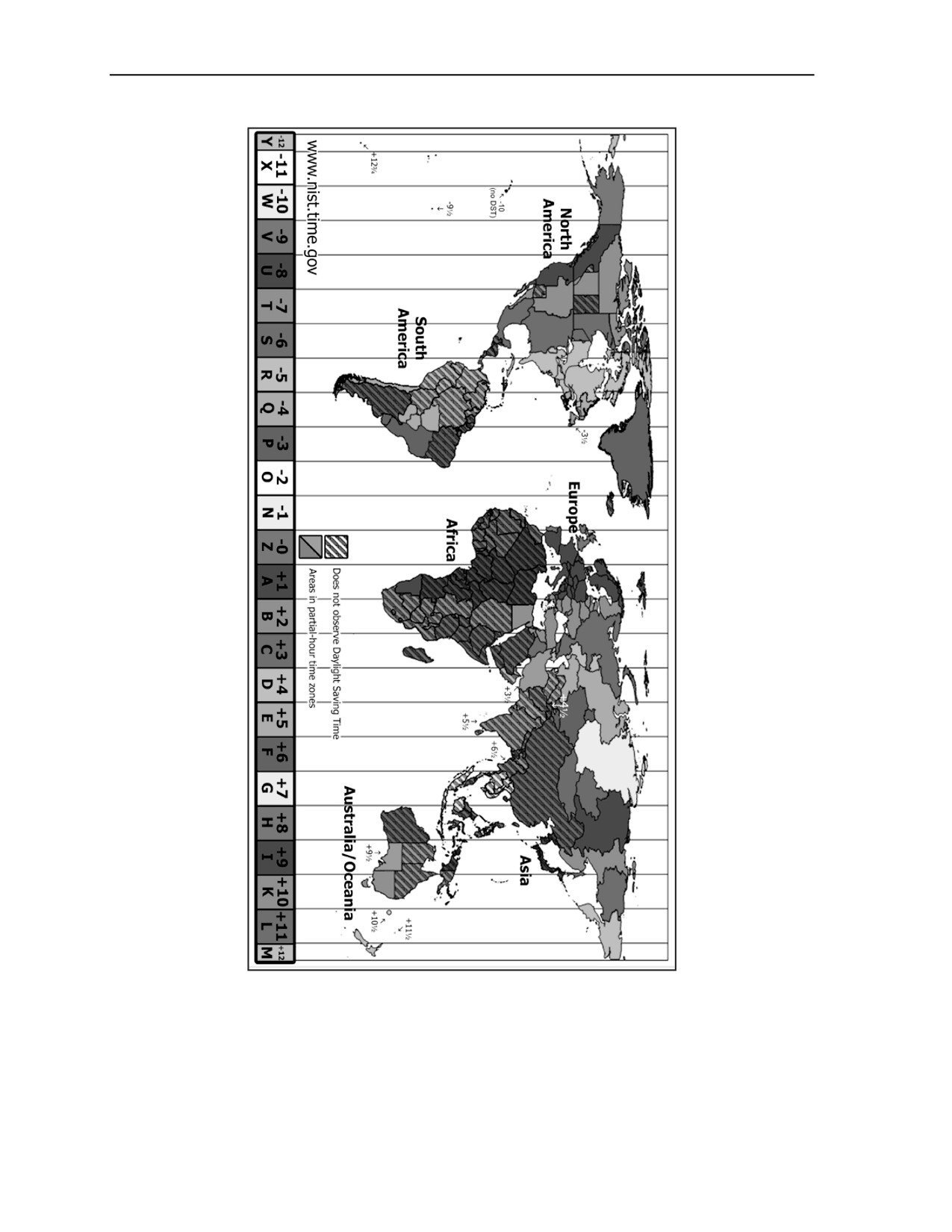
Appendix E
Figure E-1. World time zone map
E-4
FM 6-02.53
5 August 2009
Appendix F
Radio Compromise Recovery Procedures
Net compromise recovery procedures are essential to maintaining secure
communications, and preventing an adversary from disrupting C2 communications
due to loss or capture of COMSEC equipment. This appendix provides procedures
for preventing and recovering a net after a compromise, and addresses recovery
options available to the commander and his staff. This appendix is compliant with AR
380-40, and can be used as the core basis for a unit or taskforce SOP.
SECURE COMMUNICATIONS IMPERATIVES
F-1. The following imperatives will increase the unit’s ability to operate without adversary intervention
on its nets—
z
ANCDs/SKLs below the battalion level (S-6) will only have the current TEK and KEK of the
unit, and the minimum SOI data to perform the mission.
z
ANCD loadsets will be loaded with NET ID 999 in each fill position, so not to compromise unit
nets if captured. NET ID 999 will not be assigned as an operational net. (SINCGARS has the
capability to manipulate all three digits of the NET ID.)
z
ANCDs/SKLs and CIKs are always stored or transported separately to decrease ease of captured
equipment operation by the adversary.
z
Unique KEKs will be assigned down to the company level. (However, situations may arise that
require unique KEKs at lower levels.)
z
Units assign specific NET IDs as COMSEC recovery nets. (Predetermined NET IDs should be
addressed in each unit’s tactical SOP and/or OPORD.)
COMPROMISE DETERMINATION
F-2. The S-6, S-3, and S-2 will work together in determining the possibility of a compromise and the
potential damage the compromise may cause. This damage is determined by evaluating what equipment
was possibly captured or lost, and what COMSEC was loaded into the equipment. Upon determining there
has been a compromise, COMSEC key replacement is required to secure the net.
F-3. Upon notification by the staff, the commander has three options. He can—
z
Immediately implement the unit’s compromise recovery procedures to secure the net.
z
Extend the use of validated, intact COMSEC keys up to 24-hours. (Only if the commander is the
controlling authority.) Commands must request permission to change COMSEC keys through
the correct command channels.
z
As a last resort, continue to use the compromised COMSEC keys.
COMPROMISE RECOVERY
F-4. If the controlling authority decides to continue using the compromised key, the commander, under
advisement from the S-6/G-6 and staff, may initiate actions to protect net security.
F-5. If an operational radio and/or a filled ANCD/SKL falls into an adversary’s hands, the unit SOP
should assume the adversary has English-speaking Soldiers who can operate the radio and ANCD/SKL.
The SOP should also assume the adversary is able to listen to US secure FH net communications and can
transmit on that same US net, if desired.
5 August 2009
FM 6-02.53
F-1

Appendix F
F-6. Other assumptions and factors to consider if faced with a compromise recovery requirement
include—
z
Can the adversary move the captured radio and continue to operate that radio?
z
What is the range of the captured radio?
z
What is the expected duration of the battery or other power source?
z
How long until the next periodic COMSEC update?
z
How serious is the adversary’s access to your net?
z
What is the potential impact of the captured loadset on other nets?
z
What was the nature of, and how critical is, the unit operation at the time that the compromise
recovery was considered?
F-7. Two sets of net compromise recovery procedures exist to provide units guidance on recovering from
a net compromise. Table F-1 provides procedures for those units that have compromised TEKs and KEKs,
and Table F-2 provides procedures for those units that have compromised TEKs only. These procedures
offer ways to help protect net security; however, this is not a substitute for distributing new COMSEC keys
as soon as operationally possible.
Table F-1. Compromised net recovery procedures: compromised TEKs and KEKs
Step
Procedure
1
The NCS is advised of loss of radio and/or ANCD/SKL.
2
The S-6 notifies next higher command and/or controlling authority, and requests permission
to change to reserve TEK.
3
The G-6/S-6 and the commander determine if compromise recovery action is warranted.
Depending on the operational situation, the G-6/S-6 and the commander may elect to
temporarily continue to use the presumably compromised net until it is determined that the
compromise and compromise procedures will not interfere with current operations.
4
If compromise recovery action is required, the NCS broadcasts unit code word, meaning
“Standby for activation of compromise procedures.” (Adversary does not know the meaning
of this code-word.)
5
In accordance with compromise procedures, each operator in the net will answer back with
“WILCO, out,” verifying they understand and will comply. The operator will then switch to the
unit’s predetermined alternate NET ID, and wait for the NCS to perform a net call.
6
The NCS maintains a tracking chart to log all subscribers confirming the code word. If
possible, the NCS should maintain additional SINCGARS on the old NET ID to ensure that
all users are moved to the alternate NET ID. (This is commonly called straggler control.)
7
The NCS then changes to the predetermined alternate NET ID and performs a net call. NCS
operator logs in the users as they answer on the alternate NET ID.
8
Upon gaining controlling authority approval to change to the new TEK, the NCS will initiate a
net call and inform all users of the manual COMSEC distribution plan. Each radio and
ANCD/SKL will have to be manually filled from another device with the new COMSEC. (This
is a mandatory physical distribution due to the KEK compromise.)
9
Upon complete distribution of the new COMSEC, the NCS will initiate a net call, informing
the unit of the time to change to the new COMSEC, and return to the original NET ID.
10
At the designated time, the NCS will return to the original NET ID and log all subscribers on
a tracking chart as they return to the original NET ID on the new COMSEC. If possible, the
NCS should maintain an additional radio on the alternate NET ID to ensure that all users are
moved over to the original NET ID.
11
The losing unit/net has now effectively recovered from the actual or potential compromise
situation.
F-2
FM 6-02.53
5 August 2009

Radio Compromise Recovery Procedures
Table F-2. Compromised net recovery procedures: compromised TEKs
Step
Procedures
1
The NCS of the net is advised of loss of radio and/or ANCD/SKL.
2
The S-6 notifies next higher command and/or controlling authority, and requests
permission to change to the reserve TEK.
3
The G-6/S-6 and the commander determine if compromise recovery action is warranted.
Depending on the operational situation, the G-6/S-6 and the commander may elect to
temporarily continue to use the presumably compromised net until they determine the
compromise and compromise procedures will not interfere with current operations.
4
If compromise recovery action is required, the NCS broadcasts unit code-word, meaning
“Standby for activation of compromise procedures.” (Adversary does not know the
meaning of this code-word, and does not know the alternate NET ID.)
5
In accordance with compromise procedures, each operator in the net will answer back
with “WILCO, out,” verifying that he understands and will comply. The operator will then
switch to the alternate NET ID, and wait for the NCS to perform a net call.
6
The NCS maintains a tracking chart to log all subscribers confirming the code-word. If
possible, the NCS should maintain an additional radio on the old NET ID to ensure that
all users are moved over to the alternate NET ID. (This is commonly called straggler
control.)
7
The NCS then changes to the predetermined alternate NET ID and performs a net call.
NCS logs in users as they answer on the alternate NET ID.
8
Upon gaining approval from the controlling authority to change to the new TEK, the NCS
will initiate a net call and OTAR procedures, or initiate a manual rekeying of the unit’s
SINCGARS and fill devices. (OTAR—automatic key procedures should only be used at
the effective time of the COMSEC key.)
9
Upon complete distribution of the new COMSEC, the NCS will initiate a net call
informing the unit of the time to change to the new COMSEC and return to the original
NET ID.
10
At the designated time, the NCS will return to the original NET ID and log all subscribers
on a tracking chart as they return to the original NET ID on the new COMSEC. If
possible, the NCS should maintain an additional radio on the alternate NET ID to ensure
that all users are moved to original NET ID.
11
The losing unit/net has now effectively recovered from the actual or potential
compromise situation.
F-8.
Since the entire division/brigade is operating on the same TEK, the divisions/brigade G-6 may elect
to have all nets change to a new TEK. If so, this change may be accomplished by the physical transfer from
ANCD/SKL to ANCD/SKL, or by OTAR, as most appropriate for the operational situation.
5 August 2009
FMI 6-02.53
F-3
This page intentionally left blank.
Appendix G
Data Communications
This appendix addresses data communications elements such as binary data, baud
rate, modems and FEC.
BINARY DATA
G-1. Bits are part of a numbering system (binary digits) having a base of two that uses only the symbols 0
and 1. Thus, a bit is any variable that assumes two distinct states. For example, a switch is open or closed; a
voltage is positive or negative. In terms of communications, words become binary digits for transformation
over a channel (specific frequency range), via a HF radio transmitter, to a HF receiver.
G-2. A simple way to communicate binary data is to switch a circuit on and off in patterns that are
interpreted at the other end; the same as the telegraph. Later schemes used a bit to select one of two
possible states of the properties that characterize a carrier, FM or AM. Currently, the carrier assumes more
than two states, and is able to represent multiple bits.
BAUD RATE
G-3. Data transmission speed is commonly measured in bps. Sometimes the word baud is used to
represent bps, although the terms are different. Baud measures the signaling speed and is a measurement of
symbols per second that are being sent. Symbols may represent a bit or more.
G-4. The bandwidth determines the maximum baud rate on a radio channel; the larger the bandwidth, the
greater the baud rate. The rate at which information is transmitted (the bit rate) depends on how many bits
are used per symbol.
ASYNCHRONOUS AND SYNCHRONOUS DATA
G-5. The transmission of data occurs in either the asynchronous or synchronous mode. In asynchronous
data transmission, each character has a start and stop bit. The start bit prepares the data receiver to accept
the character. The stop bit brings the data receiver back to the wait state. Synchronous data transmission
eliminates the start and stop bits. This type of system typically uses a preamble (a known sequence of bits
at the start of the message) to synchronize the receiver’s internal clock and to alert the data receiver that a
message is coming.
G-6. Asynchronous systems eliminate the need for complex synchronization circuits, but at the cost of
higher overhead than synchronous systems. With asynchronous systems the start and stop bits increase the
length of the character from 8 bits (one byte) to 10 bits, a 25 percent increase.
HIGH FREQUENCY MODEMS
G-7. The average voice radio cannot transmit data directly. Data digital voltage levels must be converted
to audio using a modulator device that applies the audio to the transmitter. At the receiver, a demodulator
converts the audio back to digital voltage levels. HF modems fall into three basic categories—
z
Modems with slow-speed audio FSK capable of operating at data rates of 75, 150, 300 and 600
bps.
z
High-speed parallel tone.
z
High-speed serial tone capable of operating at data rates between 75 and 2, 400 bps.
5 August 2009
FM 6-02.53
G-1
Appendix G
G-8. The simplest modems use FSK to encode binary data. The input to the modulator is a digital signal
that takes one of two possible voltage levels. The output of the modulator is an audio signal that is one of
two possible tones. HF FSK systems are limited to data rates less than 75 bps, due to the effects of
multipath propagation. Higher rates are possible with multitone FSK, which uses a greater number of
frequencies.
G-9. High-speed HF modem technology, using both parallel and serial tone waveforms, allows data
transmissions at up to 4,800 bps. The serial tone modem carries information on a single audio tone. This
vastly improves data communications on HF channels, including greater toughness, less sensitivity to
interference, and a higher data rate with more powerful FEC.
IMPROVED DATA MODEM
G-10. The improved data modem will allow both air and ground forces to exchange complex information
in short bursts. It will permit simultaneous transmit/receive information from four different radios,
interface with MIL-STD 1553 data bus, transmit data at 16,000 bps, and process messages up to 3,500
characters in length.
FORWARD ERROR CODING
G-11. FEC adds redundant data to the data stream to allow the data receiver to detect and correct errors. It
does not require a return channel for the acknowledgment. If a data receiver detects an error, it simply
corrects it and accurately reproduces the original data without notifying the data sender that there was an
error.
G-12. FEC coding is most effective if errors occur randomly in a data stream. However, the HF medium
typically introduces errors that occur in bursts. To take advantage of the FEC coding technique,
interleaving randomizes the errors that occur in the channel. At the demodulator, de-interleaving reverses
the process.
G-13. Soft-decision decoding further enhances the power of the error correction coding. In this process, a
group of detected symbols that retains its analog character is compared against a set of possible transmitted
code words. The system remembers the voltage from the detector, and applies a weighing factor to each
symbol in the code word before making a decision about which code word was transmitted.
G-14. Data communications techniques are also used for encrypting voice calls by a VOCODER, a
derivative of voice coder-decoder. The VOCODER converts sound into a data stream for transmission over
a HF channel. The VOCODER at the receiving end reconstructs the data into telephone quality sound.
G-15. In addition to error correction techniques, high-speed serial modems may include two signal-
processing schemes that improve data transmission. An automatic-channel equalizer compensates for
variations in the channel characteristics as data is being received. An adaptive excision filter seeks output,
and suppresses narrowband interference in the demodulator input, thereby reducing the effects of co-
channel interference; interference on the same channel being used.
G-2
FM 6-02.53
5 August 2009
Appendix H
Co-Site Interference
Co-site interference is the effect of unwanted energy, due to emissions, radiation, or
induction, on reception in a radio communications system. This could cause system
performance degradation, misinterpretation, or loss of information. As
telecommunication systems become more complex and several antennas are placed
on the same platform, or when multiple radios in the same or dissimilar frequency
bands are integrated within mobile communications CP platforms, interference
becomes significant in system performance. This appendix addresses SINCGARS
implications and co-site interference mitigation.
SINCGARS IMPLICATIONS
H-1. Due to SINCGARS FH capabilities, frequency management alone does not reduce co-site
interference. The addition of computer central processing units, displays, switches, routers, hubs, and
cables in the confined CP amplifies the potential for co-site interference.
H-2. Within a CP or a mobile platform (vehicle or aircraft), co-site interference depends on several
factors, including—
z
The number of transmitters within the restricted area.
z
The duty cycle of each transmitter—the transmitting time of the radio, divided by the
transmitting time plus the time before the next transmission. (Example: if a radio transmits for
four seconds and waits six seconds before the next transmission, the duty cycle is 40 percent.)
z
The hopset bandwidth (if hopping).
z
An increase in the system data rate increases the electromagnetic flux of the system, thus
increasing interference potential.
z
Antenna placement.
z
Equipment shielding.
z
Bonding.
z
Grounding.
H-3. SINCGARS that habitually transmit to distances of 35-40 km (21.7-24.8 miles), by themselves, can
transmit at distances reduced to less than 5 km (3.1 miles) when influenced by co-site interference. This
degradation, if not properly addressed, will adversely distress the flow of C2 communications. This distress
may lead to the physical shutdown of non-critical systems that pass information onto critical systems.
H-4. Figure H-1 shows the mobile CP antenna configuration. (The antennas have been removed to avoid
clutter). This mobile CP contains multiple radio systems, including FH SINCGARS, multiplexed on a
single antenna within the CP. The close proximity and number of simultaneous transmitters produce
unwanted emissions and degrade or block outstation receiver communications.
5 August 2009
FM 6-02.53
H-1
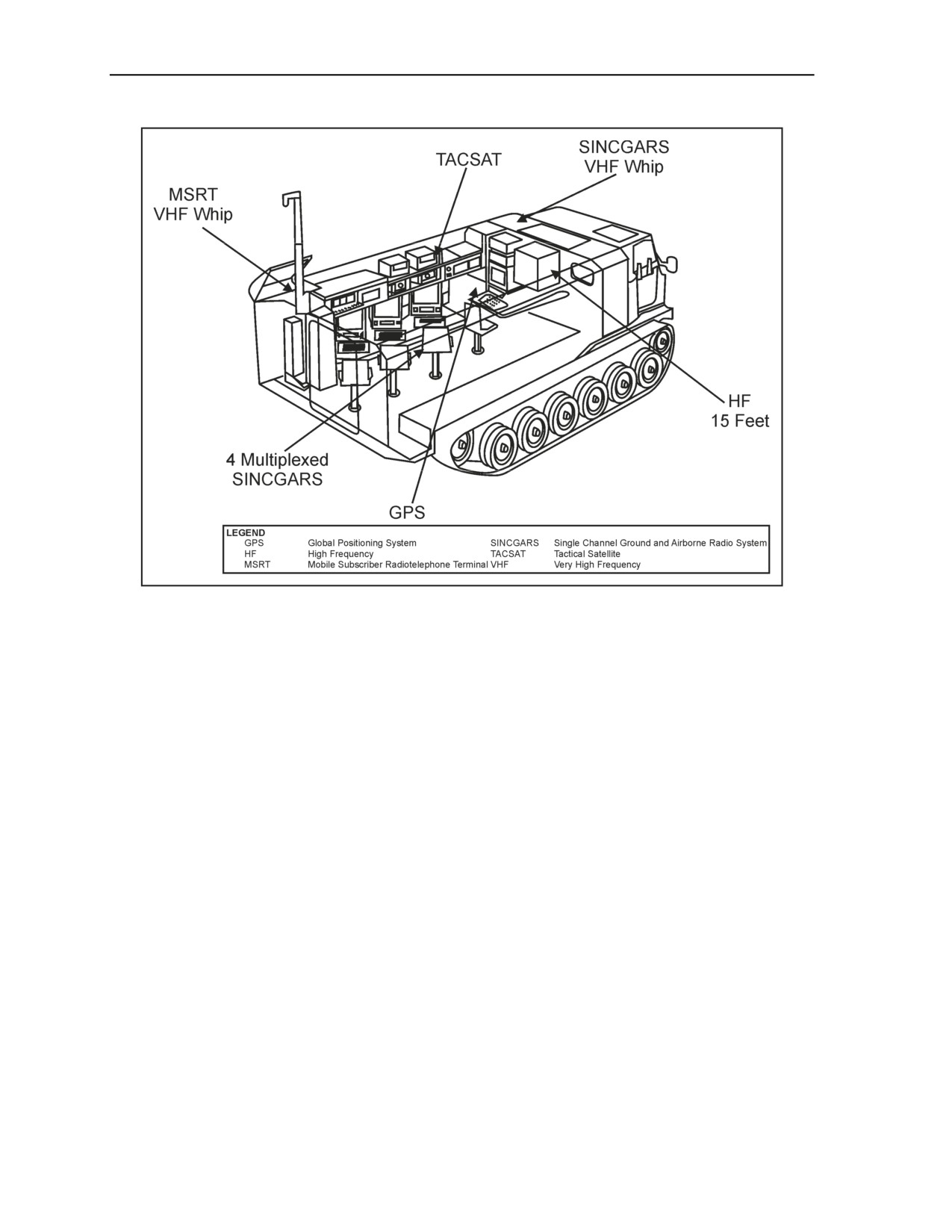
Appendix H
Figure H-1. Mobile command post antenna configuration
H-5. When a SINCGARS transmits at maximum power, a collocated mobile subscriber radiotelephone
terminal (MSRT) radio cannot establish a link into the MSE area communications system. Antennas
require 20+ ft of separation to overcome the SINCGARS-generated increase in background noise. This
separation allows an acceptable S/N ratio for MSRT to establish a successful link.
H-6. If SINCGARS transmits at a power of four watts or less, the MSRT can effectively establish a voice
link with some reduction in data quality. SINCGARS low power (4 watts) output reduces the SINCGARS
planning range by 90 percent, and subjects the SINCGARS to increased noise generated by the collocated,
transmitting MSRT system.
H-7. If SINCGARS is configured to hop outside the MSRT frequency range (59-88 MHz outside the
Continental United States [OCONUS] or 40-50 MHz CONUS), plus an additional 5 MHz cushion in both
areas of operation, the MSRT is relatively resistant to SINCGARS co-site interference. However, this
causes a significant reduction of the available frequency spectrum, and a constraint on the capabilities of
the SINCGARS. Full frequency range and full power hopping transmissions from SINCGARS will reduce
MSRT operational distances by 94 percent. MSRT transmissions (16 watts) will degrade a co-sited
SINCGARS operational planning distance by 74 percent. For all intents and purposes, full power
operations of both systems can render them inoperable in many tactical situations.
CO-SITE INTERFERENCE MITIGATION
H-8. A number of options are available to mitigate co-site interference, but there are no comprehensive
solutions. The user must decide if an option is applicable to his tactical situation, and take the appropriate
action to resolve co-site interference.
H-9. Some equipment systems are not as critical as others. The S-6/G-6 must recommend to the
commander a system priority list that ensures the transmission of critical mission information. During
H-2
FM 6-02.53
5 August 2009
Co-Site Interference
interference, the S-6/G-6 must be prepared to shut down less critical systems. The following paragraphs
address ways to reduce co-site interference.
TRANSMISSION
H-10. When possible and operationally acceptable, transmit at the lowest power level. This allows
collocated SINCGARS and MSRT antenna systems to operate with minimal interference in both data and
voice communications at the receivers. This option may be unacceptable due to the significant transmission
range reduction of the SINCGARS.
H-11. Remoting antennas and transmitting from the CP at low power to a full power wireless network
extension system mitigates co-site interference. Certain critical TOC nets would then be able to maintain
their high power advantage.
ANTENNA PLACEMENT
H-12. Antenna placement is critical when the antennas operate in the same or nearby frequency range(s);
separate antennas as much as possible. The greater the separation between the transmitting and receiving
antennas, the less interference encountered. TOCs could be issued a significant quantity of mast-mounted
antennas (OE-254 or equivalent) to match the number of installed SINCGARS. Extra length low-loss
coaxial transmission lines should be included with each requirement. However, this may cause an increase
in the physical size of the CP location, and an increase in CP setup and disassembly times. Figure H-2
shows an example of proper antenna separation for an armored TOC.
H-13. Tilting the tops of the transmitting and receiving antennas away from each other can enhance
vertically polarized ground wave communications. Tilt angles between 15 and 30 degrees will provide the
best results; the best angle is achieved by trial and error.
5 August 2009
FM 6-02.53
H-3