FM 6-02.53 TACTICAL RADIO OPERATIONS (August 2009) - page 5
Chapter 11
As a minimum, four categories of EP planning must be considered: deployment, employment, replacement,
and concealment. The following paragraphs address the deployment phase of the EP planning process.
GEOMETRY
11-14. Analyze the terrain, and determine methods to make the geometry of the operations work in the
favor of friendly forces. Adhering rigidly to standard CP deployment makes it easier for the adversary to
use the direction finder and aim his jamming equipment at his enemies.
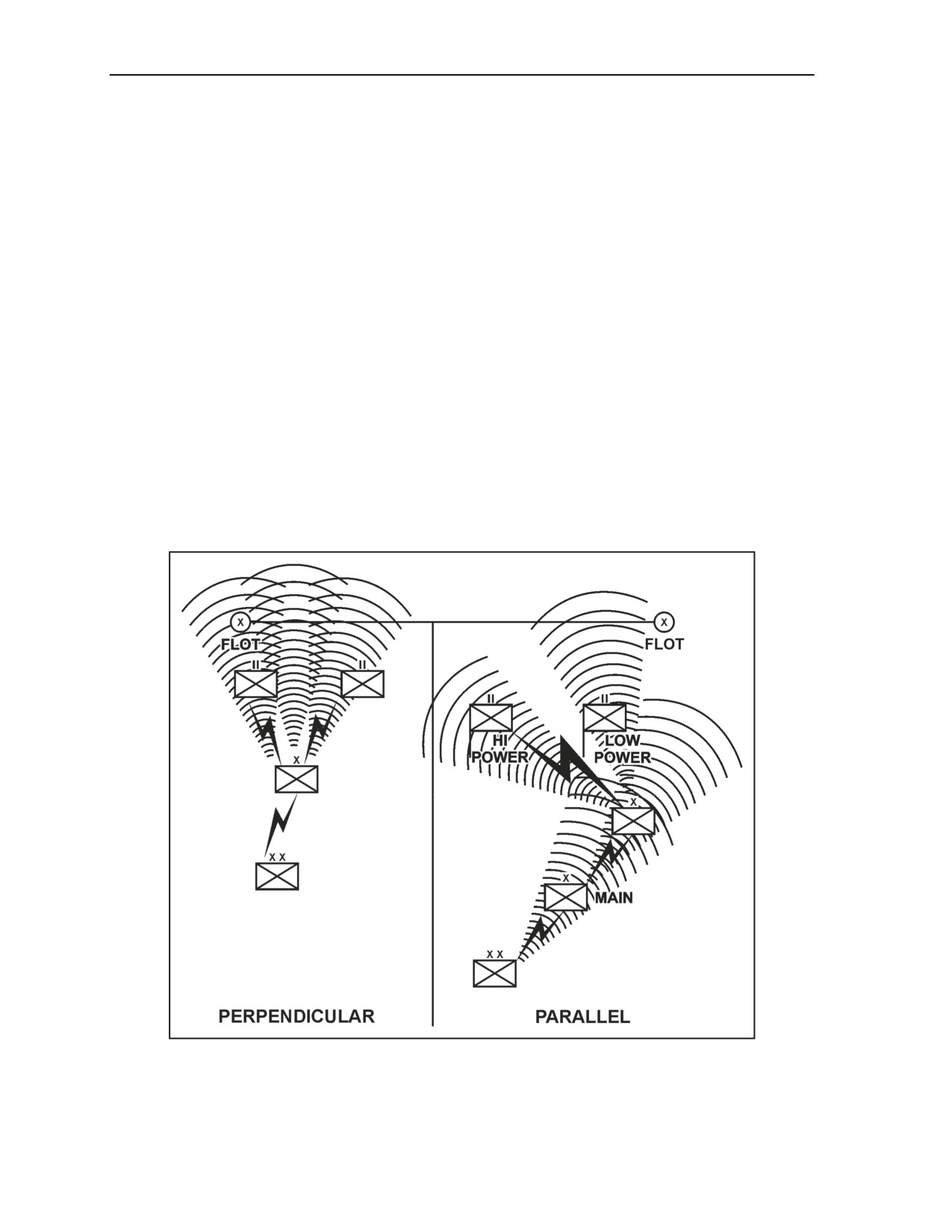
11-15. Deploying units and communications systems perpendicular to the forward line of own troops
(FLOT) enhance the enemy’s ability to intercept communications because US forces aim transmissions in
the enemy’s direction. When possible, friendly forces must install terrestrial LOS communications parallel
to the FLOT. This supports keeping the primary strength of US transmissions in friendly terrain. Refer to
Figure 11-1 for an example of geometry during operations.
11-16. SC TACSAT systems reduce friendly CP vulnerability to enemy direction efforts. Tactical
SATCOM systems are relieved of this constraint because of their inherent resistance to enemy direction
finder efforts. Terrain features should be used when possible to mask friendly communications from enemy
positions. This may mean moving senior headquarters farther forward and using more jump or TAC CPs so
that commanders can continue to direct their units effectively.
11-17. Locations of CPs must be carefully planned, as CP locations generally determine antenna
locations. The proper installation and positioning of antennas around CPs is critical. Antennas and emitters
should be dispersed and positioned at the maximum remote distance, terrain dependent, from the CP, so
that all of a unit’s transmissions are not coming from one central location.
Figure 11-1. Geometry during operations
11-4
FM 6-02.53
5 August 2009
Communications Techniques: Electronic Protection
SYSTEM DESIGN
11-18. Alternate routes of communications must be established when designing communications systems.
This involves establishing sufficient communications paths to ensure that the loss of one or more routes
will not seriously degrade the overall system. The commander establishes the priorities of critical
communications links; the higher priority links should be afforded the greatest number of alternate routes.
11-19. Alternate routes enable friendly units to continue to communicate despite the enemy’s efforts to
deny them the use of their communications systems. They can also be used to transmit false messages and
orders on the route that is experiencing interference, while they transmit actual messages and orders
through another route or means. A positive benefit of continuing to operate in a degraded system is the
problematic degraded system will cause the enemy to waste assets that might otherwise be used to impair
friendly communications elsewhere.
11-20. Three routing concepts, or some permutation of them, can be used in communications—
z
Straight-line system—provides no alternate routes of communications.
z
Circular system—provides one alternate route of communications.
z
Grid system—provides as many alternate routes of communications as can be practically
planned.
11-21. Avoid establishing a pattern of communications. Adversary intelligence analysts are highly trained
to extract information from the pattern, and the text, of friendly transmissions. If easily identifiable patterns
of friendly communications are established, the enemy can gain valuable information.
11-22. The number of friendly transmissions tends to increase or decrease according to the type of tactical
operation being executed. This deceptive communications traffic can be executed by using either false
peaks, or traffic leveling. False peaks are used to prevent the enemy from connecting an increase of
communications with a tactical operation. Transmission increases, on a random schedule, create false
peaks.
11-23. Tactically, traffic leveling is accomplished by designing messages to be sent when there is a
decrease in transmission traffic. Thus, traffic leveling is used to keep the transmission traffic fairly
constant. Messages transmitted for traffic leveling or false peaks must be coordinated to avoid operational
security violations, mutual interference, and confusion among friendly equipment operators.
11-24. ACES equipment, software, and subsequent SOI development resolves many problems concerning
communications patterns; they allow users to change frequencies often, and at random. This has long been
recognized as a key in confusing enemy traffic analysts. Adversary traffic analysts are confused when
frequencies, net call signs, locations, and operators are often changed. The adversary uses US TTP to help
perform their mission. Therefore, these procedures must be flexible enough to avoid establishing
communications patterns.
REPLACEMENT
11-25. Replacement involves establishing alternate routes and means of doing what the commander
requires. FM voice communications are the most critical communications used by the commander during
adversary engagements. As much as possible, critical systems should be reserved for critical operations.
The adversary should not have access to information about friendly critical systems until the information is
useless.
11-26. Alternate means of communications should be used before enemy engagements. This ensures the
adversary cannot establish a database to destroy primary means of communications. Primary systems must
always be replaced with alternate means of communications, if the primary means become significantly
degraded. These replacements must be preplanned and carefully coordinated; if not, the alternate means of
communications could be compromised, and become as worthless as the primary means. Users of
communications equipment must know how and when to use the primary and alternate means of
communications. This planning and knowledge ensures the most efficient use of communications systems.
5 August 2009
FM 6-02.53
11-5
Chapter 11
CONCEALMENT
11-27. OPLANs should include provisions to conceal communications personnel, equipment, and
transmissions. It is difficult to effectively conceal most communications systems; however, installing
antennas as low as possible on the backside of terrain features, and behind man-made obstacles, helps
conceal communications equipment while still permitting communications.
SIGNAL SECURITY
11-28. EP and signal security are closely related; they are defensive arts based on the same principle. If
adversaries do not have access to the essential elements of friendly information (EEFI) of US forces, they
are much less effective. The goal of practicing sound EP techniques is to ensure the continued effective use
of the electromagnetic spectrum. The goal of signal security is to ensure the enemy cannot exploit the
friendly use of the electromagnetic spectrum for communications. Signal security techniques are designed
to give commanders confidence in the security of their transmissions. Signal security and EP should be
planned based on the enemy’s ability to gather intelligence and degrade friendly communications systems.
11-29. Tactical commanders must ensure effective employment of all communications equipment, despite
the adversary’s concerted efforts to degrade friendly communications to his tactical advantage. Modifying
and developing equipment, to make friendly communications less susceptible to adversary exploitation, is
an expensive process. Equipment that will solve some EP problems is being developed and fielded.
Ultimately, the commander, staff planners, and RTOs are responsible for both security and continued
operation of all communications equipment.
EMISSION CONTROL
11-30. The control of friendly electromagnetic emissions is essential to successful defense against the
enemy’s attempts to destroy or disrupt US communications. Transmitters should be turned on only when
needed to accomplish the mission. The enemy intelligence analyst will look for patterns he can turn into
usable information. If friendly transmitters are inactive, the enemy has nothing to work with as
intelligence. Emission control can be total; for example, the commander may direct radio silence or radio
listening silence whenever desired.
11-31. Emission control should be a habitual exercise. Transmissions should be kept to a minimum (20
seconds absolute maximum, 15 seconds maximum preferred) and should contain only mission-critical
information. Good emission control makes the use of communications equipment appear random, and is
therefore consistent with good EP practices. This technique alone will not eliminate the enemy’s ability to
find a friendly transmitter; but when combined with other EP techniques, it will make locating a transmitter
more difficult.
PREVENTIVE ELECTRONIC PROTECTION TECHNIQUES
11-32. In planning communications, consider the enemy’s capabilities to deny the effective use of
communications equipment. EP should be planned and applied to force the adversary to commit more
jamming, information gathering, and deception resources to a target than it is worth or than he has readily
available. EP techniques must also force the enemy to doubt the effectiveness of his jamming and
deception efforts.
11-33. RTOs must use preventive EP techniques to safeguard friendly communications from enemy
disruption and destruction. Preventive EP techniques include all measures taken to avoid enemy detection,
and to deny enemy intelligence analysts useful information. These techniques include EP designed circuits
(equipment features) and radio systems installation and operating procedures. Refer to AR 380-5 for the
Department of the Army Information Security Program.
11-34. EP designed circuits are in compliance with the MIL-STD for EP. They are built with a focus on
technology enhancements, to mitigate the effects of adversary radio electronic combat threats and reduce
vulnerabilities to electronic countermeasures.
11-6
FM 6-02.53
5 August 2009
Communications Techniques: Electronic Protection
11-35. RTOs have little control over the effectiveness of EP designed circuits; therefore, their primary
focus is radio systems installation and operating procedures. (Appendix C addresses operations in cold
weather, jungle, urban, desert, and nuclear environments.)
11-36. Incorrect operating procedures can jeopardize the unit’s mission, and ultimately increase unit
casualties. Communications equipment operators must instinctively use preventive and remedial EP
techniques. Maintenance personnel must know that improper modifications to equipment may cause the
equipment to develop peculiar characteristics that can be readily identified by the adversary. Commanders
and staff must develop plans to ensure the continued use of friendly communications equipment and
systems, while also evaluating JSIR reports and after action reports so that appropriate remedial actions can
be initiated. FM 7-0 addresses proper training development techniques and is the foundation for developing
preventative and EP remedial training.
11-37. Effective jamming depends on knowing the frequencies and approximate locations of units to be
jammed. Using the techniques addressed in the following paragraphs reduces the vulnerability of
communications from enemy disruption or destruction; this information must not be disclosed.
MINIMIZING TRANSMISSIONS
11-38. The most effective preventive EP technique is to minimize both radio transmissions, and
transmission times. Although normal day-to-day operations require radio communications, these
communications should be kept to the minimum needed to accomplish the mission. Table 11-2 lists the
techniques for minimizing transmissions and transmission times.
11-39. Minimizing transmissions will safeguard radios for critical transmissions. This does not advocate
total, continuing radio silence; it advocates minimum transmissions and transmission times.
Table 11-2. Techniques for minimizing transmissions and transmission times
Technique
Description
Ensure all
Analysis of US tactical communications indicates that most communications
transmissions
used in training exercises are explanatory and not directive. Radio
are necessary.
communications must never be used as a substitute for complete planning.
Tactical radio communications should be used to convey orders and critical
information rapidly. Execution of the operation must be inherent in training,
planning, ingenuity, teamwork, and established and practiced SOPs. The high
volume of radio communications that usually precedes a tactical operation
makes the friendly force vulnerable to enemy interception, DF, jamming, and
deception.
Note. Even when communications are secure, the volume of radio transmissions can betray an operation, and the enemy can
still disrupt or destroy the ability of US forces to communicate.
Preplan
The RTO should know what he is going to say before beginning a transmission.
messages before
When the situation and time permit, the message should be written out before
transmitting
beginning the transmission. This minimizes the number of pauses in the
them.
transmission and decreases transmission time. It will also help ensure the
conciseness of the message. The Joint Interoperability of Tactical Command
and Control System (JINTACCS) provides a standard vocabulary that can be
used for message planning. JINTACCS voice templates are some of the best
tools a RTO can use to minimize transmission time.
5 August 2009
FM 6-02.53
11-7
Chapter 11
Table 11-2. Techniques for minimizing transmissions and transmission times (continued)
Technique
Description
Transmit quickly
This is critical when the quality of communications is poor. This minimizes the
and precisely.
chances that a radio transmission will have to be repeated. Unnecessary
repetition increases transmission time and the enemy’s opportunity to intercept
US transmissions and thus gain valuable information. When a transmission is
necessary, the radio operator should speak in a clear, well-modulated voice,
and use proper radiotelephone procedures.
Use equipment
This is one of the most significant advantages of tactical SATCOM systems.
capable of data
When messages are encoded on a digital entry device for transmission over
burst
satellite systems, the transmission time is greatly reduced.
transmission.
Use an alternate
Alternate means of communications, such as cable, wire, or organic Soldiers
means of
performing as messengers, can be used to convey necessary directives and
communications.
information. Other means of communications must be used, when practical.
Use of brevity
A brevity code is a code which provides no security but which has as its sole
codes
purpose the shortening of messages rather than the concealment of their
content. (Refer to FM 1-02.1 for more information.)
Low Power
11-40. Power controls and antennas are closely related. The strength of the signal transmitted by an
antenna depends on the strength of the signal delivered to it by the transmitter; the stronger the signal, the
farther it travels. A radio communications system must be planned and installed, allowing all stations to
communicate with each. In carefully planned and installed communications systems, users can normally
operate on low power, thereby decreasing the range, and making it more difficult for the adversary to
detect and intercept transmissions. It also reserves high power for penetrating enemy jamming.
RADIO-TELEPHONE OPERATOR PROCEDURES
11-41. The RTO, or Soldier, is essential to the success of preventive EP techniques. The RTO ensures
that radio transmissions are minimized and protected; thereby preventing the adversary from intercepting
and disrupting or destroying communications based on information detected in the pattern or content of
transmissions.
11-42. Many RTOs can be readily identified by certain voice characteristics or overused phrases. The
adversary can use these distinguishing characteristics to identify a unit, even though frequencies and net
call signs are changed periodically. Strictly adhering to the proper use of procedure words, as outlined in
Chapter Twelve or unit SOP, helps keep operator distinguishing characteristics to a minimum. However,
this is not enough, as accents and overused phrases must also be kept to a minimum. The adversary must
not be able to associate a particular RTO with a particular unit.
11-43. The adversary can gather information based on the pattern, and the content, of radio
communications. Therefore, do not develop patterns through hourly radio checks, daily reports at specific
times, or any other periodic transmission. Periodic reports should be made by alternate means of
communications. Take all reasonable measures to deny information to adversary intelligence analysts.
Authentication
11-44. Authentication must be used in radio systems that do not use secure devices. The adversary has
skilled experts, whose sole mission is to enter nets by imitating friendly radio stations. This threat to radio
11-8
FM 6-02.53
5 August 2009
Communications Techniques: Electronic Protection
communications can be minimized by the proper use of authentication. Procedures for authentication are
found in the supplemental instructions to the SOI. Authentication is required if the user—
z
Suspects the adversary is on his net.
z
Is challenged by someone to authenticate. (Do not break radio listening silence to do this.)
z
Transmits directions or orders that affect the tactical situation, such as change locations, shift
fire, or change frequencies.
z
Talks about adversary contact, gives an early warning report, or issues a follow-up report. (This
rule applies even if he used a brevity list or operations code.)
z
Tells a station to go to radio or listening silence, or asks it to break that silence.
(Use
transmission authentication for this.)
z
Transmits to a station that is under radio listening silence. (Use transmission authentication for
this.)
z
Cancels a message by radio or visual means, and the other station cannot recognize him.
z
Resumes transmitting after a long period, or if this is the first transmission.
z
Is authorized to transmit a CLASSIFIED message in the clear. (Use transmission authentication
for this.)
z
Is forced, because of no response by a called station, to send a message in the blind. (Use
transmission authentication for this.)
11-45. All instances in which the adversary attempts to deceptively enter nets to insert false information
must be reported. The procedures for reporting these incidents are addressed later in this chapter. These
procedures are also in the supplemental instructions to the SOI.
Encryption
11-46. Encrypt all EEFI (those items of information the adversary must not be allowed to obtain). A
broad, general list of these items of information is contained in the supplemental instructions to the SOI.
These items are applicable to most Army units engaged in training exercises or tactical operations. The list
supports the Army self-monitoring program, and is not totally encompassing. Individual units should
develop a more specific EEFI list to be included in unit OPORDS, OPLANS, and field SOPs. These items
of information must be encrypted manually or electronically before transmission. Manual encryption is
accomplished by using approved operations codes. Electronic encryption is accomplished using COMSEC
devices such as the KG-84, KG-95, KY-57/58, KY-90, KY-99, and KY-100 or ANCD/SKL. Manual and
electronic encryption does not need to be used together, as either method will protect EEFI from enemy
exploitation.
Key Distribution
11-47. Key distribution is critical in achieving secure transmissions. Commanders must ensure these
procedures are established in the units SOP. Only the requesting unit’s COMSEC custodian, with valid
COMSEC account (and requirement), is authorized to order these keys.
11-48. TB 11-5820-890-12 and TM 11-5820-1130-12&P expound upon the receipt of OTAR material
and TB 380-41 provides more information on the procedures for safeguarding, accounting, and the supply
control of COMSEC material such as COMSEC material distribution.
EQUIPMENT AND COMMUNICATIONS ENHANCEMENTS
11-49. Equipment enhancements can be used to reduce the vulnerability of friendly communications to
hostile exploitations. FH is particularly useful in lessening the effects of adversary communications
jamming, and in denying friendly position location data to the enemy.
11-50. Adaptive antenna techniques are designed to achieve more survivable communications systems.
These techniques are typically coupled with spread spectrum waveforms, combining FH with pseudo-noise
coding.
5 August 2009
FM 6-02.53
11-9
Chapter 11
11-51. Spread spectrum techniques suppress interference by other users (hostile or friendly), to provide
multiple access (user sharing), and to eliminate multi-path interference (self-jamming caused by a delayed
signal). The transmitted intelligence is deliberately spread across a very wide frequency band in the
operating spectrum, so it becomes hard to detect from normal noise levels. EPLRS and JTIDS use spread
spectrum techniques.
11-52. Adjustable power automatically limits the radiated power to a level sufficient for effective
communications, thereby reducing the electronic signature of the subscriber.
11-53. The FHMUX and high power broadband vehicular whip antennas are available for use to enhance
communications. The FHMUX is an antenna multiplexer used with SINCGARS in both stationary and
mobile operations. This multiplexer will allow up to four SINCGARS to transmit and receive through one
VHF-FM broadband antenna (OE-254 or high-power broadband vehicular whip antenna) while operating
in the FH mode, non-hopping mode, or a combination of both. Using one antenna (instead of up to four)
will reduce visual and electronic profiles of CPs. Also, emplacement and displacement times will be greatly
reduced.
REMEDIAL EP TECHNIQUES
11-54. Remedial EP techniques that help reduce the effectiveness of enemy efforts to jam US radio nets
are—
z
Identify jamming signals.
z
Determine if the interference is obvious or subtle jamming.
z
Recognize jamming and interference by:
Determining whether the interference is internal or external to the radio.
Determining whether the interference is jamming or unintentional.
Reporting jamming and interference incidents.
z
Overcome jamming and interference by adhering to the following techniques:
Continue to operate.
Improve the signal-to-jamming ratio.
Adjust the receiver.
Increase the transmitter power output.
Adjust or change the antenna.
Establish a wireless network extension station.
Relocate the antenna.
Use an alternate route for communications.
Change the frequencies.
Acquire another satellite.
JAMMING SIGNALS
11-55. Jamming is an effective way for the enemy to disrupt friendly communications. An adversary only
needs a transmitter tuned to a US frequency, with enough power to override friendly signals, to jam US
systems. Jammers operate against receivers, not transmitters. The two modes of jamming are spot and
barrage jamming. Spot jamming is concentrated power directed toward one channel or frequency. Barrage
jamming is power spread over several frequencies or channels at the same time. It is important to recognize
jamming, but it can be difficult to detect.
Obvious Jamming
11-56. Obvious jamming is normally simple to detect. When experiencing jamming, it is more important
to recognize and overcome the incident than to identify it formally. Table 11-3 lists some common
jamming signals.
11-10
FM 6-02.53
5 August 2009

Communications Techniques: Electronic Protection
Table 11-3. Common jamming signals
Signal
Description
Random
Synthetic radio noise. It is indiscriminate in amplitude and frequency. It is similar to
Noise
normal background noise, and can be used to degrade all types of signals. Operators
often mistake it for receiver or atmospheric noise, and fail to take appropriate EP
actions.
Stepped
Tones transmitted in increasing and decreasing pitch. They resemble the sound of
Tones
bagpipes. Stepped tones are normally used against SC AM or FM voice circuits.
Spark
Easily produced and is one of the most effective jamming signals. Bursts are of short
duration and high intensity; they are repeated at a rapid rate. This signal is effective in
disrupting all types of radio communications.
Gulls
Generated by a quick rise and slow fall of a variable RF, and are similar to the cry of a
sea gull. It produces a nuisance effect and is very effective against voice radio
communications.
Random
Pulses of varying amplitude, duration, and rate are generated and transmitted. They
Pulse
are used to disrupt teletypewriter, radar, and all types of data transmission systems.
Wobbler
A single frequency, modulated by a low and slowly varying tone. The result is a
howling sound that causes a nuisance effect on voice radio communications.
Recorded
Any audible sound, especially of a variable nature, can be used to distract radio
Sounds
operators and disrupt communications. Music, screams, applause, whistles, machinery
noise, and laughter are examples.
Preamble
A tone resembling the synchronization preamble of the speech security equipment is
Jamming
broadcast over the operating frequency of secure radio sets. Results in all radios being
locked in the receive mode. It is especially effective when employed against radio nets
using speech security devices.
Subtle Jamming
11-57. Subtle jamming is not obvious, as no sound is heard from the receivers. Although everything
appears normal to the RTO, the receiver cannot receive an incoming friendly signal. Often, users assume
their radios are malfunctioning, instead of recognizing subtle jamming for what it is.
RECOGNIZING JAMMING
11-58. RTOs must be able to recognize jamming. This is not always an easy task, as interference can be
internal and external. If the interference or suspected jamming remains, after grounding or disconnecting
the antenna, the disturbance is most likely internal and caused by a malfunction of the radio. Maintenance
personnel should be contacted to repair it. If the interference or suspected jamming can be eliminated or
substantially reduced by grounding the radio equipment or disconnecting the receiver antenna, the source
of the disturbance is most likely external to the radio. External interference must be checked further for
enemy jamming or unintentional interference.
11-59. Interference may be caused by sources having nothing to do with enemy jamming. Unintentional
interference may be caused by—
z
Other radios (friendly and enemy).
z
Other electronic or electric/electromechanical equipment.
z
Atmospheric conditions.
z
Malfunction of the radio.
z
A combination of any of the above.
5 August 2009
FM 6-02.53
11-11
Chapter 11
11-60. Unintentional interference normally travels only a short distance; a search of the immediate area
may reveal its source. Moving the receiving antenna short distances may cause noticeable variations in the
strength of the interfering signal. Conversely, little or no variation normally indicates enemy jamming.
Regardless of the source, actions must be taken to reduce the effect of interference on friendly
communications.
11-61. The enemy can use powerful unmodulated or noise modulated jamming signals. Unmodulated
jamming signals are characterized by a lack of noise. Noise modulated jamming signals are characterized
by obvious interference noise.
11-62. In all cases, suspected enemy jamming and any unidentified or unintentional interference that
disrupts the ability of US forces to communicate must be reported. This applies even if the radio operator is
able to overcome the effects of the jamming or interference. The JSIR report is the format used when
reporting this information. Instructions for submitting a JSIR report are addressed later in this chapter. As it
applies to remedial EP techniques, the information in the JSIR report provided to higher headquarters can
be used to destroy the enemy jamming efforts or take other action to the benefit of US forces.
OVERCOMING JAMMING
11-63. The enemy constantly strives to perfect and use new and more confusing forms of jamming. RTOs
must be increasingly alert to the possibility of jamming. Training and experience are the most important
tools operators have to determine when a particular signal is a jamming signal. Exposure to the effects of
jamming in training, or actual situations, is invaluable. The ability to recognize jamming is important, as
jamming is a problem that requires action. The following paragraphs address the actions to take if
adversary jamming is detected. If any of the actions taken alleviate the jamming problem, simply continue
normal operations and submit a JSIR report to higher headquarters.
Continue to Operate
11-64. Adversary jamming usually involves a period of jamming followed by a brief listening period.
Operator activity during this short period of time will tell the adversary how effective his jamming has
been. If the operation is continuing in a normal manner, as it was before the jamming began, the adversary
will assume that his jamming has not been particularly effective. On the other hand, if he hears a discussion
of the problem on the air or if the operation has been shut down entirely, the enemy may assume that his
jamming has been effective. Because the adversary jammer is monitoring operation this way, unless
otherwise ordered, never terminate operations or in any way disclose to the enemy that the radio is being
adversely affected. This means normal operations should continue even when degraded by jamming.
Improve the Signal-to-Jamming Ratio
11-65. The signal-to-jamming ratio is the relative strength of the desired signal to the jamming signal at
the receiver. Signal refers to the signal being received. Jamming refers to the hostile or unidentified
interference being received. It is always best to have a signal-to-jamming ratio in which the desired signal
is stronger than the jamming signal. In this situation, the desired signal cannot be significantly degraded by
the jamming signal. To improve the signal-to-jamming ratio operators and signal leaders can consider the
following—
z
Increase the transmitter power output. To increase the power output at the time of jamming,
the transmitter must be set on something less than full power when jamming begins. Using low
power as a preventive EP technique depends on the enemy not being able to detect radio
transmissions. Once the enemy begins jamming the radios, the threat of being detected becomes
obvious. Use the reserve power on the terrestrial LOS radios to override the enemy’s jamming
signal.
z
Adjust or change the antenna. When jamming is experienced, the radio operator should ensure
the antenna is optimally adjusted to receive the desired incoming signal. Specific methods that
11-12
FM 6-02.53
5 August 2009
Communications Techniques: Electronic Protection
apply to a particular radio set are in the appropriate operator’s manual. Depending on the
antenna, some methods include—
Reorienting the antenna.
Changing the antenna polarization. (Must be done by all stations.)
Installing an antenna with a longer range.
z
Establish a wireless network extension station. This can increase the range and power of a
signal between two or more radio stations. Depending on the situation and available resources,
this may be a viable method to improve the signal-to-jamming ratio.
z
Relocate the antenna. Frequently, the signal-to-jamming ratio may be improved by relocating
the antenna and associated radio set affected by the jamming or unidentified interference. This
may mean moving it a few meters or several hundred meters. It is best to relocate the antenna
and associated radio set, so there is a terrain feature between them and any suspected enemy
jamming location.
z
Use an alternate route for communications. In some instances, enemy jamming will prevent
friendly forces from communicating with another radio station. If radio communications have
been degraded between two radio stations that must communicate, another radio station or route
of communications may be used as a relay between the two radio stations.
z
Change frequencies. If a communications net cannot overcome enemy jamming using the
above measures, the commander (or designated representative) may direct the net to be switched
to an alternate or spare frequency. If practical, dummy stations can continue to operate on the
frequency being jammed, to mask the change to an alternate frequency; this action must be
preplanned and well coordinated. During enemy jamming, it may be difficult to coordinate a
change of frequency. All RTOs must know when, and under what circumstances, they are to
switch to an alternate or spare frequency. If this is not done smoothly, the enemy may discover
what is happening, and try to degrade communications on the new frequency.
ELECTRONIC WARFARE FOR SINGLE-CHANNEL TACTICAL
SATELLITE
11-66. SC TACSAT communications is an important element of the C2 system. Parts of the enemy’s
resources are directed against the satellite system through EW. How vulnerable we are to enemy EW and
the success of our actions to deny the enemy success in EW efforts depends on our equipment and our
signal personnel.
11-67. SC TACSAT communications will be high on the enemy’s target list. Shortly after tactical
communications is placed in operation, the enemy will compile data on the satellite. This data will most
likely include—
z
Data indicating the satellite’s orbit and location.
z
Information on frequency, bandwidth, and modulation used in the satellite.
z
The amount, type, and frequency of traffic relayed by the satellite.
11-68. With the satellite relay located, the primary enemy threat then is directed toward locating ground
stations through radio DF. Due to the highly directional antennas used with super high frequency/EHF SC
TACSAT communications radios, there is a low probability of intercept and DF. However, a satellite based
intercept station orbiting near our satellites can be successful. In this case, the analysis effort can be done
by the enemy on his home ground, far from the AO.
11-69. Because of the enemy’s massive computer support SC TACSAT communications stations will
hide very little from the enemy. Even without ground station locations, jamming can be directed towards
the satellites. When this is occurs, SC TACSAT communications nets working through the satellite are
operating in a “stressed” mode. Jamming signals directed toward the satellite can originate far from the
battlefield. Due to the directional antennas and frequencies used, jamming directed toward ground stations
must come from nearby. Besides jamming, the enemy may attempt deception from either the ground or his
own satellites. The enemy may attempt to insert false or misleading information and may also establish
5 August 2009
FM 6-02.53
11-13
Chapter 11
dummy nets operating through our satellites to cause confusion. In stability operations however, there is a
reduced electronic threat.
DEFENSIVE ELECTRONIC WARFARE
11-70. TACSAT communications must operate within the environment just described. To do this, it is
necessary to use available anti-jamming equipment and sound countermeasures. Communications
discipline, security, and training underlie ECCM. COMSEC techniques give the commander confidence in
the security of his communications. ECCM equipment and techniques provide confidence in the continued
operation of TACSAT communications in a hostile EW or stressed environment. Particularly in SC
TACSAT communications, the two are closely related techniques serving an ECCM role.
11-71. COMSEC techniques protect the transmitted information. Physical security safeguards COMSEC
materiel and information from access or observation by unauthorized personnel using physical means.
TRANSEC protects transmissions from hostile interception and exploitation. COMSEC and TRANSEC
equipment protects most circuits. However, some SC TACSAT orderwires may not be secure. Technical
discussions between operators can contain information important to the enemy. The nature of any mission
gives the enemy access to critical information about commanders, organizations, and locations of
headquarters. Although revealed casually on the job, this information is sensitive and must be protected.
11-72. ECCM techniques protect against enemy attempts to detect, deceive, or destroy friendly
communications. Changing frequency can defeat jamming. This requires the jammer to determine the new
frequency and move to it. Meanwhile, the frequency can again be changed. This is the principle behind FH.
11-73. Since it takes about 0.25 seconds for the earth station satellite-earth station trip, FH four times per
second denies the jammer access to the satellite to earth link. FH at this rate must rely on automated
equipment. FH at rates between 4 per second and 75 per second effectively avoids intercept and jamming
when the enemy can receive only the downlink. With these low rates, bandwidth is still minimal while
providing secure communications. FH forces the jammer to spread his energy (broadband jamming). This
reduces the jammer noise density on any one channel.
11-74. Wideband spread spectrum modulation is another effective anti-jamming technique. With this
technique, the information transmitted is added to a pseudorandom noise code and is used to modulate the
SC TACSAT terminal transmitter. At the receiving end, an identical noise generator synchronized to the
transmitter is used. It generates the same noise code as the one at the transmitter to cancel the noise signal
from the incoming signal. Thus, only the transmitted information remains.
11-75. The spread spectrum signal can occupy the entire bandwidth of the satellite at the same time with
several other spread spectrum signals. Each signal must have a different pseudorandom noise code. The
noise code looks the same to the jammer whether or not it is carrying intelligence. This forces the jammer
to spread his energy throughout the entire bandwidth of the random noise. This results in a reduced
jamming noise density. The jammer has no knowledge of whether the jamming is effective.
ELECTROMAGNETIC COMPATIBILITY
11-76. An electromagnetic compatibility occurs when all equipment (radios, radars, generators) and
vehicles
(ignition systems) operate without interference from each other. With SC TACSAT
communications terminals, a source of interference is solar weather (to include solar flares, solar winds,
geomagnetic storms, and solar radiation storms). However, factors such as location and antenna orientation
can be controlled to eliminate this source of noise. For each piece of equipment, use proper grounding
techniques and follow safety considerations. When SC TACSAT communications terminals and other sets
must be collocated, use a plan that prevents antennas from shooting directly into one another. Maintaining
an adequate distance between antennas reduces mutual interference.
11-77. Desensitization is the most common interference problem. This reduces receiver sensitivity caused
by signals from nearby transmitters. The Electromagnetic compatibility must be included in the plans for
siting a SC TACSAT communications station. An electromagnetic pulse
(EMP) is a threat to all
sophisticated electronic systems.
11-14
FM 6-02.53
5 August 2009
Communications Techniques: Electronic Protection
COUNTER REMOTE CONTROL IMPROVISED EXPLOSIVE DEVICE
WARFARE
11-78. Counter Remote Control Improvised Explosive Device Warfare (CREW) provides the operational
capability to prevent and/or defeat improvised explosive device (IED) detonation ambushes that are
pervasive threats throughout an AOR. CREW employs a spiral development approach to allow for rapid
fielding of incremental CREW capabilities. CREW acts a radio-frequency jammer to preempt the
detonation of remote control IEDs by disrupting the radio signal.
11-79. CREW-1 produced and fielded the Warlock Family of Systems. Crew-1 systems are in various
configurations and varied levels of performance. CREW-1 systems target specific RF dependent
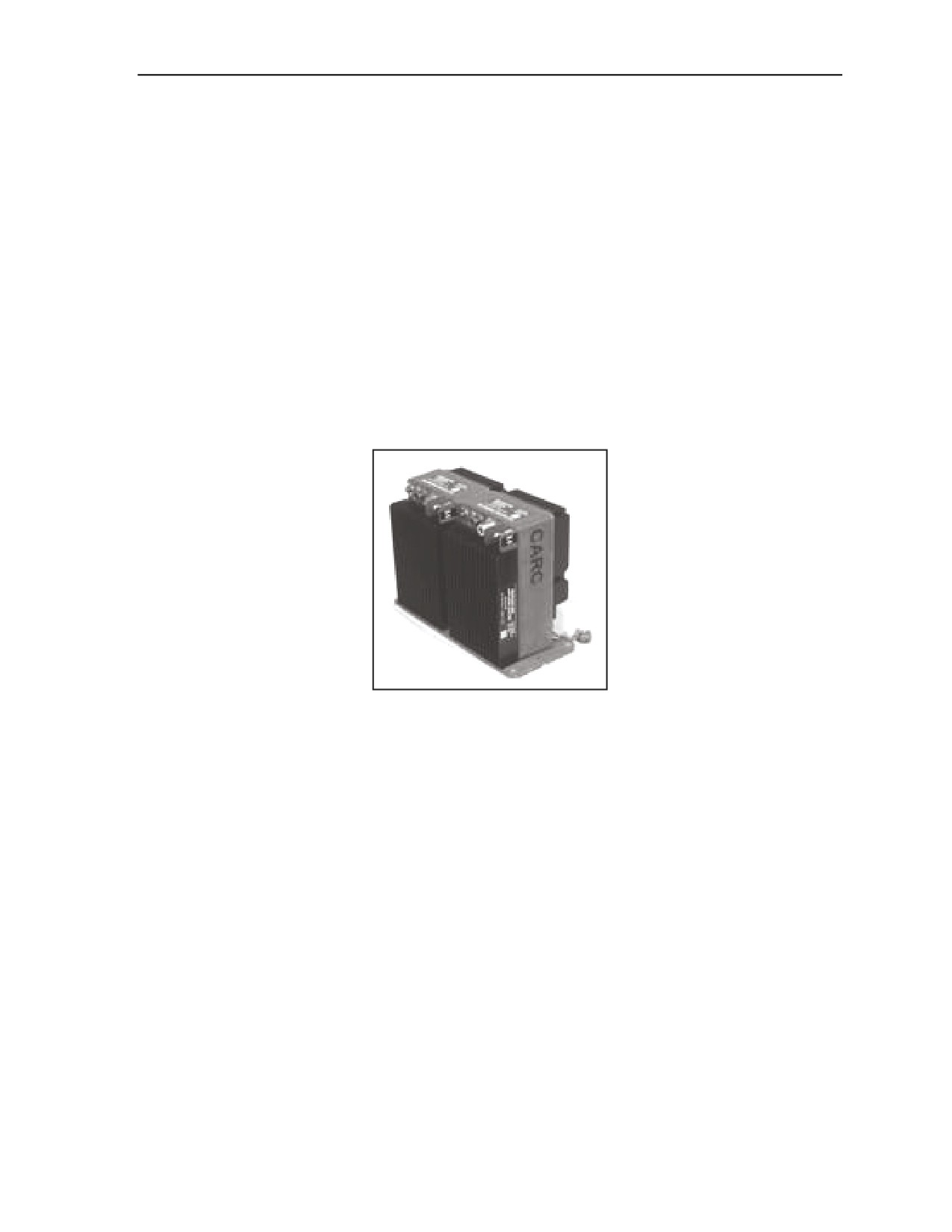
technologies. CREW-1 Warlock Systems are—
z
Warlock-Red (Figure 11-2).
z
Warlock-Green.
z
Warlock-IED Counter-Measure Equipment.
z
Warlock-Self Screening Vehicle Jammer.
z
Warlock-Blue Wearable & Vehicle Mounted.
Figure 11-2. Warlock-red
JOINT SPECTRUM INTERFERENCE RESOLUTION REPORTING
11-80. JSIR addresses EMI incidents and EA affecting the DOD. The JSIR objective is to report and
assist in resolving EA and persistent, recurring interference. Resolution is at the lowest possible level,
using organic assets. Incidents that cannot be resolved locally are referred up the chain of command with
resolution attempted at each level.
11-81. Chairman Joint Chiefs of Staff Instruction (CJCSI) 3320.02A directs DOD components to resolve
RF interference at the lowest possible level within the chain of command. To accomplish this, the Army
established the Army interference resolution program (AIRP).
ARMY INTERFERENCE RESOLUTION PROGRAM
11-82. The AIRP revolves around four functions: DF, signal monitoring, signal analysis, and
transportability/mobility. These functions are described in Table 11-4. Refer to AR 5-12 for additional
information on the AIRP.
5 August 2009
FM 6-02.53
11-15

Chapter 11
Table 11-4. Army interference resolution program functions
Function
Description
DF
Is often the key to locating the source of interference, and is an integral part of
resolving and analyzing incidents and problems. The degree of accuracy depends
upon the environment and frequency band.
Signal
Or spectrum surveillance incorporates a frequency spectrum analyzer or
Monitoring
surveillance receiver, covering all spectrum bands of use. These systems perform
real-time evaluation of spectrum usage and interference in a specific area.
Signal
Analysis of DF and monitoring data is required to determine the source of
Analysis
interference and misuse of the spectrum.
Transportabi
Degree, circumstances, and geographic location of the types of interference
lity/Mobility
incidents and problems will determine transportability and mobility requirements.
Mobile/Transportable DF and monitoring equipment is a requirement for tactical
units and for incidents not necessarily confined to a specific geographical area.
Man portable equipment should be considered for certain instances and
conditions, as defined in unit SOPs. Fixed equipment would be required for those
areas that require real-time solutions in a defined geographical area.
INTERFERENCE RESOLUTION
11-83. Corps and division frequency managers are the coordinating authorities for regional and local
interference resolution. The impact of each interference incident is unique, and no standard procedure can
be established that will guarantee resolution in every case. However, a logical step-by-step approach will
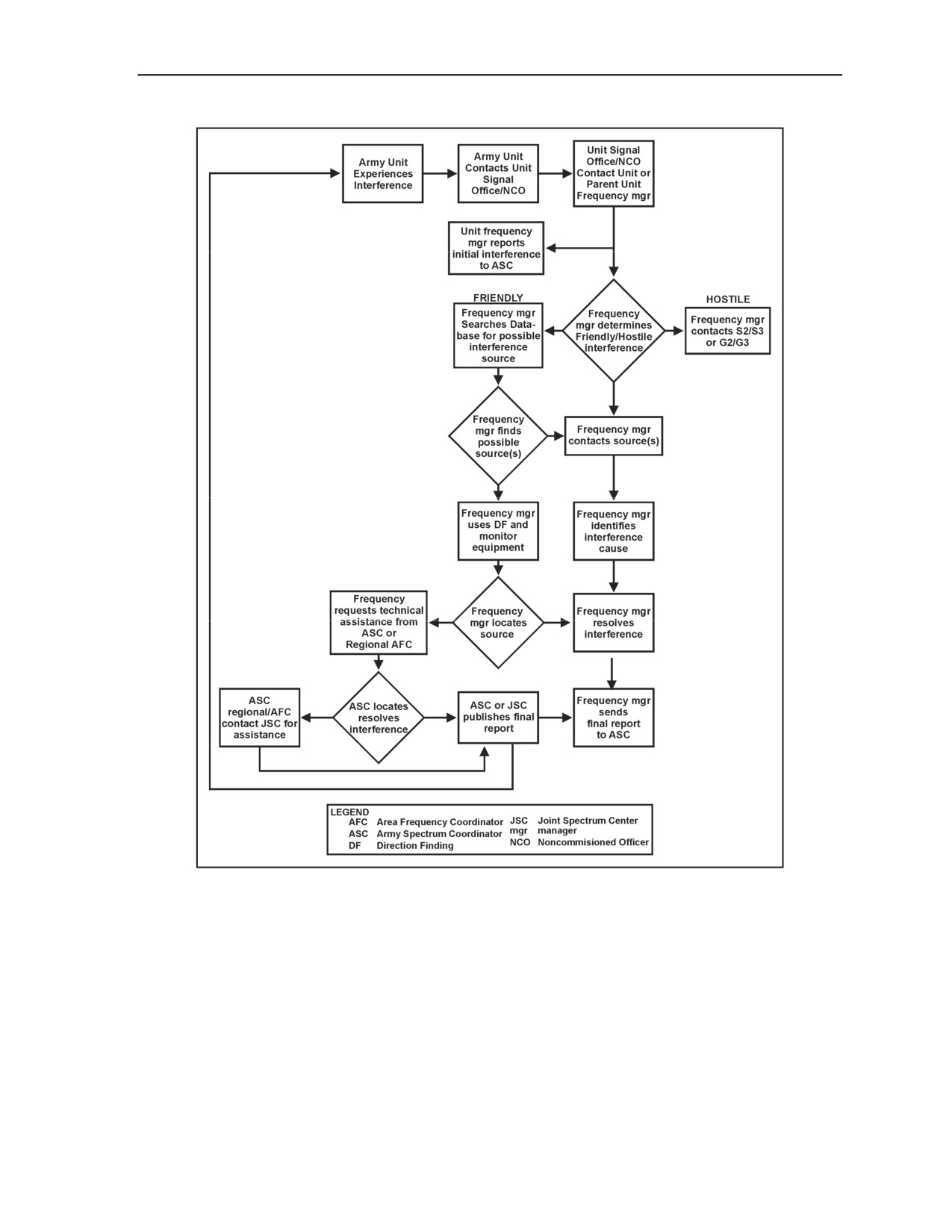
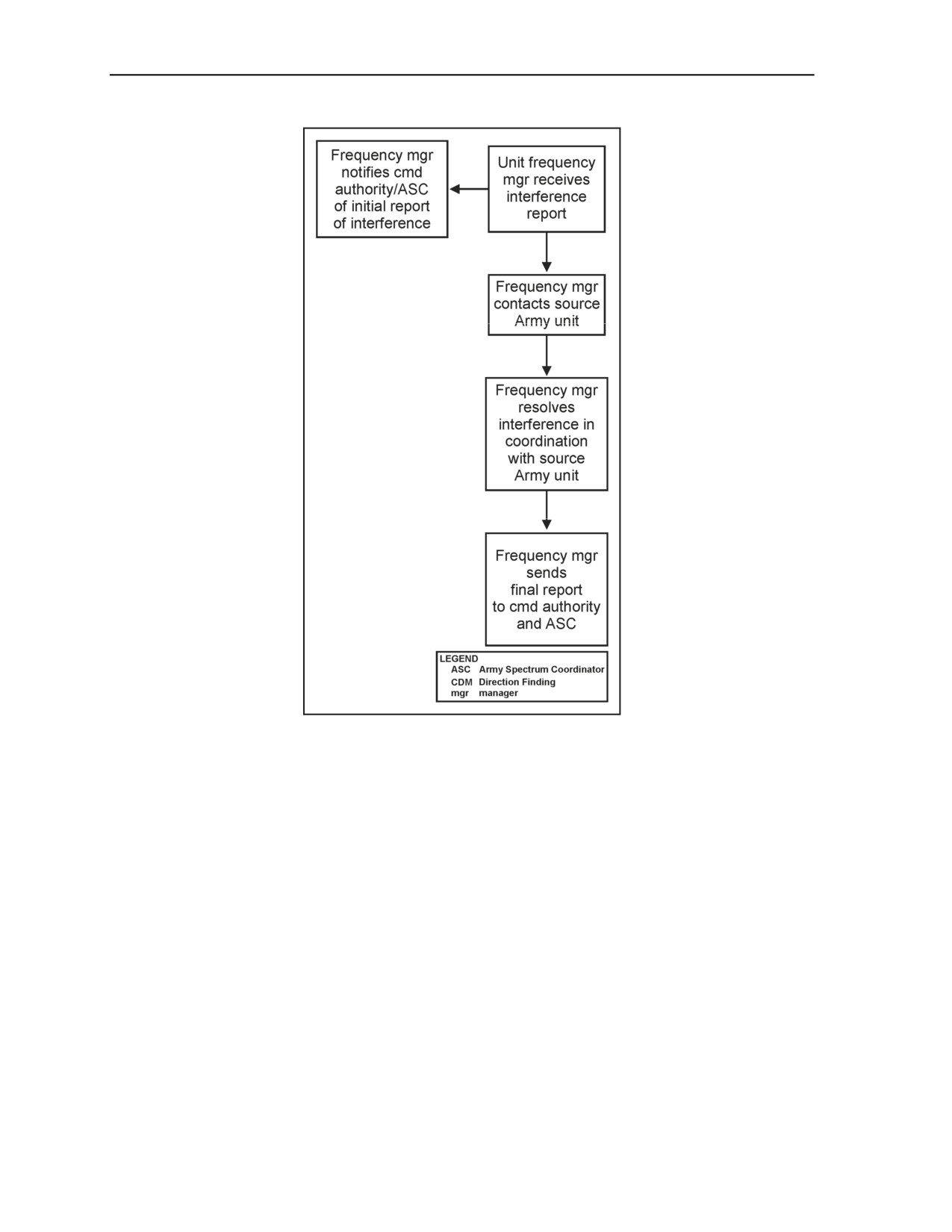
reduce time and cost in resolving interference situations. Figure 11-3 is a logical flow diagram for
instances when an Army unit is the victim of interference in a tactical operation. Figure 11-4 shows a flow
diagram for interference, when the Army unit is the source of the interference.
11-16
FM 6-02.53
5 August 2009
Communications Techniques: Electronic Protection
Figure 11-3. Interference resolution (Army victim)
5 August 2009
FM 6-02.53
11-17
Chapter 11
Figure 11-4. Interference resolution (Army source)
Reporting Procedure
11-84. All EMI incidents must be reported through the proper channels. All reports of suspected hostile
interference are submitted via secure means. The report should not be held up due to information not being
readily available; use follow-up reports to provide additional information, as it becomes available.
11-85. The equipment operator experiencing the interference incident forwards the initial JSIR report
through the chain of command to the unit operations center. An attempt to resolve the EMI problem at the
lowest possible level will be conducted before submitting JSIR reports to higher headquarters.
11-86. The Joint Spectrum Management System/Spectrum XXI programs should be used to submit the
report electronically. The sender will classify the report by evaluating the security sensitivity of the
interference on the affected system, and by considering the classification of the text comments. Table 11-5
is a guide for JSIR security classification.
11-87. The JSIR report will be assigned precedence consistent with the urgency of the reported situation.
Use ROUTINE or PRIORITY precedence, unless the organization originating the report believes the
incident is hazardous to military operations. For this incident, use IMMEDIATE precedence.
11-18
FM 6-02.53
5 August 2009

Communications Techniques: Electronic Protection
11-88. Each Army unit must submit reports through its chain of command, up to the major, or combatant
command, or GCC level, and to the US Army Communications-Electronic Services Office. Information
copies of all incident reports should be sent to Joint Spectrum Center for inclusion in the JSIR database.
Table 11-5. JSIR security classification guide
Information Revealing
Security Classification
The specific identification of an unfriendly platform or location,
SECRET (S)
by country or coordinates, as the source of interference or EA.
Specific susceptibility or vulnerability of US electronic
SECRET (S)
equipment/systems.
Parametric data of classified US electronic equipment.
In accordance with the
classification guide of the
affected equipment.
Suspected interference from unidentified sources while
SECRET (S)
operating in or near hostile countries.
Interference to US electromagnetic equipment/systems caused
CONFIDENTIAL
by EA exercises in foreign nations.
Suspected interference from friendly sources.
UNCLASSIFIED (U) or
SECRET (S), if specific
equipment vulnerability is
revealed.
Information referring to JSIR; stating that JSIR analyses are a
UNCLASSIFIED (U)
function of the Joint Spectrum Center.
Joint Spectrum Interference Resolution Report Content
11-89. Table 11-6 shows the minimum information requirements for the JSIR. The message subject line
should indicate whether the report is initial, follow-up, or final.
Table 11-6. JSIR information requirements
Item
Number
Data Input
1
Frequencies affected by the interference.
2
Locations of systems experiencing the interference.
3
The affected system name, nomenclature, manufacturer (with model number), or
other system description. If available, include the equipment characteristics of the
victim receiver, such as bandwidth, antenna type, and antenna size.
4
The operating mode of the affected system. If applicable, include the following:
frequency agile, pulse Doppler, search, and upper and lower sidebands.
5
The characteristics of the interference (noise, pulsed, continuous, intermittent,
frequency, or bandwidth).
6
The description of the interference effects on victim performance (reduced range,
false targets, reduced intelligibility, or data errors).
7
Enter the dates and times the interference occurred. Indicate whether the duration of
the interference is continuous or intermittent, the approximate repetition rate of the
interference, and whether the amplitude of the interference is varying or constant.
Indicate if the interference is occurring at a regular or irregular time of day, and if the
occurrence of the interference coincides with any ongoing local activity.
8
The location of possible interference sources (coordinates or line of bearing, if
known; otherwise, state as unknown).
5 August 2009
FM 6-02.53
11-19

Chapter 11
Table 11-6. JSIR information requirements (continued)
Item
Number
Data Input
9
A listing of other units affected by the interference (if known) and their location or
distance, and bearing from the reporting site.
10
A clear and concise narrative summary of what is known about the interference, and
any local actions that have been taken to resolve the problem. The operator is
encouraged to provide any other information, based on observation or estimation that
is pertinent in the technical or operational analysis of the incident. Identify whether the
information being furnished is based on actual observation/measurement or is being
estimated. Avoid the use of Army or program jargon and acronyms.
11
Reference message traffic that is related to the interference problem being reported.
Include the message date-time group, originator, action addressees, and subject line.
12
Indicate whether the problem has been identified or resolved.
13
Indicate if JSIR technical assistance is desired or anticipated.
14
Point of contact information, including name, unit, and contact phone numbers.
11-20
FM 6-02.53
5 August 2009

Chapter 12
Radio Operating Procedures
Using proper radio procedures can make the difference in time and security when
operating on C2 nets. This chapter addresses the proper way to pronounce letters and
numbers when sending messages over a radio as well as the proper procedures for
opening and closing a radio net.
PHONETIC ALPHABET
12-1. When radio operators are communicating over the radio they will use the phonetic alphabet outlined
in Table 12-1 to pronounce individual letters of the alphabet.
Table 12-1. Phonetic alphabet
LETTER
WORD
PRONUNCIATION
A
ALPHA
AL FAH
B
BRAVO
BRAH VOH
C
CHARLIE
CHAR LEE OR SHAR LEE
D
DELTA
DELL TAH
E
ECHO
ECH OH
F
FOXTROT
FOKS TROT
G
GOLF
GOLF
H
HOTEL
HOH TELL
I
INDIA
IN DEE AH
J
JULIETT
JEW LEE ETT
K
KILO
KEY LOH
L
LIMA
LEE MAH
M
MIKE
MIKE
N
NOVEMBER
NO VEM BER
O
OSCAR
OSS CAH
P
PAPA
PAH PAH
Q
QUEBEC
KEH BECK
R
ROMEO
ROW ME OH
S
SIERRA
SEE AIR RAH
T
TANGO
TANG GO
U
UNIFORM
YOU NEE FORM OR OO NEE FORM
V
VICTOR
VIC TAH
W
WISKEY
WISS KEY
X
XRAY
ECKS RAY
Y
YANKEE
YANG KEY
Z
ZULU
ZOO LOO
5 August 2009
FM 6-02.53
12-1

Chapter 12
NUMERICAL PRONUNCIATION
12-2. To distinguish numerals from words similarly pronounced, the proword “FIGURES” may be used
preceding such numbers.
12-3. Table 12-2 outlines the pronunciation of how numerals will be transmitted by radio.
Table 12-2. Numerical
pronunciation
NUMERAL
SPOKEN AS
0
ZE-RO
1
WUN
2
TOO
3
TREE
4
FOW-ER
5
FIFE
6
SIX
7
SEV-EN
8
AIT
9
NIN-ER
12-4. Numbers will be transmitted digit by digit except that exact multiples of thousands may be spoken as
such (refer to Table 12-3). However, there are special cases, such as anti-air warfare reporting procedures,
when the normal pronunciation of numerals is prescribed for example, 17 would then be “seventeen.”
Table 12-3. Numerals in combinations
NUMBERAL
SPOKEN AS
44
FOW-ER, FOW-ER
90
NIN-ER, ZE-RO
136
WUN, TREE, SIX
TIME 1200
WUN, TOO, ZE-RO, ZE-RO
1748
WUN, FOW-ER, SEV-EN, AIT
7000
SEV-EN, TOU-SAND
16000
WUN, SIX, TOU-SAND
812681
AIT, WUN, TOO, SIX, AIT, WUN
12-5. The figure “ZERO” will be written as “0,” the figure “ONE” will be written as “1” and the letter
“ZULU” will be written as “Z”. Difficult words may be spelled out phonetically but abbreviations and
isolated letters should be phoneticized without the proword “I SPELL”.
Note. Any abbreviated words used in the message must be transmitted phonetically, for
example, 1st is sent as ONE SIERRA TANGO, or headquarters (HQ) as HOTEL QUEBEC.
PROCEDURE WORDS
12-6. Table 12-4 outlines proper procedure words (often called prowords) that should be used during radio
transmissions and their meanings. Prowords are words or phrases limited to radio telephone procedures
used to facilitate communication by conveying information in a condensed form.
12-2
FM 6-02.53
5 August 2009

Radio Operating Procedures
Table 12-4. Prowords listed alphabetically
PROWORD
MEANING
ACKNOWLEDGE
A directive from the originator requiring the addressee (s) to advise the
originator that his communication has been received and understood.
This term is normally included in the electronic transmission of orders to
ensure the receiving station or person confirms the receipt of the orders.
ALL AFTER
The portion of the message to which I have referenced is all that which
follows.
ALL BEFORE
The portion of the message to which I have reference is all that
proceeds.
AUTHENTICATE
The station called is to reply to the challenge which follows.
AUTHENTICATION IS
The transmission authentication of this message is.
BREAK
I hereby indicated the separation of the text from other portions of the
message.
CLEAR
To eliminate transmission on a net in order to allow a higher-precedence
transmission to occur.
CORRECT
You are correct, or what you have transmitted is correct.
CORRECTION
An error has been made in this transmission. Transmission will continue
with the last word correctly transmitted.
DISREGARD THIS
This transmission is in error. Disregard it. (The proword shall not be
TRANSMISSION-OUT
used to cancel any message that has been completely transmitted and
for which receipt or acknowledgement has been received.)
DO NOT ANSWER
Stations called are not to answer this call, receipt for this message, or
otherwise to transmit in connection with this transmission. When this
proword is employed, the transmission shall be ended with the proword
“OUT”.
EXEMPT
The addressees immediately following are exempted from the collective
call.
FIGURES
Numerals or numbers follow. (Optional)
FLASH
Precedence FLASH. Reserved for initial enemy contact reports on
special operational combat traffic originated by specifically designated
high commanders of units directly affected. This traffic is SHORT reports
of emergency situations of vital proportion. Handling is as fast as
possible with an objective time of 10 minutes or less.
FROM
The originator of this message is indicated by the address designator
immediately following.
GROUPS
This message contains numbers of groups indicated.
I AUTHENTICATE
The group that follows it is the reply to your challenge to authenticate.
IMMEDIATE
Precedence IMMEDIATE. Reserved for messages relating to situations
which gravely affect the security of national/multinational forces of
populace, and which require immediate delivery.
INFO
The addressees immediately following are addressed for information.
I READ BACK
The following is my response to your instructions to read back.
I SAY AGAIN
I am repeating transmission or portion indicated.
I SPELL
I shall spell the next word phonetically.
5 August 2009
FM 6-02.53
12-3

Chapter 12
Table 12-4. Prowords listed alphabetically (continued)
PROWORD
MEANING
I VERIFY
That which follows has been verified at your request and is
repeated. (To be used as a reply to verify information.)
MESSAGE
A message which requires recording is about to follow. (Transmitted
immediately after the call.)
MORE TO FOLLOW
Transmitting station has additional traffic for the receiving station.
OUT
This is the end of my transmission to you and no answer is required
or expected. (Since OVER and OUT have opposite meanings, they
are never used together.)
OVER
This is the end of my transmission to you and a response is
necessary. Go ahead; transmit.
PRIORITY
Precedence PRIORITY. Reserved for important messages which
must have precedence over routine traffic. This is the highest
precedence which normally may be assigned to a message of
administrative nature.
READ BACK
Repeat this entire transmission back to me exactly as received.
RELAY (TO)
Transmit this message to all addressee (or addresses immediately
following this proword). The address component is mandatory when
this proword is used.
ROGER
I have received your last transmission satisfactorily.
ROUTINE
Precedence ROUTINE. Reserved for all types of messages which
are not of sufficient urgency to justify a higher precedence, but must
be delivered to the addressee without delay.
SAY AGAIN
Repeat all of your last transmission. (Followed by identification data
means to repeat after the portion indicated.
SILENCE
“Cease Transmission Immediately.” Silence will be maintained until
lifted. (Transmission imposing silence must be authenticated.)
SILENCE LIFTED
Silence is lifted. (When authentication system is in force the
transmission silence is to be authenticated.)
SPEAK SLOWER
Your transmission is at too fast of a speed. Reduce speed of
transmission.
THIS IS
This transmission is from the station whose designator immediately
follows.
TIME
That which immediately follows is the time or date/time group of the
message.
SILENCE
“Cease Transmission Immediately.” Silence will be maintained until
lifted. (Transmission imposing silence must be authenticated.)
TO
The addressee(s) immediately following is (are) addressed for
action.
UNKNOWN STATION
The identity of the station with whom I am attempting to establish
communications is unknown.
VERIFY
Verify the entire message (or portion indicated) with the originator
and send correct version. (To be issued only at the discretion of the
addressee to which the questioned message was directed.)
WAIT
I must pause for a few seconds.
12-4
FM 6-02.53
5 August 2009

Radio Operating Procedures
Table 12-4. Prowords listed alphabetically (continued)
PROWORD
MEANING
WAIT OUT
I must pause for longer than a few seconds.
WILCO
I have received your signal, understand it and will comply. (To be used
only by the addressee. Since the meaning of ROGER is included in that of
WILCO, the two prowords are never used together)
WORD AFTER
The word of the message to which I have reference is that which follows…
WORD BEFORE
The word of the message to which I have reference is that which
proceeds…
WORD TWICE
Communication is difficult. Transmit (ring) each phrase (or each code
group) twice. This procedure word may be used as an order, request, or
as information.
WRONG
Your last transmission was incorrect. The correct version is…
RADIO CALL PROCEDURES
12-7. A preliminary call will be transmitted when the sending station wishes to know if the receiving
station is ready to receive a message. When communications reception is good and contact has been
continuous, a preliminary call is optional. The following is an example of a preliminary call—
z
A1D THIS IS B6T, OVER.
z
B6T THIS IS A1D, OVER.
z
A1D THIS IS B6T (sends message), OVER.
z
B6T THIS IS A1D, ROGER OUT.
Note. For more information on radio call signs and procedures refer to Allied Communications
Publication 121 and 125.
OPENING A RADIO NET
12-8. During radio net calls, the last letter of the call sign determines the answering order. The stations in a
net respond alphabetically, for example, A3D will answer before A2W and A2E will answer before BIF. If
two stations in a net have the same last letter, for instance, A1D and A2D, then the answering order will be
determined by numerical sequence, with the lower number A1D answering first.
12-9. The following is an example of a secure voice net opening by the NCS and several distant stations—
z
NET THIS NCS, OVER.
z
NCS THIS IS A1D, OVER.
z
NCS THIS IS A2D, OVER.
z
NCS THIS A2E, OVER.
z
NET THIS IS NCS, OUT (IF THE NCS HAS NO TRAFFIC).
RADIO CHECKS
12-10. To minimize transmission time, use radio checks sparingly or by unit SOP. The following is an
example of a radio check with the NCS—
z
NET THIS IS NCS, RADIO CHECK OVER.
z
NCS THIS IS A1D, ROGER OUT.
z
NCS THIS IS A2D, WEAK READABLE OVER (A2D is receiving the NCS’s signal weak).
z
NCS THIS IS A2E, ROGER OUT.
z
NET THIS IS NCS, ROGER OUT.
5 August 2009
FM 6-02.53
12-5
Chapter 12
STATION ENTERING A NET ALREADY ESTABLISHED
12-11. The following is an example of how a radio station would enter a net after the net was opened and
the station was unable to answer and now wants to report into the net (NCS)—
z
NCS THIS B4G, REPORTING INTO THE NET OVER.
z
B4G THIS NCS, AUTHENTICATE OVER.
z
NCS THIS B4G, I AUTHENTICATE (B4G authenticates) OVER.
z
B4G THIS IS NCS, I AUTHENTICATE (NCS authenticates) OVER.
z
NCS THIS IS B4G, ROGER OUT.
Note. Authentication is a security measure designed to protect a communications system against
acceptance of a fraudulent transmission or simulation by establishing the validity of a
transmission, message, or originator.
STATION REQUESTING TO LEAVE A NET
12-12. The following is an example of a radio station requesting permission to leave a net from the NCS
of the net—
z
NCS THIS A24, REQUEST PERMISSION TO CLOSE DOWN (OR LEAVE NET), OVER.
z
A24 THIS IS NCS, ROGER OUT.
CLOSING A SECURE VOICE NET
12-13. The following is an example of a NCS closing a secure voice radio net. Authentication can be used
for a non secure net.
z
NET THIS IS NCS, CLOSE DOWN, OVER.
z
NCS THIS A1D, ROGER OUT.
z
NCS THIS A2D, ROGER OUT.
z
NCS THIS B2D, ROGER OUT.
Note. For more information on NCS radio procedures refer to TM 11-5820-890-10-5 and TM
11-5820-890-10-8.
12-6
FM 6-02.53
5 August 2009

Appendix A
FM Radio Networks
Units from battalion to theater establish FM radio nets, for example C2, fires net,
A&L, and O&I nets to execute on the move combat operations. Commanders may
establish other networks in addition to these to enhance mission accomplishment. The
lack of sufficient SC TACSAT frequency resources, SC radio systems density and the
need for radio wireless network extension capability all validate the need for FM
networks. This appendix addresses FM networks.
COMMAND AND CONTROL NETWORKS
A-1. C2 networks are found in all Army units. The units establish internal C2 networks, and are
subscribers in at least one other network. SINCGARS is the primary means of short range communications
in secure C2 voice networks. The C2 net is given the highest installation priority.
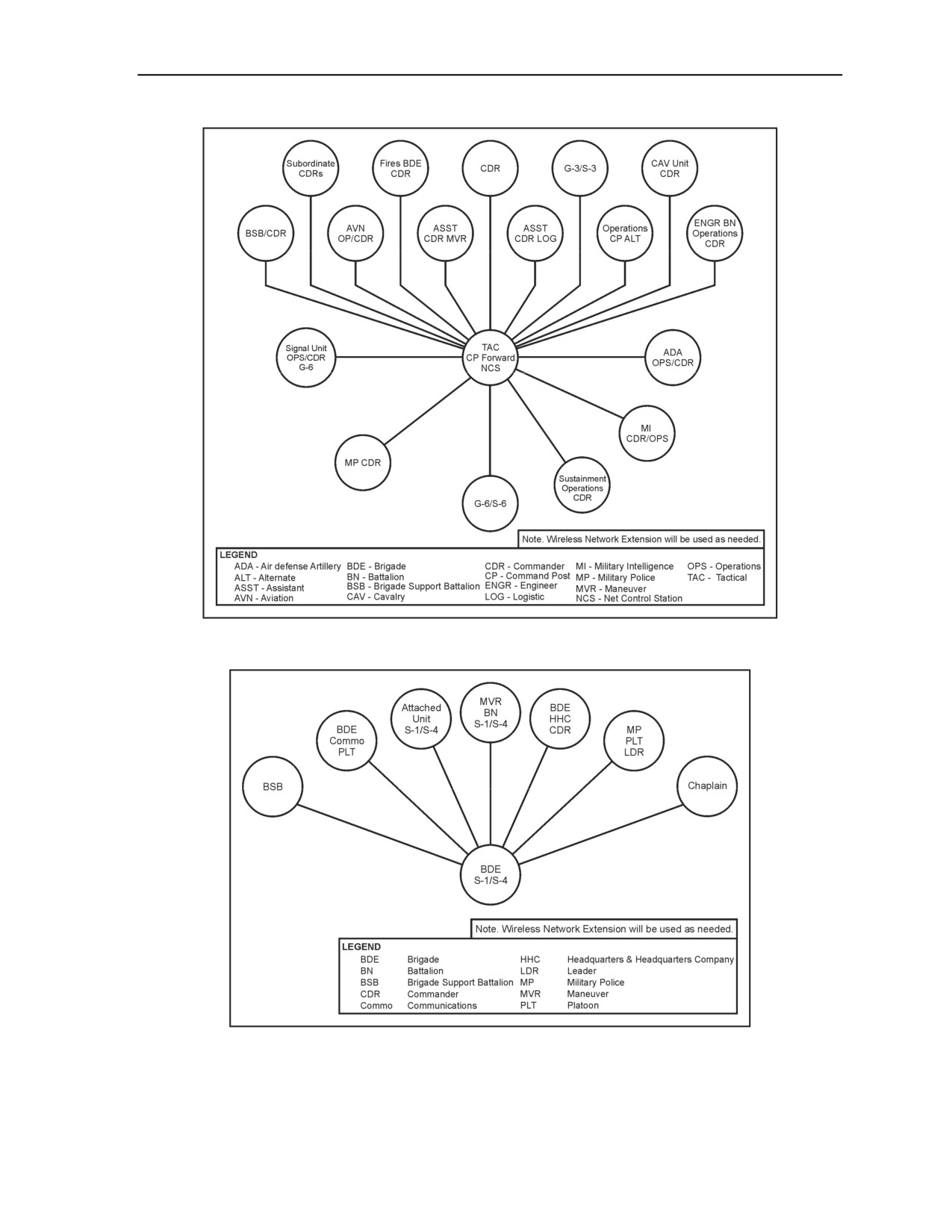
A-2. Table A-1 is an example of division networks. The C2 networks shown merely serve as a guide for
establishing radio networks. The actual networks established depend on the existing situation, command
guidance, and equipment available. Figure A-1 is an example of typical subscribers for a division C2 FM
network.
Note. Subscribers in a C2 network are members of that echelon and the next senior echelon C2
network. When necessary, wireless network extension teams are used to
overcome
communications obstacles between higher and lower units.
Table A-1. Example of division C2 FM networks
Net Stations
Command (CMD)
O&I Net
Sustainment
A&L Net
Operations Net
Operations Net
Commander (CDR)
X
X
X
X
Assistant CDR
X
OP G-3
X
X
X
X
G-2
X
X
TAC CP G-3
X
X
X
TAC CP G-2
X
TAC CP G-6
X
X
X
X
Subordinate brigade CP
X
X
X
X
Brigade support battalion
X
X
Reconnaissance battalion
X
X
X
X
Aviation units
X
X
X
X
Engineer unit
X
X
X
X
5 August 2009
FM 6-02.53
A-1

Appendix A
Table A-1. Example of division C2 FM networks (continued)
Net Stations
Command
O&I Net
Sustainment
A&L Net
Operations Net
Operations Net
Military intelligence unit
X
X
ADA unit
X
X
X
Artillery units
X
X
X
X
Military police
X
X
Sustainment operations
X
X
X
center
Division Signal company
X
X
X
Liaison officer
X
Long range reconnaissance
detachment
X
TACTICAL THEATER SIGNAL BRIGADES
A-3. A tactical theater signal brigade
(TTSB) provides the Army and joint forces with an agile,
expeditionary-capable signal formation that supports the Soldier across full spectrum operations through a
unified network architecture that is common across all Army echelons.
A-4. A TTSB also provides C2 to assigned and attached units while supervising the installation, operation
and maintenance of communications nodes in the theater communications system excluding the division
and corps systems.
A-5. It further provides real- and near real-time in-theater source information to combatant commanders
and JTF commanders for the control, management, and dissemination of high volumes of data, to include
air tasking orders, logistical, movement timetables, imagery, weather, etc. to deployed and dispersed forces
in the theater.
A-6. Signal leaders (G-6/S-6) coordinate with supporting units (TTSBs) for inclusions in their network.
EXPEDITIONARY SIGNAL BATTALIONS
A-7. An ESB provides the Army and joint forces with an agile, expeditionary-capable signal formation
that supports the Soldier across full spectrum operations through a unified network architecture that is
common across all Army echelons.
A-8. An ESB operates 24 hours a day in austere environment to provide voice, data, and other network
services to commanders previously conducted by theater, corps and division signal organizations. ESBs
provide pooled signal assets to augment organic division/corps network support capabilities and/or replace
network support battle losses at all echelons.
A-9. Signal leaders (G-6/S-6) coordinate with supporting units (ESBs) for inclusions in their network.
ADMINISTRATIVE AND LOGISTICS NETWORKS
A-10. Units establish A&L nets as required. Figure A-1 is an example of a typical division C2 network and
Figure A-2 is an example of a brigade A&L FM network. All echelons, from battalion through division,
have a support network to separate A&L from operational information. This prevents support information
from overwhelming the C2 and O&I networks during operations.
A-2
FM 6-02.53
5 August 2009
FM Radio Networks
Figure A-1. Example of a division C2 FM network
Figure A-2. Example of a brigade A&L FM network
5 August 2009
FM 6-02.53
A-3
Appendix A
OPERATIONS AND INTELLIGENCE NETWORKS
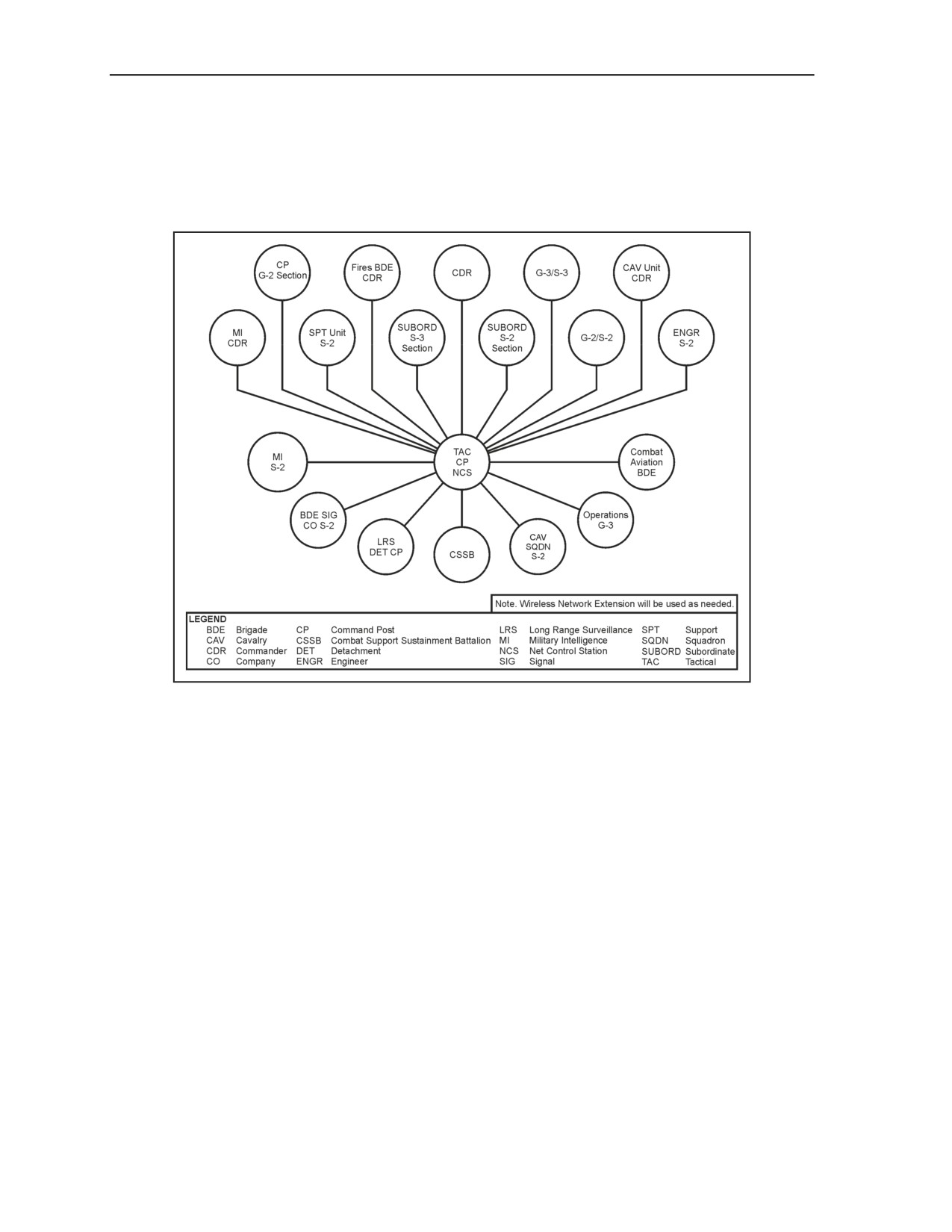
A-11. O&I nets are usually combined and established at brigade and battalion levels. Figure A-3 is an
example of a division intelligence network. The information passed over these nets is continuous, and
requires a separate net to prevent overloading the C2 net. The local situation determines whether other
subscribers are added or deleted.
Figure A-3. Example of a division intelligence network
OTHER RELATED NETWORKS
A-12. Commanders may direct the G-6/S-6 to establish a variety of unit-specific networks dependent upon
the commander’s intent and METT-TC.
A-13. Wireless network extension operations extend the C2 network to ensure the availability of C2 at the
critical moment during operations. In most cases, this network is established with the next higher
headquarters.
HIGH FREQUENCY AND DATA NETWORKS
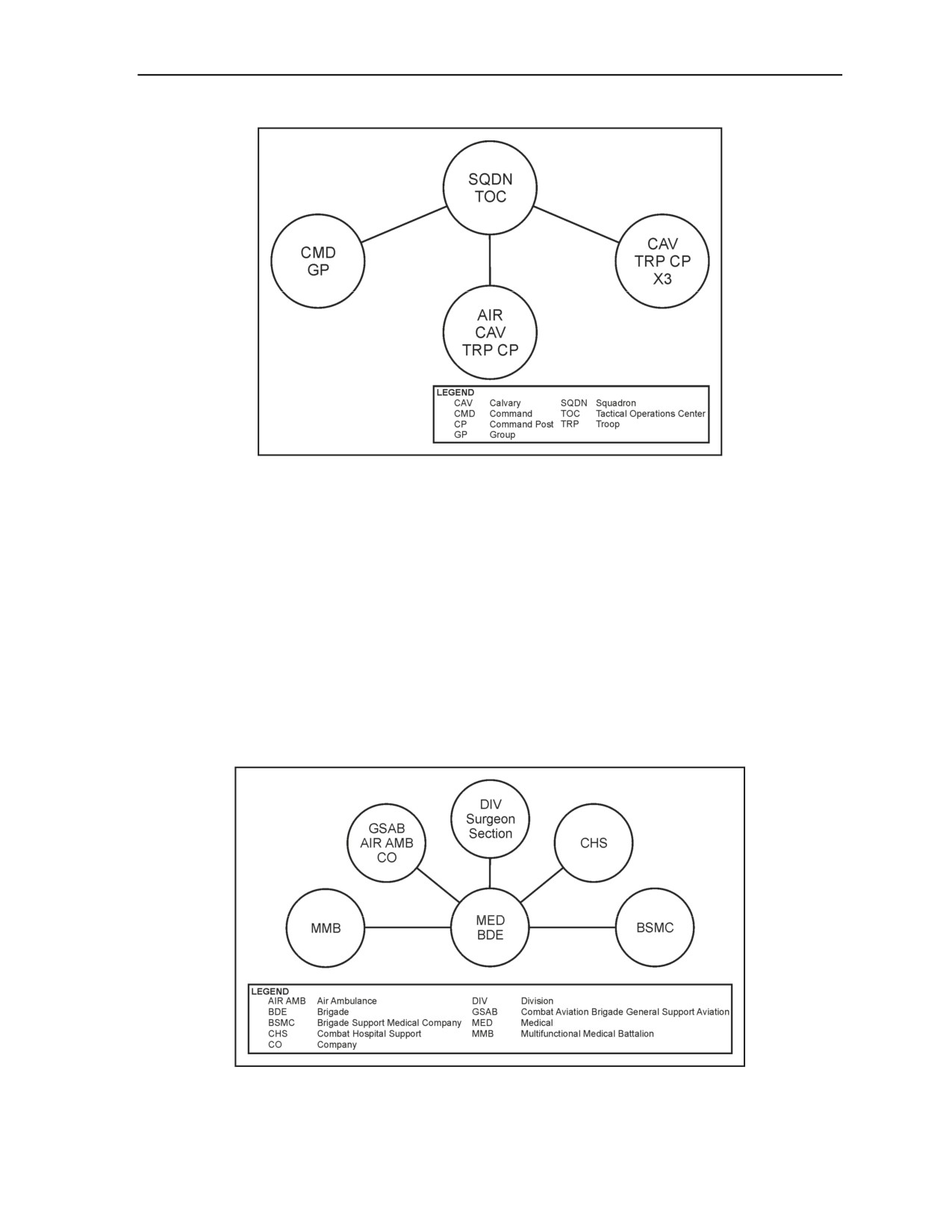
A-14. Data networks extend the tactical Internet to platforms that are not EPLRS equipped. Combat
aviation brigades and air cavalry units use HF nets to provide long-range, non-LOS communications.
Figure A-4 shows a typical cavalry unit HF net. Cavalry squadrons and troops use the low power HF for
their C2 networks when distance is not an issue; the same is true of both divisional and regimental cavalry.
A-4
FM 6-02.53
5 August 2009
FM Radio Networks
Figure A-4. Example of a cavalry unit HF network
Brigade Combat Team
A-15. The traditional HF nets are C2, A&L, O&I, fires, and other specialty uses such as reconnaissance.
These nets were once limited due to the small number of HF radios available. Now, a brigade typically has
between 70-80 HF radios and can establish nets down to the company and lower levels when the situation
warrants it.
Medical Network
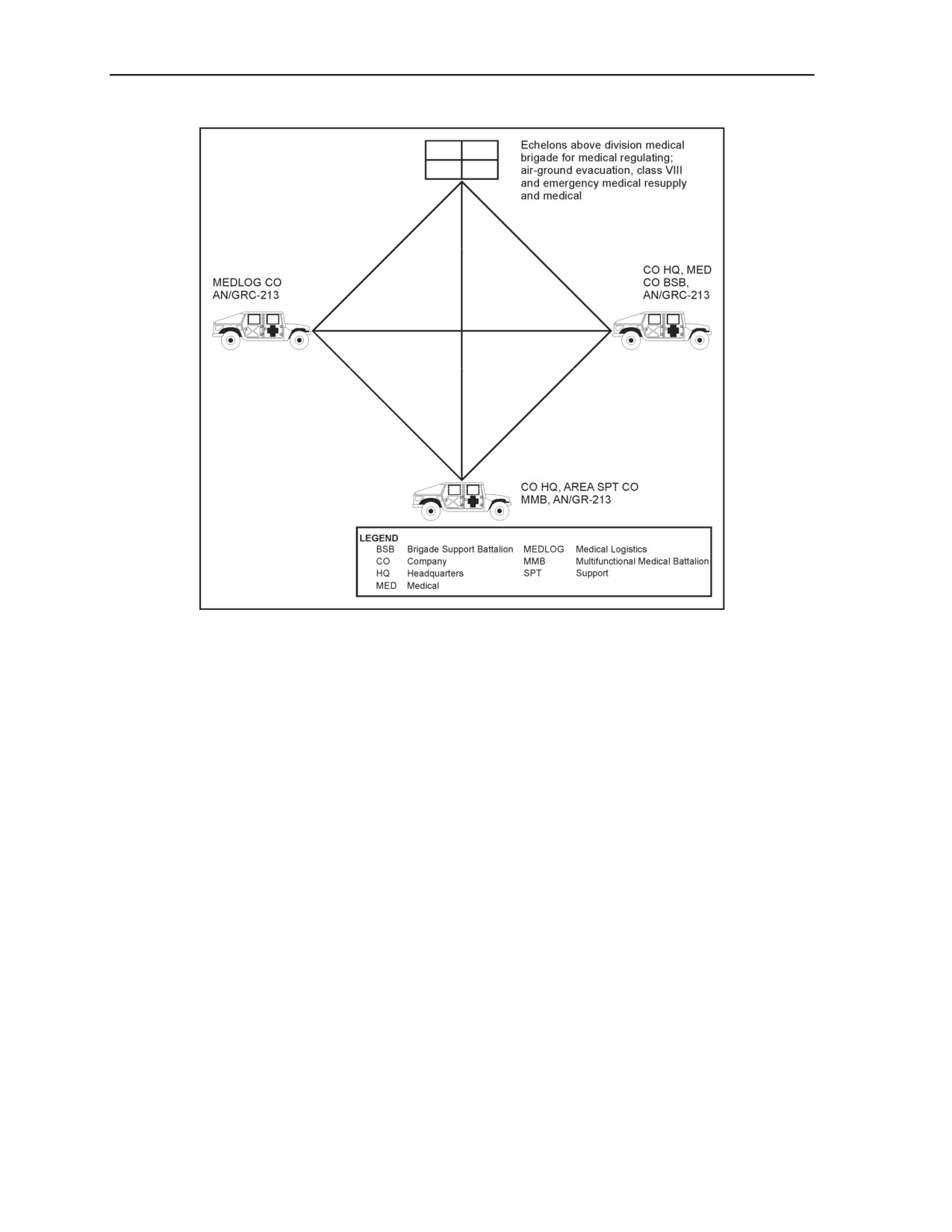
A-16. Medical units need dedicated, long-range, reliable communications systems that can be user-
operated. Communications distances will be substantial between major medical support bases and forward
aid stations. ALE tuning (Harris 5000 series radios) and other simplified operating features make HF ideal
for units with a limited number of signal personnel. Figures A-5 and A-6 are examples of a medical unit
HF networks for corps and division.
Figure A-5. Example of a division corps medical operations network HF-SSB
5 August 2009
FM 6-02.53
A-5
Appendix A
Figure A-6. Example of a medical operations network in a division HF-SSB
FIRE DIRECTION NETWORK
A-17. The fire direction network is the highest priority net in field artillery firing units. This network is
used for exchange of technical and/or firing data. (Wireless network extension teams are also used to
support these nets when needed.) Refer to TC 2-33.4 or FM 3-09.21 for more information on fire direction
networks.
SURVEILLANCE NETWORK
A-18. The surveillance network passes along reports dealing with adversary movement and massing. The
battalion battlefield information control center sets up this net to coordinate and control the ground
surveillance radar and unattended ground sensor teams. The information from this net is vital to
commanders and is given high priority for activation. Refer to FM 2-0 or FM 2-33.4 for more information
on surveillance nets.
SUSTAINMENT AREA BATTLE COMMAND NETWORK
A-19. Sustainment area operations ensure freedom of maneuver. They consist of actions taken by Army
units and host nation units (singularly or in a combined effort) to secure the force, or to neutralize or defeat
adversary operations in the sustainment area. The sustainment area battle command FM net is a form of the
C2 network. This network consists of many units that are collocated in the division sustainment area.
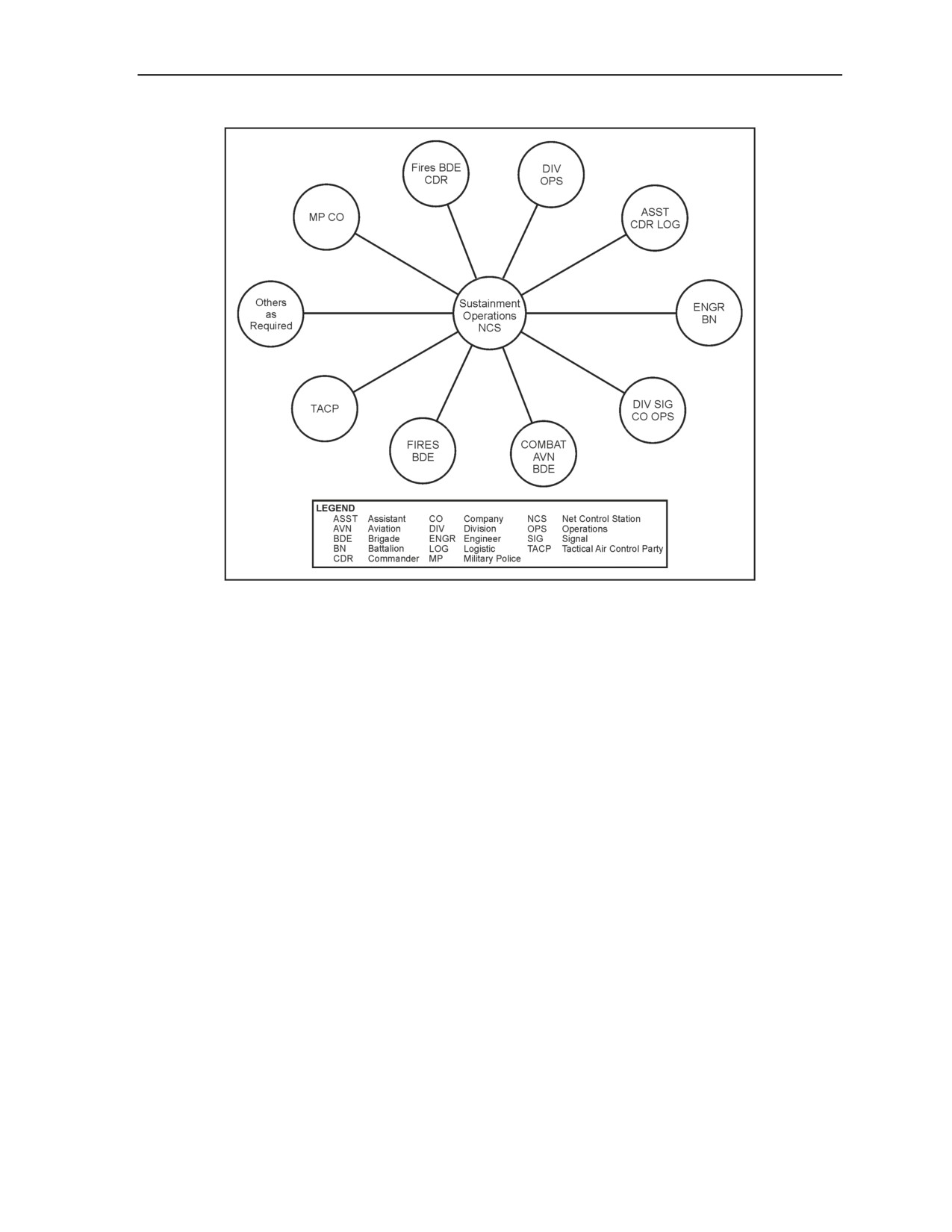
Figure A-7 is an example of a division sustainment area FM network. Members of the sustainment area
battle command network also depend on themselves to form the base cluster defense.
A-6
FM 6-02.53
5 August 2009
FM Radio Networks
Figure A-7. Example of a division sustainment area FM network
HIGH FREQUENCY NETWORKS
A-20. The IHFRs (AN/PRC-104, AN/GRC-213, and AN/GRC-193) are being replaced by HF radios with
ALE such as the AN/PRC-150 I. The HF nets shown are generic networks. Specific networks established,
and subscribers to those networks, depend on command guidance and mission requirements.
A-21. HF networks are similar to the VHF FM networks in function and establishment. Many HF networks
are a backup or supplement to their VHF FM counterparts. HF networks are established when unit
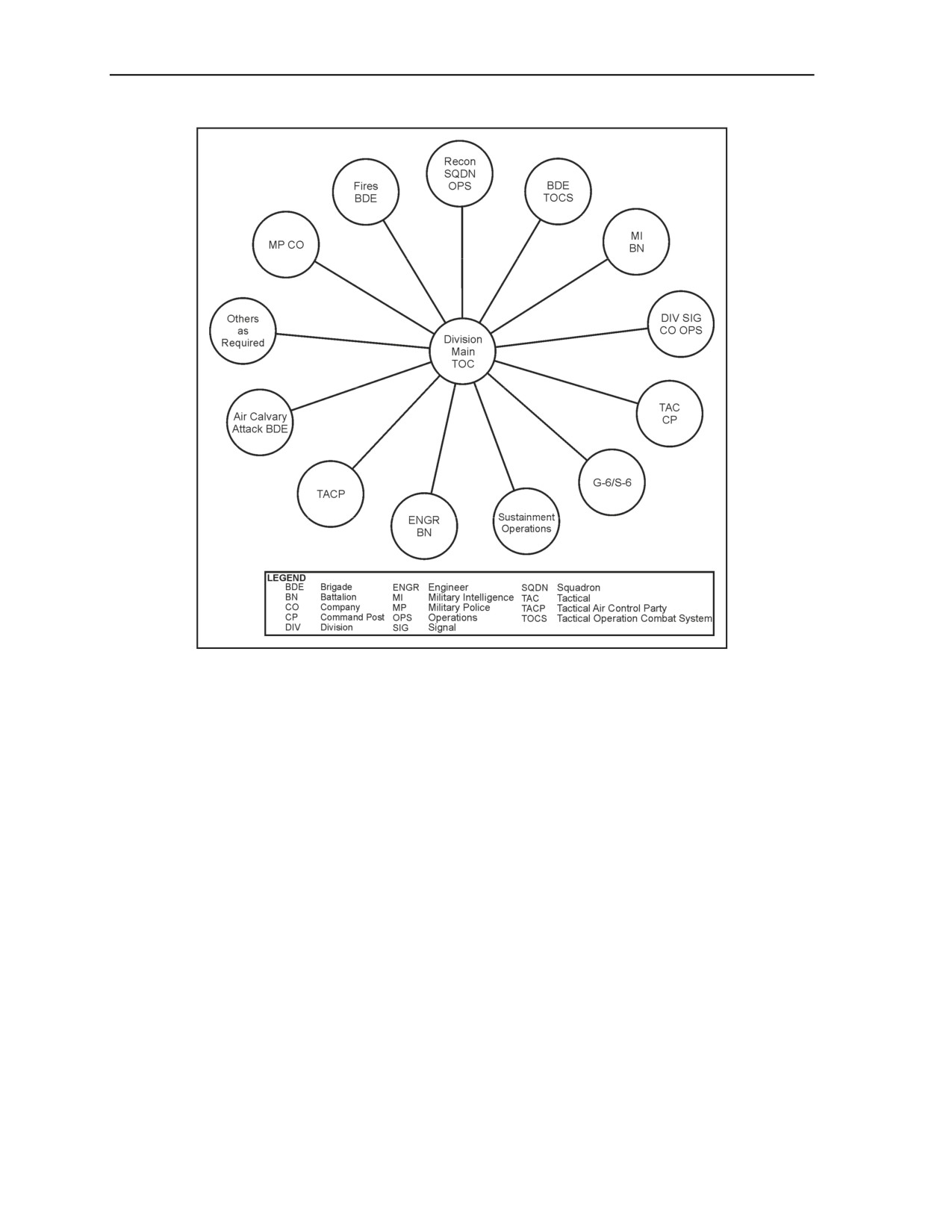
dispersal exceeds the planning range for VHF FM systems. Figure A-8 is an example of a HF C2 network
at division level. Note the similarity with the VHF FM C2 network. Commanders routinely establish a HF
C2 network as a secondary means of controlling operations.
5 August 2009
FM 6-02.53
A-7
Appendix A
Figure A-8. Example of a division HF C2 network
A-22. Logistics units may use HF radios for C2 and internal coordination due to the communications
distances from the division support area to the brigade support area. HF nets are a backup to FM networks,
when the tactical spread of the division extends the lines of communications. The support units within the
corps establish similar networks, or monitor the division networks to ensure push forward support.
A-8
FM 6-02.53
5 August 2009
Appendix B
Single-Channel Radio Communications Principles
SC radio communications equipment is used to transmit and receive voice, data, or
telegraphic/voice code. This appendix addresses a radio sets basic components,
characteristics and properties of radio waves, wave modulation, and site
considerations for SC radios.
RADIO SET BASIC COMPONENTS
B-1. A radio set consists of a transmitter and receiver. Other items necessary for operation include a
source of electrical power and an antenna for both radiation and reception of radio waves.
B-2. The transmitter contains an oscillator that generates RF energy in the form of alternating current. A
transmission line, or cable, feeds the RF to the antenna. The antenna converts the alternating current into
electromagnetic energy that is radiated into space; a keying device is used to control the transmission.
B-3. Normally, in SC radio operations, the receiver uses the same antenna as the transmitter to receive
electromagnetic energy. The antenna converts the received electromagnetic energy into RF alternating
current. The RF is fed to the receiver by a transmission line or cable. In the receiver, the RF is converted to
audio frequencies. The audio frequencies are then changed into sound waves by a headset or loudspeaker.
B-4. Communications are possible when two radio sets operate on the same frequency, with the same type
of modulation, and are within operating range.
RADIO TRANSMITTER
B-5. The simplest radio transmitter consists of a power supply and an oscillator. The power supply can be
batteries, a generator, an alternating current power source with a rectifier and a filter, or a direct current
rotating power source. The oscillator, which generates RF energy, must contain a circuit to tune the
transmitter to the desired operating frequency. The transmitter must also have a device for controlling the
emission of the RF signal. The simplest device is a telegraph key, a type of switch for controlling the flow
of electric current. As the key is operated, the oscillator is turned on and off for varying lengths of time.
The varying pulses of RF energy produced correspond to dots and dashes. This is a CW operation, and is
used when transmitting international Morse code.
B-6. A CW radio transmitter is used to generate RF energy, which is radiated into space. The transmitter
may contain only a simple oscillator stage. Usually, the output of the oscillator is applied to a buffer stage
to increase oscillator stability, and to a PA that produces greater output. A telegraph key may be used to
control the energy waves produced by the transmitter. When the key is closed, the transmitter produces its
maximum output; when the key is opened, no output is produced.
B-7. By adding a modulator and a microphone, a radiotelephone transmitter can transmit messages by
voice. When the modulating signal causes the amplitude of the radio wave to change, the radio is an AM
set. When the modulating signal varies the frequency of the radio wave, the radio is an FM set.
Transmitter Characteristics
B-8. The reliability of radio communications depends on the characteristics of the transmitted signal. The
transmitter, and its associated antenna, forms the initial step in the transfer of energy to a distant receiver.
B-9. Ground-wave transmission is used for most field radio communications. The range of the ground
wave becomes correspondingly shorter as the operating frequency of the transmitter is increased through
5 August 2009
FM 6-02.53
B-1
Appendix B
the applicable portions of the medium frequency (MF) band (300-3000 kHz) to the HF band (3.0-30
MHz). When the transmitter is operating at frequencies above 30 MHz, its range is generally limited to
slightly more than LOS. For circuits using sky wave propagation, the frequency selected depends on the
geographic area, season, and time of day.
Note. Frequency selection is the responsibility of the frequency manager not the RTO.
B-10. For maximum transfer of energy, the radiating antenna must be the proper length for the operating
frequency. The local terrain determines, in part, the radiation pattern, and therefore affects the directivity of
the antenna and the possible range of the set in the desired direction. When possible, several variations in
the physical position of the antenna should be tried to determine the best operating position for radiating
the greatest amount of energy in the desired direction.
B-11. The range of a transmitter is proportional to the power radiated by its antenna. An increase in the
power output of the transmitter results in some increase in range. Under normal operating conditions, the
transmitter should feed only enough power into the radiating antenna to establish reliable communications
with the receiving station. Transmission of a signal more powerful than required is a breach of signal
security, because adversary DF stations may instantly and more easily fix the location of the transmitter.
Also, the signal can interfere with friendly stations operating on the same frequency.
RADIO RECEIVER
B-12. A radio receiver can receive modulated RF signals that carry speech, music, or other audio energy. It
can also receive CW signals that are bursts of RF energy conveying messages by means of coded
(dot/dash) signals.
B-13. The process of recovering intelligence from an RF signal is called detection; the circuit in which it
occurs is called a detector. The detector recovers the intelligence from the carrier and makes it available for
direct use, or for further amplification. In an FM receiver, the detector is usually called a discriminator.
B-14. An RF signal rapidly diminishes in strength after it leaves the transmitting antenna. Many RF signals
of various frequencies are crowded into the RF spectrum. An RF amplifier selects and amplifies the desired
signal; it contains integrated circuits or microprocessors to amplify the signal to a usable level. The RF
amplifier is included in the receiver to sharpen the selectivity, and to increase the sensitivity. The RF
amplifier normally uses tunable circuits to select the desired signal.
B-15. The signal level of the output of a detector, with or without an RF amplifier, is generally very low.
One or more audio frequency amplifiers are used in the receiver, to build up the signal output to a useful
level to operate headphones, a loudspeaker, or data devices.
Receiver Characteristics
B-16. When the transmitted signal reaches the receiver location, it arrives at a much lower power level than
when it left the transmitter. The receiver must efficiently process this relatively weak signal to provide
maximum reliability of communications.
B-17. Sensitivity describes how well a receiver responds to a weak signal at a given frequency. A receiver
with high sensitivity is able to accept a very weak signal, and amplify and process it to provide a usable
output. The principal factor that limits or lowers the sensitivity of a receiver is the noise generated by its
own internal circuits.
B-18. Selectivity describes how well a receiver is able to differentiate between a desired frequency and
undesired frequencies.
B-19. In field radio communications, the type, location, and electrical characteristics of the receiving
antenna are not as important as they are for the transmitting antenna. The receiving antenna must be of
sufficient length, be properly coupled to the input of the receiver circuit, and (except in some cases for HF
sky wave propagation) must have the same polarization as the transmitting antenna.
B-2
FM 6-02.53
5 August 2009
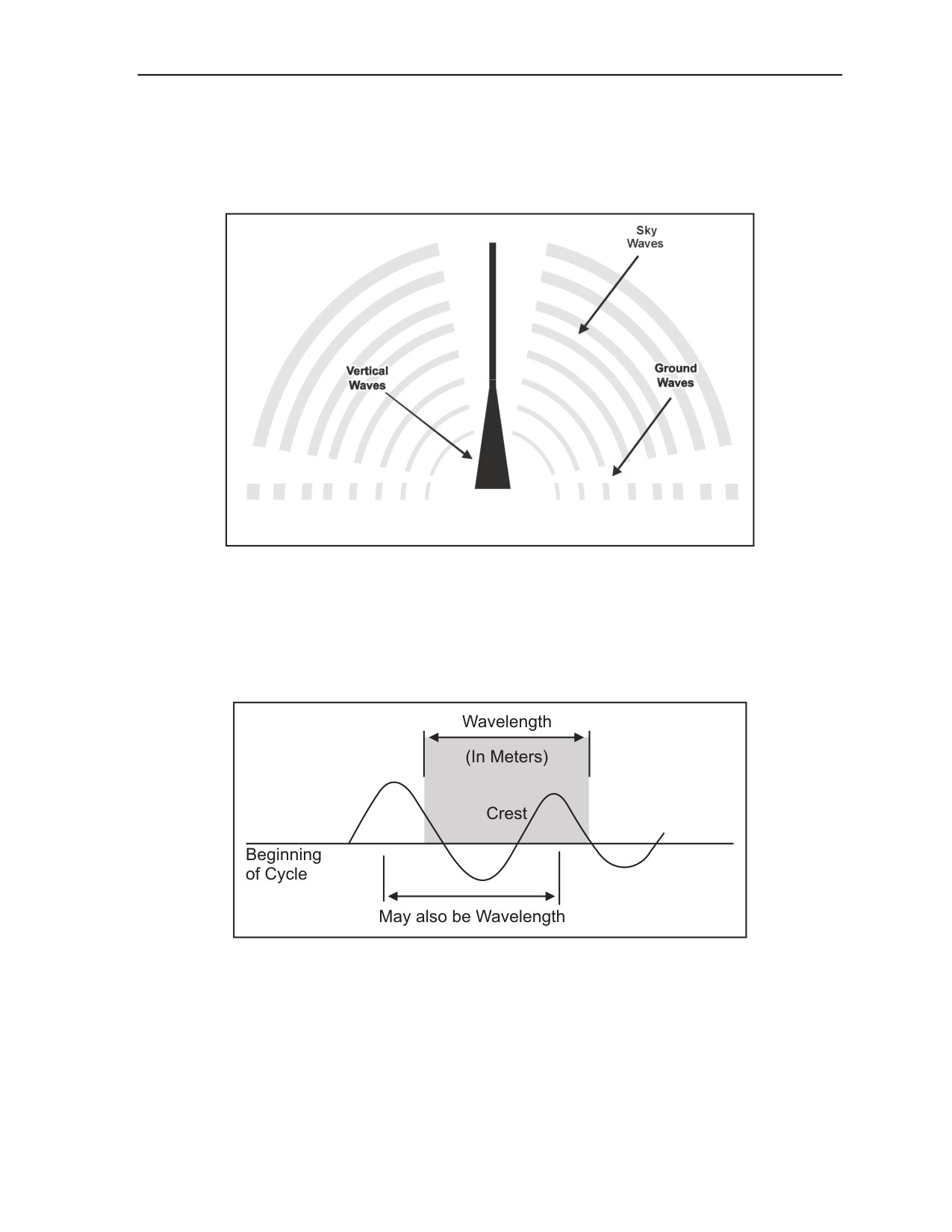
Single-Channel Radio Communications Principles
RADIO WAVES
B-20. Radio waves travel near the surface of the earth, and radiate skyward at various angles to the earth’s
surface. These electromagnetic waves travel through space at the speed of light, approximately 300,000 km
(186,000 miles) per second. Figure B-1 shows the wave radiation from a vertical antenna.
Figure B-1. Radiation of radio waves from a vertical antenna
WAVELENGTH
B-21. The wavelength is defined as the distance between the crest of one wave to the crest of the next
wave; it is the length (always measured in meters) of one complete cycle of the waveform. Figure B-2
shows the wavelength of a radio wave.
Figure B-2. Wavelength of a radio wave
FREQUENCY
B-22. The frequency of a radio wave is the same as the number of complete cycles that occur in one
second. The longer the time of one cycle, the longer the wavelength and the lower the frequency;
frequency is measured and stated in Hz. One cycle per second is stated as 1 Hz. Because the frequency of a
radio wave is very high, it is generally measured and stated in kHz (one thousand hertz) or MHz (one
million hertz) per second. Sometimes frequencies are expressed in GHz (one billion hertz) per second.
5 August 2009
FM 6-02.53
B-3

Appendix B
Frequency Calculation
B-23. For practical purposes, the velocity of a radio wave is considered constant, regardless of the
frequency or the amplitude of the transmitted wave. Therefore, to find the frequency when the free-space
wavelength is known, divide the velocity by the wavelength, for example—
z
Frequency (Hz) = 300,000,000 (meters per second) wavelength in meters.
z
Wavelength (meters) = 300,000,000 (meters per second) frequency in Hz.
Frequency Bands
B-24. Within the RF spectrum, radio frequencies are divided into groups, or bands, of frequencies. Table
B-1 lists the frequency band coverage. Most tactical radio sets operate within a 2-400 MHz range within
the frequency spectrum.
Table B-1. Frequency band chart
Band
Frequency
Very low frequency
3-30 kHz
Low frequency
30-300 kHz
MF
.3-3.0 MHz
HF
3.0-30 MHz
VHF
30-300 MHz
UHF
300-3,000 GHz
Super high frequency
3,000-30,000 GHz
EHF
30,000-300,000 GHz
B-25. Table B-2 lists certain characteristics of each frequency band. The ranges and power requirements
shown are for normal operating conditions (proper site selection and antenna orientation, and correct
operating procedures). The ranges will change according to the condition of the propagation medium and
the transmitter output power.
Table B-2. Frequency band characteristics
Range
Power Required
Band
(Kilowatt [kW])
Ground Wave
Sky Wave
Miles
Kilometers
Miles
Kilometers
Low frequency
0-1,000
0-1,609
500-8,000
805-12,872
Above 50
MF
0-100
0-161
100-1,500
161-2,415
.5-50
HF
0-50
0-83
100-8,000
161-12,872
.5-5
VHF
0-30
0-48
50-150
80.5-241
.5 or Less
UHF
0-50
0-83
unlimited (refer to paragraph B-30)
.5 or Less
B-26. The frequency of the radio wave affects its propagation characteristics. At low frequencies (.03-.3
MHz), the ground wave is very useful for communications over great distances. The ground wave signals
are quite stable and show little seasonal variation.
B-27. In the MF band (.3-3.0 MHz) the range of the ground wave varies from about 24 km (15 miles) at 3
MHz to about 640 km (400 miles) at the lowest frequencies of this band. Sky wave reception is possible
during the day or night at any of the lower frequencies in this band. At night, the sky wave is receivable at
distances up to
12,870 km (8,000 miles). Major uses of the MF band include medium distance
communications, radio navigation, and AM broadcasting.
B-4
FM 6-02.53
5 August 2009
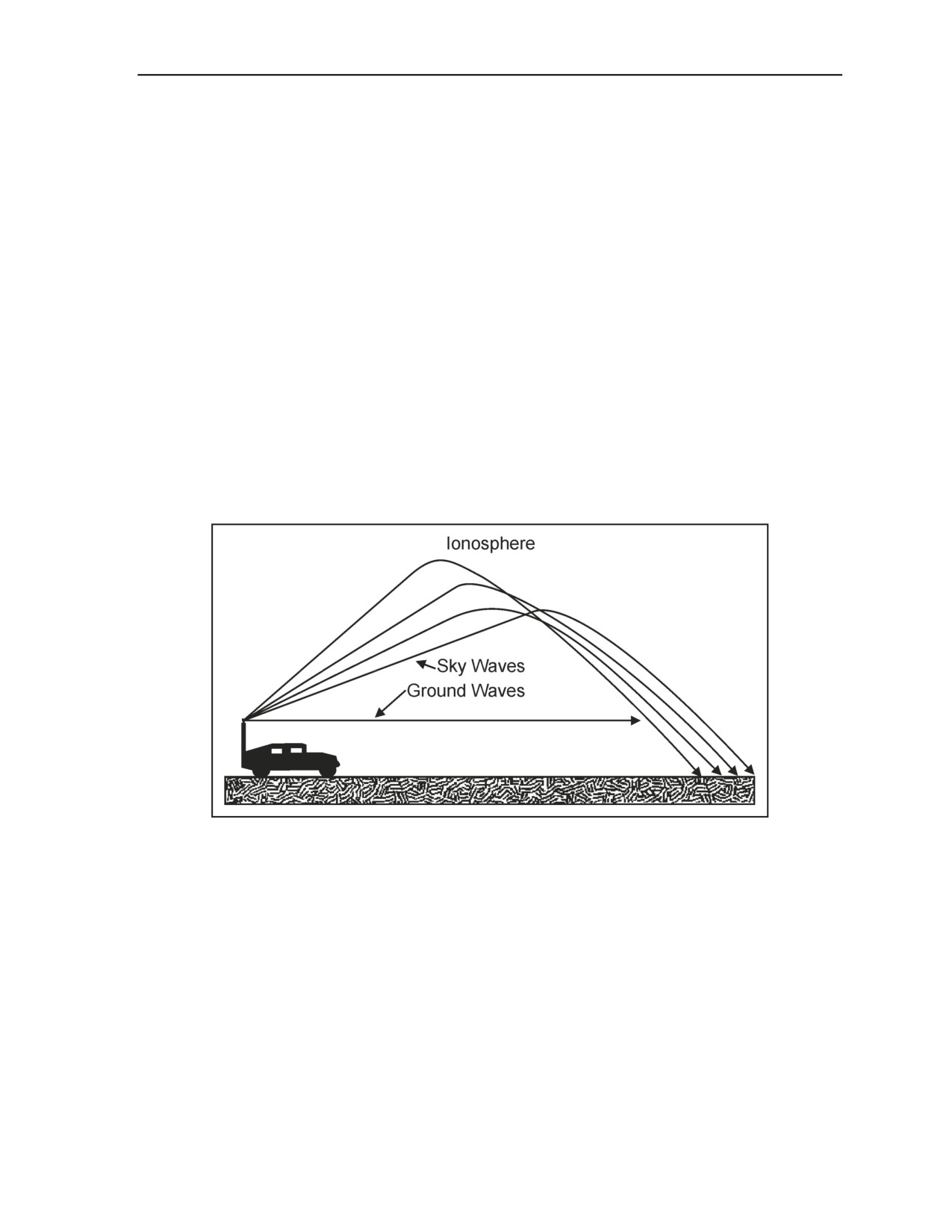
Single-Channel Radio Communications Principles
B-28. In the HF band (3.0-30 MHz), the range of the ground wave decreases as frequency increases, and
the sky waves are greatly influenced by ionospheric considerations. HF is widely used for long distance
communications, short-wave broadcasting, and over-the-horizon radar; HF is also used to supplement
tactical communications when LOS communication is not possible or feasible.
B-29. In the VHF band (30-300 MHz), there is no usable ground wave and only slight refraction of sky
waves by the ionosphere at the lower frequencies. The direct wave (LOS) provides communications if the
transmitting and receiving antennas are elevated high enough above the surface of the Earth.
B-30. In the UHF band (300-3,000 GHz), the direct wave must be used for all transmissions (15-100
miles). Communications are limited to a short distance beyond the horizon. Lack of static and fading in
these bands makes LOS reception satisfactory. Antennas that are highly directional can be used to
concentrate the beam of RF energy, thus increasing the signal intensity. UHF satellite transmissions can
cover thousands of miles, depending on altitude, power, and antenna configuration.
PROPAGATION
B-31. Ground waves and sky waves are the two principal paths by which radio waves travel from a
transmitter to a receiver. Figure B-3 is an example of the principal paths of radio waves. Ground waves
travel directly from the transmitter to the receiver; sky waves travel up to the ionosphere and are refracted
(bent downward) back to the earth. Short distance, UHF, and upper VHF transmissions are made by
ground waves; long distance transmission is principally by sky waves. SC radio sets can use either ground
wave or sky wave propagation for communications.
Figure B-3. Principal paths of radio waves
GROUND WAVE PROPAGATION
B-32. Radio communications that use ground wave propagation do not use or depend on waves that are
refracted from the ionosphere
(sky waves). Ground wave propagation is affected by the electrical
characteristics of the earth and the amount of diffraction (bending) of the waves along the curvature of the
earth. The strength of the ground wave at the receiver depends on the power output and frequency of the
transmitter, the shape and conductivity of the earth along the transmission path, and the local weather
conditions. Figure B-4 shows possible routes for ground waves.
5 August 2009
FM 6-02.53
B-5
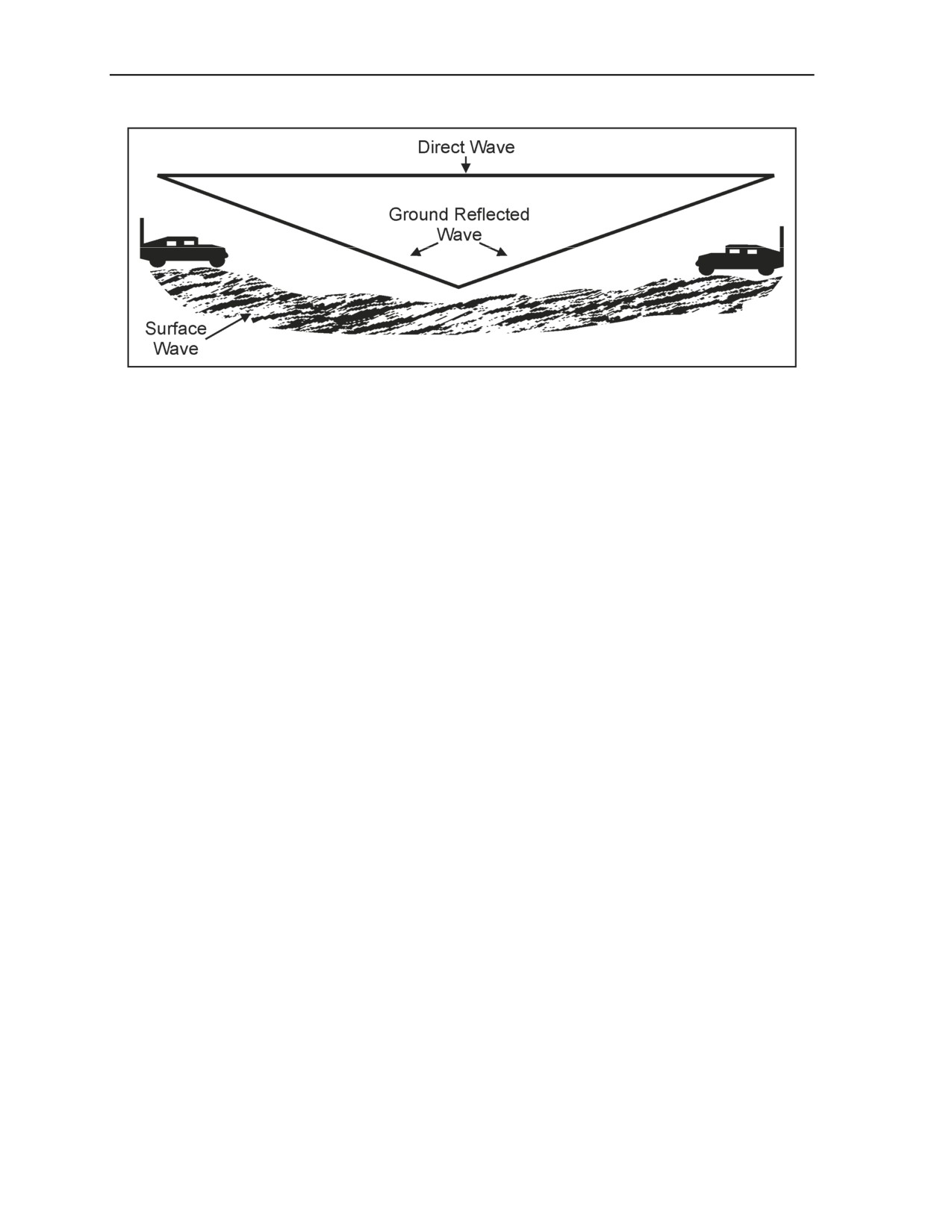
Appendix B
Figure B-4. Possible routes for ground waves
Direct Wave
B-33. The direct wave travels directly from the transmitting antenna to the receiving antenna. The direct
part of the wave is limited to the LOS distance between the transmitting and receiving antennas, and the
small distance added by atmospheric refraction and diffraction of the wave around the curvature of the
Earth. Increasing the height of the transmitting or receiving antenna, or both, can extend this distance.
Ground-Reflected Wave
B-34. The ground wave reaches the receiving antenna after being reflected from the surface of the earth.
Cancellation of the radio signal can occur when the ground reflected component and the direct wave
component arrive at the receiving antenna at the same time, and are 180 degrees out of phase with each
other.
Surface Wave
B-35. The surface wave follows the Earth’s curvature and is affected by the Earth’s conductivity and
dielectric constant.
FREQUENCY CHARACTERISTICS OF GROUND WAVES
B-36. Various frequencies determine which wave component will prevail along any given signal path. For
example, when the Earth’s conductivity is high and the frequency of a radiated signal is low, the surface
wave is the predominant component. For frequencies below 10 MHz, the surface wave is sometimes the
predominant component. However, above 10 MHz, the losses that are sustained by the surface wave
component are so great that the other components (direct and sky wave) become predominant.
B-37. At frequencies of 30-300 kHz, ground losses are very small, so the surface wave component follows
the Earth’s curvature. It can be used for long-distance communications provided the RTO has enough
power from the transmitter. The frequencies 300 kHz-3 MHz are used for long distance communications
over sea water and for medium-distance communications over land.
B-38. At HF, 3-30 MHz, the ground’s conductivity is extremely important, especially above 10 MHz
where the dielectric constant or conductivity of the Earth’s surface determines how much signal absorption
occurs. In general, the signal is strongest at the lower frequencies when the surface over which it travels
has a high dielectric constant and conductivity.
B-6
FM 6-02.53
5 August 2009

Single-Channel Radio Communications Principles
Earth’s Surface Conductivity
B-39. The dielectric constant or Earth’s surface conductivity determines how much of the surface wave
signal energy will be absorbed or lost. Although the Earth’s surface conductivity as a whole is generally
poor, Table B-3 shows a comparison of the conductivity of varying surface conditions.
Table B-3. Surface conductivity
Surface Type
Relative Conductivity
Large body of fresh water
Very good
Ocean or sea water
Good
Flat or hilly loamy soil
Fair
Rocky terrain
Poor
Desert
Poor
Jungle
Very poor
SKY WAVE PROPAGATION
B-40. Radio communications that use sky wave propagation depend on the ionosphere to provide the
signal path between the transmitting and receiving antennas. The ionosphere has four distinct layers. These
layers are labeled D, E, F1, and F2, in the order of increasing heights and decreasing molecular densities.
During the day, when the rays of the sun are directed toward that portion of the atmosphere, all four layers
may be present. During the night, the F1 and F2 layers seem to merge into a single F layer, while the D and
E layers fade out. The actual number of layers, their height above the earth, and their relative intensity of
ionization, varies constantly. Table B-4 provides a description of the ionosphere layers and Figure B-5
shows the average layer distribution of the ionosphere.
Table B-4. Ionosphere layers
Region
Description
D Region
Exists only during daylight hours and has little effect in bending the paths of
HF radio waves. The main effect of the D region is to attenuate HF waves
when the transmission path is in sunlit regions.
E Region
Is used during the day for HF radio transmission over intermediate distances
(less than 2,400 km [1,500 miles]). At night, the intensity of the E region
decreases and it becomes useless for radio transmission.
F Region
Exists at heights up to 380 km (240 miles) above the earth and is ionized all
the time. It has two well-defined layers (F1 and F2) during the day and one
layer (F) during the night. At night, the F region remains at a height of about
260 km (170 miles) and is useful for long-range radio communications (over
2,400 km [1,500 miles]). The F2 layer is the most useful of all layers for long-
range radio communications, although its degree of ionization varies
appreciably from day to day.
5 August 2009
FM 6-02.53
B-7
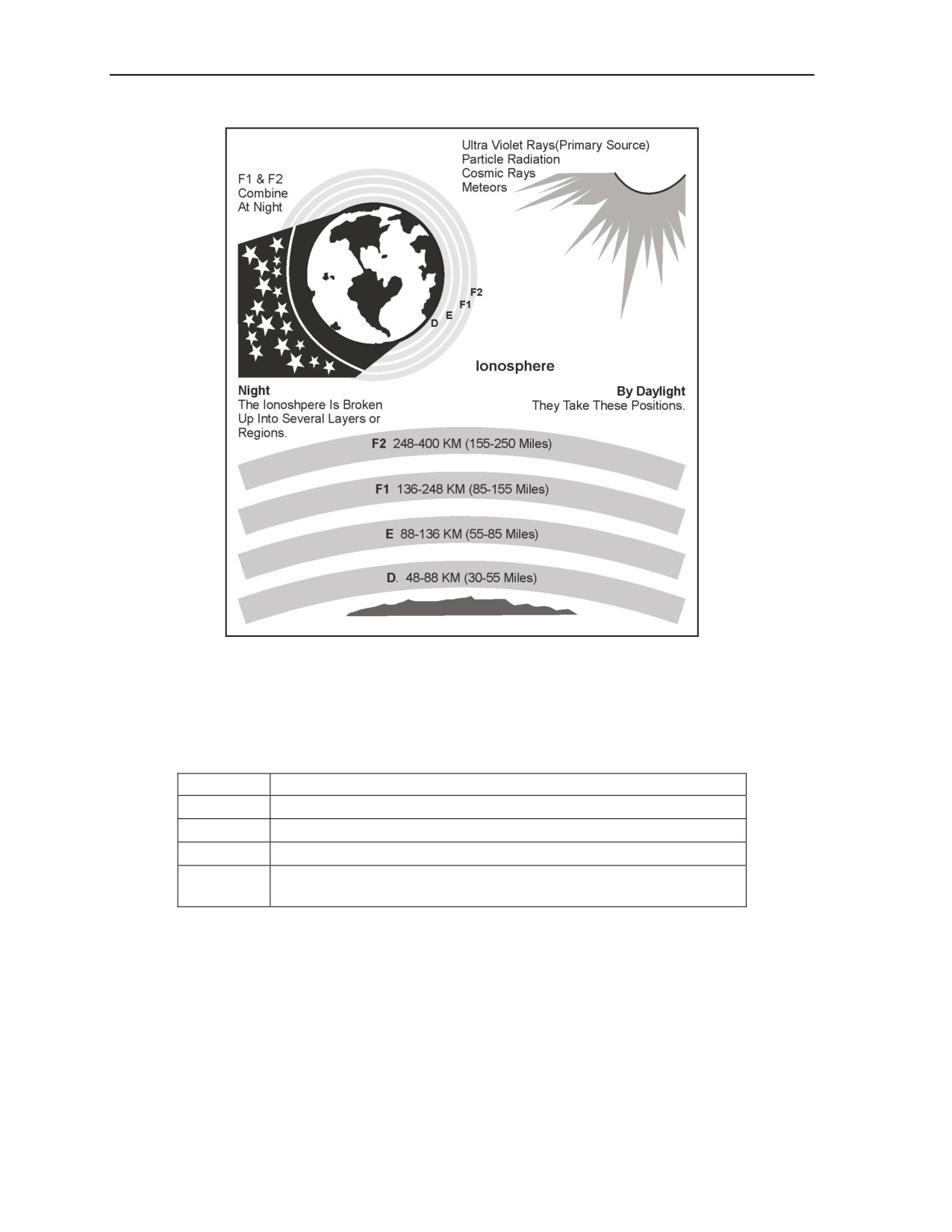
Appendix B
Figure B-5. Average layer distribution of the ionosphere
B-41. The movement of the earth around the sun, and changes in the sun’s activity, contribute to
ionospheric variations. These variations are regular, and therefore predictable; and irregular, which occur
from abnormal behavior of the sun. Table B-5 lists the regular variations of the ionosphere.
Table B-5. Regular variations of the ionosphere
Variation
Description
Daily
Caused by the rotation of the earth.
Seasonal
Caused by the north and south progression of the sun.
27-day
Caused by the rotation of the sun on its axis.
11-year
Caused by the sunspot activity cycle going from maximum through
minimum back to maximum levels of intensity.
B-42. In planning a communications system, the status of the four regular variations must be anticipated.
Irregular variations must also be considered since they have a degrading effect (at times blanking out
communications), which currently cannot be controlled or compensated for. Table B-6 lists some irregular
variations of the ionosphere.
B-8
FM 6-02.53
5 August 2009

Single-Channel Radio Communications Principles
Table B-6. Irregular variations of the ionosphere
Variation
Description
Sporadic E
When excessively ionized, the E layer often blanks out the
reflections back from the higher layers. It can also cause
unexpected propagation of signals hundreds of miles beyond
the normal range. This effect can occur at any time.
Sudden Ionospheric
Coincides with a bright solar eruption, and causes abnormal
Disturbance
ionization of the D layer. This effect causes total absorption of
all frequencies above approximately 1 MHz. It can occur
without warning during daylight hours, and can last from a few
minutes to several hours. When it occurs, receivers seem to
go dead.
Ionospheric Storms
During these storms, sky wave reception above approximately
1.5 MHz shows low intensity, and is subject to a type of rapid
blasting and fading called flutter fading. May last from several
hours to several days, and usually extend over the entire
earth.
B-43. Sunspots generate bursts of radiation that cause high levels of ionization. The more sunspots, the
greater the ionization. During periods of low sunspot activity, frequencies above 20 MHz tend to be
unusable because the E and F layers are too weakly ionized to reflect signal back to Earth. At the peak of
the sunspot cycle, however, it is unusual to have worldwide propagation on frequencies above 30 MHz.
B-44. Primarily, the ionization density of each layer determines the range of long distance radio
transmissions; the higher the frequency, the greater the ionization density required to reflect radio waves
back to earth. The upper (E and F) regions reflect the higher frequencies, because they are the most highly
ionized. The D region, which is the least ionized, does not reflect frequencies above approximately 500
kHz. Thus, at any given time and for each ionized region, there is an upper frequency limit at which radio
waves sent vertically upward are reflected back to earth. This limit is called the critical frequency.
B-45. Radio waves directed vertically at frequencies higher than the critical frequency pass through the
ionized layer out into space. All radio waves that are directed vertically into the ionosphere at frequencies
lower than the critical frequency are reflected back to earth.
B-46. Generally, radio waves used in communications are directed toward the ionosphere at some oblique
angle, called the angle of incidence. Radio waves at frequencies above the critical frequency will be
reflected back to earth if transmitted at angles of incidence smaller than a certain angle, called the critical
angle. At the critical angle, and at all angles larger than the critical angle, the radio waves will pass through
the ionosphere if the frequency is higher than the critical frequency.
TRANSMISSION PATHS
B-47. Sky wave propagation refers to those types of radio transmissions that depend on the ionosphere to
provide signal paths between transmitters and receivers. Figure B-6 shows the sky wave transmission
paths. The distance from the transmitting antenna to the place where the sky waves first return to earth is
called the skip distance. The skip distance depends upon the angle of incidence, the operating frequency,
and the height and density of the ionosphere.
B-48. The antenna height, in relation to the operating frequency, affects the angles at which transmitted
radio waves strike and penetrate the ionosphere and then return to Earth. This angle of incidence can be
controlled to obtain the desired area of coverage; lowering the antenna height will increase the angle of
transmission. This provides broad and even signal patterns in an area the size of a typical corps. The use of
near-vertical transmission paths is known as NVIS. Raising the antenna height will lower the angle of
incidence.
5 August 2009
FM 6-02.53
B-9