FM 6-02.53 TACTICAL RADIO OPERATIONS (August 2009) - page 4
Chapter 9
Less Favorable Soil Conditions
9-49. When an antenna must be erected over soil with low conductivity, treat the soil with substances that
are highly conductive when in solution, to reduce its resistance.
9-50. For simple installations, a single ground rod can be fabricated in the field from the pipe or conduit. It
is important that a low resistance connection be made between the ground wire and the ground rod. The
rod should be cleaned thoroughly by scraping and sand papering at the point where the connection is to be
made, and a clean ground clamp should be installed. A ground wire can then be soldered or joined to the
clamp; this joint should be covered with tape to prevent an increase in resistance because of oxidation.
Unfavorable Soil Conditions
9-51. When an actual ground connection cannot be used because of the high resistance of the soil, or
because a large buried ground system is not practical, either a counterpoise or a ground screen may be used
to replace the usual direct ground connection.
Couterpoise
9-52. When an actual ground connection cannot be used because of the high resistance of the soil or
because a large buried ground system is not practical, a counterpoise may be used to replace the usual
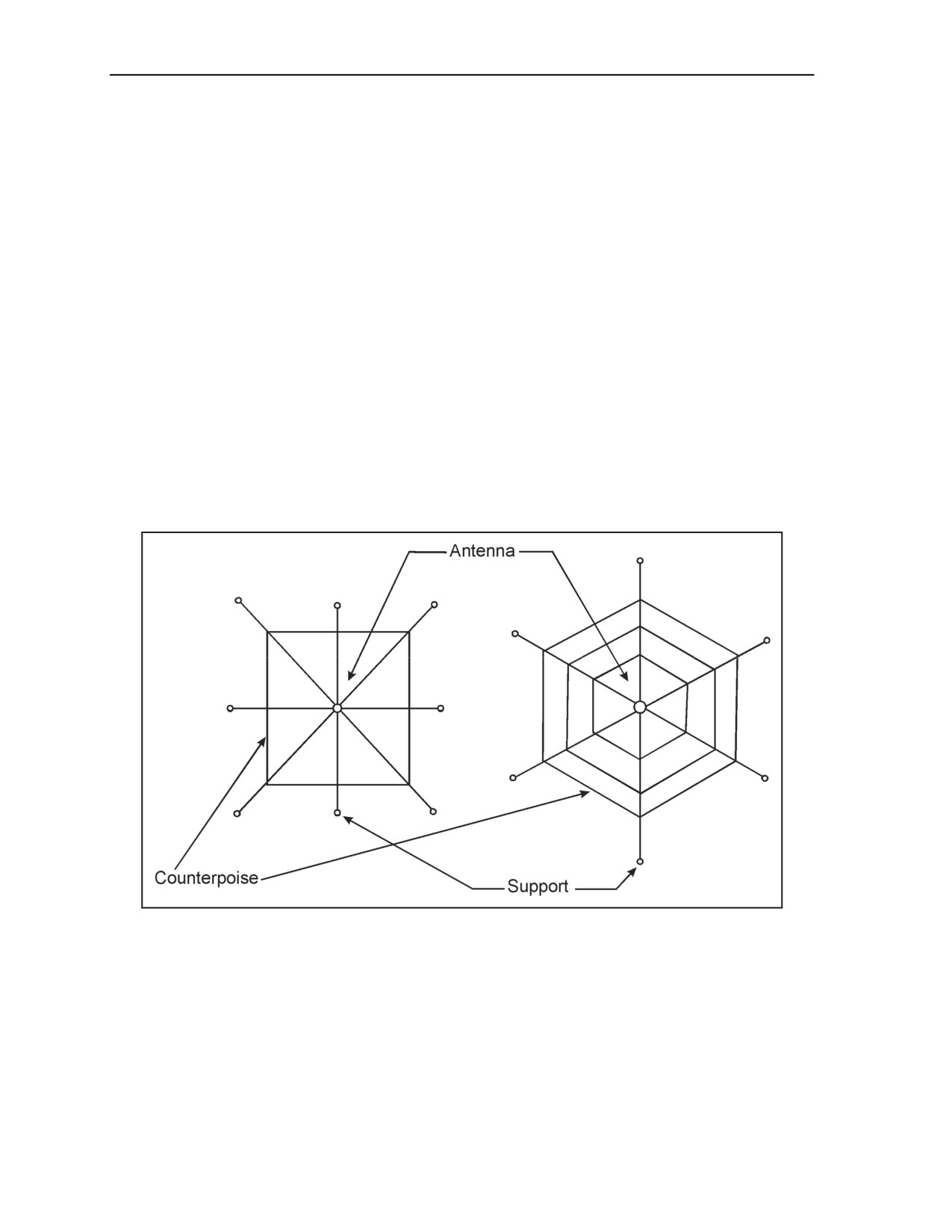
direct ground connection. The counterpoise consists of a device made of wire that is erected a short
distance above the ground, and insulated from it. The size of the counterpoise should be equal to, or larger
than, the size of the antenna. Figure 9-9 is an example of wire counterpoise.
Figure 9-9. Wire counterpoise
9-53. When the antenna is mounted vertically, the counterpoise should be made into a simple geometric
pattern; perfect symmetry is not required. The counterpoise appears to the antenna as an artificial ground
that helps to produce the required radiation pattern.
9-54. In some VHF antenna installations on vehicles, the metal roof of the vehicle (or shelter) is used as a
counterpoise for the antenna. Small counterpoises of metal mesh are sometimes used with special VHF
antennas that must be located a considerable distance above the ground.
9-12
FM 6-02.53
5 August 2009
Antennas
Ground Screen
9-55. A ground screen consists of a fairly large area of metal mesh or screen that is laid on the surface of
the ground under the antenna. There are two specific advantages in using ground screens. First, the ground
screen reduces ground absorption losses that occur when an antenna is erected over ground with poor
conductivity. Second, the height of the antenna can be set accurately. Thus, the radiation resistance of the
antenna can be determined more accurately.
ANTENNA LENGTH
9-56. The antenna has both a physical and electrical length; the two are never the same. The reduced
velocities of the wave on the antenna, and a capacitive effect (known as end effect), make the antenna seem
longer electrically than it is physically. The contributing factors are the ratio of the diameter of the antenna
to its length, and the capacitive effect of terminal equipment (insulators, clamps) used to support the
antenna.
9-57. To calculate the physical length of an antenna, use a correction of 0.95 for frequencies between 3.0-
50.0 MHz. Table 9-1 provides antenna length calculations for a half-wave antenna.
Table 9-1. Antenna length calculations
The formula below calculates the half-wave length, and uses a correction of 0.95 for frequencies
between 3 and 50 MHz. The same formula calculates the height above ground for HF wire
antennas.
Length (meters)
=150 X 0.95/frequency in MHz
=142.5/frequency in MHz
Length (ft)
=492 X 0.95/frequency in MHz
=468/frequency in MHz
The length of a long wire antenna (one wavelength or longer) for harmonic operation is
calculated by using the following formula:
Length (meters)
=150 X (N-0.05)/frequency in MHz
Length (ft)
=492 X (N-0.05)/frequency in MHz
Where N equals the number of half-wave lengths in the total length of the antenna.
For example, if the number of half-wave lengths is 3 and the frequency in MHz is 7, then:
Length (meters)=150(N-0.05)/frequency in MHz
=150(3-0.05)/7
=150 X 2.95/7
=63.2 meters
Note. For HF antennas: a half wavelength in meters is 143/f where f is the frequency in MHz. If the frequency is 30
MHz, the wavelength is 5 meters. Often a half wavelength dipole is used and is center fed.
ANTENNA ORIENTATION
9-58. The orientation of an antenna is extremely important. Determining the position of an antenna in
relation to the points of the compass can make the difference between a marginal and good radio circuit.
Azimuth
9-59. If the azimuth of the radio path is not provided, the azimuth should be determined by the best
available means. The accuracy required in determining the azimuth of the path depends on the radiation
pattern of the directional antenna.
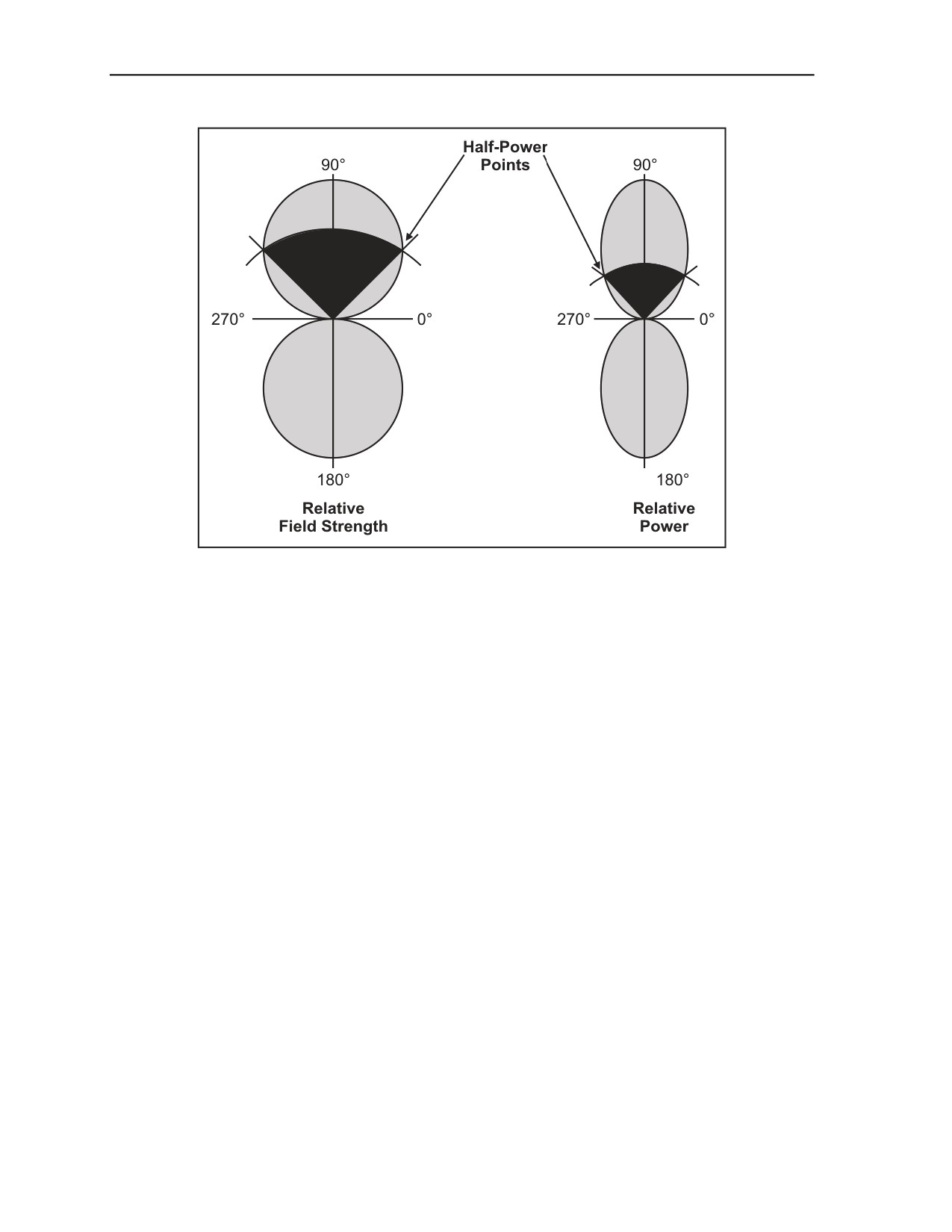
9-60. If the antenna beam width is very wide (for example, a 90 degree angle between half-power points),
an error of 10 degrees in azimuth is of little consequence. However, in transportable operation, the rhombic
and V antennas may have such a narrow beam as to require great accuracy in azimuth determination. The
antenna should be erected for the correct azimuth; unless a line of known azimuth is available at the site,
the direction of the path is best determined by a magnetic compass. Figure 9-10 is an example of a beam
width measured on relative field strength and relative power patterns.
5 August 2009
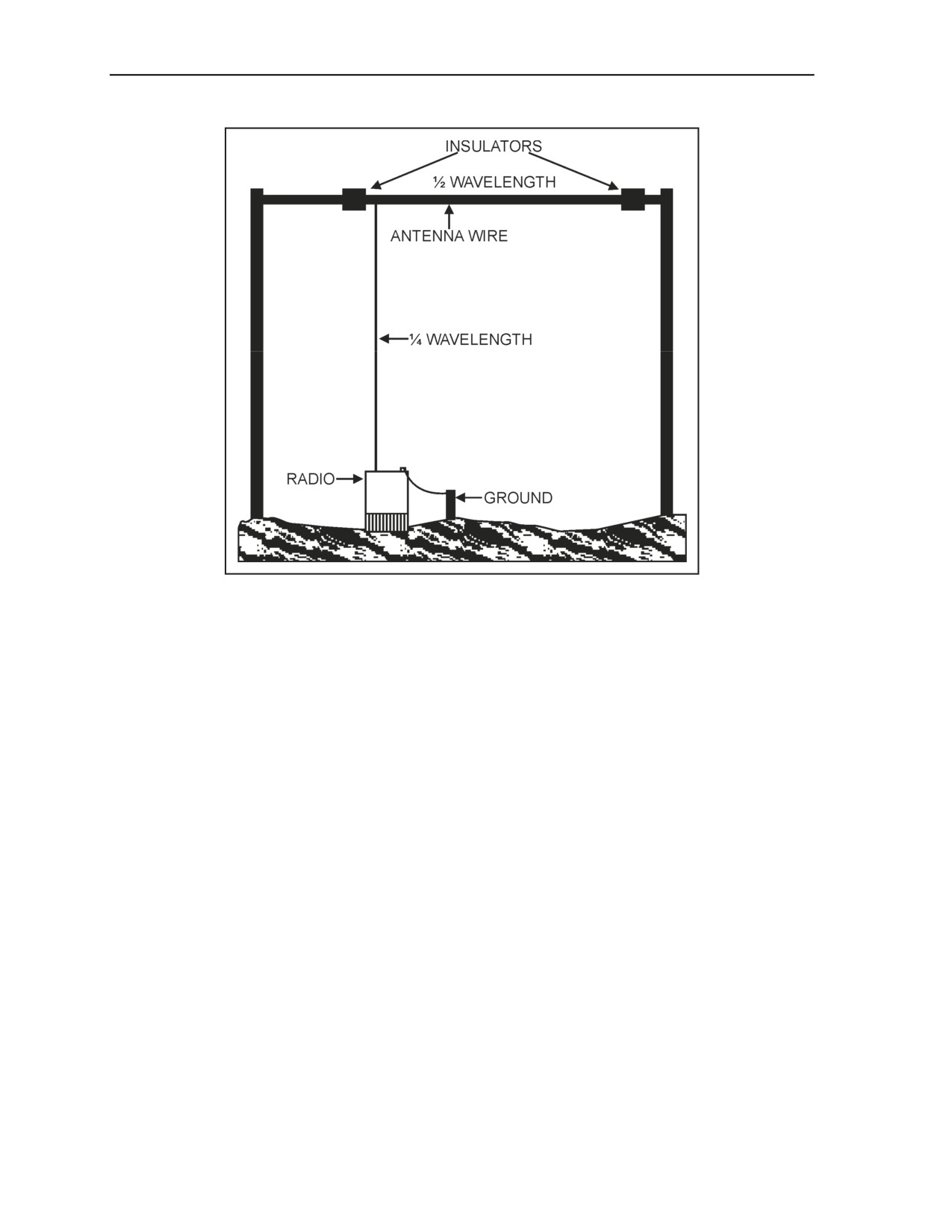
FM 6-02.53
9-13
Chapter 9
Figure 9-10. Beam width
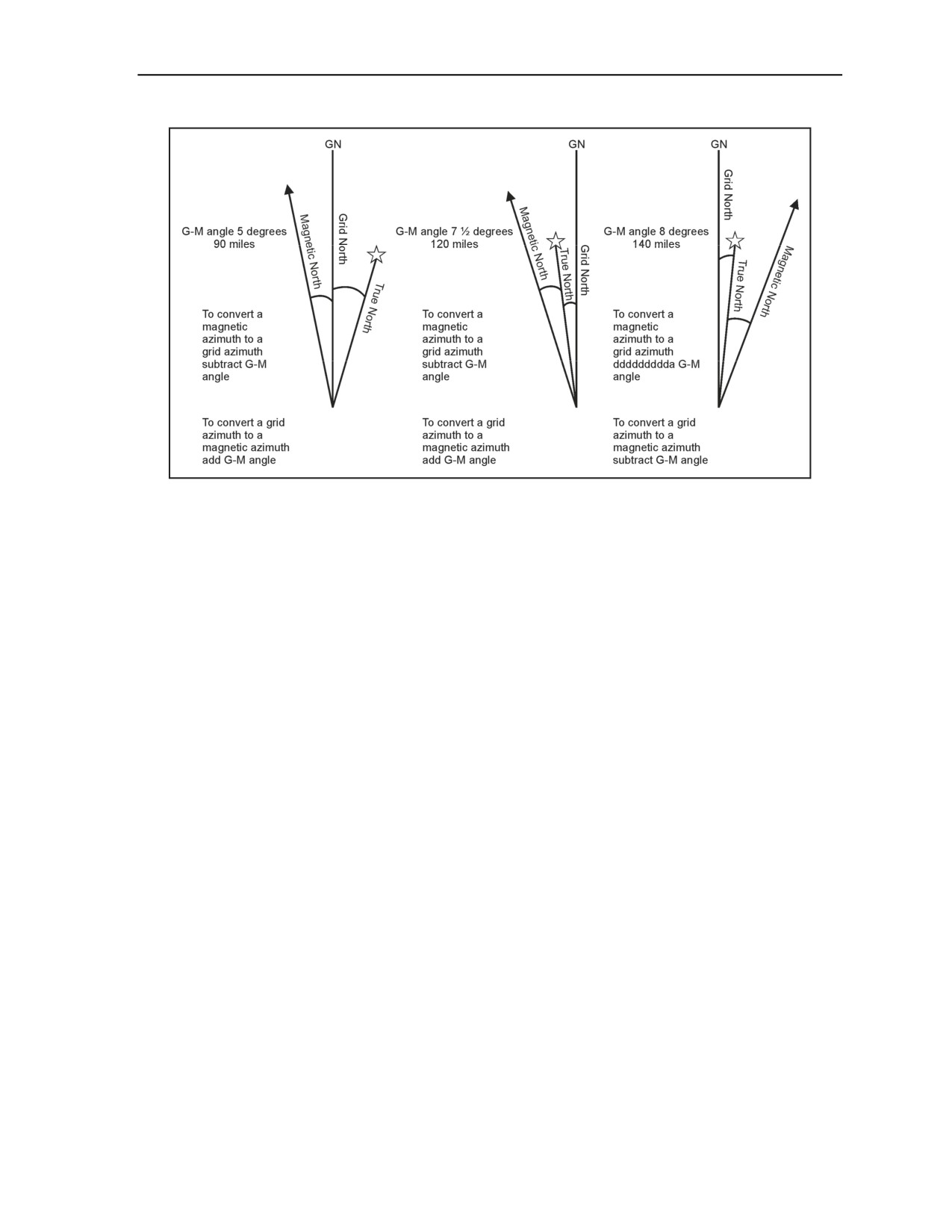
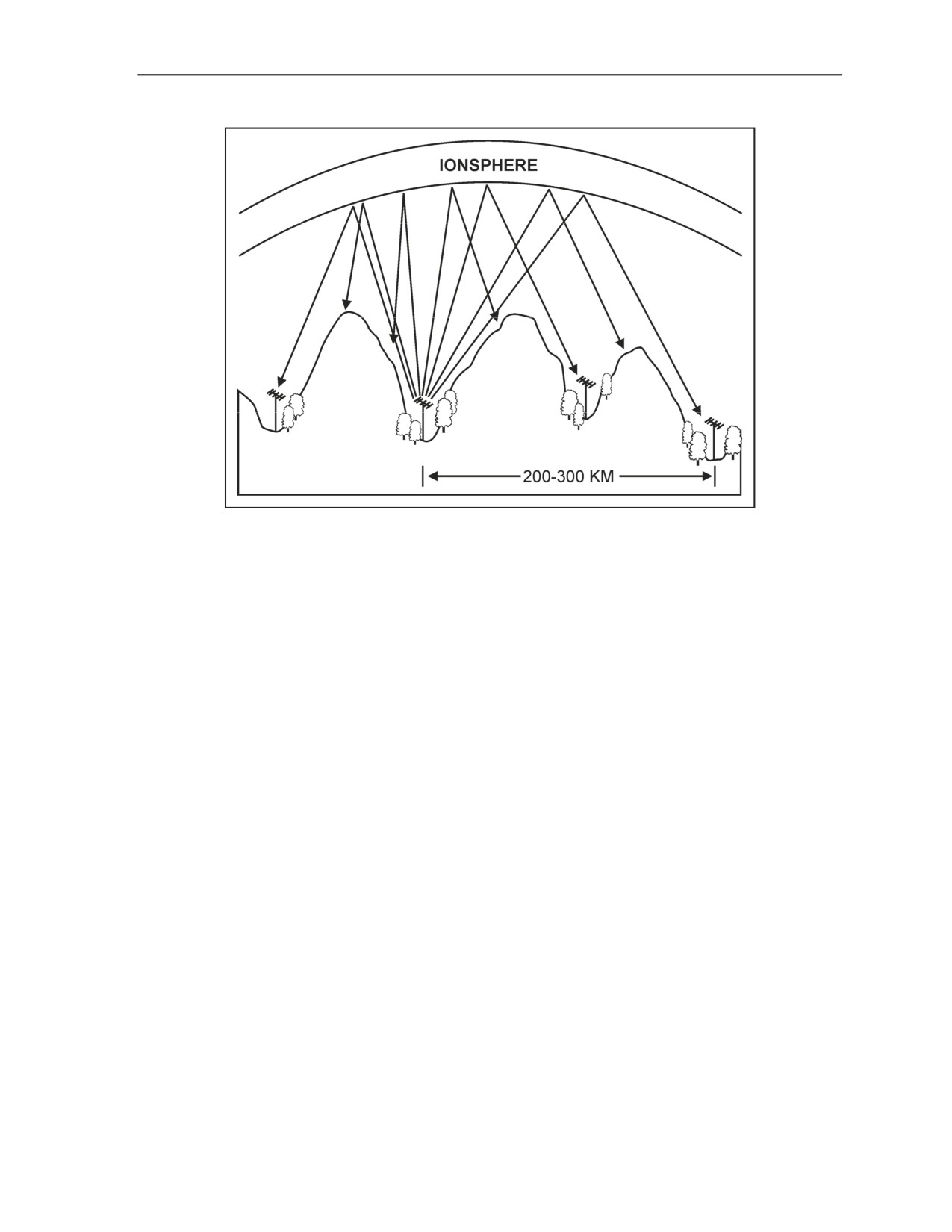
9-61. Figure 9-11 is an example of a declination diagram. This example shows the relationship between
the three north points (magnetic, grid and true) as represented on topographic maps by a declination
diagram. It is important to understand the difference between the three and how to calculate from one to the
other. Magnetic azimuths are determined by using magnetic instruments such as lensatic or M2 compasses
while a grid azimuth is plotted on a map between two points, the points are joined together by a straight
line and a protractor is used to measure the angle between grid north and drawn line. (Refer to FM 3-25.54
for more information on azimuths and map reading.)
9-14
FM 6-02.53
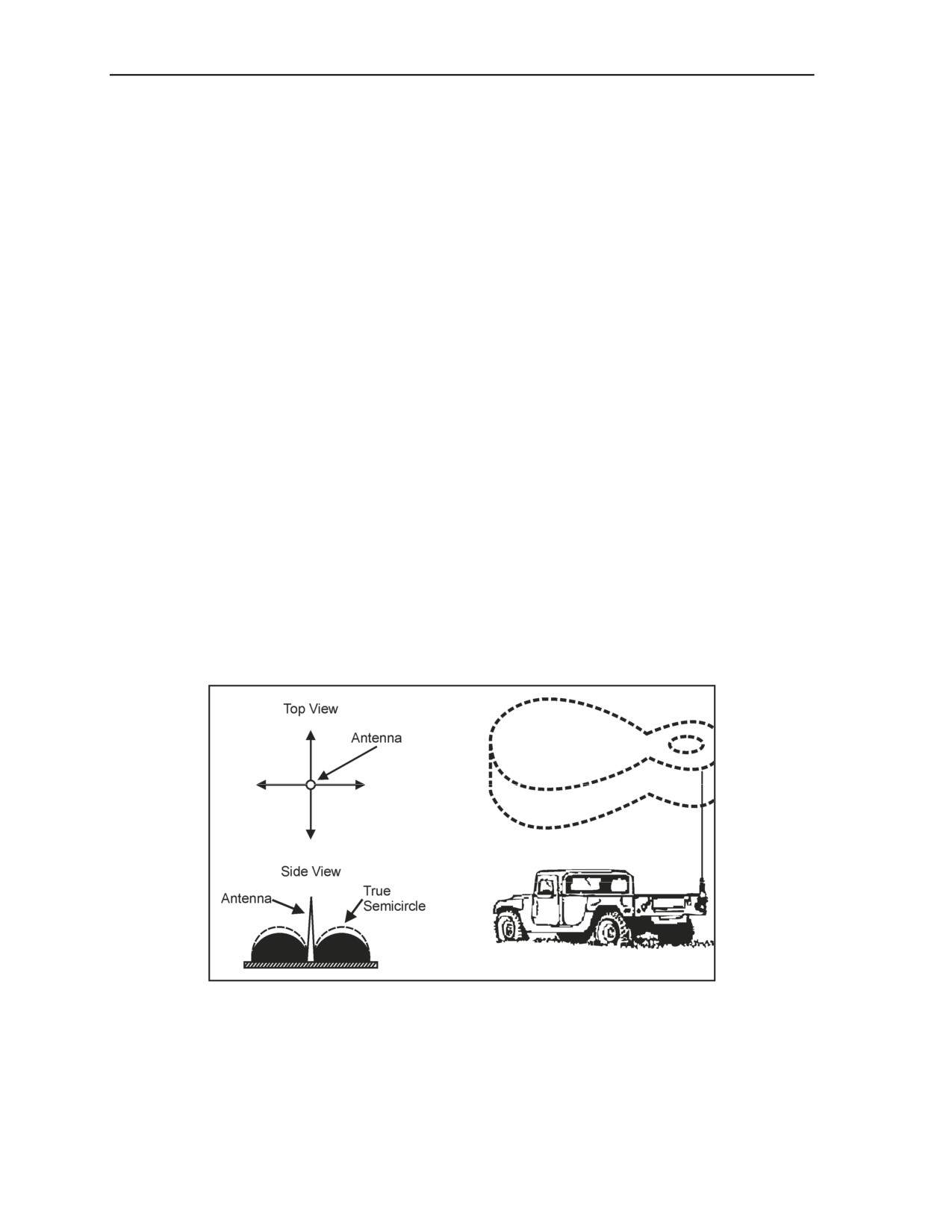
5 August 2009
Antennas
Figure 9-11. Example of a declination diagram
IMPROVEMENT OF MARGINAL COMMUNICATIONS
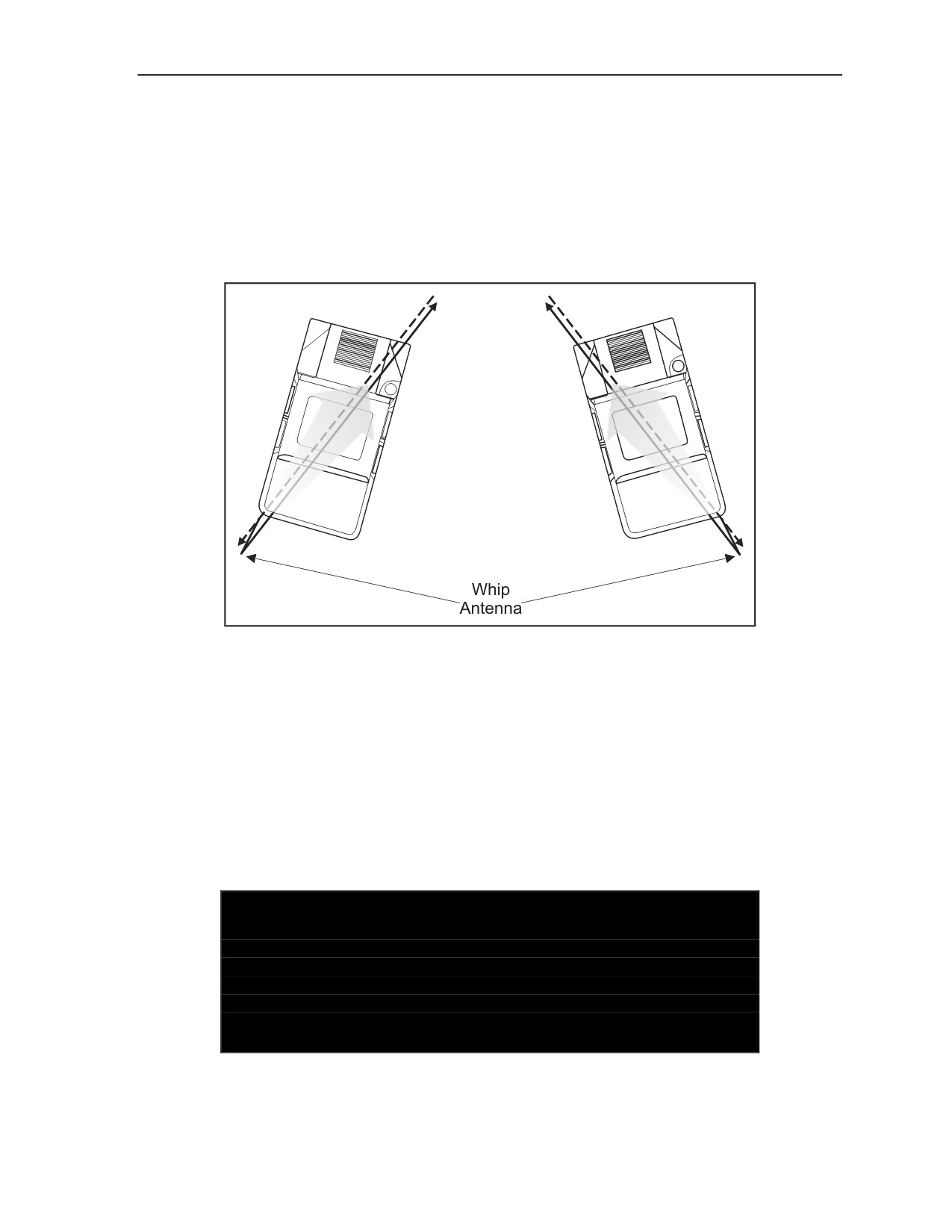
9-62. Under certain situations, it may not be possible to orient directional antennas to the correct azimuth
of the desired radio path. As a result, marginal communications may suffer. To improve marginal
communications—
z
Check, tighten, and tape cable couplings and connections.
z
Check to see that antennas are adjusted for the proper operating frequency (if possible).
z
Change the heights of antennas.
z
Move the antenna a short distance away, and in different locations, from its original location.
z
Separate transmitters from receiving equipment, if possible.
9-63. An improvised antenna may change the performance of a radio set; use a distant station to test if an
antenna is operating correctly. If the signal received from this station is strong, the antenna is operating
satisfactorily. If the signal is weak, adjust the height and length of both the antenna and the transmission
line, to receive the strongest signal at a given setting on the volume control of the receiver. This is the best
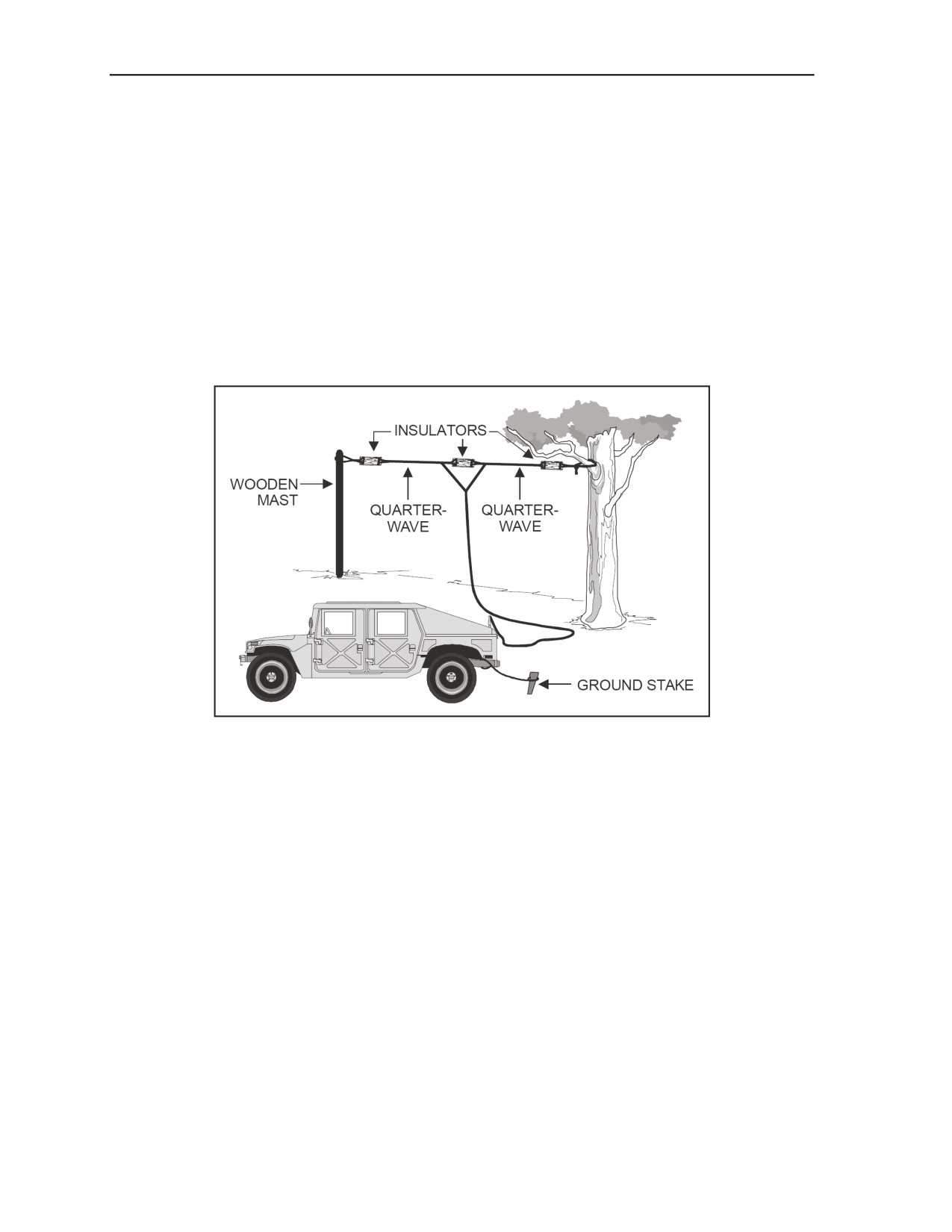
method of tuning an antenna when transmission is dangerous or forbidden.
9-64. Impedance matching a load to its source is an important consideration in transmission systems. If the
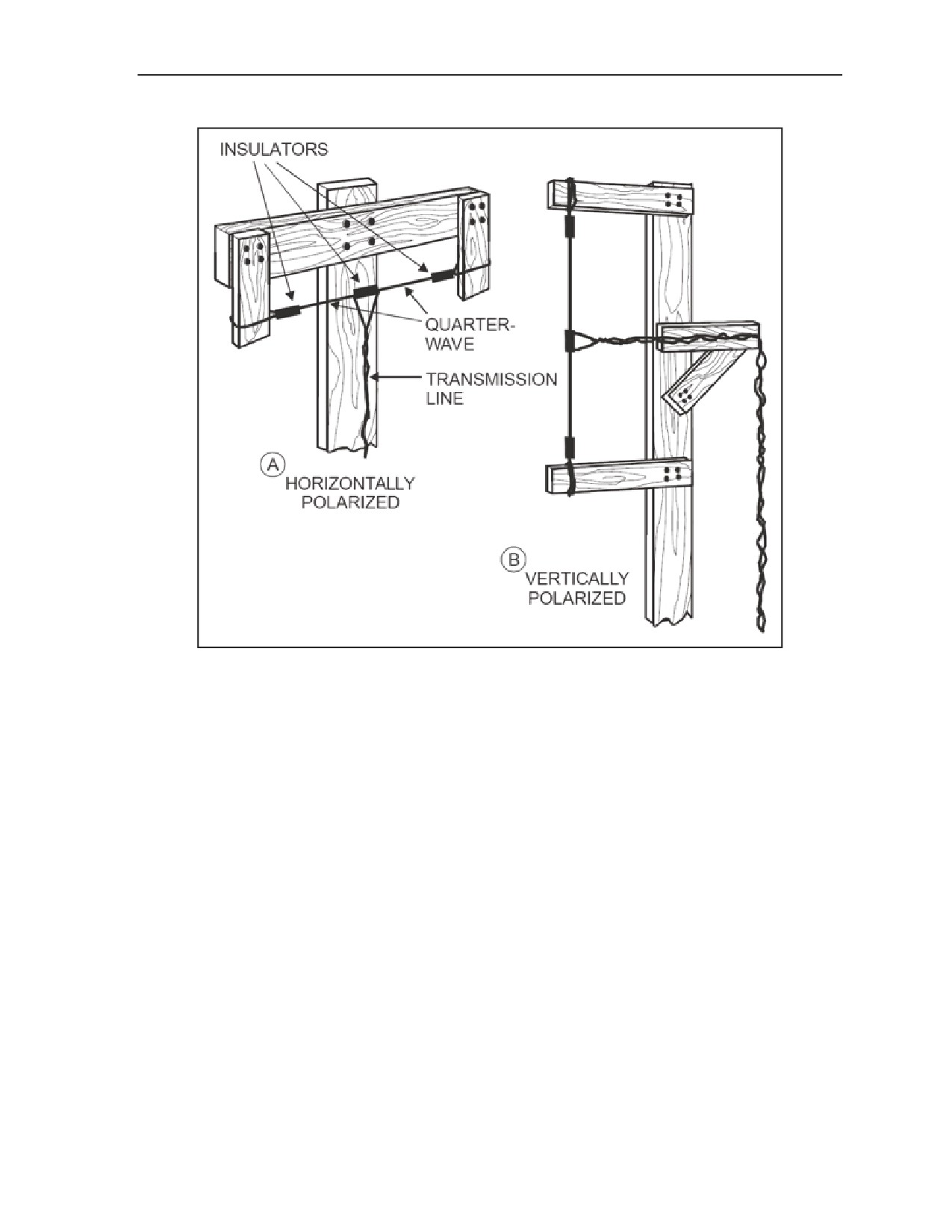
load and source are mismatched, part of the power is reflected back along the transmission line toward the
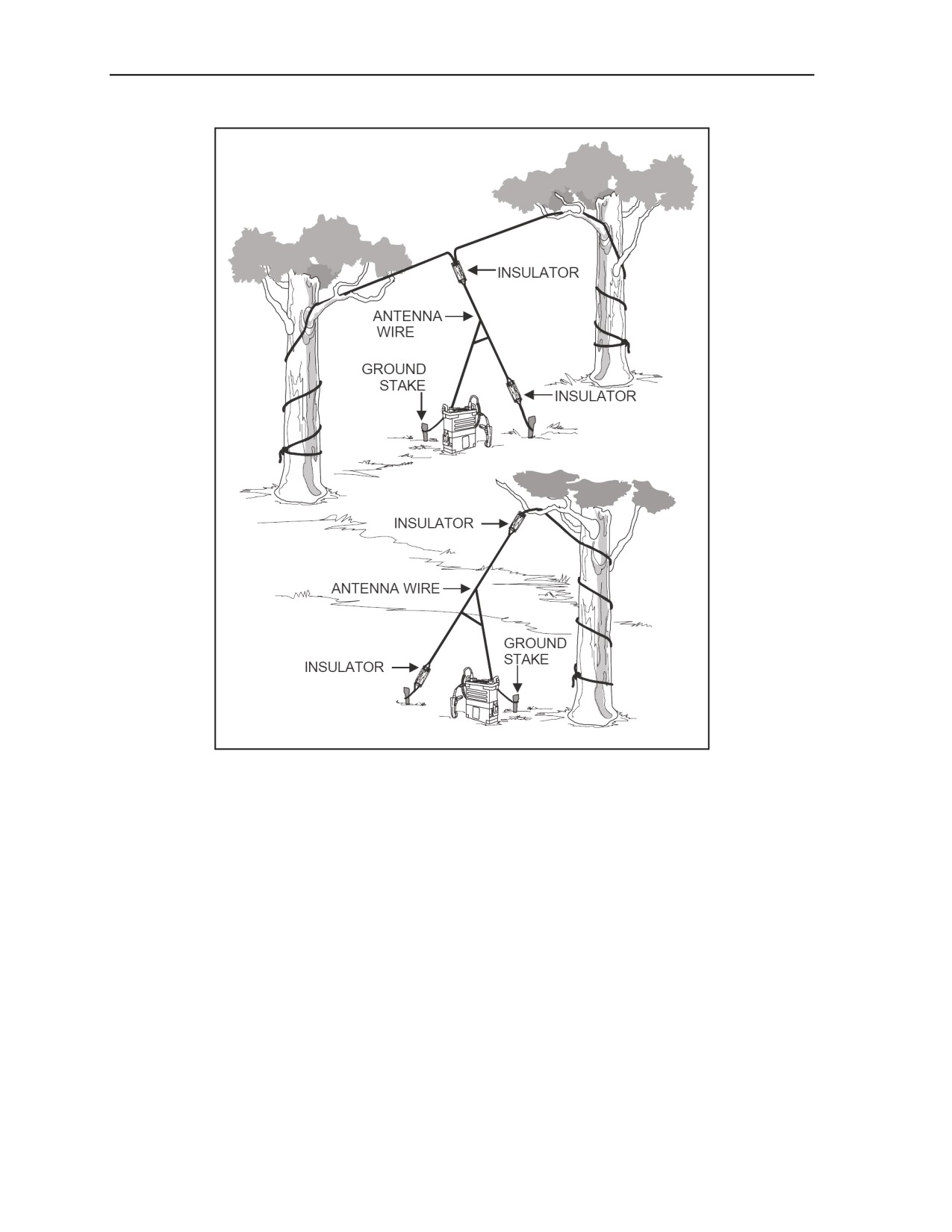
source. This prevents maximum power transfer, and can be responsible for erroneous measurements of
other parameters. It may also cause circuit damage in high-power applications.
9-65. The power reflected from the load interferes with the incident (forward) power, causing standing
waves of voltages and current to exist along the line. Standing wave maximum-to-minimum ratio is
directly related to the impedance mismatch of the load. Therefore, the standing wave ratio provides the
means of determining impedance and mismatch.
TRANSMISSION AND RECEPTION OF STRONG SIGNALS
9-66. After an adequate site has been selected and the proper antenna orientation obtained, the signal level
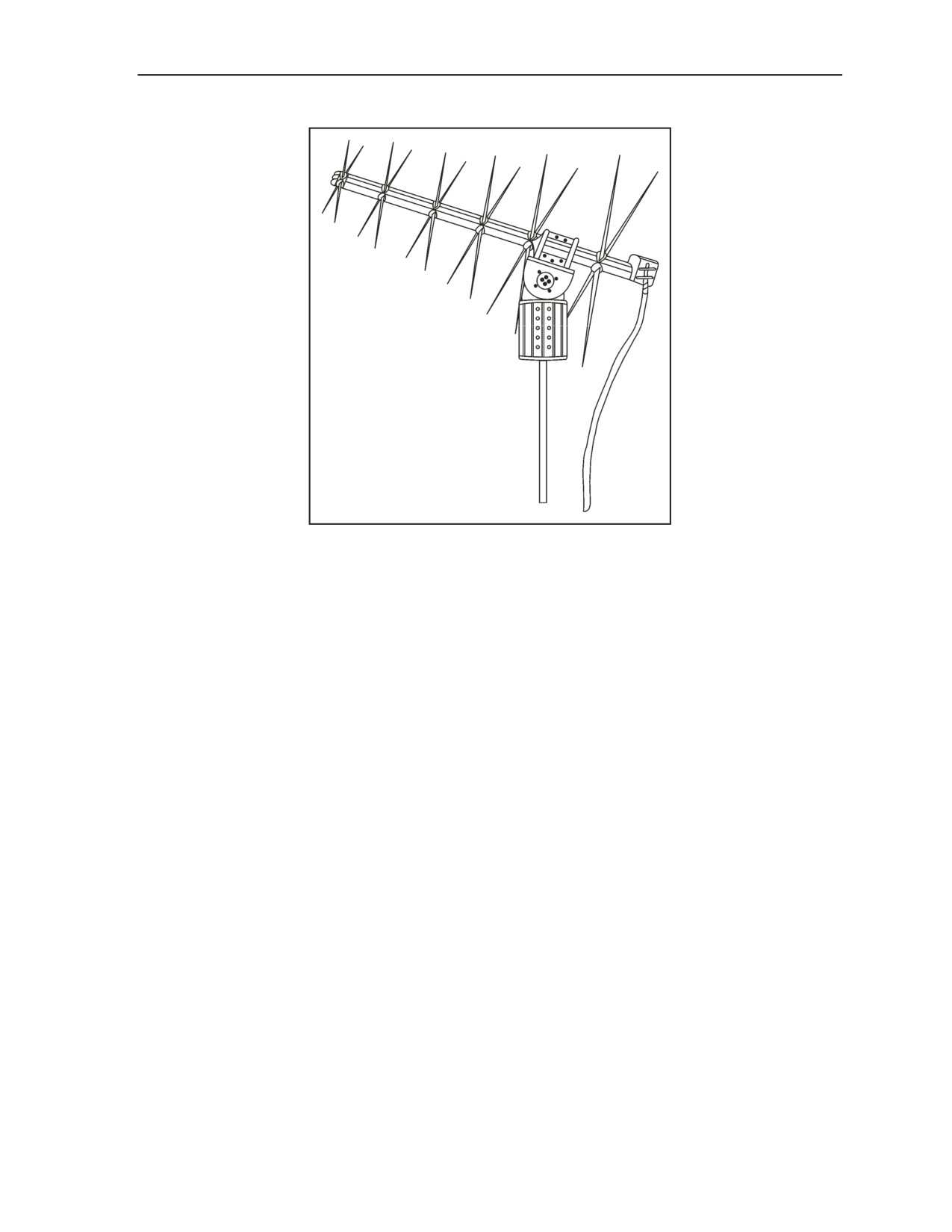
at the receiver will be proportional to the strength of the transmitted signal. If a high-gain antenna is used, a
stronger signal can be obtained. Using a high quality transmission line (as short as possible and properly
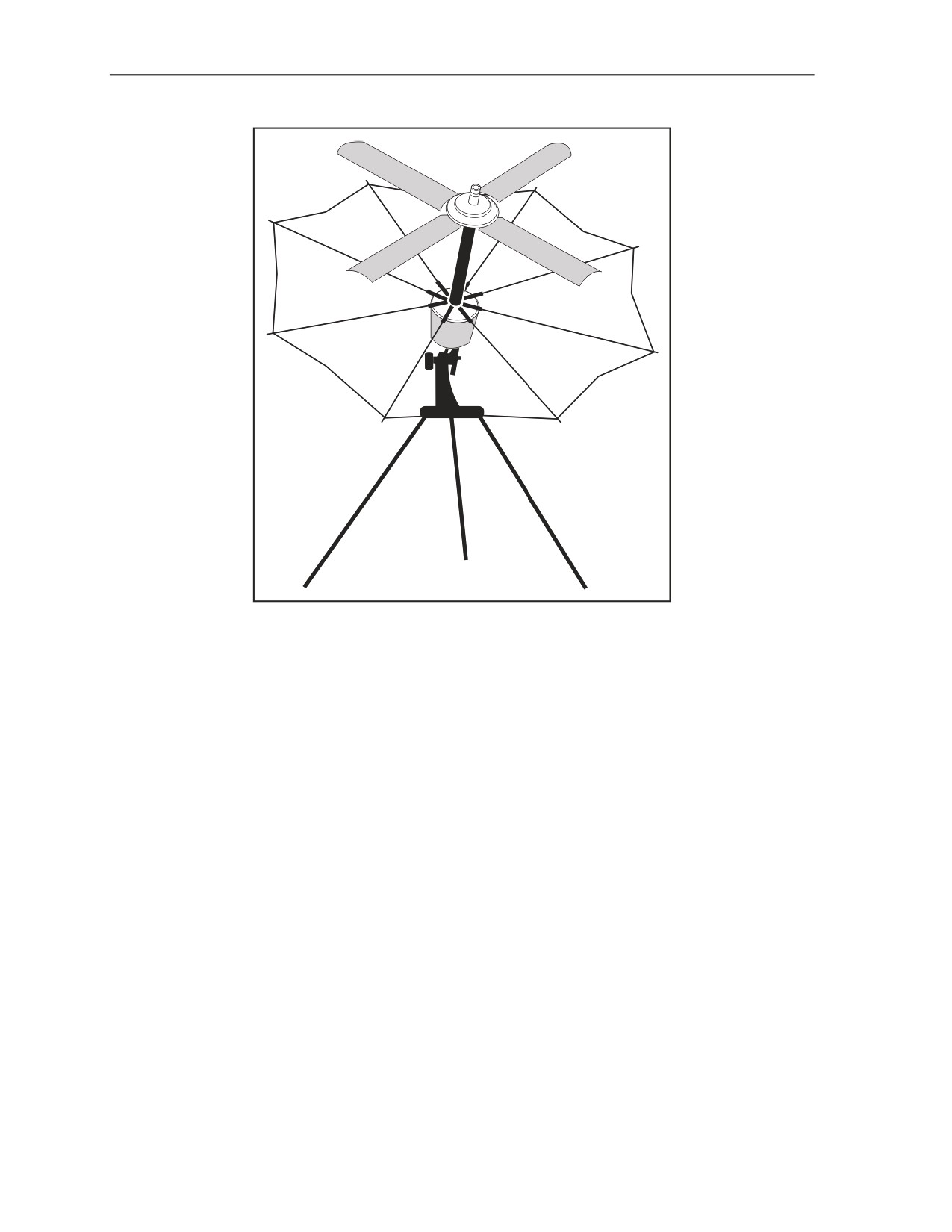
matched at both ends) can reduce losses between the antenna and the equipment.
5 August 2009
FM 6-02.53
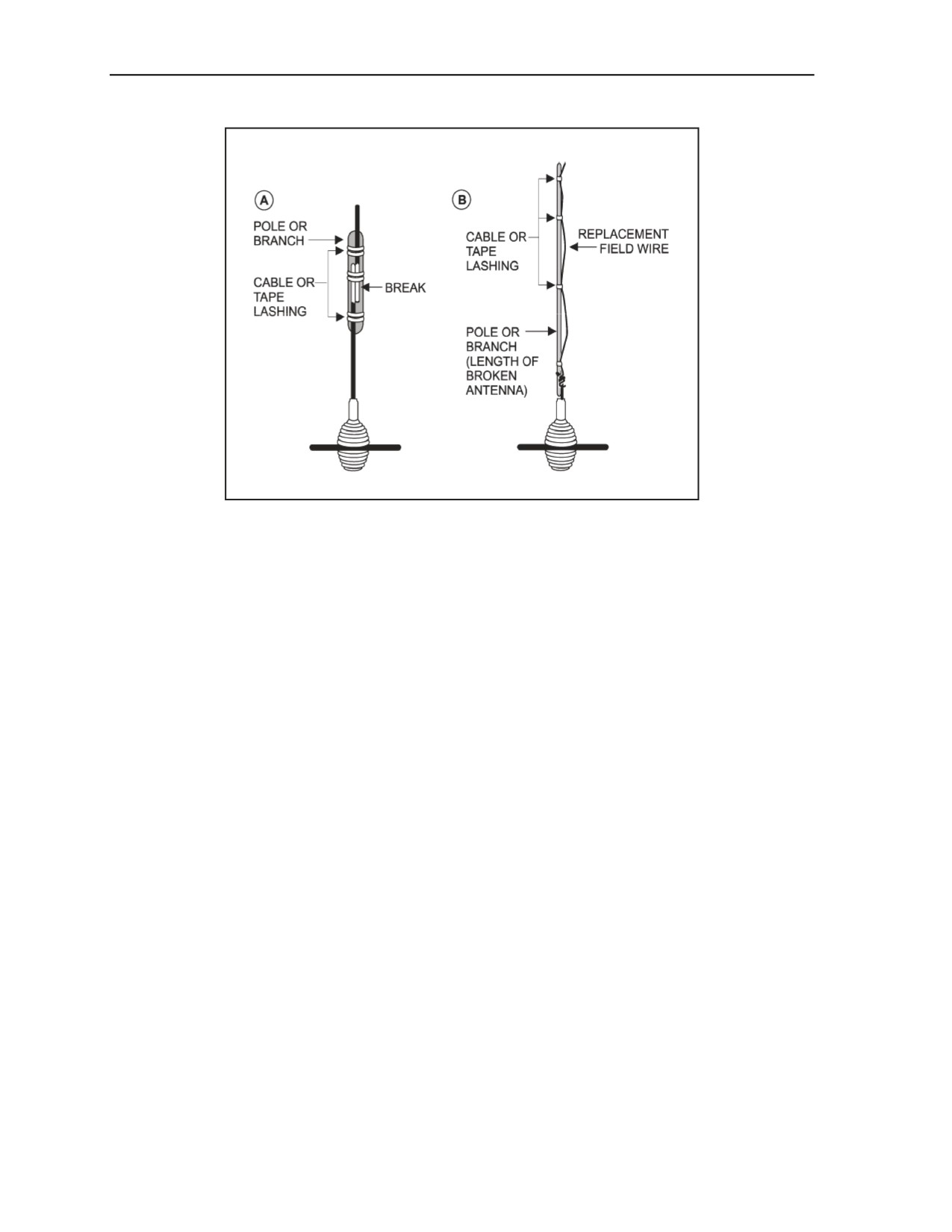
9-15
Chapter 9
WARNING
Excessive signal strength may result in adversary intercept and
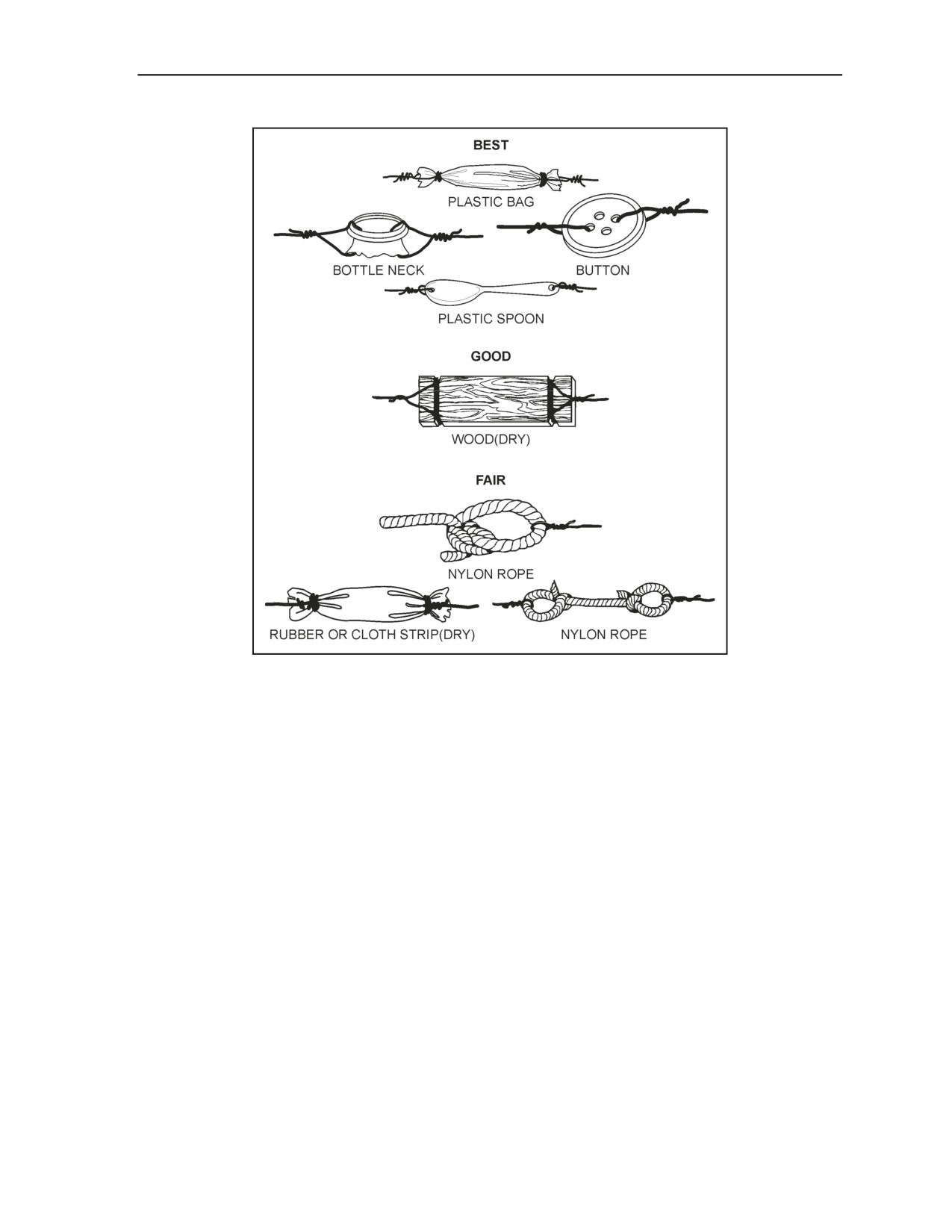
interference, or in the operator interfering with adjacent
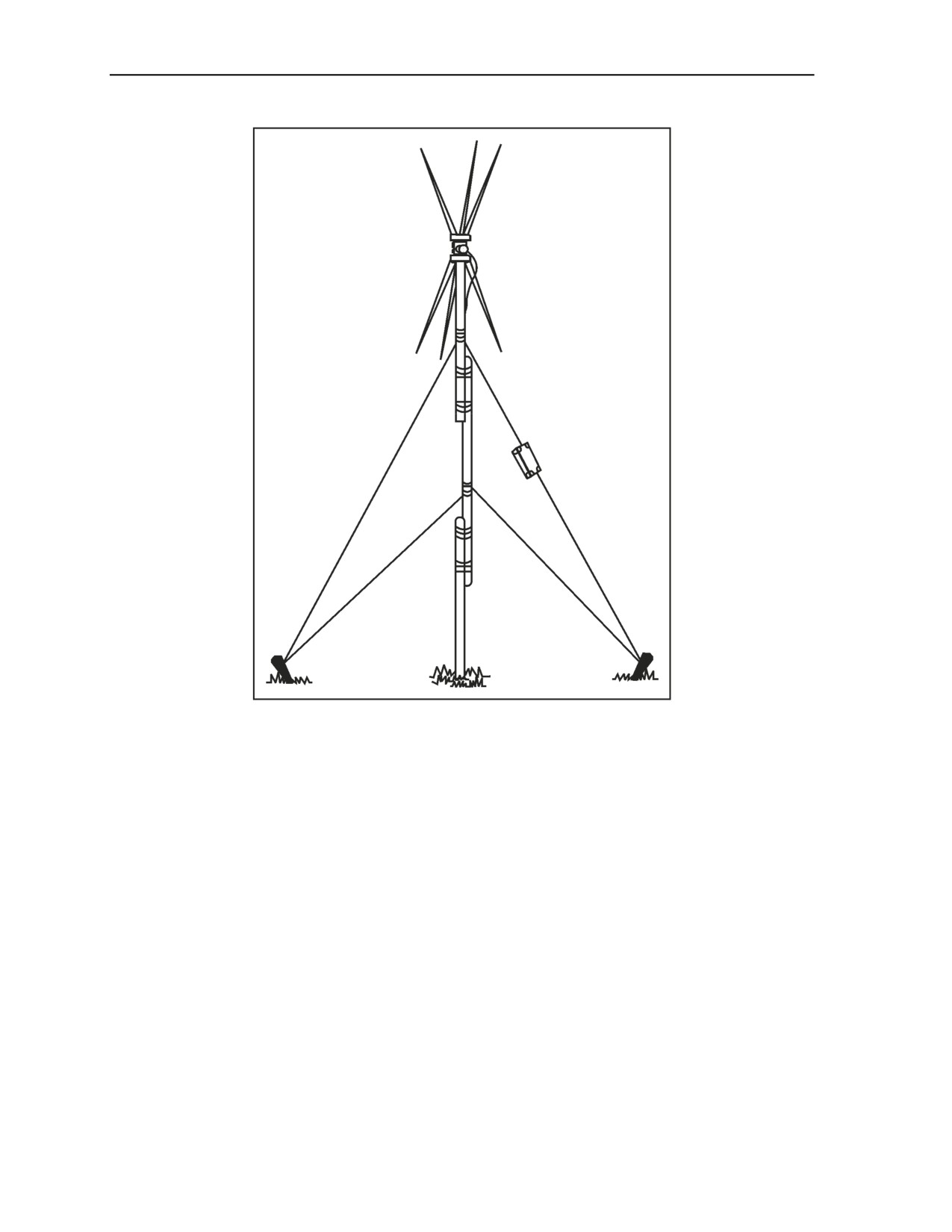
frequencies.
TYPES OF ANTENNAS
9-67. Tactical antennas are designed to be rugged; they permit mobility with the least possible sacrifice of
efficiency. Some are mounted on the sides of vehicles that have to move over rough terrain; others are
mounted on single masts, or suspended between sets of masts. All tactical antennas must be easy to install.
Small antennas are mounted on the helmets of personnel who use the radio sets; large antennas must be
easy to dismantle, pack, and transport.
9-68. A Hertz antenna (also known as a doublet, dipole, an ungrounded, or a half-wave antenna) can be
mounted in a vertical, horizontal, or slanting position; it is generally used at higher frequencies (above 2
MHz). With Hertz antennas, the wavelength to which any wire electrically tunes depends directly upon its
physical length. The basic Hertz antenna is center fed, and its total wire length is equal to approximately
one half of the wavelength of the signal to be transmitted.
9-69. A Marconi antenna is a quarter-wave antenna with one end grounded (usually through the output of
the transmitter or the coupling coil at the end of the feed line) which is required for the antenna to resonate.
It is positioned perpendicular to the earth and is generally used at the lower frequencies. However, when
used on vehicles or aircraft, Marconi antennas operate at high frequencies. In these cases, the aircraft or
vehicle chassis becomes the effective ground for the antenna.
9-70. The main advantage of the Marconi antenna over the Hertz antenna is that, for any given frequency,
the Marconi antenna is physically much shorter. This is particularly important in all field and vehicular
radio installations. Typical Marconi antennas include the inverted L, and the whip.
9-71. The best kinds of wire for antennas are copper and aluminum. In an emergency, use any type that is
available. The exact length of most antennas is critical. An expedient antenna should be the same length as
the antenna it replaces.
HIGH FREQUENCY ANTENNAS
9-72. The following paragraphs describe HF NVIS communication and HF antennas. Refer to Appendix C
for information on antenna selection.
Near-Vertical Incident Sky Wave Antenna, AS-2259/GR
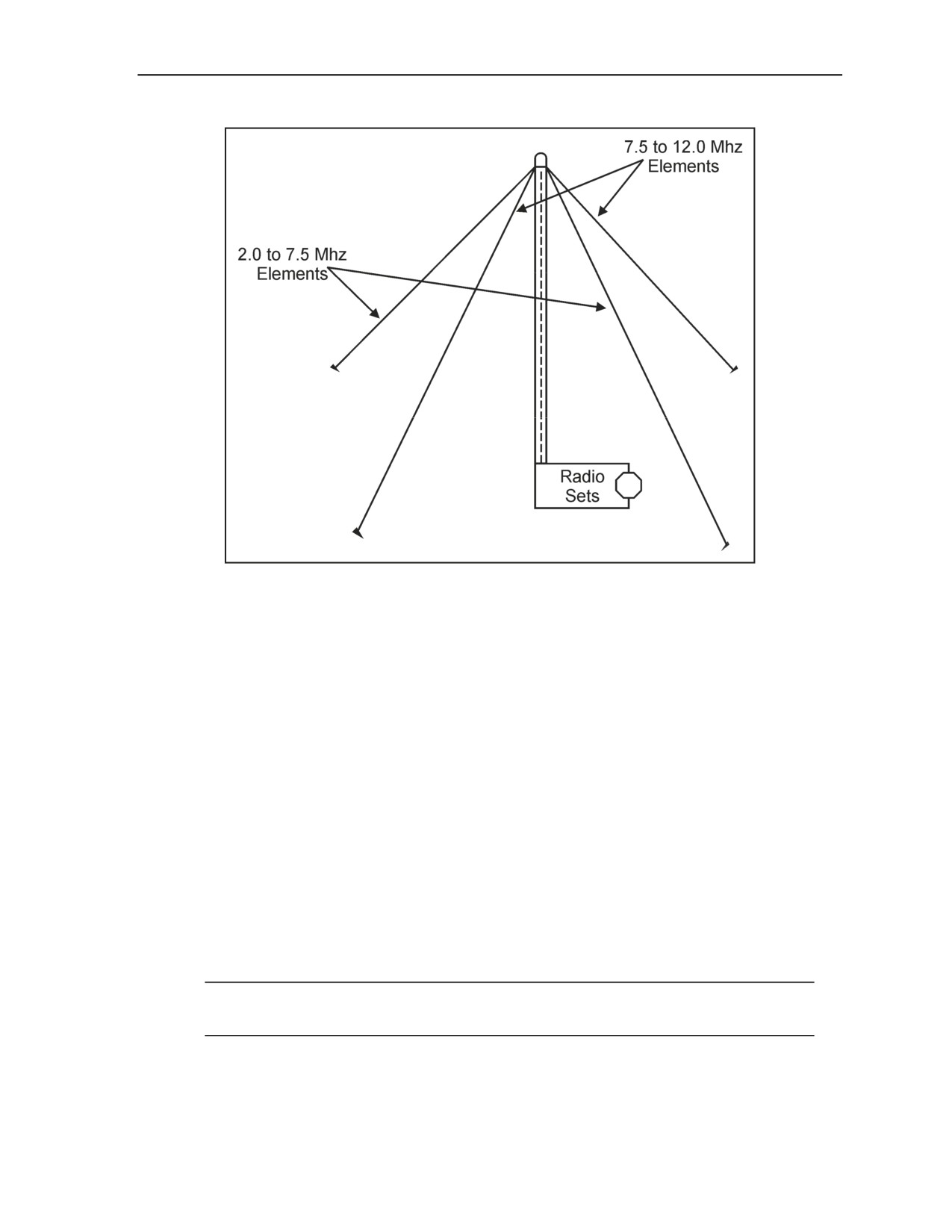
9-73. The NVIS antenna, AS-2259/GR, is a lightweight sloping dipole omnidirectional antenna. Figure 9-
12 is an example of the NVIS antenna. The NVIS is employed with HF radio communications in a 0-483
km (0 to 300 miles) range. It is capable of operating with older AM/HF radio sets, and was typically issued
with the older IHFR.
9-16
FM 6-02.53
5 August 2009
Antennas
Figure 9-12. NVIS antenna, AS-2259/GR
Harris RF-1944, Inverted Vee HF Antenna
9-74. The Harris RF-1944 Inverted Vee antenna is a lightweight, broadband dipole COTS antenna that is
primarily being fielded with the AN/PRC 150 (the older AS-2259/GR antenna is rarely used) The RF-1944
is primarily used because it is ideal for radios that have ALE and FH capabilities. The Harris RF-1944
antenna capabilities include—
z
Horizontal polarization.
z
Radiation patterns ideal for HF skywave communications from 0-500 miles (0-804.7 km).
z
Bandwidth over the entire 1.6-30 MHz frequency range.
z
Up to 20 watts power and 50 ohms input impedance.
z
A gain of:
-16 dBi (gain in decibels) at 2 MHz.
-2 dBi at 30 MHz.
z
Weight of less than four pounds.
9-75. The RF-1944 antenna does not include a mast. The primary components are a balun, two radiation
elements with integral terminating loads, two ground stakes, a coaxial cable, a weighing throwing line, and
a carrying bag. An added bonus for Soldiers is that the small, lightweight antenna can easily be carried in a
rucksack.
Note. A balun is a device used to couple a balanced device or line to an unbalanced device or
line.
5 August 2009
FM 6-02.53
9-17
Chapter 9
V Antenna
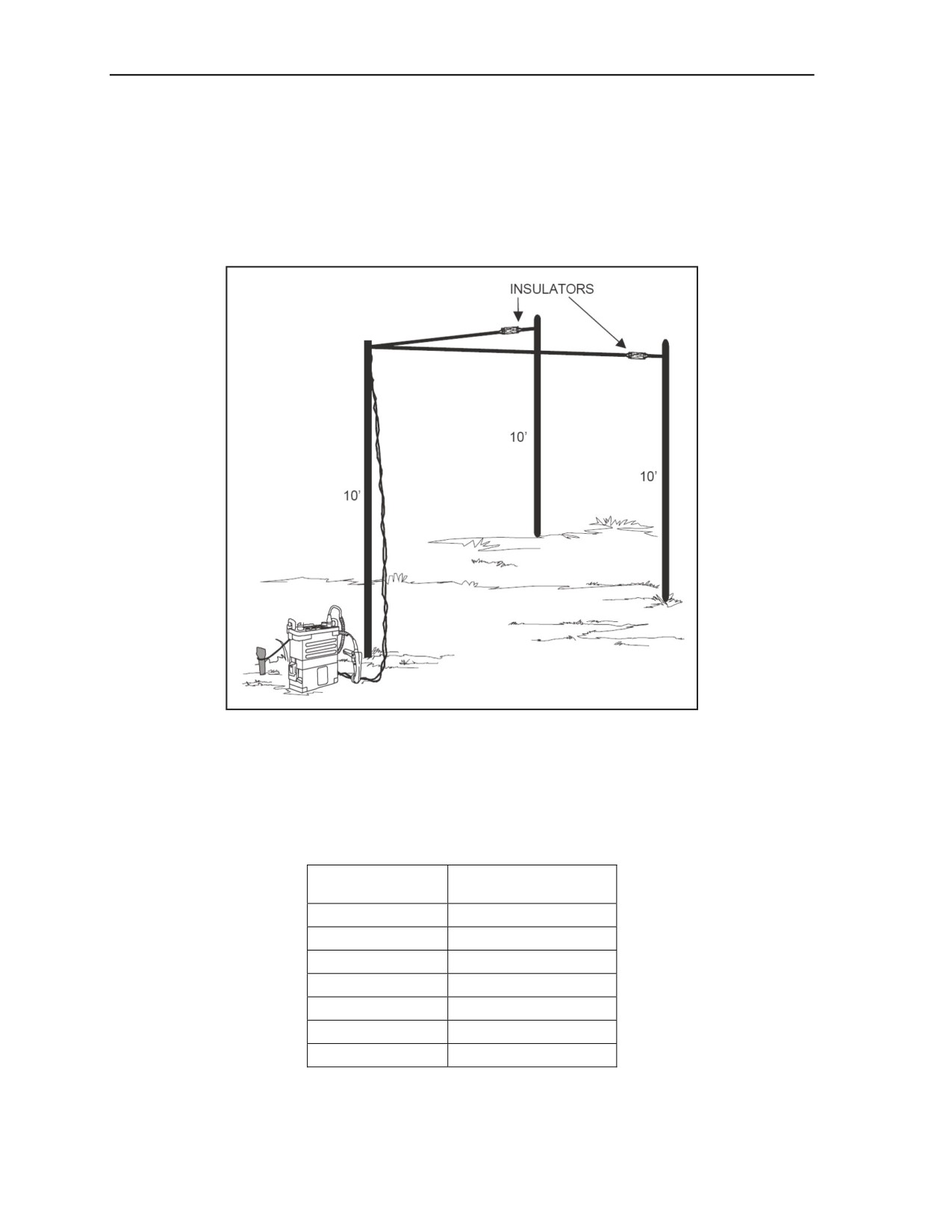
9-76. The V antenna is a medium- to long-range, broadband sky wave antenna. It is used for point-to-point
communications to ranges exceeding 4,000 km (2,500 miles). The V antenna consists of two wires
arranged to form a V, with its ends at the apex (where the legs come together) attached to a transmission
line (Figure 9-13). Radiation lobes off each wire combine to increase gain in the direction of an imaginary
line bisecting the apex angle; the pattern is bidirectional. However, adding terminating resistors (300 ohms)
to the far end of each leg will make the pattern unidirectional (in the direction away from the apex angle).
Figure 9-13. V antenna
9-77. The angle between the legs varies with the length of the legs to achieve maximum performance. Use
Table 9-2 to determine the angle and the length of the legs. When the antenna is used with more than one
frequency or wavelength, use an apex angle that is midway between the extreme angles determined by the
chart.
Table 9-2. Leg angle for V antennas
Antenna Length
Optimum Apex Angle
(Wavelength)
(Degrees)
1
90
2
70
3
58
4
50
6
40
8
35
10
33
9-18
FM 6-02.53
5 August 2009
Antennas
Vertical Half Rhombic Antenna and the Long Wire Antenna
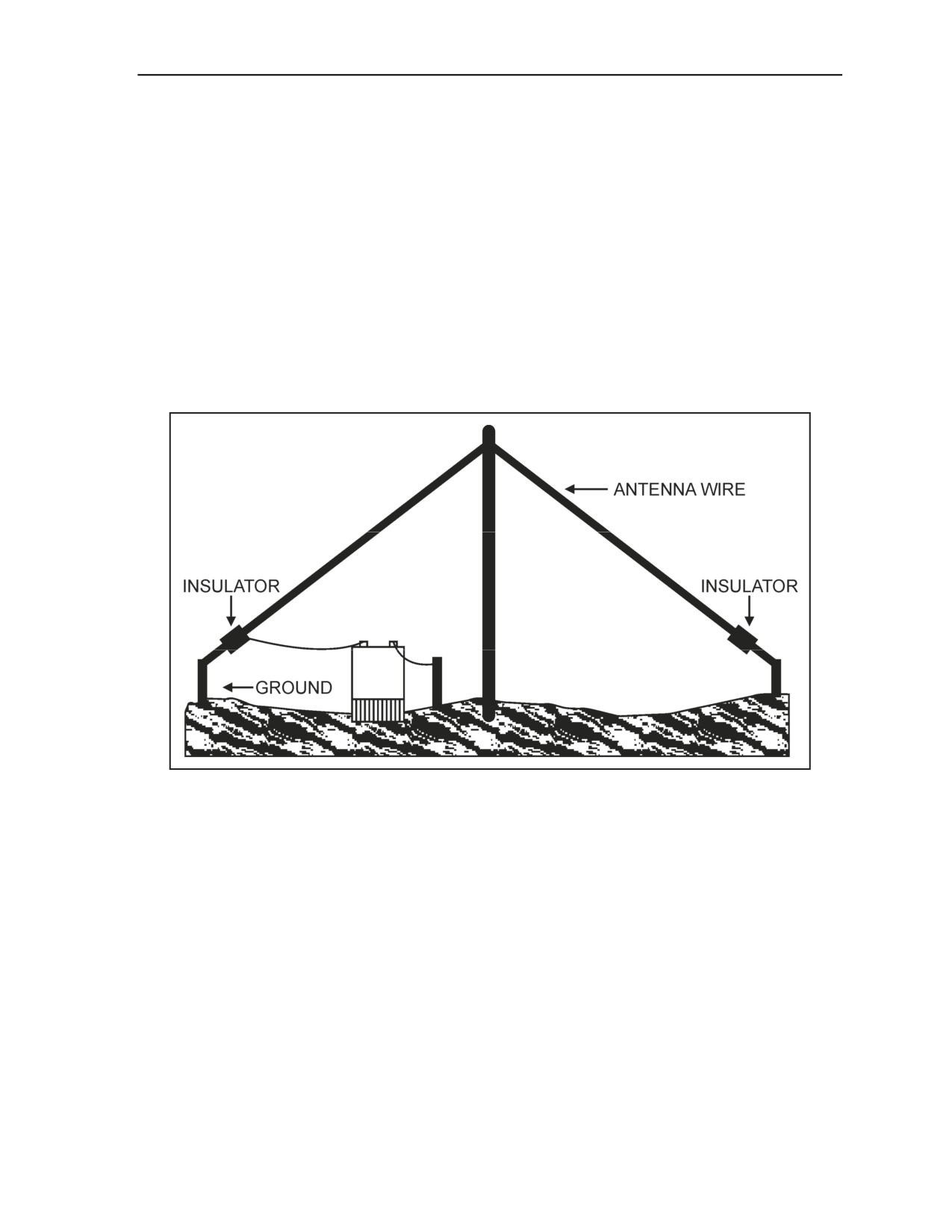
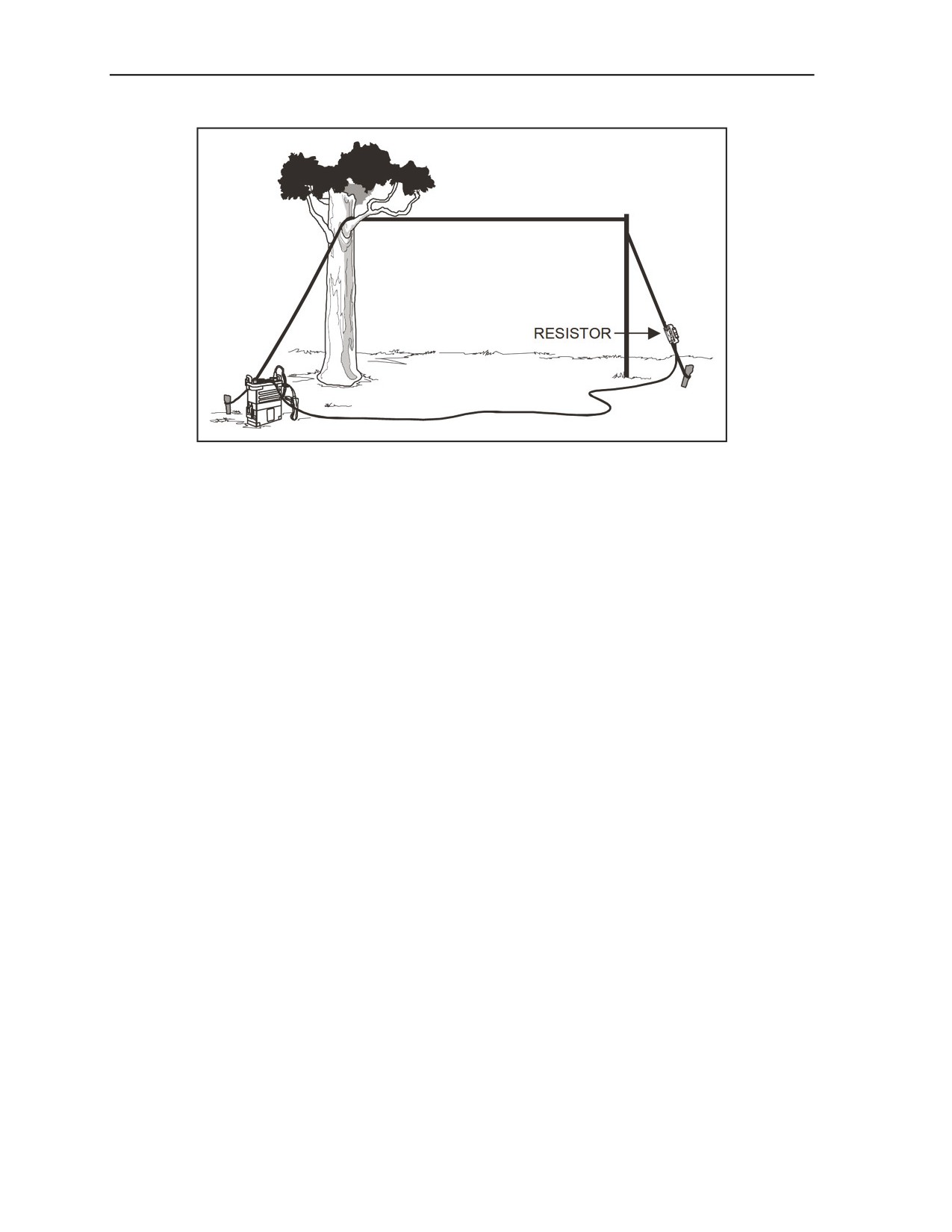
9-78. The vertical half rhombic antenna and the long-wire antenna are two field expedient directional
antennas. The long wire antenna directive pattern will radiate in both the horizontal and vertical planes and
the vertical half rhombic antenna will radiate both to the front and back of the sloping wires if resistors are
not used.
9-79. Figures 9-14 and 9-15 are examples of the vertical half rhombic antenna and the long wire antenna,
respectively. These antennas consist of a single wire, preferably two or more wavelengths long, supported
on poles at a height of 3-7 meters (10-20 ft) above the ground. However, the antennas will operate
satisfactorily as low as 1 meter (approximately 3.2 ft) above the ground.
9-80. The far end of the wire is connected to the ground through a non-inductive resistor of 500-600
ohms. To ensure the resistor is not burned out by the output power of the transmitter, use a resistor rated at
least one-half the wattage output of the transmitter. A reasonably good ground, such as a number of ground
rods or a counterpoise, should be used at both ends of the antenna. The antennas are used primarily for
transmitting or receiving HF signals.
Figure 9-14. Vertical half rhombic antenna
5 August 2009
FM 6-02.53
9-19
Chapter 9
Figure 9-15. Long-wire antenna
Sloping V Antenna
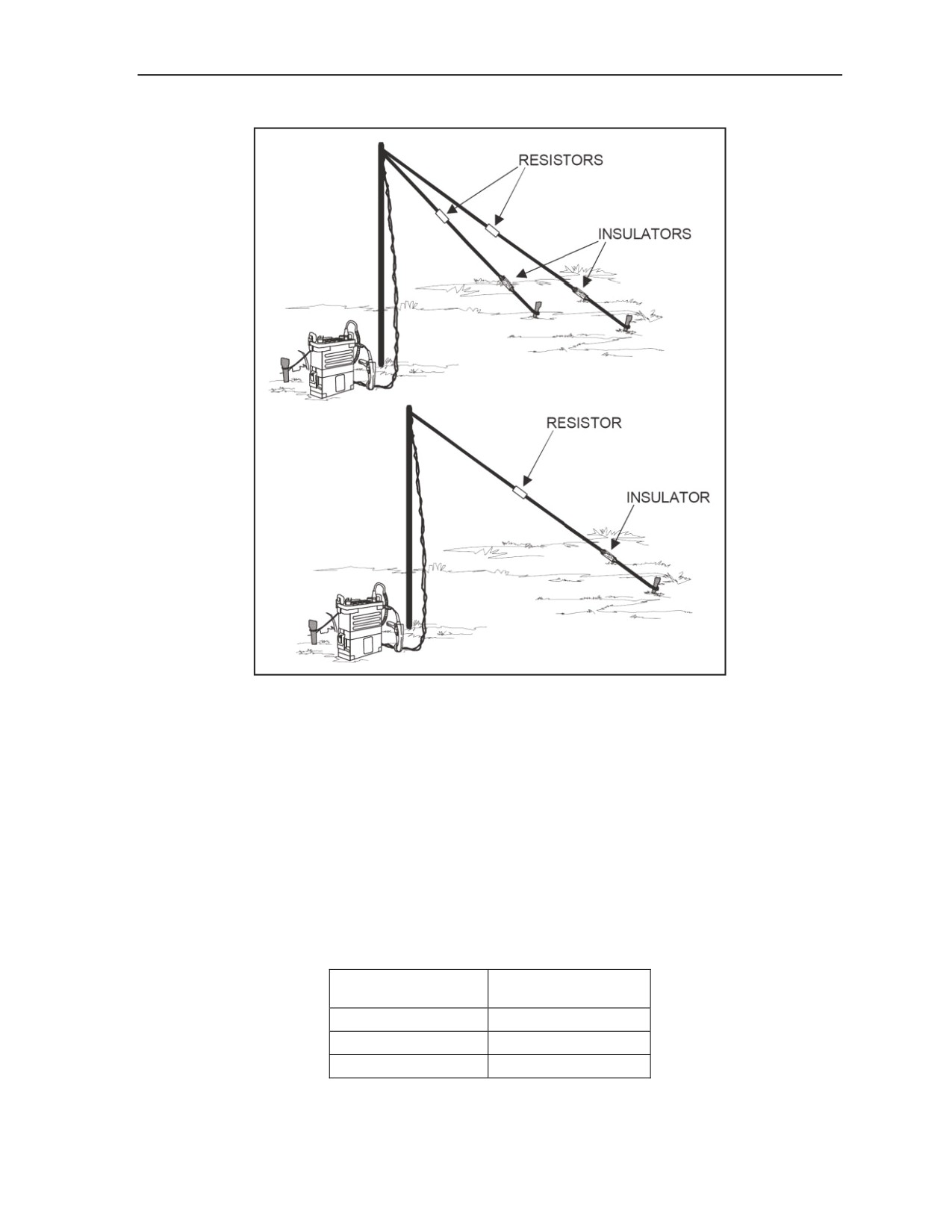
9-81. The sloping V antenna is another field expedient directional antenna. To make construction easier,
the legs may slope downward from the apex of the V (this is called a sloping V antenna). Figure 9-16 is an
example of a sloping V antenna.
9-82. To make the antenna radiate in only one direction, add non-inductive terminating resistors from the
end of each leg (not at the apex) to ground. The resistors should be approximately 500 ohms and have a
power rating at least one half that of the output power of the transmitter being used. Without the resistors,
the antenna radiates bi-directionally, both front and back. A balanced transmission line must feed the
antenna.
9-20
FM 6-02.53
5 August 2009
Antennas
Figure 9-16. Sloping-V antenna
Inverted L Antenna
9-83. The inverted L is a combination antenna made up of vertical and horizontal wire sections. It provides
omnidirectional radiation (when no resistors are being used) from the vertical element for ground wave
propagation, and high-angle radiation from the horizontal element for short-range sky wave propagation,
0-400 km (0-250 miles). The classic inverted L has a quarter-wave vertical section and a half-wave
horizontal section.
9-84. Table 9-3 outlines the frequency and the length of the horizontal element. Using a vertical height of
11-12 meters (35-40 ft), this combination will give reasonable performance for short-range sky wave
circuits. Figure 9-17 is an example inverted L antenna.
Table 9-3. Frequency and inverted L
horizontal element length
Operating Frequency
Length of
Horizontal Element
5.0-7.0 MHz
24.3 meters (80 ft)
3.5-6.0 MHz
30.4 meters (100 ft)
2.5-4.0 MHz
45.7 meters (150 ft)
5 August 2009
FM 6-02.53
9-21
Chapter 9
Figure 9-17. Inverted L antenna
Near-Vertical Incident Sky Wave Communications
9-85. The standard communications techniques used in the past will not support the widely deployed and
fast moving formations of today’s Army. Coupling this with the problems that can be expected in
deploying multi-channel LOS systems with relays to keep up with present and future operation, HF radio
and the NVIS mode take on new importance. The HF radio is quickly deployable, securable, and capable
of data transmission. HF (such as the AN/PRC-150 [C]) will be the first, and frequently the only, means of
communicating with fast-moving or widely separated units. With this reliance on HF radio,
communications planners, commanders, and operators must be familiar with NVIS techniques and their
applications and shortcomings in order to provide more reliable communications.
9-86. NVIS propagation is simply sky wave propagation that uses antennas with high angle radiation and
low operation frequencies. Just as the proper selection of antenna can increase the reliability of a long
range circuit, the same holds true for short range communications.
9-87. NVIS propagation uses high take-off angle (60-90 degrees) antennas to radiate the signal almost
straight up. The signal is then reflected back from the ionosphere and returns to Earth in a circular pattern
all around the transmitter. Because of near vertical radiation angle, there is no skip zone (skip zone is the
area between the maximum ground wave distance and the shortest sky wave distances where no
communications are possible). Communications are continuous out to several hundred kilometers from the
transmitter. The nearly vertical angle of radiation also means lower frequencies must be used.
9-88. Generally, NVIS propagation uses frequencies up to 8 MHz. The steep up and down propagation of
the signal gives the RTO the ability to communicate over nearby ridge lines, mountains, and dense
vegetation. A valley location may give the RTO terrain shielding from hostile intercept or protect the
circuit from ground wave and long wave interference. Antennas used for NVIS propagation need high
take-off angle radiation with very little ground wave radiation. Refer to Figure 9-18 for an example of
NVIS propagation.
9-22
FM 6-02.53
5 August 2009
Antennas
Figure 9-18. NVIS propagation
9-89. Using the HF antenna table matrix in Appendix C, the AS-2259/GR and the half wave dipole are the
only antennas listed that meet the requirements of NVIS propagation. While the inverted V and inverted L
have high angle radiation, they can also have strong ground wave radiation that could interfere with the
close-in NVIS communications.
Disadvantages of Using the NVIS Concept
9-90. It is also important to understand that where both NVIS and ground wave signals are present, the
ground wave can cause destructive interference. Proper antenna selection will suppress ground wave
radiation and minimize this effect while maximizing the amount of energy going into the NVIS mode.
Advantages of Using the NVIS Concept
9-91. The following are advantages of using NVIS in a tactical environment—
z
There are skip-zone-free omnidirectional communications.
z
Terrain does not affect loss of signal. This gives a more constant received signal level over the
operational range instead of one which varies widely with distance.
z
Operators are able to operate from protected, dug-in positions. Thus tactical commanders do not
have to control the high ground for HF communications purposes.
z
Orientation, such as, doublets and inverted antennas are not as critical.
9-92. The following are advantages of using NVIS in an EW environment—
z
There is a lower probability of geolocation. NVIS energy is received from above at very steep
angles, which makes direction finding (DF) from nearby (but beyond ground wave range)
locations more difficult.
z
Communications are harder to jam. Ground wave jammers are subject to path loss. Terrain
features can be used to attenuate a ground wave jammer without degrading the desired
communication path. The jamming signal will be attenuated by terrain, while the sky wave
5 August 2009
FM 6-02.53
9-23
Chapter 9
NVIS path loss will be constant. This will force the jammer to move very close to the target or
put out more power. Either tactic makes jamming more difficult.
z
Operators can use low power successfully. The NVIS mode can be used successfully with
very low power HF sets. This will result in much lower probabilities of LPI/D.
VHF/UHF ANTENNAS
9-93. The following paragraphs address VHF/UHF antennas and their characteristics and capabilities.
Whip Antenna
9-94. Whip antennas for VHF tactical radio sets are usually 4.5 meters (15 ft) long. A vehicular whip
antenna in HF operations has a planning range of 400-4,000 km (250-2,500 miles).
9-95. Two whip antennas are used with lightweight portable FM radios; a 0.9 meter (2.9 ft) long semi-
rigid steel tape antenna, and a 3 meter (9.8 ft) long multi-section whip antenna. These antennas are made
shorter than a quarter wavelength to ensure they are kept at a practical length. (A quarter wavelength
antenna for a 5.0 MHz radio would be over 14 meters/45.9 ft long.) An antenna tuning unit, either built
into the radio set or supplied with it, compensates for the missing length of the antenna. The tuning unit
varies the electrical length of the antenna to accommodate a range of frequencies.
9-96. Whip antennas are used with tactical radio sets because they radiate equally in all directions on the
horizontal plane. Since stations in a radio net lie in random directions and change their positions
frequently, the radiation pattern is ideal for tactical communications.
9-97. When a whip antenna is mounted on a vehicle, the metal of the vehicle affects the operation of the
antenna. Thus, the direction in which the vehicle is facing may also affect transmission and reception,
particularly of distant or weak signals.
9-98. At lower frequencies where wavelengths are longer, it is impractical to use resonant-length tactical
antennas with portable radio equipment, especially with vehicle-mounted radio sets. Tactical whip
antennas are electrically short, vertical, base loaded types, fed with a nonresonant coaxial cable of about 52
ohms impedance. Figure 9-19 is an example of a whip antenna.
Figure 9-19. Whip antenna
9-99. To attain efficiency with a tactical whip, comparable to that of a half-wave antenna, the height of the
vertical radiator should be a quarter wavelength. This is not always possible, so the loaded whip is used
instead. The loading increases the electrical length of the vertical radiator to a quarter wavelength. The
ground, counterpoise, or any conducting surface that is large enough, supplies the missing quarter-
wavelength of the antenna.
9-24
FM 6-02.53
5 August 2009
Antennas
9-100. A vehicle with a whip antenna mounted on the left rear side of the vehicle transmits its strongest
signal in a line running from the antenna through the right front side of the vehicle. Similarly, an antenna
mounted on the right rear side of the vehicle radiates its strongest signal in a direction toward the left front
side. Figure 9-20 shows the best direction for whip antennas mounted on vehicles. The best reception is
obtained from signals traveling in the direction shown by the dashed arrows on the figure.
9-101. In some cases, the best direction for transmission can be determined by driving the vehicle in a
small circle until the best position is located. Normally, the best direction for receiving from a distant
station is also the best direction for transmitting to that station.
Figure 9-20. Whip antennas mounted on a vehicle
9-102. Sometimes, a whip antenna mounted on a vehicle must be left fully extended so that it can be used
instantly while the vehicle is in motion. The base-mounted insulator of the whip is fitted with a coil spring
attached to a mounting bracket on the vehicle. The spring base allows the vertical whip antenna to be tied
down horizontally when the vehicle is in motion, and when driving under low bridges or obstructions.
Even in the vertical position, if the antenna hits an obstruction, the whip usually will not break because the
spring base absorbs most of the shock.
9-103. Some of the energy leaving a whip antenna travels downward and is reflected by the ground with
practically no loss. To obtain greater distance in transmitting and receiving, it may be necessary to raise the
whip antenna. However, when a whip antenna is raised, its efficiency decreases because it is further from
the ground. Therefore, when using a whip antenna at the top of a mast, supply an elevated substitute for the
ground (ground plane).
DANGER
When an antenna must be left fully extended while in motion,
contact with overhead power lines must be avoided. Death or
serious injury can result if a vehicular antenna strikes a high-
voltage transmission line. If the antenna is tied down, be sure the
tip protector is in place.
5 August 2009
FM 6-02.53
9-25
Chapter 9
Broadband Omnidirectional Antenna
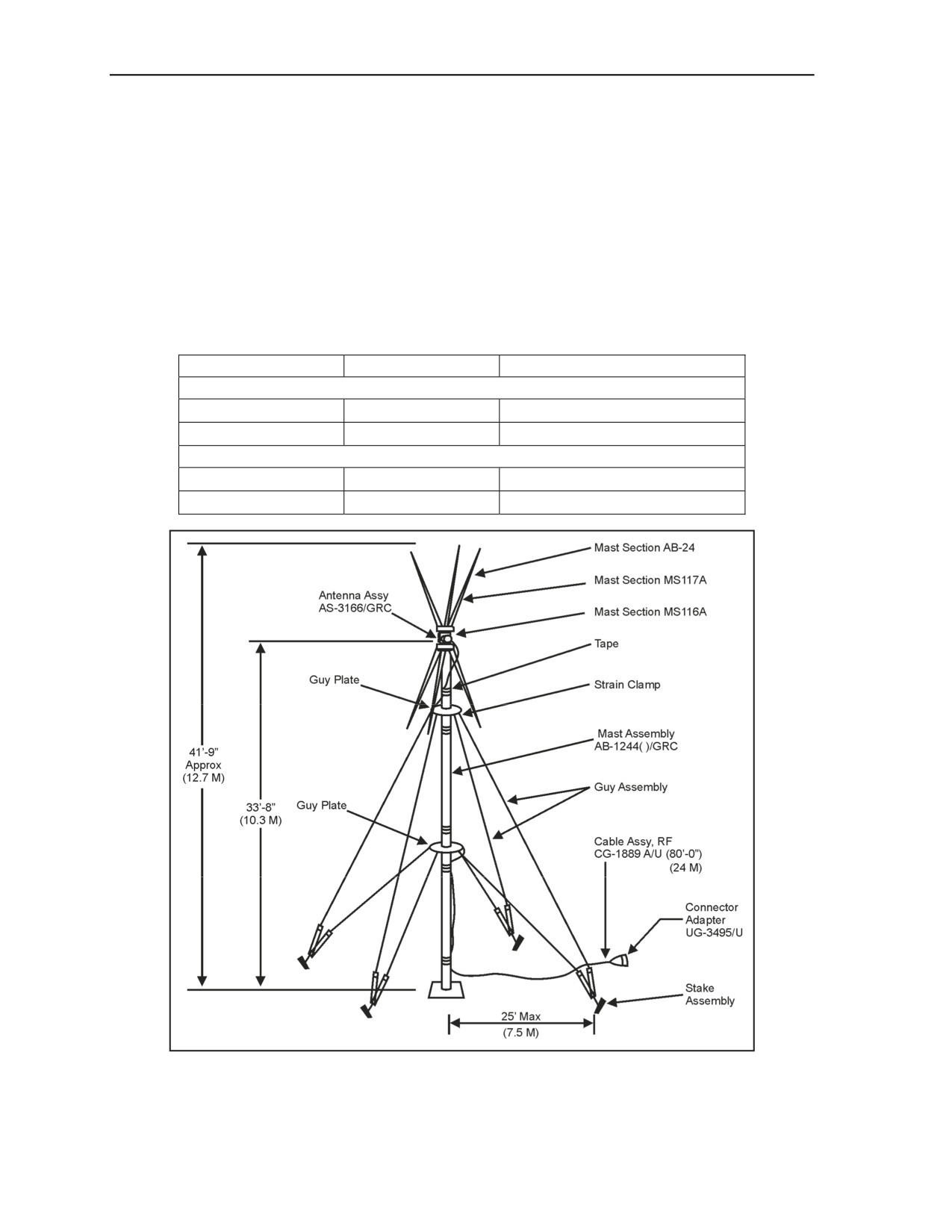
9-104. The broadband omnidirectional, vertically polarized, VHF antenna system OE-254 (refer to Figure
9-21) is an improved tactical antenna. Table 9-4 shows planning ranges for the OE-254 antenna. The OE-
254 antenna—
z
Operates in the 30-88 MHz range without any physical adjustments.
z
Has input impedance of 50 ohms unbalanced with an average voltage standing wave ratio
(VSWR) of 3:1 or less, at RF power levels up to 350 watts.
z
Is capable of being assembled and erected by one individual.
z
Meets the broadband and power handling requirements of the frequency hopping multiplexer
(FHMUX). (For more information on the OE-254 antenna refer to TM 11-5985-357-13.)
Table 9-4. OE-254 planning ranges
Terrain
High Power
Low Power (Nominal Conditions)
OE to OE
Average Terrain
57.9 km (36 miles)
19.3 km (12 miles)
Difficult Terrain
48.3 km (30 miles)
OE to Vehicle Whip
Average Terrain
48.3 km (30 miles)
12.9 km (8 miles)
Difficult Terrain
40.3 km (25 miles)
Figure 9-21. OE-254 broadband omnidirectional antenna system
9-26
FM 6-02.53
5 August 2009
Antennas
Quick Erect Antenna Mast, AB 1386/U
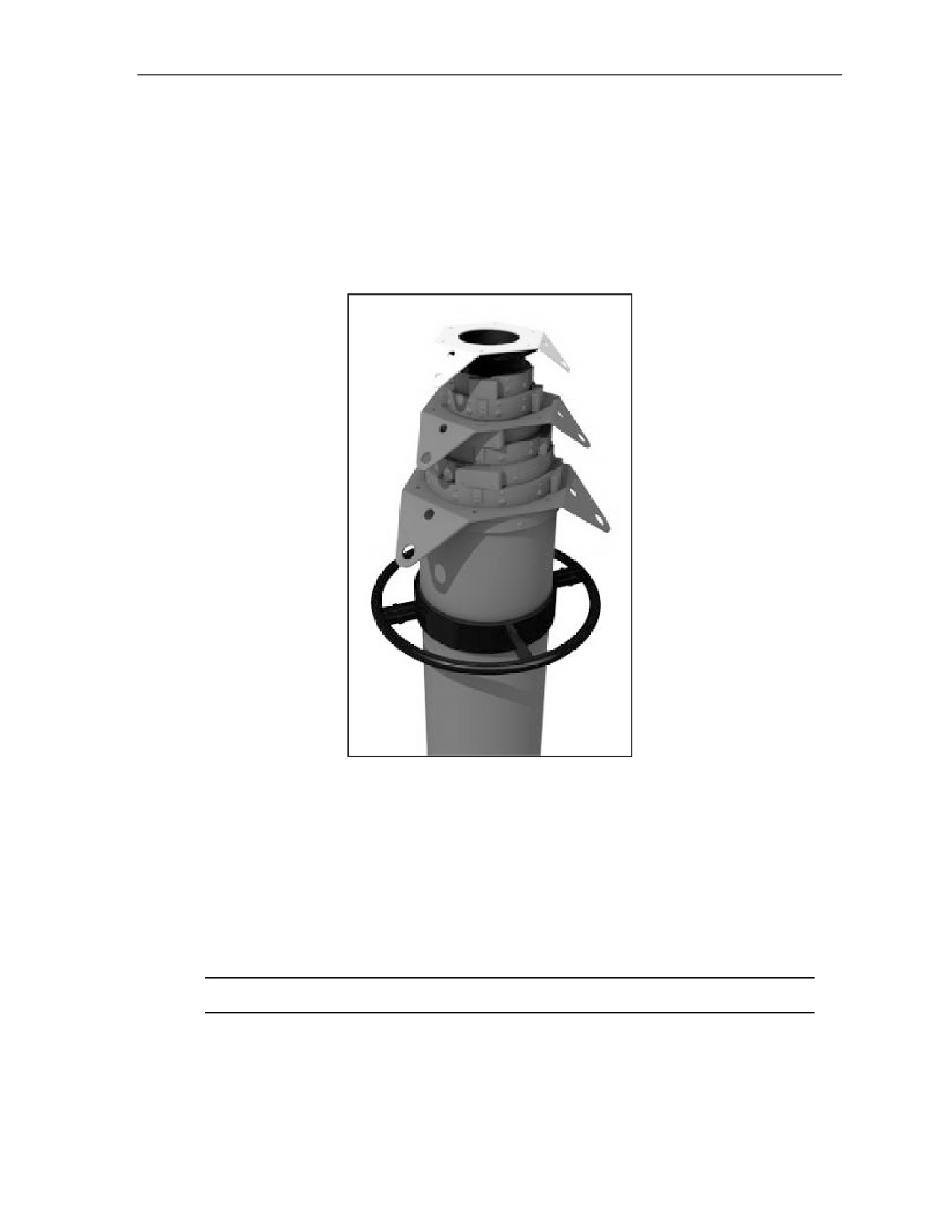
9-105. The quick erect antenna mast (QEAM) is used for elevating tactical communications antennas to a
maximum height of 33 ft (10 meters) which results in more reliable communications over extended ranges.
The QEAM uses the same antenna elements and RF cable as the OE-254 antenna The QEAM will mount
the OE-254, MSE and EPLRS antenna.
9-106. The mast can be deployed and operated in a ground or vehicular (wheeled and tracked) mounted
configuration. It can also be erected in 7 ½ minutes by two Soldiers and only 15 minutes by one. Refer to
Figure 9-22 for an example of the QEAM.
Figure 9-22. QEAM AB 1386/U
COM 201B Antenna
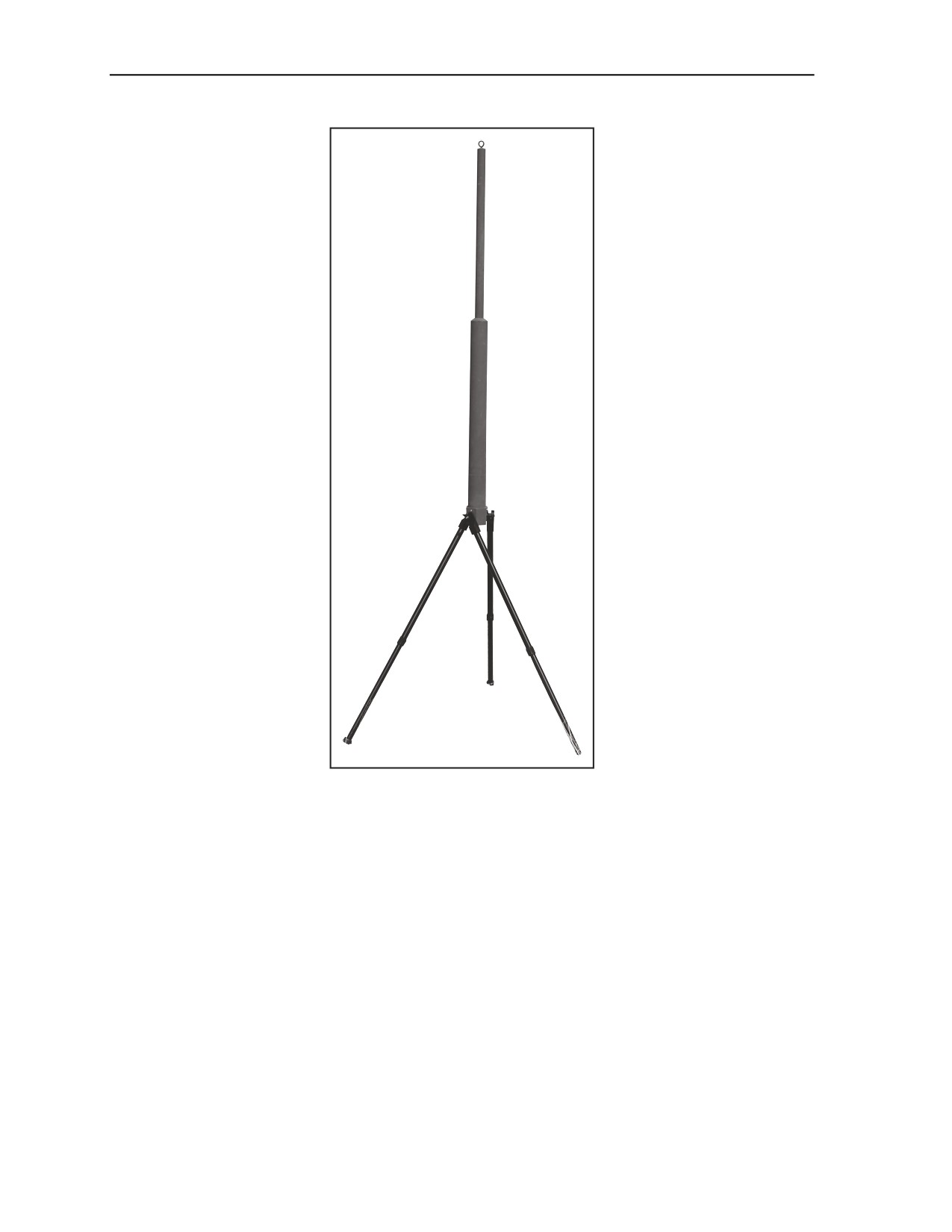
9-107. The COM 201B antenna is a commercial (from Atlantic Microwave Corporation) VHF/UHF
vertically polarized, omnidirectional antenna that has become popular due to its versatility and unique
design. The antenna was originally used by the USMC and is now a standard USMC item. It has a tripod
leg structure that allows the antenna to be mounted directly on the ground or in a standard communications
mast and can be quickly assembled and disassembles for transport and storage which makes it ideal in
situations where there is not enough time to erect the OE-254. Refer to Figure 9-23 for an example of the
COM 201-B.
Note. The COM 201B is not an Army issued replacement for the OE-254 antenna.
5 August 2009
FM 6-02.53
9-27
Chapter 9
Figure 9-23. COM-201B antenna
9-108. The antennas ease of operations makes it ideal for a field expedient antenna or mounting to a
vehicle if more elevation is needed. The eye fitting at the top of the antenna facilitates suspending it from
buildings or trees when a mast isn’t available but more height is desired.
9-109. The COM 201B antenna has the following characteristics and capabilities—
z
Operates in the 30-88 MHz range.
z
Vertically polarized.
z
Input impedance of 50 ohms unbalanced with an average VSWR of 3:1 or less, at RF power
levels up to 200 watts.
z
Maximum power is directed towards the horizon with a typical antenna gain of +2 dB relative to
an isotropic source.
z
One individual can assemble and erect.
z
Assembly can be stored in a space less than 36 inches by 10 inches in diameter.
9-28
FM 6-02.53
5 August 2009
Antennas
OE-303, VHF Half Rhombic Antenna
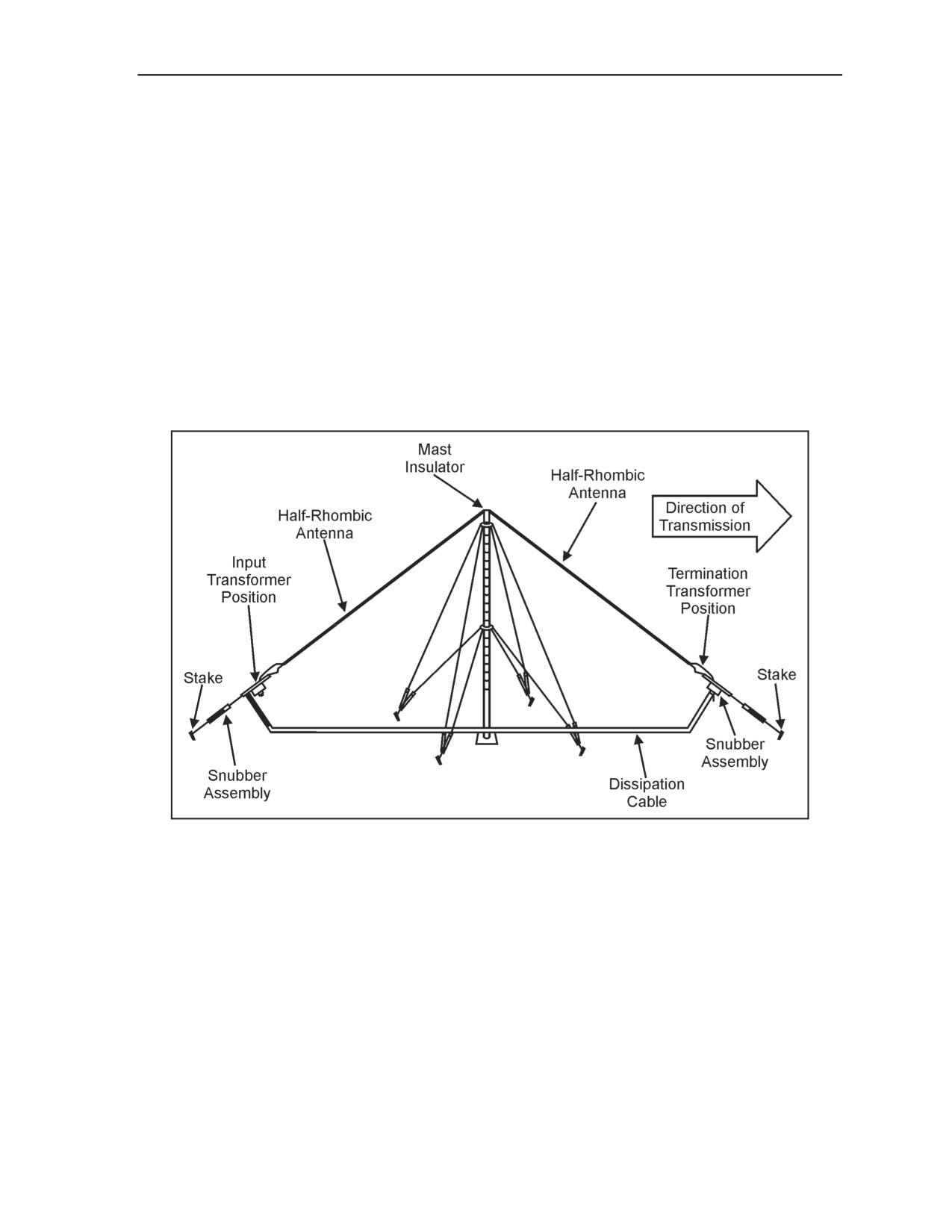
9-110. The VHF half rhombic antenna is a vertically polarized antenna that, when used with VHF FM
tactical radios, extends the range of transmission considerably and provides some degree of EP. The half
rhombic antenna, when properly employed, decreases VHF FM radio susceptibility to hostile EW
operations, and enhances the communications ranges of the deployed radio sets. This effect is realized by
directing the maximum signal strength in the direction of the desired friendly unit.
9-111. The VHF half rhombic antenna is a high gain, lightweight, directional antenna. It operates over the
frequency range of 30-88 MHz. The antenna and all the ancillary equipment (guys, stakes, tools, and mast
sections) can be packaged in a carrying bag for manpack or vehicular transportation.
9-112. Figure 9-24 is an example of the OE-303 VHF half rhombic antenna. The planning range for the
OE-303 is equivalent to the planning range of the OE-254. The OE-303 half rhombic antenna is used with
the AB-1244 mast assembly, consisting of 12 tubular mast sections (five lower-mast sections, one mast
transition adapter, five upper-mast sections, and antenna adapter), a mast base assembly, and assorted
ancillary equipment. When erected, the mast assembly is stabilized by a two-level, four-way guying
system.
Figure 9-24. OE-303 half rhombic VHF antenna
9-113. The OE-303 antenna handles RF power levels up to 200 watts. It matches a nominal 50 ohm
impedance with a VSWR of no more than 2:1, over the entire frequency range of the antenna. It meets the
operation, storage, and transit requirements as specified in AR 70-38.
9-114. The OE-303 half rhombic antenna has the following characteristics and capabilities—
z
Erected in a geographical area of 53.3 meters (175 ft) in diameter, or less, depending upon the
frequency.
z
Mounted on any structure approximately 15.2 meters (50 ft) in height.
z
Azimuthal directional change within 1 minute.
z
Transported by manpack or tactical vehicle when fitted into a package.
z
Operation with the four-port FHMUX.
9-115. The OE-303 half rhombic antenna is used for special applications; it is task assigned as required.
Its primary use is on C2 and intelligence nets to a higher headquarters. It must be available for use by units
5 August 2009
FM 6-02.53
9-29
Chapter 9
that habitually operate over extended distances from parent units, and must be available to units for special
tasks. For more information on the half rhombic OE-303 antenna, refer to TM 11-5985-370-12.
High Frequency Antennas Usable at VHF and UHF
9-116. Simple vertical half-wave dipole/doublet and quarter wave monopole antenna are very popular for
omnidirectional transmission and reception over short range distances. For longer distances, rhombic
antennas made of wire and somewhat similar in design to HF versions may be used to good advantage at
frequencies as high as 1 GHz.
Dipole (Doublet) Antenna
9-117. The dipole (doublet) is a half-wave antenna consisting of two quarter wavelength sections on each
side of the center. It is also considered a center fed antenna. Figure 9-25 is an example of an improvised
dipole (doublet) antenna used with FM radios.
Figure 9-25. Half-wave dipole (doublet) antenna
9-118. A transmission line is used for conducting electrical energy from one point to another, and for
transferring the output of a transmitter to an antenna. Although it is possible to connect an antenna directly
to a transmitter, the antenna generally is located some distance away. In a vehicular installation, for
example, the antenna is mounted outside, and the transmitter inside the vehicle.
9-119. Center-fed half-wave FM antennas can be supported entirely by pieces of wood. Figure 9-26 is an
example of a horizontal (A) and vertical (B) center-fed half-wave antenna. These antennas can be rotated
to any position to obtain the best performance. If the antenna is erected vertically, the transmission line
should be brought out horizontally from the antenna, for a distance equal to at least one-half of the
antenna’s length, before it is dropped down to the radio set.
9-30
FM 6-02.53
5 August 2009
Antennas
Figure 9-26. Center-fed half-wave antenna
9-120. Figure 9-27 is an example of an improvised vertical half-wave antenna. This technique is used
primarily with FM radios. It is effective in heavily wooded areas to increase the range of portable radios.
The top guy wire can be connected to a limb, or passed over the limb and connected to the tree trunk or a
stake.
5 August 2009
FM 6-02.53
9-31
Chapter 9
Figure 9-27. Improvised vertical half-wave antenna
SATELLITE COMMUNICATIONS ANTENNAS
9-121. The most important consideration in siting LOS equipment is the antenna elevation with respect to
the path terrain. Choose sites that exploit natural elevations.
Antenna Siting Considerations
9-122. The most important consideration in siting over-the-horizon systems is the antenna horizon
(screening angles) at the terminals. As the horizon angle increases, the transmission loss increases,
resulting in a weaker signal.
9-123. The effect of the horizon on transmission loss is very significant. Except where the consideration
of one or more other factors outweighs the effect of horizon angles, the site with the most negative angle
should be fist choice. If no sites with negative angles exist, the site with the smallest positive angle should
be the first choice.
9-124. The horizon angle can be determined by using a transit at each site and sighting along the circuit
path. The on-site survey will determine the visual horizon angle. The radio horizon angle is slightly
different from the visual horizon angle: however, the difference is generally insignificant.
9-32
FM 6-02.53
5 August 2009
Antennas
9-125. The horizon angle is measured between the tangent at the exact location of the antenna and a
direct LOS to the horizon. The tangent line is a right angle (90 degrees) to a plumb line at the antenna site.
If the LOS to the horizon is below the tangent line, the horizon angel is negative.
9-126. Trees, building, hills or the Earth can block a portion of the UHF signals, causing an obstruction
loss. To avoid signal loss due to obstruction and shielding, clearance is required between the direct LOS
and the terrain. Path profile plots are used to determine if there is adequate clearance in LOS systems.
9-127. Weak or distorted signals may result if the SATCOM set is operated near steel bridges, water
towers, power lines, or power units. The presence of congested air-traffic conditions on the proximity of
microwave equipment can result in significant signal fading, particularly when a non-diversity mode is
employed.
9-128. For LOS and TACSAT communications the AN/PSC-5 family of radios are the most widely used
radios. The AN/PSC-5 provides LOS communications with the AS-3566 antenna and long range
SATCOM with the AS-3567 and AS-3568 antennas. The following paragraphs describe several antennas
and their characteristics.
AS-3566, Low Gain Antenna
9-129. The AS-3566 has the following characteristics—
z
Frequency range (LOS): 30-400 MHz.
z
DAMA: 225-400 MHz.
z
Non DAMA: 225-400 MHz.
z
Polarization: directional.
z
Power capability: determined by terminating resistor.
z
Azimuthal (bearing): directional.
AS-3567, Medium Gain Antenna
9-130. The AS-3567 (refer to Figure 9-28) has the following characteristics—
z
Frequency range: 225-399.995 MHz.
z
Beam width: 85 degrees.
z
Orientation:
Directional.
Elevation (0-90 degrees).
z
Input impedance: 50 ohms.
z
VSWR: 1.5:1
z
Gain:
6 dB (225-318 MHz).
5 dB (318-399.995 MHz).
5 August 2009
FM 6-02.53
9-33
Chapter 9
Figure 9-28. AS-3567, medium gain antenna
AS-3568, High Gain Antenna
9-131. The AS-3566 (refer to Figure 9-29) has the following characteristics—
z
Frequency range: 240-400 MHz.
z
Beam width: 77 degrees.
z
Orientation:
Directional.
Elevation (0 to 90 degrees).
Azimuth+180 degrees.
z
Input impedance: 50 ohms.
z
VSWR: 1.5:1
z
Gain:
8 dB (240-318 MHz).
6 dB (318-400 MHz).
z
Power: up to 140 watts.
9-34
FM 6-02.53
5 August 2009
Antennas
Figure 9-29. AS-3568, high-gain antenna
FIELD REPAIR
9-132. Antennas that are broken or damaged cause poor communications or even communications failure.
If a spare antenna is available, replace the damaged antenna. When a spare is not available, the user may
have to construct an emergency antenna. The following paragraphs provide suggestions on repairing
antennas and antenna supports.
REPAIR OF A WHIP ANTENNA
9-133. A broken whip antenna can be temporarily repaired. If the whip is broken in two sections, rejoin
the sections. Remove the paint and clean the sections this will help to ensure a good electrical connection.
Place the sections together, secure them with a pole or branch, and lash them with bare wire or tape above
and below the break (refer to Figure 9-30, antenna A).
9-134. If the whip is badly damaged, use a length of field wire (WD-1/TT) the same length as the original
antenna. Remove the insulation from the lower end of the field wire antenna, twist the conductors together,
insert them in the antenna base connector, and secure with a wooden block. Use either a pole or a tree to
support the antenna wire (refer to Figure 9-30, antenna B).
5 August 2009
FM 6-02.53
9-35
Chapter 9
Figure 9-30. Field repair of broken whip antennas
WIRE ANTENNAS
9-135. Emergency repair of a wire antenna may involve the repair or replacement of the wire used as the
antenna or transmission line. It may also involve the repair or replacement of the assembly used to support
the antenna. When one or more antenna wires are broken, reconnecting the broken wires can repair the
antenna. To do this, lower the antenna to the ground, clean the ends of the wires, and twist the wires
together. When possible, solder the connection and reassemble.
9-136. Antenna supports may also require repair or replacement. A substitute item may be used in place
of a damaged support and, if properly insulated, may consist of any material of adequate strength. If the
radiating element is not properly insulated, field antennas may be shorted to ground, and be ineffective.
9-137. Many common items can be used as field expedient insulators. Plastic or glass (to include plastic
spoons, buttons, bottlenecks, and plastic bags) is the best insulator. Wood and rope also act as insulators
although they are less effective than plastic and glass (refer to Figure 9-31 for examples of field expedient
antenna insulators). The radiating element, the actual antenna wire, should touch only the antenna terminal,
and should be physically separated from all other objects other than the supporting insulator.
9-36
FM 6-02.53
5 August 2009
Antennas
Figure 9-31. Examples of field expedient antenna insulators
ANTENNA GUYS
9-138. Guys stabilize the supports for an antenna. They are usually made of wire, manila rope, or nylon
rope. Broken rope can be repaired by tying the two broken ends together. If the rope is too short after the
tie is made, add another piece of rope or a piece of dry wood or cloth to lengthen it. Broken guy wire can
be replaced with another piece of wire. To ensure that the guys made of wire do not affect the operation of
the antenna, cut the wire into several short lengths and connect the pieces with insulators. Figure 9-32
shows an example of repaired guy lines with wood.
5 August 2009
FM 6-02.53
9-37
Chapter 9
Figure 9-32. Repaired antenna guy lines and masts
Antenna Masts
9-139. Masts support some antennas and if broken, one can be replaced with another of the same length.
When long poles are not available as replacements, short poles may be overlapped and lashed together with
rope or wire to provide a pole of the required length.
9-38
FM 6-02.53
5 August 2009
Chapter 10
Automated Communications Security Management and
Engineering System
This chapter addresses the Automated Communications Security Management and
Engineering System (ACMES) and its hardware and software components, designed
to meet critical requirements to both decentralize and automate the process of
generating and distributing data vital to communications systems. The ACMES
supports the current version of the AKMS.
SYSTEM DESCRIPTION
10-1. The AKMS integrates all functions of cryptographic management and engineering, SOI, EP, and
cryptographic key generation, distribution, accounting, and audit trail recordkeeping into a total system
designated as the ACMES.
10-2. The ACMES provides commanders the necessary tools to work with the widely proliferating
COMSEC systems associated with the MSE, JTIDS, EPLRS, SINCGARS, and other keying methods
(electronic key generation, OTAR transfer, and electronic bulk encryption and transfer) being fielded by
the Army.
10-3. The ACMES is a hardware and software system that provides the communications planner with the
capability to design, develop, generate, distribute, and manage both decentralized and automated
communications-electronics operating instructions (CEOI)/SOIs. ACMES can produce the EP fill variables
to support SINCGARS in data file and electronic formats; it also produces SOI outputs in either electronic
or hard copy (paper) formats. The objective is to fully utilize the electronic data storage devices (ANCD
and SKL) to eliminate the need for exclusive use of a hard copy paper SOI.
10-4. The planning and distribution of ACMES products are essential to the success of military operations,
and are a command responsibility. The controlling authority is the commander, who establishes a
cryptographic net. Within divisions, brigades, and battalions, commanders may be assigned responsibilities
depending upon command policy and operational situations. Table 10-1 outlines the ACMES functions and
products at various command levels, theater to battalion.
10-5. Signal officers at corps and division
(G-6s) levels
(and separate brigades) use their ACMES
components to design, develop, generate, and distribute CEOI and SINCGARS FH data, along with HF,
UHF, and VHF frequency assignments at their respective levels and subordinate levels, as appropriate.
10-6. Brigades and separate battalion units use their ACMES components to selectively distribute
generated CEOI and SINCGARS FH data for use at their respective and subordinate levels.
Note. Refer to AR 380-40, AR 380-5, AR 25-2, AR 380-53, and FM 6-02.72 for additional
information on controlling authority and commanders’ responsibilities regarding cryptographic
networks.
5 August 2009
FM 6-02.53
10-1

Chapter 10
Table 10-1. ACMES functions at various command levels
Command
Media
Function
Levels
Theater
Disk
Generates pairs of operational TRANSEC keys every
30 days, for ICOM and non-ICOM SINCGARS. The
communications systems directorate of a joint staff (J-
6) generates the TRANSEC keys every 90 days.
Corps
Disk
Generates the sign/countersign, smoke/pyrotechnic
signals, suffix/expander, hopsets, and CEOI/SOI at
corps level; receives TRANSEC keys from theater.
Division
Disk/ANCD/SKL
Uses corps data, or if authorized, generates and
merges SOI data, generates COMSEC data (division
TEK), and generates FH data (NET IDs and division
TSKs).
Brigade
Disk/ANCD/SKL
Receives the generated CEOI/SOI and other data,
such as hopsets and TRANSEC keys from division.
Battalion
Disk/ANCD/SKL/
Receives the CEOI/SOI information and other data
Paper and ECCM
such as hopsets and TRANSEC keys from the
Fill Device
brigade.
Note. In some situations, theater may not be the highest level of command to generate TRANSEC keys. It depends
on the mission, situation and if the unit is a supporting command.
HARDWARE
10-7. The following paragraphs address ACMES hardware components (AN/GYK-33A, lightweight
computer unit
[LCU], LCU printer, random data generator
[RDG], and ANCD). These hardware
components, along with the software, make up the ACMES workstation. Workstations with the RDG are
organic to corps, divisions, and separate brigades. (Refer to FM 6.02-72 for more information on the
ACMES workstation.)
AN/GYK-33A, LIGHTWEIGHT COMPUTER UNIT
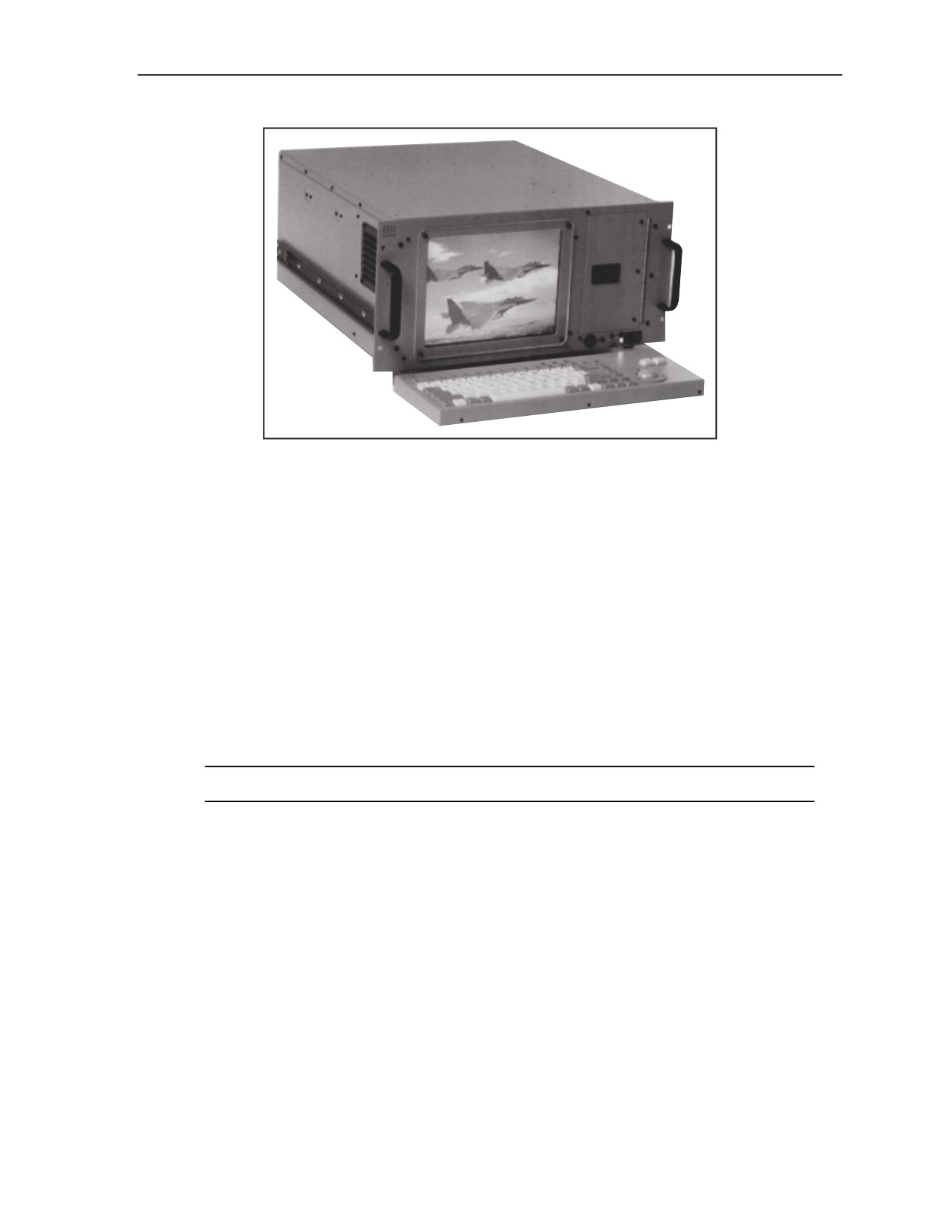
10-8. The LCU is a computer system that may serve as a host for many application software packages
(programs) designed to provide the user with the means to accomplish assigned missions. Figure 10-1 is an
example of a LCU.
10-9. When operating the ACES and ACES DTD application software, the LCU provides the user with the
capability to generate, store, print, and/or electronically transfer both SC and FH information. It also
provides the TSK for EP. These capabilities are designed to be more responsive to rapidly changing and
highly mobile conditions on the battlefield.
10-10. The LCU consists of a computer with a keyboard and a crystal display. The 10-inch display
normally shows 25 80 character lines of alphanumeric information. The video graphics array display
contains 640 x 480 pixels, and supports 16 levels of shading. The LCU may be used at a fixed workstation
or may be carried to most locations when using battery power. The LCU holds 20 rechargeable nickel
cadmium or alkaline batteries (size C). Mission duration under battery power is less than two hours, at 70
degrees ambient temperature, unless batteries are recharged or replaced. A typical workstation setup might
require space for peripheral devices such as a printer, printer paper, interface transfer cables, and/or
interfaced devices (for example, SINCGARS and ANCDs).
10-2
FM 6-02.53
5 August 2009
Automated Communications Security Management and Engineering System
Figure 10-1. Lightweight computer unit
LIGHTWEIGHT COMPUTER UNIT PRINTER
10-11. The LCU printer is a small, lightweight dot-matrix printer that is easily transportable. The LCU
printer has a print rate of 160 characters per second in the draft printing mode, and 80 characters per
second in the near-letter-quality printing mode. It is powered by either battery, or the LCU power supply.
The printer ribbon is capable of printing several hundred pages; it is disposable, and easily replaced. The
normal line width is 80 characters. The printer will accept paper widths from three to 8.5 inches, and has a
tractor feed attachment that accepts 8.5 x 11 inch continuous form, fan-fold paper. The printer operates on
9-36 VDC (battery and vehicular), or 110 VAC.
RANDOM DATA GENERATOR, AN/CSZ-9
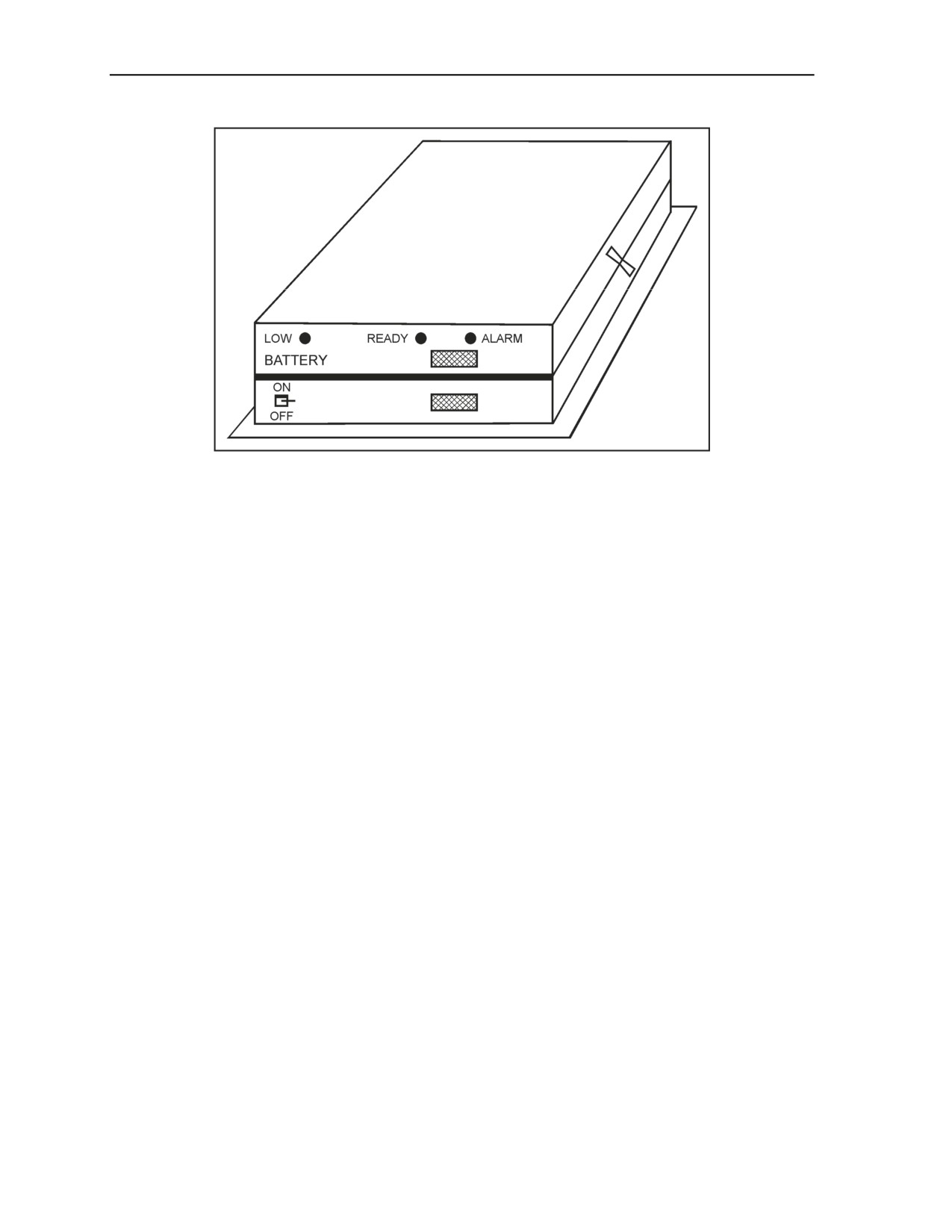
10-12. The RDG provides the LCU with the necessary random data to allow the ACES software to
generate SOI and/or TSK fill data. Figure 10-2 shows the RDG. It is a controlled cryptographic item, and
must be transported as authorized by AR 380-5.
Note. RDGs are only authorized and issued for use at selected echelons.
10-13. The RDG is a self-contained unit, powered by five D-size 1.5 volt batteries, located beneath the
bottom shelf/foot plate of the unit. Serviceable batteries should be installed prior to using the unit.
10-14. The on/off switch on the front panel activates the RDG; however, the unit does have a sleep mode
that inactivates the unit when not in use for an extended period, to conserve energy drain from the unit’s
battery power supply. The unit is provided with a cable that connects the unit (from its rear panel) to a
serial port on the computer.
5 August 2009
FM 6-02.53
10-3
Chapter 10
Figure 10-2. Random data generator
SOFTWARE
10-15. Revised DTD software (RDS) and the ACES application software make up the applications
software for ACMES.
10-16. The RDS software is unclassified, pre-installed on the ANCD, and designated to provide support
of user’s needs with regard to SOIs and FH data for the FH SINCGARS. RDS is divided into a CEOI/SOI
portion and a SINCGARS portion.
10-17. The CEOI/SOI portion provides the capability to receive, store, display, and transfer CEOI/SOI
data.
10-18. The SINCGARS portion of RDS provides the capability to fill SINCGARS, and receive, store,
display, and transfer the data that is required to fill these radios.
AUTOMATED COMMUNICATIONS ENGINEERING SOFTWARE
10-19. ACES is a net planning software program that replaced the Revised Battlefield Electronic
Communications-Electronics Operational Instruction/Signal Operating Instructions System (RBECS), for
the US Army. ACES works in a ruggedized Windows NT COTS platform for tactical operations as well as
in desktop Windows NT workstations in strategic locations. ACES allows military users to perform fully
automated cryptographic net, SOI, CEOI, joint CEOI and EP planning, management, validation and
generation distribution at the time and location needed.
10-20. The network planning functionality of ACES incorporates cryptonet planning, key management,
and key tag generation. The planning concept relates to the development of network structures supporting
missions and plans. The data for a given plan includes individual nets, which are assigned individual net
members. Net members are associated with a specific platform and equipment. Once net members,
platforms, and equipment are designated, specific equipment fill locations are defined and key tags/keys
are associated with the equipment locations.
10-21. The equipment records, which include platform data, net data, and key tags, are then downloaded
to the DTD, and subsequently associated with the required key. Similarly, the EP data and SOI are
generated by the ACES workstation operator and can be downloaded to the DTD.
10-4
FM 6-02.53
5 August 2009
Automated Communications Security Management and Engineering System
MASTER NET LIST
10-22. Master net list (MNL) maintains all nets requiring SOI assignments. Maintaining the MNL is
essential to creating deconflicted SOI assignments. Additionally, nets that have been created or imported
may be edited from the MNL allowing individual frequency assignments to be tracked with assigned
equipment. The ACES version of the MNL has direct correlation to standard frequency action format
(SFAF) line item numbers, so as you create the MNL the base for the SFAF and the SOI is being compiled
at the same time.
10-23. The MNL is the database link for all information listed under a plan, such as nets, frequencies and
equipment. The MNL provides the capability to create, edit, organize, and delete nets. Before creating the
MNL, the ACES workstation operator must know how many nets are required, what types of equipment
will be used, and specific information about the equipment, such as maximum transmit power, frequency
bands, and emission designators. This information is available from the spectrum or area frequency
manager. This section provides the information in creating the MNL folder and entering and managing the
information within the folder. (Refer to TB 11-7010-293-10-2 for more detailed information on ACES and
how to build a MNL.)
10-24. The MNL module of the ACES software may also be displayed in service specific views (US
Army, USN, USAF, and USMC) or joint combined. The MNL also incorporates a number of SFAF
compatible fields to facilitate the transfer of data to and from other frequency management systems such as
Spectrum XXI, as well as service unique systems. The database capabilities of the ACES workstation allow
the data in the MNL to be used to create the initial SFAF frequency proposal and the SOI.
10-25. The ACES software components on the ACES workstation include the ACES core module,
general purpose module, resource manager module, MNL module, SOI module, and CNR module.
COMBAT NET RADIO MODULE
10-26. The CNR module provides the necessary functions and procedures to create and modify hopsets,
loadsets, and to generate SINCGARS TSKs. It also provides the capability to plan CNR nets in all bands.
CNR net planning is integrated with the MNL module.
RESOURCE MANAGER MODULE
10-27. The resource manager module contains frequency resources and allows these resources to be
created, edited, merged, deleted, and printed. The resource manager also provides the planner the capability
to import and export resources in RBECS, ACES, integrated system control, and SFAF formats.
SIGNAL OPERATING INSTRUCTIONS MODULE
10-28. The SOI module allows editions to be created and updated. Each SOI is identified by a short title
and edition and may contain up to ten time periods. SOI is a series of orders issued to control and
coordination of the signal operations of a command or activity. It provides guidance needed to ensure the
speed, simplicity, and security of communications. Nets are selected from the MNL to be included in a
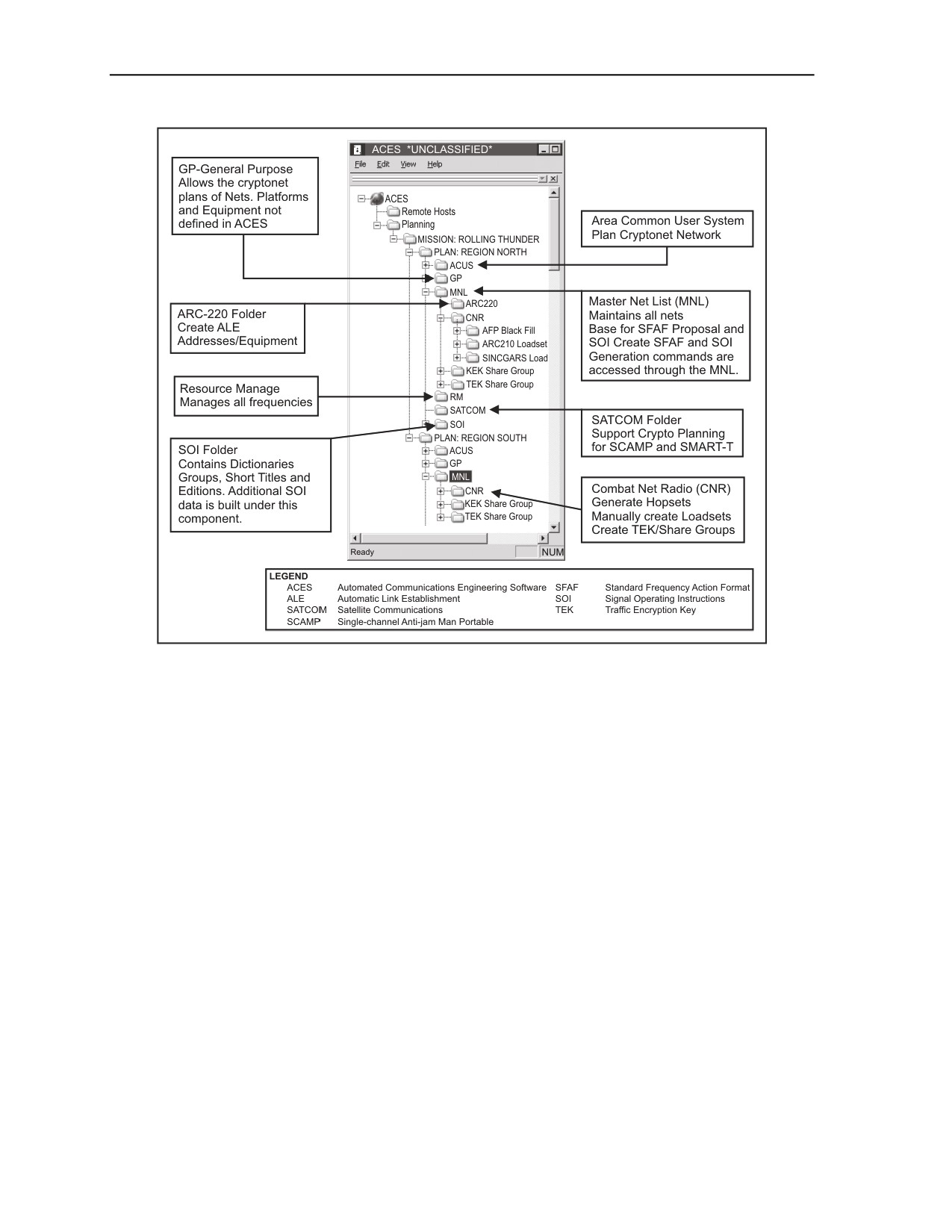
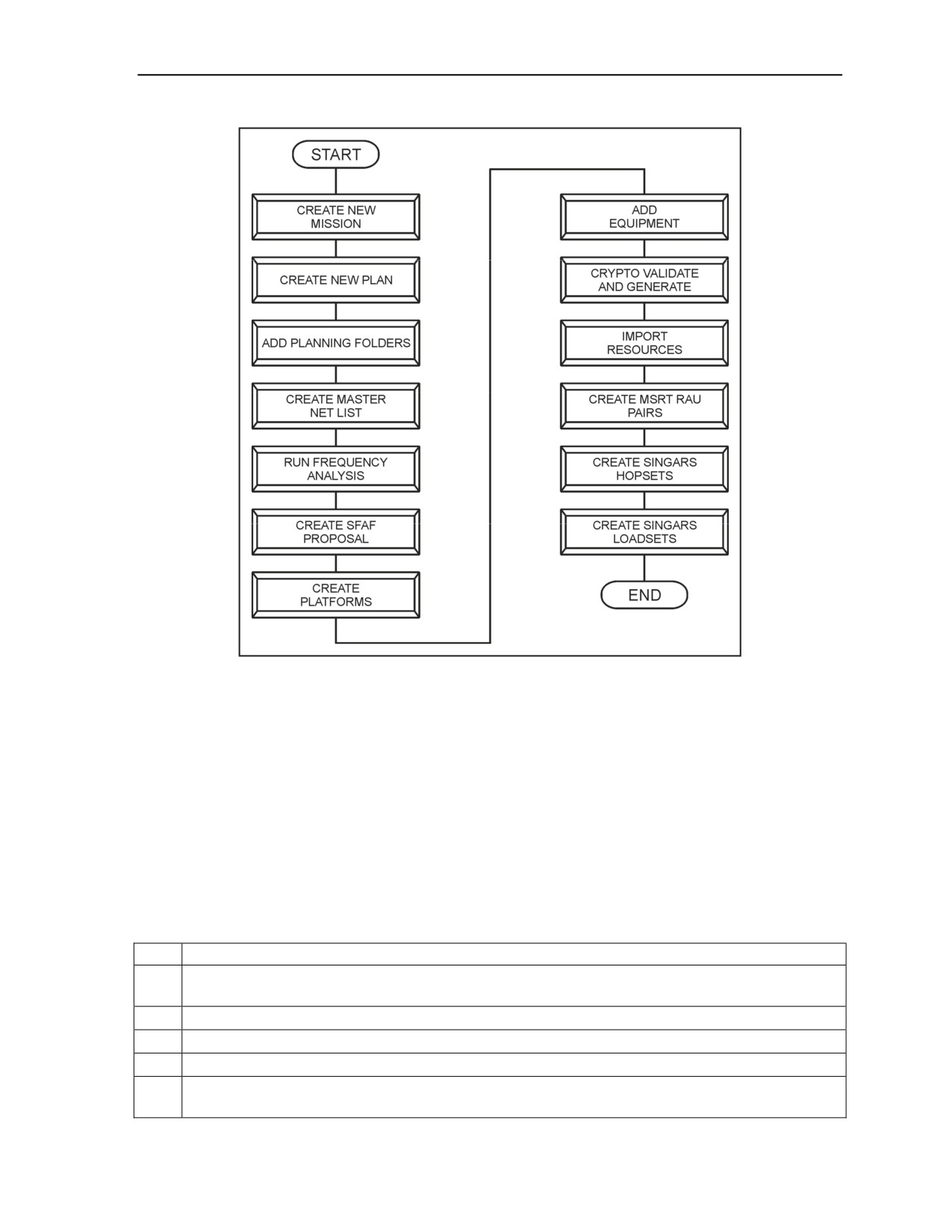
generated SOI edition. Before the SOI can be generated the MNL must be saved and validated. Figure10-3
is an example of an expanded ACES navigation tree and Figure 10-4 is an example of the general sequence
for planning a CNR net.
5 August 2009
FM 6-02.53
10-5
Chapter 10
Figure 10-3. Expanded ACES navigation tree
10-6
FM 6-02.53
5 August 2009
Automated Communications Security Management and Engineering System
Figure 10-4. Example for planning a CNR net
COMMUNICATIONS-ELECTRONICS OPERATING INSTRUCTIONS/SIGNAL OPERATING
INSTRUCTIONS DEVELOPMENT
10-29. ACES is designed to decentralize and automate CEOI/SOI generation. Generating and distributing
ACES CEOI/SOI can be done with virtually no dependence on the NSA. ACES is also capable of building
a division size CEOI/SOI in two to five hours. The NSA normally requires 60-90 days lead time; a manual
build normally requires three to five days to produce the same CEOI/SOI. ACES can respond quickly to a
compromise of CEOI/SOI in the field, or to rapidly changing force structures and can regenerate
frequencies and net call signs in three to five hours (depending on database size).
10-30. Although ACES automates the generation process, the signal officer must first design the
CEOI/SOI on paper. Table 10-2 lists the initial steps for designing and developing CEOI/SOI data. The
following paragraphs provide more detail on CEOI/SOI development.
Table 10-2. Initializing ACES CEOI/SOI data
Step
Description
1
Research and extract data from the modified table of organization and equipment, which
authorizes the use of personnel and equipment.
2
Determine the doctrine to be followed.
3
OPORD/OPLAN/unit SOP.
4
Frequency list from the spectrum manager.
5
Determine how many nets and frequencies are required. Use the current CEOI/SOI as a
starting point.
5 August 2009
FM 6-02.53
10-7
Chapter 10
FREQUENCY ASSIGNMENT
10-31. ACES can be used for frequency and net call sign generation in all frequency bands currently used
by the military. All frequency assignments are based on the authorized frequencies of the using
organization. The available frequencies are listed in the current resource frequency allocation. The initial
step in preparing the net/frequency assignment plan is to identify the unit nets required for C2 of tactical
operations.
10-32. After all nets are identified, compare the resulting frequency requirements with the number of
frequencies available. Spare frequencies are available for assignment in most CEOI/SOI, with their use
being controlled by the major organization’s
(controlling authority) signal officer. If the frequency
allocations and assignments are inadequate, additional frequencies must be requested through a higher
command or area frequency coordinator, or some nets will be required to share frequencies with other nets.
10-33. Various types of frequency assignments should be considered when developing the database to
generate a CEOI/SOI. Ideally, frequencies are randomly assigned to nets, designed to receive a changing
frequency with each change in time period. A net may be sufficiently important to warrant a dedicated
(sole user) frequency for its use. The frequency is unique to the organization, and is only used by one net
during any time period. This assignment is reserved for C2 nets. (Refer to Table B-1 for an outline of the
frequency bands.)
Fixed Frequencies
10-34. Fixed frequencies are usually assigned to nontactical units. The frequency value is manually
assigned, and is unique to the specific net. The frequency value is non-changing for all time periods of the
generation. For example, the medical evacuation net may be assigned 34.000 MHz, and this frequency will
never change; also, 34.000 MHz will not be assigned to another net. Fixed frequencies do not have any
restrictions assigned, and are used on SC nets only.
Reusing and Sharing Frequencies and Frequency Separation
10-35. The lack of available frequencies, or abundance of needed nets, may require nets to reuse or share
frequencies. Also, some nets require frequency separation from other nets, to prevent interference.
10-36. When the number of nets requiring frequencies is greater than the number of available
frequencies, frequency reuse (common user) may be necessary. Nets are selected for inclusion in a reuse
plan on the basis of low operating power, geographic separation, terrain masking, and other factors
permitting the use of the same frequencies on a noninterference basis.
10-37. The following list of nets should be excluded from a reuse plan—
z
Command and wireless network extension (and corresponding) nets.
z
Command and fire control nets (maneuver units).
z
Fire direction nets (division artillery).
z
Any FM aviation net (cavalry/attack).
z
Any emergency net.
z
Any spare net.
z
Any anti-jam or alternate net.
10-38. Sharing frequencies is another method of reducing the number of frequencies required; two or
more nets use a shared frequency. The sharing nets will receive the same frequency for a given time period,
either fixed or discrete. Typical nets that use shared frequencies are survey and weather nets.
10-39. A separation plan provides a frequency separation between nets. This plan is used when operating
more than one net within a communications van, in close proximity to other nets, or when mutual
frequency interference may result between radios. A separation plan is designed to allow these nets to
communicate simultaneously without mutual interference. Frequency assignment separation requirements
include co-site, wireless network extension, and other alternate nets.
10-8
FM 6-02.53
5 August 2009
Automated Communications Security Management and Engineering System
10-40. Mutual interference problems may result if FM transmitters operating on different frequencies are
situated in the same locale. To effectively reduce these interference problems, ACES adheres to the
following basic standards—
z
Frequencies with an exact separation factor of 5.750 or 23.000 MHz to collocated nets are not
assigned.
z
Frequencies that are on the order of the second harmonic. (For example, the frequency setting of
30.000, 32.650, and 35.000 MHz will possibly interfere with radios using 60.000, 65.300, and
70.000 MHz, respectively, are not assigned.)
SINCGARS SPECTRUM MANAGEMENT VARIABLES
10-41. The G-6/S-6 section identifies requirements for the construction of loadsets to support the radios
that are employed by their organization. These loadsets, once defined, are then constructed using ACES,
saved to file, and distributed to subordinate organizational units or elements for follow-on distribution to
respective users. The construction of loadsets is defined by the user, and is primarily based upon the
identification of the nets that the radio user is required to enter/monitor.
10-42. For example, the commander of an infantry battalion would normally be a member of several FH
SINCGARS nets. One of the commander’s SINCGARS could require the following to be loaded—
z
Brigade command net.
z
Brigade operations net.
z
Battalion command net.
z
Battalion operations net.
z
Brigade wireless network extension net.
10-43. RTOs will normally load all six preset channels on the SINCGARS, with operational NET IDs and
TEKS. If a requirement to perform an OTAR arises, all stations involved with OTAR must load a KEK
(stored in the ANCD) into preset Channel 6 on the SINCGARS, with an appropriate NET ID.
Loadset Updates
10-44. The responsible signal section personnel using ACES and RDS, as appropriate, maintain loadset
data. Loadset data is updated with new replacement key data, when appropriate, before the current key
expires. The loadset data is then saved to file, and distributed to users via ANCD/SKL, so they are in place
and available for loading into the SINCGARS at the appropriate key changeover time. Additionally, the
signal sections should have several sets of loadsets with associated keys, already constructed and
distributed (or available for expeditious distribution) for immediate use.
Loadset Revisions/Creations
10-45. Existing loadsets may require revision when the required net content changes (unit reassignment
or attachment). New loadsets may have to be constructed to meet new requirements (for example, a new
task force organization is created).
JOINT AUTOMATED CEOI SYSTEM
10-46. The Military Communications Electronics Board has designated ACES as the Joint Spectrum
Management Planning software. For multi-service operations it is called Joint Automated
Communications-Electronics Operating Instructions System (JACS). JACS has the same basic function as
ACES. JACS core purpose is to allow an interface between the joint CEOI generation tool with service
unique communications planning software and spectrum management automated tools.
5 August 2009
FM 6-02.53
10-9
This page intentionally left blank.

Chapter 11
Communications Techniques: Electronic Protection
This chapter addresses EW and the EP techniques used to prevent enemy jamming
and intrusion into friendly communications systems. It also addresses EP
responsibilities, the planning process, signal security, emission control, preventive
and remedial EP techniques and the Joint Spectrum Interference Resolution (JSIR)
reporting procedures and requirements.
ELECTRONIC WARFARE
11-1. EW uses electromagnetic energy to determine, exploit, reduce, or prevent hostile use of the
electromagnetic spectrum; it also involves actions taken to retain friendly use of the electromagnetic
spectrum. Table 11-1 lists the three elements of EW.
Table 11-1. Electronic warfare elements
Element
Responsibilities
Electronic
Involves actions taken to search for, interrupt, locate, record, and analyze
warfare
radio signals for using such signals in support of military operations.
support
Provides EW information required to combat electronic countermeasures,
(ES)
to include threat detection, warning, avoidance, target location, and
homing.
Produces signals intelligence (SIGINT), communications intelligence, and
electronic intelligence.
EA
Involves using electromagnetic or directed energy to attack personnel,
facilities, or equipment with the intent of degrading.
Includes actions taken to prevent or reduce the enemy’s effective use of his
frequencies; includes jamming and deception.
Employs weapons that use either electromagnetic or directed energy as
their primary destructive mechanism (lasers, RF weapons, and particle
beams).
EP
Ensures friendly effective use of frequencies, despite the enemy’s use of
EW.
Provides defensive measures used to protect friendly systems from enemy
EW activities, such as—
z
Careful siting of radio equipment.
z
Employment of directional antennas.
z
Operations using lowest power required.
z
Staying off the air unless absolutely necessary.
z
Using a random schedule, if one is used.
z
Using good radio techniques and continued operation.
Note. Refer to Appendix H for more information on antenna placement and co-site
interference.
5 August 2009
FM 6-02.53
11-1
Chapter 11
ELECTRONIC WARFARE IN COMMAND AND CONTROL ATTACK
11-2. EW support, EA, and EP contribute to C2-attack operations. ES, in the form of combat information,
can provide real-time information required to locate and identify adversary C2 nodes, and
supporting/supported early warning and offensive systems during C2 attack missions. It produces SIGINT,
and can provide timely intelligence about an adversary’s C2 capabilities and limitations that can be used to
update previously known information about the adversary’s C2 systems. This updated information can be
used to plan C2 attack operations, and provide damage assessment feedback on the effectiveness of the
overall C2 warfare plan.
11-3. EA is present in most C2 attack operations in a combat environment. It includes jamming and
electromagnetic deception or destruction of C2 nodes, with directed-energy weapons or anti-radiation
missiles.
11-4. EP protects the electromagnetic spectrum for friendly forces. Coordinating the use of the
electromagnetic spectrum through the joint restricted frequency list (JRFL) is a means of preventing
fratricide among friendly electronic emissions. Equipment and procedures designed to prevent adversary
disruption or exploitation of the electromagnetic spectrum are the best means friendly forces have to ensure
their own uninterrupted use of the electromagnetic spectrum during C2 attack operations. (For more
information on joint EW refer to JP 3-13.1.)
ELECTRONIC WARFARE IN COMMAND AND CONTROL PROTECT
11-5. The three elements of EW can also contribute to friendly C2 protect efforts. ES, supported by
SIGINT data, can be used to monitor an impending adversary attack on friendly C2 nodes. In the form of
signal security monitoring, ES can be used to identify potential sources of information for an adversary to
obtain knowledge about friendly C2 systems.
11-6. EP can be used to defend a friendly force from adversary C2-attack. EP should be used in C2 protect
to safeguard friendly forces from exploitation by adversary ES/SIGINT operations. Frequency
management using the JRFL is essential to a successful coordinated defense against adversary C2-attack
operations.
ADVERSARY COMMAND AND CONTROL ATTACK
11-7. Understanding the threat to the electromagnetic spectrum is the key to practicing sound EP
techniques. Adversary C2 attack is the total integration of EW and physical destruction of resources, to
deny friendly forces the use of electronic control systems. Potential adversaries consider C2 attack integral
to all combat operations. They have invested in developing techniques and equipment to deny their
enemies the effective use of the electromagnetic spectrum for communications.
11-8. Adversary C2 attack disrupts or destroys at least 60 percent of the command, control, intelligence,
and weapons systems communications (30 percent by jamming and 30 percent by destructive fires). To
accomplish this goal, enemy forces expend considerable resources gathering combat information about
their enemies. As locations are determined, and units are identified, enemy forces establish priorities to—
z
Jam communications assets.
z
Deceptively enter radio nets.
z
Interfere with the normal flow of their enemy’s communications.
COMMANDERS ELECTRONIC PROTECTION RESPONSIBILITIES
11-9. EP is a command responsibility. The more emphasis the commander places on EP, the greater the
benefits, in terms of casualty reduction and combat survivability, in a hostile environment. Because
adversary C2 attack is a real threat on the modern battlefield, commanders at all levels must ensure their
units are trained to practice sound EP techniques.
11-2
FM 6-02.53
5 August 2009
Communications Techniques: Electronic Protection
11-10. Commanders must constantly measure the effectiveness of the EP techniques; they must also
consider EP while planning tactical operations. Commanders’ EP responsibilities are—
z
Review all after action reports where jamming or deception was encountered, and assess the
effectiveness of defensive EP.
z
Ensure all encounters of interference, deception, or jamming are reported and properly analyzed
by the G-6/S-6 and the assistant chief of staff, intelligence (G-2) or intelligence staff officer (S-
2).
z
Analyze the impact of enemy efforts to disrupt or destroy friendly C2 communications systems
on friendly OPLANs.
z
Ensure the unit practices COMSEC techniques daily. Units should—
Change net call signs and frequencies often (in accordance with the SOI).
Use approved encryption systems, codes, and authentication systems.
Control emissions.
Make EP equipment requirements known through quick reaction
capabilities that are designed to expedite procedure for solving, research,
development, procurement, testing, evaluation, installations modification,
and logistics problems as they pertain to EW.
Ensure radios with mechanical or electrical faults are repaired quickly; this
is one way to reduce radio distinguishing characteristics.
Practice net discipline.
STAFF ELECTRONIC PROTECTION RESPONSIBILITIES
11-11. The staff is organized to assist the commander in accomplishing the mission. Specifically, the staff
responds immediately to the commander and subordinate units. The staff should—
z
Keep the commander informed.
z
Reduce the time to control, integrate, and coordinate operations.
z
Reduce the chance for error.
11-12. All staff officers provide information, furnish estimates, and provide recommendations to the
commander; prepare plans and orders for military operations; and supervise subordinates to achieve
mission accomplishment. Staff members should assist the commander in carrying out communications EP
responsibilities. Specific responsibilities of the staff officers are—
z
G-2/S-2—advises the commander of enemy capabilities that could be used to deny the unit
effective use of the electromagnetic spectrum. They also keep the commander informed of the
unit’s signal security posture.
z
G-3/S-3—exercises staff responsibility for EP and includes ES and EA scenarios in all CP and
field training exercises, and evaluates EP techniques employed. They also include EP training in
the unit training program.
z
G-6/S-6—prepares and conducts the unit EP training program; ensures there are alternate means
of communications for those systems most vulnerable to enemy jamming; ensures available
COMSEC equipment is distributed to those systems most vulnerable to enemy information
gathering activities and ensures measures are taken to protect critical friendly frequencies from
intentional and unintentional interference. The G-6/S-6 also enforces proper use of radio, EP,
and TRANSEC procedures on communications channels; performs frequency management
duties, and issues SOIs on a timely basis; prepares and maintains a restricted frequency list of
taboo, protected, and guarded frequencies and prepares the EP and restricted frequency list
appendices to the signal annex with appropriate cross-references to the other annexes (EW,
operations security, and deception) and to the SOI for related information.
PLANNING PROCESS
11-13. Threats to friendly communications must be assessed during the planning process. Planning
counters the enemy’s attempts to take advantage of the vulnerabilities of friendly communications systems.
5 August 2009
FM 6-02.53
11-3