FM 6-02.53 TACTICAL RADIO OPERATIONS (August 2009) - page 3

Chapter 6
Table 6-1. AN/PSC-5/C/D, AN/PRC-117F and AN/ARC-231 LOS interoperability
AN/PSC-5
AN/PSC-5I
AN/PSC-5D and
Radio Item
Spitfire
Shadowfire
AN/ARC-231
AN/PRC-117F
Frequency
Range
30-400 MHz
30-420 MHz
30-512 MHz
30-512 MHz
MHz
Voice 12
FASCINATOR
FASCINATOR
FASCINATOR
FASCINATOR
kbps
Voice 16
VINSON
VINSON
VINSON
VINSON
kbps
Data 16
VINSON, 3 or 4
VINSON, 3 or 4
VINSON, 3 or 4
VINSON, 3 or 4 KG-
kbps
KG-84
KG-84
KG-84
84
1-4 KG-84 (3 KG-
1-4 KG-84 (3 KG-
Data (over
No
84)—up to 48
84)—up to 48
No
16 kbps)
kbps
kbps
CTCSS
No
Yes
Yes
No
SINCGARS
No
Yes
Yes
Yes
FH
Guard
No
Yes
Yes
No
frequency
Channel
5, 6.25, 8.33, 12.5,
10 Hz, 5, 8.33, 12.5
5 and 25 kHz
5 and 25 kHz
Spacing
25 kHz
and 25 kHz
Note. CTCSS—continuous tone coded squelch system
6-10
FM 6-02.53
5 August 2009

Single Channel Tactical Satellite
Table 6-2. AN/PSC-5/C/D, AN/ARC-231 and AN/PRC-117F
5 kHz and 25 kHz DAMA interoperability
Terminal
AN/PSC-5D and
Mode
AN/PSC-5
AN/PSC-5C
AN/ARC-231
AN/PRC-117
5 kHz voice 2400
ANDVT
MELP (AUTO)
MELP (AUTO)
MELP (AUTO)
bps
5 kHz Data 2400
ANDVT, 3 or 4
ANDVT, 3 or 4
ANDVT, 3 or 4
ANDVT, 3 or 4
bps
KG-84
KG-84
KG-84
KG-84
1-4 KG-84 (3
KG-84)—up to
ANDVT, 3 or 4
1-4 KG-84 (3 KG-
1-4 KG-84 (3 KG-
5 kHz DASA
8000 bps
KG-84 up to 2400
84)—up to 9600
84)—up to 9600
(Data)
*must use 181B for
bps
bps
bps
interoperability (HPW
between 117F only)
25 kHz Voice
ANDVT
MELP (AUTO)
MELP (AUTO)
MELP (AUTO)
2400 bps
25 kHz Data 2400
ANDVT, 3 or 4
ANDVT, 3 or 4
ANDVT, 3 or 4
ANDVT, 3 or 4
bps
KG-84
KG-84
KG-84
KG-84
Data 4800 bps
3 or 4 KG-84
3 or 4 KG-84
3 or 4 KG-84
3 or 4 KG-84
(limited access)
1-4 KG-84 (3
Vinson, 3 KG-
1-4 KG-84 (3 KG-
1-4 KG-84 (3 KG-
KG-84)—up to
25 kHz DASA
84/4 KG—84 only
84)—up to 48
84)—up to 56
56 kbps
Data
up to 16 kbps
kbps
kbps
*must use 181B for
interoperability
Data transfer
Yes
Yes
Yes
No
Note. DASA—demand assigned single access
HPW—high performance waveform
Table 6-3. AN/PSC-5/C/D AN/ARC-231 and AN/PRC-117F
25 kHz SATCOM interoperability
Terminal
AN/PSC-5D and
Mode
AN/PSC-5
AN/PSC-5C
AN/ARC-231
AN/PRC-117
Voice 16 kbps
VINSON
VINSON
VINSON
VINSON
VINSON, 3 or 4
VINSON, 3 or 4
VINSON, 3 or 4
VINSON, 3 or 4
Data 16 kbps
KG-84
KG-84
KG-84
KG-84
1-4 KG-84 (3
KG-84)—up to
1-4 KG-84 (3 KG-
1-4 KG-84 (3 KG-
Data (over 16
56 kbps
NO
84)—up to 48
84)—up to 56
kbps)
*Must use 181B for
kbps
kbps
interoperability (HPW
between 117F only)
AN/PRC-117F MANPACK RADIO
6-39. The AN/PRC-117F is an advanced multiband/multimission manpack radio that provides reliable
tactical communications performance in a small, lightweight package that can maximize user mobility. The
AN/PRC-117F is a multiprocessor based, fully digital, software controlled, voice and data transceiver. The
5 August 2009
FM 6-02.53
6-11
Chapter 6
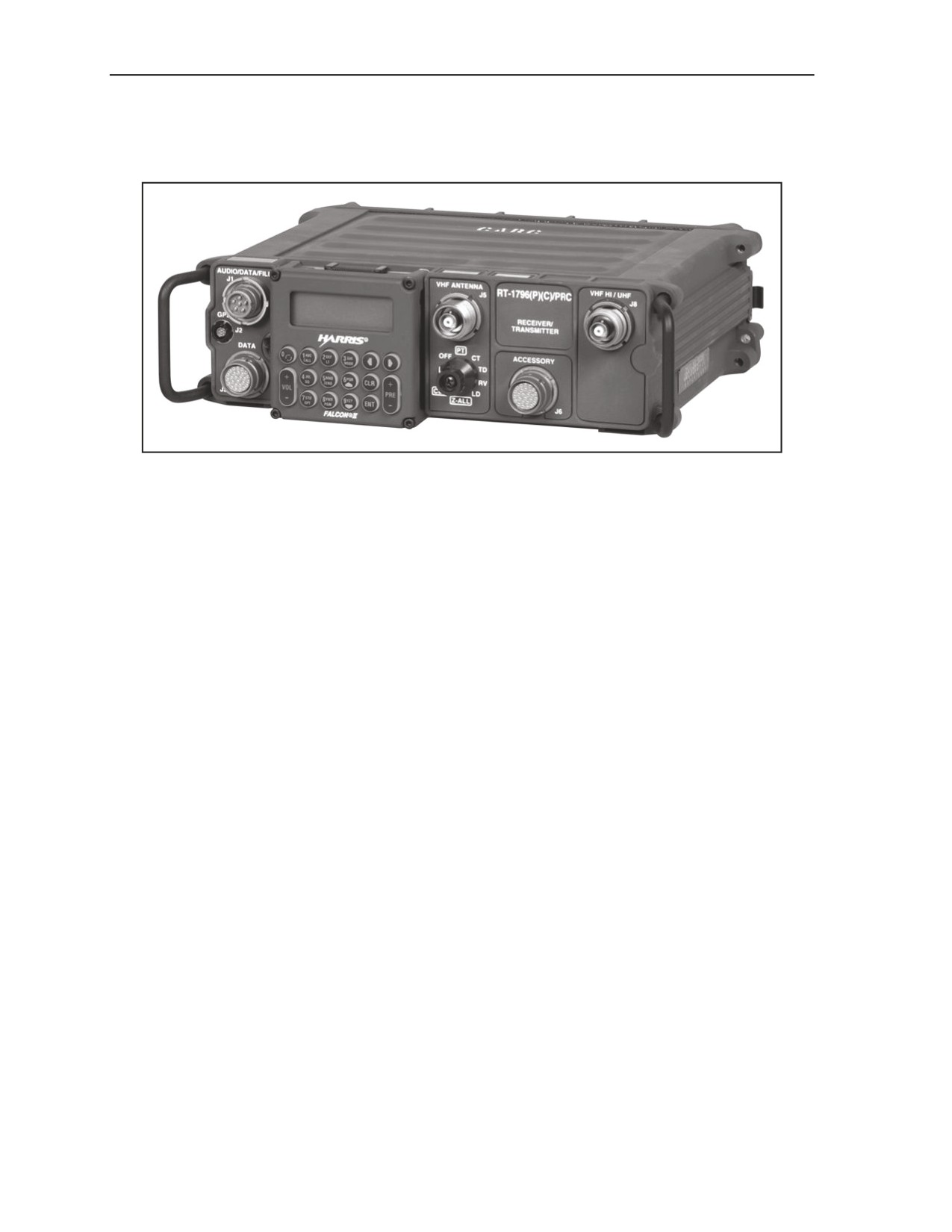
AN/PRC-117F is capable of providing; LOS, SATCOM, ECCM, FH operations (SINCGARS and
HAVEQUICK), and is compatible with all tactical VHF/UHF radios. (The AN/VRC-103 is the vehicular
version of the AN/PRC-117F.) Refer to Figure 6-6 for an example of the AN/PRC-117F.
Figure 6-6. AN/PRC-117F
6-40. The AN/PRC-117F is a COTS radio and is covered under a commercial warranty. The radio requires
regular updates to the firmware. Signal planners should pay special attention to ensuring that radios have
the latest version, which is available from the Harris Premier Web site (https://www.premier.harris.com/ ),
because having multiple versions of the firmware within a unit can cause problems with interoperability.
AN/PRC-117F CHARACTERISTICS AND CAPABILITIES
6-41. The AN/PRC-117F is designed to act as the transmission means for a range of command, control and
communications input devices (both digital data and analog). These include standard audio
(voice)
communications via a handset; line-level audio-data devices such as the handheld data terminals found in
SOF, military intelligence, field artillery and other units; analog teletype modems; C2 digital DTE as found
in the ABCS; PCs; e-mail systems, video systems, fax and more. The AN/PRC-117F can operate across
both the VHF and UHF military tactical frequency bands using either LOS modes or satellite propagation
media for BLOS communications.
6-42. According to the article “AN/PRC-117 Special Operations Forces Radio Has Applications for
Digital Divisions and Beyond”, due to the microprocessor design, digital signal processing and software
control, the AN/PRC-117F is actually the equivalent of many current radios in one manpack or vehicle
mounted box. This greatly reduces the space, weight, power and support requirements for both individual
fighting platforms and tactical-operations centers. This also greatly reduces co-site interference problems
and, if used properly, can reduce the number of tactical radio nets required to support a digitally equipped
fighting force. The AN/PRC-117F has the following characteristics and capabilities—
z
Frequency range of 30-512 MHz. This frequency range covers not only the “standard” Army
tactical
(30-88 MHz) band but also covers the frequency bands and modulation modes
commonly used by the USAF, USN and Coast Guard for operations, air traffic control (ATC),
tactical data links and maritime uses. This makes the radio ideal for use as a “liaison radio” or
“gateway” between service components using different waveforms for joint ground sea and air
operations. Also, AN/PRC-117Fs frequency range and waveform modes are compatible with
civil and public service frequency bands commonly used by non-DOD local, state, federal and
foreign agencies.
6-12
FM 6-02.53
5 August 2009
Single Channel Tactical Satellite
z
Modulation. As delivered, the radio is programmed at the factory for compatibility with current
“standard” modulation characteristics segmented in the traditional RF bands—
VHF low band. 30.00000-89.99999 MHz, FSK. This makes the radio
interoperable with SINCGARS, AN/PRC-68, AN/PRC-126 and other tactical radios of both
foreign and domestic manufacture.
VHF high band. 90.00000-224.99999 MHz FM, AM, FSK, amplitude
shift-keying. In this frequency band, the radio can be used for air-to-air, air-to-ground and
ground-to-ground voice and data communications using waveforms found in this band. The
AN/PRC-117F is compatible with a variety of existing military aircraft and air-traffic-control
radio communications, as well as military air-to-ground data-link communications, the
commercial USMC band, USN/Coast Guard communications and civil police, fire and
emergency-management standard radios. Due to its capability, joint and civil-military liaison for
both voice and data can be accomplished in one radio by units that have AN/PRC-117F. This is
particularly important to the Army National Guard because of their large role in civil support
operations.
UHF band.
225.00000-511.99999 MHz. AM, FSK, amplitude shift
keying. In this frequency band, AN/PRC-117F can be used to perform air-to-air, air-to-ground,
ground-to-ground, fixed or mobile radio communications missions for both voice and data
modes. The AN/PRC-117F is also compatible with ECCM-capable equipment such as
AN/ARC-164 and AN/ARC-182 that can be widely found in existing tri-service ground,
airborne and special-mission systems.
UHF SATCOM. 243.00000-270.00000 MHz and 292.00000-318.00000
MHz. In this frequency range, AN/PRC-117F is fully compatible with SC and DAMA TACSAT
systems. The AN/PRC-117F also has full orderwire capability and can send and receive data at a
rate of 64 kbps in a 25 kHz channel or 12 kbps in a 5 kHz channel. Also, automatic requests for
wireless network extension of bad data packets and COMSEC are embedded in the radio
hardware and software. This key SATCOM capability gives the radio a feature no other standard
CNR has: the ability to communicate BLOS without wireless network extension stations from
the same radio package that’s used for LOS communications.
6-43. The AN/PRC-117F operates in the following LOS fixed frequency CT operating capabilities and
limitations—
z
VINSON—16 kbps data rate, 25 kHz COMSEC (KY-57/58) mode for secure voice and data.
z
KG-84 compatible—(data only) supports voice only using a 12 kbps data rate in FM and trellis
code modulation from 30.00000-511.99999 MHz and AM mode from 90.00000-511.99999
MHz. Also available in all modes of UHF SATCOM.
z
TEKs—electronically loaded 128 bit transmission encryption keys used to secure voice and data
communications.
z
COMSEC fill—TEKs, TSKs, and KEKs can be filled from the following devices—
AN/CYZ-10, DTD (ANCD).
AN/PYQ-10, SKL.
KYK-13, electronic transfer device.
KYX-15, net control device.
MX-18290, ECCM fill device.
KOI-18, general purpose tape reader.
6-44. The AN/PRC-117F can operate in HAVEQUICK I/II, utilizing FH from 225-400 MHz, providing
compatibility with current airborne FH. It can also operate in SINCGARS FH mode from 30.0000-87.975
MHz. and supports SINCGARS SIP/ESIP features by being placed in either a net master or a net member
mode.
6-45. The AN/PRC-117F can scan up to 10 LOS fixed frequency or dedicated SATCOM radio voice
operation nets. It does not scan HAVEQUICK, SINCGARS, or UHF DAMA nets and digital squelch
5 August 2009
FM 6-02.53
6-13
Chapter 6
cannot be used. Scanning combinations of CT and PT nets is allowed by the PT override feature of the
VINSON and FASCINATOR CT mode.
AN/PRC-117F DATA CAPABILITIES
6-46. The AN/PRC-117F can be used as a digital data-transmission device. The recommended standard-
232 and 422, and MIL-188-114 I/O ports are provided integral to the radio, along with synchronous and
asynchronous data interfaces. This makes it very easy to interface DTE, computer workstations and
networking components such as, CP routers, to the radio for data transmission applications. The AN/PRC-
117F can send data transmission rates of 56 kbps through SATCOM and 64 kbps ground-to-ground (LOS).
6-47. With these data rates, the AN/PRC-117F would make data transmission among brigade and battalion
TOCs and lower echelons fast enough to support lengthy database-to-database transfers. Transmission of
databases, plans, orders and reports that are now difficult and time consuming to do over tactical radios
would be much faster. This would not only improve operations but would also reduce system vulnerability
to enemy intercept and detection. Also, these rates will support user desired C2 tools such as video
teleconferencing, imagery transmission, en route mission planning and collaborative planning that aren’t
practical using current lower-data-rate equipment. (Refer to Appendix G for more information on data
communications.)
ARMY CONVENTIONAL FORCES
6-48. The primary mission of the Warfighter Network is to augment the current and projected C2 system.
This system must always be operational to support requirements during peace, crisis, and war. The addition
of the Warfighter Network ensures a C2 communications system across the operational continuum. CNR
provides the commander the ability to immediately access CPs while operating on the move, eavesdrop on
subordinate units’ communications, and affect operations during critical moments of the fight.
6-49. The significant advantages of SINCGARS and SC TACSAT systems are to make them the
recommended CNR communications means for the Warfighter Network. SINCGARS will continue to be
widely available on the battlefield, easy to use, and interoperable with aircraft radio versions. It provides
improved immunity from the EW threat. SC TACSAT terminals provide users with critical C2 connectivity
over extended ranges. The Warfighter Network requires assured space segment access 365 days a year to
support operational training. It ensures a smooth transition from peacetime operation to war. This assured
access requirement is critical to force deployment operations, and equals USN and USAF requirements.
OPERATIONS AND INTELLIGENCE NETWORKS
6-50. The corps and division system improves intelligence planning, streamlines the handling of
information, and expedites production of intelligence. Its purpose is to speed the flow of information up
and down the chain of command using dedicated and secure communications nets. It also ensures the
integration of information from all sources into a clear, accurate, and complete picture for the commander.
6-51. The corps combines intelligence and combat information from corps subordinate units and
national/strategic, theater, combatant command, and multinational intelligence efforts. Fully integrated, all-
source intelligence is produced at corps and is the basis of the commander’s intelligence preparation of the
battlefield.
6-52. SC TACSAT is a valuable communications asset for sustainment units in support of dispersed forces
across full spectrum operations and communications zone. The requirement for SC TACSAT assets exists
for sustainment units, from early entry, through normal daily operations in a mature theater. Units at all
levels rely heavily on a fully planned and reliable communications architecture to provide SA, multimedia
services, imagery, and asset visibility.
6-53. Additionally, the ability to access timely materiel and movement related information allows the
logistician to focus on the discipline of distribution from the strategic, operational, and tactical echelons of
logistical support, to sustain operations. The theater sustainment command, battlefield distribution, and
velocity management concepts support the requirement for SC TACSAT capabilities. The SC TACSAT
6-14
FM 6-02.53
5 August 2009
Single Channel Tactical Satellite
communications assets can provide continuous information feeds to Army and joint total assets visibility,
which will achieve the leap-ahead capability that is necessary to support the Army’s transformation to
modularity.
SINGLE-CHANNEL TACTICAL SATELLITE FIRE SUPPORT
NETWORKS
6-54. Doctrinally, most of the SC TACSAT nets used in the distribution plan for the Spitfire are voice
nets. The need for a digital link between the Advanced Field Artillery Tactical Data System (AFATDS),
Initial Fire Support Automation System, Forward Observer System, and non-fire support C2 systems may
require these nets to be used for digital traffic. Voice/Data contention does not satisfy the requirements of
fire support. The commander must decide which net will provide voice service, and which will carry data.
These nets can be used for either voice or data, but not both.
CORPS FIRE SUPPORT NET
6-55. The purpose of the corps fire support net is for clearing fires, which refers to the coordination
necessary when firing into an adjacent AO controlled by someone else. The coordination ensures the area
is under enemy control and there are no friendly forces in the area. The primary users of the net include
any of the following—
z
Corps fires cell.
z
Fires brigades.
z
Armored cavalry regiment fires cell.
z
Attack regiment fires cell.
FIRES BRIGADE COMMAND OPERATIONS NET
6-56. The fires brigade command operations net will contain the operations elements from the fires
brigade, field artillery brigade, fires battalion, and Multiple Launch Rocket System (MLRS) battalions. The
primary purpose of this net is to provide a long range C2 link to subordinate field artillery elements. This
net is primarily a voice net, but can transmit digital traffic between AFATDS or other automated devices.
MLRS BATTALION COMMAND OPERATIONS NET
6-57. The MLRS battalion and battery fire direction centers will use the MLRS battalion command
operations net to facilitate BLOS communications between the MLRS battalion and its subordinate
batteries. While primarily a voice net, the MLRS battalion command’s operations net may be designated as
a digital net, used to transmit AFATDS traffic.
DIVISION FIRE SUPPORT NET
6-58. The principle members of the division fire support net include the division fires cell, fires brigade,
the brigade fires cell, fires battalion and the MLRS battalion. This net is used for fire support coordination
and as an alternate for fire direction with elements throughout the division. The division TOC is typically
the NCS. This net will normally operate as a voice net.
6-59. The separate brigade has unique long haul communications requirements, which LOS operations
cannot satisfy when dispersed over extended distances. These units deploy UHF SC TACSAT terminals
with their headquarters to provide C2 connectivity with higher headquarters. The primary communications
mode is secure voice.
AIRBORNE AND AIR ASSAULT UNITS
6-60. The airborne and air assault units have a need for en route communications to maintain a connection
with the sustaining base, other aircraft, and with the units that may already be in place. This is
accomplished by using a secure en route communications package (SECOMP), which uses the Spitfire or a
5 August 2009
FM 6-02.53
6-15
Chapter 6
VHF/UHF DAMA-capable SC TACSAT. The DAMA-capable SC TACSAT will provide communications
in both the LOS and SATCOM modes. The SECOMP supports the commander and his principal staff
while in route to the AO. It supports ground operations independently of the aircraft at staging areas and
during joint task force (JTF) initial ground operations.
Secure En Route Communications Package
6-61. The SECOMP provides Army JCF with the necessary real-time communications to receive orders
from higher headquarters. It allows the JCF to plan, coordinate, and rehearse mission operations, and to
receive and disseminate near real-time, up-to-date intelligence information. The system provides Soldiers
en route to an AO with the ability to communicate both vertically and horizontally from higher to lower,
inter-aircraft, intra-aircraft, inter-service, and air-to-ground with both multinational and joint forces.
6-62. The SECOMP is connected via the coaxial cable into the aircraft satellite antenna system, or into an
unused aircraft UHF antenna for LOS operations. The RTO, under the aircrew’s supervision,
connects/disconnects the radio from the aircraft antenna cable system. The RTO will remove the radio
when exiting the aircraft. (Refer to Appendix A for more information on FM networks.)
SINGLE-CHANNEL TACTICAL SATELLITE COMMUNICATIONS
PLANNING
6-63. Tactical communications networks change constantly. Unless control of the network is exercised, it
will result in communications delay and a poor grade of service. The best method of providing this control
without hampering operation is through centralized planning. Execution of these plans should be
decentralized. This concept is applied to the space systems portion and to the ground stations. The US
military satellite systems consist of terminals (ground segment), satellites (space segment), and tracking,
telemetry, and control terminals (control segment).
6-64. The planning and system control process helps communications systems managers react
appropriately to the mission of the force supported, the needs of the commander, and the current tactical
situation. The type, size, and complexity of the system being operated establish the method of control.
6-65. Communications control is a process in which the matching of resources with requirements takes
place. This process occurs at all levels of the control and management structure. In each case, the
availability of resources is considered.
6-16
FM 6-02.53
5 August 2009
Chapter 7
Airborne Radios
Airborne radios provide communications for ground-to-air operations as well as air-
to-air and air-to-sea missions. This chapter addresses airborne SINCGARS, the
AN/ARC-210, AN/ARC-220, AN/ARC-231, AN/ARC 164, AN/ARC-184, AN/VRC-
100, AN/VRC-83, and the AN/ARC-186.
AIRBORNE SINGLE-CHANNEL GROUND AND AIRBORNE RADIO
SYSTEMS
7-1. The following paragraphs address the airborne SINCGARS. (For more information on aviation
brigades and communications refer to FM 3-04.111.)
AN/ARC 201
7-2. Ground and airborne versions are interoperable even though they are physically different from each
other. The major change in the airborne mode is the faceplate that is attached to the different configurations
plus the add-on modules change each version’s capabilities. Airborne versions RT-1476/1477A/B/C
require the TSEC/KY-58 security equipment for CT operation.
7-3. The RT-1476/ARC-201 (refer to Figure 7-1) is the base radio in all three versions and they all
operate in both the SC and FH modes. The RT-1476/ARC-201 is controlled from the front panel. It is
designed to be mounted in the cockpit of an aircraft.
(Refer to TM 11-5821-357-12&P for more
information on the AN/ARC-201.)
Figure 7-1. Airborne radio RT-1476/ARC-201
5 August 2009
FM 6-02.53
7-1
Chapter 7
RT-1477/ARC-201
7-4. The RT-1477/ARC-201 provides a remote capability for installations where the radio must be
located away from the pilot’s cockpit. It has a separate radio and a radio set control (also known as a
RCU), C-11466, so the pilot can remotely control the radio from his position in the aircraft. All controls
are on the RCU, located in the aircraft cockpit. The RT is located in a remote equipment compartment on
the aircraft. Control and status signals are sent back and forth between RT and RCU via dedicated cables.
The RT-1476/1477 has wireless network extension capabilities.
RT-1478/ARC-201
7-5. The RT-1478/ARC-201 is a remote controlled RT. The aircraft system control display unit (CDU)
controls the RT. The RT is located in the remote equipment compartment of the aircraft. The optional
DRA, CV-3885/ARC-201, processes 1,200 and 2,400 Hz FSK data through the radio set for data
transmission and interfaces between the RT and the TSEC/KY-58 COMSEC equipment. Operation of the
DRA is automatic; there is no operator interface.
SINCGARS AIRBORNE SYSTEM IMPROVEMENT PROGRAM
7-6. The SINCGARS airborne system improvement program (AIRSIP) contains throughput and robust
enhancements. It includes a wireless network extension capability in the packet mode, improved error
correction, more flexible remote control, and GPS compatibility. Additionally, the AIRSIP combines three
line replaceable units (LRUs) (RT-1478, DRA, and external COMSEC/KY-58) into one unit, and reduces
the overall weight of the radio system.
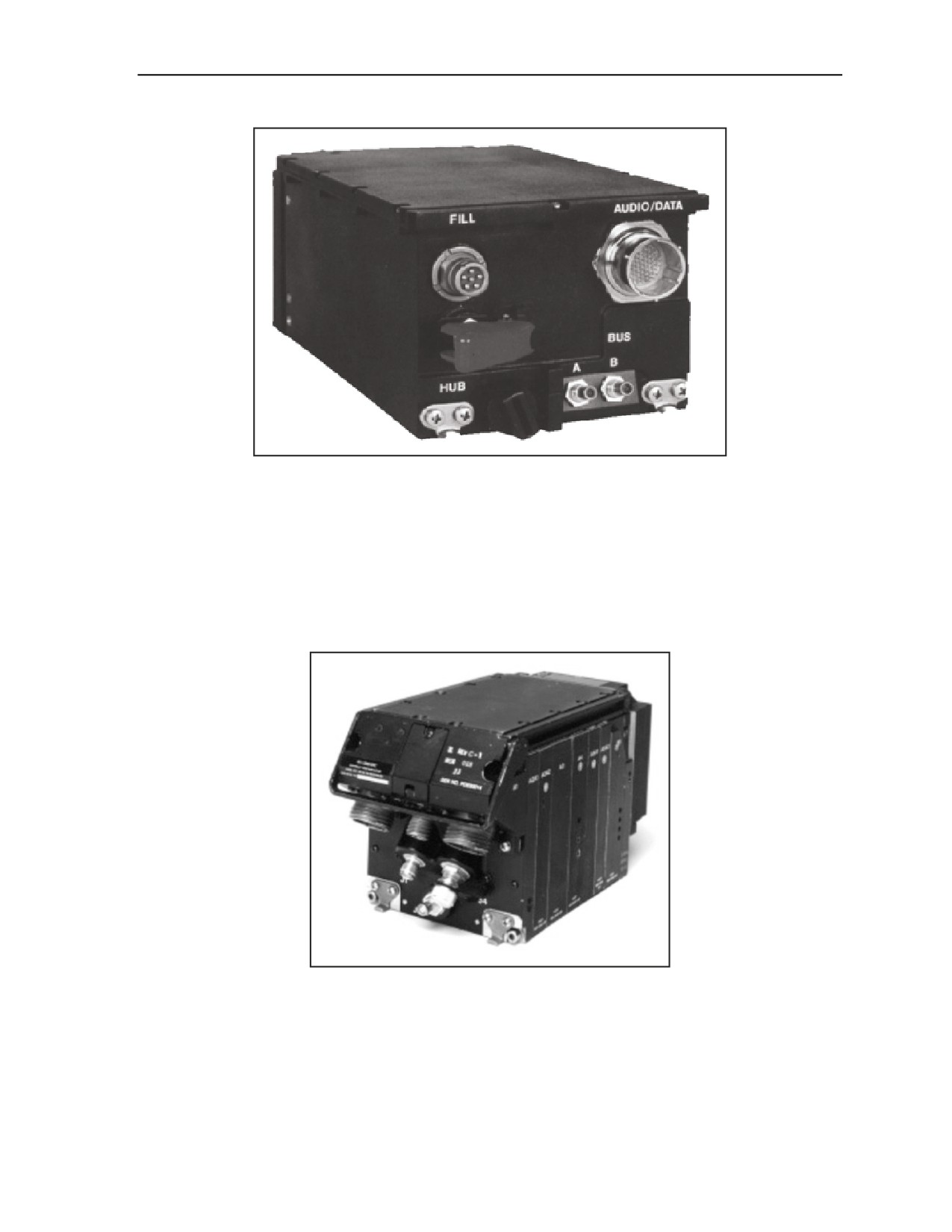
7-7. The SINCGARS AIRSIP RT-1478D/ARC-201D is a VHF FM radio set that provides users with the
ability to transmit and receive voice and data communications in the 30-88 MHz band. The integration of
COMSEC and the DRA combines three LRUs into one enclosed system. The radio can operate in secure or
PT mode. When operating in the FH mode, the radio provides an EP capability. The RT-1478D/ARC-
201D provides voice interoperability with legacy radios in the SC mode and is fully interoperable with the
SINCGARS family of ground and airborne radios. Figure 7-2 is an example of the SINCGARS AIRSIP,
RT-1478D.
7-8. The RT-1478D/ARC-201D key features include—
z
Automatic wireless network extension.
z
Built-in amplitude homing.
z
Integrated DRA functions to include:
TACFIRE and SINCGARS data modes: 600, 1,200, 2,400, 4,800, and
16,000 bps.
Enhanced packet data modes:
1200N,
2400N,
4800N,
9600N;
recommended standard-232 packet; and recommended standard-423 EDM is 16,000 bps only.
1553B bus: provides both radio control and data I/O.
z
BIT function.
z
AM-7189/ARC compatible.
z
Six FH presets (including TRANSEC keys).
z
Six SC presets, plus manual and cue channels.
7-2
FM 6-02.53
5 August 2009
Airborne Radios
Figure 7-2. RT-1478D SINCGARS AIRSIP
AN/ARC-210 RADIO SYSTEM
7-9. The AN/ARC-210 is offered in several models, which when coupled with ancillary equipment,
provides the aviation community with exceptional long range capability. The RT-1556B provides LOS
VHF/UHF capability and HAVEQUICK I/II, and SINCGARS ECCM waveforms. The RT-1794I (refer to
Figure 7-3), RT-1824I, RT-1851I, and RT-1851AI are network capable and include embedded COMSEC,
5 kHz and 25 kHz and DAMA SATCOM, and are certified to MIL-STD-188-181B/-182A/-183.
Figure 7-3. RT-1794 I
7-10. The AN/ARC-210 provides air-to-air and air-to-ground, two-way voice communication in both the
UHF ranges and VHF. Data and voice communications are provided via the embedded SATCOM
functions that operate in the UHF radio band.
5 August 2009
FM 6-02.53
7-3
Chapter 7
7-11. The AN/ARC-210 provides the following key features—
z
30-400 MHz frequency range provides VHF and UHF in all radios; 121.5 and 243.0 MHz
guard channels, and 4 channel scan.
z
30-512 MHz frequency range providing VHF and UHF in the RT-1851AI; 121.5 and 243.0
MHz guard channels, 4 channel scan.
z
Synthesizer speed and rapid radio response time handles any developed ECCM algorithm or
LINK requirement.
z
Data rates up to 80,000 bps (SATCOM) and 100,000 bps LOS with bandwidth efficient
advanced modulation technology.
z
Compatible with Link 11, Link 4A and improved data modem.
z
MIL-STD-1553B or remote control and BIT to module level.
z
Channel spacing of—
25 kHz (30-512 MHz).
8.33 kHz (118-137 MHz).
12.5 kHz (400-512 MHz).
z
Tuning capability: 5 kHz with remote control, 2.5 kHz via 1553 bus.
z
Optional PAs, mounts, and low noise amplifier/diplexer.
AN/ARC-220 RADIO SYSTEM
7-12. The AN/ARC-220 radio system is a microprocessor-based communications system intended for
airborne applications and also has a ground version (AN/VRC-100). The AN/ARC-220 radio system uses
advanced digital signal processor technology.
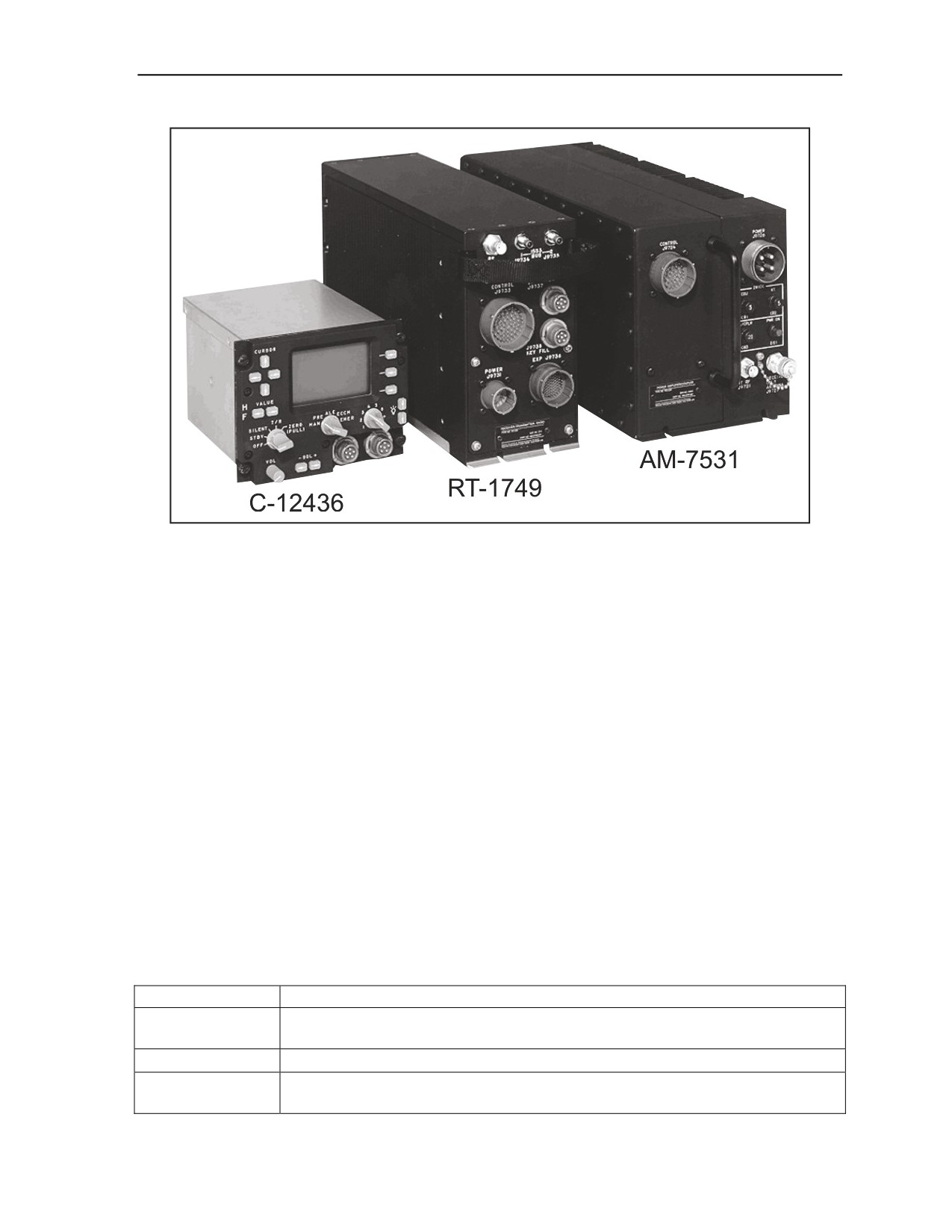
7-13. It consists of three replaceable units; a RT (RT-1749/URC or RT-1749A/URC), PA coupler (AM-
7531/URC), and CDU (C-12436/URC). The AN/ARC-220 has embedded ALE, serial tone data modem,
and anti-jam (ECCM) functions. The RT provides the electrical interface with other AN/ARC-220 LRUs
and associated aircraft systems such as interphone, GPS, and secure voice systems. It also offers the ability
for up to 25 free text data messages to be pre-programmed via data fill or created/edited in real time and
the ability to receive data messages to be stored for later viewing.
7-14. The AN/ARC-220 radio system is capable of wireless network extension if desired and built-in
integration with external GPS units allow position data reports to be sent with the push of a button. For
more information on the AN/ARC-220 radio system refer to TM 11-5821-357-12&P.
7-15. The AN/ARC-220 radio system (refer to Figure 7-4) provides the following capabilities—
z
Frequency range from 2.000-29.9999 MHz in 100 Hz steps.
z
20 user programmable simplex or half duplex channels.
z
20 programmable simplex or half duplex channels.
z
12 programmable ECCM hop sets.
z
Certified for ALE in accordance with MIL-STD-188-141B and MIL-STD-188-141B.
z
An integrated data modem which enables communication in noisy environments where voice
communications are often not possible.
z
Built-in integration with external GPS units allows position data reports to be sent with the push
of a button.
z
Embedded ALE, ECCM, and data modem (Joint Interoperability Test Command certified).
z
Ability to rapidly and efficiently tune a variety of antennas.
7-4
FM 6-02.53
5 August 2009
Airborne Radios
Figure 7-4. AN/ARC-220 radio system
AN/VRC-100(V) HIGH FREQUENCY GROUND/VEHICULAR
COMMUNICATIONS SYSTEM
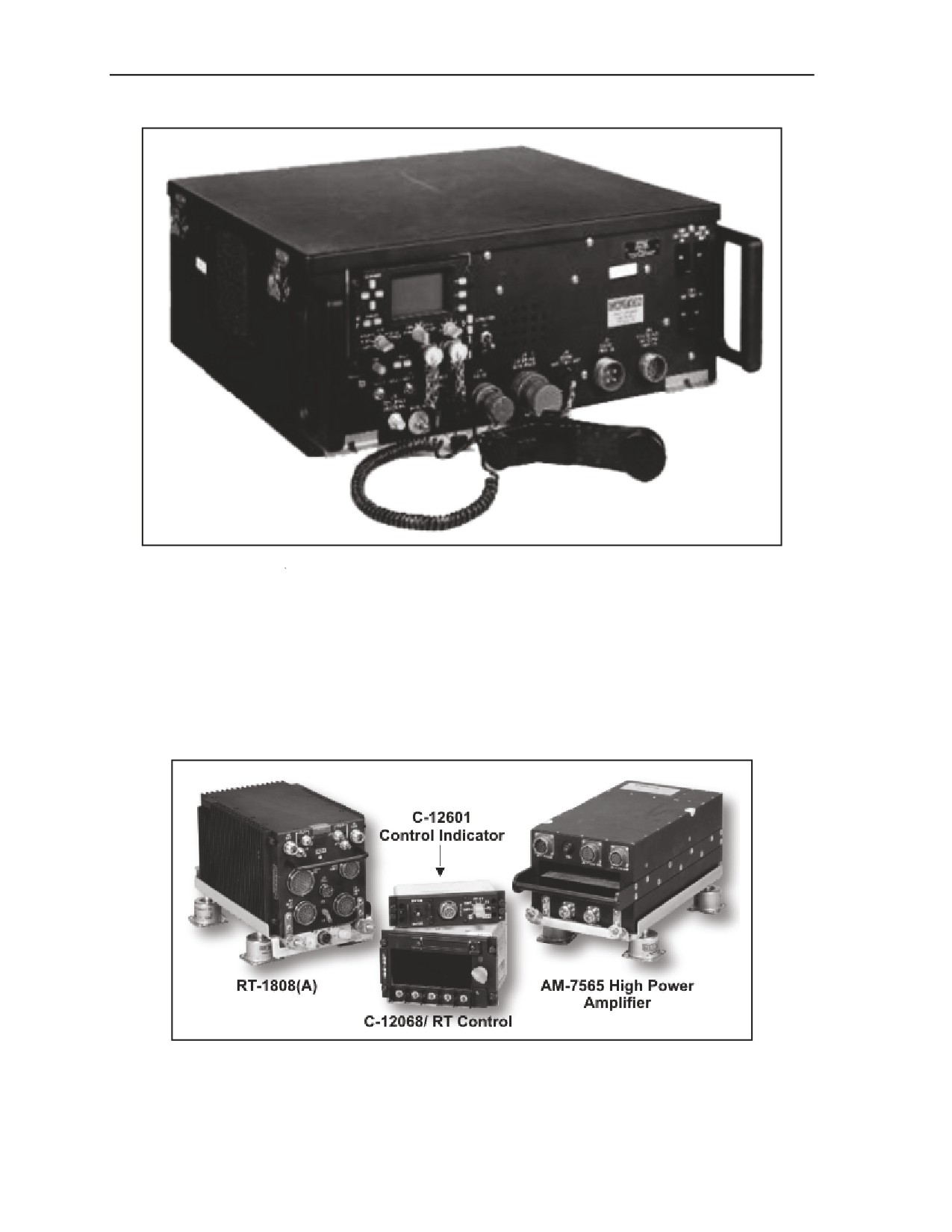
7-16. The AN/VRC-100(V) ground radio uses the RT, PA/coupler, and CDU LRUs of the AN/ARC-220
system without modification, within an aluminum-structured, bracketed case. It has a portable, metal case,
with a removable top, that provides easy access for removal of LRUs. All controls, and the radio I/O, are
located on the front panel. The AN/VRC-100 is intended for use in TOCs, ATC, and vehicular applications
such as the high mobility multipurpose wheeled vehicle. Its key features are—
z
Full digital signal processing with embedded ALE, EP, and data modem.
z
Spare card slot in the RT provides for future growth.
z
Operates on 28 VDC (and is compatible with 24 VDC vehicular power) or from 115 or 220
volts alternating current (VAC) 50/60 Hz power source.
z
PC or laptop connectivity.
z
E-mail messaging using local recommended standard-232 interface.
z
Ability to effectively tune a variety of antennas.
7-17. Table 7-1 lists the three basic configurations of the AN/VRC-100 and Figure 7-5 is an example of an
AN/VRC-100(V). Refer to TM 11-5820-1141-12&P for more information on the AN/VRC-100(V) 1/2/3.
Table 7-1. AN/VRC-100 configurations
Configuration
Description
AN/VRC-100(V) 1
Consists of three LRUs housed in a metal casing with a power supply and
speaker.
AN/VRC-100(V) 2
Consists of the AN/VRC-100(V) 1 mounted in a wheeled vehicle.
AN/VRC-100(V) 3
Consists of the AN/VRC-100(V) 1 with the AS-3791/G broadband antenna and
is used at theater level.
5 August 2009
FM 6-02.53
7-5
Chapter 7
Figure 7-5. AN/VRC-100(V) high frequency radio
AN/ARC-231 RADIO SYSTEM
7-18. The AN/ARC-231 (refer to Figure 7-6) is an airborne VHF/UHF LOS and DAMA SATCOM radio
system that is also a multiband/multimission, secure anti-jam voice, data and imagery radio set. The RT-
1808 is the primary radio for the AN/ARC-231. One of the key features of the RT 1808 is that it capitalizes
on the AN/PSC-5 Spitfire’s expandable modular architecture and permits users to upgrade as new
requirements drive new capabilities. The AN/ARC-231 is being used in the A2C2S to provide C2 mission
capabilities to corps, division maneuver brigade, or attack helicopter commander’s airborne TAC CP.
Figure 7-6. AN/ARC-231 radio system
7-6
FM 6-02.53
5 August 2009
Airborne Radios
7-19. The AN/ARC-231 has the following characteristics and capabilities—
z
HAVEQUICK I/II and SINCGARS communications modes.
z
DAMA and non-DAMA SATCOM communications modes.
z
Frequency ranges of:
30-87.975 MHz VHF FM SINCGARS.
108-173.995 MHz VHF AM and VHF FM.
225-399.995 MHz UHF AM HAVEQUICK II/ground air band, UHF
SATCOM band.
403-511.995 MHz UHF FM public service band.
z
Embedded COMSEC and TRANSEC keys with transmit and receive OTARs.
z
148 preset channels.
z
Independent red and black MIL-STD-1553 bus interfaces.
z
Embedded MIL-STD-188-184 analog to digital converter and tactical IPs.
z
SINCGARS SIP and optional ESIP and end of message.
z
MIL-STD-188-181B high data rate in both LOS and SATCOM.
z
8.33 kHz ATC channelization coverage to 512 Hz.
z
Minimal size and weight suitable for rotary and fixed wing applications.
AN/ARC-164(V) 12 ULTRA HIGH FREQUENCY RADIO
7-20. The AN/ARC-164(V)
12 radios are used for air-to-air, air-to-ground and ground-to-air
communications. There are three major aircraft configurations of the AN/ARC-164 radio and one ground
configuration of the AN/VRC-83(V). The AN/ARC-164(V) 12 RT configurations include a panel mount
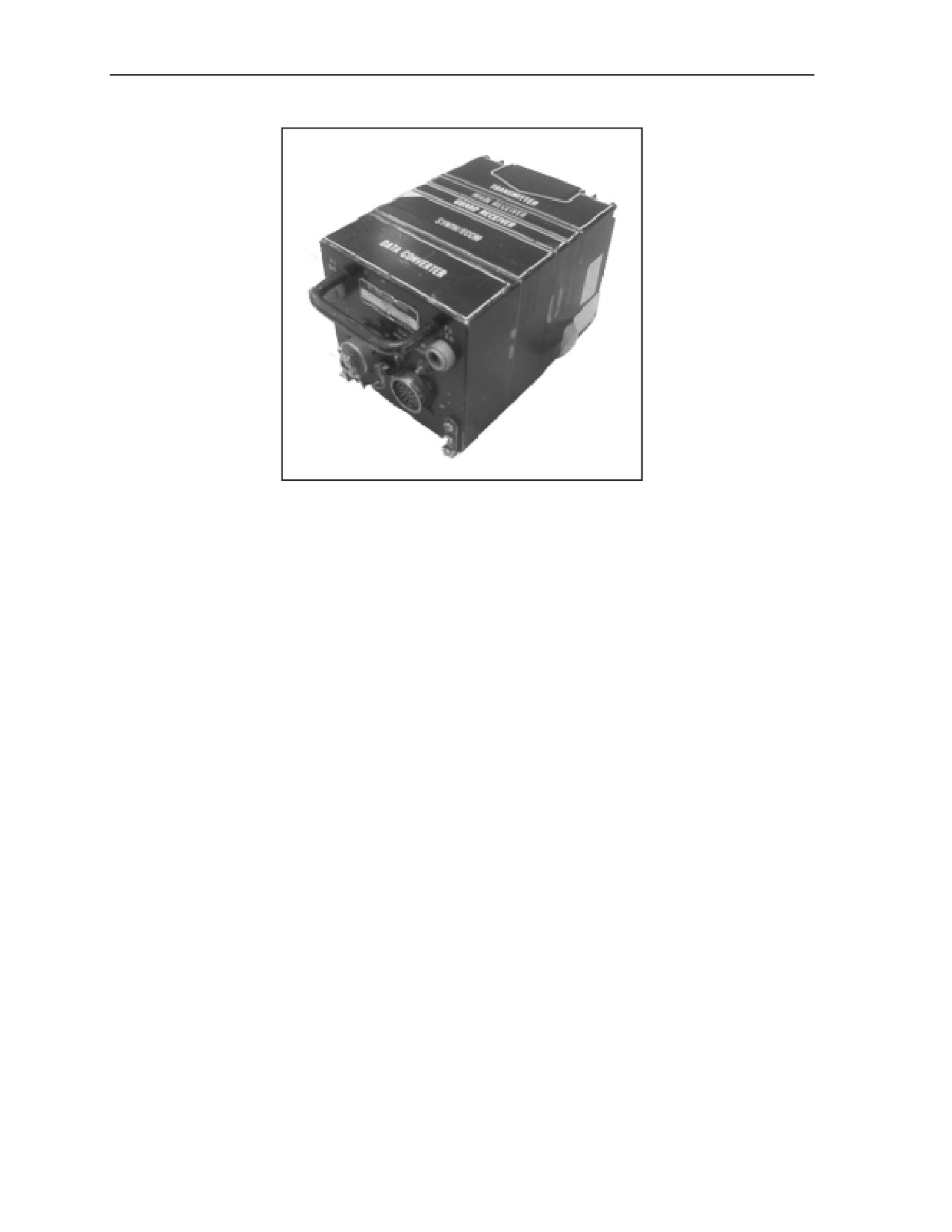
(RT-1518C), remote control (C-11721), remote mount (RT-1504) (refer to Figure 7-7), and data bus
compatible (RT-1614). These radios provide anti-jam, secure communications links for JTF and Army
aviation missions. The Army operational forces utilizing these radios are aviation units, air traffic services
and Ranger units. It also provides the Army the ability to communicate with USAF, USN and NATO units
in the UHF-AM mode which is the communications band for tactical air operations.
7-21. The AN/ARC-164(V) 12 has the following capabilities and characteristics—
z
Operations in SC or FH mode.
z
Frequency range of 225-399.975 MHz.
z
Capacity of 7,000 channels.
z
Embedded ECCM anti-jamming capabilities.
z
Voice and data modulated signals with VINSON or VANDAL devices.
7-22. Refer to FM 6-02.771 for more information on HAVEQUICK radios and TM 11-5841-286-13 for
information on the AN/ARC-164(V) 12.
5 August 2009
FM 6-02.53
7-7
Chapter 7
Figure 7-7. RT-1504 for an AN/ARC-164(V) 12
AN/VRC-83(V) RADIO SET
7-23. The AN/VRC-83(V) is a two-band VHF AM and UHF AM radio set. The AN/VRC-83(V) is
designed for tactical short range ground-to-ground and ground-to-air communication. The AN/VRC-83(V)
is ground configuration of the AN/ARC-164, which is described in the next section. The AN/VRC-83(V)
can operate in the jam-resistant, ECCM mode or in the NORMAL (non-ECCM) mode and can be used
with COMSEC TSEC/KY-57 speech security equipment for secure voice communication.
7-24. The AN/VRC-83(V) is tunable in 25 kHz steps to either one of two frequency bands, VHF
(116.000-149.975 MHz with 1360 channels) or UHF (225.000-399.875 MHz with 7000 channels). The
AN/VRC-83(V) also has an RF PA to increase the RT transmit power of the set, an audio amplifier, a
power supply to regulate the input voltage, a speaker and a handset. The handset is the audio input-output
device for the radio set.
7-25. Primary components of the AN/VRC-83(V) consist of: one RT-1319B/URC, radio amplifier AM-
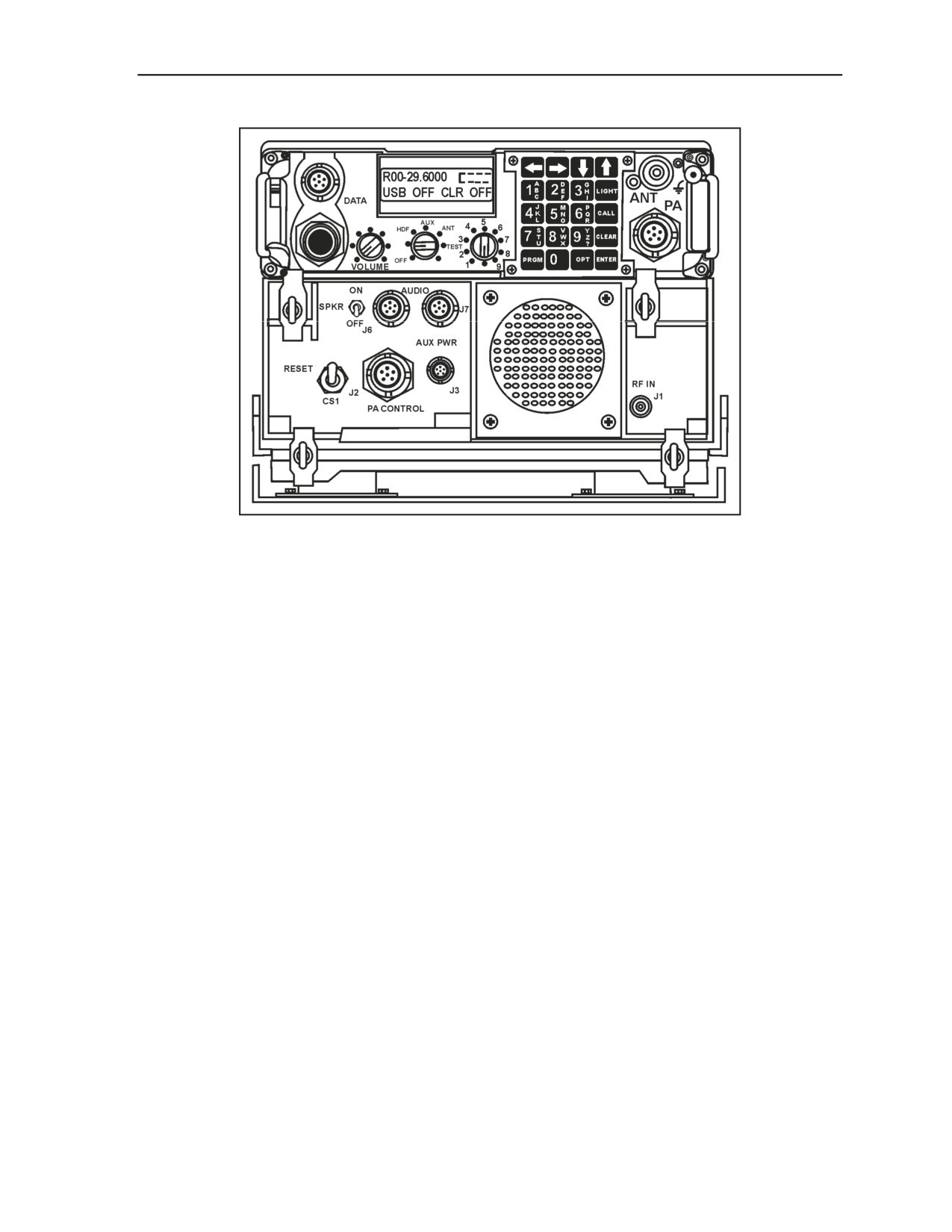
7176, VRC-83 mount, cable assemblies, and a handset. Refer to Figure 7-8 for an example of the
AN/VRC-83(V) and TM 11-5820-1149-14&P for more information on radio maintenance.
7-8
FM 6-02.53
5 August 2009
Airborne Radios
Figure 7-8. AN/VRC-83 radio set
AN/ARC-186(V) VHF AM/FM RADIO
7-26. The AN/ARC-186(V) provides AM, FM, FM homing and wireless network extension. It is primarily
used as an administrative VHF AM/FM radio used to communicate with the ATC. The AN/ARC-186(V) is
a LOS radio system with limited range at terrain-flight altitudes but greater range at administrative altitudes
normally associated with ATC communications. It can back up the SINCGARS in the same 30-89.975
MHz frequency range but a big disadvantage is that it has no FH mode compatible with SINCGARS and it
generally lacks KY-58 interface to provide secure FM communications.
7-27. Battalions typically operate a C2 network, O&I and A&L network all using SINCGARS. Battalions
also operate an internal air operations network using HAVEQUICK II. The AN/ARC-186(V) is a
secondary means of secure tactical communication to overcome SINCGARS and HAVEQUICK II LOS
constraints.
7-28. Even though the AN/ARC-186(V) VHF AM radio is normally used for administrative purposes it
may function as a platoon internal net. The battalion TOC may also have access to MSE and SATCOM for
communicating with higher headquarters. (Refer to TM 11-5821-318-12 for more information on the
AN/ARC-186(V).)
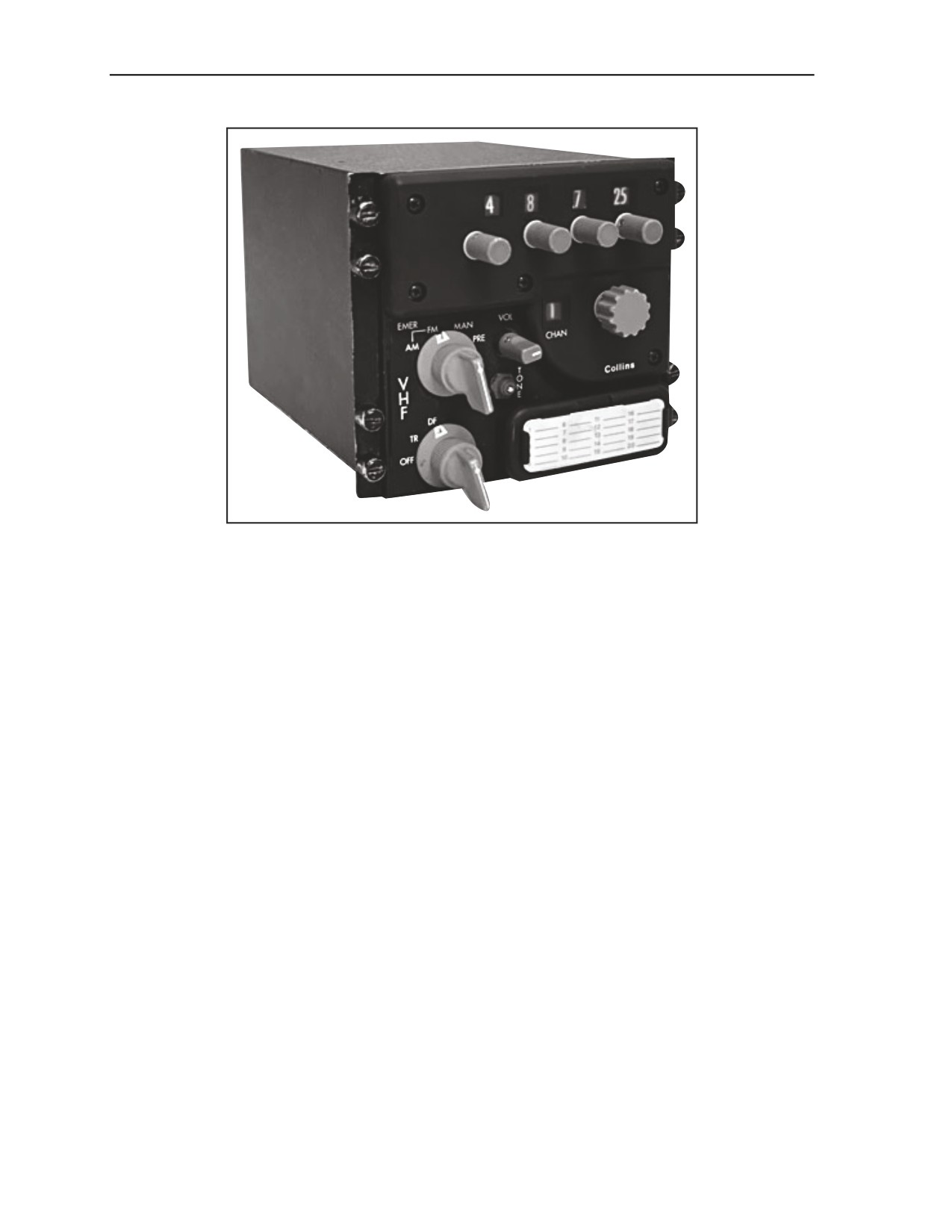
7-29. The AN/ARC-186(V) (refer to Figure 7-9) has the following capabilities—
z
Secure communications when the radio is employed with the KY-58.
z
Frequency ranges of:
AM transmit/receive: 116-151.975 MHz.
AM receive only: 108.000-115.975 MHz.
FM transmit/receive: 30.000-87.975 MHz.
z
Channel spacing: 25 kHz.
z
20 preset channels with electronic memory.
5 August 2009
FM 6-02.53
7-9
Chapter 7
Figure 7-9. AN/ARC-186 (V)
7-10
FM 6-02.53
5 August 2009
Chapter 8
Other Tactical Radio Systems
To be successful on the modern battlefield, commanders must be able to
communicate in order to control and coordinate movement, send and receive
instructions, request logistical or fire support, and gather and disseminate
information. In addition to CNR systems, many other tactical radio systems are now
available. The means of communications chosen will depend on the situation. This
chapter addresses the AN/PRC-126, ICOM F43G, the LMR, the Land Warrior (LW)
communications networking radio subsystem
(CNRS), combat survivor evader
locator radio, and the JTRS.
AN/PRC-126 RADIO SET
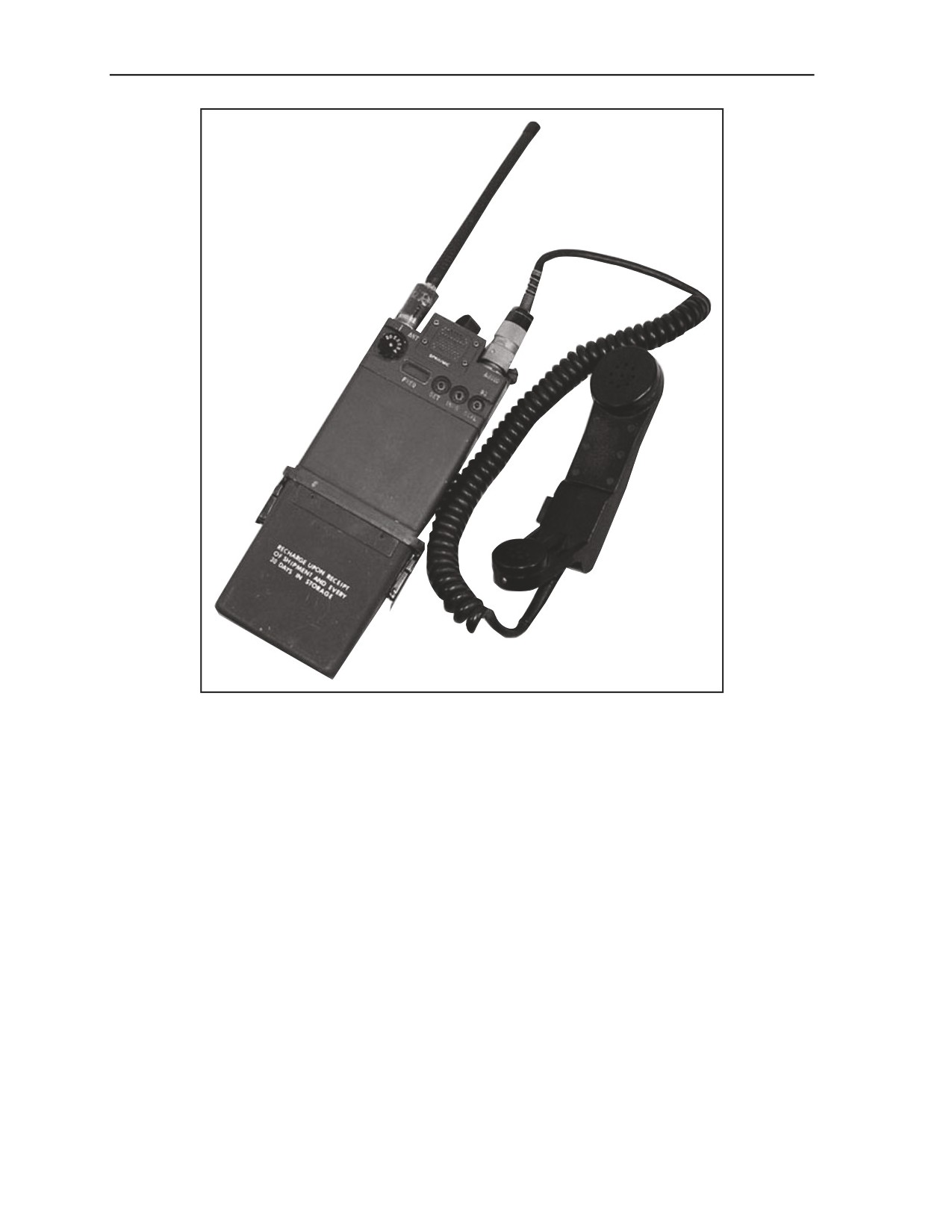
8-1. The AN/PRC-126 (refer to Figure 8-1) is susceptible to adversary jamming and friendly co-site
interference. Alternate frequencies must be identified for use in case of jamming, and leaders must ensure
that Soldiers are trained to recognize, overcome, and report jamming activities.
8-2. The AN/PRC-126 enables small unit leaders to adequately control the activities of subordinate
elements in accomplishing the unit’s mission. It is a short-range, handheld, or vehicular mounted tactical
radio, used primarily at the squad/platoon level. Vehicular power requires connection to an OG-174,
amplifier power supply. It’s key features include—
z
Lightweight, militarized transceiver providing two-way voice communications.
z
Frequency range of 30-87.975 MHz.
z
Frequency separation is 25 kHz.
z
Nominal range for reliable communications over rolling, slightly wooded terrain is 500 meters
(1,640.4 ft) with the short antenna, or 3,000 meters (9,842.5 ft) with the long antenna.
z
Standard battery (lithium) operating time is 70 hours.
z
Capable of operating with SINCGARS in the fixed frequency mode.
z
Capable of providing secure voice operation when used with the TSEC/KYV-2A secure voice
module.
z
Digital communications for passing TACFIRE data are possible when connected to the OG-174.
(Refer to TM 11-5820-1025-10 for more information on the AN/PRC-126 and FM 6-50 for
additional information on transmitting TACFIRE data with the AN/PRC-126.)
8-3. In the light infantry platoon, the rifle squad has two AN/PRC-126 radios: one for the squad leader
and the other for the A-team leader. Air assault and airborne infantry squads have only one AN/PRC-126
each. If tasked to conduct a patrol, the dismounted section of a Bradley infantry fighting vehicle
mechanized infantry platoon, should task organize its radio equipment in the preparation phase to ensure
teams will have communications.
5 August 2009
FM 6-02.53
8-1
Chapter 8
Figure 8-1. AN/PRC-126 radio set
ICOM F43G HANDHELD RADIO
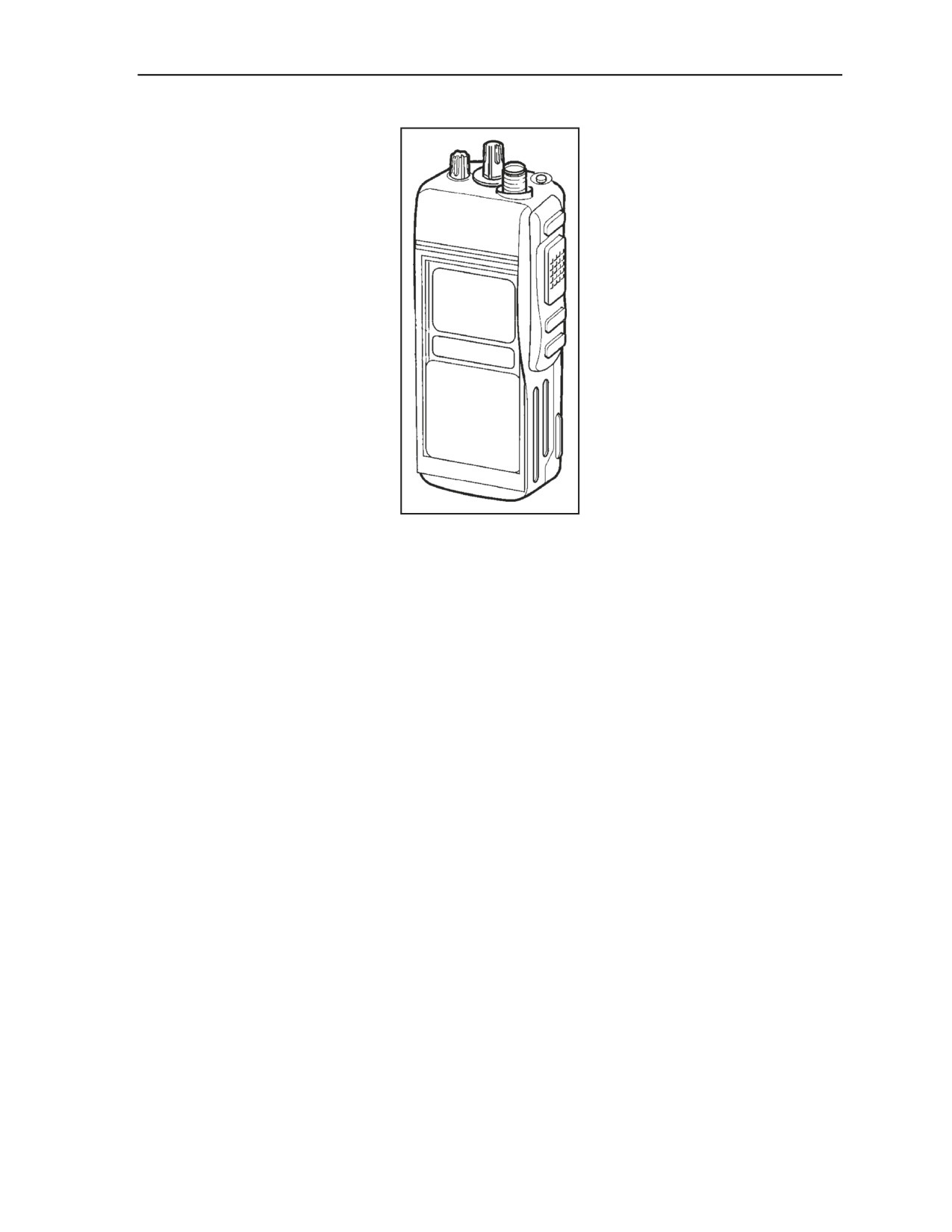
8-4. The ICOM F43G handheld radio is a COTS system. It is a short range, handheld radio fielded with
headset and an encryption module. It is employed at the lowest echelon of command, to control squads and
teams. The ICOM F43G is used to provide the Soldier with a small light weight, rugged handheld radio
with capability of secure UHF 2-way communication.
8-5. The ICOM F43G (Figure 8-2 is an example of the ICOM F43G) has the following characteristics
and capabilities—
z
UHF operation in the 380-430 MHz frequency range.
z
4 miles (6.4 km) plus transmission in the unencrypted mode.
z
256 memory channel capacity.
z
16 memory banks that allow for division and storage of a variety of flexible channel groupings.
z
Built-in multi-format tone signaling and built-in voice scrambler.
z
It uses a data encryption standard card which can be upgraded for secure communication.
8-2
FM 6-02.53
5 August 2009
Other Tactical Radio Systems
Figure 8-2. ICOM F43G handheld radio
LAND MOBILE RADIO
8-6. The LMR is typically the primary system used for daily installation communications. It is also
commonly employed and used for administrative installation activities in public safety organizations and is
compliant with the Association of Public Safety Communications Officials (normally referred to as APCO)
Project 25 (P25) standards. P25 standards are based on the public safety communities needs as they define
them. The LMR enhances communications interoperability with state and local agencies in a homeland
defense or disaster situation.
8-7. LMR systems range from SC analog to digital trunked systems. The most basic LMR systems are
SC analog systems. Each radio is set to a particular frequency that must be monitored by everyone utilizing
the same channel. These systems have a dedicated channel for each group or agency using the system. In
smaller agencies, if the system experiences heavy usage, users may not be able to place calls. The majority
of these systems are VHF systems that offer very little flexibility in their operations. These systems fail to
provide a common air interface and cannot accommodate users outside the system. These systems are
inefficient users of spectrum, and many agencies have outgrown them. For United States and Possessions
(US&P) LMR regulations see Chapter
8 of the National Telecommunications and Information
Administration (NTIA) Redbook.
8-8. The majority of public safety organizations are currently using SC analog systems. Many of these
organizations are in the process of switching, or have switched to, digital trunked systems. Trunked
systems utilize a relatively small number of paths, or channels, for a large number of users. This is similar
to commercial telephones. Rather than having a dedicated wire line for every user, the phone company has
a computer (switch) that manages many calls over a relatively small number of telephone lines. This is
based on the assumption that not every user will require a line at the same time.
8-9. Trunked systems are generally made up of a control console, repeaters, and radios. Instead of using
switches and phone lines, these systems use consoles and channels or frequencies to complete calls. The
process is the dynamic allocation of a channel that is totally transparent to the user. When the user of a
trunked system activates the push-to-talk, the system automatically searches for an unused channel on
which to complete the call.
5 August 2009
FM 6-02.53
8-3
Chapter 8
8-10. Digital trunked systems offer better performance and provide a more flexible platform. This system
accommodates a greater number of users and offers an open ended architecture. This allows for various
modes of communications such as data, telephone-interconnect, and security functions. Additionally, there
is faster system access, more user privacy, and the ability to expand by providing a common air interface.
For CONUS LMR regulations refer to the NTIA Redbook, Chapter 10. The user/unit is responsible for
obtaining a frequency assignment IAW NTIA, Manual of Regulations and Procedures for Federal Radio
Frequency Management; AR 5-12; AR 25-1; and FM 6-02.70. Operation of Radio Frequency System
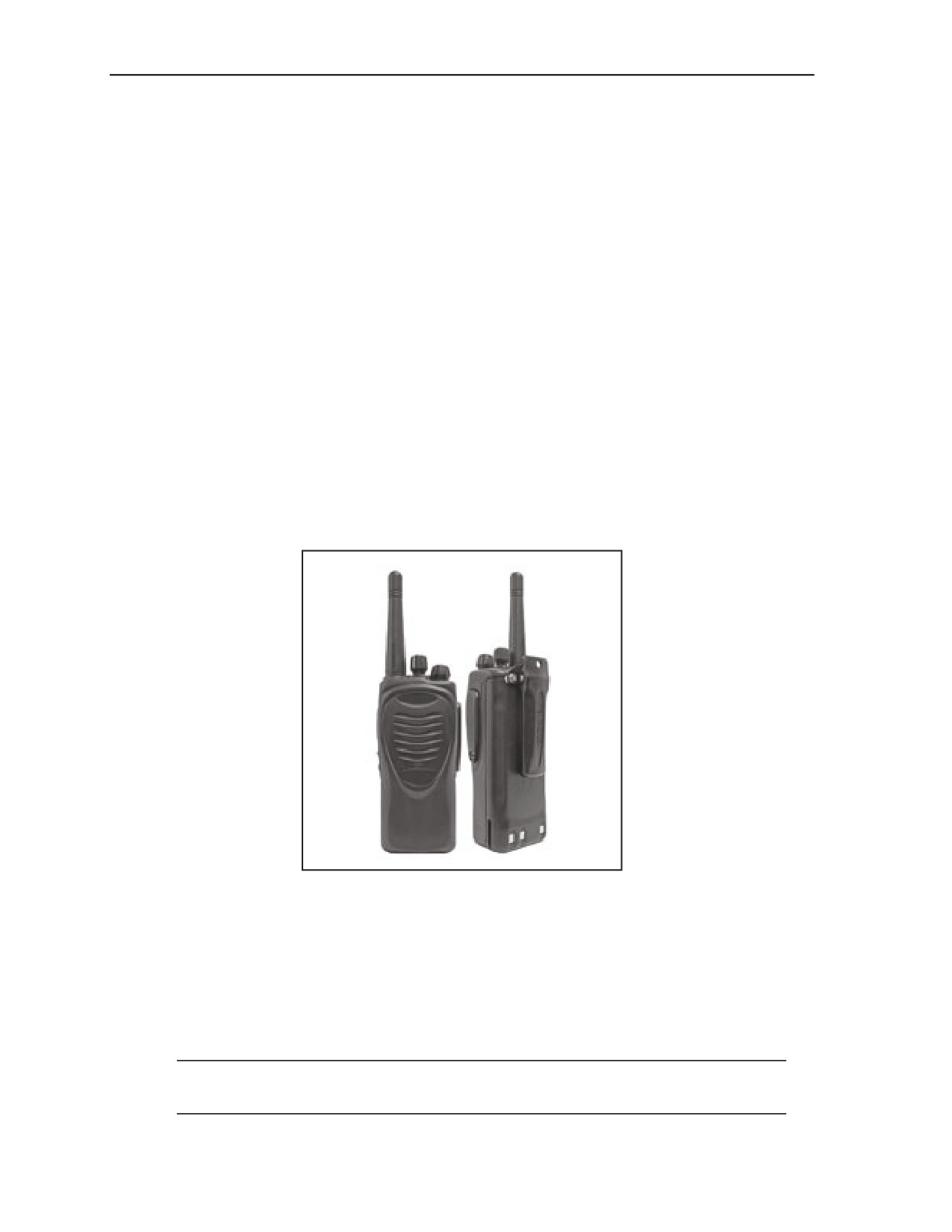
without spectrum authorization/assignments is prohibited. (Refer to Figure 8-3 for an example of the
LMR.)
8-11. The LMR has the following characteristics and capabilities—
z
Frequency range of 380-470 MHz.
z
Power of 1-4 Watts.
z
Battery life of 10 hours.
z
Secure
(National Institute of Standards and Technology Type III) point-to-point voice
communications.
z
Range of 5 km (3.1 miles) max over smooth terrain.
z
Programming of up to 512 channels.
z
Easy radio reprogramming feature.
z
Immersible to a depth of 1 meter (3.2 ft) for 30 minutes.
z
Supports both narrowband (12.5 kHz) and wideband (25 kHz) channel spacing.
z
Intra-Squad/Team Communications for non-critical C2, admin and logistics functions.
Figure 8-3. Land mobile radio
LAND WARRIOR
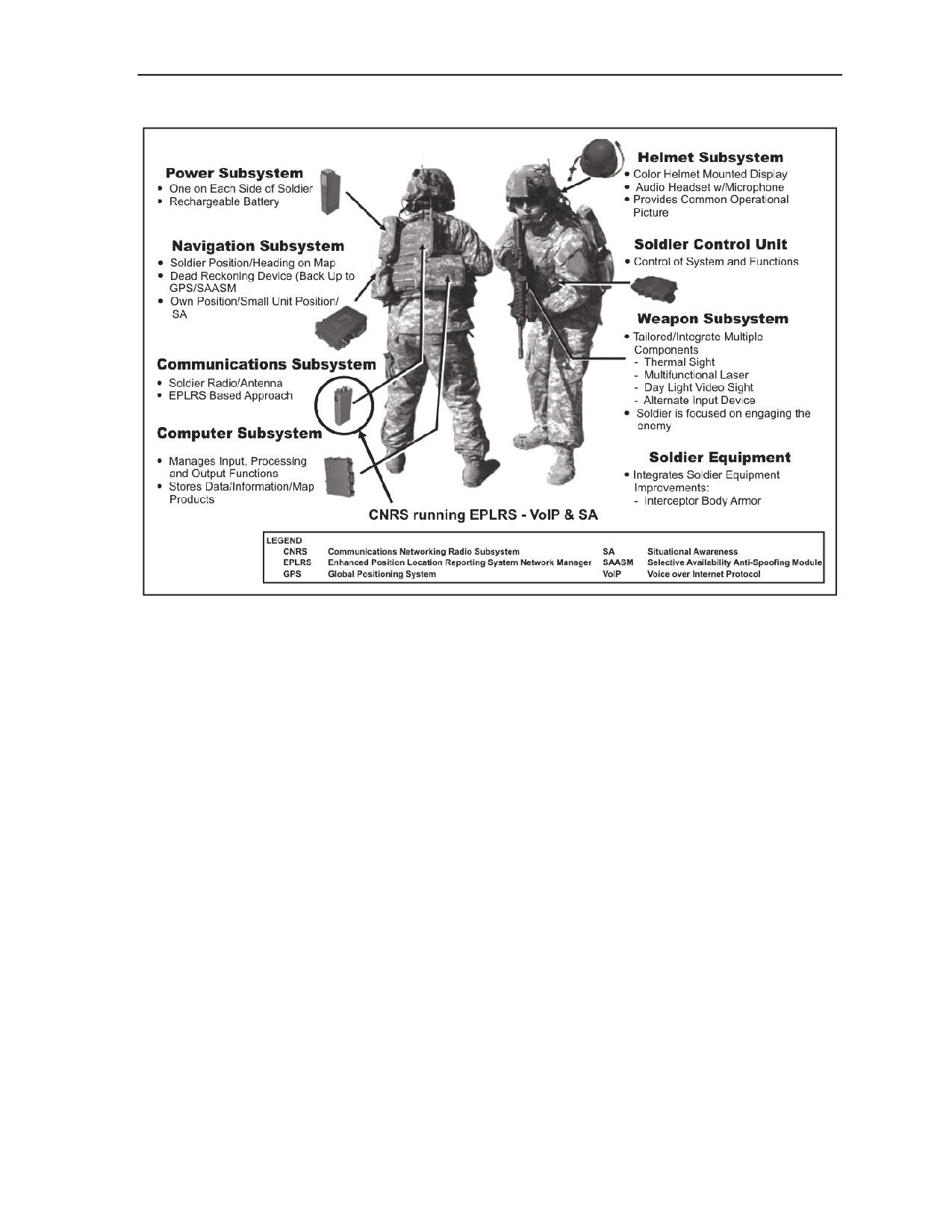
8-12. The LW, Figure 8-4, is a ground Soldier system, which integrates everything an infantry Soldier
wears or carries on the battlefield. It is based on advances in communications, sensors, and materials. The
LW integrates commercial technologies into a complete Soldier system. Its components include a: helmet
subsystem, weapons subsystem, Soldier control unit, power subsystem, navigation subsystem, computer
subsystem and CNRS.
Note. Information in this manual was current at time of publication and the LW had only been
fielded to 4/9th Infantry Regiment.
8-4
FM 6-02.53
5 August 2009
Other Tactical Radio Systems
Figure 8-4. Land Warrior
COMMUNICATIONS NETWORKING RADIO SUBSYSTEM
8-13. The CNRS offers the same functionality as the full size EPLRS radio (refer to Chapter 5 for more
information on EPLRS radios), except that it uses a smaller, lighter, and more power efficient EPLRS, the
RT 1922 C/G. It also supports multiple simultaneous channels of contention free voice (Voice over IP) and
data. Power is supplied through the radio’s interface connector pins, using an external (remote) battery
pack or an external power supply.
8-14. The CNRS characteristics and capabilities include—
z
Voice and data communications in a single streamlined unit.
z
Interoperability with EPLRS and JTRS and integrates with the Army’s tactical Internet FBCB2.
z
LOS with automatic hopping within the tactical Internet for range extension.
z
Handling of SECRET and “Secure But Unclassified” material.
z
2.9 megabits per second per network with a maximum of 486 kbps per user.
z
Power out of 50 milliwatts to 5 watt (batter pack).
z
Weight of approximately 12 ounces (without the power supply).
Land Warrior/CNRS Bandwidth Methodolgy
8-15. The EPLRS is an adaptive mobile radio network for users within tactical units. It employs embedded
security features and automatic relaying which is used for range extension and is transparent to the user.
EPLRS uses TDMA to allow a user to participate simultaneously in more than one network. The EPLRS
TDMA architecture is divided into eight logical time slots (LTS). Each separate net (for example: battalion
SA, battalion other data, company voice) is assigned its own LTS, or portion of a LTS, and frequency.
5 August 2009
FM 6-02.53
8-5
Chapter 8
8-16. The EPLRS offers three types of communication services: duplex, CSMA, and MSG. The LW SA
and C2 nets are CSMA allowing everyone on the net the capabilities of transmitting and receiving all
traffic transmitted/received on the net.
8-17. The architecture allocates a one-half LTS CSMA short local needline for the battalion position report
SA net. The short indicates that all messages must fit into one transmission unit (648 bits); local indicates
the messages will be relayed one time; and one-half LTS provides a user data rate of 9.4 kbps.
8-18. The number of participants in the battalion position report SA net that will receive the position report
SA updates from others on that net is dependent on distribution and actual ranges. When the battalion is
distributed over a 30 km (18.6 miles) area, approximately 45 percent of the battalion will be within range
of each other (including radio relay).
8-19. Unlike the FBCB2 architecture, LW does not use SA servers to forward information. The LW
battalion data needlines are two hop nets. Position reports SA from key LW roles is forwarded to the lower
tactical Internet SA net which is then relayed 4 hops and retransmitted down to LWs beyond the two hop
limit of the LW data needlines as part of the lower tactical Internet brigade SA on the other LW needline.
This ensures that most of the LW systems will consistently receive the updated position report SA for key
LW roles. It is considered acceptable if a LW periodically misses an SA update because of the frequency
of updates. A C2 message will be resent up to three times before the LW system stops trying to send the
message.
8-20. For each unit on the SA network, an SA message is sent either at regular time intervals when
position is unchanged (the unit is stationary), or when position changes by a specified distance. This is
known as a time-motion update rate (distance). For example, the time-motion update rate for the company
vehicles is 300 seconds or 100 meters (328 ft). The current LW default settings are two minute updates if
stationary, every 15 meters (49.2 ft) of movement, or every 15 seconds if moving faster than 60 meters
(196.8ft)/minute.
8-21. Knowing the number of EPLRS equipped company vehicles and LW platforms, and using
assumptions about the time-motion update rates and the number of platforms moving, the number of
messages that would be sent in one hour can be calculated. SA messages are 496 bits, which is smaller than
the EPLRS transmission unit of 648 bits. Since a transmission unit represents the smallest amount of
information that can be transmitted, each SA message sent will consume 648 bits.
8-22. From this information, the offered data load for one hour will be summed and the average bps
determined. This average divided by the data rate of the EPLRS radio produced a utilization number for the
network. Previous modeling and testing of the EPLRS network have developed a relationship between
network utilization and message completion rate. This relationship will be used to estimate the message
completion rate for each LW EPLRS net.
COMBAT SURVIVOR EVADER LOCATOR
8-23. The combat survivor evader locator (CSEL) handheld radio is utilized for locating and rescuing
downed aircrew members. It is primarily used by personnel assigned as flight crews, SOF and other
personnel with a high priority of becoming isolated. The CSEL is the primary search and rescue system
used by SOF and aviation units. Its enhanced capabilities are not available by the older transceivers;
AN/PRC-90 and AN/PRC-112.
8-24. The CSEL system is composed of three segments: over-the-horizon segment, ground segment, and
the user segment. The three segments use GPS, national and international satellites and other national
systems to provide geopositioning and radio communications for personnel recovery.
OVER-THE-HORIZON SEGMENT
8-25. The over-the-horizon segment operates over UHF SATCOM systems and Search and Rescue
Satellite Assisted Tracking. The UHF SATCOM mode supports two ways messaging/geoposition between
an AN/GRC-242 radio set base station and the AN/PRQ-7 radio set.
8-6
FM 6-02.53
5 August 2009
Other Tactical Radio Systems
GROUND SEGMENT
8-26. The ground segment is composed of CSEL workstations and the ground distribution network
interconnecting with base stations. The ground segment provides highly reliable and timely global
connection between all CSEL ground elements utilizing the Defense Information System Network.
USER SEGMENT
8-27. The user segment equipment consists of—
z
AN/PRC-7 radio set.
z
J-6431/PRQ-7 radio set adapter (RSA) also referred to as the loader.
z
Combat survivor evader locator planning computer (CPC).
z
CPC program software.
AN/PRQ-7 Radio Set
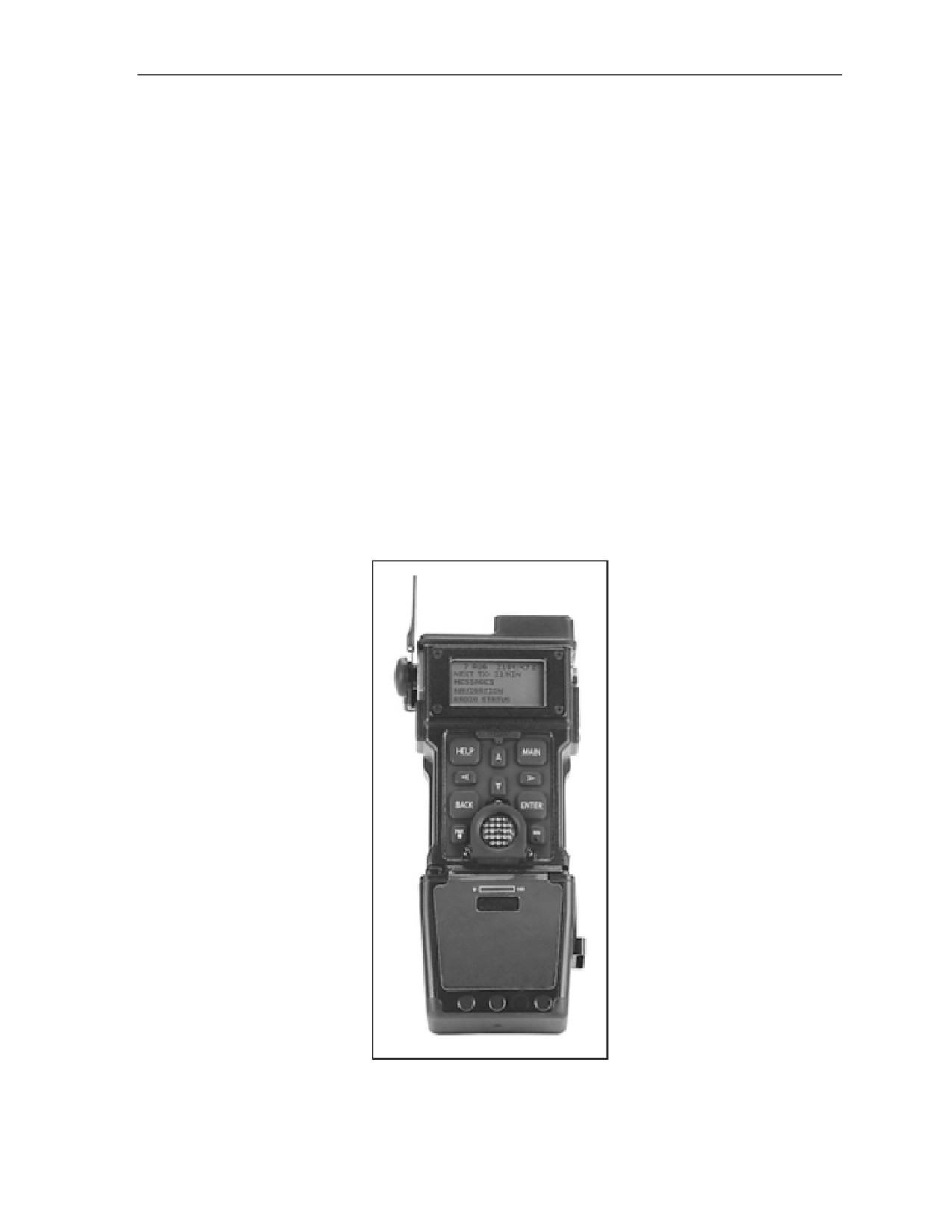
8-28. The AN/PRQ-7 (refer to Figure 8-5) provides data communications geo-positioning, voice beacons.
The RSA provides the physical interface the CPC and two operational AN/PRQ-7s. One AN/PRQ-7 serves
as the reference in the RSA to acquire and store GPS almanac, ephemeris and time for the transfer to the
other (target) AN/PRQ-7. The CPC host CSEL application software that allows loading of the AN/PRQ-7
through the RSA. A window operating environment is used to load a target AN/PRQ-7 with mission
specific data and transfer GPS key loading. Loading current almanac and ephemeris data speed the satellite
acquisition process in the GPS receiver. Transfer of current GPS data speeds the calculation of user
position and transfer of current time allows faster acquisition of GPS.
Figure 8-5. AN/PRQ-7 radio set
5 August 2009
FM 6-02.53
8-7
Chapter 8
8-29. The AN/PRQ-7 radio set has the following capabilities and characteristics—
z
Water resistant.
z
GPS receiver.
z
Secure data UHF SATCOM transmit and receive capability.
z
VHF/UHF voice and beacon.
z
Low probability of exploitation of one way transmission.
z
Search and rescue satellite transmission.
AN/PRC-90-2 TRANSCEIVER
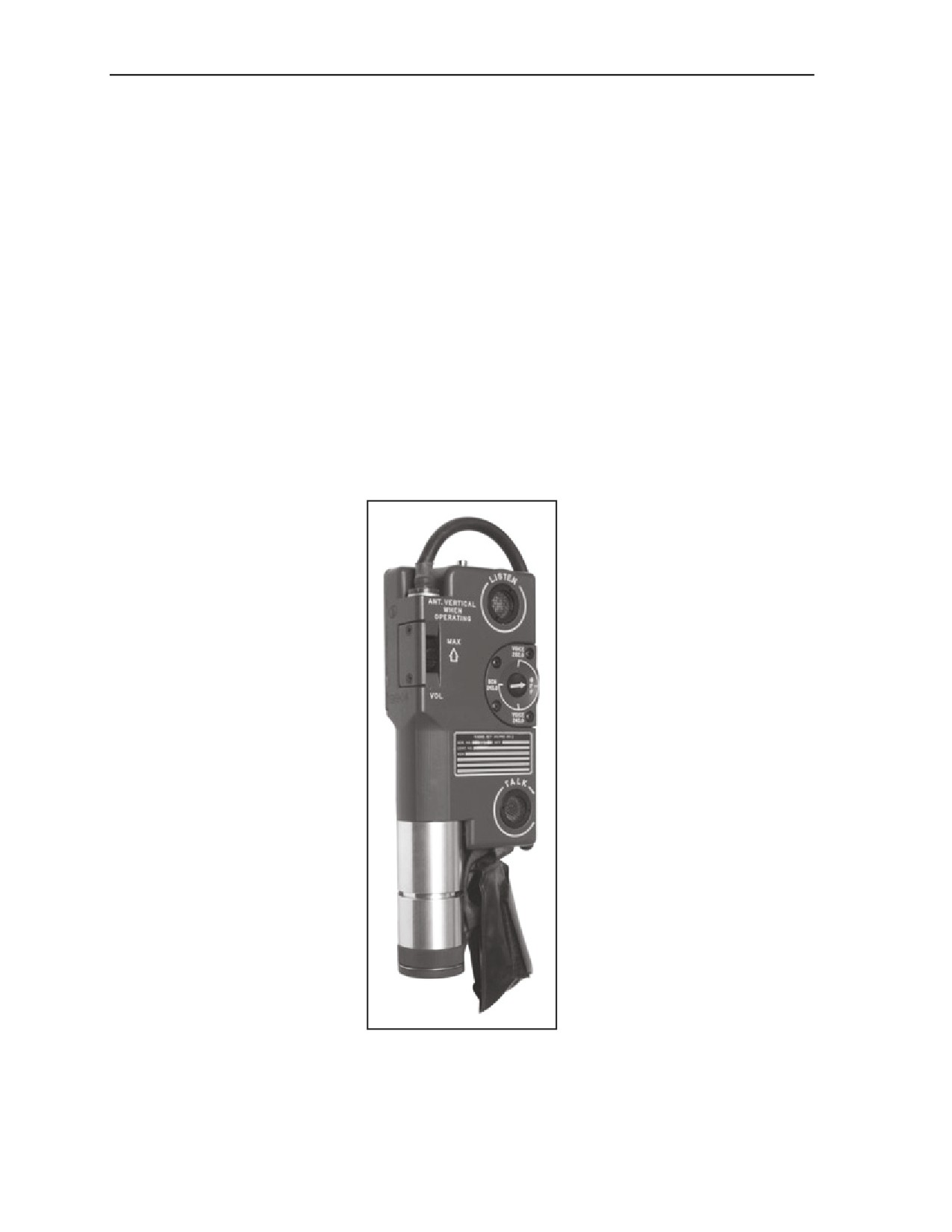
8-30. The AN/PRC-90-2 is a LOS dual channel, personal survival transceiver used primarily used for
communications between a downed crewman and a rescue aircraft. It has two preselected frequencies for
voice and beacon transmissions. The signal is not secure and can be easily intercepted leaving isolated
personnel limited to short voice transmissions.
8-31. The AN/PRC-90-2 (refer to Figure 8-6) can transmit a beacon (attention getting warble tone) on
243.0 MHz, voice on 243.0 or 282.2 MHz and Morse Code in modulated continuous wave (CW) mode on
243.0 MHz. It also has the capability of receiving voice communications on 243.0 and 282.2 MHz. The
distance for LOS transmission also depends on conditions such as weather, terrain and battery power.
(Refer to TM 11-5820-1049-12 for more information on the AN/PRC-90-2.)
Figure 8-6. AN/PRC-90-2 transceiver
8-8
FM 6-02.53
5 August 2009
Other Tactical Radio Systems
AN/PRC-112 COMBAT SEARCH AND RESCUE TRANSCEIVER
8-32. The AN/PRC-112 combat search and rescue transceiver is a replacement for the AN/PRC-90-2. The
AN/PRC-112 has frequency ranges of—
z
AM voice on 121.5 MHz, 243 MHz and 282.8 MHz.
z
UHF frequency of 225-320 MHz.
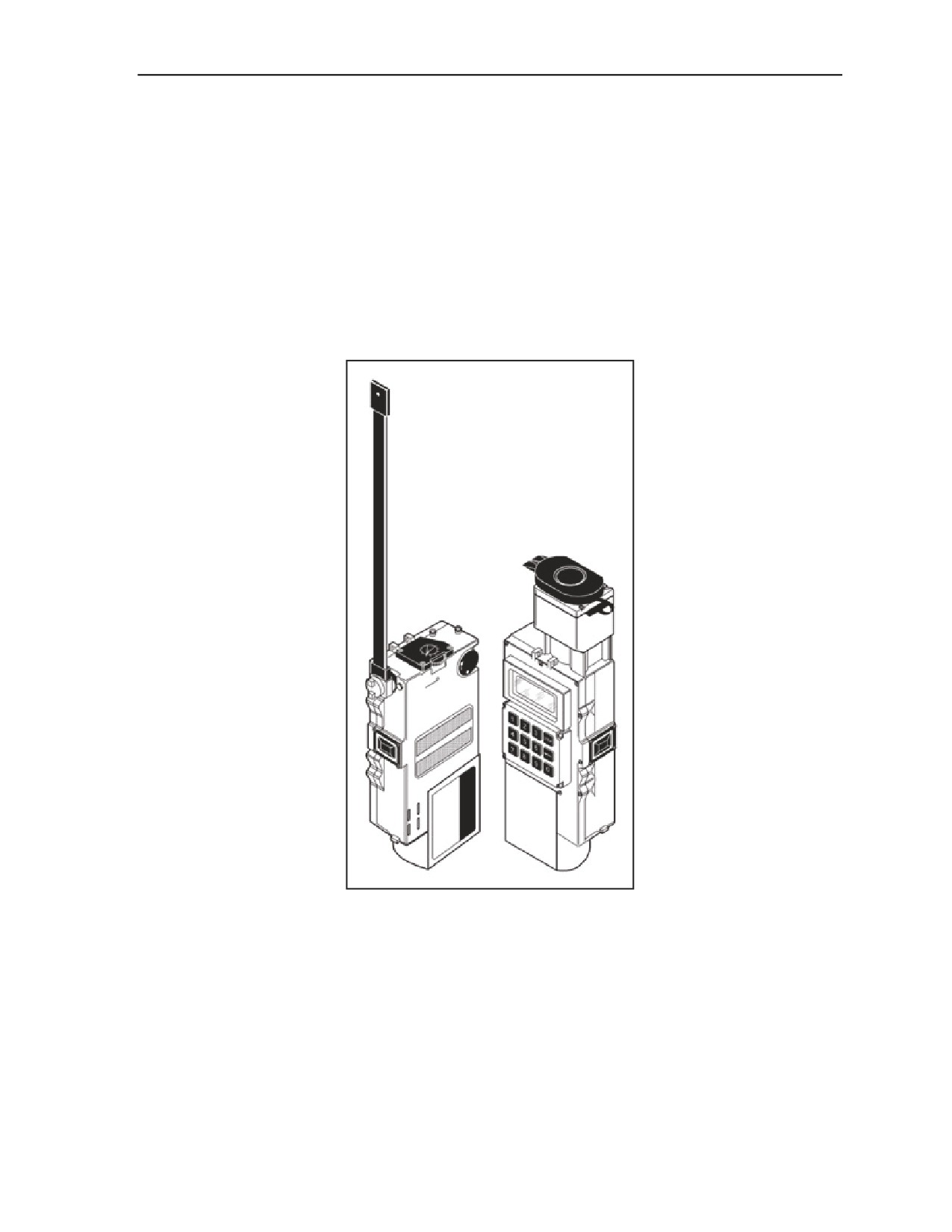
8-33. The AN/PRC-112 (refer to Figure 8-7) operates in the following modes: voice, beacon, transponder
mode, 406 search and rescue satellite, and UHF SATCOM. It is also dependant on the program loader KY-
913 which has a keypad for data entry and an eight character display used to display the entered data and
messages to the operator. The program loader attaches to the radio during programming and supplies the
required power to the radio when attached. (Refer to TM 11-5820-1037-13&P for more information on the
AN/PRC-112.)
Figure 8-7. AN/PRC-112 and program loader KY-913
JOINT TACTICAL RADIO SYSTEM
8-34. The JTRS is the DOD radio of choice for radio requirements. The components of JTRS include
airborne maritime fixed station, ground mobile radio, and handheld man-pack small form fit. JTRS are
software based networking radios that will deliver networks to the mounted, dismounted, and un-mounted
joint force.
5 August 2009
FM 6-02.53
8-9
Chapter 8
Note. At the time of publication JTRS had not been fielded to Army units and was in the process
of being developed and tested. Pre-engineering design model ground mobile radios were
available in the Experimental BCT Future Combat System.
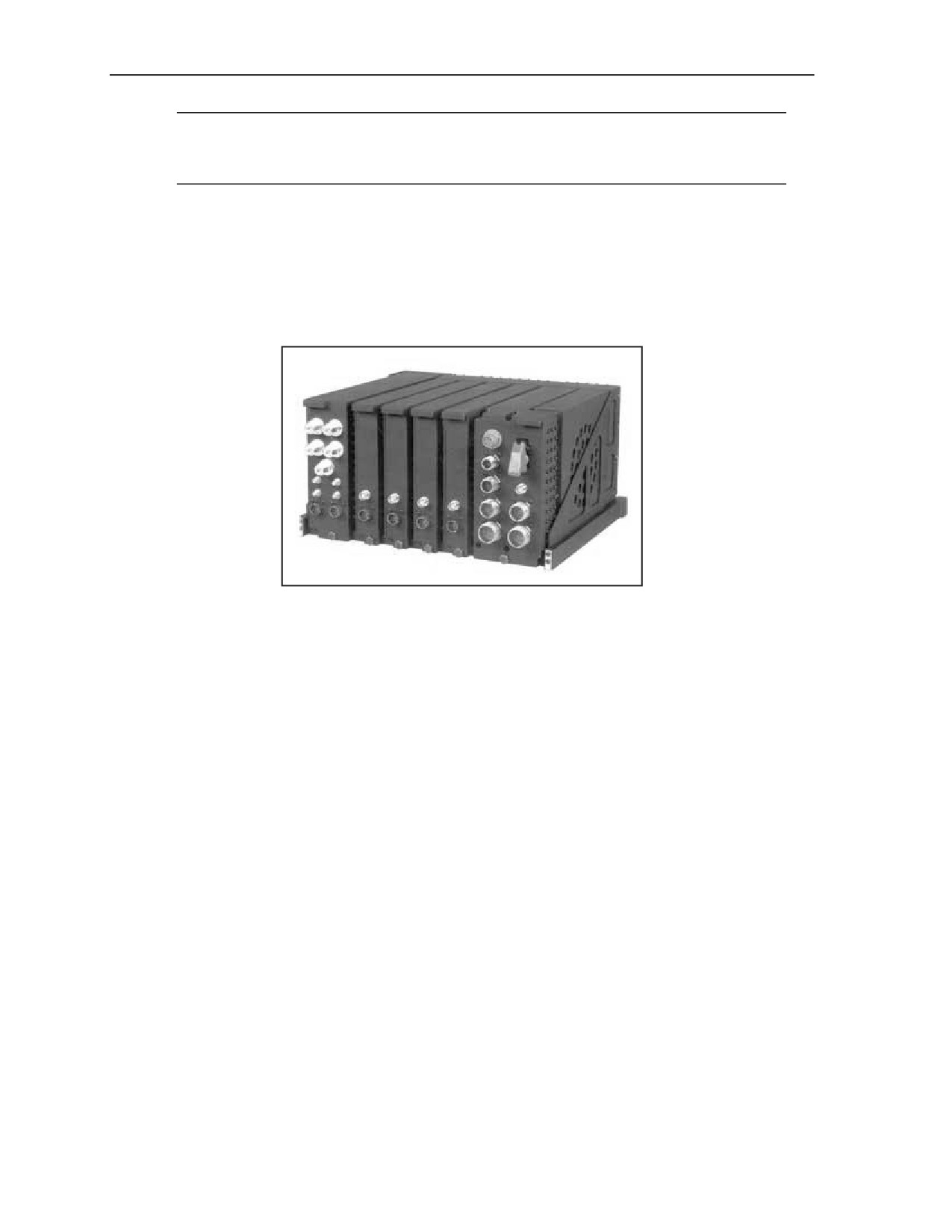
8-35. The concept behind the JTRS family of radios (refer to Figure 8-8 for an example of the JTRS) is for
all military services to migrate toward a commonality of media among Soldiers, while concurrently out-
pacing the growth rate of information exchange requirements and eventually realizing a fully digitized
tactical environment. JTRS lays the foundation for achieving network connectivity across the RF spectrum.
The network will provide the means for low-to-high rate digital information exchange, both vertically and
horizontally, between warfighting elements. It will also enable connectivity to civil and national
authorities.
Figure 8-8. Joint tactical radio system ground mobile radio
8-36. The JTRS was designed to meet the emerging service needs for secure, multiband/multimode, high
capacity digital radios for the future tactical environments. The JTRS provides increased interoperability
among the Services, reduce upgrade costs through software programming (add new capabilities, change
wave forms, and provide waveform enhancements), and support future legacy communications
requirements.
8-37. The JTRS has ease of operation, redundancy, and security. It also has network capable, demand
adaptive (dynamic bandwidth management), reliable, maintainable, deployable, and more survivable than
the current generation of analog radios and stovepipe networks. The key features of the JTRS family of
radios systems include—
z
Simultaneous multichannel operation; has a fixed radio requirement for a minimum of four-
channel operation (threshold) scalable to 10 channels (objective).
z
Narrowband and wideband waveforms currently used in the 2 MHz and 2 GHz frequency range,
to include HF ALE, SINCGARS, VHF AM 8.88 kHz operation for European ATC, ATC data
links, HAVEQUICK I/II, UHF SATCOM DAMA, EPLRS, and Link 16.
z
Increased throughput for data communications capabilities, including commercial waveforms.
z
Multimode support for voice, data, video, and other communications.
z
Integrated GPS, information security, modem, and baseband processing functions.
z
Provide networking such as cross banding, bridging, relay, IP compatibility, and near real-time
task organization.
z
New capabilities, or provides waveform upgrades, as required.
z
Extend with modular hardware and software, and can be reconfigured in the tactical
environment.
z
Interface with inventory PAs, antennas, and ancillary equipment.
z
Operations in various domains—airborne, maritime/fixed, vehicular, dismounted (manpack),
and handheld.
8-10
FM 6-02.53
5 August 2009
Other Tactical Radio Systems
8-38. JTRS radios range from low cost terminals with limited waveform support, to multiband, multimode,
and multichannel radios supporting advanced narrowband and wideband waveform capabilities with
integrated computer networking features. The JTRS family will be open system architecture, interoperable
with current legacy communications systems, capable of future technology insertion, and capable of
providing both LOS, and BLOS, communications capabilities to the Soldier.
8-39. JTRS has several functionalities, it is—
z
To the user—plug and play voice, high data throughput, and video-capable communications in
a transparent network, with the ability to expand and modify the capacity and capability of the
individual radio, links, and networks to accommodate user demands.
z
To the communicator—intensive planning, management, and control:
Automated central planning and management; distributed technical control.
Information security, spectral efficiency, and electromagnetic interference
(EMI)/electromagnetic compatibility.
Gateways to other systems (military, civil, joint, multinational, host, and
nation).
z
The joint tactical radio family of systems, which are scalable hardware configurations and
multiple programmable waveforms and modes, capable of being operated and monitored while
unattended, and remotely controlled and have standard interfaces and legacy radio emulation to
operate in selected legacy radio nets.
z
The joint tactical Internet, to include—
All hardware and software to form and manage a seamless mobile tactical
radio Internet.
Common operating environment and dynamic power management.
Dynamic routing and traffic load management.
Embedded position location and automatic SA feed to the network.
JTRS WAVEFORM
8-40. Wireless tactical networking is one of the most critical capabilities a JTRS software defined radio
will provide to the Soldier. The JTRS networking waveforms enable extension of networking to the
battalion, company, and dismounted Soldiers.
8-41. The initial increment of JTRS being developed includes three networking, one BLOS waveform, and
ten new software defined radios. The new networking waveforms are Soldier Radio Waveform, focused on
the disadvantaged user using size, weight, and power constrained radios; Wideband Networking
Waveform, for use on more capable vehicular, rotary-wing and fixed-wing aircraft; and the Joint Aerial
Network-Tactical Edge for the fast moving aerial fleet that requires a very low latency capability. The
BLOS waveform is the Mobile User Objective System, which will provide more capacity and throughput
than the current UHF SATCOM system.
8-42. Each of these waveforms fills a particular operational need in the tactical environment, yet each
provides a common transport function for IP-based traffic. The reprogrammable nature of the radio allows
selection of the software waveform giving it multiple radios and networking capabilities, including legacy
capabilities in one joint tactical radio set.
8-43. The waveform software developed for JTRS includes not only the actual RF signal, but the entire set
of radio functions that occur from the user input to the RF output and vice versa. For example, in the
transmitting JTRS, the waveform software will control the receipt of the data (either analog or digital) from
the input device and manage the encoding. The encoded data is passed to the encryption engine. The
resultant encoded/encrypted data stream is modulated into an intermediate frequency signal. Finally, the
intermediate frequency signal is converted into a RF signal and transmitted to the antenna. These same
functions will be reversed in the receiving JTRS with the ultimate output of the data to the user.
5 August 2009
FM 6-02.53
8-11
Chapter 8
JTRS RIFLEMAN RADIO
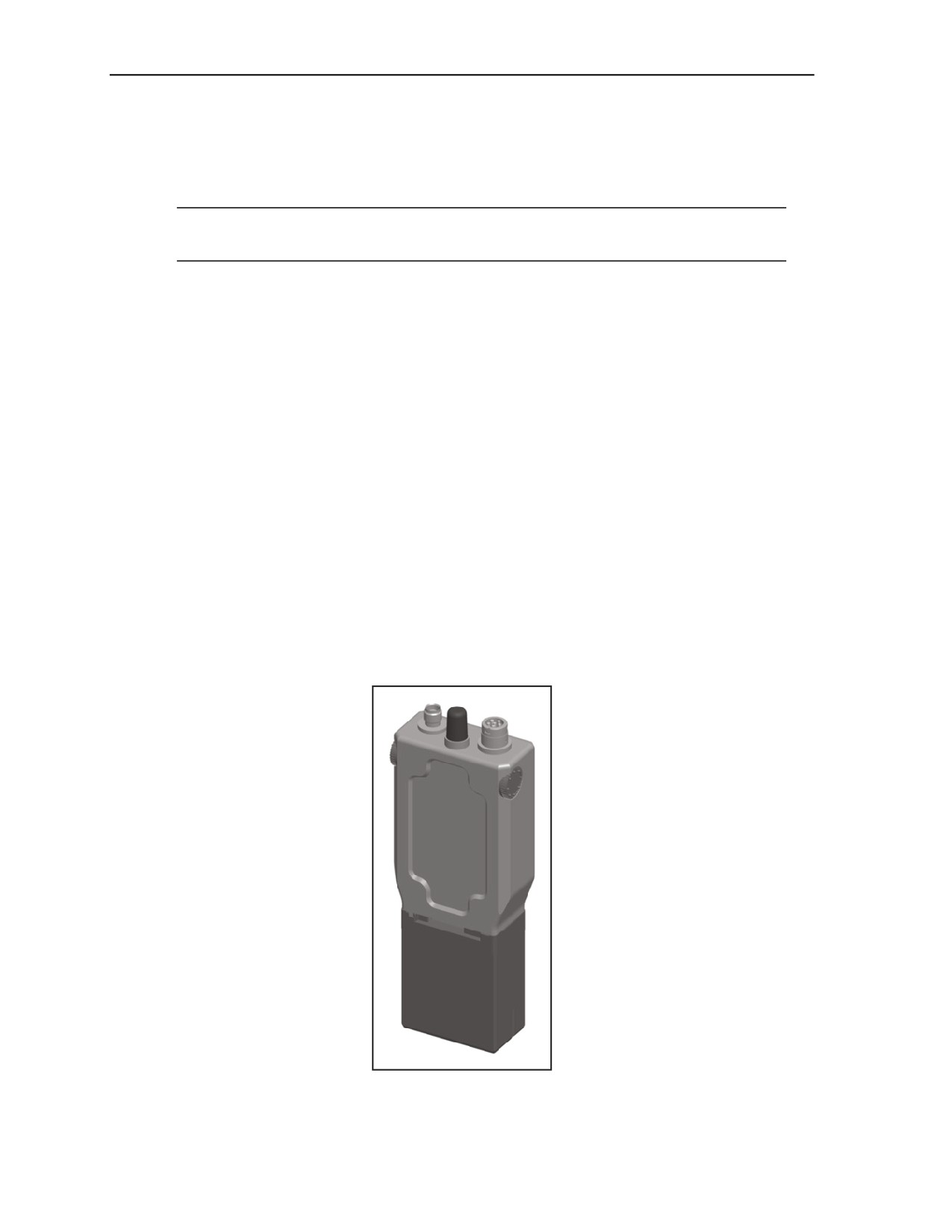
8-44. The Rifleman Radio (refer to Figure 8-9) will provide Soldiers vertical and horizontal intra-squad
network connectivity to achieve the information dominance deemed critical to successfully conduct
dismounted operations independent of any vehicle or other communications infrastructure.
Note. The Rifleman Radio capabilities are currently being tested. The radio is projected to be
fielded in FY10.
8-45. The Rifleman Radio will enable the individual Soldier to operate in a tactical voice network with
other team members, team and squad leaders via a networking waveform (i.e., Soldier Radio Waveform). It
will provide controlled unclassified real-time intra-squad C2 voice communications and transmit position
location information enabling—
z
A squad to employ much bolder and more sophisticated tactics to attack identified threats
decisively.
z
Increased speed of movement when conducting individual movement techniques as part of Fire
Team and Squad.
z
Improved networked communications while dispersed in complex terrain.
z
Increased speed of maneuver, a reduced risk of potential fratricide, increased flexibility to
transition missions on the move, more bold and sophisticated tactics, and the ability to attack
identified threats decisively.
z
A reduced exposure to the enemy, synchronized fire and maneuver in complex terrain, increased
team movement distances, and a reduced limitation on movement locations.
z
Soldiers to communicate with leaders when out of visual contact and shouting distance to
conduct movement techniques as part of a squad.
z
Leaders to display individual position location information of squad members (via an external
display device or as part of a Ground Soldier Ensemble) when out of visual contact to
coordinate fire and maneuver.
z
Improved SA for leaders to make informed and timely decisions.
Figure 8-9. Rifleman radio
8-12
FM 6-02.53
5 August 2009
Chapter 9
Antennas
All radios, whether transmitting or receiving, require an antenna. This chapter
addresses antenna fundamentals, concepts and terms, ground effects, antenna length,
types of antennas, as well as examples of antenna field repairs.
ANTENNA FUNDEMENTALS
9-1. Simplex operation, or one-way-reversible, consists of sending and receiving radio signals on one
antenna. It is normally used by SC radios. Two antennas are used during duplex operation: one for
transmitting and one for receiving. In either case, the transmitter generates a radio signal; a transmission
line delivers the signal from the transmitter to the antenna.
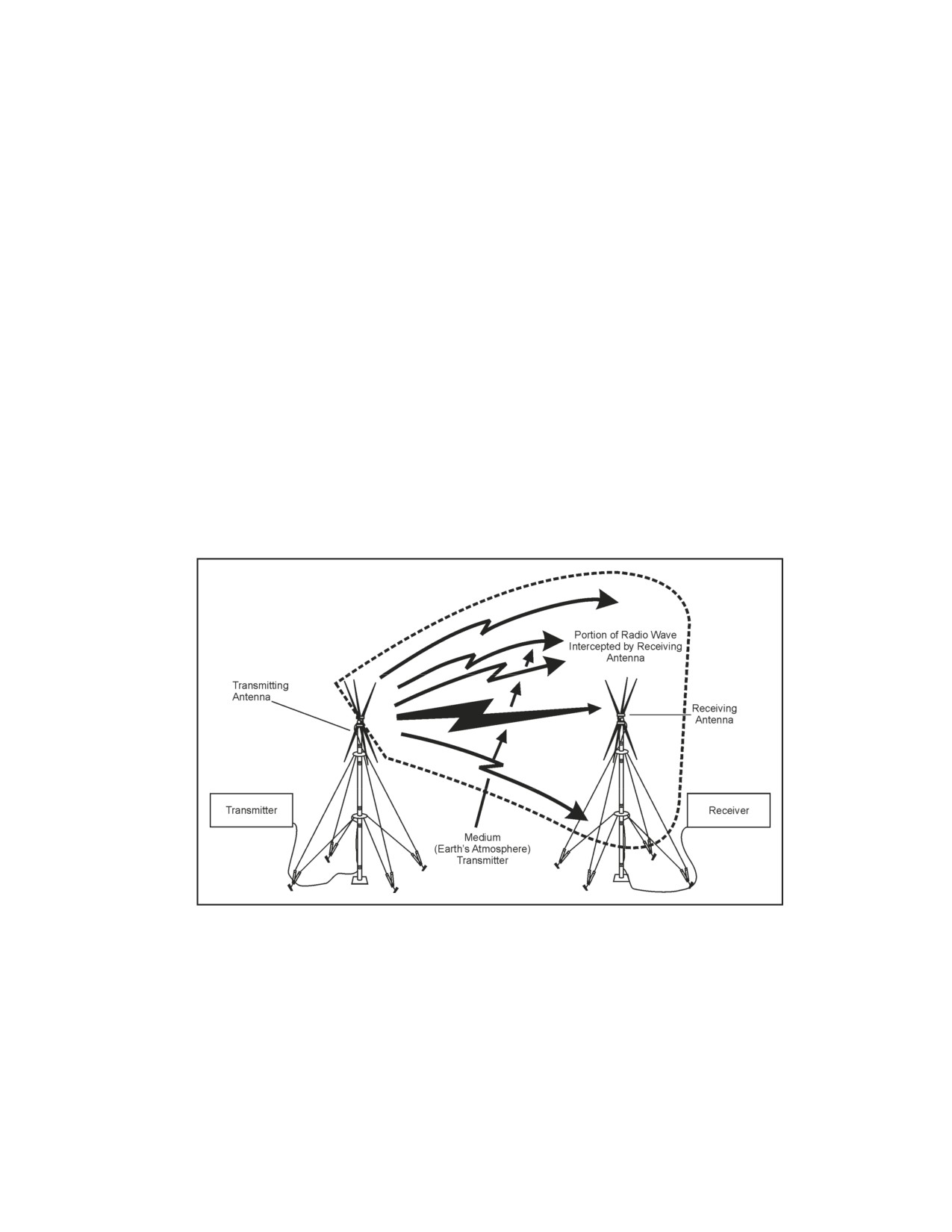
9-2. The transmitting antenna sends the radio signal into space toward the receiving antenna, which
intercepts the signal and sends it through a transmission line to the receiver. The receiver processes the
radio signal so it can either be heard or used to operate a data device, such as an AN/UXC-10 facsimile.
Figure 9-1 is an example of a typical transmitter and receiver connection.
Figure 9-1. A typical transmitter and receiver connection
9-3. The function of an antenna depends on whether it is transmitting or receiving. A transmitting antenna
transforms the output RF signal, in the form of an alternating electrical current produced by a radio
transmitter (RF output power), into an electromagnetic field that is radiated through space; the transmitting
antenna converts energy from one form to another form. The receiving antenna reverses this process; it
transforms the electromagnetic field into electrical energy that is delivered to a radio receiver.
5 August 2009
FM 6-02.53
9-1
Chapter 9
ANTENNA CONCEPTS AND TERMS
9-4. To select the right antenna, certain concepts and terms must be understood. The following
paragraphs address several basic terms and relationships which help the reader understand antenna
fundamentals.
FORMING A RADIO WAVE
9-5. When an alternating electric current flows through a conductor (wire), electric and magnetic fields
are created around the conductor. If the length of the conductor is very short compared to a wavelength, the
electric and magnetic fields will generally die out within a distance of one or two wavelengths. However,
as the conductor is lengthened, the intensity of the field enlarges. Thus, an ever increasing amount of
energy escapes into space.
RADIATION
9-6. Once a wire is connected to a transmitter and properly grounded, it begins to oscillate electrically,
causing the wave to convert nearly all of the transmitter power into an electromagnetic radio wave. The
electromagnetic energy is created by the alternating flow of electrons impressed on the bottom end of the
wire. The electrons travel upward on the wire to the top, where they have no place to go and they are
bounced back toward the lower end. As the electrons reach the lower end in phase (for example, they are in
step with the radio energy then being applied by the transmitter) the energy of their motion is strongly
reinforced as they bounced back upward along the wire. This regenerative process sustains the oscillation.
The wire is resonant at the frequency at which the source of energy is alternating.
9-7. The radio power supplied to a simple wire antenna appears nearly equally distributed throughout its
length. The energy stored at any location along the wire is equal to the product of the voltage and the
current at that point. If the voltage is high at a given point, the current must be low. If the current is high,
the voltage must be low. The electric current reaches its maximum near the bottom end of the wire.
RADIATION FIELDS
9-8. When RF power is delivered to an antenna, two fields are created: an induction field, which is
associated with the stored energy, and a radiation field. At the antenna, the intensities of these fields are
large, and are proportional to the amount of RF power delivered to the antenna. At a short distance from
the transmitting antenna, and traveling toward the receiving antenna, only the radiation field remains; this
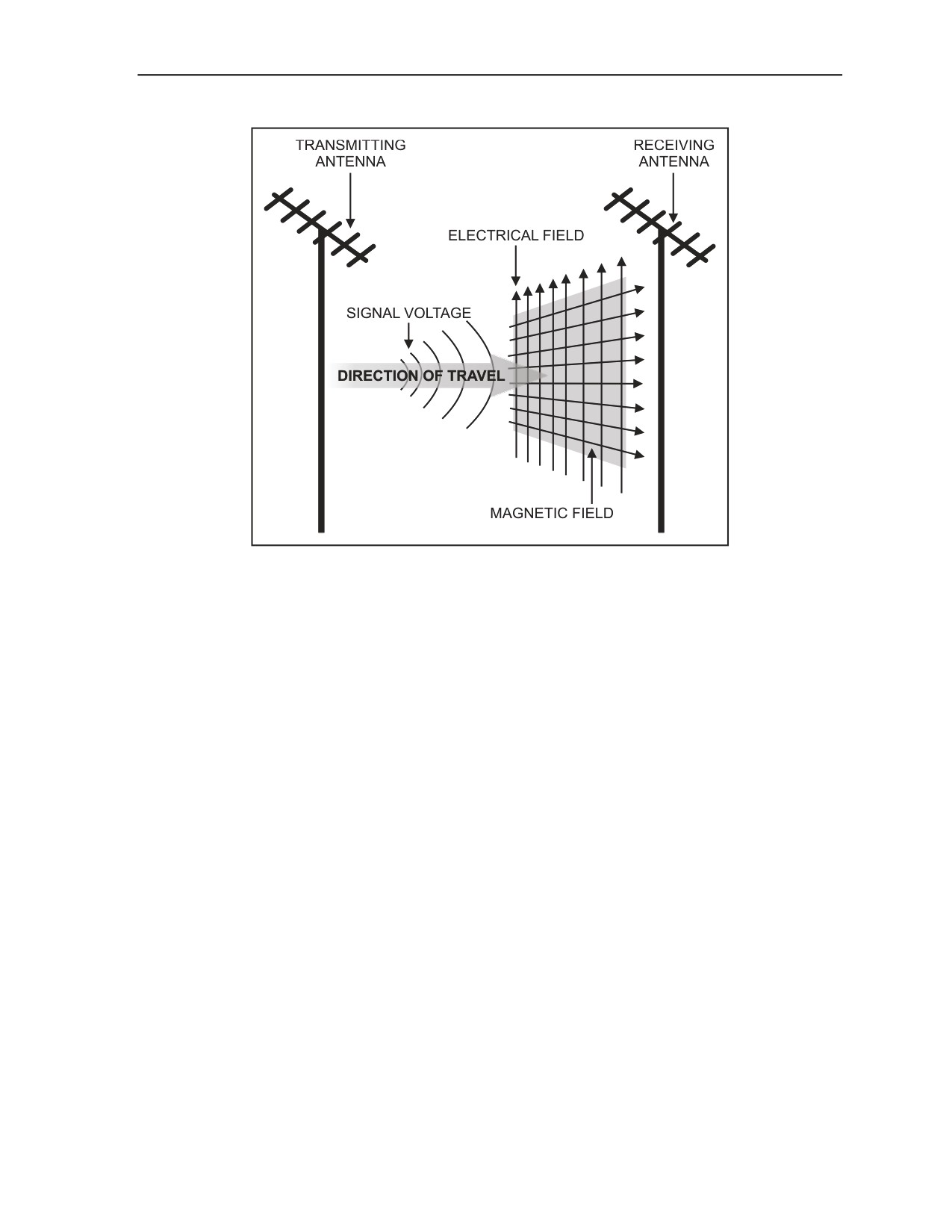
radiation field is composed of electric and magnetic components. Figure 9-2 is an example of the
components of electromagnetic waves.
9-9. The electric and magnetic fields (components) radiated from an antenna form the electromagnetic
field. It is responsible for transmitting and receiving electromagnetic energy through free space. A radio
wave is a moving electromagnetic field that has velocity in the direction of travel. Its components are of
electric and magnetic intensity arranged at right angles to each other.
9-2
FM 6-02.53
5 August 2009
Antennas
Figure 9-2. Components of electromagnetic waves
RADIATION PATTERNS
9-10. The radiation pattern is a graphical depiction of the relative field strength transmitted from, or
received by, the antenna.
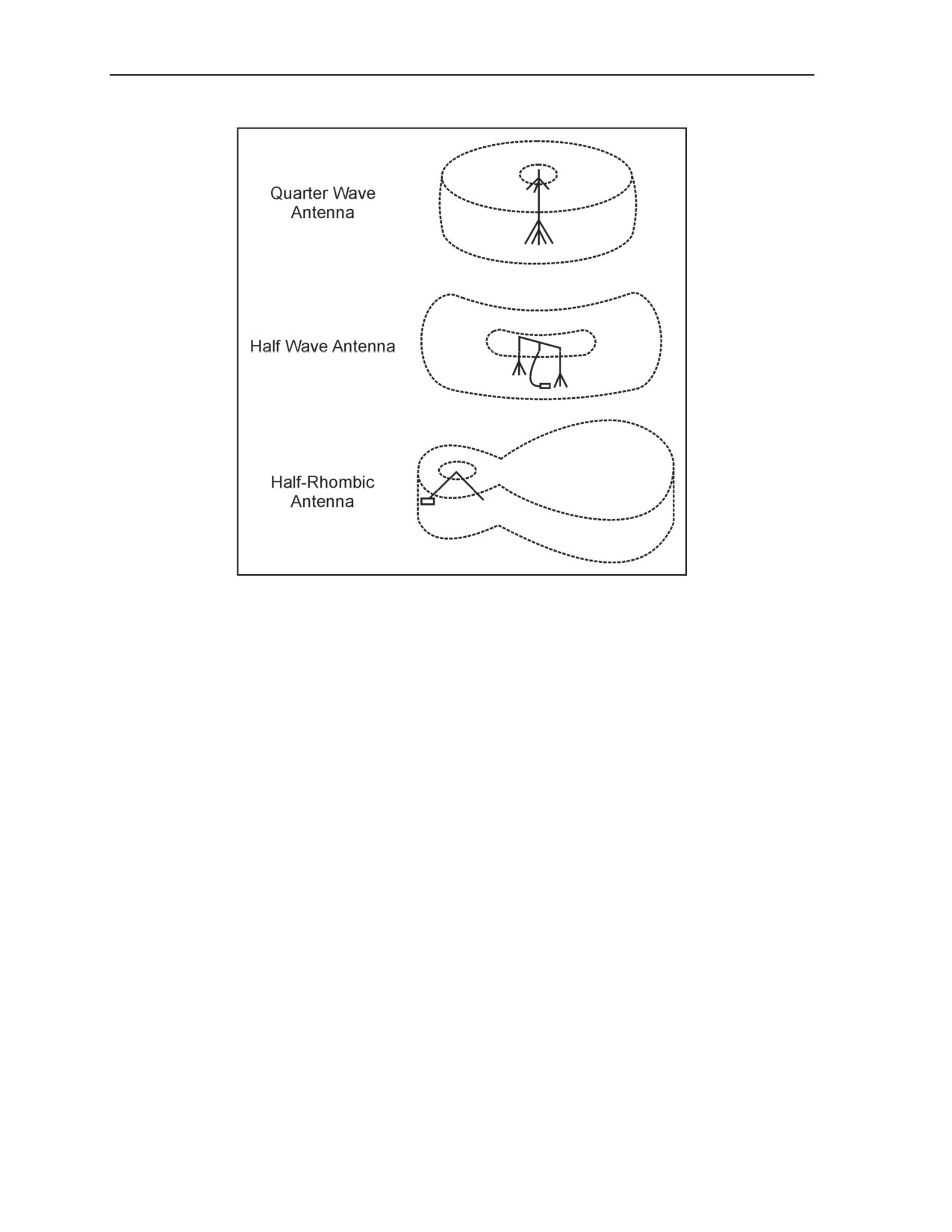
9-11. The full- or solid-radiation pattern is represented as a three-dimensional figure that looks somewhat
like a doughnut with a transmitting antenna in the center. Figure 9-3 is an example of solid antenna
radiation patterns. The top figure shows a quarter-wave vertical antenna; the middle figure shows a half-
wave horizontal antenna, located one-half wavelength above the ground; and the bottom figure shows a
vertical half rhombic antenna. (Omnidirectional and bidirectional antennas are discussed later in this
chapter.)
5 August 2009
FM 6-02.53
9-3
Chapter 9
Figure 9-3. Solid radiation patterns
POLARIZATION
9-12. The polarization of a radiated wave is determined by the direction of the lines of force making up the
electric field; polarization can be vertical, horizontal, or elliptical. When a single-wire antenna is used to
extract (receive) energy from a passing radio wave, maximum pickup results if the antenna is oriented so
that it lies in the same direction as the electric field component.
9-13. Horizontal or vertical polarization is satisfactory for VHF or UHF signals. The original polarization
produced at the transmitting antenna is maintained as the wave travels to the receiving antenna. Therefore,
if a horizontal antenna is used for transmitting, a horizontal antenna must be used for receiving.
Vertical Polarization
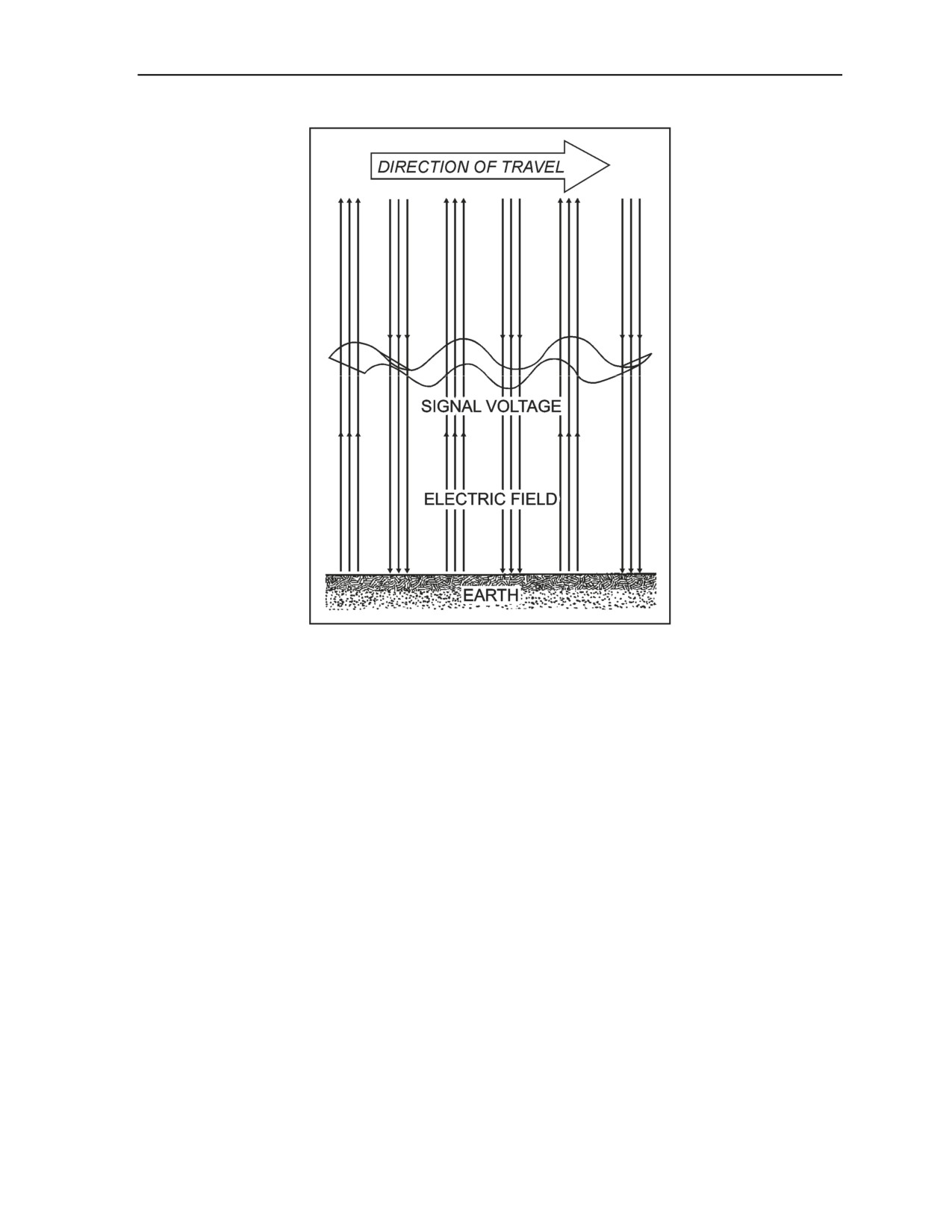
9-14. In a vertical polarized wave, the lines of electric force are at right angles to the surface of the earth.
Figure 9-4 illustrates a vertical polarized wave. A vertical antenna is used for efficient reception of
vertically polarized waves.
9-4
FM 6-02.53
5 August 2009
Antennas
Figure 9-4. Vertically polarized wave
9-15. Vertical polarization is necessary at medium and low frequencies, because ground-wave
transmission is used extensively. Vertical lines of force are perpendicular to the ground, and the radio wave
can travel a considerable distance along the ground surface with a minimum amount of loss.
9-16. Vertical polarization provides a stronger received signal at frequencies up to approximately 50 MHz,
when antenna heights are limited to 3.05 meters (10 ft) or less over land, as in a vehicular installation.
9-17. Vertically polarized radiation is less affected by reflections from aircraft flying over the transmission
path. This factor is important in areas where aircraft traffic is heavy.
9-18. When vertical polarization is used, less interference is produced or picked up from strong VHF and
UHF transmissions (television and FM broadcasts). This factor is important when an antenna must be
located in an urban area that has television or FM broadcast stations.
Horizontal Polarization
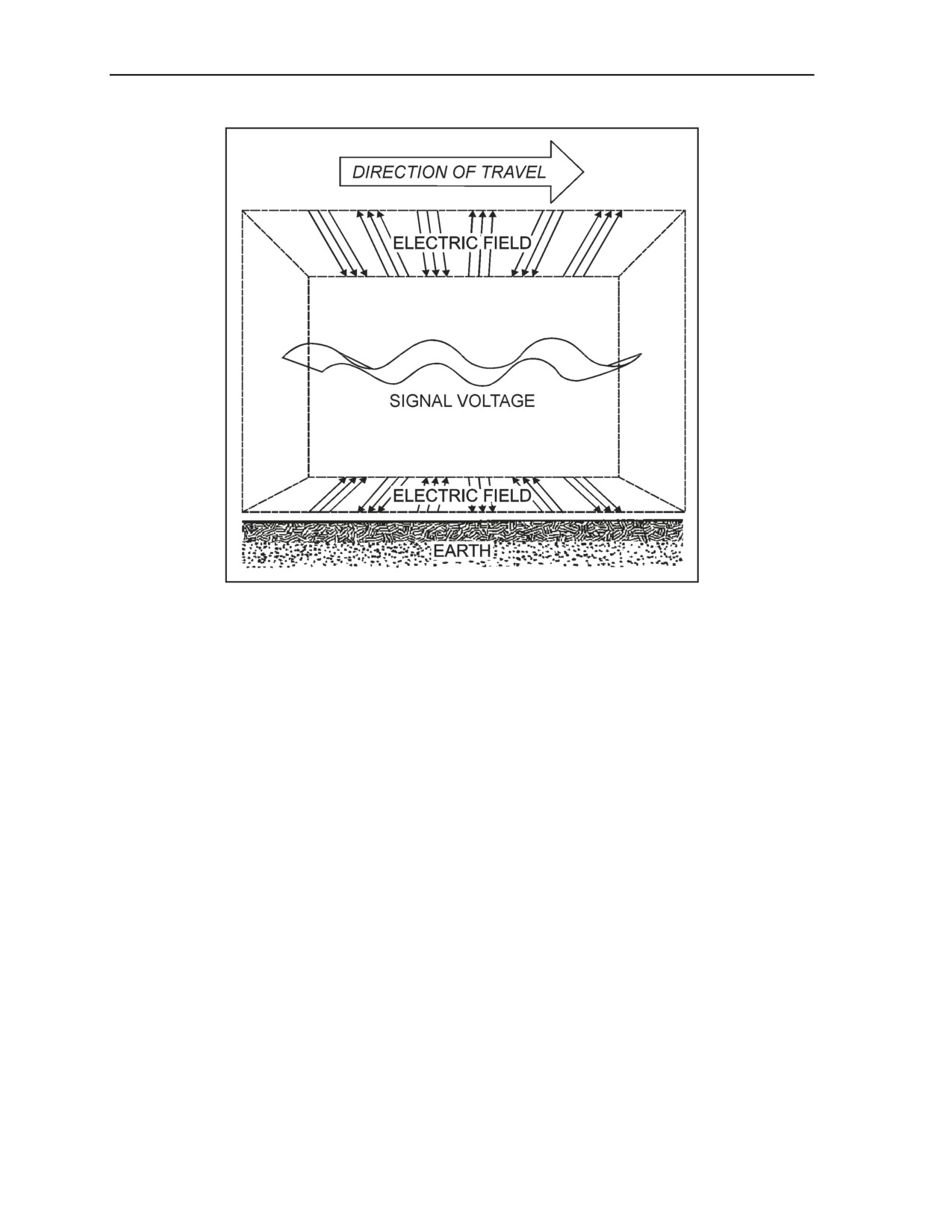
9-19. In a horizontal polarized wave, the lines of electric force are parallel to the surface of the earth. A
horizontal antenna is used for the reception of horizontally polarized waves. Figure 9-5 is an example of a
horizontal polarized wave.
5 August 2009
FM 6-02.53
9-5
Chapter 9
Figure 9-5. Horizontally polarized wave
9-20. At high frequencies, with sky wave transmission, it makes little difference whether horizontal or
vertical polarization is used. The sky wave, after being reflected by the ionosphere, arrives at the receiving
antenna elliptically polarized. Therefore, the transmitting and receiving antennas can be mounted either
horizontally or vertically. However, horizontal antennas are preferred, since they can be made to radiate
effectively at high angles and have inherent directional properties.
9-21. A simple horizontal, half-wave antenna is bidirectional. This characteristic is useful when
minimizing interference from certain directions and masking signals from the enemy. Horizontal antennas
are less likely to pick up man-made interference. When antennas are located near dense forests,
horizontally polarized waves suffer lower losses, especially at frequencies above 100 MHz.
9-22. Small changes in antenna location do not cause large variations in the field intensity of horizontally
polarized waves, when an antenna is located among trees or buildings.
Elliptical Polarization
9-23. In some cases, the field rotates as the waves travel through space. Under these conditions, both
horizontal and vertical components of the field exist and the wave has elliptical polarization.
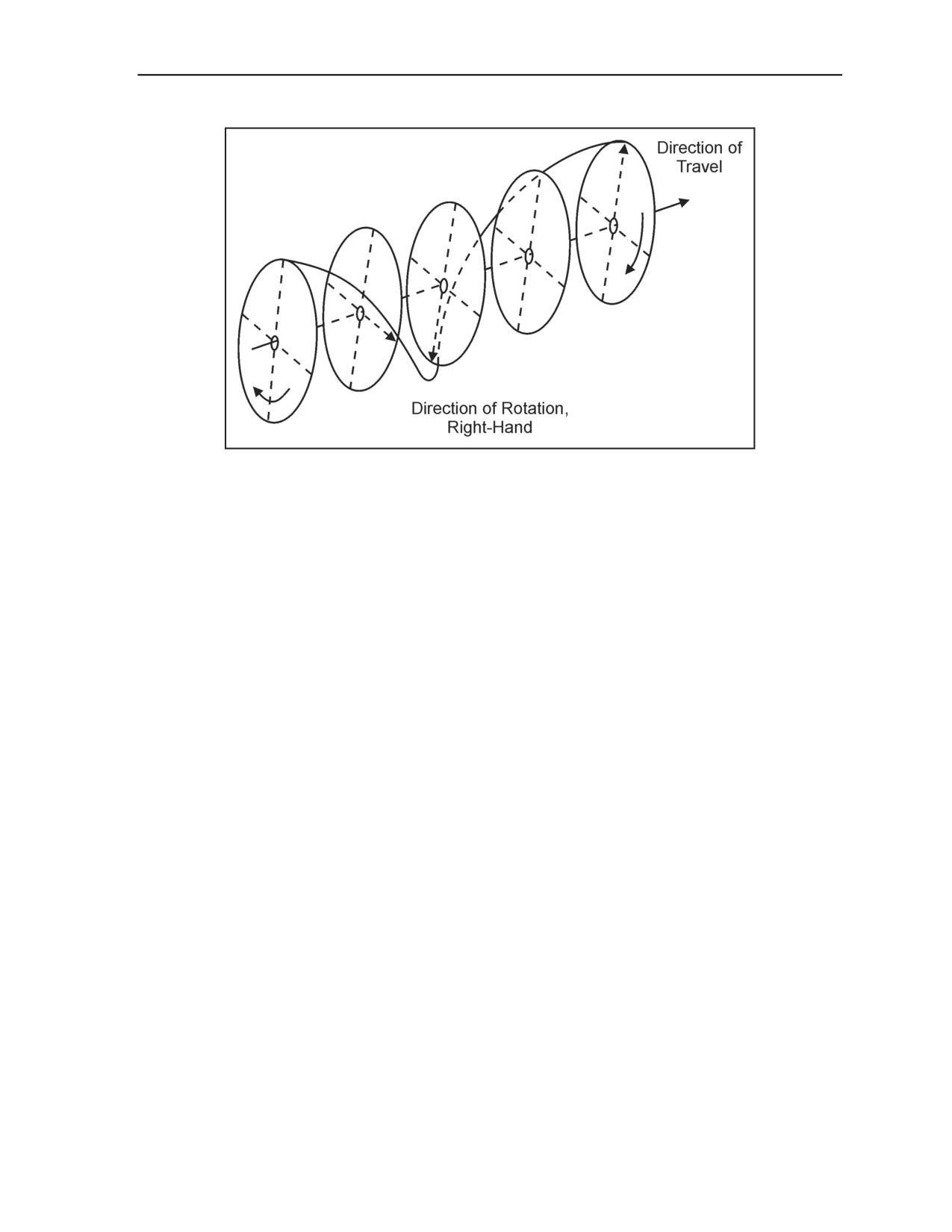
9-24. Satellites and satellite terminals use a type of elliptical polarization, called circular polarization.
Circular polarization describes a wave whose plane of polarization rotates through 360 degrees as it
progresses forward; the rotation can be clockwise or counterclockwise. Figure 9-6 is an example of a
circular polarized wave. Circular polarization occurs when equal magnitudes of vertically and horizontally
polarized waves are combined with a phase difference of
90 degrees. Depending on their phase
relationship, this causes rotation either in one direction or the other.
9-6
FM 6-02.53
5 August 2009
Antennas
Figure 9-6. Circular polarized wave
DIRECTIONALITY
9-25. Vertical transmitting antennas radiate equally in horizontal directions; vertical receiving antennas
accept radio signals equally from all horizontal directions. Thus, other stations operating on the same or
nearby frequencies may interfere with the desired signal, making reception difficult or impossible.
However, reception of a desired signal can be improved by using directional antennas.
9-26. Horizontal half-wave antennas accept radio signals from all directions. The strongest reception is
received from a direction perpendicular to the antenna, while the weakest reception is received from the
direction of the ends of the antenna. Interfering signals can be eliminated or reduced by changing the
antenna installation, so that each end of the antenna points directly at the interfering station.
9-27. Communication over a radio circuit is satisfactory when the received signal is strong enough to
override undesired signals and noise. Increasing the transmitting power between two radio stations
increases communications effectiveness, as the receiver must be within range of the transmitter. Also,
changing the types of transmission, changing to a frequency that is not readily absorbed or using a
directional antenna aids in communications effectiveness.
RESONANCE
9-28. Antennas can be classified as either resonant or nonresonant, depending on their design. In a
resonant antenna, almost all of the radio signals fed to the antenna are radiated. If the antenna is fed with a
frequency other than the one for which it is resonant, much of the fed signal will be lost and will not be
radiated. A resonant antenna will effectively radiate a radio signal for frequencies close to its design
frequency. If a resonant antenna is used for a radio circuit, a separate antenna must be built for each
frequency to be used on the radio circuit. A nonresonant antenna, on the other hand, will effectively radiate
a broad range of frequencies with less efficiency. Resonant and nonresonant antennas are commonly used
on tactical circuits. Resonance can be achieved in two ways: physically matching the length of the antenna
to the wavelength and electronically matching the length of the antenna to the wavelength.
RECEPTION
9-29. The radio waves that leave the transmitting antenna will have an influence on and will be influenced
by any electrons in their path. For example, as a HF wave enters the ionosphere, it is reflected or refracted
back to the Earth by the action of free electrons in this region of the atmosphere. When the radio wave
5 August 2009
FM 6-02.53
9-7
Chapter 9
encounters the wire or metallic conductors of the receiving antenna, the radio wave’s electric field will
cause the electrons in the antenna to oscillate back and forth in step with the wave as it passes. The
movement of these electrons within the antenna is the small alternating electrical current which is detected
by the radio receiver.
9-30. When radio waves encounter electrons which are free to move under the influence of the wave’s
electric field, the free electrons oscillate in sympathy with the wave. This generates electric current which
then creates waves of its own. These new waves are reflected or scattered waves. This process is
electromagnetic scattering. All materials that are good electric conductors reflect or scatter RF energy.
Since a receiving antenna is a good conductor, it too acts as a scatter. Only a portion of the energy which
comes in contact with the antenna is converted into a received electrical power: a sizeable portion of the
total power is re-radiated by the wire.
9-31. If an antenna is located within a congested urban environment or within a building, there are many
objects that will scatter or reradiate the energy in a manner that can be detrimental to reception. For
example, the electric wiring inside a building can strongly reradiate RF energy. If a receiving antenna is in
close proximity to wires, it is possible for the reflected energy to cancel the energy received directly from
the desired signal path. When this condition exists, the receiving antenna should be moved to another
location within the room where the reflected and direct signals may reinforce rather than cancel each other.
Note. For more information on wave propagation refer to Training Circular 9-64.
RECIPROCITY
9-32. Reciprocity refers to the various properties of an antenna that apply equally, regardless of whether
the antenna is used for transmitting or receiving. For example, the more efficient a certain antenna is for
transmitting, the more efficient it will be for receiving the same frequency. The directive properties of a
given antenna will be the same whether it is used for transmission or reception.
9-33. There is a minimum amount of radiation along the axis of the antenna. If this same antenna is used as
a receiving antenna, it receives best in the same directions in which it produces maximum radiation (at
right angles to the axis of the antenna). There is a minimum amount of signal received from transmitters
located in the line with the antenna wire.
IMPEDANCE
9-34. Impedance is the relationship between voltage and current at any point in an alternating current
circuit. The impedance of an antenna is equal to the ratio of the voltage to the current at the point on the
antenna where the feed is connected (feed point). If the feed point is located at a point of maximum voltage
point, the impedance is as much as 500 to 10,000 ohms.
9-35. The input impedance of an antenna depends on the conductivity or impedance of the ground. For,
example, if the ground is a simple stake driven about a meter (3.2 ft) into earth of average conductivity, the
impedance of the monopole may be double or even triple the quoted values. Because this additional
resistance occurs at a point on the antenna circuit where the current is high, a large amount of transmitter
power will dissipate as heat into the ground rather than radiated as intended. Therefore, it is essential to
provide as good a ground or artificial ground (counterpoise) connection as possible when using a vertical
whip or monopole.
9-36. The amount of power an antenna radiates depends on the amount of current which flows in it.
Maximum power is radiated when there is maximum current flowing. Maximum current flows when the
impedance is minimized which is when the antenna is resonated so that its impedance is pure resistance.
(When capacitive reactance is made equal to inductive reactance, they cancel each other, and impedance
equals pure resistance.)
9-8
FM 6-02.53
5 August 2009
Antennas
BANDWIDTH
9-37. The bandwidth of an antenna is the frequency range over which it will perform within certain
specified limits. These limits are with respect to impedance match, gain, and/or radiation pattern
characteristics.
9-38. In the radio communication process, intelligence changes from speech or writing to low frequency
signal that is used to modulate, or cause change, in a much higher frequency radio signal. When
transmitted by an antenna, where it is picked up and reconverted into the original speech or writing. There
are natural laws which limit the amount of intelligence or signal that can be transmitted and received at a
given time. The more words per minute, the higher the rate of modulation frequency, so a wider or greater
bandwidth is needed. To transmit and receive all the intelligence necessary, the antenna bandwidth must be
as wide or wider that the signal bandwidth, otherwise it will limit the signal frequencies, causing voices
and writing to be unintelligible. Too wide of a bandwidth is also bad, since it accepts extra voices and will
degrade the S/N ratio.
ANTENNA GAIN
9-39. The antenna gain depends on its design. Transmitting antennas are designed for high efficiency in
radiating energy, and receiving antennas are designed for high efficiency in picking up (gaining) energy.
On many radio circuits, transmission is required between a transmitter and only one receiving station.
Directed energy is radiated in one direction because it is useful only in that direction. Directional receiving
antennas increase the energy gain in the favored direction and reduce the reception of unwanted noise in
signals from other directions. Transmitting and receiving antennas should have small energy losses and
should be efficient as radiators and receptors.
9-40. For example, current omnidirectional antennas, when employed in forward combat areas, transmit
and receive signals equally in all directions, and provide an equally strong signal to both adversary EW
units, and friendly units.
TAKE-OFF ANGLE
9-41. The antenna’s take-off angle is the angle above the horizon that an antenna radiates the largest
amount of energy (refer to Figure 9-7 for an example of an antenna take-off angle). VHF communications
antennas are designed so that the energy is radiated parallel to the Earth (do not confuse take-off angle and
polarization). The take-off angle of an HF communications antenna can determine whether a circuit is
successful or not. HF sky wave antennas are designed for specific take-off angles, depending on the circuit
distance. High take-off angles are used for short-range communications and low take-off angles are used
for long range communications.
5 August 2009
FM 6-02.53
9-9
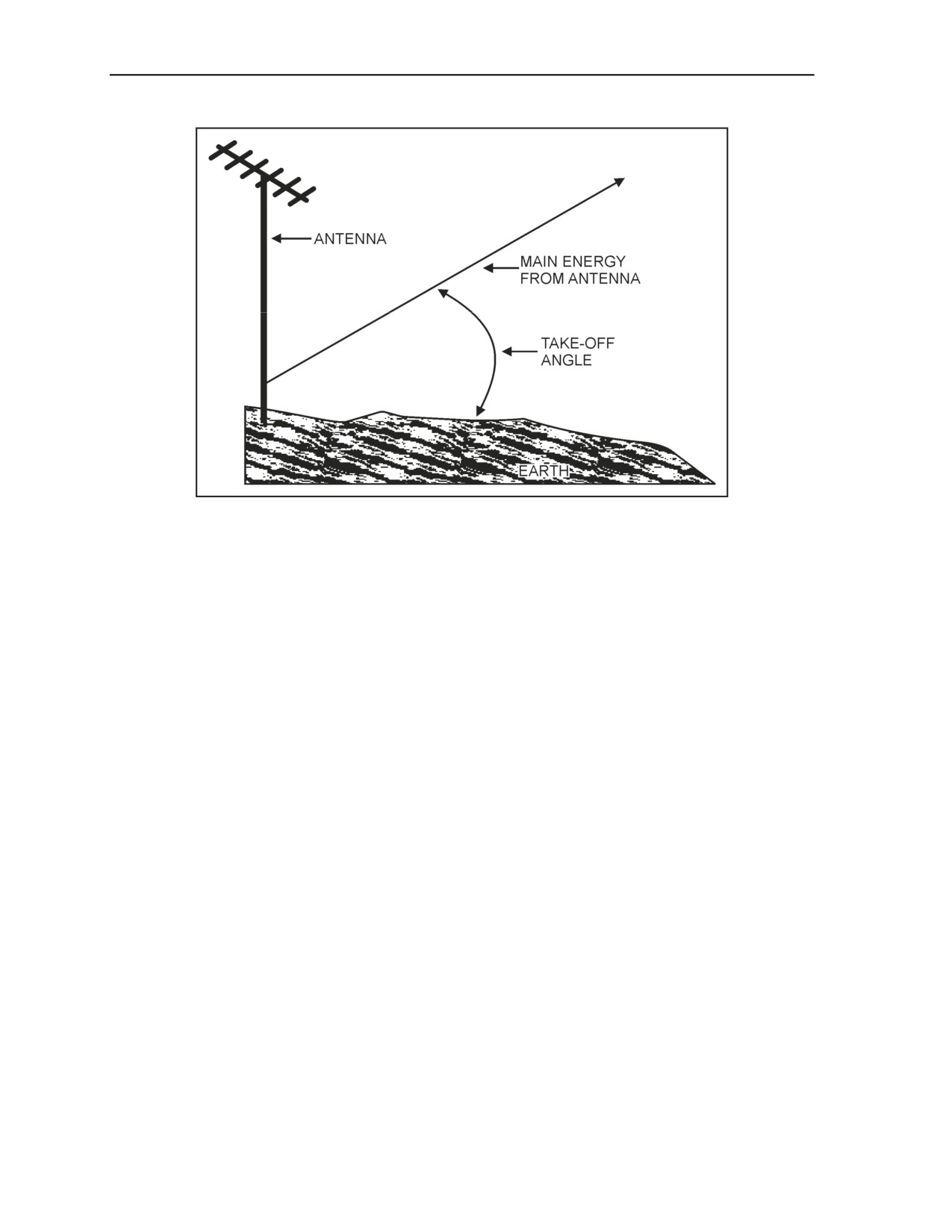
Chapter 9
Figure 9-7. Antenna take-off angle
GROUND EFFECTS
9-42. Since most tactical antennas are erected over the earth, and not out in free space (except for those on
satellites), the ground alters the free space radiation patterns of antennas. The ground will also have an
effect on some of the electrical characteristics of antennas, specifically those mounted relatively close to
the ground in terms of wavelength. For example, medium and HF antennas, elevated above the ground by
only a fraction of a wavelength, will have radiation patterns that are quite different from the free-space
patterns.
GROUNDED ANTENNA THEORY
9-43. When grounded antennas are used, it is important that the ground has as high conductivity as
possible. This reduces ground loss, and provides the best possible reflecting surface for the down-going
radiated energy from the antenna.
9-44. The ground is a good conductor for medium and low frequencies, and acts as a large mirror for the
radiated energy. This results in the ground reflecting a large amount of energy that is radiated downward
from an antenna mounted over it. Thus, a quarter-wave antenna erected vertically, with its lower end
connected electrically to the ground, behaves like a half-wave antenna. Figure 9-8 is an example of a
quarter-wave connected to the ground. Under these conditions, the vertical antenna (quarter wavelength)
and the ground create the half wavelength. The ground portrays the quarter wavelength of radiated energy
that is reflected to complete the half wavelength. At higher frequencies, artificial grounds constructed of
large metal surfaces are common to provide better wave propagation.
9-10
FM 6-02.53
5 August 2009
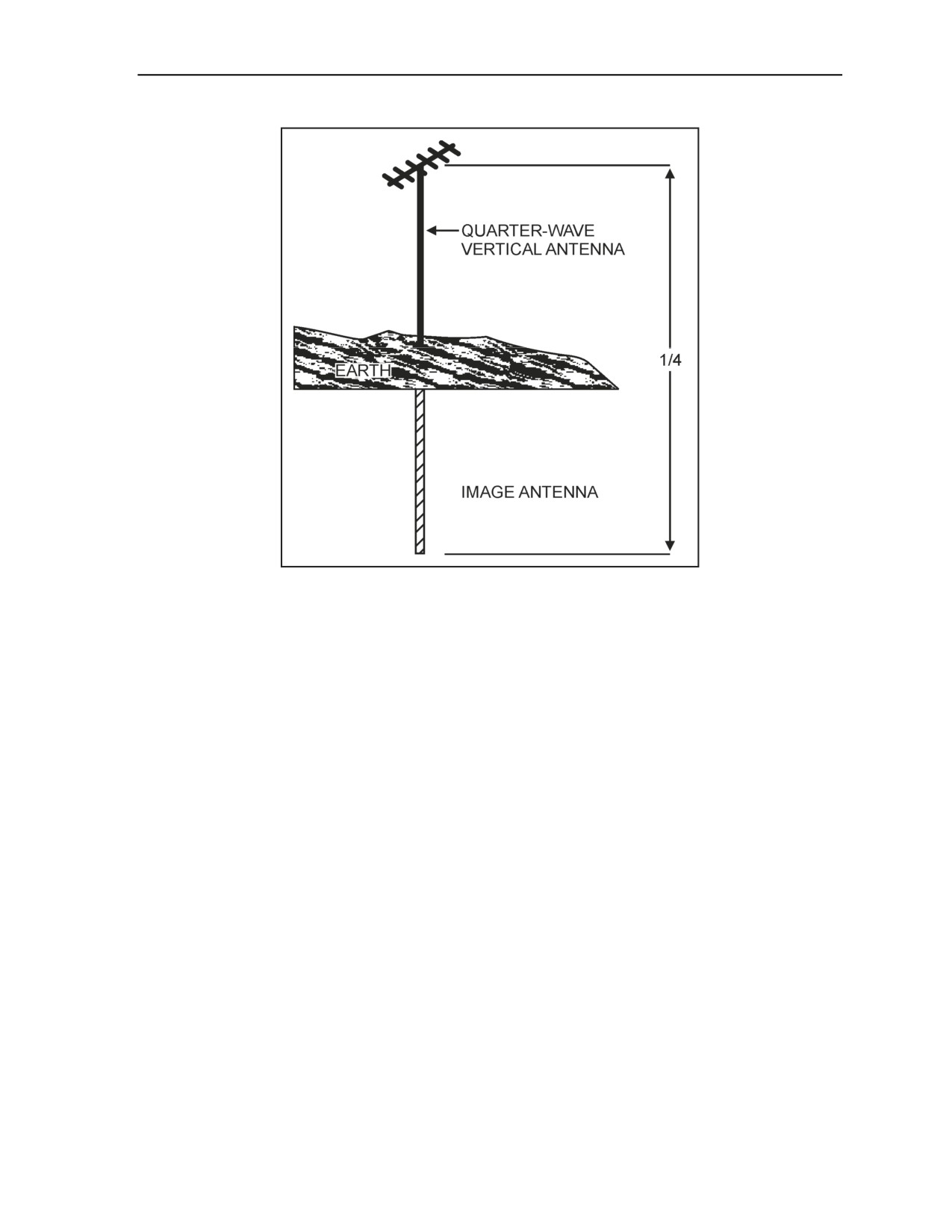
Antennas
Figure 9-8. Quarter-wave antenna connected to ground
Types of Grounds
9-45. At low and medium frequencies, the Earth acts as a good conductor. The ground connection must be
made in such a way as to introduce the least possible amount of resistance to ground. At higher
frequencies, artificial grounds constructed of large metal surfaces are common.
9-46. The ground connections take many forms, depending on the type of installation and the loss that can
be tolerated. In many simple field installations, the ground connection is made by one or more metal rods
driven into the soil. Where more satisfactory arrangements cannot be made, ground leads can be connected
to existing devices which are grounded. Metal structures or underground pipes systems are commonly used
as ground connections. In an emergency, a ground connection can be made by forcing one or more
bayonets into the soil.
Soil Conditions
9-47. When an antenna is erected over soil with low conductivity, treat the soil to reduce resistance. Soil
ground conditions are categorized as favorable, less favorable, or unfavorable. The following paragraphs
address a variety of grounding techniques that can be used during these soil conditions.
Favorable Soil Conditions
9-48. Ground connections take many forms, depending on the type of installation and the loss that can be
tolerated. In many simple field installations, one or more metal rods driven into the soil make the ground
connection. When more satisfactory arrangements cannot be made, ground leads can be connected to
existing devices that are grounded. Metal structures or underground pipe systems are commonly used as
ground connections. In an emergency, forcing one or more bayonets into the soil can make a ground
connection.
5 August 2009
FM 6-02.53
9-11