FM 6-02.53 TACTICAL RADIO OPERATIONS (August 2009) - page 1
FM 6-02.53
TACTICAL RADIO OPERATIONS
August 2009
DISTRIBUTION RESTRICTION. Approved for public release; distribution is unlimited.
HEADQUARTERS, DEPARTMENT OF THE ARMY
This publication is available at
General Dennis J. Reimer Training and Doctrine
FM 6-02.53
Field Manual
Headquarters
Department of the Army
No. 6-02.53
Washington, DC
5 August 2009
TACTICAL RADIO OPERATIONS
Contents
Page
PREFACE
viii
Chapter 1
APPLICATIONS FOR TACTICAL RADIO DEPLOYMENT
1-1
Modularity
1-1
Tactical Radio Deployment
1-2
Army Special Operations Forces
1-6
Army Force Generation Process
1-7
Chapter 2
TACTICAL RADIOS
2-1
Tactical Radio Networks
2-1
Electromagnetic Spectrum Operations
2-2
Chapter 3
HIGH FREQUENCY RADIOS
3-1
High Frequency Communications Concepts
3-1
AN/PRC-150 I Advanced High Frequency/Very High Frequency Tactical
Radio
3-4
Improving High Frequency Radio Operations
3-6
Improved High Frequency Radios
3-7
Chapter 4
VERY HIGH FREQUENCY RADIO SYSTEMS
4-1
Single-Channel Ground and Airborne Radio System Characteristics and
Capabilites
4-1
Single-Channel Ground and Airborne Radio System Radio Sets
4-2
Single-Channel Ground and Airborne Radio System Ancillary Equipment
4-7
Single-Channel Ground and Airborne Radio System Planning
4-17
Single-Channel Ground and Airborne Radio System Wireless Network
Extension Station
4-18
Single-Channel Ground and Airborne Radio System Jamming and Anti-
Jamming
4-21
AN/PRC-148 Multiband Inter/Intra Team Radio
4-22
AN/PRC-152 Multiband Handheld Radio
4-24
Distribution Restriction: Approved for public release; distribution is unlimited.
i
Contents
Chapter 5
ULTRA HIGH FREQUENCY RADIOS
5-1
Force XXI Battle Command, Brigade and Below
5-1
Enhanced Position Location Reporting System
5-1
Blue Force Tracking
5-7
Near Term Digital Radio
5-7
Tactical Digital Information Link-Joint Terminals
5-8
Multifunctional Information Distribution System
5-10
Chapter 6
SINGLE-CHANNEL TACTICAL SATELLITE
6-1
Single-Channel Tactical Satellite Introduction
6-1
Single-Channel Tactical Satellite Planning Considerations
6-2
Single-Channel Ultra High Frequency And Extremely High Frequency
Terminals
6-2
AN/PSC-5 Radio Set (Spitfire)
6-5
AN/PSC-5I UHF Tactical Ground Terminal (Shadowfire)
6-9
AN/PSC-5D Multiband Multimission Radio
6-9
AN/PRC-117F Manpack Radio
6-11
Army Conventional Forces
6-14
Operations and Intelligence Networks
6-14
Single-Channel Tactical Satellite Fire Support Networks
6-15
Single-Channel Tactical Satellite Communications Planning
6-16
Chapter 7
AIRBORNE RADIOS
7-1
Airborne Single-Channel Ground and Airborne Radio Systems
7-1
AN/ARC-210 Radio System
7-3
AN/ARC-220 Radio System
7-4
AN/VRC-100(V) High Frequency Ground/Vehicular Communications System . 7-5
AN/ARC-231 Radio System
7-6
AN/ARC-164(V) 12 Ultra High Frequency Radio
7-7
AN/VRC-83(V) Radio Set
7-8
AN/ARC-186(V) VHF AM/FM Radio
7-9
Chapter 8
OTHER TACTICAL RADIO SYSTEMS
8-1
AN/PRC-126 Radio Set
8-1
ICOM F43G Handheld Radio
8-2
Land Mobile Radio
8-3
Land Warrior
8-4
Combat Survivor Evader Locator
8-6
AN/PRC-90-2 Transceiver
8-8
AN/PRC-112 Combat Search and Rescue Transceiver
8-9
Joint Tactical Radio System
8-9
Chapter 9
ANTENNAS
9-1
Antenna Fundementals
9-1
Antenna Concepts and Terms
9-2
Ground Effects
9-10
Antenna Length
9-13
Improvement of Marginal Communications
9-15
Types of Antennas
9-16
Field Repair
9-35
ii
FM 6-02.53
5 August 2009
Contents
Chapter 10
AUTOMATED COMMUNICATIONS SECURITY MANAGEMENT AND
ENGINEERING SYSTEM
10-1
System Description
10-1
Hardware
10-2
Software
10-4
Chapter 11 COMMUNICATIONS TECHNIQUES: ELECTRONIC PROTECTION
11-1
Electronic Warfare
11-1
Commanders Electronic Protection Responsibilities
11-2
Staff Electronic Protection Responsibilities
11-3
Planning Process
11-3
Signal Security
11-6
Emission Control
11-6
Preventive Electronic Protection Techniques
11-6
Electronic Warfare for Single-Channel Tactical Satellite
11-13
Counter Remote Control Improvised Explosive Device Warfare
11-15
Joint Spectrum Interference Resolution Reporting
11-15
Chapter 12
RADIO OPERATING PROCEDURES
12-1
Phonetic Alphabet
12-1
Numerical Pronunciation
12-2
Procedure Words
12-2
Radio Call Procedures
12-5
Appendix A
FM RADIO NETWORKS
A-1
Appendix B
SINGLE-CHANNEL RADIO COMMUNICATIONS PRINCIPLES
B-1
Appendix C
ANTENNA SELECTION
C-1
Appendix D
COMMUNICATIONS IN UNUSUAL ENVIRONMENTS
D-1
Appendix E
JULIAN DATE, SYNC TIME, AND TIME CONVERSION CHART
E-1
Appendix F
RADIO COMPROMISE RECOVERY PROCEDURES
F-1
Appendix G
DATA COMMUNICATIONS
G-1
Appendix H
CO-SITE INTERFERENCE
H-1
GLOSSARY
Glossary-1
REFERENCES
References-1
INDEX
Index-1
Figures
Figure 3-1. AN/PRC-150 I
3-4
Figure 3-2. AN/PRC 104 manpack radio
3-7
Figure 3-3. AN/GRC-213 low-power manpack/vehicular radio
3-8
Figure 3-4. AN/GRC-193 high-power vehicle radio
3-9
Figure 4-1. Front panel ICOM radio RT-1523/A/B/C/D
4-3
Figure 4-2. Front panel ICOM radio RT-1523E
4-3
5 August 2009
FM 6-02.53
iii
Contents
Figure
4-3. SINCGARS ASIP radio
4-4
Figure
4-4. Vehicular amp adapter and INC
4-7
Figure
4-5. Intravehicular remote control unit, C-11291
4-8
Figure
4-6. Securable remote control unit, C-11561
4-9
Figure
4-7. Automated net control device, AN/CYZ-10
4-10
Figure
4-8. AN/PYQ-10 simple key loader
4-11
Figure
4-9. AN/PSN-11 precision lightweight GPS receiver
4-12
Figure
4-10. AN/PSN-13 DAGR compared to a PLGR
4-13
Figure
4-11. Vehicular intercommunications system, VIC-3 components
4-14
Figure
4-12. Vehicular intercommunications system, VIC-3 Headsets
4-16
Figure
4-13. Handheld remote control radio device
4-17
Figure
4-14. Wireless network extension operations
4-20
Figure
4-15. AN/PRC-148 MBITR radio
4-23
Figure
4-16. AN/PRC-152 multiband handheld radio
4-25
Figure
5-1. Enhanced position location reporting system
5-3
Figure
5-2. EPLRS radio set and host computer
5-6
Figure
5-3. Near term digital radio
5-8
Figure
5-4. JTIDS class 2M, AN/GSQ-240 I radio set
5-10
Figure
5-5. Army MIDS LVT-2, AN/USQ-140
5-11
Figure
6-1. LST-5
6-3
Figure
6-2. AN/PSN-11 SCAMP
6-4
Figure
6-3. SCAMP/CNR configurations
6-5
Figure
6-4. AN/PSC-5 radio set, Spitfire
6-6
Figure
6-5. SINCGARS range-extension with Spitfire
6-8
Figure
6-6. AN/PRC-117F
6-12
Figure
7-1. Airborne radio RT-1476/ARC-201
7-1
Figure
7-2. RT-1478D SINCGARS AIRSIP
7-3
Figure
7-3. RT-1794 I
7-3
Figure
7-4. AN/ARC-220 radio system
7-5
Figure
7-5. AN/VRC-100(V) high frequency radio
7-6
Figure
7-6. AN/ARC-231 radio system
7-6
Figure
7-7. RT-1504 for an AN/ARC-164(V) 12
7-8
Figure
7-8. AN/VRC-83 radio set
7-9
Figure
7-9. AN/ARC-186 (V)
7-10
Figure
8-1. AN/PRC-126 radio set
8-2
Figure
8-2. ICOM F43G handheld radio
8-3
Figure
8-3. Land mobile radio
8-4
Figure
8-4. Land Warrior
8-5
Figure
8-5. AN/PRQ-7 radio set
8-7
Figure
8-6. AN/PRC-90-2 transceiver
8-8
Figure
8-7. AN/PRC-112 and program loader KY-913
8-9
iv
FM 6-02.53
5 August 2009
Contents
Figure
8-8. Joint tactical radio system ground mobile radio
8-10
Figure
8-9. Rifleman radio
8-12
Figure
9-1. A typical transmitter and receiver connection
9-1
Figure
9-2. Components of electromagnetic waves
9-3
Figure
9-3. Solid radiation patterns
9-4
Figure
9-4. Vertically polarized wave
9-5
Figure
9-5. Horizontally polarized wave
9-6
Figure
9-6. Circular polarized wave
9-7
Figure
9-7. Antenna take-off angle
9-10
Figure
9-8. Quarter-wave antenna connected to ground
9-11
Figure
9-9. Wire counterpoise
9-12
Figure
9-10. Beam width
9-14
Figure
9-11. Example of a declination diagram
9-15
Figure
9-12. NVIS antenna, AS-2259/GR
9-17
Figure
9-13. V antenna
9-18
Figure
9-14. Vertical half rhombic antenna
9-19
Figure
9-15. Long-wire antenna
9-20
Figure
9-16. Sloping-V antenna
9-21
Figure
9-17. Inverted L antenna
9-22
Figure
9-18. NVIS propagation
9-23
Figure
9-19. Whip antenna
9-24
Figure
9-20. Whip antennas mounted on a vehicle
9-25
Figure
9-21. OE-254 broadband omnidirectional antenna system
9-26
Figure
9-22. QEAM AB 1386/U
9-27
Figure
9-23. COM-201B antenna
9-28
Figure
9-24. OE-303 half rhombic VHF antenna
9-29
Figure
9-25. Half-wave dipole (doublet) antenna
9-30
Figure
9-26. Center-fed half-wave antenna
9-31
Figure
9-27. Improvised vertical half-wave antenna
9-32
Figure
9-28. AS-3567, medium gain antenna
9-34
Figure
9-29. AS-3568, high-gain antenna
9-35
Figure
9-30. Field repair of broken whip antennas
9-36
Figure
9-31. Examples of field expedient antenna insulators
9-37
Figure
9-32. Repaired antenna guy lines and masts
9-38
Figure
10-1. Lightweight computer unit
10-3
Figure
10-2. Random data generator
10-4
Figure
10-3. Expanded ACES navigation tree
10-6
Figure
10-4. Example for planning a CNR net
10-7
Figure
11-1. Geometry during operations
11-4
Figure
11-2. Warlock-red
11-15
Figure
11-3. Interference resolution (Army victim)
11-17
5 August 2009
FM 6-02.53
v
Contents
Figure
11-4. Interference resolution (Army source)
11-18
Figure A-1. Example of a division C2 FM network
A-3
Figure A-2. Example of a brigade A&L FM network
A-3
Figure A-3. Example of a division intelligence network
A-4
Figure A-4. Example of a cavalry unit HF network
A-5
Figure A-5. Example of a division corps medical operations network HF-SSB
A-5
Figure A-6. Example of a medical operations network in a division HF-SSB
A-6
Figure A-7. Example of a division sustainment area FM network
A-7
Figure A-8. Example of a division HF C2 network
A-8
Figure B-1. Radiation of radio waves from a vertical antenna
B-3
Figure B-2. Wavelength of a radio wave
B-3
Figure B-3. Principal paths of radio waves
B-5
Figure B-4. Possible routes for ground waves
B-6
Figure B-5. Average layer distribution of the ionosphere
B-8
Figure B-6. Sky wave transmission paths
B-10
Figure B-7. Sky wave transmission hop paths
B-10
Figure B-8. Wave shapes
B-14
Figure B-9. AM system
B-16
Figure B-10. SSB system
B-16
Figure C-1. 32-foot vertical whip, vertical antenna pattern
C-3
Figure E-1. World time zone map
E-4
Figure H-1. Mobile command post antenna configuration
H-2
Figure H-2. Example of proper antenna separation for an armored TOC
H-4
Figure H-3. Possible antenna stacks
H-5
Figure H-4. Frequency hopping multiplexer
H-6
Tables
Table 3-1. ALE system handshake
3-2
Table 3-2. Notional link quality analysis matrix for a radio (B3B)
3-3
Table 4-1. Comparison of SINCGARS versions and components
4-2
Table 4-2. SINCGARS enhancements comparison
4-4
Table 4-2. SINCGARS enhancements comparison (continued)
4-5
Table 4-3. Minimum antenna separation distance
4-20
Table 6-1. AN/PSC-5/C/D, AN/PRC-117F and AN/ARC-231 LOS interoperability
6-10
Table 6-2. AN/PSC-5/C/D, AN/ARC-231 and AN/PRC-117F 5 kHz and 25 kHz DAMA
interoperability
6-11
Table 6-3. AN/PSC-5/C/D AN/ARC-231 and AN/PRC-117F 25 kHz SATCOM
interoperability
6-11
Table 7-1. AN/VRC-100 configurations
7-5
Table 9-1. Antenna length calculations
9-13
vi
FM 6-02.53
5 August 2009
Contents
Table 9-2. Leg angle for V antennas
9-18
Table 9-3. Frequency and inverted L horizontal element length
9-21
Table 9-4. OE-254 planning ranges
9-26
Table 10-1. ACMES functions at various command levels
10-2
Table 10-2. Initializing ACES CEOI/SOI data
10-7
Table 11-1. Electronic warfare elements
11-1
Table 11-2. Techniques for minimizing transmissions and transmission times
11-7
Table 11-2. Techniques for minimizing transmissions and transmission times
(continued)
11-8
Table
11-3. Common jamming signals
11-11
Table
11-4. Army interference resolution program functions
11-16
Table
11-5. JSIR security classification guide
11-19
Table
11-6. JSIR information requirements
11-19
Table
11-6. JSIR information requirements (continued)
11-20
Table
12-1. Phonetic alphabet
12-1
Table
12-2. Numerical pronunciation
12-2
Table
12-3. Numerals in combinations
12-2
Table
12-4. Prowords listed alphabetically
12-3
Table
12-4. Prowords listed alphabetically (continued)
12-4
Table
12-4. Prowords listed alphabetically (continued)
12-5
Table A-1. Example of division C2 FM networks
A-1
Table A-1. Example of division C2 FM networks (continued)
A-2
Table B-1. Frequency band chart
B-4
Table B-2. Frequency band characteristics
B-4
Table B-3. Surface conductivity
B-7
Table B-4. Ionosphere layers
B-7
Table B-5. Regular variations of the ionosphere
B-8
Table B-6. Irregular variations of the ionosphere
B-9
Table C-1. Take-off angle versus distance
C-2
Table C-2. HF antenna selection matrix
C-4
Table E-1. Julian date calendar (regular year)
E-1
Table E-1. Julian date calendar (regular year) (continued)
E-2
Table E-2. Julian date calendar (leap year)
E-2
Table E-3. Example of world time zone conversion (standard time)
E-3
Table F-1. Compromised net recovery procedures: compromised TEKs and KEKs
F-2
Table F-2. Compromised net recovery procedures: compromised TEKs
F-3
Table H-1. Transmitters and transmission ranges with and without the FHMUX
H-7
5 August 2009
FM 6-02.53
vii
Preface
This field manual (FM) serves as a reference document for tactical radio systems. (It does not replace FMs
governing combat net radios, unit tactical deployment, or technical manuals [TMs] on equipment use.) It also
provides doctrinal procedures and guidance for using tactical radios on the modern battlefield.
This FM targets operators, supervisors, and planners, providing a common reference for tactical radios. It
provides a basic guidance and gives the system planner the necessary steps for network planning,
interoperability considerations, and equipment capabilities.
This publication applies to Active Army, the Army National Guard (ARNG)/Army National Guard of the
United States
(ARNGUS), and the United States Army Reserve (USAR) unless otherwise stated. The
proponent of this publication is the United States Army Training and Doctrine Command (TRADOC). The
preparing agency is the United States Army Signal Center, approved by Combined Arms Doctrine Directorate.
Send comments and recommendations on Department of the Army (DA) Form 2028 (Recommended Changes
to Publications and Forms) directly to: Commander, United States Army Signal Center and Fort Gordon,
ATTN: ATZH-IDC-CB
(Doctrine Branch), Fort Gordon, Georgia
30905-5075, or via e-mail to
signal.doctrine@conus.army.mil or signal.doctrine@us.army.mil.
Unless this publication states otherwise, masculine nouns and pronouns do not refer exclusively to men.
viii
FM 6-02.53
5 August 2009
Chapter 1
Applications for Tactical Radio Deployment
This chapter addresses the Army’s move to modularity and applications for tactical
radio deployment from conventional corps to joint operations. It also includes a
section on the Army Special Operations Forces (SOF) and the Army force generation
process.
MODULARITY
1-1. The Army’s transformation roadmap describes how the Army will sustain and enhance the
capabilities of current forces while building future force capabilities to meet the requirements of
tomorrow’s joint force. It also describes how the Army will restructure the current force, creating modular
capabilities and flexible formations while obtaining the correct mix between Regular Army and Army
Reserve force structure. This rebalancing effort enhances the Army’s ability to provide the joint team
relevant and ready expeditionary land-power capability.
THE MODULAR ARMY CORPS AND DIVISION
1-2. The most significant advantage of modularization is greater strategic, operational, and tactical
flexibility. The numbered Army Service component commander (ASCC), corps and division, will serve
as—
z
Theater’s operational, strategic, and tactical command and control (C2).
z
A land force and joint support element.
z
C2 for a brigade combat team (BCT) or sustainment brigade, which serves as the primary
tactical and support elements in a theater.
1-3. The modular numbered Army is organized and equipped primarily as an ASCC for a geographic
combatant commander (GCC), or combatant command, and serves as the senior Army headquarters for an
area of responsibility
(AOR). It is a regionally focused, but globally networked, headquarters that
consolidated most functions that were performed by the traditional Army and corps levels into a single
operational echelon. The numbered Army is responsible for—
z
Administrative control of all Army serviced personnel and installations in the GCCs AOR.
z
Integrating Army forces into the execution of an AOR security cooperation plans.
z
Providing Army support to joint forces, interagency elements, and multinational forces as
directed by the GCC.
z
Providing support to Army, joint, and multinational forces deployed to diverse joint operations
areas.
1-4. The numbered Army modular design provides enough capability to execute an AOR entry and initial
phases of an operation, while providing a flexible platform for Army and joint augmentation as the AOR
develops. It provides administrative control of all Army personnel, units, and facilities in an AOR. The
numbered Army is also responsible for providing continuous Army support to joint, interagency, and
multinational elements as directed by the GCC, regardless of whether it is also controlling land forces in a
major operation.
5 August 2009
FM 6-02.53
1-1
Chapter 1
TACTICAL RADIO DEPLOYMENT
1-5. Tactical radios are deployed in support of the warfighting functions outlined in FM
3-0;
movement/maneuver, fires, intelligence, sustainment, C2, and protection. The following paragraphs are an
introduction of the tactical radio deployment throughout the Army to include BCTs and joint operations.
THEATER/ARMY
1-6. The theater/Army level is supported by signal companies within BCTs or expeditionary signal
battalions (ESBs) depending on their mission and what type of support is needed. Some examples of
combat net radio (CNR) communications that can be provided are—
z
Single-channel tactical satellite (SC TACSAT).
z
High frequency (HF) radio.
z
Enhanced Position Location Reporting System (EPLRS) and EPLRS network (net) control
capabilities.
z
Single-Channel Ground and Airborne Radio System (SINCGARS) nets.
z
Joint Network Node (JNN).
Note. For more information on theater/Army communications refer to Field Manual Interim
(FMI) 6-02.45.
Note. As of June 2007 the Joint Network Node-Network program was incorporated into the
Warfighter Information Network-Tactical
(WIN-T) program and designated as WIN-T
Increment 1. When JNN is used in this document it refers to the equipment and not to the
program.
CORPS
1-7. C2 support at corps level is primarily provided by the integrated theater signal battalion (ITSB) or
expeditionary signal battalion (ESB). The ITSB or ESB installs, operates, and maintains voice and data
networks within and between corps C2 facilities. JNNs are the primary means to connect all elements of
the corps and CNR networks perform a secondary role in the corps area of operations (AO). (For more
information on JNN refer to FMI 6-02.60.)
DIVISION
1-8. Communications and information support at division level is provided by the division assistant chief
of staff, command, control, communications, and computer operations (G-6) and the division signal
company. The voice and data systems used by the division’s AO are JNN, mobile regional hub nodes,
tactical hub nodes, regional hub nodes, the tactical Internet, CNR nets, and the Global Broadcast Service.
1-9. The division signal company deploys JNN and tactical Internet networks in support of the division.
The CNR systems deployed by the division are primarily SINCGARS, SC TACSAT, and HF radios. These
systems are mostly user-owned and operated systems with the higher command responsible for net control.
BRIGADE
1-10. Communications and information support at maneuver brigade level is provided by internal brigade
CNR assets. The SINCGARS, SC TACSAT, and HF radio are the primary means of communications
within a maneuver brigade. The internal brigade signal company assets support C2 at brigade tactical
operations centers (TOCs). Sustainment units operating in the division area behind the brigade sustainment
area use CNRs as a secondary means of communications, with JNNthe brigade subscriber node, or mobile
subscriber equipment (MSE) as the primary means of communications (some units that have not been
fielded with JNN still have MSE).
1-2
FM 6-02.53
5 August 2009
Applications for Tactical Radio Deployment
BRIGADE COMBAT TEAMS
1-11. Communications and information support at the BCT level is provided by the brigade signal
company. The brigade signal company is unique in structure and capabilities. It consists of the command
and network operations sections, brigade support battalion, TOC nodal and the signal support platoons.
The platoons support the BCT by providing—
z
JNN.
z
SC TACSAT.
z
Brigade subscriber node that provides secure and non-secure voice, video, and data.
z
EPLRS and EPLRS net control capabilities.
z
Wireless network extension and capabilities.
z
SINCGARS nets.
JOINT AND MULTINATIONAL OPERATIONS
1-12. Early planning and coordination are vital for reliable communications within the joint/multinational
areas. Initial planning must be done at the highest level possible to ensure all contingency missions are
included. Representatives from the host nation, multinational forces, and subordinate units should be
present during coordination meetings; ensuring the individual requirements of multinational and
subordinate commands is considered in the total communications plan. (Refer to Joint Publication [JP] 6-0
for additional information on joint communications planning and FM 6-02.72 for additional information on
joint CNR issues.)
GEOGRAPHIC COMBATANT COMMANDER/ARMY SERVICE COMPONENT COMMANDER
COMMUNICATIONS TEAM
1-13. The GCC/ASCC Communications Team provides communications support in the form of secure
frequency modulation radio, UHF TACSAT, record telecommunications message support, and
communications security (COMSEC) equipment maintenance to GCCs and/or ASCCs.
1-14. The GCC/ASCC Communications Team consists of—
z
Signal Systems Technician. His duties are—
Supervises and manages the tactical Internet and administers the local area
network and radio systems in TOC.
Plans, administers, manages, maintains, operates, integrates, secures, and
troubleshoots Army Battle Command System (ABCS), Automated Information Systems (AIS),
tactical data distribution, and radio systems.
Leads the team and personnel, and manages the training of personnel on the
installation, administration, management, maintenance, operation, integration, securing, and
troubleshooting of tactical ABCS/AIS, intranets, radio systems, and video teleconferencing
systems.
Performs system integration and administration, and implements
Information Assurance programs to protect and defend information, computers, and networks
from disruption, denial of service, degradation, or destruction.
Develops policy recommendations and advise commanders and staffs on
planning, installing, administering, managing, maintaining, operating, integrating, and securing
ABCS/AIS, intranets, radio systems, and video teleconferencing systems on Army, Joint,
Combined, and Multinational networks.
z
Electronic Systems Maintenance Technician. His duties are—
Establishes team safety and crime prevention/security programs that adhere
to the policies, practices, and regulations associated with these programs.
Manages personnel, equipment, and facility assets for operation, repair,
maintenance, and modification of radio, radar, computer, electronic data processing, controlled
cryptographic items, television, fiber optic, radiological and related communications equipment
and associated tools, test, and accessory equipment.
Establishes team standing operating procedures (SOP) to ensure a proper
work environment is maintained and that personnel adhere to maintenance schedules, the Army
5 August 2009
FM 6-02.53
1-3
Chapter 1
Maintenance Management Systems, Quality Assurance and Quality Control procedures, and
Standard Army Maintenance System-Level 1 (SAMS-1).
Ensures personnel are trained to use the tools, test equipment, and
applicable publications for the completion of the mission and are trained in automation skills.
Ensures that the team is deployable by supervising the Unit Level Logistic
System. Develops, rehearses, and implements load plans and deployment scenarios; establishes
field SOPs; and ensures standards of the Mission Essential Task List are met.
Ensures that Logistics tracking systems such as the Unit Level Logistic
System, SAMS-2, and the Standard Army Retail Supply Systems are used. Interprets technical
data and schematics, researches and interprets supply data, and fabricates repair parts or
procures through outside resources. Coordinates technical, administrative, and logistical
interface between the maintenance activity and supported units.
Advises commander and staff on electronic equipment development,
procurement, capabilities, limitations, and employment.
Establishes, monitors, and maintains comprehensive environmental
protection program IAW national and local directives.
z
Information Systems Chief who is the principal information systems noncommissioned officer
(NCO) for the GCC/ASCC Communications Team. His duties are—
Supervises, plans, coordinates, and directs the employment, operation,
management and unit level maintenance of multi-functional/multi-user information processing
systems in mobile and fixed facilities.
Provides technical and tactical advice to command and staff concerning all
aspects of information processing system operations, maintenance and logistical support.
Supervises installation, operation, strapping, restrapping, preventive
maintenance checks and services (PMCS) and unit level maintenance on COMSEC devices.
Conducts briefings on the status, relationship and interface of information
processing systems within assigned area of interest.
Supervises or prepares technical studies, evaluations, reports,
correspondence and records pertaining to multi-functional/multi-user information processing
systems.
Plans, organizes and conducts technical inspections. Supervises
development of the Information Systems Plan (ISP), Information Management Plan (IMP), and
the Information Management Master Plan (IMMP).
Reviews, consolidates and forwards final written input for the Continuity of
Operations Plan (COOP). Develops, enforces policy and procedure for facility Operations
Security and physical security in accordance with regulations and policies.
Prepares or supervises the preparation of technical studies, evaluations,
reports, correspondence, software programs, program editing, debugging and associated
functions. Maintains records pertaining to information system operations.
z
COMSEC custodians. They are responsible for—
Receipt, custody, security, accountability, safeguarding, inventory, transfer,
and destruction of COMSEC material.
Supervision and oversight of hand-receipt holders to ensure compliance
with existing COMSEC material security, accounting, operational policies/procedures, and
acquisition, control, and distribution of all classified COMSEC material and cryptographic key
in support of organizational missions.
z
Senior Information Technology NCO who plans, supervises, coordinates, and provides
technical assistance for the installation, operation, systems analyst functions, unit level
maintenance, and management of multi-functional/multi-user information processing systems in
mobile and fixed facilities. The Senior Information Technology NCO also—
Participates in development of the COOP, ISP, IMP and IMMP. Conducts
quality assurance of information systems operations. Performs duties of COMSEC custodian in
1-4
FM 6-02.53
5 August 2009
Applications for Tactical Radio Deployment
accordance with appropriate regulations. Supervises the operation of the Information Systems
Security Officer (ISSO). Establishes and operates the printing and duplication program.
Supervises and implements classified document control policies,
procedures, standards and inspections. Provides guidance on printing and publication account
procedures, processes and regulatory requirements.
Controls production operations in support of command or agency priorities.
Develop and enforce policy and procedures for facility management.
Develops, directs, and supervises training programs to ensure Soldier
proficiency and career development. Organizes work schedules and ensure compliance with
directives and policies on operations security, signal security, COMSEC and physical security.
Prepares or supervises the preparation of technical studies, evaluations,
reports, correspondence and records pertaining to information system operations. Directs high
level programming projects. Briefs staff and operations personnel on matters pertaining to
information systems.
z
Information Technology NCO who supervises the deployment, installation, operation, and unit
level maintenance of multi-functional/multi-user information processing systems. His duties
are—
Determines requirement, assign duties, coordinates activities of personnel
engaged in information system analysis and maintenance.
Develops and administers on-site training programs. Compile output reports
in support of information systems operations. Performs system studies using established
techniques to develop new or revised system applications and programs. Analyzes
telecommunications information management needs, and request logistical support and
coordinate systems integration.
Ensures that spare parts, supplies, and operating essentials are requisitioned
and maintained. Performs maintenance management and administrative duties related to facility
operations, maintenance, security and personnel.
Performs COMSEC management functions and ISSO/Systems
Administrator duties for the certification authority workstation. Prepares emergency evacuation
and destruction plans for COMSEC facilities. Requisitions, receives, stores, issues, destroys and
accounts for COMSEC equipment and keying material including over the air key.
Supervises ISSO functions. Provides verbal and written guidance and
directions for the installation, operation and maintenance of specified battlefield information
services.
Provides technical assistance; to resolve problems for information services
in support personnel, functional users and functional staff.
z
Senior GCC/ASCC Communications NCO who is responsible for supervising
communications Soldiers of a GCC communications team. His duties are—
Supervises, plans and executes the installation, operation and maintenance
of signal support systems, to include local area networks, wide-area networks and routers;
satellite radio communications and electronic support systems; and network integration using
radio, wire and battlefield automated systems.
Develops and implements unit level signal maintenance programs. Directs
unit signal training and provides technical advice and assistance to commanders.
Develops and executes information services policies and procedures for
supported organizations.
Coordinates external signal support mission requirements.
Prepares and implements Signal operations orders and reports.
Plans and requests Signal logistics support for unit level operations and
maintenance.
5 August 2009
FM 6-02.53
1-5
Chapter 1
z
GCC/ASCC Communications NCO. His duties are—
Supervises, installs, maintains and troubleshoots signal support systems and
terminal devices, to include radio, wire and battlefield automated systems.
Provides technical assistance and unit level training for automation,
communication and user owned and operated automated telecommunications computer systems,
to include local area networks and routers; signal communications support electronic equipment;
and satellite radio communications equipment.
Disseminate information services policy, and prepares maintenance and
supply requests for unit level signal support.
Operates and performs PMCS on assigned vehicles and on assigned power
generators.
ARMY SPECIAL OPERATIONS FORCES
1-15. Army SOF includes the Special Forces, Ranger units, Special Operations Aviation Regiment, Civil
Affairs (CA), and Psychological Operations (PSYOP).
SPECIAL FORCES
1-16. The Army Special Forces is organized into five active and two Army National Guard groups. In a
tactical environment, Special Forces communications are strictly CNR. Special Forces units use the
following CNR communication assets—
z
Ultra high frequency
(UHF) dedicated satellite communications
(SATCOM) and demand
assigned multiple access (DAMA).
z
HF single side band
(SSB), automatic link establishment
(ALE), low probability of
interception/detection (LPI/D), amplitude modulation (AM) and frequency modulation (FM)
line of sight (LOS) radios.
1-17. The Special Operations Task Force has the capability to provide—
z
Single-channel (SC) circuits (UHF DAMA and non-DAMA).
z
HF SSB, ALE, and LPI/D.
z
Very high frequency (VHF) and frequency modulation (FM) SINCGARS nets.
z
Electronic mail (e-mail).
z
Interface with the tactical Internet, MSE, and the Tri-Service Tactical Communications Program
(if being utilized).
RANGERS
1-18. Ranger unit communications must be rapidly deployable and able to support airborne, air assault and
infantry-type operations at all levels. Communications requirements are task organized to meet each
mission’s profile.
1-19. SC UHF SATCOM is the backbone of Ranger unit communications for links among headquarters,
battalions, companies, and detachments. Other communications capabilities include:
z
International maritime satellite (INMARSAT).
z
UHF/VHF/FM/AM radios.
z
HF SSB ALE.
z
LPI/D.
z
Multi-channel SATCOM augmentation may also be required.
1-6
FM 6-02.53
5 August 2009
Applications for Tactical Radio Deployment
SPECIAL OPERATIONS AVIATION REGIMENT
1-20. Special Operations Aviation Regiment communications provide air-to-air and air-to-ground aircraft
communications for C2 mission deconflictions and mission support to SOF units. Air communications
capabilities include:
z
Multiband SATCOM.
z
SC UHF SATCOM.
z
HF burst and data.
z
AM and FM radios.
1-21. Ground communications capabilities include: UHF SC SATCOM, HF, VHF or FM radio.
CIVIL AFFAIRS
1-22. SC SATCOM is the primary means of communications within CA units. While CA units receive
other communications support from supported units or from commercial systems, they do have organic
UHF/VHF/FM/AM, HF ALE and INMARSAT assets as well.
PSYCHOLOGICAL OPERATIONS FORCES
1-23. PSYOP communications support ensures the availability of communications and product distribution
assets to PSYOP forces. Current and emerging technologies (military and commercial, including the
PSYOP product distribution system and the Global Broadcast Service) will support the intelligence reach
concept by providing secure, digital communications paths for transferring PSYOP products between the
continental United States (CONUS) and deployed PSYOP units.
1-24. The PSYOP communications architecture consists of INMARSAT, SC TACSAT, and secure
phones. Organic communications capabilities include SC UHF SATCOM, INMARSAT, HF, and FM
radios.
ARMY FORCE GENERATION PROCESS
1-25. The Army force generation process creates three operational readiness cycles (reset/train pool, ready
pool and available pool) where individual units increase their readiness over time, culminating into full
mission readiness and availability to deploy. In order for signal Soldiers to be fully prepared once the unit
reaches the available cycle they must have prior training on signal equipment. The following paragraphs
address the importance of signal/CNR training during each cycle.
RESET/TRAIN POOL CYCLE
1-26. During the reset/train pool time it is important that leaders at all levels ensure that Soldiers are
trained on current signal/CNR equipment. Some systems are more complex than others and require more
familiarization.
1-27. It is during this cycle that new equipment training is also conducted by equipment fielding teams. It
is important that new equipment is introduced as soon as possible so Soldiers have enough time to train and
become proficient.
1-28. The unit must provide sustainment training to ensure individual skills do not decay and collective
proficiency is attained to support mission accomplishment. New communications equipment, applications,
and software updates are being fielded with greater frequency. Signal military occupational specialties are
becoming more consolidated, and the highly specialized and technical skills required to operate
communications systems are highly perishable.
5 August 2009
FM 6-02.53
1-7
Chapter 1
READY POOL CYCLE
1-29. During the ready pool cycle Soldiers will receive critical training on signal equipment during
sustainment training and field exercises (for example, the National Training Center, Maneuver Combat
Training Centers, Joint Readiness Training Center and Combat Training Center.)
AVAILABLE POOL CYCLE
1-30. It is during the available pool cycle that units will be conducting deployments. Signal leaders should
ensure Soldiers continue sustainment training on signal equipment as missions permit.
1-8
FM 6-02.53
5 August 2009
Chapter 2
Tactical Radios
This chapter provides an introduction to tactical radio operations. It addresses the
tactical radio network, HF radios, VHF radios, UHF radios, SC TACSAT radios,
airborne radios and other tactical radios being used. It also addresses electromagnetic
spectrum operations (EMSO).
TACTICAL RADIO NETWORKS
2-1. The primary role of the network is voice transmission for C2. It assumes a secondary role for data
transmission where other data capabilities do not exist.
2-2. Tactical communications networks change constantly. Unless control of the network is exercised,
communications delay and a poor grade of service will result. The best method of providing this control
without hampering operation is through centralized planning. Execution of these plans should be
decentralized.
2-3. The planning and system control process helps communications systems managers react
appropriately to the mission of the force supported, the needs of the commander, and the current tactical
situation. The type, size, and complexity of the system being operated will establish the method of control.
2-4. Communications control is a process in which the matching of resources with requirements takes
place. This process occurs at all levels of the control and management structure. In each case, the
availability of resources is considered.
2-5. Operating systems control is the detailed hourly management of a portion of a theater Army, corps,
or division communications system. Planning and control is according to the system being used.
2-6. The tactical radio network is designed around VHF radios (SINCGARS), HF radios, SC TACSAT
and more recently, commercial off-the-shelf (COTS) radios are being used. Each system has unique and
different capabilities and transmission characteristics that commanders consider to determine how to
employ each system depending on the units’ mission and other factors. (Refer to Appendix A for
information on FM radio communication nets.)
HIGH FREQUENCY RADIOS
2-7. HF radios with ALE capability are replacing older HF systems. ALE permits radio stations to make
contact with one another automatically. The success of ALE is dependent on effective frequency
propagation and HF antenna construction and use.
VERY HIGH FREQUENCY RADIOS
2-8. SINCGARS is a family of VHF FM CNRs. They provide interoperable communications between
surface and airborne C2 assets. SINCGARS has the capability to transmit and receive secure voice and data
and is consistent with the North Atlantic Treaty Organization (NATO) interoperability requirements.
2-9. SINCGARS is secured with electronic attack (EA) security features (such as frequency hopping
[FH]) that enable the United States (US) Army, United States Navy (USN), United States Air Force
(USAF), and United States Marine Corps (USMC) communications interoperability. This interoperability
ensures successful communications for joint and single component combat operations. (Refer to FM 6-
02.72 for additional information regarding multi-service SINCGARS communications procedures.)
5 August 2009
FM 6-02.53
2-1
Chapter 2
2-10. SINCGARS provides communications for units throughout the military. Data and facsimile
transmission capabilities are available to tactical commanders through simple connections with various
data terminal equipment (DTE).
2-11. The AN/PRC-148 and the AN/PRC-152 are COTS VHF LOS radios (multiband/multimode) that are
being utilized in greater numbers in the Army today. The AN/PRC-148 was originally designed for the
USMC and the SOF but the rest of the Army started to use the radio once its capabilities for small unit
tactical operations were known. One of the features of multiband/multimode radios that is appealing to
units is they all have SINCGARS and tactical satellite (TACSAT) capabilities.
ULTRA HIGH FREQUENCY RADIOS
2-12. UHF radios and systems play an import role in the military today. Radios such as the EPLRS, near
term digital radio (NTDR), Multifunctional Information Distribution System (MIDS) and the Joint Tactical
Information Distribution System (JTIDS) are being used throughout the Army for ground-to-air, ship-to-
shore and multinational communications. UHF radios have been vital in recent urban combat situations.
SINGLE-CHANNEL TACTICAL SATELLITE
2-13. SC TACSAT systems provide another means for C2 communications in a tactical environment. SC
TACSAT supports wideband and narrowband voice and data communications up to 64 kilobits per second
(kbps) throughout the entire Army and Army SOF.
2-14. As more organizations take advantage of the range extension capabilities of SC TACSAT
communications, there is potential for an overload in SATCOM. In response, the Army developed
advanced SATCOM systems, such as the AN/PSC-5 (Spitfire), AN/PSC-5I
(Shadowfire), and the
AN/PSC-5D (multiband/multimode radio); and procured the AN/PRC-117F SC packable radios.
AIRBORNE RADIOS
2-15. Due to the nature of airborne operations, most of the radio systems used have air and ground
capabilities or have ground and air versions to ensure that all elements of the tactical force have voice and
data communications.
OTHER TACTICAL RADIOS
2-16. There are several other tactical radios and systems that are being used by units for different purposes.
Handheld radios, such as the land mobile radio (LMR) and the integrated communications security (ICOM)
F43G, are COTS radios being used by many units as platoon/squad radios for internal communications.
There are also several survivor locator radios that are used by Special Forces, airborne and other units for
search and rescue missions.
ELECTROMAGNETIC SPECTRUM OPERATIONS
2-17. EMSO is a core competency of the Signal Corps and falls under the purview of the signal staff
officer (S-6)/G-6. In the Army, EMSO is performed by trained spectrum managers located in the S-6/G-6
from brigade to Army level. EMSO consists of planning, operating, and coordinating joint use of the
electromagnetic spectrum through operational, planning, and administrative procedures. The objective of
EMSO is to enable electronic systems to perform their functions in the intended environment without
causing or suffering unacceptable frequency interference.
2-18. EMSO consists of four core functions; spectrum management, frequency assignment, host nation
coordination, and policy. Through these core functions the spectrum manager uses available tools and
processes to provide the Soldier with the spectrum resources necessary to accomplish the mission during
all phases of operations. (For more information on EMSO refer to FMI 6-02.70.)
2-19. For CNR, the spectrum manager produces and distributes the corps units and division command
level signal operating instructions (SOI) information. The corps spectrum manager assigns hopsets to corps
2-2
FM 6-02.53
5 August 2009
Tactical Radios
units, restrictions to frequencies for hopset development, determines corps common hopsets, and allocates
frequencies to the divisions for use in their hopsets and nets.
2-20. The corps SOI information is transferred to the divisions and from the division to the brigades for
inclusion in their SOI data bases. This information is used to build the loadsets for the applicable radios
(loadsets are the frequency data and COMSEC keys necessary for the radio to operate in FH mode).
5 August 2009
FM 6-02.53
2-3
This page intentionally left blank.
Chapter 3
High Frequency Radios
HF radios use ground and sky wave propagation paths to achieve short, medium, and
long-range communications distances. The HF radio provides the tactical commander
alternate means of passing voice and data communications. This chapter addresses
the HF communications concepts, ALE, HF radios with ALE such as the AN/PRC-
150 I and the improved high frequency radio (IHFR).
HIGH FREQUENCY COMMUNICATIONS CONCEPTS
3-1. The challenge of making HF radio systems work can be illustrated by contrasting them with the
commonly used LOS radio systems. A well-designed, poorly-maintained LOS system will operate year
after year with insignificant outages. On the other hand, even if the HF system is initially well designed,
the HF radio-telephone operator
(RTO) must continually adjust the system to compensate for the
ionosphere, and an ever-changing terrestrial environment (interference from the other stations, atmospheric
interference, and manmade noise).
3-2. Although HF radios are harder to maintain than the commonly used LOS radio, they provide a
combination of simplicity, economy, transportability, and versatility that is impossible to match. For
successful communications, radio frequency (RF) performance depends on—
z
The type of emission.
z
The amount of transmitter power output.
z
The characteristics of the transmitter antenna. (To select the best antenna the planner must
understand wavelength, frequency, resonance, and polarization. Antenna characteristics are
addressed later in detail, in Chapter 9.)
z
The amount of propagation path loss.
z
The characteristics of the receiver antenna.
z
The amount of noise received.
z
The sensitivity and selectivity of the receiver.
z
An approved list of usable frequencies within a selected frequency range.
3-3. The HF radio has the following characteristics that make it ideal for tactical long distance, wide area
communication—
z
HF signals can be reflected off the ionosphere at high angles that will allow beyond line of sight
(BLOS) communications at distances out to 400 miles (643.7 kilometers [km]) without gaps in
communications coverage.
z
HF signals can be reflected off the ionosphere at low angles to communicate over distances of
many thousands of miles.
z
HF signals do not require the use of either SATCOM or wireless network extension assets.
z
HF systems can be engineered to operate independent of intervening terrain or manmade
obstructions.
3-4. Conducting tactical communications under urban combat/complex terrain conditions can be hard
even for an experienced RTO. G-6/S-6 officers and radio planners need to know several factors that will
provide the key to success—
z
How to pick an antenna.
z
Mode of transmission.
5 August 2009
FM 6-02.53
3-1

Chapter 3
z
Frequency band.
z
Antenna masking.
3-5. Training and implementing the units’ HF equipment can help get messages through.
Communications planners at every level need to understand the concepts of propagation, path loss,
antennas, antenna couplers and digital signal processing. (Refer to Chapter 9 and Appendix B for more
information on antennas and radio communications in unusual areas.)
AUTOMATIC LINK ESTABLISHMENT
3-6. ALE is when a specialized radio modem, known as an ALE adaptive controller, is assigned the task
of automatically controlling an HF receiver and transmitter, to establish the highest quality
communications link with one or multiple HF radio stations. ALE controllers can be external devices or an
embedded option in modern HF radio equipment.
3-7. ALE controllers function on the basic principles of link quality analysis (LQA) and sounding
(SOUND). These tasks are accomplished using the following common elements—
z
Each controller has a predetermined set of frequencies (properly propagated for conditions)
programmed into memory channels.
z
Channels are continuously scanned (typically at a rate of two channels per second).
z
Each controller has a predetermined set of net call signs programmed into memory that include
its own station net call sign, net call signs, group call signs, and individual call signs.
z
ALE controllers transmit LQA, which SOUND the programmed frequencies for best link quality
factors on a regular, automated, or operator-initiated basis.
z
When in a listening mode, ALE units (receiver/transmitter [RT]) log station call signs and
associated frequencies, and assign a ranking score relevant to the quality of the link on a per
channel basis.
z
When a station desires to place a call, the ALE controller element attempts to link to the
outstation using the data collected during ALE and SOUND activities. If the sending ALE has
not collected the outstation’s data, the controller will seek the station, and attempt to link a
logical circuit between two users on a net that enables the users to communicate using all
programmed channels.
3-8. When the receiving station hears its address, it stops scanning and stays on that frequency. A
handshake (a sequence of events governed by hardware or software, requiring mutual agreement of the
state of the operational mode prior to information exchange) is required between the two stations. The two
stations automatically conduct a handshake to confirm that a link was established. Upon a successful link,
the ALE controllers will cease the channel scanning process, and alert the RTOs that the system has
established a connection and that stations should now exchange traffic. Table 3-1 outlines communications
between two stations during the handshake and LQA.
Table 3-1. ALE system handshake
Call Station
Message
Receive Station
B3B
“T6Y this is B3B”
T6Y
Receive Station
Message
Call Station
B3B
“B3B this is T6Y”
T6Y
Call Station
Message
Receive Station
B3B
“T6Y this is B3B”
T6Y
Systems Linked
3-9. Table
3-2 outlines the LQA matrix for B3B. The channel numbers represent programmed
frequencies, and the numbers in the matrix are the most recent channel-quality scores. Thus, if an RTO
wanted to make a call from “B3B” to “T6Y”, the radio would attempt to call on Channel 18, which has the
highest LQA score.
3-2
FM 6-02.53
5 August 2009

High Frequency Radios
3-10. When making multi-station calls, the radio (B3B) selects the channel with the best average score.
Thus, for a multi-station call to all addresses in the matrix, Channel 14 would be selected.
Table 3-2. Notional link quality analysis
matrix for a radio (B3B)
Address
Channels
(call sign)
01
02
04
14
18
R3R
60
33
12
81
23
B6P
10
--
48
86
21
T6Y
--
--
29
52
63
E9T
21
00
00
45
--
3-11. Upon completion of a link session, the ALE controllers will send a link TERMINATION command,
and return to the scanning mode to await further traffic. Built-in safeguards ensure that ALE controllers
will return to the SCAN mode in case of a loss-of-contact condition.
3-12. Modern ALE controllers are capable of sending short orderwire digital messages known as
automatic message displays to members of the net. Messages can be sent to any (ANY) or all (ALL)
members of the NET or GROUP. ALE controllers can contact individual stations by their call sign, ALL
stations or ANY stations on the NET or GROUP. ALL calls and ANY calls make use of wildcard
characters in substitution for individual call signs such as @?@ (ALL) and @@? (ANY). NULL address
calls are used for systems maintenance, and are sent as @@@. (For more information on HF ALE refer to
FM 6-02.74.)
FREQUENCY SELECTION
3-13. For ALE to function properly, frequency selection is important. Consult with the frequency manager
early on in the process. When selecting frequencies to use in a net, take into consideration the time of
operation and distance to be communicated, power level and the type of antenna being used.
3-14. HF propagation changes daily. Lower frequencies work better at night and higher frequencies work
better during the day. Frequencies need to be selected based on the type of network and the distance
between radios.
3-15. When using the above parameters, a good propagation program should also be used to determine
which frequencies will propagate. (Appendix C lists some of the propagation software programs available
for use.)
THIRD GENERATION ALE
3-16. The third generation (3G) HF system uses a family of scalable burst waveform signaling formats for
transmission of all control and data traffic signaling. Scalable burst waveforms are defined for the various
kinds of signaling required in the system, to meet their distinctive requirements as to payload, duration,
time synchronization, and acquisition and demodulation performance in the presence of noise, fading, and
multipath. All of the burst waveforms use the basic binary PSK serial tone modulation at 2400 symbols per
second that is also used in the military standard (MIL-STD) 188-110A serial tone modem waveform. The
low-level modulation and demodulation techniques required for the new system are similar to those of the
110A modems.
3-17. In contrast to the MIL-STD-188-110A waveform, the waveforms used in the 3G HF system are
designed to balance the potentially conflicting objectives of maximizing the time diversity achieved
through interleaving, and minimizing on-air time and link turn-around delay. The latter objective plays an
important role in improving the performance of ALE and automatic request for wireless network extension
systems, which by their nature requires a high level of agility.
3-18. 3G ALE is designed to quickly and efficiently establish one-to-one and one-to-many (both broadcast
and multicast) links. It uses a specialized carrier sense multiple access (CSMA) scheme to share calling
5 August 2009
FM 6-02.53
3-3
Chapter 3
channels, and monitors traffic channels prior to using them to avoid interference and collisions. Calling and
traffic channels may share frequencies, but the system is likely to achieve better performance when they
are separate. Each calling channel is assumed to be associated with one or more traffic channels that are
sufficiently near in frequency to have similar propagation characteristics. The concept of associated control
and traffic frequencies can be reduced to the case in which the control and traffic frequencies are identical.
3-19.
3G HF receivers continuously scan an assigned list of calling channels, listening for second
generation (2G) or 3G calls. However, 2G ALE is an asynchronous system in the sense that a calling
station makes no assumption about when a destination station will be listening to any particular channel.
The 3G HF system includes a similar asynchronous mode; however, synchronous operation is likely to
provide superior performance under conditions of moderate to high network load.
AN/PRC-150 I ADVANCED HIGH FREQUENCY/VERY HIGH
FREQUENCY TACTICAL RADIO
Note. ALE HF radio systems procured by units are becoming more prevalent, as IHFRs such as
AN/PRC-104, AN/GRC-192 and 213 are no longer in production. The ALE HF radio addressed
in this section was recognized at publication time as being used in the field but not necessarily
representative of all the ALE HF systems.
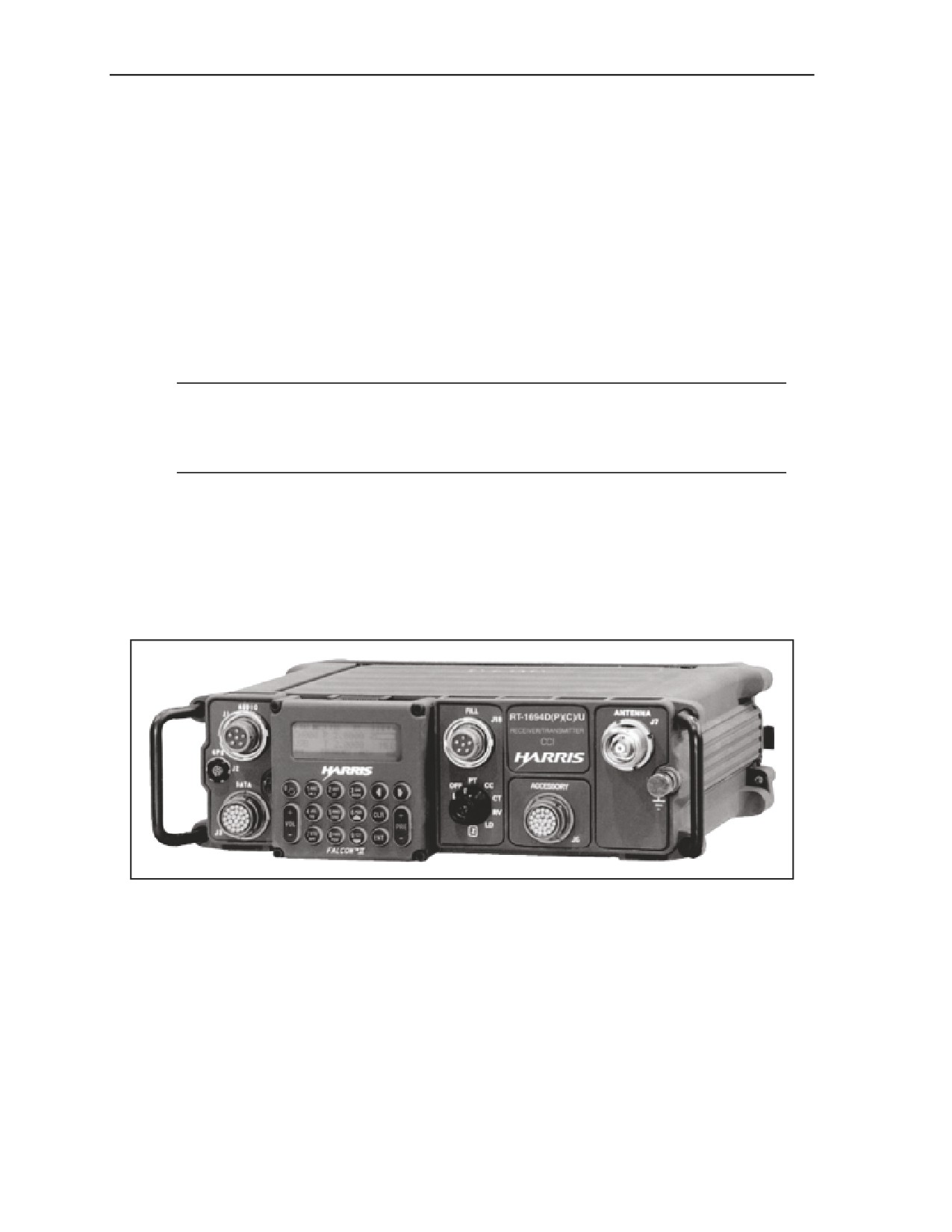
3-20. The AN/PRC-150 I radio, refer to Figure 3-1, provides units with state of the art HF radio
capabilities in support of fast moving, wide area operations. HF signals travel longer distances over the
ground than the VHF (SINCGARS) or UHF (EPLRS) signals do because they are less affected by factors
such as terrain or vegetation. The AN/PRC-150 I and AN/VRC-104(V) 1 and (V) 3 vehicular radio
systems, provide units with BLOS communications without having to rely on satellite availability on a
crowded communications battlefield. The systems’ manpack and vehicular configurations ensure units
have reliable communications while on the move, and allow for rapid transmission of data and imagery.
Figure 3-1. AN/PRC-150 I
3-4
FM 6-02.53
5 August 2009
High Frequency Radios
3-21. The AN/PRC-150 I has the following characteristics and capabilities—
z
Frequencies range from
1.6-29.9999 megahertz
(MHz) using skywave modulation with
selectable low, medium and high output power. It also operates from 20.0000-59.9999 MHz
FM with a maximum output of 10.0 watts.
z
Can be configured in manpack, mobile and fixed station configurations.
z
Embedded Type I multinational COMSEC allows secure voice and data communications
between ground and aircraft.
z
Able to interface with SINCGARS cryptographic ignition key (CIK) is embedded in the
removable key pad.
z
Advanced electronic counter-countermeasures
(ECCM) serial-tone FH improves
communications reliability in jamming environments.
z
Supports FH in HF narrowband, wideband and list.
z
Programmable system presets for “one-button” operation.
z
Internal tuning unit matches a wide variety of whip, dipole, and long-wire antenna
automatically.
z
Includes an internal, high-speed MIL-STD-188-110B serial-tone modem, which provides data
operation up to 9,600 bits per second (bps).
z
Embedded MIL-STD-188-141A ALE, digital voice 600 that simplifies HF operation by quickly
and automatically selecting an accepted channel.
z
Supports NATO Standardization Agreement (STANAG) 4538 automatic radio control system
link set-up and data link protocols in 3G ALE radio mode.
z
Supports networking capabilities using point-to-point protocol or Ethernet.
z
Supports wireless Internet Protocol (IP) data transfer when operating in STANAG 4538 (3G).
3-22. The transceiver’s extended frequency range (1.6-60 MHz) in combination with 16 kbps digital voice
and data enables fixed frequency interoperability with other VHF FM CNRs. It provides Type 1 voice and
data encryption compatible with advanced narrowband digital voice terminal
(ANDVT)/KY-99,
ANDVT/KY-100, VINSON/KY-57, and KG-84C cryptographic devices.
3-23. The AN/PRC-150 I is also capable of data communications by utilizing the TacChat software that is
provided with the radio. Point-to-point data transmission can be completely secure and, with the use of the
radios, 3G ALE synchronized scanning can be initiated quickly and smoothly.
MIXED EXCITATION LINEAR PREDICTION
3-24. Mixed excitation linear prediction (MELP) implemented in the AN/PRC-150 I can operate at both
600 and 2400 bps data rates. MELP has the ability to provide a significant increase in secure voice
availability over degraded channels particularly at the 600 bps data rate when compared to other digital and
analog forms of voice modulation.
3-25. The MELP speech mode uses an integrated noise pre-processor that reduces the effect of background
noise and compensates for poor response at the lower speech frequencies. By using digital voice techniques
such as band-pass filtering, pulse-dispersion filters, adaptive-spectral enhancement and adaptive noise pre-
processing, voice communications performance over channels with low signal to noise (S/N) ratios typical
of the urban combat environment can now be made useable and reliable.
3-26. The MELP capability is comparable to lowering the frequency, using higher power, and improving
antenna efficiency which translates into decibels (dB) of “processing gain” and a better capability to
communicate over urban terrain. In effect MELP is compensating for path loss and antenna inefficiency.
3-27. Last ditch voice (LDV) mode is designed to work when nothing else will. LDV takes advantage of
digital voice processing at a much lower data rate (75 bps) in order to slash digital errors caused by
marginal conditions. LDV is not a “real time” transmission mode but LDV has both a broadcast and an
automatic-request for wireless network extension capability.
5 August 2009
FM 6-02.53
3-5
Chapter 3
3-28. Voice data packets are created and sent in the transmitting radio. The radio then sends the packets at
a very slow data rate using sophisticated error detection and correction digital coding techniques. Data
packets are stored in the receiving radio and checked for errors in transmission caused by poor
transmission path characteristics.
3-29. In an automatic request for wireless network extension mode corrupted packets can be returned to
the transmitting radio in the event too many packets have too many errors for decoding into useable voice
communications.
3-30. In broadcast mode all packets are stored upon receipt the first time. Radio software then assembles
the packets and cues the RTO. The Soldier at the receiving radio then plays the message like a voicemail.
The lower data rate and extensive signal processing can produce impressive performance since LDV can
recover signals from below the noise levels. This can be equated to a considerable increase (3 dB or
double) in transmitter power.
IMPROVING HIGH FREQUENCY RADIO OPERATIONS
3-31. According to the article “Planning for the Use of High-Frequency Radios in the Brigade Combat
Teams and Other Transforming Army Organizations” whenever possible, man packed radios should be
removed from the RTO’s back and operated from the ground. This will decrease the capacitive coupling to
ground effects of the RTO’s body that reduce signal strength. The ground stake kit should also be
connected to the radio terminal and driven into the earth when the radio is operated from the ground. The
kit is provided with every radio and is designed to provide a low-resistance return path for ground currents.
Using the kit dramatically improves signal strength and communications efficiency.
3-32. All antennas in the same net should also have the same polarization. Mixing polarization of antennas
in a net as a rule will result in significant loss of signal strength due to cross polarization. The S-6 will
therefore have to ensure that all stations in a net have the same (horizontal or vertical) antenna polarization
when possible.
3-33. Signal strength can be improved by constructing radial wires to the ground. Radials need to be
constructed from insulated wire and connected on one end to the radio ground terminal. The radials should
be one-quarter wavelength long and secured to the earth on their ends by means of nails, stakes, etc.
Distribution of the radials should be symmetrical. In operational terms for a brigade example, four wires
(more if possible) of a practical length should be crossed in the center (X), and the center connected to the
radio ground. The wires should be spread by 90 degrees and secured. (Chapter 9, Antennas, addresses how
to construct a counterpoise which is similar to a radial.)
3-34. Using ground radials improves vertical antenna performance (gain) by allowing more current to flow
in the antenna circuit and by lowering the antenna pattern’s take off angle. This produces an increase in
ground wave signal strength on low angles, where it is most useful for tactical communications. (Appendix
D addresses radio operations in unusual environments.)
HF ANTENNA LOCATION CONSIDERATIONS
3-35. Units in a tactical fighting organization, when engaged in combat operations, will not always be able
to locate their fixed and mobile radio assets at the most technically ideal positions for the best
communications operations. HF communications planners should attempt to comply with as many of the
following criteria as possible to gain the best technical advantages for the tactical situation—
z
Use ground radials and ground stakes under vertical antenna to improve antenna efficiency and
lower take off angles for better ground wave communications.
z
Place vertical antennas on higher spots if possible, to enhance ground wave communications.
z
Avoid placing vertical antennas behind metal fencing that will shield ground wave signals.
z
Avoid placing vertical antenna near vertical conducting structures such as masts, tight poles,
trees or metal buildings. Antennas need to be at distances of one wavelength or more to
eliminate major pattern distortions and antenna impedance changes by induced current and
reflections.
3-6
FM 6-02.53
5 August 2009
High Frequency Radios
z
Separate antenna as far as is practical to reduce interference effects between radio and antenna
system. (For more information on HF radio operations in urban operations refer to “AN/PRC-
150 HF Radio in Urban Combat—a Better Way to Command and Control the Urban Fight.”)
IMPROVED HIGH FREQUENCY RADIOS
3-36. The IHFR is a SC, modular designed radio. It provides a versatile capability for short- and long-
range communications. The capabilities of the IHFR make it flexible, securable, mobile, and reliable.
However, the radio is the most detectable means of electronic communications, and is subject to intentional
and unintentional electronic interference.
3-37. When using IHFRs, all transmissions will be secured with an approved cryptographic device
(miniaturized terminal KY-99 or airborne terminal KY-100).
AN/PRC-104A MANPACK RADIO
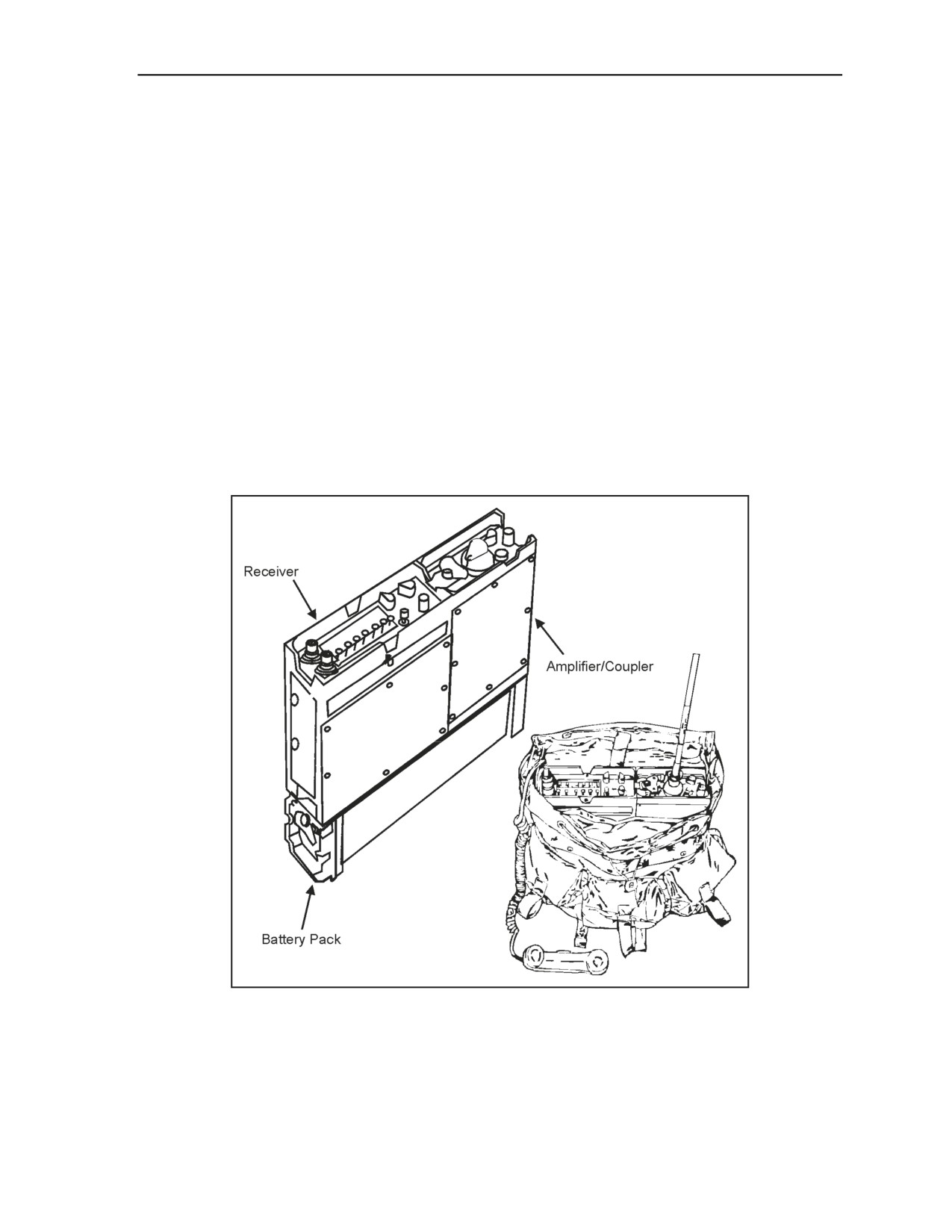
3-38. The AN/PRC-104A, refer to Figure 3-2, consists of the RT-1209, amplifier/coupler AM-6874,
antennas, and handsets. It is a low power radio which operates in the 2 to 29.999 MHz frequency range and
passes secure C2 information over medium to long distances and varying degrees of terrain features that
would prevent the use of VHF/FM CNR. It provides 280,000 tunable channels in 100 hertz (Hz) steps, and
has automatic antenna tuning. (Refer to TM 11-5820-919-12 for more information on the AN/PRC-104A.)
Figure 3-2. AN/PRC 104 manpack radio
LOW-POWER MANPACK/VEHICULAR RADIO, AN/GRC-213
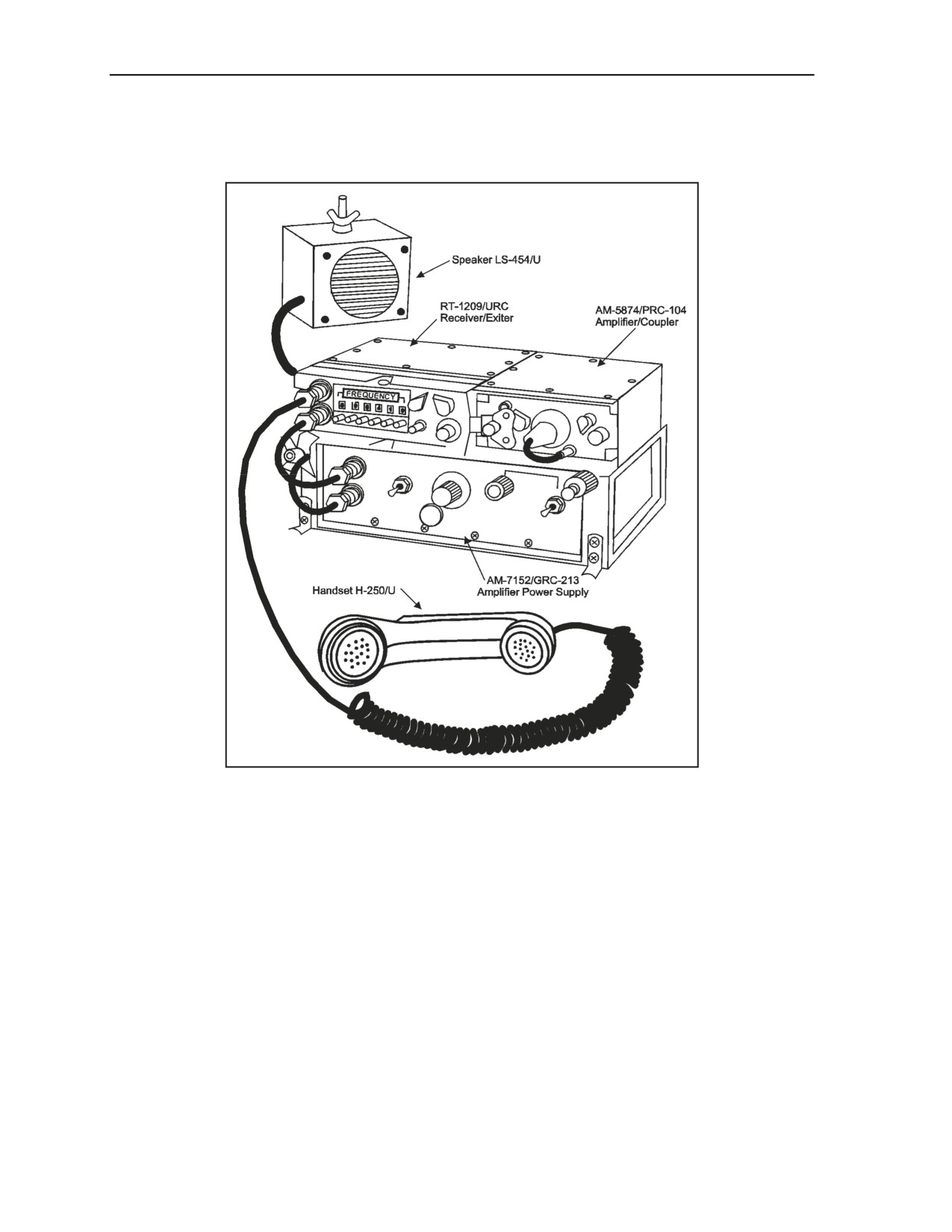
3-39. The AN/GRC-213, refer to Figure 3-3, is a low power manpack/vehicular radio. It consists of the
AN/PRC-104A radio, vehicle mount, amplifier power supply AM-7152, and three antennas (whip,
5 August 2009
FM 6-02.53
3-7
Chapter 3
AN/GRA-50 doublet, and AS-2259 near-vertical incident sky wave
[NVIS] antennas). Neither the
AN/GRC-213 nor the AN/PRC-104A should be used for transmissions exceeding one minute within a 10
minute time frame. (Refer to TM 11-5820-923-12 for more information on the AN/GRC-213.)
Figure 3-3. AN/GRC-213 low-power manpack/vehicular radio
HIGH-POWER VEHICLE RADIO, AN/GRC-193
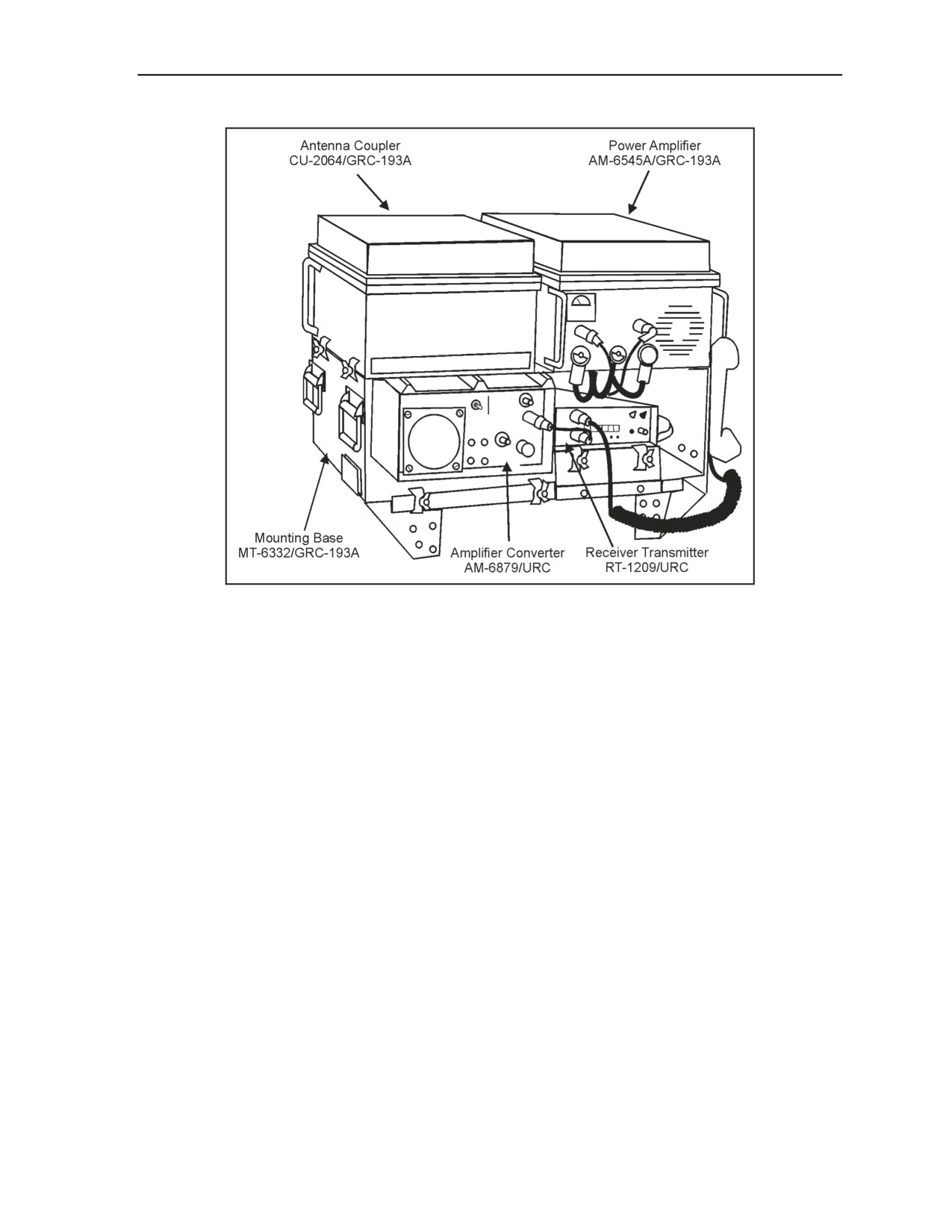
3-40. The AN/GRC-193 (refer to Figure 3-4) is a medium/high power vehicular radio. The high power
vehicular/airborne adaptive configuration consists of a basic RT (RT-1209) with required coupling device,
amplifier, antenna (NVIS and whip antennas); data input/output (I/O) device; and external power sources.
The radio will have the capability of selectable power (100 watts, 400 watts); normal operation will be at
100 watts. The AN/GRC-193 uses the KY-99 for securing voice traffic, and uses the telecommunications
security (TSEC)/KG-84 for securing data traffic. The antenna may be remoted up to 61 meters (200 feet
[ft]) from the radio set, using the antenna siting built-in test (BIT) that is part of the basic configuration.
(Refer to TM 11-5820-924-13 for more information on the AN/GRC-193.)
3-8
FM 6-02.53
5 August 2009
High Frequency Radios
Figure 3-4. AN/GRC-193 high-power vehicle radio
5 August 2009
FM 6-02.53
3-9
This page intentionally left blank.
Chapter 4
Very High Frequency Radio Systems
SINCGARS provide interoperable communications between C2 assets and have the
capability to transmit and receive secure voice and data. This chapter describes the
SINCGARS, its components, enhancements, and ancillary equipment. It also
addresses SINCGARS planning, secure devices, VHF FM wireless network
extension stations and SINCGARS jamming and anti-jamming. Due to the high usage
of COTS radios, other VHF radios included are the AN/PRC-148 and AN/PRC-152.
SINGLE-CHANNEL GROUND AND AIRBORNE RADIO SYSTEM
CHARACTERISTICS AND CAPABILITES
4-1. The SINCGARS family is designed on a modular basis to achieve maximum commonality among
various ground and airborne configurations. A common RT is used in the manpack and all vehicle
configurations. These individual components are totally interchangeable from one configuration to the
next. Additionally, the modular design reduces the burden on the logistics system to provide repair parts.
4-2. SINCGARS operates in either the SC or FH mode. It is compatible with all current US and
multinational VHF radios in the SC non-secure mode. SINCGARS is compatible with other USAF,
USMC, and USN SINCGARS in the FH mode. SINCGARS stores eight SC frequencies, including the cue
and manual frequencies and six separate hopsets.
4-3. SINCGARS operates on any of 2,320 channels between 30-88 MHz, with a channel separation of 25
kilohertz (kHz). It is designed to operate in nuclear or hostile environments.
4-4. SINCGARS accepts either digital or analog input and imposes the signal onto a SC or FH output
signal. In FH, the input changes frequency about 100 times per second over portions of the tactical VHF
range. This hinders threat intercept and jamming units from locating or disrupting friendly
communications.
4-5. SINCGARS provides data rates of 600, 1,200, 2,400, 4,800, and 16,000 bps; enhanced data mode
(EDM) of 1200N, 2400N, 4800N, and 9600N; and packet and recommended standard-232 data. The
system improvement program (SIP) and advanced system improvement program (ASIP) radios provide
EDM, which provide forward error correction (FEC), speed, range, and data transmission accuracy.
4-6. SINCGARS has the ability to control output power. The RT has three power settings that vary
transmission range from 200 meters (656.1 ft) to 10 km (6.2 miles). Adding a power amplifier (PA)
increases the LOS range to 40 km (25 miles). The variable output power level allows users to lessen the
electromagnetic signature given off by the radio set.
4-7. Using lower power is particularly important at major command posts (CPs), which operate in
multiple networks. The ultimate goal is to reduce the electronic signature at the CPs. The net control station
(NCS) should ensure all members of the network operate on the minimum power necessary to maintain
reliable communications.
4-8. SINCGARS also has BIT functions that notify the RTO when the RT is malfunctioning. It also
identifies the faulty circuits for repair or maintenance.
4-9. SINCGARS provides outside network access through a hailing method. The cue frequency provides
the hailing ability to the SINCGARS. When hailing a net, an individual outside the net contacts the
alternate NCS on the cue frequency. The NCS must retain control of the net. Having the alternate NCS go
5 August 2009
FM 6-02.53
4-1

Chapter 4
to the cue assists in managing the net without disruption. In the active FH mode, the SINCGARS gives
audible and visual signals to the RTO that an external subscriber wants to communicate with the FH net.
The SINCGARS alternate NCS RTO must change to the cue frequency to communicate with the outside
radio system.
4-10. The net uses the manual channel for initial network activation. The manual channel provides a
common frequency for all members of the net to verify the equipment is operational. During initial net
activation, all RTOs in the net tune to the manual channel using the same frequency. After establishing
communications on the manual channel, the NCS transfers the hopset variables to the out stations and then
switches the net to the FH mode.
4-11. The NCS is responsible for—
z
Opening and closing a net.
z
Maintaining net discipline.
z
Controlling net access.
z
Knowing who is a member of the net.
z
Imposing net controls.
4-12. Refer to Appendix B for more information on SC radio communications principles, Chapter 12 for
proper radio procedures, Appendix E for Julian date, sync time and time conversion and TM 11-5820-890-
10-5 for more information on SINCGARS NCS.
SINGLE-CHANNEL GROUND AND AIRBORNE RADIO SYSTEM
RADIO SETS
4-13. Using common components in SINCGARS is the key to tailoring radio sets for specific missions
with the RT being the basic building block for all radio configurations. The number of RTs, amplifiers, the
installation kit, and the backpack component determine the model. Table 4-1 compares the components of
several versions of SINCGARS. For more information on SINCGARS refer to TM 11-5820-890-10-5, TM
11-5820-890-10-8 and Technical Bulletin (TB) 11-5821-333-10-2.
Table 4-1. Comparison of SINCGARS versions and components
Short
Long
PA
Dismount
Vehicular
Range
Range
Manpack
Amplifier Adapter
(consist of
(consist of
(VAA)
1 radio)
1 radio)
(AM-7239C/E)
AN/VRC-87
X
X
AN/VRC-88
X
X
X
AN/VRC-89
X
X
X
X
AN/VRC-90
X
X
X
AN/VRC-91
X
X
X
X
X
AN/VRC-92
X (2)
X (2)
X
AN/PRC-119
X
X
4-14. There are several ground unit versions of SINCGARS (RT-1523/A/B/C/D/E) and three airborne
versions (RT-1476/1477/1478). Most airborne versions require external COMSEC devices. The RT-1478D
has ICOM and an integrated data rate adapter (DRA). (Airborne SINCGARS versions are addressed in
Chapter 7.)
4-15. Airborne and ground versions are interoperable in FH and SC operations. The airborne versions
differ in installation packages and requirements for data capable terminals.
4-2
FM 6-02.53
5 August 2009
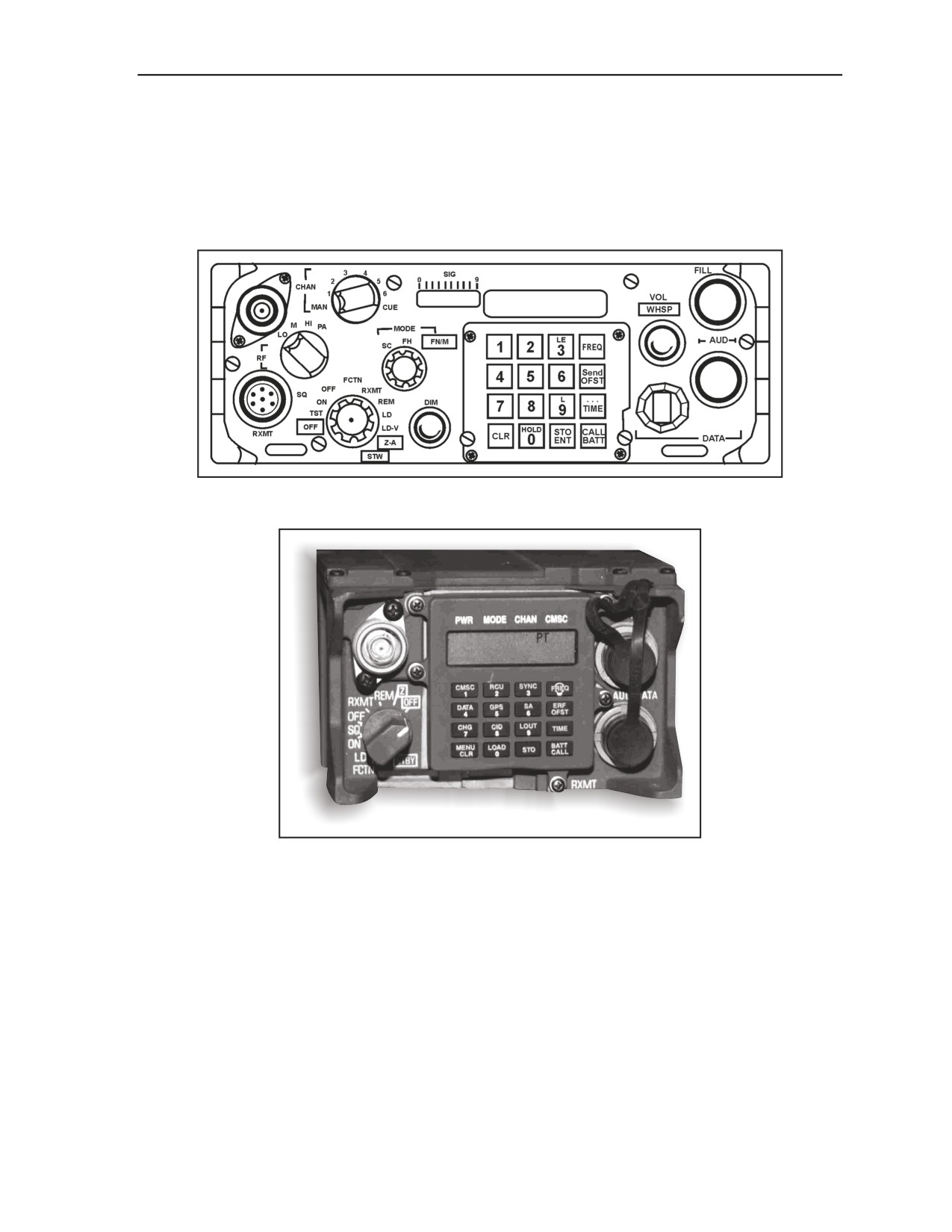
Very High Frequency Radio Systems
GROUND VERSION RECEIVER/TRANSMITTER
4-16. Either the RT-1523/A/B/C/D (refer to Figure 4-1) or the RT-1523E (refer to Figure 4-2) comprise
the core component of all ground-based radio sets. The RT-1523 series has internal COMSEC circuits
(source of the ICOM designation). The ground versions are equipped with a whisper mode for noise
restriction during patrolling or while in defensive positions. The RTO whispers into the handset and is
heard at the receiver in a normal voice.
Figure 4-1. Front panel ICOM radio RT-1523/A/B/C/D
Figure 4-2. Front panel ICOM radio RT-1523E
ADVANCED SYSTEM IMPROVEMENT PROGRAM
4-17. The SINCGARS ASIP increases the performance of the SINCGARS SIP (RT-1523 C/D models). It
also increases its operational capability in support of the tactical Internet, specifically improved data
capability, manpower and personnel integration requirement compliance, and flexibility in terms of
interfaces with other systems. Figure 4-3 is an example of the SINCGARS ASIP radio.
5 August 2009
FM 6-02.53
4-3
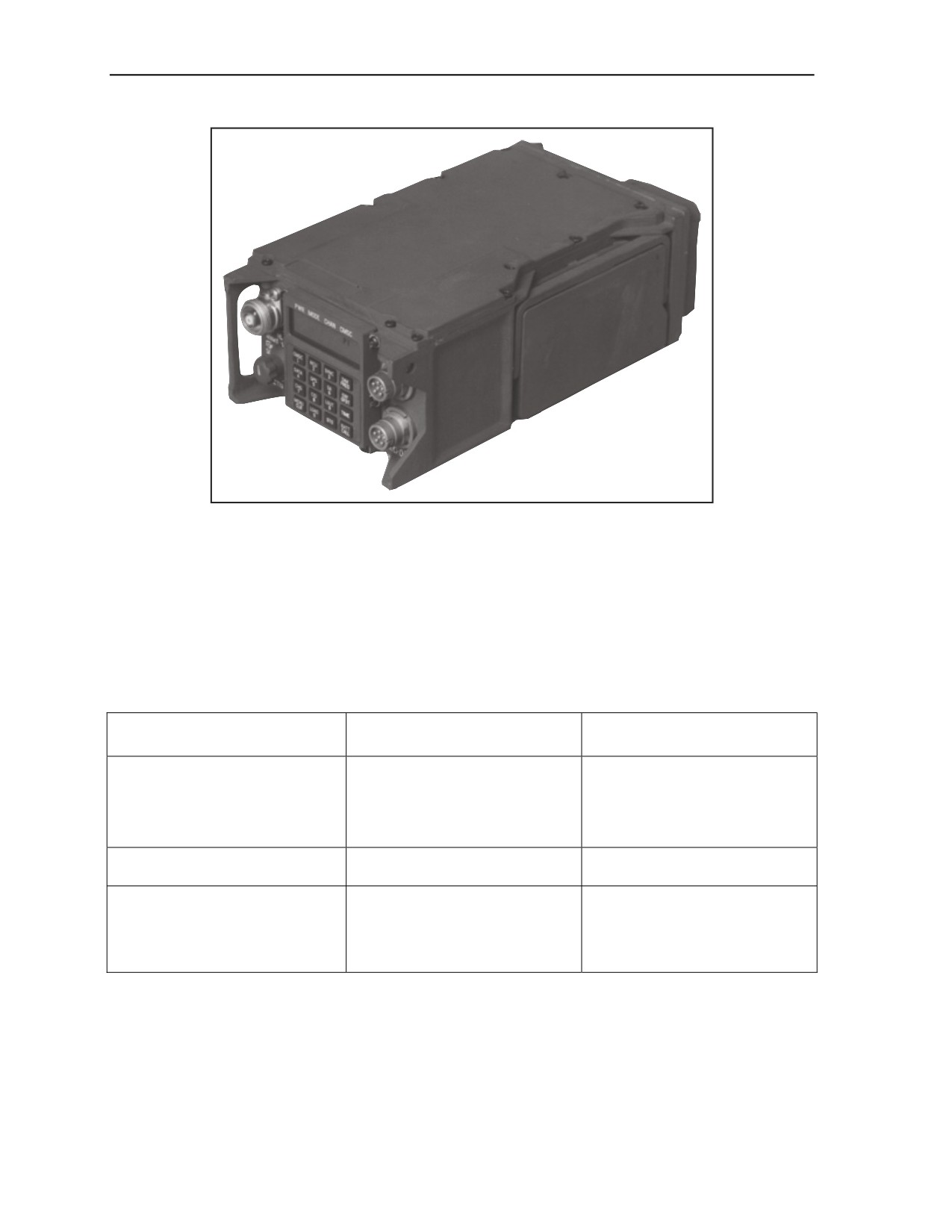
Chapter 4
Figure 4-3. SINCGARS ASIP radio
4-18. Table 4-2 outlines a comparison of the SINCGARS ICOM, SINCGARS SIP, and the SINCGARS
ASIP. All ASIP radios can be physically remoted by another ASIP radio up to 4 km (2.4 miles) away, via a
two-wire twisted pair (typically WD-1 or WF-16). To remote a radio, an external two-wire adapter is used
as the interface between the radio and the wires. This remote control feature can be performed between the
dismounted RT and the VAA, or between two dismounted RTs. Another host controller can control the
ASIP radio via the external control interface when the ASIP radio system is integrated as part of a larger
system.
Table 4-2. SINCGARS enhancements comparison
ICOM capabilities (RT-1523A/B)
SIP capabilities (RT-1523C/D)
ASIP capabilities (RT 1523E/F)
Point-to-point communications
Point-to-point communications
Point-to-point communications
1. FH per MIL-STD-188-241.
1. FH per MIL-STD-188-241.
1. Same as SIP.
2. SC per STANAG 4204.
2. SC per STANAG 4204.
3. Mode 1, 2, 3 fill.
3. Mode 1, 2, 3 fill.
4. Electronic remote fill (ERF).
4. ERF.
Plain text (PT) and cipher text
Circuit switching and packet
Circuit switching and packet
(CT) mode
network communications
network communications
1. Railman COMSEC.
1. CSMA protocol.
1. Same as SIP.
2. Seville advanced remote
2. Railman COMSEC.
keying.
3. Seville advanced remote
keying.
4-4
FM 6-02.53
5 August 2009

Very High Frequency Radio Systems
Table 4-2. SINCGARS enhancements comparison (continued)
Point-to-point data
Point-to-point data
Point-to-point data
communications
communications
communications
1. 600 to 4,800 bps standard
1. 600 to 4,800 bps standard
1. Same as SIP.
data mode.
data mode.
2. Tactical Fire Direction
2. TACFIRE, analog data.
System (TACFIRE), analog
3. Transparent 16 kbps data.
data.
4. 1,200 to 9,600 bps EDM
3. Transparent 16 kbps data.
data.
5. Recommended standard-
232 EDM data.
6. Packet data.
7. External control interface.
Other features
Other features
Other features
1. Noisy channel avoidance.
1. Noisy channel avoidance.
1. Same as SIP plus—
2. Enhanced message
2. Enhanced message
z
Enhanced system
completion.
completion.
improvement program
(ESIP) waveform.
3. External global positioning
system (GPS) interface.
z
Faster channel access
to reduce net
4. Embedded GPS hooks.
fragmentation.
5. Remote control unit (RCU).
z
Enhanced noisy
channel avoidance
algorithm to improve
FH sync probability.
z
Improved time of day
tracking and
adjustments.
z
Extra end of message
hops to improve sync
detection and reduce
fade bridging.
z
Embedded battery.
VAA (AM-7239B):
VAA (AM-7239C):
VAA (AM-7239E):
1. Dual transmit power supply.
1. Dual transmit power supply.
1. Same as SIP plus—
2. Host interface.
z
More powerful 860
microprocessor.
3. Backbone interface.
z
Ethernet interface.
4. MIL-STD-188-220A.
z
Enhanced protocols.
z
Increased memory and
buffer size.
5 August 2009
FM 6-02.53
4-5
Chapter 4
Enhanced System Improvement Program Capabilities
4-19. The SINCGARS ASIP radio incorporates an ESIP waveform. The waveform includes optimizations
to the algorithms of the noisy channel avoidance scheme, the time of day tracking scheme, and the end of
message scheme. Enhancements include—
z
ESIP waveform—implements a faster channel access protocol, which reduces net
fragmentation by shortening the collision intervals between voice and data transmissions. The
result is the reduction of voice and data contention problems associated with shared voice and
data networks.
z
Noisy channel avoidance algorithm—always reverts to a known good frequency instead of
constantly searching for clear frequencies, thus increasing the FH synchronization probability in
high noise and jamming conditions.
z
Time of day enhancement—uses a reference BIT that assures time constraints are the same
during each transmission.
z
End of message enhancement—reduces fade bridging, whereby the transmission would linger
even though adding extra end of message hops to increase the detection and probability of
synchronization completes the message.
SINCGARS INTERNET CONTROLLER CARD
4-20. The internet controller card (INC) was introduced as part of the SINCGARS VAA to support the
seamless flow of data across the battlefield, permitting both horizontal and vertical flow of C2 information.
The INC is in the right hand side of the VAA, and is only needed when the SINCGARS system is
operating in the packet mode of operation. Figure 4-4 is an example of a VAA.
4-21. The packet mode allows for the sharing of voice and data over the same operational net. A store and
forward feature in the INC delays data while voice traffic is ongoing, and puts data on the net when the
push-to-talk is released for voice. When the INC is loaded with initialization data, it will contain routing
tables that identify the addresses of all members with which it is affiliated, as well as other radio nets that it
can route to. The host computers generate messages, along with the IP addresses of the individual(s) to
whom it is being sent.
4-22. When a message reaches an INC, the INC looks up its routing table to determine whether that
message is for a member of its net or whether it needs to be sent off to the next adjoining net. The packet
mode will automatically continue this routing process until it reaches its destination. The packet mode
knows if the message is for someone within its net, and if the message stops there it will not get wirelessly
networked extended out. This differs in a wireless network extension site, in that everything received at the
wireless network extension station is relayed.
4-23. The VAA mounted INC is the predominant communications router for the tactical maneuver
platforms participating in a SINCGARS enabled tactical Internet. The INC routes data between
SINCGARS and EPLRS. The INC uses commercial IP services to deliver unicast and multicast data
packets that consist of C2 and situational awareness (SA) messages.
4-24. The INC has an improved microprocessor with increased memory buffer size and an Ethernet
interface is also available. Access to the Ethernet interface is through the same 19 pin connector used for
the EPLRS interface. Two of the nineteen pins are used as twisted pairs to provide for the 10Base-T
Ethernet connection. This feature will allow multiple INCs to be connected for the sharing or dissemination
of information in a local area network configuration (such as in a TOC environment).
4-6
FM 6-02.53
5 August 2009
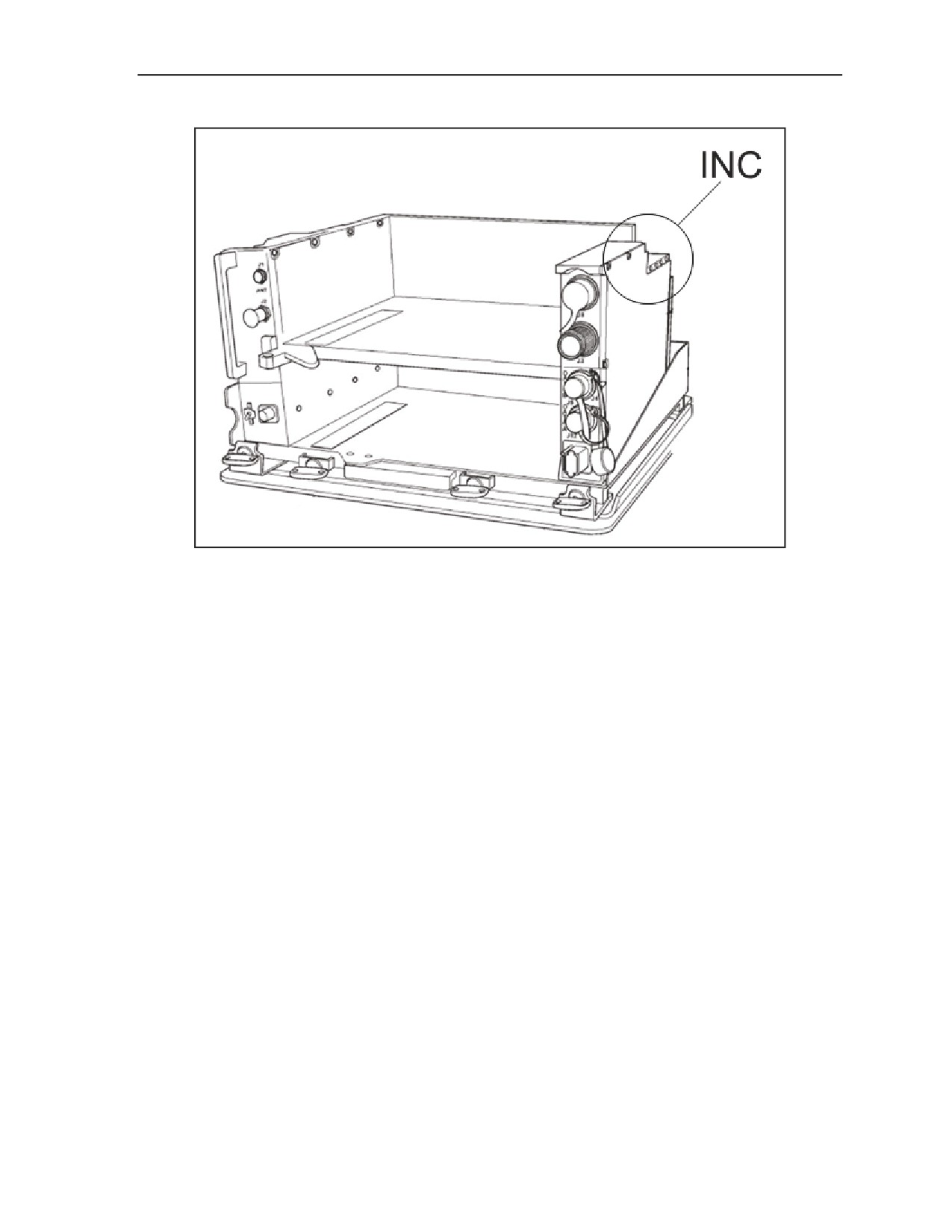
Very High Frequency Radio Systems
Figure 4-4. Vehicular amp adapter and INC
SINGLE-CHANNEL GROUND AND AIRBORNE RADIO SYSTEM
ANCILLARY EQUIPMENT
4-25. Remote control devices, data fill/variable storage transfer devices, and the vehicular
intercommunications system
(VIS) are the main categories of ancillary equipment associated with
SINCGARS addressed in the following paragraphs.
4-26. Remote control devices are divided into intra-vehicular and external remotes. The intravehicular
remote control unit (IVRCU), C-11291, is the remote for intra-vehicular radio control. The securable
remote control unit (SRCU), C-11561, is used to remote radios off the main site location. Additionally, the
SIP/ASIP radio can be used as a RCU by merely selecting the RCU option under the RCU key of the
SIP/ASIP RT keypad.
INTRAVEHICULAR REMOTE CONTROL UNIT
4-27. The IVRCU, C-11291 can be used with either an ICOM or non-ICOM radio. It can control up to two
mounting adapters with up to three separate radio sets from a single station. The IVRCU can also be
connected in parallel so that two different RTOs, such as the vehicle commander and the vehicle driver,
can control the radios from their respective positions in the vehicle. The radio function switch must be set
in the remote operating position for the external control monitor to function correctly. Refer to Figure 4-5
for more information on Intravehicular remote control unit, C-11291.
5 August 2009
FM 6-02.53
4-7
///////////////////////////////////////