FM 6-02.53 TACTICAL RADIO OPERATIONS (August 2009) - page 7
Appendix H
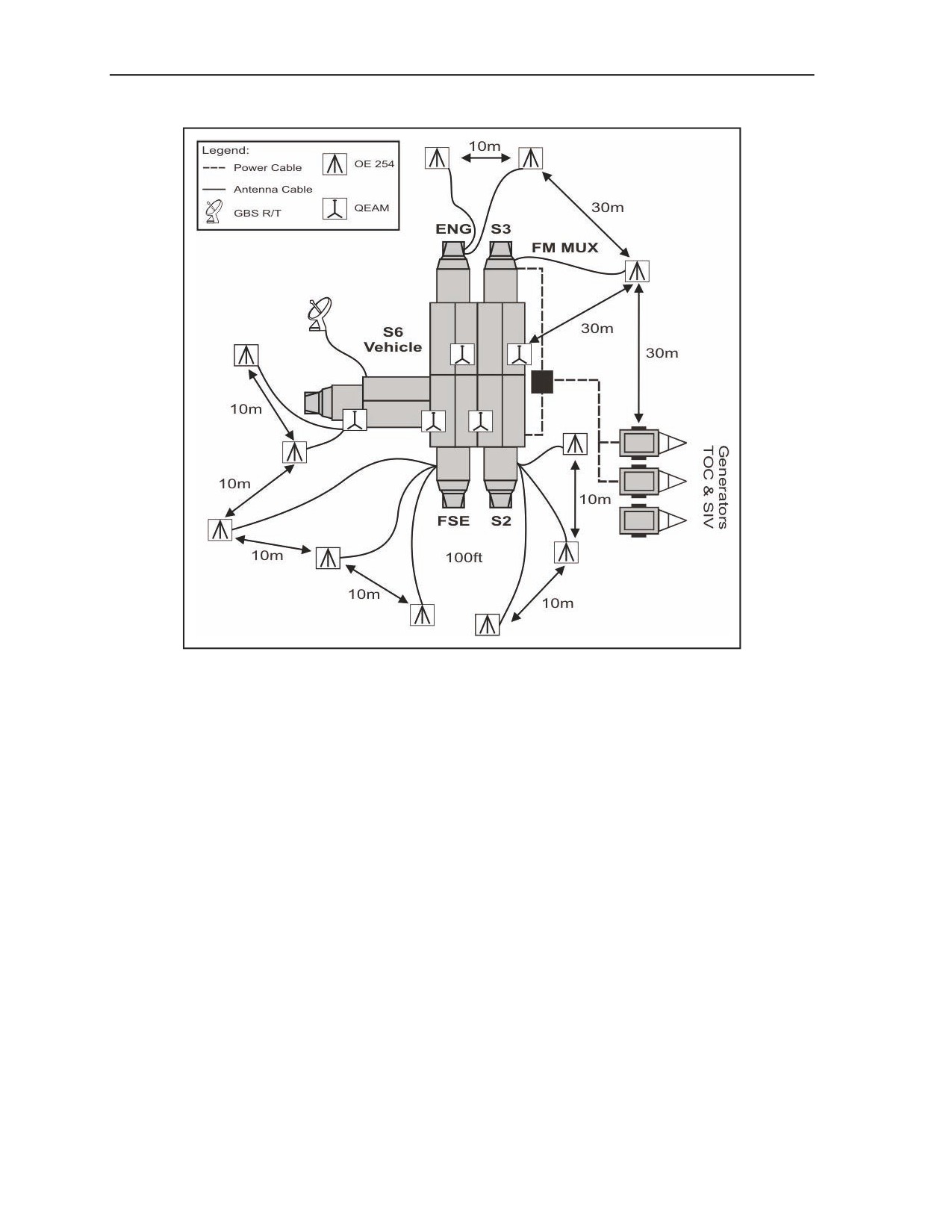
Figure H-2. Example of proper antenna separation for an armored TOC
DIRECTIONAL ANTENNAS
H-14. Use directional antennas whenever possible. This may require the prefabrication of VHF directional
antennas, since these are not available in the current Army inventory. Change antenna polarization on
systems where distance is not an issue. A horizontally polarized ground wave will have less signal loss
than a vertically polarized ground wave if antenna heights exceed treetop levels or other horizontal energy
absorbers.
MAST ASSEMBLIES
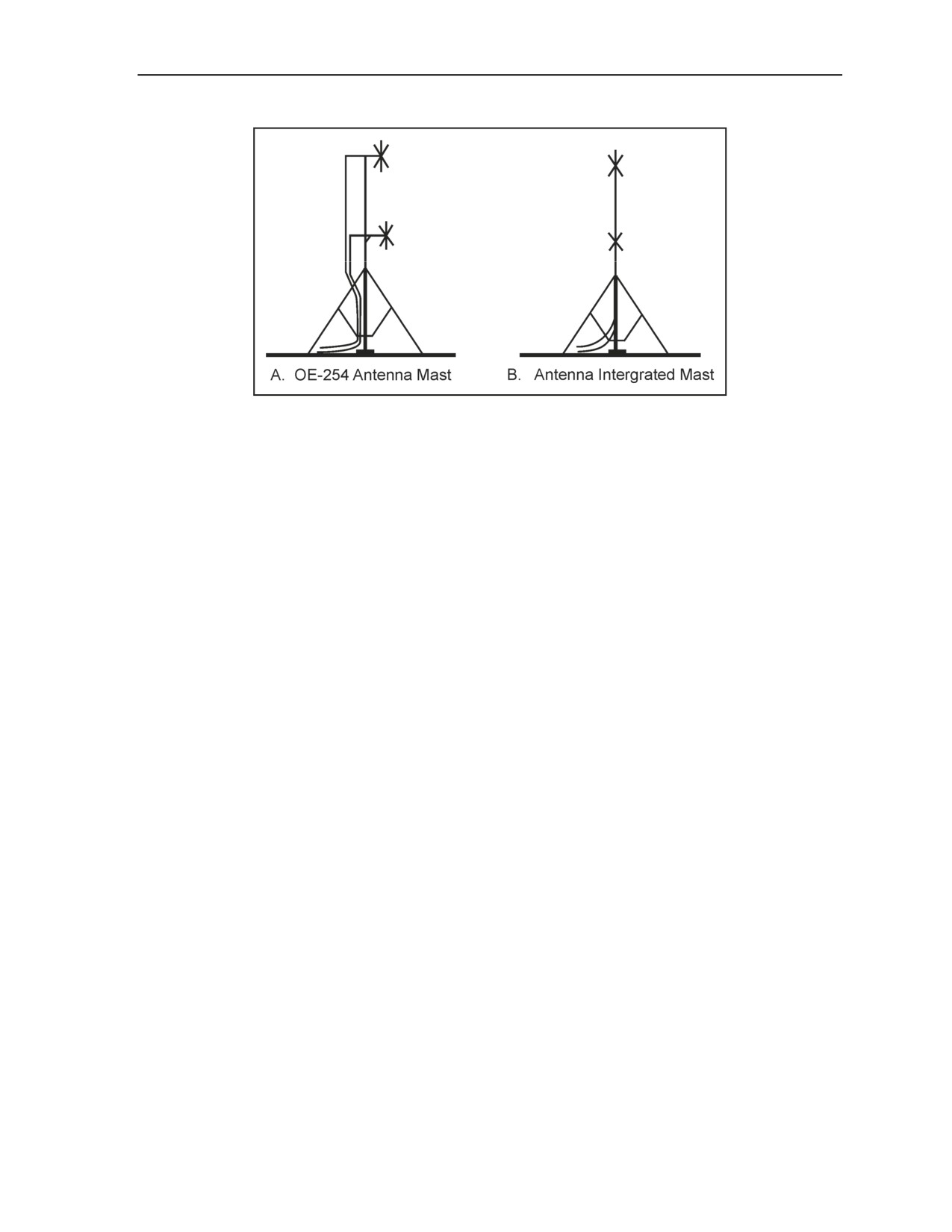
H-15. If possible, stack antennas in the null space of another vertical antenna. The radiation pattern of a
vertical antenna has a deep energy void directly overhead (90 degrees). Figure H-3 shows possible antenna
stacks. These mast assemblies would be configured to mount two OE-254 broadband antennas using
vertical separation, as shown in configuration A of Figure H-3. Mast assemblies could also use a new
design that incorporates the omnidirectional antennas into mast sections, as shown in configuration B of
Figure H-3.
H-16. Both dual-antenna mast assemblies must provide at least 12 dB or greater antenna isolation (at 30
MHz) over that obtained using the same distance horizontal separation. Taking advantage of the lateral
wave propagation of vertical antennas. Energy transference is negligible on a receiving antenna in this null
space. Early fabrication of mounting devices may be required to achieve antenna stacking.
H-4
FM 6-02.53
5 August 2009
Co-Site Interference
Figure H-3. Possible antenna stacks
GROUNDING
H-17. Ensure electronic equipment within the CP is properly grounded. Proper grounding ensures that each
item does not develop interference-producing electromagnetic fields, or simulate the properties of an
unwanted, energy-radiating transmitting antenna within the CP.
H-18. Another option is to counterpoise the antenna. The wires used in the counterpoise should be either a
half wavelength, or a full wavelength long for best results. A greater direction gain can be achieved by
placing the counterpoise wires in the direction of the receiving antenna. (Refer to Chapter 9 for more
information on how to construct a counterpoise.)
SINGLE-CHANNEL OPERATIONS
H-19. When operating against less sophisticated adversaries, using SINCGARS SC mode of operation also
mitigates co-site interference. Even when operating at full power, properly chosen frequencies can reduce
co-site interference, and provide increased range capability due to better bit error rate, inherent with SC
operation.
INITIATIVES
H-20. Two co-site mitigation initiatives are the TD-1456/VRC, FHMUX, and the JTRS family of radios.
Communications integration and co-site mitigation science and technology objectives products enhance
both initiatives.
TD-1456/VRC, FHMUX
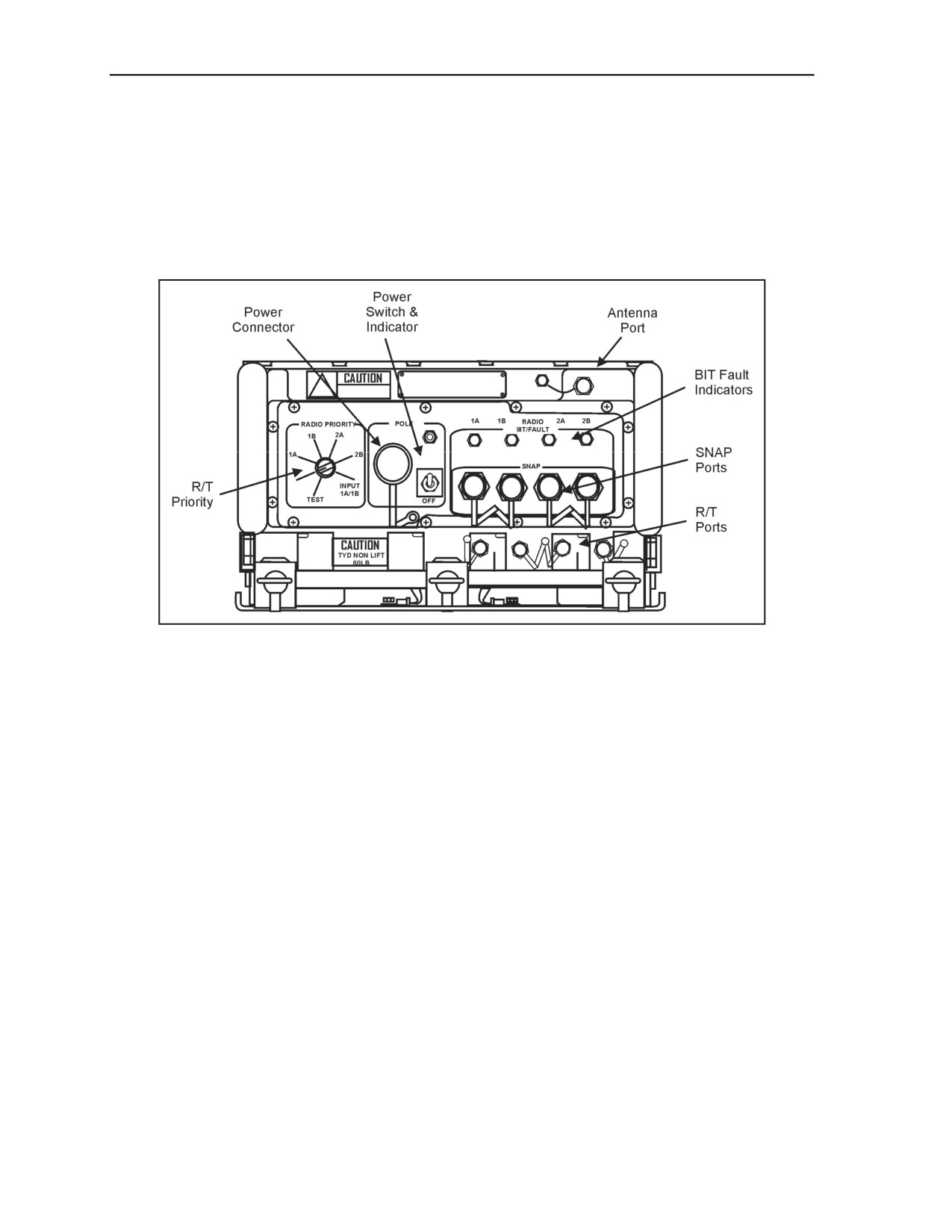
H-21. The FHMUX is a hardware solution to co-site interference. It is compatible with the SINCGARS in
EP (FH) and SC (non-FH) modes of operation. Figure H-4 shows the FHMUX. The FHMUX is an antenna
multicoupler that—
z
Reduces visual signature of the command vehicle, by reducing the antenna count, thus
increasing the survivability of the vehicle on the battlefield.
z
Reduces collocated net-to-net interference (co-site).
z
Reduces setup time for C2. The user erects one OE-254 antenna, and four nets are operational
via the FHMUX. FHMUX is compatible with high power whip antennas, such as the AS-
3900A/VRC or AS-3916/VRC.
5 August 2009
FM 6-02.53
H-5
Appendix H
z
Reduces the parasitic effect of the antennas. The transmit radiation of one antenna in close
proximity (10 ft/3 meters) will interact with another antenna producing undesirable distortions
within the pattern of each antenna.
z
Provides up to 300 meters (.3 km) multicoupler to antenna separation, to reduce exposure of the
CP to hostile fire.
z
Provides frequency conflict arbitration software that optimizes the transmission range. Table H-
1 shows the effects of multiple transmitters (within a C2 vehicle) on transmission ranges with
and without the FHMUX.
Figure H-4. Frequency hopping multiplexer
H-6
FM 6-02.53
5 August 2009

Co-Site Interference
Table H-1. Transmitters and transmission ranges with and without the FHMUX
Transmitters On
Range to target receiver without FHMUX
Range to target receiver with FHMUX
zero
35 km/21.7 miles
35 km/21.7 miles
one
14 km/8.6 miles
32 km/19.8 miles
two
9 km/5.5 miles
27 km/16.7 miles
three
3 km/1.8 miles
19 km/11.8 miles
Note. Range to target receiver from a C2 vehicle, compared to the number of transmitters operating on the C2 vehicle.
H-22. The FHMUX contains bandpass filters that tune synchronously with the radios. These filters remove
most of the broadband transmit interference. Signals coming from the antenna also pass through these
bandpass filters, and strong, non-bandpass signals are removed. This greatly improves the performance of
the radio system when in a co-site environment.
H-23. In the EP mode, the FHMUX is most effective when the hopset contains at least 800 channels and it
is spread over at least 20 MHz of the VHF band. When enemy intrusion is not an issue, and the SC mode is
used, the FHMUX is most effective when frequencies are separated by a five percent delta for each radio.
(Refer to TM 11-5820-890-10-8 and TM 11-5820-890-23&P for more information on the FHMUX.)
Joint Tactical Radio System
H-24. The JTRS may eliminate most, if not all, co-site interference problems that occur when multiple
radios in the same or dissimilar frequency bands are integrated within the same mobile communications CP
platform. The JTRS operates at full performance levels, and does not degrade mission effectiveness of host
systems/platforms engaged in their tactical environments, including weapons firing and movements.
H-25. New efforts, in conjunction with the JTRS, include the development of a VHF/UHF multiplexer,
utilizing RF signal combining, and co-site mitigation technology to reduce the platform’s antenna visual
signature and JTRS self-jamming interference. The initial and objective multiplexer development efforts
will exploit emerging technology applications in the areas of wideband interference mitigation and
compact delay lines.
H-26. A new communications integration and co-site mitigation science and technology objective initiative
includes a multiband VHF/UHF PA that will eliminate dissimilar legacy radio amplifiers and their
logistics, training, and maintenance infrastructures, and will provide a modular, programmable JTRS
waveform capability. The initial and objective PA development efforts will use laterally diffused metal
oxide semiconductor and silicone carbide device technology to meet higher power and frequency
requirements.
5 August 2009
FM 6-02.53
H-7
This page intentionally left blank.
Glossary
The glossary lists acronyms and terms with Army, multi-service, or joint definitions,
and other selected terms. Where Army and joint definitions are different, (Army) follows
the term. Terms for which FM 6-02.53 is the proponent manual (the authority) are
marked with an asterisk (*). The proponent manual for other terms is listed in parentheses
after the definition.
SECTION I - ACRONYMS AND ABBREVIATIONS
2G
second generation
3G
third generation
A&L
administrative and logistics
A2C2S
Army Airborne Command and Control System
ABCS
Army Battle Command System
ACES
automated communications engineering software
ACMES
Automated Communications Security Management and Engineering
System
ADA
air defense artillery
AFATDS
Advanced Field Artillery Tactical Data System
AIRP
Army interference resolution program
AIRSIP
airborne system improvement program
AIS
Automated Information Systems
AKMS
Army Key Management System
ALE
automatic link establishment
AM
amplitude modulation
ANCD
automated net control device
ANDVT
advanced narrowband digital voice terminal
ANR
active noise reduction
AO
area of operations
AOR
area of responsibility
APCO
Association of Public Safety Communications Officials
AR
Army regulation
ARNG
Army National Guard
ARNGUS
Army National Guard of the United States
ASIP
advanced system improvement program
ASIP-E
advanced system improvement program-enhanced
ASCC
Army Service component commander
ATC
air traffic control
AWACS
Airborne Warning and Control System
BCT
brigade combat team
5 August 2009
FM 6-02.53
Glossary-1
Glossary
BFT
Blue Force Tracking
BIT
built-in test
BLOS
beyond line of sight
bps
bits per second
C2
command and control
CA
Civil Affairs
CDR
commander
CDU
control display unit
CEOI
communications-electronics operating instructions
CIK
cryptographic ignition key
CJCSI
Chairman Joint Chiefs of Staff instruction
CNR
combat net radio
CNRS
communications networking radio subsystem
CO
company
COA
course of action
COMSEC
communications security
CONUS
continental United States
COOP
Continuity of Operations Plan
COTS
commercial off-the-shelf
CP
command post
CPC
combat survivor evader locator planning computer
CREW
Counter Remote Control Improvised Explosive Device Warfare
CSEL
combat survivor evader locator
CSMA
carrier sense multiple access
CT
cipher text
CW
continuous wave
DA
Department of the Army
DAGR
defense advanced global positioning system receiver
DAMA
demand assigned multiple access
DAP
dynamically allocated permanent (virtual circuit)
dB
decibel
dBi
gain in decibels
dbm
decibels above a milliwatt
DF
direction finding
DOD
Department of Defense
DRA
data rate adapter
DTD
data transfer device
DSN
Defense Switched Network
DTE
data terminal equipment
EA
electronic attack
ECCM
electronic counter-countermeasures
Glossary-2
FM 6-02.53
5 August 2009
Glossary
EDM
enhanced data mode
EEFI
essential elements of friendly information
EHF
extremely high frequency
EKMS
Electronic Key Management System
e-mail
electronic mail
EMI
electromagnetic interference
EMP
electromagnetic pulse
EMSO
electromagnetic spectrum operations
ENM
Enhanced Position Location Reporting System network manager
EP
electronic protection
EPLRS
Enhanced Position Location Reporting System
ERF
electronic remote fill
ES
electronic warfare support
ESB
expeditionary signal battalion
ESIP
enhanced system improvement program
EW
electronic warfare
FBCB2
Force XXI Battle Command Brigade and Below
FCTN
function
FEC
forward error correction
FH
frequency hopping
FHMUX
frequency hopping multiplexer
FLOT
forward line of own troops
FM
field manual; frequency modulation
FMI
field manual interim
FSK
frequency shift key
ft
feet
G-2
assistant chief of staff, intelligence
G-3
assistant chief of staff, operations
G-6
assistant chief of staff, command, control, communications, and
computer operations
GCC
geographic combatant commander
GHz
gigahertz
GPS
global positioning system
HDR
high data rate
HF
high frequency
HRCRD
handheld remote control radio device
HQ
headquarters
Hz
hertz
I/O
input/output
ICEPAC
Ionospheric Communications Enhanced Profile and Circuit
ICOM
integrated communications security
5 August 2009
FM 6-02.53
Glossary-3
Glossary
IED
improvised explosive device
IHFR
improved high frequency radio
IMMP
Information Management Master Plan
IMP
Information Management Plan
INC
internet controller card
INMARSAT
international maritime satellite
IONCAP
Ionospheric Communications Analysis and Prediction
IP
Internet Protocol
ISP
Information Systems Plan
ISSO
Information Systems Security Officer
ITSB
integrated theater signal battalion
IVRCU
intravehicular remote control unit
J-6
communications system directorate of a joint staff
JACS
joint automated communications-electronics operating instructions
system
JCF
joint contingency force
JCS
Joint Chiefs of Staff
JINTACCS
Joint Interoperability of Tactical Command and Control System
JLENS
Joint Land Attack Cruise Missile Defense Elevated Netted Sensor
System
JNN
Joint Network Node
JP
joint publication
JRFL
joint restricted frequency list
JSIR
Joint Spectrum Interference Resolution
JTAGS
joint tactical ground station
JTF
joint task force
JTIDS
Joint Tactical Information Distribution System
JTRS
Joint Tactical Radio System
kbps
kilobits per second
KEK
key encryption key
kHz
kilohertz
km
kilometer
KMP
key management plan
kW
kilowatt
LCMS
local communications security management software
LCU
lightweight computer unit
LDV
last ditch voice
LMR
land mobile radio
LOS
line of sight
LPI/D
low probability of interception/detection
LQA
link quality analysis
Glossary-4
FM 6-02.53
5 August 2009
Glossary
LRU
line replaceable unit
LTS
logical time slot
LVT
low volume terminal
LW
Land Warrior
MBITR
multiband inter/intra team radio
MCS
master control station
MEADS
medium extended air defense system
MELP
mixed excitation linear prediction
METT-TC
mission, enemy, terrain and weather, troops and support available, time
available, civil considerations
MF
medium frequency
MHz
megahertz
MIDS
Multifunctional Information Distribution System
MIL-STD
military standard
MLRS
Multiple Launch Rocket System
MNL
master net list
MSE
mobile subscriber equipment
MSG
multisource group
MSRT
mobile subscriber radiotelephone terminal
MUF
maximum usable frequency
NATO
North Atlantic Treaty Organization
NCO
noncommisioned officer
NCS
net control station
net
network
NET ID
network identifier
NMS
Network Management System
NSA
National Security Agency
NTDR
near term digital radio
NTIA
National Telecommunications and Information Administration
NVIS
near-vertical incident sky wave
O&I
operations and intelligence
OCONUS
outside the continental United States
OPLAN
operation plan
OPORD
operation order
OTAR
over-the-air rekeying
P25
Project 25 standards (APCO)
PA
power amplifier
PC
personal computer
PLGR
precision lightweight global positioning system receiver
PMCS
preventive maintenance checks and services
PSK
phase shift keying
5 August 2009
FM 6-02.53
Glossary-5
Glossary
PSYOP
Psychological Operations
PT
plain text
QEAM
quick erect antenna mast
RBECS
Revised Battlefield Electronic Communications-Electronics Operational
Instruction/Signal Operating Instructions System
RCU
remote control unit
RDG
random data generator
RDS
revised data transfer device software
RF
radio frequency
RSA
radio set adapter
RT
receiver/transmitter
RTO
radio-telephone operator
S-2
intelligence staff officer
S-3
operations staff officer
S-6
signal staff officer
SA
situational awareness
SAMS-1
Standard Army Maintenance System-Level 1
SATCOM
satellite communications
SC
single-channel
SCAMP
single-channel anti-jam man portable
SC TACSAT
single-channel tactical satellite
SECOMP
secure en route communications package
SFAF
standard frequency action format
SHORAD
short-range air defense
SIGINT
signals intelligence
SINAD
signal, noise and distortion
SINCGARS
Single-Channel Ground and Airborne Radio System
SIP
system improvement program
SKL
simple key loader
S/N
signal to noise
SOF
Special Operations Forces
SOI
signal operating instructions
SOP
standing operating procedure
SPEED
system planning, engineering, and evaluation device
SQ
squelch
SRCU
securable remote control unit
SSB
single side band
STANAG
standardization agreement (NATO)
STU
secure telephone unit
TAC CP
tactical command post
TACFIRE
Tactical Fire Direction System
Glossary-6
FM 6-02.53
5 August 2009
Glossary
TACSAT
tactical satellite
TADIL-J
tactical digital information link-joint
TAOM
Tactical Air Operations Module
TB
technical bulletin
TDMA
time division multiple access
TEK
traffic encryption key
THAAD
Theater High Altitude Air Defense
TM
technical manual
TOC
tactical operations center
TRADOC
United States Army Training and Doctrine Command
TRANSEC
transmission security
TSEC
telecommunications security
TSK
transmission security key
TTP
tactics, techniques, and procedures
TTSB
tactical theater signal brigade
UHF
ultra high frequency
US
United States
US&P
United States and Possessions
USAF
United States Air Force
USAR
United States Army Reserve
USMC
United States Marine Corps
USN
United States Navy
VAA
vehicular amplifier adapter
VAC
volts alternating current
VDC
volts direct current
VHF
very high frequency
VIS
vehicular intercommunications system
VOACAP
Voice of America Coverage Analysis Program
VOCODER
voice encoder
VSWR
voltage standing wave radio
WIN-T
Warfighter Information Network-Tactical
SECTION II - TERMS
*acknowledge
A directive from the originator of a communication requiring the address(s) to advise the originator that his
communication has been received and understood. This term is normally included in the electronic
transmission of orders to ensure the receiving station or person confirms the receipt of the order.
*all after
A procedure word meaning, “The portion of the message to which I have referenced is all that follows
(insert text).” See also procedure word.
5 August 2009
FM 6-02.53
Glossary-7
Glossary
*all before
A procedure word meaning, “The portion of the message to which I have reference is all that precedes
(insert text).” See also procedure word.
area of operations
(joint) An operational area defined by the joint force commander for land and maritime forces. Areas of
operations do not typically encompass the entire operational area of the joint force commander, but should
be large enough for component commanders to accomplish their missions and protect their forces. (JP 3-0)
*authenticate
A procedure word meaning, “The station called is to reply to the challenge which follows (insert text)”.
*authentication
A security measure designed to protect a communications system against acceptance of a fraudulent
transmission or simulation by establishing the validity of a transmission, message, or originator.
*authentication is
A procedure word meaning, “ The transmission authentication of this message is “ (insert text).” See also
procedure word.
azimuth
(joint) Quantities may be expressed in positive quantities increasing in a clockwise direction, or in X, Y
coordinates where south and west are negative. They may be referenced to true north or magnetic north
depending on the particular weapon system used.
bandwidth
(joint) The difference between the limiting frequencies of a continuous frequency expressed in hertz
(cycles per second). The term bandwidth is also loosely used to refer to the rate at which data can be
transmitted over a given communications circuit. In the latter usage, bandwidth is usually expressed in
either kilobits per second or megabits per second. (JP 1-02)
beam width
(joint) The angle between the directions on either side of the axis, at which the intensity of the radio
frequency field drops to one-half the value it has on the axis. (JP 1-02)
*break
A procedure word meaning, “I here by indicate the separation of the text from another portion of the
message.” See also procedure word.
call sign
(joint) Any combination of characters or pronounceable words, which identifies a communication facility,
a command, an authority, an activity, or a unit; used primarily for establishing and maintaining
communications. (JP 1-02)
*clear
To eliminate transmissions on a tactical radio net in order to allow a higher-precedence transmission to
occur.
command and control
(Army) The exercise of authority and direction by a properly designated commander over assigned and
attached forces in the accomplishment of a mission. Commanders perform command and control functions
through a command and control system. (FM 6-0)
command post
(Army) A unit’s or subunit’s headquarters where the commander and the staff perform their activities. (FM
6-0)
common operating environment
(joint) Automation services that support the development of the common reusable software modules that
enable interoperability across multiple combat support applications. This includes segmentation of
Glossary-8
FM 6-02.53
5 August 2009
Glossary
common software modules from existing applications, integration of commercial products, development of
a common architecture, and development of common tools for application developers. (JP 4-01)
communications net
(joint) An organization of stations capable of direct communications on a common channel or frequency.
(JP-1.02)
communications intelligence
(joint) Technical information and intelligence derived from foreign communications by other than the
intended recipients. (JP 2-0)
communications security
(joint) The protection resulting from all measures designed to deny unauthorized persons information of
value that might be derived from the possession and study of telecommunications, or to mislead
unauthorized persons in their interpretation of the results of such possession and study. (JP 6-0)
*correct
A procedure word meaning, “You are correct, or what you have transmitted is correct”. See also
procedure word.
*correction
A procedure word meaning, 1. “An error has been made in this transmission. Transmission will continue
with the last word correctly transmitted.” 2. “An error has been made in thes transmission (or message
indicated). The correct version is (insert text).” 3. “That which follows is a corrected version in answer to
your request for verification.” See also procedure word.
*disregard this transmission-out
A procedure word meaning, “This transmission is in error. Disregard it.” (This procedure word shall not be
used to cancel any message that has been completely transmitted and for which a receipt or
acknowledgement has been received.) See also procedure word.
*do not answer
A procedure word meaning, “Stations called are not to answer this call, receipt for this message, or
otherwise transmit in connection with this transmission.” When this procedure word is employed, the
transmission shall be ended with the procedure word “Out.” See also procedure word.
electromagnetic interference
(joint) Any electromagnetic disturbance that interrupts, obstructs, or otherwise degrades or limits the
effective performance of electronics and electrical equipment. It can be induced intentionally, as in some
forms of electronic warfare, or unintentionally, as a result of spurious emissions and responses,
intermodulation products, and the like. (JP 1-02)
electromagnetic pulse
(joint) The electromagnetic radiation from a strong electronic pulse, most commonly caused by a nuclear
explosion, that may couple with electrical or electronic systems to produce damaging current and voltage
surges. (JP 3-13.1)
electromagnetic spectrum
(joint) The range of frequencies of electromagnetic radiation from zero to infinity. It is divided into 26
alphabetically designated bands. (JP 1-02)
electronic protection
(joint) Division of electronic warfare involving actions taken to protect personnel, facilities, and equipment
from any effects of friendly or enemy use of the electromagnetic spectrum that degrade, neutralize or
destroy friendly combat capability. (JP 3-13.1)
electronic warfare
(joint) Military action involving the use of electromagnetic and directed energy to control the
electromagnetic spectrum or to attack the enemy. Electronic warfare consists of three divisions: electronic
attack, electronic protection, and electronic warfare support. (JP 3-13.1)
5 August 2009
FM 6-02.53
Glossary-9
Glossary
electronic warfare support
(joint) Division of electronic warfare involving actions tasked by, or under direct control of, an operational
commander to search for, intercept, identify, and locate or localize sources of intentional and unintentional
radiated electromagnetic energy for the purpose of immediate threat recognition, targeting, planning, and
conduct of future operations. (JP 3-13.1)
emission control
(joint) The selective and controlled use of electromagnetic, acoustic, or other emitters to optimize
command and control capabilities while minimizing, for operations security: a. detection by enemy sensors;
b. mutual interference among friendly systems; and/or c. enemy interference with the ability to execute a
military deception plan. (JP 1-02)
*exempt
A procedure word meaning, “The addresses immediately following are exempt from the collective call.”
See also procedure word.
*figures
A procedure word meaning, “Numerals or numbers follow.” See also procedure word.
*flash
A procedure word meaning, “Precedence, FLASH.” Reserved for initial enemy contact reports on special
emergency operational combat traffic originated by specifically designated high commanders or units
directly affected. This traffic is to be SHORT reports of emergency situations of vital proportions.
Handling is as fast as humanely possible with an objective time of 10 minute or less. See also procedure
word.
forward line of own troops
(joint) A line that indicates the most forward positions of friendly forces in any kind of military operation
at a specific time. The forward line of own troops normally identifies the forward location of covering and
screening forces. The FLOT may be at, beyond, or short of the forward edge of the battle area. An enemy
FLOT indicates the forward-most position of hostile forces. (JP 1-02)
*from
A procedure word meaning, “The originator of this message is indicated by the address designator
immediately following.” See also procedure word.
*groups
A procedure word meaning, “This message contains the number of groups indicated.” See also procedure
word.
*guard
A procedure word meaning, “A…MHz” radio frequency that is normally used for emergency
transmissions and is continuously monitored. UHF band: 243. MHz; VHF band: 121.5 MHz. See also
procedure word.
*I authenticate
A procedure word meaning, “The group that follows is the reply to your challenge to authenticate.” See
also procedure word.
*immediate
A procedure word meaning, “Precedence immediate.” The precedence reserved for messages relating to
situations which gravely affect the security of national/multinational forces or populace, and which require
immediate delivery. See also procedure word.
*info
A procedure word meaning, “The addressees immediately following are addressed for information.” See
also procedure word.
information superiority
(joint) The operational advantage derived from the ability to collect, process, and disseminate an
uninterrupted flow of information while exploiting or denying an adversary’s ability to do the same. (JP 3-
13)
Glossary-10
FM 6-02.53
5 August 2009
Glossary
*I read back
A procedure word meaning, “The following is my response to your instructions to read back.” See also
procedure word.
*I say again
A procedure word meaning, “I am repeating transmission or portion indicated.” See also procedure word.
*I spell
A procedure word meaning, “I shall spell the next word phonetically.” See also procedure word.
*I verify
A procedure word meaning, “That which follows has been verified at your request and is repeated.” (to be
used as a reply to “verify”). See also procedure word.
jamming
(Army) The deliberate radiation or reflection of electromagnetic energy to prevent or degrade the receipt of
information by a receiver. It includes communications and noncommunications jamming. (FM 2-0)
line of sight
(Army) The unobstructed path from a Soldier/Marine, weapon, weapon sight, electronic-sending and -
receiving antennas, or piece of reconnaissance equipment to another point. (FM 34-130)
man portable
(joint) Capable of being carried by one man. Specifically, the term may be used to qualify 1. Items
designed to be carried as an integral part of individual, crew-served, or team equipment of the dismounted
Soldier in conjunction with assigned duties. Upper weight limit: approximately 14 kilograms (31 pounds).
2. In land warfare, equipment which can be carried by one man over long distance without serious
degradation of the performance of normal duties. (JP 1-02)
*message
A procedure word meaning, “A message which requires recording is about to follow.” See also procedure
word.
*more to follow
A procedure word meaning “Transmitting station has additional traffic for the receiving station.” See also
procedure word.
multichannel
(joint) Pertaining to communications, usually full duplex, on more than one channel simultaneously.
Multichannel transmission may be accomplished by either time-, frequency-, code-, and phase-division
multiplexing or space diversity. (JP 1-02)
near real time
(joint) Pertaining to the timeliness of data or information which has been delayed by the time required for
electronic communication and automatic data processing. This implies that there are no significant delays.
(JP 1-02)
net (communications)
(joint) An organization of stations capable of direct communications on a common channel or frequency.
(JP 1-02)
net call sign
(joint) A call sign which represents all stations within a net. (JP 1-02)
*net control station
A communications station designated to control traffic and enforce circuit discipline within a given net.
operational environment
(joint) A composite of the conditions, circumstances, and influences which affect the employment of
military forces and bear on the decisions of the unit commander. (JP 3-0)
5 August 2009
FM 6-02.53
Glossary-11
Glossary
*out
A procedure word meaning, “This is the end of my transmission to you and no answer is required or
expected.” (Since “over” and “out” have opposite meanings, they are never used together.) See also
procedure word.
*over
A procedure word meaning, “This is the end of my transmission to you and a response is necessary. Go
ahead; transmit.” See also procedure word.
phonetic alphabet
(joint) A list of standard words used to identify letters in a message transmitted by radio or telephone. (JP
1-02)
*priority
A procedure word meaning, “Precedence priority.” Reserved for important messages that must have
precedence over routine traffic. This is the highest precedence that normally may be assigned to a message
of administrative nature. See also procedure word.
*procedure word
A word or phrase limited to radio telephone procedure used to facilitate communication by conveying
information in a condensed standard form. Also called proword.
*radio listening silence
The situation where radios are on and continuously monitored with strict criteria when a station on the
radio network is allowed to break silence. For example, “maintain radio listening silence until physical
contact with the enemy is made.”
*read back
A procedure word meaning, “Repeat this entire transmission back to me exactly as received.” See also
procedure word.
*relay to
A procedure word meaning, “Transmit this message to all addressees (or addressees immediately following
this proword).” The address component is mandatory when this proword is used. See also procedure
word.
*roger
A procedure word meaning “I have received your last transmission satisfactorily.” See also procedure
word.
*routine
A procedure word meaning, “Precedence routine.” Reserved for all types of messages that are not of
sufficient urgency to justify a higher precedence, but must be delivered to the addressee without delay. See
also procedure word.
*say again
A procedure word meaning, “Repeat all of your last transmission.” (Followed by identification data, means
“Repeat ________ (portion indicated).”) See also procedure word.
SECRET Internet Protocol Router Network
(joint) The worldwide SECRET-level packet switch network that uses high-speed Internet protocol routers
and high-capacity Defense Information Systems Network circuitry. (JP 6-0)
signal
(joint) 1. As applied to electronics, any transmitted electrical impulse. 2. Operationally, a type of message,
the text of which consists of one or more letters, words, characters, signal flags, visual displays, or special
sounds with prearranged meaning, and which is conveyed or transmitted by visual, acoustic, or electrical
means. (JP 1-02)
*signal operating instructions
A series of orders issued for technical control and coordination of the signal communication activities of a
command.
Glossary-12
FM 6-02.53
5 August 2009
Glossary
*signal security
A generic term that includes both communications security and electronics security. Measures intended to
deny or counter hostile exploitation of electronic emissions. Signal security includes communications
security and electronic security.
signal to noise ratio
(joint) The ratio of the amplitude of the desired signal to the amplitude of noise signals at a given point in
time. (JP 1-02)
*silence
A procedure word meaning, “Cease transmission immediately.” Silence will be maintained until lifted.
(Transmissions imposing silence must be authenticated.) See also procedure word.
*silence lifted
A procedure word meaning, “Silence is lifted.” (When an authentication system is in force, the
transmission lifting silence is to be authenticated.) See also procedure word.
SIPRNET
See SECRET Internet Protocol Router Network.
*speak slower
A procedure word meaning, “Your transmission is at too fast a speed. Reduce speed of transmission.” See
also procedure word.
TABOO frequencies
(joint) Any friendly frequency of such importance that it must never be deliberately jammed or interfered
with by friendly forces. Normally, these frequencies include international distress, CEASE BUZZER,
safety, and controller frequencies. These frequencies are generally long standing. However, they may be
time-oriented in that, as the conduct or exercise situation changes, the restrictions may be removed. (JP 1-
02)
tactical call sign
(joint) A call sign which identifies a tactical command or tactical communication facility. (JP 1-02)
*this is
A procedure word meaning, “This transmission is from the station whose designator immediately follows.”
See also procedure word.
*time
A procedure word meaning, “That which immediately follows is the time or date/time group of the
message.” See also procedure word.
*to
A procedure word meaning, “The addressee(s) immediately following is (are) addressed for action.” See
also procedure word.
transponder
(joint) A receiver-transmitter which will generate a reply signal upon proper interrogation. (JP 1-02)
Universal Time
(joint) A measure of time that conforms, within a close approximation, to the mean diurnal rotation of the
Earth and serves as the basis of civil timekeeping. Universal Time (UT1) is determined from observations
of the stars, radio sources, and also from ranging observations of the moon and artificial Earth satellites.
The scale determined directly from such observations is designated Universal Time Observed (UTO); it is
slightly dependent on the place of observation. When UTO is corrected for the shift in longitude of the
observing station caused by polar motion, the time scale UT1 is obtained. When an accuracy better than
one second is not required, Universal Time can be used to mean Coordinated Universal Time. (JP 1-02)
5 August 2009
FM 6-02.53
Glossary-13
Glossary
*unknown station
A procedure word meaning, “The identity of the station with whom I am attempting to establish
communications is unknown.” See also procedure word.
urban operations
(Army) Offense, defense, stability, and support operations conducted in a topographical complex and
adjacent natural terrain where manmade construction and high population density are the dominant
features. (FM 3-0)
*verify
A procedure word meaning, “Verify entire message (or portion indicated) with the originator and send
correct version.” (To be used only at the discretion of the addressee to which question message was
directed.) See also procedure word.
*wait
A procedure word meaning, “I must pause for a few seconds.” See also procedure word.
*wait out
A procedure word meaning, “I must wait for longer than a few seconds.” See also procedure word.
way point
(joint) A designated point or series of points loaded and stored in a global positioning system or other
electronic navigational aid system to facilitate movement. (JP 1-02)
*wilco
A procedure word meaning, “I have received your signal, understand it, and will comply.” (To be used
only by addressee. Since the meaning of ROGER is included in that of WILCO, the two procedure words
are never used together.) See also procedure word.
*word after
A procedure word meaning, ”The word of the message to which I have reference is that which follows
(insert text).” See also procedure word.
*word before
A procedure word meaning, “The word of the message to which I have reference is that which precedes
(insert text).” See also procedure word.
*words twice
A procedure word meaning, “Communication is difficult. Transmit (ring) each phrase (or each code group)
twice.” This procedure word may be used as an order, request, or as information. See also procedure
word.
*wrong
A procedure word meaning, “Your last transmission was incorrect, the correct version is (insert text).” See
also procedure word.
Zulu Time
See Universal Time.
Glossary-14
FM 6-02.53
5 August 2009
References
SOURCES USED
These are the sources quoted or paraphrased in this publication. Allied publications can be found online at
http://www.jcs.dtic.mil/j6/cceb/acps/. Most Army doctrinal publications are available online at
https://akocomm.us.army.mil/usapa/.
(Access requires an Army Knowledge Online account.) Most joint
publications can be found online at http://www.dtic.mil/doctrine/jpcsystemsseriespubs.htm. Publications from
the Army Communicator can be found online at http://www.gordon.army.mil/ac/default.asp. Other useful Web
sites are http://www.gordon.army.mil/sigbde15/25U/FAQ.htm and https://lwneusignal.army.mil/login.html.
ALLIED COMMUNICATIONS PUBLICATIONS
ACP 121 (H). Communications Instructions General. April 2007.
ACP 125 US SUPP-l. Communications Instructions Radiotelephone Procedures for Use by United
States Ground Forces. October 1985.
JOINT PUBLICATIONS
CJCSM 3320.02B. Joint Spectrum Interference Resolution (JSIR) Procedures. 31 December 2008.
CJCSI 6251.01B. Ultrahigh Frequency (UHF) Satellite Communications Demand Assigned Multiple
Access Requirements. 20 November 2007.
JP 1-02. Department of Defense Dictionary of Military Terms and Associated Terms. 12 April 2001.
JP 3-13.1 Electronic Warfare. 25 January 2007.
JP 6-0. Joint Communications Systems. 20 March 2006.
MIL-STD-196E. Joint Electronics Type Designator System. 17 February 1998.
Manual of Regulations and Procedures for Federal Radio Frequency Management (NTIA Manual).
US Department of Commerce, NTIA. January 2009.
ARMY PUBLICATIONS
AR 5-12. Army Management of the Electromagnetic Spectrum. 01 October 1997.
AR 25-2. Information Assurance. 24 October 2007.
AR 70-38. Research, Development, Test and Evaluation of Material for Extreme Climate Conditions.
15 September 1979.
AR 380-5. Department of the Army Information Security Program. 29 September 2000.
AR 380-40. Policy for Safeguarding and Controlling Communications Security (COMSEC) Material.
30 June 2000.
AR 380-53. Information System Security Monitoring. 29 April 1998.
FM 1-02. Operational Terms and Graphics. 21 September 2004.
FM 1-02.1 (FM 3-54.10). Multi-Service Brevity Codes. 30 October 2007.
FM 2-0 (FM 34-1). Intelligence. 17 May 2004.
FM 3-0. Operations. 27 February 2008.
FM 3-04.111. Aviation Brigades. 07 December 2007.
FM 3-09.21 (FM 6-20-1). Tactics, Techniques and Procedures for the Field Artillery Battalion.
22 March 2001.
FM 3-25.26. Map Reading and Land Navigation. 18 January 2005.
FM 6-02.72. Multiservice Communications Procedures for Tactical Radios in a Joint
Environment. 14 June 2002.
5 August 2009
FM 6-02.53
References-1
References
FM 6-02.74. Multi-Service Tactics, Techniques, and Procedures for High Frequency-Automatic
Link Establishment (HF ALE) Radios. 20 November 2007.
FM 6-02.771. Multiservice Tactics, Techniques, and Procedures for Have Quick Radios. 07 May
2004.
FM 6-02.90. Multi-service Tactics, Techniques, and Procedures for Ultra High Frequency
Tactical Demand Assigned Multiple Access Operations. 31 August 2004.
FM 6-50. Tactics, Techniques, and Procedures for the Field Artillery Cannon Battery.
23 December 1996.
FM 7-0. Training for Full Spectrum Operations. 12 December 2007.
TB 11-5820-890-12. Operator and Unit Maintenance for AN/CYZ-10 Automated Net Control Device
(ANCD) (NSN 5810-01-343-1194) (EIC: QSU) with the Single Channel Ground and Airborne
Radio Systems (SINCGARS)(AR). 01 April 1993.
TB 11-5820-1171-10. Software User’s Guide for Near Term Digital Radio (NTDR) Network
Management Terminal (NMT) (NSN: N/A) (EIC: N/A). 01 May 2005.
TB 11-5820-1172-10. Operator and Maintenance Manual for Defense Advanced GPS Receiver
(DAGR) Satellite Signals Navigation Set AN/PSN-13 AN/PSN-13 (NSN 5825-01-516-8038)
AN/PSN-13A (NSN 5825-01-526-4783). 01 March 2005.
TB 11-5821-333-10-2. SINCGARS Airborne ICOM Radio Operator’s Pocket Guide, SINCGARS
Airborne ICOM Radios used with Automated Net Control Device, AN/CYZ-10. 01 July 1995.
TB 11-5825-291-10-2. Soldiers Guide for Precision Lightweight GPS Receiver (PLGR) AN/PSN-11
(NSN 5825-01-374-6643) (EIC: N/A) and AN/PSN-11(v) (5825-01-395-3513) (EIC: N/A).
01 December 1996.
TB 11-5825-298-10-1. Operator’s Manual for Net Control Station AN/TSQ-158A (NSN 5895-01-495-
5977) (EIC: N/A) Part of Enhanced Position Location Reporting System (EPLRS). 01 May 2005.
TB 11-7010-293-10-2. Operator’s Manual Automated Communications Engineering Software (ACES)
Version 1.9 for AN/GYK-33D (NSN: 7010-01-541-5396) (EIC; N/A). 01 June 2009.
TB 380-41. Security: Procedures for Safeguarding, Accounting, and Supply control of COMSEC
Material. 15 March 2006.
TC 2-33.4 (FM 34-3). Intelligence Analysis. 01 July 2999.
TC 9-64. Communications-Electronics Fundamentals: Wave Propagation, Transmission Lines, and
Antennas.15 July 2004.
TM 11-5820-890-10-5. SINCGARS Icom and Non-Icom Ground Radio Net Control Station (NCS)
Pocket Guide Radio Set Manpack Radio (AN/PRC-119/119A) Vehicular Radios (AN/VRC-
87/87A-C Thru AN/VRC-92/92A). 01 April 1993.
TM 11-5820-890-10-6. SINCGARS Icom Ground Radios Used With Automated Net Control Device
(ANCD) AN/CYZ-10; Precision Lightweight GPS Receiver (PLGR) AN/PSN-11; Handheld
Remote Control Radio Device (HRCRD)C-12493/U; Simple Key Loader (SKL) AN/PYQ-10;
Operator's Pocket Guide Radio Manpack Radios (AN/PRC-119A/D/F) (NSN: N/A) (EIC: N/A)
Vehicular Radios (AN/VRC-87A/D/F THRU AN/VRC-92A/D/F) (NSN: N/A) (EIC: N/A). 01 July
2007.
TM 11-5820-890-10-7. SINCGARS Icom Ground Radios Used With Automated Net Control Device
(ANCD) AN/CYZ-10, Precision Lightweight GPS Receiver (PLGR) AN/PSN-11 Handheld Remote
Control Radio Device (HRCRD) C-12493/U; Simple Key Loader (SKL) AN/PYQ-10 Net Control
Station (NCS) Pocket Guide Manpack Radios AN/PRC-119A/D/F (NSN: N/A) (EIC: N/A)
Vehicular Radios AN/VRC-87A/D/F Thru AN/VRC-92A/D/F (NSN: N/A)(EIC: N/A).
01 August 2007.
TM 11-5820-890-10-8. Operator’s Manual for SINCGARS Ground Combat Net Radio, ICOM
Manpack Radio AN/PRC-119A (NSN 5820-01-267-9482) (EIC: L2Q), Short Range Vehicular
Radio AN/VRC-87A (5820-01-267-9480) (EIC: L22), Short Range Vehicular Radio with Single
Radio Mount AN/VRC-87C (5820-01-304-2045) (EIC: GDC), Short Range Vehicular Radio with
References-2
FM 6-02.53
5 August 2009
References
Dismount AN/VRC-88A (5820-01-267-9481) (EIC: L23), Short Range/Long Range Vehicular
Radio AN/VRC-89A (5820-01-267-9479) (EIC: L24), Long Range Vehicular Radio AN/VRC-90A
(5820-01-268-5105) (EIC: L25), Short Range/Long Range Vehicular Radio with Dismount
AN/VRC-91A (5820-01-267-9478) (EIC: L26), Short Range/Long Range Vehicular Radio
AN/VRC-92A (5820-01-267-9477) (EIC: L27) Used With Automated Net Control Device (ANCD)
(AN/CYZ-10) Precision Lightweight GPS Receiver (PLGR) (AN/PSN-11) Secure Telephone Unit
(STU) Frequency Hopping Mutiplexer (FHMUX). 01 December 1998.
TM 11-5820-890-23P. Unit and Direct Support Maintenance Repair Parts and Special Tools List for
FHMUX TD-1456/VRC (NSN 5820-01-365-2721) (EIC: N/A) Mount MT-6845/VRC (5975-01-
430-3109) (EIC: N/A). 01 October 1998.
TM 11-5820-919-12. Operator’s and Organizational Maintenance Manual for Radio Set, AN/PRC-
104A (NSN 5820-01-141-7953). 15 January 1986.
TM 11-5820-923-12. Operator’s and Organizational Maintenance Manual for Radio Set, AN/GRC-
213 (NSN 5820-01-128-3935). 14 February 1986.
TM 11-5820-924-13. Operator’s, Organizational and Direct Support Maintenance Manual for Radio
Set, AN/GRC-193A (NSN 5820-01-133-4195). 14 February 1986.
TM 11-5820-1025-10. Operator’s Manual for Radio Set, AN/PRC-126 (NSN 5820-01-215-6181).
01 February 1988.
TM 11-5820-1037-13&P. Operator's, Unit, and Intermediate Maintenance Manual (Repair Parts and
Special Tools List) for Radio Set AN/PRC-112 (NSN 5820-01-279-5450) (EIC: JBG) Program
Loader KY-913/PRC-112 (NSN 7025-01-279-5308) (EIC: N/A). 15 July 2005.
TM 11-5820-1049-12. Operator's and Aviation Unit Maintenance Manual for Radio Set AN/PRC-90-
2 (NSN 5820-01-238-6603). 15 August 1990.
TM 11-5820-1130-12&P. Operator’s and Unit Maintenance Manual (Including Repair Parts and
Special Tools List) for Radio Set AN/PSC-5 (NSN 5820-01-366-4120) (EIC: N/A). 01 June 2000.
TM 11-5820-1141-12&P. Operator and Unit Maintenance Manual (Including Repair Parts and
Special Tools List) for Radio Set AN/VRC-100(V)1 (NSN: 5820-01-413-4235) (EIC: N/A).
01 December 2004.
TM 11-5820-1149-14&P. Operator’s Unit, Direct and General Support Maintenance Manual
(Including Repair Parts and Special Tools List) for Radio Set AN/VRC-83(V)3 (NSN 5820-01-
291-5415) (EIC: N/A). 01 April 1996.
TM 11-5820-1157-10. Operator's Manual for AN/PSC-11 Single Channel Anti-Jam Manportable
(SCAMP) Terminal (NSN 5820-01-431-2060) (EIC: N/A). 01 May 2003.
TM 11-5820-1171-12&P. Operator's and Unit Maintenance Including Repair Parts and Special Tools
List for Radio Set AN/VRC-108 (Near Term Digital Radio (NTDR)) (NSN 5820-01-519-2729)
(EIC:N/A). 01 May 2005.
TM 11-5820-1172-13. Operator and Maintenance Manual Defense Advanced GPS Receiver (DAGR)
Satellite Signals Navigation Set AN/PSN-13 (NSN 5825-01-516-8038) AN/PSN-13A (NSN 5825-
01-526-4783). 01 March 2005.
TM 11-5821-318-12. Operator’s and Aviation Unit Maintenance Manual for VHF AM/FM Radio Set
AN/ARC-186(V) (NSN 5821-01-086-6243) (EIC: N/A). 01 September 2005.
TM 11-5821-333-12. Operator's and Aviation Unit Maintenance Manual for SINCGARS Airborne
Combat Net Radio, Icom and Non-Icom; Non-Icom Airborne Radio AN/ARC-201(V) (NSN: N/A)
(EIC:N/A) Icom Airborne Radio AN/ARC-201A(V) (NSN: N/A) (EIC: N/A). 01 September 1992.
TM 11-5821-357-12&P. Operator's and Aviation Unit Maintenance Manual (Including Repair Parts
and Sepcial Tools List) for Radio Set AN/ARC-220(V)1 (NSN 5821-01-413-4233) (EIC: GC6) and
AN/ARC-220(V)2 (5821-01-413-4232) (EIC: GC7). 01 June 2001.
TM 11-5825-283-10. Operator's Manual for Manpack Radio Set (MP-RS) Radio Sets AN/ASQ-
177C(V)4 (NSN 5820-01-462-8407) (EIC: N/A); AN/PSQ-6C (5820-01-462- 8410) (EC: N/A);
AN/VSQ-2C(V)1 (5820-01-462-8411) (EIC: N/A): AN/VSQ-2C(V)2 (5820-01-462-8404) (EIC:
N/A); AN/VSQ-2C(V)4 (5820-01-462-8408) (EIC: N/A); Grid Reference Radio Set AN/GRC-229C
5 August 2009
FM 6-02.53
References-3
References
(5895-01-462-8405) (EIC: N/A); Downsized Enhanced Command Response Unit RT-1718/TSQ-
158A (5820-01-381-6339) (EIC: N/A). 15 August 2000.
TM 11-5825-291-13. Operations and Maintenance Manual for Satellite Signals Navigation Sets
AN/PSN-11 (NSN 5825-01-374-6643) and AN/PSN-11(V)1 (5825-01-395-3513). 01 April 2001.
TM 11-5825-298-13&P. Operator and Field Maintenance Manual (Including Repair Parts and
Special Tools List) for Net Control Station (NCS) AN/TSQ-158A (NSN 5895-01-495-5977) (EIC:
N/A) Part of Enhanced Position Location Reporting System (EPLRS). 01 October 2006.
TM 11-5830-263-10. Operator's Manual for Vehicular Intercommunication Set AN/VIC-3(V),
Including: Control Indicator CD-82/VRC (NSN 5895-01-382-3221) (EIC: N/A) Control
Intercommunication Set C-12357/VRC (5830-01-382-3218) (EIC: N/A) Control
Intercommunication SET C-12358/VRC (5830-01-382-3209) (EIC: N/A) Interface Unit,
Communication Equipment C-12359/VRC (5895-01-382-3220) (EIC: N/A) Loudspeaker LS-
688/VRC (5965-01-382-3222) (EIC: N/A). 01 May 1997.
TM 11-5841-286-13. Operator's, Organizational, and Direct Support Maintenance Manual: Radio
Sets, AN/ARC-164(V)12 (NSN 5821-01-071-5624) AND AN/ARC-164(V)16 (5841-01-122-7094).
30 July 1980.
TM 11-5985-357-13. Operator's, Organizational, and Direct Support Maintenance Manual for
Antenna Group, OE-254/GRC (NSN 5985-01-063-1574). 01 February 1991.
MARINE CORP PUBLICATIONS
Marine Corps Reference Publication 622D. Field Antenna Handbook. 01 June 1999.
NONMILITARY PUBLICATIONS
Farmer, Edward. Long-range Communications at High Frequencies. Army Communicator. Winter,
2002.
Fiedler, David, M. AN/PRC-117F Special Operations Forces Radio has Applications For Digital
Divisions and Beyond. Army Communicator. Summer, 2000.
Fiedler, David, M. MBITR Communications = Power in Your Pocket. Army Communicator. Summer,
2005.
Fiedler, David, M. Planning for the use of high-frequency radios in the brigade combat teams and
other transformation Army organizations. Army Communicator. Fall, 2002.
Fiedler, David, M. Tactical Ground-Wave Communications for Force XXI Tactical Internet and
Beyond. Army Communicator. Summer, 1996.
Fiedler, David, M. & Farmer, Edward. AN/PRC-150 HF Radio in Urban Combat: A Better Way To
Command and Control the Urban Fight. Army Communicator. Spring, 2004.
Flynn, Mike. Fulfilling the Promise of HF. Army Communicator. Winter, 2007.
DOCUMENTS NEEDED
These documents must be available to the intended user of this publication.
DA Form 2028. Recommended Changes to Publications and Blank Forms.
References-4
FM 6-02.53
5 August 2009