FM 3-34.400 GENERAL ENGINEERING (December 2008) - page 5
Chapter 12
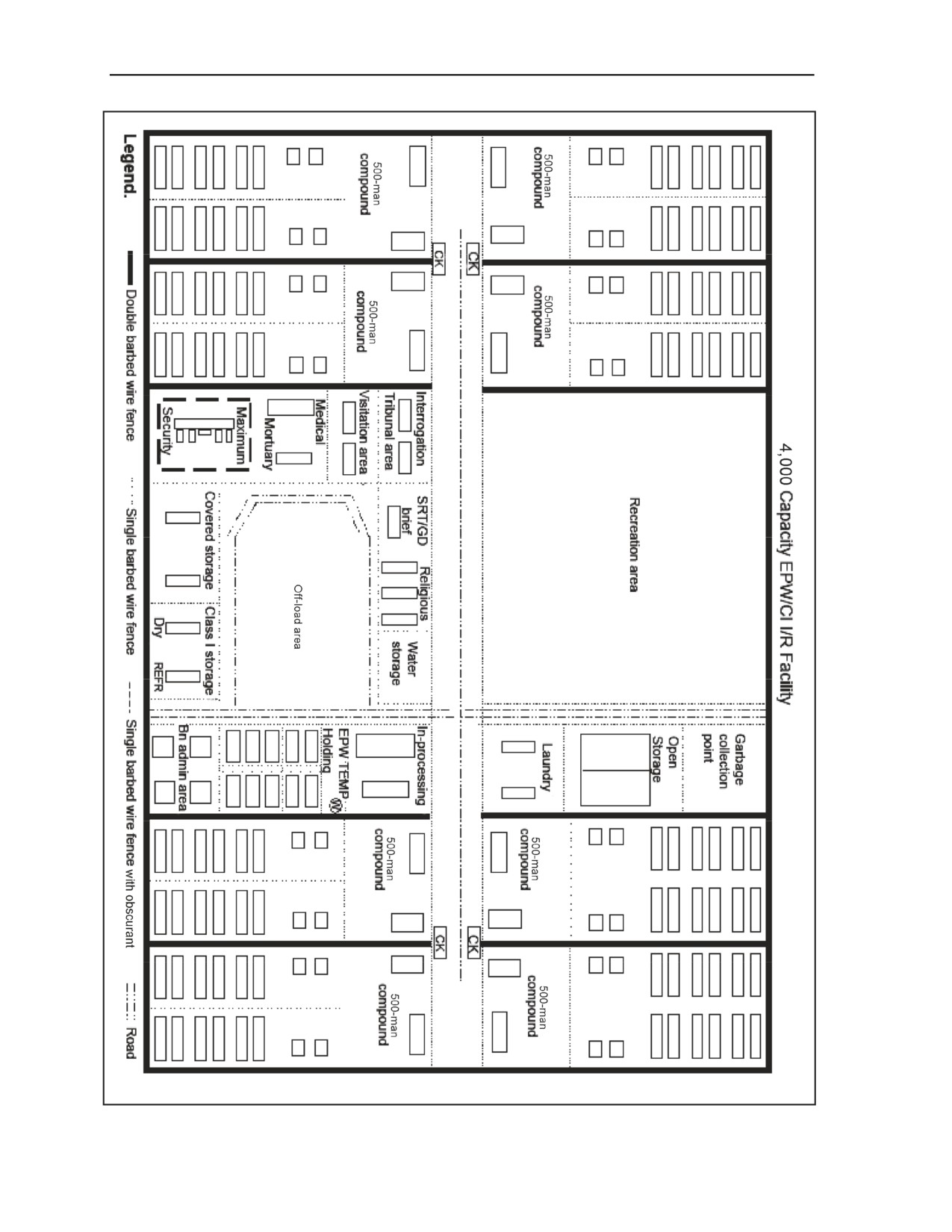
Figure 12-5. Sample theater internment facility
12-14
FM 3-34.400
9 December 2008
Support Area Facilities
NEW CONSTRUCTION
12-33. Construction standards, BOMs, and estimates of man-hours of construction effort are contained in
TCMS and the AFCS for I/R compounds. If facilities must be built, consideration must be given to the
length of time that the facility will operate to assist in determining the standard of construction. Engineer
support to the construction of I/R facilities may include the following:
z
Security fencing and obstacles.
z
Lighting.
z
Towers.
z
Vegetation-clear zone.
z
Patrol roads adjacent to or outside the facility.
z
Barracks, dispensary, mess, baths, and latrines, with related water and power facilities.
z
EBS in conjunction with an EHSA for the site.
ENEMY PRISONER OF WAR LABOR
12-34. EPWs constitute a significant potential supply of both skilled and unskilled labor. How they are
used is governed by those portions of the Geneva Convention relative to the treatment of prisoners of war
(see FM 3-19.40). EPWs may possess engineer-related labor skills. The camp commander can assure the
best employment for each EPW by establishing and maintaining occupational skill records. Approval for
work on a project is obtained through operations channels. The use of EPW labor assumes a nonhostile
attitude on the part of the EPWs. The commander, in deciding to use EPW labor, must weigh how essential
the required work is against the personnel (security and support) and logistics effort required to provide the
EPW labor. Generally, the significant effort required to manage EPW labor means that EPWs are only used
in the absence of qualified local labor or contractors or when the commander determines that military
engineers are not available or must be employed elsewhere. Prisoners of war should be used to the
maximum extent for all work necessary in the administration, management, construction, and maintenance
of EPW camps and facilities. EPWs─
z
May not be retained or employed in an area subject to hostile fire in the combat zone. This
generally precludes the use of EPWs forward of the communications zone (COMMZ).
z
May volunteer, but may not be compelled, to transport or handle stores or to engage in public
works and building operations which have a military character or purpose.
z
May not be employed in labor considered to be injurious to health or dangerous because of the
inherent nature of the work.
z
May not be assigned to perform work considered as humiliating or degrading. This does not
include those tasks required for the administration or maintenance of the EPW camp itself.
9 December 2008
FM 3-34.400
12-15
This page intentionally left blank.
Chapter 13
Real Estate and Real Property Maintenance Activities
Except when war is waged in the desert, noncombatants, also known as civilians or "the
people," constitute the great majority of those affected.
Martin Van Creveld
Land and fixed facilities are needed within the AO to support committed forces.
Included in this support is the acquisition of real estate for use as office space,
billeting and housing, mess, material storage, staging areas, maintenance functions,
training, ports, roads, buffer or safety zones, and so forth. These facilities may be
used to house operations, planning, administrative, logistics, maintenance, and other
functions. Existing facilities are used whenever possible for tempo enhancement. The
engineer construction and other military support effort can then be invested in other
immediate commitments. The Army’s engineer real estate team and USACE CRESTs
provide real estate support to U.S. forces both in CONUS and during contingency
operations by obtaining land and facilities and managing the leases and use
agreements. In the absence of existing facilities, new construction may be advised.
The acquisition of privately owned property overseas, whether improved or
unimproved, will almost always be accomplished through leasing. The use of HN
land and facilities should be via written agreement. Whenever possible, integrate an
EBS and EHSA into the process of obtaining real property and real estate. This is to
ensure that EBS and EHSA meet acceptable levels of all appropriate inquiry into the
previous ownership and that the uses of the property are consistent with good
commercial or customary practice. The goal of this process is to identify
environmental conditions that may present a material risk of harm to public health or
the environment.
OBJECTIVES
13-1. The efficient conduct of real estate activities depends largely on a command-wide understanding of
the objectives of the real estate program in overseas commands. These objectives are to—
z
Acquire and administer real property essential to the mission.
z
Acquire and use existing facilities to keep new construction to a minimum.
z
Acquire environmentally safe real property and facilities that promote FHP, and coordinate for
the performance of an EHSA when applicable.
z
Protect the United States and its allies against unjust and unreasonable claims and charges for
using, renting, or leasing real or personal property. Linking an EBS to the signing of a lease
whenever possible is an excellent method of providing desired financial protection for the
government.
z
Provide reasonable compensation to individuals or private entities for the use of real property,
except enemy-held property or, possibly, when such property is located in a combat zone or in
enemy territory.
9 December 2008
FM 3-34.400
13-1
Chapter 13
DEPARTMENT OF THE ARMY POLICIES
13-2. DA policy concerning real estate acquisitions is described in AR 405-10, TM 5-300, and DOD
Directive 4165.6. Real estate operations in overseas theaters are based on the following general principles:
z
Adhere to international conventions. U.S. forces will adhere to the provisions of the Hague
Convention (1907), the Geneva Convention Relative to the Protection of Civilian Persons in
Time of War (1949), the Hague Convention Relative to the Protection of Cultural Property in
the Event of Armed Conflict (1954), and FM 27-10.
z
Conform to international agreements. The Army real estate program will conform to
international agreements and all other agreements affecting the United States, such as treaties,
memoranda of understandings, land leases, and reciprocal aid, military assistance, SOFA, and
CA agreements.
z
Make appropriate compensation. When required, a fair and reasonable rental will be paid for
real estate used, occupied, or held by the U.S. Army. Payment for the occupation of land will
not be made to any person or persons who are members of the enemy government or who are
hostile to interests of the United States. Compensation will not be made for any real property
located in the combat zone, that is lost, damaged, or destroyed as a result of military action.
z
Honor HN laws. U.S. forces will honor the real estate laws and customs of the host country to
the fullest extent possible consistent with military requirements.
z
Use existing facilities. U.S. forces will use existing facilities as much as possible to reduce the
need for new construction and to conserve resources, time, and personnel.
z
Facilitate AT and other protection requirements. U.S. forces will recognize, understand, and
adhere to theater command AT and other protection requirements for facilities with regard to
security and protection.
z
Minimize acquisition. Real estate acquisition will be held to an absolute minimum, consistent
with military requirements, to minimize disruption of the local economy. Joint utilization should
be encouraged and the duplication of function and services should be avoided.
z
Follow appropriate acquisition policies. The full use of the HN’s governmental agencies will
be made whenever possible, if not restricted by treaties. The acquisition of real estate in an
overseas TO will be by requisition, by lease, or through consignment by the HN to the United
States where the property is in the territory of an ally or by requisition, confiscation, or seizure
when the property is owned by the enemy.
RESPONSIBILITY FOR REAL ESTATE
CHIEF OF ENGINEERS
13-3. The Chief of Engineers is the DA staff officer responsible for real estate functions and, as such,
exercises staff supervision over Army real estate activities of overseas commands. The Chief of Engineers
is responsible for carrying out the following duties:
z
Provide technical advice and assistance in handling real estate acquisition, management of lease
actions, and disposal.
z
Issue instructions.
z
Enforce applicable directives, policies, and regulations.
z
Review records and reports.
COMBATANT COMMANDERS
13-4. CCDRs are responsible for all real estate activities within their AO. This responsibility may be
delegated to a designated deputy or to the Army, Navy, or Air Force Service component commander with
the greatest requirements and the appropriate authority and technical real estate staff expertise. Maintaining
a single inter-Service real estate facility-use policy consolidates activities, reduces duplication, and limits
the impact on the local economy. The theater commander may either establish a central real estate office to
13-2
FM 3-34.400
9 December 2008
Real Estate and Real Property Maintenance Activities
direct and record all real estate activities or direct that the commander assigned real estate responsibility
establish such an office. Associated guidance on environmental considerations will be provided in annex L
of the OPORD or OPLAN.
JOINT FORCE COMMANDERS
13-5. JFCs are responsible for carrying out the following duties:
z
Determine real estate requirements.
z
Plan, execute, and analyze real estate operations according to the pertinent directives, policies,
and regulations.
z
Prepare budget estimates and justifications as directed.
z
Secure funding for lease payments from the appropriate using command.
z
Prepare and submit real estate reports as directed.
z
Conduct utilization inspection according to the instructions and criteria furnished by the Chief of
Engineers.
z
Notify the Chief of Engineers of utilization problems that require action at Headquarters, DA
level.
z
Furnish the Chief of Engineers with copies of all intercommand real estate and space utilization
directives.
ARMY SERVICE COMPONENT COMMANDER
13-6. If the ASCC is assigned responsibility for real estate operations in the AO, all or part of this
responsibility may be redelegated to the COMMZ commander. The acquisition of real property interests
and lease management will be accomplished by qualified and delegated real estate teams or the CREST.
The TA commander may retain control of real estate in the combat zone, redelegating responsibility for
rear areas only.
ARMY SERVICE COMPONENT STAFF ENGINEER
13-7. The ASCC staff engineer operates and manages real estate and property acquisition, maintenance,
and disposal functions. Duties include—
z
Furnishing technical real estate guidance and advice to the commander, staff, and all echelons of
command.
z
Recommending real estate policies and operation procedures to the logistics officers.
z
Preparing, coordinating, distributing, and exercising staff supervision over the execution of
theater real estate directives with approval by the logistics officer.
z
Acquiring, managing leases and use agreements, disposing of land or facilities, paying rents and
damages, handling claims, and preparing records and reports for the real estate used within the
AO.
z
Maintaining an area real estate office in the AOR.
z
Preparing long-range real estate plans and requirements.
z
Using existing facilities as much as possible to reduce the need for new construction.
z
Exercising staff supervision over real estate operations of subordinate commands.
z
Ensuring compliance with international agreements and the law-of-land warfare.
z
Coordinating with the authorities of the friendly HN.
z
Ensuring the integration of appropriate environmental considerations in all real estate policies,
operational policies, and operations.
13-8. The ASCC executes all real estate functions in the AOR when delegated such responsibility by the
CCDR. When the commander of another Service component command is responsible for real estate
activities, the ASCC engineer executes only ASCC real estate functions.
9 December 2008
FM 3-34.400
13-3
Chapter 13
SUBORDINATE COMMAND ENGINEER
13-9. Engineers of commands below the ASCC staff engineer are responsible for furnishing technical real
estate guidance to the commanders, staffs, and subordinate echelons of the commands. They handle other
real estate duties as may be assigned or subdelegated to them by the TA commander.
ARMY ENGINEER REAL ESTATE TEAM
13-10. The engineer real estate team or CREST, with the appropriate delegations from the Army
Secretariat or the Chief of Engineers, is responsible to the area support command or other command as
appropriate. They conduct real estate operations within their assigned areas according to the directives,
instructions, and standing operating procedures (SOPs). Their duties include—
z
Acquiring, managing leases and use agreements, disposing of land or facilities, and paying rents
and damages for real estate used within the AO.
z
Investigating, processing, and settling real estate claims.
z
Conducting utilization inspections.
z
Recording, documenting, and preparing reports on the real estate used, occupied, or held by the
Army (or joint forces as appropriate) within their assigned areas.
z
Coordinating with agencies of the friendly HN to execute joint U.S. and HN real estate
functions.
z
Coordinating with the SJA for legal issues and claim settlements.
z
Including an EBS and EHSA, whenever possible and appropriate, in all real estate actions.
PLANNING
13-11. Real estate operations plans are based on directives or instructions issued to the CCDR by the
Joint Chiefs of Staff (JCS) or by the Service commander appointed as executive agent for the JCS. The
CCDR, based on directives and instructions issued by the JCS, establishes other policies.
13-12. A planning group that includes the combatant command staff and representatives of all Service
commanders must initiate real estate planning in the preparatory phases of a campaign. The agency that
will execute real estate operations when the campaign begins is organized at this time and should
participate in all planning activities. In addition to plans for real estate operations during hostilities,
consideration should be given to real estate requirements for the occupation period after hostilities cease.
This may be most critical for those requirements that will be expected to be met by new construction such
as base camps.
13-13. The site selection process is a joint effort consisting of several members (see FM 4-20.07 for more
on-site selection team and site selection considerations). If available, a USACE CREST member should be
an integral part of the site selection team, helping to ensure site acquisition through a HN use agreement or
lease of private property. The site selection team should also include engineer, medical, or other required
expertise to conduct an EBS and EHSA and integrate appropriate environmental considerations whenever
possible.
13-14. Qualified personnel are essential for the handling of real estate responsibilities. Such activities can
have major consequences in relations between U.S. forces and the HN. Military legal officers, USACE
counsel, and civilian lawyers familiar with the laws of countries within the theater must be included to
assist the planning group with advice and technical review of proposed real estate policies and procedures.
PROPERTY ACQUISITION
13-15. During conventional combat operations in the active combat zone, real estate required by U.S.
forces is acquired by seizure or requisition, without formal documentation. Seizure is resorted to only when
it is justified by urgent military necessity and only with the approval of the commander who has area
responsibility. HN property may be occupied without documentation to the extent that tactical operations
13-4
FM 3-34.400
9 December 2008
Real Estate and Real Property Maintenance Activities
dictate and according to the U.S./HN agreements. After cessation of hostilities, private property will be
leased if the property is still needed for 30 days or longer and if the property owner is known.
13-16. Normally, property is obtained through requisition, which is a demand upon the owner of the
property or the owner’s representative. No rent or other compensation is paid for requisitioned or seized
property in the combat zone. This includes its use or its damage resulting from acts of war or caused by
ordinary military wear and tear.
13-17. Outside the active combat zone, property is acquired only by requisition and lease and all
transactions are documented thoroughly under the applicable provisions of theater directives. Large tracts
of real estate are required for ports, staging areas, training and maneuver areas, leave centers, supply
depots, base camps, and headquarters installations. Some of this property may be highly developed and
have considerable value to the civilian population. The procedures must be followed in order to provide the
required property, while ensuring that the legal rights of its owners are protected. Occupying units are
responsible for providing funds for lease payments.
EXISTING FACILITIES
13-18. Existing facilities should be used whenever they are available. The advantages of using existing
facilities are shown below:
z
Swift occupation by military activities.
z
Existence of utilities, telephone service, and connecting air, ground, and sea LOC facilities.
z
Availability of on-site administrative and industrial equipment.
z
Less diversion of troops from combat missions.
z
Smaller outlay of government funds.
z
Some inherent camouflaging of military activity.
13-19. The advantages of using existing facilities normally outweigh the disadvantages. Some
disadvantages, however, may make facilities undesirable for military use. Planners should consider
alternatives when existing facilities cannot be adapted to the desired survivability standards, when
dispersion is difficult or impossible, when facilities cannot be tailored to meet military needs, or when
environmental considerations and associated FHP issues make the site undesirable or questionable for
occupation.
ACQUISITION
13-20. Local government officials can help identify available facilities or properties that meet or
approximate military requirements. If these officials are unable to provide adequate assistance, military
intelligence sources can be used to locate facilities. CA personnel and Army engineer real estate and/or
CREST may work through local government officials or directly contact property owners to achieve
agreements. Whenever possible, local government officials will normally evict and resettle any civilians
from property requisitioned by the military forces. Only in the most urgent circumstances or upon refusal
or inability of local authorities to act will U.S. military forces evict tenants or occupants.
13-21. A representative of the local government should assist in preparing all property inventories for
local government-owned property. It is particularly important that requisitions carry the correct property
descriptions and that local government officials check all requisitions against the corresponding entries in
their permanent records. An EBS is also desirable to protect the government from future claims. If local
records have been destroyed, the local authorities must establish a correct legal identification for the
requisitioned property. The signature of the local official charged with real estate responsibility must be
obtained on both the initial and release inventories. This official signature is required by international
agreement to ensure that the U.S. government is protected from unjust claims for loss of or damage to
property used by U.S. forces.
9 December 2008
FM 3-34.400
13-5
Chapter 13
MODIFICATION
13-22. Instances may arise when it will be beneficial or perhaps essential to modify existing facilities to
better serve military needs. Correcting deficiencies should be the primary focus of GE work. Theater
planning should identify deficiencies and corrective actions that need to be taken. Theater requirements for
AT and other protection tasks must be considered. AOR real estate principles for property acquisition
apply as discussed above. Some additional compensation to property owners may be required, however.
The ingenuity of Army engineers, HN and civilian contractors, combined with tools such as TCMS/AFCS,
will be required to adapt existing facilities to military use.
FACILITY CONSTRUCTION
13-23. New construction in the AO is limited to facilities that are vital to the accomplishment of the
overall mission, where no existing facilities meet the criteria required by commanders. The combination of
land location and protection requirements may cause the construction of base camps to have a high
likelihood of the need for new construction. See chapter 11 for a discussion of base camps.
REAL PROPERTY MAINTENANCE ACTIVITIES
13-24. RPMA are those actions taken to ensure that real property is acquired, developed, operated,
maintained, and disposed of in a manner responsive to the mission. Acquisition, disposal, major and minor
construction activities for new facilities, and additions or alterations to existing facilities are covered in
chapter
12. This section includes operation, maintenance, and repair of facilities and utilities; fire
prevention and protection; and refuse collection and disposal.
13-25. The RPMA function does not include the maintenance and repair of mobile and portable
equipment or other items not classified as real property. Some of the coordination aspects of RPMA,
however, do include many tasks not normally associated with minor construction and routine maintenance
and repair aspects of RPMA.
RESPONSIBILITIES
13-26. RPMA is administered in the COMMZ by the theater Army area command (TAACOM) through
its subordinate area support groups (ASGs). Support for RPMA is provided on an area basis to all
installations, organic activities, and tenant units. The theater engineer command at the TA level provides
overall supervision and technical assistance. The administration of RPMA forward of the corps rear
boundary is a corps responsibility. Command relationships in the TA are described in FM 100-16.
PLANNING
13-27. The theater engineer command (or senior engineer brigade) and the responsible engineer staff
must consider current and anticipated RPMA requirements for their AO. This will include—
z
Maintaining and repairing the COMMZ.
z
Estimating potential requirements for repairing war damage.
z
Phase planning and target date requirements.
z
Reviewing after-action reviews and lessons learned from recent operations.
z
Considering contract support
(such as logistics civilian augmentation program
[Army]),
preplacement of contract vehicles, and mechanisms for management of such contracts in theater
(such as engineer advisory board or Defense Contract Management Command as in Bosnia).
z
Considering other U.S. agencies
(such as DOS and USAID) that may be in the AOR
concurrently, and considering how the competencies of each might be leveraged. Establishing
working relations across the agencies in peacetime.
z
Determining the limitations (such as political) on using a cost-effective local work force and
local contractors.
z
Ensuring that a management system is in place that identifies facilities to support U.S. facility
needs.
13-6
FM 3-34.400
9 December 2008
Real Estate and Real Property Maintenance Activities
z
Identifying procedures for accountability, security, maintenance, and training of appropriate
local national facilities personnel if they are to be transferred to local authorities after the
ceasing of hostilities.
z
Integrating appropriate environmental considerations and related FHP concerns.
13-28. Any alteration or renovation work that is planned for existing structures should be designed
according to the guidance of the AFCS and should essentially be of a nonpermanent nature. Plans for
major repairs, renovations, or alterations on existing structures must include estimates for labor and
materials. Planners may use estimating sources such as the engineer performance standards or a
commercial estimating guide(means estimating guide).
13-29. There may be instances in the theater where the estimated materials or labor resources are in short
supply or unavailable. Local materials and labor should be used to accomplish RPMA wherever possible.
With the approval of the TA engineer, and with the support of the theater engineer command or the senior
engineer brigade resources, the local engineer may change the design and/or scope of planned work to take
advantage of locally available personnel and resources.
OPERATION OF UTILITIES
13-30. In the TO, the operation and maintenance or upgrade of existing utilities as well as the
construction, operation, and maintenance of new utilities systems may be an engineer responsibility.
Utilities systems include electrical generating and distribution systems, wastewater collection and treatment
systems, and other special utilities systems, such as cooling and refrigeration, compressed air, and heating
systems. Operating these systems requires specially trained personnel. They may be available through the
theater engineer command (or the senior engineer brigade), trained locally, or hired from the local work
force.
13-31. Since utilities systems must be reliable, measures should be taken to ensure their correct operation
and to provide increased security if the situation warrants. Such measures include controlled access,
continuous inspection, and adequate security personnel.
POWER GENERATION AND DISTRIBUTION SYSTEMS
13-32. If existing electrical generating and distribution systems are substandard or inadequate for military
requirements, they will require upgrading or the installation of new systems. FM 3-34.480, FM 5-424, TM
5-683, and TM 5-684 give detailed guidance on installation, maintenance, and repair of electrical
generation and distribution systems. Electrical supply in the AO can be accomplished in phases. Portable
generating sets can supply minimum power requirements until fixed generation and distribution systems
are installed.
Note. For more information on interior wiring see the National Electrical Code
(NEC)®
Handbook. For exterior wiring, see the National Electrical Safety Code (NESC)® Handbook.
WASTEWATER COLLECTION AND TREATMENT SYSTEMS
13-33. Large troop concentrations at fixed facilities generate requirements for sewage and wastewater
collection and treatment. When existing fixed facilities are occupied, they usually include wastewater
systems. However, these may not be operational or suitable for use by military forces. These systems
should be operated, maintained, and repaired by engineer elements or qualified indigenous personnel.
Construction, operation, maintenance, and repair of adequate sewage disposal systems are described in
AR 420-1.
13-34. Field sanitation measures (such as pit latrines and grease sumps), portable chemical toilets, and
waste treatment plants may be used temporarily until fixed facilities are completed and in operation. FHP is
facilitated through good unit SOPs and field discipline in conjunction with the conduct of an EHSA and
medical monitoring procedures.
9 December 2008
FM 3-34.400
13-7
Chapter 13
13-35. As with all AFCS designs in the AO, the standard of construction for wastewater systems will
nearly always be nonpermanent and designed to require minimum maintenance during the limited time
anticipated for the period of occupation. Locally available materials may be used if approved by the ASCC
engineer. Engineers will perform RPMA and operate the system as directed by the ASCC engineer.
Guidance on environmental considerations will be provided in annex L of the OPORD.
OPERATION OF OTHER UTILITIES SYSTEM
13-36. In some areas, other types of central utilities systems may have to be operated by theater forces.
These systems include heating, cooling, or refrigeration. Often, existing facilities will have utility
equipment that must be repaired and/or maintained if it is to be operated. The responsibility for supervising
this work will be directed by the ASCC engineer.
13-37. Local, portable, or unit systems
(such as stoves and portable refrigeration units) will be
maintained, repaired, and operated by the using unit. Engineers usually maintain central utility systems,
such as steam plants, cold storage warehouses, or cooling plants. Where existing facilities are used, the
theater engineer command may ensure the maintenance of these systems.
MAINTENANCE AND REPAIR OF FACILITIES
13-38. The maintenance and repair of facilities are the responsibility of the local commander, supported
by engineer assets. Existing facilities that need maintenance and repair before they can be used are repaired
to minimum standards. Repair materials must be estimated and prestocked to ensure that they will be
available when needed.
13-39. Much short-term maintenance and repair work can be performed by local troops organized into
self-help teams. These teams work with local logistics sources or supporting engineers to obtain the
materials and tools they need. The early identification of spare parts requirements and the establishment of
supply sources are critical. Adequately trained self-help teams can perform the majority of maintenance
and repair work on their facilities, releasing engineer troops to accomplish more critical duties, complex
repair work, and major construction projects.
13-40. When major repairs are required, the engineer unit assigned to the ASG, augmented when
necessary with assets from the theater engineer command, makes repairs according to the priorities given
by the TA engineer. Generally, the priorities are scheduled based on the impact the work has on the
mission.
13-41. After immediate and ongoing maintenance and repair requirements are determined, a repair and
maintenance program will be established using self-help and supporting engineer assets and/or local
personnel or contracted support to accomplish the work. If the program is extensive or long-term, the unit
commander should coordinate with the ASCC engineer to initiate a continuing facility engineer operation
at the facility or installation. The facility engineer will then coordinate all requirements and resources
needed to accomplish the mission. Further guidance on facilities maintenance and repair may be found in
AR 420-1 and TM 5-610.
FIRE PREVENTION AND PROTECTION
13-42. Construction standards and materials in the AO make facilities very susceptible to fire damage and
catastrophic loss of life or materials. TM
5-315 gives specific guidance for firefighting and rescue
procedures in the TO. This TM prescribes the assignment of firefighting assets based on the supported
population or facility area. For example, airfields, troop populations of 5,000 to 10,000 persons, or storage
areas containing more than 100,000 square feet of storage space are each allocated at least one fire pumper
truck team.
13-43. In all cases, and especially at smaller installations and facilities that do not have assigned fire
protection equipment, the commander has responsibility for fire prevention and protection. All Army,
command, and local fire regulations must be enforced. Programs of inspection must be established and
self-help firefighting responsibilities assigned. Fire protection measures available to the commander
13-8
FM 3-34.400
9 December 2008
Real Estate and Real Property Maintenance Activities
include strictly enforcing the rules, setting up alarm and notification procedures, procuring and making
available extinguishers and other firefighting equipment, and training personnel in fire prevention and
protection measures. AR 420-1 provides further information about fire prevention and protection.
13-44. An additional requirement for the assets that provides fire protection is the requirement that they
respond to HAZMAT spills. This support is an important part of environmental considerations that may
have a direct effect on FHP.
REFUSE COLLECTION AND DISPOSAL
13-45. Improperly handled refuse can be a safety and health hazard. The local commander is usually
made responsible for refuse collection and disposal. The command’s engineers accomplish the task.
Guidance on refuse collection and disposal may be found in AR 420-1 and NAVFAC MO-213/AFR
91-8/TM 5-634.
13-46. Landfill, burning, and removal are normal means for refuse disposal in an AO. Because of
potential surface and groundwater contamination, the EH associated with uncontrolled methane gas
production, increased vermin activity, and the obvious problems with refuse odors, it is imperative that
landfills be properly designed and managed. Options available to lessen the quantity and/or eliminate
specific types of refuse in sanitary landfills include incineration, recycling, composting, or a combination
(see
UFC
3-240-10A for more information pertaining to landfills).
13-47. Compaction and selective disposal are two other methods for reducing the volume of refuse.
Selective disposal is the separation of certain types of refuse, such as wood or metal, from the refuse to be
buried. The separated material is then stored or reused. Compaction is accomplished with specialized
equipment for collecting and compacting refuse before it is dumped into the landfill. At the landfill site,
special mobile compaction equipment may be used to reduce the volume of refuse before it is covered.
Other compaction and refuse handling techniques include compacting and baling refuse for burial or
removal from the area.
13-48. Refuse collection and disposal techniques depend on the volume of refuse to be generated, the
duration of facility occupation, the presence of existing collection facilities, the resources available to
perform the work, the area where the facility will be located, the situation, and the environmental aspects
of the area. In some cases, selected recycling may even be enacted.
13-49. Special consideration should be given to hazardous waste, especially waste products generated by
medical facilities and maintenance operations. Dispose of hazardous waste according to the appropriate
regulations, laws, treaties, and agreements. Specific guidance should be contained in annex L of the
OPORD. Improper disposal of such products may cause serious illness or death to those who operate
landfills or cause irreversible damage to the environment. Specialized medical expertise exists to support
the engineer and the commander when dealing with hazardous waste.
MILITARY REAL ESTATE OR REAL PROPERTY TRANSFER
13-50. The transfer of real estate or real property between units is an extensive process that can vary
between commands and theaters. It requires planning and coordination between the current occupant and
the incoming unit. If the transfer involves coalition or HN forces, there are special requirements to ensure
that the United States is relieved of liability and that monetary reimbursements are made for any
improvements (for more information, see the Base Camp Facilities Handbook).
13-51. During initial occupation, the inbound unit should focus on documenting facility conditions,
inventorying the property, and reviewing all existing records. It is imperative that units properly manage
and maintain records and reports as it will ease the transfer of future real estate or real property transactions
with other units. Property agreements, the location, the description, the condition, surveys, the value, and
maps are examples of items that should be requested from the outbound unit, kept on file, and updated as
changes occur.
9 December 2008
FM 3-34.400
13-9
Chapter 13
13-52. To complete a transfer, units must ensure that they have complied with all applicable laws and
regulations before finalizing the transaction. Once the transfer is approved for acceptance or return,
commands will─
z
Coordinate with authorized representatives of units receiving the property, usually the real
property accounting officer or designated representative (when feasible or required).
z
Conduct a joint inspection of the property or facility, and prepare and sign a verification of joint
inspection and record of return.
z
Prepare and sign an outgoing inventory report.
z
Prepare and sign a condition report.
z
Prepare and sign an environmental summary report.
z
Complete DD Form 1354 (Transfer and Acceptance of Military Real Property), ensuring that
real property accountable officers or designated representatives of both organizations receive
copies.
13-10
FM 3-34.400
9 December 2008
Chapter 14
Power Generation and Distribution
One should know one's enemies, their alliances, their resources and the nature of their
country, in order to plan a campaign.
Frederick the Great
Electrical power is of critical importance as the military and the rest of society
increasingly rely on electricity to conduct daily business and for basic life support. As
the Army moves toward advanced digitization and automation to improve battle
command, access to safe, reliable power has become an operational requirement.
Likewise, utility-grade power is a component of the infrastructure that enables the
execution and sustainment of military operations. In some cases, the level of
electrical service available may serve as one of the primary measures of success for
an operation. Consideration of electrical power requirements must occur from the
lowest tactical level to the strategic level, across the spectrum of military operations
and throughout the entire AO. Proper prior planning may prevent military and
political issues from arising during the course of the operation. Since power is a
component of GE, this consideration must include synchronizing work on the power
system with the overall GE effort and associated environmental considerations during
an operation.
RESPONSIBILITIES AND CAPABILITIES
14-1. Electrical power systems range from simple, unit-owned and
-maintained tactical generators
(TACGENS) to highly sophisticated multinational utility grids. Responsibility for each system varies
widely, from large international corporations operating regional power grids, to individual units operating
TACGENS for their command posts, to individual HN families operating small, portable generators inside
homes. Each instance varies in complexity, efficiency, and reliability, but ultimately provides the user with
a source of electrical power. As a theater matures, power requirements grow significantly, necessitating
detailed updating of the plan by engineers to ensure that the power demand does not outstrip supply over
time.
14-2. At the lowest unit level, organic TACGENS supply electrical power. Operation and maintenance of
these simple power systems is a unit responsibility and does not require engineer support.
14-3. As the battlefield framework solidifies and the AO matures, the consolidation of clusters of small
unit power systems is desirable. All but the most short-term, expeditionary facilities can benefit from
centralization of the power system. The advantages of consolidated, centralized power generation and
distribution systems are shown below:
z
Reduced wear and tear on TACGENS, which are not designed for long-term, continuous
operation.
z
Streamlined maintenance and fueling demands.
z
Increased cost efficiency per kilowatt-hour of power produced.
z
Consolidated noise signature and security of power generation assets.
z
More precise power with a higher degree of voltage and frequency control.
z
Superior reliability of the power system.
9 December 2008
FM 3-34.400
14-1
Chapter 14
14-4. Consolidation of power systems on a base camp, FOB, or other installation requires engineers to
conduct detailed technical planning to best match projected requirements with available assets. Engineers
conduct power planning in concert with overall facility master planning. For planning beyond the
capability of organic engineers, specialized assistance may be obtained from engineer prime power assets
(the 249th Engineer Battalion [Prime Power]) or by reachback to the USACE using tele-engineering or
other means.
14-5. One, or a combination of the following, may achieve consolidation of power systems:
z
Transition to commercial utility power.
z
Centralized, contracted power plant with an interconnected electrical distribution system.
z
Large deployable power generation and distribution systems (DPGDS) (up to 3.4 megawatts).
z
Centralized military power plant (Army prime power or Air Force civil engineers).
Even after consolidation, transition to a more centralized power system never eliminates the need for the
military user to provide redundancy by implementing a backup power plan using organic TACGENS.
14-6. At the operational level, electrical power is usually part of the national or regional infrastructure in
the form of a commercial power grid. These power grids may be owned and operated by a government
entity, a public or private corporation or a series of interdependent corporations. The sophistication of these
power systems varies with the level of development of the location. In the most underdeveloped nations,
the power systems may be small, crude, and well within the capabilities of engineer prime power units to
operate, repair, and maintain. In more highly developed countries, systems may be highly complex with
ultra-high voltage transmission, state-of-the-art dispatch and controls, and advanced generation methods. In
these situations, engineer prime power units would be challenged to provide more than basic technical
expertise because these conditions are outside their areas of core competence. Instead, rehabilitation of
these systems will likely require the expertise of USACE electrical engineers, specialized contractors, large
budgets, and long project timelines.
PLANNING
14-7. Electrical-power requirements and capabilities must be carefully integrated into the overall GE
concept to support the objectives of the theater energy support plan. As with all niche engineer capabilities,
the unit owning the capability is the SME and is best prepared to provide assistance in integrating and
synchronizing their efforts with those of other engineer units. Requests for LNOs from prime power units
and for staff assistance early in the planning process are crucial to achieving the desired effect with regard
to power. When using existing power facilities, planning for the environmental risks associated with
maintaining or upgrading a site needs to be considered. Recent experiences in Iraq have reminded planners
and commanders of the effect of asbestos and other environmental problems on operations.
14-8. Planners should consider the full range of prime power capabilities when analyzing mission
requirements and allocating units against those missions. Prime power units deploy, install, operate,
maintain, and troubleshoot large power plants and distribution grids. However, their ability to provide
technical expertise and battle damage repair of existing infrastructure produces more immediate and
profound results than the time- and manpower-intensive process of constructing a new power system.
14-9. During complex missions (such as base camp construction), particular attention must be given to
synchronizing prime power with the efforts applied to vertical and horizontal construction. Early
involvement of the prime power unit in the master-planning process is crucial. It is important to have prime
power personnel involved in regular construction meetings to maintain logical sequencing of the overall
project, to minimize wasted effort, and to ensure that all parties involved in the development of the facility
power system are working in a mutually supportive manner that supports the defined priorities for the
project.
14-10. Engineer planners should set the conditions for mission success with the supported unit
commander by managing expectations from the beginning of the planning process. Construction of a new
power system is a laborious process with few interior tangible results until the system is complete and
power is delivered. The same is true with repair or rehabilitation of an existing, battle-damaged system.
14-2
FM 3-34.400
9 December 2008
Power Generation and Distribution
14-11. Planners should consider the development of the TO infrastructure in the terms of utilities, a
skilled labor workforce, and sustainable power sources. Theaters with less developed infrastructures will
require more prime power support than well-developed infrastructures. At wartime, however, developed
infrastructures can be crippled in a short period of time. The extent of damage will influence the impact on
the restoration of commercial power and may take months or years. Loss of commercial-power production
will be detrimental to military operations and civilian activities. It will greatly increase the demand for
electrical power produced by TACGENS, non-MTOE generators, and prime power plants.
14-12. Planners should consider distribution voltage and frequency. This is critical if plans call for using
commercial power. In most cases where U.S. forces will maintain a long-term operational presence in a
theater, the transition of military facilities to commercial power is a likely and desirable end state for
power. Planners should strongly consider basing the theater electrical standard on HN voltages and
frequencies. When voltage and frequency are not compatible with the intended use, power must be
obtained from an alternate compatible source or, when possible, converted for compatibility. Planners must
avoid dual-frequency circuits inside buildings. The close proximity of 50- and 60-hertz circuits can create a
10-hertz harmonic that can interfere with communications equipment and other frequency-sensitive
electronic equipment.
ELECTRICAL POWER SYSTEMS
POWER GENERATION
14-13. Power is produced by generators that may be driven by diesel engines, gas turbines, boilers, or
alternative sources. Generators are machines and, as such, are subject to mechanical or electrical failure.
They require periodic maintenance and service to avoid breakdown. To obtain a source of continuous or
prime power, multiple generators are installed in parallel. This arrangement allows the performance of
maintenance on one or more generators while the others produce power. In developed countries, many
large commercial power plants may be linked together to form an interconnected, redundant national or
regional power grid. This power grid is the means of sending available power from the source to the user
and is known as transmission or distribution.
PRIMARY POWER DISTRIBUTION AND TRANSFORMATION
14-14. Primary distribution networks carry medium-voltage power from the power plant to the
transformers or substations. Primary distribution systems may be constructed with an extra-heavy-duty,
multiconductor, shielded power cable that is suitable for ground-laid or buried applications, or they may
be constructed overhead using poles and bare cable as part of an aerial distribution system. Transmission
and primary distribution are in the medium, high, or ultra-high voltage ranges to efficiently and effectively
send the power from the source to the user over long distances.
14-15. Army MOS 21P and 21Q prime power units are trained and qualified to work on distribution
systems up to 33 kilovolts. Voltages beyond 33 kilovolts require specialized commercial personnel and
protective equipment.
TRANSFORMATION
14-16. The medium-voltage power that is distributed on the primary system is stepped down to user level
voltage by transformers. Most transformers are more than 95 percent efficient. As a result, very little
energy is lost in the transformation process. The power put into a transformer approximately equals the
power coming out. In the case of step-down distribution transformers, the high-voltage, low-current power
going into a transformer approximately equals the low-voltage, high-current power coming out. When a
transformer reduces voltage, it increases the current proportionally.
14-17. Primary distribution voltage
(medium voltage) is stepped down to user level voltage by
distribution transformers or substations. A primary distribution system may incorporate either or both of
these items. Using distribution transformers allows power to be distributed at a higher voltage on smaller
9 December 2008
FM 3-34.400
14-3
Chapter 14
conductors and helps to reduce voltage drop and line loss. For military purposes, MOS 21P Soldiers are
qualified to test and install transformers and test, install, and repair substations.
SECONDARY DISTRIBUTION
14-18. Once the voltage is stepped down to the user level voltage at the transformer, the secondary
distribution network carries the power from the transformer to the user. Secondary distribution systems are
constructed with multiconductor cable when possible.
14-19. In military applications, engineer prime power units (MOS 21P Soldiers) are responsible for the
secondary distribution of a power system from the transformer to the main distribution load center (if one
is used) or to the input of the main distribution panel box. Interior electricians (MOS 21R) in vertical
construction platoons and utilities detachments construct the secondary distribution from the load center or
main panel box to the user.
POWER SYSTEM CHARACTERISTICS
14-20. The consideration of power system characteristics is important in determining the use of power for
specific applications. Some power system characteristics can be altered to suit the needs of the user.
OUTPUT VOLTAGE
14-21. Output voltage is the measure of the voltage at the output terminals of the power system. Large
output voltage alterations can be made by using distribution transformers. Small output voltage changes
can be made by adjusting the controls on TACGENS and prime power generators. Devices, such as voltage
regulators, can be used to make small voltage adjustments to commercial power.
SINGLE- OR THREE-PHASE POWER
14-22. Most alternating current (AC) power is generated as three-phase power. Single-phase power can
easily be obtained from a three-phase source. Three-phase power is provided at three separate output
terminals that share a common neutral terminal. The voltage difference between phases is the result of each
being +120° out of phase with the other two. For example, on a user voltage level three-phase, four-wire
system (fourth wire being neutral) with a measured voltage from any phase conductor to neutral of 120
volts AC, 208 volts AC is available by connection to any two-phase conductors. This allows for the
connection of loads requiring 208 volts AC user voltage.
14-23. Three-phase power systems should be designed so that each phase carries about the same amount
of load as the other two. This concept is called “load balancing.” Badly unbalanced loads will result in
frequent tripping of protective devices and may damage equipment.
OUTPUT CAPACITY
14-24. Output capacity is the amount of power a system can deliver. It is usually measured either in
apparent power, kilo volt-amperes, or real power in kilowatts with an associated power factor. Output
capacity is limited not only by the size of the generation equipment but also by the rated capacity of the
distribution system. Electrical conductors and devices (such as transformers, breakers, and switches) are
designed and manufactured with specific limitations on current and voltage. When the power demands of
the user exceed the output capacity, the system is said to be overloaded and one of two things may occur.
Either protective devices (such as fuses, breakers, or relays) are blown or tripped or else the system is
damaged. The damage can occur in the form of melted conductors, burned connections, or blown
transformers. Output capacity may be increased by upgrading distribution systems and by employing
additional or larger generators.
14-4
FM 3-34.400
9 December 2008
Power Generation and Distribution
RELIABILITY
14-25. Reliability is the measure of the ability of a power system to fulfill all the demands of the user
without failure for long periods of time. Systems that are susceptible to outages, either scheduled or
unscheduled, or that cannot provide all the power users need are not very reliable. Reliability can be
improved by employing standby and load-sharing generators. It can also be improved by using redundant
distribution systems
(loop circuits) and enhanced by maintaining existing distribution systems and
generation equipment.
PORTABILITY
14-26. Portability is the ability to rapidly relocate a power system that may be critical to certain
operations. TACGENS are the most portable systems available. Since commercial power is tied to fixed
facilities, it is the least portable. Prime power systems are portable, but require more effort and time to
move and install than TACGENS. Prime power plant installation may be feasible if the plant remains in
operation (stationary) for 30 days or longer.
14-27. AC power frequency is given in cycles per second or hertz. The most common worldwide systems
are 50 and 60 hertz. The accepted U.S. standard is 60 hertz. Most countries establish one or the other as a
national standard. They build their commercial-power systems accordingly. In a few countries, both
systems may be encountered.
14-28. Some equipment is sensitive to AC frequency and will not operate properly when powered by a
source with a different frequency. Units should ensure frequency compatibility for this equipment to avoid
damaging it. Most transformers designed for 50-hertz operation can be used for 60-hertz application. Most
60-hertz transformers cannot be used for 50-hertz application unless they are significantly derated.
14-29. Prime power generation equipment can operate at 50 or 60 hertz. Most TACGENS operate at 60
hertz. Some specialized TACGENS operate at 400 hertz. The frequency power that is used extensively for
aircraft systems, missile and avionics systems, signal systems, and some shipboard systems is 400 hertz.
Frequency alterations are possible with the use of frequency converters.
LINE LOSS AND VOLTAGE DROP
14-30. Electrical conductors have some resistance. The amount of resistance depends on the type of
metal, the cross-sectional area and length, and the temperature of the conductor. Copper is less resistive
than aluminum. Conductors with larger cross sections and shorter lengths are less resistive than those with
smaller cross sections and longer lengths. Conductors are less resistive at lower temperatures than at higher
temperatures.
14-31. When electrical-current flows through a resistive material, some of the energy is converted to heat,
causing a drop in voltage. The energy converted to heat is called line loss, and the drop in voltage is called
“voltage drop.” Distribution systems must be designed to safely carry the required amount of current while
maintaining output voltage within the operating parameters of the devices being powered.
PRIME POWER OPERATIONS
14-32. Prime power operations are a subset of the GE function of the Engineer Regiment (see FM
3-34.480). Engineer prime power units provide an essential continuity between power from TACGENS
and commercial sources (figure 14-1, page 14-6). Prime power units provide technical assistance and staff
planning to support the development of electrical-power solutions for military operations. Prime power
units also possess a limited organic capability to provide interim contingency power to satisfy the critical
electrical requirements above the capability of TACGENS and below the availability of commercial power
or to augment the power available from either source. The portion of the continuum that is exclusively
prime power represents power generation and distribution accomplished by prime power units with their
organic equipment. The intersections of TACGENS and commercial power with prime power represent
areas of shared responsibility.
9 December 2008
FM 3-34.400
14-5

Chapter 14
Figure 14-1. The power continuum
ORGANIZATION
14-33. The prime power platoon is the basic building block for conducting prime power operations.
Prime power platoons are small, highly deployable, modular units that provide electrical-power support
across the spectrum of military operations. The platoon is capable of deploying independently of its higher
headquarters, but does require administrative and logistical support upon arrival in a TO.
14-34. If two or more platoons deploy for a mission, a prime power engineer company headquarters
deploys to provide C2, sustainment, and specialized technical support to the mission. In peacetime, each
prime power company consists of a company headquarters and four prime power platoons, augmented with
one prime power platoon and one power line platoon from the Reserve Component.
14-35. These prime power companies are organized along with a headquarters and headquarters company
under an engineer battalion (prime power). The battalion higher headquarters is USACE, which is an Army
command. A cell from the battalion headquarters is deployed if more than one subordinate company is
required to support a particular theater or contingency. This cell usually includes logistics, liaison, or
coordination capability. It provides C2 of the companies; liaison and coordination; and specialized
maintenance, administrative, and limited logistical support.
CAPABILITIES
14-36. Engineer prime power units support GE efforts theater-wide by providing advice and technical
assistance on all aspects of electrical power. They provide limited, interim contingency power generation
to critical facilities. This spans the spectrum of military operations, to include combat, stability operations,
and homeland security. Prime power efforts and capabilities must be closely integrated and synchronized
with the GEs effort to achieve the effects intended in a theater civil engineer support plan.
14-37. The prime power unit performs many technical, power-related tasks. A two-Soldier team will—
z
Provide power-related planning and staff assistance.
z
Conduct an electrical-load survey.
z
Analyze and design power distribution systems.
z
Perform damage assessment of distribution systems.
z
Provide power-related technical assistance to the representative of the contracting officer.
14-38. Engineer prime power units can produce large quantities of reliable power with their organic
generators. They can also install, operate, and maintain non-MTOE power generation equipment and some
fixed commercial-power plants. This power generation capability can be used in a variety of military base
camp configurations as well as seaports, airfields, C2 nodes, and other critical facilities. The power
generation capability of the unit also allows it to operate, maintain, and perform damage assessments of
fixed commercial diesel engine power plants. It uses organic or war reserve equipment to provide power to
locations where another source is not available or is inadequate.
14-39. Each prime power platoon is equipped with four 1,050 kilovolt-ampere power units, giving the
platoon 2.52 megawatts of continuous power production capability and 3.36 megawatts of peak power
production.
14-6
FM 3-34.400
9 December 2008
Power Generation and Distribution
ORGANIZATION EMPLOYMENT CONSIDERATIONS FOR PRIME POWER ORGANIZATIONS
14-40. The following guidelines will enhance the employment of prime power assets and will result in
more reliable electrical service:
z
Determine how much power is needed and the power source.
z
Plan to upgrade service after initial installation.
z
Determine the required level of service and reliability.
z
Specify the date and duration of the requirement.
z
Coordinate funding requirements.
14-41. The prime power unit will conduct a preliminary reconnaissance before committing assets. The
prime power platoon can identify the power needs and recommend the best way to fulfill them. The
platoon will conduct a load survey to determine how much power is required and where it is required and
then design systems to provide power based on the survey. The prime power unit will recommend the best
power source based on the level of reliability required and available assets. Many times, the power
requirements are so complex that the supported unit is unable to communicate its power needs. A thorough
reconnaissance will clarify their needs.
14-42. Commercial power is used when it is available. Commercial power is usually reliable in developed
countries. Prime power platoons can make connections to commercial distribution networks or coordinate
with the utility company to have them make the connection. Once connected, the system can provide
continuous power service virtually maintenance-free. A major advantage of using commercial power over
installing a plant is that the prime power platoon remains available to perform other electrical work. When
a plant is installed, the platoon or part of the platoon is fully committed to operating and maintaining the
plant instead of performing other power-related missions. This takes greater advantage of the technical
training of the platoon.
14-43. The power source should be matched to the load requirements. Resources that are ill-suited for a
particular application should not be committed. A common violation of this guideline occurs when a large
prime power plant is installed to provide power to a relatively light load. This is an inefficient use of power
generation assets that could be better used elsewhere. Operating large prime power generators under light
loads also increases the wear and tear on generator engines. Prolonged misuse will cause carbon fouling
and buildup, reduced engine performance, and eventual engine failure. Prime power equipment should be
considered when the assessed load exceeds 437.5 kilovolt-amperes. However, prime power assets can be
used for smaller loads in circumstances when reliable, continuous power is critical to mission
accomplishment.
14-44. Load increases should be considered during planning and made to provide adequate power. If
future plans indicate that growth will increase power demands, build distribution systems to handle the
growth. This can be done either by overbuilding the system initially or by building it so that it can be
readily expanded as needed. Systems that are not anticipating growth should still be designed and built to
accommodate 150 percent of the estimated demand.
14-45. Plant deployment, installation, and distribution system construction is a time-consuming
procedure. This process precludes the rapid relocation and setup of power plants and their associated
distribution networks. Generally, it takes a full prime power platoon up to 5 days to construct one organic
power plant and have it operational, depending on the amount of site preparation required. The 5-day rule
of thumb does not include construction of a distribution system to provide power from the plant to the user.
14-46. Distribution system installation can take days, weeks, or months depending primarily on the size
of the system to be constructed. Distribution system construction and installation is influenced by the
following variables:
z
The type of system required (underground or aerial).
z
The availability of the BOM.
z
The availability of other engineer assets for trenching or mine clearing.
z
The threat of the enemy and local security situation.
9 December 2008
FM 3-34.400
14-7
Chapter 14
z
The availability of interior electricians (MOS 21R) to construct the secondary (interior and
low-voltage) portion of the distribution system.
z
The environmental considerations that may constrain construction or renovation of existing
systems.
14-47. Generally, it is feasible to install a prime power plant for units or activities that plan to use it for 30
days or more. Units relocating often should use TACGENS or relocate to facilities powered by a
commercial grid or an existing prime power plant. Expanding an existing prime power plant and its
distribution network is usually more practical than relocating it.
14-48. Deployed units will rely on their TACGENS for initial power needs. Units and activities that are
in place for extended periods will need to upgrade their facilities. Power produced by low-voltage
TACGENS should be replaced by prime power or commercial power when units anticipate remaining in
place for more than 30 days and load demand justifies the replacement. This replacement increases
reliability and saves wear and tear on TACGENS. Stand-alone prime power plants should be replaced with
commercial power as it becomes available. Prime power plants may be used for up to 6 months as a
temporary power solution. At this time, supported units should plan to switch to commercial power,
purchased commercial generators, or contract power assets (such as the logistics civil augmentation
program, local contractors, and USACE contracts). When considering purchased commercial generators,
the maintenance and refueling requirements must be addressed. Because of the unique capabilities and
limited equipment of prime power units, organic prime power equipment should be used as a temporary
power solution until a more permanent power capability is attained when supporting missions of a long
duration. As a strategic asset, prime power equipment and personnel must establish power quickly and then
support the next high-priority mission as the situation continues to develop. The desired end result is
usually to use power from the highest level of the power continuum.
14-49. The priorities of employment of prime power support are the same as those for other engineer
support in the TO. FM 5-116 and FM 100-16 list engineer support priorities in the TO.
14-50. Planners should consider the use of prime power war reserve assets when it is impractical to
employ organic prime power equipment assets or when the mission is known to be long-term. Prime power
Soldiers will install these assets and train the supported organic personnel (normally MOS 52D, power
generation equipment repairer) to assist in the operation and maintenance of the plants. This provides the
supported unit sustained reliable power, while reducing the long-term manpower requirements on the
prime power battalion. War reserve assets may be used for backup power as well.
MULTISERVICE CAPABILITIES
14-51. The Navy has the construction battalion maintenance unit (CBMU) that provides follow-on public
works operations to maintain and repair existing advanced base shore facilities or facilities constructed by
NMCB during contingency operations. The unit is capable of equipping, manning, and maintaining steam
and electrical power generation and distribution systems for advanced base facilities of up to 5,000
personnel. For more information on CBMU and NMCB capabilities, see Naval Warfare Publication
(NWP) 4-04.1/MCWP 4-11.5.
14-52. The Navy also has mobile utility support equipment (MUSE), which provides power plants,
substations, steam plants, and technical expertise to support DOD utility shortfalls worldwide. MUSE
technicians, like their Army 21P counterparts, attend the prime power production specialist course and an
additional MUSE familiarization course. Technicians are deployable within a 24-hour notice to provide
technical assistance for organic and inorganic utilities. Technicians are capable and equipped to install,
repair, maintain, and operate power generation, electrical distribution, transformation, and steam-
generating equipment and infrastructure. MUSE teams are compact and multidimensional with utility skills
that are applicable in nearly any utility situation. For more information on MUSE, see Naval Facility
Command Instruction
(NAVFACINST)
11310.2E and Chief of Naval Operations Instruction
(OPNAVINST) 11300.5B.
14-53. The Air Force has both Prime BEEF and RED HORSE units that are deployed in UTC sets. Prime
BEEF are mobile assets deployed to air bases, where they can combine to form a MOB combat engineer
14-8
FM 3-34.400
9 December 2008
Power Generation and Distribution
force of 200 to 320 people, depending on the threat and number and type of aircraft. RED HORSE units
provide heavy repair capability and construction support when requirements exceed normal base civil
engineer capabilities and where Army engineer support is not readily available. They are stand-alone
squadrons that are highly mobile, largely self-sufficient, and rapidly deployable. Both of these units are
capable of providing electrical-system installation.
14-54. Marine engineers are organized to accomplish specific tasks of limited duration focusing on
support to Marine air-ground task forces (MAGTFs). They are capable of providing mobile electric power
through their engineer support battalion (ESB), primarily to the MAGTF.
9 December 2008
FM 3-34.400
14-9
This page intentionally left blank.
Chapter 15
Petroleum Pipeline and Storage Facilities
…before the shooting begins. The bravest men can do nothing without guns, the guns
nothing without ammunition; and neither guns nor ammunition are of much use in
mobile warfare unless there are vehicles with sufficient petrol to haul them around.
Field Marshal Erwin Rommel, World War II
The noncontiguous battlefield of today is even more dependent on petroleum
products. In the European Theater during World War II, about half the total logistical
tonnage was petroleum fuel. During the Korean and Vietnam wars, this figure rose to
about 60 percent. The battlefield of the future anticipates even greater consumption
of these products. In the conceptual plan for supplying needed fuels, bulk petroleum
is delivered through ports or LOTS. There, it is off-loaded into storage facilities and
shipped forward. The modes of shipment in descending order of priority are pipeline,
inland waterways, rail, motor carriers, and aircraft. The preferred method of shipment
is by pipeline because pipelines save time, money, and resources for other logistical
operations. Each of these methods has its own security considerations and risks that
must be addressed in the planning process. The engineer mission is to provide general
and specialized assistance in constructing and maintaining pipeline systems. The
environmental considerations surrounding petroleum and petroleum products are
huge; and even in the midst of operations, spills can have an effect that impacts
operational commanders due to the volume of petroleum involved in spills, being set
afire, or subjected to some other negative situation. FHP, environmental protection,
and other related risks must be addressed in the planning for and operational
activities surrounding bulk petroleum.
RESPONSIBILITIES
15-1. The joint petroleum office (JPO) under the logistics directorate of a joint staff (J-4) coordinates the
petroleum needs of all services within the CCDR’s AOR. The petroleum group commander for the ASCC
is responsible for all aspects of petroleum distribution planning and related supply operations. The group
performs liaison with the theater support command materiel management center and HN staffs for
coordinating multinational petroleum distribution support. It distributes fuels based on priorities
established by the ASCC and by directives received from the theater support command materiel
management center.
15-2. The petroleum pipeline and terminal operating battalions distribute bulk petroleum in the AO. These
battalions are responsible for the operation and organizational maintenance of petroleum pipelines and
storage facilities. They are responsible for installing collapsible tanks and associated equipment for the
tactical petroleum terminal (TPT). They also install collapsible hose lines used to temporarily extend
pipelines.
15-3. The theater engineer command is typically the senior engineer headquarters that supports the
petroleum distribution effort. See figure
15-1, page
15-2. The theater engineer command provides
maintenance (excluding organizational maintenance) and repair of existing pipelines. It also designs,
constructs, and expands the tactical pipeline system (including marine terminals and storage facilities).
9 December 2008
FM 3-34.400
15-1
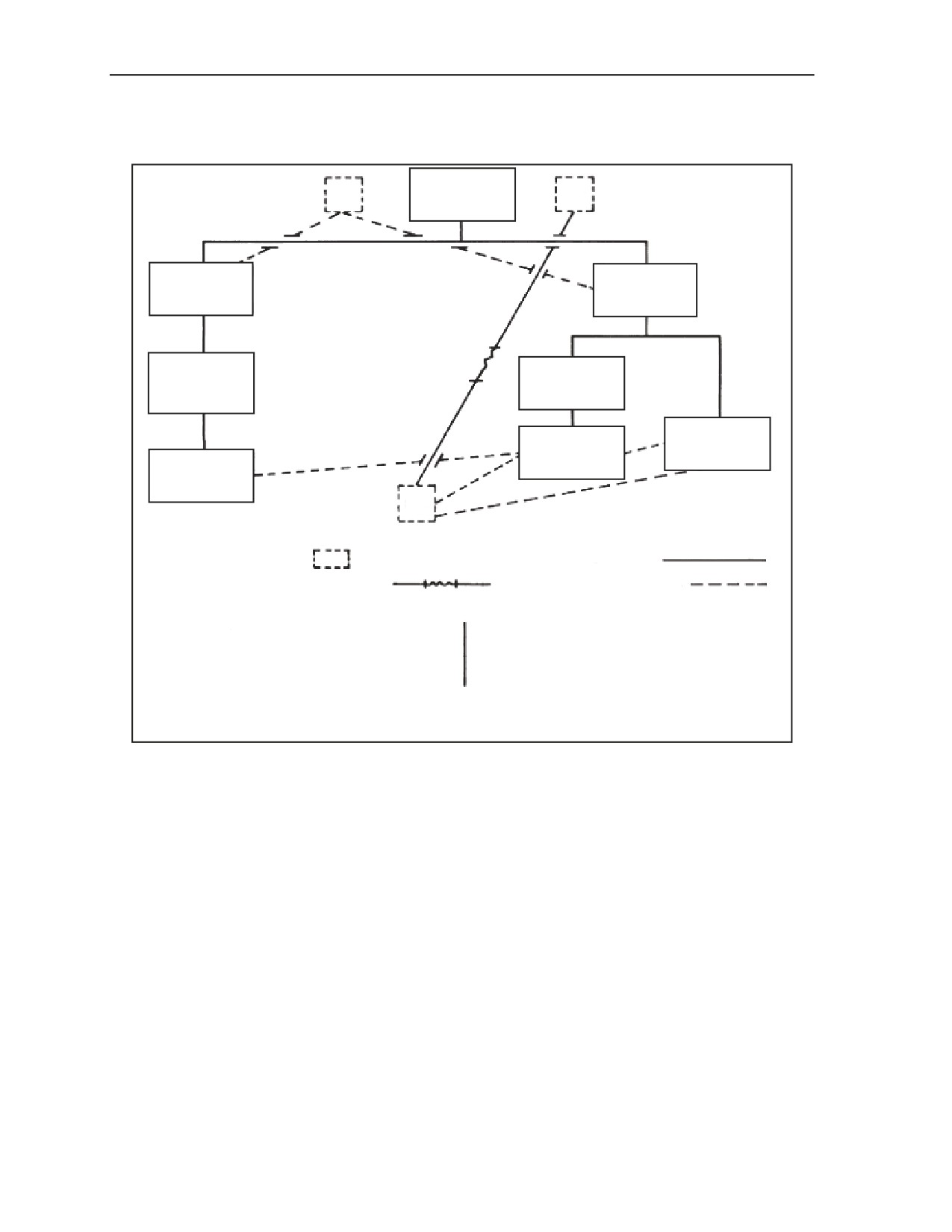
Chapter 15
These tasks are typically done by U.S. engineer forces (could also be multinational engineers or contracted
capabilities) or through coordination with the HN.
Theater
JPO
commander
HNS
Navy
TA
Naval
Engineer
operations
command
group
Petroleum
Engineer
group
units
Seabee
(offshore)
HNS
Command (less intermediate chain)
Petroleum group (QM)
Engineer Command
Operation and routine maintenance of
New construction
facilities disruption
Major repair of bulk petroleum
Placement of assault (flexible) hose line
distribution and storage facilities
Figure 15-1. Engineer support to POL facilities
CAPABILITIES
15-4. Engineer support to the petroleum distribution effort calls for a combination of general and special
construction skills. To maximize potential and minimize the duplication of low-density skills and
equipment, GE construction units are augmented with specialized pipeline engineer units from the Active
or Reserve Components. Each of these units must be well trained, possess experts knowledgeable of the
environmental considerations associated with HAZMAT, and know how to minimize/mitigate the
associated risks. They must also have the knowledge of how to integrate AT and other protection
considerations into the design and operation of pipeline operations to minimize those risks.
ENGINEER HORIZONTAL CONSTRUCTION COMPANY
15-5. The primary military engineer unit required to support the pipeline construction company with the
petroleum distribution effort is the horizontal construction company, augmented with a construction and
geodetic survey design and material analysis section. These companies provide horizontal construction
support for most of the tactical pipeline construction missions. Tasks include route repair and construction,
gap crossings, pipe supports, storage tank erection, and pump station and dispensing facility construction.
A unit with heavy earthmoving equipment can best do these tasks. Contractors may perform these tasks as
15-2
FM 3-34.400
9 December 2008
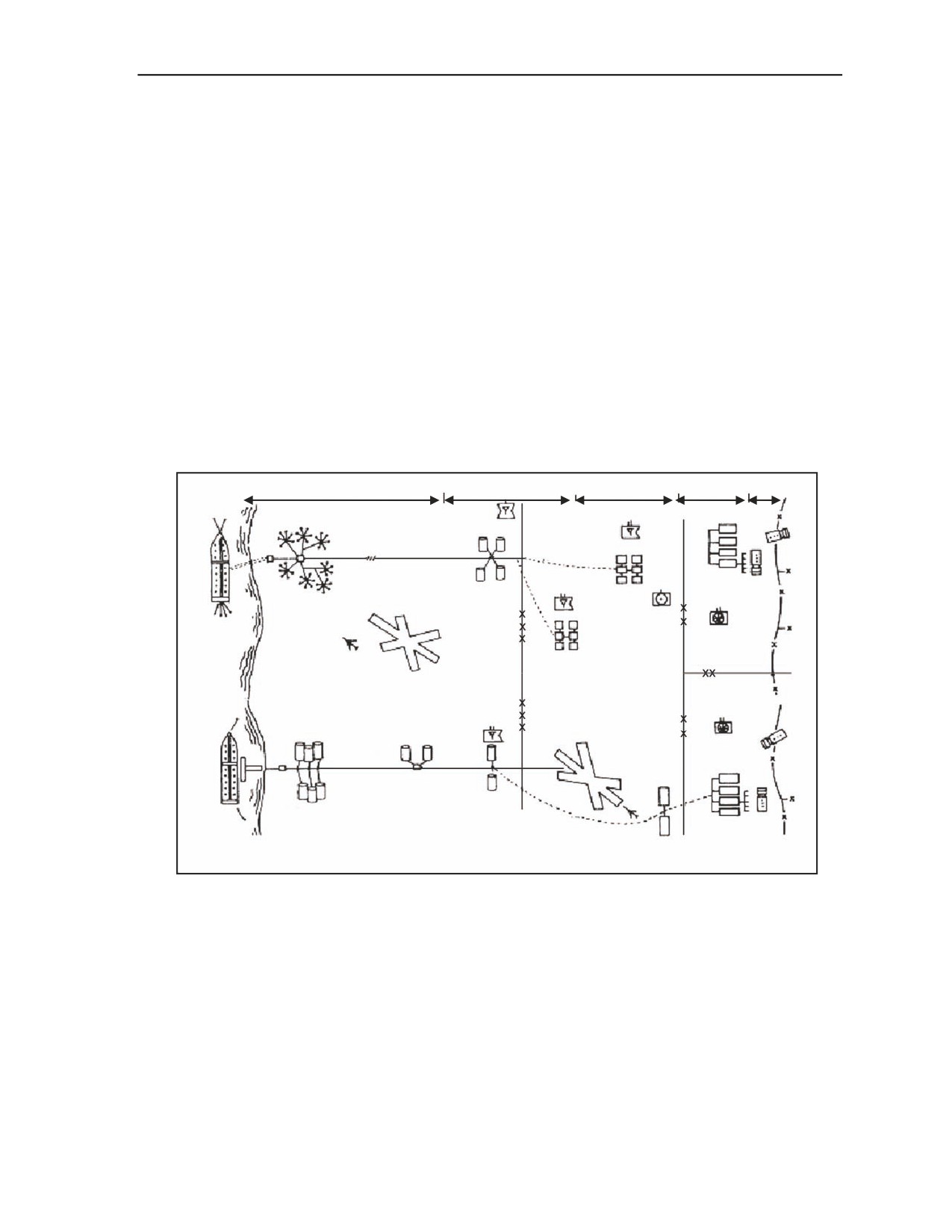
Petroleum Pipeline and Storage Facilities
well. The horizontal and pipeline companies may also provide supervisory personnel for HN employees
that assemble pipe and associated equipment.
ENGINEER PIPELINE CONSTRUCTION COMPANY
15-6. These units provide technical personnel and specialized equipment to support up to three horizontal
construction companies. They support construction by assisting horizontal companies in the construction,
rehabilitation, and maintenance of pipeline systems. These units have a limited capability to construct,
rehabilitate, and maintain pipeline systems without the assistance of horizontal companies.
MILITARY BULK PETROLEUM DISTRIBUTION SYSTEMS
15-7. The Army has used large-scale petroleum pipeline distribution systems since World War II. During
World War II and shortly afterward, the total military pipeline system became standardized.
Standardization included the bulk fuel distribution equipment. This equipment remained largely unchanged
until the mid-1980s, when a major upgrade of materials and equipment took place. The entire distribution
system is now subdivided into offshore and inland systems. The basic characteristics of each system and
some of their prominent features are shown in figure 15-2 and are described in the following paragraphs.
More in-depth characteristics and construction standards can be found in FM 10-67 and FM 10-67-1.
Ocean tanker discharge &
Pipeline or hose line
Corps
Division
Unit
marine petroleum terminal
Petroleum SUP
Petroleum OP
Tactical marine terminal
Hose line
Collapsible bags
Hose line or tactical
FSSP
Petroleum SUP
pipeline
Tank
farm
S&T
Base terminal
U.S. Army
Trans
Multileg
medium
mooring
truck co
system
COMMZ
POL
Corps
S&T
Fixed facilities
Petroleum OP
U.S. Army
Buried
pipeline
Collapsible
tanks
Regulating
terminal
Head
Base
terminal
Hose line
terminal
FSSP
Figure 15-2. Example bulk petroleum distribution system
NAVY UNDERWATER CONSTRUCTION TEAM
15-8. An underwater construction team (UCT) is a specially trained and equipped unit that provides
underwater engineering, construction, repair, and inspection capabilities to meet Navy, Marine Corps, or
joint force operational requirements. In addition to many other capabilities, a UCT can repair underwater
pipelines.
9 December 2008
FM 3-34.400
15-3
Chapter 15
OFFSHORE PETROLEUM DISTRIBUTION SYSTEMS
15-9. The Offshore Petroleum Distribution System (Navy) (OPDS) is a set of equipment and material used
to move petroleum from ships or barges to the first storage facilities on land. The OPDS may be installed
entirely by U.S. Army engineer units or in conjunction with Navy construction units, depending on the
specific situation. Both Army engineers and Navy construction forces have the capability to extend
underwater pipeline up to 4 miles from the high-water mark. Such lines are needed where shallow waters
or blocked channels prevent tankers from entering ports. If tankers can enter and use existing port
facilities, engineers install fuel-unloading equipment at the pier or wharf. The first major storage facility is
usually located within a
5-mile radius of the beach. Primarily, Army engineers and QM units are
responsible for the construction of the beach terminal unit and the associated road networks. The Navy
construction forces ensure that the OPDS is constructed properly and ties into the Army’s beach terminal
unit. JP 4-03 addresses this relationship in more detail. For guidance on the environmental considerations
associated with bulk fuel, spills, and other offshore-related issues refer to NWP 4-11 and OPNAVINST
5090.1B.
TACTICAL PETROLEUM TERMINALS
15-10. TPTs have recently been developed to take advantage of new, rapidly emplaceable, flexible
storage tanks. The standard TPT uses 18 of these 5,000-barrel (210,000-gallon) collapsible tanks to
provide fuel storage. When the TPT is deployed at its maximum size, it requires an area of about 160 acres.
The tanks are interconnected, filled, and emptied by a system of flexible hoses and trailer-mounted pumps.
The petroleum pipeline terminal operations (PPTO) battalion is responsible for emplacing fuel tanks, hose
lines, and pumps. This is not typically an engineer responsibility, although selected engineer support may
be required.
15-11. Substantial engineer effort may be needed to help the petroleum operating battalion prepare the
TPT site. The areas around the tank sites must be cleared of vegetation, and the sites must be leveled. Earth
berms must be built to provide added support and horizontal protection for the tanks. The tank farm area
must be properly drained to prevent water damage and to minimize problems from fuel spills or
catastrophic tank failure. Interconnecting roads are needed within the tank farm as well as access roads and
parking areas for heavy vehicles at fuel-dispensing points. A water supply for firefighting may need to be
developed.
BOLTED STEEL STORAGE TANKS
15-12. Bolted steel tanks with storage capacities of up to 10,000 barrels (420,000 gallons) are still in the
supply system. These tanks are especially useful at petroleum terminals in places where area restrictions
preclude the optimum spacing of collapsible tanks or where more permanent facilities are required. The
erection of the bolted steel tanks requires considerably more time and engineer effort than collapsible
tanks.
INLAND PETROLEUM DISTRIBUTION SYSTEMS
15-13. The inland petroleum distribution system (Army) (IPDS) is a system of pipelines, hose lines, and
storage containers that extends from the shore or port as far forward toward the combat area as required.
The system consists of one or more main or trunk pipelines and pumping stations that move the product
through the line, intermediate tank farms, and branch lines to large users (such as airfields) and the head
terminal at the end of the line. The main pipeline may be an existing civilian pipeline provided by the HN,
a line captured from the enemy, a tactical military pipeline constructed by military engineers, or a
combination of these. The construction materials used in tactical military pipelines are easily assembled
and readily adaptable to existing conditions.
MILITARY INLAND PETROLEUM DISTRIBUTION SYSTEMS PIPE AND COUPLINGS
15-14. The new standard pipe used in the IPDS is a 6- or 8-inch nominal diameter, coupled aluminum
pipe. The pipe comes in standard lengths of 19 feet. The pipe ends have special grooves rolled on the ends
15-4
FM 3-34.400
9 December 2008
Petroleum Pipeline and Storage Facilities
to allow sections of pipe to be joined with a gasket and coupling. The couplings for the pipe are designed
to close with a lever. The pipe is considerably lighter than the older steel pipe and tubing and can be joined
much faster and with fewer people. Aluminum pipe comes with curved elbow sections, which allows the
pipe to negotiate turns better. Aluminum pipe can be cut and the ends prepared in the field with special
tools found in the IPDS inventory.
PUMPS AND PUMP STATIONS
15-15. Pump stations are located along the pipeline to maintain the pressure required to move liquid fuel.
PPTO battalions operate the pump stations. These crews operate pumps, maintain equipment, and perform
pipeline patrol between adjacent pump stations. Security patrolling may require additional personnel to
accomplish. The spacing of the pump stations will depend upon the hydraulic design of the pipeline, as
determined by the senior engineer headquarters controlling the engineer effort for the petroleum operations
and by the anticipated future requirements of the system. On relatively flat terrain, pump stations will be
about 15 to 20 miles apart. In mountainous terrain, pump stations may be much closer.
15-16. Pump stations consist of a set of pumps, station fuel storage tanks, various pipeline operating
equipment, and personnel facilities for the crews. The tactical and logistical situation will dictate the other
features of the station, to include any specific protection and AT requirements. The pump station should be
located on relatively high ground to allow fuel vapors to move away from the facility. Personnel facilities
should be located away from the operating equipment because of noise and the presence of noxious fumes.
These and other considerations must be integrated into the engineering support plan. Involve medical
personnel to do an EHSA to verify the level of FHP risks associated with these operations. Ideally, medical
personnel will be included in planning to minimize the likelihood of these risks.
15-17. Assembling pump station components requires the specialized skills of personnel from the
pipeline construction company. Newly introduced equipment significantly reduces construction time,
because many of the components are modularized. Some fabrication, however, is still required.
PIPELINE CONSTRUCTION AND MAINTENANCE
PLANNING PHASE
15-18. The engineer planning phase for the construction of a petroleum pipeline begins as soon as the
need for a pipeline has been established. The theater engineer command, in conjunction with the other
subordinate controlling headquarters, determines the general route for the pipeline, incorporating
appropriate environmental considerations. This ensures that the material required can be available when
needed and that the environmental considerations of environmental protection and FHP have been
integrated. In some cases, pipe has to be manufactured and shipped to the designated area. This may add
months to the construction schedule. Proper planning can reduce some of these potential delays.
15-19. Early determination of required construction units and support must be made. Transportation
needs must be well planned because engineer companies have a limited lift capability to move themselves
or the required materials. The requirement to transport large volumes of pipeline material may also prevent
rapid installation of the pipeline, but again, proper planning can reduce much of this potential delay.
15-20. Final selection of the pipeline route begins after a physical reconnaissance of the areas to be
crossed is completed. The pipeline route will have the following major characteristics:
z
Route follows secondary roads to reduce disruption of traffic on the MSRs.
z
Route should be the most level ground available and avoid sharp changes in elevation. Pipeline
supports and suspension bridges allow the construction of the line over small and large gaps, but
add to the construction time and amount of additional construction material required.
z
Route avoids heavily populated areas to minimize potential problems from spills and to reduce
opportunities for tampering.
z
Route can service large users, such as airfields and logistical support areas.
z
Route follows natural linear features, such as wood edges and fencerows to aid in camouflage.
9 December 2008
FM 3-34.400
15-5
Chapter 15
z
Route takes into account applicable environmental considerations.
z
Route takes into account AT and other protection considerations.
15-21. It is essential to determine elevations along the route as part of the reconnaissance. This data is
critical to the system's hydraulic design. The hydraulic design determines the location and number of pump
stations and of certain control devices required for the pipeline to work properly.
CONSTRUCTION PHASE
15-22. Different parts of the pipeline system can be built simultaneously. As construction crews are
clearing the pipeline route, other crews can be building gap-crossing structures or installing pump stations
and intermediate storage facilities. The construction of a pipeline system requires maximum flexibility and
decentralized control of the construction elements. Leaders of small units must be well prepared to function
with a minimum of supervision because the project will likely have elements spread over many miles. It is
because of this that most projects of this scope will have a brigade or battalion level C2 element. In this
way, the entire organization can be most effectively employed.
15-23. The tactical situation, terrain difficulty, and required supporting construction will determine how
the construction will be carried out. The joining of pipeline elements is likely to be a short end phase, with
longer, earlier phases in which the companies work in a decentralized fashion.
15-24. As the pipeline is assembled, certain sections must be pressure-tested carefully to ensure that they
are leakproof. Fuel lines need to be equipped with vacuum, pressure, and vapor releases as required. Any
section of pipe that cannot be visually inspected or is not readily accessible must meet this criterion.
Sections of pipe that are buried underground or are submerged underwater must be tested. Other critical
sections include any parts of a pipeline that are placed in tunnels used by personnel or vehicles. Leaks in
tunnels may allow vapors to accumulate or expose the pipe to damage from moving vehicles; a fire or
explosion may result.
15-25. The pipeline can be checked by pressure-testing with four fluids: potable water, nonpotable water,
saltwater, and fuel. The preferred method is to use potable water, as it prohibits corrosion. The engineer
unit is responsible for providing water for this event. Water is introduced into the pipeline and subjected to
increasing pressure for a period of time. The pipeline must maintain the required pressure for the specified
period before the operating unit (the PPTO battalion) will accept that specific section of pipeline. Testing
with air can also be used for shorter sections of line, but leaks are difficult to pinpoint. Under extreme
operational requirements, fuel may be authorized for testing, but only as a last resort. Applicable
environmental considerations should be followed.
PIPELINE MAINTENANCE
15-26. Once the PPTO battalion accepts the pipeline, it is responsible for operational maintenance. The
unit will make frequent inspections of the line for visual signs of leaks and damage. The unit is capable of
repairing minor leaks and replacing short sections of pipeline that have been damaged. The operating unit
will need engineer support to make repairs beyond its capabilities (minor repairs). This includes, but is not
limited to, buried pipe or pipe that is in an inaccessible location. Generally, engineers are needed for major
repairs, such as 1-mile or more sections of leaking or destroyed pipe that requires reconstruction, or
sections that have severe petroleum leaks.
15-27. Safety is extremely important when dealing with pipeline breaks and leaks. Spilled fuel must be
contained to reduce the fire hazard and to prevent the contamination of water supplies. Absolute control of
all flame- or spark-generating equipment or material within or near the work area is vital. Security
measures must be considered against sabotage and pilfering.
15-6
FM 3-34.400
9 December 2008
Chapter 16
Water Supply and Well Drilling
I don’t know what the hell this “logistics” is that Marshall is always talking about, but I
want some of it.
Fleet Admiral Ernest J. King, 1942
Maintaining a constant supply of water is critical to sustaining the force. Beyond
Soldier consumption, it is critical for CBRN decontamination, sanitation,
construction, medical operations, and equipment maintenance. The quantity and
quality required depends on climatic conditions, terrain, and the type of operation
conducted. Logistics officers at all levels estimate their unit needs for water and plan
all required procurement and distribution activities to meet those needs. When part of
their plan includes well drilling or support for the establishment of distribution
systems, commanders will request GE support.
FIELD WATER SUPPLY
16-1. Tactical and logistical planners determine and coordinate water support functions in the AO. Water
distribution units are responsible for distribution. Preventive medicine personnel analyze, test, and certify
water supplies. Together, they ensure that there is enough quality water production and distribution to
continuously support the forces. Logistics planners, using FM 10-52, estimate the required quantity and
quality based on the mission, size of the supported force, dispersion of forces in the AO, and availability of
various sources of water supply.
16-2. Logisticians use FM 10-52-1 to plan the actual distribution of water to units. Logistics units,
typically supply companies, normally have a water distribution platoon assigned to conduct water supply
operations, including establishing and operating a water supply point. To do this effectively, the logistics
unit may require engineer support, to include—
z
Building combat roads and trails to establish traffic control patterns at the distribution site.
z
Constructing improvised dams for impounding small streams to obtain a steady source of water.
z
Constructing gravel pads to ensure a steady platform for operating reverse osmosis water
purification units (ROWPUs).
z
Constructing a brine pit (ROWPU support).
z
Digging intake galleries along banks of streams.
z
Improving drainage at the facility to prevent muddy conditions that may cause the area to
become unusable.
z
Constructing pads for water storage blivets.
z
Constructing or repairing troop bed-down, protection, AT, and maintenance facilities (because
water distribution points are often long-term operations).
z
Providing diving support for the emplacement of offshore water hoses and pipelines.
z
Rehabilitating damaged wells and distribution points.
16-3. Most water supply units are equipped with two 10-mile segments of the tactical water distribution
system. The tactical water distribution system is used to transport potable water from wells, desalination
plants, and other sources over distances less than 10 miles (per segment) to 20,000-gallon fabric storage
tanks. The system is capable of transporting water forward up to 80 miles at a rate of 600 gallons per
minute across level terrain. Engineers support this system by providing GE support to set up the
9 December 2008
FM 3-34.400
16-1
Chapter 16
distribution point, leveling water storage pads, and assisting with the emplacement of the hose system. The
need to cross hard-surfaced roads and other obstacles will require engineers to install culverts or emplace
suspension kits at various locations throughout the hose system.
16-4. GE support in the form of well drilling is provided to the water collection and distribution process.
Well drilling may occur when—
z
Surface sources of water are not available in enough quantity or quality to support the force.
This is likely to occur in arid terrain where the quantity of water required is high and surface
sources are low.
z
The distribution system is insufficient to support the force. Haul distances may be significantly
reduced by a well drilled close to the consumer.
z
CBRN or other contamination is expected that would render surface sources unusable.
z
The mission is part of a HCA mission. A major portion of the world’s population does not have
a readily available source of potable water. Providing a source by conducting well-drilling
operations may be the decisive operation in a stability and reconstruction operation, and a
critical part of the overall IO.
WATER DETECTION
16-5. The detection of groundwater sources is critical for successful well-drilling operations. Without
proper analysis, the potential for finding an adequate source is less likely. Determining the most suitable
sites to drill for groundwater falls primarily on geospatial teams and the water detection response team
(WDRT). Geospatial teams use data from terrain and other geospatial products to recommend the best sites
to conduct well-drilling operations. These teams use the results of field reconnaissance and geophysical
surveys to provide recommendations. They also have the capability of reachback to experts at the
Topographic Engineering Center to obtain data and analysis from historic records and further SME
analysis to identify areas with a high potential for developing water supply sources. Geospatial teams are
not equipped or trained for actual detection, only predictive analysis.
16-6. The mission of the WDRT is to assist the military planner, terrain team, and all DOD well-drilling
teams in locating adequate groundwater supplies before drilling to improve military well-drilling success.
In unfamiliar terrain, drilling by trial and error can be costly and time-consuming. When needed, contact
the Topographic Engineering Center (see appendix B).
16-7. Well-drilling teams may drill exploratory or test holes to detect groundwater, but this method is
time-consuming. It is only recommended if other water detection methods are not available or have been
proven to be unsuccessful.
WELL-DRILLING OPERATIONS
16-8. Wells provide water to the deployed forces. Proper planning and execution guidance for the conduct
of well-drilling operations resides in FM 5-484/NAVFAC P-1065/AFMAN 32-1072 (note that the Navy
and Air Force maintain well-drilling capabilities that are addressed in this manual). Wells should be drilled
of a secure area within the AO and, if possible, within base camps or other facilities for which the water
will be used. The well-drilling team is inherently modular and deploys to the AO with the organic
equipment they use to drill and complete a well.
16-9. Well-drilling teams are a theater engineer command asset and should be deployed and employed by
an engineer brigade or battalion capable of providing expertise and logistical support. Since the team has
limited personnel, the engineer headquarters must also plan for security at any work site.
16-10. Well-drilling projects should be managed as any construction project. The well-drilling team
commander must coordinate work closely with the construction or operations officer of the higher
headquarters unit to ensure timely reporting. Because well-drilling equipment is inherently large and
heavy, engineers must ensure its mobility in conditions with poor trafficability. As the team moves from
project to project, the operations officer arranges the transfer of all completed work to the user, movement
to the new project site, and further logistics and security arrangements.
16-2
FM 3-34.400
9 December 2008
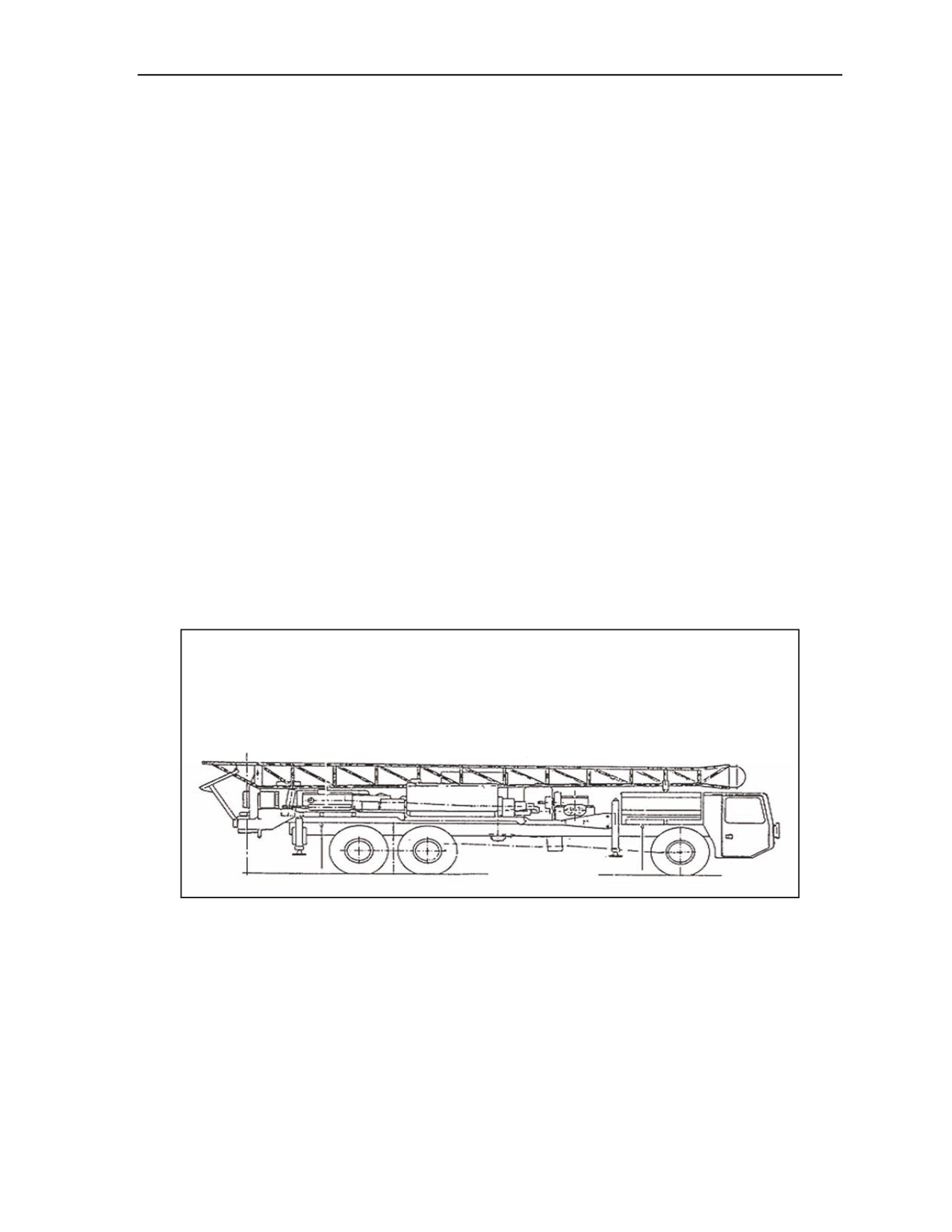
Water Supply and Well Drilling
16-11. Drilling rigs are either truck- or semitrailer-mounted. Current well-drilling and well completion
equipment consists of the 600-foot, well-drilling system. The system includes—
z
A truck-mounted drilling machine mounted on a Navistar™ 6-by-6 truck chassis.
z
A truck-mounted tender vehicle.
z
A lightweight, well completion kit (including accessories, supplies, and tools needed for drilling
a well).
16-12. The Army also uses the CF-15-S trailer-mounted, 1,500-foot, well-drilling machine and 1,500-foot
completion kit. The 600-foot well-drilling system has replaced the CF-15-S trailer-mounted machine and
1,500-foot, well completion kit, but the CF-15-S may still be found forward-deployed for contingency
operations.
16-13. The 600-foot, well-drilling system (figure 16-1) can be deployed with minimal preparation and
support equipment anywhere in the world. With the completion kit, drillers can complete a well to a depth
of 600 feet using mud, air, or a down-hole hammer─with or without foam injection. With the augmentation
of an auxiliary 250-CFM air compressor, drill pipe, and 400 feet of drilling stem, the 600-foot well-drilling
system can drill up to depths of 1,000 feet in a variety of soil conditions using mud or drilling foam.
Additional equipment includes casing elevators and slips, larger drill bits, and an additional drill stem.
Well-drilling teams should ensure that they have the rig accessory kit for the LP-12 to be fully mission-
capable. The 600-foot, well-drilling system is—
z
Air-transportable by a C-130, C-141, and C-5. The vehicle is equipped for tie-down as well as
lift operations during transport.
z
Equipped for air percussion drilling and for rotary drilling with mud or air.
z
Equipped to drill wells up to 600 feet.
z
Adaptable for drilling to a depth of 1,500 feet.
z
Truck-mounted for mobility.
z
A three-mode, water transfer pumping system.
Model: LP-12
Manufacturer: George E. Failing Company™
Shipping weight: 38,000 pounds
Length: 35 feet
Fuel tank capacity: 200 gallons
Width: 8 feet
Hydraulic reservoir: 79 gallons
Height (mast lowered): 8 feet
Water injection tank: 25 gallons
Height (mast raised): 38 feet
Figure 16-1. 600-foot, well-drilling system and specifications
9 December 2008
FM 3-34.400
16-3
This page intentionally left blank.

Appendix A
Metric Conversion Table
A-1. When planning GE missions, it is often necessary to use metric units to standardize
project
measurements. Table A-1 is intended to serve as a basic conversion table for that purpose.
Table A-1. Metric conversion table
U.S. Units
Multiplied By
Equals Metric Units
Acres
0.4947
Hectares
Acres
43,560
Square feet
Acres
4,047
Square meters
Bulk fuel, 55-gal drum (bbl)
0.17
Soft tons
Cubic feet
0.0283
Cubic meters
Cubic inches
16.3872
Cubic centimeters
Cubic inches
0.0164
Liters
Cubic yards
0.7646
Cubic meters
Degrees Fahrenheit
Subtract 32, multiply by 5/9
Degrees Celsius
Feet
0.3048
Meters
Feet per second
18.288
Meters per second
Fluid ounces
29.573
Milliliters
Gallons
0.1337
Cubic feet
Gallons
0.00378
Cubic meters
Gallons
3.7854
Liters
Gallons (bulk fuel)
0.004
Soft tons
Inches
2.54
Centimeters
Inches
0.0254
Meters
Inches
25.4001
Millimeters
Miles (nautical)
1.85320
Kilometers
Miles (statute)
1.6093
Kilometers
Ounces
28.349
Grams
Pounds
453.59
Grams
Pounds
0.4536
Kilograms
Square inches
6.4516
Square centimeters
Square feet
0.0929
Square meters
Square miles
2.59
Square kilometers
Square yards
0.8361
Square meters
Yards
0.914
Meters
9 December 2008
FM 3-34.400
A-1

Appendix A
Table A-1. Metric conversion table
Metric Units
Multiplied By
U.S. Units
Centimeters
0.3937
Inches
Cubic centimeters
0.061
Cubic inches
Cubic meters
35.3144
Cubic feet
Cubic meters
1.3079
Cubic yards
Degrees Celsius
By 9/5 and add 32
Degrees Fahrenheit
Milliliters
0.03380
Fluid ounces
Grams
0.03527
Ounces
Kilograms
2.2046
Pounds
Kilometers
0.5396
Miles (nautical)
Kilometers
0.62137
Miles (statute)
Meters
3.2808
Feet
Meters
39.37
Inches
Meters
1.0936
Yards
Millimeters
0.03937
Inches
Square centimeters
0.155
Square inches
Square kilometers
0.3861
Square miles
Square meters
1.196
Square yards
Square meters
10.764
Square feet
A-2
FM 3-34.400
9 December 2008
Appendix B
Reachback Tools
The availability of military and civilian engineers through reachback provides the full
expertise of the Regiment to support full spectrum operations, enhancing the
capabilities and expertise of forward-deployed forces while minimizing the required
footprint. This appendix is designed to highlight the most useful and primary support
available to engineers performing GE operations. These tools include resources from
the USAES, USACE, and the U.S. Army Center for Health Promotion and Preventive
Medicine
(USACHPPM). This type of reachback capability is one of the
characteristics of FFE. The Air Force and Navy provide some of the same type of
capabilities and support through the Air Force Civil Engineering Support Agency and
the NAVFAC. See FM 3-34 for further information.
UNITED STATES ARMY ENGINEER SCHOOL
B-1. The Doctrine Development Division of the USAES manages engineer doctrine within the TRADOC
doctrine development cycle. As part of this process, the Doctrine Development Division assesses, plans,
develops, produces, and disseminates engineer doctrine that is synchronized with allied, multinational,
joint, multi-Service, and combined arms doctrine. It supports the development of nonengineer doctrinal
products by providing subject matter expertise for review and coordination, supports the Engineer
Regiment by managing the Center for Engineer Lessons Learned, and provides information and analysis as
needed.
UNITED STATES ARMY CORPS OF ENGINEERS
B-2. The USACE has over 35,000 military and civilian employees in 9 USACE divisions, 45 districts,
multiple centers of expertise, and laboratories. The military and civilian engineers, scientists, and other
specialists work hand in hand as leaders in engineering and environmental matters. The diverse workforce
of biologists, engineers, geologists, hydrologists, natural-resource managers, and other professionals meets
the demands of changing times and requirements as a vital part of America's Army (see figure B-1, page
B-2).
9 December 2008
FM 3-34.400
B-1
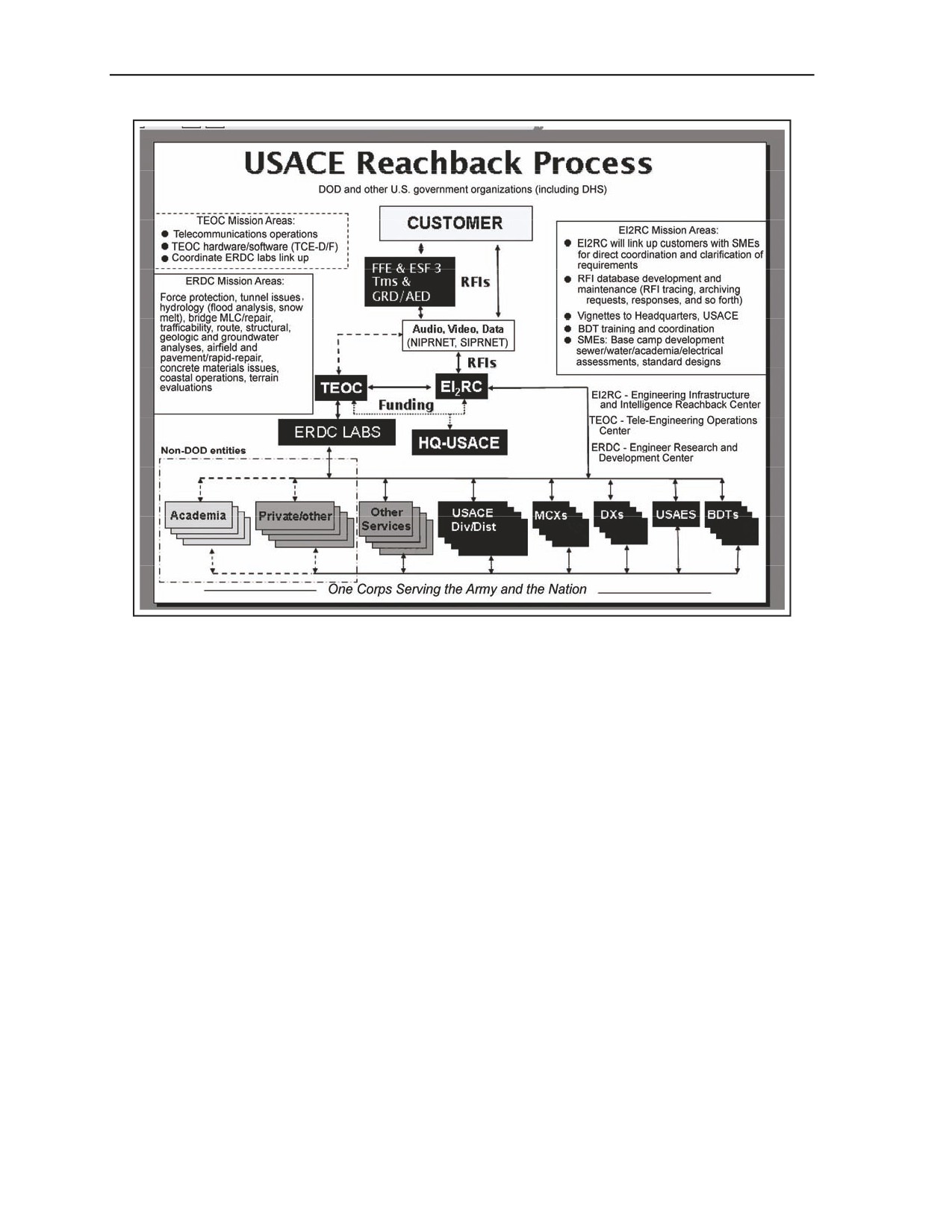
Appendix B
Figure B-1. The USACE reachback process
ENGINEERING INFRASTRUCTURE AND INTELLIGENCE
REACHBACK CENTER
B-3. The EI2RC serves as the USACE FFE “hub” for engineering support and GIS infrastructure
intelligence to military deployments and civil-military operations worldwide. As such, it is the primary
USACE reachback center for technical assistance and engineering support.
B-4. The concept of operations for the EI2RC is as follows:
z
The requestor or customer sends a request for information (RFI) to the EI2RC via SIPRNET or
Nonsecure Internet Protocol Router Network
(NIPRNET) EI2RC Web site, video
teleconferencing, telephone, or SIPRNET or NIPRNET e-mail.
z
EI2RC accepts RFIs for a variety of technical and nontechnical assistance, including, but not
limited to, structural assessment; mapping; satellite imagery; GIS; evacuee, EPW, and base
camp development; water resources; protection; road, airfield, and port repair; and expedient
designs.
z
EI2RC assigns the RFI to a BDT, laboratory, or center of expertise and oversees the completion
of the RFI.
z
EI2RC archives RFI deliverable products into an easy-to-search, online database.
B-5. The EI2RC is currently fielding the “it knows everything™(ike)” with the geospatial assessment tool
for engineering reachback (GATER), a field data collection platform for collecting information related to
infrastructure assessments in the field. The ike is a rapid data collection device consisting of a handheld
computer, global positioning system (GPS), laser range finder, digital camera, and inclinometer all in one
ruggedized handheld device. The GATER is actually the customized ArcPAD® interface that is developed
and tailored for your specific AOR. The GATER currently supports infrastructure assessments as a module
B-2
FM 3-34.400
9 December 2008
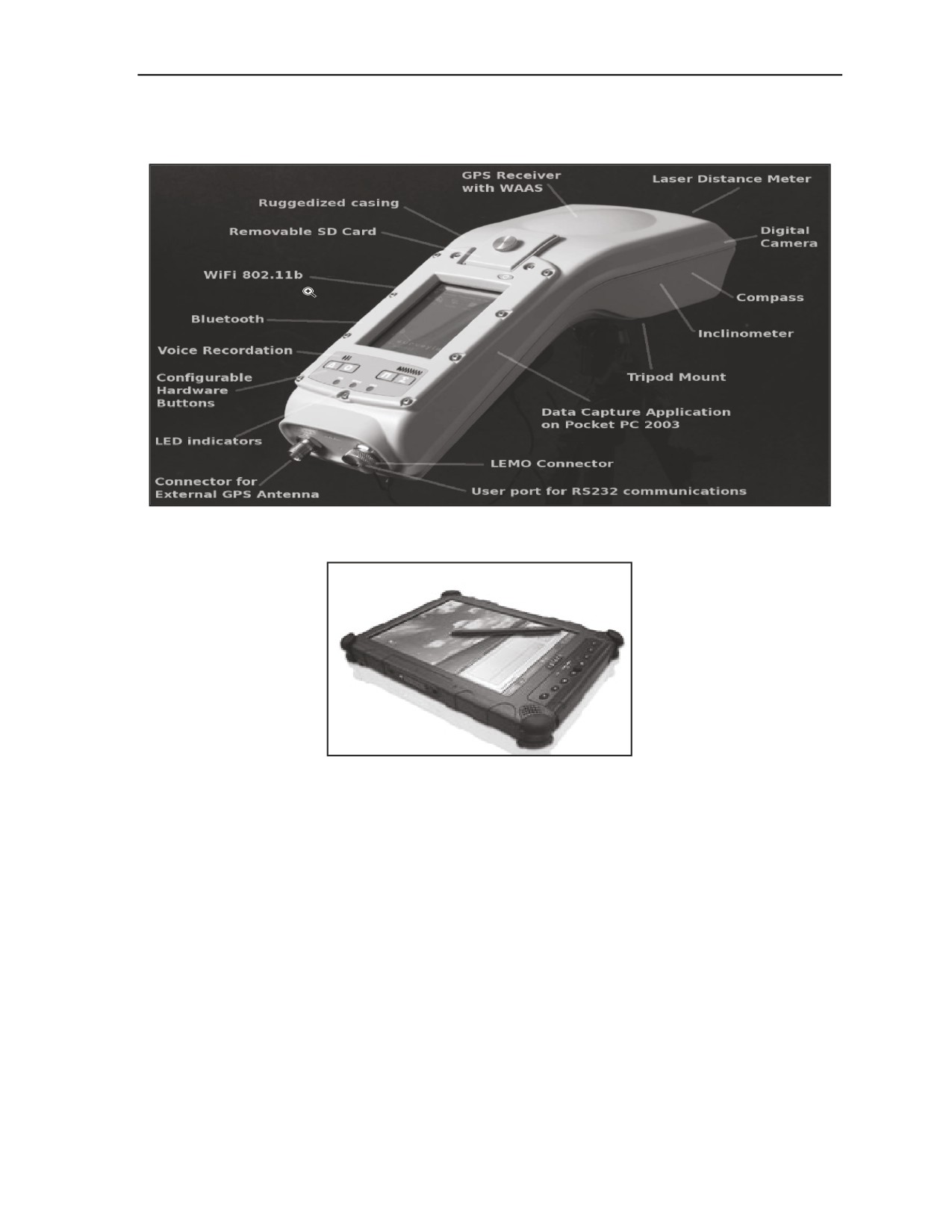
Reachback Tools
of forms that the user easily accesses and fills in during the field infrastructure assessment. The deployment
of the ike device with the GATER is considered ike with GATER (figure B-2 and figure B-3).
Figure B-2. Ike
Figure B-3. GATER
B-6. The EI2RC also has the repository and archiving capability to provide Reachback technical
assistance to military deployments and civil-military operations. The EI2RC is designated as the repository
for the information, document, and designs it generates and is therefore responsible for archiving and
maintaining an online NIPRNET and SIPRNET document management system. This Web-based system
provides the means to receive, locate (spatially), assign, track, and archive all documents from RFI
deliverables. Also available are the situation reports (SITREPs), after-action reviews, lessons learned,
standard designs, and technical library documents. The online system has been customized so that
supported units can easily submit their requests and later query the document management system to
download response deliverables.
TELE-ENGINEERING OPERATIONS CENTER
DESCRIPTION
B-7. The TEOC provides a reachback engineering capability that allows DOD personnel deployed
worldwide to talk directly with experts in the United States when a problem in the field needs quick
resolution. Deployed troops can be linked to SMEs within the USACE (or comparable Air Force and Navy
9 December 2008
FM 3-34.400
B-3
Appendix B
organizations), private industry, and academia to obtain detailed analysis of complex problems that would
be difficult to achieve with the limited expertise or computational capabilities available in the field.
CAPABILITIES
B-8. TEOC staff members respond to incoming information requests and provide detailed analyses of
problems that the ERDC laboratories can address, such as flooding potential due to dam breaches, load-
carrying capacities of roads and bridges, field fortifications and protection, evaluation of transportation
networks, and water resource data.
SUPPORTING TECHNOLOGY
B-9. TCE-D provides reachback capability using COTS communications equipment with encryption
added. Video teleconferences and data transfers can be conducted from remote sites where other similar
means of communications are nonexistent or unavailable.
B-10. The tele-engineering toolkit (TETK) is a software product that provides a valuable analysis tool to
personnel on the ground or going into an AO. By annotating an area of interest, a small reference file can
be sent back to the SMEs to provide requests for a variety of information, to include cross-country mobility
analysis, flood analysis, and vegetation information. The response can then be sent back and graphically
displayed using the TETK.
ENGINEER RESEARCH AND DEVELOPMENT CENTER
B-11. The U.S. Army ERDC is one of the most diverse engineering and scientific research organizations in
the world. It consists of seven laboratories at four geographical sites in Vicksburg, Mississippi;
Champaign, Illinois; Hanover, New Hampshire; and Alexandria, Virginia. It employs more than 2,000
engineers, scientists, and support personnel.
B-12. The ERDC supports the DOD, other federal agencies, and the nation in military and civilian projects.
Its primary mission areas include the following:
z
Warfighter support.
z
Installations.
z
Environment.
z
Water resources.
z
Information technology.
B-13. Research projects include facilities, airfields, pavements, protective structures, sustainment
engineering, environmental quality, installation restoration (cleanup), compliance, conservation, regulatory
functions, flood control, navigation, recreation, hydropower, topography, mapping, geospatial data, winter
climatic conditions, oceanography, environmental impacts, and information technology.
UNITED STATES ARMY CORPS OF ENGINEERS CENTERS OF
EXPERTISE AND LABORATORIES
B-14. The USACE has numerous centers of expertise and laboratories who conduct research and
development for both military and civil missions the Corps supports. Listed below is the majority of
centers of expertise, directed centers of expertise (DXs), and laboratories within USACE.
ENGINEERING RESEARCH AND DEVELOPMENT CENTER
B-15. The following is a list of the ERDCs:
z
Geotechnical and Structures Laboratory, Vicksburg, Mississippi.
z
Coastal and Hydraulics Laboratory, Vicksburg, Mississippi.
z
Environmental Laboratory, Vicksburg, Mississippi.
z
Information Technology Laboratory, Vicksburg, Mississippi.
B-4
FM 3-34.400
9 December 2008
Reachback Tools
z
Topographic Engineering Center, Alexandria, Virginia (Fort Belvoir).
z
Construction Engineering Research Laboratory, Champaign, Illinois.
z
Cold Regions Research and Engineering Laboratory, Hanover, New Hampshire.
z
Computer-Aided Design and Drafting (CADD) and GIS Technology Center for Facilities,
Infrastructure, and Environment, Vicksburg, Mississippi, DX.
z
Concrete Technology Information Analysis Center, Vicksburg, Mississippi, DX.
UNITED STATES ARMY ENGINEERING AND SUPPORT CENTER, HUNTSVILLE, ALABAMA
B-16. The following are located at the United States Army Engineering and Support Center:
z
Ballistic Missile Defense.
z
Chemical Demilitarization.
z
Installation Support.
z
Medical Facilities Center of Expertise.
z
Ordnance and Explosives.
z
Ranges and Training Land Program.
z
TCMS.
z
Electronic Security Systems.
z
Electronic Technology Systems Center.
z
Utility Monitoring and Control Systems.
z
Energy Savings Performance Contracting.
z
Facility Repair and Renewal.
z
Operation and Maintenance Engineering Enhancement (OMEE).
z
Utility Systems Privatization.
z
Contingency Facilities Support.
z
Facility Standards and Criteria.
z
Facility Programming and Cost Engineering and Estimating Tools.
MISCELLANEOUS
B-17. The following are additional DX locations:
z
Hydroelectric Design Center, Portland, Oregon, DX.
z
Management and Curation of Archeological Collections, Saint Louis, Missouri, DX.
z
Preservation of Historic Buildings and Structures, Saint Louis, Missouri, DX.
z
Photogrammetric Mapping, Kansas City, Kansas, DX.
z
Heating, Ventilation, and Air Conditioning Control Systems, Savannah, Georgia, DX.
z
Automated Performance Monitoring of Dams, Saint Louis, Missouri, DX.
z
Remote Sensing/GIS Center, Hanover, New Hampshire, DX.
z
Hydrologic Engineering Center, Davis, California, DX.
z
Subsurface Exploration Center, Mobile, Alabama, DX.
z
Readiness Support Center, Mobile, Alabama, DX.
z
Internet Center of Expertise, Hanover, New Hampshire, DX.
z
National Security Agency Real Estate Technical Support Center, Baltimore, Maryland, DX.
z
Technical Assistance Center (Real Estate) Technical Support Center, Savannah, Georgia, DX.
z
U. S. Army, Southern Command Real Estate Technical Support Center, Mobile, Alabama, DX.
z
Real Estate Systems Support Center, Mobile, Alabama, DX.
z
Defense National Relocation Program, Baltimore, Maryland, DX.
z
Aircraft Hangar Fire Protection, Winchester, Virginia, DX.
z
Marine Design Center, Philadelphia, Pennsylvania.
9 December 2008
FM 3-34.400
B-5