FM 3-34.400 GENERAL ENGINEERING (December 2008) - page 3
This page intentionally left blank.
Chapter 7
Roads and Railroads
The line that connects an army with its base of supplies is the heel of Achilles-its most
vital and vulnerable point.
John S. Mosby, Colonel, Confederate States of America (1887)
Maintaining forward-deployed forces during contingency operations requires an
extensive logistics network. An adequate ground LOC network is a critical part of
this network and one of the keys to sustainment operations in today’s OE. Engineers
are responsible for road and railroad construction, maintenance, and repair. Roads
and railroads are built to meet mission and operational requirements. Depending on
the METT-TC, they may form the primary LOCs during a contingency operation.
From nation-building and humanitarian assistance, through combat operations, as
unit AOs expand along both contiguous and noncontiguous lines due to technological
advances and the natural evolution of modern warfare, roads and railroads will
continue to be crucial to operational support throughout the AO.
ROAD CONSTRUCTION, MAINTENANCE, AND REPAIR
RESPONSIBILITIES
7-1. The purpose of a military road is to allow traffic to get from one point to another quickly and
efficiently, for as long as necessary, based on operational requirements. Roads are classified according to
their degree of permanence and the characteristics of traffic they are designed to support. Sound
engineering logic and the ever-changing, dynamic battlefield environment dictate that existing roads be
used whenever possible. When suitable road networks do not exist or cannot be used, roads are upgraded
or constructed to support operational requirements. Combat roads and trails are a combat engineering
mission that is discussed in FM 3-34.2. Higher-level road work is a GE mission. The specific application of
this level of road construction is discussed in FM 5-430-00-1.
7-2. Military roads are rarely constructed to meet the exacting standards of comparable civilian
construction, to include environmental standards. Their degree of permanence varies depending on how
long they are needed. Combat trails or earthen roads may be hastily cut pathways designed to initial
standards to enhance mobility for only a short time (less than six months). More permanent road networks,
such as MSRs and primary LOCs, are designed to temporary standards to sustain mobility for a longer
period of time (up to two years). During contingency operations, nearly all roads are constructed to
temporary standards. In some rare cases, semipermanent and permanent roads may be designed to provide
long-term mobility (up to 20 years). Permanent roads are often done in conjunction with USACE or similar
organizations and the employment of civilian contractors or the oversight of Service GE organizations.
7-3. Military roads are classified as either Type A, B, C, or D depending on the amount of traffic they are
expected to sustain per day. Type A roads are designed for the highest capacity, while type D roads are
designed for the lowest. Only road types B, C, and D apply to TO construction. See FM 5-430-00-1,
chapter 9, table 9-1.
7-4. During contingency operations, most military roads that are constructed do not receive asphalt
cement or portland cement concrete surface due to the time required and the added cost for this type of
construction. These types of pavements may not be required to sustain heavy traffic over extended periods
of time. Instead, most new military roads are surfaced with either sand, gravel, crushed rock, stabilized
9 December 2008
FM 3-34.400
7-1
Chapter 7
soil, or the best locally available materials. Selected high-use portions of the road may be surfaced to
support this requirement. Gap-crossing sites will require special consideration. This allows for future
upgrades and permits the maximum use of readily available materials to rapidly complete the road. Army
engineer units have the following responsibilities as directed by the appropriate commander:
z
Road reconnaissance.
z
Maintenance, repair, and upgrade of existing roads.
z
Construction of new roads.
z
Recommendation of traffic pattern flow based on terrain and construction considerations.
z
Topographic and other geospatial support.
ROAD CONSTRUCTION, MAINTENANCE, AND REPAIR PLANNING
7-5. The following factors must be considered when establishing any road network:
z
Mission. Operational and mission requirements determine the minimum road classification and
design requirements based on the expected period of usage and the anticipated traffic load.
z
Enemy. Threat capabilities and anticipated types of action could impact the methods of
construction and affect the road location and design. Creating choke points and other potential
ambush points should be avoided when possible.
z
Terrain and weather. The location of a road is dictated by operational and mission
requirements. Using existing roads, when possible, is preferred to avoid unnecessary
construction. Existing slopes, drainage, vegetation, soil properties, weather patterns, and other
conditions may affect layout and construction.
z
Troops and support available. Local materials, labor, and equipment are used whenever and
wherever possible. Simple or preexisting designs, such as those in the TCMS that require a
minimum of skilled labor and specialized equipment, are used whenever possible.
z
Time available. Speed is critical to establishing a road network during a contingency operation
because of the rapid and dynamic tempo of military operations. It is essential to save as much
time as possible by efficiently using the minimum amount of resources. Effective project
management techniques should be used. Good planning, careful estimating, sound scheduling,
and thorough supervision speed job completion and save time, labor, equipment, and materials.
Wherever possible, use staged construction to allow early use of roadways while further
construction, maintenance, repairs, and upgrades continue.
z
Civil considerations. Civilian property restrictions, existing structures, restricted areas, cultural
beliefs, environmental considerations, and other factors may also affect road layout and
construction.
7-6. One of the most critical parts in planning the establishment of a road network is site investigation.
Site investigation includes reconnoitering the proposed routes and determining existing soil properties and
terrain characteristics. This requires a thorough knowledge of soils engineering, hydrology, and engineer
technical reconnaissance. A detailed site investigation will serve as the foundation behind the design of a
new road and/or the upgrade, repair, and maintenance of an existing road.
7-7. Route reconnaissance (see FM 3-34.170) to evaluate the traffic-bearing capabilities and condition of
existing roads supports route selection decisions and determines the improvements needed before a route
can carry the proposed traffic. Route reconnaissance is classified as either hasty or deliberate. The way in
which route reconnaissance is performed depends upon the amount of detail required, the time available,
the terrain problems encountered, and the tactical situation. The composition of the reconnaissance element
depends upon these protection considerations and a risk assessment by the commander directing the
reconnaissance. Hasty route reconnaissance determines the immediate military trafficability of a specified
route. It is limited to the critical terrain data necessary for route classification. The results are part of the
mobility input to the common operational picture (COP). Information concerning the route is updated with
additional reports as required by the situation and/or the commander's guidance. A deliberate route
reconnaissance is conducted when enough time and qualified technical personnel are available. Deliberate
route reconnaissance is usually conducted when operational requirements are anticipated to cause heavy,
7-2
FM 3-34.400
9 December 2008
Roads and Railroads
protracted use of the road and may be the first reconnaissance conducted or follow the conduct of a hasty
route reconnaissance. When available, an automated route reconnaissance kit
(ARRK) can provide
engineer units with an automated reconnaissance package that allows the reconnaissance element to collect
and process reconnaissance information (see appendix B). An overlay is made with attachments that
describe all pertinent terrain features in detail. This overlay forms part of the mobility input to the COP and
is maintained by the engineer unit tasked to perform the reconnaissance.
7-8. The engineer reconnaissance team is briefed as to the anticipated traffic (wheeled, tracked, or a
combination) and the anticipated traffic flow. Single-flow traffic allows a column of vehicles to proceed
while individual oncoming or overtaking vehicles pass at predetermined points. Double-flow traffic allows
two columns of vehicles to proceed simultaneously in the same or in opposite directions. The
reconnaissance team may also be asked to determine the grade and alignment, horizontal and vertical curve
characteristics, and the nature and location of obstructions. Obstructions are defined as anything that
reduces the road classification below what is required to support the proposed traffic efficiently.
Obstructions include—
z
Restricted lateral clearance, including traveled way width, such as bridges, built-up areas, rock
falls or slide areas, tunnels, and wooded areas.
z
Restricted overhead clearance, including overpasses, bridges, tunnels, wooded areas, and built-
up areas.
z
Sharp curves.
z
Excessive gradients.
z
Poor drainage.
z
Snow blockage.
z
Unstable foundations.
z
Rough surface conditions.
z
Other obstacles, including CBRN contamination, roadblocks, craters, EH (to include mines and
other UXOs and IEDs), cultural sites, and environmental restrictions. Existing bridging may
require special attention, as it is often a weak link. It may be necessary to conduct bridge
reconnaissance and classification computations (see chapter 8).
ROAD CONSTRUCTION
7-9. Reconnaissance to support the construction of a new road may be classified as either area or route
reconnaissance (see FM 3-90 and FM 3-34.170). Area reconnaissance is a search conducted over a wide
area to find a general site suitable for construction. Route reconnaissance is an investigation of a particular
site or an undeveloped, but potential, route. Before starting the actual reconnaissance, the engineer
reconnaissance team should conduct a map reconnaissance of the site or area, to include studying aerial
photographs; reviewing available geological and hydrological information and other geospatial information
and considering any other available relevant information. The engineer reconnaissance team may request
the following sources of information in planning reconnaissance missions and in making the preliminary
study of a specific mission:
z
Existing intelligence reports and threat analysis.
z
Existing strategic and technical reports, studies, and summaries.
z
Existing road, topographic, soil, vegetation, and geologic maps or any other geospatial
information.
z
Existing aerial reconnaissance reports.
z
Existing road design information or maintenance plans.
7-10. An air and/or map reconnaissance includes a general study of the topography, drainage pattern, and
vegetation. Construction problems, camouflage possibilities, and access routes should be identified. A
route reconnaissance plan is developed by selecting the areas to investigate and the questions to be
answered to support the reconnaissance.
9 December 2008
FM 3-34.400
7-3
Chapter 7
Air and/or map reconnaissance can be used to eliminate unsuitable sites, but cannot be relied on for site
selection. Digital imagery enhances the usefulness of this method of reconnaissance.
7-11. While air and map reconnaissance can effectively minimize needed ground reconnaissance, it cannot
replace ground reconnaissance. It is on the ground that most questions must be answered, or that most
observations tentatively made from available information are verified.
7-12. The engineer reconnaissance team may also determine soil properties on-site and at potential borrow
pits and quarry sites along the proposed route. Soil properties, such as the liquid limit, plasticity index,
CBR, and gradation are required to design a new road’s pavement structure, or upgrade an existing road’s
pavement structure based on the anticipated traffic that the road will be required to support. These soil
properties are also required to evaluate the suitability of aggregate taken from potential borrow pits and
quarries for use in road construction, maintenance, and repair.
7-13. Site selection is a crucial step in new road construction. Future problems can be avoided by careful
reconnaissance and wise consideration of future operational requirements. A project that is poorly laid out
will not meet the requirements for construction ease and efficiency, maintainability, usability, capacity, and
convenience.
7-14. Drainage patterns are also important in site selection. When the tactical situation permits, roads
should be located on ridgelines. Thus, natural drainage features minimize the need for costly and
time-consuming construction of drainage structures. Whenever possible, avoid subsurface water. If it is
impossible to avoid road construction in saturated terrain, water tables must be lowered during
construction. Steps must also be taken to minimize water's adverse effect on the strength of the supporting
subgrade and base course.
7-15. Where possible, avoid obstacles, such as rivers, ravines, and canals to minimize the need for bridge
construction or for other similar structures. Such construction is time-consuming and calls for materials
that may be in short supply. Make maximum use of existing structures to decrease total work requirements.
Do not bridge an obstacle more than once. Should gap crossing be necessary, ensure that the proper type of
bridging or other method provides an adequate and sustainable solution.
7-16. These existing soil properties, grade and alignment, and horizontal and vertical curve characteristics
are all considered when designing a road. To sustain traffic, roads must have a suitable pavement structure
to support traffic loads and suitable geometric characteristics to allow traffic to rapidly and safely move
along the route (see FM 5-430-00-1).
7-17. To sustain traffic, roads have a crowned driving surface and pavement structure, a shoulder area that
slopes directly away from the driving surface to provide drainage off the driving surface, and side ditches
for drainage away from the road itself (figure 7-1). The shoulder areas and side ditches along many roads
may be minimal depending on their location and their road classification.
7-4
FM 3-34.400
9 December 2008
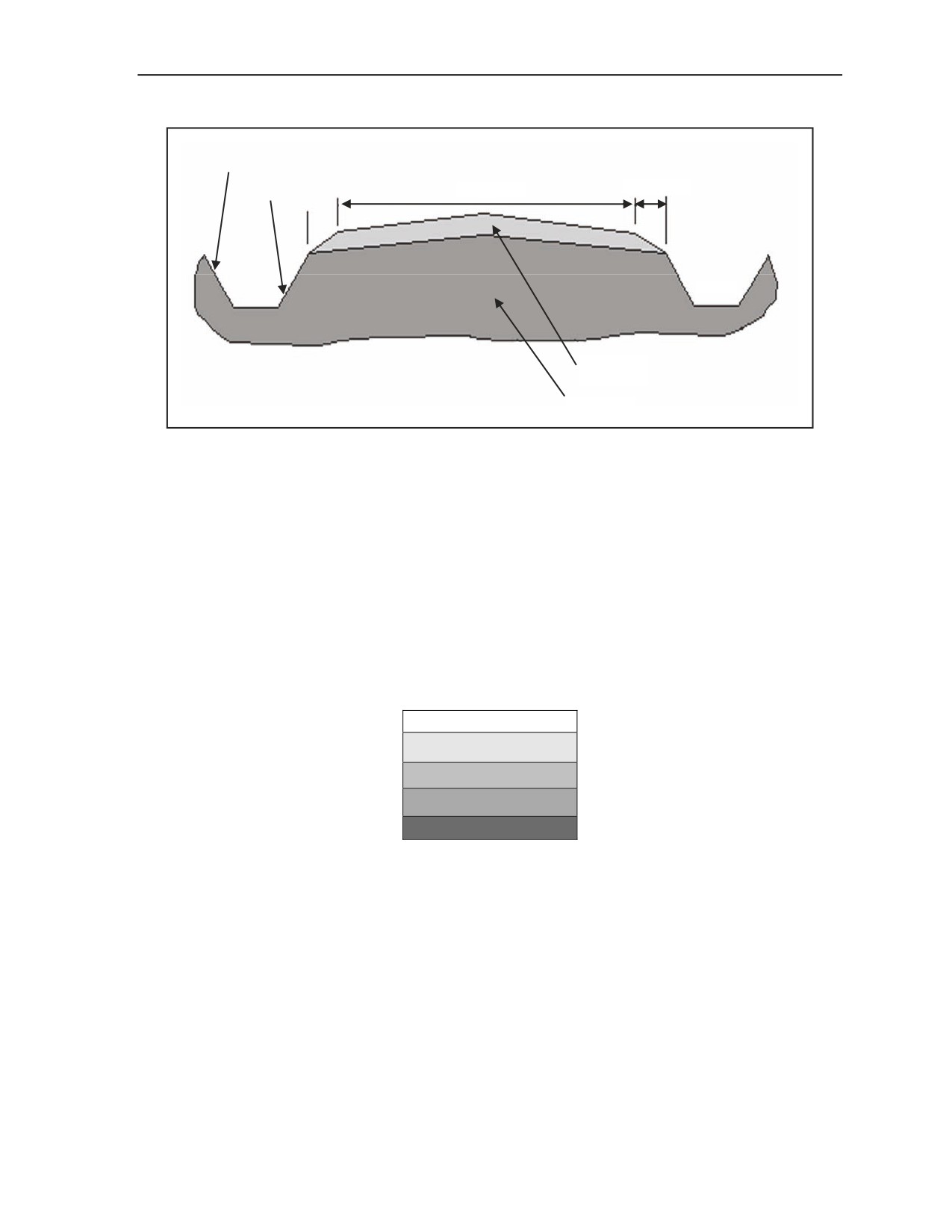
Roads and Railroads
Back slope
Road
Shoulder
Fore slope
Ditch
Pavement
structure
Subgrade
Figure 7-1. Typical road cross section
7-18. A road’s pavement structure sits on top of the subgrade or the soil in place. A layer of compacted
subgrade sits on top of the subgrade, and a layer of select material sits on top of the compacted subgrade. A
layer of subbase material sits on top of the select material, and the base course sits on top of the subbase. A
road may have a flexible pavement
(asphalt) or a rigid pavement (concrete) surface on top of the base
course (figure 7-2). The thickness of a layer depends on the strength of the layer below it. Depending on
design requirements, some layers may not be required. These parts of the pavement structure distribute
wheel loadings over a wide area within the pavement, thereby reducing pressures on the subgrade soils.
During contingency operations, nearly all roads are constructed as aggregate-surfaced roads. These designs
permit the maximum use of readily available materials and are easy to upgrade, permitting great flexibility
to respond to changing operational and mission requirements. When possible, the roadbed should be
aligned to take advantage of the most favorable surface and subsurface terrain. An alignment over soil with
good properties meets the design standards for strength and stability and minimizes the need to remove
undesirable materials.
Asphalt Pavement
Base
Subase
Select material
Compacted subgrade
Figure 7-2. Typical flexible pavement structure cross section
7-19. Traffic flow over roads is far more efficient if curves and grades are held to a minimum. Even gentle
curves significantly decrease traffic capacity if there are too many on a route. Therefore, lay out all routes
with a minimum of curves by making the tangent lines as long as possible. The availability of long tangents
is influenced by terrain. It is also limited by other principles of efficient location, such as minimizing
earthwork, avoiding excessive grades, and obtaining desirable soil characteristics.
7-20. Horizontal curves are circular curves. They connect tangent lines around obstacles, such as
buildings, swamps, and lakes. The following four types of horizontal curves (figure 7-3, page 7-6) may be
used in road construction:
z
Simple.
z
Compound.
9 December 2008
FM 3-34.400
7-5

Chapter 7
z
Reverse.
z
Spiral.
Note. During contingency operations, only simple and compound curves are used because they
are the simplest to design and construct.
Simple
Reverse
R2
R1
Compound
Spiral
R
R1
R2
R changingng
Figure 7-3. Horizontal curve types
7-21. Vertical curves are parabolic as opposed to circular horizontal curves. Vertical curves allow traffic to
maintain reasonable speeds, provide adequate visibility for stopping and passing, and provide a smooth
transition for increased comfort and safety. Overt and invert are the two types of vertical curves (figure
7-4). Vertical curve design determines the amount of cut and fill required to construct a road.
Overt
Invert
“Crest”
“Sag”
Figure 7-4. Vertical curve types
7-22. Earthmoving operations are usually the largest single work item on any project involving the
construction of a road, unless the road will have significant gaps to cross. Any step that can be taken to
avoid excessive earthwork will increase job efficiency. Since all roads are a series of grades that seldom
appear in nature, it is inevitable that some earthwork must be done. However, the amount to be done
should be minimized by properly locating the route. The engineer should take advantage of all prevailing
grades that fall within the required specifications. Excessive grades should be avoided and steep hills
should be bypassed whenever possible. If the route must negotiate excessively steep hills, it should run
along the side of the hill. This may result in a longer route, but will prove to be more efficient in terms of
7-6
FM 3-34.400
9 December 2008
Roads and Railroads
earthwork and trafficability. Following contour lines on hillsides or ridgelines also avoids excessive grades
and drainage construction. It is important to make a careful analysis of the geology and ground cover
within the proposed area of construction. Avoid wooded areas, extremely rocky soils, undesirable humus,
unnecessary clearing, and earthwork.
7-23. When there is need for both cutting and filling at various points along a project, use excavated
material to construct embankments if possible. This reduces the need for earth handling. Plan balancing so
that it fits the hauling capabilities of available equipment. Even though it is desirable to balance earthwork
throughout a project, long hauling distances may make it more practical to open a nearby borrow pit to
obtain fill material or to establish spoil areas to dispose of excess soil. Obviously, balancing cannot be
done where excavated material cannot be used for embankment. If possible, roads should be located near
construction materials. Readily available construction materials require less haul assets.
7-24. When a general route has been selected for new construction, a construction survey is initiated. In
this survey, the team obtains data for all phases of construction activity. Surveys include reconnaissance,
preliminary, final location, and construction layout.
7-25. A reconnaissance survey provides a basis for selecting feasible sites or routes and furnishes
information for use in later surveys. The techniques discussed in the sections above on reconnaissance and
site selection should be used. If a location cannot be selected on the basis of this survey, it will be chosen
in the preliminary survey.
7-26. A preliminary survey is a detailed study of a location tentatively selected on the basis of
reconnaissance, survey information, and recommendations. Surveyors run a traverse along a proposed
route, record the topography, and plot results. Several surveys may be needed if reconnaissance shows that
more than one route is feasible to meet the specified requirements for the road. If the best available route is
not already chosen, it should be selected at this time.
7-27. A final location survey is conducted if time permits. Permanent benchmarks for vertical control and
well-marked points for horizontal control are established. This enables construction elements to accurately
locate and match specific design locations with those on-site.
7-28. A construction layout survey is the final operation before construction begins. In this instrument
survey, alignment, grades, and locations are provided to guide construction operations. To enable
construction to begin, exact placement of the centerline is made; curves are laid out; all remaining stakes
are set, such as slope, grade, and shoulder; necessary structures are staked out; culvert sites are laid out;
and other work is performed. This survey is used until construction is complete. The main purpose of
construction surveys is to ease and control construction. The number of surveys conducted and the extent
to which they are carried out are largely governed by available time, construction standard, and by
personnel and material assets. Roads constructed to initial standards may be constructed with minimal
preplanning and construction control. However, extensive surveys may be conducted for a road built to
temporary standards. The quality and efficiency of construction is strongly related to the number and extent
of surveys and other preplanning activities.
7-29. Adequate drainage is essential during construction of a military road or airfield. Immediately provide
adequate drainage for the site to ensure that all water that might interfere with construction operations is
removed. Eliminate construction delays and subgrade failures due to ponding of surface water by
aggressive, timely development of a drainage system. Include temporary measures, such as pumping.
During clearing and grubbing operations, keep existing or natural watercourses clear and fill and compact
holes and depressions to grade. Rough crown and grade must be maintained to permit water from
precipitation, sidehill seeps, and springs to move freely away from worksites by gravity flow. If water is
permitted to pond, the subgrade becomes saturated and fails under load, earthmoving is impeded, and the
need for equipment maintenance is increased.
7-30. In permanent peacetime construction, underground drains are often used because of efficient use of
space, environmental considerations, and safety practices do not permit large open ditches, particularly for
disposal of collected runoff. In contrast, designs for road drainage in contingency operations use surface
ditching almost exclusively because of limited pipe supplies and the absence of storm sewer systems to
collect runoff. The drainage system is designed to remove surface water effectively from operating areas,
9 December 2008
FM 3-34.400
7-7
Chapter 7
to intercept and dispose of runoff from adjoining areas, to intercept and remove detrimental conditions of
the selected design storm, and to minimize the effects of exceptionally adverse weather conditions.
7-31. The proposed use of the road is considered. If it is to be used only for a short time, such as one or
two weeks, a detailed drainage design is not justifiable (see FM 3-34.2). However, if improvement or
expansion is anticipated, design drainage so that future construction does not overload ditches, culverts,
and other drainage facilities. Drainage problems are greater when all-weather use occurs whether than
when only intermittent use occurs. The availability of engineer resources should be considered. Heavy
equipment (such as dozers, graders, scrapers, and excavators) is commonly used on drainage projects. But
where unskilled labor and hand tools are readily available, much work can be done by hand. When the
necessary reconnaissance and mission analysis are complete, the engineer prepares an estimate of the work
and materials required and a plan for carrying out the construction. The engineer must schedule the priority
and rate of construction and provide for the even flow of material to ensure orderly progress. Schedules
must continually be updated to accommodate changed field conditions or other exigencies. In addition to
their planning function, the schedules can also serve as progress charts.
7-32. When earthwork estimation, equipment scheduling, and necessary surveys are complete, the
construction sequence can begin. The construction site is prepared by clearing, grubbing, and stripping.
These operations are usually done with heavy engineer equipment. Hand or power felling equipment,
explosives, and fire are used when applicable. The factors determining the methods to be used are the
acreage to be cleared, the type and density of vegetation, the terrain's effect on equipment operation, the
availability of equipment and personnel, and the time available for completion. For best results, a
combination of methods should be used, choosing each method for the operation in which it is most
effective.
7-33. Cut and fill operations are conducted when clearing, grubbing, and stripping are finished. Cut and
fill operations are the biggest part of the earthwork in road construction. The goal of cut and fill work is to
bring the route elevation to design specifications. Throughout the fill operation, the soil is compacted in
layers (lifts). Compaction is achieved with self-propelled or towed rollers. The end product is a structure
that minimizes settlement, increases shearing resistance, reduces seepage, and minimizes volume change.
The advantages that accompany soil compaction make this process a standard procedure for constructing
embankments, subgrades, and bases for road and airfield pavements. Cut and fill and compaction efforts
are intended to achieve the final grade. This alignment takes into consideration super elevation along
curves to ensure load stability, and falls within the grade specifications required for the military road.
When final grade is achieved, ditching is cut to control drainage runoff and the road is crowned along its
centerline. The road is now ready for surfacing.
7-34. During contingency operations, consider whether or not to pave a road by taking account of the
urgency of its completion, the tactical situation, the expected traffic, the soil-bearing characteristics, the
climate, the availability of materials and equipment, and the necessity of dust control. Pavements, including
the surface and underlying courses, are divided into two broad types—rigid and flexible. The wearing
surface of rigid pavement is made of portland cement concrete. Asphalt cement concrete pavements are
classified as flexible pavements.
7-35. Flexible pavements are used almost exclusively in contingency operations. They are adaptable to
almost any situation and fall within the construction capabilities of normal engineer troop units. Rigid
pavements are not usually suited to construction requirements during contingency operations. Because
flexible pavements reflect distortion and displacement from the subgrade upward to the surface course,
their design must be based on complete and thorough investigations of subgrade conditions, borrow areas,
and sources of select materials, subbase, and base materials.
7-36. Another option to improve the road’s ability to support traffic is soil stabilization. The goals of soil
stabilization are stabilization of expansive soils, soil waterproofing, and dust control. Strength
improvement increases the load-carrying capability of the road. Dust control alleviates or eliminates dust
generated by vehicle and aircraft operations. Soil waterproofing maintains the natural or constructed
strength of a soil by preventing water from entering it. Stabilization is generally accomplished by either
mechanical or chemical methods.
7-8
FM 3-34.400
9 December 2008
Roads and Railroads
In mechanical stabilization, soils are blended and then compacted. In chemical stabilization, soil particles
are bonded to form a more stable mass. Additives are used (such as lime, bitumen, or portland cement).
7-37. All unpaved roads will give off dust under traffic. Dust is usually an inherent problem. The amount
of dust that an unpaved road produces varies greatly, depending on local climatic conditions and the
quality and type of aggregate used to construct the road. Common dust control agents include chlorides,
resins, natural clays, asphalts, and other commercial binders and membranes. Dust control and soil
waterproofing can be carried out by applying these agents in a spray (soil penetrants); a mix (admix); or by
laying aggregate, membrane, or mesh as a soil blanket. The agronomic method, using vegetation cover, is
suited to stable situations, but is rarely useful during contingency operations. Ensure that the aggregate
surface of the road has good gradation, there is a good crown on the driving surface and good drainage,
equipment is calibrated accurately and working properly, and rehearse the application of the agent using a
test strip for the effective application of any stabilizer or dust control agent.
7-38. Expedient surfaces may be used as a temporary means to quickly cross small areas with extremely
poor soil conditions, such as swamps, quicksand, and wetlands when there is not enough time or resources
for standard road construction. The following are the two types of expedient roads:
z
Hasty. Hasty expedient roads are built quickly to last only a few days.
z
Heavy. Heavy expedient roads are built to last until a durable standard road can be constructed.
Expedient surfacing methods include cross-country tracks, Army tracks, chespaling, corduroy, landing mat,
chain-link wire mesh, plank roads, and snow or ice roads.
UPGRADING EXISTING ROADS
7-39. Wherever possible, existing facilities are used. In most areas, an extensive road network already
exists. With expansion and rehabilitation of the roadway and preparation of adequate surfaces, this network
can carry required traffic loads. Upgrading an existing road, combined with routine maintenance and
repair, usually involves reducing or eliminating obstructions. It is the preferred method of improving the
trafficability of a selected route. Techniques, equipment, and materials needed for upgrading are generally
the same as those required for new road construction. A changing tactical situation and unpredictable
military operations may also require that engineer troops modify and expand completed construction. The
location of a road should allow for potential expansion. Expanding an existing route or facility conserves
manpower and material and permits speedier completion of a usable roadway.
ROAD MAINTENANCE AND REPAIR
7-40. Road maintenance is the routine prevention and correction of damage and deterioration caused by
normal use and exposure to the elements. Repair restores damage caused by abnormal use, accidents,
hostile forces, and severe environmental actions. Rehabilitation restores roads that have not been in the
hands of friendly forces and do not meet operational requirements.
7-41. Routine maintenance and repair operations include inspections, stockpiling materials for
maintenance and repair work, maintenance and repair of road surfaces and drainage systems, dust and mud
control, and snow and ice removal. The main purpose of maintenance and repair work is to keep road
surfaces in usable and safe condition. It also increases route capacity and reduces vehicle maintenance
requirements. Effective maintenance begins with a command-wide emphasis stressing good driving
practices to reduce unnecessary damage. Once damage has occurred, prompt repair is vital. After
deterioration or destruction of the road surface begins, rapid degeneration may follow. A minor
maintenance job that has been postponed becomes a major repair effort involving reconstruction of the
subgrade, base course, and roadway surface. The following principles should be observed in conducting
sound road maintenance and repair:
z
Minimize interference with traffic. To keep surfaces usable, maintenance and repair activities
should interfere as little as possible with the normal flow of traffic. A temporary bypass may be
required.
9 December 2008
FM 3-34.400
7-9
Chapter 7
z
Correct the basic cause of surface failure. Efforts spent to make surface repairs on a defective
subgrade are wasted. Any maintenance or repair job should include an investigation to find the
cause of the damage or deterioration. That cause must be remedied before the repair is made. To
ignore the cause of the damage is to invite prompt reappearance of the damage.
z
Reconstruct the uniform surface. Maintenance and repair of existing surfaces should conform
as closely as possible to the original construction in strength and texture. Simplify maintenance
by retaining uniformity. Spot-strengthening often creates differences in wear and traffic impacts,
which are harmful to the adjoining surfaces.
z
Assign priorities. Priority in making repairs depends on the operational requirements,
commander’s guidance, traffic volume, and hazards that would result from complete failure of
the facility.
7-42. The purpose of maintenance inspections is to detect early evidence of defects before actual failure
occurs. Frequent inspections and effective follow-up procedures prevent minor defects from becoming
serious and causing major repair jobs. Surface and drainage systems and the road pavement should be
inspected. Pavement surface defects can usually be attributed to excessive loads, inferior surfacing
material, poor subgrade or base conditions, inadequate drainage, or a combination of these conditions.
Ensure that all drainage channels and structures are unobstructed. Special vigilance must be exercised
during rainy seasons, spring thaws, and after every heavy storm.
7-43. Generally, the materials required in road maintenance and repair are the same as those used in new
construction. Maintenance activities may include opening pits and stockpiling sand and gravel, base
materials, and premixed cold patching material. Materials should be placed in convenient locations and in
sufficient quantities for emergency maintenance and repair. Stockpiles should be arranged for quick
loading and transporting to key routes.
7-44. In some areas, extensive repairs are often needed to make roads usable. Advance engineer units
usually do this work. Under the pressure of combat conditions, repairs are sometimes temporary and
hurriedly made with the most readily available materials. Such expedient repairs are intended only to meet
immediate minimum needs. As advance units move forward, other engineer units take over additional
repair and maintenance. Early expedient repairs are supplemented or replaced by more permanent work.
When surfaces are brought to a standard that will withstand the required use, only routine maintenance is
performed.
7-45. Engineer units establish a patrol system to cover the road net for which the unit is responsible.
Periodic patrols by other elements, such as the military police, who use the road net on a sustained and
frequent basis, may also assist with this system. Engineer road maintenance and repair modules are
organized with personnel, equipment, and supplies to accomplish road repair and maintenance in a specific
area. As many modules as needed are organized to cover the total AOR. The traffic level and the limited
durability of a road sometimes make it necessary to put the maintenance function on a 24-hour-a-day basis
in heavy traffic areas. A squad-sized road maintenance and repair module equipped with a dump truck,
grader, and hand tools can usually carry out all maintenance and minor repairs encountered on a 5- to 15-
mile stretch of road. This module or force package can be increased or decreased, and more or fewer miles
can be assigned to a module as the mission dictates. Security conditions may affect the size and
composition of these elements and the method of employment.
7-46. During contingency operations, winter weather may present special maintenance problems. Regions
of heavy snowfall require special equipment and material to keep pavements and other traffic areas open.
Low temperatures cause icing on pavements and frost effects on subgrade structures. Alternate freezing
and thawing may cause damage to surfaces and block drainage systems with ice. Spring thaws may cause
both surface and subgrade failures and may damage bridging. Winter maintenance consists chiefly of
removing snow and ice, sanding icy surfaces, erecting and maintaining snow fences, and keeping drainage
systems free from obstruction. Each command should publish a comprehensive snow and ice control plan
that clearly specifies the responsibilities of engineer and nonengineer units. Engineer and nonengineer
patrols must be established to monitor snow and ice conditions within the AO. Available snow and ice
control equipment and supplies must be allocated to support the plan.
7-10
FM 3-34.400
9 December 2008
Roads and Railroads
RAILROAD RESPONSIBILITIES AND PLANNING
7-47. The ability to move troops and materiel may well decide the outcome of a conflict. Railroads provide
one of the most effective and efficient forms of land transportation available to forces during contingency
operations. They can move great tonnages of materiel and large numbers of personnel long distances. They
move with considerable regularity and speed under practically all weather conditions. Railroads are
flexible and versatile; rolling stock may be tailored for almost any use. Extensive railway systems exist in
most regions of the world with an interoperability provided by standard equipment and common gauge.
Due to these capabilities, railroads may be the preferred means of transportation during contingency
operations. The degree to which a rail system may be exploited depends on its capacity (length and
condition of existing track, condition of rolling stock, and other facilities) and its ability to operational
support and mission requirements while still maintaining essential commercial traffic. FM
4-01.41
describes the organizations, processes, basic construction and maintenance standards, and systems involved
in rail operations.
7-48. Engineers are responsible for new railroad construction. The transportation railway battalion is
responsible for operating railroads and performing rehabilitation and routine maintenance. Each
transportation railway battalion may be assigned from 90 to 150 miles of main line with terminal operating
and maintenance facilities, signaling equipment, and interlocking facilities necessary for operation. Where
HN agreements exist, day-to-day operations and maintenance may be largely conducted by the local work
force.
7-49. Reconnaissance and selection of new routes is done by transportation units in coordination with
engineers. Although transportation units have the responsibility for routine maintenance, engineers must be
prepared to provide construction support in cases where additional maintenance beyond the organic
capabilities of transportation units is required. All existing facilities must be used to the maximum extent
possible to minimize construction time and effort. New railroad construction will normally consist of short
spurs to connect existing networks with military terminals or to detour around severely damaged areas. The
focus of engineer effort should be on modifying and repairing existing railroads to meet operational and
mission requirements. Local labor and management are key to the rapid modification and continuing
maintenance of existing facilities. Local personnel can often supply materials and skilled labor to speed the
work and relieve military personnel for other projects. Local railway operating personnel are also a source
of information on existing operations and supply facilities in a given area. Railroads constructed during
contingency operations may have lower factors of safety, sharper curves, and steeper grades than
recommended by the American Railway Engineering Association. Once the minimum standard for
immediate service has been attained, phased improvements can be made, provided the importance of the
line justifies the effort.
7-50. A simple steel stringer-type bridge supported on timber trestles or piles satisfies most railway
bridging requirements. The construction process begins with a determination of design requirements. In
most cases the design criteria should consider copper E80 loads (a train with a locomotive weight of 520
metric tons and axle loads equal to 37 metric tons). The engineer must establish immediate liaison with the
Transportation Corps to develop the—
z
Mission and required capacity of the proposed systems.
z
Type and size of rolling stock to be operated.
z
Track gauge.
z
Initial, intermediate, and final terminal points along the route.
z
Required servicing and maintenance of facilities.
z
Connections with other rail systems.
z
Required maximum gradient and degree of curvature.
z
Scheduling or timetable for construction.
z
Direction of future development and expansion.
7-51. Upon determining the design requirements, transportation unit representatives and engineers will
conduct a reconnaissance to determine the siting of the rail system. The surveys, studies, and plans required
9 December 2008
FM 3-34.400
7-11
Chapter 7
for constructing a railroad are necessarily more elaborate than those for most road construction. Studies of
the best available topographic maps, imagery, and other geospatial products narrow the choice of routes to
be reconnoitered. Factors that affect the location of a route include logistics, length of line, curvature,
gradients, and ease and speed of construction. Each of the factors of METT-TC may have an effect on the
determination of the site of a railroad, just as they affect the location of a road.
7-52. Logistics are nearly always the primary consideration when selecting a rail route during contingency
operations. Normally, a rail line will extend from a SPOD, APOD, beachhead, or other source of supplies
in theater to the logistics support areas sustaining the forces present. Alternate routes are desirable for
greater flexibility of movement and as insurance against cases of mainline obstruction as a result of threat
actions, wrecks, washouts, floods, fires, or landslides.
7-53. The length of line (mileage from point of origin to terminus) is important only when it adds
materially to the time of train movement. As much as a 30 percent increase in mileage is permissible when
it proves advantageous to the other factors involved.
7-54. Curvatures should be minimized as much as possible and be consistent with the speed of
construction. Curvature for a military railroad will depend largely on the maximum rigid wheelbase of cars
and locomotives. Superelevation is used to counteract centrifugal force on curves by raising the outer rail
higher than the inner.
7-55. The ruling grade of a route is the most demanding grade over which a maximum tonnage train can be
handled by a single locomotive. Where diesel electric units are used, a single locomotive may consist of
two or more units coupled to work as a single locomotive that is controlled from the cab of the leading
unit. The ruling grade is not necessarily the maximum grade. Steeper grades can be negotiated with the use
of an additional locomotive as a helper engine or, if the grade is very short, the train may be carried over
the crest by momentum. Since military railroads operate at slow speeds, the ruling grade must be kept to a
minimum. As always, the necessity for rapid construction must be a top priority.
7-56. The route should be chosen so that the railroad line can be quickly constructed using minimal
resources. Transportation facilities must be available as soon as possible to support contingency operations.
Many additional hours of earthwork and grading can be avoided by a careful route selection.
7-57. A complete ground reconnaissance of the possible routes is required. The reconnaissance team
should note odometer and barometer observations of distances and elevations, general terrain
characteristics, the controlling curvatures, soil and drainage conditions, bridge and tunnel sites, the size and
type of bridges needed, intersections with railways or important roads, availability of ballast and other
construction material, and points at which construction units would have access to the railway route.
Factors to be taken into consideration include the roadbed, rock cuts, hillsides, drainage, security, water
supply, passing track, and surveys.
7-58. The roadbed should be built on favorable soils. Clay beds, peat bogs, muck, and swampy areas are
unstable foundations and provide unsuitable soils for building fills. Cuts through unfavorable soils will
slough and slide. Seek minimum earthwork in locating the roadbed and track. Where rock cuts are
proposed, bedding planes should dip away from the track to prevent rockslides. Locations at the foot of
high bluffs subject the track to rock falls, slides, and washouts. Rock work is time-consuming and should
be avoided whenever practicable. In the temperate zone, choose sites along the leeward side of hills. This
prevents snowdrifts and resists the effect of winds.
7-59. The proposed site should facilitate drainage or prevent the need for it. Ridge routes are best for this
purpose, but may be exposed to enemy fire or observation. Avoid locations that require heavy bridging.
Note that diesel equipment cannot be operated over a track that is inundated above the top of the rail
because water will damage traction motors. If a steam operation is planned, an adequate water supply must
be available at 15- to 20-mile intervals along the route. Suitable sites for passing sidings must be planned.
Passing track spacing depends on traffic density and expected peak conditions of traffic flow.
7-60. The preliminary survey includes cross sections along the feasible routes. Trail locations are plotted
and adjusted to give the best balance of grades, compensated grades, cuts, and fills. This establishes or
fixes the line of the railroad.
7-12
FM 3-34.400
9 December 2008
Roads and Railroads
Field survey parties locate the precise line and stake it. This requires much more precision than the location
survey of most new roads, since curves and super elevations must be accurately computed.
7-61. When the necessary reconnaissance and surveys are complete, the engineer prepares an estimate of
the work and materials required and a plan for carrying out the construction. The engineer must schedule
the priority and rate of construction and provide for the even flow of material to ensure orderly progress.
Schedules must continually be updated to accommodate changed field conditions or other exigencies. In
addition to their planning function, the schedules can also serve as progress charts.
RAILROAD CONSTRUCTION
7-62. As a first stage in organizing the work, the engineer divides the line into sections in which special
features (such as bridges, stations, yards, and rock cuts) can be constructed while other work is in progress.
Work can proceed concurrently at several locations. The standard construction sequence is as follows:
z
Clear and grub.
z
Prepare the subgrade by cutting or filling and compacting.
z
Unload and distribute track materials.
z
Align and space cross ties.
z
Place line rails or ties.
z
Place gauge rail on ties to ensure proper spacing.
z
Line the track.
z
Unload ballast.
z
Raise and surface track.
z
Make final alignment.
7-63. In addition to the actual rail line, certain facilities are necessary to rail operations or are required due
to particular physical conditions. Sidings are auxiliary tracks next to the main line. They are used for
meeting and passing trains, for separating and storing equipment that breaks down en route, and for storing
rolling stock that cannot be moved to its destination. The transportation unit responsible for operating the
railroad will determine siding locations in coordination with the engineers. Sidings are built parallel to the
rail line. The siding should be 250 feet longer than the longest train that will use it. Generally, the siding
has a turnout at either end.
7-64. Highway and road crossings at grade should be avoided wherever possible. When crossings must be
installed, they should be constructed so that the axis of the road is approximately perpendicular to the
centerline of the railroad. Rail crossings carry one track across another at grade and permit passing wheel
flanges through opposing rails. The design of frogs to allow these crossings depends on the angle at which
they cross. In military railroads, most frogs are made of precast, immobile rails that can be easily installed.
7-65. Wyes are used in place of turntables, which are normally impractical for use in contingency
operations. Wyes may be installed at engine terminals, summits, junctions, and railheads as time permits.
In some cases, the wye’s stem may be long enough to permit turnaround of the entire train.
7-66. Service facilities should be laid out so that servicing operations can be performed in the proper
sequence as the locomotive moves through the terminal. The usual relation of operations and facilities from
terminal entrance to terminal exit is—
z
Inspection (inspection pits or platforms).
z
Lubrication (during inspection) (oil and grease service areas).
z
Cleaning fires and ash pits (for steam locomotives).
z
Coal, sand, diesel oil, and water (appropriate facilities).
z
Running repairs (engine house).
z
Outbound movement (the ready track and wye).
9 December 2008
FM 3-34.400
7-13
Chapter 7
7-67. Structures are needed for crew headquarters, maintenance personnel, tools, material storage, and
block stations. Block stations are facilities that house the switching and signaling equipment that controls
train movements.
7-68. A railhead is at the end of a railroad line. Yards are a system of tracks that serve the following three
basic functions:
z
One or more tracks long enough to receive an entire train.
z
A system of shorter tracks for the storage or classification of freight.
z
Departure tracks on which rolling stock from the classification yard may be assembled for
dispatch.
7-69. In addition to the auxiliary facilities described above, other specific construction requirements may
be dictated by the terrain or operational requirements. Special equipment, materials, and expertise may be
required to construct a railroad and its accompanying facilities to quickly and efficiently support units.
RAILROAD MAINTENANCE AND REPAIR
7-70. Rail lines and supporting facilities must be inspected regularly to ensure adequate maintenance and
proper operation. Necessary action must be undertaken as quickly as possible to minimize future repair
requirements. Preventive maintenance, including the proper cleaning and lubrication of equipment and
machinery, will minimize the need for unnecessary maintenance and repairs. The upkeep of railroads is
essential to the smooth flow of troops and supplies to the needed areas. Railroads are susceptible to
maintenance problems, and vulnerable to enemy attack, guerrilla operations, and sabotage. Railroads used
by the transportation railway service are normally already located and constructed. The rail transportation
officer’s task is to make the most efficient use of existing facilities by maximizing maintenance efforts.
7-14
FM 3-34.400
9 December 2008
Chapter 8
Bridging
History shows that army campaigns in undeveloped countries have often involved
waging war against natural obstacles, rather than against a foe.
Air Marshall E. J. Kingston-McCloughry
Military traffic engaged in rapid decisive maneuvers must be able to cross wet or dry
gaps in existing road networks or natural high-speed avenues of approach. Very few
LOCs will exist without some form of bridge, bypass, or detour. Maneuver forces and
logistics support depend on four types of bridging—tactical, support, LOC, and
existing or permanent bridges. Tactical operations of combined arms forces within
the BCT are primarily focused on the first two of these forms of bridging or the
seizure of existing or permanent bridges. Tactical bridging is typically linked to
combat engineers and immediate support of combined arms ground maneuver. See
FM 3-90.12 for a more in-depth discussion of bridging as a component of combined
arms gap-crossing operations. See FM 3-34.170 for the specifics of reconnaissance
associated with bridging. Engineers enable mobility through construction, repair, and
reinforcement of bridges; by providing bridge reconnaissance and classification; and
in the construction of bypasses and detours. The specific mission undertaken is
planned in a manner that maintains the momentum of the force. Bypasses and fording
sites can be used to overcome obstacles when it is more feasible or when no bridges
are available. Existing bridges may need to be repaired or reinforced to keep MSRs
and LOCs open. As the tactical situation changes, MSRs are moved or adjusted to
support the force. Forward elements may demand that expedient, standard, and
nonstandard structures be emplaced to replace tactical bridging and support bridging
and those assets returned for their use by the combat maneuver elements of the force.
These types of bridges are not designed for the multiple passes that are typical for
MSRs and will need to ultimately be replaced by other bridging. Requirements for
engineer units to employ tactical, support, and LOC bridging will continue
throughout the fight.
BRIDGE TYPES AND CATEGORIES
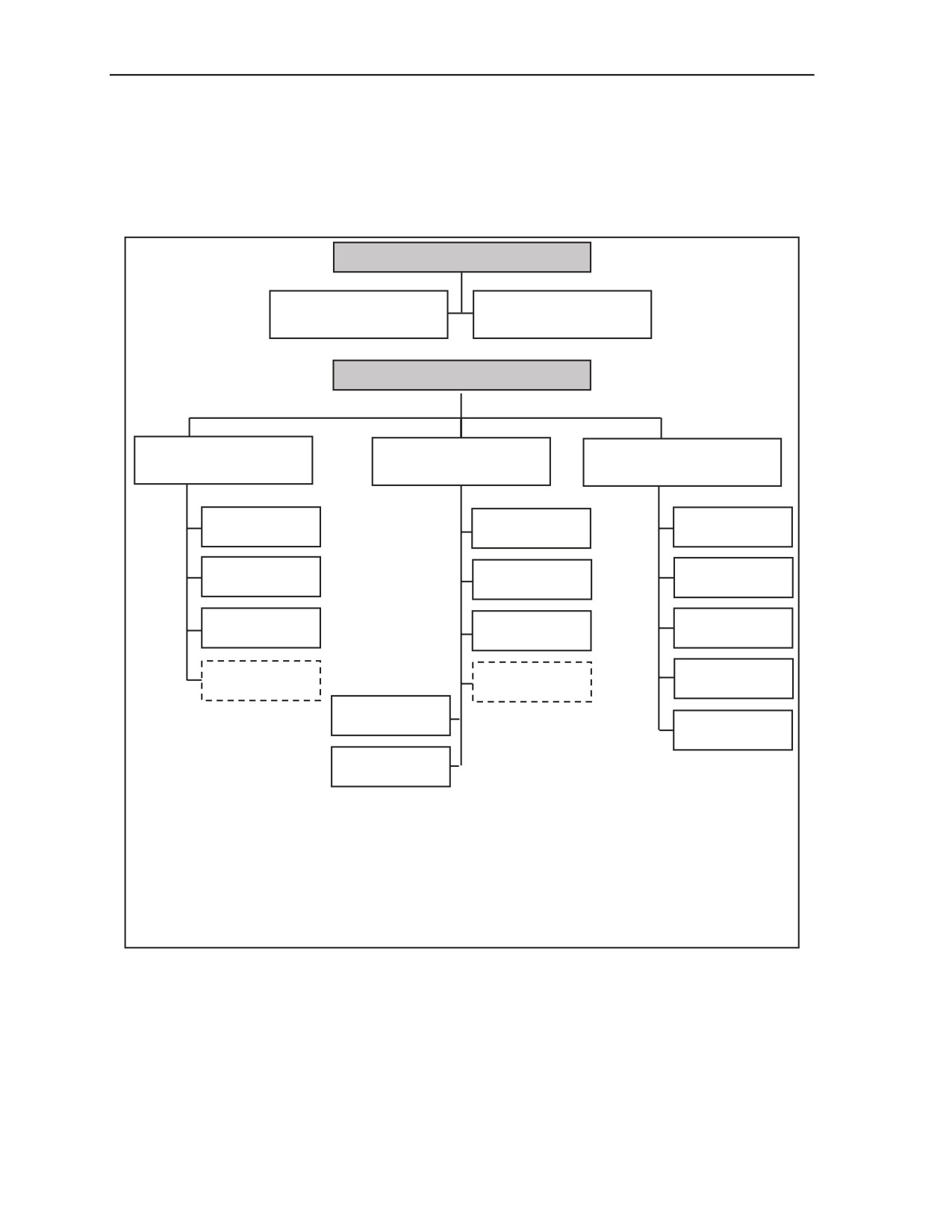
8-1. The two basic bridging types are standard and nonstandard (figure 8-1, page 8-2). While the two
types could be combined as a hybrid of some nature, the bridge will normally be identified by the
predominant components of the bridge. Standard bridging includes any bridging derived from
manufactured bridge systems and components that are designed to be transportable, easily constructed, and
reused. Examples of standard bridging include the Wolverine, dry support bridge (DSB), and Bailey
bridges. Nonstandard bridging is purposely designed for a particular gap and typically built using COTS or
locally available materials. They are used when time permits, and materials and construction resources are
readily available; when standard bridging is inadequate, unavailable, or being reserved for other crossings;
and the situation allows for unique construction. These bridges are left on-site, even when they are no
longer necessary to support military movement. Nonstandard bridging is typically constructed by
construction engineers or contractors using construction materials, such as steel, concrete, and/or timber.
9 December 2008
FM 3-34.400
8-1
Chapter 8
8-2. There are three bridging categories (figure
8-1) and they are broadly defined by their intended
purposes. These categories include tactical bridging, support bridging, and LOC bridging. The bridging
category is typically dictated by the OE, gap characteristics, and equipment available. They are subordinate
to the bridging types and can be standard or nonstandard. As the situation changes, crossing sites may be
abandoned, improved, or replaced with the appropriate alternatives that provide appropriate solutions for
each site.
Bridging Types
Standard Bridging
Nonstandard Bridging1
Bridging Categories
Tactical Bridging
Support Bridging
LOC Bridging
LSB
AVLB
REBS2
JAB
DSB
Bailey3
Wolverine
MGB
XS 700
REBS2
Bailey3
Railroad Bridging
SRB
Other COTS
RB4
Notes.
1. Constructed from locally available, suitable materials.
2 and 3. While most bridge systems are designed for use in a particular bridging category for various reasons, it may be
appropriate to use the REBS and Bailey as shown.
REBS: Primary - Support; Secondary - Tactical
Bailey: Primary - LOC; Secondary - Support
4. Wet bridges can only be used over wet gaps. Some dry bridges can be used over wet or dry gaps.
Figure 8-1. Types and categories of bridging
TACTICAL BRIDGING
8-3. Tactical bridging is rapidly deployable with the mobility to maintain the pace of operations with the
maneuver force it supports. Tactical bridging is typically linked to combat engineers and immediate
support of combined arms ground maneuver. The actual bridge can be deployed and recovered without
exposing the crew to direct or indirect fire. There are little to no requirements for bank preparation when
8-2
FM 3-34.400
9 December 2008
Bridging
using tactical bridging assets. It takes minimal time to deploy and recover for temporary crossings.
Engineers use primarily four bridge systems to conduct tactical bridging operations. They are the—
z
Armored vehicle-launched bridge (AVLB).
z
Joint assault bridge (JAB).
z
Wolverine.
z
Rapidly emplaced bridge system (REBS).
8-4. Unfortunately, the AVLB is an old system that is prone to maintenance problems, and lacks the
speed to maintain momentum with heavy brigade combat team (HBCT) and Stryker brigade combat team
(SBCT)-based maneuver forces. The REBS meets all the requirements for tactical bridging except that the
crew is exposed to enemy fires during emplacement and can only support a military load classification
(MLC) of 30. At this time, the Wolverine is the only bridge that meets all the desired tactical bridging
criteria. Although tactical bridging can be used on LOCs, planners will often find that this limited resource
should only be used for a limited time until some other bridging method can be employed. Tactical
bridging is not designed to accept the repeated number of crossings associated with LOC sustained use.
Additionally, it is often important to release these bridges so that adequate tactical bridging is available to
support combat maneuver within the force and sustain the desired or required tempo of operations.
SUPPORT BRIDGING
8-5. Support bridging is used to establish semipermanent or permanent support to planned movements
and road networks. It is used to replace tactical bridging as it provides greater gap-crossing capability to
the force than tactical bridging. Units typically deploy and recover these systems when and where little or
no direct fire threat exists. Bank preparation and improvement are important planning factors for support
bridging. The support bridging category contains all float bridges in the Army inventory: the standard
ribbon bridge (SRB) and the improved ribbon bridge (IRB). Other support bridges include the medium
girder bridge (MGB), DSB, Bailey panel bridge, and REBS. Although a REBS is often considered a
tactical bridge, it is more accurately described as a support bridge because it lacks crew survivability.
FLOAT BRIDGING
8-6. Float bridges are designed to cross maneuver forces over wet gaps by either building raft
configurations to transport forces across the wet gap, or by emplacing bays to span the entire width of the
wet gap. There is generally no design limit to the length of this bridge. The normal limiting factor is the
quantity of bays and boats; however, velocity or current of the water, tidal variation, water depth,
underwater obstructions and floating debris, and entry and exit bank slopes can limit float bridge
operations. Descriptions and construction techniques for the SRB are found in FM 5-34 and for the IRB the
techniques are explained in TM 5-5420-278-10. Float bridging may be used when there is a lack of
existing fixed facilities or no suitable construction materials to fabricate, reinforce, or repair existing
bridges. When the situation calls for prolonged use or heavy traffic, an existing bridge should be upgraded
or new construction initiated.
8-7. Criteria for establishing a float bridge site may be the same as those for general bridge site selection
criteria. The following are specific float bridge site considerations:
z
Banks should be low, firm, moderately sloping, and free from obstructions. Existing or easily
prepared assembly sites are desirable.
z
Stable banks should have a slope of 8° or less and a water depth of at least 48 inches on the
nearshore.
z
Water velocity near the shore should be less than 5 feet per second, if the current is faster (up to
10 feet per second), then additional boats and time will be required to emplace the bridge.
z
Natural holdfasts for anchorages are desirable. Float bridging must be installed far enough
downstream from a demolished or under-capacity bridge to avoid interference with
reconstruction or reinforcement operations. Unstable portions of a demolished bridge and other
debris that may damage the float bridge should be removed before the emplacement of the float
bridge.
9 December 2008
FM 3-34.400
8-3
Chapter 8
LINE OF COMMUNICATIONS BRIDGING
8-8. LOC bridging is generally conducted in areas free from the direct influence of enemy action.
Typically, its primary purpose is to facilitate sustainment of the force. It can be used as a semipermanent or
permanent structure. LOC bridges are built with the assumption that once emplaced, they will not be
removed until a permanent structure is constructed to replace them. LOC bridges may be tactical fixed
bridges if the intention is to leave the system in place for an extended period of time and they are not
required for the support of combat maneuver. Planning factors should then account for the extended use of
the bridge and any wear that will occur as a result of the extended use. A common consideration for LOC
bridges is planning for the possibility that an existing permanent bridge has been damaged or is not strong
enough for mission requirements. Engineers will repair and reinforce a bridge, if necessary, by either using
standard or nonstandard materials to meet mission requirements. New construction of LOC bridges is
possible; however, improving existing structures is the primary focus because of the intense resource
requirements associated with new construction.
8-9. Railroad brides are LOC bridges and are classified as nonstandard bridges. The U.S. Army does not
currently have design criteria for nonstandard railroad bridges nor does it maintain railroad float bridge
equipment. Many varieties of standard railroad bridges are available through AFCS. Construction details
and BOMs are given in TM 5-302. Standard railroad bridging is available for the Bailey bridge and certain
contracted panel bridges. Repair and reinforcement of existing railroad bridges is a much more viable
option than new construction in most cases. Nonstandard railroad bridging can be repaired or improved
using any available and suitable materials. Railroad bridges will require specialized construction equipment
and large quantities of labor. This generally precludes the construction of railroad bridges at locations away
from existing rail lines. When a site must be selected, use the basic criteria for general bridge sites.
8-10. The urgency of the situation or lack of additional bridging assets may require that a railroad bridge
be converted into a highway bridge by constructing a smooth roadway surface. The use of the bridge by
both rail, wheeled, and tracked vehicles can be achieved by constructing planking along the ties between
and outside the rails up to the level of the top of the rail. The roadway surface is made flush with the top of
the rail with adequate distance from the rails to allow use by train wheels. The additional dead load of
roadway decking must be factored into the bridge classification to determine safe traffic loads. Since
railroad loadings are usually heavier than highway loadings, it is seldom practical to convert a highway
bridge to railway use.
BRIDGE SITE SELECTION
GEOSPATIAL CONSIDERATIONS
8-11. Engineers have the ability to use the engineer function of geospatial engineering to greatly improve
situational understanding (to include terrain) and select optimal bridging sites. High-resolution satellite
imagery or UAS video are precise pictures of terrain. The requirement for the engineer is to have the
appropriate software. Engineer terrain teams should assist in determining conditions in areas at or around
potential gap-crossing sites. Terrain teams have software that can assist in mission planning by determining
soil conditions, hydrology, vegetation types, general weather patterns, and other useful aspects of the
terrain.
8-4
FM 3-34.400
9 December 2008
Bridging
RECONNAISSANCE
8-12. Engineer reconnaissance teams should be used to collect data to determine acceptable terrain and
conditions for new construction. Using the results of reconnaissance (see FM 3-34.170), planners can
determine which type of bridge or bridge combinations are right for the mission based on available
resources. The location ultimately chosen for the bridge is determined by numerous factors which are
reflected in its structural design. Primary screening considerations include—
z
Access and approach roads. Determine if the preexisting roads are adequate. Remember that
the time to construct approaches can be a controlling factor in determining if a crossing site is
feasible. Ensure that approaches are straight, with two lanes, and less than a 6 percent slope.
z
Width. Determine the width of the gap to be spanned at both normal and flood stage for wet
gaps.
z
Banks. Estimate the character and shape of the banks accurately enough to establish abutment
positions. Ensure that the banks are firm and level to limit the need for extensive grading. Select
straight reaches to avoid scour.
z
Flow characteristics. Determine the stream velocity and erosion data, taking into consideration
the rise and fall of the water. Remember that a good site has steady current that runs parallel to
the bank at less than 3 feet per second.
z
Stream bottom characteristics. Record the characteristics of the bottom to help in determining
the type of supports and footings required. Remember that an actual soil sample is useful in the
planning process, particularly in wide gaps that may require an intermediate pier.
z
Elevation. Determine and record accurate cross-sectional dimensions of the site for determining
the bridge’s height. Ensure that planners know of any existing structures that the bridge must
cross over.
z
Materials. Determine the accessibility of material for improving bank conditions, such as rock.
8-13. If
these primary considerations appear favorable, planners may apply the following evaluation
criteria:
z
Proper concealment for personnel and equipment on both sides of the gap.
z
The location of bivouac and preconstruction storage sites.
z
Firm banks with less than a 5 percent grade to reduce preparation work. Less than 1 percent
grade will also require site preparation.
z
Terrain that permits rapid construction of short approach roads to existing road networks on
both sides of the gap.
z
Turnarounds for construction equipment.
z
Large trees or other holdfasts near the banks for fastening anchor cables and guylines.
z
A steady, moderate current that is parallel to the bank.
z
A bottom that is free of snags, rocks, and shoals and is firm enough to permit some type of
spread footing.
z
Determination of the number of assembly sites for floating portions of the bridge, either
upstream or downstream. If the current is strong, locate all assembly sites upstream from the
bridge site.
z
Proper siting of logistics sustainment operations to mitigate the possible effects of flooding.
EXISTING BRIDGES
8-14. Part of site selection is reconnaissance of existing structures to evaluate the physical details of
existing bridges. Engineer reconnaissance teams inspect the bridge to determine its load-carrying capacity
(classification) and its structural integrity. Engineer reconnaissance teams should determine whether the
situation warrants emplacing a tactical, support, or LOC bridge. When a damaged bridge is being
considered for repair or replacement, reconnaissance information should include a report on the
serviceability of the structural members in-place, local materials that might be reused in other construction,
and the potential for overbridging (see FM 3-90.12 and FM 3-34.343). Maximum use should be made of
9 December 2008
FM 3-34.400
8-5
Chapter 8
existing bridge sites to take advantage of the existing roads, abutments, piers, and spans that are
serviceable.
8-15. Bridge reconnaissance is classified as either hasty or deliberate, depending on the amount of detail
required, time available, and security in the AO. Both types of reconnaissance are fully discussed in FM 3-
34.170. A deliberate reconnaissance is usually conducted in support of the MSR and LOC bridging
operations since greater traffic requirements dictate that time and qualified personnel be made available to
support the task. Use of the ARRK will assist the engineer reconnaissance team by tracking the location,
speed, curve, and slope of roads and obstacles encountered along the route (see appendix B). An engineer
light dive team can assist with the deliberate reconnaissance by providing nearshore and farshore crossing
site data. Additionally, they can mark and prepare landing sites, riverbanks, and exit routes for the crossing
force. A deliberate reconnaissance includes a thorough structural analysis; report on approaches to the
bridge site; report on the nature of the crossing site, abutments, intermediate supports, and bridge structure;
repair and demolition information; and the possibility of alternate crossing sites.
8-16. After proper reconnaissance, a bridge study is completed. This is the detailed analysis of the selected
site. To complete a study, the engineer should—
z
Request a topographic map to a scale of about 1:25,000. Use this map to plot the location and
obtain distances and elevations for design purposes.
z
Determine whether physical characteristics at the site limit normal construction methods or
interfere with construction plant installation.
z
Make a detailed survey to furnish accurate information from which the bridge layout can be
developed, materials requisitioned, and the construction procedure outlined. Submit the survey
as plan and profile site drawings.
z
Conduct a foundation investigation. Develop a soil profile along the proposed bridge centerline
and at pier and abutment locations (see FM 5-410).
BRIDGE CLASSIFICATION
8-17. An efficient MSR network must be capable of carrying all expected traffic loads. Often, bridging is
the weak link in the load-carrying capacity of a route. Military standard bridging is assembled in modules
that result in a bridge of known capacities. Support bridging is designed to pass an uninterrupted flow of
combat and tactical vehicles that generally fall within a MLC below 60. However, some combinations of
vehicles may exceed a given bridge design capacity. Where heavier loads are anticipated, it is best to
designate MSRs along routes that already possess bridges with appropriate classification ratings, or to
design and emplace bridges that can carry these loads. Selective use of fords in conjunction with MSR
bridge sites may also provide a solution in selected cases.
8-18. Situations arise when it will be impossible to safely accommodate all traffic designated to cross MSR
bridges. Guidelines are set for special crossings (caution and risk) for oversized or overweight loads on
military standard fixed and float bridging. Specific guidance for determining special crossing is contained
in FM 5-34, FM 5-277, TM 5-5420-212-10-1, TM 5-5420-278-10, and TM 5-5420-279-10. JTF engineer
planners must recommend appropriate circumstances for risk or caution crossings to the commander and
receive the delegation of authority for approval of such crossings if necessary. An engineer officer must
periodically inspect the bridge for signs of failure when routine caution crossings are made and after each
risk crossing. Structurally damaged parts must be replaced, repaired, or reinforced before traffic can
resume. If necessary, an engineer light dive team can assist in determining the extent of any subsurface
damage, and completing repairs
8-19. Not all civilian bridges are designed to support military MSR traffic and all required load
classifications may not be known when forces initially enter the AO. There are an infinite number of types
of bridges that forces may encounter in a given AO, and there is no single, easy approach to classifying all
of them. Figure 8-2 depicts many of the various types of bridges that units may encounter in an AO. Table
8-1, page 8-8, gives the span construction types when recording them on the bridge reconnaissance report.
8-6
FM 3-34.400
9 December 2008
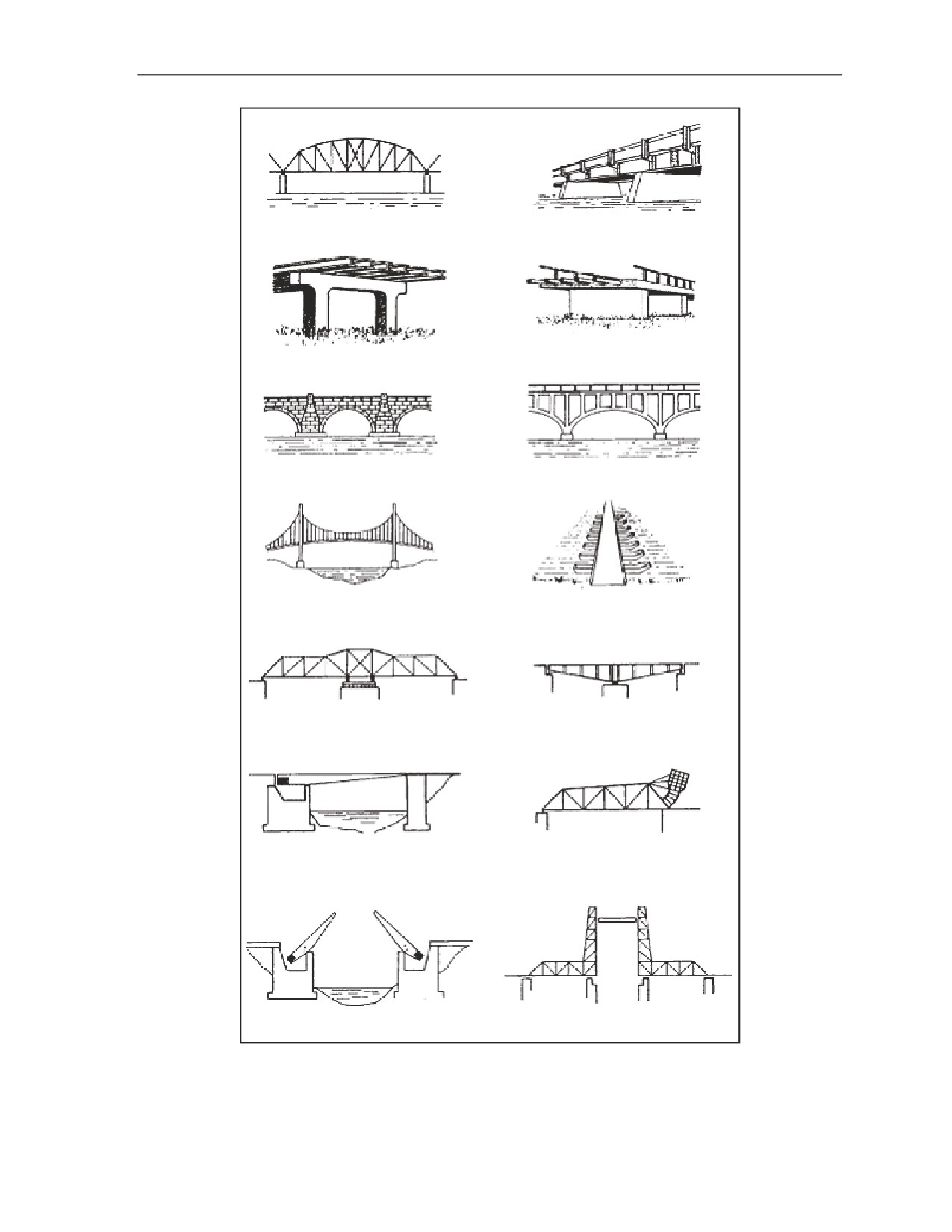
Bridging
1. Truss
2. Girder
3. Beam
4. Slab
5. Arch (closed spandrel)
6. Arch (open spandrel)
7. Suspension
8. Floating
9. Trunnion swing
9. Counterweight swing
10. Single-leaf trunnion bascule
10. Rolling-lift bascule
10. Double trunnion bascule
11. Vertical lift
Figure 8-2. Selected bridge types
9 December 2008
FM 3-34.400
8-7

Chapter 8
Table 8-1. Span Construction Types
Span Type
Number
Truss
1
Girder
(including steel multigirder and
2
two girder spans)
Beam
(including reinforced or
3
prestressed concrete and steel
box beam spans)
Slab
4
Arch (closed spandrel)
5
Arch (open spandrel)
6
Suspension
7
Floating
8
Swing
9 (specify type in additional information)
Bascule
10 (specify type in additional information)
Vertical lift
11
Other
12 (specify type in additional information)
METHODS
8-20. Bridges are classified by either analytical or expedient methods. Careful analysis must often follow
expedient classification. The situation and available time and information determine the method chosen.
An analytical classification may be required if the bridge is of great importance. An engineer’s estimate
may suffice if similar bridges in the area have a known classification.
8-21. Bridge classification data can usually be found with the engineer unit in the AO containing a
particular bridge. This unit is responsible for the area where the bridge is located along with the supporting
geospatial products and imagery. If military engineers constructed the bridge, the design class or as-built
plans should be on file. Satellite imagery and engineer intelligence studies often provide some level of
bridge classification information for most of the potential AOs in foreign countries. If this is not the case
for a specific bridge, engineer reconnaissance data will be used to classify it. The most reliable source of
bridge classification information for civilian-constructed bridges is often the local civilian authorities. In
most cases, complete design specifications, as-built plans, and the types and strengths of materials used in
civilian bridges are available. Local, state, and county officials in the United States and in friendly foreign
countries often impose maximum load limits or maximum permissible stresses on their bridges. It is
important that these officials be consulted to determine maximum MLC that can be applied to the bridge in
peacetime or for maneuver purposes. Corrosion and normal wear and tear tend to diminish a bridge’s load-
carrying capacity over time. The most recent evaluation of the bridge is desirable and currency of the
evaluation is important to note. Based upon the engineer’s evaluation of civilian reports, additional
appraisal of a bridge’s classification may be required. Correlation curves have been developed for some
standard United States and foreign civilian-made bridges that relate known civilian bridge design loads to
MLCs. These curves, discussed in FM 3-34.343, are generally useful for establishing a temporary bridge
classification. The analytical method of classification is always preferred when time and information are
available.
BRIDGE CLASSIFICATION AND MARKING
8-22. Bridge classification and marking is an engineer responsibility. It must follow classification systems
established by STANAG 2010, STANAG 2021, and QSTAG 180, which permit the use of bridges at their
maximum safe military capacities. The classification systems relate bridge capacity to the overall loading
8-8
FM 3-34.400
9 December 2008
Bridging
effect a vehicle might impose on a bridge. The responsible engineer organization in the area will classify
bridges of military significance by the analytical method if possible. If the responsible engineer judges a
posted temporary class accurate, the classification can be posted as permanent. Engineer units should keep
records on each significant bridge within their assigned area.
EXISTING BRIDGE REINFORCEMENT AND REPAIR
8-23. Civilian bridges in the AO often suffer damage or may be below the load-carrying capacity required
for use on an MSR or LOC. These bridges can be reinforced or repaired by engineers. Bridge
reinforcement is the process of increasing the structure’s load-carrying capacities by adding materials to
strengthen the component parts, or by reducing span length. Bridge repair, on the other hand, means
restoring a damaged bridge to its original load-carrying capacity or higher. Reinforcement or repair of
existing bridges or sites has many advantages, but primarily those of economy of time and material. Since
existing bridges are usually located on established routes, they will require less work on approaches and
speed the flow of traffic. The availability of preexisting serviceable bridge components, particularly
abutments and piers, conserves both time and materials.
BRIDGE REINFORCEMENT
8-24. Once the decision has been made to reinforce a bridge, several construction factors must be taken
into consideration before detailed planning and execution are undertaken. Among these factors are details
of the site, available materials, and possible construction methods. Pertinent questions concerning the site
include—
z
What parts of the original structure are still usable?
z
What is the type of bridge and what are the span lengths?
z
What are the characteristics of the waterway, particularly as to the use of additional bents or pile
piers?
z
Will the present approaches be satisfactory for a reinforced bridge?
z
Will the intermediate supports and abutments also need to be reinforced? Are alternate sites
available?
8-25. Materials that may be used include standard steel (preferred because of quality and speed of
construction), stock timbers, other military items of issue, and local materials of adequate quality. Possible
construction methods depend upon items of equipment available, working locations, and the nature of the
repairs. A detailed discussion of bridge reinforcement can be found in chapter 4 of FM 3-34.343.
8-26. Another option for bridge reinforcement is the use of overbridging. Overbridging is a method used to
reinforce, provide emergency repair, or augment existing bridges or bridge spans using standard bridging.
It can be used in a variety of gap-crossing situations, but is typically used when time is critical and/or
construction assets and resources are not readily available to make the existing bridge reliable. The
inherent characteristics of each of these tactical bridges, including the fact that they do not require a gap for
emplacement (zero gap bridge), make them a viable option for placement in support of close combat and
other operations. Risk should be evaluated, however, when using these bridges to repair or replace
damaged spans if the bridge will not be supported by a pier or abutment. In other situations when time is
not as critical, enemy contact is less likely, support or LOC bridging is readily available, and/or the gap is
beyond the span length of tactical bridging, the MGB, logistics support bridge (LSB), Bailey, Acrow®, or
similar systems may provide an appropriate alternative. When considering this option, the repair or
reinforcement of piers or abutments may be necessary; however, reduce the overall work effort by
replacing a span or spans with support or LOC bridging.
BRIDGE REPAIR
8-27. Emergency repairs are usually governed by the requirement that a crossing site be available as soon
as possible. Immediate need dictates the desired capacity and permanence of the structure. Where possible,
standard bridging should be used to expedite repairs, and tactical bridging is designed for this purpose. In
the absence of tactical or standard bridging, expedient methods may satisfy the requirements. Most
9 December 2008
FM 3-34.400
8-9
Chapter 8
emergency structures will later be reinforced, replaced, or rehabilitated. Bridge structures and
surroundings, the nature of bridge damage, and the methods of repair are all so varied that no single
preferred method will always be the preferred method. Experience with several methods will usually
suggest a practical method of repair. Unless there has been an opportunity for advanced planning, the
selection of repair methods should be left to the engineer commander who is responsible for the repairs.
The factors upon which the engineer will base choices include the—
z
Type of bridge.
z
Nature of damage.
z
Tactical situation and bridge requirements.
z
Nature of the surroundings and immediately usable bypasses or detours.
z
Troops and equipment available.
z
Standard stock bridging materials and accessories available and the time involved in
procurement.
z
Local materials available.
z
Time estimated for bridge repair versus time estimated for a detour or preparation of a bypass.
DETOURS AND BYPASSES
8-28. Detours and bypasses are important in ensuring continued movement of forces. The problem of
crossing wet gaps is reduced considerably when an alternate route is available to a serviceable bridge, or to
a bridge that can be repaired under favorable circumstances. Detours are usually of the following types:
z
Alternate routing over other existing bridges which have not been damaged.
z
Alternate routing over bridges with lesser damage, or routing to other locations.
z
Alternate routing of highways over railroad bridges.
8-29. Bypasses are usually of the following types:
z
Bypasses with a grade crossing around the bridge.
z
Fords.
z
Local ferries, rafts, or barges.
z
Ice bridges in extremely cold climates.
8-30. When determining construction methods, consider the condition of existing roads and the approaches
that connect with the detours and bypasses. The work necessary to make roads usable may outweigh the
advantages of using these alternatives. Traffic-supporting properties, grade and alignment, built-up areas,
and sharp curves or corners involving clearances are also important factors to ensure that vehicle
requirements are met.
8-10
FM 3-34.400
9 December 2008
PART THREE
Other Sustainment Operations
Part three of this manual discusses how the GE function supports sustainment
operations other than LOC support. Sustainment operations at any echelon are
those that enable decisive and shaping operations to occur without pause by
providing sustainment functions, security, movement control, terrain management,
and infrastructure development. Although joint and Army engineers may not have the
lead in conducting sustainment operations, they clearly have an important role in
ensuring that they are successful. Part three discusses several very important
engineer missions that facilitate these sustainment operations other than LOC
support. Chapter 9 discusses protection construction support, chapter 10 discusses
procurement of construction materials, chapters 11 and 12 discuss facilities, chapter
13 discusses real estate, chapter
14 discusses power generation, chapter
15
discusses pipelines, and chapter 16 discusses wells and water distribution. Each
chapter provides the overall concept for executing a specific type of GE mission that
supports sustainment operations.
Chapter 9
General Engineering Support to Protection
The art of war teaches us to rely not on the likelihood of the enemy not coming, but on
our readiness to receive him; not on the chance of his not attacking, but rather on the
fact that we have made our position unassailable.
Sun Tzu
In full spectrum operations, commanders must constantly and actively protect the
force. The protection warfighting function is the related tasks and systems that
preserve the force so the commander can apply maximum combat power. Preserving
the force includes protecting personnel
(combatant and noncombatant), physical
assets, and information of the United States and multinational partners. The
protection warfighting function has nine capability tasks that define it: safety;
fratricide avoidance; survivability; air missile defense; AT; chemical, biological,
radiological, nuclear, and high-yield explosives
(CBRNE) defense; information
protection; FHP; and operational area security. When synchronized with the other
warfighting functions, protection will ensure that the force maintains the ability to
fight and win (see FM 3-0). An integral part of protection success is GE support. In
terms of protection, GE is focused on survivability and related AT tasks. Planners
should use this chapter in conjunction with FM 5-103 and the TM 5-301 series which
contain detailed information applicable to survivability and the broader protection
warfighting function. Both documents are focused on survivability and AT and the
9 December 2008
FM 3-34.400
9-1
Chapter 9
subordinate specific focus area of hardening as performed by engineers or units
supported by engineer technical expertise and equipment. Hardening is the act of
using natural or man-made materials to protect personnel, equipment, or facilities.
THREAT
9-1. Because protection encompasses the entire operational spectrum
(to include CONUS-based
operations), the threat to U.S. forces varies extremely in nature and includes opponents who possess a wide
variety of capabilities. Deployed Army forces may encounter various threats or be specifically targeted by
terrorists, paramilitary elements, or even conventional military forces. All of these groups may seek to
manipulate events and realize their desired goals by striking at U.S. forces. Commanders must commit
significant resources to lower risk to acceptable levels. Adversaries who seek to destabilize an area will go
to great lengths to expel U.S. forces and advance their agendas.
CONVENTIONAL THREAT
9-2. The conventional threat that the United States became accustomed to and focused on during the Cold
War still has aspects that remain, and the skill sets required to meet this threat still remain. However,
during current and future operations, U.S. forces are more likely to face an unconventional enemy and
encounter or work with nations of widely diverse political systems, economic capabilities, cultures, and
militaries. Future challenges will involve the full spectrum of warfare against an evolving and asymmetric
enemy. These challenges may range from conventional war to AT operations and insurgencies. U.S. forces
may still face Soviet style weaponry and tactics, or they may be limited to low-intensity operations against
nontraditional enemy forces. When facing a more conventional enemy force refer to FM 7-100 as a
baseline document.
UNCONVENTIONAL/ASYMMETRIC THREAT
9-3. The concept of asymmetric warfare is critical to understanding the OE. Asymmetry is a condition of
ideological, cultural, technological, or military imbalance that exists when there is a disparity in
comparative strengths and weaknesses. In the context of the OE, asymmetry means an adaptive approach to
avoid or counter U.S. strengths without attempting to oppose them directly, while seeking to exploit U.S.
weaknesses. The asymmetric approach is not a new phenomenon, but given the position and capabilities of
the United States as opposed to its potential enemies, it is more likely to be used against the United States
and its allies by other nations and nonstate adversaries. Potential opponents will seek to avoid United
States strengths while exploiting perceived United States weaknesses.
9-4. Various countries and nonstate entities have studied how the U.S. fights and have begun to devise
ways to fight a technologically superior force and win. Future wars will not be fought within the confines
of the conflicts of the past. Since it is difficult to predict who the next enemy will be, the United States
does not always have the luxury of having studied these nations or nonstate adversaries. Therefore, the
United States must be prepared to refocus quickly, learn fast, and rapidly apply lessons learned in training.
Flexibility and initiative are key to being able to adapt doctrine, organization, training, materiel, leadership
and education, personnel, and facilities (DOTMLPF) domain solutions to meet the challenges of a given
adversary and the asymmetric approaches that may be applied against friendly forces.
PROTECTION CONSIDERATIONS
9-5. The overarching implementing concept for the protection warfighting function is contained in the
Army keystone protection manual. As the proponent manual, it describes how the Army applies resources
to support this warfighting function and establishes the foundation of protection that will assist
commanders in preserving combat power. In addition, FM 5-103 and the TM 5-301 series of manuals
provide illustrations and design criteria for many of the examples provided in this chapter. Most of these
illustrations are focused on survivability and AT and the hardening measures provided by engineering
support.
9-2
FM 3-34.400
9 December 2008
General Engineering Support to Protection
9-6. Commanders are responsible for their unit's protection plan. Engineer involvement is critical in
protection planning from two perspectives. They prepare their unit's protection plans and they provide
input (and capability) to the units they support. As with other missions, engineer protection planning must
be well thought out, logical, and integrated with other staff planning. Protection plans or policies must be
developed in line with the command estimate process. IPB is an integral part of protection planning and
serves as the basis for developing a protection strategy. IPB includes both threat analysis and the
commander’s assessment of unit vulnerabilities. Engineers must be involved in the IPB process to ensure
that engineer intelligence needs are integrated into the reconnaissance and surveillance plan.
9-7. In developing a protection policy, commanders and their staff analyze the situation using the
following process:
z
They determine the composition of assets (personnel, equipment, and facilities).
z
They define the threat and attack probability.
z
They determine levels of protection for each asset.
z
They identify constraints.
z
They design protective systems to counter threats.
9-8. The engineer must ensure that the maneuver staff and commander develop an AT and protection
policy based on the threat. The plan must balance the attack probability, the consequences of inadequate
protection,
and the cost of adequate protection
(risk
level).
Planners use FM
5-480 to assist in the process of balancing the consequences and costs of protection and recommending
appropriate levels of risk to the commander. The commander must set the priority of protection for his
forces and equipment, local assets, infrastructure, and the local populace.
PROTECTIVE MEASURES AND TECHNIQUES
9-9. As experienced in Iraq and other locations, engineers are tasked to plan and execute infrastructure
repair and FOB physical security, such as bunkers, guard towers, overhead covers, entry control points
(ECPs) and facilities, protective berms, and vehicle checkpoints. Because of organic equipment and
expertise, GE support is critical in supporting AT and protection.
DEFENSIVE MEASURES
9-10. Engineers play a significant role in protecting deployed U.S. forces. They have the capability, when
given time, priority, and a thorough IPB, to effectively establish defensive measures to protect forces,
facilities, and equipment from potential aggressors. The list of measures below will enhance a force’s
survivability and AT posture. The specific options that the engineer planner selects will be based on the—
z
Specific threat in the AO.
z
Degree of protection required.
z
Time available.
z
Materials available.
9-11. Basic considerations include—
z
Eliminating potential hiding places near facilities.
z
Providing an unobstructed view around all facilities.
z
Siting facilities within view of other occupied facilities.
z
Locating assets stored on-site but outside facilities within view of occupied rooms of the
facilities.
z
Minimizing the need for signs or other indications of asset locations.
z
Minimizing exterior signs that may indicate the location of assets.
z
Providing a 170-foot minimum facility separation from installation boundaries.
z
Eliminating lines of approach perpendicular to buildings.
z
Minimizing vehicle and personnel ECPs.
9 December 2008
FM 3-34.400
9-3
Chapter 9
z
Eliminating parking beneath facilities.
z
Locating parking as far from facilities as practical.
z
Illuminating building exteriors or exterior sites where assets are located.
z
Securing access to power and/or heat plants, gas mains, water supplies, and electrical service.
z
Locating public parking areas within view of occupied rooms or facilities.
z
Considering minimum recommended separation of facilities or developing mitigating
procedures if minimums cannot be met.
z
Locating construction staging areas away from asset locations.
z
Locating the facilities away from natural or man-made vantage points.
z
Locating the facilities' critical assets within areas that do not have exterior walls when possible.
z
Minimizing window areas.
z
Covering windows next to doors, so that aggressors cannot unlock the doors through them.
z
Securing exposed exterior ladders and fire escapes.
z
Designing building layout so that there are no areas hidden from view from control points or
occupied spaces.
z
Arranging building interiors to eliminate hiding places.
z
Locating assets in spaces occupied 24 hours a day, when possible.
z
Locating activities with large visitor populations away from protected assets when possible.
z
Locating protected assets in controlled areas where they are visible to more than one person.
Placing mail rooms on the perimeter of facilities.
z
Providing emergency back up power generation for critical activities and facilities.
9-12. Listed below are some of the potential missions where engineers may be tasked to construct
protective devices or facilities to support protection. Depending on the time, availability, resources, and
extent of the required protection, horizontal and vertical companies and/or other more specialized teams or
sections may be assigned the mission. Planners should review FM 5-103 and consult TCMS for detailed
protection criteria.
z
C2 sites.
z
Support facilities.
z
Logistics sites.
z
Troop concentration areas.
z
ECPs.
z
Vehicle checkpoints.
9-13. Another area where engineers contribute significantly to protection is with the engineer mine dog
detachment. This detachment consists of dog handler teams equipped to conduct mine detection operations
in support of the movement of troops within a TO. They support the force by detecting casualty-producing
devices during route and area clearance operations, route reconnaissance, and other missions. See FM
3-34.2 and ST 20-23-8 for additional information.
AREA DAMAGE CONTROL AND INCIDENT MANAGEMENT
9-14. ADC measures are taken before, during, or after hostile action or natural or man-made disasters to
reduce the probability of damage and to minimize its effects. ADC measures are typically applicable to
offensive, defensive, and stability operations. ADC functions and missions are primarily referred to as GE
missions that support many aspects of protection. While there are certain ADC measures that can be taken
before and during a hostile action or disaster, the focus of the GE effort is in repair and reestablishment of
operations. During offensive, defensive, and stability operations, ADC efforts normally occur in rear (or
relatively secure) areas and are planned as part of rear area or base defense.
9-15. ADC operations can be extensive and involve various other Army branches, other Services,
governmental and nongovernmental agencies, and HN assets. During a stability operation, the land
component commander (LCC), ASCC, or USAID will coordinate the effort, depending on the mission and
9-4
FM 3-34.400
9 December 2008
General Engineering Support to Protection
its associated C2 structure. If ADC operations occur during combat operations (offense and defense) it is
an operational matter. If possible, engineers should consider the use of HN assistance, as it can be a vital
resource, and also serves the purpose of putting those in the area of the disaster back to work in a
meaningful fashion. This allows those personnel to become a part of the solution to the destruction rather
than remaining part of the problems caused by the destruction. Early HNS identification and coordination
are essential if they are to supplement the ADC effort. Responsibilities and support from the HN are
normally negotiated at the theater level and as a part of the SOFAs and treaties.
9-16. Incident management is a national comprehensive approach to preventing, preparing for, responding
to, and recovering from terrorist attacks, major disasters, and other emergencies. Incident management
includes measures and activities performed at the local, state, and national levels and includes both crisis
and CM (see JP 1-02). Regardless of whether DOD is conducting incident management as a part of
homeland defense or civil support operations, military forces always remain under the control of the
established 10 USC, 32 USC, or state active duty military chain of command. DOD is the lead, supported
by other agencies, in defending against traditional external threats/aggression (such as air and missile
attack). However, against internal asymmetric, nontraditional threats (such as terrorism), DOD may be in
support of the DHS. When ordered to conduct homeland defense operations within U.S. territory, DOD
will coordinate closely with other federal agencies or departments (see JP 3-26). Except for homeland
defense missions, DOD serves in a supporting role for domestic incident management.
9-17. As a subset of incident management, CM are those actions taken to maintain or restore essential
services and manage and mitigate problems resulting from disasters and catastrophes, including natural,
manmade, or terrorist incidents. Responses requiring CM occur under the primary jurisdiction of the
affected state and local government, and the Federal government provides assistance when required. When
situations are beyond the capability of the state, the governor requests federal assistance through the
President. The President may also direct the Federal government to provide supplemental assistance to
state and local governments to alleviate the suffering and damage resulting from disasters or emergencies.
The DHS or FEMA has the primary responsibility for coordination of federal CM assistance to state and
local governments.
9 December 2008
FM 3-34.400
9-5
This page intentionally left blank.
Chapter 10
Procurement and Production of Construction Materials
Class IV stocks should be robust and ready for crisis projects. If engineers don’t stock
Class IV, no one else will.
S-4, 130th Engineer Brigade, Operation Iraqi Freedom After-Action Review
GE missions can be and usually are resource intensive. One of the key and often
limiting resources is construction materials. Determining the method of construction
and obtaining materials on time and in the quantity and quality needed must be
synchronized to support the assembly of other resources
(time, personnel, and
equipment) to complete the project. Construction of any kind will fail if the required
materials
(or suitable substitutes) are not available. Efforts to obtain the proper
material at the time, in the quantity, and of the quality needed must begin early during
the planning phase (receipt of the mission or construction directive) and do not really
end until the project completion and turnover. For procurement, engineers have the
options of obtaining materials from CONUS through the service supply system, from
countries as adjacent to the AOR as possible, and locally. Each method has inherent
costs and benefits. Engineer units may be used, or a contractor hired, to produce the
necessary materials. Whatever the method, obtaining resources must be an integral
part of all planning and execution tasks to properly accomplish the mission.
METHODS OF CONSTRUCTION
10-1. In almost every contingency operation conducted, base camps and FOBs have been constructed
throughout the AOs to support all aspects of the U.S. military mission. Living quarters, dining and
recreation facilities, post exchanges (PXs), and a multitude of other support facilities are an important
component of base camps and occupy significant space within a camp. There are multiple options for the
construction of the supporting infrastructure for these facilities, ranging from using preexisting structures;
erecting tentage; assembling pre-engineered metal or fabric buildings; bringing in modular buildings,
trailer units, assembled prefabricated buildings, or manufactured buildings; or by constructing wood, steel,
or concrete masonry unit (CMU) framed and supported buildings. Each of these methods has advantages
and disadvantages in TO construction.
PREEXISTING STRUCTURES
10-2. Using preexisting structures (figure 10-1, page 10-2) can be the least time-consuming for providing
needed facilities for mission accomplishment. The original design use, intended use, and current structural
integrity are key factors in determining the feasibility of a preexisting structure that meets mission
requirements.
9 December 2008
FM 3-34.400
10-1
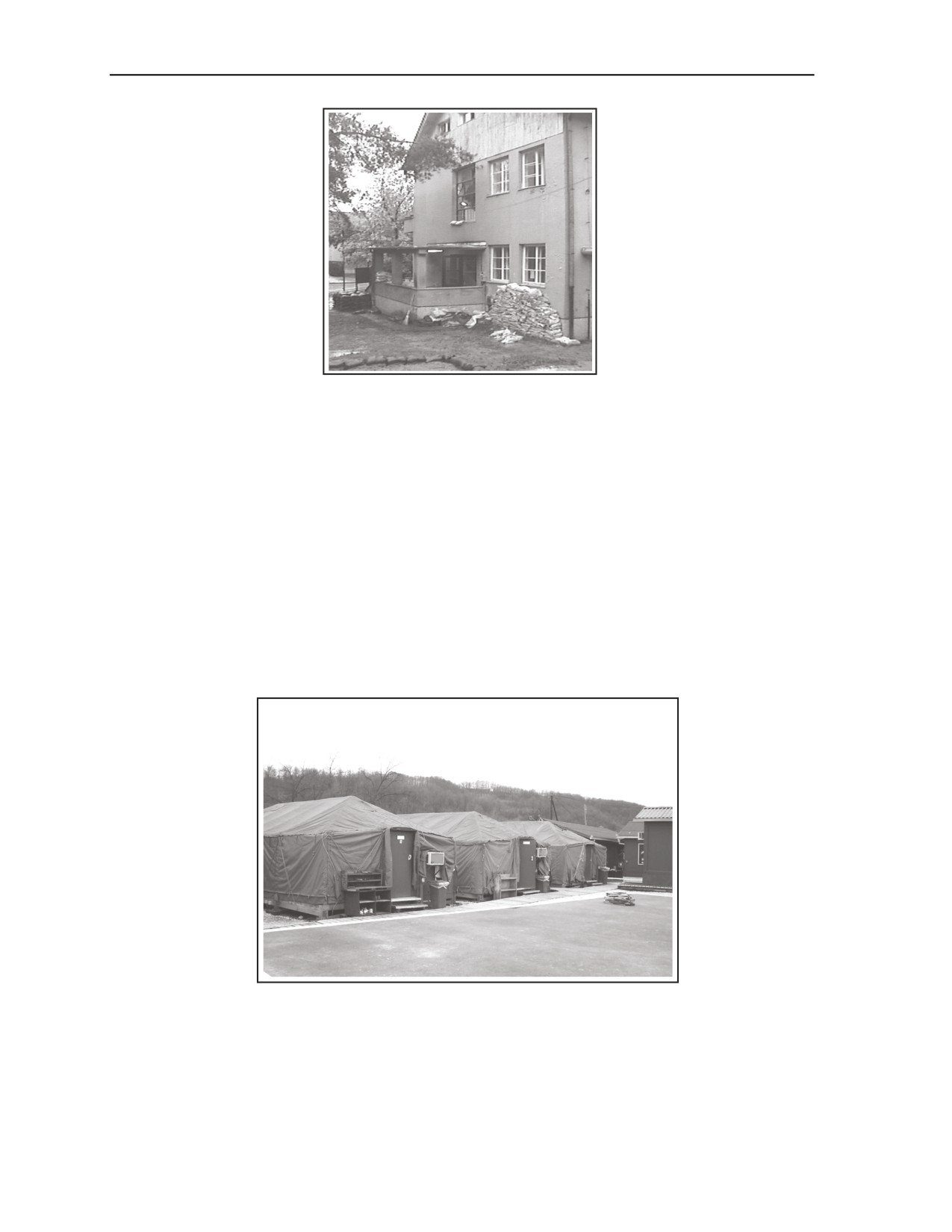
Chapter 10
Figure 10-1. Preexisting structure
TENTAGE
10-3. The use of organic unit tentage (figure 10-2 and figure 10-3) or assembled packaged kits like “force
provider” is another option. This option is quick in establishing basic life support areas and minor mission
support areas (such as company, battalion, brigade, and division tactical operation centers/headquarters) if
the tentage is already on hand and available; however, the impacts of long-term use of tents and the impact
on the quality of life, and the level of personnel protection must be weighed in light of the mission
requirements. The planned length of use must also be weighed against the ability to reuse the tentage later.
The longer tentage is used and exposed to environmental conditions, the less likely it is to be easily
repacked and stored for reuse. Also, as tentage is converted from tier 1 to tier 2, or tier 3, its reuse is also
impacted. Consider the following:
z
Is this only the initial (or immediate) standard?
z
What is the plan for transition to a more enduring temporary or semipermanent facility?
z
Is sufficient billeting capacity designed to allow for transitions between units?
Figure 10-2. General purpose (GP) medium tentage with wood floor
10-2
FM 3-34.400
9 December 2008
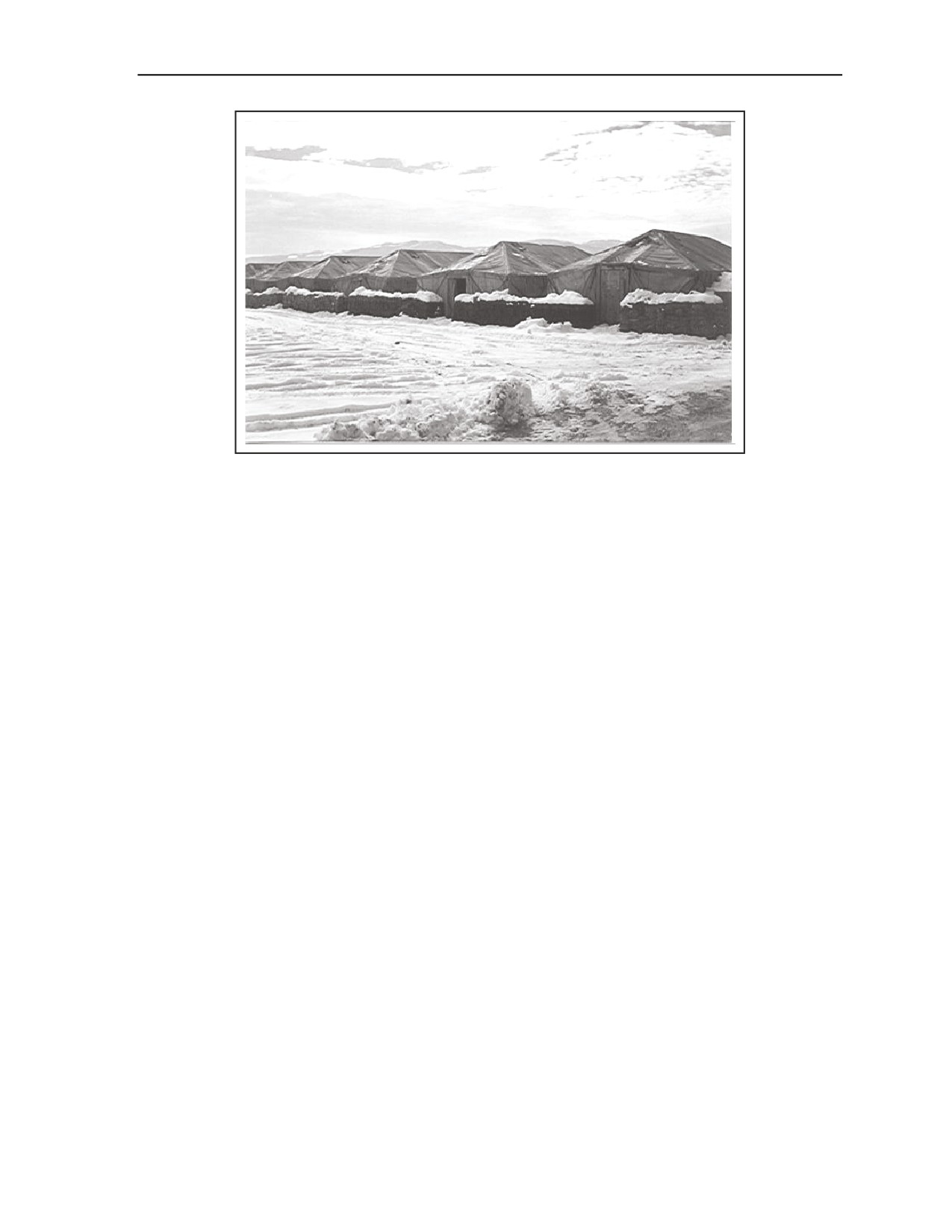
Procurement and Production of Construction Materials
Figure 10-3. Tentage protected with HESCO Baston® revetments
PRE-ENGINEERED METAL OR FABRIC BUILDINGS
10-4. Pre-engineered metal or fabric buildings are structures that are completely assembled on-site out of
standard components and materials brought to the site. They range from custom designs, to fit specific sites
and usage requirements, to prepackaged and assembled kits ready for construction. Some of the advantages
of pre-engineered metal or fabric buildings are—
z
Rapidly constructed.
z
Mobility/transportability of the materials.
z
Flexibility of designs.
z
Durability and low maintenance requirements.
z
Minimal or no foundation preparation or requirements.
10-5. A disadvantage of some manufacturing techniques is that some of the major structural components
are quite large and bulky in nature, making mobility/transportability a significant consideration. Other
manufacturers have worked through that issue by fabricating panels or the major structural members on-
site.
Pre-Engineered Metal Buildings
10-6. An example of a pre-engineered metal building system (assembled on-site) (figure 10-4, page 10-4)
is the next generation of the K-Span® structure from M.I.C. Industries, Incorporated, known as the
Ultimate Building Machine® (UBM®). The UBM, a self-contained manufacturing factory on wheels, is
capable of fabricating and assembling an entire building at the construction site, producing a durable steel
building in days. It is capable of being transported directly to the construction site via truck or airplane to
anywhere in the world. A small crew of 10 to 12 workers can manufacture and assemble a 10,000 square
feet structure in as little as a single day. The structures produced from various designs are unique and site
specific with ground-to-ground, self-supporting panels that require no beams, trusses, columns, nuts, bolts,
fasteners, screws, or sealants and they are virtually maintenance free. With the UBM system, units could
build a
*variety of facilities using these small crews and small quantities of building materials. A
comparison of traditional TO construction to steel building construction using this technology, conducted
by the U.S. Army Corps of Engineers, found these steel buildings require only half as much labor, 40
percent as much material, half as much construction time, and less than one-fourth the cargo space for
9 December 2008
FM 3-34.400
10-3
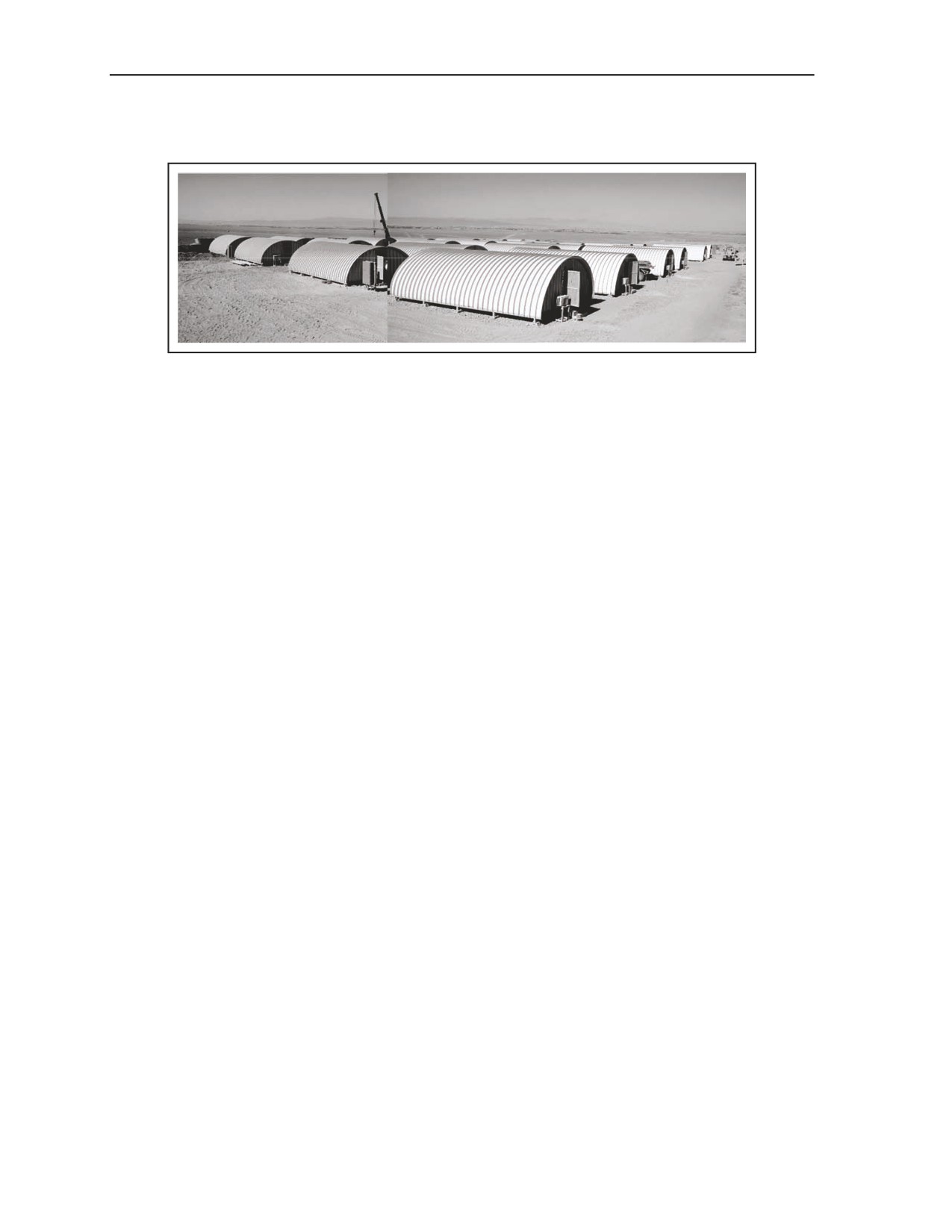
Chapter 10
materials transport. Although not as important as the above considerations, the steel buildings can be as
much as 60 percent cheaper than wood TO structures.
Figure 10-4. Metal buildings constructed with the UBM in a contingency environment
PRE-ENGINEERED FABRIC BUILDINGS
10-7. The pre-engineered fabric building system is commonly referred to as giant tents or tent buildings.
They are actually engineered fabric structures developed according to the prevailing
construction/engineering standards that are prefabricated, customizable, and modular in design that can
meet a wide range of military and civilian applications. Many manufacturers use in-house steel and fabric
production so they have complete control over the manufacturing process, enabling stringent quality
monitoring and lower cost operations. These systems typically require simple foundation preparation and
allow for quick erections. Most are relocatable structures that are deployable wherever needed, with the
ability to be recovered and then stored after use for the next requirement. With many of these systems, a
small structure can be erected in hours by a small crew of 3 to 8 personnel aided by a lift truck with access
platforms. The same structure, over time, could see use by multiple owners, in different locations, and be
used for very different applications than the structure was originally supplied for. (An example would be a
clamshell originally purchased for use as a dining facility in one contingency operation and finding use as a
maintenance bay or as surge housing capacity in its next use.) These types of structures are available in
multiple spans (ranging typically from about 20 to 80 meters wide by just about any length). These
structures are adaptable to a multitude of purposes ranging from housing, logistics support warehousing
requirements, to quality-of-life uses. Typically the fabric membrane will have about a 20-year service life
expectancy depending on the extremes of the environments they are used in.
PRE-ENGINEERED TENSION FABRIC BUILDING SYSTEM EXAMPLES
10-8. Examples of pre-engineered tension fabric building systems are the medium shelter system (MSS) by
Universal Fabric Structures (UFS)®, commonly known as a clamshell shelter and structures produced by a
multitude of other venders like Rubb Building Systems™. Some examples of these tension fabric buildings
are shown below. Figure 10-5 shows UFS MSSs. Figure 10-6 shows a genuine fabric structure. Figure 10-
7 shows some of the products by Rubb Building Systems.
10-4
FM 3-34.400
9 December 2008
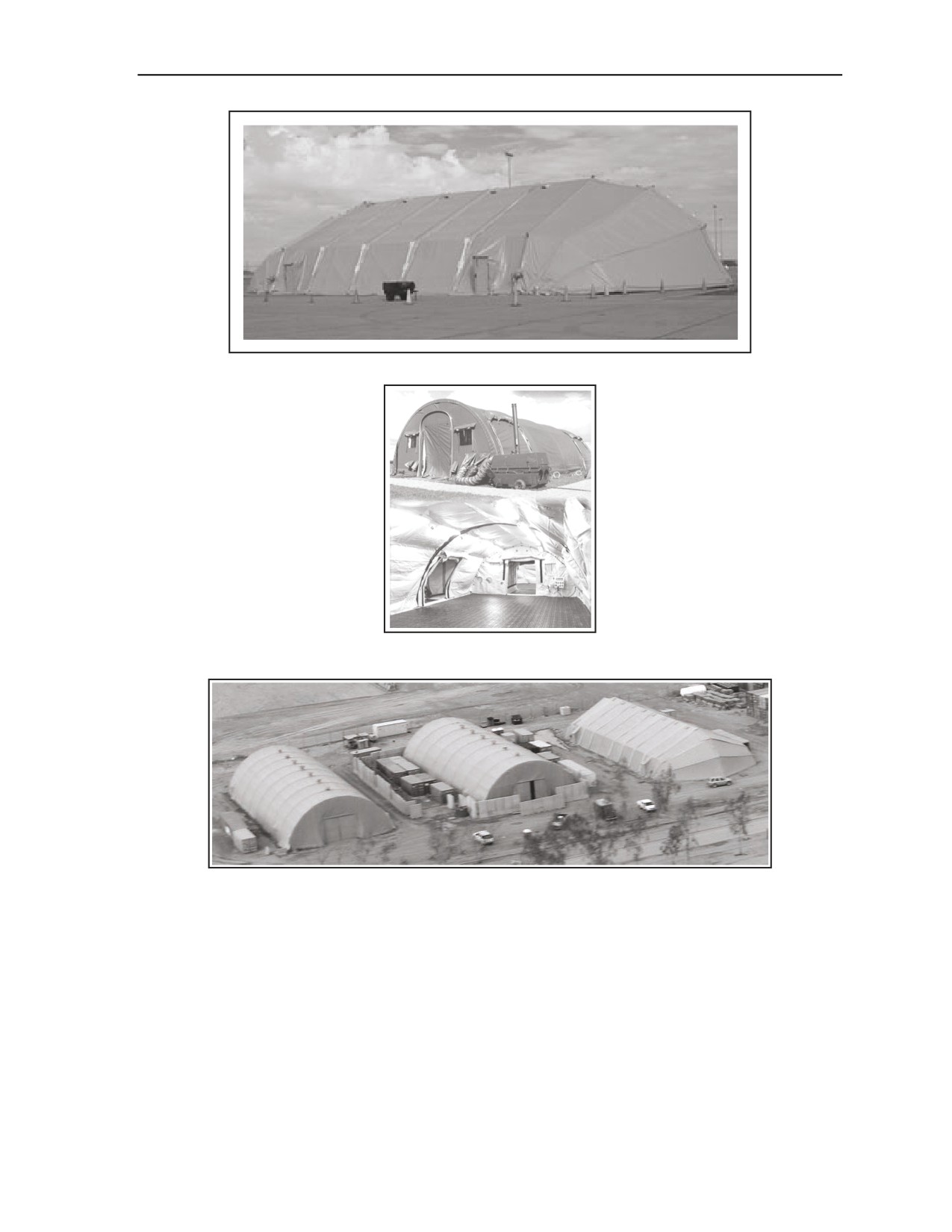
Procurement and Production of Construction Materials
Figure 10-5. Clamshell structure
Figure 10-6. Rubb fabric structure
Figure 10-7. Tension fabric structures located at Balad Air Base, Iraq
MODULAR BUILDINGS OR TRAILER UNITS
10-9. Modular buildings or trailer units are types of facilities that are fabricated/assembled off-site,
transported to the site, and placed in position. Modular buildings are manufactured in a controlled factory
environment. The building or trailer is then delivered to a prepared building site for installation. A modular
building comes complete with all the necessary components, including walls, floor trusses, windows,
heating and cooling, plumbing, electrical wiring, and interior finishes. These structures vary in size and
cost and can be very versatile. Modular buildings may be used for many purposes; they can be free
standing or built inside an existing structure. Many modular buildings are constructed from steel. Modular
buildings provide flexibility and other advantages over site-construction, such as—
z
Cost savings.
z
Speed of occupancy.
9 December 2008
FM 3-34.400
10-5
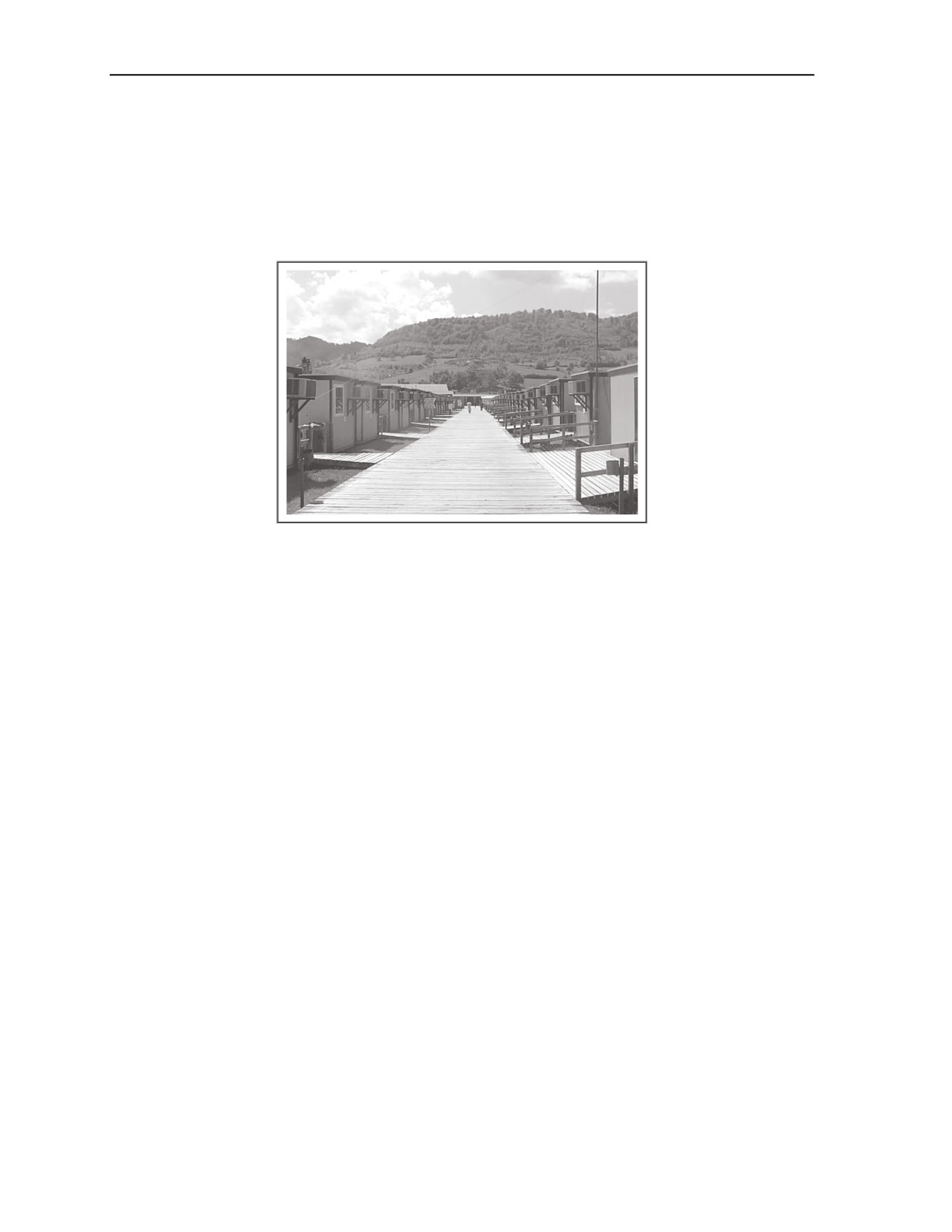
Chapter 10
z
Factory-controlled quality.
z
Ease of expansion.
z
Ease of relocation.
10-10. The most significant advantage of modular buildings is the significant on-site time that is saved as
opposed to on-site construction. Access and availability of an appropriate foundation are possible
concerns/disadvantages when placing these structures on site. Figure 10-8 shows container buildings.
Figure 10-8. Containers used as life support areas at Camp Demi, Bosnia
PREFABRICATED OR MANUFACTURED BUILDINGS
10-11. Prefabricated or manufactured buildings are types that consist of several factory built components
that are assembled on-site to complete the unit. Prefabrication is used for many types of constructions
because it saves time on the construction site. This can be vital to the success of projects where on-site
construction time is limited or where weather (or the tactical) conditions may only allow for brief periods
of construction effort on-site. Prefabricated building components are manufactured in a controlled factory
environment. The components are then delivered to prepared building sites for assembly and installation.
A prefabricated building comes complete with all the necessary components, including walls, floor trusses,
windows, heating and cooling, plumbing, electrical wiring, and interior finishes. Prefabricated buildings
can be used for many purposes; they may be freestanding or built inside an existing structure. Like modular
buildings, many prefabricated building components are also constructed from steel.
10-12. There are multiple advantages to prefabricated buildings; they are self-supporting and ready-made
components are used, so the need for shuttering and scaffolding is greatly reduced. Overall construction
time is reduced and buildings are completed sooner, allowing an earlier occupancy. On-site construction is
minimized. Quality can be controlled while the components are in production. Typically less waste is
generated during the production process and on-site. Molds for the different components can be used
several times. There are also disadvantages; careful handling of prefabricated components, such as concrete
panels, is required. Leaks can form at joints in prefabricated components. Transportation costs can be high,
depending on the distance between the factory, the construction site, and the method of construction used.
Figure 10-9 shows a manufactured building that was constructed by the U.S. Army for use by the New
York Police Department after September 11 (or 9-11).
10-6
FM 3-34.400
9 December 2008
Procurement and Production of Construction Materials
Figure 10-9. Manufactured building
ON-SITE CONSTRUCTION USING WOOD, STEEL, OR CONCRETE MASONRY UNITS FRAMING
(TRADITIONAL CONSTRUCTION)
10-13. On-site construction using wood, steel, or CMU framing (traditional construction) standard basic
construction techniques are used. One advantage is the flexibility of the designs. They can be modified to
fit the existing site conditions perfectly and have personnel protective enhancements built directly into the
plan. A significant disadvantage is the amount of time and availability of personnel to design and construct
individual facilities in this manner on such a large scale. Figure 10-10 shows SEAhut cluster buildings and
figure 10-11, page 10-8, shows a CMU structure.
Figure 10-10. SEAhut cluster
9 December 2008
FM 3-34.400
10-7
Chapter 10
Figure 10-11. CMU constructed fire station
PROCUREMENT OF CONSTRUCTION MATERIALS
10-14. Units may obtain GE construction materials using standard supply procedures that unify the way
in which they are requested, managed, and distributed. Most construction materials are Class IV and their
distribution in the AO occurs as depicted in figure 10-12. Note that this figure depicts a contiguous AO and
may be much different than that encountered in a particular contingency. Many Class IV materials are also
used for field fortifications, fighting positions, and other sorts of protection work, making it likely that they
are in high demand and necessitating engineer involvement in distribution decisions. Class IV supplies are
not maintained in significant quantities and are bulky. This makes handling and transportation over
strategic distances difficult. Because of this, obtaining GE materials through normal supply channels is
considered the least efficient and desirable method for GE missions. Engineers should only use this method
after determining the materials are unavailable locally, that the proper quantity and quality cannot be met
locally, or the cost to obtain them in this fashion is prohibitively high. Engineer logisticians must
constantly track the status of orders throughout the requisition process to ensure that they are filled.
10-8
FM 3-34.400
9 December 2008
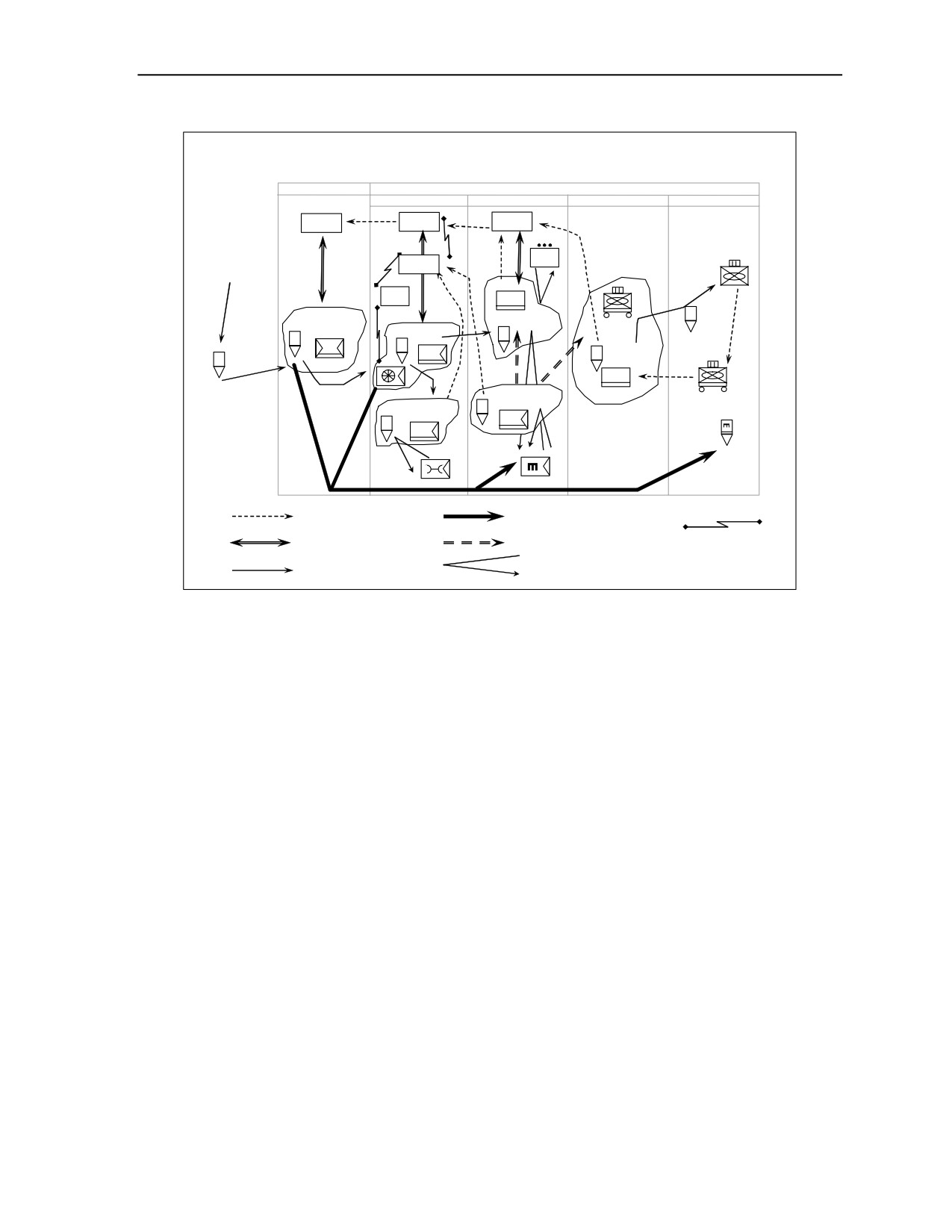
Procurement and Production of Construction Materials
ISB
Area of Operations
CORPS
DIV
BCT
BN
TAMMC
CMMC
DMMC
CONUS
MP
NICP
CMCC
I
MCT
SVC
LRP
CL IV
CL IV
FLD
CL IV
I
I
GS
CL IV
CCP
GS
I
I
CL IV
CBT
CL IV
I
I
DS
DS
I
II
LEGEND.
Requisitions
Throughput distribution
Asset visibility and
Reinforcing support
Coordination
rqn mngt
Supply point distribution
Normal resupply
Figure 10-12. Class IV requests and distribution in contiguous AOs
10-15. Maintaining Class IV supply points is clearly a logistics function that engineer units are not
organized or equipped for. Although engineer units should avoid responsibility for operating Class IV
points, recent and repeated experience in contingency environments has shown that engineers habitually
are forced to do so to ensure the completion of GE missions, particularly when time constraints exist.
Engineers should be involved, but they should not be required to run Class IV points. Table 10-1, pages
10-10 through 10-12, is an example of a list of supplies that units might maintain in an engineer Class IV
point during a contingency. Note that it contains only very basic materials and supplies. Units may need to
be creative in the way they obtain Class IV supplies. Using materials from base camps that are closing is an
example.
10-16. Engineers may also procure construction materials in theater using local purchase procedures or
contracting. In a contingency, engineer logisticians must rapidly learn the methods and rules for obtaining
construction supplies through the appropriate system. To maximize its benefits, local procurement should
occur as close as possible to the actual construction site to minimize transportation requirements. Engineers
must learn specific procedures and rules for local purchase procedures and contracting. Some of the
options include—
z
Government-wide commercial purchase cards. These are useful instruments for purchase of
supplies up to an established limit. It is an effective method for small purchases. When
deploying, users must determine the specific rules for their cards for the specific contingency.
Depending on the deployment location, there may be problems with finding vendors who are
willing to accept the government-wide commercial purchase cards.
z
Blanket purchase agreements (BPAs). A blanket purchase agreement is a simplified method
of filling anticipated repetitive needs for supplies by establishing charge accounts with qualified
sources of supply. A blanket purchase agreement is a written understanding between the
government and a supplier that eliminates the need for individual purchase and payment
documents.
9 December 2008
FM 3-34.400
10-9