FM 3-34.400 GENERAL ENGINEERING (December 2008) - page 4

Chapter 10
z
Prime vendor program. This is a DOD institutionalized program that is operated by the
Defense Logistics Agency. It establishes a series of contracts with different vendors. When a
specific item is needed, each vendor is given an opportunity to bid to fill the order in a set period
of time.
z
Logistics civilian augmentation program
(Army). The logistics civilian augmentation
program (Army) is a program for preplanned use of a civilian contractor to augment capabilities
of selected forces during a contingency. Units may obtain logistics support, to include Class IV
through this program.
10-17. Although obtaining materials for GE missions is often the most advantageous method for needed
requirements, engineers must keep certain factors in mind while doing so. Some of these factors include—
z
Standard sizes of GE materials may be different in the AO. Dimensional lumber is often cut to
different standards in foreign countries. Voltage systems in overseas locations are also typically
different from CONUS.
z
The quality of different items may be considered substandard. Lumber, concrete, and asphalt are
three examples of construction materials that are typically not consistent with U.S. standards.
z
Language and cultural difference may make it difficult to obtain GE supplies. In some
situations, local vendors may feel it is more important to try to please you in initial discussions
than tell you the truth about whether they are capable of providing materials in the quantity and
quality needed.
z
Military operations may drive up prices. Shortages caused by multiple units competing for the
same resource may induce local suppliers to profiteer from ongoing operations.
Table 10-1. Sample stockage level for engineer class IV point
Unit of
Line
Nomenclature
NSN
Issue
4
AA
Sandbags
8105-00-142-9345
HD
4
AB
Wire, barbed
5660-00-224-8663
RO
4
AC
Wire, concertina
5660-00-921-5516
RO
4
AD
Pickets, long, 6 feet long
5660-00-270-1510
EA
4
AF
Pickets, short, 3 feet long
5660-00-270-1589
EA
4
AG
Barrier, Hesco bastion, 2 x 2 x 10 feet
2590-99-169-0183
EA
4
AH
Barrier, Hesco bastion, 2 x 2 x 4 feet
2590-99-001-9392
EA
4
AI
Barrier, Hesco bastion, 3 x 3 x 2.5 feet
2590-99-001-9393
EA
4
AJ
Barrier, Hesco bastion, 3 x 5 x 2.5 feet
2590-99-001-9395
EA
4
AK
Barrier, Hesco bastion, 4.5 x 3.5 x 2.5 feet
2590-99-835-7866
EA
4
AL
Barrier, Hesco bastion, 4.5 x 4 x 2.5 feet
2590-99-391-0852
EA
4
AM
Barrier, Hesco bastion, 7 x 7 x 7.5 feet
2590-99-335-4902
EA
4
AN
Lumber, 1 inch x 6 inches x 12 feet
5510-00-220-6080
EA
4
AO
Lumber, 1 inch x 4 inches x 12 feet
5510-00-220-6078
EA
4
AP
Lumber, 1 inch x 10 inches x 12 feet
5510-00-220-6084
EA
4
AQ
Lumber, 2 inches x 4 inches x 8 feet
5510-00-220-6194
EA
4
AR
Lumber, 2 inches x 4 inches x 10 feet
5510-00-220-6194
EA
4
AS
Lumber, 2 inches x 4 inches x 12 feet
5510-00-220-6194
EA
4
AT
Lumber, 2 inches x 6 inches x 8 feet
5510-00-220-6196
EA
10-10
FM 3-34.400
9 December 2008

Procurement and Production of Construction Materials
Table 10-1. Sample stockage level for engineer class IV point (continued)
Unit of
Line
Nomenclature
NSN
Issue
4
AU
Lumber, 2 inches x 6 inches x 10 feet
5510-00-220-6196
EA
4
AV
Lumber, 2 inches x 8 inches x 14 feet
5510-00-220-6198
EA
4
AW
Lumber, 2 inches x 10 inches x 12 feet
5510-00-220-6200
EA
4
AX
Lumber, 2 inches x 12 inches x 12 feet
5510-00-220-6202
EA
4
AY
Lumber, 4 inches x 4 inches x 8 feet
5510-00-220-6178
EA
4
AZ
Lumber, 4 inches x 4 inches x 10 feet
5510-00-220-6178
EA
4
BA
Lumber, 4 inches x 4 inches x 16 feet
5510-00-220-6178
EA
4
BB
Timber, 6 inches x 6 inches x 8 feet
5510-00-550-6825
EA
4
BC
Timber, 6 inches x 6 inches x 10 feet
5510-00-550-6825
EA
4
BD
Plywood, 1/2-inch x 4-foot x 8-foot ply
5530-00-128-5143
EA
4
BE
Plywood, 5/8-inch x 4-foot x 8-foot ply
5530-00-128-5147
EA
4
BF
Plywood, 3/4-inch x 4-foot x 8 foot ply
5530-00-128-5151
EA
4
BG
Nail, common wire, steel 5d
5315-00-010-4656
LB
4
BH
Nail, common wire, steel 8d
5315-00-010-4659
LB
4
BI
Nail, common, 3 inch 10d
5315-00-753-3883
LB
4
BJ
Nail, common, 3 1/4 inch 12d
5315-00-753-3884
LB
4
BK
Nail, common, 3 1/2 inch 16d
5315-00-753-3885
LB
4
BL
Nail, common, 20d
5315-00-753-3886
LB
4
BM
Screening, insect, nonmetal, 48 inches wide
8305-00-559-5047
YD
4
BN
Bolt, machine, 3/4 inch x 12 inches with nut
5306-00-550-3697
EA
Washer, flat cadmium steel, 13/16-inch inside diameter,
4
BO
5310-00-236-6478
EA
2-inch outside diameter
4
BP
Hinge, butt, steel leaves, 3 1/2 x 1 3/4 inch
5340-00-243-6193
EA
4
BQ
Hook and eye, door steel, 3 inches
5340-00-243-3224
EA
4
BR
Nipple pipe, steel galvanized, 1/2 x 4 inches long
4730-00-196-1547
EA
4
BS
Union pipe, galvanized, 1/2-inch pipe
4730-00-240-1674
EA
4
BT
Elbow pipe, galvanized, 1/2 inch x 90° angle
4730-00-278-4773
EA
4
BU
Elbow pipe, galvanized, 3/4 inch x 90° angle
4730-00-249-1478
EA
4
BV
Reducer, pipe, galvanized, 3/4 inch to 1/2 inch
4730-00-231-5650
EA
4
BW
Valve gate, bronze screw, 3/4 inch, class 125
4820-00-288-7567
EA
4
BX
Pipe, steel galvanized, 3/4 inch x 21 feet (threads)
4710-00-162-1019
EA
4
BY
Nipple pipe, steel galvanized, 3/4 x 4 inch long
4730-00-196-1500
EA
4
BZ
Nipple pipe, steel galvanized, 3/4 x 2 inch long
4730-00-196-1505
EA
Union pipe, galvanized, female 3/4 inch, 300 pounds per square
4
CA
4730-00-240-1675
EA
inch with water on gas
4
CB
Coupling pipe, mall iron, 1/2-inch standard weight
4730-00-187-7612
EA
4
CC
Coupling pipe, mall iron, 3/4-inch standard weight
4730-00-187-7613
EA
4
CD
Cap pipe, galvanized mall iron, 1/2 inch
4730-00-231-2424
EA
4
CE
Cap pipe, galvanized mall iron, 3/4 inch
4730-00-231-2425
EA
4
CF
Primer adhesive for PVC pipe
8040-01-001-2705
PT
9 December 2008
FM 3-34.400
10-11

Chapter 10
Table 10-1. Sample stockage level for engineer class IV point (continued)
Unit
Line
Nomenclature
NSN
of
Issue
Pipe, PVC drain waste vent, schedule 40, 20 foot long, 2 inch
4
CG
4710-00-476-5870
EA
diameter
4
CI
Outlet box, 4 x 4 1/2 to 3/4-inch knockout
5975-00-159-0969
EA
4
CJ
Cover junction box, 4 inches square flat
5975-00-281-0057
EA
Junction box, rectangular, surface mounted for
4
CK
5975-00-281-0090
EA
switch or receptacle
4
CL
Wire, electrical 6 round 20° Celsius, .162 inches nominal
6145-00-299-4456
EA
4
CM
Wire, electrical 6 round 60° Celsius, .449 inches nominal
6145-00-519-1332
FT
4
CN
Cable, power, electrical, 4 oval, 60° Celsius
6145-00-519-2718
FT
4
CO
Wire, electrical 6 round 75° Celsius, .481 inches nominal
6145-00-939-4951
FT
4
CP
Wire, electrical 6 round 90° Celsius, .19 single conductor
6145-01-204-6473
FT
4
CQ
Wire, electrical 6 round 90° Celsius, .13 single conductor, (white)
6145-01-204-6477
FT
4
CR
Wire, electrical 6 round 90° Celsius, .13 single conductor (blue)
6145-01-204-6478
FT
4
CS
Wire, electrical 6 round 90° Celsius, .13 single conductor (red)
6240-00-152-2987
EA
4
CT
Lamp, fluorescent, 48 inches nominal, 3,000 lumens
6240-00-990-8191
EA
4
CU
Lamp incandescent, 5.25 inches maximum, 1,650 lumens nominal
6210-00-865-8451
EA
4
CV
Fixture, lighting, 36 inches, translucent, diffuser
6210-01-395-9544
EA
4
CW
Cement, Portland, 94-pound bag
5610-00-250-4676
BG
PRODUCTION OF CONSTRUCTION MATERIALS
10-18. Certain types of materials are typically needed in large quantities and are of great weight that
engineers must produce them locally (or contract a supplier). Soil for fill, sand, and gravel are examples of
materials typically obtained from local sources. To produce more refined products, engineers may need to
further process materials to obtain construction materials, such as crushed rock, asphalt, and concrete.
There are specialized engineer platoons, teams, and sections that handle production missions for most types
of construction materials. Significant environmental considerations may be placed upon U.S. forces when
creating or operating these sites. At a minimum, each of these operations has inherent significant FHP
issues associated with them.
BORROW PITS AND QUARRIES
10-19. Specific classifications of pits and quarries are shown in table 10-2. Borrow pits are the preferred
source of construction aggregate and fill material when resources are scarce and material quality is not
critical. They are similar to quarries except they tend to be smaller and generally require no blasting and
minimal mechanical efforts. Materials in borrows seldom need to be blasted, crushed, or screened. Though
the gravel, sand, and fines obtained in a borrow pit may not be as good as crushed stone, it is often
acceptable. Equipment needed for a borrow pit includes dozers for grubbing and clearing, dump trucks for
hauling, and scoop loaders, scrapers, or cranes with a shovel and dragline for loading.
10-12
FM 3-34.400
9 December 2008

Procurement and Production of Construction Materials
Table 10-2. Pit and quarry classifications
Type
Material
Primary Use
Operation
Subgrades, base course,
Medium and light
Borrow pit
Soil, sand, and gravel
and fill
mechanical
Gravel, coarse sand,
Base course, surfacing,
Medium and light
Gravel pit
and clay
and fill
mechanical
Heavy mechanical
Aggregate for concrete
Alluvial pit
Clean gravel and sand
crusher and screen and
and mixes
wash
Heavy mechanical
Mine spoil, slag, and
Recycling and surfacing
Dump pit
crusher and screen and
overburden
and aggregate
wash
Base course, surfacing,
Heavy mechanical
and aggregate for
crusher, screen and
Hard rock quarry
Aggregate
concrete mixes or
wash, and drill and
concrete and asphalt
blasting
mixes
Heavy mechanical
Medium rock
Base course, surfacing,
crusher, screen and
Aggregate
quarry
and fill
wash, and drill and
blasting
Base course, surfacing,
Medium and light
Soft rock quarry
Cement material
and roads and airfields
mechanical
10-20. Borrow pits are best located at the tops of hills close to or on the construction site for ease of
material handling. If borrow pits are located away from the construction site, careful consideration should
be made in locating them to ensure efficiency of operation and causing minimal environmental damage and
impact on the local population. In planning the GE mission, units should take into account the time
required to close the borrow pits in the overall timeline.
10-21. Specific information for opening and operating a borrow pit is contained in chapter 4 of FM
3-34.465. Units may also use FM 3-34.468 in these operations. In the future, these manuals will be
combined to form one multi-Service manual that covers all aspects of pits and quarry operations.
10-22. Quarries are similar to pits except that they generally require drilling, blasting, or the mechanical
removal of aggregate to obtain suitable material for a GE mission. Although not specifically part of the
quarry operation, planners may find it advantageous to collocate rock-crushing capabilities, asphalt plants,
and concrete production facilities. Specific information on quarries is contained in FM 3-34.465.
10-23. In a contingency operation, if it is determined that a quarry is required to support GE efforts,
extensive planning must occur to ensure the operation is efficient, meets production requirements, and
conforms to applicable environmental considerations. Unless there is an extremely large construction
project, it is likely that one quarry will support multiple GE missions, so determining its location must be
considered in a holistic manner. Layout of the site consists of preplanning the location, dimensions, and
arrangement of the quarry and the supporting roads and facilities. Planners must consider the mission,
source geology, amount of overburden, equipment available, access, drainage, and traffic flow when
locating a quarry.
CRUSHED ROCK PRODUCTION
10-24. Rock of specific size and gradation is needed for asphalt and concrete production. Crushed rock is
used as the base course for roads and airfields. Rock from quarry operations and borrow pit material must
be crushed, screened, and perhaps washed to meet standards for a particular design. See
FM 5-472/NAVFAC MO 330/AFJMAN 32-1221(I) for more information on methods of testing materials
for proper design characteristics. Also, FM
3-34.465 contains extensive information on aggregate
9 December 2008
FM 3-34.400
10-13
Chapter 10
production through rock-crushing operations. Almost all contingency operations will require some level of
crushed rock supply, and units with a rock-crushing capability are only in the reserve components.
Planners must be aware that moving and establishing a rock-crushing capability is a time- and labor-
intensive operation that must be well planned to meet specific project time constraints.
10-25. The rock-crushing plant must be sited within a short distance of the quarry and collocation of these
operations may be ideal. It should be located on level ground with good drainage with adequate space for
equipment, stockpiles, and maintenance areas. An adequate supply of water must be available for the
washing process. This water may require a settling basin or some other method to mitigate the
environmental impacts of the operation.
10-26. The two most common rock-processing units have either a 75- or a 225-ton production capability
per hour. Each plant consists of several large pieces of towed equipment, to include the crushers, screening
equipment, washing equipment, and conveyers. The mobile crushing, screening, and washing plant is
diesel-and electric motor-driven, and it consists of nine major components capable of producing a
minimum of 150 tons per hour of aggregate suitable for cement or asphalt concrete. The components and
accessories include the following:
z
Primary jaw crushing unit.
z
Secondary cone crushing unit.
z
Surge bin unit.
z
Tertiary cone crushing unit.
z
Washing and screening unit.
z
Dolly unit.
z
Three power generators.
z
Ten product conveyors.
z
Water-pumping unit.
10-27. All units are semitrailer and trailer-mounted and can be operated independent, tandem, or
combined to meet aggregate production requirements. Planners must be aware that the actual output from a
given plant differs from its normal capacity in that it is dependent on the specific product input, the desired
size of the final product, and the proportion of the by-product.
10-28. Maintenance of rock crushing equipment is a time-consuming process. Heavy loads and the
abrasive action of the crushing operation, along with movement of large quantities of material, lead to wear
and damage of the equipment. Repairs of older plants can be difficult because of a lack of spare parts.
Dust, noise, and other environmental considerations must be taken into account when planning for the
operation of a rock-crushing plant.
ASPHALT PRODUCTION
10-29. FM 5-436 provides the doctrinal foundation for conducting asphalt production operations.
Engineer units with organic asphalt production capability are low density and only reside in the Reserve
Components. Projects that require asphalt must consider the complex process of moving and establishing
an asphalt plant due to the lead time required. An adequate supply of raw materials, such as rock, sand, and
bitumen must be on hand to conduct asphalt operations production. Asphalt equipment provides the asphalt
team with the capability to produce large quantities (2,250 tons) of asphalt per day. The equipment can
supply patch material for the maintenance of existing roads and highways; pave parking and storage areas,
roads (3 to 4 miles per day), and airfields; and treat surfaces for dust suppression and stabilization. The
asphalt equipment can be used through the full spectrum of conflict, but is most frequently used in stability
operations. In offensive and defensive operations conducted in a contiguous fashion, it will typically be
employed only in the rear area. The asphalt team is normally combined with other units (concrete, vertical,
horizontal, and haul) to accomplish its mission. The asphalt team depends on the quarry and equipment
support platoons to move the equipment and asphalt.
10-30. The asphalt plant is a portable drum-type, electric motor-driven facility capable of self-erection
(major components) and satisfactory operation without permanent-type footings. It consists of major units,
10-14
FM 3-34.400
9 December 2008
Procurement and Production of Construction Materials
components, and accessories as required to assemble a complete plant capable of producing 150 tons per
hour of graded asphalt paving mix. The asphalt plant is trailer mounted and can be interconnected
mechanically and electrically and operated to the rated capacity. A good road network is needed to avoid
traffic jams and resultant cooling of mixes. The planner must also consider the potential environmental
problems, including dust generated by the plant and potential soil contamination from bitumen and fuel
spills.
10-31. The bituminous-material paving machine is a self-propelled, crawler-mounted,
diesel-engine-driven machine with an 8-foot basic paving width. The paving machine is capable of laying,
compacting, and finishing bituminous concrete strips 6 to 16 feet wide. The paving machine consists of a
receiving hopper, a spreader, a compaction unit, cut-off shoes, and a screed with the capability of being
extended.
10-32. The asphalt melter is a skid-mounted, 750-gallons-per-hour de-drumming asphalt melter. The de-
drumming tunnel is capable of removing 85- to 100-penetration cement from twelve 55-gallon drums at
one time. The unit also contains a 3,000-gallon hot-storage compartment for heating the asphalt to pumping
temperature (235°F). The melter can operate individually, in pairs, or in trios in parallel from a single
source of hot oil.
10-33. The hot-oil heater is a trailer-mounted, heavy-duty, high-output-capacity unit designed to transfer
oil and pump it through transmission lines to the asphalt melter and storage tank. Fuel and external electric
power are required for operation.
CONCRETE PRODUCTION
10-34. The 16S concrete mixer meets small-scale concrete requirements. The 16S mixer is ideal for small
missions and can be moved to remote locations. It is manpower intensive, but can be grouped together to
form a more efficient concrete mix operation.
10-35. The M5 engineer mission module concrete mobile mixer is transported by an M1075 palletized
load system and an M1076 palletized load system trailer. The M919 concrete mobile is a self-contained
concrete material transporter and mixing machine. It is capable of producing high-quality, fresh concrete at
the construction site. The machine has the capacity to carry the materials for 5 to 8 cubic yards of concrete
depending on usage (mobile/stationary). The M919 has limited trafficability and must remain on firm
ground. It requires a scoop loader to support it while mixing.
10-36. FM 5-428 provides planners, designers, and general engineers using concrete in their construction
with information on the production of this construction material. Planners refer to it when determining the
design mixture required for a specific mission.
LOGGING AND SAWMILL OPERATIONS
10-37. The Engineer Regiment no longer maintains an organic capability to conduct logging operations
and supply timber products for construction. These engineer forestry teams were divided into a logging and
sawmill section. However, since these units are no longer in existence, planners must procure these
products instead of producing them, or contract for HN or civilian teams to directly support engineer
requirements with logging and sawmill operations if the demand is high enough. Some allies may have
organic units in their military forces to conduct these operations.
9 December 2008
FM 3-34.400
10-15
This page intentionally left blank.
Chapter 11
Base Camps and Force Bed-Down Facilities
If you can figure out the criteria for base camp selection…you’ve done something the
Army can use.
LTG Robert B. Flowers, 50th Chief of Engineers
For over two centuries, the Army and its sister Services (with the assistance of HN
and contract support) have employed base camps as support locations for forward-
deployed forces. Base camp construction is not a new idea. What is new is the recent
trend to outsource base camp operations
(food, power, waste, bed-down, and
construction). Although advantageous under certain circumstances, outsourcing has
proven expensive and sometimes wasteful. Outsourcing supplies and services is often
a result of the political need to minimize the number of U.S. Soldiers deployed to an
AO, resulting in base camps being very expensive to operate and maintain. Recent
experiences in such places as Bosnia, Kosovo, Kuwait, and Iraq have become test
beds for engineering and base camp construction. The quality of life for deployed
Soldiers have become increasingly important, and base camp facilities have had to
improve beyond the standards initially planned for by military leaders.
RESPONSIBILITIES
11-1. A base camp is an evolving military facility that supports the military operations of a deployed unit
and provides the necessary support and services for sustained operations. It is a grouping of facilities
colocated within a contiguous area of land, or within close proximity to each other, for the purpose of
supporting an assigned mission, be it tactical, operational, or logistical. A base camp may be located near a
strategic piece of real estate, such as a port, an airfield, a railroad, or another major LOC. Base camps
support the tenants and their equipment; and while they are not installations, they have many of the same
standards the longer they are in existence. Figure
11-1, page 11-2, shows the conditions of Camp
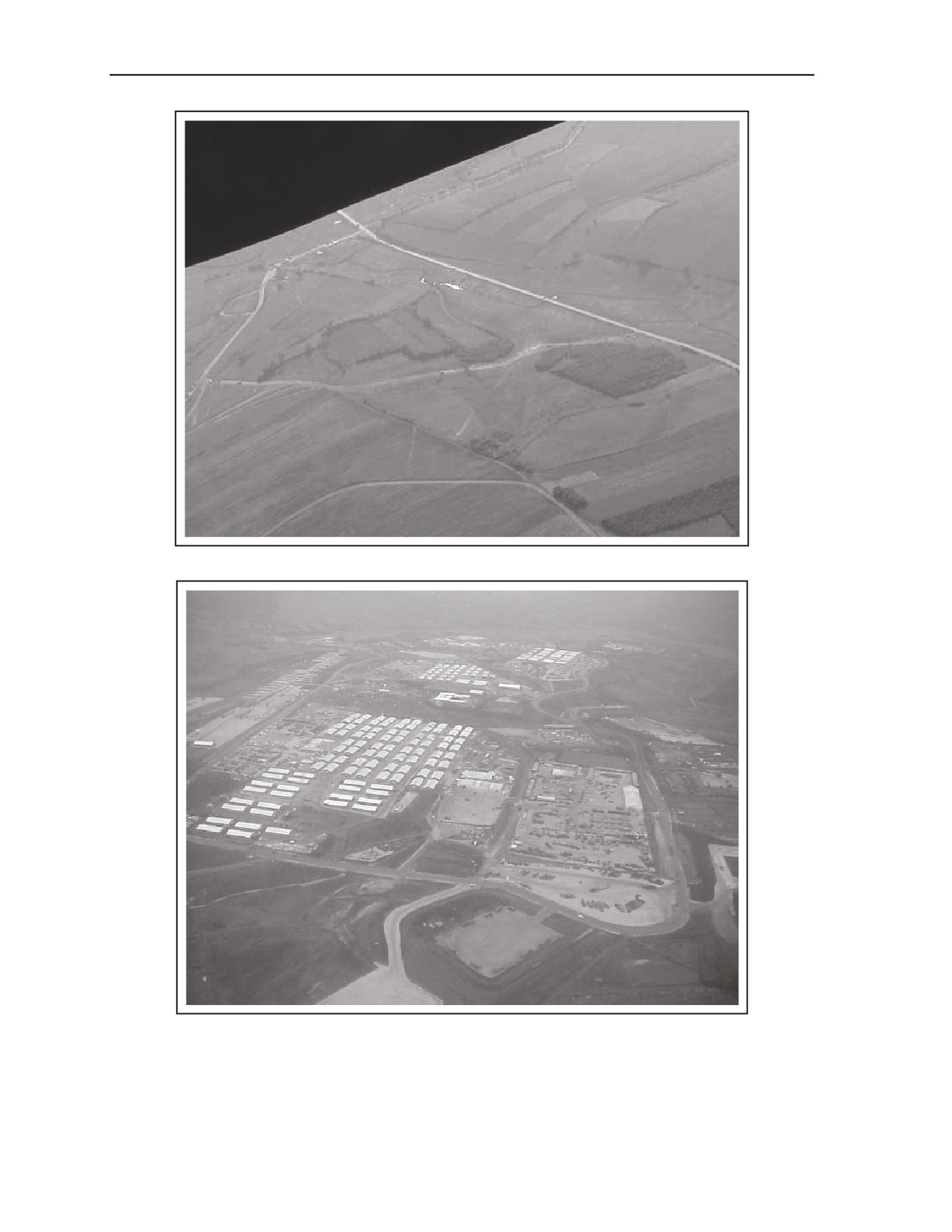
Bondsteel, Kosovo, in July 1999 before construction. Figure 11-2, page 11-2, shows the conditions of the
same camp in October 1999 after construction.
11-2. The primary purpose for a base camp is mission support─the support that a base camp system
provides for the execution of the overall military mission of the deployed force. To execute mission
support, a base camp must provide survivability and other aspects of protection to deployed forces,
resource management of critical infrastructure, training opportunities for deployed forces and permanent
party, and maintenance to facilities. Included in that mission support is the application of environmental
considerations, to include the critical aspects of FHP.
COMBATANT COMMANDER
11-3. The CCDR is responsible for the major decisions involving base camp location and development
within the AO. The CCDR may delegate authority for base camp decision making to component
commanders or to commanders exercising 10 USC service responsibilities (the ASCC in the case of the
Army). Decisions are often made in consultation with the HN, subordinate commanders, and U.S.
Department of State (DOS) representatives. CCDRs provide the necessary planning and construction
guidance for base camps in the form of a standards book or through OPLANs and OPORDs.
9 December 2008
FM 3-34.400
11-1
Chapter 11
Figure 11-1. Camp Bondsteel, Kosovo, July 1999
Figure 11-2. Camp Bondsteel, Kosovo, October 1999
11-2
FM 3-34.400
9 December 2008
Base Camps and Force Bed-Down Facilities
ARMY SERVICE COMPONENT COMMANDER
11-4. The ASCC establishes a staff engineer section with a facilities and construction department that
manages engineering and construction within the AO under the appropriate 10 USC responsibilities. This
staff engineer section is responsible for developing the base camp and bed-down plan for all Service
personnel and equipment arriving in the AOR. With guidance from the CCDR and the approval of the
ASCC, they provide guidance on engineering and construction missions; establish standards for
construction; conduct coordination with the HN; participate in funding, utilization, and resourcing boards;
and coordinate with the USACE and the ENCOM. Their responsibilities include integrating the legal, FHP,
and other aspects of environmental considerations provided from the respective areas of staff expertise.
THEATER ENGINEER COMMAND
11-5. The theater engineer command executes the majority of the ASCC engineering missions when they
are deployed to support an AO, with either military engineering units or civilian contractors.
FORWARD-DEPLOYMENT AND REACHBACK CAPABILITIES
11-6. The ASCC engineer staff and subordinate commands rely heavily on FFE, in the form of forward
deployment and reachback, to accomplish base camp design, construction, and management functions. See
appendix D for a discussion on the teams and resources available, along with their specific capabilities.
Note that the facilities engineering team is ideally suited to serve as a department of public works or camp
mayor’s cell for a forward-deployed base camp in a contingency operation.
11-7. The deployment of U.S. military forces has become increasingly common over the past two decades.
These deployment missions include the critical task to set up and occupy a base camp that projects,
sustains, and protects the force. Without proper master planning, synchronization, and oversight, base
camp construction will not meet the needs of the commander. A lack of understanding of base camps as
complex systems may result in very inefficient and ineffective base camps. Failure to include this
discussion early in the planning process can cause significant problems for the force.
FACTORS
11-8. There are many factors that contribute to the overwhelming challenges and inherent difficulty in
establishing base camps. Changing missions, fluctuating populations, turbulent civil-military situations,
and an unclear end state all greatly affect the size, orientation, and stance of base camps. Another factor
that hinders efficient planning of base camps in a postconflict situation is that units often begin establishing
their base camps by occupying existing facilities where they ceased forward movement. It could be several
weeks before a decision is made to establish a formal base camp in that location and when engineer teams
arrive to begin planning.
9 December 2008
FM 3-34.400
11-3
Chapter 11
PERSPECTIVE
During Operation Iraqi Freedom, the deserts of Kuwait became home to Soldier base
camps. They bore names like Camp Doha, Camp Arifjan, Camp Victory, Camp
Udairi, Camp New York, Camp New Jersey, Truckville, and Camp Wolf. In the
course of only a few months, barren deserts became home to tens of thousands of
Soldiers. The combined forces land component command engineer staff oversaw the
planning, design, and execution of millions of dollars of construction effort as the
United States prepared for the ground attack into Iraq. After crossing the border into
Iraq, U.S. forces fought their way north, stopping for short periods of time to rest,
rearm, and refit before moving again. Locations where the 3d Infantry Division (ID)
and 1st Marine Expedionary Force (MEF) stopped for any length of time became
small FOBs. As these FOBs were improved, several became actual base camps. As
the tactical and COP became clearer over the following months, combined JTF-7
(Iraq) had designated 13 enduring base camps within Iraq.
STANDARDS
11-9. The CCDR specifies the construction standards for facilities in the theater to minimize the engineer
effort expended on any given facility, while assuring that the facilities are adequate for health, safety, and
mission accomplishment. Typically, the CCDR will develop the base camp construction standards for use
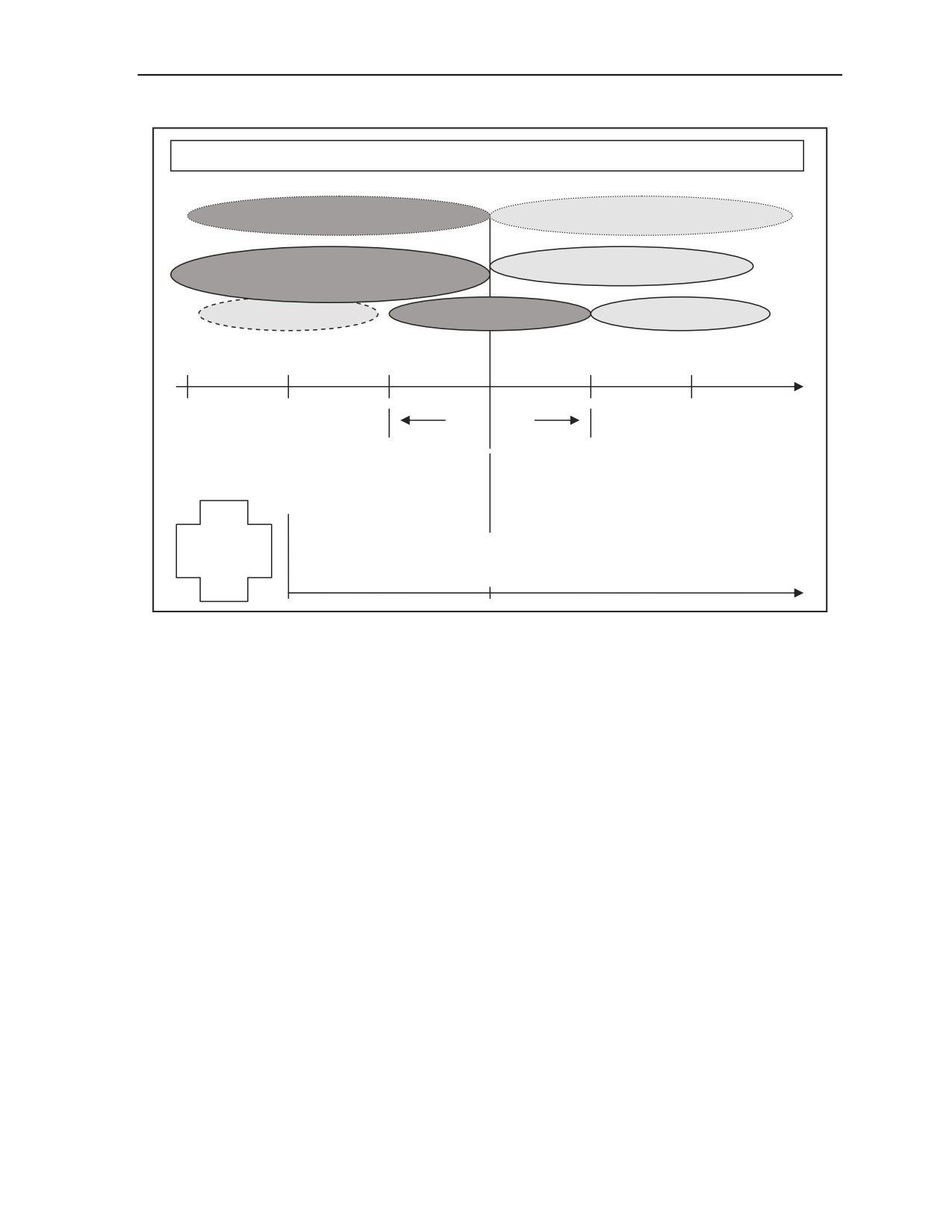
within the theater using the guidelines provided in JP 3-34. Figure 11-3 shows the bed-down and basing
continuum [and highlights the need for early master planning efforts to help facilitate transition to more
permanent facilities as the operation develops. While the timelines provide a standard framework, the
situation may warrant deviations. The engineer must recommend the most feasible solutions to each
requirement based on construction guidelines and other planning factors. Other standards documents that
provide specific construction examples include the United States Army, European Command (USAREUR)
Red Book, Base Camp Facility Standards, and USCENTCOM Sand Book. The commander may also
establish standards in specific OPLANs, OPORDs, and directives. These standards are used as initial
guides and planning tools. Standards may also provide priorities for construction within base camps.
Planners must be very familiar with the appropriate standards to execute construction and maintenance
activities in a decentralized manner.
11-4
FM 3-34.400
9 December 2008
Base Camps and Force Bed-Down Facilities
Maximized Use of Existing Facilities
Contingency
Enduring
Semipermanent
Initial
Organic
Temporary
Permanent
Initial
90 days
6 months
2 years
5 years
10 years
Transition
Entry
• Camps mature out of contingency to enduring
Standards.
• Transitions may occur anywhere in the 6-month
to 5-year planning period.
• Transitions demand early master planning.
• Potential enduring bases and conditions for transition to be addressed in the
Master
OPLAN.
Planning
• Master planning for enduring bases to begin no later than 90 days into operation.
• Master planning may be performed in reachback or in a collaborative environment.
Figure 11-3. Force bed-down and base camp development
11-10. There are two phases, based on anticipated lifespan, that identify the construction standards. Those
phases are the contingency phase (0 to 2 years) and the enduring phase (over 2 years). Within each of the
phases are subset standards which further refine the phases.
11-11. Contingency phase standards (table 11-1, page 11-6) are defined by the following types:
z
Organic. A subset of initial standard construction, organic standard construction is set up on an
expedient basis with no external engineer support, using unit organic equipment and systems or
HN resources. It is intended for use up to 90 days, and it may be used for up to 6 months. It
typically provides for initial force presence and maneuver activities until force flow supports the
arrival of engineer resources.
z
Initial. Characterized by austere facilities requiring minimal engineer effort and the ease of
material transportability or availability, initial standard construction is intended for immediate
use by units upon arrival in theater for up to 6 months. Typical to transient mission activities, it
may require system upgrades or replacement by more substantial or durable facilities during the
course of operations.
z
Temporary. Characterized by minimum facilities and effort with material transportability or
availability, temporary standard construction is intended to increase the efficiency of operations
for use extending to 24 months, but may fulfill enduring phase standards and extend to 5 years.
It provides for sustained operations and may replace initial standard construction in some cases
where mission requirements dictate and require replacement during the course of extended
operations. Temporary standard construction can be used from the start of an operation if
directed by a CCDR. It is typical to nontransient mission activities.
9 December 2008
FM 3-34.400
11-5

Chapter 11
Table 11-1. Contingency construction standards in theater
Organic construction standards—
• Support on an expedient basis with no external engineer support.
• Use unit organic equipment and systems and/or HN resources.
• The mission duration is typically 1 to 90 days.
• Provide for initial force presence and maneuver activities until force flow supports arrival of engineer
resources.
Initial construction standards—
• Are characterized by austere facilities requiring minimal engineer effort.
• Are intended for immediate operational use by units upon arrival for a limited time, ranging up to 6
months.
• May require replacement by more substantial or durable facilities during the course of operations.
Temporary construction standards—
• Are characterized by austere facilities requiring additional engineer effort above that required for initial
construction standard facilities.
• Are intended to increase the efficiency of operations for use up to 24 months.
• Provide for sustained operations.
• Replace initial construction standards in some cases, where mission requirements dictate. The
temporary construction standard may be used initially if so directed by the CCDR.
Type of
Organic
Initial
Temporary
Construction
Site work
Minimal to no site
Clearing and grading for facilities
Engineered site preparation,
work; maximized
(to include drainage, revetments,
including paved surfaces for
use of existing
or POL ammunition storage, and
vehicle traffic areas and aircraft
facilities
aircraft parking) aggregate for
parking, building foundations,
heavily used hardstands; and soil
and concrete floor slabs.
stabilization
Troop housing
Unit tents
Tents (may have wood frames
Wood frame structures,
and flooring)
relocatable structures, and
modular building systems
Electricity
Unit TACGENS
TACGENS: high- and low-voltage
Nontactical or commercial
distribution
power and high or low voltage
Water
Water points and
Water point wells and/or potable
Limited pressurized water
bladders
water production and pressurized
distribution systems that
water distribution systems
support hospitals, dining halls,
firefighting, and other large
users
Cold storage
Contracted or
Portable refrigeration with freezer
Refrigeration installed in
unit purchased
units for medical, food, and
temporary structures
maintenance storage
Sanitation
Unit field
Organic equipment, evaporative
Waterborne to austere
sanitation kits
ponds, pit or burnout latrines,
treatment facilities; priorities
and pit latrines
lagoons for hospitals, and sewage
are hospitals, dining halls,
lift stations
bathhouses, decontamination
sites, and other high-volume
users
Airfield pavement1
Tactical surfacing, including
Conventional pavements
matting, aggregate, soil
stabilization, and concrete pads
Fuel storage
Bladders
Bladders
Bladders and steel tanks
1. The type of airfield surfacing to be used will be based on soil conditions and the expected weight and number of aircraft
involved in operations.
11-6
FM 3-34.400
9 December 2008

Base Camps and Force Bed-Down Facilities
11-12. DOD construction agents
(USACE, NAVFAC, or other DOD-approved activities) are the
principal organizations that design, award, and manage construction contracts in support of enduring
facilities. Enduring phase facilities are categorized by the following two types:
z
Semipermanent. This facility is designed and constructed with finishes, materials, and systems
selected for moderate energy efficiency, maintenance, and life cycle cost. Semipermanent
standard construction has a life expectancy of more than 2 years, but less than 10 years. The
types of structures used will depend on the duration. It may be used initially if directed by the
CCDR after carefully considering the political situation, cost, quality of life, and other criteria.
z
Permanent. This facility is designed and constructed with finishes, materials, and systems
selected for high-energy efficiency, low maintenance, and life cycle cost. Permanent standard
construction has a life expectancy of more than 10 years. The CCDR must specifically approve
permanent construction.
BASE CAMP LIFE CYCLE
11-13. When developing a base camp, there are required considerations and processes that contribute to
the life cycle of a base camp. The life cycle is that time period from when the need is identified, continues
through occupation, and is completed with transfer or closure. The factors that impact the life cycle (figure
11-4) are as follows:
z
The planning and requirements.
z
The design, construction, and camp operation.
z
The transfer or disposal of real property at the end of the mission.
(2) Design
(1) Planning
Access and proximity to
Site selection
mission
Environmental baseline
Indigenous utilities
survey
Transportation requirements
Drainage
Solar considerations
(3) Construction
Structural requirements
Blast protection and AT
traffic patterns
Security standoff
(4) Operations
Sustainment
(5) Transfer and closure of camp
Budget planning and
HN agreement
programming
Environmental cleanup
Maintenance and repair
Disposal of non-real property and
functions
assets
Figure 11-4. Base camp life cycle
BASE CAMP PLANNING
11-14. Engineers must be familiar with numerous planning considerations and design factors when
planning the layout of a base camp. They must have and be familiar with the appropriate publications,
references, and planning tools required to develop a base development site plan. A base camp development
9 December 2008
FM 3-34.400
11-7
Chapter 11
plan is the set of interrelated documents that record the planning process involved in laying out,
determining the scope, and initiating implementation actions for a base camp during contingency
operations.
11-15. There are four main components of the base camp development process (see appendix E). These
components are listed below.
z
AT and protection. AT and protection are critical to the development of contingency bases and
long-term camps. Incorporating AT, physical security, and other protection concerns into site
selection and the development of the base camp layout will ensure adequate protection of
personnel and assets. The key to the effective development of base camp protection (to include
AT, associated physical security requirements, and other protection considerations, to include
survivability) is a partnership between those personnel focused on AT and other protection
issues and the site engineers. This partnership helps to ensure the development of integrated
physical security protective measures and security procedures that are consistent with base camp
design. Essential to the base camp planning effort is the early identification of AT and other (to
include physical security) protection requirements. Addressing the collective protection
concerns early helps to ensure that site location and layout are compatible with security
operations and mission accomplishment. See FM 5-103.
z
Facility standards identification. The CCDR establishes the base camp standard for the joint
operations area (JOA) by OPORD or FRAGO. These standards are intended to provide the
CCDR’s expectations to component commanders for base camp living and operating conditions.
z
Master planning. Master planning provides an integrated strategy for construction and
maintenance of required facilities at the best possible cost. The level of detail of the base camp
master plan depends on the maturity of the location, the speed at which the operational need for
a base camp develops, and the expected length of stay. A base camp master plan for
expeditionary and/or initial standard camps may be simply a sketch of the camp, while a base
camp master plan for temporary or enduring presence camps will include fully engineered
construction plans based on complete surveys that integrate environmental considerations.
z
Construction management. Responsible components
(often USACE, theater command
engineers, or facility engineer teams) will track the development of base camp construction
according to the master plan priorities and report its progress.
11-16. Integral to this process is the expectation that the development of the base camp will have a
limited timeframe and will require rapid planning and fast-track construction. Additionally, the possibility
of rapidly changing military and political situations, a requirement to serve parallel missions in the same or
neighboring regions, or a reintroduction of combat operations into the target area of the proposed base
camp, may contribute to the need to alter the steps in the planning process. Also, the requirement to serve
HN needs and concerns regarding the establishment of a single base camp or a series of base camps may
change not only the described steps of the planning process, but also the options that may be considered
with respect to the flexibility within each planning step. The intended life span of the facilities and
infrastructure of a base camp depend upon mission-driven and economic decisions. A likely ingredient of
this effort is the FFE support that the USACE will provide to the tactical commanders who determine the
need for a base camp.
11-17. A decision to establish a base camp in a theater can be made at any time during the process of
planning and executing a military operation. Ideally. it is made very early in the process to allow
appropriate planning to take place in a proactive rather than reactive environment. The USACE usually has
the mission to plan or assist in the planning and development of base camps in support of contingency
operations. Engineers and planners must be prepared to support and assist users (whose first priority is the
mission) in making base camp site selection and layout decisions. A base camp could be established in a
hostile nation after active combat operations cease (such as in the case of Iraq), in a friendly nation as a
contingency location to be used in the event of a deployment (such as in the case of Kuwait and Turkey),
or in a friendly nation to support active combat operations in a nearby country (such as in the case of
Qatar).
11-8
FM 3-34.400
9 December 2008
Base Camps and Force Bed-Down Facilities
SPECIFIC TERMINOLOGY
Base Camp
11-18. A base camp is an evolving military facility that supports the military operations of a deployed
unit. It provides the necessary support and services for sustained operations.
Base Camp Location Selection
11-19. Base camp location selection is a group of actions taken by a multidisciplinary team of U.S.
personnel. Often base camp selection is done in cooperation with a HN, to locate and obtain land, water
areas, transportation corridors, and associated air space to support a U.S. military mission.
Base Camp Development Plan
11-20. A base camp development plan is a time-sensitive, mission-driven, iterative, and cyclical process
that determines and documents the physical layout of properly located, sized, and interrelated land areas,
facilities, utilities, and other factors to achieve maximum mission effectiveness, maintainability, and
expansion capability in the AO. Additionally, the process must address the eventual cleanup and closure of
the base camp after the U.S. military mission is completed. Important products of base camp development
planning include the planning report, maps, plan drawings, and other geophysical information. Further, the
tabulation of existing and required facilities is essential in defining real-property assets, shortfalls and,
subsequently, in developing projects and other actions to mitigate deficiencies. Some documents, such as
selected maps, are used on a daily basis by assigned units and by those individuals who are responsible for
operating and maintaining the base camp.
Base Development
11-21. Base development is the acquisition, development, expansion, improvement, construction and/or
replacement of the facilities and resources of an area or location, either to support forces employed in
military operations or deployed according to strategic plans.
Design Guide
11-22. A design guide is a written and graphically depicted set of standards that govern the design,
development, visual aspects, and maintainability of a specific base camp. The guide may be used to define
performance and customer service standards for various base operation functions.
Environmental Baseline Survey
11-23. An EBS documents the original environmental condition of the land. An EBS is required if an area
is to be occupied by U.S. forces for more than 30 days. An EBS identifies environmental hazards and
issues that could impact area suitability for occupation by U.S. forces. This document is also critical during
base cleanup and closure, when the U.S. military prepares to return the land back to the HN in its original
condition. For more information on conducting EBS before the establishment of a base camp, see the
Environmental Baseline Survey Handbook: Contingency Operations (Overseas).
General Site Plan
11-24. General site planning includes the actions to inspect, analyze, and select suitable locations for the
facilities, infrastructure, utilities, and other improvements to be located within the boundaries of a base
camp. The result of this process establishes plan-view dimensions, corridors, zones, and boundaries for the
development of a base camp, usually portrayed on overlays to maps of the area.
Land Use Plan
11-25. Land use planning is the process of mapping and planning the allocation of land use areas based
on general use categories, mission analysis products, functional requirements and interrelationships, and
9 December 2008
FM 3-34.400
11-9
Chapter 11
criteria and guidelines. A land use plan is like a jigsaw puzzle because each piece of the plan is intended to
fit together to form “a whole that is greater than the sum of the parts.” The plan is sized and shaped to
account for constraints that cannot be overcome, to take advantage of opportunities that exist, to
accommodate existing requirements, and to allow for future expansion. Compatible land uses are placed
close to each another, and incompatible land uses are not.
Site Design
11-26. Site design is sometimes referred to as “site planning” by design professionals. Site design
includes the actions taken by a design professional to draw up and prepare detailed plans, specifications,
and cost estimates for the construction or renovation of facility complexes, individual buildings,
infrastructures, and supporting utilities. The term “site design” is used to avoid confusion with the terms
“site planning” and “general site planning.”
Base Camp Cleanup and Closure
11-27. Base camp cleanup and closure is the process of preparing and executing alternative COAs to
vacate a base camp after a U.S. military mission is completed. An archival record is prepared that includes
the operational history of the base camp and the actions taken to clean up and close the base camp, as well
as a description of any cleanup and closure tasks that could not be completed that may lead to land use,
health, safety, and environmental problems in the future.
Base Camp Development Planning Process
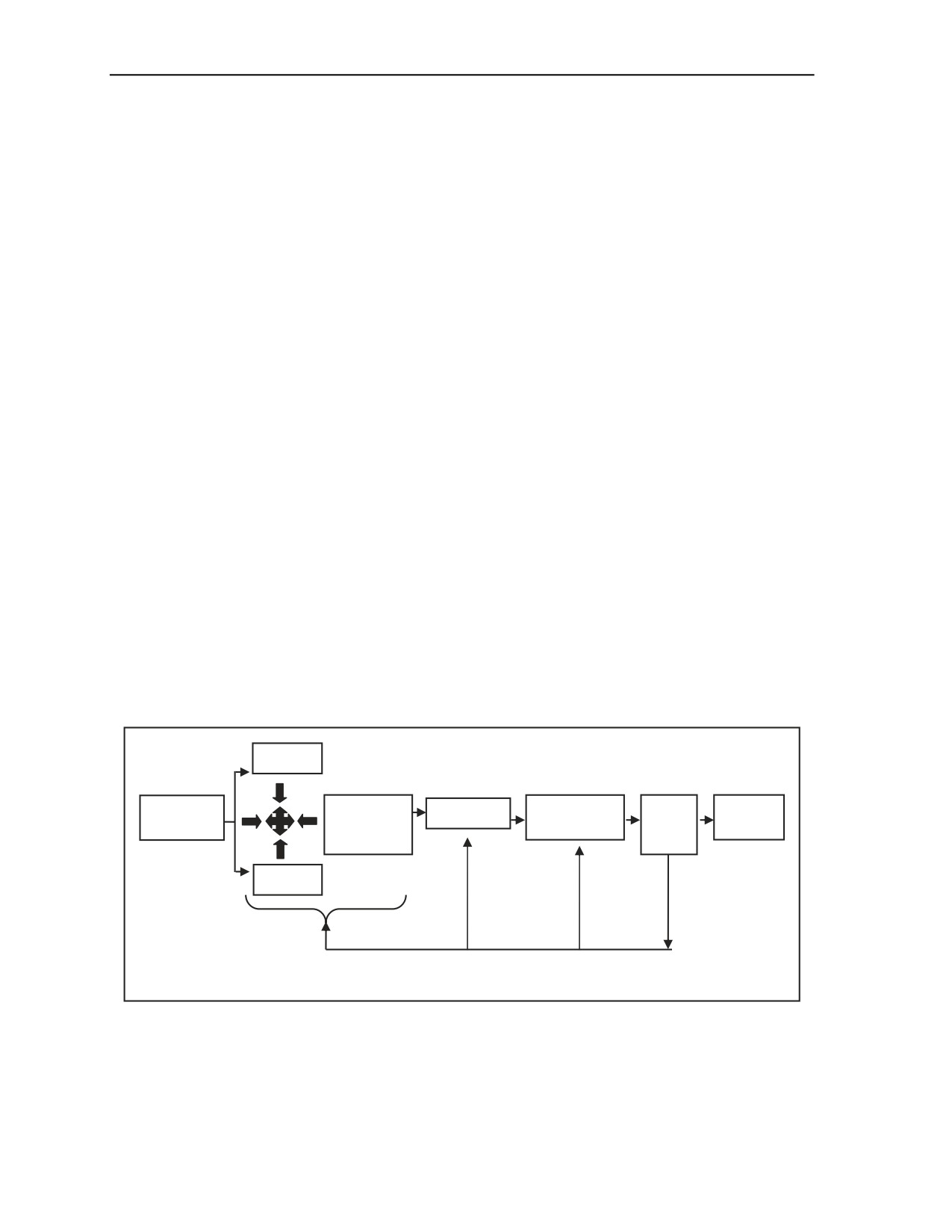
11-28. The base camp development planning process is depicted in figure 11-5. Planners rarely perform
these steps in exact sequence; consequently, numbers are not assigned to the steps. At times, planners may
enter the process when it is well underway. Planning is iterative and intuitive in nature. The base camp
development planning requires a multidisciplinary, multistaff team approach to efficiently identify,
analyze, and develop workable solutions to the many challenges that will require addressing. Base camp
planning team members could include (most importantly) commanders and their staff from the units that
will occupy or may already be occupying the base camp; operational planners and AT and protection
experts; CA specialists; technical experts in engineering and other design professions; environmental and
preventive medicine expertise; resource managers; range and training experts; program analysts;
contracting, real estate, and other legal specialists; and HN planners.
Land use
planning
Initiate
Facility
General site
Design guide,
Main-
Cleanup,
preliminary
requirements
planning
programming,
tenance,
closure,
planning
development
construction
update
archive
plans
Location
selection
(Revising and Updating)
Figure 11-5. Base camp development planning process
11-29. Base camp development planning is an iterative process that is never finished until the facilities
and land are turned back over to the HN. Base camp development plans must be shaped to always be
reaching for improvements in the base camp’s living and working conditions. For example, tents should
11-10
FM 3-34.400
9 December 2008
Base Camps and Force Bed-Down Facilities
give way to shelters. Shelters should give way to buildings. Field sanitation should give way to chemical,
then waterborne, systems. Unimproved paths and roads should give way to pavements.
11-30. All levels of command are involved in real property planning and its related facility programming
actions. Therefore, base camp development plans are reviewed and approved by not only the base camp
commander or designated representative by means of a base camp planning board, but also by higher
echelons as appropriate. This procedure has the added advantage of serving as a check-and-balance system
against hasty or capricious planning. Additional technical review and approval of development plans for
specialized projects and facilities, such as the planning of munitions storage and handling facilities, ranges
and training areas, and high-security and aviation facilities, is required.
11-31. Planners should consider the objective end-state condition of the base camp facilities and the land
area it occupies from the very start of the planning process. Initial agreements should address the cleanup,
closure, and disposal or turnover of facilities that were occupied by U.S. forces to the HN. The objective
condition of formerly occupied land must be thoroughly defined, because in many cases, the original
owners want it returned in the same condition that it was in before U.S. occupancy.
11-32. The TCMS is the Army’s official tool for base camp development planning and design. It is an
automated military engineering construction planning and execution support system that delivers AFCS
engineering and construction information for use in a TO. It provides military planners, logisticians, and
engineers with the information necessary to plan, design, and manage theater construction projects where
austere, temporary facilities are required.
DESIGN AND PLANNING CONSIDERATIONS
11-33. There is no single correct design to a base camp. There are an infinite number of designs, many of
which are efficient and functional. Specific variables include whether the unit will be—
z
Occupying existing facilities or building from the ground up.
z
Using local labor and materials or bringing them in from other nations.
z
Using a standards book or specific commander’s guidance.
11-34. The design must also consider the operational aspects of the base camp and include a base camp
zoning design and plan that will support the mission. Typical zoning considerations include the following:
z
Zone 1, billeting.
z
Zone 2, administrative areas.
z
Zone 3, support facilities.
z
Zone 4, storage facilities.
z
Zone 5, motor pool and vehicle parking areas.
z
Zone 6, waste and wastewater disposal.
z
Zone 7, AT/protection measures.
Note. See the Base Camp Facilities Handbook for more information.
11-35. The base camp planning and estimating card in appendix E provides a quick planning method for
the BCT or higher-level staff planners to develop an initial engineer estimate (such as area requirements,
tonnage, man-hours, and equipment hours) for a base camp.
11-36. To determine the requirements for land, facilities, and infrastructure, Army base camp
development planners must assess the mission, population, lifespan and construction standards, and
commander’s guidance. Each of these are discussed─
z
Mission. Base camps are home to the force where the Army (and other Service elements) lives,
works, trains, maintains, improves, and prepares for the next mission. The development of a
base camp depends on the type of operations, missions, and activities anticipated for the
encampment. Base camps may be classified as—
9 December 2008
FM 3-34.400
11-11
Chapter 11
Main operations base camps. Main operations base camps are continuously operated
camps occupied by one or more large units with command, staff, logistical, and tactical
functions. This base camp may be in support of a forward (C-130/C-17-capable) airfield
and is primarily concerned with operational missions.
Logistics hub base camps. Logistics hub base camps (also referred to as logistics support
areas) are continuously operated camps occupied by several large units with command,
staff, and logistics functions. This base camp supports theater APOE, seaport of
embarkation (SPOE), APOD, and SPOD and is primarily concerned with theater logistical
support.
Forward operating base camps. FOBs are more remote, smaller, and austere camps that
support operationally defined missions for a shorter period of time.
z
Population. The population data of a base camp is fundamental information that is required for
the base camp development plan process. As examples, the sizing of a base camp’s utility
systems and the determining of its billeting requirements cannot be accomplished without this
information. Sources of population data for a base camp include─
Table of organization and equipment (TOE) documents.
Table of distribution and allowances (TDA) documents.
Nonappropriated fund and other U.S. government documents that provide data on other
segments of the population, such as contractor personnel and local national employees.
The time-phased force and deployment data deployment list (TPFDL). TPFDL identifies
types and/or actual units required to support the OPLAN, and indicates the origin and PODs
or ocean area. It may also be generated as a computer listing from the time-phased force and
deployment data.
The civilian tracking system provides information regarding U.S. civilians present, or
scheduled to be present in the TO.
Population data for U.S. and foreign contractors, and HN employees can be acquired from
the staffing numbers that accompany the U.S. government contracting documents that
authorize contractors and local nationals. This personnel count must be added to the
personnel count of the assigned military units to determine the total planned population of a
proposed base camp.
z
Lifespan and construction standards. The planned lifespan of base camps and facilities
influences the standards used to design and construct them. Table 11-1, page 11-6, shows the
joint contingency construction standards in theater based on anticipated lifespan as provided in
JP 3-34.
z
Commander’s guidance. The CCDR’s or ASCC’s base camp facility standards give planning
guidance and minimum construction standards. Further guidance is given in OPLANs,
OPORDs, and FRAGOs. If a conflict arises between OPORDs, FRAGOs, and the facility
standards book, orders take precedence. During the life cycle of a base camp, authorized
facilities may progress from contingency to enduring or may be immediately established at any
level depending on operational requirements and CCDR guidance. Meeting these standards may
be a progressive effort.
11-37. The USCENTCOM Sand Book and USEUCOM Red Book provide very specific recommended
minimum planning factors for the construction of facilities within contingency and enduring base camps.
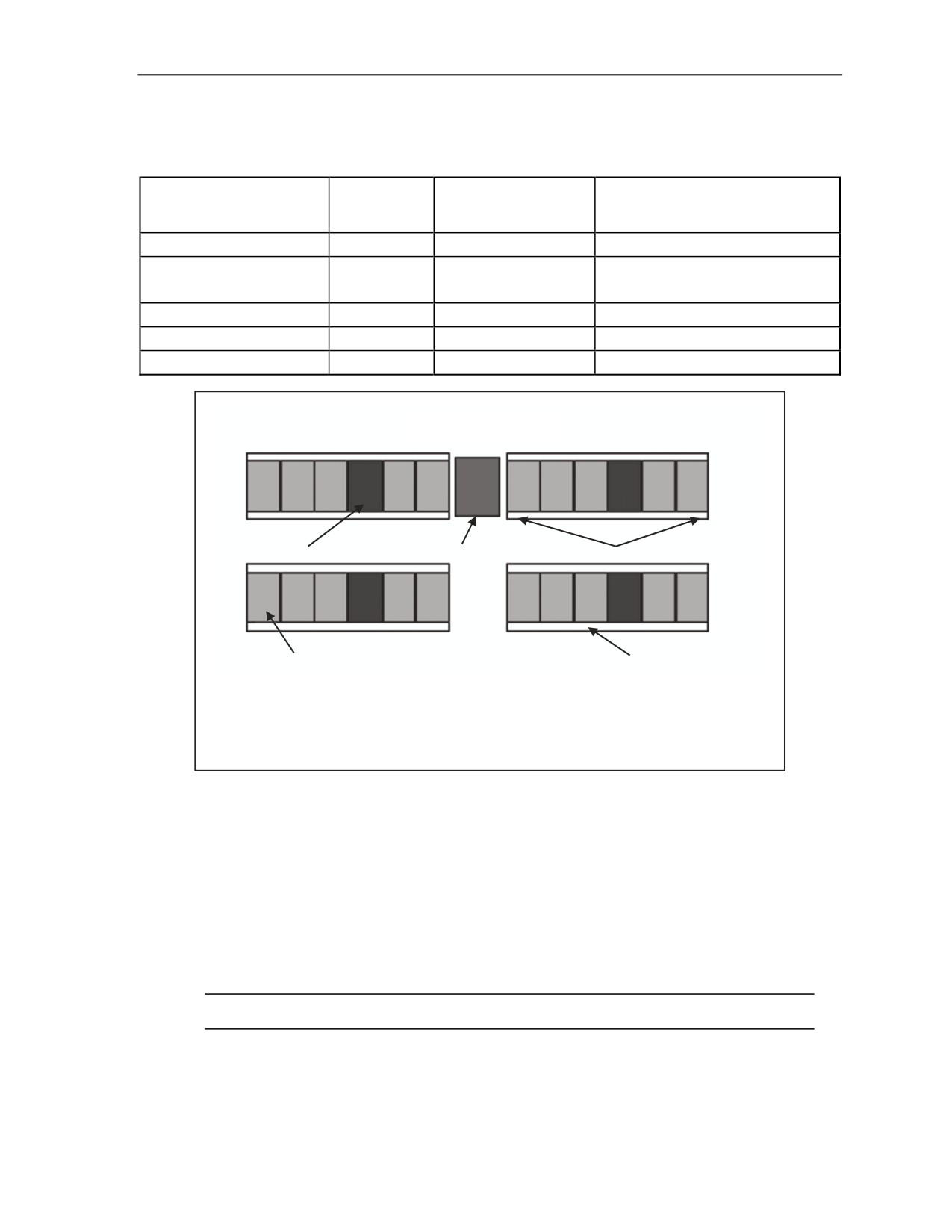
For bed-down facilities, the recommended minimum square footage for personnel accommodations is
shown in Table 11-2. The table also shows how many personnel are housed in a Southeast Asia hut
(SEAhut) or container. See Figure 11-6 for more information on SEAhuts.
11-12
FM 3-34.400
9 December 2008
Base Camps and Force Bed-Down Facilities
Table 11-2. Recommended square footage for personnel accommodations
Net
Category
Number Per
Number Per Container
Square
SEAhut
(8 x 20)
Feet
E1 through E5
80
6
2
E6 through E7,
130
4
2
WO-1/2, O1/2
E8, CW-3/4, O3/4
160
3
2
E9, CW5, O5/6
256
2
1
O7+
512
1
1
Company Cluster
Latrine
Bunker
“Davidson”
SEAhut
Covered
walkway
Each SEAhut is 16’ x 32’, same as a GP
medium tent
Figure 11-6. SEAhut company cluster
FIRE PROTECTION
11-38. Fire protection must be planned into the design of all base camps. Tent separations, wiring
standards, and Soldier education are all critical components in reducing or preventing base camp fires and
mitigating their effects on Soldiers and equipment. Over 50 tents in Kuwait were lost due to fires during
Operation Enduring Freedom and Operation Iraqi Freedom. Most fires were due to improper electrical
wiring connections and involved contractor-supplied tents that did not have the same flame-retardant
material that the military-issued tents have. A lack of proper spacing, cleanliness, unit discipline, fire
protection equipment, and training all contribute to this hazard.
Note. It is possible to retrofit tentage that is not flame-retardant.
UTILITIES
11-39. Utility system design must be based on current applicable TMs and guidance. Engineering
calculations will be used to size the system. Where economically supportable and practicable, electric grids
9 December 2008
FM 3-34.400
11-13
Chapter 11
should be connected to commercial power. Smaller or remote bases should construct central power plants
capable of supporting 125 percent of camp maximum demand load or use distributed generators of
sufficient capacity to support maximum demand loads. When stand-alone, distributed generators are the
main power source, they will be sized so that no generator set is loaded at less than 50 percent. The aspects
of heating, ventilation, and air conditioning (HVAC) should be considered. All facilities where personnel
are billeted or work should have heating by some means. Cooling in some climates is also more than a
luxury item. For larger facilities, a central HVAC system will in all likelihood be more economical and
practical when available. If it is economically feasible, tie into local municipalities and meet Army health
and other protection standards. Installation of wells for potable water is authorized. There should be a
minimum of two wells per camp─one primary and one backup (located within the camp boundaries). The
last choice is to have potable water and/or bottled water trucked in. It also is more preferable to connect to
a municipal sewage and wastewater treatment plant than to transport waste offsite for disposition.
LAND USE PLAN
11-40. A land use plan depicts general locations for areas in relation to any existing development patterns
and any existing major constraints that would have been identified by earlier data analysis. A land use plan
should portray the basic scheme for main vehicular and rail networks, and it should designate the most
advantageous locations and alignments for the mains, the stations, and the plants associated with the utility
systems. Land use relationships should achieve the most efficient arrangement of functions, should resolve
existing problems, and should provide logical and desirable locations for all mission and functional
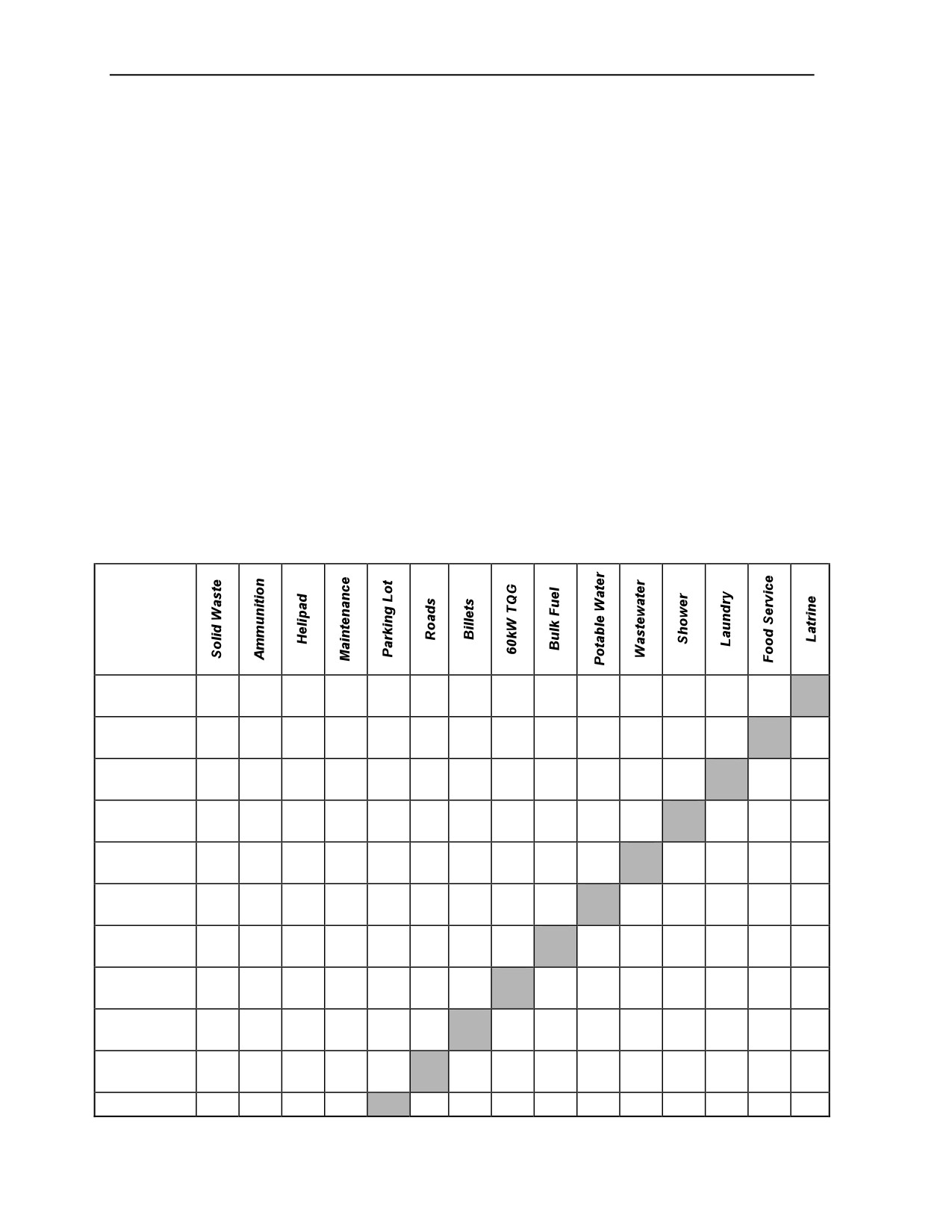
requirements. The distances shown in Table 11-3 should be used as minimum spacing for specific types of
facilities. Drainage considerations must be applied (see appendix E).
Table 11-3. Minimum distances between facilities (in feet)
Latrine
30
30
50
20
20
15
20
50
30
10
20
0
50
30
0
0
0
0
0
0
0
0
0
0
Food
30
30
50
30
30
15
20
50
30
50
20
30
30
Service
0
0
0
0
0
0
0
0
0
0
Laundry
30
30
50
20
20
15
20
50
30
50
20
50
0
0
0
0
0
0
0
0
Shower
30
30
50
20
20
15
20
50
30
50
30
0
0
0
0
0
0
0
0
Wastewater
30
20
30
20
20
15
20
50
20
30
0
0
0
0
0
0
0
0
Potable
30
20
30
30
30
20
20
15
50
Water
0
0
0
0
0
0
0
Bulk Fuel
30
50
30
20
20
15
20
20
0
0
0
0
0
0
0
60kW TQG
50
30
30
50
20
15
50
0
0
0
Billets
30
20
50
20
20
15
0
0
0
0
0
Roads
15
15
30
15
15
0
Parking Lot
20
20
30
50
11-14
FM 3-34.400
9 December 2008

Base Camps and Force Bed-Down Facilities
Table 11-3. Minimum distances between facilities (in feet)
0
0
0
Maintenance
30
30
30
0
0
0
Helipad
30
30
0
0
Ammunition
30
0
Solid Waste
SPECIFIC FACILITIES WITHIN BASE CAMPS
11-41. Used extensively in recent contingencies, SEAhuts, as shown in a cluster configuration in
figure 11-6, page 11-13, are 512 square feet (16 by 32 feet). A SEAhut has eight 110- or 220-volt electrical
outlets. Normally, there is an environmental control unit (ECU) on each end for climate control. SEAhuts
are constructed of wood with a sheet vinyl floor, 5/8-inch gypsum walls and ceiling, flat latex paint, metal
roof, precast concrete pilings, painted exterior, and nail board 6 feet above the floor (so Soldiers can put a
nail on the wall to hang things). When in a “Davidson” configuration, there are 5 SEAhut units, with a
12- by 32-foot latrine, for a total of 2,944 square feet of enclosed space. There is a 5-foot-wide walkway on
each side. An administrative configuration has 3,072 square feet, but the latrines only take up 256 square
feet. The building has walkways all around the building. The entire footprint is 42 by 106 feet, including
walkways.
LIFE SUPPORT AREAS
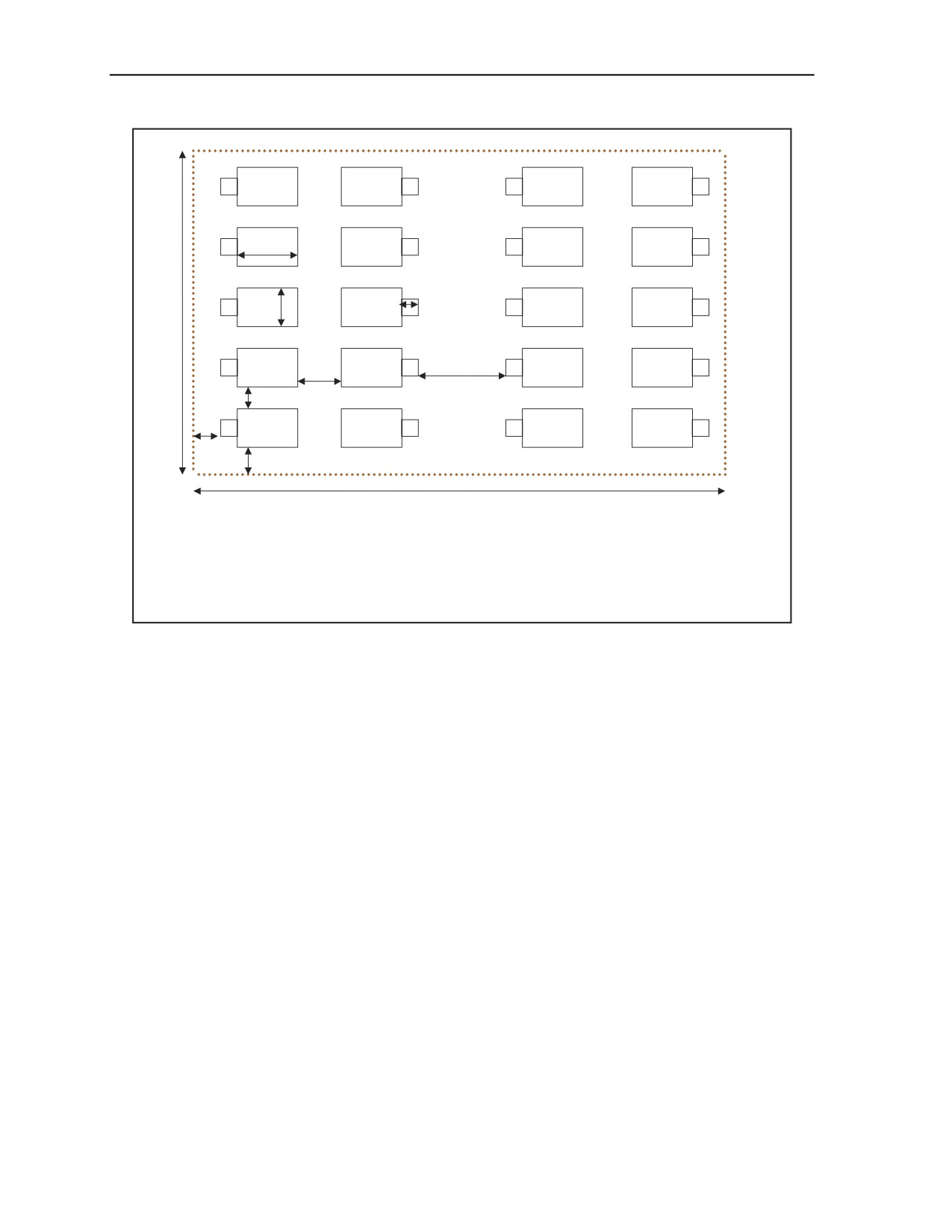
11-42. A standard life support area has 20 temper tents in the configuration shown in figure 11-7. The
large spacing between tents is for fire lanes and to allow cranes and other heavy equipment to move around
to service air conditioners without damaging the existing tents or wires. The wide fire lanes provide a
firebreak and maneuver room for firefighting equipment. Wooden buildups should not be constructed on or
inside the tents, as the wind tends to drag the tent fabric across the rough wooden edges and destroy the
tents. The tent city has a 4-inch gravel pad surrounded by a ditch. The ditch is for drainage when it rains
and to separate the “no drive” area of the life support area from the rest of the camp. Its size and depth
should be adequate to contain anticipated rainfall and runoff as well as prevent vehicular traffic from
entering and exiting at nondesignated points across the ditch. Geotextile is normally not used.
9 December 2008
FM 3-34.400
11-15
Chapter 11
10 m
2 m
6 m
66 m
9 m
18 m
6 m
6 m
6 m
Ditch
96 m
Requires 634 compacted cubic meters of 0- to 150-mm gravel
(800 loose cubic meters)
Figure 11-7. Standard life support area
SURGE HOUSING
11-43. Base camps should maintain the ability to house 10 percent of the total population as transients
and surges. During surge periods that exceed 10 percent, Tier 2 tents (maximum) will be used for housing.
The definition of construction standards for tents include—
z
Tier 1. Tier 1 consists of a GP medium field tent with plywood floor panels.
z
Tier 2. Tier 2 consists of a GP medium field tent with plywood floor panels, two electric light
outlets, two electrical outlets, and space heaters.
z
Tier 3. Tier 3 consists of a GP medium field tent, full wooden frame for tent, plywood panel
sidewalls, raised insulated flooring, four electric light outlets, eight electrical outlets, and space
heaters.
TOILET AND SHOWER FACILITIES
11-44. Toilet and shower facilities will be lighted, heated, and equipped with hot and cold water. Sanitary
wallboard is the preferred wall covering for latrines. Sheetrock, if used, must be waterproof with a
waterproof finish for cleaning. The female to male facility ratio will be based on the actual percentage of
the sexes on a base camp at the current time or anticipated for the near future. The goals for all base camps
are as follows:
z
Showers. A shower head with a population ratio of 1:20 to 1:10.
z
Toilets. A toilet with a population ratio of 1:20 to 1:10.
11-16
FM 3-34.400
9 December 2008
Base Camps and Force Bed-Down Facilities
OTHER ADMINISTRATIVE AND SUPPORT FACILITIES
CONSIDERATIONS
HEADQUARTERS FACILITIES
11-45. The size and type of headquarters facilities will depend on the situation and be based on the
established standards. The task force headquarters facilities should include at least the following:
z
Fencing.
z
Parking.
z
Security lighting.
z
Secure compartmentalized information facility.
z
Facility to house the tactical operations center operation.
z
Commander’s office space or building.
z
Space for primary staff offices.
z
Communications platforms and shelter.
z
Command bunkers, guard shacks, and so forth.
11-46. Separate headquarters facilities should also be considered for brigades, battalions, and company
elements.
LOGISTICAL SUPPORT FACILITIES
11-47. The construction of facilities such as a supply support activity, a direct exchange facility, a central
issue facility, and warehouse facilities (when required), will depend on equipment density, troop strength,
and classes of supply to be supported and will range from fixed warehouse facilities for long-term storage
and the use of military vans (containers) for transportation and short-term storage. See chapter 12 for a
more detailed discussion on support area facilities.
DINING FACILITIES
11-48. Dining facilities should have dining room space for their patrons as well as kitchen,
administration, and storage space (open and refrigerated). Adequate space for cleaning, latrines, and
clothes changing/locker areas for local national/contract kitchen staff may also be required.
FINANCE AND PERSONNEL SUPPORT
11-49. When finance center and personnel support operations are required, working areas and separated
customer service areas should be included. For the finance detachment, this may include space for a pay
cage and a vault.
POSTAL FACILITIES
11-50. When a postal facility is required, the building may not exceed the standards in DOD 4525.6-M,
chapter 13. Postal facilities must also be at least 20 meters from any other structure.
LAUNDRY COLLECTION AND DISTRIBUTION POINT
11-51. Each base camp as it develops should have a laundry collection and distribution point to serve its
population.
AVIATION FACILITIES
11-52. When aviation elements are present on a base camp, there are many aspects that must be taken into
consideration to fully address their requirements. Aviation assets need things such as─
z
Helicopter landing and parking pads.
z
Vehicle parking areas.
9 December 2008
FM 3-34.400
11-17
Chapter 11
z
A lighted landing pad or runway.
z
A forward area refuel point (FARP).
z
A control tower.
z
A squadron operations area.
z
Areas for aviation maintenance and ground maintenance.
z
Helicopter and aviation washracks.
z
Other areas.
Note. Areas where uploaded ammunition is on aircraft “hot pads” or stored in close proximity
should be separated to create a standoff distance or protected in a manner to minimize damage
from an accidental weapons discharge. See chapter 6 for a more detailed discussion on aviation
facilities.
COMMUNICATIONS FACILITIES
11-53. When a communications compound or network service center is authorized, the facility size will
depend on its purpose and the intended number of occupants it is to support.
MEDICAL FACILITIES
11-54. The level of medical support and type of clinics and hospitals will vary, but should be taken into
consideration when planning base camps. The specifics range from aid stations through clinics (dental and
medical) to field hospitals. The actual requirements will directly relate to the mission, medical, and dental
support requirements and the expectations of the command.
MOTOR POOL FACILITIES
11-55. The need and space requirements for motor pool facilities and equipment parking areas must be
recognized early on in the base camp planning and synchronized with the traffic flow patterns of the base
camp and its security planning. Space for the conduct of maintenance (enclosed and exterior maintenance
pads) and an area for administrative functions are requirements in almost all operations where base camps
are established. This may also generate a need for DS maintenance facilities as well.
FUEL STORAGE FACILITIES
11-56. As the length of the operation grows, it is more economical and safe to transition from using fuel
bladders for fuel storage to aboveground fuel tanks. Keep in mind the environmental requirements and the
need for secondary containment.
HAZARDOUS-WASTE COLLECTION POINTS
11-57. The need to address hazardous wastes generated by our operations does not go away in a deployed
environment
(see the environmental annex of the applicable plan or operations order for specific
requirements). HAZMAT spill kits should be kept on site and available.
PARKING LOTS
11-58. In addition to motor pool equipment parking areas, depending on the size and purpose of each
facility contained on a base camp, there may be a requirement to provide parking areas. These, as all
developed parking areas, should be constructed using well-graded, compacted rock and soils with an
engineered slope and drainage to minimize weather effects and increase the safety and longevity of the
parking area.
11-18
FM 3-34.400
9 December 2008
Base Camps and Force Bed-Down Facilities
KENNELS
11-59. A lighted and climate-controlled kennel facility and an exercise yard may be required when
military working dogs are attached.
MORGUE
11-60. Considerations for a morgue facility include─
z
Separation from the medical facilities.
z
Privacy.
z
The need for a work space.
z
The requirement for refrigeration.
AMMUNITION SUPPLY POINTS
11-61. ASPs vary in size and purposes. They include the need to establish basic load ammunition holding
areas and captured ammunition holding areas. Sometimes, these are colocated but segregated; other times,
they are separated into completely different locations. Storage in bunkers is preferred, but storage in
ammunition-certified containers located in bermed cells is another option. The least-preferred option is
open-air storage whether in bermed cells or not. See chapter 12 for more detailed discussions on ASPs.
WASHRACKS
11-62. There is a need for washrack facilities in prolonged operations to support the maintenance of
vehicles and the conduct of operations. Some considerations are that they should be designed to fit the
largest and heaviest vehicles in the flee, and where possible, the washrack should be equipped with oil-
water separators.
FIRE PROTECTION
11-63. Fire and emergency response services should be provided according to DOD guidance when
practical and available. Fire stations should include accommodations for the firefighters, the fire trucks and
associated equipment. There may be a need for a “live-fire” training area to keep the firefighting skills
honed and the equipment exercised. Siting of the fire station should take into consideration the response
times to mission-critical areas requiring protection (such as an airfield, helipad, or headquarters). Locations
that do not meet the criteria for having dedicated fire and emergency response services will still run a unit
fire prevention program and assign extinguisher duties to properly trained personnel. See AR 420-1,
Department of Defense Instruction (DODI) 6055.6, and FM 5-415 for more details on these requirements
and Army firefighting capabilities.
TRAINING FACILITIES
11-64. The quantity and types of training facilities will depend on the size and mission of the unit as well
as the specific base camp population. When training facilities are made available, the options vary from
virtual trainers ranges to maintain basic soldier weapon proficiencies, to full-blown, live-fire ranges for the
conduct of combined arms training. See DA Pamphlet 350-38, chapter 16, for specific requirements for
live-fire ranges.
CHAPELS
11-65. When authorized, chapel design should be nondenominational with office space provided for the
chaplain. The chaplain’s office space should be designed to support privileged communications with
Soldiers.
9 December 2008
FM 3-34.400
11-19
Chapter 11
EDUCATION CENTERS
11-66. In enduring operations, an education center may be authorized.
ARMY AND AIR FORCE EXCHANGE SERVICE
11-67. Army and Air Force Exchange Service (AAFES) facilities (such as a PX, food and service
concessions stands, and a barber and beauty shop) may be authorized and can be colocated for efficiencies.
MORALE, WELFARE, AND RECREATION FACILITIES
11-68. When authorized, morale, welfare, and recreation (MWR) facilities considerations include─
z
Fitness facilities.
z
Multipurpose facility (field house, theater, and so forth).
z
Athletic fields.
z
Running paths or tracks.
z
Armed forces network facilities.
PROTECTION CONSIDERATIONS
11-69. AT, physical security, survivability, and safety during deployed environments present unique
challenges to planners, engineers, and security forces. As is the case for fixed permanent facilities, the type
and severity of the threat as well as the desired level of protection may be the primary considerations in the
selection of the measures used. These considerations will affect decisions on many varied issues, such as
the types of vulnerability reduction measures, the physical layout of facilities, facility groupings, and the
entire infrastructure of the base camp. Important factors in planning security measures include the
availability of existing facilities, the types of structures in which people live and work, existing natural and
man-made features, types and quantities of indigenous construction materials, available real estate, and
layout of utilities and other base infrastructure. For preexisting buildings, the standards for existing
buildings should be used. Other factors for consideration are issues like facility access, standoff or
separation between facilities, threat specific standards, power generation and distribution, base camp
perimeter (fences, gates, guard towers, constructed fighting positions, and so forth), clearing barrels,
walkways, buried utilities, bunkers, and water and fuel storage protective measures.
OPERATIONS AND MAINTENANCE CONSIDERATIONS
11-70. Major facilities and base camps constructed for use in contingency operations are expensive to
build and maintain. The goal should be to maximize the life expectancy of these facilities with minimum
cost. Considerations include paint, signage, routine upkeep, and preventive maintenance
(electrical,
plumbing, exterior, and interior), road and pavement repairs, erosion control, snow and ice clearance, and
dust abatement. See chapter 13 for more details on specific maintenance considerations.
11-20
FM 3-34.400
9 December 2008
Chapter 12
Support Area Facilities
Simplicity is the ultimate sophistication.
Leonardo da Vinci
Adequate support area facilities are as vital for combat operations as they are critical
to sustainment operations. Engineers at the strategic, operational, and tactical levels
construct, maintain, and repair facilities for receiving, storing, and distributing all
classes of supply and supporting all other logistics functions. This chapter addresses
the procurement, construction, maintenance, and repair of logistics facilities and
associated environmental considerations, both for general supply and for the more
specialized purpose of storing munitions. Engineers tasked to support logistics
installations have the following four major missions: provide new facilities, maintain
existing facilities, recover and repair facilities damaged by hostile actions, and
upgrade existing facilities to meet minimum standards or usage requirements. In
some combatant command AOs, peacetime construction and HN agreements have
provided extensive facilities. In less-developed theaters, there may be no preexisting
logistics facilities. In such theaters, adapting and converting commercial property to
military use or constructing new facilities may be required to provide logistics
support facilities. Due to the magnitude of new construction and maintenance and
repair of existing infrastructure generally associated with support facilities, it is
recommended that planners consult the following publications for planning and
design criteria:
z
AR 415-16.
z
TM 5-301-1.
z
TM 5-301-2.
z
TM 5-301-3.
z
TM 5-301-4.
z
TM 5-302-1.
z
TM 5-302-2.
z
TM 5-302-3.
z
TM 5-302-4.
z
TM 5-302-5
z
TM 5-303.
SUPPLY AND MAINTENANCE FACILITIES
12-1. Logistics support areas in a contingency environment vary widely. The simplest installation may be a
hardstand surface with rudimentary surface drainage and a supporting road system. More complex
installations may look like urban industrial parks, including warehouses; maintenance and repair facilities;
water, sewage, and electrical utilities; refrigeration or other climate control capabilities; and supporting
roads, railroads, ports, airfields, protective fencing, fire services, and personnel support administration
facilities. Logistics installations include general, ammunition, and maintenance depots; storage sites (to
include fuel storage); and hospitals.
9 December 2008
FM 3-34.400
12-1
Chapter 12
CONSTRUCTION RESPONSIBILITY
12-2. The CCDR, JFC, and ASCC with 10 USC responsibility, identify the minimum-essential engineering
and construction requirements for facilities, including new construction and repair of war-damaged
facilities. For the ASCC, the theater engineer command is normally responsible for planning, prioritizing,
and tasking subordinate units for project execution. The theater engineer command can provide
construction assistance and restoration support to the other services when assets are available or as directed
by the ASCC. Support may also be provided to multinational forces when they are assisting U.S.
operations. The CCDR or JFC may designate a regional wartime theater construction manager (TCM) to
coordinate and prioritize engineer construction activities of all services in a geographic area. Detailed
command and support relationships are given in FM 100-16.
PLANNING CONSIDERATIONS
12-3. It is necessary to determine requirements for time-phased facility construction, war damage repair,
construction materiel, and other engineering needs for supporting deployed U.S. forces. In developing and
evaluating alternatives, planning should result in—
z
Determining critical requirements, the duration of construction projects, and information for
scheduling and requisitioning.
z
Developing a logical task sequence based on priorities necessary to accomplish the mission.
z
Determining an accurate estimate of the required materials and labor that takes into account HN
guidelines and resources.
z
Determining command and support relationships and providing for engineering coordination
throughout the theater or AO.
z
Identifying a method of controlling the situation as it develops or changes.
z
Identifying environmental considerations that may impact planning decisions.
z
Meeting the commander’s guidance if possible.
SITE SELECTION
12-4. Planners conduct a preliminary reconnaissance (sometimes a map reconnaissance) usually followed
by a field reconnaissance. The field reconnaissance team may be composed of, but is not limited to,
representatives of those units which the facility will support, the S-3 of the unit responsible for
construction, a command group representative, a CA personnel representative (and other specialists, such
as real estate, medical, chemical, legal, environmental, and others as required), and a representative of the
HN. Emphasis should be placed on the following considerations:
z
Tactical situation.
z
Capability to defend the site.
z
Terrain.
z
Availability of suitable existing facilities that may be either occupied immediately or modified
to desired specifications.
z
Environmental restrictions that may limit the size of the required facility (these may be caused
by weather or HN policy) or that may affect the location, design, or requirements of facilities.
z
Accessibility to projected traffic.
z
Availability of construction materials.
z
Climatic extremes that may demand refrigeration or other climate control measures.
z
Potential mission expansion and surge requirements.
PROTECTION
12-5. Protection of a facility or installation may be accomplished by active and passive security measures,
including facility hardening and dispersion. The enemy situation must be evaluated as thoroughly as
possible. Threats to supply and maintenance facilities may include conventional and nonconventional
12-2
FM 3-34.400
9 December 2008
Support Area Facilities
ground forces, CBRN threats, and attacks delivered by direct and indirect systems. Remote delivery of
mines should also be considered. In an asymmetrical AO, insurgent activities may pose a threat to logistics
assets. In determining how to best protect a facility against interdictory attacks, the commander must take
into account the surrounding terrain, the weather, the availability of Class IV and V materials to support
protective measures, and the enemy situation. Another consideration that may influence the commander’s
decision is the HN’s policy governing construction and the use of construction resources. See chapter 9 for
more information on protection. FHP and other associated environmental considerations should always be
a factor in assessment and planning. For facility protection, planners should consider using facility
hardening, dispersion, standoff, and security:
z
Hardening. Hardening of facilities should be emphasized when terrain constricts dispersion and
the threat analysis indicates that the facilities are possible targets for enemy weapons. Hardening
techniques are discussed in FM 5-103.
z
Dispersion. Where terrain conditions permit, facilities should be dispersed to prevent the enemy
from inflicting massive damage in a single strike. Precautions must be made, however, to ensure
that operations are not unduly hampered by ill-planned dispersion schemes.
z
Standoff. One of the most important considerations in protecting facilities is standoff. Standoff
is the distance between the facility and the location from which the facility could be attacked.
Increased standoff distance degrades the effect of explosive devices, helping to minimize blast
effects.
z
Security. Generally, security includes active and passive measures taken to thwart enemy troop
interdiction. Active measures may include the construction of fighting positions, wire obstacles,
earthen and concrete barriers, minefields, placement of remote sensors, and use of security
patrols. Passive measures may include the use of CCD discipline (see FM 20-3). Refer to AR
190-11 for the required security measures for ASPs. Engineer tasks that support security
measures include clearing a right of way for security fences and constructing guard posts,
fences, and lighting systems. Protective minefields and/or ECP and entry control facility (ECF)
functional zones may be required in some cases.
LAYOUT
12-6. When locating and positioning a support area facility, the commander evaluates all information
gathered in the planning and reconnaissance phases. Once the commander or designated representative has
made a decision on where the installation is to be built, the engineer develops a construction plan that takes
into consideration available resources (military, HN, or contract construction personnel, materials, and
equipment). The layout should be well coordinated and organized in such a way that it can be completed
soon enough to meet the operational priorities and minimize future controversies.
12-7. Internal operating efficiency must also be considered in the layout. The TCMS and the AFCS show
typical installation layouts. New construction and the use of nonstandard designs must be held to a
minimum. Whenever feasible, facility requirements must be met by existing facilities (U.S. and HN),
organic unit shelters, and portable or relocatable facility substitutes. Standards for new construction (initial
or temporary) are dictated by the CCDR or ASCC based on the expected duration of use, availability of
materials, man-hours of construction effort, and material cost. Locally available materials may dictate
design and construction criteria. Plans are provided for many supply and maintenance facilities in the
TCMS and the references located in the chapter introduction. Modifications may be required.
CONVERSION OF EXISTING FACILITIES
12-8. During many operations, the use and modification of existing facilities is more advantageous than
new construction, based on the availability of time, labor, and materials. Chapter
13 discusses the
procedures for acquiring existing facilities and other real property. HN agreements may require
compensation for using or converting such facilities. Army engineers, HN parties, and civilian contractors
are encouraged to use ingenuity, imagination, and inventiveness to adapt existing facilities for military use.
A cost benefit analysis will be one of the factors used to determine if new construction is more prudent or
appropriate. An infrastructure reconnaissance (assessment or survey) is recommended to document the
9 December 2008
FM 3-34.400
12-3
Chapter 12
condition of, and preexisting deficiencies in, existing structures adapted for military use. An EBS and
EHSA conducted in concert with each other are recommended to ensure that HAZMAT which would
endanger Soldier health are not present in the existing structures or their surrounding areas and to limit
claims against the government later in the life of the facility. If not able to be coordinated initially, the EBS
and EHSA must be completed as soon as possible.
12-9. Units and organizations that occupy facilities are encouraged to establish internal teams that perform
routine maintenance and repair of facilities. Army engineers perform maintenance and repair work that
exceeds the capabilities of user units. This support usually requires specialized skills or heavy equipment.
Further information on real property maintenance activities (RPMA) is given in chapter 13.
AMMUNITION STORAGE AND SUPPLY
12-10. A mature theater requires a network of ammunition supply and storage facilities. Well-situated and
stocked ammunition storage and supply facilities are critical to the timely distribution of the required
munitions. Ammunition must be stored with maximum attention to protection against natural and
man-made threats, including accidents caused by careless storage and handling. Class V and Class V (W)
(aircraft ordnance) supply items are explosive and often contain sensitive components. Improper, careless,
or rough storage and handling of ammunition and explosives may result in malfunctions and cause
accidents that result in the loss of life, injury, or property damage. Properly designed, constructed, and
maintained ammunition storage and supply facilities will help limit the possibility of such accidents.
Appropriate storage ensures the maximum serviceability and shelf life of stocks and reduces maintenance
requirements to a minimum. Planners must address concerns contained in DA Pamphlet 385-64 to ensure
the effective and safe storage of ammunition.
THEATER STORAGE LOCATIONS
12-11. The theater distribution element coordinates storage and distribution of theater munitions.
Ammunition may be pushed forward to the ordnance ammunition units, where further distribution is made
to forward ASPs. These are located in a secure area. Units may then draw directly from the ASPs.
Ammunition may be brought further forward to ammunition transfer points (ATPs) where munitions are
transferred from corps haul assets to user resupply vehicles. Generally, the farther to the rear the
ammunition facility is, the more elaborate the construction, and the more extensive the construction support
required.
CONSTRUCTION RESPONSIBILITIES
12-12. Engineer units are charged with construction responsibilities in support of ammunition storage and
supply operations. These responsibilities include the following:
z
Reconnoitering and improving and/or constructing roads and bridges, which provide access to
and egress from the ammunition facility. Engineers will also construct roads within the facility.
z
Locating water sources for firefighting operations and constructing required reservoirs and
water distribution systems.
z
Constructing standard ammunition storage magazines for indoor storage and berms and
constructing pads for outdoor storage. Engineers may be tasked to supply appropriate dunnage
for ammunition stacks according to DA Pamphlet 385-64.
z
Constructing quarters and support facilities for ammunition facility personnel and security
forces. This includes associated power and sanitation requirements.
z
Constructing and maintaining perimeter security fences, lighting systems, or other required
security, infrastructure protection and protection measures.
z
Constructing fire breaks in and around the facility.
z
Having staff proponency for the integration of environmental considerations and the linkage to
the surgeon on matters of the included FHP issues.
z
Planning for and installing adequate lighting protection systems.
12-4
FM 3-34.400
9 December 2008
Support Area Facilities
PLANNING CONSIDERATIONS
12-13. Planners must consider a number of factors when they are designing ammunition storage and
supply facilities, including drainage, shelter, ventilation, facility size, vehicle access, water supply,
environmental impacts, adjacent property use, and facility protection:
z
Drainage. Munitions can be damaged by excessive moisture and must be kept dry. Proper
grading and, where possible, the installation of drainage facilities in the area of the ammunition
facility will divert rainfall and groundwater away from ammunition stacks.
z
Shelter. Ammunition and explosives must be sheltered from the elements and the enemy.
Depending on the situation and the assets available, these shelters may range from approved
steel, arched-earth mounded igloos, to an outdoor modular storage system reinforced with
earthwork berms. These systems are discussed in detail FM 4-30.13.
z
Ventilation. Adequate ventilation is required to protect stocks from moisture and to prevent the
buildup of toxic and combustible gases.
z
Facility size. The size of the facility depends on the kinds and quantities of munitions being
handled. Facility size will be determined by the logistics unit commander, based on standards set
forth in DA Pamphlet 385-64 and the tactical situation.
z
Vehicle access. Vehicles that use the ammunition facility must be able to travel to and from the
appropriate pickup points. Road networks and traffic flow patterns inside the facility must
support concurrent resupply and issue operations and provide for the rapid evacuation of all
vehicles in case of emergency. Firefighting equipment must have access to all parts of the
facility.
z
Water supply. Water tanks and reservoirs must be located to support firefighting activities.
Refer to DA Pamphlet 385-64 for siting and resupply requirements and to FM 5-415 for
firefighting procedures.
z
Environmental impacts. With its associated FHP, environmental impacts are an aspect of
protection that must always be evaluated and planned.
z
Adjacent property use. Both present and potential future uses are important. Deeds of
restriction may be required for adjacent properties in the vicinity of ammunition storage areas.
z
Facility protection. The protection of an ammunition facility may be accomplished through a
combination of facility hardening and dispersion and through active and passive security
measures. These measures are similar to those described in the section on maintenance and
supply facilities in this chapter. Generally, the ADC plan will stipulate what measures must be
taken before, during, and after a damage incident and who will be responsible for each measure.
SITING AND LAYOUT
12-14. The logistics unit commander determines the locations of an ASP that best supports the scheme of
maneuver and meets the commander’s intent. The ASP is located within a reasonable support distance of
the maneuver elements and, it is desirable to place the ASP near an established MSR (road or rail) to make
stocking and distribution easier. However, ammunition storage facilities should not be placed too near
major facilities, such as airfields, POL storage, and ports. Taking this precaution will reduce collateral
destruction as a result of enemy targeting on other facilities. Level terrain with existing natural barriers and
good drainage is preferable. This will serve to reduce earthwork requirements. If possible, existing
facilities or structures suitable for conversion to storage areas should be used. The engineer advises the
logistics unit commander on such matters as the location of construction materials, topography, drainage,
and the condition of local road and bridge networks. Consideration must also be given to security and the
ease of defense. Wherever possible, sites should provide a defilade to give concealment from enemy
observation.
12-15. The specific layout of an ammunition supply or storage facility depends on the tactical situation,
the terrain, and the type and amount of ammunition being handled. Engineers supporting the construction
of ammunition supply and storage facilities advise the appropriate commander on construction and
maintenance matters. If required by the tactical situation, the facility may have to receive and issue
9 December 2008
FM 3-34.400
12-5
Chapter 12
ammunition before construction operations are finished. Engineers may have to alter construction plans
and techniques to allow for safe and efficient handling of ammunition while construction proceeds.
Ammunition storage facilities are best arranged in dispersed storage areas. The separation of facilities
provides protective dispersion; expedites the handling, receipt, and issue of materials; and facilitates
inventory management and segregation. The road network is designed so that each area can be entered and
exited independently. This prevents crossing traffic in all areas. Firebreaks wide enough (50 feet minimum)
to prevent fires from spreading should be maintained. Soil that contains enough organic matter to allow it
to burn must be excavated to the mineral subsoil. Since firebreaks around ammunition stacks are easily
detected by aerial reconnaissance, their use may have to be restricted or camouflaged.
12-16. Existing buildings may be used for ammunition storage as long as the rated floor load is sufficient.
Chemical, incendiary, and white phosphorus rounds should not be stored on wooden floors since they are a
fire hazard. Ammunition and explosives may be stored outdoors according to DA Pamphlet 385-64, which
details site and layout requirements for the outdoor storage of ammunition. These supplies may also be
stored on vehicles for adequate dispersion and rapid deployment.
12-17. Special effects imposed by the local climate must be taken into consideration in the design and
construction of ammunition storage facilities. The following should be considered:
z
Desert. In the desert, the need for dispersion is extremely important since natural concealment is
generally quite sparse. Shadows and regular-shaped patterns are conspicuous and can be
avoided by the use of small, irregular stacks and the elimination of regular lines and rows. In
this environment, engineers are seldom required to develop extensive road networks.
z
Cold-weather climate. In a cold-weather climate, care must be taken to provide adequate
dunnage for ammunition storage. Defilades must be avoided because they may be susceptible to
flooding following a thaw. Engineer assets may be used to clear and maintain the road network
in snow and icy conditions. See FM 5-430-00-1/Air Force Joint Pamphlet (AFJPAM), Volume
1.
z
Wet climate. In wet climates, particularly the tropics, maximum effort must be made to combat
the effects of moisture. Adequate shelter, dunnage, and ventilation must be provided.
z
Hot and cold areas. In very hot and very cold areas, static electricity is an important
consideration.
z
Drainage. Drainage is an important consideration in certain climates and areas (including desert
environments).
MEDICAL TREATMENT FACILITIES
12-18. Regardless of the size, intensity, or duration of a conflict, medical treatment facilities (MTFs) are
needed. With the fielding of Deployable Medical Systems (DEPMEDS) equipment to both the ISB and
AO, construction requirements are greatly reduced. However, the requirements for site preparation remain
high. The following are some of the GE tasks that must occur as part of the establishment of medical
facilities:
z
Site preparation.
z
Trash and garbage pits.
z
Soakage pits or a liquid disposal system.
z
Incinerators (in addition to solid-waste requirements).
z
Facilities such as showers, latrines, laundry services, food preparation, and dining.
z
Water distribution.
z
Hazardous-waste disposal.
z
Regulated medical-waste disposal.
z
Motor parking.
z
An LZ.
z
Perimeter security.
12-6
FM 3-34.400
9 December 2008
Support Area Facilities
z
Fuel storage.
z
Power generation equipment placement.
12-19. The longer the anticipated duration of the conflict, the greater the need to support medical
treatment through fixed facilities. While medical facilities always entail a considerable amount of
environmental considerations in either temporary or fixed facilities, the importance of these considerations
will tend to increase over time and should be considered and applied as early in the process as possible to
minimize their effects over time. These facilities must have the capacity and degree of sophistication to
treat injuries and other health problems sustained during the contingency. Design for a CBRN environment
may be appropriate; it must promote rapid, high-quality treatment within the theater to expedite the
Soldiers’ return to their assigned duties. In addition, U.S. forces are responsible for the well-being of
enemy prisoners of war (EPWs), DOD employees, contractors, and other nonmilitary personnel who
accompany combat forces, such as the media and NGOs. The emergency treatment of multinational
Soldiers or the civilian population may also be required.
HEALTH SERVICE SUPPORT SYSTEM
12-20. In the absence of DEPMEDS-equipped hospitals, consideration should be given to the use of
existing facilities in the areas which were originally designed as MTF, or which are readily adaptable to
use as an MTF. Attention should be paid to the types of buildings, their potential patient capacity, and their
effective use before the conduct of an operation doing so may result in the selection or use of facilities that
will save time and resources. The requirements for fixed facilities are generally restricted to the ISB, where
hospital units do not move in conjunction with the redeployment of major tactical units.
12-21. The degree of permanence may range from a temporary field hospital, to a semipermanent station
hospital, to the permanent construction of a general hospital. Site selection is the responsibility of health
service support planners, who in turn, coordinate with the logistics staff officer. The logistics staff officer
allocates the site and coordinates for the required GE support. These facilities should be located so that
patients from the ISB can be easily brought in and safely transferred within the ISB from one medical
facility to another. A location near ground transportation networks and close proximity to an air terminal is
most desirable.
12-22. Hospitals may also be located to support high-density troop populations. MTF requirements are
based on estimates of inpatient and outpatient loads and the theater patient evacuation policy. This policy
establishes the number of days that patients may be held within the command for treatment. Then they
either return to duty or convalescence or are evacuated to a facility outside the command. Shortcomings in
major existing hospital facilities and all new requirements must be identified so that construction or
rehabilitation can begin. Except when they are located in existing structures, general and station hospitals
require many weeks for development before they can function. Once established, they can be moved only
with substantial difficulty and time-consuming effort. TCMS or AFCS contains BOMs, estimates of man-
hours of construction time, and plans for station and general hospital facilities and associated clinics.
SITE RESPONSIBILITIES AND PLANNING CONSIDERATIONS
12-23. The best sites have existing utilities, such as a potable water supply, sewage disposal, and
electrical power. When new construction must be initiated, the site should be a relative geospatial high
point and the subsoil should be free-draining. The site should be isolated and from areas where sanitation
may be difficult and areas subjected to noise, smoke, odors, and other nuisances. It should, however, be
located in an area that is conducive to expansion and safe for handling large volumes of fuels (up to 50,000
gallons of jet petroleum 4 (JP4) or diesel contained in collapsible fabric tanks). The fuel is needed for
auxiliary power generation. The site should be located near waste collection facilities that can handle large
volumes of contaminated material, including discarded food products and contaminated solids. The
principles of phased construction will be enforced.
12-24. Lower-priority, complementary facilities may include a helicopter landing site, waste collection
facilities, motor pools, laundry, vehicle parking, supply receiving and shipping facilities, and recreation
areas. Even though waste collection facilities have low priority at the initial planning phase, the importance
9 December 2008
FM 3-34.400
12-7
Chapter 12
of them increases in direct proportion to the intensity and duration of the conflict since vast amounts of
contaminated waste may be generated. Expedient methods for disposing of contaminated-waste products
must be considered during the initial stages of planning. Such efforts must be designed to avoid any
possibility of contaminating groundwater supplies. Expedient methods, whether they are landfill operations
or incinerators, should be planned and located so that they enhance the operations of the medical facilities.
These methods should also be planned for semifixed facilities, such as evacuation facilities like combat
support hospitals
(CSHs), to prevent them from contaminating their own groundwater supply, and
potentially exposing patients and staff to infections. Provisions for a CBRN environment may be
appropriate.
FACILITY PROTECTION
12-25. Precautionary measures taken to prevent or minimize damage as a result of natural disaster,
accidents, and enemy activity are specified in the ADC plan. An MTF should not be located immediately
adjacent to potential tactical targets, such as airfields, ammunition storage and supply facilities, POL
storage, and major bridges. When the facility must lie within an established defensive position, it should be
located away from the outer perimeter and at a distance from critical targets. The decision to camouflage a
hospital or display the Red Cross© emblem rests with the tactical commander. All protection afforded to
medical units under the articles of the
1949 Geneva Convention are compromised when MTFs are
camouflaged.
INTERNMENT/RESETTLEMENT FACILITIES
12-26. Successful combat operations inevitably result in internees of some type. Internees fall into one of
the following classifications:
z
EPW, civilian internee (CI).
z
Retained personnel (RP).
z
Other detainee.
z
Dislocated civilian (DC).
z
U.S. military prisoner.
Note. Refer to FM 3-19.40.
Depending on the duration and extent of the conflict, the requirements for the evacuation of internees may
warrant the establishment of internee holding areas within the corps area and semipermanent internment
facilities within more secure locations. Further evacuation to semipermanent or permanent facilities outside
the AO may also require provisions for total evacuation. The discussion of internment facilities in this
chapter will be limited to the BCT, division, and theater levels. Generally, internees are evacuated for their
own safety, for interrogation, for medical treatment, or to relieve troops in the capturing unit. Once
internees are gathered at internment facilities, they constitute a pool of potential labor assets. They are,
however, subject to special considerations and some limitations. Caution should be exercised when
contemplating the use of internees of any type for labor, and the Judge Advocate General office should be
consulted for guidance.
RESPONSIBILITIES AND PLANNING
12-27. The CCDR is responsible for I/R operations, and he provides engineer and logistics support to the
military police commander for the establishment and maintenance of I/R facilities. Planning for the
construction of I/R facilities must be developed early in the operational plan. This provides timely
notification of engineers, the selection and development of facility sites, and the procurement of
construction materials. The military police coordinate the location with engineers, logistics units, higher
headquarters, and the HN. Failure to properly consider and correctly evaluate all factors may increase the
logistics and personnel efforts required to support military operations. If an I/R facility is improperly
12-8
FM 3-34.400
9 December 2008
Support Area Facilities
located, the entire internee population may require relocation when resources are scarce. When selecting a
site for a facility, the following should be considered:
z
Locations where internee labor can most effectively be used.
z
Potential threat from the internee population to logistics support in the proposed location.
z
Threat and boldness of guerrilla activity in the area.
z
Attitude of the local civilian population.
z
Accessibility of the facility to support forces and transportation to the site for support elements.
z
Proximity to probable target areas (for example, airfields and ammunition storage).
z
Classification of internees to be housed at the site.
z
Type of terrain surrounding the site and its conduciveness to escape.
z
The distance from the MSR to the source of logistics support.
12-28. In addition, consider the—
z
METT-TC.
z
Availability of suitable existing facilities (avoids unnecessary construction).
z
Presence of swamps, vectors, and other factors (including water drainage) that affect human
health.
z
Existence of an adequate, satisfactory source of potable water. The supply should meet the
demands for consumption, food sanitation, and personal hygiene.
z
Availability of electricity. Portable generators can be used as standby and emergency sources of
electricity.
z
Distance to work if internees are employed outside the facility.
z
Availability of construction material.
z
Soil drainage.
z
FHP for EPWs and forces manning the site.
z
Other environmental considerations as appropriate.
12-29. Engineer participation in managing internee activities includes providing construction support for
building or renovating internment facilities and employing internee labor in engineer tasks where
appropriate.
FACILITIES
12-30. The permanency and complexity of I/R facilities vary; however, internees must be provided areas
that are dry, environmentally controlled, lighted, and protected from fire. They must also conform to
sanitary rules, including the best practicable provisions for baths and showers. Internees must be allowed to
exercise and have access to fresh air. Sexes must be segregated.
SITE SELECTION
12-31. Internment facilities must be planned soon enough in a contingency operation to provide for
timely site selection and development. Construction materials must be procured and construction initiated
promptly. Construction should be planned to maintain a standby capability for the acceptance of additional
EPWs. The site should be located on a relatively topographic high point with free-draining subgrade soil.
This will serve to minimize earthmoving requirements for drainage. Greater sanitary precautions must be
taken when working with high-water tables or swamp-like environments. Planners should also ensure the
availability of a potable water supply, a sewage system, an electrical power supply, and nearby supplies of
construction materials. If possible, existing structures should be used to minimize new construction. The
same basic safety and environmental considerations and conformity apply.
9 December 2008
FM 3-34.400
12-9
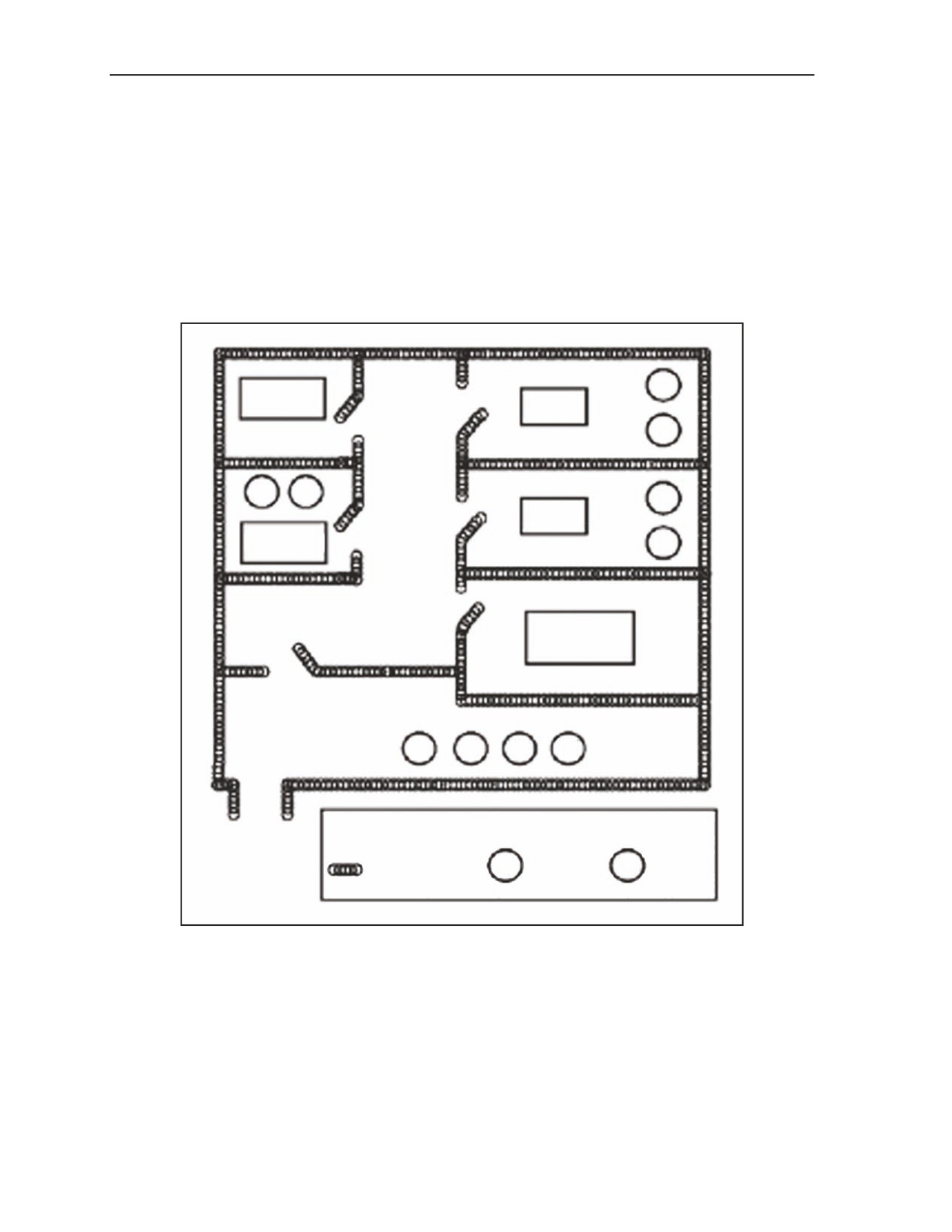
Chapter 12
TYPES
12-32. Within locations in the AOR, internment facilities are classified as detainee collection points,
detainee holding areas, or theater internment facilities. The facilities are built to contingency or enduring
construction standards and vary in size, depending on the number and classification of internees. Under
certain circumstances, semipermanent construction may be authorized. As with any TO construction,
existing facilities that can be used directly or modified with a justifiable effort are preferable to new
construction. Examples of internment facilities are shown in figures 12-1 through 12-5, pages 12-10
through 12-14. The degree of engineer effort required for the construction of these facilities varies from
little or no support to a full-scale GE effort. Normally, the degree of engineer effort will depend on the
permanence of the facility, the size and scope, and the availability of engineer assets.
L
MI
Tent
W
L
W
L
Tent
Medical
W
Military
police admin
L
L
W W
Legend.
Entrance
L
W
Concertina
Latrine
Water
Figure 12-1. Sample detainee collection point
12-10
FM 3-34.400
9 December 2008
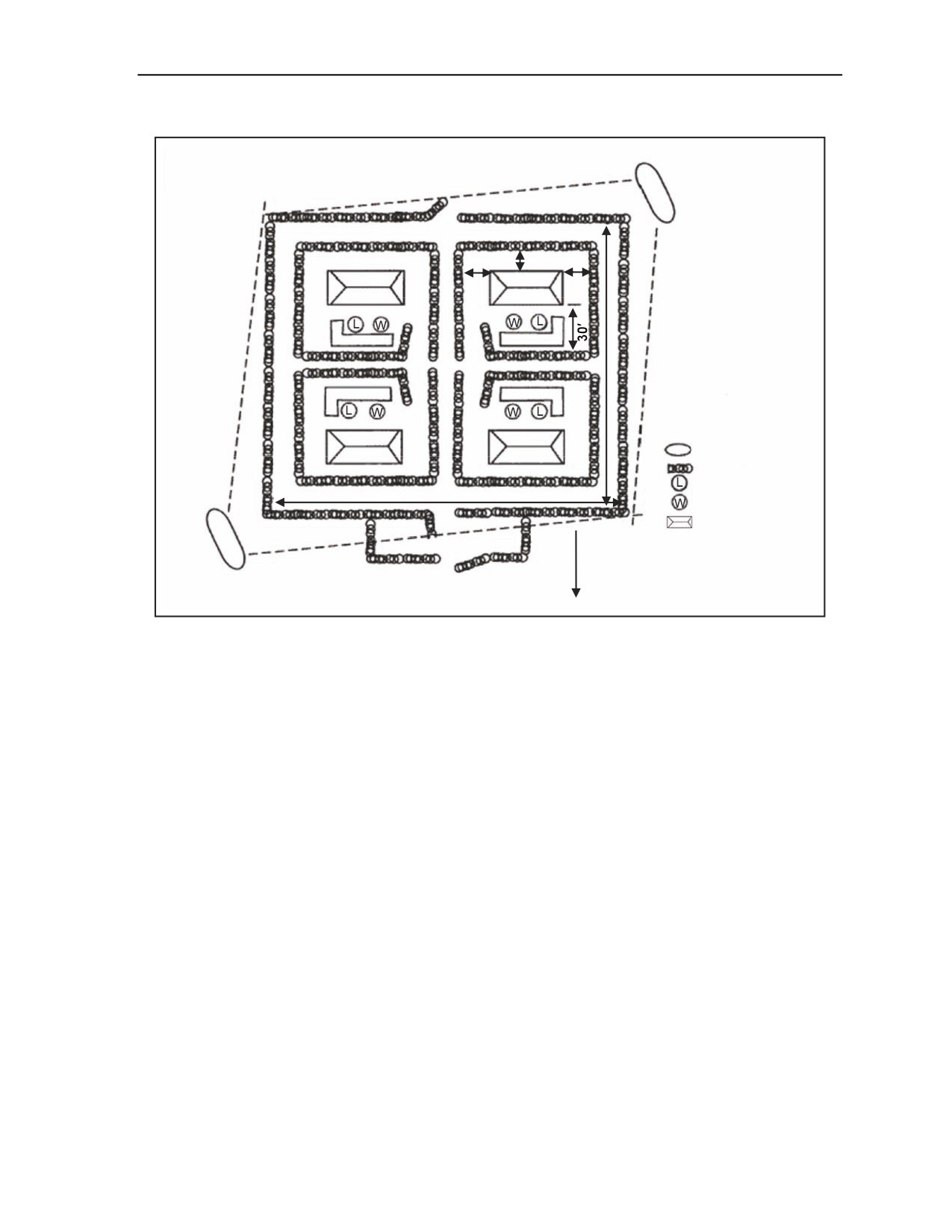
Support Area Facilities
15′
15′
Legend.
Fighting position
Concertina
Latrine
Water
GP medium tent
Figure 12-2. Sample detainee holding area
9 December 2008
FM 3-34.400
12-11
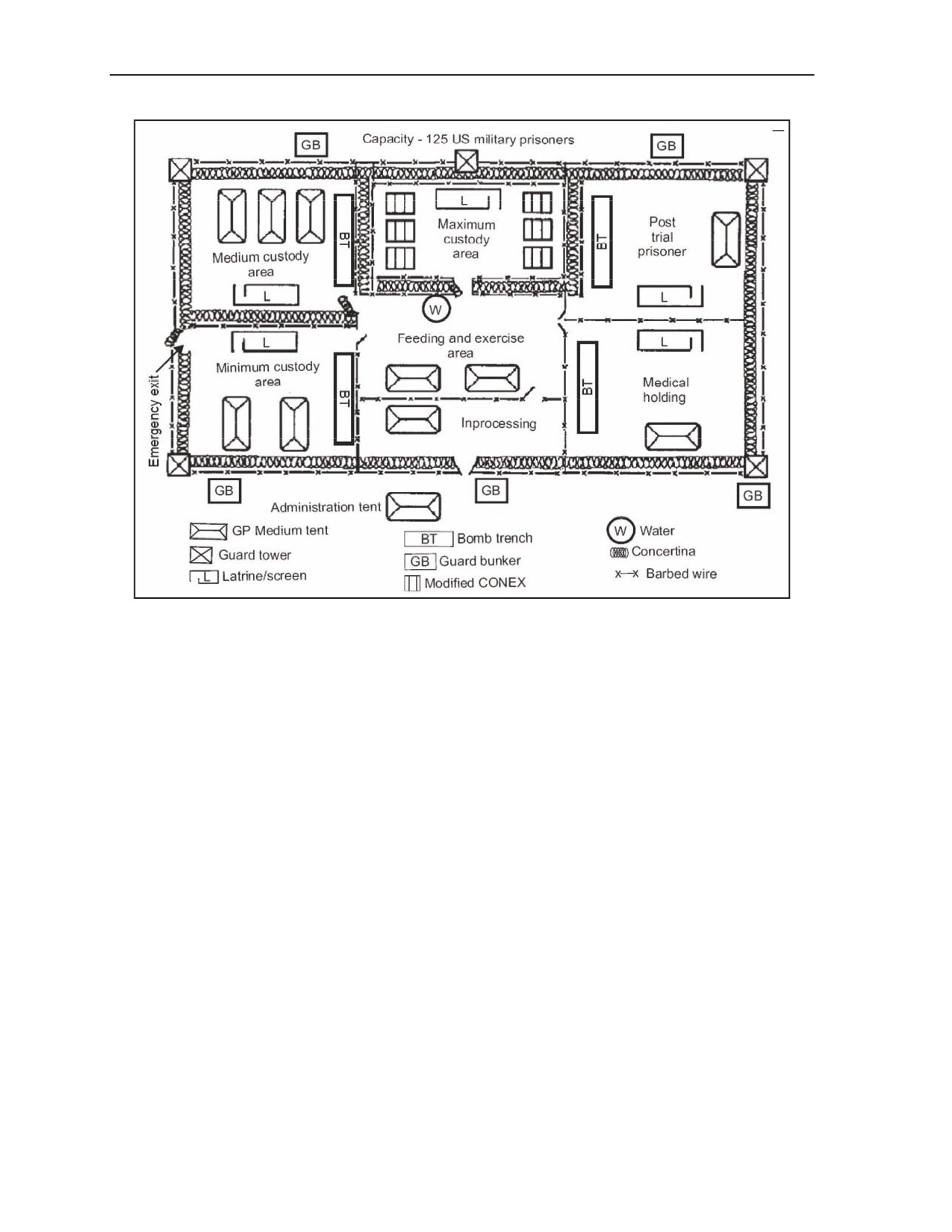
Chapter 12
Figure 12-3. Sample field detention facility
12-12
FM 3-34.400
9 December 2008
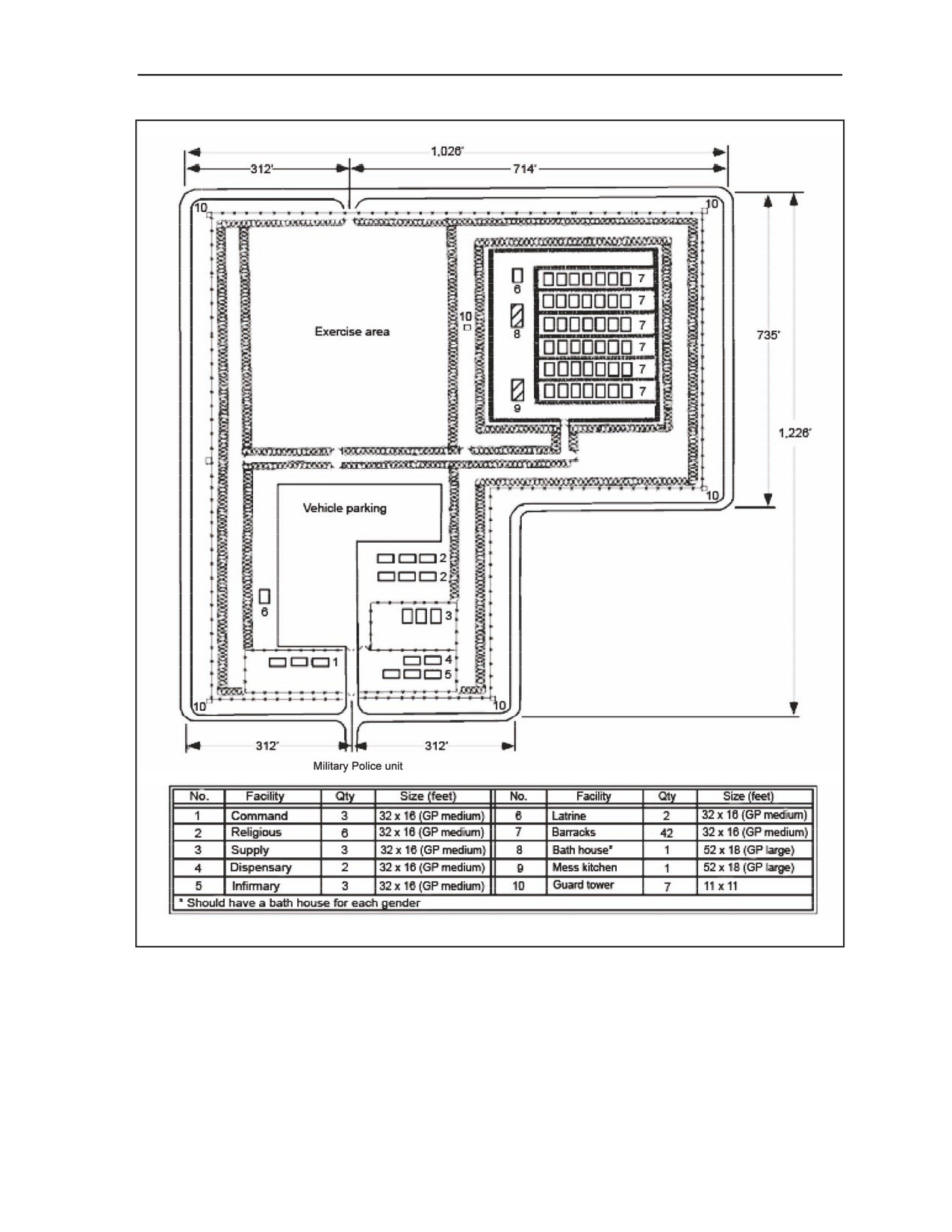
Support Area Facilities
Figure 12-4. Sample 500-man enclosure
9 December 2008
FM 3-34.400
12-13