FM 3-34.400 GENERAL ENGINEERING (December 2008) - page 2
Chapter 4
a GE project to apply these standards. Often the standards will be markedly different, depending on
whether the construction is contingent or is intended to have an enduring presence.
OPERATIONAL AND TACTICAL PLANNING CONSIDERATIONS
PROJECT MANAGEMENT
4-7. Planners use the project management system described in FM 5-412 as a tool for the process of
coordinating the skill and labor of personnel using machines and materials to form the materials into a
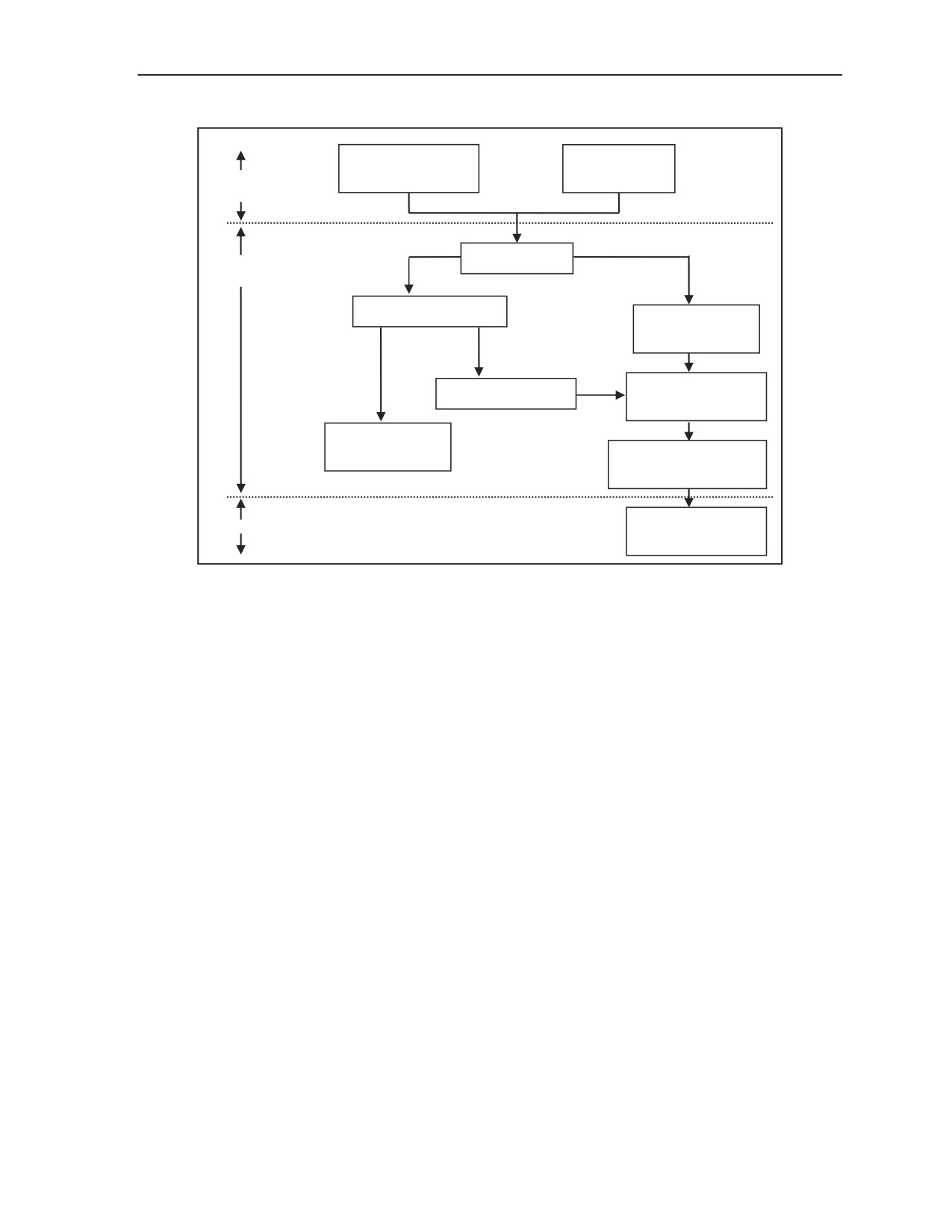
desired structure. Figure 4-1 shows the project management process that divides the effort into preliminary
planning, detailed planning, and project execution. Today, when engineer planners are focused on GE
tasks, they rely extensively on the Theater Construction Management System (TCMS) to produce the
products required by the project management system. These products include the design, activities list,
logic network, critical path method or Gantt chart, bill of materials (BOM), and other products. Effective
products produced during the planning phases also greatly assist during the construction phase. In addition
to TCMS, the engineer has various other reachback tools or organizations that can exploit resources,
capabilities, and expertise that is not organic to the unit that requires them. These tools and organizations
include, but are not limited to, the USAES; USACE Engineering Infrastructure and Intelligence Reachback
Center
(EI2RC), and the Tele-Engineering Operations Center
(TEOC), Engineering Research and
Development Center (ERDC), 412th and 416th Theater Engineer Commands; the Air Force Civil Engineer
Supporting Agency; and the NAVFAC (see appendix B).
4-8. The project management process normally begins at the unit level with the construction directive.
This gives the who, what, when, where, and why of a particular project and is similar to an OPORD in its
scope and purpose. Critical to the construction directive are plans, specifications, and all items essential for
success of the project. Units may also receive GE missions as part of an OPORD, FRAGO, warning order
(WARNORD), or he may receive them verbally. When a leader analyzes a construction directive, he may
need to treat it as a FRAGO in that much of the information required for a thorough mission analysis may
exist in an OPORD issued for a specific contingency operation.
4-4
FM 3-34.400
9 December 2008
Planning Considerations and Tools
Study construction
Conduct site
Preliminary
directive
investigation
planning
List activities
Detailed
planning
Estimate quantities
Prepare logic
network
Prepare network
Estimate duration
time development
Prepare BOM
Prepare critical path
method schedules
Control
Execution
construction
Figure 4-1. Project management process
9 December 2008
FM 3-34.400
4-5
Chapter 4
INFRASTUCTURE RECONNAISSANCE: ASSESSMENT AND SURVEY
4-9. Transitions between offensive, defensive, stability, and/or civil support operations are a complex
process. Engineers conducting offensive operations one day may suddenly find themselves conducting
stability operations. Likewise, stability operations may suddenly turn violent and units will find themselves
on the defense in preparation for offensive operations. The keys to success under such circumstances are
adaptable, flexible small-unit leaders who are able to rapidly assess the situation and make decisions with
minimal guidance and intent.
4-10. Recent history in Operation Just Cause (Panama), Operation Desert Storm, Operation Enduring
Freedom, and Operation Iraqi Freedom have been noted as relatively short and violent offensive operations
followed by a rapid transition to stability operations. Engineer units focused on the mobility of the force
suddenly found themselves relieving the suffering of the local population, restoring infrastructure, and
providing basic services (including general security). Inherent in this transition is a shift in focus from
combat to the GE function. To successfully make this transition, leaders must determine the requirements
inherent in this transition.
4-11. The infrastructure assessment and the infrastructure survey are two types or levels of reconnaissance
used to gather this necessary infrastructure information. The purpose of the assessment is to provide
immediate feedback concerning the status of the basic services necessary to sustain the local population.
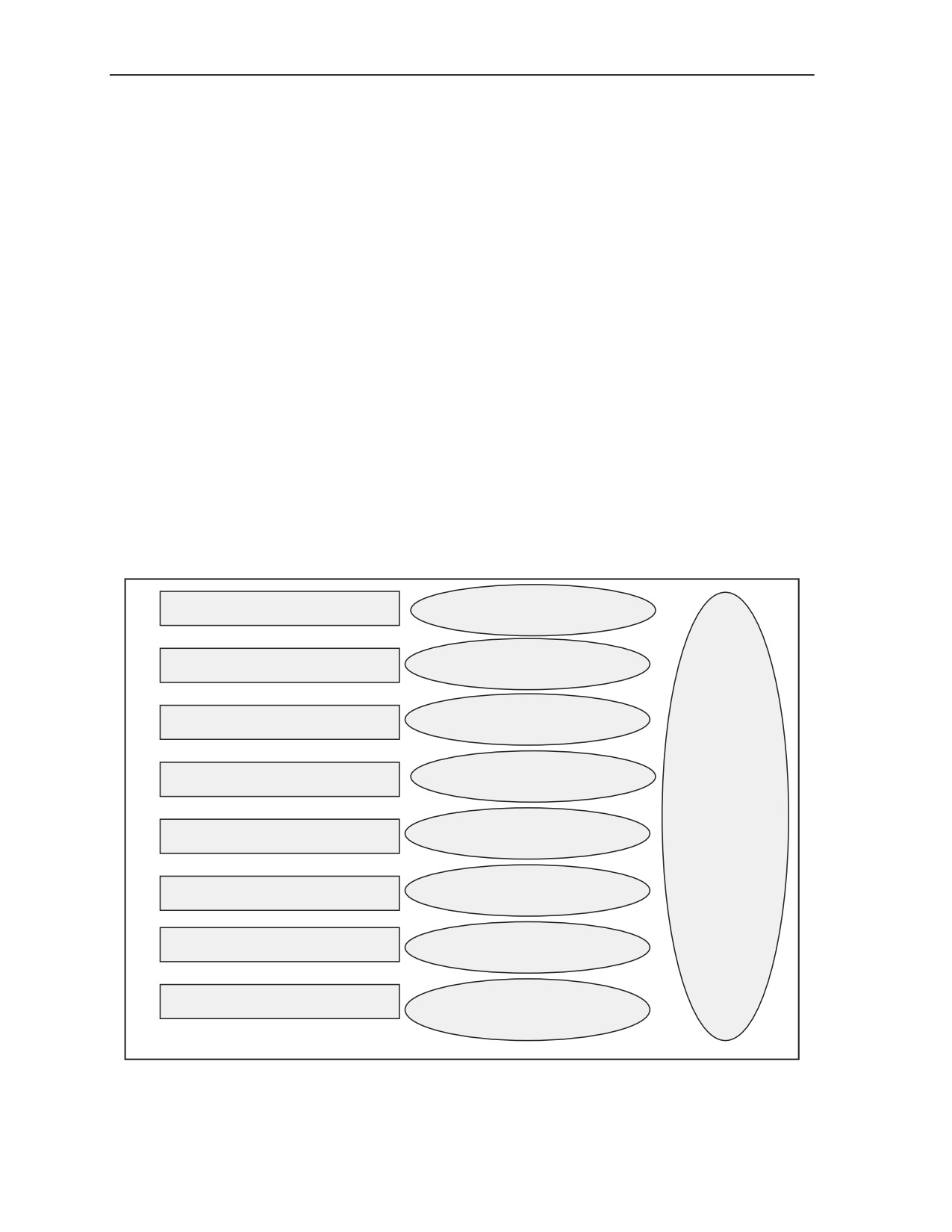
The memory aid to describe this assessment is sewage, water, electricity, academics, trash, medical, safety,
and other considerations (SWEAT-MSO) with each of the letters describing a major area within the
assessment (figure 4-2). The model can be adapted for use at the tactical level in either stability or civil
support operations. In either type of operation, the SWEAT-MSO model can be used during COA
development to delineate tasks, missions, and effects that support civil-military related objectives.
S
Sewage
Municipal sewage system fully
operational
Water treatment plants
W
Water
functional and distributing
Electrical plant open; all power
E
Electricity
lines intact
Essential
All schools open, staffed, and
A
Academics
services
supplied
operational,
critical positions
Trash service in place; city
staffed,
T
Trash
dump open
infrastructure
and populace
secure, and civil
Hospitals and clinics open and
order attained
M
Medical
staffed
Vital infrastructure secure,
S
Security
patrols ongoing
Includes all other
O
Other considerations
considerations not otherwise
specified
Figure 4-2. The infrastructure assessment and survey model
4-6
FM 3-34.400
9 December 2008
Planning Considerations and Tools
4-12. The basic services or categories evaluated depend on the situation, mission, and the commander’s
intent. While it is typically performed by engineers, it may be accomplished by others when an engineer is
not available, depending on the expertise available and the desired type or quality of information required.
If available, leaders should also consult military and NGO units and agencies in the area to determine if
there are extenuating circumstances that may influence the outcome of the assessment. Typically, engineer
planners use this information to define immediate needs and determine priorities of work. While an
infrastructure assessment is designed to support the resolution of the immediate challenges, it will set the
conditions for a successful transition. Leaders must continue to expand and refine the assessment. As
follow-on to the assessment, the infrastructure survey provides a very detailed description of the condition
of major services. The primary difference in the assessment and the survey is the degree of technical
information and the expertise required. The survey is conducted by forward USACE personnel assigned to
a forward engineer support team (FEST) and will integrate other technical specialties (medical, CA, and
others) to enhance the quality of the survey.
4-13. Some of the primary considerations for the assessment are—
z
Sewage. Determine what the status of the local sewage system is. Determine what health and
environmental risks exist.
z
Water. Determine what potable water sources are available. Determine if they are adequate and
if they have been tested.
z
Electricity. Determine the status of electrical generation facilities, to include the availability of
generators. Determine the status of the transmission infrastructure. Determine what critical
facilities (to include hospitals, government buildings, and schools) are not having their needs
met. Determine the availability of fuel for transportation, heating, and cooking. Determine if
there is an adequate system of distribution.
z
Academics. Determine what schools are in need of repair and rebuilding.
z
Trash. Determine if there is a system in place for the removal of waste. Determine what
hazardous waste streams are being generated that may have detrimental impacts on health and
the environment. Determine the ultimate disposal system for trash.
z
Medical. Determine the medical services available and if they are operational. Determine if an
emergency service exists. Determine if there are services available for animals.
z
Safety. Determine if there are police and fire services available. Determine if unexploded
explosive ordnance (UXO) or other EH is an issue.
z
Other considerations. Other considerations that leaders may consider as a part of the
assessment include—
Transportation networks. Determine if there are roads, bridges, and railroads that are
trafficable. Determine if there is an operational airport and if there are usable helicopter
landing sites. Determine if they can sustain the local, humanitarian assistance traffic.
Fuel distribution. Determine if there is a fuel distribution system available to commercial
and residential customers.
Housing. Determine if homes are structurally sound and habitable and if they include basic
utilities.
EH. Determine if there are any EH.
Environmental hazards. Determine if there are any environmental hazards.
Communications. Determine if there is an operational telephone network available.
Determine if the town has television, radio, and newspaper access and, if so, do they work.
Places of worship. Determine if there are adequate facilities to support religious activities
for all groups.
Attitude. Determine if local people and community leaders are supportive and if there is
ethnic tension.
4-14. Table
4-2, page
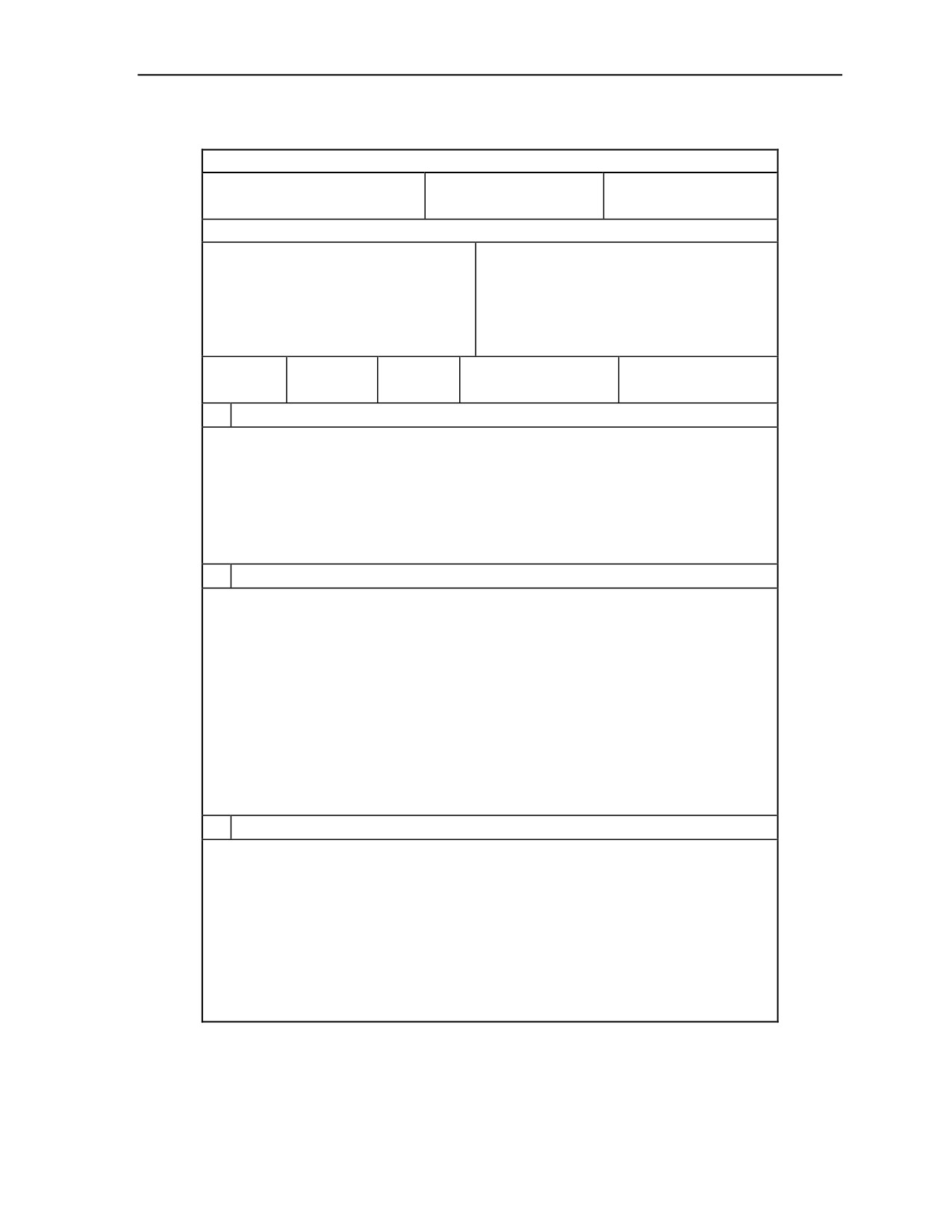
4-8 through 4-10, provides an example checklist for an initial infrastructure
assessment of a town or location to assist in determining the HCA needs of the town at the beginning of a
stability and reconstruction operation. This example is not intended to be all-inclusive, but rather another
9 December 2008
FM 3-34.400
4-7
Chapter 4
aid to support an assessment. The formal survey will be much more specific and in-depth than the
information in any assessment. The example uses the SWEAT-MSO model introduced in Figure 4-2, page
4-6, to assist the Soldier in organizing an assessment strategy. Appendix C provides an infrastructure
assessment rating to assist in rating each of the assessed categories. Leaders may use these resources to
begin developing priorities, obtaining resources, and refining a plan. Many of the tasks derived from this
process will be GE tasks (such as facilities construction, well drilling, power generation, and road repair).
4-15. Leaders should understand that many GE efforts will be part of larger information operations (IO).
GE tasks for infrastructure repair must be coordinated through the humanitarian assistance coordination
center (HACC), the civil-military operations center (CMOC), and possibly the fire support coordinator and
fire support cell, to achieve proper synchronization and the effect desired. Engineers will integrate
expertise (CA, medical, psychological operations [PSYOP], and others) during their reconnaissance and
project work, including coordinating with the maneuver commander in charge of the specific AO where a
project is located. Leaders are encouraged to modify the contents of table 4-2, pages 4-8 through 4-10, to
meet the specific needs and requirements of the operation and discuss its contents with all personnel
involved before undertaking a reconnaissance. Leaders should reference FM 3-05.40 and FM 3-13 for
more information on conducting these operations as part of a combined arms team. A more in-depth
discussion of infrastructure reconnaissance and how to conduct it as part of a combined arms team is
included in FM 3-34.170.
4-8
FM 3-34.400
9 December 2008
Planning Considerations and Tools
Table 4-2. Sample infrastructure assessment
GE Requirements - Infrastructure Assessment
Town/Village/Neighborhood:
Location:
Assessor:
Local Points of Contact (Name, Location, Telephone Number, and so forth)
Mayor:
Police Chief:
City Council:
Fire Chief:
City Engineer:
School Administrators:
Religious Leaders:
NGOs:
Community Leaders:
Population:
Male:
Female:
Religious Breakdown:
Ethnic Breakdown:
S
Sewage System Assessment
Status of municipal sewage system and distribution system:
Status of sewage systems in commercial and residential properties:
Immediate needs:
W
Water Assessment
Status of water treatment plants and distribution systems:
Status of potable water in commercial and residential properties:
Storage capacity:
Wells (location and capacity):
Immediate needs:
E
Electricity Assessment
Status of electric plant and distribution system:
Status of electric power in commercial and residential properties:
Alternate power sources:
Immediate needs:
9 December 2008
FM 3-34.400
4-9

Chapter 4
Table 4-2. Sample infrastructure assessment (continued)
A
Academics Assessment
Status of school buildings:
Status of teachers and supplies:
Immediate needs:
T
Trash Assessment
Status of trash collection system:
Status of disposal site:
Immediate needs:
M
Medical Assessment
Status of hospital and clinic buildings:
Status of physicians and supplies:
Immediate needs:
S
Safety Assessment
Status of police and fire departments:
Status of safety personnel and supplies:
Immediate needs:
O
Other Considerations
Transportation System Assessment
Status of road system (attach sketch if necessary):
Impact on critical transportation needs:
Immediate needs:
Fuel Distribution Assessment
Status of fuel distribution system:
Storage capacity:
Immediate needs:
4-10
FM 3-34.400
9 December 2008

Planning Considerations and Tools
Table 4-2. Sample infrastructure assessment (continued)
Housing Assessment
Status of structures:
Status of utilities:
Immediate needs:
EH Assessment
Explosive ordnance locations and type (send 9-line UXO report as required by the
mission):
Explosive ordnance marked (if yes, marking description):
Immediate needs:
Environmental Hazards Assessment
Do known hazards exist (if yes, describe):
Are chemicals visible on the ground (if yes, describe):
Abandoned manufacturing buildings (if yes, are waste products and streams
contained?):
Immediate needs:
Other Critical Considerations:
Recommended Priorities:
Remarks:
Signature:
Organization:
Date:
9 December 2008
FM 3-34.400
4-11
Chapter 4
FIELD FORCE ENGINEERING
4-16. The overarching concept of FFE is provided in FM 3-34. It is the application of all the Engineer
Regiment’s capabilities across full spectrum operations facilitated by both forward presence and reachback
(see appendix B). FFE works to provide seamless specialized GE support to any type of military operation,
including military support to the Department of Homeland Security (DHS) during civil disaster response.
FFE fuses the capabilities resident in USACE, USAES, theater engineer commands, Public Works, and
civilian contractors. It recognizes the critical need for early, integrated engineer participation in planning
and optimizing engineer capabilities for mission analysis, development, and accomplishment. Although
FFE may apply to all engineer functions, GE missions and geospatial engineering support best suit its
applications.
FORWARD PRESENCE PLANNING OPTIONS
4-17. The cornerstone of forward presence is the ability to form modular and scaleable teams capable of
deploying into theater on short notice to provide engineering support to the CCDR. Engineer planners at all
levels must carefully analyze the mission to determine the required level of forward presence support and
tailor its requests. Because these teams can be tailored, specificity of requests in terms of the type of
missions the team will conduct is critical. To facilitate the engineer planning effort, USACE maintains
established liaison officer (LNO) planners at the combatant command (command authority) (COCOM) and
ASCC levels.
4-18. The request for forces (RFF) process is the surest means to acquire the services of a deployable
USACE organization (described below). Because USACE is a reimbursable organization, the deployment
order (DEPORD) produced as a result of the RFF ensures funding for services provided. Requests for
USACE support should be channeled through the USACE LNO at the combatant command or ASCC
echelons. The USACE Deputy G-3 will respond to requests for engineer support in the event that
coordination through the LNOs is not possible.
Forward Engineer Support Team-Advance
4-19. The forward engineer support team-advance (FEST-A) is a deployable planning and assessment cell
that augments the engineer or civil military staffs of other organizations from the combatant command
down to the BCT level. Normally five to eight personnel, the FEST-A consists of a military team leader;
geographic information system (GIS) specialist; and civil, mechanical, and electrical engineers. It can be
augmented with structural, environmental, and other engineering skills depending on the mission. A FEST-
A prepares plans and designs to include master planning for base camps, I/R facilities, forward operating
bases
(FOBs), convoy support centers, and other facilities. FEST-A units provide assessments of
infrastructure and rough order of magnitude estimates for reconstruction of damaged infrastructure or
improvement of existing infrastructure. A FEST-A is also capable of providing formal infrastructure
reconnaissance surveys. They deploy with tele-engineering capability and are the focal point for reachback
for technical engineering support for the supported unit. During Phase IV of Operation Iraqi Freedom, as
many as thirteen FEST-A organizations were deployed in the USCENTCOM AOR at one time in support
of military units, the Coalition Provisional Authority, and the USAID. FEST-A units have conducted
hundreds of engineer assessments in Iraq and Afghanistan.
Note. Tele-engineering assists engineers and the commanders they support in planning and
executing their missions with capabilities inherent in field force engineering (FFE) through
exploitation of the Army’s command, control, and communications architectures to provide a
linkage between engineers and the appropriate nondeployed subject matter experts (SMEs) for
resolution of technical challenges. Tele-engineering is under the proponency of the USACE.
4-12
FM 3-34.400
9 December 2008
Planning Considerations and Tools
Forward Engineer Support Team-Main
4-20. The forward engineer support team-main (FEST-M) is a deployable, USACE organization that
executes the USACE mission in theater, specifically execution of contract construction. Recently deployed
FEST-M units consisted of 12 to 150 personnel depending on the mission. A FEST-M is typically placed
under the OPCON of the CCDR, ASCC, or theater engineer command commander. As the most robust of
the forward presence organizations, the FEST-M may serve as the nucleus for a precursor to an overseas
USACE district. The FEST-M typically has personnel with design capabilities for all disciplines, to include
electrical, mechanical, civil, and environmental engineering. The commander of the FEST-M tailors the
skill sets of the team to meet mission requirements.
Contingency Real Estate Support Team
4-21. The contingency real estate support team (CREST) is a 2- to 4-person team that is often attached to a
FEST-M. A CREST works on a delegation of authority to a acquire real estate for the DA. The CREST can
quickly execute real property leases in forward locations. Funding for lease payments must be provided by
the supported command. Their support is critical when deploying forces in a permissive environment in
countries with a sovereign government. Without this capability, the JFC will not be able to use HN
facilities or land.
Environmental Support Team
4-22. The environmental support team is a team of environmental experts established at the USACE
division level. It is available to deploy to perform environmental analysis and address environmental issues
regarding base camp development and operations. This team is capable of performing an Overseas EBS as
directed in DOD Instruction 4715.5, when supported with medical expertise. An EBS is most effective
when it is conducted in conjunction with an EHSA.
Water Resource Detection Team
4-23. The water resource detection team identifies high-potential areas for quality water that is within the
capability of available drilling equipment. While not automatically deployable, the team provides technical
support for military operations using databases, imagery, and other sources. See appendix B for more
information.
TECHNICAL ENGINEERING REACHBACK
Engineer Infrastructure and Intelligence Reachback Center
4-24. The Engineer Infrastructure and Intelligence Reachback Center
(previously known as the
infrastructure assessment team [IAT]) it serves as the USACE FFE “hub” for engineering support and GIS
infrastructure intelligence to military deployments and civil-military operations worldwide. It is known as
the
“one door” to USACE for reachback technical assistance and engineering support. It provides
infrastructure assessments, base camp planning, and design assistance in support to the USCENTCOM,
USEUCOM, USNORTHCOM/Federal Emergency Management Agency (FEMA), United States Pacific
Command (USPACOM), and the United States Southern Command (USSOUTHCOM). See appendix B
for more information.
Base Development Team
4-25. The base development team (BDT) provides installation-level base development planning and
facilities design expertise for ISBs, base camps, FOBs, and displaced persons camps. It integrates
environmental aspects into the design of these facilities. This ten-person nondeployable organization is
located in various USACE engineer districts and draws support from the ERDC and other USACE centers
of expertise. It is capable of completing a 30 percent design of a major base camp within three days. It uses
the inherent capabilities of Army Facilities Components System (AFCS) and TCMS to prepare designs and
passes them to forward presence organizations via tele-engineering or the SECRET Internet Protocol
9 December 2008
FM 3-34.400
4-13
Chapter 4
Router Network (SIPRNET). The BDT provided reachback support for FEMA housing planning and
response teams for temporary housing during Hurricane Katrina and is prepared to provide support for civil
disaster response as needed.
Tele-Engineering Operations Center
4-26. The TEOC serves as the focal point for video conferences. It has a classified bridge which has about
50 ports for video conferences. It also has an unclassified bridge with about 15 ports. See appendix B for
more information.
REACHBACK CAPABILITY
4-27. USACE (and other engineer organizations) elements may use the tele-engineering communications
equipment-deployable (TCE-D) for reachback for technical engineering support. The TCE-D provides
reachback capability using commercial off-the-shelf (COTS) communications equipment with encryption
added. Video teleconferences and data transfers can be conducted from remote sites where other means of
communication are nonexistent or unavailable. TCE-D comes with its own satellite links and does not use
bandwidth from units deployed in theater. Although originally designed for USACE organizations, TCE-D
is fielded to a number of tactical units for reachback and has proved to be a valuable tool. See appendix B
for more information on the reachback process, organizations, and tools.
4-14
FM 3-34.400
9 December 2008
PART TWO
Lines of Communication
Part two of this manual discusses specific GE support for the creation and repair of
LOCs. LOCs are routes over land, water, or air that connect an operating military
force with a base of operations and along which supplies and military forces move.
There are strategic, operational, and tactical LOCs and usually establishing and
maintaining them are sustainment operations. The joint force depends on ports and
airfields for AOR access and links to the CONUS base of operations. They may also
have important impacts at the operational and tactical levels. The joint force depends
on roads and railways for a link to its base of operations, and bridging is often
included to establish them. Engineers support each of these aspects of LOCs and
each are addressed here as part of the GE function.
Chapter 5
Seaports of Debarkation
They must float up and down with the tide. The anchor problem must be mastered. Let
me have the best solution worked out. Don't argue the matter. The difficulties will argue
for themselves.
Winston Churchill on pier construction to support the invasion, May 1943
Obtaining adequate port facilities early in any contingency is essential to the efficient
flow of troops and materiel. Port construction, rehabilitation, and repair are of vital
importance to the success of any such mission as they support assured mobility at the
strategic level. They are most often inherently joint operations. Securing these
facilities is often an initial objective of overseas operations. HN agreements granting
the military use rights are essential to ensure that the impact on commercial shipping
and local military operations is kept to a minimum.
While the situation dictates the COA, assault landing facilities are usually used for
supply and replenishment in the initial phase of a campaign, followed by logistics
over-the-shore
(LOTS) and joint logistics over-the-shore (JLOTS) operations, as
discussed later in this chapter. As established port areas are acquired or rehabilitated,
LOTS sites are normally abandoned. Certain AOs, however, may require the use of
beach sites for extended periods of time or even indefinitely, due to the lack of
existing facilities, the geography, the terrain, or the enemy situation. The construction
of new ports is normally undesirable, as it requires a large amount of labor, materials,
and time, and probably would lack the desirable related facilities, such as connecting
road and rail networks. Therefore, existing ports are usually targeted for
rehabilitation and upgrade. The engineer mission is to support construction,
9 December 2008
FM 3-34.400
5-1
Chapter 5
maintenance, and repair of a wide variety of facilities, both above and below the
waterline.
SCOPE OF PORT OPERATIONS
5-1. This chapter is a guide for the construction and rehabilitation of ship-unloading and cargo-handling
facilities in the OE. The coverage includes special problems encountered in port construction and the
construction of those supporting structures located in and around the port facility. Based on current trends
in the commercial shipping industry, it is anticipated that up to 90 percent of all cargo arriving in future
OEs will be containerized.
5-2. This method of shipping requires dock and road surfaces capable of withstanding severe loads and
heavy lift equipment capable of transferring the largest loaded container (8 feet wide, 40 feet long, and
67,200 pounds) from large, oceangoing vessels to shore facilities. These factors should be considered
during port planning. The guidelines concerning facilities for handling containerized cargo and container
shipping outlined within this chapter represent the most current developments in this industry.
Perspective
One of the singular logistical achievements of World War II associated with the
Normandy invasion was the gigantic artificial harbors, or "Mulberries," that were
designed, built, and transported to the landing beaches, which lacked the natural
harbor facilities that would be vital to continued support of the invasion. One harbor,
known as Mulberry A, was constructed off Saint-Laurent at Omaha Beach in the
American sector, and the other, Mulberry B, was built off Arromanches at Gold
Beach in the British sector. Each harbor, when fully operational, had the capacity to
move 7,000 tons of vehicles and supplies per day from ship to shore. Each Mulberry
harbor consisted of roughly 6 miles of flexible steel roadways (code-named Whales)
that floated on steel or concrete pontoons (called Beetles). The roadways, which
terminated at great pier heads called Spuds, were jacked up and down on legs which
rested on the seafloor. These structures were to be sheltered from the sea by lines of
massive sunken caissons
(called Phoenixes), lines of scuttled ships
(called
Gooseberries), and a line of floating breakwaters
(called Bombardons). It was
estimated that construction of the caissons alone required 330,000 cubic yards of
concrete, 31,000 tons of steel, and 1.5 million yards of steel shuttering. The various
parts of the Mulberries were fabricated in secrecy in Britain and floated into position
immediately after D-Day. Within 12 days of the landing (D-Day plus 12), both harbors
were operational.
RESPONSIBILITIES AND CAPABILITIES
5-3. The operation of a port in an OE is a large and vital undertaking with many divisions of
responsibility between the Navy and the branches of the Army. The geographic CCDR or ASCC makes
basic decisions as to the location of ports, capacity, utilization, wharfage, storage facilities, and United
States Transportation Command (USTRANSCOM) headquarters as stated in FM 100-10-1. The ASCC
Assistant Chief of Staff (ACS), movements, is responsible for operating ports and furnishing liaisons with
the Navy, Coast Guard, and other interested military and authorized civilian agencies, both of allied
countries and the United States. The ACS, Movements, requests, advises, and makes recommendations
concerning the engineer troops employed and the work concerned. All engineer branches use the guidance
in annex L, Environmental Considerations (joint OPLAN/OPORD), to achieve operational objectives,
while minimizing the impact on health and the environment.
5-4. The CCDR may assign construction support responsibilities to Army, Navy, and/or Marine Corps
engineer units, depending on their availability and the overall situation. Mutually supporting or follow-on
5-2
FM 3-34.400
9 December 2008
Seaports of Debarkation
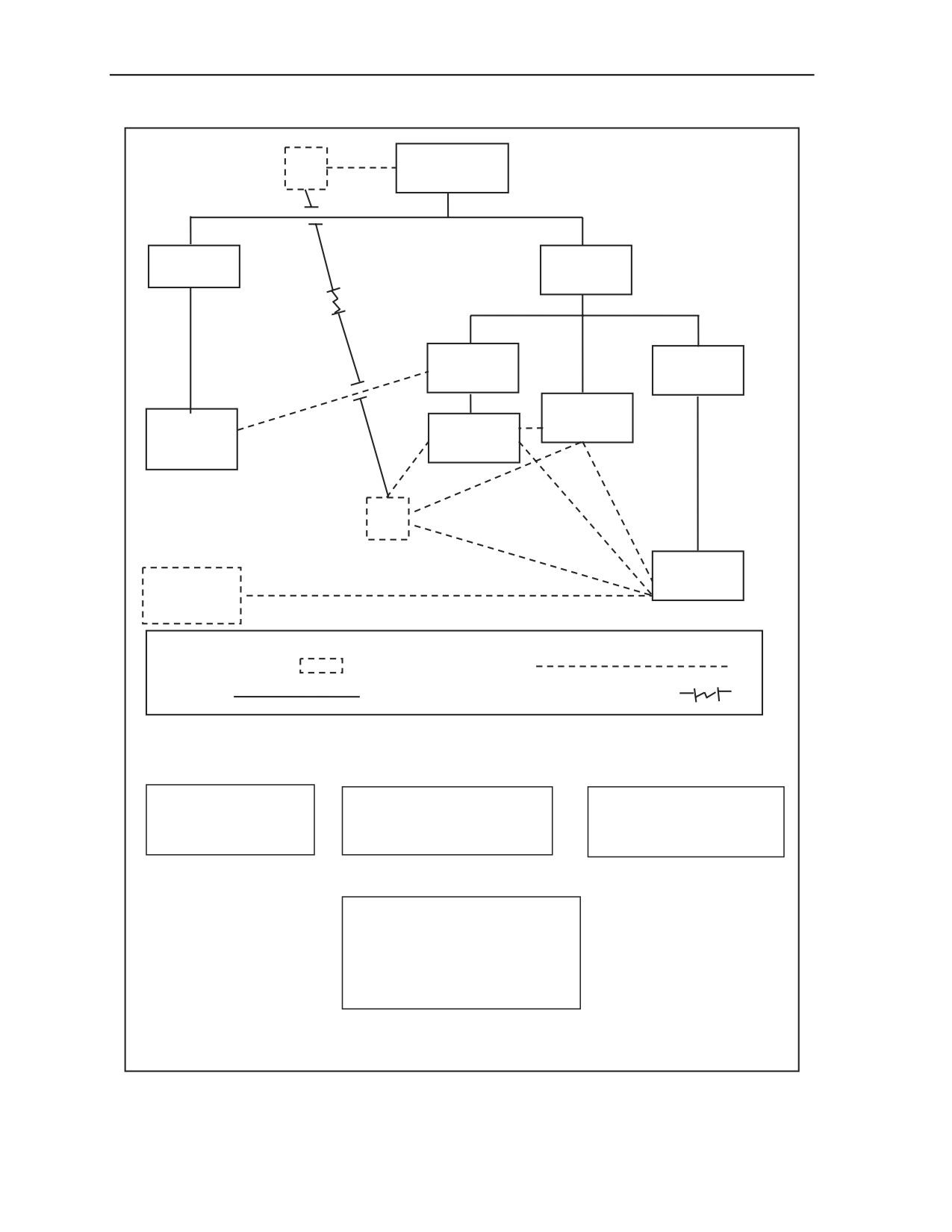
construction must be coordinated with other engineer units assigned to or projected for the AO. See
figure 5-1, page 5-4.
ARMY SERVICE COMPONENT COMMANDER RESPONSIBILITIES
5-5. The functions of the ASCC under 10 USC, for the construction or rehabilitation of a port may
include—
z
Studies of intelligence reports and all available reconnaissance applying to each port area that is
considered for use.
z
Tentative determination of the ports or coastal area to be used as a part of overall strategic
planning.
z
Assignment of the mission of the port.
z
Determination of port requirements.
z
Tentative decision on the general methods of construction to be used and the determination of
engineer units, special equipment, and materials required.
9 December 2008
FM 3-34.400
5-3
Chapter 5
Theater
HNS
commander
Navy
TA
TRANSCOM
ENCOM
Petroleum
Naval
group (QM)
Terminal
operations
unit
group
HNS
Engineer
units
Seabee
Legend
Subject to availability
Coordination
Command
Command (less intermediate chain)
Responsibilities
Navy
TRANSCOM (TC)
Petroleum group (QM)
Major dredging
Post operations
Operation of POL pipelines
Major salvage
Establish construction priorities
Off-vessel discharging and
operations offshore
Movement of freight out of the
loading of POL
construction
port area
ENCOM
Rehabilitation and construction of
over water facilities, breakwaters,
storage areas, utilities, POL
facilities, firefighting facilities,
dredging, minor salvage operations,
and real estate functions
Figure 5-1. Port construction command and coordination
5-4
FM 3-34.400
9 December 2008
Seaports of Debarkation
NAVY RESPONSIBILITIES
5-6. The Navy has many of the same capabilities for port construction as the Army. The Navy
accomplishes its port construction missions with Seabees. Close coordination between the forces must be
done to avoid duplication or counterproductive efforts.
MARINE RESPONSIBILITIES
5-7. The Marines have a considerably smaller overall engineer force than the Army. As such, they have a
smaller role, though no less important, during most port construction operations. The majority of Marine
engineer forces is primarily task-organized to support maneuver units and may only provide port
construction support sufficient to move Marine units through a port.
ARMY ENGINEER UNITS
5-8. Army engineer units are responsible for port construction and rehabilitation and for coordinating all
work with that of any Navy units engaged in harbor clearance and salvage operations, such as the
neutralization of mines and underwater obstacles. Engineers perform minor salvage operations, such as
clearing obstructions and debris from harbor entrances and improving channels. This does not include
large-scale salvaging, which is a Navy responsibility. Vertical and horizontal companies augmented with a
concrete section, dive team, and other specialty teams and sections accomplish the majority of the tasks. In
performing their mission of rehabilitation, construction, and maintenance of a port, Army engineers are
responsible for—
z
The construction and repair of breakwaters, docks, piers, wharves, quays, moles, and landing
stages.
z
The construction and maintenance of roads in the port area.
z
The construction and major maintenance, only, of railway facilities required by the port.
z
The construction of storage and marshaling areas required by the port.
z
The construction or reconstruction of port utilities, including water supply, electric power, and
sewerage, if required.
z
The construction and major maintenance, only, of tanker unloading facilities, including mooring
facilities, submerged pipelines, surface pipelines, and rigid petroleum, oils, and lubricants (POL)
tank farms.
z
The maintenance and operation of the firefighting facilities of the port.
z
Any dredging, except as accomplished by the Navy.
z
The debris and EH clearance in the port area.
z
The acquisition of buildings, facilities, and other property within the port area for military use.
z
The provision for warehouses, depots, quarters for port personnel, and other facilities as
required for the operation of the port.
z
The continuous study of the port situation and the preparation of tentative plans for possible
contingencies.
z
The requisitioning of supplies and equipment to carry out the mission.
z
The provision for diver support.
z
The liaison with naval units to coordinate construction with harbor clearance activities.
z
The recommendations for real estate allocations.
z
The recommendations based on environmental considerations, to include force health protection
(FHP).
z
The advising of the CCDR and staff on engineering matters connected with the identification,
classification, in-transit storage, movement, and distribution of engineer equipment and Class II
and Class IV construction materials.
9 December 2008
FM 3-34.400
5-5
Chapter 5
5-9. The engineer unit with overall responsibility for port construction or rehabilitation may be the theater
engineer command, engineer brigade, battalion, or company depending on the scope of work. For port
construction, it is essential to task-organize a modularized force with the right type and number of
companies, platoons, sections, and teams. The modularized force may include horizontal and vertical
companies, concrete sections, heavy dive teams, pipeline companies, survey design sections, and other
units as the mission requires.
5-10. Tele-engineering technology improves global reach, letting engineers who are deployed reach back
via satellite to experts for additional advice and expertise as necessary (see appendix B). This reduces the
number of engineer footprints while providing the technical expertise necessary to support GE projects,
such as port construction, rehabilitation, and repair.
TRANSPORTATION UNITS
5-11. Transportation units are responsible for operating the port. The unit coordinates operational activities
with the completion of necessary projects, and provides liaison with the Navy and Coast Guard. The
transportation unit also performs a continuous study of the needs of the port facilities to ensure smooth and
orderly flow of personnel, supplies, and materiel through the port. The unit staff plans, supervises, and
controls freight movement from the port by rail, motor, and inland water transportation, and under certain
conditions, air transport. Finally, the transportation unit is responsible for establishing engineer
construction priorities.
QUARTERMASTER UNITS
5-12. Quartermaster (QM) units have responsibility for the operation of petroleum pipeline systems
including off-vessel discharging and loading. They coordinate with naval units, engineer units, and
transportation units in determining the location of tanker unloading and vessel fueling facilities.
HOST NATION AND LOCAL LABOR SUPPORT
5-13. HNS is used to the fullest extent to reduce the requirements for engineer units and to expedite
construction. In the rehabilitation of developed areas, it may be practical to arrange employment of HN
engineers, contractors, and superintendents with their organizations. These may include a variety of skilled
workers. In many undeveloped AO, local businesses have established organizations to employ and
supervise labor in agriculture and other pursuits. Such organizations can often provide labor skilled in
primitive construction methods. In either case, the plans for employing civilian labor must include adequate
consideration of such factors as housing, transportation, local customs, language difficulties, any locally
determined complications due to race or religion, and adapting construction plans to the methods and
materials to be used. The use of local civilian labor may result in savings in mobilization and
demobilization costs and additional savings due to the local wage scale.
PLANNING FACTORS
5-14. Wherever possible, port construction efforts in the OE are based upon the rehabilitation and/or
expansion of existing facilities rather than new construction. Once the decision as to the location of the port
has been made at theater headquarters, the mission is assigned to an appropriate engineer level of
command. The location of the port will be made based upon an analysis of the projected capacity of the
facility, the quantity and nature of cargo to be handled, the tactical and strategic situation, and the
construction materials and assets available.
5-15. Careful planning based upon extensive and detailed reconnaissance is essential to successful port
construction. This reconnaissance should begin upon receipt of the mission and continue throughout
construction and up to actual occupation. A thorough initial reconnaissance will help planners estimate
logistics requirements by providing data on the physical condition of the port to be seized or occupied.
Geospatial products may assist before, during, and after the reconnaissance has been completed.
5-6
FM 3-34.400
9 December 2008
Seaports of Debarkation
5-16. Based upon this analysis, construction assignments, facilities required, and scheduled target dates for
various phases of development are derived and outlined in the OPORD. From this information, a
construction schedule is formulated. Construction schedules are prepared to show in detail the time plan for
all operations in their proper sequence. Equipment hours and man-hours of labor required for each
principal operation are then tabulated. The construction schedule is based on the─
z
Time allowed for completion.
z
Available equipment.
z
Type of labor available (regular troop units, reserve troop units, newly activated troop units,
local contractors, and international contractors).
z
Delivery of construction materials.
z
Local sequence of operations.
z
Necessary delays between operations.
z
Weather.
z
Protection and AT considerations and assessment of the threat.
z
Environmental and health considerations.
5-17. After the port has been occupied, planners must carefully and critically examine previous plans in
view of the actual physical condition of the port. The impact of proposed changes on logistics and
scheduling must be coordinated through engineer, transportation, and command channels. Priorities
established in the OPORD may have to be modified after construction is undertaken. Planning and
scheduling are based on meeting all immediate needs, while ensuring that all work contributes toward the
anticipated requirements.
5-18. Studies are made to determine the relative value of rehabilitation and construction. These studies
compare the value to be gained from specific facilities within a port to the construction effort required.
Among other factors, selection of the best ports for further development is determined by the need for
dispersion, location of logistics requirements, time and effort required to move construction units, local
availability of materials, and civilian labor.
5-19. The Army theater sustainment command estimates port capacity requirements. The engineer usually
makes an independent estimate of the capacity of the port under various alternative methods of
construction, repair, or rehabilitation. This procedure serves as an aid to determine the most advantageous
relative priorities of engineer projects. The capacity estimates of the sustainment brigade or theater opening
element, however, must govern with respect to military loads. On the basis of port capacity estimates, the
engineer recommends schedules for construction and rehabilitation of port cranes and other facilities, road
and railroad construction within the port area, preparation of storage and marshaling areas, and the like.
Some considerations in port capacity estimating and planning are shown in the following paragraphs.
UNIFIED FACILITIES CRITERIA
5-20. The UFC system provides planning, design, construction, operations, and maintenance criteria and
applies to all service commands having military construction responsibilities. It will be used for all service
projects and work for other customers where appropriate. The UFC handbooks are a guide for engineers,
planners, and facility personnel in scheduling, inspecting, maintaining, and repairing mooring hardware at
waterfront facilities and related facilities. The following UFC apply to port construction:
z
UFC 4-150-02.
z
UFC 4-150-06.
z
UFC 4-150-07.
z
UFC 4-150-08.
z
UFC 4-151-10.
WHARF FACILITIES
5-21. Rehabilitation and construction priorities, choice of construction materials, and operational plans for
the port are factors which determine the attainment of the greatest capacity from the wharfage with the
9 December 2008
FM 3-34.400
5-7
Chapter 5
least expenditure of manpower and material. Port capacity estimates are based on the discharge rates of
ships, either at the wharf or in the stream. Priority is given to the methods which allow ships to be
discharged more quickly. Construction is scheduled in coordination with transportation operations so that
construction activities interfere as little as possible with the discharge of ships.
ANCHORAGE AVAILABLE
5-22. When sheltered anchorage is available, lighterage operations offer a means of discharging cargo
while deepwater wharves are under construction or repair. By conducting lighterage operations while
construction and rehabilitation work go forward, continued unloading is possible through the use of the
following alternatives:
z
The continuous dredging of the deepwater wharf approach channel by using a shallow-draft
approach and discharge outside of dredging work areas.
z
The use of shallow-draft parts of the wharf systems while some of the deepwater wharves are
under construction.
z
The unloading of shallow-draft vessels over deep-draft wharves during construction.
5-23. Planners may use the basic periods of time, such as the two-shift, 20-hour working day, or the days
in a month to prepare estimated labor needs extending over a period of time. However, adverse physical
conditions peculiar to the location must be considered. For example, severe icing conditions during the
winter months, periods of extreme tide range, or severe seasonal winds may have a direct bearing upon
construction or rehabilitation work. When heavy seasonal rains, snowfall, icing, seasonal winds of unusual
severity, frequent or seasonal fogs, or exceptionally high or low temperatures are typical to a coastal area,
work time estimates should be modified to allow for such conditions.
5-24. Good engineering design is based on careful consideration of pertinent variable relationships and
their applications. A temporary or expedient construction design is good if it fulfills its purpose within job
limitations. Whenever possible, standard designs are used to save time in design, construction, and
maintenance. Standard designs and their accompanying BOM are the basis for advance procurement of
construction materials and equipment. The engineer must fit these designs to the site and adapt them to the
existing conditions. Reconnaissance, construction surveys, soil bearing tests, driving of test piles, and
perhaps a sieve analysis of local sands and gravels are prerequisites to the preparation of final design
drawings and BOM. Design of nonstandard structures is usually carried out only if standard designs cannot
be adapted.
5-25. FM 101-10-1 gives planning factors for approximate materials and man-hour requirements in overall
planning and estimating of general and break-bulk cargo port construction. TM 5-301-2, TM 5-301-4, and
TM 5-303, also give data on design, material, and labor requirements for port structures.
PORT CONSTRUCTION
PHASED CONSTRUCTION
5-26. Current procedures for port construction in undeveloped areas usually fall under the following
phases:
z
Phase 1, preliminary. This phase includes all requirements from the arrival of construction
units to the beginning of construction of deep-draft wharves. LOTS operations are conducted
during this phase.
z
Phase 2, initial construction. This phase continues to the point at which the first cargo ship
berth is fully operational, including road and rail connection, water supply and electrical
services, and bulk POL handling facilities that can receive liquid fuels direct from oceangoing
tankers.
z
Phase 3, completion. This phase ends when all authorized facilities are fully operational.
5-8
FM 3-34.400
9 December 2008
Seaports of Debarkation
CONSTRUCTION METHODS
5-27. Commercial records indicate that at least 9 months are required for a skilled construction crew of 30
to construct a modern (about 80 by 1,000 feet) steel or concrete pile wharf by conventional (cast-in-place
and/or on-site job erection) methods. This time requirement, even allowing for larger construction crews,
indicates that neither steel nor concrete pile wharves will likely be built by conventional methods in the
future. Recent studies indicate that although steel and concrete will be the most common building materials
in new military port construction, their use will probably be limited to new, unconventional construction
methods.
STEEL WHARVES OR PIERS
5-28. The use of steel in future military port construction is expected to occur mainly in the construction of
expedient container ports with large self-elevating, self-propelled, and spud-type barge pier units. These
can be put into service in relatively short periods of time.
5-29. These structures have been used extensively in the oil exploration industry. Their recommended use
in expedient port construction is based not only on concepts, but on actual use in situations at least as
demanding as those found in modern military operations. The newer versions of these barges use truss-type
supports rather than caissons. They may be elevated at a much faster rate (50 feet per hour) and are more
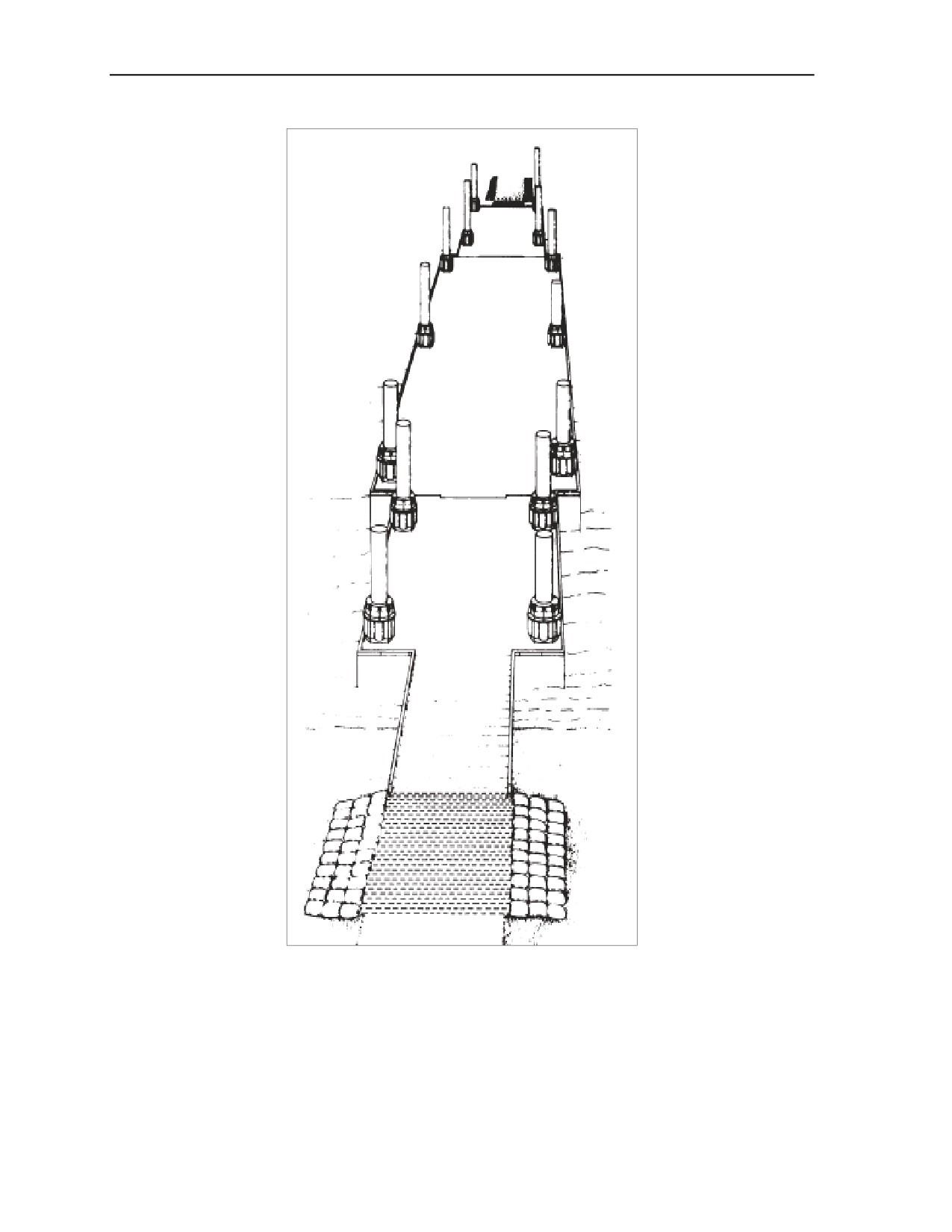
relocatable than the older DeLong-type piers (figure 5-2, page 5-10). This capability may limit the planning
for construction and expansion of future ports to getting the individual components to the jobsite.
CONCRETE WHARVES OR PIERS
5-30. Commercial port engineers have prepared and are continuing to prepare designs for precast concrete
pier pilings, caps, decks, and curbs. These techniques should reduce conventional concrete port
construction time requirements considerably.
CONSTRUCTION MATERIALS
5-31. Materials demanded for port construction are often quite specialized or unique. Class IV supplies
include all construction materials and installed equipment. Theater requisitions for engineer construction
materials must take account of project requirements for special large-scale operations. Issues from stocks
are based on the requirements for the particular work on which the requisitioning unit is engaged. Critical
items of Class IV supply may be issued under policies approved by the G-4; uncontrolled items are issued
on call.
9 December 2008
FM 3-34.400
5-9
Chapter 5
Figure 5-2. DeLong pier
5-32. The task of providing engineer construction supplies is so large, complex, and costly, that every
effort must be made to simplify it through the use of local procurement. The unit supply officer locally
maintains a continuous inventory of stocks of construction materials and equipment available. Class IV
supplies suitable for local procurement may include—
z
Lumber.
z
Cement.
5-10
FM 3-34.400
9 December 2008
Seaports of Debarkation
z
Structural steel.
z
Sand, gravel, and rock.
z
Plumbing supplies
z
Electrical supplies.
z
Hardware.
z
Paint.
SUPPORT FACILITIES
5-33. A large amount of construction effort goes into building port support facilities. If a port is located in
an area where there is an adequate rail or roadway network, cargo-handling (break-bulk or container)
operations will be more efficient when there are like connectors on the wharves. Engineer units are
responsible for the construction of rail and roadway facilities required by the port. Plans are worked out in
coordination with the Transportation Corps (TC) requirements.
5-34. Designs currently being recommended to the Army for future expedient military container port
construction generally specify tractor-trailers to transport the individual containers from the wharves. The
wharf must be of sufficient strength (capable of supporting up to 1,000 pounds per square foot of live
loads) and width (usually 80 to 100 feet) to accommodate fully loaded tractor-trailers and must be
constructed to an elevation from which suitable connections can be made to existing or planned roadway
networks.
5-35. Other on-shore construction requirements include—
z
Potable and nonpotable water supply for ships docked or moored in the port and the port itself.
z
Electric power supply and distribution, which may require overhead and underground systems.
z
Firefighting facilities and special systems as needed, such as special facilities for POL terminals.
5-36. Suitable water depths must be maintained at ports. According to FM 101-10-1, a minimum low tide
water depth of about 33 feet should be used for planning purposes because it will accommodate virtually
all deep-draft vessels. However, the recent trend toward containerization and the use of large tankers with
over 50,000 hundred weight capacities indicate that some future military ports should be planned with
minimum water depths of 40 to 50 feet. The planned construction of wharves in water depths several feet
less than desired may also be justified where—
z
It is established that the required depth can be obtained by dredging, that such dredging is
practical as part of the construction project, and that it can be performed without endangering
the in-place wharf structure.
z
Short-term use is anticipated, making lighterage more feasible than dredging or wharf
relocation.
z
The actual minimum water depths of new wharf construction are dictated by the wharf’s
intended use (POL wharf, container wharf, or lighter wharf). These depths are determined and
given in the OPORD and/or construction directive.
5-37. Dredging may be required to establish and maintain the required depths. Experience gained during
World War II and in Vietnam indicates that there are a number of specific problems associated with
dredging projects in an AO. Transportation of dredges to the AO can be difficult. Hopper dredges and side-
casting dredges are the only ones that are seagoing. Other dredges must either be towed to the site or
assembled from components transported aboard cargo ships.
5-38. It is difficult to secure dredges within the AO. The routine patterns followed by dredges limit the
effectiveness of any passive defensive measures. Pipeline dredges are virtually stationary targets. The
availability of dredges and crews for use in early stages of deployment in an AO is a major problem. The
Army at the present has no trained military dredge crews or portable dredges suitable for use in an AO.
USACE has dredges, but the availability of these is not certain and must be planned for and requested well
in advance.
9 December 2008
FM 3-34.400
5-11
Chapter 5
5-39. Sweeping, covered in detail in TM 5-235, is a method of locating pinnacles or other obstructions,
which exist in navigation areas above the depth limits required by the draft of the largest ships to use the
area. Sweeping is always used as a final check after dredging operations.
PORT REPAIR AND MAINTENANCE
5-40. Repair and maintenance involves the correction of critical defects to restore damaged facilities to
satisfactory use. Repair and maintenance of conventional and expedient construction could include
emergency repair, major repair, rehabilitation of breakwater structures, and expedients.
EMERGENCY REPAIR
5-41. Emergency repair is work done to repair storm, accident, or other damage to prevent additional
losses and larger repairs. Emergency repairs include—
z
Repairing breached breakwaters to prevent further damage to harbor installations.
z
Repairing wharf damage caused by ship or storm damage or enemy action to restore structural
strength.
z
Dumping rock to control foundation scour or breach erosion.
MAJOR REPAIR
5-42. Major repair is significant replacement work that is unlikely to recur. Major repair includes—
z
Replacing wharf decks.
z
Resurfacing access roads and earth-filled quays.
z
Replacing wharf bracings and anchorages which have been destroyed by decay or erosion.
z
Replacing an entire spud barge pier, a spud, or other major barge pier accessories.
REHABILITATION OF BREAKWATER STRUCTURES
5-43. The repair of breakwaters and similar structures is required to protect the characteristics of a harbor.
Breached breakwater structures are repaired by dumping rock of sizes suitable for use in mounds.
EXPEDIENTS
5-44. The use of expedient methods should be encouraged during limited port operations while major
repair and rehabilitation go forward. A number of possible measures to speed repairs follow:
z
Use launches or tugboats with a line to the shore for various hauling and hoisting functions in
construction work at the waterfront.
z
Erect a derrick or install a crawler or truck-mounted crane on a regular barge; landing craft,
mechanized (LCM); a barge of pontoon cubes; or a barge fabricated for military floating bridge
units may improvise a floating crane.
z
Fabricate rafts for pile-bent bracing operations from oil drums, heavy timbers, spare piles, or
local material.
z
Improvise floating dry docks for small craft from Navy pontoons.
z
Improvise light barges, floating wharf approaches, and small floating wharves from steel oil
drums.
z
Use diagonal flooring laid over existing decking which strengthens a structure by distributing
the load over more stringers.
z
Remove the decking for adding stringers, or place smaller stringers on the pile cap between
existing stringers from beneath the decking and wedged tight against the deck.
z
Take up several floor planks and drive piles through the hole if the wharf can support the weight
of the pile driver. Cap new pile bents and wedge them tightly against the stringers.
5-12
FM 3-34.400
9 December 2008
Seaports of Debarkation
z
Use a rock or ballast-filled timber crib to replace a gap in a pile wharf structure or to extend the
offshore end on the wharf. The timber crib may be built on land, launched by using log rollers,
floated into position, and filled with rock or ballast to hold it in place.
z
Use standard military floating bridges or Navy pontoons to supplement or temporarily replace
damaged causeways.
z
Use standard military floating bridges or Navy pontoons to provide access between undamaged
sections of off-loading piers.
z
Ensure that when a section of a wharf has been destroyed, the face of the wharf is restored first
so that ships may be worked while the area behind the face is being restored.
z
Use the shore end of a pier for lighterage or other short vessels while the pier is being extended.
z
Bridge part of a solid-fill wharf using standard or nonstandard fixed bridging (see FM 3-
34.343).
z
Fill a slip with rubble so that ships cannot be brought to the face of the wharf.
Note. It may be possible to fend ships off with camels, barges, or other devices so that they will
be retained in deepwater for unloading. Alternatively, it may be possible to use standard trestles,
fixed bridging, and assembled Navy pontoons to extend the width of the pier.
z
Use the hull of a capsized or sunken vessel as the substructure for a pier.
z
Anchor the shore end of a causeway constructed from Navy pontoon cubes onshore by
excavating a section of beach, floating the pontoons into the temporary inlet thus made, and then
backfilling to provide a solid anchorage.
LOGISTICS OVER-THE-SHORE OPERATIONS
5-45. At least 90 percent of the tonnage required to support deployed forces in the AO must be provided
by sea LOC. Although air LOCs will usually carry high priority shipments and personnel, sea LOCs will
likely bear the main burden. The uninterrupted delivery of materiel requires that vulnerable fixed port
facilities be backed up by a flexible system, and LOTS operations provide that system. Armed forces
LOTS operations involve transferring, marshaling, and dispersing materiel from a marine to a land
transport system. The rule of thumb for planners is that 40 percent of all cargo entering contingency
theaters by surface means will need to be delivered through LOTS terminals. In some theaters, this
proportion may be much greater. Beaches distant from fixed port facilities serve as LOTS sites. The rapid
establishment of a viable LOTS system depends on engineer construction and maintenance support.
RESPONSIBILITIES
5-46. Logistics planning to support deployed forces on a foreign shore always begins with an evaluation of
in-place fixed port facilities and capacities. These, combined with connecting railway, highway, and inland
waterway networks, are the major logistic systems required for military operations. When a reckoning of
available resources is complete, planners determine the need for LOTS terminals to supplement and back
up the transportation net.
5-47. Overall responsibility for LOTS operations lies with the TC. Each LOTS terminal acts under the
direct control of a transportation terminal battalion made up of two service companies and appropriate
lighterage units. The CCDR may assign construction support responsibilities to Army, Navy, and/or
Marine Corps engineer units, depending on their availability and the overall situation. Mutually supporting
or follow-on construction must be coordinated with other engineer units assigned to or projected for the
AO. Army engineers must be prepared to support the LOTS mission because—
z
Existing ports may be damaged, incomplete, or unavailable.
z
Existing ports may be unable to handle resupply operations.
9 December 2008
FM 3-34.400
5-13
Chapter 5
z
Existing port facilities are vulnerable to enemy activities, such as mining, CBRN, and air
interdiction.
z
Existing ports under repair may be unavailable for long periods.
5-48. Engineer units give construction, repair, and maintenance support to LOTS operations. An engineer
unit may expect to encounter these missions in supporting a LOTS operation by—
z
Constructing semipermanent piers and causeways.
z
Preparing and stabilizing beaches.
z
Constructing access and egress routes from beaches to backwater areas.
z
Constructing access to marshaling areas and/or adjoining LOTS sites.
z
Constructing marshaling and storage areas.
z
Constructing road and rail links to existing LOCs.
z
Constructing utility systems.
z
Constructing POL storage and distribution systems.
z
Providing other assistance or maintenance determined by the terminal commander.
LOGISTICS OVER-THE-SHORE INSTALLATION
5-49. Initial LOTS planning and site selection are coordinated between the theater opening element or
sustainment brigade commander (TC) and the Navy or Military Sealift Command (MSC). Initial selection
is based on map studies, hydrographic charts, and aerial reconnaissance.
RECONNAISSANCE
5-50. The reconnaissance party includes representatives of the terminal group commander, the terminal
battalion command, the supporting engineer, the supporting signal officer, military police, and Navy
personnel to provide advice on mooring areas. Others participate if the situation dictates, or at the terminal
commander’s request. The reconnaissance party briefs the terminal commander on its findings. The
briefing must cover—
z
Engineer efforts required when preparing and maintaining the site, based on available units,
equipment, and materials.
z
Signal construction and maintenance required for necessary communications within the beach
area, and between the beach and the terminal group headquarters.
z
Lighterage craft (landing craft utility [LCU], LCM, and light air cushion vehicle-30 [LACV-
30]) types that may be used based on beach conditions.
z
Safe havens for lighterage craft in stormy weather.
z
Location and desirability of mooring areas.
z
Adequate egress from the beach. Availability of the egress and the beach dimensions are key
factors in determining the tonnage capacity for the beach.
z
Tidal range.
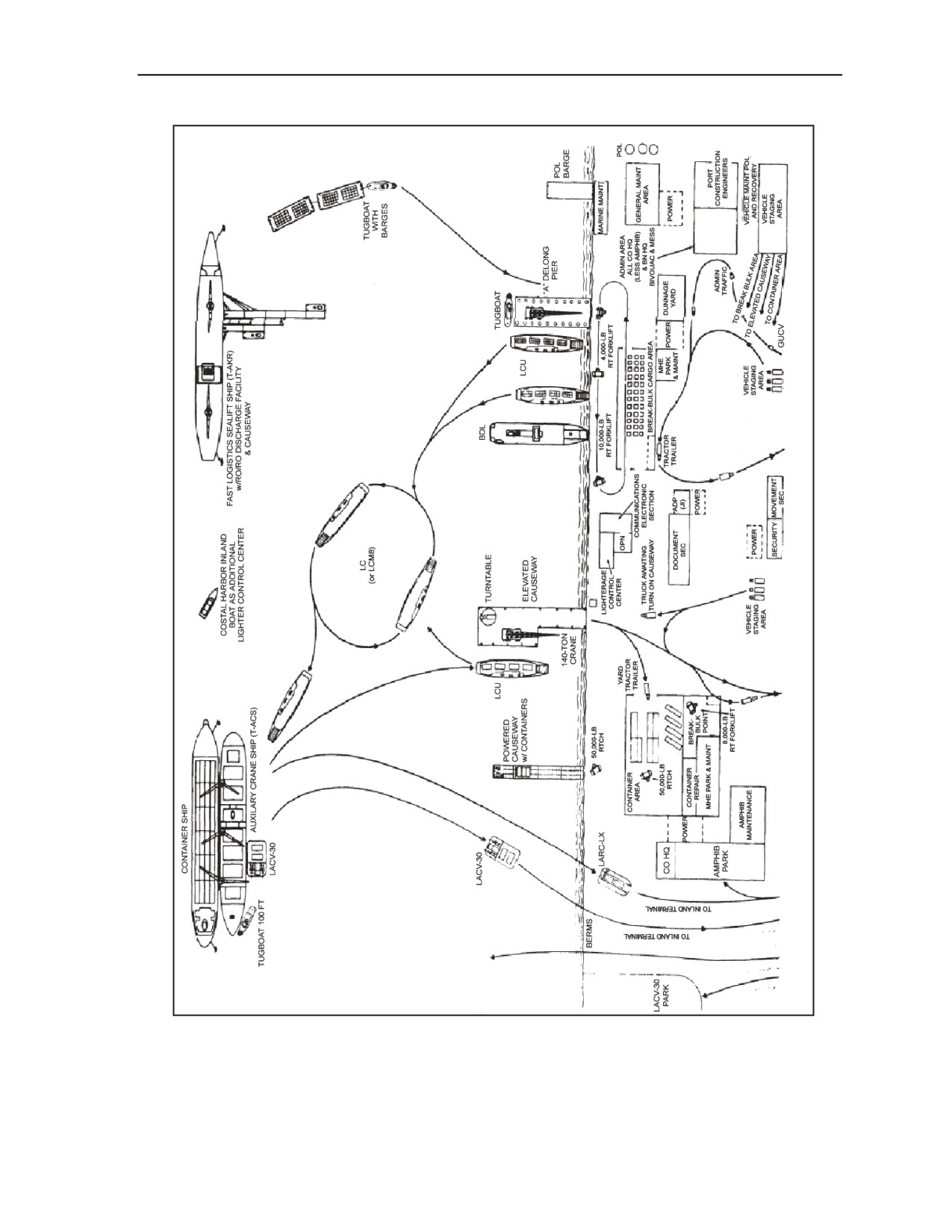
5-51. See Figure 5-3. The supporting engineer must be informed about the layout of the LOTS site,
because the layout determines the required engineer effort. A LOTS layout varies with the situation and
existing geographic conditions. The physical size of the individual site depends on the security
considerations, soil trafficability, the number of ships to be unloaded at the site, and the type of cargo
coming ashore. For example, a LOTS terminal may need to be very large if ammunition and/or POL are
being unloaded over a beach that is subject to enemy attack. General cargo unloaded over a secure beach
needs less area.
5-14
FM 3-34.400
9 December 2008
Seaports of Debarkation
Figure 5-3. Typical LOTS operations
9 December 2008
FM 3-34.400
5-15
Chapter 5
LANDING CRAFT UNLOADING POINTS
5-52. Knowledge of the beaching positions designated for landing craft is important to the supporting
engineer, especially if landing points are to be used for extended periods. A common maintenance problem
on beaching positions is the creation of troughs or pits in the beach beyond the waterline. Troughing is
caused by landing craft ramps, which dig into the inclined beach at a steep angle. This problem is
exacerbated when wheeled vehicles dig into the sandy beach material, and water washes the loosened
material away. Vehicles can easily bog down and stall in these troughs, slowing unloading operations.
Engineers can reduce the troughing by placing stone or gravel at the unloading point, or by cutting down
the slope of the beach. Both these measures require maintenance for as long as the unloading points are
used.
PIER AND CAUSEWAY CONSTRUCTION
5-53. FM 5-134 provides data on the use of pile material in the construction of piers and causeways. Piers
and causeways allow cargo vessels direct beach access, eliminating multiple handling of material and
speeding unloading times. Piers are structures with working surfaces raised above the water on piles. Piers
project beyond the surf zone. Their stability and protected working surfaces permit unloading at times
when wave action would otherwise prevent landing craft from operating across a beach. The DeLong pier
is a self-contained pier that can be brought to the LOTS site and emplaced in a relatively short time.
Specially trained engineer personnel from the port construction company and certain other units can install
this equipment. Other engineer assistance is required at the beach end of the pier to prepare the beach and
anchor the pier. Causeways are floating structures, which project out from the beach. In some applications,
they are used as rafts to ferry equipment from ship to shore. Causeways are more susceptible to wave
action than piers, but they are more easily deployed. In areas where wave action is not a significant
problem, causeways can be used as floating piers. Engineers provide beach preparation and anchoring for
causeway operations.
ROAD CONSTRUCTION
5-54. The major engineer effort in LOTS is invested in road construction and maintenance. Considerable
effort must be spent to stabilize soil and improve trafficability in the beach area. Constructed roads must
withstand the impact of materials handling equipment (MHE) carrying extremely heavy loads. Roads that
support LOTS are usually constructed in a loop to reduce their required width and eliminate vehicle turning
as much as possible (see chapter 7).
5-55. The availability of construction material determines the types of roads that can be constructed.
Naturally occurring materials, such as rock and wood, may be scarce or of poor quality. Portland cement
may not be available or may be prohibitively expensive to use. Sand grid material is excellent for use in
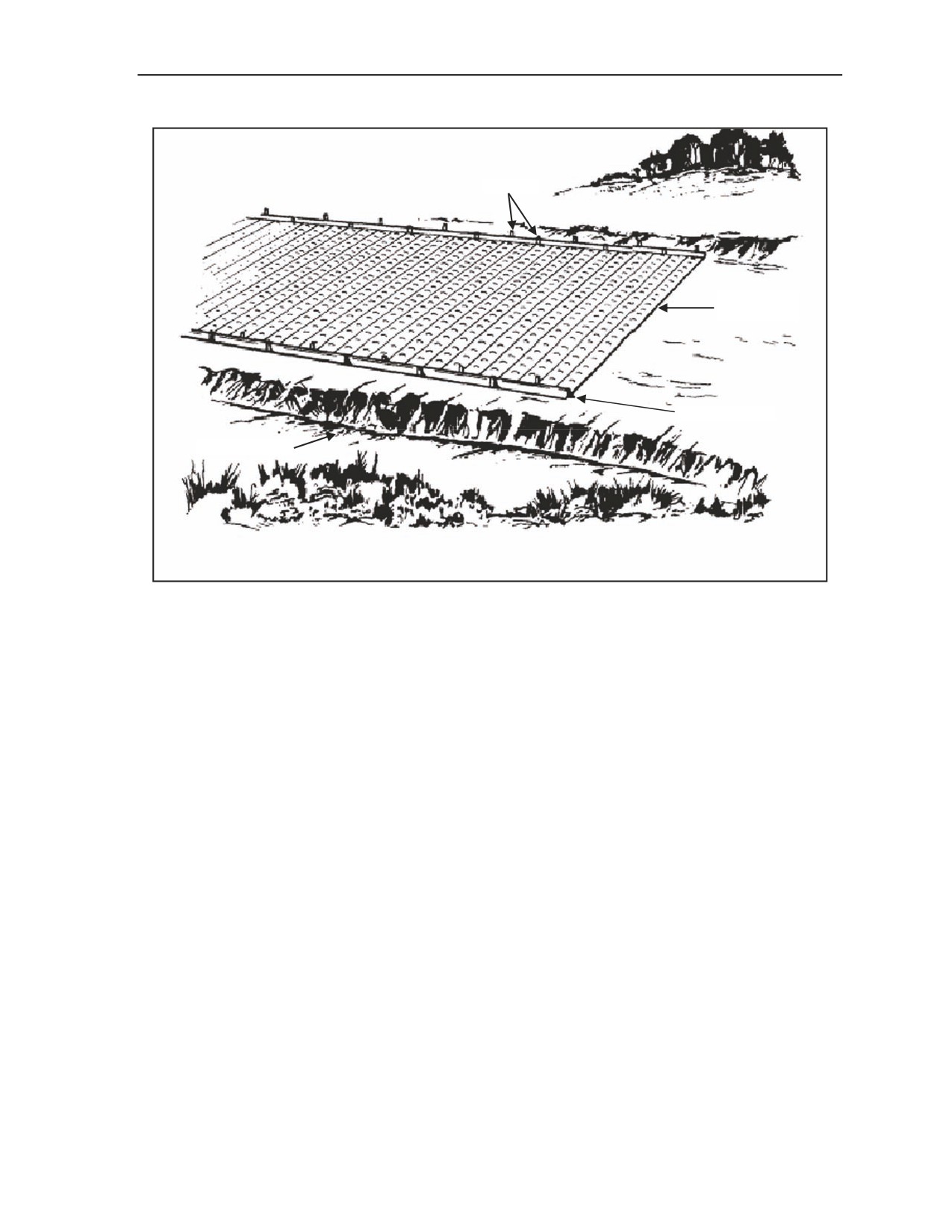
areas of cohesionless soil. Matting and/or steel planking may be used if they are available (see FM 55-60
and figure 5-4 for more details). When roads are constructed in areas of poor soil conditions, roadways
must be well marked and adequate drainage must be provided.
5-16
FM 3-34.400
9 December 2008
Seaports of Debarkation
Stakes
Metal landing
mat
Timber curb
Drainage ditch
Figure 5-4. Field expedient matting
MARSHALING AREAS
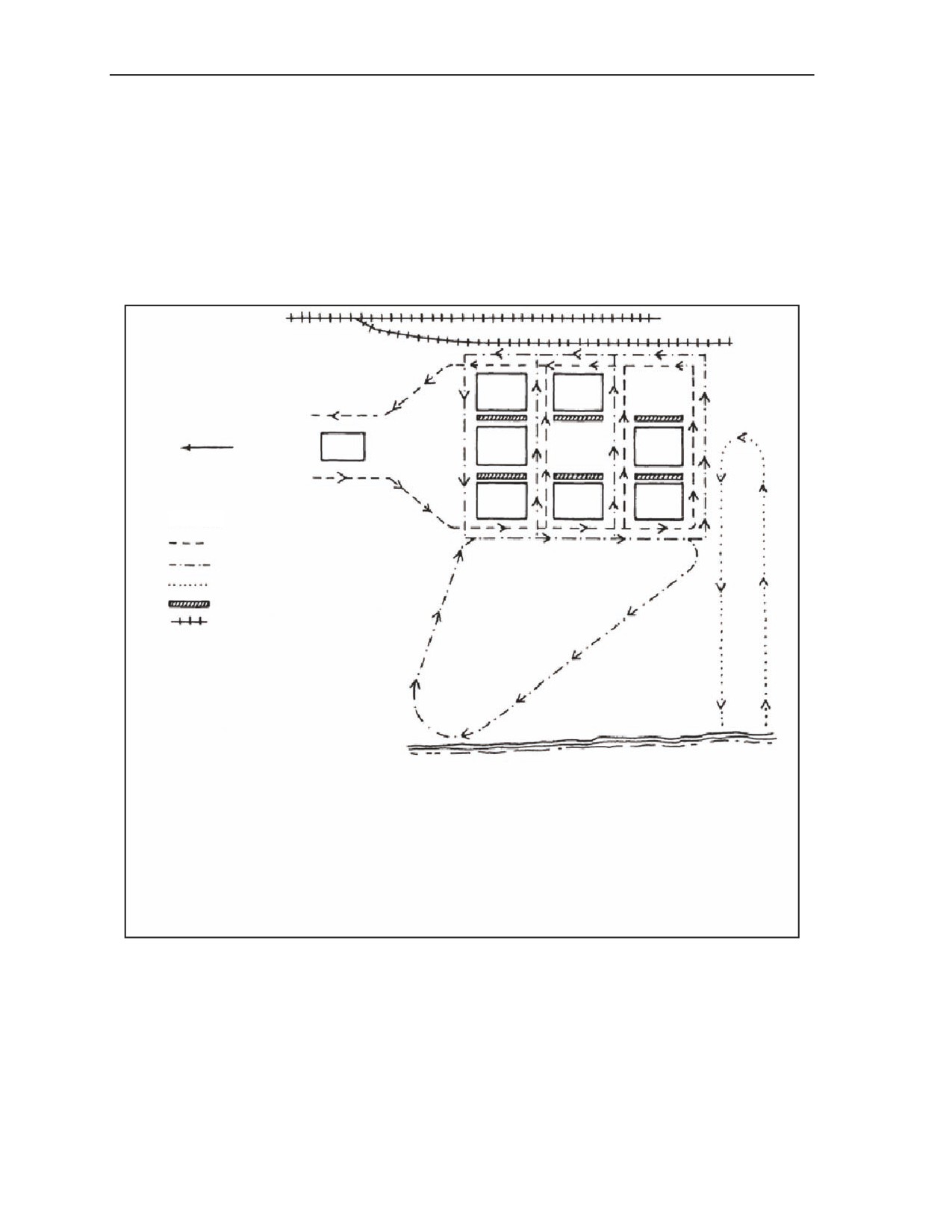
5-56. Marshaling areas (figure 5-5, page 5-18) serve as a collection point from which unloaded materials
and equipment can be distributed to the proper units. The size of the marshaling area varies with the size
and type of shipping, the unloading rate, the hostile situation, and the units being supported. Marshaling
areas vary from 25 to 500 acres. In hostile environments, marshaling areas are dispersed with acreage
divided into many small parcels. Other protection considerations must be integrated into the design of
marshaling areas as well.
5-57. Marshaling area surfaces must be stable enough to support a loaded piece of MHE. MHE with loads
may weigh up to 100,000 pounds. Access and egress roads must be capable of supporting the same loads.
The surface must be protected with adequate drainage.
5-58. Most material shipped to an OE via surface transportation is containerized. Once ashore, the
containers are opened and unpacked for distribution to the intended units. Empty containers are collected
and reloaded aboard ships, then returned to their point of origin. Container collection areas must be
provided. These areas must have the same trafficability, drainage, and access and egress characteristics as
the marshaling areas, and can require nearly as much space.
AMMUNITION STORAGE AREAS
5-59. Areas where ammunition is to be unloaded, sorted, and temporarily stored requires the same type of
planning and engineer effort as marshaling areas. In addition, engineer units will have to perform more
horizontal construction work, making earthen berms and revetments. Ammunition supply points (ASPs)
that will be used for an extended time must be provided with overhead protection from the elements.
9 December 2008
FM 3-34.400
5-17
Chapter 5
5-60. Ammunition storage areas must be remote from other activities on the beach. They must be dispersed
and camouflaged. Each site requires access and egress routes, preferably arranged so that vehicles will not
have to back up.
PETROLEUM, OIL, AND LUBRICANTS STORAGE AREAS
5-61. Fuel storage areas on the beach will likely be the largest concentration of fuels in the distribution
system. Construction of rigid storage tanks and distribution pipelines within the storage areas is a major
engineer task. Engineers also support the QM Corps by installing collapsible tank farms and related
facilities.
H
I
G
G
F
H
H
H
To MSR
A
E
G
G
H
B C
D
G
G
Legend
Surface local/line-haul transport
Beach/marshaling area transport
Amphibian transport
Side loader/front loader
Rail spur
A. Inspection, yard inventory/control
documentation, movement functions
B. Decontamination/cleaning area
H
H
C. Container repair activity
D. Stacked retrograde containers
E. Stowing and unstowing activity
F. Equipment maintenance and parking
G. Stacked inbound containers
H. Cargo checkers
I. Helicopter landing pad
Note. 1. Not to scale.
2. Inbound line-haul equipment is staged along the roadway outside the marshaling area, with
controlled entry into the yard.
Figure 5-5. Container yard marshaling area
5-18
FM 3-34.400
9 December 2008
Chapter 6
Airfields and Heliports
Air power is a thunderbolt launched from an eggshell invisibly tethered to a base.
Hoffman Nickerson, Arms and Policy (1945)
Airfields and heliports support the deployment, operational maneuver, and
sustainment of forces. An adequate aerial LOC network is one of the keys to shaping
operations in today’s OE. Airfields and heliports are built, upgraded, repaired, and
maintained to meet mission and operational requirements. Depending on mission,
enemy, terrain and weather, troops and support available, time available, and civil
considerations (METT-TC) aerial LOC may form the primary means of sustaining a
contingency operation. Contingency operation airfield and heliport planning involves
much more than just the airfield layout
(geometry) and pavement structure. It
involves planning for all of the supporting facilities and infrastructure, such as the air
traffic control and landing system
(ATCALS), and POL and munitions storage
facilities needed to sustain airfield operations. It also involves protection, security
measures, health, safety, and environmental factors. Forward aviation combat
engineering prepares or repairs expedient landing zones (LZs), forward arming and
refueling points (FARPs), landing strips, or other aviation support sites in the forward
combat area and are considered combat engineering tasks and are focused on
providing support to tactical combat maneuver forces. See Air Force Engineering
Technical Letters (ETLs) 04-7 and 97-9; FM 3-34.2; and FM 5-430-00-2, Volume II.
All other airfield and heliport construction are considered GE tasks. Contingency
operations airfield planning is similar to base camp or force bed-down planning in
many respects. This chapter will focus on just the airfield and heliport aspects (see
chapter 11 for details on base camp and force bed-down).
Note. The Marine Corps and joint doctrine use METT-T without “civil considerations” being
added.
RESPONSIBILITIES
6-1. Army, Air Force, Navy, and Marine engineers all have the capability to design, plan, construct,
upgrade, repair, and maintain airfields and heliports. Army engineers are often responsible for initial
airfield damage repair (ADR) as a part of a forcible entry operation. This is a type of the forward aviation
combat engineering that is performed by combat engineers to enhance mobility. Army engineers may assist
other engineers as directed in airfield and heliport design, planning, construction, repair, and maintenance.
The Army provides the following construction support to Air Force-controlled airfields:
z
Develops engineering design criteria, standard plans, and material to meet Air Force
requirements.
z
Performs reconnaissance, survey, design, construction, or improvement of airfields, roads,
utilities, and structures.
z
Repairs Air Force bases and facilities beyond the immediate emergency recovery requirements
of the Air Force (semipermanent and permanent repair).
9 December 2008
FM 3-34.400
6-1
Chapter 6
z
Supplies construction materials and equipment.
z
Assists in emergency repair of war-damaged air bases.
z
Assists in providing expedient facilities (force bed-down).
z
Manages war-damaged repair and base development; supervises Army personnel. The Air Force
base commander sets the priorities.
z
Performs emergency and permanent repair of war damage to forward tactical airlift support
facilities.
6-2. The branch of service that is the primary user of the airfield or heliport has the responsibility for
certifying that facility for flight operations. In most cases during airfield contingency operations, this is an
Air Force responsibility. Air Force engineers may assist other Army engineers, Navy Seabees, or Marine
engineers as directed in airfield and heliport design, planning, construction, repair, and maintenance. The
Air Force provides the following engineer support:
z
Performs primary emergency repair of war damage to air bases and other ADR tasks.
z
Constructs expedient facilities for Air Force units and weapon systems. This excludes
responsibility for Army base development.
z
Operates and maintains Air Force facilities. Air Force engineer units perform maintenance tasks.
z
Provides crash rescue and fire suppression.
z
Provides hazardous material (HAZMAT) response.
z
Manages emergency repair of war damage and force bed-down construction.
z
Provides infrastructure support for solid waste and hazardous waste disposal.
z
Supplies material and equipment for its own engineering mission.
z
Provides the EBS and EHSA for the airfield and its support facilities.
PLANNING
6-3. Airfields and heliports are classified by their degree of permanence and type of aircraft they are
designed to support. They are essential for controlling aircraft, either fixed-wing and/or rotary-wing. These
controlling aircraft, or aircraft combination, are identified for each kind of facility to establish limiting
airfield and/or heliport geometric and surface-strength requirements. For information on survivability
(hardening) support, to include the construction of revetments for helicopters, see FM
5-103. For
information on Air Force aircraft survivability, see Air Force Manual (AFM) 91-201, Category Code 141-
182, Hardened Aircraft Shelters.
6-4. Army airfields and heliports are divided into the following six classes (see UFC 3-260-02, chapter
2):
z
Class I, helipads-heliports with aircraft 25,000 pounds (11,340 kilograms) or less. The
controlling aircraft is a UH-60 aircraft at a 16,300-pound (7,395 kilograms) operational weight.
z
Class II, helipads-heliports with aircraft over 25,000 pounds (11,340 kilograms). The
controlling aircraft is a CH-47 aircraft at a 50,000-pound (22,680 kilograms) operational weight.
z
Class III, airfields with Class A runways. The controlling aircraft combination is a C-23
aircraft at a 24,600-pound (11,200 kilograms) operational weight and a CH-47 aircraft at a
50,000-pound (22,680 kilograms) operational weight. Class A runways are primarily intended
for small aircraft, such as C-12s and C-23s.
z
Class IV, airfields with Class B runways. The controlling aircraft is a C-130 aircraft at a
155,000-pound (70,310 kilograms) operational weight or a C-17 aircraft at a 580,000-pound
(263,100 kilograms) operational weight. Class B runways are primarily intended for high
performance and large, heavy aircraft such as C-130s, C-17s, and C-141s.
z
Class V, contingency operations heliport or helipads supporting Army assault training
missions. The controlling aircraft is a CH-47 aircraft at a 50,000-pound (22,680 kilograms)
operational weight.
6-2
FM 3-34.400
9 December 2008
Airfields and Heliports
z
Class VI, assault LZs for contingency operations airfields supporting Army training
missions that have semiprepared or paved surfaces (also known as forward landing strips).
The controlling aircraft is a C-130 aircraft at a 155,000-pound (70,310 kilograms) operational
weight or a C-17 aircraft at a 580,000-pound (263,100 kilograms) operational weight.
6-5. Air Force airfields are classified into six mission categories. A controlling aircraft or combination of
controlling aircraft has been designated for each category to establish limiting airfield, geometric, and
surface strength requirements. The six airfield categories include (see UFC 3-260-02, chapter 2 and chapter
3) the following:
z
Light (F-15 and C-17).
z
Medium (F-15, C-17, and B-52).
z
Heavy (F-15, C-5, and B-52.)
z
Modified heavy (F-15, C-17, and B-1).
z
Auxiliary (F-15).
z
Assault LZ (C-130 and C-17).
6-6. A bare base airfield is a site with a usable runway, taxiway, and parking area and a source of water
that can be made potable. It must be capable of supporting assigned aircraft and providing other
mission-essential resources, such as logistical support, services, and infrastructure (supplies, equipment,
people, and facilities). This concept requires modular facilities, mobile facilities, utilities, and support
equipment packages that can be rapidly deployed and installed. A bare base airfield forms the baseline for
contingency operations airfield planning.
6-7. On normal operational airfields, pavements are grouped into the following four traffic areas based on
their intended use and design load (see UFC 3-260-02, chapter 2 and chapter 3):
z
Type A. Those traffic areas that receive concentrated traffic and the full design weight of the
aircraft. These traffic areas require a greater pavement thickness than other areas on the airfield
and include all airfield runways and, in most cases, runway ends and primary taxiways. All
airfield pavement structures on contingency operations airfields are considered Type A traffic
areas.
z
Type B. Those traffic areas that receive a more even traffic flow and the full design weight of
the aircraft. These traffic areas include parking aprons, pads, and hardstands.
z
Type C. Those traffic areas with low-volume traffic, or the applied weight of the operating
aircraft is generally less than the design weight. These traffic areas include secondary taxiways,
washrack pavements, access aprons, interior portions of runways, and hangar floor areas
trafficked by aircraft.
z
Type D. Those traffic areas with extremely low-volume traffic and/or the applied weight of the
operating aircraft is considerably lower than the design weight.
6-8.
See FM 5-430-00-2. Based on an airfield’s location in the AO, it could be described as a─
z
Close battle area. Forward airfields are intended to provide focused logistics support and/or
support combat missions of short-range , such as attack helicopters and unmanned aircraft
systems
(UASs) during contingency operations. These airfields are designed to initial or
temporary contingency operations standards, depending on mission and operational
requirements, and may be paved or semiprepared. These may be initially prepared or repaired as
forward aviation combat engineering tasks.
z
Support area. Intermediate airfields are intended to provide general logistics support, support
combat missions of longer-range aircraft during contingency operations, and/or training. These
airfields are designed to temporary or semipermanent standards depending on mission and
operational requirements. Normally these airfields are paved. These airfields provide a link
between close battle area airfields with rear area airfields.
z
Rear area. Airfields are intended to provide logistics support forward from fixed, secure bases,
and support combat operations of long-range aircraft. These airfields are designed to be
semipermanent or permanent facilities.
9 December 2008
FM 3-34.400
6-3
Chapter 6
6-9. Most planning factors described in chapter 7 for road designs are applicable for airfields. The most
important factors include—
z
Mission. To achieve a proper design for the airfield, it is essential that the engineer planner have
a complete understanding of the number and type of aircraft, purpose, scope, and estimated
number of the particular air missions to be flown by the design-controlling aircraft. Categories
of missions that may be conducted include reconnaissance, cargo transport, or attack.
z
Enemy. The engineer planner devises an adequate plan to ensure that construction troops can
protect themselves, their equipment, and their materials against harassment and sabotage during
airfield or heliport construction. Requirements for additional security forces should be
evaluated. The engineer planner should also consider AT and other protection requirements of
the aircraft using the airfield and the infrastructure supporting airfield operations. See chapter 9
for more details on protection. See FM 5-103 for those aspects of protection that have to do with
survivability operations (the development and construction of protective positions, such as earth
berms, dug-in positions, overhead protection, and countersurveillance means, to reduce the
effectiveness of enemy weapon systems. [FM 5-103]).
z
Terrain and weather. The engineer planner's attention must be directed first toward selecting
sites. Within site requirements dictated by mission and operational requirements, the planner
establishes reasonable site requirements for each type of airfield. The planner chooses
geographic locations on the basis of topographic features (grading, drainage, and hydrology),
soil, vegetation, utilities, climatic conditions, and accessibility of materials. Other site
characteristics to be studied include weather patterns (such as temperature, barometric pressure,
seasonal variations, and wind directions) and flight path obstacles. The planner evaluates all
existing transport facilities to determine the best methods and routes to provide logistics support
the project. These include ports, rail lines, road nets, and other nearby airfields that might be
used for assembling and moving construction equipment and materials to the construction site.
See appendix D for a discussion of the effect of various environmental considerations.
z
Troops and support available. The planner evaluates the availability and type of engineer
construction forces to determine if construction capability is sufficient to carry out the required
airfield construction. The planner must weigh the type and availability of local construction
materials against the overall needs for proposed construction. Both naturally occurring materials
and other possible sources for materials for subgrade strengthening should be examined.
Requirements for importing special materials for surfacing, drainage, and dust control must be
feasible for available construction time and resources. The planner must have knowledge of the
forces dedicated to the ADR. Depending upon base locations, local agreements, and the overall
military situation, any combination of Army, Air Force, HN, or contract engineer support may
be possible. Time-phased force and deployment data (TPFDD) or population flow into the
airfield must be considered when developing the airfield master plan.
z
Time available. Operational and mission requirements will dictate when the airfields need to be
able to support aircraft operations.
z
Civil considerations. The engineer planner must consider what civilian construction resources
are available in the local area and what structures already exist that could be used to support
airfield construction, repair, and maintenance. The planner must also consider the environmental
impact, restricted areas, political and cultural factors, and other factors that may affect airfield
layout and construction.
z
Maximum on ground. MOG is the maximum number of aircraft that can be accommodated on
an airfield. There are two types of MOG. Parking MOG is the total number of aircraft that can
be parked at an airfield. Parking MOG is affected by both the overall size of the airfield and by
how available space is managed. Working MOG refers to how many or how quickly parked
aircraft can be off-loaded, material through-putted from the aerial port of debarkation (APOD),
and aircraft serviced and prepared for departure. MHE, trucks, buses, and other surface transport
vehicles, road networks, aircraft support equipment, fuel tankers, personnel, and other factors
affect working MOG.
6-4
FM 3-34.400
9 December 2008
Airfields and Heliports
6-10. Ideally, working MOG equals parking MOG; when it does not, backlogs occur. MOG is normally
expressed in terms of C-141s. A minimum of MOG two is desired for contingency operations airfields.
Refer to Air Force Pamphlet (AFPAM) 10-1403 for aircraft dimensions.
6-11. Engineers are responsible for site reconnaissance and recommendations, design of the airfield or
heliport, and the actual construction of the individual airfield. Standard designs for the type and capacity of
the airfield are available in TCMS. However, the planner must frequently alter these designs to meet time
and material limitations or the limitations imposed by local topography, area, or obstruction characteristics.
Engineers may alter designs, but must obtain approval for major changes from the user before work starts.
The engineer will need to solve the following engineering problems when carrying out most airfield
assignments:
z
Design a drainage system structure.
z
Design runways, taxiways, and hardstands.
z
Select or dispose of soils encountered in cuts, determining their usefulness for improving
subgrade.
z
Choose a method or methods for stabilizing the subgrade.
z
Decide upon the type and thickness of the base course.
z
Decide upon the type and thickness of the surface course.
z
Select the grade for a minimum of earthwork within specification limits.
z
Design related facilities, including access and service roads, ammunition and POL storage areas,
navigation aids (NAVAIDs), maintenance aprons, warm-up aprons, corrosion control facilities,
control towers, airfield lighting, and other facilities.
z
Integrate environmental considerations, to include applicable FHP intelligence.
6-12. For airfield planning and design, refer to the following manuals:
z
FM 3-34.2 and those associated with forward aviation combat engineering operations.
z
FM 5-430-00-1, Volume I.
z
FM 5-430-00-2, Volume II.
z
TM 5-820-1.
z
UFC 3-260-01.
z
UFC 3-260-02.
z
UFC 4-141-10N.
CONSTRUCTION
6-13. A completed air base is a complex construction project. However, careful planning and a strict focus
on essentials can result in a facility that will support air operations soon after construction begins.
Subsequent improvements can be made during use. If construction is guided by a master plan, staged
completion of each structure can be designed to serve both expedient operation and the final design of the
facility.
6-14. Preplanned design layouts within TCMS for each type of field are based on the assumption that
previously unoccupied sites will be chosen. However, the layouts have been coordinated so that, within
terrain limitations, it is practicable to develop a larger field from a smaller one with minimal construction
effort. Existing airfields or a bare base site can be used if they meet minimum requirements or can be
upgraded to meet operational or mission requirements. (A bare base is a base having minimum essential
facilities to house, sustain, and support operations to include, if required, a stabilized runway, taxiways,
and aircraft parking areas. A bare base must have a source of water that can be made potable. Other
requirements to operate under bare base conditions form a necessary part of the force package deployed to
the bare base.)
6-15. It is best to complete an air base to its ultimate design in a single construction program. Often,
however, it is necessary to initially design to a lower construction standard to get the base into operation
9 December 2008
FM 3-34.400
6-5
Chapter 6
within available time and construction support. In such cases, every effort must be made to proceed to the
ultimate design standard for the airfield. Repeated modification of a facility plan is to be avoided.
6-16. A fully completed airfield includes the following types of facilities:
z
Runways, taxiways, hardstands, aprons, and other pavements, shoulders, overrun, approach
zones, NAVAIDs, airfield marking, and lighting.
z
Sanitary facilities (kitchens, dining areas, showers, and latrines).
z
Direct operational support facilities (ammunition, storage and distribution of aviation fuels and
lubricants, HAZMAT, and waste storage sites).
z
Maintenance, operations, and supply (aircraft maintenance, base shops, operations buildings,
base communications, photograph laboratories, fire stations, weather facilities, general storage,
and medical facilities).
z
Indirect operational support facilities (roads and exterior utilities, such as water supply and
electric power).
z
Administration (headquarters, personnel services, recreation, and welfare facilities).
z
General housing and troop quarters.
6-17. The first goal when building an airfield is to achieve operational status. Therefore, construction is
designed to support air traffic as soon as possible. The order for construction proceeds according to the
following priorities of work:
z
Priority 1, AT and security. Provide the facilities most essential for air operations as soon as
possible. Build airfield operational facilities, such as runways, taxiways, approaches, and
aircraft parking areas of minimum dimensions. Provide minimum storage for bombs,
ammunition, and aviation fuel. Provide essential airfield lighting, fire protection services,
medical, attack warning system, sanitary, power generation, and water facilities. Site in facility
groups and ATCALS.
z
Priority 2, improve AT and increase the capacity, safety, and efficiency of all air base
operations. Provide indirect support to operational facilities. Construct access and service roads
and essential operational, maintenance, and supply buildings.
z
Priority 3, improve AT and operational facilities. Provide facilities for administration and
special housing such as leach fields, wash racks, landfills, and an explosive ordnance disposal
(EOD) range.
z
Priority 4, improve AT and provide general housing. Institute a base operation and facilities
maintenance plan. Sustain environmental and medical surveillance of the airfield and its
supporting facilities.
6-18. Construction stages establish a sequence for constructing an airfield. These stages provide for
building the airfield in parts, so that minimum operational facilities may be constructed in the shortest
possible time. For example, a priority task may be reduced to stages as follows:
z
Stage I. Stage I provides a loop that permits landing, take off, and circulation and limited apron
parking is built. Runway lengths and widths are the minimum required for critical aircraft.
z
Stage II. Stage II provides a new runway. The stage I runway now becomes a taxiway, and
aprons, hardstands, and additional taxiways are built.
z
Stage III. Stage III provides facilities that are further expanded, and accommodation for more
aircraft is added, if necessary. When an existing surface in the rear area is not adequate for all-
weather operations in support of heavy transport aircraft or high-performance fighter aircraft, an
appropriate pavement structure is designed and constructed.
6-19. Airfield reconnaissance differs from road location reconnaissance in that more comprehensive
information is typically required. An airfield project involves more man-hours, machine-hours, and
material than most road projects. Air traffic also imposes stricter requirements on traffic facilities than does
vehicular traffic. Consequently, the site selected has to be the best available.
6-20. When new construction is undertaken, the planner and the reconnaissance team must choose a site
with soil characteristics that meet strength and stability requirements, or a site that requires minimum
6-6
FM 3-34.400
9 December 2008
Airfields and Heliports
construction effort to attain those standards. Airfields present more drainage problems than roads. Their
wide, paved areas demand that water be diverted completely around the field, or that long drainage
structures be built. Sites at the low points of valleys or other depressed areas should be avoided because
they tend to be focal points for water collection. As in road construction, subsurface water should be
avoided. A desirable airfield site lies across a long, gentle slope, because it is relatively easy to divert water
around the finished installation.
6-21. To accommodate missions efficiently, airfields require large areas of relatively flat land. Advance
location and layout planning will avoid cramping facilities. To obtain the required area, the airfield may
have to be spread over a large area. This may call for a complex network of taxiways and service roads.
Runways should be aligned in the direction of the prevailing wind.
6-22. The safe operation of fixed- or rotary-wing aircraft requires that all obstacles above elevations
specified by design criteria be removed. This criteria varies according to the operating characteristics of the
aircraft that use the airfield. For example, most heliports require an approach zone with a 10:1 glide angle,
whereas heavy cargo aircraft in the rear area require a glide angle as flat as 50:1. To achieve the right glide
angle, it is often necessary to remove hills and do major earthwork on distant approaches to the airfield.
The reconnaissance team should avoid locations that need extensive earthwork to achieve the necessary
glide angle. Clearances are also required along the sides of runways. An area of specified width must be
cleared of all obstacles and graded according to specification.
6-23. Except for staking requirements, the techniques and principles for conducting airfield and heliport
construction surveys are identical to those for roads. An accurate estimate of earthwork volume is essential
to proper control and management of a horizontal construction project. Following mass diagram
construction and analysis, equipment is scheduled and project durations are determined. Analysis of the
mass diagram will also determine haul routes, location of equipment work zones, and areas for waste and
borrow sites. Earthwork is conducted as described for road construction in chapter 7, except that project
width permits more balancing perpendicular to the airfield's centerline. Earthwork balancing may also
occur between adjacent projects (for example, runway and taxiway).
6-24. During construction, permanent drainage structures are essential to the successful completion of an
airfield or heliport. Planning considerations are similar to those used for road construction.
6-25. The decision to pave an airfield or heliport during contingency operations is based upon the urgency
that the airfield be completed, the tactical situation, the amount and type of anticipated traffic, the
soil-bearing characteristics, the climate, and the availability of new materials and equipment. Surfacing
must meet the allowable roughness criteria for each type of aircraft that will use the facility. Soil
stabilization operations improve strength, control dust, and render surfaces waterproof. The process is
discussed in chapter 7.
6-26. Maximum use must be made of existing facilities. However, airfields and heliports may need
extensive new support facility construction. Expansion and rehabilitation of existing infrastructure should
usually be considered over new construction, since there is generally a substantial savings in time, effort,
and materials to upgrade rather than building from scratch. Except in highly developed areas, existing
airfields are seldom adequate to handle modern, high-performance aircraft.
6-27. Existing airfield dimensions and pavement structures must be evaluated by the reconnaissance team
based on mission and operational requirements to determine if the airfield is capable of supporting air
traffic and if not, what construction effort will be required to enable the airfield to meet those requirements.
Some airfields may be made adequate with only minimal effort. They may also serve as the nucleus for
larger fields that meet the specifications of high-performance aircraft. Helicopters and light planes can
often operate from existing roads, pastures, and athletic fields. Combat engineers may be able to upgrade
these enough for initial or temporary use through forward aviation combat engineering. Support facilities
are converted to standards dictated by the theater construction policy. Imaginative use of existing facilities
is preferable to new construction. Ground reconnaissance of an airfield previously occupied by enemy
forces must be cautious, since facilities may contain EH. Facility use must be coordinated with HN
authorities because existing airfields, particularly in the rear area, are needed by HN air forces and for
commercial purposes.
9 December 2008
FM 3-34.400
6-7
Chapter 6
6-28. Priorities for expanding and rehabilitating an existing airfield generally parallel those for new
airfield or heliport construction. Procedures, personnel, and construction material requirements for
expanding or rehabilitating airfields are usually similar to the requirements for new construction and ADR.
Before using an existing facility for personnel, an inspection (ideally both an EBS and EHSA performed in
conjunction with one another) should be done by environmental and preventive medicine personnel to
ensure that Soldiers are not being exposed to existing environmental and occupational health hazards.
6-29. Upon completion of construction, the airfield manager or other individual authorized to monitor and
control onsite aircraft operations can then certify the airfield and issue a notice to airmen (NOTAM) to
change the airfield status.
AIRFIELD DAMAGE REPAIR
6-30. ADR encompasses all actions required to repair airfield and landing zone operating surfaces
and infrastructure or services to conduct operations at a base or location seized from the enemy or
offered for use by a HN. It also includes repairs required to sustain operations or to reestablish
operations after enemy attack at an airfield. Airfields could be subjected to damage by an increasingly
capable and complex array of destructive weapons, including cannon fire, rocket fire, small or large
bombs, and bomblets. EH such as UXOs (to include scatterable mines and unexploded bomblets) and
improvised explosive devices (IEDs), a variety of potential barriers, and other hindrances may challenge
efforts to make airfields capable of supporting air traffic. Army engineers normally conduct minimal ADR
as part of a forcible entry operation, focused on runway clearance and surface repair. ADR operations,
however, include not only the actions required to rapidly repair airfield operating surfaces, but also the
infrastructure to conduct operations at a base seized from the enemy or offered for use by a friendly HN. It
also includes repairs required to sustain operations or to reestablish operations after enemy attack at either
a FOB or main operating base (MOB).
6-31. Engineers must conduct a damage assessment, prepare for EH reconnaissance and removal,
understand the repair quality criteria, and know the requirements for the minimum aircraft operating
surface. Air Force technical experts and/or airborne RED HORSE elements may be included as a part of
the Army combat engineer element participating in the forcible entry operation to approve the aircraft
operating surface, control aircraft landing and departure, and serve as liaison to the airfield opening team.
The airfield opening team will typically work with GE elements to take the airfield to a higher standard of
repair after the lodgment area has been secured.
6-32. Pavement damage categories are shown in figure 6-1. Damage to the pavement includes both the
apparent crater damage and the upheaval of pavement around the crater. The damage category for a given
munition depends on the delivery method and extent of penetration and charge size. See UFC 3-270-07.
6-8
FM 3-34.400
9 December 2008
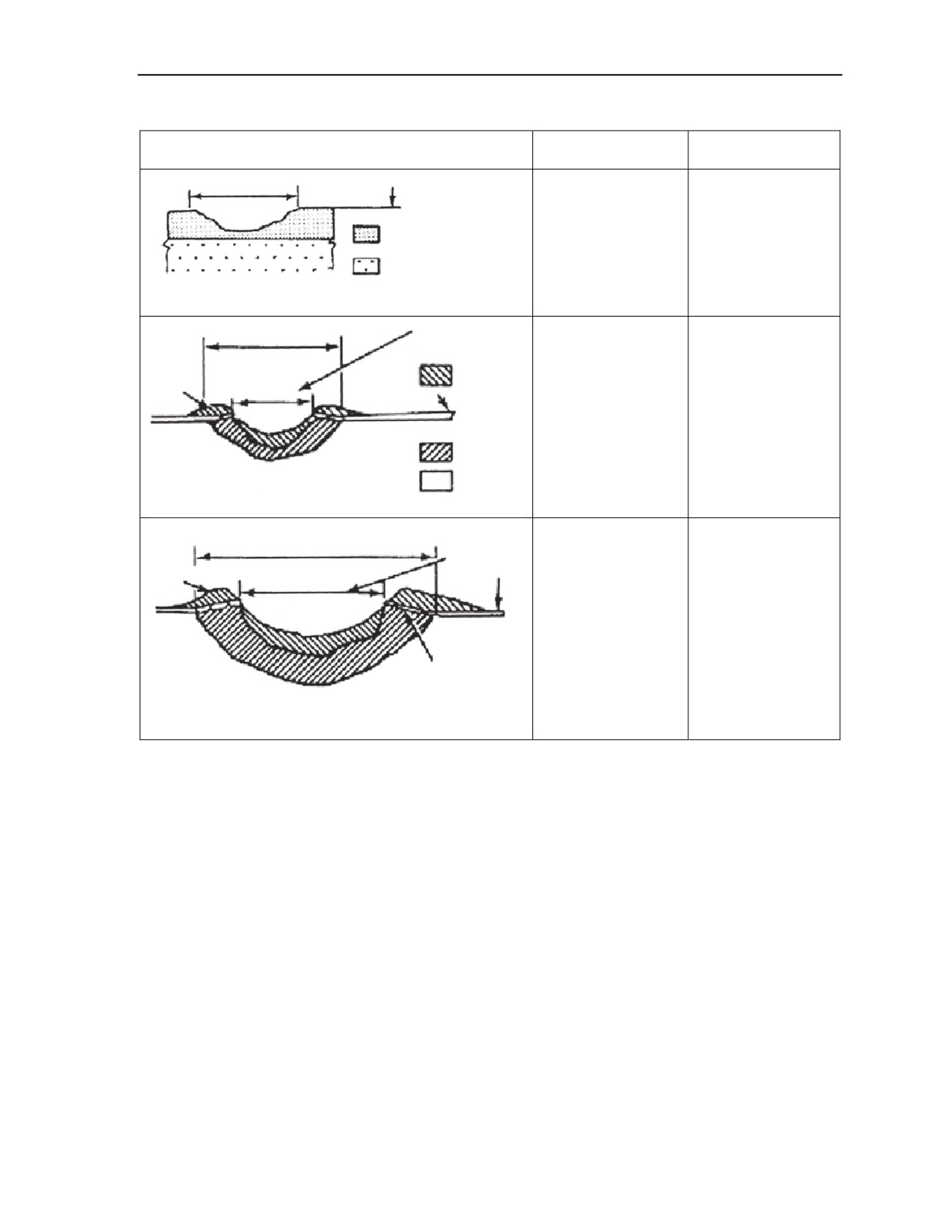
Airfields and Heliports
Probable Charge
Damage Category
Probable Munitions
Size
<5 ft
Grade
<1.5 ft
Small rocket
Cannon fire
5-8 lb
Pavement
Contact-fused
(2.3-3.6 kg)
Base
munitions
course
A. Spall/scab
Apparent
Actual damage
crater
Diameter
diameter
Debris/fallb
Crater
<20 ft
ack
Large rocket
lip
Grade
Clustered munitions
5-35 lb
<6.1 m
Small concrete
(2.3-15.8 kg)
Deformed
penetrators
soil
Pavement
B. Small crater
Apparent
Actual damage diameter
crater
diameter
Crater
>20 ft
Grade
lip
>6.1 m
Bombs
<100 lb
Delay-fused munitions
(45 kg)
Large concrete
Pavement
upheaval
C. Large crater
Figure 6.1. Airfield damage categories
6-33. The airfield commander prioritizes essential ADR missions, usually in the following order:
z
Reconnaissance or damage assessment.
z
EOD.
z
Minimum airfield operating surface (MAOS) repair.
z
Repair to operational facilities, communication systems, ammunition storage facilities, essential
maintenance facilities, fuel storage and distribution, utilities, and on-and-off base access routes
as a result of indirect damage due to direct attack explosives that missed their primary targets.
Environmental and occupational health hazards are included in these considerations.
6-34. Emergency repairs are conducted to provide a temporary fix. This allows the earliest possible
resumption of air missions. The service that is responsible for the airfield determines the minimum
operating strip and performs crater and surface repairs. The minimum operating strip is the minimum width
and length required for an aircraft to land and take off. Normally, the largest area of the airfield with the
least amount of damage is selected and identified as the minimum operating strip. All EH, including
remotely delivered mines, must be cleared from the minimum operating strip before surface repair starts.
6-35. Army engineers organic to the BCTs will typically conduct the initial forcible-entry ADR. This is
performed by airborne and air assault engineer elements centered on combat engineering skills and using
9 December 2008
FM 3-34.400
6-9
Chapter 6
specific force packages or modules to conduct emergency repairs using primarily a sand grid. At this level
of repair this is a forward aviation combat engineering task enabling mobility operations. See FM 3-34.2
for a discussion of forward aviation combat engineering operations.
6-36. Air Force engineers have sole responsibility for conducting emergency repairs of established U.S. air
bases. This is done by specific force packages or unit type codes (UTCs) formed from Air Force RED
HORSE or Prime BEEF units. Currently, the Air Force uses the following three types of emergency repairs
(depending on the nature of the damage):
z
Crushed stone over debris.
z
Choke-ballast repair.
z
Choke ballast over debris.
6-37. Army engineers use the following two methods to make “beyond emergency” repairs to established
U.S. air bases:
z
Stone and grout repair.
z
Concrete cap repair.
Air Force, Navy, and Marine engineers use similar techniques. The airfield commander directs the priority
of pavement repair effort, allowing permanent repair to begin as soon as the tactical situation, available
equipment, and labor permit. Pavements outside the minimum operating strip, including taxiways, usually
have a lower repair priority. Deliberately marking and/or clearing EH (to include UXOs and IEDs) must be
done before permanent repairs. Usually EOD personnel are available for these types of area clearance
operations, but engineers may have to perform these tasks in their absence if time is critical and the risk is
acceptable.
6-38. Army engineers are responsible for helping Air Force RED HORSE or Prime BEEF teams to repair
critical air base support facilities, when such repairs exceed the Air Force's capability. Methods for
repairing indirect damage are much the same as ordinary engineer construction techniques.
AIRFIELD MAINTENANCE
6-39. Airfield maintenance is the routine prevention and correction of damage and deterioration caused by
normal use and exposure to the elements and aircraft traffic. Routine maintenance includes inspections;
stockpiling materials for repair and maintenance work; maintenance and repair of pavement surfaces and
drainage systems, dust and control; and snow, ice, and FOD removal. The procedures and considerations
for airfield maintenance are similar to those for road maintenance and repair. The materials used for
airfield maintenance are generally the same as those used for airfield construction and repair.
6-40. FOD removal is accomplished using motorized sweepers. The user of the airfield, in coordination
with engineers responsible for airfield maintenance, should do routine FOD inspections.
6-41. Upon completion of an airfield repair or a maintenance mission, a repair evaluation must be
conducted before resuming aircraft operations. When conducting the repair evaluation, the following
should be considered:
z
Repair compaction. The strength of the backfill, debris, or subgrade materials must be verified.
Depending upon the repair method used, the thickness and strengths of all surface and/or base
course materials must also be verified. The soil structure should be tested using a dynamic cone
penetrometer (DCP) to determine the California bearing ratios (CBR) of each layer. These tests
must be accomplished before placing the FOD covers, AM-2 matting, stone and grout, asphalt,
concrete, or other surface materials that would prevent the use of the DCP.
z
Surface roughness. The final grade of the repair must be checked using line-of-sight profile
measurement stanchions, upheaval posts, or string lines to ensure that the repair meets the
surface roughness criteria. In the case of a crushed stone repair without a FOD cover, the repair
surface should be checked for loose aggregate or potential FOD.
z
Foreign object damage covers. FOD covers should be no more than 5° off parallel with the
runway centerline. Connection bolts are checked and all bolts are verified to be tight and secure
6-10
FM 3-34.400
9 December 2008
Airfields and Heliports
between panels. Anchor bolts are checked and all bolts are verified to be secure and the FOD
cover is checked to ensure that it is held snugly against the pavement surface. In taxiway and
apron applications, the leading and trailing edges of the FOD cover must be anchored. The side
edges must also be anchored if the cover is located in an area where aircraft will be required to
turn.
z
Setting and curing. If the repairs are capped with concrete, stone and grout, or rapid-set
materials, verify that the surface material has set and that adequate cure time is allowed before
aircraft operations.
z
Clean up. For all repair methods, verify that the areas are cleared of any excess repair materials.
z
Airfield certification. The on-site engineer responsible for the repair will certify that the repair
was accomplished according to the procedures in the appropriate UFC and other applicable
publications. The repair procedures will be documented on an ADR log. This form will then be
updated to reflect subsequent aircraft traffic and required maintenance throughout the history of
the repair. If another team replaces the initial repair team, this form is given to the follow-on
team. This information will be useful in planning or performing any further maintenance and/or
upgrade of the repairs. Upon completion of repairs, the status of the airfield or repairs is
provided to the airfield manager or other individual authorized to monitor and control on-site
aircraft operations. This individual can then issue a NOTAM to change the airfield status.
9 December 2008
FM 3-34.400
6-11