FM 3-22.37 COMBAT MISSILE SYSTEM, MEDIUM (March 2008) - page 3
Chapter 3
ACTION:
Terminate a Javelin engagement.
CONDITION:
Given a BST with the seeker activated and one of the following situations:
1. You are ordered to stop the engagement.
2. You cannot establish or maintain a lock on the target.
STANDARD:
1. Engaged another target or aborted the mission.
2. Removed the activated BCU and installed a new BCU.
3. Continued the mission or displaced.
ACTION:
Engage multiple targets with a Javelin.
CONDITION:
Given a ready-to-fire BST and a firing position.
STANDARD:
Engaged a target, reloaded, and then engaged two more targets within 3
minutes.
ACTION:
React to warning indicators.
CONDITION:
Given a Javelin or BST.
STANDARD:
1. Demonstrated the actions required to clear the warning indicator.
2. Scored at least 70 percent to pass each BST warning exercise.
ACTION:
React to a malfunction.
CONDITION:
Given a Javelin or BST.
STANDARD:
1. Demonstrated the actions required to correct the malfunction.
2. Scored at least 70 percent to pass each BST malfunction exercise.
MODULE 7: FIELD TACTICAL TRAINER
3-81. Module 7 covers the major components of the FTT and the techniques involved in assembling
the FTT, running a daily readiness check, assuming a carry configuration with the FTT, and engaging
targets with the FTT. Module 7 consists of the following training objectives:
ACTION:
Identify the major components of the FTT simulated round.
CONDITION:
Given an FTT simulated round or an illustration of a simulated round.
STANDARD:
Identified at least 5 out of 6 FTT simulated round components (latch
assembly, simulated battery coolant unit [SBCU], forward end cap, launch
effects simulator, battery compartment, and W1 housing [P3 connector]).
3-18
FM 3-22.37
20 March 2008
Training Program
ACTION:
Identify the FTT instructor station control panel controls and indicators.
CONDITION:
Given an FTT instructor station or an illustration of the FTT instructor station
control panel.
STANDARD:
Identified at least 5 of 6 of the FTT instructor station control panel controls
and indicators (PUSH TO TEST switch, LOW BATT indicator, menu display,
LASER FIRE indicator, PUSH TO LIGHT switch, and BIT FAIL indicator).
ACTION:
Prepare an FTT for operation.
CONDITION:
Given a simulated round, a CLU with a carrying bag, a yellow MILES key, a
W1 cable, and a BB390 A/U.
STANDARD:
Removed the CLU from the carrying bag, installed a BB390A/U in the CLU,
set the CLU power switch to NIGHT, connected the CLU to the simulated
round, removed the forward end cap, opened the lens covers, installed the
W1 cable, powered up the simulated round, and conducted a daily readiness
check (DRC).
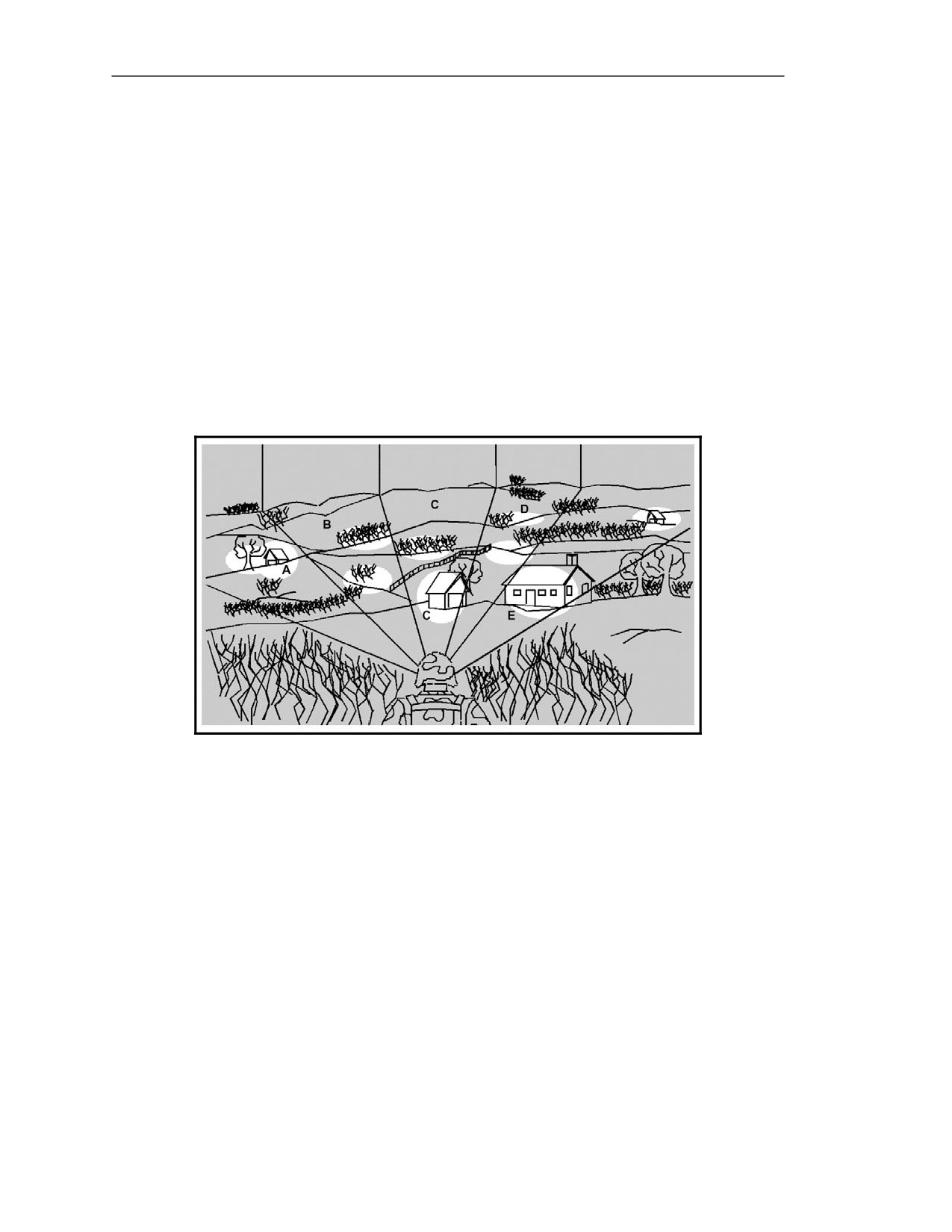
ACTION:
Engage target(s) with an FTT.
CONDITION:
Given a ready-to-fire FTT and a firing position.
STANDARD:
1. Detected, classified, and recognized a target.
2. Determined the target's engageability.
3. Activated the simulated seeker.
4. Reacquired the target in the seeker.
5. Changed the missile mode, if necessary.
6. Adjusted the track gates.
7. Locked on the target.
8. Checked the crosshairs and track gates.
9. Fired the FTT.
ACTION:
Disassemble an FTT.
CONDITION:
Given an FTT and a carrying bag.
STANDARD:
1. Powered down the FTT.
2. Performed the following actions to the simulated round:
• Removed the W1 cable, the SBCU, and the yellow MILES key.
• Removed the FNC battery from the simulated round and turned it in
for charging.
3. Performed the following actions to the CLU:
• Removed the CLU from the simulated round.
• Removed the CLU battery and stored it in the carrying bag.
20 March 2008
FM 3-22.37
3-19
Chapter 3
ACTION:
Boresight an FTT.
CONDITION:
Given a powered-up FTT, a boresight kit, a small-arms alignment fixture
(SAAF), a 9-volt battery, and three 6-volt batteries.
STANDARD:
Set up the equipment and boresighted the FTT, achieving a minimum
alignment of 1 in both directions.
ACTION:
Maintain an FTT.
CONDITION:
Given a CLU, a carrying bag with all components, a simulated round, a
cleaning cloth, one ounce of detergent, one quart of water, one 2-quart pail,
the Operator’s Manual for the Javelin Weapon System M98A2, TM 9-1425-
1687-10, and the Operator’s Manual for the Javelin Missile System Field
Tactical Trainer M82 (TM 9-6920-688-10).
STANDARD:
Inspected the CLU, the carrying bag, and the simulated round. Removed all
dirt and corrosion from each item. Identified, corrected, and reported any
deficiencies IAW TM 9-1425-1687-10. Notified the squad leader if items were
missing and if any CLU deficiencies were not gunner-correctable.
NOTE: Observe the following safety conditions during training:
• Treat the simulated round as if it were a Javelin round.
• Handle the simulated round carefully to prevent shock or friction.
• DO NOT drop, drag, throw, roll, or "walk" when carrying or transporting the simulated
round.
• Handle the simulated round in a way that prevents damage, an accident, or defacing of
the identification markings.
• Promptly report any evidence that the simulated round has been handled roughly to the
instructor.
• When not in use, ensure that the simulated round (like the round) is pointed away from
personnel and toward the area offering the least hazard to personnel and equipment in
the event of a fire or explosion.
MODULE 8: MAINTAIN A JAVELIN
3-82. Module 8 covers Javelin preventive maintenance checks and services
(PMCS), including
inspections, cleanings, BITs, and operational checks.
ACTION:
Maintain a Javelin.
CONDITION:
Given a CLU, a carrying bag with all components, a CLU battery, an MSR, a
flashlight with batteries, a cleaning cloth, one ounce of detergent, one stiff
bristle brush, one quart of water, one 2-quart pail, and the Operator’s Manual
for the Javelin Weapon System M98A2 (Army TM 9-1425-1687-10/Marine
Corps TM 09397B-12/1).
STANDARD:
Performed PMCS IAW Work Packages 0008 00-0013 00 of
TM 9-1425-1687-10, Maintenance Instructions.
NOTES:
1. Before operating the Javelin, review all notes, cautions, and warnings. Perform
all before-operation checks IAW TM 9-1425-1687-10.
2. After operating the Javelin, perform after-operation checks and services.
3. The CLU BIT is performed without a round attached.
3-20
FM 3-22.37
20 March 2008

Training Program
SUSTAINMENT TRAINING
3-83. The gunners’ sustainment training is conducted monthly, quarterly, and annually. The frequency
of training may be modified based on the gunner’s ability to perform to standards. If a gunner
consistently has trouble with a task required quarterly, consider changing that task to a monthly
sustainment training program to increase the training frequency and enhance the gunner’s ability to
perform to standard. The matrix in Table 3-2 identifies the specific tasks and subjects that must be
performed by all Javelin gunners and assistant gunners.
COLLECTIVE TRAINING
3-84. Collective training integrates the Javelin into the unit training program and develops an
antiarmor resource that the commander and the unit can use to augment their fighting capability.
Individual tasks are integrated into collective training and rehearsals. To accomplish this, commanders
analyze the collective tasks (from their unit METLs) and the individual tasks supporting them. The
commander determines which collective tasks must be practiced by analyzing the mission outlines in
the appropriate mission training plan
(MTP). The mission outlines describe the collective tasks
required to execute each Army Training And Evaluation Program
(ARTEP) mission. Leaders
determine which individual tasks support the collective tasks by referring to the collective task-to-
individual task matrix in the appropriate MTP. Some considerations for planning collective tasks are as
follows:
z
How does a Javelin that is issued at the squad level affect training?
z
Who do I assign as designated Javelin gunner?
z
Does the Javelin gunner require an assistant gunner or an ammunition bearer?
z
If a second round is issued to the gunner or squad, who carries it?
z
If the designated Javelin gunner is injured or killed, who replaces him?
z
Who else can be trained?
3-85. Table 3-3 includes some suggested collective training events.
Table 3-2. Sustainment training matrix.
TRAINING
TASK
TIME
REMARKS
FREQUENCY
Practical Exercise
Maintain a Javelin.
M
4 hrs
MSR/CLU
Practical Exercise
Prepare a Javelin for firing.
M1
10 min
MSR/CLU
Practical Exercise
Restore a Javelin to carrying configuration.
M1
5 min
MSR/CLU
Perform long-distance carry technique.
Q
2 hrs
CLU and MSR
Practical Exercise
Perform malfunction procedures on a Javelin.
M1
15 min
BST and FTT
Recognize friendly and threat armored vehicles and
Practical Exercise
M
30 min
aircraft.
BST
Explain how to construct a two-man fighting position
Perform as part of an
A
N/A
with a Javelin firing platform.
ARTEP or FTX
Prepare a standard range card.
M2
30 min
Practical Exercise
Engage targets with a Javelin.
Practical Exercise
•
BST
M/Q
4 hrs
BST
•
FTT
FTT
Explain immediate decontamination and emergency
Perform during BST
Q
30 min
destruction procedures.
and FTT training
M
= Every month
M1
=
1st month (odd months)
M2
=
2nd month (even months)
Q
=
Quarterly
A
=
Annual
20 March 2008
FM 3-22.37
3-21

Chapter 3
Table 3-3. Collective training tasks.
FREQUENCY
SEQUENCE
HOW
(TIME/YEAR)
Squad, Platoon or Company FTX
4
MILES
Battalion FTX
2
MILES
Platoon/Company Urban Operations Exercise
1
MILES
Gunner LFX
1
Live Round
Externally Evaluated Battalion MTP
1
MILES
3-22
FM 3-22.37
20 March 2008
Chapter 4
TACTICAL CONSIDERATIONS
This chapter discusses tactical considerations and limitations of Javelin
employment during combat operations. To integrate the Javelin into tactics and
techniques, leaders—from the company commander down to the squad leader—
must be familiar with the field manuals (FMs 7-7, 3-06.11, 3-21.8, 3-21.9, 3-
21.10,
3-21.11, and
3-21.71) appropriate to the organizations and to the
organizational level. This chapter also discusses how to construct a Javelin
fighting position, affording the gunner and assistant gunner/ammunition handler
good cover and concealment while allowing for the best possible engagement of
the enemy.
SECTION I. ROLE AND FUNDAMENTALS
The role of the Javelin is to destroy enemy vehicles out to 2,000 meters. Commanders may use the Javelin's
unique capabilities from supporting fire to conducting surveillance to enhance the units' combat power. The
Javelin replaces the Dragon in selected Infantry, Armor, and Engineer units.
ROLE
4-1. The Javelin’s primary role is to destroy enemy armored vehicles. When there is no armored
vehicle threat, the Javelin can be employed in a secondary role of providing fire support against point
targets such as bunkers and crew-served weapons positions. In addition, the Javelin CLU can be used
alone as an aided vision device for reconnaissance, security operations, and surveillance. In
mechanized Infantry units, when Bradley fighting vehicles (BFVs) are part of a combined-arms team
with tanks, the Javelin becomes a secondary weapon system. It supports the fires of tanks and tube-
launched, optically-tracked, wire-guided missiles (TOWs), covers secondary avenues of approach
(AAs), and provides observation posts with long-range sight capability.
CAPABILITIES AND LIMITATIONS
4-2. The Javelin has some unique capabilities that provide the unit with an effective medium close
combat missile system. However, the commander should also understand the system's limitations in
order to effectively employ the Javelin.
FIREPOWER
Capabilities
4-3. The Javelin has the following capabilities:
z
The maximum effective range of the Javelin is 2,000 meters.
z
The Javelin has a fire and forget capability. The missile I2R system gives the missile the
ability to guide itself to the target when launched by the gunner.
z
The Javelin has two missile flight paths:
Top attack flight path is designed to impact on top of the target.
20 March 2008
FM 3-22.37
4-1
Chapter 4
Direct attack flight path is designed to impact on the side (front, rear, flank) of the
target.
z
The Javelin gunner is capable of firing up to three missiles within 2 minutes.
z
The dual-shaped charge warhead is capable of defeating any known enemy armor.
z
The NVS sees little degradation of the target image.
z
Countermeasures used by the enemy are countered by the NVS filter.
Limitations
4-4. The Javelin has the following limitations:
z
The CLU sight cannot discriminate targets past 2,000 meters.
z
The NVS cooldown time is from 2.5 to 3.5 minutes.
z
The seeker’s cooldown time is about 10 seconds.
z
The BCU life, once activated, is about 4 minutes.
z
During limited visibility (natural or man-made), rain, snow, sleet, fog, haze, smoke, dust,
and night are collectively referred to as limited visibility conditions.
z
Night.
The day FOV relies on daylight to provide the gunner a suitable target image.
The NVS uses the IR naturally emitted from objects. IR crossover is the time at dawn
and dusk that the terrain and the target are close enough in temperature to cause the
target to blend in with its surroundings.
Natural clutter is when the sun heats objects to a close enough temperature that it
causes the target to blend in with the surrounding terrain.
Artificial clutter occurs when there are man-made objects that emit large amounts of IR
(for example, burning vehicles).
Heavy fog reduces the capability of the gunner to detect and engage targets.
z
The flight path of the missile is restricted in wooded, mountainous, and urban terrain.
z
The gunner must have line of sight for the seeker to lock onto a target.
MANEUVER
Capabilities
4-5. The Javelin has the following capabilities:
z
The Javelin is man-portable.
z
The fire and forget capability allows the gunner to shoot and move before missile impact.
z
The soft launch capability of the Javelin allows it to be fired from inside buildings and bunkers.
z
The Javelin is maneuverable over short distances for the gunners.
Limitations
4-6. The Javelin has the following limitations:
z
The weight of the Javelin makes maneuvering slow over long distances.
z
The Javelin round is bulky and restricts movement in heavily wooded or vegetative terrain.
PROTECTION
Capabilities
4-7. The Javelin has the following capabilities:
z
The passive IR targeting system used to acquire lock-on cannot be detected.
z
The launch motor produces a small signature.
4-2
FM 3-22.37
20 March 2008
Tactical Considerations
z
The fire and forget feature allows the gunner to take cover immediately after the missile is
launched.
Limitations
4-8. The Javelin has the following limitations:
z
The gunner must partially expose himself to engage the enemy.
z
The CLU requires a clear line-of-sight to acquire targets in top attack and direct attack
modes.
FUNDAMENTALS OF EMPLOYMENT
4-9. The Javelin is employed based on METT-TC. The Javelin’s increased range and lethality gives
the commander a greater effect on the battlefield. By applying the following fundamentals of
employment, the gunner and his leaders increase the probability of destroying enemy targets and
enhances the survivability of the Javelin gunner.
STANDOFF
4-10. The gunner strives to engage enemy vehicles in the 1,000-to 2,000-meter range. The Javelin size
and small-launch signature are not easily detected at these distances, and the maximum effective range
of most machine guns is about 1,000 meters. Engagement at ranges of less than 1,000 meters exposes
the gunner to enemy direct fire weapons and lessens his survivability on the battlefield. By engaging
the enemy whenever possible out to 2,000 meters, enemy vehicles are forced to break formation.
Mechanized Infantry vehicles are forced to take cover and dismount the Infantry. The result is a change
in momentum of the battle for both defensive and offensive operations.
MUTUAL SUPPORT
4-11. The Javelin provides mutual support for other unit assets. Mutual support is established by employing
the Javelin in sections and by overlapping sectors of fire between Javelins.
Employing by Sections
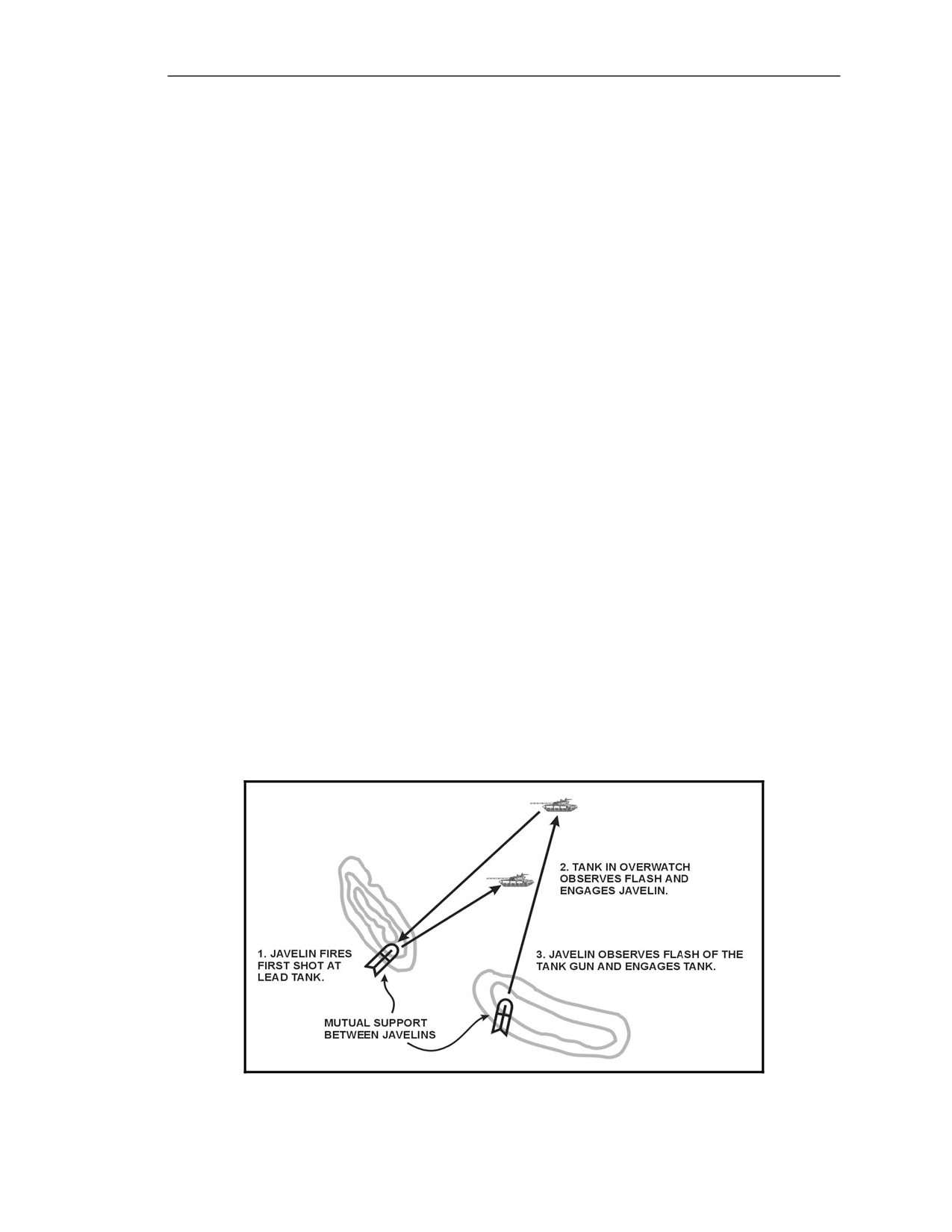
4-12. Employment of Javelins by section establishes mutual support between gunners. If one gunner has
engaged and is displacing, the other gunner can continue to cover the assigned sector. To achieve this, the
Javelins are positioned so that fires directed at one Javelin do not suppress the other Javelins (Figure 4-1).
Figure 4-1. Mutual supporting fire.
20 March 2008
FM 3-22.37
4-3
Chapter 4
Overlapping Sectors of Fire
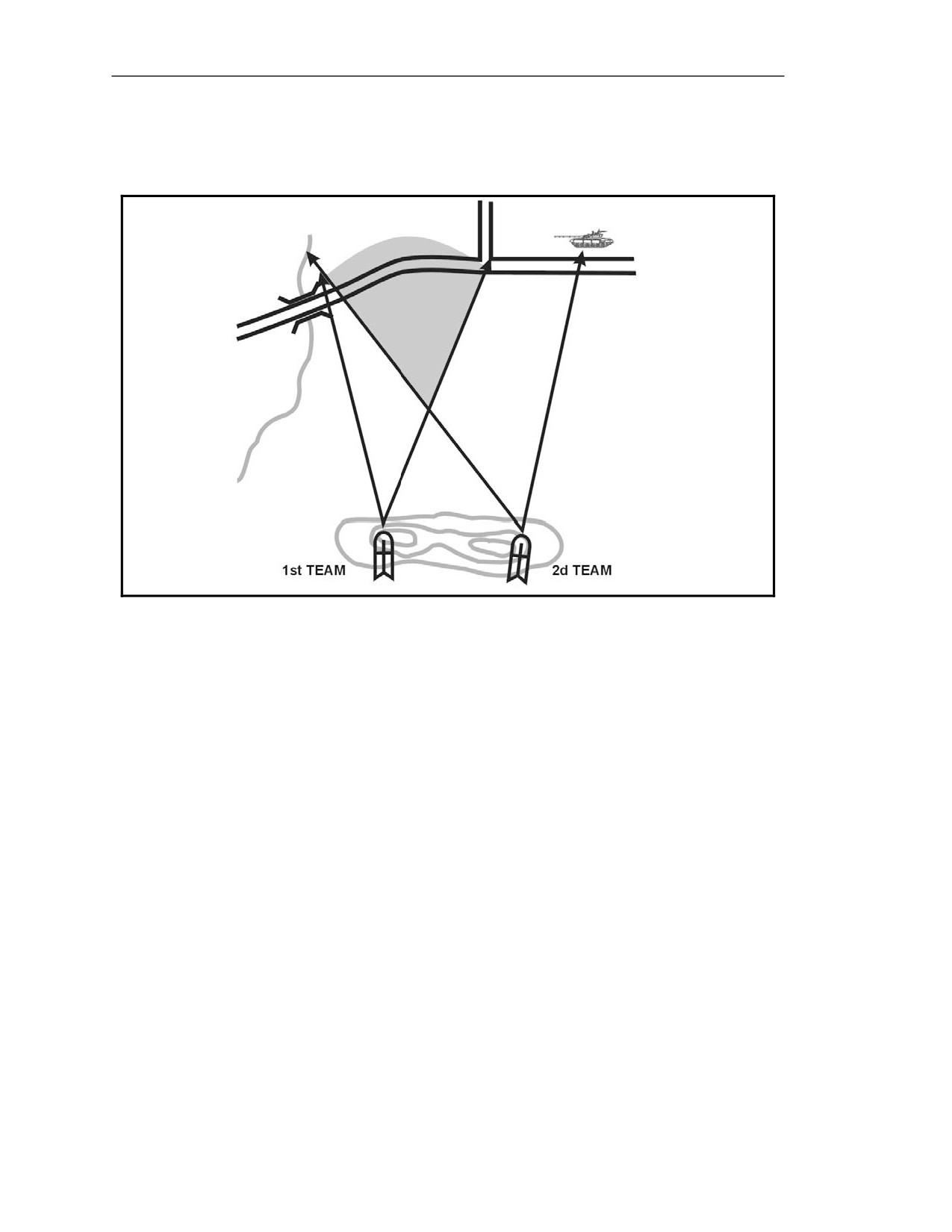
4-13. The gunners may overlap sectors of fire to maximize coverage (Figure 4-2). Overlapping sectors
of fire are essential to mutual support.
Figure 4-2. Overlapping sectors of fire.
SECURITY
4-14. Javelin gunners are vulnerable to attack by dismounted Infantry. To protect gunners, position
them near friendly Infantry units. The Infantry should be able to cover dismounted AAs to the Javelin
position.
FLANK ENGAGEMENTS
4-15. The Javelin should be employed to engage enemy vehicles from the flank. Although the Javelin
has the unique ability to use a top attack, the gunner should still seek to engage with flank shots.
COVER AND CONCEALMENT
4-16. The Javelin gunners should use cover and concealment to increase their survivability. Cover is
protection from the fire of enemy weapons and from enemy observation. It can be natural or man-
made. Concealment is protection from enemy observation. Concealment includes not only camouflage
but also light, noise, and movement discipline.
EMPLOY IN DEPTH
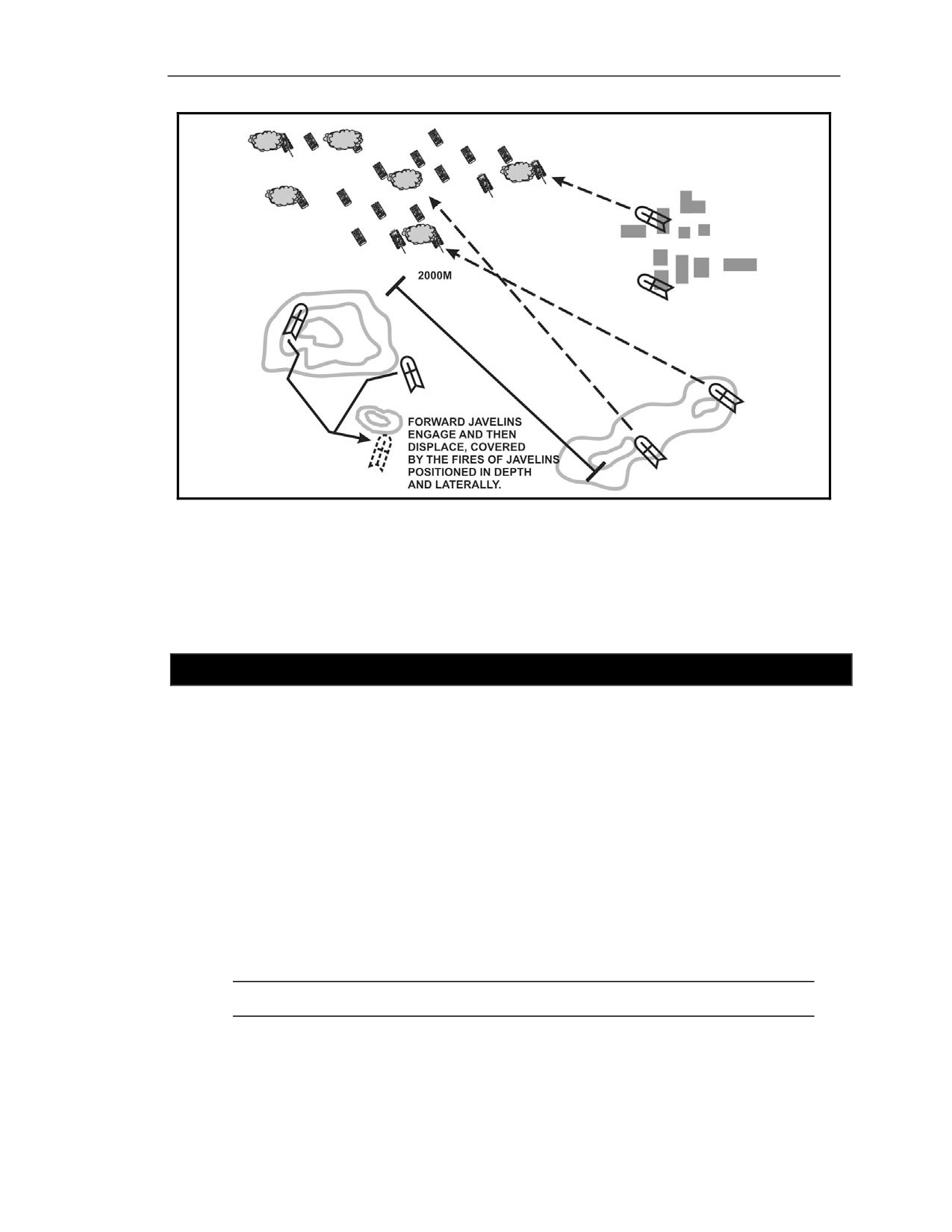
4-17. Javelin fire should be employed in depth. By employing the Javelins in depth in conjunction
with integrated fires and obstacles, the commander prevents the enemy from easily engaging friendly
weapon systems and slows and canalizes the enemy advance (Figure 4-3). This increases engagement
times for all Javelin systems and the probability of achieving a hit. Positions are selected to capitalize
on the Javelin's 2,000-meter range.
4-4
FM 3-22.37
20 March 2008
Tactical Considerations
Figure 4-3. Javelins positioned in depth.
COMBINED ARMS
4-18. Skillful integration of Infantry, Armor, Engineer, and indirect fire assets greatly improve the
survivability and lethality of unit Javelins. When employed correctly, the Javelin can be an integral
part of the combined arms team.
SECTION II. DEFENSE
This section describes the Javelin in defensive operations, mechanized company defensive employment,
defense in depth, and retrograde operations. The principle factors to consider when positioning the Javelin
are gunner protection and optimizing the capabilities of the weapon system.
DEFENSIVE OPERATIONS
4-19. The Javelin supports a rifle squad or platoon. In some units, these weapons are organic to the
platoon. In units not assigned Javelins, the commander should plan for some form of mutually
supporting weapon fires. At times, the platoon may be supported by heavy close combat missile
systems, which have a much greater range than the Javelin. During planning, the leader considers the
threat, then positions unit weapons accordingly to cover AAs. He also considers the fields of fire,
tracking time, and minimum engagement distance of each weapon. The platoon leader selects a
primary position and sector of fire for each weapon. He also picks alternate and supplementary
positions for them. Each position should allow flank fire and have cover and concealment. The leader
should integrate the CLU into his limited visibility security and observation plan. If time permits, the
gunner prepares range cards for his primary, alternate, and supplementary positions.
NOTE: See Appendix B for more information.
20 March 2008
FM 3-22.37
4-5

Chapter 4
PERSONNEL DUTIES
4-20. The tasks listed in Table 4-1 must be performed to successfully employ the Javelin in the
defense.
Table 4-1. Personnel duties.
AA SECTION
AA SECTION
GUNNER/
---------
------------
ASSISTANT
TASKS TO BE PERFORMED
SECTION
TEAM
GUNNER
SERGEANT
LEADER
(if assigned)
Integrate Javelin into the platoon tactical plan:
• Select general weapons positions.
X
• Assign sectors of fires.
X
• Coordinate mutual support.
X
• Coordinate with adjacent units.
X
Reconnoiter for and select tentative Javelin firing positions (primary,
X
alternate, and supplementary) and routes between positions.
Supervise continual preparation and improvement of positions.
X
X
Coordinate security for the Javelin teams.
X
Inspect the selection of tentative firing positions. Confirm or make adjustments.
X
X
Supervise preparation of a standard range card.
X
X
Control movement of gunners between positions.
X
X
Issue fire commands to gunners.
X
X
Coordinate resupply and collection of extra rounds carried in platoon.
X
Identify enemy AAs.
X
Prepare fighting position (primary, alternate, supplementary).
X
Prepare a standard range card.
X
X
Designate target reference points (TRPs).
X
Prestock Javelin rounds.
X
X
Prepare round for firing.
X
React to fire commands.
X
Engage targets.
X
GUNNER PLACEMENT
4-21. The platoon leader selects the fighting position and assigns the sector of fire. Taking into
consideration these simple rules will greatly improve the gunner's survivability.
Natural Cover and Concealment
4-22. The gunner should use the terrain to his advantage for cover and concealment from enemy
ground and aerial observation.
Flank or Rear Shots
4-23. It is much more difficult for the enemy to retrace the flight path of a round to its launch site and orient
their weapons on the Javelin firing position when the round moves obliquely across the enemy's front.
Mutually Supporting Positions
4-24. Javelins should be placed in mutually supporting positions to ensure continuous coverage of the
engagement area (Figure 4-1).
Integrate with Adjacent Units
4-25. Javelin teams need to coordinate with adjacent units to ensure security.
Engage at Maximum Range
4-26. The Javelin's 2,000-meter maximum range makes it difficult for the enemy to engage the Javelin
with direct fire. This forces the enemy to deploy earlier than intended. Because of the Javelin's range, it
may need to be placed at the flank or rear of the platoon positions.
4-6
FM 3-22.37
20 March 2008
Tactical Considerations
POSITIONS
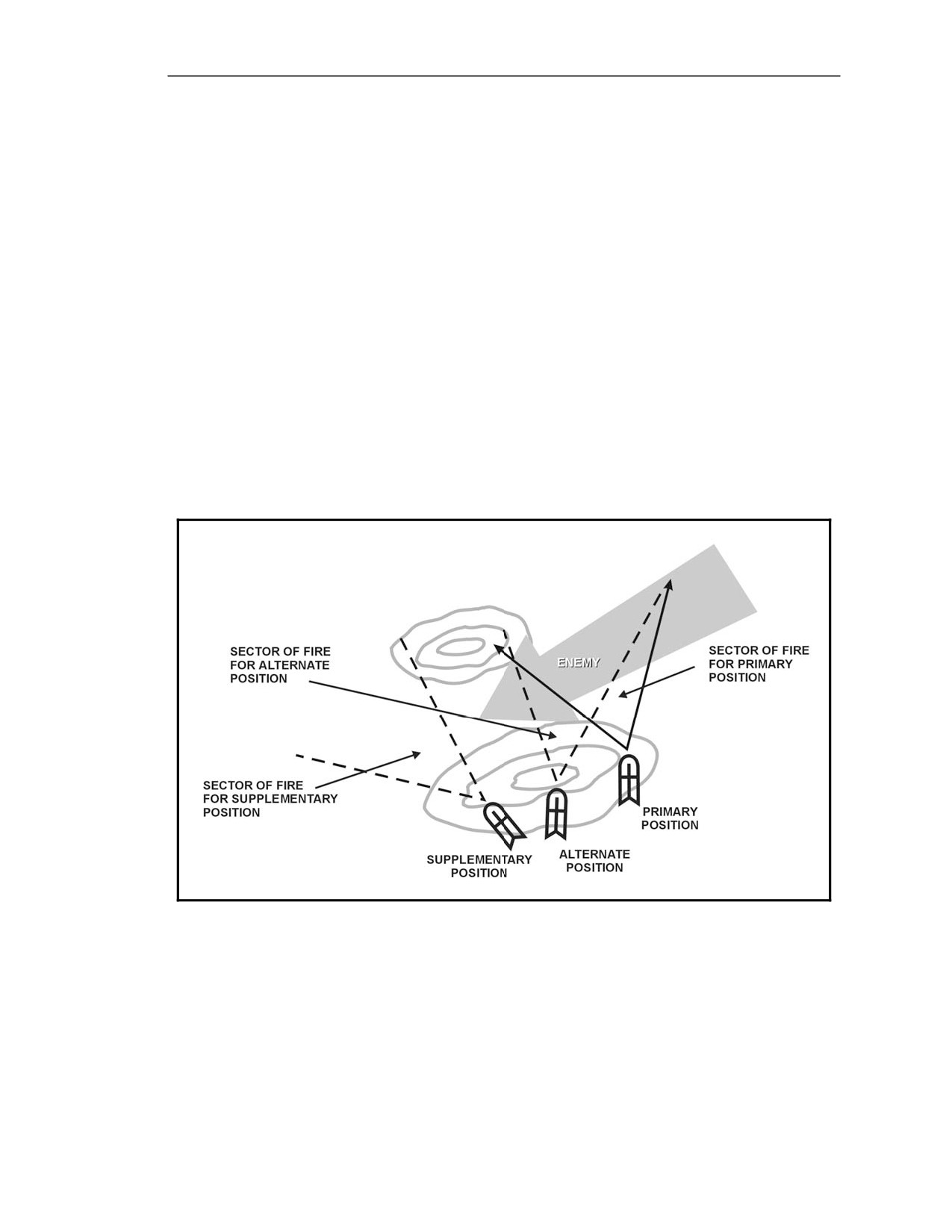
4-27. The Javelin gunner prepares three firing positions within the platoon sector of fire, a primary, an
alternate, and a secondary position (Figure 4-4).
Primary
4-28. The primary position is one from which a gunner or team can cover the assigned sector of fire. It
should have good observation, cover and concealment, and good fields of fire.
Alternate
4-29. The alternate position is one from which a gunner or team can either move to the flank or
slightly to the rear of the primary position. The gunner or team must be able to cover the same sector
of fire as from the primary position. The gunner moves to the alternate position when the primary
position can no longer be occupied. The decision to change positions is made by the leader.
Supplementary
4-30. The supplementary position is one from which a gunner or team covers AAs and any target
reference points (TRPs) not covered by the primary and alternate positions. This position is usually
close enough to the primary position to share mutual support with other positions. This position should
also have good observation, cover and concealment, and good fields of fire.
Figure 4-4. Primary, alternate, and supplementary positions.
MECHANIZED COMPANY DEFENSIVE EMPLOYMENT
4-31. Mechanized Infantry companies (Heavy or Light) use the Javelin’s range and lethality to
complement the firepower of the BFV and Stryker brigade combat team (SBCT). This technique
creates a much more effective engagement, especially when the company is fighting without tanks.
Without the Javelin, BFV-SBCT equipped Infantry units have difficulty defending when the enemy
attacks with both tanks and Infantry fighting vehicles (IFVs). If the commander focuses his BFV fires
on the tanks, the IFVs are free to maneuver close enough to engage with their weapons, dismount their
Infantry, and begin the assault. If the commander focuses all his fires on the IFVs, he risks letting the
20 March 2008
FM 3-22.37
4-7
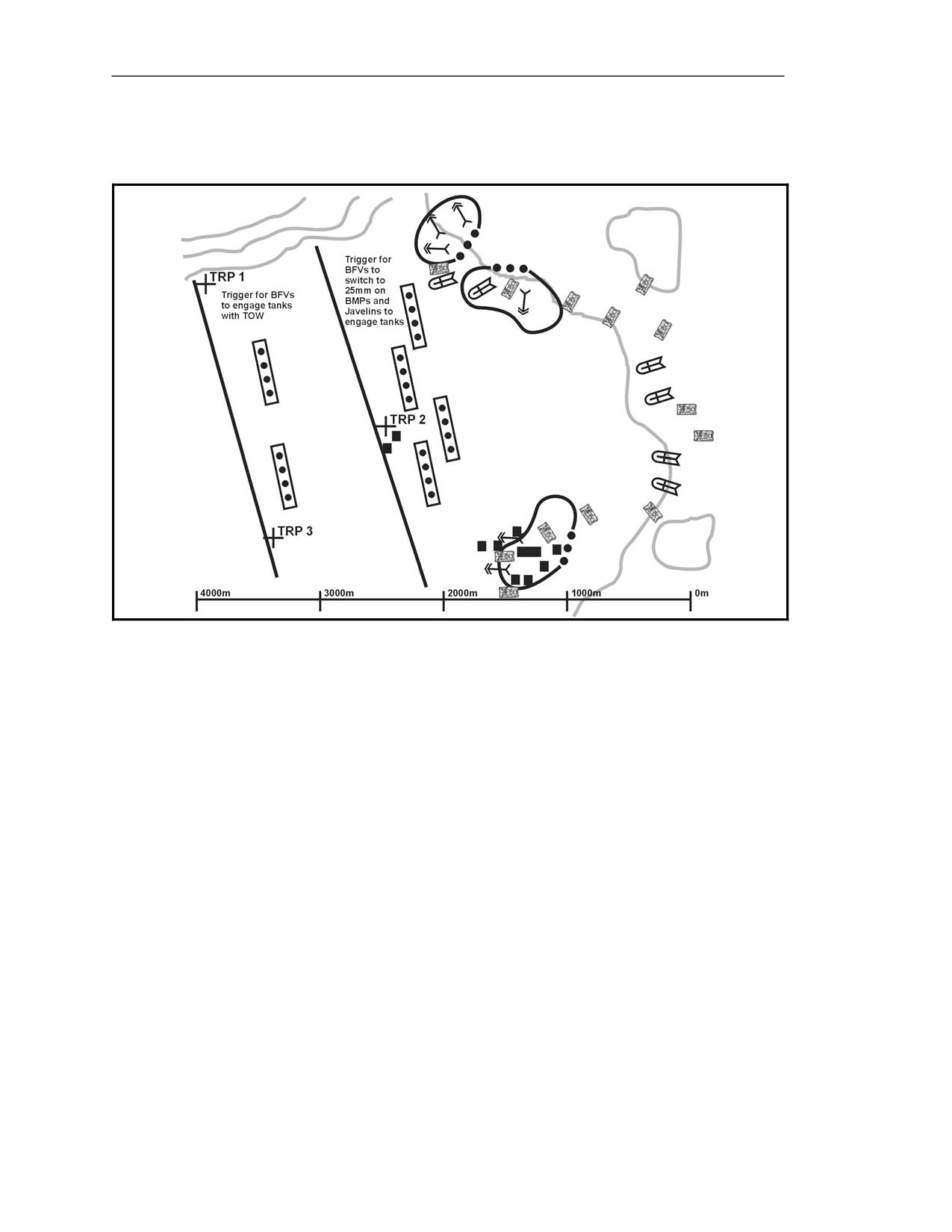
Chapter 4
enemy tanks get close enough to engage his BFVs. The Javelin gives the mechanized company
commander the ability to focus effective fires on both tanks and IFVs throughout his engagement area
and to destroy enemy IFVs before they can close to assault range (Figure 4-5).
Figure 4-5. Javelin-equipped mechanized company defense.
DEFENSE IN DEPTH
4-32. In the defense, the Javelin team may participate as part of a screen. The Javelin team supports
screen operations by assisting in:
z
Maintaining continuous surveillance of AAs using the CLU's night vision capability.
z
Detecting enemy units and reporting their direction of movement.
z
Destroying the pursuing enemy when forced to withdraw.
z
Providing supporting fires to allow screening units to break contact and withdraw.
DELAYS AND WITHDRAWALS
4-33. Delays and withdrawals involve movement away from the enemy. Against an armored enemy, Javelins
and similar weapons are often positioned so they can cover the movement of the entire force.
DELAY
4-34. In a delay, the unit trades space for time without becoming decisively engaged, Javelin teams
can be directed to set up antiarmor ambushes, to block AAs, and to slow advancing enemy vehicles.
WITHDRAWAL
4-35. In a withdrawal, Javelin teams often overwatch and protect the force as it withdraws.
4-8
FM 3-22.37
20 March 2008
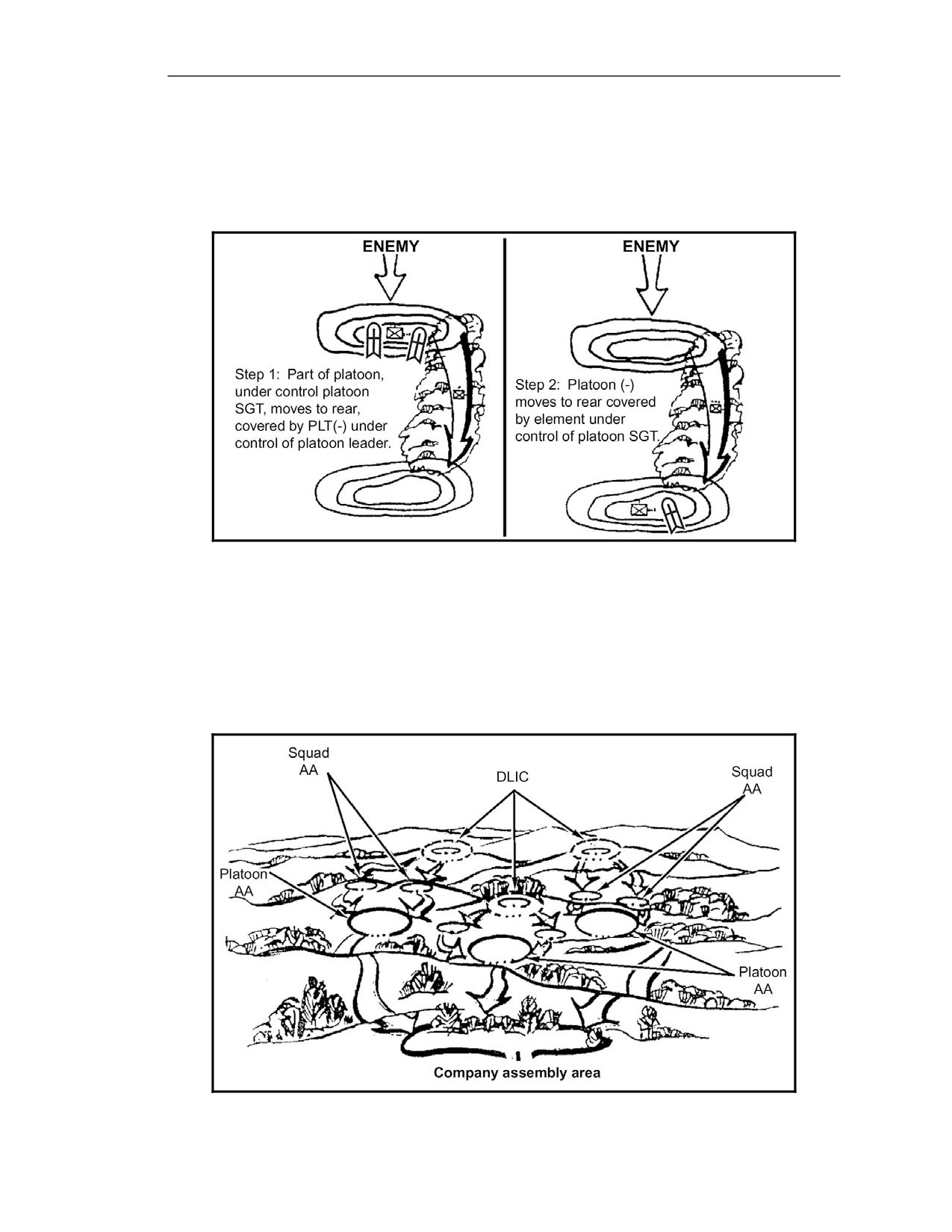
Tactical Considerations
Withdrawal Under Enemy Pressure
4-36. Enemy pressure makes withdrawing more difficult than it would be otherwise (Figure 4-6). The
platoon must employ fire and maneuver to fight its way away from the enemy. To ensure continuous
supporting fires, both covering and maneuvering elements must have Javelins.
Figure 4-6. Withdrawal under enemy pressure.
Withdrawal Not Under Enemy Pressure
4-37. The company can withdraw with speed, secrecy, and deception (Figure 4-7). Withdrawal is most
effective during the hours of darkness or under limited visibility conditions. Withdrawal is usually
conducted in mass. When required, the company leaves a security force to cover a withdrawal by
deception and maneuver. The weapon section can be split with a portion of the Javelin gunners
assigned to the security force and the remainder with the main body.
Figure 4-7. Withdrawal not under pressure.
20 March 2008
FM 3-22.37
4-9
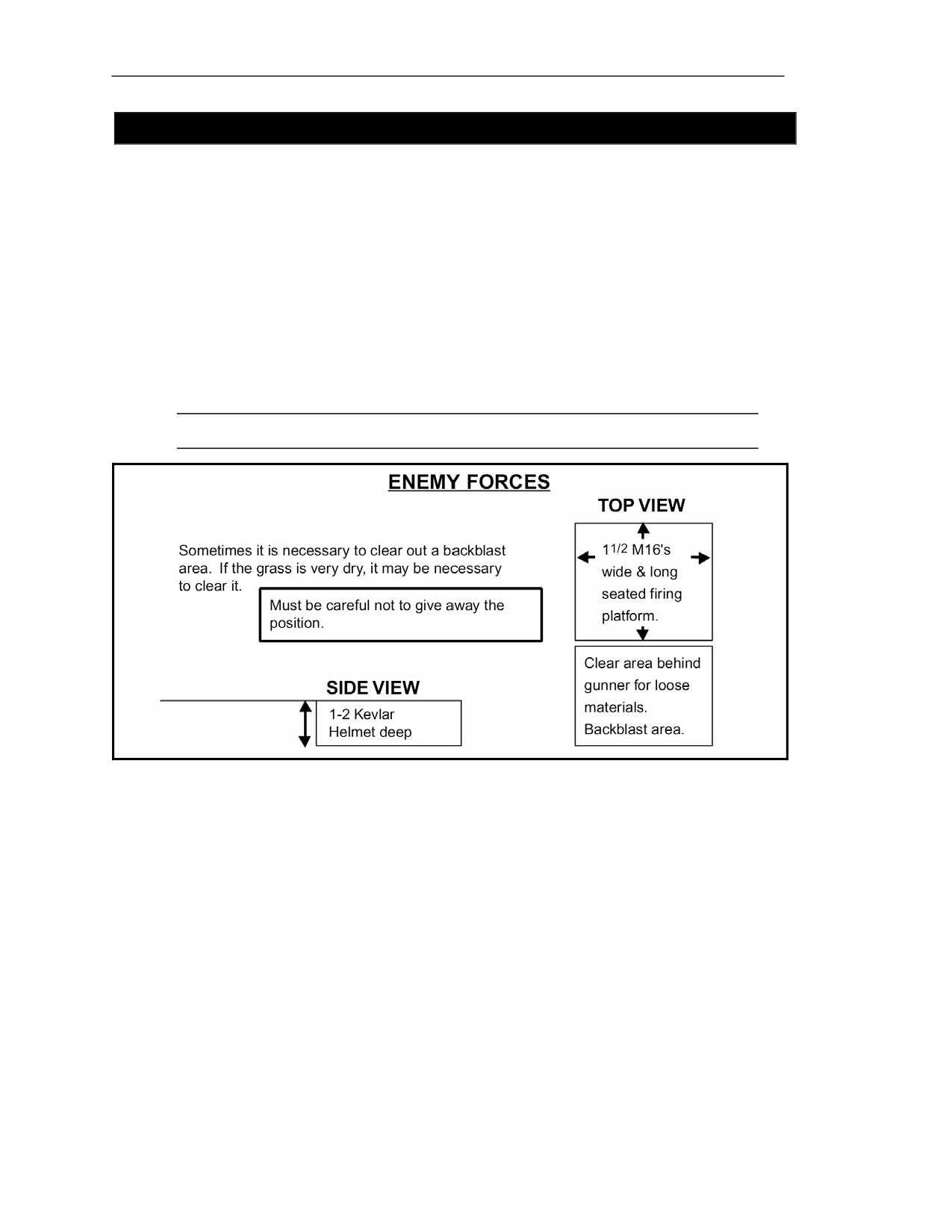
Chapter 4
SECTION III. FIGHTING POSITIONS
This section describes the different fighting positions the gunner uses. The gunner may use a hasty fighting
position or a deliberate fighting position.
HASTY FIGHTING POSITION
4-38. Hasty positions (Figure 4-8) are prepared when contact is imminent and time available for
organization needed to prepare a deliberate fighting position is limited. The gunner should only select a
location that affords him (and his assistant gunner, if assigned): cover, concealment, a clear FOV, a
clear overhead path for the missile, and a clear backblast area.
4-39. The gunner should dig out an area about one to one and a half M16A2s wide by one and a half
M16A2s long and one Kevlar helmet deep. In most areas, it is not necessary to dig a backblast area
because the two-stage motor provides a soft launch capability with a small backblast. However, the
gunner must check and clear any debris from behind his position. Dirt removed during digging is
placed to the front of the position to provide cover for the gunner.
NOTE: If assigned an M4-series weapon, add 7 inches to the dimensions on the position.
Figure 4-8. Hasty fighting position.
4-40. The hasty fighting position is constructed for expansion to afford the gunner and the assistant
gunner/ammunition handler, if assigned, cover and concealment. This fighting position is based on the
gunner firing from the sitting position, which is the preferred firing position. This position affords the
gunner a low silhouette, and a steady and comfortable position while maintaining the ability to engage
targets in his sector (Figure 4-9).
4-10
FM 3-22.37
20 March 2008
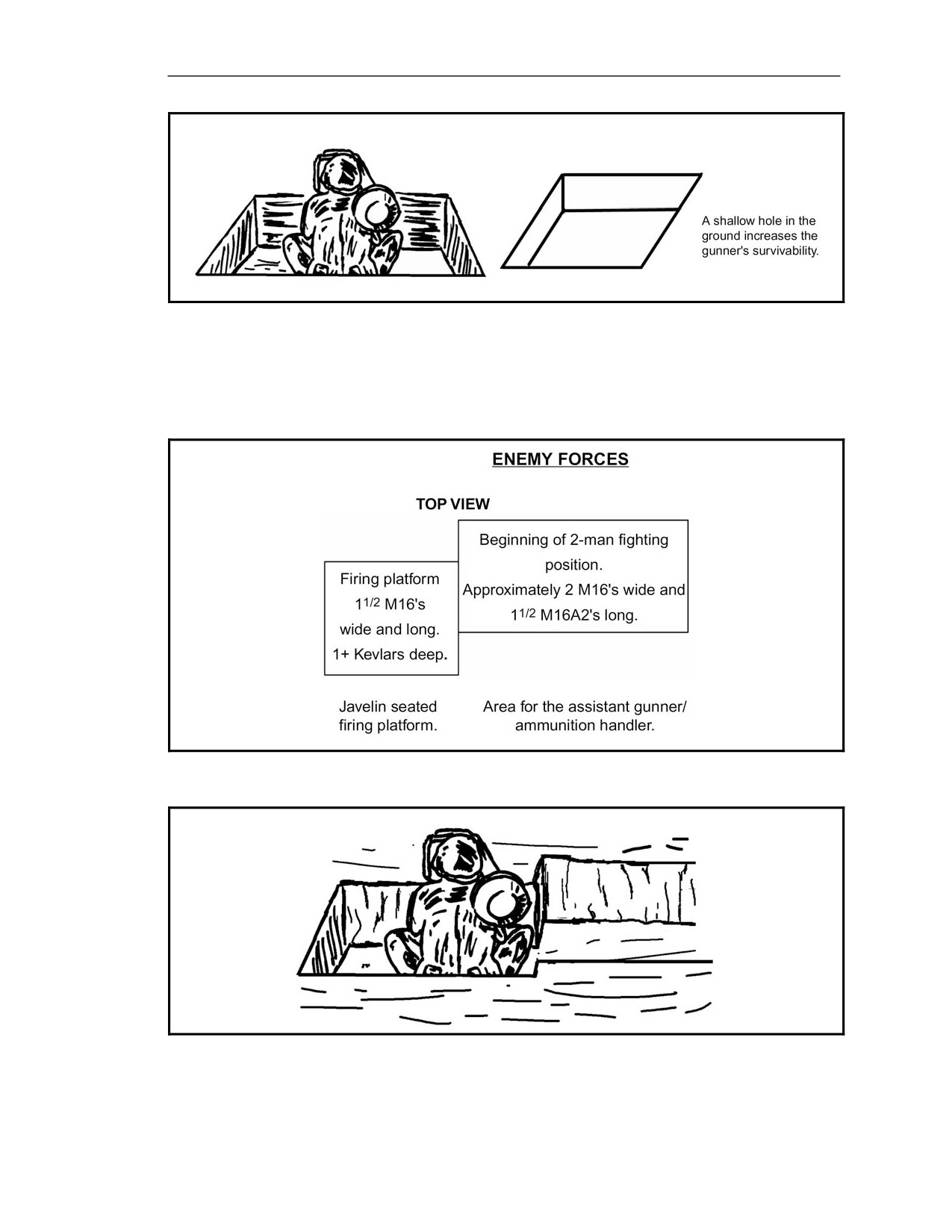
Tactical Considerations
Figure 4-9. Hasty fighting position.
4-41. The gunner continues to improve the fighting position, as time permits. The position should be
expanded to include cover and concealment for the assistant gunner/ammunition handler, if assigned.
Once a fighting position begins to expand, then it becomes the firing platform for the deliberate
fighting position (Figures 4-10 and 4-11).
Figure 4-10. Improved hasty fighting position.
Figure 4-11. Expanded hasty fighting position.
20 March 2008
FM 3-22.37
4-11
Chapter 4
4-42. The gunner now has an expanded hasty fighting position that offers the minimum amount of
cover and concealment to the gunner and the assistant gunner/ammunition handler, if assigned. This
position is considered the basic fighting position for the Javelin.
DELIBERATE FIGHTING POSITION
4-43. A deliberate fighting position is normally constructed when contact with the enemy is not
imminent and time for organization is available. The gunner constructs a two-man fighting position
with the Javelin firing platform added to one or both sides, depending on the expected battle situation.
CONSTRUCTING THE FIGHTING POSITION
4-44. To construct a deliberate fighting position, the gunner first traces the outline of the fighting
position on the ground, ensuring the outline of the position is facing the center of the squad/platoon’s
sector of fire. Once the gunner/leaders are satisfied the Javelin line-of-fire is correct, the gunner
should—
(1) Check the fields of fire. The gunner must be able to cover the entire sector from that
position. If not, he should look for an alternate position and inform the squad leader.
(2) Prepare the Javelin.
(3) Clear fields of fire, both overhead and ground.
(4) Prepare the position. The overall area needed for constructing a Javelin fighting position is
about 3 feet (front to rear) by 5 feet (side by side) (Figure 4-12). This includes the space
required to construct the front, sides, and back parapets. The depth of the fighting position
depends on the height of the shortest Soldier occupying the position. The standing area
should be about two M16A2s wide (from side-to-side) and about one and a half M16A2
rifles long (from front to rear) (Figure 4-12).
NOTE: If assigned an M4-series weapon, add 7 inches to the dimensions on the position.
Dig the primary (left side) Javelin seated firing platform. He should dig down about
one Kevlar helmet deep, one and a half M16A2s wide, and one M16A2 long. All dirt
removed should be used to build the parapets to the front and flanks of the position.
Dig the standing area of the deliberate fighting position wider than the standard two-
man fighting position making room for the Javelin round and the gunner’s equipment.
Decide if a secondary sitting firing platform is needed. If needed, digs the position,
using the dirt to build the right side parapet.
Improve the position by adding overhead cover. The overhead cover should not restrict
the gunner from firing the Javelin, and should not completely cover the firing platform.
This allows the missile to exit the LTA without obstruction.
Improve the position by adding a storage/protective area. The size of this area depends
on the space needed for equipment.
Camouflage the front of the position. If possible, moves out in front of the fighting
position about 35 meters to see if the fighting position can be seen. The position must
blend into the background.
(5) Continue improvements as long as the position is occupied.
Check the camouflage and replace them as necessary.
Position camouflage nets, if used, so they do not hang in the backblast area. If any
portion of the net is in the backblast area, it can reflect launch overpressure into the
position, damage the net, and could collapse the position when the missile is launched.
NOTE: Camouflage maintenance is a continuous process.
4-12
FM 3-22.37
20 March 2008
Tactical Considerations
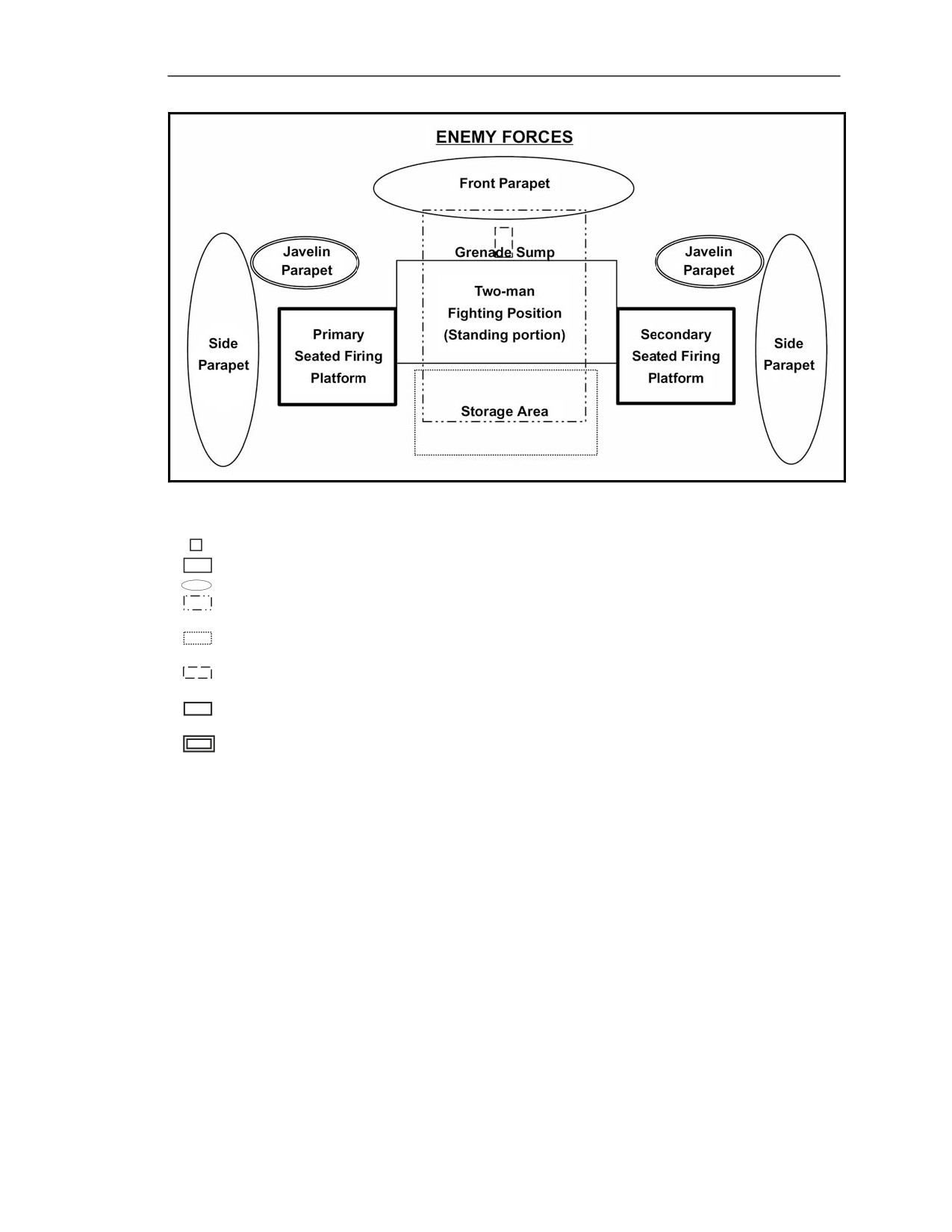
Figure 4-12. Deliberate fighting position.
LEGEND
Javelin seated firing platform (1-1/2 M16A2s wide by 1 M16A2s long).
Two-man fighting position (2 M16A2s wide by 1-1/2 M16A2s long).
Parapet (minimum of 18 inches between you and the enemy and as high as necessary).
Overhead cover (1-1/2 M16A2s wide by 1-1/2 to 2 M16A2s long) capable of supporting at
least 18 inches of dirt.
Storage area (depends on amount of equipment to be stored, to include extra Javelin
rounds).
Grenade sump (1 entrenching tool in diameter and the length of the entrenching tool
deep).
Backblast berm is about 1 Kevlar helmet thick and 18 inches high. The berm deflects the
hot gases and debris up and out. This reduces the amount of clearing required.
Javelin parapet, sand bags if available, should be used.
20 March 2008
FM 3-22.37
4-13
Chapter 4
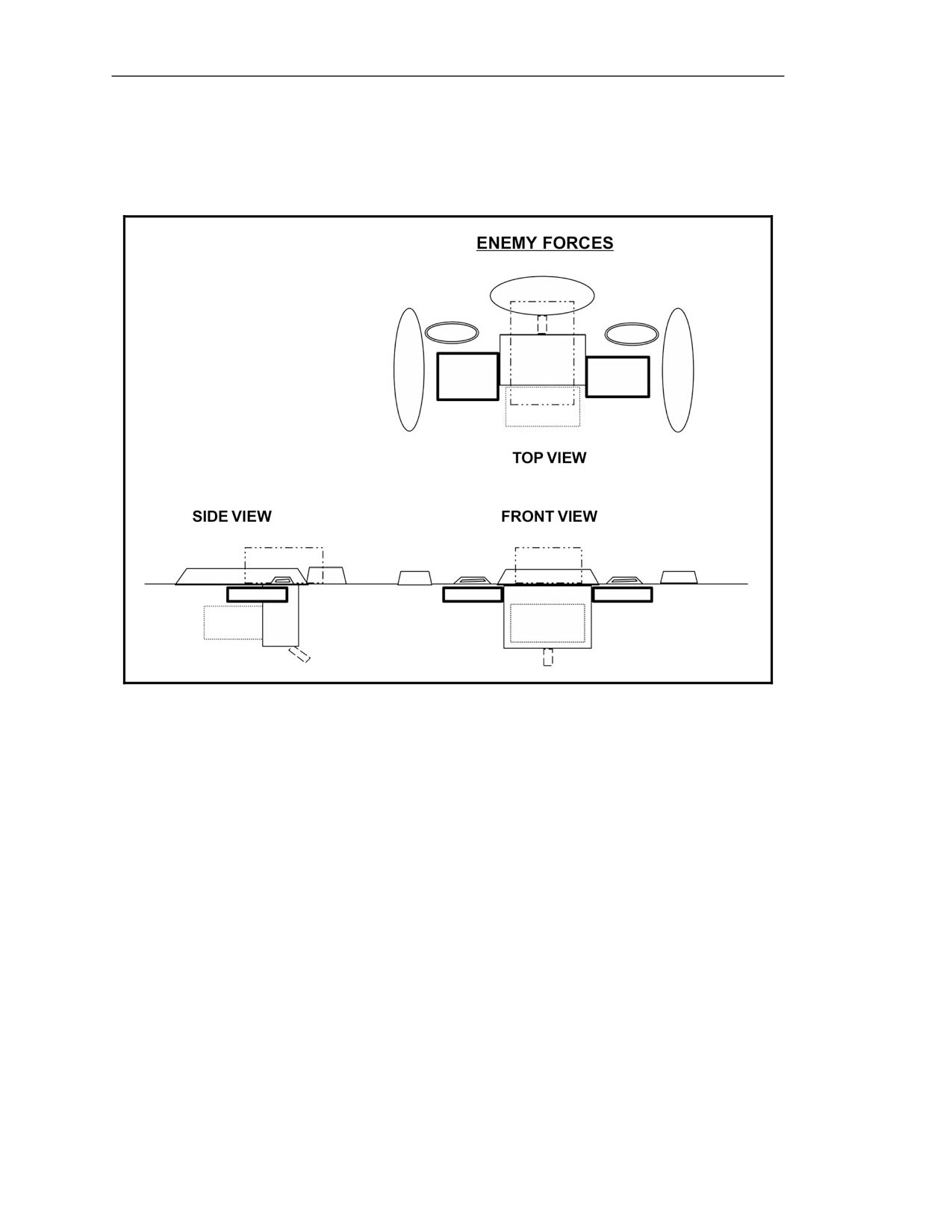
VIEWS
4-45. The three views of Javelin fighting positions are illustrated in Figure 4-13, but refer to the legend
for Figure 4-12.
Figure 4-13. Completed deliberate fighting position.
FORTIFIED JAVELIN FIGHTING POSITION
4-46. In a defensive position, with the help of the engineers and an abundant supply of Class IV
materials, it is possible to construct a bunker-style fighting position. This position requires a lot of time
and material.
Front View
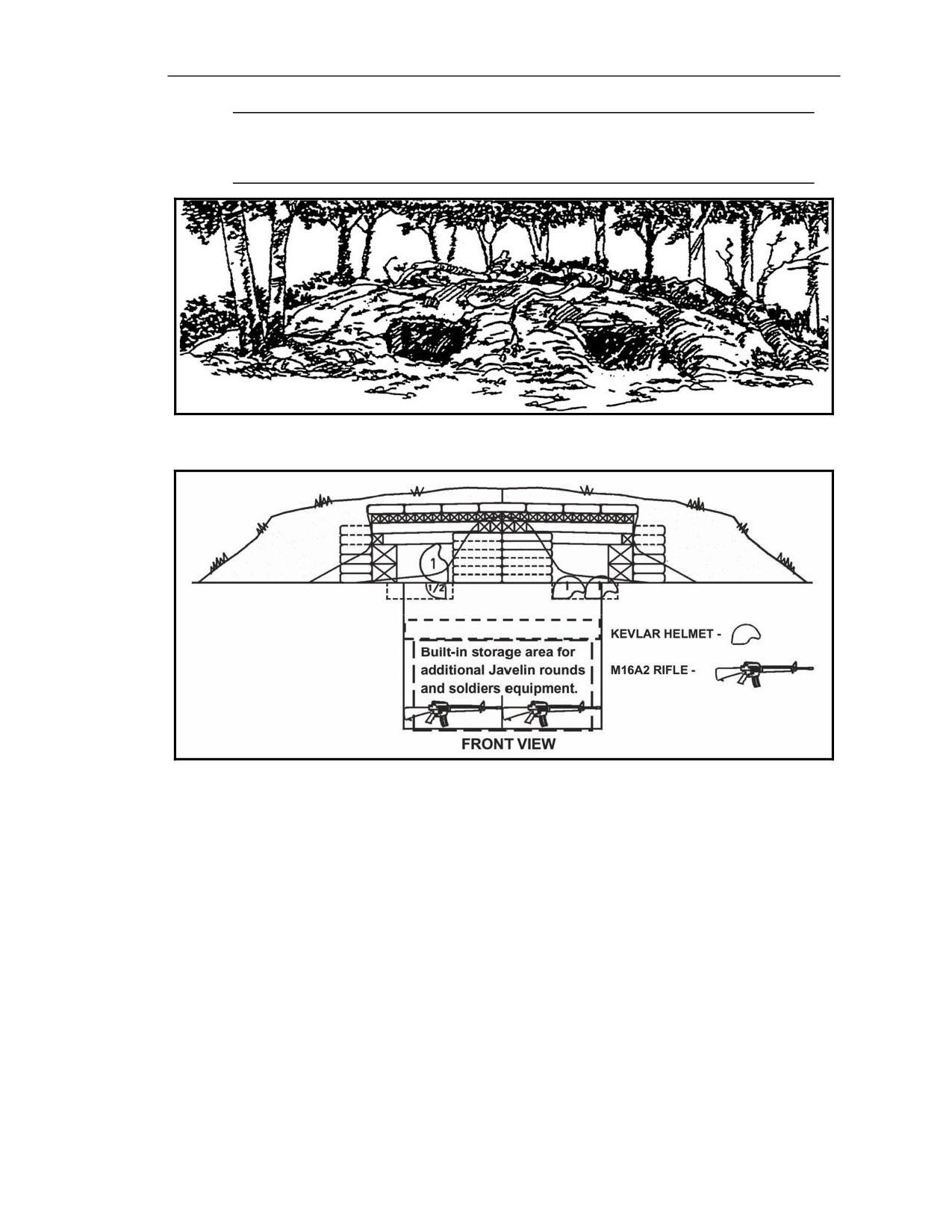
4-47. The front of the Javelin defensive fighting position
(Figures
4-14 and
4-15) provides
considerable protection from small arms and indirect fire. However, the gunner is limited in his ability
to engage targets.
4-48. When this type position is constructed, it is imperative to examine the front of the position and
consider how well the position blends into the background.
4-49. When using vegetation, replace it when it begins to die. How long the vegetation remains green
depends on the temperature. After the gunner has scanned the sector for any signs of the enemy, the
assistant gunner/ammunition handler, if assigned, approaches the front of the position to check its
concealment and makes the required improvements, then returns. The gunner continues surveillance
until the assistant gunner/ammunition handler, if assigned, has returned to his position.
4-14
FM 3-22.37
20 March 2008
Tactical Considerations
NOTE: Continuous movement to the front of the fighting position can damage natural
camouflage, making the position stand-out. Limit movement around the position, and use
more than one approach to the position to keep from creating paths to and from the position.
Figure 4-14. Sketch of the front view of a Javelin defensive fighting position.
Figure 4-15. Front view of a Javelin defensive fighting position.
20 March 2008
FM 3-22.37
4-15
Chapter 4
Side View
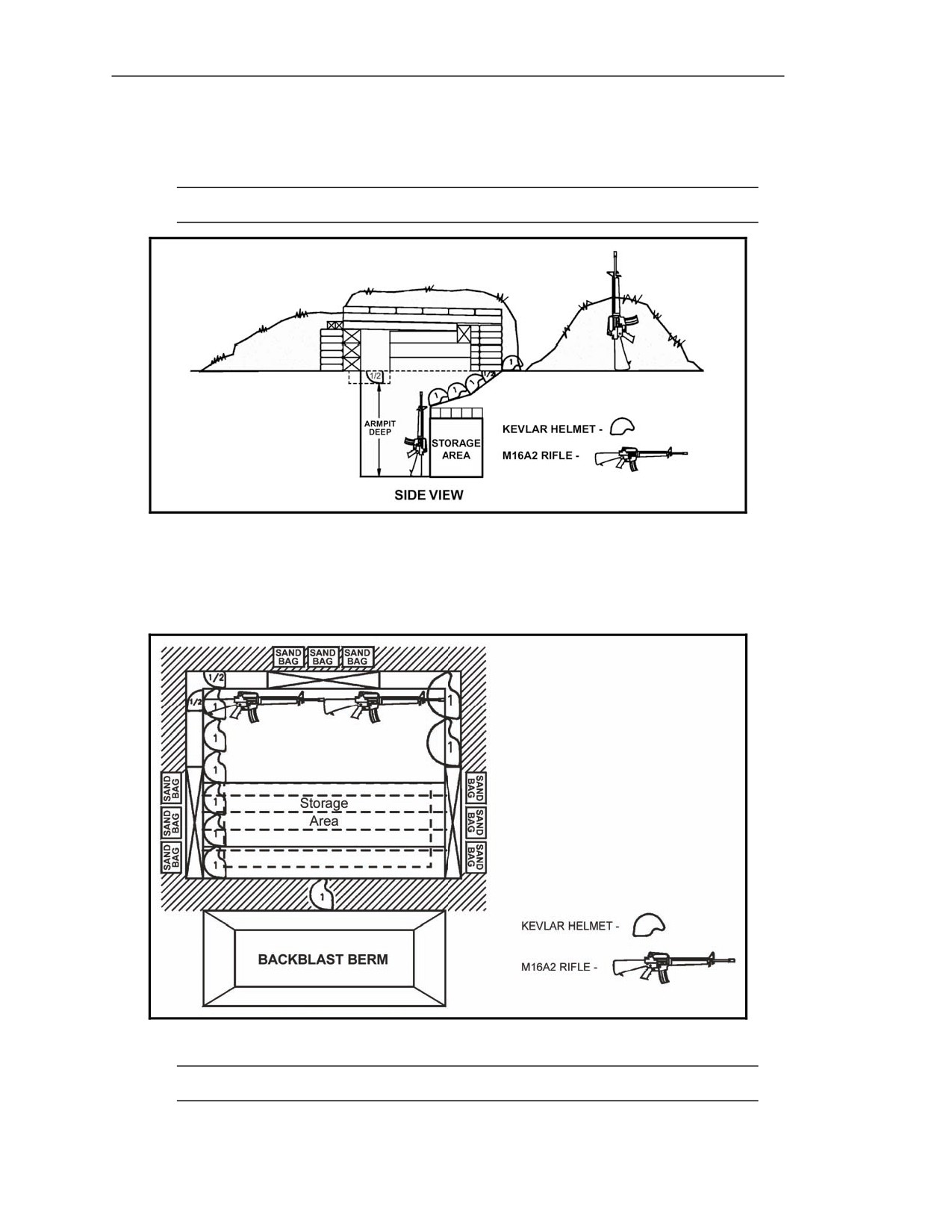
4-50. Figure 4-16 shows the side view of the Javelin defensive fighting position.
NOTE: If assigned an M4-series weapon, add 7 inches to the dimensions on the position.
Figure 4-16. Side view of a Javelin defensive fighting position.
Top View
4-51. Figure 4-17 shows the top view of a Javelin defensive fighting position.
Figure 4-17. Top view of a Javelin defensive fighting position.
NOTE: If assigned an M4-series weapon, add 7 inches to the dimensions on the position.
4-16
FM 3-22.37
20 March 2008
Tactical Considerations
SECTION IV. OTHER TACTICAL OPERATIONS
This section describes how the Javelin contributes to offensive operations and the antiarmor ambush role.
During stability and support operations, Javelins are not used in their typical roles.
OFFENSIVE OPERATIONS
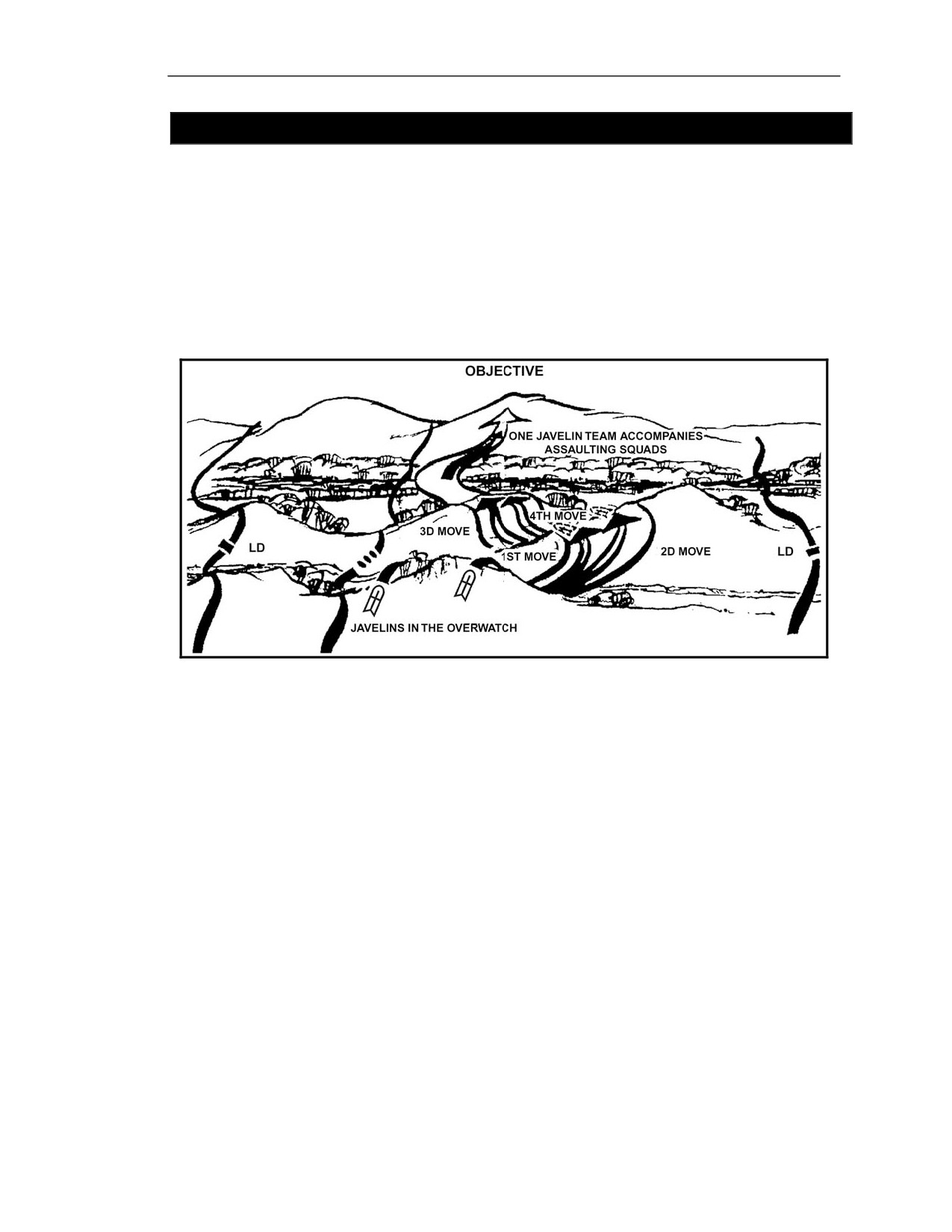
4-52. The Javelin contributes to offensive operations (Figure 4-18) by providing long-range fires that
destroy enemy armor and protecting the force from counterattacks. In the absence of armored targets,
the Javelin can be used against enemy fortifications and for locating and disrupting enemy sniper fire.
The Javelin is normally used in a support-by-fire role during offensive operations. The primary
consideration for such employment is the availability of fields of fire and the threat. Javelin teams can
also provide overwatch for unit movement.
Figure 4-18. Javelin supporting offensive operations.
ANTIARMOR AMBUSH ROLE
4-53. Antiarmor ambushes are usually conducted to destroy small groups of armored vehicles, force
the enemy to move more slowly and cautiously, or force the enemy into a choke point. Any unit
conducting an antiarmor ambush can use Javelins for this purpose. The Javelin has a slow rate of fire,
so other weapon systems must be prepared to engage the vehicles while the Javelin gunners attach the
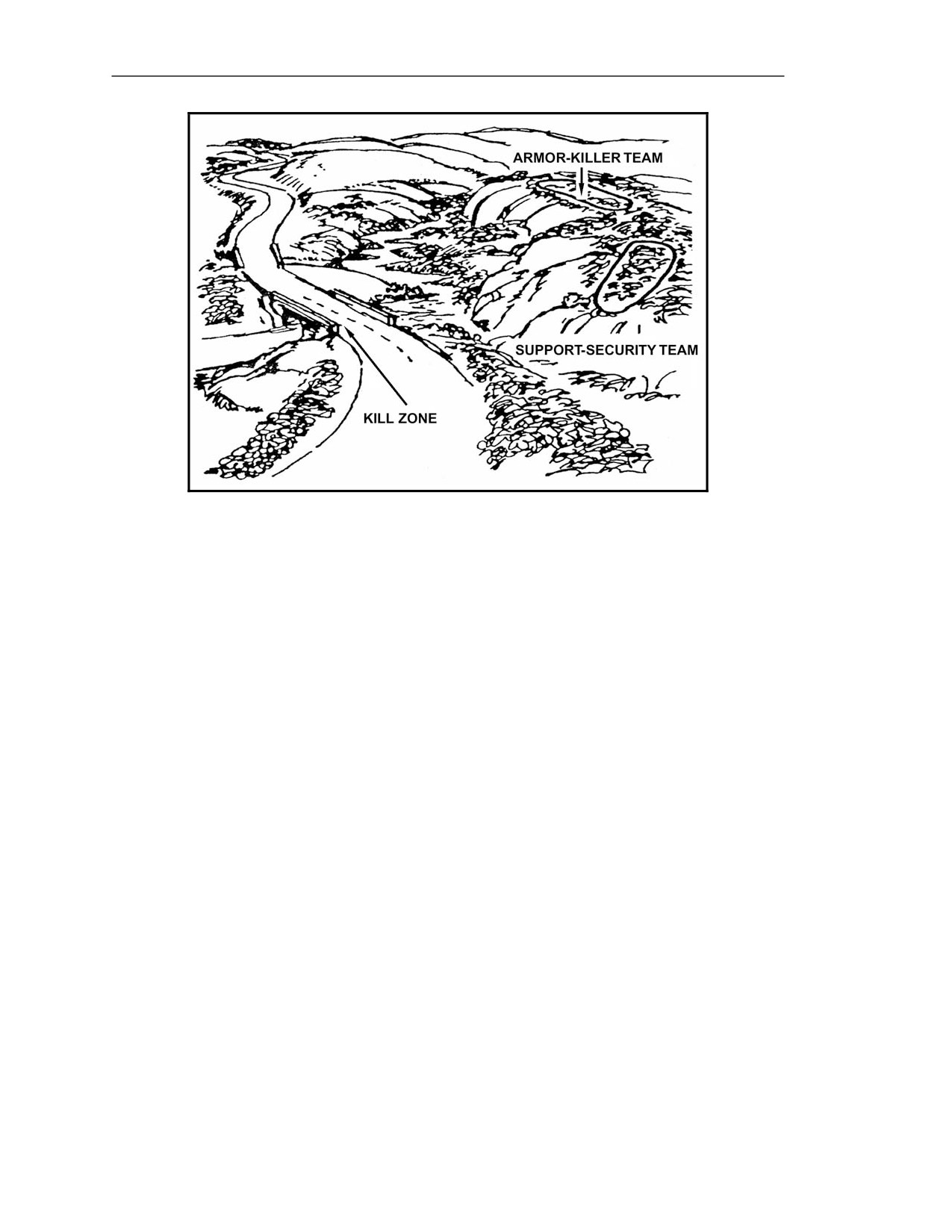
CLU to new rounds. The Javelin's 2,000-meter range allows flexibility in choosing ambush positions.
In addition to fires into the kill zones, the Javelin can be employed in a security role to guard high-
speed AAs, to slow or stop enemy reinforcements, or to destroy vehicles attempting to flee the kill
zone (Figure 4-19).
20 March 2008
FM 3-22.37
4-17
Chapter 4
Figure 4-19. Antiarmor ambush.
STABILITY AND SUPPORT OPERATIONS
4-54. During stability operations, Javelin gunners may be used against an armored threat if one exists.
If there is no armored threat, the Javelin gunner can expect to provide a surveillance capability. The
NVS is especially useful during periods of limited visibility. In the case of
24-hour operated
roadblocks, Javelin gunners provide protection against vehicles that attempt to run the roadblock. To
be effective in this task, the gunner needs to be able to position himself where he has an unimpeded
view of the approaches to the roadblock. The gunner must clearly understand the rules of engagement
(ROE) to know when he is authorized to engage targets, which may be at minimum range. The
observation capability of the Javelin's sight may be useful during support operations, but it is not likely
that a missile will ever be fired.
URBAN COMBAT
4-55. Although the Javelin is primarily used to defeat main battle tanks and other combat vehicles, it
has a moderate capability against bunkers, buildings, and other fortified targets commonly found
during combat in built-up areas. Javelin teams provide overwatching fires during the attack of a built-
up area. Within built-up areas, they are best employed along major thoroughfares and from the upper
floors of buildings or roofs to attain long-range fields of fire. The minimum engagement distance limits
firing opportunities in the confines of densely built-up areas, and the Javelin may not be the weapon of
choice in the urban environment (FM 3-06.11) where there are additional considerations including:
fires (caused by both friendly and enemy) may cause target acquisition and lock-on problems; clutter
on the battlefield may cause lock-on problems; and, line-of-sight communications may be limited by
the structures.
4-18
FM 3-22.37
20 March 2008
Tactical Considerations
OBSTACLES
4-56. The Javelin’s unique flight path forces the gunner to check missile flight path before engaging
targets. The urban environment has overhead obstacles such as street signs, light poles, and wires,
which could impede the missile’s flight path.
ENGAGEMENT CONSIDERATIONS
4-57. The Javelin’s three distinct engagement considerations are: engagement distance, crossover, and
time.
Engagement Distance
4-58. The Javelin missile has a minimum engagement distance (150 meters in the attack mode and 65
meters in the direct attack mode), which limits its use in built-up areas. Few areas in the inner city
permit the gunner to fire much beyond the minimum arming distance. The gunner is usually limited to
firing down streets, rail lines, parks, or plazas. The Javelin can effectively fire from upper level stories
or roofs of buildings into other buildings as long as the gunner has a “clear” missile flight path.
Crossover
4-59. Sometimes the seeker will not be able to distinguish between the background and the target
because the two have the same temperature (crossover).
Time
4-60. When a gunner comes across a target of opportunity, he may not be able to take advantage of it.
The cooldown time of the NVS is 2.5 to 3.5 minutes. Seeker cooldown takes about 10 seconds. Once
the BCU is activated, the gunner has a maximum of 4 minutes to engage the target before the BCU is
spent. Vehicles crossing the street or moving between buildings (flank shot) are exposed for about 10
to 15 seconds, meaning the gunner may not have enough time to lock-on to the target and fire.
BACKBLAST
4-61. The soft launch capability enables the gunner to fire from inside buildings because there is little
overpressure or flying debris. Anyone in the enclosure should wear a helmet, protective vest, ballistic
eye protection, and hearing protection.
WEAPON PENETRATION
4-62. The dual charge warhead penetrates typical urban targets. The direct attack mode is selected
when engaging targets in a building. Enemy positions or bunkers in the open closer than 150 meters
are engaged using the direct attack mode. Positions in the open farther than 150 meters are engaged
using either the top or direct attack mode depending on the situation.
SECTION V. TARGET ENGAGEMENT TECHNIQUES
Target acquisition is essential for a gunner to be effective on the battlefield. Target acquisition is a four-
step process: target detection, target classification, target recognition, and target identification. Target
acquisition begins with detection; the gunner uses his senses in conjunction with the CLU to detect targets.
Using the CLU to aid in the detection, classification, recognition and identification of the enemy target only
enhances the commander’s usage as a valuable tool for the unit. The gunner learns to use different fields of
view in scanning for targets.
20 March 2008
FM 3-22.37
4-19
Chapter 4
TARGET DETECTION
4-63. The gunner should listen for the sounds that will alert him to the enemy’s presence, it may not
pinpoint the exact location but it will alert him. The gunner can see vehicles moving by dust trails. The
gunner’s best method of detection is with his eyes. He can also use binoculars, his scope, his NVS, and
even the CLU to aid him in detecting targets. When scanning his sector of fire, the gunner should look
for the most likely areas a vehicle may be positioned or approaching from. Look for dust or vehicle
exhaust. Look for enemy vehicle movements along high-speed AAs. As a vehicle moves over a terrain
feature it may cause what is known as a “flash” this is the thermal signature may be visible for a
fraction of a second after the vehicle has moved out of sight. Look for unnatural shapes and shadows.
During the daytime, light often reflects off equipment and in the dark, the enemy may not practice
good light discipline making them observable by the naked eye allowing the gunner to detect targets
quickly and begin the target engagement process. The gunner determines target engageability by
changing the fields of view.
TARGET IMAGES
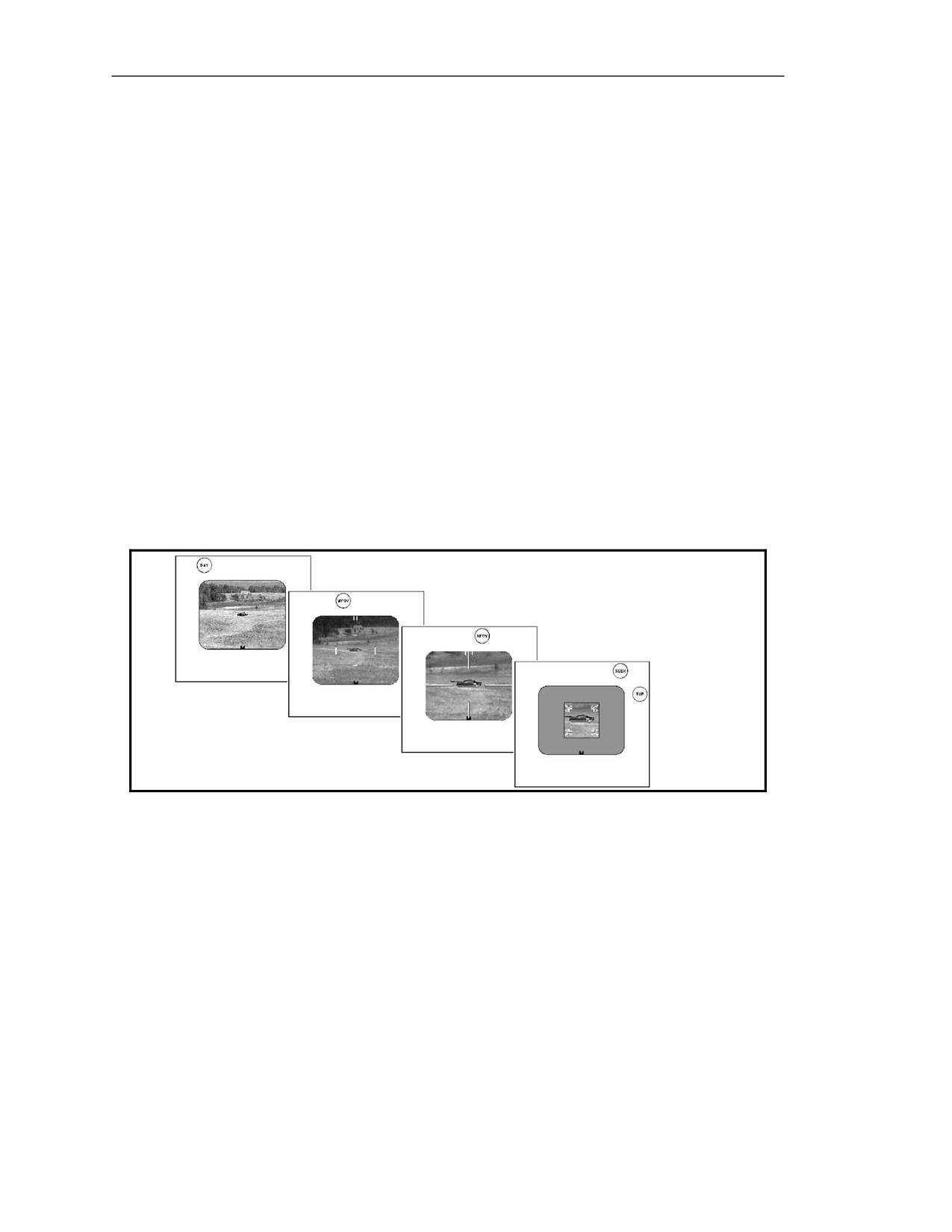
4-64. There are some differences in the way a target appears in each FOV (Figure 4-20):
z
Day FOV: full-color visible light image, 4x magnification of target.
z
WFOV: black-and-green IR image, 4x magnification of target.
z
NFOV: black-and-green IR image, 9x magnification of target.
z
Seeker FOV: black-and-green IR image, 9x magnification of target.
Figure 4-20. Fields of view.
FIELDS OF VIEW
4-65. The day FOV is used during daylight hours to conduct surveillance and target detection. The
NVS has two fields of view, WFOV and NFOV that present a black-and-green image of the terrain and
targets. The missile has a seeker FOV and is used for target engagement and is available to the gunner
once the seeker has been activated. Cold areas appear dark green or black, and hot areas light green.
The gunner adjusts the contrast and brightness controls and the focus to better locate enemy targets.
Wide Field-of-View
4-66. WFOV is used as the primary scanning FOV for surveillance and target detection.
4-20
FM 3-22.37
20 March 2008
Tactical Considerations
Narrow Field-of-View
4-67. NFOV is used for target classification, recognition and identification. This FOV has a limited
use for target detection and is not used for scanning because of its small area.
Seeker Field-of-View
4-68. Seeker FOV is the view that the missile has of the target. Is used to lock the track gates onto the
target.
SCAN FOR TARGETS
4-69. The gunner must scan his sector of fire or area of surveillance at all times for the enemy. The
scanning techniques that help to detect targets quickly are rapid scan, slow scan, and detailed search.
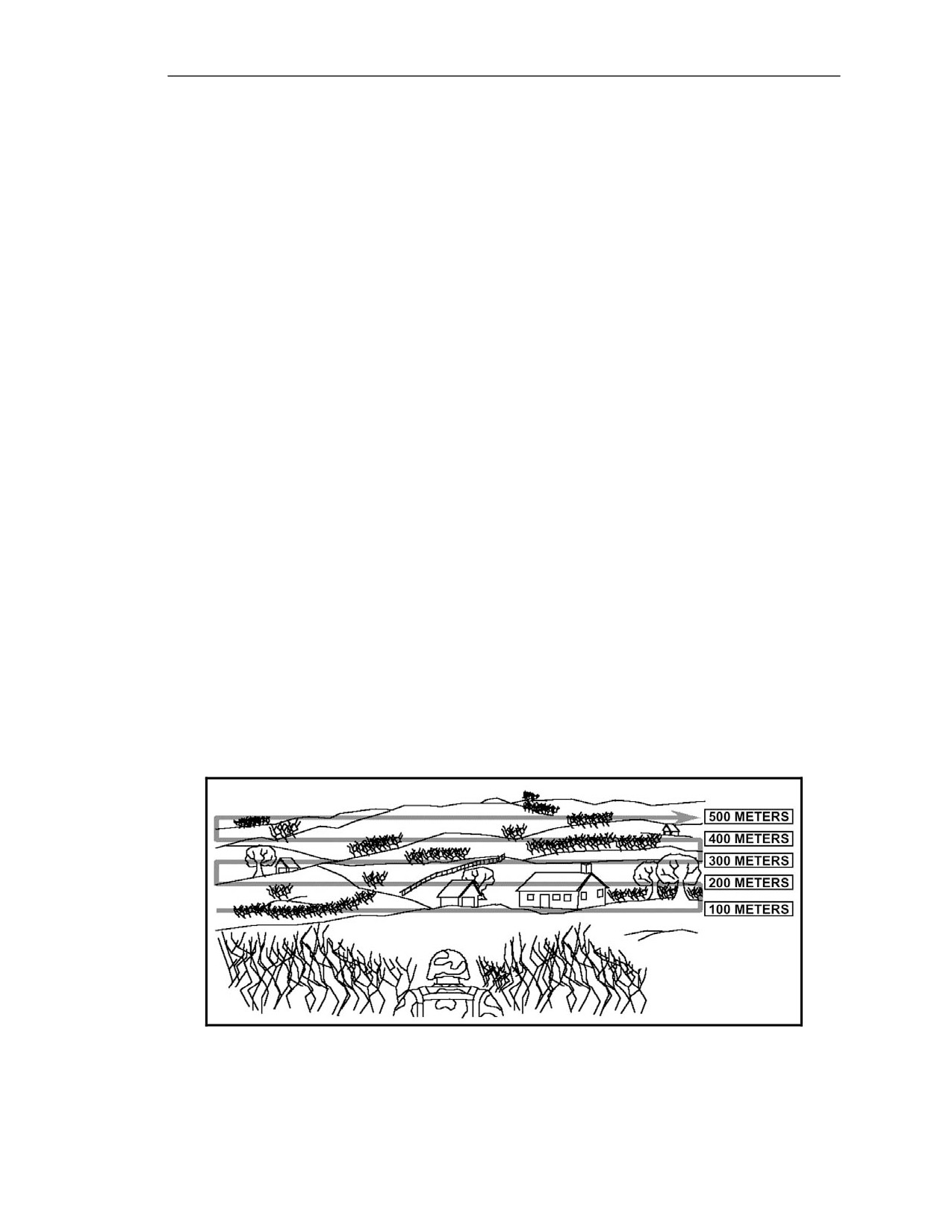
The gunner observes the following procedures in all three techniques to scan for targets effectively
(Figure 4-21). The gunner—
z
Scans the entire sector of fire or area of surveillance using WFOV of the CLU.
z
Scans in a consistent pattern, slowly and evenly.
z
Pays special attention to those positions in which a target would most likely appear, for
example, AAs.
z
Identifies the location of objects, such as trees, roads, buildings, and any man-made IR
signatures.
Rapid Scan
4-70. The rapid scan method is used to detect obvious signs of enemy activity. This type of scan is
used when first occupying a fighting position. (Figure 4-23). The gunner—
z
Divides the target area into sections. Uses TRPs or easily recognizable terrain features to
divide the area.
z
Adjusts the brightness of the CLU display so that the hot spots (bright green when viewed
through the CLU display) stand out in the CLU display.
z
Starts from the gunner’s position, scans out to either the left or the right to the farthest point
of the gunner’s sector and back across the sector to the other side.
z
Stops and uses the detailed search technique, if the gunner suspects he has spotted a target
during the rapid scan.
Figure 4-21. Slow/rapid scan.
20 March 2008
FM 3-22.37
4-21
Chapter 4
Slow Scan
4-71. If there are no targets detected during the rapid scan, the gunner conducts a slow scan of the
sector (Figure 4-21). The gunner—
z
Starts from the gunner’s position and begins a slow scan of the sector from left to right in
short intervals 50 to 100 meters deep, until a scan of the sector is completely covered.
z
Conducts a more detailed search if a target is detected.
Detailed Search
4-72. The detailed search is used when targets are either detected, or other techniques have been used
and it has resulted in no enemy activity found. The gunner uses the NFOV to search specific areas of
the sector. If a target is detected, the gunner uses the NFOV to further recognize, classify and identify
the target. (Figure 4-22) The gunner—
z
Concentrates on specific areas that are more likely for targets to be hiding or likely AAs.
z
Looks for signs that the enemy may have been in the area by looking for tracks and any
other signs of enemy activity.
Figure 4-22. Detailed search.
Moving Targets
4-73. Moving targets are easier to spot when scanning a sector because movement catches the eye's
attention. Moving vehicles also leave signatures that are easily detected by the NVS of the CLU. The
following considerations will help gunners detect moving targets:
z
Track vehicles leave a distinct pattern on the ground caused by the friction from the tracks
in contact with the ground.
z
Exhaust plumes are easily seen when the vehicles are moving through low lying areas.
z
An IR flash can be seen immediately following a vehicle that moves behind cover.
Stationary Targets
4-74. These targets are more difficult to detect than moving targets due to camouflage or its cold
status. Targets that have been sitting for long periods of time may appear to blend in with the
remainder of the surroundings. However, tanks and other vehicles are started periodically to ensure
they remain combat ready. This procedure heats up the vehicle, exhaust, and engine areas.
4-22
FM 3-22.37
20 March 2008
Tactical Considerations
Hot Stationary Targets
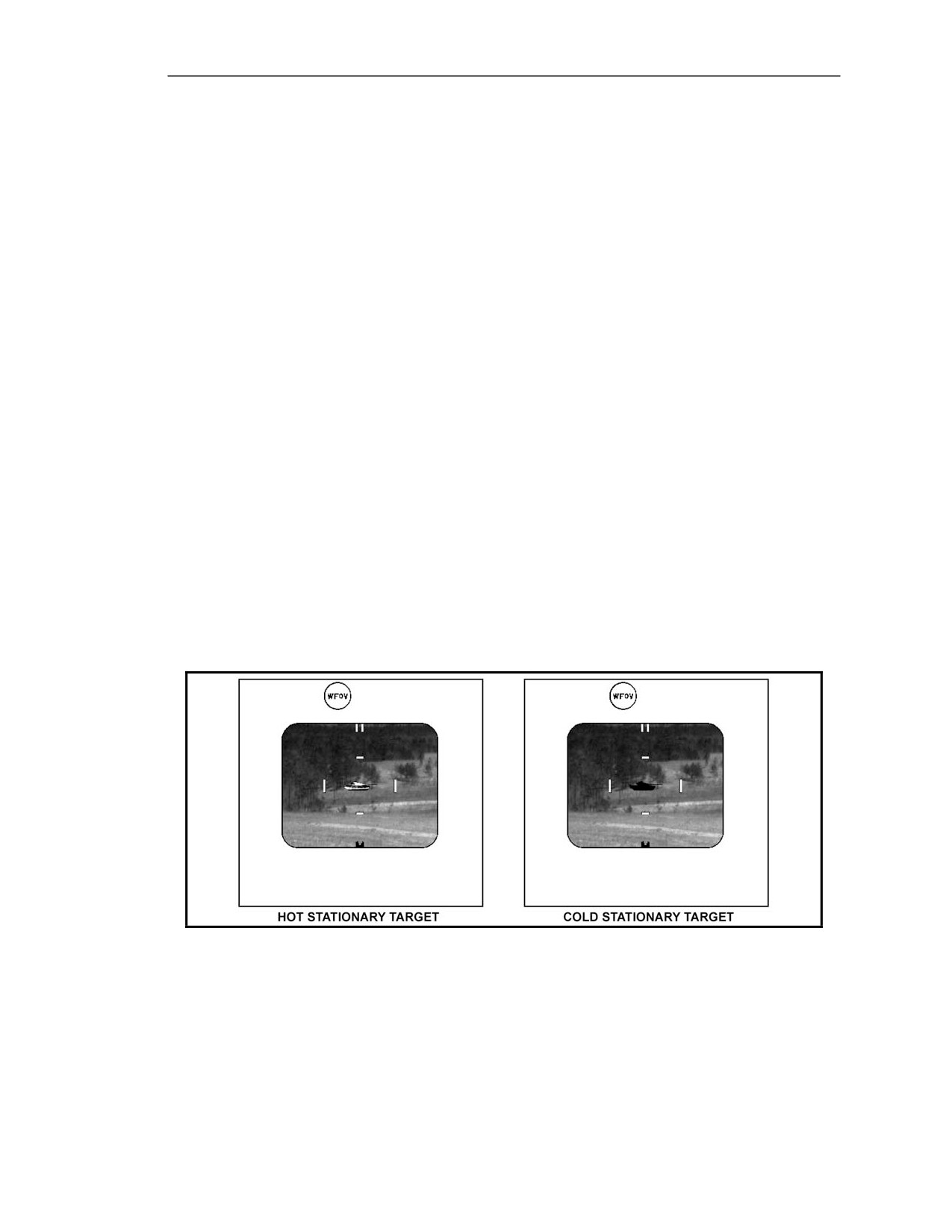
4-75. Tanks, armored personnel carriers (APCs), and other vehicles either remain running for long
periods of time or are started to keep their batteries from running low and to keep their electronics
operational. These targets have a hot signature when compared to its surroundings. The gunner easily
detects these targets when using the CLU (Figure 4-23).
Suspension System
4-76. Tracks, wheels and road wheels heat up during movement. It provides a hotter signature than the
hull and makes detection easier.
Engine Compartment
4-77. Once stopped, the vehicle continues to give off a hot signature for several hours. The engine
takes longer to cool off than the remainder of the vehicle.
Exhaust
4-78. Vehicles are started periodically to charge its engines. The vehicle’s exhaust takes time to cool
down after being operated.
Gun Tube
4-79. If the vehicle has been involved in firing, its gun tube gives off a heat signature that will aid in
classification.
Cold Stationary Targets
4-80. After a vehicle has been sitting for a long period of time, without the engine or electronics being
operated, it appears as darker green or black against the surrounding area. When using the CLU in the
night vision mode (WFOV or NFOV), the target is detected based on its appearance in relation to the
surrounding objects or ΔT.
Figure 4-23. Stationary targets.
TARGET CLASSIFICATION
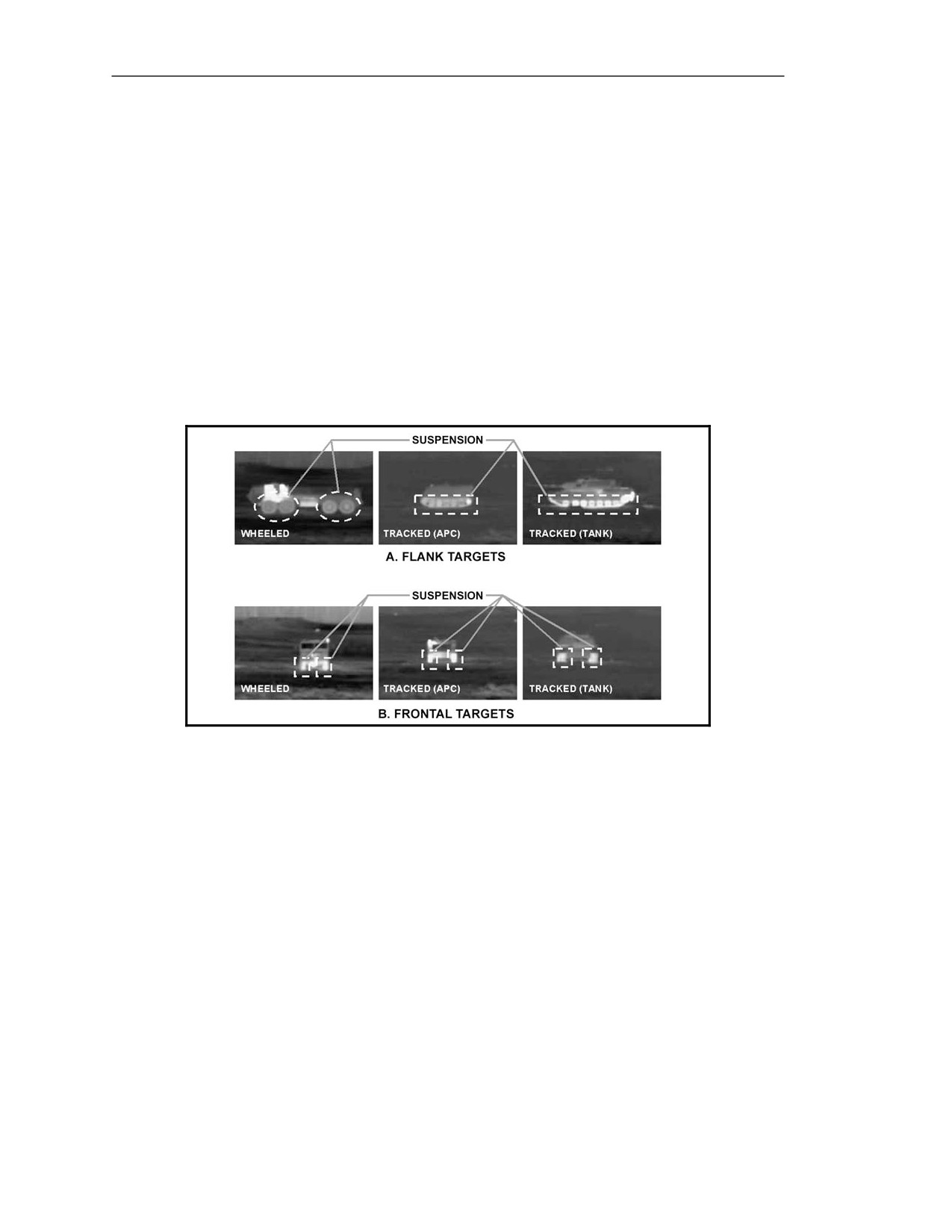
4-81. Once a target is detected, the gunner must classify the target as either a wheeled or tracked
vehicle (Figure 4-24). Different parts of the vehicle give off heat signatures making the classification
of a vehicle easier. When viewed through the NVS (WFOV or NFOV), a vehicle’s wheels or
suspension system quickly heats up.
20 March 2008
FM 3-22.37
4-23
Chapter 4
WHEELED VEHICLES
4-82. The hubs of wheeled vehicles heat up along with the tires, giving it a distinct heat signature.
Based on the vehicles configuration of axles, there may be two or more distinctive round heat
signatures just below the hull or body. The engine compartments are normally located at the front of
the vehicle. Some wheeled vehicles may or may not have gun tubes; if it does, some may be small and
harder to spot, while those with larger gun tubes when fired heats up and makes classification of the
vehicle easier.
TRACKED VEHICLES
4-83. The suspension system has road wheels that heat up during movement, usually five to seven
road wheels based on the type of vehicle. The engine compartment is usually located in the rear on
tanks and the front on APCs. These signatures are usually hotter for a longer period of time than the
remainder of the vehicle. Track vehicles, like wheeled vehicles, may or may not have gun tubes; if it
does, some may be small and harder to spot, while those with larger gun tubes when fired heats up and
makes classification of the vehicle easier.
Figure 4-24. Target classification features.
TARGET RECOGNITION
4-84. After a gunner classifies a target as a wheeled or track vehicle, the gunner then determines
whether a target is a tank or an APC. Some of the same techniques used to classify a vehicle are used
to recognize the vehicle.
TANKS
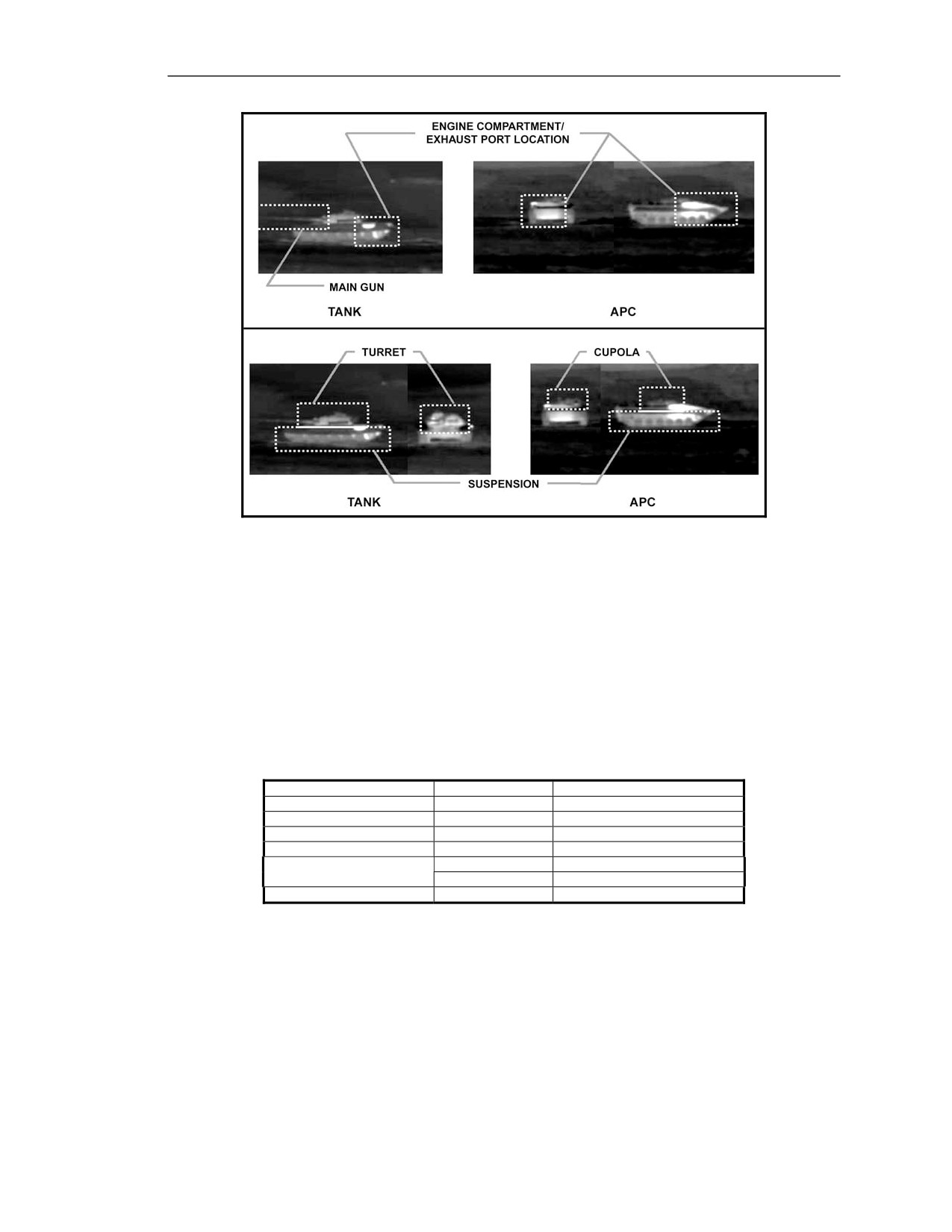
4-85. The characteristics of a tank make this vehicle stand out from others. The large gun tube, the five
to seven road wheels, and the engine compartment being in the rear of the vehicle, all make this easily
recognizable as a tank. (Figure 4-25)
4-24
FM 3-22.37
20 March 2008
Tactical Considerations
Figure 4-25. Target classification.
ARMORED PERSONNEL CARRIERS
4-86. Based on the configuration of an APC, it may be wheeled or tracked. The enemy configures the
APC differently based on its use however; there are some common characteristics for them. The engine
compartment is located in the front of the vehicle; they may or may not have a turret, and may or may
not have a gun tube.
TANKS OR ARMORED PERSONNEL CARRIERS
4-87. The target classification features for tanks and APCs are listed in Table 4-2.
Table 4-2. Target classification features.
SIGNATURE
TANK
APC
Engine Compartment
In rear
In front
Exhaust Ports
In rear
In front or side
Main Gun
Long and thick
Short and thin
Turret
Yes and large
Some and usually small
New Tanks
No
Cupola
Old Tanks
Yes
Size/Shape
Large and sloping
TARGET IDENTIFICATION
4-88. Once the gunner has detected, classified and recognized, he may have enough information to
engage the target, but the final step in target acquisition is identification. The enemy may have
common armored vehicles as our allies and the gunner must be sure of his target. The use of the CLU
provides the gunner with a thermal image of a target; therefore the gunner must have a clear
understanding of thermal vehicle signatures as well as daylight images. Training aids available to the
units come in different forms, from compact disk read-only memory (CD-ROM) and graphic training
aids (GTA) to actual photographs. These tools are used prepare the gunner to correctly identify enemy
and friendly vehicles.
20 March 2008
FM 3-22.37
4-25
Chapter 4
4-89. The Night Vision and Electronic Sensors Directorate, PM-FLIR, can be contacted at
ROV-V@nvl.army.mil for assistance in vehicle identification. The Recognition of Combat-Vehicles
(ROC-V) CD-ROM is available from this directorate.
4-90. GTA 17-2-11 and GTA 17-2-13 provides the gunner with line drawings and pictures of friendly
and enemy vehicles. These are available through the local training support center (TSC).
TARGET ENGAGEMENT
4-91. There are several factors inherit to Javelin that the gunner must consider before engaging a
potential target. They are—
z
Time/space factors.
z
Track gate solution.
z
Multiple targets.
z
Rapid target engagement techniques.
TIME/SPACE FACTORS
4-92. The gunner must take into consideration the factors that decrease the probability of hitting the
target. He must consider—
z
The time it takes for NVS cooldown (2.5 to 3.5 seconds).
z
The time it takes for seeker activation (10 to 14 seconds).
z
The time it takes to adjust track gates, lock-on, and fire.
z
The time it takes for the missile to fly the distance to the target
(2,000 meters in
14 seconds).
z
The speed of the vehicle.
z
The location of possible cover that the vehicle may be headed towards and may reach before
missile impact.
z
Any obstructions in the flight path of the missile.
NOTE: Keep in mind that there is a time delay of about 10 seconds between the time of
seeker activation and when the seeker FOV comes on the CLU display.
TRACK GATE SOLUTION (SEEKER LOCK-ON)
4-93. To achieve a seeker lock-on target, the gunner must ensure he has a good image of the target by
adjusting the focus, contrast, and brightness while in the WFOV or NFOV. Once the seeker FOV is
available, the gunner keeps the target in the center of the FOV and begins his track gate adjustments.
Tanks and Turretless Targets
4-94. To ensure a good seeker lock-on, keep the target’s center of mass (the tank’s hull but not the gun
barrel) centered in the track gates and adjust the track gates as close to the tank’s edges as possible
(Figure 4-26). To increase the probability of a hit, place the track gates around the hull only. Do not
include the turret on flank targets.
4-26
FM 3-22.37
20 March 2008
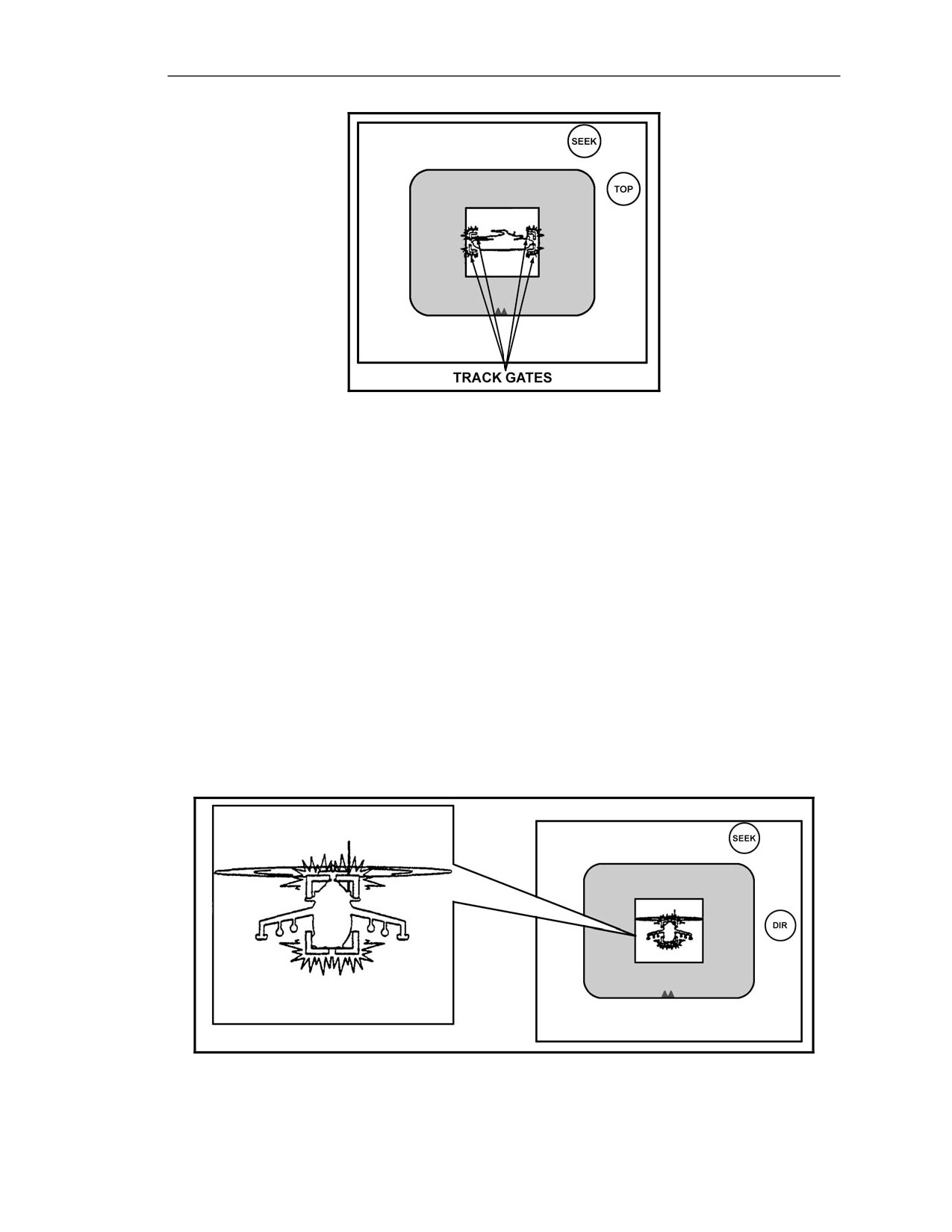
Tactical Considerations
Figure 4-26. Position track gates on target.
Stationary Targets
4-95. The lock quality for stationary targets is good when the track gates surround the edges of the
target. If they are too large or too small, break lock, readjusts the track gates around the target, and
relock on the target. Continue this procedure until lock-on is achieved.
Hull-Down Targets
4-96. When engaging hull-down vehicles at the maximum distance (2,000 meters), the CLU is limited
by track gate adjustments based on the size of the target. Adjust the track gates to acquire only the
visible portions of the target.
Hovering Helicopter
4-97. To ensure an effective engagement, select the direct attack mode only.
Frontal Target
4-98. Adjust the track gates so that they surround only the nose of the fuselage (Figure 4-27). Any
appendages (such as armaments, wings, rotor, and so forth) should be ignored.
Figure 4-27. Track gate adjustment for helicopters―front.
20 March 2008
FM 3-22.37
4-27
Chapter 4
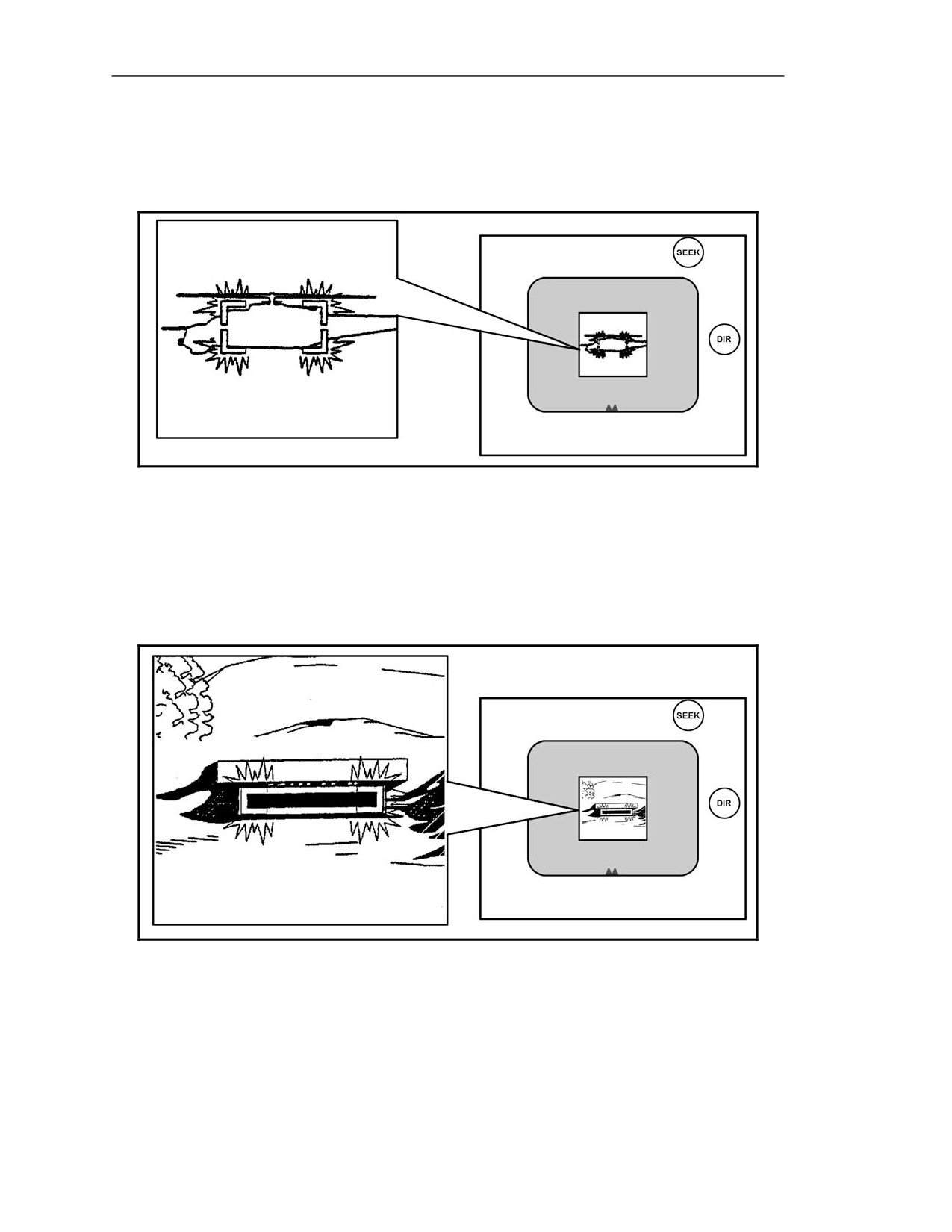
Flank Target
4-99. Adjust the track gates to surround the passenger/engine compartment or main body (for those
helicopters without a passenger compartment) (Figure 4-28). Any appendages—such as the cockpit,
tail boom, rotor, and so forth—are ignored.
Figure 4-28. Track gate adjustment for helicopters―flank.
Bunker
4-100. Track gate adjustment for a bunker involves the perceived size of the bunker’s firing port.
This adjustment depends on the range to the bunker.
z
Place the track gates around the internal opening of the firing port (Figure 4-29). Select the
direct attack mode when engaging this type of target.
Figure 4-29. Track gate adjustment for bunker.
z
If the bunker is at a range far enough away that the firing ports cannot be seen, adjust the
gates so that they surround the port frame. Select the direct attack mode when engaging this
type of target.
Obscured Targets
4-101. Attempt to acquire the entire target when engaging targets obscured by dust, smoke, or IR
clutter.
4-28
FM 3-22.37
20 March 2008
Tactical Considerations
MULTIPLE TARGETS
4-102. The biggest difference between a single-target engagement and a multiple-target engagement
is removing the CLU from the empty LTA, connecting the CLU to a new round, and engaging the
remaining targets. The sequence of events is—
(1) Prepare the Javelin for firing.
(2) Assume a good firing position.
(3) Determine target engageability.
(4) Activate the seeker. (Squeeze and hold the seeker until the BCU pop is heard.)
(5) Change attack mode, if necessary.
(6) Adjust track gates.
(7) Lock-on target.
(8) Check crosshairs and track gates.
(9) Launch the missile.
(10) After missile launch, release the fire and seeker triggers.
(11) Remove the CLU from the empty LTA. Place the empty LTA outside the backblast area.
(12) Connect the CLU to a new round.
(13) Repeat until all the targets are engaged and destroyed.
RAPID ENGAGEMENT TECHNIQUES (DAY MODE ONLY)
4-103. This technique is used to engage a target rapidly when time is critical and time available for
the NVS to cool down. Standard engagement procedures are used except for powering up the CLU in
the DAY mode and activating the seeker before assuming a firing position. This action starts the 10-
second seeker cooldown. By the time it takes to assume a good firing position, the Javelin should be in
seeker FOV. The sequence of events for a rapid engagement is—
(1) Prepare the Javelin for firing.
Connect the CLU to a round.
Power up the CLU in the DAY position.
Activate the seeker. (Hold the seeker trigger and listen for the BCU pop before
releasing the trigger.)
Remove the forward end cap.
(2) Assume a firing position. Observe the CLU display and ensure the following:
Green DAY, SEEK, and TOP indicators are lit (usually 10 to 15 seconds).
Seeker FOV and flashing track gates are present.
Change the attack mode, if necessary.
NOTE: The seeker FOV has a very limited area of coverage. Look over the CLU to locate
the target, and aim the CLU in the direction of the target and attempt to acquire the target. If
the target cannot be located, change the SEL switch to day FOV to locate the target, and
then go back to the seeker FOV.
(3) Adjust the track gates.
(4) Lock-on the target.
(5) Check crosshairs and track gates.
(6) Launch the missile.
(7) Perform battle damage assessment (BDA) or displace.
20 March 2008
FM 3-22.37
4-29
Chapter 4
FIRE PLAN
4-104. The Javelin is part of the direct fire plan and is used in conjunction with other weapon systems
to cover an engagement area. The platoon leader should use the fire plan to ensure constant coverage
by key weapon systems. The fire plan also includes units to the flanks and how their fires interlock to
provide mutual support.
FIRE CONTROL
4-105. Well-planned and executed fire control measures are critical to the effectiveness of Javelin
fires. Javelin positions should not be jeopardized by premature fires in which either the range is
excessive or the target is not in position to ensure a high probability of kill. Proper fire control ensures
that Javelins engage targets at optimum times and with only the best placed Javelin in relation to the
target. Uncontrolled firing decreases the effectiveness of the unit's overall weapon capabilities.
METHODS
4-106. The primary control methods used to control the fire of one or more Javelins include sectors of
fire, TRPs, engagement priorities, fire patterns, and fire commands.
Sector of Fire
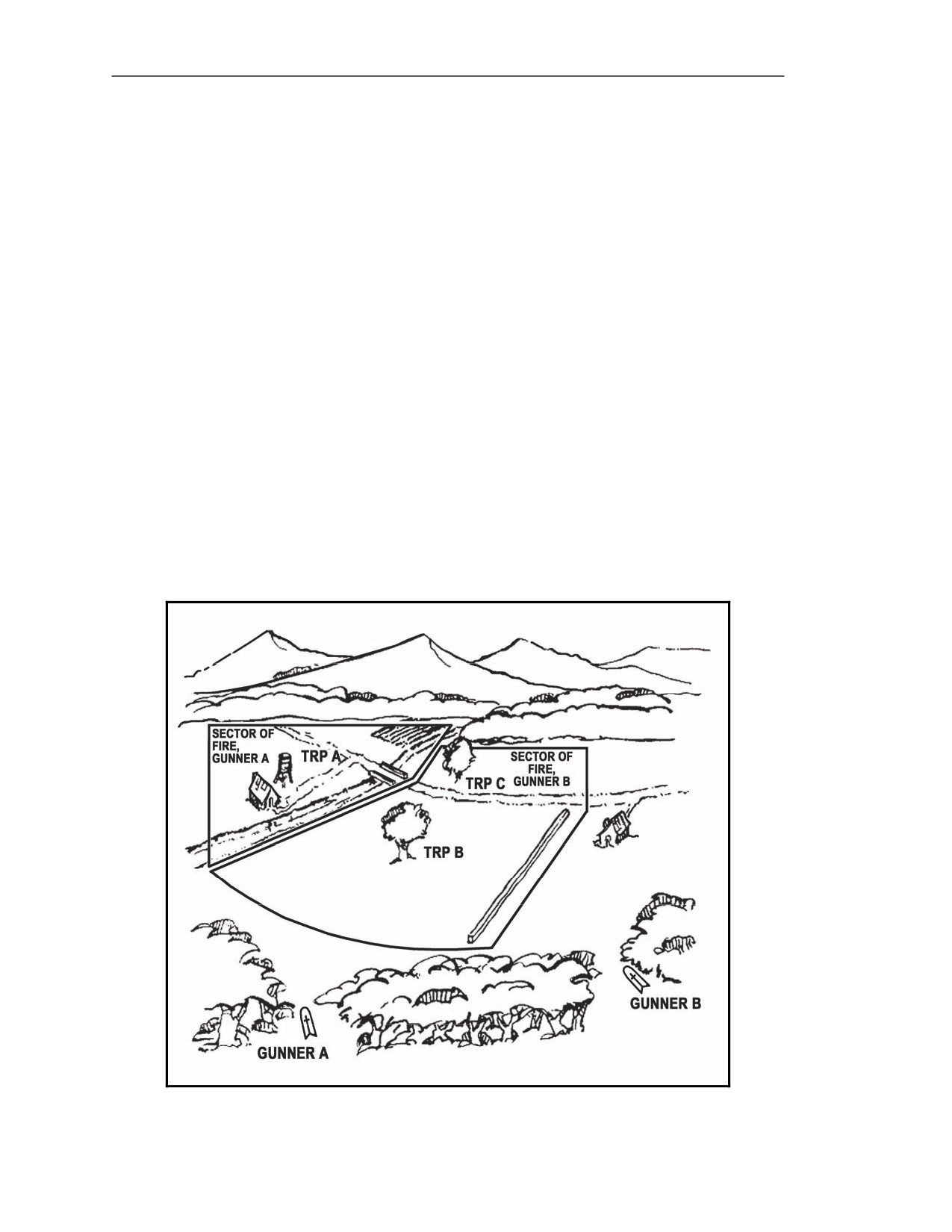
4-107. A sector of fire refers to an area limited by boundaries and assigned to a unit or weapon to
cover by fire (Figure 4-30). The gunner or unit assigned a sector of fire may fire only within that
sector. Leaders should make sure sectors overlap to cover all areas and so that the Javelin gunners do
not hesitate when enemy vehicles come into range. The gunner should record the left and right limit on
his range card.
Figure 4-30. Sector of fire.
4-30
FM 3-22.37
20 March 2008
Tactical Considerations
Target Reference Point
4-108. A TRP identifies an easily recognizable, natural or man-made point on the ground. The TRP is
used as a reference point for locating and controlling fires. They are normally referenced by two
letters, followed by four numbers (assigned by a higher headquarters). TRPs are also used for shifting
fires. The gunner must record the location of TRPs on his range card (see Appendix B).
Engagement Priorities
4-109. Engagement priority means the order in which Javelins engage the various types of vehicles in
an enemy formation. The commander designates the engagement priority for each of his units. Table
4-3 is an example list of engagement priority.
Table 4-3. Engagement priority.
1.
Command and control vehicles
2.
Tanks/APCs
3.
Antiaircraft vehicles
Fire Patterns
4-110. Fire patterns describe the relationship between Javelins and their targets. Firing patterns help
leaders control the gunners. These patterns also give gunners specific targets to focus on. Two basic
patterns include cross-fire and depth-fire. Leaders should not fixate on one, but should remain flexible
and change the pattern as needed. Within the unit's sector, the leader could use both patterns at the
same time.
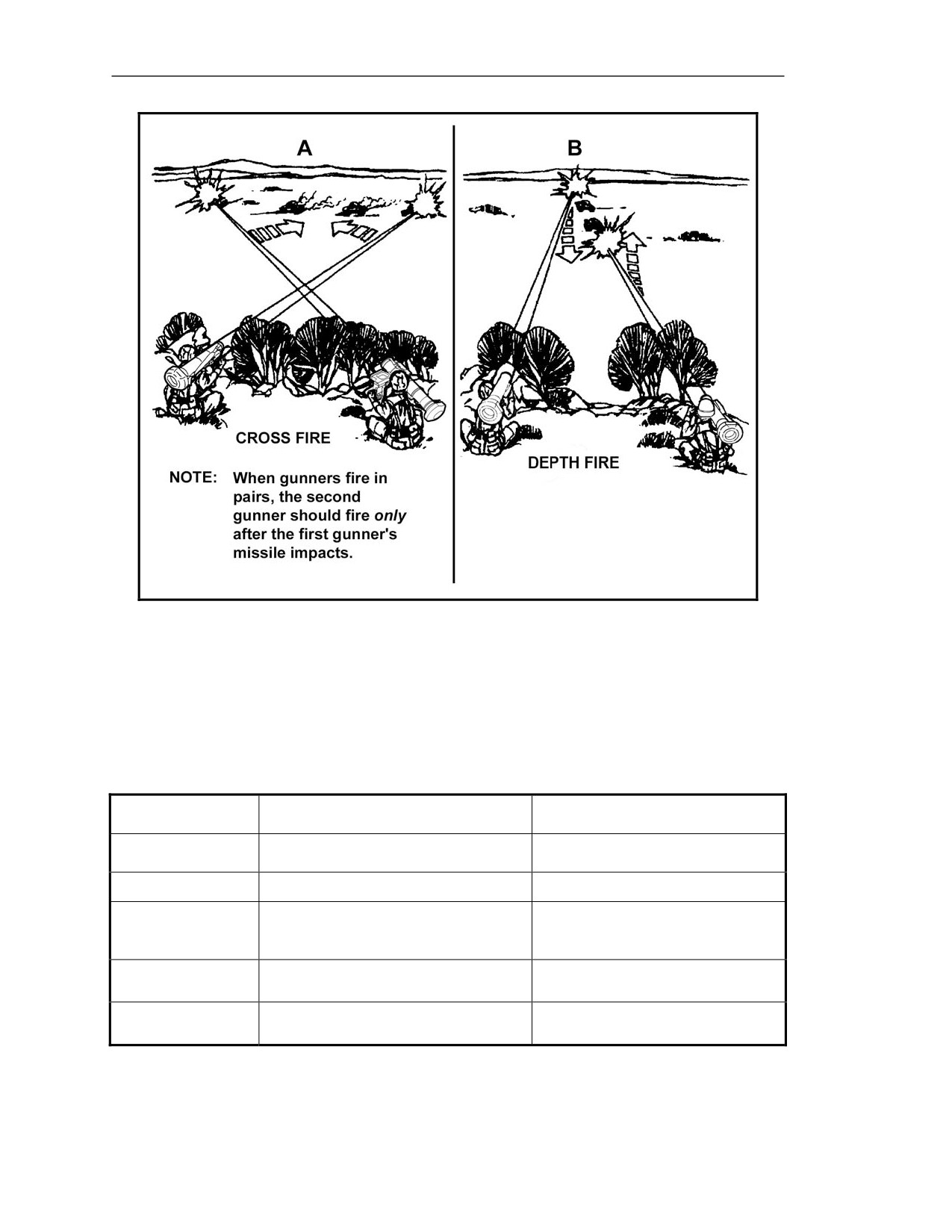
Crossfire
4-111. Leaders should use crossfire patterns with targets dispersed laterally or when obstructions
prevent the Javelin from firing to the front. Gunners must stagger their crossfire. That is, when the first
missile hits, only then should other systems fire.
Flanking Targets
4-112. With flanking targets, leaders should have each gunner engage the target that is diagonal to his
position.
Frontal Targets
4-113. With a frontal target, that is, a target moving straight at the Javelin, leaders should use cross-
fire. This helps prevent detection.
Follow-Up
4-114. As Javelin gunners destroy their targets, leaders should have them shift their fire to the center
of the enemy formation (Figure 4-31A).
Depth Fire
4-115. Leaders should use depth fire when targets are exposed in depth. Have Javelins on one side
engage the nearest targets, while Javelins on the other side engage the farthest targets. The gunners can
then shift fire toward the center of the formation. This procedure should be specified by unit standing
operating procedures (SOPs) or in the section leader's order (Figure 4-31B).
20 March 2008
FM 3-22.37
4-31
Chapter 4
Figure 4-31. Fire patterns.
Fire Commands
4-116. The leader uses the fire commands to control the gunner's rate of fire, time of fire, and point of
fire. When distance dictates radio delivery of fire commands, the gunner divides his concentration
between listening to the radio and firing the Javelin. His assistant, if he has one, listens to the radio and
relays the radio commands (Table 4-4).
Table 4-4. Fire commands and examples.
DEFINITION
ELEMENT
EXAMPLE
Warns the gunners of a fire mission.
"Enemy in sector, prepare to fire."
Alert
Target Description/
Briefly describes the target location relative to
"BMP, 200 meters right of TRP 1."
Location
a TRP or the gunner.
Provides instructions for engaging a
formation—fire cross or depth fire, fire front to
"Fire from rear to center."
Method of Engagement
rear, fire left to right or right to left, and so
"Fire from front to center."
forth.
"Team Alpha, fire."
Execution
Gives the command to fire
"Team Bravo, stand by."
Gunner gives BDA and continues the
"One tank
(APC) destroyed," and
Cease Fire
engagement.
continues engagement.
4-32
FM 3-22.37
20 March 2008
Tactical Considerations
EMERGENCY FIRE SIGNALS
4-117. Radio communications may be lost. In such cases, control of fire will be difficult at best. Use
of sectors of fire and alternate signals with pyrotechnics will often be the best and most rapid method
available to control the fire of Javelin gunners. Units should establish SOPs and practice
communications procedures.
RANGE CARDS
4-118. In some situations, such as when moving from position to position to cover the movement of
an advancing force or during retrograde operations, preparing and using range cards may not work. In
that case, TRPs offer the best way to control the distribution of fire. If time and circumstances permit,
gunners prepare range cards for primary, alternate, and supplementary positions. These cards help the
gunner engage targets successfully.
20 March 2008
FM 3-22.37
4-33
This page intentionally left blank.
Chapter 5
BLOCK 1 IMPROVEMENTS
Specific Block 1 changes enhance the CLU's optics. These improvements shorten
both the target acquisition surveillance time and the operator timeline, thereby
allowing for earlier target engagement and a potential improvement in
survivability.
INTRODUCTION
5-1. This chapter reflects Block
1 improvements to the CLU and associated weapon training
components. While some information contained in Chapter 1 and Chapter 2 is repeated in this chapter,
additional information is provided, changes are added, and the order in which this information is
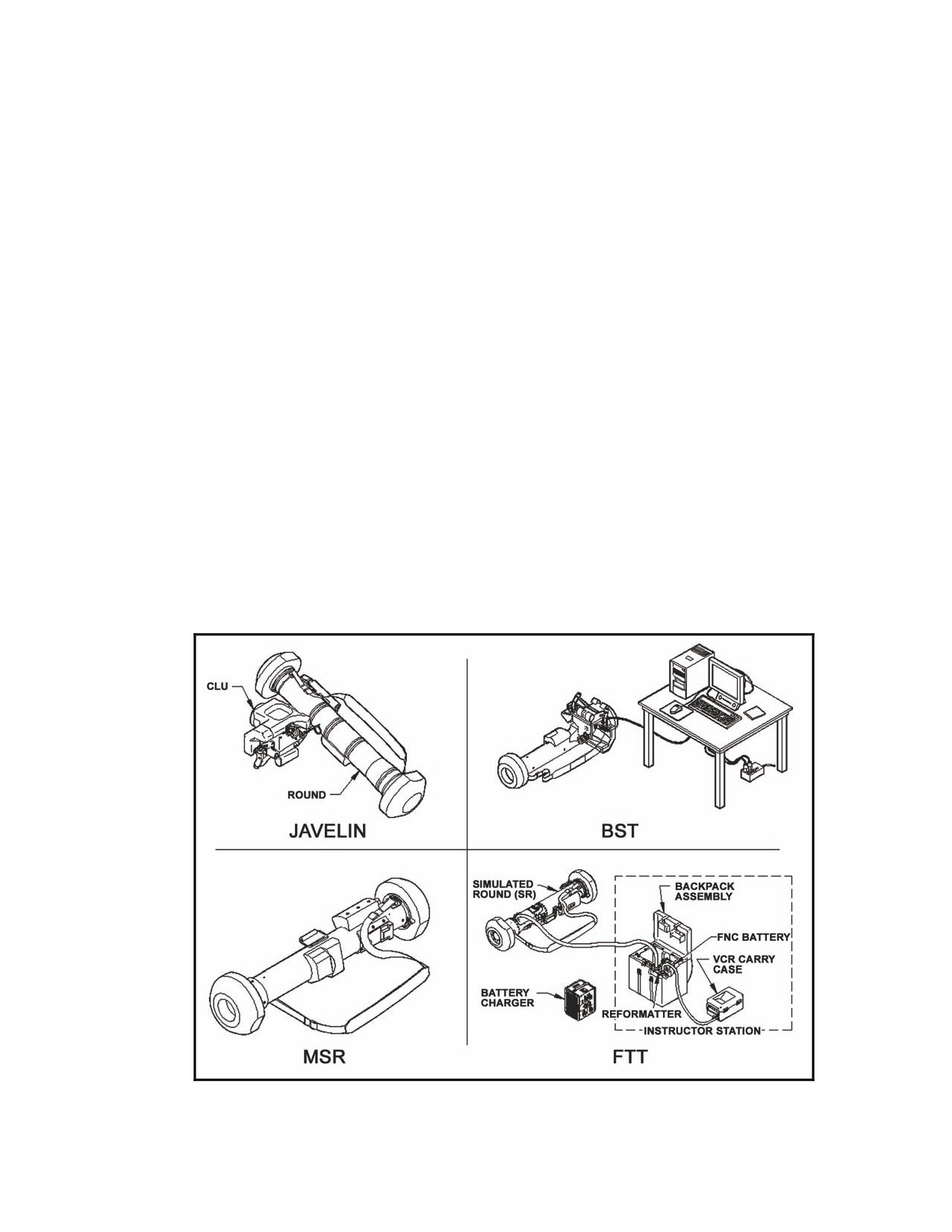
provided will not be the same as in previous chapters. Javelin CLU software and hardware changes are
covered later in the chapter; other Block 1 system changes (Figure 5-1) include—
z
Replacing the BST with a 12x afocal lens that simulates the improved CLU.
z
Adding a video port connector to provide video output capability of the CLU images to the
FTT instructor station.
z
Adding a new FTT instructor station cable and upgrading the software to support video
output from the improved CLU.
z
Modifying the MSR to work with the improved CLU.
Figure 5-1. Javelin weapon system.
20 March 2008
FM 3-22.37
5-1