FM 3-22.37 COMBAT MISSILE SYSTEM, MEDIUM (March 2008) - page 1
*FM 3-22.37
Field Manual
Headquarters
No. 3-22.37
Department of the Army
Washington, DC, 20 March 2008
Javelin—Close Combat Missile System, Medium
Contents
Page
PREFACE
xii
Chapter 1
INTRODUCTION
1-1
Weapon System
1-1
Equipment Description and Data
1-3
Command Launch Unit
1-5
Round
1-10
Missile Operation
1-14
Capabilities and Features
1-17
Chapter 2
CONTROLS AND OPERATION
2-1
Controls and Indicators
2-1
Command Launch Unit Status Indicators
2-6
Command Launch Unit Display Indicators
2-9
Preparation for Firing
2-12
Firing Positions
2-16
Restore to Carrying Configuration
2-23
Carrying Techniques
2-27
Chapter 3
TRAINING PROGRAM
3-1
Section I. General
3-1
Training Strategy
3-1
Prerequisites for Additional Skill Identifier
3-2
Section II. Train The Trainer
3-2
Train-the-Trainer Program
3-2
Program Audience
3-3
Standards for Trainers
3-3
Resource Requirements
3-4
Training Support Packages
3-4
Training Devices
3-4
DISTRIBUTION RESTRICTION: Approved for public release; distribution is unlimited.
* This publication supersedes FM 3-22.37, dated 23 January 2003.
FM 3-22.37
i
Contents
Basic Skills Trainer Setup Operations
3-6
Field Tactical Trainer Setup Operations
3-8
Gunner's Skill Test Execution
3-9
Section III. Train The Gunner
3-10
Conduct of Training
3-10
Program Execution
3-10
Centralized Training
3-11
Training Objectives
3-11
Practice Exercises
3-11
Evaluation System
3-12
Safety
3-13
Gunner Qualification Program
3-13
Sustainment Training
3-21
Collective Training
3-21
Chapter 4
TACTICAL CONSIDERATIONS
4-1
Section I. Role and Fundamentals
4-1
Role
4-1
Capabilities and Limitations
4-1
Fundamentals of Employment
4-3
Section II. Defense
4-5
Defensive Operations
4-5
Mechanized Company Defensive Employment
4-7
Defense In Depth
4-8
Delays and Withdrawals
4-8
Section III. Fighting Positions
4-10
Hasty Fighting Position
4-10
Deliberate Fighting Position
4-12
Section IV. Other Tactical Operations
4-17
Offensive Operations
4-17
Antiarmor Ambush Role
4-17
Stability and Support Operations
4-18
Urban Combat
4-18
Section V. Target Engagement Techniques
4-19
Target Detection
4-20
Target Classification
4-23
Target Recognition
4-24
Target Identification
4-25
Target Engagement
4-26
Fire Plan
4-30
Fire Control
4-30
ii
FM 3-22.37
20 March 2008
Contents
Chapter 5
BLOCK 1 IMPROVEMENTS
5-1
Introduction
5-1
Javelin Weapon System (Block 1)
5-2
Equipment Data and Description
5-6
Command Launch Unit
5-7
Command Launch Unit Status Indicators
5-24
Command Launch Unit Display Indicators
5-35
Round
5-36
Missile Operation
5-41
Round Controls
5-47
Round Indicators
5-52
Capabilities and Features
5-54
Appendix A
SAFETY
A-1
Javelin Backblast Area
A-1
Round Handling
A-2
Firing From Enclosures
A-2
Fighting Position
A-4
Safety Precautions for the Multiple Integrated Laser Engagement System
A-4
Safety Precautions for the Battery Coolant Unit
A-4
Safety Precautions for Live Rounds
A-5
Risk Management
A-5
Accident Reporting
A-5
Appendix B
STANDARD RANGE CARD
B-1
Description
B-1
General Procedures
B-2
Marginal Information
B-2
Calculate
B-3
Sector Sketch Section Development
B-4
Data Section
B-8
Field-Expedient Range Card
B-10
Appendix C
IMMEDIATE DECONTAMINATION AND DESTRUCTION PROCEDURES
C-1
Decontamination Principles
C-1
Destruction Guidance
C-2
Appendix D
WARNING INDICATORS AND MALFUNCTIONS
D-1
Section I. Warning Indicators
D-1
Night Vision Sight Not Cool
D-1
Night Vision Sight Focus Adjustment Limit
D-2
Command Launch Unit Battery Low
D-3
Battery Coolant Unit Low
D-4
Missile Not Ready
D-5
20 March 2008
FM 3-22.37
iii
Contents
Section II. Malfunction Indicators
D-7
Command Launch Unit Built-In Test Failure
D-7
Missile Built-In Test Failure
D-9
Misfire
D-10
Hangfire
D-12
General Practical Exercises for Warnings and Malfunctions
D-13
Appendix E
FORWARD LOOKING INFRARED
E-1
Introduction
E-1
Electromagnetic Spectrum
E-1
Infrared Waves
E-2
Infrared Systems
E-5
ΔT
E-5
Infrared Image Adjustment
E-9
Factors that Affect Infrared Target Images and ΔTs
E-15
Target Acquisition
E-22
Target Classification
E-33
Target Recognition
E-37
GLOSSARY
Glossary-1
REFERENCES
References-1
INDEX
Index-1
Figures
Figure 1-1. Javelin
1-1
Figure 1-2. Basic skills trainer
1-2
Figure 1-3. Field tactical trainer
1-2
Figure 1-4. Missile simulation round
1-3
Figure 1-5. Javelin backblast safety zones
1-5
Figure 1-6. Javelin components
1-5
Figure 1-7. Main housing and absorbers
1-6
Figure 1-8. Handgrips
1-6
Figure 1-9. Battery compartment
1-7
Figure 1-10. Daysight
1-7
Figure 1-11. Night vision sight lens
1-8
Figure 1-12. Detector Dewar cooler
1-8
Figure 1-13. Status indicators
1-9
Figure 1-14. Eyepiece
1-9
Figure 1-15. Test connector, round interface connector, and humidity indicator
1-10
Figure 1-16. Launch tube assembly, end caps, and carry handle
1-11
Figure 1-17. Shoulder strap and pad
1-12
iv
FM 3-22.37
20 March 2008
Contents
Figure
1-18. Command launch unit interface connector
1-12
Figure
1-19. Battery coolant unit
1-13
Figure
1-20. Javelin missile
1-13
Figure
1-21. Missile guidance section
1-14
Figure
1-22. Mid-body section
1-15
Figure
1-23. Missile warhead
1-15
Figure
1-24. Missile propulsion section
1-16
Figure
1-25. Control actuator section
1-17
Figure
1-26. Top attack mode
1-17
Figure
1-27. Top attack flight path
1-18
Figure
1-28. Direct attack mode
1-18
Figure
1-29. Direct attack flight path
1-19
Figure
2-1. Diopter adjust ring
2-1
Figure
2-2. Power switch positions
2-2
Figure
2-3. Power switch—TEST position
2-2
Figure
2-4. Left handgrip controls
2-3
Figure
2-5. Left handgrip controls—seeker trigger
2-4
Figure
2-6. Right handgrip controls
2-5
Figure
2-7. Command launch unit display indicators
2-6
Figure
2-8. Status indicators―green
2-7
Figure
2-9. Status indicators―amber
2-8
Figure
2-10. Status indicator―red
2-9
Figure
2-11. Day field-of-view stadia
2-9
Figure
2-12. Night vision sight stadia comparisons
2-10
Figure
2-13. Reticle area versus field-of-view change
2-10
Figure
2-14. Track gates
2-11
Figure
2-15. Crosshairs
2-11
Figure
2-16. Battery compartment
2-12
Figure
2-17. Connect the round to the command launch unit
2-13
Figure
2-18. Connect the command launch unit to the round
2-13
Figure
2-19. Connect the command launch unit to the round
2-14
Figure
2-20. Power switch
2-14
Figure
2-21. Remove the forward end cap
2-15
Figure
2-22. Javelin sitting firing position
2-16
Figure
2-23. Javelin kneeling firing position
2-17
Figure
2-24. Gunner sights along the top of the round for obstructions
2-17
Figure
2-25. Standing supported firing position
2-18
Figure
2-26. Preparing to connect the command launch unit
2-19
Figure
2-27. Remove the forward end cap
2-20
Figure
2-28. Reaching for forward end cap
2-21
Figure
2-29. Placing end cap
2-21
Figure
2-30. Placement of forward end cap in prone position
2-22
20 March 2008
FM 3-22.37
v
Contents
Figure
2-31. Prone supported firing position
2-22
Figure
2-32. Correct prone body position
2-23
Figure
2-33. Power switch OFF position
2-24
Figure
2-34. Replace forward end cap
2-25
Figure
2-35. Forward end cap locking pin
2-25
Figure
2-36. Disconnect the command launch unit from the round
2-26
Figure
2-37. Old battery coolant unit
2-27
Figure
2-38. New battery coolant unit
2-27
Figure
2-39. Tactical carry technique
2-28
Figure
2-40. Short-distance carry techniques
2-29
Figure
2-41. Long-distance carry technique
2-29
Figure
2-42. Secure the round to the rucksack
2-30
Figure
3-1. Basic skills trainer
3-4
Figure
3-2. Field tactical trainer
3-5
Figure
4-1. Mutual supporting fire
4-3
Figure
4-2. Overlapping sectors of fire
4-4
Figure
4-3. Javelins positioned in depth
4-5
Figure
4-4. Primary, alternate, and supplementary positions
4-7
Figure
4-5. Javelin-equipped mechanized company defense
4-8
Figure
4-6. Withdrawal under enemy pressure
4-9
Figure
4-7. Withdrawal not under pressure
4-9
Figure
4-8. Hasty fighting position
4-10
Figure
4-9. Hasty fighting position
4-11
Figure
4-10. Improved hasty fighting position
4-11
Figure
4-11. Expanded hasty fighting position
4-11
Figure
4-12. Deliberate fighting position
4-13
Figure
4-13. Completed deliberate fighting position
4-14
Figure
4-14. Sketch of the front view of a Javelin defensive fighting position
4-15
Figure
4-15. Front view of a Javelin defensive fighting position
4-15
Figure
4-16. Side view of a Javelin defensive fighting position
4-16
Figure
4-17. Top view of a Javelin defensive fighting position
4-16
Figure
4-18. Javelin supporting offensive operations
4-17
Figure
4-19. Antiarmor ambush
4-18
Figure
4-20. Fields of view
4-20
Figure
4-21. Slow/rapid scan
4-21
Figure
4-22. Detailed search
4-22
Figure
4-23. Stationary targets
4-23
Figure
4-24. Target classification features
4-24
Figure
4-25. Target classification
4-25
Figure
4-26. Position track gates on target
4-27
Figure
4-27. Track gate adjustment for helicopters―front
4-27
Figure
4-28. Track gate adjustment for helicopters―flank
4-28
vi
FM 3-22.37
20 March 2008
Contents
Figure
4-29. Track gate adjustment for bunker
4-28
Figure
4-30. Sector of fire
4-30
Figure
4-31. Fire patterns
4-32
Figure
5-1. Javelin weapon system
5-1
Figure
5-2. Javelin command launch unit
5-2
Figure
5-3. Javelin command launch unit and accessories
5-2
Figure
5-4. Javelin missile
5-3
Figure
5-5. Basic skills trainer
5-4
Figure
5-6. Field tactical trainer
5-5
Figure
5-7. Missile simulation round
5-5
Figure
5-8. Main housing
5-8
Figure
5-9. Battery compartment
5-9
Figure
5-10. Test connector, round interface connector, and desiccant plug
5-10
Figure
5-11. Video port
5-11
Figure
5-12. Elapsed time meter
5-11
Figure
5-13. Daysight
5-12
Figure
5-14. Daysight optical path
5-12
Figure
5-15. Example daysight images—clear and rainy
5-13
Figure
5-16. Night vision sight
5-14
Figure
5-17. Night vision sight fields of view
5-14
Figure
5-18. Detector dewar cooler
5-15
Figure
5-19. Flipper mirror positions
5-15
Figure
5-20. Night vision sight status display
5-16
Figure
5-21. Eyepiece
5-16
Figure
5-22. Shock absorbers
5-17
Figure
5-23. Handgrips
5-18
Figure
5-24. Diopter adjust ring
5-19
Figure
5-25. Power switch
5-19
Figure
5-26. Power switch in the TEST position
5-20
Figure
5-27. Left handgrip controls
5-21
Figure
5-28. Filter, Focus, and Sight Select switches
5-22
Figure
5-29. Seeker trigger
5-22
Figure
5-30. Right handgrip controls
5-23
Figure
5-31. Fire trigger
5-24
Figure
5-32. Status indicators
5-25
Figure
5-33. Light-emitting diode indicators
5-26
Figure
5-34. Video display status indicators
5-27
Figure
5-35. Video display status indicators in the command launch unit options
section
5-28
Figure 5-36. Video display status indicators in the command launch unit status
section
5-29
Figure 5-37. Video display status indicators in the missile status section
5-30
20 March 2008
FM 3-22.37
vii
Contents
Figure
5-38. Video display indicators in the command launch unit menu section
5-32
Figure
5-39. Text message windows
5-34
Figure
5-40. Reticle lines
5-35
Figure
5-41. Reticle area versus field-of-view change
5-36
Figure
5-42. Launch tube assembly
5-37
Figure
5-43. Command launch unit mounting brackets
5-38
Figure
5-44. Battery coolant unit
5-40
Figure
5-45. Javelin missile
5-41
Figure
5-46. Seeker field-of-view
5-42
Figure
5-47. Guidance section
5-44
Figure
5-48. Warhead section
5-44
Figure
5-49. Mid-body section
5-45
Figure
5-50. Propulsion section
5-46
Figure
5-51. Control actuator section
5-47
Figure
5-52. Seeker trigger
5-48
Figure
5-53. Sight Select switch
5-48
Figure
5-54. Right handgrip controls
5-49
Figure
5-55. Attack Select switch
5-49
Figure
5-56. Missile mode indicators
5-50
Figure
5-57. Gate Adjust/Contrast and Brightness switch
5-50
Figure
5-58. Track gate adjustment, down/up
5-51
Figure
5-59. Track gate adjustment, left/right
5-51
Figure
5-60. Fire trigger
5-51
Figure
5-61. Manual release button
5-52
Figure
5-62. Battery coolant unit status indicator
5-53
Figure
5-63. Humidity indicator
5-53
Figure
5-64. Flashing track gates
5-54
Figure
5-65. Solid track gates and crosshairs
5-54
Figure
5-66. Top attack mode
5-55
Figure
5-67. Top attack flight paths
5-55
Figure
5-68. Direct attack mode
5-56
Figure
5-69. Direct attack flight paths
5-56
Figure A-1. Javelin backblast area and surface danger zone
A-3
Figure A-2. Laser-safe eye distance
A-4
Figure A-3. Javelin weapon system batteries
A-5
Figure B-1. Example of DA Form 5517-R
B-1
Figure B-2. Gunner’s sector of fire
B-2
Figure B-3. Marginal information
B-3
Figure B-4. Determination of distance between circles
B-3
Figure B-5. Sector sketch
B-4
Figure B-6. Sector of fire and maximum engagement line
B-5
Figure B-7. Avenues of approach
B-6
viii
FM 3-22.37
20 March 2008
Contents
Figure B-8. Target reference points
B-6
Figure B-9. Dead space
B-7
Figure B-10. Gunner’s reference point and firing
B-7
Figure B-11. DA Form 5517-R ―data section
B-8
Figure B-12. Example completed DA Form 5517-R
B-9
Figure B-13. Terrain presentation
B-10
Figure B-14. Field-expedient range card showing the terrain
B-10
Figure D-1. Amber NVS NOT COOL indicator―on
D-1
Figure D-2. WFOV or NFOV indicator―flashing
D-2
Figure D-3. CLU BATTERY indicator―on
D-3
Figure D-4. BCU LOW indicator―flashing/on
D-5
Figure D-5. NFOV to seeker FOV sequence
D-6
Figure D-6. MISSILE NOT READY indicator
D-6
Figure D-7. CLU BIT FAILURE indicator
D-8
Figure D-8. MISSILE BIT FAILURE indicator―solid on
D-9
Figure D-9. Misfire—with and without warning indicators
D-10
Figure D-10. HANGFIRE indicator
D-12
Figure E-1. Electromagnetic spectrum
E-1
Figure E-2. Infrared band
E-2
Figure E-3. Heat caused by combustion
E-2
Figure E-4. Heat caused by friction
E-3
Figure E-5. Infrared affected by color
E-4
Figure E-6. Smooth versus rough surface texture
E-5
Figure E-7. Display of infrared levels
E-6
Figure E-8. ΔTs
E-6
Figure E-9. Measurable ΔT
E-7
Figure E-10. Temperatures of objects during 24-hour period
E-7
Figure E-11. ΔT changes from day to night
E-8
Figure E-12. Crossover periods
E-8
Figure E-13. Focus adjustments
E-9
Figure E-14. Focus on far tree line
E-10
Figure E-15. Slow focus adjustment
E-10
Figure E-16. Fast focus adjustment
E-11
Figure E-17. Focus direction
E-11
Figure E-18. Night vision sight initial contrast and brightness baseline
E-12
Figure E-19. Return to baseline from an extreme contrast/brightness adjustment
E-12
Figure E-20. Properly adjusted contrast and brightness
E-13
Figure E-21. High versus good contrast adjustments
E-14
Figure E-22. Low versus good contrast adjustments
E-14
Figure E-23. High versus good brightness adjustments
E-15
Figure E-24. Low versus good contrast adjustments
E-15
20 March 2008
FM 3-22.37
ix
Contents
Figure E-25. Day vision sight versus night vision sight operation during high
levels of obscuration
E-16
Figure E-26. Infrared clutter―background ΔT pattern matches target ΔT pattern
E-17
Figure E-27. Defeating clutter caused by reflected infrared
E-18
Figure E-28. Effects of man-made clutter on night vision sight target scene
E-19
Figure E-29. Counteracting man-made clutter Step 1―adjust brightness
E-19
Figure E-30. Counteracting man-made clutter Step 2―adjust contrast
E-20
Figure E-31. Infrared crossover times
E-20
Figure E-32. Infrared crossover effects
E-21
Figure E-33. Road temperature increases due to friction from vehicle tracks
E-21
Figure E-34. Effects of range on target details
E-22
Figure E-35. Target acquisition steps
E-22
Figure E-36. Target engagement field-of-view sequence
E-23
Figure E-37. Day field-of-view image and area of coverage
E-23
Figure E-38. Wide field-of-view image and area of coverage
E-24
Figure E-39. Narrow field-of-view image and area of coverage
E-24
Figure E-40. Seeker field-of-view image and area of coverage
E-25
Figure E-41. Target acquisition―detection
E-25
Figure E-42. Rapid/slow scan pattern
E-26
Figure E-43. Detailed search
E-27
Figure E-44. Dust cloud from moving vehicle
E-27
Figure E-45. Image adjustment for defensive position
E-28
Figure E-46. Hot and cold stationary targets
E-28
Figure E-47. Vehicle exhaust
E-29
Figure E-48. Dismounted troops as infrared source
E-29
Figure E-49. Image adjustment for detecting hot stationary targets
E-30
Figure E-50. Track and hull signatures
E-30
Figure E-51. Engine compartment and gun tube/barrel
E-31
Figure E-52. Backlighting
E-31
Figure E-53. Image adjustment for detecting cold, stationary targets
E-32
Figure E-54. Tank in defilade
E-33
Figure E-55. Target acquisition process―classification step
E-33
Figure E-56. Classification features―suspension system
E-34
Figure E-57. Classification features―engine compartment location
E-34
Figure E-58. Classification features―gun tube/barrel
E-35
Figure E-59. Image adjustments for target classification and recognition
E-35
Figure E-60. Classification and recognition features of flank and frontal targets
E-36
Figure E-61. Target acquisition process―recognition step
E-37
Figure E-62. Target recognition features
E-37
Figure E-62. Target recognition features (continued)
E-38
x
FM 3-22.37
20 March 2008
Contents
Tables
Table
1-1. Javelin capabilities and features
1-3
Table
1-2. Physical characteristics of the command launch unit
1-4
Table
1-3. Physical characteristics of the round
1-4
Table
3-1. Javelin 10-day (80-hour) training schedule
3-10
Table
3-2. Sustainment training matrix
3-21
Table
3-3. Collective training tasks
3-22
Table
4-1. Personnel duties
4-6
Table
4-2. Target classification features
4-25
Table
4-3. Engagement priority
4-31
Table
4-4. Fire commands and examples
4-32
Table
5-1. Javelin missile and weapon system capabilities and features
5-6
Table
5-2. Physical characteristics of the command launch unit
5-6
Table
5-3. Physical characteristics of the round
5-7
Table C-1. Javelin immediate decontamination procedures
C-1
Table D-1. Gunner corrective actions for NVS NOT COOL indicator
D-2
Table D-2. Gunner corrective action for flashing WFOV and NFOV indicators
D-3
Table D-3. Gunner corrective action for CLU BATTERY LOW indicator
D-4
Table D-4. Gunner corrective action for BCU LOW indicator
D-5
Table D-5. Gunner corrective action for MISSILE NOT READY indicator
D-7
Table D-6. Gunner corrective action for CLU BIT FAILURE indicator
D-9
Table D-7. Gunner corrective action for MISSILE BIT FAILURE indicator
D-10
Table D-8. Gunner corrective action for MISSILE MISFIRE indicator
D-11
Table D-9. Gunner corrective action for HANGFIRE indicator
D-13
Table E-1. Target recognition features
E-38
20 March 2008
FM 3-22.37
xi
Preface
PREFACE
This publication provides technical information, training techniques, and guidance on the current Javelin
weapon system and Block 1 improvements. The intended users include unit leaders, trainers, and
designated gunners. The users will find this information invaluable in their efforts to successfully integrate
this weapon system into their combat operations.
This publication applies to the Active Army, the Army National Guard (ARNG)/National Guard of the
United States (ARNGUS), and the US Army Reserve (USAR) unless otherwise stated.
Terms that have joint or Army definitions are identified in both the glossary and the text. Terms for which
FM 3-22.37 is the proponent FM are indicated with an asterisk in the glossary.
Uniforms depicted in this manual were drawn without camouflage for clarity of the illustration. Unless this
publication states otherwise, masculine nouns and pronouns refer to both men and women.
The proponent for this publication is the US Army Training and Doctrine Command. The preparing agency
is the United States Army Infantry School (USAIS). You may send comments and recommendations by
any means (US mail, e-mail, fax, or telephone) as long as you use DA Form 2028 (Recommended Changes
to Publications and Blank Forms) or follow its format. Point of contact information is as follows:
E-mail:
benn.29IN.229-S3-DOC-LIT@conus.army.mil
Phone:
Commercial: 706-545-8623
DSN: 835-8623
Fax:
Commercial: 706-545-8600
DSN: 835-8600
US Mail: Commandant, USAIS
ATTN: ATSH-INB
6650 Wilkin Drive, Bldg 74, Rm 102
Fort Benning, GA 31905-5593
xii
FM 3-22.37
20 March 2008
Chapter 1
INTRODUCTION
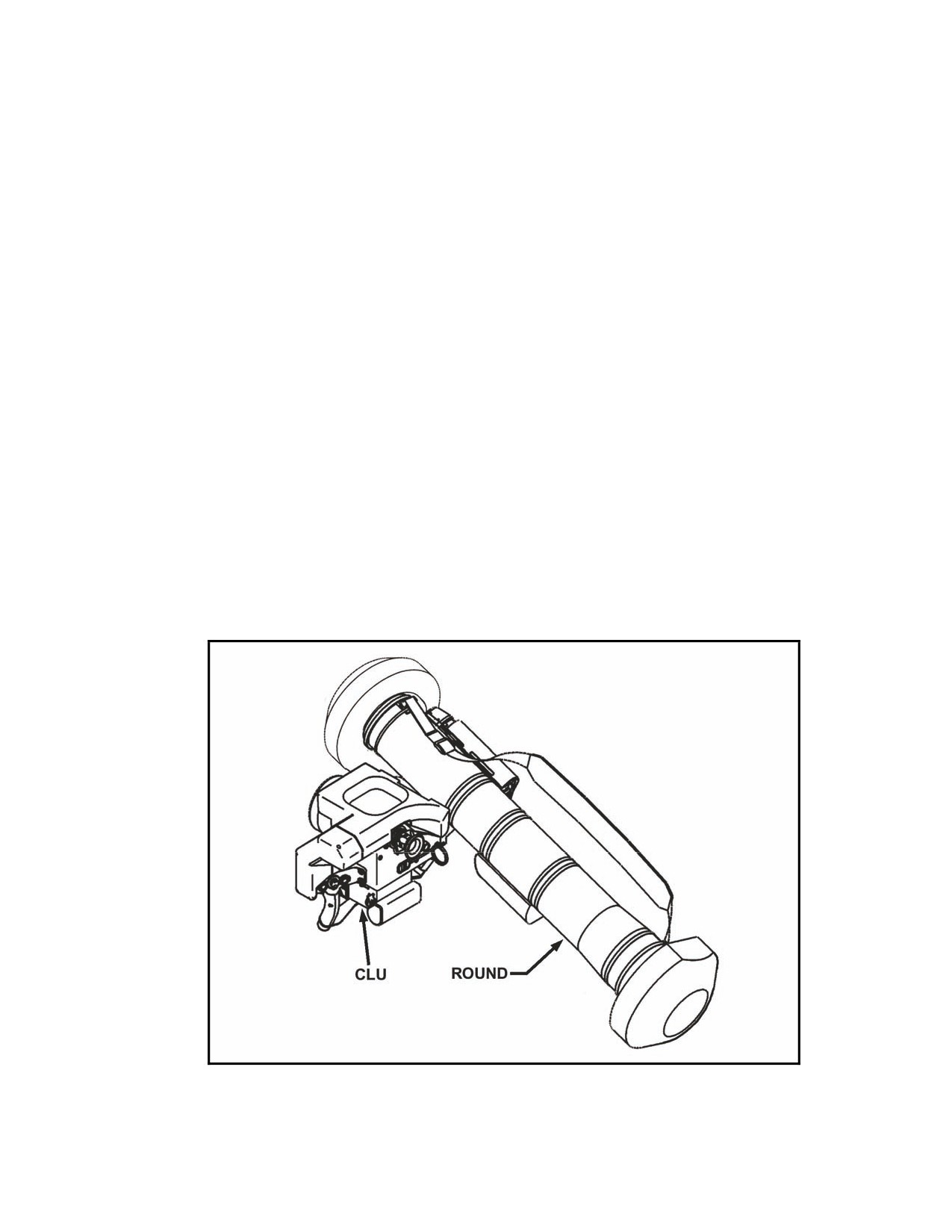
The Javelin surface-attack guided missile and launcher is a fire-and-forget, man-
portable medium close combat missile system consisting of a command launch unit
(CLU) and a round. The Javelin is operated by an individual Soldier or in crews of
two or three. Soldiers can use the Javelin during the day, at night, and during limited
visibility conditions.
WEAPON SYSTEM
1-1. The Javelin weapon system consists of a Javelin, a basic skills trainer (BST), a field tactical
trainer (FTT), and a missile simulation round (MSR).
JAVELIN
1-2. The Javelin is a fire-and-forget, shoulder-fired weapon that consists of a reusable M98A1 CLU
and a round. The CLU houses the daysight, night vision sight (NVS), controls, and indicators. The
round consists of the missile, the launch tube assembly (LTA) (Figure 1-1), and the battery coolant unit
(BCU). The missile contains the guidance section, mid-body section, warhead section, propulsion
section, and control actuator section. The LTA serves as the launch platform and carrying container for
the missile.
Figure 1-1. Javelin.
20 March 2008
FM 3-22.37
1-1
Chapter 1
BASIC SKILLS TRAINER
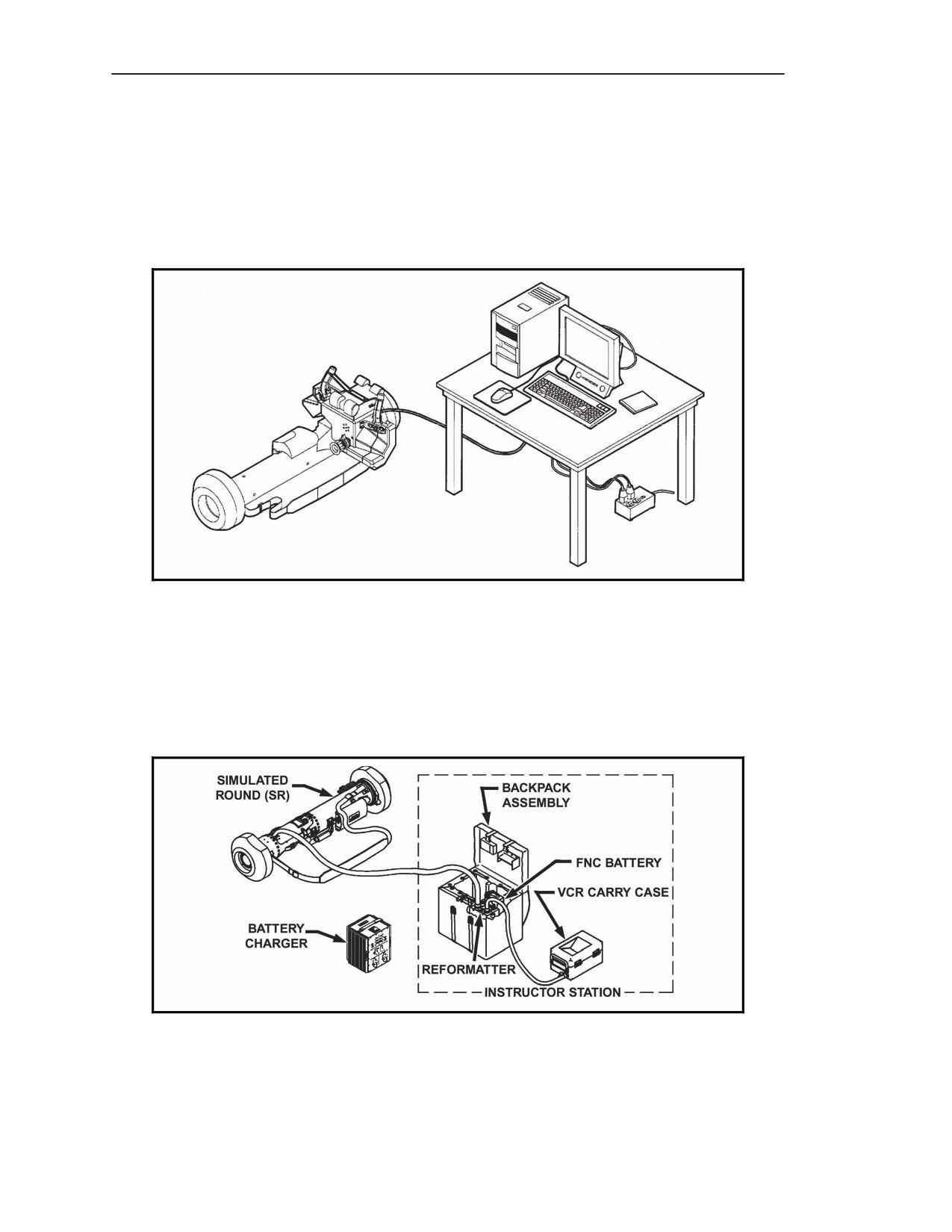
1-3. The BST is an indoor training device that consists of a Soldier station and an instructor station
(Figure 1-2). The Soldier station consists of a simulated command launch unit (SCLU) and an MSR.
The instructor station has a desktop computer, a monitor, a keyboard, a mouse, an interconnect cable,
and a surge suppressor. BST training exercises use real terrain models, actual visible and infrared (IR)
imagery, and matching three-dimensional target models for natural target movements. The gunner sees
a realistic simulated battlefield environment.
Figure 1-2. Basic skills trainer.
FIELD TACTICAL TRAINER
1-4. The FTT is an outdoor force-on-force trainer used in conjunction with a tactical CLU and a
simulated round. The FTT consists of an instructor station, which is used to monitor the student
(Figure 1-3). The simulated round is equipped with a multiple integrated laser engagement system
(MILES).
Figure 1-3. Field tactical trainer.
1-2
FM 3-22.37
20 March 2008
Introduction
MISSILE SIMULATION ROUND
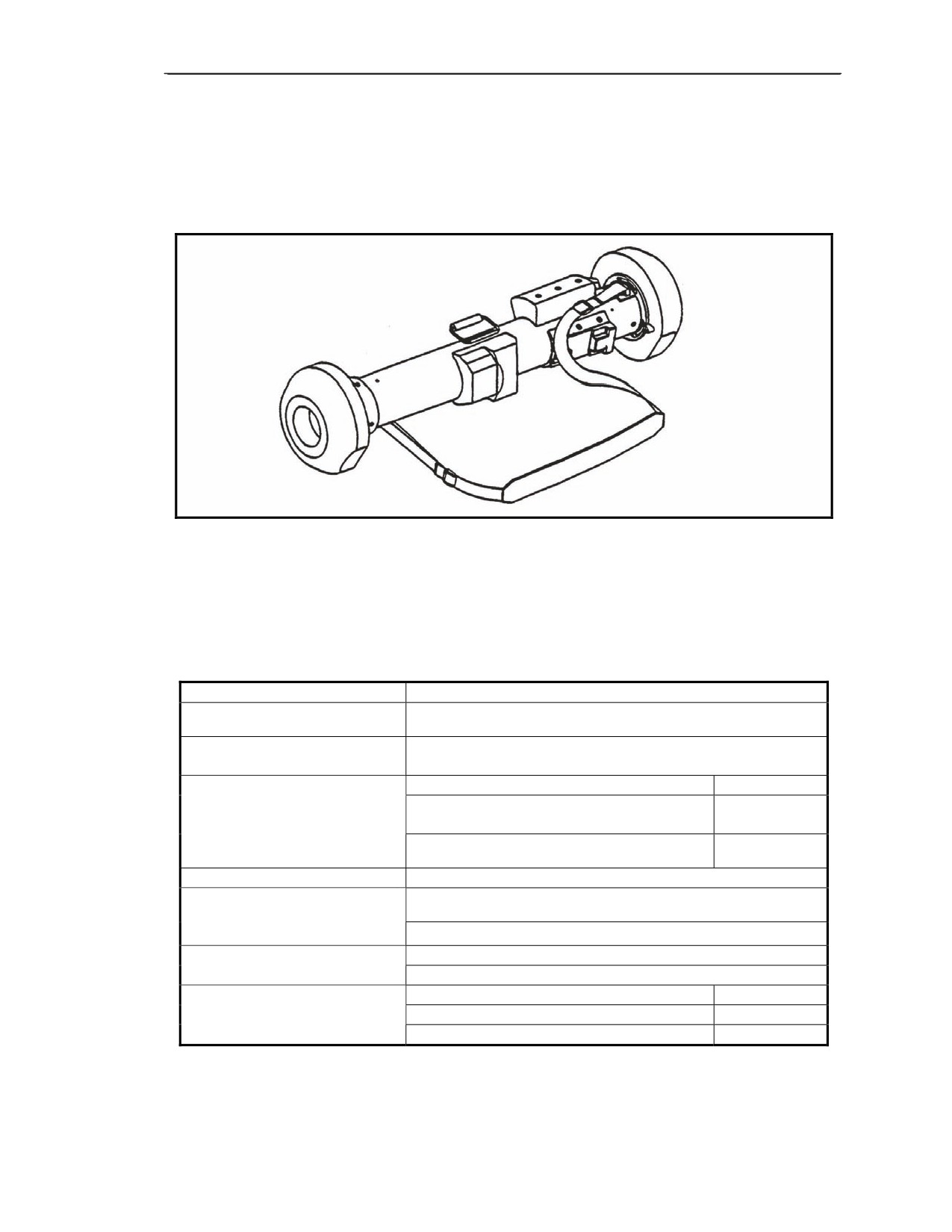
1-5. The MSR is a field handling round with a simulated launch tube (Figure 1-4). It replicates the
weight and balance of the actual round. The FTT contains no instruments or circuitry and is used to
train gunners on how to maintain, handle, and carry the round.
Figure 1-4. Missile simulation round.
EQUIPMENT DESCRIPTION AND DATA
1-6. Tables 1-1 through
1-3 show the Javelin's capabilities and features, the CLU's physical
characteristics, and the round's physical characteristics.
Table 1-1. Javelin capabilities and features.
Type of System
Fire and forget
Crew
One- to three-Soldier teams based on table of organization and
equipment (TOE)
Missile Modes
Top attack ( default )
Direct attack
Ranges
Top attack mode minimum effective engagement
150 m
Maximum effective engagement range
2,000 m
(direct attack and top attack modes)
Direct attack mode minimum effective engagement
65 m
range
Flight Time
About 14 seconds at 2,000 meters
Backblast Area
Primary danger zone extends out 25 m at a 60-degree (cone-shaped)
angle.
(See Figure 1-11 and
Caution zone extends the cone-shaped area out to 100 m
Appendix A for safety factors.)
Propulsion (Two-Stage Motor)
Launch motor ejects the missile from the LTA
Flight motor propels the missile to the target
Firing From Inside Enclosures
Minimum room length
15 ft
Minimum room width
12 ft
Minimum room height
7 ft
20 March 2008
FM 3-22.37
1-3

Chapter 1
Table 1-2. Physical characteristics of the command launch unit.
M98A1 CLU
With Battery, Carrying Bag, and Cleaning Kit
Weight
14.16 lb (6.42 kg)
Length
13.71 in (34.82 cm)
Height
13.34 in (33.88 cm)
Width
19.65 in (49.91 cm)
Carrying Bag Only
Weight
0.60 lb (0.27 kg)
Sights
Daysight
Magnification
4x
Field-of-view (FOV)
4.80° x 6.40°
NVS
Wide field-of-view (WFOV) magnification
4.2x
WFOV
4.58° x 6.11°
Narrow field-of-view (NFOV) magnification
9.2x
NFOV
2.00° x 3.00° (approximately)
Battery
Battery type
Lithium sulfur dioxide
BA-5590/U (Non-rechargeable)
Number required
1
NSN
6135-01-036-3495
Weight
2.2 lb (1.00 kg)
Life
4.0 hr below 120°F (49°C)
3.0 hr between 50°F to 120°F (10°C to
49°C)
1.0 hr between -20°F to 50°F (-49°C
to 10°C)
0.5 hr above 120°F (49°C)
Table 1-3. Physical characteristics of the round.
Complete Round
Weight
35.14 lb (15.97 kg)
(LTA with missile and BCU)
Length
47.60 in (120.90 cm)
Diameter with end caps
11.75 in (29.85 cm)
Inside diameter
5.52 in (14.00 cm)
BCU
Weight
2.91 lb (1.32 kg)
Length
8.16 in (20.73 cm)
Width
4.63 in (11.75 cm)
Battery
Type
Lithium, non-rechargeable
Life
4 min of BCU time
Coolant gas
Argon
1-4
FM 3-22.37
20 March 2008
Introduction
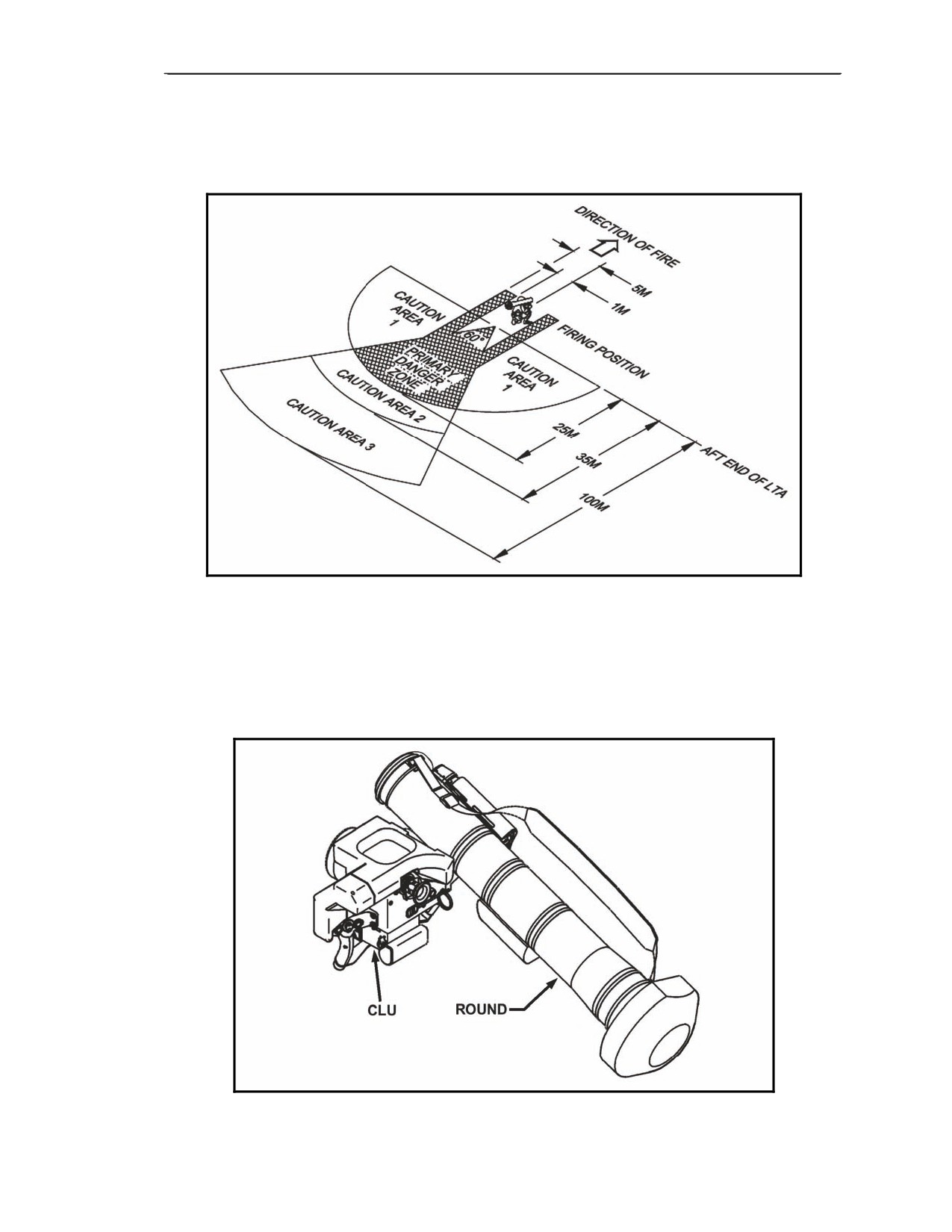
1-7. Figure 1-5 shows the Javelin backblast danger area. The primary danger area is a 60-degree
sector, with the apex of the sector at the aft end of the missile launch motor. For more safety
information, see Appendix A.
Figure 1-5. Javelin backblast safety zones.
COMMAND LAUNCH UNIT
1-8. The M98A1 CLU attaches to the LTA, the only reusable portion of the Javelin system
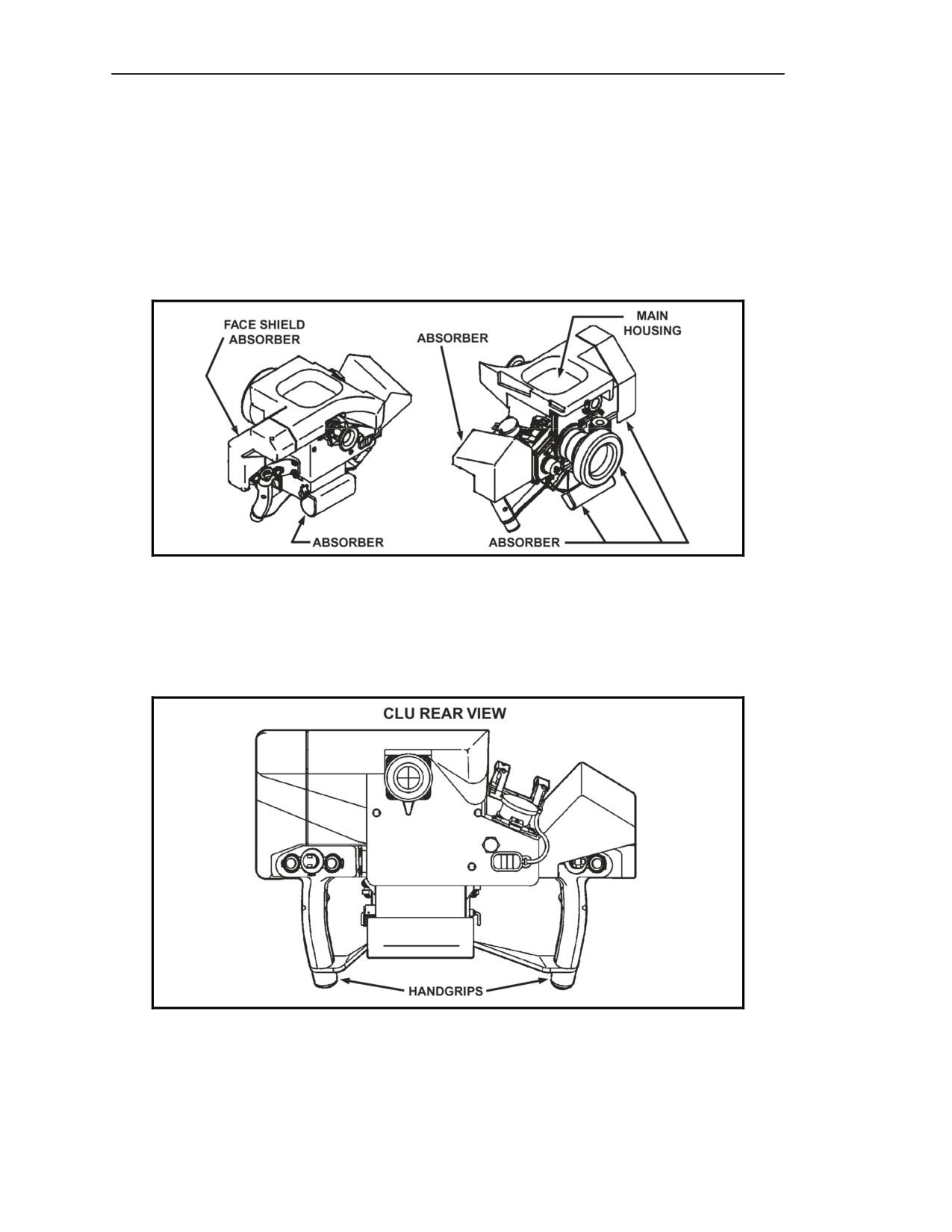
(Figure 1-6). It consists of a main housing, shock absorbers, handgrips, battery compartment, daysight,
NVS, eyepiece, test connector, and round interface connector.
Figure 1-6. Javelin components.
20 March 2008
FM 3-22.37
1-5
Chapter 1
MAIN HOUSING
1-9. The main housing (body) of the CLU (Figure 1-7) contains the system’s electronics, the display,
daysight, and NVS.
ABSORBERS
1-10. The absorbers (Figure 1-7) around the main housing of the CLU help protect the equipment
during operation. The absorbers are replaceable. One absorber is a face shield that protects the
gunner’s face during missile launch.
Figure 1-7. Main housing and absorbers.
HANDGRIPS
1-11. The gunner uses the handgrips attached to the sides of the main housing (Figure 1-8) to hold the
CLU. The gunner uses the controls on the handgrips for all Javelin operations.
Figure 1-8. Handgrips.
1-6
FM 3-22.37
20 March 2008
Introduction
BATTERY COMPARTMENT
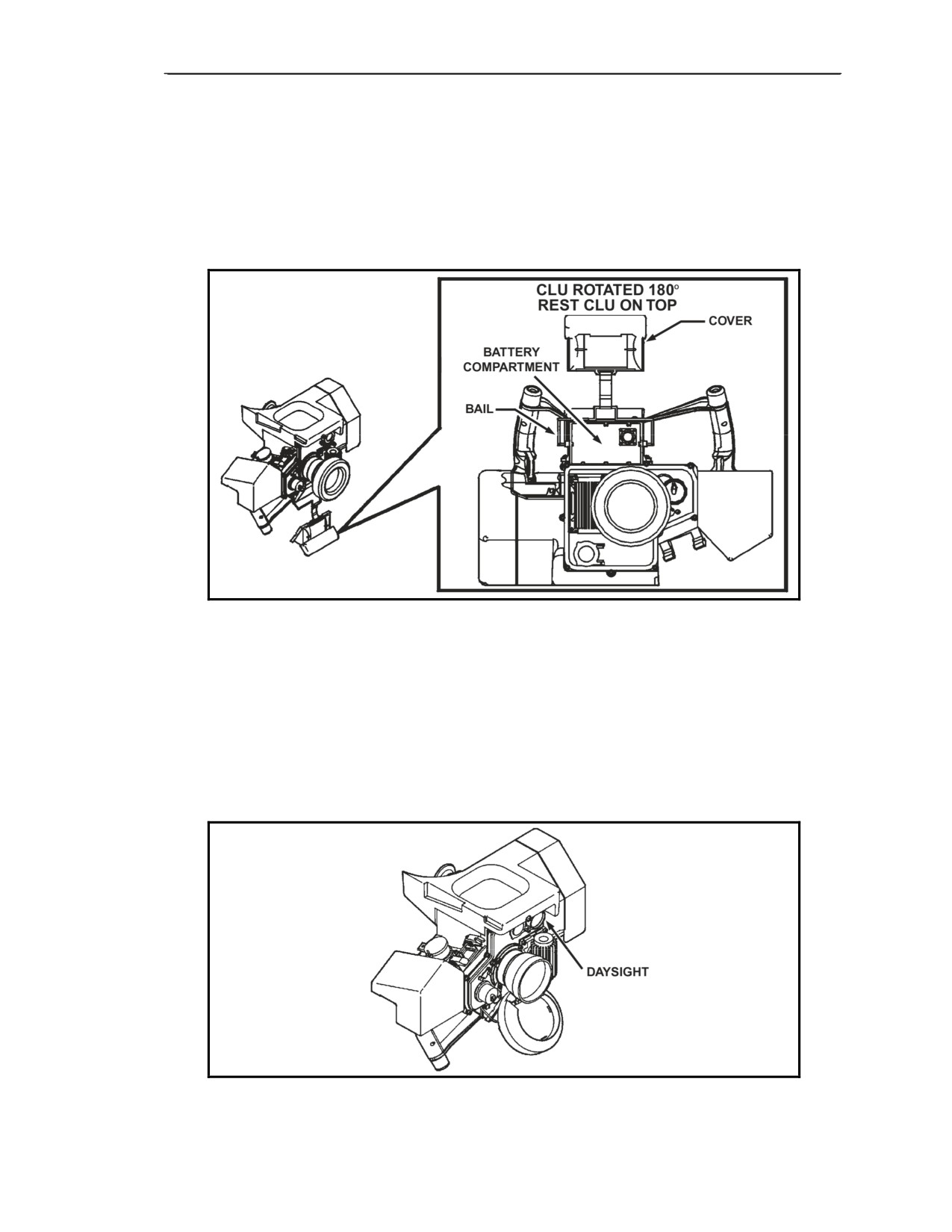
1-12. Located on the bottom of the main housing, the battery compartment (Figure 1-9) houses the
nonrechargeable BA-5590/U or the rechargeable BB390A battery (for training use only). The same
battery is used in the single-channel ground and airborne radio system (SINCGARS) and can be
interchanged with the CLU. A connector on the battery compartment joins to a corresponding
connector on the battery. A wire bail holds the detachable battery compartment cover in place.
Figure 1-9. Battery compartment.
DAYSIGHT
1-13. The daysight works much like a telescope and consists of a lens, status indicators, and an
eyepiece (Figure 1-10). The daysight—
z
Provides the gunner visible light imagery with 4x magnification for target viewing and
battlefield surveillance.
z
Can be used with the power off for surveillance to conserve battery life.
z
Is not affected by IR clutter.
Figure 1-10. Daysight.
20 March 2008
FM 3-22.37
1-7
Chapter 1
NIGHT VISION SIGHT
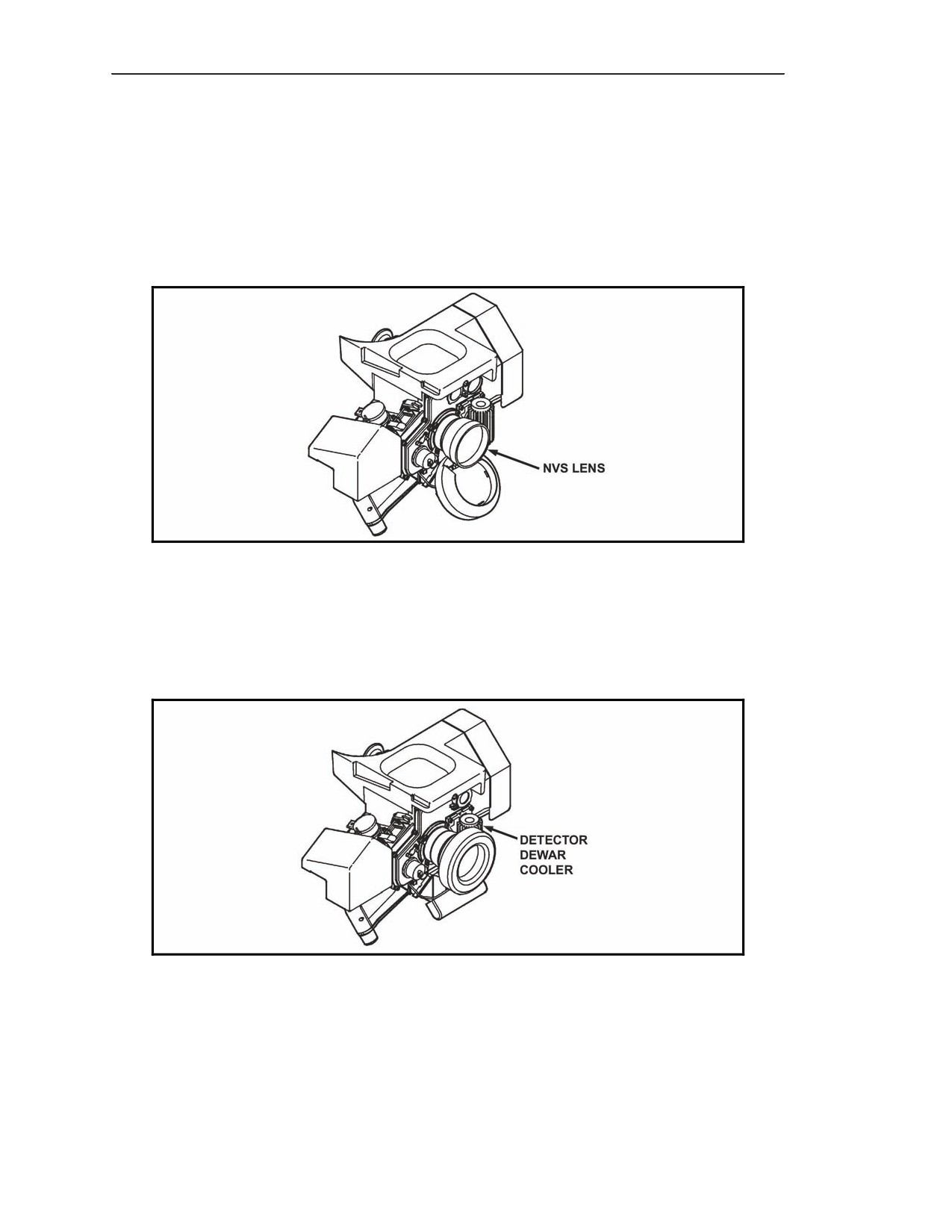
1-14. The NVS is the primary sight used by the gunners (Figure 1-11) during the day or night. This
imaging infrared (I2R) system allows the gunner to see during limited visibility conditions, including
darkness, obscuration, smoke, fog, inclement weather, and IR clutter. The NVS operates by converting
an IR target image to a visible light image for the gunner. The NVS consists of the NVS lens, a
detector dewar cooler (DDC), a CLU display, and an eyepiece that provides the gunner with both 4x
wide field-of-view (WFOV) and 9x narrow field-of-view (NFOV) magnification for scanning and
target detection.
Figure 1-11. Night vision sight lens.
Detector Dewar Cooler
1-15. The DDC (Figure 1-12) cools the NVS to the proper operating temperature and converts IR
energy to electrical signals. These signals are sent to the CLU display by way of the signal processor to
provide the gunner a picture of the target area.
Figure 1-12. Detector Dewar cooler.
1-8
FM 3-22.37
20 March 2008
Introduction
Command Launch Unit Display
1-16. Similar to a miniature television, the CLU display is used to make the WFOV, NFOV, and
seeker IR images visible to the gunner.
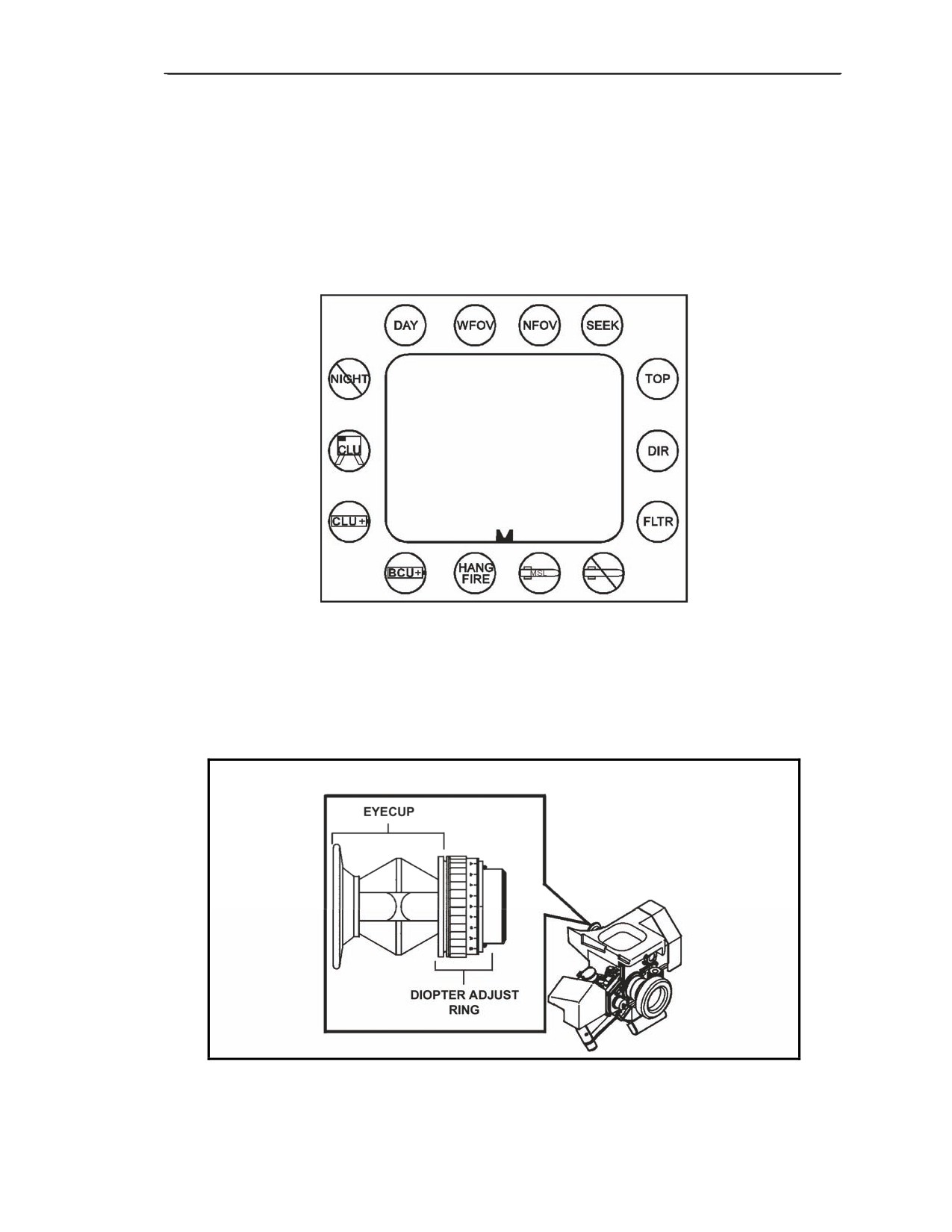
1-17. The green, amber, and red icon indicators (Figure 1-13) that surround the CLU display identify
operational modes, conditions, and malfunctions. Visible during day and night use, these indicators
provide the gunner with continuous feedback on missile readiness or possible system malfunctions. All
indicators will be explained in detail in Chapter 2.
Figure 1-13. Status indicators.
Eyepiece
1-18. The eyepiece (Figure 1-14) allows the gunner to see the CLU display. Through the eyepiece, the
gunner sees the DAY FOV, WFOV, NFOV, seeker FOV, and the status indicators. The eyepiece
consists of a lens assembly, eyecup, and diopter adjust ring.
Figure 1-14. Eyepiece.
20 March 2008
FM 3-22.37
1-9
Chapter 1
Test Connector
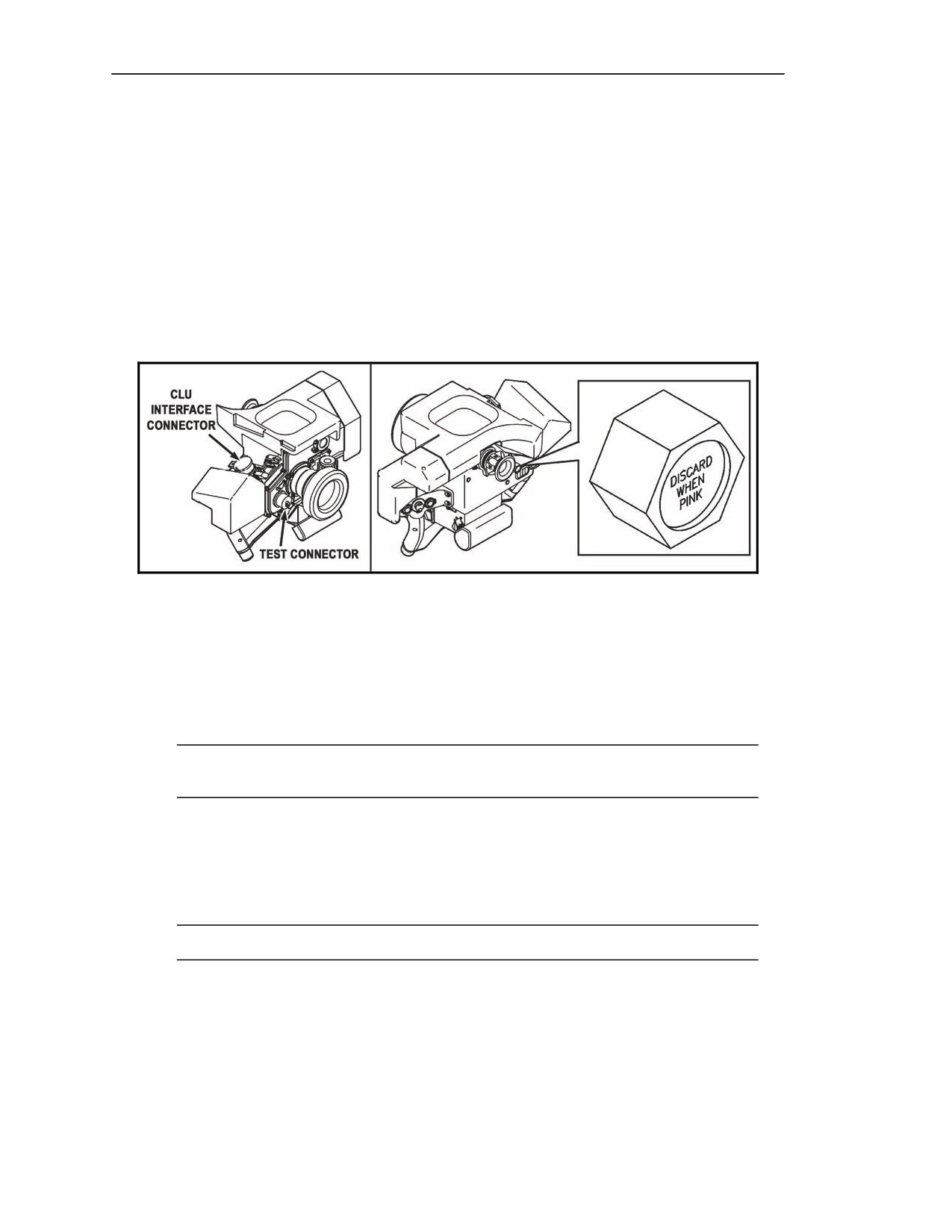
1-19. The test connector (Figure 1-15) is used to perform field- or higher-level maintenance and to
interface with the FTT.
Round Interface Connector
1-20. The round interface connector (Figure 1-15) provides the electrical connection between the CLU
and the round.
Humidity Indicator
1-21. The humidity indicator (Figure 1-15) displays the quality of the air inside the CLU (white or
blue within acceptable levels; pink requires maintenance).
Figure 1-15. Test connector, round interface connector, and humidity indicator.
ROUND
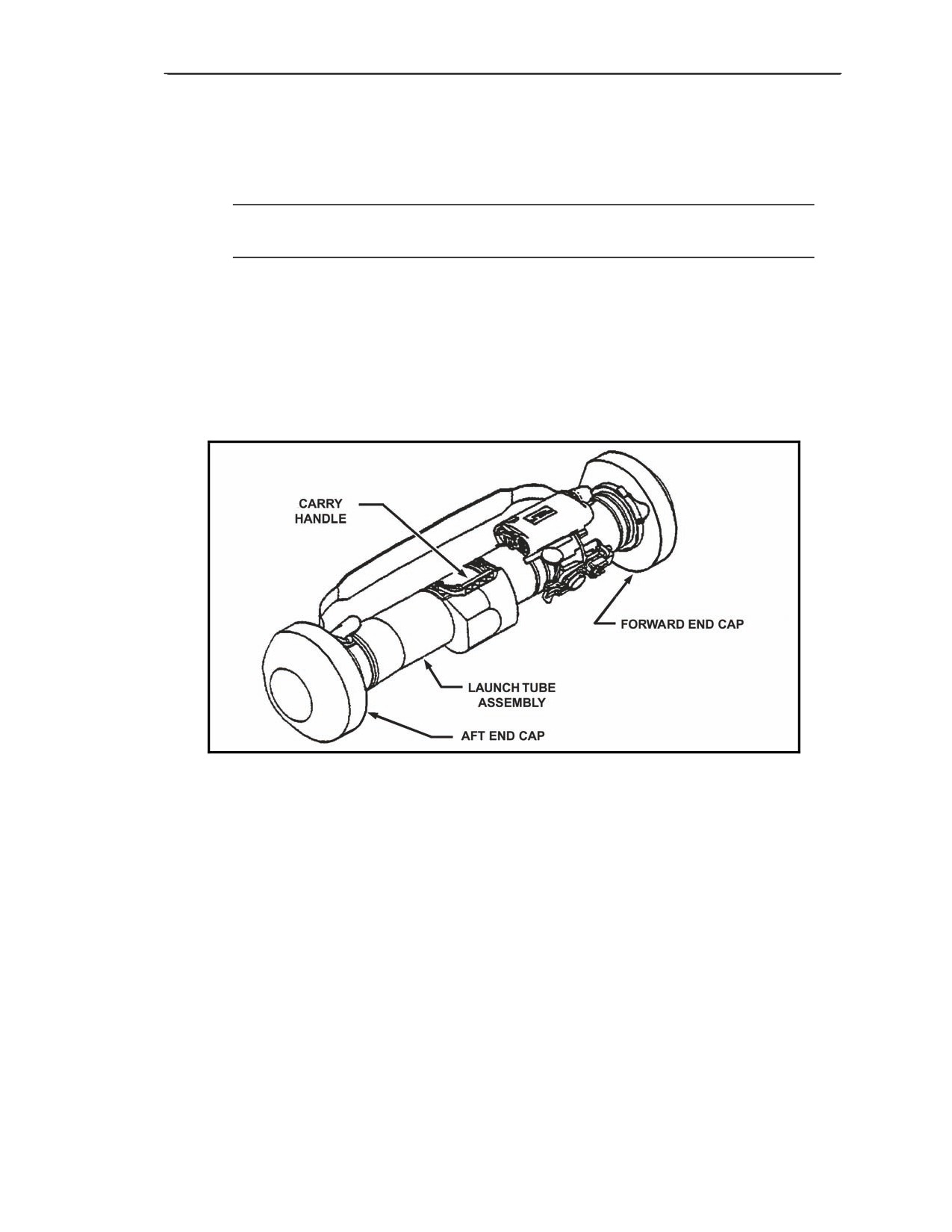
1-22. The round consists of the LTA, the BCU, and the missile (Figure 1-16). The LTA interfaces with
the CLU and serves both as a handling container and launch platform for the missile. The LTA consists
of a launch tube, forward and aft end caps, carry handle, shoulder strap, CLU interface connector, and
shoulder pad.
NOTE: The round has a 10-year shelf life. The only maintenance requirement is stockpile
surveillance.
LAUNCH TUBE
1-23. The launch tube houses the missile. It is a single-piece, composite graphite/epoxy design. The
launch tube protects the missile from the environment before the missile is launched. All other LTA
components mount externally on the tube.
NOTE: Once the missile is launched, the LTA is discarded.
END CAPS
1-24. Two end caps protect the missile from damage during transport and handling.
1-10
FM 3-22.37
20 March 2008
Introduction
Forward End Cap
1-25. The forward end cap (Figure 1-16) protects the seeker dome from moisture, dust, and other
elements that could harm it. The forward end cap is removed when preparing for launch. The pressure
release valve is used to reduce the pressure in the LTA so the forward end cap can be removed.
NOTE: If the missile is not fired, ensure that the LTA is clear of debris, and replace the
forward end cap to protect the seeker dome.
Aft End Cap
1-26. The aft end cap (Figure 1-16) is permanently attached to the LTA. The center of the cap is blown
out by the launch motor blast during launch.
CARRY HANDLE
1-27. The carry handle (Figure 1-16) is used to lift and carry the round.
Figure 1-16. Launch tube assembly, end caps, and carry handle.
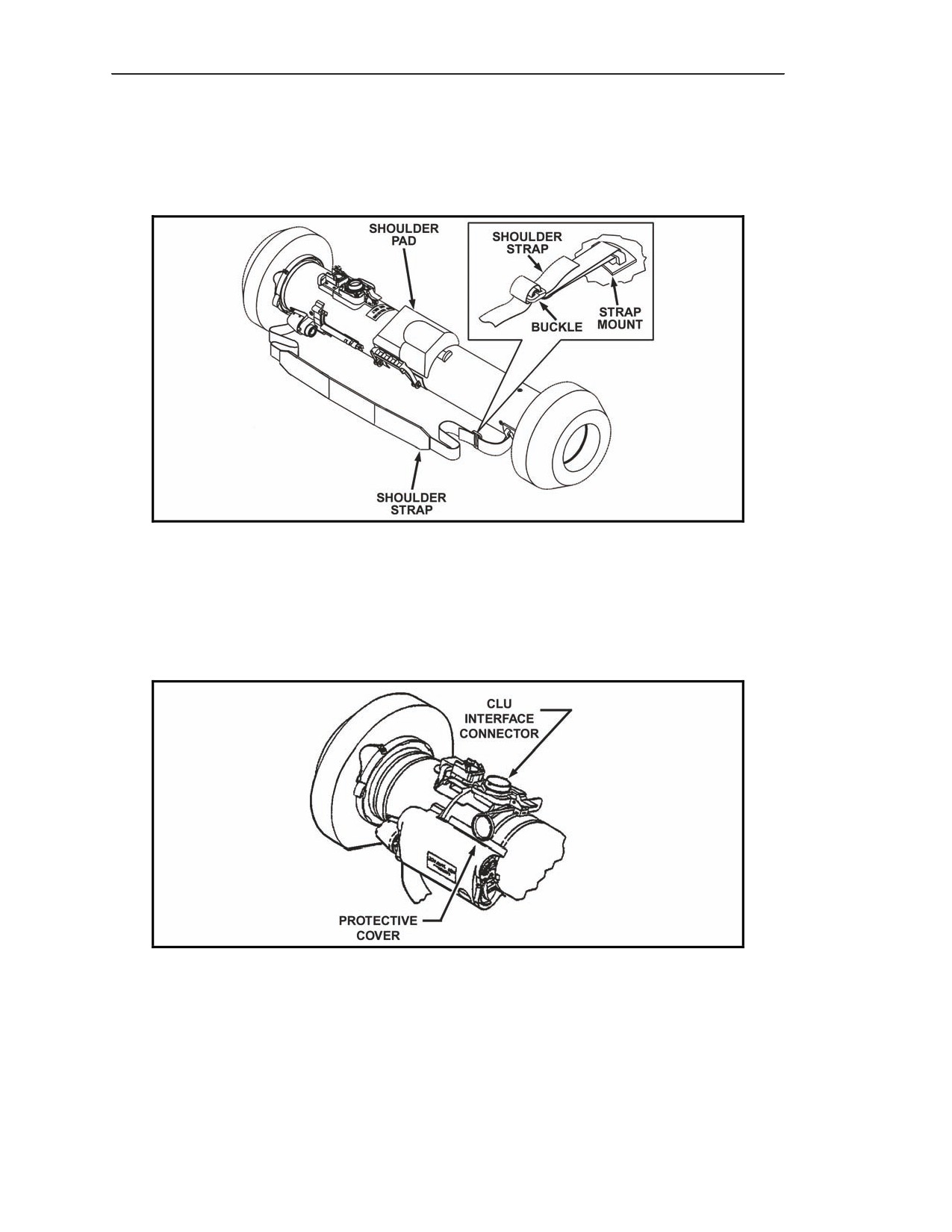
SHOULDER STRAP
1-28. The adjustable shoulder strap (Figure 1-17) provides a means for carrying the round.
20 March 2008
FM 3-22.37
1-11
Chapter 1
SHOULDER PAD
1-29. The shoulder pad (Figure 1-17) provides balance and support when the round is placed on the
gunner’s shoulder.
Figure 1-17. Shoulder strap and pad.
COMMAND LAUNCH UNIT INTERFACE CONNECTOR
1-30. The CLU interface connector (Figure 1-18) provides the electrical interface between the round
and CLU. Signals are passed through the connector between the CLU and round, which includes:
digital information, power, and seeker image signals.
Figure 1-18. Command launch unit interface connector.
1-12
FM 3-22.37
20 March 2008
Introduction
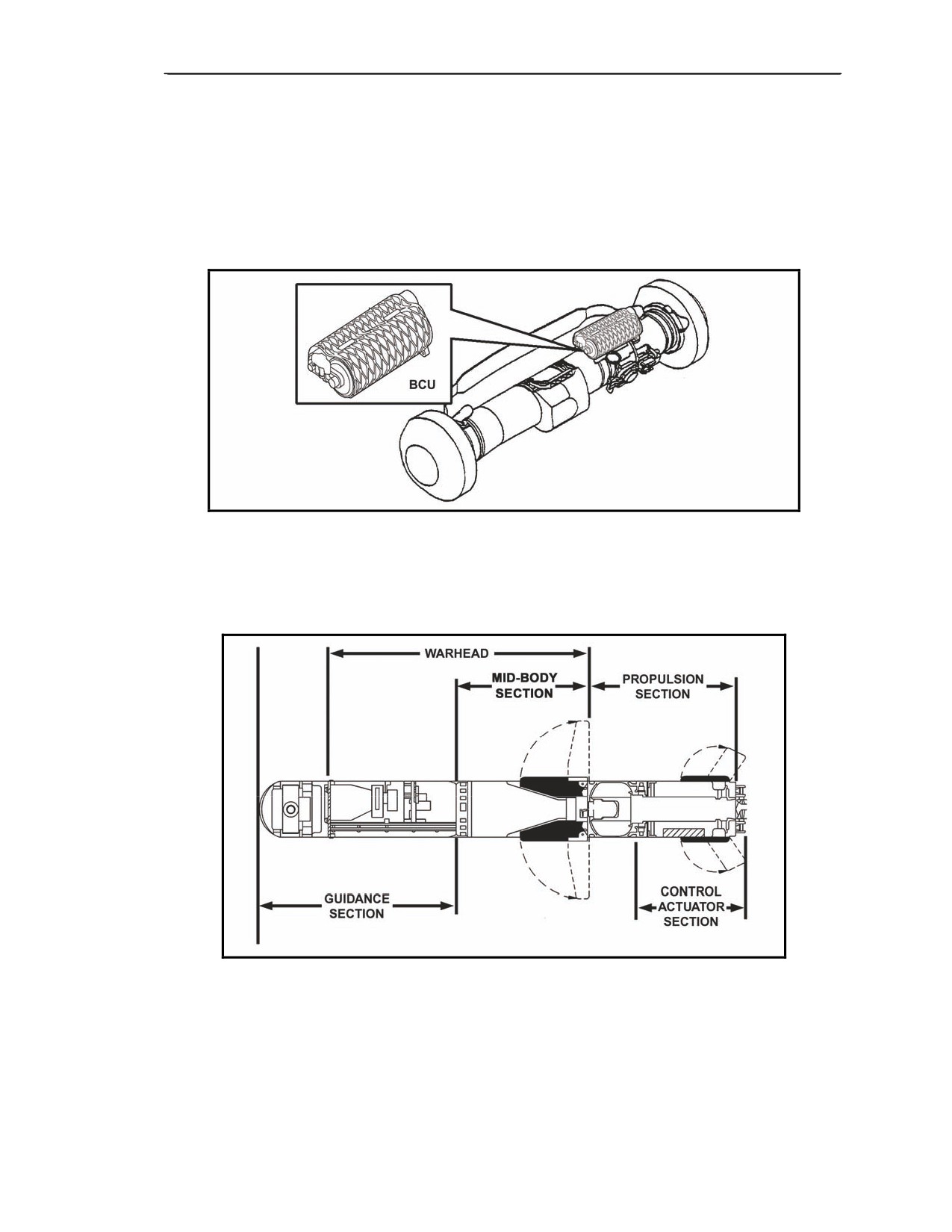
BATTERY COOLANT UNIT
1-31. The BCU (Figure 1-19) consists of a battery section and a compressed-gas coolant section.
Before missile launch, the battery section powers the missile electronics, and the coolant section cools
the missile seeker to its operating temperature. The BCU is a single-use unit with 4 minutes of
operating time; it is not rechargeable. Once the missile has been fired, the spent BCU is discarded with
the LTA.
Figure 1-19. Battery coolant unit.
MISSILE
1-32. The Javelin missile is environmentally sealed in the LTA (Figure 1-20).
Figure 1-20. Javelin missile.
20 March 2008
FM 3-22.37
1-13
Chapter 1
MISSILE OPERATION
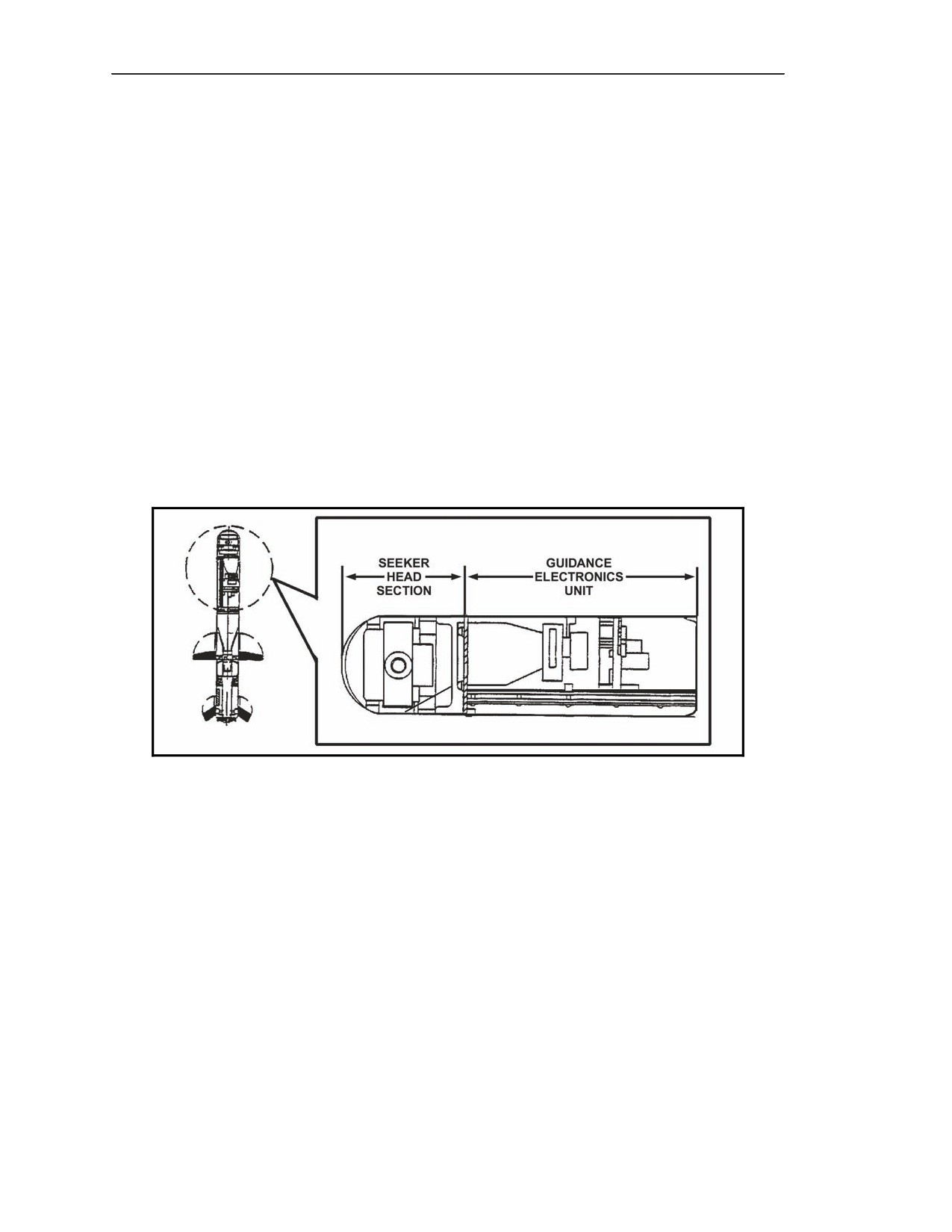
1-33. The missile consists of the guidance section, the mid-body section, the warhead, the propulsion
section, and the control actuator section (Figure 1-21).
GUIDANCE SECTION
1-34. The guidance section (Figure 1-21) provides target tracking and flight control signals. It is the
forward section of the missile and includes the seeker head section and the guidance electronics unit.
Seeker Head
1-35. The seeker head section, known as the seeker, contains the missile I2R system and the contact
switches used to detonate the warhead. The missile I2R system gives the missile its fire-and-forget
capability. During flight to the target, the missile I2R system tracks the target and sends target location
information to the onboard guidance electronics unit.
Guidance Electronics Unit
1-36. The guidance electronics unit serves two functions. It controls the seeker head so that it looks at the
target, and it sends signals to the control actuator section to guide the missile to the target during flight.
Figure 1-21. Missile guidance section.
MID-BODY SECTION
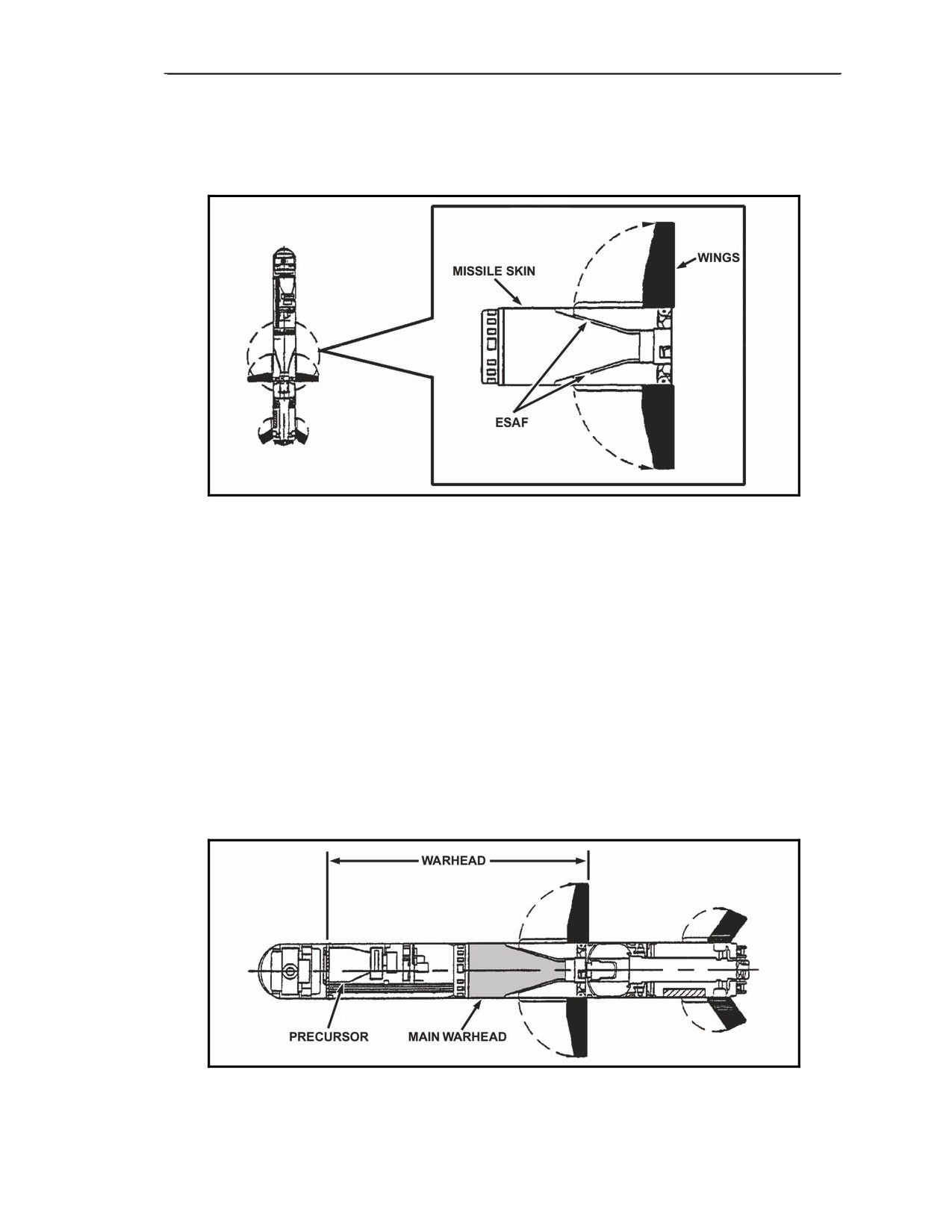
1-37. The mid-body section includes the missile skin; electronic safe, arm, and fire unit (ESAF);
wings; and the main charge of the warhead (Figure 1-22).
Missile Skin
1-38. The missile skin is a structural part of the missile and provides environmental protection for the
internal components during flight.
Electronic Safe, Arm, and Fire
1-39. The ESAF is the principal safety device that prevents accidental ignition of the motors and
accidental warhead detonation. The ESAF consists of circuits and two detonators
(one for the
precursor and one for the main charge). The ESAF controls missile launch sequence and warhead
detonation. It permits starting the rocket motors in the proper sequence when the gunner pulls the fire
trigger and all other firing conditions have been met. When the missile hits the target, the ESAF
detonates each warhead charge in sequence.
1-14
FM 3-22.37
20 March 2008
Introduction
Wings
1-40. The wings provide lift and keep the missile stabilized during flight. The wings fold into slots in
the missile skin when the missile is in the LTA and deploy into flight position after clearing the LTA.
Figure 1-22. Mid-body section.
WARHEAD SECTION
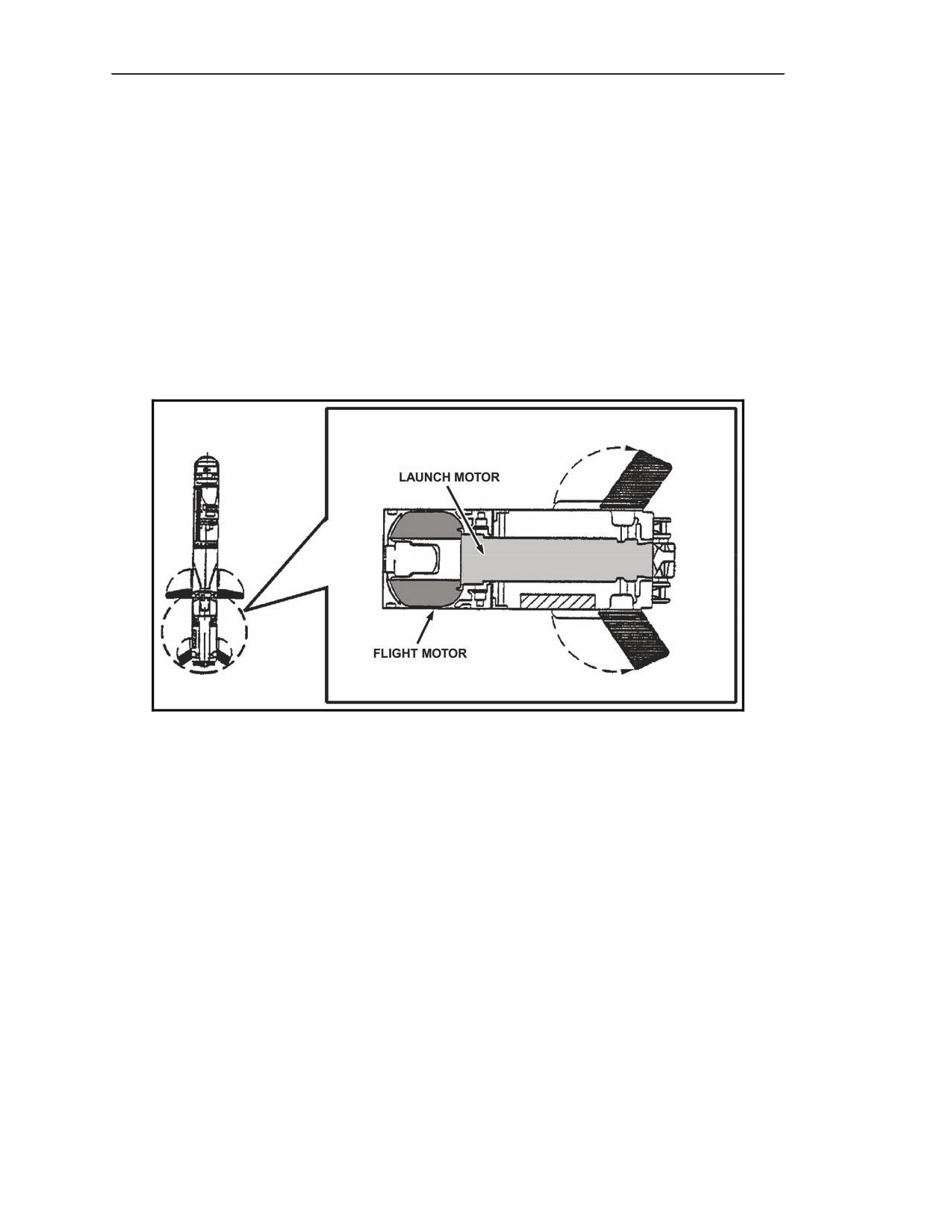
1-41. The Javelin missile uses a dual-charged warhead (Figure 1-23). The warhead has a precursor
charge and a main charge.
Precursor Charge
1-42. The precursor charge is a high-explosive (HE) shaped charge. Its purpose is to cause the target's
reactive armor to detonate before the main charge reaches the armor. Once the reactive armor is
penetrated, the target’s main hull is exposed to the warhead’s main charge. If the target is not equipped
with reactive armor, the precursor charge provides additional explosives to penetrate the main armor.
Main Charge
1-43. The main charge is the second charge of a dual-charge warhead and is also an HE shaped charge.
The primary warhead charge is designed to penetrate the target’s main armor to achieve a target kill.
Figure 1-23. Missile warhead.
20 March 2008
FM 3-22.37
1-15
Chapter 1
PROPULSION SECTION
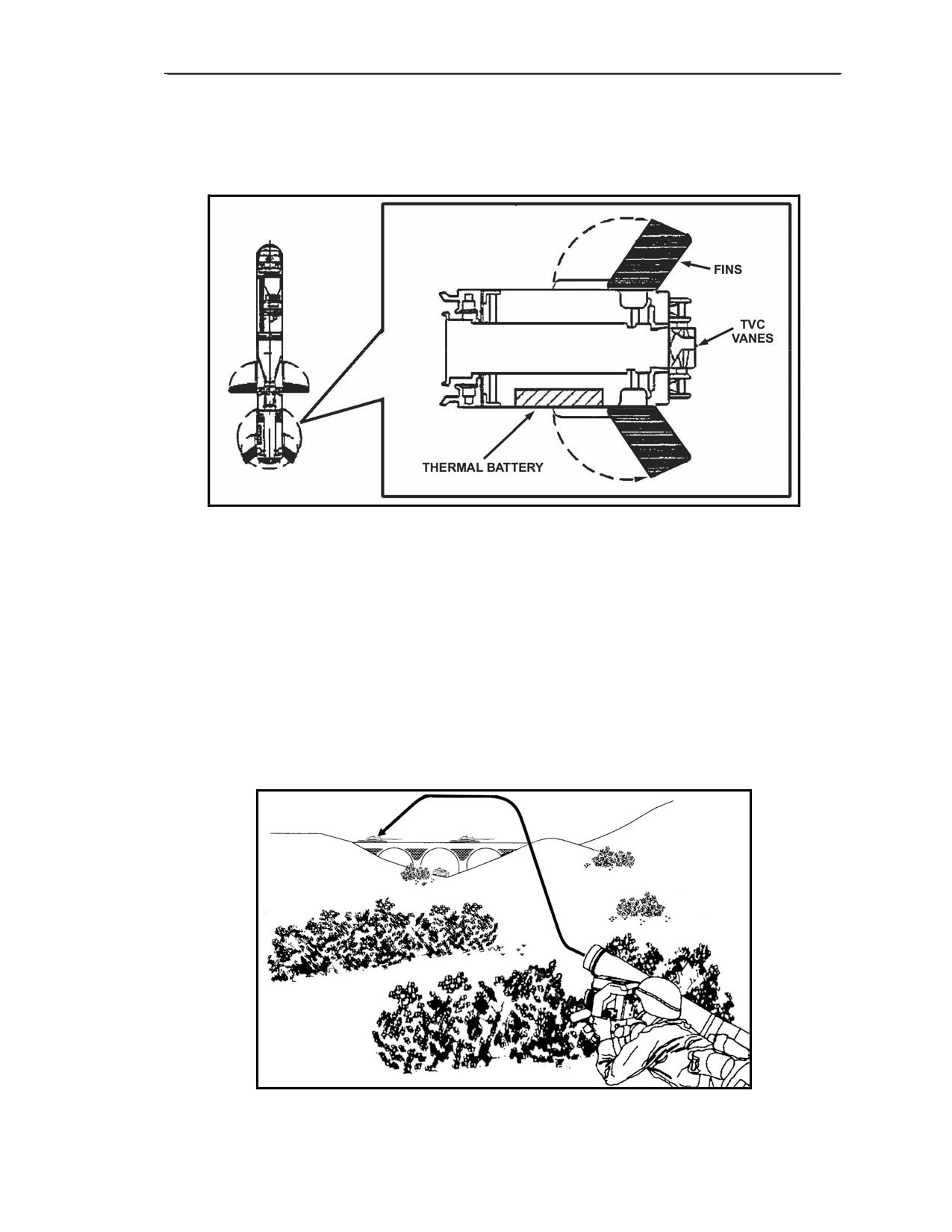
1-44. The propulsion section (Figure 1-24) consists of the launch and flight motors.
Launch Motor
1-45. The launch motor propels the missile out of the LTA. It provides the initial force to push the
missile a safe distance from the gunner before the flight motor ignites to ensure the gunner’s safety.
The launch motor is completely spent by the time the missile clears the LTA, this accounts for the low
signature after launch.
Flight Motor
1-46. The flight motor powers the missile to the target during flight. It ignites when the missile is a
safe distance from the gunner, protecting the gunner from hot exhaust gases generated when the motor
fires.
Figure 1-24. Missile propulsion section.
CONTROL ACTUATOR SECTION
1-47. The control actuator section (Figure 1-25) maneuvers the missile during flight and provides
internal electrical power. The control actuator section consists of four control fins, four thrust vector
control (TVC) vanes, and a thermal battery.
Control Fins
1-48. The control fins maneuver the missile during flight. The spring-loaded fins automatically deploy
and lock into flight position after the missile clears the LTA. During flight, they adjust automatically to
guide the missile to the target.
Thrust Vector Control Vanes
1-49. The TVC vanes aid the control fins in maneuvering the missile during flight by deflecting the
flight motor exhaust. This control changes the angle of thrust from the flight motor, resulting in a
change to the missile’s flight path.
1-16
FM 3-22.37
20 March 2008
Introduction
Thermal Battery
1-50. The thermal battery provides internal electrical power for the missile during flight. It is sealed in
the body of the missile.
Figure 1-25. Control actuator section.
CAPABILITIES AND FEATURES
1-51. The missile has two gunner-selectable attack modes: top or direct. Each mode has its own flight
path or profile for reaching the target.
TOP ATTACK MODE
1-52. The top attack is the default mode when the missile seeker is first activated. In the top attack
mode, the missile approaches from above to impact and detonate on the top of the target (Figure 1-26).
This capacity allows the gunner to attack a vehicle from the front, rear, or the side and greatly
increases the probability of a kill. Vehicles usually have less protection on top. The minimum
engagement distance is 150 meters.
Figure 1-26. Top attack mode.
20 March 2008
FM 3-22.37
1-17
Chapter 1
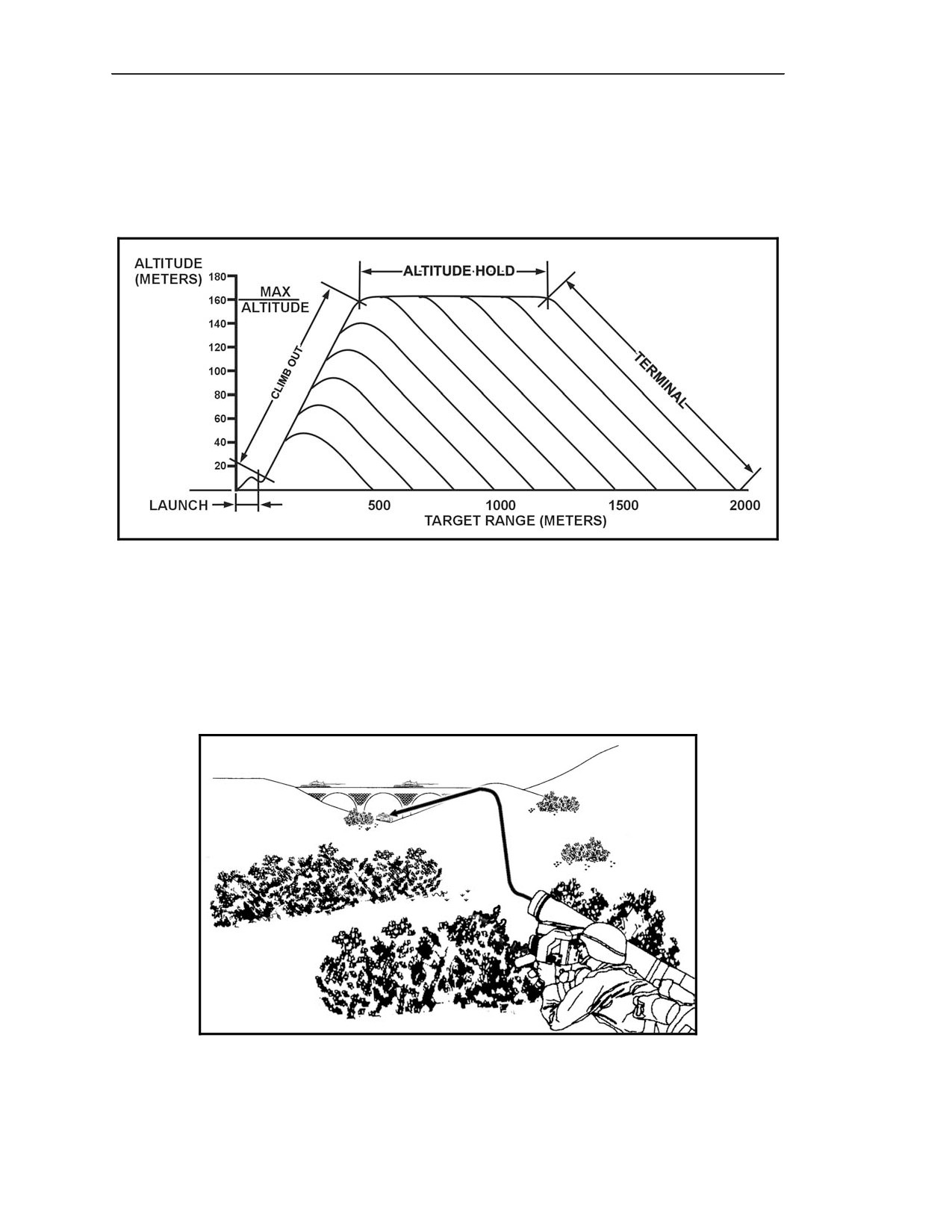
1-53. The exact profile of the missile flight path depends on the range to the target and is determined
automatically by the missile’s onboard software). When firing at a 2,000-meter target, the missile
reaches a height of about 160 meters above the battlefield (Figure 1-27). If the target is under a
protective structure, using the top attack mode will cause the missile to detonate on the structure
instead of on the target. The gunner can select the direct attack mode to counter targets hiding under
protective cover.
Figure 1-27. Top attack flight path.
DIRECT ATTACK MODE
1-54. The direct attack mode can be selected only after seeker cooldown and before lock-on. The
gunner pushes the attack select (ATTK SEL) switch on the right handgrip to change attack modes. In
the direct attack mode, the missile flies on a more direct path to the target. The missile impacts and
detonates on the side (front, rear, or flank) of the target (Figure 1-28). The minimum engagement
distance is 65 meters.
Figure 1-28. Direct attack mode.
1-18
FM 3-22.37
20 March 2008
Introduction
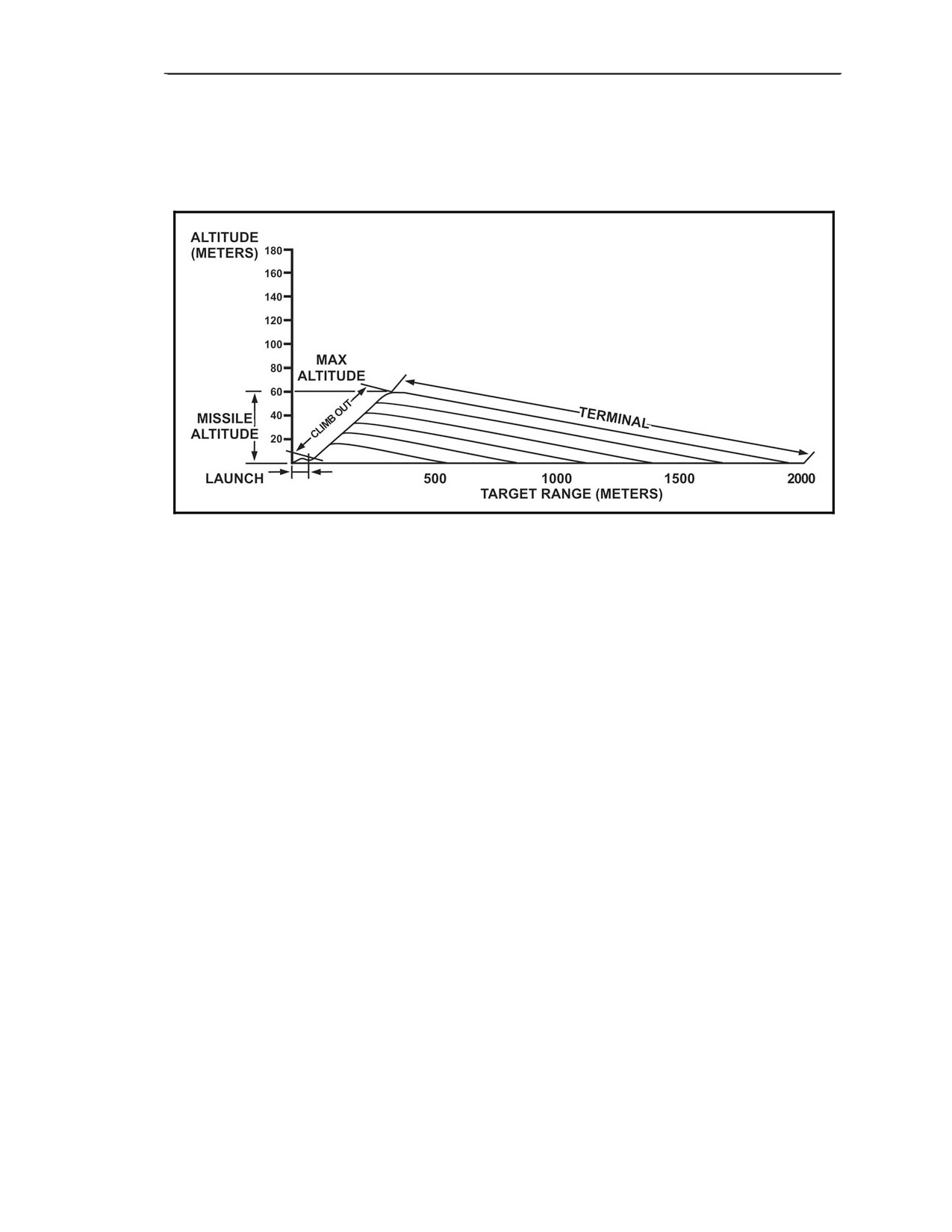
1-55. The exact profile of the missile flight path shown in a general configuration in Figure 1-29
depends on the range to the target and is determined automatically by the missile’s onboard software.
With a 2,000-meter target, the missile reaches a height of about 60 meters above the battlefield. This
path allows the missile to reach a target under a protective structure.
Figure 1-29. Direct attack flight path.
20 March 2008
FM 3-22.37
1-19
This page intentionally left blank.
Chapter 2
CONTROLS AND OPERATION
This chapter is an overview of the Javelin’s controls and indicators, operation of
the Javelin, and CLU display indicators.
CONTROLS AND INDICATORS
2-1. The Javelin controls allow the gunner to perform and monitor all operations. The controls are
located on the handgrips except for the diopter adjust ring and the power switch.
DIOPTER ADJUST RING
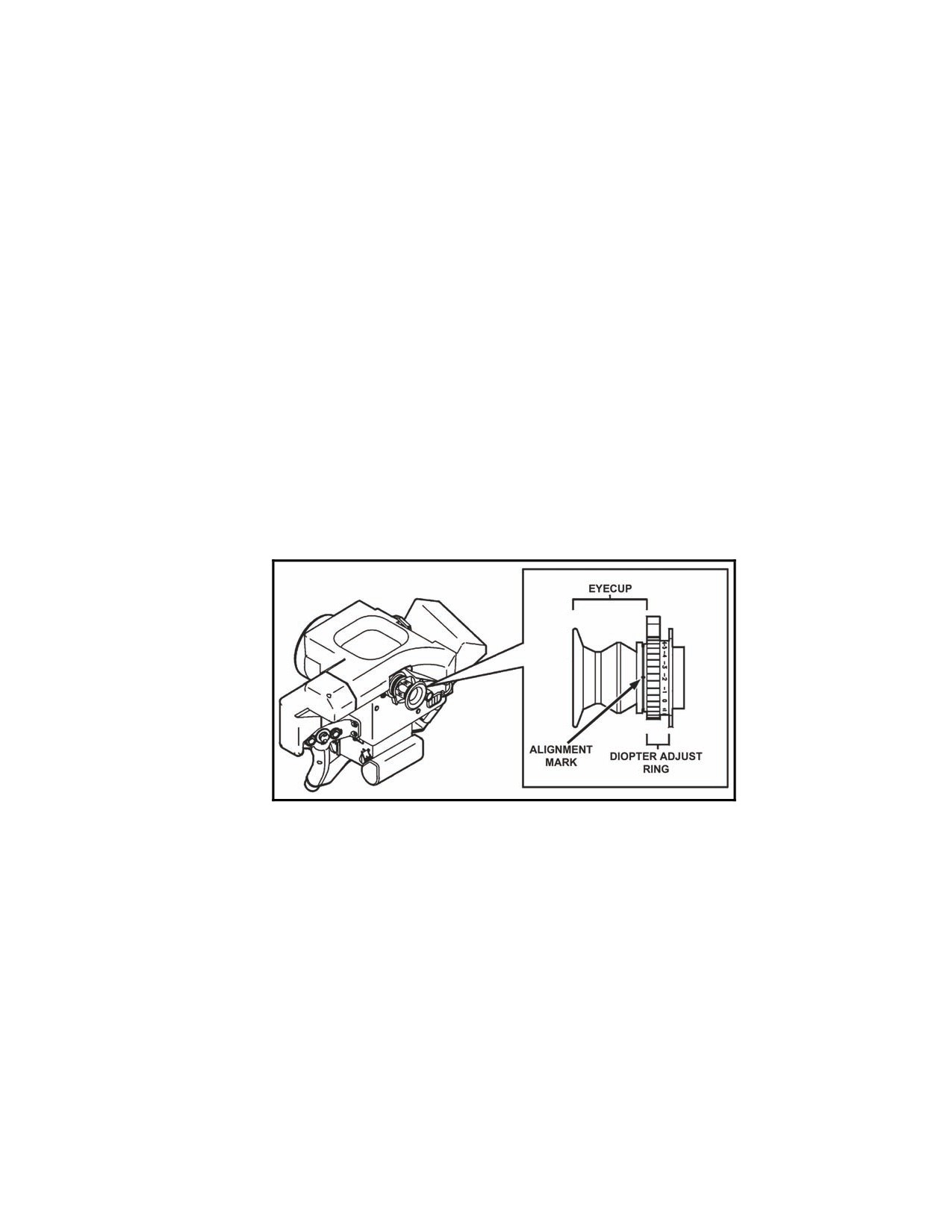
2-2. The diopter adjust ring is located on the CLU eyepiece assembly (Figure 2-1). The gunner uses
the diopter adjust ring to adjust the focus of the image. Any gunner with vision correctable to 20/20
can use the CLU to see an in-focus image without using glasses. The alignment mark is located on the
eyepiece. Align the number that corresponds with the adjustment. This adjustment is constant on all
CLUs.
Figure 2-1. Diopter adjust ring.
POWER SWITCH
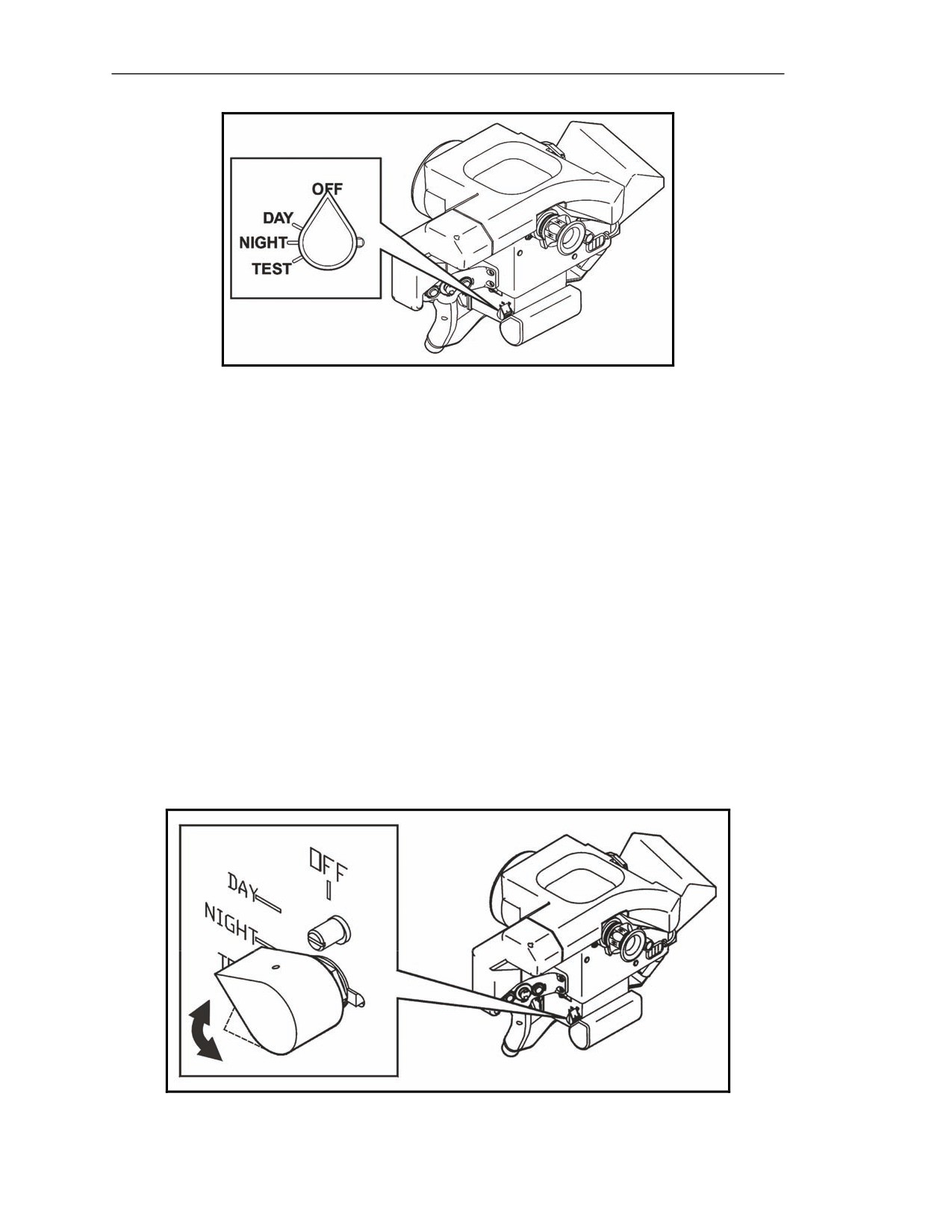
2-3. The power switch is a rotary switch located on the lower rear corner of the left-hand side of the
CLU main housing (Figure 2-2). The power switch controls the Javelin’s mode of operation and each
position brings different components of the Javelin into operation. The power switch has four
positions: OFF, DAY, NIGHT, and TEST.
20 March 2008
FM 3-22.37
2-1
Chapter 2
Figure 2-2. Power switch positions.
OFF Position
2-4. The Javelin is in the OFF mode when the power switch is in the OFF position. In this mode, no
battery power is applied to the Javelin. The day field-of-view (FOV) can be used for surveillance and target
detection, but the NVS cannot be used and the seeker cannot be activated. The missile cannot be launched.
DAY Position
2-5. The Javelin is in the DAY mode when the power switch is in the DAY position. In the day
mode, power is applied to the CLU. In the day mode, there is a day FOV but no NVS.
NIGHT Position
2-6. The Javelin is in the NIGHT mode when the power switch is in the NIGHT position. This mode
gives the gunner the full Javelin capability. Once the NVS is cooled down (about 2.5 to 3.5 minutes),
the gunner selects WFOV, NFOV, and day FOV, which gives him the full missile capability.
TEST Position
2-7. The Javelin enters a built-in test (BIT) routine (Figure 2-3) when the power switch in the TEST
position. The power switch is spring-loaded when in the test position. When the gunner moves the
power switch to the TEST position, it then returns to the NIGHT position upon release.
Figure 2-3. Power switch—TEST position.
2-2
FM 3-22.37
20 March 2008
Controls and Operation
Return to OFF
2-8. Before turning the power switch to OFF, the gunner must leave the power switch at DAY for at
least two seconds to allow the flipper mirror time to move to the power switch to the DAY position.
LEFT HANDGRIP CONTROLS
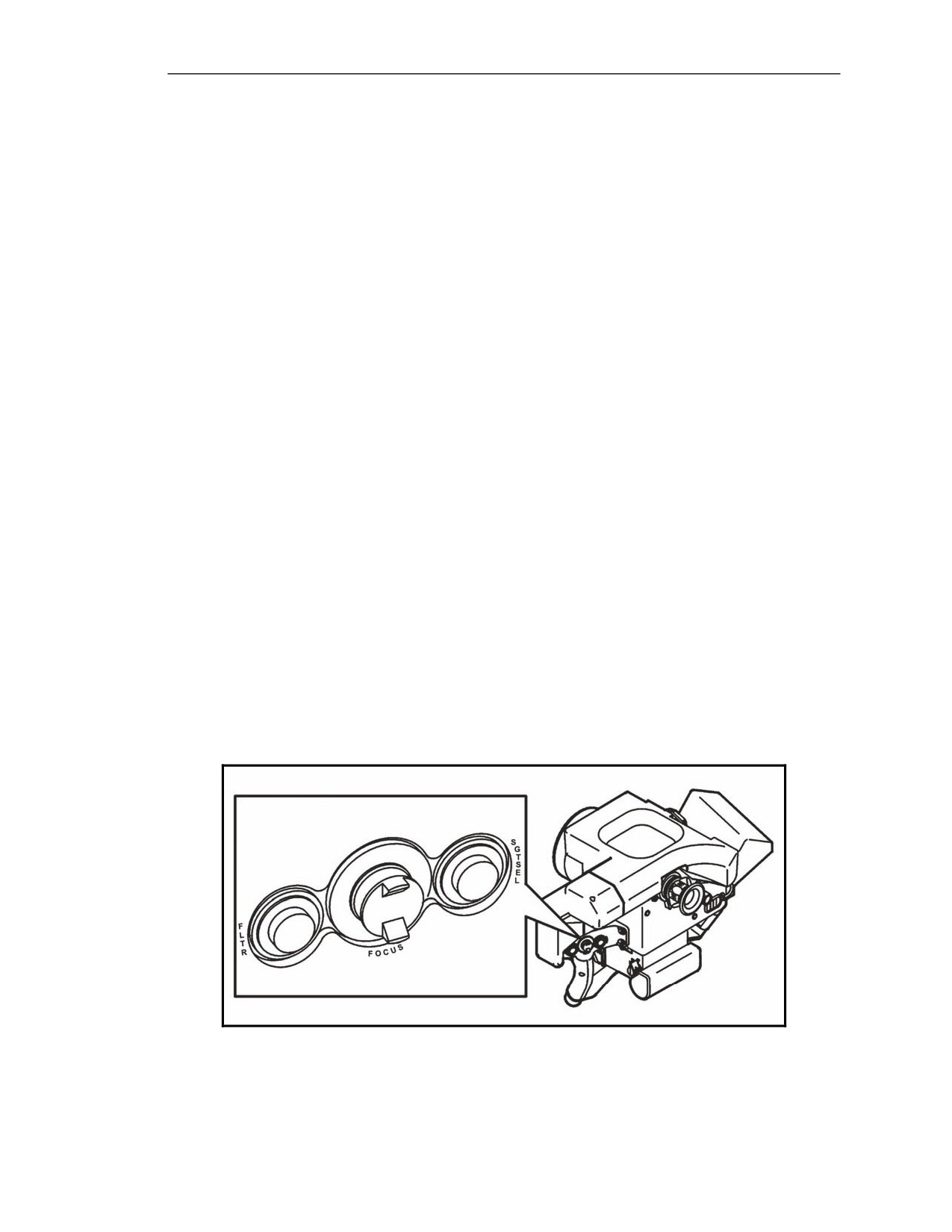
2-9. The left handgrip (Figure 2-4) has the following controls: the filter select (FLTR) switch, the
focus adjust (FOCUS) switch, the sight select (SGT SEL) switch, and the seeker trigger.
Function of Controls
2-10. These controls are used to assist the gunner in—
z
Conducting surveillance.
z
Detecting, classifying, and recognizing targets.
z
Determining target range.
z
Activating the missile seeker.
z
Reacquiring the target in seeker FOV.
z
Locking the missile seeker onto the target.
z
Assessing battle damage.
z
Activating system countermeasures.
Filter Select (FLTR) Switch
2-11. The FLTR switch (Figure 2-4) is the left switch on the left handgrip. This pushbutton switch is
used to select the NVS filter; once initiated, the NVS filter prevents the enemy from detecting the CLU.
Focus Adjust (FOCUS) Switch
2-12. The FOCUS switch (Figure 2-4) is the center switch on the left handgrip. This switch is a self-centering
toggle switch used to focus the image on the CLU display during NVS (WFOV or NFOV) operation.
Sight Select (SGT SEL) Switch
2-13. The SGT SEL switch (Figure 2-4) is the right switch on the left handgrip. This pushbutton
switch is used to select day FOV, WFOV, NFOV, or seeker FOV.
Figure 2-4. Left handgrip controls.
20 March 2008
FM 3-22.37
2-3
Chapter 2
Seeker Trigger
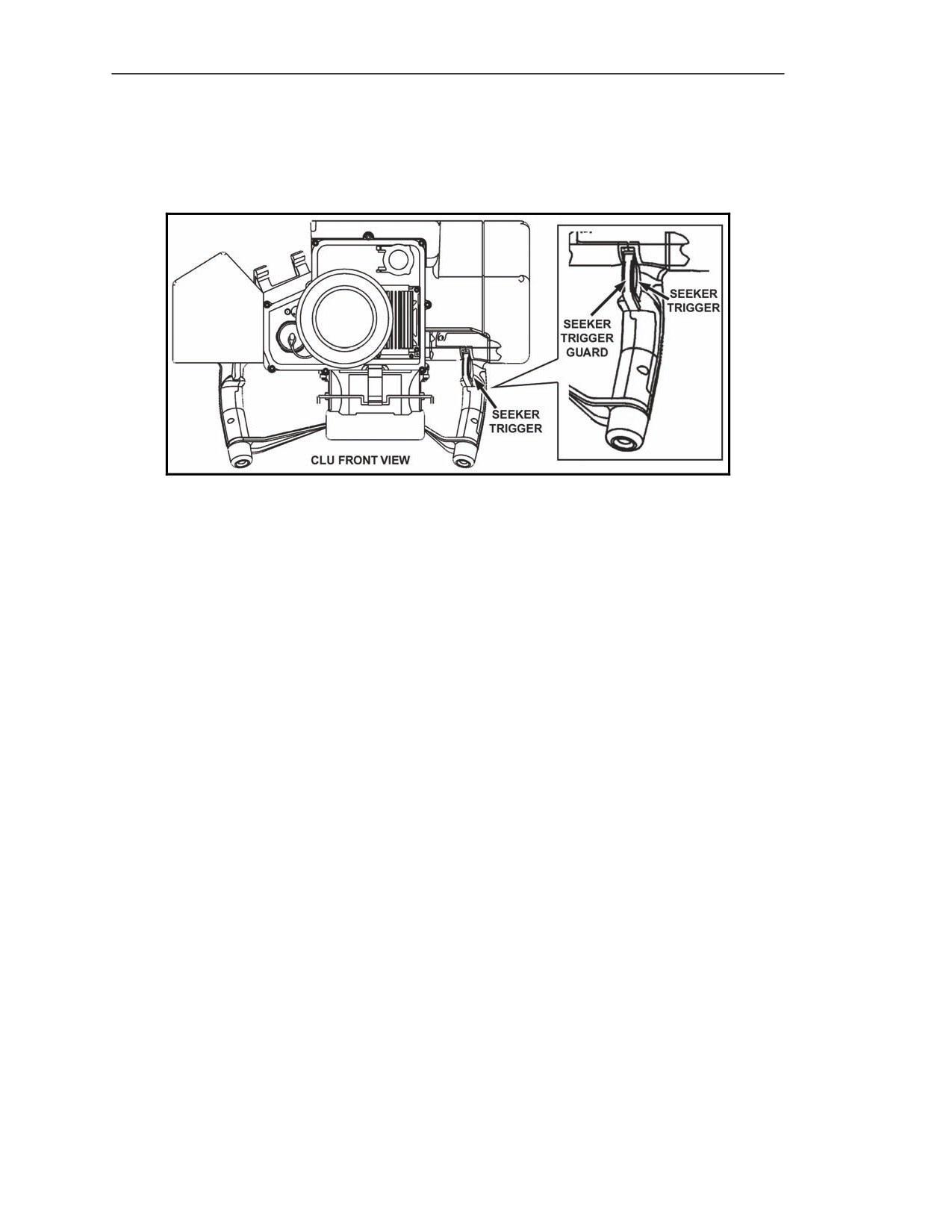
2-14. The seeker trigger (Figure 2-5) is the trigger located on the fingergrip (front) side of the left
handgrip. This trigger activates the seeker, locks the seeker onto the target, and enables the fire trigger.
A trigger guard is provided to protect against accidental activation.
Figure 2-5. Left handgrip controls—seeker trigger.
RIGHT HANDGRIP CONTROLS
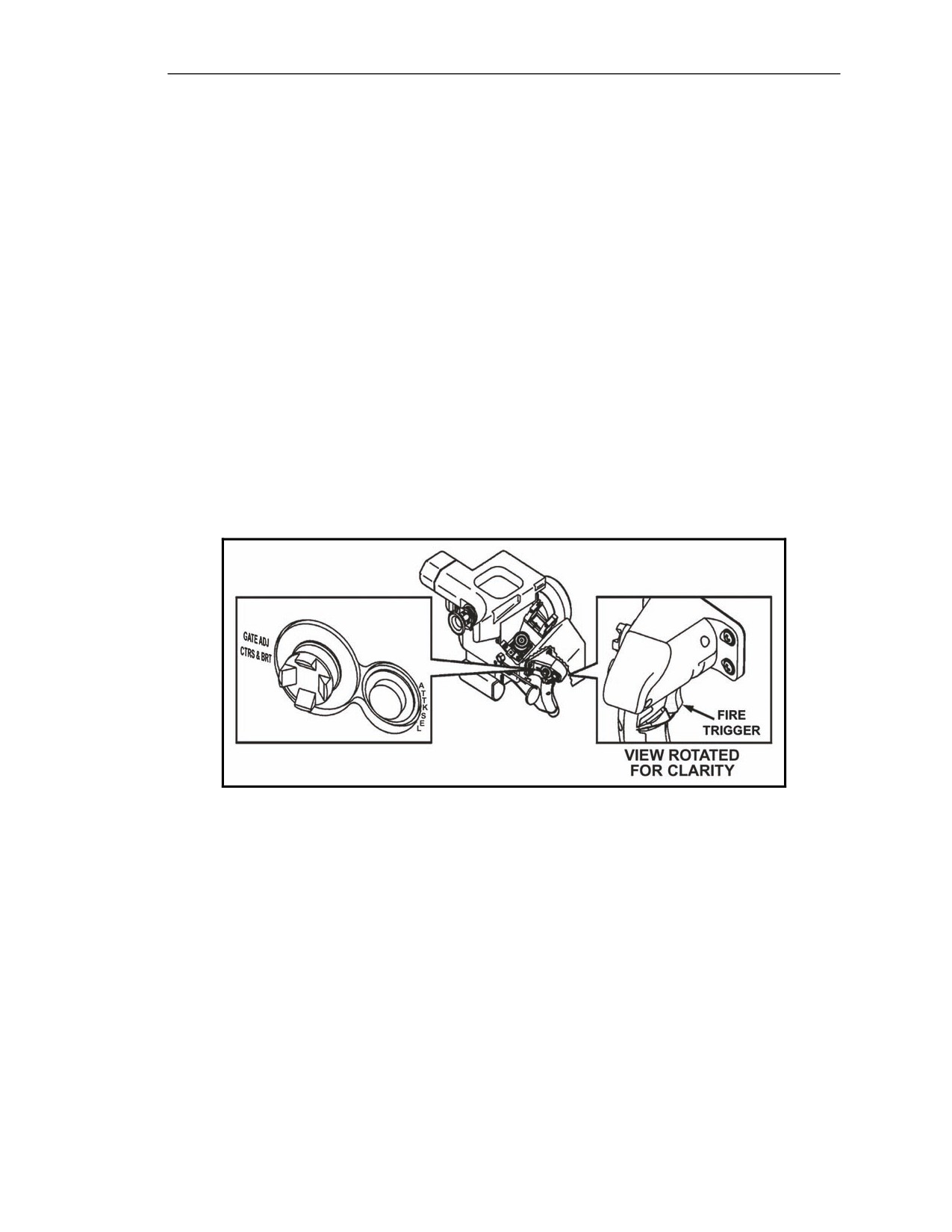
2-15. The right handgrip has the following controls: the attack select (ATTK SEL) switch, the gate
adjust/contrast and brightness (GATE ADJ/CTRS & BRT) switch, and the fire trigger (Figure 2-6).
These controls allow the gunner to—
z
Change the attack mode, if necessary.
z
Adjust the track gates so the seeker can lock onto the target.
z
Adjust NVS contrast and brightness.
z
Fire the missile.
Attack Select (ATTK SEL) Switch
2-16. The ATTK SEL switch (Figure 2-6) is the right switch on the two-switch console on the right
handgrip. This pushbutton switch allows the gunner to toggle between the top attack and direct attack
modes. The top attack mode is the default attack mode and is automatically selected when the seeker is
activated. To change the mode of attack, the gunner must be in the seeker FOV.
Gate Adjust/Contrast and Brightness (GATE ADJ/CTRS & BRT) Switch
2-17. The GATE ADJ/CTRS & BRT switch (Figure 2-6) is the left switch of the two-switch console
on the right handgrip. This self-centering switch moves up, down, left, and right. This switch serves
two functions depending on whether the CLU display image is from the NVS or the seeker.
Night Vision Sight
2-18. When a CLU image is displayed using the NVS (WFOV or NFOV), the gunner uses the GATE
ADJ/CTRS & BRT switch to adjust the contrast and brightness of the CLU display image. When the
NVS first comes up, both the brightness and contrast are electronically adjusted so that they require
minimal adjustment by the gunner.
Brightness
2-19. Brightness is adjusted by moving the GATE ADJ/CTRS & BRT switch vertically (up and
down).
2-4
FM 3-22.37
20 March 2008
Controls and Operation
Contrast
2-20. Contrast is adjusted by moving the GATE ADJ/CTRS & BRT switch horizontally (left and
right).
Seeker
2-21. When the CLU display shows the seeker (Figure 2-7) FOV, the GATE ADJ/CTRS & BRT
switch is used to adjust the size of the track gates (the track gates are the four corners of the open-sided
box shown in the seeker FOV).
UP and DOWN
2-22. UP moves the track gates apart vertically; DOWN moves the track gates together vertically.
LEFT and RIGHT
2-23. LEFT moves the track gates together horizontally; RIGHT moves the track gates apart
horizontally.
Fire Trigger
2-24. The fire trigger (Figure 2-6) is on the front side of the right handgrip at the index finger level.
When the gunner locks the missile onto the target, he squeezes and holds the seeker trigger, and then
squeezes the fire trigger to launch the missile.
Figure 2-6. Right handgrip controls.
20 March 2008
FM 3-22.37
2-5
Chapter 2
COMMAND LAUNCH UNIT STATUS INDICATORS
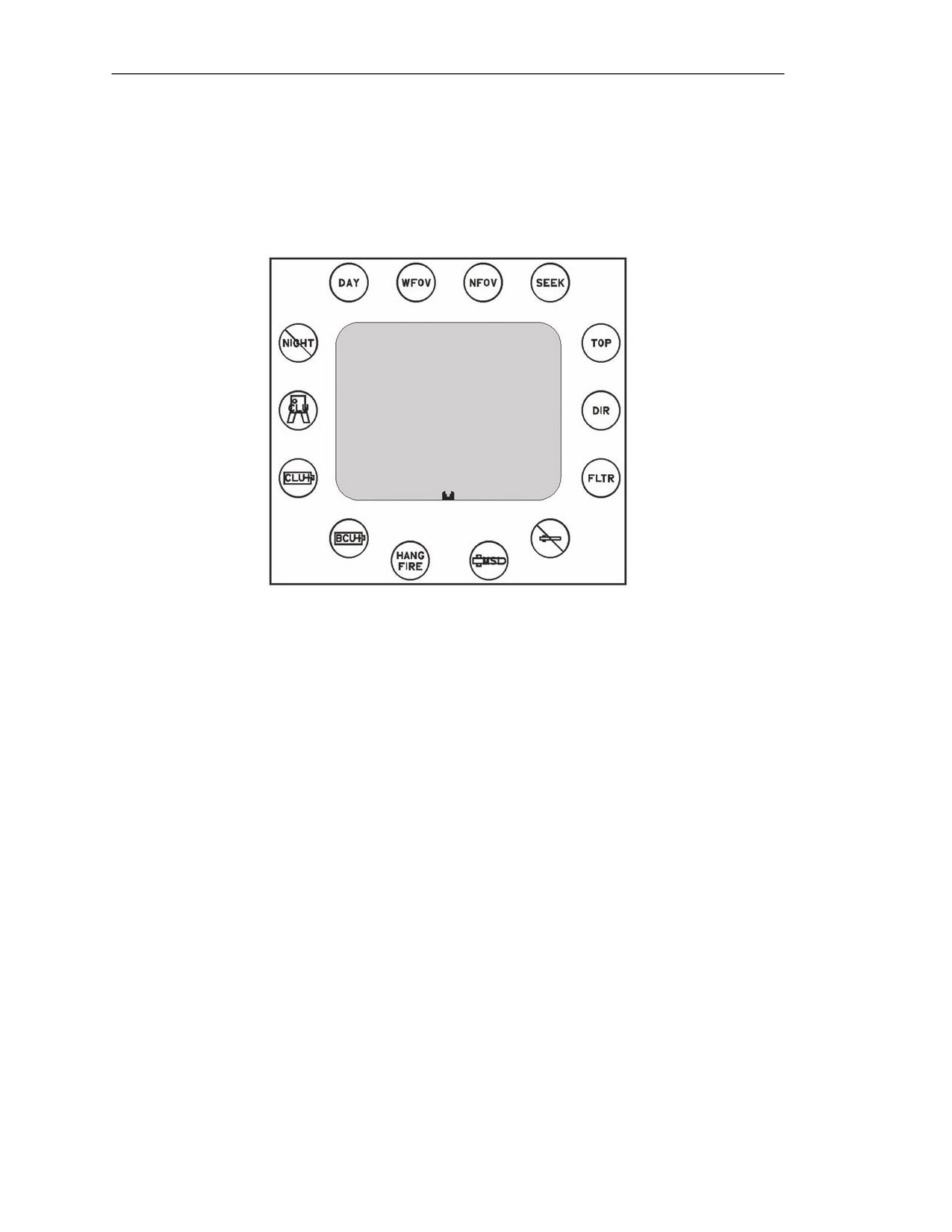
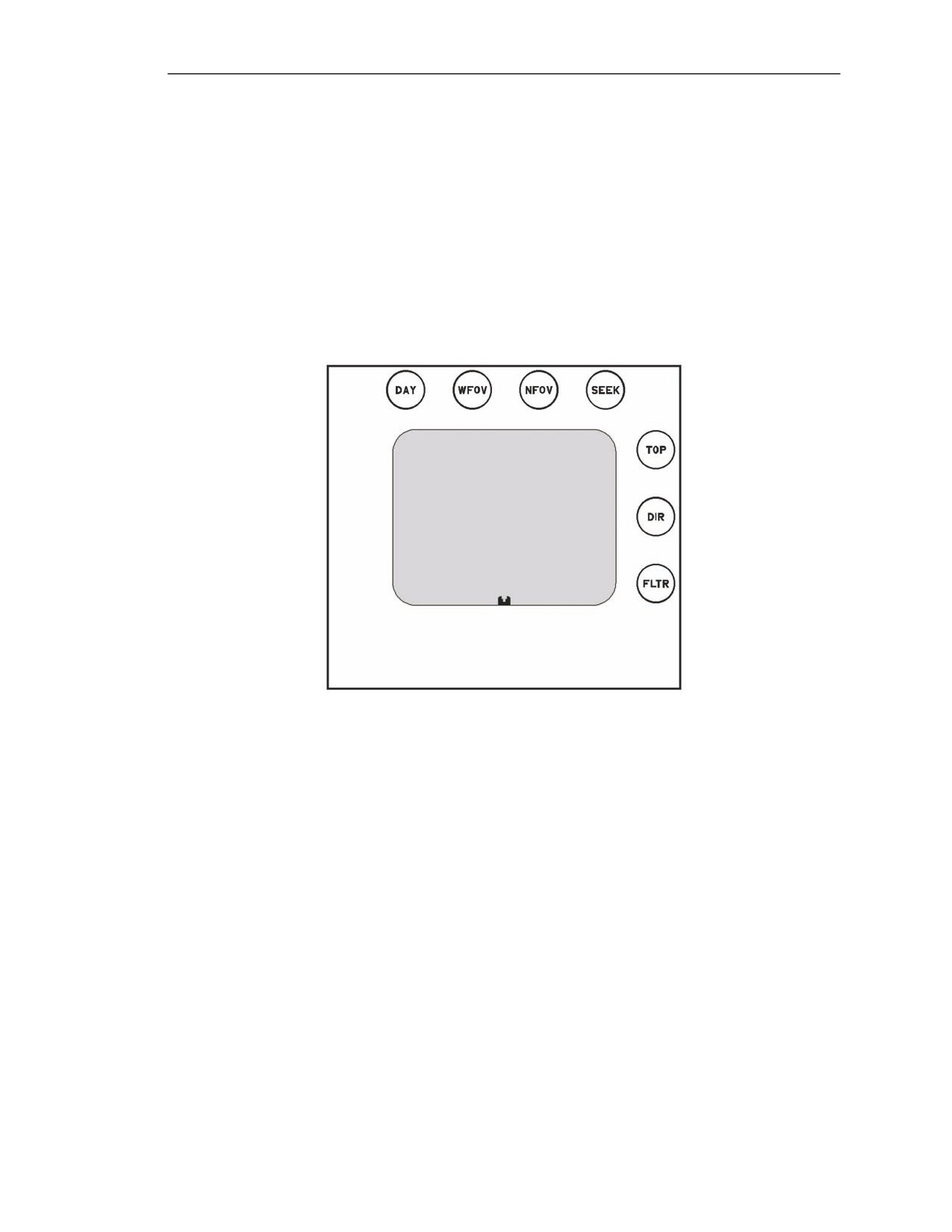
2-25. The CLU status (icon) indicators that appear around the CLU display are never on at the same
time during normal operation. The gunner observes the status indicators by looking into the eyepiece.
These indicators, coded in colors of green, amber, or red, identify Javelin operational modes,
conditions, and malfunctions.
Figure 2-7. Command launch unit display indicators.
GREEN STATUS INDICATORS
2-26. Green indicators (Figure 2-8) signify that the monitored function is in satisfactory condition and
that it is okay to proceed with normal operations.
Day (DAY) Indicator
2-27. The DAY indicator is located in the upper left corner of the CLU display. It lights up when the
power switch is in the day or night position.
Wide Field-of-View (WFOV) Indicator
2-28. The WFOV indicator is located on the upper left side of the CLU display. A steady light
indicates that the CLU is in WFOV, and a flashing light indicates that the NVS has reached a focus
limit.
Narrow Field-of-View (NFOV) Indicator
2-29. The NFOV indicator is located on the upper right side of the CLU display. A steady light
indicates that the CLU is in NFOV, and a flashing light indicates that the NVS has reached a focus
limit.
Seeker (SEEK) Indicator
2-30. The SEEK indicator is located in the upper right corner of the CLU display. It lights up within 3
seconds after squeezing the seeker trigger.
2-6
FM 3-22.37
20 March 2008
Controls and Operation
Top Attack (TOP) Indicator
2-31. The TOP indicator is located on the upper right side of the CLU display. It lights up when the
missile is in the top attack mode.
Direct Attack (DIR) Indicator
2-32. The DIR indicator is located on the center right side of the CLU display. It lights up when the
missile is in the direct attack mode.
Filter (FLTR) Indicator
2-33. The FLTR indicator is located on the bottom right side of the status display. It lights up when the
NVS filter is selected.
Figure 2-8. Status indicators―green.
AMBER STATUS INDICATORS
2-34. Amber status indicators (Figure 2-9) become illuminated when a marginal condition exists. It
also alerts the gunner to situations where caution, a recheck, or an unexpected delay is necessary.
NVS NOT COOL Indicator
2-35. The NVS NOT COOL indicator is located on the upper left side of the CLU display. It lights up
when the CLU is in the night mode, but the DDC has not cooled to its operating temperature. The
indicator goes out when the NVS is cooled to its operating temperature. If the DDC warms up again,
this indicator comes back on.
MISSILE NOT READY Indicator
2-36. The MISSILE NOT READY indicator is located on the bottom right side of the CLU display. A
steady light indicates that the missile flight information is not downloaded from the CLU, missile BIT
is not complete, or seeker is not cooled; a flashing light indicates that the missile electronics are close
to overheating. The missile shuts down within 30 seconds after the flashing starts.
20 March 2008
FM 3-22.37
2-7
///////////////////////////////////////