FM 3-22.37 COMBAT MISSILE SYSTEM, MEDIUM (March 2008) - page 2

Chapter 2
Figure 2-9. Status indicators―amber.
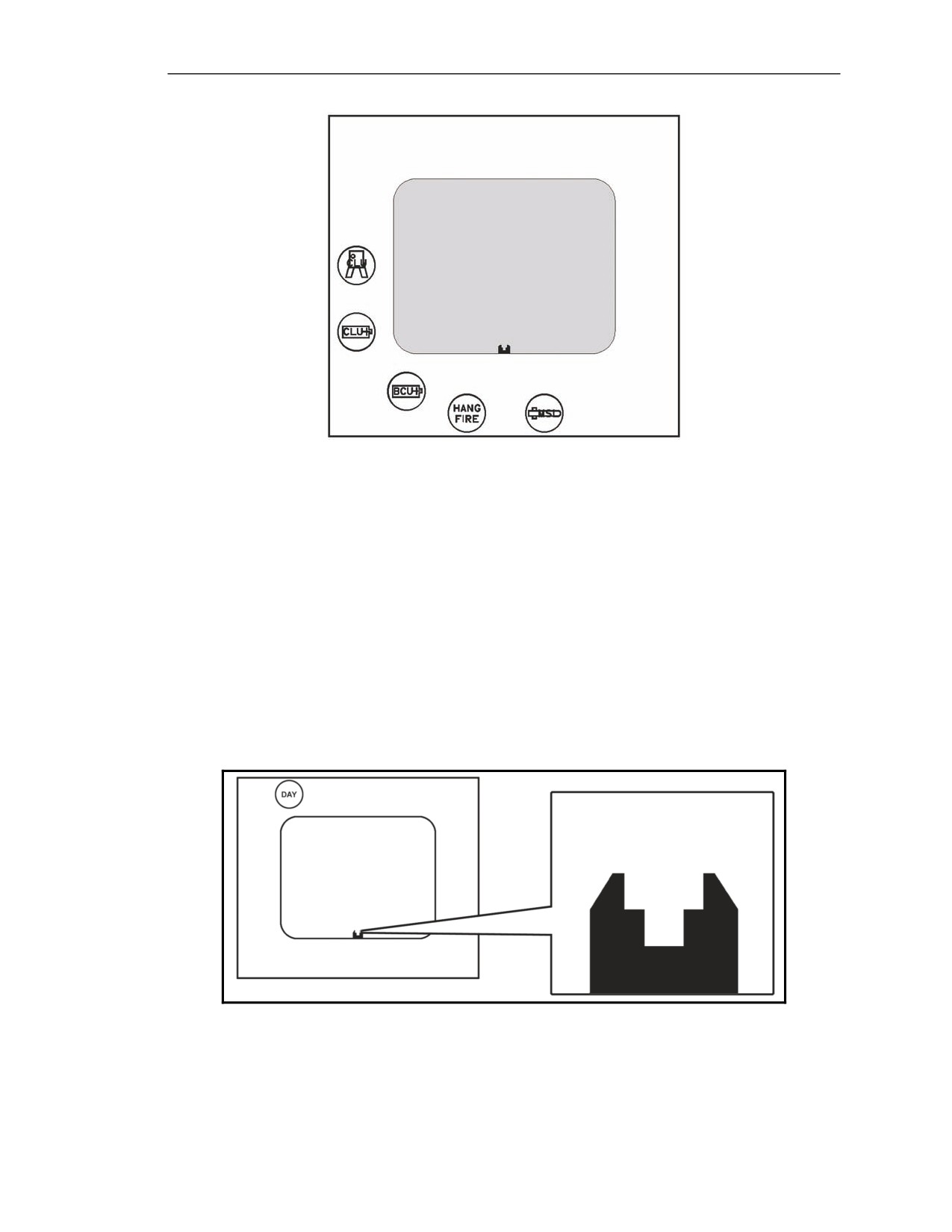
RED STATUS INDICATORS
2-37. There are two types of red indicators (Figure 2-10). A flashing red indicator warns the gunner of
an emergency condition where action must be taken. A solid red indicator tells the gunner that the
Javelin is inoperative and a successful missile launch is not possible until corrective action is taken.
MISSILE BIT FAILURE Indicator
2-38. The MISSILE BIT FAILURE indicator is located on the bottom right side of the CLU display. A
steady light indicates that the missile BIT has detected a failure in the missile, and a flashing light
indicates a misfire when the gunner squeezes the fire trigger and the missile does not launch.
HANGFIRE Indicator
2-39. The HANGFIRE indicator is located on the bottom left side of the CLU display. The
HANGFIRE indicator flashes to indicate a missile hangfire when the gunner squeezes the fire trigger
and the missile does not launch.
BCU Indicator
2-40. The BCU indicator is located on the bottom left side of the CLU display. After seeker activation,
the BCU indicator flashes to indicate that the BCU has about 30 seconds of operating time remaining,
and it illuminates solid red when the BCU is spent.
CLU BATTERY Indicator
2-41. The CLU BATTERY indicator is located on the bottom left side of the CLU display. The
indicator lights up to indicate that the CLU battery has about 5 minutes of operating time remaining.
CLU BIT FAILURE Indicator
2-42. The CLU BIT FAILURE indicator is located on the center left side of the CLU display. The
CLU BIT FAILURE light comes ON when the CLU has failed an automatic BIT.
2-8
FM 3-22.37
20 March 2008
Controls and Operation
Figure 2-10. Status indicator―red.
COMMAND LAUNCH UNIT DISPLAY INDICATORS
2-43. The CLU display indicators include stadia, reticles, track gates, and crosshairs.
STADIA
2-44. Stadia are seen in all CLU fields of view. They change their appearance, size and location
according to the FOV selected. The CLU has three different stadia for each of the three CLU fields of
view. The day FOV stadia are seen in all FOVs, but are used only in day FOV. The WFOV and NFOV
stadia are present only in their respective fields of view.
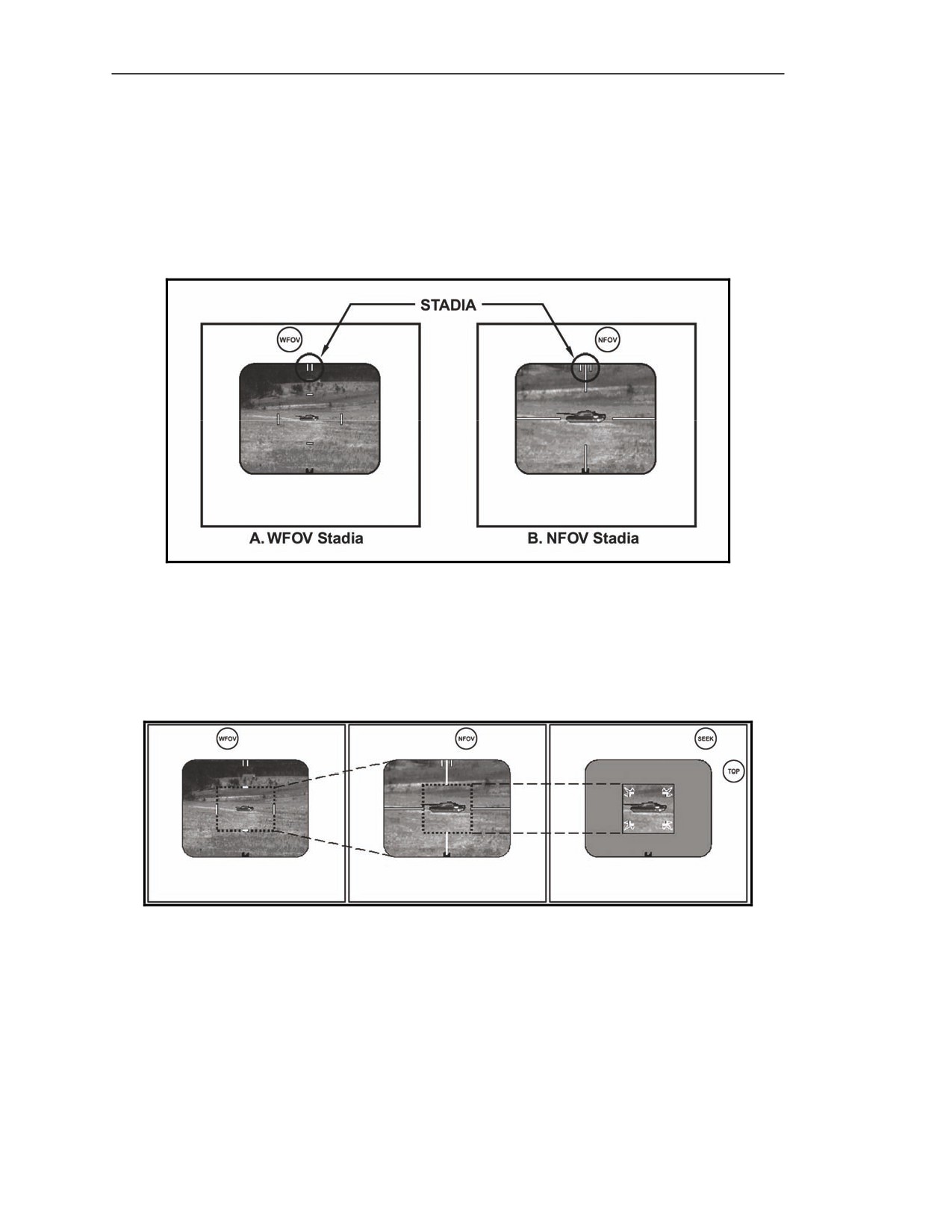
Day Field-of-View Stadia
2-45. Day FOV stadia (Figure 2-11) are attached permanently to and appear at the bottom center of the
CLU display.
Figure 2-11. Day field-of-view stadia.
20 March 2008
FM 3-22.37
2-9
Chapter 2
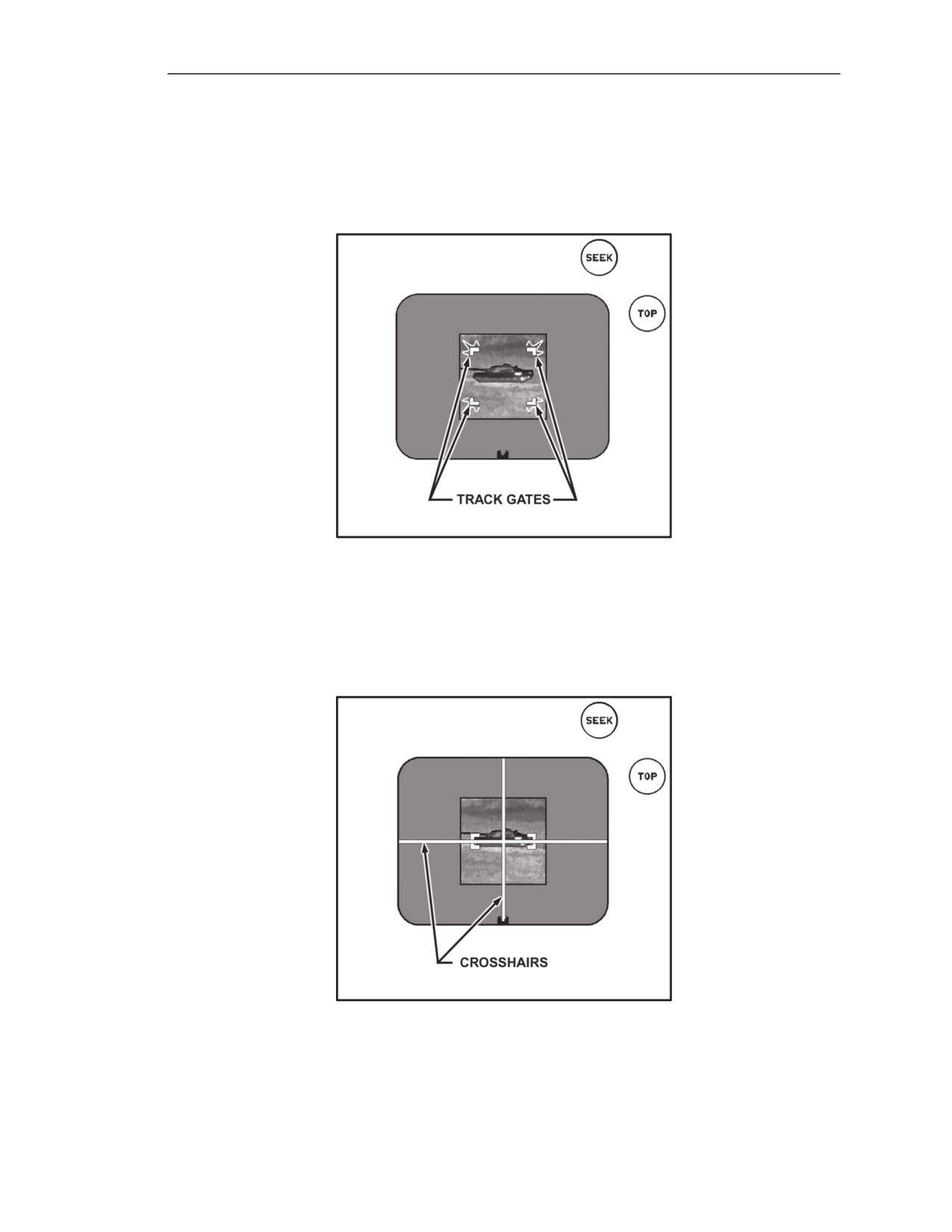
Wide Field-of-View Stadia
2-46. WFOV stadia consist of two vertical lines centered at the top of the CLU display (Figure 2-
12A). The WFOV stadia are visible only in WFOV.
Narrow Field-of-View Stadia
2-47. NFOV stadia also consist of two vertical lines centered at the top of the CLU display (Figure 2-
12B). The NFOV stadia are visible only in NFOV.
Figure 2-12. Night vision sight stadia comparisons.
RETICLES
2-48. In WFOV and NFOV, lines appear on the CLU display, and the configuration of lines in the
reticles change from WFOV to NFOV, which allows the gunner to identify the FOV just by looking at
the display (Figure 2-13).
Figure 2-13. Reticle area versus field-of-view change.
2-10
FM 3-22.37
20 March 2008
Controls and Operation
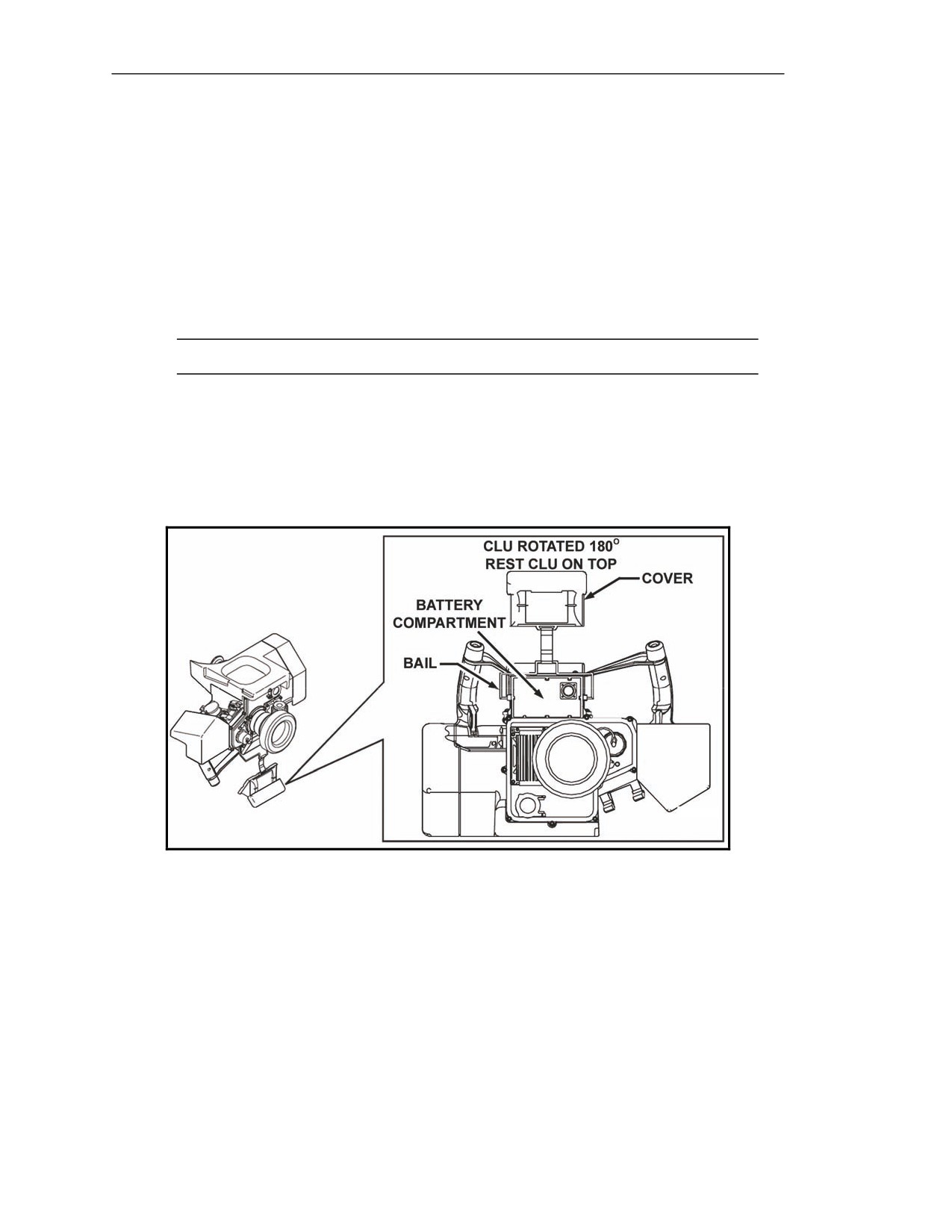
TRACK GATES
2-49. The track gates (Figure 2-14) are used by the gunner to lock the seeker on target. The gunner
activates the seeker and the track gates appear and flash in the CLU display. The track gates are a
visual indication the seeker is active but not locked on the target.
Figure 2-14. Track gates.
CROSSHAIRS
2-50. The gunner uses the crosshairs (Figure 2-15) to designate the center of mass, which the seeker
locks on. The crosshairs first appear and are flashing when the gunner squeezes and holds the seeker
trigger. After the seeker locks on the target, the track gates and crosshairs become solid.
Figure 2-15. Crosshairs.
20 March 2008
FM 3-22.37
2-11
Chapter 2
PREPARATION FOR FIRING
2-51. During preparation, the gunner performs a BIT, inspects the round, and prepares to fire. There
are seven steps in preparing the Javelin for firing:
(1) Prepare the Javelin components.
Place the round on the ground with the flat sides of the end caps down.
Place the carry bag on the ground on the left side of the round.
(2) Remove the CLU from the carry bag.
Open the carry bag.
Grasp the CLU by the handgrip and remove it from the carry bag.
(3) Install the CLU battery (Figure 2-16).
NOTE: The battery compartment is located on the bottom of the CLU.
Turn the CLU 180 degrees to reveal the battery compartment.
The battery compartment cover is held in place by a wire bail. Detach and move the
wire bail cover out of the way.
The compartment is equipped with a battery connector. This connector mates with the
corresponding connector on the battery. Align the two connectors and attach.
Replace the battery compartment cover, and reattach the wire bail.
Figure 2-16. Battery compartment.
2-12
FM 3-22.37
20 March 2008
Controls and Operation
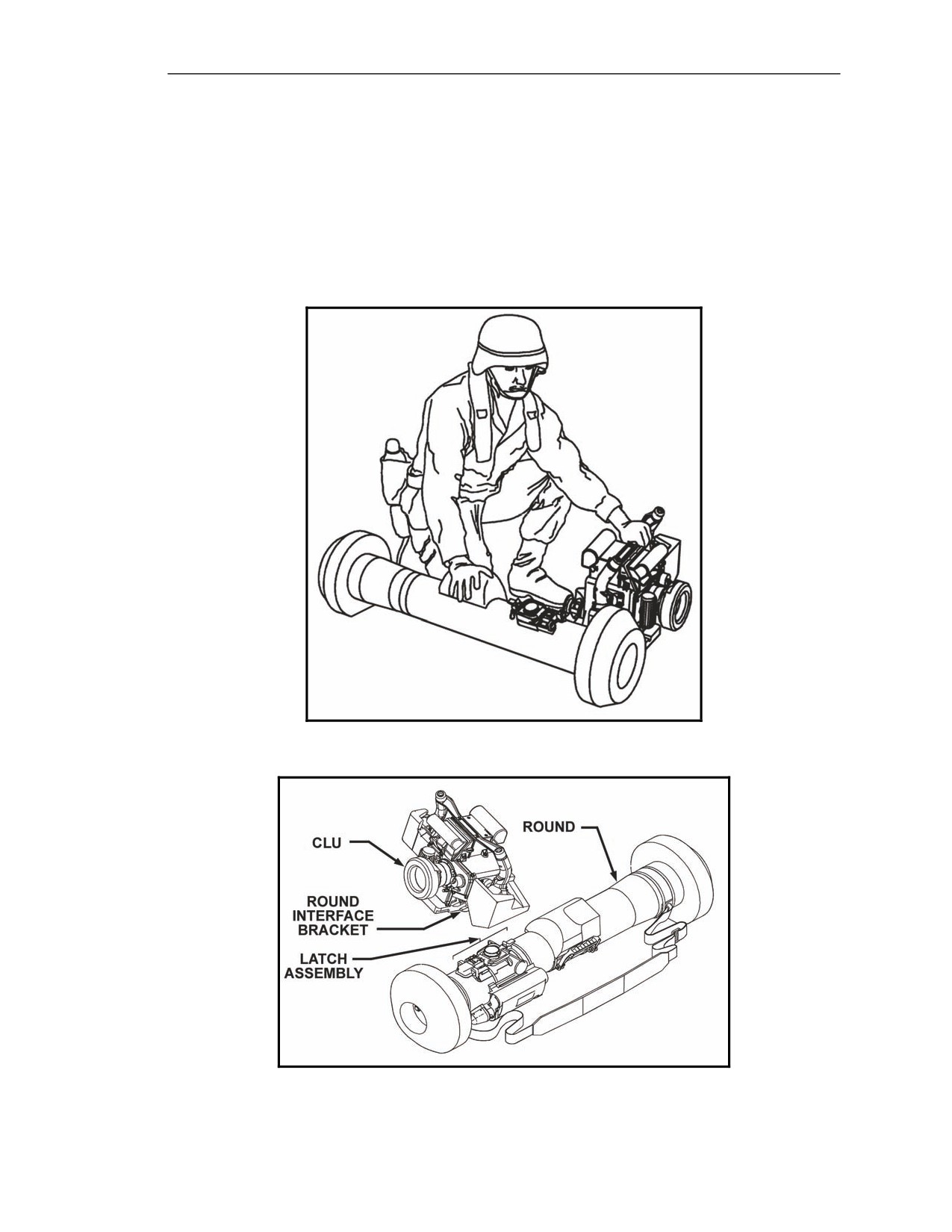
(4) Connect the CLU to the round (Figure 2-17).
Kneel on the left side of the round, at the forward end, facing forward.
Remove the protective cover from the CLU and round interface connectors. Pull on the
lanyard tab to secure the protective cover against the side of the round and CLU.
Position the protective covers so that they do not interfere when the CLU and round are
connected.
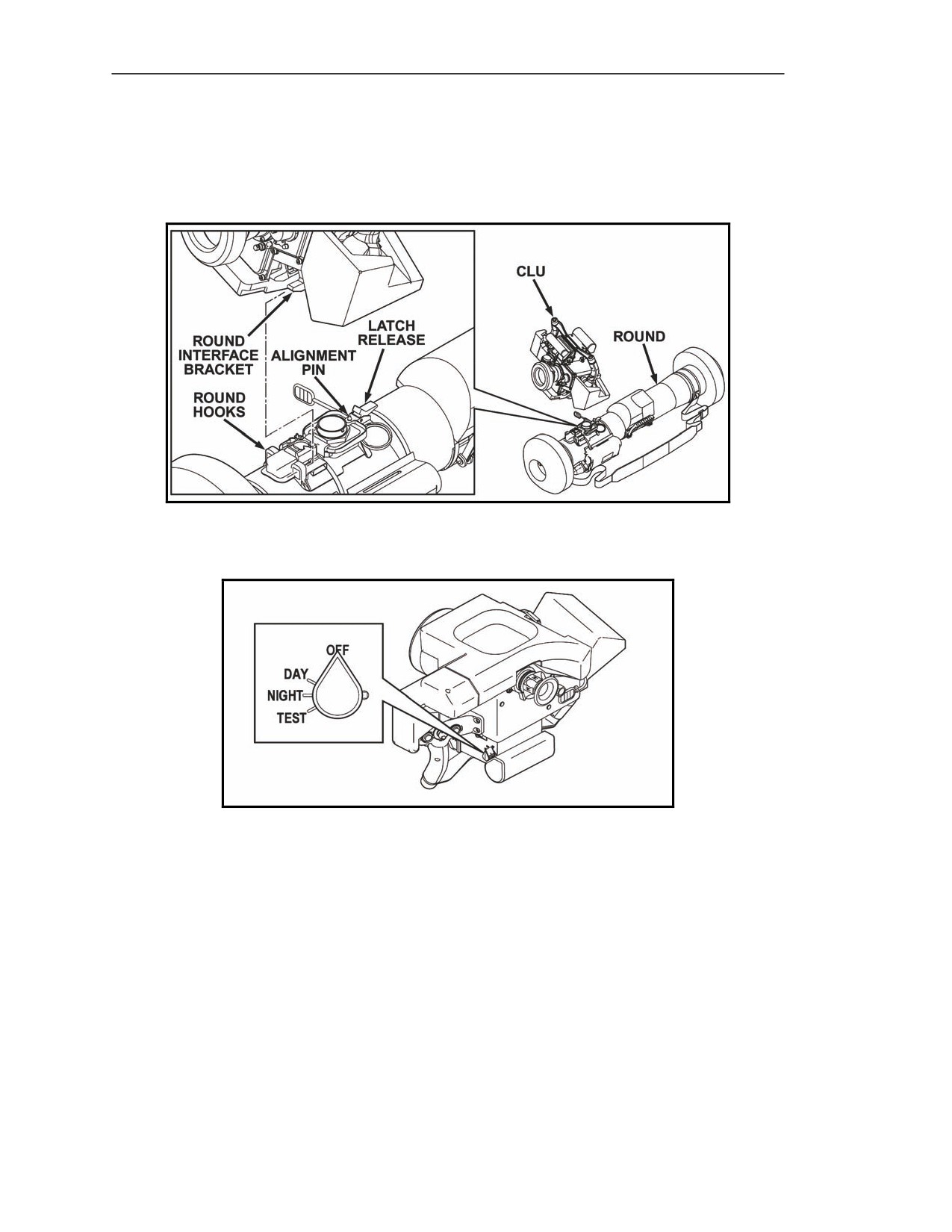
Grasp the handgrips, and lift the CLU into position over the CLU interface connector.
Keep the eyecup pointed toward the aft end of the round (Figure 2-18).
Place the round interface bracket in the round hooks.
Figure 2-17. Connect the round to the command launch unit.
Figure 2-18. Connect the command launch unit to the round.
20 March 2008
FM 3-22.37
2-13
Chapter 2
Slide the CLU toward the latch release and press down on the CLU to engage the CLU
and the round interface connectors. When the latch release snaps into place, the CLU
and round are connected (Figure 2-19).
Ensure CLU and round connectivity by rocking the CLU from side to side before
attempting to pick up the Javelin.
Figure 2-19. Connect the command launch unit to the round.
(5) Turn the power switch from the OFF position to the NIGHT position (Figure 2-20).
Figure 2-20. Power switch.
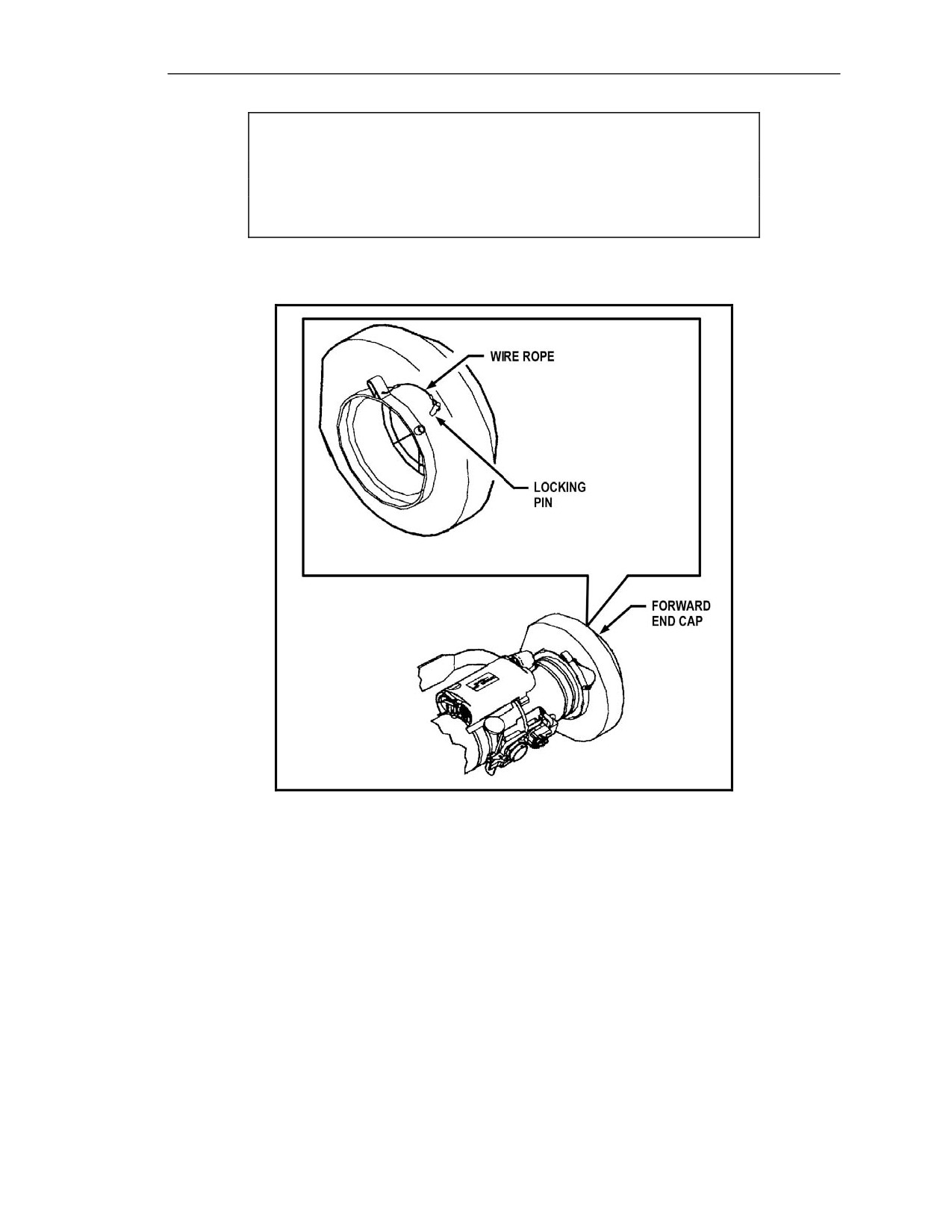
(6) Remove the forward end cap (Figure 2-21).
Remove the locking pin from the forward end cap by pulling straight up on the wire
rope.
Using the left hand, turn the forward end cap latch release counterclockwise.
Grasp the handgrip with the right hand and lift the front end of the Javelin enough to
raise the forward end cap off the ground.
Slide the forward end cap off the round. If the forward end cap does not come off press
the manual release button until the hissing stops. Set the open end of the round on the
forward end cap to prevent dirt and debris from obstructing the seeker. When the
forward end cap is removed, the gunner must use extreme caution not to damage the
seeker or allow foreign material to come in contact with the seeker.
2-14
FM 3-22.37
20 March 2008
Controls and Operation
CAUTION
With the forward end cap removed, the seeker is exposed. Use
extreme caution when tipping the Javelin forward to ensure no
foreign material comes in contact with the seeker.
Inspect the open end of the round for dirt and foreign material. Remove any dirt or
foreign material that is present.
Figure 2-21. Remove the forward end cap.
(7) Open the lens covers. Ensure the daysight and NVS lens covers are completely open.
20 March 2008
FM 3-22.37
2-15
Chapter 2
FIRING POSITIONS
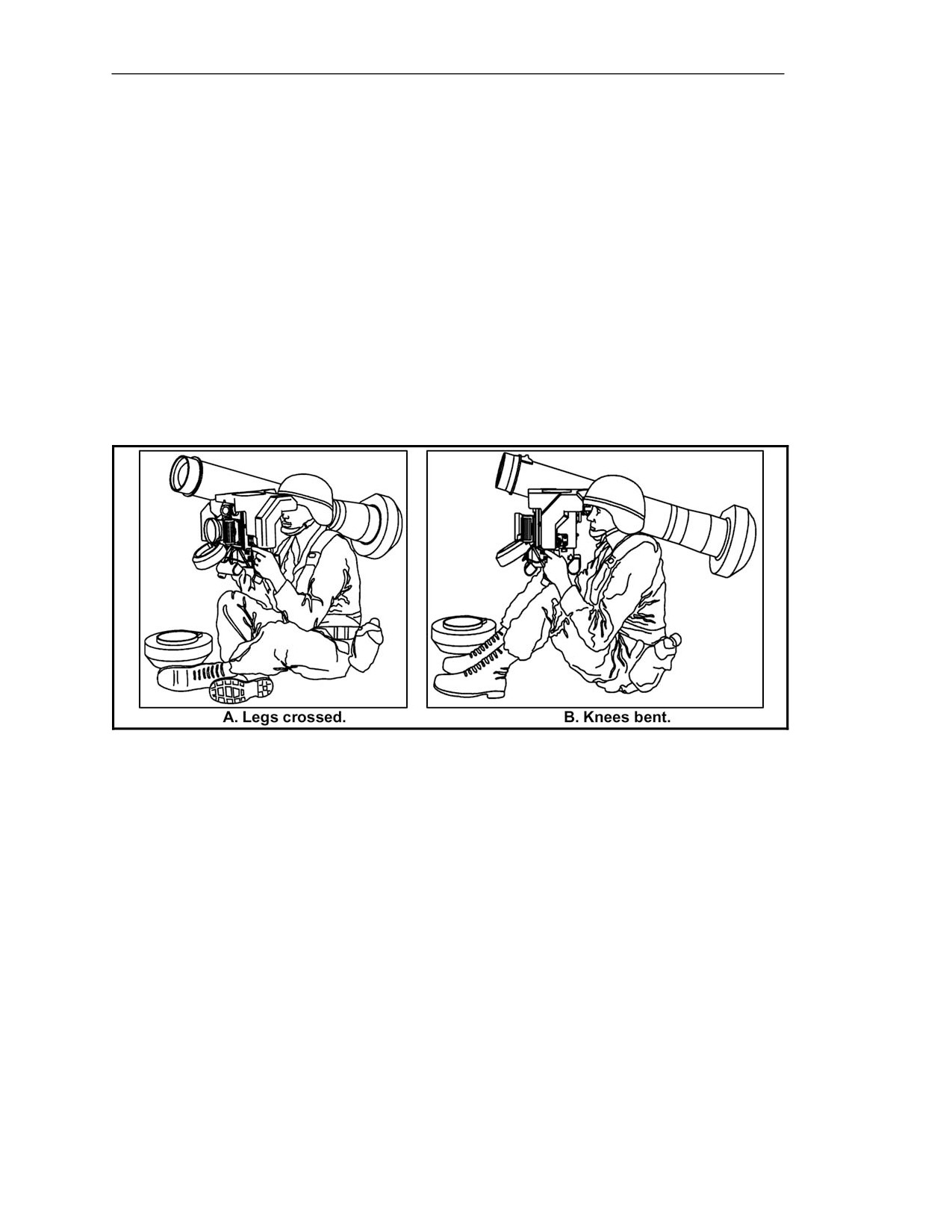
2-52. Firing positions for the Javelin include: sitting (bent knees or legs crossed), the kneeling (using
one knee or both knees), standing supported, and the prone supported.
SITTING POSITION
2-53. To fire the Javelin from the sitting position—
(1) Sit on the left side of the Javelin facing the direction of fire.
(2) Check the backblast area.
(3) Grasp the left handgrip of the CLU with the left hand. Place the right hand under the round
near the shoulder pad.
(4) Lift the Javelin in a single, smooth motion and position the shoulder pad on the right
shoulder.
(5) Assume a comfortable sitting position with legs crossed (Figure 2-22A) or knees bent
(Figure 2-23B).
Figure 2-22. Javelin sitting firing position.
(6) Adjust the body while holding the CLU.
(7) Check the overhead flight path between the target and the firing position by sighting along
the top of the round. The missile must have a clear flight path once launched.
(8) After assuming the sitting position, ensure the forward end cap is on the ground, in front of
and slightly to the right of the right leg or foot. The gunner is prepared.
KNEELING POSITION
2-54. To fire the Javelin from the kneeling position—
(1) Kneel on the left side of the Javelin facing the direction of fire.
(2) Check the backblast area.
(3) Grasp the left handgrip of the CLU with the left hand. Place the right hand under the round
near the shoulder pad.
(4) Lift the Javelin in a single, smooth motion and position the shoulder pad on the right
shoulder.
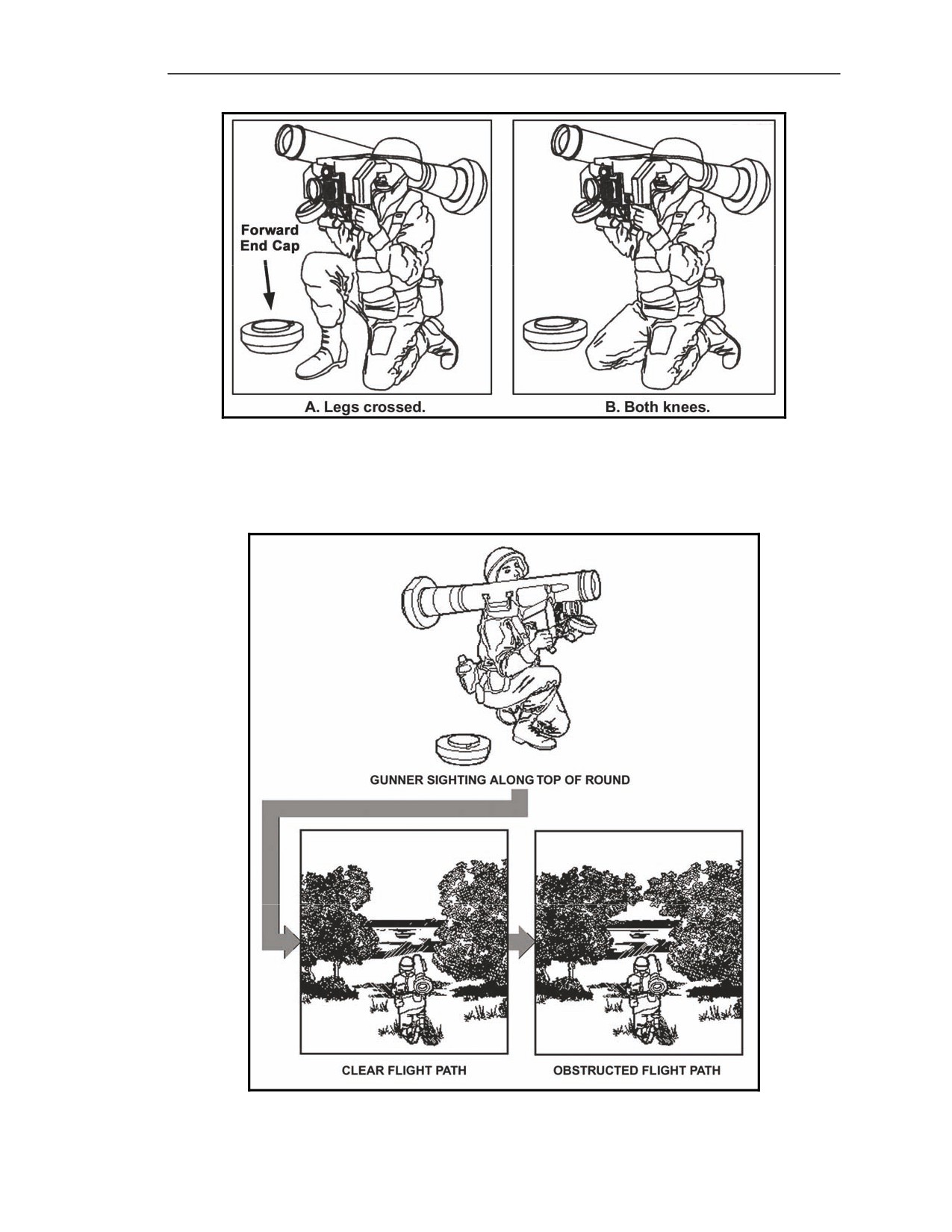
(5) Kneel in a comfortable position with one knee (Figure 2-23A) or both knees on the ground
(Figure 2-23B).
2-16
FM 3-22.37
20 March 2008
Controls and Operation
Figure 2-23. Javelin kneeling firing position.
(6) Hold the CLU by the right handgrip and adjust the body until comfortable with the Javelin.
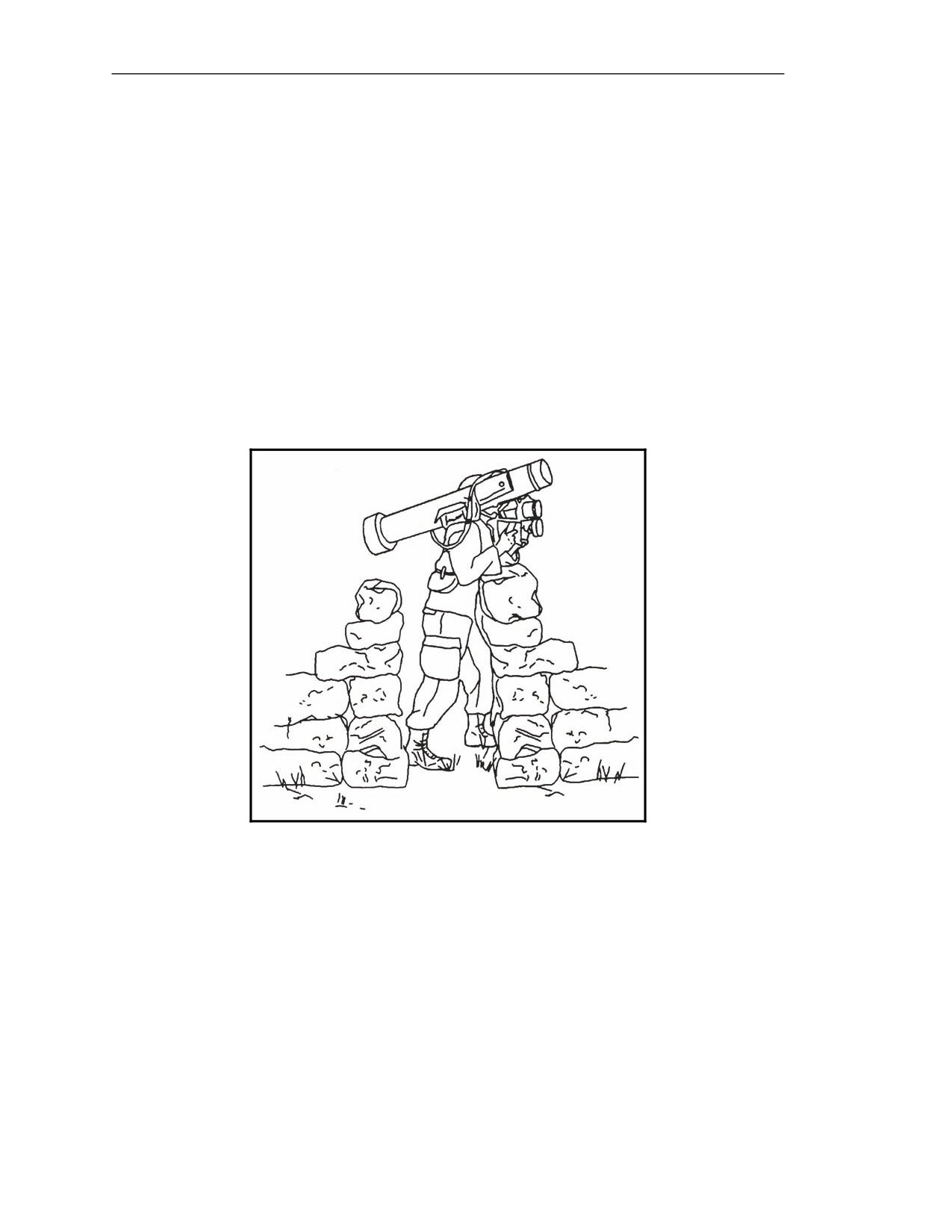
(7) Check the overhead flight path between the target and the firing position by sighting along
the top of the round. The missile must have a clear flight path once launched (Figure 2-24).
Figure 2-24. Gunner sights along the top of the round for obstructions.
20 March 2008
FM 3-22.37
2-17
Chapter 2
(8) After assuming the kneeling position, ensure the forward end cap is on the ground, in front
of and slightly to the right of the right leg or foot.
(9) The gunner is now prepared to fire the Javelin.
STANDING SUPPORTED POSITION
2-55. To fire the Javelin from the standing supported position—
(1) Stand on the left side of the Javelin facing the direction of fire. Take up a kneeling position
with the right knee on the ground.
(2) Check the backblast area.
(3) Grasp the left handgrip of the CLU with the left hand. Place the right hand under the round
nearest the shoulder pad.
(4) Lift the Javelin in a single, smooth motion and position the shoulder pad on the right
shoulder.
(5) From this one knee position, stand up keeping the back straight and the weight balanced.
The gunner keeps his balance by standing with the legs spread a comfortable distance apart
(Figure 2-25).
Figure 2-25. Standing supported firing position.
(6) Move the right hand to the right handgrip of the CLU. Place the elbows on the edge or rim
of the fighting position or other steady feature to provide support.
(7) Adjust the body until the Javelin feels comfortable.
(8) Check the overhead flight path between the target and the firing position by sighting along
the top of the round. The missile must have a clear flight path once launched.
(9) After assuming a firing position, ensure that the forward end cap is on the ground and
slightly to the right of the right leg or foot. The gunner is now prepared to fire the Javelin.
2-18
FM 3-22.37
20 March 2008
Controls and Operation
PRONE SUPPORTED POSITION
2-56. To fire the Javelin from the prone supported position—
(1) Set the round on the ground with the flat sides of the end caps face down. The CLU
interface connector and latch assembly should be face up.
(2) Ensure the round points toward the target area.
(3) Place the carry bag (with CLU) on the left side of the round by the forward end.
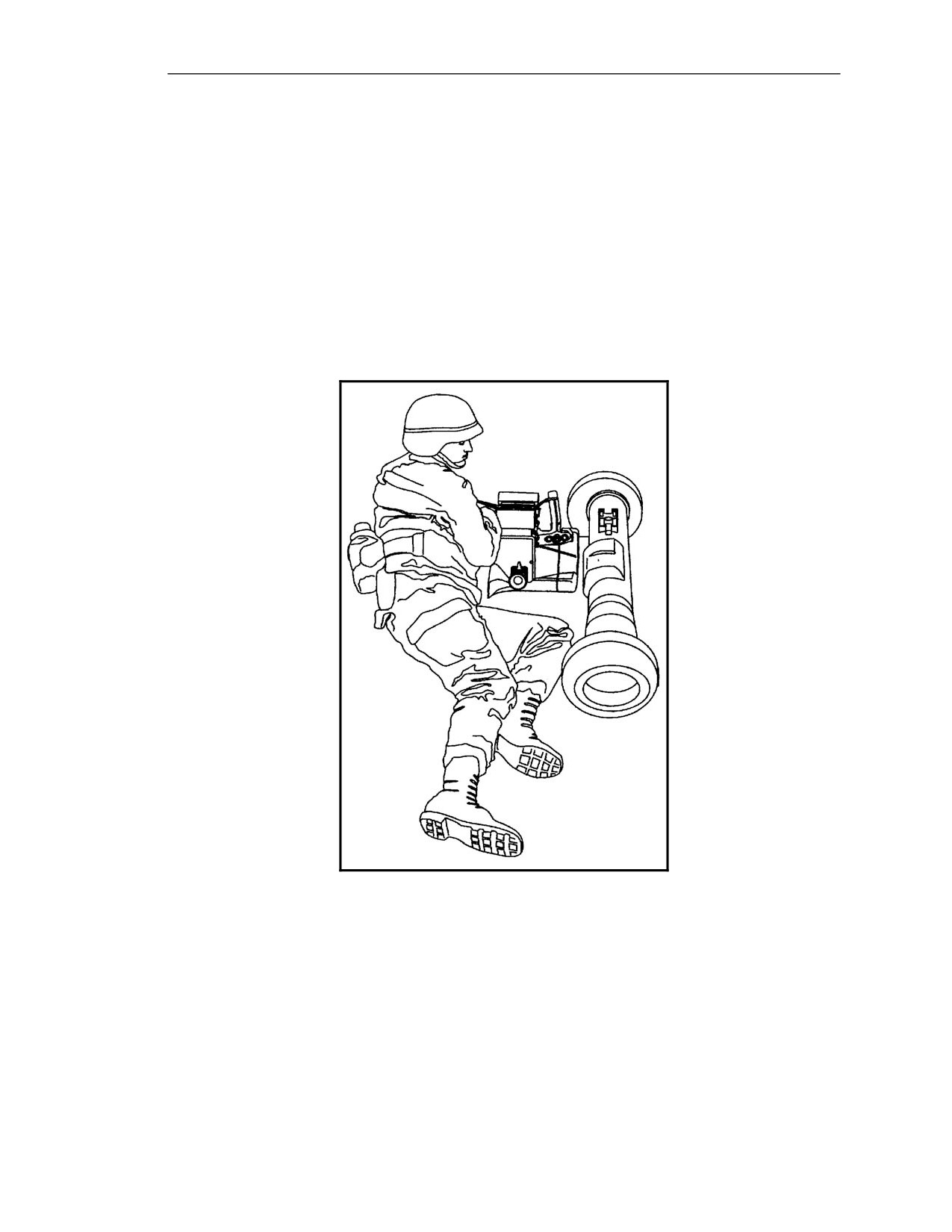
(4) Lay on the left side along the left side of the round next to the carry bag (Figure 2-26).
Maintain a low profile to limit observation of movement.
(5) Remove the CLU from the carry bag.
(6) Turn the power switch to the NIGHT position.
(7) Connect the CLU to the round.
Figure 2-26. Preparing to connect the command launch unit.
20 March 2008
FM 3-22.37
2-19
Chapter 2
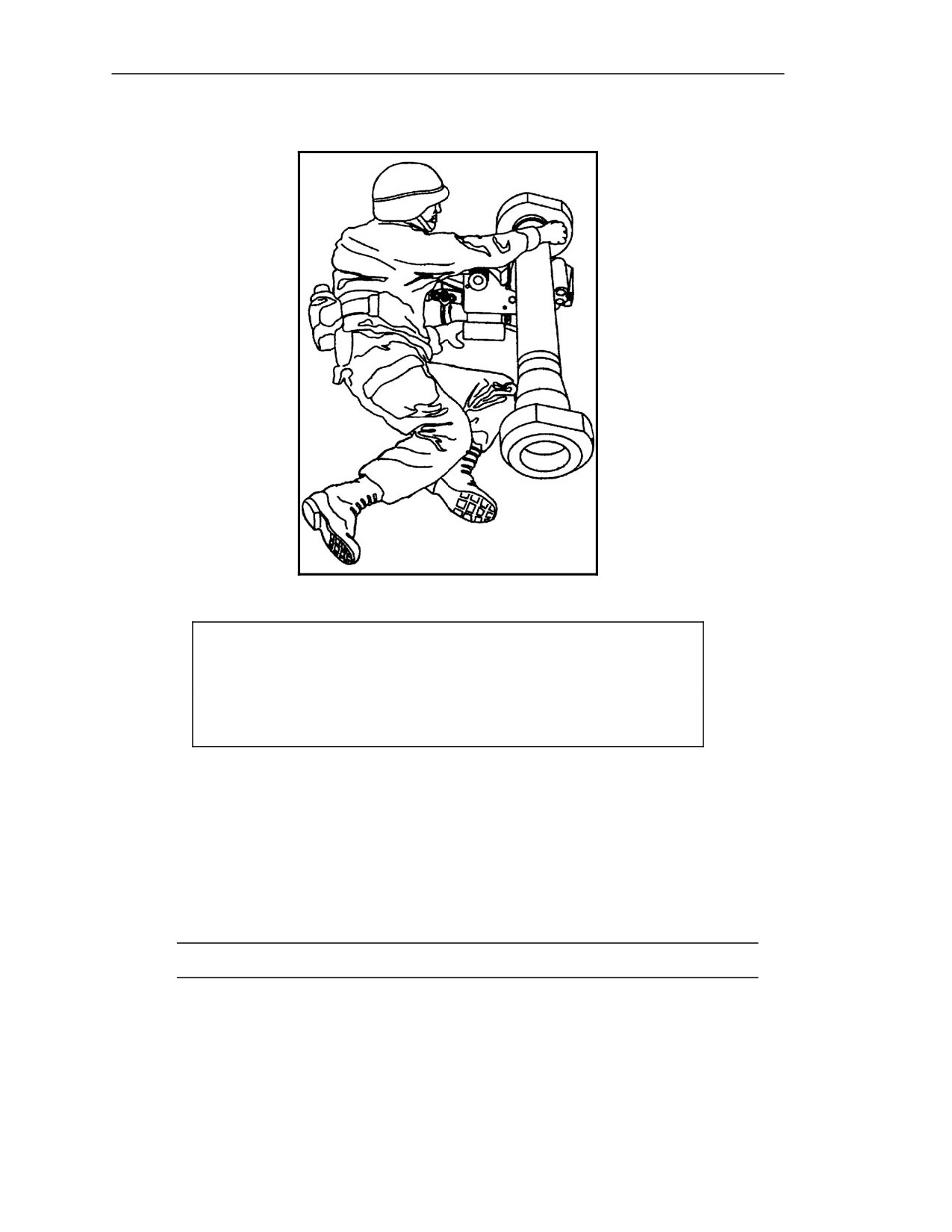
(8) Remove the forward end cap (Figure 2-27).
Figure 2-27. Remove the forward end cap.
CAUTION
With the forward end cap removed, the seeker is exposed. Use
extreme caution when tipping the Javelin forward to ensure no
foreign material comes in contact with the seeker.
(9) Place the forward end cap directly under the open end of the Javelin.
(10) Open the NVS and daysight lens covers.
(11) Check the backblast area. Ensure no personnel are located in the primary danger zone or
caution areas.
(12) Position the body so it is parallel with the Javelin with the left hand tightly on the left
handgrip. Placing the left hand on left handgrip helps guide the Javelin and maintain
control. The right shoulder should be just behind the shoulder pad to balance the weight.
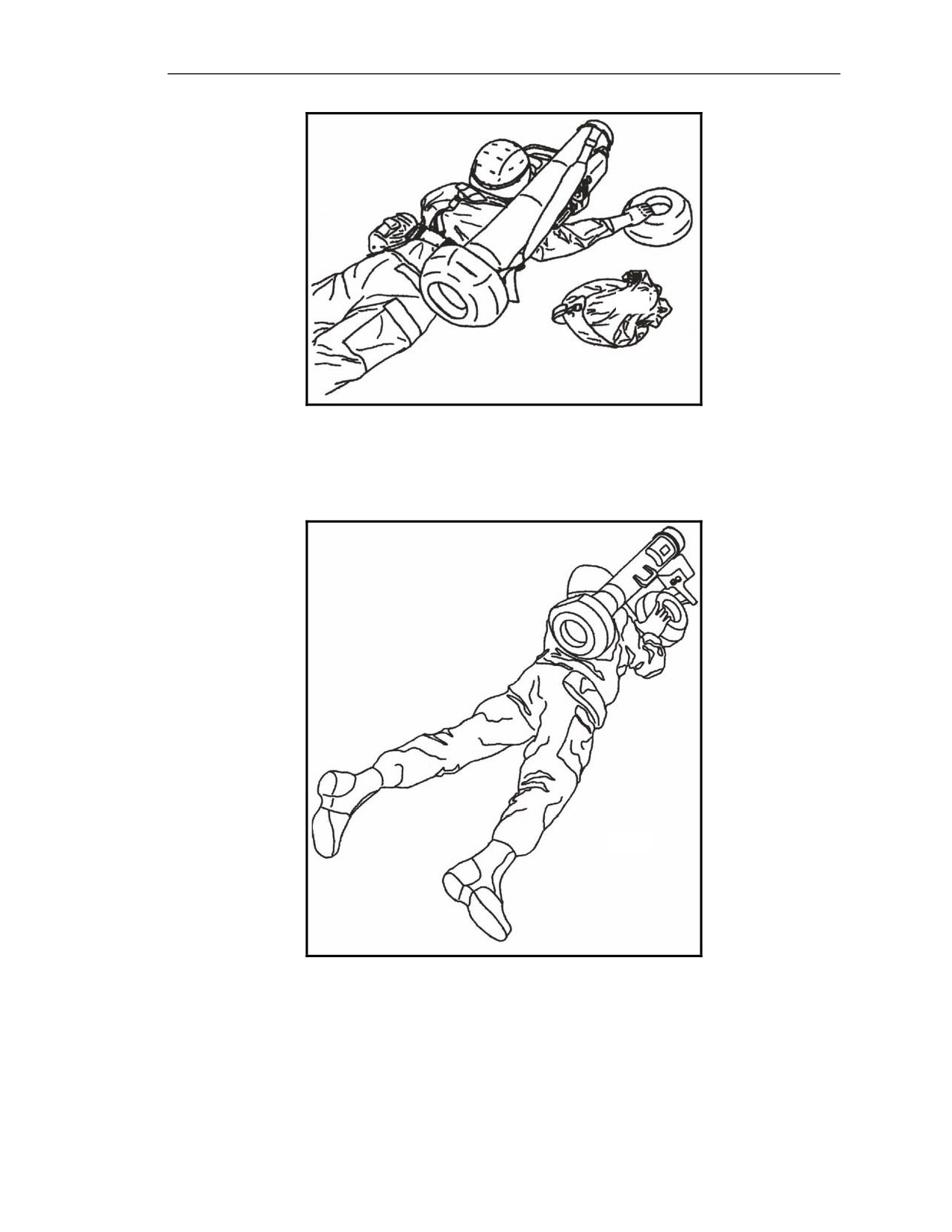
(13) The gunner tilts his body and the Javelin to the left side and, at the same time, reaches out
with the right hand to secure the forward end cap (Figure 2-28).
NOTE: The forward end cap supports the Javelin’s weight when in the prone position.
2-20
FM 3-22.37
20 March 2008
Controls and Operation
Figure 2-28. Reaching for forward end cap.
(14) Grasp the forward end cap; hold it with the inside of the forward end cap facing toward the
CLU and the flat side of the forward end cap facing up.
(15) Place the flat side of the forward end cap against the round shoulder pad (Figure 2-29).
Figure 2-29. Placing end cap.
20 March 2008
FM 3-22.37
2-21
Chapter 2
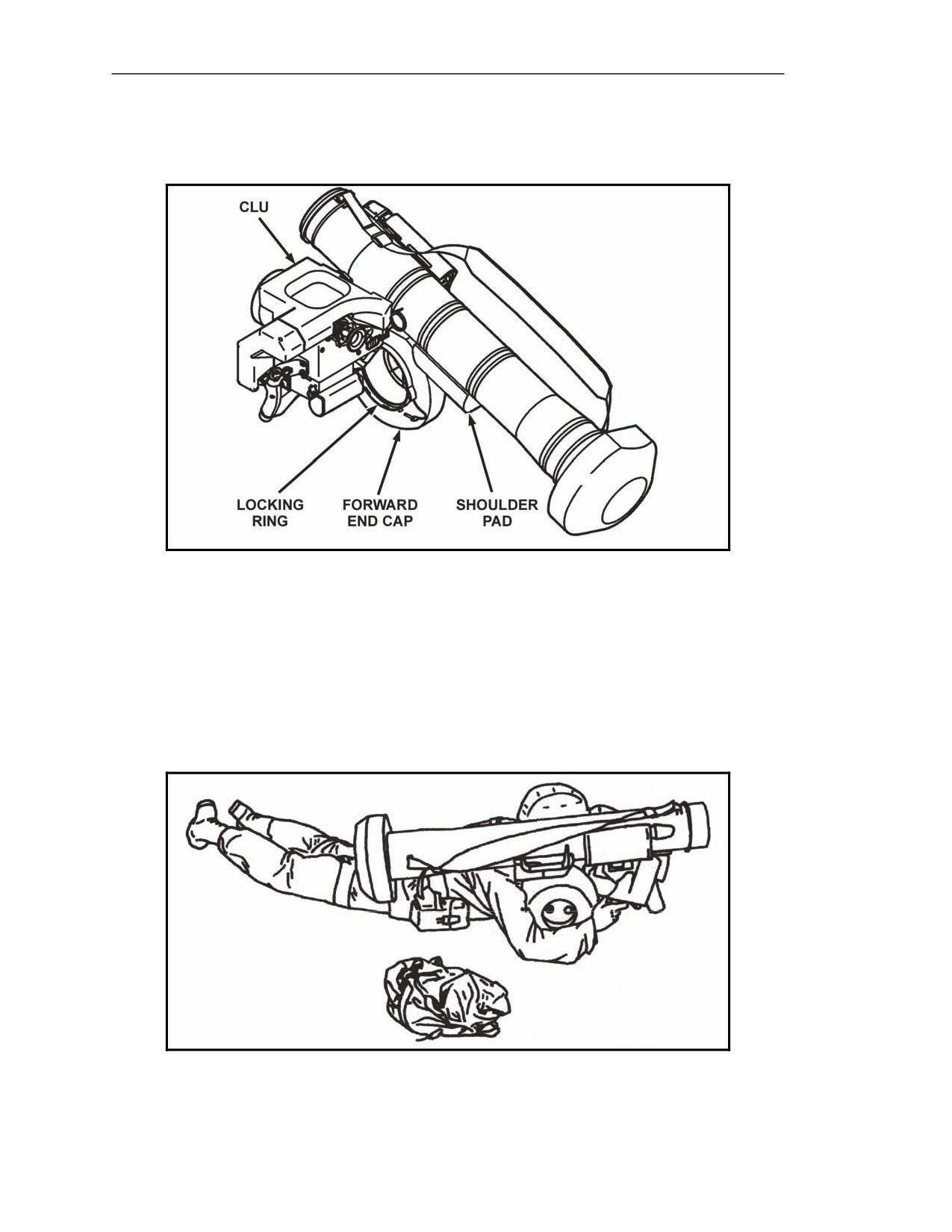
(16) Slide the forward end cap forward until the forward end cap locking ring contacts the shock
absorber on the battery compartment. This wedges the forward end cap into position (Figure
2-30).
Figure 2-30. Placement of forward end cap in prone position.
(17) Slowly lower the Javelin until it rests on the forward end cap. Slide the body forward so the
right shoulder is against the forward end cap.
PRONE SUPPORTED POSITION CHECK
2-57. To check the prone supported position—
(1) Ensure reaching the right handgrip switches is possible and easy to operate.
(2) Ensure the Javelin is supported by the forward end cap and is not resting on the shoulder
(Figure 2-31).
Figure 2-31. Prone supported firing position.
2-22
FM 3-22.37
20 March 2008
Controls and Operation
(3) Pull the Javelin tightly into the body until the forward end cap fits against the right shoulder.
WARNINGS
1.Injury will occur if the body is extended into the backblast
area. If injured, seek medical help immediately.
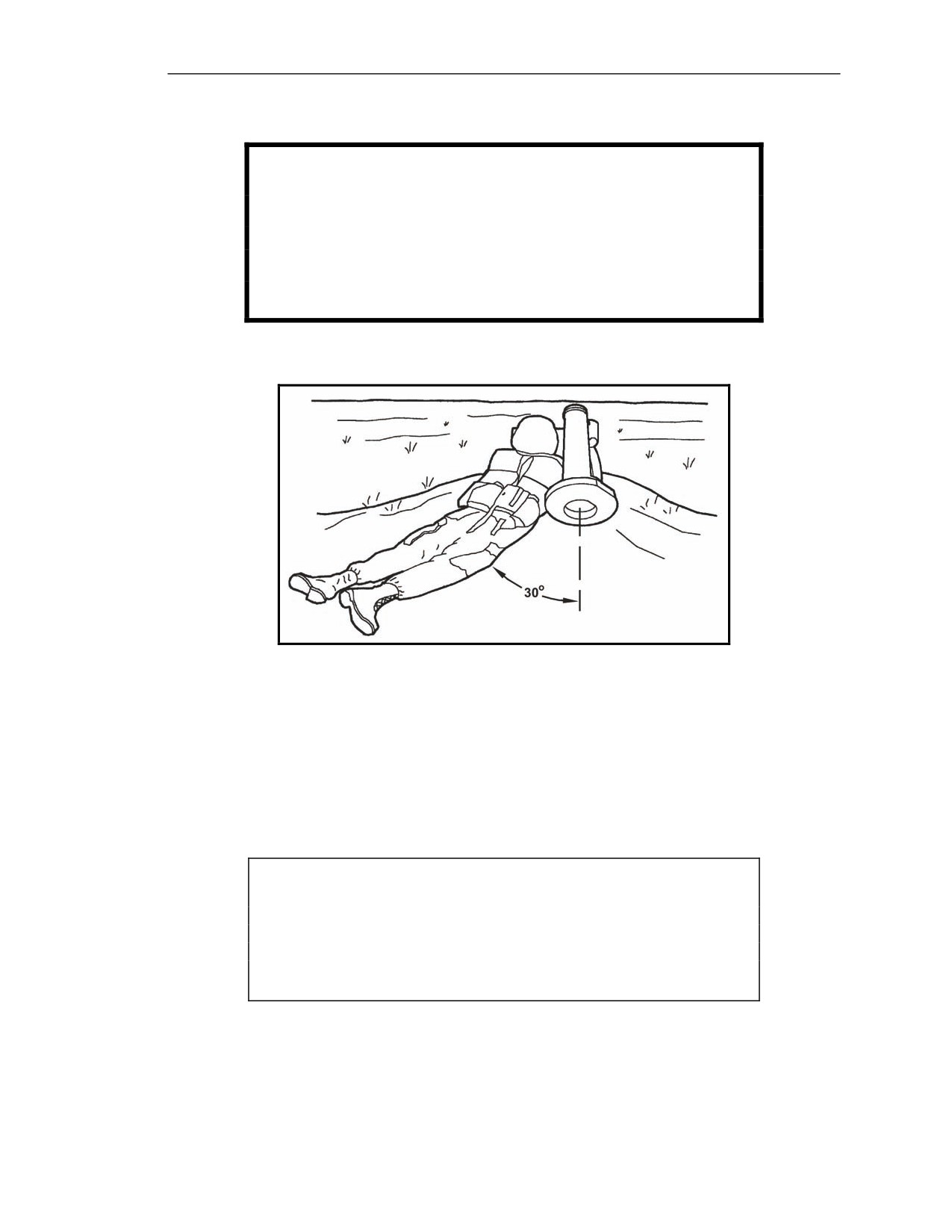
2.Keep body at a 30-degree angle away from the round when
firing from the prone position.
(4) Place the body at a 30-degree angle to the length of the round (intended direction of fire) to
prevent the legs from extending into the backblast area (Figure 2-32).
Figure 2-32. Correct prone body position.
(5) Check the overhead flight path between the target and the firing position by sighting along
the top of the round. The missile must have a clear flight path once launched.
(6) The gunner is now prepared to fire the Javelin.
RESTORE TO CARRYING CONFIGURATION
2-58. To restore the Javelin to the carrying configuration, the gunner turns the power switch to the
OFF position, places the Javelin on the ground, closes the lens cover, replaces the forward end cap, and
disconnects the CLU from the round.
CAUTION
With the forward end cap removed, the seeker is exposed. Use
extreme caution when tipping the Javelin forward to ensure that no
foreign material comes in contact with the seeker. Ensure that the
LTA is clear of debris before reinstalling the forward end cap.
2-59. If the seeker has been activated, the gunner replaces the BCU by installing a new one, and places
the CLU in the carry bag.
20 March 2008
FM 3-22.37
2-23
Chapter 2
TURN THE POWER SWITCH TO OFF
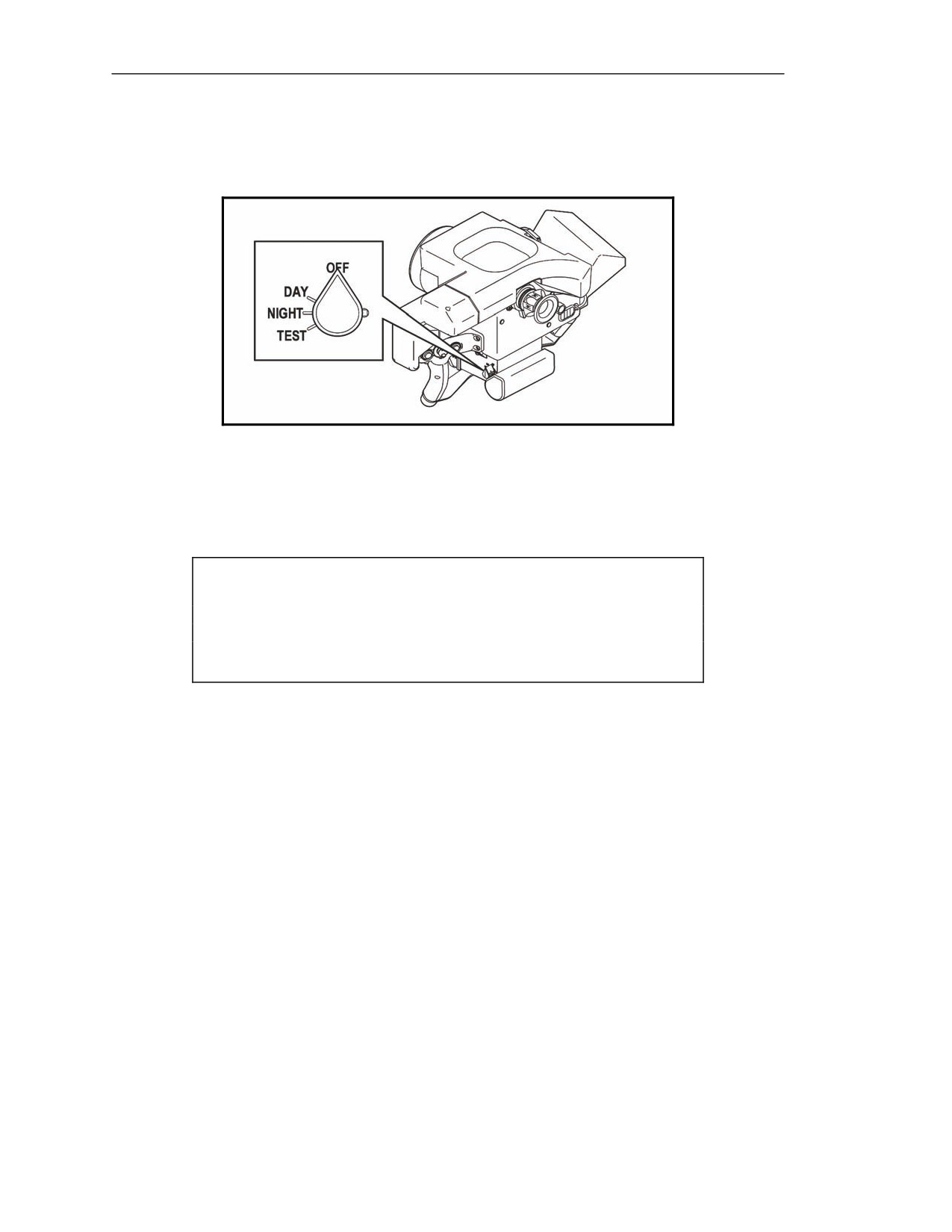
2-60. The gunner turns the power switch to the DAY position and waits for the flipper mirror to switch
to the day sight position (about 2 seconds), then he turns the power switch to OFF (Figure 2-33).
Figure 2-33. Power switch OFF position.
PLACE THE JAVELIN ON THE GROUND
2-61. When placing the Javelin on the ground, rotate the Javelin so the round rests on the ground and
the handgrips of the CLU are pointing skyward.
CAUTION
With the forward end cap removed, the seeker is exposed. Use
extreme caution when tipping the Javelin forward to ensure that no
foreign material comes in contact with the seeker.
CLOSE THE COMMAND LAUNCH UNIT LENS COVERS
2-62. Close the DAY sight and NVS lens cover. Ensure the lens covers are firmly seated in place.
REPLACE THE FORWARD END CAP
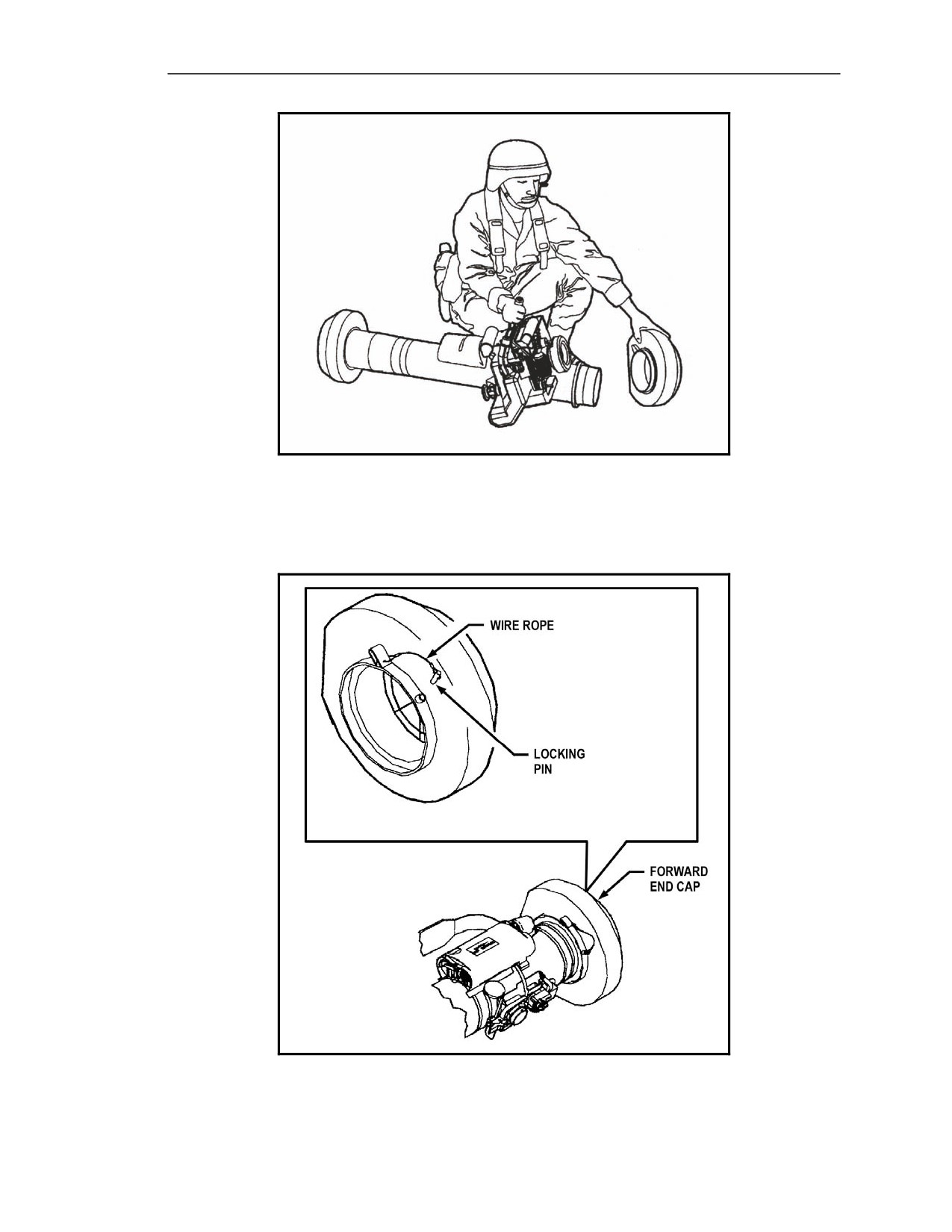
2-63. To replace the forward end cap—
(1) Grasp the handgrip with the right hand and lift the forward end of the round off the top of
the forward end cap (Figure 2-34).
(2) Check to ensure the forward end cap latch is in the open position.
2-24
FM 3-22.37
20 March 2008
Controls and Operation
Figure 2-34. Replace forward end cap.
(3) Align the forward end cap latch handle with the BCU pylon.
(4) Slide the forward end cap onto the round and turn the latch clockwise to engage the locks.
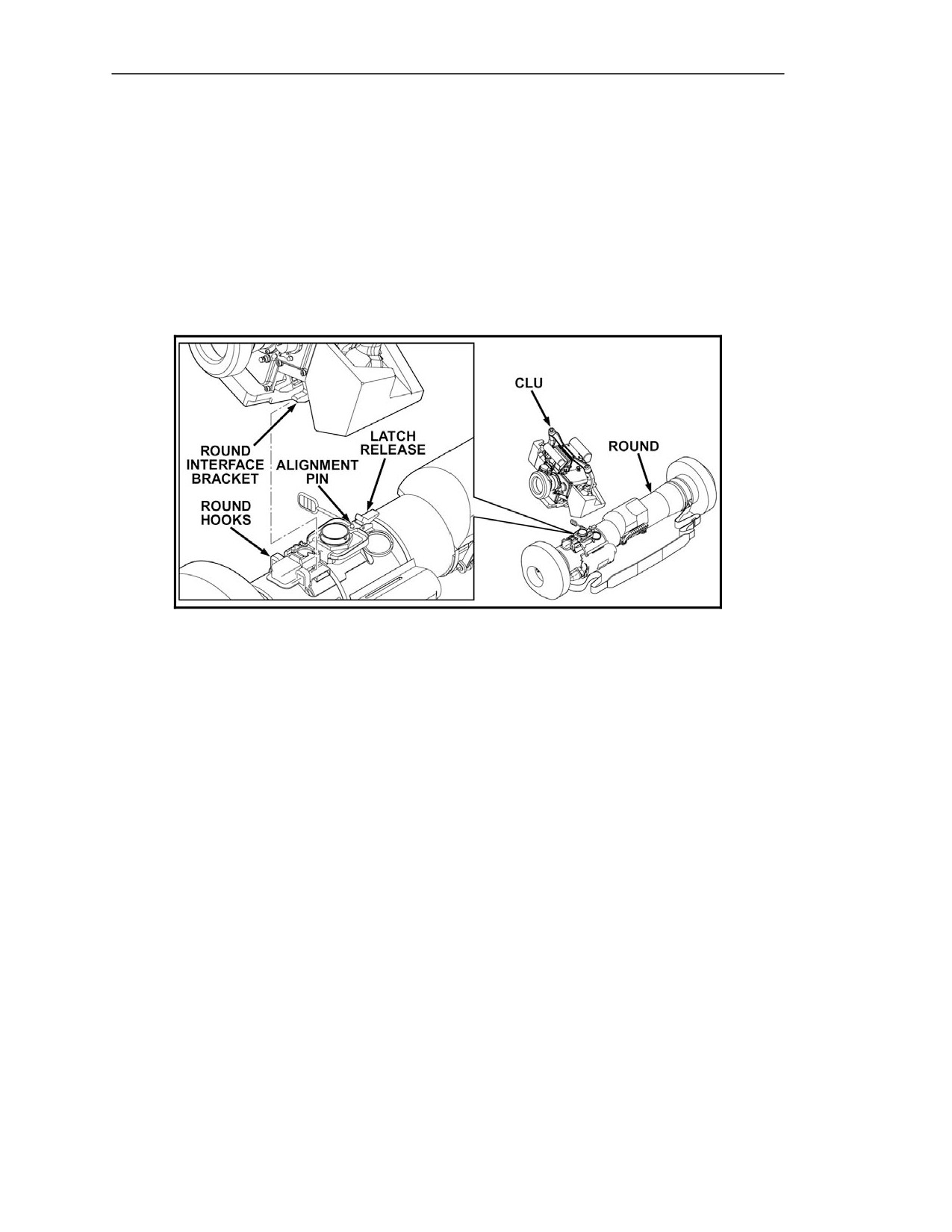
(5) Reinstall the locking pin in the hole in the forward end cap (Figure 2-35).
Figure 2-35. Forward end cap locking pin.
20 March 2008
FM 3-22.37
2-25
Chapter 2
DISCONNECT THE COMMAND LAUNCH UNIT FROM THE ROUND
2-64. To disconnect the CLU from the round—
(1) Depress the latch release on the round (Figure 2-36).
(2) Using the handgrip, lift up and rotate the CLU toward the forward end cap. The CLU rotates
away from the round interface connector and the round hooks.
(3) Reinstall the connector covers on the interface connectors on the CLU and on the round. If
the seeker was activated, replace the BCU.
(4) Place the CLU in the CLU carry bag with the handgrips up and the eyepiece toward the
back of the carry bag.
Figure 2-36. Disconnect the command launch unit from the round.
REPLACE THE BATTERY COOLANT UNIT
2-65. If the seeker has been activated, replace the BCU. To replace the BCU—
(1) Remove the expended BCU.
(2) Kneel on the left side of the round and position the Javelin on the ground so the handgrips
point up.
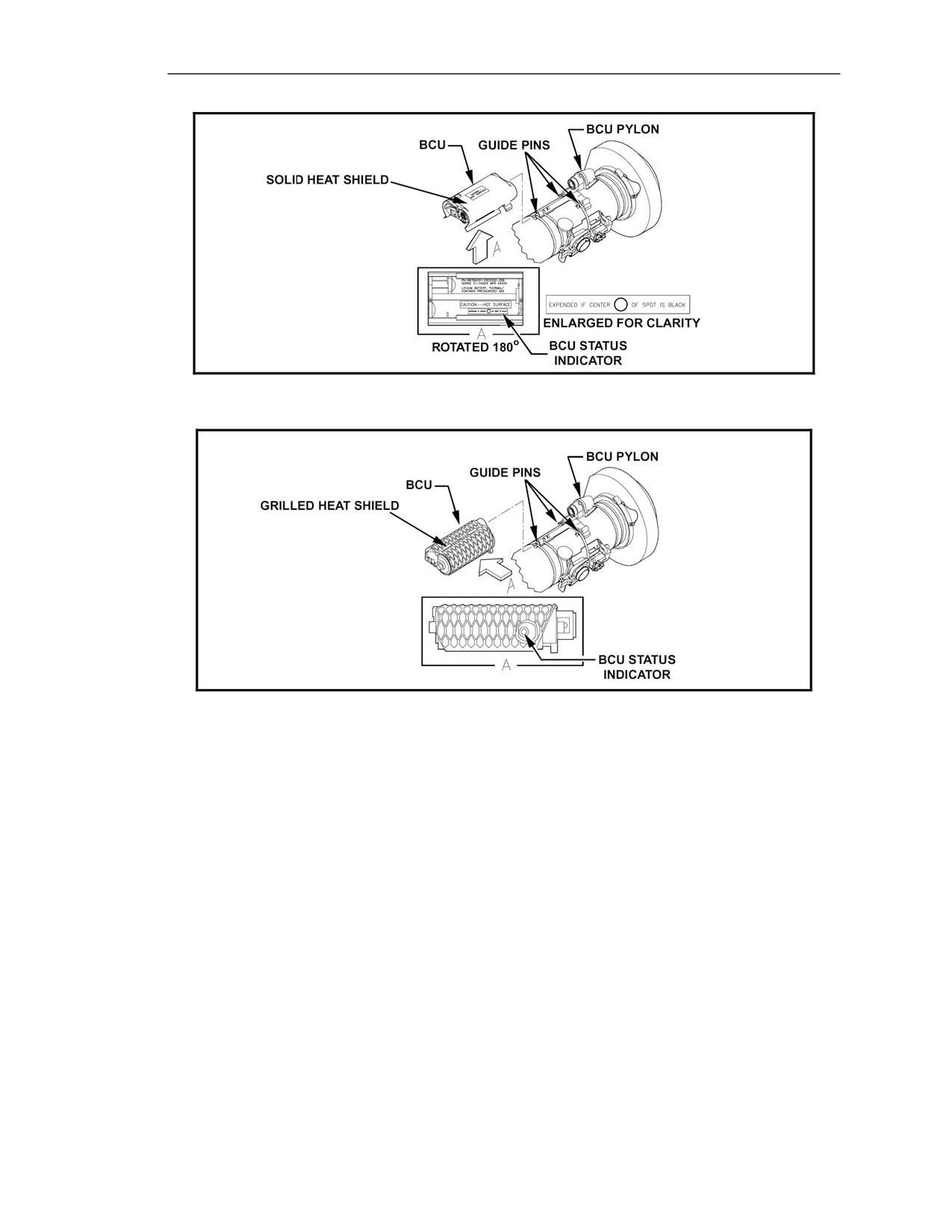
(3) If BCU has solid heat shield (Figure 2-37)—
Lift BCU latch with the thumb.
Slide the BCU to the rear to release it from the guide pins.
(4) If BCU has grilled heat shield (Figure 2-38)—
Push down on the BCU latch with the thumb.
Grasp the BCU with the opposite hand and slide it to rear to release it from the guide
pins.
INSTALL A NEW BATTERY COOLANT UNIT
2-66. To install a new BCU—
(1) Remove the shipping plug that protects the internal gas bottle.
(2) Inspect BCU status indicator to ensure the replacement BCU is operational.
(3) Place BCU on the round’s guide pins with the catch to the rear of round, slide the BCU onto
the guide pins. Ensure the BCU snaps into place.
2-26
FM 3-22.37
20 March 2008
Controls and Operation
Figure 2-37. Old battery coolant unit.
Figure 2-38. New battery coolant unit.
CARRYING TECHNIQUES
2-67. Three techniques are used for carrying the Javelin. The choice is based on mission, enemy,
terrain and weather, troops and support available, time available, civil considerations (METT-TC); the
situation; and the distance to be traveled.
TACTICAL CARRY
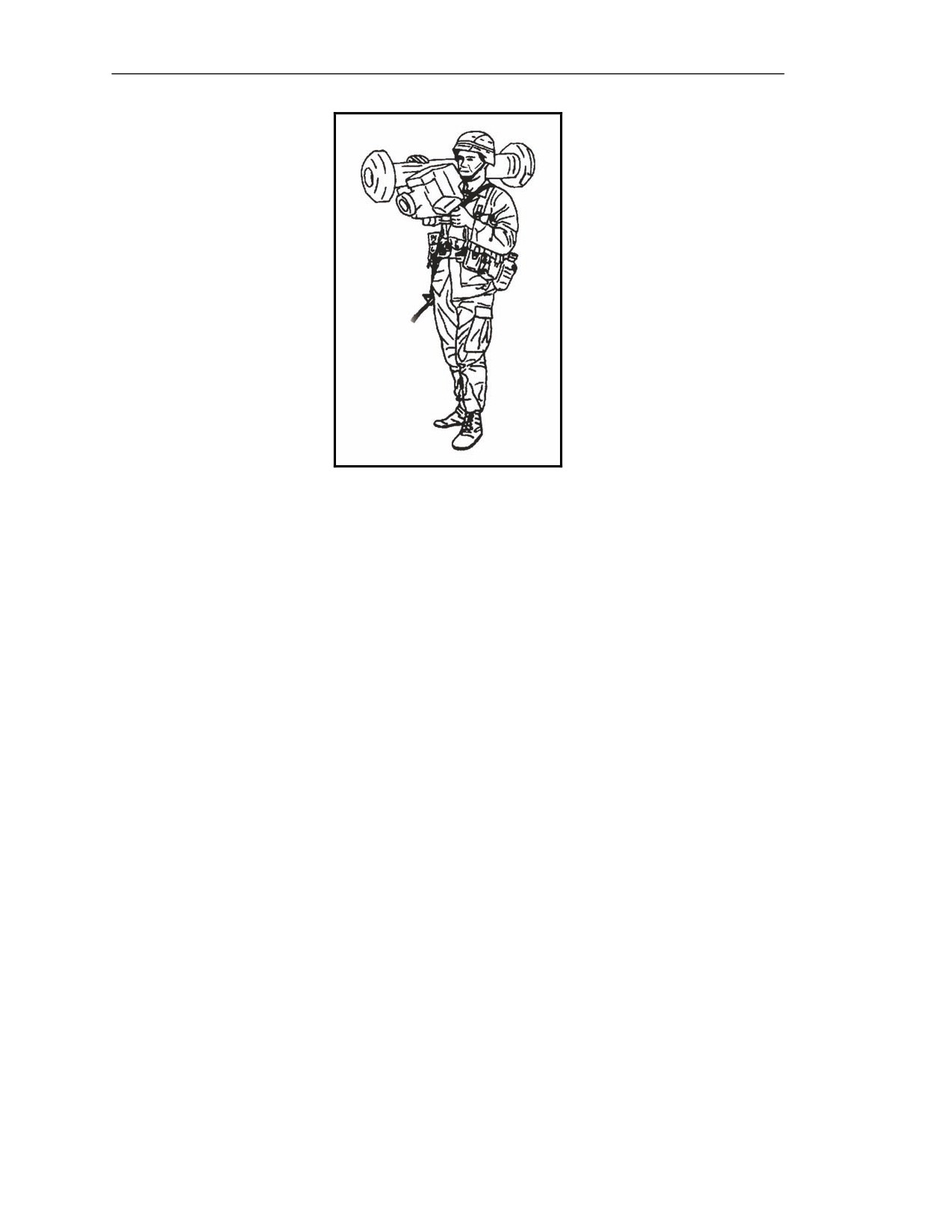
2-68. This technique is used when moving into position, between positions, and when enemy contact
is likely (Figure 2-39).
(1) The CLU and round are connected. Both end caps are secured to the round, and the NVS
and day sight lens covers are closed to prevent damage.
(2) The Javelin is carried on the gunner’s right shoulder, balanced on the shoulder pad. The left
hand holds the left handgrip, and the right hand is on top of the round.
(3) The gunner’s assigned weapon is slung across the back.
(4) The round can be cocked to the side so the gunner is able to see. He should not attempt to
move while looking through the CLU.
20 March 2008
FM 3-22.37
2-27
Chapter 2
Figure 2-39. Tactical carry technique.
SHORT-DISTANCE CARRY
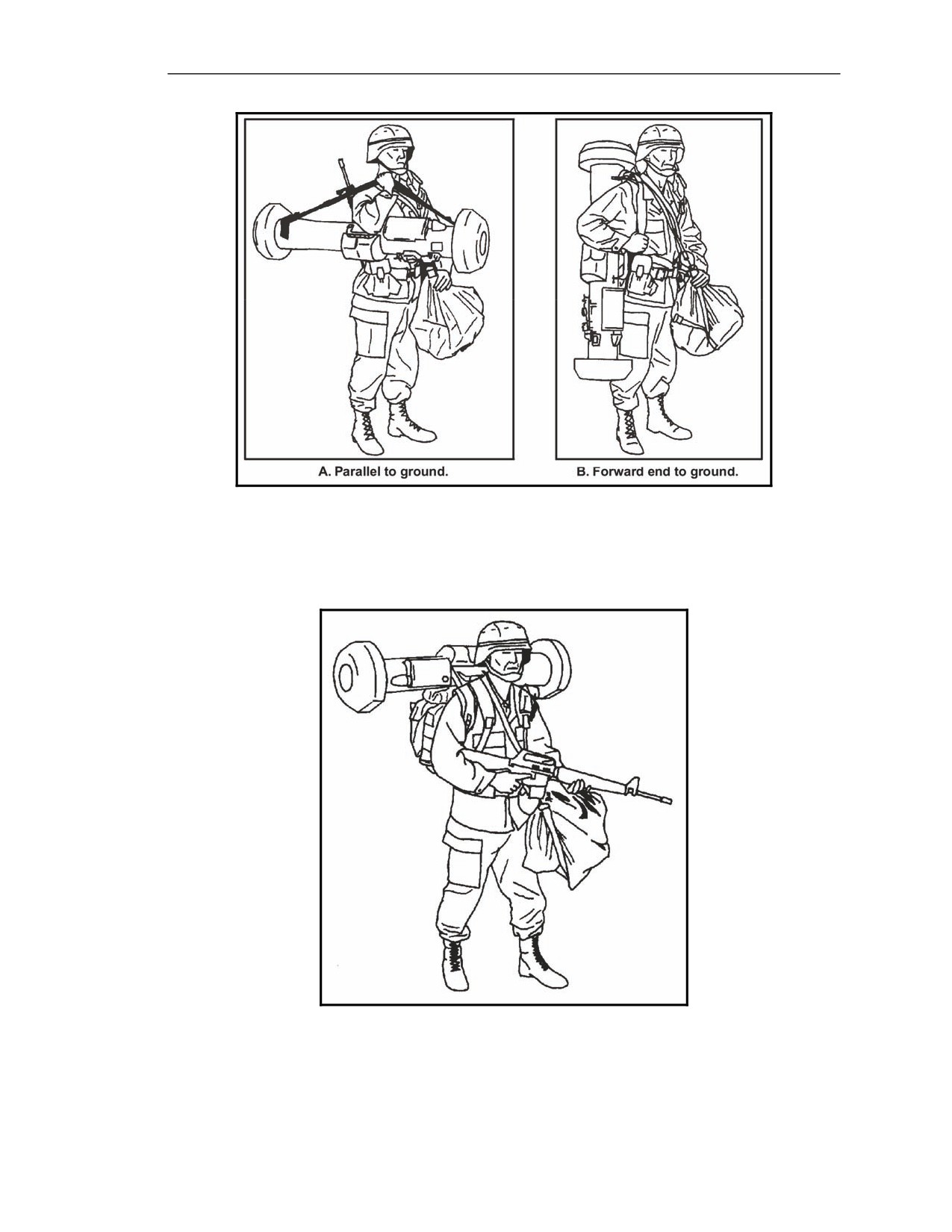
2-69. The short-distance carry technique is used when enemy contact is possible. The rifle is slung
over the gunner’s left shoulder. The CLU is in the carry bag. The carry bag is carried on the gunner’s
left side with the shoulder strap over the left shoulder or across the chest. Using the short-distance
carry technique, the round can be carried in one of two ways.
Round Parallel to Ground
2-70. The round is carried on the gunner’s right side with the shoulder strap over the right shoulder.
The round is parallel to the ground, waist high with the forward end cap pointed in the direction of
movement. The gunner’s right hand may be placed on the shoulder strap to keep the round from
swaying and to help keep the shoulder strap on the shoulder (Figure 2-40A).
Round Forward End Pointed Down
2-71. The round is carried on the gunner’s right side with the shoulder strap over the right shoulder.
The forward end cap is pointed down with the round behind the right shoulder, parallel to the gunner’s
body. The gunner’s right hand may be placed on the shoulder strap to help keep the strap on the
shoulder (Figure 2-40B).
2-28
FM 3-22.37
20 March 2008
Controls and Operation
Figure 2-40. Short-distance carry techniques.
LONG-DISTANCE CARRY
2-72. The long-distance carry technique is used when contact is not likely (Figure 2-41).
Figure 2-41. Long-distance carry technique.
20 March 2008
FM 3-22.37
2-29
Chapter 2
Command Launch Unit Carry Position
2-73. To carry the CLU—
(1) Place the CLU in the carry bag.
(2) Ensure the carry bag is on the gunner’s left side with the shoulder strap over the left
shoulder or across the chest.
(3) Use a second strap on the carry bag to fasten the CLU to the gunner’s waist. This procedure
prevents the carry bag from bouncing when the gunner walks.
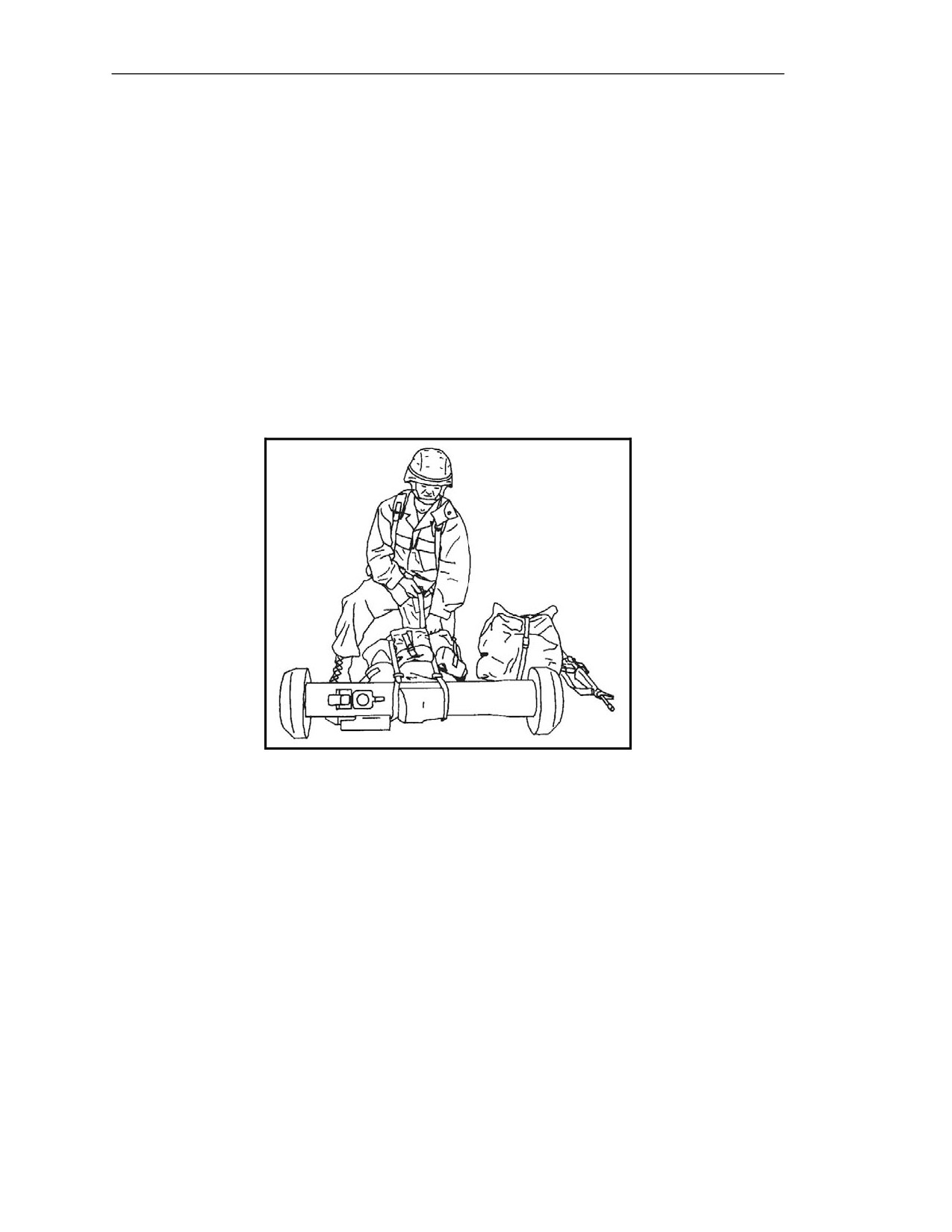
Stowing the Round on a Rucksack
2-74. To stow the round on a rucksack—
(1) Place the rucksack on the ground with the frame face down and the top of the pack facing
away.
(2) Locate the two long web straps extending from the top of the frame and across the front of
the pack (Figure 2-42).
Figure 2-42. Secure the round to the rucksack.
(3) Open the straps to form a loop at the top of the rucksack frame.
(4) Pick up the round and slide it through the strap loops.
(5) Make sure the BCU is facing forward to prevent damage to it when the rucksack is placed
on the ground.
(6) Tighten the straps by pulling on the ends. Continue until the straps are tight.
(7) Place the rucksack on the back making sure the round well balanced and evenly distributed
across the top of the frame. Make sure the round is parallel to the ground.
2-30
FM 3-22.37
20 March 2008
Chapter 3
TRAINING PROGRAM
The Javelin training program integrates the Javelin into the overall unit training
program to increase combat readiness and ensure that trainers and gunners are
proficient in operating and maintaining the Javelin.
SECTION I. GENERAL
The commander should conduct an accurate assessment to determine the initial and sustainment training
required to maintain the proficiency of assigned Javelin gunners. Unit training programs should include
Javelin gunner training; the unit’s battle focus and mission-essential task list (METL); and the supporting
Soldier, leader, and collective tasks.
TRAINING STRATEGY
3-1. The Javelin training strategy is composed of five primary components:
z
Initial training.
z
Sustainment training.
z
Collective training.
z
Force-on-force training.
z
Leader training.
INITIAL TRAINING
3-2. Initial gunner training is a prescriptive program of instruction (POI) conducted at the institution
and in the unit. This training consists of two weeks of instruction, culminating in the successful
completion of the gunner's skill test (GST).
SUSTAINMENT TRAINING
3-3. Sustainment training ensures retaining skills learned during initial training. This training takes
place entirely in the unit: monthly, bimonthly, quarterly, and annually. Gunners must retain their skills
by practicing engaging targets at least monthly. The gunner fires selected engagements from the
monthly sustainment exercises using the BST. The gunner practices field engagements using the FTT
every other month. Once a quarter, the gunner completes the entire GST. If the gunner does not
perform satisfactorily, he should be retrained until he qualifies.
COLLECTIVE TRAINING
3-4. Collective training takes place in the unit to integrate the Javelin into the unit’s overall combat
power. The Javelin is integrated into collective training using the FTT. Force-on-force training is
conducted with the FTT during squad platoon, company, and battalion field training exercises
(FTXs)/situational training exercises (STXs).
LEADER TRAINING
3-5. Leader training is conducted in both the institution and the unit. Leaders are taught to train,
maintain, and employ the Javelin in courses such as Officer and Noncommissioned Officer Education
Systems (OES and NCOES, respectively) This training must continue in units formally through
20 March 2008
FM 3-22.37
3-1
Chapter 3
noncommissioned officer (NCO) and officer development classes and informally through personal
initiative.
3-6. Javelin leadership training begins with the basic understanding of the Javelin, its capabilities and
limitations, moves to understanding the fundamentals of Javelin tactical employment, and includes
how to integrate the Javelin into company level training.
3-7. Leaders must learn how to employ the Javelin and integrate it into their units. Tactical exercises
without troops (TEWT) can be used to develop leaders' tactical understanding. (For more information
about tactical employment considerations, see Chapter 4.) Gunners may also be employed with their
squads to help train other squad or fire team members to perform their duties (providing security,
locating targets, etc.). After-action reviews (AAR) should be conducted after all training exercises, and
recommendations should be provided to the commander so that Javelin security, operation, and
employment considerations can be more effectively integrated into the unit training plan.
PREREQUISITES FOR ADDITIONAL SKILL IDENTIFIER
3-8. Normally, the 2C (Javelin Gunner) additional skill identifier (ASI) is awarded at the completion
of institutional training; however, initial gunner training can be conducted by the unit when school-
trained gunners are not available. This training should only be conducted by qualified Javelin trainers,
and only on an as needed basis, to maintain qualified gunners at the battalion level and above. The
course must be conducted in accordance with (IAW) the Javelin POI established by the USAIS.
NOTE: Units must provide qualified instructors who have completed the Basic
Noncommissioned Officer Course (BNCOC) and who are certified to conduct initial gunner
training, or who have completed the train-the-trainer program. The unit must contact the
Javelin course at USAIS for approval to conduct the Javelin Gunner's Course (JGC). USAIS
oversees and monitors all non-resident Javelin courses.
SECTION II. TRAIN THE TRAINER
The train-the-trainer program develops selected unit leaders into competent trainers prepared to teach other
Soldiers how to become Javelin gunners. To ensure trainer longevity, commanders should ensure that only
those personnel recently assigned are chosen to attend the Javelin train-the-trainer program.
TRAIN-THE-TRAINER PROGRAM
3-9. The train-the-trainer program provides unit-selected Javelin trainers with the skills and
knowledge necessary to teach gunners to apply Javelin gunner techniques. During this program,
trainers will also learn to develop and maintain a Javelin training program by which the unit can
sustain individual gunner proficiency. Soldiers attending this training receive instruction on—
z
Planning and scheduling Javelin training.
z
Setting up, operating, and maintaining Javelin training equipment.
z
Conducting individual and force-on-force training.
z
Coaching gunners on engagement skills.
z
Evaluating gunner training weaknesses.
z
Qualifying gunners.
z
Maintaining training records.
3-2
FM 3-22.37
20 March 2008
Training Program
INITIAL TRAINING
3-10. The Soldier designated to become a trainer receives 40 hours of Javelin instruction taught by the USAIS. The
course consists of four modules: Module 1, Course Introduction; Module 2, Introduction to the Javelin; Module 3,
Basic Skills Trainer Operating Instructions; and Module 4, Field Tactical Trainer Operating Instructions.
Module 1: Course Introduction
3-11. This module covers course orientation and applicable training materials. The provided materials give the unit
trainer an insight into the 40-hour course of instruction, Javelin training requirements, and the expected course outcome.
Module 2: Introduction to the Javelin
3-12. This module covers the operational capabilities of the Javelin and its major components.
Module 3: Basic Skills Trainer Operating Instructions
3-13. This module covers the use and operation of the BST, the primary training device used for
developing the technical skills required to become a Javelin gunner and for qualifying Javelin gunners.
Module 4: Field Tactical Trainer Operating Instructions
3-14. This module covers the use and operation of the FTT, a critical element in developing Javelin gunner
proficiency. The FTT is used to develop the skills required to engage targets under field conditions.
SUSTAINMENT TRAINING
3-15. After trainers complete the initial gunner training and Javelin device operational training, they
learn to develop a unit training program. The trainers' sustainment training includes practicing the
exercises in the BST annex and the FTT exercises in Table 3-1. The last piece of course instruction
addresses the planning and frequency of Javelin gunnery, and the documentation (recording and
maintaining gunner records) associated with training and qualification.
PROGRAM AUDIENCE
3-16. The train-the-trainer program has two target audiences: potential trainers and potential coaches.
TRAINERS
3-17. Trainers are proficient with the Javelin and can teach others to become Javelin gunners and
coaches. These Soldiers should be selected from the most highly qualified Soldiers in the unit.
COACHES
3-18. Coaches are Javelin gunners who can demonstrate the necessary warrior skills to assist other
Soldiers in learning basic Javelin gunnery skills. These Soldiers should be selected from unit gunners
who possess the desire and ability to train other Soldiers. Coaching has a two-fold benefit: (1) the
coach learns and retains the subject matter through repetitive training and demonstrated leadership
skills, and (2) other gunners can benefit from the one-on-one assistance.
STANDARDS FOR TRAINERS
3-19. Javelin instructors meet the same standards as Javelin gunners. Successful gunner experience is
an asset, but it is not necessarily an indicator of a good instructor. Each instructor must have the
confidence, willingness, knowledge, and skills required to train Soldiers to become consistent and
effective Javelin gunners in combat. Once selected, the instructors must have successfully completed a
train-the-trainer course. The unit commander is encouraged to periodically evaluate each trainer.
20 March 2008
FM 3-22.37
3-3
Chapter 3
RESOURCE REQUIREMENTS
3-20. When preparing Javelin instruction, the unit trainer determines the number of gunners to be
trained, the time frame for the training, and the resources required. At the beginning of each training
module, Soldiers attending institutional or unit Javelin courses receive a training support package that
provides a checklist of training requirements.
TRAINING SUPPORT PACKAGES
3-21. Javelin training support material is continually reviewed and updated by the Javelin training
team at the USAIS at Fort Benning, Georgia. There are two sets of media packages for the Javelin:
Training Device Course (TDC) and JGC. The entire JGC is presented in media packages featuring up-
to-date information and sound and video elements. A current version of the training materials can be
downloaded from the USAIS website.
TRAINING DEVICES
3-22. The Javelin weapon system includes three training devices: the BST, the FTT, and the MSR.
BASIC SKILLS TRAINER
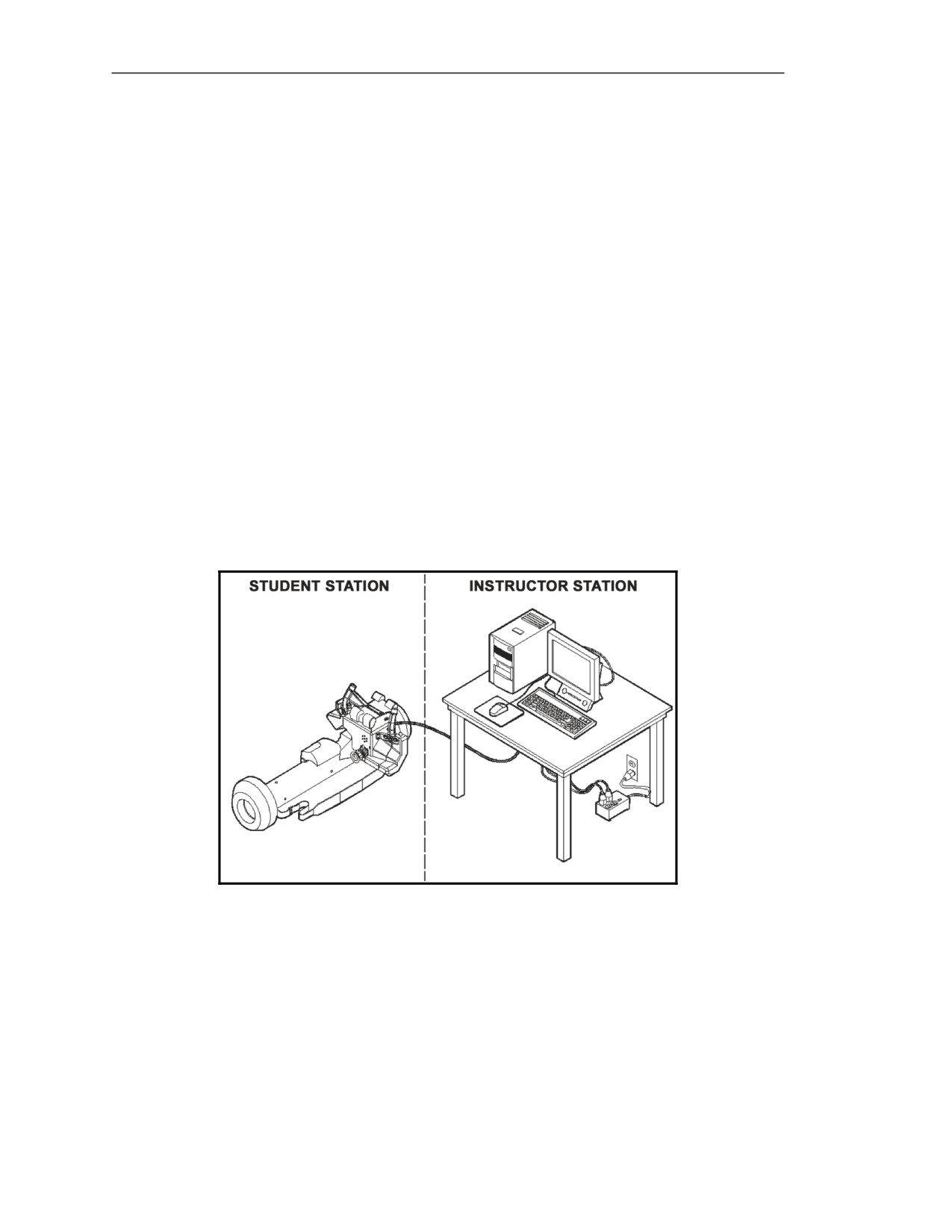
3-23. The BST is the primary trainer used to train and qualify Soldiers on the Javelin. The BST
consists of two major assemblies: an instructor station and a Soldier station (Figure 3-1). The instructor
station consists of a personal computer equipped with special hardware and software, and the Soldier
station consists of an SCLU and an MSR. A cable links the Soldier station with the instructor station.
Figure 3-1. Basic skills trainer.
Instructor Station Features
3-24. At the instructor station, a desktop personal computer provides the means to install or upgrade
software, create and save gunner training records, and monitor gunner performance during a given
exercise. BST operators can enter and save gunner training record data on a 3.5-inch disk. The
instructor station also allows the operator to monitor the gunner's actions during each exercise. After
the exercise is over, the BST operator can critique the gunner's performance by replaying the exercise.
3-4
FM 3-22.37
20 March 2008
Training Program
Training Exercises
3-25. The BST contains training exercises for initial Javelin training and qualification, with two retest
exercises for each qualification exercise. Initial training and qualification exercises are stored in
separate directories, with expansion directories for sustainment and advanced gunnery training. The
exercises contain terrain models, three-dimensional target models, weather conditions (i.e., clear, rain,
snow, etc.), run times (1 to 7 minutes), and malfunctions (i.e., hangfire and misfire).
Soldier Station Features
3-26. The Soldier station equipment simulates the physical and operational characteristics of the
Javelin, including weight, point of balance, dimensions, hardware components, controls, and
indicators. It reproduces simulated battlefield imagery, visual indicators that the gunner uses during
target engagement, and operational sounds from a built-in speaker system.
Simulated Imagery
3-27. The computer-generated IR and daylight imagery reflects the magnification and spectral capabilities
of the Javelin. BST training exercises use digital images of real terrain from actual visible light and IR
imagery. As the gunner works through an exercise, identical imagery is displayed on the instructor station.
Simulated Battery Coolant Unit Removal and Replacement
3-28. The simulated BCU is fixed to the simulated round and cannot be removed during normal use.
The Soldier explains the actions that he would take to do so, and the BST operator removes and
replaces the BCU by an input at the instructor station.
FIELD TACTICAL TRAINER
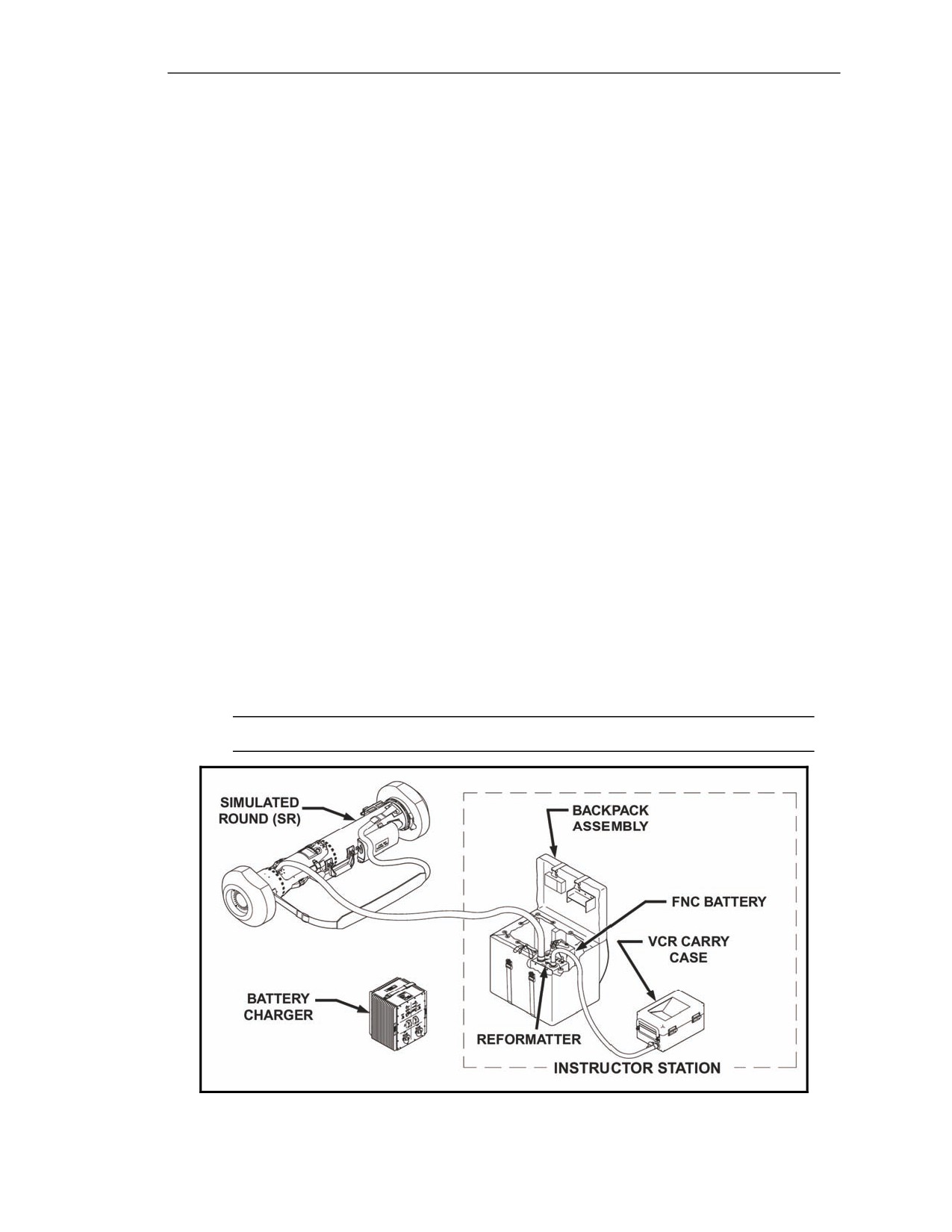
3-29. The FTT is a fully integrated, three-dimensional force-on-force training device consisting of an
instructor station, a simulated round, a battery charger, and batteries
(Figure
3-2). The round
incorporates a MILES laser transmitter to allow simulated Javelin engagements during training
exercises. The FTT is designed to simulate the Javelin's operational and engagement parameters
(Figure 3-2).
NOTE: A Javelin CLU is required, but it is not a component supplied with the FTT.
Figure 3-2. Field tactical trainer.
20 March 2008
FM 3-22.37
3-5
Chapter 3
Field Tactical Trainer Instructor Station
3-30. The FTT instructor station consists of a backpack assembly that contains a video camera
recorder (VCR), a reformatter, and a fiber nickel cadmium (FNC) battery. The instructor station adds
the capability of monitoring, recording, and reviewing gunner activities on 8-millimeter videotape.
Field Tactical Trainer Simulated Round
3-31. The FTT simulated round is used to simulate the actual Javelin round and weighs slightly more
(about 2 pounds). Using the video from the NVS-WFOV, the round simulates Javelin seeker imagery
and inserts crosshairs and track gates; then, it sends the image to the CLU display.
Battery Charger
3-32. The battery charger is used to charge the FNC battery that powers the simulated round and the
instructor station.
Fiber Nickel Cadmium Batteries BB390 for the Command Launch Unit
3-33. These are for training use only.
Command Launch Unit
3-34. The CLU interfaces with the simulated round through an interface connector and the W1 cable.
MISSILE SIMULATION ROUND
3-35. The MSR is used to teach gunners how to handle, maintain, and carry the round. It consists of a
simulated launch tube that contains no instruments or circuitry, but has the weight and balance of the
live Javelin round.
BASIC SKILLS TRAINER SETUP OPERATIONS
3-36. The BST allows training gunners in a realistic training environment. This training is conducted
indoors using computer-generated terrain and target vehicles. The Javelin instructor must have the
following knowledge to use the BST effectively:
z
Major components, equipment characteristics, capabilities, and features.
z
Basic operation of the Javelin.
z
How to prepare the BST for operation.
z
How to conduct daily readiness check procedures.
z
How to prepare and maintain a Gunner Training Record.
z
How to prepare and conduct a BST exercise.
z
How to apply BST troubleshooting procedures.
z
How to maintain a BST.
z
How to prepare a BST for shipment or storage.
3-37. The BST is self-contained and comes in two transit cases containing the instructor station and
the Soldier station. The instructor station transit case contains the Javelin BST setup instructions. The
instructions explain how to set up the BST and include a wiring diagram.
3-6
FM 3-22.37
20 March 2008
Training Program
OPERATIONS
3-38. Once the instructor station has been turned ON, the BST software icon is selected, and the Javelin
Main Menu window appears on the monitor, the instructor can select from the following directories:
z
Daily readiness check.
z
Exercise editor.
z
Javelin training.
z
IR training.
z
Exit.
3-39. From this point on, the instructor can decide where he wants to go. The program is menu-driven.
EXERCISES
3-40. The Javelin exercises and exercise upgrades provided by the Javelin Project Management Office are
reviewed periodically by the USAIS. System upgrades are managed by the Javelin Project Manager.
COACHING TECHNIQUES
3-41. The instructor station allows the trainer/coach to see what the gunner sees as he works through
the performance steps. The various exercises work toward one goalʊa gunner who can detect,
identify, and successfully engage targets with the Javelin. The trainer/coach helps the gunner work
through the various exercises to develop techniques to engage the enemy. The BST records these
exercises so that the coach and gunner can review the events that occurred. The immediate feedback
allows the gunner to review his actions and learn from his successes and mistakes.
CONDUCT BASIC SKILLS TRAINER EXERCISES
3-42. The trainer/coach should have a complete understanding and the expertise to perform the
following tasks:
(1) Set up the instructor and Soldier stations. Perform a system check to ensure that they are
properly assembled.
(2) Provide the gunner’s briefing.
(3) Ensure that gunners assume the best firing position possible and that they always check the
backblast area before firing. The Javelin is balanced so the gunner can easily hold the
Javelin steady, acquire a target, and engage it. If the position is awkward, the gunner tires
quickly, making it more difficult for him to hold the Javelin steady while operating CLU
control switches.
(4) Watch the gunner adjust the focus adjustment ring. Ensure that the adjustment compensates
for the gunner's vision by asking the gunner to scan and identify targets.
(5) Guide the gunner through making necessary sight changes (i.e., when the target scene
changes). The brightness and contrast controls must be adjusted for changing conditions.
(6) Observe the gunner as he selects the FOV and the method of scanning (rapid, slow, or
detailed; day or night). Make notes for the AAR.
NOTE: The gunner should use the WFOV for scanning.
(7) Follow the gunner as he looks at his sector of fire to ensure that he covers the sector
completely and detects any sounds from or physical evidence of nearby vehicles. For
example, does the gunner hear any engine noises or see any vehicle exhaust or dust clouds?
20 March 2008
FM 3-22.37
3-7
Chapter 3
NOTES:
1. The gunner should use the WFOV to detect targets.
2. During limited visibility conditions, the gunner should look for any light
sources, such as a lit cigarette, headlights, or flashlights. During the day, the
gunner should look for light reflected from shiny surfaces.
(8) Ensure that the gunner correctly performs target detection and classification. Once the
gunner detects a potential target, he must classify it as wheeled or tracked and recognize it
as friendly or enemy. The coach and gunner should talk to each other during this process.
For example, the coach may ask the gunner what makes the target friendly or enemy, or the
gunner may have to identify the types of vehicles.
NOTE: The gunner should use the NFOV for classification and recognition.
(9) Ensure that the gunner correctly performs seeker lock-on and target engagement procedures.
To achieve seeker lock-on, the gunner must be able to adjust the track gates (see Chapter 4).
Observe where the gunner places the track gates on the target. This adjustment is a critical
step. Make sure that the gunner gets a good lock on the target. Observe the gunner to ensure
that he smoothly transitions into locking on the target, and follow the gunner during moving
target engagements. Once the gunner has identified the target as enemy, the gunner should
achieve seeker lock-on and fire.
(10) Conduct an AAR. The critique provides feedback to the gunner concerning his performance
during the exercise. There are several steps to the critique, including providing the score
computed by the BST, viewing a replay of the exercise, and determining whether to
override the exercise pass/fail status assigned by the BST. Critique the gunner's
performance by interpreting the system comments and providing an evaluation IAW
paragraph 7 of the exercise summary sheet. Record comments in the instructor’s comment
area of the Exercise Critique window.
FIELD TACTICAL TRAINER SETUP OPERATIONS
3-43. The FTT allows gunner training to be conducted in a field environment with actual target
vehicles. To use the FTT effectively, the Javelin trainer must be familiar with the Javelin's major
components, equipment characteristics, capabilities, and features; understand basic Javelin operation;
and know how to—
z
Prepare the FTT for operation.
z
Program an FTT using training exercise menus.
z
Prepare the instructor station for use with an FTT.
z
Conduct daily readiness checks.
z
Prepare and maintain a gunner training record.
z
Prepare and conduct an FTT exercise.
z
Monitor, record, and playback gunner training.
z
Apply FTT troubleshooting procedures with or without an instructor station.
z
Maintain an FTT with the instructor station.
z
Prepare an FTT for shipment or storage.
SETUP REQUIREMENTS INCLUDING BORESIGHT PROCEDURES
3-44. See the Training Device Module 4ʊFTT Operating Instructions. It provides step-by-step
instructions on how to set up the FTT and conduct boresight procedures.
3-8
FM 3-22.37
20 March 2008
Training Program
OPERATIONS
3-45.See Training Device Module 4—FTT Operating Instructions.
EXERCISES
3-46. FTT training is conducted in the field. Its execution varies based on the environment and assets
at hand.
COACHING TECHNIQUES
3-47. The FTT instructor station has the ability to video capture the exercise. This allows the
trainer/coach to observe the gunner's actions and record the engagement. The trainer/coach and gunner
can review the exercise together and critique each engagement during the AAR.
GUNNER'S SKILL TEST EXECUTION
3-48. The GST evaluates the gunner’s skills and is used to qualify Javelin gunners. It consists of a
BST test, an FTT test, and a range card exercise (conducted in any sequence). Gunner supporting tasks
are listed in paragraphs 3-74 to 3-82.
BASIC SKILL TEST
3-49. The BST portion of the GST consists of a series of exercises used to evaluate the following skills:
z
Assume a Javelin firing position and demonstrate how to engage a target.
z
Replace a spent BCU.
z
Apply Javelin misfire procedures.
z
Engage two or more targets.
z
Terminate an engagement.
z
Re-engage a target after break-lock.
z
React to a malfunction or warning indicator.
FIELD TACTICAL TRAINER
3-50. The FTT portion of the GST consists of five stations. The following skills are evaluated:
z
Engage a target.
z
Engage two or more targets.
z
Terminate an engagement.
z
Re-engage a target after break-lock.
z
Demonstrate the Javelin carry techniques using an FTT.
z
Change the missile mode, if necessary.
RANGE CARD EXERCISE
3-51. The gunner is required to correctly prepare a standard range card IAW information found in
Appendix B.
20 March 2008
FM 3-22.37
3-9

Chapter 3
SECTION III. TRAIN THE GUNNER
The JGC, an 80-hour POI, is the base training for the Javelin gunner. The course curriculum covers a series
of instructor lectures and a combination of hands-on practice exercises (PEs) and paper evaluations. Three
training devices—the BST, the FTT, and the MSR—are used during the training, as well as the CLU and
training aids.
CONDUCT OF TRAINING
3-52. Training the gunner on the basic skills needed to engage and destroy enemy targets begins in the
classroom learning the Javelin and its capabilities. The gunner then learns how to engage targets using the
BST and reacts to warning indicators and malfunctions. The next step in training the gunner is how to
operate the FTT. Using a combination of lecture, demonstration, and hands-on training, the trainer is able
to teach the gunner how to become an effective Javelin gunner. The gunner is finally evaluated using a
series of tests on the BST, FTT, and standard range card. See Table 3-1, a notional training schedule.
Table 3-1. Javelin 10-day (80-hour) training schedule.
DAY 1
DAY 2
DAY 3
DAY 4
DAY 5
Module 1
Module 3 (cont.)
Module 5 (cont.)
Module 6 (cont.)
Module 6 (cont.)
Course Intro
Module 2
Module 4
Module 6
Intro to Javelin
IR Images Target
Target Engagement
Acquisition.
System Malfunctions
(BST)
LUNCH
LUNCH
LUNCH
LUNCH
LUNCH
Module 2 (cont.)
Module 4 (cont.)
Module 6 (cont.)
Module 6 (cont.)
Module 6 (cont.)
Module 3
Module 5
Prepare Restore
Target Engageability
Carry
DAY 6
DAY 7
DAY 8
DAY 9
DAY 10
GST - BST
Module 7
Module 7 (cont.)
GST - FTT
Module 8
FTT
Maintain Javelin
LUNCH
LUNCH
LUNCH
LUNCH
LUNCH
GST - BST (cont.)
Module 7 (cont.)
Module 7 (cont.)
GST - FTT (cont.)
Course Critique
Graduation
PROGRAM EXECUTION
3-53. The gunner’s training program is designed to be taught in 10 days. Many units may not be able
to dedicate personnel and equipment assets for consecutive daily training. If this is the case, the
schedule can be modified, but units must avoid reducing the content of any training period. Each POI
is unique and plays an important part in the overall performance and understanding of the gunner.
Units modifying the schedule should keep the time between training periods as short as possible. When
a gap occurs between training events, a review of previous training must be planned at the start of the
next training period. Negative results are achieved when the training schedule is shortened. Units must
consider the following factors when deciding to modify (lengthen or split training periods/programs)
their gunner qualification program:
z
Quality of instruction must be maintained.
z
Tasks must be taught in a logical sequence.
z
Instructor continuity must be maintained.
3-10
FM 3-22.37
20 March 2008
Training Program
CENTRALIZED TRAINING
3-54. Centralized Javelin training is highly recommended. The decision to use centralized training
depends on the availability of the following training resources:
z
Equipment and facilities.
z
Personnel.
z
Time.
z
Tasks.
3-55. Centralized training establishes and maintains unit standards, but should not replace or
undermine the small unit leader. It should maximize the limited resources because the available
number of training devices may limit the choice to centralized training.
EQUIPMENT AND FACILITIES
3-56. Control of the BST and FTT should be centralized.
PERSONNEL
3-57. A train-the-trainer program is developed to maintain a pool of trainers for a successful training
program at the unit level. At least one Soldier at the company level should be trainer-qualified.
TIME
3-58. Until a train-the-trainer program has produced a sufficient number of trained Soldiers,
centralized training is conducted to save time and resources.
TASKS
3-59. When considering centralized training, the commander identifies the tasks required to achieve
training objectives and support the unit METL. Tasks that are not critical are taught during individual
or unit sustainment training.
TRAINING OBJECTIVES
3-60. Training objectives are statements that describe what the gunner should be able to do at the end of the
lesson. Each training objective consists of three statements: an action, the conditions, and the standards.
ACTION
3-61. The “action” statement describes a clearly defined and measurable activity that the gunner must
accomplish.
CONDITIONS
3-62. The “conditions” statement defines the circumstances and environment in which the gunner must
perform the activity defined in the “action” statement.
STANDARDS
3-63. The “standards” statement defines the minimum acceptable proficiency at which the gunner
must perform the activity defined in the “action” statement.
PRACTICE EXERCISES
3-64. A PE is a tool used to determine if Soldiers understood the information received during the
instruction. PEs may be conducted as either a written or a hands-on exercise.
20 March 2008
FM 3-22.37
3-11
Chapter 3
WRITTEN EXERCISE
3-65. A written exercise verifies how well Soldiers retained information given for knowledge-based
tasks (i.e., system capabilities, etc.). A written exercise may be a fill-in-the-blank, multiple choice, or
matching exercise.
HANDS-ON EXERCISE
3-66. A hands-on exercise determines how well Soldiers perform with the Javelin equipment (i.e.,
preparing the Javelin for firing, engaging targets, assuming carry configurations, and restoring the
Javelin to a carry configuration). During a hands-on exercise, Soldiers should use tactical equipment or
a training device to perform the action, while having their actions checked against a checklist.
EVALUATION SYSTEM
3-67. Soldiers' progress is evaluated throughout the course using PEs. A GST is given at the end of the
course.
PRACTICE EXERCISES
3-68. This training method provides input on Soldier retention. A PE gives the Soldier a chance to
practice the Javelin gunner skills learned in class. It is not a test, but the Soldier is evaluated to provide
feedback on proficiency of those skills. If the Soldier is given a “T” (trained), he is considered trained
on that information. If the Soldier is given a “P” (practice), he should be given additional time to
practice those skills or reread the information, and retested immediately. If the Soldier receives a “U”
(untrained), he should receive additional training to ensure that he did not misunderstand the principles
involved.
GUNNER'S SKILL TEST
3-69. During the GST, Soldiers are evaluated in three areas: the BST, the FTT, and range card
preparation.
Basic Skills Trainer
3-70. Soldiers are required to complete 11 qualification exercises on the BST. In each of these
exercises, he will be graded automatically by the BST and on observations made by the instructor. The
minimum standard for any qualification exercise is 70 percent. To pass, he must achieve the minimum
score on all 11 qualification exercises. If a Soldier receives a “NO GO” for any qualification exercise,
he will have up to two opportunities to retest on that exercise.
Field Tactical Trainer
3-71. During the FTT portion, the Soldier will rotate through five stations—one for maintenance and the
other four for firing at targets on a range. At each firing station, he will be given instructions similar to
those that a Javelin gunner would receive upon arrival at a fighting position. He is expected to carry out
those instructions just as he has learned to do during the course. When he rotates from one station to
another, he will be told to assume a specific carry configuration, which will be graded. At each station, he
will be graded as a “GO” or a “NO GO.” To pass, he must receive a “GO” at all stations.
Range Card Preparation
3-72. During the range card preparation, he will complete a standard range card as he was taught in
class. This portion is graded as “GO/NO GO.” To pass, he must receive a “GO.”
3-12
FM 3-22.37
20 March 2008
Training Program
SAFETY
3-73. Safety is everyone’s responsibility. Trainers must immediately correct any identified unsafe or
harmful acts and conditions, thereby preventing personal injury, illness, and damage to government
property. See Appendix A.
GUNNER QUALIFICATION PROGRAM
3-74. The Javelin gunner is qualified by a series of training events beginning with the JGC. The
gunner passes the GST to successfully complete the JGC. In the unit, the GST is conducted quarterly.
The gunner/trainer sustainment trainer supports the gunner’s qualification program. The Javelin
qualification program consists of eight modules:
z
Module 1: Introduction to the Course.
z
Module 2: Introduction to the Javelin Weapon System.
z
Module 3: Preparing, Restoring, and Carrying the Javelin.
z
Module 4: Imaging Infrared and Target Acquisition.
z
Module 5: Target Engageability.
z
Module 6: Target Engagement and Malfunctions.
z
Module 7: Field Tactical Trainer.
z
Module 8: Maintain a Javelin.
MODULE 1: INTRODUCTION TO THE COURSE
3-75. Although a short module, it sets the tone for the upcoming training. Module
1 lays the
foundation for the JGC. It starts with a list of objectives contained in each module. In the body, it
provides the administrative information, as well as course structure, objective, schedule, overview,
reference materials, and evaluation system.
MODULE 2: INTRODUCTION TO THE JAVELIN WEAPON SYSTEM
3-76. Module
2 provides information on Javelin capabilities, major components, controls, and
indicators. Gunners need this information to understand the remainder of the JGC. Module 2 consists
of the following training objectives:
ACTION:
Describe the operational capabilities of the Javelin.
CONDITION:
From memory. Given a set of fill-in-the-blank questions.
STANDARD:
Answered at least 12 of 16 questions correctly.
ACTION:
Identify the major components of the CLU.
CONDITION:
Given a CLU or a line drawing of the CLU.
STANDARD:
1. Identified at least 6 of the 8 major CLU components (handgrips, battery
compartment, daysight, eyepiece, NVS, DDC, absorbers, and round
interface connector).
2. Matched at least 6 of the 8 major CLU components with their functions.
20 March 2008
FM 3-22.37
3-13
Chapter 3
ACTION:
Identify the CLU controls.
CONDITION:
Given a drawing of a CLU.
STANDARD:
1. Identified at least 7 of the 9 CLU controls (diopter adjust ring, POWER
switch, FLTR switch, FOCUS switch, SGT SEL switch, seeker trigger,
GATE ADJ/CTRS & BRT switch, ATTK SEL switch, and fire trigger).
2. Matched at least 7 of the 9 CLU controls with their functions.
ACTION:
Identify the CLU status indicators.
CONDITION:
Given drawings of the CLU display with the status indicators.
STANDARD:
1. Identified at least 14 of the 20 status indicators (CLU power LED, CLU
BIT LED, DAY, WFOV, NFOV, WHITE HOT, BLACK HOT, E-ZOOM
OFF 2X, E-ZOOM OFF, FLTR, NVS NOT COOL, CLU BIT FAILURE,
CLU BATTERY, MSL CONN, MISSILE NOT READY, SEEK, TOP, DIR,
BCU, and MISSILE BIT FAILURE).
2. Matched at least 14 of the 20 status indicators with their functions.
ACTION:
Identify the major components of the round.
CONDITION:
Given an MSR or a line drawing of the round.
STANDARD:
1. Identified at least 6 of the 8 major components of the round (launch tube,
forward end cap, aft end cap, carry handle, shoulder strap, BCU,
shoulder pad, and latch assembly).
2. Matched at least 6 of the 8 major components of the round with their
functions.
ACTION:
Identify the round controls.
CONDITION:
From memory. Given a list of functions and a list of round controls.
STANDARD:
1.
Identified at least 5 of the 7 round controls (seeker trigger/trigger guard,
SGT SEL switch, ATTK SEL switch, GATE ADJ/CTRS & BRT switch,
fire trigger, and manual release button).
2.
Matched at least 5 of the 7 round controls with their functions.
ACTION:
Identify the round indicators.
CONDITION:
From memory. Given a list of functions and a list of round indicators.
STANDARD:
1.
Identified at least 3 of the 4 round indicators (BCU status indicator,
humidity indicator, track gates, and crosshairs).
2.
Matched at least 3 of the 4 round indicators with their functions.
3-14
FM 3-22.37
20 March 2008
Training Program
MODULE 3: PREPARING, RESTORING, AND CARRYING THE JAVELIN
3-77. Module 3 covers preparing the Javelin for firing, assuming the Javelin firing positions, restoring
the Javelin to a carry configuration, and employing the Javelin carry techniques. Module 3 consists of
the following training objectives:
ACTION:
Demonstrate the Javelin carry techniques.
CONDITION:
Given a Javelin and a carrying bag with all components.
STANDARD:
Assumed each of the following carry positions:
1. A tactical carry within 1 minute.
2. A short-distance carry within 1 minute.
3. A long-distance carry within 3 minutes.
ACTION:
Prepare a Javelin for firing.
CONDITION:
Given a CLU, a round, and a carrying bag with all components in either the
short-distance or long-distance carry configuration.
STANDARD:
Removed the CLU from the carrying bag, installed the BA-5590/U battery,
connected the CLU to the round, removed the forward end cap, and opened
the lens covers within 2 minutes.
ACTION:
Restore a Javelin to a carry configuration.
CONDITION:
Given a Javelin in the ready-to-fire configuration, a CLU carrying bag, and a
designated carry configuration.
STANDARD:
Powered down the CLU, replaced the forward end cap, removed the CLU
from the round, and assumed either the short- or long-distance carry
position.
ACTION:
Assume a Javelin firing position.
CONDITION:
Given a Javelin in the ready-to-fire configuration.
STANDARD:
Assumed each designated firing position within 60 seconds.
ACTION:
Replace a BCU.
CONDITION:
Given a Javelin with the seeker activated (but the missile has not been
launched) and an unused BCU.
STANDARD:
Removed spent BCU and reinstalled a new BCU within 20 seconds.
20 March 2008
FM 3-22.37
3-15
Chapter 3
ACTION:
Construct a Javelin fighting position.
CONDITION:
TBD
STANDARD:
TBD
MODULE 4: IMAGING INFRARED AND TARGET ACQUISITION
3-78. In the first part, Module 4 covers IR theory, the effects of various environmental influences on
IR images, and the techniques involved in adjusting the focus, contrast, and brightness to counteract
those influences. In the second part, Module 4 covers target acquisition (i.e., how to detect, classify,
and recognize them). Module 4 consists of the following training objectives:
ACTION:
Describe IR principles.
CONDITION:
Given a set of fill-in-the-blank questions.
STANDARD:
Described IR principles by correctly filling in all of the blanks for at least 15
out of 20 statements.
ACTION:
Adjust NVS focus, contrast, and brightness.
CONDITION:
Given 8 sets of target scene images, a CLU, and 5 objects.
STANDARD:
1. Determined in the first target scene whether to adjust the contrast or
brightness and the direction of adjustment to obtain the second target
scene for at least 6 of the 8 sets.
2. Correctly answered at least 6 of 8 questions about objects viewed
through the NVS.
ACTION:
Detect, classify, and recognize targets using IR imagery.
CONDITION:
Given 12 vehicle videos using IR imagery and 8 IR target images for 8
different vehicles.
STANDARD:
1. Classified 90 percent (10 out of 11) of the vehicles.
2. Recognized 80 percent of the correctly classified vehicles (9 out of the
10 or 11).
3. Correctly matched all of the IR target images in a set with its target
aspect for at least 6 of the 8 vehicles.
3-16
FM 3-22.37
20 March 2008
Training Program
MODULE 5: TARGET ENGAGEABILITY
3-79. Module 5 describes the use and purpose of the range card and the sector of fire, and the
processes involved in completing a standard range card and determining target engageability. Module
5 consists of the following training objectives:
ACTION:
Prepare a standard range card.
CONDITION:
During the daylight. Given combat equipment, a Javelin, a designated firing
position, a sector of fire, target reference data, a DA Form 5517-R (Standard
Range Card [LRA]), and a pencil.
STANDARD:
Completed a range card within 15 minutes.
Sketched a sector of fire with appropriate sketches and military symbols
(arrow between reference point and weapon position with azimuth and
distance; left limit; right limit; areas where targets are likely to appear; target
reference points [TRPs] and TRP numbers; maximum engagement line
[MEL]; all prominent terrain features, natural and man-made; all dead space;
unit size, not to exceed company; and magnetic north arrow).
Completed the Data section, including the type of position, type of weapon,
correct interval between circles, date, assigned TRPs (direction and range),
and avenues of approach ([AAs] direction and range).
NOTE: The range card must be readable and uncluttered.
ACTION:
Determine if a moving target is within Javelin range.
CONDITION:
Given a Javelin prepared to fire, a sector of fire, and a range card.
STANDARD:
Recognized when a target crossed the MEL.
MODULE 6: TARGET ENGAGEMENT AND MALFUNCTIONS
3-80. Module 6 covers the techniques involved in engaging a stationary target, a moving target, and
multiple targets; terminating an engagement; and handling warning indicators or malfunctions,
including misfires and hangfires. In this module, you will use the BST to perform these actions during
hands-on PEs. Module 6 consists of the following training objectives:
ACTION:
Engage a target with a Javelin.
CONDITION:
Given a BST ready to fire and a firing position.
STANDARD:
Detected, classified, and recognized targets; determined target
engageability; activated the seeker; changed the missile mode, if necessary;
locked on the target; checked for solid crosshairs and track gates; and
launched the missile.
20 March 2008
FM 3-22.37
3-17