FM 3-34 ENGINEER OPERATIONS (April 2009) - page 4
Sustainment Support for Engineer Capabilities
contracting battalions and contingency contracting teams. The contracting support brigade also provides
common joint, multinational, and interagency support when directed by the JFC and ASCC. As theater-
committed units, the contracting support brigades are aligned to theater Armies, but receive their
contingency contracting authority through the United States Army Sustainment Command. More
information on contracting support can be found later in this chapter.
OPERATIONAL-LEVEL SUPPORT
6-9. The JFC directs operations through Service component commanders or establishes functional
commands. Such functional commands include a joint forces land component to provide centralized
direction and control of all land operations (see JP 0-2, JP 3-31, and JP 4-07). For sustainment support, the
JFC assigns a lead Service to provide common-user logistics wherever possible, to avoid redundancy and
achieve greater efficiency.
6-10. The TSC is the senior Army logistics headquarters in a theater of operations and the single Army
logistics headquarters for the theater-level numbered Army (such as USAREUR 7th Army, United States
Army, United States Pacific Command (USPACOM) 8th Army, or JFC). The TSC consolidates most of the
functions previously performed by corps support commands and TSCs into a single operational echelon
and is responsible for C2 of logistics operations conducted in support of Army, joint, interagency, and
multinational forces. The TSC is regionally focused and globally employable. Its modular design provides
the TSC commander with the flexibility to adapt his C2 as requirements develop with ESC providing an
additional measure of responsiveness, agility, and flexibility for employment or deterrence.
6-11. The TSC rapidly establishes C2 of operational-level logistics in a specified AO by employing one or
more ESC. Each ESC provides a rapidly deployable, regionally focused, forward-based C2 capability that
mirrors the organizational structure of the TSC. By design, the ESC executes logistics operations that are
limited in scale and scope; employs reach capabilities to provide support to full spectrum operations; and
conducts logistics operations according to TSC plans, policies, programs, and mission guidance. In some
situations, the ASCC may choose to use a TEC or MEDCOM as senior headquarters for support if dictated
by the mission circumstances.
TACTICAL-LEVEL SUPPORT
6-12. Engineers operating above the BCT level will work closely with the sustainment brigade.
Sustainment brigades are one of the five types of support brigades and are subordinate commands of the
TSC. They consolidate selected functions previously performed by corps and division support commands
and area support groups into a single operational echelon. They provide C2 of the full range of logistics
operations conducted at the operational (theater Army) or higher tactical (corps and division) levels. They
perform theater opening, distribution, and sustainment functions. Each of these functions is interrelated,
and throughout the course of an operation, a sustainment brigade will likely perform one or more of these
functions simultaneously.
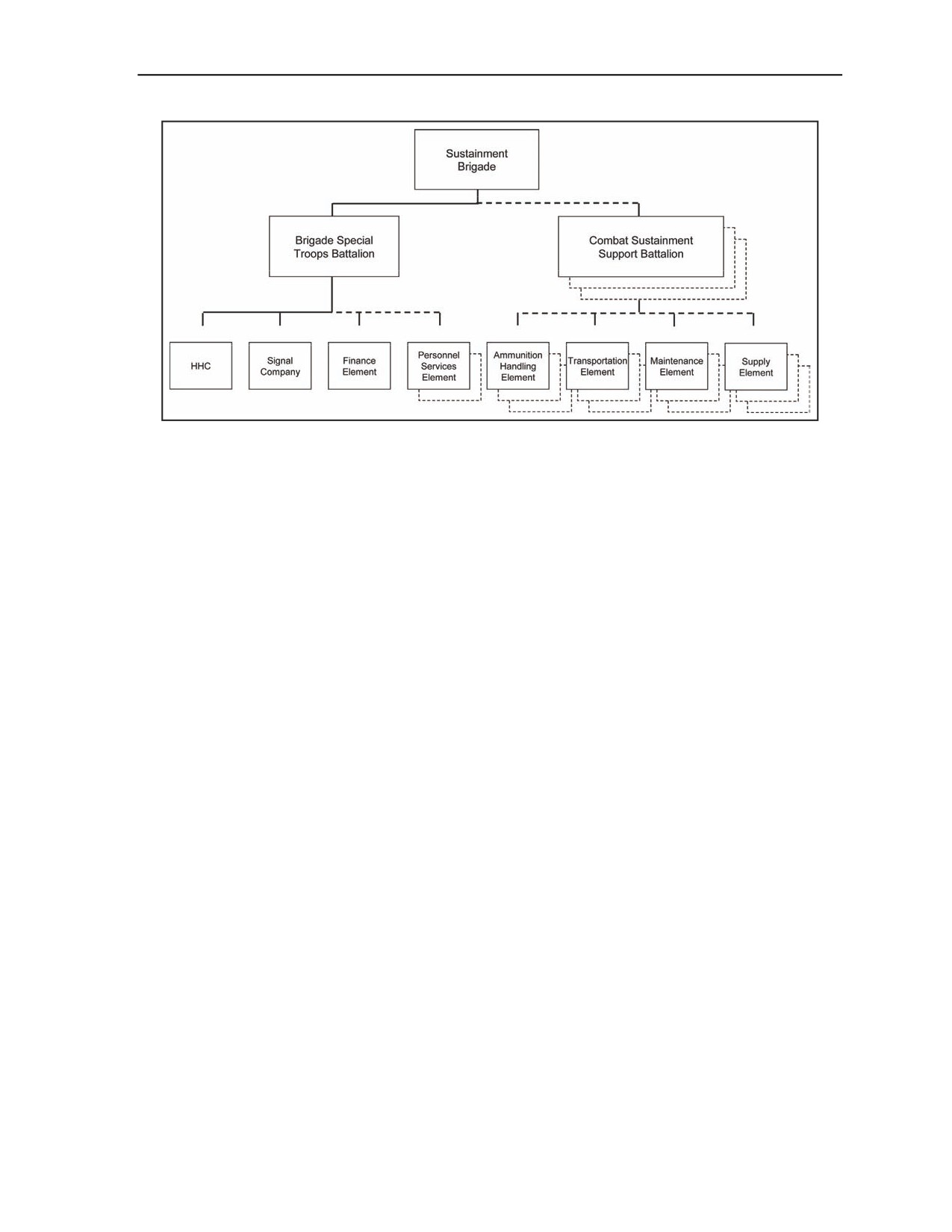
6-13. The sustainment brigade is a flexible, modular organization. Organic to the sustainment brigade are
the brigade headquarters and an STB. All other assets are task-organized to the sustainment brigade to
enable it to accomplish its role and mission (see FM 100-10-2 for more information on the organic and
modular units within the sustainment brigade). Sustainment brigades are assigned to a TSC, but may be
task-organized based on mission variables. The sustainment brigade may be assigned at either the
operational level (tasked to provide operational sustainment, tasked to conduct theater opening operations, or
tasked to provide theater distribution) or the tactical level (tasked to provide tactical logistics support to the
division). Sustainment brigades, when assigned appropriate modular units, can provide logistics support for
theater opening operations, theater distribution, operational and tactical logistics, and area support
missions. Figure 6-1, page 6-4, depicts a notional sustainment brigade organization.
2 April 2009
FM 3-34
6-3
Chapter 6
Figure 6-1. Notional sustainment brigade organization
6-14. Theater opening functions set the conditions for effective support and lay the groundwork for
subsequent expansion of the theater distribution system. The critical tasks for theater opening include: C2,
reach, and in-transit visibility; theater reception, staging, and onward movement; distribution and
distribution management; life support; protection; contracting; and initial theater sustainment. Given the
mission of theater opening, a sustainment brigade may have the following capabilities:
z
Capable of receiving and providing C2 for theater opening, theater distribution, signal, financial
management, ammunition, transportation, maintenance, supply and services, HR support,
religious support, and other sustainment support.
z
Capable of supporting early-entry operations until relieved by an operational-level sustainment
brigade or ordered to continue that mission by the corps or TSC.
z
Capable of establishing and managing initial theater opening operations to include reception,
staging, and onward movement functions and establishing the theater base.
z
Capable of establishing and managing initial theater distribution operations.
6-15. The sustainment brigade (theater distribution) operates the ground transportation assets, as well as
the theater ground distribution network (nodes, rest halts, and distribution hubs) from the theater base
distribution hub to the BCT BSBs. It is designed to provide C2 to assigned and attached units for the
purpose of conducting distribution operations in the AO. Distribution operations include receive, store,
issue, distribute, redistribute, transload, configure, reconfigure, classify, and collect stocks and unit
equipment. It also includes the reception and transportation of units and replacement personnel. When task-
organized to provide theater distribution, the sustainment brigade—
z
Configures and reconfigures loads as required. Distributes to and retrogrades from maneuver
BCTs; other support brigades; and joint, interagency, and multinational forces operating in the
AO.
z
Stores bulk supplies and authorized stockage list items for distribution and internal
consumption.
z
Directs the distribution of all supplies and services for which the sustainment brigade is
responsible in coordination with the TSC. Plans and controls the use of surface transport for
missions within the assigned AO. Organizes the movements of subordinate units within its AO.
This function requires coordination with the supported elements concerning current and
proposed locations and movement of units.
z
Provides guidance and assistance to units in the AO on matters relating to airdrop.
z
Provides staff supervision of technical training for personnel regarding the rigging and loading
of supplies and equipment for airdrop and aerial resupply.
6-4
FM 3-34
2 April 2009
Sustainment Support for Engineer Capabilities
z
Integrates joint, interagency, and multinational distribution capabilities.
z
Supports SOF units.
z
Delivers supplies, materiel, equipment, and personnel over the theater ground distribution
network from theater bases to BCTs and forward distribution points, as required.
z
Maintains surveillance over the theater ground distribution network.
z
Operates forward distribution points to receive, store, issue, configure, and reconfigure materiel.
z
Conducts retrograde, redirection, frustrated cargo, and redistribution operations.
z
Establishes and maintains total asset visibility and in-transit visibility over commodities,
equipment, personnel, units, and ground assets flowing in the distribution network.
z
Executes the TSC’s theater distribution plan.
z
Operates regional distribution hubs.
z
Synchronizes movements with the MEB along secured routes.
z
Deploys an early-entry element to the theater just after or in conjunction with the sustainment
brigade tasked to provide theater opening capabilities to establish robust distribution operations
beyond the theater base, when required.
6-16. The sustainment brigade provides support within an AO. Each sustainment brigade is a
multifunctional logistics organization providing support for multiple brigade-size units. It is tailored, task-
organized, and uses modular subunits (battalions, companies, and platoons) to perform specific functions.
At the tactical level, multifunctional sustainment brigades normally operate within the division AO. The
sustainment brigade is primarily concerned with the continuous management and flow of stocks and
allocation of reinforcing maintenance support in the AO to provide operational reach to maneuver
commanders. When task-organized to provide sustainment support within an AO, the sustainment brigade
capabilities include the following:
z
Coordinating supply of arms, munitions, and equipment.
z
Synchronizing supply and distribution of fuel and water.
z
Maintaining equipment and stocks that support the supply system.
z
Coordinating support of forces, including HR, field services, health, religious support, financial
management, and legal services.
z
Managing materiel, controlling movement, and managing distribution.
z
Providing lead service common-user logistics to other services, multinational partners, and
civilian agencies on order.
z
Establishing, managing, and maintaining facilities, including storage areas and maintenance
areas.
z
Planning, coordinating, managing, and supervising the positioning and security of activities.
6-17. Engineers operating within the BCT will work closely with the BSB. The BSB is the organic
sustainment unit of the BCT. The BSB commander is the BCT commander’s single sustainment operator.
The BSB support operations officer manages sustainment and HSS operations for the BSB commander.
The support operations officer provides the technical supervision for the external sustainment mission of
the BSB, is the key interface between the supported units and the BSB, plans and monitors sustainment
operations and makes necessary adjustments to ensure that support requirements are met, and requests and
coordinates augmentation with the higher echelon when requirements exceed capabilities. The BSB also
has a sustainment automation management officer who assists with maintenance of logistics-related
standard Army Management Information Systems (STAMIS) throughout the BCT.
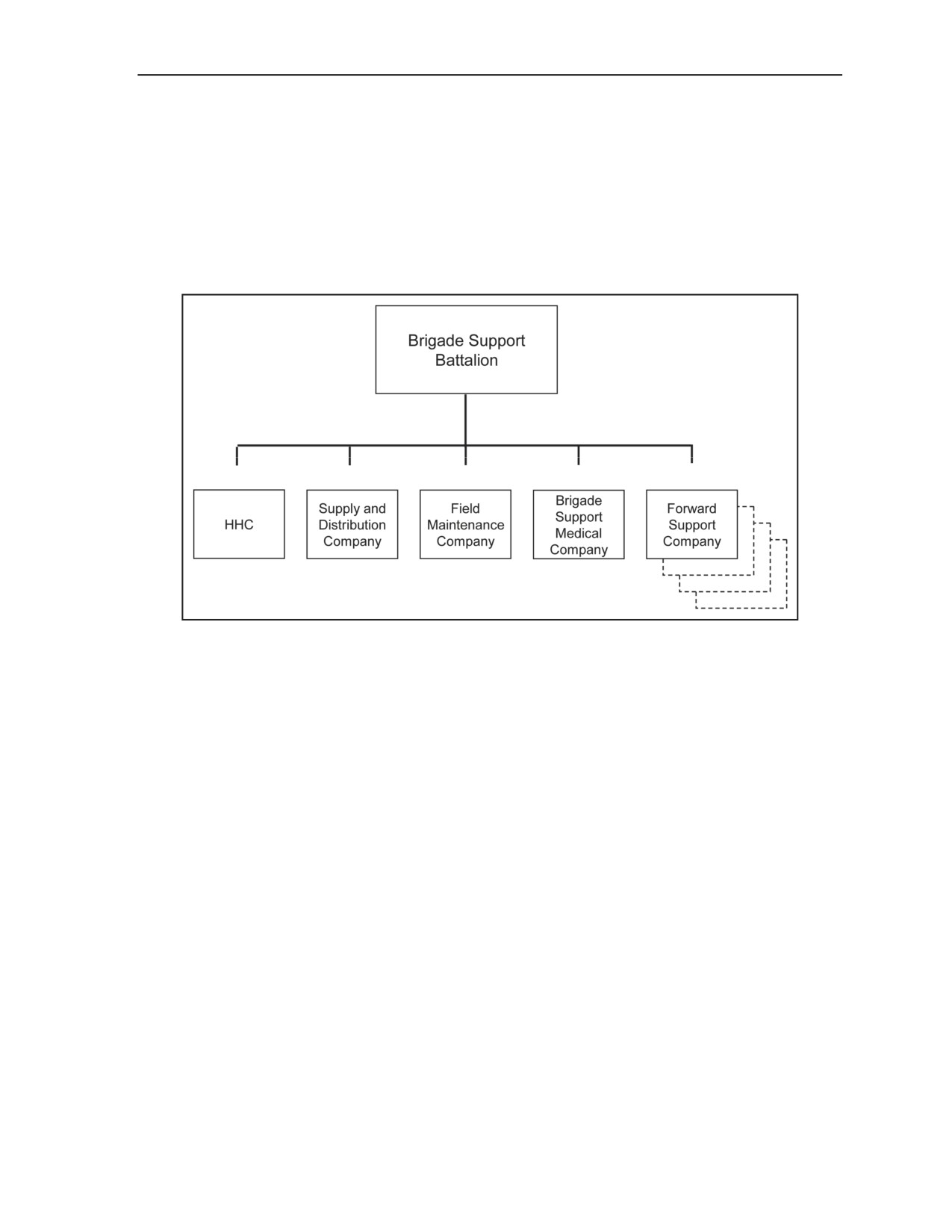
6-18. The BSB has four forward support companies (FSCs) and three other companies in addition to its
HHC (see figure 6-2, page 6-6). The BSB companies include a distribution company, a field maintenance
company, and a medical company.
6-19. The distribution company provides all classes of supply (excluding medical) for BCT units. The field
maintenance company provides common maintenance support for the BCT, excluding medical and
automation support. It generally supports the BSTB (and HHC in the SBCT) and BSB since support for
maneuver battalions comes from FSCs in the HBCT and IBCT. The medical company operates a Role 2
2 April 2009
FM 3-34
6-5
Chapter 6
medical treatment facility and provides Role 2 HSS to all units on an area basis. The medical company is
responsible for providing medical evacuation from supported units to its Role 2 medical treatment facility
(MTF). It also provides Role 1 care to units without organic medical personnel and augments and
reinforces maneuver battalion medical platoons/sections.
6-20. Each FSC commander is responsible for executing the sustainment plan according to the supported
battalion commander’s guidance. The BSB provides technical oversight to each FSC. The FSC has a
distribution platoon providing transportation lift, along with food (Class I) and water, fuel (Class III), and
ammunition (Class V) and a maintenance platoon that supports repair parts (Class IX), maintenance, and
recovery.
Figure 6-2. Brigade support battalion and subordinate unit organizations
6-21. The BSBs of the HBCT and IBCT each have FSCs to provide sustainment support to the maneuver,
reconnaissance, and fires battalions. The BSB of the SBCT does not have FSCs authorized and creates
improvised logistics teams to support SBCT units. FSCs are assigned to the BSB, but are generally task-
organized to their supported battalions. The BCT commander must ensure that his staff and subordinate
units understand the command and support relationships of FSCs. If an engineer battalion augments the
BCT, it should be accompanied by its appropriate sustainment element that is task-organized to the
battalion and augments the sustainment capabilities of the BSB.
6-22. Although not specifically a sustainment unit, the BSTB is included here because it provides
sustainment for the colocated support elements assigned or attached to it from augmentation. The HBCT
and IBCT each have a BSTB to provide C2 of selected support units as one of its primary functions. The
SBCT and the ACR currently do not have a BSTB authorized. Augmenting units are task-organized to the
BCT and much of their control comes from BCT staff officers. See FM 3-90.61 for additional information.
ENGINEER LEADER AND STAFF RESPONSIBILITIES
SUSTAINMENT SUPPORT
6-23. Engineer staff and commanders are essential to the sustainment of engineer organizations and
capabilities operating at every echelon. Sustainment for engineer units and capabilities organic, assigned,
or attached directly to a supported unit is the responsibility of the leaders and staff of the unit they support,
but the higher echelon ENCOORD will retain an interest in status of their support. The ENCOORD must
also work closely with the supported unit logistics staff to assist in planning, preparing, executing, and
assessing operations which will most likely require extensive engineer materials and resources. When
engineer or multifunctional modular headquarters units are provided, the organic logistics staff within that
6-6
FM 3-34
2 April 2009
Sustainment Support for Engineer Capabilities
headquarters provides sustainment planning for the engineer force under its C2. Engineer battalions
provide logistics support to subordinate units through organic FSCs.
6-24. At the engineer unit level, the basic sustainment responsibilities are to monitor, report, and request
requirements through the correct channels and to ensure that sustainment requirements are met when
sustainment is brought forward to the engineer unit. The engineer company executive officer (XO) and first
sergeant (1SG) are normally in charge of these functions within the engineer companies and they receive
guidance and oversight from the commander. They are also responsible for supporting any augmentation
they may receive. Accurate and timely submission of personnel and logistics reports and other necessary
information and requests is essential.
ENGINEER COORDINATOR
6-25. The ENCOORD at each echelon is responsible for engineer logistics estimates and plans and
monitors engineer-related sustainment support for engineer capabilities operating at that echelon. When an
engineer unit or capability is task-organized in support of the unit, the ENCOORD recommends the most
effective command or support relationship, including considering the impact of inherent sustainment
responsibilities. The ENCOORD—
z
Writes the engineer annex and associated appendixes to the OPLAN or OPORD to support the
commander’s intent, including recommended distribution for any engineer-related command-
regulated classes of supply and special equipment.
z
Assists in planning the location(s) of the engineer forward supply point for the delivery of
engineer configured loads of Class IV and Class V material. This site(s) is coordinated with the
unit responsible for the terrain and the appropriate S-4 or assistant chief of staff, logistics
(G-4).
z
Assists in planning the location(s) of the engineer equipment parks for pre-positioning of critical
equipment sets, such as tactical bridging. These sites are coordinated with the unit responsible
for the terrain and the appropriate S-4 or G-4.
z
Works closely with the sustainment staff to identify available haul assets (including HN) and
recommends priorities to the sustainment planners.
z
Identifies extraordinary medical evacuation requirements or coverage issues for engineer units
and coordinates with sustainment planners to ensure that the supporting unit can accomplish
these special workloads.
z
Identifies critical engineer equipment and engineer mission logistics shortages.
z
Provides the appropriate S-4 or G-4 with an initial estimate of required Class IV and Class V
supplies for the countermobility and survivability efforts.
z
Provides the appropriate S-4 or G-4 with an initial estimate of required Class IV supplies in
support of construction. Monitors and advises, as required, implications of statutory, regulatory,
and command policies for the procurement of construction materials. The critical issue for the
ENCOORD is the timely delivery at required specifications whatever the source for construction
materials.
z
Tracks the flow of mission-critical Class IV and Class V supplies into support areas and forward
to the supporting engineer units. Coordinates to provide engineer assistance as required to
accept delivery of construction materials.
z
Coordinates MSR clearing operations and tracks their status at the main CP.
z
Coordinates for EOD support and integration as necessary.
ENGINEER UNIT COMMANDER
6-26. The unit commander ensures that sustainment operations maintain the mission capabilities of the unit
and its ability to provide combat power. The unit commander provides critical insight during the supported
unit planning process. The unit commander—
z
Coordinates for sustainment support requirements external to the engineer unit.
2 April 2009
FM 3-34
6-7
Chapter 6
z
Anticipates problems, works to avoid delays in planning and transition, and conducts
sustainment battle tracking.
z
Communicates with subordinate leaders to identify the need for push packages, ensures their
arrival, and tracks their expenditure.
z
Determines the location of the unit resupply points and monitors the operation.
z
Ensures that the unit is executing sustainment operations according to the supported unit SOP
and OPORD.
z
Monitors equipment locations and maintenance status.
z
Updates the engineer-specific Class IV and Class V supply requirements based on
reconnaissance of mission sites.
z
Tracks engineer equipment use, maintenance deadlines, and fuel consumption.
z
Receives, consolidates, and forwards all logistical, administrative, personnel, and casualty
reports to the parent or supported unit.
z
Directs and supervises the medical support within the unit, coordinating for additional support
as required.
z
Supervises and monitors the evacuation of casualties, detainees, and damaged equipment.
z
Orients personnel replacements and assigns personnel to subordinate units.
z
Conducts sustainment rehearsals at the unit level.
z
Maintains and provides supplies for unit field sanitation activities.
z
Integrates EOD support as necessary.
PRINCIPLES OF LOGISTICS
6-27. During the operations process cycle, the ENCOORD and the engineer unit commander(s) must plan,
prepare, execute, and continuously assess sustainment support for engineer capabilities. Concurrent with
other operational planning, the unit develops a sustainment plan during the mission analysis and refines it
in the wargaming portion of the MDMP. Sustainment rehearsals are normally conducted at brigade,
battalion, and company levels to ensure a smooth, continuous flow of materiel and services.
6-28. Successful sustainment involves balancing effectiveness with efficiency. Sustainment operations are
characterized by being able to anticipate requirements, integrate joint and multinational sustainment,
improvise solutions, and be responsive and continuous. The logistics principles—responsiveness,
simplicity, flexibility, attainability, sustainability, survivability, economy, and integration—defined in FM
4-0 facilitate effective, efficient sustainment and act as a guide for planners and operators to synchronize
logistics in support of operations. The following paragraphs describe these eight principles along with the
engineer considerations for each.
6-29. “Responsiveness” is the key logistics principle. It means providing the right support in the right
place at the right time. Responsiveness includes the ability to anticipate operational requirements and is the
keystone of all the logistic principles. Engineers ensure that they identify all sustainment requirements in
advance—taking into consideration support relationships of subordinate units. This information must be
passed into sustainment channels and tracked through delivery. It involves identifying, accumulating, and
maintaining the minimum assets, capabilities, and information necessary to meet support requirements. On
the other hand, the force that accumulates enough material and personnel reserves to address every possible
contingency usually cedes the initiative to the enemy. The sustainment system must keep pace with rapid
decision cycles and mission execution to react quickly to crises or opportunities. It must continually
respond to a changing situation and the shifting of engineer unit locations. Interim contingency sustainment
support must be planned until the task organization is modified or changed. When possible, the plan should
include aerial resupply.
6-30. Personnel losses and unit capabilities must also be anticipated to plan for continuous operations and
future missions. Forward engineer units depend on the sustainment system of their parent unit or of the unit
they are supporting and may require significant support to accomplish their engineer tasks. The brigade
(and battalion) engineer must anticipate likely task organization changes that will affect the flow of
6-8
FM 3-34
2 April 2009
Sustainment Support for Engineer Capabilities
sustainment to engineer organizations. Additional missions will be created by the sustainment support plan
(for example, clearing an LZ for aerial resupply). These missions and tasks must be anticipated and
planned for during the mission analysis.
6-31. Versatile sustainment systems enhance the engineer unit's responsiveness and adapt engineer change
requirements without interrupting the flow of support.
6-32. In this respect, responsiveness is closely tied with improvisation. Theater sustainment planners
structure the logistics force to be versatile enough to complement engineer plans and operations yet be
robust enough to ensure that engineer services are not interrupted. The structure must be responsive
enough to allow the engineer commander to seize and maintain the initiative.
6-33. Engineers plan to meet the changing requirements of the operation on short notice. The engineer
sustainment system should be versatile enough to keep pace with rapid decision cycles and mission
execution and react rapidly to crises or opportunities. Engineer planners are sensitive to engineer task
organization changes. Engineer units can normally respond to a change in task organization much quicker
than theater sustainment packages can. Because of this, contingency engineer sustainment plans are
normally developed.
6-34. The planner who anticipates—before, during, and after operations—is proactive, not reactive. The
ability of the force to seize and maintain the initiative, synchronize activities along the entire depth of the
AO, and exploit success depends on the commanders’, logisticians’, and engineers’ ability to anticipate
requirements. Engineers consider joint, multinational, contract civilian, and interagency assets when
planning support for engineer operations. They—
z
Use all available resources to the fullest, especially HN assets.
z
Prioritize critical engineer activities based on the concept of operations.
z
Anticipate engineer requirements based on wargaming and rock drills, incorporating experience
and historical knowledge.
z
Do not think linearly or sequentially; organize and resource for simultaneous and noncontiguous
operations.
z
Participate in and evaluate the engineer significance of each phase of the operation during the
entire command estimate process, to include mission analysis and COA development, analysis
and wargaming, recommendation, and execution.
6-35. The ENCOORD and the engineer unit commander forecast future requirements and accumulate
assets needed to accommodate likely contingencies. Engineer operations frequently require—
z
High fuel consumption rates (higher than most equipment found in a light brigade).
z
Engineer-specific Class IX repair parts which often necessitates extraordinary coordination to
obtain.
z
Large amounts of Class IV (construction and barrier materials) and Class V (munitions and
demolitions).
z
Demolitions for offensive and defensive operations.
z
A large commitment of maintenance and transportation support.
z
Financial management support to procurement and contracting of locally available commercial
services and materials.
6-36. “Simplicity” is avoiding complexity and often fosters efficiency in planning and executing logistics
operations. Mission-type orders and standardized procedures contribute to simplicity. Engineer
commanders and staffs establish priorities and allocate classes of supply and services to simplify
sustainment operations. Engineers use preconfigured loads of specialized classes of supply to simplify
transport.
6-37. “Flexibility” is the ability to adapt sustainment availability based on changing situations, missions,
and concepts of operation. Due to the inherently changing world environment, engineer missions will
change. Engineers require flexibility and coordination with higher staffs to provide sustainment and
2 April 2009
FM 3-34
6-9
Chapter 6
logistical support. As ENCOORDs work future branch or sequel plans, they ensure that sustainment and
logistical support is planned and resourced.
6-38. Sustainment plans and operations must be flexible enough to achieve responsiveness and economy.
Flexibility may include improvisation, which is the ability to make, invent, or arrange what is needed from
what is on hand. Improvised methods and support sources can maintain sustainment continuity when the
preferred method is undefined or not usable to complete the mission.
6-39. Extraordinary methods may be necessary to ensure success during operations. Sustainment planners
attempt to push support to engineer units forward to ensure smooth combat operations. Sometimes this is
not feasible or supportable. In such cases, engineers improvise by making, inventing, devising, or
fabricating what is needed. One example is creating a demolition cratering charge using common fertilizer
and diesel fuel.
6-40. Commanders must be aware of the environmental impacts of their actions. They must weigh the
implications of holding out for logistical support against environmental collateral damage that they will
cause. They must ensure that a proper environmental risk-assessment is done before beginning any action.
6-41. Specific damage assessment and repair procedures have been developed based on the need to
improvise during the operation. Improvisation is not a substitute for good planning; requirements must be
anticipated. However, improvisation can be a great strength; engineer personnel must recognize it as an
advantage in meeting emergencies.
6-42. “Attainability” involves generating the minimum essential supplies and services necessary to begin
operations. Commanders determine the minimum levels of support acceptable to initiate operations. The
engineer, in conjunction with the logistician, completes the sustainment estimate and initiates resource
identification based on the supported commander’s requirements and priorities. An operation should not
begin until minimum essential levels of support are on hand.
6-43. For engineers, attainability is at the very core of decisions that are made. Trade-offs may be
necessary to attain a given goal or level and quality of product. Since engineer materials must meet specific
technical requirements, engineers work closely with the logistics staff to help them understand these
requirements and obtain acceptable and suitable alternatives when trade-off decisions are required.
6-44. “Sustainability” ensures the longevity of logistics support to engineers throughout the AO for the
duration of the operation. Sustainability focuses on the engineer commander’s attention for long-term
objectives and capabilities of the engineer forces. Long-term support is a challenge for the engineer staff,
which must not only attain the minimum essential materiel levels to initiate operations but must also sustain
those operations through the end state. The ENCOORD must ensure that logistical requirements are known
and are flowing based on available transportation assets.
6-45. Engineers are either committed to the current operation or preparing for the next one. The tempo of
operations requires a constant vigilance by the logistician and engineer commander to ensure a constant
flow of support. Supplies are pushed (unit distribution method) forward whenever logistically feasible.
Maneuver units rely on lulls in the tempo of an operation to conduct sustainment operations, while
engineers may not. Engineers usually do not have this opportunity since many of their missions occur
during a lull in operations and this may deny them the opportunity to use the supply point method. This
increases the need for engineers to plan for continuous, routine, and emergency logistics support.
6-46. General engineering involves constructing, repairing, operating, and maintaining infrastructure and
facilities to enhance provision of sustainment and services (see FM 3-34.400). Contracting support obtains
and provides supplies, services, and construction labor and materiel—often providing a responsive option
or enhancement to support the force (see FM 100-10-2 and FMI 4-93.41). General engineers will often be
required to provide subject matter expertise for the supervision of contracted materials and services.
6-47. The logistics principle of “survivability” is related to but not exactly the same as the discussion of
survivability operations in FM
5-103. It is based on being able to protect support functions from
destruction or degradation. Engineers contribute to ensuring that sustainment means are survivable by
constructing sustainment bases and clearing LOCs. They may also construct ammunition holding areas and
provide revetments and other hardening for POL products.
6-10
FM 3-34
2 April 2009
Sustainment Support for Engineer Capabilities
6-48. “Economy” is the provision of support at the least cost. At some level and to some degree, resources
are always limited. When prioritizing and allocating resources, the engineer commander and staff may not
be able to provide a robust support package. Priority of effort will be established while balancing
mitigation of risk to the operation. Engineer commanders may have to improvise to meet the higher intent
and mitigate the risks. Commanders consider economy in prioritizing and allocating resources. Economy
reflects the reality of resource shortfalls, while recognizing the inevitable friction and uncertainty of
military operations.
6-49. “Integration” consists of synchronizing sustainment operations with all aspects of Army and joint,
interagency, and multinational operations. The concept of operations achieves integration through a
thorough understanding of the commander’s intent and synchronization of the sustainment plan.
Integration includes coordination with and mutual support among Army and joint, interagency, and
multinational sustainment organizations.
6-50. Operational and tactical plans integrate all sustainment support to create a synergy with the concept
of operations. Engineer planners participate in and evaluate the sustainment significance of each phase of
the operation during the entire command estimate process. They create a clear and concise concept of
support that integrates the commander's intent and concept of operations. This includes analyzing the
mission; developing, analyzing, wargaming, and recommending a COA; and executing the plan.
SUSTAINMENT PLANNING
6-51. The efforts of engineer leaders and staff to plan and coordinate engineer sustainment are essential to
the full integration of engineer operations. The ENCOORD, the engineer unit commander, the supported
unit S-4 or G-4, and the sustainment support unit work closely to synchronize sustainment for engineer
capabilities.
6-52. When the supported unit receives a warning order (directly or implied) as part of the MDMP, the
ENCOORD initiates the engineer portion of the logistics estimate process. The ENCOORD focuses the
logistics estimate on the requirements for the upcoming mission and the sustainment of all subordinate
engineer units that are organic and task-organized in support of the unit. Class I, III, IV, and V supplies
and personnel losses are the essential elements in the estimate process. Close integration with the
sustainment support unit can simplify and accelerate this process through the use of the automated systems
logistics status report to ensure that the sustainment support unit is able to maintain an up-to-date picture of
the engineer unit sustainment requirements. During continuous operations, the estimate process supporting
the RDSP may need to be abbreviated because of time constraints.
6-53. After conducting the estimate process to determine the requirements for unit and mission
sustainment, the ENCOORD, with the respective S-4 or G-4, compares the requirements with the reported
status of subordinate units to determine the specific amount of supplies needed to support the operation.
These requirements are then coordinated with the sustainment support unit or forward support element to
ensure that the needed supplies are identified and resourced higher echelon stocks.
6-54. The ENCOORD then translates the estimate into specific plans that are used to determine the
supportability of supported unit COAs. After a COA is selected, the specific sustainment input to the
supported unit base OPORD and paragraph 4 of the engineer annex is developed and incorporated.
6-55. In each of the different types of BCTs, the ENCOORD, working with the appropriate sustainment
planner and executor, tracks essential sustainment tasks involving all engineer units supporting the brigade.
Accurate and timely status reporting assists the ENCOORD in providing the overall engineer status to the
brigade commander and allows the ENCOORD to intercede in critical sustainment problems when
necessary. The ENCOORD also ensures that supplies needed by augmenting EAB engineer units to
execute missions for the brigade are integrated into the brigade sustainment plans. For the ENCOORD to
execute these missions properly, accurate and timely reporting and close coordination between the
ENCOORD, sustainment planners and providers, task force engineers (or in some cases the engineer unit
commander in the SBCT), and supporting EAB engineers are essential. Supporting EAB engineer units
must effect linkup with the existing engineer sustainment to ensure their synchronization of effort.
2 April 2009
FM 3-34
6-11
Chapter 6
SUSTAINMENT SUPPORT FUNCTIONS
6-56. Sustainment support can be broadly categorized and discussed within subordinate functions. The
functions assist planners and leaders in coordinating for sustainment support. The functions include tasks
associated with maintenance, ammunition support, supply and field services, transportation, HSS,
transportation, HR support, and financial management.
MAINTENANCE
6-57. The Army has transitioned to two levels of maintenance: field and sustainment. Field maintenance is
on-system maintenance and is mainly preventive maintenance and the replacement of defective parts. Field
maintenance returns repaired equipment to the Soldier. It covers tasks previously assigned to operator and
crew, organization and unit, and DS maintenance levels. It includes some “off-system maintenance” critical
to mission readiness. Sustainment maintenance consists of repairing components of the user’s system. It is
generally a merging of the previous GS and depot levels of maintenance. Sustainment maintenance actions
typically involve repair of repairable Class IX components (off-system) for return to the supply system.
Sustainment-level maintenance is typically by an element of the sustainment brigade or higher echelon.
The ENCOORD ensures that field level maintenance is identified for each supporting engineer unit.
6-58. Unit commanders ensure that vehicle crews and equipment operators perform preventive
maintenance checks and services. To provide quick turnaround of maintenance problems, each engineer
unit should coordinate for a field maintenance team (FMT) from their supporting maintenance company.
These FMTs have contact maintenance trucks and mechanics trained to repair the unit’s equipment.
SUPPLY AND FIELD SERVICES
6-59. Providing the force with general supplies and services is the mission of the attached or assigned
elements of the sustainment brigade and functional battalions. Supply and service elements generally
provide the subsistence, general supplies, bulk fuel, heavy materiel, repair parts, laundry and shower
services, mortuary services, and water. Personal demand items (Class VI) and medical supplies are not
typically provided by units under the C2 of the sustainment brigade, but must be considered during the
planning process.
6-60. Class I consists of subsistence and gratuitous health and welfare items. They are automatically
requested based on daily strength reports. BCT units deploy with three days of operational rations (meal,
ready to eat [MRE]). MREs are distributed in case lots at the distribution point and picked up by the
appropriate supply section. Unitized group rations and A-rations are broken down into lots at the
distribution point and picked up by the appropriate field feeding section for incorporation into the
LOGPAC.
6-61. Water is provided to Soldiers in two forms: bulk and bottled (packaged). Water support is provided
through organic water purification and distribution capability when feasible. Either a distribution company
or sustainment battalion provides external water support if required. Bulk potable water is used as needed
for individual Soldiers. Bottled water may be provided on a limited basis, usually during the deployment
phase of operations. Bottled water containers are issued based upon the same unit daily strength reports
used for rations and field feeding. Engineers may be required to support with well drilling and other
general and geospatial engineering expertise to provide adequate water for the force.
6-62. Class II consists of such items as clothing, individual equipment, tentage, hand tools, administrative
and housekeeping supplies, and CBRN defense and decontamination items. Class III (P) consists of
packaged POL. Usually, the unit deploys with 30 day’s worth of common consumable supplies. These
supplies are provided by the supporting supply unit and are maintained as part of the unit’s authorized
stockage list. Replenishment and other necessary supplies are ordered by unit supply sergeants. Supplies
are provided at distribution points to the supporting supply unit. They are carried forward with the next
LOGPAC, or immediately, if needed. Religious supplies and maps are considered Class II items. Unit
ministry teams order consumable chaplain supplies as necessary. Maps are ordered through the S-2 or S-3
staff section or through the unit-level supply room if they are not classified.
6-12
FM 3-34
2 April 2009
Sustainment Support for Engineer Capabilities
6-63. Class III (B) consists of bulk POL. Quartermaster petroleum units provide fuel support for all U.S.
(and potentially coalition) land-based forces. The POL group will be involved in the distribution from the
refinery or terminal to the BSB’s distribution company. The POL group may be task-organized with a
quartermaster pipeline and terminal operating battalion. In a developed theater, the fuel distribution system
includes: the offshore petroleum discharge system (OPDS), inland tank farms, tactical petroleum terminals,
and pipeline systems. With a theater structure in place, operational petroleum pipeline and terminal
operating companies in the POL group establish the theater petroleum support base for products received
from ocean tankers at marine petroleum terminals. The petroleum support base serves as a hub for
receiving, temporarily storing, and moving fuels to petroleum support companies in the sustainment
brigades at division level. Petroleum support battalions in the POL group provide theater stocks and deliver
fuel forward to the division-level sustainment brigade’s petroleum support companies in the combat
sustainment support battalion. Petroleum support companies support the distribution mission and POL
truck companies deliver fuel to the BSB in the BCTs.
6-64. Pipelines and hoselines will be used to deliver fuel products as much as possible during initial
operations. Large-scale combat operations may justify construction of coupled pipelines and hoselines
using the inland petroleum distribution system or rapidly installed pipeline or hoseline systems to move
bulk petroleum from the theater sustainment area storage locations forward. Air bases and tactical airfields
are serviced by pipeline when feasible. When available, pipeline distribution is supplemented by tank-type
vehicles, railcars, and barges.
6-65. Units usually deploy with half-full vehicle fuel tanks, purged fuelers, and empty fuel cans. Fuel is
issued on the unit’s arrival in the theater. Units forecast requirements based on the current or upcoming
mission. The forecast is SOP-dependent, but usually is for the 72-hour period beyond the next day or out to
96 hours.
6-66. Class IV consists of construction materials, including all fortification and barrier materials. These are
items for which allowances are not prescribed. The management of Class IV supplies for survivability and
countermobility is most efficient when there is a shared interest between the maneuver and engineer
logisticians. Units deploy with a limited amount of Class IV barrier material, primarily for protection of
unit perimeters and key positions. This material is considered the unit’s basic load and usually is carried on
tactical vehicles. Replenishment is ordered by company supply sergeants. Supplies are provided from the
distribution point and are carried forward by sustainment elements with the next LOGPAC, or
immediately, if needed. Barrier material may also be requested as expeditionary support packages. See FM
3-90.6 for additional information on expeditionary support packages.
6-67. The ENCOORD must coordinate closely with the logistics staff to assist in management of required
construction materials. Engineer operations may require large quantities and specified qualities of these
materials. Statutory, regulatory, and command policies may dictate the source, requiring the maximum use
of local procurement for example. The ENCOORD assists the logistics staff in adequately forecasting the
requirements and ensuring a quality control process is in place for receipt of the materials.
6-68. Class V consists of all types of ammunition, including chemical, radiological, and special weapons;
bombs; explosives; mines; fuses; detonators; pyrotechnics; missiles; rockets; propellants; and other
associated items. Class V supplies are based on a required supply rate (RSR) and controlled supply rate
(CSR). RSR is the amount of ammunition (usually expressed in rounds per weapon per day) estimated to
be required to sustain operations without restriction for a specific period. CSR is the rate of ammunition
consumption that can be supported (considering availability, facilities, and transportation) for a given
period. The CSR may be less than the RSR. If the RSR exceeds the CSR, the commander determines who
receives the ammunition. The ENCOORD coordinates supporting engineer unit ammunition requirements,
including demolition munitions and mines, with the S-4 or G-4.
6-69. A combat load is the unit commander’s designated quantity of munitions and items authorized to be
carried by unit personnel and combat vehicles (turret-load). Troop-carried munitions to accompany troops
are those issued before departure from the aerial port of embarkation (APOE). Turret-load and combat load
munitions are those authorized for transportation in thick-skinned vehicles for deployment purposes.
Generally, BCTs try to keep three combat loads of critical munitions on hand. Most units do not deploy
2 April 2009
FM 3-34
6-13
Chapter 6
with their authorized basic load of ammunition. Instead, they are issued their combat load upon arrival in
the theater. There are, however, times when selected units deploy with a full combat load of ammunition.
6-70. Ammunition support activities like the theater storage area (TSA), ASPs, and ammunition transfer
and holding points (ATHPs) provide the capability to receive, store, issue, inspect, and perform field-level
munitions maintenance support. The sustainment brigade gains such capability when it is assigned one or
more ammunition ordnance company. The TSA encompasses the storage facilities located at the
operational level. This is where the bulk of the theater reserve ammunition stocks are located. The primary
mission of the TSA is to receive munitions from the national level, conduct the bulk of operational-level
reconfiguration, and distribute munitions to forward ASP locations and BCT ATHPs. The TSA will build
those configured loads that cannot be shipped into theater due to explosive compatibility conflicts for
international shipment. Engineer units may provide general engineer support to the ammunition support
activities.
6-71. Class VI consists of all personal-demand items, such as candy, cigarettes, soap, and cameras
(nonmilitary sale items). Soldiers usually carry
30 days of personal comfort items with them when
deploying. Health and comfort packs are also Class VI items. Class VI support is obtained through supply
channels when a post exchange is not available. Resupply flow is the same as for Class I. Delivery of
health and comfort packs is based on headcounts provided for field feeding.
6-72. Class VII consists of major end items, such as launchers, tanks, mobile machine shops, vehicles, and
organizational tool sets. Units deploy with all required equipment based on the appropriate MTOE.
Additional equipment may be issued to the unit in the theater of operations based on mission requirements.
Class VII replacement is based on losses reported through command channels. Reporting loss of major end
items permits the commander to remain apprised of the operational status of subordinate commands and to
direct the distribution of items to the units having the most critical need.
6-73. Class VIII consists of medical material, including repair parts peculiar to medical equipment.
Usually, medical units deploy with a 3- to 5-day supply of consumable medical supplies, and all companies
deploy with complete combat lifesaver bags. Initial sustainment supplies are pushed to the medical
company based on theater casualty estimates. Individual Soldiers deploy with a 180-day supply of their
prescribed medications. Soldier must advise their supporting medical unit of their specific needs.
6-74. Resupply of medical supplies is through medical channels. The medical company and maneuver
platoon medical personnel are responsible for maintaining the medical sets, kits, and outfits. Combat
lifesavers and company and platoon medics receive replenishment for their aid bags from their unit medical
platoon.
6-75. Class IX consists of repair parts and components, including kits, assemblies, and subassemblies
(repairable and unrepairable) that are required for maintenance support of all equipment. Each unit stocks
and deploys with combinations of repair parts: shop stock, bench stock, combat repair team stocks, and
combat spares. Stocks are based on demand history and usually maintained at a 15-day supply quantity.
Maintenance personnel replenish their combat spares and order other parts as needed through the
supporting sustainment brigade, sustainment battalion, or BSB. Class IX repair part requisitions are
prioritized based on the commander’s priority of maintenance and need.
6-76. Class X consists of materials to support nonmilitary programs, such as agriculture and economic
development. Class X items are requested based on requirements from the CA or operations channels.
Materiel for nonmilitary support usually is provided by the HN, NGOs (such as Red Cross), or the DOS.
Humanitarian assistance is governed by Title 10, U.S.C. Section 401, which specifies that humanitarian
assistance—
z
Must be carried out according to HN military or civilian personnel.
z
Shall complement and may not duplicate any other form of social or economic assistance that
may be provided to the HN by any other department or agency of the United States government.
z
May not be provided directly or indirectly to any individual, group, or organization engaged in
military or paramilitary activities.
z
May not be provided unless the DOS specifically approves such assistance.
6-14
FM 3-34
2 April 2009
Sustainment Support for Engineer Capabilities
Note. Before providing civil-military support or humanitarian assistance, commanders should
seek legal review from their servicing Judge Advocate.
6-77. The recovery and identification of deceased personnel is the responsibility of each unit. Units
supervise the preparation of incident statements on DD Form 565, Statements of Recognition of Deceased.
These documents accompany the remains during transport to a remains collection point. Usually, remains
collection points are in the vicinity of the combat trains, but not near the medical support section. Once the
necessary reports are complete, the remains are evacuated to the supporting collection point. From there
remains are evacuated to a mortuary collection point established by the TSC. If remains have been
contaminated by CBRN agents or toxic industrial materials, the S-4, in coordination with the CBRN
officer, should provide guidance to units before they handle or evacuate the remains.
6-78. Shower, laundry, and clothing renovation capabilities resident within the quartermaster field services
company are provided from the sustainment brigades with projection as far forward as possible. The
mission is to provide Soldiers a minimum of a weekly shower and up to 15 pounds of laundered clothing
each week (comprising two uniform sets, undergarments, socks, and two towels). Small unit showers are
authorized according to common table of allowances 50-909. One shower unit consists of one heater, one
shelter, and two water bags. Showers may be provided to the BCT by sustainment brigade units during
mission staging operations.
TRANSPORTATION
6-79. Transportation assets of the sustainment brigade and functional transportation battalions provide
distribution from the sustainment brigades forward and retrograde of damaged or surplus items. The
mobility branch of the TSC support operations officer provides staff supervision of all transportation and
coordinates directly with the movement control battalion (MCB). The MCB and its movement control
teams coordinate all movement in the JOA or AO, to include in, out, and through all divisional areas.
Sustainment brigades with lift assets physically located adjacent to divisional units may or may not provide
transportation support to move materiel when requests from tactical units are processed by the TSC DMC.
6-80. Recent history has shown that intermodal operations are critically affected by the manner in which
container management policies are enforced and container management is subsequently executed. Industry
partners will continue to use this method of packaging and distribution within the global environment for
the foreseeable future; therefore, it is vital to maintain the control and flow of containers. Modular force
operations must fully integrate container management into the distribution system. Flat racks and
containers offer tactical efficiencies that serve to increase the pace of sustainment operations. The key to
these efficiencies and maintaining this pace is congruent flat rack and container management procedures at
each stage or level of support (FSC, BSB, sustainment brigade, ESC, and TSC). An increased operational
depth and the reduction of redundant logistics force structure challenge flat rack and container management
and, ultimately, the sustainment of combat power. Flat rack and container employment, management, and
retrograde operations are the responsibility of distribution managers. In the sustainment brigade, the
support operations officer must track flat racks and containers dispersed throughout the distribution system
and, if applicable, to the consignee in the division or corps AO.
6-81. Movement control teams process movement requests and arrange transport for moving personnel,
equipment, and sustainment supplies. They process convoy clearance requests and special hauling permits.
Movement control teams coordinate for the optimal mode (air, rail, inland waterway, or highway) for
unprogrammed moves, and commit the mode operators from the sustainment brigade, LOGCAP,
multinational elements, and the HN. They also assist in carrying out the movement program (for more
information, refer to FM 4-01.30.)
HEALTH SERVICE SUPPORT
6-82. The first medical care a Soldier receives is provided at Role 1 of the Army health system. This care
includes immediate lifesaving measures, emergency medical treatment, advanced trauma management,
disease prevention, stress prevention, casualty collection, and evacuation from the supported unit to a
2 April 2009
FM 3-34
6-15
Chapter 6
supporting MTF. These elements include the trauma specialist assisted by first aid (self-aid and buddy aid),
advanced first aid (combat lifesaver), and the Role 1 MTF (battalion aid station). When a Role 1 medical
capability is not present in a unit, this support is provided on an area support basis to that unit by the
supporting Role 2 medical unit. See FM 4-02 for an overarching discussion of HSS.
6-83. Combat lifesavers and buddy aid are crucial to sustaining HSS. The combat lifesaver is almost
always the first person on the scene to begin the process of providing enhanced first aid to wounded and
injured personnel. The combat lifesaver is a nonmedical Soldier trained to provide enhanced first aid and
lifesaving procedures beyond the level of self aid or buddy aid. The combat lifesaver is not intended to take
the place of medical personnel but to slow deterioration of a wounded Soldier’s condition until medical
personnel arrive. Each squad, crew, or equivalent-size deployable unit will have at least one Soldier trained
and certified as a combat lifesaver. The senior medic advises the company commander on the status of
combat lifesavers for the company. The company commander coordinates with the supporting medical
element for combat lifesaver training and Class VIII resupply.
6-84. Vehicle commanders are responsible for ensuring that injured crewmen receive immediate first aid
and for reporting casualties. Vehicle commanders coordinate with the 1SG and senior medic for ground
evacuation. Evacuation of injured Soldiers is categorized into two types:
z
Medical evacuation is the use of ground or air ambulances to evacuate from the point of injury
to a MTF while providing en route care.
z
Casualty evacuation (CASEVAC) is the use of nonmedical vehicles or other means for patient
movement without providing en route care.
6-85. Medical evacuation elements use the most expedient means available for medical evacuation of sick
or wounded Soldiers. The use of air ambulance is METT-TC-dependent since they may not always be
available. The CAB GS aviation battalion will determine where to position the forward support medical
teams. The number of HH-60 Blackhawk aircraft in support of a BCT will be based on mission
requirements. The forward support medical team will either provide DS or GS to the BCTs. The brigade
aviation element and BCT surgeon coordinate the use and positioning of the forward support medical team.
They integrate air ambulance support, to include coordination of Army airspace C2 requirements,
establishing clear lines of authority to launch a medical evacuation and identification of pickup zones and
LZs. Planners must anticipate potential high casualty rates and long evacuation distances while retaining
the flexibility to shift nonstandard evacuation assets to support mass casualty or CASEVAC, as required.
6-86. Capabilities at the medical company duplicate those found at Role 1 and expand available medical
services by adding operational dental, laboratory, X-ray, patient holding, mental health, and preventive
medicine capabilities. Emergency medical treatment and advanced trauma management is continued. If
necessary, additional emergency measures are instituted; however, these measures do not exceed those
dictated by immediate needs. The forward surgical team from the corps may colocate with the medical
company and provide emergency resuscitative surgical capability. The combined medical company and
forward surgical team are generally considered to be Role 2+. The medical company examines and
evaluates a casualty’s wounds and general physical condition to determine treatment and evacuation
priorities. The medical company provides sick call services, area medical support, and ground ambulance
medical evacuation support for the engineer company.
HUMAN RESOURCES SUPPORT
6-87. The unit HR staff officer (S-1) is the principal coordinating staff responsible for the planning,
integration, coordination, and delivery of HR support. The S-1 is responsible for the execution of the HR
core competencies and capabilities listed in paragraph 6-91, and military pay input and inquiries. The S-1
also serves as the point of contact for command interest programs, such as voting assistance, Army
Emergency Relief, equal opportunity, and retention. External HR support is coordinated through the HR
Operations Cell of the sustainment brigade supporting the unit. The S-1 relies on the availability of both
secure and nonsecure data and voice systems and its location in the AO must allow for full connectivity
with SIPRNET and Nonsecure Internet Protocol Router Network (NIPRNET). Brigade-level S-1 sections
provide staff control of subordinate S-1 sections.
6-16
FM 3-34
2 April 2009
Sustainment Support for Engineer Capabilities
6-88. HR support encompasses ten core competencies. These core competencies are—
z
Personnel readiness management.
z
Personnel accountability and strength reporting.
z
Personnel information management.
z
Reception, replacement, redeployment, rest and recuperation, and return-to-duty.
z
Casualty operations.
z
Essential personnel services.
z
HR planning and operations.
z
Postal operations.
z
Morale, welfare, and recreation.
z
Band operations.
OTHER SUSTAINMENT SUPPORT
6-89. In addition to the support provided by U.S. military organizations, sustainment support may
incorporate support provided by contractors and host nation support (HNS) into plans and operations.
These sources of support offer greater economy and may reduce demands on strategic lift. However, their
use must be balanced with the greater burden of protection that they also bring.
CONTRACTED SUPPORT
6-90. Contracting is a key source of support for deployed forces conducting full spectrum operations.
Because of the importance and unique challenges of contracted support, engineer commanders and staff
need to fully understand their role in planning for and managing contracted support. Key to understanding
contracting and contractor management is being familiar with the doctrine laid out in FM 100-10-2, FMI 4-
93.41, and FM 3-100.21. These FMs describe three broad types of contracted support: theater support,
external support, and systems support.
z
Theater support contractors support deployed operational forces under prearranged contracts or
contracts awarded from the mission area by contracting officers under the OPCON of the
contracting support brigade or joint contracting command (if established). Theater-support
contractors provide goods, services, and minor construction, usually from the local commercial
sources, to meet the immediate needs of operational commanders. Theater support contracts are
the type of contract typically associated with contingency contracting.
z
External support contractors provide a variety of sustainment support to deployed forces.
External support contracts may be prearranged contracts or contracts awarded during the
contingency itself to support the mission and may include a mix of U.S. citizens, third-country
nationals, and local national subcontractor employees. The largest and most commonly used
external support contract is LOGCAP. This Army program is commonly used to provide life
support, transportation support, and many other support functions to deployed Army forces and
other elements of the joint force as well.
z
System support contracts are prearranged contracts by the ASA (ALT) program executive
officer (PEO) and program management offices. Supported systems include, but are not limited
to, newly fielded weapon systems, aircraft, C2 infrastructure
(such as the Army Battle
Command System [ABCS] and standard STAMIS), and communications equipment. System
support contractors, made up mostly of U.S. citizens, often provide support in garrison and may
deploy with the force to both training and real-world operations. They may provide either
temporary support during the initial fielding of a system (called interim contracted support) or
long-term support for selected materiel systems (often referred to as contractor logistic support).
6-91. For engineer units, the major challenge is ensuring that the engineer-related requirements are
properly identified in the ESP and that all requirements that cannot be met via military or HNS means are
identified. It is imperative that the staff engineer work closely with the TSC or ESC support operations
officer, the Army forces G-4, and the supporting contracting support brigade to ensure that engineer
2 April 2009
FM 3-34
6-17
Chapter 6
requirements are properly integrated and captured in the contracting support plan and/or specifically
addressed in the ESP. It is also important to understand that most engineer units (less FEST-As) do not
have any dedicated contingency contracting teams and that this support will be provided on a GS basis
from the supporting contracting support brigade (or joint command if established).
6-92. It is also imperative that the engineer commanders and staff fully understand the key differences
between contracted and military support. These differences include—
z
Contractor personnel authorized to accompany the force are neither combatants nor
noncombatants, they are civilians "authorized" to accompany the force in the field.
z
Contractors are not in the chain of command. They are managed through their contracts and the
contract management system, which should always include a unit contracting officer’s
representative.
z
Contractors perform only tasks specified in contracts. "Other duties as assigned" does not apply.
GENERATING FORCE SUSTAINMENT OF FORCES AND OPERATIONS
6-93. The increasingly interconnected global environment allows the generating force to apply its
sustainment capabilities directly within the theater of operations. These capabilities include contingency
and sustainment contracting; the maintenance and repair of equipment; acquisition, logistics, and
technology functions; HSS; and force health protection. The generating force supports deployed operating
forces employing a combination of forward presence, call-forward support, and technical reach. The Army
field support brigade coordinates generating force sustainment support of operations in the theater of
operations.
6-94. The ASC, through its deployable AFSBs, is the primary generating force integrator of ALT support.
The AFSB, normally OPCON to the TSC, is responsible for integrating, coordinating, and, when
appropriate, commanding Army ALT support organizations in support of deployed Army forces. Using
reach and call-forward methodologies, the AFSB leverages national sustainment-level generating force
capabilities. Specific AFSB generating force-related capabilities include, but are not limited to—
z
Calling forward TDA or contracted-forward repair activities.
z
Coordinating technical advice from various ALT organizations.
z
Coordinating PEO and program manager system fielding and modification efforts.
z
Integrating and assisting in the management of systems support contracts.
6-95. The MEDCOM provides enterprise-level HSS to the joint force that provides continuity of care from
the theater of operations through the generating force. MEDCOM integrates the capabilities of its
subordinate operational Army units with generating force assets like military treatment facilities and
research, development, and acquisition capabilities. MEDCOM’s generating force capabilities not only
augment those of operating forces but also provide significant assistance in coping with unanticipated
health threats.
HOST NATION SUPPORT
6-96. The TSC will coordinate for HNS (negotiated by the U.S. DOS) as required in support of its mission.
6-97. HNS and local procurement may provide a full range of logistics, operational, and tactical support.
HNS agreements fulfilling the command requirements for support need to be prenegotiated. Such support
arrangements must be integrated into the distribution plan and coordinated with other Services, allies, and
coalition partners to prevent competition for resources and ensure that high-priority requirements are met.
HNS may include functional or area support and use of HN facilities, government agencies, civilians, or
military units. Pre-established arrangements for HNS can reduce the requirement for early deployment of
U.S. assets and can offset requirements for early strategic lift by reducing requirements for moving
resources to the theater.
6-18
FM 3-34
2 April 2009
Sustainment Support for Engineer Capabilities
MULTINATIONAL SUPPORT
6-98. Multinational support may consist of common-user logistics support provided from one
multinational partner to another. One or more of the following organizational and management options
facilitates multinational support:
z
National support elements provide national support.
z
Individual acquisition and cross-servicing agreements provide limited support.
z
A lead nation provides specific support to other contributing nation military forces.
z
A role-specialist nation provides a specific common supply item or service.
z
A multinational integrated logistics unit provides limited common supply and service support.
z
A multinational joint logistics center manages common-user logistics support.
6-99. In all cases, the multinational force commander directs specific multinational common-user logistics
support within the applicable laws and regulations of the HN. When operating within a formal alliance, the
TSC commander and staff execute common-user logistics support according to applicable standardization
agreements or international standardization agreements. FM 100-8, FM 4-0, JP 4-07, and JP 4-08 discuss
multinational logistics support.
2 April 2009
FM 3-34
6-19
This page intentionally left blank.

Appendix A
Engineer Field Manuals and Related Joint Publications
A-1. Table A-1 provides a summary of engineer FMs and related JPs other than FM 3-34. These Army
engineer publications are in some cases dual-Service manuals or multi-Service publications. Each one of
these is linked through the engineer keystone manual of FM 3-34 or directly to the three engineer JPs—
z
JP 2-03.
z
JP 3-15.
z
JP 3-34.
A-2. The Army and joint engineer publications are also linked with allied engineer doctrine whenever
required or possible. Key allied publications include—
z
Allied administrative publication (AAP) 19.
z
AJP-3.12.
z
ATP-52(B).
Table A-1. Other Army engineer publications
Planned
Current Version
Current Number
Current Document Title
Revision Number
Available
FM 3-34.2
FM 3-90.11
Combined Arms Breaching Operations
With change
1-3, 11 Oct 02
FM 5-102
FM 3-90.13
Countermobility
14 Mar 85
FM 5-103
FM 3-34.300
Survivability
10 Jun 85
FM 3-90.12
Combined Arms Gap-Crossing Operations
1 Jul 08
FM 90-7
FM 3-90.13
Combined Arms Obstacle Integration
With change 1,
10 Apr 03
FM 3-90.119
Combined Arms Improvised Explosive
21 Sep 07
Device Defeat Operations
FM 3-34.170
Engineer Reconnaissance
25 Mar 08
FM 3-34.280
Engineer Diving Operations
20 Dec 04
FM 20-11
FM 3-34.281
Military Diving
With change 1,
14 Apr 00
FM 3-34.210
Explosive Hazards Operations
27 Mar 07
FM 3-34.214
Explosives and Demolitions
11 July 2007
FM 20-3
FM 3-34.305
Camouflage, Concealment, and Decoys
30 Aug 99
FM 5-34
FM 3-34.310
Engineer Field Data
19 Jul 05
FM 3-34.400
General Engineering
9 Dec 08
FM 5-430-00-1
FM 3-34.410
Planning and Design of Roads, Airports, and
26 Aug 94
Heliports in the Theater of Operations -
Road Design
FM 5-430-00-2
FM 3-34.411
Planning and Design of Roads, Airports, and
29 Sep 94
Heliports in the Theater of Operations -
Airfield and Heliport Design
FM 5-434
FM 3-34.420
Earthmoving Operations
15 Jun 00
FM 5-436
FM 3-34.421
Paving and Surfacing Operations
28 Apr 00
2 April 2009
FM 3-34
A-1

Appendix A
Table A-1. Other Army engineer publications
Planned
Current Version
Current Number
Current Document Title
Revision Number
Available
FM 5-428
FM 3-34.425
Concrete and Masonry
18 Jun 98
FM 3-34.471
FM 3-34.426
Plumbing, Pipefitting and Sewerage
31 Aug 01
FM 5-424
FM 3-34.428
Theater of Operations Electrical Systems
25 Jun 97
FM 5-426
FM 3-34.427
Carpentry
3 Oct 95
FM 5-212
FM 3-34.473
Medium Girder Bridge
7 Feb 89
FM 5-277
FM 3-34.474
Bailey Bridge
With change 1,
15 Aug 91
FM 3-34.343
FM 3-34.475
Military Nonstandard Fixed Bridging
12 Feb 02
FM 5-482
FM 3-34.476
Military Petroleum Pipeline Systems
26 Aug 94
FM 5-412
FM 3-34.464
Project Management
13 Jun 94
FM 5-553
FM 3-34.430
General Drafting
6 Jan 84*
TM 5-581B
FM 3-34.431
Construction Drafting
8 Dec 72*
TM 5-704
TM 3-34.432
Construction Print Reading in the Field
2 Jan 69*
FM 5-233
FM 3-34.433
Construction Surveying
4 Jan 85
FM 5-410
FM 3-34.450
Military Soils Engineering
With change 1,
4 Jun 97
FM 5-472
FM 3-34.451
Materials Testing
With change 2,
1 Jun 01
FM 5-125
FM 3-34.494
Rigging Techniques, Procedures, and
With change 1,
Applications
3 Oct 95
FM 5-480
FM 3-34.470
Port Construction and Repair
12 Dec 90
FM 5-134
FM 3-34.471
Pile Construction
18 Apr 85
TM 5-349
FM 3-34.472
Arctic Construction
1 Feb -62
FM 3-34.468
Seabee Quarry Blasting Operations and
19 Dec 03
Safety Manual
FM 5-484
FM 3-34.469
Multi-Service Well-Drilling Operations
8 Mar 94
FM 3-34.480
None
Engineer Prime Power Operations
4 Apr 07
FM 5-415
FM 3-34.485
Firefighting Operations
9 Feb 99
FM 5-499
FM 3-34.495
Hydraulics
1 Aug 97
TM 5-323
FM 3-34.496
Military Standardization Handbook:
30 Aug 62*
Generators
FM 3-100.4
FM 3-34.500
Environmental Considerations in Military
With change 1,
Operations
11 May 01
FM 3-34.230
FM 3-34.600
Topographic Operations
3 Aug 00
FM 5-33
FM 3-34.610
Terrain Analysis
With change 1,
8 Sep 92
FM 3-34.331
FM 3-34.620
Topographic Surveying
16 Jan 01
TM 5-235
FM 3-34.625
Special Surveys
18 Sep 64*
FM 5-10
FM 3-34.21
Combat Engineer Platoon
With change 1,
1 Apr 05
FM 5-116
FM 3-34.23
Engineer Operations: Echelons Above
9 Feb 99
Corps
FM 5-100-15
FM 3-34.23
Corps Engineer Operations
6 Jun 95
FM 5-71-100
FM 3-34.23
Division Engineer Combat Operations
22 Apr 93
Note: * Not available on AKO; available by request through the Engineer Doctrine Section.
A-2
FM 3-34
2 April 2009

Appendix B
Army Engineer Organizations and Capabilities
The modular construct of the Army engineer operational force is a complementary
and interdependent relationship between four major categories of units (and includes
USACE-provided technical engineering and contract support as already discussed).
The four categories include organic engineers
(and staff elements) and three
categories in an engineer force pool (all operational force engineer units not organic
to a BCT, organic to the ACR, or in a headquarters staff). The assets in the force pool
exist to augment organic BCT engineers and provide echelons above the BCT with
necessary engineer capabilities. The force pool is organized into engineer
headquarters units, baseline units, and specialized engineer units.
ORGANIC ENGINEER UNITS
B-1. Table B-1 provides a quick reference index for the organic engineer units described in this appendix.
Table B-1. Organic engineer units
Unit
Figure Number and Page
HBCT Engineer Company
B-1, B-3
IBCT Engineer Company
B-2, B-4
SBCT Engineer Company
B-3, B-5
ACR Engineer Company
B-4, B-6
ENGINEER HEADQUARTERS UNITS
B-2. Table B-2 provides a quick reference index for the C2 units described in this appendix.
Table B-2. Headquarters units
Unit
Figure Number and Page
Theater Engineer Command
B-5, B-7
Engineer Brigade
B-6, B-8
Engineer Battalion
B-7, B-9
BASELINE ENGINEER UNITS
B-3. Table B-3, page B-2, provides a quick reference index for the baseline engineer units described in
this appendix.
2 April 2009
FM 3-34
B-1

Appendix B
Table B-3. Baseline engineer units
Unit
Figure Number and Page
Sapper Company
B-8, B-10
Sapper Company (Wheeled)
B-9, B-11
Sapper Company (Airborne)
B-10, B-12
Mobility Augmentation Company
B-11, B-13
Multirole Bridge Company
B-12, B-14
Clearance Company
B-13, B-15
Horizontal Construction Company
B-14, B-16
Vertical Construction Company
B-15, B-17
Engineer Support Company
B-16, B-18
Engineer Support Company (Airborne)
B-17, B-19
SPECIALIZED ENGINEER UNITS
B-4. Table B-4 provides a quick reference index for the specialized engineer units described in this
appendix.
Table B-4. Specialized engineer units
Unit
Figure Number and Page
Pipeline Construction Company
B-18, B-20
Prime Power Company
B-19, B-21
Topographic Engineer Company
B-20, B-22
Equipment Support Platoon
B-21, B-23
Quarry Platoon
B-22, B-24
Facility Engineer Detachment
B-23, B-25
Construction Management Team
B-24, B-26
Survey and Design Team
B-25, B-27
Concrete Section
B-26, B-28
Forward Engineer Support Team-Main
B-27, B-29
Forward Engineer Support Team-Advance
B-28, B-30
Firefighting Headquarters
B-29, B-31
Firefighting Team
B-30, B-32
Asphalt Team
B-31, B-33
Dive Team
B-32, B-34
Real Estate Team
B-33, B-35
Well-Drilling Headquarters
B-34, B-36
Well-Drilling Team
B-35, B-37
Engineer Detachment Headquarters (Canine)
B-36, B-38
Engineer Squad (Canine)
B-37, B-39
Explosive Hazards Team
B-38, B-40
Explosive Hazards Coordination Cell
B-39, B-41
Geospatial Planning Cell
B-40, B-42
B-2
FM 3-34
2 April 2009
Appendix C
Joint Engineer Organizations and Capabilities
Each Service has core engineering units and capabilities that stem from their
traditional roles and associations to meet specific operational needs and to support
accomplishing a variety of mission requirements in any OE. An understanding of the
Services’ combat, general, and geospatial engineering capabilities allows the JFC and
the joint force engineer to tailor the engineer force to effectively and efficiently
accomplish the mission. The JFC should understand multinational, interagency,
NGO, and IGO engineer capabilities to better coordinate coherent activity, develop
viable COAs, and, when appropriate, to properly integrate them into the joint
operation (see Appendix D). The joint force engineer is responsible for providing
comprehensive recommendations to the JFC on the effective employment of all
engineer capabilities in support of joint operations. The JFC, with the assistance of
the joint force engineer, analyzes mission requirements to tailor optimal engineer
force packages. The engineering capabilities of each Service component may provide
engineering support to the other components to meet joint force requirements. For
additional information see JP 3-34.
NAVY ENGINEER ORGANIZATIONS AND CAPABILITIES
C-1. Naval civil engineering forces are organized and equipped within the Department of the Navy to
meet the requirements of expeditionary operations. The term naval civil engineering forces is an
overarching reference to all naval civil engineers including officers, enlisted personnel, civilians, and units.
It combines the complementary but distinct capabilities of the engineering operating forces of 1NCD, the
ACBs organized under the Atlantic and Pacific NBGs, and the business enterprise of Naval NAVFAC.
1NCD, its subordinate units, and the ACBs make up the NCF also referred to as Seabees.
C-2. The NCF is a general engineering and construction force. The units of the NCF construct, repair,
maintain, and operate shore, inshore, and deep ocean facilities for the Navy and Marine Corps, other
Services, and JTFs as tasked by the CCDRs through the Navy component commander or an assigned
JFLCC or joint force maritime component command. They are responsive, versatile, flexible, task-
tailorable, expandable, rapidly deployable, sustainable, and are able to reconstitute for expeditionary
operations. The NCF’s mission is to conduct contingency engineering and expeditionary construction
operations to support amphibious landing, construction diving, humanitarian aid, and disaster recovery
operations across the range of military operations.
C-3. Navy Seabees deploy around the world to provide construction support for U.S. forces, as well as the
FHA. Naval mobile construction battalion (NMCB) resources are continually forward-deployed to provide
quick response to any location where a contingency may occur and to support combatant command
OPLANs. NMCB equipment is forward-deployed to Okinawa, Japan; Guam; and Rota, Spain. NMCB and
naval construction regiment (NCR) equipment is also deployed aboard all three squadrons of the maritime
pre-positioning force. The forward-deployed presence of Seabee resources minimizes strategic lift
requirements and ensures prompt engineering support to the JFC or MAGTF commander.
C-4. The NCF is organized, trained, and equipped to construct, maintain, operate, and repair advanced
bases and their associated logistic pipelines. The force also provides disaster recovery and relief assistance
and performs civic action projects to complement military and other national programs. NCF units are
organized for quick and effective response as required by planning assumptions and guidance. Seabee units
C-1
2 April 2009
FM 3-34
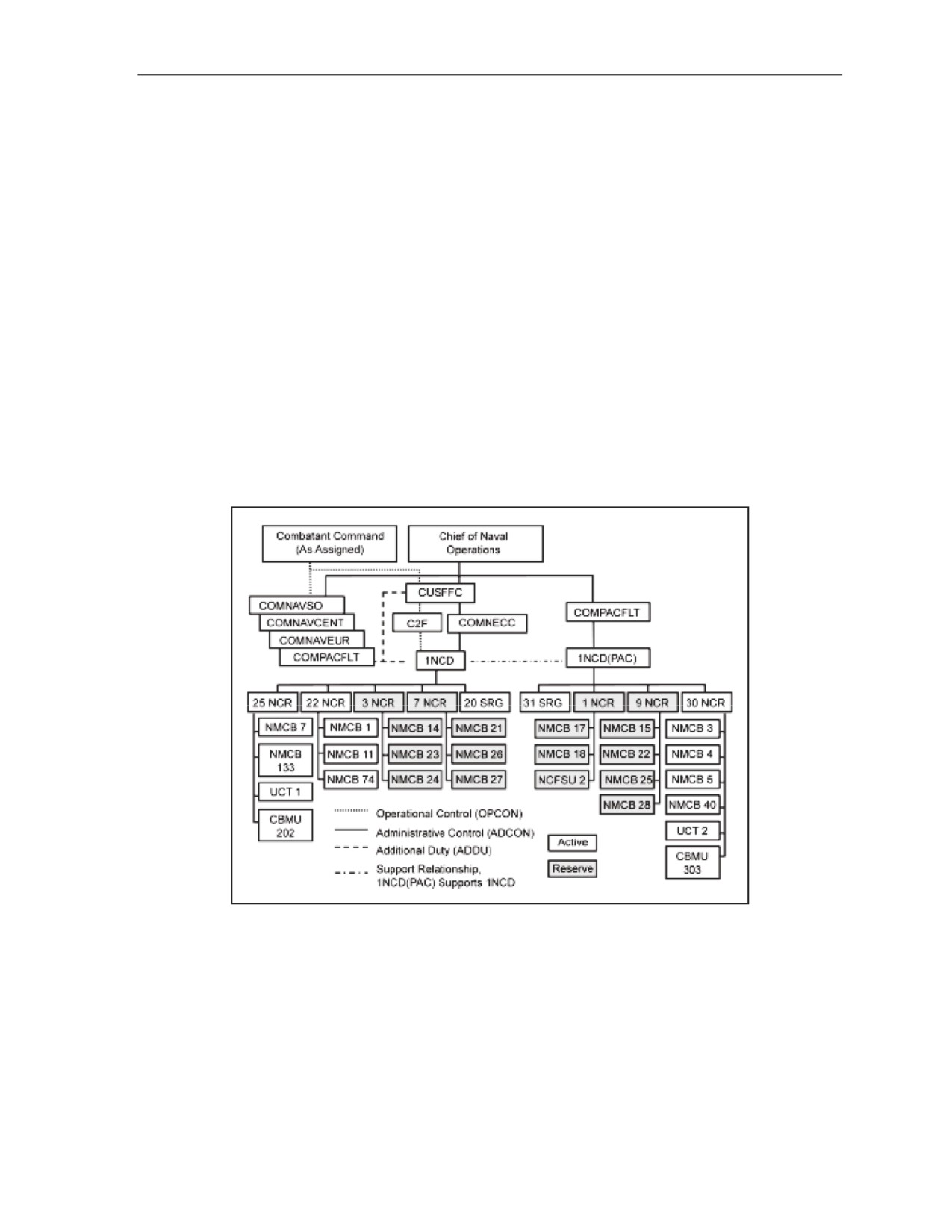
Appendix C
are trained in survivability operations and in limited defensive combat. The common thread that is woven
throughout all Seabee units is responsiveness and flexibility.
C-5. During normal homeport operations, NCF units are under the OPCON of the Navy component
commander of their assigned CCDR. When deployed during peacetime, NCF units are normally transferred
to the supported theater Navy component commander under the geographic CCDR. During contingencies
when NCF units deploy in support of a MAGTF, NCF units are generally transferred to the theater Marine
Corps forces component commander. When not directly supporting Navy or Marine Corps forces, Seabee
units may be assigned as part of a JTF, or assigned to operate with other Service engineers under a special
engineering task force.
FIRST NAVAL CONSTRUCTION DIVISION ORGANIZATION
C-6.
1NCD is an active and reserve integrated staff commanded by a Navy Civil Engineer Corps (CEC)
rear admiral (upper half). It is headquartered at Naval Amphibious Base Little Creek, Virginia Beach,
Virginia. Commander, 1NCD, who has concurrent duties as Commander, Naval Construction Forces
Command, reports to Commander, U.S. Fleet Forces Command through Commander, U.S. Second Fleet
operationally, and Commander, Navy Expeditionary Combat Command administratively. Commander,
1NCD, is assigned additional duty to Commander, U.S. Pacific Fleet; Commander, U.S. Naval Forces
Europe; Commander, U.S. Naval Forces Central Command; and Commander, U.S. Naval Forces Southern
Command as the subject matter expert and principal advisor for NCF matters. Figure C-1 illustrates the
command relationships of 1NCD and its subordinate units.
Figure C-1. 1NCD command relationships
C-7. The 1NCD exercises ADCON and OPCON over NCRs and Seabee readiness groups (SRGs), which
encompass about 16,000 active duty and reserve Navy Seabees. These commands are responsible for C2
over NMCBs, underwater construction teams (UCTs), construction battalion maintenance units (CBMUs),
and a naval construction force support unit (NCFSU). As a force provider, 1NCD provides ready combat
construction forces to fulfill operational and forward engagement requirements of CCDRs and their
component commanders for expeditionary construction, contributory support to Naval Shore Activities and
Marine Corps bases and camps, and FHA and disaster recovery operations.
1NCD also provides
contingency and deliberate engineer planning in support of CCDR planning efforts.
C-2
FM 3-34
2 April 2009
Joint Engineer Organizations and Capabilities
C-8. The 1NCD commander exercises C2 over the NCRs and SRGs; normally deploying only in support
of two or more deployed NCRs during exercises, contingencies, or major combat operations. When
deployed, it relies on subordinate units for tactical and logistic support.
NAVAL CONSTRUCTION REGIMENT
C-9. NCRs report directly to 1NCD. There are three active and four reserve NCRs commanded by a Navy
CEC captain. Two active NCRs are located at Construction Battalion Center, Gulfport, Mississippi; and
one active NCR is located at Naval Base Ventura County, Port Hueneme, California. There are four reserve
NCRs with readiness support sites spread across CONUS.
C-10. NCRs exercise ADCON and OPCON of all NCF units assigned to them and will generally deploy to
exercise C2 over two or more NCF units operating in a specific geographic area or in support of a specific
military operation. In addition, NCRs are responsible for ensuring that subordinate units assigned to them
achieve maximum operational readiness before the unit’s deployment to a contingency or forward-
deployment site.
SEABEE READINESS GROUPS
C-11. SRGs report directly to 1NCD. There are two active and reserve integrated SRGs commanded by a
Navy CEC captain. There is one SRG located at Construction Battalion Center, Gulfport, Mississippi, and
one at Naval Base Ventura County, Port Hueneme, California.
C-12. SRGs provide military training for active and reserve NCF units during their homeport training
cycles. SRGs also ensure that units achieve maximum effectiveness and operational readiness by
facilitating individual and unit training, and assist NCRs in evaluating unit readiness to deploy, equip unit
personnel, and assist NCRs in the marshalling and embarkation of units or detachments. Additionally,
SRGs are tasked with processing, equipping, and training reserve units during recalls or mobilizations. The
SRGs do not deploy.
NAVAL MOBILE CONSTRUCTION BATTALIONS
C-13. NMCBs report to their respective NCR. There are 9 active and 12 reserve battalions commanded by
Navy CEC commanders. Five active NMCBs are homeported at Construction Battalion Center, Gulfport,
Mississippi, and four are homeported at Naval Base Ventura County, Port Hueneme, California. There are
12 reserve NMCBs with readiness support sites spread across CONUS.
C-14. NMCBs provide responsive military engineering and construction support to Navy, Marine Corps,
and other forces in military operations. NMCBs have extensive heavy horizontal and vertical construction
capabilities. NMCBs construct and maintain roads and bridging for supply routes; build expeditionary
airfields and advanced bases; construct or extend airfield pavements; establish ASPs; install, repackage,
and redeploy support and LOC bridging; construct base facilities and force beddown facilities; and conduct
defensive combat operations. Additional functions include repair, maintenance, and construction of shore
facilities and LOCs during contingency, emergency, or disaster recovery operations. NMCBs also perform
specialized construction such as water well drilling, quarry and rock crusher operations, asphalt and
concrete placement, and battle damage repair (for example, airfield damage repair). They are able to work
and defend themselves, including self-decontamination of organic equipment and personnel at construction
sites outside of their base camp and execution of tactical convoys.
C-15. NMCBs deploy on a rotational basis according to the 1NCD approved deployment schedule.
NMCBs are operationally self-sustainable for up to 60 days, requiring only replenishment of consumables.
In times of emergency or disaster, NMCBs conduct disaster recovery and humanitarian assistance
operations. NMCBs are capable of limited operations in a CBRN environment. They are outfitted with
individual personal protective gear, limited chemical and radiological detection equipment, and
decontamination apparatus capable of decontamination of personnel, facilities, and equipment organic to
the unit. Other configurations of the NMCB’s manpower and equipment, such as those pre-positioned on
the maritime pre-positioning ships, have been tailored to meet various missions. An NMCB can task-
2 April 2009
FM 3-34
C-3
Appendix C
organize and deploy away from its main body a number of detachments, details, and teams, depending on
the operational tasking and theater requirements.
C-16. NMCBs have standing 89-person air detachments capable of deploying anywhere in the world
within 48 hours of notification via tactical or strategic airlift, such as C-130 or C-17 (not organic assets).
The NCMB air detachment can be augmented with an organic security element or a special engineering
capability, such as a well-drilling team.
UNDERWATER CONSTRUCTION TEAMS
C-17. UCTs report to their respective NCR. There are two active and reserve integrated teams commanded
by Navy CEC lieutenant commanders. There is one UCT located at the Naval Amphibious Base Little
Creek, Virginia Beach, Virginia, and one at Naval Base Ventura County, Port Hueneme, California.
C-18. UCTs are specially trained and equipped units that perform underwater engineering, construction,
repair, and inspection. UCTs facilitate port-opening operations with underwater surveys, damage repair,
and obstacle removal through the use of precision demolitions, as well as detailed beach and port
hydrographic and side-scan surveys for maritime pre-positioning force or amphibious operations. UCTs
conduct battle damage repair and assessments to ocean, waterfront, and port facilities and are capable of a
light salvage capability.
C-19. UCTs perform complex inshore and deep ocean underwater construction tasks in any climate,
including extreme cold weather environments. They provide ocean bottom surveys for appropriate site
selection of underwater facilities. UCTs are capable of diving and working at depths of 190 feet and rely
on self-contained underwater breathing apparatus and surface-supplied air driving systems. Typical
projects include underwater repair of wharves, piers, pipelines, moorings, boat ramps, and underwater
utility systems. The unit also supports OPDS operations by sinking, installing, connecting, and maintaining
the single anchor let moorings.
C-20. A UCT is divided into three air detachments and a platoon-size sea echelon, capable of deploying as
one unit or separately. Each air detachment carries its own transportable recompression chamber to support
diving operations anywhere in the world. The sea echelon is composed of additional and larger unit
equipment for sustained operations. UCTs deploy only during exercises, contingencies, or major combat
operations and do not conduct regular rotational deployments.
CONSTRUCTION BATTALION MAINTENANCE UNITS
C-21. CBMUs report to their respective NCR. There are two active and reserve integrated shore-based,
surge capable units commanded by Navy CEC lieutenant commanders. There is one CBMU headquartered
at Naval Amphibious Base Little Creek, Virginia Beach, Virginia, and one at Naval Base San Diego,
California.
C-22. CBMUs provide initial construction and continuous public works support to the Navy’s
expeditionary medical facilities deployed in support of a contingency. The CBMU can provide follow-on
public works operations to maintain and repair existing advanced base shore facilities or facilities
constructed by NMCBs during contingency operations, to include base camps, power, sewage, POLs, and
water systems. The unit is also capable of equipping, manning, and maintaining water production, as well
as steam and electrical power generation and distribution systems (systems less than 600 volts) for
advanced base facilities. CBMUs deploy only during exercises, contingencies, or major combat operations
and do not conduct regular rotational deployments.
NAVAL CONSTRUCTION FORCE SUPPORT UNIT
C-23. The NCFSU reports to its respective NCR. The one reserve NCFSU is commanded by a Navy CEC
commander and is headquartered at Naval Base Ventura County, Port Hueneme, California. The NCFSU is
undergoing extensive transformation at the time of this publication. The following paragraphs represent the
traditional mission of the NCFSU.
C-4
FM 3-34
2 April 2009
Joint Engineer Organizations and Capabilities
C-24. NCFSUs provide logistics-oriented and specialized construction support for the NCR and other NCF
units in the following areas:
z
Operation, maintenance, and repair of local and long-haul transportation equipment.
z
Set up and support of quarry and rock crusher operations, asphalt and concrete production and
placement, and soil analysis and stabilization equipment.
z
The production and storage of potable water using reverse osmosis purification systems and
storage units.
z
Construction material management, including requisitioning, expediting, receiving, controlling,
storing, issuing, and delivering.
z
Support for deliberate bridging and heavy timber construction.
z
Maintenance, custody, inventory control, and issuance of special Seabee support equipment.
C-25. The NCFSU deploys only during exercises, contingencies, or major combat operations and do not
conduct regular rotational deployments.
AMPHIBIOUS CONSTRUCTION BATTALION
C-26. ACBs are organized under the Atlantic and Pacific NBGs. They are not subordinate to 1NCD. There
are two active and reserve integrated units commanded by Navy CEC captains. There is one located at
Naval Amphibious Base Little Creek, Virginia Beach, Virginia, and one at Naval Amphibious Base
Coronado, San Diego, California.
C-27. NBGs provide an administrative and command element from which personnel and equipment are
formed in tactical elements and made available to appropriate commanders to support beach and waterfront
operations, especially amphibious and maritime pre-positioning force off-load operations. ACBs provide
logistics over-the-shore movement
(ship-to-shore or shore-to-shore) and construction support to
amphibious forces. ACBs are part of the naval support element and report to the NBG, which is
responsible for in-stream offload of maritime ships in support of amphibious operations or the pier-side
offload of a maritime pre-positioning squadron in support of a more permissive operation. The primary
tasking of ACBs is to provide ship-to-shore transportation of fuel, materials, and equipment in support of
amphibious operations. Transport is accomplished primarily by means of assembling powered and
nonpowered causeway sections into transfer barges and warping tugs. Additional tasks include operating
pontoon causeways, installing and operating offshore petroleum discharge system and assault bulk liquid
transfer systems, and meeting the salvage requirements of the NBG. ACBs construct elevated causeways
and floating causeway piers, erect 1,300 man expeditionary camps, and provide camp public works
support, perimeter defense, and other beach improvement construction support.
C-28. The ACBs deploy only during exercises, contingencies, or major combat operations and do not
conduct regular rotational deployments.
GENERAL ENGINEERING SUPPORT TO THE MARINE CORPS
C-29. The NCF provides general engineering support to reinforce and augment the limited general
engineering capability of the Marine Corps. The normal employment of the NCF is as a major subordinate
element within the MAGTF to maximize engineering capabilities available to the MAGTF commander.
Seabees are an essential support element to any size MAGTF and routinely deploy and exercise with
Marine Corps units. The NCF constructs and maintains base facilities, repairs battle-damaged facilities,
accomplishes disaster recovery efforts and FHA construction projects, and conducts limited defensive
operations as required by the OE.
ENGINEERING TECHNICAL AND CONTRACT SUPPORT
C-30. NAVFAC is the Navy’s global shore facilities manager and reports to the Chief of Naval Operations.
NAVFAC is an active and reserve integrated organization commanded by a Navy CEC rear admiral (upper
half). It is headquartered at the Washington Navy Yard, Washington, District of Columbia.
2 April 2009
FM 3-34
C-5
Appendix C
C-31. NAVFAC’s component commands comprise two subordinate headquarters commands (NAVFAC
Atlantic and NAVFAC Pacific) and facilities engineering commands located around the globe. Facilities
engineering commands include an officer in charge of construction located in Department of Navy
concentration areas that can be used to support contingency operations. NAVFAC has three specialty
centers that provide significant support to the NCF: Naval Facilities Engineering Service Center, Naval
Facilities Expeditionary Logistics Center, and the Navy Crane Center.
C-32. NAVFAC provides acquisition and technical support to include planning, design, project
management, environmental engineering, and operations and maintenance for shore-based, ocean facilities,
and the operating forces of the Navy, Marine Corps, and other services as required. NAVFAC does not
regularly deploy, but can deploy contingency engineering response teams to assess damaged facilities and
environmental disasters; environmental engineering support teams to conduct surveys, remediation, and
disposal; and a contingency officer in charge of construction detail to provide theater or expeditionary
contracting management and support to include real-estate transactions and the Global Contingency
Construction and Contingency Service Contracts. NAVFAC also has mobile utilities support equipment
teams, which provide temporary or short-term utility support. The mobile utilities support equipment
program provides portable diesel engine driven generators, substations, switchgear, low-NOx boilers, and
technical expertise to support worldwide DOD utility shortfalls and emergencies.
Note. For additional information on the NCF, see Office of the Chief of Naval Operations
Instruction (OPNAVINST) 5450.46(series), NCF Policy.
AIR FORCE ENGINEER ORGANIZATIONS AND CAPABILITIES
C-33. Air Force engineer units, organized as Prime BEEF or RED HORSE units, are structured and
equipped to provide the full range of support required to establish, operate, and maintain garrison and
contingency air bases that support fixed-wing and rotary-wing aircraft. The units provide support ranging
from expeditionary to general engineering across the spectrum of operations. The primary mission of Air
Force engineers is to provide mission-ready base systems, to include force beddown and aircraft beddown,
for the projection of air power for both in-garrison and deployed locations. Air Force engineers are focused
on general engineering tasks, but have limited combat engineering capabilities centered on the defense of
deployed forces, camouflage, survivability, and base denial.
AIR FORCE ENGINEER STRUCTURE
C-34. Air Force engineering units can deploy as part of an AETF, or as detached units operating in support
of specific missions and operational taskings. Prime BEEF forces are organized and deployed according to
unit type codes (UTCs) and are tailorable to meet special deployment taskings. Beddown UTCs deploy
with other modular teams as necessary for command, control, and communications to conduct construction,
maintenance, repair, fire and emergency services, readiness, and EOD operations.
PRIME BASE ENGINEER EMERGENCY FORCE CAPABILITIES
C-35. Prime BEEF capabilities include site surveys, bare-base construction using mobility assets (such as
Bear/Eagle), concrete and asphalt paving, and utility system installation and maintenance (such as water;
waste water; electrical; heating, ventilation, and air conditioning; fire protection and crash rescue; and
EOD operations and readiness). Projected mobility asset requirements are established using the base
engineering survey toolkit. This geospatial component enables the warfighter to preplan beddown
capabilities and limitations before actual deployment. Support UTCs augment beddown teams or provide
support to limited deployments. All Prime BEEF UTCs are rapidly deployable via airlift with team kits to
support initial beddown taskings. Sustainment supplies and project materials can be procured from pre-
positioned stockpiles, war reserve materiel depots, or contract sources.
C-6
FM 3-34
2 April 2009
Joint Engineer Organizations and Capabilities
RAPID ENGINEER DEPLOYABLE HEAVY OPERATIONAL REPAIR SQUADRON ENGINEER
CAPABILITIES
C-36. RED HORSE squadrons are organized and deployed for austere, independent operation to execute
heavy horizontal and vertical construction projects; site development; construction and repair of runways,
taxiways, aprons, roads, and revetments; heavy earthwork; and construction and repair of facilities and
infrastructure. RED HORSE squadrons are organized to operate on a hub-and-spoke concept and, unlike
Prime BEEF units, are a theater asset. The concept is to deploy the entire squadron, including augmenters,
to a single AOR with the capability of the hub supporting multiple tailored spokes simultaneously. RED
HORSE capabilities include all of the functions of Prime BEEF teams, but they are more focused on
providing a heavy construction capability, to include water well drilling, quarry operations, small-scale
explosive demolition, heavy horizontal and vertical construction, and water purification.
C-37. RED HORSE units are organized in a capabilities-based, building block structure capable of
operating a hub-and-spoke concept. The concept is to deploy the entire squadron, including augmentees, to
a single AOR. UTCs are structured to support hub-and-spoke operations. Each RED HORSE unit is a 404-
person squadron composed of seven different types of personnel UTCs which include vertical construction
teams (large and small), horizontal construction teams (large and small), additional construction support
element, and beddown and C2 hubs (primary and secondary). In addition, these units have the following
airborne capabilities: airborne and air insertable repair teams, airborne fire protection, EOD, and readiness
teams.
C-38. RED HORSE units also have small, highly specialized airborne engineer teams (up to 35-person
teams). These tailorable teams are trained and equipped to rapidly deploy into an austere location to assess
airfield capabilities, prepare helicopter or aircraft landing areas, clear obstacles, make expedient airfield
damage repairs, and provide initial assessment of required follow-on forces and material resources to
establish airfield contingency operations. The airborne teams can be augmented to clear small areas of
UXO and EH, assess potential CBRNE and toxic industrial material hazards, and provide limited crash
rescue and medical services. Airborne RED HORSE teams do not capture airfields via forcible entry;
rather, they operate on airfields controlled by other U.S. or coalition forces or open airfields not held by
enemy forces. Airborne air assault RED HORSE personnel and equipment can be inserted into locations
via airdrop, air-insertion, or air-delivery.
AIRFIELD OPERATIONS
C-39. A primary tasking for Air Force engineers is to enable rapid global mobility for airlift, bombers,
fighters and to support other manned and unmanned aerial weapon systems. Air Force engineers are trained
and equipped with organic capabilities to support all aspects of airfield operations where heavy strategic
airlift, bombers, or fighters will operate on a daily or frequent basis. The Air Force has the capability to
rapidly deploy general engineer units organized as part of an AETF to open, establish, and maintain air
base power projection platforms. These same units can deploy as detached units operating in support of
specific missions and operational taskings, such as airfield pavement evaluations; crash and fire rescue;
EOD; emergency management response; airfield damage repair; facility construction and maintenance; and
utility systems construction, maintenance, and operation. Other taskings include road construction;
pavement construction and maintenance; aircraft arresting system installation and maintenance; and airfield
lighting, marking, and installation of navigational aids.
C-40. Air Force engineers assess, establish, maintain, and operate air bases that support fixed-wing aircraft.
Air Force engineer units have the specialized capabilities required to support all engineering aspects of
2 April 2009
FM 3-34
C-7
Appendix C
airfield operations ranging from early-entry operations to war damage repair. Specialized functions include
the following:
z
En route base opening and operational support for strategic airlift.
z
Generation of geospatial site information and analysis of operational locations using approved
Headquarters Air Force Geo-Integration Office expeditionary site mapping agencies and
established policies.
z
Airfield pavement inspection and evaluation required to determine the feasibility of supporting
and sustaining aircraft operations.
z
Design and execution of expedient airfield damage repair.
z
Installation, operation, and maintenance of deployable airfield lighting systems.
z
Installation, operation, and maintenance of mobile aircraft arresting systems.
z
Design and construction of runways, taxiways, and parking aprons, including associated
facilities and utilities.
z
Automatic or ultimate building machine
(K-span), pre-engineered building, tension fabric
structure, and inflatable building construction.
z
Power and water utility generation required to support deployed forces, to include reverse
osmosis water purification.
z
Aircraft crash fire rescue, structural fire, hazardous material response, and first responder
medical support.
z
CBRNE training, reconnaissance, operations, and initial weapons of mass destruction (WMD)
response.
z
EOD to support aircraft munitions, rendering safe and disposing of hazardous munitions,
providing response to IEDs and WMD incidents, and conducting assessment support for the
destruction of captured enemy munitions and caches and clearance of IEDs from MSRs (not just
limited to airfields).
TECHNICAL AND CONTRACT SUPPORT
C-41. Engineering technical and contract support for Air Force mobility forces are provided by a variety of
other supporting organizations separate from Prime BEEF and RED HORSE units. The AFCESA provides
technical engineering support and training and administers the AFCAP. Additionally, AFCESA provides
specialized teams to assess pavement and runway conditions along with teams to conduct in-field
maintenance and repair specialized power generation equipment.
C-42. The civil engineer maintenance, inspection, and repair team provides intermediate and depot-level
repair support on power generation, electrical distribution, and aircraft arresting systems. They also provide
technical support for heating, ventilation, and cooling systems. These teams provide commanders with
power production and electrical expertise during wartime, contingency operations, and humanitarian and
natural disaster recovery actions. In addition, the Air Force Center for Environmental Excellence provides
a full range of environmental program support, base planning, construction, and contract services.
Headquarters, Air Force, Geo-Integration Office expeditionary site mapping agencies provide planners and
warfighters high-quality, timely geospatial information. Expeditionary site mapping agencies fuse ISR with
agile combat support in a horizontal and vertical integration strategy to provide the warfighter rapid
situational awareness.
FIRE AND EMERGENCY SERVICES CAPABILITY
C-43. Fire and emergency services prevent fires and minimize losses to lives, property, and the
environment occurring throughout the spectrum of operations. Included are both man-made and natural
incidents; fire suppression or hazard mitigation; rescue; mitigation or containment of releases of hazardous
materials resulting from industrial accidents, terrorism, or WMD; and emergency medical responses.
C-8
FM 3-34
2 April 2009
Joint Engineer Organizations and Capabilities
C-44. The capabilities within fire and emergency services are—
z
Rescue trapped, sick, or injured personnel from aircraft, buildings, equipment, vehicles, water,
confined spaces, or high angles.
z
Suppress and minimize fires involving aircraft and other weapon systems, structures, equipment,
vehicles, or natural cover.
z
Provide emergency lifesaving care for victims of accident or sudden illness.
z
Mitigate the impact of hazardous material releases, such as industrial materials; chemical,
biological, or radiological materials; or detonation of explosives.
z
Prevent fires by advising, enforcing standards, and educating personnel.
C-45. Fire and emergency services are a fundamental component of the Air Force civil engineer capability.
Because fire and emergency services are “capabilities based,” the capability changes little from one
location to another. At home stations, military firefighters represent
50 percent of the Air Force’s
firefighting capability. By assisting civilian firefighters with home-station missions, they are able to
acquire the experience and training needed to maintain the critical skills needed for wartime operations.
Since missions at home station and deployed locations are similar, military firefighters are seamlessly
postured in UTCs for rapid deployment. Military firefighters support both home station and deployed
missions, but equipment and vehicles required to support war plans are set aside in UTCs. This enables
firefighters to rapidly transition from peacetime to wartime operations with similar capability, with the
same types of equipment and vehicles. Moreover, fire protection UTCs are packaged to support a variety of
scenarios that may require a single firefighting crew, multiple firefighting crews, or a management and
oversight capability.
C-46. Air Force fire and emergency services provide continuous “24/7” capability. The capability required
is based on the specific mission at the deployed location, primarily the type and size of aircraft assigned.
Other factors such as large tent cities and lack of an adequate water supply can also affect capability.
Firefighters work 72 hours per week in 24-hour shifts at home station and 84 hours per week in 24-hour
shifts during contingency operations.
EMERGENCY MANAGEMENT
C-47. Emergency management provides CBRNE defense expertise, to include CBRN and WMD defense
supporting activities ranging from small-scale contingency operations to response to major accidents and
natural disasters for an air base. Capabilities include preliminary risk and vulnerability assessments and
threat analysis; planning, detection, identification, warning and reporting; and contamination control,
decontamination, and disaster response equipment.
MARINE CORPS ENGINEER ORGANIZATIONS AND CAPABILITIES
C-48. The MAGTF is the Marine Corps's principal organization for all missions across the spectrum of
operations. MAGTFs are balanced combined arms forces consisting of four organic elements: the
command element (CE), aviation combat element (ACE), ground combat element (GCE), and a logistics
combat element (LCE). MAGTFs range in size from an MEF, Marine expeditionary brigade, Marine
expeditionary unit (MEU), to a special-purpose MAGTF. An MEF has a Marine division as the GCE, a
Marine air wing as the ACE, and a Marine logistics group as the LCE. A Marine expeditionary brigade has
a regiment as the GCE, a Marine air group as the ACE, and a brigade service support-group as the LCE.
An MEU has a battalion as the GCE, a squadron as the ACE, and an MEU combat logistics group as the
LCE. The element sizes that make up a special purpose MAGTF vary according to mission. Engineers are
organic to each of the four elements of a MAGTF.
ENGINEERS IN THE COMBAT ELEMENT
C-49. Engineers within the CE provide advice and guidance to the MAGTF commander and coordinate the
overall engineer efforts of the MAGTF. CE engineers work closely with other staff sections to integrate
engineer considerations and requirements into all phases of planning and execution.
2 April 2009
FM 3-34
C-9
Appendix C
ENGINEERS IN THE AVIATION COMBAT ELEMENT
C-50. A Marine wing support group (MWSG) is organic to each Marine air wing. The MWSG is a
headquarters element that has subordinate Marine wing support squadrons (MWSSs). The MWSS provides
the following aviation ground support (AGS) functions: internal airfield communications, weather services,
expeditionary airfield services, aircraft rescue and firefighting, EOD, essential engineer services, motor
transport, field messing, medical, CBRN defense, security and law enforcement, and air base commandant
functions (including air base ground defense). These functions allow the ACE to project its assets ashore
and generate sorties at a rate beyond that capable from sea-based platforms.
C-51. AGS is compatible with Navy aircraft and can support and accommodate Army rotary-wing aircraft
and most Air Force aircraft. The MWSS provides a full range of general engineering, utilities, material
handling, and heavy equipment. Tasks include engineer reconnaissance and survey; construction and
maintenance of base camps, including survivability, horizontal and vertical construction; K-span
construction; airfield drainage; airfield damage repair; countermobility; mine detection; vertical or short
takeoff and landing facilities; bulk fuel storage and distribution; forward arming and refueling point sites;
water purification, storage, and distribution; laundry and shower services; mobile electric power;
refrigeration; expedient road construction, repair, and maintenance in an ACE area; drafting and surveying;
and material handling equipment. The MWSS can be reinforced by MAGTF engineer support battalions
(ESBs) or Seabees as necessary to perform missions such as constructing airstrips in excess of 900 feet.
Generally, four MWSSs compose the MWSG. The MWSS is composed of a headquarters company,
airfield operations company, engineer company, motor transport company, and a maintenance company.
ENGINEERS IN THE GROUND COMBAT ELEMENT
C-52. A combat engineer battalion (CEB) is organic to the MEF. The CEB mission is to enhance the
mobility, countermobility, and survivability of the division through combat and limited general engineering
support. CEB tasks include engineer reconnaissance, emplacing obstacle systems, breaching operations,
mine and countermine, demolitions, assault bridging, expedient bridge construction and repair, limited
combat road and trail construction and maintenance, temporary vertical and horizontal construction, and
provide provisional infantry. A CEB contains a headquarters and service company, engineer support
company, and three or four combat engineer companies.
ENGINEERS IN THE LOGISTICS COMBAT ELEMENT
C-53. The ESB is organic to the LCE. The ESB mission is to provide combat engineering and limited
general engineering, bulk liquid (fuel and water), and utility support to the MAGTF. ESB tasks include
combat engineering support; standard and nonstandard bridging; EOD; handling, storing, and dispensing
bulk fuel and water; water purification; engineer reconnaissance and survey; construction and maintenance
of base camps, to include survivability; horizontal and vertical construction; laundry and shower services;
mobile electric power; refrigeration; expedient road construction, repair, and maintenance; drafting and
surveying; obstacle emplacement; breaching operations; and expeditionary airfield construction. The ESB
can reinforce either the MWSS or CEB to support specific requirements that exceed organic ACE or GCE
engineer capabilities. The ESB works in concert with the NCF to provide comprehensive engineer support
to the MAGTF. The ESB is composed of a headquarters and service company, engineer support company,
bridge company, bulk fuel company, and two or three combat engineer companies.
SEABEE SUPPORT TO THE MARINE AIR-GROUND TASK FORCE
C-54. The Navy typically provides an NCE to enhance the MAGTF through complementary, not
duplicative engineering support. NCE tasks include construction or pre-engineered buildings, bunkers,
towers, ASPs, and concrete and masonry buildings; surveying and drafting; materials testing; well-drilling
operations; rapid runway repair; bulk liquid distribution and storage; forward arming and refueling point
sites; water purification; horizontal construction such as paved and unpaved roads; MSR maintenance,
expeditionary airfields, and asphalt and concrete runways; parking areas; beach improvements; and
installation of both standard and nonstandard bridging.
C-10
FM 3-34
2 April 2009
Joint Engineer Organizations and Capabilities
COMMUNICATIONS SUPPORT FOR JOINT ENGINEER FORCES
C-55. Supporting engineer forces with an effective communications system for C2 is an essential
consideration for the JFC and the joint force engineer. Engineer forces have organic communications
capabilities within Service channels up to the component headquarters. When operating in a joint
environment, engineer units retain organic communications capabilities, but may also require additional
communications system support from the Service component, other Service components, or the joint force.
Specific requirements will depend on the C2 arrangement of the engineer forces within the joint force,
mission tasking, and geographic location in the JOA. The following description of capabilities may be
helpful in developing the communications for engineer forces supporting the joint force.
ARMY
C-56. Army engineers use the Global Command and Control System (GCCS)-Army at corps level and
above and the ABCS at corps level and below. The Maneuver Control System, a subfunction of the ABCS,
is used down to the divisional battalion level to accomplish mission planning and C2. At the brigade level
and below, Army engineers rely on organic communication assets that include encrypted frequency
modulation, facsimile and telephone mobile subscriber equipment, and digitized tactical electronic mail.
When operating in a joint force, Army engineers rely on organic communications capability. The
GCCS-Army provides engineer access and interface to the JOPES and JEPES, which give Army engineers
the capability to exchange engineer annexes with the JFC’s headquarters and other elements of the joint
force. A secure video teleconference (VTC) capability provided by the Tele-Engineering Kit allows an
additional means to reach back to draw on the capabilities of the USACE and assets that they may bring to
the fight.
NAVY
C-57. NCF units have sufficient capability to perform all internal communications operations and to
communicate with subordinate, adjacent, and higher headquarters. NCRs can maintain voice
communications with subordinate units and higher authority by telephone, very high frequency (VHF),
high frequency (HF), and limited ultrahigh frequency (UHF). Units can transmit data and achieve limited
NIPRNET and SIPRNET access via UHF or satellite phone. Battalion-level units have internal client or
server tactical data network computer systems and can transmit information and achieve limited NIPRNET
and SIPRNET connectivity via UHF or satellite phone. When operating in a joint force, NCF engineers
rely on organic communications capability, but may also require additional support.
MARINE CORPS
C-58. Marine Corps engineers have the minimum required capability to perform internal communications
operations and to communicate with subordinate, adjacent, and higher headquarters at the division level
and below when in a noncontingency status. Marine Corps engineer units may rely on higher headquarters
capabilities or request additional C2 assets during operations, particularly when subordinate units support
multiple task-organized units. With appropriate augmentation, Marine Corps engineer units can maintain
voice communications with subordinate units and higher authority by secure telephone, VHF, HF, and
limited UHF and transmit data and achieve limited NIPRNET and SIPRNET access via UHF satellite
communications. When employed as part of an MEF or MEF-size MAGTF, engineer units have access to
GCCS-Marine Corps combat logistics group headquarters. When operating in a joint force, Marine Corps
engineers rely on organic communications capability, but also require additional support.
AIR FORCE
C-59. Air Force engineer forces’ communications requirements beyond unit-level capability are provided
by deployed installation communications elements. These communications elements are embedded in the
base information infrastructure. Developed as part of the Air Force’s expeditionary air and space
expeditionary force concept, base information infrastructure packages are scalable, modular
communications support packages that offer deployed personnel access to such standard services as secure
2 April 2009
FM 3-34
C-11
Appendix C
and unsecured telephones and facsimiles, NIPRNET, SIPRNET, and land mobile radio repeaters. When
operating out of an Air Force, joint, or combined operations center, Air Force engineer forces can gain
access to a wide range of mission support systems. These systems provide linkage to the GCCS, JOPES,
JEPES, and other ISR systems necessary for mission planning.
C-12
FM 3-34
2 April 2009
Appendix D
Multinational, Interagency, and Host Nation Considerations
Military engineers may need to coordinate their activities with multinational, U.S.
government agencies, NGOs, UN, and HN agencies according to the operational
mandate or military objective. In all cases, authority must exist for direct
coordination. Military engineers must establish interagency relationships through
negotiation. The specific agency will vary, depending on who has federal or state
proponency for the situation
(for example, disaster relief versus a firefighting
mission). Agreements should be written as memorandums of understanding or terms
of reference to ensure understanding and avoid confusion. Most agreements are made
at the unified command or JTF level and normally place serious legal restrictions on
using military personnel and equipment. These agencies and organizations may have
unique engineer capabilities that could be used as part of the overall operational
effort. However, these agencies and organizations often request extensive engineer
support of their activities and programs. It is critical that an effective engineer liaison
is established with the force headquarters CMOC to coordinate and execute any
engineer support exchange with these agencies.
SECTION I-MULTINATIONAL CONSIDERATIONS
UNITS AND ORGANIZATIONS
D-1. When military operations are considered, the U.S. seeks to develop coalitions rather than conduct
unilateral operations. The United States may participate in a U.S.-led coalition, such as Operation Restore
Hope (Somalia), or a non-U.S.-led coalition, such as Operation Able Sentry (former Yugoslav Republic of
Macedonia). The agencies involved in each of these operations are both consumers and possible resources
of engineer activity. Army engineer units may be subordinate to, colocated, and working alongside, or
directing engineer activities and providing oversight or support for the missions assigned to these
organizations. The engineer forces’ effectiveness to operate within the varied framework surrounding a
collective international enterprise can be greatly enhanced by respecting the multinational partners; their
construction and engineering techniques; and their ideas, culture, religion, and customs. Equally important
and parallel to operating within a U.S. unilateral joint environment is understanding multinational unit or
organization capabilities and training. This understanding ensures the assignment of appropriate missions
and avoids the risk of offending national honor or prestige by allocating unsuitable tasks to partners in the
multinational endeavor.
MULTINATIONAL ENGINEERS
D-2. The engineer organizations available from deployed national armies are generally a mix of combat
and construction engineers in company- and battalion-size units. The training and experience levels and
equipment fielding varies among these units. National engineers from Britain, Canada, and Australia have
been involved in numerous missions outside their territorial boundaries. The political impact of these
missions is important to understand. When German engineers deployed into Somalia in 1992, it took a
national legislative amendment to their constitution to allow them to participate in operations off German
soil. This was their first experience in multinational efforts outside of NATO. Smaller countries have more
regional restrictions on their involvement, and their experience is correspondingly narrow. However, they
are also more likely to be attuned to the special circumstances that are relevant to the AO.
2 April 2009
FM 3-34
D-1
Appendix D
MULTINATIONAL ENGINEER CAPABILITIES
D-3. NATO and American, British, Canadian, and Australian New Zealand Armies Program engineer
capabilities are well known, and data about them is readily available. Standardization agreements between
national armies facilitate engineer interoperability and cooperation. The capabilities of other nation’s
engineers are normally available through intelligence channels or formal links with the nations concerned.
Several nations have engineers that are experts in specific combat engineering tasks, such as mine
detection and removal. Other national engineers are focused on specific missions, such as disaster relief.
Engineers must have an appreciation for the engineer capabilities and limitations of other nations. AJP 3.12
and
ATP-52(B) provide a necessary starting point for working with allied engineers.
MULTINATIONAL ENGINEER COMMAND AND CONTROL
D-4. Depending on the multinational force arrangement in-theater, Army engineers may control or work
closely with engineers from other nations. C2 relationships for multinational engineer forces are
established to foster cooperation and share information. Critical to this process is providing adequate U.S.
engineer LNO support, including linguist support, communications equipment, and transportation.
MULTINATIONAL ENGINEER CONSIDERATIONS
D-5. During force projection operations, the initial engineer capabilities in-theater will most likely be a
mix of HN, contract, and multinational capabilities. As Army engineers deploy into a theater, they may be
joined by multinational engineers. The Army engineer staff should consider including the following when
coordinating multinational engineer plans and operations:
z
Requesting the latest intelligence information concerning the HN, allied, and coalition
engineers’ structures and logistics requirements.
z
Requesting the latest engineer intelligence data from the HN or deploying allied and coalition
engineer elements to help identify force projection theater Army engineer requirements and
enemy engineer capabilities. Requirements include threat mine and obstacle data, soils data,
construction materials availability, and HN construction support.
z
Establishing multinational engineer staff links between the Army, HN, allied, and coalition
engineer force staff sections through the JTF or theater engineer staff and headquarters.
z
Executing NATO multinational C2 with the NATO OPORD format and the NATO decision-
making process.
z
Providing necessary Army engineer liaison officer support.
z
Developing the multinational task-organization relationships that enhance HN, allied, and
coalition engineer capabilities following the deployment of Army engineers.
z
Assessing the need for HN, allied, and coalition engineer support following the arrival of Army
combat and construction units in-theater.
z
Determining if multinational engineer units need augmentation from Army combat and
construction units.
z
Developing procedures for Army engineer units to support multinational engineers with
additional Class IV construction materials and engineer equipment.
SECTION II-INTERAGENCY AND NONGOVERNMENTAL ORGANIZATION
CONSIDERATIONS
INTERAGENCY OPERATIONS
D-6. Interagency operations expand the scope and capabilities of any given response because of the wide
variety of expertise and funding resources potentially available. Not only do interagency operations
increase the resources engaged in an operation, but they also increase and complicate the coordination
necessary to conduct operations. Engineer operations may be significantly impacted by the participation of
D-2
FM 3-34
2 April 2009
Multinational, Interagency, and Host Nation Considerations
interagency organizations. In civil support operations, Army forces provide C2, protection, and
sustainment to government agencies at all levels until they can function normally. Engineer operations may
be a key enabler to extending this support. In stability operations, interagency organizations will employ
contract or other construction capabilities concurrently with ongoing military engineer operations.
Coordination can identify and avoid conflicting issues and unify the effect of these efforts. The following
are some of the interagency organizations that could be involved:
z
FEMA.
z
Environmental Protection Agency.
z
Drug Enforcement Administration.
z
National Oceanic and Atmospheric Administration.
z
United States Geological Survey.
z
Public Health Service.
z
Civil Air Patrol.
z
Department of Agriculture.
z
DOS and the United States Agency for International Development.
z
Office of Foreign Disaster Assistance.
z
Department of the Interior, Fish, and Wildlife Agency.
z
General Accounting Office.
z
NGA.
D-7. USACE routinely operates with many of these organizations and may, through FFE, provide
assistance in coordination. See Appendix A of JP 3-07 and JP 3-08 for an in-depth discussion of
interagency coordination during joint operations.
NONGOVERNMENTAL ORGANIZATIONS
D-8. Relationships with international and domestic NGOs must be established through negotiation. Most
agreements are made at the strategic level (unified command); however, the operational commander may
have some latitude delegated to him. All agreements normally have serious legal restrictions on using
military personnel and equipment. Some of these agencies may have unique and significant engineer
capabilities that could be used as a part of the overall operational concept. These capabilities may be a
useful source of Class IV material, not only for the agency’s own projects, but also as a negotiated barter
for services rendered in support of its mission. More often than not, however, these agencies and
organizations may request extensive engineer support for their activities and programs. As these
organizations play an important part in the CCDR’s achievement of strategic objectives, their demands
must be coordinated. Therefore, it is critical that an effective engineer liaison be established and
maintained with the force headquarters CMOC.
D-9. The UN may designate a regional organization with a greater vested interest and appreciation for the
forces at work in a given region as its operational agent to exercise control. Each of these organizations has
different operational concepts and organizational procedures; U.S. forces are familiar with some of these
concepts and procedures, such as those of NATO. However, there are others with which they are not
familiar.
SECTION III-HOST NATION CONSIDERATIONS
HOST NATION INTERFACE
D-10. In a forward-deployed theater, the ASCC in conjunction with the other component commanders, the
CCDR, the allies, and the HNs identifies wartime facility and construction requirements for the Army as
part of the deliberate war planning effort. Doctrinal construction requirements for the ASCC may be
identified using the planning module in the TCMS. Subsequent analyses further refine construction
requirements and provide a basis for—
2 April 2009
FM 3-34
D-3
Appendix D
z
Force structuring.
z
Procurement.
z
Leasing provisions and establishing HN agreements.
D-11. The product of these analyses is the ESP. The goal is to reach HN support agreements in peacetime
to provide as many of the facilities as possible that are needed within the theater. Advanced planning and
the commitment of resources by HNs reduce the early lift requirements needed to support the RSOI.
Engineering support from the HN usually involves providing—
z
Land.
z
Facilities.
z
Construction support.
z
Manpower.
z
Equipment.
z
Materials.
z
Services.
z
Hazardous-waste disposal.
D-12. Written agreements with HNs regarding support items foster an understanding of the assistance
levels and increase the likelihood of execution.
REAL ESTATE CONSIDERATIONS
D-13. Real estate operations involve acquiring, managing, and disposing of land and facilities to support
joint operations. The JFC should establish real estate acquisition policies and programs in support of
contingency operations. The JFC determines what real estate is needed to satisfy operational requirements.
Acquiring land and facilities not owned by the United States government is accomplished through
assignment, international agreements such as Status of Forces Agreements, memorandums of agreement,
leases from the HN, or direct leases from the private sector. Within DOD, the secretaries of the military
departments are authorized to lease structures and real property relating to structures that are needed for
urgent military purposes in foreign countries (see Title 10 U.S. Code, initiated as contingency plans are
developed to identify land and facility requirements for joint operations). Real estate acquisition requires
special contracting procedures that are performed by USACE, NAVFAC, or a designated executive agent.
Early deployment of real estate personnel is essential to acquire land and facilities in a timely manner.
D-14. Real estate authorities throughout the world have been assigned to components along similar lines
corresponding to the designation of DOD construction agents (DOD Directive 4270.5). Within regions
designated to the Army, USACE establishes policies for the acquisition, maintenance, and disposal of real
estate, to include leased and rent-free facilities. Real estate teams may be assigned to each sustainment
brigade or centrally controlled at the senior engineer headquarters. These teams coordinate with HN
agencies and private owners to acquire and dispose of real estate and establish the terms of lease
agreements. Real estate planning and surveys must be initiated as campaign plans are developed to provide
timely and adequate facilities to sustain the combat force. Local HN officials can help identify available
facilities or land that meets military requirements. Thorough documentation of lease agreements and
property conditions at the time of the lease, to include environmental baseline survey data and expectations
of property conditions at the termination of the lease, are crucial to expedite a fair and amiable conclusion
of lease activities. CA and real estate personnel may be required to work through HN governments to settle
agreements with property owners. Real estate acquisition is more difficult in contingency operations due to
the lack of preparation to identify probable sources of and confirm legal ownership. Real estate is required
for—
z
Air bases.
z
Base camps.
z
Medical and logistics complexes.
z
Ranges and training sites.
z
Quarry and borrow sites.
D-4
FM 3-34
2 April 2009
Multinational, Interagency, and Host Nation Considerations
z
Trailer transfer points.
z
Traffic control points.
D-15. Property is generally acquired by requisition, with all transactions documented thoroughly under the
provisions of the CCDR’s directives. Procedures are used that provide the property required for missions
while protecting the property owner’s legal rights. Using rent-free facilities provided by the host
government or a host agency require the same legal responsibilities as using facilities leased from private
owners. Real estate policies and procedures are discussed in more detail in FM 3-34.400.
HOST NATION SUPPORT
D-16. Wartime HN support agreements in forward-presence theaters (Europe and Korea) have been
negotiated to provide HN construction support, such as facility modifications, LOC maintenance and
repair, and utility services. In Southwest Asia, the agreements are less formal and lack the practiced
application that accompanies the full-time presence of U.S. forces in Europe and Korea. However, these
agreements are no less critical to mission success in the event of an operation in this region. Such HNS is
used whenever possible to free U.S. engineer units for critical missions where HNS alternatives are not
viable. Support agreements are negotiated in peacetime on an asset basis. Assets may be facilities,
contracts, or equipment. Again, this support is particularly critical during the initial stages of a contingency
when RSOI requirements are high and engineer assets are limited.
D-17. Pre-positioning equipment within the region reduces the United States response time into a particular
theater by allowing military forces to deploy by air and fall in on war stocks within the region. These pre-
positioning locations are a critical element of U.S. force projection national strategy and represent a
significant contribution of HNS. The HN’s commitment for space, facilities, services, and utility support
for these complexes demonstrate the HN’s interface with U.S. forces and the partnership of the United
States and UN in the defense and stability within the region. Beyond direct HNS, multinational elements
directly or indirectly involved in the crisis may provide other support. Other nations sympathetic to the
cause may be limited in their direct participation because of constitutional restrictions or political
sensitivities. However, these nations may provide nonlethal equipment or funding much like the Japanese
provided during the Gulf War.
D-18. During a conflict, the HN may provide construction organizations to repair or construct facilities,
usually within the sustainment area. Construction materials (such as cement, asphalt, aggregate, timber, and
steel) and contract labor may also be available. HN assets may also be available for local security and for
transporting construction materials and equipment. Third-country nationals may also be available by
request through the HN or direct contact with nationals to support engineer activities within the
sustainment areas. Engineer reconnaissance and assessment teams engaged in planning during peacetime or
dispatched early in contingency operations are the key to identifying and accessing available HN assets.
2 April 2009
FM 3-34
D-5
This page intentionally left blank.