FM 3-34 ENGINEER OPERATIONS (April 2009) - page 5
Appendix E
Engineer Staff Organization and Selected Cells,
Workgroups, and Boards
This appendix describes engineer staff and geospatial engineering organizations at
each echelon from BCT to theater Army. It also highlights many of the key cells,
workgroups, and boards with which the engineer staff may interact.
ENGINEER STAFF ORGANIZATIONS IN BRIGADES
E-1. The BCT is the principal tactical unit and centerpiece of the Army’s modular effort. It is the
fundamental building block of combat power in the Army, made up of battalion-, company-, and platoon-
size units that are discrete packages and rapidly deployable. The three types of BCTs are heavy, infantry,
and Stryker. This section provides general information on the engineer staff organization within the BCT,
including staff assigned to the CABs and BSTBs. Additional information on the structure of each of the
BCTs can be found in FM 3-90.6.
BRIGADE COMBAT TEAM ENGINEER STAFF AND GEOSPATIAL SUPPORT
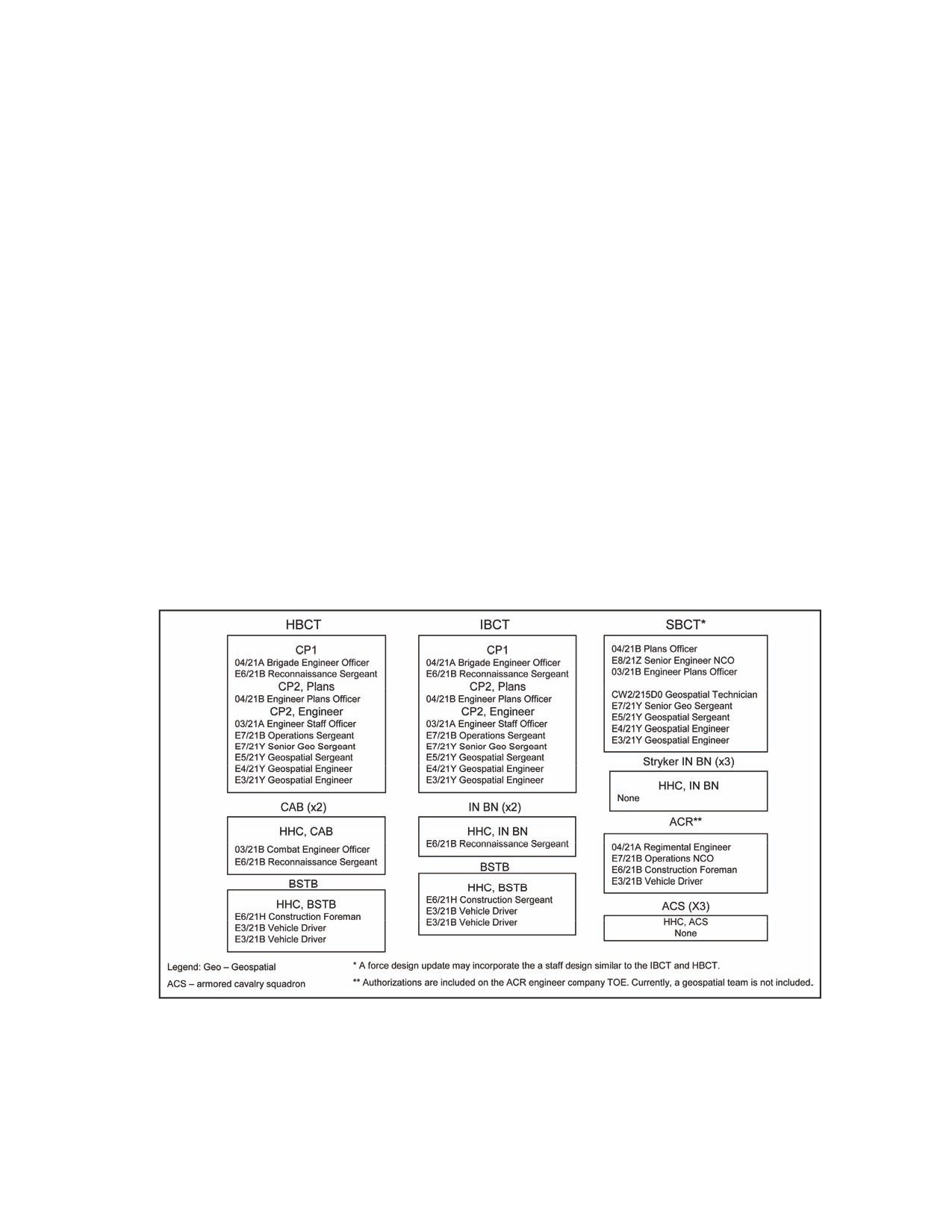
E-2. The organic engineer staff organizations within the three types of BCT and the ACR are shown in
figure E-1. A discussion of the variations is provided below.
Figure E-1. Organic engineer staff in the brigade combat teams
E-3. All three types of BCTs have assigned engineer staff personnel in the BCT headquarters in addition
to a supporting geospatial engineer section. The HBCT and IBCT both have five engineer personnel
assigned, while the SBCT has only three additional engineer staff assigned. In all three, a major is assigned
as the brigade engineer or ENCOORD and is the senior engineer in the BCT headquarters. The brigade
2 April 2009
FM 3-34
E-1
Appendix E
engineer is assisted by an engineer NCO (a senior engineer NCO in the SBCT) to provide 24-hour
coverage. In the HBCT, an additional major is assigned to the BCT plans cell as the engineer planner. The
engineer planner in the IBCT and the SBCT is a captain. Both the HBCT and IBCT are assigned an
additional captain and engineer NCO to provide staff support.
E-4. The organic geospatial engineer team assigned to both the HBCT and IBCT headquarters consists of
two geospatial engineer NCOs and two enlisted Soldiers. The organic geospatial engineer team assigned to
the SBCT headquarters consists of one chief warrant officer 2 geospatial information technician, two
geospatial engineer NCOs, and two enlisted Soldiers. The geospatial engineer section operates in the BCT
main CP providing geospatial support for the BCT. The geospatial engineer section has the capability to—
z
Generate and analyze terrain data.
z
Prepare decision graphics.
z
Produce image maps.
z
Provide three-dimensional terrain perspective views.
z
Manage the theater geospatial database.
z
Update maps.
z
Produce tactical decision aids.
z
Produce IPB overlays.
z
Operate on a 24-hour basis.
E-5. Equipment assigned to the geospatial engineer section includes—
z
One each digital geospatial engineer support system (Digital Topographic Support System
[DTSS]): AN/TYQ-67 (light).
z
One each DTSS: AN/TYQ-71 (deployable minus) (SBCT only).
z
One each truck cargo: 4 by 4 light medium tactical vehicle (LMTV) with towed generator.
z
One each truck utility: 1 ¼-ton 4 by 4 (with equipment) high-mobility multipurpose wheeled
vehicle (HMMWV).
E-6. In the HBCT, an engineer planning staff is assigned to each CAB headquarters. This engineer
section includes an engineer captain as the CAB engineer or ENCOORD and a senior engineer NCO. They
are responsible for engineer planning and coordination within the CAB. This staff section coordinates
directly with the supporting engineer units and advises the CAB commander on engineer operations.
E-7. Each infantry battalion of the IBCT has an engineer staff of one engineer NCO to act as the battalion
staff engineer or ENCOORD. This engineer NCO advises the commander on engineer operations in the
battalion. Responsibilities include providing planning and coordination for engineer elements that augment
the battalion and tracking engineer effort within the battalion. There are currently no engineers on the staff
of the Stryker infantry battalion or in the ACR.
E-8. The BSTB of the HBCT is resourced with two engineer personnel, a construction foreman and a
command section driver. The BSTB of the IBCT is resourced with two engineer personnel, the BSTB
commander’s driver and a construction NCO. The engineer NCO is assigned to the BSTB to coordinate
engineer support to sustainment and facilitate additional engineer forces being attached to augment the
HBCT. Engineer units from company size and below are intended to be attached to the BCT for C2 and
logistics support. Neither the SBCT nor the ACR currently has an organic BSTB. If the decision is made to
resource one, then it is expected that it will include the same basic engineer staff package as is present in
the BSTB of the HBCT or the IBCT.
OTHER BRIGADES AND AUGMENTING ENGINEER ORGANIZATIONS
E-9. A mix of multifunctional brigade types is available to support theater Army, corps, and division
commanders. These supporting brigade types include the BFSB, CAB, MEB, the fires brigade, and the
sustainment brigade. These brigades are combined arms units designed to support BCTs and carry out
specific tasks in support of echelons above BCT. The MEB was previously discussed in Chapter 2 and
includes a robust engineer staff presence. Of the other four multifunctional brigades, only the sustainment
E-2
FM 3-34
2 April 2009
Engineer Staff Organization and Selected Cells, Workgroups, and Boards
brigade includes an assigned engineer staff officer, a major in the plans and civil support operations staff.
All five of the multifunctional brigades have a geospatial engineer cell assigned—or a working proposal to
assign—that consists of two geospatial engineer NCOs and two geospatial engineer Soldiers.
E-10. A mix of functional supporting brigades and units will remain in the Army force structure for the
foreseeable future. These functional brigades will normally be assigned to theater-level commands.
Examples include, but are not limited to, MP, engineer, AMD, network, medical, CBRN defense, and CA.
Of the functional brigades, only the engineer brigade has assigned engineer staff personnel.
E-11. The engineer battalion headquarters from the force pool possesses the capability to provide engineer
staff planning for a variety of engineer-related missions. Based on the factors of METT-TC, the
headquarters may be task-organized in support of a brigade or BCT, not only to provide C2 of other
assigned or augmenting units, but also to provide engineer staff and planning support. Both the engineer
brigade and the TEC may provide limited engineer staff augmentation to brigades or the BCT based on the
factors of METT-TC.
ECHELONS ABOVE BRIGADE ENGINEER STAFF AND
GEOSPATIAL ENGINEERING SUPPORT
E-12. The organic structure of the staff at each EAB will vary slightly from unit to unit. This is especially
true at theater Army echelon. The basic structure is described as follows, but readers must investigate
variations based on the specific division, corps, or theater Army headquarters in which they are interested.
Divison Engineer Staff
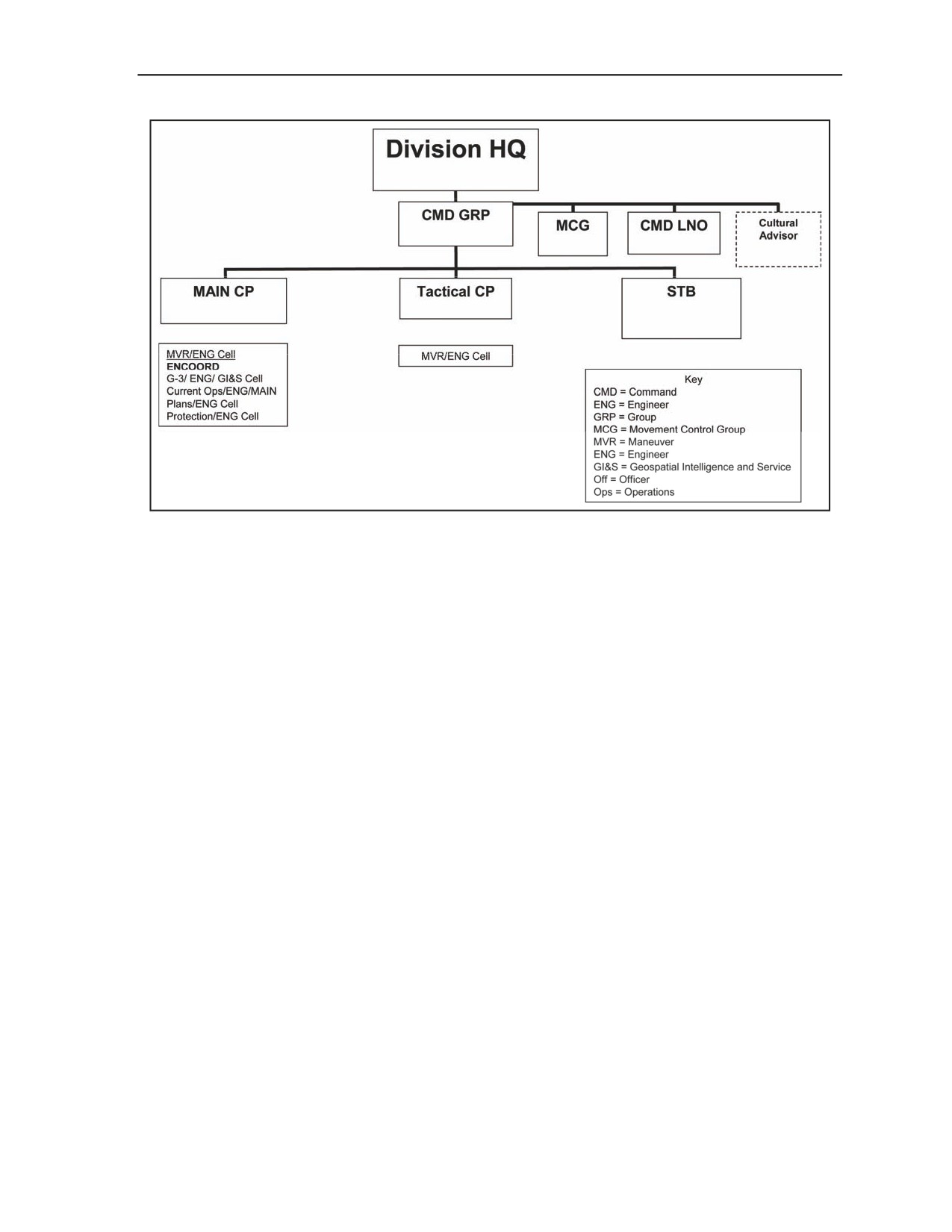
E-13. The organic engineer staff distribution within the division headquarters is shown in figure E-2,
page E-4.
2 April 2009
FM 3-34
E-3
Appendix E
Figure E-2. Organic engineer staff in the division headquarters
E-14. The division engineer or ENCOORD is an engineer lieutenant colonel who is assisted by a senior
engineer NCO and a chief warrant officer 2 utilities operations maintenance technician. In addition to the
ENCOORD, the division headquarters is assigned engineer staff cells in both the main CP and tactical CP.
An engineer major, captain, and NCO provide an engineer operations cell in both the main CP and tactical
CP. An additional engineer major and NCO are assigned to the protection cell in the main CP, and an
engineer major serves as engineer plans officer in the main CP.
E-15. The organic GI&S cell assigned to the division main CP is lead by a chief warrant officer 3
geospatial information technician and a senior geospatial engineer sergeant. In addition, the cell has two
geospatial engineer NCOs and five geospatial engineer Soldiers. The geospatial engineer cell has the
capability to—
z
Generate and analyze terrain data.
z
Prepare decision graphics.
z
Produce image maps.
z
Provide three-dimensional terrain perspective views.
z
Manage the theater geospatial database.
z
Update maps.
z
Produce tactical decision aids.
z
Produce IPB overlays.
z
Operate on a 24-hour basis.
E-16. Equipment assigned to the geospatial engineer section includes—
z
One each DTSS: AN/TYQ-67 (light).
z
One each truck cargo: 4X4 LMTV with towed generator.
z
One each truck utility: 1 1/4-ton 4 by 4 (with equipment) HMMWV.
Corps Engineer Staff
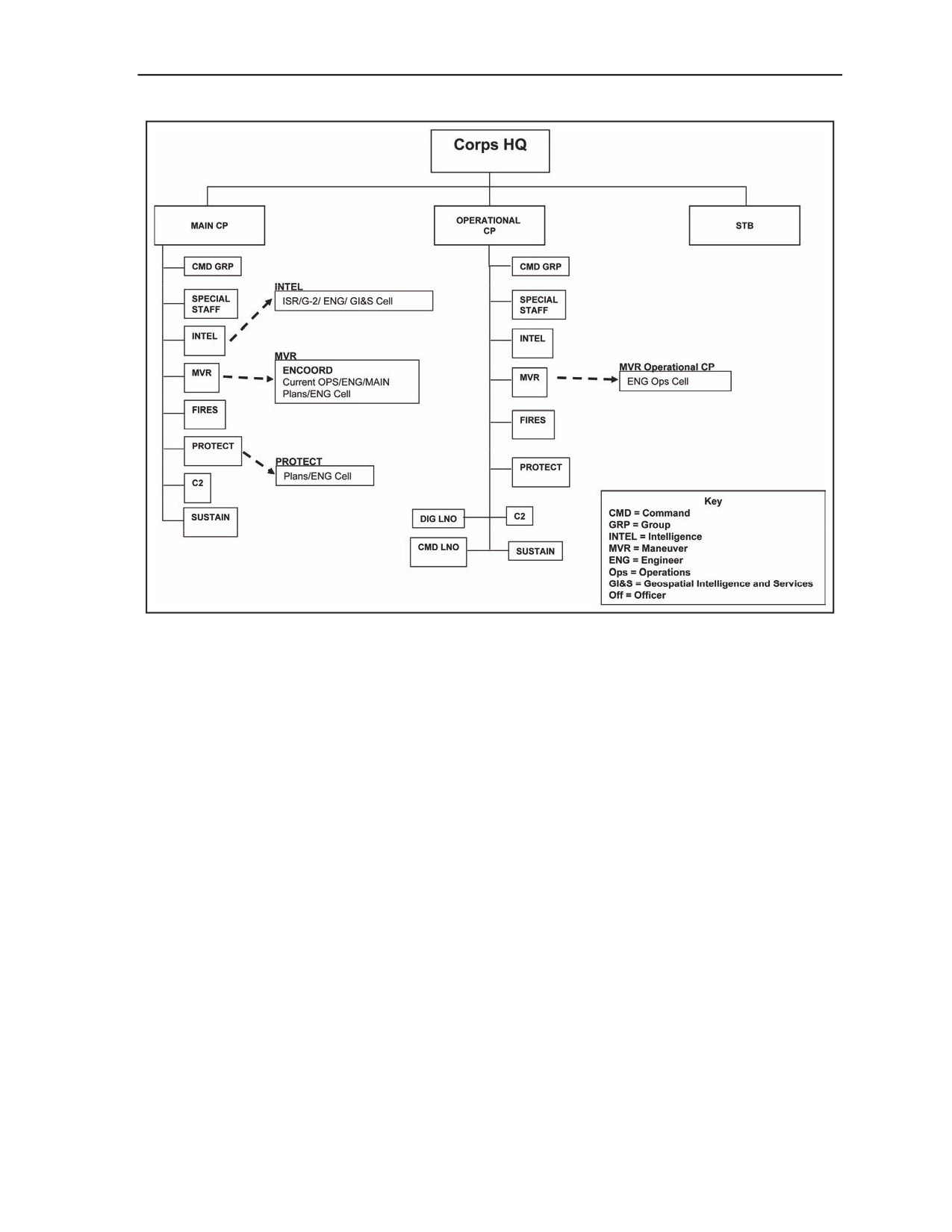
E-17. The organic engineer staff distribution within the corps headquarters is shown in figure E-3.
E-4
FM 3-34
2 April 2009
Engineer Staff Organization and Selected Cells, Workgroups, and Boards
Figure E-3. Organic engineer staff in the corps headquarters
E-18. The corps engineer or ENCOORD is an engineer colonel who is assisted by an engineer sergeant
major (SGM). In addition to the ENCOORD, the corps headquarters is assigned engineer staff cells in both
the main CP and operational CP. An engineer major and captain provide an engineer operations cell in the
main CP. The engineer operations cell in the operational CP consists of an engineer lieutenant colonel, two
majors, an engineer NCO, and two combat engineer Soldiers. An additional engineer major serves as
engineer plans officer in the main CP.
E-19. The organic GI&S cell assigned to the corps main CP is lead by a chief warrant officer geospatial
information technician and a senior geospatial engineer sergeant. In addition, the cell has two geospatial
engineer NCOs and seven geospatial engineer Soldiers. The geospatial engineer section has the capability
to—
z
Generate and analyze terrain data.
z
Prepare decision graphics.
z
Produce image maps.
z
Provide three-dimensional terrain perspective views.
z
Manage the theater geospatial database.
z
Update maps.
z
Produce tactical decision aids.
z
Produce IPB overlays.
z
Operate on a 24-hour basis.
E-20. Equipment assigned to the geospatial engineer section includes—
z
One each DTSS: AN/TYQ-67 (light).
z
One each truck cargo: 4X4 LMTV with towed generator.
z
One each truck utility: 1 1/4-ton 4 by 4 (with equipment) HMMWV.
2 April 2009
FM 3-34
E-5
Appendix E
Theater Army Engineer Staff
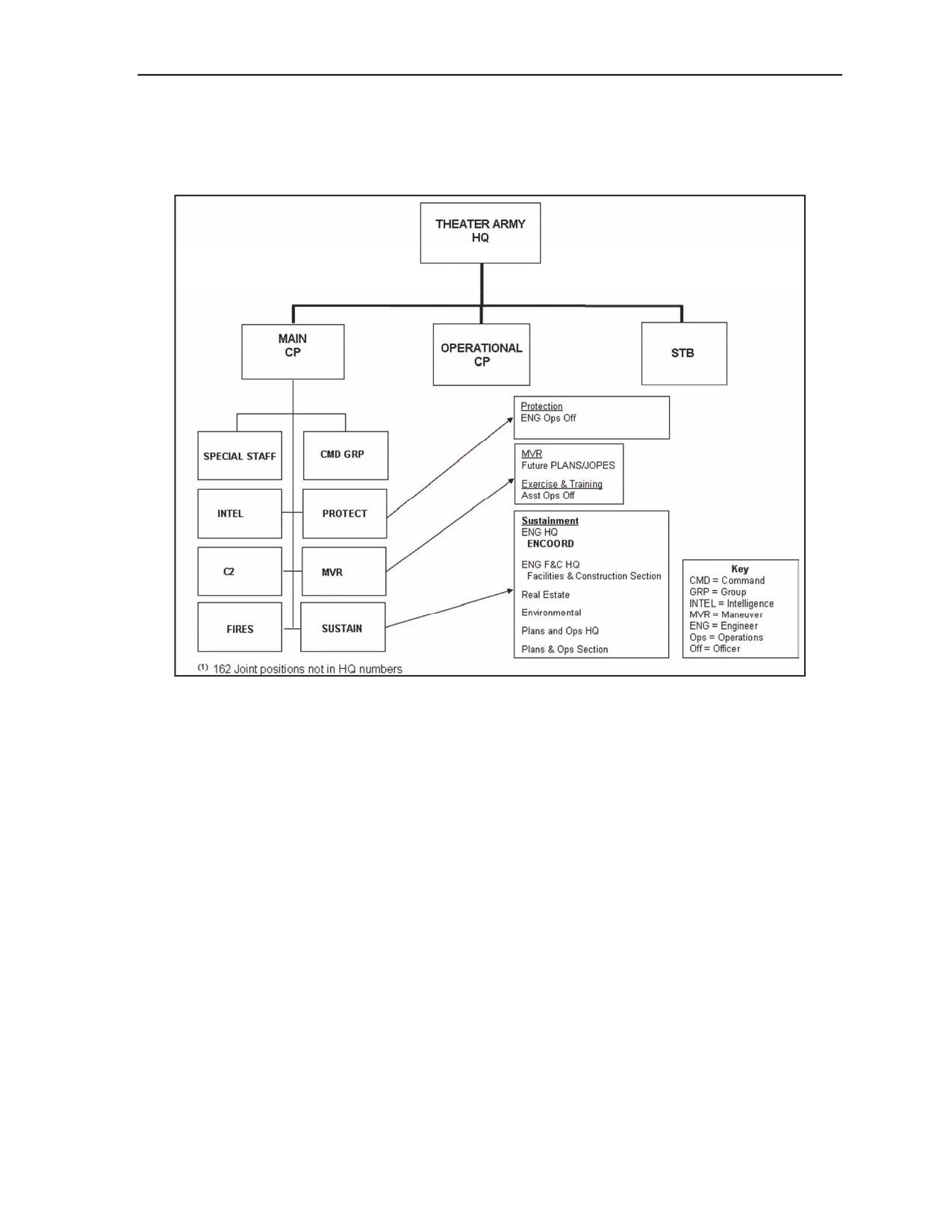
E-21. The organic engineer staff distribution within the theater Army headquarters is shown in figure
E-4.
Figure E-4. Organic engineer staff in the Army headquarters
E-22. The theater Army engineer, ENCOORD, is an engineer colonel who is assisted by an engineer SGM.
In addition to the ENCOORD, the theater Army headquarters is assigned engineer staff cells within the
protection, maneuver, and sustainment sections of the main CP. Within the operational sustainment section,
a total of seven engineer lieutenant colonels lead subordinate engineer staff cells with majors, captains,
NCOs, and combat engineer Soldiers to assist as shown in figure E-4. An additional engineer lieutenant
colonel and two majors serve within the operational maneuver section and an engineer major serves in the
operational protection section.
E-23. The theater Army headquarters relies on a geospatial engineer company or geospatial planning cell
task-organized to provide geospatial engineering support. See Appendix B for a description of these
organizations.
JOINT FORCE ENGINEER STAFF AND GEOSPATIAL SUPPORT
E-24. Each JFC has a unique engineer staff structure. The specific joint manning document (JMD)
describes the engineer staff organization and should reflect representation from each Service. Staff
engineers should work closely with civilian and multinational partner organizations to develop operational
organization augmentation manning. The JMD should be built based on analysis of the mission and the
engineer staff capabilities required to support the operation.
E-25. The JFC will organize their staffs to carry out their respective assigned duties and responsibilities.
Based on mission-specific requirements, the engineer staff may be placed within the J-3 or J-4 or be
organized as a separate staff to the JFC. The JFC may choose to organize geospatial engineers or GI&S
E-6
FM 3-34
2 April 2009
Engineer Staff Organization and Selected Cells, Workgroups, and Boards
officers within the J-2, J-3, or J-4 depending on the specific organizational structure of the unit.
Considerations for each option include the following:
z
Operations Directorate Staff. When the focus of engineer effort predominantly supports the
operational movement and maneuver, fires, and protection warfighting functions, the JFC
should consider placing the engineer staff as a cell within the J-3. This option will provide the
fastest exchange of information during crisis action planning and optimize the use of supporting
capabilities.
z
Logistics Directorate Staff. When the engineer effort predominantly supports sustainment of the
joint force, the JFC should consider placing the engineer staff as a cell within the J-4. This
option facilitates planning and coordination among engineers and logisticians for the
construction and repair of LOCs, MSRs, airfields, other logistic facilities, and infrastructure in
general.
z
Separate Engineer Staff. When the engineer effort is a significant focus or a key element of the
joint operation equally divided between combat and general engineer functions, the JFC should
consider establishing a separate engineer staff element that reports directly to the JFC. This
option provides the greatest flexibility in orchestrating diverse engineer operations, and it
provides the greatest visibility of engineer capabilities, requirements, and responsibilities
throughout the staff. This is the preferred option.
CELLS, WORKGROUPS, AND BOARDS
COMMAND POST CELLS
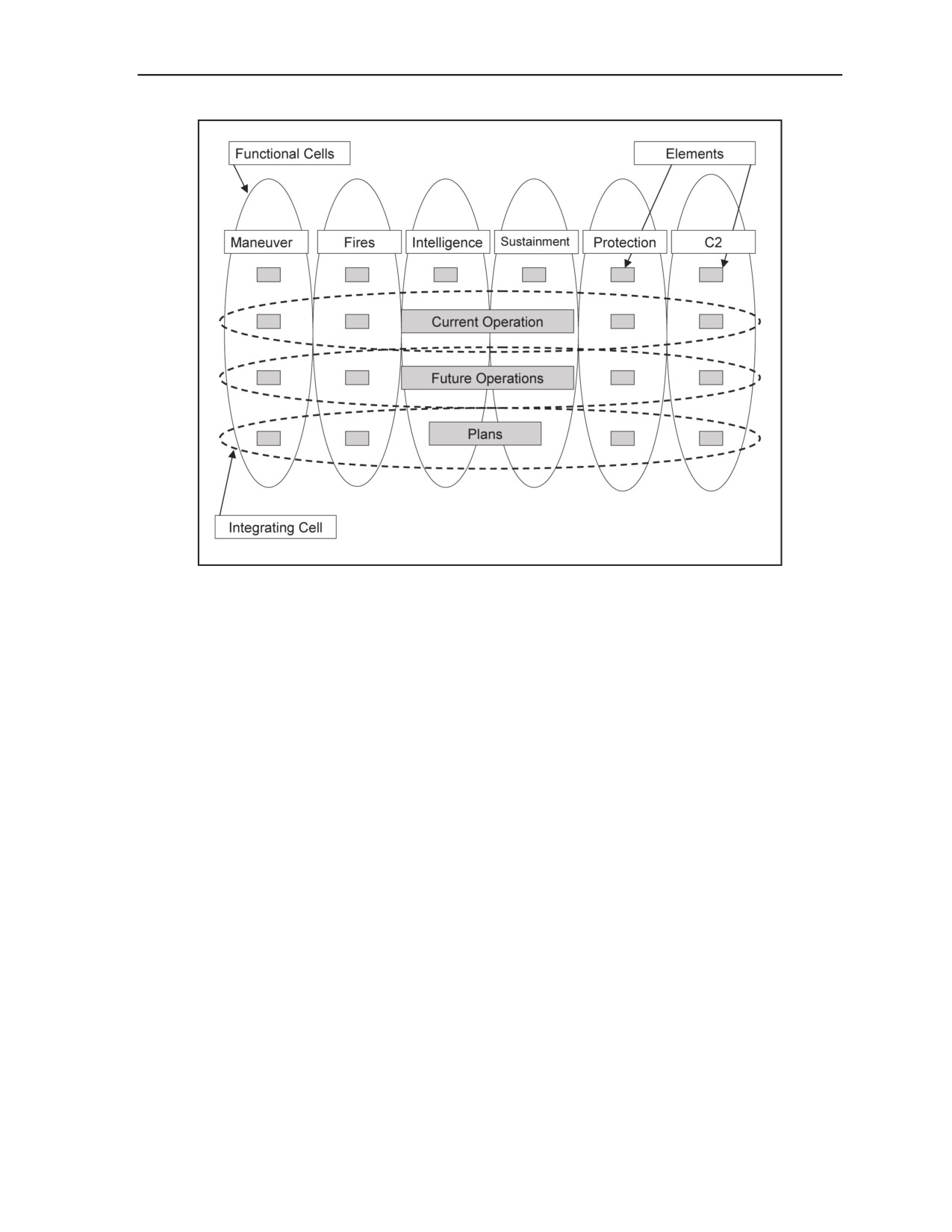
E-26. In the context of CPs, a cell is a grouping of personnel and equipment by warfighting function or
purpose to facilitate C2. There are two types of CP cells: functional and integrating (see figure E-5,
page E-8). Functional cells group personnel and equipment by warfighting function. Integrating cells group
personnel and equipment to integrate functional cell activities. Integrating cells normally focus on different
time horizons. For example, the plans cell focuses on the long-range time horizon, while the current
operations cell focuses on the short-range time horizons (FM 3-0 discusses time horizons). This is not to
say that the functional cells do not integrate. The sustainment cell integrates numerous logistic areas and
services; the fires cell integrates the contributions of all warfighting functions to targeting through the
targeting working group. This integration, however, generally focuses on maximizing the effects of a
single warfighting function. Integrating cells focus the efforts of functional cells on planning, preparing
for, or executing the overall operation within a time horizon.
E-27. Functional cells and integrating cells are not single staff sections. In a sense, they are combined arms
staff components. For example, in a corps main CP, G-2 section personnel often form elements of the
intelligence, fires, current operations, and plans cells. They form elements of the intelligence, fires, current
operations, and future operations cells in the tactical CP.
E-28. Not all cells depicted in figure E-5 are in every CP. A battalion or brigade tactical CP, for example,
is usually not divided into cells; the entire tactical CP is the current operations cell. It comprises
representatives from various staff sections. A corps tactical CP, in contrast, has all cells listed in paragraph
E-27 except for plans.
2 April 2009
FM 3-34
E-7
Appendix E
Figure E-5. Command post organization
MEETINGS, WORKGROUPS, AND BOARDS
E-29. Periodically or as required, ad hoc groupings form to solve problems and coordinate actions. These
groups include representatives from within or outside a CP. Their composition depends on the issue. These
groups are called meetings, working groups, and boards. Each is a control mechanism for regulating a
specific action, process, or function. (See JP 5-00.2 for joint force headquarters design options. It addresses
the boards, bureaus, and centers used by JFCs.)
E-30. “Meetings” (sometimes called huddles) are informal gatherings used to present and exchange
information. Cell chiefs and staff section representatives hold meetings as needed to synchronize their
activities.
E-31. A working group is a temporary grouping of predetermined staff representatives who meet to
coordinate and provide recommendations for a particular purpose or function. (FMI 5-0.1) Some working
groups may be thought of as ad hoc cells. Others are the forum used to synchronize the contributions of
multiple cells to a process. For example, the targeting working group brings together representatives of all
staff elements concerned with targeting. It synchronizes the contributions of all staff elements to the work
of the fires cell. It also synchronizes fires with current or future operations. Working groups may be held at
a central location, by teleconference, by VTC, or by a combination of all of these. They are formed as
needed or when the commander directs. Typical working groups and the lead cell or staff section at
division and corps headquarters include—
z
Operations synchronization (current operations cell).
z
Plans (plans cell).
z
Targeting (fires cell).
z
Information operations (Assistant Chief of Staff (ACOS), information operations [G-7] section).
z
ISR (current operations cell).
z
GEOINT (GEOINT cell)
E-8
FM 3-34
2 April 2009
Engineer Staff Organization and Selected Cells, Workgroups, and Boards
z
Intelligence synchronization (intelligence cell).
z
Protection (protection cell).
z
Logistics synchronization (sustainment cell).
z
Movements (sustainment cell).
z
Civil-military operations (assistant chief of staff, civil affairs [G-9] section).
z
Information management (ACOS, command, control, communications, and computer operations
[G-6] section).
E-32. The number of and subjects that working groups address will depend on the situation and echelon.
For example, a corps CP may form working groups to address enemy IED tactics or refugee return and
resettlement. Battalion and brigade headquarters normally have fewer working groups than higher
echelons. Working groups there are often less formal. Groups may gather daily, weekly, or monthly
depending on the subject, situation, and echelon.
E-33. Working groups form a major part of a CP’s battle rhythm. The chief of staff or XO oversees the
battle rhythm and scheduling of working groups. Each group should be logically sequenced so that one
working group’s outputs are available for the next working group’s inputs when needed. Chiefs of staff or
XOs balance the time required to plan, prepare for, and hold working groups with other staff duties and
responsibilities. They also examine attendance requirements critically. Some staff sections and cells may
not have enough personnel to attend all working groups. Chiefs of staff and cell leaders constantly look for
ways to combine working groups and eliminate unproductive ones.
E-34. A board is a temporary grouping of selected staff representatives delegated decision authority for a
particular purpose or function. (FMI 5-0.1) They are similar to working groups. When the process or
activity being synchronized requires command approval, a board is the appropriate forum. The unit’s SOP
establishes each board’s purpose, frequency, required inputs, expected outputs, attendees, and agenda.
ENGINEER BOARDS, CENTERS, AND CELLS
E-35. A JFC may establish engineer boards or cells to manage engineer-intensive activities and ensure that
resources are used effectively to meet mission requirements. Engineer boards establish policies,
procedures, priorities, and oversight to coordinate efficient use of engineer resources. Engineer boards
serve as the forum to address issues outside of daily operations and to ensure coordination at the leadership
level and across staff directorates. The joint force engineer and staff will carry out responsibilities of the
engineer-specific boards until the boards are formed. An important distinction between a board and a
working group is that a board is usually a decision-making body. Working groups conduct staff
coordination at the action officer level and prepare materials for decisions to be made at a board. Cells
within the JTF are a group of personnel with specific skills who are listed together on the headquarters
joint manning document to accomplish key functions. It is important for the Services and components to be
represented on the engineer boards to facilitate vertical and horizontal integration that will allow the joint
force engineer to capitalize on the advantages of joint capabilities. Collaborative tools allow components to
participate in boards without having to be physically present at the joint force headquarters. The joint force
engineer is responsible for the boards described below.
E-36. The CCDR or subordinate JFC may establish a JCMEB to assist in managing civil-military
construction, engineer projects, and resources. The JCMEB is a temporary board chaired by the CCDR or a
designated representative (such as the combatant command J-4, combatant command engineer, subordinate
joint force engineer, or CA officer). The joint force engineer provides the secretariat and manages the
administrative details of the board. Key members on the board include the J-3 future plans officer, J-4,
engineer, CA officer, staff judge advocate, and J-8. Other personnel from the staff, components, and DOD
agencies or activities in support of the combatant command may also participate. According to the CCDR
guidelines, the JCMEB establishes policies, procedures, priorities, and overall direction for general military
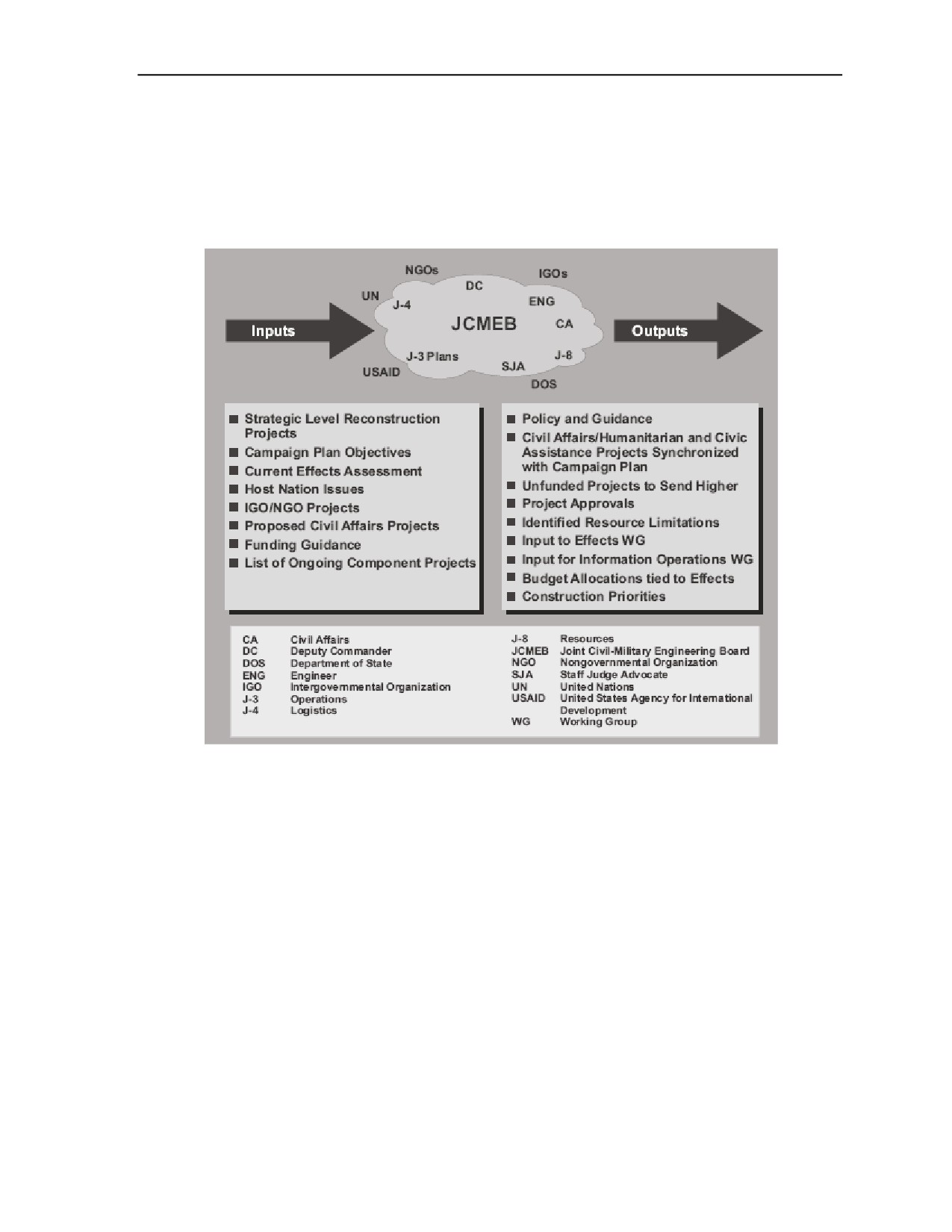
construction and engineering requirements in-theater. Figure E-6, page E-10, depicts some typical inputs
and outputs for the board, as well as primary membership and outside stakeholders. The board gauges
mission impact from engineering activities and recommends actions as needed. A primary task of the board
is to deconflict requirements between the military and civilian aspects of construction during a joint
2 April 2009
FM 3-34
E-9
Appendix E
operation. The board should also facilitate synchronization of the joint force engineer effort with similar
efforts being undertaken at the strategic level. The JCMEB will coordinate its activities with the combatant
command’s engineering and CA staff. The JCMEB will elevate construction and engineering requirements
it cannot satisfy from within joint force resources to the next appropriate level for support. The JCMEB
may arbitrate issues referred to it by the JFUB. The JCMEB, in conjunction with the JFUB, provides
guidance on developing the ESP to an OPLAN or OPORD and, if appropriate, assumes responsibility for
preparation of the ESP.
Figure E-6. Joint civil-military engineering board inputs and outputs
E-37. The JFC may establish a JFUB to assist in managing Service component use of real estate and
existing facilities. The JFUB is a temporary board chaired by the combatant command or subordinate joint
force engineer, with members from the joint force staff, components, and any other required special
activities (such as legal, contracting, and CA). If the JFC decides that all engineer-related decisions will be
made at the JCMEB, then the JFUB functions as a working group to forward recommendations for
decision to the JCMEB. The JFUB evaluates and reconciles component requests for real estate, use of
existing facilities, inter-Service support, and construction to ensure compliance with priorities established
by the JFC. It serves as the primary coordination body within the JTF for approving construction projects
within the wire to support troop beddown and mission requirements. For long-standing JTFs, the JFUB
may issue master planning guidance and develop the JTF military construction program to support
enduring base operations. The joint force engineer handles most of the JFUB’s work with assistance from
other selected board members. Unresolved issues may be forwarded to the JCMEB.
E-38. The JFC may establish a JEMB to assist in managing environmental requirements. The JEMB is a
temporary board, chaired by the combatant command or subordinate joint force engineer, with members
from the joint force staff, components, and any other required special activities (such as legal, medical, and
CA). The board establishes policies, procedures, priorities, and the overall direction for environmental
management requirements in a JOA. The JEMB will coordinate its activities with the combatant command
E-10
FM 3-34
2 April 2009
Engineer Staff Organization and Selected Cells, Workgroups, and Boards
or subordinate joint force engineering staff. The JEMB also provides guidance on development of Annex
L, "Environmental Considerations," of the ESP and, if appropriate, assumes responsibility for preparation
and appropriate updates of this annex.
E-39. The JFC may establish the EHCC to predict, track, distribute information on, and mitigate EH within
the theater that affect force application, focused logistics, survivability, and awareness of the OE. The
EHCC should establish and maintain an EH database, conduct pattern analysis, investigate mine and IED
strikes, and track UXO hazard areas. The cell provides technical advice on the mitigation of EH, including
the development of TTP, and provides training updates to field units. The EHCC coordinates EHTs. Key
capabilities of the EHCC include—
z
Establishing, maintaining, and sharing the EH tracking database within the joint force.
z
Ensuring accuracy of EH information.
z
Coordinating site evaluations or strike incident investigations.
z
Conducting unit EH training.
z
Assisting ISR planners with EH pattern analysis and ISR synchronization.
z
Providing updated TTP and guidance for route and area clearance operations.
E-40. Engineer participation in a number of other boards, centers, and cells is essential to joint mission
accomplishment. Compared to the formal, nonstanding nature of boards, centers are standing organizations
typically operating
24 hours, and cells are functionally oriented groups meeting on a regular basis.
Engineer staff participation and support to these organizations will be significant, but the resultant
exchange of relevant information is vital in maintaining situational awareness and facilitating the
horizontal staff integration of the joint force engineer. Joint force engineer participation in boards, centers,
and cells include the following:
z
Joint Planning Group. Engineers are represented on the joint planning group to enhance the
formulation of joint force plans. The engineer planner ensures that joint force plans are
supportable from an engineer perspective. Support by the rest of the joint force engineer cell
with products facilitates engineer input and impact into the planning cycle. The engineer planner
should leverage the rest of the engineer staff to provide products throughout the planning
process. The key for the engineer is to ensure representation and establish hand-off procedures
for products developed within all three planning horizons within the joint force: future plans,
future operations, and current operations.
z
Joint Intelligence Support Element. Representation on the joint intelligence support element
provides engineers with MI related to infrastructure, hydrography, and other geospatial
engineering and GEOINT topics.
z
Joint Operations Center. The joint operations center plans, monitors, and guides the execution of
the JFC’s decisions. The joint force engineer maintains a presence in or close contact with this
center. This is the engineer’s link to current operations and the engineer watch officer is
responsible for keeping the rest of the engineer staff situationally aware.
z
Joint Targeting Coordination Board. On the joint targeting coordination board, the joint force
engineer contributes to the planning and integration of munitions fields into the barrier plan and
participates in target coordination to ensure critical infrastructure preservation. Of particular
engineer concern are remotely delivered mines scattered beyond the intended location and the
related reporting, marking, and clearing of those mines. The joint force engineer should ensure
that implications on stability operations are considered during the targeting process for decisive
operations. Engineer expertise can enable the JFC to achieve desired effects with minimal long-
term infrastructure damage and protection of significant cultural and natural resources in the
operational area.
z
Information Operations Cell. In the information operations cell, the joint force engineer
coordinates with other staff elements on the preservation of critical adversary facilities and
infrastructure. During stability operations, engineer reconstruction efforts focused on the HN
can help support the commander’s strategic communications plan.
z
Civil-Military Operations Center. The CMOC provides the joint force engineer a meeting place
to coordinate nonmilitary activities with other agencies, departments, organizations, and the HN.
2 April 2009
FM 3-34
E-11
Appendix E
If formed, the CMOC is the focal point where engineers coordinate any support to IGOs and
NGOs. Outputs from the CMOC (such as lists of IGO and NGO projects) are useful input into
the JCMEB and help facilitate unity of effort.
z
Joint Logistics Operations Center. Engineers are represented at the joint logistics operations
center to respond to information received from supporting command, Service components, and
external sources for presentation to the CCDR.
z
Force Protection Working Group. The force protection working group will often generate
engineer requirements as they develop or modify JTF force protection policy and guidance.
Examples include hardening of key facilities and modifications to entry control points.
z
Special Purpose Boards, Centers, Working Groups, and Cells. Through necessity, new boards,
centers, and cells may be formed and require engineer participation. For example, an IED
working group may be required as a central clearinghouse for developing solutions to an IED
problem within the JOA. The engineer should also have representation at the force protection
and effects assessment working groups and boards, if established. Engineer construction efforts,
whether inside or outside the wire, are closely tied to the issues addressed at these two working
groups and boards.
E-12
FM 3-34
2 April 2009
Appendix F
Civil Support Considerations
Civil support refers to support provided by military forces, DOD civilians, contractor
personnel, and DOD agencies and components in response to requests for assistance
during domestic incidents, to include terrorist threats or attacks, major disasters, and
other emergencies (see JP 3-27 and FM 3-28, when published). FM 3-0 and FM 3-28
provide Army doctrine for civil support. Engineer operations are a key enabler in the
restoration of essential services in civil support.
CIVIL SUPPORT
F-1. In an emergency situation, such as managing the consequences of a terrorist attack or natural
disaster, DOD may receive requests for assistance once local, state, and federal resources are
overwhelmed. DOD has the capability to provide self-deploying, self-sustaining forces with a wide variety
of skills and equipment, including engineer forces, which can play a major role in support of civil
authorities.
F-2. Support of civil authorities usually consists of catastrophic emergencies
(natural or man-made
disasters). Emergency response is managed locally with response capability growing to include the state
government, and if the disaster is large enough in scope to overwhelm local and state agencies, the federal
government becomes involved. If federal support is required, it is managed under the authority of the
Secretary of Homeland Security using the NRF. While the military can be called upon to provide support
in any of the civil support categories, the most common situations that can potentially employ engineer
forces include—
z
Natural disasters. Natural disasters include, but are not limited to, severe weather, earthquakes,
and wild land firefighting. Engineers can expect to respond with equipment assets to remove
rubble and debris. Engineers may be tasked to maintain or restore essential services and
activities, to mitigate damage, and to take actions to avoid hardship and human suffering.
Engineers may be called on to provide manpower support or general engineering support (such
as water purification operations). Other engineer contributions include technical advice and
assessments, construction planning, management and inspection, emergency contracting, and
emergency repair of wastewater and solid waste facilities.
z
Man-made disasters. Examples of man-made disasters include oil spills, terrorist acts, or a
CBRNE incident. These events can produce catastrophic loss of life, destruction of property, or
irreparable damage to the environment. Support to domestic CBRNE consequence management
is a major support requirement for military forces and may be an extensive civil support
operation for military engineers. Engineers possess mobility and heavy equipment assets and
may provide support similar to that provided in response to a natural disaster.
F-3. DOD engineer forces may serve in a supporting role to a primary agency in support of civil
authorities. Deployed DOD forces remain under the C2 of the Secretary of Defense at all times. Engineer
forces may operate under the scenarios described below.
2 April 2009
FM 3-34
F-1
Appendix F
F-4. Immediate response. Military installation commanders or responsible DOD officials may respond
immediately to a request from local or state governments in an emergency that has imminent serious
conditions that require immediate response to prevent loss of life, human suffering, or major property
damage, but may not be a Presidential declared emergency. Engineer assets on military installations may be
directed to respond in support of public fire, search and rescue services, and public works. DOD support
for local environmental operations can begin immediately within the authority delegated to installation
commanders. The commander’s authority is generally limited to the initial 72 hours of an emergency.
F-5. Support to a Primary Agency or as Part of a Joint Task Force. Requests for assistance follow the
NRF procedures. If the primary agency determines that existing resources are inadequate or not available, a
request is initiated and passed to the defense coordinating officer on site with the primary agency. The
primary agency validates the request and forwards it to the Joint Director of Military Support (JDOMS)
and the geographic combatant command for approval. JDOMS coordinates, validates, and provides the
Assistant Secretary of Defense (Homeland Defense) with recommendations and then passes it to the
Secretary of Defense for approval. Once approved, JDOMS processes the request (in the form of
deployment and execute orders) to the Commander, United States Joint Forces Command (USJFCOM),
who will task the Services for the best-matched capability to meet the requested requirement. A JTF may
be established with engineering support under a joint force engineer, or supporting engineer forces may be
assigned to an existing JTF such as JTF-Civil Support, JTF-Alaska, JTF-National Capital Region, or JTF-
North.
ENGINEER PLANNING CONSIDERATIONS
F-6. General engineering planning in support of civil authorities is focused on taking actions to save lives
and property, assisting in stabilizing a disaster area, and assisting state or federal agencies where needed.
Typical engineer units with capabilities required include the NMCBs, Air Force Prime BEEF and RED
HORSE units, Army construction units, and task-organized Marine Corps units. Specialized units may
include capabilities for bridging, water well drilling, power generation, and water purification.
F-7. A focus for engineers during civil support operations will be the restoration of essential services.
Essential services of concern for engineers include providing the following:
z
Rescue operations.
z
Food and water.
z
Emergency shelter.
z
Basic sanitation (sewage and garbage disposal).
z
Minimum essential access to affected areas.
F-8. Both combat and general engineer capabilities may be applied to restore essential services. Engineer
equipment is well suited for removal of rubble and debris associated with rescue and access to affected
areas. Other likely requirements include the construction of temporary shelters and provision of water and
sanitation services. Likely missions include the following:
z
Constructing and repairing rudimentary surface transportation systems, basic sanitation
facilities, and rudimentary public facilities and utilities.
z
Detecting and assessing water sources and drilling water wells.
z
Constructing feeding centers.
z
Providing environmental assessment and technical advice.
z
Disposing of human and hazardous wastes.
z
Providing camp construction and power generation.
z
Providing infrastructure reconnaissance, technical assistance, and damage assessment.
z
Providing emergency demolition.
z
Providing debris or route clearing operations.
F-2
FM 3-34
2 April 2009
Civil Support Considerations
F-9. Engineer operations in civil support may include the typical integration with and support for
combined arms forces in their missions. Combat engineer route clearance and other close support
capabilities may be critical tasks applied through the movement and maneuver warfighting function.
Geospatial engineer support continues to provide foundational information supporting the COP. General
engineer support may be required for the sustainment and survivability requirements of the force and may
be extended to support other agencies. Likely missions include the following:
z
Base camp construction and power generation.
z
Debris or route clearing operations.
z
Construction and repair of expedient (temporary) roads and trails.
z
FACE, to include the repair of paved, asphalt, and concrete runways and airfields.
z
Installation of assets that prevent FOD to rotary-wing aircraft.
z
Construction of temporary bridging.
z
Ensuring access to the region through the construction and upgrade of ports, airfields, and RSOI
facilities.
UNITED STATES ARMY CORPS OF ENGINEERS IN CIVIL SUPPORT
OPERATIONS
F-10. In a typical year, USACE responds to more than 30 Presidential disaster declarations, plus numerous
state and local emergencies. Emergency responses usually involve cooperation with other military elements
and federal agencies in support of state and local efforts. USACE conducts its emergency response
activities under two basic authorities: the Flood Control and Coastal Emergency Act (Public Law 84-99, as
amended) and the Stafford Disaster and Emergency Assistance Act (Public Law 93-288, as amended).
F-11. Under the Flood Control and Coastal Emergency Act, USACE provides disaster preparedness
services and advanced planning measures designed to reduce the amount of damage caused by an
impending disaster. Under the Stafford Act, USACE supports the Department of Homeland Security and
FEMA in carrying out the NRF, which calls on 30 federal departments and agencies to provide coordinated
disaster relief and recovery operations.
F-12. The NRF is an all-discipline, all-hazards plan that establishes a single comprehensive framework for
the management of domestic incidents. It provides the structure and mechanisms to coordinate federal
support to state, local, and tribal incident managers and for exercising direct federal authorities and
responsibilities. It assists in the important homeland security mission of preventing terrorist attacks within
the United States, reducing the vulnerability to all natural and man-made hazards, minimizing the damage,
and assisting in the recovery from any type of incident that occurs.
F-13. Within the plan, DOD has designated USACE as the primary agency for planning, preparedness, and
response under the “ESF #3, Public Works and Engineering.” The purpose of this ESF is to provide
lifesaving or life protecting assistance to augment efforts of the affected state(s) and local response efforts
following a major or catastrophic disaster.
2 April 2009
FM 3-34
F-3
Appendix F
F-14. Public works and engineering support includes technical advice and evaluations, engineering
services, construction management and inspection, emergency contracting, provision of emergency power,
emergency repair of wastewater and solid waste facilities, and real estate support. Some of the activities
within the scope of ESF #3 include—
z
Emergency clearance of debris for reconnaissance of the damaged areas and passage of
emergency personnel and equipment.
z
Temporary construction of emergency access routes which include damaged streets, roads,
bridges, ports, waterways, airfields, and any other facilities necessary for passage of rescue
personnel.
z
Emergency restoration of critical public services and facilities, including supply of adequate
amounts of potable water, temporary restoration of water supply systems, and the provision of
water for firefighting.
z
Emergency demolition or stabilization of damaged structures and facilities designated by state or
local governments.
z
Technical assistance and damaged assessment, including structural inspection of structures.
F-15. While the USACE is coordinating public works and engineering activities under the NRF, it may
also be simultaneously providing direct assistance under its own Flood Control and Coastal Emergency
authorities.
F-4
FM 3-34
2 April 2009
Appendix G
Contingency Authorities and Funding
It is especially important that engineers understand contingency authorities and the
associated funding. These are the tools that set the conditions for success during
contingency operations and provide the basis for legal spending to take care of DOD
personnel and activities in support of contingency operations. Contingency
operations comprise a large portion of the operations conducted by Army and joint
forces. This appendix provides an introduction to contingency authorities and
funding. However, the information in this appendix is subject to change due to
changes in legislation, policy, or regulation. The reader should consult with legal and
financial management personnel for the latest definitive guidance.
LEGAL PERSONNEL
G-1. Legal personnel can provide invaluable advice and guidance on authorities and sources of funding
for civil engineering activities in a variety of situations. From the earliest stages of planning, execution, and
redeployment, legal professionals play a vital role in preparing the JOA by identifying and assisting in the
resolution of legal and political constraints, as well as providing relevant and responsive readiness
programs to the individual civil engineering members.
TYPES OF AUTHORIZATIONS AND SOURCES OF FUNDING
G-2. Services are authorized to use annual operation and maintenance (O&M) funds for construction
projects costing less than $750,000 on U.S. controlled or owned real property ($1.5 million to correct a
life-threatening condition or for new construction and $3 million for maintenance and repair when the
repair to replacement ratio is less than 50 percent). This is a peacetime provision, applicable during
contingencies and emergencies; however, “life threatening” is generally considered a safety issue vice an
emergency in the context of contingency operations. During combat or designated contingency operations,
O&M funds may be used to fund construction projects exceeding these thresholds. The JFC must consult
with their staff judge advocate before making a determination to use O&M funds in such a case.
G-3. Several broad authorities have been established under Title 10 U.S. Code that enable the JFC to
carry out contingency construction, including procuring materials for construction by military forces and
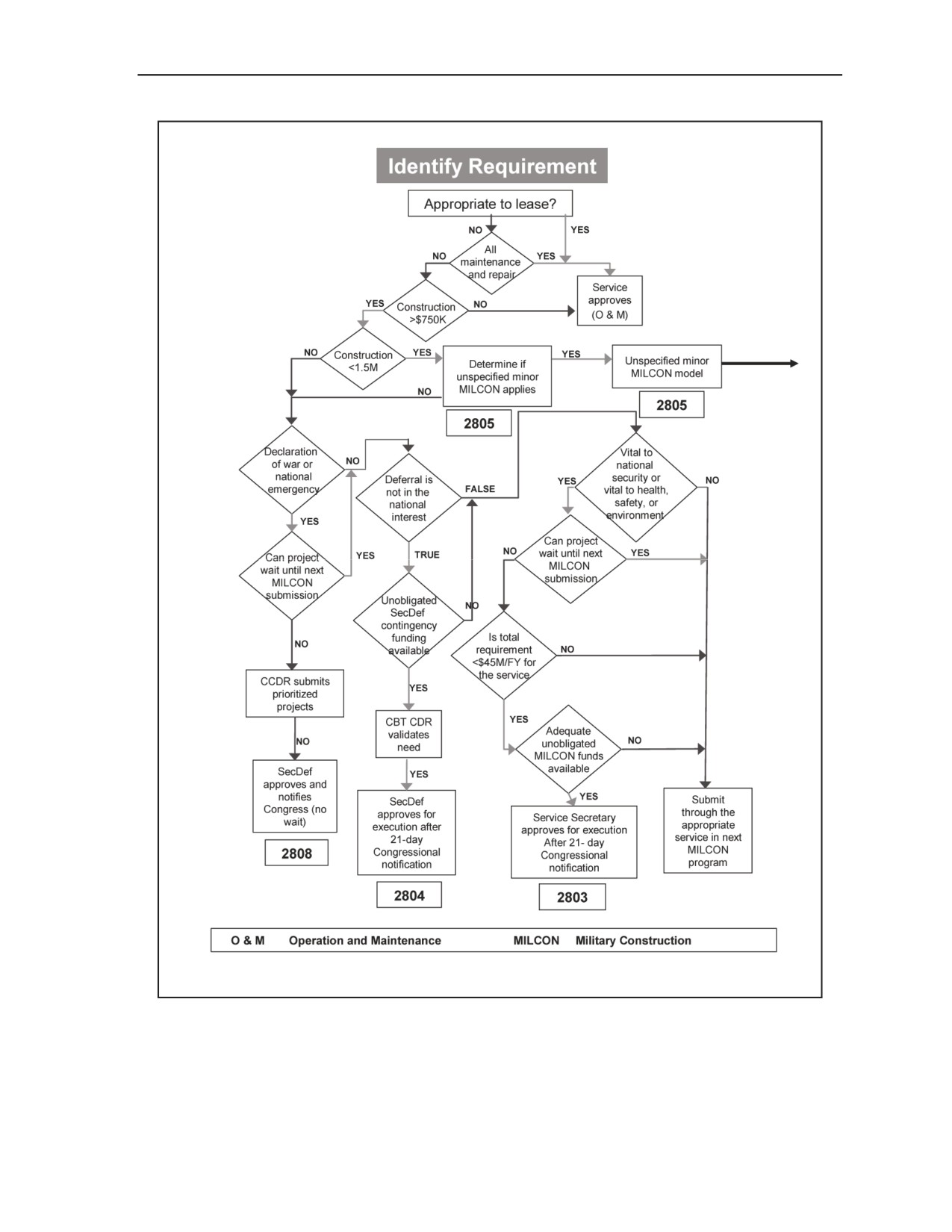
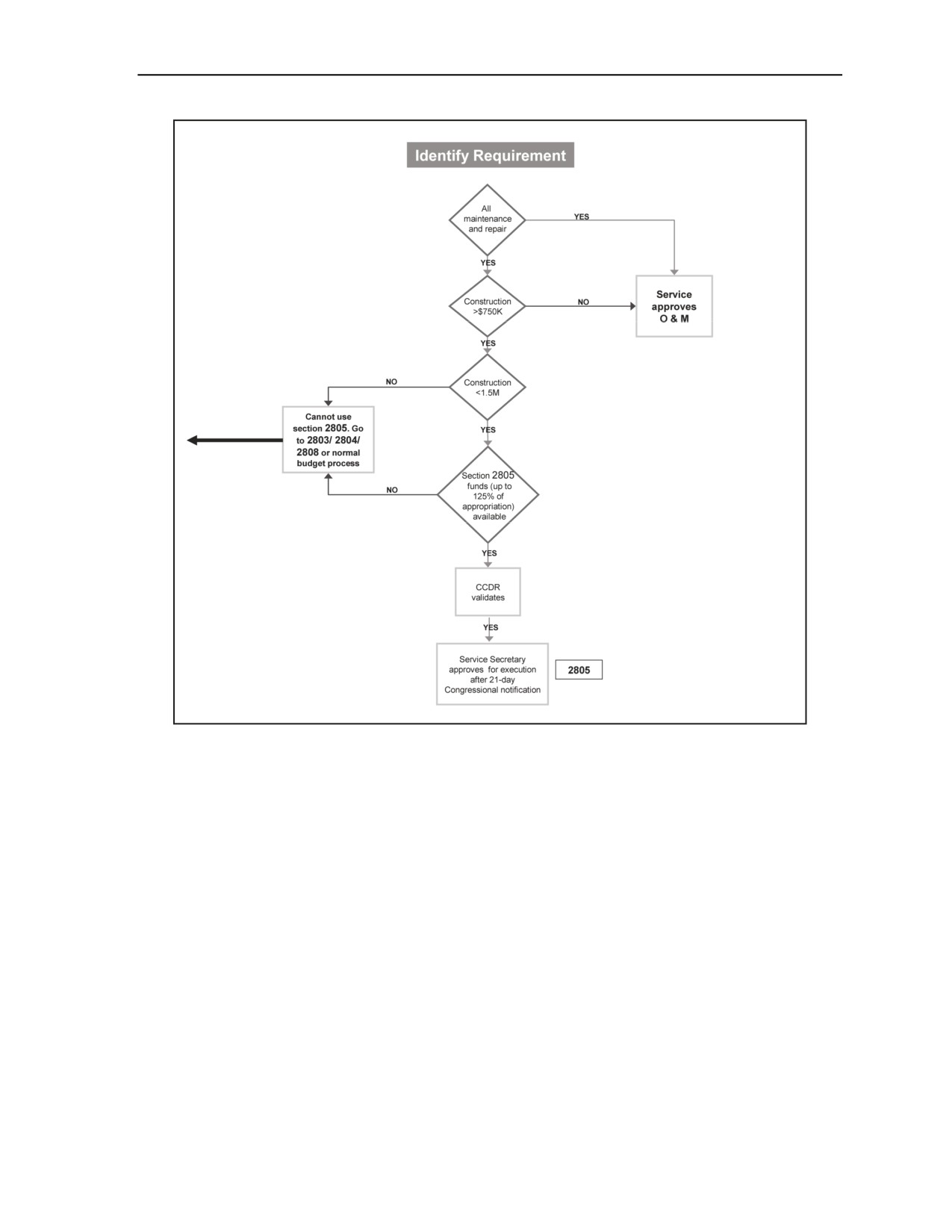
funding of civilian contracts in support of contingency operations. Figure G-1, page G-2, and figure G-2,
page G-3, depict decision trees for the following contingency construction funding options:
z
Section 2803, Emergency Construction, authorizes each service to use $45 million per year of
nonobligated military construction funds for projects that cannot wait for the normal military
construction submission procedures. Projects must comply with a 21-day congressional notice
and wait period before proceeding. Generally, a previous congressionally approved project must
be canceled to free the required funds.
2 April 2009
FM 3-34
G-1
Appendix G
Figure G-1. Contingency construction funding model
G-2
FM 3-34
2 April 2009
Contingency Authorities and Funding
Figure G-2. Contingency construction funding model
(unspecified minor, $750,000-$1.5 million)
z
Section 2804, Contingency Construction, authorizes the Secretary of Defense a specific military
construction line item amount for contingency construction projects that cannot wait for the
normal military construction program submission process. A project must comply with a 21-day
congressional notice and wait period before proceeding. Generally, funding for this section has
been limited to less than $10 million per year.
z
Section 2805, Unspecified Minor Construction, authorizes each Service a specific military
construction line item amount that varies annually for unspecified minor construction. Projects
must be less than $1.5 million each (or $3 million for life-, safety-, or heath-focused projects).
Projects more than $750,000 require a 21-day congressional notice and wait period before
proceeding.
2 April 2009
FM 3-34
G-3
Appendix G
z
Section 2808, Construction Authority, requires a Presidential declaration of war or national
emergency and authorizes the Secretary of Defense to carry out any military construction project
for the war or national emergency within the total amount of unobligated military construction
funds available. Congress must be notified of each project, but there is no wait requirement
before the project may begin.
z
Section 2811, Repair of Facilities, authorizes the Secretary of Defense to use funds available to
carry out repair of facilities. Repair projects over $10 million must be submitted to Congress for
approval.
G-4. CCDRs do not need specific authority to request projects under Sections 2803 and 2804. To gain
approval for a project under either authority, it is necessary to provide the appropriate service secretary or
Secretary of Defense with a justification of need, estimated costs, and source of funding.
OTHER AUTHORITIES AND SOURCES OF FUNDING
BURDEN SHARING (TITLE 10 UNITED STATES CODE 2350.J)
G-5. This portion of law authorizes the Secretary of Defense, after consultation with the Secretary of
State, to accept burden sharing cash contributions from any country or regional organization designated for
certain purposes (to include military construction projects) for DOD. Written approval from the Under
Secretary of Defense (Comptroller) is required for the use of such contributions to carry out military
construction projects. For additional information, see DOD 7000.14-R, “DOD Financial Management
Regulation,” Volume 12, Chapter 24.
SECTION 607A OF THE FOREIGN ASSISTANCE ACT OF 1961 (PUBLIC LAW 87-195, AS
AMENDED)
G-6. This act provides restoration of HN civil infrastructure. This provision of law allows any U.S.
government agency to provide goods and services to friendly countries and NGO agencies on an advance-
of-funds or reimbursable basis.
ARMS EXPORT CONTROL ACT OF 1976 (PUBLIC LAW 90-629, AS AMENDED)
G-7. HN military facilities may be restored under the foreign military sales provisions of this authority.
ECONOMY IN GOVERNMENT ACT (TITLE 31 UNITED STATES CODE 1535)
G-8. This act allows U.S. government agencies to support each other, provided that the supported agency
has the funds and authority to do the work requested.
HUMANITARIAN AND CIVIC ASSISTANCE PROJECTS PROVIDED IN CONJUNCTION WITH
MILITARY OPERATIONS (TITLE 10 UNITED STATES CODE 401) PROJECTS
G-9. In humanitarian and civic assistance facilities projects, the JFC and joint force engineers may work
with HN government agencies to repair or improve infrastructure and public facilities. These authorized
and funded projects are designed to provide assistance to the HN populace in conjunction with a military
operation or exercise. They are usually planned well in advance and are not usually planned in response to
disasters, although humanitarian and civic assistance activities have been executed following disasters.
Specific engineer activities for which humanitarian and civic assistance funds can be used include
construction of rudimentary surface transportation systems, well drilling, construction of basic sanitation
facilities, and rudimentary construction and repair of facilities.
FOREIGN HUMANITARIAN ASSISTANCE (TITLE 10 UNITED STATES CODE 2551)
G-10. In disaster operations, the UN, the DOS, and the Office of Foreign Disaster Assistance may generate
funded requirements for DOD assistance. FHA programs focus on the use of DOD excess property,
G-4
FM 3-34
2 April 2009
Contingency Authorities and Funding
emergency transportation support, disaster relief, or other support as necessary to alleviate urgent needs
caused by some type of disaster or catastrophe in a host country. While other elements of the joint force are
focused on immediate humanitarian assistance, civil engineering planning may focus on projects that
provide immediate shelter for dislocated civilians. The joint force engineers must work in a close
relationship with the representatives of the HN and U.S. country team.
DRAWDOWN OF DEPARTMENT OF DEFENSE ARTICLES AND SERVICES (TITLE 22, 2318)
G-11. Drawdown authority is a means to respond to unforeseen military emergencies or humanitarian relief
situations. These recurring authorities have placed annual limitations on the value of articles and services
that may be drawn down in any fiscal year.
DEPARTMENT OF DEFENSE DIRECTIVE 5100.46, FOREIGN DISASTER RELIEF
G-12. Normally, DOD components may participate in foreign disaster relief operations only after a
determination is made by the DOS. This directive allows the military commander at the scene of a disaster
to undertake disaster relief operations without prior approval from the ambassador or chief of the mission
when the emergency is so acute that immediate action is required to save life and property.
2 April 2009
FM 3-34
G-5
This page intentionally left blank.
Appendix H
Contract Construction Agents
Use of construction contracting and engineering support can play an important role in
support of joint operations. Civilian construction contractors and HN engineering
support provide the JFC with a significant engineering capability that becomes a
force multiplier when combined with joint force military engineering units.
Construction agents provide the ability to harness and direct this means of support.
CONSTRUCTION CONTRACTING AND ENGINEERING SUPPORT
H-1. DOD construction agents are USACE, NAVFAC, or other approved DOD activities (see DOD
Directive 4270.5). These organizations and their contractors are a powerful force multiplier, allowing
military engineers to concentrate on engineering missions in high-threat areas. USACE and NAVFAC also
provide the JFC with a significant engineering capability to be leveraged in joint operations. They are
DOD’s principal organizations to plan, design, construct, and acquire (lease or buy) facilities and real
estate. Inherent in their mission support capabilities is a planning and engineering capability for theater
advanced base and infrastructure development. These organizations also maintain in-depth engineering
expertise in their operating field organizations and laboratories.
H-2. The responsibilities of DOD construction agents include designing, awarding, and managing the
construction contracts for projects associated with the peacetime military construction program. When
overseas, USACE, NAVFAC, and the Air Force are assigned specific geographical areas under DOD
Directive 4270.5 (see figure H-1, page H-2). Related to these responsibilities is the leasing of real estate.
The CCAs are fee for service organizations that require funding from JFC or other user in order to execute
taskings.
H-3. The CCDR may also use USACE and NAVFAC as contingency CCAs for design, award, and
management of construction contracts in support of military operations. For geographical areas where there
is no designated DOD construction agent, the CCDR usually designates a CCA for support during a
contingency. USACE and NAVFAC also provide facilities planning, contract administration, and technical
engineering support to JFCs (such as advanced base master planning, geospatial engineering, facilities
hardening, environmental engineering, and cold-weather mobility assessments). The Air Force also
maintains a limited capability in contract construction in contingencies and facilities and real estate
acquisition in England, Turkey, Spain, and Israel.
2 April 2009
FM 3-34
H-1

Appendix H
DEPARTMENT OF THE ARMY
DEPARTMENT OF THE NAVY
Afghanistan
Atlantic Ocean area
Canada, excluding Newfoundland
Australia and New Zealand
Central America
Caribbean Sea area
Europe, excluding Span, Portugal, Italy,
Greece
Greece, and the British Isles
Iceland
Northern Eurasia, which makes up Russia
Indian Ocean area
and the former Soviet Republics
Italy
Greenland
Newfoundland
Iraq
North Africa, including Somalia and Kenya but
Japan, including the Ryukya Island (Okinawa)
excluding Egypt
Korea
Pacific Ocean area, including the
Marshall Islands
Commonwealth of the Northern Marianas
Mexico
Islands, but excluding the Marshall Islands
Middle East, including the Saudi Arabian
Portugal, including the Azores
Peninsula
Republic of the Philippines
South America
Southeast Asia, from Thailand to Vietnam
Southern Asia, from Iran to Myanmar (Burma)
Span
Sub-Sahara Africa, excluding Kenya and
DEPARTMENT OF THE AIR FORCE
Somalia
British Isles
Taiwán
Turkey
Figure H-1. Designated geographical areas of Department of Defense construction agents
UNITED STATES ARMY CORPS OF ENGINEERS
H-4. USACE is assigned responsibility to execute the following Army and DOD mission areas:
z
Engineering and design for the Army and Air Force military construction programs.
z
Contract construction.
z
Real estate acquisition.
z
Technical assistance.
z
Geospatial engineering support.
z
The Army’s civil works program.
H-5. USACE’s subordinate commands are organized geographically and functionally. There are three
major organizational structures—
z
The division is the major subordinate C2 organization for USACE. The division commander
provides executive direction to and management of the subordinate district commands. The
division’s orientation is regional and provides broad interface with regional interests and
management of division-wide programs (see figure H-2).
z
The district command is the operating arm of the division. All USACE districts in the United
States have civil works responsibilities. In the United States, their boundaries are delineated
along major watershed basins, and their work lines are set on state boundaries (see figure H-3,
page H-4). In addition, some of the districts have military execution responsibilities. The
districts maintain in-house capabilities in planning, engineering, construction, operations,
project management, and contract administration.
H-2
FM 3-34
2 April 2009
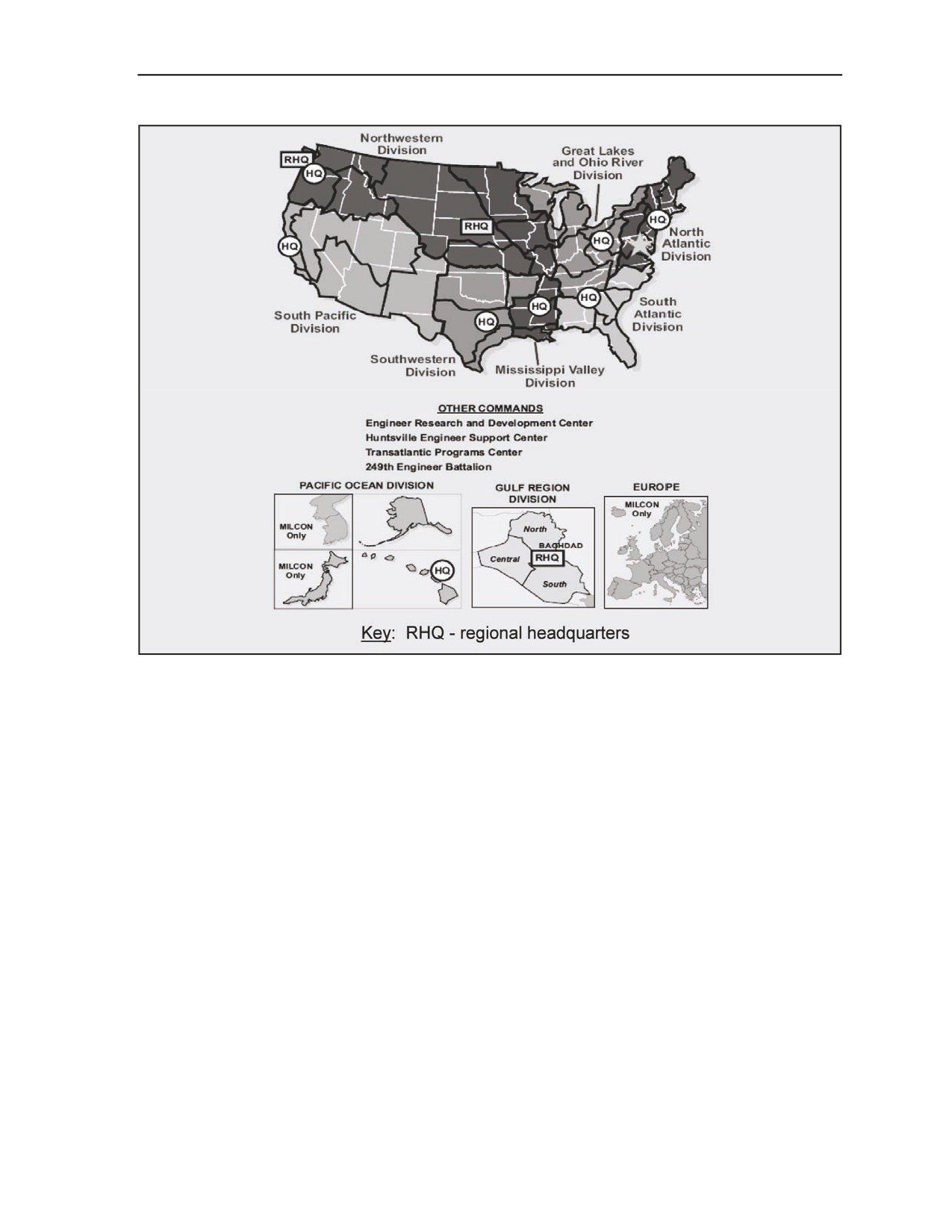
Contract Construction Agents
Figure H-2. USACE division organization
2 April 2009
FM 3-34
H-3
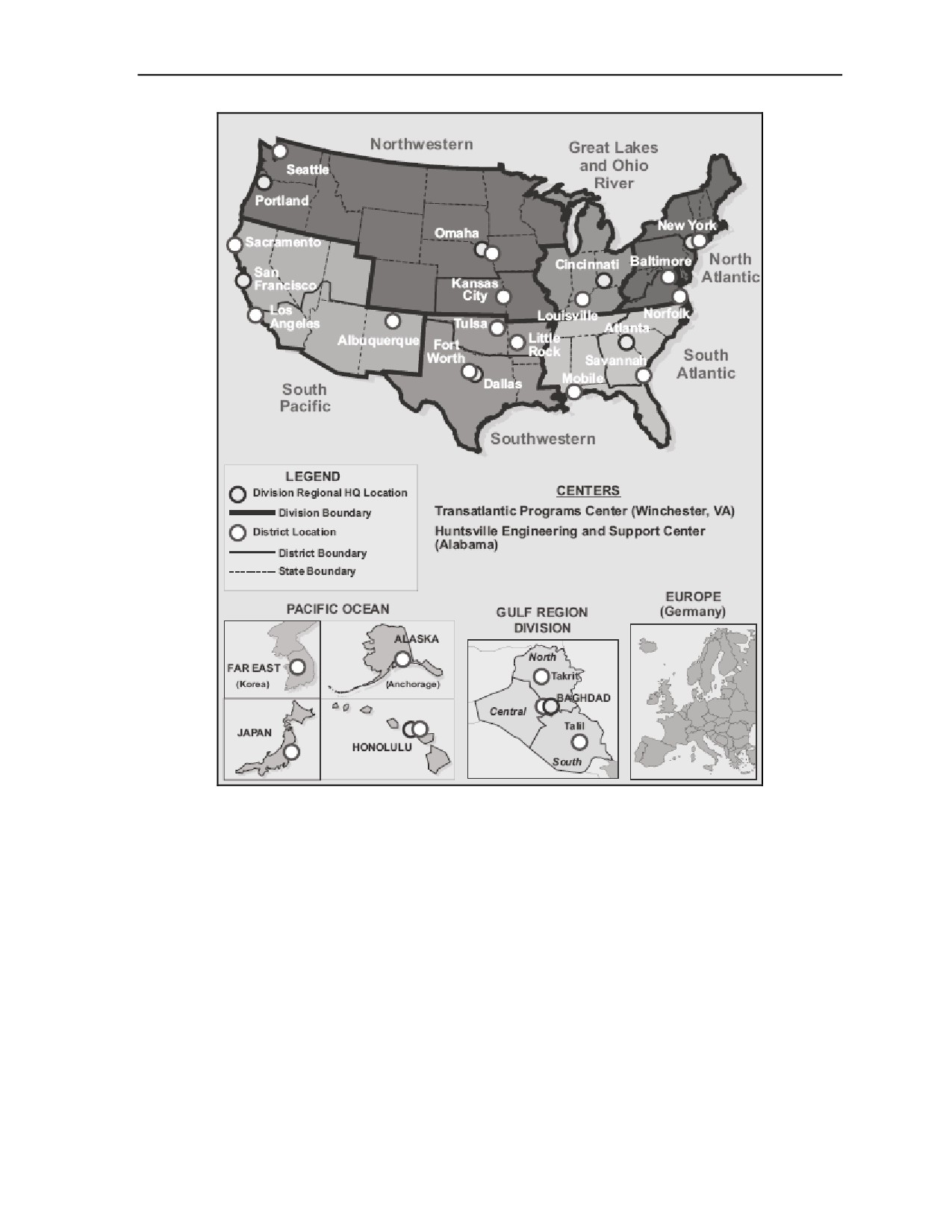
Appendix H
Figure H-3. USACE military works boundaries
z
ERDC is USACE’s distributed research and development command. Headquartered in
Vicksburg, Mississippi, ERDC consists of seven unique laboratories that conduct research and
development in support of the Army and the other Services. By virtue of their engineering
expertise, laboratory personnel provide operational support to the rest of USACE and DOD
through the aforementioned subordinate commands. In addition, USACE maintains several
specialized centers of expertise at its districts that provide additional technical engineering
services, to include—
Coastal and Hydraulics Laboratory, Vicksburg, Mississippi.
Cold Regions Research and Engineering Laboratory, Hanover, New Hampshire.
Construction Engineering Research Laboratory, Champaign, Illinois.
Environmental Laboratory, Vicksburg, Mississippi.
Geotechnical and Structures Laboratory, Vicksburg, Mississippi.
Information Technology Laboratory, Vicksburg, Mississippi.
Topographic Engineering Center, Alexandria, Virginia.
H-4
FM 3-34
2 April 2009
Contract Construction Agents
H-6. USACE designs and constructs military facilities and supports military installations worldwide. The
military engineering expertise of USACE is focused on the engineering required to plan, design, and
construct military facilities and the environmental engineering necessary to execute DOD installation
environmental restoration projects. USACE maintains specialized expertise in its laboratories and centers
for cold-weather engineering, remote sensing and imagery, force protection design, airfield design,
weapons effects (for example, support for operational targeting—assess the target, recommend appropriate
weapon systems, and attack profile), terrain analysis for mobility and countermobility, topographic
engineering, security systems engineering, environmental management, and environmental engineering.
Additionally, USACE’s 249th Engineer Battalion (Prime Power) can conduct power assessments and
install generators to provide emergency power.
H-7. USACE initially provides contingency operations support to CCDRs and subordinate JFCs through
assigned LNOs who define requirements. A FEST or FESTs, each with a warranted contracting officer
assigned, is deployed as required. Headquarters USACE will task support as necessary.
THE FIELD FORCE ENGINEERING REACHBACK PROCESS
H-8. FFE refers to linking well-trained and well-equipped military and civilian deployed forces with
reachback teams for technical expertise. The objective of FFE is to effectively execute USACE roles—
such as engineering expertise, contract construction, real estate acquisition and disposal, and environmental
engineering—in the AO and to maximize the use of reachback to assist the CCDR. FFE reachback teams
provide rapid, actionable engineering analyses across the full operational and natural disaster response
spectrum in support of the armed forces and the nation. They provide support for technical engineering
analyses, base camp planning, Geographic Information Systems, intelligence support, training, and
equipment.
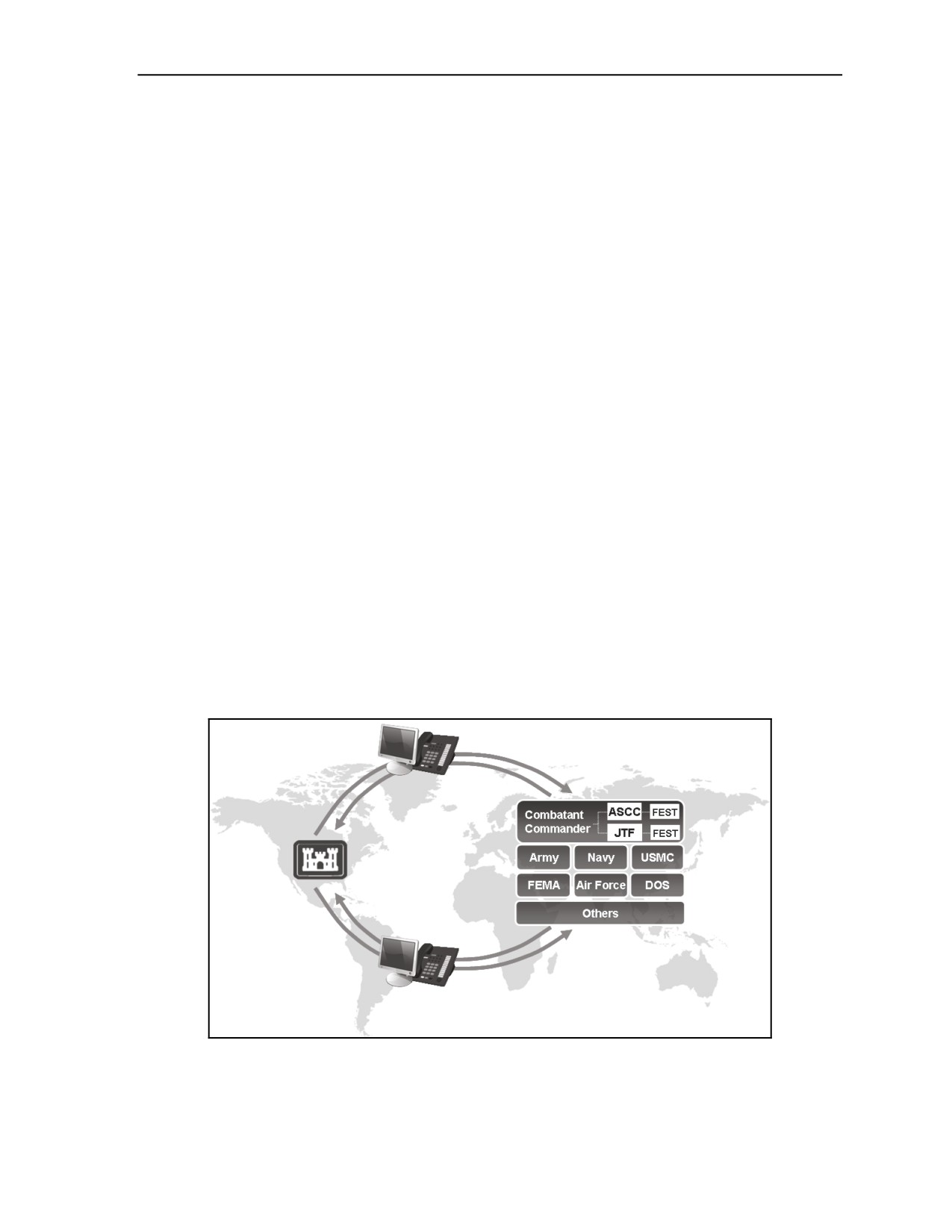
H-9. Accessing reachback support is simple. Deployed personnel from all military services or other U.S.
government organizations can submit a request for information
(RFI) via unclassified or classified
websites, electronic mail, VTC, or telephone to the Engineering Infrastructure Intelligence Reachback
Center (EI2RC) in Mobile, Alabama, or the Tele-Engineering Operations Center (TEOC) in Vicksburg,
Mississippi. Once a request is submitted, it is routed to trained response teams, centers of expertise, or
laboratories for solutions. The personnel working the RFI will provide the response to the requestor to
solve the problem and the data will be archived in a repository. Army, Navy, Air Force, Marine Corps, the
DOS, and FEMA, among others, can benefit from USACE expertise (see figure H-4).
Figure H-4. Reachback process
2 April 2009
FM 3-34
H-5

Appendix H
H-10. The engineer providing support is the preferred access point to the USACE reachback capability.
The engineer will determine if the required technical assistance is beyond available capabilities and can
then develop an appropriate RFI for reachback support. Table H-1 provides general contact information for
reachback support.
Table H-1. Reachback contact information
Website
Electronic-mail
Mail
Telephone
CEEI2RC@usace.army.mil
CESAM-EN (EI2RC)
Comm:
army.mil
109 Saint Joseph Street
251-690-2039
TEOC@usace.army.mil
Mobile, Alabama 36602
601-634-2735
TEOC-VTC@usace.
usace.army.mil
CEERDC, TEOC
DSN:
army.mil
Room 42, Building 3294
312-446-2735
3909 Halls Ferry Road
VTC:
Vicksburg, Mississippi
601-634-3485
39180-6199
OrgMBoxCEEI2RC@usace.
Comm:
army.smil.mil
army.smil.mil
601-634-4231
(STUIII)
TEOC@teleengineering.
teleengineering.army.
army.smil.mil
smil.mil
ei2rc@korea.army.rmil.mil
DSN 312-457-
rmil.mil
2039 (STUIII)
NAVAL FACILITIES ENGINEERING COMMAND
NAVAL FACILITIES ENGINEERING COMMAND HEADQUARTERS
H-11. NAVFAC is the Navy’s facilities engineering professionals. A global, interdependent organization,
NAVFAC has a broad range and strong depth of expertise in facilities engineering and acquisition.
NAVFAC headquarters is an Echelon II headquarters with programmatic responsibilities for the Military
Construction Program, the Environmental Restoration Navy Program, and a variety of other programs
related to Shore Installation Management. In partnership with the Commander, Navy Installations, and the
Commander, Naval Supply Systems Command, NAVFAC supports the “shore domain” of the Navy. The
NAVFAC headquarters contingency engineering officer provides the liaison to the JCS and the functional
combatant commands.
ATLANTIC AND PACIFIC THEATERS
H-12. Two Echelon III commands under NAVFAC, NAVFAC Atlantic and Pacific (figure H-5), are
aligned with the fleet commanders and provide leadership over NAVFAC Echelon IV activities within
each fleet’s operational area. In addition, they provide centralized production of specialized engineering
services beyond the organic capability of the regional commands at the Echelon IV level. The contingency
engineering officer at NAVFAC Pacific provides the liaison to USPACOM. The Contingency Engineering
Officer at NAVFAC Atlantic provides the liaison to USEUCOM, United States Southern Command
(USSOUTHCOM), and USCENTCOM.
H-6
FM 3-34
2 April 2009
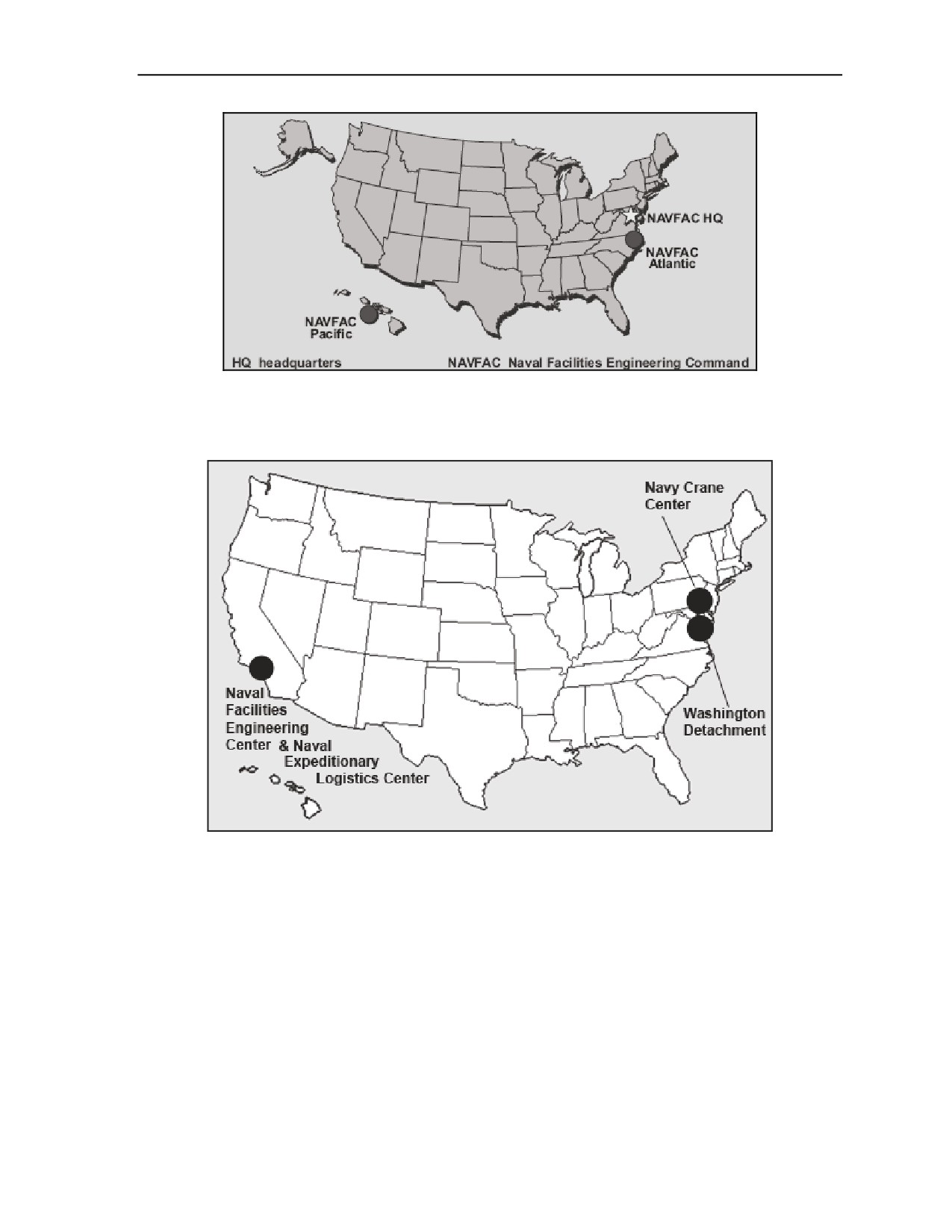
Contract Construction Agents
Figure H-5. Naval Facilities Engineering Command, C2
H-13. NAVFAC specialty centers shown in figure H-6 are described below.
Figure H-6. Naval Facilities Engineering Command, naval facilities engineering
specialty centers
NAVAL FACILITIES ENGINEERING SERVICE CENTER
H-14. The Naval Facilities Engineering Service Center is located in Port Hueneme, California, with a
detachment in Washington, District of Columbia. The center provides specialized engineering and
technical expertise in contingency engineering, amphibious and expeditionary systems, logistics C2,
explosive safety, blast mitigation, ordnance facilities, utilities and energy, environmental engineering,
ocean engineering, shore facilities engineering, and antiterrorism or force protection services.
NAVAL FACILITIES EXPEDITIONARY LOGISTICS CENTER
H-15. The Naval Facilities Expeditionary Logistics Center is located in Port Hueneme, California, and is
commanded by a Navy CEC captain. The center provides overarching asset management and expeditionary
2 April 2009
FM 3-34
H-7
Appendix H
logistics support and is responsible for lifecycle management of the equipment, materials, and training
required to enable the readiness of the NCF and other expeditionary units. Specific support to the NCF
includes the following:
z
Management and maintenance of the Seabee table of allowance which is the primary allowance
of equipment, supplies, and facilities for the NCF.
z
Development of communication and information technology in support of the NCF and other
expeditionary forces.
z
Service as the training support agency for the NCF and sealift program.
z
Development and maintenance of training curriculums and training publications to support
military and construction skills for the NCF and NBG.
z
Management of pre-positioned war reserve material and stock for the NCF, including
maintenance and wartime mobilization of stock stored, received, or shipped at Port Hueneme,
California, and Construction Battalion Center, Gulfport, Mississippi.
z
Primary procurement of the Navy's inventory of automotive and construction equipment.
z
Management of mobile utilities support equipment program.
z
Development of sealift support products, including modular, floating, and elevated piers;
wharves and docks; powered and nonpowered causeways; roll-on/roll-off floating platforms;
and fabrication of special craft and bulk liquid transfer systems.
NAVY CRANE CENTER
H-16. The Navy Crane Center is located in Portsmouth, Virginia, at the Norfolk Naval Shipyard and led by
a civilian director. It has five field offices located at the three other Navy shipyards (Pearl Harbor,
Portsmouth, and Puget Sound), San Diego, California, and Silverdale, Washington. It leads the Navy's
weight handling program by establishing policy and providing engineering, acquisition, technical support,
training, and evaluation services to Navy shore activities worldwide. The Navy Crane Center's website
requirement and policy documents, training information on courses (both instructor-led and web-based),
safety videos, and other useful information to assist Navy shore activities in improving their weight
handling programs and operations. Since cranes are an important NCF resource, the Navy Crane Center
provides technical expertise and programmatic oversight for safe operation of NCF crane assets.
FACILITIES ENGINEERING COMMANDS
H-17. The majority of the products and services provided to bases and shore installations by NAVFAC are
produced at Echelon IV commands aligned with Navy regions. Each activity is named “NAVFAC Region
Name,” such as NAVFAC Hawaii or NAVFAC Mid-Atlantic. These activities are staffed primarily by
civilian employees and led by Navy Civil Engineer Corps officers. While each activity will vary in size and
capability based on the regional requirements, each is capable of delivering the full range of NAVFAC
products and services by leveraging other NAVFAC activities. NAVFAC supports Navy and Marine Corps
operations, DOD missions, and joint force operations around the world in the following ways:
z
The Navy accomplishes force projection worldwide by use of superior naval, air, and
amphibious forces, equipment, tactics, and doctrine. This force projection requires shore logistic
platforms, such as advanced logistic support sites and ports to receive supplies, equipment, and
personnel to be deployed to ships and advanced bases. NAVFAC directly supports these
activities by providing engineering, contract construction, and facilities management (including
disposition of real estate) for these ports and bases.
z
During normal operations, NAVFAC provides support to the NCF or Seabees; the fleet
commanders; Commander, Naval Installations; the Marine Corps; and many other clients in
planning, design, construction, maintenance, and environmental compliance for Navy shore
facilities and other bases worldwide. NAVFAC elements directly support the Navy’s shore
establishment throughout the world with a wide variety of engineering services. These
commands provide project management, planning, design engineering, construction, operations
and maintenance, and real property disposal functions for shore facilities. Across the spectrum
H-8
FM 3-34
2 April 2009
Contract Construction Agents
of operations, NAVFAC, while not an operating command, can support the combatant or
component commanders in three specific ways—
Execution of contract construction funded from the military construction appropriation for
all Services in DOD-designated NAVFAC geographic areas.
Execution of contracts to accomplish architect-engineer services, construction, real estate,
or base operating support and facilities support services.
Provision of specific technical support across a broad spectrum of engineering and scientific
disciplines to solve challenging engineering and infrastructure-related problems.
z
Programs such as counterterrorism, antiterrorism, counterdrug, and health affairs are common
areas where NAVFAC provides direct support to JFCs by carrying out engineer missions using
in-house and contracted forces.
z
NAVFAC has responsibility for disaster recovery and other contingency operations at Navy and
Marine Corps installations in the United States. NAVFAC can quickly mobilize and provide
significant assets for disaster recovery.
2 April 2009
FM 3-34
H-9
This page intentionally left blank.
Appendix I
Explosive Ordnance Disposal Organizations and Functions
The mission of EOD is to eliminate or reduce CBRNE hazards and to protect the
commander's combat power. UXO limits mobility, denies the use of critical assets,
and threatens to injure or kill Soldiers at levels unprecedented in past wars. UXO, to
include improved conventional munitions and IEDs, have greater emphasis now and
in the future because of the potential of significantly reducing the commander’s
combat power. The continuing development of foreign and U.S. smart and brilliant
munitions that disperse hundreds of submunitions and area denial ordnance has lead
to the proliferation of UXO. These munitions are available for a range of weapon
systems, including artillery, ballistic and cruise missiles, rockets, and bombs.
INTRODUCTION TO EXPLOSIVE ORDNANCE DISPOSAL
I-1. The EOD force is prepared to deal with the increased quantity, quality, and lethality of UXO.
Sophisticated fuzing and sensors systems developed for the 21st century have the capability to detect,
identify, and select specific targets using infrared, proximity, magnetic influence, acoustic, and seismic
technologies. Attempts to approach and perform a render-safe procedure on these munitions by the
traditional 20th century methods will cause detonation of the devices. This is because of a wider kill radius
(greater than 250 meters) added to the hazards of their antidisturbance, antiremoval, antilift, random-delay,
and self-destruct features. UXO also presents access problems from—
z
Toxic chemicals from rocket motors and guidance systems.
z
Ordnance that is normally safe can be extremely dangerous after it has been in fire, especially
newer ordnance made of lightweight metals and plastics.
z
The nature of the location of most UXO—destroyed vehicles and aircraft—have unique dangers
like depleted uranium and carbon fiber.
z
Confined space, bunkers, caves, and tunnels.
I-2. EOD missions include—
z
Responding to counterterrorism, WMD, and UXO incidents on the sea, in the air, and on land.
z
Supporting the United States Secret Service, DOS, Department of Justice, Department of
Energy, and FEMA.
z
Advising and assisting civil authorities in the remediation of military ordnance that poses a
threat to public safety.
z
Providing education on the hazards of UXO.
z
Examining, identifying, and reporting new and unusual explosive ordnance for technical
intelligence purposes.
z
Supporting nuclear and chemical weapons shipments.
z
Conducting a range sweep by disposing of UXO on impact areas.
z
Destroying ammunition and routine ammunition stocks and conducting emergency destruction
of ammunition to prevent capture by the enemy (including sensitive site exploitation).
z
Responding to increased lethality of UXO, IEDs, and WMD.
z
Removing rounds stuck in artillery tubes and other large-caliber weapons.
z
Advising and assisting in the instruction of UXO clearance for humanitarian demining missions.
2 April 2009
FM 3-34
I-1
Appendix I
z
Clearing enemy UXO and booby traps from a captured ASP, airfield, AMD site, CP, or other
key objectives.
z
Clearing dropped UXO from enemy targets, such as an ASP, airfield, AMD site, CP, or other
key objectives that have been captured by U.S. forces.
z
Responding to an enemy Sapper attack clearing satchel charges from targets—aircraft, vehicles,
stacks of ammunition, and dead Sappers or suicide bombers.
z
Responding to terrorist attacks against U.S. facilities with car or truck bombs at U.S. embassies,
consulates, and military barracks.
z
Retrieving casualties from a minefield and evacuating survivors to medical facilities while
assisting graves registration for fatalities.
z
Clearing enemy aircraft, armor, artillery, and other materiel identified as having significant
intelligence value of booby traps and hazardous ordnance.
z
Collecting war souvenirs from departing U.S. forces.
EXPLOSIVE ORDNANCE DISPOSAL ORGANIZATION
GROUP HEADQUARTERS
I-3. The EOD group commander serves as the ASCC, G-3, and theater EOD special staff officer. The
EOD group provides C2 of all Army EOD assets and operations in-theater. When directed by the JFC, the
EOD group commander becomes the commander of the joint EOD task force and coordinates all EOD
assets within theater.
I-4. The EOD group provides C2, mission tasking, theater EOD planning, technical intelligence
acquisition and management, and limited administrative and logistics support for two to six EOD
battalions. In operations without a fully deployed theater or EOD group, a headquarters element of an EOD
group will deploy to provide C2 and staff planning for deployed EOD battalions.
BATTALION HEADQUARTERS
I-5. The EOD battalion exercises C2 for three to seven EOD companies in the AO. The commander of
the EOD battalion is the EOD officer for the corps. He monitors operations and develops plans to meet the
needs of the CCDR, providing an LNO team, as required.
I-6. The EOD battalion provides C2, mission tasking, EOD planning, and technical intelligence
acquisition and management. The battalion also provides limited administrative and logistics support for up
to seven EOD companies.
COMPANY
I-7. The EOD company exercises C2 for two EOD response sections. The primary function of the EOD
company is to provide support as directed by the EOD battalion; it does this in a variety of ways. An EOD
company provides GS to assigned AORs and all units within it. Dependent upon METT-TC considerations,
this may require the company to perform split-based operations to fully support mission requirements. An
EOD company is task-organized by the EOD battalion commander and is typically attached to a separate
organization for administrative and logistical support. The EOD company commander may further task-
organize EOD teams to division, BCT, or MEB areas to conduct EOD operations in support of maneuver
elements. The commander of an EOD company exercises C2 of the company throughout his assigned
AOR, to include split-based operations and fragmented team operations. He must also coordinate and
conduct liaison with various supported and supporting units, to include civil or HN authorities and other
agencies.
I-8. The EOD company provides the ability to eliminate or reduce the hazards of domestic or foreign
conventional, nuclear, chemical, and biological munitions and IEDs that threaten personnel, military
operations, facilities, and materiel. The EOD company exploits technical intelligence by submitting reports
on first-seen ordnance. It provides support to the U.S. Secret Service to protect the President, Vice
I-2
FM 3-34
2 April 2009
Explosive Ordnance Disposal Organizations and Functions
President, and others, as directed. It also provides support to the Federal Bureau of Investigation and
Department of Energy about counterterrorism with emphasis on IEDs.
ENGINEER AND EXPLOSIVE ORDNANCE DISPOSAL
CONSIDERATIONS
I-9. Army engineer and EOD units have a unique relationship compared to other armies and services
around the world. Several allied countries (United Kingdom, France, Canada, and Australia) teach EOD
skills in addition to combat engineer training; the U.S. Army does not. Army engineers and ordnance are
two distinct branches and organizations. The role of each is unique but similar, and this necessitates close
coordination when operating in today's OE. Engineers are responsible for ensuring mobility of combat
forces. The Army's combat engineers approach detection and neutralization of mines along three
strategies—metal detection, explosive neutralization, and brute force neutralization. Detection technologies
focus on identifying the metal content of mines. Explosive neutralization applies systems such as mine-
clearing line charges to detonate the mines. The brute force neutralization applies plows and rollers to push
the mines aside or detonate them by pressure. All these means require the use of intelligence sources and
reconnaissance to detect mines and then use the appropriate combination of explosive or brute force means
to neutralize and breach conventional minefields. Explosive and brute force neutralization strategies may
not be appropriate in all operations, such as in urban areas. EOD personnel can task-organize directly to a
maneuver unit to render safe or neutralize booby traps, UXO, and IEDs. (Booby traps have increased in
sophistication in recent years and may include electronic circuitry, to include light sensors, motion sensors,
and command detonation.)
I-10. The engineer commander or staff engineer should consider the following when working with EOD
units:
z
Ensure that you know the EOD LNO and work together in planning.
z
Exchange information on the mines, booby traps, UXO, and IEDs.
z
Work with the S-2 or G-2 to identify the types of booby traps expected.
z
Include EOD in planning and request EOD intelligence of the region.
z
Establish and operate a training scenario to teach awareness and the most current procedures.
z
Use combat engineers to detect, mark, record, and report booby traps.
z
Know that EOD is task-organized to evaluate and render safe booby traps, IED, and UXO.
z
Know that combat engineers can remove standard structural demolitions that are not booby
trapped.
I-11. EOCA personnel are Army combat engineers trained to perform limited battlefield destruction of
UXO—as outlined in the EOCA identification guide and supplemental list of EOCA ordnance provided by
the theater EOD commander (part of the ordnance order of battle)—during route reconnaissance or route
clearance operations or other engineer missions. If the UXO is out of the scope of operations for the
EOCA, EOD personnel must be called. EOCA personnel can assist EOD personnel in disposing of other
EH as requested. Properly trained and certified EOCA personnel capabilities include the following:
z
Unexploded ordnance reconnaissance. EOCA personnel are trained to perform detailed
reconnaissance of a suspected UXO.
z
Unexploded ordnance identification. EOCA personnel can perform limited identification of
items listed in the EOCA identification guide and the supplemental EOCA ordnance list
provided by the theater EOD commander (part of the ordnance order of battle). Items that the
EOCA cannot positively identify must be reported to EOD personnel.
z
Unexploded ordnance area marking. EOCA personnel mark the UXO area according to the
standard UXO marking system.
z
Protective works. EOCA personnel can provide protective works to isolate a blast and
fragmentation danger area of identified UXO. EOCA personnel may provide an estimated blast
and fragmentation danger area for items similar to, but not included in the EOCA identification
guide and supplemental list of EOCA ordnance provided by the theater EOD commander (part
of the ordnance order of battle). EOCAs will advise the on-scene commander about the
2 April 2009
FM 3-34
I-3
Appendix I
recommended personnel and equipment protective measures. When the commander determines
that certain personnel or equipment cannot be removed from the hazard area, protective works
must be established to protect those personnel and assets from the effects of the UXO. EOCAs
will recommend and supervise the appropriate protective works to be completed.
z
Unexploded ordnance disposal. EOCA personnel are authorized to destroy (by detonation)
individual UXO identified in the EOCA identification guide and supplemental list of EOCA
ordnance list provided by the theater EOD commander (part of the ordnance order of battle).
z
Improvised explosive device disposal. EOCA personnel are authorized to blow in place single
munitions-based IEDs that are positively identifiable in the EOCA identification guide and the
supplemental EOCA ordnance provided by the theater EOD commander (part of the ordnance
order of battle) and based upon theater policy.
I-12. The following are the EOCA’s limitations (see FM 3-90.119 for the most detailed and current
information):
z
Not trained to move, combine, or destroy multiple UXO (such as cache or IED incorporating
more than one munition).
z
Not trained to perform reconnaissance or handling of IED or vehicle-borne IED incidents.
z
Can only perform explosive remnants of war operations under the direct supervision of EOD
personnel (includes EH teams).
z
Are not to be used for EH response calls. However, if EOD is not readily available as
determined by the maneuver commander, EOCA personnel can be used to conduct an initial
reconnaissance of the UXO. If the UXO falls within their capability, then EOCA personnel may
dispose of the UXO.
Note. The JFC will be advised by the senior EOD commander who creates and manages
modifications to the JOA UXO supplemental list. Requests to modify the supplemental list will
be coordinated through the local EOD unit or EH team for approval by the CBRNE cell or EOD
group or battalion staff. Any modification to the JOA UXO supplemental list will be provided
based upon positively identifiable munitions in the theaters ordnance order of battle.
I-4
FM 3-34
2 April 2009
Source Notes
These are the sources used, quoted, or paraphrased in this publication. They are listed
by page number. Where material appears in a paragraph, both page and paragraph
numbers are listed.
1-1
“A general in all his projects…”: Frederick the Great, Instructions to his Generals, 1747.
3-1
“I would desire to have companies…”: Louis Deportail, Chief of Engineers, Continental Army,
January 1778.
4-1
“In preparing for battle…”: Dwight D. Eisenhower, The Military Quotation Book, James Charlton,
ed. (New York: St. Martin’s Press, 2002), 5.
5-1
“Prepare for the unknown…”: General George S. Patton, The Military Quotation Book, James
Charlton, ed. (New York: St. Martin’s Press, 2002), 5.
6-1
“Build no more fortresses…”: Field Marshall Helmuth Von Moltke, The Elder, The Military
Quotation Book, James Charlton, ed. (New York: St. Martin’s Press, 2002), 86.
2 April 2009
FM 3-34
Source Notes-1
This page intentionally left blank.
Glossary
The glossary lists acronyms/abbreviations and terms with Army or joint
definitions, and other selected terms. Where Army and joint definitions are
different, (Army) follows the term. Terms or acronyms for which FM 3-34 is the
proponent manual (the authority) are marked with an asterisk (*).
SECTION I-ACRONYMS AND ABBREVIATIONS
Acronym/Term
Definition
1NCD
First Naval Construction Division
1SG
first sergeant
A2C2
Army airspace command and control
AAP
allied administrative publication
ABCS
Army Battle Command System
AC
Active Component
ACB
amphibious construction battalion
ACE
aviation combat element
ACOS
Assistant Chief of Staff
ACR
armored cavalry regiment
ACS
armored cavalry squadron
ADC
area damage control
ADCON
administrative control
AETF
air and space expeditionary task force
AFCAP
Air Force Contract Augmentation Program
AFCESA
Air Force Civil Engineer Support Agency
AFSB
Army field service brigade
AG
Adjutant General
AGS
aviation ground support
AKO
Army Knowledge Online
AJP
allied joint publication
ALT
acquisition, logistics, and technology
AMD
air and missile defense
AO
area of operations
AOR
area of responsibility
APOD
aerial port of debarkation
APOE
aerial port of embarkation
AR
Army regulation
ARFORGEN
Army force generation
ARNG
Army National Guard
ARNGUS
Army National Guard of the United States
ASA
Assistant Secretary of the Army
2 April 2009
FM 3-34
Glossary-1
Glossary
Acronym/Term
Definition
ASCC
Army service component commander
ASP
ammunition supply point
ATHP
ammunition transfer and holding points
ATP
allied tactical publication
BCT
brigade combat team
BFSB
battlefield surveillance brigade
BLST
brigade logistics support team
BSB
brigade support battalion
BSTB
brigade special troops battalion
C2
command and control
CA
civil affairs
CAB
combat aviation brigade
CALL
Center for Army Lessons Learned
CASEVAC
casualty evacuation
CBMU
construction battalion maintenance unit
CBRN
chemical, biological, radiological, and nuclear
CBRNE
chemical, biological, radiological, nuclear, and high-yield explosives
CBT
combat
CCA
contract construction agent
CCDR
combatant commander
CCIR
commander's critical information requirements
CCMET
core capability mission essential task
CE
combat element
CEB
combat engineer battalion
CEC
Civil Engineer Corps
CEF
contingency expeditionary force
CJCSI
Chairman of the Joint Chiefs of Staff instruction
CJCSM
Chairman, Joint Chiefs of Staff Manual
CMO
civil-military operations
CMOC
civil-military operations center
CMT
collection management
COA
course of action
COCOM
combatant command (command authority)
COMM
commercial
CONPLAN
concept plan
CONUS
continental United States
COP
common operational picture
CP
command post
CPM
critical path method
CSA
Chief of Staff of the Army
Glossary-2
FM 3-34
2 April 2009