FM 3-34 ENGINEER OPERATIONS (April 2009) - page 3
Foundations2 April 2009perations
z
Underwater and other specialized construction support.
z
Infrastructure assessment or survey.
z
Assessment of HN technical capacity.
z
Environmental baseline assessment or survey.
z
Environmental remediation survey and assessment.
3-109. Technical capabilities include robust support from joint Service, multiagency, contractor, HN, and
reachback elements. FFE is the broad range of primarily generating force activities linked through the
general engineer element on the ground to apply a high degree of technical expertise to the engineer
mission. FFE, as it relates to reconnaissance, is discussed in greater detail in FM 3-34.170.
SUSTAINMENT
3-110. The sustainment warfighting function is the related tasks and systems that provide support and
services to ensure freedom of action, extend operational reach, and prolong endurance (this definition was
shortened, and the complete definition is printed in the glossary). (FM 3-0) The endurance of Army forces
is primarily a function of their sustainment. Sustainment determines the depth to which Army forces can
conduct decisive operations, allowing the commander to seize, retain, and exploit the initiative.
Sustainment is the provision of logistics, personnel services, and HSS necessary to maintain and prolong
operations until mission accomplishment. It also includes internment and resettlement operations.
3-111. General engineer applications are primarily linked through and provide a major category of tasks
under providing logistic support in the sustainment warfighting function. As already discussed, general
engineer capabilities can also be applied in support of combat engineer applications and will have links
across both the movement and maneuver and the protection warfighting functions. Providing general
engineer support (see FM 3-34.400) includes—
z
Restore damaged areas.
z
Construct and maintain sustainment LOCs.
Construct and maintain roads and highways.
Construct and maintain over-the-shore facilities.
Construct and maintain ports.
Construct and maintain railroad facilities.
Construct and expand airfield facilities.
Construct and maintain pipelines and tank farms.
Construct and maintain standard and nonstandard fixed bridges.
z
Provide engineer construction support.
z
Supply mobile electric power.
z
Provide facilities engineering support.
Provide waste management.
Acquire, manage, and dispose of real estate.
Provide firefighting support.
Construct, manage, and maintain bases and installations.
3-112. In stability or civil support operations, sustainment support may shift to the establishment of
services that support civilian agencies, in addition to the normal support of U.S. forces. Stability operations
tend to be of a long duration compared to the other elements in full spectrum operations. As such, the
general engineering level of effort, including FFE support from USACE, is very high at the onset and
gradually decreases as the theater matures. As the AO matures, the general engineering effort may transfer
to theater or external support contracts, such as LOGCAP, AFCAP, or the Navy’s global contingency
construction contract.
2 April 2009
FM 3-34
3-35
Chapter 3
PROTECTION
3-113. The protection warfighting function is the related tasks and systems that preserve the force so the
commander can apply maximum combat power (this definition was shortened, and the complete definition
is printed in the glossary). (FM 3-0) Preserving the force includes protecting personnel (combatants and
noncombatants), physical assets, and information of the United States and multinational military and
civilian partners. The protection warfighting function facilitates the commander’s ability to maintain the
force’s integrity and combat power. Protection determines the degree to which potential threats can disrupt
operations and counters or mitigates those threats. Protection efforts are continuous. They increase during
preparation and continue throughout execution. Protection is a continuing activity; it integrates all
protection capabilities to safeguard bases, secure routes, and protect forces. The protection warfighting
function includes the following tasks:
z
Employ air and missile defense.
z
Conduct personnel recovery operations.
z
Conduct information protection.
z
Perform fratricide avoidance.
z
Conduct operational area security.
z
Apply antiterrorism measures.
z
Conduct survivability operations.
z
Conduct force health protection.
z
Conduct CBRN operations.
z
Employ safety techniques.
z
Implement operations security.
z
Provide EOD protection support.
3-114. Engineers have unique equipment and personnel capabilities that can be used to support
survivability and related protection efforts. Combat engineers, supported by general engineer capabilities
when required, provide selected survivability operations through the protection warfighting function (see
FM 5-103). Survivability operations also include camouflage, concealment, and deception support to
tactical ground maneuver forces. Combat engineers typically provide the basic hardening and camouflage,
concealment, and deception support while general engineering support is focused on longer term
survivability efforts. General engineer support is also applied through the protection warfighting function
control pollution and hazardous materials as well as to harden facilities. Survivability operations include
the following engineer tasks:
z
Protect against enemy hazards within the AO.
Prepare fighting positions. Ensure that vehicle fighting positions, crew-served weapon
fighting positions, and individual fighting positions are constructed.
Prepare protective positions. Ensure that protective earth walls, berms, and revetments are
constructed and that vehicle system, equipment, and material protective positions are also
constructed.
Employ protective equipment. Ensure that bridge protective devices are installed and that
protective obstacles are installed or removed.
z
Conduct actions to control pollution and hazardous materials (see FM 3-100.4).
3-115. When conducting stability operations or civil support operations, survivability remains a key
commander concern. Although the likelihood of combat operations is reduced, key resources and personnel
remain vulnerable to other types of hostile action or attack. Commanders must consider protecting vital
resources (such as fuel sites, sustainment convoys, FOBs, and logistic support areas) since the entire AO
has an equal potential for enemy attack. Therefore, priority of work for construction assets will be much
more focused on protecting these types of resources than constructing fighting positions for combat
vehicles or crew-served weapons. Vital resources requiring protection may also include facilities critical to
the civilian infrastructure, such as key industrial sites, pipelines, water treatment plants, and government
buildings. Engineers also employ protective obstacles as a key tool in protecting these important assets and
3-36
FM 3-34
2 April 2009
Foundations2 April 2009perations
locations. Protective obstacles range from tetrahedrons and concrete barriers to networked munitions.
Physical barriers provide relatively inexpensive, although inflexible, protection capability. Networked
munitions, with their built-in sensor capabilities and central control over nonlethal and lethal fields,
provide a flexible intrusion detection and denial system.
2 April 2009
FM 3-34
3-37
Chapter 4
Planning Engineer Operations
In preparing for battle I have always found that plans are useless, but planning is
indispensable.
Dwight D. Eisenhower
Full spectrum operations follow a cycle of planning, preparation, execution, and
continuous assessment. These cyclic activities may be sequential or simultaneous.
They are usually not discrete; they overlap and recur as circumstances demand. As a
whole, they make up the operations process. As discussed in Chapter 3, engineer
operations include multiple interactions with the C2 function and the operations
process it drives. Whether a subordinate or supporting unit, engineer unit
commanders and their staffs must understand and exercise the art and science of C2,
including the cyclical activities of the operations process. Engineer planners and staff
members in combined arms or other nonengineer headquarters must understand and
become integral members during planning and other operations process activities at
that headquarters. Engineers must also understand joint planning processes when
supporting joint operations. Engineers use other problem solving activities that
address specific engineer functional requirements. This chapter enters the operations
process by discussing various planning activities required for effective engineer
operations. It describes planning responsibilities, integration, and processes for
engineer units and for engineer planners in nonengineer units. Finally, it describes
responsibilities and processes for joint engineer planning and selected technical
requirements.
SECTION I-INTEGRATED PLANNING
4-1. Planning is part of C2. Planning is the means by which the commander envisions a desired outcome;
lays out effective ways of achieving it; and communicates to subordinates his visualization, intent, and
decisions. The outcome of planning is a plan or an order that—
z
Fosters mission command by clearly conveying the commander’s intent.
z
Assigns tasks and purposes to subordinates.
z
Contains the minimum coordinating measures necessary to synchronize the operation.
z
Allocates or reallocates resources.
z
Directs preparation activities and establishes times or conditions for execution.
4-2. Commanders use their staffs and integrate input from subordinate commanders into their planning
processes. Engineer leaders must understand and be integral participants in the planning processes
impacting engineer operations at their echelon of employment. Supporting engineer unit commanders and
leaders conduct parallel planning processes that provide both effective outcomes for the engineer units
employed and appropriate input to the higher commander’s process. Geospatial support elements and
engineer staff planners integrate directly within the planning staff at each echelon to participate in the
planning process.
4-3. Engineer operations are complex, resource intensive (time, manpower, equipment, and materials),
and require extensive and proactive coordination. Additionally, a successful engineering effort requires an
2 April 2009
FM 3-34
4-1
Chapter 4
understanding of all engineer requirements (combat, general, and geospatial) and their roles in the concept
of operations. Planning, from the perspective of engineer operations, includes even more than the
description ascribes to it. Engineer operations must be directed and synchronized through planning as one
of the critical activities in the operations process, but many engineer activities also require the critical
reasoning skills and problem solving techniques that form the base logic for the planning processes (see
FM 5-0). Engineer operations will involve the use of some functionally unique analytic tools to solve
construction, design, facilities, and other engineer-specific problems.
PLANNING AT EACH LEVEL OF WAR
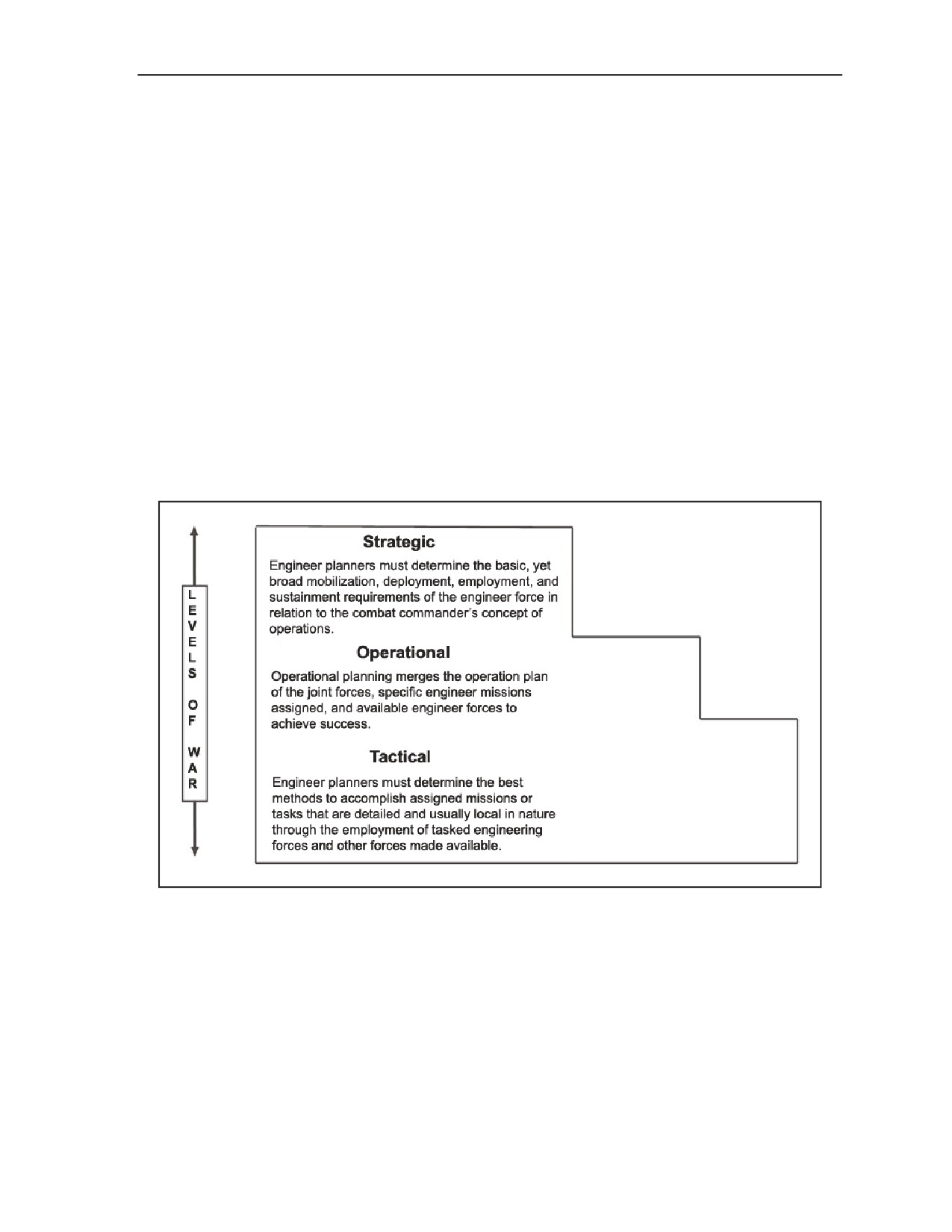
4-4. It is important to understand planning within the context of the levels of war (see figure 4-1).
Operational-level planning involves broader dimensions of time and space than tactical-level planning. It is
often more complex and less defined. Operational-level planners are often required to define an AO,
estimate forces required, and evaluate the requirements for the operation. In contrast, tactical-level
planning proceeds from an existing operational design. Normally AOs are prescribed, objectives and
available forces identified, and sequences of activities specified for tactical-level commanders.
Operational- and tactical-level planning, however, are not limited to particular echelons. As echelons of
responsibilities have blurred, essentially any engineer unit is capable of supporting a maneuver unit at any
level of war. For example, an engineer battalion may deploy to support a JTF or an Army corps at the
operational level, or a division or BCT at the tactical level. Engineer planning is conducted at the strategic,
operational, and tactical levels and includes all of the engineer functions.
Figure 4-1. Engineer planning at each level of war
4-5. Operational and tactical planning complements one another but have different aims. Operational
planning prepares the way for tactical activity on the most favorable terms (proper resourcing) and
continually seeks to foster and exploit tactical success. Major operations depend on the creative use of
tactical action to accomplish a strategic or operational purpose within a specific situational context against
an adaptive opponent. Tactical planning emphasizes flexibility and options. Comprehensive planning may
be feasible only for the first event or phase in an operation; succeeding actions depend on enemy response
and circumstances. The art of tactical planning lies in anticipation and the development of sound branches
and sequels.
4-2
FM 3-34
2 April 2009
Planning Engineer Operations
4-6. Scope, complexity, and length of planning horizons differ between operational and tactical planning.
Campaign planning coordinates major actions across significant time periods and distances to achieve
operational objectives. Planners mesh service capabilities with joint and multinational formations, as well
as interagency and NGOs. Tactical planning has the same clarity of purpose as operational planning, but
has a shorter planning horizon. The plan guides subordinates as they progress through each phase of
operations. Comprehensive, continuous, and adaptive planning characterizes successful operations at the
operational and tactical levels of war.
4-7. The CCDR or senior Army commander’s engineer planning concepts focus on the relationship of
geography and force projection infrastructure to the concept of operations. Engineer planners must
determine the basic, yet broad, mobilization, deployment, employment, and sustainment requirements of
the CCDR’s concept of operations. At all levels of planning, the senior engineer commander or the
ENCOORD at each echelon must support the development of the supported commander’s OPLAN or
OPORD, as well as an internal OPLAN or OPORD for the engineer organization. As previously discussed,
the ENCOORD is the special staff officer responsible for coordinating engineer assets and operations for
the command, including engineer planning. The ENCOORD is usually the senior engineer officer on the
staff, but may be a senior engineer commander supporting the force. In select circumstances, the senior
engineer commander may also be the supported commander.
4-8. In planning engineer operations at every level, the engineer planner should consider a number of
general considerations, including speed, economy, flexibility, decentralization of authority,
and
establishment of priorities (see figure 4-2).
SPEED. Engineering tasks are resource intensive in terms of time, materials, manpower,
and equipment. Practices that support speed include use of existing facilities,
standardization, simplicity of design and construction, base-base construction, and
construction in phases.
ECONOMY. Engineering demands efficient use of personnel, equipment, and materials.
Practices that support economy include the conservation of manpower, equipment, and
materials and the application of environmental consideration early in the process.
FLEXIBILITY. Standard plans that allow for adjustment, expansion, and contraction will be
used whenever possible. For example, forward airfields should be designed and located so
that they can be expanded into more robust facilities.
DECENTRALIZATION OF AUTHORITY. Dispersion of forces requires that engineer
authority be decentralized as much as possible. The engineer commander at a particular
location must have authority consistent with responsibilities.
ESTABLISHMENT OF PRIORITIES. Establish priorities and resource allocation to
determine how much engineer effort must be devoted to a single task. All levels of
command, beginning with the joint force commander, will issue directives establishing broad
priorities. Resources are initially assigned to the highest priority tasks while low priority
tasks may be left undone while recognizing and mitigating the risk.
Figure 4-2. Engineer planning considerations
OPERATIONAL COMPONENT CONSIDERATIONS
4-9. During combat operations, engineer units will tend to have command relationships to maneuver
commanders. Engineer units are normally task-organized OPCON for a given offensive mission because it
lets the gaining unit task-organize and direct the engineer forces. Although the forms of offensive
maneuver have different intentions, the planning phase must always begin with predicting the adversary’s
intent through a thorough understanding of the threat, enemy engineer capabilities, and how the terrain will
effect operations. Geospatial products and information become the foundation and common reference for
planning. Of all the forms of maneuver, knowledge of the threat’s disposition is especially critical and
2 April 2009
FM 3-34
4-3
Chapter 4
required for an infiltration or penetration due to the requirements for stealth and surprise. Engineer
planning tends to focus on mobility support including a robust reconnaissance effort. A greater degree of
planning is required for a penetration from the breach to the ultimate control of the decisive objective.
4-10. Planning for defensive operations is inextricably linked to offensive operations and, for planning
purposes, must consider the transition from offensive operations, as well as follow-on offensive operations.
During defensive operations, engineers use terrain products to best position the units within the defense.
Engineers then work with intelligence staff to describe the threat functions to predict where the threat is
likely to attack friendly forces. Engineers work in conjunction with intelligence personnel to determine
which sensor capabilities to leverage and best predict and prevent the threat from maneuvering freely into
the defended area. Construction planning includes security and survivability considerations. The
consideration of counterattack planning or support for the mobile strike force is the same as the typical
mobility planning for offensive operations. The ENCOORD works with other staff members to ensure that
the counterattack force can mass its effects on the enemy for decisive operations. The type of defensive
operation will define the amount and focus of engineer effort required. An area defense will typically
require a greater amount of effort due to the increased survivability requirements. A mobile defense’s
effort will be to a lesser degree (although mobility requirements may increase) because it has greater
flexibility and takes advantage of the terrain in depth.
4-11. Stability and civil support operations emphasize nonlethal, constructive actions by Soldiers working
among noncombatants. In planning for stability operations, engineers consider requirements necessary for
the support of the primary stability tasks. Engineers are typically critical enablers and may lead in the
restoration of essential services. The planner considers capabilities needed to establish or restore the most
basic services for the provision of food and water, emergency shelter, and basic sanitation (sewage and
garbage disposal); engineer assessment of the OE focuses on different aspects of the terrain, as well as
friendly and threat capabilities. Terrain products continue to have a great deal of importance, but political
and cultural considerations may be more important. Terrain analysts will work with the intelligence staff to
develop usable products for the commander to reflect this information if it is available. When analyzing the
troops available, the ENCOORD considers HN, third-party NGOs, or other multinational forces involved
with engineering capabilities. Interaction with these parties requires engineers to address interoperability,
common standards, and mutual agreements. CA forces have a major role in this interaction, working with
and through HN agencies and other civilian organizations to enhance the HN government’s legitimacy.
4-12. Planning for civil support operations is significantly different from offensive, defensive, or stability
operations because of the unique nature of the threat, although the basic missions may be very similar to
those of stability operations. The threat will likely be a natural or man-made disaster with unpredictable
consequences. Additionally, planners must be aware of the number of statutes and regulations that restrict
the Army’s interaction with other government agencies and civilians during civil support operations. The
local and state response normally leads the effort with a federal response providing support as required.
Interagency response during civil support operations is governed by the National Response Framework
(NRF), which delegates responsibility to various federal agencies for ESFs. Table 4-1 contains a list of the
emergency support functions and federal and DOD coordinators. Each lead agency is responsible for
planning within their ESF. Of note is that DOD may provide support to each ESF. USACE and other
engineering capabilities of the generating force will have a prominent role in civil support operations.
4-4
FM 3-34
2 April 2009

Planning Engineer Operations
Table 4-1. Emergency support functions and proponents
Emergency Support Function
Federal Coordinating Agency
#1-Transportation
Department of Transportation
#2-Communications
Department of Homeland Security,
National Communication System
#3-Public Works and
Department of Defense, USACE
Engineering
#4-Firefighting
Department of Agriculture
#5-Emergency Management
Department of Homeland Security,
Federal Emergency Management
Agency
#6-Mass Care, Housing, and
Department of Homeland Security,
Human Services
Federal Emergency Management
Agency
#7-Resource Support
General Services Administration
#8-Public Health and Medical
Department of Health and Human
Services
Services
#9-Urban Search and Rescue
Department of Homeland Security,
Federal Emergency Management
Agency
#10-Oil and Hazardous Material
Environmental Protection Agency
Response
#11-Agriculture and Natural
Department of Agriculture
Resources
#12-Energy
Department of Energy
#13-Public Safety and Security
Department of Justice
#14-Long-Term Community
Department of Homeland Security,
Recovery
Federal Emergency Management
Agency
#15-External Affairs
Department of Homeland Security
4-13. Army commanders will assume a support role to one or more designated agencies. Engineers can
expect to be involved in planning for support of relief operations with geospatial products and analysis of
potential areas to establish life-support areas. Engineers may be called on to provide manpower support or
general engineering support from units with unique capabilities, such as water purification, temporary
shelter, power generation, and firefighting. Engineer commanders and staff will work with the proponent
planners to identify requirements and plan engineer applications. See Appendix F for a more detailed
discussion of planning for engineer applications in civil support operations.
PARALLEL PLANNING
4-14. Commanders ensure that plans are sent to subordinates in time to allow them to adequately plan and
prepare their own operations. To accomplish this, echelons plan in parallel as much as possible. Parallel
planning is two or more echelons planning for the same operation nearly simultaneously. It is facilitated by
continuous information sharing by the higher headquarters with subordinate units concerning future
operations. Parallel planning requires significant interaction between echelons. With parallel planning,
subordinate units do not wait for their higher headquarters to publish an OPORD or OPLAN to begin their
own planning and orders development process.
2 April 2009
FM 3-34
4-5
Chapter 4
4-15. Engineer commanders and the ENCOORD develop a parallel planning process between the
supported unit and their task-organized engineer units as well. Although the senior engineer commander
may in selected cases be dual hatted as commander and ENCOORD at lower echelons, this is no longer the
preferred engineer staff relationship (see discussion in Chapter 3). At the brigade level and above, the
senior staff engineer, the ENCOORD, should not be a supporting engineer unit commander. It is critical in
either case that the ENCOORD conducts parallel planning with task-organized or subordinate engineer
units to facilitate synchronized application of engineer operations. This parallel process feeds into the force
commander’s MDMP and provides input for an engineer unit OPLAN or OPORD or annex to be published
nearly simultaneously and maximizing the time available for execution.
4-16. To facilitate effective parallel planning at the engineer unit level, engineer unit commanders and staff
planners must—
z
Understand the higher commander’s intent and planning guidance.
z
Analyze the terrain, OBSTINTEL, and threat capabilities.
z
Know their engineer systems and capabilities to accomplish the identified tasks within the time
allotted. Identify risks where engineer capabilities are limited or time is short and identify
methods to mitigate the risks ensuring that all potential reachback capabilities have been
leveraged.
z
Consider the depth of the AO and the transitions that will occur among operational elements.
This includes integration of environmental considerations.
z
Plan for sustainment of the engineer operations. Engineers ensure that all logistical requirements
are analyzed and accounted for to the end state of the operation and resourced to accomplish the
mission and facilitate future operations.
STAFF PLANNING
4-17. Except in the smallest echelon of Army units, commanders will rely on assistance from a staff to
conduct the planning processes which lead to the OPLAN or OPORD. FM 6-0 and FMI 5-0.1 describe the
organization and responsibilities of the engineer staff. Engineer planners provide for the integration of
engineer-focused considerations on the supported commander’s staff at each echelon. Throughout the
planning process, the engineer staff must advise supported commanders and their staffs about engineer
capabilities, methods of employment, and the additional capabilities and depth of the Engineer Regiment.
In the units without organic engineer staff support, including support-type organizations, it may be
important for the supporting engineer organization to provide planning support. Liaison may need to be
provided in certain situations to ensure that proper and complete staff planning is accomplished.
4-18. Relevant information (RI) is all information of importance to commanders and staffs in the exercise
of C2. (FM 3-0) In the context of information management, the mission variables make up the major
subject categories into which RI is grouped for military operations. See FM 6-0 for a complete discussion
of METT-TC variables. The commander and staff consider RI for each variable in all military operations.
The relative impact of each variable may vary, but the commander and C2 system consider them all.
4-19. Visualizing the desired outcome requires commanders to clearly understand the situation in the OE.
What is the mission? What are the enemy’s capabilities and likely actions? What are the characteristics of
the AO? How much time is available? What sustainment factors are important? What role do civil
considerations play? Analysis of the OE in terms of the operational variables begins as early as possible in
the planning process. Analysis in terms of the mission variables begins during mission analysis. Staff
sections analyze the situation and its effects on their areas of expertise in terms of METT-TC to maintain
their running estimates. Staff running estimates provide the RI commanders need to understand the
situation.
4-20. A running estimate is a staff section’s continuous assessment of current and future operations to
determine if the current operation is proceeding according to plan and if future operations are supportable.
Staff sections maintain their running estimates continuously throughout planning, preparation, and
execution. During planning, estimates initially focus on assessing which COA is most supportable from
4-6
FM 3-34
2 April 2009
Planning Engineer Operations
each staff section’s perspective. When the commander selects a COA, estimates focus on assessing the
status of resources within the section’s area of expertise.
SECTION II-PLANNING PROCESSES
4-21. Full spectrum operations demand a flexible approach to planning that adapts planning methods to
each situation. An effective planning process structures the thinking of commanders and staffs while
supporting their insight, creativity, and initiative. There are two Army doctrinal planning procedures
defined in FM 5-0. In units with a formally organized staff, the MDMP helps commanders and staffs
develop estimates, plans, and orders. It provides a logical sequence of decision and interaction between the
commander and staff. The MDMP provides a common framework that supports the maximum use of
parallel planning for all staffs. However, at the lowest tactical echelons, commanders do not have a staff.
Consequently, they and subordinate leaders follow TLP. Both procedures hinge on the commander’s
ability to visualize and describe the mission or operation. Both are means to an end, and their value lies in
the result, not the process. Each process can be performed in detail if time permits or in an abbreviated
fashion in a time-constrained environment.
4-22. Although not fully developed planning procedures, there are a number of other processes and
activities that assist commanders and staffs in planning for engineer operations. In addition to engineer
operational considerations in the MDMP, this section describes some of those processes.
z
The ENCOORD develops and maintains a running estimate as described in FM 5-0 and
FMI 5-0.1, which links engineer input to the MDMP and coordination throughout planning and
the other activities of the operations process.
z
Plans and orders are the outcome of the planning process and provide direction for the
application of engineer operations.
z
Assured mobility provides a planning framework to guide the commander and staff in the
proactive application of engineer and other combat power to assure the freedom of movement
and maneuver.
z
Essential tasks for M/CM/S provide the staff a framework for recommending prioritization of
the critical enabling tasks.
Note. FMI 5-0.1 introduced the rapid decision-making and synchronization process (RDSP) for
use when presented opportunities or threats during execution. Because the RDSP is an execution
activity, it is discussed further in Chapter 5.
THE MILITARY DECISION-MAKING PROCESS
4-23. Planning is a form of decision making. Decision making is selecting a COA as the one most
favorable to accomplish the mission. (FM 6-0) Not all decisions require the same level of planning.
Commanders make hundreds of decisions during operations in an environment of great uncertainty,
unpredictability, and constant change. The commander makes some decisions very quickly. Other decisions
are deliberate, using the MDMP and a complete staff to create a fully developed and written order. The
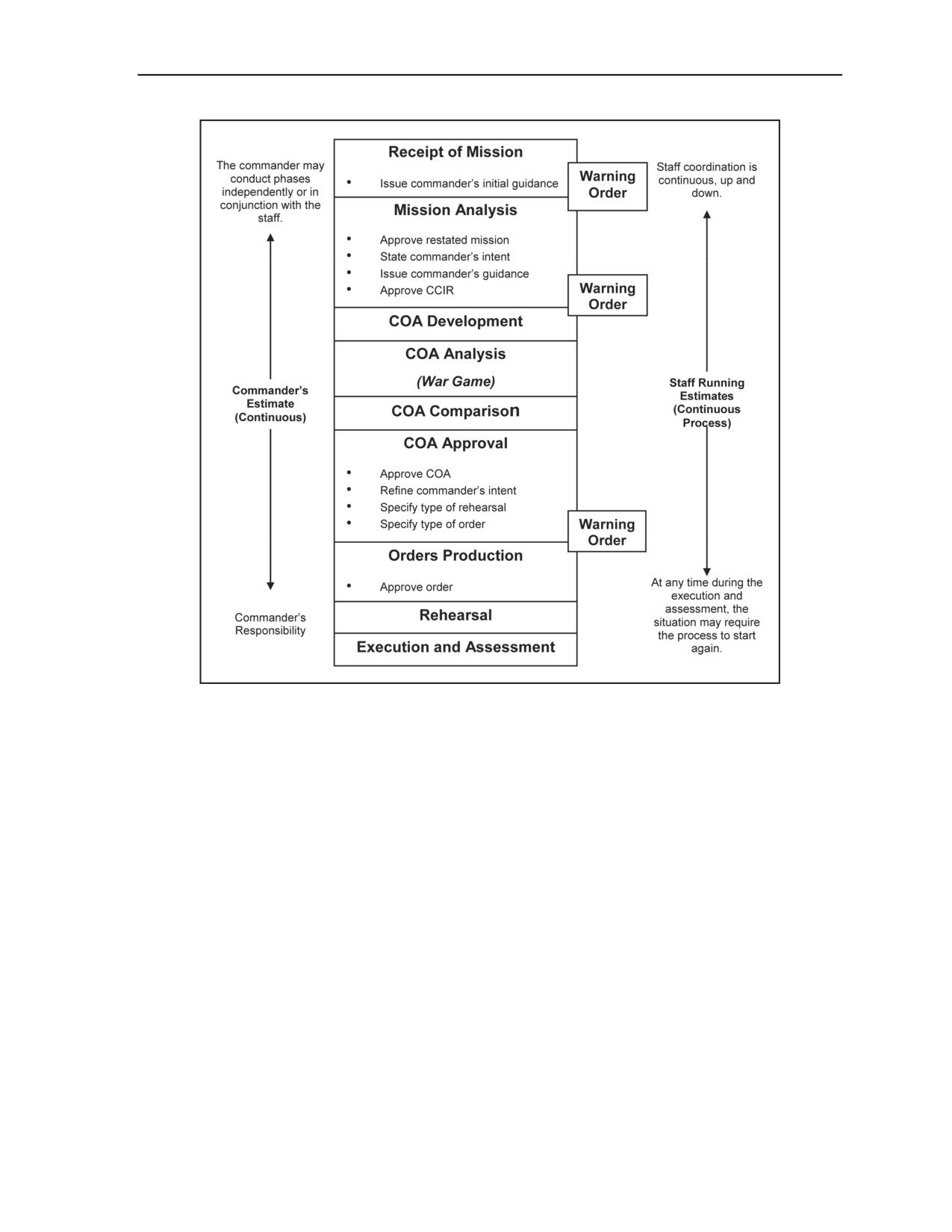
MDMP is defined in detail in FM 5-0 (see figure 4-3, page 4-8). JP 5-0 provides the planning construct in a
joint environment in much the same manner.
2 April 2009
FM 3-34
4-7
Chapter 4
Figure 4-3. The military decision-making process
4-24. Engineer planning will include considerations unique to the particular situation and mission. Some
considerations are more generic and can be summarized for broad reference in any application of the
MDMP. Table 4-2 lists some of the generic engineer planning considerations as they pertain to each step of
the MDMP, focused primarily at operational-level planning.
4-8
FM 3-34
2 April 2009

Planning Engineer Operations
Table 4-2. Engineer considerations in the military decision-making process
Steps of the MDMP
Engineer Considerations
Receipt of the
y Receive higher headquarters plans, orders, and construction directive(s).
Mission
y Understand the commander’s intent and time constraints.
y Request geospatial information about the AO. Provide geospatial engineer products
to the staff for use during the MDMP.
y Establish and participate in engineer-related boards.
Mission
y Analyze available intelligence on existing obstacles. Evaluate terrain, weather, and
Analysis
threat capabilities to determine potential impact on M/CM/S.
y Develop essential tasks for M/CM/S.
y Identify available information on routes and key facilities. Evaluate LOCs, APOD,
and SPOD requirements.
y Determine availability of construction and other engineering materials.
y Review availability of engineer capabilities to include Army, joint, multinational, HN,
and contract.
y Determine beddown requirements for supported force. Review theater construction
standards and base camp master planning documentation. Review unified facilities
criteria as required.
y Review existing geospatial data on potential sites; conduct site reconnaissance (if
possible); and determine the threat (to include environmental and EH).
y Obtain necessary geologic, hydrologic, and climatic data.
y Determine the level of interagency cooperation required.
y Determine funding sources as required.
y Determine terrain and mobility restraints, OBSTINTEL, threat engineer capabilities,
and critical infrastructure. Recommend CCIR.
y Integrate reconnaissance effort.
COA
y Identify priority engineer requirements, including essential tasks for M/CM/S
Development
developed during mission analysis.
y Integrate engineer operations into COA development.
y Recommend an appropriate level of survivability effort for each COA based on the
expected threat.
y Produce construction designs that meet the commander’s intent (use the Theater
Construction Management System [TCMS] if a project is sufficient size and scope).
y Determine alternate construction location, methods, means, materials, and
timelines to give the commander options.
y Determine real property and real estate requirements.
COA
y War-game and refine the engineer plan.
Analysis
y Use the critical path method (CPM) to determine length of different COAs and the
ability to accelerate the project.
COA
y Determine the most feasible, acceptable, and suitable methods of completing the
Comparison
engineering effort.
y Determine and compare the risks of each engineering COA.
COA
y Gain approval of the essential tasks for M/CM/S, construction management plan,
Approval
safety plan, security plan, logistics plan, and environmental plan as required.
Orders
y Produce construction directives as required.
Production
y Provide input to the appropriate plans and orders.
y Ensure that all resources are properly allocated.
Rehearsal
y Coordinate combined arms rehearsals as appropriate.
y Conduct construction prebriefings, preinspections, and construction meetings.
y Synchronize construction plans with local and adjacent units.
2 April 2009
FM 3-34
4-9
Chapter 4
Table 4-2. Engineer considerations in the military decision-making process
Steps of the MDMP
Engineer Considerations
Execution and
y Implement survivability construction standards, including requirements for security
Assessment
fencing, lighting, barriers, and guard posts.
y Conduct quality assurance and midproject inspections.
y Participate in engineer-related boards.
y Maintain “as built” and “red line” drawings.
y Project turnover activities.
STAFF RUNNING ESTIMATE
4-25. The ENCOORD uses the running estimate as a logical thought process and extension of the MDMP.
It is conducted by the ENCOORD concurrently with the planning process of the supported force
commander and is continually refined. This estimate allows for early integration and synchronization of
engineer considerations into combined arms planning processes. In their running estimates, staff sections
continuously consider the effect of new information and update: assumptions, friendly force status, effects
of enemy activity, civil considerations, and conclusions and recommendations. A section’s running
estimate assesses the following:
z
Friendly force capabilities with respect to ongoing and planned operations.
z
Enemy capabilities as they affect the section’s area of expertise for both current operations and
future plans.
z
Civil considerations as they affect the section’s area of expertise for both current operations and
future plans.
z
OE’s effect on current and future operations from the section’s perspective.
4-26. The development and continuous maintenance of the running estimate drives the coordination
between the staff engineer, supporting engineers, the supported commander, and other staff officers in the
development of plans, orders, and the supporting annexes. Additionally, the allocation of engineer assets
and resources assists in determining command and support relationships that will be used. Table 4-3 shows
the relationship between the MDMP and the engineer staff running estimate.
4-10
FM 3-34
2 April 2009

Planning Engineer Operations
Table 4-3. The military decision-making process and the engineer estimate
Military Decision-Making Process
Engineer Staff Running Estimate
Mission Analysis:
Mission Analysis:
•
Analyze higher headquarters
•
Analyze higher headquarters orders, including—
order.
Commander’s intent.
•
Conduct IPB.
Mission.
•
Determine specified, implied, and
Concept of operation.
essential tasks.
Timeline.
•
Review available assets.
AO.
•
Determine constraints.
•
Conduct IPB and develop engineer staff running
•
Identify critical facts and
estimate, including—
assumptions.
Terrain and weather analysis.
•
Conduct risk assessment.
Enemy mission and M/CM/S capabilities.
•
Determine CCIR.
Friendly mission and M/CM/S capabilities.
•
Analyze the engineer mission, including—
•
Develop ISR plan.
Specified M/CM/S tasks.
•
Plan use of available time.
Implied M/CM/S tasks.
•
Write restated mission.
Assets available.
•
Conduct mission-analysis
Limitations.
briefing.
Risk as applied to engineer capabilities.
•
Approve restated mission.
Time analysis.
•
Develop commander’s intent.
Identify essential tasks for M/CM/S.
•
Issue commander’s guidance.
Restated mission.
•
Issue warning order.
•
Conduct risk assessment.
•
Review facts and assumptions.
Safety.
Environment.
•
Determine terrain and mobility restraints,
OBSTINTEL, threat engineer capabilities, and critical
infrastructure. Recommend CCIR.
•
Integrate engineer reconnaissance effort.
COA Development
Develop scheme of engineer operations.
• Analyze relative combat power.
• Refine essential tasks for M/CM/S.
• Identify engineer missions and allocation of forces and
assets.
• Determine engineer priority of effort and support.
• Refine commander’s guidance for M/CM/S operations.
• Apply engineer employment considerations.
• Integrate engineer operations into the maneuver COA.
COA Analysis
War-game and refine the engineer plan.
COA Comparison
Recommend a COA.
COA Approval
Finalize the engineer plan.
Order Production
• Input the following into a basic OPORD:
Scheme of engineer operations.
Essential tasks for M/CM/S.
Subunit instructions.
Coordinating instructions.
• Prepare engineer annex and appendixes.
2 April 2009
FM 3-34
4-11
Chapter 4
PLANS AND ORDERS
4-27. The staff prepares the order or plan by turning the selected COA into a clear, concise concept of
operations and required supporting information. The concept of operations for the approved COA becomes
the concept of operations for the plan. The COA sketch becomes the basis for the operation overlay. Orders
and plans provide all information subordinates need for execution. Mission orders avoid unnecessary
constraints that inhibit subordinate initiative. The staff assists subordinate unit staffs with their planning
and coordination.
4-28. The engineer staff planner provides input for the appropriate paragraphs in the base plan, as well as
annexes and appendixes of the plan as found in FM 5-0. Chairman, Joint Chiefs of Staff Manual
[CJCSM] 3122.03B, Volume II, is used for joint planning and resulting joint plans and orders. In addition
to developing input for the functionally specific paragraphs in the base plan, annexes, and appendixes of
the plan, engineer planners must review other sections. Engineers ensure the integration of geospatial
support in appropriate sections and annexes. Engineers review the task organization to ensure sufficient
capability to meet identified requirements. The engineer planner recommends appropriate command or
support relationships. Additionally, planners provide input to the flow of the engineer force as detailed on
the time-phased force and deployment data (TPFDD). Engineers review operations sections, annexes, and
overlays to ensure the inclusion of obstacle effects or other graphics and assist in conveying engineer
operations. In the fires sections, engineers work with the fire support coordinator and other members of the
staff to integrate obstacles with fire, including SCATMINEs and confirming that all obstacles are covered
by fire.
4-29. An engineer annex is the principal means through which the engineer defines engineer support to the
maneuver commander’s intent, essential tasks for M/CM/S, and coordinating instructions to subordinate
commanders. It is not intended to function as the internal order for an engineer organization, where the
engineer commander will articulate intent; concept of operations; and coordinating instructions to
subordinate, supporting, and supported commanders. The preparation of the annex seeks to clarify engineer
support to the OPLAN or OPORD and includes the—
z
ENCOORDs overall description of the concept for engineer operations, including approved
essential tasks for M/CM/S.
z
Priorities of work to shape the theater or AO (not in a tactical-level engineer annex).
z
Operational project planning, preparation, and execution responsibilities (not in a tactical-level
engineer annex).
z
Engineer organization for combat.
z
Essential tasks for M/CM/S for subordinate units.
z
Allocations of Class IV
(construction and barrier materials) and Class V
(munitions and
demolitions).
Note. Guidance to maneuver units on obstacle responsibilities should be listed in the body of the
basic order, not in the annex.
4-30. The ENCOORD may produce an engineer overlay in conjunction with the operations overlay to
highlight obstacle information or breaching operations. A gap crossing operation may require a separate
annex as part of an order.
4-31. The ENCOORD performs as the staff integrator and advisor to the commander for environmental
considerations. An environmental considerations appendix parallels guidance from the joint OPLAN,
OPORD, or concept plan (CONPLAN). See FM 3-100.4 for an example of this appendix. When specific
command procedures dictate, other staff officers include some environmental considerations in logistics
and medical annexes. Unit planning at the regiment or brigade level and below will normally include only
those elements required by higher headquarters orders or plans that are not already included in a unit SOP.
If this appendix is not written, appropriate material will be placed in the coordinating instructions of the
basic order.
4-12
FM 3-34
2 April 2009
Planning Engineer Operations
ASSURED MOBILITY
4-32. Planners employ the fundamentals of assured mobility as a planning process to assure the ability of
the joint force to deploy and maneuver where and when desired, without interruption or delay, to achieve
the mission. This construct is one means of enabling a joint force to achieve the commander’s intent.
Assured mobility emphasizes proactive mobility and countermobility (and supporting survivability) actions
and integrates all of the engineer functions in accomplishing this. The fundamentals of assured mobility
may also be, in certain circumstances, employed during the integrated application of the broader array of
maneuver support capabilities.
4-33. Assured mobility can be applied at the strategic level (ports, rail, and roads), at the operational level
(sustainment routes and airfields), and at the tactical level (the commander’s freedom to maneuver). While
the engineer has the primary staff role in assured mobility, other staff members support its integration and
have critical roles to play. Ultimately, assured mobility is the commander’s responsibility. The
fundamentals of assured mobility are predict, detect, prevent, avoid, neutralize, and protect. These
fundamentals support the implementation of the assured mobility framework.
z
Predict. Engineers and other planners must accurately predict potential enemy impediments to
joint force mobility by analyzing the enemy’s TTP, capability, and evolution. Prediction
requires a constantly updated understanding of the OE.
z
Detect. Using ISR assets, engineers and other planners identify the location of natural and man-
made obstacles, preparations to create and emplace obstacles, and potential means for obstacle
creation. They identify both actual and potential obstacles and propose solutions and alternate
COAs to minimize or eliminate their potential impact.
z
Prevent. Engineers and other planners apply this fundamental by denying the enemy’s ability to
influence mobility. This is accomplished by forces acting proactively before the obstacles are
emplaced or activated. This may include aggressive action to destroy enemy assets and
capabilities before they can be used to create obstacles.
z
Avoid. If prevention fails, the commander will maneuver forces to avoid impediments to
mobility, if this is viable within the scheme of maneuver.
z
Neutralize. Engineers and other planners plan to neutralize, reduce, or overcome obstacles and
impediments as soon as possible to allow unrestricted movement of forces. The breaching tenets
and fundamentals apply to the fundamental of “neutralize.”
z
Protect. Engineers and other elements plan and implement survivability and other protection
measures that will deny the enemy the ability to inflict damage as joint forces maneuver. This
may include countermobility missions to deny the enemy maneuver and provide protection to
friendly maneuvering forces.
ESSENTIAL TASKS FOR MOBILITY, COUNTERMOBILITY, AND
SURVIVABILITY
4-34. Increased engineer requirements in the OE may limit engineer resources immediately available to
support mobility operations. Combat and general engineering requirements are often in competition for the
same engineer assets. The maneuver commander sets the priorities to allow the force to perform the most
critical tasks. The ENCOORD and other staff members assist the maneuver commander in his decision by
identifying essential tasks for M/CM/S.
4-35. An essential task for M/CM/S is a specified or implied M/CM/S task that is critical to combined
arms mission success. Like other essential tasks, these tasks are identified from the specified and implied
tasks listed during mission analysis. Although ultimately executed by a combined arms element, the staff
2 April 2009
FM 3-34
4-13
Chapter 4
(typically elements such as engineer, CBRN, MP, or EOD) identifies and recommends the essential tasks
for M/CM/S to the commander. A fully developed essential task for M/CM/S includes the task and
purpose.
z
Task. A task is one or more clearly defined and measurable activities accomplished by
individuals and organizations required to achieve the desired effects (see FM 7-0). These are the
most important M/CM/S tasks that must be accomplished. Often the entire operation is
dependent on completing these tasks, and without their successful completion, the operation is at
risk.
z
Purpose. The purpose is the desired or intended result of the task, stated in terms relating to the
purpose of the supported unit. This portion of the essential task for M/CM/S explains why it
must be accomplished. It also provides intent to the engineer commander so he can be reactive
as the situation changes.
4-36. The maneuver commander uses essential tasks for M/CM/S to communicate to subordinate
maneuver units what he wants accomplished with available assets to perform M/CM/S tasks. This provides
the maneuver unit with clear priorities and unity of purpose in planning, preparation, and execution.
Essential tasks for M/CM/S also provide CBRN, MP, PSYOPs, CA, and other nonengineer elements
clearly articulated tasks related to M/CM/S. Sample engineer related essential tasks for M/CM/S might
include—
z
Essential task for M/CM/S #1 (see FM 3-34.170).
Task: Conduct engineer reconnaissance of MSR Tigers from CP 1 to CP 2.
Purpose: Classify the route, identify impediments to maneuver, and facilitate planning of
route clearance operations.
z
Essential task for M/CM/S #2 (see FM 3-34.170 and FM 3-90.12).
Task: Conduct engineer reconnaissance of Crossing Area White.
Purpose: Collect and confirm crossing site data, and locate key BCT river crossing
locations.
z
Essential task for M/CM/S #3 (see FM 3-34.170).
Task: Conduct an infrastructure reconnaissance of the power station at grid ST231546.
Purpose: Assess the status of the power station to enhance the SU of critical infrastructure
throughout the AO.
z
Essential task for M/CM/S #4 (see FM 3-34.170).
Task: Conduct engineer reconnaissance of buildings at grid ST234544.
Purpose: Determine if the buildings are adequate to house a BCT headquarters from a
protection standpoint.
z
Essential task for M/CM/S #5 (see FM 3-34.2).
Task: Conduct a deliberate breach at point of penetration 1 and 2.
Purpose: To facilitate the passage of BCT maneuver forces through obstacles and continue
the attack to BCT Objectives Red and Green.
z
Essential task for M/CM/S #6 (see FM 3-34.2).
Task: Conduct a route clearance of Route Dolphin.
Purpose: To clear the route of all obstacles and EH, in order to facilitate the uninterrupted
movement of critical sustainment elements and allow resupply of BCT elements.
z
Essential task for M/CM/S #7 (see FM 5-103).
Task: Employ sensored, scaleable obstacles as part of base camp security.
Purpose: Provide early warning and a combination of nonlethal and lethal means of
defeating intruders.
z
Essential task for M/CM/S #8 (see FM 5-103).
Task: Support hardening of FOB Bears.
Purpose: Construct revetments and berms to protect key assets at the FOB.
4-14
FM 3-34
2 April 2009
Planning Engineer Operations
4-37. Essential tasks for M/CM/S development begins during the mission analysis phase of the MDMP.
During this phase, planners identify specified and implied tasks and associated purpose. From these tasks,
combined with the maneuver commander’s guidance, the ENCOORD and other staff representatives
recommend essential tasks for M/CM/S to maneuver commanders during the mission analysis brief. After
essential tasks for M/CM/S are approved, the ENCOORD and other planners integrate them into COA
development.
SECTION III-JOINT AND OTHER PROCESSES
JOINT ENGINEER PLANNING
4-38. Joint planning is focused at the strategic and operational levels of war. While corps and below Army
units normally conduct Army tactical planning, Army forces frequently participate in or conduct joint
operations planning. For example, ASCCs routinely participate in joint operation planning, to include
developing plans as the joint force land component. Corps and divisions perform joint operations planning
when serving as a JTF or Army forces headquarters. Corps, divisions, and brigades directly subordinate to
a JTF participate in joint operations planning and receive joint formatted orders. It is important that Army
leaders serving in headquarters above battalion understand the joint planning process and are familiar with
the joint format for plans and orders.
4-39. The primary joint doctrinal publication for planning engineer operations is JP 3-34. Army planners
should understand that the Air Force and Navy have a narrower focus for the engineering mission and
consider (general) engineering to be primarily a logistic function that is executed to sustain their forces in a
contingency operation. Their activities tend to focus on missions (such as base camp and life support
development and construction and repair of SPODs, APODs, and other facilities and sites) and not focus
on operational support to ground maneuver forces. The NCF’s DS bridging mission in support of
maneuver forces is an exception to this broad generalization of the Navy focus areas.
4-40. Joint engineer activities and considerations are similar during both the contingency and crisis action
planning processes. For additional information about the deliberate planning and crisis action planning
processes, see CJCSM 3122.01A, Volume I, and JP 5-0. The ESP (Appendix 6, Annex D, of a joint
OPLAN) is produced by a joint engineer staff for input to a joint OPLAN as part of the planning process. It
ensures that essential engineering capabilities are identified and will be provided at the required locations
and times. It is the most critical appendix for engineering in a joint OPLAN. Other critical portions of a
joint OPLAN for engineer planning include—
z
Appendix 8, Annex C: Air Base Operability.
z
Appendix 15, Annex C: Force Protection.
z
Appendix 16, Annex C: Critical Infrastructure Protection.
z
Appendix 5, Annex D: Mobility and Transportation.
z
Annex G: Civil-Military Operations.
z
Annex L: Environmental Considerations.
z
Annex M: Geospatial Information and Services.
4-41. The engineer prepares several annexes and appendixes, provides significant input to others, and must
review still others due to their possible significant impact on engineer operations (see table 4-4, page 4-16).
2 April 2009
FM 3-34
4-15

Chapter 4
Table 4-4. Operation plan annexes
Subject
Annex
Subject
Annex
Task Organization
A
Communications System
K
Intelligence
B
Environmental Considerations
L
Operations
C
Geospatial Information and Services
M
Appendix A, Special Operations
Appendix 6, Rules of Engagement
Appendix 7, Reconnaissance
Appendix 8, Air Base Operability
Appendix 12, Counterattack
Appendix 13, Explosive Ordnance Disposal
Appendix 14, Amphibious Operations
Appendix 15, Force Protection
Appendix 16, Critical Infrastructure
Protection
Logistics
D
Space Operations
N
Appendix 5, Mobility and Transportation
Appendix 6, Engineer Support Plan
Personnel
E
Host-Nation Support
P
Public Affairs
F
Medical Services
Q
Civil-Military Operations
G
Special Technical Operations
S
Meteorological
H
Execution Checklist
X
Command Relationships
J
Distribution
Z
The joint force engineer—
z
Prepares italicized annexes and appendixes.
z
Provides significant input for the development of bolded annexes and appendixes.
z
Reviews all other annexes and appendixes due to their possible significant impact on
engineer
operations and provides input as appropriate.
4-42. The Joint Engineer Planning and Execution System (JEPES) is a tool used to support quantitative
aspects of engineering support planning and execution. It provides the general requirements for the ESP
and provides a common automated system for the joint force engineer planners to determine the
appropriate amount of engineer assets and capabilities to support the selected COA. JEPES is the engineer
component of the Global Combat Support System, a web-based application residing on the SIPRNET.
JEPES assists engineer planners in determining the correct engineer capability for the proper location,
timed correctly to support the concept of operations. JEPES includes a TCMS module to assist with
facilities planning and links into construction resource and materials planning. It also includes an
environmental module. JEPES is used to—
z
Generate time-phased facility requirements based on the OPLAN.
z
Analyze and assess engineering support by comparing facility requirements to in-theater facility
assets and HN, contract, and troop engineering capability.
z
Provide facility feasibility assessment, manpower, material, and nonunit cargo requirements for
other processes.
z
Provide infrastructure data to assist in mission analysis and COA development.
z
Provide real time monitoring capability needed to track plan execution.
4-16
FM 3-34
2 April 2009
Planning Engineer Operations
FORCE PROJECTION
4-43. Force projection is the ability to project the military instrument of national power from the U.S. or
another theater in response to requirements for military operations. (JP 5-0) Force projection operations
extend from mobilization and deployment of forces to redeployment to CONUS or home theater.
4-44. The most important characteristic of force projection is synchronizing assets at all levels of war and
projecting forces rapidly in response to a crisis or other military requirement. Force projection operations
may begin as contingency operations, involving imminent or actual involvement during war, or as conflict
on a regional scale involving stability or support missions. Force projection also applies to rapidly
deploying forces to respond to a Homeland Security requirement or national emergency or disaster. In
combat operations, theater aims may be achieved faster by committing a smaller forward presence force
than by waiting for a larger, but less timely, response option. In this case, U.S. forces could be opposed;
however, force projection may occur unopposed. Unopposed operations could afford forces time to
continue to build combat power, train, and acclimate after they arrive in-theater. The engineer will conduct
force projection as part of the overall joint and, possibly, multinational force operation. Engineer support
efforts require close coordination with joint and coalition military engineer forces and other agencies to
meet force projection requirements. Operational requirements for force projection enablers may require
creating or upgrading an intermediate staging base, a rapid port enhancement, or a similar support. These
missions would require extensive use of engineer support in the earliest stages of force projection.
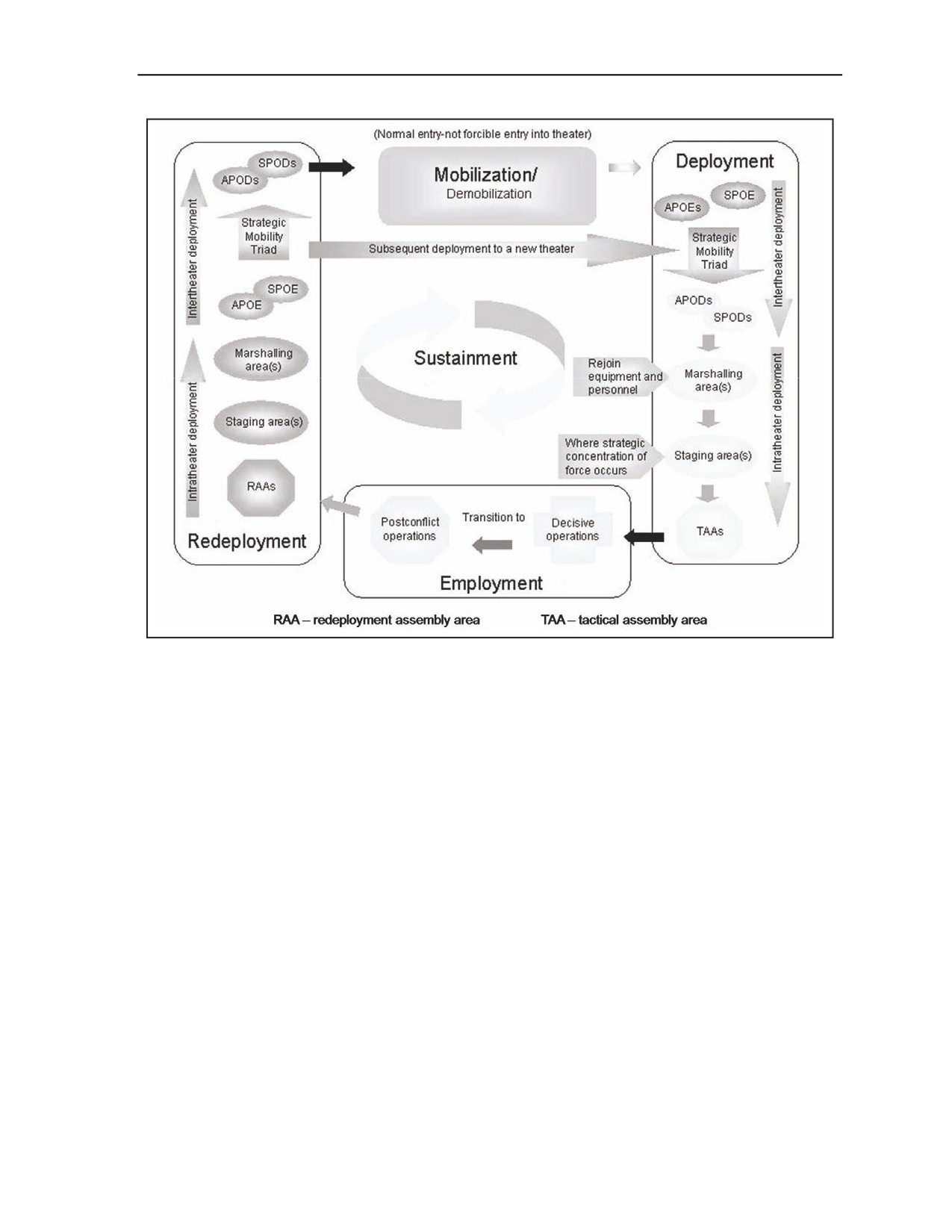
4-45. Force projection encompasses five processes—mobilization, deployment, employment, sustainment,
and redeployment—that normally occur in a continuous, overlapping, and iterative sequence for the
duration of the mission (see figure 4-4, page 4-18).
2 April 2009
FM 3-34
4-17
Chapter 4
Figure 4-4. Force projection process
4-46. Deployment activities, for example, might be so closely followed by decisive operations that they are
indistinct from one another. Decisive operations may begin well before the entire force has completely
deployed. At a minimum, commanders and staffs must consider the—
z
Coordination of sequencing and phasing of forces (maneuver, operational support, operational
protection, SOF, and C2/intelligence and surveillance [IS]/ISR).
z
Requirement and time frame to establish and build up the theater infrastructure.
z
Environmental issues and the need to reduce the risk of negative impacts on HSS.
z
Protection of forces, to include security operations, TCF, and ADC.
z
Preparation time for deployment and operational readiness (types of units and their readiness).
z
CCDR's critical items list in the TPFDD flow.
z
Requirement and level of in-theater stocks.
z
HN capability and availability.
4-47. Any particular force projection operation may not include all of the processes. For example, a force
projection operation may be the first phase of an evolving major operation. Redeployment of all forces may
not begin until the end of the subsequent phases of the major operation, of which the force projection was a
single phase.
FACILITIES AND CONSTRUCTION PLANNING
4-48. Engineers must plan for the acquisition of uncontaminated land and facilities and their management
and ultimate disposal to support operations, including—
z
Operational facilities (such as CPs, airfields, and ports).
4-18
FM 3-34
2 April 2009
Planning Engineer Operations
z
Logistic facilities (such as maintenance facilities, supply points, warehouses, ammunition supply
points (ASPs), and APOD or SPOD for sustainment).
z
Force beddown facilities (such as dining halls, billeting, religious support facilities, clinics, and
hygiene facilities).
z
Common-use facilities (such as roads and joint RSOI facilities).
z
Protection facilities
(such as site selection, proximity to potential threat areas, and sniper
screening).
4-49. The commander determines what facilities are needed to satisfy operational requirements. Facilities
are grouped into six broad categories that emphasize the use of existing assets over new construction. To
the maximum extent possible, facilities or real estate requirements should be met from these categories in
the following priority order:
z
U.S.-owned, occupied, or leased facilities (including captured facilities).
z
U.S.-owned facility substitutes pre-positioned in-theater.
z
HN or multinational support where an agreement exists for the HN or multinational element to
provide specific types and quantities of facilities at specified times in designated locations.
z
Facilities available from commercial sources.
z
U.S.-owned facility substitutes stored in the United States.
z
Construction of facilities that are considered shortfall after an assessment of the availability of
existing assets.
4-50. The engineer staff should plan expeditious construction of facility requirements that are considered
shortfalls (such as those facilities that cannot be sourced from existing assets). In these circumstances, the
appropriate Service, HN, alliance, or coalition should—to the extent possible—perform construction
during peacetime. Contracting support should be used to augment military capabilities. If time constraints
risk new construction not being finished in time to meet mission requirements, the engineer should seek
alternative solutions to new construction. Expedient construction (rapid construction techniques such as
prefabricated buildings and clamshell structures) should also be considered, because these methods can be
selectively employed with minimum time, cost, and risk.
4-51. Adequate funding (see Appendix G) must be available to undertake early engineer reconnaissance
and acquisition of facilities to meet requirements, whether by construction or leasing. Funding constraints
are a planning consideration. The commander articulates funding requirements for construction and leasing
of facilities by considering the missions supported and the amount of funds required. Funding requirements
include facility construction, associated contract administration services, and real estate acquisition and
disposal services. Facility construction planning must be routinely and repetitively accomplished to ensure
that mission-essential facilities are identified well in advance of the need and, wherever possible, on-the-
shelf designs are completed to expedite facility construction in time of need.
4-52. The CCDR, in coordination with Service components and the Services, specifies the construction
standards for facilities in the theater to optimize the engineer effort expended on any given facility while
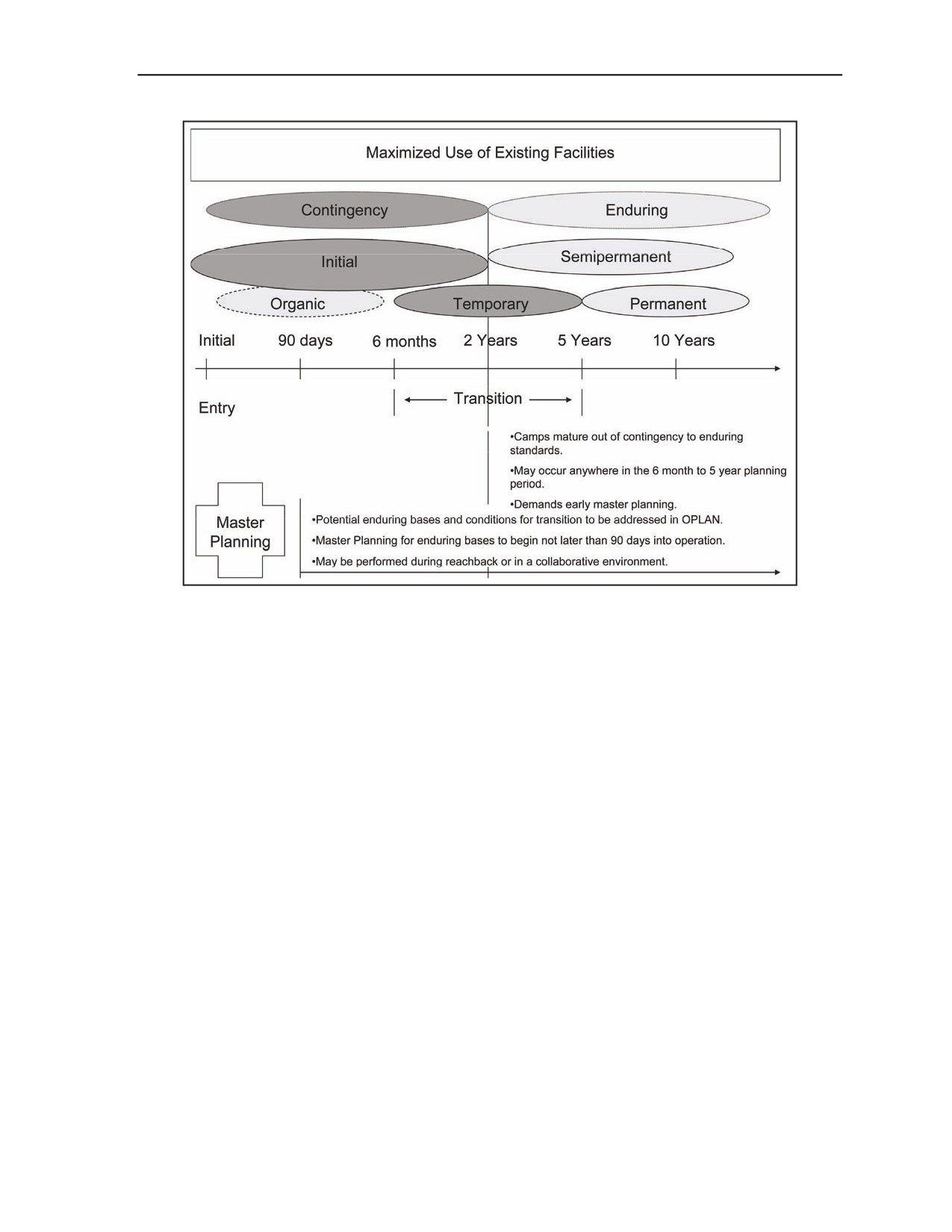
assuring that the facilities are adequate for health, safety, and mission accomplishment. Figure
4-5,
page 4-20, shows the beddown and basing continuum and highlights the need for early master planning
efforts to help facilitate transition to more permanent facilities as an operation develops. While the
timelines provide a standard framework, the situation may warrant deviations from them. In addition to
using these guidelines when establishing initial construction standards, the JFUB should be used to
periodically revalidate construction standards based on current operational issues and provide
recommendations to the commander on potential changes. Ultimately, it is the CCDR who determines the
exact construction type based on location, materials available, and other factors. Construction standards are
guidelines and the engineer must consider other factors in their planning (see FM 3-34.400 and JP 3-34 for
additional discussion of construction standards).
2 April 2009
FM 3-34
4-19
Chapter 4
Figure 4-5. Force beddown and base development
4-53. Unified facilities criteria
(UFC) provide facility planning, design, construction, operations, and
maintenance criteria for all DOD components. Individual UFC are developed by a single-disciplined
working group and published after careful coordination. They are jointly developed and managed by
USACE, NAVFAC, and the Air Force Civil Engineer Support Agency (AFCESA). Although UFC are
written with long-term standards in mind, planners who are executing under contingency and enduring
standards for general engineering tasks will find them useful. Topics include pavement design, water
supply systems, military airfields, concrete design and repair, plumbing, electrical systems, and many
more.
4-54. UFC are living documents and will be periodically reviewed, updated, and made available to users as
part of the Services’ responsibility for providing technical criteria for military construction. UFC are
effective upon issuance and are distributed only in electronic media from the following sources:
z
UFC index at <http://65.204.17.188//report/doc_ufc.html>.
z
USACE Technical Information at <http://www.hnd.usace.army.mil/techinfo>.
z
NAVFAC Engineering Innovation and Criteria Office at
z
Construction Criteria Base System maintained by the National Institute of Building Sciences at
4-55. General engineer planners must consider any and all construction standards established by CCDRs
and ASCCs for their AOR. Specific examples of these are the “Red Book” in the United States European
Command (USEUCOM) AOR and “Sand Book” in United States Central Command (USCENTCOM).
These constantly evolving guidebooks specifically establish base camp standards that consider regional
requirements for troop living conditions and therefore have a major impact on projects such as base camps
and utilities. Because availability of construction materials may vary greatly in various AORs, standards of
construction may differ greatly between them. CCDRs often establish standards for construction in
OPORDs and FRAGOs that may take precedence over guidebooks. Planners must understand the expected
4-20
FM 3-34
2 April 2009
Planning Engineer Operations
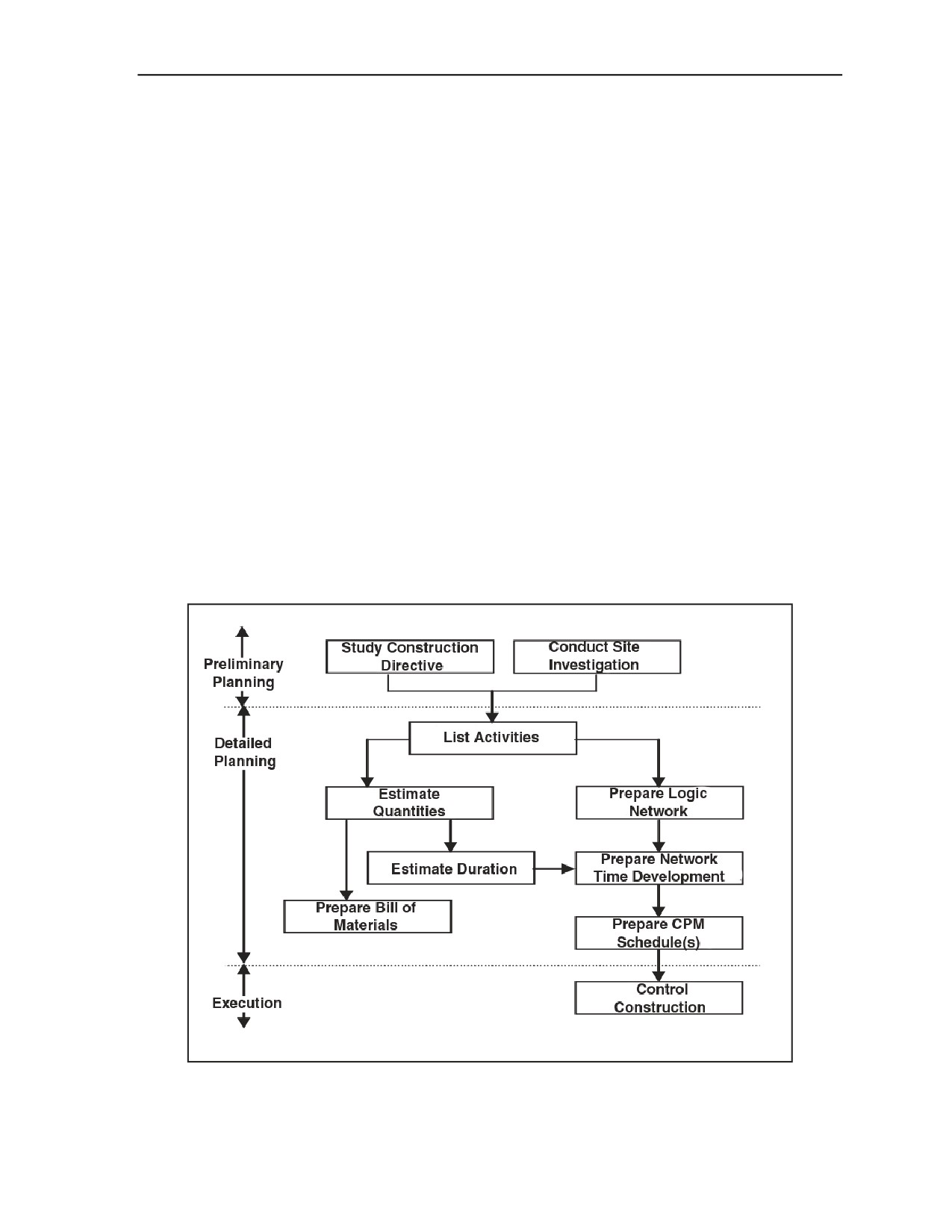
life cycle of a general engineering project to apply these standards. Often the standards will be markedly
different, depending on whether the construction is contingency or is intended to have an enduring
presence.
PROJECT MANAGEMENT
4-56. Planners use the project management system described in FM 5-412 as a tool for the process of
coordinating the skill and labor of personnel using machines and materials to form the materials into a
desired structure. Figure
4-6 shows the project management process that divides the effort into the
preliminary planning, detailed planning, and project execution. Today, when engineer planners are focused
on general engineering tasks, they rely extensively on the TCMS to produce the products required by the
project management system. These products include the design, activities list, logic network, CPM or Gantt
Chart, bill of materials, and other products. Effective products produced during the planning phases also
greatly assist during the construction phase. In addition to TCMS, the engineer has various other reachback
tools or organizations that can exploit resources, capabilities, and expertise that is not organic to the unit
that requires them. These tools and organizations include, but are not limited to, USAES, USACE
Engineering Infrastructure and Intelligence Reachback Center and ERDC Tele-Engineering Operations
Center, the 412th and 416th TECs, AFCESA, and NAVFAC. See Appendix H for additional information
on how to access reachback support.
4-57. The project management process normally begins at the unit level with the construction directive.
This gives who, what, when, where, and why of a particular project and is similar to an OPORD in its
scope and purpose. Critical to the construction directive are plans, specifications, and all items essential for
success of the project. Units may also receive general engineering missions as part of an OPORD,
FRAGO, warning order, or verbal order/instruction. When a leader analyzes a construction directive, he
may need to treat it as a FRAGO in that much of the information required for a thorough mission analysis
may exist in an OPORD issued for a specific contingency operation.
Figure 4-6. Project management process
2 April 2009
FM 3-34
4-21
Chapter 5
Preparing, Executing, and Assessing Engineer Operations
Prepare for the unknown by studying how others in the past have coped with the
unforeseeable and the unpredictable.
General George S. Patton
Full spectrum operations conducted overseas simultaneously combine: offensive,
defensive, and stability operations. Within the United States and its territories,
operations simultaneously combine offensive, defensive, and civil support operations.
Army forces adapt to the requirements of the OE and conduct operations within it.
Army forces operate through ever-changing combinations of full spectrum operations
using synchronized action, joint interdependent capabilities, and mission command.
They defeat enemies on land using offensive and defensive operations and engage the
populace and civil authorities in the AO using stability or civil support operations.
The effort accorded to each component is proportional to the mission and varies with
the situation. Each element of full spectrum operations—offense, defense, and
stability or civil support—is necessary in any campaign or joint operation.
Synchronized through the warfighting functions, engineer operations contribute
significant combat power, both lethal and nonlethal in nature, to all of the elements of
full spectrum operations. The operations process is the context within which engineer
capabilities are integrated into combined arms application. Chapter 4 entered the
operations process by discussing various planning activities required for effective
engineer operations. This chapter continues in that context by discussing preparation,
execution, and continuous assessment of the entire spectrum of engineer operations.
SIMULTANEOUS COMBINATIONS
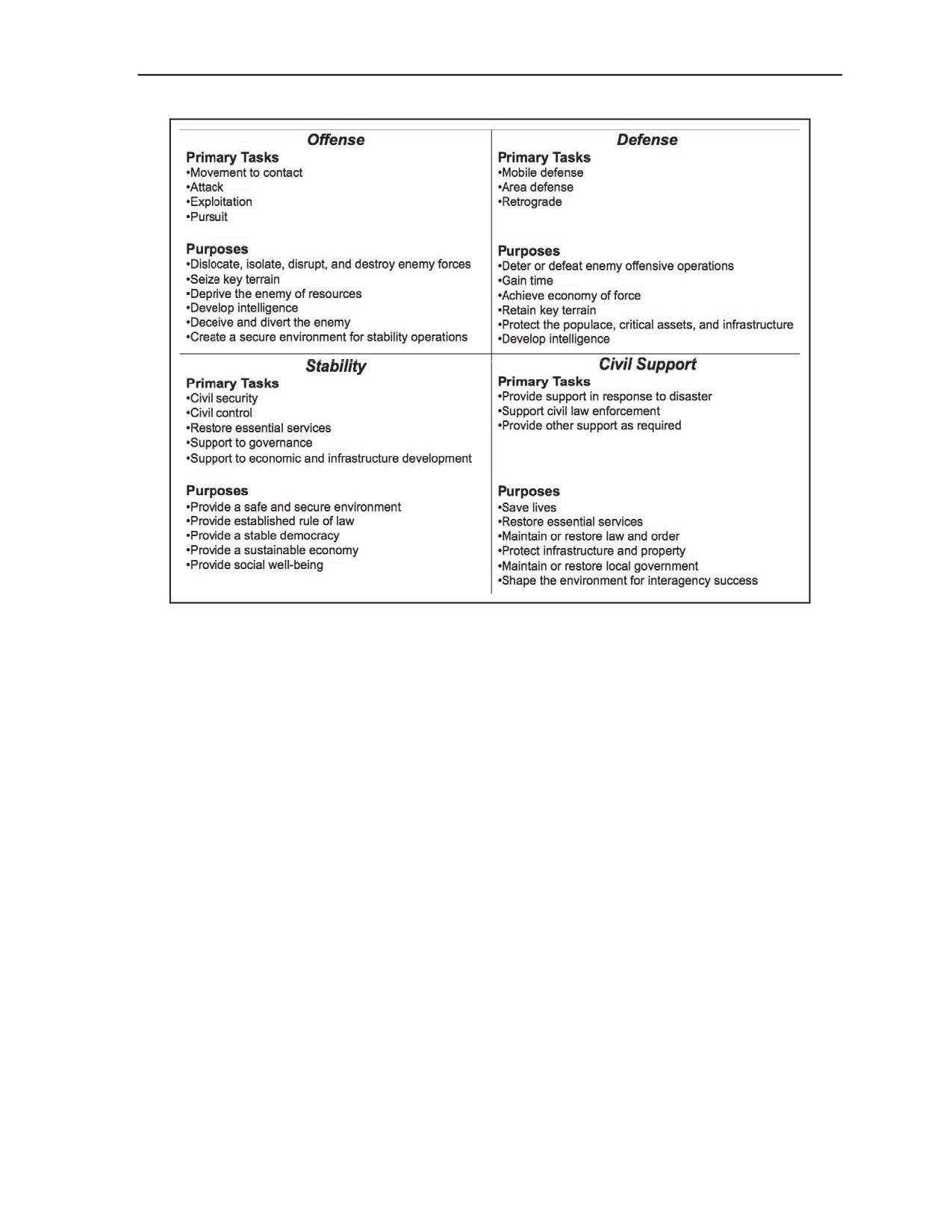
5-1. Full spectrum operations require simultaneous combinations of up to three elements—offense,
defense, and stability or civil support. Figure 5-1, page 5-2, lists the elements of full spectrum operations,
the primary tasks associated with them, and the purposes of each element. Each primary task has numerous
associated subordinate tasks.
5-2. Engineer operations describe the synchronized application of engineer combat power capabilities in
support of full spectrum operations. Engineer capabilities are organized by the engineer functions and
synchronized in their application through the warfighting functions. As described in Chapter 3, the
operations process activities provide the context in which both the synchronization and application are
integrated into the combined arms operation. Chapter 4 described integration of engineer operations
through the planning activities. This chapter will discuss integration through the preparation, execution,
and continuous assessment activities of the process.
2 April 2009
FM 3-34
5-1
Chapter 5
Figure 5-1. Elements of full spectrum operations
OPERATIONS PROCESS ACTIVITIES
5-3. Preparation consists of activities performed by the unit before execution to improve its ability to
conduct the operation. Preparation requires staff, unit, and Soldier actions. Mission success depends as
much on preparation as planning. Rehearsals help staffs, units, and individuals to better understand their
specific role in upcoming operations, practice complicated tasks before execution, and ensure equipment
and weapons function properly. Key preparation activities include—
z
Revision and refinement of the plan.
z
Rehearsals.
z
Tailoring and task-organizing.
z
Surveillance and reconnaissance.
z
Training.
z
Troop movements.
z
Preparations checks and inspections.
z
Sustainment preparations.
z
Integrating new Soldiers and units.
z
Subordinate confirmation back briefs.
5-4. In many cases, engineer units conduct these preparation activities integrated within the combined
arms task organizations required by the operation. Combined arms rehearsals are critical to the success of a
breaching, clearing, or gap crossing operation. Similarly, ERTs can be employed as integrated elements in
a combined arms reconnaissance formation. In every case, engineer reconnaissance efforts must be
integrated within the ISR plan. As required, engineer forces will conduct additional construction or other
5-2
FM 3-34
2 April 2009
Preparing, Executing, and Assessing Engineer Operations
technical preparation activities focused on the specific mission. Construction and technical preparation
activities include—
z
Complete and review the design. In a design-build process, the design will typically only be
completed at a 10 to 30 percent resolution prior to execution.
z
Conduct any necessary preconstruction studies or surveys.
z
Identify additional technical support required.
z
Complete any detailed planning activities not yet completed from the project management
process, such as estimates, bill of materials, and schedules.
z
Prepare the construction site as required; for example, stage equipment, stockpile materials, and
complete temporary construction.
5-5. Execution is putting a plan into action by applying combat power to accomplish the mission and
using SU to assess progress and make execution and adjustment decisions. It focuses on concerted action
to seize, retain, and exploit the initiative. The Army’s operational concept emphasizes executing operations
at a tempo enemies cannot match by acting or reacting faster than they can adapt. To achieve this type of
flexibility, commanders use mission command to focus subordinate commanders’ initiative. Subordinates
exercising initiative within the commander’s intent can significantly increase tempo; however, they also
may desynchronize the unit’s warfighting functions. This may reduce commanders’ ability to mass the
effects of combat power. Even relatively minor, planned actions by CP cells affect other cells’ areas of
expertise, affecting the operation’s overall synchronization.
5-6. Collaborative synchronization enabled and expected by mission command uses subordinates’
initiative to achieve resynchronization continuously. Subordinates’ successes may offer opportunities
within the concept or develop advantages that make a new concept practical. In either case, the
commander’s intent keeps the force acceptably focused and synchronized. Subordinates need not wait for
top-down synchronization. Mission command is especially appropriate for operations in which stability
operations predominate. It allows subordinates to exploit information about enemies, adversaries, events,
and trends without direction from higher echelons.
5-7. During execution, the current operations cell strives to keep the warfighting functions synchronized
and balanced between subordinates’ initiative and synchronized activities as the situation changes. The
current operations cell follows and provides its own level of collaborative synchronization. To assist
commanders in massing the effects of combat power at decisive times and places, the current operations
cell considers the following outcomes when making synchronization decisions or allowing others’
collaborative synchronization to proceed:
z
Combined arms integration.
z
Responsiveness (proactive and reactive).
z
Timeliness.
5-8. Execution involves monitoring the situation, assessing the operation, and adjusting the order as
needed. Throughout execution, commanders continuously assess the operation’s progress based on
information from the COP, running estimates, and assessments from subordinate commanders. When the
situation varies from the assumptions the order was based on, commanders direct adjustments to exploit
opportunities and counter threats.
5-9. The staff, both the engineer unit commander’s staff and the combined arms commander’s engineer
staff, assists the commander in execution through the integrating processes and continuing activities during
execution (see FM 3-0). In addition, commanders, assisted by the staff, perform the following activities
specific to execution:
z
Focus assets on the decisive operation.
z
Adjust CCIR based on the situation.
z
Adjust control measures.
z
Manage movement and positioning of supporting units.
z
Adjust unit missions and tasks as necessary.
z
Modify the concept of operations as required.
2 April 2009
FM 3-34
5-3
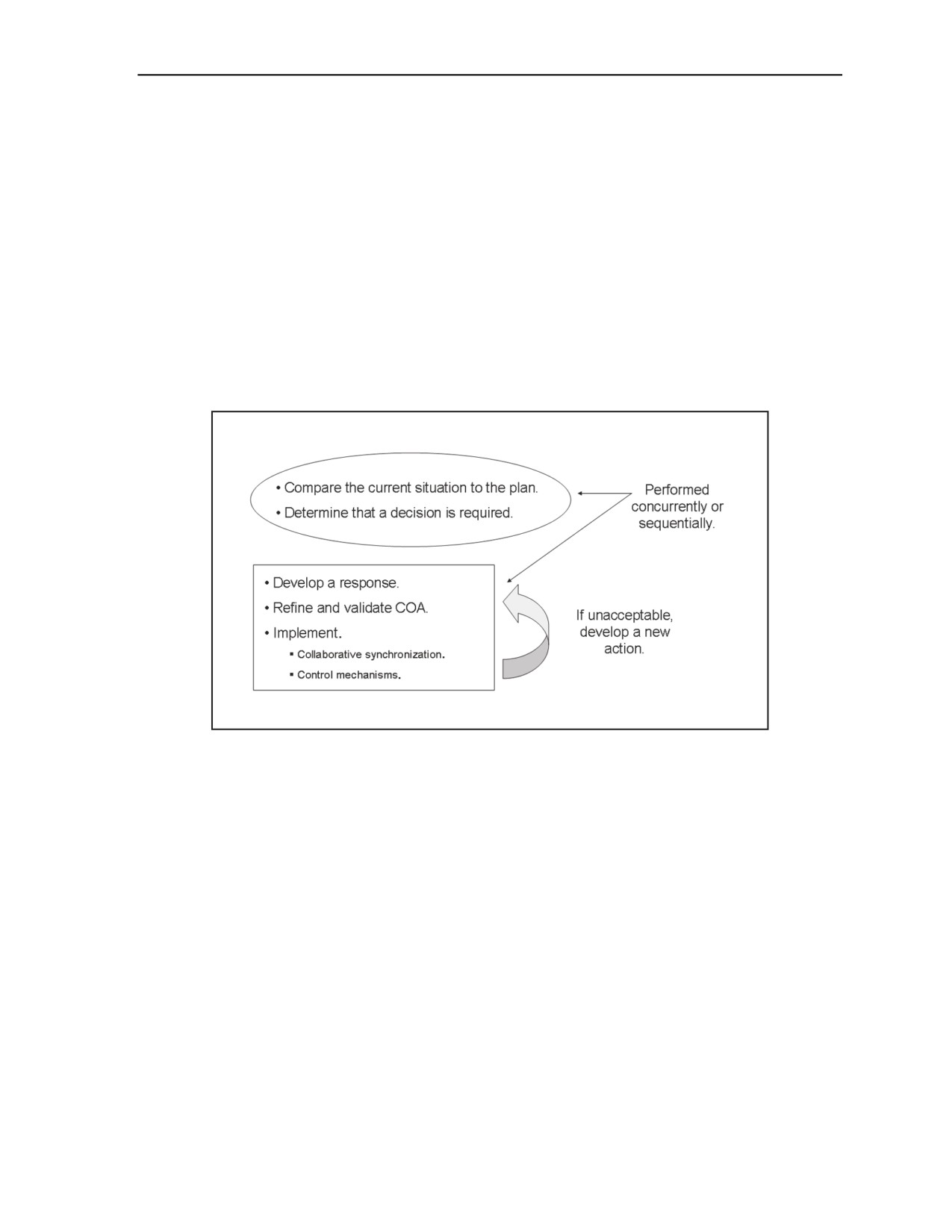
Chapter 5
z
Position or relocate committed, supporting, and reserve units.
5-10. As with preparation, engineer forces will conduct additional construction or other technically related
activities during execution of the specific mission. Construction and technically related execution activities
include the following:
z
Implementation and maintenance of a construction safety program.
z
Implementation and enforcement of quality controls.
z
Periodic design and construction reviews.
z
Preparation of as-built drawings.
z
Response to construction contingencies.
5-11. Commanders and staffs also use the RDSP described in FMI 5-0.1 to make decisions and rapidly
resynchronize forces and warfighting functions when presented opportunities or threats during execution.
The RDSP includes five steps. Leaders perform them as shown in FMI 5-0.1. The first two steps may be
performed in any order, including concurrently. The last three steps are performed interactively until an
acceptable COA is found (see figure 5-2).
Figure 5-2. Rapid decision-making and synchronization process
5-12. Assessment is the continuous monitoring and evaluation of the current situation and progress of an
operation. Commanders, assisted by the staff, continuously assess the current situation and the progress of
the operation and compare it with the commander’s vision throughout the entire operations process. Based
on their assessment, commanders make decisions to direct adjustments, ensuring that the operation remains
aligned with the mission and commander’s intent. Subordinates assess their unit’s progress by comparing it
with their mission and commander’s intent
(one and two echelons up) and adjust their actions to
accomplish the mission and achieve the desired end state.
5-13. Assessment precedes and guides every activity in the operations process and concludes each
operation or phase of an operation. It involves a comparison of forecasted outcomes to actual events, using
measures of performance (MOPs) and measures of effectiveness (MOEs) to judge progress toward success.
It entails two distinct tasks: continuously monitoring the situation and progress of the operation toward the
commander’s desired end state and evaluating the operation against measures of effectiveness and
performance.
z
A measure of performance is a criterion used to assess friendly actions that is tied to measuring
task accomplishment. (JP 3-0) MOPs answer the question: “Was the task or action performed as
the commander intended?” MOPs confirm or deny that we have done things right.
z
A measure of effectiveness is a criterion used to assess changes in system behavior, capability,
or OE that is tied to measuring the attainment of an end state, achievement of an objective, or
5-4
FM 3-34
2 April 2009
Preparing, Executing, and Assessing Engineer Operations
creation of an effect. (JP 3-0) MOEs focus on the results or consequences of friendly actions
taken. They answer the question, “Are we doing the right things or are additional or alternative
actions required?”
5-14. Engineer capabilities may be applied to add technical detail to the commander’s assessment.
Engineer assessment and survey teams gather technically focused information on the physical environment,
infrastructure, or other physical aspects of the AO. Relevant information gathered adds to the depth of the
commander’s understanding and can provide a technical basis for MOPs or MOEs.
5-15. Commanders monitor the current situation for unexpected success, failure, or enemy action that can
prevent the operation from progressing toward the desired end state. As commanders assess progress, they
look for opportunities, threats, or acceptable progress according to the plan. They embrace risk, seize
opportunities, mitigate threats, and adjust the plan as necessary.
5-16. Staffs analyze the situation in terms of mission and/or operational variables to understand the
mission and prepare their staff running estimates. They continuously assess the effects of new information
on the conduct of the operation; they update their staff running estimates and determine if adjustment
decisions are required. Commanders empower their staffs to make adjustments within their areas of
expertise. This requires staffs to understand those aspects of operations that require the commander’s
attention as opposed to those that are delegated to their control.
5-17. Commanders avoid excessive analysis when assessing operations. The assessment process must be
tailored to meet the needs of the commander. It must provide useful feedback on the progress of the
operation that allows the commander to provide guidance and recommendations to the planning staff on
potential course corrections. The focus should be on providing information in a means useful to the
commander. Staffs should avoid developing systems that become all-consuming of resources and staff
effort. Generally, the echelon at which a specific operation, task, or action is conducted should be the
echelon at which the activity is assessed. This focuses assessment at each echelon and enhances the
efficiency of the overall operations process.
SIMULTANEOUS APPLICATION
5-18. Not every echelon or unit will conduct simultaneous full spectrum combinations. Divisions and
higher echelons normally conduct full spectrum operations simultaneously, based on METT-TC. BCTs
may focus exclusively on offensive or defensive operations in a major combat operation, but typically shift
to simultaneous execution of offensive, defensive, and stability operations in irregular warfare or peace
operations. Battalion and smaller units often conduct the elements sequentially, based on their capabilities
and the situation.
5-19. Engineer operations occur throughout the depth of the AO and simultaneously involve applications
in support of any combination of the elements. Simultaneously, throughout the AO combat engineers
prepare, execute, and assess close support of maneuver forces while general engineers support with a focus
on operational mobility, sustainment, and protection. Geospatial support is provided for intelligence and
C2. Integration through the operations process enables synchronization of the various and simultaneous
applications through warfighting functions. At division and higher echelons, the ENCOORD will
simultaneously coordinate the application of capabilities from all three engineer functions. Brigade and
task force engineers may focus coordination activities on one or two of the engineer functions for a
particular operation, but must be able to quickly shift to the integration of other applications as the situation
changes.
OFFENSIVE OPERATIONS
5-20. Seizing, retaining, and exploiting the initiative is the essence of the offense. Offensive operations
seek to throw enemy forces off balance, overwhelm their capabilities, disrupt their defenses, and ensure
their defeat or destruction by maneuver. An offensive ends when the force achieves the operation’s
purpose, reaches a limit of advance, or approaches culmination. Army forces conclude an offensive by
consolidating gains through stability operations, resuming the attack, shifting over to the defense, or
preparing for future operations.
2 April 2009
FM 3-34
5-5
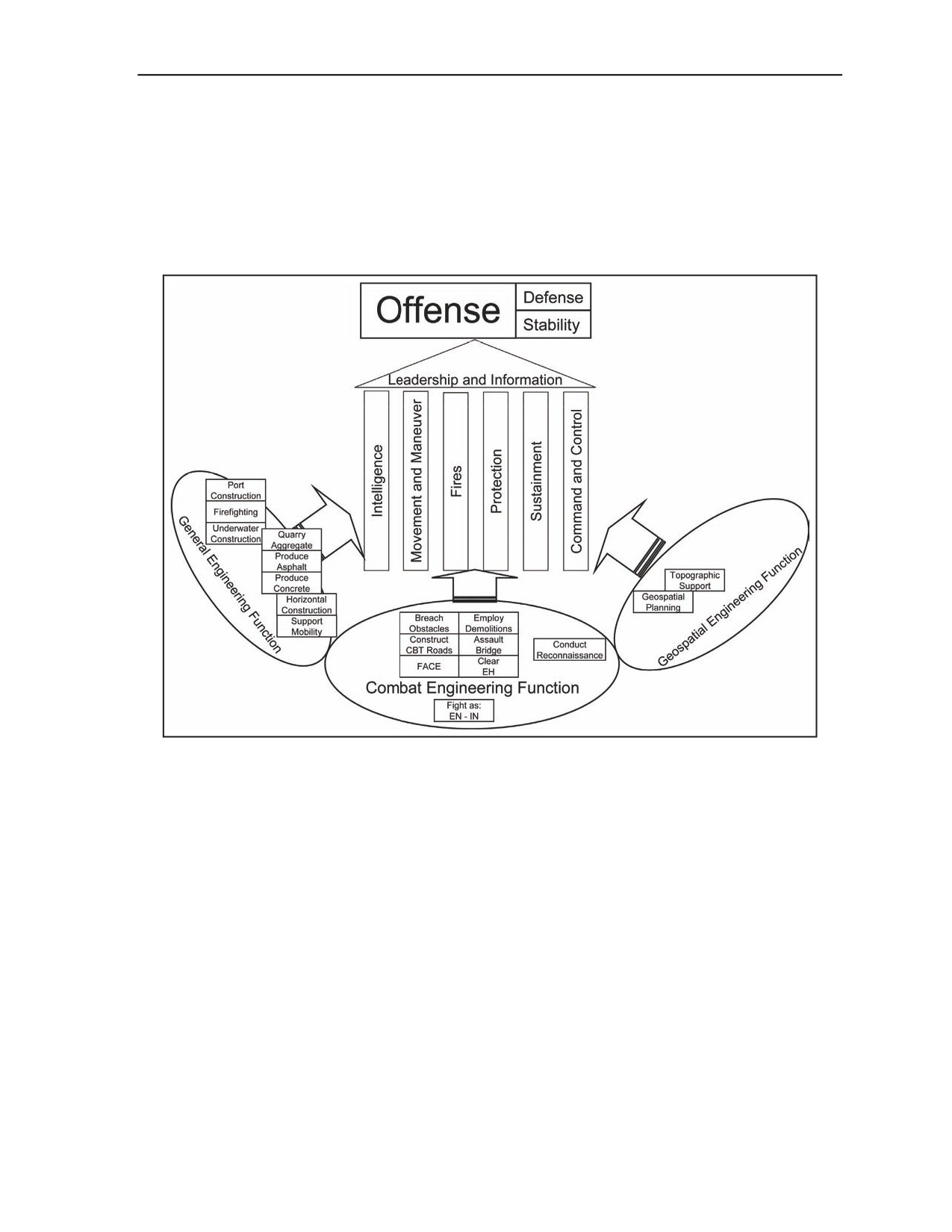
Chapter 5
5-21. Army forces conduct four types of offensive operations: movement to contact, attack, exploitation,
and pursuit. FM 3-90 provides details on the conduct of types of offensive operations.
5-22. Engineer operations supporting the offense include simultaneous application of combat, general, and
geospatial engineer capabilities through synchronizing warfighting functions and throughout the depth of
the AO. Combat engineer operations in close support of maneuver forces are the primary focus in offensive
operations; however, all three functions are applied simultaneously to some degree. The primary focus will
be support that enables movement and maneuver. Figure 5-3 shows a notional application of engineer
capabilities supporting offensive operations.
Figure 5-3. Notional engineer operations in the offense
5-23. Combat engineers use preparation activities to posture engineer assets with their task-organized
gaining or supported headquarters. Engineer units establish early linkups with the maneuver units they will
support. As combat engineer units prepare for offensive operations, they focus on inspections and
combined arms rehearsals. Combined arms breaching and gap-crossing forces are organized and conduct
rehearsals for the breach, assault, and support forces. The ENCOORD at the appropriate echelon
coordinates engineer reconnaissance focused to support the collection of the appropriate OBSTINTEL.
Assault and tactical bridging is moved into staging areas and crossing site reconnaissance is conducted
when possible. Preparation may include creating combat trails or forward LZs. If route clearance
operations are anticipated, clearance teams are organized and focus on inspections and combined arms
rehearsals. Combat engineer preparation activities occur in close proximity and are closely aligned and
integrated with maneuver force preparations.
5-24. ENCOORDs at every echelon coordinate the movement and positioning of general engineer assets
task-organized to augment combat engineer capabilities. Although general engineer assets can be placed in
command or support relationships with the maneuver force, these linkups are more effective directly
between the combat engineer unit being augmented and the general engineer unit providing augmentation.
General engineer assets will require added time for movement given the nature of the heavy and wheeled
equipment employed. For significant construction, preparation activities may require a more technical
engineer reconnaissance to enable adequate project planning and design, including the provision of
5-6
FM 3-34
2 April 2009
Preparing, Executing, and Assessing Engineer Operations
construction materials as required. Specialized engineer assets may also be necessary to accomplish certain
missions. At the operational level, general engineer operations may not be conducted as part of a combined
arms mission but must, nonetheless, be fully coordinated with the maneuver commander responsible for the
AO. These general engineer operations are applied primarily to enable the sustainment warfighting
function, but may be critical to the preparation for an offensive operation, to include support to operational
mobility.
5-25. During offensive operations, fighting and protective position development is minimal for tactical
vehicles and weapon systems. The emphasis lies on mobility of the force. Protective positions for artillery,
AMD, and logistic positions may be required in the offense and defense, although more so in the defense.
Stationary C2 facilities require protection to lessen their vulnerability. During halts in the advance, while
the use of terrain will provide a measure of protection, units should develop as many protective positions as
possible for key weapon systems, C2 nodes, and critical supplies based on the threat level and unit
vulnerabilities. For example, expedient earth excavations or parapets are located to make the best use of
existing terrain. During the early planning stages, terrain analysis teams can provide information on soil
conditions, vegetative concealment, and terrain masking along march routes to facilitate survivability for
the force. Each position design should consider camouflage from the start and the development of
deception techniques as the situation and time permit.
5-26. When executing offensive operations, the maneuver force uses its COP to link detection efforts to
maneuver to avoid encountering obstacles along the route of the attack. The maneuver force can actively
avoid by interdicting threat countermobility before emplacement or passively avoid by identifying,
marking, and bypassing. Assessment enables execution as decisions are made to breach or bypass
obstacles. If the friendly force commander is compelled to neutralize obstacles, the force employs the
breach tenets of intelligence, breach fundamentals, breach organization, mass, and synchronization.
Bypasses are preferred whenever possible and may be handed off to follow-on engineer units for
maintenance and improvement. Similarly, assault bridging must be replaced when feasible with appropriate
tactical or LOC bridging to remain postured for future assault bridge missions. As soon as possible, more
technical level assessments are made to determine feasible and suitable improvements to the LOCs.
DEFENSIVE OPERATIONS
5-27. Defending forces anticipate the enemy’s attack and counter it. Waiting for the attack is not a passive
activity. Commanders conduct aggressive ISR and security operations to seek out enemy forces and deny
information to them. They engage them with Army and joint fires and maneuver to weaken them before
close combat. Commanders use combined arms and joint capabilities to attack enemy vulnerabilities and
seize the initiative. There are three types of tactical operations associated with defense. The three types of
defensive operations are mobile defense, area defense, and retrograde. FM
3-90 provides detailed
information on the conduct of types of offensive operations.
5-28. Engineer operations supporting the defense include simultaneous application of combat, general, and
geospatial engineer capabilities through synchronizing warfighting functions and throughout the depth of
the AO. Combat engineer operations in close support of maneuver forces are the primary focus in
defensive operations; however, all three functions are applied simultaneously to some degree. Figure 5-4,
page 5-8, shows a notional application of engineer capabilities supporting defensive operations.
2 April 2009
FM 3-34
5-7
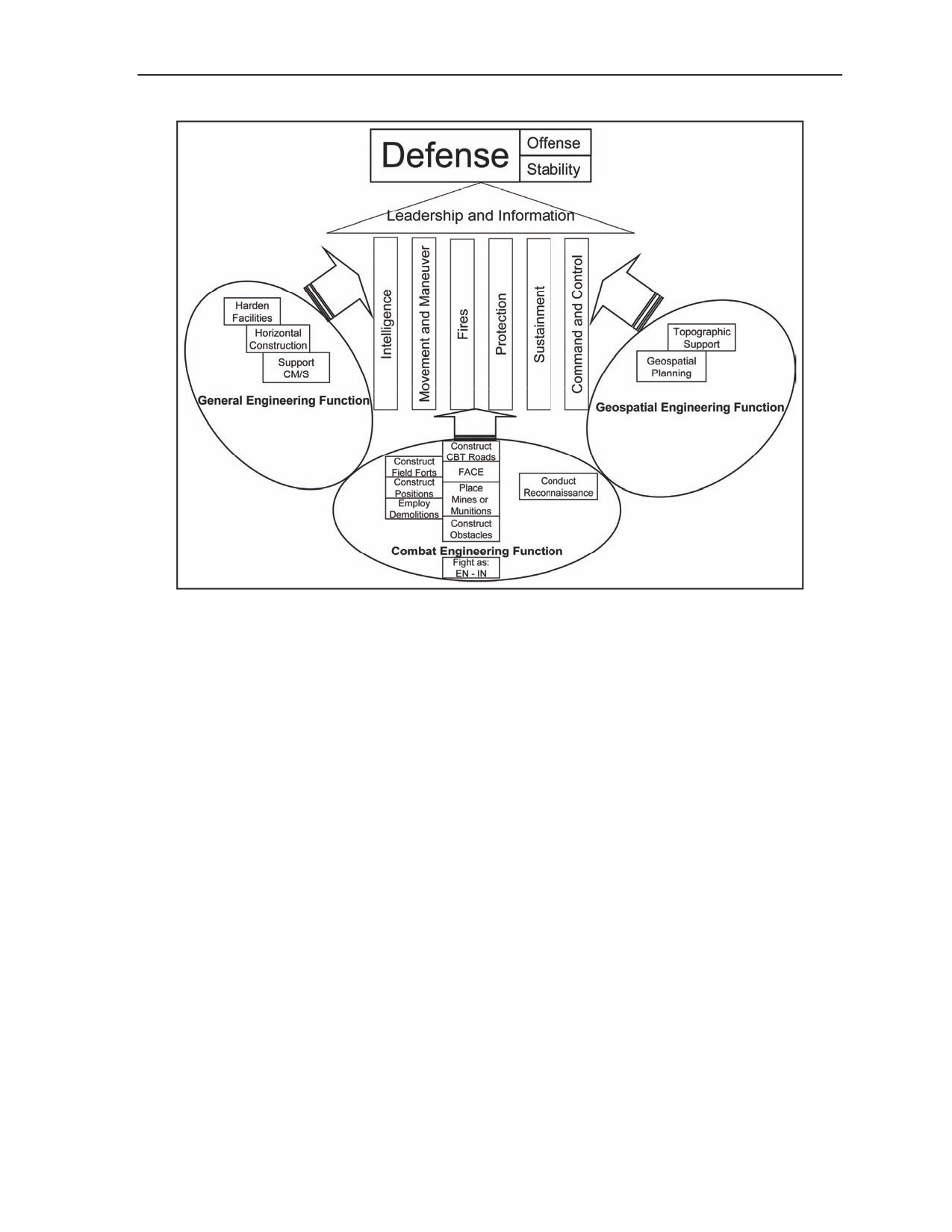
Chapter 5
Figure 5-4. Notional engineer operations in the defense
5-29. In all three types of defensive operations (area defense, mobile defense, and retrograde), the primary
focus for combat engineers is to enable combined arms obstacle integration (countermobility) and assure
mobility to friendly repositioning or counterattacking forces. Defensive missions demand the greatest
survivability effort. Activities in the defense include constructing survivability positions for C2, artillery,
AMD, and critical equipment and supplies. They also include preparing individual and crew-served
fighting positions and defilade fighting positions for combat vehicles. The use of engineer work timelines
is essential and digging assets are intensively managed. During this period, countermobility efforts will
compete with survivability resources and assets. Because of this, it is critical that maneuver commanders
provide clear guidance on resources and priorities of effort. General engineer support accomplishes tasks
exceeding the capability of the combat engineer force, as well as more extensive support to the mobility of
repositioning counterattack forces. Examples of expected missions include—
z
Construction and integration of obstacles and barriers.
z
Preparation of fighting positions and survivability positions in-depth.
z
Construction and repair of routes that facilitate the repositioning of forces throughout the AO.
5-30. During preparation, engineer assets are postured with their task-organized gaining or supported
headquarters and initiate the engineer work effort. The equipment work effort is a balance between
countermobility and survivability as determined by the commander. The effort continues throughout
preparation activities until complete or until no longer feasible. Significant coordination is required to
resource the materials required for constructing obstacles and fighting positions and to integrate the
obstacles with friendly fire effects. Designated combat engineers link up and provide mobility support for
the reserve or mobile strike force. The ENCOORD at the appropriate echelon coordinates for ISR assets to
detect enemy engineer (primarily breaching, gap crossing, and countermobility assets) capabilities to
nominate those in the targeting process and ensure their timely destruction.
5-31. At the operational level, general engineer operations will be conducted continuously to harden and
prepare protective positions for facilities and installations. These general engineer operations are applied
5-8
FM 3-34
2 April 2009
Preparing, Executing, and Assessing Engineer Operations
primarily through the protection warfighting function. General engineer support to survivability and other
protection tasks continues throughout operations as improvements are continuously reassessed and
additional effort is made available. Operational-level barriers and obstacles may also be necessary as part
of countermobility support (see JP 3-15 and the Joint Forward Operations Base [JFOB] Handbook). Other
general engineer operations applied to enable the sustain warfighting function may also be critical to the
preparation and conduct of defensive operation. Enabling mobility throughout the depth of the AO will
remain an engineer mission.
STABILITY OPERATIONS
5-32. Stability operations involve both coercive and constructive military actions. They are designed to
establish a safe and secure environment and facilitate reconciliation among local or regional adversaries.
Stability operations establish political, legal, social, and economic institutions and support the transition to
legitimate local governance. It is essential that stability operations maintain the initiative by pursuing
objectives that resolve the causes of instability. The combination of tasks conducted during stability
operations depends on the situation. Stability operations consist of five primary tasks: civil security, civil
control, restore essential services, support to governance, and support to economic and infrastructure
development. The primary tasks are discussed in detail in FM 3-07.
5-33. Engineer support for stability operations include simultaneous application of combat, general, and
geospatial engineer capabilities through synchronizing warfighting functions and throughout the depth of
the AO. General engineer operations supporting restoration of essential services and infrastructure
development are the primary engineer focus in stability operations; however, all three functions are applied
simultaneously to some degree. Figure 5-5, page 5-10, shows a notional application of engineer capabilities
providing support to stability operations. The participation of engineer generating force elements (such as
USACE) to stability operations will be significant and is typically realized as general or geospatial support.
The TEC includes the capability to provide C2 of the USACE effort.
5-34. Often, stability operations are required to meet the critical needs of the populace. Engineer forces
may be a critical enabler in the provision of essential services until the HN government or other agencies
can do so. Engineering tasks primarily focus on reconstructing or establishing infrastructure to provide
essential services that support the population. The effort is typically conducted in conjunction with civilian
agencies and in addition to other engineer support of U.S. forces. Support for infrastructure development
may be extended to assist the HN in developing capability and capacity. Essential services for engineer
consideration include food and water, emergency shelter, and basic sanitation
(sewage and garbage
disposal). Likely engineer missions are similar to those required in civil support, except that they are
conducted overseas. They include—
z
Constructing and repairing rudimentary surface transportation systems, basic sanitation
facilities, and rudimentary public facilities and utilities.
z
Detecting and assessing water sources and drilling water wells.
z
Constructing feeding centers.
z
Providing environmental assessment and technical advice.
z
Disposing of human and hazardous wastes.
z
Constructing camps and providing power generation.
z
Providing infrastructure reconnaissance, technical assistance, and damage assessment.
z
Conducting emergency demolition.
z
Conducting debris or route clearance operations.
z
Support to HN capacity development.
2 April 2009
FM 3-34
5-9
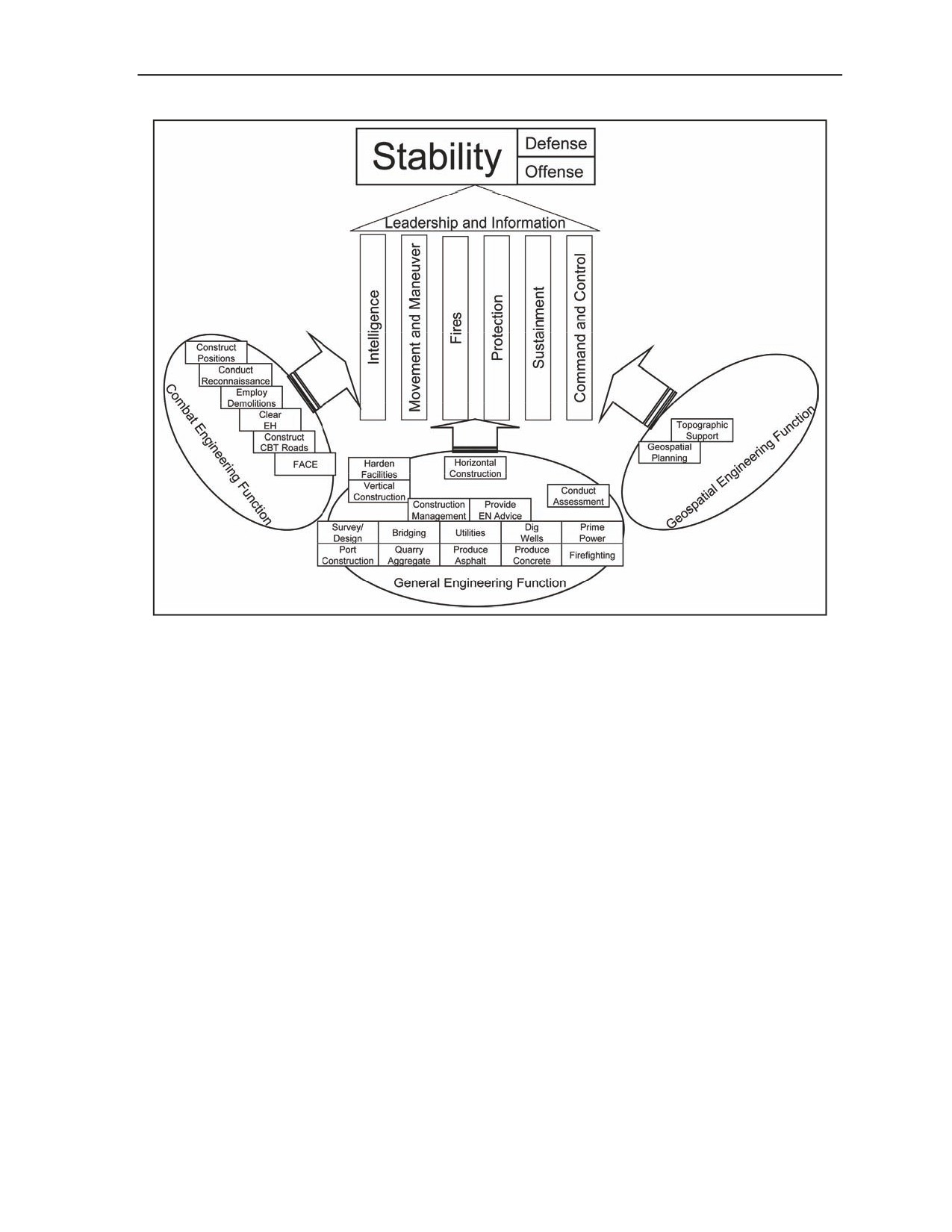
Chapter 5
Figure 5-5. Notional engineer operations supporting stability
5-35. Engineer support to stability operations may include the typical integration with and support for
combined arms forces in their missions. Combat engineer route clearance and other close support
capabilities may be critical tasks applied through the movement and maneuver warfighting function.
Geospatial engineer support continues to provide foundational information supporting the COP. General
engineer support may be required for the sustainment and survivability requirements of the force.
However, in stability operations, a focus of the engineer effort is likely to be the general engineering
capabilities applied to restore essential services and support infrastructure development. Many of the
technical capabilities only found in the generating force will be essential to providing appropriate engineer
support as those elements of the Engineer Regiment are called upon (through reachback and FFE) for their
specialized expertise and capabilities. Stability operations tend to be of a long duration compared to the
other full spectrum operations. As such, the general engineering level of effort is very high at the onset and
gradually decreases as the theater matures, although support will be required to some degree for the
duration of the stability operation. Preparation activities include identification of significant infrastructure
and base development construction projects and nomination of those projects for funding. The highest
priority projects may be executed using military general engineer capabilities while others may compete for
contingency funding and execution through a contract capability. As the AO matures, the general
engineering effort in support of sustainment requirements may transfer to theater or external support
contracts such as LOGCAP, AFCAP, or the Navy’s global contingency construction contract.
5-36. CA operations are activities performed or supported by CA personnel that enhance the relationship
between military forces and civil authorities in areas where military forces are present. They involve
application of CA functional specialty skills in areas that are normally the responsibility of the civil
government. These operations involve establishing, maintaining, influencing, or exploiting relations
between military forces and all levels of HN government agencies. These activities are fundamental to
5-10
FM 3-34
2 April 2009
Preparing, Executing, and Assessing Engineer Operations
executing stability tasks. CA personnel, other Army forces, or a combination of the two perform the
following tasks.
z
CA personnel engage in a variety of CA operations in fulfillment of CA core tasks. CA elements
can assess the needs of civil authorities, act as an interface between civil authorities and the
military supporting agency, and act as a liaison to the civil populace. They can develop
population and resource control measures and coordinate with international support agencies.
z
CA personnel are regionally oriented and possess cultural and linguistic knowledge of countries
in each region. Most CA personnel have had extensive experience in combat arms or combat
support before assignment to CA units. With guidance from the commander on desired effects,
CA personnel have a wide variety of resources at their disposal to influence the AO. CA is a
combat multiplier in this sense. Additionally, the civilian skills that RC CA units possess enable
them to assess and coordinate infrastructure activities (see FM 3-05.40 for more details).
5-37. CA operations may be critical in supporting engineer operations, which typically can include the
engineer activities of nonmilitary organizations, as well as military forces. Similarly, engineer capabilities
may be applied to provide specific construction and other technical support integrated within the CA plan.
Integration occurs through the operations process activities and is facilitated by coordination among the
ENCOORD and CA staff at the CMOC.
5-38. Preparing for stability operations may be more difficult than preparing for combat operations
because of the technical nature of requirements and broad range of potential engineer missions associated
with them. An early on-the-ground assessment can be critical to tailor the engineer force with required
specialties and engineer resources. Results of this assessment are passed to planners to ensure that an
adequate engineer force arrives in the AO in a timely manner. This early on-the-ground engineer
reconnaissance and associated assessment or survey identifies the—
z
Status of the infrastructure in the AO, to include airfields, roads, ports, logistic bases, and troop
beddown facilities; real estate acquisition; environmental standards, conditions, and
considerations; construction material supply; construction management; and line-haul
requirements.
z
Theater- and situation-specific survivability requirements.
z
Existing geospatial product availability and requirements for new terrain visualization products.
z
Specialized engineer requirements, such as prime power, well-drilling, and firefighting support.
z
Specialized engineer requirements available only in the capabilities of generating force elements
of the Engineer Regiment.
z
C2 requirements, including headquarters staffing, communications, and information systems
support.
z
Engineer liaison requirements, including linguists and CA personnel.
z
Potential for contract construction or other engineer capabilities.
CIVIL SUPPORT OPERATIONS
5-39. Civil support includes operations that address the consequences of natural or man-made disasters,
accidents, and incidents within the United States and its territories. Army forces conduct civil support
operations when the size and scope of events exceed the capabilities or capacities of domestic civilian
agencies. The ARNG is often the first military force to respond on behalf of state authorities. In stability
operations, multinational operations are typical; in civil support operations, they are the exception. Army
civil support operations include three primary tasks: provide support in response to a disaster, support civil
law enforcement, and provide other support as required. (When revised, FM 3-28 will discuss these tasks
in detail.)
5-40. Engineer operations in civil support may include simultaneous application of combat, general, and
geospatial engineer capabilities through synchronizing warfighting functions and throughout the depth of
the AO. General engineer support for the restoration of essential services is the primary engineer focus in
civil support. Engineer support may also be required for Army forces providing C2, protection, and
sustainment to government agencies at all levels until they can function normally. Figure 5-6 shows a
2 April 2009
FM 3-34
5-11
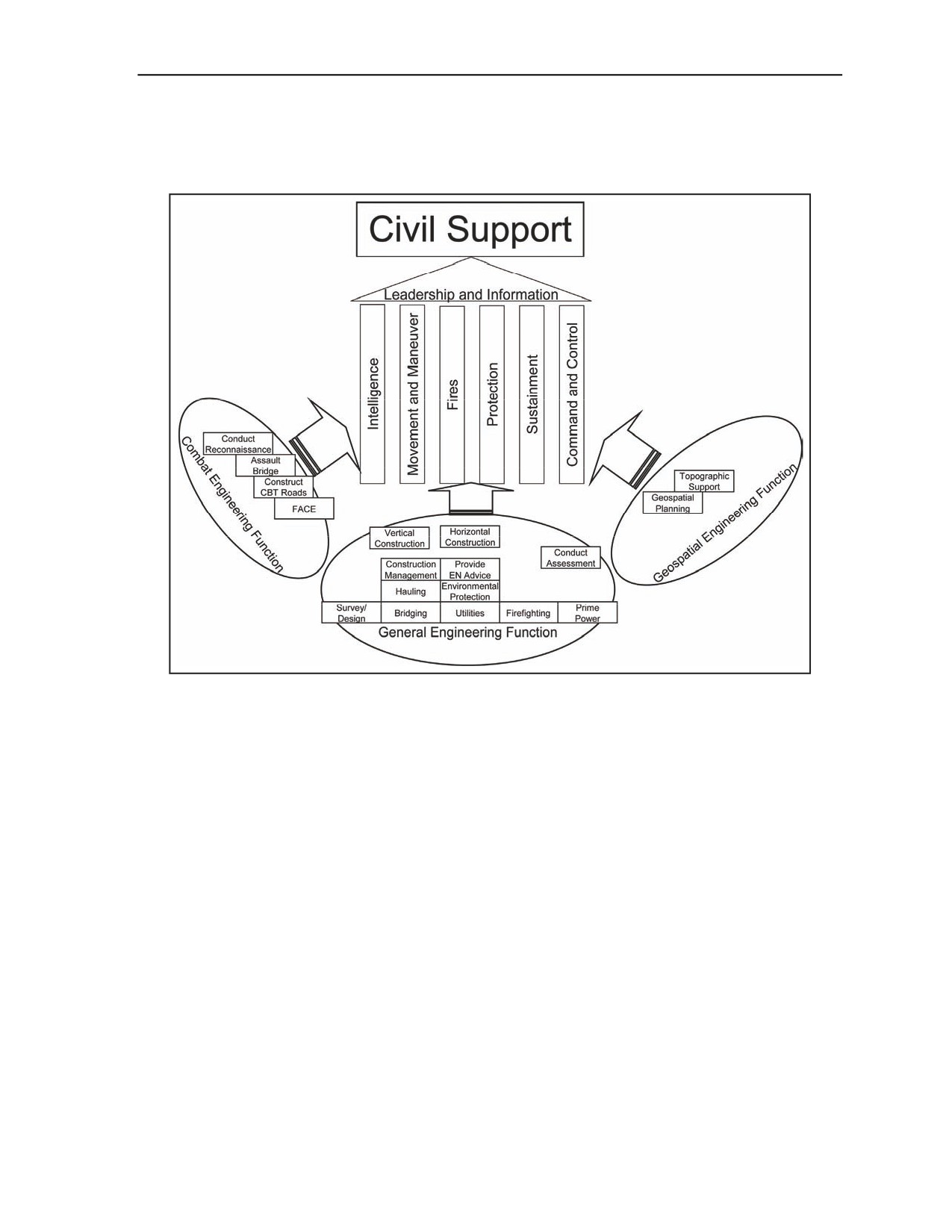
Chapter 5
notional application of engineer capabilities supporting civil support operations. The generating force
elements of the Engineer Regiment (such as USACE) will play a critical and significant role in civil
support operations. TECs, under their OPCON relationship with USACE, can provide C2 support. See
Appendix F for a more detailed discussion of engineer applications in civil support operations.
Figure 5-6. Notional engineer operations during civil support
5-41. There are few unique engineer missions performed in civil support that are not performed during
other operations. The difference is the context in which they are performed. U.S. law carefully limits the
actions that military forces, particularly regular Army units, can conduct within the U.S. and its territories.
In addition to legal differences, civil support operations are always conducted in support of state and
federal agencies. Army forces cooperate and synchronize their efforts closely with them. These agencies
are trained, resourced, and equipped more extensively than similar agencies involved in stability operations
overseas. Policies issued by the federal government govern the essential services Army forces provide in
response to a disaster. Within this context, a focus for engineers during civil support operations will be the
restoration of essential services. Essential services engineers are concerned with providing include the
following:
z
Rescue.
z
Food and water.
z
Emergency shelter.
z
Basic sanitation (sewage and garbage disposal).
z
Minimum essential access to affected areas.
5-12
FM 3-34
2 April 2009
Preparing, Executing, and Assessing Engineer Operations
5-42. Both combat and general engineer capabilities may be applied to restore essential services. Engineer
equipment is well suited for removal of rubble and debris associated with rescue and access to affected
areas. Other likely requirements include the construction of temporary shelters and provision of water and
sanitation services. Likely missions include the following:
z
Constructing and repairing rudimentary surface transportation systems, basic sanitation
facilities, and rudimentary public facilities and utilities.
z
Detecting and assessing water sources and drilling water wells.
z
Constructing feeding centers.
z
Providing environmental assessment and technical advice.
z
Disposing of human and hazardous wastes.
z
Constructing camps and providing power generation.
z
Providing infrastructure reconnaissance, technical assistance, and damage assessment.
z
Conducting emergency demolition.
z
Conducting debris or route clearance operations.
5-43. Engineer operations in civil support may include the typical integration with and support for
combined arms forces in their missions. Combat engineer route clearance and other close support
capabilities may be critical tasks applied through the movement and maneuver warfighting function.
Geospatial engineer support continues to provide foundational information supporting the COP. General
engineer support may be required for the sustainment and survivability requirements of the force and may
be extended to support other agencies. Likely missions include the following:
z
Base camp construction and power generation.
z
Debris or route clearance operations.
z
Construction and repair of expedient (temporary) roads and trails.
z
FACE (including the repair of paved, asphalt, and concrete runways and airfields).
z
Installation of assets that prevent FOD to rotary-wing aircraft.
z
Construction of temporary bridging.
z
Construction and upgrade of ports, airfields, and RSOI facilities to ensure access to the region.
5-44. There is usually little time for preparation for civil support operations. Civil support operations may
require an immediate response. Support to civilian law enforcement and community assistance allows
greater leeway to plan and prepare. USACE maintains significant response capability and will normally be
involved in civil support requiring engineer operations. USACE leverages capabilities and expertise
developed through responsibility for military construction and civil works programs to prepare for assigned
and anticipated civil support missions.
SPECIAL CONSIDERATIONS
5-45. Army commanders will likely determine that operations in an urban environment will be essential to
mission accomplishment. They need to assess the relevance and impact of one or more urban areas as part
of their mission. They will also need to determine whether urban operations may be the commander’s sole
focus or only one of several tasks nested in an even larger operation. Although urban operations can
potentially be conducted as a single battle, engagement, or operation, they will more often be conducted as
a major operation requiring joint resources. FM 3-06 provides a new framework—assess, shape, dominate,
and transition—for urban operations. These are not phases or sequential operations, but rather a means to
visualize the fight (or potentially the stability or civil support mission).
5-46. Engineers will provide critical support to any urban operation. FM 3-06 and FM 3-06.11 have more
details, but commanders should understand that historically, large numbers of engineer units have been
task-organized for urban operations. Engineers will provide unique geospatial products for the complex
terrain of cities. Three-dimensional terrain visualization products are available and continue to be
developed. Assured mobility will be an important framework for commanders to use as maneuver
commanders think about how to shape and dominate within the urban terrain. General engineering tasks
2 April 2009
FM 3-34
5-13
Chapter 5
will be prevalent throughout all operations, but will also be the major function during transition to stability
or civil support operations. Engineers will have to work closely with all of the elements that enable
M/CM/S. They must ensure close coordination with EOD (to reduce EH [improvised explosives and UXO]
to minimize collateral damage), MPs (to enable the movement of civilians along routes), and CBRN
elements (for potential agents along the routes and at other locations within the AO).
5-47. Full spectrum operations present a broad range of potential tasks to any engineer commander. It may
appear daunting as METL is considered and training plans are established; however, it is up to the
commander to understand these challenges and assess the priority missions that must be trained and
prepared for. Projected support relationships allow discussion with higher headquarters and the units the
engineer unit is likely to support and will assist the commander in narrowing the list of missions and,
therefore, prioritizing their training. There is no substitute for having a unit that is trained and disciplined
in its core tasks. When called on to respond to a mission, commanders can expect assistance from the
remainder of the Regiment to facilitate the unit’s preparation. It is up to the commander to be aware of the
potential considerations and understand the right questions to ask and explore to develop the best training
and preparation.
5-14
FM 3-34
2 April 2009
Chapter 6
Sustainment Support for Engineer Capabilities
Build no more fortresses, build railways.
Field Marshal Helmuth Von Moltke, The Elder
Army transformation into an expeditionary, campaign-quality force includes
significant changes in the structure and systems providing logistics and other
sustainment support. One key feature is a logistics system that relies on asset
visibility and flexibility instead of mass. Within the transformed framework,
distributed support and sustainment are keys to maintaining freedom of action with
the smallest feasible deployed logistical footprint. Support planning and execution
must be closely integrated into tactical and operational battle rhythms. Successful
engineer operations include effective incorporation of sustainment support.
Sustainment for the engineer company includes the functions of supply, field
services, transportation, maintenance, EOD, HSS, human resources (HR) support,
financial management support, legal support, religious support, and band support.
Assignment of engineer companies to the BCTs includes responsibility for their
sustainment support. Except for medics organic to each of the BCT engineer
companies, all other sustainment support is provided by or coordinated through the
BSTB for the engineer company of the HBCT and IBCT and through the BSB and
the HHC of the SBCT for the organic engineer company of the SBCT. For units
augmenting the BCT engineers and all other units operating at EAB, integration into
an area or theater support structure will be required. This chapter focuses on
sustainment support for engineer capabilities and highlights the sustainment
considerations that will affect engineer operations.
ORGANIZATIONS AND FUNCTIONS
STRATEGIC-LEVEL SUPPORT
6-1. Within the transformed framework, distribution has transitioned to a single distribution manager who
provides unity of control. The manager directs the flow throughout the entire network using asset visibility,
capacity, and control information available from the COP while supported by a network-wide view of
distribution operations. A single distribution manager will be used at each level of war within a distribution
management center (DMC) and will interact as appropriate to provide sustainment support.
6-2. The strategic-level manager is concerned with centrally controlling the distribution network in
support of the Secretary of Defense, the Joint Chiefs of Staff (JCS) and, when appropriate, Service
components. The operational-level manager, working at the theater Army or JFLCC level, controls the
flow of personnel, equipment, and materiel entering, leaving, or being distributed within the JOA. The
tactical-level distribution managers, working in the modular force support battalion, manage according to
the designated tactical commander’s priorities.
Defense Logistics Agency
6-3. DLA is DOD’s primary strategic-level logistics provider and is responsible for providing a variety of
logistics support to the military Services. DLA has the capability of providing a forward presence in the
2 April 2009
FM 3-34
6-1
Chapter 6
operational area via its DLA contingency support teams (DCSTs). DLA normally provides a DCST to each
major joint operation. The team serves as the focal point for coordinating DLA activities within a specific
AOR, theater of operation, or JOA. The DCSTs may either colocate with the JFC J-4, the TSC DMC, or
the Army field support brigade (AFSB) when the Army is the lead Service for significant common-user
logistics support. The in-theater DCST integrates strategic- to operational-level materiel management
support of DLA common commodities (such as subsistence, clothing and other general supplies, Class IV
construction and barrier materiel, package and bulk petroleum, and medical materiel).
6-4. DLA also provides in-theater defense reutilization and marketing services (DRMS). In coordination
with the JFC J-4, DLA establishes theater-specific procedures for the reuse, demilitarization, or disposal of
facilities, equipment, and supplies, to include hazardous material and waste. Initially, salvage and excess
materiel destined for the DRMS is collected in the theater sustainment area or the BCT BSB areas as the
situation permits. As the theater matures, DLA evacuates this materiel to collection points for inspection,
classification, and disposal by DLA-directed activities. The TSC or sustainment brigade DMC coordinates
DRMS operations for the Army forces to ensure that usable materiel is not disposed of or evacuated from
the theater.
United States Army Materiel Command
6-5. Strategic logistics embraces national-level sustainment base capabilities. The TSC, expeditionary
sustainment command
(ESC), and sustainment brigades coordinate with elements of strategic-level
organizations to ensure a smooth flow of support into and throughout the theater. In almost all operations,
elements of the national strategic organizations deploy to the theater to enhance this coordination. Some of
these elements, such as the United States Army Materiel Command (USAMC) and DLA work closely
with, and in some cases, have a command or support relationship with the TSC or ESC and sustainment
brigades as described below.
6-6. USAMC support to deployed Army forces is executed through the Army Sustainment Command's
assigned AFSBs and contracting support brigades. These two separate O6-level commands are theater-
committed headquarters which, upon deployment, are normally placed OPCON to the TSC. The AFSB is
responsible for planning and controlling all Army acquisition, logistics, and technology (ALT) functions—
less theater, contracting, and LOGCAP support—in the operational area. The AFSB is a small, highly
modular TOE headquarters that leverages reach capabilities to provide ALT technical and call-forward
support from the national sustainment base. In addition to the small TOE command and staff element, each
AFSB has a tailored table of distribution and allowances (TDA) structure and can call forward significant
USAMC and Assistant Secretary of the Army (ASA) (ALT) support capabilities necessary to meet specific
mission requirements. Specific AFSB functions include, but are not limited to—
z
Providing command, control, and management of the Logistics Assistance Program (LAP).
z
Coordinating system contract support to new or partially fielded systems.
z
Providing Army science and technology functions, as well as all materiel fielding organizations
providing new equipment training.
z
Coordinating Army pre-positioned stock support to include off-loading and property
accountability.
z
Providing C2 of sustainment maintenance organizations deployed to the theater.
z
Maintaining accountability of all Army contractor personnel who deploy with the force.
6-7. AFSBs provide ALT support through two primary subordinate units: the logistics support element
(LSE) and the brigade logistics support team (BLST). LSEs are small, tailorable, deployable, battalion-
level TDA organizations of approximately 20 personnel, mostly Life Cycle Management Command
logistics assistant representatives. BLSTs are similar to LSEs, but are smaller organizations that provide
DS LAP support to a specific BCT or CAB. The LSE commander is primarily responsible for coordinating
and controlling GS technical LAP support to the corps or division headquarters and Army units such as the
MEB that do not have a DS BLST. Additional information on the AFSB can be found in FMI 4-93.41.
6-8. The contracting support brigades are new USAMC TOE commands that provide contracting support
in-theater, normally on a GS basis, to deployed U.S. forces through its assigned or attached contingency
6-2
FM 3-34
2 April 2009