FM 3-34 ENGINEER OPERATIONS (April 2009) - page 2
Engineering in Unified Action
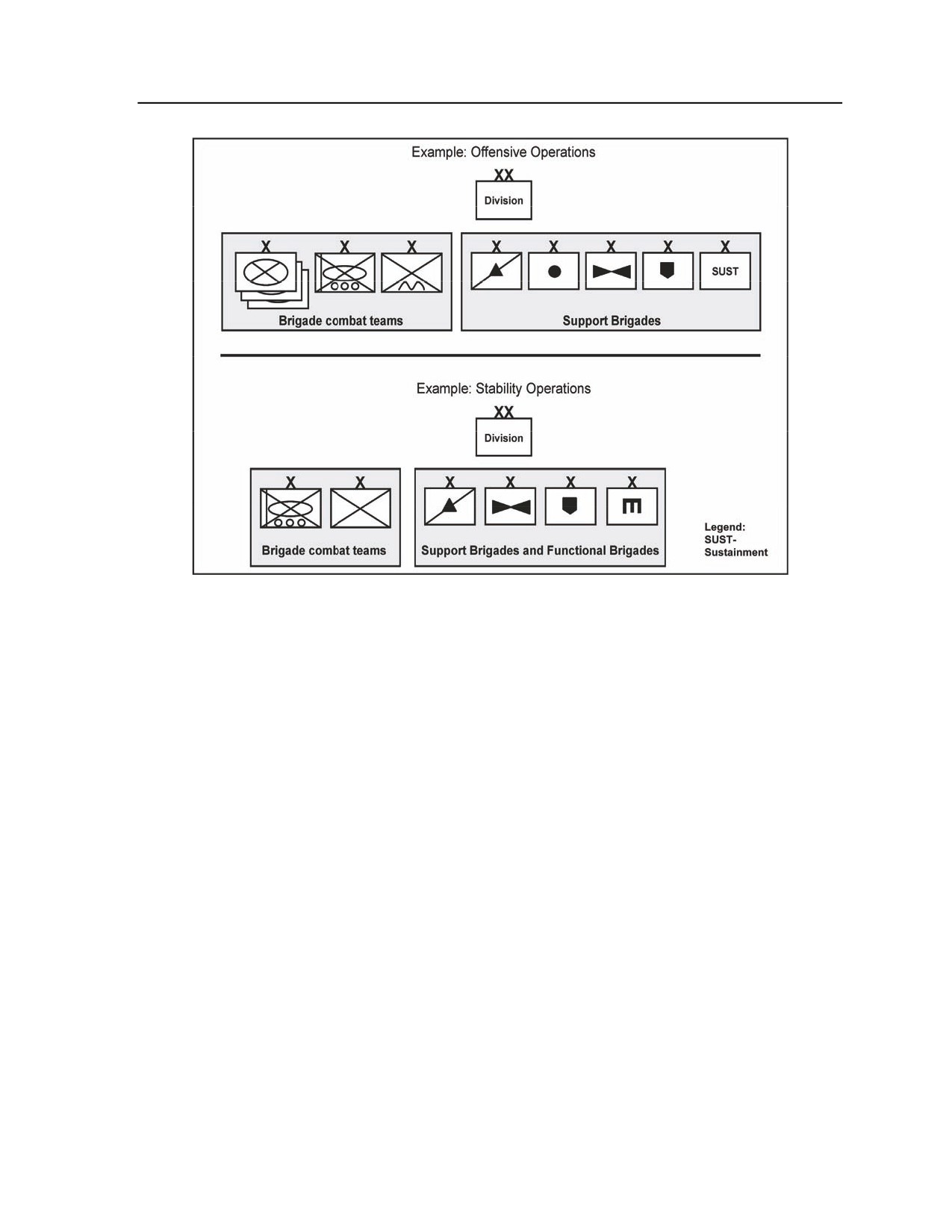
Figure 2-3. Examples of tailored divisions
2-72. The tailored engineer force supporting a division is not set by rules of allocation. Rather, the force
will be tailored to meet anticipated requirements based on an analysis of the situation. The divisional
engineer force may be organized under a multifunctional headquarters, such as the MEB, or may be
organized under a functional engineer headquarters. In some situations, the division may require a
combination of engineer forces organized both functionally and multifunctionally. While either battalion or
brigade echelons of engineer or multifunctional headquarters may be allocated as the divisional engineer
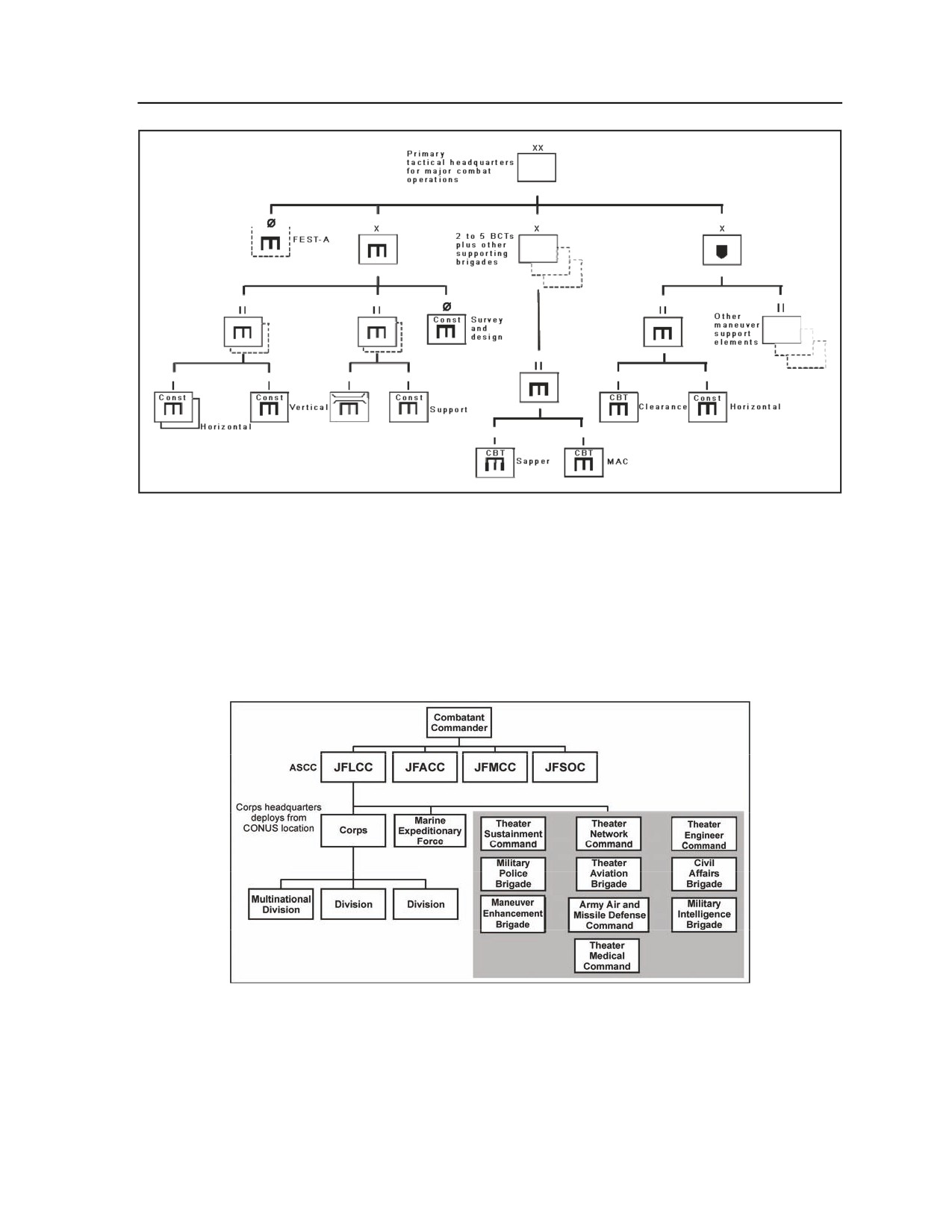
headquarters, a brigade echelon headquarters is more typical for most operations. Figure 2-4, page 2-22,
provides a notional organization for both an engineer brigade headquarters and an MEB supporting a
division.
2 April 2009
FM 3-34
2-21
Chapter 2
Figure 2-4. Notional division engineer force
2-73. Corps are the Army’s premier headquarters for joint operations and can rapidly transition to either a
JTF or a JFLCC headquarters for contingency operations. When required, a corps may become an
intermediate tactical headquarters under the JFLCC with OPCON of two or more divisions (to include
multinational or United States Marine Corps [USMC] formations) or other large tactical formations (see
figure 2-5). Corps can deploy to any AOR to provide C2 for Army, joint, and multinational forces.
2-74. Corps do not have any echelon-specific units other than the organic corps headquarters. They can
control any mix of modular brigades and divisions, as well as other-Service or multinational forces. The
ASCC headquarters tailors the corps headquarters to meet mission requirements.
Figure 2-5. Corps as an intermediate land force headquarters
2-75. Like the division, the tailored engineer force supporting a corps is not set by rules of allocation.
Rather, the force will be tailored to meet anticipated requirements based on an analysis of the situation. The
corps force is likely to include joint engineer elements or a joint engineer headquarters. In some situations,
the corps may require a combination of engineer forces organized both functionally and multifunctionally.
2-22
FM 3-34
2 April 2009
Engineering in Unified Action
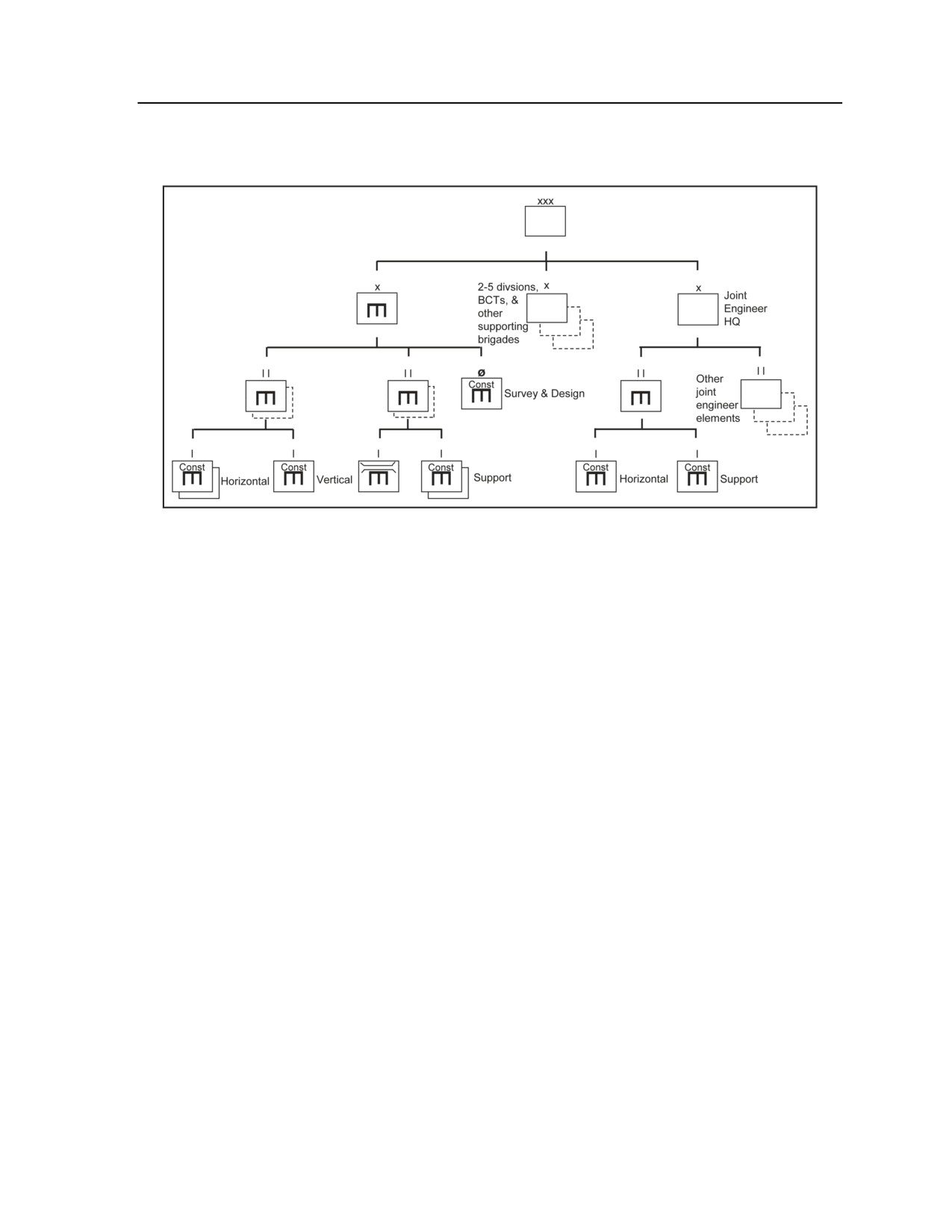
Typically, an engineer brigade headquarters will be allocated to a corps for most operations. Figure 2-6
shows a notional organization for both an engineer brigade headquarters and a joint engineer headquarters
supporting a corps.
Figure 2-6. Notional corps engineer force
2-76. The theater Army (the doctrinal name for the ASCC of a GCC) is the primary vehicle for Army
support to Army, joint, interagency, and multinational forces operating across the AOR. The theater Army
commander performs the functions and tasks of the ASCC for the GCC. As the Army headquarters
supporting the GCC, the theater Army provides various combinations of Army capabilities and orchestrates
their employment. The theater Army provides ADCON of all Army personnel, units, and facilities in the
AOR and is responsible for providing Army support to other services and common user logistics as
directed by law or the GCC. In major combat operations, where the GCC is the JFC, the theater Army
commander may become the JFLCC and exercise OPCON over committed land forces. The theater Army
headquarters continues to perform AOR-wide ASCC functions, to include joint reception, staging, onward
movement and integration (RSOI), joint logistics over the shore, and joint sustainment area coordination.
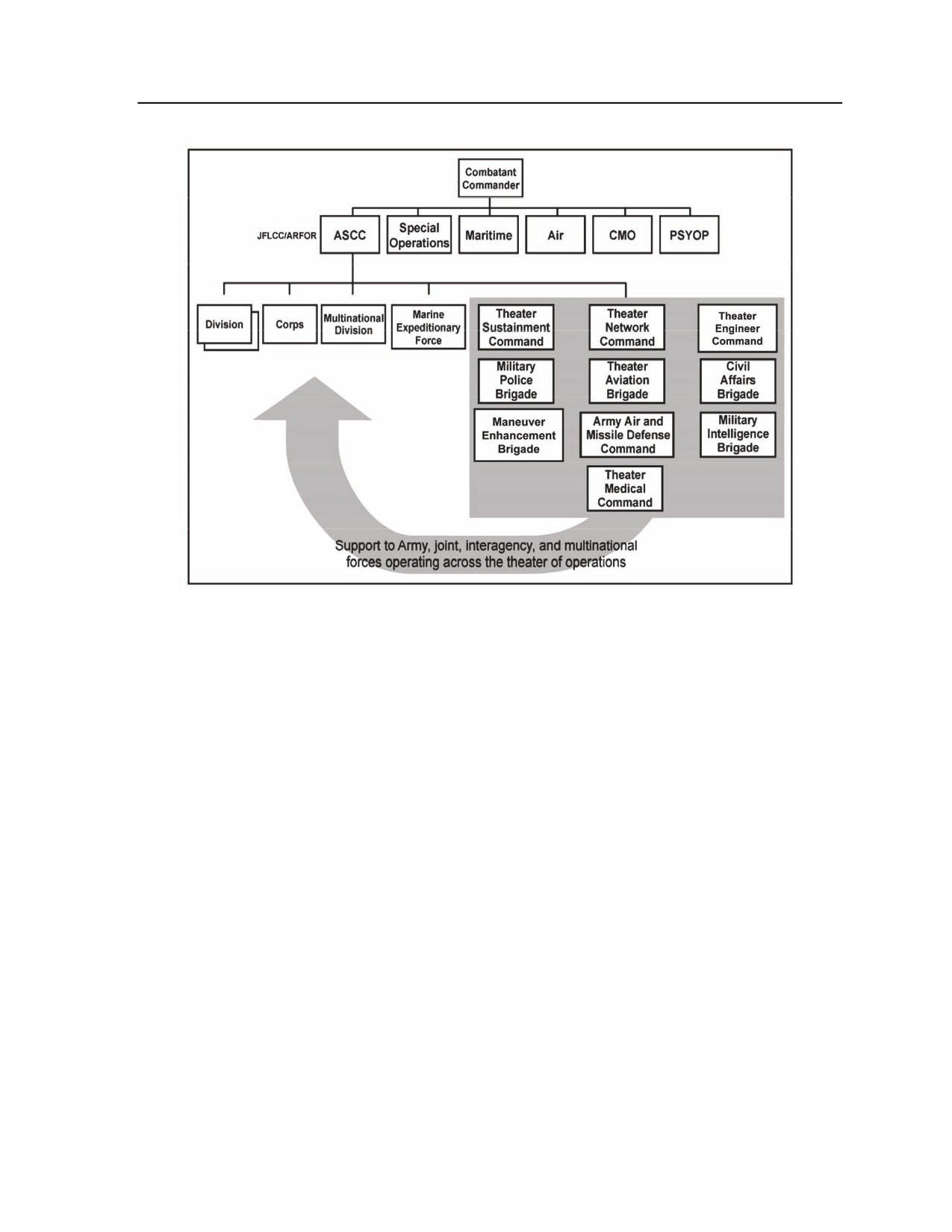
Figure 2-7, page 2-24, shows a theater Army as a JFLCC. When required for crisis-response or limited
contingency operations, the theater Army can provide a JTF-capable headquarters to control forces within
a JOA.
2 April 2009
FM 3-34
2-23
Chapter 2
Figure 2-7. The theater Army as a joint force land component command
while continuing Army support
2-77. Each theater Army headquarters consists of three different table of organization and equipment
(TOE) organizations: a main command post (MCP) with its associated HHC, the operational command
post (OCP), and the OCP’s associated special troops battalion (STB). The theater Army commander
exercises ADCON over all Army forces in the AOR. He uses his MCP to integrate Army forces into the
execution of regional security cooperation plans and provides Army support to joint forces, interagency
elements, and multinational forces as directed by the GCC.
2-78. The theater Army controls an assigned mix of regionally focused, supporting commands and
brigades, including sustainment, signal, MI, CA, and medical. In addition to these regionally focused
commands, the theater Army receives additional attachments in the form of brigades and commands
requisite for the campaign or missions in the AOR. These latter forces are not regionally focused, but are
drawn from the “pool” of available forces assigned to general warfighting and maintained in the
continental United States (CONUS) and around the world. The situation in each theater dictates the size of
these formations; that is, commands, brigades, or groups. Command relationships also vary across theaters
between the theater Army and supporting capabilities. In some theaters, the commands are assigned; in
others, they are OPCON or aligned for planning only.
2-79. In major combat operations, the theater Army normally receives one TEC (see figure 2-8). The TEC
is a modular organization that can be tailored based on mission requirements. Within the TEC, there are
two DCPs that provide flexibility and rotational capability. Each TEC can deploy its MCP and two DCPs.
The DCP can be augmented with FFE assets from USACE. Typical capabilities that may be included with
this augmentation might be contracting, real estate support, and interagency coordination. The TEC is able
to leverage reachback capabilities to capitalize on CONUS-based assets.
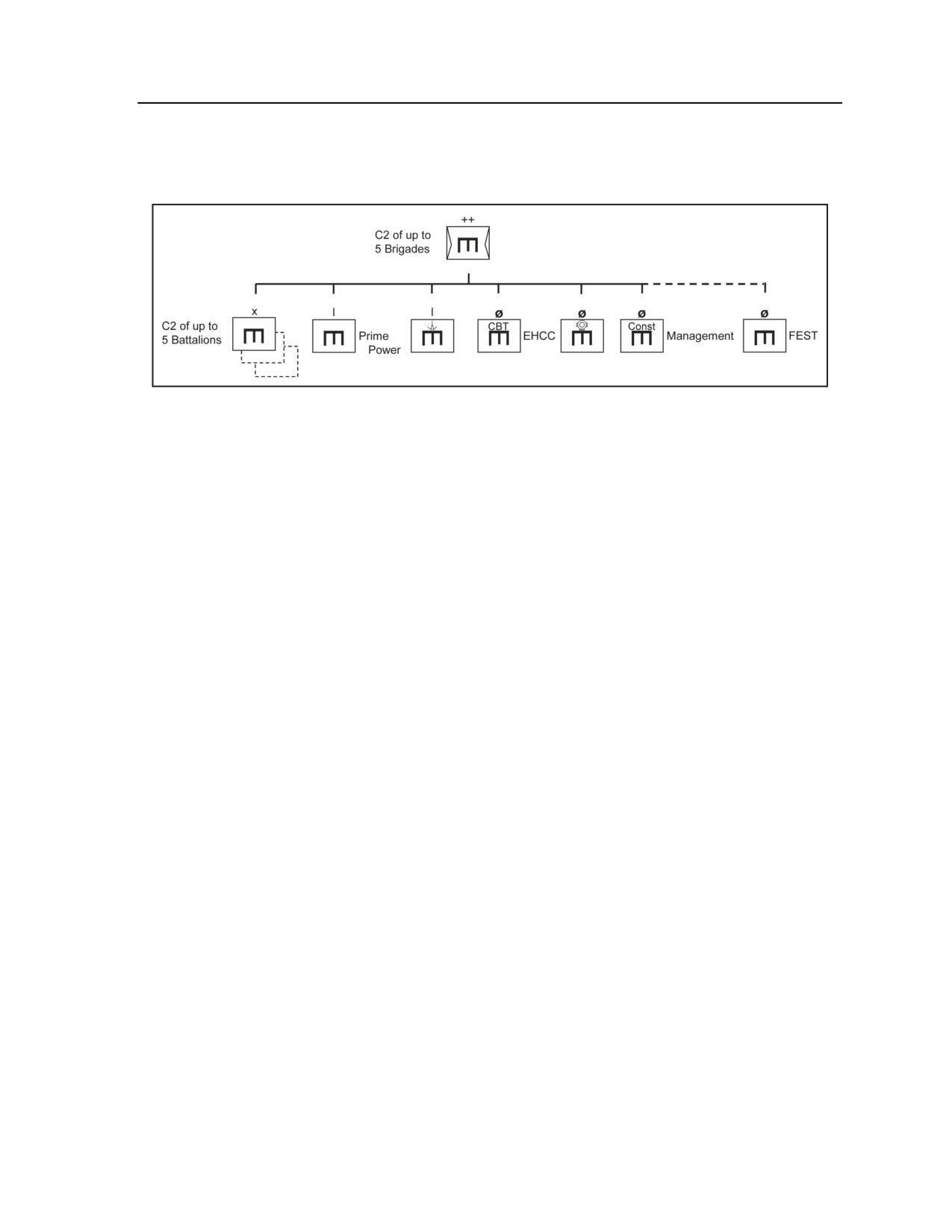
2-80. The TEC provides C2 and an organizational framework for the operational-level engineer effort
within the AOR. The TEC focuses on reinforcing and augmenting tactical-level engineer efforts and
2-24
FM 3-34
2 April 2009
Engineering in Unified Action
developing the theater sustainment base. This focus involves planning, ensuring operational mobility, and
coordinating all operational engineering assets. It also supervises the direction of geospatial operations,
construction, real-property maintenance activities, LOC sustainment, engineer logistics management, and
base development. The TEC has primary responsibility for theater infrastructure development.
Figure 2-8. Notional theater engineer command
2-81. The TEC develops plans, procedures, and programs for engineer support for the theater Army,
including requirements determination, operational mobility and countermobility, general engineering,
power generation, ADC, military construction, geospatial engineering, engineering design, construction
materiel, and real property maintenance activities. Engineer units are responsible for infrastructure
planning, development, construction, and maintenance. The TEC commander receives policy guidance
from the theater Army based on the guidance of the GCC’s joint force engineer. The TEC headquarters
element provides staff supervision over operational-level engineer operations in the AO and reinforces
engineer support to all theater Army forces. The TEC may also support joint and multinational commands
and other elements according to lead Service responsibilities as directed by the supported JFC. It provides
policy and technical guidance to all Army engineer units in the AO. This headquarters maintains a planning
relationship with the theater Army and joint force staff engineers to help establish engineer policy for the
theater. It maintains required coordination links with other Service and multinational command engineering
staffs. In some theaters, a tailored engineer brigade may provide theater-level engineer support. The
engineer brigade provides expertise and capability that is similar to the TEC, but at a reduced level.
2 April 2009
FM 3-34
2-25
This page intentionally left blank.
Chapter 3
Foundations of Engineer Operations
I would desire to have companies of Sappers formed—they should be instructed in every
thing that relates to the construction of Field works—how to dispose of the Earth—to cut
the Slopes—face with turf or sods—make fascines—arrange them properly—cut and fix
Palisades, etc.
Louis Duportail
Chief of Engineers, Continental Army
January 18, 1778
The new version of FM 3-0 emphasizes operations that combine offensive, defensive,
and stability or civil support by defining a distinct operational concept around full
spectrum operations. Army forces conduct full spectrum operations within the larger
framework of joint operations. Engineer capabilities are a significant force multiplier
in joint operations, facilitating the freedom of action necessary to meet mission
objectives. Engineer operations modify, maintain, provide understanding of, and
protect the physical environment. In doing so, they enable the mobility of friendly
forces, alter the mobility of adversaries, enhance the survivability and enable the
sustainment of friendly forces, contribute to a clear understanding of the physical
environment, and provide support to noncombatants, other nations, and civilian
authorities and agencies. This chapter describes the foundations necessary for
effective engineer operations. It defines engineer functions that broadly categorize
the array of engineer capabilities and enable clear linkages from those capabilities to
the warfighting functions. It discusses linkages to the operational concept, full
spectrum operations, and the warfighting functions that provide the integrating
framework. It discusses the operations process as the context for integration into
combined arms application and multiple C2 interactions throughout engineer
operations within that context. Finally, this chapter describes engineer combat power
applications linked through the intelligence, movement and maneuver, protection,
and sustainment warfighting functions that also provide the primary framework for
engineer tasks in the Army universal task list.
SECTION I-ENGINEER FUNCTIONS
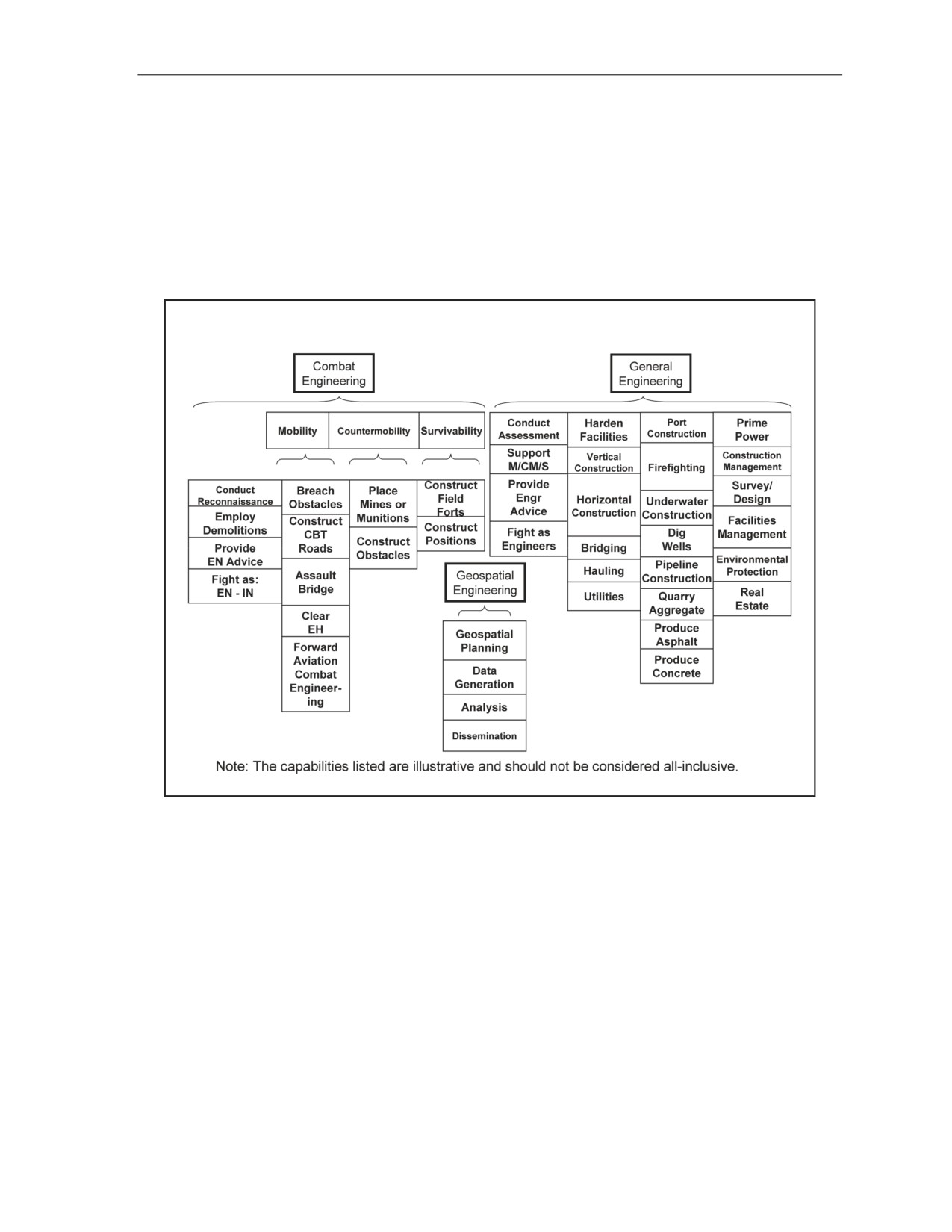
3-1. Engineer functions are categories of related engineer capabilities and activities grouped
together to help JFCs integrate, synchronize, and direct engineer operations. One of the three
engineer functions are combat engineering, general engineering, and geospatial engineering (see
figure 3-1, page 3-2).
z
Combat engineering is defined as those engineering capabilities and activities that support the
maneuver of land combat forces and that require close support to those forces. Combat
engineering consists of three types of capabilities and activities: mobility, countermobility, and
survivability (M/CM/S). (JP 3-34)
z
General engineering is defined as those engineer capabilities and activities, other than combat
engineering, that modify, maintain, or protect the physical environment (the definition was
shortened, and the complete definition is printed in the glossary). (JP 3-34) Examples include
the construction, repair, maintenance, and operation of infrastructure, facilities, LOCs, and
2 April 2009
FM 3-34
3-1
Chapter 3
bases; protection of natural and cultural resources; terrain modification and repair; and selected
EH activities.
z
Geospatial engineering is the art and science of applying geospatial information to enable
understanding of the physical environment for military operations. The art is the ability to
understand METT-TC and the geospatial information available, including intent of use
and limitations, in order to explain the military significance of the terrain to the
commander and staff and create geospatial products for decision making; the science is
the ability to exploit geospatial information, producing spatially accurate products for
measurement, mapping, visualization, modeling, and all types of analysis of the terrain.
Figure 3-1. Engineer functions
3-2. Engineer reconnaissance, although not a separate engineer function, is a critical part of each of the
engineer functions. See FM 3-34.170 for additional discussion of engineer reconnaissance and Section IV
of this chapter for additional discussion of integration of engineer reconnaissance support.
COMBAT ENGINEERING
3-3. Combat engineering is an integral part of combined arms units’ ability to maneuver. It is focused on
support of close combat forces. Combat engineers enhance the force’s momentum by shaping the physical
environment to make the most efficient use of the space and time necessary to generate mass and speed
while denying the enemy maneuver. By enhancing the unit’s ability to maneuver, combat engineers
accelerate the concentration of combat power, increasing the velocity and tempo of the force necessary to
exploit critical enemy vulnerabilities. By reinforcing the natural restrictions of the physical environment,
combat engineers limit the enemy’s ability to generate tempo and velocity. These limitations increase the
enemy’s reaction time and physically and psychologically degrade his will to fight.
3-2
FM 3-34
2 April 2009
Foundations2 April 2009perations
3-4. Combat engineering includes those capabilities organic to and augmenting the BCTs. Combat
engineering provides tactical-level engineer support to combat (offensive and defensive), stability, or civil
support operations. In combat operations, it is typically (although not always) focused on the support of
close combat. It may be augmented at times with general engineering support but retains its focus on the
integrated application of engineer capabilities to support the combined arms team’s freedom of maneuver
(mobility and countermobility) and survivability.
MOBILITY
3-5. Mobility operations are defined as obstacle reduction by maneuver and engineer units to reduce
or negate the effects of existing or reinforcing obstacles. The objective is to maintain freedom of
movement for maneuver units, weapon systems, and critical supplies. For combat engineering it is
focused on the movement and maneuver warfighting function. See FM 3-34.2 for information on combined
arms mobility operations. Mobility tasks are typically expressed as essential tasks and may require
integration into the synchronization matrix to account for the assets and time required to implement them.
See Chapter 4 for a discussion of planning for M/CM/S.
3-6. Maneuver warfare depends on freedom of movement and seeks to avoid enemy strengths to focus
efforts on enemy weaknesses whenever possible. The enemy will use firepower, terrain, and man-made
obstacles to deny us freedom of maneuver. Friendly forces will first attempt to bypass such obstacles;
however, this may not always be an option. Challenges that limit maneuver must be overcome. Breaching,
including breaching of gates, fences, or walls in an urban environment, and gap crossing operations are
employed to restore the ability to wage maneuver warfare. Clearing operations, including route or area
clearance, are employed to eliminate current or recurring obstacle threats. Combat roads and trails support
tactical maneuver, and forward aviation combat engineering (FACE) produces mobility support to tactical
maneuver in the form of forward airfields, landing zones (LZs), and the immediate facilities that support
them.
3-7. Mobility operations, a combined arms task, enable maneuver as envisioned in the application of
combat power. Operations that support mobility involve more than engineers. For example, maneuver and
mobility support are those MP missions performed to support and preserve the commander’s freedom of
movement and enhance the movement of friendly resources in all environments. Tasks include route
reconnaissance and surveillance, MSR regulation and enforcement, temporary route signing, support to
river crossings, and straggler and refugee control. Route reconnaissance as a form of reconnaissance
described in FM 3-90 is another example. Mobility operations within the context of this manual, however,
are those Army tactical tasks conducted by combat engineers task-organized with appropriate combat and
other supporting forces to enable freedom of movement either by overcoming barriers, obstacles, and EH
or by enhancing movement and maneuver.
COUNTERMOBILITY
3-8. Countermobility operations are operations that deny the enemy freedom of maneuver through
the employment of reinforcing obstacles. Reinforcing obstacles are a component of terrain
reinforcement. Terrain reinforcement is the development of terrain using obstacles to degrade enemy
mobility or to enhance friendly survivability through the construction of fighting positions and
cover. The primary purpose of countermobility operations is to slow or divert the enemy, to increase time
for target acquisition, and to increase weapon effectiveness. Countermobility operations include the
construction of entry control points and other barriers to deny free access to fixed sites. The advent of
rapidly-emplaced, remotely controlled, networked munitions enables engineers to conduct effective
countermobility operations as part of offensive, defensive, and stability operations, as well as during the
transitions among these operations.
3-9. At every level of war, commanders consider the use of obstacles when planning offensive, defensive,
and stability operations. Combined arms obstacle integration is the process that synchronizes
countermobility operations into the scheme of maneuver and the fire support plan. The engineer advises the
commander on how to integrate obstacles through the military decision-making process (MDMP) and
operations processes. During these processes, the engineer coordinates for obstacle emplacement authority,
2 April 2009
FM 3-34
3-3
Chapter 3
establishes obstacle control, recommends directed targets, supervises the employment of obstacles, and
maintains obstacle status throughout the operation. A directed target is a target directed by the
responsible commander to be prepared for demolition or destroyed to support his intent. Most
obstacles have the potential to deny freedom of maneuver to friendly forces, as well as to enemy forces.
Therefore, it is critical that the engineer accurately understands the countermobility capabilities and
limitations of the available engineer forces and properly weighs the risks of employing various types of
obstacles. The engineer must also plan for clearing of obstacles at the cessation of hostilities and for
minimizing obstacle effects on noncombatants and their environment.
3-10. Engineers must be familiar with the specific ROE concerning mines. U.S. forces use ROE to ensure
that the employment of conventional
(persistent or nonself-destructing) and scatterable mines
(SCATMINEs) is consistent with the numerous international laws and U.S. laws and policies governing
their use. The current U.S. Land Mine Policy acknowledges the importance of protecting noncombatants
while enabling legitimate warfighter requirements. Under this policy, the United States has committed to
end the use of persistent land mines of all types after the end of 2010 and will no longer use nondetectable
land mines of any type (see JP 3-15). Until the end of 2010, the President must authorize the employment
of conventional antitank mines outside of Korea. The U.S. will continue to employ self-destructing/self-
deactivating mines, such as SCATMINEs, to provide countermobility for the force. Additionally, newly
developed weapon systems called networked munitions provide the flexible and adaptive countermobility
and survivability capability required by the Army conducting full spectrum operations. Networked
munitions are remotely controlled (man in the loop), ground-emplaced weapon systems that provide lethal
and nonlethal antipersonnel and antitank effects with the ability to be turned on/off/on from a distance and
recovered for multiple employments.
SURVIVABILITY
3-11. Survivability operations are defined as the development and construction of protective
positions, such as earth berms, dug-in positions, overhead protection, and countersurveillance
means, to reduce the effectiveness of enemy weapon systems. Survivability tasks are typically expressed
as essential tasks and may require integration into the synchronization matrix to account for the assets and
time required to implement them. These tasks tend to be equipment intensive and the use of equipment
timelines may be required to properly optimize the work performed. For more information on survivability
operations, see FM 5-103.
3-12. The concept of survivability in today’s OE includes all aspects of protecting personnel, equipment,
supplies, and information systems while deceiving the enemy. Survivability considerations are applied in
support of battle positions, combat outposts, FOBs, base camps, and in many cases HN and other
infrastructure support. Today’s OE requires commanders to know all survivability tactics and techniques
available to provide this protection. The construction of fighting positions and protective positions by itself
cannot eliminate vulnerability of personnel and resources. It will, however, limit personnel and equipment
losses and reduce exposure to hostile enemy action.
3-13. Two key factors in the development of defensive fighting positions are proper siting in relation to the
surrounding terrain and proper siting for the most effective employment of key weapon systems, such as
antitank guided missiles (shoulder-launched munitions and close combat missiles), crew-served weapons,
and tanks. Defensive protective positions include, but are not limited to, C2 facilities or communications
sites, critical equipment (to include radars), supply and ammunition storage or holding areas, and other
items that are likely to be targeted first by enemy action. Consider protecting hazardous material and POL
storage areas that present a threat to personnel if the storage containers are damaged or destroyed. The
degree of protection actually provided for these items is based on the availability of time, equipment, and
resources to the commander. An additional consideration is the probability or risk of acquisition and attack
and the risk assessment made for each site and facility. Facilities emitting a strong electromagnetic signal
or substantial thermal or visual signature may require full protection against potential enemy attack.
Electronic countermeasures and deception activities are mandatory considerations and an integral part of
planning for all activities in the defense.
3-4
FM 3-34
2 April 2009
Foundations2 April 2009perations
GENERAL ENGINEERING
3-14. General engineering may be performed in support of combat operations, which may cause
uncertainty in distinguishing purely combat engineering from general engineering tasks at the tactical level.
General engineering capabilities are not organic to the BCTs and will typically not be associated with close
combat. More distinguishable at the operational level, general engineering capabilities are applied to
establish and maintain the infrastructure necessary for sustaining military operations in-theater. At times,
the military operation may extend general engineering support to restore facilities, power, and life-support
systems within the infrastructure of the AO or build technical capacity of the HN. This effort aids in the
recovery and the transition to preconflict conditions or may be the objective of stability or civil support
operations. For more information on general engineering, see FM 3-34.400.
3-15. General engineering is the most diverse of the three engineer functions and is typically the largest
percentage of all engineer support provided to an operation. Besides occurring throughout the AO, at all
levels of war, and being executed during every type of military operation, it may employ all MOSs within
the Engineer Regiment. General engineering tasks—
z
May include construction or repair of existing logistics-support facilities, LOC and other supply
routes
(including bridging and roads), airfields, ports, water wells, power generation and
distribution, water and fuel pipelines, and base camps or force beddown. Firefighting and
engineer dive operations are two aspects that may be critical enablers to these tasks.
z
May be performed by modified table of organization and equipment (MTOE) units or through
the USACE.
z
May also be performed by a combination of joint engineer units, civilian contractors, and HN
forces or multinational engineer capabilities.
z
Incorporate FFE to leverage all capabilities throughout the Engineer Regiment. This includes the
linkages that facilitate engineer reachback.
z
May require various types of reconnaissance and assessments to be performed before or early on
in a particular mission (see FM 3-34.170).
z
Include disaster preparedness planning, response, and support to consequence management.
z
Include the acquisition and disposal of real estate and real property.
z
Include those survivability planning and construction tasks that are not considered under combat
engineering.
z
May include camouflage, concealment, and deception tasks (see FM 20-3).
z
May include the performance of environmental support engineering missions.
z
May include base or area denial missions.
z
Usually require large amounts of construction materials, which must be planned and provided
for in a timely manner.
z
May include the production of construction materials.
z
Require the integration of environmental considerations (see FM 3-100.4).
GEOSPATIAL ENGINEERING
3-16. Geospatial engineering is generating, managing, analyzing, and disseminating positionally accurate
terrain information that is tied to some portion of the earth’s surface. These actions provide
mission-tailored data, tactical decision aids, and visualization products that define the character of the zone
for the maneuver commander. Key aspects of the geospatial engineering mission are databases, analysis,
digital products, visualization, and printed maps. Both organic and augmenting geospatial engineer
capabilities at the theater, corps, division, and brigade levels are responsible for geospatial engineering.
3-17. Geospatial engineering enables the commander and staff to visualize the OE discussed in Chapter 1.
It collects, creates, and processes geospatial information and imagery that supports analysis of the OE,
either by the operational or mission variables. Additionally, geospatial engineering provides foundational
information enabling a more efficient and functional approach to analysis resulting in a quicker shared
common understanding of the OE at all echelons thereby preserving the critical resource of time.
2 April 2009
FM 3-34
3-5
Chapter 3
3-18. Geospatial engineering capabilities have experienced significant improvements due to organizational
changes, doctrine updates, technology advancements, and emerging best practices. Geospatial engineering
possesses ever-finer temporal and spatial resolutions from additional sensors and platforms that allow
increased volumes and more complex data. New methods and technologies provide additional utility and
the ability to work effectively within a broad pool of partners and allies.
3-19. The characterization of effective geospatial engineering lies in this ability to effectively go outside
the engineer community and work with other staff sections, organizations, and agencies. As such,
coordination across functional areas focused on supporting various missions becomes critical. This
coordination contains, but is not limited to, the ability to fully define requirements; discover and obtain the
geospatial data; put it into a usable form; and then use, share, and maintain with those mission partners. It
is the geospatial engineer who, through this process, enables the commander and staff to leverage
geospatial information to the fullest extent possible.
3-20. Geospatial information that is timely, accurate, and relevant is a critical enabler for the operations
process. Geospatial engineers assist in the analysis of the meaning of activities and significantly contribute
to anticipating, estimating, and warning of possible future events. They provide the foundation for
developing shared situational awareness and improve understanding of our forces, our capabilities, the
adversary, and other conditions of the OE.
3-21. Geospatial regional analysis product examples include the following:
z
Statistical analysis—IED and insurgent networks.
z
Significant activities database analysis to determine tactics and emerging trends.
z
Capabilities and readiness of enemy forces.
z
Climatic impacts on operations.
z
Route analysis.
z
Sectarian demographics.
z
Nonstandard or mission-specific geospatial products.
3-22. Geospatial functional analysis sample products graphically describe the following:
z
Industries and energy.
z
Telecommunications infrastructure.
z
Underground facilities and caves.
z
Political boundaries.
3-23. The geospatial engineer uses analysis and visualization capabilities to integrate people, processes,
and tools using multiple information sources and collaborative analysis to build a shared knowledge of the
physical environment. Whether it is using one of the examples indicated above, or through some other
special product, the geospatial engineer, in combination with other engineers and staff officers, provides
support to the unit’s mission and commander’s intent. FM 3-34.230 and JP 2-03 are the primary references
for geospatial engineering.
SECTION II-OPERATIONAL CONCEPT
ELEMENTS AND COMBINATIONS OF FULL SPECTRUM
OPERATIONS
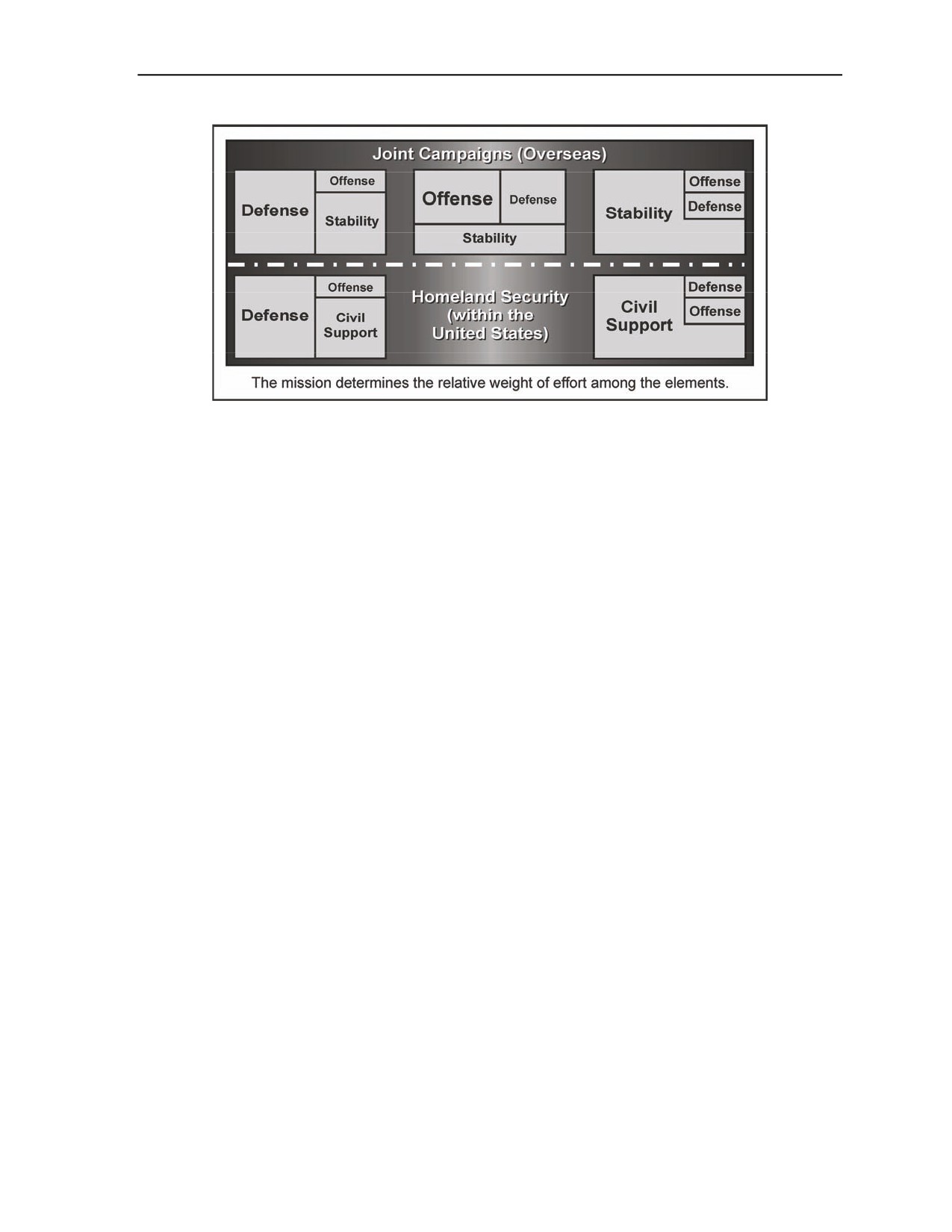
3-24. The Army’s operational concept is full spectrum operations (see figure 3-2 and FM 3-0). Full
spectrum operations are the purposeful, continuous, and simultaneous combinations of offense, defense,
and stability or civil support to dominate the military situation at operational and tactical levels. In full
spectrum operations, Army forces adapt to the requirements of the OE and conduct operations within it
using synchronized action, joint interdependent capabilities, and mission command. They defeat
adversaries on land using offensive and defensive operations, and operate with the populace and civil
authorities in the AO using stability or civil support operations.
3-6
FM 3-34
2 April 2009
Foundations2 April 2009perations
Figure 3-2. Full spectrum operations—the Army’s operational concept
3-25. Commanders plan for the concurrent conduct of the elements of full spectrum operations in weighted
combinations. Within broader combinations of full spectrum operations, Army forces conduct multiple
component operations simultaneously. This is the ability to execute several similar operations in different
locations at the same time, synchronizing them to produce a greater effect than if each were executed in
sequence. Tactically, simultaneous execution of full spectrum operations requires the synchronized
application of combat power. Synchronization is the arrangement of military activities in time, space, and
purpose to produce maximum relative combat power at a decisive place and time (the definition was
shortened, and the complete definition is printed in the glossary). (JP 2-0)
3-26. Simultaneity requires the ability to conduct operations in depth. Commanders consider the full
depths of their AOs, the enemy, the information environment, and civil considerations and act in the times
and places necessary to achieve their objectives. Army forces increase the depth of their operations through
combined arms, advanced information systems, and joint capabilities. Because Army forces conduct
operations across large areas, enemies face many potential friendly actions. Depth is equally important in
stability operations to preclude threats from operating outside of the reach of friendly forces, where they
can affect the campaign. In civil support operations, depth gives the Army its ability to reach all the
citizens in an affected area, bringing relief and hope.
3-27. There is an inherent complementary relationship between the use of lethal force and the application
of military capabilities for nonlethal purposes. Although each situation requires a different mix of violence
and restraint, lethal and nonlethal actions used together complement each other and create dilemmas for the
opponent. Lethal means are at the heart of offensive and defensive actions and their application is critical
to success in these operations; however, nonlethal means are becoming increasingly important. Today’s
threat operates from populated areas, wary of U.S. combat capabilities and welcoming the potential
carnage to noncombatants when combat erupts. They use information operations effectively to dramatize
any harm inflicted on noncombatants by friendly forces. Nonlethal, constructive actions can persuade the
local populace to withhold support for adversaries and provide intelligence to friendly forces. This can
force the enemy to choose between abandoning an area and exposing his forces to lethal combat.
Commanders analyze the factors of METT-TC to achieve a balance between lethal and nonlethal actions.
3-28. Engineer operations contribute significant combat power, both lethal and nonlethal in nature, to all
of the elements of full spectrum operations. Organic engineer capabilities in each of the BCTs provide
close support to the maneuver of those forces. Based on a METT-TC analysis, the BCTs will be task-
organized with additional modular engineer capabilities to meet mission requirements. For offensive and
defensive operations, engineer augmentation may consist of additional close support capabilities, as well as
an engineer battalion headquarters to provide the necessary C2 for the mix of modular engineer units and
capabilities augmenting the BCT. Other more technically specialized engineer capabilities support the
2 April 2009
FM 3-34
3-7
Chapter 3
BCT’s requirements related to the movement and maneuver, protection, and sustainment warfighting
functions. These same capabilities may be employed at division, corps, and theater echelon to enable force
mobility, survivability, and sustainment. Force tailored engineer capabilities from the force pool can
provide critical nonlethal capabilities to conduct or support stability or civil support operations. Geospatial
capabilities, both organic and from the force pool, support all four elements by adding to a clear
understanding of the physical environment.
COMBINED ARMS THROUGH THE WARFIGHTING FUNCTIONS
3-29. Full spectrum operations require the continuous generation and application of combat power, often
for protracted periods. Combat power is the actual application of force—the conversion of fighting
potential into effective action. It includes the unit’s constructive and information capabilities, and its
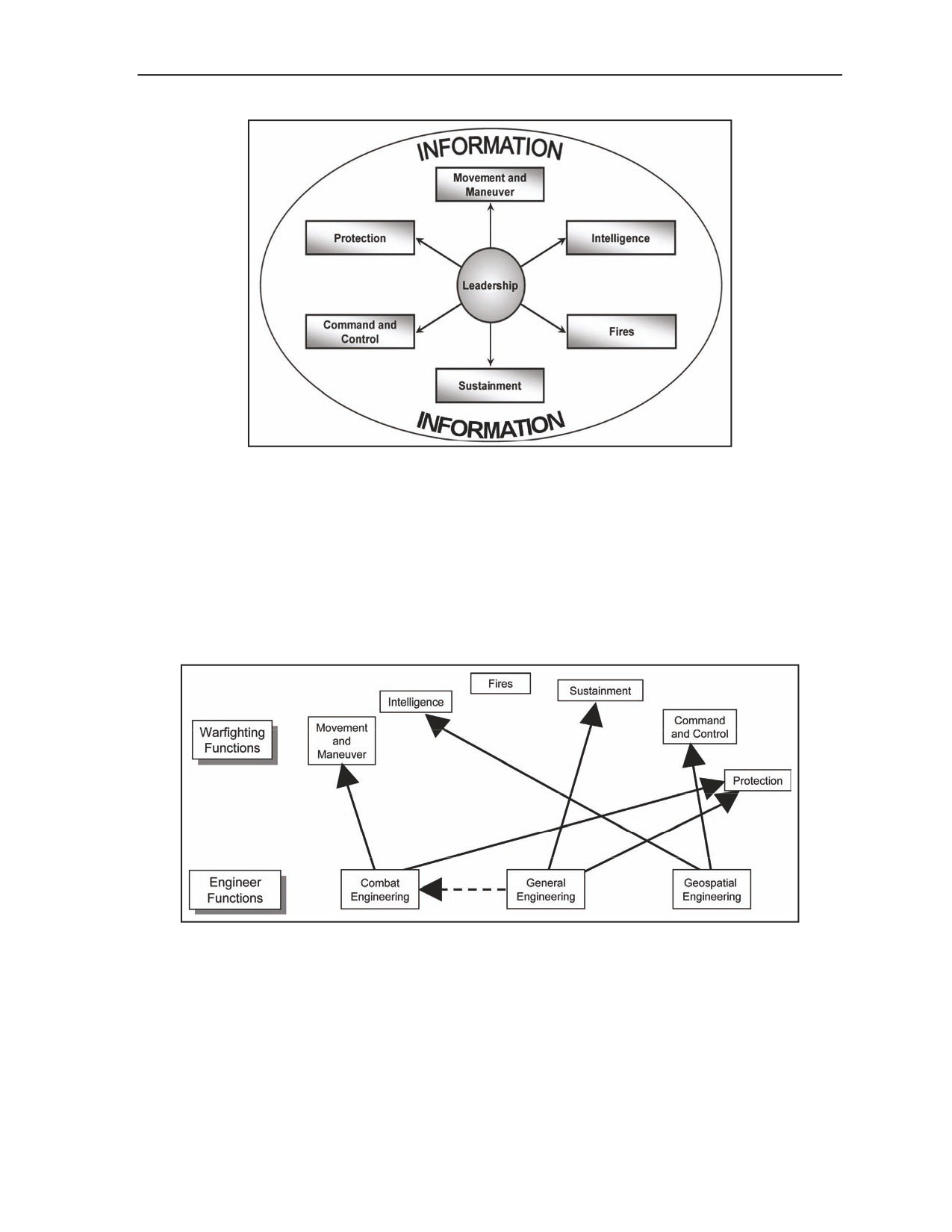
disruptive or destructive force. There are eight elements of combat power: leadership, information,
movement and maneuver, intelligence, fires, sustainment, C2, and protection. Leadership and information
are applied through and multiply the effects of the other six elements of combat power. These six—
movement and maneuver, intelligence, fires, sustainment, C2, and protection—are collectively described as
the warfighting functions (see figure 3-3). In full spectrum operations, Army forces combine the elements
of combat power to defeat the enemy and master each situation.
3-30. Commanders ensure that deployed Army forces have enough combat power to conduct necessary
combinations of full spectrum operations appropriate to the situation. Commanders balance the ability to
mass the effects of lethal and nonlethal systems with the requirements to deploy and sustain the units that
employ those systems. Sustaining combat power throughout the operation is important to success. Tailored
force packages maximize the capability of initial-entry forces consistent with the mission and the
requirement to project, employ, and sustain the force. Follow-on forces increase the entire force’s
endurance and ability to operate in depth. Employing reserves, focusing joint support, arranging rest for
committed forces, and staging sustainment assets to preserve momentum and synchronization all assist in
applying combat power effectively over time and space.
3-8
FM 3-34
2 April 2009
Foundations2 April 2009perations
Figure 3-3. The elements of combat power
3-31. Every unit, regardless of type, generates combat power and contributes to the operation. A variety of
engineer capabilities and unit types is available to contribute to combat power. Engineer functions are the
categories of related engineer capabilities and activities grouped together to help JFCs integrate,
synchronize, and direct engineer operations. These functions are each generally aligned in support of
specific warfighting functions (see figure 3-4), although they have impact in and across the others. Combat
engineering is aligned primarily with the movement and maneuver and the protection warfighting
functions; general engineering aligns to focus its support on the sustainment and protection warfighting
functions, as well as reinforcement of combat engineering outside of close combat; and geospatial
engineering is primarily aligned with the C2 and intelligence warfighting functions.
Figure 3-4. The primary relationships of engineer functions to the warfighting functions
3-32. Combined arms is the synchronized and simultaneous application of several arms—such as infantry,
armor, field artillery, and engineers—to achieve an effect that is greater than if each arm was used
separately or sequentially. The warfighting functions provide engineers a common framework within
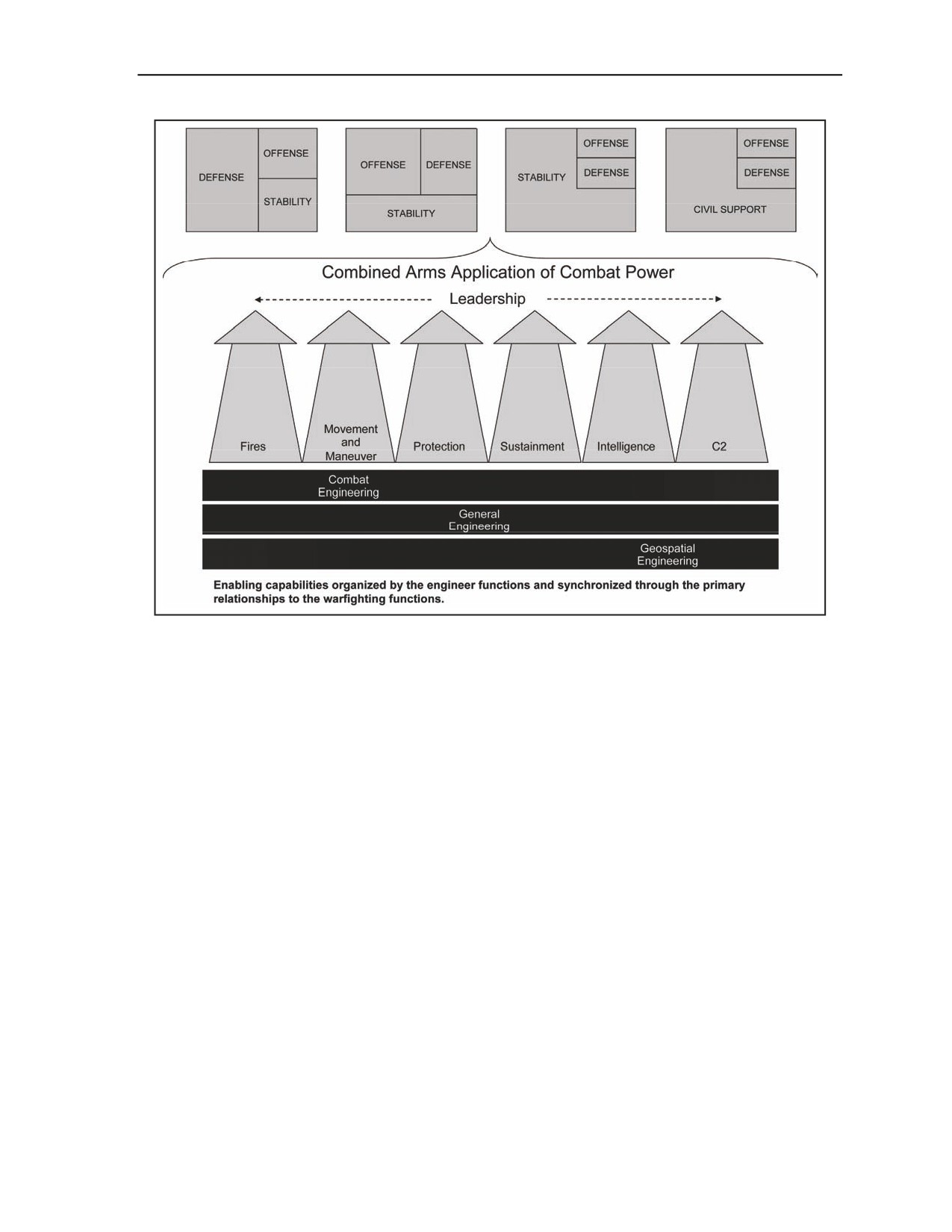
which to link the required engineer capabilities to the synchronized application of combined arms (see
figure 3-5, page 3-10).
2 April 2009
FM 3-34
3-9
Chapter 3
Figure 3-5. Application of engineer combat power
3-33. C2 is unique among the warfighting functions in that it integrates the activities of the other
warfighting functions. Given the nature of operations, effective C2 is characterized by the ability to—
z
Forecast or identify changes in the situation and react to them.
z
Provide continuous reciprocal interaction and influence among the commander, staff, and
forces.
z
Reduce chaos, lessen uncertainty, and operate effectively despite the remaining uncertainty.
3-34. Whether a subordinate or supporting unit, engineer unit commanders and their staffs must
understand and exercise the art and science of C2 as described in FM 3-0 (see also FM 5-0 and FM 6-0).
Organic units operating within their assigned BCT operate within that structure as a matter of routine.
However, augmenting units face challenges in quickly recognizing and integrating into the distinct
character of their “new unit.” Similarly, as modular units and headquarters elements are tailored and
allocated to division, corps, and Army headquarters, those unit commanders and staff must recognize and
integrate within the respective C2 structure. Thorough understanding of and practice with the C2 function
and the operations process that it drives enable the flexibility necessary for modular engineer forces to plug
into supported units. In unique cases where an engineer headquarters serves as the base around which a
task force or JTF is formed, as in a disaster relief operation, it becomes even more critical that the C2
function and the operations process it drives adheres closely to the ideal described in the referenced FMs
(and applicable joint doctrine when operating as a JTF).
3-35. Finding ways to accomplish the mission with an appropriate mix of lethal and nonlethal force is a
paramount consideration for every Army commander. Through synchronization, commanders mass the
lethal and nonlethal effects of combat power at the decisive place and time to overwhelm an enemy or
dominate the situation. Engineer leaders and staff planners at each echelon play a pivotal role in ensuring
the synchronization of the variety of engineer capabilities that are available to conduct or support full
3-10
FM 3-34
2 April 2009
Foundations2 April 2009perations
spectrum operations. Engineer leaders and staff synchronize the application of engineer functions through
the warfighting function framework by integrating into the operations process.
3-36. Assured mobility is a framework of processes, actions, and capabilities that assures the ability
of the joint force to deploy and maneuver where and when desired, without interruption or delay, to
achieve the mission. The assured mobility fundamentals—predict, detect, prevent, neutralize, and
protect—support the implementation of the assured mobility framework. This construct is one means
of enabling a joint force to achieve the commander’s intent. Assured mobility emphasizes proactive
mobility and countermobility actions and integrates all of the engineer functions in accomplishing this.
Assured mobility should not be confused with the limited application of the mobility function. While
focused primarily on the movement and maneuver warfighting function, it has linkages to each of the
warfighting functions and both enables and is enabled by those functions. While the engineer has the
primary staff role in assured mobility, other staff members support its integration and have critical roles to
play. Chapter
4 provides additional discussion on assured mobility, including the application of its
fundamentals in the planning process.
SECTION III-OPERATIONS PROCESS
3-37. Full spectrum operations follow a cycle of planning, preparation, execution, and continuous
assessment. These cyclic activities may be sequential or simultaneous. They are usually not discrete; they
overlap and recur as circumstances demand. As a whole, they make up the operations process. The
operations process consists of the major C2 activities performed during operations: planning, preparation,
execution, and continuous assessment. Battle command drives the operations process. Throughout the
operations process, commanders synchronize forces and warfighting functions to accomplish missions.
They use the operations process model to help them decide when and where to make decisions, issue
guidance, and provide command presence. Commanders and staffs develop and use control measures for
this coordination.
3-38. The operations process is the context within which engineer capabilities are integrated into combined
arms application. This context gains importance because of multiple and distinct interactions throughout
engineer operations with the C2 function. At every echelon from BCT to theater Army and JTF, engineer
leaders and staff exercise C2, participate in their supported commander’s C2, and provide geospatial and
other support through their supported commander’s C2 warfighting function.
COMMAND AND CONTROL OF ENGINEER OPERATIONS
3-39. C2 are interrelated. Command resides with commanders. It consists of authority, decision making,
and leadership. Control is how commanders execute command. It resides with both commanders and staffs.
Commanders cannot exercise command effectively without control. Conversely, control has no purpose
without command to focus it. This manual addresses C2 of engineer forces separately from engineer staff
participation in the supported commander’s C2. All engineer units must execute C2 and the operations
process activities for their own unit, and many engineer units will interact with the C2 activities of the unit
being supported. The interaction may be primarily through an engineer staff assigned to the supported unit
or through staff counterparts. In some cases, a supported unit may not have assigned engineer staff and the
supporting unit will provide this support as well. This relationship and degree of interaction is determined
by many factors including the type of unit and echelon being supported and the command or support
relationship established. Engineers can expect challenges in the OE when trying to execute engineering
tasks. Lack of engineer resources is typical in the OE and may impede the commander from executing all
identified tasks. Careful prioritization must occur. Even more challenging is that once in the AO, force-
tailored engineer units must be able to rapidly transition among elements of operations. Because the
available force-tailored engineer units are designed for more specific types of tasks, engineer capabilities
must be shifted within the AO to match the operational component requirements and the capabilities of the
modular engineer units. Transitions will occur at the strategic, operational, and tactical levels and
flexibility in the task organization at all levels will be required to permit the shifting of engineer
capabilities. For engineer units, consideration must also be given to the administration and support,
including control of resources and equipment, personnel management, unit logistics, individual and unit
2 April 2009
FM 3-34
3-11
Chapter 3
training, readiness, mobilization, demobilization, discipline, and other matters not included in the
operational missions but inherent in ADCON responsibilities.
CONSIDERATIONS AND RELATIONSHIPS IN THE BRIGADE COMBAT TEAM
3-40. Each of the three types of BCTs and the ACR are organized with organic engineer company-level
units (see Appendix B). These engineer companies support the BCT or its subordinate organizations by
conducting engineer operations within the BCT as an element of the BSTB (as in the HBCT and the IBCT)
or directly under the BCT headquarters (as in the SBCT and the ACR). The engineer companies organic to
the BCT may be further task-organized to maneuver task forces or the reconnaissance squadron, or even to
a subordinate company or troop. These unit commanders and leaders are fully integrated participants in the
C2 structure and activities of the BCT or its subordinate elements which they routinely support.
3-41. C2 above the engineer company is multifunctional (including engineer staff as discussed later in this
chapter) in nature, by a CAB, BSTB, or the BCT headquarters itself. The engineer company commander
must provide C2 for his unit and may be required to participate in C2 activities at the battalion or BCT
headquarters. The company has no staff capability to employ the MDMP, but instead will rely on higher
level staff support, troop-leading procedures (TLP), and SOPs to effectively exercise C2 of the unit. The
company has very limited capability to integrate augmenting engineer elements.
3-42. The limited structure for C2 of engineer forces within the BCT provides the greatest challenge to
integrating engineer operations in any of the BCTs for either the organic engineers or potential
augmentation by echelons above brigade (EAB) modular engineer organizations. In many situations the
augmentation of a BCT by a task-organized engineer battalion task force will provide the necessary
additional C2 to orchestrate engineer operations and support. Similarly, a task-organized engineer battalion
may be required in situations requiring engineer operations supporting one of the various support brigades.
3-43. Additional engineer units augmenting the BCT (or a support or functional brigade) are task-
organized to the BCT in either a command or support relationship as summarized in table 3-1 and table 3-
2, page 3-14. Command relationships are used when the most responsive employment of the augmenting
engineer units is required. Attached engineer units are temporarily associated with the gaining BCT. They
return to their parent unit when the reason for the attachment ends. Engineer units are normally assigned
OPCON to a gaining BCT for a given mission, lasting perhaps a few days. In both attached and OPCON
relationships, the augmenting engineer unit is tasked and provided priorities by the gaining unit. A
significant consideration in the OPCON relationship is that sustainment support and other ADCON
responsibilities remain with the parent engineer unit unless coordinated with the gaining BCT for certain
classes of supply. In both cases, the gaining BCT retains responsibility to furnish construction and barrier
materials required to support their missions.
3-44. Commanders establish support relationships when subordination of one unit to another is
inappropriate. Support relationships are graduated from an exclusive supported and supporting relationship
between two units—as in DS—to a broad level of support extended to all units under the control of the
higher headquarters—as in general support
(GS). Support relationships do not normally alter ADCON. In
a DS relationship, an engineer unit receives missions from the supported unit. A DS relationship is
typically used when it is anticipated that a change to the engineer task organization may require frequent
shifting of an engineer unit to multiple locations. The logistics system can best support this in a DS role
where the parent unit remains responsible for logistics and other types of support to the unit. In a GS
relationship, an engineer unit receives missions and all support from its parent engineer unit. In a GS
relationship, the engineer unit supports the maneuver element as a whole, and is appropriate when central
control and flexibility in employing limited engineer forces is required. A GS relationship is typically used
when a BCT’s higher headquarters either identifies a mission requirement within the BCT AO or accepts
responsibility for a requirement identified by the BCT. In either case, the requirement must be coordinated
with the impacted BCT and any missions must be executed through close coordination with the BCT.
3-12
FM 3-34
2 April 2009

Foundations2 April 2009perations
CONSIDERATIONS AND RELATIONSHIPS AT ECHELONS ABOVE BRIGADE
3-45. Army command and support relationships allow for flexibly allocating Army capabilities among
various echelons. Table 3-1 and table 3-2, page 3-14, list responsibilities inherent in the Army’s command
and support relationships. Command and support relationships are the basis for building task organizations.
Command relationships define superior and subordinate relationships between unit commanders.
Command relationships identify the degree of control of the gaining or supported commander. The type of
command relationship often relates to the expected longevity of the relationship between the headquarters
involved. Table 3-1 lists the Army’s command relationships.
Table 3-1. Army command relationships
Inherent Responsibilities:
Have
May be
Are
Are
Provide
Establish/
Have
Can impose
command
task-
ADCON
assigned
liaison
maintain
priorities
on gaining unit
relationship
organized
by:
position
to:
communi-
established
further
Relationship:
with:
by:1
or AO by:
cations
by:
command or
with:
support
relationship
by:
Organic
All organic
Organic
Army
Organic
N/A
N/A
Organic
Attached;
forces
head-
delegated
head-
head-
OPCON;
organized
quarters
quarters
quarters
TACON; GS;
with the
GSR; R; DS
headquarters
Assigned
Combatant
Gaining
Army
OPCON
As
As required
ASCC or
As required by
command
head-
delegated
chain of
required
by OPCON
Service-
OPCON
quarters
command
by
assigned
headquarters
OPCON
head-
quarters
Attached
Gaining unit
Gaining
Army
Gaining
As
Unit to
Gaining unit
Attached;
unit
delegated
unit
required
which
OPCON;
by
attached
TACON; GS;
gaining
GSR; R; DS
unit
OPCON
Gaining unit
Parent unit
Parent
Gaining
As
As required
Gaining unit
OPCON;
and
unit
unit
required
by gaining
TACON; GS;
gaining
by
unit and
GSR; R; DS
unit;
gaining
parent unit
gaining
unit
unit may
pass
OPCON to
lower HQ1
TACON
Gaining unit
Parent unit
Parent
Gaining
As
As required
Gaining unit
GS; GSR; R;
unit
unit
required
by gaining
DS
by
unit and
gaining
parent unit
unit
Note: 1In North Atlantic Treaty Organization (NATO), the gaining unit may not task-organize a multinational force (see TACON).
Legend:
ADCON - administrative control
HQ - headquarters
ASCC - Army service component commander
N/A - not applicable
AO - area of operations
OPCON - operational control
DS - direct support
R - reinforcing
GS - general support
TACON - tactical control
GSR: general support reinforcing
3-46. Table
3-2 lists support relationships. Commanders establish support relationships when
subordination of one unit to another is inappropriate. They assign a support relationship when—
z
The support is more effective when the supporting unit is controlled by a commander with the
requisite technical and tactical expertise.
2 April 2009
FM 3-34
3-13

Chapter 3
z
The echelon of the supporting unit is the same as or higher than that of the supported unit. For
example, the supporting unit may be a brigade, and the supported unit may be a battalion. It
would be inappropriate for the brigade to be subordinate to the battalion, hence the use of an
Army support relationship.
z
The supporting unit supports several units simultaneously. The requirement to set support
priorities to allocate resources to supported units exists. Assigning support relationships is one
aspect of mission command.
Table 3-2. Army support relationships
Inherent Responsibilities:
Can impose
Establish/
on gaining
Have
May be
Receives
Are
Have
Relationship:
maintain
unit further
command
task-
sustain-
assigned
Provide
priorities
communi-
command or
relationship
organized
ment
position or
liaison to:
established
cations
support
with:
by:
from:
AO by:
by:
with:
relationship
by:
Parent unit
Direct
Parent
Parent
Supported
Supported
and
Supported
Parent unit
See note1
support1
unit
unit
unit
unit
supported
unit
unit
Parent unit
Reinforced
Parent
Parent
Reinforced
Reinforced
and
Not
Reinforcing
Parent unit
unit then
unit
unit
unit
unit
reinforced
applicable
parent unit
unit
Reinforced
Reinforced
Parent unit;
General
Parent
Parent
unit and as
unit and as
then
Not
support-
Parent unit
Parent unit
unit
unit
required by
required by
reinforced
applicable
reinforcing
parent unit
parent unit
unit
As required
As required
General
Parent
Parent
Not
Parent unit
Parent unit
by parent
by parent
Parent unit
support
unit
unit
applicable
unit
unit
Note: 1 Commanders of units in DS may further assign support relationships between their subordinate units and elements of
the supported unit after coordination with the supported commander.
3-47. Several other relationships established by higher headquarters exist with units that are not in
command or support relationships (see table 3-3). These relationships are limited or specialized to a greater
degree than the command and support relationships. These limited relationships are not used when tailoring
or task-organizing Army forces. Use of these specialized relationships helps clarify certain aspects of
OPCON or ADCON. Experience has generally reflected that command relationships work well in
offensive operations, but that support relationships allow for more efficient use of high demand, low
density engineer capabilities during defensive and stability operations. However, each situation is different
and requires careful analysis in determining the appropriate relationship of engineers to the supported
force.
3-14
FM 3-34
2 April 2009

Foundations2 April 2009perations
Table 3-3. Other relationships
ADCON
Authority and
Operational use
Established by
responsi-
limitations
bilities
TRO allows the CCDR
to provide guidance on
operational
requirements and
training priorities,
TRO is an authority
review readiness
exercised by a CCDR
The gaining CCDR,
reports, and review
over assigned Reserve
who normally
Parent unit
mobilization plans for
Component (RC)
delegates TRO to the
responsibility
Training and
RC forces. TRO is not
forces not on active
ASCC. For most RC
for training and
readiness
a command
duty. Through TRO,
forces, the CCDR is
readiness of
oversight
relationship. ARNG
the CCDR shapes RC
the United States Joint
forces is
(TRO)
forces remain under
training and readiness.
Forces Command
inherent in
the C2 of their
Upon mobilization of
(JFCOM) and the
ADCON.
respective State
the RC forces, TRO is
ASCC is FORSCOM.
Adjutant Generals until
no longer applicable.
mobilized for federal
service. USAR forces
remain under the C2 of
the USAR command
until mobilized.
Allows planning and
Limited to planning and
direct collaboration
coordination between
between two units
Direct
units. Any
assigned to different
liaison
Chain of command.
implementation of
Parent unit
commands, based on
authorized
plans must be made
anticipated tailoring
through the current
and task organization
controlling parent unit.
changes.
Normally establishes
coordinating authority
Informal relationship
between the gaining
between an ASCC and
ASCC and supporting
ASCC and units used
Aligned
other Army units
Army command or
Parent unit
to form force packages
identified for use in a
direct reporting unit.
with priority of
specific GCC.
commitment to that
ASCC.
JOINT CONSIDERATIONS AND RELATIONSHIPS
3-48. Army command relationships are similar but not identical to joint command authorities
and
relationships. Differences stem from the way Army forces task-organize and the need for a system of
support relationships. CCDRs have broad authority and control over subordinate commands and forces.
Particularly pertinent to engineer operations are—
z
The directive authority for logistics that CCDRs have and their authority to delegate directive
authority for common support capabilities, which includes engineering support.
z
The authority to employ mines, which originates with the President. See JP 3-15 for more
information.
3-49. A subordinate JFC normally exercises OPCON over assigned or attached forces and is responsible
for the employment of their capabilities to accomplish the assigned mission or objective. Additionally, the
JFC ensures that cross-Service support is provided and that all engineering forces operate as an effective,
mutually supporting team. The JFC assigns engineering tasks to subordinate commanders. Most often, joint
forces are organized with a combination of Service and functional component commands.
2 April 2009
FM 3-34
3-15
Chapter 3
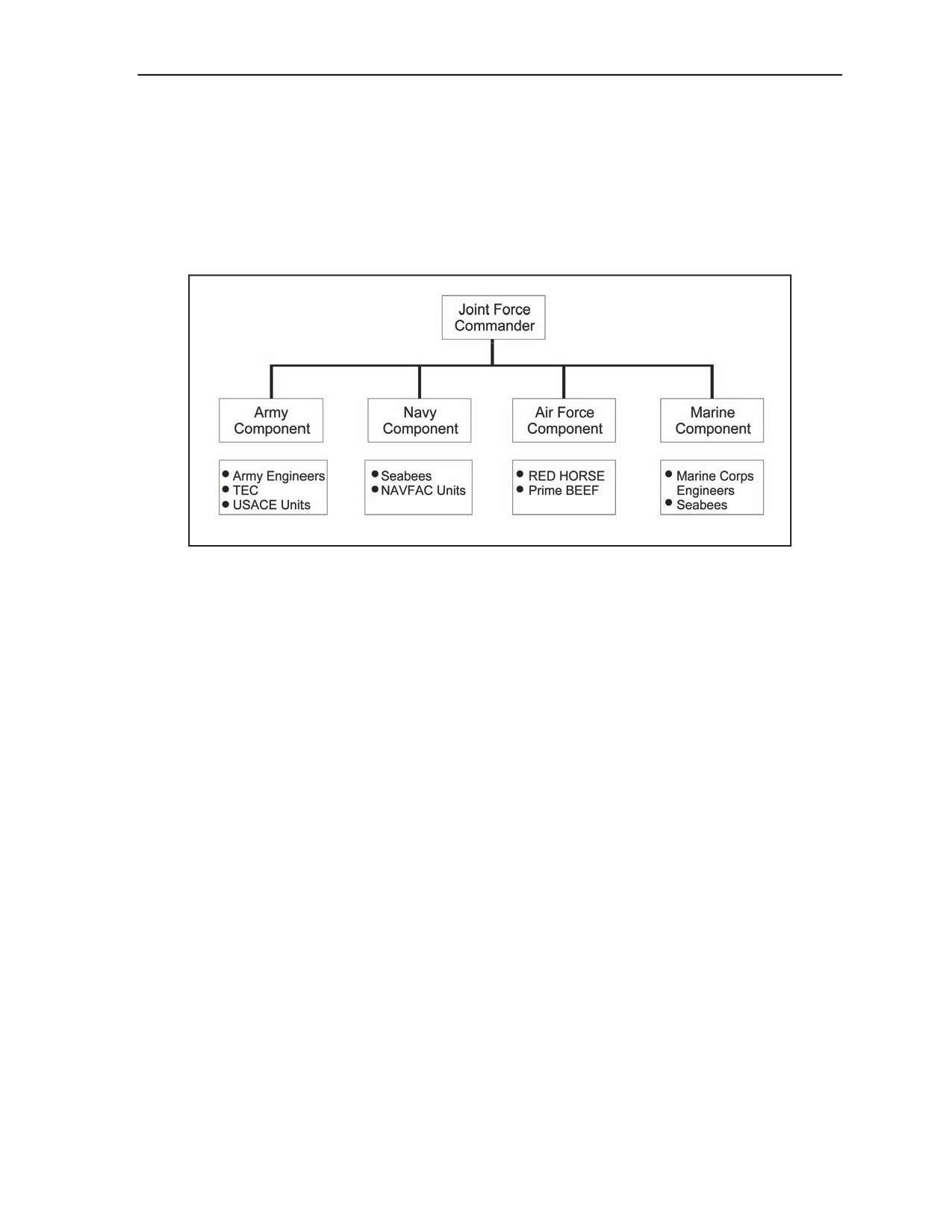
3-50. Service component commanders maintain OPCON over their Service engineer forces under this
organizational option (see figure 3-6). This structure maintains traditional command relationships and is
best used when the JFC chooses to conduct operations through Service component commanders and when
engineer forces are used in DS of Service component missions. A Service component command may be
delegated OPCON or TACON of engineer forces from another Service to accomplish the assigned mission
or tasks. For example, a task tailored NCE may be placed under OPCON or TACON of the Marine
component commander for general engineering support. In addition, the JFC may also establish support
relationships between subordinate commanders to aid, protect, complement, or sustain another force.
Figure 3-6. Service component command
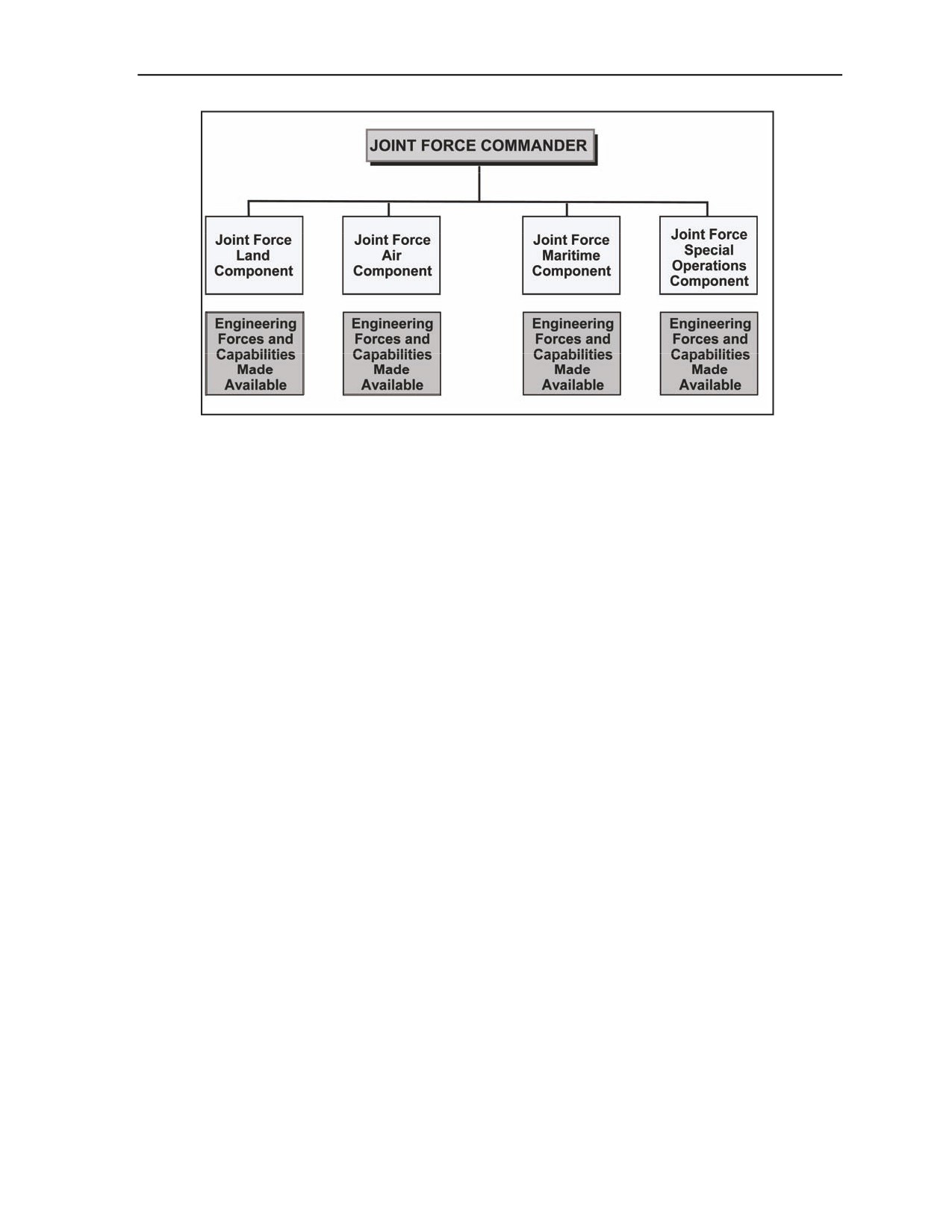
3-51. The JFC may also organize using one or more functional component commands (see figure 3-7).
Under this organizational option, the JFC establishes command relationships for engineer forces based on
the requirement for engineer missions. The JFC is responsible for establishing the appropriate relationships
between components to accomplish the required tasks. For example, Air Force engineers or NCF units may
be placed in TACON to the JFLCC. Use of engineering forces either in DS or attached to a functional
component commander is a viable option when providing capabilities tied directly to the functional
component’s mission. The functional component command will not normally be responsible for providing
common logistic support (that is, beddown construction) to the joint force. When a joint force component
commander does not have adequate engineer forces assigned, the component commander will coordinate
engineering support requirements through the JFC to obtain the support from other components of the JTF.
There are numerous variations in organizing engineer forces under this command structure that provide
significant flexibility to the joint force. The key advantage of this option is that it provides the JFC with the
ability to tailor the engineer capabilities within the joint force by crossing Service component lines to best
achieve mission requirements.
3-16
FM 3-34
2 April 2009
Foundations2 April 2009perations
Figure 3-7. Functional component command
3-52. Establishing a support relationship between components (as described in JP 0-2) is a useful option to
accomplish needed tasks. Support relationships can be established among all functional and Service
component commanders, such as the coordination of operations in-depth, involving the JFLCC and the
JFACC. Within a joint force, more than one supported command may be designated simultaneously, and
components may simultaneously receive and provide support for different missions, functions, or
operations. For instance, a joint force special operations component may be supported for a direct action
mission while simultaneously providing support to a joint force land component for a raid. Similarly, a
joint force maritime component may be supported for sea control while simultaneously supporting a joint
force air component to achieve air superiority over the operational area.
3-53. Some operations, such as disaster relief or FHA, are engineer-intensive. In such cases, the JFC may
opt to establish a subordinate JTF to control extensive engineer operations and missions. Such a JTF may
be formed around an existing TEC or naval construction regiment. The JFC designates the military
engineer capabilities that will be made available for tasking and the appropriate command relationships.
Engineer forces could be placed under OPCON, TACON, or in a supporting role depending on the degree
of control that the JFC desires to delegate to the subordinate JTF. The engineer assets attached to the
subordinate JTF will normally be a mix of engineer assets drawn from the entire force’s engineer
resources. If the subordinate JTF is to provide a common support capability, it will require a specific
delegation of directive authority from the CCDR for the common support capability that is to be provided.
THE ENGINEER COORDINATOR
3-54. Commanders cannot exercise control alone except in the simplest and smallest of units. The staff’s
primary function is to help the commander and subordinate commanders exercise control. Control allows
commanders to direct the execution of operations. Unlike command functions—which remain relatively
similar among echelons of command—control functions increase in complexity at each higher echelon. As
the control function becomes increasingly complex, units are typically assigned larger staffs to ensure
integration through the warfighting functions and synchronization of combat power. The staff assigned to
BCT, division, corps, theater Army, GCC, and other joint organizations includes a number of engineers in
various sections and cells. A senior engineer staff advisor, the engineer coordinator (ENCOORD), is
designated among these engineer staff members to assist the commander in exercising control over
engineer forces in the AO.
3-55. Previous editions of this manual recommended “dual hatting” the senior engineer unit commander as
both the engineer force commander and the senior engineer staff advisor to the supported commander.
Because of the transformation to a modular force and based on recent experience in projecting the tailored
engineer force, dual hatting is no longer the preferred option for providing C2 for engineer forces and
2 April 2009
FM 3-34
3-17
Chapter 3
meeting the supporting commander’s requirement for engineer staff advice. Ultimately, the decision on
whether the senior engineer unit commander will serve both roles will be made by each supported force
commander and be situationally dependent. Some specific considerations for determining the relationship
of the senior engineer staff advisor and the engineer force commander include—
z
What staff assets are available to support the engineer staff advisor versus the engineer unit
commander? Are these elements from the same unit or are separate units resourced for each
role?
z
What experience level is needed for the engineer staff advisor? Should this role be resourced
with a current or former commander?
z
What duration of time will the augmenting engineer element, commanded by the senior engineer
unit commander, be working for or with the force? Is there enough time for this engineer
commander to acclimate and effectively advise the force commander?
z
What working relationship is established between an existing engineer staff advisor and the
force commander? Similarly, is there an existing working relationship between the engineer unit
commander and this force commander?
3-56. The engineer coordinator is the special staff officer, usually the senior engineer officer on the
staff, responsible for coordinating engineer assets and operations for the command. Each maneuver
force echelon down to brigade level has an organic engineer planner and staff element to integrate
engineers into the combined arms fight. The task force and company levels may have a designated engineer
planner, but their engineer will not be organic at these echelons. The engineer is a special staff member of
the staff responsible for understanding the full array of engineer capabilities
(combat, general, and
geospatial engineering) available to the force and for synchronizing them to best meet the needs of the
maneuver commander.
BRIGADE ENGINEER COORDINATOR
3-57. Each of the three types of BCTs and ACR are organized with organic engineer staff sections (see
Appendix B). These engineer staff sections support the C2 of the BCT and its subordinate organizations
while focusing on engineer operations within the BCT. They also provide the C2 framework for engineer
augmentation in whatever form it may come to the BCT.
3-58. The brigade ENCOORD is responsible for coordinating engineer operations and may be the senior
engineer officer in the force. When an engineer battalion is task-organized in support of the BCT, the BCT
commander determines if a change will occur in the ENCOORD designation. This decision is based on the
type of unit, duration of the task organization, and focus of the mission being performed by the supporting
engineer battalion. If the attached engineer battalion commander is designated as the ENCOORD, he will
rely heavily on the BCT staff engineer for integration into the BCT operations process. Regardless of the
task organization, the brigade engineer is responsible for the functional control (through the brigade
commander) of all engineer units in support of the brigade. At the maneuver battalion level, the
ENCOORD is the engineer staff officer organic to the battalion headquarters or the senior engineer
supporting that battalion if it has no organic engineer staff.
3-59. The brigade ENCOORD’s primary duty is to coordinate the conduct of engineer operations in
support of the combined arms operation. The ENCOORD integrates specified and implied engineer tasks
into the brigade plan and ensures that supporting engineer units are integrated into brigade mission
planning, preparation, execution, and assessment activities. The ENCOORD may also be tasked to
coordinate the broader array of maneuver support operations conducted in support of the BCT. The
ENCOORD is normally located in the BCT main. However, if the BCT is located in some type of
sanctuary and the tactical CP is deployed forward, the ENCOORD may be located in the tactical CP. The
following lists various ENCOORD activities in the conduct of engineer operations:
z
Plan.
Assist the S-2 with the IPB, including information from the preparation of the engineer
running estimate.
Determine and evaluate critical aspects of the engineer situation.
3-18
FM 3-34
2 April 2009
Foundations2 April 2009perations
Formulate ideas for engineer support to meet the BCT commander’s intent.
Decide what engineer missions must be accomplished to support current and future fights.
Integrate the BCT geospatial engineer team in the planning process to explain the military
significance of the terrain to the commander and staff, and create geospatial products for
decision making.
Advise the commander on using organic and nonorganic engineer assets, employing and
reducing obstacles, and employing engineer reconnaissance.
Identify any BCT requirements for EAB engineer and other related assets to support the
brigade.
Make the BCT commander aware of the capabilities, limitations, and employment
considerations of supporting engineers and related assets.
Develop a scheme of engineer operations concurrent with the BCT maneuver COAs.
Recommend the engineer priorities of effort and support, essential tasks for M/CM/S, and
acceptable mission risks to the BCT commander.
Recommend the engineer organization for combat.
Visualize the future state of engineer operations in the BCT.
Integrate the engineer functions of combat, general, and geospatial engineering into future
brigade plans.
z
Prepare.
Train the brigade engineer cell located at the brigade main CP.
Issue timely instructions and orders to subordinate engineer units through the BCT base
order to simplify preparation and integration. Develop the necessary input to BCT orders,
annexes, and engineer unit orders (as required).
Coordinate production and distribution of maps and terrain products.
Recommend intelligence requirements to the intelligence staff officer (S-2) through the
operations staff officer (S-3).
Participate in the targeting process.
Participate in appropriate working groups.
Plan and coordinate with the fires cell on the integration of obstacles and fires.
Recommend MSRs and logistics areas to the logistics staff officer (S-4) based on technical
information.
Coordinate with BCT S-4 or maneuver battalion S-4 for additional resources to support the
M/CM/S effort (supply Class III petroleum products and supply Class IV construction
materials).
Coordinate with BCT S-4 to support base camp, facilities, and other sustainment related
construction requirements.
Advise the commander on environmental issues, coordinate with other staff members to
determine the impact of operations on the environment, and help the commander integrate
environmental considerations into decision making.
Recommend when engineer diver support may facilitate specific engineer reconnaissance in
support of the BCT.
Ensure EOD integration in the conduct of operations.
2 April 2009
FM 3-34
3-19
Chapter 3
z
Execute.
Alter the engineer plan using the feedback received from maneuver battalions, the engineer
company, and any augmenting engineer units as required.
Provide information on the status of engineer assets on hand.
Make time-sensitive engineer decisions on requests for immediate support received from
BCT engineers.
z
Assess.
Track all templated and known obstacles, SCATMINEs, the survivability status, the route
status, engineer missions, and any other engineer-specific information.
Establish and maintain a continuous, open link among all engineer cells, task force
engineers, and (when applicable) supporting engineer CPs.
Use the running estimate and the continuous link with the supporting engineer staffs and
engineer units to compute resource and force requirements and recommend engineer task
organization.
Monitor the execution of engineer orders and instructions by tracking the current fight.
Use reporting from engineer unit CPs to measure and analyze engineer performance and
anticipate change and unforeseen requirements.
ECHELONS ABOVE BRIGADE ENGINEER
3-60. While staffs differ by echelon and unit type, all staffs include similar staff sections. The staff consists
of the chief of staff or executive officer and coordinating, special, and personal staff sections. A staff
section is a grouping of staff members by area of expertise. Each staff section has a principle staff officer,
who may be a coordinating, special, or personal staff officer for the commander. The commanding
officer’s grade determines whether the staff is a G staff (general officer) or an S staff (colonel or below).
Organizations commanded by a general have G staffs; other organizations have S staffs. The number of
coordinating, special, and personal staff officers and their corresponding staff sections varies with different
command levels (see figure 3-8).
3-20
FM 3-34
2 April 2009
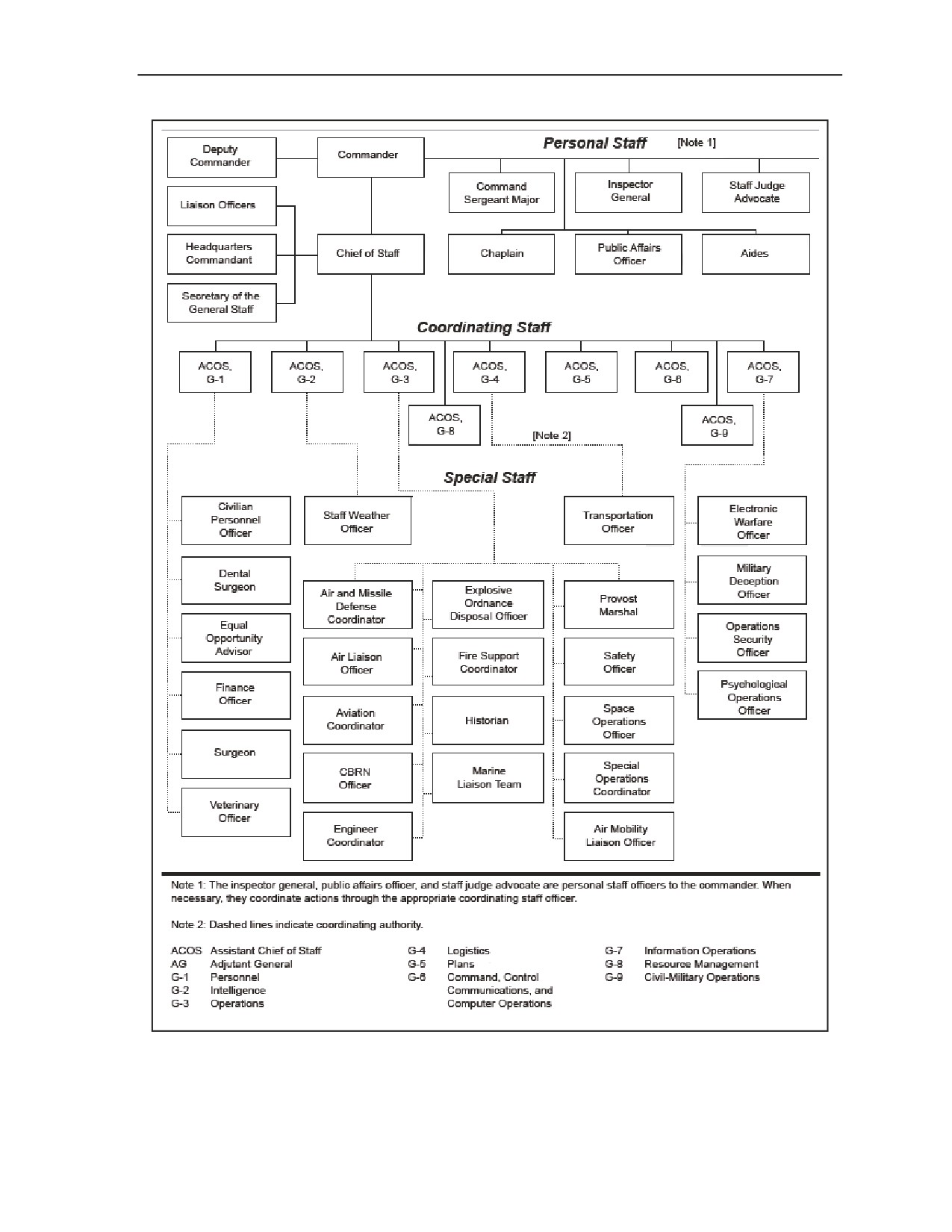
Foundations2 April 2009perations
Figure 3-8. Basic staff structure and coordinating authorities
3-61. Depending on the echelon and type of unit, engineer staff members may be assigned under the
ENCOORD section or may be assigned within other staff sections. The ENCOORD may be assigned
2 April 2009
FM 3-34
3-21
Chapter 3
within the operations section (as shown), may be assigned within the logistics section (more common in
joint staffs), or may be a separate section. Even though the division or corps headquarters may serve as a
JTF headquarters, the division engineer and corps engineer staff duties and responsibilities are similar to
those listed previously for the brigade engineer. Appendix E provides additional discussion of the division
and corps engineer staff.
3-62. Commanders organize their headquarters into CPs to help them exercise C2 throughout the conduct
of operations. By organizing into CPs, commanders disperse their staff and C2 capabilities in the AO. This
expands the commander’s ability to exercise C2 and makes the C2 system more survivable. They base the
number and internal structure of CPs on available resources, planning horizons, and warfighting functions.
Doctrine and a unit’s MTOE provide commanders a starting point for organizing their staff into CPs. Each
operation is unique based on the factors of METT-TC. Just as commanders organize their entire force for
an operation, they organize headquarters for effective C2. The mission determines which activities to
accomplish. These activities determine how commanders organize, tailor, or adapt their individual staffs to
accomplish the mission. The mission also determines the size and composition of the staff. For example, a
division headquarters may serve as the base for a JTF headquarters. Based on the factors of METT-TC, the
division staff would be augmented with additional staff members and C2 capabilities to accomplish the
mission.
3-63. Regardless of the mission, every Army staff has common areas of expertise that determine how
commanders divide duties and responsibilities. Grouping related activities by area of expertise gives
commanders an effective span of control. It also facilitates unified effort by the staff. Areas of expertise
may vary slightly depending on the command echelon, mission, and environment. For example, at battalion
level there is normally no resource manager and certain logistic units combine the intelligence and
operations areas of expertise. As previously mentioned, the section of assignment and grouping of engineer
staff varies among echelons and unit types. Regardless of the distribution of engineer staff or their section
of assignment, the ENCOORD must ensure the synchronization of the engineer effort.
JOINT ENGINEER STAFF
3-64. The GCC engineer staff performs a variety of functions to synchronize engineer operations in the
AOR. These include—
z
Planning and coordinating theater engineering support.
z
Providing recommendations to the CCDR on the assignment of engineering missions to
subordinate commanders. Recommendations may include which subordinate commander
(Service or functional component, subordinate JTF, or subunified commander) will be assigned
the mission, the scope of the project, and which commanders will be placed in a supporting role.
z
Furnishing recommendations on the tasking of components for theater engineering missions,
tasks, or projects.
z
Recommending policies and priorities for construction and real estate acquisition and for
Class IV construction materials. Compiling a joint integrated priority list for construction
projects for U.S. funded contingency construction as well as for HN funded construction.
z
Furnishing advice on the effect of joint operations on the physical environment according to
applicable U.S., international, and HN laws and agreements.
z
Recommending construction standards.
z
Identifying engineering support requirements that exceed component funding authorizations and
organized engineer capabilities.
z
Furnishing advice on the assessment of the risk to mission accomplishment of engineering
support shortfalls.
z
Furnishing advice on the feasibility, acceptability, and suitability of component engineering
plans.
z
Preparing, as part of the joint operation planning process, the engineer parts of OPLANs and
OPORDs (discussed further in Chapter 4).
z
Reviewing all engineer-related annexes and appendixes of OPLANs and OPORDs.
3-22
FM 3-34
2 April 2009
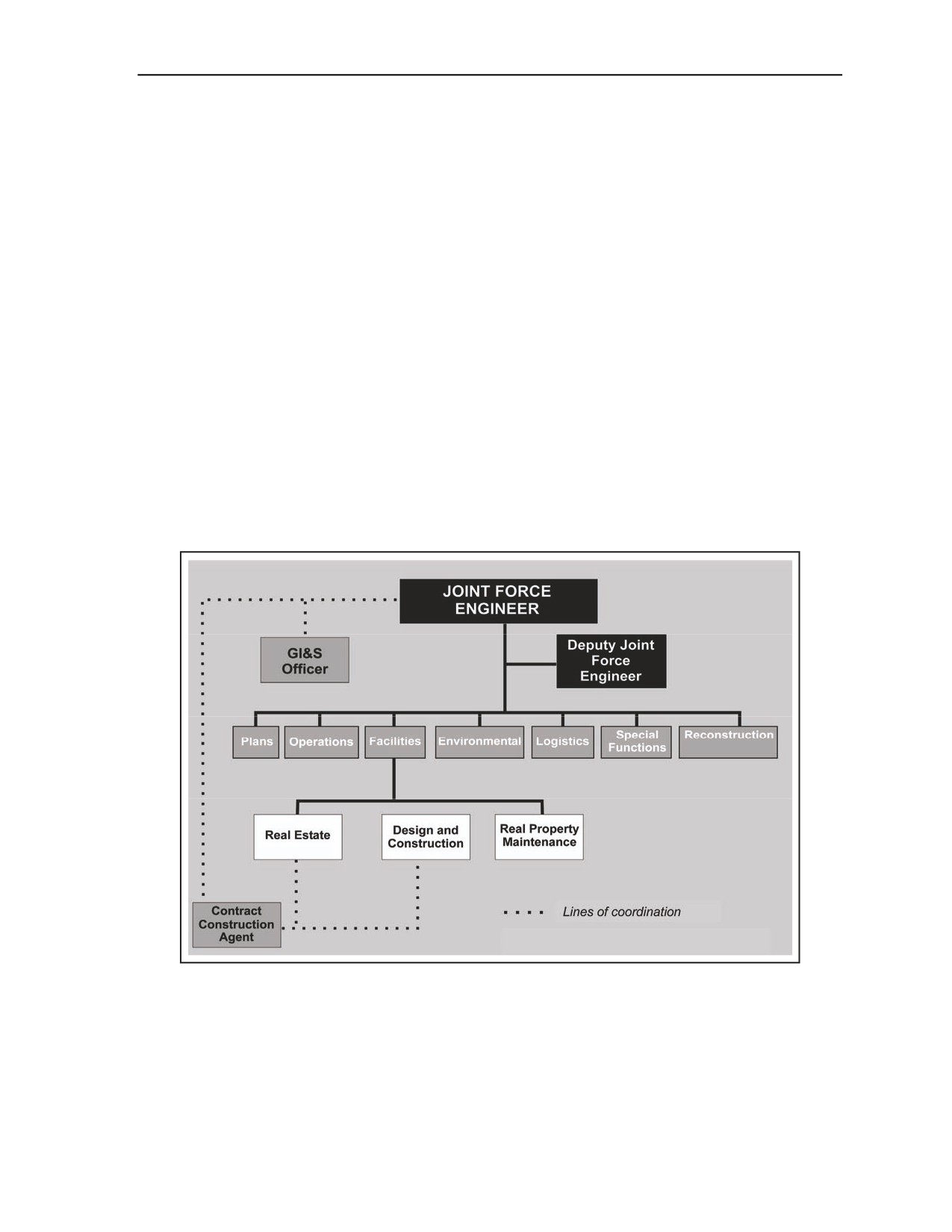
Foundations2 April 2009perations
z
Providing input to the theater security cooperation plan. Developing and programing
construction projects to include Exercise-Related Construction
(ERC) Program and
Humanitarian and Civic Assistance (HCA) Program construction projects to support theater
security cooperation strategies.
z
Developing training and exercise programs to evaluate and improve preparedness for
engineering missions.
z
Planning and coordinating the procurement and distribution of Class IV construction materiel
based on established priorities. Service components are responsible for procurement and
distribution of their Class IV requirements.
z
Coordinating with DOD and Department of State (DOS) construction agents and other engineer
support agencies.
z
Participating in joint engineering boards and engineer-related working groups, as required.
3-65. The subordinate JFC should establish an engineer staff for matters pertaining to the planning and
execution of joint engineering support operations. When a functional component command employs forces
from more than one Service, the staff should reflect each Service represented. The CCDR and subordinate
JFC will organize their staffs to carry out their respective assigned duties and responsibilities. Based on
mission-specific requirements, the engineer staff may be placed within the directorate for operations (J-3),
directorate for logistics (J-4), or organized as a separate staff to the JFC. The JFC may choose to organize
geospatial engineers or geospatial intelligence and services (GI&S) officers within the directorate for
intelligence (J-2). Regardless of the option or combination of options used, the requirement for the staff
engineer remains, as well as the need for constant communication, liaison, and coordination throughout the
entire staff. A notional engineer staff is depicted in figure 3-9.
Figure 3-9. Notional joint engineer staff
2 April 2009
FM 3-34
3-23
Chapter 3
3-66. Key joint force engineer staff functions are as follow:
z
Develops and coordinates combat engineering, general engineering, and geospatial engineering
requirements for the joint force.
z
Acts as the intermediary, facilitator, and coordinator between JTF elements, including
nonmilitary elements, requesting engineering services. Receives guidance and reports actions to
Joint Civil-Military Engineering Board (JCMEB) if established.
z
Develops and coordinates tasks for component engineer forces.
z
Coordinates and facilitates the Joint Facilities Utilization Board (JFUB), JCMEB, and Joint
Environmental Management Board (JEMB). Integrates actions from these boards, assigns
tasking based on board recommendations, and monitors completion.
z
Screens, validates, and prioritizes all engineering projects and mission assignments. Participates
in management of LOGCAP, when utilized, to validate operations and maintenance services and
construction requirements.
z
Plans, programs, and controls facility use. Receives guidance and reports actions to JFUB, if
established.
z
Prepares logistic reports on engineer resources using the Joint Operation Planning and
Execution System (JOPES).
z
Develops the ESP.
z
Plans and coordinates the distribution of construction and barrier materials and engineer
munitions based on established priorities. Participates on the Joint Acquisition Review Board to
validate requests for construction equipment leases and purchases.
z
Functions as the primary interface between the joint force, HN, contingency contractors, and
other theater construction organizations.
z
Establishes the statement of work, development of contracts, and employment of services.
z
Plans and provides guidance for environmental considerations that impact joint operations.
z
Serves as the program manager for all engineer-related functions.
WORKING GROUPS, CELLS, AND BOARDS
3-67. Staff members are assigned to staff sections. Commanders organize staff sections in CPs into
functional and integrating cells. Cells contain elements from staff sections. In the context of CPs, a cell is a
grouping of personnel and equipment by warfighting function (movement and maneuver) or purpose
(maneuver support) to facilitate C2. Periodically, or as required, ad hoc groupings form to solve problems
and coordinate actions. These groups include representatives from within or outside of a CP. Their
composition depends on the issue. These groups are called meetings, working groups, and boards. Each is
a control mechanism for regulating a specific action, process, or function. A working group is a temporary
grouping of predetermined staff representatives who meet to coordinate and provide recommendations for
a particular purpose or function. A board is a temporary grouping of selected staff representatives
delegated decision authority for a particular purpose or function. They are similar to working groups.
When the process or activity being synchronized requires command approval, a board is the appropriate
forum.
3-68. Commanders at each echelon may establish working groups, boards, or cells to manage and
coordinate functional or multifunctional activities. The engineer staff will be key members on many of
these and may chair construction-related groups. Working groups conduct staff coordination at the action
officer level and prepare materials for decisions to be made at a board. Boards establish policies,
procedures, priorities, and oversight to coordinate efficient use of resources. Cells group personnel from
various sections on a headquarters authorization document to integrate key functions, such as cells focused
on each of the warfighting functions. Appendix E discusses the various boards and cells on which the staff
engineer may participate.
3-24
FM 3-34
2 April 2009
Foundations2 April 2009perations
CONTROL MECHANISMS
3-69. Control is the regulation of forces and warfighting functions to accomplish the mission in
accordance with the commander’s intent (the definition was shortened, and the complete definition is
printed in the glossary). (FM 3-0) Aided by staffs, commanders exercise control over all forces in their AO,
including the airspace over it. Staffs provide their greatest support in providing control and keeping
commanders informed. A control mechanism is a means of regulating forces or warfighting functions.
Control mechanisms are established under the authority of a commander. Certain control mechanisms
belong to the commander alone and may not be delegated. These include the commander’s intent, unit
mission statement, planning guidance, and commander’s critical information requirements
(CCIR).
However, staff officers and subordinate leaders can establish others within the authority commander’s
delegate. Control mechanisms include, but are not limited to the following:
z
Commander’s intent.
z
Planning guidance.
z
CCIR.
z
Assignment of priorities (such as, decisive, shaping, and sustaining operations; priority of fires;
and the main effort).
z
Delegation of authority.
z
Assignment of missions and tasks to subordinates.
z
Plans and orders (see Chapter 4), including their components and subordinate plans:
Unit mission.
Task organization.
Concept of operations.
Target lists.
ROE.
ISR and service support plans.
z
Graphic control measures (including fire support coordination and air space control measures).
z
Battle rhythm.
z
Intelligence synchronization matrix.
z
Information requirements.
z
Routine reports and returns.
3-70. An engineer work line (EWL) is a graphic or functional control measure used at EAB to designate
areas of work responsibility for subordinate engineer organizations. An engineer work line is a
coordinated boundary or phase line used to compartmentalize an area of operations to indicate
where specific engineer units have primary responsibility for the engineer effort (the definition was
shortened, and the complete definition is printed in the glossary). EWLs are generally established in a
corps unassigned area. EWLs may also be established to designate engineer support boundaries in stability
or civil support operations. These lines generally match area support and HN military or political
boundaries. EWLs will be adjusted as an operation transitions. Because engineers focus on mission
requirements rather than area support, EWLs may be independent of other control measures—for example,
to permit operational-level engineers to concentrate in an assigned area or to conduct specific missions on a
task basis forward of the EWL.
SECTION IV-ENGINEER COMBAT POWER
3-71. Commanders apply combat power through the warfighting functions using leadership and
information. To effectively support the combined arms team, engineer capabilities are organized by the
engineer functions and synchronized in their application through the warfighting functions. This section
will describe selected engineer operations directed through and primarily supporting additional warfighting
functions (the C2 warfighting function is discussed above; see FM 3-34.22 for discussion of support to the
2 April 2009
FM 3-34
3-25
Chapter 3
fires warfighting function). These warfighting functions also provide the framework for engineer tasks in
the Army universal task list.
MOVEMENT AND MANEUVER
3-72. The movement and maneuver warfighting function is the related tasks and systems that move forces
to achieve a position of advantage in relation to the enemy. Direct fire is inherent in maneuver, as is close
combat (the definition was shortened, and the complete definition is printed in the glossary). (FM 3-0) The
function includes tasks associated with force projection related to gaining a positional advantage over an
enemy. One example is moving forces to execute a large-scale air or airborne assault; another is deploying
forces to intermediate staging bases in preparation for an offensive. Maneuver is the employment of forces
in the operational area through movement in combination with fires to achieve a position of advantage in
respect to the enemy in order to accomplish the mission (this definition was shortened, and the complete
definition is printed in the glossary). (JP 3-0) Maneuver is the means by which commanders mass the
effects of combat power to achieve surprise, shock, and momentum. It requires close coordination with
fires to be effective. Movement is necessary to disperse and displace the force as a whole when
maneuvering. Usually, both tactical and operational maneuver require logistic support. The movement and
maneuver warfighting function includes the following tasks:
z
Deploy.
z
Move.
z
Maneuver.
z
Conduct direct fires.
z
Occupy an area.
z
Conduct mobility and countermobility operations.
z
Battlefield obscuration.
3-73. Combat engineer support applied through the movement and maneuver warfighting function
includes mobility operations (see FM 3-34.2) and countermobility operations (see FM 90-7). Mobility
operations include the following tasks:
z
Overcome barriers, obstacles, and mines.
Conduct breaching operations.
Conduct clearing operations.
Conduct gap crossing operations (see also FM 3-90.12).
z
Enhance movement and maneuver.
Construct and maintain combat roads and trails.
Construct and maintain forward airfields and LZs.
z
Negotiate a tactical AO.
z
Provide diver support.
3-74. Countermobility operations include the following tasks:
z
Site obstacles.
z
Construct, emplace, or detonate obstacles.
z
Mark, report, and record obstacles.
z
Maintain obstacle integration.
3-75. General engineer support to movement and maneuver accomplishes tasks exceeding the capability of
the combat engineer force, as well as more extensive upgrades or new construction of LOCs and
intermediate staging bases (see FM 3-34.400). General engineer support is typically applied through the
sustain warfighting function, but may include many of the following tasks that also cross over to support
movement and maneuver:
z
Construct and repair combat roads and trails exceeding the capability of combat engineer assets.
z
Provide FACE exceeding the capabilities of combat engineer assets, to include the repair of
paved, asphalt, and concrete runways and airfields.
3-26
FM 3-34
2 April 2009
Foundations2 April 2009perations
z
Install assets that prevent foreign object damage (FOD) to rotary-wing aircraft.
z
Construct tactical, support, and LOC bridging.
z
Conduct ADC missions that support the mobility of the maneuver force.
z
Ensure theater access through the construction and upgrade of ports; airfields; and RSOI
facilities.
FIGHTING AS ENGINEERS
3-76. Combat engineers are at the vanguard because they fight beside maneuver units with a focus on close
combat. When conducting combat operations, they must be prepared to fight and employ their combat
skills, using fire and maneuver to accomplish their engineer mission. On today's battlefield, the enemy can
detect and engage engineers quickly, regardless of their location. Consequently, all combat engineers are
organized, trained, and equipped to fight and destroy the enemy in addition to their primary responsibilities
within combat engineering. This section addresses aspects of engineers in close combat organized to fight
as engineers. The next section addresses aspects of engineers organized to fight as infantry.
3-77. Combat engineers are organized, trained, and equipped to engage in close combat to accomplish
their engineer missions and to—
z
Support a movement to contact or attack as a part of a maneuver formation in the movement to
accomplish the formation's mission.
z
Fight as the breach force during BCT combined arms breaching operations.
z
Assist the supported organization to defeat an unexpected attack.
z
Protect a critical demolition target that must remain passable until friendly forces are able to
withdraw.
z
Maintain security at a work site.
z
Protect themselves in an assembly area or on the march.
3-78. General and geospatial engineer units are armed primarily with small arms and have a limited
number of crew-served weapons. They are not organized to move within combined arms formations or
apply fire and maneuver. They are capable of engaging in close combat with fire and movement primarily
in a defensive role.
3-79. During combat operations, combat engineer units are task-organized with maneuver units and are
integrated into the combined arms formation. The engineer unit is designed to provide demolition,
breaching, and hasty gap crossing capabilities to the combined arms team. The engineer unit can also
employ direct-fire weapon systems to aid in employing demolitions and breaching assets. Regardless of the
mission, armored engineer vehicles are combat vehicles and provide a significant contribution to the
combat power of the entire formation. To accomplish the mission, engineers will fire and move under the
direction of the formation commander, as necessary, using demolition, breaching, and gap crossing skills
when appropriate. Fire and movement techniques are based on rifle, automatic rifle, and grenadier covering
fire, allowing the placement of demolition charges within striking range.
3-80. When involved in an assault, engineers will fight dismounted on the objective. However, they will
focus on breaching the close-in protective obstacles, as well as demolition tasks against positions and dug-
in vehicles. Demolition charges produce significant shock and concussion effects on defenders and destroy
critical positions, munitions, and combat vehicles.
3-81. Combat engineers employed on reserve demolition targets in the defense mainly execute the
technical procedures necessary to ensure target destruction. However, the engineer demolition party
responds to enemy contact. It assists the demolition guard in securing the target by holding it open or
gaining time to ensure that it is destroyed. The engineer force may assist in target defense by installing
antitank and self-destructing antipersonnel mines to support the defensive scheme.
3-82. Combat engineer units engaged in emplacing obstacle systems provide their own local security.
Within their capability, they will employ close-combat techniques against attackers to ensure that the
obstacle system is completed. General and geospatial engineer organizations also provide their own local
security but may require support from combat units depending on where they are employed in the AO.
2 April 2009
FM 3-34
3-27
Chapter 3
They participate in base cluster defense as required. They install local protective obstacles and fight from
perimeter defensive positions. They also form reaction forces that can repel or destroy the enemy forces
that penetrate a base cluster.
FIGHTING AS INFANTRY
3-83. Throughout history, engineer organizations have been required to fight as infantry as a secondary
mission. The combat engineer organization is capable of executing infantry tasks in conjunction with other
combat units. Organizational deficiencies include the lack of organic fire support, communications
equipment, and medical personnel. If an engineer battalion has been designated to fight as infantry (a
maneuver unit), then it requires the same support and potentially the integration of other maneuver
elements (such as armor and fire support) into its task organization to accomplish the mission. Any
commander who commands combat engineers has the authority to employ them as infantry, unless
otherwise reserved. However, a commander must carefully weigh the gain in infantry strength against the
loss of engineer support. Engineers provide far more combat power in their primary mission than when
configured as infantry. Stopping the engineer work may reduce the combat power of a commander's entire
force.
3-84. Reorganizing engineer units as infantry requires careful consideration and should normally be
reserved to the operational-level command. Reorganizing involves extensive equipment and training
specific to the reorganization and must be coordinated with the headquarters with ADCON responsibilities.
Employing engineers merely implies the gaining commander using the engineers for a short period of time.
On the other hand, reorganization requires resources, time, and training.
MANEUVER SUPPORT OPERATIONS
3-85. Engineer units may be called on to provide assets to contribute to maneuver support operations when
assigned to an MEB. Missions assigned to engineers in the conduct of maneuver support operations will
enable one or more key tasks related to the MEB primary missions. See FM 3-90.31 for more information
on the MEB missions.
INTELLIGENCE
3-86. The intelligence warfighting function is the related tasks and systems that facilitate understanding of
the enemy, terrain, weather, and civil considerations (the definition was shortened, and the complete
definition is printed in the glossary). (FM 3-0) Intelligence is a continuous process that involves analyzing
information from all sources and conducting operations to develop the situation. Commanders make
decisions and direct actions based on their SU. They keep their SU current by continuously assessing the
situation and stating the information they need in the CCIR. The required information is obtained through
various detection methods and systematic observation, reconnaissance, and surveillance. Engineer
capabilities can be employed during key activities in the operations process to add to the commander’s SU.
Geospatial support improves understanding of the physical environment. Engineer reconnaissance can
provide data that contributes to answering the CCIR.
CONDUCT GEOSPATIAL ENGINEERING OPERATIONS AND FUNCTIONS
3-87. The term geospatial intelligence (GEOINT) was created to describe and encompass both the standard
and the advanced (integrated) capabilities of imagery, imagery intelligence, and geospatial information.
The full power of GEOINT comes from the integration and analysis of all three capabilities, which results
in more comprehensive, tailored intelligence products for a wider scope of problems and customers.
Imagery, imagery intelligence, and geospatial information are now considered to be three complementary
elements of GEOINT rather than separate entities. Advances in technology and the use of geospatial data
have created the ability to integrate and combine elements of any or all of these areas.
3-88. The GEOINT discipline encompasses all activities involved in the planning, collection, processing,
analysis, exploitation, and dissemination of spatial information to gain intelligence about the OE, visually
3-28
FM 3-34
2 April 2009
Foundations2 April 2009perations
depict this knowledge, and fuse the acquired knowledge with other information through analysis and
visualization processes.
3-89. Geospatial engineering contribution to GEOINT includes the standards, processes, Soldiers, and
equipment required to generate, manage, analyze, and disseminate the geospatial information necessary to
assemble the best view of the OE for the command. Geospatial engineers manage the enterprise geospatial
database compiled from all sources, including the National Geospatial-Intelligence Agency
(NGA),
Topographic Engineering Center, other Services, other federal agencies, and multinational partners, as well
as from deployed Soldiers and sensors. Geospatial engineers manage the geospatial foundation of the
COP—synchronizing hard- and soft-copy products that are necessary components of all source intelligence
and C2.
3-90. Geospatial engineer responsibilities are as follows:
z
Advise commander on geospatial issues.
z
Provide geospatial staff planning and coordination.
z
Establish geospatial policies and procedures.
z
Program management for geospatial databases.
z
Establish and participate on geospatial working groups.
z
Coordinate system requirements (such as communications, technology, hardware, and software).
3-91. Geospatial engineering functions include the following:
z
Identify gaps in geospatial data and nominate collection.
z
Manage the requirements process.
z
Acquire geospatial data from multiple sources.
z
Input field-collected and partner-added data.
z
Validate, extract, analyze, fuse, and produce relevant data and products for decision making or
operations.
z
Provide foundation data for the COP.
z
Integrate and synchronize with other staff.
z
Manage databases and dissemination architecture.
3-92. Advanced technology provides the capability to use and combine geospatial data in different ways to
create interactive, dynamic, and customized visual products. It allows the analyst to quickly make more
complex connections between different types of data and information than previously possible. Geospatial
products can now leverage a wider variety of data, including that from other intelligence sources (such as
signals intelligence and human intelligence) through collaborative processes, to provide more accurate,
comprehensive, and relevant products (see figure 3-10, page 3-30). A good example of this is the ability to
add more dimensions to standard geospatial products. The third dimension provides the capability to
visualize in-depth, while the fourth dimension integrates the elements of time and movement.
2 April 2009
FM 3-34
3-29
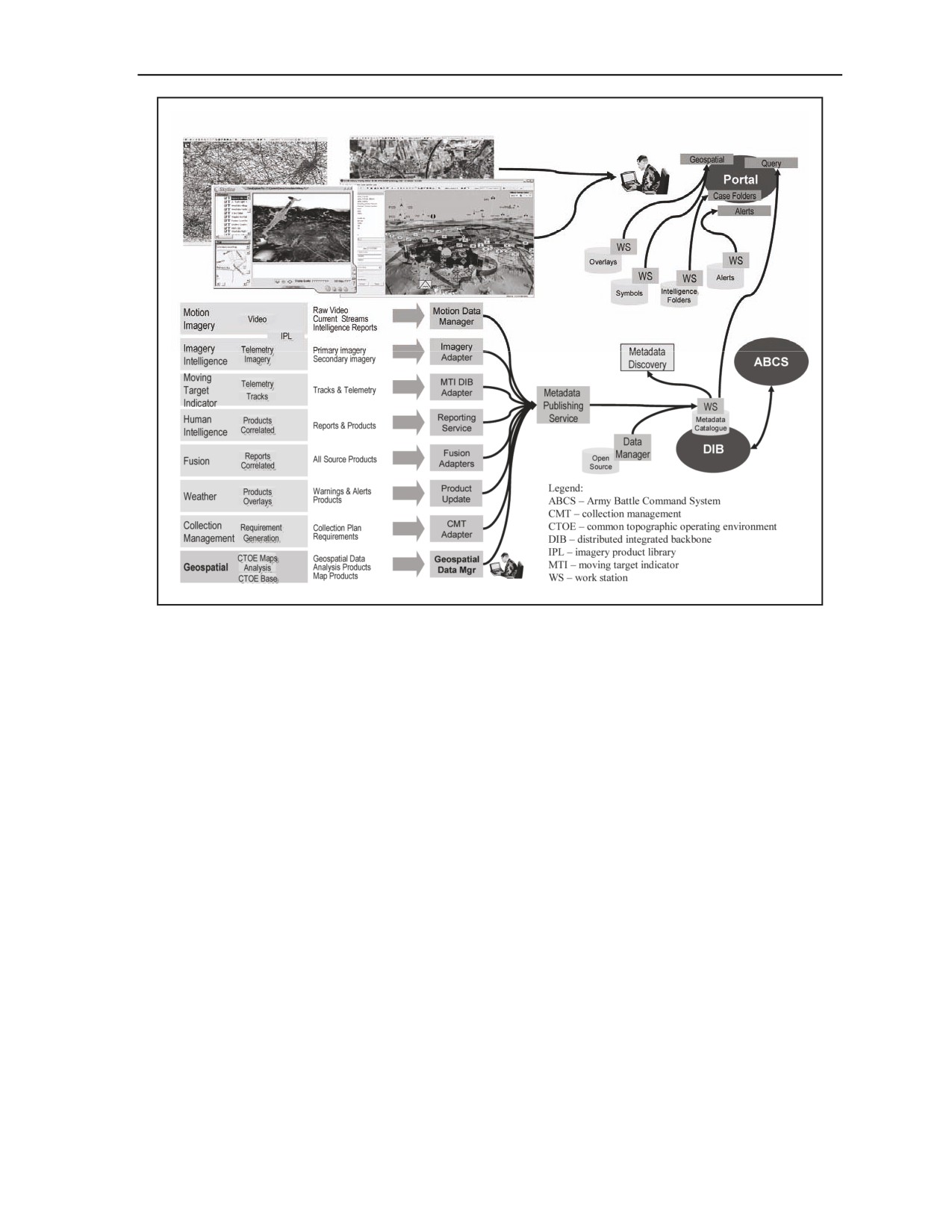
Chapter 3
Figure 3-10. Geospatial data flow and fusion
3-93. Engineers play a major role in the IPB process by anticipating and providing terrain analysis
products of likely contingency areas. Geospatial products assist in describing the OE’s effects on enemy
and friendly capabilities and broad COAs.
3-94. Many data management, analysis, and visualization tools are available to assist in the geospatial
planning effort. Geospatial engineering provides commanders with terrain analysis and visualization,
which improve situational awareness and enhance decision making. Examples of geospatial information
useful for planning purposes are as follows:
z
Three-dimensional terrain fly-throughs.
z
Avenues and routes for joint forces, as well as likely enemy avenues of approach.
z
Obstacle zone locations.
z
Potential engagement areas.
z
Potential unit positions or beddown sites.
z
Airfield and port information and capabilities.
z
Support to urban operations and other complex terrain.
z
High-payoff target information.
z
Deep-target information.
z
Communications or visual line of sight.
z
Locations of LOCs and MSRs and potential locations of base camps.
z
Identification of flood plains and potential LZs.
z
Fused data from multiple databases.
3-95. Terrain analysis is a key product of geospatial support. It is the study of the terrain’s properties and
how they change over time, with use, and under varying weather conditions. Terrain analysis starts with
3-30
FM 3-34
2 April 2009
Foundations2 April 2009perations
the collection, verification, processing, revision, and construction of source data. It requires the analysis of
climatology (current and forecasted weather conditions), soil conditions, and enemy or friendly vehicle
performance metrics. Terrain analysis and GI&S are necessary to support mission planning and operational
requirements. GI&S requires the management of an enterprise geospatial database at every echelon from
combatant command to deployed BCT. Terrain analysis is a technical process and requires the expertise of
geospatial information technicians and a geospatial engineer.
3-96. The geospatial engineering units available to the commander may become part of the command’s
GEOINT cell. The GEOINT cell is comprised of the people and capabilities that constitute the GEOINT
support, to include the imagery and geospatial assets. The cell ensures GEOINT requirements are
coordinated through appropriate channels as applicable and facilitates shared access of various domains.
This cell may be centrally located or distributed throughout the command and connected by networks. Cell
members do not have to work directly for a designated GEOINT officer; they still work for their parent
unit, but coordinate efforts across staff directorates. The key to a successful process is collaboration across
functional areas within the command and between the GEOINT cell, higher headquarters, and the rest of
the stakeholders.
3-97. Geospatial engineering is provided to the Army and other Services based on echelon. It is focused on
data generation, data management, and quality control at the numbered Army and combatant command
level. At the corps and division levels, the majority of the workload is required to support database
management, mission planning, and the IPB process. Below division level, geospatial engineering is
increasingly focused on current operations and updating the geospatial database (database management).
3-98. Geospatial engineer units—supporting each echelon from BCT, through division and corps, to field
Army—provide terrain analysis, terrain visualization, digitized terrain products, nonstandard tailored map
products, map production, and terrain data management. Engineer staffs at every level coordinate support
for terrain analysis and visualization using FalconView™ or another terrain visualization software
program. Additional support is available through reachback.
3-99. The geospatial engineer team organic to the brigade headquarters (or supporting the ACR) performs
analysis, management, and dissemination of geospatial data and products in support of brigade planning
and execution. It maintains the brigade’s common topographic operating picture on the brigade’s server
and provides updates to the brigade’s portion of the theater geospatial database. The team supports the S-2
and S-3 to fuse intelligence and geospatial information into a common picture for the commander and
offers GS to the staff and subordinate units. The brigade-level team is too small to provide continuous
support to the S-2, but will form improvised GEOINT cells as necessary to conduct operations. The
geospatial engineer team requires access to the classified tactical local area network (LAN) (SECRET
Internet Protocol Router Network [SIPRNET]) to update and disseminate geospatial information and
products.
3-100. The corps and division team supports the assistant chief of staff, intelligence (G-2) and assistant
chief of staff, operations (G-3) planners to fuse intelligence and geospatial information into a common
picture for the commander, staff, and subordinate units. The geospatial engineer team requires access to the
SIPRNET to update and disseminate geospatial information and products. The geospatial engineer team
organic to the corps and division collects and provides updated geospatial data and products in support of
corps and division operations. The team—
z
Performs analysis.
z
Acquires, manages, and disseminates geospatial data and products in support of corps and
division planning and execution.
z
Maintains the corps and division common geospatial operating picture as part of the C2 systems
on the corps’s and division’s server.
z
Provides updates to the corps’ and division’s portion of the theater geospatial database.
3-101. A geospatial planning cell (GPC) is assigned to each Army command to provide geospatial
operational planning; generation, analysis, and preparation of maps; map updates; tactical decision aids;
and coordination with other geospatial engineer elements and higher headquarters. Topographic engineer
companies and GPCs are the only units with unique, dedicated geospatial data generation capability within
2 April 2009
FM 3-34
3-31
Chapter 3
the Army force structure. The topographic engineer company and the GPC require access to the global
information grid and the SIPRNET to update and disseminate geospatial information and products.
3-102. NGA produces digital terrain and feature data which is available to users via the web or directly
from NGA. The Defense Logistics Agency (DLA) distributes maps. The geospatial engineer can request
imagery which can be used for spatial and temporal reasoning or multispectral analysis products that are
customized to meet particular operational requirements. Imagery enhances three-dimensional and fly-
through perspectives. NGA geospatial analysts may be attached to units, normally at division and above, to
supplement the organic geospatial engineers and staffs. See FM 3-34.230 for more information on
geospatial engineering.
ENGINEER RECONNAISSANCE
3-103. The responsibility for conducting reconnaissance does not reside solely with specifically
organized units. Every unit has an implied mission to report information about the terrain, civilian
activities, and friendly and enemy dispositions regardless of its location within the AO and primary
function. Although all units conduct the implied reconnaissance mission, the commander typically focuses
specifically organized reconnaissance units on the highest priority requirements. New BCT designs have
more than doubled the reconnaissance capabilities available to brigade commanders and given them new
surveillance and target acquisition capabilities.
3-104. Even with the robust reconnaissance capability now available in support of the BCT, the
commander must know the capabilities and limitations of reconnaissance assets. This ensures that the
employment of these assets is within their capabilities and on missions for which they have been trained
and equipped. Although reconnaissance primarily relies on the human dynamic rather than technical
means, the situation may require the collection of a higher degree of technical information than
nonspecialized units possess. For example, an area with suspected contamination by toxic industrial
materials must be targeted for reconnaissance by assets equipped to determine the type and level of
contaminants present and protected from the contamination. Supporting units (such as engineer, CBRN,
EOD, and MP) have specialized capabilities to collect technical information that complements the force’s
overall reconnaissance effort. It is this collection of necessary tactical and technical information that
defines the range of engineer reconnaissance capabilities (see figure 3-11).
3-32
FM 3-34
2 April 2009
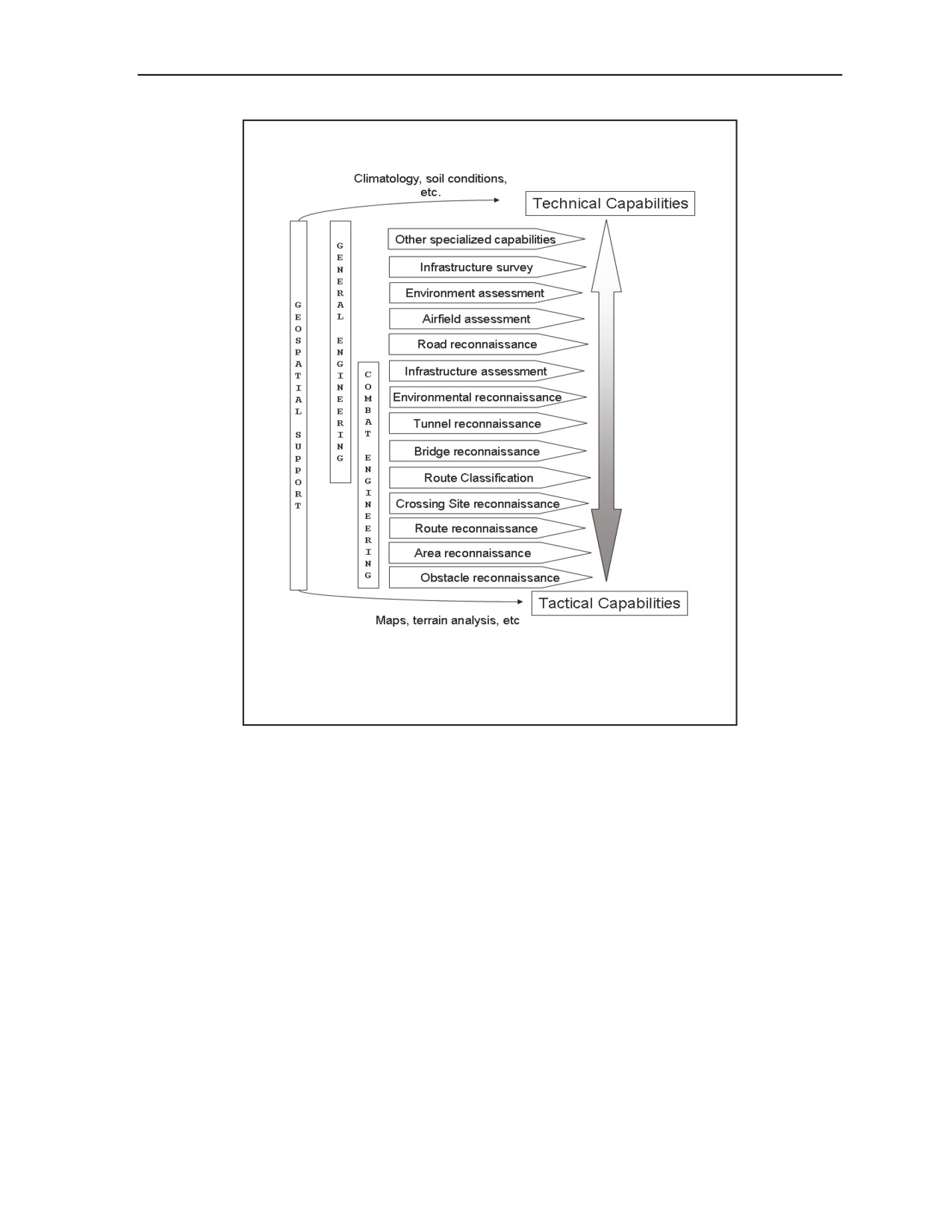
Foundations2 April 2009perations
Figure 3-11. Range of engineer reconnaissance capabilities
3-105. The engineer functions provide a menu of reconnaissance capabilities varying in linkages to
warfighting functions and varying in type and degree of tactical or technical expertise and effort applied to
the assigned mission and tasks. The capabilities are generated from and organized by combat and general
engineer units with overarching support from geospatial means. These units do not have organized and
dedicated reconnaissance elements within their structure, except for the HBCT combat engineer company.
Based on METT-TC factors, combat and general engineers are task-organized as required by the situation
and may be teamed separately or with other elements from across the engineer functions or warfighting
functions.
3-106. The majority of tactical engineer reconnaissance capabilities enable the collection of technical
information in support of the combat engineer function. Reconnaissance in support of M/CM/S operations
is conducted primarily by engineer reconnaissance teams (ERTs) comprised of combat engineers and
focused on the collection of tactical and technical information to support the BCT’s freedom of maneuver
and survivability of friendly forces and facilities. FM
3-34.170 provides a detailed discussion of
reconnaissance support of the five functional areas of mobility operations, support of obstacle integration,
turnover in countermobility operations, support to fighting and other protective positions, and support to
other tactical operations in the BCT. The specific combat engineer reconnaissance tasks include, but are
not limited to—
2 April 2009
FM 3-34
3-33
Chapter 3
z
Obstacle reconnaissance focused on bypass or breach of obstacles to create obstacle intelligence
(OBSTINTEL).
z
Route reconnaissance focused on route clearance operations.
z
Area reconnaissance focused on EH, such as mines and unexploded explosive ordnance (UXO)
requiring area clearance operations.
z
Crossing site reconnaissance focused on determining requirements for a gap crossing.
z
Route reconnaissance focused on establishing a combat road or trail.
z
Reconnaissance of planned or existing sites and facilities supporting forward aviation
operations.
z
Obstacle reconnaissance, including demolition obstacles, focused on establishing friendly
obstacles integrated with fires.
z
Obstacle reconnaissance in preparation for target turnover.
z
Area reconnaissance focused on establishing vehicle fighting positions or protective works.
z
Area reconnaissance in support of urban combat operations.
z
Reconnaissance of tunnels and underground structures.
z
Reconnaissance to establish an initial assessment of environmental factors.
z
Reconnaissance to establish an initial assessment of infrastructure factors.
z
Reconnaissance in complex terrain.
3-107. General engineering capabilities are employed in support of combat ERTs as required based on the
factors of METT-TC, providing additional technical capabilities for the mission. Additionally, general
engineer capabilities are teamed with ERTs, other BCT units, or stand-alone organizations to conduct
tactical reconnaissance tasks that enable missions linked to BCT sustainment. These tasks are tactical
missions that include the requirement to gather technical information needed for—
z
MSR maintenance and upgrade.
z
General engineering in support of airfields and heliports.
z
Bridge construction or repair.
z
General engineering in support of survivability and other protection tasks.
z
Procurement or production of construction materials.
z
General engineering in support of real estate support.
3-108. General engineers provide a range of technical reconnaissance capabilities. These capabilities are
similar in focus to the reconnaissance tasks that enable missions linked to BCT sustainment. Technical
capabilities are distinguished from the support provided to combat engineer missions and from tactical
sustainment missions by the level at which the requirements are identified and addressed. At the tactical
level, the BCT may have a general engineer element in DS and working to maintain or upgrade a specified
MSR in the BCT AO. General engineers working at the operational level will conduct reconnaissance to
identify requirements for construction along a ground LOC. Technical reconnaissance capabilities are
typically conducted by general engineer assessment or survey teams to gather the technical information
required for—
z
Maintenance and upgrade ground LOCs.
z
Bridge construction or repair.
z
General engineering in support of airfields and heliports.
z
General engineering in support of seaports.
z
General engineering in support of survivability.
z
Real estate and real property maintenance activities.
z
Procurement or production of construction materials.
z
General engineering in support of base camps and support areas.
z
Power generation and distribution.
z
Petroleum pipeline and storage facilities.
z
Water supply and well drilling
3-34
FM 3-34
2 April 2009