FM 3-34 ENGINEER OPERATIONS (April 2009) - page 1
FM 3-34
April 2009
ENGINEER OPERATIONS
DISTRIBUTION RESTRICTION: Approved for public release; distribution is unlimited.
HEADQUARTERS, DEPARTMENT OF THE ARMY
*FM 3-34
Field Manual No.
Headquarters
Department of the Army
3-34
Washington, DC, 2 April 2009
Engineer Operations
Contents
Page
PREFACE
v
INTRODUCTION
vii
Chapter 1
THE OPERATIONAL ENVIRONMENT
1-1
Understanding the Operational Environment
1-1
The Military Variable
1-4
Spectrum of Requirements
1-5
Support Spanning the Levels of War
1-7
Engineer Soldiers
1-9
Chapter 2
ENGINEERING IN UNIFIED ACTION
2-1
SECTION I-THE ENGINEER REGIMENT
2-1
The Engineer Branch
2-3
United States Army Corps of Engineers
2-4
Engineer Operational Force Capabilities
2-6
SECTION II-UNIFIED ACTION: JOINT/INTERAGENCY/MULTINATIONAL 2-12
Joint/Interagency/Multinational Capabilities
2-12
Integration of Capabilities
2-13
SECTION III-ENGINEER FORCE TAILORING
2-15
Modular Force Organization
2-16
Chapter 3
FOUNDATIONS OF ENGINEER OPERATIONS
3-1
SECTION I-ENGINEER FUNCTIONS
3-1
Combat Engineering
3-2
General Engineering
3-5
Geospatial Engineering
3-5
SECTION II-OPERATIONAL CONCEPT
3-6
Elements and Combinations of Full Spectrum Operations
3-6
Combined Arms Through the Warfighting Functions
3-8
SECTION III-OPERATIONS PROCESS
3-11
Command and Control of Engineer Operations
3-11
The Engineer Coordinator
3-17
SECTION IV-ENGINEER COMBAT POWER
3-25
Movement and Maneuver
3-26
Distribution Restriction: Approved for public release; distribution is unlimited.
i
*This publication supersedes FM 3-34, 2 January 2004.
Contents
Intelligence
3-28
Sustainment
3-35
Protection
3-36
Chapter 4
PLANNING ENGINEER OPERATIONS
4-1
SECTION I-INTEGRATED PLANNING
4-1
Planning at Each Level of War
4-2
Operational Component Considerations
4-3
Parallel Planning
4-5
Staff Planning
4-6
SECTION II-PLANNING PROCESSES
4-7
The Military Decision-Making Process
4-7
Staff Running Estimate
4-10
Plans and Orders
4-12
Assured Mobility
4-13
Essential Tasks for Mobility, Countermobility, and Survivability
4-13
SECTION III-JOINT AND OTHER PROCESSES
4-15
Joint Engineer Planning
4-15
Force Projection
4-17
Facilities and Construction Planning
4-18
Project Management
4-21
Chapter 5
PREPARING, EXECUTING, AND ASSESSING ENGINEER OPERATIONS .. 5-1
Simultaneous Combinations
5-1
Offensive Operations
5-5
Defensive Operations
5-7
Stability Operations
5-9
Civil Support Operations
5-11
Special Considerations
5-13
Chapter 6
SUSTAINMENT SUPPORT FOR ENGINEER CAPABILITIES
6-1
Organizations and Functions
6-1
Engineer Leader and Staff Responsibilities Sustainment Support
6-6
Sustainment Support Functions
6-12
Other Sustainment Support
6-17
Appendix A
ENGINEER FIELD MANUALS AND RELATED JOINT PUBLICATIONS
A-1
Appendix B
ARMY ENGINEER ORGANIZATIONS AND CAPABILITIES
B-1
Appendix C
JOINT ENGINEER ORGANIZATIONS AND CAPABILITIES
C-1
Appendix D
MULTINATIONAL, INTERAGENCY, AND HOST NATION
CONSIDERATIONS
D-1
SECTION I-MULTINATIONAL CONSIDERATIONS
D-1
SECTION II-INTERAGENCY AND NONGOVERNMENTAL
ORGANIZATION CONSIDERATIONS
D-2
SECTION III-HOST NATION CONSIDERATIONS
D-3
Appendix E ENGINEER STAFF ORGANIZATION AND SELECTED CELLS,
WORKGROUPS, AND BOARDS
E-1
Appendix F CIVIL SUPPORT CONSIDERATIONS
F-1
ii
FM 3-34
2 April 2009
Contents
Appendix G CONTINGENCY AUTHORITIES AND FUNDING
G-1
Appendix H CONTRACT CONSTRUCTION AGENTS
H-1
Appendix I
EXPLOSIVE ORDNANCE DISPOSAL ORGANIZATIONS AND FUNCTIONS I-1
GLOSSARY
Glossary-1
REFERENCES
References-1
INDEX
Index-1
Figures
Figure 1-2. Notional joint operations area
1-5
Figure 1-3. Challenges and opportunities from the engineer view
1-6
Figure 1-4. The Soldier’s rules
1-10
Figure 2-3. Examples of tailored divisions
2-21
Figure 2-5. Corps as an intermediate land force headquarters
2-22
Figure 2-6. Notional corps engineer force
2-23
Figure 2-7. The theater Army as a joint force land component command while
continuing Army support
2-24
Figure 2-8. Notional theater engineer command
2-25
Figure 3-1. Engineer functions
3-2
Figure 3-2. Full spectrum operations—the Army’s operational concept
3-7
Figure 3-4. The primary relationships of engineer functions to the warfighting
functions
3-9
Figure 3-6. Service component command
3-16
Figure 3-7. Functional component command
3-17
Figure 3-9. Notional joint engineer staff
3-23
Figure 3-10. Geospatial data flow and fusion
3-30
Figure 4-2. Engineer planning considerations
4-3
Figure 4-3. The military decision-making process
4-8
Figure 4-4. Force projection process
4-18
Figure 4-5. Force beddown and base development
4-20
Figure 5-1. Elements of full spectrum operations
5-2
Figure 5-4. Notional engineer operations in the defense
5-8
Figure 5-6. Notional engineer operations during civil support
5-12
Figure B-4. ACR engineer company
B-6
Figure B-7. Engineer battalion
B-9
Figure B-30. Firefighting team
B-32
Figure C-1. 1NCD command relationships
C-2
Figure E-3. Organic engineer staff in the corps headquarters
E-5
Figure E-4. Organic engineer staff in the Army headquarters
E-6
Figure E-5. Command post organization
E-8
Figure E-6. Joint civil-military engineering board inputs and outputs
E-10
2 April 2009
FM 3-34
iii
Contents
Figure G-1. Contingency construction funding model
G-2
Figure G-2. Contingency construction funding model (unspecified minor, $750,000-
$1.5 million)
G-3
Figure H-1. Designated geographical areas of Department of Defense construction
agents
H-2
Figure H-2. USACE division organization
H-3
Figure H-3. USACE military works boundaries
H-4
Figure H-4. Reachback process
H-5
Figure H-5. Naval Facilities Engineering Command, C2
H-7
Figure H-6. Naval Facilities Engineering Command, naval facilities engineering
specialty centers
H-7
Tables
Table
2-1. Elements of the Engineer Regiment
2-3
Table
2-2. Baseline engineer units
2-9
Table
2-3. Specialized Army engineer force pool units
2-11
Table
3-1. Army command relationships
3-13
Table
3-2. Army support relationships
3-14
Table
3-3. Other relationships
3-15
Table
4-1. Emergency support functions and proponents
4-5
Table
4-2. Engineer considerations in the military decision-making process
4-9
Table
4-3. The military decision-making process and the engineer estimate
4-11
Table
4-4. Operation plan annexes
4-16
Table A-1. Other Army engineer publications
A-1
Table B-1. Organic engineer units
B-1
Table B-2. Headquarters units
B-1
Table B-3. Baseline engineer units
B-2
Table B-4. Specialized engineer units
B-2
Table H-1. Reachback contact information
H-6
iv
FM 3-34
2 April 2009
Preface
Field Manual (FM) 3-34 describes the Engineer Regiment’s keystone operational doctrine. The manual is
linked to joint and Army doctrine to ensure its usefulness for all joint and Army-level commanders and staff.
All other engineer FMs (see Appendix A) are based on the foundations described in this manual and are
synchronized with their respective joint publications. The foundations of engineer operations are based on the
successful employment of engineers, past and present. This manual describes engineer support to Army forces
conducting full spectrum operations within the framework of joint operations. As in FM 3-0, this version of FM
3-34 increases the emphasis on simultaneous offensive, defensive, and stability or civil support operations.
This manual has been revised to align with revisions to FM 3-0 and other Army and joint doctrine. A series of
conferences at the United States Army Engineer School (USAES) convened to guide the changes in this version
of FM 3-34. This revision has been driven by major changes to Army and joint doctrine, including the—
z
Revision of the Army's capstone manual, FM 3-0.
z
Revision of Joint Publication (JP) 3-34.
z
Lessons learned from experience fighting the War on Terrorism.
z
Conversion of the Army to a brigade combat team (BCT)-based modular force that is joint and
expeditionary.
z
Conversion of the Engineer Regiment to the modular engineer force.
z
Change from maintaining readiness within the "band of excellence" to achieving readiness
through the force pool progression dictated by the Army Force Generation (ARFORGEN)
Model.
This manual is organized into six chapters and nine appendixes to provide additional details on selected
operational topics. The first three chapters follow the flow of FM 3-0 and describe engineer aspects of the
operational environment (OE), the Engineer Regiment, and the foundations of engineer operations. The
remaining chapters discuss planning; preparing, executing, and continuously assessing; and sustaining engineer
operations with focus on the operational to tactical levels of war. A brief description of each chapter is provided
below—
z
Chapter 1 examines the OE with a specific focus on engineer aspects. It discusses the nature and
scope of modern conflict, as well as important variables of the OE as described in FM 3-0;
FM 2-0; and other doctrine. The discussion is not a repeat of the more comprehensive
description provided in FM 3-0, but rather it is focused specifically on those aspects that
generate requirements for Army engineer support.
z
Chapter 2 provides a comprehensive description of the Engineer Regiment. It describes engineer
support of Army operations including in the context of joint, interagency, and multinational
operations. It also addresses tailoring engineer force pool capabilities in support of engineer
operations.
z
Chapter 3 lays the foundations for engineer operations. It includes discussion of categorizing
capabilities within the engineer functions, synchronizing application through the warfighting
functions, and integrating fully into the operations process. It concludes with a description of
engineer combat power applications.
z
Chapter 4 describes the engineer planning activities portion of the operations process. It includes
discussion of the integration of staff planners and planning cells. It describes engineer
integration in planning processes and specific processes to enhance engineer input.
z
Chapter 5 provides engineer considerations for preparing, executing, and continuously assessing
engineer operations. The chapter describes the focus of engineer support for each component of
full spectrum operations.
2 April 2009
FM 3-34
v
Preface
z
Chapter 6 discusses sustainment of engineer capabilities. Successful engineer operations include
effective incorporation of sustainment support. This chapter describes the integrated sustainment
effort required to support engineer operations.
FM 3-34 provides operational guidance for engineer commanders and trainers at all echelons and forms the
foundation for established curriculum within the engineer portions of the Army’s education system.
Information contained in this manual will assist multinational forces and other Services and branches of the
Army to plan and integrate engineer capabilities. This doctrine also will assist Army branch schools in teaching
the integration of engineer capabilities into Army and joint operations.
Terms that have joint or Army definitions are identified in both the glossary and the text. Glossary terms: The
glossary lists most terms used in FM 3-34 that have joint or Army definitions. Terms with an asterisk in the
glossary indicate that this FM is the proponent FM (the authority). Text references: Definitions printed in
boldface in the text indicate that this FM is the proponent FM. These terms and their definitions will be
incorporated into the next revision of FM 1-02. For other definitions in the text, the term is italicized, and the
number of the proponent FM follows the definition.
This publication applies to the Active Army, the Army National Guard (ARNG)/Army National Guard of the
United States (ARNGUS), and the United States Army Reserve (USAR) unless otherwise stated.
The proponent for this publication is the United States Army Training and Doctrine Command (TRADOC).
Send comments and recommendations on Department of the Army (DA) Form 2028 (Recommended Changes
to Publications and Blank Forms) directly to Commandant, United States Army Engineer School,
ATTN: ATZT-TDD-E, 320 MANSCEN Loop, Suite 220, Fort Leonard Wood, Missouri 65473-8929. Submit
an electronic DA Form 2028 or comments and recommendations in the DA Form 2028 format by e-mail to
<leon.mdottddengdoc@conus.army.mil>.
Unless this publication states otherwise, masculine nouns and pronouns do not refer exclusively to men.
vi
FM 3-34
2 April 2009
Introduction
FM 3-34 is the Engineer Regiment’s keystone manual for operating in today’s OE within the framework of
full spectrum operations and, although focused at the operational to tactical level, it is applicable for all
levels of war. As the keystone doctrinal manual for engineer operations, FM 3-34 is linked to joint and
Army doctrine to ensure its usefulness for all joint and Army-level commanders and staff. All other
engineer FMs
(see Appendix A) are based on the foundations described in this manual and are
synchronized with their respective JPs and complementary Army FMs.
Engineers enable joint and maneuver commanders to achieve their objectives through strategic movement
and tactical maneuver by providing unique combat, general, and geospatial engineering capabilities. It has
been the engineer creed to support the maneuver commander since 16 June 1775, when the Continental
Congress organized an Army with a chief engineer and two assistants. Engineers contributed to the hardest
fought battles in the Revolutionary War, including Bunker Hill, Saratoga, and the final victory at
Yorktown. At the end of the Revolutionary War, the engineers were mustered out of service. However,
their unique skills were realized, and they were called back to active duty in 1794, when Congress
organized a Corps of Artillerists and Engineers, and later in 1802 as a separate Corps of Engineers.
While the nature of warfare remains constant throughout history, the conduct of war is continually
changing in response to new concepts, technologies, and requirements. This version of FM 3-34 is the 21st
edition of this keystone manual and includes engineer doctrine that has evolved for over 200 years. It
continues the evolution of engineer operations to support full spectrum operations and emphasizes
simultaneous combinations of offensive, defensive, and stability or civil support operations during all
operations. It describes engineer support to Army forces conducting full spectrum operations within the
framework of joint operations. This manual also more extensively addresses engineer roles and functions
within multinational operations, under potentially multinational or interagency leadership, and within
diverse command relationships. One constant that is unchanged in this edition is that engineer operations
continue to rely on the engineer Soldier to provide the leadership and flexibility required to integrate the
application of engineer capabilities within combined arms operations.
FM 3-34 is built directly on the new and revised concepts of FM 3-0, FM 3-90, FM 3-07, (FM 3-28, when
published); and FM 4-0. It is synchronized with key doctrine in JP 2-03; JP 3-15; and JP 3-34 to ensure
that Army elements of a joint force use all engineer assets to their fullest extent.
The OE on which FM 3-34 is based is much more variable than the OE on which previous doctrine was
based. Engineers must be prepared to go into any OE and conduct operations in support of the maneuver
commander while dealing with a wide range of threats and other influences. The manual builds on the
collective knowledge and wisdom gained through recent conduct of operations, numerous lessons learned
and doctrine revisions, and the deliberate process of informed reasoning throughout the Army. It is rooted
in time-tested principles and fundamentals, while accommodating new technologies and organizational
changes.
2 April 2009
FM 3-34
vii
Introduction
This version of FM 3-34 is a significant revision from the previous edition and has been driven by changes
in the OE, structure of the Army, availability of technologies, and a number of changes in Army and joint
doctrine. Changes not already mentioned above that have directly affected this manual include the—
z
Replacement of “battlefield operating systems” with “warfighting functions” and the subsequent
splitting of the mobility, countermobility, survivability battlefield operating system between the
movement and maneuver and protection warfighting functions.
z
Restructuring of the engineer force to support the need for modularity in Army and joint
operations. Development of multifunctional battalion- and brigade-level structures with
significant engineer capabilities.
z
Elimination of the term “battlespace” and the subsequent change from “engineer battlespace
functions” to simply the ”engineer functions” of combat, general, and geospatial engineering.
z
Revision of the joint definitions for combat, general, and geospatial engineering.
z
Elimination of the term “force protection” except as it applies to “force protection conditions”
(FPCON) as a part of the antiterrorism element of the protection warfighting function.
z
Acknowledgement of the range of engineer reconnaissance and its role and relationship to
infrastructure reconnaissance. Staff proponency for infrastructure reconnaissance can be an
additional requirement placed on the staff engineer.
z
Revision and renaming of the “civil engineering plan” to simply the “engineer support plan”
(ESP).
z
Readjustment of the contingency construction standards.
z
Maturation of the term ”assured mobility.” The application of assured mobility as a framework
of processes, actions, and capabilities to proactively integrate engineer combat power.
z
Elimination of the terms “combat,” “combat support,” and “combat service support” to describe
categories for forces, functions, and capabilities.
z
Conversion of the “engineer command” (ENCOM) to the “theater engineer command” (TEC)
structure and its implications.
The foundations of engineer operations provided in this manual, together with related engineer doctrine,
will support the actions and decisions of engineer commanders at all levels. But, like FM 3-0, the manual is
not meant to be a substitute for thought and initiative among engineer leaders. No matter how robust the
doctrine nor advanced the new engineer capabilities and systems, it is the engineer Soldier that must
understand the OE, recognize shortfalls, and adapt to the situation on the ground. It is the adaptable and
professional engineer Soldiers of the Regiment that are most important to our future and that must be able
to successfully perform their basic skills and accomplish the mission with or without the assistance of
technology.
viii
FM 3-34
2 April 2009
Chapter 1
The Operational Environment
A general in all his projects should not think so much about what he wishes to do as
much as what his enemy will do; that he should never underestimate this enemy, but he
should put himself in his place to appreciate difficulties and hindrance the enemy could
interpose; that his plans will be deranged at the slightest event if he has not foreseen
everything and if he has not devised means with which to surmount the obstacles.
Frederick the Great: Instructions to his Generals, iii, 1747
Just as in Chapter 1 of FM 3-0, this chapter addresses the conceptual frameworks that
leaders use to understand the OE. It is not, however, a restatement of the more
detailed description provided in FM 3-0 or elsewhere (see FM 3-06, FM 3-07, and
FM 3-90.6). Rather, this chapter provides a conceptual view of the OE through an
engineer lens. It provides the basis for relevant engineer operations simultaneously
supporting full spectrum operations in an uncertain and changing OE and provides
linkage to the joint doctrine in JP 3-34. To more adequately describe the basis for
engineer operations, this chapter adds a discussion of engineer aspects of the OE
spanning the spectrum of conflict and the framing of those aspects using the levels of
war. Finally, the chapter describes the engineer Soldier as the centerpiece of those
forces conducting engineer operations.
UNDERSTANDING THE OPERATIONAL ENVIRONMENT
1-1. Operations on land are complex, dynamic, and uniquely tied to the theater’s geography and airspace.
The complexity of land combat stems from the geography; from the large number of Soldiers and weapons
platforms involved; and from the close, continuous interaction of land forces with the enemy,
noncombatants, and each other. Land operations differ fundamentally from maritime and aerospace
combat, and the command and organization of land forces are substantially different from those in other
environments. Complexity is also a function of the combined arms and joint nature of land combat,
involving the interaction and mutual support of different arms and Services. Instantaneous global
communications multiplies this complexity. Uncertainty and chaos characterize operations on land.
Technology, intelligence, and the design of operations can reduce uncertainty. However, regardless of the
effort allocated to intelligence, commanders still have to make decisions based on incomplete, inaccurate,
or contradictory information. An understanding of the OE underpins the commander’s ability to make
decisions.
1-2. Joint doctrine describes the OE as the composite of the conditions, circumstances, and influences
that affect the employment of capabilities and bear on the decisions of the commander. The OE
encompasses physical areas and factors (including geography, weather, infrastructure, and population), the
information environment (including adversary, friendly, and neutral forces), and other variables relevant to
a specific operation. Understanding the OE is essential to the successful execution of operations. To gain a
broad understanding of these influences, commanders will normally consult with specialists in each area.
Engineers are one of the specialists available to add breadth and depth to the overall understanding of the
OE. See JP 3-34 for additional discussion of operational engineering at the joint level.
1-3. An engineer view of the OE is in addition to the common understanding being gained through the
application of analytical tools by other specialists and leaders. The engineer view shares a common general
understanding of the OE, while adding a degree of focus on those aspects within the purview of an
2 April 2009
FM 3-34
1-1
Chapter 1
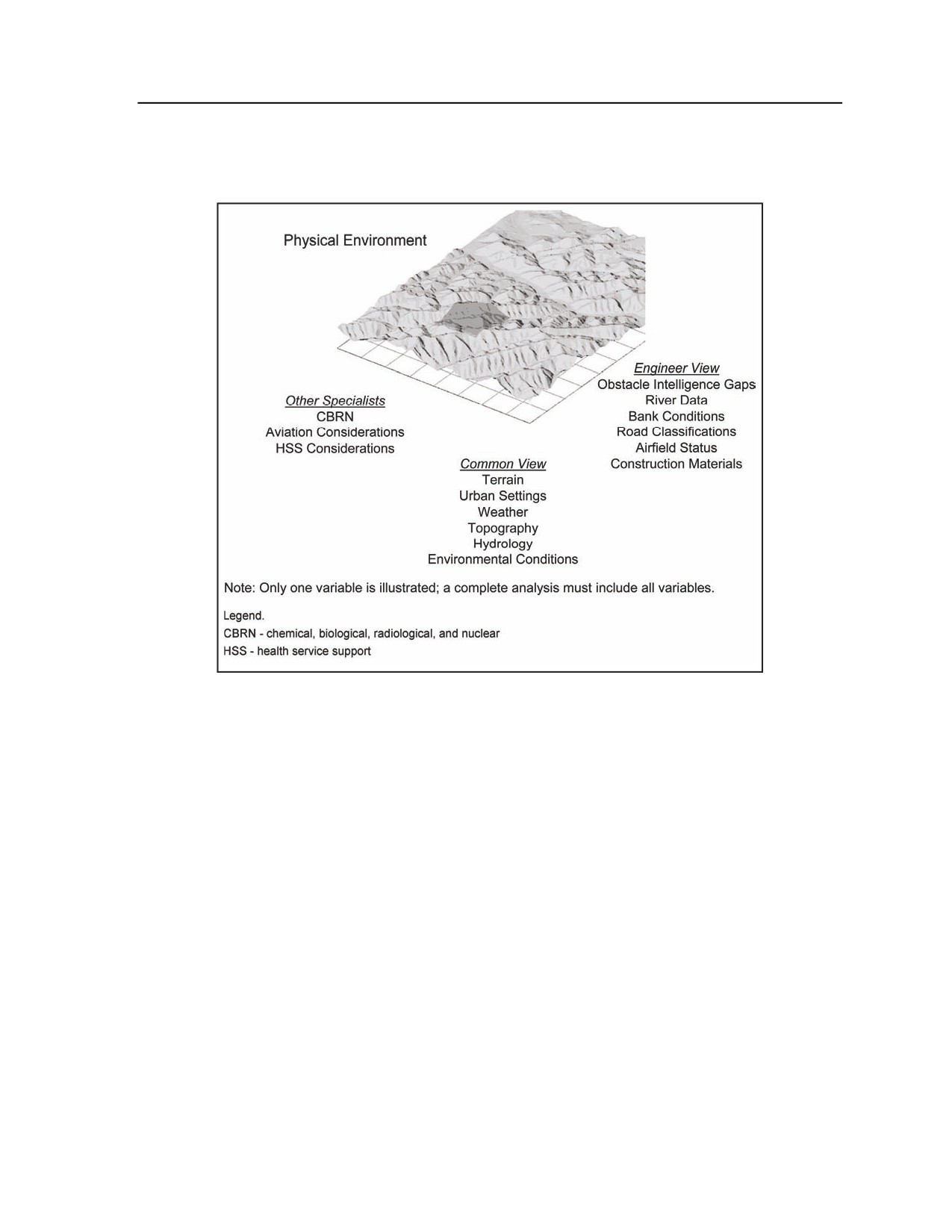
engineering background (see figure 1-1). Guided by the common general understanding, the engineer view
seeks to identify potential challenges and opportunities associated with variables of the OE. Within each
critical variable of the framework being employed, the engineer view shares a common level of
understanding while seeking the added specialty view.
Figure 1-1. Illustration of an engineer view of the operational environment
1-4. Army doctrine describes an OE in terms of eight operational variables: political, military, economic,
social, information, infrastructure, physical environment, and time (PMESII-PT). The following examples
are provided to show the added focus sought within each of the operational variables by the engineer view
of the OE. The examples are not meant to restate the more complete treatment of the variable in general
terms provided in FM 3-0. The examples are not meant to be an all inclusive treatment of the engineer
aspects within each of the variables.
z
Political. Understanding the political circumstances within an OE will help the commander
recognize key actors and visualize their explicit and implicit aims and their capabilities to
achieve their goals. The engineer view might add challenges associated with political
circumstances permitting or denying access to key ports of entry or critical sustainment
facilities. Opportunities in the form of alternative access routes might be added. The engineer
and others would be interested in the effect of laws, agreements, or positions of multinational
partners that might prevent the shipment of hazardous materials across borders or a host of
similar political considerations that might affect engineer planning and operations.
z
Military. The military variable explores the military capabilities of all relevant actors in a given
OE. The engineer view might add the challenges associated with an adversary’s capability to
employ explosive hazards (EH) or other obstacles, as well as the capability to challenge
traditional survivability standards. Opportunities in the form of existing military installations
and other infrastructure would be added. The engineer view includes a necessarily robust and
growing understanding of engineer capabilities in a joint, interagency, and multinational context
1-2
FM 3-34
2 April 2009
The Operational Environment
within this variable of the OE. Additional discussion of the military variable is provided below,
and engineer capabilities are discussed in detail in Chapter 2.
z
Economic. The economic variable encompasses individual behaviors and aggregate phenomena
related to the production, distribution, and consumption of resources. The engineer view might
add challenges associated with production or availability of key materials and resources.
Opportunities in the form of potential for new or improved production facilities might be added.
z
Social. The social variable describes the cultural, religious, ethnic makeup, and social cleavages
within an OE. The engineer view might add challenges associated with specific cultural or
religious buildings or installations. Opportunities in the form of potential to provide for
culturally related building requirements might be a consideration.
z
Information. This variable describes the nature, scope, characteristics, and effects of individuals,
organizations, and systems that collect, process, disseminate, or act on information. The
engineer view might add challenges associated with deficiencies in the supporting architecture
or nodes. Information flow may be affected by the available infrastructure to include power
considerations. Opportunities in the form of provision for humanitarian projects or services
might be added.
z
Infrastructure. Infrastructure comprises the basic facilities, services, and installations needed for
the functioning of a community or society. The engineer view might add challenges associated
with specific deficiencies in the basic infrastructure. Opportunities in the form of improvements
to existing infrastructure and specific new projects might be added. The engineer view provides
for a detailed understanding of infrastructure by subcategories in the context of combat
operations, as well as both stability and civil support operations, and this topic is discussed in
detail throughout this manual; FM 3-34.400; and FM 3-34.170 (see FM 3-28, when published,
for a discussion of critical infrastructure within the context of civil support operations).
z
Physical environment. The defining factors are urban settings
(super-surface, surface, and
subsurface features) and other types of complex terrain, weather, topography, hydrology, and
environmental conditions. The engineer view might add challenges associated with natural and
man-made obstacles. Insights into environmental considerations are also a concern (see FM 3-
100.4). Opportunities in the form of existing routes, installations, and resources might be added.
The engineer view supports a broad understanding of the physical environment through
geospatial engineering which is discussed in detail in Chapter 3 and Chapter 4 of this FM; FM
3-34.230; and JP 2-03.
z
Time. The variable of time influences military operations within an OE in terms of the decision
cycles, operational tempo, and planning horizons. The engineer view might add challenges
associated with completing required construction projects in the time allotted. Opportunities in
the form of potential to accelerate priority projects might be added.
1-5.
Analysis of the OE in terms of the operational variables provides the relevant information that
commanders can use to frame operational problems. While such analysis improves situational
understanding (SU) at all levels, land operations require more specific information. When commanders
receive a mission, they require a mission analysis focused on their specific situation. The Army uses the
mission variables of mission, enemy, terrain and weather, troops and support available, time available, and
civil considerations (METT-TC) as a framework for this mission analysis. When used together, the mission
and operational variables help commanders visualize their situation. The relevant information required for
consideration of the METT-TC variables during mission analysis can be drawn from the ongoing analysis
of the operational variables (PMESII-PT). As in the examples above, illustrating the added focus sought
within each of the variables by the engineer view of the OE, an engineer review using METT-TC seeks the
shared common understanding and the added specialty view. Chapter 4 provides a more complete
discussion of analysis using METT-TC in terms of planning engineer operations.
1-6. Engineers review the OE using operational variables to add to the shared common understanding by
identifying potential challenges and opportunities within the operation before and during mission
execution. The resulting understanding of the OE, an engineer view of the OE, does not and is not intended
to be limited to considerations within the OE that may result in engineer functional missions. The resulting
2 April 2009
FM 3-34
1-3
Chapter 1
engineer view of the OE is instead organized by engineer functions and linked to the common overall
understanding through warfighting functions.
1-7. Combat power is the way Army leaders conceptualize capabilities. For Army and Marine Corps
forces, the joint functions—intelligence, fires, movement and maneuver, protection, sustainment, and
command and control (C2)—become the six warfighting functions. To these six warfighting functions, the
Army adds two elements—leadership and information—which tie together and multiply the effects of the
other six. These eight functions are the elements of combat power. The Army employs combat power
through combined arms. Combined arms are organized through tailoring and task-organizing Army forces
to optimize the elements of combat power for a particular mission. The engineer view of the OE, and
engineer operations broadly, are synchronized to support combined arms using the warfighting functions.
Chapter 3 and figure 3-3, page 3-9, provide a more detailed discussion of the application of engineer
capabilities through the warfighting functions to synchronize support to combined arms operations.
THE MILITARY VARIABLE
1-8. Military forces seeking to transform the OE must consider all factors that bear on tactical,
operational, and strategic objectives. In practice, reshaping fundamental conditions and human perceptions,
behaviors, and actions is extremely difficult. Therefore, the ability of leaders and Soldiers to understand the
OE, interact with people, and use capabilities effectively bears directly on the Army’s ability to achieve its
tactical, operational, and strategic objectives. Engineers contribute to the overall understanding by
addressing potential challenges and opportunities associated with all variables of the OE. The military
variable is examined more closely in this section because it includes military engineer capabilities which
are the focus of Chapter 2 and, to some extent, this manual. It is a variable of the OE which may present
challenges and opportunities requiring further understanding.
1-9. The military variable of the operational variables explores the military capabilities of all relevant
actors in a given OE. Engineer capabilities can be a significant and relevant component within the military
variable. Chapter
2 provides additional discussion of engineer capabilities including Army, joint,
interagency, and multinational capabilities. Recent significant changes impacting the military variable can
be summarized as—
z
A complex, noncontiguous area of operations (AO).
z
A threat scenario in which potential adversaries are not readily identifiable.
z
Simultaneous, geographically dispersed operations that will result in extremely long and
potentially unsecured lines of communication (LOCs).
z
Increased coordination of organizations and functions to achieve appreciable gains.
z
The prevalence of joint organizations at the operational-level and single-Service organizations
operating in a collaborative or interdependent joint environment at the tactical level.
z
A significant degree of joint and single-service interaction with other governmental
organizations and nongovernmental organizations
(NGOs), multinational forces, and
contractors.
1-10. Understanding the theater structure commonly used to array military capabilities enables an
understanding of engineer capabilities within the context of the OE. A theater is a geographical area for
which a geographic combatant commander (GCC) is assigned military responsibility. The command views
a theater from a strategic perspective and assesses the level of international military cooperation
available with the degree of dedicated U.S. military resources necessary. These factors influence
prospective Army operations in each theater or GCC area of responsibility (AOR).
1-11. To conduct operations within the assigned geographic AOR, the GCC may designate a specific area
within his AOR as a theater of war, theater of operations, or joint operations area (JOA). Commanders
may use these terms independently or in conjunction with one another, depending on the needs of the
operation. If used in conjunction, the theater of war would encompass the larger area with smaller
theaters of operation and JOAs within it. JP 3-0 describes the criteria for each designation in more
detail. This manual uses the more generic term AO to refer to any area where engineer capabilities may
1-4
FM 3-34
2 April 2009
The Operational Environment
deploy to conduct operations. The GCC (or subordinate unified commander) maintains responsibility for
the operations of U.S. forces in an AOR or designates a joint task force (JTF) to command forces in a
designated area. The Army Service component commander (ASCC) provides Army forces to the joint
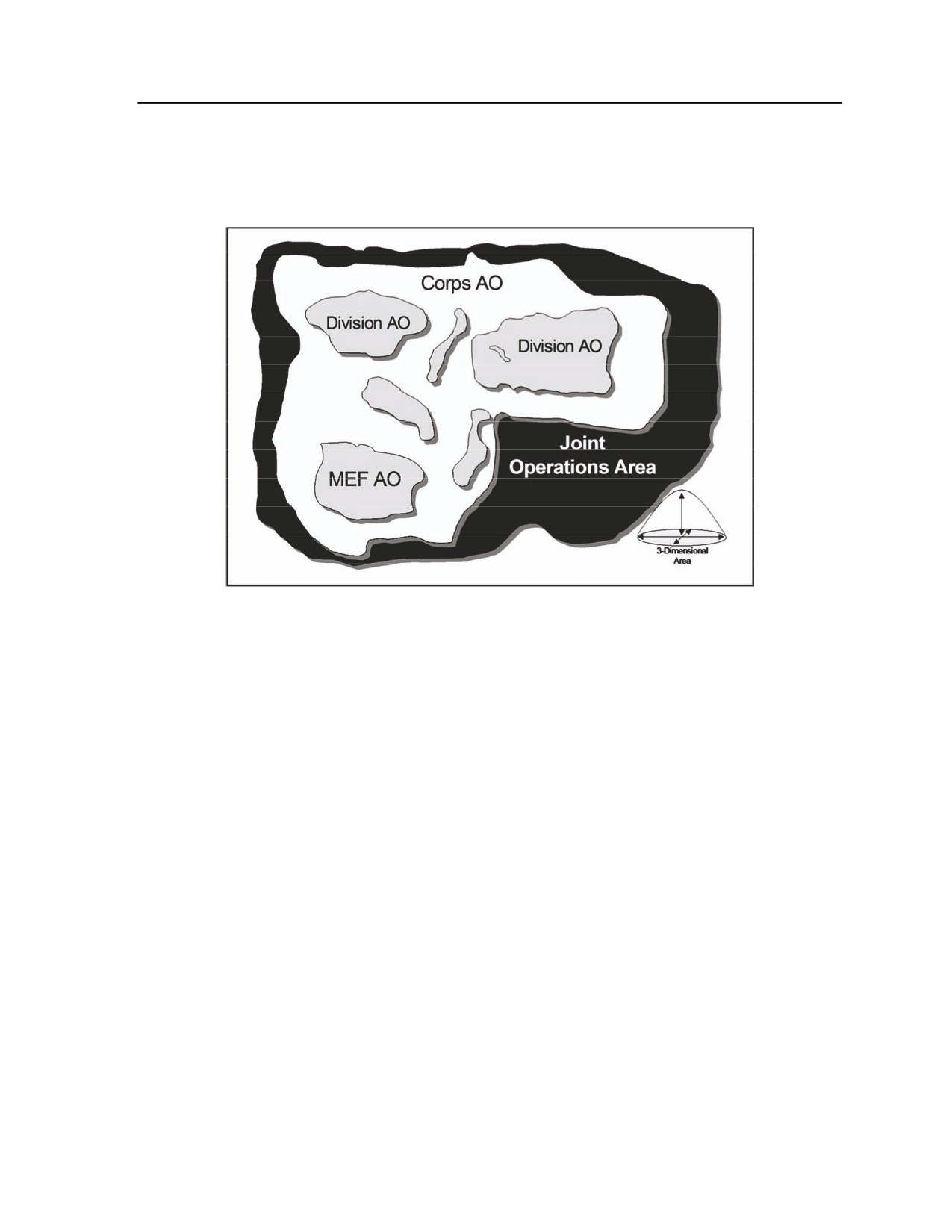
force commander (JFC) and JTF to support those operations. Figure 1-2 shows a notional JOA and how
corps and divisional AOs may be arrayed.
Figure 1-2. Notional joint operations area
SPECTRUM OF REQUIREMENTS
1-12. The United States employs its joint military capabilities at home and abroad in support of its national
security goals in a variety of ways. These operations vary in size, purpose, and combat intensity within a
spectrum of operations that extends from military engagement, security cooperation, and deterrence
activities to crisis response and limited contingency operations and, if necessary, major operations and
campaigns. The nature of the security environment is such that the U.S. military often will be engaged in
several types of joint operations simultaneously across a spectrum of conflict. The spectrum of conflict is a
scale of graduated violence ranging from stable peace to general war. It is a descriptive model that
categorizes conflict with common characteristics. The spectrum of conflict is not a linear progression. The
four primary descriptors (stable peace, unstable peace, insurgency, and general war) along the spectrum are
not static points, and they are not exclusive. The levels of conflict and corresponding politically motivated
violence may vary in different areas of the world and within a theater. It is common to conduct operations
at different points along the spectrum within a theater or even within an AO.
1-13. An engineer view of the OE is not limited to any one point on the spectrum of conflict. The engineer
view, including a shared general understanding and an added degree of focus on those aspects within the
purview of an engineering background, seeks to identify potential challenges and opportunities across the
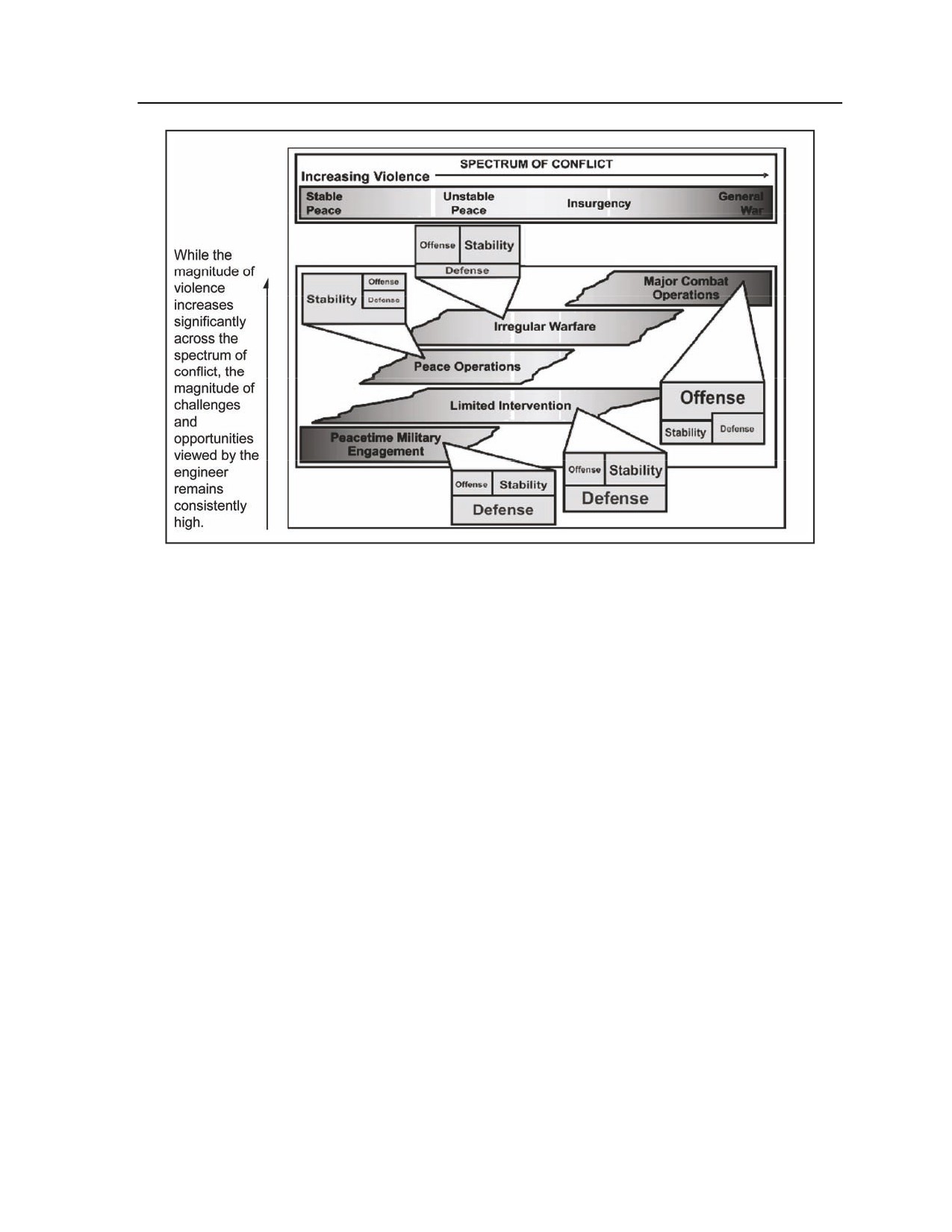
spectrum of conflict. While the magnitude of violence varies over a spectrum of conflict, the magnitude of
challenges and opportunities from an engineer view of the OE may remain consistently high (see figure 1-
3, page 1-6). This spectrum of engineer requirements provides a menu of actions available in support of
desired military operations.
2 April 2009
FM 3-34
1-5
Chapter 1
Figure 1-3. Challenges and opportunities from the engineer view
1-14. At one end of the spectrum is “stable peace,” an ideal situation characterized by little or no violence.
Peaceful interaction may include competition, cooperation, and assistance. Engineer activities may include
geospatial engineering support to provide a clear understanding of the physical environment. Military
engagement, security cooperation, and deterrence activities sometimes require large numbers of forces.
These forces will need infrastructure, facilities, LOCs, and bases to support their sustainment. Even in
areas with well-developed existing infrastructure, significant engineer effort will often be required to plan,
design, construct, acquire, operate, maintain, or repair it to support operations in-theater. Assistance in
response to disaster and humanitarian relief usually includes significant engineering challenges and
opportunities to immediately and positively impact the situation.
1-15. Where one or more factions threaten or use violence to achieve their objectives, stable peace may
degenerate into “unstable peace.” Unstable peace may also result when violence levels decrease after
violent conflict. In some cases, outside powers may apply force to limit conflict. Preventing a return to
violent conflict may require peace operations. Sometimes stable peace is not immediately achievable. At
those times, the goal of conflict termination is establishing conditions in which peace operations can
prevent conflict from recurring. Doing this allows the other instruments of national power to work toward
stable peace. Opportunities to improve the stability might be available through infrastructure, creating or
improving host nation (HN) technological capacity, or other engineering projects. Opportunities may also
include providing specialized engineer support to other agencies as necessary.
1-16. Continuing along the spectrum, the next category is insurgency. (An insurgency may include the
widespread use of terrorist tactics.) Joint doctrine defines an insurgency as an organized movement aimed
at the overthrow of a constituted government through the use of subversion and armed conflict. (JP 3-05) It
is a condition of ongoing conflict involving significant intra- or interstate violence, but short of large-scale
operations by conventional forces. Most common military operations here are either counterinsurgency or
support to insurgencies termed unconventional warfare. The engineer view will seek to identify challenges
to the commander’s ability to move and maneuver freely, protect the forces employed, and sustain the
operation. Opportunities include directly impacting the adversaries’ freedom of action and improving
stability.
1-6
FM 3-34
2 April 2009
The Operational Environment
1-17. At the far end of the spectrum is general war. General war is armed conflict between major powers
in which the total resources of the belligerents are employed, and the national survival of a major
belligerent is in jeopardy. (JP 1-02) In general war, conventional and unconventional forces vie for military
supremacy, and major combat operations predominate. Major combat aims to defeat the armed forces of an
enemy and eliminate (or at least severely limit) the military threat. Commanders do this primarily through
offensive and defensive operations accompanied by stability operations. These stability operations
primarily shape the OE to provide order and security in the areas controlled by friendly forces and to
prepare for post-conflict operations. Commanders reduce the level of conflict to smaller, less coordinated
actions by gradually decreasing numbers of disaffected parties. These actions move the situation down the
spectrum of conflict until achieving stable peace. Major combat operations normally include insurgency or
unconventional warfare simultaneously with conventional operations.
1-18. Major operations and campaigns frequently require ground combat (or the possibility of ground
combat), as do crisis response and contingency operations. Such operations include the challenge of
integrating engineer and other support activities with the fires and maneuver of ground combat forces to
assure the mobility of friendly forces, alter the mobility of adversaries, and enhance the survivability of
friendly forces. An engineer view also includes identifying challenges associated with sustaining the
operation.
1-19. Engineers will be challenged to understand the OE they face and apply their knowledge and
background to add to the overall understanding. The engineer view must be consistent with the shared
framework and variables employed to analyze the OE. But while the levels of conflict and corresponding
politically motivated violence may vary in different areas of the world and within a theater, the challenges
and opportunities identified by an engineer understanding of the OE remains consistently high across the
spectrum of conflict. Similarly the engineer view of the OE provides relevant and in some cases also
unique added understanding at each level of war.
SUPPORT SPANNING THE LEVELS OF WAR
1-20. The levels of war are doctrinal perspectives that clarify the relationship between strategic objectives
(ends), operational approach (ways), and tactical actions (means). No finite limits or boundaries exist
between the levels of war; they correlate to specific levels of responsibility and planning, helping to
organize thought and approaches to a problem. They provide a clear distinction between headquarters and
the specific responsibilities and actions performed at each level. Despite advances in technology, digital
information sharing, and the increased visibility of tactical actions, the levels of war retain great utility with
the decisions at one level always impacting the other levels.
1-21. As previously discussed, Army doctrine describes an OE in terms of the operational variables of
PMESII-PT. When commanders receive a mission, they require a more detailed mission analysis focused
on their situation. The Army uses METT-TC. When used together, METT-TC and PMESII-PT help
commanders visualize their situation. The engineer view of the OE is consistent with the common
framework used and provides relevant added understanding at all levels of war.
1-22. The challenges of planning, preparing, executing, and continuously assessing operations within
diverse theaters are numerous and varied. The engineer staff must be involved in the operations process
activities at each level of war—strategic, operational, and tactical. Understanding the challenges and
opportunities identified from an engineer view equips the staff with relevant information to form a more
comprehensive understanding. The omission of engineer considerations at any echelon of an operation may
adversely impact the effectiveness of the operation. The following paragraphs briefly describe some of the
engineer considerations at each level of war.
1-23. Engineer activities at the strategic level include force planning, engineer policy and doctrine
development, and the execution of campaigns and operations, focusing primarily on the means and
capabilities to generate, mount, sustain, and recover forces. Additionally, infrastructure development is a
critical aspect of enabling and sustaining force deployments and places a heavy demand on engineer
requirements. Engineers at the strategic level advise on terrain and infrastructure, including seaports of
debarkation (SPODs) and aerial ports of debarkation (APODs), force generation, priorities of engineer
2 April 2009
FM 3-34
1-7
Chapter 1
support, LOCs, air base and airfield operations, base camp placement and design, joint targeting, foreign
humanitarian assistance (FHA), environmental considerations, engineer interoperability, input to the rules
of engagement (ROE), rules for the use of force, and support to protection. Environmental issues can have
strategic implications and affect mission success and end states if not recognized early and incorporated
into planning and operations. Natural resource protection can be a key strategic mission objective
important to HN reconstruction. Failure to recognize environmental threats can result in significant risk to
the JTF, adversely impacting readiness. If not appropriately addressed, environmental issues have the
potential to negatively impact local community relations, affect insurgent activities, and create diplomatic
problems for the JTF.
1-24. Engineer activities at the operational level focus on the impact of geography and force-projection
infrastructure on the combatant commander’s (CCDR’s) operational design. Engineer planners must
determine the basic yet broad mobilization, deployment, employment, and sustainment requirements of the
CCDR’s concept of operations. Operational planning merges the operation plan (OPLAN) or operation
order (OPORD) of the joint force, specific engineer missions assigned, and available engineer forces to
achieve success. JFC engineer planners also need to understand the capabilities and limitations of Service
engineer forces. Many of the engineer activities conducted for strategic operations are also performed at
the operational level. At the operational level, engineers prioritize limited assets and mitigate risks.
Engineers conduct operational area and environmental assessments and work with intelligence officers to
analyze the threat. Engineers conduct master planning and plan for the construction of contingency base
camps and other facilities. Engineers anticipate requirements and request capabilities to meet them. They
develop geospatial products and services and make recommendations on joint fires and survivability for the
forces employed. As the link to tactical engineer integration, operational planning ensures that adequate
engineer capabilities are provided to accomplish combat engineering support requirements.
1-25. Engineer activities at the tactical level focus on support to the ordered arrangement and maneuver of
combat elements—in relationship to each other and to the enemy—that are required to achieve combat
objectives. Tactical planning is conducted by each of the Services; in the context of engineer operations,
this translates to a primary focus on combat engineering tasks and planning done within tactical
organizations (see Chapter 3 for a discussion of the engineer functions including combat engineering).
Operational planners set the conditions for success at the tactical level by anticipating requirements and
ensuring that capabilities are available. Engineer tactical planning is typically focused on support to combat
maneuver, survivability, and sustainment support that is not addressed by the higher-echelon commander.
Construction planning at the tactical level will typically focus on security construction in support of the
protection and sustainment warfighting functions. Engineer planners at the tactical level use the engineer
assets provided by operational planners to support the tactical mission tasks assigned to those combat
maneuver units they support. With the support of the engineer, the subordinate JFC ensures that engineer
capabilities are effectively integrated into the scheme of maneuver and the performance of assigned tasks.
Tactical missions are complex, and planning must consider both symmetric and asymmetric threat
capabilities. Special consideration includes performing terrain analysis with an understanding of these
threat capabilities. Engineer reconnaissance (both tactical and technical) is a critical capability to the
combat maneuver commander at the tactical level. Threat information must be very specific. Engineers
must discern and identify patterns and plan specific detection strategies based on the threat. The
proliferation of mines and improvised explosive devices (IEDs) requires engineers to continuously develop
new countering procedures. The tactical integration of explosive ordnance disposal (EOD) capabilities has
become an increasing requirement.
1-26. As mentioned above, the engineer view of the OE and engineer operations more broadly are
synchronized to support combined arms through the framework of the warfighting functions. The resulting
understanding of the OE is not limited to considerations within the OE that may result in engineer
functional missions. Neither is engineer planning at each level of war limited or constrained to the
development of engineer functional tasks. The warfighting functions and the parallel joint functions are
used to synchronize engineer operations at every level of war. While there are significant linkages to each
of the warfighting functions, planning support at the strategic to operational level is focused primarily
within the movement and maneuver, intelligence, and sustainment functions. At the operational to tactical
level, planning support focuses primarily on the movement and maneuver, intelligence, C2, sustainment,
1-8
FM 3-34
2 April 2009
The Operational Environment
and protection warfighting functions. While the primary focus and, in many cases, the staff organization
for engineer considerations vary among levels of war, the engineer Soldier remains consistently central to
the capability to provide and integrate an engineer view of the OE. Chapter 3 includes a more detailed
discussion of engineer support to combined arms, the linkages to all of the warfighting functions, and the
engineer staff organization.
ENGINEER SOLDIERS
1-27. Engineer Soldiers are the centerpiece of those forces conducting engineer operations. They are the
irreducible unit of engineer forces and repository of both the expertise and skills required to provide
engineer support to the combined arms. Regardless of the importance of equipment or the expansion of
technological capabilities, engineer Soldiers accomplish the missions that enable engineer operations and
support.
1-28. The rigors of service and combat bind together today’s Soldiers. Their character comes from
professional standards and experiences. They hold fast to the professional standards embodied in the
“Army Values” and “Warrior Ethos”. The “Warrior Ethos” describes the mindset of the professional
Soldier and proclaims a selfless commitment to the nation, mission, unit, and fellow Soldiers. When
internalized, it produces a tenacious will to win and moves Soldiers to fight through all conditions to
victory. Engineer Soldiers complement the “Warrior Ethos” with a curiosity for the technological aspects
of their environment.
1-29. Frequently, Soldiers operate in areas characterized by chaos and disorder—this is the nature of land
operations. They may encounter populations with diverse cultures and political orientations. These
populations may support, oppose, or remain ambivalent to a U.S. presence. In any operation, Soldiers
prepare to encounter dislocated civilians or persons of unknown status. The cornerstone of successful
interaction with local populations and displaced persons—and the key to successful stability and civil
support operations—is discipline. When the local populace supports Army forces, the Soldiers’ discipline
cements the relationship. In circumstances where the populace is ambivalent or unfriendly, discipline
fosters respect and prevents tension from flaring into open hostility. ROE guide the use of lethal and
nonlethal means, not to inhibit action and initiative but to channel it in ways that support the nation’s stated
goals. The disciplined application of lethal and nonlethal force is more than a moral issue; it is a critical
contributor to operational success. The Soldier’s rules—set forth in Army Regulation (AR) 350-1—distill
the essence of the law of war and regulate the conduct of Soldiers in operations (see figure 1-4, page 1-10).
1-30. Engineer Soldiers must be technically and tactically proficient. Their character and competence
represent the foundation of a trained and ready Army. Soldiers must be able to accomplish tasks while
operating alone or in groups. The contemporary OE requires Soldiers in all grades and in all specialties to
have a fundamental understanding of the operational variables used to frame the analysis of the OE.
Soldiers and leaders must exercise mature judgment and initiative under stressful circumstances and be
capable of learning and adapting to meet the demands of full spectrum operations. Leadership links
Soldiers’ technical and tactical competence to operational success by employing and maintaining
increasingly complex and sophisticated equipment and executing a variety of offensive, defensive,
stability, and civil support tasks.
2 April 2009
FM 3-34
1-9
Chapter 1
The Rules
• Soldiers fight only enemy combatants.
• Soldiers do not harm enemies who surrender.
• Soldiers disarm prisoners or turn them over to designated authorities.
• Soldiers do not kill or torture enemy prisoners of war.
• Soldiers collect and care for the wounded, whether friend or foe.
• Soldiers do not attack medical personnel, facilities, or equipment.
• Soldiers destroy no more than the mission calls for.
• Soldiers treat civilians humanely.
• Soldiers do not steal. Soldiers respect private property and possessions.
• Soldiers should do their best to prevent violations of the law of war.
• Soldiers report all violations to the law of war to their superior.
Figure 1-4. The Soldier’s rules
1-31. Training is the means by which Soldiers, leaders, and units achieve the tactical and technical
competence required to conduct successful operations across the spectrum of conflict. This entails specific,
dedicated training on offensive and defensive tasks and a wide range of stability and civil support tasks.
The Army trains Soldiers and units daily to accomplish tasks to standard while developing leaders that are
able to function under all conditions.
1-32. Chapter
2 discusses engineer capabilities available to Army and joint commanders. These
capabilities include Army engineer organizations with Active Army, ARNG, USAR, and the professional
DA Civilians in the United States Army Corps of Engineers (USACE). Additional capabilities may be
available from other Services, government agencies, allies, and contractors. The centerpiece of these
capabilities is the engineer Soldier, willing and able to make conventional and innovative attempts until the
task is accomplished.
1-10
FM 3-34
2 April 2009
Chapter 2
Engineering in Unified Action
Essayons (Let us try!)
Motto of the Corps of Engineers
Unified action describes the wide scope of actions (including the synchronization of
activities with governmental organizations and NGOs) taking place within combatant
commands, subordinate unified commands, or JTFs under the overall direction of the
commanders of those commands. Unified action highlights the synergistic application
of all the instruments of national and multinational power and includes the actions of
nonmilitary organizations and military forces. Engineer capabilities are a significant
force multiplier in joint operations, facilitating the freedom of action necessary for
the JFC to meet mission objectives. Engineer operations modify, maintain, provide
understanding of, and protect the physical environment. In doing so, they assure the
mobility of friendly forces; alter the mobility of adversaries; enhance the
survivability and enable the sustainment of friendly forces; contribute to a clear
understanding of the physical environment; and provide support to noncombatants,
other nations, and civilian authorities and agencies. This chapter describes the
engineer capabilities available to the JFC and the framework for generating and
organizing these capabilities.
SECTION I-THE ENGINEER REGIMENT
2-1. FM 3-0 emphasizes operations that combine offensive, defensive, and stability or civil support by
defining a distinct operational concept around full spectrum operations. Such operations require the
flexible application of combat power in the simultaneous execution of up to three elements of full spectrum
operations. Chapter 5 provides a complete discussion of engineer support to full spectrum operations.
Army forces conduct full spectrum operations within the larger framework of joint operations. Combat
power is the way Army leaders conceptualize capabilities. Engineer capabilities are key enablers for
success in full spectrum operations.
2-2. The Engineer Regiment represents the Army’s engineer capabilities in both the operational Army
and the generating force. The Engineer Regiment consists of all Active Army, Army National Guard,
and United States Army Reserve engineer organizations (as well as Department of Defense [DOD]
civilians and affiliated contractors and agencies within the civilian community) with a diverse range
of capabilities that are all focused toward supporting the Army and its mission. The Active Army
consists of USACE and active duty Army military engineer units within the combatant commands and
Army commands. The RC consists of the ARNG and USAR and provides the TEC headquarters. The RC
engineer force constitutes more than three-fourths of Army engineer forces and includes a wide range of
specialized capabilities. In addition, certain types of units are found only in the RC. The Regiment is joint
in its integration capabilities and supports the planning, preparing, executing, and assessing of joint
operations. The Regiment is experienced at interagency support and leveraging nonmilitary and
nongovernmental engineer assets to support mission accomplishment.
2-3. The Chief of Engineers leads the Engineer Regiment and is triple-hatted as the Chief of the Engineer
Branch, the Commander of USACE, and the staff officer advising the Chief of Staff of the Army (CSA) on
engineering matters and force capabilities. The Chief is assisted in these roles by the Engineer Branch;
2 April 2009
FM 3-34
2-1
Chapter 2
Headquarters, USACE; and the Office of the Chief of Engineers (OCE). The Engineer Branch and USACE
are discussed further in this chapter. OCE is a staff element assigned to the Army Staff to assist the Chief
of Engineers in advising the CSA and the Army Staff.
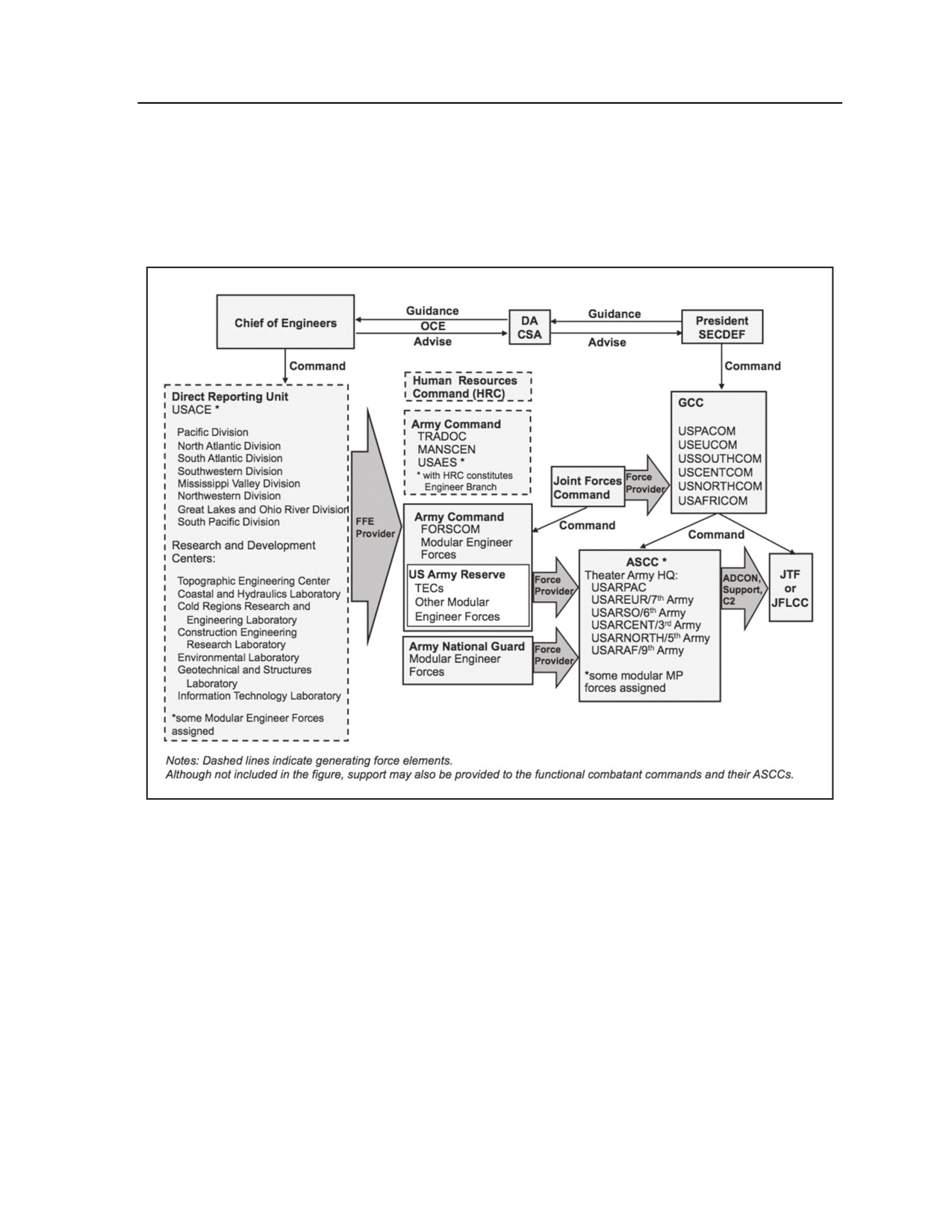
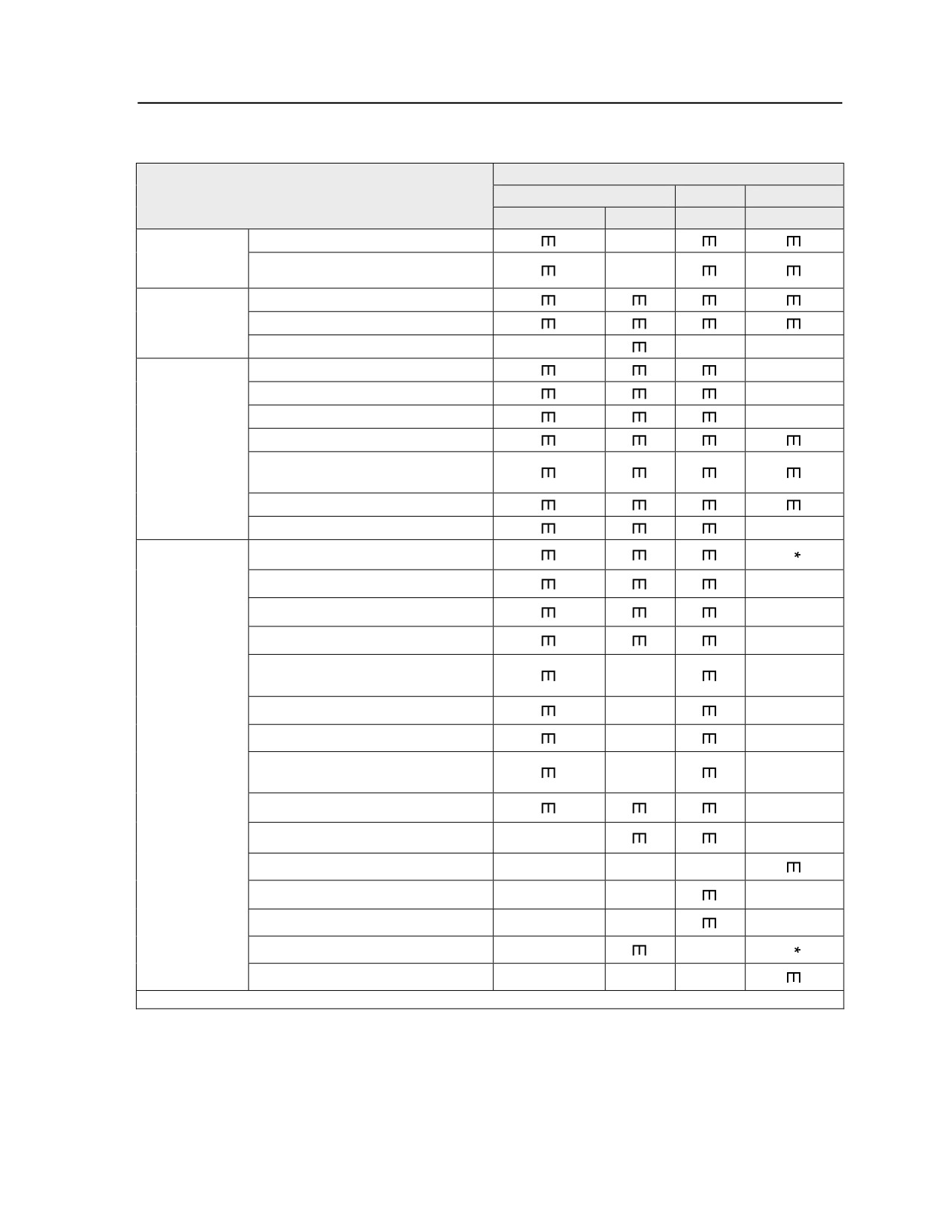
2-4. At the operational to strategic level, the Regiment is represented as shown in figure 2-1. The
Regiment is represented by the various engineer organizations and capabilities reflected in table 2-1, at the
tactical to operational level. Appendix B provides a more in-depth view of the organizations depicted in
table 2-1.
Figure 2-1. The Engineer Regiment from strategic to operational level
2-2
FM 3-34
2 April 2009
Engineering in Unified Action
Table 2-1. Elements of the Engineer Regiment
Force Provider
Engineer Element
FORSCOM
Active Army
USAR
ARNG
Other ASCC
Organic
BCT Engineer Company
Engineer
Geospatial Team
Forces
Engineer Battalion Headquarters
Engineer
Engineer Brigade Headquarters
Headquarters
Theater Engineer Command
Sapper Company
Mobility Augmentation Company
Clearance Company
Baseline
Engineer Support Company
Engineer
Forces
Horizontal Construction
Company
Vertical Construction Company
Multirole Bridge Company
Survey and Design Team
Concrete Section
Asphalt Team
Firefighting Team
Explosive Hazards Team or
Coordination Cell
Engineer Squad (Canine)
Diving Team
Specialized
Engineer
Topographic Company or
Forces
Geospatial Planning Cell
Construction Management Team
Engineer Facilities Detachment
Prime Power Company
Well-Drilling Team
Quarry Platoon
Real Estate Team
Forward Engineer Support Team
Note: * USACE may provide some capabilities from its generating force organization.
THE ENGINEER BRANCH
2-5. The Engineer Branch includes both the human resource managers
in
the
Human
Resources
Command (HRC) and the Engineer Branch proponent under TRADOC. Together, these components
generate and manage the centerpiece of those forces conducting engineer operations. The Branch trains,
2 April 2009
FM 3-34
2-3
Chapter 2
educates, and manages engineer Soldiers in a variety of military occupational specialties (MOSs). The
Engineer Branch proponent is USAES, which is colocated with the United States Army Military Police
School and the United States Army Chemical, Biological, Radiological, and Nuclear School at the
Maneuver Support Center (MANSCEN). Collocation at MANSCEN complements efforts of these three
branch proponent schools to synchronize their doctrine, organization, training, materiel, leader education,
personnel, and facilities
(DOTMLPF) functions and other support capabilities across the warfighting
functions.
2-6. USAES provides engineer Soldier education, including core, tactical, technical, and leader education
for officers, noncommissioned officers (NCOs), and enlisted personnel. Additionally, specialized training
is also provided (such as the Joint Engineer Operations Course, Explosive Ordnance Clearance Agent
[EOCA] Course, Search Advisor Course, and Sapper Leader Course). Additional training is developed and
provided as required. As part of the officer education program at USAES, selected officers are provided
the opportunity to complete postgraduate education and obtain professional engineer certification.
2-7. USAES also hosts and manages several boards, centers, conferences, and cells, both standing and ad
hoc, as a means to support DOTMLPF functions of the Army staff, generating force, and ASCCs and
gather feedback from leaders in the engineer forces. One example of an annual conference is the Engineer
Force Conference (ENFORCE) that provides direct communication among senior engineer leaders. The
Counter Explosive Hazards Center at MANSCEN coordinates DOTMLPF solutions and integration for
counter EH tactics, techniques, and procedures (TTP). Operational support is provided to engineer forces
and staffs through reachback, mobile training teams, and other mechanisms.
2-8. The Engineer Branch produces tactically and technically competent engineer Soldiers capable of
serving in engineer forces or as engineer staff of a joint force assisting the JFC by furnishing advice and
recommendations to the commander and other staff officers (Chapter 4 discusses engineer staff roles and
responsibilities in greater detail). The engineer branch proponent works closely with USACE to leverage a
vast pool of additional technical competence provided by DOD civilians and affiliated contractors and
agencies within the civilian community working with USACE. Technical support is available directly in
support of engineer staff and forces through reachback. Significant technical development benefits those
engineer Soldiers assigned to work within USACE.
UNITED STATES ARMY CORPS OF ENGINEERS
2-9. USACE is the Army’s direct reporting unit assigned responsibility to execute Army and DOD
military construction, real estate acquisition, and development of the nation’s infrastructure through the
civil works program. Most of its assets are part of the generating force (see FM 1-01), but selected
elements are a part of the operational Army, to include forward engineer support teams (FESTs) and the
249th Engineer Battalion (Prime Power). Other services include wetlands and waterway management and
disaster relief support operations
(USACE has primary responsibility to execute Emergency Support
Function [ESF] #3, Public Works and Engineering, for DOD). With its subordinate divisions, districts,
laboratories, and centers, USACE provides a broad range of engineering support to military departments,
federal agencies, state governments, and local authorities in a cost-reimbursable manner. USACE districts
provide research, design, contracting, construction, and operation of hydroelectric power generation and
river navigation while reducing overall environmental impact. USACE also provides technical assistance
and contract support to joint forces deployed worldwide. USACE operates the U.S. Army Engineer
Research and Development Center (ERDC), a comprehensive network of laboratories and centers of
expertise that includes the following facilities:
z
Geotechnical and Structures Laboratory.
z
Coastal and Hydraulics Laboratory.
z
Environmental Laboratory.
z
Information Systems Laboratory.
z
Engineer Waterways Experiment Station.
z
Cold Regions Research and Engineering Laboratory.
z
Construction Engineering Research Laboratory.
2-4
FM 3-34
2 April 2009
Engineering in Unified Action
z
Topographic Engineering Center.
2-10. USACE capabilities include access to the expertise of ERDC’s centers and laboratories and all of the
resources within the divisions, districts, and other sources. Within USACE, the Chief of Engineers has
aligned USACE divisions with and assigned liaison officers (LNOs) to CCDR and Army commanders as
they reinforce and extend the capabilities of the Regiment (see figure 2-1, page 2-2). This relationship with
the CCDR and the operational force allows direct access to USACE resources to support engagement
strategies and wartime operations. The USACE mission supports full spectrum operations with the
following five major functions:
z
Warfighting—provides engineering and contingency support for full spectrum operations.
z
Disasters—responds to and supports recovery from local, national, and global disasters.
z
Infrastructure—acquires, builds, and sustains critical facilities for military installations, theater
support facilities, and public works.
z
Environment—restores, manages, and enhances ecosystems, local and regional.
z
Water resources development—balance requirements between water resources development and
environment.
2-11. USACE support provides for technical and contract engineering support, integrating its organic
capabilities with those of other Services and other sources of engineering-related reachback support.
USACE may have assets directly integrated into the military C2 structure and linked to a TEC or senior
engineer headquarters or already operating under contract in-theater. Whether providing construction
contract and design support in the AO or outside of the contingency area, USACE can obtain necessary
data, research, and specialized expertise not present in-theater through Tele-engineering and other
reachback capabilities. Tele-engineering is assisting engineers and the commanders they support in
planning and executing their missions with capabilities inherent in field force engineering (FFE)
through exploitation of the Army’s command, control, and communications architectures to provide
a linkage between engineers and the appropriate nondeployed subject matter experts for resolution
of technical challenges. Tele-engineering is under the proponency of the United States Army Corps
of Engineers.
2-12. USACE is the primary proponent of FFE and related generating force support which enables the
engineer functions and the operational Army. FFE is the application of the Engineer Regiment’s
capabilities from the three engineer functions (although primarily general engineering) to support
full spectrum operations through both reachback and forward presence. This is provided through
USACE personnel and assets (deployed and participating through reachback) or through operational force
engineer Soldiers linked into reachback capabilities through tele-engineering. The engineer commander
maintains his flexibility and determines the mix of capabilities (troop, USACE civilian, and contractor)
based on the tactical situation, time-phased requirements, capabilities required, available funding, and force
caps. The USACE division commander task-organizes the division’s capabilities to meet the varying time-
phased requirements. The capability relies heavily on reachback through systems such as tele-engineering.
The FFE concept is applicable in joint and multinational operations to provide a better engineer solution
that can be implemented faster and with a smaller footprint. The United States Air Force (USAF) and
United States Navy (USN) have similar capabilities—the Air Force uses its Geo-Reach program while the
Navy has the capability to conduct engineer reconnaissance with reachback to the Naval Facilities
Engineering Command (NAVFAC).
2-13. The USACE objective for FFE is to more effectively execute its generating force roles (engineering
expertise, contract construction, real estate acquisition and disposal, and environmental engineering) in all
operations and maximize use of reachback to provide technical assistance and enable the engineer
functions in support of operational force engineers and the CCDR or JTF commander. One of the ways
USACE accomplishes this is by training, equipping, and maintaining specialized deployable FESTs. A
“FEST” is a deployable USACE organization that executes the USACE mission in the AO. It is usually
subordinate to the senior engineer commander in the AO. Another way that USACE supports the
operational force is through its infrastructure assessment team. The “infrastructure assessment team” is a
nondeployable team that provides engineering infrastructure assessments for military deployments and
2 April 2009
FM 3-34
2-5
Chapter 2
civil-military operations (CMO) in forward areas. Focus areas for the teams are infrastructure related to the
USACE missions and aspects of the AO impacting contract construction, to include roads, utilities, water
resources, and HN support. A third way that USACE supports the operating force is through its base
development teams. A “base development team” is a nondeployable team that can quickly provide base
development engineering and planning and facilities design for base camps. Base camps include
intermediate staging base, forward operating bases (FOBs), displaced persons camps, and any similar
requirement.
2-14. USACE has expertise that may support the strategic, operational, or tactical levels in engineer
planning and operations and can leverage reachback to technical subject matter experts in districts,
divisions, laboratories and centers of expertise, other Services, and private industry in its role as part of the
generating force. USACE FFE is a means to access specialized engineer capabilities that can augment JFC
planning staffs. Teams can rapidly deploy to meet requirements for engineering assessments and analyses
in support of the full array of engineer operations. The two types of FESTs provide support to primarily
general engineering efforts through forward-deployed engineer elements that can communicate with tele-
engineering kits and reachback to technical experts within USACE. Engineer facility detachments (EFDs)
provide a wide variety of services to forward deployed forces in a public works capacity including
assistance in the reception and staging of troops.
z
Forward Engineer Support Team-Advance (FEST-A). Its mission is to provide additional
planning capability to combatant command and Army service component command engineer
staffs. It can also deploy in support of a JTF with a limited execution capability. Its capabilities
include multiple engineer planning and design, real estate acquisition and disposal, and
contracting personnel. The FEST-A may provide an initial technical infrastructure assessment or
survey, technical engineer assistance, contracting support, and real estate acquisition support.
z
Forward Engineer Support Team-Main (FEST-M). Its mission is to provide C2 for USACE
teams in the AO and sustained USACE engineering execution capability within an AO. This
team generally supports a JTF or the land component of a JTF. The FEST-M provides LNOs
and USACE engineering planning modules to supported units, as required. It is a flexible, self-
sustaining organization with a mission of providing USACE capabilities through forward
presence and reachback for the following primary mission areas: infrastructure engineering
planning and design, technical engineering expertise, contract construction, real estate
acquisition and disposal, environmental engineering, and geospatial engineering support.
z
EFD. A 15-Soldier unit whose mission is to provide additional facility engineering planning and
support to the CCDR. It supports base development including master planning, construction
design and supervision, and contractor supervision. The unit can support multiple sites.
2-15. Department of Defense Construction Agents. The Secretary of Defense has designated USACE and
NAVFAC as construction agents for the design and construction execution within assigned areas of
responsibility for U.S. military facilities worldwide. (The Air Force is the designated DOD construction
agent for military construction in the British Isles). USACE and NAVFAC provide a significant
engineering capability to be leveraged in joint operations. Both USACE and NAVFAC have the capability
to support general engineering operations with technical assistance and contract support to joint forces
deployed worldwide. They also maintain in-depth expertise in engineering research and development.
Inherent in their mission support capabilities is a planning and engineering capability for advanced base
and infrastructure development. The CCDR may use USACE and NAVFAC to provide technical
engineering assistance for design and award of construction contracts to civilian companies in support of
military operations.
ENGINEER OPERATIONAL FORCE CAPABILITIES
2-16. Army engineer forces of the operational force operate at the strategic, operational, and tactical levels
across the spectrum of conflict. Units are organized in a scalable, modular, adaptable manner to support
combat, general, and geospatial engineering requirements. Army engineer forces operate as an integral
member of the combined arms team during peace and war to provide a full range of engineering
capabilities. They execute combat engineering tasks at the tactical and operational levels of war in support
2-6
FM 3-34
2 April 2009
Engineering in Unified Action
of combined arms forces and execute general and geospatial engineering tasks at the tactical to strategic
levels throughout the JOA.
THE MODULAR CONSTRUCT
2-17. The modular construct of the Army engineer operational force is a complementary and
interdependent relationship among four major categories of units (and includes USACE-provided technical
engineering and contract support as already discussed). The four categories include organic engineers (and
staff elements) and three other categories held in an engineer force pool (all operational force engineer
units not organic to a BCT, organic to the armored cavalry regiment [ACR], or in a headquarters staff). The
assets in the force pool exist to augment organic BCT engineers and provide echelons above the BCT with
necessary engineer capabilities. The force pool consists of engineer headquarters units, baseline units, and
specialized engineer units.
z
Organic engineer capabilities are engineer units and staff cells in the three types of BCTs and
the ACR which provide the baseline requirements for combat and geospatial engineering. These
units have very limited general engineering capability.
z
Engineer headquarters units provide C2 for engineer operations, elements, and capabilities.
They consist of the TEC, the engineer brigade, and the engineer battalion. Each has a staff that
allows the commander to C2 assorted and various engineer organizations. They are each capable
of C2 of other selected nonengineer units to support multifunctional missions such as combined
arms breaching and combined arms gap crossing.
z
Baseline engineer units consist primarily of tactically to operationally focused combat and
general engineering units that may augment the organic forces of the BCTs or be assigned to
other supporting operations, to include those typically performed under the C2 of the maneuver
enhancement brigade (MEB) or engineer brigade at the division or corps levels. All of these
units may perform roles and missions under the C2 of a functionally focused engineer brigade,
TEC, or the multifunctional MEB.
z
Specialized engineer units are a variety of typically low-density engineer forces that provide the
remaining category of engineer support. These units are technically focused units that while
providing selected support at the tactical level are focused on providing their specialized
engineering capabilities in support of the operational to strategic levels in full spectrum
operations. These specialized forces include modules for construction support, infrastructure
development, EH mitigation, geospatial support, well drilling, real estate management, and
firefighting.
ORGANIC CAPABILITIES
2-18. Each of the three types of BCTs has a single organic combat engineer company. In the infantry
brigade combat team (IBCT) and the heavy brigade combat team (HBCT), this company is located within
the brigade special troops battalion (BSTB); in the Stryker brigade combat team (SBCT), this company is
positioned as a separate unit under the brigade. The combat engineer company of the ACR is also
positioned as a separate unit under the regiment, similar to that of the SBCT. Geospatial engineering
capabilities are assigned at brigade level and higher staffs. These organic combat engineer units and
geospatial elements provide the minimum combat and geospatial engineering capability to support BCT
operations and may also perform some very limited and selected general engineering tasks. Capabilities of
organic engineers include—
z
Providing geospatial data management and analysis, except in the ACR which does not have
organic geospatial elements.
z
Providing support to close combat (mobility, countermobility, and survivability).
z
Providing mobility assessments.
z
Supporting mobility through urban terrain.
z
Providing C2 for engineer forces.
2 April 2009
FM 3-34
2-7
Chapter 2
2-19. During offensive and defensive operations, they will require augmentation by baseline elements and
potentially include an engineer battalion headquarters. Other specialized engineer units and equipment may
also provide mission-tailored engineer support when their specialized engineer capabilities are required.
EOD elements may be included in this augmentation. Organic engineers train with and remain an integral
part of their parent BCT. Additionally, engineers are organic within the staffs of all Army command level
echelons, providing engineer staff planning functions and integrating geospatial engineering support.
FORCE POOL CAPABILITIES
Engineer Headquarters Units
2-20. C2 of engineer forces is provided by three echelons of engineer headquarters units. Multifunctional
units (discussed later in this chapter) at both brigade and battalion echelons may also provide C2 for
engineer forces in cases where engineer support is integral to the multifunctional mission. C2 for engineer
functional capabilities and missions is provided by the TEC, the engineer brigade, and the engineer
battalion. The TEC is the only organization designed for operational command without augmentation of
engineer capabilities at echelons-above-corps level and often will provide C2 for the JFC if an operational
engineer headquarters is required. The TEC provides C2 for all assigned or attached Army engineer
brigades and other engineer units and missions for the joint force, land component, or Army commander.
When directed, it may also provide C2 for engineers from other Service, multinational, and contract
construction engineers. The TEC is focused on operational C2 of engineer operations across all three of the
engineer functions and typically serves as the senior theater or land component engineer headquarters.
z
Tasks performed by the TEC include providing the support for all operational planning for the
theater across all of the engineer functions. The TEC synchronizes all engineer planning and
support for the CCDR or JTF commander, providing peacetime training and support of military
engagement for their supported respective CCDRs. It plans and operates in close coordination
with the senior contract construction agents (CCAs) in the AO.
z
Both the TEC and USACE are capable of rapid deployment of modular deployable staff
elements and organizations to support the needs of the operational commander. Together they
are capable of providing a wide range of technical engineering expertise and support from
USACE, other Service technical laboratories and research centers, and other potential sources of
expertise in the civilian community. They are enabled by the global reachback capabilities
associated with FFE. TEC resources are synchronized with USACE for peacetime engagements
and to provide FFE capabilities to the operational force. These capabilities include technical
assistance, project planning and design, contract construction, real estate acquisition,
infrastructure support, and support to nation-building capacities.
2-21. The engineer brigade is one of the Army’s functional brigades and is capable of conducting engineer
missions and controlling up to five mission-tailored engineer battalions, including capabilities from all
three of the engineer functions. It may also provide C2 for other nonengineer units focused on the
performance of such missions as support of a deliberate gap (river) crossing.
z
One or more engineer brigades is required in the division or corps whenever the number of
engineer units or the functional nature of engineer missions exceed the C2 capability of the
multifunctional MEB. Once deployed, engineer brigades become the focal point for
apportioning and allocating mission-tailored engineer forces within the AO. The engineer
brigade is capable of supporting a JTF or component commander (land, air, or sea) and
providing C2 of all Service engineers and contracted engineering within an AO. The engineer
brigade has the ability to provide deployable command posts (DCPs) and staffs’ expertise for C2
of engineer operations as required. With augmentation, it may serve as a joint engineer
headquarters and may be the senior engineer headquarters deployed in a JOA if full TEC
deployment is not required.
z
The engineer brigade has the capability to simultaneously provide two DCPs. It provides
engineer-specific technical planning, design, and quality assurance and quality control during
2-8
FM 3-34
2 April 2009
Engineering in Unified Action
24-hour operations. The engineer brigade provides C2 for up to five assigned engineer
battalions, preparing them for deployment in support of the brigade or other organizations.
2-22. The engineer battalion is capable of conducting engineer missions and controlling any mix of up to
five mission-tailored engineer companies. They are typically found within the engineer brigade, the MEB,
or in support of a BCT. With the exception of the prime power battalion, which performs a specific
technical role, all engineer battalion headquarters are capable of providing C2 for either combat, general, or
mixed engineering missions when they have been task-organized to perform those roles. Selected battalion
headquarters include additional capabilities such as being airborne or air assault capable. Training
relationships will make certain battalion headquarters more capable in either combat or general engineering
roles. For the conduct of construction or EH clearance missions, the battalion should receive survey and
design or explosive hazards teams (EHTs) to facilitate those missions.
z
Whenever two or more engineer modules are task-organized in support of a BCT, MEB,
engineer brigade, or other unit, an engineer battalion headquarters may be required for the C2
and sustainment of those modules.
z
An engineer battalion may support an MEB for combat or general engineering missions. The
engineer battalion provides C2 for up to five assigned engineer companies, including preparing
them for deployment in support of the battalion or other organizations.
z
When in support of a BCT, an engineer battalion will provide C2 of engineer operations. The
battalion may be focused on a single mission, such as route clearance, security construction, or
cache interrogation and reduction. The engineer battalion may be organized to perform as a
breach force command when the BCT is conducting a combined arms breach. During a gap
(river) crossing operation, the engineer battalion provides the option to be designated as the
crossing site command.
Baseline Engineer Units
2-23. Baseline engineer units include both combat and general engineer units (see table 2-2). They are the
primary building blocks for the organization of most engineer battalions. These units are used to augment
the organic engineer capabilities of a BCT and may be task-organized under an engineer battalion
headquarters to serve under a variety of larger headquarters, providing the specific tailored capabilities
needed to support particular mission requirements.
Table 2-2. Baseline engineer units
Combat Engineer Units
General Engineer Unit
Sapper Company
Engineer Support Company
Mobility Augmentation Company
Multirole Bridge Company
Clearance Company
Horizontal Construction Company
Vertical Construction Company
Combat Engineer Units
2-24. Baseline combat engineer units are focused on support to combined arms operations at the tactical
level and are designed to participate in close combat as necessary. All have the capability of fighting as
engineers or, if required, as infantry. An engineer battalion headquarters will typically be included to
provide the necessary C2, logistics, and staff supervision for attached and assigned units when two or more
are assigned to a BCT, MEB, or other organization. Combat engineer (Sapper) units may construct tactical
obstacles, defensive positions, and fixed and float bridges and repair command posts (CPs), LOCs, tactical
routes, culverts, fords, and other selected general (horizontal and vertical construction-related) engineering
tasks. Combat engineer units also provide engineer support for gap (river) crossing operations, assist in
assaulting fortified positions, and conduct breaching operations. Airborne and air assault capable engineer
units also have the unique ability to employ air-droppable rapid runway repair kits in support of forcible
entry operations. The more specialized combat engineering capabilities of assault bridging, breaching, and
2 April 2009
FM 3-34
2-9
Chapter 2
route and area clearance are added to the organic engineer capabilities in BCTs (or to deployed baseline
Sapper companies) to allow them to accomplish their broader mission requirements.
General Engineer Units
2-25. These general engineer units are comprised of bridging, support, and construction capabilities. The
horizontal and vertical companies have a construction focus and are capable of constructing, rehabilitating,
repairing, maintaining, and modifying landing strips, airfields, CPs, main supply routes (MSRs), supply
installations, building structures, bridges, and other related aspects of the infrastructure. These units may
also perform repairs and limited reconstruction of railroads or water and sewage facilities. The basic
capabilities of these construction units can be expanded significantly. Through the augmentation of
specialized personnel and equipment, these baseline construction units can provide bituminous mixing and
paving, quarrying and crushing, and major horizontal construction projects, to include highways, storage
facilities, and airfields. Additional augmentation could also include pipeline construction or dive support,
depending on the type and scope of the construction mission.
Specialized Engineer Units
2-26. The specialized engineer unit’s portion of the force pool provides for general and geospatial
engineering capabilities at the operational and strategic levels and for specific augmentation to the tactical
level (see table 2-3). Some specialized capabilities are only available through the FFE capabilities provided
as part of the generating force by USACE. These key capabilities translate into units that are typically of a
lower availability and density than the baseline engineer units. These smaller, more specialized units are
designed to typically support larger engineer-related missions and tasks or provide augmentation to
selected headquarters elements.
2-10
FM 3-34
2 April 2009

Engineering in Unified Action
Table 2-3. Specialized Army engineer force pool units
Explosive Hazards
Construction
Infrastructure
Geospatial
USACE
Support
Support
Support
Support
y Explosive Hazards
y Survey and design
y Engineer
y Topographic
y FFE (FESTs with
Coordination Cell
team
facility
engineer
embedded
(EHCC)
detachments
company
environmental,
y Construction
(EFDs)
contingency real
y EH team
management team
y Geospatial
estate, and other
y Firefighting
planning cell
y Engineer squad
y Real estate team
support teams as
team
(canine)
needed)
y Diving team
y Pipeline
y EOD1
y Prime power
y Asphalt team
company, platoon,
y Concrete section
or detachment
y Well-drilling team
y Quarry platoon
1 Army capability is limited in scope for Army engineers and is primarily resident in the EOD specialty of the ordnance branch.
Explosive Hazards Support
2-27. EH support provides C2 for specialized elements and integrates other EH capabilities. These
capabilities include the linkage to Army EOD capabilities found in the ordnance branch. The engineer
squad (canine) includes both specialized search dog teams and mine dog teams. These teams assist in
locating firearms, ammunition, and explosives in both rural and urban environments. They may be used to
augment a variety of route and area clearance capabilities found in the clearance company.
Construction Support
2-28. Construction support provides C2 for management, procurement, and contract support. It also
provides for enhanced performance for asphalt, concrete, and haul operations. All of these capabilities have
a role in infrastructure support.
Infrastructure Support
2-29. Engineer prime power units generate electrical power and provide advice and technical assistance on
all aspects of electrical power and distribution systems. Prime power units have a limited electrical
engineering capability (design and analysis); provide electrical surveys; and operate, maintain, and perform
minor repairs to other electrical power production equipment, to include HN fixed plants. EFDs support
theater opening and closing, base development, construction management, contractor coordination, base
operations, and master planning. Pipeline companies construct and rehabilitate pipeline systems.
Firefighting teams provide first responder support for facilities and aviation operations.
Geospatial Support
2-30. Geospatial engineer units provide terrain and digital imagery analysis and support the integration of
other geospatial information. Geospatial information is the foundation information upon which all
other information about the physical environment is referenced to form the common operational
picture (COP) to the headquarters that they support. Topographic engineer companies provide geospatial
support to deployed units that require augmentation. The companies provide modules tailored to support
the GCC, JTF headquarters, ASCC, corps and division headquarters, sustainment brigades, other joint or
multinational division and brigade-size elements, and the Federal Emergency Management Agency
(FEMA) regions with analysis, collection, generation, management, finishing, and printing capability.
Geospatial planning cells have a specific mission of generating, managing, and disseminating geospatial
data, information, and products in support of the ASCC headquarters and GCC.
2 April 2009
FM 3-34
2-11
Chapter 2
2-31. Although the Army has no dedicated engineer reconnaissance units, except for an element in the
combat engineer company of the HBCT, commanders routinely form mission-tailored engineer
reconnaissance teams to collect engineer-specific tactical and technical information. These teams are a
critical source of information for engineers and combined arms commanders and staffs, playing an
important role in the intelligence preparation of the battlefield (IPB). FM 3-34.170 provides detailed
discussion on the range of engineer reconnaissance capabilities.
SECTION II-UNIFIED ACTION: JOINT/INTERAGENCY/MULTINATIONAL
JOINT/INTERAGENCY/MULTINATIONAL CAPABILITIES
2-32. In full spectrum operations, Army engineers operate as part of a joint force and often within a
multinational and interagency environment. Each Service has core engineering units and capabilities that
stem from their traditional roles and associations to meet specific operational needs and to support
accomplishing a variety of mission requirements in any OE. An understanding of the Services’ combat,
general, and geospatial engineering capabilities and limitations allows the JFC and the joint force engineer
to tailor the engineer force to effectively and efficiently accomplish the mission. The JFC should
understand multinational, interagency, NGO, and intergovernmental organization
(IGO) engineer
capabilities to better coordinate coherent activity, develop viable courses of action (COAs) and, when
appropriate, to properly integrate them into the joint operation. The joint force engineer is responsible for
providing comprehensive recommendations to the JFC on the effective employment of all engineer
capabilities in support of joint operations. The JFC, with the assistance of the joint force engineer, analyzes
mission requirements to tailor optimal engineer force packages. The engineering capabilities of each
Service component may provide engineering support to the other components to meet joint force
requirements. See JP 3-34; JP 3-08; Allied Joint Publication (AJP)-3.12; and Standardization Agreement
(STANAG) 2394/Allied Tactical Publication (ATP)-52(B), for further discussion of engineer participation
in joint, interagency, and multinational operations.
2-33. Services use the engineer functions to categorize forces and assets based on their primary function
(combat engineers, general engineers, and geospatial engineers). Forces can sometimes perform tasks from
other functions, but engineer forces and assets are not interchangeable. Planners must be careful to
accurately identify the capabilities required for an operation and the forces that have those capabilities. A
brief summary of Service engineer capabilities is provided in the following paragraphs (see Appendix C
for more information on other Service engineer capabilities). Some capabilities categorized as engineering
by other Services reside in other branches of the Army, such as EOD and chemical, biological,
radiological, and nuclear (CBRN) capabilities.
Navy Engineers
2-34. Naval civil engineering forces are organized and equipped within the Department of the Navy to
meet the requirements of expeditionary operations. The term Naval civil engineering forces is an
overarching reference to all Naval civil engineers, including officers, enlisted personnel, civilians, and
units. It combines the complementary but distinct capabilities of the engineering operating forces of the
First Naval Construction Division (1NCD), the amphibious construction battalions (ACBs) organized
under the Atlantic and pacific naval beach groups (NBGs) and the business enterprise of NAVFAC.
1NCD, its subordinate units, and the ACBs make up the Naval Construction Force (NCF), also referred to
as Seabees. The NCF has rapidly deployable units of various sizes and configurations tailored to provide
responsiveness and flexibility. Seabees provide advanced base construction, to include airfields, LOCs,
upgrade and maintenance, battle damage repair, underwater and amphibious construction, and logistic
facilities construction. Both NAVFAC and the NCF provide engineering support to the JFC, and more
specifically, Marines at various levels, including a task-tailored Naval construction element (NCE) that can
function as a major subordinate element in a Marine air-ground task force (MAGTF). Refer to Naval
Warfare Pamphlet (NWP) 4-04 for additional information on these units.
2-12
FM 3-34
2 April 2009
Engineering in Unified Action
Marine Corps Engineers
2-35. Marine Corps engineers’ primary tasking is combat engineering and general engineering in support
of MAGTFs. The Marine Corps has limited geospatial engineering capabilities (which reside in the
intelligence branch of the Marine Corps), with one topographic platoon supporting each Marine
expeditionary force (MEF).
Air Force Engineers
2-36. A primary tasking for Air Force engineers is to enable rapid global mobility for airlift, bombers, and
fighters and to support other manned and unmanned aerial weapon systems. Air Force engineers are trained
and equipped with organic capabilities to support all aspects of airfield operations where heavy strategic
airlift, bombers, or fighters will operate on a daily or frequent basis. The Air Force has the capability to
rapidly deploy general engineer units organized as part of an air and space expeditionary task force
(AETF) to open, establish, and maintain air base power projection platforms. These same units can deploy
as detached units operating in support of specific missions and operational tasks, such as airfield pavement
evaluations; crash and fire rescue; EOD; emergency management response; airfield damage repair; facility
construction and maintenance; utility systems construction, maintenance, aircraft arresting system
installation and maintenance; and airfield lighting, marking, and installation of navigation aids. Organized
as prime base emergency engineer force (Prime BEEF) and rapid engineer deployable heavy operational
repair squadron, engineer (RED HORSE) units, they provide a broad array of general and geospatial
engineering capabilities.
Other Engineering Capabilities
2-37. In addition to U.S. military engineer forces, multinational engineers can provide valuable
capabilities. Multinational military units and civilian contractors—in addition to providing labor, material,
infrastructure, and services—may possess certain engineering capabilities specifically adapted to the local
environment. There are other benefits to the use of multinational military units and civilian contractors, but
these need to be weighed against their potential limitations. This mixture of capabilities may change during
the phases of an operation and may require management across Service lines to ensure that the JFC has
appropriate forces in place.
2-38. HN engineer capabilities may be available if an adequate infrastructure exists. Potentially, this could
include a wide array of civil and public works organizations. It is also increasingly common to contract for
a wide range of engineer services with local or third party national organizations and civilian contractors.
These assets are typically used to free up military assets, minimizing the military footprint in a theater
when requirements exceed military capabilities or when the engineer operations and requirements are to be
conducted in areas that are relatively safe from active combat. See Appendix D for more information on
other multinational, interagency, and HN engineer capabilities.
Civil Augmentation Programs
2-39. Civil augmentation programs, such as the Army’s Logistics Civil Augmentation Program
(LOGCAP), the Navy’s global contingency construction and contingency service contract programs, and
the Air Force contract augmentation program
(AFCAP), also play a significant role in mission
accomplishment by providing the JFC and joint force engineer with additional options and flexibility in
general engineering and logistic support. Construction may be within the scope of any of these contract
services.
INTEGRATION OF CAPABILITIES
2-40. Joint integration does not require joint commands at all echelons; it does require understanding joint
synergy at all levels of command. Joint synergy extends the principles of combined arms to operations
conducted by two or more Service components. The strengths of each Service or functional component
combine to overcome the limitations or reinforce the effects of the other components. The combination of
multiple and diverse joint force capabilities generates combat power more potent than the sum of its parts.
2 April 2009
FM 3-34
2-13
Chapter 2
Integrating the variety and special capabilities of engineer organizations requires an understanding of the
various capabilities and limitations of the engineer assets available for any given mission. Integration also
requires a common understanding of the C2 structure and processes in place to employ the engineer
capabilities in unified action.
2-41. Unified action describes the wide scope of actions (including the synchronizing of activities with
governmental organizations and NGOs) taking place within unified commands, subordinate unified
commands, or JTFs under the overall direction of the commanders of those commands. Public law charges
CCDRs with employing military forces through unified action. Under unified action, commanders integrate
joint, single-Service, special, and supporting operations with interagency, nongovernmental, and
multinational operations, to include United Nations (UN) operations (see JP 0-2).
2-42. Combatant command (command authority) (COCOM) is the command authority over assigned
forces vested only in commanders of combatant commands by Title 10, U.S. Code, section 164 (or as
directed by the President or the Secretary of Defense in the Unified Command Plan). Multinational,
interagency, and nonmilitary forces work with the CCDR through cooperation and coordination.
Regardless of the task or the nature of the threat, CCDRs employ air, land, sea, space, and special
operations forces (SOF) and coordinate with multinational and interagency partners to achieve strategic
and operational objectives. They formulate theater strategies and campaigns, organize joint forces,
designate operational areas, and provide strategic guidance and operational focus to subordinate
commanders. The aim is to achieve unity of effort among many diverse agencies in a complex OE.
Subordinate JFCs synchronize joint operations in time and space, direct the action of other military forces
(multinational operations), and coordinate with governmental organizations and NGOs
(interagency
coordination) to achieve the same goal.
CHAIN OF COMMAND
2-43. The Secretary of Defense exercises authority and control of the armed forces through a single chain
of command with two branches (see JP 1). One branch goes from the Secretary of Defense to CCDRs to
the various service component commands and subordinate joint commands for the conduct of operations
and support. The other branch goes from the Secretary of Defense to the military departments to their
respective major service commands. An administrative control (ADCON) relationship exists between the
secretary of the military department to the respective service component commands to carry out their Title
10 responsibilities of recruiting, manning, equipping, training, and providing service forces to the CCDRs.
Although the service branch of the chain of command is separate and distinct from the operating branch,
the ASCC and the Army forces operate within the CCDR’s chain of command in the theater.
2-44. At the theater level, when Army forces operate outside the United States, they are assigned under a
JFC (see JP 0-2 and JP 3-0). A JFC is a CCDR, subunified commander, or JTF commander authorized to
exercise COCOM or operational control (OPCON) over a joint force. At the theater level, the CCDR
provides strategic direction and operational focus to forces by developing strategy, planning the theater
campaign, organizing the theater, and establishing command relationships for effective unified action. The
JFC plans, conducts, and supports the campaign in the theater of war, subordinate theater campaigns, major
operations, and battles. The four joint command relationships are COCOM, OPCON, tactical control
(TACON), and support.
2-45. An ASCC is responsible for Army Title 10 requirements in support of a CCDR. This includes
recruiting, organizing, supplying, equipping, training, servicing, mobilizing, demobilizing, and
administering forces; maintaining, outfitting, and repair of military equipment; the construction,
maintenance, and repair of buildings, structures, and utilities; and the acquisition of real property. The
ASCC may also be responsible for significant DOD and CCDR-designated common-user logistics
functions. The ASCC provides administrative and logistic services to assigned Army forces and the
ARFORs of subordinate JFCs. When appropriate, the ASCC may delegate authority for support tasks to a
single theater support command (TSC) or another subordinate Army headquarters, such as the TEC or the
United States Army Medical Command (MEDCOM), when the focus of support suggests this as the best
solution. USACE is often involved with supporting the ASCC as well and will generally operate through
the TEC, if one is present. Chapter 3 provides additional discussion of joint C2 considerations and options.
2-14
FM 3-34
2 April 2009
Engineering in Unified Action
INTERAGENCY COORDINATION
2-46. Because of the leverage of their wide range of expertise and funding resources, U.S. government
agencies can support the JFC’s mission objectives and can greatly expand the capabilities of the joint force.
This is true whether the response is international in nature or within the United States (for example, during
consequence management in the United States, engineers might provide support in the cleanup stage that
requires close coordination with government agencies). Coordination and a clear understanding of the
commander’s intent are critical when synchronizing operational efforts involving multiple U.S.
government agencies. The JFC will be required to coordinate with government agencies to achieve overall
U.S. objectives. Joint force engineers should have an understanding of the capabilities of these agencies
and their support functions. While government agencies may increase the resources engaged in a given
operation, they may also increase and complicate the coordination efforts. Stability operations are now
regarded as a core U.S. military mission and are given priority comparable to combat operations. Since
integrated civilian and military efforts are key to successful stability operations, DOD engineer personnel
must be prepared to conduct or support stability operations by working closely with U.S. departments and
agencies, foreign governments and security forces, global and regional international organizations, United
States organizations, foreign NGOs, private sector individuals, and for-profit companies.
2-47. The intricate linkages among the instruments of national power demand that commanders consider
all capabilities and agencies to help achieve the common end state. Interagency coordination forges a vital
link between military operations and activities conducted by such organizations as U.S. government
agencies; agencies of partner nations; NGOs; regional, international, and UN organizations; and HN
agencies. Interagency coordination is inherent in unified action. Because engineers are likely to operate
with other agencies, foreign governments, NGOs, and IGOs in a variety of circumstances, their
participation in the JFC’s interagency coordination is critical. Two methods for facilitating such
coordination are the civil-military operations center (CMOC) and the joint interagency coordination group
(JIACG). Additional information on the CMOC and JIACG is provided in the discussion of boards,
workgroups, and cells in Appendix E.
MULTINATIONAL OPERATIONS
2-48. During multinational operations, U.S. forces establish liaison with assigned multinational forces
early. Army forces exchange specialized liaison personnel in fields such as aviation, fire support, engineer,
intelligence, military police (MP), public affairs, and civil affairs (CA) based on mission requirements.
Missions to multinational units should reflect the capabilities and limitations of each national contingent.
Some significant factors are relative mobility and size, intelligence collection assets, long-range fires, SOF,
and organic sustainment capabilities. When assigning missions, commanders should also consider special
skills, language, and rapport with the local population, as well as the national pride of multinational
partners. Multinational commanders may assign HN forces home defense or police missions, such as
sustainment area and base security.
2-49. Commanders should give special consideration to “niche” capabilities, such as mine clearance that
may exceed U.S. capabilities. Multinational engineer forces may possess other engineering specialties that
exceed or enhance U.S. capabilities.
SECTION III-ENGINEER FORCE TAILORING
2-50. Within the modular Army, the organization of forces is dynamic at all levels. Army forces are
organized and reorganized continuously to meet mission requirements. Actual requirements for forces in a
campaign are seldom identical to planning figures. As a consequence, the theater Army commander
recommends the appropriate mix of forces and the deployment sequence for forces to meet the GCC’s
actual requirements. This is force tailoring (selecting forces based on a mission and recommending their
deployment sequence) and may include both operating Army and generating force elements.
2-51. Tailoring the engineer force requires an altogether different mindset—one that thinks in terms
completely divested from how the force is organized in garrison. It requires a leader's mindset that thinks
2 April 2009
FM 3-34
2-15
Chapter 2
beyond garrison structures to embrace combinations of modular engineer capabilities and scalable C2 to
provide each echelon of the force with the right support. While the Engineer Regiment is organized and
equipped to support full spectrum operations, engineers can expect serious challenges in the OE when
trying to execute the broad range of potential tasks. Careful prioritization must occur for the limited
engineer resources typical in the OE. To accomplish all identified tasks in the desired timeframes,
commanders must consider augmentation requirements and recognize which mission requirements can be
supported through reachback rather than enlarging the engineer footprint in the AO. Within the modular
structure, engineer units are more narrowly designed to accomplish specific types of tasks. Therefore, it is
imperative that when tailoring the engineer force, the broad range of capabilities need to be allocated from
the engineer force pool.
2-52. Engineer force packages must contain the right mix of capabilities to assure timely and relevant
engineer support to the JFC. This mix will often need to change drastically during transitions and the joint
force engineer must anticipate and plan for these changes. For example, combat engineers often make up
the majority of engineer forces in-theater during sustained combat operations, but they must be reinforced
during transition to stability operations as they typically do not have the right capabilities to accomplish all
of the general engineering tasks required. Also, since EOD support requirements during transition
operations are often significantly higher than during combat operations, more EOD capabilities will be
required.
2-53. Tailoring the engineer force should not be confused with task-organizing. Tactical and operational
commanders organize groups of units for specific missions. They reorganize for subsequent missions when
necessary. This process of allocating available assets to subordinate commanders and establishing their
command and support relationships is called task-organizing. Considerations for task-organizing engineer
units are discussed in Chapter 3.
MODULAR FORCE ORGANIZATION
2-54. In addition to the organic engineer capabilities of the BCT, the JFC is able to draw from a force pool
of modular engineer units available to be integrated into joint forces at various echelons. This structure
enables expeditionary action and flexible tailoring of forces to meet changing situations.
THE BRIGADE SPECIAL TROOPS BATTALION
2-55. The BSTB is a multifunctional battalion within the HBCT and IBCT. The BSTB provides the BCT
with military intelligence (MI) support, communications, engineer, MP, and CBRN reconnaissance
capabilities. The BSTB is responsible for training, C2, administrative/logistical operations, and health
service support (HSS) to subordinate units. The command and support relationship dictates whether the
BSTB will logistically support them or coordinate their support with the BCT brigade support battalion
(BSB) or the unit’s higher headquarters. The BSTB also secures all BCT CPs and plans and prepares and
executes operations within the BSTB AO. It is able, with the organic MP platoon or other assets provided
by the BCT commander, to defeat Level I and Level II and delay Level III enemy threats until the
tactical combat force (TCF) arrives. Figure 2-2 shows the battalion structure (see FM 3-90.61 for
additional information on the BSTB).
2-16
FM 3-34
2 April 2009
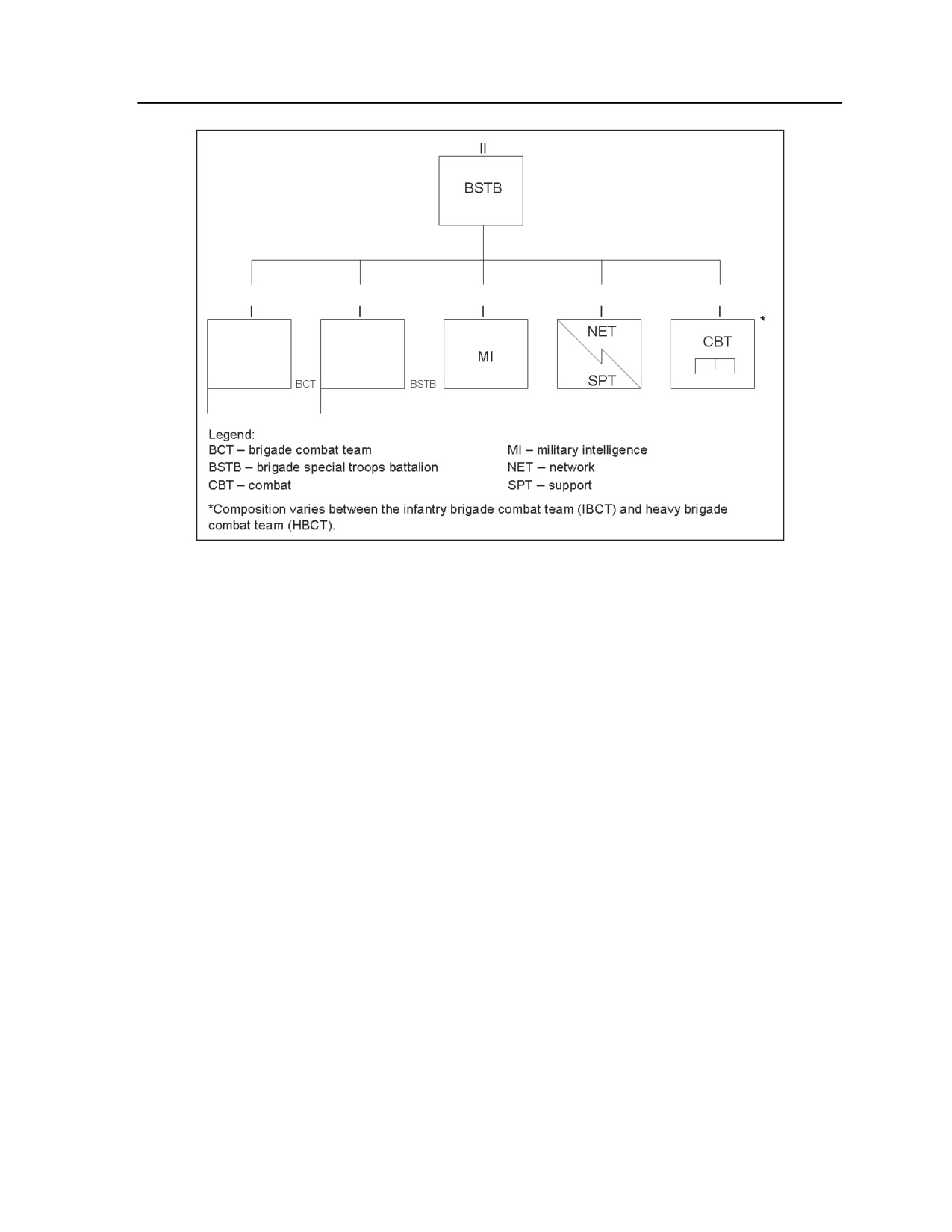
Engineering in Unified Action
Figure 2-2. Brigade special troops battalion
2-56. For the IBCT and HBCT, the BSTB is organized with a BSTB headquarters and headquarters
company (HHC), the BCT HHC, an MI company, and a network support company (NSC). The BSTB of
the IBCT and HBCT each have an engineer company, although the composition varies. The BSTB HHC
has command and staff sections, an MP platoon, a CBRN reconnaissance platoon, a support platoon (with
medical support, maintenance, Class III, and field feeding), and a security section. The sustainment assets
in the HHC include maintenance, medical support, and Class III (petroleum, oil, and lubricants [POL])
sections.
2-57. A key to modularity is the ability to task-organize units to BCTs based on the mission variables of
the operation. Depending on the command and support relationship between the incoming or outgoing unit
and the BSTB, the BSTB may be responsible for providing or coordinating for their sustainment. The
BSTB’s sustainment capability may have to be augmented by the attached units’ parent organization or by
the BCT. The BCT can expect to routinely receive a set of units for most missions. These units may
include—
z
Engineer forces.
z
Air and missile defense (AMD) forces.
z
MP company.
z
CA company.
z
EOD company.
z
CBRN company.
z
Psychological operations (PSYOPs) detachment.
THE MANEUVER ENHANCEMENT BRIGADE
2-58. BCTs are the primary organizations designed to fight tactical engagements and battles. A mix of
other functional and multifunctional brigade types is available to support theater Army, corps, and division
commanders. The multifunctional supporting brigade types include the battlefield surveillance brigade
(BFSB), combat aviation brigade (CAB), the MEB, the fires brigade, and the sustainment brigade. These
2 April 2009
FM 3-34
2-17
Chapter 2
brigades may be combined arms units and are designed to support BCTs and carry out specific tasks in
support of echelons above BCT. The MEB, one of the multifunctional brigades, is designed as a
headquarters to organize and C2, primarily, the units providing CA, CBRN, engineer, EOD, and MP
capabilities. Most support brigades are not fixed organizations. All support brigades except the CAB are
designed around a small base of organic elements, to which a mix of additional capabilities is added based
on the factors of METT-TC. To make the support brigades both tailorable and effective, the brigade
headquarters includes the necessary expertise to control many different capabilities. Each type of support
brigade’s base includes organic signal and sustainment capabilities. When published, FM 3-90.31 will
provide the doctrine for the MEB.
2-59. The MEB is designed as a C2 headquarters with a robust multifunctional brigade staff that is
optimized to conduct MANSPT operations. Maneuver support operations integrate the complementary and
reinforcing capabilities of key protection, movement and maneuver, and sustainment functions, tasks, and
systems to enhance freedom of action. The MEB contains no organic units other than its headquarters and
headquarters company, NSC, and BSB. The staff includes chemical, biological, radiological, nuclear, and
high yield explosives (CBRNE); engineer; and MP functional operations/planning cells. The staff also
includes a fires cell, area operations section, and airspace management section which support the capability
of the MEB to be assigned an AO. Each MEB is uniquely tailored with augmentation for its directed
mission. An MEB typically includes a mix of several types of battalions and separate companies which
may include CA, chemical, biological, radiological, and nuclear (CBRN), engineer, EOD, and MP units. It
may also contain other units to include MI assets and a TCF when assigned an AO with a Level III threat.
In certain circumstances, the MEB may also include AMD units.
2-60. An MEB is a combined arms organization that is task-organized based on mission requirements. The
MEB is not a maneuver brigade although it can be assigned an AO and control terrain. The MEB receives,
commands, and controls forces to conduct operations. These brigades will typically be called upon to
control terrain and potentially facilities as well. While the MEB has no direct antecedents in today’s force
structure, it combines many functions previously performed by the division/corps rear operations centers,
division engineer brigade, and other division-level engineer, EOD, MP, and CBRN assets when supporting
a division. MEBs provide capabilities to enhance freedom of movement and maneuver for operational and
tactical commanders. The MEB has a combined arms staff and C2 capabilities that optimize it for many
missions and facilitating necessary and frequent transitions between those missions or in the conduct of
multiple concurrent or consecutive missions. Some of the C2 roles previously performed by the engineer
group headquarters may now be performed by the MEB headquarters.
2-61. An MEB is a combined arms organization that is task-organized based on mission requirements. The
MEB receives, commands, and controls forces to conduct operations. These brigades will typically be
called on to control terrain and potentially facilities as well. While the MEB has no direct antecedents in
today’s force structure, it combines many functions previously performed by the division/corps rear
operations centers, division engineer brigade, and other division-level engineer, EOD, MP, and CBRN
assets when supporting a division. MEBs preserve freedom of movement and maneuver for operational and
tactical commanders. The MEB has a combined arms staff and C2 capabilities that optimize it for many
missions, as well as facilitating necessary and frequent transitions between those missions or in the conduct
of multiple concurrent or consecutive missions.
2-62. The four primary mission sets performed by the MEB include conduct maneuver support operations,
conduct support area operations, conduct consequence management operations, and conduct stability
operations. These four mission sets comprise the core capability mission essential tasks (CCMETs) for this
organization. Typical key tasks that are related to these four primary MEB mission sets are listed below:
z
Conduct maneuver support operations.
Perform mobility and maneuver.
Perform protection.
Perform sustainment.
z
Conduct support area operations.
Conduct operational area security.
2-18
FM 3-34
2 April 2009
Engineering in Unified Action
Conduct response force operations (area damage control [ADC]).
Perform ADC.
Conduct terrain management.
Perform fire support coordination.
Conduct airspace management.
z
Conduct consequence management.
Respond to CBRNE incident.
Provide support to law enforcement.
Conduct post incident response operations.
z
Conduct stability operations.
Establish civil security.
Establish civil control.
Restore essential civil services.
2-63. The MEB is normally assigned an AO in which it performs a portion of its missions. It will also
perform support missions outside of its AO. Normally, the MEB AO is also the supported echelon’s
support area. A support area is a specific surface area designated by the echelon commander to facilitate
the positioning, employment, and protection of resources required to sustain, enable, and control tactical
operations. (FMI 3-0.1) The support area normally includes the echelon’s MSRs. For each echelon, the
support area is annotated with the echelon size, such as a brigade support area or a division support area. If
the supported echelon has more than one MEB assigned, then the support area can be split into two or more
AOs, one for each MEB.
2-64. When assigned an AO, the MEB performs terrain management, movement control, clearance of
fires, security, personnel recovery, ISR, stability operations, ADC, and infrastructure development. An
MEB is not responsible for the supported echelon’s unassigned areas. For example, movement control of
sustainment operations in the division AO as a whole stays the division transportation officer’s
responsibility even when it passes through the MEB AO. The division transportation officer coordinates
those movements with the MEB.
2-65. Division and higher commanders should employ a BCT or armored cavalry regiment (ACR) when
an AO will require more than a single maneuver task force (TF) to secure the AO. The MEB is organized
and trained to execute selected area security missions, including route and convoy security. It is not
designed to conduct screen, guard, and cover operations. These operations are assigned to BCTs, or in the
case of screening operations, possibly to a CAB. The MEB coordinates and synchronizes the collective
self-defense capabilities of bases and base clusters within its AO. When the situation requires, the MEB
provides the C2 and is able to execute limited offensive and defensive operations, using response forces
and/or a TCF against threats within its AO. The TCF may include ground maneuver, aviation, and fires
assets. Division and higher commanders should employ a BCT or ACR when an AO will require more than
a single maneuver task force to secure the AO. The MEB is not designed to C2 multiple maneuver
battalions. When published, FM 3-90.31 will introduce the doctrine for movement corridors. A “movement
corridor” is a technique for setting conditions to secure movement along a route within an AO to apply
protection and movement.
2-66. The MEB does not supplant unit self-defense responsibilities. Units remain responsible for self-
protection against Level I threats. The MEB provides reaction forces to respond to Level II threats in its
AO. If the brigade is assigned an area security mission, it may need to be task-organized with a TCF when
the likelihood of Level III threats is high. Those portions of a division’s supporting sustainment brigade or
other tenant units positioned in the MEB AO remain responsible for their own unit security and base and
base cluster defense operations. To accomplish this task, one method to consider is to place the tenant units
under tactical control (TACON) of the MEB for certain aspects of security. The MEB oversees area, not
local, security operations in its AO. This includes response and TCF operations directed against Level II
and Level III threats.
2 April 2009
FM 3-34
2-19
Chapter 2
2-67. The MEB conducts operations in areas external to its previously assigned AO when directed by its
supported commander. This decision requires the supported headquarters to either temporarily change
boundaries for the AO of the MEB or have some other headquarters assume AO responsibilities for the
terrain on which the MEB units are tasked to conduct operations. One of these solutions allows the MEB to
conduct route security or convoy security operations along a ground LOC between the division sustainment
area and the AO of a subordinate BCT through what may have previously been an unassigned area within
the division AO.
2-68. The supported MEB higher headquarters may assign missions for assets assigned or attached to an
MEB executed outside its AO, such as CBRN, CA, engineer, MP, and EOD assets. This requires careful
coordination between the tasked unit, the MEB headquarters, and the headquarters of the unit in which the
mission occurs.
2-69. When the supported headquarters is task-organized with functional brigades, the MEB may also be
required to provide support to these brigades. An example is an MEB providing support to an MP brigade
focused on providing control of dislocated civilians and handling detainees. In this case, the MEB may be
tasked to provide general engineering support to construct detainee facilities for the MP brigade.
HIGHER-ECHELON HEADQUARTERS
2-70. Command headquarters above the BCT consist of divisions, corps, and theater Army headquarters.
The division is optimized for TACON of brigades during land operations. The corps provides a
headquarters that specializes in operations as a JTF or joint force land component command (JFLCC)
headquarters or may be employed as an intermediate tactical headquarters. The theater Army headquarters
serves as the ASCC with ADCON over Army forces and some theaterwide planning and controlling
support to joint forces. The ASCC focuses at combatant command-level landpower employment and
support to joint, interagency, and multinational forces. All three headquarters are modular entities designed
to employ expeditionary forces, tailored to meet the requirements of specified joint operations.
2-71. In major combat operations, divisions operate in an AO. Divisions can typically control up to six
BCTs in major combat operations. They can control more BCTs in protracted stability operations. A
division force package may include any mix of HBCTs, IBCTs, and SBCTs. In addition to BCTs, each
division controls a tailored array of modular support brigades and functional brigades. They may also
control functional groups, battalions, or separate companies; however, these are normally task-organized to
a brigade. Each division is tailored for a specific operation; the composition of the division is completely
variable. Figure 2-3 shows two possible division organizations. Many more combinations are possible.
2-20
FM 3-34
2 April 2009
///////////////////////////////////////