FM 3-96 BRIGADE COMBAT TEAM (OCTOBER 2015) - page 5
Chapter 7
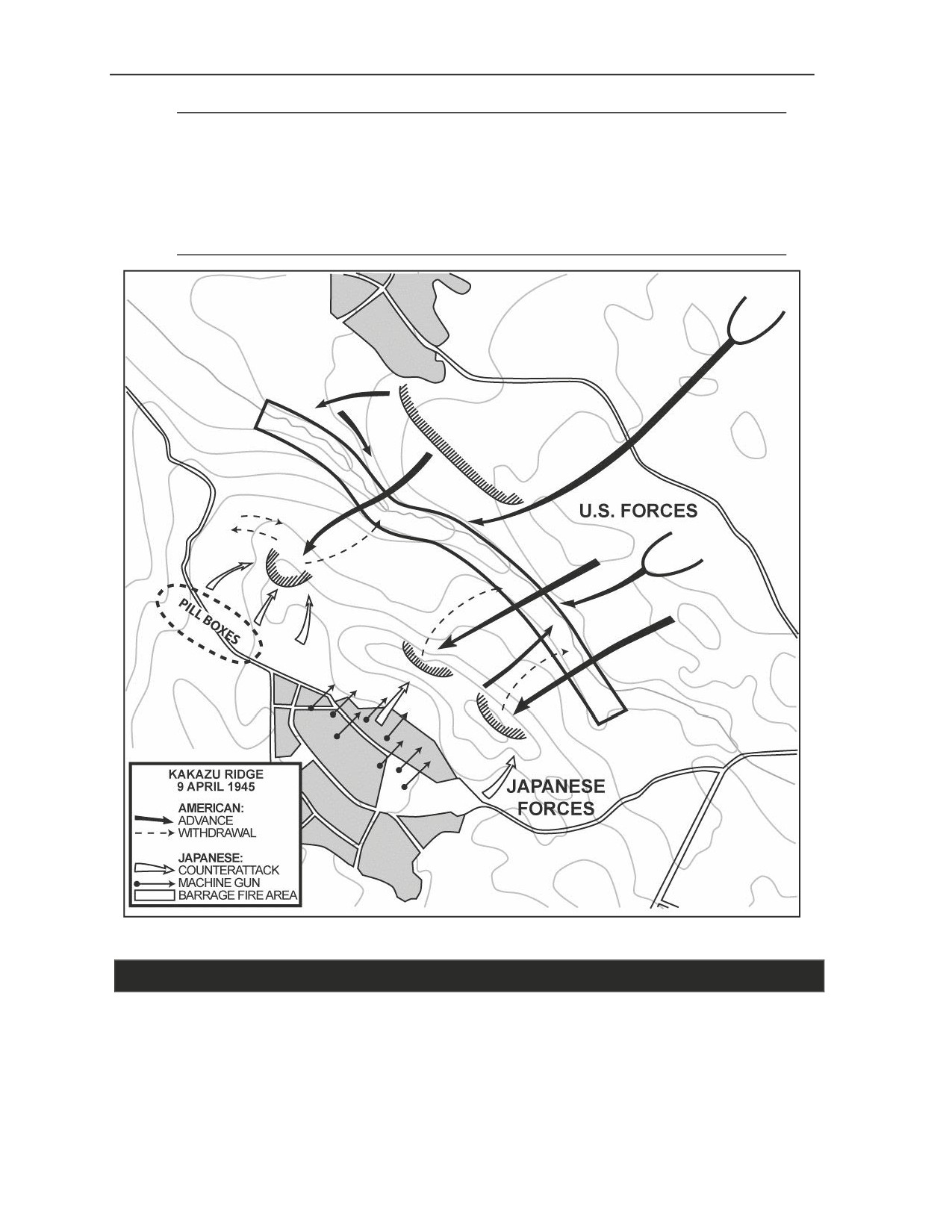
During the Okinawa campaign, Imperial Japanese forces conducted reverse-slope defenses along
a series of ridges (figure 7-5). This tactic was devastating and cost many American lives. The
Japanese, dug-in on the reverse slope, and able to maneuver through tunnels would immediately
counterattack American forces that reached the crest of the defended ridge. The Japanese held
their positions for many days against heavy American firepower and repeated American attacks.
Some of the positions, such as Kakazu Ridge, were taken, lost, and retaken repeatedly until finally
falling to American forces.
Figure 7-5. Historical example of a reverse-slope defense, Kakazu Ridge, 1945
SECTION IV - DEFENSIVE CONTROL MEASURES
7-90. A control measure is a means of regulating forces or warfighting functions (ADRP 6-0). Control
measures provide procedural control without requiring detailed explanations. Control measures can be
permissive (which allows something to happen) or restrictive (which limits how something is done). Some
control measures are graphic. A graphic control measure is a symbol used on maps and displays to regulate
forces and warfighting functions (ADRP 6-0). See ADRP 1-02 for illustrations of graphic control measures
and rules for their use.
7-20
FM 3-96
2FWREHU
Defense
7-91. Control measures provide the ability to respond to changes in the situation. They allow the defending
commander to concentrate combat power at the decisive point. Commanders use the minimum number to
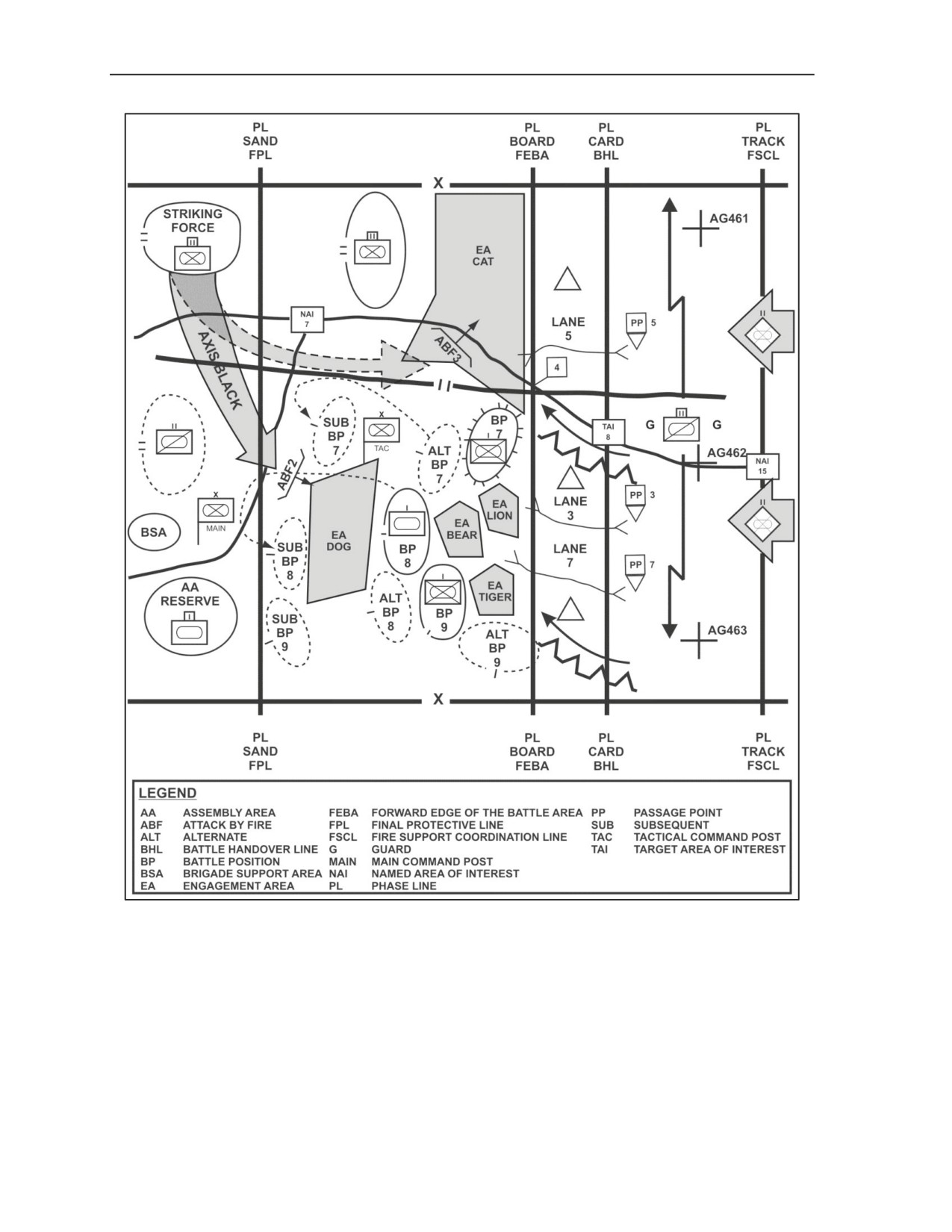
control their units and tailor their use to the higher commander’s intent. Figure 7-6, (page 22) illustrates a
BCT’s use of the following control measures:
z
Assembly area.
z
Attack by fire position.
z
Axis of advance.
z
Battle handover line.
z
Battle position (occupied and planed).
z
Boundaries.
z
Brigade support area.
z
Contact point.
z
Engagement area.
z
Fire support coordination line.
z
Forward edge of the battle area.
z
Lane.
z
Named area of interest.
z
Observation post.
z
Passage point.
z
Phase line.
z
Security (guard).
z
Strong point battle position.
z
Target area of interest.
z
Target reference point.
z
Turning obstacle.
2FWREHU
FM 3-96
7-21
Chapter 7
Figure 7-6. Common brigade combat team defensive control measures
7-92. Effectively employing control measures requires the BCT commander and staff to understand their
purposes and ramifications, including the permissions or limitations imposed on subordinates’ freedom of
action and initiative. Each measure should have a specific purpose. Control measures include designating the
security area, the main battle area with its associated battle positions, the forward edge of the battle area, and
the echelon support area.
7-93. Commanders use graphical control measures to assign responsibilities, coordinate fires and maneuver,
and control the use of airspace. Well-planned fire control measures permit the proper distribution of fires and
prevent multiple weapons from firing upon prominent targets while less prominent targets escape destruction.
7-22
FM 3-96
2FWREHU
Defense
The BCT uses both fire support and direct fire control measures. (Refer to ADRP 3-90 and ADRP 1-02 for
additional information.)
AREA OF OPERATIONS
7-94. An area of operations is an operational area defined by the joint force commander for land and
maritime forces that should be large enough to accomplish their missions and protect their forces (JP 3-0).
An area of operations is a basic tactical concept and the basic control measure for all types of operations. An
area of operations gives the responsible unit freedom of maneuver and enables fire support planning within
a specific area. All units assigned an area of operations have the following additional responsibilities within
the boundaries of that area of operations:
z
Terrain management.
z
Information collection.
z
Civil affairs operations.
z
Air and ground movement control.
z
Clearance of fires.
z
Security.
z
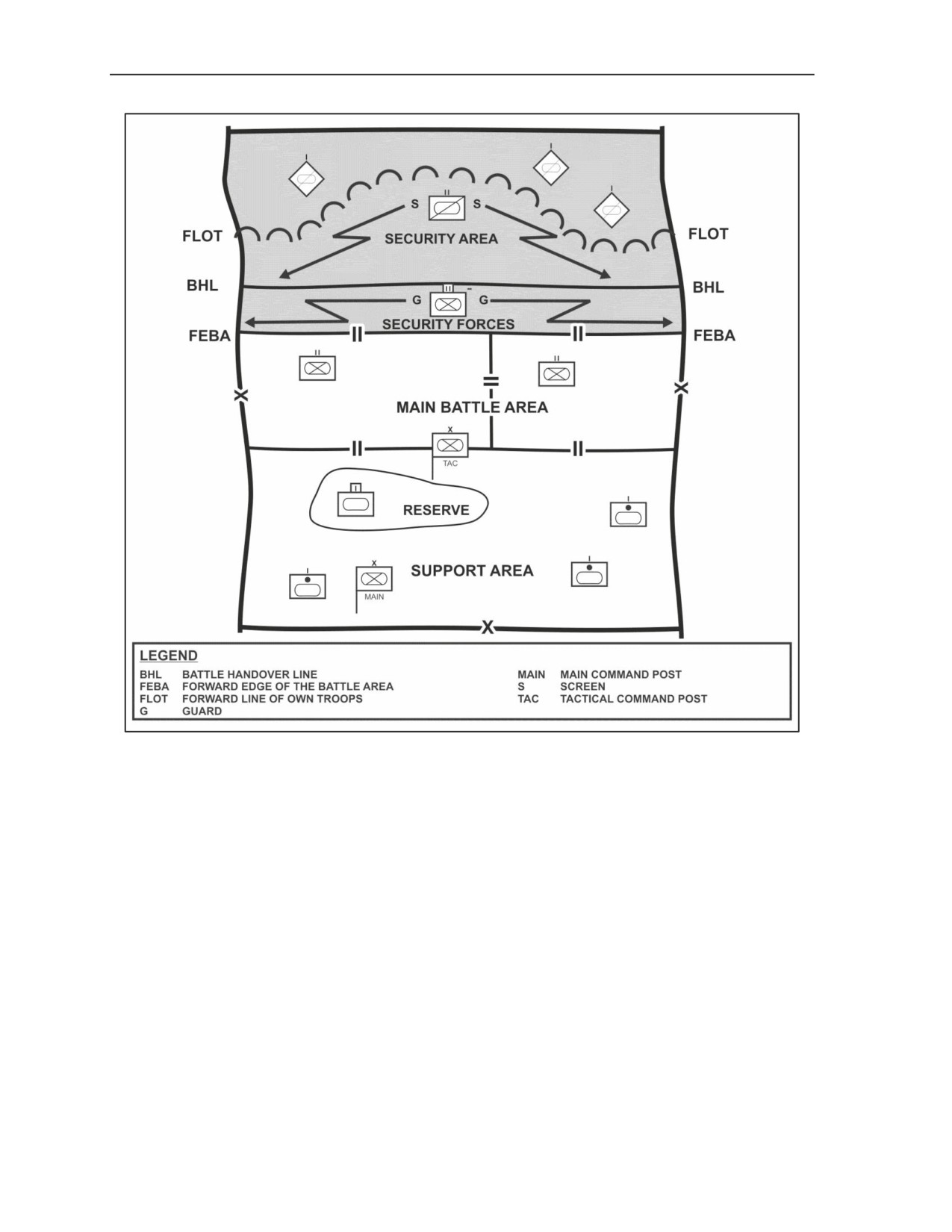
Personnel recovery.
z
Environmental considerations.
z
Minimum essential stability tasks.
7-95. A unit’s area of operations should provide adequate depth based on its assigned tasks, the terrain, and
the anticipated size of the attacking enemy force. To maintain security and a coherent defense, an area of
operations generally requires continuous coordination with flank units. The BCT assigns control measures,
such as phase lines, coordinating points, engagement areas, obstacle belts, and battle positions, to coordinate
subordinate unit defenses within the main battle area. The BCT commander and staff use briefings,
inspections, rehearsals, and supervision to ensure coordination among subordinate units, to eliminate any
gaps, and to ensure a clear understanding of the defensive plan.
7-96. Subordinate unit area of operations may be contiguous or noncontiguous. A contiguous area of
operations (See figure 7-9, page 7-26.) is where all a commander’s subordinate forces’ areas of operations
share one or more common boundaries (FM 3-90-1). A noncontiguous area of operations (See figure 7-7,
page 7-24.) is where one or more of the commander’s subordinate force’s areas of operation do not share a
common boundary (FM 3-90-1). The higher headquarters is responsible for controlling the areas not assigned
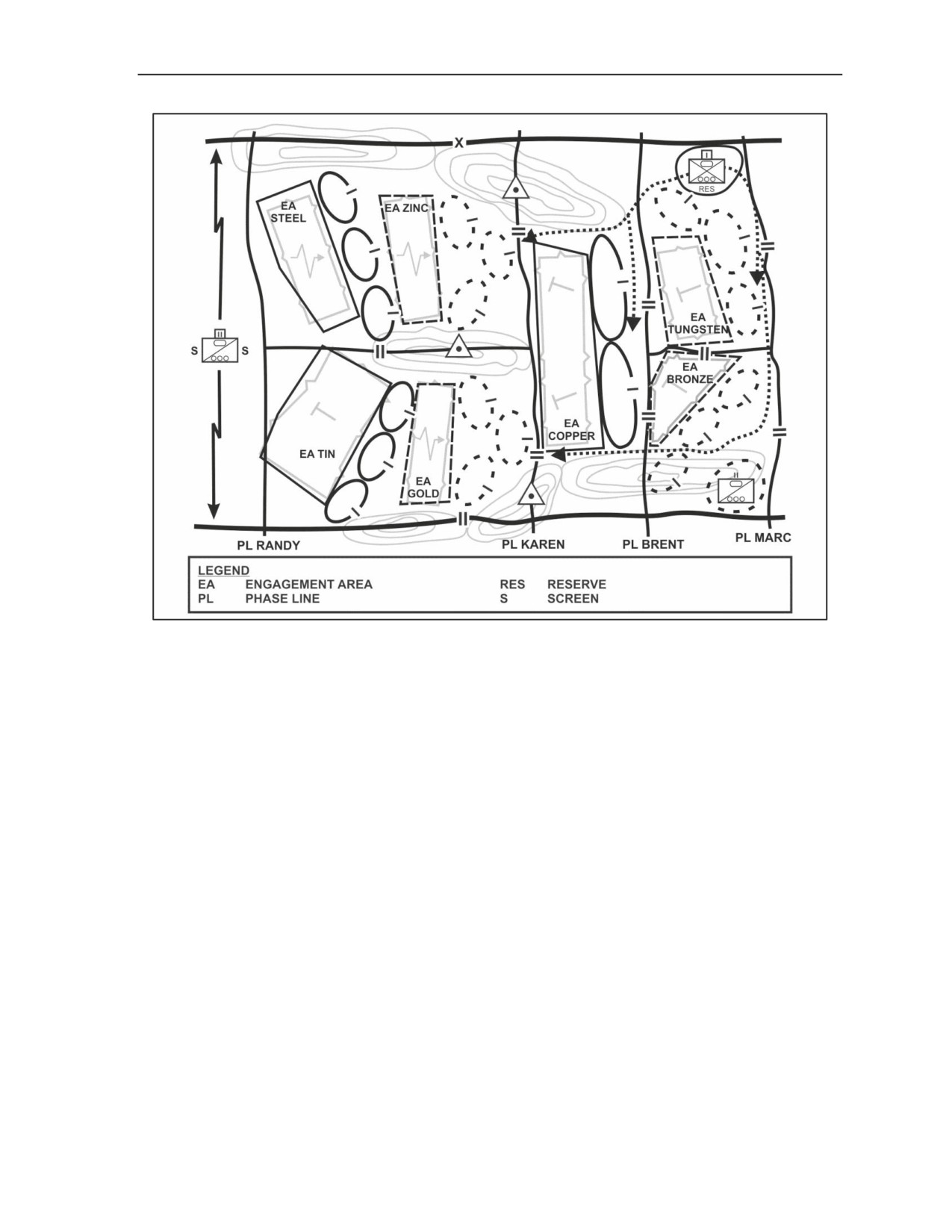
to subordinate forces within noncontiguous areas of operations.
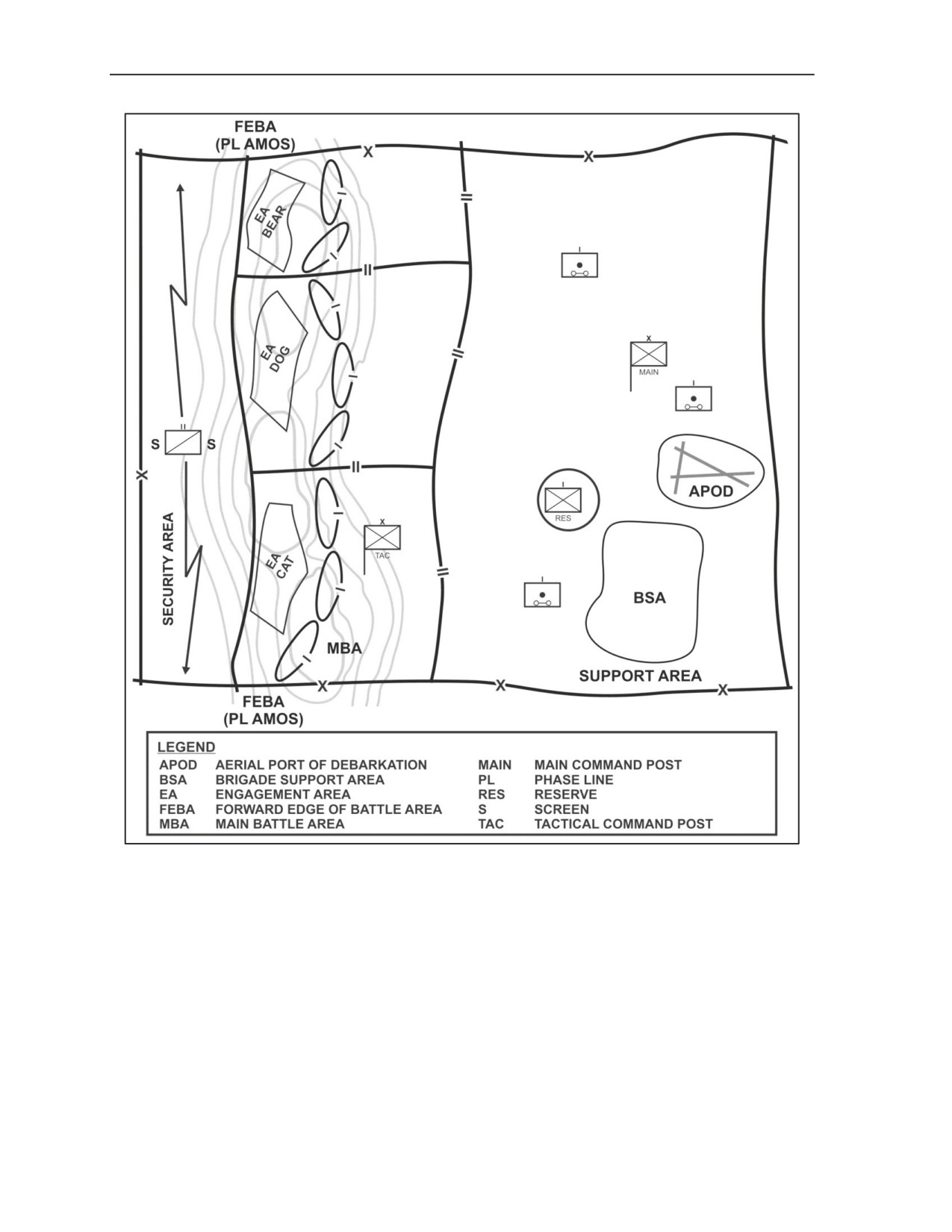
(Refer to FM 3-90-1 for additional
information.)
2FWREHU
FM 3-96
7-23
Chapter 7
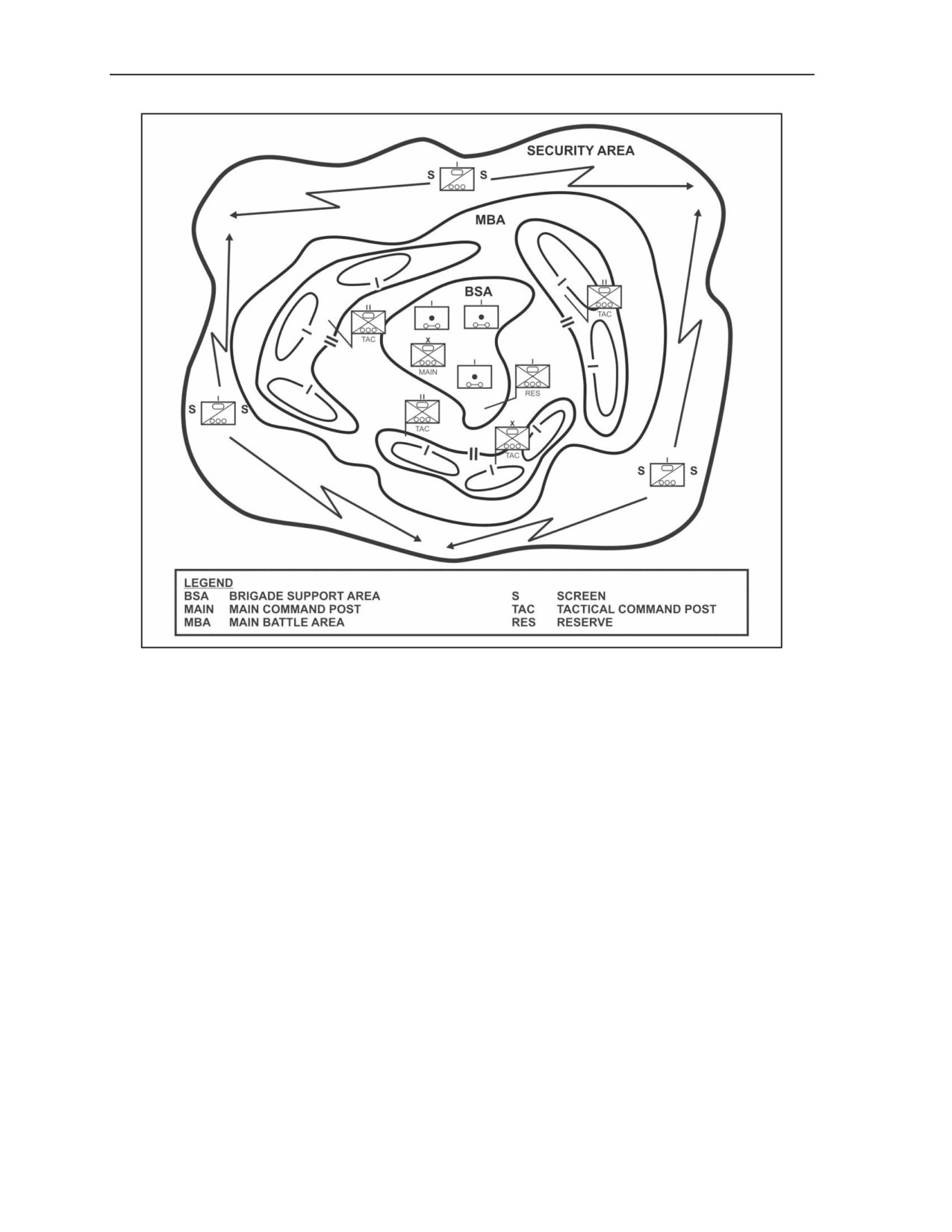
Figure 7-7. Area defense, noncontiguous area of operations
BATTLE POSITION
7-97. A battle position is a defensive location oriented on a likely enemy avenue of approach (ADRP 3-90).
The BCT commander assigns a battle position to a battalion when he wishes to control the battalion’s fires,
maneuver, and positioning. Usually, the commander assigns boundaries to provide space for the battalion
security, support, and sustainment elements that operate outside a battle position. When the commander does
not establish unit boundaries, the BCT is responsible for fires, security, terrain management, and maneuver
between positions of adjacent battalions. The battle position prescribes a primary direction of fire by the
orientation of the position. The commander defines when and under what conditions the battalion can
displace from the battle position or maneuver outside it. The use of prepared or planned battle positions, with
the associated tasks of prepare or reconnoiter, provides flexibility to rapidly concentrate forces and adds
depth to the defense.
7-98. There are five types of battle positions, primary, alternate, supplementary, subsequent, and strong
point. The commander always designates the primary battle position. The commander designates and
prepares alternate, supplementary, and subsequent positions as required.
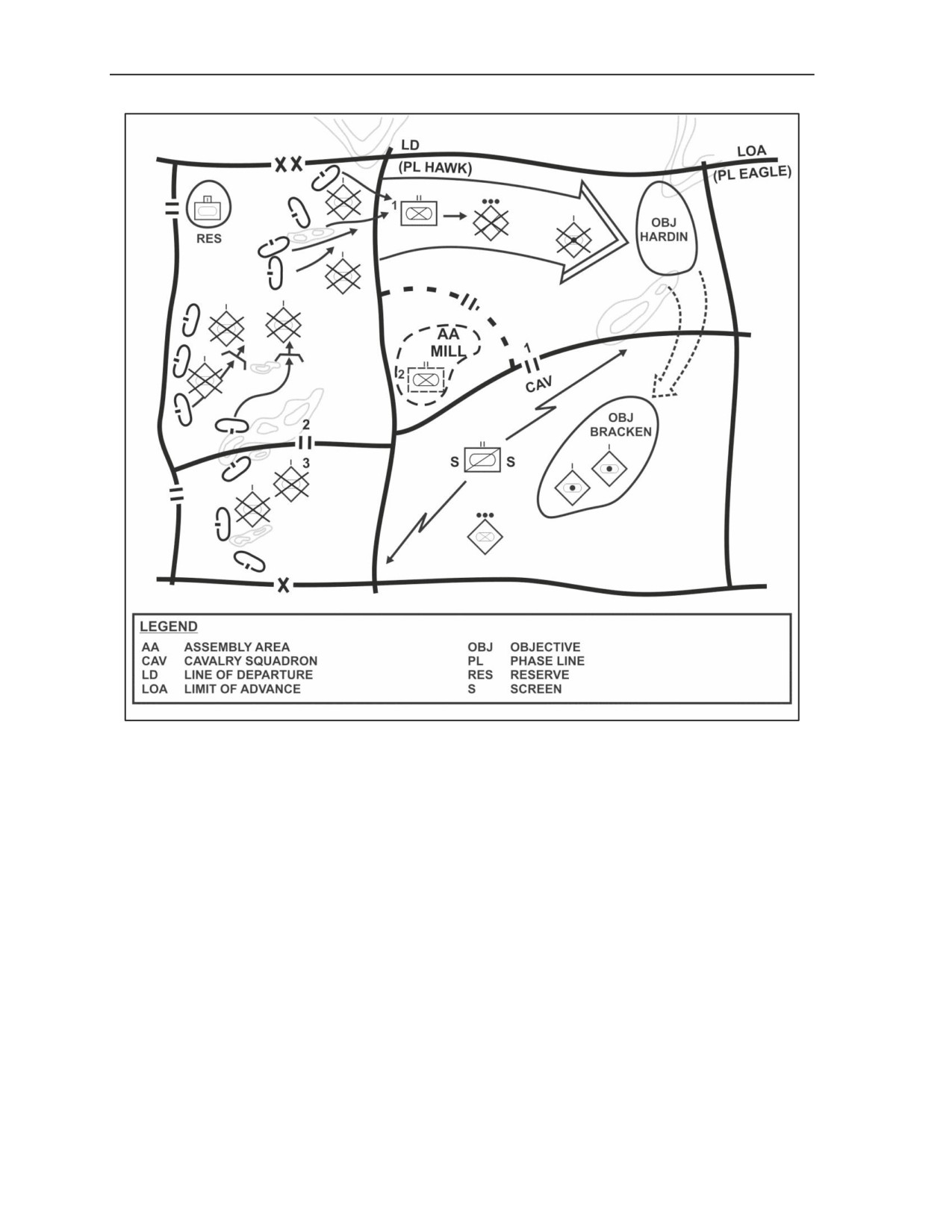
7-99. A primary position is the position that covers the enemy’s most likely avenue of approach into the area
of operations (ADRP 3-90). This position is always designated. An alternate position is a defensive position
that the commander assigns to a unit or weapon for occupation when the primary position becomes untenable
or unsuitable for carrying out the assigned task (ADRP 3-90). The alternate position covers the same area as
the primary position. A supplementary position is a defensive position located within a unit’s assigned area
of operations that provides the best sectors of fire and defensive terrain along an avenue of approach that is
not the primary avenue where the enemy is expected to attack (ADRP 3-90). Assigned when more than one
avenue of approach into a unit’s area of operations. A subsequent position is a position that a unit expects to
7-24
FM 3-96
2FWREHU
Defense
move to during the course of battle (ADRP 3-90). Subsequent positions can have primary, alternate, and
supplementary positions associated with them.
7-100. A strong point is a heavily fortified battle position tied to a natural or reinforcing obstacle to create
an anchor for the defense or to deny the enemy decisive or key terrain (ADRP 3-90). A strong point implies
retention of terrain to control key terrain and blocking, fixing, or canalizing enemy forces. Defending units
require permission from the higher headquarters to withdraw from a strong point. All combat, maneuver
enhancement, and sustainment assets within the strong point require fortified positions. In addition, extensive
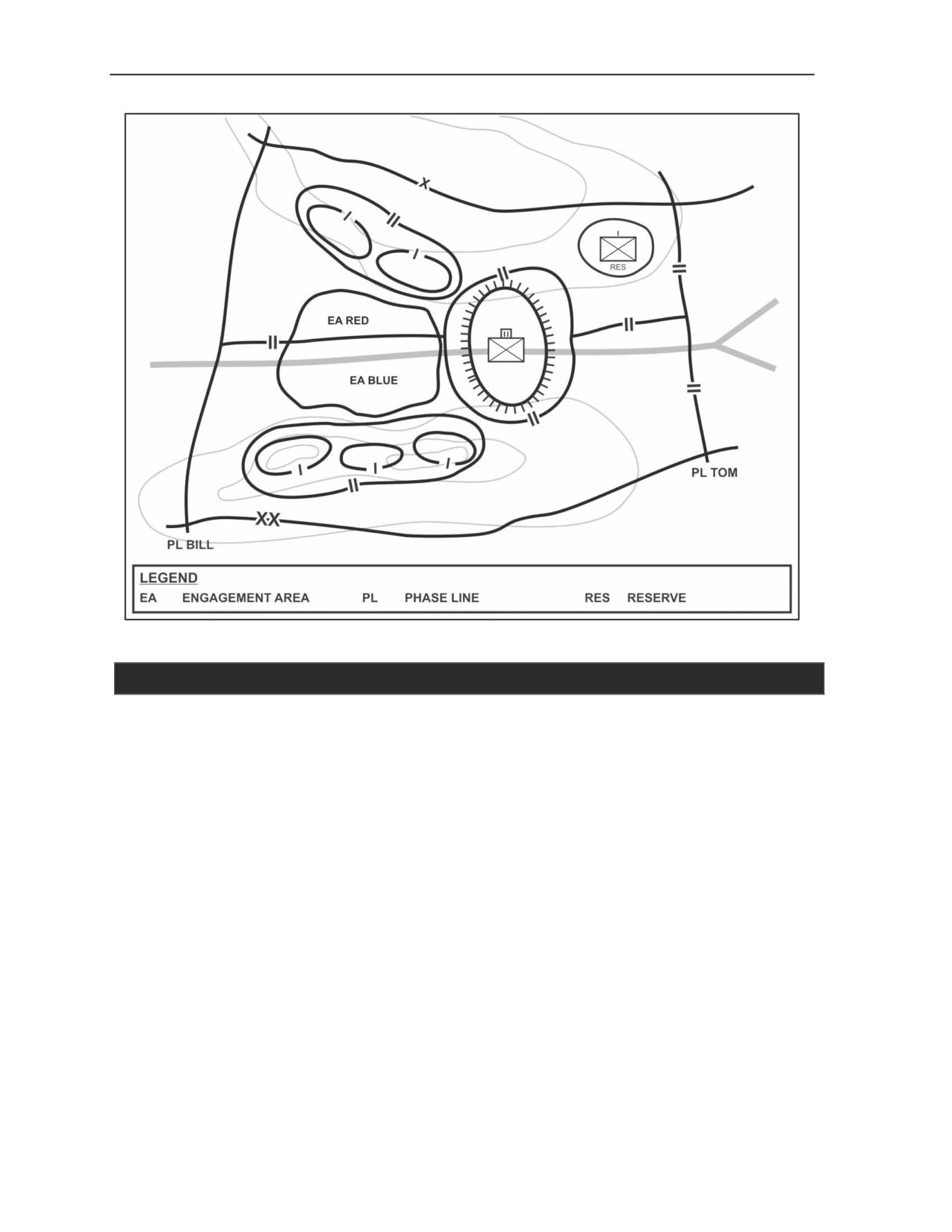
protective and tactical obstacles are required to provide an all-around defense. (See figure 7-8, page 7-26.)
7-101. As a rule of thumb, a minimally effective strong point requires a one-day effort from an engineer
unit the same size as the unit defending the strong point. Organic BCT engineers lack sufficient capacity to
create a strong point within a reasonable amount of time; additional engineer assets from echelons above the
BCT are required. Once the strong point is occupied, all units and equipment not essential to the defense are
displaced from the strong point. This includes nonessential staff and elements from the forward support
company. (Refer to FM 3-90-1 for additional information.)
7-102. Planning considerations for a strong point, although not inclusive, may include—
z
Establishment of outposts and observation posts.
z
Development of integrated fires plans that include final protective fires.
z
Priorities of work.
z
Counterattack plans.
z
Stockage of supplies.
z
Integration and support of subordinate forces outside the strong point.
z
Actions of adjacent units.
COMBAT OUTPOST
7-103. A combat outpost is a reinforced observation post capable of conducting limited combat operations
(FM 3-90-2). Using combat outposts is a technique for employing security forces in restrictive terrain that
precludes mounted security forces from covering the area. While the mission variables of METT-TC
determine the size, location, and number of combat outposts established by a unit, a reinforced platoon
typically occupies a combat outpost. Combat outposts normally are located far enough in front of the
protected force to prevent enemy ground reconnaissance elements from directly observing the protected
force. (Refer to FM 3-90-2 and FM 3-21.8 for additional information.)
2FWREHU
FM 3-96
7-25
Chapter 7
Figure 7-8. Strong point placement
SECTION V - DEFENSIVE TASKS
7-104. A defensive task is a task conducted to defeat an enemy attack, gain time, economize forces, and
develop conditions favorable for offensive or stability tasks (ADRP 3-0). The three defensive tasks are area
defense, mobile defense, and retrograde. Planning and preparing an effective defense takes time. The
commander uses his security elements to provide early warning, reaction time, and maneuver space. Units
establish a defense immediately upon occupation. Commanders refine the initial defense through planning
and preparation and may require units to shift and adjust their positions after the plan is final. Defensive
preparations and refinement are never complete.
AREA DEFENSE
7-105. An area defense is a defensive task that concentrates on denying enemy forces access to designated
terrain for a specific time rather than destroying the enemy outright (ADRP 3-90). The defender limits the
enemy’s freedom of maneuver and channels them into designated engagement areas. The focus of the area
defense is to retain terrain where the bulk of the defending force positions itself in mutually supporting,
prepared positions. Units maintain their positions and control the terrain between these positions. The
decisive operation focuses on fires into engagement areas possibly supplemented by a counterattack. The
commander can use his reserve to reinforce fires; add depth, block, or restore the position by counterattack;
seize the initiative; or destroy enemy forces. The BCT conducts an area defense under the following
conditions:
z
When directed to defend or retain specified terrain.
z
When forces available have less mobility than the enemy does.
z
When the terrain affords natural lines of resistance.
7-26
FM 3-96
2FWREHU
Defense
z
When the terrain limits the enemy to a few well-defined avenues of approach.
z
When there is time to organize the position.
z
When conditions require the preservation of forces.
ORGANIZATION OF FORCES
7-106. The BCT commander organizes an area defense around the static framework of the defensive
positions seeking to destroy enemy forces by interlocking fire or local counterattacks. The commander has
the option of defending forward or defending in-depth. The depth of the force positioning depends on the
threat, task organization of the BCT, and nature of the terrain. When the commander defends forward within
an area of operations, the force is organized so that most of the available combat power is committed early
in the defensive effort. To accomplish this, the commander may deploy forces forward or plan counterattacks
well forward in the main battle area or even beyond the main battle area. If the commander has the option of
conducting a defense in-depth, he uses security forces and forward main battle area elements to identify,
define, and control the depth of the enemy’s main effort while holding off secondary thrusts. Doing so allows
the commander to conserve combat power, strengthen the reserve, and better resource the counterattack. In
an area defense, the commander organizes the defending force to accomplish information collection, security,
main battle area, reserve, and sustainment missions. (See figure 7-9, page 7-28.)
Information Collection
7-107. The commander directs information collection assets to determine the locations, strengths, and
probable intentions of the attacking enemy force. He places a high priority on early identification of the
enemy’s main effort. The commander ensures that the mission of his reconnaissance forces and surveillance
assets are coordinated with those of higher headquarters. In the defense, reconnaissance and surveillance
operations overlap the unit’s planning and preparing phases.
7-108. BCT subordinate commanders and leaders performing reconnaissance and surveillance tasks
understand that these tasks often start before the commander fully develops the plan. Commanders and
leaders have to be responsive to changes in orientation and mission. The commander ensures that the staff
plans, prepares, and assesses the execution of the information collection portion of the overall plan. (Refer
to FM 3-90-1 for additional information.)
2FWREHU
FM 3-96
7-27
Chapter 7
Figure 7-9. Area defense, organization of forces (contiguous area of operations)
Security
7-109. The higher commander defines the depth of the BCT’s security area. The BCT’s security area
extends from the forward edge of the battle area to the BCT’s forward boundary. Depth in the security area
gives the forces within the main battle area more reaction time. Depth allows the security force more area to
conduct security missions. A very shallow security area may require more forces and assets to provide the
needed reaction time.
7-110. The BCT commander must clearly define the objective of the security area. He states the tasks of
the security force in terms of time required or expected to maintain security, expected results, disengagement
and withdrawal criteria, and follow-on tasks. He identifies specific avenues of approach and named areas of
interest on which the security force must focus. The BCT assists in the rearward passage of lines and
movement through the BCT area of operations of any division and corps security force deployed beyond the
BCT’s forward boundary. (Refer to FM 3-90-1 and FM 3-90-2 for additional information.)
7-111. The BCT commander balances the need for a strong security force to shape the battle with the
resulting diversion of combat power from the decisive operation in the main battle area. The BCT frequently
executes the forward security mission as a guard or screen. Typically, there are two options for organizing
the security force. The BCT forward defending maneuver battalions establish their own security areas or the
7-28
FM 3-96
2FWREHU
Defense
maneuver battalions provide security forces that operate with the cavalry squadron under the BCT’s direct
control.
7-112. The BCT conducts counterreconnaissance and operational area security, and implements local
security measures, operations security, and information protection (see ADRP 6-0) activities to deny the
enemy information about friendly dispositions. BCT reconnaissance and security forces seek to confuse the
enemy about the location of the BCT’s main battle positions, to prevent enemy observation of preparations
and positions, and to keep the enemy from delivering observed fire on the positions. The BCT conducts
reconnaissance and security operations to gain and maintain contact with the enemy, develop the situation,
answer commander’s critical information requirements, retain freedom of maneuver, consolidate gains,
secure the force, and protect the local population.
(Refer FM 3-90-1 and ADRP 3-37 for additional
information.)
Main Battle Area
7-113. The main battle area is the area where the commander intends to deploy the bulk of the unit’s combat
power and conduct decisive operations to defeat an attacking enemy (ADRP 3-90). The BCT’s main battle
area extends from the forward edge of the battle area to the unit’s rear boundary. The commander selects his
main battle area based on the higher commander’s concept of operations, intelligence preparation of the
battlefield, results of initial reconnaissance and surveillance efforts, and his own assessment of the situation.
7-114. The BCT commander delegates responsibilities within the main battle area by assigning areas of
operations and establishing boundaries to and for subordinate battalions. The commander locates subordinate
unit boundaries along identifiable terrain features and extends them beyond the forward line of own troops
by establishing forward boundaries. Unit boundaries should not split avenues of approach or key terrain. The
BCT is responsible for terrain management, security, clearance of fires, and coordination of maneuver among
other doctrinal responsibilities within the entire area of operations if the commander does not assign area of
operations to subordinate battalions. (Refer ADRP 3-90 for additional information.)
Reserve
7-115. The reserve is not a committed force. The BCT commander can assign it a wide variety of tasks on
its commitment, and it must be prepared to perform other missions. The reserve may be committed to restore
the defense’s integrity by blocking an enemy penetration, reinforcing fires into an engagement area, or
conducting a counterattack against the flank or rear of an attacking enemy. The reserve gives the commander
the flexibility he needs to exploit success or to deal with a tactical setback.
7-116. The commander positions the reserve to respond quickly to unanticipated missions. The commander
determines the reserve’s size and position based on accurate knowledge about the enemy and whether the
terrain can accommodate multiple enemy courses of action. When the BCT has accurate knowledge about
the enemy and the enemy's maneuver options are limited, the BCT can maintain a smaller reserve. If
knowledge about the enemy is limited and the terrain allows the enemy multiple courses of action, then the
BCT needs a larger reserve positioned deeper into the area of operations. (Refer to FM 3-90-1 for additional
information.)
Sustainment
7-117. The sustainment mission in an area defense requires a balance among establishing forward supply
stocks of ammunition, barrier material, and other supplies in sufficient amounts, and having the ability to
move the supplies in conjunction with enemy advances. Proper forecasting of supply and support
requirements is important to the success of the area defense. The location of sustainment units within the
support area is METT-TC dependent. (See chapter 9.)
PLANNING AN AREA DEFENSE
7-118. An area defense requires detailed planning and extensive coordination. In the defense, synchronizing
and integrating the BCTs combat and supporting capabilities enables a commander to apply overwhelming
combat power against selected advancing enemy forces. A successful defense depends on knowing and
understanding the enemy and its capabilities. The commander’s situational understanding is critical in
2FWREHU
FM 3-96
7-29
Chapter 7
establishing the conditions that initiate the defensive action. As the situation develops, the commander
reassesses the plan based on a revised situational understanding that results from an updated common
operational picture as new intelligence and combat information becomes available. In planning an area
defense, the commander may choose between two forms of defensive maneuver—a defense in-depth or a
forward defense.
Understanding
7-119. The BCT commander considers the mission variables of METT-TC to determine how to concentrate
his efforts and economize his forces. A detailed terrain analysis may be the most important process the BCT
commander and staff complete. A successful defense relies on a complete understanding of terrain to
determine likely enemy courses of action and the best positioning of BCT assets to counter them.
7-120. The commander must understand the situation in-depth, develop the situation through action, and
constantly reassess the situation to keep pace with the engagement. Defending forces must gain and maintain
contact with the enemy to observe, assess, and interpret enemy reactions and the ensuing opportunities or
threats to friendly forces, populations, or the mission. The commander must establish priority intelligence
requirements to enable information collection through reconnaissance, surveillance, intelligence operations,
and security operations to develop situational understanding.
7-121. Enemy forces counter friendly reconnaissance and surveillance efforts to prevent the BCT from
gaining information. Enemy forces use other countermeasures such as dispersion, concealment, deception,
and intermingling with the population to limit the BCT’s ability to develop the situation out of contact.
Reconnaissance and security forces fill in the gaps in commanders’ understanding of the situation. Fighting
for understanding and identifying opportunities to seize, retain, and exploit the initiative requires combined
arms capabilities, access to joint capabilities, specialized training, and employing combinations of manned
and unmanned air and ground systems.
Forms of Defensive Maneuver
7-122. The BCT commander may choose between two defensive maneuver forms when planning an area
defense: a defense in-depth or a forward defense. The commander usually selects the form of defensive
maneuver, but the higher headquarters’ commander may define the general defensive scheme for the BCT.
These two deployment choices are not totally exclusionary. Part of a defending commander’s unit can
conduct a forward defense, while the other part conducts a defense in-depth. The specific mission may also
impose constraints such as time, security, and retention of certain areas, which are significant factors in
determining how the BCT defends.
Defense in-depth
7-123. A defense in-depth (figure 7-10) reduces the risk of a quick penetration by the attacking enemy force.
Even if initially successful, the enemy has to continue to attack through the depth of the defense to achieve a
penetration. The defense in-depth provides more space and time to defeat the enemy attack. Dependent on
the mission variables of METT-TC, it may require forces with at least the same mobility as the enemy to
maneuver to alternate, supplementary, and subsequent positions. The mobility of the enemy force can
determine the disengagement criteria of the defending forces as they seek to maintain depth. The BCT
commander considers using a defense in-depth when—
z
The mission allows the BCT to fight throughout the depth of the area of operations.
z
The terrain does not favor a forward defense and there is better defensible terrain deeper in the
area of operations.
z
Sufficient depth is available in the area of operations.
z
Cover and concealment forward in the area of operations is limited.
z
Chemical, biological, radiological, and nuclear weapons may be used.
z
The terrain is restrictive and limits the enemy’s maneuver and size of attack.
7-30
FM 3-96
2FWREHU
Defense
Figure 7-10. Defense in-depth
Forward Defense
7-124. The intent of a forward defense (figure 7-11) is to prevent enemy penetration of the defense. A
forward defense is the least preferred form of the area defense due to its lack of depth. The BCT commander
deploys the majority of his combat power into defensive positions near the forward edge of the battle area.
The commander fights to retain the forward position and may conduct spoiling attacks or counterattacks
against enemy penetrations, or he may destroy enemy forces in forward engagement areas. Often,
counterattacks are planned forward of the forward edge of the battle area to defeat the enemy. Commanders
may use reconnaissance and security forces to find the enemy in vulnerable situations and exploit the
opportunity to conduct a spoiling attack to weaken his main attacking force and disrupt his operations.
7-125. The BCT commander uses a forward defense when a higher commander directs the commander to
retain forward terrain for political, military, economic, and other reasons. Alternatively, a commander may
choose to conduct a forward defense when the terrain in that part of the area of operations—including natural
obstacles—favors the defending force because—
z
Terrain forward in the area of operations favors the defense.
z
Strong, existing natural or man-made obstacles, such as a river or a canal, are located forward in
the area of operations.
z
Assigned area of operations lacks depth due to the location of the protected area.
z
Natural engagement areas occur near the forward edge of the battle area.
z
Cover and concealment in the rear portion of the area of operations is limited.
z
Directed by higher headquarters to retain or initially control forward terrain.
2FWREHU
FM 3-96
7-31
Chapter 7
Figure 7-11. Forward defense
PREPARING AN AREA DEFENSE
7-126. The BCT uses time available to build the defense and to refine counterattack plans. The commander
and staff assess unit preparations while maintaining situational awareness of developments in the BCT’s
areas of interest. Collection activities begin soon after receipt of the mission and continue throughout
preparation and execution. Security operations are conducted aggressively while units occupy and prepare
assigned positions and rehearse defensive actions. During preparation, reconnaissance, surveillance, and
intelligence operations help improve understanding of the enemy, terrain, and civil considerations.
7-127. Revising and refining the plan is a key activity of preparation. The commander’s situational
understanding may change over the course of operations, enemy actions may require revision of the plan, or
unforeseen opportunities may arise. During preparation, assumptions made during planning may be proven
7-32
FM 3-96
2FWREHU
Defense
true or false. Intelligence analysis may confirm or deny enemy actions or show changed conditions in the
area of operations because of shaping operations.
Establish Security
7-128. The first priority in the defense is to establish security. During the defense, effective security requires
the establishment of the security area (forward of the main battle area), the employment of patrols and
observation posts, the use of manned and unmanned aircraft systems and sensors, and the use of the terrain
(cover and concealment). Security operations, counterreconnaissance, survivability operations, military
deception, information-related capabilities, and cyber electromagnetic activities counter enemy intelligence,
surveillance, and reconnaissance from determining friendly locations, strengths, and weaknesses.
7-129. Potential threats to the defense may include noncombatant access to communications, digital
cameras, and similar devices. Security measures, such as shutting down telephone exchanges and cell
telephone towers, and preventing unauthorized personnel from moving in the BCT’s area of operations may
be required. The BCT should request guidance from higher headquarters before implementing any security
measures that could affect the civilian population.
7-130. As part of the defense, higher headquarters may have created a military deception operation and
associated information operations to protect the force, cause early committal of the enemy, or mislead the
enemy as to the defenders true intentions, composition, and disposition of friendly forces. The BCT aids in
the preparation and execution of the military deception plan to—
z
Exploit enemy pre-battle force allocation and sustainment decisions.
z
Exploit the potential for favorable outcomes of protracted minor engagements and battles.
z
Lure the enemy into friendly territory exposing his flanks and rear to attacks.
z
Mask the level of the sustaining and operational forces committed to the defense.
7-131. A defense containing branches and sequels gives the commander preplanned opportunities to exploit
the situation and around these branches and sequels that deception potentials exist. Specific deceptive actions
the BCT commander can take to hasten exhaustion of the enemy offensive include, but are not limited to—
z
Masking the conditions under which the enemy will accept decisive engagement.
z
Luring the enemy into a decisive engagement that facilitates the transition sequence.
z
Employing camouflage, decoys, false radio traffic, movement of forces, and the digging of false
positions and obstacles.
Occupation of Positions
7-132. The BCT commander and staff monitor and deconflict any positioning problems with BCT or higher
headquarters’ reconnaissance and security efforts as units move into their assigned areas of operation and
occupy positions. The BCT may have to make minor adjustments to areas of operation, engagement areas,
battle positions, and other defensive control measures based on unanticipated conditions the occupying units
encountered as they begin preparing the defense.
7-133. The assistant brigade engineer monitors units assigned to close gaps or to execute directed obstacles
such as demolition of bridges or dams to assure the units are ready to execute their mission. The assistant
brigade engineer also ensures the units site and complete all obstacle emplacements within the BCT according
to the obstacle plan.
Rehearsals
7-134. The BCT conducts defensive rehearsals as time permits. The commander uses any, or combinations
of, the four types of rehearsals: backbrief, combined arms rehearsal, support rehearsal, and battle drill or SOP
rehearsal. Each rehearsal type achieves a different result and has a specific place in the preparation timeline.
The commander’s imagination and available resources are the only limits restricting methods of conducting
rehearsals. The BCT commander ensures the integration of attached enabling forces into the defensive
scheme of maneuver through rehearsals. (Refer to Chapter 3, Section II of this manual and FM 6-0 for
additional information.)
2FWREHU
FM 3-96
7-33
Chapter 7
EXECUTING AN AREA DEFENSE
7-135. In an area defense, the BCT concentrates combat power effects against attempted enemy
breakthroughs and flanking movements from prepared and protected positions. The commander uses his
reserve to cover gaps between defensive positions, to reinforce those positions as necessary, and to
counterattack to seal penetrations or block enemy attempts at flanking movements. (Refer to FM 3-90-1 for
additional information.) For discussion purposes, the following paragraphs divide execution of an area
defense into a five step sequence:
Step 1, Gain and Maintain Enemy Contact
7-136. Gaining and maintaining contact with the enemy is vital to the success of the defense. As the enemy’s
attack begins, the BCT’s initial goals are to identify committed enemy units’ positions and capabilities,
determine the enemy’s intent and direction of attack, and gain time to react. Initially, the commander
accomplishes these goals in the security area. The sources of this type of information include reconnaissance
and security forces, surveillance assets, and supporting echelons above the BCT. The commander ensures
the distribution of a common operational picture throughout the BCT during the battle to form a shared basis
for subordinate commanders’ actions. The commander uses available information, in conjunction with his
judgment, to determine the point at which the enemy is committed to a course of action.
Step 2, Disrupt the Enemy
7-137. The commander executes shaping operations to disrupt the enemy. After making contact with the
enemy, the commander seeks to disrupt the enemy’s plan and his ability to control his forces. Ideally, the
commander’s shaping operations result in a disorganized enemy force conducting a movement to contact
against a prepared defense. Once the process of disrupting the enemy begins, it continues throughout the
defense. The BCT uses indirect fires, close air support, close combat attack, and other available fires and
nonlethal effects during this phase of the battle to—
z
Support the security force.
z
Disrupt or limit the momentum of the enemy’s attack.
z
Destroy high-payoff targets.
z
Divert the enemy’s attack.
z
Reduce the enemy’s combat power.
z
Separate enemy formations.
Step 3, Fix the Enemy
7-138. The commander has several options to help him fix an attacking force. The commander can design
his shaping operations, such as securing the flanks and point of penetration, to fix the enemy and allow
friendly forces to execute decisive maneuver elsewhere. Combat outposts and strong points can also deny
enemy movement to or through a given location. A properly executed deception operation can constrain the
enemy to a given course of action.
Step 4, Maneuver
7-139. The decisive operation occurs in the main battle area. This is where the effects of shaping operations,
coupled with sustaining operations, combine with the decisive operation of the main battle area force defeat
the enemy. The commander’s goal is to prevent the enemy’s further advance using a combination of fires
from prepared positions, obstacles and reserve forces. To accomplish this, the commander masses effects by
maneuvering his forces to focus direct and indirect fires at a critical point to counter the enemy’s attack.
7-140. In an area defense, the need for flexibility through movement and maneuver requires the use of
graphic control measures to assist mission command during the repositioning forces and counterattacks.
Specified routes, phase lines, attack- and support-by-fire positions, battle positions, engagement areas, target
reference points, and other fire control measures are required to synchronize movement and maneuver.
7-34
FM 3-96
2FWREHU
Defense
7-141. During the defense, the BCT commander must prepare to quickly take advantage of fleeting
opportunities, seize the initiative, and assume the offense. Although the BCT commander plans for the
counterattack, the plan may not correspond exactly with the existing situation when the commander launches
the counterattack. As the situation develops, the commander reassesses the plan based on a revised situational
understanding that results from an updated common operational picture.
7-142. Ideally, the commander has a counterattack plan appropriate to the existing situation. When this is
not the case, the commander must rapidly reorganize and refit selected units, move them to attack positions,
and attack or the commander must conduct an attack using those units already in contact with the enemy,
which is normally the least favorable course of action.
Step 5, Follow Through
7-143. Three conditions may result from the initial enemy attack: friendly forces achieve their objectives,
friendly forces do not achieve their objectives, or both forces are in a stalemate with neither side gaining a
decisive advantage over the other. A successful area defense allows the commander to transition to an attack.
An area defense resulting in the defender being overcome by the enemy attack and needing to transition to a
retrograde operation must take into account the current situation in adjacent defensive areas. Only the
commander who ordered the defense can designate a new forward edge of the battle area or authorize a
retrograde operation.
7-144. As the purpose of a defensive action is to retain terrain and create conditions for a counteroffensive
that regains the initiative. A successful area defense causes the enemy to sustain unacceptable losses short of
any decisive objectives. During follow-through, time is critical. Unless the commander has a large,
uncommitted reserve prepared to quickly exploit or reverse the situation, the commander must reset his
defense as well as maintain contact with the enemy. Time is also critical to the enemy, because he can use it
to reorganize, establish a security area, and fortify his positions.
7-145. The BCT commander plans and conducts a counterattack to attack the enemy when and where the
enemy is most vulnerable. There is a difference between local counterattacks designed to restore the defense
and a decisive operation designed to wrest the initiative from the enemy force and then defeat it. To conduct
a decisive counterattack, the defending force must bring the enemy attack to or past its culminating point
before it results in an unacceptable level of degradation to the defending force. To do this, the defending
force must disrupt the enemy’s ability to mass, causing the enemy to disperse its combat power into small
groups or attrit enemy forces to gain a favorable combat power ratio. The defending force must continue to
disrupt the enemy’s ability to introduce follow-on forces and attack the defender’s sustainment system. (See
figure 7-12, page 7-36.) As the objective of the counterattack is reached, the BCT consolidates and continues
reorganization that is more extensive and begins preparation to resume the offense.
2FWREHU
FM 3-96
7-35
Chapter 7
Figure 7-12. Counterattack
7-146. In a successful defense, the enemy’s attack is defeated and the defensive plan must address missions
following successful operations. The division’s follow-on missions for the BCT govern this plan. The staff
must begin planning for future offensive operations as they develop defensive plans. The commander and
staff must develop maneuver plans, control measures, obstacle restrictions, and sustainment plans that enable
the BCT to quickly transition to follow-on offensive missions or to pass follow-on forces.
MOBILE DEFENSE
7-147. The mobile defense is a defensive task that concentrates on the destruction or defeat of the enemy
through a decisive attack by a striking force (ADRP 3-90). The mobile defense focuses on defeating or
destroying the enemy by allowing enemy forces to advance to a position that exposes them to a decisive
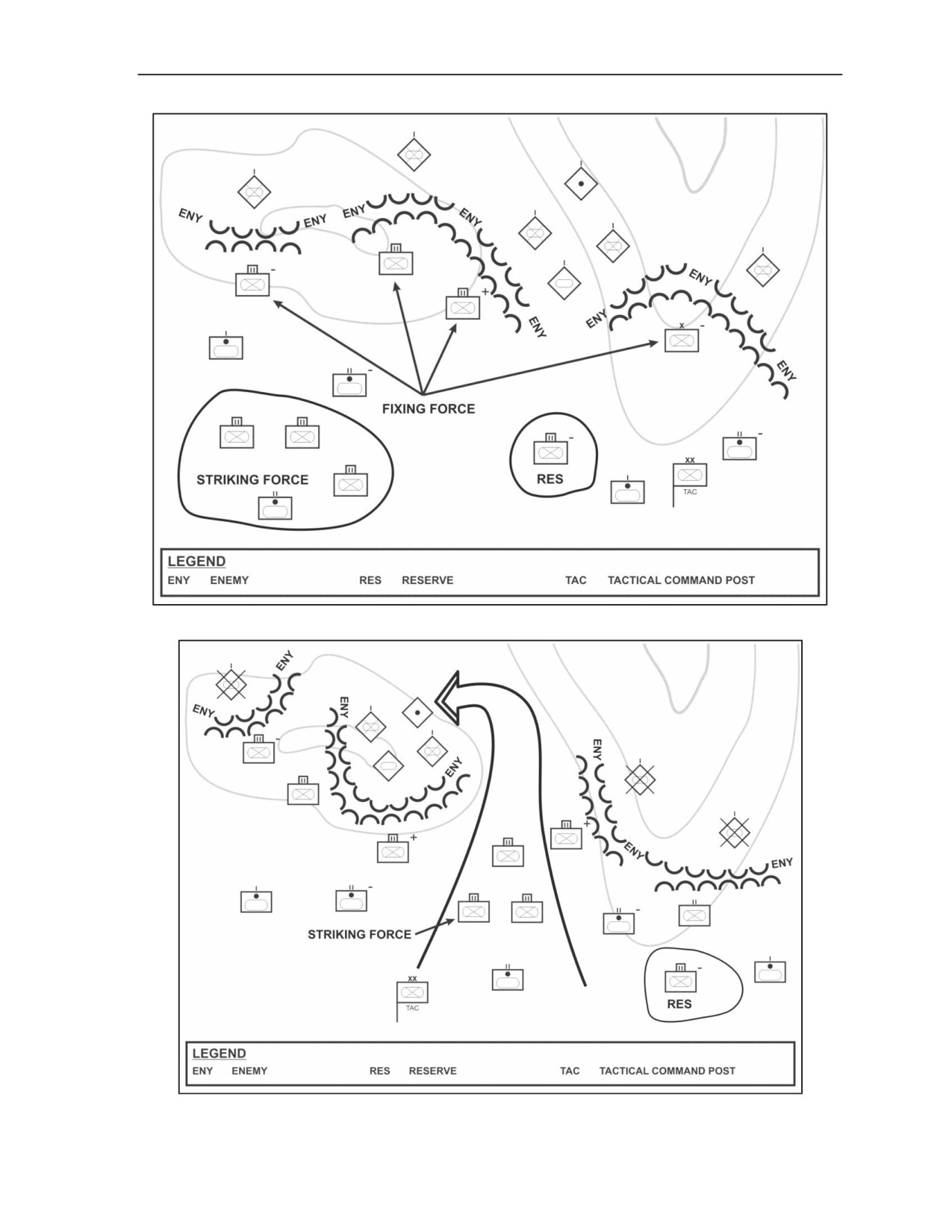
counterattack by the striking force. The commander uses the fixing force to hold attacking enemy forces in
position, to help channel attacking enemy forces into engagement areas, and to retain areas from which to
launch the striking force. (See figure 7-13.) A mobile defense requires an area of operations of considerable
depth. The commander must be able to shape the battlefield, causing an enemy force to overextend its lines
of communication, expose its flanks, and risk its combat power. Likewise, the commander must be able to
move friendly forces around and behind the enemy force, cut them off, and destroy them. (See figure 7-14.)
Divisions and larger formations normally execute mobile defenses. However, BCTs and maneuver battalions
may participate in a mobile defense as part of the fixing force or the striking force. (Refer to FM 3-90-1 for
additional information.)
7-36
FM 3-96
2FWREHU
Defense
Figure 7-13. Mobile defense, fixing force
Figure 7-14. Mobile defense, committed striking force
2FWREHU
FM 3-96
7-37
Chapter 7
RETROGRADE
7-148. A retrograde is a defensive task that involves organized movement away from the enemy
(ADRP 3-90). The enemy may force the retrograde or a commander may execute it voluntarily. There are
three forms of retrograde operations: delay, withdrawal, and retirement. (Refer to FM 3-90-1 for additional
information.)
DELAY
7-149. A delaying operation is an operation in which a force under pressure trades space for time by slowing
down the enemy’s momentum and inflicting maximum damage on the enemy without, in principle, becoming
decisively engaged (JP 3-04). Delays allow units to yield ground to gain time while retaining flexibility and
freedom of action to inflict the maximum damage on the enemy. The methods are delaying from successive
positions and alternate positions. BCTs conduct the delay by using one or a combination. The method
selected depends on the width of the front, the terrain, the forces available, the enemy, and the amount of
time required of the delay. In either method, a mobility advantage over the enemy is required.
Delay from Successive Positions
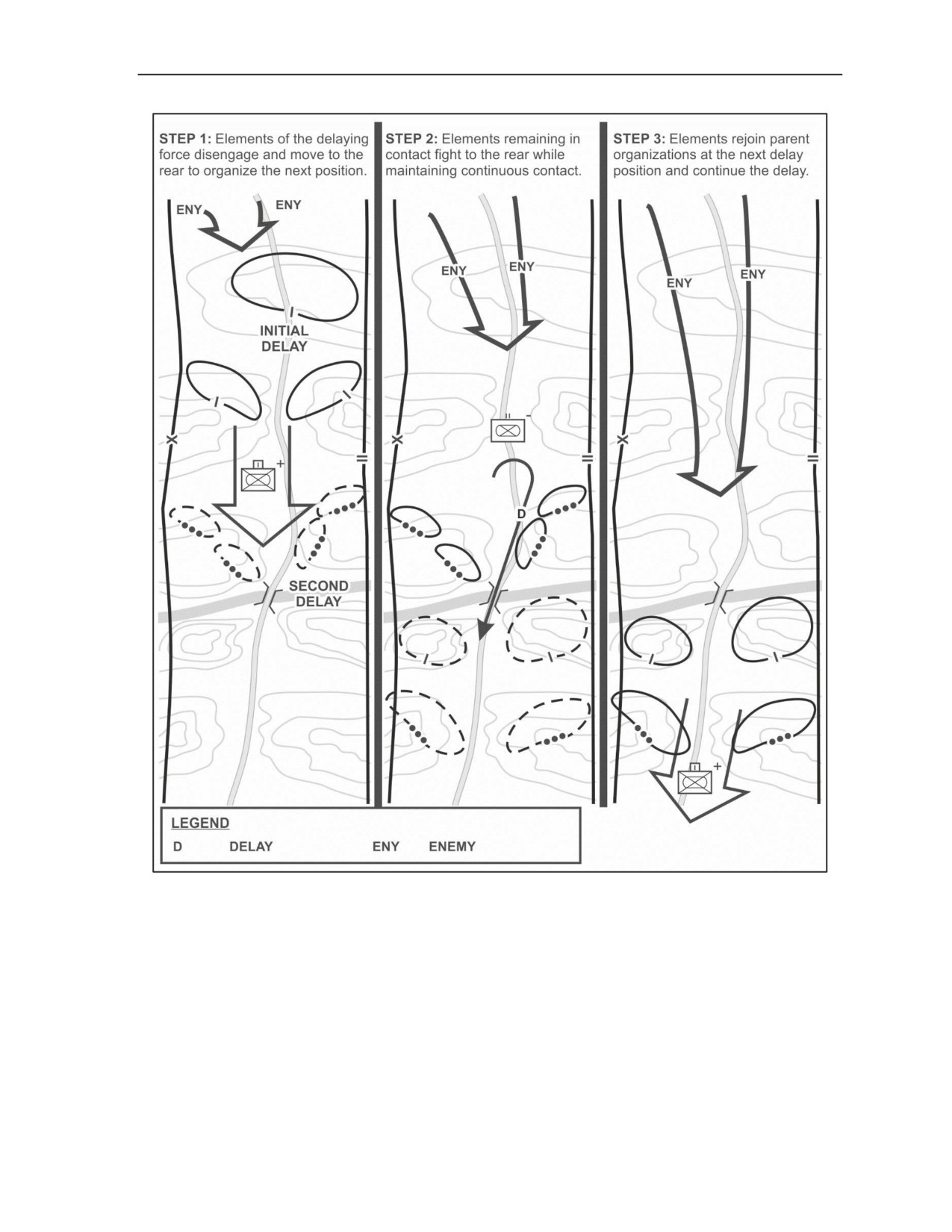
7-150. A delay from successive positions involves fighting rearward from one position to the next, holding
each as long as possible or for a specified time (figure 7-15). In this type of delay, all maneuver battalions
are committed on each of the BCT delay positions or across the area of operations on the same phase line.
The BCT commander uses a delay from successive positions when an area of operations is so wide that
available forces cannot occupy more than a single line of positions. The disadvantages of this delay are lack
of depth, less time to prepare successive positions, and the possibility of gaps between units.
7-151. When ordered to move, the BCT disengages, then moves and occupies the next designated position.
A part of the unit displaces directly to the rear when the order to begin the delay is received and occupies the
next designated position. The rest of the unit maintains contact with the enemy between the first and second
delay positions. As these elements pass through the second position, the forces on that position engage the
enemy at the greatest effective range. When the BCT can no longer hold the position without becoming
decisively engaged, it moves to the next successive position. When conducting a delay from successive
positions, the BCT may retain a reserve if the division has none. The reserve will frequently be small and
employed as a counterattacking force. It protects a threatened flank, secures vital rear areas, or provides
overwatch fires to a withdrawing unit.
7-38
FM 3-96
2FWREHU
Defense
Figure 7-15. Delay from successive positions
Delay from Alternate Positions
7-152. Delay from alternate positions can be used when a force has a narrow area of operations or has been
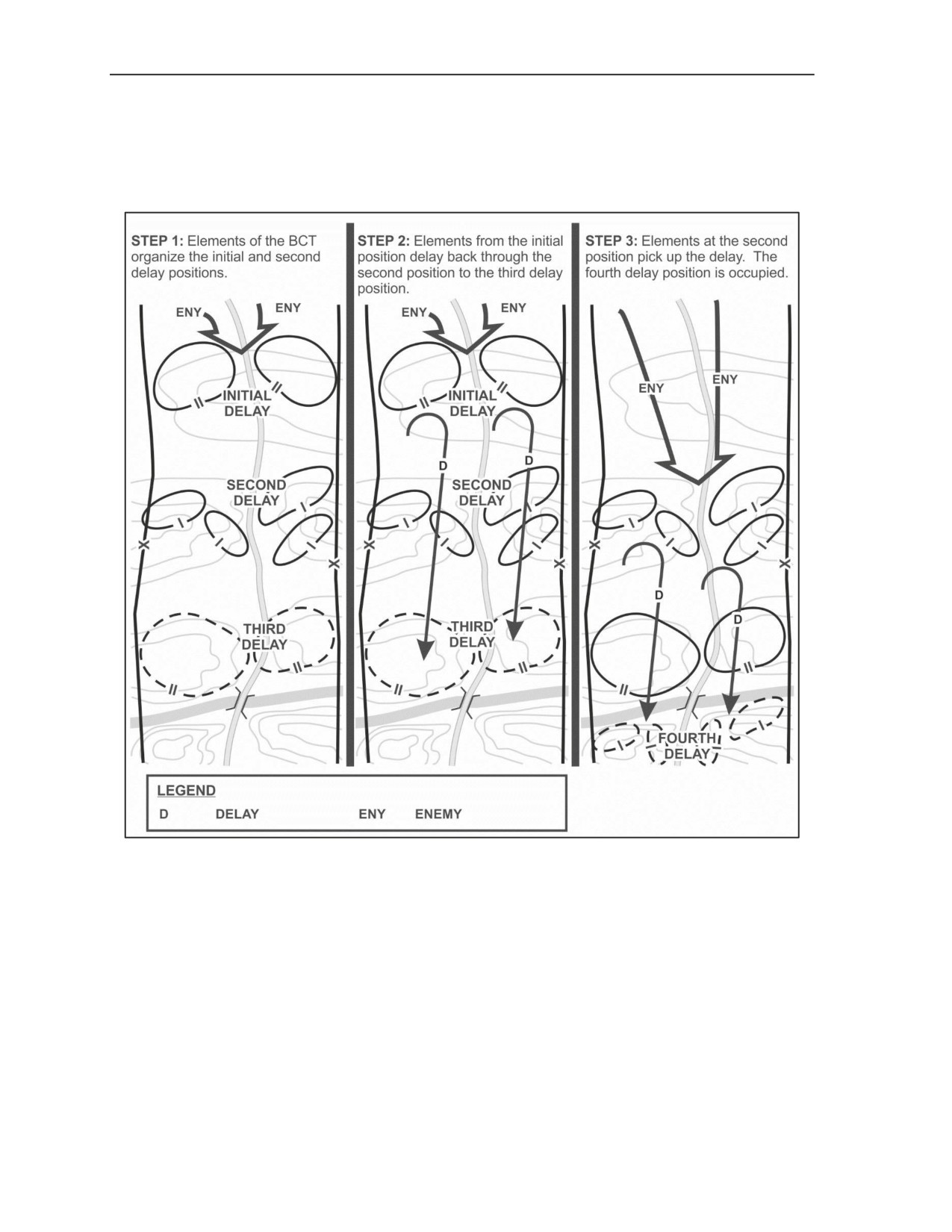
reinforced to allow positioning in-depth (figure 7-16, page 7-40). This is the preferred method of delay. One
or more maneuver battalions employ this method to occupy the initial delay position and engage the enemy.
The other maneuver battalions occupy a prepared second delay position. These elements alternate movement
in the delay. While one element is fighting, the other occupies the next position in-depth and prepares to
assume responsibility for the fight.
7-153. Units occupying the initial delay position can delay between it and the second position. When the
delaying units arrive at the second delay position, they move through or around the units that occupy the
second delay position. The units on the second delay position assume responsibility for delaying the enemy;
2FWREHU
FM 3-96
7-39
Chapter 7
the delaying procedure is then repeated. Moving around the unit on the next delay is preferred because this
simplifies passage of lines. The alternate method provides greater security to the delay force and more time
to prepare and improve delay positions. Normally, when delaying from alternate positions, the BCT
commander does not maintain a reserve. The forces not in contact with the enemy are available to function
in the role of a reserve if needed.
Figure 7-16. Delay from alternate positions
WITHDRAWAL
7-154. A withdrawal operation is a planned retrograde operation in which a force in contact disengages
from an enemy force and moves in a direction away from the enemy (ADRP 3-90). Withdrawing units,
whether all or part of a committed force, voluntarily disengage from the enemy to preserve the force or release
it for a new mission. The purpose of a withdrawal is to remove a unit from combat, adjust defensive positions,
or relocate forces. A withdrawal may free a unit for a new mission. A unit may execute a withdrawal at any
time and during any type of operation.
7-155. BCTs normally withdraw using a security force, a main body, and a reserve. There are two types of
withdrawals, assisted and unassisted. In an assisted withdrawal, the next higher headquarters provides the
security forces that facilitate the move away from the enemy. In an unassisted withdrawal, the BCT provides
its own security force. Withdrawals are generally conducted under one of two conditions, under enemy
7-40
FM 3-96
2FWREHU
Defense
pressure and not under enemy pressure. Regardless of the type or condition under which it is conducted, all
withdrawals share the following planning considerations:
z
Keep enemy pressure off the withdrawing force. Position security elements to delay the enemy.
Emplace obstacles and cover by fire to slow his advance.
z
Maintain security. Know the enemy's location and his possible courses of action. Observe possible
enemy avenues of approach.
z
Gain a mobility advantage. Gain the advantage by increasing the mobility of the BCT, reducing
the mobility of the enemy, or both.
z
Reconnoiter and prepare routes. Each unit must know the routes or lanes of withdrawal. Establish
priority of movement and traffic control if two or more units move on the same route.
z
Withdraw nonessential elements early. Withdrawing nonessential elements early may include
some mission command and sustainment elements.
z
Move during limited visibility. Movement under limited visibility provides concealment for the
moving units and reduces the effectiveness of enemy fires.
z
Concentrate all available fires on the enemy. Alternate movement between elements so some of
the force can always place direct or indirect fires on the enemy.
7-156. Withdrawing under enemy pressure demands superior maneuver, firepower, and control. The BCT
executes a withdrawal in the same manner as a delay, although its ultimate purpose is to break contact with
the enemy rather than maintain it as in the delay. When conducting a withdrawal under enemy pressure, the
commander organizes the BCT into a security force and a main body. Use control measures that facilitate the
accomplishment of the commander's intent. These control measures may include areas of operations, battle
positions, phase lines, routes, passage points and lanes, contact points, checkpoints, and battle handover lines.
7-157. Success depends on facilitating the disengagement of the main body by massing its own fires and
the overwatch fires provided by the security element. The division commander may place adjacent units in
overwatch, or he may require them to conduct security operations or limited counterattacks to support the
withdrawing BCT. To assist withdrawing elements, the security force must be strong enough to detect and
engage the enemy on all avenues of approach. The BCT may form its own security force from forward
maneuver battalion elements or the cavalry squadron. The security force must:
z
Stop, disrupt, disengage, or reduce the enemy's ability to pursue.
z
Reduce, through smoke and suppressive fires, the enemy's capability to observe the movement of
the main body.
z
Rapidly concentrate additional combat power in critical areas.
7-158. As the commander gives the order to withdraw, the BCT must engage the enemy with concentrated
direct and indirect fire to enable the withdrawing force to disengage, conduct a rearward passage through the
security force, assemble, and move to their next position. The security force assumes the fight from the
forward elements. This includes delaying the enemy advance while the bulk of the BCT conducts movement
to the rear. On order, or when the BCT meets other predetermined criteria, the security force disengages itself
and moves to the rear as a rear guard. Depending on the BCT's next mission, the security force may be
required to maintain contact with the enemy throughout the operation.
7-159. When the BCT conducts a withdrawal not under enemy pressure, it must plan as though enemy
pressure is expected, and then plan for a withdrawal without pressure. Withdrawal not under enemy pressure
requires the formation of a detachment left in contact (DLIC). Reconnaissance and deception are critical to
conducting a withdrawal not under enemy pressure. The commander must be aware of the activities and
movements of any enemy in the area that could influence his operation. He must also ensure the security of
his force against surprise. The commander must project the impression that he is conducting operations other
than a withdrawal. If the enemy becomes aware that the BCT is withdrawing, he may choose to exploit the
BCT's relative vulnerability by attacking or employing indirect fires against elements in movement.
Therefore, deception and operational security measures are essential to the success of a withdrawal not under
enemy pressure. These measures include—
z
Maintaining the same level of communications.
z
Continuing the use of patrols.
z
Moving during limited visibility.
2FWREHU
FM 3-96
7-41
Chapter 7
z
Maintaining the same level of indirect fires.
z
Avoiding compromise of the operation by radio.
z
Maintaining noise and light discipline.
z
Using the DLIC to simulate or continue normal activities.
7-160. The DLIC is a force organized from within the BCT that maintains contact with the enemy while
the majority of the BCT withdraws. The DLIC usually comprises one third of the available combat power. A
BCT may direct that three maneuver companies, augmented with the necessary combat power and increased
mobility and firepower, form the DLIC.
7-161. Two techniques for organizing the DLIC are designating one maneuver battalion as the DLIC or
forming a new organization under the BCT S-3. When one maneuver battalion forms the DLIC, it repositions
its force through a series of company-sized relief in place operations (see FM 3-90-2) with companies in the
other maneuver battalion's areas of operations. The advantages of this technique is that mission command is
facilitated by the organic nature of the units involved and the focus of the force as a whole is dedicated toward
one mission-maintaining contact and preparing to fight a delay, if necessary. The disadvantages are the time
needed to reposition and the increased amount of movement in the area of operations that may signal a
vulnerability to the enemy.
7-162. Forming a new organization under a new controlling headquarters also has advantages and
disadvantages. The advantages are that the units of the DLIC may have to do less repositioning and some
may not have to move at all. This advantage helps to deceive the enemy as to the intentions of the BCT. The
disadvantage is that the unit’s ability to fight as a team decreases if the organization is ad hoc in nature. This
organization must train together to avoid this disadvantage.
RETIREMENT
7-163. A retirement is a form of retrograde in which a force out of contact moves away from the enemy
(ADRP 3-90). A retirement is conducted as a tactical movement to the rear. The brigade may move on one
or more routes depending on the routes available. Security for the main body is similar to that for a movement
to contact using advance, flank, and rear guards. As in all tactical movements, all-round security must be
maintained. In all retrograde operations, control of friendly maneuver elements is a prerequisite for success.
A withdrawal may become a retirement once forces have disengaged from the enemy, and the main body
forms march columns.
7-164. The BCT conducts retrograde operations to improve a tactical situation or to prevent defeat.
Retrograde operations accomplish the following:
z
Resist, exhaust, and defeat enemy forces.
z
Draw the enemy into an unfavorable situation.
z
Avoid contact in undesirable conditions.
z
Gain time.
z
Disengage a force from battle for use elsewhere in other missions.
z
Reposition forces, shorten lines of communication, or conform to movements of other friendly
units.
z
Secure more favorable terrain.
SECTION VI - TRANSITION
7-165. Transitions between tasks during decisive action whether anticipated or unanticipated require
adaptability as the BCT commander copes with changes in the operational environment. The commander
considers the concurrent conduct of each task—offensive, defensive, and stability—in every phase and
ongoing operation. Transition between tasks during decisive action require careful assessment, prior
planning, and unit preparation as the commander shifts his combinations of offensive, defensive, and stability
tasks.
7-166. The BCT commander halts the defense only when the operation accomplishes the desired end state,
reaches a culminating point or receives a change of mission from higher headquarters. Transitions mark a
7-42
FM 3-96
2FWREHU
Defense
change of focus between phases or between the ongoing operation and execution of a branch or sequel. In
the defense, the BCT and subordinate units often transition from one phase of the operation to another
sequentially or simultaneously. In decisive action, it is common for subordinate units of the BCT to transition
to the offense and operations focused on stability, while maintaining the defense with other subordinate units.
7-167. The commander deliberately plans for sequential operations, assisting the transition process and
allowing the setting of the conditions necessary for a successful transition. Such planning addresses the need
to control the tempo of operations, maintain contact with both enemy and friendly forces, and keep the enemy
off balance. The BCT establishes the required organization of forces and control measures based on the
mission variables of METT-TC.
7-168. Prior contingency planning decreases the time needed to adjust the tempo of combat operations when
a unit transitions from the defense to the offense or operations focused on stability. It does this by allowing
subordinate units to simultaneously plan and prepare for subsequent operations. (Refer to ADRP 3-0 for
additional information.)
TRANSITION TO A FOCUS ON THE CONDUCT OF OFFENSIVE
TASKS
7-169. The BCT or higher commander may order an attack, a movement to contact, or participate in an
exploitation and subsequent pursuit if conditions are suitable. The commander should transition to the offense
as soon as possible. He wants to attack when the enemy is most vulnerable. The commander does not want
to give the enemy time to prepare.
7-170. A defending commander transitioning to the offense anticipates when and where the enemy force
will reach its culminating point or when it will require an operational pause before it can continue. At those
moments, the combat power ratios most likely favor the defending force. The actions which may indicate the
enemy has reached its culminating point include transitioning to the defense, heavy losses, lack of
sustainment to continue the mission, unexpected success of friendly operations, increased enemy prisoners
of war, and a lack of coherence and reduced combat power in the enemy’s attacks.
7-171. The BCT commander must be careful not to be the target of enemy information activities designed
to encourage the commander to abandon the advantages of fighting from prepared defensive positions. The
commander ensures his force has the assets necessary to complete its assigned offensive mission. The
commander should not wait too long to transition from the defense to the offense as the enemy force
approaches its culminating point. The BCT must disperse, extend in-depth, and weaken enemy forces. At
that time, any enemy defensive preparations will be hasty and enemy forces will not be adequately disposed
to defend. The BCT commander wants the enemy in this posture when the force transitions to the offense.
The commander does not want to give the enemy force time to prepare the defense. Additionally, the
psychological shock on enemy soldiers will be greater if they suddenly find themselves desperately defending
on new and often unfavorable terms, while the commander’s own Soldiers will enjoy a psychological boost
by going on the offense.
7-172. A commander can use two basic methods when he transitions to the offense. The first, and generally
preferred, method is to attack using forces not previously committed to the defense. This method has the
advantage of using rested units at a high operational strength. A drawback to this method is the requirement
to conduct a forward passage of lines. Additionally, enemy intelligence assets are likely to detect the arrival
of significant reinforcements. Another consideration of using units not in contact occurs when they are
operating in noncontiguous areas of operations. The commander rapidly masses overwhelming combat power
in the decisive operation. This might require the commander to adopt economy of force measures in some
areas of operations while temporarily abandoning others to generate sufficient combat power.
7-173. The other method is to conduct offensive actions using the currently defending forces. This method
has the advantage of being more rapidly executed and thus more likely to catch the enemy by surprise. Speed
of execution in this method results from not having to conduct an approach or tactical road march from
reserve assembly areas or, in the case of reinforcements, move from other areas of operations and reception,
staging, organization, and integration locations. Speed also results from not having to conduct a forward
passage of lines and perform the liaison necessary to establish a common operational picture that includes
2FWREHU
FM 3-96
7-43
Chapter 7
knowledge of the enemy force’s patterns of operation. The primary disadvantage of this method is that the
attacking force generally lacks stamina and must be quickly replaced if friendly offensive actions are not to
culminate quickly.
7-174. If units in contact participate in the attack, the commander must retain sufficient forces in contact to
fix the enemy. The commander concentrates the attack by reinforcing select subordinate units so they can
execute the attack and, if necessary, maintain the existing defense. The commander can also adjust the
defensive boundaries of subordinate units so entire units can withdraw and concentrate for the attack.
7-175. The commander conducts any required reorganization and resupply concurrently with transition
activities. This requires a transition in the sustainment effort, with a shift in emphasis from ensuring a
capability to defend from a chosen location to an emphasis on ensuring the force’s ability to advance and
maneuver. For example, in the defense, the sustainment effort may have focused on the forward stockage of
Class IV (construction and barrier materials) and Class V (ammunition) items and the rapid evacuation of
combat-damaged systems. In the offense, the sustainment effort may need to focus on providing POL and
forward repair of maintenance and combat losses. Transition is often a time in which forces perform deferred
equipment maintenance. Additional assets may also be available on a temporary basis for casualty evacuation
and medical treatment because of a reduction in the tempo of operations.
TRANSITION TO A FOCUS ON THE CONDUCT OF STABILITY
TASKS
7-176. During the transition to operations focused on stability, the role of the BCT varies greatly depending
upon the security environment, the authority and responsibility of the BCT, and the presence and capacities
of other nonmilitary actors. When transitioning from the defense, these other actors will normally be less
established before stability tasks begin. The BCT in this case will operate before other actors have a
significant presence. Generally, the BCT will focus on meeting the immediate essential service and civil
security needs of the civilian inhabitants of the area of operations in coordination with any existing
host-nation government and nongovernmental organizations before addressing the other three primary
stability tasks.
(See chapter 8.) Support requirements may change dramatically. During transition, the
commander may adjust rules of engagement or their implementation. The commander must effectively
convey these changes to the lowest level.
7-177. The BCT must remain versatile and retain flexibility when transitioning from the defense to
operations focused on stability. The commander may plan on-order transition to a stability focused mission
when certain conditions are met. These conditions may include a sharp reduction of the enemy’s offensive
capabilities or deterioration in civilian governance and security. These conditions may require the rapid
occupation and security of civilian areas. The commander must make every attempt to begin transition
operations as soon as subordinate units of the BCT arrive within an assigned area of operation.
7-178. BCT subordinate units and Soldiers must be aware that during the transition to operations focused
on stability, there may be events that escalate to combat. The BCT must always retain the ability to conduct
offense and defense during transition. Preserving the ability to transition allows the commander to maintain
initiative while providing security. The commander should consider planning an on-order offensive and
defensive contingency in case the transition to operations focused on stability deteriorate. Subordinate
commanders and leaders must be well-rehearsed to recognize activities that would initiate these contingences.
7-44
FM 3-96
2FWREHU
Chapter 8
Stability
The requirement for military formations to conduct operations focused on stability is
not new. Our involvement in military conflict from the Revolutionary War to Operation
Enduring Freedom consists of only eleven conventional military operations.
Conversely, that same history reveals hundreds of operations focused on stability with
recent history proving no different. Since the fall of the Berlin Wall, the United States
led or participated in over fifteen operations in places such as Haiti, Liberia, Somalia,
the Balkans, Iraq, and Afghanistan. While the magnitude of violence may not match
conventional operations, history often measures the duration of stability operations in
decades. This fact combines with the disturbing spread of international terrorism,
fragile states allowing safe haven to terrorist organizations and or possessing weapons
of mass destruction, along with an endless array of humanitarian and natural disasters
illustrates the increasing requirement for operations focused on stability.
Military formations conduct operations focused on stability to transition the security
and governance of populations to legitimate civilian authorities. The BCT lacks the
organic capability to stabilize an assigned area of operation independently. The BCT’s
central role in operations focused on stability is to establish and maintain unity of effort
towards achieving the political objectives of the operation. To do this the BCT employs
combined arms formations that execute offensive, defensive, and stability tasks to
identify and mitigate critical sources of instability. Essentially, the BCT unifies
governmental, nongovernmental, and elements of the private sector activities with
military operations to seize, retain, and exploit the initiative.
SECTION I - FOUNDATION FOR OPERATIONS FOCUSED ON STABILITY
8-1. Stability ultimately aims to establish conditions the local populace regards as legitimate, acceptable,
and predictable. Stabilization is a process in which personnel identify and mitigate underlying sources of
instability to establish the conditions for long-term stability. Stability tasks focus on identifying and targeting
the root causes of instability and building the capacity of local institutions. Army forces accomplish stability
missions and perform tasks across the range of military operations and in coordination with other instruments
of national power. Stability missions and tasks are part of broader efforts to establish and maintain the
conditions for stability in an unstable area before or during hostilities, or to reestablish enduring peace and
stability after open hostilities cease.
STABILITY PRINCIPLES
8-2. The BCT applies stability principles to the offense, defense, and operations focused on stability to
achieve political and military objectives. (See ADRP 3-07 for additional information.) The following stability
principles lay the foundation for long-term stability:
z
Conflict transformation.
z
Unity of effort.
z
Legitimacy and host-nation ownership.
z
Building partner capacity.
2FWREHU
FM 3-96
8-1
Chapter 8
CONFLICT TRANSFORMATION
8-3. Conflict transformation is the process of converting the actors and conditions that motivate violent
conflict into the governmental process to address the causes of instability. Conflict transformation sets the
host nation on a sustainable, positive trajectory in which transformational processes directly address the
dynamics causing instability. The use of the BCT in a combat role serves as a temporary solution until the
situation is stabilized and host-nation forces are able to provide security for the populace. In all cases, the
combat role supports the host nation’s ability to provide for its internal security and external defense.
UNITY OF EFFORT
8-4. Military operations typically demand unity of command, the challenge for military and civilian leaders
is to forge unity of effort or unity of purpose among the diverse array of actors involved in an operation
focused on stability. This is the essence of unified action—the synchronization, coordination, and integration
of the activities of governmental and nongovernmental entities with military operations to achieve unity of
effort (JP 1). Unity of effort is the coordination and cooperation toward common objectives, even if the
participants are not necessarily part of the same command or organization—the product of successful unified
action (JP 1). Unity of effort is fundamental to successfully incorporating all the instruments of national
power in a collaborative approach when conducting stability tasks in operations.
8-5. When countering insurgency (see FM 3-24) an example of unity of effort could be a military
commander and a civilian leader ensuring that governance and economic lines of effort are fully coordinated
with military operations. Unity of effort among nationally, culturally, and organizationally distinct partners
is difficult to maintain, given their different layers of command. Achieving unity of effort requires
participants to overcome cultural barriers and set aside parochial agendas. It also requires that each
organization understand the capabilities and limitations of the others.
LEGITIMACY AND HOST-NATION OWNERSHIP
8-6. Legitimacy is a condition based upon the perception by specific audiences of the legality, morality, or
rightness of a set of actions, and of the propriety of the authority of the individuals or organizations in taking
them. Legitimacy enables host-nation ownership by building trust and confidence among the people. The
principle of legitimacy affects every aspect of operations from every conceivable perspective. Legitimacy of
the host-nation government and mission enables successful operations characterized by stability tasks.
8-7. Within security cooperation, an activity may include security sector reform (see FM 3-22). Security
sector reform is a comprehensive set of programs and activities undertaken to improve the way a host nation
provides safety, security, and justice (JP 3-07). The BCT’s primary role in security sector reform is to support
the reform, restructuring, or re-establishment of the armed forces and the defense sector across the range of
military operations. The overall objective is to support in a way that promotes an effective and legitimate
host-nation government and mission that is transparent, accountable, and responsive to civilian authority.
(Refer to ADRP 3-07 for additional information.)
BUILDING PARTNER CAPACITY
8-8. Building partner capacity is the outcome of comprehensive inter-organizational activities, programs,
and military-to-military engagements that enhance the ability of partners to establish security, governance,
economic development, essential services, rule of law, and other critical government functions. BCTs apply
a comprehensive approach to sustained engagement with foreign and domestic partners to co-develop
mutually beneficial capabilities and capacities to address shared interests. Unified action is an indispensable
feature of building partner capacity.
8-9. In operations characterized by stability tasks, unified action to enhance the ability of partners for
security, governance, economic development, essential services, rule of law, and other critical government
functions exemplifies building partner capacity. Building the capacity and capability, during security force
assistance, of foreign security forces and their supporting institutions is normally the primary focus of the
BCT. Security force assistance will encompass various activities related to the organizing, training, advising,
equipping, and assessing of foreign security forces and their supporting institutions. Security force assistance
8-2
FM 3-96
2FWREHU
Stability
activities conducted by the BCT builds host nation capacity to defend against internal, external, and
transnational threats to stability. (Refer to FM 3-22 for additional information.)
STABILITY FRAMEWORK
8-10. A stability framework based on conditions within the area of operation of initial response,
transformation, and fostering sustainability, helps the BCT determine the required training and task
organization of forces prior to initial deployment, and serves as a guide to actions in an operation focused on
stability tasks. A BCT deployed into an area of operation where the local government is nonexistent may
conduct a set of tasks while another BCT may conduct another set of tasks in an area of operation with a
functioning local government. The phases described in the following paragraphs facilitate identifying lead
responsibilities and determining priorities. (Refer to FM 3-07 for additional information.)
INITIAL RESPONSE PHASE
8-11. Initial response actions generally reflect activity executed to stabilize a crisis state in the area of
operations. The BCT typically performs initial response actions during, or directly after, a conflict or disaster
in which the security situation prohibits the introduction of civilian personnel. Initial response actions aim to
provide a secure environment that allows relief forces to attend to the immediate humanitarian needs of the
local population. They reduce the level of violence and human suffering while creating conditions that enable
other actors to participate safely in relief efforts.
TRANSFORMATION PHASE
8-12. Stabilization, reconstruction, and capacity building are transformation actions performed in a relatively
secure environment. Transformation actions take place in either crisis or vulnerable states. These actions aim
to build host-nation capacity across multiple sectors. Transformation actions are essential to the continuing
stability of the environment and foster sustainability within the BCT’s area of operation.
FOSTERING SUSTAINABILITY PHASE
8-13. Fostering sustainability actions are those activities that encompass long-term efforts, which capitalize
on capacity building and reconstruction. Successful accomplishment of these actions establishes conditions
that enable sustainable development. Usually military forces perform fostering sustainability phase actions
only when the security environment is stable enough to support efforts to implement the long-term programs
that commit to the viability of the institutions and economy of the host nation. Often military forces conduct
these long-term efforts to support broader, civilian-led efforts.
SECTION II - STABILITY ENVIRONMENT
8-14. Operations focused on stability, range across all military operations and offer perhaps the most diverse
set of circumstances the BCT faces. The objective of operations focused on stability is to create conditions
that the local populace regards as acceptable in terms of violence; the functioning of governmental, economic,
and societal institutions; and adhere to local laws, rules, and norms of behavior. During unified land
operations, the BCT provides the means for seizing and retaining initiative through partnership with
associated enabling organizations that are better suited to bring stability to the operational environment. To
successfully seize, retain, and exploit the initiative in operations focused on stability: the BCT must identify
and mitigate sources of instability, understand and nest operations within political objectives, and achieve
unity of effort across diverse organizations.
SOURCES OF INSTABILITY
8-15. The BCT conducts information collection to gain a detailed understanding of the operational
environment’s sources of instability and capability and intentions of key actors. Sources of instability are
actors, actions, or conditions that exceed the legitimate authority’s capacity to exercise effective governance,
maintain civil control, and ensure economic development. Enemy forces leverage sources of instability to
2FWREHU
FM 3-96
8-3
Chapter 8
create conflict, exacerbate existing conditions, or threaten to collapse failing or recovering states. Examples
of sources of instability include, but are not limited to:
z
Insurgents forming shadow government.
z
Religious, ethnic, economic, political indifferences among the local population.
z
Natural disasters or resource scarcity.
z
Super-empowered individual disrupting legitimate governance.
z
Severely degraded infrastructure.
z
Severe economic strife.
z
Immature, undeveloped or atrophied systems.
z
Ineffective or corrupt host-nation security forces.
8-16. The BCT commander and staff must apply the same fundamental planning processes in the military
decisionmaking process and the intelligence preparation of the battlefield to identify the tactical problem,
and conduct information collection to answer priority intelligence requirements or identified information
gaps. Critical thinking, innovative problem solving, and leveraging different tools to address these tactical
problems assists the BCT commander and staff in identifying sources of instability. Thorough analysis,
engaging with local leaders and populations, leveraging unified action partners, and research are standard
methods used to identify sources of instability.
8-17. The commander and staff consider alternative perspectives and approaches to the ones used in offense
and defense. The BCT analyzes sources of instability from both the local, indigenous perspective and the
United States military perspective to understand the differences between viewpoints. During the intelligence
preparation of the battlefield, the BCT identifies key actors and their interests or agendas. Additionally, the
BCT analyzes how these key actors’ influence the local civil capacity; this analysis drives the BCT’s planning
effort that addresses accomplishment of the primary stability tasks. Staffs conduct preparation to understand
unique aspects of operations focused on stability. For example, the brigade assistant engineer might conduct
an assessment on the local electrical grid system of an assigned area of operation or the brigade surgeon or
medical planner may conduct an assessment on host-nation medical facilities and their capacity before
employment to an assigned area of operation. This staff specific assessment further enables the conduct of
the five primary stability tasks (see section III) and makes the BCT’s planning effort during operations
focused on stability more informed and efficient.
8-18. Once the commander and staff possess an understanding of the operational environment, the BCT
applies a mixture of stability mechanisms to set conditions to retain and exploit stabilizing factors. A stability
mechanism is the primary method through which friendly forces affect civilians in order to attain conditions
that support establishing a lasting, stable peace (ADRP 3-0). The four stability mechanisms are compel,
control, influence, and support. Combinations of stability mechanisms produce complementary and
reinforcing outcomes that accomplish the mission more effectively and efficiently than single mechanisms
do alone.
8-19. The BCT simultaneously uses stability mechanisms such as compel and control to assist with seizing
initiative. Compel means to use, or threaten to use, lethal force to establish control and dominance, effect
behavioral change, or enforce compliance with mandates, agreements, or civil authority. Control means to
impose civil order. Offensive tasks reveal and exploit enemy weaknesses by defeating, destroying, or
neutralizing threat forces. These actions disrupt threat forces, prevent them from negatively influencing
populations, and provide opportunities to continue exploiting weaknesses—but they are not decisive by
themselves. The design of these actions should consider how and what they compel the population to do and
whether or not the action will result in positive, neutral or negative support by the population in the long and
short term. (Refer to ADRP 3-0 for additional information.)
UNDERSTANDING POLITICAL OBJECTIVES
8-20. Understanding political objectives frames the unique operations required to conduct stability tasks.
General political objectives are broad and conceptual in nature, but they give contextual guidance that
informs the expanded purpose of the echelons above the BCT commander’s intent. Political objectives may
8-4
FM 3-96
2FWREHU
Stability
shift and change as the operational environment changes. That same guidance unifies or alienates partners
that may fall outside of the military chain of command.
8-21. Given the inherently complex and uncertain nature of political objectives, the BCT commander and
staff use the Army design methodology to help understand the root cause of instability and approaches to
solve problems. The Army design methodology entails framing an operational environment, framing the
problem, and developing an operational approach to solve the problem. The Army design methodology
results in an improved understanding of an operational environment. Based on this improved understanding,
the commander issues planning guidance, to include an operational approach, to guide more detailed planning
using the military decisionmaking process.
8-22. Incorporating political objectives into the planning process is a shared task amongst the BCT staff.
Each staff officer understands the general and specific political objectives and the commander’s intent two
levels up of an assigned operation focused on stability and considers the implications and effects of the
political objectives when presenting the commander with running estimates, courses of actions and other
decision support staff products. The BCT staff must understand how to communicate general and specific
political objectives into the themes and messages delivered in the operations order and fragmentary orders
that Soldiers display through their actions. These political objectives must translate across the entirety of the
operational environment yet be understood by subordinate units allowing them to affect the local population’s
perception. (Refer to FM 6-0 for additional information.)
ACHIEVE UNITY OF EFFORT ACROSS DIVERSE ORGANIZATIONS
8-23. BCT commanders and staffs must understand how to build relationships with many diverse
organizations within an area of operation. These relationships allow the BCT to nest operations with both
their higher headquarters and with the overall United States effort within the joint operational area. A
whole-of-government approach, along with collaboration and cooperation with unified action partners—
those military forces, governmental and nongovernmental organizations, and elements of the private sector
with whom Army forces plan, coordinate, synchronize, and integrate during the conduct of operations (ADRP
3-0)—are key components of operations focused on stability. The BCT staff incorporates personnel from
these organizations into the operations process as soon as possible.
MILITARY POLICE
8-24. Mission tailored military police support to the BCT integrates police intelligence operations (see ATP
3-39.20) throughout the offense, the defense, and operations focused on stability. Police intelligence
operations address the reality that, in some operational environments, the threat is more criminal than
conventional in nature. In those environments, it is not uncommon for members of armed groups, insurgents,
and other belligerents to use or mimic established criminal networks, activities, and practices to move
contraband, raise funds, or generally or specifically further their goals and objectives. Police intelligence can
provide relevant, actionable police information or police intelligence to the BCT through integration into the
operations process and fusion with other intelligence data. United States Army criminal investigations
division and provost marshal staffs provide criminal intelligence analysis to the commander that identify
indicators of potential crimes and criminal threats against, facilities and/or personnel.
SPECIAL OPERATIONS FORCES
8-25. The BCT builds relationships with United States Special Operations Forces operating in their area of
operations. These units are under operational control to a Joint Special Operations Task Force or higher and
execute different tactical tasks that may directly or indirectly support the operational objectives and end states
of the BCT. The BCT relies on interdependence with special operations forces along, with other unified
action partners to combat sources of instability. The exercise of interdependence facilitates shared
understanding between the BCT and special operations forces and provides a conduit by which the special
operations forces can provide the BCT relevant, useful and timely information during the operations
processes. Special operation forces, within the BCT’s area of operation, coordinate and synchronize efforts
to ensure reinforcing and complementary effects. Planning efforts, update briefs, and working groups are
specific events where BCTs incorporate special operations forces. (Refer to ADRP 3-05 for additional information.)
2FWREHU
FM 3-96
8-5
Chapter 8
8-26. Civil affairs operations are essential to the conduct of operations focused on stability. The full
capability of the civil affairs force manifests itself in the conduct of stability tasks in every environment
across the range of military operations. Civil affairs support to stability tasks include the execution of all five
civil affairs core tasks, employment of civil affairs functional specialists, and continuous analysis of the civil
component of the operational environment in terms of both operational and mission variables by civil affairs
staff elements. The five civil affairs core tasks are populace and resources control, foreign humanitarian
assistance, civil information management, nation assistance, and support to civil administration.
8-27. Civil affairs support to operations focused on stability depends on the nature of the operation and the
condition of the affected indigenous population and institutions. The civil affairs staff continually monitors
the condition of the host nation throughout the operation, applies available resources to affect the civilian
component, and recommends functional skills required to support this critical phase of the operation. Civil
affairs support the BCT, United States government agencies, and the host-nation civil administration in
transitioning power back to the local government. During the transition from offense or defense to operations
focused on stability, civil affairs units place greater emphasis on infrastructure, economic stability, and
governance expertise. (Refer to FM 3-57 for additional information.)
PROVINCIAL RECONSTRUCTION TEAM
8-28. A provincial reconstruction team is part of a long-term strategy to transition the functions of security,
governance, and economics to provincial governments. It is a potential combat multiplier for maneuver
commanders performing governance and economics functions and providing expertise to programs designed
to strengthen infrastructure and the institutions of local governments. The provincial reconstruction team
leverages the principles of reconstruction and development to build host-nation capacity while speeding the
transition of security, justice, and economic development to the control of the host nation.
8-29. The provincial reconstruction team structure normally has sixty to ninety personnel. A provincial
reconstruction team is intended to have the following complement of personnel:
z
Provincial reconstruction team leader.
z
Deputy team leader.
z
Multinational force liaison officer.
z
Rule of law coordinator.
z
Provincial action officer.
z
Public diplomacy officer.
z
Agricultural advisor.
z
Engineer.
z
Development officer.
z
Governance team.
z
Civil affairs team.
z
Bilingual cultural advisor.
INTERGOVERNMENTAL AND NONGOVERNMENTAL ORGANIZATIONS
8-30. BCTs also must recognize the value of intergovernmental and nongovernmental organizations and
build effective relationships with these actors. These organizations may have the most extensive amounts of
resources to conduct stability tasks within the BCT’s area of operation. Intergovernmental organizations and
nongovernmental organizations are the primary sources of subject matter expertise in many essential services
and governance topics. They also are the primary provider of humanitarian, infrastructure and essential
services in immature operational environments. Intergovernmental and nongovernmental organizations
potentially have experienced and detailed knowledge of the civil environment. Usually the intergovernmental
and nongovernmental organizations will have a better understanding of the civil considerations than any other
actors other than host-nation personnel. This insight can assist the BCT in the continual process to understand
and shape the environment.
8-31. Building relationships with intergovernmental and nongovernmental organizations is unique, as
opposed to host-nation forces and interagency actors, who often have different mandates and alternative
8-6
FM 3-96
2FWREHU
Stability
perspectives to operations, focused on stability. The BCT commander and staff utilize these differences to
see the operational environment and tactical problems from different perspectives. Additionally,
understanding where intergovernmental and nongovernmental organizations are in the area of operations and
the nature of their activities helps develop a common operational picture. This common operational picture
enables the BCT to anticipate changes to the operational environment, the effects of intergovernmental and
nongovernmental organizations on primary stability tasks and BCT operations, and future friction points
between the organization’s interests and the BCT’s interests.
8-32. Building relationships with intergovernmental and nongovernmental organizations might also be
difficult because these organizations are reluctant to establish associations with United States forces. The
BCT must be cognizant of this and establish these relationships on terms beneficial to all parties involved.
Intergovernmental and nongovernmental organizations can bring valuable resources, information regarding
the civil populace and the operational environment, and alternative perspectives to the BCT’s operation.
Examples of interagency personnel that can provide the BCT valuable information are members of a
Department of State Embassy or Consulate country team, chiefs of stations or bases, defense attaches, and
subject matter expertise from other governmental departments (Departments of Agriculture, Justice, Treasury
and so forth).
8-33. Humanitarian organizations avoid any blurring of the distinction between neutral, independent, and
impartial humanitarian action and development aid derived from political engagement, as the latter is
potentially linked to security concerns or support to one side. The BCT often works through civilian
representatives from United States Agency for International Development, the United Nations, or the
host-nation when coordinating with nongovernmental organizations. BCT commanders avoid publicly citing
nongovernmental organizations as information sources, as that might jeopardize their neutrality and invite
retaliation by adversaries. The BCT primarily uses civil-military operations centers operated by civil affairs
units to coordinate with nongovernmental organizations. (Refer to ATP 3-07.5 for additional information.)
BCTs operating with nongovernmental organizations follow these guidelines:
z
Military personnel wear uniforms when conducting relief activities.
z
Military personnel make prior arrangements before visiting nongovernmental organizations.
z
Military personnel do not refer to nongovernmental organizations as force multipliers or partners
or other similar terms.
z
United States forces respect a nongovernmental organization’s decision not to serve as an
implementing partner.
SEIZING THE INITIATIVE
8-34. The enduring theme of seizing the initiative is as applicable in operations focused on stability as in the
offense and defense. What is significantly different is the context in which the operational framework occurs.
Operations focused on stability have fewer specified applications of tactics and procedures. The BCT
commander must study and use critical thinking and creativity to address the tactical problems in this
complex environment. Operations focused on stability have broader temporal considerations; this operational
framework occurs before, during and after conflict as well as simultaneous to offensive and defensive tasks.
The BCT commander must consider the effects of this temporal aspect and manage it appropriately.
Operations focused on stability are by nature conceptual. The BCT commander must understand how each
action affects the other elements in the complex system of host-nation governmental institutions, civil society
and local economies. Success in seizing the initiative from a stability-focused perspective is critical to
preventing conflict, setting conditions for success during the offense and defense and securing hard won
successes in a post-conflict environment.
RETAINING THE INITIATIVE
8-35. Retaining initiative gained through the offense and operations focused on stability requires the BCT to
anticipate and act on civil requirements while actively averting threat actions. Influencing the population
towards the legitimacy of the civil-authority is critical to retaining initiative. In many circumstances, security
is the most influential element affecting the population beyond their basic needs of food, water, and shelter.
2FWREHU
FM 3-96
8-7
Chapter 8
A secure environment fosters a functioning economy, which provides employment and gradually transfers
the population’s dependence from military to civilian authorities and host-nation governments.
8-36. The BCT executes defensive tasks and operations focused on stability to retain key terrain, guard
populations, and protect critical capabilities that inhibit threat actions while fostering conditions to increase
the impact of stabilizing efforts. Often the BCT assigns these tasks as an economy of force to conduct
offensive tasks and operations focused on stability tasks. These tasks take form in such as actions as
partnership with other indigenous security forces, but must be executed to prevent instability. The objective
is that the population feels that the level of security promotes evolving and often sequential growth and
stabilization. Host-nation actors are often the best and most informed sources on the local environment.
EXPLOITING THE INITIATIVE
8-37. A secure operational environment enables unified action partners to capitalize on their unique
capabilities—thus exploiting the initiative gained in earlier operations. Governmental, nongovernmental, and
other actors must be unified in purpose for this to be effective. Effective civilian-military teaming starts with
the development of shared goals, aims, and objectives and a unity of purpose, which leads to a relationship
of shared trust and a unity of effort. The BCT commander’s responsibilities include creating and fostering
this dynamic and culture among organizations.
8-38. Unity of effort is more than working with other United States governmental agencies. Political leaders,
governmental agencies, security forces, and local businesses are examples of host-nation actors that a BCT
works with during operations focused on stability. The BCT also leverages relationships with host-nation
actors to develop their understanding of the information environment and to answer information requirements.
8-39. Actors that encompass unified action partners are not limited to host nation and interagency personnel.
The BCT’s area of operations may include allied and multi-national forces. Understanding capabilities,
constraints and limitations, and command relationships amongst the allied and multi-national forces facilitate
the mission preparation and execution of operations in a constantly changing operational environment. The
BCT cannot conduct successful operations focused on stability without building relationships. Each actor
brings expertise, perspective, resources and capabilities that are necessary to ensure primary stability tasks
are accomplished and that they achieve the endstate for the operation.
SECTION III - PRIMARY STABILITY TASKS
8-40. Stability tasks are conducted as part of operations outside the United States in coordination with other
instruments of national power to maintain or reestablish a safe and secure environment and provide essential
governmental services, emergency infrastructure reconstruction, and humanitarian relief (ADP 3-07). The
BCT executes operations focused on stability tasks against destabilizing factors by establishing unity of effort
among diverse organizations, and then task organizing and partnering with other elements to mitigate sources
of instability. A single action taken by a BCT or partnered element can support multiple stability tasks
because they are interrelated and interdependent. Each stability task carries unique considerations, but actions
taken affect each differently. BCTs plan, prepare, execute, and assess operations to determine impacts on the
area of operation as positively, negatively or neutral considering long-term and short-term effects. In
operations focused on stability, planning and assessing require significant analysis supported through
information collection activities focused on identifiable indicators within and external to the BCT’s area of
operation. As the commander considers each stability task within the context of the stability principles, the
BCT staff analyzes measures of performance and measures of effectiveness during assessment to plan for the
next operation asking, “What is needed to accomplish the intended outcome?” (Refer to ADRP 3-07,
FM 3-07, FM 7-15, and ATP 3-07.5 for additional information.)
ESTABLISH CIVIL SECURITY
8-41. Civil security provides for the safety of the host nation and its population, including protection from
internal and external threats. The BCT coordinates operations to restore order, halt violence and to support,
reinstate, or create civil authority by establishing a safe, secure, and stable environment for the local populace
8-8
FM 3-96
2FWREHU
Stability
supporting the overall stability operation. (Refer ATP 3-07.5 for additional information.) Establishing civil
security subtasks include the following:
z
Enforce cessation of hostilities, peace agreements, and other arrangements.
z
Determine disposition and composition of host-nation armed and intelligence services.
z
Conduct disarmament, demobilization, and reintegration.
z
Conduct border control, boundary security, and freedom of movement.
z
Support identification programs.
z
Protect key personnel and facilities.
z
Clear explosive and other hazards.
8-42. The BCT conducts operations that directly support subtasks: Enforce cessation of hostilities, peace
agreements, and other arrangements; conduct border control, boundary security, and freedom of movement;
support identification; protect key personnel, and facilities. The BCT has limited capability to support,
determine disposition and composition of national armed and intelligence services; conduct disarmament,
demobilization, and reintegration; and to clear explosives and other hazards.
INITIAL RESPONSE
8-43. During the initial response phase, the BCT often executes subordinate tasks because the host nation
lacks the capability. BCT subordinate units occupy areas of operation in accordance with geographical,
political, socio economic, task, or supported actor boundary considerations. Information collection activities
will develop further understanding of boundaries requiring the BCT to shift unit assets and resources to better
align with unified action partners to mitigate sources of instability. BCTs may be required to identify and
segregate combatants and non-combatants, search them, safeguard them, and move them out of the immediate
area of operation. The BCT commander establishes priorities for protection of civil and/or military personnel,
facilities, installations, and key terrain within the area of operation and initiates the stability principles of
conflict transformation, unity of effort, and building partner capacity during the initial response.
8-44. The BCT conducts operations that safeguard the local population and prevent factions or actors
contributing to sources of instability. Ultimately, these operations convince rival factions and actors to secure
their interests through negotiation and peaceful political processes rather than violence, intimidation,
coercion, or corruption. BCT units must remain neutral during this period. Supporting one of more factions
or leveraging one faction against another may contribute to instability. Perception from the local population
must be that the US forces are neutral, and have the best interests of the population and are providing security
to the area allowing further development to occur.
8-45. Identifying actors and their intentions during this phase through information collection allows the BCT
to seize the initiative. The BCT commander and subordinate leaders must reach, through engagements,
binding agreements or understandings with unified action partners to determine the best way to divide labor
and deconflict efforts so that partners do not work at cross-purposes. Actor agendas or intents do not know
or understand in their entirety during this phase. Military information support operations staff planners and
intelligence staff sections develop indicators that commanders and leaders can clearly understand and identify
to reveal actor agendas or intents. Information collection, with and without unified action partners, along
with continuous assessment enables the commander’s understanding of unity of effort and unity of purpose.
8-46. A BCT does not directly build local security force elements during this phase unless directed to, and
allocated the required resources. Local organizations, such as military, paramilitary, criminal, and rebels have
combat capability and can be engaged to reach an understanding between one another. The BCT relies heavily
on special operations forces during the early parts of initial response to support civil security specifically
with building partner capacity with local security organizations. As an interim government is established,
host-nation security forces will develop and partner with the BCT and operate under various accords based
on METT-TC.
TRANSFORMATION
8-47. In the transformation phase, host-nation security forces and, potentially, intergovernmental
organization peacekeepers begin to contribute. The BCT focuses more on security force assistance,
2FWREHU
FM 3-96
8-9
Chapter 8
particularly on the systems required to professionalize the host-nation security forces. The BCT continues in
partnership with unified action partners according to the legitimate government binding agreements.
Information collection will develop further understanding of boundaries requiring the BCT to shift unit assets
and resources to better align with unified action partners to mitigate sources of instability. The BCT advises
and assists the security force leadership empowering them to assume as much of the security effort as possible.
8-48. Host-nation security forces prominently work on security efforts so local populations do not perceive
the BCT as an invading force, to resist. Host-nation security forces stay involved to promote the legitimacy
of their government and progress with unified action partners. The BCT will assist host-nation security force
information operations, sustainment in support of the host nation, protection and area security operations
as needed.
8-49. As soon as possible, the BCT transfers host-nation infrastructure security to host-nation organizations.
Host-nation military units may temporarily be committed to securing public infrastructure, but eventually
police forces or dedicated security organizations conduct this function. The BCT continues coordination
between unified action partners to help mediate any disagreements among them.
8-50. The BCT ensures host-nation forces act in accordance with respect to human rights; failure to do so
undermines popular support for the host-nation government and can quickly revert conditions back to those
experienced during the initial response phase. Partnered security operations that place the host-nation forces
in the lead or independent of the BCT that result in combating instability are the most credible to the
population and build legitimacy of government through ownership.
8-51. Initially the BCT may simply be a support apparatus or, contrastingly, may make most security related
decisions and perform most tasks. Nevertheless, host-nation actors support and increasingly take ownership
in such matters. The BCT develops clear measures of performance and measures of effectiveness leading to
the security efforts shifting from the BCT as the lead to the host-nation forces in the lead. The BCT develops
indicators of the host-nation unit’s actions and conduct as well as the local population sentiment that their
units can identify while conducting partnered actions.
FOSTERING SUSTAINABILITY
8-52. In the fostering sustainability phase, the BCT transitions to a steady state posture focused on advisory
duties and security cooperation. The BCT commander implements additional peace measures depending
upon further negotiations. During this phase, the BCT enables the host nation to sustain the peace.
ESTABLISH CIVIL CONTROL
8-53. Civil control centers on rule of law by promoting efforts to rebuild host-nation judiciary and corrections
systems by providing training and support to law enforcement and judicial personnel. Civil control tasks
focus on building temporary or interim capabilities to pave the way for the host nation or international
organizations to implement permanent capabilities. (Refer ATP 3-07.5 for additional information.) Establish
civil control subtasks include:
z
Establish public order and safety.
z
Establish an interim criminal justice system.
z
Support law enforcement and police reform.
z
Support judicial reform.
z
Support a civil property dispute resolution process.
z
Support criminal justice system reform.
z
Support corrections reform.
z
Support war crimes courts and tribunals.
z
Support public outreach and community rebuilding programs.
8-54. Establishing security and rebuilding justice institutions can help to develop the necessary climate for
reconciliation, public confidence, and subsequent economic growth. The BCT supports civil control tasks
directly by conducting operations that support subtasks establishing public order and safety and supporting
8-10
FM 3-96
2FWREHU
Stability
public outreach and community rebuilding efforts. The BCT supports the remaining civil control
subtasks indirectly.
INITIAL RESPONSE
8-55. During initial response, the BCT conducts area security to protect the population, facilitate access to
critical resources for endangered populations, and secure vital resources and infrastructure for the interim
and future criminal justice institutions. The BCT initiates the principles of conflict transformation and unity
of effort to begin establishment of civil control.
8-56. The BCT conducts operations that safeguard the local population and prevent factions or actors from
contributing to sources of instability, in this case actors or groups enacting their form of justice. The legal
and justice system will be in disarray during the initial response from the interim and host-nation government.
The BCT respects and implements laws established by the host nation in support of political objectives and
directly addresses sources of instability. The BCT Staff analyzes these laws to recommend courses of action
and develop rules of engagement or other mission parameters.
8-57. The BCT conducts information operations related to the development of judicial systems that are
outside of the interim or established government and disrupt the organizations that control them. Ultimately,
these operations convince rival factions and actors to secure their interests through negotiation and peaceful
political processes rather than violence, intimidation, coercion, or corruption.
8-58. The BCT develops plans for coordinating the security, safety, and care for displaced communities in
camps and settlements. This includes the movement of displaced people, the screening of returnees at
checkpoints, the protection of relief convoys, and public safety in returnee communities that lack local law
and order.
8-59. The BCT must seek partnerships with unified action partners who can conduct investigations, collect
and handle evidence, and undertake correction reform. BCTs also must seek additional judge advocates and
military police since BCTs lack the legal manpower to assist the host nation in judicial and corrections reform,
as well as, support to war crime courts and tribunals.
TRANSFORMATION
8-60. During transformation, the BCT continues to conduct operations with unified action partners, however,
shifts efforts to legitimacy and host-nation ownership, and building partner capacity. In the transformation
phase of the stability framework, host-nation police forces and inter-organizational entities take the lead with
Army units focusing on security force assistance, particularly the professionalization of host-nation security forces.
8-61. Legitimate political authorities pass laws and orders that are binding to the local population during this
phase. The BCT continues its operations and partnership but must be aware of the laws and orders to properly
mentor and guide its partner to support legitimacy. These laws and orders may also cause an adjustment to
rules of engagement and the conduct of operations.
8-62. Building partner capacity to protect military and public infrastructure and facilitate emergency
response is the primary goal during transformation phase for civil control. Security measures should be
integrated into broader programs that foster good order and discipline, including personnel accountability,
property accountability, and maintenance. The BCT continues its engagements with unified action partners
to establish timelines and measurable standards as capacity develops for conditions improving or regressing.
FOSTERING SUSTAINABILITY
8-63. In fostering sustainability, the BCT transfers all public security responsibilities to host-nation forces
while monitoring and reporting on progress as well as identifying modernization needs and the means to
achieve them. Through engagements, the BCT ensures political authorities do not abuse their institutions and
maintain civil control.
2FWREHU
FM 3-96
8-11
Chapter 8
RESTORE ESSENTIAL SERVICES
8-64. Restoring essential services addresses the fundamental needs of the populace, beyond the provision of
security. The BCT normally supports subtasks of restore essential services, for example, conducting tasks
related to civilian dislocation and support to food relief and public health programs within its area of
operation. (Refer to ATP 3-07.5 for additional information.) Restore essential services subtasks include:
z
Provide essential civil services.
z
Perform tasks related to civilian dislocation.
z
Support famine prevention and emergency food relief programs.
z
Support nonfood relief programs.
z
Support humanitarian demining.
z
Support human rights initiatives.
z
Support public health programs.
z
Support education programs.
8-65. The BCT works to transfer responsibility to a transitional intergovernmental, nongovernmental
organization, or host-nation authority as quickly as possible. However, maintains responsibility for security
in the area of operation so that the transitional authority can best meet the needs of the population. The BCT
prioritizes restoration of essential services based solely on need and mitigate unnecessary suffering. The BCT
commander and staff consider location, security, and quantity of distribution of humanitarian aid, as well as
who and how the aid is distributed. The BCT staff must determine the perception of the local population,
mitigate corruption of a partnered element, and ensure these actions mitigate instability for short and
long term.
8-66. The BCT continuously coordinates with unified action partners assigned by the joint task force
headquarters and may be partnered with the civil-military operations center, host-nation ministry of health
and agriculture, and relief organizations such as United States Agency for International Development and the
United Nations World Food Program to ensure the population has access to food and water. Partnership with
special operations forces may also augment the BCT by providing additional geographic and cultural
knowledge, and sharing intelligence to address potential sources of instability.
INITIAL RESPONSE
8-67. The BCT’s primarily focus on essential services is to alleviate unnecessary suffering among the
population. This includes providing basic humanitarian needs such as food, water, and shelter, along with
providing support for displaced civilians and preventing the spread of epidemic disease. Efforts to restore
essential services in any operation contribute to the social well-being of the population. The BCT supports
government efforts to establish or restore basic civil services, including food, water, shelter, and medical
support with such actions as:
z
Conducting area and zone reconnaissance to identify areas that require immediate assistance.
z
Conducting area security to ensure those affected receive the goods, services, and protection.
z
Sustainment operations to deliver Class I; water, food, and emergency shelter (tents).
z
Engineer operations to repair or rebuild infrastructure within capabilities.
z
Provide medical treatment to civilians that are at immediate risk of losing life, limb, or eyesight.
8-68. A BCT may provide for immediate humanitarian needs of the population within its organic capabilities
to restore essential services following the conduct of offensive or defensive tasks or in response to disaster
as part of a humanitarian relief effort. The BCT applies the principles of conflict transformation and unity of
effort, and sets the conditions to build partner capacity when restoring essential services in the initial response phase.
8-69. Beyond security considerations, the BCT relies on its information collection and sustainment capability
to apply conflict transformation. This includes operations that identify the sources of instability and support
the restoration of essential civil service as defined in terms of immediate humanitarian needs (such as
providing food, water, shelter, and medical support) necessary to sustain the population until local civil
services are restored. Contracted services are often a viable option to fulfill essential civil services, therefore,
trained contracting officer representatives (commonly referred to as a COR) and pay agents are critical
8-12
FM 3-96
2FWREHU
Stability
enablers at the battalion and company level that can ensure that contracted support meets its intended purpose
in the manner as agreed to in contracts or other binding agreements. (See paragraphs 9-79 through 9-84.)
8-70. Operations focused on stability require unique sustainment considerations. The brigade support
battalion (BSB) must always plan to support the BCT, but also may be required to plan sustainment beyond
the BCT when supporting stability tasks. It is important to remember that the design of the BSB is only to
support the BCT’s assigned Soldiers and equipment. If the BSB develops support plans, the BSB commander
must ensure that sustainment estimates differentiate what is supporting internal BCT requirements and what
is supporting external support mission requirements. Sustainment during operations focused on stability often
involves supporting United States forces, multinational forces, and other contributing partners in a wide range
of missions and tasks.
8-71. The BCT remains responsible for achieving unity of effort in all subtasks, but other agencies, including
host nation, United States Department of State, or nongovernment organizations will most often assume
responsibility for execution. Credibility of the legitimate authority or illegitimate actors is not the primary
consideration during the initial response phase of restoring essential services. Credibility will become vital
later in the initial response phase, as actors will seize the initiative to influence their political position when
an interim authority is established and as the host nation begins the transformation phase. The BCT monitors
and keeps a record of actions taken by actors to influence the population perception of legitimacy. This allows
the BCT to credit and discredit legitimate and illegitimate actors through factual information.
8-72. BCTs also focus on maintaining civil security to allow other agency and host-nation entities to meet
these needs, thus ensuring the BCT builds capacity to transition this responsibility quickly. The activities
associated with this primary stability task extend beyond simply restoring local civil services and addressing
the effects of humanitarian crises. While military forces generally center efforts on immediate needs of the
populace, other civilian agencies and organizations focus on broader humanitarian issues and social well-being.
8-73. The presence of dislocated civilians can threaten success in any operation. A number of factors may
displace civilians, which will prompt the BCT to assist meeting the immediate needs of the displaced civilians
until other better-equipped organizations establish control in the BCT area of operation. Dislocated civilians
may indicate symptoms of broader issues such as conflict, insecurity, and disparities among the population.
The BCT must address and assess the impact of displaced civilians immediately to establish conditions for
stabilization and reconstruction of a traumatized population. Local and international aid organizations are
most often best equipped to handle the needs of the local populace but require a secure environment in which
to operate. Through close cooperation, military forces can enable the success of these organizations by
providing critical assistance to the populace.
8-74. Understanding the location, disposition, and composition of displaced civilians must remain a high
priority and consideration throughout operations focused on stability. A large number of all dislocated
civilians are women and children. Most suffer from some form of posttraumatic stress disorder, and all
require food, shelter, and medical care. External groups may target the displaced civilians as a continuation
of earlier conflict, thus escalating the conflict and destabilizing the environment. Internal unrest within the
displaced civilian population can create de-stabilizing actors as well. Thus, the BCT coordinates with unified
action partners and augments with available assets from a higher headquarters, such as medical support,
security, establishing secure facilities and possibly evacuation to maintain initiative over potential
destabilizing factors.
8-75. The BCT plans for health threats and diseases prevalent in the region to provide support for deployed
forces and affected civilians within the BCT’s area of operation. Roles 1 and 2 medical assets support force
health protection measures to mitigate the adverse effects of disease and nonbattle injuries and promote the
health of deployed forces. The BCT conducts area and zone reconnaissance to gain information on public
health hazards by collecting information on sewage, water, electricity, academics, trash, medical, safety, and
other considerations. If necessary, the BCT assesses existing medical infrastructure including preventative
health services, and may temporarily operate or augment operations of existing medical facilities in extreme
circumstances. (For information on force health protection see FM 4-02 and ATP 4-02.3.)
2FWREHU
FM 3-96
8-13
Chapter 8
TRANSFORMATION
8-76. Operations conducted during the transformation phase establish the foundation for long-term
development, resolving the root causes of conflict that lead to events such as famine, dislocated civilians,
refugee flows, and human trafficking. The BCT primarily conducts operations that secure the environment
to enable other agencies and host nation to meet the needs of the populace. The BCT commander and staff
assess related activities and missions to achieve unity of effort within the operational environment and
continually identify potential sources of instability. The commander and staff apply the principles of unity of
effort, legitimacy and host-nation ownership, and building partner capacity during transformation that
enables a combined effort toward sustained social well-being for the population and achieving progress
towards fostering sustainability.
8-77. As other organizations, nongovernmental organizations, United States Agency for International
Development, and other interagency partners and the host nation assume responsibilities for restoring
essential services. The BCT continues its partnership to support the efforts by ensuring that security exists,
identifying needs that have been overlooked, facilitating the activities of these other partners, and continuing
to provide critically-needed humanitarian assistance.
8-78. To achieve legitimacy in the eyes of the population host-nation authorities must demonstrate the ability
to restore essential services. The BCT includes host-nation legitimate authorities in assessments and in
establishing priorities. The BCT transitions its relationship from direct support and coordination to coaching,
teaching, mentoring, and facilitating unified action partners so they can continue to make progress toward
essential services.
8-79. The BCT scales activities to local capacity for sustainment. Proper scaling also creates opportunity for
the local populace to generate small-scale enterprise to provide for services as much as possible. The BCT
must not initiate large-scale projects until the necessary infrastructure is in place to support such efforts.
FOSTERING SUSTAINABILITY
8-80. Fostering sustainability tasks ensures the permanence of those efforts by institutionalizing positive
change in society. Conditions for sustained social well-being depend on the ability of the legitimate authority
to meet basic needs of the population, ensure right of return, address instances of civilian harm, promote
transitional justice, and support peaceful coexistence.
SUPPORT TO GOVERNANCE
8-81. Governance is the state’s ability to serve the citizens through the rules, processes, and behavior by
which interests are articulated, resources are managed, and power is exercised in a society, including the
representative participatory decision-making processes typically guaranteed under inclusive, constitutional
authority (JP 3-24). Support to governance subtasks include:
z
Support transitional administrations.
z
Support development of local governance.
z
Support anticorruption initiatives.
z
Support elections.
8-82. The BCT’s support to governance varies over the range of military operations and area of operation.
Support to transitional authorities and development of local governance can be supported by the BCT as a
primary or subordinate role with the partnering entities. The BCT’s support to anticorruption and elections
does not change its role throughout the area of operation; instead, it varies depending on how it may be
conducted when considering the mission variables of METT-TC. The establishment of civil security and civil
control provide a foundation for transitioning authority to civilian agencies and eventually to the host nation.
(Refer ATP 3-07.5 for additional information.)
INITIAL RESPONSE
8-83. The initial response phase sets the conditions on how governance can be supported. Information
collection during this phase must be continuous and leveraged through Soldier and leader engagements to
8-14
FM 3-96
2FWREHU
Stability
identify sources of instability, understanding of unified action partners motivations and agendas, and
identification of local civic leaders. The BCT commander and subordinate leaders apply adroit diplomatic
and communications skills to build constructive relationships during this phase. The BCT focuses on
providing a secure environment allowing relief forces to focus on the immediate local population
humanitarian needs.
8-84. BCTs set the conditions for civic leaders and factions to address grievances and sources of instability
peacefully and openly. The BCT can set conditions regarding:
z
Identification of leaders of factions, legitimate authority, popular and minority support, or aligned
with coalition forces political interests.
z
Provide a safe and secure environment for these leaders to meet and communicate.
z
Influence leaders to participate in political system and not through violence.
z
Influence local population to participate in elections.
z
Remain actively neutral but keeping the local populations interests in mind, allowing leaders to
communicate, but not tolerating intimidation, violence, corruption, or sources of instability to
escalate.
8-85. A thorough information collection plan provides the commander and subordinates units with an
understanding of the area of operation allowing them to engage unified action partners from a position of
advantage. The commander must reach clear communication, agreements, understandings, or accords to
conduct operations for laying the foundation of governance during the initial response phase. Conducting
operations after Soldier and leader engagements confirm or deny unified action partners motivations and
agendas. Assessing the outcomes of unified action partners’ operations and actions reveal their relationship
to the BCT and provide direction on how to support governance further.
8-86. The initial response phase normally ends with the election of officials and the establishment of a safe
and secure environment capable of mitigating sources of instability for a longer period time. Elections may
require an increased presence by BCT and host-nation security forces, and additional information-related
capabilities to encourage participation and responsible behavior. BCT and host-nation forces may conduct
area security for polling sites, political rallies, media centers, international observers, and candidates.
TRANSFORMATION
8-87. The transformation phase begins after establishment of some form of a government becomes
operational. This may include oversight by the transitional military authority but most include a relatively
safe environment in which a tolerable level of instability can be mitigated. Transformation ends with the host
nation capable of conducting good governance with minimal assistance, acceptance by the local population,
and prepared for long-term development.
8-88. The BCT supports governance during transformation by advising, assisting, supporting, and
monitoring other actors. During this phase, BCT commanders and leaders continue to build constructive
relationships even through changes in unit or organizational leaderships in efforts to progress the stability
principles of unity of effort, legitimate and host-nation ownership, and building partner capacity.
8-89. The BCT commander, subordinate leaders, and unified action partners advise civil servants during
administrative actions. They continue to conduct engagements within their area of operations and assess
actors’ agendas or intentions through operations ensuring unity of effort. BCT subordinate units interact with
multiple host-nation actors helping them coordinate efforts more effectively.
8-90. Legitimate and host-nation ownership must retain support of the local population. The BCT conducts
operations to build the local population’s perception that the local government and unified action partners
are capable, willing, and progressing towards mitigating sources of instability with little assistance if not
independently. The local population must be convinced that the BCT and host-nation can sustain this
achievement for the duration and not become unstable or corrupt.
8-91. The BCT commander builds partner capacity by leveraging unified action partners providing for
government needs and demonstrating the host-nation’s government legitimacy and capability. The BCT
commander and staff identify gaps in capability to address sources of instability gained through information
collection and engagements with the local government. The BCT shares this information between the local
2FWREHU
FM 3-96
8-15