FM 3-96 BRIGADE COMBAT TEAM (OCTOBER 2015) - page 6
Chapter 8
population and government leveraging unified action partners resources to build capacity mitigating
instability where capability did not previously exist. See an example of building partner capacity below.
A patrol identifies two villages that are in contention with one another because of a lack of water.
One has an abundance of water due to building a levee and the other does not. The patrol shares
this information to the company commander. The company commander engages the local
government leader about the issue and the local leader does not have the capability to solve the
problem. The company commander engages his battalion commander and staff who arranges an
engagement with the provincial reconstruction team and unified action partners. An engineer from
the provincial reconstruction team coordinates with United States Army Corp of Engineers and
local regional development planners discover that they can provide water to the other village by
digging wells that access underground water sources. The provincial reconstruction team provides
a proposal for a contract to the company commander and local government leaders. The local
government leader reaches a decision to commission a contract to build wells. While the wells are
being built, the levee must be lowered to allow some water to flow downstream for certain periods
of time. In return, both villages provide labor to the project equally. The company commander
coordinates with the provincial reconstruction team, sends patrols with a qualified contracting
officer representative and ensures fulfillment of the contract terms. The BCT commander and staff,
and subordinate units conduct information operations to show a partnership with the host nation.
8-92. The BCT supports good governance by ensuring that local governments adhere to the rule of law and
to the law established by the higher level of government. The incoming legitimate authority, with the
population’s support, establishes (or reestablishes) and supports the rule of law during the transformation
phase. The BCT commander and subordinate leaders must be familiar with the current state of the rule of
law to ensure their partnered elements support the rule of law and act accordingly. Operations conducted
during this phase support the messages and themes that support the rule of law as well as reports of violations
of the law by actors and how the government acts consistently with the rule of law in addressing violations
of the law.
FOSTERING SUSTAINABILITY
8-93. The fostering sustainability phase begins with the host nation capable of conducting good governance
with minimal assistance, accepted by the local population, and prepared for long-term development. This
phase ends with the complete withdrawal of BCTs interacting with local government on a routine basis. The
BCT support to governance during fostering sustainability oversees transfer responsibility of governance to
an enduring host-nation authority.
SUPPORT TO ECONOMIC AND INFRASTRUCTURE
DEVELOPMENT
8-94. The BCT assists host-nation actors to begin the process of achieving sustainable economic
development by establishing a safe and secure environment. Other United States Government agencies,
intergovernmental organizations, and civilian relief agencies often have the best qualifications to lead efforts
to restore and help develop host-nation economic capabilities. Ultimately, the goal is to establish conditions
so that the host nation can generate its own revenues and not rely upon outside aid. The desired end state is
for the host nation to achieve a robust, entrepreneurial, and sustainable economy. All economic development
actions build upon and enhance host-nation economic and management capacity. (Refer to ATP 3-07.5 for
additional information.) Support to economic and infrastructure development subtasks include—
z
Support economic generation and enterprise creation.
z
Support monetary institutions and programs.
z
Support national treasury operations.
z
Support public sector investment programs.
z
Support private sector development.
z
Protect natural resources and environment.
8-16
FM 3-96
2FWREHU
Stability
z
Support agricultural development programs.
z
Restore transportation infrastructure.
z
Restore telecommunications infrastructure.
z
Support general infrastructure reconstruction programs.
8-95. The BCT’s support to economic and infrastructure development varies over the range of military
operations and area of operations but the principles of conflict transformation, unity of effort, legitimacy and
host-nation ownership, and building partner capacity are enduring throughout all phases.
INITIAL RESPONSE
8-96. The BCT supports economic and infrastructure development at the local level during the initial
response phase by establishing areas of operation, and task organizing and empowering its subordinate units
by allowing them to coordinate with unified action partners. The BCT synchronizes efforts regionally and
shifts assets and resources as main efforts change or as opportunity to exploit the initiative arise. The building
blocks for broad national recovery and development are set at the local level and the BCT’s information
collection effort should focus on identifying microeconomic information such as changes in cost of a
commodity, number of unemployed males 15-45 years of age, changes in costs of services such as medical
treatment, and so forth. Although the BCT maintains responsibility for security, secondary efforts will include
facilitating the emergence of employment opportunities, infusing monetary resources into the local economy,
stimulating market activity, fostering recovery through microeconomics, and supporting the restoration of
physical infrastructure to help retain and exploit the initiative.
8-97. The BCT may have to take the lead in responding to immediate economic needs, including assessing
the critical micro- and macro-economic conditions, during the initial response phase. These economic needs
include ensuring host-nation civilians can bring agricultural products and other goods to safe and secure
marketplaces, generating jobs that can be filled with qualified laborers, and others. Unity of effort is essential
for the BCT to identify and engage all relevant actors from the host nation, United States civil agencies, and
international organizations. These evolving partnerships and assessments will significantly enhance the
economic development management transition tasks from the BCT to the United States Government civil
agencies and host-nation actors. Hostile individuals and groups can take advantage of gaps if the actors do
not engage, and exploit opportunities for profit, contributing to long-term instability.
TRANSFORMATION
8-98. The goal of the transformation phase is to establish firmly the foundation for sustainable economic
development and to begin to transition control of economic development to United States Government civil
agencies, international civil agencies, and host-nation economic officials and entrepreneurs. The collective
emphasis is on establishing host-nation institutions providing sustainable economic growth during this phase.
Once a civilian administration assumes control, the primary economic development role of the BCT is to
advise and assist local leaders.
FOSTERING SUSTAINABILITY
8-99. In fostering sustainability, the goal is to institutionalize a long-term sustainable economic development
program and to transition control of the economy completely to host-nation officials, entrepreneurs, and civil
society. This phase also includes steps that build on and reinforce the successes of the initial response and
transformation phases. Steps taken during this phase support sustainable economic growth based on a healthy
society supported by healthy communities and neighborhoods. The primary economic development role for
the BCT is to continue to advise and assist host-nation civilian economic officials.
SECTION IV - TRANSITIONS
8-100. The BCT commander and staff must always keep in mind the situation may escalate to combat
operations at any time. The BCT may be ordered to transition to offensive or defensive tasks if the focus of
the operation changes from stability. The commander task-organizes units to expeditiously transition to
combat operations while maintaining a balance between conducting operations in support of stability tasks
2FWREHU
FM 3-96
8-17
Chapter 8
and maintaining a combat posture. The BCT commander must consider transitions to outside authorities,
including host nation, international government organizations, other allied coalition forces or another United
States Government agency when a transition to offense or defense occurs.
TRANSITION TO A FOCUS ON THE CONDUCT OF DEFENSIVE
TASKS
8-101. The primary focus on stability tasks in an operation may transition to a focus on defensive tasks for
three basic reasons. The situation within the BCT’s area of operation has deteriorated so much that a primarily
defensive orientation is required. An outside superior force threatens the BCT’s area of operation, or higher
orders the BCT to conduct a defense in a new area of operation.
8-102. The BCT commander’s initial defensive scheme may be an area defense executed through smaller
individual perimeter defenses. A mobile defense requires more time, deliberate planning, and organization
of forces to accomplish. The commander performs the following actions in preparation for the transition to
defense:
z
Concentrates and orients forces on the enemy.
z
Redirects BCT assets from current operations in support of stability tasks to security area operations.
z
Establishes a main battle area.
z
Evacuates or secures critical facilities, organizations, and equipment with limited forces.
z
Reconfigures sustainment operations to align with defensive tasks.
z
Informs partners of the change in operations and the plan to conduct operations in support of
stability tasks with limited resources.
z
Conducts a battle handover when required with successor within the time constraints of the
new mission.
z
Ensures the mind-set of subordinate leaders and Soldiers has transitioned to the defense.
8-103. Transitioning from supporting stability tasks to a retrograde normally occurs if civil strife escalates
and the sources of instability are more overwhelming than the BCT and unified action partners can mitigate.
The primary objective is for BCT to preserve its forces, and gain time allowing conditions to change so that
the BCT can continue its follow-on mission. The presence of the enemy, analyzed with time available, dictate
what form of retrograde the BCT conducts. (See chapter 7 for additional information.)
TRANSITION TO A FOCUS ON THE CONDUCT OF OFFENSIVE
TASKS
8-104. The BCT commander or higher command may order an offensive action such as an attack or
movement to contact. The BCT commander and subordinate commanders must quickly orient their forces
for the offense. (See chapter 6 for additional information.) This may include:
z
Releasing cavalry forces from current stability tasks to conduct reconnaissance and security tasks
to seize the initiative.
z
Concentrating forces in preparation for offensive actions.
z
Securing critical facilities, organizations, and equipment with limited forces.
z
Reconfiguring sustainment operations to align with the offense.
z
Informing partners of the change in operations.
z
Conducting a battle handover when required with successor within the time constraints of the new
mission.
z
Ensuring the mind-set of subordinate leaders and Soldiers has transitioned to the offense.
8-18
FM 3-96
2FWREHU
Chapter 9
Sustainment
Sustainment, through mission command, enables decisive action. Sustainment
operations provide support and services to ensure freedom of action, extend operational
reach, and prolong endurance. BCT sustainment organizations synchronize and
execute sustainment operations in support of the BCT under all conditions to allow the
BCT to seize, retain, and exploit the initiative. BCT subordinate units and sustainment
staffs anticipate future needs to retain freedom of movement and action at the end of
extended and contested lines of operation. The brigade support battalion (BSB)
commander is the BCT’s senior logistician. The BSB commander is responsible for
sustainment synchronization and execution across the BCT’s area of operation. This
chapter describes sustainment operations in support of the BCT, specifically the
functions, command and staff roles and responsibilities, and unit relationships
throughout high operating tempo decentralized operations.
SECTION I - FUNDAMENTALS OF SUSTAINMENT
9-1. Sustainment is the provision of logistics, personnel services, and health service support necessary to
maintain operations until successful mission completion (ADP 4-0). Sustainment within the BCT is a
brigade-wide responsibility; commanders at all levels and the various staffs have a role to ensure sustainment
support is well-planned, understood, and executed. Sustainment must be coordinated and synchronized to
facilitate the operational pace and support the commander‘s priorities before, during, and after operations.
Sustainment must be fully integrated throughout the operations process. (Refer to ADRP 4-0 for additional information.)
SUSTAINMENT WARFIGHTING FUNCTION
9-2. The sustainment warfighting function is the related tasks and systems that provide support and services
to ensure freedom of action, extend operational reach, and to prolong endurance (ADRP 3-0). The endurance
of Army forces is primarily a function of their sustainment. Sustainment determines the depth and duration
of Army operations. It is essential to retaining and exploiting the initiative. Sustainment provides the support
necessary to maintain operations until mission accomplishment. The sustainment warfighting function
consists of three major elements; logistics, personnel services, and health service support. The following
paragraphs discuss the functional elements found in each of the sustainment categories applicable to the BCT.
LOGISTICS
9-3. Logistics is planning and executing the movement and support of forces. It includes those aspects of
military operations that deal with: design and development, acquisition, storage, movement, distribution,
maintenance, evacuation, and disposition of materiel; acquisition or construction, maintenance, operation,
and disposition of facilities; and acquisition or furnishing of services (ADP 4-0). Logistics (see FM 4-95)
within the BCT includes—
z
Maintenance. (Refer to ATP 4-33.)
z
Transportation. (Refer to FM 4-01.)
z
Supply and field services. (Refer to FM 4-40.)
z
Distribution. (Refer to ATP 4-0.1.)
z
Operational contract support. (Refer to ATTP 4-10.)
z
General engineering support. (Refer to ATP 3-34.40.)
2FWREHU
FM 3-96
9-1
Chapter 9
PERSONNEL SERVICES
9-4. Personnel services are sustainment functions that man and fund the force, maintain Soldier and Family
readiness, promote the moral and ethical values of the nation, and enable the fighting qualities of the Army
(ADRP 4-0). It includes essential personnel services such as evaluations, leaves and passes, awards and
decorations, rest and recuperation, postal, personnel accountability, casualty operations, and personnel
management. Personnel services within the BCT include the following:
z
Human resources. (Refer to FM 1-0.)
z
Financial management. (Refer to FM 1-06.)
z
Legal support. (Refer to FM 1-04.)
z
Religious support. (Refer to FM 1-05.)
HEALTH SERVICE SUPPORT
9-5. Health services support encompasses all support and services performed, provided, and arranged by
the Army Medical Department to promote, improve, conserve, or restore the mental and physical well-being
of personnel in the Army. Additionally as directed, provide support to other Services, agencies, and
organizations. This includes casualty care,
(encompassing a number of Army Medical Department
functions—organic and area medical support, hospitalization, the treatment aspects of dental care and
behavioral/neuropsychiatric treatment, clinical laboratory services, and treatment of chemical, biological,
radiological, and nuclear patients) medical evacuation, and medical logistics (FM 4-02). Health services
support elements provide health service support within maneuver units of the BCT and the brigade medical
support company of the brigade support battalion. (Refer to FM 4-02 for additional information.)
PRINCIPLES OF SUSTAINMENT
9-6. The principles of sustainment are essential to maintaining combat power, enabling strategic and
operational reach, and providing Army forces with endurance. While these principles are independent, they
are also interrelated. The BCT commander and staff use the eight guiding principles of sustainment
(integration, anticipation, responsiveness, simplicity, economy, survivability, continuity, and improvisation)
to shape the sustainment support plan and ensure freedom of action and prolonged endurance throughout the
BCT. The principles of sustainment and the principles of logistics are the same. (Refer to ADRP 4-0 and
FM 4-95 for additional information.)
PRINCIPLES OF PERSONNEL SERVICES
9-7. The principles of personnel services guide the functions for maintaining Soldier and Family support,
establishing morale and welfare, funding the force, and enforcing the rules of law. They are in addition to the
principles of sustainment and complement logistics by planning for and coordinating efforts that provide and
sustain personnel. The following principles are unique to personnel services—synchronization, timeliness,
stewardship, accuracy, and consistency—and contribute to current and future BCT operations. These
principles ensure personnel services effectively align with military actions in time, space, and purpose and
that decision makers within the BCT have access to relevant personnel services information and analysis.
The stewardship of limited resources and the accuracy of information have an impact on the BCT commander
and staff along with other decision makers within and above the BCT. Consistency ensures uniform and
compatible guidance and personnel services to forces across all levels of operations. (Refer to ADRP 4-0 and
FM 1-0 for additional information.)
PRINCIPLES OF THE ARMY HEALTH SYSTEM
9-8. The six principles of the Army Health System are the foundation—enduring fundamentals—upon
which the delivery of health care in a field environment is founded. Conformity, proximity, flexibility,
mobility, continuity, and control are the principles that guide medical planning in developing health service
support missions and force health protection missions, which are effective, efficient, flexible, and executable.
These missions are designed to support the BCT commander’s scheme of maneuver while retaining a focus
on the delivery of health care. The Army Health System principles apply across all medical functions. They
9-2
FM 3-96
2FWREHU
Sustainment
are synchronized through medical mission command and close coordination of all deployed medical assets
through operational and medical channels.
Note: The Army Health System includes both health service support and force health protection.
The health service support mission is part of the sustainment warfighting function. The force
health protection mission falls under the protection warfighting function. Refer to FM 4-02 for
additional information on the principles of the Army Health System.
SECTION II - SUSTAINING THE BRIGADE COMBAT TEAM
9-9. Sustainment based on an integrated process, (people, systems, materiel, health services, and other
support) inextricably links sustainment to operations. Sustaining the BCT in austere environments, often at
the ends of extended lines of communications, requires a logistics network capable of projecting and
providing the support and services necessary to ensure freedom of action, extend operational reach, and
prolong endurance. Success will require deployment and distribution systems capable of delivering and
sustaining the BCT from strategic bases to points of employment within and throughout the operational area
at the precise place and time of need.
SUSTAINMENT STAFF
9-10. The BCT commander and staff integrate forces, the operational plan, and existing and available
logistics and services to ensure that the BCT can win across the range of military operations. The sustainment
staff plans, directs, controls and coordinates sustainment, with unrelenting endurance in support of those
operations. The following proponents make up the sustainment staff.
EXECUTIVE OFFICER
9-11. The BCT executive officer (XO) provides oversight of operations and sustainment planning for the
BCT commander. He directs, coordinates, supervises and synchronizes the work of the staff to ensure the
staff is integrated and aligned with the BCT commander’s priorities. (Refer to FM 6-0 for additional
information.) The XO’s primary sustainment duties and responsibilities in relation to sustainment operations
include:
z
Ensuring the concept of support is synchronized with the scheme of maneuver in-depth.
z
Providing oversight over the maintenance status of the BCT.
z
Setting priorities for the BCT staff sustainment cell (personnel staff officer [S-1], logistics staff
officer [S-4], surgeon, and chaplain).
z
Supervising contract operations for the BCT.
LOGISTICS STAFF OFFICER
9-12. The BCT S-4 is the coordinating staff officer for logistical operations and plans, with special, but not
limited emphasis on long range planning. The S-4 provides staff oversight to BCT units in the areas of supply,
maintenance, transportation, and field services. The S-4 is the BCT staff integrator between the BCT
commander and the brigade support battalion commander who executes sustainment operations for the BCT.
(Refer to FM 6-0 for additional information.) Primary duties and responsibilities include, but are not limited to:
z
Developing the logistics plan to support BCT operations and determining support requirements
necessary to sustain BCT operations.
z
Coordinating support requirements with the division logistics staff officer on current and future
support requirements and capabilities.
z
Conducting logistics preparation of the battlefield.
z
Managing the logistics status report (LOGSTAT) for the BCT.
z
Monitoring and analyzing equipment readiness status of all BCT units.
z
Planning transportation to support special transportation requirements such as casualty evacuation.
2FWREHU
FM 3-96
9-3
Chapter 9
z
Coordinating for all classes of supply, food preparation, water purification, mortuary affairs, aerial
delivery, laundry, shower, and clothing/light textile repair. (See FM 4-95.)
z
Recommending sustainment priorities and controlled supply rates to the commander.
z
Monitoring and enforcing the BCT command supply discipline program throughout all phases of
the operation.
z
Managing organizational and theater provided equipment assigned to the BCT.
z
Planning for inter-theater movement and the deployment of BCT personnel and equipment
PERSONNEL STAFF OFFICER
9-13. The BCT S-1 is the principle staff advisor to the BCT commander for all matters concerning human
resources support. The function of the BCT S-1 section is to plan, provide, and coordinate the delivery of
human resources support, services, or information to all assigned and attached personnel within the BCT and
subordinate units. The BCT S-1 may coordinate the staff efforts of the BCT equal opportunity, Inspector
General, and morale support activities. (Refer to FM 6-0 for additional information.) The S-1’s primary duties
and responsibilities include, but are not limited to:
z
Maintaining unit strength and personnel accountability statuses.
z
Preparing personnel estimates and annexes.
z
Planning casualty replacement operations.
z
Assisting the support operation officer plan enemy prisoner of war and displaced civilian movement.
z
Planning the BCT postal operation plan.
z
Conducting essential personnel services for the BCT.
FINANCIAL MANAGEMENT OFFICER
9-14. As the principal financial management (resource management and finance operations) advisor to the
commander, the financial management officer directs, prioritizes, and supervises the operations and functions
of the BCT S-8 staff section. In coordination with the assistant chief of staff, G-8, financial management, the
S-8 establishes and implements command finance operations policy. The S-8 works with the servicing legal
representative for advice regarding laws and financial management regulations governing obligations,
expenditures, and limitations on the use of public funds. The S-8 coordinates financial management policies
and practices with the contracting command to ensure guidance is according to Department of the Army
mandates. (Refer to FM 1-06 for additional information.) Primary duties and responsibilities include, but are
not limited to:
z
Identifying, certifying, and managing funds available for immediate expenses.
z
Integrating all financial management requirements into operational planning.
z
Utilizing staff, commanders, training calendar, fiscal triad, and analysis of total cost to develop
funding requirements and submit requirements to higher headquarters.
z
Receiving, developing, and disseminating financial management guidance at the BCT echelon.
z
Monitoring and reporting status of funding.
z
Submitting and monitoring the status of requirements packets and spending plans to the
appropriate board.
z
Coordinating contracting and financial management disbursing support for field ordering officers
and pay agents.
z
Managing the Single Charge Card Solution.
z
Serving as the coordinator for the Managers’ Internal Control Program.
z
Monitoring execution of the BCTs contract expenditures.
SURGEON
9-15. The BCT surgeon serves as the personal staff officer responsible for health service support, and is the
advisor to the commander on the physical and mental health of the BCT. The surgeon manages health service
support activities and coordinates implementation through the BCT S-3. The surgeon provides health service
9-4
FM 3-96
2FWREHU
Sustainment
support and force health protection mission planning to support BCT operations. (Refer to FM 6-0 for
additional information.) Primary duties and responsibilities include, but are not limited to:
z
Planning casualty care and area support medical treatment.
z
Planning medical evacuation (ground and air).
z
Planning dental care (operational dental care and emergency dental care).
z
Coordinating medical logistics (class VIII, medical supplies, blood management, and field level
and sustainment support medical maintenance).
z
Planning for brigade behavioral health/neuropsychiatric treatment.
z
Treating patients contaminated with chemical, biological, radiological, and nuclear (CBRN)
hazards.
z
Planning and coordinating force health protection activities
(preventive medicine, medical
surveillance, occupational and environmental health, and field sanitation).
z
Planning and coordinating for combat and operational stress control.
z
Planning and coordinating veterinary services, dental services, and laboratory services.
z
Advising on medical humanitarian assistance.
z
Advising the command on the brigade health status, and the occupied or friendly territory’s health
situation within the command's assigned area of operation.
z
Identifying potential medical hazards associated with the geographical locations and climatic
conditions with the BCT’s area of operation.
CHAPLAIN
9-16. The BCT chaplain and unit ministry team provides religious support to the command group and brigade
staff, and exercises technical supervision over religious support by subordinate unit chaplains and unit
ministry teams. Chaplains personally deliver religious support. They have dual roles: religious leader and
religious staff advisor. The chaplain as a religious leader executes the religious support mission to ensure the
free exercise of religion for Soldiers, families, and authorized civilians. As a personal staff officer, the
chaplain advises the commander and staff on religion, morals, morale, and ethical issues, both within the
command and throughout the area of operations. (Refer to FM 1-05 for additional information.) Primary
duties and responsibilities include, but are not limited to:
z
Developing plans, policies, and programs for religious support.
z
Coordinating and synchronizing area and denominational religious support coverage.
z
Coordinating and synchronizing all tactical, logistical, and administrative actions for religious
support operations.
BRIGADE SUPPORT BATTALION
9-17. As the BCT commander’s primary sustainment organization, the brigade support battalion (BSB) is
designed to provide the BCT logistics and health service support to achieve freedom of action, prolong
endurance, and win across the range of military operations. The BSB design provides the BCT commander
with increased flexibility to organize support for the BCT and to weight the sustainment effort by leveraging
all BSB capabilities. The BSB in each of the different types of BCTs (IBCT, SBCT, and ABCT) are similar
in design with differences based on the type of BCT supported. Through the BSB’s six forward support
companies, distribution company, field maintenance company, and brigade support medical company, the
BSB supports each maneuver battalion and squadron, the brigade engineer battalion, and the field artillery
battalion within the BCT. These units are assigned to the BSB, and the BSB commander commands them.
9-18. The BSB supports the BCT’s execution of all assigned operations regardless of the size, scope, or
intensity. The BSB commander and staff plan, prepare, execute, and continuously assesses (in conjunction
with the BCT commander and staff), replenishment operations in support of the BCT. The BSB provides
supply Class I (subsistence), Class II
(clothing), Class III
(petroleum, oil, and lubricants), Class IV
(construction and barrier materials), Class V
(ammunition), Class VII
(major end items), Class VIII
(medical), and Class IX (repair parts); distribution support, food service support; and Roles 1 and 2 health
service support, and field maintenance and recovery.
2FWREHU
FM 3-96
9-5
Chapter 9
9-19. The BSB maintains visibility of the theater distribution system, synchronizing the flow of throughput
into the BCT’s area of operations. The BSB provides area support, a method of logistics, medical support,
and personnel services in which support relationships are determined by the location of the units requiring
support. Sustainment units provide support to units located in or passing through their assigned areas (ATP 4-90).
The BSB also coordinates echelon above brigade support for sustainment requirements beyond its capability.
(Refer to ATP 4-90 for additional information.)
BRIGADE SUPPORT BATTALION COMMANDER
9-20. The BSB commander is the BCT’s senior logistician. The BSB commander is responsible for
sustainment synchronization and execution across the BCT’s area of operations. The BSB commander,
supported by his staff, uses the operations process to drive the conceptual and detailed planning necessary to
understand, visualize, and describe the operational environment; make and articulate decisions; and direct,
lead, and assess sustainment operations. The BSB commander executes the BCT’s concept of support and
advises the BCT commander on all aspects of sustainment support to the BCT. The BSB commander coaches
both the BSB and BCT staff on the importance of synchronized logistics and health service support.
9-21. As the senior logistics commander charged with responsibility to sustain the BCT, the BSB commander
must retain the ability to surge, mass, and re-allocate logistics capabilities according to the BCT commander’s
intent and concept of the operation. The BSB commander makes recommendations to the BCT commander
on the task organization for support to each maneuver battalion and squadron, the brigade engineer battalion,
and the field artillery battalion.
SUPPORT OPERATIONS OFFICER
9-22. The support operations officer is assigned to the brigade support battalion, and is not part of the BCT
staff. However, the support operations officer serves as the principal staff officer responsible for
synchronizing brigade support battalion sustainment operations for all units assigned or attached to the BCT.
The support operations officer is responsible for applying sustainment capabilities against BCT requirements.
The support operations officer conducts short and mid-range planning (hours, days) and executes the
sustainment plan developed by the BCT S-4. The support operations officer also serves as the interface
between supported units and the sustainment brigade, and is responsible for coordinating support
requirements with the sustainment brigade support operations officer.
9-23. The support operations officer plans and coordinates orders published by the brigade support battalion
(BSB) S-3 for execution by all subordinate BSB units, including the forward support companies depending
on the command relationship, during the performance of current operations and brigade support operations.
These orders can include a synchronization matrix outlining the plan for execution. This enables the BCT
S-4 and all subordinate BSB units to be aware of the brigade support plan. The BSB support operations
officer uses the LOGSTAT to update the logistics synchronization matrix. The updated LOGSTAT and
logistics synchronization matrix complement paragraph
4 and Annex F of the operations order, or
fragmentary order.
(Refer to ATP 4-90 for additional information.) The support operation officer’s
responsibilities include, but are not limited to:
z
Developing the concept of support and the distribution or logistics package plan.
z
Coordinating external support requirements with the BCT S-4, division logistics staff officer and
supporting sustainment brigade.
z
Planning, preparation, and oversight of logistics and Army Health System support tasks during
BSB operations within the BCT's area of operation.
z
Maintaining a common operational picture for logistics within each formation and throughout the
BCT to ensure timely delivery of required support.
z
Coordinates support for all units assigned or attached to the BCT.
z
Advisor to the BCT commander for aerial delivery support.
z
Plans and coordinates orders published by the BCT operations staff officer (S-3) for execution by
all subordinate BSB units, including the forward support company, during the performance of
current operations and brigade support operations.
9-6
FM 3-96
2FWREHU
Sustainment
z
Performs logistics preparation of the battlefield and advises the commander on the relationship of
support requirements.
z
Plans and monitors support operations and makes necessary adjustments to ensure support
requirements are met, and provides the status of support operation officer tracked systems and
materiel as required to update the brigade support battalion logistics status report.
z
Providing centralized and integrated planning for all support operations within the BCT (structure
varies by type of unit and generally includes; transportation, maintenance, ammunition, Army
Health Systems support and distribution operations).
z
Managing the BCT’s maintenance readiness.
z
Supervising the sustainment automation support management office.
FORWARD SUPPORT COMPANIES
9-24. The BSB has six organic forward support companies (FSCs) that provide direct support to each of the
BCT maneuver battalions and squadron, the field artillery battalion, and the brigade engineer battalion. The
FSCs are the link from the BSB to the supported battalions and squadron and are the organizations that
provide the BCT the greatest flexibility for providing logistics support. Each FSC is organized to support a
specific combined arms, Infantry, Stryker, engineer, and field artillery battalion or cavalry squadron. FSCs
provide field feeding, bulk fuel, general supply, ammunition, and field maintenance support to a supported
unit. FSCs are structured similarly with the most significant differences in the maintenance capabilities.
9-25. The FSC commander assists the battalion or squadron S-4 with the battalion concept of support and is
responsible for executing logistics support according to the BSB and supported maneuver commanders’
guidance. Integrating the logistics plan early into the supported battalions or squadron S-3’s operational plan
will help to mitigate logistic shortfalls, and support the commander to seize, retain, and exploit gains.
9-26. FSCs receive technical logistic directions from the BSB commander. This allows the BSB commander
and the BSB support operations officer to task organize the FSCs and cross-level assets amongst FSCs when
it is necessary to weight logistics support to the BCT. The task organization of the FSCs is a collaborative,
coordinated effort that involves analysis by the staff and consensus amongst all commanders within the BCT.
The BSB provides administrative support, some logistic support, and technical oversight to the FSCs.
9-27. The BCT commander may attach or place a forward support company under operational control of its
supported battalion or squadron. Upon the advice of the BSB commander, the BCT commander decides to
establish these types of command relationships. All commanders must understand that these types of
command relationships limit the BSB commander’s, and ultimately the BCT commander’s, flexibility to
support the BCT. The FSC attachment or operational control to its supported battalion or squadron is
generally limited in duration and may be for a specific mission or phase of an operation. Regardless of what
command relationship is determined for the FSCs, they must retain their technical relationship with the
BSB commander.
9-28. Forward support companies normally operate in close proximity to their supported battalion or
squadron. The location of the FSC commander and the distance separating the FSC and the battalion is
METT-TC dependent, with mission command, logistics asset protection, and required resupply turn-around
times being key considerations.
9-29. FSCs may be divided with some elements collocated with the supported unit and some elements
located in the brigade support area. For example, it may be desirable to locate the FSC field maintenance
teams with the supported unit and the remainder of the FSC in the brigade support area. The FSC commander
in collaboration with the BSB commander and supported unit commander determines the task organization
for the mission. FSC employment considerations include—
z
Location, time, and distance of the FSC in relation to the supported battalion.
z
Decision to separate elements of the FSC by platoon or other sub-elements into multiple locations.
z
Benefits of locating FSC elements in the brigade support area.
z
Benefits of collocating battalion staff sections with the FSC.
2FWREHU
FM 3-96
9-7
Chapter 9
z
Benefits of collocating battalion medical elements with the FSC.
z
Security of the FSC locations and during movement.
z
Establishment and location of a maintenance collection point.
DISTRIBUTION COMPANY
9-30. The BSB’s distribution company is the primary supply and transportation hub of the BCT. It provides
the supply and transportation components of logistics support to the BCT. The distribution company consists
of a transportation platoon, a supply platoon and a water and petroleum platoon and manages the distribution
of supplies to the BCT. The company provides distribution capability for Classes I, II, III, IV, V, VII, IX
and water.
9-31. The distribution company provides supply support to the brigade headquarters, the brigade engineer
battalion, and BSB organizations directly. The company provides supply support through the forward support
companies and normally operates within the designated brigade support area.
9-32. The transportation platoon of the distribution company provides transportation support to the BCT and
distribution of supplies to the various FSCs. Of particular note, the transportation platoon can provide limited
troop transport for the IBCT. When troop transport is required that is not within the capability of the
transportation platoon, the BSB must coordinate for the requirement with a supporting combat sustainment
support battalion.
9-33. The supply platoon of the distribution company provides Class I, II, III packaged (P), IV, V, VII, and
IX support to the BCT through a multiclass supply support activity and an ammunition transfer and holding
point. The multiclass supply support activity receives, stores and issues supply Classes I, II, III (P), IV, VII,
and IX. The supply support activity is capable of handling packaged water and supports retrograde of
serviceable and unserviceable materiel.
9-34. The ammunition transfer and holding point section supports the BCT with Class V and operates the
BCT ammunition transfer and holding point. The ammunition transfer and holding point receives,
temporarily stores, issues Class V. The ammunition transfer and holding point transfers munitions to BSB
transportation assets and, if the situation dictates, holds ammunition for supported units and provides this
ammunition to the supported units FSCs.
9-35. The water and petroleum platoon provides water storage and distribution for the BCT. The platoon
provides petroleum distribution for the BCT but does not provide a water purification or petroleum storage
capability. If the BCT requires water purification or petroleum storage, the BSB must coordinate for this
support from a supporting combat sustainment support battalion. This is particularly important in the
planning phase of operations, and the BSB must plan for critical water and petroleum support from their
supporting combat sustainment support battalion and sustainment brigade. As the operational plan develops,
the BSB must continually update their supporting echelon above brigade sustainment element to ensure
seamless water and petroleum support and continue momentum.
FIELD MAINTENANCE COMPANY
9-36. The field maintenance company provides field maintenance support to the BCT. Field maintenance is
generally characterized by on (near) system maintenance, often-using line replaceable unit and component
replacement, in the owning unit, using tools and test equipment found in the unit. Field maintenance is not
limited to remove and replace actions, but also allows for repair of components or end items on (near) system.
Field maintenance includes adjustment, alignment, service, applying approved field-level modification work
orders as directed, fault/failure diagnoses, battle damage assessment, repair, and recovery.
9-37. The field maintenance company provides lift capabilities for the repair shop, recovery of organic
equipment, recovery to supported units, and support of maintenance evacuation. Field maintenance is always
repair and return to the user, and includes maintenance actions performed by operators. The company
provides limited maintenance support to the FSCs for low-density commodities such as
communications/electronics and armament equipment. The field maintenance company normally operates
within the designated brigade support area.
9-8
FM 3-96
2FWREHU
Sustainment
9-38. The FSC's maintenance platoon establishes the maintenance collection point and provides vehicle and
equipment evacuation, and maintenance support to the field maintenance teams. The maintenance collection
point is normally located near or collocated with the combat trains for security, and should be on or near a
main axis or supply route. Field maintenance teams evacuate vehicles and equipment that require evacuation
for repair and return, have an extended repair time, or when the vehicle or equipment exceeds its maintenance
capabilities and augmentation is necessary.
BRIGADE SUPPORT MEDICAL COMPANY
9-39. The brigade support medical company provides Role 1 (unit level medical care) and Role 2 (basic
primary care) Army Health Service support to all BCT units operating within the BCT area of operations.
The company, also referred to as the BSMC or medical company (brigade support battalion), provides Role 1
and Role 2 Army Health Service to all BCT units, and on an area basis to units outside the BCT. (See
ATP 4-90.) The brigade support medical company normally operates within the designated brigade support
area.
9-40. The brigade support medical company evacuates, receives, triages, treats, and determines the
disposition of patients based upon their medical condition. This includes basic and emergency treatment,
including basic primary care. The brigade support medical company provides an increased medical capability
with the addition of x-ray, laboratory, combat operational stress control, and dental services and has limited
inpatient bed space (20 cots) for holding patients up to 72 hours. The brigade support medical company may
be augmented with a forward surgical capability based upon mission requirements. (See paragraphs 9-94 to
9-100 for addition information.)
SPECIAL CONSIDERATIONS FOR AREA SUPPORT
9-41. Although the BSB is not organically equipped or intended to provide area support for long-term
operations, recent conflicts have shown an increasing reliance on the BSB’s ability to assume this role.
Additionally the BSB is responsible for providing area support to units operating in the BCT’s area of
operation within the limits of the BSB’s capability. Units in the BCT’s area of operation vary widely in type
and size, such as aviation assets (See paragraphs 3-158 to 3-163.). These increased support requirements put
a greater burden on the BCT and BSB sustainment staffs and assets. Requirements to support various, and
sometimes-unique elements, create complex problem sets for BSB commander. When area support
requirements exceed capabilities, the BSB must coordinate with a supporting combat sustainment support
battalion, sustainment brigade, or medical brigade for these support requirements. (See paragraphs 9-115 to
9-119.) To fill these capability gaps, it is often necessary to contract with host-nation or to utilize an available
logistics civil augmentation program. (See paragraphs 9-79 to 9-84.)
9-42. Army special operations forces are an example of units that may operate or transit through the BCT’s
area of operation but not in direct support of the BCT. Special operations units have organic support
capabilities but are reliant upon regional or combatant command theater of operations infrastructure. The
BSB may be called upon to provide area support to special operations forces operating in the BCT area of
operation. The BSB support operations officer, in conjunction with the BCT S-4, will coordinate support as
required. (Refer to ATP 3-05.40 for additional information.)
9-43. The BCT will operate with unified action partners. When the BCT receives capabilities attached from
the unified action partner, the BSB support operations officer must understand the task organization and the
command relationship. The support operations officer coordinates with supporting organizations on what
organic support they are bringing with them. The support operations officer arrays those capabilities so that
they integrate with BSB capabilities. In the event the unified action partners arrive with no support, the BSB
support operations officer coordinates with the sustainment brigade for additional capabilities. (Refer to JP
3-08, JP 3-16, and JP 4-08 for additional information.)
OPERATION PROCESS
9-44. Sustainment planning is fully integrated throughout the operations process, with the sustainment
concept of support synchronized with other areas within the concept of operations. Planning is continuous
and concurrent with ongoing support preparation, execution, and assessment. Key sustainment planners at
2FWREHU
FM 3-96
9-9
Chapter 9
all levels actively participate in the military decisionmaking process, to include war-gaming. Through a
running estimate, (see chapter 3) sustainment planners continually assess the current situation to determine
if the current operation is proceeding according to the commander’s intent and if planned future operations
are supportable. (Refer to ADRP 5-0 for additional information.)
PLANNING
9-45. Sustainment planning supports operational planning (including branch and sequel development) and
the targeting process. Sustainment planning is a collaborative function primarily performed by key members
of the BCT and battalion staffs (executive officer, S-4, S-1, surgeon, and chaplain) and BSB staff (support
operations officer and S-3). Sustainment planners and operators must understand the mission statement, the
commander’s intent, and the concept of operations to develop a viable and effective concept of support. The
goal is to ensure support during all phases of an operation.
9-46. The BCT S-4 is the lead planner for sustainment within the BCT staff. The BCT S-1, the surgeon, and
chaplain assist the S-4 in developing the BCT concept of support. Representatives from these and other
sections form a sustainment planning cell at the BCT main command post to ensure sustainment plans are
integrated fully into all operations planning. Sustainment standard operating procedures within the BCT
should be the basis for sustainment operations, with planning conducted to determine specific requirements
and to prepare for contingencies. BCT and subordinate unit orders should address only specific support
requirements for the operation and any deviations from standard operating procedures. The BCT S-4 is
responsible for producing the sustainment paragraph and annexes of the operations order. (Refer to FM 6-0
for additional information.)
Concept of Support
9-47. The BCT S-4 is responsible for developing the BCT concept of support. The BCT concept of support
describes how sustainment support will be executed during the operation. Once approved by the BCT
commander, the BCT S-4 briefs the concept of support to all commanders and staffs to ensure a shared
understanding across the BCT. The BSB commander executes the BCT concept of support. The BSB
commander (through his support operation officer) is responsible for the BSB's concept of support, which
will ultimately tell subordinate BSB units (to include FSCs) how they are going to execute the BCT concept
of support.
9-48. The concept of support establishes priorities of support (by phase or before, during, and after) for the
operation and gives the BSB commander the authority to weight support organizations and task organize
accordingly. The commander sets these priorities for each level in his intent statement and in the concept of
operations. Priorities include such items as personnel replacements; maintenance and evacuation by unit and
by system (air and surface systems are given separate priorities); fuel and ammunition; road network use by
unit and commodity; and any resource subject to competing demands or constraints. To establish the concept
of support, sustainment planners must know—
z
Subordinate units’ missions.
z
Times missions are to occur.
z
Desired end states.
z
Schemes of movement and maneuver.
z
Timing of critical events.
Synchronization of Battle Rhythm and Sustainment Operations
9-49. Sustainment operations are fully integrated with the BCT battle rhythm through integrated planning
and oversight of ongoing operations. Sustainment and operational planning, and the targeting process occur
simultaneously rather than sequentially. Incremental adjustments to either the maneuver or the sustainment
plan during its execution must be visible to all BCT elements. The sustainment synchronization matrix and
LOGSTAT initiate and maintain synchronization between operations and sustainment functions. (Refer to
ATP 4-90 for additional information.)
9-10
FM 3-96
2FWREHU
Sustainment
Fusion of Sustainment and Maneuver Situational Understanding
9-50. Effective sustainment operations by the BSB depend on a high level of situational understanding.
Situational understanding enables the BSB commander and staff to maintain visibility of current and
projected requirements; to synchronize movement and materiel management; and to maintain integrated
visibility of transportation and supplies. The Battle Command Sustainment Support System (BCS3),
movement tracking system, and Force XXI Battle Command, Brigade and Below (FBCB2) Blue Force
Tracking are some of the fielded systems the BSB uses to ensure effective situational understanding and
logistics support. These systems enable sustainment commanders and staffs to exercise mission command,
anticipate support requirements, and maximize battlefield distribution.
Reports
9-51. The LOGSTAT is an internal status report that identifies logistics requirements, provides visibility on
critical shortages, allows commanders and staff to project mission capability, and informs the common
operational picture. Accurate reporting of the logistics and Army Health System support status is essential
for keeping units combat ready. Brigade standard operating procedures establish report formats, reporting
times, redundancy requirements, and radio voice brevity codes to keep logistic nets manageable.
9-52. LOGSTAT reporting begins at the lowest level. The company first sergeant or executive officer
compiles reports from subordinate elements, and completes the unit’s LOGSTAT report. Once completed,
reports are forwarded from a unit to its higher headquarters and its supporting logistics headquarters, to
include the FSC and the BSB. Normally LOGSTATs flow through S-4 channels. The BSB and its subordinate
units report on hand supply and supply point on hand quantities. The BCT staff has an interest in both reports,
as does the supporting sustainment unit.
9-53. The frequency of a LOGSTAT varies and is dependent on the operational tempo of the BCT or
subordinate units. LOGSTATs should be completed at least daily, but may be required more frequently
during periods of increased intensity or high operational tempo. As long as automation is available, logistics
status relayed via near-real time automation provides the commander with the most up to date information,
ultimately improving the supporting unit’s ability to anticipate requirements.
9-54. The LOGSTAT can be completed through any means of communication to include written reports,
radio, email, BCS3, or FBCB2. Army Health System status is typically reported through the Medical
Communications for Combat Casualty Care
(MC4) system. The FBCB2 system helps lower level
commanders automate the sustainment data-gathering process. The system does this through logistics
situation reports, personnel situation reports, logistics call for support, logistics task order messaging,
situational understanding, and task management. This functionality affects the synchronization of all logistics
support in the area of operation between the supported and the supporter.
9-55. In addition to BCS3 and FBCB2, sustainment leaders utilize the Global Combat Support System-Army
(GCSS-Army) to track supplies, spare parts, and the operational readiness of organizational equipment.
GCSS-Army is the tactical logistics and financial system of the U.S. Army. Within the BCT, supply rooms,
motor pools, and the supply support activity platoon all use GCSS-Army to order supplies and repair parts,
track maintenance status, and manage supply support activity operations.
9-56. The sustainment staff must proactively identify and solve sustainment issues. This includes—
z
Using FBCB2, BCS3, GCSS-Army and other Army mission command systems to maintain
sustainment situational understanding.
z
Working closely with higher headquarters staff to resolve sustainment problems.
z
Recommending sustainment priorities that conform to mission requirements.
z
Recommending sustainment-related commander‘s critical information requirement.
z
Ensuring the commander is kept aware of critical sustainment issues.
z
Coordinating as required with key automated system operators and managers to assure focus and
continuity of support.
9-57. The S-6 and the information systems technician work together to ensure that FBCB2, BCS3,
GCSS-Army, and sustainment standard Army management information systems have interconnectivity. The
2FWREHU
FM 3-96
9-11
Chapter 9
BCT S-4, S-1, surgeon, and BSB support operations officer monitor the functionality of this system and
implement alternate means of reporting during degraded communications or as required. The MC4 system
supports information management requirements for the BCT surgeon‘s section and the BCT medical units.
The BCS3, FBCB2, GCSS-Army, and the MC4 systems are used to support mission planning, coordination
of orders and subordinate tasks, and to monitor and ensure mission execution.
PREPARATION
9-58. Preparation for the sustainment consists of activities performed by units to improve their ability to
execute an operation. Preparation includes but is not limited to plan refinement, rehearsals, information
collection, coordination, inspections, and movements. Sustainment preparation of the operational
environment identifies friendly resources
(host-nation support, contractible, or accessible assets) or
environmental factors (endemic diseases, climate) that affect sustainment. Factors to consider, although not
inclusive, include geography information and the availability of supplies and services, facilities,
transportation, maintenance, and general skills (such as translators, laborers).
9-59. Sustainment preparation of the operational environment assists planning staffs to refine the
sustainment estimate and concept of support. Sustainment planners forecast and build operational stocks as
well as identify endemic health and environmental factors. Integrating environmental considerations will
sustain vital resources and help reduce the logistics footprint. Sustainment planners take action to optimize
means (force structure and resources) for supporting the commander’s plan. These actions include,
resupplying, maintaining, and issuing supplies or equipment along with any repositioning of sustainment
assets. Additional considerations may include identifying and preparing bases, host-nation infrastructure and
capabilities, contract support requirements, and lines of communications.
9-60. Sustainment rehearsals help synchronize the sustainment warfighting function with the BCT’s overall
operation. These rehearsals typically involve coordination and procedure drills for transportation support,
resupply, maintenance and vehicle recovery, and medical and casualty evacuation. Throughout preparation,
sustainment units and staffs rehearse battle drills and standard operating procedures. Leaders place priority
on those drills or actions they anticipate occurring during the operation. For example, a transportation platoon
may rehearse a battle drill on reacting to an ambush while waiting to begin movement. Sustainment rehearsals
and combined arms rehearsals complement preparations for the operation. Units may conduct rehearsals
separately and then combine them into full-dress rehearsals. Although these rehearsals differ slightly by
warfighting function, they achieve the same result. (Refer to chapter 3 and FM 6-0 for additional information.)
EXECUTION
9-61. Sustainment plays a key role in enabling decisive action. The BCT commander plans and organizes
sustainment operations to executive a rapid tempo of highly mobile and widely dispersed operations in every
environment across the range of military operations. Sustainment determines the depth and duration of the
BCT operation and is essential to retaining and exploiting the initiative to provide the support necessary to
maintain operations until mission accomplishment. Failure to sustainment operations could cause a pause or
culmination of an operation resulting in the loss of the initiative. Sustainment planners and operation planners
work closely to synchronize all of the warfighting function, in particular sustainment, to allow commanders
the maximum freedom of action.
Support to Offensive Tasks
9-62. Support to offensive tasks is by nature a high-intensity operation that requires anticipatory support as
far forward as possible. The BCT commander and staff ensure adequate support as they plan and synchronize
the operation. Plans should include flexible sustainment capabilities to follow exploiting forces and continue
support. Considerations during execution include:
z
Establish protection for sustainment units from bypassed enemy forces in a fluid, noncontiguous
area of operations.
z
Recover damaged vehicles from the main supply route.
z
Preposition essential supplies far forward to minimize lines of communication interruptions.
z
Plan increased consumption of petroleum, oils, lubricants, and ammunition.
9-12
FM 3-96
2FWREHU
Sustainment
z
Anticipate longer lines of communications as the offensive moves forward.
z
Anticipate poor trafficability for sustainment vehicles across fought-over terrain.
z
Consider preconfigured logistics packages of essential items.
z
Anticipate increased vehicular maintenance especially over rough terrain.
z
Maximize maintenance support teams forward.
z
Request distribution at forward locations.
z
Increase use of meals-ready-to-eat.
z
Use captured enemy supplies, equipment, support vehicles, and petroleum, oils, and lubricants.
Test for contamination before use.
z
Suspend most field service functions except airdrop and mortuary affairs.
z
Prepare for casualty evacuation and mortuary affairs requirements.
z
Select potential and/or projected supply routes, logistics release points, drop zones, landing zones
and/or pickup zones, and support areas based on map reconnaissance.
z
Plan and coordinate enemy prisoner of war operations.
z
Plan replacement operations based on known and/or projected losses.
z
Ensure that sustainment preparations do not compromise tactical plans such as excess stockpiles
of vehicles and supplies and operational security.
Support to Defensive Tasks
9-63. The BCT commander positions sustainment assets to support the forces in the defense. Sustainment
requirements in the defense depend on the type of defense. Increased quantities of ammunition and decreased
quantities of fuel characterize most area defenses. Barrier and fortification materiel to support the defense
often has to move forward, placing increased demands on the transportation system. The following
sustainment considerations will apply during operations:
z
Pre-position ammunition, petroleum, oil, and lubricants, and barrier materiel in centrally located
position well forward.
z
Make plans to destroy stocks if necessary.
z
Resupply during limited visibility to reduce the chance of enemy interference.
z
Plan to reconstitute lost sustainment capability.
z
Use maintenance support teams from the maintenance collection point to reduce the need to
recover equipment to the brigade support area.
z
Consider and plan for the additional transportation requirements for movement of CL IV barrier
materiel, mines, and pre-positioned ammunition.
z
Consider and plan for sustainment requirements of additional engineer units assigned for
preparation of the defense.
z
Plan for pre-positioning and controlling ammunition on occupied and prepared defensive
positions.
Support to Operations Focused on Stability
9-64. Sustainment while conducting operations focused on stability often involves supporting United States
and multinational forces in a wide range of missions for an extended period. Tailoring supplies, personnel,
and equipment to the specific needs of the task is essential for the BCT commander to accomplish the mission.
9-65. The BCT may utilize to a greater extent sustainment support from host-nations, contractors, and local
entities. This can reduce dependence on the logistics system, improve response time and free airlift and sealift
for other priority needs. Support may include limited classes of supplies and services (catering, maintenance
and repair, sanitation, laundry, and transportation).
9-66. The logistics civil augmentation program provides the ability to contract logistics support requirements
in a theater of operations. (Refer to AR 700-137 for additional information.) The BCT commander should
expect contractors to be involved in operations focused on stability after the initial response phase. The terms
and conditions of the contract establish relationships between the military and the contractor. The commander
2FWREHU
FM 3-96
9-13
Chapter 9
and staff planners must assess the need for providing operational area security to a contractor and designate
forces to provide security when appropriate. The mission of, threat to, and location of the contractor
determines the degree of protection needed.
RESUPPLY OPERATIONS
9-67. The BSB support operations officer is the principal staff officer responsible for synchronizing BSB
distribution or logistics package operations for all units assigned or attached to the BCT. The BSB support
operations office is responsible for applying the BSB capabilities against the BCT’s requirements. The BCT
S-4 identifies requirements through daily logistic status reports, running estimates, and mission analysis.
Routine resupply operations cover all classes of supply, water, mail, and any other items usually requested.
Whenever possible, routine resupply is conducted on a regular basis, ideally during hours of limited visibility.
LOGISTICS PACKAGE
9-68. The logistics package, a grouping of multiple classes of supply and supply vehicles under the control
of a single convoy commander, is a simple and efficient method to accomplish routine resupply operations.
The key feature is a centrally organized resupply convoy. It carries all items needed to sustain the force for a
specific period, usually 24 hours or until the next scheduled logistics package. Standard operating procedures
specify the exact composition and march order of the logistics package.
Unit Loads
9-69. Logistics planners try to standardize push packages as much as possible, providing all units with
sufficient quantities of each supply item in anticipation of their requirements. Together with commander‘s
guidance for issuance of scarce, but heavily requested supply items, accurate reporting allows planners to
quickly forecast supply constraints and then to submit requisitions to alleviate projected shortages. Inaccurate
or incomplete reporting can severely handicap efforts to balance unit requirements and available supplies.
As a result, some units may go into combat without enough supplies to accomplish their mission while others
may have an excess of certain items.
9-70. A basic load includes supplies the unit keeps on its organic support vehicles for use in combat. The
length of time the unit must sustain itself in combat without resupply determines its quantity of supply items.
The higher command or the unit standard operating procedures specifies the Class V basic load. The
commander dictates minimum load requirements; however, the commander or the unit standard operating
procedures specifies most items. Specific combat loads vary by mission.
Soldier Load
9-71. Soldier load is a main concern of the leader. How much is carried, how far it is carried, and in what
configuration it is carried are critical mission considerations. Leaders must learn to prepare for the most likely
contingencies based on available information. See FM 21-18 for detailed discussions on load planning,
calculating, and management methods used to assist leaders and Soldiers in organizing tactical loads to ensure
combat effectiveness and safety. Considerations that affect Soldier load and the ability to accomplish the
mission include:
z
Body armor as a major component of Soldier load.
z
Weather conditions, especially temperature and humidity effects on Soldier stamina.
z
Terrain, especially mountains, effects on Soldier stamina.
IMMEDIATE RESUPPLY
9-72. Immediate resupply, also referred to as emergency resupply, is the least preferred method of
distribution of supplies. While some may be required when combat losses occur, requests for immediate
resupply not related to combat loss indicates a breakdown in coordination and collaboration between the
logistician and operating force. Emergency resupply that extends beyond BSB capabilities requires
immediate intervention of the next higher command capable of executing the mission.
9-14
FM 3-96
2FWREHU
Sustainment
9-73. When a unit has an urgent need for resupply that cannot wait for a routine logistics package an
immediate resupply may involve Classes III, V, and VIII, and, on occasion, Class I. In this situation, a
maneuver battalion or squadron might use its forward support company supply and transportation platoon
located in the combat trains to conduct the resupply. An immediate resupply can be conducted using either
the service station or tailgate method. The fastest appropriate means is normally used, although, procedures
may have to be adjusted when in contact with the enemy.
PRE-POSITIONED SUPPLIES
9-74. Pre-positioning of supplies must be carefully planned and executed at every level. All leaders must
know the exact locations of pre-positioned sites, which they verify during reconnaissance and rehearsals. The
commander take measures to ensure survivability. These measures may include digging in pre-positioned
supplies and selecting covered and concealed positions. The commander must also have a plan to remove or
destroy pre-positioned supplies if required.
CACHE
9-75. A cache is a pre-positioned and concealed supply point. Caches are an excellent tool for reducing the
Soldier‘s load and can be set up for a specific mission or as a contingency measure. Cache sites have the
same characteristics as an objective rally point or patrol base, with the supplies concealed above or below
ground. An above ground cache is easier to get to but is more likely to be discovered by the enemy, civilians,
or animals. A security risk always exists when returning to a cache. A cache site should be observed for signs
of enemy presence and secured before being used as it may have been booby-trapped and may be under
enemy observation.
AERIAL DELIVERY
9-76. Aerial delivery is a vital link in the distribution system and provides the capability of supplying the
force even when ground lines of communications have been disrupted or terrain is too hostile, thus adding
flexibility to the distribution system. Aerial delivery is increasingly employed as a routine distribution
method. When applied together with surface distribution operations, aerial delivery enables maneuver forces
to engage in a battle rhythm that is not as restricted by geography, supply routes, tactical situations or
operational pauses for logistic support. In order for aerial delivery to be, effective, friendly forces must
control the airspace in the area of operations and must neutralize enemy ground-based air defenses (see FM
3-99).
9-77. Aerial delivery includes airland, airdrop, and sling-load operations and can support units in various
operational environments where terrain limits access. Aerial delivery is used for routine and immediate
deliveries of sustainment. Aerial delivery acts as a combat multiplier because it is an effective means of by
passing enemy activities and reduces the need for route clearance of ground lines of communications. The
goal is to provide combat units freedom of movement by drastically reducing their dependence on surface
logistical support. (Refer to ATP 4-48 for additional information.)
9-78. BCT units must be prepared to receive airland, airdrop, and sling-load resupplies. The receiving
commander must consider the enemy‘s ability to locate his unit by observing the aircraft. The drop zone and
landing zone is located away from the main unit in an area that can be defended for a short time unless the
resupply is conducted in an area under friendly control and away from direct enemy observation. The
delivered supplies are immediately transported away from the drop zone and landing zone. Units must know
how to select pickup zones and landing zones and how to receive aerial delivery of supplies and equipment.
(Refer to FM 3-21.38 for additional information.)
CONTRACTING SUPPORT
9-79. Operational contracting support is the process of planning for and obtaining supplies, services, and
construction from commercial sources in support of combatant commander directed operations. While
varying in scope and scale, operational contracting support, and its subset of expeditionary contacting
capability, is a critical force multiplier in unified land operations, especially long-term stability operations.
(Refer to ATP 4-92 for additional information.)
2FWREHU
FM 3-96
9-15
Chapter 9
9-80. Contracting and purchasing will likely be a method of sustainment that helps to round out the BCT’s
concept of support. BCTs must have trained and ready contracting officer representatives, field ordering
officers, and pay agents. These designated personnel must be carefully selected, as they will make up the
acquisition team within the BCT. They must work closely together as these personnel are part of a larger
acquisition team that includes the contract and financial management experts, external to the BCT, who will
provide the guidance and direction to each contracting officer representative, field ordering officer, and pay
agent to meet unit needs. (Refer to ATTP 4-10 for additional information.)
9-81. The contracting officer representative
(sometimes referred to as a contracting officer technical
representative or COTR) is an individual appointed in writing by a contracting officer. (See ATTP 4-10.)
Responsibilities include monitoring contract performance and performing other duties as specified by their
appointment letter. The requiring unit or designated support unit normally nominates a contracting officer
representative.
9-82. A field ordering officer is an individual who is trained to make micro-purchases within established
thresholds (normally with local vendors) and places orders for goods or services. A pay agent is an individual
who is trained to account for government funds and make payments in relatively small amounts to local
vendors. While performing as field ordering officers or pay agents, individuals work for and must respond to
guidance from their appointing contracting official. One individual cannot serve as both field ordering officer
and pay agent. Property book officers cannot serve as field ordering officers or pay agents. Field ordering
officers and pay agents must be careful when dealing with local nationals because field ordering officers and
paying agents have a ready source of cash, local nationals may overestimate the influence of field ordering
officers and pay agent teams. (Refer to ATP 1-06.1 for additional information.) Considerations for field
ordering officers and pay agents include:
z
Security (personal and cash).
z
Unauthorized purchases:
Type of purchase.
Number of items purchased.
Single item or extended dollar amount.
z
Split purchases to get around limits.
z
Poor record keeping.
z
Accepting gifts of any kind and not reporting gifts.
9-83. Though they involve a number of risks, contractors play an increasing role in providing sustainment
during unified land operations. The BCT may use contractors to bridge sustainment gaps between required
capabilities and the actual force sustainment structure available within an area of operations. The brigade
legal section provides or coordinates any necessary legal reviews and is available to provide contract and
fiscal law advice to the BCT.
9-84. Contractors may be employed throughout the area of operations and in all conditions subject to the
mission variables of METT-TC. Protecting contractors within the area of operations is the BCT commander‘s
responsibility. (Refer to ATTP 4-10 for additional information.)
MEDICAL SUPPORT
9-85. BCTs have organic medical resources within unit headquarters (brigade, battalion, and squadron
surgeon’s section), battalion and squadron unit (medical platoon), and the brigade support battalion (medical
company). The medical command (deployment support) or the medical brigade (support) serves as the
medical force provider and is responsible for developing medical force packages for augmentation to the
BCT, as required. (See section III below.) Within each BCT (IBCT, SBCT, and ABCT), slight differences
exist between the medical capabilities and resources. These differences, based upon the type of parent unit,
are addressed in ATP 4-02.3.
9-86. Role 1 (also referred to as unit-level medical care) is the first medical care a Soldier receives.
Nonmedical personnel performing first-aid procedures assist the combat medic in his duties. An individual
(self-aid and buddy-aid) administers first aid and combat lifesavers administer enhanced first aid. If needed,
the Soldier is evacuated to the Role 1 medical treatment facility (battle aid station) at the battalion or
9-16
FM 3-96
2FWREHU
Sustainment
squadron, or the Role 2 medical treatment facility (brigade support medical company) in the BSB of the BCT.
(Refer to ATP 4-02.3 for additional information.)
COMBAT LIFESAVERS
9-87. The combat lifesaver is a nonmedical Soldier trained to provide enhanced first aid and lifesaving
procedures beyond the level of self-aid or buddy-aid. He is usually the first person on the scene of a medical
emergency. He provides enhanced first aid to wounded and injured personnel. The squad leader is responsible
for ensuring that an injured Soldier receives immediate first aid and is responsible for informing the
commander of the casualty.
COMBAT MEDIC
9-88. The combat medic is the first individual in the medical chain that makes medical decisions based on
medical specialty-specific training. The platoon combat medic goes to the casualty and initiates tactical
combat casualty care or the casualty may be brought to the combat medic at the casualty collection point.
The medic makes his assessment; administers initial medical care; initiates the DD Form 1380, Tactical
Combat Casualty Care (TCCC) Card, or other documents; requests evacuation; or returns the Soldier to duty.
BATTALION AID STATION
9-89. The mission of the medical platoon is to provide Role 1 Army Health System support to the maneuver
battalion or squadron and field artillery battalion. A medical treatment platoon is organic to each and is the
unit level Role 1 medical treatment facility, usually referred to as the battalion aid station. The medical
platoon is dependent upon the maneuver elements to which it is assigned for all logistic support, with the
exception of Class VIII (medical) supplies. For information on Class VIII coordination, synchronization,
and execution of medical logistics support see paragraph 9-100.
9-90. Medical platoons within the various BCTs configure with a headquarters section, medical treatment
squad, ambulance squad (ground), and combat medic section. Differences between the BCTs are in the
quantity and types of vehicles, configuration of medical equipment sets, and number of personnel assigned.
9-91. The treatment squad consists of two teams (treatment team alpha and team bravo). The treatment squad
operates the battalion aid station and provides Role 1 medical care and treatment (to include sick call, tactical
combat casualty care, and advance trauma management). Team alpha is clinically staffed with the battalion
surgeon while team bravo is clinically staffed with the physician assistant.
9-92. Medical platoon ambulances provide medical evacuation and en route care from the Soldier’s point of
injury, the casualty collection point, or an ambulance exchange point to the battalion aid station. The
ambulance squad is four teams of two ambulances composed of one emergency care sergeant and two
ambulance aide/drivers assigned to each ambulance.
9-93. Combat medics are normally allocated to the supported maneuver companies on a basis of one
emergency care sergeant per company plus one combat medic per platoon. The medical platoon’s emergency
care sergeants normally locate with, or near, the maneuver company commander or first sergeant to provide
guidance and direction to the subordinate platoon combat medics. The platoon’s combat medic locates with,
or near, his assigned platoon leader or platoon sergeant. (Refer to ATP 4-02.3 for additional information.)
MEDICAL COMPANY (BRIGADE SUPPORT BATTALION)
9-94. The mission of the medical company (brigade support battalion), also referred to as the BSMC or
brigade support medical company, is to provide Role 2 Army Health System support to supported maneuver
battalions and squadron, and field artillery battalion of the BCT with organic medical platoons. The medical
company provides both Roles 1 and 2 medical treatment, on an area basis, to those units without organic
medical assets operating in the BCT area of operation.
9-95. The medical company within the BCT is configured with a company headquarters, preventive medicine
section, mental health section, medical treatment platoon (with a medical treatment squad, area support
squad, medical treatment squad [area], and patient hold squad), and evacuation platoon. Differences of
2FWREHU
FM 3-96
9-17
Chapter 9
personnel, equipment, and vehicles may exist, based upon the BCT type, with the medical companies,
however, the mission remains the same for all Army Health System units and elements and they execute their
mission in a similar fashion.
9-96. The medical company headquarters provides mission command for the company and attached units.
The headquarters provides unit-level administration, general supply, and CBRN defense support. The
company headquarters is organized into a command element, a supply element, and CBRN operations
element consisting of unit decontamination and CBRN defense.
9-97. The preventive medicine section provides advice and consultation in the area of health threat
assessment, force health protection, environmental sanitation, epidemiology, sanitary engineering, and pest
management. The mission of the mental health section is to support commanders in the prevention and control
of combat and operational stress reaction through the brigade’s behavioral health activities by the provision
of advice and assistance in the areas of behavioral health and combat and operational stress control.
9-98. The medical treatment platoon receives, triages, treats, and determines the disposition of patients in
the BCT area of operation. The platoon provides for advance trauma management, tactical combat casualty
care, general medicine, general dentistry, and physical therapy. In addition, the medical treatment platoon
has limited radiology, medical laboratory, and patient holding capabilities. The medical treatment platoon is
organized with a headquarters, a medical treatment squad, an area support squad, a medical treatment squad
(area), and patient holding squad.
9-99. The evacuation platoon performs ground evacuation and en route patient care for supported units. The
evacuation platoon headquarters provides mission command for the evacuation squad (forward) and the
evacuation squad (area). The platoon employs ten evacuation teams. The evacuation platoon provides ground
medical evacuation support for the maneuver battalions and squadron, brigade engineer battalion, and field
artillery battalion of the BCT. In addition, it provides ground medical evacuation support to units receiving
area medical support from the medical company.
9-100. The medical company’s supply element is the brigade medical supply office. This office provides
brigade level, Role 2, Class VIII coordination, synchronization, and execution of medical logistics support
for the brigade support medical company and supported BCT. Class VIII organizational assets in the BCT,
are fixed and deploy with assigned Army Health System support units. Operational medical logistics support
relies on the application of a Class VIII supply chain that is agile, responsive, and swift and that possesses
situational understanding of the supported organizations, the operational environment, mission, and the area
of operation. During the initial deployment phase, the brigade support medical company receives medical
resupply mainly through preconfigured push packages, medical resupply sets from the supporting medical
logistics company, or a higher logistics support activity.
Note. The medical operations cell of the supporting combat aviation brigade (see paragraph 3-163)
provides assistance in planning and coordination for air ambulance employment and utilization.
The medical operations cell assist with the synchronization of the air and ground medical
evacuation plan. The medical operations officer and operations sergeant also manage medical
treatment facility information from Army Health System support commands and surgeon cells
from higher roles of care including combat support hospital locations and status (beds by type and
number available), evacuation routes, casualty collection points, and ambulance exchange points.
(Refer to ATP 4-02.3 and FM 3-04.111 for additional information.)
SECTION III - ECHELON SUPPORT
9-101. How BCT support organizations, including external and attached organizations, array in echelon
varies widely based upon METT-TC. The BSB, in support of the BCT’s concept of support, plans and
synchronizes echelon support—the method of supporting an organization arrayed within an area of operation
(ATP 4-90). Current mission, task organization, mission command, concept of support, and terrain influence
how support is echeloned.
9-18
FM 3-96
2FWREHU
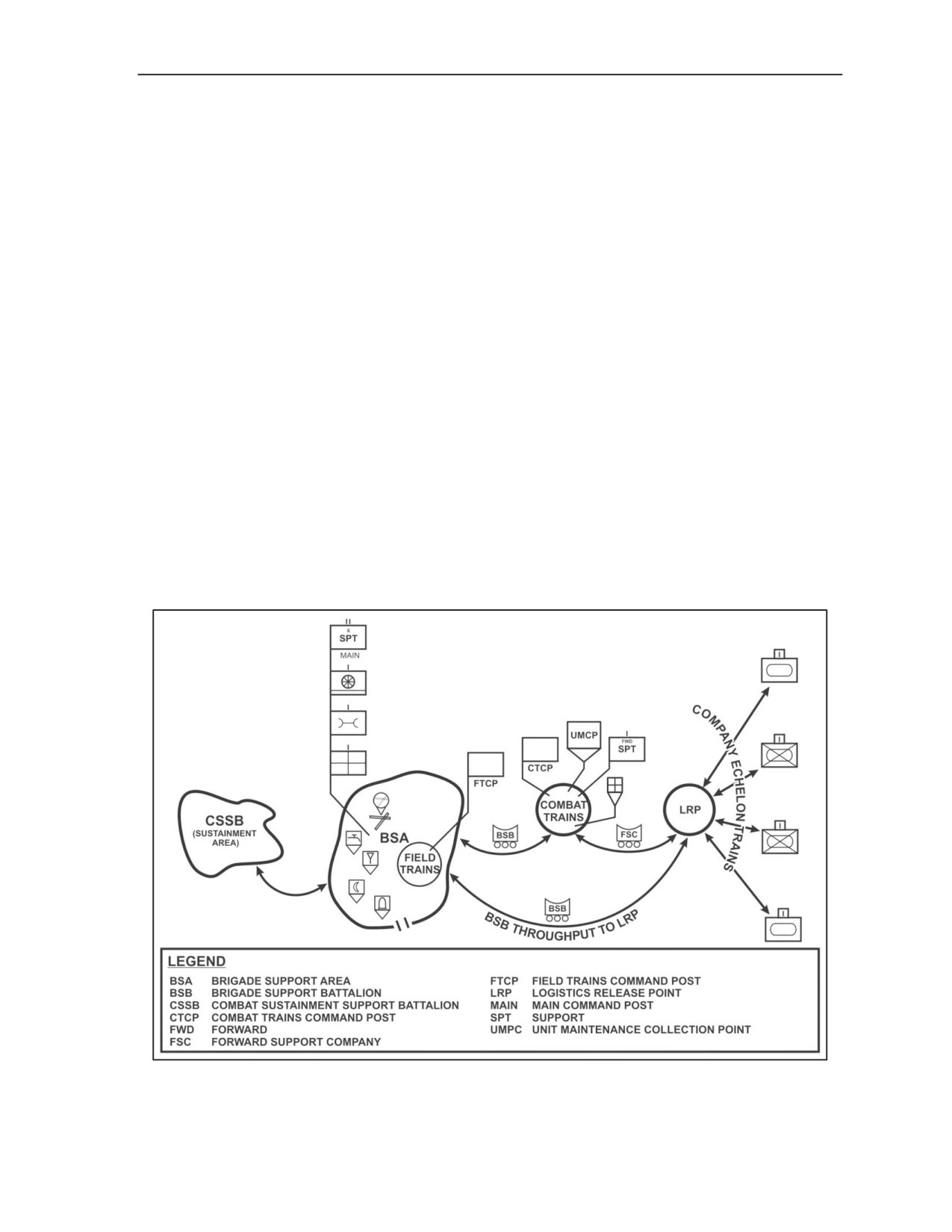
Sustainment
ECHELON OF SUPPORT
9-102. Echeloning support within the BCT is a carefully planned and executed process. The method
employed to echelon support is a deliberate, collaborative decision based upon a thorough mission analysis
within the military decisionmaking process. During this analysis, there must be an understanding at all levels
of the capabilities of each support organization within and supporting the BCT. Commanders must
understand that echeloned support will vary by BCT and each battalion or squadron. As the BCT’s primary
sustainment organization, the BSB’s organization facilitates echeloned support. Common echelon of support
at the lowest level of sustainment is executed at the battalion, squadron, company, battery, and troop echelons.
BCT echelon-specific ATPs address the methods of how each tactical echelon employs its echeloning of
support.
BATTALION AND SQUADRON ECHELONS
9-103. As discussed earlier, a FSC from the BSB supports each battalion and squadron in the BCT. The
FSC performs the logistics function within the battalion or squadron echelon of support, referred to as unit
trains in one location, or echeloned trains within an area of operation. Unit trains at the battalion or squadron
level are appropriate when the unit is consolidated in an assembly area, during reconstitution, major
movements, or when terrain or distances restrict movement causing the unit to depend on aerial resupply and
evacuation for support. The BCT normally operates in echeloned trains where subordinate unit trains employ
into multiple locations.
9-104. Echeloned trains at the battalion and squadron can be organized into combat trains and field trains.
Battalion and squadron trains are used to array subordinate sustainment elements (unit personnel, vehicles,
and equipment) including their designated FSC. The battalion or squadron commander and staff, the BSB
commander and staff, and the FSC commander collaborate to determine the best method of employment
commensurate with the BCT’s concept of support. Echeloning of support can include the battalion or
squadron aid station, elements of the S-1 section and S-4 section, and elements of the FSC. (See figure 9-1.)
Figure 9-1. Notional battalion concept of support
2FWREHU
FM 3-96
9-19
Chapter 9
Combat Trains
9-105. Combat trains usually consist of elements of the battalion or squadron S-1 section, S-4 section, and
aid station, the maintenance collection point and other selected elements of the forward support company.
Units consider the mission variables of METT-TC when locating combat trains in a battalion or squadron
support area. The maintenance collection point should be positioned where recovery vehicles have access, or
where major or difficult maintenance is performed. The combat trains must be mobile enough to support
frequent changes in location, time and terrain permitting, under the following conditions when—heavy use
or traffic in the area may cause detection, area becomes worn by heavy use such as in wet and muddy
conditions, security is compromised.
9-106. When established, the combat trains command post (CTCP) plans and coordinates sustainment
operations in support of the tactical operations. The CTCP serves as the focal point for all administrative and
logistical functions for the battalion or squadron. The CTCP may serve as an alternate command post for the
battalion or squadron main command post. The battalion or squadron S-4 usually serves as the CTCP, officer
in charge and the maintenance control officer usually serves as the maintenance collection point, officer in
charge. The headquarters and headquarters company (battery or troop) commander usually exercises mission
command for their respective CTCP. The CTCP serves the following functions:
z
Tracks the current battle.
z
Controls sustainment support to the current operation.
z
Provides sustainment representation to the main command post for planning and integration.
z
Monitors supply routes and controls the sustainment flow of materiel and personnel.
z
Coordinates evacuation of casualties, equipment, and detainees.
Field Trains
9-107. Field trains are positioned based on METT-TC considerations and often will be located in the
brigade support area. Field trains can be controlled by the headquarters or headquarters company (battery or
troop) commander or designated representative and include battalion or squadron sustainment assets not
located with the combat trains. Field trains can provide direct coordination between the battalion or squadron
and the BSB. When organized the field trains usually consist of the elements of the headquarters and
Headquarters Company (battery or troop) and the battalion or squadron S-1 and S-4 sections, and may include
FSC elements not located in the combat trains. Field trains personnel help facilitate the coordination and
movement of support from the BSB to the battalion or squadron. The battalion or squadron S-4 coordinates
all unit supply requests with the BCT S-4 and BSB. The BSB fills orders with on-hand stocked items through
unit distribution to the FSC, typically located at the combat trains. Requests for items not on-hand in the
brigade support area are forwarded to the BCT S-4.
9-108. When established, the field trains command post (FTCP) serves as the battalion or squadron
commander’s primary direct coordination element with the supporting BSB in the brigade support area. The
FTCP usually consists of the headquarters and headquarters company (battery or troop) executive officer and
first sergeant, an S-4 and S-1 representative, and supply sergeant or representative. The FTCP serves the
following functions:
z
Synchronizes and integrates the BCT concept of support.
z
Coordinates logistics requirements with the BSB support operations.
z
Configures logistical packages tailored to support requirements.
z
Coordinates with the BCT for personnel services and replacement operations.
z
Forecasts and coordinates future sustainment requirements.
z
Coordinates retrograde of equipment and personnel (casualty evacuation, personnel movement,
and human remains).
COMPANY, BATTERY, AND TROOP ECHELONS
9-109. Echeloning of support begins at the company (battery or troop) level. Companies (batteries or troops)
within the BCT have no organic logistics organizations. Echeloning support within these units, if required,
9-20
FM 3-96
2FWREHU
Sustainment
must be done with internal personnel and equipment used to facilitate or expedite logistics support within
these units.
9-110. The commander determines the composition of echeloned support, often referred to as company
(battery or troop) trains, and may consist of the first sergeant, supply sergeant, and medic. Maintenance teams
from the FSC may be included. This echeloned support expedites replenishment of subordinate elements
using either the supply point distribution or the unit distribution method. The operations order must described
the method used.
9-111. Supply point distribution requires unit representatives to move to a supply point to pick up their
supplies. Supply point distribution is commonly executed by means of a logistics release point. The logistics
release point may be any place on the ground where unit vehicles return to pick up supplies and then take
them forward to their unit. In unit distribution, supplies are configured in unit sets and delivered to one or
more central locations. Depending on the distribution method used, the first sergeant may send unit personnel
and vehicles to a logistics release point designated by the FSC (supply point distribution) or the first sergeant
may coordinate for the forward support company to deliver supplies to a location (unit distribution).
9-112. Within the company (battery or troop), the first sergeant will replenish company elements using
various methods depending on the situation. Unit elements may move from their positions to the designated
site to feed, resupply, or turn in damaged equipment. This is often referred to as a service station technique.
This method is normally used in assembly areas and when contact is not likely. This method takes the least
amount of time for the sustainment operators.
9-113. Conversely, the first sergeant may use unit or support personnel and vehicles to go to each element
to replenish them. Soldiers can remain in position when using this method. This method is the most lengthy
resupply method and may compromise friendly positions. This is often referred to as the tailgate technique
or the in-position resupply.
FORWARD LOGISTICS ELEMENT
9-114. A forward logistics element is comprised of task-organized multifunctional logistics assets designed
to support fast-moving offensive operations in the early phases of decisive action (ATP 4-90). The forward
logistics element operates out of a forward logistics base or support area. The forward logistics element
represents the BSB commander’s ability to weight the effort for the operation by drawing on all sustainment
assets across the BCT. Additionally, the BSB commander may coordinate with echelons above brigade to
provide support capabilities to augment the forward logistics element in the concept of support. This includes
identifying and the positioning of echelons above brigade unit assets in proximity to geographically dispersed
forces to extend operational reach and prolong endurance. The intent for employing a forward logistics
element is to minimize tactical pauses to the offensive plan and enable momentum for the commander.
ECHELONS ABOVE BRIGADE
9-115. Support organizations at echelons above brigade normally consist of the sustainment brigade,
combat sustainment support battalion, and medical support organizations. Identifying, planning for, and
requesting support from the sustainment brigade, combat sustainment support battalion, and medical support
organizations is critical prior to the start of an operation. Planners must ensure that the orders process is
coordinated with echelons above brigade to establish a support relationship, and that the information flow
reaches the elements providing the necessary support. (Refer to FM 3-94 for additional information.)
SUSTAINMENT BRIGADE
9-116. The sustainment brigade is a scalable, adjustable, networked brigade comprised of a headquarters,
and both functional and multifunctional subordinate sustainment units. The theater sustainment command
uses sustainment brigades, typically through expeditionary commands, to provide operational-level support
to corps or theater armies. Sustainment units are task-organized for various operations from the sustainment
brigade‘s combat sustainment support battalions. All sustainment brigades provide area support, although the
specific tasks assigned to them may differ. (See figure 9-2, page 9-22.)
2FWREHU
FM 3-96
9-21
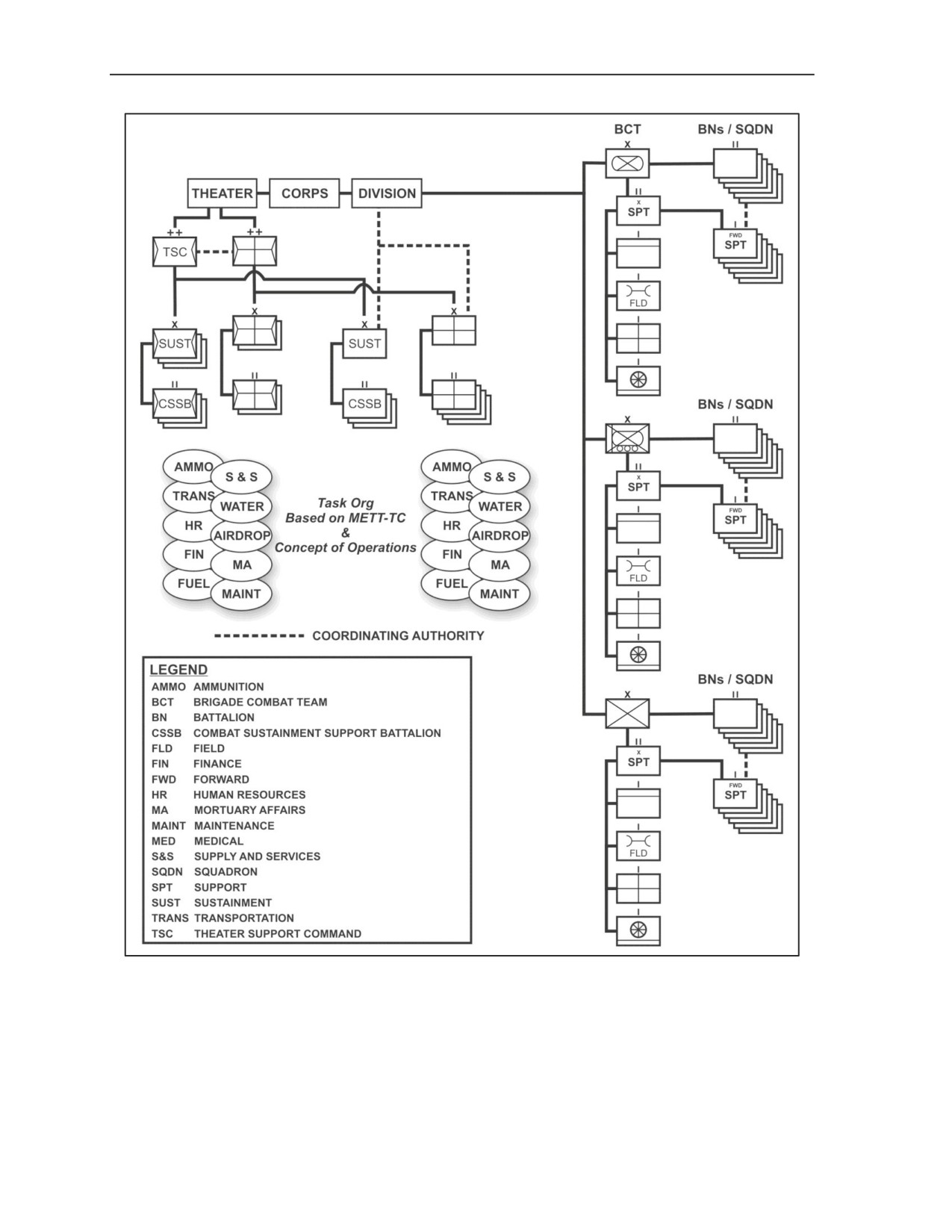
Chapter 9
Figure 9-2. Example of sustainment echelons above the BCT
9-117. The combat sustainment support battalion is the organization that normally provides replenishment
support to the BSB. The combat sustainment support battalions of the sustainment brigade are the base
organization from which sustainment units are task organized for various operations. The combat sustainment
support battalion subordinate elements consist of functional companies that provide supplies and services,
ammunition, fuel, transportation, and maintenance. The task organization of these companies is METT-TC
dependent. If required by the BCT, the combat sustainment support battalion will provide water purification,
petroleum storage, and transportation support in support of the BSB and its subordinate organizations. In this
9-22
FM 3-96
2FWREHU
Sustainment
instance, the combat sustainment support battalion will be task organized with a multi-capable supply
company and a composite truck company.
9-118. Combat sustainment support battalions provide the distribution link between theater aerial/sea ports
of debarkation and the BCT’s BSB. The structure includes cargo transfer and movement control assets,
performing the function of transporting commodities to and from the BCT BSB, and to/from repairing or
storage facilities at the theater base. Its function is to ensure and maintain the flow of replenishment using
expeditionary support packages, including retrograde of unserviceable components, end-items and supplies.
Personnel and financial management units assigned to the sustainment brigade’s special troops battalion
perform essential human resources and finance operations. The combat sustainment support battalion
coordinates with the sustainment brigade for financial management detachment support to its operations.
(Refer to ATP 4-93 for additional information.)
MEDICAL SUPPORT ORGANIZATIONS
9-119. Battalion medical platoons and the brigade support medical company provide health service support
and force health protection to BCTs. The theater Army has a medical command (deployment support) for
mission command of all medical units in a theater of operations at echelons above brigade. The medical
command (deployment support) provides subordinate medical organizations that operate under the medical
brigade and/or multifunctional medical battalion. The medical brigade provides a scalable expeditionary
medical capability for assigned and attached medical organizations that are task-organized to support BCTs
and echelons above brigade. The multifunctional medical battalion also provides medical mission command,
administrative assistance, logistical support, and technical supervision for assigned and attached companies
and detachments. The multifunctional medical battalion is assigned to the medical command (deployment
support) or medical brigade. The combat support hospital is also a battalion-size element assigned to the
medical command (deployment support) or medical brigade. (See Figure 9-2.)
SECTION IV - BRIGADE SUPPORT AREA
9-120. The brigade support area is the sustainment (logistics, medical, personnel, and administrative) node
for the BCT, and is the BSB’s terrain from which to conduct sustainment operations. It consists of the BSB
main command post (which can also serve as a BCT alternate command post if required), the brigade special
troops battalion units or brigade engineer battalion, signal assets, and other sustainment units from echelons
above brigade. The BSB commander is responsible for the mission command of all support organizations
within the brigade support area for terrain management and security unless otherwise stated by the operations
or fragmentary order. The BCT commander, with the support of his staff and upon the advice of the BSB
commander determine the control exercised by the BSB commander in governing the authority and
limitations of the BSB to execute area security within the brigade support area. Considerations used in
determining the authority and limitations of the BSB commander to execute area security within the brigade
support area are—threat levels and situation; utility of different locations; and civil considerations.
LOCATIONS FOR SUPPORT AREAS
9-121. The BSB commander, assisted by the BCT S-3 and S-4, recommends to the BCT commander the
layout of the brigade support area. Support areas should be located so that support to the BCT can be
maintained, but does not interfere with the tactical movement of BCT units or with units that must pass
through the BCT area, while still maximizing security. The brigade support area‘s size varies with terrain
and number of sustainment units. Usually the brigade support area is on a main supply route and out of the
range of the enemy‘s medium artillery. The brigade support area should be positioned away from the enemy‘s
likely avenues of approach and entry points into the BCT‘s main battle area.
9-122. In determining the location for the brigade support area, there is a constant balancing of support and
security, which ultimately determines the best placement of support areas. The BSB commander supports the
BCT while ensuring brigade support area security. The BSB commander integrates both activities so as to
not degrade the BCT’s combat effectiveness. The BSB commander must ensure logistics missions and
associated activities continue without restriction and that all units within or transiting the support area are
capable of conducting self-protection against a Level I threat.
2FWREHU
FM 3-96
9-23
Chapter 9
9-123. Threats in the BCT and higher echelon support areas are categorized by the three levels of defense
required to counter them. Any or all threat levels may exist simultaneously in these support areas. Emphasis
on defense and security measures depends on the anticipated threat level. A Level I threat is a small enemy
force that can be defeated by those units normally operating in the echelon support area or by the perimeter
defenses established by friendly bases and base clusters (ATP 3-91). A Level I threat for an echelon support
area or base camp consists of a squad-sized unit or smaller groups of enemy soldiers, agents, or terrorists.
Typical objectives for a Level I threat include supplying themselves from friendly supply stocks; disrupting
friendly mission command nodes and logistics areas; and interdicting friendly lines of communication.
9-124. A Level II threat is an enemy force or activities that can be defeated by a base or base cluster’s
defensive capabilities when augmented by a response force (ATP 3-91). A typical response force is a military
police platoon (with appropriate supporting fires) for an echelon support area or base camp; however, it can
be a combined arms maneuver element. Level II threats consist of enemy special operations teams, long-range
reconnaissance units, mounted or dismounted combat reconnaissance teams, and partially attrited small
combat units. Typical objectives for a Level II threat include the destruction, as well as the disruption, of
friendly mission command nodes and logistics and commercial facilities, and the interdiction of friendly lines
of communications.
9-125. A Level III threat is an enemy force or activities beyond the defensive capability of both the base
and base cluster and any local reserve or response force (ATP 3-91). It consists of mobile enemy combat
forces. Possible objectives for a Level III threat include seizing key terrain, interfering with the movement
and commitment of reserves and artillery, and destroying friendly combat forces. Its objectives could also
include destroying friendly sustainment facilities, supply points, command post facilities, airfields, aviation
assembly areas, arming and refueling points, and interdicting lines of communications and major supply
routes. The response (usually task organized at the division or corps level) to a Level III threat is a tactical
combat force, a combat unit, with appropriate combat support (maneuver support—Army) and combat
service support (sustainment—Army) assets, that is assigned the mission of defeating Level III threats (JP
3-10). (Refer to ATP 3-91 for additional information.)
9-126. Once positioned, echelon support areas should not be considered permanent or stationary. Support
areas (specifically echeloned trains) must be mobile to support the units when they move, and should change
locations frequently depending on available time and terrain. A change of location may occur with a change
of mission or change in a unit’s area of operation. Movement to a new location may be required to avoid
detection caused by heavy use or traffic in the area or an area becomes worn by heavy use (wet and muddy
conditions). Echeloned trains locations may need to change when security becomes lax or complacent due to
familiarity. (Refer to ATP 4-90 for additional information.) Support area location considerations include the
following:
z
Cover and concealment (natural terrain or man-made structures).
z
Room for dispersion.
z
Level, firm ground to support vehicle traffic and sustainment operations.
z
Suitable helicopter landing sites.
z
Distance from known or templated enemy indirect fire assets.
z
Good road or trail networks.
z
Good routes in and out of the area (preferably separate routes going in and going out).
z
Access to lateral routes.
z
Good access or positioned along the main supply route.
z
Positioned away from likely enemy avenues of approach.
OPERATIONAL AREA SECURITY
9-127. The BSB commander’s responsibility for operational area security includes the brigade support area
and extends to self-protection of BSB assets operating outside of the brigade support area. Forces engaged
in operational area security protect the force, installation, route, area, or asset. Although vital to the success
of military operations, operational area security is normally an economy-of-force mission, often designed to
ensure the continued conduct of sustainment operations and to support decisive and shaping operations by
generating and maintaining combat power. Operational area security may be the predominant method of
9-24
FM 3-96
2FWREHU
Sustainment
protecting support areas that are necessary to facilitate the positioning, employment, and protection of
resources required to sustain, enable, and control forces.
9-128. The BSB commander and staff must plan for and coordinate protection for subordinate units and
detachments located within and away from the BSB main command post. While the BSB S-3 is responsible
overall for developing the brigade support area security plan, the BSB S-2 assists by developing the
information collection plan to support intelligence operations, reconnaissance, surveillance, and security
operations within the brigade support area. The BSB commander uses the intelligence preparation of the
battlefield to analyze the mission variables of enemy, terrain, weather, and civil considerations to determine
their effect on sustainment operations.
9-129. Sustainment operations in noncontiguous areas of operation require commanders to emphasize
operational area security. Sustainment organizations are normally the least capable of self-defense against an
enemy force and are often the target of enemy action. As the threat increases, supported commanders and
sustainment unit commanders cannot decrease sustainment operations in favor of enhancing protection. The
supported commander and the sustainment unit commander must discuss what risks are reasonable to accept
and what risk mitigation measures they should implement based on requirements and priorities. Operational
area security within the brigade support area will include tasks such as terrain management, fire support
coordination, airspace control, and other security and protection activities including node protection, lines of
communications security, checkpoints (see FM 3-24.2), convoy security (see ATP 3-91 and ATP 4-01.45),
coordination of base camp and based cluster defense (see ATP 3-37.10), area damage control (see ATP 3-91), and
response force operations (see FM 3-39 and ATP 3-37.10).
9-130. As the enemy may avoid maneuver forces, preferring to attack targets commonly found in
sustainment areas. Sustainment elements must organize and prepare to defend themselves against ground or
air attacks. The security of the trains at each echelon is the responsibility of the individual in charge of the
echeloned trains. All elements in, or transiting the support area, assist with forming and defending the area.
Based on mission analyses, the BSB S-3 subdivides the area, and assigns subordinate and tenant units to
those subdivided areas. When a subordinate or tenant unit receives a change of mission or can no longer
occupy an assigned area, area adjustments are made to the support area by the BSB S-3. When a particular
supply point is sufficiently large, it may be assigned its own area for defense, and a security force may be
attached to provide security. (Refer to ADRP 3-37 for additional information.) Additional activities to enable
brigade support area security include:
z
Select sites that use available cover, concealment, and camouflage.
z
Use movement and positioning discipline, as well as noise and light discipline, to prevent detection.
z
Establish area defenses.
z
Establish observation posts and conduct patrols.
z
Position weapons (small arms, machine guns, and antitank weapons) for self-defense.
z
Plan mutually supporting positions to dominate likely avenues of approach.
z
Prepare a fire support plan.
z
Make area of operations sketches and identify sectors of fires.
z
Emplace target reference points to control fires.
z
Integrate available combat vehicles within the trains into the plan and adjust the plan when
vehicles depart.
z
Conduct rehearsals.
z
Establish rest plans.
z
Identify an alarm or warning system to enable rapid execution of the defense plan.
z
Designate a quick reaction force (see ATP 3-37.10) with appropriate fire support.
z
Ensure the reaction force is equipped to perform its mission.
z
Reaction force must be well rehearsed or briefed on—
Unit assembly.
Friendly and threat force recognition.
Actions on contact.
2FWREHU
FM 3-96
9-25
Chapter 9
SUPPLY ROUTES AND CONVOYS
9-131. The BCT S-4, in coordination with the BSB support operations officer and the BCT S-3, select
supply routes between echeloned support areas. Main supply routes are designated within the BCT‘s area of
operation. A main supply route is selected based on the terrain, friendly disposition, enemy situation, and
scheme of maneuver. Alternate supply routes are planned in the event that a main supply route is interdicted
by the enemy or becomes too congested. In the event of CBRN contamination, either the primary or the
alternate main supply route can be designated as the dirty main supply route to handle contaminated traffic.
Alternate supply routes should meet the same criteria as the main supply route. Military police may assist
with regulating traffic and the security of routes and convoys on those routes, and engineer units, if available,
can maintain routes. (Refer to ADRP 3-37 for additional information.) Main supply route considerations
include:
z
Location and planned scheme of maneuver for subordinate units.
z
Location and planned movements of other units moving through the BCT‘s area of operations.
z
Route classification, width, obstructions, steep slopes, sharp curves, and roadway surface.
z
Two-way, all-weather trafficability.
z
Classification of bridges and culverts. Location and planned scheme of maneuver for subordinate units.
z
Requirements for traffic control such as choke points, congested areas, confusing intersections, or
through built-up areas.
z
Location and number of crossover routes from the main supply route to alternate supply routes.
z
Requirements for repair, upgrade, or maintenance of the route, fording sites, and bridges.
z
Route vulnerabilities that must be protected, such as bridges, fords, built-up areas, and choke
points.
z
Enemy threats such as air attack, mines, ambushes, and CBRN attacks.
z
Known or likely locations of enemy penetrations, attacks, CBRN attacks, or obstacles.
z
Known or potential civilian and refugee movements that must be controlled or monitored.
9-132. Security of supply routes in a noncontiguous environment may require the BCT commander to
commit combat units. The security and protection of supply routes along with lines of communications are
critical to military operations since most support traffic moves along these routes. The security of supply
routes presents one of the greatest security challenges in an area of operation. Route security operations are
defensive in nature and are terrain-oriented. A route security force may prevent an enemy or adversary force
from impeding, harassing, or destroying traffic along a route or portions of a route by establishing a
movement corridor. Units conduct synchronized operations (mobility and information collection) within the
movement corridor. A movement corridor may be established in a high-risk area to facilitate the movement
of a single element, or it may be an enduring operation. (Refer to FM 3-90-2 for additional information.)
9-133. A convoy security operation is a specialized kind of area security operations conducted to protect
convoys. Units conduct convoy security operations anytime there are insufficient friendly forces to secure
routes continuously in an area of operations and there is a significant danger of enemy or adversary ground
action directed against the convoy. The commander may conduct convoy security operations in conjunction
with route security operations. Planning includes designating units for convoy security; providing guidance
on tactics, techniques, and procedures for units to provide for their own security during convoys; or
establishing protection and security requirements for convoys carrying critical assets. Local or theater policy
typically dictates when or which convoys receive security and protection. (Refer to ATP 4-01.45 for
additional information.)
9-26
FM 3-96
2FWREHU
Source Notes
These are the sources used for historical examples that are cited and quoted in this publication. They are listed by
paragraph number.
3-4
Wright, Donald P., Ph.D., ed. 16 Cases of Mission Command. US Army Combined Arms Center. Fort
Leavenworth, KS: Combat Studies Institute Press, 2013. Available online at
5-6
FM 3-98, Reconnaissance and Security Operations. Washington DC: Department of Defense, 1 July 2015.
Available online at https://armypubs.us.army.mil/doctrine/index.html.
6-2
Salinger, Jerry, Urban Warfare-The 2008 Battle for Sadr City. Rand Research Brief, RAND Arroyo Center.
Santa Monica, CA: 2012. Available online at
7-2
Kasserine Pass Battles. Readings, volume I. United States Army Center of Military History, United States
Army. Available online at http://www.history.army.mil/books/Staff-Rides/kasserine/kasserine.htm.
7-86
Esposito, Vincent, ed. West Point Atlas of American Wars. United States Military Academy, Department of
Military Art and Engineering. New York: Praeger, 1972.
7-88
Mossman, Billy C. Ebb and Flow, November 1950-July 1951. U.S. Army History of the Korean War
Series, volume 5. Washington, DC: Center of Military History, United States Army. Available online at
7-89
Appleman, Roy E., James M. Burns, Russell A. Gugeler, and John Stevens. The War in the Pacific,
Okinawa: The Last Battle. Washington, DC: Historical Division, Department of the Army, 1948. Available
2FWREHU
FM 3-96
Source Notes-1
This page intentionally left blank.
Glossary
The glossary lists acronyms and terms with Army or joint definitions. Where Army and joint
definitions differ, (Army) precedes the definition. Terms for which FM 3-96 is the proponent are
marked with an asterisk (*). The proponent publication for other terms is listed in parentheses after
the definition.
SECTION I - ACRONYMS AND ABBREVIATIONS
ABCT
armored brigade combat team
ADAM
air defense airspace management
ADAM/BAE
air defense airspace management/brigade aviation element
ASCOPE
areas, structures, capabilities, organizations, people, and events
BAE
brigade aviation element
BCS3
Battle Command Sustainment Support System
BCT
brigade combat team
BEB
brigade engineer battalion
BSB
brigade support battalion
BSMC
medical company (brigade support battalion)
BSTB
brigade special troops battalion
CBRN
chemical, biological, radiological, and nuclear
CBRNE
chemical, biological, radiological, nuclear, and high-yield explosives
CJCSM
Chairman of the Joint Chiefs of Staff manual
CTCP
combat trains command post
DLIC
detachment left in contact
FBCB2
Force XXI Battle Command, Brigade and Below
FSC
forward support company
FTCP
field trains command post
GCSS-Army
Global Combat Support System-Army
IBCT
infantry brigade combat team
JAGIC
joint air-ground integration center
JP
joint publication
JTAC
joint terminal attack controller
LOGSTAT
logistics status report
METT-TC
mission, enemy, terrain and weather, troops and support available, time
available, and civil considerations [mission variables] (Army)
MLRS
multiple launch rocket system
OAKOC
observation and fields of fire, avenues of approach, key terrain, obstacles, and
cover and concealment [military aspects of terrain]
2FWREHU
FM 3-96
Glossary-1
Glossary
PMESII-PT
political, military, economic, social, information, infrastructure, physical
environment, and time [operational variables]
S-1
battalion or brigade personnel staff officer
S-2
battalion or brigade intelligence staff officer
S-3
battalion or brigade operations staff officer
S-4
battalion or brigade logistics staff officer
S-6
Battalion or brigade signal staff officer
S-8
brigade financial management officer
S-9
battalion or brigade civil affairs operations staff officer
SBCT
Stryker brigade combat team
SOP
standard operating procedure
SOSRA
suppress, obscure, secure, reduce, and assault (breaching fundamentals)
TACP
tactical air control part
TCCC
tactical combat casualty care
WMD
weapons of mass destruction
XO
executive officer
SECTION II - TERMS
actions on contact
A series of combat actions often conducted simultaneously taken on contact with the enemy to develop the
situation. (ADRP 3-90)
administrative movement
A movement in which troops and vehicles are arranged to expedite their movement and conserve time and
energy when no enemy ground interference is anticipated. (FM 3-90-2)
adversary
A party acknowledged as potentially hostile to a friendly party and against which the use of force may be
envisaged. (JP 3-0)
air assault
The movement of friendly assault forces by rotary-wing aircraft to engage and destroy enemy forces or to
seize and hold key terrain. (JP 3-18)
air assault operation
An operation in which assault forces, using the mobility of rotary-wing assets and the total integration of
available firepower, maneuver under the control of a ground or air maneuver commander to engage enemy
forces or to seize and hold key terrain. (JP 3-18)
air movements
Operations involving the use of utility and cargo rotary-wing assets for other than air assaults. (FM 3-90-2)
airborne assault
The use of airborne forces to parachute into an objective area to attack and eliminate armed resistance and
secure designated objectives. (JP 3-18)
airborne operation
An operation involving the air movement into an objective area of combat forces and their logistic support
for execution of a tactical, operational, or strategic mission. (JP 3-18)
airspace management
The coordination, integration, and regulation of the use of airspace of defined dimensions. (JP 3-52)
Glossary-2
FM 3-96
2FWREHU
Glossary
alternate position
A defensive position that the commander assigns to a unit or weapon for occupation when the primary
position becomes untenable or unsuitable for carrying out the assigned task. (ADRP 3-90)
ambush
An attack by fire or other destructive means from concealed positions on a moving or temporarily halted
enemy. (FM 3-90-1)
approach march
The advance of a combat unit when direct contact with the enemy is intended. (ADRP 3-90)
area defense
A defensive task that concentrates on denying enemy forces access to designated terrain for a specific time
rather than destroying the enemy outright. (ADRP 3-90)
area of operation
An operational area defined by the joint force commander for land and maritime forces that should be large
enough to accomplish their missions and protect their forces. (JP 3-0)
area reconnaissance
A form of reconnaissance that focuses on obtaining detailed information about the terrain or enemy activity
within a prescribed area. (ADRP 3-90)
area security
A security task conducted to protect friendly forces, installations, routes, and actions within a specific area.
(ADRP 3-90)
area support
Method of logistics, medical support, and personnel services in which support relationships are determined
by the location of the units requiring support. Sustainment units provide support to units located in or
passing through their assigned areas. (ATP 4-90)
Army design methodology
A methodology for applying critical and creative thinking to understand, visualize, and describe unfamiliar
problems and approaches to solving them. (ADP 5-0)
art of command
The creative and skillful exercise of authority through timely decisionmaking and leadership. (ADP 6-0)
assessment
The determination of the progress toward accomplishing a task, creating a condition, or achieving an
objective. (JP 3-0)
attack
An offensive task that destroys or defeats enemy forces, seizes and secures terrain, or both. (ADRP 3-90)
backbrief
A briefing by subordinates to the commander to review how subordinates intend to accomplish their
mission. (FM 6-0)
battle position
A defensive location oriented on a likely enemy avenue of approach. (ADRP 3-90)
brigade support area
A designated area in which sustainment elements locate to provide support to a brigade. (ATP 4-90)
bypass criteria
Measures during the conduct of an offensive operation established by higher headquarters that specify the
conditions and size under which enemy units and contact may be avoided. (ADRP 3-90)
2FWREHU
FM 3-96
Glossary-3
Glossary
close area
In contiguous areas of operations, an area assigned to a maneuver force that extends from its subordinates’
rear boundaries to its own forward boundary. (ADRP 3-0)
close combat
Warfare carried out on land in a direct firefight, supported by direct and indirect fires, and other assets.
(ADRP 3-0)
combat formation
An ordered arrangement of forces for a specific purpose and describes the general configuration of a unit
on the ground. (ADRP 3-90)
combat outpost
A reinforced observation post capable of conducting limited combat operations. (FM 3-90-2)
command post
A unit headquarters where the commander and his staff perform their activities. (FM 6-0)
command post cell
A grouping of personnel and equipment organized by warfighting function or by planning horizon to
facilitate the exercise of mission command. (FM 6-0)
commander’s intent
A clear and concise expression of the purpose of the operation and the desired military end state that
supports mission command, provides focus to the staff, and helps subordinate and supporting commanders
act to achieve the commander’s desired results without further orders, even when the operation does not
unfold as planned. (JP 3-0)
complex terrain
A geographical area consisting of an urban center larger than a village and/or of two or more types of
restrictive terrain or environmental conditions occupying the same space. (ATP 3-34.80)
*concealment
Protection from observation or surveillance.
concept of operations
(Army) A statement that directs the manner in which subordinate units cooperate to accomplish the mission
and establishes the sequence of actions the force will use to achieve the end state. (ADRP 5-0)
confirmation brief
A briefing subordinate leaders give to the higher commander immediately after the operation order is
given. It is their understanding of his intent, their specific tasks, and the relationship between their mission
and the other units in the operation. (ADRP 5-0)
contiguous area of operations
Where all a commander’s subordinate forces’ areas of operations share one or more common boundaries.
(FM 3-90-1)
control measure
A means of regulating forces or warfighting functions. (ADRP 6-0)
cordon and search
A technique of conducting a movement to contact that involves isolating a target area and searching
suspected locations within that target area to capture or destroy possible enemy forces and contraband.
(FM 3-90-1)
counterattack
An attack by part or all of a defending force against an enemy attacking force, for such specific purposes as
regaining ground lost, or cutting off or destroying enemy advance units, and with the general objective of
denying to the enemy the attainment of the enemy’s purpose in attacking. In sustained defensive operations,
it is undertaken to restore the battle position and is directed at limited objectives. (FM 3-90-1)
Glossary-4
FM 3-96
2FWREHU
Glossary
counterreconnaissance
A tactical mission task that encompasses all measures taken by a commander to counter enemy
reconnaissance and surveillance efforts. Counterreconnaissance is not a distinct mission, but a component
of all forms of security operations. (FM 3-90-1)
*cover
Protection from the effects of fires.
cover
A security task to protect the main body by fighting to gain time while also observing and reporting
information and preventing enemy ground observation of and direct fire against the main body.
(ADRP 3-90)
covering force
Self-contained force capable of operating independently of the main body, unlike a screening or guard
force, to conduct the cover task. (FM 3-90-2)
covering force area
The area forward of the forward edge of the battle area out to the forward positions initially assigned to the
covering force. It is here that the covering force executes assigned tasks. (FM 3-90-2)
cyber electromagnetic activities
Activities leveraged to seize, retain, and exploit an advantage over adversaries and enemies in both
cyberspace and the electromagnetic spectrum, while simultaneously denying and degrading adversary and
enemy use of the same and protecting the mission command system. (ADRP 3-0)
decisive action
The continuous, simultaneous combinations of offensive, defensive, and stability or defense support of civil
authorities tasks. (ADRP 3-0)
decisive operation
The operation that directly accomplishes the mission. (ADRP 3-0)
deep area
In contiguous areas of operations, an area forward of the close area that a commander uses to shape enemy
forces before they are encountered or engaged in the close area. (ADRP 3-0)
defensive task
A task conducted to defeat an enemy attack, gain time, economize forces, and develop conditions favorable
for offensive or stability tasks. (ADRP 3-0)
delaying operation
An operation in which a force under pressure trades space for time by slowing down the enemy’s
momentum and inflicting maximum damage on the enemy without, in principle, becoming decisively
engaged. (JP 3-04)
demonstration
A show of force in an area where a decision is not sought that is made to deceive an adversary. It is similar
to a feint but no actual contact with the adversary (Army uses the term enemy instead of adversary) is
intended. (JP 3-13.4)
disengage
A tactical mission task where a commander has his unit break contact with the enemy to allow the conduct
of another mission or to avoid decisive engagement. (FM 3-90-1)
disengagement line
A phase line located on identifiable terrain that, when crossed by the enemy, signals to defending elements
that it is time to displace to their next position. (ADRP 3-90)
double envelopment
Results from simultaneous maneuvering around both flanks of a designated enemy force. (FM 3-90-1)
2FWREHU
FM 3-96
Glossary-5
Glossary
echelon support
The method of supporting an organization arrayed within an area of operation. (ATP 4-90)
encirclement operations
Operations where one force loses its freedom of maneuver because an opposing force is able to isolate it by
controlling all ground lines of communication and reinforcement. (ADRP 3-90)
enemy
A party acknowledged as potentially hostile to a friendly party and against which the use of force may be
envisaged. (JP 3-0)
engagement criteria
Protocols that specify those circumstances for initiating engement with an enemy force. (FM 3-90-1)
envelopment
A form of maneuver in which an attacking force seeks to avoid the principal enemy defenses by seizing
objectives behind those defenses that allow the targeted enemy force to be destroyed in their current
positions. (FM 3-90-1)
execution
Putting a plan into action by applying combat power to accomplish the mission. (ADP 5-0)
exploitation
An offensive task that usually follows a successful attack and is designed to disorganize the enemy
in-depth. (ADRP 3-90)
feint
Military deception is an offensive action involving contact with the adversary (Army uses the term enemy
instead of adversary) conducted for the purpose of deceiving the adversary as to the location and time of
the actual main offensive action. (JP 3-13.4)
*fire and movement
The concept of applying fires from all sources to suppress, neutralize, or destroy the enemy, and the tactical
movement of combat forces in relation to the enemy (as components of maneuver applicable at all
echelons). At the squad level, fire and movement entails a team placing suppressive fire on the enemy as
another team moves against or around the enemy.
fire support
Fires that directly support land, maritime, amphibious, and special operations forces to engage enemy
forces, combat formations, and facilities in pursuit of tactical and operational objectives. (JP 3-09)
fires
The use of weapons systems to create a specific lethal or nonlethal effect on a target. (JP 3-0)
flank attack
A form of offensive maneuver directed at the flank of an enemy. (FM 3-90-1)
forward logistics element
Element comprised of task-organized multifunctional logistics assets designed to support fast-moving
offensive operations in the early phases of decisive action. (ATP 4-90)
frontal attack
A form of maneuver in which an attacking force seeks to destroy a weaker enemy force or fix a larger
enemy force in place over a broad front. (FM 3-90-1)
governance
The state’s ability to serve the citizens through the rules, processes, and behavior by which interests are
articulated, resources are managed, and power is exercised in a society, including the representative
participatory decision-making processes typically guaranteed under inclusive, constitutional authority.
(JP 3-24)
Glossary-6
FM 3-96
2FWREHU
Glossary
graphic control measure
A symbol used on maps and displays to regulate forces and warfighting functions. (ADRP 6-0)
guard
A security task to protect the main body by fighting to gain time while also observing and reporting
information and preventing enemy ground observation of and direct fire against the main body. Units
conducting a guard mission cannot operate independently because they rely upon fires and functional and
multifunctional support assets of the main body. (ADRP 3-90)
health services support
Encompasses all support and services performed, provided, and arranged by the Army Medical Department
to promote, improve, conserve, or restore the mental and physical well-being of personnel in the Army.
Additionally as directed, provide support to other Services, agencies and organizations. This includes
casualty care, (encompassing a number of Army Medical Department functions—organic and area medical
support, hospitalization, the treatment aspects of dental care and behavioral/neuropsychiatric treatment,
clinical laboratory services, and treatment of chemical, biological, radiological, and nuclear patients)
medical evacuation, and medical logistics. (FM 4-02)
high-value target
A target the enemy commander equires for the successful completion of the mission. (JP 3-60)
hybrid threat
The diverse and dynamic combination of regular forces, irregular forces, terrorist forces, and criminal
elements unified to achieve mutually benefitting effects. (ADRP 3-0)
infiltration
A form of maneuver in which an attacking force conducts undetected movement through or into an area
occupied by enemy forces to occupy a position of advantage behind those enemy positions while exposing
only small elements to enemy defensive fires. (FM 3-90-1)
information collection
An activity that synchronizes and integrates the planning and employment of sensors and assets as well as
the processing, exploitation, and dissemination of systems in direct support of current and future
operations. (FM 3-55)
information management
The science of using procedures and information systems to collect, process, store, display, disseminate,
and protect data, information, and knowledge products. (ADRP 6-0)
information-related capabilities
Tools, techniques, or activities employed within a dimension of the information environment that can be
used to create effects and operationally desired conditions. (JP 3-13)
information system
Equipment that collects, processes, stores, displays, and disseminates information. This includes computers,
hardware and software, and communications, as well as policies and procedures for their use. (ADP 6-0)
integration
The arrangement of military forces and their actions to create a force that operates by engaging as a whole.
(JP 1)
interdiction
An action to divert, disrupt, delay, or destroy the enemy’s military surface capability before it can be used
effectively against friendly forces, or to otherwise achieve objectives. (JP 3-03)
intelligence analysis
The process by which collected information is evaluated and integrated with existing information to
facilitate intelligence production. (ADRP 2-0)
2FWREHU
FM 3-96
Glossary-7
Glossary
intelligence operations
The tasks undertaken by military intelligence units and Soldiers to obtain information to satisfy validated
requirements. (ADRP 2-0)
intelligence synchronization
The “art” of integrating information collection and intelligence analysis with operations to effectively and
efficiently support decisionmaking. (ADRP 2-0)
key terrain
Any locality, or area, the seizure or retention of which affords a marked advantage to either combatant.
(JP 2-01.3)
knowledge management
The process of enabling knowledge flow to enhance shared understanding, learning, and decisionmaking.
(ADRP 6-0)
LandWarNet
The Army’s portion of the Department of Defense Information Networks. It is a technical network that
encompasses all Army information management systems and information systems that collect, process,
store, display, disseminate, and protect information worldwide. (FM 6-02)
Level I threat
A small enemy force that can be defeated by those units normally operating in the echelon support area or
by the perimeter defenses established by friendly bases and base clusters. (ATP 3-91)
Level II threat
An enemy force or activities that can be defeated by a base or base cluster’s defensive capabilities when
augmented by a response force. (ATP 3-91)
Level III threat
An enemy force or activities beyond the defensive capability of both the base and base cluster and any local
reserve or response force. (ATP 3-91)
local security
A security task that includes low-level security activities conducted near a unit to prevent surprise by the
enemy. (ADRP 3-90)
logistics
Planning and executing the movement and support of forces. It includes those aspects of military operations
that deal with: design and development, acquisition, storage, movement, distribution, maintenance,
evacuation, and disposition of materiel; acquisition or construction, maintenance, operation, and disposition
of facilities; and acquisition or furnishing of services. (ADP 4-0)
main battle area
The area where the commander intends to deploy the bulk of the unit’s combat power and conduct decisive
operations to defeat an attacking enemy. (ADRP 3-90)
main command post
A facility containing the majority of the staff designed to control current operations, conduct detailed
analysis, and plan future operations. (FM 6-0)
main effort
A designated subordinate unit whose mission at a given point in time is critical to overall mission success.
(ADRP 3-0)
maneuver
The employment of forces in the operational area through movement in combination with fires to achieve a
position of advantage in respect to the enemy. (JP 3-0)
massed fire
Fire from a number of weapons directed at a single point or small area. (JP 3-02)
Glossary-8
FM 3-96
2FWREHU
Glossary
meeting engagement
A combat action that occurs when a moving force, incompletely deployed for battle, engages an enemy at
an unexpected time and place. (FM 3-90-1)
military decisionmaking process
An iterative planning methodology to understand the situation and mission, develop a course of action, and
produce an operation plan or order. (ADP 5-0)
mission
The task, together with the purpose, that clearly indicates the action to be taken and the reason therefore.
(JP 3-0)
mission command
The exercise of authority and direction by the commander using mission orders to enable disciplined
initiative within the commander’s intent to empower agile and adaptive leaders in the conduct of unified
land operations. (ADP 6-0)
mission command warfighting function
The related tasks and systems that develop and integrate those activities enabling a commander to balance
the art of command and the science of control in order to integrate the other warfighting functions.
(ADRP 3-0)
mission orders
Directives that emphasize to subordinates the results to be attained, not how they are to achieve them.
(ADP 6-0)
mission statement
A short sentence or paragraph that describes the organization’s essential task(s), purpose, and action
containing the elements of who, what, when, where, and why. (JP 5-0)
mission variables
The categories of specific information needed to conduct operations. (ADP 1-01)
mobile defense
A defensive task that concentrates on the destruction or defeat of the enemy through a decisive attack by a
striking force. (ADRP 3-90)
movement to contact
An offensive task designed to develop the situation and establish or regain contact. (ADRP 3-90)
mutual support
That support which units render each other against an enemy, because of their assigned tasks, their position
relative to each other and to the enemy, and their inherent capabilities. (JP 3-31)
neutral
A party identified as neither supporting nor opposing friendly or enemy forces. (ADRP 3-0)
noncontiguous area of operations
Where one or more of the commander’s subordinate force’s areas of operation do not share a common
boundary. (FM 3-90-1)
offensive task
Task conducted to defeat and destroy enemy forces and seize terrain,resources, and population centers.
(ADRP 3-0)
operational approach
A description of the broad actions the force must take to transform current conditions into those desired at
end state. (JP 5-0)
2FWREHU
FM 3-96
Glossary-9