FM 3-96 BRIGADE COMBAT TEAM (OCTOBER 2015) - page 4
Chapter 6
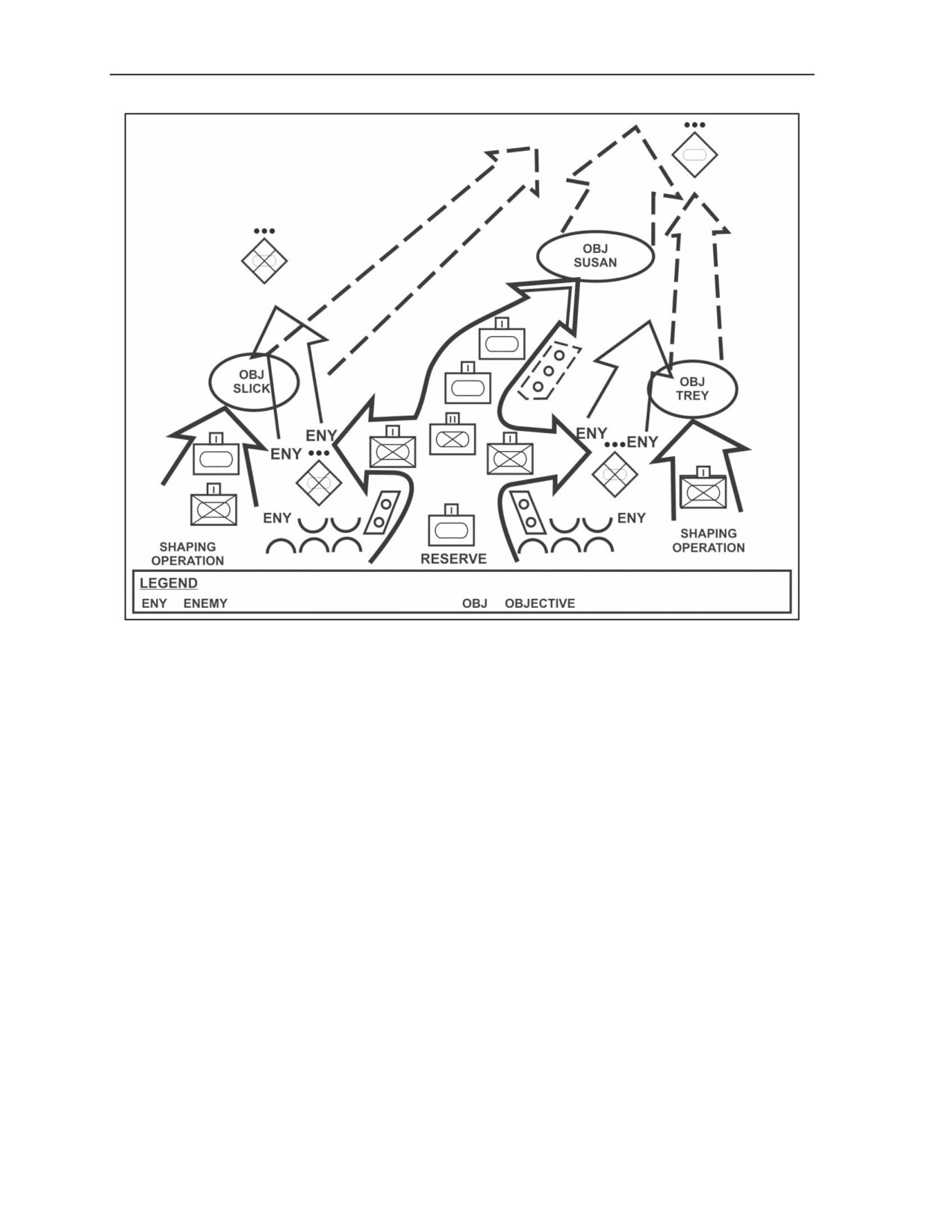
Figure 6-8. Expanding the penetration
FLANK ATTACK
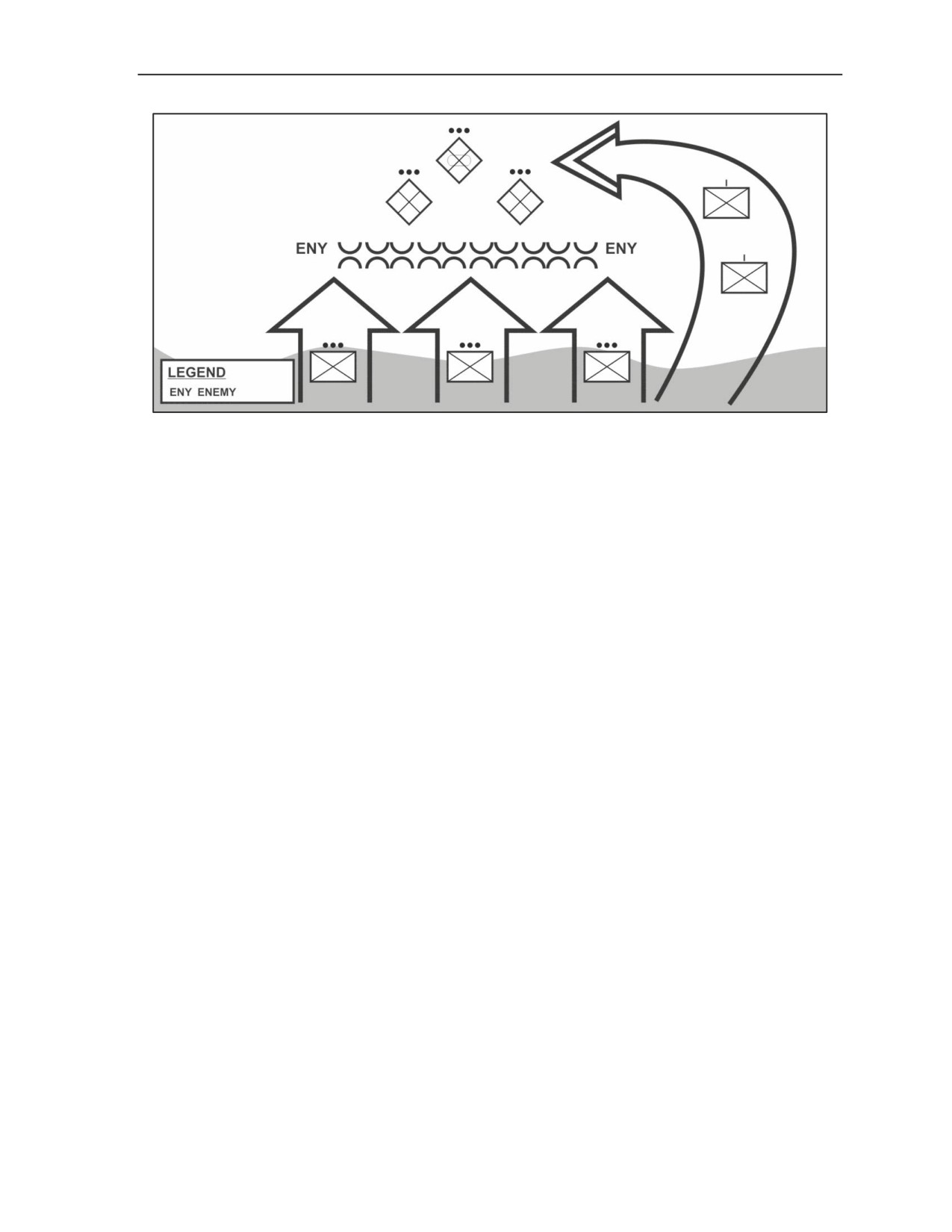
6-112. A flank attack is a form of offensive maneuver directed at the flank of an enemy (FM 3-90-1). A
flank attack is designed to defeat the enemy force while minimizing the effect of the enemy‘s frontal
orientation. BCTs conduct flanking attacks with the main effort directed at the enemy’s flank. Usually, a
supporting effort engages the enemy‘s front by fire and movement while the main effort maneuvers to attack
the enemy‘s flank. This supporting effort diverts the enemy‘s attention from the threatened flank.
6-113. Depth is the primary difference between a flank attack and an envelopment. A flank attack is an
envelopment delivered squarely on the enemy's flank. Conversely, envelopment is an attack delivered beyond
the enemy's flank and into the enemy’s support areas, but short of the depth associated with a turning
movement. Commanders often use a flank attack for a hasty attack or meeting engagement where speed and
simplicity are paramount to maintaining battle tempo and ultimately, the initiative. Smaller-sized tactical
units, such as maneuver battalions, companies, and platoons are more likely to conduct flank attacks. (See
figure 6-9.)
6-114. The commander establishes boundaries to designate the area of operations for each unit participating
in the flank attack. He designates control measures, such as phase lines, support-by-fire and attack-by-fire
positions, contact points, and appropriate fire support coordination measures, such as a restricted fire line or
boundary between converging forces, to control the flank attack. (Refer to FM 3-90-1 for additional information.)
6-26
FM 3-96
2FWREHU
Offense
Figure 6-9. Flank attack
FRONTAL ATTACK
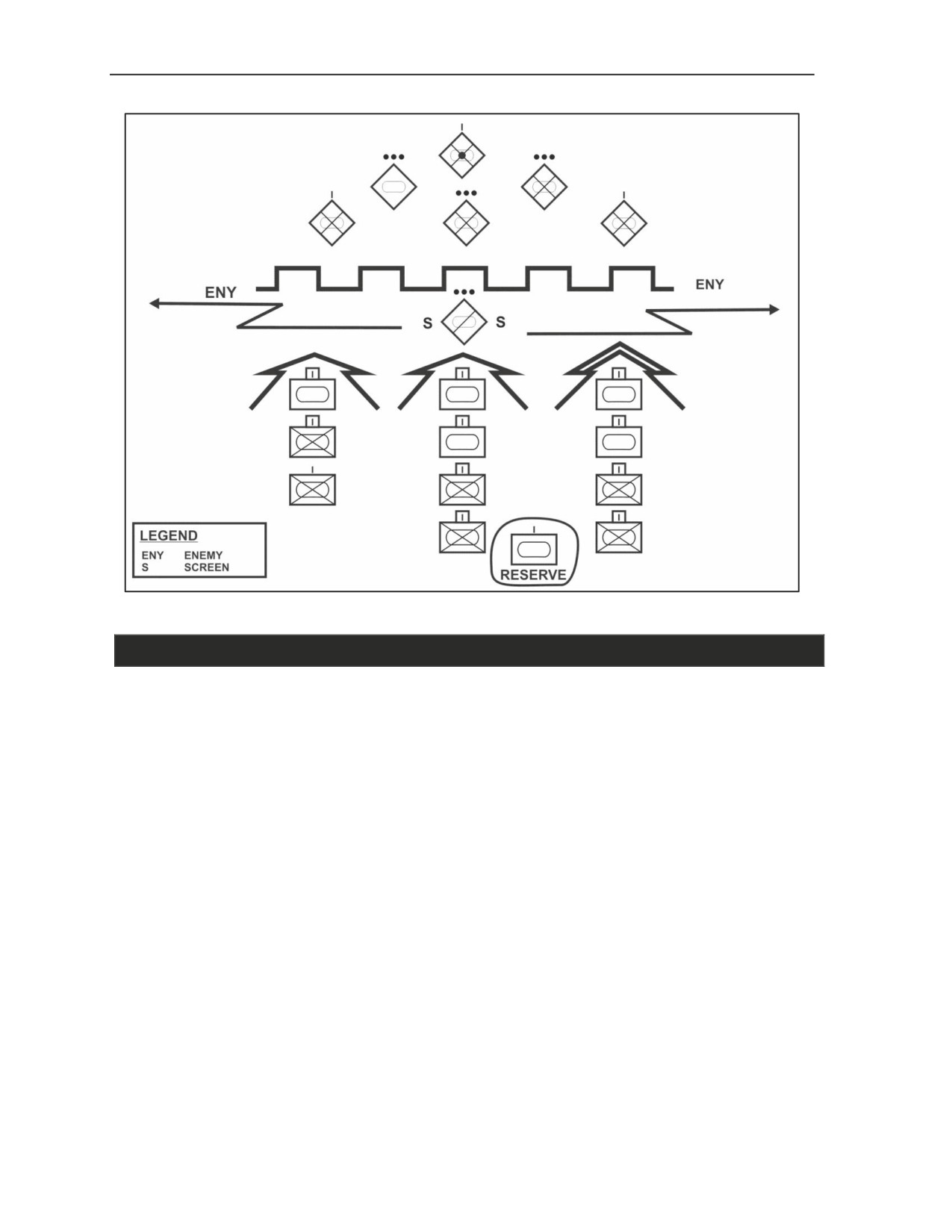
6-115. A frontal attack is a form of maneuver in which an attacking force seeks to destroy a weaker enemy
force or fix a larger enemy force in place over a broad front (FM 3-90-1). The BCT commander uses a frontal
attack as a shaping operation in conjunction with other forms of maneuver. The commander employs a frontal
attack to clear enemy security forces, overwhelm a depleted enemy during an exploitation or pursuit, and to
fix enemy forces in place. The BCT commander conducts a frontal attack when assailable flanks do not exist.
While a penetration is a sharp attack designed to rupture the enemy position, the BCT commander designs a
frontal attack to maintain continuous pressure along the entire front until either a breach occurs or the
attacking forces succeed in pushing back the enemy. Frontal attacks conducted without overwhelming
combat power are seldom decisive. (See figure 6-10, page 6-28.)
6-116. A unit conducting a frontal attack normally has a wider area of operation than a unit conducting a
penetration does. A commander conducting a frontal attack may not require any additional control measures
beyond those established to control the overall mission. Control measures include an area of operation
defined by unit boundaries, and an objective, at a minimum. The commander uses other control measures
necessary to control the attack, including attack positions, lines of departure, phase lines, assault positions,
limits of advance, and direction or axis of advance for every maneuver unit. (Refer to FM 3-90-1 for
additional information.)
2FWREHU
FM 3-96
6-27
Chapter 6
Figure 6-10. Frontal attack
SECTION IV - OFFENSIVE TASKS
6-117. The BCT conducts offensive tasks to defeat and destroy enemy forces and seize terrain, resources,
and population centers (ADRP 3-0). Offensive tasks are movement to contact, attack, exploitation, and
pursuit. BCTs conduct operations according to the capabilities and limitations inherent in their
organizational structure.
MOVEMENT TO CONTACT
6-118. A movement to contact is an offensive task designed to develop the situation and establish or regain
contact (ADRP 3-90). A movement to contact employs movement, decentralized control, and the hasty
deployment of combined arms formations from the march to create favorable conditions for subsequent
tactical actions. A movement to contact may result in a meeting engagement. A meeting engagement is a
combat action that occurs when a moving force, incompletely deployed for battle, engages an enemy at an
unexpected time and place (FM 3-90-1).
6-119. The BCT commander considers requirements for maneuver (fire and movement) upon contact. The
force making contact seeks to make contact with the smallest element possible to avoid decisive engagement
with the main body. Once the commander makes contact with the enemy, the commander has five options:
attack, defend, bypass, defend, delay, or withdraw (see paragraph 6-136). Search and attack and cordon and
search are subordinate tasks of movement to contact. See FM 3-90-1 for a discussion of search and attack.
See ATP 3-06.20 for a discussion of cordon and search.
ORGANIZATION OF FORCES
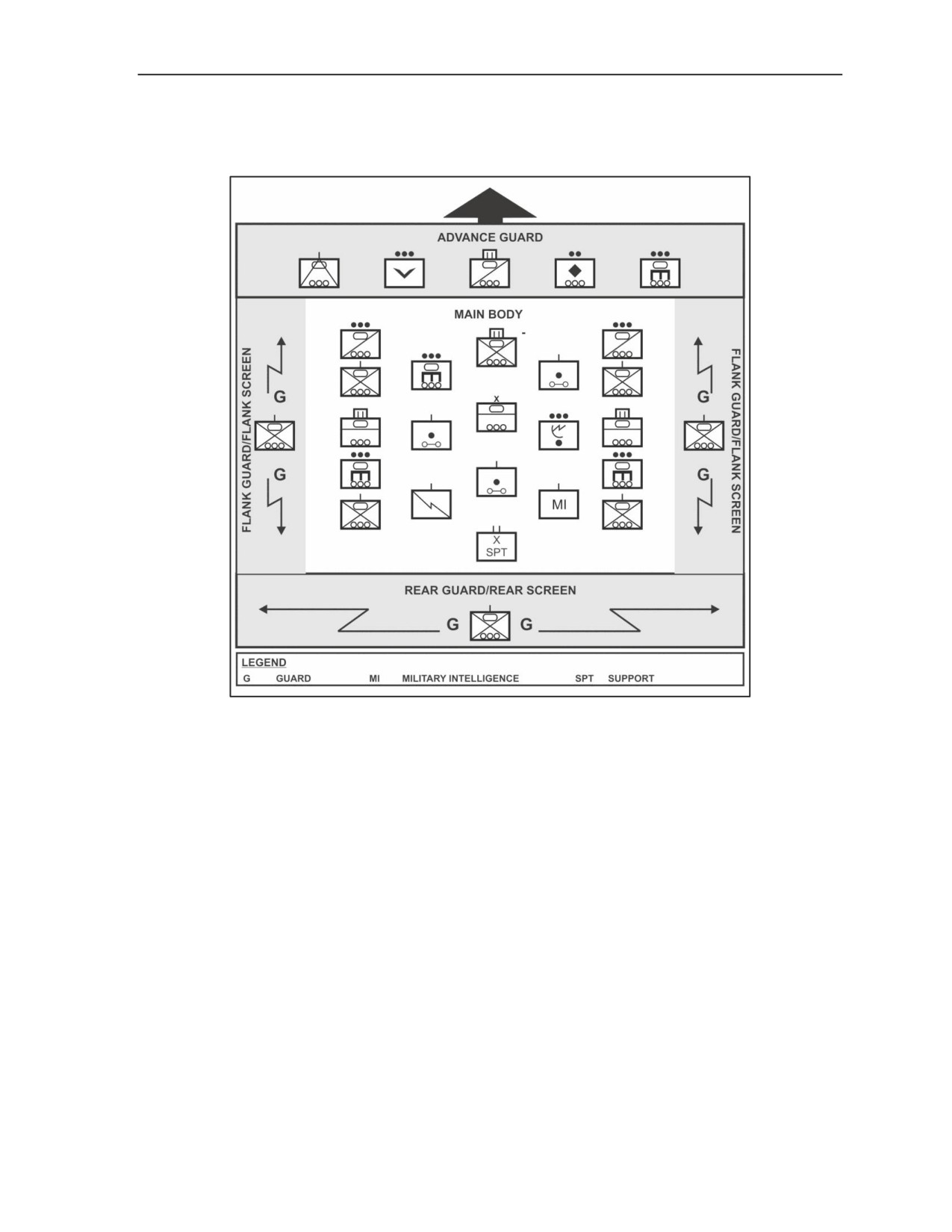
6-120. The BCT commander organizes his forces into security forces and a main body in a movement to
contact. A maneuver battalion organizes its forces the same as the BCT when conducting a movement to
6-28
FM 3-96
2FWREHU
Offense
contact independently. When the battalion moves as part of the BCT, a maneuver battalion moves as part of
the main body or with the requisite attachments may be part of the security force. The cavalry squadron
normally moves as part of the security force (See figure 6-11).
Figure 6-11. Organization of forces for a movement to contact
Security Forces
6-121. The security forces for a BCT conducting a movement to contact, normally consists of the advance
guard and, if required, flank and rear security forces. The advance guard has sufficient forces to protect the
main body from surprise attack. The positioning of flank and rear forces depends on the proximity of friendly
units to the flank or rear and to the enemy.
Advance Guard
6-122. An advance guard is a task-organized combined arms unit that precedes the main body and provides
early warning, reaction time, and maneuver space. The BCT organizes an advance guard to lead the BCT
with or without a covering force from a higher echelon. When a covering force from a higher echelon is
employed forward of the BCT, the advance guard maintains contact with the covering force. The advance
guard requires anti-armor and engineer support and remains within range of the main body’s indirect fire
systems. The advance guard reduces obstacles to create passage lanes, repairs roads and bridges, and locates
bypasses. For obstacles not covered by fire, the advance guard can either seek a bypass or create the required
number of lanes to support its maneuver or the maneuver of a supported unit’s maneuver. For obstacles
covered by fire, the unit can either seek a bypass or conduct a breaching operation.
6-123. The advance guard fixes the enemy to protect the deployment of the main body when the main body
commits to action. The advance guard forces the enemy to withdraw, or destroys small enemy groups before
they can disrupt the advance of the main body. When the advance guard encounters large enemy forces or
2FWREHU
FM 3-96
6-29
Chapter 6
heavily defended areas, it takes prompt and aggressive action to develop the situation and, within its
capability, defeat the enemy. The commander reports the location, strength, disposition, and composition of
the enemy and tries to find the enemy's flanks, gaps, or other weaknesses in his position.
Covering Force
6-124. A covering force’s mission is to protect the main body, provide early warning, reaction time, and
maneuver space before committing the main body. The covering force is task organized to accomplish tasks
independent of the main body. The covering force commander reports directly to the establishing commander
(division or corps). The BCT normally does not have the organic resources or capabilities to establish a
covering force. A covering force, if established, moves well ahead of the BCT’s advance guard and usually
beyond the main body’s fire support range. (See FM 3-90-1 for additional information on the covering force.)
Flank and Rear Security
6-125. The BCT establishes flank and rear security elements when their flanks or security area are
unprotected. The BCT may use cavalry organizations for flank security, or main body forces may provide
flank and rear security forces.
Main Body
6-126. The bulk of the BCT’s combat power is in the main body. The main body follows the advance guard
and keeps enough distance between itself and the advance guard to maintain flexibility. The BCT commander
may designate a portion of the main body as the reserve.
6-127. After the security force makes contact, the BCT commander receives information from the security
force in contact. Based upon that information the commander directs a course of action consistent with the
higher commander's intent and within the main body's capability. Elements of the main body initiate direct
and indirect fires to gain the initiative. The commander emplaces fires assets to respond immediately to calls
for fire.
6-128. A portion of the main body composes the BCT commander’s sustaining base. The commander tailors
the sustainment base to the mission. He decentralizes the execution of sustainment support, but that support
must be continuously available to the main body. Sustainment support includes using preplanned
logistics packages.
PLANNING
6-129. The BCT plans for a movement to contact in the same manner as any offensive tasks, however, time
to plan may be constrained. Planning for a movement to contact begins with a thorough understanding of the
area of operation through a detailed intelligence preparation of the battlefield. The BCT commander and staff
develop and execute the operations order information collection (Annex L) to the operations order in
collaboration with the cavalry squadron, military intelligence company, and other security force assets.
Collaborating with the cavalry squadron, military intelligence company, and security force assets helps to
synchronize the information collection effort and allows the main body to focus on the movement to
contact conduct.
6-130. The BCT intelligence staff officer and S-2 section develop feasible threat courses of action that
address all aspects of the enemy’s potential capabilities. The S-2 section, assisted by BCT engineer and air
defense staff representatives, analyzes the terrain to include enemy air avenues of approach. The plan
addresses actions the commander anticipates based upon available information and intelligence, and probable
times and locations of enemy engagements.
6-131. BCT reconnaissance and security forces detect the enemy; then confirms or denies the enemy’s
presence making contact with the enemy using the smallest elements possible. A successful information
collection effort integrates reconnaissance and security forces with human intelligence collection operations,
signals intelligence collection, target acquisition assets, and aerial reconnaissance and surveillance (manned
and unmanned) assets. The BCT commander may task organize reconnaissance and security forces with
additional combat power allowing them to develop the situation on contact with the enemy. Additional
6-30
FM 3-96
2FWREHU
Offense
combat power may include Abram tanks, Bradley fighting vehicles, Stryker vehicles, SBCT mobile gun
systems, SBCT antiarmor or infantry weapons companies, or an infantry rifle company. The unit’s planned
movement formation should contribute to the goal of making initial contact with the smallest force possible
and provide for efficient movement of the force.
6-132. The commander directs the establishment of decision points, branches, and sequels based upon the
commander’s critical information requirements to ensure flexibility in the plan. The commander controls the
movement to contact by using control measures to provide the flexibility needed to respond to changes in the
situation and to allow the commander to rapidly concentrate combat power at the decisive point.
6-133. The commander may task a forward security force to conducting zone reconnaissance where the
main body is to traverse. Based on the commander’s decision points, the security force conducts
reconnaissance or target handover with the main body to maintain contact with the enemy. This handover
allows the BCT to manage transitions between phases of the operation, or follow-on tasks and allows the
security force to conduct tasks that support the BCT scheme of maneuver.
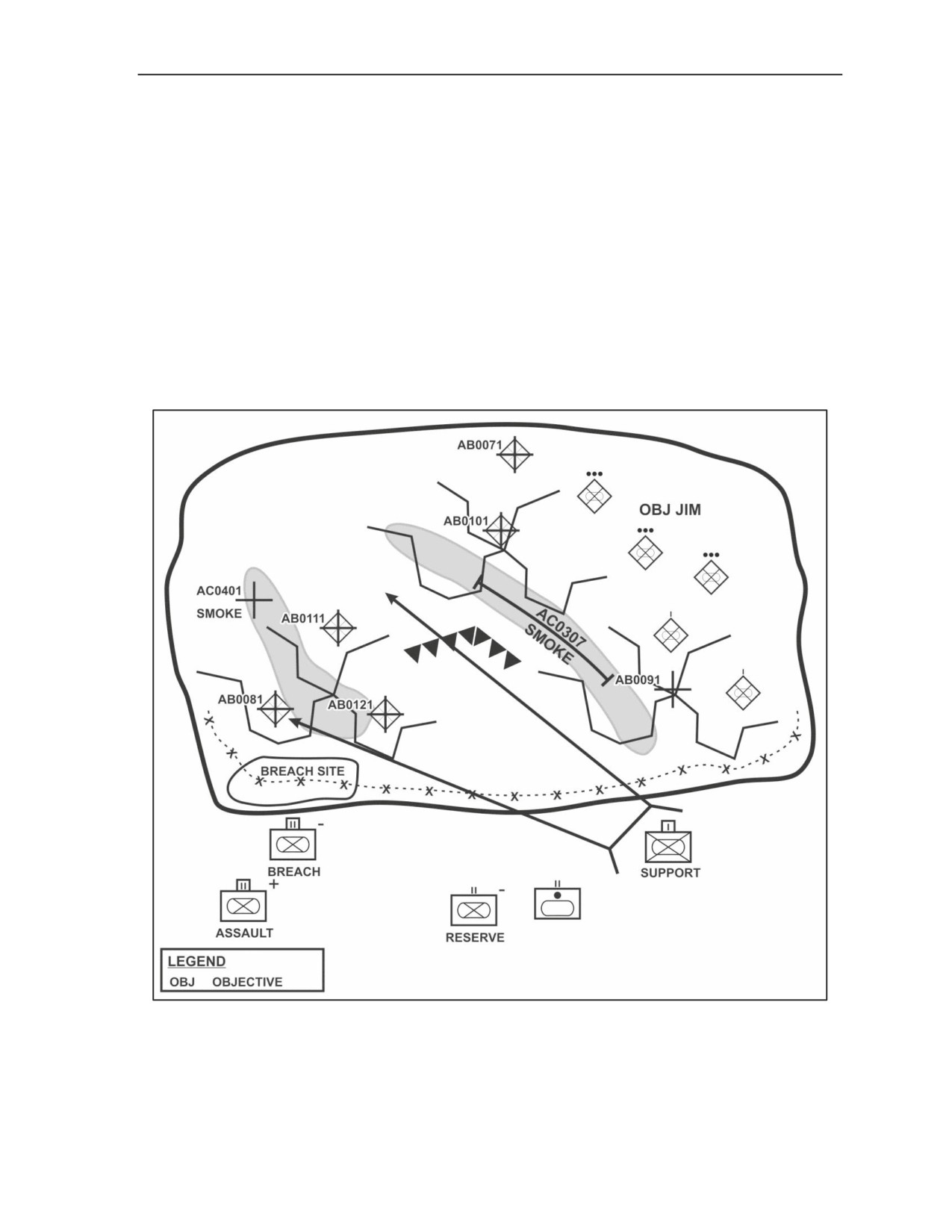
6-134. BCT Commanders tailor organic sustainment assets to the mission. Battalion and company trains
may be combined and accompany the main body. METT-TC determines the type and amount of supplies
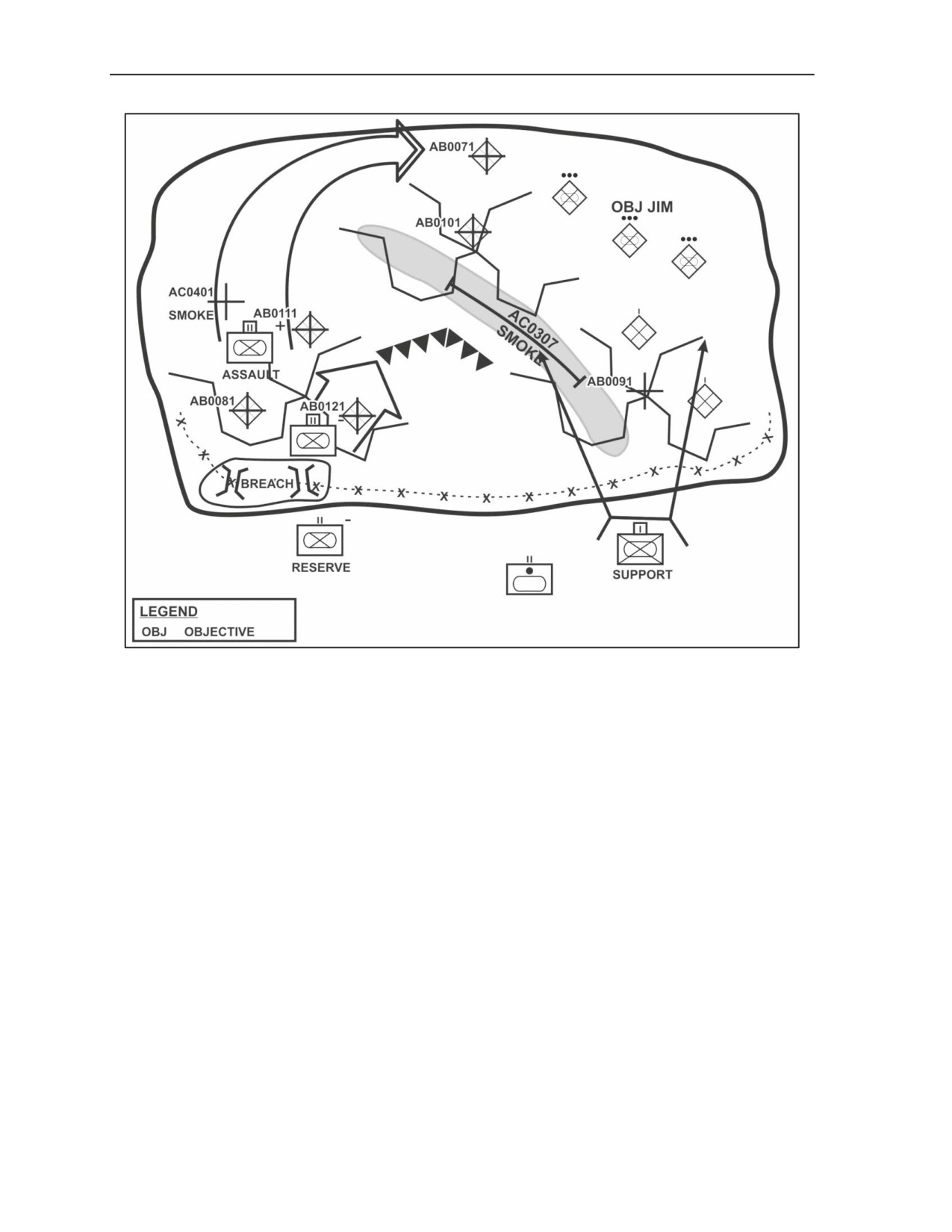
transported in these trains. Locating the combat trains with the battalion permits rapid resupply of the
maneuver units than if they were further to the rear. Commanders, however, may decide to assign combat
units to combat trains for their security if they determine that the combat trains do not have sufficient combat
power to counter the anticipated threat. (Refer to FM 3-90-1 for additional information.)
PREPARATION
6-135. The BCT constantly refines the enemy situation during the preparation based on information and
integrated intelligence products. One of the primary concerns during preparation is to ensure the commander
and staff have the latest information and that the common operational picture is accurate and the plan is still
valid. The commander ensures, through confirmation briefs, backbriefs and rehearsals, that subordinates
understand his intent and their individual missions as new information becomes available. Simple, flexible
plans that rely on standard operating procedures and battle drills, and plans that units rehearse against likely
enemy courses of action are essential to success.
6-136. The commander rehearses the operation from initiation to occupation of the final march objective or
limit of advance. The commander prioritizes rehearsals of maneuver options, enemy courses of action, and
primary, secondary, and tertiary communications systems at all levels. Actions to consider during rehearsals
include:
z
Making enemy contact (advance guard).
z
Making contact with an obstacle not identified and reported (advance guard).
z
Making enemy contact (flank security force).
z
Reporting requirements, engagement, and bypass criteria.
z
Fire support.
z
Maneuver.
z
Unit transitions.
z
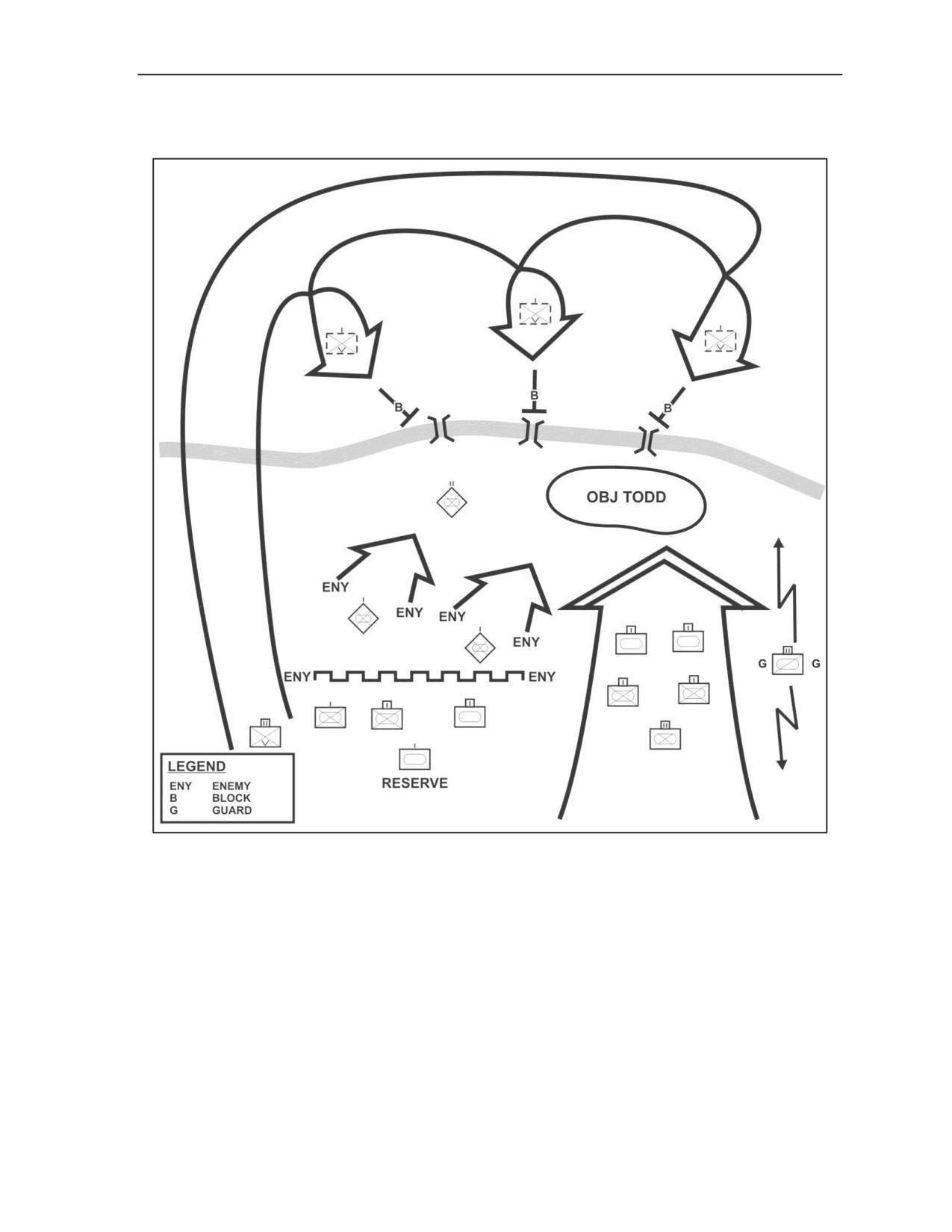
Sustainment.
EXECUTION
6-137. The BCT maneuvers aggressively within its area of operation or along its axis of advance. Speed
and security requirements must balance based on the effectiveness of the information collection effort,
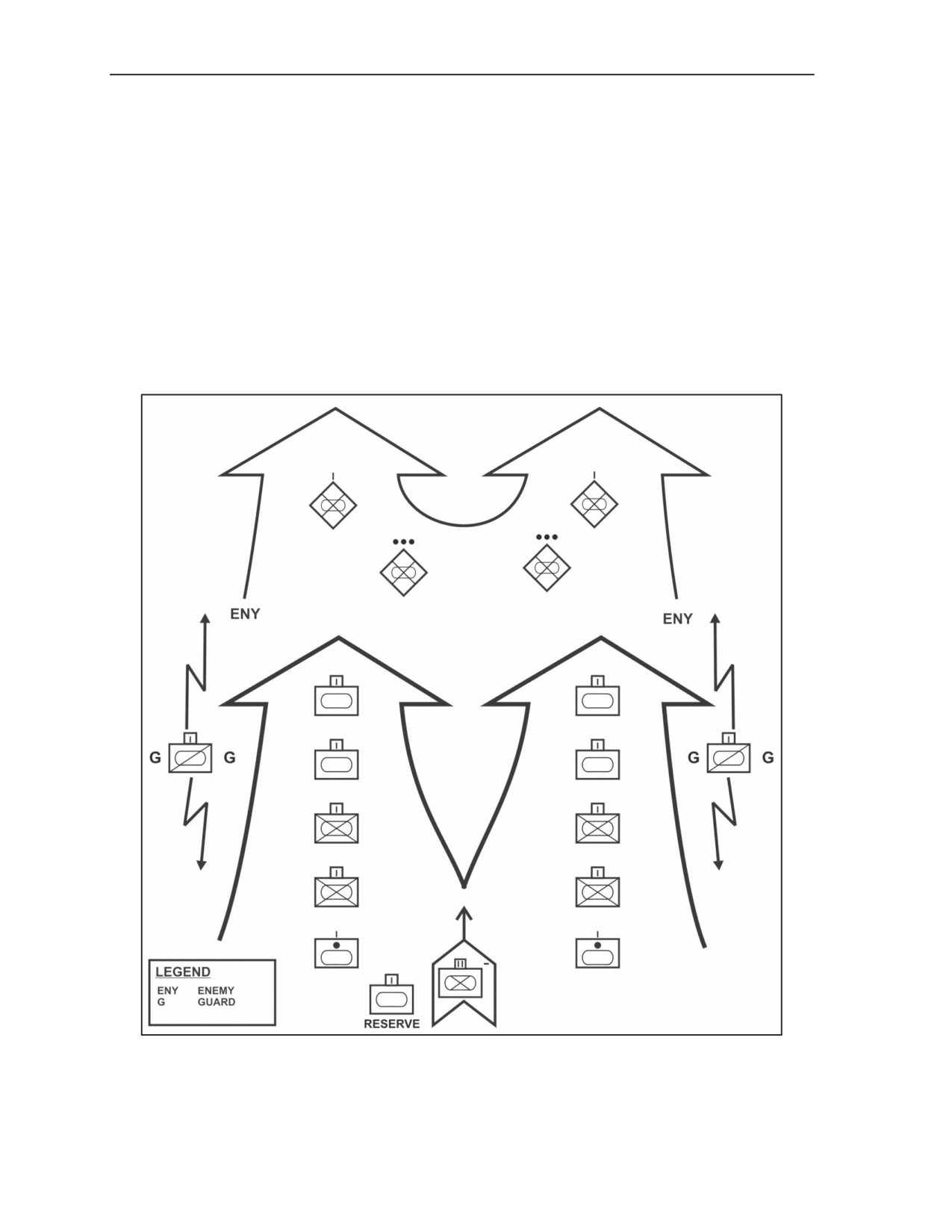
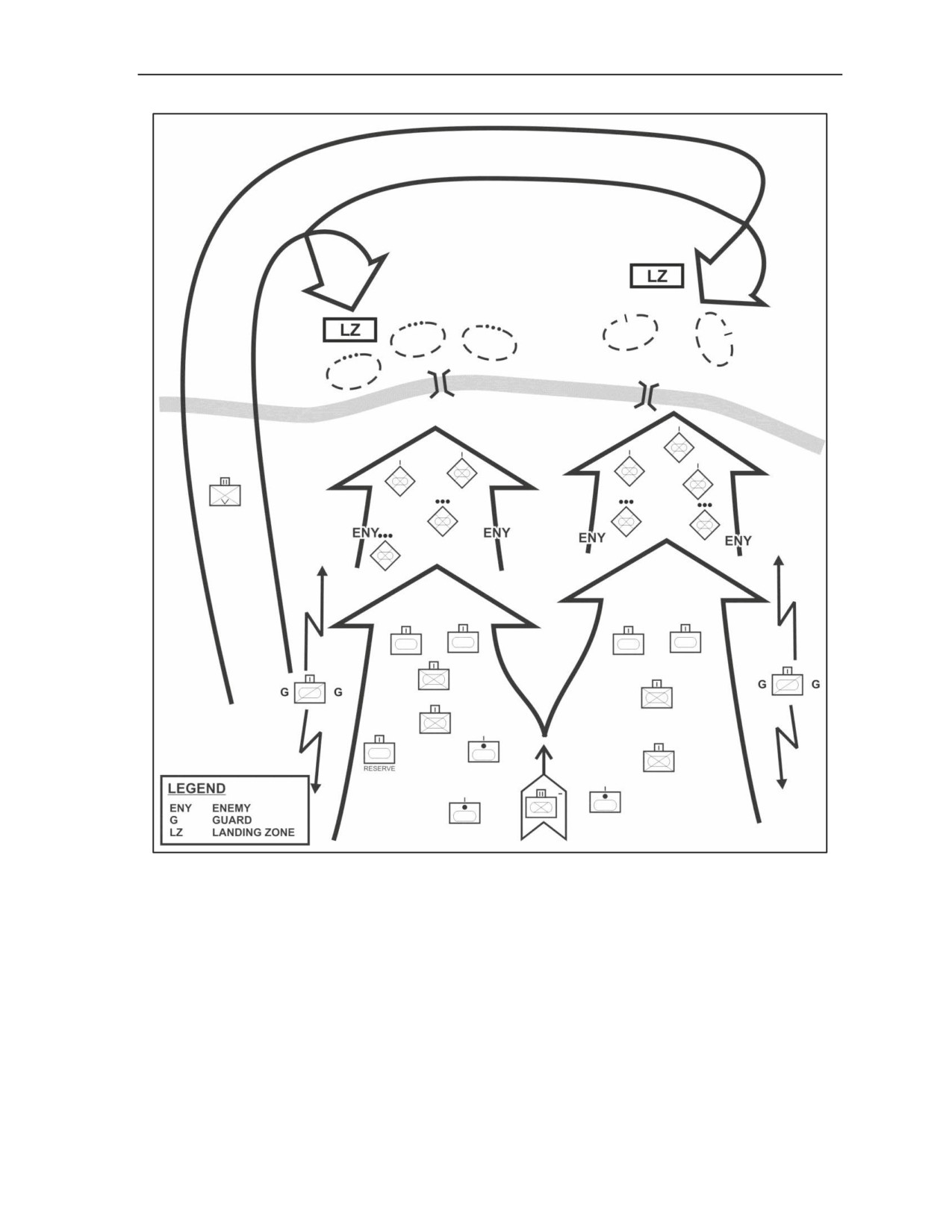
friendly mobility, effects of terrain, and enemy capabilities. The common operational picture enables close
tracking and control of the movement and location of units. The BCT (typically the tactical command post)
continually monitors the location and movement of security forces. This monitoring of security forces ensures
adequate security for the main body, and ensures the security forces are within supporting range of main
body maneuver forces and fire support assets. The BCT also controls the movement of sustainment assets,
adjusting movement to meet support requirements, to avoid congestion of routes, and to ensure responsiveness.
2FWREHU
FM 3-96
6-31
Chapter 6
Scheme of Maneuver
6-138. Movement to contacts start from a line of departure or a specified point(s) at the time specified in
the operations order. A limit of advance or a forward boundary controls the depth of the movement to contact.
Phase lines, contact points, and checkpoints control the rate of movement. Fire support is planned for
throughout the movement to contact to provide accurate and continuous fires. Actions on contact, (see
paragraph 4-39), are planned for and rehearsed. Subordinate echelons must quickly react to contact, develop
the situation, report, and gain a position of advantage over the enemy. Maneuvering unit commanders
coordinate forward passage through friendly forces in contact as required.
6-139. The primary focus of a movement to contact is the enemy force, which may be stationary or moving.
Objectives can designate the movement of subordinate units and identify suspected enemy positions.
Although an axis of advance can guide movement, there is the risk of enemy forces outside the axis being
undetected and inadvertently bypassed. During a movement to contact, the intent of the commander is to
maneuver quickly to defeat the enemy before the enemy can react. The commander avoids piecemeal
commitment of the main body unless failure to do results in mission failure or prevented by restricted or
severely restricted terrain. The BCT commander uses the advance guard to fix the enemy while the main
body maneuvers to seek the assailable flank. The commander focuses on the enemy's flanks and rear before
the enemy can counter these actions.
Maneuver Options
6-140. The commander makes the decision to execute a maneuver option based on the progress of the
advance guard’s initial engagement. The movement to contact generally ends with the commitment of the
main body. The tactical options available to the BCT after contact include the following:
6-141. Attack. The commander directs an attack when the BCT has greater combat power than the enemy
does or when he assesses that, the BCT can reach a decisive outcome. The commander can direct an ambush
against a moving or infiltrating force that is not aware of the presence of the friendly force.
6-142. Defend. The commander directs a defense when the BCT has insufficient combat power to attack.
The commander also directs a defense when the enemy’s superior strength forces the BCT to halt and prepare
for a more deliberate operation.
6-143. Bypass. The commander provides criteria detailing conditions for bypassing enemy forces. The unit
in contact can bypass if authorized, but, if the bypassed force represents a threat, the unit must fix or contain
it until released by the higher commander.
6-144. Delay. A delaying force under pressure trades space for time by slowing the enemy’s momentum
and inflicting maximum damage on the enemy, without decisively engaging, in principle. Once the advance
guard (fixing force) makes contact with the enemy, the enemy may attempt a frontal counterattack in response
to the BCT’s movement to contact. In this case, the fixing force defends itself or conducts a delay while the
main body of the BCT maneuvers to attack.
6-145. Withdraw. The commander directs a withdrawal when the BCT lacks the combat power to attack or
defend, to improve a tactical situation, or to prevent a situation from worsening. Both direct and indirect fire
assets from main body forces provide support to cover the withdrawal of the advance guard or lead elements
of the main body. The commander also may employ obscuration to assist with breaking contact with the
enemy.
Bypassed Forces
6-146. Bypassed forces present a serious threat to forces that follow the maneuver elements, especially
sustainment elements. Units conducting a movement to contact do not bypass enemy forces unless authorized
by higher authority. Bypass criteria, if established, are measures established by higher headquarters that
specify the conditions and size under which enemy units may be bypassed. The BCT distributes the location
and strengths of enemy forces throughout the area of operation so following units can move around these
threats. Bypassed enemy units are kept under observation unless otherwise directed by the commander. The
destruction or containment of the bypassed enemy forces becomes the responsibility of the higher commander
if the commander permits the lead elements to bypass.
6-32
FM 3-96
2FWREHU
Offense
Actions at Obstacles
6-147. Once the unit detects an obstacle, the obstacle is immediately reported and its location and
description distributed. The element quickly seeks a bypass. If a bypass is available, the unit in contact with
the obstacle marks the bypass; the unit reports the route of the bypass around the obstacle, also. The BCT
breaches consistent with the breaching fundamentals of suppress, obscure, secure, reduce, and assault to
create breach lanes and continue the movement to contact. Engineers support the breach effort by reducing
the obstacle, improving the lanes, and guiding the main body through the obstacle. (Refer to ATTP 3-90.4
for additional information.) Civil affairs, military police, or military information support operations assets
may redirect civilians away from the route of advance when the movement of displaced civilians causes
reduced mobility.
Five-Step Sequence
6-148. FM 3-90-1 discusses executing all four offensive tasks in a five-step sequence, listed below. This
sequence is for discussion purposes only and is not the only way of conducting offensive tasks. Execution of
offensive tasks tends to overlap each other during the conduct of offensive actions. Normally the first three
of these steps are shaping operations or supporting efforts, while the maneuver step is the decisive operation
or main effort. Follow through is normally a sequel or a branch to the plan based on the current situation.
Refer to FM 3-90-1 for additional information on the following five-step sequence:
Step 1, Gain and Maintain Enemy Contact
6-149. The advance guard focuses on identifying the enemy's composition, strength, and dispositions. The
forces provide the commander with combat information. The commander can then maneuver his units to
positions of advantage to commit friendly forces under optimal conditions.
Step 2, Disrupt the Enemy
6-150. On contact, the advance guard maneuvers to disrupt or defeat the enemy to prevent him from
conducting a spoiling attack or organizing a coherent defense. The advance guard commander gathers as
much information as possible about the enemy's dispositions, composition, strengths, capabilities, and
probable course(s) of action.
Step 3, Fix the Enemy
6-151. The advance guard prevents the enemy from maneuvering against the main body. If unable to defeat
the enemy, the advance guard reports the enemy strength and disposition and establishes a base of fire for
the subsequent attack by the main body.
Step 4, Maneuver
6-152. If the advance guard cannot defeat the enemy with a flank or frontal attack, the commander quickly
maneuvers his main body to attack. The commander attempts to defeat the enemy while still maintaining the
momentum of his advance. The main body commander resumes the movement to contact after a successful
attack. The intent is to deliver an assault before the enemy can deploy or reinforce their engaged forces.
Step 5, Follow Through
6-153. The unit transitions back to a movement to contact and continue to advance if the enemy is defeated.
The movement to contact terminates when the unit reaches its final objective or limit of advance; otherwise,
it must transition to another offensive or defensive task.
SEARCH AND ATTACK
6-154. Search and attack is a technique for conducting a movement to contact that shares many of the
characteristics of an area security mission (FM 3-90-1). The BCT conducts a search and attack to destroy
enemy forces, deny the enemy certain areas, protect the force, or collect information. Although the battalion
is the echelon, that usually conducts a search and attack, the BCT assists its subordinate battalions by ensuring
2FWREHU
FM 3-96
6-33
Chapter 6
the availability of indirect fires and other support. Refer to FM 3-21.20 or FM 3-90-1 for detailed information
on conducting a search and attack.
CORDON AND SEARCH
6-155. Cordon and search is a technique of conducting a movement to contact that involves isolating a
target area and searching suspected locations within that target area to capture or destroy possible enemy
forces and contraband (FM 3-90-1). The BCT normally assigns a cordon and search mission to a battalion.
The BCT supports the cordon and search by conducting shaping operations and providing additional
resources to the unit conducting the cordon and search. A cordon and search may support site exploitation
(see ATP 3-90.15). Refer to FM 3-21.20 or ATP 3.06.20 for detailed information on conducting a cordon
and search.
ATTACK
6-156. An attack is an offensive task that destroys or defeats enemy forces, seizes and secures terrain, or
both (ADRP 3-90). Although an attack may be a deliberate operation or a hasty operation, both synchronize
all available warfighting functions to defeat the enemy. The main difference between a hasty and a deliberate
operation is preparation and planning time.
6-157. The key difference between a movement to contact and an attack is the amount of information known
about the enemy. Information enables the commander to have more control, to better synchronize the
operation, and to employ combat power more effectively than in a movement to contact. The commander has
the advantage of being extremely deliberate and refined in task organization, assignment of tactical mission
tasks, and the scheme of maneuver.
6-158. The BCT executes subordinate forms of the attack to achieve different results. These subordinate
forms of the attack have special purposes and include the ambush, counterattack, demonstration, feint, raid,
and spoiling attack. The commander’s intent and the mission variables of METT-TC determine the specific
attack form. The commander can conduct these forms of attack, except for a raid, as a hasty or a deliberate
operation. Refer to FM 3-90-1 for additional information on each subordinate form of the attack.
ORGANIZATION OF FORCES
6-159. The BCT commander determines the scheme of maneuver and task organizes the force to give each
subordinate unit the combat power to accomplish its assigned missions. The commander normally organizes
the force into a security force, a main body, and a reserve. The commander completes any changes in task
organization early in the process to allow subordinate units to conduct rehearsals with their attached and
supporting elements.
Security Forces
6-160. The BCT executes most attacks while in contact with the enemy which reduces the requirement for
a separate forward security force. The commander commits security forces during an attack only if the attack
is likely to uncover one or more flanks or the rear of the attacking force as it advances. The commander
designates a flank or rear security force and assigns it a guard or screen mission depending on METT-TC.
Main Body
6-161. The BCT commander allocates forces based on the assigned tasks, the terrain, and the size of the
enemy force that each avenue of approach can support (probable force ratio). The BCT attacks to destroy
enemy forces or to seize key terrain. The scheme of maneuver identifies the decisive operation. During the
course of the attack, the unit(s) executing the decisive operation may change based upon conditions or plans.
6-162. Maintaining mobility in an attack is critical. The assistant brigade engineer officer must plan and
allocate mobility resources to the main body and security forces. The commander designates a breach, assault,
and support force as the initial decisive operation if he anticipates or has identified the need to conduct a
breach during the attack. The breaching fundamentals applied to ensure success when breaching against a
6-34
FM 3-96
2FWREHU
Offense
defending enemy are suppress, obscure, secure, reduce, and assault (described by the memory aid SOSRA).
These obstacle reduction fundamentals always apply, but they may vary based on METT-TC. The
commander isolates and secures the breach area, breaches the enemy’s defensive obstacles, seizes the point
of penetration, and rapidly passes through follow-on forces to continue the attack. (Refer to ATTP 3-90.4 for
additional information.)
6-163. The commander arranges forces in-depth and designates a reserve. The commander controls the field
artillery battalion, long-range fire support systems, and any breaching assets to retain flexibility until he can
identify the point of breach. The commander focuses all available resources to support achievement of the
decisive operation.
6-164. The commander designates subordinate units to conduct shaping operations for the execution of the
decisive operation. The commander allocates only the combat power needed to accomplish the missions since
he cannot employ overwhelming combat power everywhere. Shaping operations disrupt enemy defensive
preparations through aggressive combat patrolling, feints, limited-objective attacks, harassing indirect fires,
and air strikes. The commander uses shaping operations to isolate the enemy and destroy the enemy’s ability
to mutually support or reinforce his positions. (See figures 6-12 and 6-13, page 6-36.)
Figure 6-12. Organization of forces for the breach
2FWREHU
FM 3-96
6-35
Chapter 6
Figure 6-13. Organization of forces for the assault
Reserve
6-165. A reserve is that portion of a body of troops, which is withheld from action at the beginning of an
engagement, in order to be available for a decisive movement (ADRP 3-90). The reserve is not a committed
force, and is not used as a follow and support force or a follow and assume force. The commander uses the
reserve to exploit success, to defeat enemy counterattacks, or to restore momentum to a stalled attack.
6-166. Once committed, the reserve’s actions normally become or reinforce the BCTs decisive operation.
The commander makes every effort to reconstitute another reserve from units made available by the revised
situation. Often a commander’s most difficult and important decision concerns the time, place, and conditions
for committing the reserve.
6-167. In an attack, the commander prioritizes the positioning of the reserve to reinforce the success of the
decisive operation, then to counter enemy counterattacks. The reserve must be able to move quickly to areas
where it is needed in different contingencies. This is most likely to occur if the enemy has strong
counterattack forces.
Sustainment
6-168. The BCT commander resources sustainment assets to support the attacking force. The BSB
commander and BCT subordinate maneuver commanders organize sustainment assets to support the BCT’s
concept of support. The BSB commander controls the sustainment for the BCT with priority of support to
the decisive operation or main effort. The BSB commander positions sustainment units well forward in an
attack whenever possible to provide immediate support. As the BCT advances, sustainment units and
capabilities echelon support forward to ensure uninterrupted support to maneuver units.
6-36
FM 3-96
2FWREHU
Offense
PLANNING
6-169. The BCT commander allocates resources as required to provide the maximum possible combat
power to the decisive operation. Units conducting shaping operations should have sufficient combat power
to conduct their mission.
Control Measures
6-170. The commander assigns missions to subordinate units and establishes control measures to
synchronize the operation. The commander assigns subordinate unit areas of operation that allow for initiative
and decentralized actions. At a minimum BCT control measures should include, but are not limited to areas
of operation, target reference points, objectives, checkpoints, phase lines, and contact points. Contact points
indicate a specific location and time for coordinating fires and movement between adjacent units. Additional
minimum control measures include line of departure (which could also be the line of contact) and the time to
initiate the attack.
Fire Support
6-171. Fire support are fires that directly support land, maritime, amphibious, and special operations forces
to engage enemy forces, combat formations, and facilities in pursuit of tactical and operational objectives.
The commander uses a blend of friendly information management, knowledge management, and information
collection operations to take advantage of the range, precision, and lethality of available weapon systems and
information superiority, thus achieving fire superiority. The commander focuses fire support effects to gain
and maintain fire superiority at critical points during the attack and to maintain freedom of maneuver.
Responsiveness and flexibility requires that the BCT must have the ability to rapidly clear fires.
Aviation
6-172. Attack reconnaissance units conduct shaping operation attacks to assist the BCT in finding, fixing,
and destroying the enemy. Attack reconnaissance units support ground forces in contact through close combat
attacks. During a meeting engagement, attack reconnaissance units can fight for information and develop the
situation. Assault helicopter battalions support ground force maneuver through air movement and air assault
missions.
PREPARATION
6-173. The BCT uses the available time before the attack to conduct reconnaissance, precombat checks and
inspections, and rehearsals. The BCT conceals attack preparations from the enemy. The commander and staff
refine the plan based on continuously updated intelligence. Subordinates conduct parallel planning and start
their preparation for the attack immediately after the BCT issues a fragmentary order. As more intelligence
becomes available, the commander revises orders and distributes them; thereby giving subordinates more
time to prepare for the attack. (Refer to FM 3-90-1 for additional information.)
EXECUTION
6-174. For discussion purposes, the execution of the attack is addressed using the following five-step
sequence, gain and maintain enemy contact, disrupt the enemy, fix the enemy, maneuver, and follow through.
This sequence is not the only method of executing an attack. These steps may overlap or be conducted
simultaneously. Normally the first three of these steps are shaping operations or supporting efforts, while the
maneuver step is the decisive operation or main effort. Follow through is normally a sequel or a branch to
the plan based on the current situation. Refer to FM 3-90-1 for additional information on the following
five-step sequence:
Step 1, Gain and Maintain Enemy Contact
6-175. The commander positions maneuver forces and information collection assets to maintain observation
of enemy reactions to maneuver on the objective. Information collection focuses on areas the enemy may use
to reposition forces, commit reserves, and counterattack. For example, the commander may infiltrate or insert
2FWREHU
FM 3-96
6-37
Chapter 6
reconnaissance and surveillance forces to observe the objective or routes that an enemy reserve may use. As
the BCT attacks, reconnaissance and surveillance forces report enemy reactions, repositioning, and battle
damage assessment. The BCT may task the reconnaissance forces to target and engage enemy repositioning
forces, reserves, counterattacking forces, and other high payoff targets with indirect fires. Early identification
of enemy reactions is essential for the BCT to maintain momentum and the initiative during the attack. To
regain contact with the enemy during an attack, the BCT commander may use the cavalry squadron to regain
contact and provide information on the enemy’s current location, disposition, and movement.
Step 2, Disrupt the Enemy
6-176. Disrupting one or more parts of the enemy weakens their entire force and allows the BCT
commander to attack the remaining weakened enemy force. The commander can disrupt the enemy’s
defenses using a variety of methods including:
z
Gaining surprise.
z
Avoiding enemy security forces.
z
Using suppressive, interdiction, preparation, and counterair fires against enemy formations, strong
points, and assembly areas.
z
Destroying his target acquisition systems.
z
Taking advantage of limited visibility, concealment, and cover by masking the approach.
z
Using augmented electronic warfare assets to degrade enemy command and control systems.
z
Using military deception to conceal the exact time and location of the attack.
z
Using precision fires (precision-guide munitions, multiple launch rocket system/high mobility
artillery rocket system, Excalibur) against high-payoff targets in-depth coordinated with
long-range surveillance and precision observation teams.
Step 3, Fix the Enemy
6-177. The primary purpose in fixing the enemy is to prevent the enemy from maneuvering to reinforce the
unit targeted for destruction. Fixing the enemy into a given position or course of action limits the enemy’s
ability to respond to the attack effectively. Fixing the enemy usually is a shaping operation. To conserve
combat power, the BCT commander carefully considers which enemy elements to fix and targets only the
elements that can affect the point of attack.
6-178. The BCT commander fires on supporting and rear positions to isolate the objective. The commander
uses the fires to suppress the enemy’s suspected command and control centers, fire support systems, and
reserve. The commander also degrades the enemy’s command and control systems through cyber
electromagnetic activities, also.
Step 4, Maneuver
6-179. The BCT commander maneuvers his forces to gain positional advantage so he can seize, retain, and
exploit the initiative. He avoids the enemy’s strength, employing tactics that defeat the enemy by attacking
through a point of relative weakness, such as a flank or rear. The key to success is to strike hard and fast,
overwhelm a portion of the enemy force, and quickly transition to the next objective or phase, thus
maintaining the momentum of an attack without reducing pressure on the enemy.
6-180. The coordination between fire and movement is critical to massing combat power. As maneuver
forces approach the enemy defense, the commander shifts fires and obscurants to suppress and obscure the
enemy. Proper timing and adjustment of fires enable the maneuver force to close on the enemy’s positions.
The commander echelons his fires to maintain effective suppression on the objective(s) up to the last possible
moment while reducing any possibility of fratricide. The key to a successful attack is the suppression of the
enemy force by indirect and direct fires that shift in the front of the assault force as it reaches its limit of
advance. Maneuver forces and information collection assets provide battle-damage assessment to the
commander. The commander may need to adjust the speed of the approach to the objective based on reports
from forward reconnaissance and surveillance assets.
6-38
FM 3-96
2FWREHU
Offense
6-181. The BCT employs fires to weaken the enemy’s position. The BCT sets conditions for success prior
to closure within direct-fire range of the enemy. Initially, fires focus on the destruction of key enemy forces
that affect the concept of operations, such as to destroy the enemy positions at the point of penetration during
an attack.
6-182. Fires allow the commander to destroy enemy security forces and weaken or neutralize enemy
reserves. Fires can emplace artillery-delivered obstacles to block enemy reserve routes to the objective,
support breaching operations, isolate the objective, and suppress enemy positions. The commander can
employ obscuration and screening fires to deceive the enemy of the BCT’s actual intentions. Obscuration
fires (placed on or near enemy positions) decrease an enemy’s capability to visually sight friendly forces.
Screening fires
(delivered in areas between friendly and an enemy force) degrade enemy detection,
observation, and engagement capabilities to enable friendly maneuver and action. The commander employs
fires to disrupt enemy counterattacks and neutralize bypassed enemy combat forces. The commander
employs fires to conduct cyber electromagnetic activities to degrade, neutralize, or destroy enemy combat
capability. The BCT neutralizes the enemy’s indirect fires through counterfire.
6-183. Fires assets are usually positioned forward so they can cover the objective and beyond without
having to displace. The field artillery battalion positions its batteries as close as possible to the line of
departure. The battalion heavy mortars position themselves close to assault units and are prepared to displace
forward as required. Attached platoons from infantry weapons companies or SBCT anti-armor company may
displace by sections and closely follow the maneuver companies. Close air support and close combat attack
identify and attack preplanned targets.
Step 5, Follow Through
6-184. After seizing an objective, the BCT commander has two alternatives: exploit success and continue
the attack or terminate the operation. Normally, the BCT maintains contact and attempts to exploit its success.
Indirect and direct fires may continue to suppress other enemy positions. Follow-on forces, which may or
may not be part of the BCT, can conduct a forward passage of lines to continue the attack (See FM 3-90-2.).
6-185. The most likely on-order mission is to continue the attack after seizing an objective. During
consolidation, the commander continues the military decisionmaking process in preparation for any on-order
missions assigned by a higher headquarters.
SUBORDINATE FORMS OF THE ATTACK
6-186. The BCT can launch subordinate forms of the attack with various purposes to achieve different
results. Special purpose attacks are ambush, counterattack, demonstration, feint, raid, and spoiling attack.
(Refer to FM 3-90-1 for additional information.)
6-187. An ambush is an attack by fire or other destructive means from concealed positions on a moving or
temporarily halted enemy (FM 3-90-1). The three forms of an ambush are point ambush, area ambush, and
anti-armor ambush. An ambush is conducted at the small-unit level generally and takes the form of an assault
to close with and destroy the enemy, or it might be an attack by fire only, executed from concealed positions.
An ambush does not require seizing or holding the ground. Ambushes are generally executed to reduce the
enemy force's overall combat effectiveness through destruction, although other reasons could be to harass
and capture the enemy or capture enemy equipment and supplies. (Refer to FM 3-90-1 and FM 3-21.8 for
additional information.)
6-188. A counterattack is an attack by part or all of a defending force against an enemy attacking force, for
such specific purposes as regaining ground lost or cutting off or destroying enemy advance units, and with
the general objective of denying to the enemy the attainment of the enemy’s purpose in attacking. In sustained
defensive actions, it is undertaken to restore the battle position and is directed at limited objectives
(FM 3-90-1). The commander plans counterattacks as part of the BCT’s defensive plan, or the BCT might
be the counterattack force for the higher headquarters. The BCT must provide the counterattack force with
enough combat power and mobility to affect the enemy’s offense. (Refer to FM 3-90-1 for additional
information.)
2FWREHU
FM 3-96
6-39
Chapter 6
6-189. In military deception, a demonstration is a show of force in an area where a decision is not sought
that is made to deceive an adversary. It is similar to a feint but no actual contact with the adversary (Army
uses the term enemy instead of adversary) is intended (JP 3-13.4). The BCT commander uses demonstrations
and feints in conjunction with other military deception activities. The commander generally attempts to
deceive the enemy and induce the enemy commander to move reserves and shift fire support assets to
locations where they cannot immediately affect the friendly decisive operation or take other actions not
conducive to the enemy’s best interests during the defense. The BCT commander must synchronize the
conduct of these forms of attack with higher and lower echelon plans and operations to prevent inadvertently
placing another unit at risk. Both forms are always shaping operations but a feint will require more combat
power and usually requires ground combat units for execution.
6-190. A feint in military deception is an offensive action involving contact with the adversary (Army uses
the term enemy instead of adversary) conducted for the purpose of deceiving the adversary (Army uses the
term enemy instead of adversary) as to the location and time of the actual main offensive action (JP 3-13.4).
The principal difference between a feint and a demonstration is that in a feint the BCT commander assigns
the force an objective limited in size, scope, or some other measure. The force conducting the feint makes
direct fire contact with the enemy but avoids decisive engagement. The planning, preparing, and executing
considerations for demonstrations and feints are the same as for the other forms of attack. The commander
assigns the operation to a subordinate unit and approves plans to assess the effects generated by the feint, to
support the operation. (Refer to JP 3-13.4, FM 3-90-1, and FM 3-90-2 for additional information.)
6-191. A raid is an operation to temporarily seize an area in order to secure information, confuse an
adversary (Army uses the term enemy instead of adversary), capture personnel or equipment, or to destroy a
capability culminating with a planned withdrawal (JP 3-0). The BCT plans raids and usually executes them
at battalion level and below. The raiding force may operate within or outside of the BCT’s supporting range,
and it moves to its objective by infiltration. The raiding force quickly withdraws along a different route once
the raid mission is completed. (Refer to FM 3-90-1 and echelon-specific ATPs for discussion.)
6-192. A spoiling attack is a tactical maneuver employed to seriously impair a hostile attack while the
enemy is in the process of forming or assembling for an attack (FM 3-90-1). The BCT commander conducts
a spoiling attack during the defense to strike the enemy while he is in assembly areas or attack positions
preparing for his own offensive mission, or has temporarily stopped. The BCT commander employs organic
fires, as well as other available units, to attack the enemy’s assembly areas or other positions. (Refer to FM
3-90-1 for additional information.)
EXPLOITATION
6-193. Exploitation is an offensive task that usually follows a successful attack and is designed to
disorganize the enemy in-depth (ADRP 3-90). Exploitation is the bold continuation of an attack designed to
increase success and take advantage of weakened or collapsed enemy defenses. The purpose of exploitation
can vary, but generally, an exploitation capitalizes on a temporary advantage, on preventing the enemy from
establishing an organized defense, or preventing the enemy from conducting an orderly withdrawal. An
exploitation should prevent reconstitution of enemy defenses, prevent enemy withdrawal, secure deep
objectives, and destroy enemy command and control facilities, logistics, and forces.
6-194. The conditions for exploitation develop very quickly. The commander capitalizes on opportunities
using information collected to seize, retain, and exploit the initiative. The commander designates priority
intelligence requirements tied to decision points that seek out the following:
z
A significant increase in enemy prisoners of war.
z
An increase in abandoned enemy equipment and material.
z
The overrunning of enemy artillery, command and control facilities, and logistics sites.
z
A significant decrease in enemy resistance or in organized fires and maneuver.
z
A mixture of support and combat vehicles in formations and columns.
z
An increase in enemy movement rearward, including reserves and fire support units.
6-195. The commander plans the exploitation to maintain pressure on the enemy. To accomplish this, the
BCT attacks over a broad front to prevent the enemy from establishing a defense, organizing an effective rear
6-40
FM 3-96
2FWREHU
Offense
guard, withdrawing, or regaining balance. The BCT secures objectives, severs escape routes, and destroys all
enemy forces. (See figure 6-14.) The commander may employ the reserve as an exploitation force.
Figure 6-14. Organization of forces for an exploitation
6-196. Decentralized execution is characteristic of the exploitation; however, the commander maintains
enough control to prevent overextension of the command. Minimum control measures are used. Tactical air
reconnaissance and Army aircraft maintain contact with enemy movements and advise the commander of
enemy activities. Interdiction, close air support, close combat attacks, and deep artillery fires can attack
moving enemy reserves, withdrawing enemy columns, enemy constrictions at choke points, and enemy forces
that threaten the flanks of the exploiting force. The commander must consider the security of ground supply
columns and an aerial resupply may be necessary. Exploiting forces take advantage of captured supplies
whenever possible.
6-197. Failure to exploit success aggressively gives the enemy time to reconstitute an effective defense or
regain the initiative using a counterattack. BCT mounted elements may move rapidly to positions of
advantage to block enemy forces. If available, Army aviation assets can move forces to blocking positions
and unmanned aircraft systems can maintain contact. (Refer to FM 3-90-1 for additional information.)
2FWREHU
FM 3-96
6-41
Chapter 6
PURSUIT
6-198. Pursuit is an offensive task designed to catch or cut off a hostile force attempting to escape, with the
aim of destroying it (ADRP 3-90). The commander orders a pursuit when the enemy force can no longer
maintain its position and tries to escape. Normally, the commander does not organize specifically for pursuit
operations ahead of time, although the unit staff may plan for a pursuit mission as a branch or sequel to the
current order. The plan must be flexible for subordinate elements of the BCT to react when the situation
presents itself. Subordinate elements are made as self-sufficient as resources will permit.
6-199. Two options exist when conducting a pursuit. Both pursuit options involve assigning a subordinate
the mission of maintaining direct-pressure on the rearward moving enemy force. The first option is a frontal
pursuit that employs only direct-pressure. (See figure 6-15.) The second is a combination that uses one
subordinate element to maintain direct-pressure and one or more other subordinate elements to encircle the
retrograding enemy. (See figure 6-16.) The combination pursuit is more effective, generally. The subordinate
applying direct-pressure or the subordinate conducting the encirclement can conduct the decisive operation
in a combination pursuit.
Figure 6-15. Organization of forces for a frontal pursuit
6-42
FM 3-96
2FWREHU
Offense
Figure 6-16. Organization of forces for a combination pursuit
6-200. During the pursuit, the commander exerts unrelenting pressure to keep the enemy force from
reorganizing and preparing its defenses. The BCT may be a part of a corps or division pursuit, either
functioning as the direct-pressure or encircling force. An aggressive pursuit leaves the enemy faced with the
options of surrendering or facing complete destruction. Pursuits require swift maneuvers and attacks.
6-201. The pursuit normally follows a successful exploitation. The primary function of a pursuit is to
complete the destruction of the enemy force. Although the BCT may pursue a physical objective, the mission
is the destruction of the enemy’s main force. Pursuits include the rapid shifting of units, continuous day and
night movements, hasty operations, containment of bypassed enemy forces, and large numbers of prisoners.
A pursuit includes a willingness to forego some synchronization to maintain contact and pressure on a
fleeing enemy.
2FWREHU
FM 3-96
6-43
Chapter 6
6-202. A mobility advantage over the enemy is vital to the BCT’s effectiveness in pursuit. A combination
of armored or Stryker forces, combined with infantry conducting air assaults, can be extremely effective
when cutting off the enemy forcing them to either surrender or be destroyed. The range, speed, and weapons
load of attack reconnaissance units makes them uniquely useful in an exploitation or pursuit to extend the
ground commander’s reach. Dismounted movement over difficult terrain allows infantry units to seize
blocking positions. (Refer to FM 3-90-1 for additional information.)
SECTION V - TRANSITIONS
6-203. Decisive action involves more than simultaneous execution of all tasks. Decisive action requires the
commander and his staff to consider the BCT’s capabilities and capacities relative to each assigned task. The
commander considers his mission, determines which tactics to use, and balances the tasks of decisive action
while preparing his commander’s intent and concept of operations. The commander determines which tasks
the force can accomplish simultaneously, if phasing is required, what additional resources the force may
need, and how to transition from one task to another.
6-204. Transitions between tasks of decisive action require careful assessment, prior planning, and unit
preparation as the commander shifts his combinations of offensive, defensive, and stability tasks.
Commanders first assess the situation to determine applicable tasks and the priority for each. When
conditions change, commanders adjust the combination of tasks of decisive action in the concept
of operations.
6-205. A transition occurs when the commander makes an assessment that the unit must change its focus
from one element of decisive action to another. A commander halts the offense only when the offense results
in complete victory and the end of hostilities reaches a culminating point, or the commander receives a change
in mission from a higher commander. This change in mission may be a result of the interrelationship of the
other instruments of national power, such as a political decision.
6-206. All offensive actions that do not achieve complete victory reach a culminating point when the
balance of strength shifts from the attacking force to its opponent. Usually, offensive actions lose momentum
when friendly forces encounter and cannot bypass heavily defended areas. Offensive actions also reach a
culminating point when the resupply of fuel, ammunition, and other supplies fails to keep up with
expenditures, Soldiers become physically exhausted, casualties and equipment losses mount, and repairs and
replacements do not keep pace with losses. Offensive actions also stall when reserves are not available to
continue the advance, the defender receives reinforcements, or the defender counterattacks with fresh troops.
Several of these actions may combine to halt an offense. When the offensive action halts, the attacking unit
can regain its momentum, but normally this only happens after difficult fighting or after an operational pause.
6-207. The commander plans a pause to replenish combat power and phases the operation accordingly, if
the commander cannot anticipate securing decisive objectives before subordinate forces reach their
culminating points. Simultaneously, the commander attempts to prevent the enemy from knowing when
friendly forces become overextended. (Refer to ADRP 3-0 for additional information.)
TRANSITION TO A FOCUS ON THE CONDUCT OF DEFENSIVE
TASKS
6-208. Once offensive actions begin, the attacking commander tries to sense when subordinate units reach,
or are about to reach, their respective culminating points. The commander must transition to a focus on the
defense before subordinate units reach this point. The commander has more freedom to choose where and
when to halt the attack, if the commander can sense that subordinate forces are approaching culmination. The
commander can plan future activities to aid the defense, minimize vulnerability to attack, and facilitate
renewal of the offense as the force transitions to branches or sequels of the ongoing operation. For example,
some subordinate units may move into battle positions before the entire unit terminates its offensive actions
to start preparing for ensuing defensive tasks. The commander can echelon sustainment assets forward to
establish a new echelon support area. A new echelon support area may serve to prevent overburdening the
extended lines of communications that result from advances beyond eight hours of travel from the echelon
support area.
6-44
FM 3-96
2FWREHU
Offense
6-209. A lull in combat operations often accompanies a transition. The commander cannot forget about
stability tasks because the civilian populations of the unit’s area of operation tend to come out of their hiding
positions and request assistance from friendly forces during these lulls. The commander must consider how
to minimize civilian interference with the force’s combat operations while protecting civilians from future
hostile actions according to the law of war. The commander must also consider the threat civilians pose to
the force and its operations if enemy agents or saboteurs are part of the civilian population. (See FM 3-07.)
6-210. A commander anticipating the termination of unit offensive actions prepares orders that include the
time or circumstances under which the current offense transitions to the defense, the missions and locations
of subordinate units, and control measures. As the unit transitions from an offensive focus to a defensive
focus, the commander maintains contact with and surveillance of the enemy, using a combination of
reconnaissance and security forces and surveillance assets to develop the information required to plan future
actions. The commander also establishes a security area and local security measures.
TRANSITION TO A FOCUS ON THE CONDUCT OF STABILITY
TASKS
6-211. A transition to stability-centric operations occurs for several reasons. A transition may occur from
an operation dominated by combined arms maneuver to one dominated by wide area security. Transitions
also occur with the delivery of essential services or retention of infrastructure needed for reconstruction. An
unexpected change in conditions may require commanders to direct an abrupt transition between phases. In
such cases, the overall composition of the force remains unchanged despite sudden changes in mission, task
organization, and rules of engagement. Typically, task organization evolves to meet changing conditions;
however, transition planning must account for changes in mission, also. Commanders continuously assess
the situation and task-organize and cycle their forces to retain the initiative. Commanders strive to achieve
changes in emphasis without incurring an operational pause.
6-212. Planning for operations focused on stability begins the moment the BCT receives the mission.
Coordinated early planning between the military and the interagency for post-conflict operations is vitally
important. When coordinated planning to transition responsibility from military to civilian entities does not
occur, the result is always the development of military and civilian parallel efforts, which seek to either secure
or develop the host nation. The end state of the offense is the eventual transfer of all security operations to
host-nation control. Transferring security operations does not allow the commander to abdicate his role to
provide security for the host nation, facilities, or his units. The commander must work in concert with
host-nation security forces to ensure a smooth transition to host-nation control.
6-213. Building partner capacity is the outcome of comprehensive interorganizational activities, programs,
and engagements. Building partner capacity enhances security, rule of law, essential services, governance,
economic development, and other critical government functions. Army forces support host-nation ownership
when planning and implementing capacity building as part of a comprehensive approach.
6-214. All actors involved in decisive action integrate with the operation from the onset of planning.
Together, they complete detailed analyses of the situation and operational environments, develop integrated
courses of action, and continuously assess the situation. Integrating civilian and military efforts into a
whole-of-government approach has challenges. First, the efforts have differing capacities and differing
perspectives. Second, the two efforts use different approaches and decisionmaking processes.
6-215. A comprehensive approach integrates the cooperative efforts of the departments and agencies of the
United States Government, other unified action partners, and private sector entities to achieve unity of effort
toward a shared goal. A comprehensive approach builds from the cooperative spirit of unity of effort.
Successful operations use this approach, even for those operations involving actors participating at their own
discretion or present in the operational area but not acting as a unified action partner member. Integration
and collaboration among actors with different agendas and experience is challenging. A comprehensive
approach achieves unity of effort to forge a shared understanding of a common goal. Mandates, experiences,
structures, and bureaucratic cultures make it difficult to sustain a comprehensive approach. Commanders
overcome and mitigate this challenge with extensive cooperation and coordination.
6-216. Five broad conditions provide the underpinnings for strategic, whole-of-government planning and
serve as a focal point for integrating operational- and tactical-level tasks. The end state conditions are flexible
2FWREHU
FM 3-96
6-45
Chapter 6
and adaptive to support activities across the range of military operations but rely on concrete principles and
fundamentals in application. (See ATP 3-07.5.) End state conditions are—
z
A safe and secure environment.
z
Established rule of law.
z
Social well-being.
z
Stable governance.
z
A sustainable economy.
6-46
FM 3-96
2FWREHU
Chapter 7
Defense
The BCT conducts defensive tasks to defeat enemy attacks, gain time, control key
terrain, protect critical infrastructure, secure the population, and economize forces.
Most importantly, the BCT sets conditions to transition to the offense or operations
focused on stability. Defensive tasks alone are not decisive unless combined with
offensive tasks to surprise the enemy, attack enemy weaknesses, and pursue or exploit
enemy vulnerabilities. This chapter addresses the characteristics of the defense,
common defensive planning considerations, forms of the defense, defensive control
measures, defensive tasks, and planning considerations when transitioning to other
tactical operations.
SECTION I - CHARACTERISTICS OF THE DEFENSE
7-1. Successful defenses share the following characteristics: disruption, flexibility, maneuver, mass and
concentration, operations in-depth, preparation, and security. Defenses are aggressive. Defending
commanders use all available means to disrupt enemy forces. Commanders disrupt attackers and isolate them
from mutual support to defeat them in detail. Defenders seek to increase their freedom of maneuver while
denying it to attackers. Defending commanders use every opportunity to transition to the offense, even if
only temporarily. As attackers’ losses increase, they falter and the initiative shifts to the defenders. These
situations are favorable for counterattacks. Counterattack opportunities rarely last long. Defenders strike
swiftly when the attackers reach their decisive point. Surprise and speed enable counterattacking forces to
seize the initiative and overwhelm the attackers.
7-2. The Battle of Kasserine Pass, described below, is an example of neglecting the characteristics of the
defense. Prior to the Battle of Kasserine Pass, II Corps failed to adequately resource and prepare defensive
positions; ensure defensive positions could mass effects of direct and indirect fires; adequately include
flexibility, depth, and maneuver in planning, and conduct continuous reconnaissance and security operations
to provide early and accurate warning.
The Battle of Kasserine Pass, Tunisia in February 1943, served as a rude awakening for the
American Army in World War II. Over the course of the month, German Field Marshal Erwin
Rommel’s veteran Armeegruppe Afrika delivered a series of defeats to the relatively
inexperienced American II Corps under Major General Lloyd Fredendall. Kasserine Pass was a
tremendous blow to American pride and a loss of confidence in the eyes of II Corps’ British and
French allies. However, lessons learned from the battle led to changes in leadership, tactics, and
training, resulting in a competent force in the African theater, as well as more realistic and effective
training in America. Kasserine Pass remains a bitterly poignant example of the disasters that befall
a force that neglects the characteristics of the defense.
The Anglo-American advance into Tunisia transitioned to a defense in December 1942 due to poor
weather and logistical challenges. Major General Fredendall’s II Corps was tasked with
reinforcing the French defenses around several mountain passes and a road junction in southern
Tunisia. Fredendall, headquartered some 70 miles from the forward line of troops, personally
directed the dispersion of his subordinate elements over a large area of operations. Simultaneously,
engineer assets needed for improving of defensive positions were instead constructing a cavernous
bunker for the Corps command post.
2FWREHU
FM 3-96
7-1
Chapter 7
Lack of cooperation with allied forces and inadequate reconnaissance and security operations
allowed German and Italian elements of Armeegruppe Afrika to achieve tactical surprise at the
onset and throughout the battle. During the following weeks, French and American units routinely
found themselves surprised by enemy contact, fighting from non-mutually supporting positions,
and unable to mass direct and indirect fires. German and Italian forces, enjoying local air
superiority as allowed by weather, rarely experienced disruption at the hands of isolated and easily
bypassed defensive positions. Retrograde operations frequently degenerated into routes with
significant losses of manpower and equipment. Allied attempts to maneuver against Axis forces
were poorly coordinated due to failures to incorporate flexibility into the array of forces as well
as command failures at multiple echelons. Brigadier General Paul R. Robinette, commander of
Combat Command A of the 1st Armored Division, would later record the Soldiers’ observation
that during this battle “never were so few commanded by so many from so far away.”
The poor performance of the American Army left a bitter legacy for the American Soldier that
would haunt Anglo-American relations in the theater. At the human level, II Corps sustained
approximately six thousand casualties during the February 1943 engagements as well as the loss
of 183 tanks, 104 half-tracks, 208 artillery pieces, 500 other vehicles, and vast amounts of supplies.
Conversely, Rommel’s forces sustained approximately 1000 casualties and a tenth of the material
losses. (See figure 7-1.)
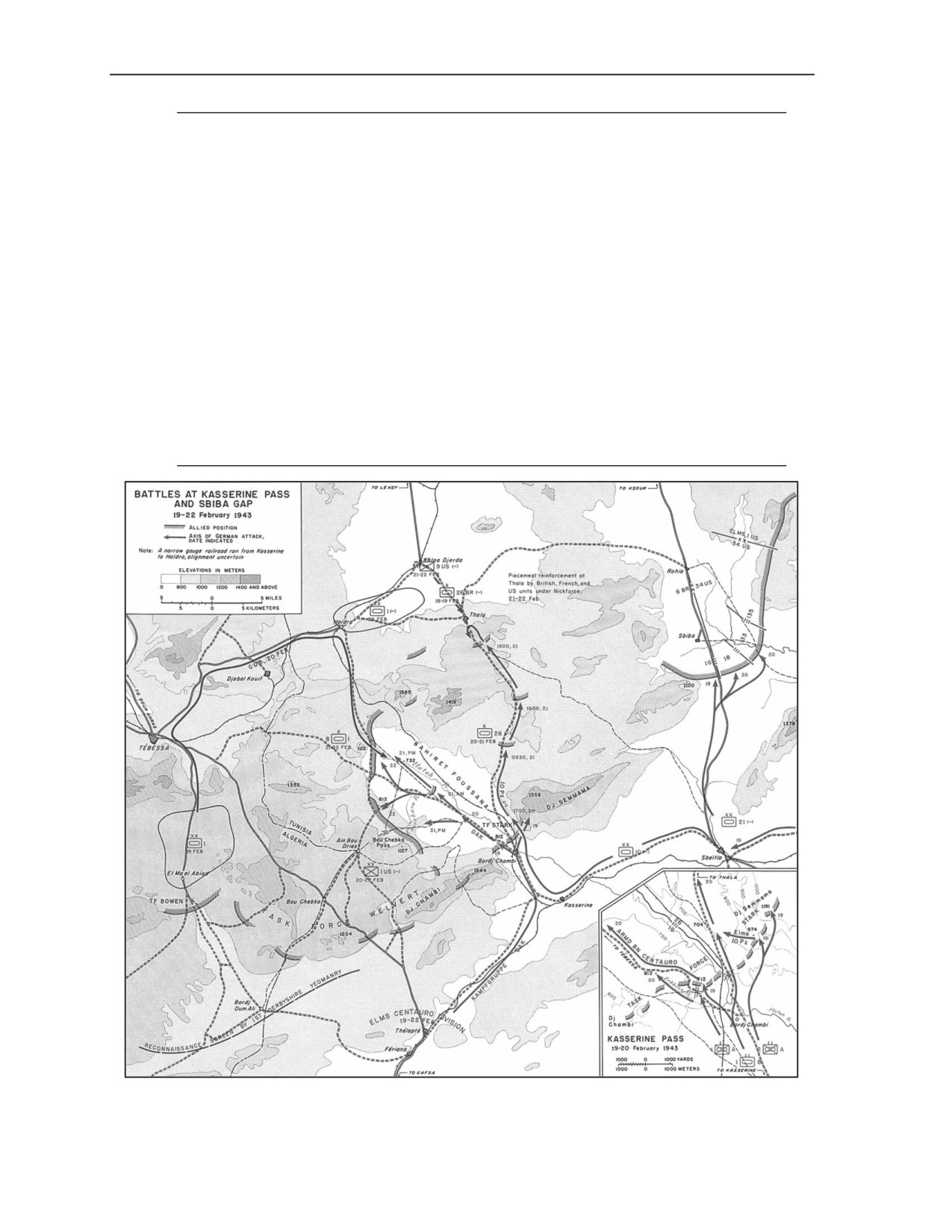
Figure 7-1. Kasserine Pass and Sbiba Gap map
7-2
FM 3-96
2FWREHU
Defense
DISRUPTION
7-3. The BCT must disrupt the tempo and synchronization of the enemy's operation to counter his initiative,
to prevent his concentrating combat power against a part of the defense, and to force him to go where the
BCT commander wants him to go. The commander achieves disruption by defeating or misleading enemy
reconnaissance forces, impeding his maneuver, disrupting his reserves, neutralizing his fire support, and
interrupting his command and control. Defensive techniques vary with circumstances, but all defensive
concepts of operation aim to spoil the attacker's synchronization. Strong security forces to defeat enemy
reconnaissance, phony initial positions or dummy positions, and obstacles are some of the measures used to
increase BCT security in the defense. The commander uses counterattack, counterbattery, and countermortar
fires; spoiling attacks; obstacles; and retention of key or decisive terrain to prevent the enemy from
concentrating overwhelming strength against portions of the defense.
FLEXIBILITY
7-4. The BCT commander uses detailed planning, sound preparation, operations in-depth, retaining
reserves, and mission command to maintain flexibility. Flexibility requires the commander to visualize the
battlefield to detect the enemy's scheme of maneuver in time to direct fire and movement against it. The
commander does not limit his information collection efforts only to the forces in contact. He also concentrates
on formations arrayed in-depth. The enemy may try to bypass areas where the defense is strong. Hence, the
BCT commander must ensure that he can detect and defeat the enemy along all possible avenues of approach.
The commander uses aviation reconnaissance and surveillance assets to support information collection. The
BCT commander's plan must allow him to shift his decisive operation or main effort quickly, if the situation
changes, while maintaining his synchronization. In addition, alternate and subsequent positions provide the
flexibility needed to execute the defense, effectively. Small reserves may position near critical terrain or
likely avenues of attack to enable rapid deployment to those areas. Blocking positions can be established to
deny the enemy a chance for a rapid breakthrough.
MANEUVER
7-5. Maneuver allows the commander to take full advantage of the area of operations and to mass and
concentrate resources where required. The BCT arrays and allocates forces in relationship to likely enemy
courses of action. The BCT uses allocations based on the results of the relative combat power analysis of the
BCT and enemy forces’ assigned tasks and the terrain. The commander accepts risk along less likely avenues
of approach to ensure that adequate combat power is available for more likely avenues of approach.
7-6. Maneuver also encompasses defensive actions such as security and support area operations. In some
cases, the commander must accept gaps within the defense, but must take measures to maintain security
within these risk areas. The BCT uses surveillance assets, security forces, patrols, or other economy of force
missions for these areas.
MASS AND CONCENTRATION
7-7. The BCT masses its combat power to overwhelm the enemy and regain the initiative. The commander
must be able to concentrate forces and/or mass the effects of fires at the decisive point and time. To
accomplish this, the commander may economize forces in some areas, retain a reserve, shift priority of fires,
and maneuver repeatedly to concentrate combat power. Commanders accept risks in some areas to
concentrate for decisive action elsewhere. Obstacles, security forces, and fires assist in reducing these risks
as forces economize.
7-8. Dependent on the operational framework, the commander designates a main effort to achieve
concentration, and directs all other elements and assets to support and sustain this effort. He also may
reprioritize forces, designating a new main effort as the situation changes. The commander directs the task
and purpose of supporting elements to create the conditions necessary for the main effort to accomplish its
task and purpose. The commander narrows the width of subordinate areas of operations, focusing
counterattack plans to support the main effort; assigns the main effort unit priority of obstacle preparation;
gives the unit priority of indirect fire; and positions the reserve to influence the main effort's area.
2FWREHU
FM 3-96
7-3
Chapter 7
7-9. Concealment and deception must mask the concentrating forces since concentration increases the risk
level of large losses from enemy fires. The strategy is to concentrate the effects of the forces, not to physically
concentrate the forces themselves. Defending units use engagement areas to concentrate combat power from
mutually supporting positions. Reconnaissance and surveillance and security operations are vital to gaining
the information and time needed to concentrate the forces and fires of the BCT.
OPERATIONS IN-DEPTH
7-10. Integration of all combat power throughout the area of operation improves the chances for success
while minimizing friendly casualties. Quick, violent, and simultaneous action throughout the depth of the
BCT’s area of operations can hurt, confuse, and even paralyze an enemy force when he is most exposed and
vulnerable. Such actions weaken the enemy’s morale and do not allow any early successes to build their
confidence. Operations in-depth prevent the enemy from gaining momentum in the attack. Synchronization
of actions within an operational framework facilitates mission success.
7-11. Alternate and supplementary positions, combat outposts, and mutually supporting strong points extend
the depth of the defense. The commander plans fires throughout the defensive area up to the maximum range
of available weapons. Fire support units and observers move and reposition to maintain contact with enemy
forces and observe target areas of interest in-depth as the battle develops. The commander plans for the
emplacement of obstacles around critical locations to disrupt the enemy’s most dangerous and most likely
courses of action.
PREPARATION
7-12. The commander must be familiar with the enemy’s abilities and limitations to prepare the defense
properly. The enemy's abilities and limitations include their organization, offensive doctrine
(tactics,
techniques, and procedures), weapons systems, and equipment. Collection means, reconnaissance,
surveillance, security operations, and intelligence operations inform the commander and staff to enable
understanding and multiply the effectiveness of the defense.
7-13. The commander analyzes the terrain in detail from all perspectives and then verifies on the ground to
select engagement areas and positions that allow for the massing of fires and the concentration of forces on
likely enemy avenues of approach. Emphasis is on preparing and concealing positions, routes, obstacles,
logistical support, and mission command facilities and networks. The commander plans, coordinates, and
prepares military deceptions and uses rehearsals to insure staffs and subordinates understand the concept of
operations and commander’s intent.
7-14. During preparation, aerial (manned and unmanned) reconnaissance and surveillance collection efforts
complement ground efforts by increasing speed and depth with which reconnaissance can be conducted over
an area. Ground reconnaissance and security forces employ and supplies are pre-positioned. Counterattack
plans to support the defense and to place the BCT on the offense are key to retaining the initiative.
Counterattack routes must be reconnoitered, improved, secured, and rehearsed. Defensive preparations
within the main battle area continue in-depth even as close engagement begins.
SECURITY
7-15. The BCT commander establishes security areas forward of the main battle area, on the flanks, and
within the BCT’s support area to protect the force while in the defense. Security tasks forward of the main
battle area normally include screen, guard, and cover. The presence of a security force forward of the main
battle area does not relieve the main battle area units from their own security responsibilities (area security
and local security tasks). All units must maintain security within assigned areas and contribute to
counterreconnaissance.
7-16. The BCT may defend to conserve combat power for use elsewhere at a later time. The commander
secures the force through integrated security operations throughout the depth and breadth of its assigned area
of operation. Long-range reconnaissance and surveillance assets at the division and corps level conduct
information collection to define and confirm the enemy at extended ranges and in time and manner. The
7-4
FM 3-96
2FWREHU
Defense
commander plans for and employs information related capabilities and cyber electromagnetic activities to
confuse the enemy as to the BCT’s manner of defense and to aid in securing the force.
SECTION II - COMMON DEFENSIVE PLANNING CONSIDERATIONS
7-17. The commander in the defense exploits prepared, mutually supporting positions even though he has
yielded the initiative to the enemy. He uses his knowledge of the terrain to slow the enemy’s momentum.
The defending force maintains its security and disrupts the enemy’s attack at every opportunity. The
defending commander uses long-range fires to reduce the force of the enemy’s initial blow, hinder enemy
offensive preparations and wrest the initiative from the enemy. He draws the enemy into engagement areas
where he can surprise the enemy with concentrated and integrated fires from concealed and protected
positions. He then counterattacks the enemy, repeatedly imposing blows from unexpected directions. The
following discussion uses the warfighting functions
(mission command, movement and maneuver,
intelligence, fires, sustainment, and protection) and specific operational environments as the framework
for planning considerations that apply to defensive tasks.
MISSION COMMAND
7-18. The BCT commander understands, visualizes, and describes the anticipated enemy actions and issues
commander’s guidance to his staff. Based upon the commander’s guidance, the staff refines the higher
headquarters’ products to enable the BCT commander to visualize his operational environment. The BCT
commander and staff refine the higher headquarters’ intelligence preparation of the battlefield products to
focus on the details of the operation in the BCT’s area of operations. The higher commander normally defines
where and how the BCT defeats or destroys the enemy and the operational framework. The BCT commander
defines how he envisions the BCT’s execution of its portion of the higher echelon fight.
7-19. The BCT commander and staff analyze how and where to defeat the enemy. The BCT commander
may define a defeat mechanism that includes use of single or multiple counterattacks to achieve success.
Subordinate commanders and staffs analyze their unit’s role in the fight and determine how to achieve
success. In an area defense, usually the BCT achieves success by massing the effects of obstacles and fires
to defeat the enemy forward of a designated area, often in conjunction with a higher echelon’s counterattack.
In a delay operation, the BCT achieves success by combining maneuver, fire support, obstacles, and the
avoidance of decisive engagement until conditions are right to gain time or shape the battlefield for a higher
echelon’s counterattack.
7-20. The BCT organizes in the defense to facilitate the execution of a defensive task. The BCT commander
and staff use the operational framework to help conceptualize and describe the concept of operations. The
operational framework provides the commander and staff with basic conceptual options for visualizing and
describing operations in time, space, purpose, and resources (See chapter 3 for additional information.) The
commander is not bound by any specific framework for conceptually organizing operations, but may use one
of three conceptual frameworks, or a combination. The three conceptual frameworks are—
z
Deep-close-security framework to describe the operation in time and space.
z
Decisive-shaping-sustaining framework to articulate the operation in terms of purpose.
z
Main and supporting framework to designate the shifting prioritization of resources.
7-21. As an example, the deep-close-security operational framework historically has been associated with
terrain orientation, but this framework can apply to temporal and organizational orientations as well. The
BCT can use the deep-close-security operational framework to engage simultaneously the enemy in three
distinct areas-deep area, close area, and security area. In a deep, close, and security framework, a commander
may also refer to a support area. (See figure 7-2, page 7-6.)
7-22. Deep area in contiguous areas of operations, an area forward of the close area that a commander uses
to shape enemy forces before they are encountered or engaged in the close area
(ADRP 3-0). In
noncontiguous areas of operations, the deep area is the area between noncontiguous areas of operations or
beyond contiguous areas of operations.
2FWREHU
FM 3-96
7-5
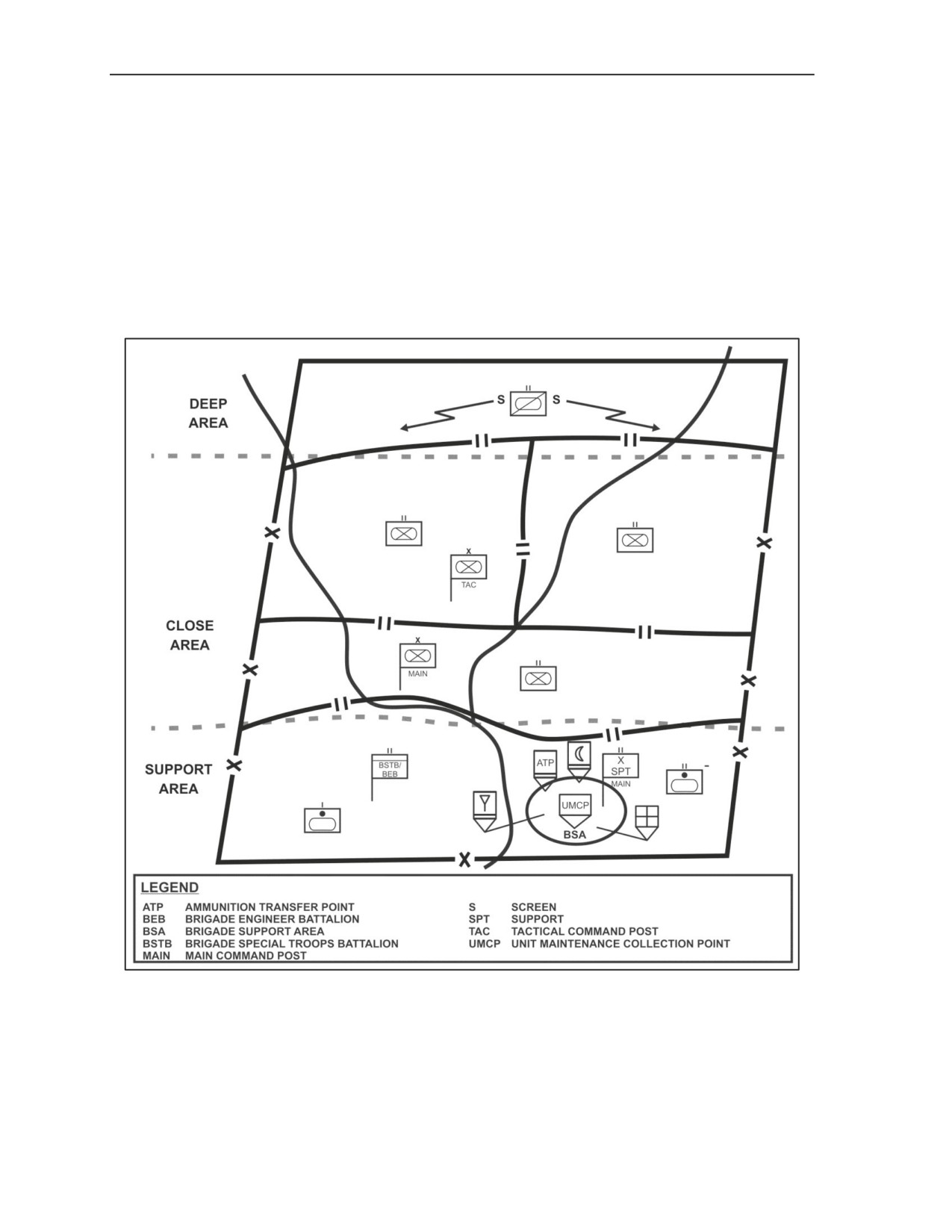
Chapter 7
7-23. Close area in contiguous areas of operations, an area assigned to a maneuver force that extends from
its subordinates’ rear boundaries to its own forward boundary (ADRP 3-0). In noncontiguous areas of
operations, the close area is the area within the subordinate commanders’ areas of operations.
7-24. Security area, that area that begins at the forward area of the battlefield and extends as far to the front
and flanks as security forces are deployed. Forces in the security area furnish information on the enemy and
delay, deceive, and disrupt the enemy and conduct counterreconnaissance (ADRP 3-90).
7-25. A support area in contiguous areas of operations, an area for any command that extends from its rear
boundary forward to the rear boundary of the next lower level of command (ADRP 3-0). In noncontiguous
areas of operations, the support area is that area defined within the higher commander’s area of operations
providing a location to base sustainment assets and provide sustainment to the force. (Refer to ADRP 3-0 for
additional information.)
Figure 7-2. Deep-close-security operational framework, contiguous area of operations
7-26. The BCT commander assigns tasks to subordinate units through his staff. The assignment of a task
includes not only the task (what), but also the unit (who), place (where), time (when), and purpose (why).
The commander and staff develop obstacle fire support plans concurrently with the defensive force array,
again defining a task and purpose for each obstacle and target in keeping with the commander’s stated fire
support tasks and intended obstacle effects. The desired end state is a plan that defines how the commander
7-6
FM 3-96
2FWREHU
Defense
intends to mass the effects of direct and indirect fires with obstacles and use of terrain to shape the battlefield
and defeat or destroy the enemy.
7-27. The BCT plans control measures to provide the flexibility needed to respond to changes in the situation
and allow the BCT to concentrate combat power at the decisive point. Defensive control measures within the
BCTs area of operation include designating the security area, the battle handover line, the main battle area
with its associated forward edge of the battle area, and the echelon support area. The BCT and subordinate
units use battle positions (primary, alternate, supplemental, subsequent, and strong point), direct fire control,
and fire support coordination measures to conduct defensive tasks. The commander designates
disengagement lines to trigger the displacement of subordinate forces when required. A disengagement line
is a phase line located on identifiable terrain that, when crossed by the enemy, signals to defending elements
that it is time to displace to their next position (ADRP 3-90).
MOVEMENT AND MANEUVER
7-28. The BCT can conduct defensive operations with units out of range and/or in mutual support of each
other. Defensive operations with out of range units require a judicious effort by the BCT commander and his
staff to determine the positioning and priority of support assets and capabilities. During the terrain analysis,
the commander and staff must look closely for key and decisive terrain, engagement areas, choke points,
intervisibility lines, and reverse slope opportunities to take full advantage of the BCT’s capabilities to mass
firepower to support defensive maneuvers.
7-29. The BCT commander must determine any potential gaps between units once he has assigned area of
operations to his maneuver units. The BCT should plan to cover any gaps with reconnaissance assets. The
BCT must plan local counterattacks to isolate and destroy any enemy that penetrates a gap in the area of
operations. The commander should also plan to reposition units not in contact to mass the effects of combat
power against an attacking enemy.
7-30. The BCT commander identifies engagement areas where he intends to contain or destroy the enemy
force with the massed effect of all available weapons and supporting systems with the assignment of area of
operations. The commander determines the size and shape of the engagement area by the visibility of the
weapons systems in their firing positions and the maximum range of those weapons. The commander
designates engagement areas to cover each enemy avenue of approach into his position. Elements,
deliberately left behind or inserted through infiltration or helicopter, can report and call in fires on an
approaching enemy.
7-31. The BCT combines fires, defensive positions, countermobility obstacles, and counterattacks to disrupt
the enemy’s attack and break his will. The BCT must disrupt the synchronization of the enemy’s operation
to counter his initiative, prevent his concentrating combat power against a part of the defense, and force him
to go where the commander wants him to go. The commander causes disruption defeating or misleading the
enemy’s reconnaissance forces, impeding his maneuver, disrupting his reserve, neutralizing his fire support,
and interrupting his command and control.
7-32. Defensive techniques vary with circumstances, but all defensive concepts of operation aim to spoil the
attacker’s synchronization. Strong security forces to defeat enemy reconnaissance, phony initial positions or
dummy positions, and obstacles are some of the measures used to increase security in the defense.
Repositioning forces, aggressive local protection measures, and employment of roadblocks and ambushes
combine to disrupt the threat of an attack. Counterattack, counterbattery fires, obstacles, and retention of key
or decisive terrain prevent the enemy from concentrating overwhelming strength against portions of the
defense.
7-33. The information environment supports the commander’s mission and desired end state using
information-related capabilities, techniques, or activities. These capabilities include, but are not limited to,
public affairs operations, military information support operations, combat camera, Soldier and leader
engagement, civil affairs operations, civil and cultural considerations, operations security, military deception,
and cyber electromagnetic activities. Cyber electromagnetic activities at the BCT level include cyberspace
operations, electronic warfare, and spectrum management operations. (Refer to FM 3-13 and FM 3-38 for
additional information.)
2FWREHU
FM 3-96
7-7
Chapter 7
7-34. The BCT commander considers mutual support when task-organizing forces, assigning areas of
operations, and positioning units. Mutual support is that support which units render each other against an
enemy, because of their assigned tasks, their position relative to each other and to the enemy, and their
inherent capabilities (JP 3-31). Mutual support has two aspects—supporting range and supporting distance.
7-35. Supporting range is the distance one unit may be geographically separated from a second unit yet
remain within the maximum range of the second unit’s weapons systems (ADRP 3-0). Mutual support exists
when positions and units are in supporting range by direct or indirect fires, thus preventing the enemy from
attacking one position without subjecting themselves to fire from one or more adjacent positions. Supporting
distance is the distance between two units that can be traveled in time for one to come to the aid of the other
and prevent its defeat by an enemy or ensure it regains control of a civil situation (ADRP 3-0). When friendly
forces are static, supporting range equals supporting distance.
7-36. Mutual support increases the strength of all defensive positions, prevents defeat in detail, and helps
prevent infiltration between positions. Tactical positions achieve the maximum degree of mutual support
between them when they are located to observe or monitor the ground between them or conduct patrols to
prevent any enemy infiltration. At night or during periods of limited visibility, the commander may position
small tactical units closer together to retain the advantages of mutual support. Unit leaders must coordinate
the nature and extent of their mutual support.
7-37. Capabilities of supported and supporting units affect supporting distance. Units may be within
supporting distance, but if the supported unit cannot communicate with the supporting unit, the supporting
unit may not be able to affect the operation’s outcome. In such cases, the units are not within supporting
distance, regardless of their proximity to each other. The following factors affect supporting distance: terrain
and mobility, distance, enemy capabilities, friendly capabilities, and reaction time. (Refer to ADRP 3-0 for
additional information.)
7-38. The need for flexibility through mobility requires the use of graphic control measures to assist mission
command during counterattacks and repositioning of forces. Specified routes, phase lines, attack- and
support-by-fire positions, battle positions, engagement areas, target reference points, and other fire control
measures are required to synchronize maneuver effectively. (Refer to FM 3-90-1 for additional information.)
7-39. During the defense, the focus for military police forces is to ensure movement of repositioning or
counterattacking forces and to support the evacuation of captured or detained individuals. Defensive missions
demand focused effort to provide the freedom of movement for repositioning forces and the reserve when it
is committed with priority of movement along main supply routes. (Refer to FM 3-39 for additional
information.) Examples of expected military police missions include—
z
Conducting detention operations.
z
Establishing a movement corridor.
z
Conducting convoy escorts.
z
Conducting response force operations.
7-40. Army aviation conducts offensive tasks to support the maneuver commander’s defensive task. Manned
and unmanned aircraft can provide reconnaissance, surveillance and security for ground forces. Aviation
quick reaction force can respond to a counterattack during the maneuver commander’s transition from
offensive to defensive tasks, allowing ground forces to focus on consolidation and reorganization.
Additionally, once in an established defensive position, aviation assets can conduct information collection
and delay advancing enemy forces. Aviation allows the maneuver commander to mass reserves by air to
reinforce a defensive position. Additional aviation considerations include—
z
Conduct reconnaissance to identify bypasses, adequate sites and routes, and provide overwatch
for security force operations.
z
Provide direct fires and/or call for fires to cover obstacles.
z
Provide security and early warning for ground movement, assembly areas, and fixed-base
operations.
7-8
FM 3-96
2FWREHU
Defense
z
Transport air defense teams, chemical, biological, radiological, and nuclear (CBRN) teams, and
supplies.
z
Conduct aerial surveys of known or suspected CBRN contaminated areas.
z
Provide information collection for targeting.
7-41. The speed and mobility of aviation can help maximize concentration and flexibility. Attack
reconnaissance helicopters routinely support security area operations and mass fires within the main battle
area. Synchronization and integration of aviation assets into the defensive ground maneuver plan is important
to ensure engagement as a whole. If the BCT augments with aviation assets, it must involve the direct fire
planning processes of the supporting aviation unit through its aviation liaison officer, the air defense airspace
management element, and brigade aviation element within the fire support cell.
7-42. Air assets provide direct fire, observation, and the rapid movement of supplies and personnel during
the conduct of the defense. Attack reconnaissance helicopters and fixed-wing aircraft can employ guided and
unguided munitions that provide close combat attack and close air support to ground forces in direct contact
with enemy elements. Through reconnaissance, intelligence, surveillance, and target acquisition planning
(see FM 3-09), these assets can conduct interdiction missions to destroy high value and high payoff targets
prior to their employment to shape the operation. Attack reconnaissance helicopters can assist the BCT
reserve in exploiting opportunities to attack an enemy weakness or to support restructuring of friendly lines
in the event of enemy penetration. Rotary and fixed wing aircraft can provide additional observation and
control indirect fires directed at enemy formations prior to contact with the BCT defense and enhance
situational awareness for the commander and staff. Utility and cargo rotary-wing aircraft can provide casualty
evacuation and conduct emergency resupply operations depending on the enemy’s air defense capabilities.
7-43. The ground commander controls all air-ground attack operations short of the fire support coordination
line (see JP 3-09). Air-ground operations require detailed planning and synchronization timelines, aviation
tasks and purposes, and airspace control. Aircraft are limited in time due to fuel requirements and the fighter
management of aircrew duty day. Analysis of enemy courses of action and timelines allow the BCT staff to
synchronize aircraft operational times to match expected enemy contact. Security forces forward of the BCT
main battle area assist in synchronizing aircraft employment at the decisive point.
7-44. Development of detailed task and purpose for the supporting aviation is essential as it enables the
aviation commander and staff to employ the right platforms and munitions. Understanding the threat and the
BCT commander’s desired aviation effects drives the aviation units’ task organization of air elements and
selection of weapon systems. (Refer to FM 3-04.111 for additional information.)
7-45. Effective airspace control is contingent on the development of a unit airspace plan consisting of
positive and procedural control measures as well as the synchronization of airspace users and activities
supporting the BCT. Airspace control is essential for deconflicting manned and unmanned aircraft from
indirect fires. Properly developed airspace coordinating measures enable the BCT to mass aerial and
surface-based fires simultaneously while using unmanned assets to maintain surveillance. (Refer to JP 3-52,
FM 3-52, and ATP 3-52.1 for additional information on airspace control and ATP 3-91.1 for information on
the joint air-ground integration center.)
INTELLIGENCE
7-46. Intelligence preparation of the battlefield is a critical part of defensive planning. Intelligence
preparation of the battlefield helps the BCT commander determine where to concentrate combat power,
where to accept risk, and where to plan the potential decisive operation. The staff integrates intelligence from
the higher echelon’s collection efforts and from units operating forward of the BCT’s area of operations.
Information collection includes collection from spot reports, tactical unmanned aircraft systems, and other
higher-level collection assets. Early warning of enemy air attack, airborne or helicopter assault or insertion,
and dismounted infiltration are vitally important to provide adequate reaction time to counter these threats as
far forward as possible. To aid in the development of a flexible defensive plan, the intelligence preparation
of the battlefield presents all feasible enemy courses of action. The essential areas of focus are terrain
analysis, determination of enemy force size and likely courses of action with associated decision points, and
determination of enemy vulnerabilities.
2FWREHU
FM 3-96
7-9
Chapter 7
7-47. Intelligence operations, conducted by the military intelligence company, collect information about the
intent, activities, and capabilities of threats and relevant aspects of the operational environment to support
commanders’ decisionmaking. The commander uses intelligence products to identify probable enemy
objectives and approaches and develops named and targeted areas of interest from probable objectives and
approaches. The commander studies the enemy operation patterns and the enemy’s vulnerability to
counterattack, interdiction, electronic warfare, air attacks, and canalization by obstacles. The commander
examines the enemy’s ability to conduct air attacks, insert forces behind friendly units, and employ nuclear,
biological, and chemical weapons and determines how soon follow-on or reaction enemy forces can influence
the operation.
7-48. The commander and staff use available reconnaissance, surveillance, and engineer assets to study the
terrain. By studying the terrain, the commander tries to determine the principal enemy and friendly heavy,
light, and air avenues of approach. The commander assesses the most advantageous area for the enemy’s
main attack, as well as other military aspects of terrain to include OAKOC. The BCT commander and staff
assess ground and air mobility corridors and avenues of approach to determine where the enemy can
maneuver to reach his likely objectives and to identify limitations on friendly maneuver and positioning.
Identification of terrain, such as chokepoints that create potential enemy vulnerabilities and opportunities for
friendly attack, is critical. (Refer to ATP 2-01.3 and ATP 3-34.80 for additional information.)
7-49. The BCT engineer uses the Digital Topographic Support System to provide terrain analysis. The
Digital Topographic Support System can identify critical terrain and position weapons systems and
intelligence assets. Once subordinate units know the area of operation, BCT units conduct their own terrain
analysis using physical reconnaissance and the line-of-sight analysis function in Force XXI Battle Command,
Brigade and Below. Terrain analysis must achieve a fidelity that allows for effective positioning of direct fire
weapons systems and observers. The analysis must identify intervisibility lines, fields of fire, dead spaces,
and integrate the effects of weather.
7-50. The staff weather officer, or higher headquarters staff if a staff weather officer is not assigned, can
assist the BCT staff by supplying predictive and descriptive weather information for specific time-periods
and locations within the BCT’s area of operations. In addition, the weather program of record (for example,
the Distributed Common Ground System-Army) can provide weather predictions and weather effects for a
specific mission, desired area of operations, or particular weapons system.
7-51. The result of the terrain analysis is a modified, combined obstacle overlay and identification of
defensible areas. The BCT staff should transmit results of the analysis digitally to subordinate units. When
the staff has analyzed the BCT’s assigned area of operations, the staff should expand its analysis to adjacent
area of operations and areas forward and to the rear of the BCT.
7-52. The staff determines enemy force sizes, likely courses of actions, and decision points through analysis.
The staff determines the size of the enemy force that each avenue of approach and mobility corridor can
support. The expected size of the enemy force drives the determination of friendly force allocation, fires, and
obstacle efforts. The commander and staff use the enemy force’s size to understand how the enemy intends
to utilize his forces and the terrain. The enemy courses of actions developed must be feasible and must reflect
the enemy’s flexibility and true potential. All courses of actions, at a minimum, should analyze the following:
z
Likely enemy objectives.
z
Enemy composition, disposition, and strength.
z
Schemes of maneuver including—
Routes.
Formations.
Locations and times the enemy may change formations.
Possible maneuver options available to the enemy.
Key decision points.
z
Time and distance factors for the enemy’s maneuver through the area of operation.
z
Likely employment of all enemy combat multipliers including —
Artillery.
Air defense.
7-10
FM 3-96
2FWREHU
Defense
Obstacles.
Chemical, biological, radiological, and nuclear strikes.
Dynamic obstacles.
Attack aircraft.
z
Likely use of all enemy reconnaissance assets and organizations including likely reconnaissance
objectives, reconnaissance avenues of approach, times to expect enemy reconnaissance.
z
Likely use of all reconnaissance assets to locate observer locations and observation posts.
z
Likely locations and identification of enemy high-value targets such as artillery formations,
reserves, and command and control.
z
Likely locations, compositions, strength, employment options, and time and distance factors for
enemy reserves and follow-on forces.
z
Locations of enemy decision points that determine selection of a specific course of action.
z
Likely breach sites, strike areas, and points of penetration.
7-53. The staff develops the enemy course of action statement and sketch. The staff graphically depicts the
enemy on a situation template based upon the results of the intelligence preparation of the battlefield. The
S-2 and staff use these items to develop the initial information collection plan. As planning progresses,
artillery counterbattery radar and counterfire radar employment is continually updated. The staff should
distribute all products digitally to the entire staff and subordinate units to support parallel planning. (Refer to
FM 3-55 for additional information.)
7-54. The staff observes the enemy’s tactics, the terrain, the weather, and friendly and enemy capabilities to
identify potential enemy vulnerabilities. To engage the enemy where the terrain puts him at a disadvantage,
the staff identifies restrictive terrain that may slow the enemy’s attack, cause a separation of forces, create
difficulties in command and control, or force the enemy to conduct defile drills; for example, narrow valleys,
passes, or urban areas. The staff also identifies chokepoints or natural obstacles that may cause a loss of
momentum, a potential fragmenting of forces, or a vulnerable concentration of forces (rivers and canals). The
staff identifies terrain that canalizes enemy formations into areas that provide defending forces with good
fields of fire, observation, and flanking fires. The staff also identifies areas dominated by key or defensible
terrain that allows massing of fires.
7-55. The entire staff must participate for intelligence preparation of the battlefield to develop successfully
for the commander and subordinate units. Each staff member is responsible for analyzing the enemy based
upon their warfighting function. Each staff member must be knowledgeable in friendly and enemy
capabilities and terrain analysis. Each staff member must execute the process rapidly. The staff must ensure
the results are detailed, legible, and disseminated quickly to support planning at all echelons.
7-56. The intelligence officer, supported by the entire staff, provides the fire support officer and information
operations officer information and intelligence for targeting and information capabilities. The intelligence
officer supports targeting by providing accurate, current intelligence and information to the staff and ensures
the information collection plan supports the finalized targeting plan. Intelligence support to targeting includes
two tasks—providing intelligence support to target development and providing intelligence support to target
detection. Intelligence support to information capabilities provides the commander with information and
intelligence support for information tasks and targeting through nonlethal actions. It includes intelligence
support to the planning, preparation, and execution of the information-related activities, as well as assessing
the effects of those activities. (Refer to FM 2-0 and FM 3-13 for additional information.)
FIRES
7-57. Supporting the BCT commander’s concept of operations during the defense involves attacking and
engaging targets throughout the area of operations with massed or precision indirect fires, air and missile
defense fires, defensive counterair, air support, and electronic warfare assets. Fire support planners must
make maximum use of any preparation time available to plan and coordinate supporting fires. Planners must
ensure fire support complements and supports all security forces and unit protection plans.
7-58. Fire support plays a key role in disrupting the attacker’s tempo and synchronization during the defense.
When required, massing overwhelming fires at critical places and times gains maximum efficiency and
2FWREHU
FM 3-96
7-11
Chapter 7
effectiveness in suppressing direct and indirect fire systems and repelling an assault. Fire support planning
and execution must address flexibility through operations in-depth and support to defensive maneuver.
Additional fires support considerations for supporting the commander’s concept of operations include—
z
Weigh the main effort.
z
Provide 360-degree air and missile defense coverage.
z
Provide and disseminate early warning.
z
Contribute targeting information.
z
Engage critical enemy assets with fires before the attack.
z
Plan counterfire against enemy indirect fire systems attacking critical friendly elements.
z
Use lethal and nonlethal means to apply constant pressure to the enemy’s command and control
structure.
z
Provide fires to support defensive counterair operations to defeat enemy attacks.
z
Plan the acquisition and attack of high payoff targets throughout the area of operation.
z
Employ electronic attack to degrade, neutralize, or destroy enemy combat capability.
z
Concentrate fires to support decisive action.
z
Provide fires to support counterattacks.
z
Plan fires to support the barrier and obstacle plan.
z
Plan for target acquisition and sensors to provide coverage of named areas of interest, target areas
of interest, and critical assets.
7-59. The BCT may utilize unmanned aircraft systems, remote sensors, and reconnaissance and security
forces to call for fire on the enemy throughout the area of operations. Quick, violent, and simultaneous action
throughout the depth of the defender’s area of operations can degrade, confuse, and paralyze an enemy force
just as that enemy force is most exposed and vulnerable. (Refer to FM 3-09 and FM 3-90-1 for additional
information.)
SUSTAINMENT
7-60. Typically, sustaining operations in support of the defense requires more centralized control. Clear
priorities of support, transportation, and maintenance are required. Movement of materiel and Soldiers within
the operating environment must be closely and continuously coordinated, controlled, and monitored to ensure
communication and enforcement of priorities. (Refer to FM 4-95 for additional information.)
7-61. The routing function of movement control becomes an essential process for coordinating and directing
movements on main supply routes or alternate supply routes, and regulating movement on lines of
communications to prevent conflict and congestion. Movement priorities must include throughput of
echelons above brigade assets transporting additional engineer assets in preparation for the defense. Supply
of Class IV (construction and barrier materials) and Class V (ammunition) normally have higher movement
priorities during the defense. Planners may consider nighttime resupply operations to minimize enemy
interference. (Refer to ATP 4-16 for additional information.)
7-62. The BCT logistics staff officer (S-4) must ensure that the sustainment plan is coordinated fully with
the rest of the staff. He coordinates with the operations staff officer (S-3) to ensure that supply routes do not
interfere with maneuver or obstacle plans but still support the full depth of the defense. Sustainment planners
must consider prepositioning Class IV, Class V, and Class III (bulk) far forward initially to support the
security area during the counterreconnaissance fight, followed by the main battle area so that the BCT can
rapidly transition from defense to offense. Planning for sustainment operations throughout the security area
is critical to sustaining reconnaissance and security operations to prevent enemy forces from determining
friendly force disposition. Forces within the security area are configured prior to line of departure with a
minimum of 72-hour logistics package of Class I (subsistence), Class III (petroleum, oil, and lubricants), and
Class V. Sustainment support to the security area must include planning for both ground and aerial medical
evacuation of long duration observation points. BCT sustainment planners also consider cross leveling
classes of supply and sustainment assets upon transition from the offense to the defense.
(See
7-12
FM 3-96
2FWREHU
Defense
7-63. Enemy actions and the maneuver of combat forces complicate forward area medical operations.
Defensive operations must include health service support to medical personnel who have much less time to
reach a patient, complete vital emergency medical treatment, and remove the patient from the battle site. The
enemy’s initial attack and the BCT’s counterattack produce the heaviest patient workload. These are also the
most likely times for enemy use of artillery and chemical, biological, radiological, and nuclear weapons. The
enemy attack can disrupt ground and air routes and delay evacuation of patients to and from treatment
elements. The depth and dispersion of the defense create significant time-distance problems for medical
evacuation assets. For additional information on the tactics, techniques, and procedures associated with health
service support, see FM 4-02, ATP 4-02.2, and ATP 4-02.3.
PROTECTION
7-64. The BCT must take measures to protect against all acts designed to impair its effectiveness and prevent
the enemy from gaining an unexpected advantage. Because a force defends to conserve combat power for
use elsewhere or later, the commander must secure the force. The BCT ensures security by employing
reconnaissance and security forces throughout the depth and breadth of its assigned area of operations. The
BCT may employ counterreconnaissance, combat outposts, a screen or guard force, and other security
operations tasks to provide this security. Information related capabilities and cyber electromagnetic activities
aid in securing the force and confuse the enemy as to the manner of defense.
7-65. As discussed in chapter 6, personnel and physical assets have inherent survivability—a quality or
capability of military forces which permits them to avoid or withstand hostile actions or environmental
conditions while retaining the ability to fulfill their primary mission (ATP 3-37.34), which can be enhanced
through various means and methods. One way to enhance survivability when existing terrain features offer
insufficient cover—protection from the effects of fires and concealment—protection from observation
or surveillance is to alter the physical environment to provide or improve cover and concealment. Similarly,
natural or artificial materials may be used as camouflage to confuse, mislead, or evade the enemy. Together,
these are called survivability operations—those military activities that alter the physical environment to
provide or improve cover, concealment, and camouflage (ATP 3-37.34).
7-66. All units conduct survivability operations within the limits of their capabilities. Engineer and CBRN
assets have additional capabilities to support survivability operations. Engineer support to survivability
operations is a major portion of the enhance protection line of engineer support (see FM 3-34). CBRN support
to survivability operations includes the employment of obscurants, which forces can use to enable
survivability operations by concealing friendly positions and screening maneuvering forces from enemy
observation and support to disengagement or movement of forces. (See FM 3-11.5.)
7-67. Although survivability encompasses capabilities of military forces both while on the move and when
stationary, survivability operations focus more on stationary capabilities—constructing fighting and
protective positions and hardening facilities. In the case of camouflage and concealment, however,
survivability operations include both stationary and on-the-move capabilities. Conducting survivability
operations is one of the tasks of the protection warfighting function, but forces can also use survivability
operations to enable other warfighting functions. For example, military deception, part of the mission
command warfighting function, can be enabled by the use of survivability operations intended to help mislead
enemy decision makers. This may include the use of dummy or decoy positions or devices. (Refer to
ATP 3-37.34 for additional information.)
7-68. Ground-based air defense artillery units execute most Army air and missile defense operations though
air and missile defense support to the BCT may be limited. Subordinate units of the BCT should expect to
use their organic weapons systems for self-defense against enemy air threats. When available air and missile
defense protects the BCT from missile attack, air attack, and aerial surveillance by ballistic missiles, cruise
missiles, conventional fixed- and rotary-wing aircraft, and unmanned aircraft systems. Air and missile
defense prevents the enemy from interdicting friendly forces, while freeing the commander to synchronize
movement and firepower.
7-69. Indirect-fire protection systems protect the BCT from threats that are largely immune to air defense
artillery systems. The indirect-fire protection intercept capability is designed to detect and destroy incoming
rocket, artillery, and mortar fires. This capability assesses the threat to maintain friendly protection and
2FWREHU
FM 3-96
7-13
Chapter 7
destroys the incoming projectile at a safe distance from the intended target. The air and missile defense task
consists of active and passive measures that protect the BCT from an air or missile attack. Passive measures
include camouflage, cover, concealment, hardening, and operations security. Active measures are taken to
destroy, neutralize, or reduce the effectiveness of hostile air and missile threats. The early warning of
in-bound missile threats is provided in theater by the globally located, joint tactical ground stations.
7-70. As stated in chapter 3, protection cell planners coordinate with the air defense airspace management
cell for air and missile defense for the protection of the critical asset list and defended asset list and for other
air and missile defense protection as required. There is continuous coordination to refine the critical asset list
and defended asset list throughout defensive and offensive operations, ensuring the protection of critical
assets and forces from air and missile attack and surveillance. Air and missile defense assets integrate
protective systems by using the six employment guidelines—mutual support, overlapping fires, balanced
fires, weighted coverage, early engagement, and defense in-depth—and additional considerations necessary
to mass and mix air and missile defense capabilities. (Refer to ADRP 3-37 and ATP 3-01.50 for additional
information.)
7-71. Military police planners, based upon the mission variables of METT-TC, identify requirements for
military police support and augmentation. The BCT provost marshal and military police staff planners at
division level coordinate military police activities and provide for the integration of military police-focused
considerations throughout the operations process. Military police operations require the use of military
police-specific technical skill sets to plan, manage, and execute the military police-specific disciplines.
Liaisons may be needed in certain situations to ensure proper and complete staff planning. (Refer to FM 3-39
for additional information.) During the defense, military police planners must—
z
Understand the intelligence preparation of the battlefield, commander’s critical information
requirements, and priority intelligence requirements to facilitate the integration of police
intelligence activities within all military police operations to support those requirements.
z
Consider the type and size of the area of responsibility, line-of-communication security, and the
threat and plan for detainee operations and dislocated civilians to determine how their presence
may affect maneuver forces.
z
Anticipate operational changes and/or transitions and prepare the military police effort toward that
action.
7-72. Chemical, biological, radiological, and nuclear (CBRN) operations in the defense, measures taken to
minimize or negate the vulnerabilities and effects of a CBRN incident, involve a combination of active and
passive defense measures to reduces the effectiveness or success of CBRN weapon employment. The BCT
commander and staff integrates CBRN defense into mission planning, regardless of the mission type. CBRN
active defense comprises measures taken to defeat an attack with CBRN weapons by employing actions to
divert, neutralize, or destroy those weapons or their means of delivery while en route to their target. CBRN
active defense operations to defend against conventionally and unconventionally delivered weapons of mass
destruction (WMD) include, but are not limited to— missile defense (ballistic and cruise), air defense, special
operations, and security operations.
7-73. CBRN active defense operations differ from WMD interdiction operations with the goal of active
defense operations to achieve a layered capability to defeat the full scope of delivery means in defense of
forces and other interests. WMD interdiction operations focus on stopping the transit of WMD capabilities.
Examples of BCT CBRN active defense tasks include, but are not limited to—
z
Destroying or defeating enemy CBRN capabilities leveraging lethal and nonlethal means.
z
Targeting munitions movement while en route to the detonation location.
z
Denying enemy attempts to position WMD.
z
Detecting planned terrorist actions maximizing the use of intelligence assets to discover who,
what, when, where, and how.
7-74. CBRN passive defense includes measures taken to minimize or negate the vulnerability to, and effects
of, CBRN attacks. Passive defense focuses on maintaining the BCT’s ability to continue operations in a
CBRN environment. Success depends on the effective integration of equipment; CBRN training; and CBRN
tactics, techniques, and procedures. Passive defense measures by the BCT designed to mitigate the immediate
effects of a CBRN incident enable and protect the force conducting the operation. The application of the
7-14
FM 3-96
2FWREHU
Defense
following three principles specifically address the hazards created by CBRN incidents or accidents and help
minimize vulnerabilities, protect friendly forces, and maintain the BCT’s operational tempo to achieve
objectives:
z
CBRN contamination avoidance of CBRN hazards. (See FM 3-11.3.)
z
CBRN protection of individuals, units, and equipment from unavoidable CBRN hazards. (See
FM 3-11.4.)
z
CBRN decontamination to restore operational capability. (See FM 3-11.5.)
Note. Although mission command is not one of the CBRN principles, mission command enables
the conduct of CBRN active and passive defense measures. (See ATP 3-11.36.)
7-75. When established, the CBRN working group led by the CBRN officer includes members from the
protection-working group, subordinate commands, host-nation agencies, and other unified action partners.
The CBRN working group—disseminates CBRN operations information, including trend analysis, defense
best practices and mitigating measures, operations, the status of equipment and training issues, CBRN
logistics, and consequence management and remediation efforts and refines the CBRN threat, hazard, and
vulnerability assessments. The working group helps to develop, train, and rehearse a CBRN defense plan to
protect personnel and equipment from an attack or incident involving CBRN threats or hazards. CBRN threat
and hazard assessments made by the working group help determine initial, individual protective equipment
levels and the positioning of decontaminants. Force health personnel maintain the medical surveillance of
personnel strength information for indications of force contamination, epidemic, or other anomalies apparent
in force health trend data. (Refer to FM 3-11 and ADRP 3-37 for additional information.)
7-76. Force health protection, measures to promote, improve, conserve or restore the mental or physical
well-being of Soldiers, enable a healthy and fit force, prevent injury and illness, and protect the force from
health hazards. Defensive actions can result in prolonged occupation of static positions and corresponding
exposure of personnel to diseases, weather and other health hazards and environmental affects that can
quickly degrade readiness. The commander enforces environmental disciplines, such as hydration, sanitation,
hygiene, protective clothing, and inspection of potable water supplies. Defensive actions also may entail
sustained enemy bombardments or attacks resulting in dramatic effects on the mental and behavioral health
of unit personnel. Soldiers can become combat ineffective from heavy indirect fire even if exposure is for
short durations. Commanders deliberately emplace systems for combat stress identification and treatment to
reduce the return-to-duty time of affected personnel. (Refer to FM 4-02 and ATP 4-02.3 for additional information.)
7-77. When planning for base camp security and defense it is critical to remember that a properly designed
perimeter security system should be an integrated, layered, defense in-depth that takes advantage of the
security area. BCT commanders, supported by their staff, evaluate mission variables—focusing on the threat
to establish a viable perimeter defense plan. Planning for perimeter security and defense, like all protection
measures integrates fires and obstacles, within the context of mission and operational variables and associated
constraints, throughout the depth of the base camp area of operation to meet security and defense objectives.
Commanders and staff with base camp security and defense responsibilities plan, coordinate, and synchronize
actions using integrating processes and continuing activities to ensure full integration of their area security
and base defense plans. (Refer to ATP 3-37.10 for additional information.)
7-78. Refer to chapter 6 for a discussion of the following supporting tasks of the protection warfighting
function—
z
Conduct operational area security.
z
Employ safety techniques (including fratricide avoidance).
z
Implement operations security.
z
Provide intelligence support to protection.
z
Implement physical security procedures.
z
Apply antiterrorism measures.
z
Conduct law and order.
z
Provide explosive ordnance disposal and protection support.
z
Conduct personnel recovery.
2FWREHU
FM 3-96
7-15
Chapter 7
z
Conduct internment and resettlement.
SPECIFIC OPERATIONAL ENVIRONMENTS
7-79. Specific operational environments include urban, mountain, desert, and jungle. Defensive tasks in
these environments follow the same planning, preparation, execution, and assessment as operations in any
other environment. Successful defensive tasks, however, impose specific techniques and methods. The BCT
uses defensive tasks in urban terrain to turn the environment’s characteristics to their advantage. Urban areas
are ideal for the defense because they enhance the combat power of defending units. (Refer to ATTP 3-06.11
for additional information.)
7-80. Defensive tasks in a mountainous terrain may reduce the BCT’s technical superiority over the enemy.
Enemy offensive tactics commonly involve short violent engagements followed by a hasty withdrawal
through preplanned routes. The enemy often strikes quickly and fights only as long as the advantage of the
initial surprise is in their favor. Attacks may include direct fires, indirect fires, or improvised explosive
devices and may be against stationary or moving forces. The design of the landscape, coupled with climatic
conditions, creates a unique set of mountain operations characteristics that are characterized by close fights
with dismounted infantry, decentralized small-unit operations, degraded mobility and increased movement
times, restricted lines of communications, and operations in thinly populated areas. (Refer to ATTP 3-21.50
for additional information.)
7-81. In desert terrain, the BCT orients on primary enemy approaches; units prepare for attack from any
direction. It is neither possible nor necessary to have maximum firepower in all directions. Air cover or an
air defense umbrella is necessary for a successful defense. Considerations for defensive tasks in a desert
environment include obstacles to site a defense, which are limited; strong points to defend choke points and
other key terrain; and mobility and sustainment. (Refer to FM 90-3 for additional information.)
7-82. Jungle operations use the same defensive fundamentals as other defensive operations. Some of the
fundamentals, however, may acquire a special significance in the jungle. Considerations for defensive tasks
in a jungle environment include limited visibility and fields of fire, and limited and restricted maneuver.
(Refer to FM 90-5 for additional information.)
7-83. Subsurface areas are conditions commonly found in all four operational environments described above.
Refer to chapter 6 for information on subsurface areas.
SECTION III - FORMS OF THE DEFENSE
7-84. The three forms of the defense (defense of a linear obstacle, perimeter defense, and reverse-slope
defense) have special purposes and require special planning and execution. The three forms of the defense
provide distinct advantages for the BCT and its subordinate units and apply to the area defense and the
operations of the fixing force during a mobile defense. (Refer to FM 3-90-1 for additional information.)
DEFENSE OF A LINEAR OBSTACLE
7-85. The defense of a linear obstacle usually forces the enemy to deploy, concentrate forces, and conduct
breaching operations. A defense of a linear obstacle generally favors the use of a forward defense (see
paragraphs 7-124 and 7-125). The defending unit constructs obstacles to stop the enemy forces and channel
them into planned engagement areas. Maintaining the integrity of the linear obstacle is the key to this type of
defense. When attacked, the defending force isolates the enemy, conducts counterattacks, and delivers fires
onto the concentrated force to defeat attempts to breach the obstacle.
7-86. A defense of a linear obstacle often is used as part of an economy of force measure. In this situation,
the defending force cannot allow the enemy to build up its forces on the friendly side of the obstacle because
it may lack the required combat power to defeat the enemy forces. As forces to counterattack and destroy the
enemy may not be available immediately; defending forces must be able to—
z
Detect enemy penetrations early enough so that local counterattacks can defeat them.
z
Defend after being isolated.
7-16
FM 3-96
2FWREHU
Defense
z
Use reconnaissance elements, sniper teams, and other elements to detect enemy forces and call in
fires.
z
Bring the fight to the enemy side of the obstacle to destroy its forces and disrupt enemy
preparations.
z
Use fires to their maximum effect.
z
Use its mobility to concentrate combat power.
Defense of a Linear Obstacle: Fredericksburg, VA 1862
By December 13, 1862, Confederate General Robert E. Lee established a strong defensive
position behind the Rappahannock River in Northern Virginia against Union forces (figure 7-3,
page 7-18). He only lightly defended the actual river line because the Union army artillery
dominated both sides of the river. His main defensive position was directly west along a line of
hills. The area between the river and the hills was generally open with scattered woods and
streams or canals. The most concealed area was the town of Fredericksburg.
Early on December 13, the Union army crossed the river and formed for attack. The plan was to
conduct the main attack to the south with a supporting attack to the north. Despite repeated
attacks, the Union forces were repulsed everywhere. Union casualties were approximately
10,000 while the confederate forces suffered approximately 5,000 casualties.
2FWREHU
FM 3-96
7-17
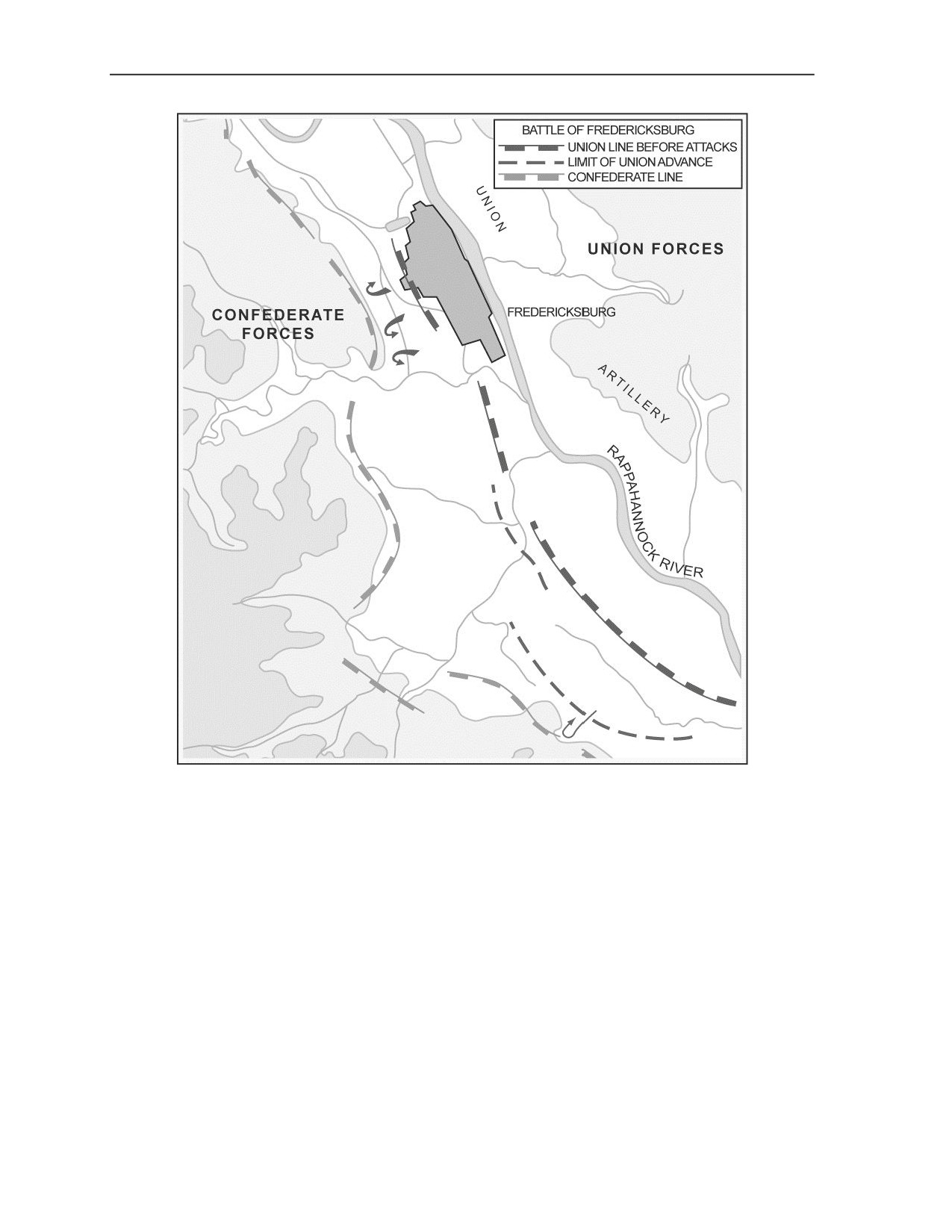
Chapter 7
Figure 7-3. Historical example, defense of a linear obstacle, Fredericksburg 1862
PERIMETER DEFENSE
7-87. The BCT and its subordinate elements often use a perimeter defense when conducting airborne and air
assault operations, as well as when conducting operations in noncontiguous areas of operations. The BCT
presents no assailable flanks to the enemy and allows the defender to reinforce a threatened area rapidly.
Some disadvantages of a perimeter defense include its isolation and the vulnerability of its concentrated units
to enemy fires.
7-88. The commander establishes a perimeter defense when the unit must hold critical terrain, such as a
strong point, or when it must defend itself in areas where the defense is not tied in with adjacent units. Units
can organize a perimeter defense to accomplish a specific mission, such as protecting a base or providing
immediate self-protection, such as during resupply operations when all-around security is required. During a
perimeter defense, leaders at all levels ensure that—
z
Units physically tie into each other.
z
Direct fire weapons use flanking fire to protect the perimeter.
z
Field artillery and mortars are protected.
7-18
FM 3-96
2FWREHU
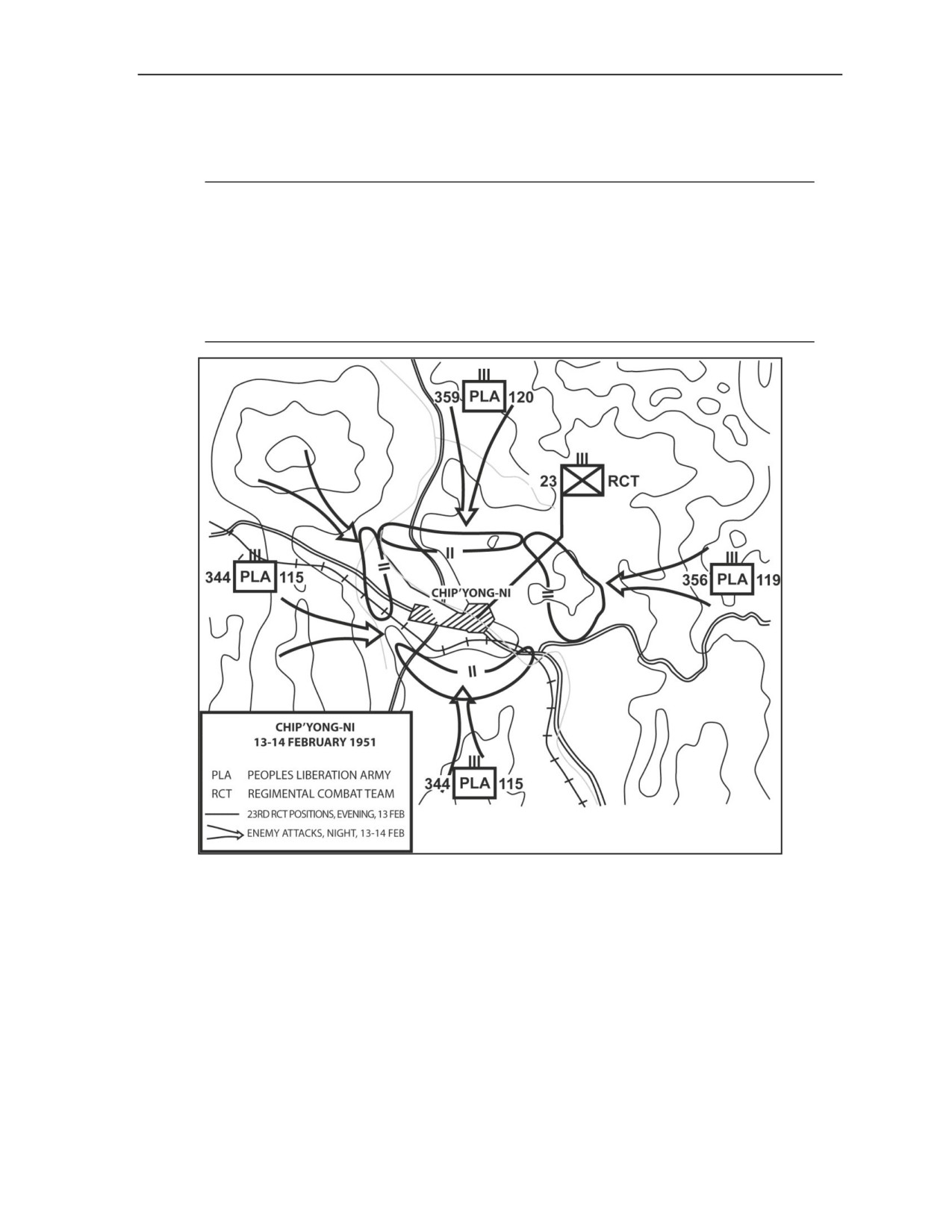
Defense
z
Communications are secure and redundant systems in place.
z
Obstacles are employed.
z
Final protective fires are established.
During the Chinese Fourth Phase offensive, the 23d infantry regimental combat team, reinforced,
used a perimeter defense to defeat elements of three People’s Republic of China armies, about
25,000 soldiers at Chip’yong-Ni, Republic of Korea (figure 7-4). From 13 to 14 February 1951,
the 23d established a perimeter defense around the town of Chip’yong-Ni and blunted a major
People’s Republic of China offensive. After a bitter fight, the Chinese forces withdrew at the cost
of 51 United Nation’s Soldiers and an estimated 2000 Peoples Republic of China soldiers killed.
The battle was a major defeat for the Chinese forces and led to subsequent United Nation
offensives that forced the Chinese back to the North.
Figure 7-4. Historical example of a perimeter defense, Chip’yong-Ni, 1951
REVERSE-SLOPE DEFENSE
7-89. The reverse-slope defense allows units to concentrate their direct fires into a relatively small area while
being protected from the enemy’s direct observation and supporting fires. The defender can destroy the
enemy’s isolated forward units through surprise and concentrated fires. The control of the forward slope is
essential for success. Gaining control of the forward slope can be done by using dominating terrain behind
the defenders or with the use of stay behind forces, such as reconnaissance and sniper teams, that can observe
and call in fires on the attackers. Generally, a unit at battalion level and below conducts a reverse-slope
defense even though the BCT may have areas within its area of operations that are conducive to the use of a
reverse-slope defense.
2FWREHU
FM 3-96
7-19