FM 3-96 BRIGADE COMBAT TEAM (OCTOBER 2015) - page 2
Chapter 3
z
Apply critical and creative thinking.
z
Encourage collaboration and dialogue.
3-21. The activities of the operations process are not discrete; they overlap and recur as circumstances
demand. Planning starts an iteration of the operations process. Upon completion of the initial order, planning
continues as leaders revise the plan based on changing circumstances. Preparing begins during planning and
continues through execution. Execution puts a plan into action by applying combat power to seize, retain,
and exploit the initiative. (Refer to ADRP 5-0 for additional information.)
PLAN
3-22. Planning is the art and science of understanding a situation, envisioning a desired future, and laying
out effective ways of bringing that future about (ADP 5-0). Planning consists of two separate but interrelated
components, a conceptual component and a detailed component. Successful planning requires the integration
of both these components. BCT leaders employ three methodologies for planning: the Army design
methodology, the military decisionmaking process (brigade and battalion echelons), and troop leading
procedures (company echelons and below). Commanders determine how much of each methodology to use
based on the scope of the problem, their familiarity with it, and the time available. Planning helps the BCT
commander create and communicate a common vision between the staff, subordinate commanders, their
staffs, and unified action partners. Planning results in an order that synchronizes the action of forces in time,
space, and purpose to achieve objectives and accomplish missions. (Refer to ADRP 5-0 for additional
information.)
Army Planning Methodologies
3-23. The BCT commanders and staffs conduct conceptual and detailed planning to facilitate the activities
of the operations process. Commanders personally lead the conceptual component of planning. While
commanders are engaged in parts of detailed planning, they often leave the specifics to the staff. Conceptual
planning provides the basis for all subsequent planning. For example, the commander’s intent and operational
approach provide the framework for the entire plan. This framework leads to a concept of operations and
associated schemes of support, such as schemes of intelligence, maneuver, fires, protection, and sustainment.
In turn, the schemes of support lead to the specifics of execution, including tasks to subordinate units and
detailed annexes to the operations order. However, the dynamic does not operate in only one direction,
conceptual planning must respond to detailed constraints.
3-24. Army design methodology is a methodology for applying critical and creative thinking to understand,
visualize, and describe problems and approaches to solving them (ADP 5-0). The commander and staff
conduct conceptual planning
(Army design methodology) to understand, visualize, and describe the
operational environment and the operational approach—a description of the broad actions the force must
take to transform current conditions into those desired at end state (JP 5-0)—to the problem. The BCT
commander and staff use the Army design methodology, operational variables, and mission variables to
analyze an operational environment in support of the operations process. Conceptual planning activities lead
to prioritization of defeat and stability mechanisms. This analysis determines the appropriate combination of
decisive action (offense, defense, stability) for the operation.
3-25. Outputs of conceptual planning include a problem statement, draft mission statement, draft
commander’s intent, a broad concept sketch, initial decision points, commander’s critical information
requirements, and initial planning guidance. Conceptual planning activities should include initial framing of
branches and sequels to the plan and the ideal end state or posture. The BCT staff uses the outputs of
conceptual planning to begin detailed planning (the military decisionmaking process at the BCT level). The
military decisionmaking process is an iterative planning methodology to understand the situation and
mission, develop a course of action, and produce an operation plan or order (ADP 5-0). The result of detailed
planning is a synchronized plan that provides mission-type orders for the staff and subordinate units.
3-26. Depending on the situation’s complexity, the commander can initiate the Army design methodology
before or in parallel with the military decisionmaking process (MDMP). If the problem is hard to identify or
the operation’s end state is unclear, the commander may initiate Army design methodology before engaging
in detailed planning. Army design methodology can assist the commander and staff in understanding the
3-6
FM 3-96
2FWREHU
Mission Command
operational environment, framing the problem, and considering an operational approach to solve or manage
the problem. The understanding and products resulting from Army design methodology guide more detailed
planning during the MDMP.
3-27. When staff members use the Army design methodology and MDMP in parallel, the commander may
direct some staff members to conduct mission analysis while engaging others in Army design methodology
activities prior to course of action development. Results of both mission analysis and Army design
methodology inform the commander in development of the commander’s intent and planning guidance. In
time-constrained conditions, or when the problem is not complex, the BCT commander may conduct the
MDMP without incorporating formal Army design methodology efforts. During execution, the commander
can use Army design methodology to help refine understanding and visualization as well as assessing and
adjusting the plan as required. (Refer to FM 6-0 for additional information.)
Key Components of a Plan
3-28. Key components of the plan include the BCT’s task organization, mission statement, commander’s
intent, concept of operation, tasks to subordinate units, coordinating instructions, and control measures. The
BCT commander ensures the mission and end state nest with those of their higher headquarters. The
commander’s intent focuses on the end state; and the concept of operations focuses on the method or sequence
of actions by which the force will achieve the end state. Within the concept of operations, the commander
may establish objectives as intermediate goals toward achieving the operation’s end state. When developing
tasks for subordinate units, the commander ensures that the purpose of each task nests with the
accomplishment of another task, with the achievement of an objective, or directly to the attainment of an end
state condition.
Task Organization
3-29. Task organization is a temporary grouping of forces designed to accomplish a particular mission
(ADRP 5-0). The BCT commander establishes command and support relationships to task organize the force.
Command relationships define command responsibility and authority. Support relationships define the
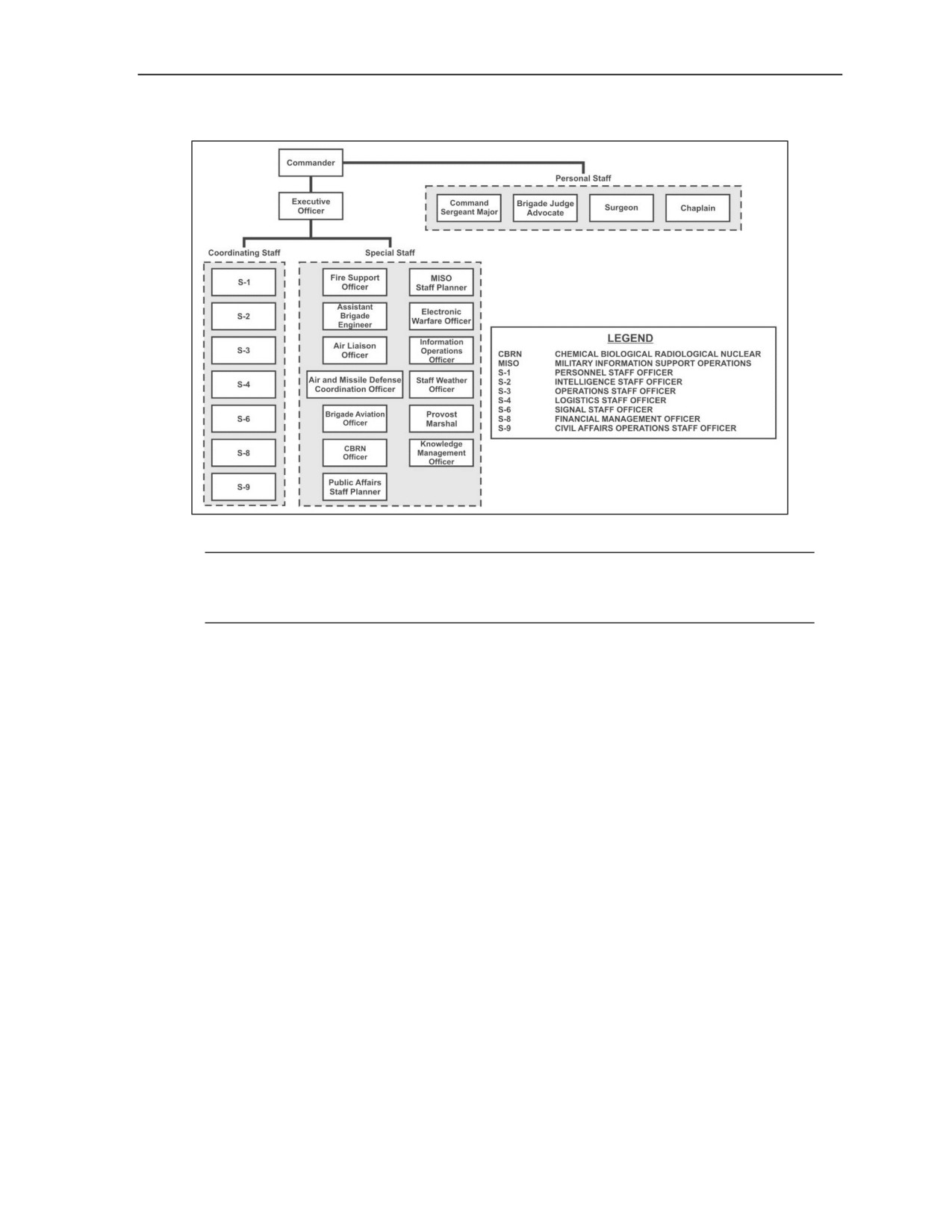
purpose, scope, and effect desired when one capability supports another. Establishing clear command and
support relationships is fundamental to organizing any operation. The commander designates command and
support relationships to weigh the decisive operation or main effort and support the concept of operations.
The commander considers two organizational principles when task-organizing forces: maintain cohesive
mission teams and do not exceed subordinates’ span of control capabilities.
Mission Statement
3-30. The mission is the task, together with the purpose, that clearly indicates the action to be taken and the
reason therefore (JP 3-0). The commander analyzes a mission as the commander’s intent two echelons above,
specified tasks, and implied tasks. The commander considers the mission of adjacent units to understand how
they contribute to the decisive operation of their higher headquarters. The analysis results yield the essential
tasks that, with the purpose of the operation, clearly specify the action required. This analysis produces the
mission statement—a short sentence or paragraph that describes the organization’s essential task(s), purpose,
and action containing the elements of who, what, when, where, and why (JP 5-0), but seldom specifies how.
Commander’s Intent
3-31. The commander’s intent succinctly describes what constitutes success for the operation. It is critical
that planners receive the commander’s intent as soon as possible after receiving the mission. The
commander’s intent includes the operation’s purpose, key tasks, and the conditions that define the end state.
The commander’s intent links the mission, concept of operations, and tasks to subordinate units. A clear
commander’s intent facilitates a shared understanding and focuses on the overall conditions that represent
mission accomplishment. During execution, the commander’s intent spurs disciplined initiative. The
commander’s intent must be understood two echelons down.
2FWREHU
FM 3-96
3-7
Chapter 3
Concept of Operations
3-32. The concept of operations is a statement that directs the manner in which subordinate units cooperate
to accomplish the mission and establishes the sequence of actions the force will use to achieve the end state
(ADRP 5-0). The concept of operations expands on the commander’s intent by describing how the
commander wants the force to accomplish the mission. The concept of operations states the principal tasks
required, the responsible subordinate unit, and how the principal tasks complement one another.
3-33. The commander and staff use operational frameworks to help conceptualize and describe the concept
of operations. An operational framework is a cognitive tool used to assist commanders and staffs in clearly
visualizing and describing the application of combat power in time, space, purpose, and resources in the
concept of operations (ADP 1-01). Any specific framework for conceptually organizing operations does not
bind the BCT commander; but he may use one of three conceptual frameworks listed below or in
combination. These operational frameworks apply equally to operational and tactical actions.
z
The deep-close-security framework to describe the operation in time and space.
z
The decisive-shaping-sustaining framework to articulate the operation in terms of purpose.
z
The main and supporting efforts framework to designate the shifting prioritization of resources.
3-34. The deep-close-security operational framework has historically been associated with terrain orientation
but can apply to temporal and organizational orientations as well. Deep operations involve efforts to prevent
uncommitted enemy forces from being committed in a coherent manner. Close operations are operations that
are within a subordinate commander’s area of operations. Security operations involve efforts to provide an
early and accurate warning of enemy operations and to provide time and maneuver space within which to
react to the enemy.
3-35. The decisive-shaping-sustaining framework lends itself to a broad conceptual orientation. The decisive
operation is the operation that directly accomplishes the mission (ADRP 3-0). The decisive operation
determines the outcome of a major operation, battle, or engagement. A shaping operation is an operation that
establishes conditions for the decisive operation through effects on the enemy, other actors, and the terrain
(ADRP 3-0). A sustaining operation is an operation at any echelon that enables the decisive operation or
shaping operation by generating and maintaining combat power (ADRP 3-0).
3-36. The main and supporting efforts operational framework (simpler than other organizing frameworks)
focuses on prioritizing effort among subordinate units. Therefore, leaders can use the main and supporting
efforts with either the deep-close-security framework or the decisive-shaping-sustaining framework. The
main effort is a designated subordinate unit whose mission at a given point in time is critical to overall mission
success. (ADRP 3-0). Usually, the preponderance of combat power weighs the main effort. A supporting
effort is a designated subordinate unit with a mission that supports the success of the main effort (ADRP 3-0).
(Refer to ADRP 3-0 for additional information.)
Tasks to Subordinate Units
3-37. The BCT commander and staff assign tasks to subordinate units. The assignment of a task includes not
only the task (what), but also the unit (who), place (where), time (when), and purpose (why). A task is a
clearly defined and measurable activity accomplished by individuals and organizations. Tasks are specific
activities that direct friendly action and contribute to mission accomplishment and other requirements. The
purpose of each task should nest with completing another task, achieving an objective, or attaining an end
state condition.
Coordinating Instructions
3-38. Coordinating instructions pertain to the BCT as a whole. Examples include commander’s critical
information requirements, essential elements of friendly information, fire support coordination measures and
airspace coordinating measures, rules of engagement, risk reduction control measures, personnel recovery
coordination measures, the time the operation order becomes effective or the condition of the BCT when the
operation order becomes effective.
3-8
FM 3-96
2FWREHU
Mission Command
Control Measures
3-39. A control measure is a means of regulating forces or warfighting functions (ADRP 6-0). Tailored to
the higher commander’s intent, the BCT commander assigns subordinate units missions and imposes control
measures necessary to synchronize and maintain control over the operation. The BCT commander or staff
assigns graphical, written or procedural control measures (permissive or restrictive) to prevent units from
impeding one another and to impose necessary coordination. The commander and his staff must understand
their purposes and ramifications, including the permissions or limitations imposed on subordinates’ freedom
of action and initiative, to employ control measures effectively. Each control measure should have a specific
purpose and provide the flexibility needed to respond to changes in the situation. The BCT commander uses
graphical, written, or procedural control measures to assign responsibilities, coordinate maneuver, and
control the use of airspace. (Refer to FM 3-90-1 and ADRP 1-02 for additional information.)
PREPARE
3-40. Preparation is those activities performed by units and Soldiers to improve their ability to execute an
operation (ADP 5-0). The military decisionmaking process drives preparation. Since time is a factor in all
operations, the BCT commander and staff conduct a time analysis early in the planning process. This analysis
helps them determine what actions they need to take and when to begin those actions to ensure forces are
ready and in position before execution. The plan may require the commander to direct subordinates to start
necessary movements; conduct task-organization changes; begin reconnaissance, surveillance, and security
operations; and execute other preparation activities before completing the plan.
Preparation Activities
3-41. Mission success depends as much on preparation as on planning. Subordinate and supporting leaders
and units of the BCT need enough time to understand plans well enough to execute them and develop their
plans and preparations for the operation. After they fully comprehend the plan, subordinate leaders rehearse
key portions of the plan and ensure Soldiers position themselves and their equipment to execute the operation.
The BCT conducts the activities listed in table 3-1 to help ensure the force is protected and prepared for
execution. (Refer to ADRP 5-0 for additional information.)
Table 3-1. Preparation activities
Continue to coordinate and conduct liaison
Conduct rehearsals
Initiate information collection
Conduct plans-to-operations transitions
Initiate security operations
Refine the plan
Initiate troop movement
Integrate new Soldiers and units
Initiate sustainment preparations
Complete task organization
Initiate network preparations
Train
Manage terrain
Perform pre-operations checks and inspections
Prepare terrain
Continue to build partnerships and teams
Conduct confirmation briefs
Conduct Rehearsals
3-42. The BCT conducts rehearsals to prepare for upcoming operations. A rehearsal is a session in which
the commander and staff or unit practices expected actions to improve performance during execution (ADRP
5-0). Four primary types of rehearsals are the backbrief, combined arms rehearsal, support rehearsal, and
battle drill or standard operating procedure rehearsal. Methods for conducting rehearsals are limited only by
the commander’s imagination and available resources. The BCT commander uses rehearsals as a tool to
ensure his staffs and subordinates understand the concept of operations and commander’s intent. The extent
of rehearsals depends on available time. In cases of short-notice requirements, a detailed rehearsal may not
be possible.
2FWREHU
FM 3-96
3-9
Chapter 3
3-43. The BCT commander often issues orders to subordinates verbally in situations requiring quick
reactions. At battalion and higher levels, written fragmentary orders confirm verbal orders to ensure
synchronization, integration, and notification of all parts of the force. If time permits, leaders verify that
subordinates understand critical tasks. Methods for doing this include the backbrief—a briefing by
subordinates to the commander to review how subordinates intend to accomplish their mission (FM 6-0) and
confirmation brief—briefing subordinate leaders give to the higher commander immediately after the
operation order is given. It is their understanding of his intent, their specific tasks, and the relationship
between their mission and the other units in the operation (ADRP 5-0). Commanders conduct backbriefs and
confirmation briefs between themselves and within staff elements to ensure mutual understanding.
3-44. Support rehearsals help synchronize each warfighting function with the BCT’s overall operation.
Throughout preparation, the BCT conduct support rehearsals within the framework of a single or limited
number of warfighting functions. These rehearsals typically involve coordination and procedure drills for
sustainment, aviation, fires, engineer support, or medical and casualty evacuation. Support rehearsals and
combined arms rehearsals complement preparations for the operation. Units may conduct rehearsals
separately and then combine them into full-dress rehearsals. Although these rehearsals differ slightly by
warfighting function, they achieve the same result.
3-45. A battle drill or standard operating procedure rehearsal ensures that all participants understand a
technique or a specific set of procedures. A battle drill is a collective action rapidly executed without applying
a deliberate decisionmaking process. All echelons use these rehearsal types; however, they are most common
for platoons, squads, and sections. Units conduct rehearsals throughout preparation; rehearsals are not limited
to published battle drills. All echelons can rehearse such actions as a command post shift change, an obstacle
breach lane-marking standard operating procedures, or a refuel-on-the-move site operation.
3-46. Subordinate units conduct rehearsals after they complete their plans and issue orders, if possible.
Rehearsals allow subordinate leaders and Soldiers to practice synchronizing operations at times and places
critical to mission accomplishment. Effective rehearsals throughout the BCT imprint a mental picture of the
sequence of the operation’s key actions and improve mutual understanding and coordination of subordinate
and supporting leaders and units. Four common rehearsals at the BCT level, although not inclusive, are the
combined arms rehearsal, the reconnaissance and security rehearsal, the fire support rehearsal, and the
sustainment rehearsal addressed below. (Refer to FM 6-0 for additional information.)
Combined Arms Rehearsal
3-47. The combined arms rehearsal ensures that subordinate plans synchronize with those of other units, and
that subordinate commanders understand the intent of the higher headquarters. Usually, the BCT commander,
executive officer (XO), primary staff, and subordinate battalion commanders and their S-3s attend the
rehearsal. Based upon the type of operation, the commander can modify the audience, such as attachments
to the BCT. If invited, flank units and the higher headquarters may attend the combined arms rehearsal if
time and distances permit.
3-48. The execution matrix, decision support template, and operation order outline the rehearsal agenda.
These tools, especially the execution matrix, drive and focus the rehearsal. The commander and staff use
them to control the operation’s execution. Any templates, matrixes, or tools developed within each of the
warfighting functions should tie directly to the supported unit’s execution matrix and decision support
template. Examples include an intelligence synchronization matrix or fires execution matrix.
3-49. The combined arms rehearsal should last no more than two hours; however, the combined arms
rehearsal is METT-TC dependent, so if the time allotted is insufficient to rehearse the entire operation, the
staff must give priority to those critical events that demand a rehearsal. The staff rehearses the most important
events first, and continues to rehearse subsequent events as time permits. All combined arms rehearsal
participants arrive at the rehearsal prepared to talk their portion of the operation.
Reconnaissance and Security Rehearsal
3-50. The BCT conducts reconnaissance and security rehearsals to ensure that the correct information is
gathered; and that Soldiers gathering the required information have a sound plan for insertion and extraction.
Usually, the BCT commander, XO, S-2, S-3, fire support coordinator and fire support officer, brigade
3-10
FM 3-96
2FWREHU
Mission Command
assistant engineer, cavalry squadron commander, other subordinate maneuver commanders as required, and
military intelligence company commander attend the rehearsal. Other BCT staff cells and elements should
have a representative attending (for example signal, sustainment, information operations, protection, aviation,
military information support operations, and civil affairs operations).
3-51. The reconnaissance and security rehearsal should last no more than one hour. The documents needed
to run the reconnaissance and security rehearsal includes the information collection matrix, the
reconnaissance and security overlay, and the enemy situation template. Rehearse the most important named
areas of interest first, then those that answer the BCT commander’s priority intelligence requirements.
Continue to rehearse subsequent named areas of interest as time permits. Each participating commander
confirms the purpose (such as priority intelligence requirements) and location, (such as named areas of
interest) for each of his collection assets. He also confirms to whom the information is reported and the means
of communicating that information.
Note. Due to the inherent risk associated with infantry reconnaissance and surveillance operations,
units must rehearse withdrawal under fire and
“in-extremis” extraction of infantry,
reconnaissance, and surveillance teams to include supporting aviation. Units must also rehearse
both lift and attack aviation.
Fire Support Rehearsal
3-52. The BCT fire support rehearsal is crucial to mission accomplishment because it ensures that fires—the
use of weapons systems to create a specific lethal or nonlethal effect on a target (JP 3-0)—synchronize with
the scheme of maneuver. The fire support rehearsal focuses on maximizing the ability of fire support systems
to support the maneuver plan, and achieve the commander’s intent.
3-53. The fire support rehearsal (including any augmenting fire support from the division artillery or a field
artillery brigade) may be used to prepare for a combined arms rehearsal or it may be used after a combined
arms rehearsal to refine and reinforce key fire support tasks. If the fire support rehearsal is held first, changes
from the combined arms rehearsal may require a second fire support rehearsal. If a combined arms rehearsal
is not conducted, a fire support rehearsal may serve as the primary preparation for execution of the fire
support plan. The unit may conduct the field artillery tactical rehearsal either before or after the fire support
rehearsal. The field artillery technical rehearsal is always held last after target refinement cutoff time.
3-54. The BCT commander, XO, S-3, and subordinate units attend the fire support rehearsal. The BCT staff
officers attending include the air liaison officer, assistant brigade engineer, chemical, biological, radiological,
and nuclear (CBRN) officer, air and missile defense officer, and brigade aviation officer. Subordinate units
often bring personnel that include the S-3, the fire support officer, scout and mortar platoon leaders, and the
precision weapons team. Representatives of reinforcing fire support units should participate when possible.
The BCT field artillery battalion commander assisted by the BCT fire support officer usually supervises the
rehearsal for the BCT commander.
Note. A precision weapons team is a three-man observer team that is constituted from forward
observer teams in the cavalry squadron of the brigade combat team (ATP 3-09.30).
3-55. The fire support rehearsal should last no more than 90 minutes and should ensure the synchronization
of the fire support effort with the maneuver plan. The maneuver plan includes ensuring observers are in the
proper location at the proper time to observe planned targets, commonly known as the BCT commander’s
observation plan.
3-56. Time is inevitably short so the rehearsal focuses on the critical portions of the plan, to include
preplanned fires, to ensure Soldiers correctly integrate and synchronize within the operational framework.
Additionally, the fire support rehearsal should address action during degraded or intermittent
communications to ensure interoperability to preserve the effectiveness of the force and maintain the
initiative over the enemy. The critical document supporting the fire support rehearsal is the fire support
execution matrix, which includes all fire support tasks. To conduct the fire support rehearsal, the BCT follows
the same procedures outlined in the combined arms rehearsal sequence of events.
2FWREHU
FM 3-96
3-11
Chapter 3
Sustainment Rehearsal
3-57. The BCT sustainment rehearsal ensures the synchronization of sustainment efforts before, during, and
after combat operations. The sustainment rehearsal validates the who, what, when, where, and how of
support. The sustainment rehearsal usually occurs after the combined arms and fire support rehearsals, which
should not last more than 90 minutes.
3-58. The brigade support battalion commander hosts the rehearsal for the BCT commander. The support
operations officer facilitates the rehearsal to ensure rehearsal of critical sustainment events. BCT attendees
include the BCT executive officer, the battalion or brigade personnel staff officer (S-1), surgeon, chaplain,
S-2 representatives, S-3 representatives, battalion or brigade logistics staff officer (S-4) representatives, and
S-6 representatives. Subordinate unit representatives include the BSB commander, the support operations
officer, the brigade support medical company commander, and each maneuver battalion executive officer,
S-1, S-4, and medical platoon leader, as well as the forward support company commander, mobility warrant,
and distribution company commander. The primary document used at the sustainment rehearsal is the
sustainment synchronization matrix.
EXECUTE
3-59. Execution is putting a plan into action by applying combat power to accomplish the mission (ADP
5-0). The commander positions himself where he can best exercise command during execution. This may be
forward of the main or tactical command post to provide command presence, sense the mood of the unit, and
to make personal observations. A position forward of the command posts and near the main effort or decisive
operation facilitates an assessment of the situation and decisionmaking. Staffs synchronize actions,
coordinate actions, inform the commander, and provide procedural control to support the commander’s
ability to assess, use judgment, and make decisions. FM 6-0 describes decisionmaking during execution and
describes the rapid decisionmaking and synchronization process.
ASSESS
3-60. Assessment is the determination of the progress toward accomplishing a task, creating a condition, or
achieving an objective (JP 3-0). Assessment is continuous; it precedes and guides every operations process
activity and concludes each operation or phase of an operation. The BCT commander and staff conduct
assessments by monitoring the current situation to collect information, evaluating progress towards achieving
endstate conditions or objectives, and recommending or directing action to modify or improve the existing
course of action. The commander establishes priorities for assessment in planning guidance, commander’s
critical information requirements
(priority intelligence requirements and friendly force information
requirements), essential element of friendly information, and decision points. By prioritizing the effort, the
commander avoids excessive analyses when assessing operations.
3-61. Throughout the operations process, the BCT commander integrates his assessments with those of the
staff, subordinate commanders, and other unified action partners. Primary tools for assessing progress of the
operation include the operation order, the common operational picture, personal observations, running
estimates, and the assessment plan. The latter includes measures of effectiveness, measures of performance,
and reframing criteria. The commander’s visualization forms the basis for the commander’s personal
assessment of progress. Running estimates provide information, conclusions, and recommendations from the
perspective of each staff section. ADRP 5-0 addresses the assessment process during the operations process.
(See FM 6-0 for doctrine on developing assessment plans.)
INTEGRATING PROCESSES AND CONTINUING ACTIVITIES
3-62. Throughout the operations process, the BCT commander and staff integrate the warfighting functions
to synchronize the force according to the commander’s intent and concept of operations. The commander
and staff use several integrating processes and continuing activities to do this. (Refer to ADRP 5-0 for additional
information.)
3-12
FM 3-96
2FWREHU
Mission Command
INTEGRATING PROCESSES
3-63. The commander and staff use several integrating processes to synchronize specific functions
throughout the operations process in addition to the major activities. The integrating processes are
intelligence preparation of the battlefield (see ATP 2-01.3), targeting (see ATP 3-60), and risk management
(see ATP 5-19).
CONTINUING ACTIVITIES
3-64. While units execute numerous tasks throughout the operations process, the commander and staff
always plan for and coordinate continuing activities. Continuing activities include the following:
z
Liaison. (See FM 6-0.)
z
Information collection. (See FM 3-55.)
z
Security operations. (See FM 3-90-2.)
z
Protection. (See ADRP 3-37.)
z
Terrain management. (See ADRP 5-0.)
z
Airspace control. (See FM 3-57.)
KNOWLEDGE AND UNDERSTANDING
3-65. Success in operations demands timely and effective decisions based on applying judgment to available
information and knowledge. Throughout the conduct of operations, the BCT commander (supported by his
staff and subordinate commanders and in coordination with unified action partners) seeks to build and
maintain situational understanding. Situational understanding is the product of applying analysis and
judgment to relevant information to determine the relationships among the operational and mission variables
to facilitate decisionmaking (ADP 5-0). The BCT staff uses knowledge management and information
management to extract knowledge from the vast amount of available information. This enables the staff to
provide knowledge to the commander in the form of recommendations and running estimates to help the
commander build and maintain situational understanding.
3-66. The BCT commander strives to create shared understanding of the operational environment, the
operation’s purpose, the problem, and approaches to solving the problem form the basis for unity of effort
and trust. Decentralized actions can perform in the context of shared understanding as if they were centrally
coordinated. Knowledge management helps create shared understanding through the alignment of people,
processes, and tools within the BCT’s organizational structure and culture to increase collaboration and
interaction. This results in better decisions and enables improved flexibility, adaptability, integration, and
synchronization to achieve a position of relative advantage. Knowledge management facilitates situational
understanding and acts as a catalyst for enhanced shared understanding.
3-67. Knowledge management and information management assist the commander with progressively
adding meaning at each level of processing and analyzing to help build and maintain situational
understanding. Knowledge management and information management are interrelated activities that support
the commander’s decisionmaking. Four levels of meaning, from the lowest level to the highest level, include
data, information, knowledge, and understanding. At the lowest level, processing transforms data into
information. Analysis then refines information into knowledge. The BCT commander and staff then apply
judgment to transform knowledge into understanding. Commanders and staffs continue a progressive
development of learning, as organizations and individuals assign meaning and value at each level.
3-68. Knowledge management is the process of enabling knowledge flow to enhance shared understanding,
learning, and decisionmaking (ADRP 6-0). Knowledge flow refers to the ease of movement of knowledge
within and among organizations. Knowledge must flow to be useful. Effective and efficient use of knowledge
in conducting operations and supporting organizational learning are essential functions of knowledge
management. The BCT executive officer is the senior knowledge management officer in the BCT and advises
the commander on knowledge management policy. The executive officer is responsible for directing the
activities of each staff section and subordinate unit to capture and disseminate organizational knowledge.
When staffed, a knowledge management officer (see paragraph 3-108 and FM 6-0), working through the
2FWREHU
FM 3-96
3-13
Chapter 3
executive officer, is responsible for developing the knowledge management plan that integrates and
synchronizes knowledge and information management within the BCT.
3-69. Information management is the science of using procedures and information systems to collect,
process, store, display, disseminate, and protect data, information, and knowledge products (ADRP 6-0).
Information management supports, underpins, and enables knowledge management. Information
management and knowledge management link to facilitate understanding and decisionmaking. Information
management is a technical discipline that involves the planning, storage, manipulating, and controlling of
information throughout its life cycle in support of the commander and staff. Information management
provides a structure so commanders and staffs can process and communicate relevant information and make
decisions. The signal staff officer (see paragraph 3-91) of the BCT enables knowledge management by
providing network architecture and the technological tools necessary to support content management and
knowledge sharing.
3-70. The staff task of “conduct knowledge management and information management” is essential to the
mission command warfighting function and entails the continuous application of the knowledge management
process of assess, design, develop, pilot, and implement activities designed to capture and distribute
knowledge throughout the organization. The assessment step begins with determining what information
leaders need to make decisions, and how the unit provides information for those leaders. Design is identifying
tailored frameworks for knowledge management products or services that effectively and efficiently answer
information requirements and meet the objectives established in the assessment. Develop is the step that
actually builds the solution derived from the assessment and design steps. Pilot is the phase that deploys the
knowledge management solution and tests and validates it with the unit. Implement is the phase that executes
the validated knowledge management plan and integrates it into the unit information systems. (Refer to ATP
6-01.1 for additional information.)
Note. The design step of the knowledge management process differs from and should not be
confused with Army design methodology. See paragraph 3-24 for information on Army design
methodology.
3-71. The knowledge management process, used throughout the operations process, puts the knowledge
management plan into practice. Example activities involved in the conduct of knowledge management and
information management will involve assessments and preparation activities, and reporting, refinement of
communications, and collaborative processes. Assessments are critical to the conduct knowledge
management and information management providing feedback to the organization on what is effective.
Preparation activities help the commander and staff, and subordinates understand the situation and their roles
in upcoming operations. Based on this improved situational understanding, the commander refines the plan,
as required, prior to execution with reporting, refinement of communications, and collaborative processes
enabling mission execution. (Refer to FM 6-0 and ATP 6-01.1 for additional activities involved in the conduct of
knowledge and information management.)
MISSION COMMAND SYSTEM
3-72. The BCT commander cannot exercise mission command alone. The mission command system enables
the commander’s ability to lead his staff and provide direction and motivation to subordinate commanders
and Soldiers. The commander organizes a mission command system to—
z
Support the commander’s decisionmaking.
z
Collect, create, and maintain relevant information and prepare knowledge products to support the
commander’s and leader’s understanding and visualization.
z
Prepare and communicate directives.
z
Establish the means by which commanders and leaders communicate, collaborate, and facilitate
the functioning of teams.
3-73. To provide these four overlapping functions, the commander arranges the five components of a mission
command system. The five components are:
z
Personnel.
3-14
FM 3-96
2FWREHU
Mission Command
z
Networks.
z
Information systems.
z
Processes and procedures.
z
Facilities and equipment.
3-74. At every echelon of command, the most important of these components is personnel. As the
commander’s mission command system begins with people, the commander bases his mission command
system on human characteristics more than on equipment and procedures. Trained personnel are essential to
an effective mission command system; the best technology cannot support mission command without them.
(Refer to ADRP 6-0 for additional information.)
PERSONNEL
3-75. Soldiers and leaders exercise disciplined initiative and accomplish assigned missions according to the
commander’s intent, not technology. Therefore, the BCT commander bases his mission command system on
human skills, knowledge, and abilities more than on equipment and procedures. Trained Soldiers and leaders
form the basis of an effective mission command system; the commander must not underestimate the
importance of providing training. Key personnel dedicated to mission command include seconds in
command, command sergeants major, and staffs. The second in command is the commander’s principal
assistant. The command sergeants major is the senior noncommissioned officer of the command. The staff
supports the commander with understanding situations, decisionmaking, and implementing decisions
throughout the operations process. The commander systematically arranges the staff as part of their mission
command system to perform the following three functions:
z
Supporting the commander.
z
Assisting subordinate units.
z
Informing units and organizations outside the headquarters.
NETWORKS
3-76. The BCT commander uses a network to communicate information and control forces whether mounted
or dismounted. The commander systematically establishes networks to connect people. These connections
can establish socially through the introduction of two personnel to perform a task, or technically through
information systems. The commander develops and leverages various social networks—individuals and
organizations interconnected by a common interest—to exchange information and ideas, build teams, and
promote unity of effort.
3-77. Technical networks also connect people and allow sharing of resources and information. An example
is LandWarNet, a technical network. LandWarNet is the Army’s portion of the Department of Defense
Information Networks. It is a technical network that encompasses all Army information management systems
and information systems that collect, process, store, display, disseminate, and protect information worldwide
(FM 6-02). LandWarNet enables the execution of mission command and supports operations through wide
dissemination of data and relevant information. (Refer to FM 6-02 for additional information.)
3-78. As networks may degrade during operations, the commander must develop methods and measures to
mitigate the impact of degraded networks. The commander may mitigate the impact of degraded networks
through exploiting the potential of technology or through establishing trust, creating shared understanding,
or providing a clear intent using mission orders.
INFORMATION SYSTEMS
3-79. The BCT commander determines his information requirements and focuses the staff and organization
on using information systems to meet these requirements. An information system consists of equipment that
collects, processes, stores, displays, and disseminates information. This includes computers, hardware and
software, and communications, as well as policies and procedures for their use (ADP 6-0). The BCT staff
uses information systems according to the commander’s information priorities. These capabilities relieve the
staff of handling routine data. Information systems, especially when integrated into a coherent, reliable
2FWREHU
FM 3-96
3-15
Chapter 3
network, enable extensive information sharing, collaborative planning, execution, and assessment that
promote shared understanding.
PROCESSES AND PROCEDURES
3-80. The BCT commander establishes and uses systematic processes and procedures to organize the
activities within the headquarters and throughout the force. Processes are a series of actions directed to an
end state, such as the military decisionmaking process. Procedures are standard, detailed steps, often used by
the BCT staff, which describes how to perform specific tasks to achieve the desired end state, such as standard
operating procedures. Processes and procedures increase organizational competence by improving the staff’s
efficiency or by increasing the tempo.
3-81. The military decisionmaking process provides the commander, staffs, and subordinate commanders an
orderly method for planning. Standard operating procedures often provide detailed unit instructions on how
to configure common operational picture displays. Adhering to processes and procedures minimizes
confusion, misunderstanding, and hesitation as the commander makes frequent, rapid decisions to meet
operational requirements.
FACILITIES AND EQUIPMENT
3-82. The commander systematically arranges facilities and equipment, including command posts,
platforms, operation centers, signal nodes, and all mission command support equipment. A facility is a
structure or location that provides a work environment and shelter for the other components of the mission
command system. Facilities range from a command post composed of vehicles and tentage, to platforms, to
hardened buildings. Examples of equipment needed to sustain a mission command system include vehicles,
radio or signal equipment, generators, and lighting. Facilities and equipment do not include information
systems. (Command posts are discussed later in this chapter and in FM 6-0.)
SECTION III - ORGANIZATION
3-83. The BCT commander organizes his headquarters into command posts and the command group(s) by
staff sections, cells, or elements. This section addresses staff organization, command post organization and
operation, and command post cells and staff elements.
STAFF ORGANIZATION
3-84. The BCT staff supports the commander, assist subordinate units, and inform units and organizations
outside the headquarters. The staff supports the commander’s understanding, making and implementing
decisions, controlling operations, and assessing progress. The BCT staff makes recommendations and
prepares plans and orders for the commander. The staff establishes and maintains a high degree of
coordination and cooperation with staffs of higher, lower, supporting, supported, and adjacent units. The
BCT staff does this by actively collaborating and communicating with commanders and staffs of other units
to solve problems. The staff keeps civilian organizations informed with relevant information according to
their security classification as well as their need to know. (See figure 3-1.) The basic BCT staff structure
includes an executive officer and various staff sections. A staff section is a grouping of staff members by area
of expertise under a coordinating, personal, or special staff officer.
(Refer to FM 6-0 for additional
information.)
3-16
FM 3-96
2FWREHU
Mission Command
Figure 3-1. Brigade combat team command and staff organization
Note. The public affairs officer is no longer authorized at the BCT echelon. The assigned public
affairs noncommissioned officer performs public affairs tasks and supports the BCT commander’s
ongoing communication strategies and planning guidance.
EXECUTIVE OFFICER
3-85. The executive officer (XO) is the commander’s principal assistant and directs staff tasks, manages and
oversees staff coordination, and special staff officers. The commander normally delegates executive
management authority to the XO. The XO provides oversight of sustainment planning (see chapter 9) and
operations for the BCT commander. As the key staff integrator, the XO frees the commander from routine
details of staff operations and the management of the headquarters and ensures efficient and prompt staff
actions. The XO may be second in command. (Refer to FM 6-0 for additional information.)
COORDINATING STAFF OFFICERS
3-86. The coordinating staff officers are the commander’s principal staff assistants. Coordinating staff
functionalities are organized and described in the paragraphs below.
Personnel Staff Officer, S-1
3-87. The S-1 is the principal staff officer for all matters concerning human resources support (military and
civilian). (See chapter 9.) Specific responsibilities include manning, personnel services, personnel support,
and headquarters management. The S-1 has coordinating staff responsibility for the civilian personnel officer
and the equal opportunity advisor and prepares a portion of Annex F (Sustainment) to the operation order.
(Refer to FM 1-0 and ATP 1-0.1 for additional information.)
Intelligence Staff Officer, S-2
3-88. The S-2 is chief of the intelligence warfighting function. The intelligence staff officer is the principal
staff officer responsible for providing intelligence to support current operations and plans. The S-2 gives the
commander and the S-3 the initial intelligence synchronization plan, which facilitates reconnaissance and
2FWREHU
FM 3-96
3-17
Chapter 3
surveillance integration. The S-2 helps the S-3 to develop the initial reconnaissance and surveillance plan.
The S-2 is responsible for the preparation of Annex B (Intelligence) and assists the S-3 in the preparation of
Annex L (Information Collection). (Refer to FM 2-0 for additional information.)
Operations Staff Officer, S-3
3-89. The S-3 is responsible for coordinating the activities of the movement and maneuver warfighting
function. The operations staff officer is the primary staff officer for integrating and synchronizing the
operation as a whole for the commander. He integrates reconnaissance and surveillance during plans and
operations. The S-3 synchronizes reconnaissance and surveillance with the overall operation throughout the
operations process (with the rest of the staff). He develops plans and orders, and determines potential
branches and sequels. The S-3 coordinates and synchronizes warfighting functions in all plans and orders.
Additionally, the S-3 is responsible for and prepares Annex L (Information Collection) and Annex V
(Interagency Coordination). The S-3 prepares Annex A (Task Organization), Annex C (Operations), and
Annex M (Assessment) to the operation order. In conjunction with the knowledge management officer, the
S-3 prepares Annex R (Reports) and Annex Z (Distribution). (Refer to FM 6-0 for additional information.)
Logistics Staff Officer, S-4
3-90. The S-4 is the principal staff officer for sustainment planning (see chapter 9) and operations, supply,
maintenance, transportation, services, field services, distribution, and operational contract support. The S-4
prepares Annex F (Sustainment), Annex P (Host-Nation Support) and Annex W (Operational Contract
Support) to the operation order. (Refer to FM 6-0 for additional information.)
Signal Staff Officer, S-6
3-91. The S-6 is the principal staff officer for all matters concerning network operations, jointly consisting
of Department of Defense Information Network Operations and applicable portions of the Defensive
Cyberspace Operations. The signal staff officer provides network transport and information services,
conducts network operations to operate and defend the network, enables knowledge management, manages
LandWarNet and combat net radios assets in area of operation, and performs spectrum management
operations. The S-6 prepares Annex H (Signal) and participates in preparation of Appendix 12 (Cyberspace
Electromagnetic Activities) to Annex C (Operations) with input from the S-2 and in coordination with the
S-3, to the operation order. (Refer to FM 6-02, FM 6-02.70, and FM 6-02.71 for additional information.)
Financial Management Officer, S-8
3-92. The S-8 is the principal staff officer singularly responsible for all financial management (see chapter
9) within the BCT. The financial management officer is the focal point in planning financial management
support that allows the BCT to accomplish its mission. The S-8 prepares a portion of Annex F (Sustainment).
(Refer to FM 1-06 for additional information.)
Civil Affairs Operations Staff Officer, S-9
3-93. The S-9 is the principal staff officer who is responsible for all matters concerning civil affairs. The
civil affairs operations staff officer conducts tactical level planning to integrate civil affairs operations,
coordinates relationships between the BCT and the civil component, and synchronizes civil affairs operations
to mitigate or defeat threats to civil society. The S-9 shapes the civil environment and sets the conditions for
military operations. The S-9 prepares Annex K (Civil Affairs Operations) to the operation order. (Refer to
FM 6-0 and FM 3-57 for additional information.)
Note. The S-9 (G-9) is required at all echelons from battalion through corps, but normally
authorized only at division and corps. Once deployed, units below division level may be
authorized an S-9.
3-18
FM 3-96
2FWREHU
Mission Command
PERSONAL STAFF OFFICERS
3-94. The personal staff officers work under the immediate control of, and have direct access to, the BCT
commander. They advise the commander, provide input to orders and plans, and interface and coordinate
with entities external to the BCT headquarters. Examples of personal staff officers to the BCT commander
include the command sergeant major, the brigade judge advocate, the surgeon, and the chaplain. Personal
staff responsibilities are described below.
Command Sergeant Major
3-95. The command sergeant major is the senior noncommissioned officer within the BCT who advises the
commander on issues related to the enlisted ranks. The command sergeant major carries out policies and
enforces standards for the performance, training, and conduct of enlisted Soldiers. In operations, a
commander employs the command sergeant major throughout the area of operations to extend command
influence, assess the morale of the force, and assist during critical events.
Brigade Judge Advocate
3-96. The brigade judge advocate is the senior legal advisor to the BCT commander. The brigade judge
advocate advises the commander and staff on operational law, military justice, administrative law, fiscal law,
and other areas of the law as required and ensures the delivery of legal services to the brigade across the core legal
disciplines of the judge advocate general corps. The brigade judge advocate prepares a portion of Annex C
(Operations) and Annex F (Sustainment) to the operation order. (Refer to AR 27-1 and FM 1-04 for additional
information.)
Surgeon
3-97. The surgeon is responsible for coordinating health service support (see chapter 9) and operations within
the command. The surgeon provides and oversees medical care to Soldiers, civilians, and enemy prisoners
of war.
(See ATP 4-02.3.) The surgeon prepares a portion of Annex E (Protection) and Annex F
(Sustainment) of the operation order. (Refer to FM 4-02 for additional information.)
Chaplain
3-98. The chaplain is responsible for religious support operations; advises the commander and staff on
religion, morale, moral, and ethical issues, within both the command and area of operation. Chaplains and
chaplain assistants are assigned at brigade and battalion echelons. (See chapter 9.) The chaplain prepares a
portion of Annex F (Sustainment) to the operations order. (Refer FM 1-05 for additional information.)
SPECIAL STAFF OFFICERS
3-99. Every staff organization has special staff officers. The number of special staff officers and their
responsibilities vary with authorizations, the desires of the commander, and the size of the command. Special
staff officers, common to the BCT, include the fire support officer, the assistant brigade engineer, the air
liaison officer, the air and missile defense coordination officer, the brigade aviation officer, the chemical,
biological, radiological, and nuclear officer, the public affairs staff planner, the military information support
operations staff planner, the knowledge management officer, the electronic warfare officer, the information
operations officer, the staff weather officer, and the provost marshal. Responsibilities for each are described
in the following paragraphs. (Refer to FM 6-0 for additional information.)
Fire Support Officer
3-100. The fire support officer serves as the special staff officer for fires and integrates fires into the scheme
of maneuver for the commander. The fire support officer leads the targeting process and fire support planning
for the delivery of fires to include preparation fires, harassing fires, interdiction fires, suppressive fires,
destruction fires, and deception fires. The fire support officer leads the fire support cell and prepares Annex
D (Fires) of the operation order. He also coordinates with the electronic warfare officer and the air liaison
officer. The BCT S-3 coordinates this position. (Refer to ADRP 3-09 for additional information.)
2FWREHU
FM 3-96
3-19
Chapter 3
Note. The BCT’s organic field artillery battalion commander, as the fire support coordinator, is
the BCT commander’s primary advisor for the planning, coordination, and integration of field
artillery and fire support to execute assigned tasks. (Refer to FM 3-09 for additional information.)
Assistant Brigade Engineer
3-101. The assistant brigade engineer (engineer officer) is the senior engineer on staff responsible for
coordinating engineer support to combined arms operations. The assistant brigade engineer integrates
specified and implied engineer tasks into the maneuver force plan. He ensures that mission planning,
preparation, execution, and assessment activities integrate supporting engineer units. The assistant brigade
engineer prepares Annex G
(Engineer) to the operation order.
(Refer to FM 6-0 for additional
information.)
Note. The brigade engineer battalion commander is the senior engineer in the BCT and advises
the BCT commander on how best to employ combat, general, and geospatial engineering
capabilities to conduct combined arms integration in support of decisive action. (Refer to ATP
3-34.22 for additional information.)
Air Liaison Officer
3-102. The air liaison officer is the senior Air Force officer with each tactical air control party. The air
liaison officer plans and executes close air support in accordance with the BCT commander’s guidance and
intent. The air liaison officer is responsible for coordinating aerospace assets and operations such as close air
support, air interdiction, air reconnaissance, airlift, and joint suppression of enemy air defenses. At battalion
or squadron level, the senior member of the tactical air control party is called a battalion air liaison officerʊa
specially trained and experienced noncommissioned officer or officer. (Refer to JP 3-09.3, FM 3-52, and
ATP 3-52.1 for additional information.)
Air and Missile Defense Coordination Officer
3-103. The air and missile defense coordination officer leads the air defense airspace management cell,
responsible for planning, coordinating, integrating, and controlling air defense and airspace management for
the BCT. This includes providing the capability to integrate mission command systems to provide the brigade
aviation element with the common operating picture, developing air defense plans, air defense artillery task
organization, scheme of air defense operations, and reconnaissance and surveillance planning. In addition,
the air and missile defense coordination officer integrates and coordinates tasks between the BCT and any
augmented air and missile defense assets and units not directly task-organized to BCT subordinate units. The
coordination officer within the air defense airspace management cell prepares a portion of Annex D (Fires)
to the operation order. (Refer to ATP 3-01.50, FM 3-52, and ATP 3-52.1 for additional information.)
Brigade Aviation Officer
3-104. The brigade aviation officer leads the brigade aviation element (BAE), is the airspace control officer
for the BCT S-3, plans for and synchronizes aviation into BCT commander’s ground scheme of maneuver.
The brigade aviation officer standardizes unmanned aircraft systems employment for the BCT, advises and
plans the use of reconnaissance, attack, air assault, air movement, sustainment, and medical evacuation. As
the BCT’s aviation subject matter expert, the brigade aviation officer is responsible for advising the BCT
commander and staff on the status and availability of aviation assets, their capabilities and limitations. The
brigade aviation officer recommends and helps coordinate priorities and allocations of aviation assets, helps
determine the priorities for their employment, and participates in targeting. The brigade aviation officer helps
prepare portions of Annex C (Operations) and portions of Annex D (Fires) of the operation order. (Refer to
FM 3-52 and ATP 3-52.1 for additional information.)
3-20
FM 3-96
2FWREHU
Mission Command
Chemical, Biological, Radiological, and Nuclear Officer
3-105. The CBRN officer is responsible for CBRN operations, obscuration operations, and CBRN asset
use. The CBRN officer leads the CBRN working group. When established, the CBRN working group
includes members from the protection working group, subordinate commands, host-nation agencies, and
other unified action partners (see paragraph 7-75). The CBRN officer prepares a portion of Annex E
(Protection) and a portion of Annex C (Operations) of the operation order. (Refer to ATP 3-11.36 for
additional information.)
Public Affairs Staff Planner
3-106. The public affairs staff planner, a noncommissioned officer authorized at the BCT level, develops
strategies, leads, and supervises the conduct of public information, community engagements, and command
information. Whether commissioned officer, noncommissioned officer, or Army civilian, the public affairs
officer’s principal role is to provide advice and counsel to the commander and the staff on how affected
external and internal publics will accept and understand the unit’s operations. The BCT public affairs officer
understands and coordinates the flow of information to Soldiers, the Army community, and the public and
prepares Annex J (Public Affairs) to the operation order. (Refer to FM 3-61 for additional information.)
Note. The public affairs officer (a personal staff officer to the commander) is required at all
echelons from brigade through Army command, but is no longer authorized at the BCT echelon.
Once deployed, the BCT may be assigned or attached a public affairs officer and section to
perform public affairs tasks and support the BCT commander’s ongoing communication strategies
and planning guidance.
Military Information Support Operations Staff Planner
3-107. The military information support operations staff planner, a noncommissioned officer authorized at
the BCT level, is responsible for synchronizing and coordinating military information support operations
with other information-related capabilities. If no military information support noncommissioned officer is
assigned, the commander of an attached military information support element may assume the military
information support staff officer’s responsibilities. The military information support operations staff planner
prepares Appendix 13 (Military Information Support Operations) and a portion of Appendix 14 (Military
Deception) and Appendix 15 (Information Operations) to Annex C (Operations) to the operation order. (Refer to
FM 3-53 for additional information.)
Knowledge Management Officer
3-108. Working through the BCT executive officer, the knowledge management officer is responsible for
developing the knowledge management plan that integrates and synchronizes knowledge and information
management. (The BCT executive officer is responsible for the organization’s knowledge management
program.) The knowledge management officer synchronizes knowledge and information management to
facilitate the BCT commander’s situational understanding for any problem set and to provide the staff shared
understanding. The knowledge management officer accomplishes this by using the tools, processes, and
people available to facilitate an environment of shared understanding. When required, the knowledge
management officer is responsible for Annex Q (Knowledge Management) to the operations order. (Refer to FM
6-0 and ATP 6-01.1 for additional information.)
Electronic Warfare Officer
3-109. The electronic warfare officer serves as the commander’s designated staff officer for the planning,
integration, synchronization, and assessment of electronic warfare, to include cyber electromagnetic
activities. The electronic warfare officer coordinates through other staff members to integrate electronic
warfare or/and cyber electromagnetic activities into the commander’s concept of operations. The electronic
warfare officer prepares Appendix 12 (Cyber Electromagnetic Activities) to Annex C (Operations) to the
operation order and contributes to any section that has a cyber electromagnetic activities subparagraph such
2FWREHU
FM 3-96
3-21
Chapter 3
as Annex N (Space Operations) in the operations order. (Refer to ATP 3-36 and FM 3-38 for additional
information.)
Information Operations Officer
3-110. The information operations officer, authorized at the BCT level, is responsible for synchronizing
and deconflicting information-related capabilities employed in support of BCT operations.
Information-related capabilities are tools, techniques, or activities employed within a dimension of the
information environment that can be used to create effects and operationally desired conditions (JP 3-13).
Led by the information operations officer, the BCT staff synchronizes capabilities that communicate
information to audiences and affect information content and flow of enemy or adversary decisionmaking
while protecting friendly information flow. The information operations staff planner prepares Appendix
15 and a portion of Appendices 12, 13, and 14 to Annex C (Operations) to the operation order. (Refer to
ADRP 6-0 for additional information.)
Staff Weather Officer
3-111. The staff weather officer is an Air Force officer or noncommissioned officer who coordinates
operational weather support and weather service matters through the S-2 and other staff members. The staff
weather officer collects environmental information. He uses this information to produce and disseminate an
environmental running estimate, mission execution forecast, and watches warnings and advisories. He
integrates weather effects into planning and execution and responds to weather requests for information. The
staff weather officer prepares Tab B
(Weather) to Appendix 1 (Intelligence Estimate) to Annex B
(Intelligence) to the operations order. (Refer to FM 2-0 for additional information.)
Provost Marshal
3-112. The provost marshal is responsible for planning, coordinating, and employing all organic, assigned,
or attached military police assets. Usually, the provost marshal is the senior military police officer in the
command. He augments the staff with a small planning cell that works within the S-3 typically. The provost
marshal prepares a portion of Annex C (Operations) and a portion of Annex E (Protection) to the operation
order. (Refer to FM 3-39 for additional information.)
Note. The brigade special troops battalion that converts to a brigade engineer battalion within the
BCT no longer has a military police platoon. Military police support mission requirements are
coordinated through the provost marshal to the echelon above the BCT.
AUGMENTATION
3-113. Often, Army headquarters receive augmentation teams to assist with mission command. The
commander integrates these teams and detachments into their command posts. For example, a division may
receive an Army space support team when deployed. An Army space support team within a division can
provide the BCT with space-related planning that may directly affect BCT operations. Critical space-related
information provided to BCT operations includes navigation accuracy forecasts for planning and conducting
mission and maneuver operations in support of fires and targeting effects. Space operations identify deliberate
enemy interference activities such as attempts to jam friendly communications systems and navigation
warfare that directly impacts targeting and maneuver forces. The BCT commander may request staff
augmentation. Augmentation teams include but are not limited to—
z
Army space support team. (See FM 3-14.)
z
Army cyberspace operations support team. (See FM 3-38.)
z
Civil affairs planning team. (See FM 3-57.)
z
Combat camera team. (See ATP 3-55.12.)
z
Legal support teams. (See FM 1-04.)
z
Mobile public affairs detachment. (See FM 3-61.)
z
Military history detachment. (See ATP 1-20.)
3-22
FM 3-96
2FWREHU
Mission Command
z
Military information support operations units. (See FM 3-53.)
z
Army information operations field support team. (See FM 3-13)
z
Individual augmentation by specialty (assessment or economic development).
COMMAND POST ORGANIZATION AND OPERATION
3-114. A command post is a unit headquarters where the commander and his staff perform their activities
(FM 6-0). The BCT design, combined with robust communications, gives the commander two command
posts, the main command post and the tactical command post, and a command group. The BCT commander
may designate the main command post of a subordinate battalion, normally the field artillery battalion, as the
BCT alternate command post. Either the brigade support battalion or the brigade special troops battalion (and
when replaced, the brigade engineer battalion) main command post may be assigned responsibility for the
brigade support area (see chapter 9). The brigade support area is a designated area in which sustainment
elements locate to provide support to a brigade (ATP 4-90).
3-115. The BCT commander organizes these command posts by staff sections or staff cells. Organizing the
staff among command posts, and into cells within command posts, expands the commander’s ability to
exercise mission command and makes the system survivable. The commander assigns functions and tasks to
each command post. The commander determines the sequence, timing of the deployment or movement, initial
locations, and exact organization of command posts.
3-116. Command post survivability is vital to the success of the BCT mission. Command posts often gain
survivability at the price of effectiveness. When concentrated, the enemy can easily acquire and target most
command posts. However, when elements of a command post disperse, they often have difficulty maintaining
a coordinated staff effort. When developing command post standard operating procedures and organizing
headquarters into command posts for operations, the BCT commander uses dispersion, size, redundancy, and
mobility to increase survivability.
3-117. Echelons within the BCT man, equip, and organize command posts to control operations for
extended periods. Command post personnel maintain communication with all subordinate units and higher
and adjacent units. The commander arranges command post personnel and equipment to facilitate internal
coordination, information sharing, and rapid decisionmaking. The BCT commander and staff use standard
operating procedures, battle rhythms, and meetings to assist with command post operations. (Refer to FM 6-0
for additional information.)
MAIN COMMAND POST
3-118. The main command post is a facility containing the majority of the staff designed to control current
operations, conduct detailed analysis, and plan future operations (FM 6-0). The main command post is the
BCT’s principal command post. The main command post includes representatives of all staff sections and a
full suite of information systems to plan, prepare, execute, and assess operations. The main command post is
larger in size and staffing and less mobile than the tactical command post. Normally, the BCT executive
officer leads and supervises the staff of the main command post. Functions of the main command post include
the following:
z
Planning current operations including branches and sequels.
z
Developing contingency plans from identified branches to the plan.
z
Developing plans from information from higher headquarters.
z
Developing plans from sequels identified during the planning process.
z
Controlling and synchronizing current operations.
z
Synchronizing all aspects of the operational framework (see ADRP 3-0) such as—
Deep, close, and security.
Decisive, shaping, and sustaining.
Main and supporting efforts.
z
Monitoring and assessing current operations for their impact on future operations.
z
Coordinating fires and effects.
2FWREHU
FM 3-96
3-23
Chapter 3
z
Synchronizing information-related capabilities; capabilities complemented by capabilities such
as—
Operations security.
Information assurance.
Counterdeception.
Physical security.
Electronic warfare support.
Electronic protection.
z
Coordinating cyber electromagnetic activities including—
Electronic warfare.
Cyberspace operations.
Spectrum management operations.
z
Planning for future operations.
z
Employing information collection.
z
Anticipating and monitoring the commander’s decision points and critical information
requirements.
z
Coordinating with higher headquarters and adjacent or lateral units.
z
Informing higher headquarters and units of ongoing missions.
z
Supporting the commander’s situational understanding through information and knowledge
management.
z
Enterprise services and network operations. (See FM 6-02.)
z
Planning, monitoring, and integrating airspace users.
z
Synchronizing sustainment including—
Common operational picture across all echelons of support.
Synchronization with the operations process; plan, prepare, execute, and assess.
Alignment with military actions in time and space, prioritization, and purpose.
Material readiness reports of combat power platforms.
Coordination of echelons above brigade sustainment support.
z
Developing and implementing—
Safety and occupational health. (See AR 385-10.)
Risk management. (See ATP 5-19.)
Accident prevention requirements, policies, and measures.
z
Coordinating air-ground operations.
z
Coordinating personnel recovery operations. (See FM 3-50.)
3-119.
Positioning the main command post includes the following considerations:
z
Where the enemy can least affect main command post operations.
z
Where the main command post can achieve the best communications (digital and voice).
z
Where the main command post can control operations best.
Note. In contiguous areas of operation, the BCT main command post locates behind the battalion
tactical command post and the BCT tactical command post, and out of enemy medium artillery
range, if practical. In noncontiguous areas of operation, the BCT main command post usually
locates within a subordinate battalion’s area of operations.
TACTICAL COMMAND POST
3-120. A tactical command post is a facility containing a tailored portion of a unit headquarters designed to
control portions of an operation for a limited time (FM 6-0). The BCT commander employs the tactical
command post as an extension of the main command post to help control the execution of an operation or
3-24
FM 3-96
2FWREHU
Mission Command
task. The BCT commander can employ the tactical command post to direct the operations of units close to
each other when direct command is necessary. The commander can use the tactical command post to control
a special task force or to control complex tasks such as reception, staging, onward movement, and integration.
When the tactical command post is not used, the staff assigned to it reinforces the main command post. BCT
standard operating procedures should address procedures to detach the tactical command post from the main
command post.
3-121. The tactical command post is fully mobile and is usually located near the decisive point of the
operation. As a rule, the post includes the personnel and equipment essential to the tasks assigned; however,
sometimes the tactical command post requires augmentation for security. The tactical command post relies
on the main command post for planning, detailed analysis, and coordination. Usually the BCT S-3 leads the
tactical command post. Tactical command post functions include the following when employed:
z
Control current operations.
z
Provide information to the common operational picture.
z
Assess the progress of operations.
z
Assess the progress of higher and adjacent units.
z
Perform short-range planning.
z
Provide input to targeting and future operations planning.
z
Provide a facility for the commander to control operations, issue orders, and conduct rehearsals.
3-122. Airborne mission command support often requires independent operations by aircrews and aircraft
under operational control to commanders and staffs down to the BCT and battalion level. An Army airborne
mission command platform provides the maneuver commander with a highly mobile, self-contained, and
reliable airborne digital command post. The command post is equipped with the mission command systems
needed to operate with joint forces and components, multinational forces, and United States government
agencies and departments. The airborne mission command platform allows the commander and his staff to
maintain voice and digital connectivity with required elements, roughly replicating the systems and
capabilities of a digitized maneuver BCT commander’s tactical command post. The commander and staff
can perform all mission command and coordination functions from the airborne platform. The airborne
platform provides tactical internet access to manipulate, store, manage, and analyze information, intelligence
data, mission plans, and mission progress data. The size and functions required of an airborne tactical
command post is mission dependent and within the capabilities and limitations of the aircraft. Ideally, as a
minimum the S-3, S-2, fire support officer, and air liaison officer accompany the commander.
COMMAND GROUP
3-123. The commander and selected staff members comprise a command group (see FM 6-0). Selected staff
members accompany the commander to exercise mission command away from a command post. The
command group gives the commander the mobility and protection to move throughout the area of operations
and to observe and direct BCT operations from forward positions.
3-124. The command group led by the BCT commander consists of whomever he designates. The command
group can include the command sergeant major and representatives from the S-2, S-3, and the fire support
cell. Normally, the command group is task-organized with a security element whenever it departs the main
command post. For example, a maneuver platoon from one of the BCTs maneuver battalions may be tasked
to provide that element. The commander positions his command group near the most critical event, usually
with or near the main effort or decisive operation. The BCT executive officer may establish a second
command group when required.
EARLY-ENTRY COMMAND POST
3-125. While not part of the unit’s table of organization and equipment, the commander can establish an
early-entry command post to assist in controlling operations during the deployment phase of an operation.
An early-entry command post is a lead element of a headquarters designed to control operations until the
remaining portions of the headquarters are deployed and operational (FM 6-0). The early-entry command
post normally consists of personnel and equipment from the tactical command post with additional
intelligence analysts, planners, and other staff officers from the main command based on the situation. The
2FWREHU
FM 3-96
3-25
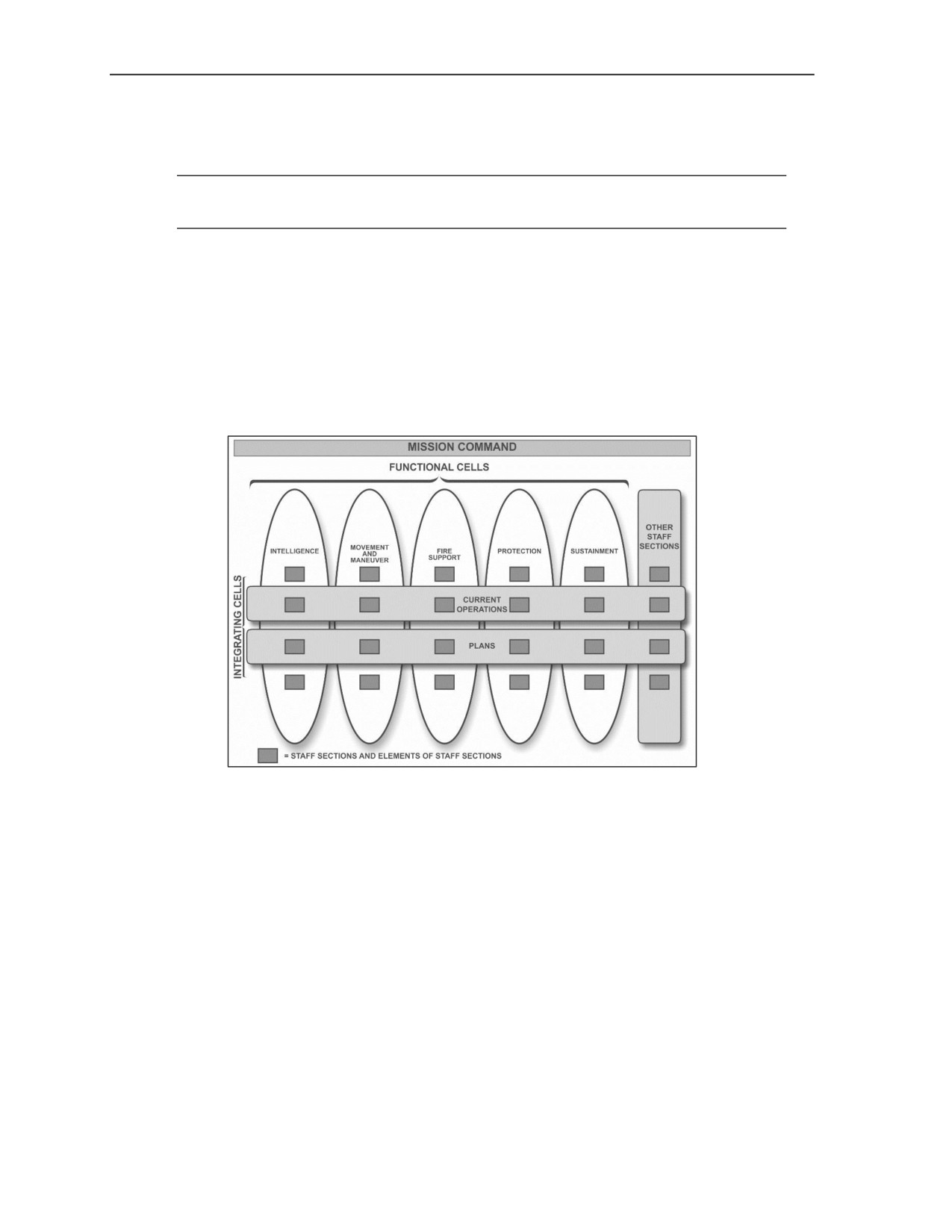
Chapter 3
early-entry command post performs the functions of the main and tactical command posts until those
command posts are deployed and fully operational. The BCT executive officer or operations officer normally
leads the early-entry command post.
Note. Refer to FM 3-99, Airborne and Air Assault Operations for information on airborne assault
and air assault command post organization and operation.
COMMAND POST CELLS AND STAFF ELEMENTS
3-126. The situation determines the main command post configuration. A command post cell is a grouping
of personnel and equipment organized by warfighting function or by planning horizon to facilitate the
exercise of mission command (FM 6-0). Staff elements, consisting of personnel and equipment from staff
sections, form command post cells. Typically, a BCT organizes into two types of command post cells:
integrating cells (current operations and plans) and functional cells (intelligence, movement and maneuver,
fire support, protection, sustainment). Integrating and functional cells provide staff expertise,
communications, and information systems that work in concert to aid the commander in planning and
controlling operations. (See figure 3-2.)
Figure 3-2. Integrating and functional cells
INTEGRATING CELLS
3-127. Cross functional by design, integrating cells coordinate and synchronize forces and warfighting
functions within a specified planning horizon. A planning horizon is a point in time that commanders use to
focus the organization’s planning efforts to shape future events (ADRP 5-0). The three planning horizons are
short, mid, and long. These planning horizons correspond to the integrating cells within a headquarters, which
are the current operations cell, future operations cell (typically above BCT level, see FM 6-0 for discussion),
and the plans cell.
3-128. Not all echelons and types of units are resourced for all three integrating cells. The BCT has a current
operations cell and a small, dedicated planning cell. The BCT is not resourced for a future operations cell.
Planning horizons are situation-dependent; they can range from hours and days to weeks and months. As a
rule, the higher the echelon, the more distant the planning horizon with which it is concerned.
3-26
FM 3-96
2FWREHU
Mission Command
Current Operations Cell
3-129. The current operations cell is the focal point for all operational matters. The cell oversees execution
of the current operation. The current operations cell assesses the current situation while regulating forces and
warfighting functions according to the commander’s intent and concept of operations.
3-130. The current operations cell displays the common operational picture and conducts shift change,
battle updates, and other briefings as required. The cell provides information on the status of operations to
all staff members and to higher, lower, and adjacent units. The movement and maneuver cell forms the core
of the current operations cell. Typically, a BCT designates a chief of operations to lead the current operations
cell from the main command post. The current operations cell has representatives from all staff sections, who
are either permanent or on call as well as attached or supporting subordinate units, special operations forces,
and unified action partner liaison officers.
Plans Cell
3-131. The plans cell is responsible for planning operations for the mid- to long-range planning horizons.
The plans cell develops plans, orders, branches, and sequels using the military decisionmaking process to
prepare for operations beyond the scope of the current order. The plans cell oversees military deception
planning.
3-132. The plans cell consists of a core group of planners and analysts led by the plans officer. All staff
sections assist as required. While the BCT has a small, dedicated plans element, the majority of its staff
sections balance their efforts between the current operations and plans cells. Upon completion of the initial
operation order, the plans cell normally develops plans for the next operation or the next phase of the current
operation. In addition, the plans cell develops solutions to complex problems resulting in orders, policies,
and other coordinating or directive products such as memorandums of agreement. In some situations,
planning teams form to solve specific problems, such as redeployment within the theater of operations. These
planning teams dissolve when planning is complete.
FUNCTIONAL CELLS
3-133. Functional cells coordinate and synchronize forces and activities by warfighting function. The
functional cells within a command post are movement and maneuver, fire support, intelligence, protection,
and sustainment.
Movement and Maneuver Cell
3-134. The movement and maneuver cell coordinates activities and systems that move forces to achieve an
advantageous position in relation to the enemy. Activities include tasks that employ forces in combination
with direct fire or fire potential (maneuver), force projection (movement) related to gaining a positional
advantage over an enemy, and mobility and countermobility. Elements of the operations, airspace control,
aviation, and engineer staff sections form this cell. The S-3 leads this cell. Staff elements in the movement
and maneuver cell form the core of the current operations cell, also. Additional staff officers and elements
residing in the movement and maneuver cell may include information operations officer, military information
support operations officer, electronic warfare officer, and brigade judge advocate.
Fire Support Cell
3-135. Fire support are fires that directly support land, maritime, amphibious, and special operations forces
to engage enemy forces, combat formations, and facilities in pursuit of tactical and operational objectives (JP
3-09). The fire support cell and its elements integrate the fires warfighting function within the BCT. The BCT
fire support officer leads this cell. Soldiers who have expertise integral to the fires warfighting function staff
the fire support cell. The cell has resources to plan for future operations from the main command post and to
support current operations from the tactical command post when deployed. Additionally, the cell has the
limited capability to provide coverage to the command group when deployed.
3-136. The fire support cell plans, prepares, executes, and assesses fires. The cell synchronizes the effects
of fires with other elements of combat power to accomplish the commander’s intent. During the targeting
2FWREHU
FM 3-96
3-27
Chapter 3
process, the fire support cell develops high-payoff targets and prioritizes targets for attack. The cell matches
a wide range of targeting and delivering systems, and integrates air defense and airspace management. The
fire support cell coordinates with the joint air-ground integration center (JAGIC), in the division’s current
operations integrating cell, for the execution of fires in support of current operations. The JAGIC ensures the
fire support cell has current fire support coordination measures and airspace coordinating measures and that
all BCT fires are executed within BCT airspace parameters. The JAGIC may also execute fires, through BCT
fire support cell, in specific situations.
3-137. The air defense airspace management element and the brigade aviation element collocate within the
fire support cell. The air defense airspace management/brigade aviation element (ADAM/BAE) composed
of Army air and missile defense and aviation staff supports the BCT commander and staff by providing
situational understanding of the airspace and early warning via connectivity with airspace users and with
multinational partner’s sensors and command networks. The ADAM/BAE cell coordinates closely with the
BCT tactical air control party to identify close air support airspace requirements and facilitate air-ground
integration. The cell coordinates airspace and aviation support issues with other BCT cells, participates
directly in the targeting process, airspace control, air defense, and may be a part of most working groups and
meetings. The ADAM/BAE is responsible for integrating airspace requirements in the BCT unit airspace
plan and submits airspace requirements to the division airspace element. (See paragraphs 3-155 to 3-157 for
addition information.)
3-138. The tactical air control party (TACP) is the principal air liaison unit collocated with the fire support
cell in the main command post. Selected portions of the cell can deploy with the tactical command post when
used. The air liaison officer is the senior TACP member attached to the BCT who functions as the primary
advisor to the BCT commander on air operations. The TACP has two primary missions: advise the BCT
commander and staff on the capabilities and limitations of air operations and provide the primary terminal
attack control of close air support. TACPs coordinate airspace coordinating measures and deconflict aircraft
with other fire support. TACPs may employ joint terminal attack controllers (JTACs) at any echelon, but will
most often place them in a forward position down to company and troop level. The JTAC is a qualified and
certified Service member, who, most often from a forward position, directs the action of combat aircraft
engaged in close air support and other air operations. The JTAC provides the ground commander
recommendations on the use of close air support and its integration with ground maneuver. (Refer to JP
3-09.3 for additional information.)
3-139. The brigade judge advocate participates in the planning and targeting processes. Additionally the
trial counsel assists the brigade judge advocate on operational law matters and is a standing member of work
groups, targeting boards, and the fire support cell. The brigade legal section’s inclusion in planning and on
board and working groups helps the legal section to have a full awareness of all the issues. The legal section
should advise the command about matters such as rules of engagement. The legal section also should review
any output for legal sufficiency and provide responsive advice for proposed follow-on operations. (Refer to
FM 1-04 for additional information.)
3-140. The electronic warfare officer leads the electronic warfare and/or the cyber electromagnetic activities
working groups. The determination of which working group is appropriate is situation dependent based on
which portion of the information environment desired effects occur. The electronic warfare officer plans,
coordinates, assesses, and supports the execution of electronic warfare and other cyber electromagnetic
activities, supports the BCT S-2 during intelligence preparation of the battlefield and the fire support officer
to ensure electronic attack fires are prioritized and integrated with all other effects. The electronic warfare
officer plans, assesses, and implements friendly electronic security measures, serves as electronic warfare
subject matter expert on existing electronic warfare rules of engagement, and maintains a current assessment
of available electronic warfare resources. (Refer to ATP 3-36 or FM 3-38 for additional information.)
3-141. The Army and Air Force can augment the main command post’s fire support cell as the mission
variables of METT-TC dictate. Joint resources and assets such as information engagement, civil affairs, and
related activities can augment the cell as needed. Additional functions within the fire support cell include:
z
Targeting work group. (See ATP 3-60.)
z
Preparing fires portion of operations order including scheme of fires. (See FM 3-09.)
z
Managing changes to fire support coordination measures. (See ATP 3-09.32.)
z
Coordinating clearance for attacks against targets (clearance of fires). (See FM 3-09.)
3-28
FM 3-96
2FWREHU
Mission Command
z
Preparing products for targeting work group and targeting board. (See ATP 3-60.)
z
Implementing, updating, managing, and disseminating all targeting guidance in the Advanced
Field Artillery Tactical Data Systems. (See FM 3-09.)
z
Recommending radar employment and functional dissemination of rocket, artillery, and mortar
warnings. (See ATP 3-01.60.)
Intelligence Cell
3-142. Intelligence core competencies within the intelligence cell are intelligence synchronization,
intelligence operations, and intelligence analysis. Intelligence synchronization is the “art” of integrating
information collection and intelligence analysis with operations to effectively and efficiently support
decisionmaking (ADRP 2-0). Intelligence operations are the tasks undertaken by military intelligence units
and Soldiers to obtain information to satisfy validated requirements (ADRP 2-0). Intelligence analysis is the
process by which collected information is evaluated and integrated with existing information to facilitate
intelligence production (ADRP 2-0). Intelligence core competencies are the basic activities and tasks used to
describe and drive the intelligence warfighting function and leverage the intelligence enterprise. (Refer to
ADRP 2-0 for additional information.)
3-143. The BCT intelligence officer leads the intelligence cell. The BCT intelligence staff section is the
core around which the intelligence officer forms the BCT intelligence cell along with designated Soldiers
from the BCT military intelligence company and an assigned USAF weather team. Higher headquarters may
augment this cell with additional capabilities to meet mission requirements. The BCT intelligence cell
requests, receives, and analyzes information from all sources to produce and distribute intelligence products.
Although there are intelligence staff elements in other command post cells, most of the intelligence staff
section resides in this cell. (Refer to FM 2-0 for additional information.) The BCT intelligence cell performs
the following functions:
Facilitate Commander’s Visualization and Understanding
3-144. The BCT intelligence cell facilitates the commander’s visualization and understanding of the threat,
terrain and weather, and civil considerations as well as other relevant aspects of the operational environment
within the BCT area of interest. The intelligence cell provides information and intelligence that assists the
commander with performing his visualization (see ADRP 5-0). The cell performs intelligence preparation of
the battlefield (see ATP 2-01.3), indications and warning (see FM 2-0), and situation development tasks (see
FM 2-0) to provide information and intelligence.
Support Targeting and Protection
3-145. The intelligence cell provides the commander and staff with information and intelligence to target
threat forces, organizations, units, and systems through lethal and nonlethal effects. The BCT intelligence
cell conducts tasks to deny or degrade the threat’s effort to access and gain intelligence about friendly forces.
The intelligence cell develops target systems, locates targets, and performs battle damage assessment to
support targeting (see ATP 3-60). The intelligence cell performs counterintelligence by reporting the
capabilities and limitations of threat intelligence services to the commander. (Refer to FM 2-22.2 for
additional information.)
Assisting in Information Collection Planning
3-146. The BCT intelligence cell integrates military intelligence collection assets so the commander can
gain situational understanding to produce intelligence. Information collection is an activity that synchronizes
and integrates the planning and employment of sensors and assets as well as the processing, exploitation, and
dissemination systems in direct support of current and future operations (FM 3-55). The intelligence cell
identifies, prioritizes, and validates information collection tasks. The information collection plan is developed
and synchronized with the concept of operations. The BCT intelligence cell performs the planning
requirements and assesses collection tasks to support information collection planning. (Refer to ATP 2-01 for
additional information.)
2FWREHU
FM 3-96
3-29
Chapter 3
Produce Intelligence Products
3-147. Intelligence informs the commander and staff of where and when to look. Reconnaissance,
surveillance, security operations, and intelligence operations are the collection means. The collection means
range from national and joint collection capabilities to individual Soldier observations and reports. The result
or product is intelligence that supports the commander’s decisionmaking. (Refer to ATP 2-01 for additional
information.)
Dissiminating and Integrating Intelligence
3-148. The cell uses various mission command networks to disseminate and integrate within the BCT area
of operation. The cell uses verbal reports, documents, textual reports, graphic products, softcopy products,
and automated databases to disseminate intelligence. The commander and staff integrate the intelligence to
assist them in maintaining situational awareness. Establishing communications networks and knowledge and
information management procedures accomplishes this function.
Protection Cell
3-149. The protection cell integrates and synchronizes protection tasks and their associated systems
throughout the operations process. The protection cell coordinates the activities and systems that preserve
the force through risk management. Risk management includes tasks associated with protecting personnel
and physical assets. Protection tasks and systems include air and missile defense, personnel recovery,
information protection, fratricide avoidance, operational area security, antiterrorism, survivability, force
health protection, CBRN operations, safety, operations security, and explosive ordnance disposal. Elements
of the following staff sections form this cell, chemical, biological, radiological, and nuclear; engineer;
personnel recovery; and provost marshal. The protection cell coordinates with the signal staff section to
facilitate the information protection task.
3-150. The S-3 supervises the protection cell within the BCT. Protection integration in the BCT may require
the commander to designate a staff lead as the protection officer. The protection officer has the experience
to integrate risk management and other integrating processes. The executive officer, S-3, or a sergeant major
could perform these duties. The commander may designate the assistant operations officer or other staff
officer as the protection coordinator to facilitate the integration of protection tasks.
3-151. Working groups established within the protection cell may include cyber electromagnetic activities
(see FM 3-38), CBRN (see ADRP 3-37), and personnel recovery (see FM 3-50). For example, protection
requires the integration and coordination of tasks to defend the network, as well as protect individuals and
platforms. Thus, the S-3 designates and relies on the cyber electromagnetic activities working group. The
electronic warfare officer, with representation from the S-2, S-6 and other staff elements, leads the cyber
electromagnetic activities working group to achieve the level of protection required. In all cases, protection
officers and coordinators work with higher and lower echelons to nest protection activities with
complementary and reinforcing capabilities. (Refer to ADRP 3-37 for additional information.)
Sustainment Cell
3-152. The sustainment cell coordinates activities and systems that provide support and services to ensure
freedom of action and to prolong endurance. The sustainment cell includes tasks associated with logistics,
personnel services, and health service support. The following staff section elements work in the sustainment
cell, logistics, human resources, and the surgeon. The BCT sustainment cell may collocate with the BSB
within the brigade support area. The BCT S-4 leads this cell. (Refer to chapter 9 for additional information.)
AIR-GROUND OPERATIONS
3-153. Air and ground forces must integrate effectively to conduct operations and to minimize the potential
for fratricide and civilian casualties. Integration, the arrangement of military forces and their actions to create
a force that operates by engaging as a whole (JP 1), maximizes combat power through synergy of both forces.
The integration of air operations into the ground commander’s scheme of maneuver may also require
integration of other services or multinational partners. Integration continues through planning, preparation,
3-30
FM 3-96
2FWREHU
Mission Command
execution, and assessment. The BCT commander and staff must consider the following framework
fundamentals to ensure effective integration of air and ground maneuver forces.
z
Understanding capabilities and limitations of each force.
z
Standard operating procedures.
z
Habitual relationships.
z
Regular training events.
z
Airspace control.
z
Maximizing and concentrating effects of available assets.
z
Employment methods.
z
Synchronization.
3-154. The BCT commander uses the division’s joint air-ground integration center (JAGIC) to ensure
continuous collaboration with unified action partners to integrate fires and to use airspace effectively. The
BCT fire support cell sends requests for division-level Army and joint fires to the JAGIC in the current
operations integrating cell of the division. Upon receipt of the request for fire or joint tactical airstrikes, the
JAGIC fire support cell personnel make attack recommendations and, if required, provide target coordinate
mensuration. Additionally, the JAGIC conducts collateral damage estimation and reviews available ground
and air component fires capabilities to determine the most effective attack method. Refer to ATP 3-91.1 for
additional information on the joint air-ground integration center.
Air Defense Airspace Management/Brigade Aviation Element
3-155. The air defense airspace management/brigade aviation element (ABCT and IBCT), and the air
defense airspace management element (SBCT), located within the BCT fire support cell, provides the BCT
commander and staff with the aerial component of the common operational picture. These elements
coordinate airspace control requirements with higher headquarters and enable air and missile defense and
aviation considerations throughout the operations process. By providing the BCT commander and staff with
near-real-time situational awareness of the airspace dimension, these elements allow the commander to
optimize the air battle and airspace management at all levels.
3-156. The air defense airspace management (ADAM) element integrates within the BCT’s fire support
cell and always deploys with the BCT. Upon mission notification, the ADAM element conducts an
assessment to determine if air and missile defense augmentation from the division air and missile defense
battalion is required. The element conducts continuous planning and coordination proportionate with the
augmented sensors deployed within the brigade’s area of operation. The ADAM element and tailored air and
missile defense augmentation force provide the active air defense within the BCT’s area of operations. (Refer
to ATP 3-01.50 for additional information.)
3-157. The brigade aviation element (BAE) plans and coordinates the incorporation of Army aviation into
the ground commander's scheme of maneuver and synchronizes aviation operations and airspace control
measures. The element provides employment advice and initial planning for aviation missions to include
employment of unmanned aircraft systems, airspace planning and coordination, and synchronization with
other air liaison officers and the fire support coordinator. The BAE coordinates directly with the supporting
combat aviation brigade or aviation task force. The combat aviation brigade commander exercises an
informal oversight role for the brigade aviation officer and the BAE. The combat aviation brigade commander
interfaces with the supported BCT commander to ensure the BAE is manned properly to meet the BCT
commander’s intent. (Refer to FM 3-04.111 for additional information.)
Combat Aviation Brigade
3-158. The combat aviation brigade is a modular and tailorable force organized and equipped to integrate
and synchronize operations of multiple aviation battalions. The combat aviation brigade can operate as a
maneuver headquarters and can employ subordinate battalions and other augmenting forces in deliberate and
hasty operations. The combat aviation brigade headquarters provides tailored support to adjacent supported
maneuver commanders at the BCT level and below when employed in this role. While a BAE works directly
for the BCT commander as a permanent member of the BCT staff, aviation liaison teams represent the
supporting aviation task force at designated maneuver headquarters for the duration of a specific operation.
2FWREHU
FM 3-96
3-31
Chapter 3
If collocated with a BAE, the liaison team normally works directly with the brigade aviation officer as a
functioning addition to the BAE staff section. Effective employment of liaison officers is imperative for
coordination and synchronization. Often aviation liaison teams coordinate with the BAE and proceed to a
supported ground maneuver battalion or squadron location.
3-159. Air-ground integration is merging air and ground operations into one fight. The goal is to apply
aviation capabilities according to the BCT commander’s intent. Ideally, integration begins early in the
planning process with the brigade aviation element’s involvement. The brigade aviation element advises the
BCT commander on aviation capabilities and on how to best use aviation to support mission objectives. The
employment of aviation assets is dependent upon providing the supporting aviation units with a task and
purpose, integrating them into the BCT commander’s scheme of maneuver. This integration allows the
aviation commander and staff to identify the best available platform(s) for the mission, to identify the proper
utilization of aviation assets, and to increase the BCT’s maneuver capabilities, as well as the commander’s
ability to conduct mission command on the move. BCT planners, down through the supporting aviation unit
to the individual aircrews, should consider these imperatives as elements of air-ground operations. A failure
to properly consider these imperatives can result in the lack of synchronization, wasted combat power, the
loss of friendly forces by enemy actions, or fratricide. (Refer to FM 3-04.111 for additional information.)
3-160. Combat aviation brigade attacks may be in close proximity or in direct support of ground maneuver
forces (close combat attack) or the attacks may be against enemy forces not in direct contact with friendly
ground forces (interdiction). A close combat attack is a coordinated attack by Army attack reconnaissance
aircraft (manned and unmanned) against targets that are in close proximity to friendly forces. The close
combat attack is not synonymous with close air support flown by joint aircraft. Terminal control from ground
units or controllers is not required due to the capabilities of the aircraft and the enhanced situational
understanding of the aircrew. Detailed integration with ground forces is required due to the close proximity
of friendly forces. Interdiction is an action to divert, disrupt, delay, or destroy the enemy’s military surface
capability before it can be used effectively against friendly forces, or to otherwise achieve objectives (JP
3-03). An interdiction is at such a distance from friendly forces that detailed integration with ground forces
is not required.
3-161. Air-ground operations include the movement of maneuver forces. An air assault is the movement
of friendly assault forces by rotary-wing aircraft to engage and destroy enemy forces or to seize and hold key
terrain (JP 3-18). Air assaults use the firepower, mobility, protection, and total integration of aviation assets
in their air and ground roles to attain the advantage of surprise. Air assaults allow friendly forces to strike
over extended distances and terrain to attack the enemy when and where it is most vulnerable. By their very
nature, air assaults are high-risk, high-payoff operations that are resource-intensive and require extensive
planning and preparation to be successful. (Refer to FM 3-99 for additional information.)
3-162. Army air movements are operations involving the use of utility and cargo rotary-wing assets for
other than air assaults (FM 3-90-2). Air movements are a viable means of transport and distribution to support
maneuver and sustainment conducted to reposition units, personnel, supplies, equipment, and other critical
combat elements. In addition, to airdrop and air landing, these operations include external carry by sling-load.
Army rotary-wing aircraft conduct airdrop and air-landing movement as well as sling load operations. Sling
operations are unique to helicopters with external cargo hooks. The utility and cargo helicopters of the combat
aviation brigade supplement ground transportation to help sustain continuous operations. The aviation unit
performs air movements on a direct support or general support basis with utility and cargo aircraft. The same
general planning considerations that apply to air assaults apply to air movements. (Refer to FM 3-04.113 for
additional information.)
3-163. The combat aviation brigade has an organic air ambulance medical company, also referred to as the
medical company (air ambulance), found in the general support aviation battalion. The air ambulance medical
company has a company headquarters and four forward support medical evacuation platoons or forward
support medical evacuation teams. Air ambulance aircraft are equipped with medical personnel and
equipment enabling the provision of en route care of patients. Air ambulance medical company assets can
collocate with Army health service support organizations, the aviation task force, the supported BCT, or
higher to provide air ambulance support throughout the area of operation. (Refer to ATP 4-02.3 and FM
3-04.111 for additional information.)
3-32
FM 3-96
2FWREHU
Mission Command
SECTION IV - STAFF PROCESSES AND PROCEDURES
3-164. A BCT must man, equip, and organize command posts to control operations for extended periods.
The BCT commander, assisted by his staff, arranges command post personnel and equipment to facilitate
24-hour operations, internal coordination, information sharing, and rapid decisionmaking. The commander
ensures procedures to execute the operations process within the headquarters enable mission command. The
staff uses standard operating procedures, battle rhythm, meetings, and running estimates to assist them
in command post operations.
STANDARD OPERATING PROCEDURES
3-165. Standard operating procedures (SOPs) that assist with effective mission command serve two
purposes. Internal SOPs standardize each command post’s internal operations and administration. External
SOPs, developed for the entire force, standardize interactions among command posts and between
subordinate units and command posts. Effective SOPs require all Soldiers to know their provisions and to train to
their standards. (Refer to FM 7-15 for additional information on tasks for command post operations.) Critical brigade
combat team SOPs include tactical SOPs (refer to ATP 3-90.90), targeting SOPs (refer to ATP 3-60), and command
post battle drill SOPs (refer to FM 7-15).
BATTLE RHYTHM
3-166. Within the operations process, the BCT commander and staff must integrate and synchronize
numerous activities, meetings, and reports with their headquarters and higher headquarters and with
subordinate units. The commander and staff establish the BCT’s battle rhythm. Battle rhythm is a deliberate
daily cycle of command, staff, and unit activities intended to synchronize current and future operations (FM
6-0). The BCT’s battle rhythm sequences the actions and events within a headquarters that are regulated by
the flow and sharing of information that supports decisionmaking. An effective battle rhythm—
z
Establishes a routine for staff interaction and coordination.
z
Facilitates interaction among the commander, staff, and subordinate units.
z
Facilitates staff planning and the commander’s decisionmaking.
3-167. As a practical matter, a BCT’s battle rhythm consists of a series of meetings, report requirements,
and other activities synchronized by time and purpose. These activities may be daily, weekly, monthly, or
quarterly depending on the planning horizon.
3-168. The BCT commander adjusts the unit’s battle rhythm as operations progress. For example early in
the operation, a commander may require a commander’s update every several hours. As the situation changes,
the commander may require only a daily commander’s update. Some factors that help determine a unit’s
battle rhythm include the staff’s proficiency, higher headquarters’ battle rhythm, and current mission. The
BCT commander and/or executive officer consider the following when developing the unit’s battle rhythm:
z
Higher headquarters’ battle rhythm and report requirements.
z
Duration and intensity of the operation.
z
Planning requirements of the integrating cells (current operations and plans).
MEETINGS
3-169. Meetings (including working groups and boards) take up a large amount of a BCT’s battle rhythm.
Meetings are gatherings to present and exchange information, solve problems, coordinate action, and make
decisions. Meetings may involve the staff; the commander and staff; or the commander, subordinate
commanders, staff, and other partners. Who attends a meeting depends on the issue. The BCT commander
establishes meetings to integrate the staff and enhance planning and decisionmaking within the headquarters.
Two critical meetings that happen as a part of the BCT battle rhythm are the operations update and assessment
briefing and the operations synchronization meeting.
2FWREHU
FM 3-96
3-33
Chapter 3
OPERATION UPDATE AND ASSESSMENT BRIEFING
3-170. An operation update and assessment briefing may occur daily or anytime the commander calls for
one. The content is similar to the shift-change briefing but has a different audience. The staff presents the
briefing to the commander and subordinate commanders. The briefing provides all key personnel with
common situational awareness. Often the commander requires this briefing shortly before an operation begins
to summarize changes made during preparation, including changes resulting from reconnaissance and
surveillance efforts.
3-171. Staff sections present their running estimates during the briefing. Subordinate commanders brief
their current situation and planned activities. Rarely do all members conduct this briefing face-to-face. All
command posts and subordinate commanders participate using available communications, including radio,
conference calls, and video teleconference. The briefing follows a sequence and format specified by SOPs
that keeps transmissions short, ensures completeness, and eases note taking. The briefing normally has a
format similar to a shift-change briefing. However, this briefing omits command post administrative
information and includes presentations by subordinate commanders in an established sequence.
OPERATIONS SYNCHRONIZATION MEETING
3-172. The key event in the battle rhythm is the operations synchronization meeting, which supports the
current operation. The primary purpose of the meeting is to synchronize all warfighting functions and other
activities in the short-term planning horizon. The meeting ensures that all staff members have a common
understanding of current operations including upcoming and projected actions at decision points.
3-173. The operations synchronization meeting does not replace the shift-change briefing or operation
update and assessment briefing. The S-3 or XO chairs the meeting. Representatives of each command post
cell and separate staff section attend the meeting. The operations synchronization meeting includes a
fragmentary order addressing any required changes to maintain synchronization of current operations, and
any updated planning guidance for upcoming working groups and boards. All warfighting functions are
synchronized and appropriate fragmentary orders are issued to subordinates based on the commander’s intent
for current operations.
RUNNING ESTIMATE
3-174. Effective plans and successful executions hinge on accurate and current running estimates. A
running estimate is the continuous assessment of the current situation used to determine if the current
operation is proceeding according to the commander’s intent and if planned future operations are supportable
(ADP 5-0). Failure to maintain accurate running estimates may cause errors or omissions resulting in flawed
plans or bad decisions during execution.
3-175. Running estimates are principal knowledge management tools the BCT commander and staff use
throughout the operations process. In their running estimates, the commander and each staff section member
continuously considers the effect of new information and update the following:
z
Facts.
z
Assumptions.
z
Friendly force status.
z
Enemy activities and capabilities.
z
Civil considerations.
z
Conclusions and recommendations.
3-176. Running estimates always include recommendations for anticipated decisions. During planning, the
BCT commander uses these recommendations to select feasible, acceptable, and suitable courses of action
for further analysis. The commander uses recommendations from running estimates in decisionmaking
during preparation and execution.
3-177. The BCT staff maintains formal running estimates while the commander’s estimate is a mental
process directly tied to his vision. The commander integrates personal knowledge of the situation with
analysis of the operational and mission variables, with subordinate commanders and other organizations
3-34
FM 3-96
2FWREHU
Mission Command
assessments, and with relevant details gained from running estimates. The BCT commander uses his running
estimate to crosscheck and supplement the staff’s running estimates. A running estimate format is included
in FM 6-0.
SECTION V - NETWORK AND INFORMATION SYSTEMS
3-178. The BCT uses networks and information systems, such as brigade combat team network and
LandWarNet, to share the common operational picture with subordinates to guide the initiative. The common
operational picture conveys the BCT commander’s perspective and facilitates subordinates’ situational
understanding. The following paragraphs address the BCT commander’s mission command system and the
various information systems that support the brigade combat team network. (Refer to ADRP 6-0 for
additional information.)
3-179. The brigade combat team network is a portion of LandWarNet when connected or accessing
LandWarNet and Department of Defense information network providing applications, data, and computing
services. The brigade combat team network technical infrastructure includes communications systems,
network services, applications, information management, and network operations. These BCT technical
infrastructures use warfighting functions to collect, process, store, display, disseminate , and protect
information within their organizations.
3-180. LandWarNet gives the BCT advantages when collecting technical information and when
distributing information and intelligence. The LandWarNet comprises core battlefield automated systems
plus common services and network management. Each system provides access and the passing of information
from a horizontally integrated brigade combat team network. The following are the core systems:
z
Tactical Mission Command System.
z
Global Command and Control System-Army.
z
Distributed Common Ground System-Army.
z
Battle Command Sustainment Support System.
z
Air and Missile Defense Planning and Control System.
z
Advanced Field Artillery Tactical Data System.
z
Force XXI Battle Command, Brigade and Below.
z
Blue Force Tracking.
z
Tactical Airspace Integration System.
z
Digital Topographic Support System.
z
Integrated System Control.
Note: The Tactical Mission Command System comprises the functions previously performed by
the Maneuver Control System and the command post of the future.
3-181. The LandWarNet common server supplies interoperability and infrastructure between the mission
command systems. The common server provides command posts at multiple echelons with a localized
network directory, access control, and other services. The server also provides the command post with
nonbattle command server systems (such as collaboration servers, databases, file servers, websites, and
email). Lastly, the LandWarNet common server supplies the command post with networks operating either
as a stand-alone configuration or as part of the Department of Defense information network. (Refer to
FM 6-02 for additional information.)
3-182. The BCT uses combat net radios for voice mission command transmission and secondarily for data
transmission where other data capabilities do not exist. The combat net radio’s design is around
single-channel ground and airborne radio systems, single-channel tactical satellites, and high frequency
radios. The blue force tracking, when equipped, can communicate between platforms. Blue Force Tracking,
equipped with Force XXI Battle Command, Brigade and Below (terrestrial and satellite); use the enhanced
position location reporting system for rapid, jam-resistant, secure data transfer between Force XXI Battle
Command, Brigade and Below systems. (Refer to ATP 6-02.72 for additional information.)
2FWREHU
FM 3-96
3-35
Chapter 3
3-183. The BCT and battalion S-6 sections use integrated system control to provide communications system
network management, control, and planning. Transport systems consist of the Warfighter Information
Network-Tactical Increment 1 or Increment 2 and the brigade subscriber node.
3-36
FM 3-96
2FWREHU
Chapter 4
Reconnaissance and Security
Reconnaissance and security is essential to all operations. Brigade combat teams
(BCTs) develop and sustain understanding to defeat the enemy through four primary
means (reconnaissance, surveillance, security operations, and intelligence operations)
conducted as part of information collection. Reconnaissance and security forces within
the BCT provide flexibility, adaptability, and depth to the maneuver commander’s plan
by synchronizing and integrating combined arms teams based on a relevant
understanding of the situation. BCT commanders understand the tactical, human, and
political environment, visualize operations, develop the situation, and identify or create
options to seize, retain, and exploit the initiative through reconnaissance and security
operations. Reconnaissance and security operations answer the commander’s critical
information requirements and enable the commander to make decisions, and direct
forces to achieve the mission.
SECTION I - RECONNAISSANCE AND SECURITY FORCES
4-1. Reconnaissance and security forces, through effective information collection
(specifically
reconnaissance, surveillance, and security operations) help develop and sustain the BCT’s understanding of
the operational environment to defeat adaptive and determined enemies and set conditions to consolidate
tactical gains. Reconnaissance employs many tactics, techniques, and procedures throughout the course of
an operation, one of which may include an extended period of surveillance. Surveillance—is the systematic
observation of aerospace, surface, or subsurface areas, places, persons, or things, by visual, aural, electronic,
photographic, or other means (JP
3-0). Both reconnaissance and surveillance produce raw data and
information, some of which may be combat information that meets one or more of the commander’s critical
information requirements or intelligence requirements. A key difference between surveillance missions and
reconnaissance is that surveillance is systematic, usually passive in collection of information, and may be
continuous while reconnaissance may be limited in duration of the assigned mission, is active in collection
of information, and usually includes human participation. Security operations keep or inhibit the enemy from
acquiring accurate information about friendly forces, provide early warning and early and continuous disrupt
enemy actions. This section addresses the employment of reconnaissance and security forces within the BCT.
RECONNAISSANCE AND SECURITY OPERATIONS
4-2. BCTs conduct reconnaissance and security operations through combined arms from scout and infantry
squad through BCT subordinate cavalry squadron and maneuver battalion. By employing reconnaissance and
security forces, in the context of the mission variables of mission, enemy, terrain and weather, troops and
support available, time available, and civil considerations (METT-TC), the BCT commander can fight,
collect, and exploit information and develop the situation against a broad range of threats. The resulting
tactical effects of these combined arms provide the BCT commander with tactical depth, freedom to
maneuver, and flexibility. As the eyes and ears of the BCT commander, reconnaissance and security forces
can also better enable decisions by confirming or denying the commander’s critical information requirements,
as well as identify and develop opportunities to seize, retain, and exploit the initiative. Reconnaissance and
security operations enable the BCT commander to—
z
Understand the tactical, human, and political dynamics within an area of operations.
z
Visualize operations in the context of mission variables.
z
Achieve tactical depth.
2FWREHU
FM 3-96
4-1
Chapter 4
z
Develop the situation through action in close contact with enemy and civilian populations.
z
Execute decisive operations with higher degrees of flexibility, adaptability, synchronization,
and integration.
z
Identify or create options to seize, retain, and exploit the initiative.
4-3. The BCT commander and maneuver battalion commanders use reconnaissance and security forces,
specifically the BCT’s cavalry squadron and the maneuver battalion’s scout platoon, respectively, to develop
the situation under conditions of uncertainty in close contact with the enemy and civilian populations. The
BCT fights to gain a position of relative advantage over the enemy to win in combat and accomplish the
mission. The BCT commander must strike the enemy in a time, manner, and place where the enemy is not
prepared. Leaders must then prevent the enemy’s recovery by rapidly following up with a series of actions
that destroy enemy capabilities, seize decisive terrain, protect populations and critical infrastructure, and
degrade the integrity of the enemy force, and then defeat or destroy him before he can recover.
4-4. Reconnaissance and security operations are essential in providing the BCT commander with the
freedom of action required to conduct decisive action. Knowing when, where, and how to conduct decisive
action, as well as protecting fleeting opportunities to do so, is a result of effective reconnaissance and security
operations. Additionally, BCT reconnaissance and security forces accomplish a secondary mission to defeat
enemy reconnaissance and surveillance efforts through counterreconnaissance. Counterreconnaissance is a
tactical mission task that encompasses all measures taken by a commander to counter enemy reconnaissance
and surveillance efforts. Counterreconnaissance is not a distinct mission, but a component of all forms of
security operations (FM 3-90-1). Counterreconnaissance prevents hostile observation of a force or area and
is an element of most local security measures. Counterreconnaissance involves both active and passive
elements and includes combat action to destroy or repel enemy reconnaissance units and surveillance assets.
4-5. During decisive action, reconnaissance and security forces must develop an accurate understanding of
the tactical situation. Effective reconnaissance and security operations assist the BCT to ease transitions and
mitigate information gaps between units. In other words, if the BCT is to conduct operations characterized
by flexibility, lethality, adaptability, depth, and synchronization, then the BCT commander must have the
combat information on the enemy, the terrain, and indigenous populations to do so. With this information,
the commander can maneuver to positions of relative advantage, and apply effective firepower against
enemies to accomplish the mission. Effective reconnaissance and security operations allow the commander
to direct friendly strengths against enemy weaknesses, while simultaneously protecting friendly forces,
infrastructure, and populations. In the end, reconnaissance and security operations allows the commander to
confirm information requirements, identify or create options, and employ the most appropriate forms of
maneuver to defeat enemy forces.
4-6. The BCT commander uses reconnaissance fundamentals and the fundamental of security operations to
provide for mission command, fill gaps in information, determine if the friendly plan is still valid, locate gaps
or weaknesses in the enemy’s defense, cover gaps for stationary or moving forces, and maintain contact with
the enemy. Reconnaissance operations answer priority intelligence requirements and enable the commander
to make decisions and direct forces to achieve mission success. Reconnaissance and security operations
enable offensive and defensive tasks and operations focused on stability tasks. The BCT commander and
staff identify information gaps during the military decisionmaking process and continuously assess, adapt,
add, and delete requirements throughout the operation. The BCT staff identifies specified, implied, and
essential tasks necessary for mission success during mission analysis, while reviewing available assets and
when identifying resource and information shortfalls. During mission analysis, the staff identifies certain
critical facts and assumptions that aid in the development of initial commander’s critical information
requirements. The commander’s critical information requirements include priority intelligence requirements
and friendly force information requirements. Commander’s critical information requirements facilitate timely
decisionmaking. Priority intelligence requirements are information requirements necessary to understand an
adversary or enemy and the operational environment. Priority intelligence requirements identify information
about the threat, terrain, weather, and civil considerations that the commander considers most important.
Priority intelligence requirements have an impact upon future decisions. Friendly force information
requirements identify information about friendly forces and supporting capabilities and information that
affects future courses of action and decisions from a friendly perspective. The BCT staff assigns tasks to
prioritize, manage, and develop collection of information requirements based upon identified information
4-2
FM 3-96
2FWREHU
Reconnaissance and Security
requirements leading to future decisions. As the staff identifies requirements necessary for successful
execution, they recommend and assign tasks for reconnaissance forces so the commander can make decisions
and capitalize on opportunities.
COMMANDER’S RECONNAISSANCE AND SECURITY PLANNING
GUIDANCE
4-7. The BCT commander’s reconnaissance and security planning guidance gives a clear understanding of
the reconnaissance and security organization’s task and purpose, specifically the BCT’s cavalry squadron.
Reconnaissance and security guidance explains tempo, the level of detail, and covertness required, the
reconnaissance objective, and guidelines for engagement, disengagement, and bypass criteria, and
displacement criteria. The commander develops his planning guidance based on the BCT mission,
commander’s intent, timeline, and enemy to satisfy information requirements and identify opportunities to
seize, retain, and exploit the initiative. The BCT commander specifies different reconnaissance and security
planning guidance for each phase of an operation and adjusts the components of his guidance when
appropriate. The commander’s reconnaissance and security planning guidance consists of the following components:
z
Tempo, level of detail and covertness required.
z
Reconnaissance objective.
z
Engagement, disengagement, and bypass criteria.
z
Displacement criteria.
TEMPO, LEVEL OF DETAIL, AND COVERTNESS REQUIRED
4-8. Tempo, the level of detail, and covertness required of the cavalry organization to accomplish
reconnaissance or security operations tasks are described in four ways: rapid, deliberate, stealthy, and
forceful. (See figure 4-1.) Tempo is the relative speed and rhythm of military operations over time with
respect to the enemy (ADRP 3-0). Rapid and deliberate are levels of detail that are mutually exclusive in all
cases, as one cannot be rapid and deliberate at the same time. However, cavalry organizations can oscillate
between the two from phase to phase or even within sub-phases of an operation. Stealthy and forceful indicate
mutually exclusive levels of covertness. Commanders choose the appropriate form of reconnaissance or
security operations task, balanced with the mission variables of METT-TC, to complete the mission.
4-9. Rapid action dictates that the level of detail for reconnaissance and security operations is limited to a
prescribed list of critical tasks or priority intelligence requirements. Rapid action is appropriate when time is
of the essence and only a limited number of information requirements are necessary to accomplish the mission.
4-10. Deliberate action implies that the organization must accomplish all critical tasks to ensure mission
success. Deliberate action allows the organization more time to answer all information requirements. Detailed
and thorough reconnaissance and security operations require time intensive, comprehensive, and meticulous
mounted and dismounted efforts to observe reconnaissance objectives and develop the situation.
4-11. Stealthy action emphasizes avoiding detection and engagement dictated by restrictive engagement
criteria. Stealthy reconnaissance and security operations typically takes more time than aggressive
reconnaissance and security operations. Stealthy reconnaissance utilizes dismounted scouts to take maximum
advantage of cover and concealment to reduce signatures that lead to compromise. The BCT commander
uses stealthy reconnaissance when time is available, detailed reconnaissance and stealth is required, enemy
forces are likely to be in a specific area, when dismounted scouts encounter danger areas, and when restrictive
terrain limits effectiveness of mounted reconnaissance or security operations.
4-12. Forceful action develops the situation by employing reconnaissance and security forces, technical
means, and direct and indirect fire systems that can move rapidly to develop the situation. Forceful
reconnaissance and security operations require firepower, aggressive exploitation of action on contact,
operational security, and training to survive and accomplish the mission. Forceful reconnaissance and
security operations are appropriate when time is limited, detailed reconnaissance is not required, terrain is
open, environmental conditions allow for mounted reconnaissance, and when dismounted reconnaissance
cannot complete the mission within existing time constraints. Forceful reconnaissance and security
2FWREHU
FM 3-96
4-3
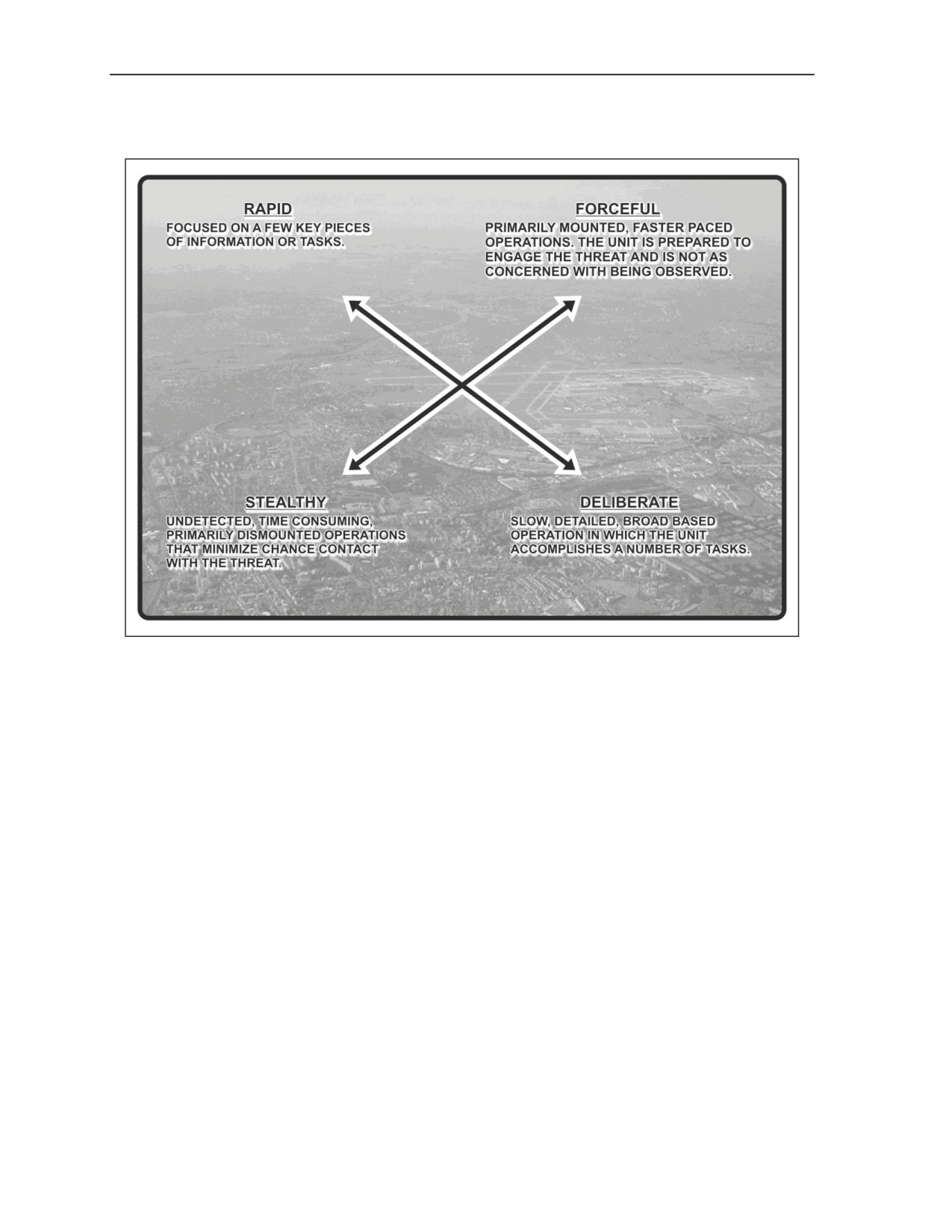
Chapter 4
operations do not preclude the judicious use of dismounted reconnaissance to reduce risk as long as the
organization maintains the tempo of the operation.
Figure 4-1. Variations of action
RECONNAISSANCE OBJECTIVE
4-13. Reconnaissance objective is a terrain feature, geographic area, enemy force, adversary, or other
mission or operational variable, such as specific civil considerations, about which the commander wants to
obtain additional information (ADRP 3-90). A reconnaissance objective focuses the cavalry organization’s
area of emphasis. Four categories form the area of emphasis—threat, infrastructure, terrain and weather
effects, and civil considerations. The commander often assigns more than one category to cavalry units even
though the tasking organization recognizes that a broad focus in multiple areas dilutes the cavalry
organization’s ability to collect information. Narrowing the scope of operations helps to focus the cavalry
organization to acquire information to develop the situation for future operations.
4-14. Threat prescribes the identification of the enemy’s locations, composition, disposition, and strength
within an assigned area of operation. Infrastructure dictates gathering information pertinent to the
understating of the operational environment. Terrain and weather effects confirm step two of the intelligence
preparation of the battlefield process (describe environmental effects on operations) and is accomplished by
analyzing and determining the influences that the five military aspects of terrain and the military aspects of
weather will have on future operations. The five military aspects of terrain are observation and fields of fire,
avenues of approach, key terrain, obstacles, and cover and concealment, expressed in the Army memory aid
OAKOC. The military aspects of weather include visibility, wind, precipitation, cloud cover, temperature,
humidity, and atmospheric pressure (as required). Civil considerations reflect the influence of manmade
infrastructure, civilian institutions, and attitudes and activities of the civilian leaders, populations, and
organizations within the operational environment on the conduct of military operations. The commander and
staff analyze civil considerations in terms of the following categories: areas, structures, capabilities,
organizations, people, and events, expressed in the memory aid ASCOPE. (Refer to ATP 2-01.3 and ATP
3-34.80 for additional information.)
4-4
FM 3-96
2FWREHU
Reconnaissance and Security
ENGAGEMENT, DISENGAGEMENT, AND BYPASS CRITERIA
4-15. Engagement, disengagement, and bypass criteria prescribe events and conditions that require initiation
of engagement with the enemy, disengagement from enemy contact, or bypassing the enemy. Engagement,
disengagement, and bypass criteria outlines parameters for cavalry units to engage the enemy with direct or
indirect fire based on the level of threat, levels of risk, required levels of covertness, and preservation
of the force.
4-16. Engagement criteria are protocols that specify those circumstances for initiating engagement with an
enemy force (FM 3-90-1). Regardless of engagement criteria, it is not enough to state in the operations order
that engagement criterion is either restrictive or permissive; the operations order must describe conditions
relative to the enemy situation to ensure complete understanding.
4-17. Disengage is a tactical mission task where a commander has the unit break contact with the enemy to
allow the conduct of another mission or to avoid decisive engagement (FM 3-90-1). Disengagement criteria
describe the events and conditions that necessitate disengaging from enemy contact or temporarily breaking
enemy contact to preserve the force. Compromised cavalry units or scouts who find themselves in a position
of disadvantage provide no information or security value and should temporarily break contact to reestablish
observation as soon as the tactical situation permits. As with engagement criteria, specific conditions are
described that require disengagement.
4-18. Bypass criteria are measures during the conduct of an offensive operation established by higher
headquarters that specify the conditions and size under which enemy units and contact may be avoided
(ADRP 3-90). Bypass criteria describes the events and conditions that necessitate maneuver around an
obstacle, position, or enemy force to maintain the momentum of the operation. Bypass criteria describes the
conditions that necessitate maneuver so as not to decisively engage or fall below a certain combat strength
when deliberately avoiding combat with an enemy force.
DISPLACEMENT CRITERIA
4-19. Displacement criteria define triggers for planned withdrawals, passage of lines, or reconnaissance
handovers between units. As with engagement, disengagement, and bypass criteria, the conditions and
parameters set in displacement criteria integrate the BCT commander’s intent with tactical feasibility.
Conditions are event driven, time driven, or enemy driven. An example of event driven conditions are
associated priority intelligence requirements being met, enemy contact not expected in the area, and observed
named areas of interest or avenues of approach denied to the enemy. Time driven conditions is ensuring the
time triggers are met (for example, latest time information is of value.) An observation post compromised by
threat or local civilian contact is a threat driven condition. Failure to dictate conditions of displacement,
nested within the higher scheme of maneuver, results in mission failure.
TARGETING AND REQUIREMENTS DEVELOPMENT
4-20. Targeting, nested within the operations process, is an effective method for matching friendly force
capabilities against enemy targets. The targeting process is comprised of four basic steps: decide, detect,
deliver, and assess. The decide step sets priorities for information collection and scheme of fires during detect
and deliver steps. The decide step draws heavily on the commander’s intent and concept of operations and a
detailed intelligence preparation of the battlefield with continuous assessment.
4-21. Information collection priorities must be set for each phase or critical event of an operation. Priorities
depicted during targeting value analysis using visual products and matrixes communicate the importance of
specific targets to the enemy’s course of action and those targets that, if destroyed, would contribute favorably
to the friendly course of action.
4-22. The information collection plan guides reconnaissance and security forces to answer the commander’s
critical information requirements, to include those high-payoff targets designated as priority intelligence
requirements. Effective planning requirements and assessing collection focuses information collection
activities on obtaining the information required by the BCT commander and staff to influence targeting
decisions and the scheme of fires. Determining information requirements is necessary for the early
identification of information gaps. (Refer to FM 3-09 and ATP 2-01 for additional information.)
2FWREHU
FM 3-96
4-5
Chapter 4
COMBINED ARMS, AIR-GROUND RECONNAISSANCE AND
SECURITY OPERATIONS
4-23. The commander uses information and intelligence from combined-arms, air-ground reconnaissance
and security operations to reduce uncertainty and facilitate rapid decisionmaking. Reconnaissance operations
collect information so the commander can understand the situation, visualize the battlefield, and shape
decisions. Security operations protect the force, provide reaction time, and maneuver space to enable
decisions and prudent use of combat power. The commander uses reconnaissance and security operations to
answer priority intelligence requirements to fill information gaps, mitigate risk, prioritize tasks, and allocate
resources. Lastly, reconnaissance and security operations create advantageous conditions for future
operations that seize, retain, and exploit the initiative.
4-24. Army attack reconnaissance aircraft, both manned and unmanned, provide direct fire, observation, and
rapid movement during reconnaissance and security operations and counterreconnaissance. Army attack
reconnaissance units conduct close combat attacks during reconnaissance and security operations and
interdiction to destroying high-value and high-payoff targets within a targeted area of interest. Close combat
attack aircraft can provide additional observation to assist reconnaissance and security forces, specifically
the cavalry squadron in maintaining contact. Utility and cargo helicopters support reconnaissance and
security operations through air movements,
(including casualty evacuation and emergency resupply
operations) depending on the enemy’s air defense threat.
Note. The same general planning considerations that apply to air assaults apply to air movements.
(Refer to FM 3-99 for additional information.)
4-25. Air-ground operations require detailed planning of synchronized timelines, aviation task and purpose,
and airspace management. Shared graphics ensure common operational language, reduce fratricide risk,
reduce the chance of an accidental compromise of a ground unit, and increase the effectiveness of mixing
collection sources. Development of detailed mission statements for the supporting aviation is essential for
aviation commanders and staffs to employ the right platforms and munitions. Understanding the threat and
the commander’s intent and desired effects drives the aviation units’ task organization of air elements and
selection of weapon systems. Aircraft fuel consumption rates, forward arming and refueling, and fighter
management can limit aircraft availability.
4-26. Airspace management is the coordination, integration, and regulation of the use of airspace of defined
dimensions (JP 3-52). Airspace management is essential to integrate all airspace uses (manned and unmanned
aircraft and indirect fires). Properly developed airspace coordinating measures facilitate reconnaissance and
security operations and the BCT’s employment of aerial and surface-based fires simultaneously as well as
unmanned assets to maintain surveillance. Airspace management includes development of control measures
and synchronization of timelines and events. (Refer to FM 3-52 and ATP 3-52.1 for additional information
about airspace control and ATP 3-91.1 for information about the joint air-ground integration center.)
RECONNAISSANCE AND SECURITY FORCE SUSTAINMENT
4-27. Sustainment for reconnaissance and security forces requires deliberate planning. Logistics units
supporting reconnaissance and security operations must contend with long lines of communication, dispersed
forces, poor trafficability, and contested terrain. Planners must consider protection requirements to protect
sustainment units against bypassed enemy forces and the effects of extended lines of communications.
Well-timed and tailored forward logistics elements
(see chapter
9) extend the operational reach of
reconnaissance and security operations. Reconnaissance and security force sustainment must be rehearsed
and wargamed.
4-28. Reconnaissance and security forces often require a basic load in excess of the typical three days of
supply configuration due to mission requirements. Supplies can be pre-positioned in collocated trains with a
maneuver battalion’s echelon support. In restricted terrain, the most important commodities are likely Class
I (subsistence-priority to water) and Class III (petroleum, oil, and lubricants) and depending on the enemy
situation and terrain Class V
(ammunition). Examples would include moderate-to-steep slopes or
moderately-to-densely spaced obstacles, swamps, and rugged terrain and operation in urban terrain.
4-6
FM 3-96
2FWREHU
Reconnaissance and Security
4-29. Forces conducting reconnaissance generally have a greater requirement for Class III and Class V for
indirect fire assets and anti-armor systems. Similar to offensive tasks, reconnaissance requires refuel on the
move. Security forces have a greater reliance on Class V and reduced requirements for Class III during
security operations. Reconnaissance and security forces generally do not have large barrier Class IV
(construction and barrier materials) requirements. Possible exceptions for security forces are during the
execution of long-term guard missions or during a defensive cover.
4-30. When units task-organize, particularly from outside the BCT, planners must incorporate and rehearse
supporting logistics assets. The nature of reconnaissance and security operations stresses medical evacuation
and requires wargaming and close coordination with external assets. Casualty evacuation planning and
requirements for reconnaissance and security forces focuses on ground movement assets and must balance
with survivability and stealth. Planners plan for and utilize aviation casualty backhaul as aircrafts become
available.
SECTION II - RECONNAISSANCE
4-31. Reconnaissance is a mission undertaken to obtain, by visual observation or other detection methods,
information about the activities and resources of an enemy or adversary, or to secure data concerning the
meteorological, hydrographic, or geographic characteristics of a particular area (JP 2-0). Reconnaissance
operations validate the intelligence preparation of the battlefield process by confirming or denying natural
and manmade obstacles, trafficability of routes, viability and utility of key terrain, and enemy composition,
disposition, and strength. As mission analysis identifies information gaps, the BCT commander and staff
develop information requirements to fill those gaps. During wargaming, information requirements develop
into priority intelligence requirements, which further develop tasks that, when executed, answer priority
intelligence requirements. The commander and staff continuously reevaluate information gaps and refocus
the reconnaissance effort with the seven reconnaissance fundamentals. The commander utilizes one of the
five forms of reconnaissance as they collect and assess information. (Refer to FM 3-90-2 for additional information.)
RECONNAISSANCE FUNDAMENTALS
4-32. Reconnaissance fundamentals, discussed below, remind planners and practitioners of the inherent
characteristics required to execute successful reconnaissance. Failure to understand the following seven
fundamentals results in incomplete reconnaissance and missed opportunities.
ENSURE CONTINUOUS RECONNAISSANCE
4-33. The BCT conducts reconnaissance before, during, and after all operations. Before an operation,
reconnaissance fills gaps in information about the enemy, the terrain, and civil considerations. During an
operation, reconnaissance provides the BCT commander with updated information that verifies the enemy’s
composition, dispositions, and intentions as the battle progresses. After an operation, reconnaissance forces
maintain contact with the enemy to determine the enemy’s next move and collect information, including
terrain and civil considerations, necessary for planning subsequent operations. When current operational
information is adequate, reconnaissance forces gather information for branches and sequels to current plans.
As operations transition from a focus on one element of operations to another, the nature of priority
intelligence requirements and information requirements change. Reconnaissance over extended distances and
time may require pacing reconnaissance assets to maintain the effort, or rotating units to maintain continuous
coverage. The human and technical assets used in the reconnaissance effort must be allowed time for rest,
resupply, troop leading procedures, and preventive maintenance checks and services. The commander must
determine not only where, but also when, the maximum reconnaissance effort is required and pace the
commitment of available reconnaissance assets to ensure adequate assets are available at those critical times
and places.
DO NOT KEEP RECONNAISSANCE ASSETS IN RESERVE
4-34. Never keep reconnaissance assets in reserve. The BCT commander commits reconnaissance forces and
assets with specific missions designed to help reduce uncertainty through the collection of information related
to priority intelligence requirements and information requirements. Although noncontiguous operations may
2FWREHU
FM 3-96
4-7
Chapter 4
necessitate orientation of reconnaissance assets in multiple directions, reconnaissance forces maximize all
assets at their disposal to information collection focused on the commander’s critical information
requirements. This does not mean that all reconnaissance forces and assets are committed all the time. The
BCT commander uses reconnaissance forces and assets based on their capabilities and the mission variables
of METT-TC to achieve the maximum coverage needed to answer commander’s critical information
requirements. At times, this requires the commander to withhold or position reconnaissance forces and assets
to ensure that they are available at critical times and places.
ORIENT ON THE RECONNAISSANCE OBJECTIVE
4-35. The BCT commander orients reconnaissance assets by identifying a reconnaissance objective in the
area of operations. The reconnaissance objective clarifies the intent of the reconnaissance effort by specifying
the most important result to obtain from the reconnaissance effort. Every reconnaissance mission specifies a
reconnaissance objective. The commander assigns a reconnaissance objective based on priority intelligence
requirements resulting from the intelligence preparation of the battlefield process and the capabilities and
limitations of the reconnaissance force or asset. The reconnaissance objective can be information about a
specific geographical location, such as the cross-country trafficability of a specific area, a specific enemy or
adversary activity to be confirmed or denied, or a specific enemy or adversary unit to be located and tracked.
When the reconnaissance force does not have enough time to complete all the tasks associated with a specific
form of reconnaissance, it uses the reconnaissance objective to guide it in setting priorities. The commander
may need to provide additional detailed instructions beyond the reconnaissance objective, such as the specific
tasks and their priorities. The commander issues additional guidance to the reconnaissance force or specifies
these instructions in tasks to subordinates in a warning order, fragmentary order, or the operations order.
REPORT INFORMATION RAPIDLY AND ACCURATELY
4-36. Reconnaissance assets acquire and report accurate and timely information on the enemy, terrain, and
civil considerations of the area over which the commander conducts operations. As information may quickly
lose its value over time, the BCT commander must have accurate reports quickly to make informed decisions
as to where to concentrate combat power. Rapid reporting allows the staff maximum time to analyze
information and make timely recommendations to the commander. Information requirements, tied to decision
points, define a latest time information is of value date-time group. Reconnaissance forces report exactly
what they see and, if appropriate, what they do not see. Seemingly, unimportant information may be
extremely important when combined with other information. Reports of no enemy activity are as important
as reports of enemy activity. Failing to report tells the commander nothing.
RETAIN FREEDOM OF MANEUVER
4-37. Reconnaissance forces must maintain battlefield mobility, as fixed reconnaissance forces are
ineffective. Reconnaissance forces must have clear engagement criteria that support the BCT commander’s
intent. They must employ proper movement and reconnaissance techniques, use overwatching fires, and
follow standard operating procedures. Initiative and knowledge of both the terrain and the enemy reduce the
likelihood of decisive engagement and help maintain freedom of movement. Before initial contact, the
reconnaissance force adopts a combat formation designed to gain contact with the smallest friendly element
possible. This combat formation provides the reconnaissance force with the maximum opportunity for
maneuver and enables the force to avoid having the entire reconnaissance force decisively engaged. The
intelligence preparation of the battlefield is use to identify anticipated areas of contact. Indirect fires to
provide suppression, obscuration, and to destroy point targets is a method reconnaissance forces use to retain
freedom of maneuver.
GAIN AND MAINTAIN ENEMY CONTACT
4-38. Once reconnaissance forces gain contact with the enemy, it maintains that contact unless the
commander directing the reconnaissance orders a change of mission, disengagement or displacement criteria,
when the force conducts reconnaissance handover or the survival of the unit is at risk. Contact can range from
surveillance to close combat. Surveillance, combined with stealth, is often sufficient to maintain contact and
is the preferred method. Units conducting reconnaissance avoid combat unless it is necessary to gain essential
4-8
FM 3-96
2FWREHU
Reconnaissance and Security
information, in which case the reconnaissance force uses maneuver (fire and movement) to maintain contact
while avoiding decisive engagement. Maintaining contact provides real-time information on the enemy’s
composition, disposition, strength, and actions that allow the staff to analyze and make recommendations to
the commander.
DEVELOP THE SITUATION RAPIDLY
4-39. When reconnaissance forces make contact with an enemy force or obstacle, it must act instinctively to
develop the situation and quickly determine the threat it faces. For an enemy force, reconnaissance forces
must determine the enemy’s composition, disposition, activities, and movements and assess the implications
of that information to allow the BCT commander freedom of action. For an obstacle, reconnaissance forces
must determine the type and extent of the obstacle and whether fire is covering the obstacle. Obstacles can
provide information concerning the enemy force, weapon capabilities, and organization of fires.
Reconnaissance forces, in most cases, develop the situation using actions on contact—a series of combat
actions often conducted simultaneously taken on contact with the enemy to develop the situation (ADRP
3-90)—in accordance with the commander’s plan and intent. Actions on contact are deploy and report,
evaluate and develop the situation, choose a course of action, execute selected course of action, and
recommend a course of action to the higher commander.
FORMS OF RECONNAISSANCE
4-40. The five forms of reconnaissance, discussed below, are zone reconnaissance, area reconnaissance,
route reconnaissance, reconnaissance in force, and special reconnaissance. Each form of reconnaissance
provides a specific level of detail in information collection specific to the mission, conditions, and end state
of the BCT commander. All forms of reconnaissance satisfy priority intelligence requirements to understand
and visualize the environment, develop the situation, create options, and identify opportunities to seize, retain,
and exploit the initiative.
ZONE RECONNAISSANCE
4-41. Zone reconnaissance is a form of reconnaissance that involves a directed effort to obtain detailed
information on all routes, obstacles, terrain, and enemy forces within a zone defined by boundaries (ADRP
3-90). Zone reconnaissance is a deliberate and time-intensive operation that takes more time to conduct than
any other form of reconnaissance. The BCT commander assigns a zone reconnaissance when the enemy
situation is vague or when information related to terrain, infrastructure, or civil considerations is limited. A
zone reconnaissance conducted over an extended distance begins at the line of departure, and concludes at a
specified limit of advance. The BCT commander specifies information requirements based upon time
constraints and his intent, and relates reconnaissance objectives to follow-on missions. Reconnaissance forces
find and report enemy activities within the area of operation for the zone reconnaissance, reconnoiter specific
terrain, and report all information in a timely manner.
AREA RECONNAISSANCE
4-42. Area reconnaissance is a form of reconnaissance that focuses on obtaining detailed information about
the terrain or enemy activity within a prescribed area (ADRP 3-90). The commander assigns an area
reconnaissance when information on the enemy situation is limited, when focused reconnaissance in a given
area likely yields specific information related to decision points, or when information that is more thorough
is required in a designated area. The commander defines the area as a named area of interest to focus the unit
on a relatively small area such as a building, bridge, or key terrain. Area reconnaissance allows for focused
reconnaissance over a wide area concentrated in specific locations that answer priority intelligence
requirements and develop the situation to provide the commander with options.
ROUTE RECONNAISSANCE
4-43. Route reconnaissance is a directed effort to obtain detailed information of a specified route and all
terrain from which the enemy could influence movement along that route (ADRP 3-90). A route can be a
road, highway, trail, mobility corridor, avenue of approach, or axis of advance. Routes begin at a start point
2FWREHU
FM 3-96
4-9