FM 3-96 BRIGADE COMBAT TEAM (OCTOBER 2015) - page 3
Chapter 4
and end at a destination release point. The commander assigns a route reconnaissance either as a discrete
mission or as a specified task of a zone or area reconnaissance. Route reconnaissance is not to be confused
with route classification, which requires technical measurements and analysis typically performed by
mission-tailored engineer reconnaissance teams. Typically, a route classification is included as a specified
task for the engineer reconnaissance team as part of an assigned route reconnaissance. Reconnaissance forces
collect information about roads, bridges, tunnels, fords, waterways, and other natural and manmade terrain
features that can affect traffic flow. Route reconnaissance provides the commander with detailed information
on the route and terrain that can influence the route to prevent surprise, determine trafficability for follow-on
forces, and to confirm or deny running estimates made during the operations process.
RECONNAISSANCE IN FORCE
4-44. Reconnaissance in force is a deliberate combat operation designed to discover or test the enemy’s
strength, disposition, and reactions or to obtain other information (ADRP 3-90). A reconnaissance in force is
a limited objective operation normally conducted by a battalion-sized or larger task force. The commander
assigns a reconnaissance in force when the enemy is operating within an area and the commander cannot
obtain adequate intelligence by any other means. Reconnaissance in force is an aggressive reconnaissance,
which develops information in contact with the enemy to determine and exploit enemy weaknesses. The
commander plans for the extrication of the force or the exploitation of success in advance.
SPECIAL RECONNAISSANCE
4-45. Special reconnaissance is reconnaissance and surveillance actions conducted as a special operation in
hostile, denied, or politically sensitive environments to collect or verify information of strategic or
operational significance, employing military capabilities not normally found in conventional forces (JP 3-05).
Special reconnaissance operations support the collection of the joint task force commander’s priority
intelligence requirements. Special reconnaissance may occur prior to conventional forces entering a
designated area of operation. A special operations liaison may provide a responsive reporting capability in
situations where the special operations task force commander has been requested to provide intelligence
information that supports the intelligence requirements of a conventional force commander. The BCT
commander and staff must understand when, where, and why the force is conducting special reconnaissance
operations to establish unity of purpose. The BCT and the special operations forces element may establish a
liaison capacity to understand collection task prioritization, and to understand associated reporting
requirements and mechanisms. (Refer to FM 3-18 for additional information.)
Note. A special operations forces element will not suspend or alter their collection efforts to
support another collection plan unless directed to do so by the joint task force commander.
INFORMATION COLLECTION
4-46. The purpose of reconnaissance is to gather information so commanders can create plans, make
decisions, and issue orders. The BCT commander’s focus for reconnaissance usually falls in three general
areas: commander’s critical information requirements, targeting, and voids in information. The BCT staff,
primarily the intelligence staff officer, identifies gaps in available intelligence based on the initial intelligence
preparation of the battlefield. The intelligence preparation of the battlefield process helps determine factors
that affect information collection, specifically the reconnaissance and surveillance effort.
4-47. Reconnaissance forces must employ the appropriate combinations of mounted, dismounted, and aerial
(manned and unmanned) reconnaissance and surveillance to obtain the information required to answer the
commander’s priority intelligence requirements and to support the targeting process. At the same time,
reconnaissance forces must be prepared to conduct counterreconnaissance and continuously develop detailed
information on both the enemy and terrain. Reconnaissance forces fight for information as in a
reconnaissance in force designed to discover or test the enemy’s strength, dispositions, and reactions.
4-48. Reconnaissance forces often may be the first friendly units to encounter special operations forces
because of their forward proximity in the BCT’s area of operation. Depending on the command relationship,
4-10
FM 3-96
2FWREHU
Reconnaissance and Security
conventional reconnaissance forces may operate in conjunction with special operations forces. (Refer
to FM 3-55 for additional information.)
RECONNAISSANCE HANDOVER
4-49. Reconnaissance handover is the action that occurs between two elements to coordinate the transfer of
information or responsibility for observation of potential threat contact, or the transfer of an assigned area
from one element to another. Reconnaissance handover facilitates observation or surveillance of enemy
contact or an assigned named or targeted area of interest. Reconnaissance handover is associated with a
trigger, coordination point, or phase line designated as the reconnaissance handover line. A reconnaissance
handover line is a designated phase line on the ground where reconnaissance responsibility transitions from
one element to another. The reconnaissance handover line ensures positive control and chain of custody from
the initial force to the force assuming responsibility and control.
4-50. Reconnaissance handover prevents gaps or seams to emerge that the enemy can exploit. Once handover
is complete, the reconnaissance force transferring control either passes to the rear through the main body
assuming responsibility for the reconnaissance objective as a rearward passage of lines or continues further
into the zone to continue the reconnaissance mission. Reconnaissance handover assures that information
requirements are transferred between units to maintain initiative, tempo, and to ease transitions. Well-planned
and executed reconnaissance handover eases transitions in plans, phases, and priorities of effort and mitigates
information gaps between units.
SECTION III - SECURITY OPERATIONS
4-51. Security operations are operations undertaken by a commander to provide early and accurate warning
of enemy operations, to provide the force being protected with time and maneuver space within which to
react to the enemy, and to develop the situation to allow the commander to effectively use the protected force
(ADRP 3-90). The main difference between the conduct of security operations and reconnaissance is that the
conduct of security operations orient on the protected force or facility, while reconnaissance is enemy and
terrain oriented. Security missions protect the BCT from observation, indirect fires, harassment, surprise, and
sabotage. At the same time, security forces conducting security operations provide information about the
size, composition, location, and movement of enemy forces including information about the terrain and
populations within a BCT’s area of operations. Effective security operations can also draw enemy forces into
exposed positions, trade space for time, allow the BCT to concentrate forces elsewhere, deceive the enemy,
attrite enemy forces, and hold, deny, or control key terrain. Security forces must be prepared to destroy enemy
reconnaissance efforts and fight for information to seize, retain, or exploit the initiative. (Refer to FM 3-90-2
for additional information.)
FUNDAMENTALS OF SECURITY OPERATIONS
4-52. Five fundamentals of security operations establish the framework for security operations. These
fundamentals, discussed below, provide a set of principles that remind planners and practitioners of the
inherent characteristics required to execute security operations. These fundamentals include provide early
and accurate warning; provide reaction time and maneuver space; orient on the force or facility to be secured;
perform continuous reconnaissance; and maintain enemy contact.
PROVIDE EARLY AND ACCURATE WARNING
4-53. The security force detects, observes, and reports threat forces that can influence the protected force.
Early detection and warning through rapid reporting enables the BCT commander to make timely and
well-informed decisions to apply forces relative to the threat. As a minimum, security forces should operate
far enough from the protected force to prevent enemy ground forces from observing or engaging the protected
force with direct fires. The BCT commander and staff plan for the positioning of ground security, aerial
scouts, and unmanned aircraft systems to provide long-range observation of expected enemy avenues of
approach. The commander reinforces and integrates them with available intelligence collection systems, such
as unattended ground sensors, surveillance systems, and moving target indicators to maximize warning time.
2FWREHU
FM 3-96
4-11
Chapter 4
PROVIDE REACTION TIME AND MANEUVER SPACE
4-54. Security forces provides the protected force with enough reaction time and maneuver space to
effectively respond to likely enemy actions by operating at a distance from the protected force and by offering
resistance (within its capabilities and mission constraints) to enemy forces. Providing the security force with
an area of operation that has sufficient depth to operate enhances its ability to provide reaction time and
maneuver space to the protected force. The commander determines the amount of time and space required to
effectively respond from the information provided by the intelligence preparation of the battlefield process
and the protected force commander’s guidance regarding time the protected force requires to react to enemy
courses of action based on the mission variables of METT-TC. Reaction time and maneuver space relates to
decision points driven by information requirements and indicators given the latest time information is of
value parameters to ensure the commander makes decisions that place maximum firepower at the decisive
point in a timely manner.
ORIENT ON THE FORCE OR FACILITY TO BE SECURED
4-55. While reconnaissance forces orient on the enemy, security forces orient on the protected force by
understanding their scheme of maneuver and follow-on mission. The security force focuses all its actions on
protecting and providing early warning operating between the protected force and known or suspected enemy.
The security force moves as the protected force moves and orients on its movement. The value of terrain
occupied by the security force hinges on the protection it provides to the protected force. In addition to
orienting on a force, security operations may orient on an area or facility.
PERFORM CONTINUOUS RECONNAISSANCE
4-56. Reconnaissance fundamentals are implicit in all security operations. Security forces continuously seek
the enemy and reconnoiter key terrain. Security forces use continuous reconnaissance to gain and maintain
enemy contact, develop the situation, report rapidly and accurately, retain freedom of maneuver to provide
early and accurate warning, and provide reaction time and maneuver space to the protected force. Security
forces conduct area reconnaissance or zone reconnaissance to detect enemy movement or enemy preparations
for action and to learn as much as possible about the terrain with the ultimate goal to determine the enemy’s
course of action and to assist the protected force in countering it. Terrain information focuses on its possible
use by the enemy or the friendly force, either for offensive or defensive operations. During operations focused
on stability, terrain includes civil considerations. Stationary security forces use combinations of observation
posts, aviation, patrols, intelligence collection assets, and battle positions to perform reconnaissance. Moving
security forces perform zone, area, or route reconnaissance along with using observation points and battle
positions to detect enemy movements and preparations.
MAINTAIN ENEMY CONTACT
4-57. Once the security force makes enemy contact, it does not break contact unless the main force
commander specifically directs it. However, the individual security asset that first makes contact does not
have to maintain that contact, if the entire security force maintains contact with the enemy. The security force
commander ensures that subordinate security assets hand off contact with the enemy from one security asset
to another in this case. The security force must continuously collect information on the enemy’s activities to
assist the main body in determining potential and actual enemy course of actions and to prevent the enemy
from surprising the protected force. This requires the security force to maintain continuous visual contact, to
be able to use direct and indirect fires, and to maneuver freely, which requires the security force have depth
in space and time.
SECURITY OPERATIONS TASKS
4-58. Security operations tasks provide the protected force with varying levels of protection and are
dependent upon the size of the unit conducting the security operation. All security tasks provide protection
and early warning to the protected force. Security operations encompass five tasks: screen, guard, cover, area
security, and local security.
4-12
FM 3-96
2FWREHU
Reconnaissance and Security
4-59. Security tasks conducted in the security area by one force or a subordinate element of a force that
provides security for the larger force are screen, guard, and cover. The screen, guard, and cover security tasks,
respectively, contain increasing levels of combat power and provide the main body with increasing levels of
security. The more combat power in the security force means less combat power for the main body. Normally,
the BCT commander designates a security area in which security forces provide the BCT with reaction time
and maneuver space to preserve freedom of action. (Refer to FM 3-90-2 for additional information.)
4-60. Operational area security occurs regardless of which element of operations is currently dominant.
Operational area security is a form of security operations conducted to protect friendly forces, installations,
routes, and actions within an area of operations (ADRP 3-37). Forces engaged in operational area security
protect the force, installation, route, area, or asset. Although vital to the success of military operations,
normally operational area security is an economy-of-force mission. Operational area security designed, to
generate and maintain combat power, ensures the continued conduct of sustainment operations to support
decisive and shaping operations. Operational area security preserves the commander’s freedom to move
reserves, position fire support means, provide for mission command, and conduct sustaining operations.
Operational area security in noncontiguous areas of operations requires the BCT commander to emphasize
area security. (Refer to ADRP 3-37 for additional information.)
4-61. Local security provides immediate protection to the friendly force. All forces are responsible for their
own local security. Local security may consist of observation posts, local security patrols, perimeter security,
and other measures to provide close-in security for a force. (See echelon-specific ATPs for echelon level
discussions.)
SCREEN
4-62. Screen is a security task that primarily provides early warning to the protected force (ADRP 3-90). The
screen provides the least protection of any security mission; it does not have the combat power to develop
the situation. A screen is appropriate to cover gaps between forces, exposed flanks, or the rear of stationary
and moving forces. The commander can place a screen in front of a stationary formation when the likelihood
of enemy action is small, the expected enemy force is small, or the main body needs only limited time, once
it is warned, to react effectively. If a significant enemy force is expected or a significant amount of time and
space is needed to provide the required degree of protection, the commander assigns and resources a guard
mission instead of a screen.
4-63. A screening force observes, identifies, and reports enemy actions. The unit performing a screen may
engage, repel, or destroy an enemy’s reconnaissance and surveillance element within its capabilities,
augmented by indirect fires, close combat attack, and/or close air support, but otherwise fights only in
self-defense. The screen has the minimum combat power necessary to provide the desired early warning,
which allows the commander to retain the bulk of the main body’s combat power for commitment at the
decisive place and time. The depth of the screen is critical to allow reconnaissance handover of threat contact
from one element to another without displacement from established observation posts. Screening forces use
depth to delay, impede, and harass the enemy with indirect fires and/or air support to cause the enemy to
deploy early and to prevent the enemy from identifying, penetrating, and exploiting the screen.
4-64. Within an assigned area of operation, a security force normally conducts a screen by establishing a
series of observation posts and patrols to ensure adequate surveillance. The commander uses reconnaissance
patrols (mounted, dismounted, and aerial), relocates observation posts, and employs technical assets to ensure
continuous and overlapping surveillance. The commander also employs terrain data base analytical support
systems to ensure the integration of friendly reconnaissance and surveillance assets to provide that necessary
coverage. (Refer to FM 3-90-2 for additional information.)
GUARD
4-65. Guard is a security task to protect the main body by fighting to gain time while also observing and
reporting information and preventing enemy ground observation of and direct fire against the main body.
Units conducting a guard mission cannot operate independently because they rely upon fires and functional
and multifunctional support assets of the main body (ADRP 3-90). A guard force differs from a screen in that
2FWREHU
FM 3-96
4-13
Chapter 4
it routinely engages enemy forces with direct and indirect fires. A screening force primarily uses indirect
fires or air support to destroy enemy reconnaissance elements and slow the movement of other enemy forces.
4-66. The BCT commander assigns a guard mission when he expects contact or has an exposed flank that
requires greater protection than a screen can provide. The three types of guard operations are advance, flank,
and rear guard. The commander can assign a guard mission to protect either a stationary or a moving force.
The guard force commander normally conducts the guard mission as an area defense, a delay, a zone
reconnaissance, or a movement to contact mission in the security area to provide reaction time and maneuver
space to the main body. A guard operates within the range of the main body’s fire support weapons, deploying
over a narrower front than a comparable-sized screening force to permit concentrating combat power. Guards
are most effective when air assets are integrated. The commander’s intent and end state determines the nature
and extent of required augmentation. (Refer to FM 3-90-2 for additional information.)
COVER
4-67. Cover is a security task to protect the main body by fighting to gain time while also observing and
reporting information and preventing enemy ground observation of and direct fire against the main body
(ADRP 3-90). In Army doctrine, a covering force is a self-contained force capable of operating independently
of the main body, unlike a screening or guard force, to conduct the cover task (FM 3-90-2). A covering force
performs all the tasks of screening and guard forces.
4-68. A division covering force is usually a reinforced BCT that performs reconnaissance or other security
missions. The covering force area is the area forward of the forward edge of the battle area out to the forward
positions initially assigned to the covering force. It is here that the covering force executes assigned tasks
(FM 3-90-2). The width of the covering force area is the same as the main body’s area of operation. An
adequately reinforced combined arms battalion, ABCT or SBCT cavalry squadron, or SBCT infantry
battalion may perform a covering force mission if the division area of operations is narrow enough. These
reinforcements typically revert to their parent organizations on passage of the covering force. BCTs and
battalions typically organize a guard force instead of a covering force because their resources are limited.
4-69. A covering force’s distance forward of the main body depends on the main body commander’s
intentions and instructions, reinforcements, the terrain, the enemy location and strength, and the main body
and covering force’s rate of march. Covering forces often become decisively engaged with enemy forces and
therefore, must have substantial combat power to engage the enemy and accomplish the mission. A covering
force develops the situation earlier than a screen or a guard force, fights longer and more often and defeats
larger enemy forces. (Refer to FM 3-90-2 for additional information.)
AREA SECURITY
4-70. Area security is a security task conducted to protect friendly forces, installations, routes, and actions
within a specific area (ADRP 3-90). Area security operations allow commanders to provide protection to
critical assets without a significant diversion of combat power. Protected forces range from echelon
headquarters through artillery and echelon reserves to the sustaining base. Protected installations can be part
of the sustaining base or they can constitute part of the area’s critical infrastructure.
4-71. During the offense, various military organizations may be involved in conducting area security
operations in an economy-of-force role to protect lines of communications, convoys, or critical fixed sites
and radars. Route security operations are defensive in nature and are terrain-oriented. A route security force
may prevent an enemy force from impeding, harassing, or destroying lines of communications. Establishing
a movement corridor for traffic along a route or portions of a route is an example of route security operations.
4-72. Areas to secure range from specific points, (bridges and defiles) and terrain features (ridgelines and
hills), to large civilian population centers and their adjacent areas. Population-centric area security missions
are common across the range of military operations, but almost a fixture during irregular warfare.
Population-centric area security operations typically combine aspects of the area defense and offensive tasks
to eliminate the power to produce internal defense threats. (Refer to ADRP 3-37 for additional information.)
4-14
FM 3-96
2FWREHU
Reconnaissance and Security
LOCAL SECURITY
4-73. Local security is a security task that includes low-level security activities conducted near a unit to
prevent surprise by the enemy (ADRP 3-90). Local security tasks include local measures that prevent or
interdict enemy efforts. Local security is an enduring priority of work, is essential to maintaining initiative,
and prevents units from being surprised. Local security involves avoiding detection and deceiving the enemy
about friendly actions, positions, and intentions. Local security includes finding any enemy forces in the
immediate vicinity and knowing as much about their positions and intentions as possible.
4-74. Local security can be part of the sustaining base or part of the area infrastructure. Local security
protection ranges from echelon headquarters to reserve and sustainment forces using active and passive
measures to provide local security. Active patrolling, unit standard operating procedures, and continuous
reconnaissance are active measures that help provide local security. Passive measures include using
camouflage, movement control, noise and light discipline, proper communications procedures, ground
sensors, night-vision devices, and daylight sights. (See echelon-specific ATPs for echelon level discussions.)
2FWREHU
FM 3-96
4-15
This page intentionally left blank.
Chapter 5
Understand, Shape, Influence, and Consolidate Gains
Brigade combat teams (BCTs) must understand the operational environment, shape the
operational environment through action, influence the population and its leaders, and
consolidate gains to seize, retain, and exploit the initiative. BCT commanders conduct
multiple missions to shape the operational environment and seek to achieve a common
goal and end state that nests with high command objectives. Commanders must
understand competing interests within the operational and information environment to
determine what is of value to competitive parties and entities within the BCT’s area of
operations. Understanding competing interests helps develop courses of action that
influence the populace and political structure, enhance the security situation, and lead
to mission success. BCTs consolidate gains and favorable milestones to seize and
exploit weaknesses, capitalize on opportunities, and further the allies’ interests to
secure stable political settlements and objectives complimentary to desired outcomes.
SECTION I - UNDERSTANDING THE OPERATIONAL ENVIRONMENT
5-1. Interests are motivations that provide insight to perceived rights, influences, responsibilities, and
power. Interests influence how populations perceive complexity, physical security, political systems,
economic influence, tribal and religious identity, self-serving, or a combination of two or more. The BCT
commander and staff develop an understanding of operational variables—political, military, economic,
social, information, infrastructure, physical environment, and time (commonly referred to as PMESII-PT)
and mission variables—mission, enemy, terrain and weather, troops and support available, time available,
and civil considerations (METT-TC) through information collection to enhance situational awareness and
understanding of competing interests. (At the tactical level, intelligence operations, reconnaissance, security
operations, and surveillance are the four primary means conducted as part of information collection.) The
commander and staff can frame a problem if they understand competing interests within the area of operation.
The BCT seeks to understand the motivations and recognize that each interest has multiple perspectives. The
BCT considers political interests from multiple perspectives to operate effectively under conditions of
complexity and in close contact with enemies and populations. Understanding interests assist the commander
and staff to synchronize information-related capabilities that shape the information environment and to
modify behaviors to further sustainable objectives.
5-2. Understanding interests requires analysis of operational variables and mission variables within a
particular region. Understanding requires an appreciation of the operational environment’s complex,
humanistic, and political environs within the context of war as a contest of wills. The BCT commander and
staff must develop an understanding of the local audience’s cultural communication techniques to
communicate with them effectively. The BCT also must understand that the most important aspect of cultural
communication is how the population receives the information rather than how the unit transmits the
information. Determination of valued interests within an area provides options for the BCT to establish
programs that incentivize cooperation leading to mission accomplishment. Comprehension of interests allows
understanding to implement disincentives that seek to coerce and persuade adversaries, enemies, and neutral
parties with interests counter to the objectives the BCT and higher have established. The understanding and
acknowledgement of interests help to frame information-related capabilities in future operations.
5-3. Efforts to understand interests begin before deployment. Country studies, analysis of the social
demographics, constructs of local, sub-national and national governance, and understanding of key
personalities and organizations within the BCT’s future area of operation provide baseline knowledge to
increase situational awareness and identify potential areas of friction before deployment. The BCT considers
2FWREHU
FM 3-96
5-1
Chapter 5
operational variables and mission variables within their area of operations to gain an understanding of the
interests and motivations particular to different groups and individuals to enhance situational awareness.
Unified action partners and Army special operations forces are key resources that the BCT uses to develop
situational understanding to shape efforts that lead to a sustainable, secure environment. Analysis of these
resources allows informed leaders to identify information gaps and develop courses of action that increase
their situational understanding within their area of operation.
5-4. The BCT conducts information collection through intelligence operations, reconnaissance, security
operations, and surveillance means that focus on intelligence requirements to bridge information gaps. Gaps
identified during intelligence preparation of the battlefield develop into information requirements through
aggressive and continuous operations to acquire information. The BCT staff considers operational variables
and mission variables, with emphasis on civil considerations, to understand the interests within their area of
operation. Information requirements that develop situational understanding of the interests within an area are
defined and collected by focusing civil considerations within the construct of area, structures, capabilities,
organizations, people, and events, (commonly known as ASCOPE). BCTs use human terrain system teams,
the processes by which these teams function, and other enablers (civil affairs operations, military information
support operations) to understand the nuances and particulars of organizations and people within the area of
operation.
5-5. The commander and staff consider culture and pillar organizations that influence the operational
environment’s civil considerations. Culture is the shared beliefs, values, customs, behaviors, and artifacts
members of a society use to cope with the world and each other. Pillar organizations are organizations or
systems on which the populace depends for support, security, strength, and direction. Examination of a
culture gives insight to the motivations and interests of people and organizations. Consideration of a culture
is imperative to successful shaping operations that set conditions for future successes. Thorough
understanding of the interests of groups and individuals allow for informed and viable courses of action that
seek to favorably shape the environment and contribute to positive outcomes and objectives within the BCT’s
area of operations.
5-6. Host-nation security organizations and political partners provide invaluable insight into values, beliefs,
and interests. As organizations are comprised of the people, they secure and govern, their native fluency in
the customs, courtesies, cultures, beliefs, interests, and ideals provide the partnering BCT cultural perspective
and intelligence that develop understanding of the operational environment. Close positive relationships (as
addressed in the vignette below) with host-nation partners breed trust, which leads to an enhanced
understanding of the operational environment.
UNDERSTAND, SHAPE, AND INFLUENCE
When 1st Brigade, 1st Armored Division (the Ready First Combat Team) arrived in
Ramadi, Iraq in June 2006, the situation was dire. Attacks averaged over thirty per day,
spiking on some days to over fifty. Less than 100 police out of an authorized 4000 were
present for duty each day. The police that were present each day were forced to stay
bunkered in their stations. Attacks bombarded the garrison at the government center several
times daily with mortars, rocket propelled grenades, and small arms fire. The population
of this provincial capital was terrified of the anticipated full-scale assault on the city to
remove the insurgents.
The armored brigade combat team of 6000 United States Soldiers and Marines and 3000
Iraqi Army troops employed a far different strategy. Instead of launching a massive assault
to clear the city house by house, the brigade isolated the insurgents. Disregarding the
theater emphasis to withdraw to large bases, the brigade pushed out, placing
company -sized combat outposts in the worst insurgent areas. These outposts restricted
insurgent movement and demonstrated willingness to confront Al Qaeda in his sanctuary.
Using the outposts as an example of their commitment to free the city from insurgent
control, the BCT and Iraqi partners reached out to the remaining local tribal leaders,
offering protection and economic development in exchange for police recruits to clear the
5-2
FM 3-96
2FWREHU
Understand, Shape, Influence, and Consolidate Gains
city. Frustrated by Al Qaeda's excesses and abuse, the tribal leaders provided over 4000
recruits over the following six months to fill the dwindling police ranks.
In the meantime, the BCT continued to execute a clear, hold, build strategy in the city,
emplacing more combat outposts to reduce insurgent control over the city's center. A linked
information operations effort began to discredit Al Qaeda in the eyes of the people. Allied
tribes provided intelligence that enabled raids; thus, demoralizing the Al Qaeda force. The
Iraqi Army and United States’ forces liberated the city's large hospital, freeing access to
medical care. Micro- and macro -economic development projects began in cooperative
areas, providing much -needed local jobs. Sensing diminishing support and legitimacy
among the population, Al Qaeda attempted to retaliate against cooperating tribes through
a murder and intimidation campaign. The Ready First stood by the tribes, providing air,
artillery, and troop support to defend against insurgent attacks when required. This
demonstration of solidarity solidified the tribal rebellion, which expanded exponentially.
Returning police recruits provided security in cleared areas, and provided the flexibility to
expand and clear the remaining sanctuaries. In addition to sending troops to far away police
and army schools, the Ready First Combat Team provided a leadership academy to develop
local forces’ ability to conduct counterinsurgency operations. Soldiers and local security
forces inhabited joint security stations throughout the city, working together to provide
security. The tribal councils selected mayors and local leaders to rebuild the human
infrastructure of the city. Violence decreased by nearly 70 percent by February 2007, and
by summer 2007, attacks practically ceased in Ramadi. The Awakening spread quickly
from Ramadi to the rest of Anbar, changing the course of the Iraq war.
SECTION II - SHAPE THE ENVIRONMENT
5-7. Setting conditions to shape the operational environment requires understanding of competing dynamics
within the area of operation. The BCT commander and staff consider the competitive environment of the area
of operations and shape the operational environment to set conditions to seize, retain, and exploit the
initiative. Different political entities, different personalities, tribal dynamics, religious interests, economic
motivations, sources of security, and potential havens of refuge for enemies all contribute to the competitive
nature of the operational environment. Not all of these interests are parallel and mutually supportive of the
objectives and end state for a particular region. The BCT develops situational understanding and influences
personalities and organizations to achieve objectives to shape the environment. Shaping the environment
includes persuading and empowering other personalities and organizations to modify behaviors and actions
consistent with the friendly force’s intent and objectives. Setting conditions is an enduring process throughout
all phases of an operation.
5-8. The BCT Commander and staff understand through analysis of operational and mission variables,
enhanced and developed through information collection to understand the competing dynamics within the
area of operation. The commander and staff seek to understand the populations’ interests and motivations
and to identify pillar organizations that provide guidance, inspiration, and strength to the population. The
BCT must understand who is influential in the area of operation to engage leaders, influence behaviors, and
persuade neutral and fringe groups to synthesize with friendly objectives, and to plan and execute limited
offensive tasks that set conditions for future successes. Ultimately, greater understanding of operational and
mission variables is essential to the development, planning, and execution of information-related capabilities
that shape the operational environment.
5-9. Commanders seek to understand the competitive interests within their area of operations and how these
interests influence desired outcomes and objectives. Some interests and motivations are supportive of the
BCT’s objectives and others conflict, counter, and disrupt efforts of the desired end state. The BCT’s ability
to shape favorable outcomes relates to the BCT’s ability to understand the influence of different competitive
interests. The BCT seeks answers to information gaps through the development of intelligence requirements
that are satisfied through active information operations within a given area. Staffs develop options for the
2FWREHU
FM 3-96
5-3
Chapter 5
commander through information collection and analysis so he can inform the populace and influence various
actors to shape the environment.
5-10. Analysis of the motivations and interests of personalities and organizations provide insight to future
information operations seeking to modify behaviors counter to friendly force objectives. Subordinate
commanders and staffs develop plans and operations that support the BCT commander’s intent and desired
end state. Supporting efforts empower key influencers and organizations, and persuade neutral audiences, to
bolster legitimacy and secure vital interests and objectives. Coercive efforts attack to neutralize the enemy’s
narrative. BCTs use coercive efforts to counter enemy propaganda and isolate adversaries or enemies from
their support base to begin the psychological breakdown of adversary or enemy organizations. The BCT
shapes conditions for favorable objectives in line with the interests of the host nation contributing to the
enemy’s defeat through use of military deception, engagements, and communication mediums.
5-11. Activities that shape the operational environment derive success in how effectively they persuade the
populace and empower the host-nation government. All efforts focus on bolstering the legitimacy of the rule
of law and the host-nation’s ability to provide for effective governance. Persuasion and empowerment
demand BCTs use engagement strategies to make connections and form relationships with pillar
organizations and individuals who control and influence the local community. Engagements secure common
and clearly defined goals and ideals that provide a common reference point for future engagements and
activities. Engagements seek to reinforce the authority of legitimate leaders and pillars and to restore or
solidify confidence in host-nation security forces, governance, and rule of law. Persuasive efforts utilize a
compelling narrative that justifies and explains friendly actions while delegitimizing motivations and
behaviors of those who are counter to positive gains within the area of operations. Additionally, persuasive
efforts specifically target neutral or fringe entities with the goal of tipping neutrality to a favorable alliance.
5-12. Offensive tasks of limited scope, duration, and objectives targeting enemy, capabilities, groups, or
individuals seize initiative and opportunities contributing to enduring success. BCTs identify opportunities
to seize, retain, and exploit the initiative to destroy, dislocate, disintegrate, or isolate enemy organizations
and discredit enemy actions as trust builds and information is collected. Offensive tasks shape the operational
environment within the three operational frameworks and establish conditions for future operations. Effective
offensive tasks retain initiative through actions and coherent and compelling themes and messages to inform
and influence audiences.
SECTION III - INFLUENCE AUDIENCES
5-13. The BCT commander ensures actions, themes, and messages complement and reinforce each other to
accomplish objectives. An information theme is a unifying or dominant idea or image that expresses the
purpose for an action. A message is a verbal, written, or electronic communication that supports an
information theme focused on an audience. A message supports a specific action or objective. Actions,
themes, and messages are inextricably linked. The commander ensures actions, themes, and messages
complement and reinforce each other and support operational objectives. The commander keeps in mind that
every action implies a message, and avoids contradictory actions, themes, or messages.
5-14. Throughout operations, the commander informs and influences audiences inside and outside of the
BCT. The commander informs and influences by conducting Soldier and leader engagements, radio
programs, command information programs, operations briefs, and unit website posts or social media. The
BCT staff assists the commander to create shared understanding and purpose inside and outside of the BCT,
and among all affected audiences. Shared understanding synchronizes words and actions, which supports the
commander’s operational goals.
5-15. Influence is central to shaping the operational environment. All activities conducted by the BCT
directly or indirectly contribute to or detract from the BCT’s ability to influence the populace and
environment. Information-related tools, techniques, and activities are the integration of designated
information-related capabilities to synchronize themes, messages, and actions with operations to inform
United States and global audiences, influence foreign audiences, and affect adversary and enemy decision
making. Information-related capabilities clarify intentions through common narratives, counter enemy
propaganda, expose corruption within competing groups or entities, and bolster the legitimacy of host-nation
power and governance. Information-related capabilities modify behaviors and efforts through persuasion,
5-4
FM 3-96
2FWREHU
Understand, Shape, Influence, and Consolidate Gains
cooperation, or coercion that leads to successful operations that secure the populace and provide order to the
social structure.
5-16. Narratives provide a communication mechanism and are the unifying structures between action and
communication with the populace. Simple narratives tie together the actions of the BCT with unit objectives.
Simple narratives provide a basis for informing and influencing leaders and pillars as to the purpose behind
actions and activities conducted by host-nation forces and the BCT. Compelling narratives seek to address
concerns and interests of the populace while explaining the methodologies endeavored by the host-nation
government and security forces in partnership with the BCT. All BCT leaders must understand the narrative
as they play a central role in key leader engagements and all information-related capabilities. Narratives
explain and justify friendly actions while delegitimizing enemy and adversary actions. Narratives
simultaneously serve as both communication mechanisms and counterpropaganda instruments that gain the
populaces’ favor. Narratives seek to neutralize or disable the support structures provided to adversary or
enemy groups and factions. BCTs must be aware of the multiple narratives within a given information
environment. The BCT gains valuable insights from competing narratives to determine the multiple and
disparate interests and motivations of the population and its subsets. BCTs identify the actors and analyze
the narratives to determine competing narratives; staffs then articulate these competing narratives to inform
the commander’s decisions.
5-17. BCTs address enemy propaganda efforts by preempting and countering enemy propaganda to
neutralize their effects on friendly actions and objectives. BCTs maintain credibility with the host-nation
populace and counter enemy propaganda that seeks to delegitimize host-nation government and friendly
forces actions to maintain the initiative. Use of mainstream media, social media, community meetings, key
leader engagements, and other messaging mechanisms provide multiple means to counter enemy propaganda
and address accusations and misinformation before the local, regional, national, and global audience
perceives deceit and lies as truth and fact. The BCT must actively collects information and intelligence that
allows unhindered observation of enemy messaging and propaganda platforms to identify enemy information
campaigns that seek to degrade the effectiveness of friendly actions and activities. BCTs construct narratives,
identify enemy countermessaging and propaganda efforts through information collection, and aggressively
deliver countermessages that discredit enemy propaganda. BCTs assess the impact of friendly and enemy
influences upon the populace at the local, regional, national, and international level to counter enemy propaganda.
5-18. Criminal patronage networks that undermine progress for their own political or economic gains require
transparency, accountability, and combined oversight with host-nation partners. Political environments and
security organizations allow opportunists to infiltrate legitimate systems and pursue agendas outside the
interests, aims, and objectives that support sustainable and favorable outcomes. Political subversion
undermines legitimacy and gives enemies and adversaries insider information about friendly motivations
and operations.
5-19. The BCT must understand the external and internal influences of corruption within host-nation
political, economic, and security systems. BCTs, in partnership with the host nation, must identify corrupt
officials, discredit enemy influence in legitimate systems, and eliminate subversive elements that promote
negative influences to legitimate governmental processes or other pillar organizations. When the host-nation
denies enemy organizations sanctuary in pillar organizations, they are forced to seek support elsewhere or
retire from a given area, thereby making themselves vulnerable to friendly forces that can identify transitions,
seize initiative, exploit weakness, and neutralize or destroy enemy forces.
5-20. Above all, the BCT supports efforts designed to bolster host-nation partner legitimacy among the
populace and global audience. Legitimacy takes on varying forms depending upon the social, cultural, and
political systems of a particular society. Rule of law is fundamental to legitimate governance. Partnered
security operations between the BCT and host-nation security forces are essential to gaining and maintaining
the rule of law and a sustainable security environment. The populace decides whether the governance
mechanisms within their society are legitimate since local and cultural norms define legitimacy and
acceptance by the people. Measurable and noticeable progress, however slight, enhances legitimacy that
improves the security, law and order, economic situation, and social structure over time.
5-21. BCTs that exhibit an understanding of the information environment are prepared to synchronize
information-related capabilities to enhance the effectiveness of their operations. Information operations
communicate action and intent to the populace, encourage cooperation through persuasion and relationships,
2FWREHU
FM 3-96
5-5
Chapter 5
effectively counter enemy propaganda, expose and defeat corruption, and bolster the legitimacy of
host-nation partners. Effective information operations shape the information environment and enable
sustainable outcomes that lead to rule of law, effective governance, address the needs of the people, and
enhance mission accomplishment.
SECTION IV - INFLUENCE OUTCOMES
5-22. BCT commanders employ information-related capabilities within their area of operation to empower
the successful accomplishment of objectives. Influence alters public opinion garnering support for military
and diplomatic operations. Well-planned and executed, information operations lead to diplomatic and
political conclusions that minimize or eliminate the need for military operations. All assets and capabilities
at a commander’s disposal have the capacity to achieve objectives, and inform and influence to varying
degrees. Some examples of resources commanders may use include combat camera, counterintelligence,
maneuver, and network operations. Objectives encapsulate the results of activities and the expected or desired
conclusion of missions and tasks. Use of information-related capabilities nested within tactical, operational,
and strategic objectives reinforce narratives that inform and promote influence.
5-23. Culture, history, religion, politics, tradition, and needs hierarchies contribute to interpretation and
acceptance of the narratives presented to adversaries, host-nation forces, and indigenous populations.
Competing narratives clash within the operational environment concurrently with lethal, nonlethal, and
ancillary capabilities within the operational environment. Commanders work with information-related
capabilities such as civil affairs, public affairs, military intelligence, and other capabilities. Capabilities such
as military information support operations, draft, implement, distribute, and monitor the effectiveness of
narratives. Unintended or unconsidered consequences, impacts from activities and actions of entities outside
of the commander’s sphere of control, and adversary or enemy competing narratives struggle for acceptance
or rejection of the narrative within the operational environment. Using environmental metrics, civil
considerations, intelligence, monitoring of media
(external and social), and constant attention to all
competing narratives increases the commander’s development of influence within an area of operations.
5-24. Influence and outcomes are inextricably linked so commanders can consolidate the elements of combat
power resulting in mission success and end-state accomplishment. Subsets within influence and its attainment
are concepts and actions such as conflict resolution, negotiation, accommodation, reconciliation,
compromise, and release of authority and responsibility to host-nation military and political forces and
entities. Continuous information collection and analysis of intelligence within the human dynamic are
essential to gain and implement influence. BCT commanders and staffs must continuously assess and modify
information-related capabilities to maintain narrative dominance. Commanders and staffs ensure that any
expected or desired outcomes of other activities and operations link and nest with influence mechanisms and narrative.
SECTION V - CONSOLIDATE GAINS
5-25. BCTs consolidate gains by seizing, retaining, and exploiting initiative and opportunities resulting from
information collection, interaction with people and organizations, offensive and defensive tasks,
information-related capabilities, and cyber electromagnetic activities. Consolidating gains is the combination
and nesting of multiple objectives to unite military advantage and influence within the area of operation.
Executing tasks to accomplish objectives that are consistent with the higher intent achieves consolidation.
Gains capitalize success in military operations, the information environment, and combined operations to
accomplish tactical, operational, and strategic objectives. BCTs develop and reassess situations, perceptions,
and opportunities through continuous information collection to maintain positive momentum and tactical,
operational, and strategic gains.
5-26. BCT commanders and staffs influence their host partners and populace through compelling narratives
that explain actions, discredit enemy propaganda, and highlight common goals, themes, and messages. BCTs
develop information and intelligence to understand, shape, and influence the operational environment and
consolidate positive gains leading towards desired objectives. BCT commanders and staffs analyze
operational and mission variables to provide understanding of the operational environment and to influence
the people and organizations within their area of operation. The BCT influences, persuades, and empowers
5-6
FM 3-96
2FWREHU
Understand, Shape, Influence, and Consolidate Gains
people and organizations to shape the environment and support sustainable objectives. Setting conditions to
shape transcends phases and is continuous throughout all operations.
5-27. The BCT commander seeks opportunities to maintain pressure on enemy forces, highlight and promote
positive contributions in rule of law and governance, and exploit weaknesses in enemy narratives.
Consolidating gains capitalize on the positive actions and objectives through information collection,
offensive and defensive tasks, information operations, narratives, themes, messages, and host-nation
partnerships to bridge tactical success with operational and strategic objectives. In essence, the consolidation
of gains (demonstrated in the example below) links positive, contributing tactical actions with operational
and strategic objectives.
CONSOLIDATION OF GAINS
A BCT establishes two combat outposts within a contested area. These combat outposts
represent gains in security and stability within their immediate surroundings, but the
contested space (physical-geographical, political, social, and so forth) between the combat
outposts remains under the control and influence of adversarial groups. The BCT
consolidates (nests) these gains (combat outposts security and stability) through the rapid
introduction of joint patrolling and influence mechanisms within the contested space. Thus,
the BCT maintains the initiative and momentum towards mission accomplishment and
operational and strategic goal achievement.
5-28. As described above, the BCT commander joined complimentary tactical objectives across multiple
lines of effort to influence operational and strategic objectives with tactical actions. Ultimately, the host
nation must have the capability to ensure a safe and secure environment and must likewise develop the
capacity to maintain acceptable conditions related to good governance, the rule-of-law, social well-being,
and economic development. The BCT commander builds partner capacity through collaboration and
empowerment that enhances the legitimacy of host-nation forces and government. Partner capacity must be
sustainable and eventually independent of the BCT’s influence to maintain legitimate authority and
perception of the rule of law and governance.
2FWREHU
FM 3-96
5-7
This page intentionally left blank.
Chapter 6
Offense
The brigade combat team (BCT) conducts offensive tasks to defeat and destroy enemy
forces and seize terrain, resources, and population centers. Offensive actions impose
the BCT commander’s will on the enemy. Offensive actions capitalize on accurate and
timely intelligence and other relevant information regarding enemy forces, weather,
and terrain. Protection tasks, such as security operations, operations security, and
information protection prevent or inhibit the enemy from acquiring accurate
information about friendly forces. As the commander maneuvers forces to
advantageous positions before contact, contact with enemy forces before the decisive
operation is deliberate and designed to shape the optimum situation for the decisive
operation. When commented, the decisive operation is a sudden, shattering action that
capitalizes on subordinate initiative and a common operational picture. This chapter
addresses the characteristics of the offense, common offensive planning
considerations, forms of maneuver, offensive tasks, and planning considerations when
transitioning to other tactical operations.
SECTION I - CHARACTERISTICS OF THE OFFENSE
6-1. Successful offenses share the following characteristics: surprise, concentration, tempo, and audacity.
Offense characteristics, used in concert, create the foundation for an effective offense in any operational
environment. The tactical vignette below is an example of this foundation and illustrates why United States
forces must be able to transition from one type of military action (counterinsurgency) to another (close
combat) seamlessly and rapidly.
6-2. Close combat, as experienced by Russian forces in Grozny and United States forces in Fallujah
illustrate two approaches for conducting the offense in urban terrain. In each case, noncombatants were told
to evacuate in advance of the attack and anyone left was a de facto enemy fighter. These geographically
remote cities were, in effect, besieged and then stormed, with attacks supported by massive firepower. The
result was high casualties on both sides and rubbled cities. The 2008 battle for Sadr City offers a different
approach. The challenges during the battle for Sadr City were in some cases even more formidable than the
challenges posed by Grozny and Fallujah.
Sadr City is part of Baghdad and has an estimated population of 2.4 million. Forcing
noncombatants to evacuate was not an option, there was nowhere for them to go. However,
the approach to ridding Sadr City of Jaish al-Mahdi fighters was quite different from that
used in Grozny or Fallujah. The operation in Sadr City focused on enemy fighters and their
capabilities, rather than taking and clearing the city.
The trigger for the battle was Jaish al-Mahdi fighter’s response to the Iraqi government’s
offensive against insurgents in Basra. Jaish al-Mahdi fighters launched their own offensive,
overrunning Iraqi government of Iraq security forces and firing rockets and mortars into
the International Zone, also known as the Green Zone. In response, a United States Army
brigade and Iraqi security forces (army and police), featuring Abrams tanks, Bradley
fighting vehicles, and Strykers, along with engineers, civil affairs, and psychological
operations personnel and other support troops, attacked Jaish al-Mahdi fighters. The
command and control arrangements gave the brigade commander direct access to crucial
joint intelligence, surveillance, and reconnaissance assets, and fire support including attack
Chapter 6
helicopters, fighter aircraft, armed Predator unmanned aircraft systems, and Shadow
unmanned aircraft systems. This arrangement gave the brigade commander a short
decision-response time, rapidly increasing the tempo of attacks to disrupt Jaish al-Mahdi
operations.
An early priority was to stop the rocket and mortar attacks on the international zone. Jaish
al-Mahdi fighters could launch these attacks quickly and almost at will. These attacks
simply required pulling a vehicle into a firing position, unloading the rocket and its firing
rail, firing off the rocket, and driving back to a hide position. United States forces quickly
realized that the international zone was at the extreme end of the 107-mm rocket’s range.
The solution was to push Jaish al-Mahdi fighters out of their firing positions and back into
Sadr City. This approach did not stop Jaish al-Mahdi infiltration. The brigade then
employed an innovative but straightforward approach: It walled off two neighborhoods
south of Sadr City, including the one containing the Jamilla market where Jaish al-Mahdi
fighters obtained much of their resources. This inventive plan consisted of T-wall sections,
each twelve feet tall and weighing 9000 pounds. The wall became an impenetrable; nearly
five-kilometer barrier that denied Jaish al-Mahdi fighters what had been terrain and
avenues of movement crucial to its operations. The fighting was particularly intense and
required the brigade commander to commit Abrams tanks and Bradley fighting vehicles to
dislodge Jaish al-Mahdi fighters and protect the soldiers building the wall. As soon as the
wall started to go up, Jaish al-Mahdi fighters instantly recognized the threat posed to its
operations and launched numerous attacks to stop its construction. The wall, in the words
of one United States commander, became a terrorist magnet. United States forces fought
from a position of advantage, massing the effects of combat power to defeat the Jaish
al-Mahdi fighters’ assaults. While the construction of the T-wall ultimately squelched the
rocket attacks by defeating Jaish al-Mahdi fighters, United States forces waged an intense
and instructive concentration of counterfire operation.
Key to the counterfire operation was giving the brigade commander direct access to joint
intelligence, surveillance, and reconnaissance assets so that he could identify firing
locations almost immediately without having to consult with another headquarters. The
commander could also pass intelligence rapidly, and by using secure communications,
down to the company level. He could attack enemy firing points around the clock with a
formidable array of assets, including Apache helicopters, Air Force fighter aircraft, and
armed Predator unmanned aircraft systems. Brigade intelligence analysts honed their
techniques over time and learned to follow Jaish al-Mahdi rocket teams to their source
rather than attack them immediately. This tactic allowed the United States forces to strike
ammo dumps and senior leaders at a time or place the enemy did not expect. This tactic
had a profound effect, more so than if they had destroyed a vehicle and a few fighters.
The overall results were impressive. In about two months, United States and Iraqi forces
obliterated Jaish al-Mahdi fighters, killing an estimated 700, won back significant numbers
of the population, and re-established control of what had been an insurgent stronghold.
United States forces killed in action numbered fewer than ten. Furthermore, the
Multi-national Division-Baghdad exploited the success of the combat gains in Sadr City
with an intensive campaign of providing local security and reconstruction, all
complemented by information operations. In addition to the key lessons highlighted above,
other key lessons emerged. First, persistent intelligence, surveillance, and reconnaissance,
technical intelligence, and responsive precision strikes were crucial to success because they
were integrated at low levels. Second, ground maneuver forces were essential. Aggressive
ground maneuver forced the enemy to react and enabled United States forces to seize
control of the terrain south of Sadr City and to erect the barrier. Finally, capable indigenous
forces were decisive in securing gains. Their presence signaled that Iraqis were in charge,
not coalition forces that would leave eventually.
6-2
FM 3-96
2FWREHU
Offense
SURPRISE
6-3. As in the vignette above, BCT commanders achieve surprise by striking the enemy at a time or place
the enemy does not expect or in a manner that the enemy is unprepared. Commanders assess the enemy’s
intent to prevent him from gaining situational understanding. The BCT identifies and avoids enemy strengths
while attacking enemy weaknesses. The BCT strikes the enemy where he least expects it through night
attacks, infiltrations, and/or rapid insertion of airborne or air assault forces, thus, forcing the enemy to deal
with multiple forms of contact. BCTs focus security forces to gain accurate and timely information about the
enemy and capitalize on this information by maneuvering forces to critical locations on the battlefield to limit
the enemy’s ability to react.
CONCENTRATION
6-4. Concentration, as display in the vignette, is the massing of overwhelming effects of combat power to
achieve a single purpose. During the offense, the BCT commander must avoid set patterns or obvious
movements that would indicate the timing or direction of the attack. The commander designates, sustains,
and shifts the main effort as necessary. The BCT concentrates combat power against the enemy using
company level enhanced digital communications and information systems. Simultaneously, the BCT
synchronizes information from reconnaissance operations, adjacent units, higher headquarters, and unified
action partners. Synchronizing allows the BCT to gain an understanding of the terrain and threat forces in its
area of operations and to concentrate reconnaissance efforts on the commander’s specific information requirements.
6-5. The division commander assists the BCT commander to achieve concentration by task organizing
additional resources from augmenting units or forces from within the division. The division commander,
through the division artillery headquarters, may provide additional artillery support from the division artillery
or a field artillery brigade. If lacking external resources, the division commander for example, may direct the
organic field artillery battalion of the BCT in reserve to reinforce the fires of the field artillery battalion
organic to the BCT conducting the main effort until the reserve is committed. Another example is to direct
the division artillery target acquisition platoon radars to provide coverage while BCT radars are moving.
TEMPO
6-6. Commanders build the appropriate tempo to provide the necessary momentum for successful attacks
that achieve the objective. Controlling or altering tempo, as demonstrated in the vignette, by the commander’s
direct access to crucial joint intelligence, surveillance, and reconnaissance assets was essential to retaining
the initiative and maintaining the rapid tempo of the operation. During the offense, rapid tempo focuses on
key pieces of information and terrain at the tactical level. A rapid tempo entails a small number of tasks, and
allows attackers to penetrate barriers and defenses quickly to destroy enemy forces in-depth before they can
react. A rapid tempo allows the BCT to deliver multiple blows in-depth from numerous directions to seize,
retain, and exploit the initiative. Blows from multiple directions cause a multidimensional dilemma for the enemy.
6-7. Commanders adjust the tempo to achieve synchronization. Speed is preferred to keep the enemy off
balance. Establishing the conditions for decisive actions may require slowing the tempo as the pieces are set
in place. Once ready, the tempo is increased, and the action takes place rapidly.
AUDACITY
6-8. As seen in the vignette a simple but boldly executed plan of action, walling off the two neighborhoods
south of Sadr City, demonstrated audacity through action to seize the initiative and press the battle.
Commanders must exercise audacity by developing inventive plans that produce decisive results while
violently applying combat power. Commanders must understand when and where to take risks and avoid
hesitation when executing the plan.
SECTION II - COMMON OFFENSIVE PLANNING CONSIDERATIONS
6-9. The BCT commander begins with a designated area of operations, identified mission, and assigned
forces. The commander develops and issues planning guidance based on his visualization relating to the
2FWREHU
FM 3-96
6-3
Chapter 6
physical means to accomplish the mission. The following paragraphs discuss activities, functions, and
specific operational environments as the framework for discussing offensive planning considerations.
JOINT, INTERORGANIZATIONAL, AND MULTINATIONAL TEAMS
6-10. The operational environment may require the BCT to maintain direct links with joint and multinational
forces and United States and foreign governmental and nongovernmental organizations involved in the
conflict, crisis, or instability. In many situations, such as when an adversary or enemy is primarily employing
unconventional activities, the BCT benefits from exploiting the knowledge and capabilities residing within
these organizations.
6-11. The BCT headquarters or subordinate elements actively participate in civil-military activities and may
synchronize their operations with those of different civil-military organizations. Unity of effort with these
organizations is essential and facilitates best through the exchange of a liaison officer. The fact that the BCT's
communications systems may not be compatible with the civil-military organization increases the need for
an exchange of knowledgeable liaison officers who are properly equipped to communicate according to the
table of organization and equipment.
MISSION COMMAND
6-12. As with all operations, the BCT commander drives the operations process through the activities of
understanding, visualizing, describing, directing, leading, and assessing. For example, a movement to contact
includes the general plan, direction, objectives, general organization of forces, general guidance of actions
on contact, bypass criteria, and other guidance as required. The commander also specifies his location. (Refer
to ADRP 6-0 for additional information.)
6-13. The commander and staff use the operational framework to help conceptualize and describe the concept
of operations. The operational framework provides the commander and staff with basic conceptual options
for visualizing and describing operations in time, space, purpose, and resources (see chapter 3). The BCT
commander is not bound by any specific framework for conceptually organizing operations; but may use one
of three conceptual frameworks or in combination, that follow. For example, a commander may use the deep-
close-security framework to describe the operation in time and space, the decisive-shaping-sustaining
framework to articulate the operation in terms of purpose, and the main and supporting efforts framework to
designate the shifting prioritization of resources. These operational frameworks apply equally to both
operational and tactical actions. (Refer to ADRP 3-0 for additional information.)
6-14. Mission command within the operations process involves a continuous development process of
estimates, decisions, assigning tasks and missions, executing tasks and missions, and acquiring feedback.
The operations process includes deriving missions, formulating concepts, and communicating the
commander's intent successfully. Information products and the interpretations result in decisions and
directives. Based on the commander’s guidance, the staff recommends—
z
Suspected enemy locations and courses of action.
z
Formation and task organization of forces (planned two levels down, tasked one level down).
z
Reconnaissance and surveillance tasks (enemy’s strength, disposition, and location).
z
Decision points to support changes in the movement formation.
z
Security plans to protect the main body.
z
Priorities of fire.
z
Bypass criteria.
z
Missions for subordinate units.
z
Control measures.
6-15. Mission command involves acquiring and displaying information. All units continually acquire
information about the mission, enemy, terrain and weather, troops and support available, time available, and
civil considerations (METT-TC) through a variety of means. Units send and receive information, manage the
means of communicating the information, and filter and maintain the information in a form that is convenient
to the decisionmaking process. The commander records his decisions as plans and orders that serve as input
6-4
FM 3-96
2FWREHU
Offense
to the mission command process at the next lower echelon. Feedback from subordinate units provides input
to the BCT's mission command process thus contributing to an ongoing process. (Refer to FM 3-90-1 for
additional information.)
6-16. Airspace management conducted through the development of a unit airspace plan consists of positive
and procedural control measures as well as the synchronization of airspace users and activities supporting
the BCT. Airspace control procedures provide flexibility through a combination of positive and procedural
control measures. Positive control—a method of airspace control that relies on positive identification,
tracking, and direction of aircraft within an airspace, conducted with electronic means by an agency having
the authority and responsibility therein (JP 3-52). Procedural control—a method of airspace control which
relies on a combination of previously agreed and promulgated orders and procedures (JP 3-52). Properly
developed airspace control measures facilitate the BCT’s employment of aerial and surface-based fires
simultaneously. (Refer to JP 3-52, FM 3-52, and ATP 3-52.1 for additional information on airspace control
and ATP 3-91.1 for information on the joint air-ground integration center.)
MOVEMENT AND MANEUVER
6-17. The commander conducts movement and maneuver to avoid enemy strengths and to create
opportunities to increase friendly fire effects. The commander makes unexpected maneuvers, rapidly changes
the tempo of ongoing operations, avoids observation, and uses deceptive techniques and procedures to
surprise the enemy. The commander overwhelms the enemy with one or more unexpected blows before the
enemy has time to react in an organized fashion. Attacking the enemy force from an advantageous position,
such as engaging the enemy from a flanking position, facilitates defeating the enemy force.
6-18. The commander maneuvers to close with and destroy the enemy by close combat and shock effect.
Close combat is warfare carried out on land in a direct-fire fight, supported by direct and indirect fires, and
other assets (ADRP 3-0). Close combat defeats or destroys enemy forces or seizes and retains ground. Close
combat encompasses all actions that place friendly forces in immediate contact with the enemy where the
commander uses fire and movement.
6-19. Swift maneuver against several decisive points supported by precise, concentrated fire can induce
paralysis and shock among enemy troops and commanders. During combined arms operations, commanders
compel the enemy to respond to friendly action. Such friendly actions nullify the enemy’s ability to conduct
their synchronized, mutually supporting reactions. In the offense, the decisive operation is a sudden,
shattering action against an enemy weakness that capitalizes on speed, surprise, and shock. Offense involves
taking the fight to the enemy and never allowing enemy forces to recover from the initial shock of the attack.
6-20. The commander integrates and synchronizes all available combat power to achieve the commander's
objectives, which are to seize, retain, and exploit the initiative, and sustain freedom of movement and action.
He employs joint capabilities when provided, such as close air support to complement or reinforce BCT capabilities.
6-21. Air-ground operations support the commander’s objectives. Relationships, common understanding,
and mutual trust enhance the planning, coordination, and synchronized employment of ground and air
maneuver. Air-ground operations require detailed planning of synchronized timelines, aviation task and
purpose, and airspace management. Aircraft are limited in time due to fuel requirements and fighter
management of aircrew duty day. Commanders and staffs use friendly timelines. Synchronization matrixes
assist the commanders and staffs to ensure air assets are at the right place at the right time, that they nest with
the ground maneuver plan, and provide the desired effects to support the BCT mission. Aviation commanders
and staffs use these timelines to manage aircrew duty day and aircraft readiness.
SCHEME OF MANEUVER
6-22. The scheme of maneuver covers the actions from prior to line of departure to consolidation and
reorganization. The BCT operations order scheme of maneuver paragraph addresses the following:
z
Task and purpose of subordinate elements.
z
Actions at known or likely enemy contact locations.
z
Scheme of fires.
z
Direct fire control measures.
2FWREHU
FM 3-96
6-5
Chapter 6
z
Fire support coordination measures and airspace coordinating measures.
z
Commander’s critical information requirements.
z
Methods for moving through and crossing dangerous areas.
z
Combat formation and known locations where the formation changes.
z
Actions and array of forces at the final objective or limit of advance.
z
Decision points and criteria for execution of maneuver options (attack, report and bypass, defend
and retrograde), that may develop during execution.
MOBILITY
6-23. The brigade special troops battalion, engineer company or brigade engineer battalion, engineer
companies’ priority of support typically is to mobility, although it may rapidly change to countermobility in
anticipation of an enemy attack. Engineer reconnaissance teams join reconnaissance and security forces to
reconnoiter obstacles based on an analysis of the mission variables of METT-TC. Suppression and
obscuration fires planning support breaching operations. Additional combat engineers, task organized for
breaching, reducing obstacles, and making expedient repairs to roads, trails, and ford sites may travel with
the advance guard. The combat engineers’ purpose is to assure that the advance guard and the main body
remains mobile. (Refer to ATP 3-34.22 for additional information.)
6-24. For BCTs where the brigade special troops battalion has converted to a brigade engineer battalion the
military police platoon is no longer assigned. Mobility planning, based upon the mission variables of
METT-TC includes identifying requirements for military police support and augmentation. Military police
contribute to the maneuver and mobility by—
z
Preserving the freedom of movement over main supply routes (see ATP 3-39.10).
z
Improving the protection of high-risk personnel and facilities during security and mobility (see
ATP 3-39.30).
z
Providing temporary detention operations (see FM 3-63) for detained individuals.
z
Integrating police intelligence through operations
(see ATP 3-39.20) to enhance situational
understanding, protection, civil control, and law enforcement efforts.
6-25. The BCT provost marshal is responsible for coordinating military police assets and activities for the
brigade. Mobility planning should integrate the security and mobility support discipline to support the BCT
with a distribution of military police forces throughout the area of operations. (Refer to FM 3-39 for
additional information.)
PASSAGE OF LINES
6-26. Maneuver forces conduct passage of lines when at least one of the mission variables of METT-TC
does not permit the bypass of a friendly unit. A passage of lines is a complex operation requiring close
supervision and detailed planning, coordination, and synchronization between the commander of the unit
conducting the passage and the unit being passed.
6-27. The primary purpose of a passage of lines is to transfer responsibility (forward or rearward) for an area
from one unit to another. Units conduct a passage of lines to sustain the tempo of an offensive task or to
transfer responsibility from one unit to another to maintain the viability of the defense. Units also conduct
passage of lines to transition from a delay or security operation by one force to a defense or to free a unit for
another mission or task. (Refer to FM 3-90-2 for additional information.)
COMBAT FORMATIONS
6-28. A combat formation is an ordered arrangement of forces for a specific purpose and describes the
general configuration of a unit on the ground (ADRP 3-90). The seven combat formations are column, line,
echelon (left or right), box, diamond, wedge, and vee.
6-29. Combat formations are threat-or terrain-based. The BCT may use more than one formation within a
given movement, especially if the terrain or enemy situation changes during a movement. For example, a
battalion may use the column formation during the passage of lines and then change to another formation
6-6
FM 3-96
2FWREHU
Offense
such as the wedge. Companies within the battalion formation may conduct movement-using formations
different from that of the battalion. For example, one company may be in a wedge, another in an echelon
right, and yet another in a column. Other factors, such as the distance of the move or enemy dispositions may
prompt the commander to use more than one formation. Distances between units are METT-TC dependent.
6-30. Combat formations allow the unit to move in a posture suited to the commander’s intent and mission.
The commander considers the advantages and disadvantages of each formation to determine the appropriate
formation for a situation. A series of combat formations may be appropriate during the course of an attack.
All combat formations use one or more of the three movement techniques, which are traveling, traveling
overwatch, and bounding overwatch. (FM 3-90-2 describes these three movement techniques.)
6-31. The commander designates a combat formation to establish a geographic relationship between units
and to posture for an attack. The commander considers probable reactions on enemy contact, indicates the
level of security desired, and establishes the preponderant orientation of subordinate weapon systems when
directing formations. The commander provides flexibility to subordinate units to shift from one formation to
another based on changes to METT-TC. (Refer to FM 3-90-1 for additional information.)
TROOP MOVEMENT
6-32. Troop movement is the movement of troops from one place to another by any available means (ADRP
3-90). The BCT commander must be able to move his forces to a position of advantage relative to the enemy.
Troop movement places troops and equipment at the destination at the proper time, ready for combat.
METT-TC dictates the level of security required and the resulting speed of movement. (Refer to FM 3-90-2
for additional information.) The three types of troop movement are administrative movement, tactical road
march, and approach march.
Administrative Movement
6-33. Administrative movement is a movement in which troops and vehicles are arranged to expedite their
movement, and conserve time and energy when no enemy ground interference is anticipated (FM 3-90-2).
The commander only conducts administrative movements in secure areas. Examples of administrative
movements include rail and highway movement in the continental United States. Once units deploy into a
theater of war, commanders normally do not employ administrative movements. Since these types of moves
are nontactical, the echelon assistant chief of staff, logistics/battalion or brigade logistics staff officer usually
supervises the movement. (FM 4-01 discusses route synchronization planning.)
Tactical Road Marches
6-34. A tactical road march is a rapid movement used to relocate units within an area of operation to prepare
for combat operations (ADRP 3-90). The unit maintains security against enemy air attack and prepares to
take immediate action against an enemy ambush, although contact with the enemy ground forces is not
expected.
6-35. The march column is the organization for a tactical road march. All elements use the same route for a
single movement under control of a single commander. The commander organizes a march column into four
elements: reconnaissance, quartering party, main body, and trail party. (Refer to FM 3-90-2 for additional
information.)
Approach March
6-36. An approach march is the advance of a combat unit when direct contact with the enemy is intended
(ADRP 3-90). An approach march emphasizes speed over tactical deployment. Commanders employ an
approach march when they know the enemy’s approximate location, since an approach march allows units
to move with greater speed and less physical security or dispersion.
6-37. Units conducting an approach march are task organized before the march begins to allow transition to
another movement technique without slowing the tempo. The approach march terminates at a march
objective, such as an attack position, assembly area, or assault position, or an approach march can be used to
2FWREHU
FM 3-96
6-7
Chapter 6
transition to an attack. Follow-and-assume and reserve forces also may conduct an approach march forward
of a line of departure. (Refer to FM 3-90-2 for additional information.)
INTELLIGENCE
6-38. BCT commanders consider their entire area of operations, the enemy, and information collection
activities (intelligence operations, reconnaissance, security operations, and surveillance) necessary to shape
an operational environment and civil conditions. Intelligence helps commanders visualize the operational
environment, organize forces, and control operations to achieve objectives. Intelligence answers specific
requirements focused in time and space. Intelligence leaders within the BCT ensure that the intelligence
warfighting function operates effectively and efficiently. The intelligence staff officer is the BCT
commander’s primary advisors on employing information collection assets and driving information
collection.
6-39. Information collection is an activity that synchronizes and integrates the planning and employment of
sensors and assets as well as the processing, exploitation, and dissemination of systems in direct support of
current and future operations (FM 3-55). The information collection plan should be the first consideration
for the conduct of an offensive task. The BCT staff must integrate, synchronize, and coordinate the plan
among the BCT subordinate units, with the higher echelon assets, and the other elements executing the overall
information collection plan.
6-40. Information identified early and incorporated into the information collection plan includes potential
enemy missions, courses of action, objectives, defensive locations, uses of key terrain, avenues of approach
and routes, enemy engagement areas, population locations and characteristics, and obstacles. Information
collection supports situational understanding and intelligence support to targeting and information
capabilities. Information collection efforts result in the timely collection and reporting of relevant and
accurate information, which supports intelligence production. Information collection can disseminate as
combat information, also.
6-41. Commanders use reconnaissance, security operations, surveillance, intelligence operations, and the
skills of Soldiers to obtain information. All activities that help to develop understanding of the area of
operation are information collection activities. Planners must understand all collection assets and resources
available to them and the procedures to request or task collection from those assets and resources.
6-42. The military intelligence company supports the BCT and its subordinate commands. The military
intelligence company commander ensures that intelligence operations conform to and support the brigade
commander’s intent, concept of operations, scheme of information collection, and the scheme of maneuver.
The military intelligence company supports the BCT and its subordinate units through collection, analysis,
and dissemination of intelligence information. The company provides analysis and intelligence
synchronization support to the BCT S-2. The intelligence company supports the BCT S-2 with maintaining
a timely and accurate picture of the enemy situation to increase the commander’s situational understanding
and to support the lethal and nonlethal targeting process. (Refer to FM 2-0 for additional information.)
FIRES
6-43. The BCT, in coordination with the field artillery headquarters, positions its field artillery batteries to
provide continuous indirect fires. Battalions do the same with their heavy mortars. Companies often have
their mortars follow behind the forward platoons so they are prepared to provide immediate indirect fires.
Army attack reconnaissance helicopters and close air support may be available to interdict enemy
counterattack forces or to destroy defensive positions.
6-44. BCTs plan for, integrate, coordinate, and synchronize joint fires capabilities (sensors and weapon
systems) into the concept of operations to achieve synergy and provide redundancy in coverage from a
particular asset. By definition maneuver is the employment of forces in the operational area through
movement in combination with fires to achieve a position of advantage in respect to the enemy (JP 3-0).
6-45. During the offense, using preparation fires, counterfire, suppression fires, and electronic warfare assets
provides the BCT commander with numerous options for gaining and maintaining fire superiority. The
commander uses long-range artillery systems (cannon, rocket, and air support; rotary- and fixed-wing) to
6-8
FM 3-96
2FWREHU
Offense
engage the enemy throughout the depth of the enemy's defensive positions. (Refer to FM 3-09 for
additional information.)
6-46. Fires can be time or event driven. The two types of triggers associated with a target are tactical (event
driven) and technical (time driven). A tactical trigger is the maneuver related event or action that causes the
initiation of fires. This event can be friendly or enemy based and is usually determined during course of
action development. A technical trigger is the mathematically derived solution for fires based on the tactical
trigger to ensure that fires arrive at the correct time and location to achieve the desired effects. Triggers can
be marked using techniques similar to those for marking target reference points (see FM 3-21.10).
6-47. The tactical air control party is collocated with the fire support cell at the BCT main command post.
Air liaison officers and joint terminal attack controllers make up the tactical air control party. The air liaison
officer is the BCT commander's principal air support advisor. The air liaison officer leverages the expertise
of the tactical air control party with linkage to the higher echelon to plan, prepare, execute, and assess air
support for BCT operations to include the integration of all forms of unified action partner fires. Joint fires
observers may assist joint terminal attack controllers with conducting Type 2 or 3 close air support or with
the proper authorization, conduct autonomous terminal guidance operations.
(Refer to JP
3-09.3 for
additional information.)
6-48. Considerations for supporting the scheme of maneuver during the offense include:
z
Weight the main effort.
z
Consider positioning fires assets to exploit weapons ranges.
z
Preclude untimely displacement when fires are needed the most.
z
Provide counterfire.
z
Provide early warning and dissemination.
z
Provide wide area surveillance.
z
Provide fires to protect forces preparing for and assets critical to offensive actions.
z
Disrupt enemy counterattacks.
z
Plan fires to support breaching operations.
z
Plan fires to deny enemy observation or screen friendly movements.
z
Allocate responsive fires to support the decisive operation.
z
Allocate fires for the neutralization of bypassed enemy combat forces.
z
Plan for target acquisition and sensors to provide coverage of named areas of interest, target areas
of interest, and critical assets.
6-49. The BCT’s brigade aviation element and/or air defense airspace management element, normally
located in the fire support cell, are key monitoring and managing assets for the airspace over the area of
operation. The air defense airspace management element and brigade aviation element (ABCT/IBCT) or air
defense airspace management (SBCT) assists the commander to coordinate and employ air and missile
defense and aviation assets to support the scheme of maneuver. (Refer to ATP 3-01.50 for additional information.)
SUSTAINMENT
6-50. Commanders and staffs must plan for increased sustainment demands during the offense. Sustainment
planners synchronize and coordinate with the entire BCT staff to determine the scope of the operation.
Sustainment planners develop and continually refine the sustainment concept of support. Coordination
between staff planners must be continuous to maintain momentum and freedom of action. The brigade
support battalion (BSB) commander anticipates where the greatest need may occur to develop a priority of
support that meets the BCT commander’s operational plan. Sustainment planners may consider positioning
sustainment units in close proximity to operations to reduce critical support response times. Establishment of
a forward logistics element provides the ability to weight the effort for the operation by drawing on all
sustainment assets across the BCT (see chapter 9). Commanders and staff may consider alternative methods
for delivering sustainment during emergencies.
6-51. Logistics within the BCT is planning and executing the movement and support of forces. During the
offense, the most important commodities typically are fuel (Class III bulk), ammunition (Class V), and major
2FWREHU
FM 3-96
6-9
Chapter 6
end items (Class VII). Movement control is critical to ensuring supply distribution. The concept of support
must include a responsive medical evacuation plan (see ATP 4-02.2) and resupply plan. Long lines of
communication, dispersed forces, poor trafficability, contested terrain, and congested road networks are
factors that impede the transportation system. The BCT commander must consider all of these factors when
developing the distribution plan that supports the operational plan. (Refer to FM 4-95 for additional information.)
6-52. Personnel services are sustainment functions that man and fund the force, promote the moral and
ethical values, and enable the fighting qualities of the BCT during the conduct of the offense. Personnel
services staff planning is a continuous process that evaluates current and future operations from the
perspective of the personnel services provider. Providers consider how the information being developed
impacts personnel services that support each phase of a military operation. Units focus on casualty reporting
and personnel accountability during the offense and accomplish other tasks as the situation permits. Personnel
services complement logistics by planning and coordinating efforts that provide and sustain personnel.
Personnel services within the BCT include human resources support, financial management operations,
legal support, and religious support. (Refer to FM 1-0 and ATP 1-0.1 for additional information.)
6-53. The burden on health service support (casualty care, medical evacuation, and medical logistics)
increases due to the intensity of offensive actions and the increased distances over which support is required
as the force advances. BCTs have organic medical resources within maneuver unit headquarters (brigade
surgeon’s section), subordinate maneuver battalions or squadron (medical platoons), and the BCT (Role 2
medical company). The commander reallocates medical resources as the tactical situation changes. The
medical command (deployment support) or the medical brigade (support) serves as the medical force provider
and is responsible for developing medical force packages for augmentation to the BCT as required. Slight
differences exist between the medical capabilities or resources of the three BCTs due to differences in types
and quantities of vehicles and numbers of personnel assigned; however, the mission remains the same for all
health service support units or elements and they execute their mission in a similar fashion. (Refer to ATP
4-02.5, ATP 4-02.2 and FM 4-02 for additional information.)
6-54. BCT planners must consider protection requirements to protect sustainment units against bypassed
enemy forces. Planners must also factor time and distance when developing the offensive plan. The BSB and
its supporting sustainment units must balance maintaining manageable distances to resupply the maneuver
battalions and squadron and receiving resupply from their next higher sustainment echelon. The BSB
commander must articulate to the BCT commander any potential sustainment shortfall risks as the BCT’s
offensive movement extends logistic lines of communication. The BSB receives its resupply from a
supporting sustainment brigade or combat sustainment support battalion. During the offense, the BSB must
synchronize the operational plan with supporting higher sustainment echelons to ensure that echelon above
brigade sustainment support is responsive as the maneuver plan is incorporated.
6-55. Transportation shortfalls can occur during the offense. Sustainment planners integrate a combination
of surface and aerial delivery methods to augment distribution requirements. Distribution managers
synchronize the BCT’s movement plans and priorities according to the commander’s priority of support.
Regulating traffic management through movement control is essential to coordinate and direct movements
on main supply routes and alternate supply routes.
6-56. The conduct of offensive tasks normally is associated with higher casualty rates and may increase
requirements for medical resources and nonstandard transportation support. Additional combat and
operational stress control teams may be required to treat casualties following operations. Higher casualty
rates increase the emphasis on personnel accountability, casualty reports, and replacement operations. The
offense support plan must incorporate religious support. Religious support through counseling and
appropriate worship can help reduce combat and operational stress, increase unit cohesion, and
enhance performance.
PROTECTION
6-57. Survivability operations enhance the ability to avoid or withstand hostile actions by altering the
physical environment. Conduct of survivability operations in the offense (fighting and protective position
development) is minimal for tactical vehicles and weapons systems. The emphasis lies on force mobility.
Camouflage and concealment typically play a greater role in survivability during offensive tasks than the
6-10
FM 3-96
2FWREHU
Offense
other survivability operations. Protective positions for artillery, air and missile defense, and logistics
positions, however, still may be required in the offense. Stationary command posts, and other facilities for
the mission command, may require protection to lessen their vulnerability. The use of terrain provides a
measure of protection during halts in the advance, but subordinate units of the BCT still should develop as
many protective positions as necessary for key weapons systems, command posts, and critical supplies based
on the threat level and unit vulnerabilities. During the early planning stages, geospatial engineer teams can
provide information on soil conditions, vegetative concealment, and terrain masking along march routes to
facilitate the force’s survivability. (Refer to ATP 3-37.34 for additional information.)
6-58. BCT forces engaged in operational area security protect the force, installation, routes, area, or assets.
Operational area security normally is an economy-of-force mission, often designed to ensure the continued
conduct of sustainment operations and to support decisive and shaping operations by generating and
maintaining combat power. Operational area security often focuses on named areas of interest in an effort to
answer commander’s critical information requirements, aiding in tactical decisionmaking and confirming or
denying threat intentions. In the offense, security forces engaged in operational area security typically
organize in a manner that emphasizes their mobility, lethality, and communications capabilities. (See ADRP
3-37.) As in all operations, the commander has the inherent responsibility to analyze the risks and implement
control measures to mitigate them. The BCT commander and staff must understand and factor into their
analysis how the execution of the operation could adversely affect Soldiers. Incorporating protection within
the risk management integrating process ensures a thorough analysis of the risk and the implementation of
controls to mitigate their effects. Risk management integration during the activities of the operations process
is the primary responsibility of the protection officer and operations officer within the BCT. (See ATP 5-19.)
6-59. Air and missile defense planning in support of the BCT integrates protective systems by using the six
employment guidelines, mutual support, overlapping fires, balanced fires, weighted coverage, early
engagement, and defense in-depth, and additional considerations necessary to mass and mix air and missile
defense capabilities. The BCT’s air defense airspace management element is a key monitoring and managing
asset for the airspace over the area of operation. The air defense airspace management element is usually
located in the fire support cell with the brigade aviation element. This BCT element assists the commander
to employ air defense assets to support the scheme of maneuver. (Refer to ARPP 3-37 ATP 3-01.50 for
additional information.)
6-60. The purpose of operations security is to reduce the vulnerability of the BCT from successful enemy
exploitation of critical information. Operations security applies to all activities that prepare, sustain, or
employ units of the BCT. The operations security process is a systematic method used to identify, control,
and protect critical information and subsequently analyze friendly actions associated with the conduct of the
offense. Tailored to the operations security process, intelligence preparation of the battlefield is a useful
methodology for the intelligence section to perform mission analysis on friendly operations. Intelligence
preparation of the battlefield provides insight into potential areas where the adversary could collect
information and identify essential elements of friendly information.
6-61. Identification of essential elements of friendly information assists operations security planners to
ensure all operations security-related critical unclassified information is included in the critical information
list. Unlike security programs that seek to protect classified information and controlled unclassified
information, operations security is concerned with identifying, controlling, and protecting unclassified
information that is associated with specific military operations and activities. The BCT’s operations security
program and any military deception or survivability efforts should, as a minimum, conceal the location of the
friendly objective, the decisive operation, the disposition of forces, and the timing of the offensive task from
the enemy or mislead the enemy regarding this information. (Refer to JP 3-13.3 for additional information.)
6-62. The task, provide intelligence support to protection alerts the commander to threats and assists in
preserving and protecting the force. Intelligence support to protection includes providing intelligence that
supports measures, which the BCT takes to remain viable and functional by protecting the force from the
effects of threat activities. Intelligence support to protection includes analyzing the threats, hazards, and other
aspects of an operational environment and utilizing the intelligence preparation of the battlefield process to
describe the operational environment and identify threats and hazards that may influence protection.
Intelligence support develops and sustains an understanding of the enemy, terrain and weather, and civil
considerations that affect the operational environment. (Refer to ADRP 3-37 for additional information.)
2FWREHU
FM 3-96
6-11
Chapter 6
6-63. Information collection can complement or supplement protection tasks. All-source analysts that the
BCT receives depends on information collection assets internal and external to the BCT for accurate and
detailed information about threats and relevant aspects of the operational environment. All-source analysts
make the most significant contributions when they accurately assess (predictive assessment) possible threat
events and actions. Predictive assessments facilitate the commander’s visualization and support
decisionmaking. Predictive assessments answer specific requirements focused in time and space and
identifying any threats to mission accomplishment. The intelligence staff of the BCT provides the commander
with predictive assessments that consider all aspects of threats, terrain and weather, and civil considerations.
The commander should receive an estimate regarding the degree of confidence the intelligence officer places
in each analytic assessment using predictive assessments. (Refer to ADRP 2-0 for additional information.)
6-64. The BCT commander and his staff continuously plan, task, and employ collection assets and forces
within the BCT using information collection. These forces collect, process, and disseminate timely and
accurate information to satisfy the commander’s critical information requirements and other intelligence
requirements. (See FM 3-55.) When necessary, information collection assets (ground- and space-based
reconnaissance and surveillance activities) focus on special requirements, such as personnel recovery. (See
FM 3-50.)
6-65. Within the BCT, physical security is that part of security concerned with physical measures designed
to safeguard personnel; to prevent unauthorized access to equipment, installations, material, and documents;
and to safeguard them against espionage, sabotage, damage, and theft (JP 3-0). Refer to ATP 3-39.32 for a
detailed discussion of physical security.
6-66. Subordinate units of the BCT may be involved in area security in an economy-of-force role to protect
lines of communications, convoys, and critical fixed sites and radars during the conduct of the offense. Units
identify antiterrorism measures through mission analysis to counter terrorist tactics. The BCT commander,
with the assistance of his antiterrorism officer and staff, assesses the threat, vulnerabilities, and criticality
associated with conducting the offense. The BCT’s protection cell provides staff oversight and recommends
the emplacement of security forces to thwart identified threats. The protection cell increases overall
protection through implementation of antiterrorism measures to protect the force. Staff members weigh the
probability of terrorist organizations attacking forces en route to execute offensive tasks within the protection
cell. Staff members analyze the susceptibility of terrorist attacks on other BCT subordinate units along lines
of communications with the reduction of available combat forces other than an economy-of-force role by
security forces. (Refer to ATP 3-37.2 for additional information.)
6-67. Military police support to protection includes security and mobility support (see ATP 3-39.30),
detention [(specifically detainee operations (see FM 3-63)], and police operations (see ATP 3-39.10). The
security and mobility support discipline, discussed earlier under mobility, provides the BCT with a
distribution of military police forces throughout the area of operations. These military police forces support
mobility operations, and conduct area security, local security, main supply route regulation enforcement, and
populace and resource control. Military police forces patrol aggressively and conduct reconnaissance to
protect units, critical facilities, high-risk personnel, and civilian populations. Planning includes identifying
requirements for task organization of additional baseline military police elements. (Refer to FM 3-39 for
additional information.)
6-68. Military police support to the offense includes missions and tasks that support uninterrupted
movement, allow maneuver forces to preserve combat power so that it may be applied at decisive points and
times, and foster rapid transitions in operations. Military police operations supporting the offense include the
simultaneous application of military police capabilities. Military police operations in close support of
maneuver forces are the primary focus during offensive tasks; however, military police apply all three
disciplines simultaneously to some degree. The primary focus is support that enables movement and
maneuver, provides detention tasks to support captured or detained individuals, and provides protection.
6-69. Military police operations during the conduct of the offense include early shaping operations to
establish conditions for preparing follow-on efforts for civil security and civil control. Military police
operations, in concert with other elements, begin the initial efforts to—
6-12
FM 3-96
2FWREHU
Offense
z
Restore and maintain order in areas passed by maneuver forces.
z
Assess the criminal environment and begin the identification of criminal elements.
z
Identify and establish rapport with existing host-nation police or friendly security elements.
Note. For BCTs where the brigade special troops battalion has converted to a brigade engineer
battalion, the military police platoon is no longer assigned. For those BCTs, planning requires
identifying all required military police support and augmentation.
6-70. Force health protection encompasses measures to promote, improve, or conserve the mental and
physical well-being of Soldiers. (Refer to FM 4-02.) Force health protection measures enable a healthy and
fit force, prevent injury and illness, protect the force from health hazards, and include the prevention aspects of—
z
Preventive medicine (medical surveillance, occupational and environmental health surveillance).
z
Veterinary services
(food inspection, animal care missions, prevention of zoonotic disease
transmissible to man).
z
Combat and operational stress control.
z
Dental services (preventive dentistry).
z
Laboratory services (area medical laboratory support).
6-71. Soldiers must be physically and behaviorally fit; therefore, programs must promote and improve the
capacity of personnel to perform military tasks at high levels, under extreme conditions, and for extended
periods. Preventive and protective capabilities include physical exercise, nutritional diets, dental hygiene and
restorative treatment, combat and operational stress management, rest, recreation, and relaxation geared to
individuals and organizations. (Refer to ATP 4-02.3.)
6-72. The commander integrates chemical, biological, radiological, and nuclear
(CBRN) defense
considerations into mission planning depending on the CBRN threat. This includes CBRN passive-defense
principles, such as contamination avoidance, individual and collective protection, and decontamination.
CBRN protective measures may slow the tempo, degrade combat power, and increase logistics requirements.
CBRN reconnaissance and surveillance consumes resources, especially time. Personnel wearing individual
protective equipment find it difficult to work or fight for an extended period. (Refer to FM 3-11.4 and
ATP 3-11.37 for additional information.)
6-73. Weapons of mass destruction (WMD) are chemical, biological, radiological, or nuclear weapons
capable of a high order of destruction or causing mass casualties and exclude the means of transporting or
propelling the weapon where such means is a separable and divisible part from the weapon (JP 3-40). WMD
elimination operations at the tactical level are conducted as preventive measures. WMD elimination
operations conducted by the BCT can include requirements to locate, characterize, and secure WMD
materials and to collect forensic evidence and intelligence that enable later attribution. WMD elimination
missions require extensive collaborative planning, coordination, and execution oversight by BCT commander
and staff. WMD elimination will likely involve teams of experts to include both technical forces (but are not
limited to, CBRN reconnaissance teams, hazardous response teams, CBRN dual-purpose teams, and
explosive ordnance disposal elements) and specialized forces (but are not limited to, technical escort units,
nuclear disablement teams, and chemical analytical remediation activity elements). Associated planning will
begin at echelons above the BCT characterized by centralized planning and decentralized execution of WMD
elimination missions to ensure that the right assets are provided. (Refer to FM 3-94, ATP 3-91, and ATP 4-32
for additional information.)
6-74. Weapons of mass destruction elimination operations may be lethal or nonlethal as indicators are
identified that meet the commander’s critical information requirements and priority intelligence requirements
suggesting that a site contains sensitive information. Weapons of mass destruction elimination operations
may develop intelligence that feeds back into the planning process to include the intelligence preparation of
the battlefield and targeting process. The priority for WMD elimination activities is to reduce or eliminate
the threat. Weapons of mass destruction elimination operations may be conducted under two circumstances—
planned and opportunity. While planned operations are preferred, some operations involving WMD sensitive
sites may occur because the opportunity presents itself during operations to accomplish another mission. Not
every operation requires destruction tasks—tactical isolation or exploitation may be the only elements
2FWREHU
FM 3-96
6-13
Chapter 6
executed. Nonetheless, the BCT commander and staff always consider each element of WMD elimination
operations (isolation, exploitation, destruction, and monitoring and redirection) and its relevance to the
situation. A particular element may be unnecessary, but making that judgment is the commander’s
responsibility. (Refer to ATP 3-11.23 for additional information.)
6-75. WMD elimination is described as actions undertaken in a hostile or uncertain environment to
systematically locate, characterize, secure, and disable, or destroy WMD programs and related capabilities.
Collecting forensic evidence from the WMD program during WMD elimination is a priority for ascertaining
the scope of a WMD program and for follow-on attribution. Many technical chemical, biological,
radiological, nuclear, and explosives (CBRNE) forces have the capability to conduct some activities within
WMD elimination; however, no single technical CBRNE force can accomplish the entire WMD elimination
mission alone. CBRNE response teams conduct exploitation and destruction. They also have the capability
to provide field confirmatory identification of CBRN hazards. Nuclear disablement teams (specialized
forces) perform site exploitation and disable critical radiological and nuclear infrastructure during WMD
elimination. (Refer to ATP 3-11.24 for additional information.)
6-76. An explosive ordnance disposal company, when tasked, provides explosive ordnance disposal,
protection planning, and operations support to the BCT. (See ATP 4-32.16.) The explosive ordnance disposal
company supporting the BCT may provide an operations officer and noncommissioned officer to the BCT to
provide appropriate explosive ordnance disposal planning and to perform liaison officer duties that include
facilitating cooperation and understanding among the BCT commander, staff, and explosive ordnance
disposal battalion and company commanders. The explosive ordnance disposal company coordinates tactical
matters to achieve mutual purpose, support, and action. In addition, the company ensures precise
understanding of stated or implied coordination measures to achieve synchronized results.
6-77. Explosive ordnance disposal elements supporting subordinate maneuver units can neutralize hazards
from conventional unexploded ordnance, explosives and associated materials, improvised explosive devices,
booby traps containing both conventional explosives and CBRN explosives that present a threat to those
units. These elements may dispose of hazardous foreign or United States ammunition, unexploded ordnance,
individual mines, booby-trapped mines, and chemical mines. Breaching and clearance of minefields is
primarily an engineer responsibility. (Refer to ATP 4-32.2 for additional information about unexploded
ordnance procedures.)
6-78. BCT commanders are committed to the safety and security of the members of their organization.
Commanders emphasize personnel recovery throughout the operations process to prevent forces or individual
Soldiers from becoming isolated, missing, or captured. Individuals or groups become isolated for a variety
of reasons, including their own behavior, enemy actions, and interaction with the physical environment. The
BCT commander and staff must guard against treating personnel recovery as episodic, must anticipate
requirements, and integrate personnel recovery throughout all operations. The commander develops three
interrelated categories of information to exercise mission command of personnel recovery: personnel
recovery guidance, isolated Soldier guidance, and evasion plan of action.
6-79. The BCT commander and staff must have an understanding of the complex, dynamic relationships
among friendly forces and enemies and the other aspects of the operational environment (including the
populace). This understanding helps the commander visualize and describe his intent for personnel recovery
and helps him develop focused planning guidance. Effective personnel recovery planning guidance accounts
for the operational environment and the execution of operations. Personnel recovery guidance provides a
framework for how the BCT and subordinate units synchronize the actions of isolated personnel and the
recovery force. As the commander develops personnel recovery guidance for subordinate units, he must
ensure that subordinates have adequate combat power for personnel recovery. The commander must also
define command relationships with the requisite flexibility to plan and execute personnel recovery operations.
6-80. The commander translates personnel recovery guidance into recommendations usually known as
isolated Soldier guidance. Isolated Soldier guidance focuses on awareness, accountability, and rapid
reporting of isolation incidents. Isolated Soldier guidance anticipates the potential situation. As with
personnel recovery guidance, there is no set format. At the BCT level, where there are no dedicated personnel
recovery staff officers and noncommissioned officers, the guidance is a part of the general protection
guidance. The commander gives guidance for developing isolated Soldier guidance during initial planning
and establishes isolated Soldier guidance for operations in any area with a risk of isolation.
6-14
FM 3-96
2FWREHU
Offense
6-81. The commander determines if units or individuals require an evasion plan of action. Typically, evasion
plans of action contain specific instructions developed for short-term aviation operations (air movements and
air assaults) and ad hoc groupings such as combat and reconnaissance patrols, ground convoys, combat
outposts, and human intelligence teams or civil affairs assistance teams. These operations and ad hoc
groupings develop an evasion plan of action when the risk of isolation is elevated and make modification to
the plan when conditions change.
6-82. Personnel recovery guidance, isolated Soldier guidance, and evasion plan of action apply also to
civilians and contractors. Because the isolated person may include department of defense civilians and
contractors authorized to accompany the force, the BCT commander and staff must develop a
communications program to inform these individuals. Civilian and contractor members of the organization
need the guidance necessary for their safety, especially the isolated Soldier guidance that enables them to
contribute to prevention, preparation, and self-recovery if they become isolated. When dealing with local
national or third-country national contractors, culture and language complicates this process. (Refer to FM
3-50 for additional information.)
6-83. The conduct of offensive tasks, often require the temporary resettlement of civilian populations (see
FM 3-39) and detention operations (see FM 3-63). The BCT can expect to accumulate a sizeable number of
resettlement or detained individuals, all with varying classifications, depending on the situation. The BCT
monitors the actual number closely to avoid devoting too many or too few resources to the performance of
resettlement or detention operations. The BCT protection cell works with the sustainment cell to ensure
resources are available to construct and operate resettlement or detention facilities for individuals acquired
during the conduct of the mission. Military police, when available, organize to establish and operate
resettlement and detention facilities, and to shelter, sustain, guard, protect, and account for civilians that are
dislocated due to military or civil conflict or natural and manmade disasters.
SPECIFIC OPERATIONAL ENVIRONMENTS
6-84. Specific operational environments include urban, mountain, desert, and jungle. Subsurface areas are
conditions found in all four operational environments. Offensive tasks in these environments follow the same
planning process as operations in any other environment, but they do impose specific techniques and methods
for success. Each specific operational environment has a specific manual because of their individual characteristics.
OPERATIONS IN URBAN TERRAIN
6-85. Operations in urban terrain are infantry-centric combined arms operations that capitalize on the
adaptive and innovative leaders at the squad, platoon, and company level. (Refer to ATTP 3-06.11 for
additional information.) Common considerations for operations in urban terrain include—
z
Flexible plan that promote disciplined initiative by subordinate leaders.
z
Simple scheme of maneuver and a clear commander’s intent
z
Determination of likely maneuver options that may occur during execution.
z
Force tailoring at the right place and time to achieve the desired effect.
z
Detailed control measures for interaction with civilian population and/or noncombatants.
OPERATIONS IN MOUNTAINOUS TERRAIN
6-86. Offensive tasks in mountainous terrain are conducted for three primary purposes: to deny an enemy a
base of operations to conduct operations against United States or coalition forces; to isolate and defeat enemy
forces before they conduct operations in populated areas; and to secure lines of communication for friendly
and coalition forces. Commanders understand during planning that even a technologically inferior enemy can
capitalize on the advantages of mountainous terrain and potentially mitigate United States forces’ advantages.
(Refer to ATTP 3-21.50 for additional information.) Common considerations for operations in mountainous
terrain include:
z
Identification of enemy positions.
z
Maneuver.
2FWREHU
FM 3-96
6-15
Chapter 6
z
Sustainment functions.
z
Terrain.
z
Weather changes.
DESERT TERRAIN
6-87. Successful operations in desert terrain require adaptation to the terrain and climate. Equipment must
be adapted to a dusty and rugged landscape with extremes in temperature and visibility. The visibility in the
desert may change from 30 miles to 30 feet in a matter of minutes. (Refer to FM 90-3 for additional
information.) Common considerations for operations in desert terrain include:
z
Active and aggressive reconnaissance and security operations.
z
Lack of concealment when moving.
z
Criticality of mobility and sustainment.
JUNGLE TERRAIN
6-88. Successful operations in jungle terrain combine dispersion and concentration. For example, a force
may move out in a dispersed formation to find the enemy. Once the force makes contact, its subordinate
forces close on the enemy from all directions. Operations are enemy-oriented, not terrain-oriented. Forces
should destroy the enemy wherever he is found. If the force allows the enemy to escape, the force will have
to find him again, with all the risks involved. (Refer to FM 90-5 for additional information.) Common
considerations for operations in jungle terrain include:
z
Limited fields of view and fire.
z
Difficulty in finding the enemy.
z
Limited mobility.
z
Difficulty controlling units.
SUBSURFACE AREAS
6-89. A subsurface area is a condition found in all four operational environments described above.
Subsurface areas are areas below ground level that may consist of underground facilities, passages, subway
lines, utility corridors or tunnels, sewers and storm drains, caves, or other subterranean spaces. This
dimension includes areas both below the ground and below water. Additional subterranean areas include
drainage systems, cellars, civil defense shelters, mines, and other various underground utility systems. In
older cities, subsurface areas include ancient hand-dug tunnels and catacombs.
6-90. Subsurface areas may serve as secondary and, in fewer instances, primary avenues of approach at lower
tactical levels. Subsurface areas are used for cover and concealment, troop movement, command functions,
and engagements, but their use requires intimate knowledge of the area. When thoroughly reconnoitered and
controlled, subsurface areas offer excellent covered and concealed lines of communications for moving
supplies and evacuating casualties. Attackers and defenders can use subsurface areas to gain surprise and
maneuver against the rear and flanks of an enemy and to conduct ambushes. However, these areas are often
the most restrictive and easiest to defend or block. The BCT commander may need to consider potential
avenues of approach afforded by the subsurface areas of rivers and major bodies of water that border urban
areas.
6-91. Knowledge of the nature and location of these subsurface areas is of great value to both friendly and
enemy forces. The effectiveness of subsurface areas depends on superior knowledge of their existence and
overall design. A thorough understanding of the environment is required to exploit the advantages of
subsurface areas. Maximizing the use of these areas could prove to be a decisive factor while conducting
offensive and defensive tasks. (Refer to FM 3-06, FM 2-91.4, and FM 3-34.170 for additional information
on subsurface areas.)
6-16
FM 3-96
2FWREHU
Offense
SECTION III - FORMS OF MANEUVER
6-92. The forms of maneuver are envelopment, turning movement, infiltration, penetration, frontal attack,
and flank attack. Combined arms organizations synchronize the contributions of all units to execute the forms
of maneuver to accomplish the mission. The BCT commander generally chooses one form to build a course
of action. The higher commander rarely specifies the specific offensive form of maneuver; however, his
guidance and intent, along with the mission, may impose constraints such as time, security, and direction of
attack that narrows the form of maneuver to one option. The area of operation’s characteristics and the
enemy's dispositions also determine the offensive form of maneuver selected. A single operation may contain
several forms of maneuver, such as a frontal attack to clear a security area, followed by a penetration to create
a gap in the enemy’s defense.
ENVELOPMENT
6-93. An envelopment is a form of maneuver in which an attacking force seeks to avoid the principal enemy
defenses by seizing objectives behind those defenses that allow the targeted enemy force to be destroyed in
their current positions (FM 3-90-1). At the BCT level, envelopments focus on seizing terrain, destroying
specific enemy forces, and interdicting enemy withdrawal routes. The BCT commander's decisive operation
focuses on attacking an assailable flank. The operation avoids the enemy's front, which is his strength, where
the effects of his fires and obstacles are the greatest. The BCT commander prefers to conduct an envelopment
instead of a penetration or a frontal attack because the attacking force tends to suffer fewer casualties while
having the most opportunities to destroy the enemy. If no assailable flank is available, the attacking force
creates one.
6-94. The BCT commander uses boundaries to designate areas of operations for each unit participating in
the envelopment. The commander designates phase lines, support-by-fire and attack-by-fire positions, and
contact points. The commander also designates appropriate fire support coordination measures, such as a
restricted fire line or boundaries between converging forces, and any other control measures he feels are
necessary to control the envelopment. The four varieties of envelopment are single envelopment, double
envelopment, encirclement operation, and vertical envelopment.
SINGLE ENVELOPMENT
6-95. Single envelopment is a form of maneuver that results from maneuvering around one assailable flank
of a designated enemy force (FM 3-90-1). The commander envisioning a single envelopment organizes his
forces into the enveloping force and the fixing force. (See figure 6-1.) He also allocates forces to conduct
reconnaissance, security, reserve, and sustaining operations. The enveloping force, conducting the decisive
operation, attacks an assailable enemy flank and avoids his main strength en route to the objective. The fixing
force conducts a frontal attack as a shaping operation to fix the enemy in his current positions to prevent his
escape and reduce his capability to react against the enveloping force. (Refer to FM 3-90-1 for additional
information.)
DOUBLE ENVELOPMENT
6-96. Double envelopment results from simultaneous maneuvering around both flanks of a designated enemy
force (FM 3-90-1). A commander executing a double envelopment organizes his forces into two enveloping
forces and one fixing force in addition to allocating reconnaissance, security, reserve, and sustaining forces.
(See figure 6-2.) The commander typically designates the more important of the two enveloping forces as the
main effort for resources. The enveloping force is the commander's decisive operation if its action
accomplishes the mission. (Refer to FM 3-90-1 for additional information.)
2FWREHU
FM 3-96
6-17
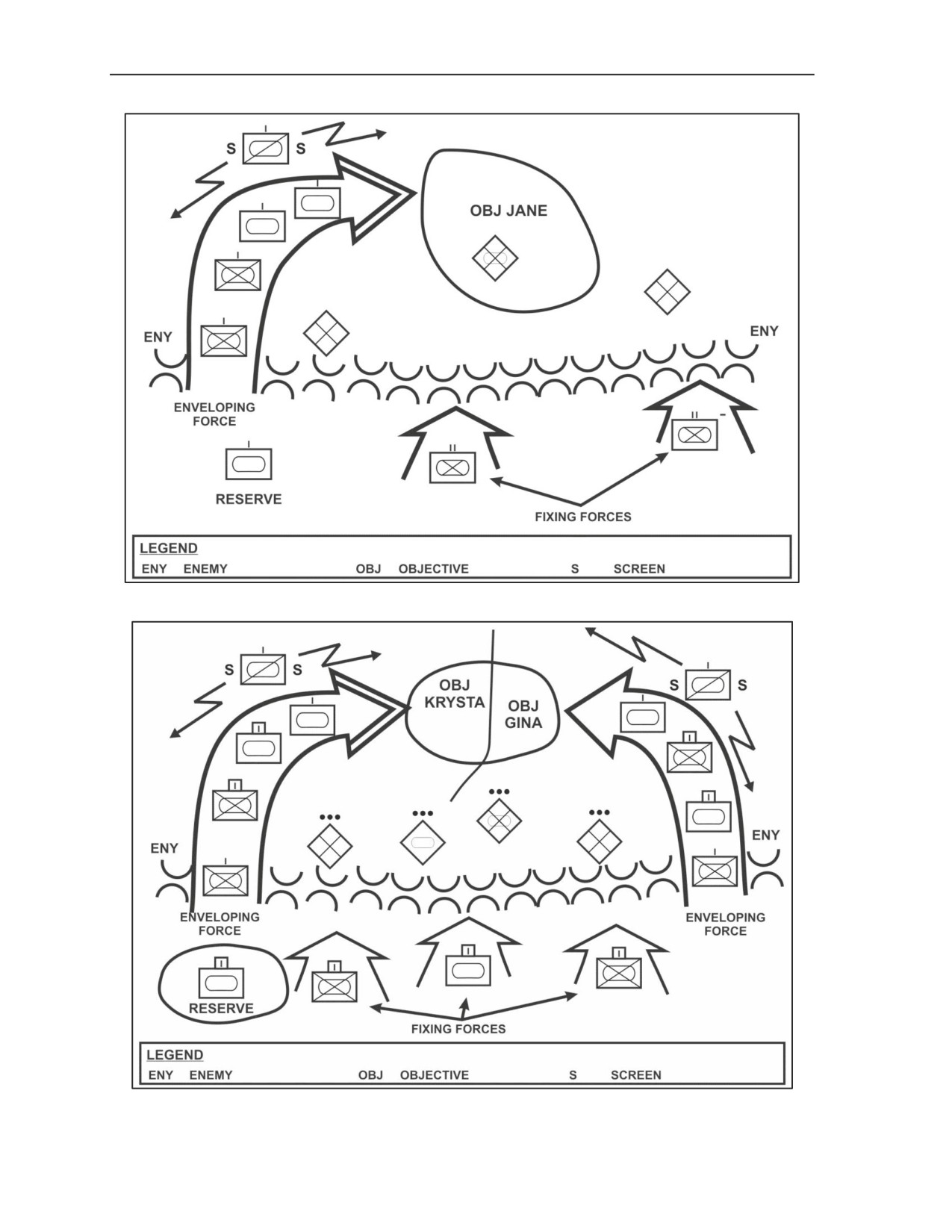
Chapter 6
Figure 6-1. Single envelopment
Figure 6-2. Double envelopment
6-18
FM 3-96
2FWREHU
Offense
ENCIRCLEMENT OPERATIONS
6-97. Encirclement operations are operations where one force loses its freedom of maneuver because an
opposing force is able to isolate it by controlling all ground lines of communication and reinforcement
(ADRP 3-90). The commander conducts offensive encirclements to isolate an enemy force. Typically,
encirclements result from penetrations and envelopments, or are extensions of exploitation and pursuit
operations. As such, encirclements are not a separate form of offensive operations but an extension of an
ongoing operation. Encirclements may be planned sequels or result from exploiting an unforeseen
opportunity. Encirclements usually result from the linkup of two encircling arms conducting a double
envelopment. However, encirclements can occur in situations where the attacking commander uses a major
obstacle, such as a shoreline, as a second encircling force. Although a commander may designate terrain
objectives in an encirclement, isolating and defeating enemy forces are the primary goals. Ideally, an
encirclement results in the surrender of the encircled force. An encirclement operation minimizes friendly
force losses and resource expenditures.
6-98. An encirclement operation usually has at least two phases—the actual encirclement and the action
taken against the isolated enemy. The commander considers adjusting subordinate units’ task organizations
between phases to maximize unit effectiveness in each phase. The first phase is the actual encirclement that
isolates the enemy force. The organization of forces for an encirclement is similar to that of a movement to
contact or an envelopment. The commander executing an encirclement operation organizes encircling forces
into a direct pressure force and one or more encircling arms. (See figure 6-3.)
6-99. The commander organizes an inner encircling arm only if there is no possibility of the encircled forces
receiving relief from enemy forces outside the encirclement. The commander organizes both inner and outer
encircling arms if there is any danger of an enemy relief force reaching the encircled enemy force. The
commander assigns the outer encircling arm a security mission, an offensive mission to drive away any
enemy relief force, or a defensive mission to prevent the enemy relief force from making contact with the
encircled enemy force. Once the encirclement is complete, these inner or outer encircling arms form a
perimeter. (Refer to FM 3-90-2 for additional information.)
2FWREHU
FM 3-96
6-19
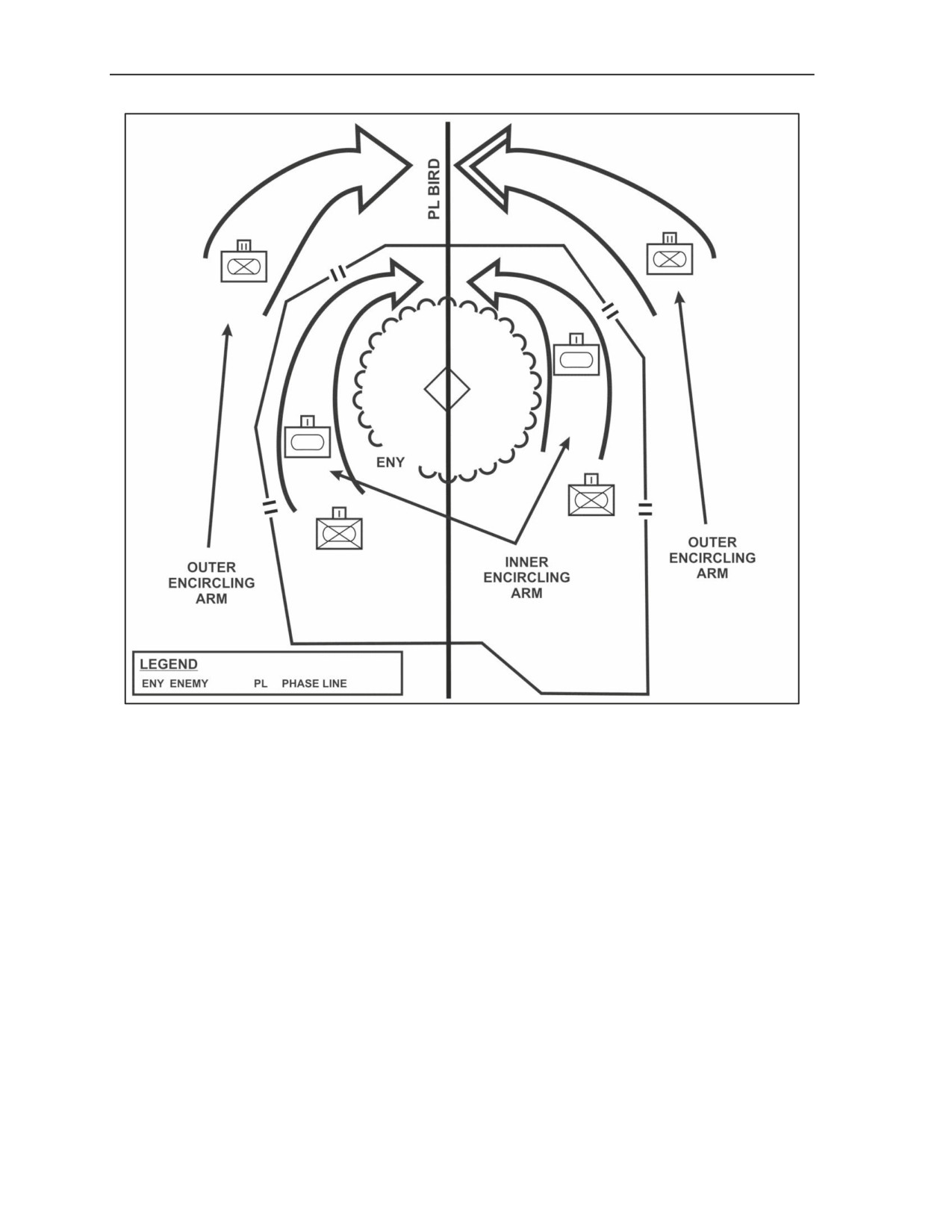
Chapter 6
Figure 6-3. Encirclement operations
VERTICAL ENVELOPMENT
6-100. Vertical envelopment is a tactical maneuver in which troops that are air-dropped, air-landed, or
inserted via air assault, attack the rear and flanks of a force, in effect cutting off or encircling the force (JP
3-18). A vertical envelopment, airborne assault and/or air assault (see figure 6-4), allows the commander to
threaten the enemy’s rear areas causing the enemy to divert combat elements to protect key terrain, vital bases
or installations, and lines of communications. An airborne assault is the use of airborne forces to parachute
into an objective area to attack and eliminate armed resistance and secure designated objectives (JP 3-18).
An air assault is the movement of friendly assault forces by rotary-wing aircraft to engage and destroy enemy
forces or to seize and hold key terrain (JP 3-18). Vertical envelopment allows the commander to—
z
Overcome distances quickly, overfly barriers, and bypass enemy defenses.
z
Extend the area over which the commander can exert influence.
z
Disperse reserve forces widely for survivability reasons while maintaining their capability for
effective and rapid response.
z
Exploit combat power by increasing tactical mobility.
6-101. Entry operations, airborne operation and/or air assault operation, occupy advantageous ground to
shape the operational area and accelerate the momentum of the engagement. An airborne operation is an
operation involving the air movement into an objective area of combat forces and their logistic support for
execution of a tactical, operational, or strategic mission (JP 3-18). An air assault operation is an operation
6-20
FM 3-96
2FWREHU
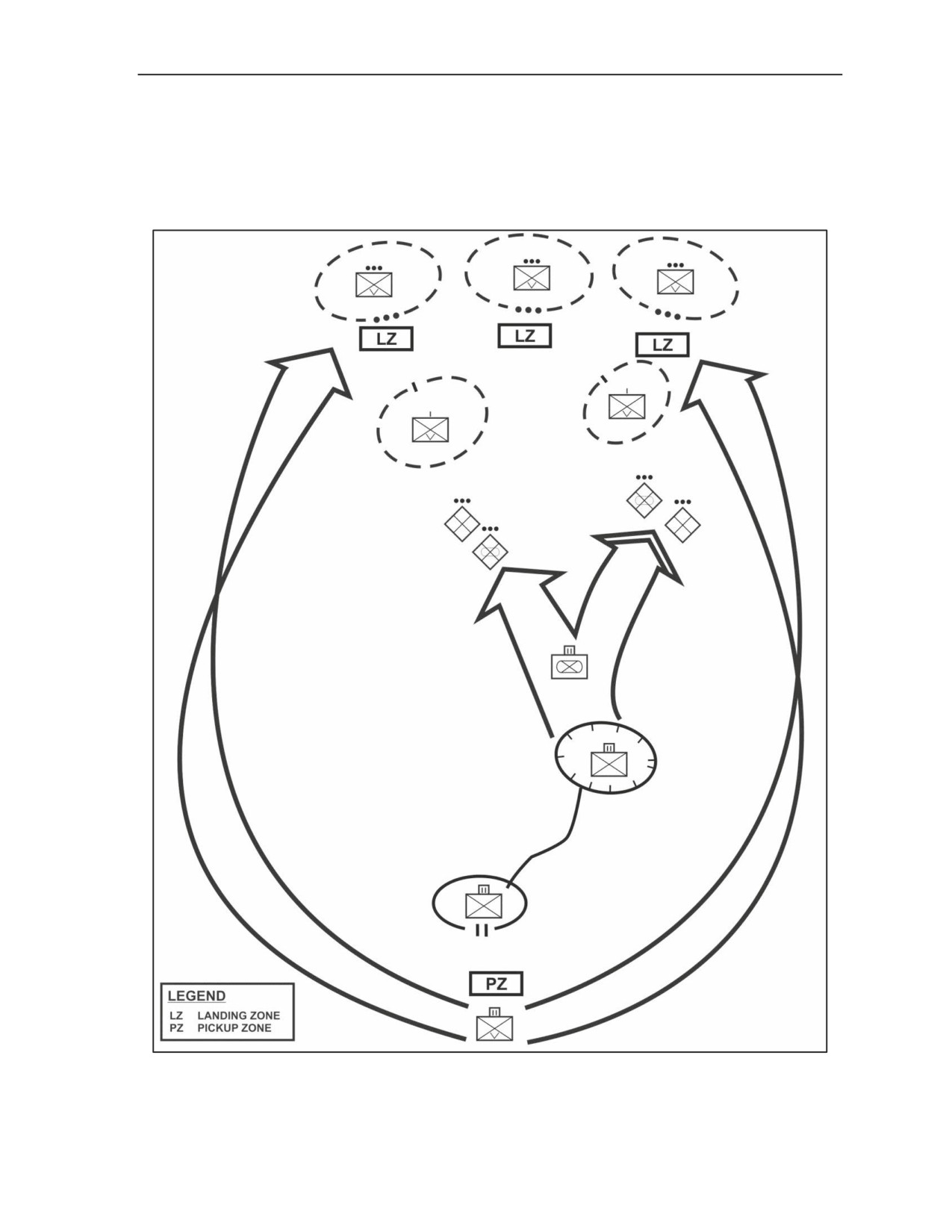
Offense
in which assault forces, using the mobility of rotary-wing assets and the total integration of available
firepower, maneuver under the control of a ground or air maneuver commander to engage enemy forces or
to seize and hold key terrain (JP 3-18). An enemy may or may not be in a position to oppose the maneuver.
While the commander should attempt to achieve an unopposed landing when conducting a vertical
envelopment, the assault force must prepare for the presence of opposition. (Refer to FM 3-99 for
additional information.)
Figure 6-4. Vertical envelopment (example air assault)
2FWREHU
FM 3-96
6-21
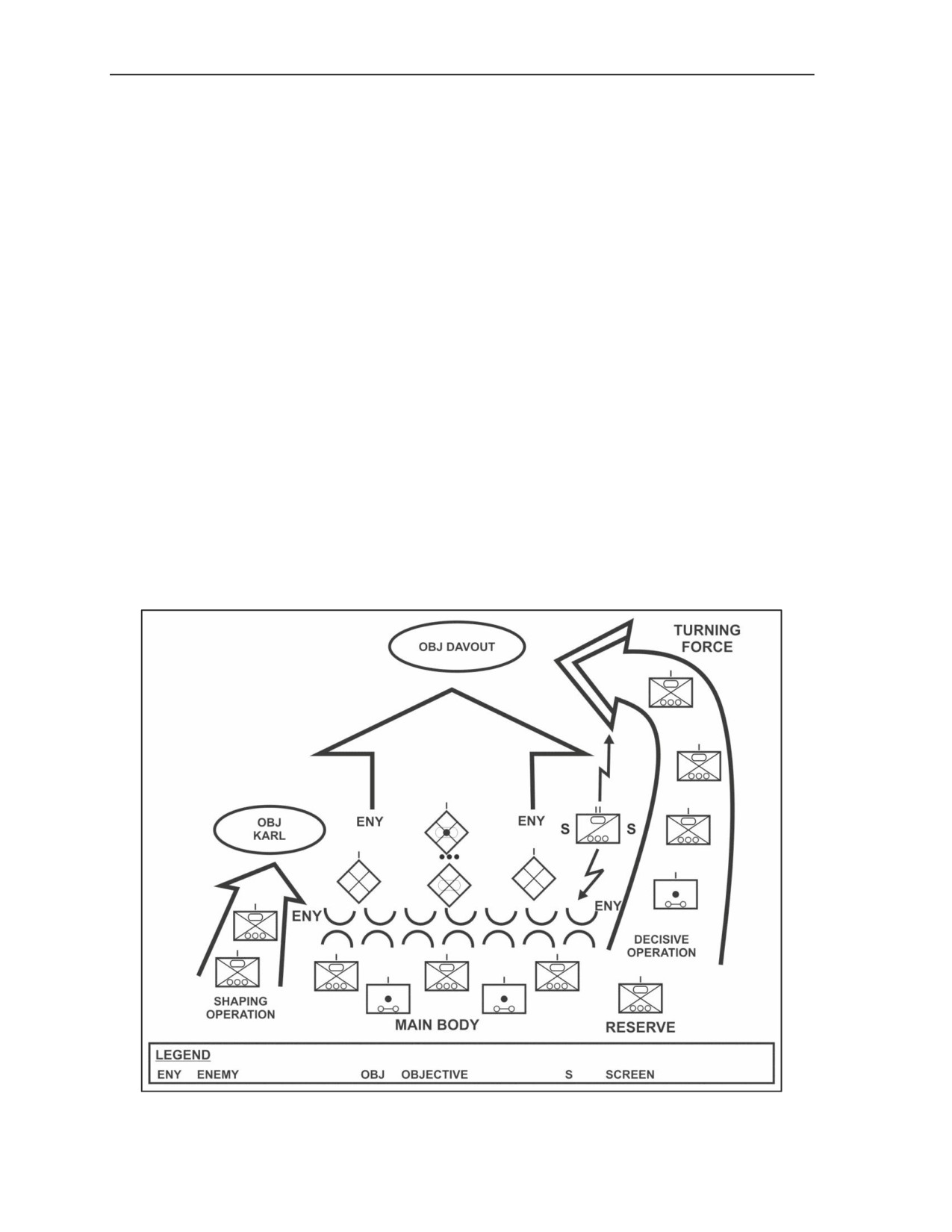
Chapter 6
TURNING MOVEMENT
6-102. A turning movement (see figure 6-5) is a form of maneuver in which the attacking force seeks to
avoid the enemy's principle defensive positions by seizing objectives behind the enemy’s current positions
thereby causing the enemy force to move out of their current positions or divert major forces to meet the
threat (FM 3-90-1). A turning movement differs from an envelopment in that the turning movement force
seeks to make the enemy displace from his current locations, whereas an enveloping force seeks to engage
the enemy in his current location from an unexpected direction. A turning movement is particularly suited
when forces possess a high degree of tactical mobility. Commanders frequently use a turning movement to
transition from an attack to an exploitation or pursuit.
6-103. The BCT commander organizes his forces into a turning force, a main body, and a reserve. Either
the turning force or the main body can conduct the decisive operation based on the situation. Normally, a
turning force conducts the majority of its operations outside of the main body’s supporting range and
distance; therefore, the turning force must contain sufficient combat power and sustainment capabilities to
operate independently of the main body for a specific period. The turning force seizes vital areas to the
enemy's rear before the main enemy force can withdraw or receive support or reinforcements. The maneuver
of the turning force causes the enemy to leave his position.
6-104. The commander organizes the main body so the turning force is successful. The main body conducts
operations, such as attacks to divert the enemy's attention away from the area where the turning force
maneuvers. The main body can be the decisive or shaping operation. The commander organizes his reserve
to exploit success of the turning force or the main body. The reserve also provides the commander with the
flexibility to counter unexpected enemy actions.
6-105. The BCT commander establishes boundaries to designate the area of operations for each force
participating in the turning movement. The commander designates control measures, such as phase lines,
contact points, objectives, limit of advance, and appropriate fire support coordination measures to
synchronize the operation. (Refer to FM 3-90-1 for additional information.)
Figure 6-5. Turning movement
6-22
FM 3-96
2FWREHU
Offense
INFILTRATION
6-106. An infiltration is a form of maneuver in which an attacking force conducts undetected movement
through or into an area occupied by enemy forces to occupy a position of advantage behind those enemy
positions while exposing only small elements to enemy defensive fires (FM 3-90-1). Infiltration occurs by
land, water, air, or a combination of means. Moving undetected by enemy forces is paramount to success.
Moving and assembling forces covertly through enemy positions takes a considerable amount of time. Limits
on the size and strength of an infiltrating force mean that the force can rarely defeat an enemy force alone.
Commanders use infiltration to support other forms of maneuver.
6-107. The infiltrating force's size, strength, and composition are limited usually. The infiltrating unit
commander organizes his main body into one or more infiltrating elements. The largest element that is
compatible with the requirement for stealth and ease of movement conducts the infiltration. This increases
the commander's control, speeds the execution of the infiltration, and provides responsive combat power.
The exact size and number of infiltrating elements are situation dependent. The commander considers the
following factors when determining how to organize his forces. Smaller infiltrating elements are not as easy
to detect and can get through smaller defensive gaps. Even the detection of one or two small elements by the
enemy does not prevent the unit from accomplishing its mission in most cases. Larger infiltrating elements
are easier to detect and their discovery is more apt to endanger the success of the mission. In addition, larger
elements require larger gaps to move through as opposed to smaller elements. A unit with many smaller
infiltrating elements requires more time to complete the infiltration and needs more linkup points than a
similar size unit that has only a few infiltrating elements. Many infiltrating elements are harder to control
than fewer, larger elements. The commander may establish security forces that move ahead of, to the flanks
of, and/or to the rear of each infiltrating element's main body to provide early warning, reaction time, and
maneuver space. The sizes and orientations of security elements are situation dependent. Each infiltrating
element is responsible for its own reconnaissance effort, if required. Sustainment of an infiltrating force
normally depends on the force's basic load of supplies and medical and maintenance assets accompanying
the infiltrating force. After completing the mission, the commander reopens lines of communication to
conduct normal sustainment operations.
6-108. The commander establishes boundaries to designate the area of operations for the unit(s) conducting
the infiltration. (See figure 6-6, page 6-24.) The commander also designates additional control measures as
necessary to synchronize the operations of his subordinates. Additional control measures include one or more
infiltration lanes, a line of departure or points of departure, movement routes, linkup or rally points, assault
positions, objectives, and a limit of advance. (Refer to FM 3-90-1 for additional information.)
2FWREHU
FM 3-96
6-23
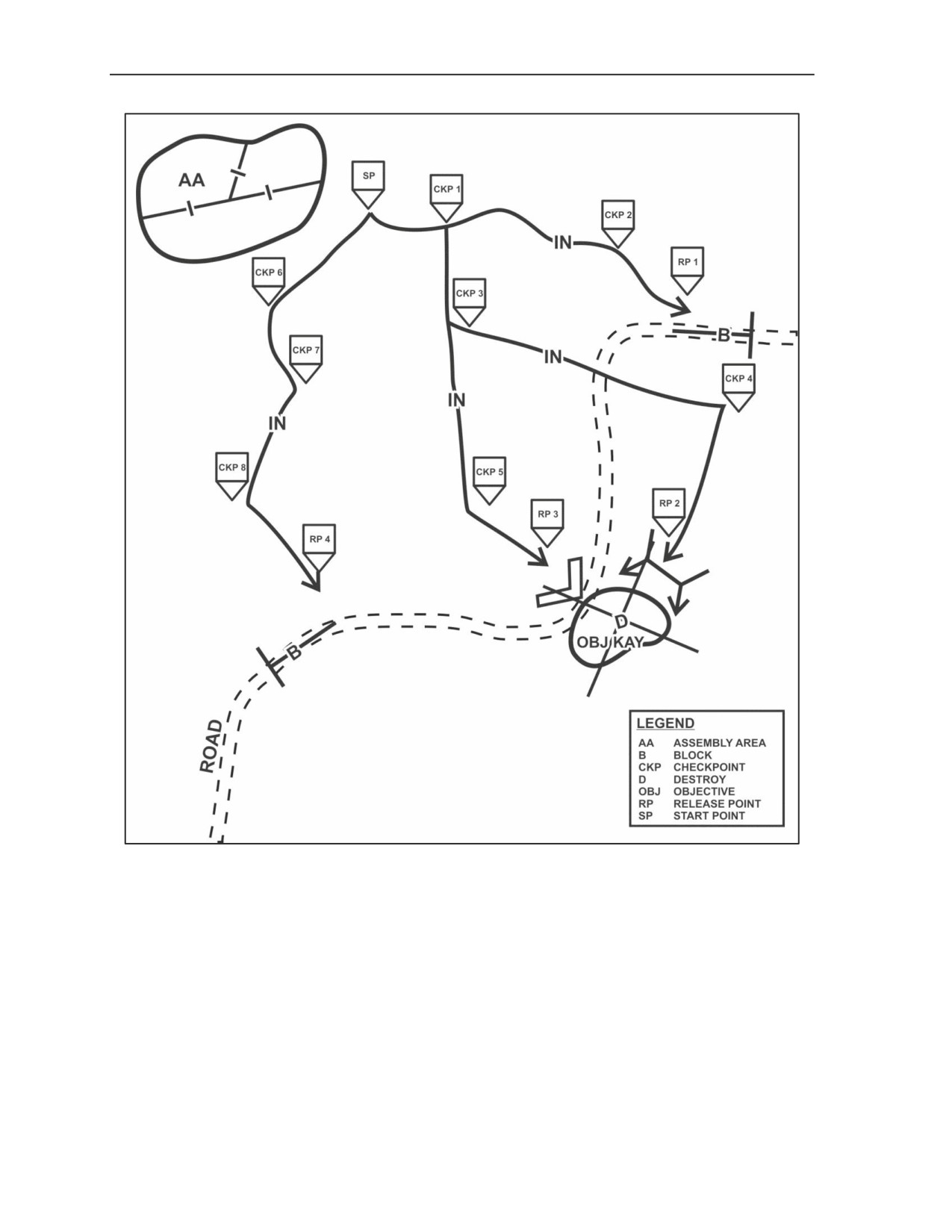
Chapter 6
Figure 6-6. Infiltration
PENETRATION
6-109. A penetration is a form of maneuver in which an attacking force seeks to rupture enemy defenses
on a narrow front to disrupt the defensive system (FM 3-90-1). Destroying the continuity of the enemy’s
defense causes the enemy's isolation and defeat in detail. The penetration extends from the enemy's security
area through his main defensive positions and the rear area. A commander executes a penetration when time
pressures do not permit an envelopment, there is no assailable flank, enemy defenses are overextended, and
weak spots are detected in the enemy's positions through reconnaissance operations.
6-110. Penetrating a well-organized position requires massing overwhelming combat power at the point of
penetration and combat superiority to continue the momentum of the attack. The BCT commander designates
a breach force, support force, assault force, and a reserve. He can designate these elements for each defensive
position that he is required to penetrate. He assigns additional units follow-and-support or follow-and-assume
6-24
FM 3-96
2FWREHU
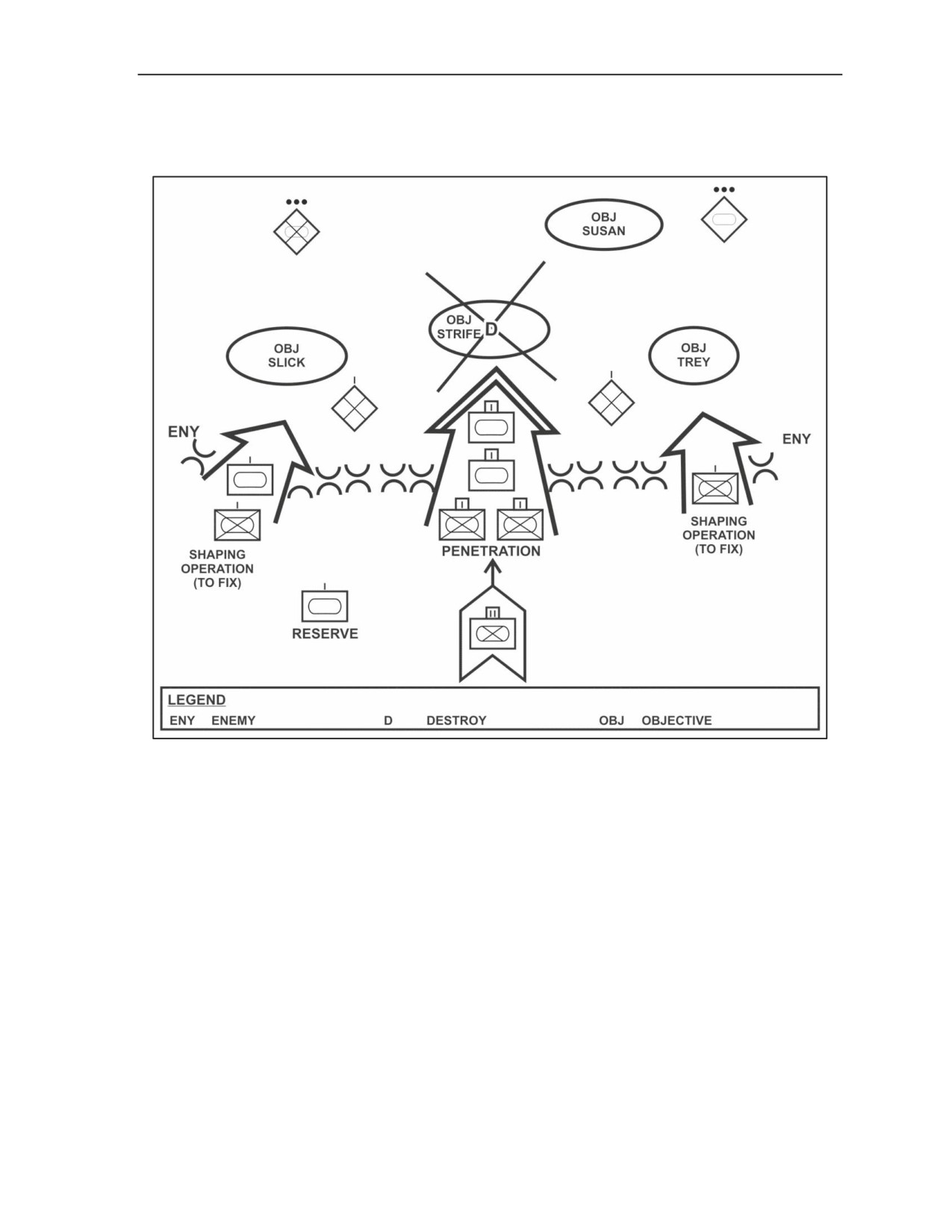
Offense
missions to ensure rapid exploitation of initial success. The commander designates forces to fix enemy
reserves in their current locations and isolate enemy forces within the area selected for penetration. (See
figure 6-7.)
Figure 6-7. Penetration
6-111. The commander assigns, as a minimum, an area of operation to every maneuver unit, a line of
departure or a line of contact, a time of the attack or a time of assault, a phase line, an objective, and a limit
of advance to control and synchronize the attack. (See figure 6-8, page 6-26.) The commander can use a
battle handover line instead of a limit of advance if he knows where he would like to commit a
follow-and-assume force. The commander designates the limit of advance beyond the enemy's main
defensive position. If the operation results in opportunities to exploit success and pursue a beaten enemy, the
commander adjusts existing boundaries to accommodate the new situation. (Refer to FM 3-90-1 for additional
information.)
2FWREHU
FM 3-96
6-25